First Lecture. SETTLEMENTS IN LAKE ZÜRICH, WESTERN SWITZERLAND AND FRANCE. (continued 3)
Reading edition
Station du Roselet was the first discovered in this lake, but it has yielded only a few relics, among which are fragments of pottery, some fine spindle-whorls, a hatchet of serpentine, and a bronze bracelet.
Chatillon was in a depth of 8 to 13 feet, and among its relics are a socketed knife and a couple of bracelets (No. 4).
The settlement at Vieugy was discovered in 1868, and the most important objects from it are a bronze hatchet of the flat type (No. 1), some stone moulds, and a few rubbers. (B. 315.)
LAKES OF AIGUEBELLETTE AND THUILLE.
M. Troyon reported the existence of piles at two places in the Lake Aiguebellette, and one in Lake Thuille; but of these I find no further records. (B. 31.)
LAKE CLAIRVAUX (FRANCE).
The Lake of Clairvaux is situated on the first rising plateau of the Jura mountains, not far from the town of Lons-le-Saulnier, and covers an area of about 200 acres. At its north-west extremity there is a tongue of land projecting into the lake called La Motte-aux-Magnins, which is believed to have been an island in former times, but is now continuous with a tract of marshy ground which extends between the Motte and the town of Clairvaux.
It has been recorded that at various times prior to 1870 diverse antiquities were found in the course of drainage operations in this marshy ground, such as horn implements, stone axes of flint and jade, boars' tusks, bits of pottery, bronze celts, a fibula, and an armilla; also Gallo-Roman remains, including a Gaulish gold coin and Roman coins. In the lake itself there were no discoveries made, with the exception of a group of five piles known to fishermen. But none of these discoveries had ever suggested to any one the idea of a lake-dwelling, the common and accepted opinion being that they were remains of Druidical times and customs.
On the 27th of June, 1870, when the water was about its lowest, Mr. Le Mire happened to be walking on the shore and accidentally stumbled on the top of a black pile of oak. His attention being thus directed to such a curious object, he looked about and detected many others just protruding from the lake-bottom. He then determined to investigate the matter, and at once employed some labourers to make excavations. The place selected was 100 yards to the west of the Motte-aux-Magnins, and 25 yards to the east of the canal which forms the outlet of the lake. Trenches were dug about 1 yard in width and the same in depth (a greater depth being prevented by the oozing up of water). During these operations piles were abundantly met with, but no relics were found, and it was remarked that there was no change in the stuff thrown up from the trenches, it being the ordinary whitish deposits similar to what is seen on the present surface of the strand. The piles were of oak, fir, yew, poplar, willow, and hazel, and measured from 4 to 6 inches in diameter.
Mr. Le Mire then shifted his operations to the south side of the Motte-aux-Magnins, and after passing through 6 to 8 inches of the whitish surface deposits he came upon a blackish peaty layer containing roots of water-plants and other organic débris, which turned out to be the veritable relic-bed of the lake-dwellers.
Here he continued the excavations for about three weeks with a couple of workmen, and in this way an area of about 120 square yards was examined, which he thinks was not more than a twentieth part of the total site of the lake-dwelling. The piles did not reach the surface, but they were met with abundantly, no less than 150 being counted in the space examined. The breaking-out of the war put a stop to these excavations, and the subsequent return of the water to its ordinary level prevented their renewal.
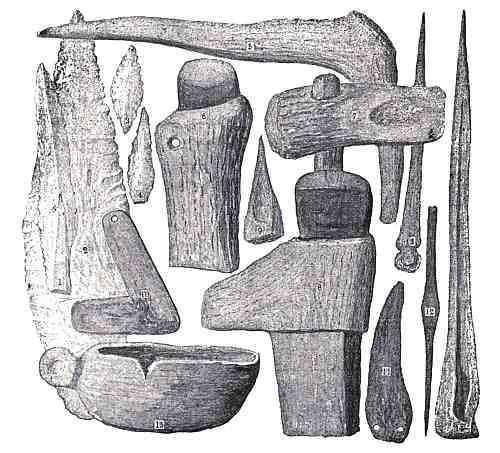
Fig. 23.—Clairvaux. Nos. 5, 7, and 15 = 1⁄4, the rest = 1⁄2 real size.
Mr. Le Mire has published an illustrated report of his investigations (B. 219), from which these notes are taken, but the accompanying illustrations (Fig. 23) are from a selection of objects exhibited in the anthropological section of the Paris International Exposition of 1889. In this collection I note that there are a few relics, such as the two bronze objects, to which Mr. Le Mire does not refer in his report; probably these may have been found since its publication.
Among the relics staghorn implements take a prominent place. Handles and fixers for stone weapons amounted to 49, and the two here illustrated (of five exhibited in Paris) still retain their celts (Nos. 6 and 8). There are several perforated horn hammers, one of which (No. 7) retained portion of its wooden handle when found; another is a foot long, and the perforation is nearer the burr of the horn which forms the hammer-end. A tyne 11 inches long forms the handle to a small stone chisel. Another object (No. 5) is a unicum of its kind. It is a chisel of horn formed from the tyne, with the body of the horn forming a neatly-polished handle.
The polished daggers or pointers are also finely made, and almost remind one of those at Laibach. Twenty-six were exhibited in Paris, three of which are here represented, including the largest and smallest (Nos. 9, 13, and 14).
About a dozen triangular or leaf-shaped arrow-points, and one or two spear-heads of flint. Of the latter, one (No. 2) is remarkable for its size and elegant workmanship.
Wooden dishes formed out of the solid, all having a round base, were collected to the number of 15, and some large globular pieces of wood were supposed to be the primary stage of their manufacture. One dish figured by Le Mire is here reproduced, and shows a neat handle (No. 15). There were also wooden mallets perforated for a handle. Three bits of a bow, one showing the tip with a notch for the string. An axle-tree for a waggon Le Mire considers interesting, as showing a knowledge and use of traction by wheels.
Besides a few stone celts and chisels, most of which were still in their horn handles, there were a few flint knives (No. 1), three sharpening stones, two curious and novel objects of polished stone, one of which is illustrated (No. 10).
The pottery includes 140 fragments of dishes, showing various forms of handles and linear ornamentation.
Of bronze there are just two objects, a small awl or chisel and a much-worn dagger (Nos. 11 and 12).
Animal bones collected to the amount of 150 kilogrammes were not reported on by a skilled person; but, according to Le Mire, they belonged chiefly to the ox, stag, boar and pig; among them was a fine specimen of a bear's skull. Among other organic remains were a few grains of wheat and acorns.
MARSH DWELLING IN THE TOWN OF BORDEAUX.
In 1867 Mr. Delfortrie (B. 136) published a notice of prehistoric antiquities of the Neolithic Age found in the course of excavations for the improvement of the town of Bordeaux, which point to the existence of some kind of marsh dwelling in the very centre of the town. Attention was first directed to the matter by the quantity of bones thrown up from the lower part of the excavations, among which Delfortrie detected some worked ones, and associated with them were various stone and flint implements.
In regard to the osseous remains, he observes that the lower jaws of ruminants, which were relatively in great abundance, had their incisor teeth purposely removed, but the molars were retained. On the other hand, the upper jaws were entirely absent or broken, like all other marrow bones.
At three different points forming an almost equilateral triangle of 200 mètres the side, he procured sections of these street cuttings, in all of which the succession of strata and relics indicated similar conditions. At one point he gives the following details of a section:—
Mètres.
A. Earth and subsoil }
B. Terramare of Gallo-Roman period } 4·
C. Marine bed with shells ·10
D. Sandy peat ·50
E. Bed of ashes with oyster shells, worked bones, etc. ·50
F. Lacustrine sand ·45
G. Black peat with sand and gravel 1·55
7·10
The bones represented the following animals:—Great ox, smaller ox, stag, pig, wild boar, horse (a small kind), goat, sheep, and dog. Mr. Delfortrie thinks the bones of the horse show that the animal was not domesticated. No piles were discovered except in the Gallo-Roman period. The following shells were found in the marine bed C.:—Ostrea edulis, Pecten maximus, Mytilus edulis, Venus decussata, Cardium edule, Mactrea solida, Turbo neritoides, and Trochus cinerarius.
The relics were found chiefly in bed E., among the ashes, a few being from the sandy peat above it. These consist of pointers, needles, polishers, spatulæ, arrow-points, and an implement of bone called a whistle; flint saws, a polished celt also of flint, three small polished stone celts of serpentine or quartzite, and about a dozen flint knives.
The opinion of the narrator is that there was here a marsh dwelling of the nature of the Kökkenmödings of Denmark which in point of time preceded the Swiss lake-dwellings, but was posterior to the Reindeer Period of Central France.
In my opinion, the character and finish of the relics furnish no grounds for supposing that this habitation was prior to the early Swiss lake-dwellings; nor are we warranted, from such limited explorations as could be made in the streets of a town, to exclude the more probable idea that this was an ordinary palafitte, notwithstanding that piles were not observed.