Third Lecture. LAKE-DWELLINGS AND PILE-STRUCTURES IN ITALY. (continued 2)
Reading edition
A perpendicular section, which can be readily obtained at various points, presents the following succession of layers from above downwards:—
1. Ordinary mould or disturbed soil for a depth of 6 feet, said to contain Roman and more recent remains.
2. The terramara beds proper, arranged in thin, wavy laminations of variously-coloured earths. Sometimes a thickish bed of clay or a black band of charcoal catches the eye; in another place an overlapped bed is seen to shelve out and disappear altogether. But, notwithstanding a wavy or undulating appearance, the general horizontality of these layers is maintained. Their average total thickness amounts to 8 feet.
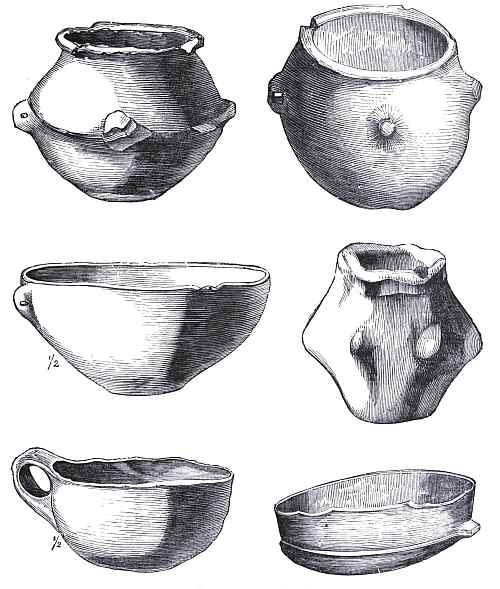
Fig. 68a—Pottery from the Terremare.
3. Underneath these beds lies a blackish peaty substance, some 3 feet thick, in which, as already mentioned, Strobel detected the remains of a palafitte.
Below this peaty stratum there is a greenish clayey deposit, similar in composition to that found at some depth in the surrounding plain, into which the piles were driven.
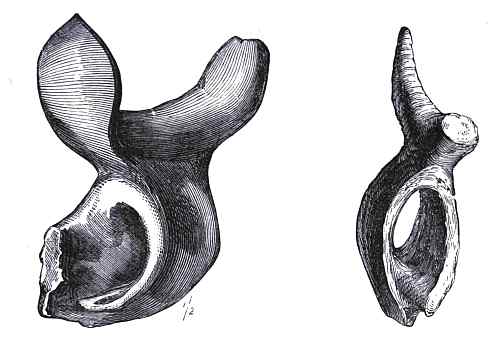
Fig. 68b.—Anse Lunate or Cornute from the Terremare.
Strobel's discovery caused much speculative interest, especially when correlated with the researches initiated by Gastaldi regarding lake-and pile-dwellings, the existence of which in Italy had just been demonstrated at Mercurago and Lake Garda.
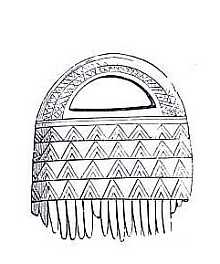
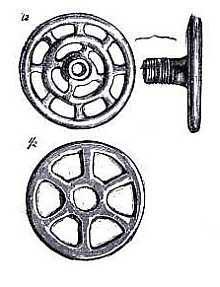
Fig. 69.—Bone Comb(1⁄2) from Vico-Fertile. Fig. 70.—Bone Wheels from Campeggine.
Reflecting on these novel revelations and impelled, no doubt, by the growing interest in such studies, Strobel and Pigorini, both then residing at Parma, commenced a series of observations and inquiries regarding the terremare in their vicinity, the outcome of which was a joint report, first published in 1862 as part of Gastaldi's well-known article, "Nuovi cenni sugli oggetti di alta antichità trovati nelle torbiere e nelle mariniere dell' Italia." (B. 52.)
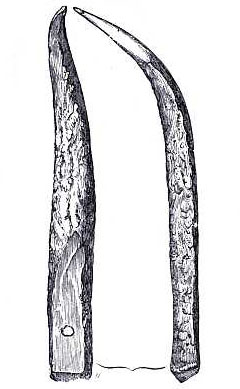
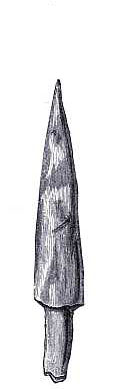
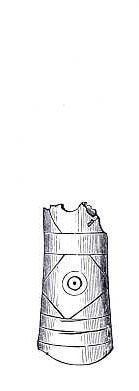
Fig. 71.—Horn implement. Both from Fig. 72.—Bone (1⁄2) Campeggine. Fig. 73.—Portion of a Bone Handle from Castione (1⁄2).
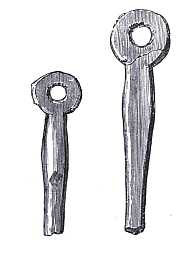
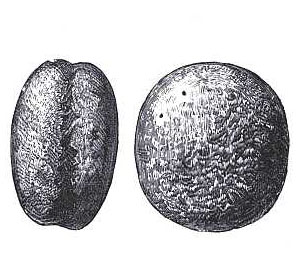
Fig. 74.—Two Bone objects from Campeggine (1⁄1). Fig. 75.—Discoidal Stone from Campeggine (1⁄2).
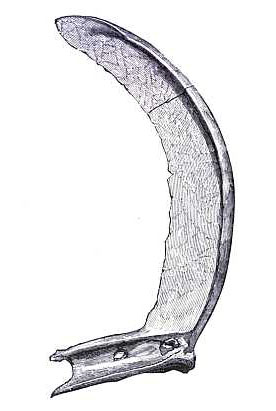
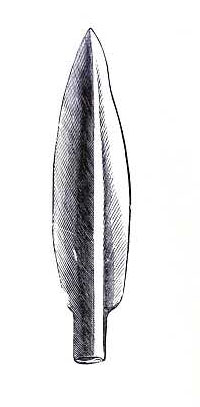
Fig. 76.—Bronze Sickle from Campeggine (1⁄2). Fig. 77.—Bronze Spear-head from Bargone di Salso (1⁄2).
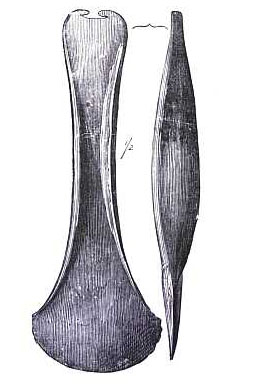
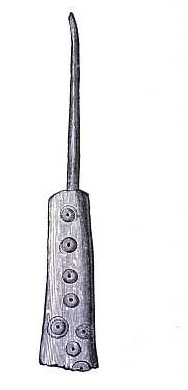
Fig. 78.—Bronze Celt from Castellazzo. Fig. 79.—Bronze Awl with bone handle, from Campeggine (1⁄2).
In this report the authors discussed the works of man found in the marl-beds under the following five heads—viz. habitations, vessels, utensils, arms, and things of uncertain use. The pottery they recognised as having degrees of quality according to the uses to which the vessels were put. The larger vases were roughly kneaded, the grains of sand were larger and more visible, and the colour of the paste was ash-black inside and reddish outside. They had no glaze. The smaller dishes were made of fine homogeneous paste, with very thin walls, smooth surface, and a blackish surface approaching to varnish. According to their form they might be divided into a great many varieties, as plates, cups, basins, bottles, vases, etc. (Fig. 68a). In the makers of this pottery the authors recognised an inclination to vary their handiworks, and this was especially manifested in the various forms and different embellishments of the handles, called appendiculati, which turned up in large quantities. These were ordinary handles with an addition on the top, either in the form of an upright button-like process or transverse bar. To the latter the greatest interest was attached, as the ends of the bars were bent in a variety of ways so as to assume the form of ears or horns as in Fig. 68b.
Among the utensils they distinguished a variety of industrial objects such as needles, pins, ornamented combs, small wheels, handles, etc., made of bone or horn (Figs. 69 to 74). Of stone there were numbers of rubbers, corn-grinders, and grooved spheroidal stones (Fig. 75), but very few hatchets and chisels.
Of bronze they found sickles (Fig. 76), spear-heads (Fig. 77), flat celts (Fig. 78), awls (Fig. 79), chisels, pins, etc.
Among the objects of uncertain use were classified a series of spindle-whorls of different forms (Fig. 80).
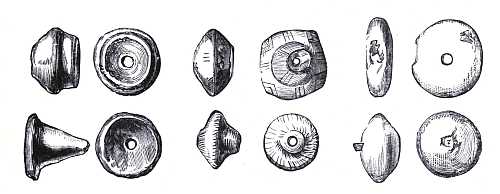
Fig. 80.—Various forms of Spindle-whorls or Beads (1⁄2) from Campeggine.
From the existence of metal slag and stone moulds (Fig. 81) the authors inferred that the terramaricoli knew the art of founding in metals.
Professor Strobel gave also a minute description of the bones and other organic remains, to which I shall afterwards refer when treating of his subsequent investigations in this wide and important field of research.
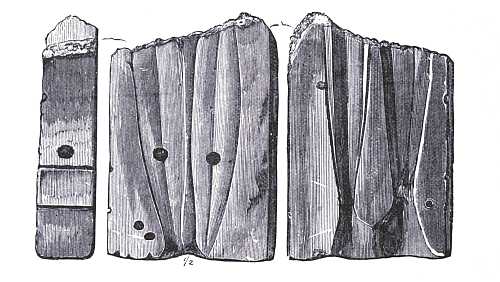
Fig. 81.—Stone Mould from Castelnuovo.
In summing up, the authors used the following words:—
"As to the first origin of the marl-earths, it is clear that the banquets, as you assert, are a considerable part; but there seems to us to appear in the scoriæ, the millstones, the heaps of grain, the palisades, the potsherds, already cited, together with the arms and utensils of all sorts which are found in these earths, something more than a mere meeting-place to banquet. It seems to us, if we do not err, that there is something of settlement and duration. Man did not meet there only to arrange and devour the feast, but to employ himself besides in domestic avocations, in preparing implements and arms, to sew garments, and make nets—in a word, to inhabit them; besides, to exercise the practices of their religious worship, and, perhaps, also to burn their dead, and all these after the fashion of barbarians, such as the people of the marl-beds must have been. These people, according to the place and time, were fishermen, hunters, shepherds, and even agriculturists." (B. 91, p. 83.)
These words contain the most important feature of this report. The authors, though not absolutely free from the previous notions that floods and inundations had something to do with the stratification of the débris, distinctly recognise that the terremare must be considered as the remains of the habitations of the living, and not, as hitherto supposed, the resting-places of the dead.
Interest in the whole subject now rapidly increased, and extended to agriculturists and local observers. Yearly excavations were carefully scanned and even special researches were carried on in the interests of science. Strobel, a professed naturalist with remarkably precise and accurate habits, devoted his great energies to the elucidation of the organic remains, especially the rich and varied products of the peaty bed (terra uliginosa) at Castione, in which the piles were detected. Pigorini, on the other hand, was an archæologist pure and simple, but endowed with great ability and much fertility in the correlation and generalisation of facts—qualities which have since gained him the chair of archæology at Rome, which he now fills with so much distinction. Thus associated these two men may be said to have developed a new school of archæology, especially anent the terremare, having as its primary and indispensable object the collection of authenticated data, without which, they asserted, no deductions however brilliant could be scientific.
In the course of researches conducted by Strobel at Castione, during the years 1862 and 1863, he observed that the piles were placed in a sort of basin, either natural or artificial; that they supported transverse beams over which clay floorings had been placed; and that they were more thickly set towards the margin, and slanting, as if to strengthen the inner superstructures. Moreover, he proved that the supposed peaty formation (terra uliginosa) had nothing in common with true peat, but was simply a subaqueous deposit of ordinary earth, associated with decomposed organic débris. Another terramara in Parma having similar characteristics to that at Castione was investigated in the following year by Pigorini, and thus the theory of an occasional palafitte converted into a land-dwelling seemed to them to be confirmed. Previous to this the stratification of the beds—one of the most remarkable features of these deposits—had not excited any unusual surprise, but now it began to be commented upon.
These and some other noteworthy observations here and there coming to light induced Strobel and Pigorini to issue a second report on the terremare of Parma. (B. 89.) But in this brochure, which appeared in 1864, there does not appear to be any striking departure from the views expressed by the authors in their previous report. They asserted that the people who constructed and inhabited these dwellings were a nomadic or agricultural race, belonging to the Bronze Age, and were probably allied to the Swiss lake-dwellers; and that their habitations varied in structural character according to the exigencies of the site chosen. No significance was attached to the piles at Castione and elsewhere, beyond supplying a proof that different methods of construction had been in use, the adoption of which depended on local conditions. The composition of the strata as "earthy beds, now ashy, now yellowish, now reddish or black," and their peculiarly wavy arrangement, were supposed to mark merely a variety.
The terremare now became a controversial focus between the adherents of the old and new schools. To the former Cavedoni, Coppi, and subsequently Crespellani, lent their influence; while the latter were reinforced by Boni, Canestrini, Calegari, and Chierici. Amongst all these, during the next few years, Chierici stood pre-eminent. Already an ardent collector of the antiquities of his native country, he found in the mysterious terremare a congenial field and a new outlet for his love of practical research. For minute observation and lucid exposition of the phenomena observed in explorations, Chierici had few superiors. To him must undoubtedly be assigned the next great contributions towards the elucidation of the terremare problem. Observing in several instances that an earthy dyke of a rectangular shape, with a ditch outside, surrounded the terramara mound, and that upright beams, or traces of them, were to be seen in all parts of the deposits, he suggested that these were normal features in their structure. Although some of his contemporary explorers had incidentally noticed piles in a stratum different from that in which their original discovery was made at Castione, and even recorded the fact (B. 407, p. 7), it remained to Chierici alone to interpret the true significance of the discovery. In support of the theory of universality of the palafitte system, he showed that in many cases the piles had entirely disappeared by decomposition, and that the only traces of their existence were the holes they had occupied. Some of these, indeed, had subsequently become filled up by infiltrated matter, so that on section they presented the appearance of inverted cones. On this point he relates that in one space measuring 210 square metres he counted no less than 124 "buche di pali." (B. 206, p. 9.)
It must be remembered that, previous to this, archæologists had no clear notion of the order or relative position of the products of different ages and races, and the same confusion extended to the terremare. For instance, at Castelnuovo, Chierici seemed puzzled at finding, underneath a Bronze Age terramara, indications of an older period. At Campeggine, on the other hand, objects of the early Iron Age appeared, but chiefly in the upper strata, while Etruscan remains had been recognised in several instances.
Another point to which Chierici's attention was directed was the frequency with which rectangular enclosures were disposed so as to have their four sides facing the cardinal points; and this orientation within certain limits, varying, it would seem, according to the direction of the sunrise when the settlement was founded, he considered also applicable to all the terramara villages. On this point see also Helbig. (B. 308.)
In his famous theory of the structure of the terramara villages (B. 206) Chierici conceived the idea that they had been constructed over artificial basins to which a running stream was made to flow so as to convert the bacino into a pool of water. This pool was surrounded by an earthen dyke inside of which a wooden platform was erected on piles and covered with a layer of clay. Huts were then erected over this platform at regular intervals, and the refuse from them was thrown, by means of holes here and there, into the space below. The water entering at one side of the enclosure made its exit at the opposite side. Thus the space below the platform was more or less occupied with water, and the débris thrown into it became arranged into sedimentary strata, and so continued to accumulate until the entire space was filled up. When the accumulation of débris reached this extent it became necessary to elevate their floorings, and this was done by repeating the same process at a higher level; and in this manner Chierici accounted for the successive platforms and palafittes which were to be met with in the terramara beds.
Thus in the hands of Chierici almost every feature of the terramara deposits excited fresh interest and an eagerness for further inquiries. Piles or their traces were found almost immediately in all the stations wherever they were carefully looked for. In 1872 Chierici and Mantovani explored two stations, one at Monte Venere and the other at Monte, in which were found not only the dyke surrounding the basin and palafitte, but, in one of them, three series of piles, one superimposed above the other, thus clearly showing that when the spaces around the piles and underneath the platform had got filled up with débris, a second palafitte had been resorted to, which in its turn had been succeeded by a third. (B. 233 and 247.) It was on all hands acknowledged that in many parts the peculiar stratification of the layers in certain beds could only be accounted for on the supposition that water had somehow to do with the sorting of their ingredients, as floating materials, such as bits of charcoal, were often eliminated and formed separate layers. So far Chierici's theory might be taken as offering a complete explanation of the phenomena. But the deposition of the higher portions of the mound remained to be accounted for, as it was difficult to conceive of pools of water at the requisite heights. A still more formidable objection was the impossibility of transporting water without the intervention of a system of hydraulics to sites placed on elevations far above the level of any adjacent streams, and of this class several had been known, as at Monte Venere, Roteglia, Castellaccio, etc. (B. 407, p. 9); yet, in most cases, they also contained the palafitte and dyke. This was the weakest part of the theory and found few supporters, but in other respects every additional discovery only tended to confirm it. Strobel, however, declined to believe in the universality of either dykes or palafittes. Thus, writing in 1874 (B. 267), he says: "At the conclusion of an article which I wrote in 1872 on shells of Unio found in the marière, etc., I asserted that the terremare, those prehistoric settlements, were terrestrial; that in some of them man lived in pile-dwellings on dry ground, in others he dwelt in tents or huts; and that in some of the terramara beds earthworks can be seen, which may have been used as dykes or bulwarks, and which in all probability were fortified with ditches." After showing how impossible it would be for the terramaricoli of Roteglia and Castellaccio to have pools of water at such an elevation as they had been, he goes on to say: "And here I may be permitted to raise my voice against those who imagine that prehistoric men, and more especially those of the marière, and of our terremare and pile-dwellings of the Bronze Age, always and everywhere followed constantly one uniform and invariable order in arranging their abodes, as if they were inferior to the animals, nay, even to the invertebrates, who modify their constructions according to circumstances. But, in fact, there is much less uniformity in these terremare than is often found in the dwellings of animals; therefore I maintain logically, that even prehistoric men changed their mode of living according to place, time, and circumstances; and that the terramaricoli did not live solely in pools of water, as some assert, but had settlements both in the water and on dry land, and that the terramara beds are the results of the latter. In some of the terrestrial settlements they probably had pile-dwellings, while in others they lived in huts or tents. Some at least of the land settlements were defended by dykes and ditches." (B. 119, 2nd ed., p. 402.)
Pigorini, on the other hand, looked favourably on the major portion of Chierici's generalisations, and in the course of explorations conducted by him at Casaroldo in 1874 (B. 266 and 297) he found everything not only in harmony with his views but some additional facts that seemed to strengthen that portion of his theory in which he maintained that the palafitte was the normal method adopted in the structure of the terremare, whatever the nature of the locality might be in which they were constructed. Thus at Casaroldo, although there was both a ditch and a dyke surrounding the basin containing the palafitte, it had no peaty understratum (terra uliginosa), as at Castione, but a substance precisely identical with the superimposed deposits. Here also there were traces of piles on a higher level.
Almost coincident with the publication of Chierici's theory of the terremare, in 1871, was the International Congress of Anthropology and Prehistoric Archæology at Bologna, which gave an immense impetus to such studies. Indeed, the decade which followed may be characterised as the Augustan age in the department of prehistoric archæology in Italy. The remarkable discoveries in the old cemeteries of Bologna, and in Etruscan tombs elsewhere in the Circumpadana district, together with the increasing number of prehistoric stations in lakes, turbaries, caverns, etc., greatly widened the field of research and added to the difficulty of deciphering, from amidst the endless overlappings of their remains, the history of the various civilisations which formerly characterised the country. In order to facilitate these studies the Bullettino Paletnologia Italiana was established at the commencement of 1875, under the joint editorship of Chierici, Pigorini, and Strobel. This periodical has done much good and is still in a flourishing condition.
SPECIAL INVESTIGATIONS AT CASTIONE.
Such was the general tenor of the opinions in regard to the terremare up to 1877, when, owing to the interest then taken in these singular remains and with the view of clearing up some of the contested points, the Minister of Public Instruction ordered a fresh excavation to be made at Castione under the superintendence of Professor Pigorini. The portion selected was an oblong space at the north side of the church, beginning at the margin and stretching inwards for a considerable distance. The result of this was the disclosure of a new and remarkable feature in its structural arrangement. At the inside of the earthen dyke, and intervening between it and a forest of piles which extended towards the interior, was a series of small rectangular enclosures constructed of horizontal beams laid one above the other. These enclosures, which extended side by side like a string of log-houses, formed an abrupt facing to the dyke. The beams were roughly hewn, and partially mortised into each other at the points of crossing, from which their ends projected irregularly, some even extending from one compartment to the next. Inside these log-houses there was nothing but rubbish—clay, gravel, bits of wood, etc.—packed firmly together. But it is needless to enter upon all the details of this curious structure; suffice it to say that Pigorini came to the conclusion that their purpose was to support the inside of the earthen dyke (contrafforte dell' argine). The piles were in rows about two feet apart, and each pile was separated from its neighbour by an interval of one foot. When the space was cleared there was quite a forest of these piles, and it is noteworthy that they were all inclined in one direction, viz. north-east, a fact which is well shown in the first of the two photographic illustrations here given (Fig. 82).
From an examination of the composition of the soil outside the limits of the station Pigorini ascertained that the bluish clay bed forming the subsoil of the terramara mound corresponded to what was the surface of the surrounding plain when the terramaricoli founded their settlement, and that the thick mass of alluvial yellowish clay in which the mound is now partially buried has been subsequently deposited.
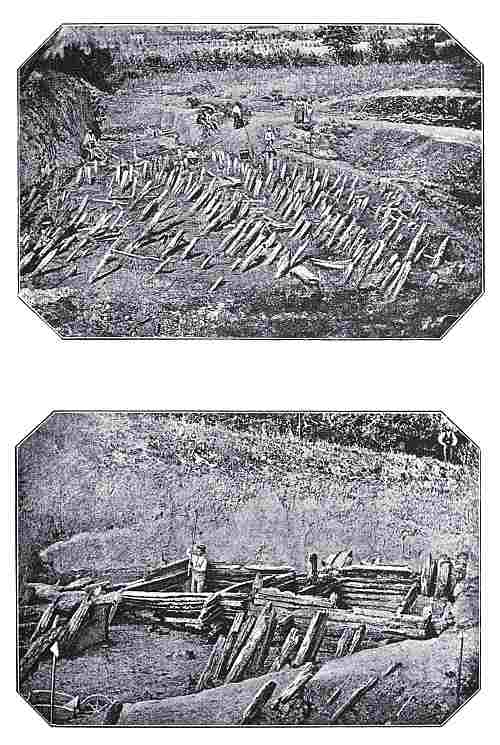
Fig. 82.—Two Views of the Piles and Woodwork exposed at Castione during the special excavations conducted by Prof. Pigorini in 1877.
Other interesting details are given in Pigorini's exhaustive and admirable report regarding the structure of the ditch, dyke, platforms, hearths, etc., and the peculiarity and composition of the strata. But these the limits at my disposal in this work compel me to pass over, and I must be content with quoting the following summary of his conclusions in regard to the origin of the station:—
"The terramaricoli having arrived at the place now called Castione dei Marchesi did not select for their encampment a low-lying spot subject to inundations, but the top of a slight elevation of bluish clay not yet covered with the more recent alluvial deposits. The space measured out for the station was of a rectangular shape and covered about a couple of acres. This area they surrounded with a ditch, the excavated soil being thrown to the inside and so they formed a dyke 6 feet in height, which consequently enclosed a bacino having its base on the original soil of the plain. The area thus defined had an orientated position with a deviation of 30° from east to north.
"Having completed the surrounding ditch and dyke, the next step was to construct along the inner margin of the dyke a series of log-houses, bound together and filled with débris, over which they finally laid a gravel pavement. The main object of this elaborate structure was to support the earthen dyke. Next they planted all over the bacino rows of piles at regular intervals, whose tops reached to the level of the surface of the contrafforte, and over them they laid horizontal planks of wood which, in certain places, were covered with beds of clay (tavole coperte d'argilla).
"On this platform were constructed the huts of the people. The exact form of these huts has not been ascertained, but they were certainly made of wood, straw and clay, no other material having been used either at Castione or any other terramara. The village was now complete, and the inhabitants, in the course of their domestic avocations, threw the refuse of food and other débris into the space below, probably by means of holes, which gradually accumulated until the space became completely filled up.
"When this stage was reached the people did not change their chosen site, but proceeded to erect a new palafitte above the old one. They elevated the dyke by extending its base, placed new contrafforte along its inner side superimposed on the older ones, and thus continued to convert the surface of the first platform into the base of the new bacino. Here they repeated the operation of planting it with piles, and over these a new platform and huts were erected, which were occupied as before, until the accumulation of débris again drove the inhabitants to construct a third dwelling-place at a still higher level." (B. 407, p. 44.)
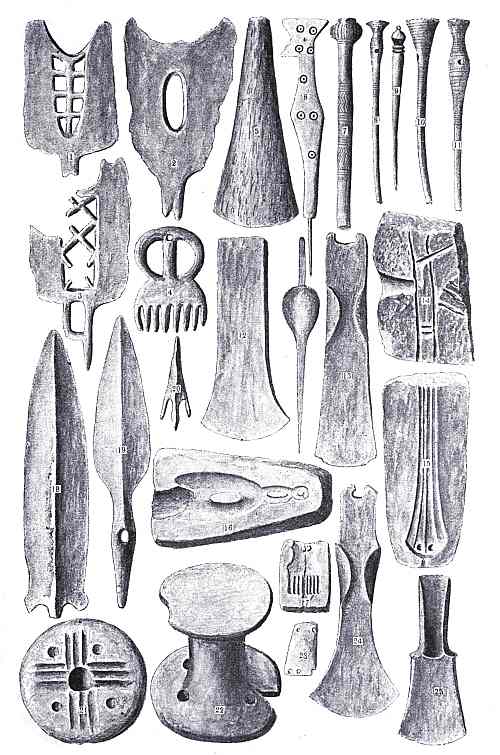
Fig. 83.—Castione and various other Terremare in the vicinity of Parma. Nos. 1 to 12 and 18 to 20 = 1⁄2, and the rest = 1⁄4 real size.
Illustrations of some of the industrial remains found at Castione, and other places in the neighbourhood of Parma, are given on Fig. 83.
MONTALE.
Another instructive station, which I visited along with the distinguished archæologist, Sig. Crespellani, is that at Montale, a few miles south of Modena. Here the elevation of the mound is more marked than at Castione, as the entire mass stands clear above the surrounding plain, and, like it, the central part is occupied by a church and some other religious buildings. The discovery of this terramara was not made till 1868, but, its contents being readily accessible, the progress of its demolition has been rapid. In 1871 it was selected as the most suitable to be visited by the members of the International Congress, and, for their special benefit, a new section was then opened up. The annual explorations conducted in this mound, of course regulated by agricultural demands, are now entirely in the hands of the authorities of the Museo Civico at Modena, who appropriate all rare objects for the enhancement of their large and valuable prehistoric collection. The director of the Museum, Sig. Boni, publishes, from time to time, a report of the excavations and of the results obtained. (B. 380 and 421.)
According to Boni, the area of the mound, including the dyke, was 9,000 square mètres (about 2 acres), of which about 4,000 are occupied by the ecclesiastical buildings already referred to. Of the remaining space available for explorations about one half has been cleared away. On the north side of the church, just on the verge of the pit where the workmen were riddling and preparing the saleable stuff, stood an enormous chestnut tree, whose roots could be seen below the grassy surface projecting from the perpendicular face of the section. The priest, whose house forms part of the ecclesiastical buildings on the mound, soon joined our party, and expatiated on the fabulous age of this tree, but which Crespellani reduced to something like 150 or 200 years. The entire height of the section here exposed would be from 15 to 20 feet, the upper five of which consisted of mouldy soil, which has, of course, to be removed before the commercially valuable stuff is reached. In the course of the removal of this upper stratum the following objects were found, viz. an iron hatchet, fragments of a spur, several keys, and some much corroded coins of the Old Empire. The remains of fifteen human burials were also encountered, three of which had the bodies enclosed in cists made of large bricks. Indeed, some large tiles, apparently part of a sepulchre, were still to be seen protruding from a part of this layer. Near one of the unenclosed burials lay a terra-cotta lamp and a bone comb with a double row of teeth. Sunk into the upper part of the terramara beds was a primitive lime-kiln, "evidently," says Boni, "introduced into the cumulo marnoso at a later period than its formation." (B. 386, p. 13.)
The great depth of this upper bed of mould, which exists in all the terremare, is very remarkable and most puzzling to archæologists. Boni thinks it was spread over the mound at some posterior time, either for agricultural purposes, or as hygienic precautions, or perhaps from motives of respect to the supposed sacred character of its contents.
All the rest of the section was terramara proper, whose contorted and wave-like beds could readily be distinguished. Sticking in the face of the section were innumerable fragments of black pottery, broken bones, and bits of charcoal. All the stuff, before being disposed of, was passed through riddles, and what remained was thrown aside as useless rubbish, the heaps of which could only be estimated by cart-loads. The riddlings consisted almost entirely of broken pottery, among which were occasional clay weights and more frequently spindle-whorls, together with the bones and horns of animals, many of which were converted into implements. Bronze objects were comparatively rare.
Part of a large earthen dyke which is supposed to have surrounded the entire mound is still left exposed on the north side. It measured from 20 to 30 feet in breadth at the base and 11½ feet in height. Boni, in his description of this dyke, states that a section which ought to be conical is not so, but more slanting on the outside; also, at the inner side, its contents are occasionally seen to overlap the terramara beds. From this and some other structural details he adduces evidence to show that the dyke had been subsequently added to by the terramaricoli during their occupation of the settlement. Bearing in mind what Pigorini says about Castione, the significance of these observations will be readily perceived.
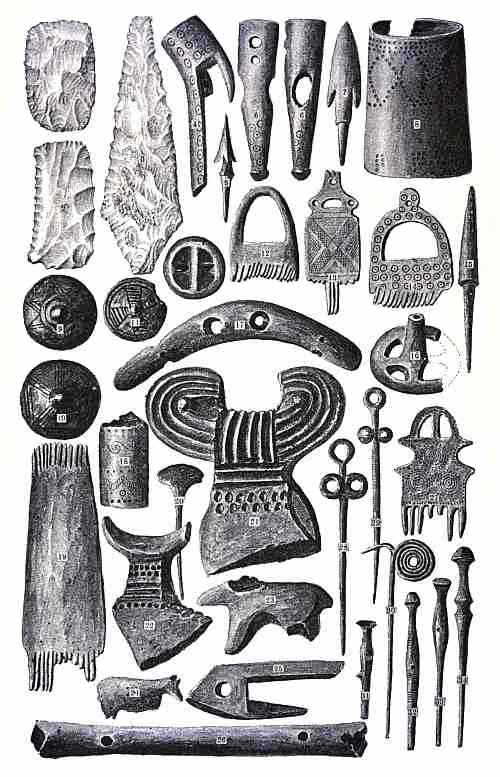
Fig. 84.—Montale. All 1⁄2 real size.
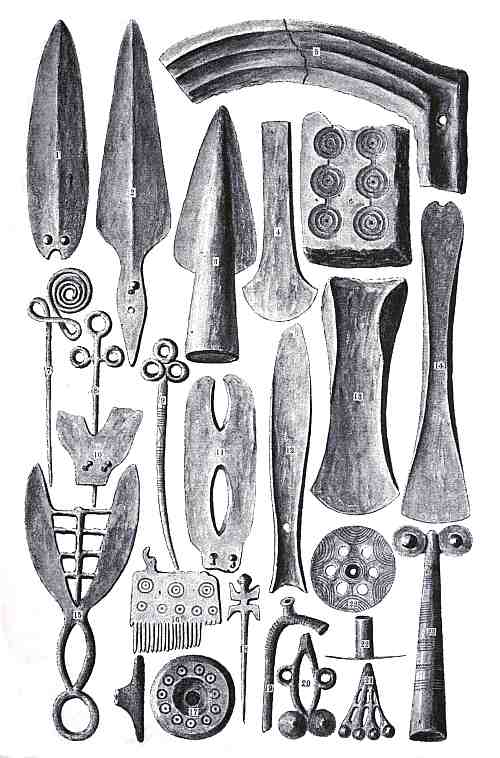
Fig. 85.—Montale and various other Terremare in the vicinity. All 1⁄2 real size.
For illustrations of relics from Montale see Fig. 84 and Fig. 85, Nos. 1 to 6; and for its literature B. 157, 184, 186, 204, 231, 298b, 367, 386, 421, 422, 425a'. An account of the excursion to Montale by the members of the International Congress is given in their Proceedings for 1871 (Bologna).
CASALE ZAFFANELLA.
Another typical example of the terremare, which I wish to describe shortly, lies 1¼ mile north of the Po, near the town of Viadana. This station was accidentally discovered a few years ago by the brothers Pietro and Giacomo Tassoni, the peasant proprietors of a field in which they were making trenches for planting vines. In the course of their operations they dug up fragments of pottery, which they brought to the Arciprete Antonio Parazzi of Viadana (already widely known as a skilled archæologist and the founder of an excellent museum of the local antiquities of the district). Some of the fragments of pottery turned out to be Roman, while others were undoubtedly pre-Roman, and this led to a preliminary investigation of the locality, in which the experienced eye of Parazzi soon detected the site of a terramara dwelling. A full report of the subsequent excavations and results obtained was published by Parazzi in the Bullettino for 1886 (B. 451)—a monograph which is a perfect model of the descriptive details of an investigation conducted on scientific methods.
First of all let me emphasise the fact that there was here no mound at all. The field was quite flat, and to reach the surface of the terramara beds a stratum of considerable thickness, varying from 1 to 2 feet, of the ordinary alluvial deposits had to be passed through. The terramara beds then continued for a depth of 8 or 10 feet, underneath which came the subsoil on which the settlement was originally constructed. It is noteworthy that in one part of the area, underneath the terramara beds proper, a peaty bed, similar to that at Castione, was discovered. To make the resemblance still more striking, this terra uliginosa also contained the remains of a palafitte. These piles were very well preserved, and some of them may now be seen in the Museum at Viadana.
It was impossible, without enormous labour, to explore this settlement to a great extent; but by a few well-directed trenches Parazzi ascertained that it was of a quadrangular shape, and orientated to within 11 degrees, and that it was surrounded by a ditch and a dyke. The enclosure, exclusive of the area of the dyke, had a superficial area of about one English acre. Its four sides measured, respectively, 208 (N.), 218 (S.), 227 (W.), and 237 (E.) feet. The dyke was 26 feet broad at its base, and 11 feet 6 inches high, and showed that it had been added to on three different occasions. Its inner edge appeared to have been very steep, a fact which suggests that, as at Castione, there had been some kind of support to prevent the earth from falling in. The ditch was 34 feet wide, and its maximum depth was 6½ feet.
The underlying peaty stratum, containing the piles, occupied much of Parazzi's attention, and he goes largely into its minutiæ. One curious fact which he records is that the dyke passed over its middle, leaving a considerable portion of the terra torbosa and palafitte outside the area of the terramara deposits. This undoubtedly suggests the idea that the palafitte existed prior to the terramara settlement. From the character of the relics we shall, however, see that both belonged to the same age and people.
On the surface of the terramara beds Roman remains were largely met with, and in one place they came upon a rectangular excavation, measuring 18 square mètres, containing ordinary earth, bricks, tiles, fragments of jars, and other Roman pottery. When this was cleared out there was found at the bottom, at a depth of 7 feet 6 inches, a Roman pavement, and the stratified terramara layers could be distinctly seen in the perpendicular walls. Clearly this cellar was constructed long after the deposition of the terramara beds.
Nor is the settlement of Casale Zaffanella a solitary example in the Viadana district. Already Parazzi has prepared a large map of the neighbourhood, which finds a suitable position on the wall of his museum, with no less than 12 terramara stations marked on it. Among these there is one Cogozzo (B. 372b) situated about one-and-a-quarter mile from the town and within 200 yards of the Po, which presents the same features as that at Casale Zaffanella, and also contains traces of a palafitte. Its area is an orientated quadrangle covering about an acre, but it is completely buried in mud, its highest point being 31 inches below the surface. It is surrounded by a ditch and dyke; and, moreover, the inner edge of the dyke was found to be almost perpendicular, showing that originally it must have had some kind of contrafforte.
Some of the objects from this group of terramara stations, now deposited in the Viadana Museum, are represented in Fig. 86, Nos. 1 to 13.
GORZANO (MODENA).
The old-school views advocated by Dr. Coppi, viz. that the terremare were remains of funeral pyres (roghi), so much biassed his mind that for many years he appeared to have paid little attention to the significance of the strata, and consequently the first two volumes of his magnificently illustrated monograph on the terramara settlement at Gorzano (B. 207 and 261) lose much of their value from having the objects of different ages indiscriminately mixed. This defect is so far removed in the third volume that he divides the deposits into upper and lower, corresponding to the historic and prehistoric periods. But, notwithstanding this defect in Dr. Coppi's earlier works, his investigations are of considerable scientific value, as his numerous matter-of-fact observations are strictly to be depended on.
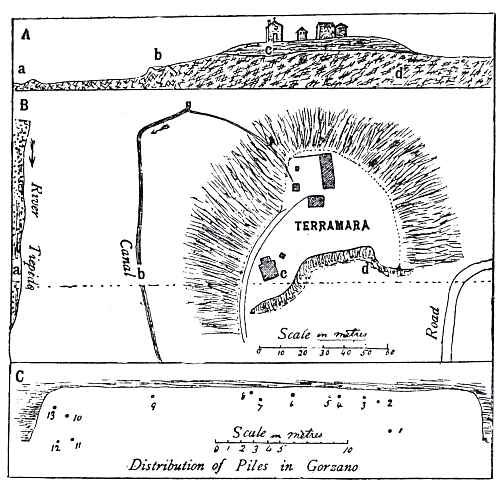
The accompanying plan and sections of Gorzano will convey some idea of the position of the terramara beds in respect to their immediate surroundings. The deposits (marked c on section A) extended in length about 90 to 100 mètres from north to south, and 70 mètres in breadth, with an average thickness of 3½ mètres. The settlement was constructed on a natural elevation, rising about 9 mètres above the rest of the plain and 11 above the bed of the adjacent stream Tiepido. It was surrounded by a ditch and a dyke, and it also contained the remains of a palafitte. The existence of piles is clearly proved by Dr. Coppi himself, who gives a section (C) showing their respective positions, but at the same time he denies that they indicate the remains of a palafitte.
Of the comparative frequency of industrial remains in the terramara deposits, a correct notion will be got from a study of Dr. Coppi's report of the excavations at Gorzano during the year 1875. In this year there were 274 cubic mètres excavated, covering an area of 180 square mètres; and from this mass of débris there were collected 3,051 objects, of which 173 belonged to the upper or Romano-mediæval stratum, which varied from 1 to 1½ mètres in thickness. The rest of the objects, which came from the under strata, and were reckoned prehistoric, are thus classified:—852 industrial objects, 1,544 remains of vertebrate animals, 285 remains of molluscs, 153 vegetable remains.
The 852 industrial remains are again thus assigned:—
Bronze.—50 objects: viz. eight pins, four axes, 12 daggers, one chisel, two awls, six discs, one spindle-whorl, two fragments of sickles, and 14 diverse bits.
Bone.—80 objects: viz. 38 needles and pins (of which 23 are entire), nine spatulæ, 17 pointers, three chisels, six teeth, one lamina, five awls, and one handle.
Horn.—62 objects: viz. seven small wheels, one cylinder, one comb, two arrow-points, 17 spatulæ, 12 pointers, two awls, three ornaments, two picks, four handles, and 17 diverse pieces.
Stone.—68 objects: viz. two flint knives, two pendants, four spindle-whorls, two discs, four weights, six grinding-stones, one polisher, three flint nodules, four flint flakes, and 30 worked stones.
Terracotta.—585 objects: viz. 494 spindle-whorls (Fig. 85, No. 17), two cylinders, 12 weights, 68 vases, three covers, five percolators, and one small animal figure.
The bones capable of being determined represented the following animals:—15 oxen, 25 sheep or goats, seven stags, eight roes, 30 pigs, two wild boars, 14 dogs or wolves, one cat, eight birds, one tortoise, and 15 toads.
The industrial remains from the upper stratum were as follows:—The central part of a Byzantine crucifix, one lamp, two fibulæ, three rings of bronze, 12 spindle-whorls of terra-cotta (of which four were glazed), one spindle-whorl of amber, one spindle-whorl of glass, two spindle-whorls of talc; of iron there were 20 darts, two lance-heads, eight knives, seven keys, one lock, eight buckles, one horseshoe, one bullock-shoe, and 11 undetermined fragments; five fragments of glass vessels; one sword-handle of wood with bronze mountings; four bronze fragments; 25 pieces of pottery (three with potters mark); a small basin of brick; 52 coins (of which 46 were together); and some slag, etc.
The objects in the upper stratum were mostly associated with the Oratorio di S. Alberto, built about the early part of the seventeenth century, and other mediæval buildings now entirely demolished. It was found to have been built over a still older church, which dated from the third century. A few of the coins were Roman of about the same date, but the largest number dated from the end of the twelfth or commencement of the thirteenth century, and a few were of still later date. There was also a Christian cemetery found containing a number of skeletons.
In 1879 Coppi published (B. 340) an account of further discoveries, and among other objects he describes several stone moulds (10 for pins, five for lance-heads, and seven for daggers), a stone weapon of nephrite, two flint knives, a weight of white marble, etc. Of bronze there are 12 pins, three needles, 20 dagger-blades, five chisels, nine awls, and a small wheel ornamented with graffiti, besides a quantity of other objects of horn, bone, pottery, etc.
In 1885 the workmen came upon a grave embedded in the virgin soil underneath the terramara beds, and supposed to be anterior to their formation. It was constructed of small unhewn stones, and the space enclosed measured 5 feet 10½ inches long, 1 foot broad, and 1 foot deep. This grave contained a human skeleton which lay on the right side with the head towards the east, and along with it were found a spatula of staghorn, fragments of fossil shells, and some bits of carbonised vegetable matter. (Crespellani, "Scavi del Modenese," 1886, p. 11.)
A few of the bronze objects from Gorzano are illustrated on Fig. 85, Nos. 9, 12 to 14, and 19 to 23.
GENERAL REMARKS ON THE TERRAMARA SETTLEMENTS.
In the above sketch of the progress of scientific research into the terremare I have selected four typical examples for special description. We have seen that in one, viz. Montale, accumulated débris stood as a clear mound on the surface of the surrounding plain, while that of Gorzano rested on a natural hillock. The Castione deposits also assumed the same form, but in this case the mound was only partially above the plain, the rest being buried in it. The tops of the piles found in its peaty stratum (terra uliginosa) were on an average 3 feet below the level of the present surface of the surrounding plain, and the lowest portion of this bed was a couple of feet still lower. In the fourth example, Casale Zaffanella, there was no mound at all visible, but on examination the remains of the settlement were found to be precisely similar to those of the others, only the mound was completely buried, as it were, in a sea of hardened mud.
The explanation of this will be readily perceived when we remember that the amount of submergence respectively shown in these instances is in the inverse ratio to their distance from the lower parts of the plain and its great water channels. The yearly inundations of the Po and its tributaries extend far and wide, each time leaving a film of mud, by the repetition of which, in the course of ages, the surface of the plain has become considerably elevated. Thus, the increase of silt since the terramara settlement of Casale Zaffanella was founded, amounts to 12½ feet—a depth sufficient to cover the highest part of the mound. It is difficult to say how much this levelling up process is accountable for the scarcity of these stations in the lower parts of the Po valley. That they existed, however, in close proximity to the river is amply proved by those stations at Viadana, as well as one or two others, for example, at Brescello, in the Parmensian district, on the south side of the river.
Distribution.—Formerly the terramara deposits were supposed to be peculiar to the middle reaches of Parma, Reggio, and Modena; but later discoveries have upset this generalisation, as they are now shown to have a much wider distribution, embracing the provinces on both sides of the Po. (See Sketch Map, page 266.)
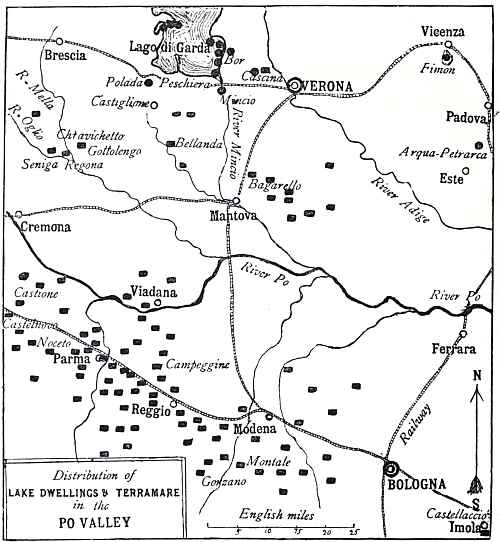
Dr. Giacometti first (1868) directed attention to the terramara deposits in the province of Mantua, and showed their similarity to those of Emilia. A few miles north-east of the town of Mantua there was found a group of seven or eight stations, regarding one of which, Bigarello, he stated that it contained the same kind of pottery and the same forms of stone implements as that at Castelnuovo in Emilia, the only difference being in the kind of stone used, the one being taken from the débris of the Alps and the other from the Apennines. Among the fragments of pottery he drew particular attention to the variety of handles, which showed all the transitional forms from knobs up to the most elegant anse lunate. "Havvene," says he, "di bicornute, di lunate, di bitubercolate, bilanceolate, cincinnate, transverse, appendiculate, ecc., quasi tutta in somma, la famiglia designata dal Mortillet ('Les Terramares du Reggianais,' 1865), colla speciale caratteristica di anse lunate."
In 1874 Marinoni gave an interesting account of the prehistoric remains of the district of Seniga in the province of Brescia, especially those of the terremare at Chiavichetto and Gottolengo. (B. 265.) The former, which is the most interesting of a group of seven stations, is situated in the angle formed by the junction of the Mella with the Oglia, nearly 20 miles south of the town of Brescia. In excavating soil for making a dyke the workmen found objects of human industry—scrapers and saws of flint, three hatchets of serpentine, one large stone-adze, various stone rubbers, etc., several fragments of worked horn, and an extraordinary quantity of broken pottery. The further objects discovered here were chiefly of stone, rarely of bronze, and, according to Marinoni, they were very similar to those from the terramara stations of Bigarello and Pomella to the east of Mantua.
The station at Gottolengo, discovered in 1871, is situated five miles to the north of Regona, and on the left bank of the Mella. Before being disturbed it presented the form of a flattish mound, which on examination yielded relics similar to those of the other well-known terremare, of which the following may be mentioned:—
Upwards of 20 arrow-points—pedunculated, triangular, or heart-shaped. Some fragments of polished hatchets of serpentine; spindle-whorls of terra-cotta (Fig. 86, No. 17):—one very large, 4¾ inches in diameter (No. 28), was similar to another found at Chiavichetto. Broken bones, portions of deer-horns, some of which · were made into daggers and pointers; two bone combs ornamented with triangular lines and graffitti, similar to those from Castione and Noceto. An oval cake or ring of wood like the supports for vases (No. 25). Of bronze there were various tools and implements. Spear-heads with a tang were most common; No. 19 represents one with two rivet-holes, a type which was also represented at Chiavichetto. A double-edged implement still held the rivet which had fixed it to a handle (No. 22). One arrow-point (No. 23) is similar to one found in the terramara station at Campeggine in the province of Parma. Several fragments of pins, wires, spirals, and small plates of bronze. Among iron objects, all of which were much corroded, was a spear-head (No. 24). Portions of greenish vitreous paste.
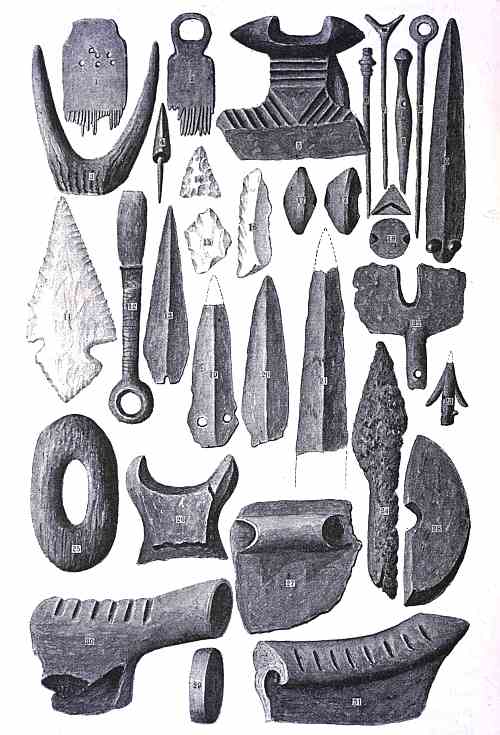
Fig. 86.—Viadana and stations on the north side of the Po. No. 3 = 1⁄4, 28 = 1⁄3 and the rest = 1⁄2 real size.
The following animals were identified among the osseous remains:—stag, ox, goat, sheep, horse, and pig.
Not only as regards the relics but also in internal structure the terramara stations on the north of the Po have been shown to be identical with those on the south side. This we have already seen in the description of Casale Zaffanella. But the point was first established by the indefatigable researches of Chierici, who, in 1881, along with a few other antiquaries, explored the stations at Bellanda and Villa Cappella in the commune of Gazzoldo, about 10 miles west of Mantua. Here all the characteristic features of the terremare—the surrounding dyke, palafitte, and orientation—were clearly established. (B. 372a.)
The best investigated terramara in the Bologna district is that at Castellaccio, about three-quarters of a mile to the south of Imola. (B. 457.) The deposits repose on an isolated elevation on the right bank of the river Santerno, and rising nearly 120 feet above its bed; but on it there are no remains of ancient stone buildings, as the name would seem to imply. The hill is of yellowish sand, belonging to the Upper Pliocene. Scarabelli, who has recently published an illustrated monograph of its peculiarities and the antiquities found on it, states that piles were numerous, though many had disappeared by decomposition, only traces of their holes being then detected. Some of the piles were large, measuring over a foot in diameter, and they were placed irregularly. No less than 26 hearths were met with at different levels, and those on the same level were from 4 to 6½ mètres apart.
The peculiarity of this terramara is that its antiquities would appear to belong to both the Stone and Bronze Ages. The flint implements included about 20 roughly-chipped tools like scrapers, some badly-made arrow-points, and saws resembling those found in the palafittes in the Mincio. Altogether 216 worked flints and about 600 chips and cores were collected. Some polished stone axes, together with four portions of perforated implements.
Among about 120 spindle-whorls of burnt clay there was only one ornamented. There were various implements of staghorn and bone, a few of the former being perforated and apparently used as axe and hammer heads like those from Gorzano. Some perforated shells are also recorded.
The pottery was precisely similar to that usually found on the well-known terramara deposits of Emilia, showing various forms of handles, horn-like projections, perforated knobs, etc.
The total number of bronze articles amounted only to seven pieces, and included a small sickle, a coltello-ascia like that from Bosisio (Fig. 51, No. 10), and a small dagger with two rivets—the rest being of an undetermined character. Two objects of pietra ollare (a small spindle-whorl and a dish turned on the wheel) and a bronze buckle were found among the disturbed beds on the surface.
Beyond the valley of the Po no decided remains of palafittes or terremare have come to light, and the obscure indications that have been recorded leave it doubtful whether they are of a prehistoric character.[41] Of these the only one worthy of detailed notice here is the dwelling found near Offida, in the Piceno district (Central Italy), and described by Professor Pigorini. (B. 343b.)
About one and a half miles from Offida, in a small valley surrounded by hills, there was formerly a small lake, which has become drained by the erosion of a stream which falls into the Tresino. Here, covered with 16 feet of sand and débris, the Marquis Allevi found a platform 50 yards long, 15 yards wide, and 2 feet thick. Below the platform there was lake-mud, containing fresh-water shells, to the depth of 9½ feet, in which were charcoal, bones of animals, fragments of pottery, and other remains of human occupancy. This platform was constructed of large trunks deprived of their branches and laid horizontally at intervals of about four feet, above which came smaller beams irregularly laid without any order and then a layer of clay and moss. On this platform were found calcined round stones, the bottom of a dish, and some 12 fragments of other vessels, some of fine and some of coarse pottery. One bit had a recurved lip, and another was ornamented with a kind of zig-zag ornamentation in incised lines. There were also about 20 pieces of copper, some of which looked like crucibles.
Extent.—As to the actual dimensions of the terramara mounds, it is difficult to procure accurate measurements, for several reasons. In many instances they are either built over by modern buildings, or there is nothing to distinguish their débris from the surrounding soil without making extensive excavations. Even when the site is a clearly-defined mound, as at Montale, one estimate may differ from another according as the area of the surrounding dyke is or is not included in the measurements. Generally speaking they are rectangular in form and, according to Chierici, their average superficial area is about seven acres. (B. 311, p. 105.) But their respective areas vary very much, as will be seen from the following stations, in addition to those already given, whose measurements have been accurately ascertained by competent authorities:—
Casaroldo (Parma), 200 by 160 by 3·70 mètres. (B. 297, p. 360.)
Parma, 300 by 28 mètres. (Strobel e Pigorini, Seconda Relazione, p. 149.)
Castiglione di Marano (Modena), 114 by 64, and 3 mètres thick. (B. 422, p. 19.)
Pragatto (Bologna), 200 by 150, and 3 mètres thick. (B. 372, p. 138.)
In his description of Bellanda (Mantua), Chierici observes that the bacino was a rectangle 96 mètres across, giving an area of about two acres, to which he adds "ampiezza ordinaria delle terremare." (B. 372, p. 80.) On the other hand, the two whose measurements have been accurately given by Parazzi, viz. Cogozzo and Casale Zaffanella, show a superficial area of only half this size, a fact which induced Parazzi to observe that the terremare in Viadana seemed to be smaller than those of Emilia and that at Bellanda. (B. 451, p. 4.)
Number.—The total number of terramara stations in the Po valley is over 100, which are thus (approximately) distributed among the provinces:—Parma, 30; Reggio, 25; Modena, 16; Bologna, 5 or 6; Mantua, about 20; and Brescia, 8.
Relics.—More trustworthy knowledge of the social conditions and general culture of the terramaricoli is to be derived from a study of the remains of their villages than if they had come within the scope of the earliest written records. The ordinary débris here accumulated, such as the more imperishable portions of food refuse, stray objects, etc., are arranged in chronological sequence like geological strata, the more recent being on the surface, and the oldest at the bottom. Wherever an object of human industry happened to drop there it remained, marking in all time coming its relative place in the duration of the community. The industrial remains show that these people founded their dwellings in the early Bronze Age. The existence of a few flint implements and other objects of the Stone Age is quite in harmony with the usual overlap of the relics of dying customs in the transition period. That the weaving of cloth was largely practised by them is proved by the extraordinary variety and abundance of spindle-whorls and loom-weights. They made ornamental buttons of terra-cotta, horn, and bone; as well as pins, combs, and other objects of the latter materials. Wood was also largely used in the manufacture of a great variety of things, as handles, dishes, spoons, floorings, etc. (B. 328e.) That they worked their implements and ornaments of bronze is proved by the number of foundry objects collected, as bronze slag, stone moulds, etc. (Fig. 83, Nos. 14 to 17).
We have already seen that the terramaricoli had an extensive knowledge of the ceramic art. The vessels in daily use were no less varied and elegant in shape than our modern jugs, teapots, cups, bowls, basins, saucers, flower-vases, etc. Some had everted rims and the majority flat bases. The ornamentation consisted of parallel and wavy ridges, knobs (sometimes perforated), triangles, and crosses of incised grooves, circular or semicircular impressions, etc. But most characteristic are the appendages attached to the tops of the handles (Fig. 84, Nos. 21 and 22), which were of the most varied and fanciful forms. These remarkable handles are not found on pottery beyond the area circumscribed by the terremare. Nor is the fully-developed ansa lunata found in the lake-dwellings within this area, with the exception of the stations at Peschiera, Mincio and Il Bor, in the south-east corner of Lake Garda. Rudimentary forms of these handles, such as those from the lake-dwellings of Polada (Fig. 67, Nos. 13 and 14), Arquà Petrarca and Fimon (Fig. 66), are also found in the western district of the Po valley (Fig. 48, No. 16). The terremare would, therefore, appear to be somewhat posterior to the earlier lake-dwellings. But, on the other hand, the later lake-dwellings (Peschiera and Mincio) were posterior to the terremare. Not only does the pottery of the palafitte at Peschiera include the characteristic anse lunate (Fig. 65, No. 26), but among its bronze relics are examples of almost every object found in the terremare, as razors, pins, sickles, knives, etc.—a fact which will be at once seen from a comparison of their respective objects here illustrated. (Compare Figs. 63, 64, and 65, with Figs. 83, 84, and 85.) Moreover, from this comparison a further inference will be drawn, viz. that the lake-dwelling remains contain various objects which are not found in the terremare, as fibulæ (Fig. 64, Nos. 8 and 22 to 25), bracelets (Fig. 63, Nos. 31 and 32), one-edged knives (Fig. 64, No. 11), torques (Fig. 63, Nos. 13, 19), etc., all of which are indisputably of later date than the relics of the terremare proper.
Organic Remains.—The principal food of the terramaricoli consisted of the produce derived from agricultural and pastoral farming. An exhaustive analysis of their vegetable remains has not yet been made; but, from the occasional stores of grain, chiefly in a carbonised state, and other provisions met with, they are believed to have been in the habit of eating the following seeds and fruits:—wheat (two varieties), beans, millet, acorns, beech-nuts, apples, pears, sloes, cornel-cherries, brambles, pistachio-nuts (Staphylea pinnata), hazel-nuts, and grapes (Vitis vinifera). Flax was largely cultivated, and its seeds were supposed to have been used as food, while of course its fibres were converted into thread, ropes, and cloth. Among the vegetal remains from Casale Zaffanella submitted to Professor Oreste Mattirolo in Turin, wheat and both the seeds and wood of the vine were recognised.
As regards the domestic and wild animals on which the terramaricoli subsisted, we are in possession of more definite information, owing to the persevering watchfulness of Professor Strobel. The following is his corrected list down to the year 1883 (B. 410c):—
Erinaceus europæus, L. (hedgehog). Gorzano. Ursus arctos L. (bear). Castellaccio, Gorzano, Campeggine, etc. Vulpes vulg., Brisson (fox). Castellaccio, Gorzano, Montecchio, Ronchi di Viadana. Canis familiaris, S. (domestic dog). var. Spalletti, Strob. Montecchio, Castione(?), Cogozzo(?), Casale Zaffanella. " palustris, Rüt. Common. sub. var. matris optimæ. Gorzano, Montale, Montecchio, Demorta. Lupus vulgaris (wolf). Castellaccio, Redù. Meles vulgaris (badger). Montale. Martes foina, L. (polecat). Gorzano. Felis catus, L. (wild-cat). Gorzano(?), Montale(?). Sus scrofa (ferus), L. (wild boar). Widely spread, but not common. Sus palustris, Rüt. (domestic pig). Common. Asinus africanus, Sans. (ass). Common. Equus caballus (horse). Widely spread and not rare. The remains are of two races, one large and the other small. Capreolus vulgaris (roe). Less common on the south side of the Po. Cervus elaphus, L. (deer). Common. Dama platyceros, Plinius (fallow deer). Gorzano. Very rare. Cervus tarandus (reindeer). Gorzano (Coppi). Hircus ægagrus, L., palustris (goat). Widely spread and common. Ovis aries, L. (sheep). Emilia, Mantua, Brescia. var. palustris, Rüt., capricornis, Can. Not rare. " O. musimom. Castellaccio. Bos primigenius, Boj., domesticus. Emilia, Mantua, and Brescia. Not common. Bos brachyceros, Rüt. Very common as domestic cattle. Lepus timidus (hare). Gorzano (Coppi). Mus sylvaticus (wood-mouse). Castione. Hystrix cristata, L. (porcupine). Portion of a quill of this animal was found in the socket of an arrow-head of bronze from Campeggine. Castor fiber, L. (beaver). Castellaccio, Cogozzo. Frugilegus segetem (raven). Gorzano (Coppi). Gallus domesticus, L. (domestic fowl). S. Ambrogio, Gorzano, Bismantova, Castellazzo di Fontanellato, Parma, Bozzoletto. Ciconia alba, W. (stork). Montale. Ardea cinerea, L. (heron). S. Ambrogio. Anser segetum (wild-goose). S. Ambrogio, Possioncella near Viadana. Anas boschas, L. (duck). Montale, Parma, Cogozzo. Emys europæa, Sch. (tortoise). Gorzano, Montale, S. Ambrogio (Boni), Campeggine (Chierici), Casale Zaffanella (Parazzi). Bufo (a species of toad). Esox lucius, L. (pike). Parma, Casale Zaffanella (Parazzi).
As coming under the category of organic remains I may add that a great variety of shells, both of living and fossil species, are found in the terramara deposits. Many of them are perforated, especially the more ornamental fossil varieties, and were undoubtedly used as ornaments. Some of the flat shells of bivalves give a tingling noise when struck, and are therefore supposed to have been used to produce some kind of musical sound. Land and fresh-water species were also, no doubt, used as food. Coppi in his monograph (vol. ii. p. 100) describes and illustrates a variety of the more striking forms collected in Gorzano; and, in summing up his list, he states that 479 were of marine origin (either recent or fossil), 388 belonged to fresh-water species, and 31 were land shells.
From the existence of the horny cases of various kinds of insects, some living in air and others in water, and their larvæ in various stages of evolution, Pigorini adduces an argument against the supposition that the bacino was kept constantly filled with water. (Strobel, B. 88, p. 18, and 89, p. 36; Pigorini, B. 407, p. 38; Parazzi, B. 451, p. 54.)
The protracted discussion as to whether or not amber has been found in the terremare proper was finally settled by the statement of Pigorini that, in his recent explorations (1877) at Castione, it was found in the lowest stratum. "Ora siamo certi che l'ambra si trovò in Castione sepolta nello strato infimo, e colla certezza che vi fosse penetrata nei giorni in cui lo strato stesso si formava." (B. 407, p. 51.)
As early as 1863 Strobel and Pigorini announced the discovery at Castione of a couple of amber beads, but as their position in the débris had not been determined, no inferences could be drawn from this discovery. In 1871 Coppi found a large one (fusaiuola) at Gorzano; and later, another of the same kind. One was also found at Montale, and another at Casinalbo. As these are all the records of amber up to the decided discovery of Pigorini, it is clear that it was a very scarce object among the terramaricoli. The number from Montale, however, now amounts to 16, the largest of which is 1¾ inches in diameter. (B. 279b, 298b, 311a'.)
Age.—In the spring of 1865 Pigorini explored and described a station in the district of Parma called Fontanellato, which, at the time, he considered to be a terramara containing a fascine structure belonging to the Iron Age. (B. 112.) In the excavations which were conducted here the following different strata were exposed from above downwards:—(1) 2 feet of soil; (2) a bed of alluvial deposits 4 inches thick; (3) a bed of materials similar in colour and composition to those of the ordinary terramara deposits, 1 foot 10 inches thick; (4) a mass of mixed materials 2 feet 7 inches thick, containing roots, branches, leaves, etc., mixed with clay, together with pottery, short piles, charcoal, bones of animals, shells, fruits, seeds, etc.
The objects of special interest collected were fragments of coarse pottery, made, however, on the wheel, and particularly some vessels made of potstone; a large stone splinter, showing marks of usage; a bronze ring, and some iron slag.
In 1883 Pigorini recurs to the remains at Fontanellato (B. 408) and explains that, owing to the great progress made in the investigations of the terramara deposits, and the additional light thrown on the subject, he has come to the conclusion that the station at Fontanellato was not a direct continuation of the terramara system which prevailed in the Bronze Age, but a "palafitta barbarica," in which he sees the practical evidence of the incursions, into the Po valley many centuries later, of the northern hordes of barbarians which gave the final coup to the Roman empire. That these people were conversant with such structures there is ample evidence in the analogous remains of terpen in Holland, the burgwälle and lake-dwellings of Germany, the Tószeg and other mounds in Hungary, etc. (B. 410b.)
Nor does the station at Fontanellato stand as an isolated example of these later structures. Chierici found one at Marmirolo, in the district of Reggio.[42] Another is recorded by Cornalia,[43] and Pigorini thinks that several other stations which have been more or less described belong to the same class as those in the Thrasimene district[44] and that at Offida, near Piceno. (B. 343.) With these exceptions, there are no terramara mounds of the Iron Age, and the system is supposed to have flourished in the early Bronze Age and to have fallen completely into desuetude before the commencement of the Iron Age.