Second Lecture. SETTLEMENTS IN EASTERN SWITZERLAND, THE DANUBIAN VALLEY, AND CARNIOLA. (continued 2)
Reading edition
The osseous remains were much decayed, but among them the following animals were identified, viz. stag, urus, ox, pig, and horse (represented only by two teeth).
Flints were comparatively rare, but the stone implements were varied both in form and material, being made of such materials as serpentine, diorite, basalt and schist.
The pottery, though rude, appeared to have been partly made on the wheel, but yet had finger-nail marks and other curved impressions as ornamentation. All sorts of handles were used, from mere perforations for strings to the most perfectly made handle. The paste was mixed with coarse materials.
The non-appearance of piles and organic matter may probably be accounted for by their rapid decomposition from alternate exposure to air and water.
Further notices of these finds were given by Count Wurmbrand (B. 259), Dr. Much (B. 318), and Von Luschan (B. 365).
PILE STRUCTURES IN HUNGARY.
On the right bank of the Theiss, a few miles from the railway-station of Szolnok, and near the village of Tószeg, there is an artificial mound called "Kuczorgó or Lapos-halom," to which, since the meeting of the International Congress at Buda-Pesth, in 1876, much importance is attached on account of the opinion expressed by Pigorini that it is identical in structure with the terramara mounds of Northern Italy. The mound, though now considerably undermined by the river Theiss during the great floods of 1876, is still of considerable extent, measuring some 360 mètres in length, and 100 in breadth, and rising to a maximum height of 8 mètres over the surrounding plain. It is only in times of flood that the waters reach the mound, its usual bed being about 1½ mile distant. When the artificial nature of this mound became known by the section exposed by the floods, some extensive investigations were made to determine its archæological character. The objects collected in these researches were exhibited at the Congress as a special find, and among them were the following (Catalogue, pp. 85-87):—
1. Perforated hammers of staghorn, various pointed implements of horn and bone, perforated teeth of pigs, and a leg-bone perforated in two places, probably a skate.
2. Polished stone celts and perforated hammers, four flint flakes, and one of obsidian, corn-crushers, and various other worked stones.
3. Fragment of a bronze pin, a bronze knife, and a small ingot of bronze.
4. Pottery, showing a variety of dishes, some with handles, etc.; various objects of burnt clay, as a whistle, buttons, a spoon, 18 pyramidal clay weights (perforated), etc.
5. A considerable amount of food refuse, as bones, scales of fish, shells, charred wheat, etc.
When the International Congress was held at Buda-Pesth, Pigorini, Virchow, and Miss Mestorf visited this mound, and made some further researches, which not only confirmed Pigorini in his suspicions about the structure of the mound, but also led his distinguished fellow investigators to accept the main portion of his theory. Upon their return home they[30] published separate accounts of this excursion to Tószeg and the results obtained, from which I must here be content to notice that the following propositions are admitted facts:—
1. The existence of piles and wooden beams was satisfactorily proved, and Pigorini asserts that these corresponded with three different levels, precisely as they occur in the terramara mounds.
2. The materials containing the débris of occupancy were distinctly stratified, forming parallel or undulating layers, amounting to a total thickness of 4 mètres.
3. The antiquities collected represented all ages, including stone celts, bronze and iron implements, and a skate made of the leg-bone of a horse.
Subsequently Dr. Romer gave an account of the excavations conducted at Tószeg previous to the meeting of the International Congress, in an article entitled "Les Terramares en Hongrie," along with which he describes similar deposits at other places, as Nagy-Rév, Szelevény, Keménytetö, and Ásott-halom. In regard to the latter station he remarks that rotten piles were observed in its lowest stratum before Pigorini called attention to their importance. Some of the objects from Ásott-halom were exhibited at the Congress (see Cat., p. 44), and included polished stone axes and hammers, flakes of obsidian, perforated hammers of staghorn, etc. The author concludes his article by stating that the terramara deposits are by no means confined to the valley of the Tisza, as they have already been observed in various other low-lying districts along the Danube, Garam, etc. (B. 316.)
RESEARCHES IN THE LAKES OF CARINTHIA AND CARNIOLA.
In 1864 Professor Ferdinand v. Hochstetter gave a report of researches conducted by him, at the request of the Royal Academy of Sciences of Vienna, in the lakes of Carinthia and Carniola in search of remains of lake-dwellings. (B. 98.) But the results were, in the main, of a negative character, as no traces whatever were found in the lakes of Millstätter, Afritzer, Brenn, and Weissen, in Carinthia; nor in those of Weldeser, Wocheiner, and Zirknitzer, in Carniola. In the latter lake it was confidently expected that lake-dwelling remains would be discovered, as the chronicler Valvasor (1689) relates that in this lake there was an old bridge, whose piles he himself had seen; but upon Von Hochstetter and Deschmann visiting the locality nothing whatever could be seen of this character.[31]
On the other hand, Von Hochstetter believed that he had succeeded in finding traces of these settlements in no less than five lakes in Carinthia, viz. Wörther, Keutschacher, Rauschelen, Ossiacher, and Längsee. The Keutschachersee is, however, the only one which has yielded positive remains of a sufficiently varied character to render the evidence of Pfahlbauten more than problematical. This small lake, known also as the Plaschischersee, which lies to the south of the Wörthersee, contains near its middle a shallow portion which can be readily distinguished from the shore by the rushes which grow over it. The area of the space thus marked out is not great, measuring only 20 fathoms long (Klafter) by 10 fathoms broad, and it is covered by water never less than 4 to 6 feet in depth. Here piles and large beams were seen embedded among stones and mud, but so firmly that they could not be drawn up. Notwithstanding the difficulty of examination, some relics of human occupancy were collected. These, which were subsequently augmented by a further investigation by Mr. Ullepitsch, of Klagenfurt, are deposited in the museum of that town; they consist of portions of half-burnt clay with the impression of wattling, and are supposed to be part of the walls of a cottage. There are also one or two fragments of black and grey pottery, one of which is ornamented (Fig. 41, No. 10); a sharpening or grinding stone; a bit of staghorn, together with charcoal; heaps of shells (Adonta); hazel-nuts, and portion of a wooden pile.
Dr. v. Hochstetter draws attention to the extraordinary number of submerged cairns which he discovered along the shores of the Wörthersee and Ossiachersee. On the eastern shore of the latter he counted no less than 29. These cairns are about 6 feet high, with a diameter of 15 to 20 feet, and their tops are generally covered with 4 to 6 feet of water. It will be remembered that similar cairns were observed in Lake Morat.
The only other place which suggested the existence of lake-dwellings was the "Laibacher Morast," in which, a few years previously, a couple of canoes, and some other industrial relics, were dug out of the peat, the full significance of which only now became apparent. Since then the vast morass has yielded a large quantity of the débris of these settlements, which I shall now proceed to describe.
LAIBACH MOOR (CARNIOLA).
What is known as Laibach Moor is an extensive but irregularly shaped plain now nearly all well cultivated, which extends southwards from the town of Laibach to Ober-Laibach, some 12 miles distant. Previous to a series of drainage schemes, executed at various times during the last fifty years, the whole of this plain was a morass or peat bog, and there can be no doubt that in prehistoric times it was a navigable sheet of water. It covers an area of about 85 English square miles, and is interspersed here and there with six or seven rocky eminences, which, when the locality was under water, formed so many islands. It is also intersected by the rivers Laibach, Isca, and some smaller streams, which unite before reaching the town of Laibach, and about half way up it is crossed by the railway to Trieste. Some years ago a new road was constructed along the valley of the Isca, from Laibach to Brunndorf, and in 1875, in the course of excavating a ditch alongside of it, various bone implements and fragments of pottery were turned up by the workmen. Mr. Martin Peruzzi, the proprietor, recognising the archæological value of these objects, at once gave information of the discovery to the authorities of the Landesmuseum at Laibach. This led to an extensive series of investigations, which were continued during the following two years under the care of Dr. Karl Deschmann, curator of this museum. An illustrated report of the first year's operations was published by the eminent archæologist, Baron von Sacken (B. 290), while those of the two following years have found an able exponent in Dr. Deschmann. (B. 302 and 317.)
The first year's working revealed the foundations of a pile-dwelling close to the road on its west side, where, by the removal of some 3,000 square yards of peat, quite a forest of piles was disclosed. These were irregularly placed, but on an average they numbered three or four in a dozen square feet. They were made of aspen, poplar, elm, and fir, the last, however, being sparingly used. The peat was about 6 feet thick, and below it was the ancient sediment of the lake into which the piles were driven, their heads now merely entering into the peaty stratum. Between the peat and lake sediment there was a thin layer of organic débris, 4 or 5 inches thick, in which alone the relics of the lake-dwellers were found. In the following year some 2,000 square yards were cleared of peat, partly in the same place, and partly on the other side of the road. In this new locality the piles were more closely set and the deposit of peat was a little thicker, but the character of the relics was exactly the same, only a larger proportion of the fragments of pottery were ornamented.
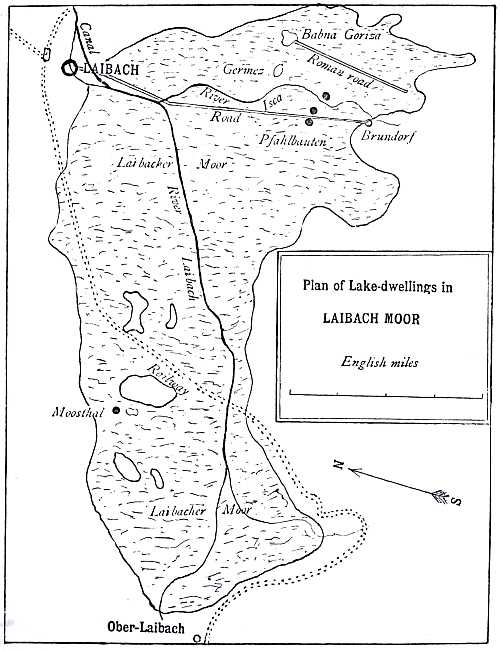
During the autumn of 1877 the site of a third pile-dwelling was come upon, about 300 yards from the last mentioned, and on the other side of the Isca (see Sketch, p. 171), under precisely similar conditions as the two former, but owing to want of funds the excavations were discontinued before the entire area was searched. Dr. Deschmann is of opinion that these are by no means the only portions of the moor in which lake-dwellings existed, as indications of them were found in several other places along the bed of the Isca. In further support of this opinion I may mention that in 1857, before lake-dwellings had attracted attention in this quarter, some objects were found at Moosthal, in quite a different part of the moor, which point to its being the site of a lake-dwelling. Here the peat was 10 feet deep, and at this depth, and lying immediately over the lake-silt, were found three perforated staghorn hammers, two canoes, and some other objects of human industry, which, however, were dispersed before Dr. Deschmann became aware of the discovery.
The relics of human industry collected during these systematic explorations, with the exception of a few in the Museum of Vienna, are deposited in the handsome new Museum at Laibach, where they form a remarkably complete and interesting demonstration of the culture and civilisation of the lake-dwellers. Some of these are illustrated on Figs. 42, 43, and 44.
Pottery.—Vessels for household use are extremely abundant, and varied in form and ornamentation. They are all hand-made, and the quality of the paste appears to have been good—that for the larger dishes was mixed with rough sand. All the pottery has a darkish appearance, but most of the smaller vessels had been smeared over with some black composition. Not a few of these dishes were quite whole, so that their varied forms and uses may be readily distinguished. They may be classified as jars, vases, cups, plates, jugs, bowls, flasks, spoons, etc.; and ordinary handles, perforated knobs, tubular borings (ansa canalicularis) appear to have been indiscriminately used.
Some of the smaller dishes have four or five stud-like processes or rudimentary feet, and others have a pedestal-like base, slightly expanding at the lowest point, on the underside of which there is often impressed the shape of a broad cross (Fig. 42, No. 20). The ornamentation, when reduced into its simple elements, may be thus stated:—
(1) Straight or wavy ridges, sometimes notched across, and running upwards or across the body of the vessel; (2) finger or nail marks; (3) checks made with groups of incised lines crossing each other; (4) lozenge-shaped spaces alternately plain and lined; (5) herring-bone pattern; (6) triangles, crosses, wheels, rhombs, and other simple geometrical figures, sometimes with inscribed figures or lines; (7) impressions of strings, points, etc. The style of the more highly ornamented vessels is, though complicated, artistic, and when the incised lines were filled with a white material, as is supposed to have been the case with some of them, these patterns on a dark or black ground must have been very effective. Ornamentation is not always confined to the outside of the vessel, as may be seen from Fig. 43, No. 8. Dr. Deschmann sees a striking resemblance between the Laibach pottery, both in manufacture and ornamentation, to that represented in Dr. Schliemann's works on Troy.
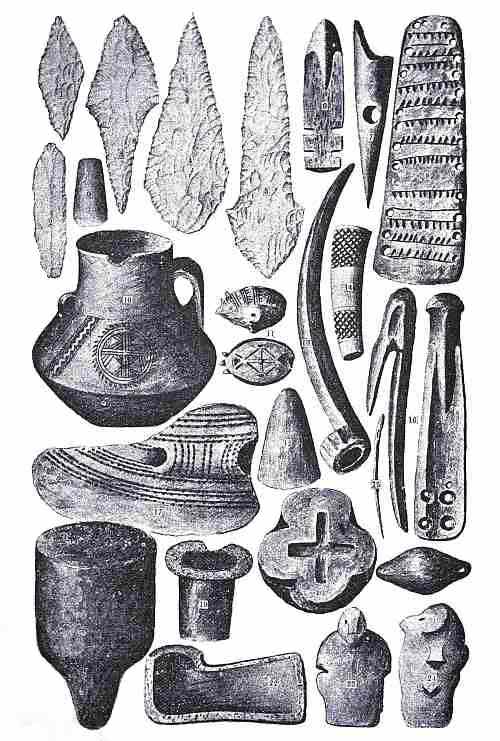
Fig. 42.—Laibach. Nos. 19 to 24 = 1⁄4, and the rest = 1⁄2 real size.
Besides the ordinary dishes, there fall to be enumerated under this heading some two or three hundred spindle-whorls, one or two cylindrical weights, perforated cones (Fig. 43, No. 5), a few crucibles of superior workmanship (Fig. 45, No. 14), a mould for an axe-head (Fig. 42, No. 22), and some other small objects, apparently toys (Fig. 42, No. 21). Among the most remarkable and mysterious objects are some ornamented images, more or less fragmentary, of animals and human beings with fantastically-formed heads (Fig. 42, Nos. 11, 23, and 24; and Fig. 195, Nos. 5 to 8).
Stone.—The stone implements, with the exception of rubbers, hammers, and sharpening-stones, are comparatively rare. The sharpening-stones are well represented by a variety of implements—from the small portable hone with a string perforation, to a large hollow block weighing 220 pounds. Of simple stone axes and chisels there are only about a dozen good examples, but amongst them are two little gems—one a hatchet of nephrite (Fig. 42, No. 12), and the other a miniature chisel of greenstone (No. 9). Perforated axe-hammers number about two dozen (Fig. 43, No. 10); they are mostly of serpentine and well shaped, and the boring is neatly executed. The flint objects, which amount to about four dozen, consist chiefly of neatly-formed lance-heads; but amongst them are a few scrapers and flakes, but hardly one that could be called an arrow-point (Fig. 42, Nos. 1 to 5). Almost unique are two conical anvils, one of which (No. 18) has metallic particles of copper or bronze on its flat surface. There is also a polished stone disc showing the commencement of a perforation near its centre with the core still remaining.
Bone and Horn.—A characteristic feature of the Laibach settlements is the abundance of implements of bone and horn which they have yielded, and which may be thus classified:—
1. Perforated hammer-axes of staghorn, numbering between 300 and 400, in all stages of manufacture. The most typical forms of these implements are sketched on Fig. 44.
2. Polished daggers, pointers, chisels, etc., varying in length from 4 to 10 inches, amount to many hundreds. The smaller pointers, awls, and pins, were made of bone splinters and ground to fine points. The finer daggers were invariably made of the leg-bones of a deer or other animal. It appears that they were manufactured by sawing or cutting the bone lengthways and slightly diagonally, so as to have two weapons out of the one bone, leaving each with a joint for its hilt. One or two bones were found showing this operation in an uncompleted stage. Some of these daggers had perforations near the extremity of the handle-end for suspension.
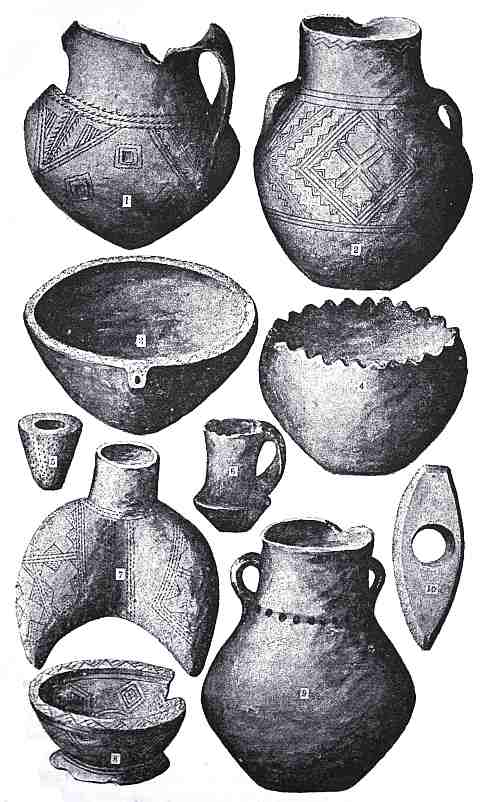
Fig. 43.—Laibach. All 1⁄3 real size.
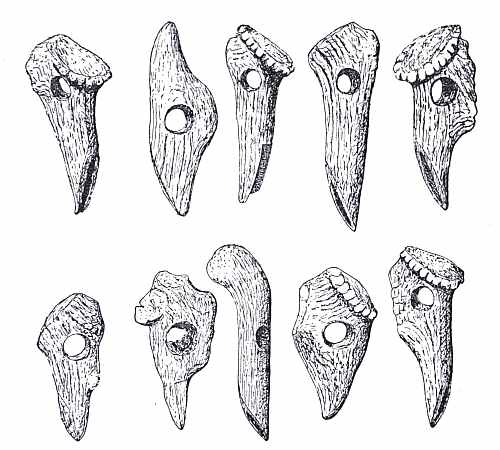
Fig. 44.—Laibach. All 1⁄4 real size.
3. The tynes of deer-horns were converted into coarse needles (Fig. 42, No. 13), and used probably in the manufacture of nets. Over a score of these implements have been collected.
4. A few finely-polished objects like hooks are supposed to have been used as dress-fasteners or buckles (Nos. 6 and 16).
5. Another set of curious objects (No. 7), of which about a score have been collected, is supposed by Dr. Deschmann to have been used as artificial bait to catch large fish, just as we at the present day use an imitation minnow. They are made of the tynes of deer-horns, and vary in length from 2 to 5 inches.
6. About a dozen or so of very sharp and finely-polished needles made from the superficial lamina of a rib. The eye, which is at one end, is either round or elongated (No. 15.)
7. Several hollow bones (some of the wild swan), open at both ends, and varying in length from 5 to 10 inches, have marks inside, as if made by the friction of running threads. They are supposed to have been used in the preparation of thread, and hence go under the name of "Zwirndreher."
8. Some flat portions of the horns of the elk and the underjaws of oxen, minus their teeth, were used as polishers.
Metal Objects.—(Fig. 45.) The total number of metal objects now in the Museum at Laibach, and tabulated as coming from the lake-dwellings, is 24. They are all either of bronze or copper, as hitherto not a trace of iron has anywhere been met with. The following is a list of them:—
1. Two flat-handled bronze swords 21 and 14½ inches long (Nos. 3 and 4).
2. Three bronze daggers, 11½, 8, and 7½, inches long (Nos. 2, 1, and 7). The larger has four rivets for fastening a handle; the next has six rivets, and the blade is beautifully ornamented; and the third has two rivet-holes, arranged differently from those in the other two.
3. A winged bronze celt (No. 5); and one of the flat type (No. 9), said to be of copper.
4. Portions of three bronze pins (Nos. 12 and 13).
5. Two thin bracelets of bronze, much worn.
6. Five peculiar objects of copper, like awls (Nos. 6 and 8).
7. Seven objects like daggers, lance-heads, or knives, rudely hammered, are also supposed to be of pure copper (Nos. 10 and 11).
The winged celt and the larger of the two swords are not noticed in either of the reports of the various investigations, but I am assured they form part of the same find; and, in corroboration of this, I find they are included in a photograph issued by the authorities of the Museum, purporting to be a representation of all the metal objects from the Pfahlbauten.
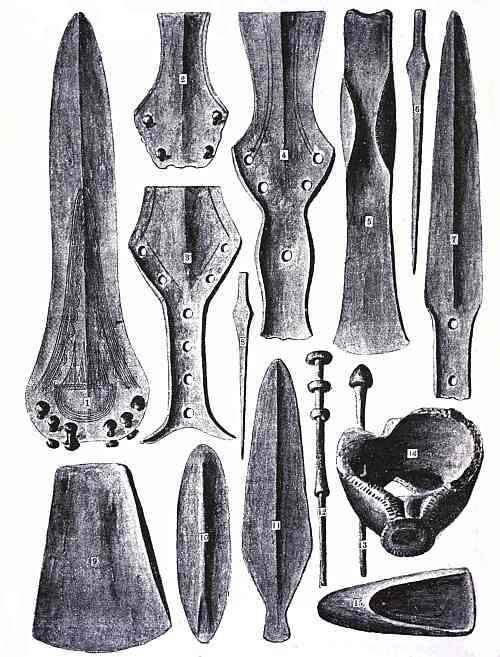
Fig. 45.—Laibach. Nos. 14 and 15 = 1⁄4, and the rest = 1⁄2 real size.
Objects of Wood.—A canoe 15½ feet long and 2½ feet wide was pointed at both ends. Also a toy canoe. Fragments of a few dishes, such as a large plate, a spoon of yew wood, and some bowls—one of which is scooped out of a large round natural protuberance of a tree. A few elongated pebbles rolled in birch bark. Portions of bast ropes, and some coils of very fine carbonised linen threads.
Two remarkable machines ("Biberfälle") (Fig. 46), each constructed out of one solid piece of wood, and having two movable valves in the centre worked by projecting pivots resting loosely in corresponding holes in the machine. These valves are freely movable when pushed upwards, but this motion is arrested just a little short of the perpendicular by the slanting shape of their posterior edges, so that, when left to themselves, they always fall together, and never backwards. The one here represented is in a very perfect state of preservation; and the other, though now in a fragmentary condition, clearly shows that in its structure it was precisely similar to the former. These peculiar implements, though found at a little distance, are considered of contemporary date with the lake-dwelling remains, as they were in the same archæological stratum, and about the same depth in the peat. The one here figured is made of oak, and measures 32 inches long, 12 inches broad, and 4 inches deep. The aperture, when the valves are open, measures 9 by 5 inches. The most recent opinion as to the use of these machines is that they were beaver traps—an opinion that derives much probability from the extraordinary number of the skeletons of this animal which have been found among the food-refuse of the inhabitants of this lake-dwelling.
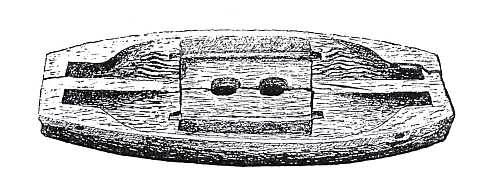
Fig. 46.—Laibach. Wooden machine, supposed to be a Beaver-trap.
Such machines are not absolutely new to archæology, and the little that is known about them rather strengthens the opinion above given as to their use. The first discovered to which attention was directed in archæological journals was figured and described in 1873[32] by Dr. Hildebrandt, of Tribsees, Neu-Vorpommern. It measures 29½ inches long, and 6 inches broad at the ends, and has two movable valves in the centre. It was found in a peat bog at a depth of 5 to 6 feet below the surface, and is now preserved in the Museum at Greifswald. Dr. Hildebrandt conjectured that it was some kind of trap for catching fish.
In reply to Dr. Hildebrandt's notice of the machine found at Tribsees, Professor F. Merkel, of Rostock, wrote to say[33] that two similar ones were found in different parts of North Germany, which he considered to be otter traps rather than fish traps. One of them was found in the moor of Samow, near Gnoien, at a depth of 6 or 7 feet, and is now in the Museum at Rostock.
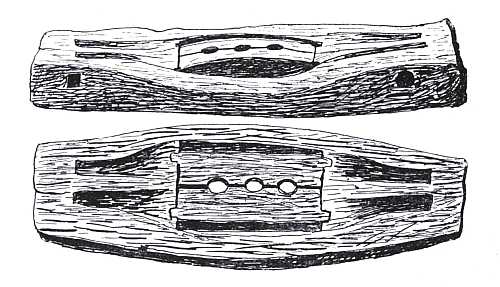
Fig. 47.—Wooden machine, 3 feet long, from North Germany.
It is remarkably like the one from Laibach, and differs only in being 4 inches longer, and having three holes in the valves instead of two (Fig. 47). A third[34] was found in a moor at Friedrichsbruch, near Flatow, in the province of West Preussen, which was sent to the Märkisches Museum. At no time within historical times were such machines known to be in use, so that their function still remains conjectural, unless the circumstantial evidence derived from the Pfahlbau at Laibach decides them to be "Biberfälle."
While the proofs of the above remarks were still in my hands, I received from Dr. Luigi Meschinelli, of the Geological Museum of the Royal University of Naples, a copy of an article by him, entitled "Studio Sugli Avanzi Preistorici della Valle di Fontega."[35] The objects described in this memoir were found, in the course of excavating peat, in a small valley which opens into Lake Fimon in the vicinity of Vicenza. Among numerous industrial remains of man, consisting of fragments of pottery, various implements of stone and flint, a bronze celt, and a Roman coin of the time of the Emperor Adrian, were three curious and novel objects of wood shaped like small canoes. One of these machines—the best preserved, though not the largest—is carefully described and figured by Dr. Meschinelli, and from his minute description there can be no doubt it is another example of the same apparatus which I have just described as having been found in North Germany and Laibach Moor.
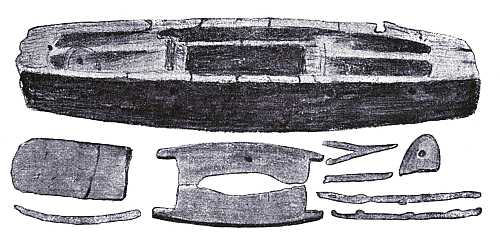
Fig. 47a.—Wooden machine from Fontega, 28 inches long, with detached valves, and some worked sticks found along with it.
The body of the Italian machine was constructed out of one piece of oak, and measured 28 inches long, 6¾ inches broad, and 2¾ inches thick (Fig. 47a). The opening in the centre, which was closed by two valves revolving on projecting pivots, and resting along their axis in a deep groove cut on each side of the machine, measured 6½ inches by 3½ inches on the under side, so that this would be the actual size of the aperture when the valves were open. Associated with the machine, as will be seen from the illustration, were several worked portions of sticks, evidently the débris of some kind of mechanism attached to it. Similar sticks were found along with the Laibach examples. It will be observed that the dimensions of the Italian one are a little less than those of the previously described machines, but that in all other respects they are identical. The other two found at Fontega were, according to Dr. Meschinelli, precisely similar to the one he describes.
Among the organic remains from these peat excavations I find no mention made of the osseous remains of the beaver, neither is this animal included by Lioy among the fauna of the lake-dwellings at Fimon. So far, therefore, there is no presumptive evidence that the machines described by Dr. Meschinelli were beaver-traps. That, however, the beaver frequented the Po valley during prehistoric times we have positive evidence in the discovery of its bones in several localities—as, for example, the terremare of Castellaccio (B. 457) and Cogozzo (B. 389a).
Puzzled to account for these curious machines which so fortunately attracted the attention of Dr. Meschinelli, he concludes his notice of them thus:—
"A che cosa poteva servire questo oggetto? Era forse un modello per costruire poi una piroga di dimensioni maggiori per utilità pratica? Portata a queste dimensioni, serviva essa al trasporto, o meglio quei congegni erano stati inventati a facilitare la pesca? Volle invece l'artefice sbizzarrire il suo genio inventivo nel costruire un trastullo cosi grazioso? E perchè allora costruirne due di eguali?"
It may be interesting to add that in 1859 a wooden machine, which evidently comes under the same category as the above, was found in a bog in the townland of Coolnaman, parish of Aghadowey, county Derry, Ireland. It is figured in The Ulster Journal of Archæology (vol. vii. p. 165), as an "antique wooden implement," which is thus described by the editor:—
"It was discovered embedded in a solid bank of turf, at a depth of 4 feet from the surface, the bog extending to a great depth underneath. No other article was found near it. It is entirely of wood, and measures as follows:—Extreme length, 3 feet 5 inches; breadth across the centre, 7½ inches; depth, 2½ inches; lid, 14 inches long and 3½ inches broad; under hole, 12¾ inches long and 3½ inches broad. The upper edges have evidently been higher on all sides, when perfect—probably on a level with the lid or small door—or even extending still higher, so as to form a kind of trough. The lid is now somewhat narrower than the opening which it is intended to close, but, no doubt, was made to fit accurately when in use. It moves up and down on a hinge formed by two projections which lie in corresponding hollows, and seems to have been opened and shut by means of a handle inserted into a hole in its centre. These hinges have, no doubt, been kept in their place by some part of the wood above them which is now lost. From each end of the lid and on a level with its upper surface there runs a hollow groove, sloping regularly downwards to the end of the implement, and terminating in a hole which perforates the bottom, seemingly for the discharge of a liquid. Towards each end are two lateral holes placed opposite to each other, one in each lip of the groove, apparently to receive a rope passed through them to serve as a handle for removing the article from place to place. The under side of the implement is flat, having in its centre an oblong hole (the bottom opening of the cavity covered by the lid), which has all its four edges sloped or bevelled.... Coolnaman, which gives name to the townland, is a considerable hill, entirely cultivated, but surrounded at its base by a bog of unknown depth, which evidently occupies the site of an ancient lake. On the side of the hill where the implement was discovered the turf has become quite solidified, and forms a dense black mass up to the surface."
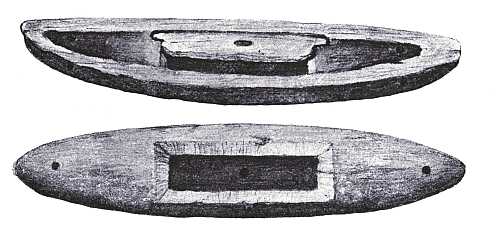
Fig. 47b.—Antique wooden implement from Ireland, showing upper and under surfaces. Length, 3 feet 5 inches.
In looking at Fig. 47b, which shows the upper and under sides of this implement, it will be at once seen that it differs from the Continental examples only by having one valve or lid closing the central aperture instead of two. Neither the editor nor any of the parties who had examined this curious machine at the time had ever seen anything of the kind before, and no rational explanation of its use has ever since been offered. One thought it was a fishtrap intended to be placed in a river; another, that it was a kind of pump; a third, that it was a machine for making peats; and a fourth, that it was a cheese-press (Ibid., p. 289).
To find so many of these machines, of unknown use and so remarkably similar in structure, in such widely separate districts as Ireland, North Germany, Styria, and Italy, must be a matter of interest to archæologists, and no one can say that the correct explanation of their use is to be found in any of the suggestions hitherto offered on this point. I may mention one element which may help in the solution of this problem, viz. that all the examples from Italy, Laibach, and Ireland were found in bogs that were formerly lakes. Perhaps this is true in regard to those from North Germany, but the point is not referred to in the short notices which have appeared of them. If these machines are really traps they could only be used in water where the animal could insert its head from below, and among amphibious animals the otter and beaver are the only ones to which all the conditions involved in the trap theory could apply.[36]
Organic Remains.—In the report of the investigations for the year 1877 Dr. Deschmann gives the following analysis of the osseous remains collected, which shows the relative frequency of the respective animals:—
Individuals. Individuals.
Sheep, a horned variety 147 | Wild Boar 28
Stag 131 | Bear 18
Beaver 52 | Bison 17
Domestic Ox, with 48 pieces |
of horn 35 | Dog 16
Goat 31 | Roe 12
Badger 31 | Wolf 2 to 3
Marsh Pig 35 | Elk 3 to 4
Some of these bones contained crystals of vivianite, resembling in this respect the osseous remains found on some of the Scottish crannogs, especially that at Lochlee. (B. 373, p. 88.)
The Bos primigenius is also represented by a portion of horn 21 inches long. The presence of hazel nuts with gnawed holes also points to the existence of some small rodents, probably the dormouse. One or two bones (metacarpal bone of a deer and an ulna of the bear) are covered all over with groups of peculiarly-striated markings, as if made with a file; but for what purpose, or whether the work of man or of some rodent animal, remains a mystery.
There is also a considerable quantity of the bones of birds, the spine bones of fish, jawbones of large pike, carp, etc., and a portion of the shell of a tortoise (Emis lutaria).
Of human remains there are two skulls of adults, minus the facial part, another of a child, a lower jaw, and a few bones of the extremities.
Notwithstanding a minute search, no traces of any kind of corn have hitherto come to light; but we must not therefore conclude that the lake-dwellers were ignorant of agriculture and the ordinary cereals, as grain is so apt to decompose unless it happens to be in a carbonised state. It is, however, probable that the cultivation of grain was not the chief industry of the colony, and that the mealing-stones which were in such abundance must have been used for grinding some other kind of food as well as grain, such as the kernels of hazel-nuts and water-chestnuts. The water-chestnut (Trapa natans), according to Deschmann, does not grow at the present time in Carniola; nor has it ever, since the earliest botanical examination of the country by Scopoli, been considered a native plant in the Flora Carniolica. In the last century the monks of the Cistercian order, at Sittich, cultivated it in their ponds. Pliny, however, distinctly states that in ancient times it was used as a food. "Thraces qui ad Strymona habitant foliis tribuli equos saginant, ipsi nucleo vivunt, panem facientes prædulcem, et qui contrabit ventrem." (H. Nat., xxii. 10-12.)
Among the vast quantity of osseous remains there is not a single fragment of the skeleton of the horse. On the other hand, it is calculated that the deer is represented by no less than 500 individuals, and the beaver by at least 140. For the latter this is a colossal figure, seeing that the richest station in beaver remains among the Swiss lake-dwellings, viz. Moosseedorfsee, numbers only eight individuals. The animal is now extinct in the country, nor has it ever been mentioned in any of the historical annals of Carniola.