First Lecture. SETTLEMENTS IN LAKE ZÜRICH, WESTERN SWITZERLAND AND FRANCE.
Reading edition
The investigations of geologists in the early part of this century, culminating in the publication of Sir Charles Lyell's "Principles of Geology," not only upset current theories regarding the past history of our globe, but also revolutionised the very formulæ on which these theories were founded. The influence of this drastic clearance of antiquated machinery in geology soon extended to the collateral sciences, and one of the first to benefit from the improved methods was archæology. The first great application of scientific methods to prehistoric researches was made in the north of Europe. The Scandinavian savants, in attempting to pry into the early history of their people, found so little reliable information in their sagas and other mythological fables, that they cast them altogether aside as useless or misleading. Struck with the elegance and beauty of the stone weapons and implements so profusely scattered over the land, they seized the idea, occasionally previously mooted by writers in other countries, but hitherto never seriously considered, that there was a time when people were entirely ignorant of the use of metals, and, in the prosecution of their social industries, had to depend exclusively on such tools as could be manufactured out of stone, horn, wood, etc. To this idea they soon afterwards linked another, which experience has also shown to be founded on accurate observation, viz. that their earliest metal objects were made from a nearly uniform compound of copper and tin, known as bronze. Iron, it was maintained, was not known in the country for several centuries afterwards; but, on the other hand, when it became known, it gradually superseded bronze in the manufacture of all cutting implements and weapons, on account of its superior qualities for such purposes.
These simple observations in the hands of the Scandinavian scientists supplied the essential elements of a new system of classification, which has since become so familiar all over the world as the three ages of Stone, Bronze and Iron. Its adoption by Dr. Thomsen, in 1830, as the basis of arranging the prehistoric materials in the Museum of Northern Antiquities at Copenhagen, and, a few years later, in the Museums of Lund and Stockholm, marks the commencement of a new era in the history of prehistoric archæology. Other nations were not slow in following in the footsteps of the northern savants, and to such an extent was this new departure carried that for a time at least, all antiquarian objects were classified as belonging to one or other of the so-called ages, on the mere knowledge of their composition. So fascinating was the spell of this new doctrine, that it was some time before even experienced archæologists could see the fallacy of adhering rigidly to such a method of arranging objects; as if, the instant a bronze or an iron implement became known, the manufacture of its analogues in the inferior materials there and then ceased for ever. While, therefore, conceding that the chronological sequence of the three ages, as determined in Scandinavia, is generally correct, and holds good also for European countries, I consider it radically wrong to suppose that the respective epochs indicated by these successive stages of civilisation, especially in districts widely separated, are identical in point of time. Many local circumstances in a country, such as the poverty of the people, their isolation and distance from commercial highways, etc., have often so contributed to the persistency of customs and usages, elsewhere become obsolete and entirely superseded, that a chronological comparison of its progress in civilisation, as defined by the three ages, becomes perplexing, if not misleading, when applied to other countries. The question resolves itself, therefore, into this: that each well-defined archæological or geographical area must ascertain the chronological sequence and duration of these ages for itself.
But whatever may be the value of this system when applied to the elucidation of early European civilisation, one thing is certain—that it was the means of evoking throughout the entire world an enormous amount of interest in archæological pursuits. Henceforth primeval antiquities of every description, the merest "waifs and strays" of humanity, things which previously were utterly ignored, were now eagerly collected, described, and catalogued; and in every centre of intelligence societies and journals were founded with the express object of following up the new found trail of prehistoric man. Since then the problem of man's place in nature has come largely to the front, and now appeals for its solution to all departments of science, and to all legitimate processes of reasoning. Among those who devoted their energies to the study and elucidation of the archæological phase of this problem was the learned Ferdinand Keller, President of the Antiquarian Association at Zürich, to whom the world is indebted for one of the most remarkable archæological discoveries of this century—a discovery which in its consequential results is unique for the variety and wealth of materials with which it has illustrated that singular but long unknown and forgotten phase of prehistoric civilisation in Europe, which found its outcome in the habit of constructing dwellings in lakes, marshes, etc. This discovery of Dr. Keller was not of the nature of a lucky find, but was the result of a purely mental process—a spark of superior intelligence—fostered, I have no doubt, by his knowledge of these very Scandinavian doctrines to which I have just referred.
In countries whose lakes and rivers are fed from snow-clad mountains and glaciers, it is observed that their waters find their greatest diminution in winter, when a portion of their supply is temporarily suspended in the form of ice. This phenomenon became unusually intensified in Switzerland during the winter of 1853-4, so much so, that the level of its lakes had sunk lower than had ever before been known. Some of the inhabitants of the village of Ober-Meilen, on the east shore of Lake Zürich, took advantage of this circumstance to extend their vineyards, by recovering portions of the exposed shore, which they enclosed with stone walls, and filled in the space with mud, so as to bring its surface above the ordinary level of the lake. In the course of these operations the workmen came upon the heads of wooden piles around which were portions of stags' horns, stone hatchets and other implements (Fig. 1), which excited some curiosity among them. The event, however, was not singular in the district, as objects of a similar character were on several occasions encountered along the shore of the lake; and even in this same spot, in 1829, when the little harbour of the village was being deepened, bits of rotten piles, as well as implements of stone and horn, were turned up among the dredged stuff. They were not, however, deemed of sufficient value to be rescued from the mud, so that, along with it, they were carried away and re-deposited in deep water. Also at Männedorf, a village a few leagues farther up the lake, during the winter of 1843-4, while its harbour was being enlarged, similar discoveries were made. A few of the relics were on this occasion collected and sent to the Museum at Zürich, where they are still to be seen. Indeed, these, and other recorded instances of antiquarian remains being fished up or dredged from the Swiss lakes, are by no means exceptional events; but, however suggestive they may now appear, they all failed to excite in the minds of their beholders that great deduction which will for ever associate the name of Keller with the lake-dwellings of Europe. On this occasion the schoolmaster of the village of Ober-Meilen, Mr. Æppli, whose house was close by, considered the find of sufficient importance to be brought under the notice of the Antiquarian Association at Zürich, which he accordingly did in the month of January, 1854. Thus it was that Dr. Keller appeared on the scene. From the investigations which subsequently ensued the following general facts were ascertained.
(a) Composition of Lake-bed.—First, or uppermost, there was a stratum of yellowish mud, from 1 to 2 feet thick, mixed with rounded pebbles, and in all respects similar to what was being deposited in the shallow indentations of the lake in the vicinity. Beneath this was a deposit of blackish mud, mixed with decayed organic matter, and varying in thickness from 2 to 2½ feet, in which the tops of the piles appeared and all the relics were found. The third stratum was in composition somewhat similar to the first, and, like it, with the exception of the deeply penetrating piles, was devoid of antiquarian remains.
(b) Disposition of the Piles, etc.—The exact dimensions of the area occupied by the piles were not determined, but it appeared to be considerable, and to stretch along the shore within a few fathoms of the ordinary water-mark. The piles were made of different kinds of wood—oak, beech, birch, and fir being the most prevalent—and they varied in thickness from 4 to 6 inches. Sometimes entire stems were used, but more frequently they were split into halves or quarters. They were about 1½ foot apart, and had a kind of systematic arrangement in rows parallel to the beach. Some piles were pulled up, and their tips were found to have been pointed by blunt tools, the cuts of which were, in the estimation of experienced carpenters who had examined them, precisely similar to those which would be made by those very stone implements collected around them.
(c) Relics.—The relics were of a mixed character, and included the following:—Stone celts and chisels, some of them being still fixed in their horn handles and fastenings (Fig. 1, Nos. 3, 4, 11, and 15); perforated hammer-axes (Nos. 8, 13, and 17); mealing-stones and polishers (No. 12); various implements made of flint, as scrapers, flakes (No. 1), saws (No. 2), and some rude arrow-points (only one being neatly finished, No. 16); various objects of horn and bone (Nos. 6 and 7); also some wooden clubs, fragments of pottery, spindle-whorls (No. 14), shells of hazel-nuts, etc. Among the relics then collected were a bead of amber (No. 9) and a bronze armilla (No. 10).
After careful consideration of the facts thus brought to light, Dr. Keller came to the conclusion that the piles had formerly supported a wooden platform, that on this platform huts had been erected, and that, after these had been inhabited for a long period, the whole structure had been destroyed by fire.
A knowledge of these discoveries at Ober-Meilen, and of Dr. Keller's opinion in regard to them, soon spread among the surrounding inhabitants, the immediate result of which was a sudden crop of lacustrine explorers, who carried on a vigorous search for similar remains in this and the adjacent lakes. For their guidance were requisitioned all sorts of traditions, stories of submerged cities, of which many abounded, recollections of the occasional finding of implements and weapons of unusual types, etc.; but of greatest service was the local knowledge of fishermen, who, from practical experiences of disasters to their nets and fishing gear, could at once point out numberless localities where large fields of submerged piling were to be found. In the spring of the same year the celebrated station known as the Steinberg, at Nidau, in Lake Bienne, was discovered, as well as numerous other stations in the lakes of Bienne, Neuchâtel, and Geneva; so that before an illustrated account of the Ober-Meilen discovery could appear in the Transactions of the Antiquarian Society of Zürich Dr. Keller had important materials of a similar character from other localities to record. This report, entitled "Die Keltischen Pfahlbauten in den Schweizerseen," appeared towards the close of the year 1854, and at once attracted the attention of archæologists in all countries. Since then lacustrine investigations in search of lake-dwellings have been incessantly carried on, not only in Switzerland, but in many other countries in Europe, with the result that each year has seen an increase in their number, as well as a corresponding enhancement of the archæological value of the materials so discovered.
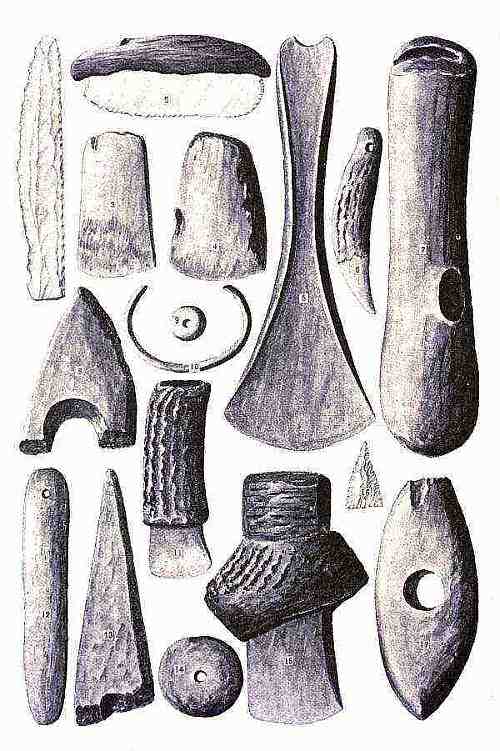
Fig. 1.—Ober-Meilen. All ½ real size.
Prominent among the early investigators whose names have a claim to be associated with this great discovery which has so popularised the name of the Zürich antiquary were Colonel Schwab, of Bienne, whose splendid collection of lake-dwelling antiquities now adorns his native town; Professor Desor, author of the admirable little treatise "Les Palafittes, ou Constructions lacustres du lac de Neuchâtel," and other works; and Professor Troyon of Lausanne, whose work, "Habitations lacustres des temps anciens et modernes," is so well known. But foremost among them all stood Keller himself, who from time to time, according to the demands of fresh discoveries, issued systematic reports of the Pfahlbauten, of which no fewer than six had appeared previous to the year 1866. In that year was published the English edition of Keller's reports, arranged and translated by Mr. Lee. It is needless to pursue here any further in historical order the various means, whether as publications or investigations, by which Keller's discovery was being pursued, as they come to be dealt with elsewhere. Suffice it to say that within a few years of its publicity, the existence of lacustrine villages all over Central Europe in prehistoric times was fully established.
From these remarks you will have some idea of the work before us in these lectures. It contemplates a critical and summary review of the principal results of the investigations of the lake-dwellings of Europe during the last half-century. This embraces a large geographical area, extending, roughly, from Ireland to Bulgaria, and from Venice on the Adriatic to the shores of the Baltic. Of the very numerous researches to which I shall have to refer, some were conducted by private individuals, others by public or scientific bodies, but all presumably more or less qualified to give a correct report of the facts. The records of successive discoveries have been generally published in the proceedings of local societies, but sometimes in separate monographs of extremely limited circulation. As to the antiquities, some have found their way to dealers, and have disappeared to foreign lands. A large proportion, however, have been carefully preserved in the respective districts or countries in which they were found, and are now located in public museums or private collections, where, as a rule, they are intelligently arranged and duly labelled. In conducting you, as it were, over this wide area, amidst such diversified materials, I shall be guided, to a certain extent, by geographical convenience, even at the expense of historical sequence; and in discussing typical finds I shall, as far as this may be practicable, make use of diagrammatic and pictorial illustrations, believing that even a poor illustration often conveys more information than the most accurate description.
LAKE ZÜRICH.
Further discoveries in Lake Zürich were not so speedily effected as in some of the other Swiss lakes, and for a few years the interest in this subject was transferred to more distant localities. In the following year, 1855, Colonel Schwab visited Zürich and made further researches at Männedorf and Ober-Meilen. From the latter he succeeded in securing a considerable number of objects, especially stone hatchets, some of which were made of nephrite, and a bronze celt of the flat type (Fig. 1, No. 5).
In 1858, in the course of some dredging operations for the purpose of deepening the mouth of the Limmat, fragments of pottery, bits of piles, and some peculiar beams having one or two square-cut holes (Fig. 2, Nos. 13 and 14) were dredged up. Dr. Keller recognised here the site of a Pfahlbau which extended both under the little island called Bauschanze and outwards towards the lake. (B. 22 and 336.)
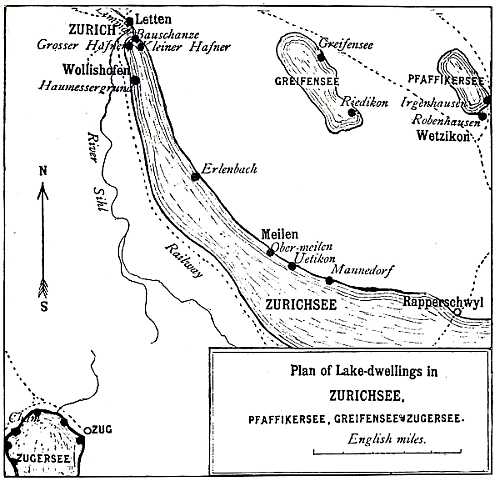
Two other localities near the outlet known as the "Kleiner Hafner" and "Grosser Hafner" were also proved to have been stations. The former was opposite the north end of the Tonhalle, and about 150 yards distant from the original shore. It occupied a circular area of about 1½ acre in extent and, when the water was low, its surface was only some 3 feet submerged. The Grosser Hafner was farther off in the lake, and its area was considerably larger than that of the Kleiner Hafner. On a clear day in both these localities stones and the tops of piles could be seen. Another locality known to Dr. Keller at this early period was about two miles from Zürich, on the west shore of the lake and just opposite the steamboat pier at Wollishofen. Here the lake-bed consisted of a deposit of fine mud, and owing to the constant commotion made by the steamers in passing to and fro the débris of the lake-dwelling had been greatly covered up. (B. 336.)
As the Kleiner Hafner lay directly along the course followed by the steamers, and greatly obstructed their passage, the authorities, in 1867, resolved to have the obstruction removed altogether. For this purpose a dredging machine was used, by means of which a segment several feet thick was removed from its surface. During this operation the same kind of perforated beams which had already attracted attention at the Bauschanze were turned up among the stuff, together with numerous objects of flint, stone, bone, etc., similar to those at Ober-Meilen (Fig. 2, Nos. 9 to 17). In addition to these, however, there were bronze axes of the winged type, some spoon-shaped crucibles, large clay rings and fragments of pottery of an unusually fine kind (Fig. 2, Nos. 1 to 8). But, what was considered still more strange, there were among these relics some iron weapons and Roman tiles.
Hitherto there was little or nothing done to the Grosser Hafner, and the "Haumessergrund" at Wollishofen, and so the surmises of Dr. Keller regarding them might have died with him, had it not been for the extraordinary exertions of the people of Zürich to have their beautiful environments made still more attractive by art. These extensive alterations, begun some six years ago, and scarcely yet completed, have so entirely changed the aspect of the shore in the immediate neighbourhood of the outlet, that visitors whose recollection of the town dates farther back than these transformations, will hardly recognise the locality. A splendid bridge now spans the opening of the Limmat, and on both sides of it are elegant promenades, gardens, and ornamental quays, which occupy what was formerly part of the lake. The filling up of such a great area of lake-bottom involved the use of dredgers, which, with revolving buckets, raised stuff from the most convenient shallows along the shore, and having dropped it into boats, it was then transported to its final destination. Among the localities selected for these operations were the Grosser Hafner and the outskirts of the Bauschanze. The rich loamy deposits of the Haumessergrund at Wollishofen were also found suitable for mixing with the gravel and for forming a good soil for the floral and horticultural gardens which now form such a conspicuous ornament to the fashionable walks along the northern shore of the lake.
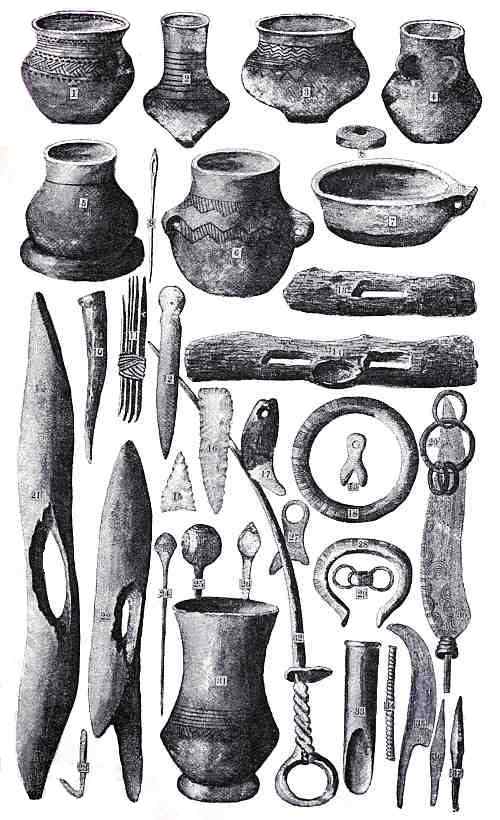
Fig. 2.—Bauschanze (13, 14, and 21 to 23); Kleiner Hafner (1 to 12, and 15 to 17), and Grosser Hafner. All 1⁄3 real size except 13 and 14.
The Grosser Hafner[1] supplied a wonderful medley of antiquarian objects, apparently of all ages—stone hatchets (one of which was 10 inches long), horn handles, bone implements, etc. Among bronze objects were: hatchets of the winged type, chisels, sickles, knives some ornamented with half-circles, points, and lines (Fig. 2, Nos. 30 and 35); pins with large heads, oval or round, and sometimes perforated and variously ornamented (Nos. 24, 25, and 26); arm-rings, both closed and open, and ornamented with engraved lines, dots, etc. (Nos. 18 and 28); a few spirals (No. 34), small rings and pendants (Nos. 19 and 27); two solid rings attached by a band (No. 29); a group of four rings—one being larger, on which the other three were hung (No. 20); a pin-like object, 15½ inches long, with a handle like that of a sword (No. 32); lance-heads, some of which were ornamented; a few small beads of amber. Among the fragments of pottery were two vessels complete with round bases (No. 31), and part of a moon-shaped crescent, rudely ornamented with depressions like finger-marks.
Here, again, as in the Kleiner Hafner, objects apparently of a later date were found, among which were Roman tiles, pottery of the kind known as terra sigillata, and an iron spear-head; also upwards of 16 coins of the time of Augustus, Tiberias and Vespasian.
On the other hand, at the Bauschanze, while objects of the stone age were very numerous, there were scarcely any of bronze. Most of the objects collected on this station were dispersed; but among the few that have come to the knowledge of antiquaries are some remarkable implements of horn, like picks, said to be field-hoes (Nos. 21 and 22). One of these is 14½ inches long, pointed at one end and chisel-shaped at the other. Another (10½ inches long) is also pointed at one end, but forked at the other. Both are perforated with an oval hole for the insertion of a wooden handle.[2]
Wollishofen.—The greatest of all the finds in Lake Zürich was that at Wollishofen. (B. 448, 449a, and 462.) Here, again, the dredging machines brought up a large quantity of wood, among which were some of those peculiar oak beams with square-cut holes, already noticed (Fig. 2, Nos. 13 and 14). The wood was of various kinds, and so abundant that the poorer people were in the habit of collecting it for firewood. Although the antiquities of the stone age were numerous, the great feature of this station is that it belonged to, or at least existed during, the most flourishing period of the bronze age. Notwithstanding pilfering, and the difficulty of detecting the smaller objects, the collection, as now deposited in the Museum at Zürich, must be considered one of the most important in the whole series of lake-dwelling researches. Among the more remarkable objects were the following:—
Weapons.—Four bronze swords, one only of which is complete (Fig. 3, No. 1); its entire length is 28½ inches, including the handle, which is also of bronze (barely 4 inches long), and to which the blade is attached by two rivets; another (No. 2), which is defective both in the blade and handle, is of a different type, especially in the formation of the handle, which was intended to have bone or wooden plates fastened with rivets to the remaining bronze portion; it is ornamented with a combination of circles or semicircles, in incised lines or dots. Three daggers, two of which have rivet-holes, and the third has what appears to be the remains of a tang. Eleven arrow-heads of bronze, and several of flint and bone. Of the former, two only have sockets (Nos. 4 and 14), the others being imitations of the ordinary flint forms (Nos. 3 and 5). Lance-heads were in much larger numbers than either the swords or daggers; they are mostly socketed, with side rivet-holes for fixing the handle; they vary in length from 3½ to 8 inches, and are sometimes ornamented, as shown in No. 7, and only two had tangs. Portions of wood are supposed to be fragments of bows.
Industrial Implements and Ornaments.—The stone hatchets are exceedingly well-made, and appear to have been partly sawn from water-worn boulders of serpentine and hornstone. None were of nephrite or jadeite; a few of horn have been noted (Fig. 185, No. 15). The bronze hatchets (Fig. 4, Nos. 16, 20, and 25) were numerous, the greatest number having four wings and sometimes a loop at the side; the direction of the cutting edge is generally at right angles to that of the wings, but in a few instances parallel to it (as in No. 16); at the top of the hatchet there is a hole or small recess. Of the flat kind there were a few, one of which is here figured (No. 25). Two small ones are of copper (Fig. 3, No. 17). The knives are mostly ornamented with running patterns or circles or semicircles in dots or lines, and the blades are all more or less curved (Fig. 4, Nos. 11 to 15); the handles were sometimes solid and of a piece with the blade, but more frequently they were of horn or wood, and attached by tangs or rivets. It is rather remarkable that amongst the large number of knives collected at Wollishofen there is not one of the socketed kind, which, as we shall afterwards see, are so frequently met with in Lake Bourget and some stations in western Switzerland. Some sickles of the usual type, fish-hooks, and a few of the socketed razor knives. Of bronze hammers there are six, all of which are socketed and either round or rectangular in shape (Fig. 4, Nos. 8 and 18). The round one, No. 8, is ornamented with a series of circular grooves, and has a socket 1¾ inches deep; it weighs 490 grs.
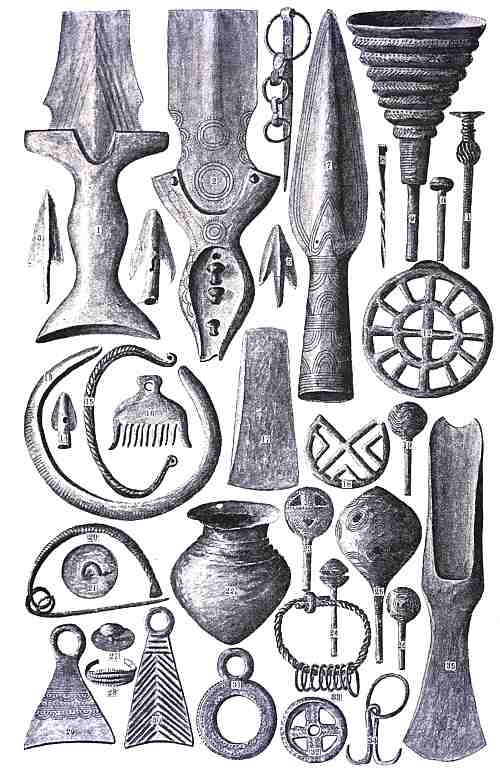
Fig. 3.—Wollishofen. All 1⁄2 real size.
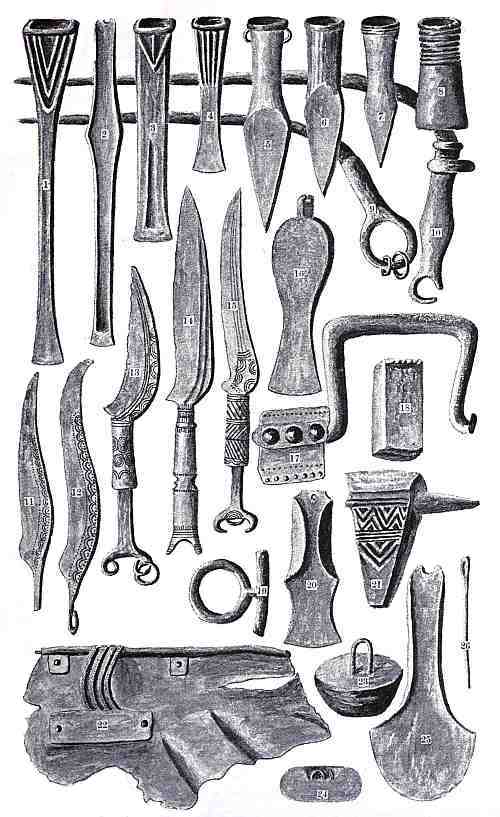
Fig. 4.—Wollishofen. All 1⁄3 real size.
There is a considerable number of chisels and gouges (Fig. 4, Nos. 1 to 7), small tubes, broad-headed nails and studs. One bronze punch is bifurcated (Antiqua, 1886, Pl. v. Fig. 8). An elegant vase of solid bronze (Fig. 3, No. 22), and fragments of large situlæ, made of thin bronze plates riveted (Fig. 4, Nos. 17 and 22). One of the most remarkable objects is that represented on Fig. 4, No. 21, which is supposed to be an anvil. Several long pins with sword-like handles, similar to one found on the Grosser Hafner (Fig. 4, Nos. 9 and 10). Bronze hair-pins were so numerous that they are to be counted by hundreds in the Museum (Fig. 3, Nos. 6, 8, 9, 10, 11, 19 and 23 to 26). One bronze comb and one bronze fibula (Fig. 3, Nos. 16 and 20). Bracelets are well represented, both closed and open; they are either flat or in solid mass (Fig. 3, No. 13), and generally ornamented; one (No. 15), open at the ends, is made of two stout wires, one of which is spirally grooved, and the other plain; these wires are united at the ends by a tin pin, which passes through a loop formed by the recoil of the ends of the wires. A large hollow ring (three inches internal, and rather more than four inches external diameter) is highly ornamented. (See Fig. 188, No. 2.) Finger-rings (Fig. 3, No. 28), pendants (Nos. 29, 30, and 31), buttons (No. 21), studs (No. 27), a so-called portemonnaie, for ring money (No. 33), portions of girdles (Fig. 4, No. 19). There are also one ringlet of gold and three beads, one of amber and two of glass. Amongst the nondescript objects are several small wheels—three of pottery (Fig. 5, No. 6), five of bronze (Fig. 3, Nos. 12 and 18), and two of tin (No. 32)—a leaden weight, which has a high loop of bronze (Fig. 4, No. 23). An object of the same kind (No. 24), with two loops, was found at Onnens. Besides the two copper celts (Fig. 3, No. 17) there were two small copper awls and several bits of this metal.
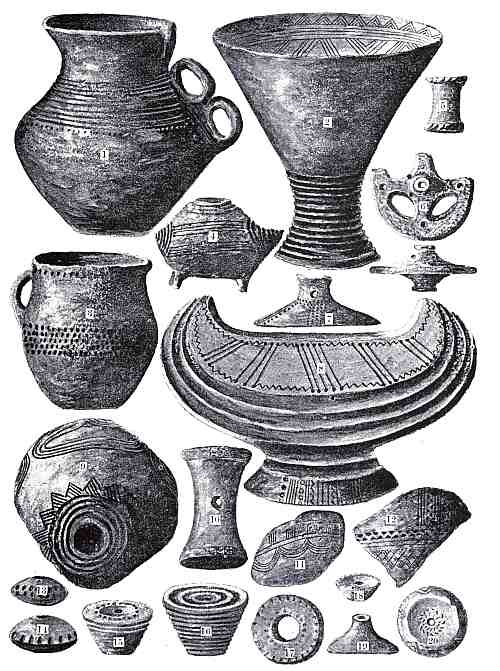
Fig. 5.—Wollishofen. All 1⁄3 real size.
Pottery.—The pottery at Wollishofen shows vessels made of two kinds of paste, one fine, and the other coarse containing a mixture of rough sand. The vessels varied much in size, the smallest being only about one inch in diameter, and the larger ones, judging from the curve of the fragments, ranged from sixteen to twenty-seven inches in diameter. They had no glaze, nor can it be said that the wheel was used in their manufacture, although some are very symmetrically shaped. No quartz or sand was mixed with the fine paste, of which the more ornamental vessels were made (Fig. 5 Nos. 1, 2, 3, 7, 9, 11, and 12). Some had a conical-shaped base, and could only be made to sit in soft material, such as sand, or by means of a ring, like those figured from the Kleiner and Grosser Hafner. One small vessel was trilocular, having its three chambers or bowls attached to one common base. Some very flat vessels were found, which are supposed to have been lids (Fig. 5, No. 7). Spindle whorls of burnt clay variously ornamented (Fig. 5, Nos. 13 to 20), and some other objects like modern thread pirns (Nos. 5 and 10) are in abundance. Portions of six crescents are all differently ornamented. Some now in the Museum have been restored, so as to show their original form and ornamentation, and it is from one of these that the illustration here given was taken (Fig. 5, No. 8). Some dishes took the forms of animals, as in No. 4, and were probably used as lamps.
Among other objects may be mentioned some bits of red stone, supposed to have been used as paint; foundry materials, as moulds and bronze dross; portion of a dug-out canoe; various bits of sawn and cut horn; etc.
Human Remains.—The only portion of a human skeleton was a skull, which, according to Dr. Kollmann, is of the mesocephalic type. (B. 420, p. 90.)
Organic Remains.—Wheat, millet, hazel-nuts, and crab-apples, were identified.
Männedorf.—I have already incidentally referred to the discovery of the site of a lake-dwelling at Männedorf before 1854, when such antiquities were not understood (page 4). In 1866, however, a portion of lake-bottom close to where these early discoveries were made, measuring about eighty feet by thirty, was deepened to facilitate the passage of steamers, when further evidence as to the nature of this settlement was disclosed. The piles were so closely set that there was hardly the breadth of a pile between them. The objects collected were very similar to those already described from Ober-Meilen, among which was a spoon-like crucible like those from Robenhausen. (B. 126, p. 263.) The discovery of a second station near the mouth of the Surenbach, between Männedorf and Uetikon, was noticed by Dr. Keller in his second report. (B. 22, p. 121.)
Uetikon.—Remains of another station are to be found close by the landing stage at Uetikon, from which on several occasions antiquities of the Stone Age were picked up. More decided indications of the character of this settlement were, however, revealed in 1886, in consequence of some dredging operations that were carried on. On this occasion were found not only piles, bones of various animals, as stag, ox, and pig, fragments of pottery, stone hatchets, and flint implements—the usual relics of the Stone Age—but also a few bronze rings and hair-pins. (B. 462, p. 17.)
In the Zürich Museum may be seen a considerable number of the relics from this station, among which are twenty-three stone celts (one being still in its horn fastening), five flint saws or scrapers, four pointers of horn, and a semi-globular spindle-whorl.
Erlenbach.—Near Erlenbach were two settlements, one at Winkel, a few minutes' walk above the village; and the other at Wyden, about an equal distance below it. In 1886 the usual indications of the Pfahlbau settlements, such as piles and various industrial relics, were found in the course of some dredging operations, but the objects were mostly dispersed. (B. 462, and 420a, p. 73.)
Letten.—In 1877, while digging a canal in connection with the Zürich waterworks, some remarkable antiquities of bronze and iron were dug up, which Dr. Keller describes in the eighth report of the lake-dwellings. They were found in a portion of the cutting extending some eight hundred yards in length at a place called Letten, on the right bank of the Limmat, nearly opposite to where the Zihl joins it. The objects lay in a fine mud deposited by the river, and underneath a bed of gravel of the same origin. Dr. Keller came to the conclusion that the "Lettenfunde" belonged to a settlement analogous to, and probably contemporary with, the later Pfahlbauten, with the relics from which they in many respects agree. A careful inspection of the Letten relics—which include two swords, one or two spear-heads, a variety of winged celts, a couple of sickles with raised buttons, knives, a great number of hair-pins of diversified forms, an involved ring-ornament, etc., all of bronze—shows that they are of a more recent period than the lake-dwellings. Among the bronze celts are forms (as for example that in Fig. 3, No. 35) which have never been found in the true relic bed of a lake-dwelling; and besides there are other objects, such as a fibula, and a piece of iron partly fashioned, probably intended for a sword, which are characteristic of the La Tène period. (See Fig. 87, No. 6.) While deepening the bed of the Limmat similar objects, as well as those of preceding and succeeding ages (Roman), have been frequently found. The Letten objects correspond more with the pre-Roman antiquities found in the Nidau-Büren Canal and in some of the later tumuli, and may therefore be said to link together the products of two very different civilisations, viz. the bronze age of the lake-dwellings, and the subsequent iron age, so characteristic in La Tène.
For the relative positions of these stations see Sketch Map, page 9.
LAKE OF BIENNE.
Investigations in the Jura Lakes, and Archæological Result of the "Correction des Eaux du Jura."—At a short distance from the eastern shore of Lake Bienne, near where the Zihl by several mouths found its former exit, there exists, or rather formerly existed, a stony elevation, covering an area of some three acres, which rose gradually from a depth of about 20 feet to within 7 or 8 of the surface. This curious cairn-like structure, being in marked contrast with the surrounding lake sediments which here consist chiefly of fine mud, was well-known to the fishermen as the "Steinberg," i.e. stone hillock. Among these stones were many projecting heads of piles which, to prevent injury to their nets, the fishermen were in the habit from time to time of pulling out. Moreover, at various times, on or near this steinberg, Roman tiles and some fantastically shaped objects covered with chalky concretions were picked up, which fostered a vague opinion that it was the foundation of a Roman fortress or lighthouse.
In 1854 Colonel Schwab and Mr. Müller of Nidau made a careful investigation of the steinberg, the result of which was to leave no doubt that it was the site of a lake-village which had been erected over the piles, the stumps of which then only were detected among the stones. These stones were of a pretty uniform size, not too large to be transported readily by human hands, and in material they were exactly similar to those scattered among the glacial débris on the neighbouring slopes. Interspersed in this cairn were, not only the upright piles of round or split stems, singly and in groups, but also transverse beams, which had evidently not fallen at random but had been intentionally placed and jammed between the uprights to keep them more firmly in position. The strange-looking objects turned out to be bronze implements encrusted with such a coating of lime that their metallic nature had been effectually concealed. The station quickly proved to be exceedingly rich in antiquities of new and varied forms. Not only the usual objects of the Stone Age, but even implements of iron and fragments of pottery of unusual elegance were fished up.
This discovery was greatly talked of in the district, and led to such a lively search for the sites of lacustrine abodes that before the end of the year some half-dozen stations were identified in the Lake of Bienne alone, not to mention a much larger number in the adjacent lakes. Notwithstanding the difficulties under which these lacustrine investigations were conducted, as dredging or digging under several feet of water was both laborious and expensive, the number of objects collected by the Swiss antiquaries in those early years is astonishingly great, as evidence of which I have only to point to the collections of Col. Schwab and Professor Desor.
It is often the case that antiquarian remains owe their discovery to the mere accident of agricultural operations, peat-cutting, drainage, etc. Such operations are, however, usually confined to small lakes and bogs. The idea of partially lowering the surface of the extensive sheets of water in the Jura valley, comprising the lakes of Bienne, Neuchâtel, and Morat, was too chimerical to be ever entertained in the interests of archæology. But what was inconceivable and utterly beyond hope from this point of view, became, in the interests of agriculture, not only a practical problem, but is now an accomplished fact. Between the lakes of Bienne, Neuchâtel, and Morat, there stretches a vast mossy district known as the "Gross Moos," through which the combined surplus water of the two latter lakes finds its way to the former. From the north end of Lake Bienne the surplus water again emerges, and is conveyed by the Zihl or Lower Thielle in a sluggish channel for some miles farther down the valley, where, before the Correction des Eaux du Jura, it united with the Aar. As the surface of these lakes is nearly on the same level, it is more than probable that in early prehistoric times their waters formed one united sheet, which in the course of ages became separated into three lakes by the interposition of the sedimentary and peaty deposits now forming the Gross Moos. Their connecting channels, the Broye and the Upper Thielle, owing to the sluggishness of the flow, became gradually raised by the constant deposition of mud, thus proportionately raising the level of the confined waters, and consequently rendering the surrounding lands more and more liable to submergence. Also, the river Aar, though passing quite in the vicinity of the lake of Bienne, went a long way beyond it before joining with the Zihl, and often caused great havoc by flooding the richly-cultivated lands of the lower grounds.
To remedy these defects the Swiss Government entered on the gigantic project of rectifying and deepening the entire waterway from the junction of the Lower Thielle with the Aar to the mouth of the Broye in Lake Morat. The scheme also included the cutting of a new channel for the Aar, by means of which it would be entirely diverted from its old course, and made to debouch into Lake Bienne by a straight and much shorter route. (See Sketch Map, page 23.)
The hydrographical result of these works (which were begun in 1868, and only completed a few years ago) was to lower the surface of these lakes to the extent of six or eight feet. In the winter of 1871-2 the operations began to tell on Lake Bienne, but it was some years later before the others became sensibly affected. When, however, the works were completed, the permanent effect on these lakes, especially on Lake Neuchâtel, was very marked—harbours, jetties, and extensive tracts of shore-land being left high and dry by the subsiding waters. This was the harvest-time of archæology. Many of the lacustrine abodes became dry land, and were visited by crowds of eager searchers; even fishermen forsook their normal avocations, finding it more profitable to fish for prehistoric relics. Government at last interfered with this indiscriminate "howking," and passed a law restricting the privilege of excavating to the authorities of the respective Cantons on whose territories the stations happened to be. Thus the "Correction des Eaux du Jura," as the undertaking was called, greatly facilitated the investigations of the Swiss lake-dwellings, and contributed enormously to the elucidation of the culture and civilisation of their inhabitants.
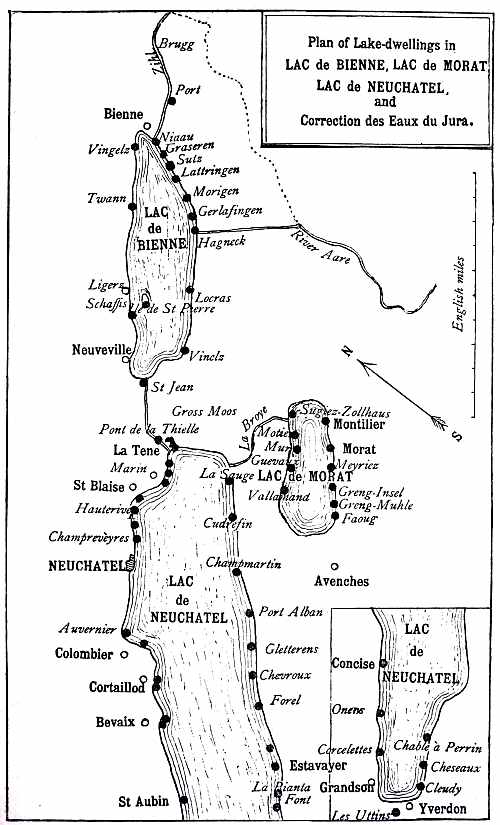
In the following descriptive notes of the stations in Lake Bienne I follow simply the order of their distribution along its shore, making, as it were, a circular tour of the lake, beginning at Nidau, and passing along its southern shore, then round to the other side, until we come back to our starting-point.
Nidau-Steinberg.—This station was so thoroughly investigated by Colonel Schwab and his assistants that little remained to be done after the lowering of the water. The objects collected are both numerous and varied, and being among the earlier of the kind brought to light from the lake-dwellings, they have been fully illustrated by Dr. Keller. (B. 15 and 22.) Among them were some heavy stone weights, some perforated, and some with an iron hoop; discoidal stones, with a marginal groove; a variety of corn crushers, polishers, and hammer-stones, etc.
Bronze.—Sickles and axes, both socketed and winged, generally with a side loop, but without a notch at the top. Knives were numerous, and some were ornamented with flowing lines and semicircles; they were hafted by tangs or sockets, but in a few instances the blade and handle were cast in one piece. Several spear-heads, one of which is richly ornamented with a series of rings and a serpentine pattern; a few arrow-points with barbs; several socketed chisels of various sizes; numerous needles, hair-pins, fish-hooks, curiously-shaped pendants, rings, and bifurcated pincer-like objects; one hexagonal-shaped hammer with a socket, and another having a small loop attached to the side like that of a celt. Some remarkably fine bracelets, open at the ends, and hollow, and having the outside ornamented with concentric circles, lines, etc.; others are solid, or made of spirally-grooved wire. A number of so-called razors, buttons, studs, broad-headed nails, spirals, the central portion of a horse-bit, etc.
Gold.—A small spiral of gold wire, and a square piece of thin plate neatly corrugated.
Iron.—A few conical javelins with sockets.
Pottery.—The potter's art seems to have been carried to great perfection. The vessels were of all sizes, from two to three feet in diameter down to the most tiny objects. They were generally round at the base, and required ring supports, of which many were found. Some shallow plates were ornamented with squares, oblongs, and circles. Various forms of spindle-whorls, some of which are made of fine paste, and blackened with charcoal, like the finest pottery. Over twenty clay crescents, represented by fragments, and one of stone. Some clay cylinders, weights, and a few rude figures of a four-footed animal.
Bone, Wood, etc.—A few bone implements, pointers, etc.; the side piece of a bridle-bit of staghorn, perforated with three holes; portion of a yoke, clubs, etc.; bits of clay with marks of wattle-work.
Graseren.—A small station concealed in rushes, and containing large piles. The antiquities consist of a few iron objects, one being a dagger with the handle ornamented with silver wire, and a few mealing-stones and rubbers, etc. (B. 22.)
Sutz.—This was a very large settlement, the piles extending over an area of about 6 acres. It was connected with the shore by a bridge or gangway, about 100 yards long and 13 wide. Within its area several steinbergs were interspersed; and the relic-bed, from 4 to 16 inches thick, was near the surface. The piles were mostly of oak, and irregularly placed. The antiquities are classified as belonging to both the Stone Age and the Bronze Age, among which the following are the more interesting (B. 15 and 286):—
Stone.—Hatchets of the usual form (a few of nephrite) and others perforated; beads or spindle-whorls, one of quartz; flint arrow-heads, flakes, and knives.
Horn.—Among the horn objects were fixers for axe-heads, many with a V-shaped split at the end, probably for being better fixed in the wooden handle; perforated portions of staghorns, in the form of hammers and clubs, three of which, in the Museum at Bern, are remarkable for their irregular forms.
Amber.—Two or three well-made beads.
Bronze.—A sword (Fig. 186, No. 9), a fibula, a winged celt with burnt portion of the wooden handle still remaining between the flanges, a few hair-pins, and a hook shaped like a Roman key.
Iron.—Two lance-heads like those from Nidau, and a curious trident-like object. (B. 31, Pl. xv. 10.)
Wood.—A bow of yew, quite perfect (length, 5 feet 3 inches), portion of basket-work, and some wooden dishes with handles.
Pottery.—The ceramic art is poorly represented here; only fragments of a coarse quality, and ornamented with finger or string marks, are recorded. (B. 462, Pl. ix. 4.) Two clay cylinders are in the Museum at Bern, like those from Wollishofen (Fig. 5, Nos. 5 and 10), together with some perforated clay weights.
In the neighbourhood of this station there are some ruins of Roman buildings, a fact which is suggestive as an explanation of a quern or millstone made after the Roman fashion, which is reckoned as a relic from this lake-dwelling. From systematic investigations carried on here in 1884, Dr. v. Fellenberg concluded that the station belonged to the transition period, like Vinelz. (B. 462, p. 34.)
Lattringen.—Dr. Gross describes two stations here, both of which, from the prevailing character of the antiquities, appear to have belonged to the Stone Age, although previous to his investigations some bronze objects were said to have been fished up from one of them by Colonel Schwab.
The first, or lower station, covered a space of some 5 acres, and its remains are situated opposite the little port of the village of Lattringen. It was connected with the shore by four bridges, the largest of which was 65 yards long and 14 feet wide. The relics collected by Dr. Gross are of the Stone Age, and among them are staghorn haftings and a fine harpoon with 11 barbs and a perforation at its obtuse extremity. According to Fellenberg, this station belonged to the middle Stone Age period, as it has yielded no copper implements, nor perforated hammer-axes, but on the other hand most excellent nephrite implements. (B. 462, p. 35.) The collection of objects from this station in the Cantonal Museum at Bern contains among other things:—Daggers; chisels, harpoons, and pointers of bone and horn; some perforated horn hammers and horn holders for stone axes (only two of which have the end split); a number of flint arrow-points, all flat based. A few stone beads and bits of rock crystal. One small dagger-blade with four rivet-holes is of bronze or copper.
Previous to Dr. Gross's report, the following objects have been recorded as coming from this station:—Mealing-stones, fragments of coarse pottery, a bronze dagger, a shovel-shaped bronze axe, and a spiral ring, also of bronze. (B. 15, p. 95.) The upper station is 500 or 600 feet from the former, just opposite the erratic block known as the Sumpfstein. It contained a small steinberg, and yielded fine lance-heads of flint, a stone axe of serpentine sharpened at both ends and perforated with an oval hole, and one or two horn objects. (See Fig. 186, Nos. 7 and 11.)
Moeringen.—Judging from the number and variety of antiquities collected from Moeringen, it must be ranked as the most important station in Lake Bienne. The settlement occupied a sheltered bay called the "Moeringen Ecken," and covered a rectangular area about 550 feet long and 350 wide. The relic-bed was covered with eight or ten inches of sand and mud. When discovered, and during the earlier years of its investigation, piles were seen protruding more or less out of the mud, and among them could be readily distinguished the ends of several canoes. Investigations have been made here almost every favourable season since its discovery by Mr. Müller in 1854, but in the winter of 1872-3 Government took the matter into their own hands, and conducted systematic explorations under the care of Messrs. Fellenberg and Jenner. It then became apparent that there were two stations in this bay—one belonging to the Stone Age, and another to the Bronze Age—between which a well-defined distinction could be made, especially in respect of the piles. The former occupied a position nearer the shore, and the stumps of its piles were hardly visible; while the latter was in deeper water, and its piles, less decayed than the former, projected 1½ to 2 feet above the lake sediment. Both had bridges extending to the shore, as was indicated in each case by the remains of a double row of piles. But while the bridge of the Stone Age settlement was 5 to 8 feet wide, that of the Bronze Age was 10 to 12 feet wide, and moreover it was much longer, being over 200 yards in length. Dr. v. Fellenberg calculates, from counting the piles in one or two selected places, that for the entire bronze settlement somewhere about 10,000 piles must have been used.
The exploration of the settlement at Moeringen undertaken by Government was continued in 1874, by which time the level of the lake had fallen to such a degree that most of the bronze station was laid dry, and many additional relics were added to the already large collections from this station. Among the more interesting may be mentioned some burnt boards and posts with square holes, supposed to indicate the position and remains of huts or workshops. (B. 271.)
The earlier investigators, Col. Schwab and Mr. Müller, collected from this station a number of objects, now deposited in the Schwab Museum, among which are the following:—An iron sword of the La Tène type, and a curious iron fork. Of bronze, there are knives, hair-pins, and a variety of pendants. Some beads of glass and amber. Novel specimens of earthenware; charred apples, grains of wheat, and beans; ropes and cords made of flax and bast; etc.
The smaller station, according to Fellenberg, belonged to the middle Stone Age period. A number of stone beads, some of white quartz, were found in a contracted space, which are supposed to have formed a necklace. (B. 462, p. 36.)
The two best collections from Moeringen are in the Cantonal Museum and in the Federal Government rooms (Gross collection), both at Bern.
Of the very remarkable antiquities found here, Dr. Gross (B. 286) gives a full account, classifying the objects under the following heads:—
1. Arms.—Swords (Fig. 186, Nos. 4, 5, and 6), daggers, lances, arrows.
2. Instruments.—Hatchets, sickles, polishing stones, discoidal stones, anvils, spindle-whorls, and weaving weights.
3. Objects of Dress.—Girdles and belt-buckles, hair-pins, fibulæ, bracelets, rings, earrings, beads of amber and glass, etc.
4. Objects belonging to Horses' Harness.—Bridle-bits of bronze, iron, and horn; phaleræ. (See Fig. 191, Nos. 3 to 7, and 13.)
5. Pottery, crescents, etc.
6. Sundry objects.
As specimens of the bronze relics from this station, I give the illustrations on Fig. 6, selected from the beautiful coloured plates of Desor and Favre. (B. 252.) The purpose of these objects is sufficiently manifest without entering on a detailed description.
I will only remark that the unique dagger, the handle of which is here only represented (No. 5), consists of a stout bronze rod twenty-one inches long, pointed at one end, and becoming quadrangular at the other, where it enters a socket in the handle. The free end of the handle terminates in a fixed ring, on which are three movable rings; and on its body there is a secondary handle, with a curious curved appendage in front of it.
Gerlafingen (Gerofin).—There were two settlements here also—one of the Stone Age, covering little more than half an acre; and the other of the Bronze Age, of much larger dimensions and farther from the shore than the former. The stations had separate bridges, the remains of which again suggested that these approaches were larger during the Bronze Age. The Stone Age station was covered with mud, and the relics from it consisted of stone celts (one perforated), flint flakes, and some fragments of coarse pottery.
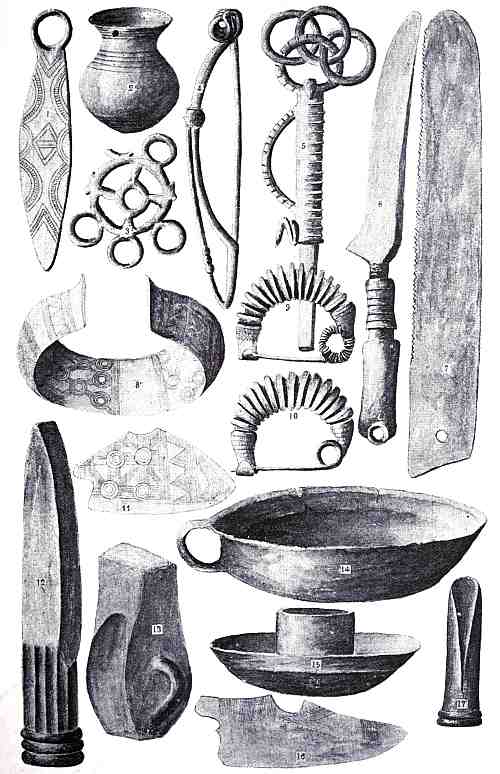
Fig. 6.—Moeringen. All bronze and 1⁄2 real size.
The second station (Unter Station oder Oefeliplätze) contains a steinberg which communicated with an adjacent tongue of land by a bridge. There was no well-defined relic-bed, but the relics picked up are of great value, among which are the following[3]:—A number of nephrite and jadeite hatchets, a nephrite knife in its horn handle, flint knives, a wooden spoon, a miniature canoe, four copper chisels (B. 286, Pl. ix. 34 and 35), two flat hatchets of bronze, showing rudimentary wings, a double-stemmed hair-pin (B. 286, Pl. x. 2), two daggers of bronze, one triangularly shaped (B. 286, Pl. iii. 17), a massive bracelet of bronze, some staghorn hammers, a scoop, some large clay weights, etc. In the Bern Museum are thirteen beads of copper, graduated so as to form a necklet; some arrow-heads of rock crystal; an ammonite and another shell (pectunculus), both perforated; also some perforated small bones, teeth, and beads of horn. (B. 462, p. 64, and Pl. xiv.) Dr. Gross estimates the number of jade implements from Oefeli at thirty or forty, the largest being four inches long, and the smallest one inch (both of nephrite).
Piles were found in various spots in this locality; and associated with one group were Roman remains, such as fragments of tiles, pottery, coins, and bits of glass.
Hagneck.—In this locality, near where the Aar now debouches into the lake, and about one hundred yards from the shore, were formerly to be seen some piles, but the relic-bed seemed to have been washed away. Desor found some stone hatchets and a few other relics. The station was connected with the shore by a bridge sixty-five yards long and thirteen feet wide.
Ile de St. Pierre.—On the south side of this island there are remains of an extensive settlement, the piles of which run parallel to the bank. A large canoe was observed here, lying in the mud, apparently having been swamped with a load of stones, with which it still was filled. It was 50 feet long, and 3½ to 4 feet wide. Near the piles a bronze pin with an oval head, and ornamented with wavy lines, was picked up. Another station was on the north-east side of the island, which is now dry, and on which a large number of bronze objects was collected; but there was no regular relic-bed, and as the objects were gathered on the surface, Dr. v. Fellenberg thinks it has been washed away. (B. 462, p.31.) Among the relics are a bronze knife, a compound pendant curiously arranged (B. 286, Pl. viii. 3), a pair of pincers, portion of a chain consisting of rings and bands, and several fragments of swords, celts, and sickles; also an iron sword with the handle of bronze.
On the south side of the Ile des Lapins there are some piles, which point to this being the site of a station, but on the island itself antiquities of various ages have been collected, such as Roman roofing tiles and coins, a pretty gold ornament, and many objects of Gallo-Roman manufacture.
Locras (Lüscherz).—Owing to the depth of water over the ruins of the settlement opposite this village, the station, although known to Colonel Schwab, did not assume any importance till the winter of 1871-2, when the waters commenced to fall, and the Bernese Government undertook a series of investigations. The extent of the settlement was estimated by Dr. Gross at about four acres, and it had been connected with the shore by a short bridge. The relic-bed, four to twenty inches thick, lay under a considerable accumulation of sand and gravel, and consisted of a blackish stratum of organic débris, which appears to have been peculiarly favourable for the preservation of the usually perishable objects of human industry. It is therefore singularly rich in such remains, and has furnished balls of linen thread, fragments of cloth made of flax, heaps of grain, and various remains of cultivated plants.
In prosecuting the exploration of the station it was found that the relic-bed became more deeply buried the farther it was pursued outwards; so that from 2½ feet, its depth on the shore side, it gradually increased to 7½ on the opposite side. The piles were of oak, beech, silver fir, pine, poplar, and birch, mostly in the form of round stems. All these different kinds of wood appear to have been used in nearly the same proportion all over the settlement except at the north-west corner, at a place called the Steinberg, where the piles were entirely of split oak stems. Another peculiarity was that the piles were more superficial, and hence it was suggested that this corner was of later date. Like most of the other lake-dwelling settlements, the woodwork showed marks of burning. The theory of some sudden catastrophe, such as a general conflagration, was strengthened by the number of human remains—no less than three skulls and some bones of the trunk and extremities—that were found at a depth of 3 feet.
Among the antiquities recorded by Dr. Gross (B. 286) the following may be mentioned:—
Stone.—Several hundreds of polished celts, about 30 of which were jadeite or nephrite; flint implements of black and yellow flint, and beautifully formed, such as lance-heads, arrow-points, saws, and flakes; some round pebbles, about the size of a pigeon's egg, encircled with birch-bark, and arranged in a row, like peas in a pod; spindle-whorls, corn-crushers, etc.
Horn and Bone.—A large number of haftings, probably from 600 to 800, many still retaining a stone celt or chisel; about 40 axe-hammer heads, perforated with a square or round hole; two little combs with three teeth; chisels, needles, awls, bodkins, arrow-points; a carding implement made of a number of small ribs pointed at one end and tied together, etc.
Pottery.—A large number of entire vessels and fragments show that two qualities of paste were used, a coarse and a fine kind. Among them are bowls, plates, jugs—some having the ordinary handle and others perforated knobs; clay weights, round, cylindrical, or conical.
Sundry Objects.—Portion of a spindle with the thread wound round it (carbonised), various wooden handles, dishes, and implements; fragments of cloth, matting, burnt straw, etc. One small flat dagger of copper is in the Bern Museum.
The following extract from the Government Report by Mr. Jenner, Dr. v. Fellenberg's deputy (B. 119, 2nd ed., p. 203), gives a good idea of the comparative numbers of these relics:—"The results of my excavations, which occupied 27 days, and extended over an area of 20,000 square feet, at a medium depth of 3½ feet, the relic-bed being from 2 inches to 1½ foot thick, were as follows:—
1. Stone implements 600
2. Staghorn do. 480
3. Bone do. 235
4. Pieces of cloth 50
5. Objects for ornament 45
6. Entire vessels of pottery 11
7. Stone celts and axes in their haftings 23
8. Flint implements 121
9. Unworked pieces of staghorn 430
10. Wooden implements 24
11. Ornamented potsherds 26
12. Clay weights 8
13. Celts of nephrite and jadeite 8
14. A number of net-weights in birch-bark.
Contiguous to the station just described, on its north-east side, and separated from it by a dozen paces or so, there came subsequently to light another station, described by Dr. Gross as "Une nouvelle palafitte de l'époque de la pierre à Locras." (B. 336 and 347.) Its area was only about a fourth of the former, and the relic-bed, being quite near the surface, was easily worked. Two human skulls were found here, one of which appears to have been used as a drinking-cup. From the character of the relics generally, the settlement seems to have flourished during the transition period. There were perforated axe-hammer heads, with grooves and raised ridges, like Scandinavian forms, and a few metal objects. The latter consist of three articles of copper—a remarkable double celt of large size (Fig. 186, No. 10), a dagger, and an awl—and three articles of bronze, viz. a sword, a dagger-blade, and a hair-pin. The other objects are of the usual Stone Age type, among which may be noted as of rather uncommon occurrence an arrow-point of nephrite (B. 347, Pl. ii. 9), and a knife of the same material with one cutting edge (Fig. 185, No. 28).
Vinelz (Fenil).—This station, which is now entirely on dry land, was accidentally discovered in 1881 by labourers while digging a ditch to carry off water accumulating on the fields.[4] At a depth of two or three feet of sand and gravel they came upon a blackish bed of mud-earth, in which were detected a number of piles, the heads of which projected upwards into the sand and gravel for about a foot. Dr. Gross, who was informed of the circumstance, soon visited the spot, and at once recognised the site of a lake-dwelling. It appears that the locality is much exposed to the north winds, and that the settlement had thus become completely covered over with sand and gravel thrown up on the shore, as was the case with the station of Wangen in the Untersee. During the spring and summer of 1882 the new Pfahlbau was investigated by several experts, including Drs. Gross and v. Fellenberg. The station is remarkable for the number of copper objects which it has yielded to the systematic explorations ordered by Fellenberg, and carefully conducted by Ed. Matthys, of Ligerz. From the results thus obtained, the station at Vinelz is the most typical yet discovered of the final Stone Age period (Uebergangszeit). (B. 462, p. 33.) The following are some of the antiquities collected, most of which are in the Cantonal Museum of Bern and the Gross collection.
Among nearly 100 copper objects (including 46 beads, Fig. 7, No. 31) are several daggers (Nos. 26 and 28), flat axes (No. 27), chisels (No. 24), rude knives, awls (Nos. 17 and 25), pendants (No. 23), tubes and spirals (Nos. 22 and 30). No bronze or iron object has yet been found on this station. Bone and horn handles, polished daggers, large button-like objects (Nos. 20 and 21), perforated clubs, ornamental pins (Nos. 15, 16, and 18), etc., are numerous. Perforated stone axes and the ordinary polished celts are common (about 40 of the former and 100 of the latter being in the Bern Museum). Flint daggers, sometimes worked at both ends (No. 12), are also very fine; two were found in their wooden handles (No. 11). For more firmly fixing them a fine band of reed or withe was neatly rolled round the handle. A variety of flint arrow-heads, scrapers, etc. (Nos. 1 to 9), clay weights of different forms, implements of pointed ribs, basket-work, etc. For bits of well-woven cloth, thread, and fishing-nets, this station vies with Robenhausen. A portion of a spindle has some thread still round it. There was an entire fishing-net (carbonised) associated with a number of stone sinkers.
The pottery (Nos. 29, 32, and 33) was ornamented with dots and string-marks. One vessel had a horn-shaped handle projecting from the body of the vessel.
Wooden objects are also well represented in the form of dishes, clubs, handles, and net-floats. One portion of wood had some pointed flints stuck in it with resin, which had evidently been used like a saw (Fig. 185, No. 17), finger-marks having been cut out in the wood, by means of which the instrument could be more readily grasped.
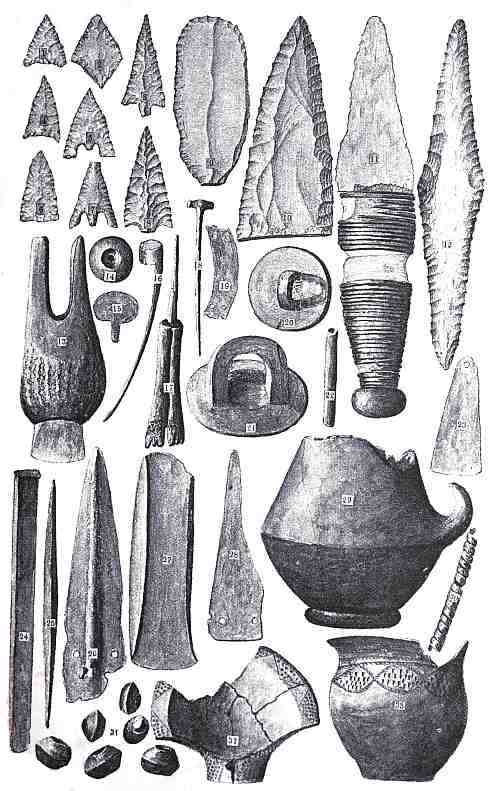
Fig. 7—Vinelz. Nos. 29, 32 and 33 = 1⁄4, the rest = 1⁄2 real size.
Saint Jean.—A little less than a mile from the lake, in the marshy plain, some bronze objects were found, which point to this as the site of a station. Below Landerdon there are also some piles, the tops of which are much decayed and deeply buried in mud. Dr. Gross is reported to have found here a sword of the Middle Ages.
Schaffis (Chavannes).—This settlement stretched as a narrow band on the left bank of the lake, and though known for a considerable time it remained unexplored till the lowering of the water facilitated its investigation. This was done by Dr. v. Fellenberg, in 1873, on behalf of the Government. (B. 271.)
Three steinbergs were found on its site, two of which were close together. In the vicinity of these steinbergs the piles were placed in rows running outward into the lake. Elsewhere they were irregularly but closely placed, seldom more than two feet apart, and penetrated deeply into the old black lake-sediment. Few timbers were met with, though twigs, basket-work, and charred food, were common.
The total length of the station was 640 feet, and greatest breadth 167 feet. The largest steinberg measured 217 by 65 feet. Several bridges, from 30 to 60 feet in length, connected the piled area with the shore. The station is now completely dry, and overgrown with vegetation.
On the steinbergs the relic-bed was quite superficial, being covered only with a thin layer of sand and gravel. The organic remains, such as staghorn haftings and bone implements, were of a blackish colour, and so much decomposed that few could be preserved from crumbling into pieces. Stone celts were very numerous, but unusually small, as, out of several hundred specimens, only a few reached the length of 5 or 6 inches. The majority were only 3 inches long, and although well polished and sharpened along the cutting edge, they were of inferior workmanship when compared with those of some other stations, such as Locras. They were all manufactured of materials readily found in the surrounding country, with the exception of three jade implements (two jadeite and one nephrite). Large slabs for grinding and polishing these tools were remarkably abundant.
On the other hand, the station is prominent for the beauty and elegance of its flint implements, many of which were, when found, still in their horn or wooden handles. Along with the horn haftings may be mentioned perforated hammers, chisels, barbed harpoons, pins, awls, flax-heckles, amulets, perforated teeth, and boars' tusks of great size. Among wooden objects the most remarkable are a wooden door, still retaining portion of a polished oval bolt of yew which traversed it horizontally (B. 336, p. 48), and a portion of a ladder (B. 347). The fragments of pottery indicated not only coarse material but rude workmanship. The clay is badly burnt, and it is uniformly mixed with pieces of quartz or small pebbles of the size of a pea. The vessels are roughly cylindrical, and have thick bases, but no ornamentation, not even the projecting knobs so characteristic of Locras. Some large clay balls, perforated in the centre, are probably loom-weights, and among the remains are bits of plaited and woven flax, which prove that the art of weaving was well known to the inhabitants. Dr. v. Fellenberg, from whose writings I have taken the substance of this notice, considers the settlement one of the earliest among the Swiss lake-dwellings and much inferior to some of the other Stone Age settlements in Lake Bienne.
A cup made from the upper part of a human skull found here has attracted much attention. (B. 119, 2nd ed., p. 221.)
Twann (Douanne).—It must be remembered that the west side of the lake does not present the same facilities for pile-dwellings as the opposite shore, owing to the steepness of the immediate shore-land and the rapidity with which deep water is met with. Moreover, the narrow strip of beach available for the purpose has become greatly covered up with alluvial deposits, as is proved from a discovery made at Twann. Here, at a depth of 15 or 20 feet, some workmen, while making excavations in connection with railway works near the quay, came upon a blackish bed of mould containing piles, pottery, staghorn implements, etc., which, on being inspected by Dr. Gross who happened to be passing at the time, was at once recognised as the site of a lacustrine station. Mr. Irlet, of Twann, has also discovered another station at Wingreis, in the vicinity of which the canoe, now so well preserved in the Museum at Neuveville, was found. (See page 481.) The objects from Wingreis consist of stone hatchets, flints, and horn handles. (B. 462, p. 32.)
In 1886 another station, called "Bipschal," was announced by Dr. v. Fellenberg as having been discovered by Ed. Matthys between Ligerz and Twann. (B. 462, p. 35.)
Vingelz.—Dr. v. Fellenberg states (B. 462, p. 32) that in 1874, when the great canoe which for many years was known to be lying in the mud near Vingelz was raised, a deeply-buried relic-bed was brought to light.
Nearly 3,000 feet from the shore, and opposite the steinberg of Nidau, there is what is supposed to have been a small station, on which a few objects were found, among which is to be noted a great stone weight with an iron ring round it. A group of piles was observed to run from it in the direction of the Nidau steinberg, and hence it is conjectured that a bridge formerly connected the two. (B. 15 and 22.)
Between Vingelz and Bienne there is a small steinberg, on which a few arrow-heads of iron are said to have been found.
Port.—During the excavations for the "Correction des Eaux du Jura" some remarkable discoveries were made, especially along the Lower Thielle, between Nidau and Meyenried. Immediately below the little village of Port the remains of a palatitte of the Stone Age were met with. The station appeared to have been of considerable extent, as the piles were traced for several hundred yards along the line of the canal. The relic-bed was 7 feet below the surface, and amongst its débris were found various implements of stone and horn. Among the stone celts was one of nephrite, still in its horn fastening, the handle of which was covered over with a bluish coating of amorphous vivianite. (B. 446, p. 11.)
LAKE OF NEUCHÂTEL.
The Lake of Neuchâtel, like that of Bienne, was studded with lake villages, particularly in the more sheltered localities. From data collected by Col. Schwab a chart was constructed and published in 1863, showing no less than 46 stations in the lake; but many of them were of little archæological value beyond giving indications of their existence. Since then some additional sites have been added to this list, and from the activity with which lacustrine researches have been conducted, especially after the lowering of the water by the "Correction des Eaux," many of the supposed less important sites have turned out extremely rich in antiquities.
Pont de la Thielle.—Leaving the Lake of Bienne, and following the Upper Thielle, we come to the Pont de la Thielle (Zihlbrücke), which crosses the river at a short distance below where it emerges from Lake Neuchâtel. A little above this bridge and on both sides of the river, Col. Schwab discovered piles, among which he collected some industrial remains at a depth of 5 feet, from which he concluded that there had been here an ordinary pile-dwelling, in what was then probably a bay of the lake. With the exception of one hair-pin of bronze, the objects collected were of the Stone Age. (B. 32.) In 1870 v. Fellenberg made some further investigations, which, while justifying the conclusions previously arrived at, showed that the station had larger dimensions than were formerly suspected, and that the relic-bed was in some parts deeply buried. He enumerates the following relics as the result of his labours:—7 large stone axes and 9 small or imperfect ones, of serpentine, diorite, etc.; 20 implements of bone—pointers, daggers, chisels, etc.; a large number of staghorn axe-hammer heads (perforated); flakes of flint and other flint implements, and one beautifully-worked arrow-head; a knife of polished nephrite. The pottery indicated a coarse paste mixed with rough sand, and some of the vessels were ornamented with knobs. (B. 196, p. 281.)
According to Mr. Dardel-Thorens,[5] a Roman station succeeded the palafitte, as many objects of pure Roman origin were found amongst the piles on the right bank. Among these he mentions a lion head of bronze, portion of a girdle, a silver ring like those from Pompeii, knives, chisels, axes, etc., and a tile with the legion mark CLXXI; also a piece of worked horn with figures.
La Tène (Stone Age Stations).—Close to the outlet, on its north side, is the celebrated station known as La Tène, which, from the remarkable character and varied assortment of iron implements found on it, has given a name to a well-defined period of the Early Iron Age. Now that the lowering of the level of the lake has left its site on dry ground, and its exploration has become thus greatly facilitated, it would appear that La Tène was more of a stronghold, commanding a bridge which crossed the Thielle at its outlet, than a real pile-village. Its consideration will therefore be deferred till we come to the description of the lake-dwellings of the Iron Age.
Making a circuit of the lake westwards, we come at once on a series of four stations, the ruins of which lie scattered on the shore between La Tène and the promontory of Préfargier. Their débris lay embedded in a thick bed of ancient mud, which has since become undermined, and almost entirely washed away by the waves, leaving the heavier antiquities amongst the rolled pebbles. Some beautiful implements of nephrite and jadeite, and occasionally copper objects, have been thus picked up, some of which are still in the possession of Messrs. Vouga, Dardel-Thorens, and other local collectors.
St. Blaise.—This station has only come into prominence since the operations for the "Correction des Eaux du Jura" took effect on the lake; and although its investigation has been somewhat desultorily conducted, the finds from it are extremely interesting, as they are characteristic of the period of transition. The settlement, was situated to the west of the town of St. Blaise, and appears to have occupied a large area, as piles extended more or less all the way to Hauterive. Its chief explorers and relic-holders are Messrs. Vouga, Zintgraff, and Dardel-Thorens. In 1878 Dr. Gross published a description of its relics with two plates of illustrations, and subsequently a notice of it appeared in the Anzeiger (B. 376a) and Das Ausland (B. 418, p. 49). Among some thousands of stone axes, of which about ten per cent are perforated, there are many of nephrite, jadeite, chloromelanite, and saussurite. These latter are generally small, and set in horn fixers with a split at the end. The perforated hatchets (one of which is an unfinished specimen, with the core still in the hole) have often one end formed into a hammer (Fig. 8, Nos. 25 and 26). Among the many worked objects of horn and bone, such as pins (Nos. 22, 23, and 24), perforated clubs (No. 20), and daggers or spear-heads (No. 21), are some curiously-wrought pieces, which suggested to Dr. Gross the idea that they were part of a machine for boring holes in hard substances. The chief interest, however, lies in the number and variety of copper objects which this station has yielded. Out of about a dozen articles of metal, only one is said to be bronze (No. 4)—a dagger with a well-defined mid-rib—while the rest consist of two flat axes (Nos. 6, a fragment, and 14), six daggers after the type of the flint weapons (Nos. 1 to 5, 7, and 9), a knife (No. 8),[6] a bit of a spiral (No. 18), an arrow-point with some asphalt still adhering to it (No. 16), two small awls (Nos. 15 and 17), two earrings (Nos. 11 and 12), and two beads (Nos. 10 and 13).
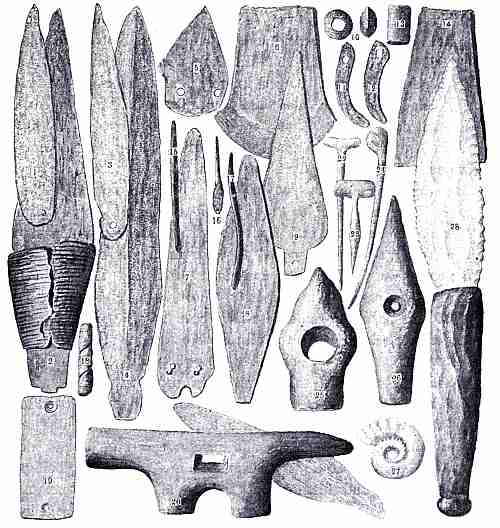
Fig. 8.—St. Blaise. Nos. 20 and 26 = 1⁄4, the rest = 1⁄2 real size.
One of the copper daggers was mounted in a handle of withes, the remains of which are still to be seen (No. 2), and strongly reminds one of the flint daggers when similarly mounted, as seen in No. 28. As ornaments from this station I have figured a fossil ammonite and a smooth stone, both perforated (Nos. 27 and 19). Two fossil shells, an ammonite (Fig. 185, No. 23), and pectunculus, are described in the Ninth Report on the Pfahlbauten (B. 462) as coming from Oefeliplätze.
Hauterive.—Opposite the village there was a very large settlement, which has yielded a considerable number of antiquities of a mixed character, chiefly dispersed among the Museums of Neuchâtel, Bern, Bienne, and Zürich. Col. Schwab found two iron spear-heads and pottery. After Schwab's investigation, Desor searched the station and found a steinberg. Among the more interesting objects are:—a small figure shaped like a duck and ornamented with strips of tin (Fig. 195, No. 13); a vase, also ornamented in the same way (Fig. 193, No. 6); a disc of bone ornamented with concentric circles, and some bronze pendants (Fig. 189, Nos. 13, 14, and 16). In Bern there are four pins with large heads, and several tanged knives, sickles, bracelets, pendants rings, fish-hooks, etc.; also dishes of fine black pottery with round bottoms.
Between this and Neuchâtel are three stations, viz. Champréveyres, Monruz, and Crêt, on which a few objects have been picked up. In 1885 a pot of dark pottery ornamented with circular lines and triangles ("Wolfszahn-ornamenten"), measuring 6¼ inches in diameter and 4¾ in height, was fished up in eight feet of water, and was supposed to be from the bronze station of Champréveyres.[7] The pot contained sand and the following objects:—two stone celts, a spindle-whorl, a pierced boars tusk, half of a stone axe-hammer partially bored, two objects of stone, a bit of red ochre, and a bit of yellow ochre.
Auvernier.—In the sheltered bay between Colombier and Auvernier was one of the largest and most interesting settlements in the lake. It was discovered early, and notwithstanding that its remains were covered with ten or twelve feet of water, it was minutely searched. Professor Desor ascertained that there were two distinct stations near the same place, one being a bronze station and farther out in the lake. The Stone Age settlement, which lay just between the latter and the shore, contained a steinberg of round and angular stones, and covered nearly two acres. The piles of the bronze station were inserted in soft mud, and their tops projected from one to two feet above the lake bottom. In one place a canoe and large masses of wattle-work were seen by Desor protruding from the mud. Among the antiquities collected by the earlier explorers are:—Arrow-points of various shapes with and without barbs, a richly-ornamented socketed lance-head, a solid ring armilla, a chisel, fish-hook, etc. Also fragments of variously-ornamented pottery, one of which showed something like the Greek pattern or meander line. Not less than twenty of the illustrations of Desor (B. 95) are of objects from this station.
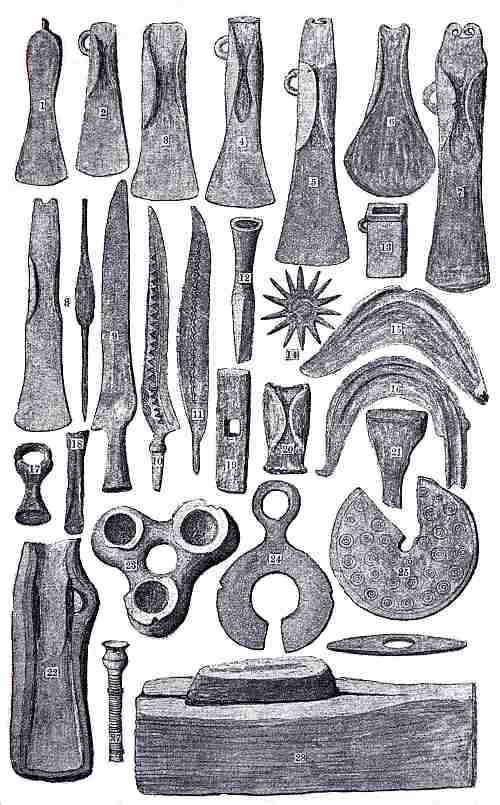
Fig. 9.—Auvernier. All 1⁄3 real size.
The station was systematically investigated during the year 1873 and the three following years, and a report of the results was published by Dr. Gross in 1876. (B. 286.) He describes the antiquities under the following heads, from which it will be seen that the station ranks almost on a par with that at Moeringen:—(1) Arms, (2) instruments, (3) objects of dress, (4) objects belonging to horses' harness, (5) moulds, (6) pottery. Dr. Gross, at the eighth meeting of the German Congress of Archæologists at Constance, in September, 1877, gave some further account of the relics from Auvernier, particularly the swords, of which six were found. (B. 306.)
The illustrations on Fig. 9 include a variety of axes (Nos. 1 to 8), knives (Nos. 9 to 11), a socketed chisel (No. 12), a gouge (No. 18); three hammers, one with a square socket and a side loop (No. 13), another with a square perforation in the middle (No. 19), and the third shaped like the upper portion of a winged axe (No. 20); two sickles (Nos. 15 and 16), a star-like ornament (No. 14), pendants (Nos. 17 and 24), half of a mould for an axe (No. 22), and an ornamental object (No. 27). All the above are of bronze, and of the remaining objects, one (No. 23) is a trilocular dish of pottery, two are of bone (Nos. 25 and 26), and the last (No. 28) is a stone anvil set in a wooden casing. The handle of one of the swords is illustrated on Fig. 186, No. 3.
Cortaillod.—We next come to the neighbourhood of Cortaillod, where there were several settlements. From Mr. A. Vouga's admirable and concise notices (B. 393 and 414a) of the more recent discoveries, it appears that the principal station (Station Principale, marked a on the accompanying Sketch Map) was nearly opposite the village of Petit Cortaillod, and consisted of two portions—one, nearest the shore, furnishing relics of the Stone Age; and the other, those characteristic of the Bronze Age. A few hundred yards to the north there was another large Stone Age settlement (Station de la Fabrique, b), also with a Bronze Age portion on its outer or lake side. On the south side of the principal station there were observed two small groups of piles probably remains of embryonic stations which were never completed (c and d). On one of these a remarkable wooden implement, supposed to be a pile-driver, was found, measuring 5 feet 4 inches in length (Fig. 184, No. 4).
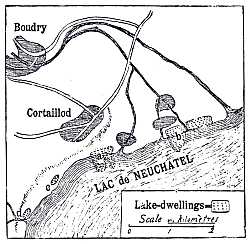
The first exploration of the settlement commenced in the spring of 1858, when Mr. Troyon, after examining the stations near Yverdon, visited the locality and fished up five bracelets of bronze, together with some hair-pins and a few small rings, which are now in the Museum of Lausanne. Mr. Burki, of Petit Cortaillod, also found several bronze objects, some of which he sold to Agassiz.
These respective successes induced Col. Schwab and Prof. Desor to direct their attention to Cortaillod, who, in the course of a few years, made a collection of very remarkable objects. Among these the following are worthy of note:—a bronze wheel, 19¾ inches in diameter, with four spokes (Fig. 10, No. 17); the surplus jet of a bronze casting, broken off apparently after the operation was completed; several half-moon and other variously shaped pendants (Nos. 10, 12, and 21); bracelets (No. 14); a massive ring ornamented with concentric circles (No. 15); some large-headed pins, earrings (No. 7), studs (No. 22), hatchets, sickles, fish-hooks, beads of amber and glass, a spoon of terra-cotta, etc.; but the most novel were dishes, particularly a large plate ornamented with tin strips arranged in various patterns of lines, circles, and the Greek meander (Fig. 193, No. 2).
Of the four brothers Kopp, who worked for these antiquaries, one afterwards commenced on his own account and sold the finds, and in this way many of the relics went to other localities. In 1874 a necklace of bronze was found (Fig. 10, No. 3), which Mr. Vouga states is still in the possession of a gentleman at Auvernier.
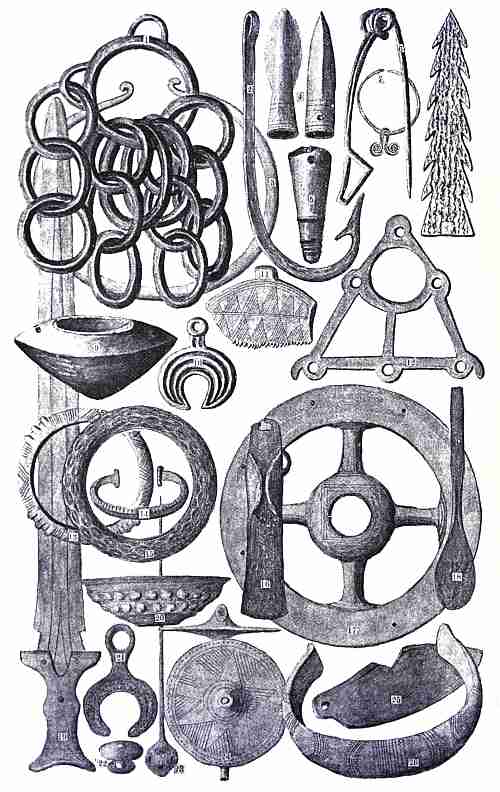
Fig. 10.—Cortaillod and Bevaix (16, 18, and 23 to 26). Nos. 8, 16, and 18 to 20 = 1⁄4, 15 = 1⁄3, all the rest, with the exception of 17 = 1⁄2 real size.
In 1876 a fisherman found a sword, which he sold to the keeper of the Museum at Bale (No. 19).
Meantime the Stone Age portion of the principal station was little examined, as the relics were deeply buried. Here, however, were formerly found some iron objects of the La Tène type, viz. a sickle (B. 31, Pl. xiv. 20), and a stone anchor with iron hoops, now in the Museum Schwab. In 1878, when the Government drainage works began to tell on the lake, many articles were picked up. Thereupon Messrs. Vouga and F. Borel commenced systematic diggings, and this set an example to the authorities of the Museum of Colombier and the Société du Musée de Boudry, who likewise started operations with a gang of workmen. Among the objects collected up to 1883 Mr. Vouga particularises the following:—
Stone.—A number of sharpening-stones of sandstone; a large hollow stone for bruising corn, measuring 1 foot 6 inches by 1 foot 9 inches, and 5½ inches in thickness, having a hollow 2½ inches in depth; some hundreds of hammer-stones, corn-crushers, etc.; portions of stone showing marks of having been sawn, and perforated net-weights; also spindle-whorls, an oval hammer of serpentine ornamented with chevrons; some perforated stone axes, etc.; about 1,200 plain axes, nearly a third of which were still in their horn fixtures. Most of these horn fixtures were inserted in wooden handles, but of course all traces of the latter were generally gone; only 12 nephrite implements were among them. About 1,500 chisels or small celts, only a few of which were of jadeite. One celt was of flint, a very rare thing in this district; and an arrow-point was of polished serpentine. Many thousands of implements of various coloured flints—saws, knives, scrapers, daggers, and arrow and lance-heads. The arrow-points were generally triangular without wings, and a few were lozenge-shaped. The largest flint dagger measures 9 inches in length (Museum Colombier); and some of the saws were still fixed in their handles with asphalt when found.
Horn.—Some 3,000 fixtures for stone hatchets, of which about one-third were perfect. These implements are not bifurcated at their end, as is often the case with those found at Auvernier and elsewhere; and many are only partially made, so that one would suppose there had been here a factory for their special manufacture. There were also perforated hammers, and a great number of chisels, pointers, etc.; also some large plaques whose use is unknown. Out of twenty barbed harpoons one, 8½ inches long, has twelve barbs (No. 8), and one (now in the Museum Boudry) is unfinished. About a similar number of pendeloques or beads, and a few small objects like arrow-points.
Bone.—A great number of pointers and chisels, some of which were inserted into handles; quantities of awls, lance-points, and javelins; thirty daggers; some twenty perforated teeth of the wolf or dog; fifty tusks of the wild boar worked, and some set in handles; bundles of pointed ribs (flax-heckles).
Wood.—An oval cup of yew, 4 by 2¾ inches; others were found, but not preserved. A small hammer, and bits of basket-work.
Metal.—A small round copper armlet, and a flat bronze axe with a round cutting edge.
Pottery.—Fragments of a coarse ware, found everywhere and generally indicating roughly-made vessels; and a few perforated weights, cylindrical and round.
As the waters became lower, the bronze station became more accessible, and accordingly its investigation was begun by Messrs. Borel, of Boudry, and Kaiser, of Estavayer. Among the antiquities collected here are the following:—
Bronze.—Several hatchets and knives; four razors, of different types (one hammered from the fragment of a bracelet); five sickles; a bracelet ornamented with lines and concentric circles, and another closed (No. 13), also ornamented; three small bracelets; some buttons, studs, etc.; the tip of a scabbard (No. 5); several lance-heads, one ornamented (No. 4); two fibulæ (No. 6); many hair-pins, several hundreds of fish-hooks; a necklet made of twenty bronze rings, connected by a chain of copper; and a cup, now in the collection of Dr. Gross (No. 20).
Among other relics were fragments of cups, vases, and other dishes of ornamented pottery, some twenty clay supports, and hundreds of spindle-whorls, etc. No. 11 represents a pendant, the substance of which no one can determine, as it is neither stone, bone, horn, nor pottery.
In the autumn of 1884 the water was unusually low, and the piles, being left high and dry, presented such a singular appearance that many visitors were attracted to see the novel sight. Many objects were then picked up. One bracelet, ornamented with concentric circles, was sold for eighty francs. Among the other objects described by Vouga are the following: A large fish-hook (No. 2), 4¾ inches long; a piece of wood surrounded by two bands of copper; a bronze pin with perforated head, and another with flat head; a small vase with four holes (No. 9), a small lamp with a handle like a spoon, and a bronze pendant formed of eleven massive rings (No. 1).
Bevaix.—Several stations were known here at an early period, and some of the objects from them have been described by Troyon, Keller, and Desor. They consist of bronze celts (Nos. 16 and 18), sickles, hair-pins (Nos. 23 and 24), bracelets (No. 26), a razor (No. 25), clay rings, etc., which are now in the collections of Schwab, Desor, and others.
Since the lowering of the water in Lake Neuchâtel, the Messrs. Borel have systematically investigated and reported on the stations in the Bevaix district. (B. 445.) From La Tuilière to Treytel, a shore-line of about two miles, they describe seven separate localities containing stations, chiefly of the Stone Age. An excellent map accompanies their description; and had they added a few illustrations its value would have been greatly enhanced.
One of the greatest drawbacks to outsiders who wish to master the archæological results of the Swiss lacustrine investigations is the want of a correct map showing the area and distribution of the respective stations; and if this desideratum is ever to be supplied for those lakes that have come under the influence of the Correction des Eaux du Jura, there is no time to lose, as most of the stations are now on dry land and nearly obliterated by vegetation; and it is a work that can only be done by local archæologists, like the Messrs. Borel, who for years have had practical knowledge of the stations in their neighbourhood.
The accompanying Sketch Map (after that of Messrs. Borel) shows that, while the foundations of the two Bronze Age stations are still in the lake, all those of the Stone Age are entirely on dry land. This distinction was long ago pointed out by Desor and others, but it was only since the lowering of the lake that such a practical demonstration became possible.
The Messrs. Borel premise their acquiescence in the proposed subdivision of the lacustrine Stone Age into three periods, viz. a first or early period ("période d'établissement et de formation"), characterised by rudeness and simplicity of industrial remains; a second ("le bel âge de la pierre"), showing commercial and agricultural progress, and especially great skill in the manufacture of all manner of stone celts; and a third ("une période de transition"), which witnessed the introduction of metals among the lake-dwellers.
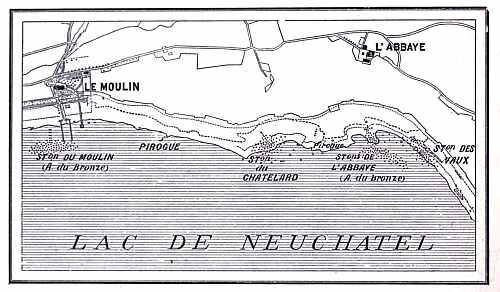
Sketch Map of the shore of Lake Neuchâtel, near Bevaix, showing the relative positions of the stations of the Stone and Bronze periods.
Typical examples of all these periods were found on the Bevaix district, as will be seen from the following notes, taken chiefly from the data supplied by the Messrs. Borel:—
(1) Station de la Tuilière.—This settlement belonged to the earliest lacustrine period, and, being much exposed to the winds, appears to have been quickly abandoned. The piles are much decayed and difficult to find, and the relics are few in number, and of a primitive type. Only rude stone axes, a few weights, and flints of a dark colour, are recorded.
(2) Station des Vaux.—Between La Tuilière to the Station des Vaux the promontory "Du Grain" intervenes, where, scattered on the shore on both sides of it, Roman tiles are met with. The remains of this pile-dwelling are situated near to a small spring of water, and directly below the rising ground, which is here covered with vines. The piles are disposed in two groups, and with scarcely an interval between them; but they represent two different periods of the Stone Age. The first or more eastern group stretches for 100 yards, with a breadth of 40 yards, parallel to the lake; and though farther within the old lake basin, it is considered by Messrs. Borel the older of the two, being contemporary with La Tuilière and the earliest lacustrine settlements in the lake. A steinberg of broken stones marks its centre, but its examination has yielded only a few small stone celts, arrow and spear-heads of dark flint, and some coarse pottery. Among the osseous remains are some jaws of the beaver.
The second group occupied a smaller area than the previous one, and contained no steinberg, but, on the other hand, a well-developed relic-bed, some 12 to 16 inches thick, which was productive of relics of a decidedly more advanced character, such as well-made implements of staghorn, including a variety of handles for stone celts. The most important discovery here was a human skull of the dolichocephalic type. (Antiqua, 1884, p. 106.) The most inland piles of this group were only about 30 yards from the vineyards, whereas the corresponding ones of the first group were 70 yards distant. The anomalous statement that the second or more advanced Stone Age settlement was situated in an outer zone from the earliest (a fact which applies to all those explored on the Bevaix coast), Messrs. Borel explain by supposing that the lake area was gradually increasing since the earlier settlements were founded. We shall afterwards see that this supposition is well founded, on evidence that by careful observation could be greatly multiplied.
(3) Station de l'Abbaye.—A little farther on there is the site of another Stone Age station, presenting the same indications of an older and younger period, and also having the same relative position to each other as we have seen in the Stations des Vaux, viz. the older occupying a situation more advanced into the old lake basin. In front of these two stations, Des Vaux and De l'Abbaye, lie the remains of a large settlement of the Bronze Age, the piles of which, even when the lake is at its lowest, are still in several feet of water; it extends parallel to the shore, about 200 yards in length, and 160 in breadth. In addition to the relics found by the earlier explorers (Troyon, Desor, Vouga, Dr. Clement, etc.), and already noticed, the following bronze objects are recorded from the station, all of which are either in the private collection of the Messrs. Borel or in the scholastic museum at Bevaix:—
Six celts (one of which is socketed), portion of a sword scabbard, four chisels (some prettily ornamented), five sickles, twenty fish-hooks, three bracelets, two razors, 105 hair-pins (all sizes and forms), five pendeloques, two earrings, two buttons, two finger-rings, twelve large and 195 small rings, etc. Among the other finds are fragments of ornamented pottery, a clay support-ring, three glass beads, weights, sharpening stones, etc.
(4) Station du Chatelard.—This station contained a steinberg covering an area of 3,000 or 4,000 square yards, and was joined to the shore by a tongue of land, on which a series of stepping-stones were placed. The relics discovered on its site include some 200 stone celts (ten of which are jade), forty staghorn handles and fixers for celts, chisels, stone hammers, flint implements, etc. The special characteristic of the station is the appearance of the following bronze objects among these relics of the Stone Age, viz. a small perforated plaque, two hair-pins, four small daggers, three flat celts. Mr. Borel states that other celts of this type were found, one being to his knowledge in the possession of Mr. Rousselet, and one in each of the Museums at Neuchâtel, Bern, and Zürich. One here figured (Fig. 10, No. 18) is from the Schwab Museum at Bienne. Hence this station belongs to the period of transition, and is in many respects comparable to the Station des Roseaux at Morges.
(5) Station du Moulin.—Proceeding about 600 yards farther west we come to an isolated station of the Bronze Age, the piles of which are still over 50 yards from the present shore; and before the lowering of the water its site would be covered by about 16 feet of water. Owing to the scarcity of relics on this station, the duration of the settlement is supposed to have been short. Desor found here some ornamented specimens of the large hollow bracelet. Mr. Borel has only one small specimen and a portion of a large one of this type. The other objects of bronze are a couple of fish-hooks and a few pins and earrings. Fragments of pottery are, however, proportionally more abundant, among them being a vase, of elegant form, and polished exteriorly by graphite. To the east of this station a fine canoe was found in 1879, measuring 26 feet in length, now deposited in the Museum at Chaux de Fonds.[8]