First Lecture. SETTLEMENTS IN LAKE ZÜRICH, WESTERN SWITZERLAND AND FRANCE. (continued 2)
Reading edition
(6) Station du Port.—The remains of this small station, which are exclusively of the Stone Age, are distributed on both sides of a small stream which enters the ancient port of Bevaix. From the character of the relics the Messrs. Borel think that the portion on the east side belonged to the first lacustrine period, while that on the west was later. It would appear that the settlement had been dwarfed by the adjacent great palafitte at Treytel.
(7) Station de Treytel.—This station presents a fine example of the second Stone Age period. Its débris is found on the exposed shore, extending upwards of 300 yards in length, and covering an area of some 8,000 to 10,000 square yards. It was first examined in 1857 by M. Rousselet, who, notwithstanding its being then submerged, made the fine collection of objects from it now in the Museum at Neuchâtel. The flint implements are particularly well made, and the raw material, which shows a fine yellowish and partially transparent flint, is supposed to have been imported from Gaul. The horn handles and fixers for the stone celts are of varied forms, and there is also a rich assortment of other relics.
Chez les Moines.—Here there is a steinberg, but the antiquities found are unimportant, only a few staghorn implements and some stone celts. Fragments of Roman tiles were also found.
St. Aubin.—This station was near the shore, and contained a vast steinberg measuring 300 feet by 200. Its investigation was chiefly due to Dr. Clement, of St. Aubin, who made a splendid collection of its antiquities, which show that the settlement belonged almost exclusively to the Stone Age. Specially noteworthy among them are flint-saws in yew and staghorn handles; arrow-points, with portion of the shaft still attached with asphalt; a few beads—one of glass and two of amber; three small gold ornaments; perforated teeth of the bear and wolf or dog. Many of the objects from Dr. Clement's collection are illustrated in the second and third volumes of Matériaux, pages 511 and 259 respectively; as well as in Keller's reports. The horn fastenings are extremely varied, and those for celts, intended to be used with wooden handles, terminate either in a split or are squarely cut. The bone implements are particularly well made, and many of the pointers are fixed into handles. The arrow-points are also well chipped, and are of a longish or triangular shape. In the Zürich Museum there is a beautifully chipped dagger of flint, over nine inches in length, from this station. (See Fig. 185, Nos. 2, 3, 5, 6, and 9.)
Concise.—Mr. Rochat, who first examined the remains of this settlement, describes a semicircular steinberg which occupied part of the station. (B. 34.) The convex part looked south and towards the lake. Its length was 459 feet, and breadth 255 feet, and when the lake was at its lowest (before the Correction des Eaux du Jura) its top was only a few inches below the surface of the water. The relic-bed was superficial, but the piles penetrated deeply into the mud. During the construction of the railway in 1859, which here passed through a small bit of the lake, a dredging machine was used, when antiquities of all kinds were collected in hundreds. These were generally sold on behalf of the workmen, and hence the objects from Concise are widely distributed, some having gone to America. On and around the steinberg the antiquities were of the Stone Age. Here the operation of dredging was carried on for six weeks amidst great archæological excitement, which led to the production of many falsifications. (B. 28, 31, and 39.) Among the vast quantity of industrial remains brought to light, there were objects of very diversified kinds, but all in this part of the station were peculiar to the Stone Age; such as saws, knives, and arrow-points of flint; hundreds of stone hatchets, mostly of serpentine, only two or three being of nephrite; perforated stone sinkers and hammer stones. Of bone and horn, there were chisels, pointers, daggers, harpoons, cups, etc. Among the pottery were circular dishes with perforated knobs, small and large vases, plates, and cups; also some vases with conical bases, with their corresponding clay rings. Clay balls, of the size of two fists and perforated, reminded Mr. Troyon of similar objects from Wangen.[9]
Among the animal remains were three fragments of human skulls and two jaws. Also one tooth of the horse.
During the last few days of these operations the dredging machine was shifted in a north-eastern direction, and here objects of bronze were turned up, such as hatchets, hair-pins, knives, buttons, spirals, beads, rings, etc.
It would thus appear that there were two stations—one of the Stone Age, and the other of the Bronze Age; or that a portion of the former survived during the Bronze Age.
It was in the vicinity of this station that Captain Pillichordy in 1832 dredged up a canoe and two beautiful bronze swords, only one of which is now known to exist in the Museum of Neuchâtel. In September, 1889, Dr. Evans showed me, among many other objects from the Swiss lacustrine dwellings, a sword from Concise, purchased by him in Paris in 1887, which at once struck me as being the other weapon which so mysteriously disappeared in 1832. The handle and the tip of the blade of this sword are here represented (Fig. 11, No. 24), and when compared with the drawings of its supposed fellow at Neuchâtel (B. 34, Pl. iii. 35; B. 119, 2nd ed., Pl. cii. 17; B. 31, Pl. xi. 11; and B. 252, Pl. v. 10), their remarkable similarity will be at once seen. That in Dr. Evans's collection has a total length of 26½ inches. The blade is of yellow bronze 21 inches long, and terminates in a somewhat rounded point.
In the months of January and February, 1885, a portion of the station hitherto unexamined became dry, and a great many objects were found, including bronze pins (Fig. 11, Nos. 2, 3, 8, 10, and 11), hatchets, bracelets, sickles, knives, pendants (Nos. 9 and 13), tin wheels (No. 4), wooden combs (No. 7), and vases, etc. Among the more remarkable objects described and figured by Mr. Vouga (B. 414d) are:—A necklace made of rolled bands of bronze, forming tubes, and ornamented with hollow lines (No. 1). Some of these tubes are of gold, and interspersed with them are three buttons of bronze and a number of small blue beads. Two bracelets or closed rings, ornamented (No. 6); a ring with a prominence inside; and a curiously-wrought pendeloque (No. 12). These objects are mostly in the possession of private collectors.
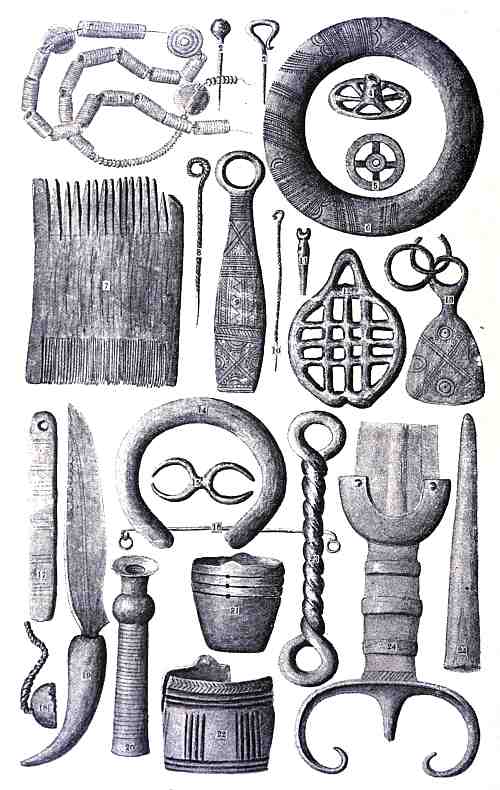
Fig. 11.—Concise and Corcelettes (5, and 14 to 23) Nos. 21 and 22—1⁄4, the rest = 1⁄2 real size.
Onens.—Two stations are situated near the village of Onens—one (Stone Age) to the east of the village, and the other (Bronze Age) to the south. The former, now entirely on dry land, has been little explored, being for some time covered with vegetation. "Je crois," says M. de Meuron, "cependant qu'elle a dû être importante d'après son étendue et la quantité de cailloux éclatés que recouvrent le sol. Cette station appartient à moi; mais la végétation y est devenue si belle que je la laisse pour les générations futures." (B. 462, p. 47.)
On the bronze station several remarkable pendeloques in the form of thin discs of bronze were found some years ago, which are now deposited in the Museum at Neuchâtel; and since this discovery it has been partially explored by M. Morel-Fatio, Dr. Brière, and others. M. de Meuron states that he is in possession of a few objects from this station, viz. hatchets, chisels, bracelets, and a magnificent lance-head 10 inches in length. From Onens comes the leaden cake with suspension loops similar to those from Wollishofen (Fig. 4, No. 24). Illustrations of some of the bronze discs are given on Fig. 189, Nos. 1 to 3.
Corcelettes.—Two groups of piles were observed by the early explorers, one to the east and the other to the west of the village of Corcelettes, and a number of antiquities both of the Bronze and Iron Ages were collected. The station, however, was never systematically examined till the lowering of the waters in 1876, when it was found to be one of the most prolific and interesting in Lake Neuchâtel. The portion since then investigated is described by Dr. Gross as lying immediately before the village, and 2 kilomètres from Grandson. It extended about 200 mètres in length and 100 in breadth. The relic-bed was thinly covered with sand, and varied much in thickness, from a maximum of 3 feet in the centre, to the margin where it thinned out. The bronze relics collected here are thus estimated by Dr. Gross at the twelfth meeting of the German Anthropological Society:— [10] 60 hatchets, 4 hammers, 30 sickles, 60 to 70 knives, 10 swords (three of which are complete), 150 entire armillæ and many fragments, 20 lance-heads, 12 discs (phalères), 300 to 400 hair-pins, 3 vessels, 11 moulds (one of bronze and 10 of sandstone), besides a quantity of smaller objects, as buttons, pendants, rings, etc. Together with beads of glass and amber, small tin wheel-shaped objects, there were some 300 entire vessels of pottery, some ornamented with tin strips, crescents, etc.
The bronze hatchets were mostly of the usual type, i.e. with four wings and a side loop; four were socketed, but not one of the flat type.
Daggers were apparently rare at Corcelettes, as only one example was found, with rivet-marks and slightly ornamented on one side.
The knives were generally small, but one measured 10½ inches in length, and a few had solid handles beautifully ornamented. Razors were numerous; one was made of a broken bracelet, another was double-bladed and showed a break which had been neatly mended with bronze wire. Horse-bits were of bronze and horn. The bronze hollow armlets are beautifully ornamented, and in the interior of some of them were observed bits of wax, supposed to be the remains of a central core of this material which had been used in the operation of casting.
It is singular that among the many ornaments from this station there is not a fibula, except a portion of one which is claimed as an importation from Scandinavia (Fig. 189, No. 19).
Of wood there were:—A round oak table; a small box, 8 by 2½ inches; and a portion of an oar.
Of the three bronze dishes, one has a handle attached by rivets; and of the other two (which are in the Museum at Lausanne), one is of northern origin (Fig. 189, No. 20).
Corcelettes, like most of the other Swiss lake-dwellings, was destroyed by fire, in proof of which Dr. Gross points to a mass of bronze objects, in a half-molten condition, consisting of three hatchets, four bracelets, a lance-head, and a sickle. (Figured in B. 392, Pl. xxii. 12.)
One of the largest collections from Corcelettes is in the Museum at Lausanne, of which I have made the following jottings:—
Pottery.—The bottom of a vase marked with the tips of the potters fingers; some dishes ornamented with herring-bone patterns (Fig. 11, No. 22), and others with circular grooves, each having a small perforation like one at Constance (No. 21); small toy cups, three of which are bilocular; clay rings, with dishes to fit them; two figures of animals; bits of clay-walling with marks of round timbers.
Wood.—Fragments of basket-work, two shaped handles of wood for sickles, fragments of wooden dishes (one with handle).
Bronze.—Of about 100 large hollow bracelets more or less perfect, some 50 are ornamented with transverse lines; the rest have various designs of lines and circles. A few bracelets are solid, and more or less penannular, with pointed or expanded tips. Four bracelets are of double wires, one of which is spirally grooved and ends in a hook and eye. Of six small socketed hammers, three have side loops, and all are more or less rectangularly shaped. Among 60 hatchets, only six have sockets, and nearly all have side loops, but no terminal catch. Two have the side loop transverse to the cutting edge.
Of 78 knives, nine are socketed, three have solid handles, apparently as part of the blade, and the rest have tangs (three being bent into a loop at the top).
Among some hundreds of pins, only seven or eight have perforated heads.
Of three horse-bits, one is entire (Fig. 191, No. 8); and of the others, only the twisted central portion remains (Fig. 11, No. 23). Moreover, there are 14 perforated portions of horn, supposed to have been parts of bridles.
Among the special objects from this station is a slender bronze rod terminating at each end with a movable ring, somewhat like the beam of a balance (No. 16). In the Museum at Boudry there is a curious ornamental tube of bronze (No. 20).
In 1888 Dr. Brière communicated a short note to Antiqua (B. 463a), in which he enumerates the following objects as the most interesting among recent finds:—A bracelet of lignite (No. 14), a tin wheel (No. 5), an amulet of bronze like the casing of a pair of spectacles (No. 15), a large bronze knife with a horn handle (No. 19), an amulet of staghorn (No. 17), a bead of amber suspended by a twisted bronze wire (No. 18), and a complete bridle-bit of horn (Fig. 191, No. 1).
Les Uttins (Yverdon).—At the foot of Mount Chamblon, rather more than a mile from the lake, there are some peat deposits, which the peasants have been in the habit of utilising as fuel. Here in two spots, according to Mr. Rochat,[11] the peat-cutters are reported to have met with piles and transverse beams with mortices. The tops of the piles were 6 to 10 feet below the surface. A flint arrow-head, two stone celts of serpentine, and a bronze bracelet, were found in one of these bogs; and hence Messrs. Troyon and Rochat (B. 31, p. 70) consider that there was a palafitte here—a supposition which involves the theory that the lake formerly extended to the locality. Nor is this theory without some evidence in support of it, as the amount of débris brought down by the Thielle is very great. On the supposition that the Roman city of Eburodunum, the ruins of which are now 2,500 feet from the present shore, was built on the lake in the fourth century, Mr. Troyon calculates that the water of the lake would have been as far back as the site of the palafitte about fifteen centuries before the Christian era.
Clendy, Cheseaux, and Chable à Perron.—Along this part of the shore there were three or four settlements with steinbergs, but the piles are now destroyed, and the few antiquities collected belong apparently to the Stone Age. Chable à Perron covers an area of some 3,500 square yards, but the only antiquities found were serpentine hatchets and their horn fixings, some flints, pointed bones, and fragments of coarse pottery. (R. 336.)
Some interesting notes of the early researches and discoveries made on the various stations in the vicinity of Yverdon are given by Mr. Rochat in Kellers third report on the Pfahlbauten. (B. 34.)
Font.—On this station a cup-marked stone was found, and Troyon records several objects—a curious bronze needle, Roman tiles, and Imperial Roman money—as coming from the same place. Professor Grangier, of Fribourg,[12] found here some Roman medals, together with an iron arrow-head, iron keys, and subsequently an oar.[13] He states that the whole coast, from Font to Estavayer, was occupied with piles, and that he attempted to make a plan of the stations, but gave it up, because the configuration was constantly changing. The original conditions were also entirely altered by the number of piles extracted by the fishermen. He knew one family who for two generations had never used any other firewood but piles extracted from the lake-dwelling stations. One place, about half-way between Font and Estavayer, was well known for its antiquities, and went among the fishermen under the name of "La Pianta." (B. 178, p. 169.) In the Fribourg Museum there is a considerable number of bronze objects from Pianta, some of which are here figured (Fig. 12, Nos. 1 to 10, and 24). I have also noted three stone moulds (two of wheel pendants), and an ingot of bronze. Some pins and a knife are in the Bern Museum.
Mr. Forrer gives some notes of the station at Font,[14] and figures some nephrite implements from "several hundreds" collected here by Mr. Beck. Along with the usual chisels and hatchets, there are in Mr. Beck's collection arrow-heads, knives, etc.—objects rather rare of this material in the Lake of Neuchâtel. Some of the hatchets are remarkable for their size, one measuring 8½ inches long, and others show great variety of colours.
Estavayer.—Mr. A. Morlot describes the early investigations of the settlements at Estavayer and its neighbouring shore in Keller's third report. (B. 34.) Systematic explorations were conducted by MM. Béat de Vevey and Henri Rey, who collected a large and varied assortment of relics, especially of bronze, many of which are illustrated on Pl. v. Close to Estavayer there were two stations—one of the Stone Age; and another, farther out in the lake, of the Bronze Age. The former was parallel to the shore, about 120 yards long and 60 broad. The relics here found were of the usual Stone Age types—stone and horn hatchets, flint saws, and arrow-points, etc. One finely-finished hammer-axe has an oval perforation, an expanded cutting edge, and a raised bead running along the centre of its anterior surface.
The Bronze Age settlement was some 400 feet distant from the shore, in water six or seven feet deep. Consequently the station is now, during low water, mostly on dry land. The area of the station was estimated at 7,700 square feet. The following is a list of the bronze objects collected by MM. de Vevey and Rey, chiefly by means of pincers:—128 hair-pins (36 with spherical and ornamental heads), 26 knives, 15 bracelets, 5 sickles, 1 socketed hatchet, 1 chisel, 1 fish-hook, 27 rings of different kinds, 2 buttons, 1 dagger-blade, 1 arrow-head (socketed), and 6 flattened wires coiled in the form of a spiral.
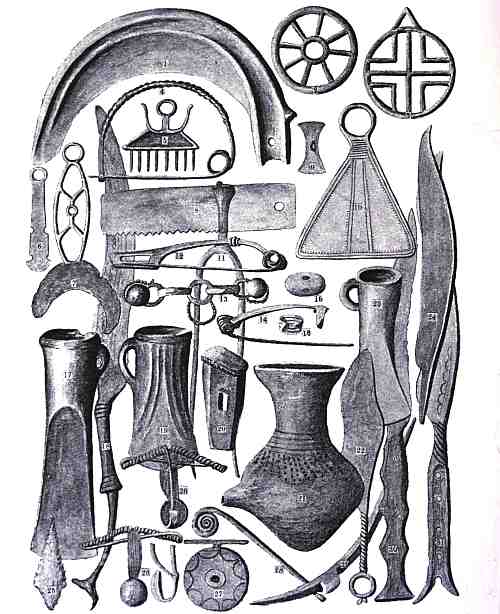
Fig. 12.—Estavayer. All 1⁄2 real size.
In 1869 Dr. Keller (B. 163) gives an account of further discoveries at Estavayer, in which he mentions a small vessel of fine clay, having a funnel-like opening and a spout below (Fig. 12, No. 21); a hair-pin 5½ inches long, with the stem of bronze, and head of staghorn, intercepted in the middle with a disc of silver; a bronze spear-head, with a spur on the stem, supposed to have been used as a spear for fishing; a bronze bracelet; and two tynes of staghorn—one perforated as for a bridle-bit, and the other ornamented with concentric circles. Professor Grangier, writing in 1878 (B. 313), describes the tenevière of Estavayer as a peninsula, and gives an amusing description of the searchers for antiquities.
About a couple of kilometres to the north-east of Estavayer, and near the village of La Corbière, there was a large settlement which also belonged partly to the Stone Age and partly to the Bronze Age. The first is a steinberg, and bears the name La Creuse or La Crasaz. (B. 414c.) On it, in addition to the ordinary Stone Age objects, were found a Roman waterjug and a fibula of the La Tène type (Fig. 12, No. 26). The part that has yielded bronze implements is farther out in the lake, and from it Colonel Schwab and others collected a considerable number of objects, among which were:—A bar of tin 6 inches long, a small bronze saw, a socketed arrow-head, a thin armlet of bronze wire, a bronze nail, a discoidal stone, fragments of pottery ornamented with strips of tin, etc. Near this in 1875 Professor Grangier discovered a curious object now supposed to be the handle portion of an Etruscan chariot. (B. 270 and 336.)
There are thus three well-defined Bronze stations in the vicinity of Estavayer, besides an equal if not larger number of the Stone Age. The chief collection of relics from this part of the lake of Neuchâtel is in the Museum of Fribourg, where I have noted:—A double-legged pin (No. 11), portion of chariot handle (Fig. 191, No. 10), a small bronze cup, a perforated bronze hammer (Fig. 12, No. 20), a couple of socketed bronze axes (Nos. 17 and 19), and a well-made arrow-point of flint (No. 25).
There are also many objects from Estavayer in the Cantonal Museum at Bern, among which may be mentioned:—A bronze fibula (No. 12), part of an ornamental chain of various sorts of bronze links (No. 13), a socketed axe (No. 23), and three large knives (Nos. 18, 30, and 31). The other illustrations are a bronze pin with a spiral head (No. 28), a gold earring (No. 16), an amber bead (No. 15), a bronze knife (No. 22), a bronze fibula (No. 14), a pin with a flat head (No. 27), and a curious horn object (No. 29). Implements like the latter are frequently met with in Swiss lacustrine stations. They vary from a few inches up to twelve or more in length, and are always curved and polished. In the Bern Museum there are four from Gerlafingen, five from Schaffis, and others from Sutz, Locras, etc.
Forel.—Little was done to this station till 1883, when the Fribourg Government granted free permission to the searchers for lacustrine antiquities to collect on their portion of the shore of Lake Neuchâtel. Since then many curious objects are reported as coming from this station, but they are mostly held by private collectors. Mr. A. Vouga gives some notes of these discoveries in the Anzeiger. (B. 414.) He states that the relics are found on this station in three different strata, the most superficial of which is 1 foot 6 inches deep, and the lowest 4 feet 8 inches.
Among the objects described and figured by Vouga are:—A stone hatchet in its horn fixture, several hatchets of coloured nephrite and one of green jade, perforated hammers and a cup of horn; knives, pins, etc., of bone; a curved implement made of the jawbone of a stag (Fig. 13, No. 19). Some remarkable objects made of horn or bone and ornamented with dots, circles, etc., consisting of bracelets (No. 20), and pendeloques (Nos. 13, 17, and 18), have attracted the attention of critics, and the general opinion is that they are forgeries.[15]
Chevroux.—Troyon describes three large settlements of the Bronze Age (B. 31, p. 150), near Chevroux, farther from the shore than a Stone Age settlement, on which were found bracelets, hair-pins, sickles, knives, two swords of bronze, and a great iron fork (Fig. 13, No. 15). In 1866, an object (Fig. 191, No. 10), described by Keller as part of an Etruscan chariot, was found near this. (B. 337.)
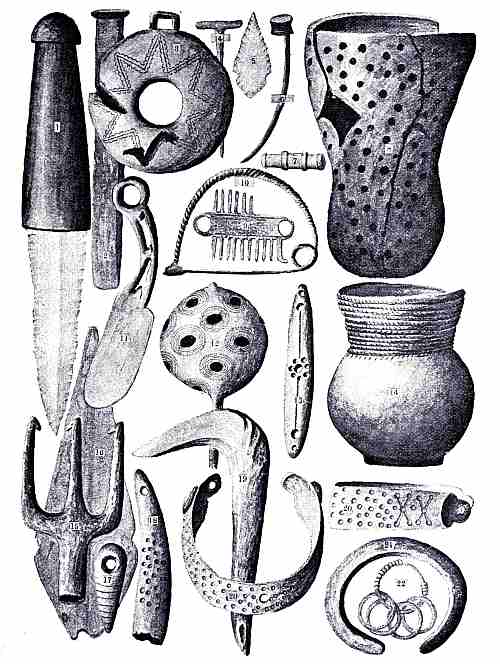
Fig. 13.—Chevroux, Forel (13, and 17 to 20), and Portalban (21 and 22). All 1⁄2 real size (except No. 15 1⁄4).
In the Museum at Lausanne there is a large collection of objects, both of the Stone and Bronze Age settlements, from Chevroux. Among the former are:—Two beautiful flint daggers with thin handles of wood (Fig. 13, No. 1), six saws of flint in their handles, part of a wooden comb, three wooden dishes, the club handle of a stone hatchet with the implement still in position, bone pins with neatly-fashioned heads (Nos. 4 and 6), etc. There are over 300 plain stone celts, and 30 perforated tools. About 100 horn fixings, of which one-third have bifurcated tops. Some celts have been identified as belonging to the following substances:—chloromelanite five, three of which are in their horn fixings (two bifurcated); saussurite, 14 to 20, one of which is in its handle (square); jadeite 22 to 25, five in handles (two bifurcated); nephrite 23 to 26, two in their fixings. There are also a few of felsite, amphibolite, etc. About 100 flint arrow-points, and the same number of beautifully chipped flint arrow-heads (No. 5). Also of horn there is a large number of chisels, pointers, hammers, flax-hecklers, and some curiously-shaped perforated clubs of horn.
Among the pottery are some curious dishes, two of which are here figured (Nos. 8 and 14), the latter being adorned with string ornamentation.
Among the objects from the Bronze Age stations are:—Many hair-pins, two phalères, five sickles, a few bracelets, one winged and one flat hatchet, portion of a flat copper celt, a few knives with tangs, six small daggers, and two remarkable pendeloques, one of which is here figured (No. 3).
Mr. Vouga (B. 414d) describes some fine discoveries that were latterly made on the Bronze stations. Among the objects which have come under his notice are:—A razor with a curved handle, 4½ inches long (No. 11); a thick crescent, ornamented with half-moons; a fibula (No. 10); a pin with spiral stem (9½ inches long) and perforated head (1⅛ inch in diameter). Another has a very large head (2 inches diameter), with 24 holes in it (No. 12). Other objects from this station are a comb (No. 9), an amber bead (No. 7), a copper dagger (No. 16), and a copper chisel (No. 2).
Gletterens to La Sauge.—Some eight or nine stations have been noted by the earlier explorers along this part of the coast, many of which have yielded Roman tiles and pottery. At Port Alban there are the remains of a station on which bronze (No. 21) and iron objects have been found. Recently there has been brought into notice a kind of ornamental metal mirror, said to have been found here (Fig. 192).[16]
Another site is farther east, giving indications of an early Stone Age station, but on which Desor found iron objects. Among recent finds are some large horn buttons and a so-called "portemonnaie lacustre" (No. 22).[17]
At Champ Martin there is a steinberg, on which spindle-whorls and a few other things have been found.
At Cudrefin the lake-dwellings are unimportant, but the station is well known as the site of a canoe, carefully described by Professor Grangier. It measures 36½ feet long, 2 feet 9 inches broad, and 1 foot 6 inches deep. This dug-out, like so many in Ireland and Scotland, had for strengthening purposes four transverse beams left in the solid. The prow had a perforated beak, which might have been used as a means for fastening a rope. (B. 194.)
At La Sauge fragments of Roman amphoræ and tiles were found associated with some piles.
LAKE OF MORAT (MURTEN).
Lying directly between the lakes of Neuchâtel and Morat there stretches a considerable elevation called Mount Vully, which ends abruptly at its north-west end on the margin of the Gross Moos. At the base of this declivity lies the Broye, and as the widening and deepening of its channel was part of the great scheme for the Correction des Eaux du Jura, a similar effect was produced on Lake Morat as on the lakes of Bienne and Neuchâtel. Previous to the lowering of its waters, however, the lake-dwelling stations along its shores were carefully examined by Colonel Schwab, Baron von Bonstetten, and the Count de Pourtalès, the proprietor of an estate on its western shore.
In Keller's 5th report (B. 61) the number of stations in this lake was given as 16, and since then one or two more have been added to the list. Many of these were, however, mere indications which, on the lowering of the level of the water, have turned out to be only stone cairns supposed to have been landing-places. According to the most recent researches of Mr. Süsstrunk (B. 336 and 462), the number may be reduced to 11, the positions of which are sufficiently defined on the accompanying Sketch Map. They belonged mostly to the Stone Age period, and only three, viz. Montilier, Greng-Insel, and Vallamand survived during the most flourishing period of the Bronze Age.
Montilier.—The first station of importance, beginning on the east side of the lake, was situated a little to the north of the present village of Montilier. It contained a steinberg, and the piles were stout and firmly fixed. Here Colonel Schwab found not only objects of the Stone Period, such as flint knives, stone hatchets, etc., but also an unusually large number of handsome earthenware vessels presenting a style of ornamentation which at once led him to assign the settlement to the Bronze Age—a deduction which his subsequent discoveries completely justified. These vessels were neatly finished, and had their surface sometimes rubbed over with charcoal or graphite, a process which gave them a glossy appearance. They were made without the intervention of the wheel, and from not giving out a ringing sound when struck with a hard substance, Colonel Schwab concluded they had been burnt in open fires. The ornamentation consisted of deeply incised lines, circles, triangles, etc., filled with a white chalky substance. In some instances strips of tin were plastered over the surface, which took the place of the linear incisions, and so presented a pleasing combination of the same principles of ornamentation. The forms of the vessels are extremely elegant and varied, and may be classed as cups, bowls, plates, jars, and jugs. Some have handles, others spouts springing from the middle of the bulge, and others a series of symmetrical perforations, but whether for ornament or use it is difficult to decide. One most remarkable dish like a saucer has its inner surface ornamented with linear incisions and a series of thirty symmetrically disposed groups of perforations. The colour of this pottery was either black, red, or grey, and sometimes the same dish had a combination of these colours. Spindle-whorls of diversified forms, and ornamented with dots, oval depressions, etc., were also abundant, (B. 126, Pl. iv. and v.)
Among the other Bronze Age antiquities collected here were some stone moulds, hair-pins, hatchets, knives, armlets, rings, sickles, fish-hooks, beads of glass and amber, a small flat finger-ring of gold, etc. There was also portion of an armlet of tin. The bronze knives were not numerous, but one was highly ornamented with a series of three flowing patterns of semicircles separated by incised lines which ran along its curved back.
No swords or bronze dishes are recorded from this station; and of three bronze hatchets in the Murten Museum, of the usual winged type, one has the loop transverse to the cutting edge, and a portion of its wooden handle still remains between the wings.
Murten.—This station lies a little above the monument of the battle of Murten. It is of considerable size, and has yielded a large quantity of Stone Age objects, such as large perforated stone axes, staghorn hammers, flint arrow-heads, lumps of carbonised wheat and many other seeds, weaving-weights, and also bits of burnt cloth. The station is now completely worked out. (B. 61 and 462.)
Meyriez (Merlach).—This station belongs to the early Stone period, and no perforated axes are among its relics. Among the few things collected on its site the following may be mentioned:—Bits of cloth, burnt corn, stone hatchet in wooden handle, another hatchet of jade, etc. The woodwork was very rotten, and the piles could hardly be distinguished. A canoe with ribbed floor (now in the Fribourg Museum) was found in the vicinity of the station. (B. 462.)
Greng-Insel.—This settlement was situated at the end of a low tongue of land which projected into the lake, and covered an area of 49,000 square feet. Near the shore the relics were entirely of the Stone Age, but farther out in the lake they became mixed with bronze and even iron objects. During low water, previous to the Correction des Eaux du Jura, a considerable portion of this station could be visited on dry land, but now it is entirely dry. In its vicinity are several stone cairns which have greatly puzzled antiquaries, as no relics have been found on them. Piles were observed in two of them—one lying to the north-east and the other to the south-west of it.
When this station was first investigated (1861-2), it yielded a number of perforated hammers and hatchets (some showing unfinished perforations), six flint knives, corn-crushers, a stone mortar, a bronze ring, a hair-pin, and several implements of iron. (B. 61.)
Subsequently the proprietor, Count de Pourtalès, with the co-operation of the local archæologists, made further excavations, which proved that it essentially belonged to the Stone Age. From Dr. Uhlmann's Report (1865), it appears that the relic-bed was from 1 to 4 feet below gravel and matted roots. The piles were generally of oak-stems as thick as a man's arm or leg, and some were as much as 1 foot in diameter, but when they reached this size they were generally split. They were irregularly set, and penetrated deeply into the mud below. They were of a blackish colour, well preserved, and apparently pointed with stone axes. Among the relics collected were daggers, saws, and arrow-heads of flint, beautifully made (Fig. 14, No. 9); stone celts, neatly bored; implements of bone, as chisels, pointers, etc., and staghorn haftings.
Fragments of pottery showed two qualities—a reddish thick earthenware, badly burnt, and a finer quality with some linear ornamentation.
The bones turned up were very numerous; among which Dr. Uhlmann recognised those of the following animals:—Urus (a large variety of horned cattle) and the small marsh cow. The sheep-bones indicated a large race with strong horn cores bent backwards and outwards; but those of the goat belonged to a more slender animal; stag, elk, and roe-deer. Amongst the carnivora were the great bear, the teeth of which were perforated for suspension, the dog (larger than at Moosseedorf), fox, hedgehog, and beaver. Bones of the frog, and the scales and bones of a fish, probably a species of pike. Also there were several portions of skulls and other human bones.
Among vegetal remains were hazel and beech nuts, stones of the sloe and birdcherry; seeds of raspberries, blackberries, and strawberries; and carbonised masses of wheat. (B. 126.)
When the station became dry in 1874, in consequence of the drainage-works, it was again investigated by Mr. Süsstrunk, on behalf of the town of Morat and the Canton of Fribourg. Among the objects then found were two flat celts, the composition of which, according to Dr. v. Fellenberg's analysis, was a mixture of carbonate of copper and sulphur, without any traces of tin. Among other things were buttons and haftings of staghorn; a conical stone set in a long hafting of staghorn; some netting-needles of wood, etc. (B. 286.)
Since then a considerable number of the usual class of bronze objects as hatchets, knives, hair-pins, fish-hooks, rings, etc., have been found on this station. (B. 462.) Noteworthy is a knife, partly of bronze and partly of iron (Fig. 14, No. 1).
Among the objects in the Museum at Morat are clay weights, dishes of pottery (Nos. 13 and 15), staghorn haftings (some with a slit at their handle-end); a curious object of staghorn, like a large earring (No. 17); beautifully worked flint daggers (No. 9), and a large number of bone chisels, pointers, etc. In the Museum at Bern there is a mould for a flat celt, with the casting still in its case, like one in the Museum at Stuttgart from the Ueberlingersee.
Greng-Mühle.—The next station following in the same direction is a large and prolific station of the Stone Age, with staghorn implements predominating among its relics. The perforated stone axes are wanting. (B. 462.)
Faoug (Pfauen).—Near the railway station, in the course of digging a well, the relic-bed of a pile-dwelling belonging to the Stone Age was encountered, but its contents have not yet been excavated. A little to the west of this in the lake some bronze objects were found associated with piles, but these relics are supposed to have come from Vallamand. (B. 462.)
Near Faoug there was observed a curious wooden structure, which Dr. Keller suggested might have been a circular lake-dwelling, like the Irish crannogs. Mr. Süsstrunk wrote a short notice of it (B. 336), in which he comes to the conclusion that it was more likely to be in connection with fishing than with the Pfahlbauten. It consisted of seven concentric circles of slender piles, separated by an interval of from 2 to 3 feet. The diameter of the largest circle was hardly 14 yards, so that little space was left in the interior for any supposed dwelling. The outer circle was formed of boards, about 10 inches broad and 2 inches thick, standing on end, and penetrating the soil to the depth of 3 feet or so, and so closely set as to be almost touching. The piles in the other circles were round and small, and their ends penetrated only 18 inches into the earth.
Vallamand.—This station was extremely rich in Bronze Age objects, and was known to Colonel Schwab, who found many vessels, clay rings, discoidal stones, a bronze earring, and a bronze shallow plate, about 10 inches in diameter and 1 inch deep. One of the fictile dishes (No. 16) is shaped like a water-bottle, and has its neck perforated with a number of small holes arranged at uniform distances and so as to be in perpendicular line. From each hole a circular line runs round the neck. (B. 61, p. 49.)
The station was finally explored in the interests of the Museum of Lausanne, where there is now a splendid collection of its relics. Some things, however, have gone to the Museum at Bern and to that in the castle ruins at Avenches. One of the most interesting objects from this station is a razor in its wooden case (No. 8). In the Lausanne Museum the objects are marked Guévaux, and among them are the following:—Of bronze—four winged celts with side loops (two of which have a terminal catch), three large hollow rings with linear ornamentations, one bracelet, two cups ornamented with small repoussé prominences, six sickles (two with a back spur and one with an upright spur), a large cup-shaped head of a pin like the one from Wollishofen (Fig. 3, No. 9) several pendants (Fig. 14, No. 10), involved rings (Nos. 2 and 4), gouges, buttons (No. 7), studs, 1,300 rings found together, combs (Nos. 11 and 12), and a curious rod hooked at the ends and perforated (No. 5). A fish-hook with attachments (No. 3), a pin with attached chain (only a portion of which is here represented, No. 21), and a curious ornamented dagger, are from other collections.
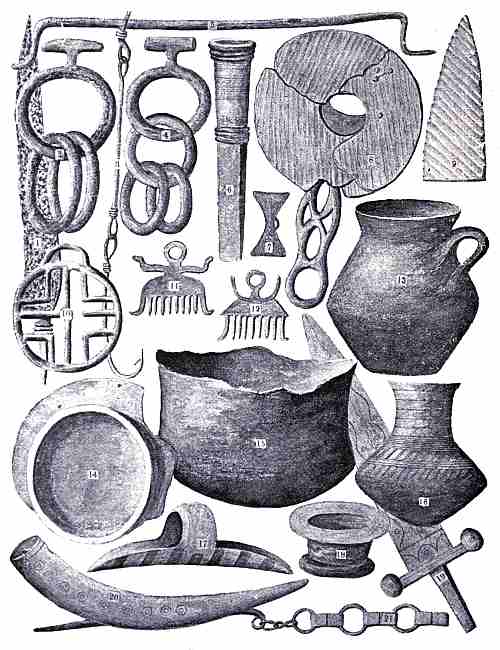
Fig. 14.—Vallamand and Greng-Insel (1, 9, 13, 15, and 17). Pottery = 1⁄4, the rest = 1⁄2 real size.
A few specimens of pottery (Nos. 14 and 18) and an ornanamented horn (No. 20) complete the illustrations from this station.
Guévaux, etc.—The four stations on this part of the coast—viz. Guévaux, Mür, Motier, and Sugiez-Zollhaus—have furnished only a few traces of their existence, from which it would appear that they belonged to the pure Stone Age.
The group of well-preserved piles at the mouth of the Chandon was probably a Roman landing-stage, as Roman tiles have been found along with them.
At Nant were found two kettles, one of bronze and the other of copper with an iron ring, two daggers, some iron arrow-heads, and a piece of sculptured marble, evidently of a later period than the lake-dwellings.
Of the remaining eight or nine cairns whose tops were occasionally above water, none have yielded industrial relics, and there is consequently no evidence as to their age and use. They are too small to admit of even a single hut. (B. 462.)
INKWYLERSEE.
The little lake of Inkwyl is surrounded by low pasture-land, and in the middle of it there is a small circular island thickly wooded, which in appearance suggests the idea of a Scottish Crannog. Professor von Morlot first, in 1854, drew attention to the probability of the island being artificially constructed, and a short notice to this effect, which appeared in 1857 (B. 19), induced Mr. Amiet, of Soleure, to make some excavations. In the following year (1858) these explorations were continued by Mr. Roth, the proprietor of the island. The result of their operations[18] showed that there was originally on the site of this island a pile-dwelling, which became subsequently a solid island, now rising about ten feet above the surface of the water. The island measured 90 feet by 80 feet, and in the interior of it, some 6 or 7 feet deep, there was a rough platform of logs supported on piles. The antiquities, collected immediately on and underneath the platform, consisted of stone axes of nephrite and serpentine, along with their staghorn haftings; corn-crushers; flint arrow-heads; bone implements; perforated tusks; fragments of pottery, both rough and fine; clay rings and weights; spindle-whorls; broken bones of various animals, such as stag, roe, marsh pig, wild boar, ox, beaver, and some birds. (B. 22.)
In the superficial layers were found a bronze spoon, fragments of Roman pottery and flanged roofing tiles, an iron lance-head, and a spur, apparently relics of the Middle Ages.
BURGÄSCHISEE.
About half an hour's walk from Inkwyl there is a somewhat extensive valley, in which lies the small Burgäschisee, whose boggy margins were for some time surmised to contain the remains of lake-dwellings, as several objects of stone and a couple of bronze pins were found by peat-cutters. A few years ago the matter was put beyond doubt by investigations conducted under the superintendence of Dr. Uhlmann and Mr. Jenner. A series of pits were dug in the peat along the shore of the lake, and at a depth of 2 to 4½ feet they came upon very rotten piles, and a large assortment of the usual industrial remains of the lake-dwellers of the Stone Age. The relics and osseous remains were similar to those from Moosseedorfsee; and among the former were stone axes, flint saws, scrapers and daggers, arrow-points, of flint and of rock crystal, with traces of asphalt, and mealing-stones. Also fragments of various vessels, one with a handle; implements of bone and horn, as chisels, pointers, etc.; a rubbing instrument, made of the underjaw of a beaver; forked implements of ribs, etc.
Noteworthy is the fact that some stone relics show evidence of having been sawn. A short notice of these discoveries is inserted in the eighth report on the Pfahlbauten by Mr. Keiser, of Burgdorf. (B. 336.)
MOOSSEEDORFSEE.
This settlement, known as Moosseedorf, was situated in the marsh of Münchenbuchsee, about seven miles from Bern. The small lake of this name is now nothing more than a moorland tarn, surrounded by meadow-land and peat bogs. It is of an oblong form, having its greatest axis (east to west) corresponding with that of the valley. During the winter of 1855-6, in consequence of a canal made for agricultural purposes, its usual level was lowered some eight feet, and thus a considerable portion of its peaty bed became exposed, and for the first time divulged the existence of two prehistoric pile dwellings, one at each end of the lake. The western, which was more satisfactorily investigated, owing to its site becoming dry land, proved to be a small parallelogram 70 by 55 feet. This area was occupied with piles of entire or split stems of oak and other woods, and leading from it and running to the shore, there was a kind of faggot roadway of branches. The relics were found among the piles and underneath a stratum of mud, containing the roots of reeds and water-plants. This relic-bed varied in thickness from 5 inches to 2 feet, and contained stones, gravel, bones, charcoal, etc., lying immediately over the shell-marl. The piles penetrated into this shell-marl, but no relics were found in it. During the succeeding ten years after its discovery, these settlements and their industrial remains were carefully examined by Messrs. Jahn, Morlot, and Dr. Uhlmann. (B. 19, 22, 34, 40, 126.)
The relics, most of which are deposited in the Bern Museum, include a large assortment of industrial remains:—40 stone celts (four of which are of nephrite), a number of stones perforated, and one stone spindle-whorl; flint saws in handles; arrow-points of bone, flint (one with barbs), and rock crystal; harpoons; horn fastenings for celts, some with a bifurcated end; three horn cups, all with a round hole at the edge; needles, gouges, chisels, and pointers of bone; a comb made of yew, a fish-hook made of boar's tusk, a skate from the leg-bone of the horse, pieces of cloth and string, bits of wood perforated as for net-floats, rolls of birch-bark, etc.
Fragments of pottery had perforated knobs for suspension, and some of them indicated large vessels—about 16 or 17 inches in diameter. In 1868 Dr. Uhlmann found a fragment of pottery having a perforated knob, and alongside of it, evidently for ornamentation, there were triangular bits of birch-bark plastered over the surface with asphalt. (B. 336, p. 37.) (Fig. 184, No. 5.)
Two portions of stone sawn off show that the art of sawing this material was then known.
According to Dr. Uhlmann's analysis of its flora and fauna the following species were identified:—
Flora.—Barley, wheat (Trit. vulg. and compactum), pea, poppy, and flax (L. angust.); also the water-chestnut (Trapa natans).
Fauna.—Among domestic animals were the dog, sheep, and various kinds of ox. A few bones of the horse were also found among the osseous remains, but as it is not yet certain that the horse was domesticated in the Stone Age, these might belong to the wild species.
The remains of wild animals showed:—Bear, badger, polecat, marten, wild cat, otter, fox, hedgehog, beaver, hare, squirrel, fieldmouse, marsh pig, wild boar, elk, stag, roe, ox (Bos prim.), bison, several kinds of falcons, owl, wild pigeon, crow, partridge, heron, stork, sea-gull, wild duck, and teal; also those of the tortoise, frog, toad, perch, carp, pike, and salmon. (B. 284.)
SEMPACHERSEE.
In 1806 this lake was lowered to the extent of 6 or 8 feet, and on the shore thus exposed a number of piles became visible, among which it was reported that there were Celtic weapons, hair-pins, and other implements found. "Keltische Waffen, die in vii Bande des Geschichtsfreundes beschreiben sind, Nadeln und andere Gegenstände." (B. 15, p. 99.) But these notices and relics of a past civilisation attracted little attention at the time, and it was only in the light of Keller's discovery of lake-dwellings that the recollection of the find at Sempach was revived and properly interpreted. Colonel Schwab in his lacustrine peregrinations extended his researches also to Lake Sempach, and identified seven or eight stations along its shores, most of which were then on dry land. These settlements were situated near the following places:—Eich, Schenken, Inselchen, Mariazell, Margarethen, and Nottwyl: and in all of them some antiquities either of stone or bronze were collected. (B. 61.)
At the north end, near the site of the lake-dwelling at Mariazell, but about 20 feet from the water and a foot underground, there was a remarkable bronze hoard found. (B. 126.) At a short distance from this there was a human skull disinterred, and along with it a hair-pin and a bronze gouge; but whether or not these objects belonged to the lake-dwellers it is impossible to say. Most of the lake-dwelling remains from the Sempachersee are deposited in the Museum of Lucerne, among which I have noted the following:—One or two discoidal stones; a few clay cylinders with everted edges; whorls of various forms and sizes, some ornamented with lines and pitted impressions; pottery ornamented with lines and triangles, finger-marks, etc.; and four beautifully-worked stone axes (Fig. 15, Nos. 8, 9, and 10). The bronze find from Maria Zellermoos includes seven winged and two flat celts, a chisel, two knives, one dagger with six rivets, four sickles (one with back spur), and 13 flat bracelets. Some Roman keys, buckles, a few yellow beads of glass (one of amber), etc., are mixed with this find. Specimens of these bronze implements are given on Fig. 15, Nos. 1 to 7, and 11.
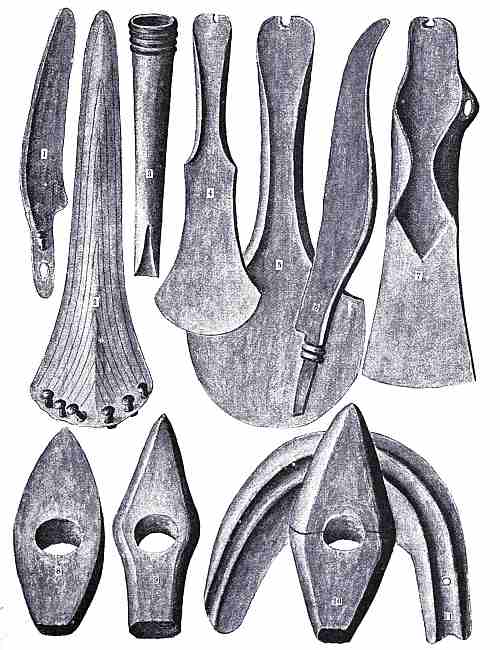
Fig. 15,—Sempachersee. All 1⁄2 real size.
WAUWYLERSEE. (B. 34 and 126.)
To the west of the little Lake of Wauwyl there is an extensive peaty plain, in which, upon the lowering of the lake for further utilisation of the peat, the remains of some curiously-constructed lake-dwellings were discovered. Wooden platforms were met with, resting, not on piles, but upon a series of successive beds of roughly-cut stems lying transversely to each other, the lowest of which reposed on the lake-bottom. Between these layers were branches and brushwood, mixed with clay, and the whole mass was pierced with vertical piles, the tops of which were at least a foot above the upper platform. These layers were as many as five, and the total thickness of the mass when exposed was about 3 feet, but there can be no doubt that, originally, it would have been greater, as there had been considerable condensation of the mass due to decay, especially of the interposing branches. The uprights were not observed to have been in any way connected with the platform, and the only peculiarity in the method of their arrangement was that they were more thickly placed at the corners, as if to keep the wooden mass in position. These artificial structures measured only 10 or 12 feet square, but they were very numerous, and so close that beams from one sometimes reached to the one next it. They were found in various parts of the moor, but in one place they were crowded into a rectangle measuring 90 feet by 50, which was surrounded by several rows of upright piles, as if for common protection. The upright piles were made of oak, alder, or fir, and they penetrated deeply into the shell marl—the stoutest being of oak, measuring 5 inches or more in diameter. It is noteworthy that the lowest horizontal woodwork lay on the shell marl, showing that these dwellings were constructed before the peat commenced to grow. The peat is now at least 6 feet thick., i.e. 3 feet of peat lying above the uppermost platforms.
No antiquarian remains were found underneath the wooden structures, but mostly in the intervals between them, where the objects lay almost directly over the shell marl. The settlement appears to have come to an end before the Bronze Age, as no metal object has been met with. A small glass bead is therefore of interest, as showing that the colonists must have had commercial relations with distant countries. Among the other antiquities are the following:—Stone celts (some of nephrite) hafted in staghorn fixings, and flint implements; chisels, pointers, flax-hecklers, etc., of bone; a lump of asphalt, harpoons of staghorn, knives made of yew, and various fragments of pottery with perforated knobs. In the Museum of Lucerne there are a few things, among which are one or two objects showing that the art of boring stone was known (Fig. 16, Nos. 1 and 2).
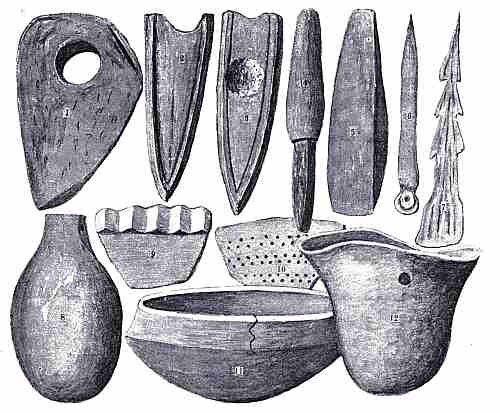
Fig. 16.—Lakes of Wauwyl (1 and 2), Zug (8), and Baldegg. No. 5 = 1⁄4, all the rest = 1⁄2 real size.
LAKE OF ZUG. (B. 61 and 126.)
The site of the first discovered settlement in this lake lay a little to the north of the town of Zug. A section of some excavations made for building purposes about 50 feet from the lake showed first a bed of common mould 2½ feet thick, then a layer of sand and rolled stones 1½ foot thick, after which came the relic-bed—a blackish band of decayed organic matter, varying in thickness from 8 inches to 1 foot, and containing the tops of piles and various industrial remains. The heads of the piles were on a level, and in some places cross-beams were observed. The relics include some stone hatchets, one fragment being of nephrite; a few flint objects—lance and arrow-heads, and one knife. There were also portions of sawn stones, apparently for making implements. From a small collection of bones Professor Rütimeyer identified the horse, cow, dog, marsh pig, red deer, roe, and hare.[19]
The surface of the soil where these discoveries were made was about 15 feet above that of the water in the lake, which of course would leave the relic-bed still on dry land—a peculiarity which is accounted for by the reported deepening of the outlet in former times. This explanation is very probable, as the channel of the Lorze, which carries off the surplus waters of Lake Zug, in passing through the town of Cham, bears evidence of having been artificially deepened. The large amount of detritus conveyed annually into this end of the lake also satisfactorily accounts for the depth at which the relic-bed lies below the surface.
Farther round the head of the lake, at Koller, near Cham, another site was discovered, on which some excavations were made, which revealed a relic-bed 3 feet below the surface. The finds here were broken celts of serpentine, fragments of pottery indicating large vessels. The present level of the lake is 3 feet below this relic-bed.
A third station was at St. Andreas, the evidence of which was the finding of a great number of stone celts, flint knives and arrow-points, over a certain part of a cultivated field bordering on the lake. Peculiar among the finds here are some curious oval objects made of limestone, with a short neck perforated (Fig. 16, No. 8).
Traces of three other stations—viz. at Derschbach, Zweieren, and Badeplatz—have been noted beyond Cham, but they have not been carefully investigated. Pottery ornamented with triangular lines and the "meander" pattern would seem to point to a later period. (B. 126, Pl. iii.)
A few of the objects collected on these stations are in a small museum in Zug; others are at Zürich; and in Bern there are 12 stone celts and one of copper, marked as coming from the station at Lorze.
BALDEGGERSEE. (B. 253 and 336.)
In the year 1871 the proprietors of the land around this lake reduced its level by drainage some 2½ to 3 feet, in consequence of which indications of lake-dwellings became visible in the vicinity of the outlet. The piles were irregularly placed along the shore, and spread over a wide range. In one place the area attained a breadth of 400 or 500 feet, and again it contracted and the piles only appeared in groups. In making excavations, the tops of piles became more numerous, and at a depth of 7 feet, beds of charcoal, containing nutshells and bits of pottery, were encountered.
Professor Amrein, who conducted the investigations, could distinguish two kinds of piles, some older than others. Horizontal beams were seldom met with. There was no regular relic-bed, as worked implements were found at all depths, from 1 to 8 feet. Some beautiful specimens of bone pointers and serpentine chisels (Fig. 16, Nos. 4 and 5) were turned up from a depth of 8 to 10 feet. Beds of clay were occasionally met with, and the piles appeared to have been arranged so as to enclose square huts. In one of the trenches some stone celts were lying on a bed of clay at a depth of 6 or 7 feet. One of these was of a grass-green colour with a transparent edge, and so hard that it could scratch glass. In an adjacent digging, at a depth of 4 feet, a large flat stone, 2 by 1½ feet, was found resting on the tops of six or seven piles, which penetrated through the bed of clay to the shell marl. The space between these supporting piles was filled with clay, and around the stone itself there were scattered bits of charcoal, fragments of pottery, hazel-nuts, etc.
Professor Amrein concludes his report by stating his opinion that this settlement was at its commencement a palatitte, and that subsequently fascine structures were constructed over its ruins.
The relics collected are partly in the Archæological Museum and partly in a small curiosity booth in the Gletscher Garten at Lucerne. Among those in the museum are beautifully-formed daggers and chisels of bone and horn (No. 6); four large harpoons (No. 7) and a scoop of horn; two horn hammers (perforated), and three small cups of the same material (No. 12); horn handles, etc.; rubbers, polishers, and celts of stone in large numbers; two flat pebbles (perforated); and some fragments of stone hammer-axes, one showing an effort to re-bore it (No. 3); several bits of rock crystal and flints worked into saws, scrapers, and arrow-points; fragments of pottery with knobs, and others ornamented with groups of triangular lines, dots, etc., the forms of which are extremely elegant (Nos. 9, 10, 11).
LAKE OF GENEVA.
Leaving the great Jura chain of lakes we come, after a short journey through an upland glacial valley, to the Rhone basin and the Lake of Geneva. On the supposition that this was the route followed by the lake-dwelling founders, the first and most natural position for a settlement would be the bay of Morges; and it is somewhat singular that in this very place one of the largest and most instructive settlements on this lake flourished for successive ages. Here, within a few hundred yards of each other, three sites have been discovered, whose respective remains mark the progressive stages of civilisation evinced in the Stone Age, the transition period, and the most flourishing period of the Bronze Age. It will be therefore of importance to examine carefully the facts disclosed by the repeated examination of these typical stations before referring to the others in this lake. Nor in selecting it am I deviating from the order of discovery, as it was the earliest known and first examined in this part of Switzerland, after Keller's observations and researches at Ober-Meilen had roused the curiosity of antiquaries in the matter.
The existence of piles in the bay of Morges was known to fishermen for a long time, but of course their significance was not understood. However, on the 22nd of May, 1854, Messrs. Morlot and Troyon examined the locality, and speedily demonstrated, by the finding of actual industrial remains, that this had been the site of a habitation lacustre. The part of the bay in which these piles were observed was about 500 feet from the shore, and in a depth of water which varied from 8 to 10 feet, even when the lake was at its lowest. Under these circumstances it will be readily seen that it was no easy matter to make investigations; but, notwithstanding the difficulties involved, there was no lack of energy among the local archæologists, who for many years systematically prosecuted the work of fishing up, by means of hand-dredgers, nippers, etc., the submerged remains of these lacustrine villages. Foremost among these explorers were the MM. Forel, of Morges, father and son, whose reports and rich collection of antiquities have chiefly supplied the facts now communicated.
When Troyon (1860) published his well-known book on the lake-dwellings (B. 31), considerable progress had been made in the exploration of the station, and from the richness of the finds it got the name of "La grande Cité de Morges;" but it had not yet been ascertained that there were three separate stations, much less that these stations represented different periods. According to Troyon, most of the piles were of oak, and some had planchettes to prevent them sinking too far in the mud. A portion of one of these supports measured 13½ inches long, 4 inches broad, and 1 inch thick; and contained two square-cut holes 1½ inch in diameter and 4 inches apart. The relics found up to this period were of much interest. Among them were bronze hatchets 4 to 7 inches long, mostly of the winged type, only one having a socket. Of 13 knives, nine had tangs and four had sockets. Two swords, one of which, with flat handle, was whole; two socketed lance-heads; several bracelets of different kinds; and a bronze mould for casting celts[20] (Fig. 17, No. 8). Pottery, clay rings for supports, discoidal stones with marginal grooves, spindle-whorls, a couple of canoes, etc. Subsequently the MM. Forel began to distinguish the respective stations, to which they gave the following names:—(1) "La grande Cité de Morges," (2) "La Station des Roseaux," and (3) "La Station de l'Église."
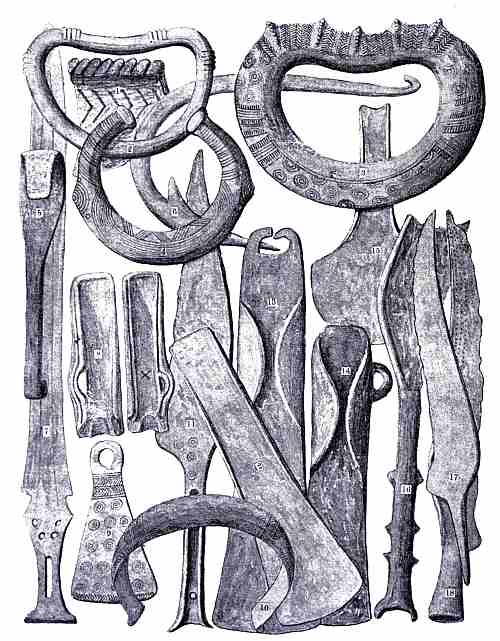
Fig. 17.—Morges, Thonon (1, 2, 9, 10, and 16 to 18), and St. Prex (12). Nos. 7 and 8 = 1⁄4, the rest = 1⁄2 real size.
(1) The Grand City was some 500 feet from the shore, and occupied an area 1,200 feet long by 100 to 150 feet broad. The stumps of its thickly-studded piles were visible in the water never less than 8 to 10 feet deep, and among them were detected some cross-beams, and a canoe, 2 feet wide, with its prow sticking out of the mud. A large and miscellaneous assortment of relics was also collected. Over 450 bronze objects, says Dr. Forel, writing in 1876 (B. 286), were found on this station, and they all belong to the purest type of what Desor calls "le bel Age du Bronze," including swords, knives, sickles, hair-pins, bracelets, etc. One remarkable observation then made was that among 60 bronze winged celts (Nos. 13 and 14) there was not one single specimen of the flat kind. In 1866 two large reniform rings, one ornamented (Fig. 17, No. 3) and the other plain, were added to the list of objects from Morges. Only one object of iron, viz. a poignard, analogous to one from Lake Bourget, was found. Among the osseous remains the stag, goat, sheep, horse, and pig, were identified.
The bronze objects from this station up to the present date are thus enumerated by Dr. Forel (B. 462, p. 55):—
Winged celts, 66; socketed celts, 6; chisels and gouges, 6; swords, 4; lance-heads, 19; knives, 61; sickles, 23; bracelets, 95; rings, 79; hair-pins, 256; divers, 23. In this total of 633 objects are included, probably under the head "épingles," five curious objects of bronze with handles similar to those from Wollishofen and Grosser Hafner at Zürich. (B. 280, p. 699.)
(2) About 450 yards from the northern extremity of the Grand City there was another settlement (Roseaux), of smaller dimensions, which has yielded objects essentially different from those of the former. Here, in marked contradistinction to the Grand City celts, there were 18, all of which were of the flat type (No. 15), and not one with wings or sockets. But, on the other hand, there were a few polished stone celts and flint objects, three small lances, and one hair-pin of bronze, and a few iron sickles of modern type. The pottery was also of a mixed character, showing fragments of dishes of a coarse and fine kind. The piles showed marks as if produced by metal tools.
(3) The third station (l'Église) lies between the shore and the Grand City, and is separated from the latter by a sterile band 220 yards wide. Here there is a decided steinberg, presenting the unusual feature of having 20 or 30 rectangular or oval spaces measuring 13 to 20 feet in diameter without any stones. The antiquities from this station were stone celts (of which 86 are recorded by Dr. Forel up to the present date), stone spindle-whorls, sharpening stones, and some fragments of coarse pottery; but no objects of metal of any kind.
(4) A fourth station is named by Dr. Forel as lying opposite the ancient poudrière of Morges, and containing a small steinberg, on which six stone celts and a few other objects of the Stone Age have been found.
The search for lacustrine remains in other parts of the lake was so actively prosecuted that Troyon could enumerate no less than 26 stations discovered during the six years prior to 1860. (B. 31, p. 31.) Since then their number, as recently corrected by Dr. Forel (B. 462), has increased to 44, notwithstanding that eight localities (viz. Villeneuve, Creux de Plan, Lutry, Pully, St. Sulpice, Yvoire, Amphion, and Evian) where supposed lake-dwelling remains have been found are excluded as doubtful or not verified by subsequent investigations.
Though no such fortuitous circumstance as the "Correction des Eaux du Jura" has come to the assistance of the lacustreurs of Geneva, they have amassed a very considerable quantity of relics. Only at a few stations, as Thonon and the Port of Geneva, have they benefited from dredging operations carried out for public works. From the results obtained during these favourable conditions, it is quite clear that an enormous quantity of antiquities, especially of the Bronze Age, still lies buried in the waters of this lake.
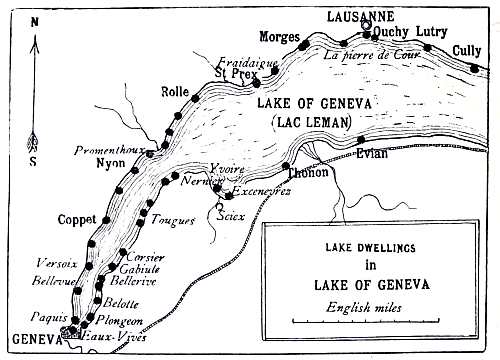
We shall now make a tour of the lake, jotting the various characteristics of the lake-dwelling stations as we move along. (See accompanying Sketch Map.)
Above Morges are four stations, as follows:—
Station de Cully.—Some piles to the east of the town, but in water from 10 to 13 feet deep. Only a few isolated objects of stone and bronze have been recorded.
Station de la Pierre de Cour.—Near Lausanne, at a large erratic block known to bathers as Pierre de Cour, there are a few rows of piles in a depth of 13 feet, and at a distance of nearly 300 yards from the shore. A hair-pin and two small bits of bronze are the only relics recorded.
Station du Flon (Vidy).—A number of discoidal stones with marginal grooves, and some stone rubbers and polishers, are recorded from this station. (B. 22.)
Station de la Venoge.—To the east of the embouchure of the river, near St. Sulpice, and greatly covered by detritus.
Morges.—Four stations, already noticed.
Frai d'Aïgue.—In the gulf of Frai d'Aïgue, a little to the north of St. Prex, are three stations—viz. De Terreneuve, De Monnivert, and De Frai d'Aïgue—extending over a length of one kilomètre. They all belonged to the Stone Age, and represent probably parts of one and the same village. Mr. Colomb has collected more than 200 stone celts in various grades of manufacture in a space of 150 square mètres. From the same station there are in the Museum of Lausanne some 40 stone celts, a few flint flakes and knives, and a spindle-whorl.
St. Prex.—In the gulf to the south of St. Prex there is a station of the Bronze Age, the piles of which are to be seen in a depth of 10 or 11 feet of water. The station has yielded a considerable number of relics, some of which are deposited in the Lausanne Museum, viz. a flat bronze celt (Fig. 17. No. 12), clay support-ring, portions of clay crescents, seven stone celts, three or four fragments of pottery ornamented with curved lines and cable pattern (one fragment of black pottery is ornamented with tin strips), a bronze pin with spherical head, a large block for sharpening tools. The other bronzes known from the station are four knives, one bracelet, five rings, and 11 pins.
Rolle.—Situated opposite this town there appears to have been a lacustrine village of considerable size, which has yielded objects characteristic of both the Stone and Bronze Ages. Part of the area occupied with piles has been covered over by an artificial island, now bearing a monumental obélisque. Fragments of pottery of the same character as those from Morges, discoidal stones, hammer and sharpening stones, were among the relics.
Dr. Forel enumerates the bronze relics from this station as follows:—Two winged hatchets, one chisel, one lance, two knives, one sickle (now in the Lausanne Museum), one bracelet, 15 rings, and nine hair-pins. (B. 462.)
To the south of this is the Station de Beaulieu, of considerable extent, but poor in relics, only some 10 bronze objects having been found on it. (Ibid.)
Station du Châtaignier.—A small Stone Age station before the village of Dully. (Ibid.)
Station du Creux de la Dullive.—A great circular station of the Bronze Age, on which two winged celts, two bracelets, and a few rings and hair-pins have been collected. (Ibid.)
Nyon.—According to Dr. Forel (B. 286), there are two stations in the bay of Nyon—one at Promenthoux (Stone Age), to the right of the embouchure of the river; and the other (Bronze Age) to the north of the town of Nyon. Mr. A. Revilliod found on the latter station a remarkable object, consisting of 300 rings of bronze, from 7 to 8 inches in diameter, which became adherent to each other by a concretionary deposit from the lake. The total number of bronze relics from Nyon is 62, thus relegated:—Seven winged celts, one chisel, one lance-head, 10 knives, two sickles, 15 bracelets, 23 hair-pins, and three undefined objects.
We now enter the lower portion of the lake, where its breadth becomes suddenly contracted from 8 to 3 miles; and here it would appear that the lake-dwellers had thickly planted their peculiar villages on both sides of the lake. Along the shore, from Nyon downwards to where the Rhone makes its exit, and then up on the other side to the opposite point of Ivoire, Dr. Forel (B. 462) enumerates no less than 22 stations, in the following order:—
Station de Céligny.—Just before the landing-pier. Bronze Age.
Station de Coppet.—Discovered in 1874 by M. Magnin. Bronze Age.
Station de Mies.—Discovered in 1877, opposite the Château des Crenées. Bronze Age.
Station de Versoix.—A great station near the landing-pier. Bronze Age. Hatchets and knives of iron are said to have been found on this station.
Station de Bellevue.—Discovered in 1880, to the north of landing-pier. Bronze and Stone Ages.
Station des Pâquis.—Extends southwards from the jetty of the new port. Stone Age.
Station des Eaux-Vives.—Outside the port, along the suburb of this name. Stone Age.
Cité de Genève.—A vast station occupying the present port. Bronze Age.
Station de Plongeon.—At the northern end of the Station des Eaux-Vives, in a contracted spot, Dr. Gosse has found some 30 objects of iron, some of which resemble those of La Tène.
The last four are generally known as the Stations of Geneva, so that the lower extremity of the lake must have been actually studded with settlements. At the foot of the largest of the two well-known and superstitiously-revered boulders called Pierres à Niton were found, about the middle of last century, a knife (Fig. 18, No. 5) and a celt of bronze of the flat type, which are still preserved in the Museum of the town. Near this was the Bronze Age station called by Dr. Forel "Cité de Genève," but sometimes described as the Station des Eaux-Vives. It would appear that there are two stations described under the latter name—one of the Stone Age, about 100 yards nearer the shore; and the other of the Bronze Age ("Cité de Genève").
The Cité de Genève is now the richest bronze station hitherto investigated in the Lake of Geneva. It occupied a horseshoe-shaped area, filling the entire space presently forming the port, and even sent a prolongation down to Rousseau's island. Dr. Forel estimates the number of bronze objects collected here at 1,500, being rather more than the total number from all the other stations in the Lake of Geneva.
At its northern extremity, next the Station des Eaux-Vives, Dr. Gosse came upon what must have been the site of a foundry. Here, in a confined space not exceeding 100 square yards, he fished up no less than 50 stone moulds, crucibles, ingots of bronze and tin, scoriæ, and other materials of the founder's art. (B. 462.)
Most of the objects of general interest from this station have been deposited in the Archæological Museum. Dr. Forel classifies those of bronze as follows:—25 winged hatchets, 19 socketed hatchets, four flat hatchets, seven chisels and gouges, four swords, seven lance-heads, 72 knives, 22 sickles, 75 bracelets, 230 rings, 1,000 hair-pins, and 60 diverse objects. In looking over this collection I made the following notes:—The socketed celts have the loop generally at right angles to the cutting edge. The knives are both socketed and tanged. Bracelets show a great variety of forms, but the solid ones predominate. Sickles have more frequently a raised button. The ceramic art shows the usual Bronze Age decoration of triangles, and the paste is of two qualities. Clay ring-supports, spindle-whorls, discoidal stones, etc., are very abundant. Among the odds and ends are to be noted pins with large perforated heads, fish-hooks, buttons, a large plaque with repoussé work of slightly-raised bosses, a rude image like a stag of bronze, a variety of pendants, small tin wheel-like objects in concentric circles, etc. A few of these objects are represented on Fig. 18, all of which, except Nos. 9, 10, 12, and 13, are from this station and deposited in the Museum at Geneva.
Station de la Belotte.—A large station, rich in Stone Age relics. A couple of bracelets and a few rings and hair-pins of bronze, in all 21 objects, are among the treasures from this settlement, which comprise no less than 1,400 stone celts.
Station de la Pointe de la Bise.—Immediately to the north of La Belotte there is another station, said to be one of the transition period, owing to its having supplied a couple of flat axes. The only other metal objects are a few rings and hair-pins.
Station de Bellerive.—A large station yielding objects both of the Stone and Bronze Ages.
Gabiule.—Before the steamboat landing-stage are two stations—one of the Stone Age; and another, in deeper water, of the Bronze Age.
Station d'Anière (Bassy).—A small Bronze Age station in deep water.
We next come to a group of four stations, all within a compass of two miles, which are sometimes confounded with one another, and described as "Les Stations de Tougues." One is near Hermance, and is known as the Station de la Vie à l'Ane or du Moulin; a second is vis-à-vis de la Fabrique Canton; a third is opposite the Château Beauregard; and a fourth, Creux de Tougues, lies before the village of Chens. These settlements were all parallel to the shore, and their remains are in deep water. Their relics are of a mixed character, and would indicate that, while founded in the Stone Age, they subsisted during that of Bronze.
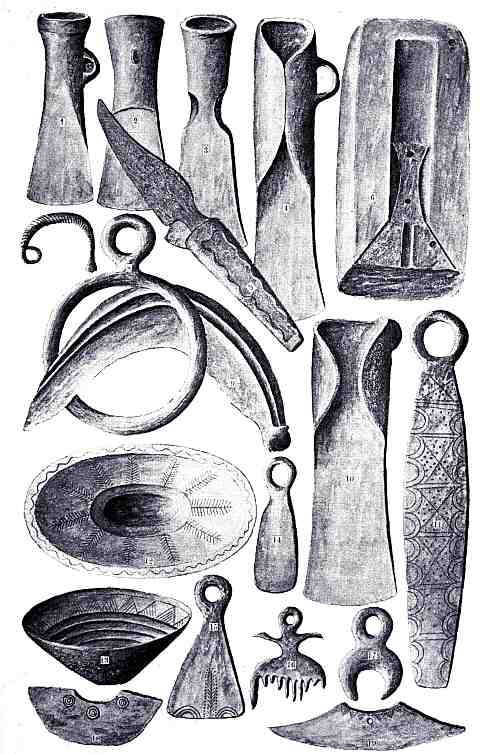
Fig. 18.—Geneva and Tougues (9, 10, 12, and 13). Nos. 6, 12, and 13 = 1⁄4, the rest = 1⁄2 real size.
The station at Creux de Tougues is the most important of the group, and it has furnished a large number of antiquities. It is about 130 yards from the shore, in a depth of water varying from 5 to 10 feet. Ordinary stone celts, 27 of which have been collected (B. 462), were found on the part next the shore. The collection of bronze objects consists of:—Four winged celts (Fig. 18, No. 10), one flat celt, two socketed chisels, one sword, one lance-head, 21 knives, five sickles (No. 9), 14 bracelets, 120 rings, 170 hair-pins, and six diverse objects. Pottery from this station (Nos. 12 and 13) comes largely to the front, and in the Museum of Geneva there are fine specimens of plates, cups, vases, and other vessels of a fine black ware which, both in form and ornamentation, resemble those from the palafittes of Lake Bourget and others of the Bronze Age in Switzerland. Spindle-whorls, discoidal stones with a marginal groove, rubbing stones, etc., are also abundant. A peculiarly-shaped stone object known as "gorge de poulies" comes here to be noted. (B. 31, 281 and 462.)
Messery.—Piles are here seen projecting above the mud 2 to 5 feet, in a depth of about 12 feet of water. One of the piles pulled up by Troyon showed markings of a metal tool. Numerous fragments of pottery characteristic of the Bronze Age have been found, but only two objects of this metal, viz. a winged celt and a sickle.
Nernier.—Two stations are described in the vicinity of the village of this name. One, near the shore, and partly covered up with gravel, belonged to the Stone Age. Here Troyon observed some large piles in a depth of 6 feet of water, and others he found on the shore buried in the gravel. Among the objects collected are flint flakes, spindle-whorls, hatchets of serpentine (a perforated one is in the Museum of Annecy), some worked bones, etc.
The Bronze Age station is 600 yards to the west of the village, and 150 from the shore. The relics consist of pottery, spindle-whorls, ring-supports, etc. Among the bronze objects are:—Eight winged celts, two chisels, one sword, two lance-heads, three knives, three sickles, five bracelets, three rings, and five hair-pins. Among the rings is included a pendeloque, in the form of a large hollow ring, attached to which is a small ring for suspension.
Stations d'Excenevrez et de Coudré.—In rounding the point of Ivoire we come to a sheltered bay, into which a couple of streams discharge their waters, carrying down a considerable amount of débris, so that the lake-dwelling remains are here deeply buried. Traces of two stations have, however, been observed, one, station De Moulin-Pâquis, near Excenevrex, and the other, De Coudré, opposite Château Bartholoni, not far from the village of Sciex. Both appear to belong to the Stone Age, and in the latter, in 1874, 12 stone hatchets were found.
Thonon.—There were two separate settlements at Thonon. One (Stone Age), about 20 yards from the shore, was discovered in 1862, when the new port was being formed. The objects there collected were piles, flint implements, stone hatchets, spindle-whorls, and some coarse pottery.
The Bronze Age station was considerably in advance of the former, and in a depth of 3 to 4 yards. The settlement was extensive, and ran parallel to the shore, and from its remains a large assortment of relics has been collected. Being among the earliest discovered in the Lake of Geneva, it has been industriously searched by a number of well-known archæologists, as Troyon, Forel, Revon, Monod, Revilliod, Carrard, etc., and consequently its treasures are widely distributed. The bronze objects, according to Dr. Forel (B. 462), amount to 48, viz. 11 winged celts, two lance-heads, six knives, two sickles, 14 bracelets, two rings, five hair-pins, and six diverse objects. One of the knives, which is finely ornamented and one foot in length, has the peculiarity that the handle contains less tin than the blade (Fig. 17, No. 16). Another knife was adapted for side-plates to be riveted on its handle (No. 11); while others were socketed and tanged (Nos. 17 and 18). Some of the hatchets have a side loop, and others are devoid of it. Among other things are a large ring, armilla sacra (Carrard), (No. 2); a pendant of three involved rings, together with various other pendants (No. 9). Among the pottery are fragments with perforated knobs, herring-bone pattern (No. 1), etc.; and some charming vases, clay ring-supports, etc.
There are thus, according to Dr. Forel, 11 stations of the Stone Age; three of the period of transition (i.e. with hatchets of bronze of the flat type), six with mixed objects, 19 of the Bronze Age, and one (Station de Plongeon) which furnished objects characteristic of the early Iron Age.
These notes have been collected from a fragmentary and widely-scattered literature, including the following original sources:—B. 22, 31, 34, 40, 121, 126, 138, 152, 280, 282, 286, 315, 377, and 462.
LAKE LUISSEL, CANTON DE VAUD.
In a small valley among the heights above Bex, adjoining the Rhone valley, there were found, in 1791, while a canal was being dug for facilitating the cutting of peat, some industrial remains which point to the existence of a lake-dwelling of the Bronze Age. At the north of the basin, and at a depth of 6 feet, a quantity of bones (some human), grains of corn, bronze rings, the tip of a scabbard, and three remarkable swords (from 23 to 26 inches in length) were encountered (Fig. 19). The swords are still preserved, and indubitably belong to the most flourishing period of the Bronze Age. In the summer of 1859 Mr. Troyon made excavations in the turf of the former bed of this lake, but found only a portion of worked wood, which might have been used as a handle for a stone hatchet. According to an old tradition in the neighbourhood, a château once existed here which had been engulfed in the lake. (B. 31.)
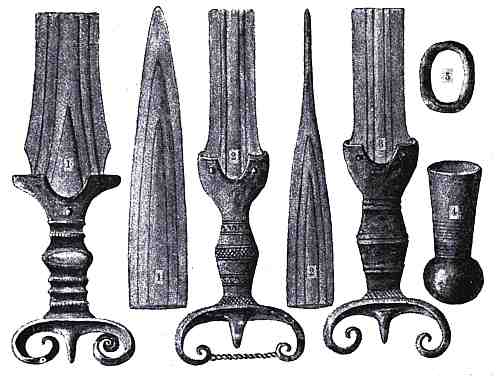
Fig. 19.—Luissel. All 1⁄3 real size.
LAKE BOURGET.
As early as 1856, while the Mont Cenis and Culoz railway was being constructed, some antiquities were dredged up in the bay of Grésine, in Lake Bourget, which the engineers surmised to be remains of a lake-dwelling. Though this information was formally communicated to the Société Savoissienne, it was not till 1862, in consequence of renewed attention to these discoveries by Baron Despine and M. Desor, that this society took steps to investigate the matter. A preliminary investigation conducted by a committee of seven gentlemen was considered so satisfactory that the committee was renewed, with funds at its disposal for systematic researches among the palafittes. Since then several archæologists have conducted independent researches, among whom may be noted particularly Le Comte Costa de Beauregard, MM. Rabut, Perrin, Revon, Cazalis de Fondouce, and Chantre. (B. 73, 138, 176, 179, 282.)
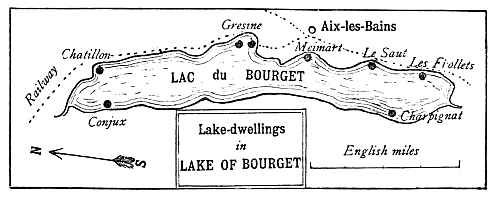
The combined results of these explorers have now established the fact that there were eight settlements in this lake, all of them belonging to the Bronze Age. The antiquities fished up have been very numerous, but unfortunately they are widely distributed, many indeed being in private collections. The largest proportion is, however, to be found in the Museums of Chambery, Aix-les-Bains, Annecy, and St. Germain, and the private collection of Count de Beauregard in his château on the Lake of Geneva. (For relative position of these stations see Sketch Map of Lake Bourget.)
Conjux.—This station is 200 yards from the shore, opposite the village of the same name. A group of piles only 50 yards from the shore is supposed to have been the ruins of a Roman pottery business, on account of the abundance of characteristic ware found among them. A peculiarity of this station is the number of moulds found on it in proportion to the other objects, no less than 13 being recorded up to 1875, representing all manner of industrial implements, as knives, winged and socketed celts, sickles, hammers, pins, rings, and buttons.
Chatillon.—This settlement occupied a sheltered position about 500 feet from the shore. In one part the piles project out of the mud, and are all inclined towards the east at an angle of 45°, but in the rest of the station they are straight. A vessel of earthenware, like the later productions of the lake-dwellers, was found among these piles with the name Severinus stamped on it in Roman characters. (B. 176, p. 24.) Here were found some 40 or 50 of these very remarkable vessels of black earthenware, ornamented with tin strips forming a combination of pleasing designs (Fig. 193, Nos. 4 and 5); also some fragments of Gallo-Roman pottery, and others of a very early type. Among the relics are eight moulds (one of which is for a lance-head) and about 320 objects of bronze.
Gresine.—The bay of Grésine contains the sites of two settlements—one close to the railway, and the other farther out and of larger extent. The latter appears to have been connected with the Pointe de Grésine, as a gravel bank runs from this part of the shore to the site of the palafitte; and the two stations were connected with a gangway, the remains of which have been traced. The railway just touches the site of the inner station, to which accident the discovery of palafittes in Lake Bourget is due. Although the stations at Grésine have been more frequently searched than any others, owing to their proximity to Aix-les-Bains, they have continued for a long time to be the richest in all kinds of antiquities, carbonised fruits, etc. Among the moulds is one for the handle of a sword on one side, and a buckle on the other. (B. 282, Pl. liv. 2.) No less than five bronze hammers have been found on this station, all of which are socketed and cylindrical in shape. Last summer some remarkable objects were fished up, which I saw in the collection of the finder at the Restaurant Lacustre (Port Puer), some of which are here figured (Fig. 21, Nos. 4, 6, and 12).
Meimart.—The débris of this settlement lies about 100 yards from the shore, under 16 to 20 feet of water, and hence it has been less searched, although it is of considerable extent, and has yielded a few antiquities, notably a bronze sword, moulds, fragments of pottery, and a Roman vase.
Le Saut.—This settlement, like the others, was on a slight elevation some 110 yards from the shore, and at low water its relics have to be fished from a depth of about 10 feet. The station has been well explored, and it has been observed that the ceramic remains indicate greater technical skill the farther out in the lake they are picked up, and where the piles are seen to project higher above the mud. A piece of timber 22 feet long, with numerous mortises at each end, and a bone harpoon with one barb, like those of bronze from Peschiera, are the only objects which distinguish the antiquities of this station, which in general are very similar to those from Grésine.
Les Fiollets.—A small settlement in 15 to 20 feet of water. The few bronze objects found here are covered with calcareous matter. Some of the pins collected on it are of novel forms, but the most interesting object is a small file, which may be seen in the Museum at Chambery. Mortised beams were also fished up from this station.
Charpignat.—Some piles have been observed near the village of Bourget, but the associated industrial remains, if any, have not yet been revealed.
In 1875 Mr. Perrin made a series of elaborate statistics, by which he estimated the entire number of bronze objects from the palafittes in Lake Bourget at a little over 4,000, and tabulated them in various categories according to their uses, indicating the stations on which they were found, and the museums or collections in which they were then located. (B. 282.) Since then so many additional relics have been recovered from the palafittes that Mr. Perrin's tables can offer no approximation to accuracy; but, nevertheless, they have a certain value in showing the relative frequency of the different objects. I have, therefore, taken the liberty of reconstructing from Mr. Perrin's data the following list of the objects found in Lake Bourget, which gives a better general idea of the culture and civilisation of its lake-dwellers than pages of descriptive details:—
Lake Bourget.
Grésine. All Stations.
Founders' ┏Moulds 22 49
Materials ┗Ingots and Castings 46 171
┏Hammers 5 7
┃Hatchets 19 38
┃Chisels 2 4
┃Gouges 1 1
┃Sickles 7 23
┃Knives 35 126
Utensils ┃Paring Knives (Tranchets) 4 13
and ┫Razors 18 32
Instruments ┃Stamp — 1
┃Borers, etc. 32 164
┃Saws 1 2
┃File — 1
┃Rivets and Nails 115 248
┃Needles 46 190
┃Fish-hooks 38 144
┗Pincers 5 7
┏Swords 2 3
┃Daggers 9 12
Arms ┫Lances 5 16
┃Arrow-heads 23 49
┗Shields 1 2
┏Hair-pins 163 798
┃Fibulæ 2 2
┃Bracelets 82 252
┃Torques 1 2
┃Finger-rings 32 121
Objects ┃Earrings 4 22
of ┫Girdles 1 1
Ornament ┃
┃Buckles, Rings, etc. 140 598
┃Pendants 7 16
┃Clasps 7 50
┃Buttons 35 63
┃Brackets, etc. 43 185
┃Beads 115 488
┗Tubes and Spirals
Diverse Objects 34 108
Total 1,110 4,002
General Remarks on the Palafittes of Lake Bourget.—Count Costa de Beauregard, in his excellent article on the "Habitations Lacustres du Lac du Bourget" (B. 176), states that the stakes on which these villages were reared were generally of oak, measuring from six to eight inches in diameter, and that they were placed at a distance of 100 to 200 yards from the shore, in a depth of 4 or 5 yards of water. Their lower extremities almost always bore cutting marks, which could only be made by metal tools. The great differences as regards their state of preservation show that the settlements had been occupied for a long time, necessitating the renewal of the piles at different epochs.
The Count also believes that all the palafittes of Lake Bourget were constructed during the Bronze Age, in regard to which he thus writes:—"Malgré les quelques instruments de silex et les hachettes de pierre rencontrés dans nos fouilles, il est peu probable, comme je l'ai déjà dit, que ces bourgades aient été fondées à l'Epoque de la Pierre. Tout nous porte à croire, au contraire, qu'elles florissaient à l'Epoque du Bronze, période qui a dû être de fort longue durée en Savoie, car il a fallu bien des siècles pour accumuler sur les différents points que nous avons explorés une pareille quantité d'objets et de débris de toute sorte." (Ibid., p. 23.)
Relics.—Weapons.—The swords recovered are few, and of one type (Fig. 20, No. 16). That they are of home manufacture is more than probable from the finding of portion of a mould of the same class of weapon, now deposited in the Museum of Chambery. Only a few tips of scabbards hitherto found (Fig. 21, No. 20). The daggers were both tanged and riveted to their handles. Lance-heads (Nos. 1 to 4) are all socketed, with only one or two exceptions (Nos. 5 and 12), which might be daggers. They are generally unornamented. Arrow-points are formed for the most part of triangular plates of bronze, with two or four holes for fastening them to the stem; but other forms are met with (Fig. 21, Nos. 13, 22 to 26, and 32).
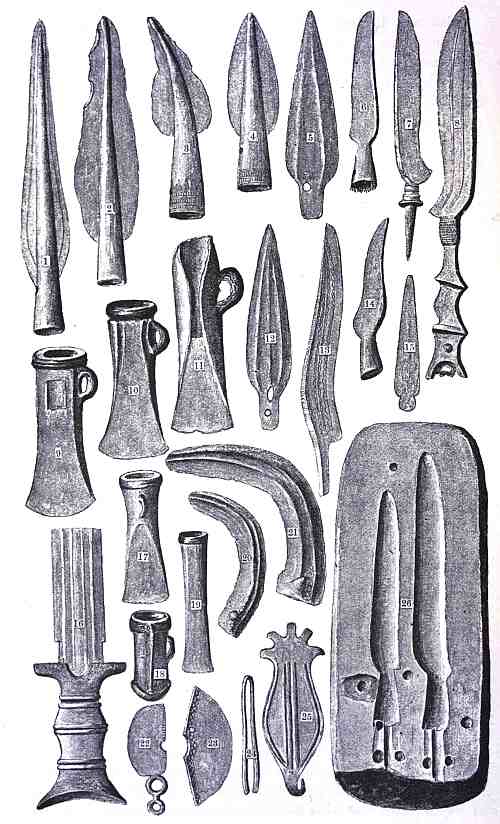
Fig. 20.—Lake Bourget. All 1⁄3 real size.
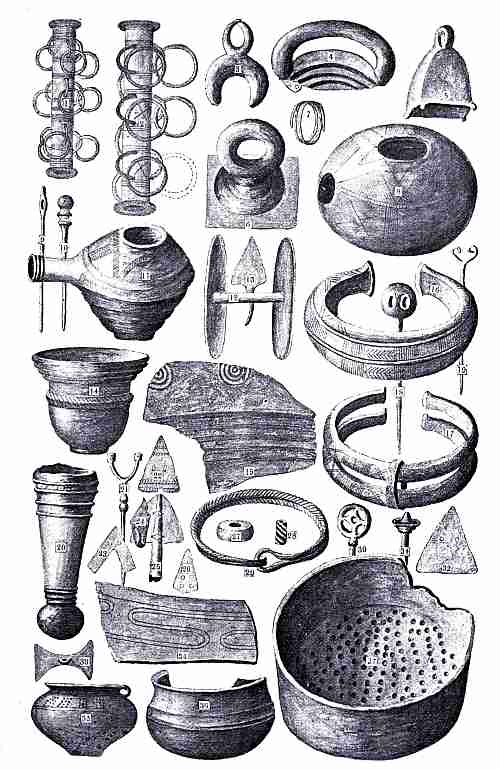
Fig. 21.—Lake Bourget. Nos. 34 to 37 = 1⁄4, the rest = 1⁄2 real size.
Implements.—Hatchets (Fig. 20, Nos. 9, 10, 11, and 17) are both winged and socketed, and the latter have their sockets round, oval, or rectangular. The chisels and gouges are all socketed (No. 19). Sickles (Nos. 20 and 21) have nearly all a raised button for fixing the handle (in which respect they differ from those of Switzerland), and may be classified under a variety of groups dependent on the degree of curvature and the disposition of their raised ribs. The knives are socketed, tanged, and with a solid handle (Nos. 6, 7, 8, 13, and 14); the former being most, and the latter less, frequent. Razors are of two kinds, with or without a handle (Nos. 22 and 23). Needles have the eye either at the end or middle. Awls and a variety of fish-hooks are abundant; but spears or harpoons are very rare. Rivets, nails, and bits of thin bronze plates, are in some places abundantly met with. Examples of saws and files have been found, but in small numbers.
Ornaments.—Pins with large round heads are very rare, as are also those with wheel heads (the various forms are shown in Fig. 21, Nos. 10, 18, 19, 21, 30, and 31). Bracelets (Nos. 16, 17, and 29), which are numerous, and mostly open, are either solid or hollow (one is of tin); fibulæ and torques rare; finger-rings are of two kinds, plain and spiral (No. 7); portions of girdles, buckles, pendants (No. 5), buttons (No. 33), bronze beads, and small spirals, are abundant; a clasp is like one from Mörigen (Fig. 20, No. 25). Tin appears in ingots, in a bracelet, discs, and thin strips for ornamentation to dishes; also gold in the form of a few portions of twisted wire or leaf. Several bronze vessels. One charming little vase (Fig. 21, No. 14) of cast bronze, figured by Count Costa de Beauregard, and now in his possession, was found at Grésine along with a sword (Fig. 20, No. 16), a knife (No. 8), and about 250 nails supposed to have been used in the manufacture of a shield. Nos. 1 and 2 of Fig. 21 represent two remarkable objects from Grésine, now exhibited in the Museum at Aix-les-Bains. A similar object, but more worn and minus some of its rings, is in the Museum at Chambery; and a fourth is in the Museum Lacustre at the Port (Fig. 195, No. 4). Crescents, spindle-whorls, fragments of cloth, bits of plaited rushes and basket-work, glass in small coloured beads, and amber (Fig. 21, Nos. 27 and 28), also in small beads, are all fully represented.
The articles represented by Nos. 4, 6, and 12, may be the brass ornaments on a set of harness; but as to the two curious vessels of bronze (Nos. 8 and 11), I am unable to assign any use.
The pottery shows great skill in the ceramic art. It is of a grey, black, or red colour (Nos. 34, 35, 36, and 37). Vessels combining the three colours, in various geometrical forms, with linear ornamentation, have been found among them, and others with ornamentation reminding one of the impressions of fern-leaves (Polypodium vulgare).
A few iron spear-heads (Fig. 198) and knives, as well as Roman tiles and pottery, have also been collected from these palafittes.
The domestic and wild animals, so far as they have been identified, are similar to those from the Swiss lake-dwellings.
LAKE ANNECY.
Since 1856 piles have been discovered in several places in Lake Annecy, but owing to the depth of water and the accumulation of mud, their associated relic-beds could not be easily examined. Up to the present time only four stations have been sufficiently investigated to enable us to form some idea of their chronological position with respect to the other remains of lake-dwellings. These are Stations du Port, De Vieugy, Du Chatillon, and Du Roselet.
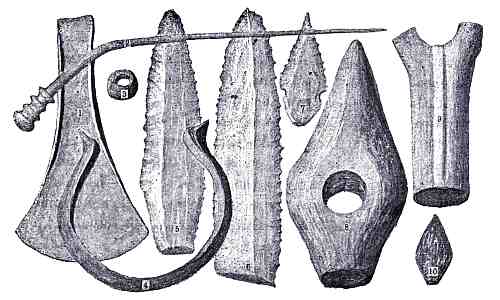
Fig. 22.—Lake Annecy. All 1⁄2 real size.
The first-named (Station du Port) came to light only in the beginning of 1884, when the little harbour at the town of Annecy was being deepened to facilitate the movements of the pleasure-steamers which ply on the lake during the season. In the course of these operations the dredging-machines came into contact with piles, and brought up various kinds of stone implements, etc., in the mud, which, unfortunately, were mostly re-deposited in deep water. The spot where these remains were found lies just at the extremity of the Swan Island; and after the public works were completed, the dredger was put at the disposal of the Société Florimontane, who conducted systematic investigations, both there and at the stations of Roselet and Vieugy. Previous to this time all the stations examined had yielded more or fewer bronze objects, and they were therefore considered to be analogous to those of Lake Bourget, all of which were founded during the Bronze Age. The explorations conducted at the Station du Port upset this view, as from the character of the relics found on it there could be no doubt that its inhabitants lived chiefly during the Stone Age, but the station survived to the Bronze Age. The objects collected from it consist of perforated hammer-axes of serpentine (Fig. 22, Nos. 8 and 9), polished hatchets of serpentine, stone spindle-whorls, beautifully-worked daggers and lance-heads of flint (Nos. 5, 6, and 7), as well as arrow-heads, (one of shale stone No. 10), saws, scrapers, etc., of the same material. Only two metal objects, viz. a bronze hair-pin (No. 2), and a bead (No. 3), probably of copper, like those from Vinelz are recorded; but these are said to have been on the surface of the relic-bed.