BOOK III. DOMESTIC ANIMALS.
Reading edition
LETTER XIII.
QUADRUPEDS KEPT FOR AMUSEMENT.—HORSES FOR RIDING AND DRIVING IN PONY CARRIAGES.—MULES, ZEBRAS, QUAGGAS, AND DONKEYS.—DOGS AND CATS.
I am delighted, my dear Annie, to find that you are fond of riding. There is something noble and invigorating in the exercise. If your horse is tractable and docile, you will soon begin to consider him as your friend; and if he is refractory, you will feel a pride in being able, by skill, to conquer a powerful being possessing strength so superior to your own. I like to see a lady ride well and fearlessly; and, in short, the only drawback I can find to the pleasure your letter gave me is, the somewhat mysterious malady of your horse, on which you consult me. You say that, though a fine spirited creature when you are on its back, it appears dull and stupid when first brought out, and that it shuffles against things as if it were half-blind. You say you have consulted a veterinary surgeon, who says that there is no disease in the eyes, so that I suspect the evil lies where you have probably never thought of looking for it, viz. in the stable. If your stable is dark, the mystery is explained at once; and I think it is very probable that this may be the case, as you tell me that your horse is kept in a stable apart from the rest, that it may be taken more care of.
I believe, indeed, that more of the diseases of horses depend on the stable than is generally imagined. If the stable be dark the eyes are affected; and if it be damp the horse is liable to catch cold; and coughs, inflammation of the lungs, and finally broken wind, are the results. Another evil in many cases arises from the stable that you would not readily think of, and that is, if the doorway is too small and the posts on each side of it sharp-edged, the hair of the horses is frequently injured in going in and out. Horses are, in fact, much more delicate than is generally imagined, and many of the diseases with which they are afflicted arise from a want of proper attention to their comforts. On this account, the first thing in the management of a horse is, to see that its stable is spacious, light, well aired, and dry. In attending to the latter point, however, care should be taken that it is kept dry by a drain in the centre and at the back of the stall, and that the paving is as nearly level as possible. It has for some years past been the fashion to make the pavement of stables slope so considerably towards the door that the horse's fore-feet stand much higher than his hind feet; and this is not only a most uncomfortable position for a tired horse, but it is very apt to bring on diseases in the fore-feet and legs. It is also of great importance that the stalls should be large enough to allow each horse room to turn himself, and to lie down comfortably in any position he may fancy. We all know what a comfort it is when we are tired, to stretch ourselves out how we like; and a hunter turned into a loose box, after a hard day's work, will often be found lying with his legs stretched out like a dog, instead of having them doubled under him as horses are obliged to sleep when confined in narrow stalls.
It is a great advantage when there is a wide space between the stalls and the door, as it prevents the wind from blowing directly upon the horses every time the door is opened. It is also best not to have the stable in an exposed situation, but to have it so placed that it may be sheltered by some other building from the north and east winds. The loftiness of the stable is another very important point. It is the custom in many places to have the hay-loft over it; but this is bad in every point of view, as it not only makes the ceiling of the stable low, and by confining the air renders the horses liable to take cold every time the door is opened, but the dust and seeds from the hay are apt to fall from the loft whenever the horse is supplied with hay, and to injure him by getting into his eyes. I am fully aware when I am saying this, that you can neither alter the position of your stables nor make them larger, without more expense being incurred than your husband would perhaps approve of. I do not, however, think that he would object to having an additional window made, or to adding to the height of the stable by removing the floor of the loft, particularly if there be any small room adjoining the stable in which the hay can conveniently be kept.
A great deal, also, may be done by cleanliness. Whenever the horse is out, the stable should be thoroughly cleaned and the windows opened, and whenever there is an opportunity the rack and manger should be well cleaned and scoured with a brush. It is, however, important that the stable should be dry when the horse returns to it. In some places stables are warmed by flues or hot-water pipes, or by a fire being kept in the harness-room adjoining; and, when there are no means of this kind, the stable may be kept dry by having a lamp constantly burning in a lantern suspended from the roof. It is, indeed, said that any stable, however damp, may be dried with this expedient in twenty-four hours; and that a similar lamp hung in the harness-room will be sufficient, without fires, to keep the harness uninjured for years. A great deal of the comfort and health of your horses must, however, depend on the care and attention of your grooms. Nothing is more injurious to a horse than to be kept standing on his litter all day. To use the words of an exceedingly clever writer on the subject (Sir George Stephens), "it makes the hoof brittle; dries up the sole, and destroys its elasticity; cankers the frog, and is a common cause of grease and swelled legs. If, on the other hand, the dung is regularly removed, and the dry and clean straw carefully separated every morning, and placed under the manger till wanted, the stable is free from unpleasant smells, and about half the quantity of clean straw will be consumed."
Horses should always be cleaned in the open air, if the weather will permit; as they frequently hurt themselves against their stalls when cleaned in the stable, and sometimes acquire a habit of crib-biting. Many horses have skins so fine as to be unable to bear the use of the common curry-comb, and these horses should be cleaned with brushes the bristles of which are of uneven length. Good cleaning is a most essential point in the management of a horse; and the horse ought to be so clean as not to soil your hand, or your pocket-handkerchief, if drawn over his back. Another point to be attended to, after a horse has had unusual work, is, to let the groom rub his legs down well, particularly his back sinews: each leg should be rubbed for at least ten minutes. When horses come in warm, with their legs very dirty, they should not be washed immediately, but they should be rubbed dry with straw, and only some of the dirt taken off with a dry brush. The feet should, however, be examined, and any stones that may be in should be picked out, and the soles of the feet washed. A horse, when very hot, should also not be covered with a cloth, till he has been rubbed dry with straw. Washing the legs of a horse with cold water, when the horse comes in hot and dirty, is sure to give a sudden chill; and putting on a cloth, while the hair of a horse is wet from the effects of violent exercise, sends the perspiration in, and is sure to lay the foundation for disease. When a horse is very hot, he should be rubbed for half an hour before any cloth is put on at all; and then, if the heat of the horse break out into moisture again, the horse should have a second rubbing, after which he should be covered with another quite dry cloth. The coat of a horse generally becomes thick and shaggy in winter, and when it does so the horse may with perfect safety be clipped, and indeed it will be an advantage, as the hair, if short, is much easier dried when wet, and can be more thoroughly cleaned. Great care, however, must be taken to protect a horse when newly clipped from cold; and, should the weather be severe, the horse not only ought to have an additional cloth on in the stable, but his legs may be bandaged with flannel rollers. The feet of a horse should be stopped every other night with a mixture of clay and cow-dung, and this, and anointing the hoof with tar in hot weather, will keep the horny part of the foot moist and elastic. A great improvement has taken place in shoeing horses within the last few years, by interposing a thick piece of leather, and, in some cases, of India rubber, between the iron shoe and the hoof of the horse.
Horses should always be fed and exercised regularly. If the hay be cut, less will be wasted; and if the oats be bruised and mixed with cut straw, three feeds a day will generally be sufficient instead of four. If the servants complain of the additional labour of bruising the oats, a mill may be procured for that purpose, which will cost a mere trifle, and the turning of which will afford employment for the poor. It is seldom advisable to give a horse that is only moderately worked beans, but it should never be stinted in its water, except when going out. If horses are kept short of water, they will drink too much when they have an opportunity; and thus often injure their wind. When a horse is over-tired, and refuses his corn, he will frequently take a mash of oatmeal and water, particularly if slightly warm, and nothing can be better for him.
When a horse is slightly indisposed, I would not advise you to put him immediately into the hands of a farrier. Most country farriers are ignorant people, who have a certain set of recipes which have been handed down from father to son, and who are as far behind the present age as Culpeper, when he recommends ointments of certain herbs gathered under Mercury to be kept in every house, as a sovereign remedy for all complaints, even broken bones. It is said that horses thrive most if they have always a lump of salt and another of chalk in the manger. Many persons turn a horse out to grass to cure a cough, but this generally only makes matters worse, if the horse has been previously kept in the stable. When a horse has taken cold, he may frequently be cured by stopping his corn and giving him mashes of thin gruel and bran for a few days. Slight feverish symptoms, which often attend a cold, and are known by the nose feeling hot, the eyes looking dull, and the coat rough, with loss of appetite, may generally be cured by similar means, with a dose of two drachms of aloes for a horse, and somewhat less for a pony. If these means are not sufficient, the horse may be bled; but, if it still continues ill, a veterinary surgeon must be sent for. For a bruised leg or a light strain a common bread poultice may be applied; a large coarse stocking being drawn over the leg first, and then the poultice put into it so as to lie on the diseased part. Should a horse break his knees, the part ought to be washed with warm water and a sponge, to remove any dirt or gravel; and then a little unsalted lard or butter should be applied, with a little powdered alum in it if the wound be large; and, taking care to make the hair lie as smooth as possible, a bit of linen should be laid on the place, and kept on with a knee-cap, not tied too tight. If the knee be bruised as well as cut, a poultice should be applied, and changed two or three times a day; but on no account use gunpowder, which is a favourite remedy for broken knees with ignorant people, as it only irritates the wound.
On no account keep a vicious horse. Do not believe what horse-jockeys or grooms may tell you of it being only play, or being easily cured. It is true that horses often become vicious through the teasing of grooms; but vice, when once shown, is never thoroughly eradicated. Sir George Stephens has some excellent observations on this subject. "A horse does not understand a jest: tickling him or pinching him; worrying him in the stall; sometimes coaxing and then scolding him; dressing him when feeding; pushing him with the fork; all play of this sort leads to retort, which, when it becomes habitual, is incurable vice." Other faults in horses arise from the follies of riders. "A horse should be mounted steadily, but promptly; and when mounted, should be allowed to walk away quietly for the first hundred yards: instead of this, nothing is more common than to see a man, as soon as his foot is in the stirrup, apply the spur and check the curb, to show off his horse's spirit. Thus he becomes irritable and impatient the instant he is led out of the stable, and sometimes acquires a habit of rearing and plunging before the rider is well settled in his seat. Some thoughtless blockheads can never pass a carriage (particularly if there are ladies in it) without the same ambition of display; and hence the animal views the approaching carriage as a forerunner of punishment, and resists every attempt to pass it." In harness horses frequently acquire a habit of gibbing or swerving to one ride from inattention to the collar; as if it galls the shoulder, or presses on the windpipe, which it often does when not made expressly for the horse that wears it, "he resists the draught; and, when punished for resistance, he rears or kicks; and, if he thus vanquishes a timid driver, he will repeat the trick till it becomes habitual." Many young men take pride in urging a horse forward, and applying the curb at the same time to make the horse collect himself, and pioff or make the coubrette; or, in other words, prance and rear. If, when the horse is in this state, the right rein be pressed, the horse will passage, that is, cross his legs, and go sideways to the right, with his head bending towards the right; but if the left rein be pressed also, though not quite so strongly as the right, the horse will perform the manœuvre called the épaule en dedans, and will go sideways to the left, bending and looking towards the right. But without going through all the terms of the manège, I may observe that most riding-masters advise their pupils to make the horse feel the rein; and this, which is called the bearing or appui, is of the utmost consequence in good horsemanship. There should indeed be a proper understanding, if I may use the term, between the horse's mouth and the rider's hand, so as to make the horse obey the slightest indication from the rein. All the movements of guidance in a good rider should indeed be so slight and gentle as to be almost imperceptible, there should be nothing approaching to jerking or pulling; but the horse should seem instinctively to obey the rider's will. It is a very good plan to accustom your horse to your voice, and to pat or caress him and give him occasionally an apple, a piece of bread or a carrot, speaking kindly to him at the same time. Horses may indeed be taught as many tricks as dogs, and sometimes more. I have known several instances of shooting ponies learning to open gates; and I have heard of others who have been taught to pick up a handkerchief, a glove, or even a whip, in their mouths, and to turn their heads round with it, so as to give it to their rider.
Whenever you ride out, take care that your hair is combed smoothly off your face, and firmly twisted up behind; your hat should also fit properly, and be tied firmly under your chin, not merely for the comfort it will give you, but because, if either your hair or your hat should feel loose, and you should put up your hand to arrange them, you might touch the horse with your whip, or slacken your hold of the reins in such a manner as to expose yourself to the greatest danger.
It is hardly possible to give directions for holding the reins properly by words; as you would learn better in five minutes by being shown, than from a volume of descriptions. I may, however, advise you to take care to sit in the centre of your saddle, and not to hang by the left crutel of your pommel. You should also take care to keep your body erect, or slightly leaning backwards; as, if you allow yourself to lean forwards, you will not only have an awkward air, but be in danger of making your horse stumble, by your weight being thrown too much upon its shoulders. The reins look best when held only in the left hand, while the whip is held in the right, care being taken to carry it in such a manner as not to irritate the flank of the horse.
In modern side-saddles, the right-hand crutel of the pommel is made very small; but there is a third crutel added behind, nominally for assistance in leaping, but which is very useful in enabling a lady to keep her proper position in the saddle. The stirrup is now considered of little use, except to support the left foot, and many of the best riding-masters make their pupils ride without one, and to put their arms behind them, while the master holds the longe and urges the horse to his speed. When a lady can do this she has learned the art of riding, and will be able to rise and fall with her horse without any apparent exertion, and as if the fable of the Centaur were realised, and the horse and his rider had become one body.
The preserving of a proper balance is the most difficult part of horsemanship, and it must be attended to in every movement that is given to the horse, in accordance with the laws of motion in mechanics. Thus, when the horse is urged forward, the body should lean forwards likewise; and when the horse is checked, the body should be bent backwards. A lady is said to have a good seat when she can see the right shoe of her horse in all his paces, by only bending slightly forwards; and when she has a good seat, particularly if she be courageous and have presence of mind, she will not easily be thrown. It is, however, proper to know what to do in cases of emergency. When a horse rears, the rider should loosen the rein, and press the weight of her body forward; and when a horse kicks, she should hold her body back and keep a tight rein. When a horse will keep turning round several times, he may generally be checked by pulling his head in the opposite direction to that in which he wants to turn; and, when a horse runs away, the best way is not to attempt to pull him in, but for the rider to direct all her energies to keeping her horse in the right course, and retaining her seat. When a horse shies it is from fear, and he should be patted and encouraged; and, when a horse stumbles, his rider should raise and support him by pulling in his head, and at the same time throwing her body back.
I do not know whether you have a pony-carriage; but, if you have not, I would advise you to get one, as you would find it very useful in summer to drive round your park, and to pay visits to your neighbours. In a close carriage you see very little of the scenery, and enjoy but little benefit from the air; whereas, in an open carriage, you have more enjoyment of the beauty of the country than even in walking; and you have every advantage from the air without running so much risk of taking cold, as you would do if you were to open the windows of a close carriage. Àpropos to this, I have often wondered that no better means have yet been contrived of ventilating a close carriage than opening the windows, the draught from which is sure to give cold to some one. Surely a ventilator might be fixed in the roof, and a little shutter contrived to slide below it, when it was not wanted, which might be moved by a string inside the carriage. I have lately seen, in the coupé of a French diligence in the South of France, a little opening just above the windows, which was filled in with double toile métallique, or wire cloth, so very fine as to admit but little light, and no perceptible air, and which was yet sufficient to prevent the glass from becoming covered with steam when all the windows were closed; and something of the kind might, I think, be generally adopted.
But to return to your pony-carriage. If you buy one, take especial care that it "runs light;" as it is not only a relief to the feelings to know that your horses have as light a weight to draw as possible, but you will find the motion of such a carriage infinitely more agreeable than that of one which is dragged along with difficulty. Besides, a pony-carriage that is intended only to carry a light weight, and to run over smooth turf or a good road, need not be built so strongly as a travelling carriage, which is to convey luggage as well as passengers, and which will be exposed to all the rough treatment it is likely to meet with at inns, as well as the shaking it will probably undergo from the different kinds of roads to be driven over. It is curious enough, however, that a carriage is rarely so much hurt by passing over pavement, however much it appears to shake, as it is by passing over bad roads, the surface of which is uneven, and by which the springs and braces are strained unequally. The French postilions are so well aware of this, that they always prefer rattling their carriages over the pavé, to driving on the side roads, however smooth and inviting they may look. In ancient times we are told the ladies had rods, called pomelles, fixed in the roofs of their carriages, with a knob at the end to hold by, in order to steady themselves when the carriage was jerked about by the deep ruts in the roads. This was, I believe, about the time of Chaucer; and though we retain remnants of the custom in the lace-holders of carriages in modern days, our carriages are now too well hung to render anything of the kind really necessary.
You are perhaps not aware that a carriage is hung exactly on the same principle as a hammock is suspended in a ship at sea, viz. to substitute a gentle and regular swinging motion for an irregular jerking one. The principle of suspending carriages is as old as the time of the Saxons; but it has been reserved for modern days to break the force of inevitable jolts, by such a variety of pieces of elastic steel or springs, as to render travelling in a carriage as easy as gliding in a boat down a smooth river. Carriages, such as those we have now in use, are, as no doubt you know, quite a recent invention. You remember the celebrated letter of Henry IV., in which he says, "I cannot come to you to-day, because my wife is using my coach;" and even in the time of Charles II. there were but fifty coaches in London and Westminster. Now it would be rather difficult to count them, and it would even be a more tedious task than I should like to undertake, to enumerate their kinds. I shall, therefore, content myself with mentioning the points that are of most importance in selecting a carriage.
The first thing to be examined is, whether it possesses proper elasticity; and this is generally tried by having the carriage shaken on its springs, and observing whether it appears rigid or yielding to the vibrations of the motion. All carriages ought to be built of ash, which is at once the most elastic and the toughest of our English woods; but, as it is rather expensive, cheaper woods are sometimes substituted. It is also known that the narrower the tread of a carriage is, that is, the shorter the axle-trees are, the easier will be the draught. The springs should then be examined, as the carriage runs lighter and is easier when the plates of the springs are of equal thickness, though the largest plate is frequently made much thicker than the rest. The stuffing of the carriage ought also to be examined, as, if the material with which it is stuffed be not left sufficiently loose to be elastic, a stuffed carriage will be nearly as hard and as uncomfortable to ride in as a carriage which was formed only of bare boards; and care should be taken that the seats are made sufficiently wide and low, and far enough apart not to cramp the legs.
It is a great point, as regards the appearance of a carriage, that the horses should be suited to it. The most elegant little carriage in the world would look ridiculous if drawn by a pair of heavy cart-horses; and when a very heavy-looking carriage is drawn by ponies, or very light blood-horses, the unpleasant impression produced by the incongruity is increased by a feeling of pain at seeing such noble creatures as horses subjected to labour unsuited for them.
Some persons use mules for drawing carriages, and they have the advantage of being sure-footed, besides which they are, I believe, much stronger, in proportion to their size, than horses. They, however, partake largely of the bad qualities derived from their asinine parentage, and are sometimes extremely obstinate and difficult to manage.
The quagga and the zebra are other animals of the ass kind, which are sometimes kept in parks for their beauty, and occasionally driven in carriages. However, as those who know them best say that they are generally wicked, treacherous, obstinate, and fickle in their disposition, I think the less a lady has to do with them the better.
After saying so much with regard to animals used for riding and drawing, I must not omit to mention asses. Most persons residing in the country keep one or two of these useful animals, in order that they may be ready to do any kind of work that their proud rival, the horse, is unfit for. It is scarcely possible to imagine two animals bearing considerable resemblance to each other in form, more unlike in character and constitution. The horse, as an able writer on the subject says, "is proud, fiery, and impetuous; nice in his taste; and delicate in his constitution. The ass, on the contrary, is humble, patient, and contented with scanty and coarse food, which other cattle reject. He bears, with patience and fortitude, the most cruel treatment: yet he is more susceptible of strong attachment than the horse; has, apparently, more prudence and reflection; and is capable of a degree of education which would not be anticipated from the forlorn and dejected appearance which coarse food and harsh treatment have rendered habitual to him."
I think you told me in your first letter that you were very much struck with the kindness of your husband, who, having recollected that you had been accustomed to take asses' milk, had provided a she-ass for you. Now, if that she-ass has a foal, let me recommend you to try what can be done to improve it by good food and kind treatment. I do not mean that it should have three or four regular feeds of corn every day, like a horse; but if it is fed twice or thrice a day on cut hay and straw, mixed with a very few bruised oats, it will soon grow large and strong, and will display a degree of liveliness and spirit that those who only know asses in their degraded state would scarcely believe possible.
Though asses are proverbially hardy, warmth seems congenial to them, and it is a well-known fact, that in Persia and Arabia asses are noble and high-spirited creatures, fetching a higher price than horses, and generally preferred to them for the saddle. Even in Spain, they are frequently fifteen hands high, that is, as large as a good-sized horse; while in the north they are small, and by no means common. Till lately they were very seldom seen in either Scotland or Sweden, and they are unknown in Norway.
If you bring up your little donkey as I have advised, I think you will find it advantageous to have it regularly cleaned like a horse, and you need not be afraid of your groom hurting it with the curry-comb, as the skin of the ass is remarkably thick. It must, however, be broken in and regularly trained before you venture to ride it, as you will find it full of spirit. The usual age for breaking donkeys in is about three years, but, as yours will be rather precocious, I think you may begin when it is about two years old. Asses and mules are admirably adapted for mountainous countries, as their hoofs are long, and furnished with very sharp rims, leaving a hollow in the centre like the ring of a patten. The hoof of the horse, on the contrary, is round and nearly flat underneath.
It is the peculiar formation of the foot that renders mules so valuable in Spain, where there are so many mountain ridges to be climbed over; and I have been told that in Spain sixty guineas English is by no means an uncommon price to be given for a good mule. You must not form any idea of what your donkey will be from the specimens you have seen at watering places; for no doubt you remember what the Irishman said of a Ramsgate donkey—"that it was the hardest-worked creature in the universe; for it was carrying angels all the day, and spirits all the night." Your donkey, on the contrary, will spurn the ground beneath him; and I expect, when I come to see you, to find you cantering over the downs upon it with your little dog Fair Star running by your side.
Haying mentioned your pretty little spaniel reminds me that I promised to give you some hints on dog management, and I think I cannot make a more useful conclusion to my letter.
In the first place, it is generally allowed by the learned in such matters, that whenever a dog becomes very fat, which lap-dogs are very apt to do, it is sure to have that distressing disease called the canine asthma. How many poor dogs have I heard wheezing and panting with this complaint, and how earnestly have I longed to become their doctor! When the disease is of moderate standing, very frequently a little abstinence, and feeding regularly, but only at stated times, will give relief; but, if this is not enough, one grain of tartar emetic with two, three, or four grains of calomel, according to the size of the dog, will effect a cure.
Sore eyes are for the most part produced by some derangement of the stomach; and, for their cure, putting a stick of sulphur in some water within reach of the dog will generally be sufficient. The water should be changed every day, but the same piece of sulphur will do for months.
Almost all young dogs are liable to the distemper, and it kills many. When seized with it before they are eighteen months old they generally die, but after that age it is much less likely to prove fatal. Most dog-doctors give a dose of tartar emetic and calomel, like that I have mentioned above, if they are called in while the disease is in its first stage; but, when it is attended with a kind of dysentery, they give balls made of prepared chalk, gum arabic, and conserve of roses, and the dog is fed on rice-milk. The best cure however is, I believe, a powder sold in the chemists' shops compounded especially for this disease; and you must observe, whatever means of cure may be adopted, it is essential during the whole progress of the complaint that the dog should be kept warm and well fed.
When dogs have fits they may generally be cured by throwing cold water over them, and inflammation of the lungs requires bleeding.
Inflammation of the bowels is generally incurable, as is likewise canine madness; and in the latter case, of course, the dog should be killed as soon as possible. Should, however, any human being or any animal be bitten, the following remedy has been recommended to me by a highly valued friend, who had it from an eminent French surgeon. It is simply to mix two table-spoonfuls of fresh chloride of lime, in powder, with half a pint of water, and with this keep continually washing the wound. The chlorine evolved by this process is said to possess the power of decomposing the virus; but I hope and trust you may never have occasion to try its efficacy. Chloride of lime is, you know, wonderfully efficacious in preventing infection, and in dispelling noxious gases.
As I am partial to cats, I cannot resist saying a few words respecting them. Though originally the natives of warm climates, they are generally much more hardy than dogs. They like warmth, however, and are very powerfully affected by changes in the weather. You are, perhaps, not aware that there are four distinct races of cats; viz., the tabby, which includes the black cats, and which is nearest allied to the wild kinds; the tortoise-shell cat, which came originally from Spain, and the males of which are buff, with stripes of a darker hue; the white and light-coloured cats, which have reddish eyes and a greyish tint in their fur, and are descended from the Chartreuse breed; and the Angora cats, which are quite distinct from all the others, and are known by their long fur. The tailless cats of Cornwall and the Isle of Man belong to the Chartreuse breed, and they are the ugliest of their kind, as the Angora cats are the handsomest. Cats are seldom ill, except from cold, which generally gets well without any particular care being taken of it; but when they have any serious disease it generally proves fatal.
LETTER XIV.
QUADRUPEDS KEPT FOR SUPPLYING FOOD.—COWS, CALVES, GOATS, PIGS, RABBITS, AND DEER.
I am very glad, my dear Annie, to hear such favourable accounts of your garden, and to find, by the inquiries you are beginning to make, that you really are taking a lively interest in country affairs. You say you are getting quite fond of your dairy; but that you cannot understand how it is that your cows produce so much less milk in the morning than they do at night, when there are exactly twelve hours between the milkings in both cases; as they are milked first at five in the morning, and again at five in the afternoon. I have no doubt from what you say, that your cows are kept in the cow-house during the night, and only turned out during the day, as this would account for the difference in the quantity of milk. But such a mode of management, though it saves trouble to the dairy-maid, who finds it much easier to milk the cows in the cow-house than in the open field, is bad for both the cows and the dairy; as the cows, after feeding on grass all day, cannot of course relish dry food at night, and whenever they fast unnaturally very little milk is secreted.
Your dairy-maid will probably tell you that cows are very delicate, and that they will catch cold if they sleep in the open air; but from May till September, unless the weather be particularly cold and rainy, they are less liable to take cold if they sleep in the open air than if they are kept in a warm cow-house all night, and turned out about sunrise. Cows are peculiarly sensible of all sudden changes of temperature, especially from heat to cold; and, after they have been kept in a cow-house all the winter, great care should be taken to accustom them gradually to the change when they are first turned out to grass, by letting them out only for a few hours in the middle of the day; but when they are become accustomed to the open air, and the nights are warm, they are much better kept in the open air altogether, especially if there is a shed in the field, under which they can find a dry place to lie upon if it should rain.
The following observations on this subject are from an excellent work, entitled The Book of the Farm, published in 1844:—"This mode of allowing them to lie out always in a sheltered field, no doubt, imposes a good deal of labour on the dairy-maid and her assistant, in carrying the milk to the dairy after the calves have been weaned, but I am persuaded it is an excellent system for the health of the cows. Under it, cows rise from their lair at daybreak, and feed while the dew is on the grass; and by the time when the hour of milking arrives, say six o'clock, they are already partially filled with food, and stand contented, chewing the cud, while the milking proceeds. They then rove about, and fill themselves, and by nine o'clock they lie down in a shady part of the field, and chew their cud until milking-time arrives at mid-day; after which they again roam about for food, and, when the afternoon is hot, will stand in the coolest part of the field, whisking away the flies with their tails and ears. The evening milking takes place about seven, after which they feed industriously, and take up their lair about sunset, from which they rouse themselves in the morning before being milked. Some people are apprehensive that cows must injure themselves by eating grass which is wet with dew in the morning; but it is a fact, which I believe is not so sufficiently known as it should be, that bedewed grass before sunrise, and grass after it is dried by the sun, are alike wholesome for animals; and it is only when the dew is in the act of being evaporated, immediately after sunrise, that grass proves injurious to them. Why it should be injurious at that particular state I do not precisely know, but I imagine it to be so, because the grass then becomes suddenly cold by the evaporation of the dew. When cows lie out, they have nearly filled themselves by the time the dew is evaporated, and therefore feel less inclined to eat the grass while in the dangerous state; whereas cows that are housed all night are usually milked about sunrise, and put out to grass just at the very time the dew on it is being evaporated, and is, of course, in the most dangerous state, just when the cows feel the greatest hunger, and eat most grass."
When cows eat a quantity of grass in this state, they very often have the disease which is called hoven or blown. To make you understand this fearful complaint, I must remind you that cows, in common with all ruminating animals, have four stomachs; and that, when a cow is turned into a field, she twists her tongue round mouthful after mouthful of the long grass, and after biting each off, conveys it without chewing to her first stomach or paunch, till this is about half full, when the animal seems stimulated by nature to seek rest and quiet, for she leaves off eating, and either stands perfectly still in some shady place, or lies down. The paunch now begins to exert its extraordinary power of separating a small portion of the food it contains, and returning it to the mouth, when the animal begins slowly to masticate it, moistening it as she does so with small quantities of water which she draws up from time to time from her second stomach, or honeycomb, in which water is retained for that purpose; and this operation is called chewing the cud. The food, when thoroughly masticated, is conveyed by another channel to the third stomach or many-plies, where it is subjected to muscular action; and, finally, it is conveyed into the fourth stomach, or red bag, which contains the gastric juice, and which in calves is the part used for rennet; and here the process of digestion is completed. Sheep, goats, deer, and camels are all ruminating animals, and are, of course, all furnished with the same apparatus for digestion; but in sheep the paunch is smaller, as they bite close to the ground, and take smaller mouthfuls than cattle; and in camels the second stomach, or receptacle for water, is much larger.
Whenever ruminating animals are particularly hungry, or are excited by any other cause to eat too much food, they fill the paunch so full that it is unable to exert its power of separating the food it contains into small portions for mastication, and, the whole mass beginning to ferment in the paunch, gases are generated, which distend the paunch till it bursts, and the unfortunate animal is suffocated, unless it is relieved by puncturing the paunch through the hide, or by forcing an instrument called a probang down the throat into the paunch, and thus opening a passage for the gases to escape. A probang is a piece of whalebone with a bit of sponge firmly fixed to one end; but, if one is not at hand, a cane with a knot at the end, or even a riding-whip, with a thick end, would probably suffice. The best instrument is a kind of stomach pump; but that, of course, can only be had from a cattle doctor. When the paunch is to be punctured, the animal must be stabbed with a knife (a penknife will do) midway between the haunch-bone and the last rib of the left side; and the opening should be prevented from closing, by the introduction of a tin tube or something of that kind, till the gases are dispelled. In the South of France a proper instrument is kept for this purpose, made something like an oyster-knife, with a guard to prevent it from going too deeply into the animal. As soon as the animal is relieved a strong stimulant should be administered, such as half a pint of gin, or an ounce of hartshorn in a pint of ale; but the animal for some days should be fed sparingly, and a tonic composed of gentian, aloes, ginger, and blue vitriol, in powder, each one drachm, and oak bark in powder six drachms, made into a ball with honey, may be given every morning.
As I have begun to speak of the diseases of cows, I may add that in cases of cold and slight feverish symptoms, they are generally relieved by giving them half an ounce of nitre in a mash every night. Where there are any symptoms of inflammation, as, for example, if the nose is very red and hot and dry, and the cow appears very thirsty, and has her body so hard that she seems to suffer pain when it is touched, she may be bled, and a saline draught, composed of eight ounces of Epsom salts and four ounces of castor oil may be administered; or, if a stronger dose seems requisite, to these may be added half an ounce of powdered aloes, beaten up with the yolk of an egg, and mixed gradually with eight ounces of water.
In diarrhœa, or dysentery, give four ounces of suet boiled in eight ounces of skim-milk, with six ounces of starch dissolved in boiling water, and one drachm of powdered alum; and keep the animal in a warm dry place, giving it mashes of barley meal or buck-wheat, but not of malt, and only a little water, which should be warm.
If the cow be affected with the yellows, which is known by the nostrils and eyelids looking yellow, ten grains of calomel should be given every other night, and a saline dose once a week, the animal being kept warm, and only turned out in the middle of the day, in a fresh pasture, if practicable.
Loss of appetite may be relieved by tonics.
All other diseases of cattle (and they are numerous) are too serious to be tampered with, and should be referred to a good cattle doctor at once.
Many persons say a great deal of the kinds of cows that are to be preferred; but this I think of very little consequence, as there are good and bad milkers of every breed. Generally speakings small, neat, compact-looking cows, are best suited for a gentleman's demesne, as they look better in the landscape, and do not tread up the ground so much as large heavy cattle. Alderney cows are much admired for the elegance of their forms and the richness of their milk; but they are delicate, and are subject to colds and loss of appetite. The Ayrshire cows are quite as handsome, and both better milkers and much hardier; but they are not often to be met with in England.
Whatever kind you select, a great deal depends upon their management. They are delicate in their appetites, and do not like grass that they have trodden down and breathed upon for many days; and they require rather long grass, because they always wrap the grass round with the tongue before they bite it, instead of nibbling the grass with their lips, and biting close to the ground, as is done by sheep and horses. For these reasons cows require to have their pasture changed every fortnight if practicable; and, when they are removed from a field, a man should be employed to toss their manure about so as to prevent it from lying in patches, as, unless this is done, coarse strong grass, which no cow will eat, will spring up from every place where a patch of cow-dung has lain. If, however, the field be properly treated, the cow may be brought back to it in about a fortnight, or at most in three or four weeks.
Cows are very particular in having clean water, though they do not drink often, as the second stomach serves as a reservoir; and where there is a pond they generally go into it till they come to deep water before they drink; and this habit is good for their feet. There should also be either an open shed, or at least one large tree, in the field, to afford shade for the cows while they are chewing the cud; and they should never be changed suddenly from a very poor pasture to a very rich one, or the reverse.
When cows are first taken up from grass in autumn, they should be fed on cut grass, mixed occasionally with a few carrots; and they should be turned out in the daytime, but not till after nine or ten o'clock in the morning, and taken up before the dew falls at night. By degrees hay should be mingled with their food, and the quantity of this should be gradually increased while that of the grass is diminished; some carrots cut in tolerably thick slices and a few grains being given occasionally, till the cows have become accustomed to their dry food. There are few points in the management of cows of greater difficulty than that of enabling them to bear the transition from grass to dry food without losing their flesh, or the quantity of their milk being diminished. The one is, indeed, generally dependent on the other, as no cow will yield a proper quantity of milk unless she is in good condition; and many cows refuse their food altogether when they are first taken up for the winter, as they none of them like dry food so well as grass. It is on this account that many farmers give their cows turnips when they are first taken up from grass; but all succulent roots and vegetables, except carrots and boiled potatoes, give an unpleasant flavour to the milk; so that they ought never to be used in private families, where, of course, it is of more importance to have the butter good than to have a large quantity of it.
Many persons milk their cows in summer three times a day, and I believe this to be a very good plan, where it is an object to get as much milk as possible, as there is no doubt that frequent milking increases the quantity of milk secreted by the animal. As, however, I have frequently heard that the milk is poorer under this management, in most cases I should think it hardly worth the trouble. It is, however, a very good plan to make the dairy-maid take a little can of warm water with her when she goes to the field, and to make her wash the udders and teats of the cows well with a sponge before she begins to milk. This is not only a cleanly practice, but it is agreeable to the cow, and makes her part with her milk more readily. After the dairy-maid has milked all the cows, she should begin with the first, and milk them all over again, as the milk produced by this second milking, which is called the drippings, is always richer than the rest; and besides, if it is left in the udder, the cow will gradually become dry.
There are many opinions about the length of time that a cow should be suffered to be dry before calving; some farmers advising the cows to be let dry two months, and others milking them till within a fortnight of the time of calving. As far as my own experience goes, the latter plan is the best, as I have observed that, when cows have been dry a long time, they are very subject to inflammation in the udder when they are again milked, instead of the contrary being the case, as is commonly supposed. When a cow is to be let dry, a little milk is left in the udder every time of milking, and in about a week or ten days the secretion of milk will cease.
The first milk after calving is called biestings, and is so very different in quality from the other milk, that it should not be mixed with it. It is of a yellow colour and a glutinous nature, and, though it is used in some places for making puddings and custards without eggs, it ought always to be reserved for the calf, to whose use nature has especially assigned it. When calves are allowed to suck their mothers' milk for the first four or five days after they are calved, they have seldom any thing the matter with them; but, when they are fed with the milk of other cows, they generally require castor oil and other medicines.
Calves, when they are to be reared, are generally fed principally on milk for the first thirteen weeks, after which they are fed partly with hay tea, which the dairy-maids make them suck through their fingers, till they are old enough to eat grass; but the rearing of calves is rather too difficult a task for you to undertake from any directions that I could give you; and, as for the management of those poor calves which are to be fattened and then sold to the butcher, I am sure you would not wish to know any thing about it.
Some people are very partial to goat's milk, as it is remarkably rich and sweet; but goats are rather troublesome creatures. In the first place, the female goats are very capricious, and will not only seldom permit a stranger to milk them, but will often refuse to give down their milk even to those to whom they are accustomed. They are also very troublesome from their being much more partial to branches of trees than grass; and if they can ever contrive to get into a shrubbery, which they will do if possible, they will destroy nearly all the shrubs in an incredibly short space of time. Besides this, some goats are very fond of butting at children or any persons who may appear weak and delicate; and, even though they may not be able to do any serious mischief, they may cause considerable alarm. Many persons are very fond of the flesh of kids, but it is more eaten abroad than in England. When goats are kept, they do best in flocks, and they should have access to shelter, both in winter and summer, extremes of heat and cold being alike prejudicial to them; and the house in which they are kept should have a paved floor, and no litter.
Wherever there are cows and a garden, pigs should be kept; as skim-milk and buttermilk, with the refuse of a garden, are almost sufficient to maintain a pig. Pigs are unlike most other animals, as they fatten soonest on sour food; they should, however, be kept clean, and in many places, I am told, the cottagers rub them with a broom. Sows are very apt to destroy their young when they are littered with long straw, as the pigs sometimes hide themselves in it for warmth, and are trodden upon accidentally or smothered by their mother. A sow ought, therefore, to be littered with short straw when she is expected to produce young. Pigs are greedy creatures, and, when there are several together, the master pig generally puts his foot in the trough while feeding, so as to prevent any other pig coming near him till he has done.
Young pigs are generally weaned when they are six or seven weeks old; and, when they are killed at this age or sooner, they are termed sucking-pigs, and are generally roasted whole. After they are taken from their mother they are generally fed three times a day on a food composed of the washing of dishes, skim-milk, buttermilk, whey, potatoes, grains, cabbage leaves, pea-shells, and any refuse from the garden. While pigs are growing they should be allowed as much liberty as they can have without doing injury; but pigs are very troublesome creatures to turn into a field, as they will dig up the roots of the grass wherever they can with their noses, and on this account young pigs are frequently ringed; that is, a slender iron ring is passed through the cartilage of the nose, or the cartilage itself is slit open with a knife. When they are about five or six months old they will have attained their full growth; and, if they are intended to be killed and eaten for pork, they are put up in a sty, and fed with boiled potatoes, milk, and a little barley meal.
When a pig is intended for bacon, he is called a store-pig till he is about eight months old, when he is put up to be fed, and is fattened on peas, meal, potatoes, and milk, always adding a sack or two of ground oats, or crushed barley, a short time before he is killed, to make the fat firm. Opinions differ very much as to what kind of pig should be preferred, but those are generally considered the best which have large deep bodies, short legs, and small heads.
Rabbits are kept either in hutches or in warrens, where they make burrows in the ground, and live almost in a state of nature. Rabbit warrens are of very great extent, varying from a hundred to three thousand acres, and they can only be formed in dry sandy soils. When rabbits are kept in hutches, the rabbit-house should be particularly dry and well ventilated, as rabbits are very subject to a disease called the rot, which is a species of liver complaint, brought on by impure air and improper food. Each hutch is generally eighteen inches high, and about three feet wide. It is divided into two chambers, in one of which the rabbit feeds, sleeping in the other. These chambers have a sliding-door between them, so that when the rabbit is in one chamber, the door can be let down, and the other chamber cleared out.
Rabbits should be fed in a great measure on corn, peas, and bran; and their food may be diversified by carrots, cooked potatoes, tares, and a few cabbage leaves; but these last should be fresh, and never in the slightest degree decayed. Lettuces and other green food may also be occasionally given, provided they are quite fresh, and that what the rabbit does not eat is removed as soon as it has done feeding. Rabbits should be fed twice or three times a day, and, if to be fattened for the table, they are considered best when about three or four months old. They are liable to many diseases, most of which are incurable. Some, however, may be stopped in time, if, whenever the rabbits appear too large in the body, their food is changed, and instead of being fed on green meat, they are given nothing but cut hay and corn, and ground peas, or some similar food.
I shall say nothing of the management of sheep, as they certainly do not come within a lady's province. Their constitutions are very much like those of rabbits, and they are subject to nearly the same diseases.
The kind of deer most common in parks is the fallow deer. These creatures are generally beautifully spotted, and the horns of the buck are broad and flat. They are changed every year, being at first shaped like a finger, and not much larger, but they afterwards become branched, and continue increasing rapidly in size, and in the number of their branches, till the buck is five years old; they afterwards increase more slowly, but they continue changing in form for several years. The does are exceedingly tame, and may be easily taught to come and feed out of the hand, while the fawns are the prettiest little creatures imaginable.
The word fallow is said to be derived from an ancient Saxon word signifying to become pale, in allusion to the manner in which the colour of the fallow deer is shaded down from the deep streak of dark brown on the back, to the pale fawn of the sides and the white under the body. There are several varieties, but the differences consist chiefly in the shades of colour. The buck of the fallow deer may be killed from the middle of June to the middle of September; and its venison, which is considered much finer than that of the doe, is in perfection when the buck is from six to eight years old. Does may be killed younger; and if they have had no fawns, or have been soon deprived of them, they are in season from the middle of November to the middle of February.
Deers are ruminating animals, and, after they have filled the first stomach, they go under the shade of trees to chew the cud. When snow is on the ground fallow deer are generally fed; as, if they are not, they are apt to do a great deal of mischief to the trees in the park, by tearing down the branches. When they are fed it is with cut hay and straw, mixed with young shoots of underwood.
When fallow deer are to be shot, the keeper generally gets into a kind of hut, so contrived as to have a loophole in the back for the rifle, and to watch through, so that, when the herd passes by, the keeper may remain unseen by the deer, and close enough to the herd to select and shoot the one most suited to his purpose. These huts have seats inside, and are convenient spots for observing the habits of birds and other creatures in a wild state, which would not, under other circumstances, suffer human beings to approach them. It is, however, only in parks that have been long used for keeping deer, that these huts are to be found, as modern gamekeepers generally consider themselves sufficiently expert to select and shoot their deer without any protection. In old parks, likewise, strips of boards are frequently found nailed to the trunks of trees to enable the keepers to ascend them for the purpose of shooting the deer; and advantage is taken of rocky scenery to make caves for the same purpose. The keepers were also attended by a bloodhound to chase any unfortunate deer that might be wounded without being killed; but this is now also found unnecessary, as the herd drive a wounded deer from them the moment it has been struck, and the only use of the keeper's dog is to follow the deer in case it should take to thick underwood and lie down there to die.
There are two other distinct species of deer, viz. the red deer and the roe; but they are now seldom kept in parks in England. The red deer is abundant in Scotland, and hunting it and shooting it with a rifle, which last is called deer-stalking, are two favourite sports with the Scotch landed proprietors. The male of the red deer is called a stag, the female a hind, and the young a calf. The stag, when young, is sometimes called a brocket, and when it is more than six years old it is called a hart, and, if it belongs to a royal chase, a hart-royal. It stands about four feet high from the shoulder, and one has been known to weigh upwards of thirty stone when killed. The roe is the smallest of the deer kind, seldom standing more than two feet high, measuring from the shoulder. It is very common in a wild state in Scotland, particularly on the banks of Loch Lomond, but it is very seldom met with in parks. The male of the roe is called a roebuck; the female, a roe; and the young, a fawn; and these creatures do not live in herds like the other deer, but in families of from ten to twenty each.
The natural process by which the horns of deer are renewed every year is extremely curious, The time when the change takes place varies in the different kinds of deer: those of the stag, and of the buck of the fallow deer, fall off in spring, and are renewed in summer; but those of the roebuck fall off in autumn, and are renewed in winter. Very soon after the old horns fall off, a soft tumour appears which is covered with a velvet-like down, and this downy skin remains on the horns as they shoot upwards, and divide into antlers. The horns have at this time a very singular appearance, as the soft downy skin with which they are covered is completely intersected with blood-vessels which are designed by nature to supply nourishment to the horns, and the furrows formed by the largest of which may always be afterwards traced in the horn itself. When the horns have attained their full growth, the velvet skin with its blood-vessels begins to dry up; and the stags at this season become very injurious to trees, as they are continually rubbing their horns against the bark, in order to get rid of the skin, which has become troublesome to them. It is a singular thing, that, though stags shed their horns every year, the old horns are scarcely ever found; and it is generally supposed that the animals bury them as soon as they fall off. The horns grow with very great rapidity, and a pair weighing twenty-five pounds have been known to be formed in ten weeks.
Deer are included in the beasts subject to the forest laws of England, the others being the fox and the marten, and according to some the wild boar; and there are certain laws still extant respecting these beasts which are very curious, and which make it penal to kill them at any but the proper seasons. Formerly, indeed, killing a deer unlawfully was considered a more heinous offence than killing a man.
LETTER XV.
INHABITANTS OF THE POULTRY-YARD.—FOWLS, TURKEYS, GUINEA FOWLS, GEESE, DUCKS, AND PIGEONS.—PEACOCKS AND HENS.—DISEASES OF POULTRY, AND THEIR CURE.
My hints for teaching you how to enjoy a country life would be sadly deficient if I were to omit poultry, as the duties of attending on them are so completely feminine, that even in farm-houses they are entirely under the care of females; and, indeed, few artists or authors would think a picture of rural life complete, if they did not introduce into it the image of a fair young girl feeding poultry. I have just been reading a description of this kind in Miss Bremer's beautiful story of Strife and Peace, and it has pleased me so much, and seems so appropriate, that I cannot resist the temptation of quoting it.
"The morning was fresh and clear. The September sun shone brightly into the valley; smoke rose from the cottages. The lady-mantles in whose channelled cups clear pearls trembled, the silver weed with its yellow flowers and silver-bright leaves, grew along a little footpath which wound round the base of a moss-grown hill. It conducted to a spring of the clearest water, which, after forming a little pond, led its silver stream, dancing and murmuring, to the river. On this beautiful morning Susanna approached the spring; and in her train came 'cock and hen, and chicken small.' Before her waddled a troop of geese, gabbling noisily, and all white but one—a grey one. The grey goose walked with a timid, hesitating air, a little behind the others, compelled to retain this position by a tyrant in the white flock, who drove him back with outstretched neck and loud cry whenever he attempted to approach the rest. None of the other geese concerned themselves about their ill-used companion, but Susanna took it under her especial protection, and did all in her power to console it for the injustice of its kind. After the geese came the demure but clumsy ducks; the petulant turkey-cock, with his awkward dames, one white and one black; and last, the turbulent race of chickens, with their stately pugnacious cocks. The prettiest of all the party were a flock of pigeons, who timidly, but confidently at the same time, now alighted on Susanna's shoulder and outstretched hand, and now rose in the air and flew in shining circles round her head; then dropping to the earth, tripped on their little fringed feet, to drink at the spring; while the geese, with loud noise, plunged splashing into the river, and threw the water over the grass in a pearly shower."
I must now, however, return from the region of poetry to plain matter of fact.
Fowls should always be kept in a poultry-yard, or enclosed place set apart for them, as, if allowed to be at liberty in gardens or pleasure-grounds, they do a great deal of mischief by half-burying themselves in newly-raked soil, to clean their feathers and get rid of vermin; and by scratching up seeds, and even the roots of plants, in their search after worms and insects. When circumstances allow, the poultry-yard should be at least half an acre in extent, as fowls are never well unless they are allowed abundance of room for exercise. The usual form for a poultry-yard is a parallelogram, of which the hen-houses form one end and a pond the other. The whole should be surrounded by a strong fence of paling, and there should be a large tree, or post with branches fixed in it, in the centre, with a heap of calcareous earth near it.
The surface of the poultry-yard (fig. 14.) should be level; and about one half of it should be laid down with gravel, but the lower part, near the pond, should be grass, as, unless there is some kind of herbage, there will be neither insects nor snails, and poultry require some animal food to keep them in health. The tree in the centre should have its branches deprived of their smaller spray, so that they may afford good roosting-places for the pea fowl and guinea fowls, both of which prefer roosting in the open air. The upper part of the yard which is near the hen-house, and which is covered with gravel, ought to be thoroughly well drained, so as to be as dry as possible; and the drains ought to be so contrived as to carry off all the water used in washing the hen-house, without suffering it to approach the pond. Where aquatic fowls are kept, it is, indeed, a good plan for the other fowls to have drinking-troughs near the hen-house, which should be filled with pure water every day, and frequently and carefully cleaned out.
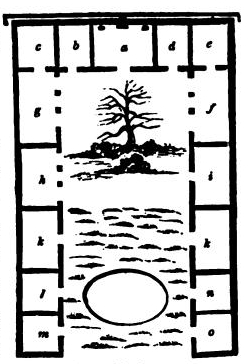
Fig. 14. Poultry-yard.
a, Feeding-house, fitted up with boilers for cooking the food, from which pipes extend on each side for heating the laying and roosting-places.
b, Sitting-place for turkeys.
c, Roosting-place for turkeys.
d, Sitting-place for hens.
e, Roosting-place for hens.
f, Feeding-shed, laid with stone.
g, Open shed, laid with sand.
h, Open shed with roosts, for pea-fowls.
i, Pheasantry, or place for choice land fowls.
k k, Places for choice aquatic fowls.
l and m, Sleeping and laying places for ducks.
n and o, Sleeping and laying places for geese.
A pigeon-house may be erected at the lower part of the yard beyond the pond, or one of the compartments marked k may be fitted up for pigeons.
Besides the hen-house, there should be an open shed on each side of the poultry-yard, extending as far as the part laid with gravel. The ground under one of these sheds should be laid with the large flag-stones called landing-stones, in order to have as few joints as possible; and under the other shed the earth should be dug out to the depth of a foot or more, and filled up with dry sand, to enable the fowls to take what may be called a sand bath, which is the principal means they have of getting rid of the body vermin with which they are generally infested, and which are very troublesome to them. The shed which has sand at the bottom may have bars under the roof, to serve as an occasional roosting-place for pea-fowl and guinea-fowl; but the one which has the flag-stones should have no bars across it, as the stone floor is intended to serve as a place for feeding the fowls on, and it should be kept as clean as possible. It is a good plan to lay a few handfuls of unthreshed straw on this stone floor, in order that the fowls may amuse themselves with scratching out the grains; and they should always have a small heap of mortar, rubbish, or lime in one corner for them to peck, as unless fowls can have access to lime, or to some kind of calcareous earth, they will produce eggs without shells.
It is necessary to observe that land fowls are, generally speaking, much more tender in constitution than aquatic ones. The common hens, in particular, will never lay well unless they are kept warm; and, as a proof of this, it is well known by every housekeeper that eggs are much scarcer and dearer in winter than in summer. As the different kinds of fowls require different treatment, it is necessary to keep them separate, and it is also necessary to keep those hens that are sitting separate from the rest. On this account the hen-house should be divided into five compartments, the centre one of which (a) may be much larger than the others, and furnished with a fireplace and boiler, for boiling potatoes and other food, from which should run hot-water pipes or flues, so contrived as to heat the whole of the compartments.
On one side of the central room may be a place for hen turkeys (b), as it is necessary always to keep them by themselves when they are inclined to sit; as, if the male turkeys see the eggs, they generally contrive to break them. Beyond this should be the roosting-house for the turkeys (c), provided with strong beams across, at a sufficient distance from each other, to suit large and heavy birds.
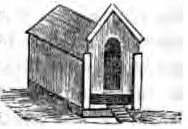
Fig. 15. Sitting-box.
On the other side of the central room should be the compartment devoted to laying and sitting hens (d) and this should be fitted up with boxes (fig. 15.) which are made moveable, and placed not quite close to each other, as it disturbs sitting hens to hear other hens close to them. The front part of each box should be made to slide up and down, so that it may be taken out, and the box thoroughly cleansed with a brush and soap and water, when not in use. This sliding front, when closed, has an arched opening in front for the hens to go in and out; and this opening is made so as not to reach quite to the ground, in order not only to keep the nest warm and in its proper place, but to prevent any danger of the eggs being sucked by rats, or other similar depredators. The hen-room should be frequently whitewashed, say twice a year, care being taken to do it with as little disturbance to the fowls as practicable; and the floor, which should be either of stone, or laid with bricks, should be swept out every day, and washed occasionally when the weather is warm and dry. It is a very good plan to have the boxes raised with two pieces of wood below each, so as to leave a hollow space in the middle below the box, as this plan allows the house to be cleaned with greater facility.
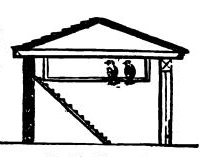
Fig. 16. Hen-roost.
The other room (e in fig. 14.) should be supplied with rails and perches to serve as roosting-places (fig. 16.), and these rails are best of rough wood, as they afford a more secure resting-place for the fowls than if they were round and smooth. Fowls are very apt to crowd together in their roosting-places; and, when the rails are smooth so that the claws of the fowls cannot take a firm hold of them, the youngest and weakest of the fowls are very often pushed off. The roosting-places should be furnished with a sloping board with sticks nailed across, to enable the fowls to ascend to them. All the rooms of the hen-house should have windows filled in with wire lattice; and they should have shutters to close in cold weather. In some cases they have ceilings like those of a house, and in others they are left open to the beams of the roof. The principal thing to attend to is to keep them scrupulously clean, and the walls frequently whitewashed. The roosting-place should have the dung removed every morning, and in warm weather it should be washed out every day; even in winter, unless the weather is frosty, the floor should be washed once a week. Sometimes, instead of fixed rails for the fowls to rest upon, hanging bars are suspended from the roof; and sometimes the nests for laying in and for sitting are fixed, and in two rows one above the other. Where danger is apprehended from thieves, the door of the roosting-house is kept locked, it being provided with an opening for the fowls to pass through.
Poultry should never be fed where they roost, if it can possibly be avoided, and their food should generally be given to them in the open shed act apart for that purpose. In wet weather, however, they may be fed in the feeding-house (a in fig. 14.), which has that name because it is the place where those fowls which are to be fattened are kept under coops (fig. 17.). For my own part I am no friend to fattening fowls artificially, as I think they are never half so good to eat as when they are indulged with moderate exercise, and kept in good condition by feeding them with barley, oats, or other grain, two or three times a day. When the poultry-yard adjoins a farm-yard, so that the fowls can be let out occasionally to pick up the grains that are scattered by the thresher, they become so plump and so well fitted for the table, that it is considered the highest praise that can be bestowed on poultry, to say that it eats as well as a barn-door fowl. When it is not practicable to admit poultry to the farm-yard, the fowls that are to be fattened should be kept in the feeding-house, and plenty of unthreshed straw should be given to them to peck at, so as to let them have constantly quite as much as they can eat, and yet be obliged to take exercise to get it; or, if more rapid feeding be required, they may be put under coops and fed with various kinds of food, either raw or cooked.
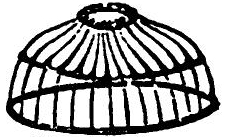
Fig. 17. Coop.
A fowl, when supplied with abundance of food, eats rapidly till it has filled its crop, in which the food is merely stored as grass or hay is in the paunch of a cow, and from which it passes through the second stomach into the gizzard, which digests it, by grinding it into a mass, partly by its own muscular action, and partly by the help of numerous little bits of gravel and small stones which the fowl swallows. This is necessarily a slow process, when the food consists of hard dry barley; but of course it is performed much quicker when the food is softened by boiling, and equally, of course, the time in which the fowl gets fat is shortened by the facility with which it can digest its food. This is the reason why cooked grain is now preferred for feeding poultry, and boiled rice, barley, oats, and wheat are given in preference to the old mixture of barley meal and milk and water. Boiled or steamed potatoes are also recommended, and they should always be given warm. All the fowls may be fed with advantage on this prepared food, as it makes the hens lay better and the chickens grow faster, care being taken that the earthen pans or wooden troughs in which it is contained are always kept perfectly clean, and that they are daily scoured with boiling water to prevent them from acquiring a sour taste. The boiled food is always given in the feeding-house, but after eating it the fowls are turned into the yard to cater for themselves if they feel inclined, and many persons advise a piece of bullock's liver or something of the kind to be thrown in the yard, as far from the hen-house as possible, to breed maggots, as they are particularly nourishing to young chickens, who will devour them greedily. You will observe that I have not given any directions for cramming fowls, as I am quite sure you would not suffer any creatures under your control to be subjected to such treatment.
Poultry are particularly liable to be attacked by body vermin, and, while they are annoyed by these torments, they will never feed properly. It is, therefore, of the greatest importance that the places in which they are kept should be perfectly clean, and that they should have abundance of sand, in which they can wallow whenever they feel inclined.
Domestic fowls are very pugnacious, and if there are too many cocks they will be fighting incessantly. The usual proportion is one cock to seven hens; and those hens should be kept for laying which are dark-coloured, as they are not only better layers, but are said to produce richer eggs. When a hen is about to begin laying she makes a cackling noise for several days, when a nest of hay should be prepared for her, and a nest egg put into it, to induce her to lay there. Some hens lay every day, and others only once in two days, or once in three days. The eggs should be removed as soon as laid, as the hen is apt to spoil or break them, by sitting in the nest to lay others. Eggs may be kept for several months sufficiently fresh either for setting or for the table, by dipping them either in oil, or in a mixture of beef suet and mutton fat melted together and used warm. Hens are considered in their prime at three years old, but they will produce eggs for several years; and some hens will continue laying all the year, except during the season for moulting, which happens with young fowls in spring, and with older ones generally in autumn. At this season all birds are ill, particularly at the time when the new feathers have just forced out the old ones, and have their quills full of blood to furnish nutriment for their growth.
When a hen is set, care should be taken that she has only as many eggs as she can cover easily. The usual number is from nine to thirteen; and, when they have been put into the nest, the hen should be placed gently upon them, and covered with a cloth till she seems quiet. When a hen is sitting, she should be plentifully supplied with water near at hand, as she is generally thirsty, but it is reckoned best not to put her food too close to her, as a little exercise does her good. A hen sits twenty-one days, but some of the chickens are generally hatched a day sooner or later. Each is taken from the hen as soon as it has left the egg, and is put in a basket on some wool or flannel, and set by the fire; but no food is given till all the brood is hatched, and returned to the hen. The chickens are then fed with eggs boiled hard and chopped small, and boiled rice and grits; and, when they are a little bigger, they may be given barley meal mixed with milk and water, or, what is better, boiled barley and rice, with a few boiled potatoes crumbled small. They will soon, however, be strong enough to feed with the hen in shallow vessels; as otherwise they are apt to get into the water to drink, and wetting their feet and feathers brings on many diseases. As soon as the chickens are hatched, a little bit of wood, with a strip nailed across it, to serve as a step, should be put from the opening of the box where the nest is to the ground, to enable the chickens to get in and out of the nest as easily as possible; and when they are permitted to go out of doors, which is generally in three or four days, the hen should be put under a coop, to prevent her from wandering, till the chickens are strong enough to accompany her, which will probably be in about ten or fifteen days.
There are many opinions as to what kinds of fowls are the best; but it is very difficult to decide this question, as almost all the kinds have advantages and disadvantages peculiar to themselves; though those are usually preferred which have rather short and slender legs, and round, compact, fleshy bodies. White or very light-coloured fowls are considered best for the table; but they are said to be tender in constitution and not good layers. The common barn-door fowl is the original stock from which most of the varieties are derived. The Game fowl are perhaps the best for the table; but the eggs are small, and the chickens are difficult to rear, unless they can be supplied with maggots or some other kind of animal food. The Dorking fowls are preferred for the table by the caterers for the London market, on account of their large size. They have generally two hind toes instead of one. The Jago, or Cochin-China, fowls are so very large that it is said they can pick crumbs from a table as they stand on the ground, and they often weigh from eight to ten pounds. They have double combs and tufts of feathers on the head: the feathers on the body are mottled, but those of the tail are a dark glossy green. The eggs are very large and good. The Crested, or Polish, fowl is black, with a white tuft on the head. The hens are excellent layers, and the chickens are good for the table; but the hens are not good sitters, and are apt to lay away. The Spanish fowls are also black, and very large and handsome. The Malay fowls are very large, and the colour of the feathers is black, streaked with brown and yellow. They are excellent layers; and their eggs, which are very large, have so much yolk, that two of their eggs will go as far as three of those of ordinary fowls. The flesh is exceedingly juicy and fine-flavoured; but the legs of the fowls are rather too large and strong to look well on the table. I speak confidently of these fowls being good, both for the table and as layers, because our very kind friend Charles Waterton, Esq., keeps no others at Walton Hall.
Bantam fowls are very small, with short legs, which are generally feathered down to the toes. They are much admired as ornamental fowls, but are of little use, either for the table or as layers, from their very small size.
There are several kinds of what may be called fancy fowls; but I shall only mention one of them, and this is the Frizzled fowl, or, as it is sometimes called, the Friesland fowl, though the name appears to have no meaning, and to have been only adopted from its resemblance to frizzled. This fowl is a native of Japan, and it certainly has a very singular appearance, from its feathers being curled up and apparently all turned the wrong way. It is, however, not worth keeping, except as an object of curiosity; as the fowls are small and bad layers, and the chickens are difficult to rear, being extremely sensitive to cold and wet.
Turkeys are very wild in their habits, and apt to stray, and their young are considered difficult to rear. Turkey-hens begin to lay in March, laying either every day or every other day; and, during their laying season, many persons will not let them out of their roosting-place in a morning till they have laid, on account of their propensity to lay away. One turkey-cock is sufficient for several hens; and if there are two they generally fight till the strongest has killed the weakest.
When a turkey-hen is about to sit, her nest is made by twisting a pad of straw like those worn by basket-women on their heads, and soft hay is laid in the middle; this is done on account of the projecting breast-bone of the turkey, which makes it difficult for her to cover her eggs, unless she has some support. Hen turkeys begin to sit in April; the number of eggs is generally eleven or thirteen, and they sit from twenty-five to thirty days. It was formerly customary, as the young were hatched, to take them away from the hen, and, opening the beak with the fingers, to force one or two peppercorns down the poor little creatures' throats; but now this mode of proceeding is thought unnecessary, and the young are left with their mother till they are all hatched. They may be then fed with crumbled curds mixed with chives or nettles chopped small. Eggs boiled hard and cut into little bits; and mutton or beef without salt, boiled so much as to tear easily into shreds, are also given. The old bird should then be put with her young ones under a coop in the hatching-house, and water should be placed within her reach and that of her young. In a few days the young ones, with their mother still under the coop, may be taken into the open air; but they should not be allowed to remain there longer than two or three hours at a time till they are about ten days old; and the mother should be kept in her coop under the open shed till they are about six weeks old, so that till they have attained that age they may always have a warm dry place to fly to. Great numbers of turkey chickens die young for want of these precautions being attended to.
When turkey chickens are about two months old, they are called turkey poults, and about this time the fleshy membranes on the head and neck begin to appear. This is called shooting the red; and a great many young turkeys die at this time, unless they are well fed and kept warm. Those turkey poults which survive this period are generally reared, and when about six months old some of them may be fattened for the table. At twelve months old they lose the name of poults, and are considered full-grown turkeys.
Guinea fowls can very seldom be persuaded to enter a hen-house; they like to roost in the open air, and to lay in a bush or some similar situation; and, where they are kept, a few bushes should be planted in the poultry-yard for their accommodation. The hen seldom sits on more than seven eggs; and when her young are hatched they should be treated like young turkeys, and the hen should be put under a coop in the turkey-house. When the young fowls get old enough to be taken into the open air, the hen should be kept under a coop in the open shed till the young are about two months old, as she is a most restless creature, and would soon kill the young ones with fatigue, if her activity were not checked.
Peacocks should never be kept in a poultry-yard, as they have a propensity for killing all the young fowls they can reach, by giving them a violent blow with the beak on the crown of the head. They will even kill their own young in a similar way, if they see them before the tuft of feathers on the head has grown. Pea-hens are very fond of laying in bushes or hedges, like guinea fowl, and when they are kept in pleasure-grounds with peacocks they should be narrowly watched. If they are observed to steal secretly into a bush or hedge, the place should be marked and examined when the pea-hen has left it; and, if a nest is found, all the eggs should be carefully removed but one. In doing this the eggs should be handled as little as possible, as pea-hens are very particular, and will not sit upon their eggs if they have been touched by persons with moist hands. When I lived in the country, I never could rear pea-fowls till the idea struck me of making the little country girl whom I used to employ to hunt for the eggs wear gloves, and after that time I never found any difficulty in getting the pea-hens to sit.
When the pea-hen has laid from five to seven eggs she generally shows a disposition to sit, or rather she begins to sit on the nest she has made for herself. When this is the case she should be left on her nest till night, and when it is dark a cloth should be put over her, and she should be conveyed, nest and all, if practicable, to either the turkey's hatching-house or the feeding-house, where she should be placed on a nest prepared for her, containing all her own eggs, and then covered with a coop, and a cloth thrown over that. When she has settled comfortably the cloth may be removed; but she should be kept under the coop the whole time she is sitting. When the young ones are hatched they are treated in the same manner as young turkeys, and, when their head-feathers begin to grow, they suffer nearly as much as the turkey poults do when shooting the red.
The houses for the aquatic fowls should be at the bottom of the poultry-yard, near the pool, and they should consist of separate divisions for the sleeping and laying places of both geese and ducks. A feeding-house is often added, and this is especially necessary when either ducks or geese are to be put up to feed. Though aquatic fowls, and particularly ducks, are proverbially fond of dirt, the house in which they are kept should be as clean as possible; and it should not only be frequently washed out, but thoroughly ventilated by the door being left open all day. The smell of goose dung is very offensive; and if the house in which the geese sleep be not kept very clean, it will materially deteriorate the pleasure you will have in visiting your poultry-yard.
Many people object to geese in a poultry-yard on account of the pugnacious habits of the gander; but when a gander is brought up with other fowls he becomes familiar with them, and is not likely to do them any injury. One gander is sufficient for several geese; and four or five geese will bring up a brood of forty or fifty goslings. Geese generally lay every other day; or, if they lay two days together, they miss the third day. They generally begin to lay in March, and lay from eight to twelve eggs before they show any signs of wishing to sit. Sometimes, if they are well fed, and the eggs taken away, they will continue laying as many as twenty or even more.