BOOK I. THE HOUSE. (continued 3)
Reading edition
The double Gloucester cheese is always made with one meal's milk warm from the cow, and the dairy-maids generally put a lemon, stuck with cloves, into the brine in which they steep their rennet. The cheese-making then proceeds in the same manner as for the single Gloucester, except that, when about half the curd has been put into the vat, an ounce of salt is sprinkled over it before the rest of the curd is put in. The remainder of the operation is the same as for the single Gloucester; the principal difference being in the thickness of the cheese, which, of course, is occasioned by the greater depth of the vat in which the curd is put.
In many parts of Gloucestershire, what is called Sage cheese is made. For this a couple of handfuls of sage leaves and a handful of parsley are generally put into a portion of the evening's milk, and suffered to remain all night. In the morning the milk is warmed, and, after being strained from the leaves, it is turned to curd with the rennet in the usual way. In the mean time a portion of the morning's milk, into which no colouring matter is put, is turned to curd by rennet; and the curds of both kinds are kept separate through the processes of draining and scalding, till they are ready to be put into the vat, when they are mixed according to the fancy of the dairy-maid. Sometimes the green curd is pressed into a tin or wooden mould, so as to form a dolphin or some other fanciful figure; in which case it is taken carefully out of the mould, and put into the vat without breaking it, and the white curd is crumbled between the fingers and pressed carefully and firmly round it. In other cases the sage and parsley leaves are only bruised, and the juice which is pressed from them is mingled with a portion of the morning's milk; or one portion of the milk is coloured red with the juice of boiled beet-root, another green with the juice from spinach leaves flavoured with sage, and another yellow with the bruised petals of the marigold. Portions of milk are coloured with these different substances and coagulated separately, the curd being varied when putting into the vat, according to the fancy of the dairy-maid. In other cases the whole of the milk is coloured and flavoured with sage.
Cheshire cheeses are generally very large, most of those made in spring being one hundredweight each. The rennet for a Cheshire cheese is not considered fit for use till it is three years old. It is soaked in warm water the night before it is wanted, and in the morning the liquor is considered ready without any further preparation. The evening's milk is set up for cream in the usual way, and in the morning the cream is taken off and put into a brass bowl made hot by rinsing it with boiling water. A third part of the skimmed milk is then put into another brass bowl, warmed in the same manner; and the two are put into the cheese-tub, and mixed with the morning's milk warm from the cow. The whole is coloured with the juice of scraped carrots, or of the bruised flowers of the marigold. The liquor from the rennet is then added, and, being well stirred in, the tub is closely covered and kept in a warm temperature till the coagulation is complete, which is generally in little more than half an hour.
As soon as the curd is well set, it is divided and turned over with a bowl to separate it from the whey; after which it is broken into small pieces by the hand, and suffered to settle down, while the whey, which swims at the top, is poured off. The curd is pressed on one side of the tub with a loose board, and the whey that runs from it is again poured off. The curd is then drawn into the centre of the tub, and formed into a heap, and the board is laid on the top and heavy weights placed on it, generally amounting to a hundred pounds. This presses the curd into a solid mass, and squeezes out an additional quantity of whey.
The mass of curd is then cut into slices, and boards and weights put upon each slice. This is repeated several times, till not a drop more whey will run from the curd; after which it is removed to a dry tub, and crumbled with the fingers as small as possible. It is then well salted, and put into a cheese-vat made warm by being scalded with boiling water, and heaped up as high as it will go, the additional curd being kept in its place by a movable tin hoop. A flat board is then laid across the top to press down the curd, which generally rises to a point in the centre of the vat, and the heavy weights are again put on it. At the same time wooden skewers are run into the cheese, in order that every particle of whey may be drawn out of it.
After standing some time, the cheese is taken out of the vat, and laid on a large cheese-cloth, and the curd again broken from the top down the centre, and more salt mixed with it; after which it is pressed into the vat by the hand as before, and weights are again put upon it, while skewers are run through holes purposely left in the vat, into the sides of the cheese, as before. Another vat having been scalded by being rinsed with boiling water, the cheese is wrapped in a cloth and put into it; the ends of the cloth being folded over the cheese as tightly as possible, and tucked inside the vat, where they are kept down by a tin hoop called a binder, which is forced in between the cheese and the upper part of the vat. The cheese is then put into the press under a pressure of about a ton weight, and a number of thin iron skewers are passed through the holes in the vat into the sides of the cheese. After four hours it is turned, and the skewers removed to fresh places, when the cheese is put into the press for another four hours; after which, the process is repeated. It is then put into the press, and left there all night; the following morning it is again turned, and put into the press without the skewers. It remains in the press for four or five days, being regularly turned every morning and evening; and it is taken from the press into the cheese-room, where it is salted on the outside, and tightly bound with a linen cloth. It is kept in this state and turned twice a day for a week; after which it is put on the shelves to dry for a fortnight or three weeks, during which period it must be turned and wiped every day. Lastly, it is then laid on straw, and kept rather warm, lest the rind should crack; and, when the rind begins to feel hard, its surface is rubbed over with butter, and the cheese is ready for the market. It is rather singular that, notwithstanding the pains taken to drain every drop of whey from the Cheshire cheese, its whey yields no butter, and is seldom made any use of except for feeding pigs.
Cheddar cheese is made like Cheshire, except that when the cheese is broken down to be resalted, before it is put in the cheese-press, the curd is crumbled, and four or five pounds of fresh butter are mixed with it. The cheese is then put in a cloth into the vat, and placed under the great press, where it remains only about a quarter of an hour, before it is turned and put into a clean cloth: this process is repeated three or four times; after which the cheese is wrapped in a very fine cloth, and has three or four other cloths wrapped round it. It is then put into the press, and remains there for forty-eight hours; after which it is taken from the press, washed in whey, and then laid on a shelf upon a clean cloth to dry. It is afterwards laid on a shelf without any cloth, and turned every day till it begins to ripen.
The Wiltshire cheeses are of four kinds: the thin, the thick, the loaf cheese, and the pine-apple, or net, cheese. The first two kinds are made nearly the same as the Gloucester cheeses; for which, indeed, they are frequently sold in the London markets. The principal difference in the manufacture consists in the curd, before it is scalded, being cut into dice of about an inch square each, and a thick layer of salt being thrown over them, which is said to harden the surface of the curd, and to prevent its buttery particles being washed away by the hot water. The curd is also put into the vat while it is as hot as the dairy-maid can handle it; and salt is strewed in between every layer. In all other respects, the manufacture of the cheese is exactly the same as in Gloucestershire till it is ready to be carried to the cheese-room, where it is either laid upon elder leaves or the shelves are washed over with their juice, in order to prevent the devastations of mites. The loaf cheeses are made the same as the others; but their vats are from ten inches to a foot in diameter, and six inches deep; and, when the curd is put into the vat, it is in four layers, with alternate thin layers of salt. These are what are generally sold in London as Wiltshire cheeses. The curd for the pine-apple cheese is prepared in the same way as the others; but, instead of being put into a vat and then into the cheese-press, it is put into a net with no other pressure than from the hand of the dairy-maid; who, however, prides herself on getting as much into the net as it can possibly hold. The net is then hung up in the cheese-room, and requires no further care.
I shall now give you only one more receipt for making keeping-cheeses, and that shall be for the far-famed Parmesan. This celebrated cheese is made with skim-milk. The night's milking is skimmed in the morning, and the morning's milk is skimmed about two o'clock in the afternoon: the two are then mixed together and put into a large copper kettle, suspended over a fire by a crane. The milk is stirred till it has reached 125° of Fahrenheit. The kettle is now turned from the fire, between which and it a wooden screen is placed; and, when the bubbling of the milk has subsided, a piece of rennet, tied in a linen rag, is put into the milk, and squeezed several times in different places. The rennet is then taken out, and the milk well stirred; after which it is left till the curd has formed, which is generally in about three quarters of an hour. As soon as this is the case the kettle is again turned on the fire, and the mass of curd is heated to 150°, being well stirred and divided while it is heating. A fourth part of the whey is now taken out of the kettle, and the curd is heated to 180°, stirring it rapidly all the time; and a few pinches of powdered saffron are thrown in, which not only colour it, but give that peculiar flavour always perceptible in Parmesan cheese. The cheese-maker (for as Parmesan cheese is always made by a man, I must not say the dairy-maid) then takes a small quantity of the curd in his hand, and squeezes it; when, if he finds it adhere together, the kettle is instantly turned off the fire, the wooden screen is again interposed, and the curd is left to settle. The whey which rises is immediately poured off, and two or three pailfuls of cold water are thrown over the curd. The cheese-maker immediately plunges his arms into the kettle, and, gathering the curd to one side, contrives to slip the whole mass into a large cloth, which is raised as rapidly as possible, and transferred to a mould without a bottom. This is an operation which requires both strength and skill; for the cheese hardens so rapidly, that it requires the greatest exertions to get it into the mould without spoiling its shape. By its own power of contraction it presses out every drop of whey. An iron plate, with a slight weight on it, is laid on the top to keep it flat; but, by the time it is cold, it is become so hard as to require no further pressure. It is then taken out of the mould, and a thick layer of salt put on its upper surface. The next day the cheese is turned, and the under surface salted in the same manner. In this way the cheese is turned and salted every day for thirty or forty days, till the salt will no longer dissolve. The rind of the cheese is then scraped, and, after a little colouring matter has been rubbed over it, it is covered with linseed oil.
I will now say a few words on Cream cheeses, and then, I think, you will have had quite enough of this subject.
A York cream cheese is made by taking a quart of new milk warm from the cow, into which is sometimes put half a pint of cream, and adding to it two spoonfuls of the water in which a piece of rennet has been steeped all night. The milk is then set before the fire till the curd is formed, when it should be taken up without breaking, if possible, and put into a frame made of oak wood, seven inches long within, four inches wide, and three inches and a half deep. This frame being open at the top and bottom, it must be placed upon rushes to permit the whey to run out; to encourage which, a board must be put within the frame to support a weight to press down the curd, between which and the curd some rushes must be put. After standing two days, the rushes must be renewed, when the cheese should be taken from the vat and turned as often as necessary. This will make an excellent cream cheese without the cream; and, indeed, the York cheeses sold in the shops are always made of milk only, without any cream. The rushes should be sewed together with thread.
A kind of cream cheese is, however, made in Yorkshire of cream only, without any rennet. "Take any quantity of cream and put it into a wet cloth. Tie it up, and hang it in a cool place for seven or eight days. Then take it from the cloth and put it into a mould (in another cloth) with a weight upon it, for two or three days longer. Turn it twice a day, when it will be fit for use."
The following is a receipt for making a Bath cream cheese. Add half a pint of cream to a quart of new milk, and warm the mixture till it is about 80° of Fahrenheit; then stir in as much rennet as will coagulate it. As soon as the curd has formed, put a cloth over the bottom of a large shallow vat, and, taking the curd up with a skimming-dish, place it in the vat and wrap the cloth over it. As the curd shrinks, the vat must be filled up with fresh curd, till the cheese is of a proper thickness. When the cheese has become a little firm, it is turned out of the vat and laid in a dry cloth. A board is then put over it, on which is placed a weight of two pounds. At night it is put into another clean cloth, and the next morning it is slightly salted with a little fine dry salt, and placed on a bed of fresh nettles or strawberry leaves, being covered with leaves of the same kind. These leaves are changed every morning, and the cheese is turned twice a day for a fortnight, after which it is fit for use.
I think I have now told you almost all I know relative to those points of domestic economy in which a country life differs from a life in town. I have, however, omitted to mention an Ice-house, which you will find an important addition to your comfort in summer. A common ice-house is a kind of well, built in Roman cement, and sunk in the ground. It is arched over, and the ice is put in through a hole in the top. A door is on one side for taking the ice out, and there is a drain at the bottom for carrying away the water that runs off as the ice melts.
A more modern invention is a small cellar built adjoining the house, with double walls, the space between the walls being filled with charcoal. The cellar has double doors with a space between, so that one may be shut before the other is opened, to prevent the entrance of the atmospheric air. The ice is kept in a sunk part made like a bath, at the farther end of the cellar, furnished with a drain to carry off the superfluous water; and in the other part of the cellar are shelves, on which wine or food can be placed to be kept cool. The old-fashioned ice-house was always made in the park at some distance from the house, and consequently was of very little use; but the modern ice-cellar is very useful for keeping cool, water, butter, and other articles of daily consumption; which can be fetched out of it when they are wanted, as easily and expeditiously as they could be out of a common dairy or pantry.
When ice is supplied from a distance, it will soon melt, if exposed to the atmospheric air during summer. To prevent this it may be kept in an ice chest, that is, a large deep coffer lined with cork, and with a double lid; or in a box called a refrigerator, which may even be brought into the dining-room. The refrigerator consists of a double frame of wood, with the space between filled in with charcoal. The bottles of wine are placed in little tin cases left for them, and ice is put between the cases. Below the ice is a tin grating, through which the melted water runs, and is let off when requisite by a cock. The box is made to hold two bottles of wine on one side, and a bottle of water and a glass for butter on the other.
The American refrigerator is another contrivance of the same nature, which will keep the ice unmelted for a fortnight even during the hottest weather in summer. This box, like the other, is double, the inner part being of lead, and the space between the two being filled with sawdust. There are two lids so as completely to exclude the air when both are closed.
The usual mode of cooling wine and other liquids by ice, is to surround the bottle, or other vessel in which the liquor is contained, entirely with ice, observing that the hottest part of the wine is always at the top of the bottle, but that if the top is chilled faster than the bottom, the cold wine descends, and that which is still warm rises and takes its place. As, therefore, the wine is liable to be set in motion by the process of cooling, it is best to decant it before it is put into the refrigerator, as otherwise there will be danger of disturbing the sediment of white wine and the crust of port. When ice is perfectly clean and clear, like that of the Wenham Lake, it is sometimes broken into small pieces, and put into the liquid which is to be cooled; but this could not be done with the ice collected from the dirty ponds near London.
When it is wished to cool wine rapidly, it is only necessary to put it into a thin glass bottle, and to wet the outside with ether; as cold is produced by rapid evaporation sooner than in any other manner, wine-coolers are formed on this principle.
A freezing mixture for cooling wine, and for freezing ice-creams, may be formed by mixing five parts of sal ammoniac with five parts of nitre and sixteen of water. A mixture of snow or pounded ice and salt produces a most intense cold, but it is only while the salt is melting the ice or snow that the cold is felt. Muriate of lime, mixed with snow, produces a still greater degree of cold. Several other mixtures may be used for freezing; but those producing the most intense cold are mixtures of nearly equal parts of sulphate of soda with nitrous or sulphuric acid, the sulphate predominating. Eight parts of sulphate of soda, mixed with five parts of muriatic acid, will produce a cold equal to zero. When any liquid is to be frozen by these mixtures, the bottle containing the liquid is put into a wooden vessel containing the mixture; and if the cold is to be very intense, the outer vessel may be placed on a flat piece of cork in a much larger empty vessel, the whole being covered with a woollen cloth. Water freezes soonest when it has been boiled, and forms the most compact and beautiful ice.
The principal utensils required for making ice-creams are a tub large enough to contain about a bushel of ice, which must be pounded small, and mixed with salt, nitre, or soda, and a freezing-pot made of pewter, like those sent out with ice-creams. Copper spoons or spaddles are also required for stirring the ingredients of which the ice-creams are composed, while the process of freezing is going on. When all is ready, the ingredients for the ice-creams are poured into the freezing-pot, which is put up to its cover into the tub full of ice and salt, and kept turning round continually by its handle till the freezing is completed. The turning the pot is the most difficult part of the operation, and it requires great attention, as, unless the ingredients are kept in constant motion, the sugar, which is the heaviest, will sink to the bottom, and the other articles will be unequally frozen, so as to form unsightly lumps. The cover must be taken off occasionally, to see how the process is going on, and the cream that has adhered to the sides of the freezing-pot should be scraped off, and mixed with the rest by the spaddle, in order to prevent waste. The whole of the ingredients should also be mixed together with the spaddle if they appear to be settling irregularly.
Ice-creams and water-ices should be perfectly smooth, and soft enough to break easily with a spoon. The ice-creams are made by mashing the fruit with which they are to be flavoured, and adding to a pint of the juice, after it has been strained, a pint of thick cream, the juice of half a lemon, and sugar to the taste. The lemon-juice should be put in last. Sometimes whipped cream is used, the cream being first mixed with sugar, and laid on a fine sieve, turned the bottom upwards in a bowl, as it is whipped, so that the cream which drains from it may not be wasted. Water-ices are generally only the juice of the fruit strained and sweetened, as, if water is added, the ice is apt to freeze too hard. Lemon-ice is composed of the juice of four lemons, and the rind of one, to a pint of clarified sugar-syrup, the whole being strained before putting it into the freezing-pot.
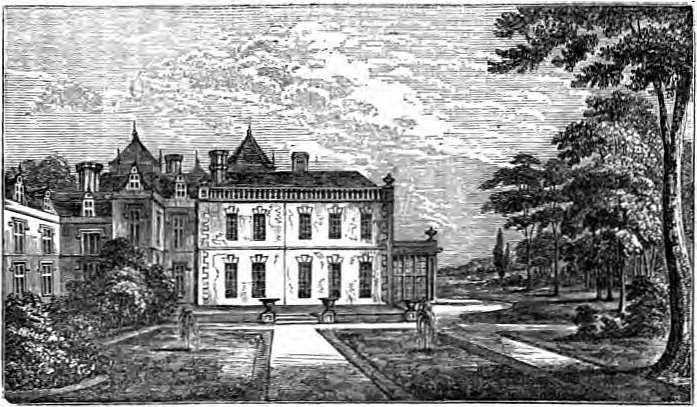
Garden Front of the Manor-House in its improved state.