BOOK II. THE GARDEN.
Reading edition
LETTER VII.
PLANTING A REGULAR GEOMETRICAL FLOWER-GARDEN.—LIST OF PLANTS.—MODE OF LAYING OUT REGULAR FIGURES ON THE GROUND.—RULES FOR ARRANGING COLOURS.—PLANTING SIDE BEDS.—PLANTS WITH FRAGRANT FLOWERS.—CULTURE OF BULBS.—RESERVE GROUND.—CULTURE OF ANNUALS, PERENNIALS, AND BIENNIALS.—HOTBEDS AND FRAMES FOR RAISING AND KEEPING HALF-HARDY FLOWERS.
It gives me great pain, my dear Annie, to find that you still think that you shall never like the country so well as town. I do not, however, despair; for I am convinced that you do not at present know whether you shall like it or not. The pleasures of the town and the country are, indeed, so different, that it requires some time to become accustomed to the change; but, when you are sufficiently well acquainted with country pursuits to take an interest in them, I am sure you will never feel any want of the pleasures of the town. The great secret of being happy is, to be able to occupy ourselves with the objects around us, so as to feel an interest in watching their changes; and, when you can once do this in your present situation, you will no longer complain of dulness or want of excitement. To be convinced of the truth of what I say, you need only remember the pleasure your friend Mrs. P. C. takes in the cultivation of her garden; the interest with which she watches the opening of her flowers, the coming up of the seeds she has sown, and the growth of the trees she has planted. It is not the positive beauty of these things that occasions the pleasure she experiences in them, but the interest they have created in her mind; for the entomologist will find pleasure in the most hideous caterpillars, and the geologist will pass whole days delightfully among barren rocks. All that is wanted to give an interest in any subject is, a sufficient degree of knowledge respecting it to be aware of its changes, and our own natural love of variety will do the rest.
It is a great advantage in a country life, that its principal objects of interest must be found at home; and hence, as home is woman's peculiar dominion, the noblest and the best feelings of the female heart are more likely to be called into action in the country than in the town. In youth, especially, the ameliorating effects of country pursuits will soon be perceptible, both morally and physically; and your health, which has always been delicate in a town, will, I have no doubt, in the country become positively robust. As the first step towards the attainment of this desirable object, let me recommend to you to have a flower-garden laid out as near the house as possible. I should like to have those cedars, and the remainder of those gloomy firs, cleared away, which I see close to your house in your sketches, and your flower-garden so placed that you could step into it at once from the windows of your usual sitting-room. I hope that this may soon be the case, and, as I must have a locale to make my descriptions understood, I will proceed to give you some hints as to the laying out and planting of such a garden as I should like you to have in the warm and sheltered corner under the southern window of your morning room.
In the first place, it will be absolutely necessary that the remainder of the trees should be not only cut down, but grubbed up; as it will be quite impossible for any flowers to grow under the shade of tall thick trees, and leaving the roots would prevent the possibility of digging the ground. In other respects the situation is admirably adapted for the purpose, as it is open to the south and south-east, and protected from the north and north-west. Supposing the Scotch pines and cedars to have been cut down, their roots to have been grubbed up, and the ground to have been dug over and levelled, the next thing is to determine upon the plan for the garden. I think it should certainly be a regular geometric figure, and planted in masses, each bed containing flowers of one kind, so as to produce something of the effect of a Turkey carpet when looked down upon from the windows of the house. I enclose you a design which I think will suit the situation, and I will adapt what I have to say to it, though my observations may easily be made suitable to another plan, if another should be found more desirable.
We will suppose the plan (fig. 7.) to consist of twelve flower-beds on grass, with a gravel walk round, which may be bordered on the side next your room by beds for flowers, with little gravel openings opposite each of your windows; or be plain gravel, as you like. There may be a conservatory into which the drawingroom windows facing the south may open, and on the other side a shrubbery to unite the garden with the lawn. In the centre of the flower-garden there may be a fountain; and, as the flower-garden is to be seen principally from your windows, the beds nearest you should be planted with dwarf flowers, so that those in the back beds may be seen. I should also advise the shrubbery behind to consist of laurustinus and arbutus, so as to furnish a handsome green back-ground to the flowers in summer, and yet to afford a few flowers themselves in winter and spring, when flowers are scarce in the beds.
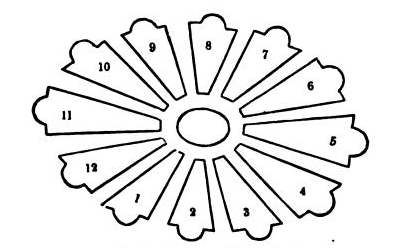
Fig. 7. Plan for a Flower-Garden.
I will now tell you how I would plant the beds. As this is the beginning of May, and as I wish your garden to look well immediately, I would advise you to get a few pots of Californian and other annuals, usually raised in pots, from the nurseryman at the neighbouring town, and to plant them, putting three potfuls in each bed, but no more. In No. 1. put Phlóx Drummóndi, the flowers of which are crimson of various shades, and let the stems be pegged down, so as to spread over the bed. No. 2. may be Lasthènia califórnica, the flowers of which are yellow, and the stems generally procumbent; but they may be pegged down to keep them in their proper places, that is, to spread completely and regularly over the bed. No. 3. should be Nemóphila insígnis, the flowers of which are of a beautiful blue, and which will not require pegging down. No. 4. may be Erýsimum Perofskiànum, the flowers of which are of a bright orange, but the stems must be pegged down, or they will grow tall and straggling. No. 5. may be Nolàna atriplicifòlia, the flowers of which are blue, and resemble those of a convolvulus; this is a procumbent plant, and will not require pegging. No. 6. may be Nemóphila atomària, which has white flowers, and is a dwarf plant. No. 7. may be Leptosìphon densiflòrus, a dwarf plant, with pale purple flowers. No. 8. may be Gília bícolor, a dwarf plant, with nearly white flowers. No. 9. may be Clintònia pulchélla, a beautiful little plant with blue flowers. No. 10. may be Gília trícolor, a dwarf plant, the flowers of which are white and very dark purple. No. 11. may be Leptosìphon androsàceus, a dwarf plant, with pale lilac flowers: and No. 12. Schizopétalon Wálkeri, the flowers of which are white, and the stems must be pegged down. These are all annuals, which if properly treated by pegging down, and not planted too close, will produce a mass of flowers in each bed only just above the surface, and will have a very pretty effect from the windows. Most of them like a poor clayey soil best, and they will only require turning out of the pots without breaking the ball, into the places prepared for them.
If you think there are too many white beds, you can substitute Sanvitàlia procúmbens, the flowers of which are yellow, for No. 8., but the seeds must have been sown the previous autumn to bring it forward, as otherwise it will not flower till late in the summer; and Bartònia aúrea, the flowers of which are of a golden yellow, may be planted instead of No. 12. Cladánthus arábicus, formerly called Ànthemis arábica, which has yellow flowers, may be planted in No. 8., if Sanvitàlia cannot be obtained.
I do not think you have ever told me what soil yours is, and perhaps you hardly know. You will, however, easily recognise gravel or chalk; if the soil be red, it is probably, if loose, a sand, and if close, a marl; a peaty soil is black and loose; and a clay may be known by water standing in little pools after rain, without running off. This is one of the worst soils for gardening purposes; but it may be improved by mixing it with sand.
I shall now give you a list of half-hardy plants for autumn, as most of the annuals will begin to look shabby in July or the beginning of August. No. 1. Verbèna Melíndres, bright scarlet; No. 2. Œnothèra Drummóndi, yellow; No. 3. Lobèlia bícolor, blue; No. 4. Calceolària rugòsa, pegged down; No. 5. Verbèna Tweediàna, crimson; No. 6. common White Petunia; No. 7. Verbèna Arraniàna, or Henderson's purple; No. 8. Calceolària integrifòlia, yellow; No. 9. Purple Petunia; No. 10. Verbèna teucrioìdes, white; No. 11. Frogmore Pelargonium, bright scarlet; No. 12. Musk plant, yellow.
In October the following bulbs and other plants may be put in for flowering in early spring. No. 1. Von Thol Tulips; No. 2. Cloth of Gold, or common Yellow Crocuses; No. 3. Blue Hepatica; No. 4. Yellow Crocuses, or White Anemone; No. 5. Scílla vérna and sibírica, blue; No. 6. Àrabis álbida, white; No. 7. Double Pink Hepatica; No. 8. Winter Aconite; No. 9. Purple Crocuses; No. 10. Snowdrops; No. 11. Primroses; No. 12. White Hepatica, or Àrabis alpìna.
If you do not like the plan for a garden which I have sent you, you can draw one according to your own fancy, of any figure you like; but, as I believe you have not yet a regular gardener, it will be necessary to teach you how to transfer the plan you have decided upon from the paper to the ground. In the first place, the ground must be dug over, raked, and made perfectly smooth. The pattern, if a complicated one, must then be drawn on Berlin paper, which is covered with regular squares, and the ground to be laid out must be covered with similar squares, but larger; the usual proportion being that a square inch on the paper represents a square foot on the ground. The squares on the ground are usually formed by sticking in wooden pegs at regular distances, and fastening strings, from peg to peg, till the whole ground is covered with a kind of latticework of string. Each string is then chalked, and made to thrill by pulling it up sharply and letting it go again, which transfers the chalk from the string to the ground. When the ground is thus covered with white squares, it is easy to trace upon it, with a sharp-pointed stick, any pattern which may have been drawn on the paper; the portion in each square on the ground being copied on a larger scale from that of the corresponding square on the paper.

Fig. 8. Plan for a Flower-Garden.
Simple patterns (fig. 8.), consisting of straight lines, need only to be measured, and pieces of string stretched from pegs put in at the proper distances, so as to form straight lines, oblongs, squares, triangles, or diamonds. If a circle is to be traced, it is done by getting a piece of string half the length of the diameter of the circle, with a piece of stick tied to each end. One stick is then driven into the ground in the centre of the circle, and a line is traced with a stick at the other extremity of the string which is drawn out quite tight. An oval is made by tracing two circles, the circumscribing line of one of which just touches the centre of the other; short lines are afterwards made at the top and bottom, and the central lines are obliterated. A square only requires a peg at each corner, with a chalked string drawn from peg to peg; and an oblong, or parallelogram, is made by joining two common squares, and taking off the corners if required.
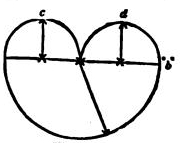
Fig. 9.
A heart-shaped pattern (fig. 9.) is made by drawing a straight line from a to b, and then fixing a peg with a string tied to it, half the length of the straight line, and another peg at the end, exactly in the middle of the line, and drawing a half-circle with it; then taking a peg with a string half the length of the other, and another peg tied to the end, and tracing with it the smaller half-circles, c and d. With the same strings and pegs you may easily trace, or rather have traced, figs. 10 and 11. Even the latter, which appears at first sight a very difficult figure to form on the ground, will be just as easily traced as the others. You will observe, that in all these figures the straight line is only to serve as a guide to show the proper places for fixing the pegs; and that it is only to be formed by a piece of string stretched by pegs from one end of the figure to the other, which is to be removed as soon as the figure is sketched, and which is not to be traced on the ground at all.
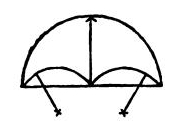
Fig. 10.
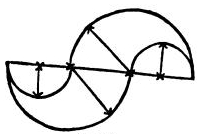
Fig. 11.
With the aid of these figures, and the pegs and strings, several very complicated gardens may be formed; for instance, that shown in fig. 12. This garden is composed of a bed in the centre for a tree rose with a circle of dwarf roses; a gravel walk surrounds these; and there are five heart-shaped beds, which may be planted with Scarlet Pelargoniums, yellow Calceolarias, Petunias white and purple, and tall yellow Mimulus; and the crescent-shaped beds, which are on grass, may all be planted with different kinds of Verbenas. This plan is also a good design for a rosery, the roses to be planted in the beds, and in the half crescents which must be on grass, with gravel walks between the grass plots.
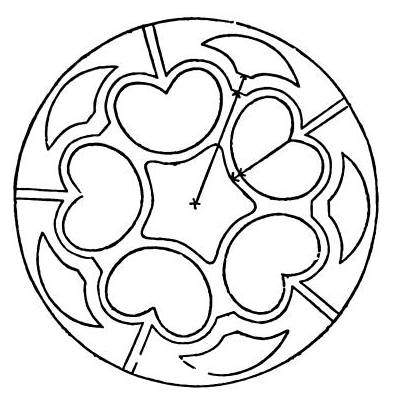
Fig. 12. Plan for a Flower-Garden.
All the beds intended for bulbs and half-hardy plants should be particularly well drained; and the best way of doing this is, to dig out the soil to the depth of two feet or more, and then to put in a layer of brick-bats and other rubbish, to the depth of nine inches or a foot. On this should be placed a layer of rich marly soil, in which the bulbs should be planted. Dahlias, hollyhocks, and other tall-growing, showy-flowered plants, may have similar beds prepared for them, but the soil should be made very rich by the addition of the remains of an old hotbed, or some other kind of half-rotten animal manure.
You will observe, that when I give directions for planting the beds in any of the plans I send you, I merely say what may be done, and not what is absolutely necessary. Indeed, it will be better for you to vary the flowers as much as possible, according to your own taste, provided you take care that the plants are, as nearly as you can contrive it, of the same height, or that they rise gradually, and that you contrast the colours well. The rule in the latter case is, always to put one of the primitive colours (red, blue, or yellow) next another of these colours, or some colour compounded of the other two; using white wherever you cannot find any handsome plants of a colour that will suit the bed you want them for. Thus, for example, if you plant one bed with red, you may plant the next with blue, yellow, green, hair-brown, or white, but never with any shade of purple, as red enters into the composition of that colour; nor with any shade of reddish brown: purple, indeed, must always be next yellow, hair-brown, or white, but never next blue, red-brown, or red. Orange will not look well near yellow or red; and lilac must not approach blue or pink. A little practice will do more than any lengthened details; generally speaking, you may take the same taste to guide you in arranging the colours of the flowers in your parterre, that you use in choosing the colours of your dresses; and if you are in any doubt, you have only to colour the beds in the plan, and see how they look; or to stick coloured wafers on a piece of paper for the same purpose.
When you have settled what to plant in the beds of your garden, supposing you to choose the plan fig. 7., you must next think of the beds round it. I should advise these to remain unplanted, unless they are sown with mignonette, or something of that kind. The shrubberies, I have already stated, should, I think, consist chiefly of the finer kinds of hardy evergreens; at least that should which is opposite the windows of your sitting-room. The other shrubbery, which is intended to unite the garden scenery with that of the park, may be planted with rhododendrons, acacias, and kalmias; the rhododendrons being farthest from the walk, and carried a little out into the park, so as to make a broken line, projecting in some places and receding in others, and here and there mixed with bushes of phillyrea, alaternus, holly of various kinds, and cratægus, so as gradually to mingle with the clumps of trees in the park. On the side next your room, if there are to be beds under the windows, there should be spaces left in them which should be gravelled so that you may throw the window open, and not only walk out on gravel, but walk round the garden on gravel also. This you will find a great convenience if the weather should be wet, though you must not mind going upon the grass, if you are to be a real gardener, and to attend to the flowers in the regular beds. With regard to the beds near the house, I would have a Lonícera flexuòsa trained over each window, on account of its delightful fragrance in summer; for a similar reason I would have Chimonánthus fràgrans against the walls between the windows, and mignonette and violets in the beds.
I think nothing can be more delightful than to throw open your window, and to inhale a refreshing odour from growing flowers when they are swept over by a balmy breeze, particularly after a slight shower; and, for this purpose, I would strongly recommend you to plant flowers near your windows which have a refreshing, but not a heavy, scent. The flowers of the evergreen magnolia, and those of the orange, have an oppressive fragrance, as have those of the heliotrope and the tuberose; but those of the mignonette, the lemon-scented verbena, the rose, the violet, and Lonícera flexuòsa are refreshing, at the same time that they yield a delicious perfume.
I must now give you some hints on cultivating your flowers. To begin with the bulbs, as they flower first in spring. The crocuses and snowdrops should be planted, five or six together, as close as possible, so as to form little tufts; and these, when once planted, should never be removed, unless they should grow out of bounds, so as to spoil the shape of the bed. The tulips, on the contrary, should be taken up as soon as their leaves begin to decay, and kept in a dry place till the proper time for planting them next year.
You must observe that there are three kinds of plants which are said to have bulbous roots: those which are solid, and which should be properly called corms, such as the crocus, the corn-flag, and many of the half-hardy plants with similar half-tubular flowers; the tunicated bulbs, which consist of a number of distinct layers, called tunics, that may be peeled off, such as the onion, the hyacinth, and the tulip; and the scaly bulbs such as the lily. Now the real roots of all these plants are the long fibres sent down by the lower part of the bulb, which may be seen plainly in hyacinths grown in glasses, and in any of the kinds if taken up while in a growing state; and what is called the bulb is, in all the corms, only a contracted stem; but, in the tunicated and scaly bulbs, the bulbous part is formed of a contracted stem and metamorphosed leaves. If you will take the trouble to examine a hyacinth, you will find at the base of the bulb a flat fleshy substance, called the root-plate, and this is, in fact, the contracted stem of the plant; while the tunics are metamorphosed leaves. In the scaly bulbs the stem is plainly perceptible in the centre, and the scales are evidently metamorphosed leaves. You will easily remember these distinctions, and you will find it useful to attend to them in cultivating your garden, as all plants having corms never flower well till they have been allowed to form a mass, which they will not do till they have been in the ground three or four years.
Many persons fancy that the Cape bulbs require to be taken up every year, but this is altogether a mistake: all the kinds of gladiolus, ixia, tritonia, and other similar plants, will live in the open ground, and flower well, if suffered to grow in masses, which would be killed by a single English winter if planted separately. The finest bed of the scarlet gladiolus I ever saw was at Blair-Adam, near Stirling, where it was suffered to remain year after year without alteration; and the Honourable and Reverend William Herbert, now Dean of Manchester, in his celebrated work on the Amaryllidàceæ, states that he has had beds of gladiolus, ixia, tritonia, and other Cape bulbs, at Spofforth in Yorkshire, which have remained for several years, without protection, in the open ground. Some persons say that, by manuring the beds every year, tulips and hyacinths may also be grown in the same beds without taking up, for several years in succession; but this I have never seen tried.
You must observe that you have no chance of keeping your flower-garden in a proper state, unless you have in some retired place what is called a reserve-garden, in which the plants may be brought forward till they are in a proper state for transplanting into the proper flower-garden. This reserve-garden is generally placed near the stable, both to have it out of sight, and for the convenience of manure; as it must contain hotbeds and frames, for rearing tender annuals, striking cuttings, and, in short, for performing all those gardening operations which require to be carried on behind the scenes.
In this reserve-garden you must bring forward your Californian annuals; and for this purpose choose a piece of hard ground, a walk will do, or any place that has been much trodden on, and cover it about an inch thick with light rich soil. In this the seeds of the annuals should be sown the first week in September, and suffered to remain till the bulbs have faded, and the annuals are wanted to cover the beds, which will probably be about April. The annuals must then be taken up with the spade, in patches, and being removed to the flower-garden, they must be laid carefully on the beds, so as to cover them exactly; the spaces between the patches being filled with soil, and pressed gently down, so that the surface of the beds may be as even as possible. These annuals will come into blossom in May, but they are killed by the dry heat of summer; and, though they would sow themselves if permitted to seed, it is better to remove them as soon as they have done flowering. It is always a bad plan to permit annuals to sow themselves; as early in autumn, when the plants have done flowering, the ground not only becomes rough, but it is covered with dead stalks and leaves, which have always a most miserable and desolate appearance; and these cannot be removed till the seed has fallen, while the beds must not be forked over and raked for fear of destroying the seedlings. It is therefore much better, as soon as the annuals have done flowering, to take them up, and throw them away; a supply of seed being preserved by having left some plants in the reserve-ground for that purpose. A second or spring sowing of the Californian annuals may be made in the reserve-ground, to be ready for use in case any should be wanted to flower in the autumn.
Though I have only advised you to have Californian annuals in your beds, I may here say a few words on the culture of annuals generally. You are, of course, aware that what are called annuals are plants that live only one year, or, rather, only a few months; for they are generally sown early in spring, and die as soon as they have ripened their seeds, at the latter end of summer, or the beginning of autumn. These plants are of three kinds; viz., hardy, half-hardy, and tender.
The hardy annuals are sown in March, April, or May; but the first month is to be preferred, if the weather is tolerably open. The ground in which they are to be sown is first forked over and raked, and a little round firm place having been made by pressing the bottom of the saucer of a flower-pot on the ground, a few seeds are scattered over it, taking great care that the seeds do not lie one upon another. The seeds are then firmed, as the gardeners call it, by pressing the saucer again upon them, and some earth is strewed lightly over to finish the operation. You will observe, that, though I have recommended you to take the saucer of a flower-pot to firm the ground, both before and after sowing your seeds, regular gardeners perform this part of the operation with their spades, and farmers roll their land before they sow their seeds. The principle, however, is the same in all; and it is that every seed requires to be securely fixed in the ground before it begins to germinate, in order to produce a strong and healthy plant. After the seeds are sown, it is customary to put a piece of stick into the ground, with the name of the seeds written upon it, to mark the place; or, if you like it better, you can write the name on a card, or a bit of pasteboard, and stick it in a notch or cleft cut in the stick.
When the seeds have come up, which, in the spring, is generally from a fortnight to six weeks after sowing, according to their nature, the seedlings may be thinned out, and the supernumerary plants either transplanted or thrown away. If the seedlings are to be transplanted, care should be taken not to break or injure the roots, and a little hole should be made with a stick for each seedling in the place to which it is to be removed; the earth being pressed close to the root at the bottom of the hole before the rest is filled in; as, if any hollow place is left round the root, it is sure to decay instead of growing. Seedling hardy annuals are, however, very seldom worth the trouble of transplanting. Many persons turn a flower-pot over every patch of seeds, from the idea that it will make them come up sooner, and protect them from the birds. It is, however, a very bad plan, as air and light are particularly necessary to seedling plants; and when they are even partially deprived of these important agents, they become drawn up with weak slender stems, and thin discoloured leaves.
Some annuals, such as the mignonette and the larkspur, are much longer before they vegetate than others; and these are better sown in autumn. Others, such as the escholtzia, the coreopsis, and the Erýsimum Perowskiànum, will often last two or three years, especially if they happen to be late in flowering the first season. They also do best sown in autumn, but they must be protected, if the winter should be very severe, by laying a mat over the bed. You must observe, however, that the mat must only be resorted to in frosty weather, as, in case the weather should be at all damp, the plants will be much better exposed to it, however cold it may feel, than they would be under any protection whatever.
The half-hardy annuals, such as the French and African marigolds, the German and China asters, the zinnias, the purple jacobæa, the sweet sultan, the purple and yellow everlastings, and other similar plants, should be sown in pots, and plunged into a slight hotbed in February or March. As soon as they come up, and have got their second pair of leaves, the earth should be turned out of the pot, and the seedlings being carefully picked out should be transplanted into other pots, three or five in each, according to the size they are expected to attain when full grown, and the pots again plunged into the hotbed. Sometimes they are transplanted a second time, but they are generally left till the beginning of May, when they are removed to the open border, to the places where they are intended to flower. When they are planted in the border, they may either be transplanted in the ordinary way, or the ball of earth may be turned entire from the pot into a hole made to receive it. This last plan is generally considered the best, as it prevents the plants from receiving any check by their removal. Brompton ten-week, and German stocks, though quite hardy, make better plants when treated like half-hardy annuals, as they flower earlier and much more vigorously.
Tender annuals, such as balsams, cock's-combs, globe amaranths, &c., must be sown in February or March in pots of light rich earth, and plunged in a hotbed. As soon as the plants come up they should be transplanted into pots of the very smallest size, one in each pot; and these small pots should be set in the hotbed again, as near the glass as possible, and slightly shaded during sunshine. In a week or two, as soon as the roots have made their appearance on the outside of the ball of earth within the pot, which is known by turning the ball of earth with the plant in it carefully out of the pot without breaking it, the plants are shifted into pots a size larger than what they were in before, and the space filled up with light rich soil. In another week or two the plants must be shifted again into pots a little larger, always using light rich mould to fill up the pots, and taking care that the pots are well drained, by putting potsherds, that is, pieces of broken pot at the bottom. As soon as the plants are shifted, the pots must be replunged in the hotbed, and shaded for the remainder of the day. The shifting and replunging must be continued till the plants begin to show flower-buds; after which they must neither be shifted nor plunged in the hotbed any more, but gradually hardened, by the frame in which they are placed being left open all day, and, at last, only partially closed, even at night, till the plants will bear setting out entirely in the open air; unless they should be intended to flower in a greenhouse, in which case they may be removed to the greenhouse as soon as they have formed flower-buds.
As I shall treat of the management of the greenhouse plants, which are to succeed the annuals, in my next, I may as well fill up my present letter by saying a few words on the management of hardy perennials, in case you should prefer planting biennials and perennials in your beds at once, to going through the routine that I have marked out for you in the former part of this letter.
Perennials are those permanent plants which are not woody, and yet remain in the ground as long as most kinds of shrubs, producing flowers and seeds every year. Perennials are of two kinds: those that die down to the ground every autumn, and send up fresh stems from the root the following spring; and those which remain green all the year, as, for example, the pinks and carnations. Besides these kinds, there are other sorts of perennials, as, for example, those that have tuberous roots, such as the dahlia. Bulbs are also perennials; but of these I have already spoken.
Most kinds of perennials are propagated by dividing the roots; but, in the case of the dahlia, ranunculus, and anemone, care must be taken to choose only those portions of the tubers that have buds or eyes, as they are called, as otherwise the tuber, though it will send out fibrous roots, will never produce a stem; and, in dividing fibrous-rooted plants, care must be taken that the divided part is furnished with buds. Almost all kinds of perennials may also be propagated by cuttings; and those of pinks and carnations are called pipings, because, instead of being cut, they are pulled asunder at a joint, and this gives the separated parts a hollow appearance like small pipes. Tubers are frequently taken up every autumn; and those of the ranunculus and anemone are replanted in November or January, the former season being much to be preferred. The tubers of the dahlia are generally taken up in November, and replanted in May or June.
Most perennials are improved by taking them up occasionally and replanting them in another place. This used to be accounted for by supposing that plants threw out excrementitious matter, which, after a few years, poisoned the soil in which they grew; but it is now supposed that, as every plant requires peculiar earths for its nourishment, they must be removed when they have exhausted all the particular kind of earth they want which lies within their reach. It is rather difficult to explain this without entering into long details; but it will be sufficient for our present purpose merely to state the fact, that plants do require their roots to have a constant supply of fresh earth; and, to meet this want, nature has provided that the roots of trees, and of all plants that are intended to remain for several years in the soil, elongate themselves every year, so as to be continually able to obtain a fresh supply of nourishment. In gardens, however, the constant digging that is going on for the culture of annual plants is unfavourable to the elongation of the roots of the perennials, and consequently it is absolutely necessary that those plants should occasionally be taken up and replanted. The season for taking up and replanting perennial plants is either in autumn, after they have done growing, or in spring, before they begin to shoot; and, if the soil about the roots looks black and wet, or, as the gardeners express it, sour, the roots should be washed quite clean before replanting. When the roots of plants are divided, it is either done with a sharp spade or a knife, care being taken in both cases to make what is called a clean cut, and not to leave any part bruised or jagged.
Biennials are plants raised from seeds, which do not flower till the second year, but which generally die as soon as they have ripened their seeds. Biennials are usually sown in a bed of light rich earth in the open air in the reserve-ground, and then transplanted in September to the place where they are to flower the ensuing year. The finer kinds, such as the Brompton stocks and hollyhocks, should have a bed or pit prepared for them, of rich loamy soil, in which they are planted, with a small quantity of manure. Wallflowers, snapdragons, and Canterbury bells do not require any further care than transplanting to the border; and, though they are called biennials, they will frequently live and flower three or four successive years.
A hotbed may be made of any material that will ferment, so as to produce heat. Stable manure and dead leaves are, however, generally preferred to all other materials; and stable manure is unquestionably the best. A cart-load of this manure will make a hotbed sufficiently large for rearing tender annuals; but as, when it is taken out of the stable, it consists partly of the dung of the horse, and partly of what is called long litter, that is, straw moistened and discoloured, but not decayed, it must first be thrown together, so as to form a heap till the straw is decomposed. A most violent heat is produced by the fermentation of the straw while decomposing; and, as this heat would be too much for any plant exposed to it, it is absolutely necessary to let the heap remain for about a fortnight, turning it over two or three times during that period with a fork, till the straw is sufficiently decomposed to be easily torn to pieces with the dung fork. When the manure is in this state it is fit for use. The hotbed should be formed in an open situation, on a surface raised about six inches from the surrounding ground, with a gutter or shallow ditch cut round it, to allow the water to drain off. The bed is then made; and, if only intended for raising annuals and striking cuttings, it may be five feet long by four feet wide. The manure should be first regularly spread over the lower part of the bed, and then continued, in successive layers, made as smooth and level as possible, till the whole of the cart-load of manure has been used.
As soon as the bed is finished the frame should be set on it. The frame consists of a box without a bottom, and with a movable top, formed of a glazed sash or sashes. A frame for a bed of the size I have mentioned will only require one sash, or light as the gardeners call it; and it should be three feet wide and four feet long, so that the bed may be half a foot larger than the frame on every side. The back of the box may be two feet high, and the front one foot, so that the glass may slope from the back to the front. About two days after the bed is made, the fermentation will recommence, and a steam will be observable on the glass. The surface of the bed should now be covered two or three inches thick with light garden mould, and any common seeds may be sown in this. It is more general, however, to sow the seeds in pots, and then either to set them on the surface of the bed, or to plunge them into it up to the rim. No bed for raising annuals should ever be hotter than 60°, and when it exceeds this heat the glasses should be left open so as to cool it. The thermometer for ascertaining the heat should be put on the surface of the bed, with the glass shut above it; and it should be examined in this situation, as it will fall a degree or two immediately on being taken into the open air, if the weather should be very cold.
You will, of course, have your hotbed made in the reserve-ground; and, as the one I have given directions for will be a very small one, you will probably find it necessary to have one much larger for your cuttings, or to have three or four small ones. I should advise the latter course, as small hotbeds are much more easily managed by inexperienced gardeners than large ones. A hotbed of two or three lights will require two or three cart-loads of manure, and will, of course, produce a great deal of heat from the immense mass of fermenting materials it contains; and, as you would find this additional quantity of heat very difficult to regulate, you might chance, some fine morning, when you visited your plants, to see them turned black, with their leaves shrivelled up, or, as the gardeners term it, burnt, from the too great heat of the bed. There is also danger of a hotbed getting too cold instead of being too hot, and, when this is the case, the heat should be renewed by the application of dung linings, that is, a quantity of fresh stable manure, round the outside of the bed; or by having linings of dead leaves piled up round the outside of the bed. If, however, you use your hotbeds only for raising seeds, they will not want any linings; as it will be advantageous for the young seedlings to let the beds gradually become cool as the plants increase in size, so that they may acquire strength and hardiness before they are turned into the open ground.
I will now say a few words on the greenhouse plants that you will want for planting in the open ground in your flower-garden. Petunias may be all raised from seeds with the other half-hardy annuals; as seedling plants both grow and flower much more vigorously when planted out into the open ground, than plants that have been raised from layers or cuttings. Célsia or Alonsòa urticifòlia may also be raised from seeds; as may Thunbérgia alàta, and its white variety. Phlóx Drummóndi is almost always raised in this manner; as are the beautiful climbing plants, Lophospérmum scándens and its varieties, Maurándya Barclayàna, Cobœa scándens, Eccremocárpus or Calámpelis scàbra, Rhodochìton volùbile, the beautiful canary-bird flower (Tropœ'olum peregrìnum), the most splendid of the ipomœas, and several other well-known plants.
Geraniums, or pelargoniums, as they are now more properly called, being half-shrubby plants, require to be raised by cuttings. These are generally taken off the points of the shoots in autumn; and, a good many being put into one pot, they are plunged into the hotbed till they have struck root, and then gradually hardened and placed on the back shelf of a greenhouse, or in a cold frame, till the spring, when they are removed to separate pots till they are wanted for planting out. Some gardeners do not put themselves to the trouble of potting them, but keep them in the same pots in which the cuttings were struck till they are wanted for planting out; but this is a slovenly mode of culture, as, when the plants are kept so long in one pot, they become drawn up, and never have the compact bushy appearance that they have when they are properly transplanted early in spring. Verbenas may be either preserved by cuttings or layers, or raised afresh from seed. The usual way of propagating them, however, is by layers, as they strike root readily at the joints, if the joints are covered with a little earth. All the other greenhouse plants which you may want to grow for planting out may be treated in the same manner as those I have mentioned.
A cold frame is a bottomless box of the kind described for a hotbed, but formed of brick or stone instead of wood. These frames have a glass sash at the top, but contain no manure; and they are generally sunk in the soil, that the warmth of the earth around may aid in protecting the plants they contain from the frost. These frames, if they have only one light, are generally five feet in width; that is, from the back to the front; but, if they have two or three lights, the width is generally seven feet, as these are the dimensions of the frames used for hotbeds in kitchen-gardens. The greenhouse plants that are to be preserved in the cold frame are merely set in their pots close together, and, the glass sashes being then closed, mats and other coverings are laid on to keep out the frost.
Sometimes greenhouse plants which are left in the open ground are preserved from the frost by coverings of wicker-work like beehives being put over them, or tin hoops over which mats have been stretched; or, where the plants are small, a flower-pot may be turned over them, or a hand-glass used for the same purpose. It is seldom, however, worth while to take much pains to preserve greenhouse plants that have flowered in the open air. The ordinary way is to make abundance of cuttings in autumn; to strike them in a hotbed, and then, after hardening them by degrees, to preserve them in a small greenhouse, or in a cold pit, till the time for planting out next year.
LETTER VIII.
USE OF PLANT-HOUSES.—NATURE OF CLIMATES—DIFFERENT KINDS OF HOTHOUSES.—THE DRY STOVE, THE BARK STOVE, AND THE ORCHIDEOUS HOUSE.—CULTURE OF PLANTS IN THE BARK STOVE.—AQUARIUM AND WATER PLANTS.—RED SPIDER.—CULTURE OF SUCCULENT STOVE PLANTS.—CULTURE OF ORCHIDEOUS PLANTS.—THE GREENHOUSE.—THE AUSTRALIAN HOUSE, AND CULTURE OF ITS PLANTS.—THE COMMON GREENHOUSE, THE HEATH HOUSE, THE CONSERVATORY, THE ORANGERY, AND THE CAMELLIA HOUSE.—THE CULTURE OF PLANTS IN THE COMMON GREEN HOUSE.—POTTING PLANTS.—HEATHS.—CULTURE OF PLANTS IN THE CONSERVATORY.—CULTURE OF ORANGE TREES.—APHIDES.
Before I say any thing of the management of the plants in your greenhouse, I must remind you that, in order to grow plants well, it is not enough merely to preserve them from the frost, but we must imitate as well as we can their native climate: that is, the degree of heat, light, and moisture they have been accustomed to in their native country, together with the air and the soil. The latter is the easiest condition to fulfil; as, by combining different kinds of earth, we can, without much difficulty, produce a very tolerable imitation of any soil we please: but it is not so easy to give plants abundance of light and air in combination with heat; and, though we can readily give plants plenty of water, it requires some management to surround them with a moist warm atmosphere, like that they have been used to in their native woods. To meet these difficulties, buildings have been constructed, suited for the reception of plants, with various contrivances for producing heat and distributing air and moisture, and with a glass roof, front, and sides, to admit abundance of light.
These structures are what we call plant-houses; and they are not only divided into hothouses for tender plants, and greenhouses for half-hardy plants, but subdivided into various kinds to suit the various climates in which plants are found. These climates, however, are not so numerous as might at first be supposed; as it is a curious fact in the history of plants, that many of the most ornamental grow in patches in some parts of the world without being found anywhere else, as, for example, the pelargoniums or shrubby geraniums at the Cape of Good Hope. Even when the same plant is found in different parts of the world, it is generally in the same climate, though in different countries; and thus pines and firs, oaks and birches, spread like belts or zones round the globe, from Asia, through Europe, to America, almost in the same degree of latitude, making an allowance for islands being warmer than continents, and mountains colder than valleys; as you must always remember that knowing the degree of latitude from which a plant comes is not sufficient to teach its culture, unless we know also whether it grows on the mountains or in the valleys, and whether the climate of the locality is moist or dry. A plant will be soon killed by a dry atmosphere, if it requires a moist one; and it will be as much injured by being kept too hot as too cold. Furze and heath will not grow within the tropics; and the first camellias introduced into England were killed by being kept in a hothouse.
From what I have said, you will perceive that as plants will only thrive in climates suitable to them, it is not enough to have a hothouse for tropical plants, and a greenhouse for those of moderately warm countries, but that you must have three or four houses imitating different climates, if you wish to grow different kinds of plants to perfection. Philosophers who have written on the subject describe sixteen distinct kinds of climate, including our own; but, as these would be too many to imitate, gardeners are obliged to content themselves with the following kinds of plant-houses and pits.
The dry stove is generally kept at a heat of from 70° to 84° in the day, and never allowed to fall below 65° at night, even in winter. It should be placed in a situation sheltered from cold winds, but quite open to the sun; as the plants grown in it require a strong light, most of them being natives of dry sandy plains, on which there is no tree high enough to cast a shade. The plants are grown in pots, which are generally placed on a frame or stage of wooden or stone shelves, so as to have abundance of air around them; and the stove is best heated by flues. The plants suitable for a stove of this kind are some of the kinds of Cactàceæ, such as the genera Melocáctus, Epiphýllum, and Cèreus, with the tender kinds of Euphórbium, Mesembryánthemum, Stapèlia, Crássula, Sèdum, Sempervìvum, and Agàve, and some kinds of bulbs.
The bark stove has a brick pit filled with tan or dead leaves in the centre; and it is generally heated with pipes of hot water or steam, from 60° at night to 80° in the day; the pots in which the plants are grown being either plunged in the tan, or placed on the walls of the pit, or on a stone shelf near the glass in front. Sometimes the trees of hot climates are grown in the bark bed in the centre without pots; and sometimes there is no bark pit, but the space in the centre of the house is filled with boxes containing tropical trees. This last kind is frequently called the botanic stove, as it is most common in botanic gardens; and it is best adapted for growing palms, and other monocotyledonous plants with large leaves, such as bananas, which require abundance of air and light.
The damp stove, or orchideous house, is only suited for orchideous plants and exotic ferns. The heat should be from 70° at night to 90° in the day, or even more; and the house should be heated with hot flues, on which water should be thrown twice or three times a day, and hot-water pipes with open tanks; as all the plants to be grown in this kind of house require excessive heat and constant moisture. As they are also plants that love the shade, the house should have only a subdued light; and though I cannot say that I approve of the coloured glass adopted by some cultivators, as it decomposes the rays of light, and deprives the plants of a portion of the heat they would otherwise derive from the sun, yet I would certainly advise that some of those climbing plants which will grow in a moist warm climate should be trained close under the glass, to produce shade.
Forcing-houses for grapes and early stone fruits are of the nature of the bark stove; and in them the pit in the centre is frequently filled with pine-apple plants, in pots plunged up to the rim in the tan; but these houses belong to the kitchen-garden, as do pits for growing pines, cucumbers, and melons.
You will thus observe that there are only three distinct kinds of hothouses in use in British gardens, viz. the damp stove, or orchideous house, which is the hottest; the dry stove, or house for succulent plants, which is the rarest; and the bark stove, which is the most common, and which may be said to have two varieties, viz. the botanic stove and the forcing-house.
The culture of hothouse plants in the bark stove requires more care than can be expected from any one not a regular gardener; and, as most tropical plants are valuable in this country, I would not advise you to try to manage them yourself, as you would be very much vexed if you should chance to kill them. I will, however, give you a few general hints on the subject, if you should like to have a house of this kind.
All bark-stove plants require a great deal of water when they are in a growing state, and, as it is necessary that the water should be of the same temperature as the house, there should be either an open cistern in the house, or a cistern in the shed behind, near the furnace, and communicating with the house by a pipe. The best plan is to have a cistern in the house, as it can be used as an aquarium; and there are many beautiful tropical aquatics, such as the different species of Nymphæ'a and Nelúmbium, which deserve growing for their beauty, while others are interesting for their curiosity, such as the Papyrus. In summer, bark-stove plants require very little care, except to prevent them from receiving any sudden check, as, if the heat be not kept up regularly, the plants are very liable to stop growing, and, when the heat is renewed, to shoot a second time, and thus to waste their strength in sickly and imperfect growth. Great care is also required in autumn to increase the fire heat in proportion as the weather grows cold, so as to prevent the plants from receiving any check from the decrease of temperature in the atmospheric air, as tropical plants may be said to have only two seasons, viz. summer and winter; and thus they should be kept as nearly as possible at the same heat as long as they are in a growing state; and then have a complete change to a season of rest, by never letting the heat rise higher than from 60° to 65° during the dark days of winter. During the winter months very little air can be admitted, on account of the great difference between the air of the atmosphere and that within the house; but in the spring, advantage should be taken of every warm day, even in March and April, to open the sashes a few inches wide for half an hour or an hour in the middle of the day, when the sun shines; but the house should be shut up immediately if the sun should go in and the air become chilled. As the summer advances, air should be admitted freely, and continued till the beginning of September, when it should be gradually reduced till the cold of winter prevents any being given at all. Most gardeners repot, or shift, as they call it, all their bark-stove plants about the middle or end of April; but this is too indiscriminate a practice, and, therefore, only those should be repotted that appear to want such an operation.
One of the greatest difficulties attending the culture of plants in a bark stove is, guarding against the ravages of the immense number of insects that are engendered by the heat; and one of the most troublesome of these is the active little mite called by gardeners the red spider (Àcarus telùrius). This little pest breeds in the bark, and when first hatched it is so small as to be scarcely perceptible; particularly as it is of a pale green, nearly the colour of the under side of the leaf, to which it fixes itself, and there spins a web. As it gets older it becomes of a brownish red, and having eight legs, it runs with the greatest rapidity. It is also furnished with a proboscis, with which it sucks the juices of the leaves, making them wither and shrivel up; and thus the flowers and the fruit of the trees are both spoiled, as neither can attain perfection unless the sap that is to nourish them be first properly matured in the leaves. Tobacco smoke, and most of the other usual remedies against insects, have no effect on the red spider; and, though sprinkling it with very cold water will kill it, it is difficult to apply without injuring the plants. The best remedy is allowing plenty of air to pass through the house, whenever the weather is hot enough to allow the atmospheric air to be admitted with safety.
The culture of the plants contained in the dry stove requires considerable care. The Cáctus family may be arranged in three groups; first, the Tree Cacti, which are included in the genus Cèreus, and have long slender stems without a single leaf, sometimes thirty or forty feet high, and not thicker than a man's arm. These plants grow on the summits of the mountains in Brazil, and only require greenhouse heat in England. Secondly, the Mammillàriæ and Echinocácti, which grow in the valleys of the temperate parts of South America, and should be kept in a warm greenhouse in this country; and thirdly, the Melocácti, the Epiphýllum, the Opúntiæ, and the Rhípsalis, which grow in the tropics, and require a dry stove in England. These plants should be grown in pots well drained with cinders, and they should be kept almost without water from October till March, and then watered profusely till they are about flowering, when the quantity of water given to them should be gradually diminished. Some cultivators keep a few of their plants in a bark stove, and plunge the pots in the tan, and they are said to thrive on this treatment, if carefully managed; but as it requires a great deal of care to prevent them from damping off, the ordinary way is the safest for an inexperienced gardener. Mesembryanthemums, which are also kept in a dry stove, require the same treatment as the Cácti.
The orchidaceous plants grown in a damp stove are all epiphytes, which, in their natural state, grow either on the branches of trees, or on exposed rocks. The former of these are found in their wild state with their roots hanging down in the air, and growing in dense forests, where shade, moisture, and excessive heat are essential to their existence. Most of these plants, in a state of culture, are grown in the husks of cocoa-nuts, half filled with moss, from which the roots hang down, or they are tied with wire to pieces of wood hung from the rafters. The wood generally preferred for this purpose in England is the robinia, or false acacia, on account of the roughness of its bark, and the softness of its wood: and moss is generally put between the epiphyte and log so as to make it quite compact. Some genera of orchideous plants, such as Dendròbium, Epidéndrum, and Cattlèya, are always grown in pots, which are filled with turfy peat, chopped moss, and lime rubbish. Others, such as Stanhòpea and Catasètum, should be grown in baskets half filled with moss, or in a curious kind of frame, made of pieces of turf fastened between four upright pegs of wood; as the flowers of these plants come from their roots, and they must be allowed abundance of room to enable them to protrude properly. The baskets or frames for the Stanhòpea and other root-flowering plants should be from three to six inches deep, and from six to ten inches wide; and the frames should be filled with strips of turf, two or three inches wide, piled up on one another so as to fill the frame, and yet leave a sufficient space between to admit the passage of the flower stems which protrude downwards from the root. When orchideous plants are grown in pots, the pots are drained with cinders, and then filled with chopped turf mixed with lime rubbish to keep it open. The exotic ferns grown in the same house require no particular care, except that of potting them so as to insure perfect drainage, and keeping them frequently syringed overhead.
There may be said to be five kinds of greenhouse; viz., the Australian house, the common greenhouse, the heath house, the conservatory, and the orangery, to which is sometimes added, the camellia house, though these plants are generally kept in the conservatory.
The Australian house contains all the curious New Holland plants, such as Bánksia, Dryándra, Grevíllea, Melaleùca, Callistèmon, Metrosidèros, and various genera belonging to the Leguminòsæ, together with the Cape plants belonging to the Proteàceæ and Compósitæ. These plants require a considerable degree of heat, and also as much air and light as can be given to any plants which require shelter from the open air. On this account they are generally grown in curvilinear houses, that is, houses that have glass on all sides, like that in the garden of the London Horticultural Society at Turnham Green. All the plants contained in this house are extremely difficult to grow, and they require the greatest care in watering, so that they may never have too much, and yet never be suffered to become too dry. Houses of this kind are generally heated by pipes of hot water, and kept at a temperature of from 40° to 50° or 60°. There is no pit in the centre, and the plants are either planted in the ground as in a conservatory, or kept on a stage formed of wooden shelves.
The common greenhouse has a brick wall at the back, with a glass roof at an angle of about 45°, and upright glass at the front and sides. The plants are grown in pots placed on a stage or range of wooden shelves rising one above another, with a path all round, and a shelf for the plants under the glass in front. All the sashes are made to open, as it is essential that there should be a free circulation of air; and so little fire is necessary, that one fireplace will be sufficient to heat a greenhouse from thirty to forty feet long, and from twelve to fifteen feet wide. The house may be heated either by hot-water pipes or by flues; in the latter case the flue should go round at the front and return at the back, being about twenty inches high and twelve inches wide. The heat of a greenhouse of this nature need never be more than 50° in the day, and it may be allowed to sink even as low as 35° at night, the object being merely to keep out the frost.
The heath house, like the Australian house, requires to be as transparent, and as thoroughly ventilated, as possible. A heathery, however, is generally a span-roofed house with a walk down the centre, and shelves for the plants on each side. It is usually heated by hot water, the pipes for conveying which are placed in the centre of the house. The width of the house should be about ten feet, and the height in the centre of the span should never exceed nine, as it is of great importance to have the plants as near the glass as possible. The floor of the house should stand one foot above the level of the ground: and, where expense is not an object, the house is sometimes built on arches to insure perfect dryness. All the windows are made to move in every possible direction so as to admit of a current of air through the house, whenever the state of the atmosphere will permit it.
The conservatory has all the plants growing in the soil, instead of being in pots and placed on shelves. It is generally more lofty and architectural than a greenhouse, and of much greater extent; and it is frequently attached to the house, being so contrived that it can be entered from one of the living-rooms. The temperature of the conservatory is generally rather warmer than that of the common greenhouse, as it is kept at 60° during the day, and seldom allowed to fall lower than 40° at night.
The orangery is a still more architectural-looking building than the conservatory, and it has an opaque roof. It is used only for preserving orange trees and other plants that remain in a dormant state during the winter, and it requires no more heat than is absolutely essential to keep out the frost.
The camellia house is generally formed like a common greenhouse, but so contrived as to allow the whole of the sashes to be taken off during the summer. The plants are kept on stone shelves, raised one above another; and there is generally no walk at the back.
Of the culture of the plants in the Australian house I have already spoken; and of those in the greenhouse I need only detail the management during the winter months, as your greenhouse will, I suppose, be in the reserve-ground, and will be only used to preserve those plants during winter which you have kept in other more conspicuous situations during the summer.
Many persons injure greenhouse plants by keeping them too warm, and giving them too little air during winter, and then are surprised that their plants become sickly and remain without flowering, notwithstanding all the care and expense that have been bestowed upon them. No greenhouse ought to be kept at a greater heat at night than from 35° to 40°; and in the daytime it should not be allowed to rise above 50°, or at most 52°. When there happens to be sunshine, the fire ought to be lessened, and whenever the air is not frosty the windows ought to be opened from twelve till two every day. If a greenhouse is kept too warm, it will induce premature vegetation, and the plants will waste their strength in an attempt to produce flowers and fruit, at a season when nature requires them to be kept in a state of complete repose. Greenhouse plants should be watered generally every morning; but in frosty weather water need not be given every day, and some plants will not require watering oftener than once a week. This, however, must depend in a great measure on circumstances, and, as a general rule, it may be observed, that water may always be given in small quantities when the surface of the earth contained in the pot looks dry. The pots should never be allowed to stand in saucers, as stagnant water is peculiarly injurious in winter. Whenever the earth looks black and sodden, the plant should be turned out of the pot, and, after the black earth has been carefully shaken from the root, it should be repotted in fresh soil, an inch or more in the bottom of the pot being filled in with small pieces of broken crocks.
In February or March greenhouse plants should be looked over, and repotted where necessary; those that are too tall should be cut in, and cuttings made of their shoots. The young plants raised from cuttings made in autumn should be repotted in larger pots for flowering; and where the plants do not require fresh potting, but have the surface of their mould become green and mossy, the moss should be taken off, and the ground slightly stirred with a flat stick, taking care, however, not to go so deep as to injure the roots. When trouble is not an object, all greenhouse plants are the better for repotting once a year, either in spring or autumn; and when the ball is taken out of the pot for this purpose, it should be carefully examined, and all the decayed parts of the roots should be cut off. Sometimes, when the ball of earth is turned out, nearly half of it will fall off almost without touching it; and when this is the case, it will generally be found that there is a worm in the pot. Worms do a great deal of mischief to greenhouse plants in cutting through the roots, as their instinct teaches them to make their way through the earth straight across the pot and back again, and they cannot do this without tearing the roots asunder every time they pass.
Another point to be attended to in the management of a greenhouse is, keeping the plants as near as possible to the glass, as, unless this be done, the plants will become what gardeners call "drawn up," that is, they will be unnaturally tall and slender, from the efforts they make to reach the light.
As I have frequently mentioned repotting, I may as well tell you here the best mode of performing the operation. The pot to which the plant is to be removed should always have been previously washed quite clean, and be perfectly dry. Some bits of broken pots, called potsherds, should then be put at the bottom of the pot, the quantity varying from three or four pieces (so as just to cover the hole) to a mass an inch in depth, depending upon the nature of the plant. If the plant has not been in a pot before, the roots are then placed just above the potsherds, and the earth is filled in, the plant being occasionally shaken so as to allow the earth to get amongst its roots. The soil is next consolidated by shaking the pot, and then lifting it up and setting it down again with a jerk; and is rendered firm and neat round the rim by means of a broad smooth piece of stick shaped somewhat like a table-knife, and called a potting-stick. When a plant has been in a pot before, and is repotted or shifted, as it is called, into a pot a size larger, the plant is turned out of its old pot by putting the hand upon the earth and turning the pot upside down; or, if the ball of earth does not come out readily, striking the rim of the pot against the edge of the potting-table or shelf. The ball containing the plant will thus drop out into the left hand; and the potsherds that adhere to the bottom of the ball having been picked off, and any part of the root that appears decayed having been removed, a little mould is put on the drainage in the new pot; and the ball of earth, containing the plant having been placed in the centre, the space between it and the pot is filled in with light rich mould, and made firm with the potting-stick. The operation is concluded by shaking the pot, and then taking hold of the rim with both hands, and striking the bottom of the pot two or three times with a jerk against the potting-bench. The plant is then watered, and set in the shade for the remainder of the day.
Heaths are very difficult plants to manage; but a great improvement has taken place in their culture within the last few years. They are grown in what is called heath mould, that is, a mixture of peat and sand; and when this earth is put into the pot, it is mixed with good-sized entire pebbles, some of which are suffered to protrude through the surface of the soil. The roots of heaths are extremely fine and hair-like, and the shelter afforded by the pebbles is so congenial to them, that, if one of the stones be taken out, a cluster of fine, white, vigorous roots will be found below it. The plants are always potted high, so as to let the base of the stem be above the level of the rim of the pot, as the plants are very apt to damp off if the collar of the plant be buried in the ground. Heaths should never be suffered to become too dry, and never kept too wet. They require very little heat; and many experienced cultivators never apply fire-heat to their heatheries at all, but merely keep out the frost by having wooden shutters to the sashes, and covering them with mats. Heaths, when growing rapidly, should be repotted whenever the roots have filled the pot; but they should not be shifted too often; and, when they have attained their full growth, they may be suffered to remain in the same pots three or four years without injury.
As plants in the conservatory are grown in the free soil, they are in a much more natural state than any plants can be in pots, and consequently they require much less care in their culture. There is usually a walk all round the conservatory, next the glass, and one down the middle, on each side of which are the beds containing the plants, and under which are placed the hot-water pipes that warm the house. The consequence of this arrangement is, that the beds on each side the middle walk are so planted as to have their highest shrubs in the centre, shelving down to those of lower growth on each side; and hence the centre is generally planted with tall camellias, acacias, metrosideros, eucalyptus, &c.; while near the walk are placed oleanders, myrtles, fuchsias of different kinds, together with chorozemas, and many of the other most ornamental New Holland plants; and up the pillars that support the roof are trained kennedyas, bignonias, ipomœas, and passion-flowers in great variety. Cliánthus puníceus and Polýgala oppositifòlia ought to find a place in every conservatory; and a plant of Wistària sinénsis may be trained under the rafters so as to afford shade to the camellias; as, under shelter, the wistaria will flower twice in the year, and its flowers will yield a delightful, though very delicate, fragrance.
As it is of the greatest importance to the health of the plants to have the soil in a conservatory well drained, many persons form the beds by excavating pits of the proper size, about two feet and a half deep, and put at the bottom a layer of brick-bats, stones, and other materials for drainage, about six inches thick. On this is deposited a thin layer of coarse rough gravel; and on the gravel a layer of rich mould, which should be about two feet thick in the centre of the bed, where the largest shrubs are to be planted, and shelving off to about sixteen or eighteen inches at the sides next the walks. All the sashes should be made to open, and there ought to be large glass doors in front, which should generally stand open during the day in summer, in order to admit as much air as possible.
In some places a movable frame is contrived for a conservatory, into which sashes fit in winter, and which, in severe weather, is covered with tarpauling, made to pull down, like a blind, from a roller along the ridge of the roof; the whole frame being so contrived as to be entirely removed in summer. The upright posts of this frame are let into holes in the ground, like the posts in a drying-ground, so that when the posts are taken out, the holes may be stopped up with wooden plugs with rings attached; and the roof and horizontal pieces fit into each other, and into the uprights, the whole being kept firm by bolts. When a conservatory of this kind is to be removed for the summer, the side sashes and doors are taken away first, generally about the middle or end of April. A week or ten days after, the sashes of the roof are taken off, but the frame and tarpauling are left in case of spring frosts; and, when all danger from these is over, the whole of the framework is removed, and the orange trees, camellias, and other exotic trees that have been planted in the conservatory, appear to be growing in the open air.
The orangery is often contrived so as to be used as a kind of living-room during summer, as it is only intended for the reception of the orange trees, and other plants belonging to the genus Citrus, during winter. The trees are generally grown in large tubs and boxes, in a rich loamy soil, and are set out in the open air during summer, when they require but little care, provided they are frequently watered over the leaves, though they do not like much water to their roots. When young plants are raised from seed, they seldom flower till they have been budded or grafted from an old tree. Orange trees are generally put in the open air in May, and kept there till September or October; and they are very seldom shifted. They require scarcely any light or water during winter, and no heat beyond what is necessary to protect them from the frost.
Some of the varieties of Caméllia japónica are sufficiently hardy to grow in the open air in the neighbourhood of London, provided their roots and the lower part of their stems are mulched; that is, covered with straw or litter, and the main trunk wrapped round with a hay-band a few inches from the ground. The hardiest kind is the variegated red. Camellias seldom do well in pots, except when they are very small, as, when they attain a tolerable size, the flower-buds are very apt to fall off without expanding. The best mode of growing camellias is, therefore, to plant them in the free soil of a conservatory, taking care that some creeping plant is trained along the rafters over their heads, as they do not like to be exposed to too much sun, unless they have also a great deal of air, and are frequently and regularly watered. The soil for camellias should be peat mixed with a little sandy loam. The temperature of the camellia house should be from 50° to 60° during the whole of the growing season; but, when the flower-buds have formed, the glasses are generally taken off during the rest of the summer. Early in autumn, however, when the flower-buds begin to swell, the glasses should be put on and the house kept warm, the plants being regularly watered morning and evening, as, if the watering be neglected a single day, or if stagnant water be suffered to remain about the roots, the flower-buds will be sure to drop off without expanding. Camellias do not require frequent repotting. Small camellias are generally shifted only once in two years, and large ones, that is, those above five feet high, not oftener than once in three or four years. The time for shifting camellias is just when they have done flowering, before they are beginning to send out their young shoots. Great care must be taken when they are repotted not to bruise the roots, as they are very easily injured.
Both camellias and orange trees are very subject to the attacks of the black fly, a kind of aphis. The best way of destroying these insects is to syringe the plants well, laying them down on their sides when they are in pots, or, if they are planted in the free soil, syringing them with a garden engine so as to throw the water in a powerful stream upwards, in order to get at the under surface of the leaves, where the insects are generally found. Some persons recommend fumigating with tobacco smoke; but I have never found it so efficacious as syringing, and washing the under surface of the leaves with a sponge, in case the insects should be very numerous.
LETTER IX.
THE PARK AND PLEASURE-GROUNDS.—SITUATION OF OLD HOUSES.—WATER.—FOREST SCENERY.—EFFECT OF A SHRUBBERY IN HARMONISING A FLOWER-GARDEN WITH A PARK.—OPENING VISTAS.—SCENES IN A PARK.—FENCES AGAINST CATTLE.—STYLES IN GARDENING.—USE OF A TERRACE.—PATTE D'OIE.—PLANTING AN ARCHITECTURAL GARDEN.—PLANTING AN ARBORETUM.—RENOVATING TURF.
I am very glad to find that you have procured some plants, and that you begin to feel an interest in the cultivation of your flowers. I do not at all agree with you, however, in thinking, that this is merely because gardening has with you, as yet, the charm of novelty; on the contrary, I am quite sure that as you become better acquainted with the subject, you will find your interest in your garden increase; as gardening is one of those happy arts in which there is always some not quite certain change to look forward to, and to be anxious about. Landscape-gardening is, however, the highest branch of the art, and it is the more necessary that you should study it, as, from the view you have sent me of your house, it appears to me that the general aspect of your park is at present very monotonous.
An ancient mansion embosomed in tall trees, with a fine broad terrace at the back, having a piece of still water lying like a liquid mirror below it, and a large park beyond, overgrown with majestic trees whose lower branches repose upon the turf beneath them, form a scene which sounds exceedingly well in description, but is very wearying to the eye which is destined continually to rest upon it. It is also not very healthy; as chilly vapours are sure to rise from the water, while the mass of trees beyond will obstruct the free current of air.
You must not, however, suppose from these remarks that I admire a house in an open exposed situation, as I think nothing can have a more bleak and naked appearance. Besides, a house entirely unsheltered by trees is sure to be a very uncomfortable residence, from its exposure to the heat in summer, and the cold in winter. It is, therefore, most desirable to have a sufficient quantity of trees near the house to shelter it, and yet to have numerous openings through those trees to admit distant prospects, and a free current of air. If a few openings could, therefore, be made in the plantations near your dwelling, I do not think there would be any danger in leaving the water in its present position; as, from your description, the house is elevated very much above it, and as, notwithstanding its appearance of stillness, there is a current through it. The elevation at which the house is above the water will also prevent the unpleasant consequences which sometimes ensue, when water overflows its banks, and makes its way into the basement story of a house. As to your house being on the ridge of a hill, I do not think that is any objection, as the rise is not very great on either side, and it is a proof that the prospect would be good if you would only cut down a sufficient number of trees to show it. Houses quite in a valley are frequently damp, and if on the summit of a high hill they are apt to be bleak; so that the side of a hill or the ridge of a knoll is, in fact, the best situation that can be imagined. Our ancestors, indeed, rarely went wrong on this subject; and it is quite an extraordinary case to find an old house badly placed. In the old times the country gentry lived in their mansions all the year, and only visited London occasionally, so that they were more anxious to make their homes comfortable than persons of the same rank at the present day, who live in London, and only visit the seats of their ancestors as they would a watering-place.
You complain bitterly of your house not having an extensive view from it. You see nothing but trees, you say, in whichever direction you look; and you detest trees, because their foliage is monotonous, and so thick that you cannot see two hundred yards before you. This last is the real point of complaint.
Forest scenery is extremely beautiful in itself, and principally from the great variety it presents in the same objects. A fine tree, even when bare of leaves in winter, is beautiful, from the delicate tracery presented by its branches, which look like the masts and rigging of a large ship, intricate, yet without confusion. In snow, trees assume a new character; the weight sustained by the branches makes them droop, and a thousand graceful and elegant forms take the place of what was before a stern and rigid outline. In hoarfrost trees glisten with a thousand gems, reflecting the rays of light in so many different colours, that they remind one of the description of Aladdin's magic garden. In spring they present vivid ideas of youth and fertility, and all nature appears awakening into new and vigorous life; the buds swell, their coverings burst, and the young leaves display their tender and delicate green; at first only half-unfolding their beautiful forms, and reminding one of a young and timid girl half-wishing and half-fearing to make her first appearance in the busy world. Trees now begin to assume each a new and decided character of its own. The leaves of no two trees are alike: those of the beech are of clear dark green, and so thin that they are almost transparent, and yet they are deeply marked with a strongly indented feather-like set of veins. The bark of the beech is clear and smooth, as though nature had intended it for the use to which it has so often been applied by lovers—to carve on it a fair one's name. The leaves of the elm are of a thick coarse texture, rugged and distorted, wrinkled, and of a dingy green; and the bark of the tree is cut into a thousand furrows. The leaves of the ash are light and pendulous, and cut into numerous leaflets; those of the oak are deeply indented, and generally grow in tufts. The palmate, drooping leaves of the horsechestnut contrast with the long, slender, and nearly erect leaves of the white willow; and those of the black poplar, which present a smooth outline, with those of the sweet chestnut, which are remarkable for their finely indented edges. In short, the leaves of every tree have beauties peculiar to themselves, in form as well as in colour. In autumn these colours become more decided; the lime trees take a yellowish tint, and the oak a reddish brown; the liquidambar becomes of a rich purplish crimson, and the maples and American oaks show a thousand varied dyes.
Yes, my dear Annie, I repeat, the fault is not in the trees, for they are beautiful; you dislike them only because they are so crowded that you cannot see their beauties. I allow it is a very difficult task to know how to proceed in a case like yours. Cutting down indiscriminately will never do; the trees must be thinned, not only with a view to make openings through the wood, but with care as to themselves. I think the first point will be, to find out the handsomest trees among those in the plantations near the house, in order to see which you would have left. Some will have been drawn up so much, and will have been forced into such awkward forms by their present crowded state, that they would be hideous if the trees that now surround them were removed. Others want room, but have grown so that they may easily be trained into a better form when space is given to them. One great point to be attended to is, to break the present formal outline; but, in doing so, it is scarcely possible to avoid destroying some trees that your husband might wish to spare, from local associations. I hope, however, he will allow a sufficient space to be cleared, not only to make your flower-garden, but to allow the plants in it to grow without being overshadowed by trees.
When the flower-garden is formed it will be necessary to have a shrubbery, so that the transition may not be too abrupt from the high state of culture in a flower-garden, to the wild nature of the forest trees. This shrubbery, indeed, will afford the only means of harmonising a newly laid out garden with the general scenery of the park, as it will contain, first, dwarf flowering shrubs next the garden; then shrubs of a larger growth, such as the laurustinus and arbutus; and, lastly, flowering trees, from the different kinds of Cratæ'gus to those of loftier growth, such as Pyrus spectábilis, Sophòra japónica, and the tulip tree, which last equals in height some of the loftiest forest trees in the park.
When a sufficient space for the flower-garden and the adjoining shrubbery has been cleared, and the most interesting trees marked, the next point is to ascertain what distant prospects will be admitted by cutting an opening through the wood, before it is finally decided in what direction the intended openings shall be made; as, for instance, if the view of a church or castle would be admitted by cutting an opening in a particular direction, that direction should be chosen in preference to any other, and a vista made in that line, even though an opening in another line would be preferable on other accounts. Should such an object be discovered, you must take care not to obscure it when planting your shrubbery; and should the object you wish to catch a view of be very distant, and not distinctly marked, the eye may be guided to it by planting some whitish-leaved low tree, such as Elæágnus angustifòlia, in the shrubbery, backed by dark-leaved shrubs, such as alaternus and phillyrea; and again, at a greater distance, planting an abele tree or white poplar in the same direction, where it will be backed by dark masses of Scotch pines or other similar trees. Before you make an opening, you must also ascertain whether any disagreeable objects will be exposed by your so doing; and, before cutting down even a single tree, you must consider what effect its removal will produce upon the trees around it. You have often told me of the exquisite taste your husband possesses, and his fondness for fine paintings: he must, therefore, be admirably qualified for improving the scenery round his house himself. Landscape-gardening is, in fact, but landscape-painting on the largest scale, and with the noblest materials; the same taste is required in both.
As the plantations near the house have been suffered to become so completely overgrown, I have no doubt those in the park are in a similar state, and that the park itself will require considerable improvement. The same general observations with regard to thinning out plantations will apply in every case; but in the park I think you will find it advisable, whenever an opportunity occurs, to take advantage of any natural feature to introduce what landscape-gardeners call a scene; as, for instance, should your park contain a rocky glen, advantage may be taken of it by planting it with different kinds of pines and firs, to form an imitation of alpine scenery, as was done, in a very striking manner, by the late Mr. Beckford at Fonthill. Another part of the grounds might be planted in imitation of American scenery, with magnolias, American oaks, and maples, and tulip trees, as was done by the late Duke of Marlborough at White Knights. A pond, in a secluded part of the grounds might have a degree of interest given to it by planting its banks with alders and willows. A variety of similar scenes will no doubt suggest themselves to you, which do not occur to me, from my ignorance of the peculiar features of the place.
I suppose neither deer nor cattle are allowed to graze in your park, as you speak of several of the trees sweeping the grass with their foliage. Cows are particularly destructive to the beauty of park scenery, as they are very fond of tearing off the lower branches of the trees, and thus producing the hard line which looks as though the branches had been shaved off about five feet from the ground, and which is called by landscape-gardeners and painters the browsing line.
It is disagreeable to have even deer come close to the windows, and they are not only fond of the young shoots of trees, but they would be decidedly injurious to your flower-garden and the clumps of ornamental shrubs in the pleasure-ground. Should your husband have any deer, it will be necessary to have some fence or line of demarcation between the park and the pleasure-ground; and it is always considered a proof of skill in the landscape-gardener to conceal such a fence as skilfully as possible. When an iron fence is used it is generally extremely slight, and painted green, so as to be almost invisible; and when this fence is used, it is sometimes concealed by a plantation of trees thrown together indiscriminately, as in fig. 13., or planted artistically in groups. In other cases a sunk wall, forming a kind of ditch, is used, which is concealed by plantations; or iron hurdles are stuck in, and the line is varied occasionally. Any of these plans may be adopted in the front of your house, to protect your garden if necessary.
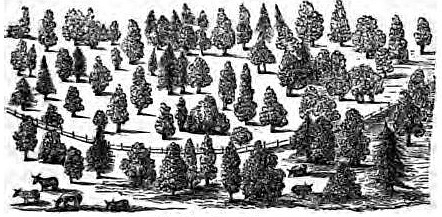
Fig. 13. Park Fence.
As I have already alluded to the improvement that will be effected by introducing a shrubbery to harmonise the intended flower-garden with the trees in the park, you will probably wish to know if any thing of the kind will be required on the back-front of the house; but in that case there will be less difficulty, as the terrace affords an admirable medium for uniting the architectural stiffness of a mansion with the beautiful wildness and grace of nature. There is always a degree of incongruity in passing abruptly from the stiff symmetrical forms of a building, to the unsymmetric, though graceful, forms of a tree left in a state of nature; and it was no doubt a feeling of this kind which induced our ancestors to surround their houses with formal architectural gardens and trees clipped into stiff and regular forms. In more modern times something of the same kind was done, by always adding to the house verandas, porticos, and terraces, which formed a connecting link between the building and its grounds. After a time these also were laid aside; and about the beginning of the last century, when Brown and his followers would admit nothing but what they called nature in garden scenery, the park was allowed to come close up to the windows of the house, and, as a writer in the Gardener's Magazine observes, the inhabitants of the mansion might "leap from their windows into jungles, and steppes, and wildernesses, where the lion and the panther would be more at home than the lady in her silken sheen."