BOOK I. THE HOUSE.
Reading edition
LETTER II.
FIRST IMPRESSIONS OF THE COUNTRY—MAKING FIRES.
You complain, my dear Annie, that when I wrote to congratulate you on your marriage, I did not send you any of the advice I promised. The neglect was intentional. I was unwilling to disturb the happiness of the honeymoon by any allusion to the troubles of life; but now that you are actually arrived at the mansion which is to be your future dwelling, I will not delay any longer beginning the fulfilment of my task. I am sorry to hear that you felt chilled and depressed at the first appearance of the Manor-House; though I am not surprised that you found the room you were ushered into dark and cold, since you tell me that the windows are shaded by some lofty Scotch pines, which are certainly the most gloomy of all the vegetable race, and which must necessarily impede both the light and the warmth of the sun. You add that you are ten miles from a market-town, and at least seven from any visitable neighbours; that the kitchen-garden is a mile from the house, and under the care of a cross old gardener, who cannot be displaced; that there is no separate flower-garden; and, in short, that if it were not for your affection for your husband, you would be miserable.
Your letter would make me very uneasy on your account if I had not had a good deal of experience of the world; but I am comforted when I reflect that in early youth the vehemence of our feelings always makes us exaggerate both our pains and our pleasures. Have you ever looked at a landscape through a window of coloured glass, and remarked the cold and miserable appearance presented through the purple pane, contrasted with the rich glow thrown upon every object by the orange glass? Both give a false idea of the reality; but the impressions thus received are not more erroneous than those we often experience of what passes around us, when viewed through the medium of our feelings. I thus consider your letter as produced by a view taken through the purple glass; and I am far from believing that you will dislike the country when you know it better; and still less do I give credence to your vehement assertion that you never can be happy in your present residence.
Happiness, I suspect, in most cases, depends more upon ourselves than we are generally willing to allow; and I am quite sure that young married people who are attached to each other, and have a competency, may be happy if they will, particularly in the country, where their principal amusements must all centre in home. You will, perhaps, be surprised to find that I think this a cause of happiness, but you will find in time that I am right; and that our chances of being happy decrease in proportion as we depend upon others for our enjoyments. I cannot conceive a more miserable life than that of a beauty who has no pleasure but in being admired; and who, consequently, must pass her time in fits of alternate depression and excitement. It would give me the greatest pain to see you plunge into this species of mental intoxication, and I rejoice that you are placed in a situation where you will not be exposed to the temptations arising from bad example. In this respect your present abode seems to be everything I could wish; as, from the description you have given me of the difficulties attending visiting your neighbours they seem to be enough to cure the most ardent lover of dissipation; and, unless the neighbours be more than commonly agreeable, I think you will not feel inclined—
——"Frequent visits to make Through ten miles of mud for formality's sake, With the coachman in drink, and the moon in a fog, And no thought in your head but a ditch or a bog."
Do not suppose from this that I think you should be unsociable; on the contrary, I think it a duty to mix occasionally with the world, as, unless we do so, we should soon learn to set a false value upon ourselves and upon every thing around us. The society of persons in our own rank in life is, therefore, essential to teach us our true level; and I have no doubt you will find some agreeable persons among your neighbours when you know them better, whose friendship you will think worth cultivating.
I will now take your objections to your residence in detail; and we will try if some remedy cannot be devised for them. I am glad your house is large. In town, we are often content to put up with the inconveniences occasioned by want of room, as we know that space is valuable, and cannot always be had; but, in the country, where we feel the free air, and see no houses before us, it seems hard to be confined. You may also find it convenient, in the winter, to have room to take exercise within doors; and I hope you have a good-sized hall or gallery to play at battledore and shuttlecock in; for that is a game not to be despised in the list of country amusements. The trees are certainly an objection. Our ancestors seem to have had strange ideas about planting trees in front of a dwelling. It is true, that the modern conveniences of blinds and verandas were then probably unknown; and, therefore, a few trees were judged agreeable to shade the windows from the glaring light and heat of the sun. At least, this appears to me the only way of accounting for the strange manner in which we often see trees placed close to the windows of an ancient manor-house, as though purposely to intercept the prospect, and to impede the entrance of two of the greatest blessings of nature, light and free air. I should hope that your husband will consent to have these trees cut down, or at least thinned out; and I am sure he will find the sacrifice amply repaid by the air of cheerfulness which will be given to his rooms. I have also no doubt that when these rooms are better ventilated, and the sun is permitted to reach them, you will find them warmer; though I confess that a country-house is generally colder than one of the same size in town. I do not mean from the size of the rooms, for large rooms, having fewer draughts, are less difficult to warm than small ones; but because houses in the country are more exposed to the wind, and the air round them is colder than in towns. In some old country-houses the rooms are small, and there are numerous long, narrow passages, which are sure to produce draughts: but to cure this evil, thick curtains may be suspended over the doors, care being taken not to prevent the doors from opening freely; or there may be double doors and double windows.
In warming a room, if an open fireplace be used, a good deal depends upon the mode of managing the fire. Servants are very apt to throw on a quantity of coals at once, in such a manner as to smother up the flame; and, when this is the case, the heated air produced by the imperfect combustion of the coals passes up the chimney with the smoke, and very little warmth enters the room. If, on the contrary, the coals are carefully arranged on the fire so as to allow a free current of air to pass through them, perfect combustion takes place, and the coals become a glowing mass, from which rays of light and heat spread in every direction; while the cheerful appearance of a bright glowing fire must be felt by every one. Where an opportunity occurs of altering a fireplace, its capability for diffusing radiant heat will be greatly increased by making the back and sides of fire-brick or fire-stone; as these substances retain heat much longer than any kind of metal, and are consequently more likely to prevent the fire from being chilled by the addition of fresh coal. Drying the coal before burning it is an excellent plan to prevent smoking, as it makes the fire exceedingly bright and fierce. It is true that the coal appears to vanish with extraordinary rapidity, but the combustion is so complete, that a much greater quantity of radiant heat is evolved from the same quantity of fuel.
In many country places it is convenient to burn wood, especially where the fireplaces are large, as wood burns best on the hearth, or with the logs supported by what are called andirons or dogs; and fires of this kind harmonise admirably with large rooms and the general appearance of the fittings up of an old country-house. A wood fire, however, requires a good deal of attention to manage it well, as, without care, it will often go out before the logs are half burnt; especially when wood is burnt in a grate, unless it is mixed with a little coal, and there is a plate at the bottom of the grate to keep in the ashes. It must also be remembered, that, though large logs are very useful to make a large fire, yet, when a quick supply of heat is required, it is best to use wood cut into short thick pieces; and that wood burns much better when dry than when green. Green wood, indeed, contains about one-third of its weight of water, which of course evaporates in the shape of vapour, and this vapour aids in carrying the heat up the chimney; dry wood, on the contrary, produces a clear bright fire, which gives out radiant heat. Opinions differ as to what kind of wood is best for fuel. Pine wood burns freely, from the quantity of turpentine it contains, but it does not give out much heat. Beech is preferred on the continent of Europe, and maple in America; but Count Rumford says that the greatest mass of radiant heat is produced by the fuel of the lime tree. Generally speaking, close-grained smooth woods make better fuel than those the grain of which is open and rough. Pine cones are admirable for lighting a fire; and you will find the gloomy Scotch pines, which have so annoyed you with their shade, may be useful in this respect, as producing an article of domestic economy.
If any of your chimneys should smoke, the usual remedy is contracting the mouth of the chimney, or raising it higher by the addition of a chimney-pot. The last is a most unsightly remedy, and I hope you will not have occasion to try it. Indeed, old houses seldom smoke, unless their chimneys are damp for want of use, or that birds have built in them; though nothing can be more common than to have smoky chimneys in modern houses. One reason, I believe, is, that newly built chimneys very often smoke because they have not been properly cored; that is, the projecting pieces of mortar, &c., which are formed inside the chimney while it is building, have not been removed, and prevent the proper ascent of the smoke. Another common fault in modern fireplaces is, that they are too shallow to allow sufficient space for the grate; and, when the grate is set too far forward into the room, it is evident that a very strong draught will be required to draw the smoke up the chimney. Neither of these faults is common in old houses; in them the chimneys are generally as smooth inside as the walls of the room, and the fireplaces are usually two feet deep, or even more, instead of being only nine inches, as I am told is the case with some modern villas. I say nothing about stoves, as I confess myself prejudiced against them, from the numerous fires they have occasioned; and I think open fireplaces not only safer and more agreeable, but much more conducive to health, as they aid in ventilating the apartments, and without a constant change of air there can be neither health nor happiness.
In speaking of the different kinds of fuel, I forgot to mention peat and charcoal, but you will find these more useful in the kitchen than in the parlour; and coke I would not advise you to employ, on account of its close unpleasant smell.
LETTER III.
HALL.—MORNING ROOM.—BOOK-CASES; PLANTS IN POTS; SQUIRRELS; CANARY BIRDS, PARROTS AND MACAWS; MONKEYS; GOLD FISH; AND CUT FLOWERS.—DRAWING-ROOM.—DINING-ROOM.
I have just received your letter, enclosing a plan of your house and a sketch of its present appearance; and, I confess, it appears to me that you have not complained of its gloominess without having abundant reason for doing so. Pray tell your husband, however, that I fully sympathise with his reluctance to cut down trees that he has been familiar with from his boyhood; and that, so far from liking to see wood felled myself, I feel positive pain when even the large limb of a noble tree falls to the ground. But I think it a weakness to give way too much to this feeling; and, if I had a favourite tree that I was convinced was injurious to the health, or even to the comfort, of human beings, I would instantly have it cut down, in the same manner as I would submit, without hesitation, to the amputation of an arm or a leg, if I had sustained an injury that I was quite sure could not be cured in any other way. You say you felt excessively pained when your husband said, that, though he did not think any circumstances could ever have induced him to order those trees to be cut down, he was quite delighted to have such an opportunity of pleasing you; and that, when you heard the workmen employed in cutting the trees down the following morning, you felt every blow they struck, and you thought he must hate you for wishing him to make such a sacrifice. These feelings are quite natural; but, in my opinion, the readiness with which your husband complied with your wishes will strengthen the bond of affection between you instead of weakening it, as there cannot possibly be a stronger proof of love than is shown in sacrificing our prejudices in favour of the beloved object; and I am sure, with your grateful and amiable disposition, you will be delighted to prove that you can make sacrifices in your turn, whenever a proper opportunity for doing so may occur.
I am sure the removal of these trees will make the house appear more cheerful; and I can now only recommend you strongly to take care that your rooms are well ventilated, by the windows being always opened in fine weather, whenever the rooms are unoccupied, for, I repeat, though you laughed at my former assertion, that a free circulation of air is essential both to health and happiness. You ask, how is it possible that fresh air can contribute towards happiness? and I, in return, ask you if you have never felt the influence of a fine clear bracing morning in making you feel gay and happy, quite independently of moral causes. On such occasions,
"The bosom's lord sits lightly on his throne,"
and we feel equal to any exertion that may be required of us. Look at the contrast between country children, as they run shouting and laughing only from the irrepressible glee of their own hearts, and the children of a close and over-populated town, who creep from school shivering and sad, with countenances as dull as the appearance of the atmosphere they are compelled to breathe. You enjoy in the country the inestimable advantage of being able to procure as much fresh air as you like, only by opening your windows; but the inhabitants of towns, when they throw open their sashes, often admit air more impure than that already in their rooms.
I will now give you my opinion as to the best method of furnishing your rooms, so as to make them look as cheerful as possible.
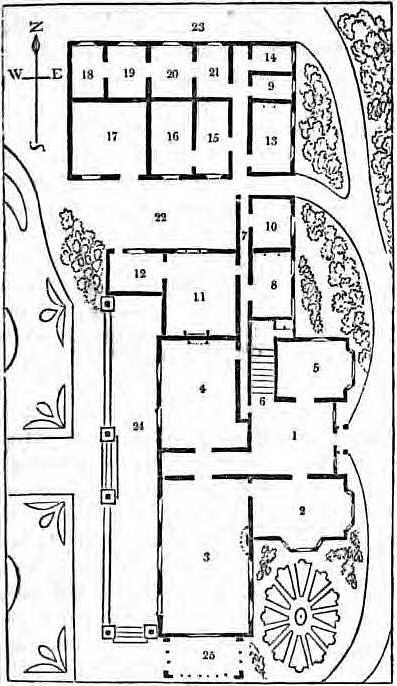
Fig. 1. Ground Plan—1, Hall. 2, Morning room and library. 3, Drawing-room. 4, Dining-room. 5, Gentlemen's business room. 6, Staircase. 7, Passages to offices. 8, Housekeeper's room and store closet. 9, Dressing-room for men-servants. 10, Butler's pantry. 11, Kitchen. 12, Scullery. 13, Servants' hall. 14, Room for female servants. 15, Dry larder, or pantry. 16. Wet larder and salting room. 17, Laundry. 18, Cheese room. 19, Butter room. 90, Churning-room. 21, Dairy. 22. Kitchen court. 23, Road to stable. 24, Terrace. 25, Conservatory.
I see by the plan (fig. 1.) that you have a good-sized hall, so that you will have room for playing at battledore and shuttlecock after all; and I repeat that it is a game not to be despised, though you do speak so contemptuously of the
"Transports that shuttlecock yields."
I think you do wrong to treat with so much scorn these trifling amusements. It is the part of true wisdom to enjoy every harmless pleasure which falls within our reach, provided we do not occupy, by so doing, those hours which ought to be devoted to more serious employments. Thus, if you do not like battledore and shuttlecock, perhaps you may billiards, and your hall would do admirably for a billiard-table. The small room on the right hand is your husband's business-room, and it is very conveniently situated, as people who want to see him on justice-business, or to show him dogs, or any thing relating to sporting, &c., can go in by the side glass door, without entering the house.
On the other side of the hall is the room you thought so gloomy the night you first arrived; and this I would advise you to fit up partly as a library, and partly as a morning sitting-room. I see that one of the windows faces the east; and this you will find is in itself sufficient to make the room pleasant for a morning room, as you will have the rising sun upon it, and that always diffuses an agreeable warmth in a room, at a period of the day when warmth is particularly agreeable. I wish the other window looked on a flower-garden, as it faces the south; and, now that the gloomy Scotch pines have been cut down, it would be just a little sheltered place, where flowers would delight to grow, particularly if your husband would consent to remove a small cedar that I see still casts a shade upon it. However, we must not ask for too much at once; and, till your flower-garden is made, I would advise you to have a few plants in pots in the east window. Remember though, you must have only a few plants, as more than five or six would give the window the appearance of being a substitute for a greenhouse, a most unpleasant idea at any time, and particularly so in the country. Two rather tall and spreading geraniums, with showy trusses of flowers, a large well-trained Sóllya heterophýlla, a fine Polýgala oppositifòlia, and two showy well-grown Fuchsias, will be quite enough. They should be in large handsome pots, standing in saucers for the sake of cleanliness; and care should be taken not to fill the pots with earth higher than to within about an inch from the brim, so as to leave plenty of room for watering. The space left should be filled with water every morning, and the water suffered to run through the pots into the saucers; which, after waiting about ten minutes, or more if necessary, so to allow as much water as possible to drain through the earth in the pots, should be emptied, as nothing can be more injurious to most kinds of plants in pots than to let water stand in their saucers. If a constant fire be kept in the room so that the air is always hot and dry, the pots in which the plants are kept should be set within other pots, and the space between the two filled with moss. This is also a good plan with plants in balconies, to prevent the roots of the plants becoming dry and withered. Plants in rooms always require a great deal more water than plants in a greenhouse, to counteract the dry atmosphere of a living-room; and when practicable they should be set out in the rain, or syringed over head, to wash off the dust which, from sweeping the room and other causes, will inevitably rest on the leaves and choke up their pores, thus impeding the action of these very important organs. Air also is as essential to the health of plants as it is to that of human beings, as both live by decomposing it; and thus when plants are kept in a room, that room requires to be more carefully ventilated than would otherwise be necessary.
You say that all your rooms must be completely new furnished, and ask my advice as to the colours of the curtains, &c., in the different rooms. It is extremely difficult to give this, as taste differs exceedingly as to colours. As general rules, however, it may be observed that cold colours, such as pale blues and greens, never look well in rooms lighted from the north; and that warm colours, such as rich yellows and reds, should be avoided in rooms lighted from the south. As, however, it is desirable, if possible, to shake off the dislike you have taken to what I hope you will make your morning sitting-room, and as that dislike has arisen partly from the gloomy dark green curtains and dingy tapestry on the walls, I would advise you to adopt only light colours in the furniture; particularly as the room will be generally used by daylight. First, the tapestry must be entirely removed: indeed you say it is already half-decayed from age and damp; and I would then advise you to have the walls, if they are in a proper state, painted or papered according to your fancy; taking care that the colour of the curtains and other furniture harmonizes with that of the walls. If your curtains are of moreen or damask you should have inner curtains of white muslin, which may be trimmed with lace, or have a coloured border: and these white curtains alone you will probably find sufficient during summer. There should be two sofas, an easy chair or two, comfortable footstools, and several small tables of different kinds, in addition to the ordinary chairs and tables; and I should add a chiffonier and a cabinet piano. You can, if you wish to be economical, have brown holland covers to the sofa and chairs; and you can pin plain white muslin over the silk of the piano and the chiffonier, to save them from the flies. The carpet may be Brussels, or Kidderminster, or a printed drugget, the first of the three being far the most expensive; the Kidderminster carpet and the drugget are nearly alike in price, but the drugget looks best, though it does not wear well. Whatever the material of the carpet may be, the colours should correspond with those of the furniture and the walls. As your books will be in daily use, they will be best in open cases with a little curtain of leather nailed along the shelves to keep out the dust. They should always, if possible, fill up entirely the space left for them; and on this account it is best to have movable shelves where it is practicable. Should the books not stand high enough to fill the space for them, the housemaid may remove the dust with a goose's wing, or with one of those brushes with long hairs now sold for similar purposes; but do not let her take the books down oftener than twice a year, as frequent removals will not only injure the binding of your books, but will occasion you great annoyance, from the confused manner in which they are sure to be replaced on the shelves.
I know you were always fond of pets, though you never kept any, as your aunt did not like them; but now you are your own mistress, I think it very likely you will have a canary bird, and perhaps a parrot; and I am sure you will have some gold fish, which you will keep in your morning room. I would not advise you to keep a squirrel, on account of its unpleasant smell in a cage, and its hiding propensities out of one; though in other respects squirrels are pretty little creatures from their gracefulness and agility, and the intelligence that sparkles in their bright little eyes. If you do keep a squirrel, feed it with bread scalded in hot water, and plenty of nuts; and take care that its cage is cleaned, its hay changed, and its tin for food washed out with hot water, every day.
Your canary bird, if you have one, should be kept scrupulously clean, and the bottom of its cage should be strewed with clean sand every morning. It should also have fresh water every day, both for drinking and bathing, the latter being in a shallow vessel; in the moulting season a small bit of iron may be put in the water for drinking, but no other medicine should be given. Its food should be as simple as possible, and should consist principally of summer rape seed, that is, those small brown rape seeds which are produced by plants sown in spring, and are ripe in summer; and not those sown in autumn and reaped in spring, which are large and black. A little duck-weed in spring, lettuce leaves in summer, endive in autumn, and slices of sweet apple in winter, may be added; and occasionally a few poppy or canary seeds, and a very small quantity of bruised hemp seed: but this last should be given as a great treat, and only sparingly: all sugar, bread, and other delicacies, are very injurious. It must never be forgotten that birds kept in cages are in a most unnatural state, and that they require the greatest care to keep them in health. Three things should be especially attended to: viz. cleanliness, simple food, and abundance of fresh air. This last particular may appear strange to those who know that the canary bird, being a native of a warm climate, is easily injured by cold; so much so indeed, that in winter its cage should never be hung in a room without a fire. But, notwithstanding this, it should have the windows of the room open frequently when the sun shines, even in winter; and in summer it should be kept as much as possible in the open air. The poor little creature shows its own feeling on the subject indeed very distinctly; for, as soon as it is placed near an open window in the sunshine, it begins to bathe, and to preen its feathers, and then it sings gaily its loudest songs of joy, frequently fluttering its wings at the same time, as though from a sensation of intense enjoyment. The cage for a single canary bird should never be less than eight inches in diameter and a foot high, and should have sticks placed across it at different heights for the bird to perch on.
Parrots, macaws, and cockatoos thrive best on a pole with a stand at the bottom for sand, as their tail and wing feathers generally become ragged when they are kept in a cage. Some grey parrots and blue macaws are very apt to pull out their breast feathers; but this is the result of a disease brought on by eating too much meat. The same cause also brings on gout in the feet, and other complaints. All the parrot tribe are hard-beaked birds, and consequently not carnivorous: their food in their native country is grain and fruit, and their habits in this respect should always be kept in view in feeding them; for though birds in confinement are in an unnatural state, and require more indulgences than they would need if wild in the woods, yet they should never have food given to them which their organs are quite unfitted to digest. Parrots and other similar birds should therefore be fed as much as possible on ripe fruit, boiled wheat or Indian corn, and milk; or, if these articles be not attainable, bread or captain's biscuit soaked in boiling water, with enough milk added to enable the bird to drink, will be found the best substitute. Bird-fanciers use generally bread made without salt, and very well baked, crumbled into water and then slightly squeezed; but the birds get very thin if kept for a long time only on this diet, and require a little milk, though that is a food they certainly never can have in their natural state. Bechstein says that they will get fat on the seed of the safflower (Cárthamus tinctòrius), and indeed these seeds are called by the French graines de perroquets. Though the parrot tribe are not carnivorous, they are all very fond of a bone to pick; and I believe that they may be indulged with one occasionally, provided there is no fat and very little meat on it. Parrots should be supplied every day with clean water to wash, and their feet should be frequently examined and cleaned from any dirt that may be adhering to them.
Should you take a fancy to a pet monkey, most of the common kinds are kept chained to a pole on a stand, and fed like parrots; but marmozets, which are pretty little creatures, are very tender, and are generally kept in a cage like squirrels. They will eat animal food, and one that was at liberty is said to have snatched a gold fish out of the water, and devoured it. The most interesting circumstance relating to them is, however, their fondness for their young, which is nursed by both the male and female like a baby.
Gold and silver fish are very ornamental and suitable objects to keep in a lady's morning room. It is generally supposed that they are quite incapable of affection; but some that we have certainly knew me again when I came back after having been out of town; and one, which I call Goldy, and which we have had four or five years, will come and nibble my finger when I put it near him, or swim after a feather when I draw it gently along the surface of the water.
It is, however, very difficult to keep gold fish long in a room, particularly in a glass globe. When it is wished to do so, only two or three should be in one globe, and the water should be changed every day in winter, and twice a day in summer; the fish having no food but the animalcula which they find in the water, which should always be from a pond or river, as spring water is not only too cold, but often contains some mineral substance which is likely to prove injurious. When several fish are kept in a small space, the water should either be kept continually changing by a fountain, or in some other mode; or the fish should be fed with some farinaceous substance, but never with baker's bread, as it is decidedly injurious to them. I am told that the dealers in gold fish, who always keep a great number together in darkness, in a large tub or tank, feed them twice a day with boiled grits; other persons recommend crushed barley or oats: in France they use a kind of paste made of maize or Indian corn; and in America, I am told, they prefer brewer's grains, or a paste made of bran and flour. Whenever farinaceous food of any kind is used, it should be given in small quantities, and be quite fresh; the vessel in which the fish are kept being always cleaned thoroughly every day, to prevent the possibility of any of the food in a sour state remaining in it.
Though gold and silver fish certainly look best in a glass globe, I doubt whether they live so long in one as they will do in an opaque vessel. When I kept my fish in a large oblong china vase, I lost only one in five years; but in a glass globe I lost seven in about six months. I tried various modes of treatment, such as putting gravel in the water, and giving the fish duck-weed and pond-weed to shelter them from the sun; but I had still the mortification to see my fish die, and generally without any apparent cause. The first symptom was the fish appearing languid and unwilling to move; but in a few hours, it began to swim on one side, and when turned on the other side it instantly resumed its former position; shortly after, the tail drooped down, so as to throw the body into an angular position, and in the course of a few hours the poor fish was dead. It is true that the year in which these experiments were tried appears to have been decidedly unfavourable for gold fish, as a great many died, even in ponds, where they are generally much more healthy than when kept in rooms. In one instance, especially, nearly twenty died in the marble basin of a fountain, where fish had been kept for years with an average of not more than two or three deaths in a year. In many cases, the cause of death in gold fish is evidently a plant nearly allied to the green scum formed on stagnant water. This plant, which is called Achyla prolífera, consists principally of threads so exceedingly fine as to be imperceptible to the naked eye, but which take root in the body of the fish, as the mistletoe grows on the apple tree, and in time produce a soft downy substance like mould, that first appears on the gills and tail, but gradually covers the whole body of the fish. When this extraordinary disease, if it may be so called, is discovered in its first stages, it may be stopped by sprinkling salt on the back and sides of the fish; but the application appears to cause intense pain, as the fish, as soon as it feels the salt, darts from one side to the other of the vessel that contains it, and appears to be writhing with agony. This, however, soon goes off, and the fish appears quite restored, seldom requiring a second application.
The best way of keeping gold and silver fish is certainly in a pond in the garden; particularly if the situation be warm and exposed to the sun. It is necessary, however, if the pond be shallow, and the water clear, to have two or three bundles of faggots thrown into it, that the fish may find shade, when they wish it. Faggots are also very useful when it is wished to breed gold fish; as they afford both warmth and shelter, without which gold fish never produce young. When first hatched the gold fish is nearly black, but it gradually becomes streaked with gold or silver; the metallic hue increasing every year, till the black finally disappears.
As you are fond of having flowers in your room, and as your present garden is so far from your house, you will perhaps be glad to know how to preserve cut flowers as long as possible. The most simple rules are, not to put too many flowers in a glass, to change the water every morning, and to remove every decayed leaf as soon as it appears, cutting off the end of the stems occasionally, as soon as they show any symptoms of decay. A more efficacious way, however, is to put nitrate of soda or nitrate of potash (saltpetre) in powder into the water; as about as much as can be easily taken up between the forefinger and the thumb, put into the glass every time the water is changed, will preserve cut flowers in all their beauty for above a fortnight. Camphor in powder has nearly the same effect.
The drawingroom should be fitted up with more elegance than any other room in the house. The walls may be panelled, and the panels filled in with fluted silk, with a gilt moulding round them; or the walls may be covered with flock or satin paper, with a gilt moulding under the cornice. In either case the cornice should be rich; and there should be bosses on the ceiling to indicate the place for the chandeliers, if you have any. A slight degree of conformity between the style of the furniture and that of the house is, I think, advisable; but, as your house appears to have had additions made to it in different reigns, almost any style of furniture that suits your own taste may be adopted without incongruity. There should be several large looking-glasses, two or more chandeliers; and against the walls there should be a few choice cabinet pictures, which should be characterised by delicacy and beauty rather than force. A Claude or two, some of Guido's exquisite female heads, and one of Raphael's Madonnas, would be very suitable, or modern paintings of first-rate artists; but I think no picture should be admitted unless its subject is elegant as well as pleasing. There should be large mirrors in panels, or in richly gilt frames, and a very handsome white marble chimney-piece, as I see there is but one indicated in the plan, with a very rich-looking steel grate, made low to show an ornamented back. I suppose the windows near the fireplace are false ones, as otherwise there would be a cross light; the three windows opening on the terrace are, however, quite sufficient to give light to the room; and that at the south end I should like to see opening into a conservatory. I scarcely know what colour to recommend for the hangings of the walls. Full-toned colours lessen the size of a room, and light colours enlarge it. Crimson is very becoming to female beauty, and it has besides the advantage of being in perfect keeping with the character of a drawingroom in an old mansion. The curtains should be silk or silk damask, and made with either a piped valance or very deep gold fringe; and the inner muslin curtains should have a rich border, and be trimmed with either lace, or with silk fringe of the same colour as the outer curtains. The chairs should correspond, and should have a great deal of gilding about them. The carpet should be Wilton, and made in one piece, of a pattern to fit the room; and this pattern should consist chiefly of flowers. There should be several sofas and ottomans and ornamental footstools, an excellent piano, and a harp, ornamental screens to correspond with the style of the curtains; consoles with richly gilt frames, and looking-glass slabs and brackets for ornamental china; candelabra for lights; an elegant ormolu clock; and in short, a variety of articles that will suggest themselves; only take care not to crowd the room too much, lest you should give it the air of an upholsterer's warehouse rather than a drawingroom.
The dining-room should be characterised by the massive appearance of its furniture, and the richness of its hangings. The curtains may be of maroon-coloured cloth, or moreen, trimmed with gold. The carpet should be Turkey or Axminster, and need not quite cover the room, but may leave a part to be rubbed bright or painted. You should have a large handsome chimney-piece, and a large grate, so contrived with a plate at the bottom, as to contain wood as well as coal. Some persons advise having no light in a dining-room except from one large chandelier hung just over the dinner-table, but sufficiently high above it to cast no shade; while others recommend side lights to show the pictures, if there should be any, on the walls. If there are, they may be of quite a different character from those in the drawingroom, and of more solemn and serious subjects, though still not painful ones; and they may include pictures by the Dutch masters, and those by English artists in the domestic style. Your dining-room is very conveniently placed in being so near the kitchen; and it is also convenient to have folding-doors opening into both the dining-room and the drawingroom, placed exactly opposite each other. The passage or vestibule between them is useful in keeping out sounds from the drawingroom, and also the smell of dinner; and it may easily be made ornamental by filling the end next the window with greenhouse plants in flower. These will also have a good effect from the hall; and in addition to them, the vestibule may contain a bust or some choice piece of sculpture, before which may be placed a lamp. The sideboard in the dining-room may be placed in the recess left for it.
I have now given you all the advice that I think you will find requisite; for, after all, you must remember that, notwithstanding any thing I may have said, the furniture and decorations of the rooms must depend principally on your own taste; I can do no more than point out what kind of style is suitable to the different rooms, and you must do the rest.
LETTER IV.
FLIES.—SERVANTS' OFFICES, INCLUDING THE HOUSEKEEPER'S ROOM AND STORE-CLOSET, THE KITCHEN, AND THE SCULLERY.—BREWING; MAKING HOME-MADE WINES, CIDER, AND PERRY; AND MAKING BREAD, ROLLS, CAKES, RUSKS, MUFFINS AND CRUMPETS, AND BISCUITS.
It gave me the greatest pleasure, my dear Annie, to hear that your husband is so well pleased with the improvement produced by the removal of the Scotch pines, that he wishes you to follow my advice in other things, and that you have actually ordered furniture for your morning room in accordance with my suggestions. You ask, however, why I have said nothing of your husband's business-room, and add that you suppose I forgot it; but this was far from being the case. The reason I omitted it was, that I wished, if he asked your opinion respecting it, you might be able to speak entirely from your own feelings, and not from the advice of another. No female friend should ever, on any account, interfere between a man and his wife. In any matter that falls within your own province, I shall always be delighted to give you the best advice I can, but that is all. Should any quarrels arise between you and your husband, (and it would be very strange, indeed, if there should not,) your best plan is to keep them entirely to yourself, and never to ask advice respecting them from any friend whatever.
But to return to your house. I was very much surprised to find that you were annoyed with flies, till I read "notwithstanding all the pains our careful housemaid takes to catch them with saucers of sugar and water." This explained the mystery. It is the saucers of sugar and water that attract the flies, and, indeed, one half of what are called remedies for these little pests only increase the nuisance. Besides, without pretending to any morbid sensibility, I must confess that I always think the sight of the poor flies struggling to get out of the liquid grave into which they have been entrapped extremely painful to the feelings. I know it is a law of nature that all creatures should prey upon each other; but I do not like killing creatures by wholesale, when there appears no absolute necessity for so doing. I think if you remove your sugar and water, your flies will disappear of themselves; and, if they do not, you must, in such rooms as are lighted from one side only, adopt our kind friend Mr. Spence's admirable plan of putting network over the window-frame, so that whenever the window is opened, either at the top or the bottom, the space is still covered with the net. You will be astonished to see how efficacious this simple plan is; as, though the flies could easily get through the meshes, they are afraid of trying, lest they should be entrapped.
I will now proceed to say a few words on your servants' offices, and of these the housekeeper's room generally ranks first. As I see no store-closet marked in your plan, I suppose you will make the housekeeper's room serve for that purpose; particularly as you say you mean to be your own housekeeper; and you will find the store-closet a most important place in the country, as it is necessary to lay in larger stores of all the common articles of daily consumption than are ever required in a town, where shops can be sent to on any emergency. Your housekeeper's room should therefore have ranges of cupboards and drawers all round it, to contain the household linen, china, glass, pickles, preserves, cakes, tea, coffee, sugar, and in short every article wanted by the family, a store of which is kept. There should be a bureau, or desk with drawers beneath, to keep the account-books, receipts for bills, and other papers relating to housekeeping; and on one side of the fireplace you may have a cupboard with iron doors enclosing a small oven, and a range of charcoal stoves, for making any dishes in French cookery, or any cakes or preserves that you may take a fancy to do yourself, with the assistance of your maid, apart from the observation of the other servants. On the other side of the fireplace may be a similar cupboard, containing a small sink with a wash-hand basin furnished with a plug and waste-pipe to let off the water, and two pipes, one to supply cold water from a cistern, and the other hot water from a boiler behind the fireplace.
Before fixing up the cupboards the walls should be made perfectly dry, and, if they are not so, they should be battened, that is, covered with canvass strained over slips of wood nailed to the walls, strong brown paper being afterwards pasted over the canvass. This preserves a stratum of air between the walls and the backs of the cupboards, which effectually excludes damp. You may easily know when a room is damp by its appearance, before you have kept any thing in it. If the walls have been whitewashed, they will show various-coloured stains; and, if they have been papered, the paper will hang loose. No expense should be spared to make a room dry, that is to be used for keeping stores in, as the mischief done by damp is incalculable. Lump sugar crumbles into powder; moist sugar hardens into lumps; saltpetre and bay salt turn to water; preserves become mouldy or candied, cakes soft, and linen mildewed. Nor is the mischief done by damp confined to any one part of the house. In the butler's pantry the silver will become spotted; in the cellar the wine will lose its strength and flavour; and, in the living-rooms, the oil paintings will become blistered, and the books and engravings stained.
But to return to the housekeeper's room. In one part you can have a cupboard to open with folding-doors like a wardrobe, for keeping tea and sugar and similar articles. There should be shelves in this, on which should stand numerous tin canisters marked with the names of the different articles they contain. In the upper part should be a shelf suspended by cords passing through holes bored in the corners, for loaves of sugar, or any similar articles likely to be attacked by mice. The common tea should be kept in a chest lined with lead, which may stand in the lower part of the closet, and the finer kinds should be kept in canisters. A bag of raw coffee may also stand on the lower shelf of the closet; but, after the coffee is ground, it should be kept in a canister, and as far apart from the tea as possible, as, if it is near it, it will give the tea an unpleasant taste. Moist sugar should be kept in a large tin canister, the lid of which opens with a hinge. The coffee-mill, if in this apartment, must be fixed to some part of the room where it will be quite firm, and yet be so placed that the person grinding may have room to use the arm freely; but many persons have the coffee-mill in the kitchen, and also a mill for pepper. When any thing is to be ground in a mill, of a different nature from what it is generally used for, the mill should be first cleaned by grinding in it a hard crust of bread.
A second cupboard should be set aside for the soap and candles. In this there should be some strong hooked nails driven into the wall, for the kitchen candles; and a kind of bench or wooden stand for the boxes containing mould candles, if you use any, though most persons now prefer the composition or stearine candles with plaited wicks, as they do not require snuffing. These candles, and those of wax or spermaceti, may be kept a long time without injury, if they are covered with paper within the box, to prevent them from becoming discoloured, which they will soon be, if much exposed to the air; but tallow candles of all kinds should never be kept more than six months, as, when old, they are very apt to gutter. Soap, also, should never be kept too long, or be suffered to become too dry. It is true that, when used too new, it wastes away very rapidly; yet, if it is kept more than six months, and particularly if it becomes too dry, it cracks and shrinks so much, as to render it very troublesome to use, and nearly double the quantity is required.
Dried currants and raisins, for cakes and puddings, should be kept in canisters in another closet; and almonds and raisins for dessert in boxes. Sage and other herbs I have found keep best in powder, after they have been dried in an oven. Every leaf should be pulled off separately into a kind of tray made of tin, and put into an oven when about the right heat for baking bread: as soon as the leaves are dry enough to rub into powder, they should be crushed with a rolling pin, and after being sifted, put into wide-mouthed bottles, which should be carefully corked. Herbs thus prepared will keep good without losing their flavour for years; and they have the advantage of being always ready for use when wanted, without the smallest particle of dust.
As I think you have told me you are several miles from a town, it will be necessary to recollect every thing that may be wanted when you send there, to avoid the inconvenience of sending frequently. For this purpose, I think you will find it useful to have a slate hanging up beside your desk in the housekeeper's room, on which you can write down the name of any article that you find is nearly exhausted when you are giving it out.
Your kitchen appears, by the plan you have sent me, to be of a very good size, and well lighted, which is essential to both comfort and cleanliness, as it is impossible for the cooking to be performed properly, or the culinary vessels to be kept clean, without abundance of light. It is also well placed, as it faces the north, which a kitchen should do whenever it is practicable, to keep it free from too much sun. In old country houses the ceiling of the kitchen is frequently furnished with racks for bacon; and there are hooks driven into the beams for hung beef, tongues, and hams, but in other places these are kept in the larder. In either case I would advise you always to have a plentiful supply of salted meat in the house, to be ready for emergencies; and I would always have a ham, a tongue, or a piece of hung beef, ready cooked; which will not only be useful for breakfast, and luncheon, but will be found a most potent auxiliary in the case of unexpected guests arriving when the larder may be at a low ebb. In the course of my experience I have always found that there are few things more agreeable to a husband than to be able to take a friend home unexpectedly, and yet to be sure that he will find a good and even elegant dinner, without any bustle or ill-temper being caused by his appearance. In large establishments the sudden arrival of a stranger is of very little consequence; but as your husband has an ancient name to keep up on limited means, and, above all, as you have undertaken to be your own housekeeper, you must remember that, in places where the butcher lives several miles off, and calls for orders only once or twice a week, it is essential you should make such provision as to be never taken off your guard. To aid in this I will, if you like, at some future time, give you a few hints on cookery, particularly on impromptu dishes, which I trust you will find useful; but I must now return to the fitting up of the kitchen.
You tell me you shall want a new kitchen-range, and ask what kind I would recommend. I would advise you to shun all those that are said to burn remarkably little fuel, as they are generally very complicated, and of course extremely liable to go out of order; a serious inconvenience any where, but particularly in the country. I should recommend you to have an open grate from four feet to eight feet wide, having of course a contrivance to make the part intended to contain the fire larger or smaller at pleasure; and the fireplace should be at least two feet deep, to allow of a boiler behind the fire, communicating with another on the side of the grate, care being taken either to have the boilers fed constantly by a pipe from a cistern, or to have them filled every night when the fire is low, as it is very dangerous to pour cold water into a boiler when it is nearly empty and quite hot. The sudden change from heat to cold sometimes indeed makes the iron contract so rapidly as to burst the boiler. It is useful to have an oven on one side of the grate, not, indeed, for baking any thing, for food seldom has its proper flavour when cooked in such ovens, but to keep plates and dishes warm. The floor of a kitchen is generally laid with stone, but it is a great comfort to the cook to have a part boarded near a table under one of the windows, for the convenience of standing upon the boards when in the act of cooking. The kitchen doors should have their hinges on the side next the fireplace, to avoid disturbing the current of air near the fire when they are opened.
As your kitchen is large, you may perhaps be able to have a small range of charcoal pans for French cooking, in addition to the ordinary kitchen-range, if you have not something of the kind in the housekeeper's room; and among your kitchen utensils you should have two or three that will be useful in French cooking. One of these should be a braising pan, with a deep concave rimmed lid, in which fire can be put whenever you have any dish cooked that requires fire above and below; another should be two saucepans, one going within the other, like a gluepot, forming a bain marie. German saucepans, and other enamelled articles for the kitchen, are very convenient in all dishes where milk or cream is used; but it is a long time before any liquid boils in them; and when it does boil, it continues to do so for a minute or more after the saucepan is taken from the fire, on account of the enamel retaining the heat. You ought also to have a cupboard in the kitchen, for the cook to keep her spices and other articles in, fitted up with shelves and canisters: and there should be another closet for the flour tub and bread jar, which should stand on a board raised at least six inches above the floor, to keep them from the attacks of mice and black beetles. The egg-basket and the salt-box may also find a place in this closet, so as to keep the general appearance of the kitchen neat and clean. Of course you will have one or two dressers for plates and dishes, made with drawers and cupboards below. Every kitchen should also contain a clock, that the cook may see exactly how the time goes, and have no excuse for not being punctual.
The scullery should be as close to the kitchen as possible. It should be paved with Yorkshire stone or brickwork, and it should have a cistern of water closely adjoining it. In every scullery there should be a stone sink, with a plate-rack at one end, and under the plate-rack should be a slanting dripboard with a kind of gutter at the base, to convey the water that drains from the plates and dishes to the waste-pipe of the sink; and it will be found a great convenience to have a pipe carried to it from the boiler behind the kitchen fireplace, in order to afford a constant supply of hot water. The scullery should also contain two coppers, one small, for boiling hams or large pieces of beef, and another of a much larger size for brewing.
For brewing twelve gallons of table ale at a time, the copper should hold eighteen gallons, as about six gallons of water will be absorbed by the malt. The usual proportion of malt and hops required for this quantity is, one bushel of malt and three quarters of a pound of hops. Pale malt is the best, and it should be plump and crisp, breaking readily, and full of flour; it should also taste sweet. The hops should have no bad smell, and they should be in condition, that is, they should abound in the yellow powder called by chemists lupuline, which makes them feel sticky when rubbed between the fingers. The malt must be crushed or ground before it is used. River water is preferred for brewing, and it should be heated in the copper to about 175°, or rather more.
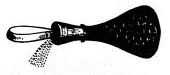
Fig. 2. Spigot and faucet.
A large deep tub is then provided, called a mash-tub, in one side of which, at the distance of an inch or two from the bottom, is fixed a cock, or what is called a spigot and faucet (fig. 2.), with the end which projects within the tub covered with basket-work to prevent the escape of the grains when the wort is drawn off. About six gallons of hot water are then poured into the mash-tub, and some of the malt is shaken in, a little at a time, and mixed with the water by the help of a wooden instrument called a mash-stirrer (fig. 3.); more water is then added, and then more malt, till nearly all the water has been poured in, and only a peck of malt is left dry. The dry malt is then strewed over the mass of malt which has been mixed with the water, and the mash-tub, having some sticks laid across it, is covered with an old blanket, a piece of sacking, or a coarse cloth, and the malt is left for an hour and a half or two hours to steep. This is called mashing the malt; and the goodness of the ale depends upon the care with which this operation is performed. The water should never be suffered to become cooler during the operation than 160°, or it will not dissolve the starchy matter contained in the malt; and, if it is hotter than 180°, the malt will be set, as the maltsters call it, that is, it will become changed into a glutinous paste, from which no strength can be extracted. When the malt has been sufficiently mashed, the wort is drawn off by the spigot, and it will be found that the eighteen gallons of water have only yielded about thirteen gallons of wort, and sometimes not so much.
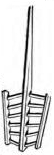
Fig. 3. Mash-stirrer.
A new kind of mashing-tub (fig. 4.) has been invented, which has a false bottom pierced with holes, through which the wort filters, instead of being drawn off by the spigot; and, by an improvement on this, the hot water is poured through a tube into the part of the mashing-tub which is below the false bottom, and suffered to rise up through the malt. When ale and beer are to be made, the ale wort is drawn off first, and then more water is heated to 175° and put to the malt, to make the beer; but when all the liquor drawn from the malt is mixed together, it is called in some places "table ale," and in others "one-way beer."
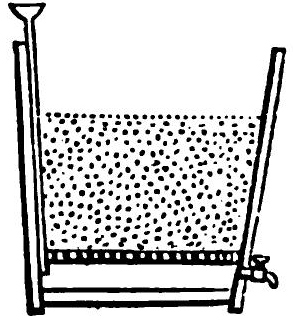
Fig. 4. Mash-tub.
While the malt is being mashed, the proper quantity of hops should be steeped in water, having been first well rubbed and separated; and when the wort is drawn off they should be added to it, and the whole put into the copper to be boiled. During the boiling the mass should be frequently stirred, to prevent the hops from either floating at the top or settling to the bottom, which they would otherwise be very apt to do. The boiling should continue briskly till the liquor begins to break, the time for which varies from half an hour to two hours and a half, according to the strength of the wort. The "breaking" is known by large fleecy flakes which appear to float in the liquor; and, when it appears, a bowlful of the liquor is taken out and set aside, when, if the flakes part and subside, leaving the wort clear, it is considered enough. Some large shallow vessels called coolers are then provided, and some sticks being laid across one of them, a sieve or wicker basket is set upon them, and the liquor is ladled out of the furnace into the sieve, to strain it from the hops. The other coolers are afterwards filled in the same manner, and then the whole are exposed to a cool current of air, in order that the liquor may cool as rapidly as possible.
When the liquor is about 70°, it is generally tunned off into a large vat or cask for it to ferment. About three quarters of a pint of yeast is mixed with a little of the wort, and as soon as it begins to work it is added to the rest. Another mode is, as soon as the wort has cooled to 70°, to convey it in the coolers to a cellar, where the temperature is about 55°, and then to mix two gallons of it with a pint of good thick yeast, and put it into an upright eighteen-gallon cask, the head of which has been knocked out, but which is covered with a piece of flannel, on which the head is laid loosely. As soon as the fermentation has begun, about three gallons more of the wort are added, provided it has not cooled below 65°; but, if it has, a pailful must be taken out and heated, so that when mixed with the rest of the three gallons, the whole shall be about 70°. When this has been added to the wort fermenting in the cask and well stirred, the cask should be covered and left to work for the night. Early the following morning the working wort should be tried with a thermometer, and, if it is between 70° and 75°, five gallons more of the wort should be added, heated as before to about 68°. The liquor should then be stirred, and left for six hours, after which three gallons more wort at 65° are added. It is then covered and left for four hours more, after which nearly all the remaining wort is added, reserving only about two quarts.
This process is very tedious, but it is said to make the ale exceedingly fine and clear; and, if the proportions be one bushel and a half of malt to a pound and three quarters of hops to make twelve gallons, it is said exactly to resemble the celebrated Indian ale. If the heat of the working wort be ever found above 75°, the remaining wort should be added cool, and the whole should be tunned out as soon as possible.
In the usual mode of brewing, when the fermentation has gone on till the yeast begins to look brown, the beer should be tunned; that is, the yeast is removed, and the beer is put into the casks in which it is to remain; and, in general, the beer is not taken down into the cellar till at this period. The casks are placed slantingly, with the bung out; and they are always kept quite full, being filled up with beer reserved for that purpose, as the beer they contain works out. In about a fortnight all the fermentation will be over, and the casks may be bunged up.
According to the Indian ale process, two quarts of wort were kept back from that fermented; and when the beer is to be tunned, which it is into two six-gallon casks, a quart of this unfermented wort is put into each cask, with two table-spoonfuls of flour and one of salt. The frothy yeast is then taken off the beer, which is poured into the barrels till it reaches the bunghole, and the froth begins to flow over: as the froth subsides, the barrels may be filled up with fresh beer, and the yeast which flows down should be caught in a vessel placed for the purpose. In a few days the yeast will become thick, and will cease to flow over: the barrels should then be filled up and the bungholes covered with brown paper, coated with thick yeast: the fermentation will afterwards proceed more slowly, and in a fortnight the barrels may be bunged down, and the bungs covered with a mass of moistened clay and sand. The Indian ale should be kept six months before it is tapped; but the other kind may be drunk in a month.
Home-made wines may be manufactured from almost any kind of fruit; and they are divided into two kinds, viz. those made with cold water, and those made with hot water.
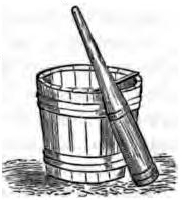
Fig. 5. Fruit-crusher.
Green Gooseberry wine is made in the first manner, by crushing the fruit in a deep tub with a fruit-crusher (fig. 5.), and pouring cold water on it, in the proportion of one gallon of water to ten pounds of fruit. It is then left to stand about six hours, when the mass, or marc, as it is called, is put into a coarse bag and pressed; more water is afterwards poured over the marc, which is again pressed, till as much water has been added as will make the proportion in all four gallons of water to ten pounds of fruit. The marc is then thrown away, and to every gallon of the liquor, or must, as it is called, three pounds of lump sugar are added, and the whole is well stirred together; the tub is afterwards covered with a blanket, and the wine is left to ferment in a temperature of from 55° to 60°. In twelve hours, if the fermentation has begun rapidly, or in twenty-four hours, if it is slow, the liquor is put into a cask and left to ferment, the bung being put in loosely, and the cask being kept filled up with fresh must as it works off. When the hissing noise subsides, the bung is driven in firmly, and a little hole is made in the head of the cask, near the bung, which is stopped with a wooden peg. In two or three days this peg is loosened to let any air out that may have been generated; and this is repeated, at intervals, several times, till no more air escapes, when the peg is driven in tight. An excellent wine may be made in a similar manner of the stalks of the giant tart rhubarb, which, if old, should be peeled and cut in pieces before they are crushed.
Ripe Gooseberry wine is made with hot water; first crushing the fruit, and, after letting it stand twenty-four hours, pressing the juice through a linen cloth. Hot water is then poured over the marc, in the proportion of two quarts of water to every gallon of the fruit before it was crushed; and, after remaining in the tub twelve hours, the marc is again pressed, and the liquor from it mixed with that produced by the fruit. Two and a half or three pounds of lump sugar should now be added to every gallon of the liquor, and the whole left to ferment. If moist sugar be used, the quantity should be four pounds to every gallon of the liquor. The rest of the process is the same as before; but when the fermentation has ceased it is usual to add British brandy, in the proportion of one quart to two gallons and a half of the wine.
When Currant wine is made, it is said to be best to boil the liquor after the sugar is added, before fermenting it in the cask.
Elderberry wine is generally made with moist sugar, and ginger and other spices are added to it.
Cowslip wine is made by boiling sugar and water together, and pouring the liquor over the rind of lemons and Seville oranges, in the proportion of four of these fruits to a gallon of sugar and water: the juice of the oranges and lemons is added, and the whole is fermented with yeast. The cowslip flowers are then put into the wine, in the proportion of one quart to every gallon of liquor, and stirred up well till they sink. When the wine is tunned, a few sprigs of sweet briar are often put into the cask, and one ounce of isinglass for every gallon of liquor; in a few days it is bunged up close. In six months it will be fit to bottle; but it will be better for remaining longer in the cask.
Any other kind of wine may be made when the wine is to be made of English fruit, either as was directed for the green or the ripe gooseberry wines; and when not made of English fruit, by boiling sugar and water, and fermenting it, before adding the substance that is to give the flavour as directed for the Cowslip wine.
Cider is made by grinding apples, and then expressing the juice, which is fermented with yeast, but without sugar. Perry is made in the same way; and both may be made on a small scale by bruising apples or pears in a deep tub, as was recommended for bruising fruit in made wines.
A brick oven for baking Bread is often placed in the scullery. The ordinary size of an oven of this kind is about six feet long by four feet deep; and it is about eighteen inches high in the centre of the arch: the floor (which generally inclines a little from the head of the oven to the mouth) is laid with tiles, and the arch is formed of fire-brick, set in fire-clay or in loam mixed with powdered brick; the whole being surrounded by a large mass of common brickwork, to keep in the heat.
When the oven is heated, the faggots, or other kind of wood which is used for that purpose, are lighted near the mouth, and then pushed on till they are as nearly as possible in the centre of the oven, so that the heat may spread as equally as possible through every part. When the heat is between 250° and 300°, it is judged sufficient, and the fire is drawn out to prepare the oven for the reception of the bread. As, however, few cooks can be expected to have a proper kind of thermometer at hand for ascertaining the heat exactly, it is necessary to have some easier rules for judging; and the following, the correctness of which I have experienced, are taken from the first volume of that excellent and useful work, the Magazine of Domestic Economy.
"A judgment must be formed by the clear red heat of the bricks of the arch and sides of the oven, and the lively sparkling of the embers on its floor. The former criterion proves that the bricks have received enough of body heat to consume that black carbonaceous coating which the smoke communicates to them at the early stage of fire; the second shows that the principle of combustion is in full activity, and not rendered inert by a cold surface, either at the top, bottom, or sides. Finally, if the brickwork be hot enough, and the point of a long stake be rubbed forcibly over any part of it, so as for the moment to make a black trace of charcoal, this trace will be burnt off, and the bricks left clear in a second of time."
When the oven is sufficiently hot, the remaining embers are drawn out with an iron hook fixed at the end of a long pole, and the bottom of the oven is cleaned with a wet mop, made of long shreds of woollen cloth or coarse sacking. The oven is then quite ready to receive the bread, and it should be put in immediately. It generally takes about an hour to heat a moderate-sized oven properly; and it takes an hour and a half, or two hours, to bake loaves of the ordinary size.
Little iron grates are sometimes sold for heating ovens, but they are more suitable for coal than wood; and, though an oven may be heated with great rapidity with coal, it does not retain its heat so long, and is more fitted for baking French bread, or cakes, than large-sized household loaves. When, on the contrary, a brick oven is heated with wood, and the hot embers are pushed by the scraper to every part of the oven, the whole mass of brick becomes what is technically called soaked, and is in a fit state for a family baking of bread. When the bread is in, the oven door should be stopped quite close; but over the door is a small opening called the stopper, which should be opened when the bread has been in a little time, in order that the vapour from the bread may escape. It is from not attending to this that home-baked bread is so frequently heavy.
Home-baked bread is generally best when made of what is called grist flour; that is, wheat ground at a mill, and only the coarse bran removed from the flour. Twenty-four pounds of this flour will make about thirty-two pounds of bread; but if the best white flour is used, two or three more pounds of it will be required to produce the same quantity of bread. Bread is made either with leaven or yeast.
Leaven is made by mixing flour with warm water into a thin paste and then leaving it to ferment. When it begins to rise in bubbles, more water and flour is added, and it is again left to ferment, and then more flour with a little salt is added to make the dough. The dough must be kept warm during the whole operation, as fermentation will not take place unless the heat be from sixty to seventy, or seventy-five degrees. Bread of this kind is very light, but it soon becomes acid. Nearly all the household bread in France is made in this way.
When yeast is used, the usual proportion is half a pint of brewer's yeast mixed with a pint of warm water to twenty-four pounds of flour.
If no fresh yeast can be procured, it may be made by putting a teacupful of split peas into a basin and pouring about a pint of boiling water over them. A cloth is then put over the basin, and it is set near the fire to keep warm. In about twelve hours it will begin to ferment, and a kind of scum will rise, which may be used as yeast. This is called Turkish yeast; but a better method is practised by the Americans, which is as follows:—Take as much hops as may be held between the thumb and finger, put them with a few slices of apples into a quart of water, and boil the whole for about fifteen or twenty minutes. Then strain the liquid, and when it is lukewarm stir in a little flour with three or four table-spoonfuls of treacle so as to make a thin paste; then set the whole in a warm place, and in a few hours the fermentation will be sufficiently strong to allow enough flour and water to be added to make a proper sponge for bread.
If you have a small quantity of yeast it may be increased in the following manner:—Take one pound of fine flour, and mix it to the thickness of gruel with boiling water; add half a pound of brown sugar, mixing the whole well together. Then put three table-spoonfuls of yeast into a large vessel, and pour the mixture upon it. It will ferment violently, and the scum which rises to the top will be good yeast, which may be used immediately, or may be preserved for some time in an earthenware vessel covered closely from the air, and kept in a warm dry place.
In the Magazine of Domestic Economy it is said that when yeast has become sour, and even slightly putrid, it may be recovered by adding a tea-spoonful of flour, the same of moist sugar, a pinch of salt, and a little warm water: this is to be stirred together and left to ferment for half an hour. I have never tried this, but it is very nearly the same as the receipt I have given above. The yeast from home-brewed beer is very apt to be bitter; but it is said that this may be cured by pouring it through a sieve containing about a pint of bran. To keep home-brewed yeast it should be put into a large pan and have three times the quantity of water poured upon it, being well stirred up, and then left to settle. The next day the water is to be poured off, and fresh put on, and in this manner it is said that yeast may be kept for six weeks. All yeast is best purified before it is used; that is, the yeast should be put into a vessel, and cold spring water being poured upon it, they should be stirred together and then left to settle. The water is afterwards poured off, and the yeast taken out carefully, leaving a brown sediment at the bottom.
The best way of keeping yeast is to hang it up in a cabbage net, so as to let it dry with the air about it on all sides. This is the way the Germans prepare their solid yeast, which is now so much used in London.
When bread is to be made, the necessary quantity of flour is put into a kneading trough, or into a deep-glazed earthenware pan, and a round hole is made in the centre for the yeast and water, which is slightly mixed with the surrounding flour, so as to form a light batter, and over this is strewed enough dry flour to cover it. I remember, when I was a child in my father's house, I have often watched the cook perform this operation (which I now find is called setting the sponge); and I always used to see her, when she had done, make a cross in the flour sprinkled over the batter, without which she declared the bread would never rise. As soon as the sponge is set, the earthenware pan is placed before the fire, and a linen cloth laid over it. In a short time the sponge begins to rise, and forms cracks in the covering of flour. More water is then added, heated to about the warmth of new milk, and salt is scattered over the flour, which gradually mixes with the water, kneading it well with the hands so as to form a fine compact dough. Some dry flour is then laid under it, and sprinkled over it; and the dough, being again covered with a cloth, is left to ferment, which, if the yeast were good, it does in about an hour, sufficiently to allow the dough to be made into loaves of bread.
A kind of bread, which is very good for toast and butter, is made by boiling and mashing some mealy potatoes, and then rubbing them into flour which has been previously warmed before the fire, in the proportion of half a pound of potatoes to two pounds of flour. When well mixed, add a proper quantity of salt, with enough yeast, warm milk, and water to make it into dough. It should be left to rise for two hours before it is made into a loaf, and it should be baked in a tin.
For Rolls. Warm an ounce of butter in a pint of skimmed milk, and add a spoonful and a half of yeast and a little salt. This will be sufficient for two pounds of flour, and will make seven rolls. The dough should rise before the fire half an hour, and the rolls should stand another half hour before the fire after they are made. They should be baked in a quick oven, and will take about half an hour. The butter may be omitted.
To make French rolls. Add half an ounce of soda to the above quantity; make them long in shape, and rasp them when they are baked.
For Sally Luns. Take two pounds of flour, and add half a pint of milk and half a pint of cream, with a bit of butter the size of a walnut; when a little warm, put to it three well-beaten yolks of eggs, three or four spoonfuls of well-purified yeast, and a little salt. Mix the whole together, and let it rise for an hour; then make it into cakes, and lay them on tins lightly rubbed over with a little butter. Let them stand on the hearth to rise for about twenty minutes, covered with a thin cloth, then bake them in rather a quick oven.
For Yorkshire or milk cakes. Dry a pound and a half of flour before the fire; beat up the yolk of an egg with a spoonful of yeast; add three quarters of a pint of new milk lukewarm; strain the whole through a hair sieve into the flour; mix it lightly into dough, and let it rise by the fire an hour; then make it up into cakes. Rub the tins with a very little butter, and let them be warm when you lay the cakes on them; cover with a thin cloth, and let them rise on the hearth about twenty or thirty minutes; bake them in a brisk oven. This dough makes very good buns, with the addition of a little good moist sugar, and a few caraway seeds or dried currants.
Both the Sally Luns and the milk cakes may be washed over with the white of an egg before they are put in the oven.
For Rusks, or Tops and Bottoms. Beat up four eggs with half a pint of new milk, in which a quarter of a pound of butter has been melted; add two table-spoonfuls of yeast, and three ounces of sugar. Mix with this as much flour as will make a very light batter, and set it before the fire for half an hour; then add a little more flour, to make it stiff enough to work. Knead it well, and, if wanted for rusks, roll it into cakes about six inches long and two broad; when baked and cold, cut them into slices, and dry them in a slow oven. For tops and bottoms, make the dough into little square cakes, and flatten them. When baked, just cut them slightly round, and then tear them in two, and put them again into the oven.
To make Banbury Cakes. Set a sponge with two table-spoonfuls of thick purified yeast, half a pint of warm milk, and a pound of flour. When risen, mix with it half a pound of currants, well cleaned and dried, half a tea-spoonful of salt, half a pound of candied orange and lemon shred small, one ounce of spice, such as powdered cinnamon, allspice, ginger, and nutmeg, or mace. Mix the whole well together with half a pound of honey. Roll out puff paste a quarter of an inch thick; cut it into rounds with a tin cutter about four inches across; lay on each with a spoon a small quantity of the mixture; close it round with the fingers in an oval form; place the joining underneath; press it gently with the hand, and sift sugar over. Bake them on a baking-plate a quarter of an hour in a moderate oven, and of a light colour.
For Bath buns. Rub half a pound of butter in a pound and half of flour, quarter of a pound of powdered sugar, a little salt, and half an ounce of caraway seeds. Beat the yolks of four eggs and three whites; put half a pint of warm milk to four spoonfuls of good yeast; when settled, pour it off on the eggs, and mix all into the middle of the flour till about a third of the flour is mixed in. Cover it with flannel, and set it before the fire to rise, about half an hour, then mix all up, and cover it till well risen. Make up the buns, and set them before the fire on a baking-tin about a quarter of an hour; bake them in a quick oven; when done, brush them over with sugar and beaten egg.
For Oat cakes. Merely mix oatmeal and water together till about as thick as ordinary dough, then roll out as thin as possible, and bake on a hot flat iron called a girdle, hung over the fire. A few eggs are sometimes added to make what is called in Scotland Car cake.
For Muffins and Crumpets. Take a pint and a half of warm milk and dissolve in it a tea-spoonful of salt of tartar (subcarbonate of potash), then mix with it five table-spoonfuls of yeast. When it has stood to settle, pour it off by degrees, if for crumpets, into two pounds of flour with a little salt, stir it well, and then beat it till it looks like a thick batter, and may be drawn out to a great length when you lift up the spoon. Set it before the fire to rise, and when it bubbles up bake the crumpets on a hot stove, or a girdle. For muffins, take three pounds of flour, and roll the dough into balls, and let them rise before putting them on the iron plate. When the muffins begin to bake they will spread into the proper shape; and when one side is done they should be turned on the other side. The crumpets do not require turning; but if they are wished to be thick, they may be baked in an iron hoop. Potato crumpets are made by adding to three pounds of mealy potatoes boiled and rubbed through a coarse sieve, half a pound of flour, an egg, a little salt, and a spoonful of yeast.
For a Brioche. Take a pound of fine flour, divide it into three parts, to one of which put a table-spoonful of yeast, mixed with warm water into a light batter, then set it before a fire if the weather is cold, and let it rise half an hour. In warm weather it need not be put to the fire, as it will rise immediately. Mix the rest of the flour with a quarter of an ounce of salt, three eggs, a quarter of a pound of butter, and enough warm water to make it into a stiff dough. Work it well, and then add the portion that was previously prepared. Knead the whole well together, and then wrap the dough in a white napkin, and leave it for seven or eight hours. Then divide the dough into pieces, as if for buns, and make them into the usual half-twisted form of a brioche, using a little warm milk to moisten them if necessary. Lastly, wash them over with eggs well beaten, and put them in the oven.
I shall now give you two or three receipts for biscuits, and sweet cakes.
For Butter biscuits. Warm two ounces of butter in as much skimmed milk as will make a pound of flour into a stiff paste, knead it well, and beat it with a paste roller; roll it out thin, cut the paste into round cakes with a glass, and prick them with a fork. Bake in a quick oven.
Stamped biscuits are made by rubbing a quarter of a pound of butter into a pound of flour, then mixing it with cold water and a tea-spoonful of yeast into a paste. Knead it till it is quite smooth; then cover it on the board with a basin for half an hour, and afterwards make it into balls, stamping each with the print.
Abernethy biscuits may be made by adding caraway seeds and a very little sugar to the above.
For a Sponge-cake. Take half a pound of flour, three quarters of a pound of lump sugar powdered, and seven eggs, leaving out three of the whites; beat all well together, and add the rind of a lemon grated on some of the sugar before it is pounded. Bake in a mould, and in a quick oven.
For Naples biscuits. Put a quarter of a pint of water, two spoonfuls of orange-flower water, and half a pound of fine sugar into a saucepan, and let it boil till the sugar be melted; then pour it upon four eggs well beaten, stirring the whole as fast as possible while the syrup is poured in. Continue beating it well till cold; then stir in half a pound of flour. Make clean white paper into moulds of the proper size for the biscuits, pour the batter into them, and put them on tins to bake; sift fine sugar on, and set them in a brisk oven, taking great care that they are not scorched.
For Wine cakes. Mix two pounds of flour, one pound of sugar, and one ounce of caraway seeds, with four eggs, and a few spoonfuls of water to make a stiff paste; roll it thin, cut the cakes in any shape, and bake them on floured tins. While baking, boil half a pound of sugar in half a pint of water to a thin syrup; and, while both are hot, dip each cake into it. Put them into the oven on tins, to dry for a short time; and when the oven is cool put them in again, and let them remain in four or five hours.
For a Pound cake. Take two pounds of flour, one pound of butter, one pound of sugar, one pound of currants, a little cream, lemon-peel, mace, and cinnamon; first rub the butter in the flour, then put in the cream, a little yeast, and five eggs, and set it to rise; when risen enough add the other ingredients. Bake in a tin lined with paper well buttered.
For Ratafia drops. Blanch and beat four ounces of bitter and two ounces of sweet almonds with a little rose-water, a pound of sifted sugar, the whites of two eggs well beaten, and a table-spoonful of flour. Drop this mixture so as to form balls about the size of a nutmeg, and bake them on wafer paper.
For Macaroons. Blanch four ounces of sweet almonds, and pound them with four spoonfuls of orange-flower water; whisk the whites of four eggs to a froth, then mix them, and a pound of sugar sifted, with the almonds, to a paste; and, laying a sheet of wafer-paper on a tin, put the paste on in different moulds, or cut into little cakes, the shape of macaroons.
Gâteau d'Avranches. Grate one pound of loaf sugar to a fine powder, and add it to the yolks of fourteen eggs. Beat them well together for half an hour, and then add the juice of two lemons, some orange-flower water, and half a pound of potato flour. In the mean time another person must beat the whites of the fourteen eggs for half an hour or more till they look like snow, as, should any liquid remain, it will spoil the cake completely. Put this snow to the yolks, and beat the whole together for ten minutes; then pour the whole quickly into a mould that has been well buttered before the fire, and put it directly into an oven, which must be hot, but not quite so much so as for bread; three quarters of an hour will bake it.
For Gingerbread. Put into a Maslin kettle half a pound of fresh butter and three quarters of a pound of treacle, and keep them on the fire, stirring them together, till they are melted and thoroughly incorporated. In the mean time mix half a pound of moist sugar with two pounds of flour and three quarters of an ounce of ginger, and pour the treacle and butter quite hot on the flour, sugar, and ginger; work the whole well together, and when almost cold roll the paste out, and cut it into cakes. Bake them in rather a slow oven. If it is wished to have the gingerbread very rich, only half the quantity of flour must be used; and the paste, which is rolled very thin, is cut into squares. This kind of gingerbread is called Parliament.
LETTER V.
IMPROMPTU COOKERY.—SOUPS.—POULTRY.—PIGEONS.—GAME.—SALADS OF COLD MEAT AND POTATOES.—MODES OF DRESSING POTATOES AND CARROTS.—SAUCES.—OMELETTES, CREAMS, AND SIDE DISHES.—MISCELLANEOUS COOKERY.—NATIONAL COOKERY.—THE FRENCH POT-AU-FEU.—ITALIAN MACARONI.—GERMAN SAUER KRAUT.—POLISH BARSCH.—SPANISH OLLA PODRIDA AND PUCHERO.—SCOTCH HAGGIS, BARLEY BROTH, AND HOTCH-POTCH.—ENGLISH PLUM-PUDDING.
The anxiety you express to see my promised hints on cookery has induced me to send them to you without waiting till I had finished all that I have to say of the servants' offices of your house; and you will observe that I shall first confine myself to what may be styled Impromptu Cookery, or cookery for the country, in contradistinction to cookery in towns; my principal aim being to enable you to have a nice little dinner ready in a short time on any emergency, without keeping an expensive table in ordinary. I have already advised you always to have a supply of salted meat in the house; but this is not enough, as a single dish of meat with vegetables and pudding, though quite sufficient as far as regards mere eating, does not form such a dinner as your husband would like to see on his table, if he were to bring a friend home unexpectedly. If, however, you are able to give them a well-flavoured soup, and two or three nicely cooked made-dishes to support the joint, (or pièce de résistance, as the French call it,) you have at once a dinner that is not expensive, and yet gives an air of elegance and refinement to the table.