I.
Reading edition
A system of religious philosophy, or more properly of theosophy, which has not only exercised for hundreds of years an extraordinary influence on the mental development of so shrewd a people as the Jews, but has captivated the minds of some of the greatest thinkers of Christendom in the sixteenth and seventeenth centuries, claims the greatest attention of both the philosopher and the theologian. When it is added that among its captives were Raymond Lully, the celebrated scholastic, metaphysician and chemist (died 1315); John Reuchlin, the renowned scholar and reviver of oriental literature in Europe (born 1455, died 1522); John Picus di Mirandola, the famous philosopher and classical scholar (1463–1494); Cornelius Henry Agrippa, the distinguished philosopher, divine and physician (1486–1535); John Baptist von Helmont, a remarkable chemist and physician (1577–1644); as well as our own countrymen Robert Fludd, the famous physician and philosopher (1574–1637), and Dr. Henry More (1614–1687); and that these men, after restlessly searching for a scientific system which should disclose to them “the deepest depths” of the Divine nature, and show them the real tie which binds all things together, found the cravings of their minds satisfied by this theosophy, the claims of the Kabbalah on the attention of students in literature and philosophy will readily be admitted. The claims of the Kabbalah, however, are not restricted to the literary man and the philosopher: the poet too will find in it ample materials for the exercise of his lofty genius. How can it be otherwise with a theosophy which, we are assured, was born of God in Paradise, was nursed and reared by the choicest of the angelic hosts in heaven, and only held converse with the holiest of man’s children upon earth. Listen to the story of its birth, growth and maturity, as told by its followers.
The Kabbalah was first taught by God himself to a select company of angels, who formed a theosophic school in Paradise. After the fall the angels most graciously communicated this heavenly doctrine to the disobedient child of earth, to furnish the protoplasts with the means of returning to their pristine nobility and felicity. From Adam it passed over to Noah, and then to Abraham, the friend of God, who emigrated with it to Egypt, where the patriarch allowed a portion of this mysterious doctrine to ooze out. It was in this way that the Egyptians obtained some knowledge of it, and the other Eastern nations could introduce it into their philosophical systems. Moses, who was learned in all the wisdom of Egypt, was first initiated into it in the land of his birth, but became most proficient in it during his wanderings in the wilderness, when he not only devoted to it the leisure hours of the whole forty years, but received lessons in it from one of the angels. By the aid of this mysterious science the lawgiver was enabled to solve the difficulties which arose during his management of the Israelites, in spite of the pilgrimages, wars and the frequent miseries of the nation. He covertly laid down the principles of this secret doctrine in the first four books of the Pentateuch, but withheld them from Deuteronomy. This constitutes the former the man, and the latter the woman. Moses also initiated the seventy elders into the secrets of this doctrine, and they again transmitted them from hand to hand. Of all who formed the unbroken line of tradition, David and Solomon were most initiated into the Kabbalah. No one, however, dared to write it down, till Simon ben Jochai, who lived at the time of the destruction of the second Temple. Having been condemned to death by Titus, Rabbi Simon managed to escape with his son and concealed himself in a cavern where he remained for twelve years. Here, in this subterranean abode, he occupied himself entirely with the contemplation of the sublime Kabbalah, and was constantly visited by the Prophet Elias, who disclosed to him some of its secrets which were still concealed from the theosophical Rabbi. Here, too, his disciples resorted to be initiated by their master into these divine mysteries; and here, Simon ben Jochai expired with this heavenly doctrine in his mouth, whilst discoursing on it to his disciples. Scarcely had his spirit departed, when a dazzling light filled the cavern, so that no one could look at the Rabbi; whilst a burning fire appeared outside, forming as it were a sentinel at the entrance of the cave, and denying admittance to the neighbours. It was not till the light inside, and the fire outside, had disappeared, that the disciples perceived that the lamp of Israel was extinguished. As they were preparing for his obsequies, a voice was heard from heaven, saying, “Come ye to the marriage of Simon b. Jochai, he is entering into peace, and shall rest in his chamber!” A flame preceded the coffin, which seemed enveloped by, and burning like fire. And when the remains were deposited in the tomb, another voice was heard from heaven, saying, “This is he who caused the earth to quake, and the kingdoms to shake!” His son, R. Eliezer, and his secretary, R. Abba, as well as his disciples, then collated R. Simon b. Jochai’s treatises, and out of these composed the celebrated work called Sohar (זהר) i.e., Splendour, which is the grand storehouse of Kabbalism.
From what has been said, it will be seen that the followers of this secret doctrine claim for it a pre-Adamite existence, and maintain that, ever since the creation of the first man, it has been received uninterruptedly from the hands of the patriarchs, the prophets, &c. It is for this reason that it is called Kabbalah (קבלה from קבל to receive) which primarily denotes reception, and then a doctrine received by oral tradition. The Kabbalah is also called by some Secret Wisdom. (חכמה נסתרה), because it was only handed down by tradition through the initiated, and is indicated in the Hebrew Scriptures by signs which are hidden and unintelligible to those who have not been instructed in its mysteries. From the initial letters of this name, this theosophic system is also denominated Grace (ח״ן = חכמה נסתרה). Vague and indefinite as this name may seem to the uninitiated, inasmuch as it conveys no idea whatever of the peculiar doctrines of the system, but simply indicates the manner in which they have been transmitted, it is nevertheless the classical and acknowledged appellation of this theosophy. The difference between the word Kabbalah (קבלה receptio) and the cognate term Massorah (מסורה traditio, from מסר to transmit)—which denotes the traditionally transmitted various readings of the Hebrew Scriptures—is, that the former expresses the act of receiving, which in this technical sense could only be on the part of one who has reached a certain period of life, as well as a certain state of sanctity, implying also a degree of secrecy; whilst the latter signifies the act of giving over, surrendering, without premising any peculiar age, stage of holiness, or degree of secrecy. The name, therefore, tells us no more than that this theosophy has been received traditionally. To ascertain its tenets we must analyze the system itself or the books which propound it; and to this task we now betake ourselves.
The cardinal doctrines of the Kabbalah are mainly designed to solve the grand problems about (I) The nature of the Supreme Being, (II) The cosmogony, (III) The creation of angels and man, (IV) The destiny of man and the universe, and (V) To point out the import of the Revealed Law. Assenting and consenting to the declarations of the Hebrew Scriptures about the unity of God ( Exod. xx, 3 ; Deut. iv, 35, 39 ; vi, 4 ; xxxii, 39 ), his incorporeity ( Exod. xx, 4 ; Deut. iv, 15 ; Ps. xiv, 18 ), eternity ( Exod. iii, 14 ; Deut. xxxii, 40 ; Isa. xli, 4 ; xliii, 10 ; xliv, 6 ; xlviii, 12 ), immutability ( Mal. iii, 6 ), perfection ( Deut. xxxii, 4 ; 2 Sam. xxii, 31 ; Job xxxviii, 16 ; Ps. xviii, 31 ), infinite goodness ( Exod. xxxiv, 6 ; Ps. xxv, 10 ; xxxiii, 5 ; c, 5 ; cxlv, 9 ), the creation of the world in time according to God’s free will ( Gen. i, 1 ), the moral government of the universe and special providence, and to the creation of man in the image of God ( Gen. i. 27 ), the Kabbalah seeks to explain the transition from the infinite to the finite; the procedure of multifariousness from an absolute unity, and of matter from a pure intelligence; the operation of pure intelligence upon matter, in spite of the infinite gulf between them; the relationship of the Creator to the creature, so as to be able to exercise supervision and providence. It, moreover, endeavours to show how it is that the Bible gives names and assigns attributes and a form to so spiritual a Being; how the existence of evil is compatible with the infinite goodness of God, and what is the Divine intention about this creation.
In our analysis of the Kabbalistic doctrines on these grand problems, we shall follow the order in which they have been enumerated, and accordingly begin with the lucubrations on the Supreme Being and the Emanations.
I. The Supreme Being and the doctrine and classification of the Emanations, or Sephiroth.
From the junction of the foregoing opposites emanated again the masculine or active potency, denominated Mercy or Love, (חסד), also called Greatness (גדולה), the fourth Sephira, which among the divine names is represented by El (אל), and among the angelic hosts by Chashmalim (חשמלים, Comp. Ezek. i, 4 ). From this again emanated the feminine or passive potency, Justice (דין), also called Judicial Power (גבורה), the fifth Sephira, which is represented by the divine name Eloha (אלה), and among the angels by Seraphim (שרפים, Isa. vi, 6 ); and from this again the uniting potency, Beauty or Mildness (תפארת), the sixth Sephira, represented by the divine name Elohim (אלהים), and among the angels by Shinanim (שנאנים, Ps. lxviii, 18 ). Since without this union the existence of things would not be possible, inasmuch as mercy not tempered with justice, and justice not tempered with mercy would be unendurable: and thus the second trinity of the Sephiroth is obtained.
The medium of union of the second trinity, i.e. Beauty (תפארת), the sixth Sephira, beamed forth the masculine or active potency, Firmness (נצח), the seventh Sephira, corresponding to the divine name Jehovah Sabaoth (יהוה צבאות), and among the angels to Tarshishim (תרשישים, Dan. x, 6 ); this again gave rise to the feminine or passive potency, Splendour (הוד), the eighth Sephira, to which answer the divine name Elohim Sabaoth (אלהים צבאות), and among the angels Benei Elohim (בני אלהים, Gen. vi, 4 ); and from it again, emanated Foundation or the Basis (יסוד), the ninth Sephira, represented by the divine name El Chai (אל חי), and among the angelic hosts by Ishim (אישים, Ps. civ, 4 ), which is the uniting point between these two opposites—thus yielding the third trinity of Sephiroth. From the ninth Sephira, the Basis (יסוד) of all, emanated the tenth, called Kingdom (מלכות), and Shechinah (שכינה), which is represented by the divine name Adonai (אדוני), and among the angelic hosts by Cherubim (כרובים). The table on the opposite page exhibits the different names of the Sephiroth, together with the several names of God and the angels, which correspond to them.
From this representation of each triad, as consisting of a threefold principle, viz., the two opposites, masculine and feminine, and the uniting principle, the development of the Sephiroth, and of life generally, is symbolically called the Balance (מתקלא), because the two opposite sexes, are compared with the two opposite scales, and the uniting Sephira is compared with the beam which joins the scales, and indicates its equipoise.
Before we enter into further particulars about the nature, operation, and classification of these Sephiroth, we shall give the Sohar’s speculations about the Supreme Being, and its account of the origin of the Sephiroth, and their relationship to the Deity.
THE TEN SEPHIROTH. THE TEN CORRESPONDING NAMES OF THE DEITY. THE TEN CORRESPONDING CLASSES OF ANGELS. THE TEN CORRESPONDING MEMBERS OF THE HUMAN BODY.
i. 1. כתר, Crown. אהיה, I am ( Exod. iii. 4 ). חיות, ζῶον. Head.
2. עתיקא, the Aged.
3. נקודה ראשונה, Primordial Point.
4. נקודה פשוטה, Smooth Point.
5. רישא הוורה, White Head.
6. אריך אנפין, Macroprosopon.
7. אדם עילאה, Heavenly Man.
8. רום מעלה, Inscrutable Height.
ii. חכמה, σοφία, Wisdom. יה, Jah ( Isa. xxvi. 4 ). אופנים, κίνησις. Brains.
iii. בינה, νοῦς, Intelligence. יהוה, Jehovah. אראלים, Arelim ( Isa. xxiii. 7 ). Heart.
iv. 1. חסד, χάρις, Love. אל, the Mighty One. חשמלים, Chasheralim ( Ezek. i. 4 ). Right Arm.
2. גדולה, Greatness.
v. 1. דין, Judgment. אלה, the Almighty. שרפים, Seraphim ( Isa. vi. 7 ). Left Arm.
2. פחד, Justice.
3. גבורה, Strength.
vi. תפארת, Beauty. אלהים, God. שנאנים, Shinanim ( Ps. lxviii. 18 ). Chest.
vii. נצח, Firmness. יהוה צבאות, Jehovah Sabaoth. תרשישים Tarshishim ( Dan. x. 6 ). Right Leg.
viii. הוד, Splendour. אלהים צבאות, God Sabaoth. בני אלהים, the Sons of God ( Gen. vi. 4 ). Left Leg.
ix. יסוד, Foundation. אל חי, Mighty Living One. אשים, Ishim ( Ps. civ. 4 ). Genital Organs.
x. 1. βασιλεία sc. τῶν οὐρανῶν, Kingdom. אדני, the Lord. כרובים, Cherubim. Union of the Whole Body.
2. שכינה, Shechinah.
The prophet Elias having learned in the heavenly college the profound mystery and true import of the words in Isa. xl, 25, 26 , “To whom will ye liken me, and shall I be equal? saith the Holy One. Lift up your eyes on high, and behold who (מי) hath created these things (אלה),” revealed to R. Simon b. Jochai that God in his absolute nature is unknown and incomprehensible, and hence, in a certain sense, non-existent; that this Who (אלה unknown subject) had to become active and creative, to demonstrate his existence, and that it is only by these (אלה) works of creation that he made himself known to us. It is therefore the combination of the unknown Who (מי) with these visible (אלה) works that showed him to be God (אלהים which is produced by מי transposed, i.e. יﬦ, and united with אלה). Or, as it is in the language of the Kabbalah;—
“Before he gave any shape to this world, before he produced any form, he was alone, without a form and resemblance to anything else. Who then can comprehend him how he was before the creation, since he was formless? Hence it is forbidden to represent him by any form, similitude, or even by his sacred name, by a single letter or a single point; and to this the words ‘Ye saw no manner of similitude on the day that the Lord spake unto you’ ( Deut. iv, 15 )—i.e. ye have not seen anything which you could represent by any form or likeness—refer. But after he created the form of the Heavenly Man (אדם עלאה), he used it as a chariot (מרכבה) wherein to descend, and wishes to be called by this form, which is the sacred name Jehovah. He wishes to be known by his attributes, and each attribute separately; and therefore had himself called the God of Mercy, the God of Justice, Almighty, God of Sabaoth, and the Being. He wishes thereby to make known his nature, and that we should see how his mercy and compassion extend both to the world and to all operations. For if he had not poured out his light upon all his creatures, how could we ever have known him? How could the words be fulfilled, ‘The whole earth is full of his glory’ ( Isa. vi, 3 )? Woe be to him who compares him with his own attributes! or still worse with the son of man whose foundation is in the dust, who vanishes and is no more! Hence, the form in which we delineate him simply describes each time his dominion over a certain attribute, or over the creatures generally. We cannot understand more of his nature than the attribute expresses. Hence, when he is divested of all these things, he has neither any attribute nor any similitude or form. The form in which he is generally depicted is to be compared to a very expansive sea; for the waters of the sea are in themselves without a limit or form, and it is only when they spread themselves upon the earth that they assume a form (דמיון). We can now make the following calculation: the source of the sea’s water and the water stream proceeding therefrom to spread itself are two. A great reservoir is then formed, just as if a huge hollow had been dug; this reservoir is called sea, and is the third. The unfathomable deep divides itself into seven streams, resembling seven long vessels. The source, the water stream, the sea and the seven streams make together ten. And when the master breaks the vessels which he has made, the waters return to the source, and then only remain the pieces of these vessels, dried up and without any water. It is in this way that the Cause of Causes gave rise to the ten Sephiroth. The Crown is the source from which streams forth an infinite light: hence the name En Soph (אין סוף) = infinite, by which the highest cause is designated: for it then had neither form nor shape, and there is neither any means whereby to comprehend it, nor a way by which to know it. Hence it is written, ‘Seek not out the things that are too hard for thee, neither search the things that are above thy strength.’ ( Ecclus. iii, 21 .) He then made a vessel, as small as a point, like the letter י, which is filled from this source (i.e. the En Soph). This is the source of wisdom, wisdom itself (חכמה), after which the Supreme Cause is called ‘wise God.’ Upon this he made a large vessel like a sea, which is called Intelligence (בינה): hence the name ‘intelligent God.’ It must, however, be remarked that God is wise, and through himself, for wisdom does not derive its name through itself, but through the wise one who fills it with the light which flows from him, just as intelligence is not comprehended through itself, but through him who is intelligent and fills it with his own substance. God needs only to withdraw himself and it would be dried up. This is also the meaning of the words, ‘the waters have disappeared from the sea, and the bed is dry and parched up.’ ( Job xiv, 11 .) The sea is finally divided into seven streams, and the seven costly vessels are produced, which are called Greatness (גדולה), Judicial Strength (גבורה), Beauty (תפארת), Firmness (נצח), Splendour (הוד), Foundation (יסוד), and Kingdom (מלכות). Therefore is he called the Great or the Merciful, the Mighty, the Glorious, the God of victory, the Creator, to whom all praise is due, and the Foundation of all things. Upon the last attribute all the others are based as well as the world. Finally, he is also the King of the universe, for everything is in his power; he can diminish the number of the vessels, and increase in them the light which streams from them, or reduce it, just as it pleases him.” (Sohar, i, 42 b, 43 a, section בא.)
In another place again the same authority gives the following description of the Deity and the emanation of the Sephiroth. “The Aged of the Aged, the Unknown of the Unknown, has a form and yet has no form. He has a form whereby the universe is preserved, and yet has no form, because he cannot be comprehended. When he first assumed the form [of the first Sephira], he caused nine splendid lights to emanate from it, which, shining through it, diffused a bright light in all directions. Imagine an elevated light sending forth its rays in all directions. Now if we approach it to examine the rays, we understand no more than that they emanate from the said light. So is the Holy Aged an absolute light, but in himself concealed and incomprehensible. We can only comprehend him through those luminous emanations (ספירות) which again are partly visible and partly concealed. These constitute the sacred name of God.” (Idra Suta, Sohar, iii, 288 a.)
In their totality and unity these ten Sephiroth are not only denominated the world of Sephiroth (עולﬦ הספירות) and the world of Emanations (עולﬦ אצילות), but represent and are called the Primordial or Archetypal Man (אדﬦ קדמון = πρωτόγονος), and the Heavenly Man (אדם עילאה). In the figure, the Crown (כתר) is the head; Wisdom (חכמה), the brains; and Intelligence (בינה), which unites the two and produces the first triad, is the heart or the understanding—thus forming the head. The fourth and fifth Sephiroth, i.e., Mercy (חסד) and Justice (פחד), are the two arms of the Lord, the former the right arm and the latter the left, one distributing life and the other death. And the sixth Sephira, Beauty (תפארת), which unites these two opposites and produces the second triad, is the chest; whilst the seventh and eighth Sephiroth,—i.e., Firmness (נצח) and Splendour (הוד), of the third triad,—are the two legs; and Foundation (יסוד), the ninth Sephira, represents the genital organs, since it denotes the basis and source of all things. Thus it is said “Every thing will return to its origin just as it proceeded from it. All marrow, all sap, and all power are congregated in this spot. Hence all powers which exist originate through the genital organs.” (Sohar, iii, 296 a.) Kingdom (מלכות), the tenth Sephira, represents the harmony of the whole Archetypal Man. The following is the archetypal figure of the ten Sephiroth.
It is this form which the prophet Ezekiel saw in the mysterious chariot, and of which the earthly man is a faint copy. Moreover, these Sephiroth, as we have already remarked, created the world and all things therein according to their own archetype or in the likeness and similitude of the Heavenly Man or the World of Emanations. But, before we propound the Kabbalistic doctrine of the creation of the world, it is necessary to describe a second mode in which the trinity of triads in the Sephiroth is represented, and to mention the appellations and offices of the respective triads.
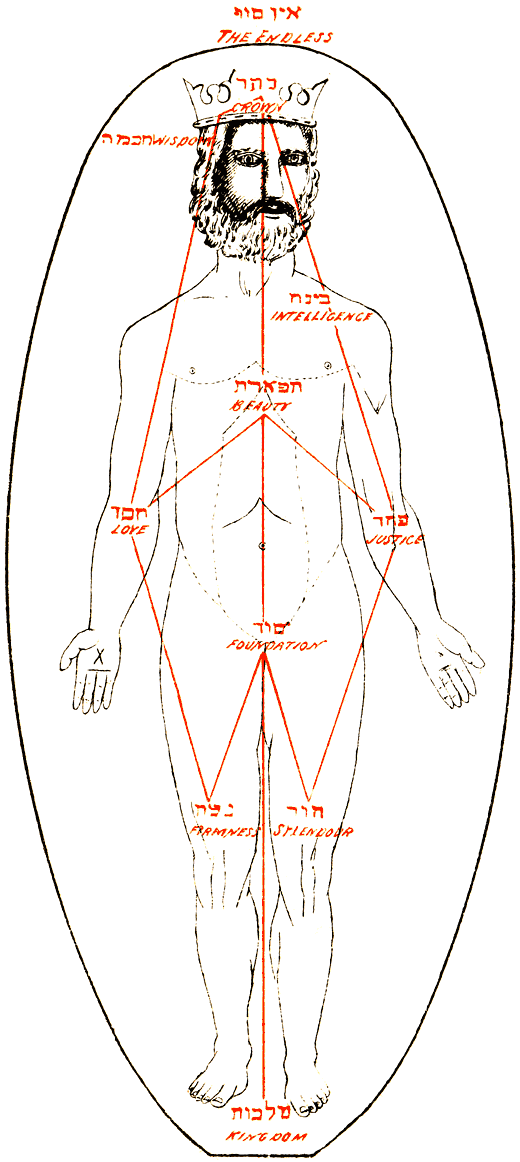
אין סוף THE ENDLESS
כתר CROWN
חכמה WISDOM
בינה INTELLIGENCE
תפארת BEAUTY
חסד LOVE פחד JUSTICE
יסוד FOUNDATION
הוד SPLENDOUR נצח FIRMNESS
מלכות KINGDOM
Now in looking at the Sephiroth which constitute the first triad, it will be seen that they represent the intellect; hence this triad is called the Intellectual World (עולם מושכל). The second triad, again, represents moral qualities; hence it is designated the moral or Sensuous World (עולﬦ מורגש): whilst the third triad represents power and stability, and hence is designated the Material World (עולﬦ המוטבע). These three aspects in which the En Soph manifested himself are called the Faces (אנפין and פרצופין = πρόσωπον, the two words are identical, the former being pure Aramaic, and the latter from the Greek). In the arrangement of this trinity of triads, so as to produce what is called the Kabbalistic tree, denominated the Tree of Life (עץ חיים), or simply the Tree (אילן), the first triad is placed above, the second and third are placed below, in such a manner that the three masculine Sephiroth are on the right, the three feminine on the left, whilst the four uniting Sephiroth occupy the centre, as shown in the following diagrams:—
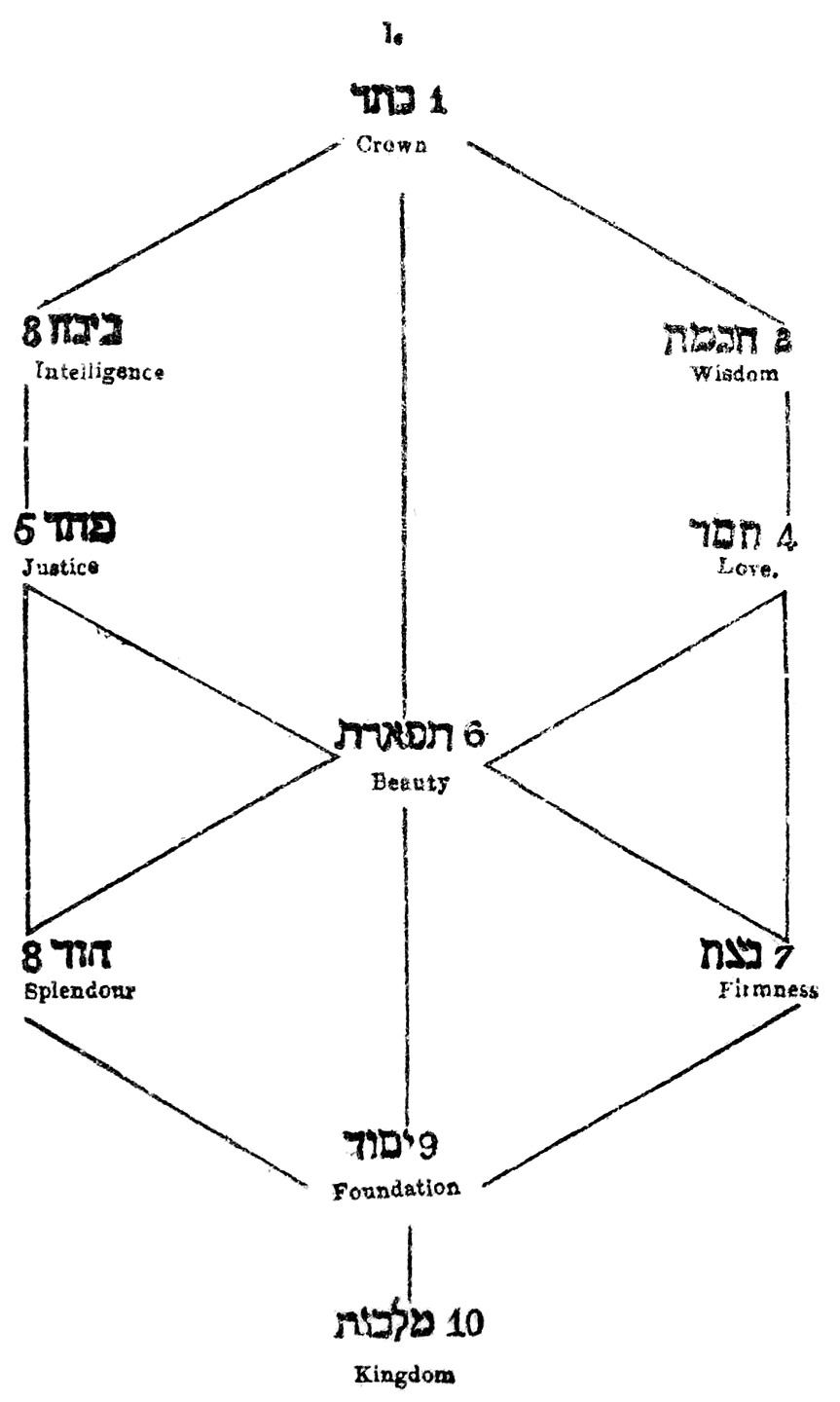
I.
כתר 1 Crown
3 בינה Intelligence חכמה 2 Wisdom
5 פחד Justice חסד 4 Love
תפארת 6 Beauty
8 הוד Splendour נצח 7 Firmness
יסוד 9 Foundation
מלכות 10 Kingdom
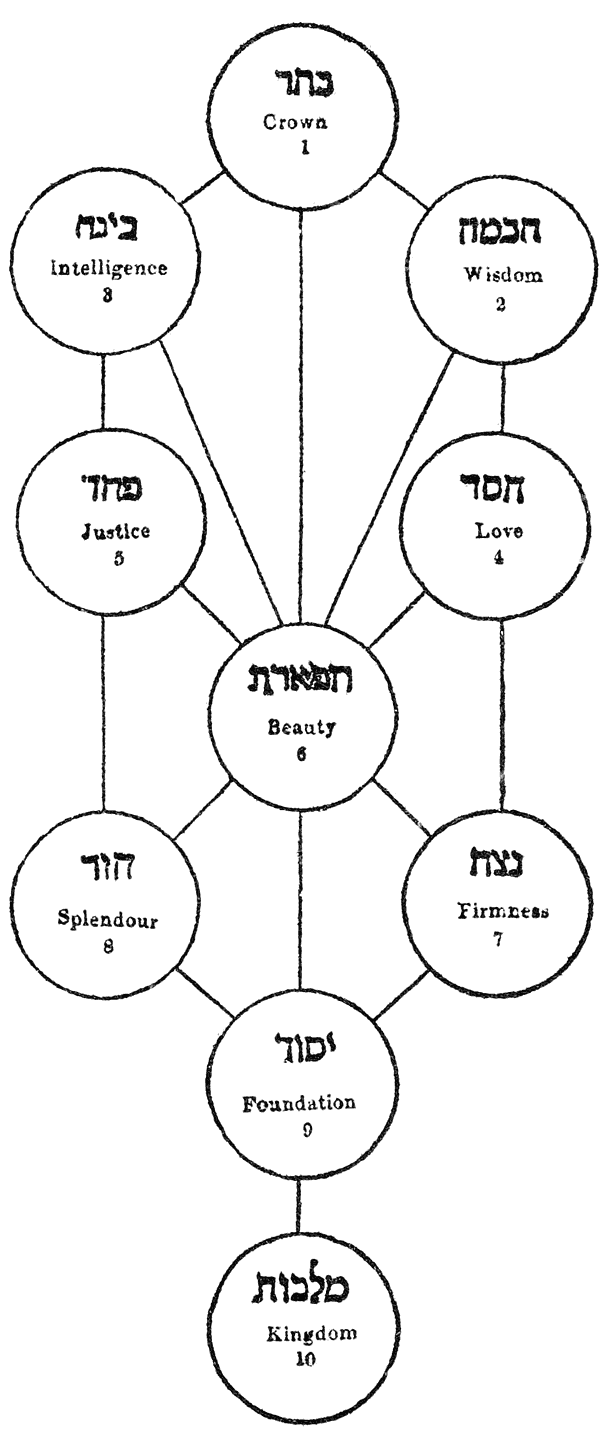
II.
און סוף The Endless.
כתר Crown 1
בינח Intelligence 3 חכמה Wisdom 2
פחד Justice 5 חסד Love 4
תפארת Beauty 6
הוד Splendour 8 נצח Firmness 7
יסוד Foundation 9
מלכות Kingdom 10
The three Sephiroth on the right, representing the principle of mercy (חסד), are called the Pillar of Mercy (סטרא ימינא עמודא דחסד); the three on the left, representing the principle of rigour (דין), are denominated the Pillar of Judgment (סטרא דשמאלא עמודא דדינה); whilst the four Sephiroth in the centre, representing mildness (רחמיﬦ), are called the Middle Pillar (עמודא דאמצעיתא). Each Sephira composing this trinity of triads is, as it were, a trinity in itself. I, It has its own absolute character; II, It receives from above; and III, It communicates to what is below it. Hence the remark, “Just as the Sacred Aged is represented by the number three, so are all the other lights (Sephiroth) of a threefold nature.” (Sohar, iii, 288 b.) Within this trinity in each unit and trinity of triads there is a trinity of units, which must be explained before we can propound the Kabbalistic view of the cosmogony.
We have seen that three of the Sephiroth constitute uniting links between three pairs of opposites, and by this means produce three triads, respectively denominated the Intellectual World, the Sensuous or Moral World, and the Material World, and that these three uniting Sephiroth, together with the one which unites the whole into a common unity, form what is called the Middle Pillar of the Kabbalistic tree. Now from the important position they thus occupy, these Sephiroth are synecdochically used to represent the worlds which by their uniting potency they respectively yield. Hence the Sephira, Crown (כתר), from which the Sephiroth, Wisdom (חכמה) and Intelligence (בינה), emanated, and by which they are also united, thus yielding the Intellectual World, is by itself used to designate the Intellectual World (עולﬦ המושכל). Its own names, however, are not changed in this capacity, and it still continues to be designated by the several appellations mentioned in the description of the first Sephira. The sixth Sephira, called Beauty (תפארת), which unites Sephiroth IV (הסד, Love) and V (פחד, Justice), thus yielding the Sensuous World, is by itself used to denote the Sensuous World, and in this capacity is called the Sacred King (מלכא קדישא), or simply the King (מלכא); whilst the Sephira called Kingdom (מלכות), which unites the whole Sephiroth, is here used to represent the Material World, instead of the ninth Sephira, called Foundation (יסוד), and is in this capacity denominated the Queen (מלכתא) or the Matron (מטרוניתא). Thus we obtain within the trinity of triads a higher trinity of units,—viz., the Crown (כתר), Beauty (תפארת), and Kingdom (מלכות),—which represents the potencies of all the Sephiroth.
II. The Creation or the Kabbalistic Cosmogony.
Having arrived at the highest trinity which comprises all the Sephiroth, and which consists of the Crown, the King, and the Queen, we shall be able to enter into the cosmogony of the Kabbalah. Now, it is not the En Soph who created the world, but this trinity, as represented in the combination of the Sephiroth; or rather the creation has arisen from the conjunction of the emanations. The world was born from the union of the crowned King and Queen; or, according to the language of the Kabbalah, these opposite sexes of royalty, who emanated from the En Soph, produced the universe in their own image. Worlds, we are told, were indeed created before ever the King and Queen or the Sephiroth gave birth to the present state of things, but they could not continue, and necessarily perished, because the En Soph had not yet assumed this human form in its completeness, which not only implies a moral and intellectual nature, but, as conditions of development, procreation, and continuance, also comprises sexual opposites. This creation, which aborted and which has been succeeded by the present order of things, is indicated in Gen. xxxvi, 31–40 . The kings of Edom, or the old kings as they are also denominated, who are here said to have reigned before the monarchs of Israel, and are mentioned as having died one after the other, are those primordial worlds which were successively convulsed and destroyed; whilst the sovereigns of Israel denote the King and Queen who emanated from the En Soph, and who have given birth to and perpetuate the present world. Thus we are told:—
“Before the Aged of the Aged, the Concealed of the Concealed, expanded into the form of King, the Crown of Crowns [i.e. the first Sephira], there was neither beginning nor end. He hewed and incised forms and figures into it [i.e. the crown] in the following manner:—He spread before him a cover, and carved therein kings [i.e. worlds], and marked out their limits and forms, but they could not preserve themselves. Therefore it is written, ‘These are the kings that reigned in the land of Edom before there reigned any king over the children of Israel.’ ( Gen. xxxvi, 31 .) This refers to the primordial kings and primordial Israel. All these were imperfect: he therefore removed them and let them vanish, till he finally descended himself to this cover and assumed a form.” (Idra Rabba, Sohar, iii, 148 a.)
It was therefore after the destruction of previous worlds, and after the En Soph or the Boundless assumed the Sephiric form, that the present world was created. “The Holy One, blessed be he, created and destroyed several worlds before the present one was made, and when this last work was nigh completion, all the things of this world, all the creatures of the universe, in whatever age they were to exist, before ever they entered into this world, were present before God in their true form. Thus are the words of Ecclesiastes to be understood ‘What was, shall be, and what has been done, shall be done.’ ” (Sohar, iii, 61 b.) “The lower world is made after the pattern of the upper world; every thing which exists in the upper world is to be found as it were in a copy upon earth; still the whole is one.” (Ibid., ii, 20 a.)
This world, however, is not a creation ex nihilo, but is simply an immanent offspring and the image of the King and Queen, or, in other words, a farther expansion or evolution of the Sephiroth which are the emanations of the En Soph. This is expressed in the Sohar in the following passage—“The indivisible point [the Absolute], who has no limit, and who cannot be comprehended because of his purity and brightness, expanded from without, and formed a brightness which served as a covering to the indivisible point, yet it too could not be viewed in consequence of its immeasurable light. It too expanded from without, and this expansion was its garment. Thus everything originated through a constant upheaving agitation, and thus finally the world originated.” (Sohar, i, 20 a.) The universe therefore is an immanent emanation from the Sephiroth, and reveals and makes visible the Boundless and the Concealed of the Concealed. And though it exhibits the Deity in less splendour than its parents the Sephiroth, because it is further removed from the primordial source of light, yet, as it is God manifested, all the multifarious forms in the world point out the unity which they represent; and nothing in it can be destroyed, but everything must return to the source whence it emanated. Hence it is said that “all things of which this world consists, spirit as well as body, will return to their principal, and the root from which they proceeded.” (Sohar, ii, 218 b.) “He is the beginning and end of all the degrees in the creation. All these degrees are stamped with his seal, and he cannot be otherwise described than by the unity. He is one, notwithstanding the innumerable forms which are in him.” (Ibid., i, 21 a.)
Now these Sephiroth, or the World of Emanation (עולם אצילות), or the Atzilatic World, gave birth to three worlds in the following order:—From the conjunction of the King and Queen (i.e., the ten Sephiroth) proceeded—I. The World of Creation, or the Briatic World (עולם הבריאה), also called The Throne (כורסיא), which is the abode of pure spirits, and which, like its parents, consists of ten Sephiroth, or Emanations. The Briatic World, again, gave rise to, II. The World of Formation, or the Jetziratic World (עולﬦ היצירה), which is the habitation of the angels, and also consists of ten Sephiroth; whilst the Jetziratic World, again, sent forth, III. The World of Action, or the Assiatic World (עולﬦ העשיה), also called the World of Keliphoth (עולﬦ הקליפות), which contains the Spheres (גלגלים) and matter, and is the residence of the Prince of Darkness and his legions. Or, as the Sohar describes it—“After the Sephiroth, and for their use, God made the Throne (i.e., the World of Creation), with four legs and six steps, thus making ten (i.e., the decade of Sephiroth which each world has).… For this Throne and its service he formed the ten Angelic hosts (i.e., the World of Formation), Malachim, Arelim, Chajoth, Ophanim, Chashmalim, Elim, Elohim, Benei Elohim, Ishim, and Seraphim (מלאכיﬦ אראליﬦ חיות אופניﬦ חשמליﬦ אליﬦ אלהיﬦ בני אלהים אישים שרפים), and for their service, again, he made Samaël and his legions (i.e., the World of Action), who are, as it were, the clouds upon which the angels ride in their descent on the earth, and serve, as it were, for their horses. Hence it is written—‘Behold the Lord rideth upon a swift cloud, and shall come into Egypt.’ ” ( Isa. xix, 1 .) (Sohar ii, 43 a.) There are, therefore, four worlds, each of which has a separate Sephiric system, consisting of a decade of emanations. I. The Atzilatic World, called alternately the World of Emanations (עולם אצילות), the Image (דיוקנא = εἰκών with ד prefixed), and the Heavenly Man (אדם עלאה), which, by virtue of its being a direct emanation from God and most intimately allied with the Deity, is perfect and immutable. II. The Briatic World, called the World of Creation (עולם הבריאה) and the Throne (כורסיא), which is the immediate emanation of the former, and whose ten Sephiroth, being further removed from the En Soph, are of a more limited and circumscribed potency, though the substances they comprise are of the purest nature and without any admixture of matter. III. The Jetziratic World, called the World of Formation (עולם היצירה) and the World of Angels (מלאכיא), which proceeded from the former world, and whose ten Sephiroth, though of a still less refined substance than the former, because further removed from the primordial source, are still without matter. It is in this angelic world where those intelligent and uncorporeal beings reside, who are wrapped in a luminous garment, and who assume a sensuous form when they appear to man. And IV. The Assiatic World, called the World of Action (עולם העשיה) and the World of Matter (עולם הקליפות) which emanated from the preceding world, the ten Sephiroth of which are made up of the grosser elements of all the former three worlds, and which has sunk down in consequence of its materiality and heaviness. Its substances consist of matter limited by space and perceptible to the senses in a multiplicity of forms. It is subject to constant changes, generations, and corruptions, and is the abode of the Evil Spirit.
III. The Creation of Angels and Men.
All human countenances are divisible into the four primordial types of faces, which appeared at the mysterious chariot throne in the vision of the prophet Ezekiel, viz., the face of man, of the lion, the ox and the eagle. Our faces resemble these more or less according to the rank which our souls occupy in the intellectual or moral dominion. “And physiognomy does not consist in the external lineaments, but in the features which are mysteriously drawn in us. The features in the face change according to the form which is peculiar to the inward face of the spirit. It is the spirit which produces all those physiognomical peculiarities known to the wise; and it is only through the spirit that the features have any meaning. All those spirits and souls which proceed from Eden (i.e., the highest wisdom) have a peculiar form, which is reflected in the face.” (Sohar, ii, 73 b.) The face thus lighted up by the peculiar spirit inhabiting the body, is the mirror of the soul; and the formation of the head indicates the character and temper of the man. An arched forehead is a sign of a cheerful and profound spirit, as well as of a distinguished intellect; a broad but flat forehead indicates foolishness and silliness; whilst a forehead which is flat, compressed on the sides and spiral, betokens narrowness of mind and vanity. (Comp. Sohar, ii, 71 b, 75 a.)
As a necessary condition of free existence and of moral being, the souls are endowed by the Deity, from the very beginning, with the power of adhering in close proximity to the primordial source of infinite light from which they emanated, and of alienating themselves from that source and pursuing an independent and opposite course. Hence, Simon ben Jochai said, “If the Holy One, blessed be he, had not put within us both the good and the evil desire, which are denominated light and darkness, the created man would have neither virtue nor vice. For this reason it is written—‘Behold, I have set before thee this day life and good, and death and evil.’ ( Deut. xxx, 15 .) To this the disciples replied, Wherefore is all this? Would it not be better if reward and punishment had not existed at all, since in that case man would have been incapable of sinning and of doing evil. He rejoined, It was meet and right that he should be created as he was created, because the Law was created for him, wherein are written punishments for the wicked and rewards for the righteous; and there would not have been any reward for the righteous and punishment for the wicked but for created man.” (Sohar, i, 23 a.) So complete is their independence, that souls, even in their pre-existent state, can and do choose which way they intend to pursue. “All souls which are not guiltless in this world, have already alienated themselves in heaven from the Holy One, blessed be he; they have thrown themselves into an abyss at their very existence, and have anticipated the time when they are to descend on earth.… Thus were the souls before they came into this world.” (Ibid., iii, 61 b.)
IV. The Destiny of Man and the Universe.
The two feelings of love and fear are designed to aid the soul in achieving her high destiny, when she shall no more look through the dark glass, but see face to face in the presence of the Luminous Mirror, by permeating all acts of obedience and divine worship. And though perfect love, which is serving God purely out of love, like that higher knowledge, is to be man’s destiny in heaven, yet the soul may attain some of it on earth, and endeavour to serve God out of love and not from fear, as thereby she will have an antepast on earth of its union with the Deity, which is to be so rapturous and indissoluble in heaven. “Yet is the service which arises from fear not to be depreciated, for fear leads to love. It is true that he who obeys God out of love has attained to the highest degree, and already belongs to the saints of the world to come, but it must not be supposed that to worship God out of fear is no worship. Such a service has also its merit, though in this case the union of the soul with the Deity is slight. There is only one degree which is higher than fear: it is love. In love is the mystery of the divine unity. It is love which unites the higher and lower degrees together; it elevates everything to that position where everything must be one. This is also the mystery of the words, ‘Hear O Israel, the Lord our God is one God.’ ” (Sohar, ii, 216 a.)
יר אה
אה בה
When thus fulfilling the commandments the pious not only enjoy a prelibation of that sublime light which shines in heaven, and which will serve them as a garment when they enter into the other world and appear before the Holy One (Sohar, ii, 299 b), but become on earth already the habitation of the Sephiroth, and each saint has that Sephira incarnate in him which corresponds to the virtue he most cultivates, or to the feature most predominant in his character. Among the patriarchs, therefore, who were the most exalted in piety, we find that Love, the fourth Sephira, was incarnate in Abraham; Rigour, the fifth Sephira, in Isaac; Mildness, the sixth Sephira, in Jacob; Firmness, the seventh Sephira, in Moses; Splendour, the eighth Sephira, in Aaron; Foundation, the ninth Sephira, in Joseph; and Kingdom, the tenth Sephira, was incarnate in David. Hence all the righteous who constitute the emanations, of the ten Sephiroth are divided into three classes corresponding to the three principles or Pillars exhibited in the Kabbalistic Tree, viz.:—I. The Pillar of Mercy (חסד), represented by the Patriarch Abraham (comp. חסד לאברהם Micah, vii, 20 ;) II. The Pillar of Justice (פחד), represented by Isaac (comp. פחד יצחק Gen. xxxi, 42 ); and III. The Middle Pillar, represented by Jacob (comp. אמת ליעקב Micah vii, 20 ), which is the connecting or uniting principle. (Sohar, i, 146 a; 148 b.) It is for this reason that the patriarchs are denominated the Chariot-throne of the Lord.
Following the paths of righteousness, the saints on earth enjoy the protection of heaven in an especial manner, by virtue of the divine wisdom inherent in them, for they are able to decipher the signs which God has put in the firmament to shield them from accidents. “In heaven above, that surrounds the universe, are signs in which the deepest mysteries are concealed. These signs are constellations and stars, which are studied and deciphered by the wise.” (Sohar, ii, 76 a.) Hence the admonition—“He who has to start on a journey very early, should rise at daybreak, look carefully towards the east, and he will perceive certain signs resembling letters which pierce through the sky and appear above the horizon. These shining forms are those of the letters wherewith God created heaven and earth. Now, if man knows the secret meaning of the sacred name, consisting of forty-two letters, and meditates on it with becoming devotion and enthusiasm, he will perceive six Jods (יוד״ין) in the pure sky, three to the right and three to the left, as well as three Vavs (וו״ין), which hover about in the heavenly arch. These are the letters of the priestly benediction (ברכת כהנים).… In the bright morning he will perceive a pillar towards the west, hanging perpendicularly over the earthly paradise, and another pillar hanging over the centre of paradise. This luminous pillar has the three colours of a purple web: three birds stand on it, singing in the following manner. The first sings, ‘Hallelujah! Praise, O ye servants of the Lord, praise the name of the Lord’ ( Ps. cxiii, 1 ); the second, ‘Blessed be the name of the Lord from this time forth and for evermore’ (ibid., v. 2 ); and the third, ‘From the rising of the sun unto the going down of the same, the Lord’s name is to be praised’ (ibid., v. 3 ). This is the time when the pious traveller is to offer up his morning prayer, in order that he may secure heaven’s blessings and the sublime and divine mercy as his sure guide.” (Sohar, ii, 130 b.)
V. The Kabbalistic view of the Old Testament, and its relation to Christianity.
This fourfold sense is gradually disclosed to the initiated in the mysteries of the Kabbalah by the application of definite hermeneutical rules, which chiefly affect the letters composing the words. The most prominent of these canons are—
I. Every letter of a word is reduced to its numerical value, and the word is explained by another of the same quantity. Thus from the words “Lo! three men stood by him” ( Gen. xviii, 2 ), it is deduced that these three angels were Michael, Gabriel, and Raphael, because והנה שלשה and lo! three men, and אלו מיכאל גבריאל ורפאל these are Michael, Gabriel, and Raphael, are of the same numerical value, as will be seen from the following reduction to their numerical value of both these phrases.
ה ש ל ש ה נ ה ו
5 + 300 + 30 + 300 + 5 + 50 + 5 + 6 = 701
ל א כ י מ ו ל א
+ 30 + 1 + 20 + 10 + 40 + 6 + 30 + 1
ל א י ר ב ג
+ 30 + 1 + 10 + 200 + 2 + 3
ל א פ ר ו
30 + 1 + 80 + 200 + 6 = 701
This rule in called גמטריא = גרמטיא which is a metathesis of the Greek word γράμμα, γραμμεία, or γραμματεία in the sense of numbers as represented by letters.
2. Every letter of a word is taken as an initial or abbreviation of a word. Thus every letter of the word בראשית, the first word in Genesis, is made the initial of a word, and we obtain בראשית ראה אלהים שיקבלו ישראל תורה in the beginning God saw that Israel would accept the Law. This rule is denominated נוטריקון = notaricun, from notarius, a shorthand writer, one who among the Romans belonged to that class of writers who abbreviated and used single letters to signify whole words.
3. The initial and final letters of several words are respectively formed into separate words. Thus from the beginnings and ends of the words מי יעלה לנו השמימה who shall go up for us to heaven? ( Deut. xxx, 12 ) are obtained מילה circumcision and יהוה Jehovah, and inferred that God ordained circumcision as the way to heaven.
5. The words of those verses which are regarded as containing a peculiar recondite meaning are ranged in squares in such a manner as to be read either vertically or boustrophedonally, beginning at the right or left hand. Again the words of several verses are placed over each other, and the letters which stand under each other are formed into new words. This is especially seen in the treatment of three verses in Exod. xiv , (viz., 19–21 ), which are believed to contain the three Pillars of the Sephiroth, and the Divine Name of seventy-two words. The following tables will illustrate this principle of interpretation. The first of these three verses ויסע מלאך האלהים ההלך לפני מחנה ישראל וילך מאחריהם ויסע עמוד הענן מפניהם ויעמד מאחריהם, and the angel of God, which went before the camp of Israel, removed and went behind them; and the pillar of the cloud went from before their face, and stood behind them ( Exod. xiv, 19 ), is read boustrophedonally, as follows:—
I.
ו א ל ש א ע מ מ
י ל פ ר ח ע פ ד
ס ח נ א ר מ נ מ
ע י י ל י ו י א
מ ם מ י ח ד ח ח
ל ח ח י ם ח ם ר
א ח נ ל ו ע ו י
ך ל ח ך י נ ח
ה ך י מ ס י ע ם
The second of these three verses ויבא בין מחנה מצרים נבין מהנה ישראל ויהי העגן והחשך ויאר את הלילה ולא קרב זה אל זה כל הלילה, and it came between the camp of the Egyptians and the camp of Israel; and it was a cloud and darkness to them, but gave light by night to these, so that the one came not near the other all the night ( Exod. xiv, 20 ), is in the first place divided, and read from right to left, beginning at the top, as exhibited in the following diagram.
II.
ו י ב א ב י ן מ ח
נ ה מ צ ר י ם ו ב*
י ן מ ח נ ה י ש ר
א ל ו י ה י ה ע נ
ן ו ה ח ש ך ו י א
ר א ת ה ל י ל ה ו
ל א ק ר ב ז ה א ל
ז ה כ ל ה ל י ל ה
It is then divided in the following manner, and read from left to right, beginning at the bottom.
III.
ה ל י ל ה ל כ ה
ז ל* א ה ז ב ר ק
א ל ו ה ל י ל ה
ת א ר א י ו ך ש
ח ה ו ן נ ע ה י
ה י ו ל א ר ש י
ה נ ח מ ן י ב ו
ם י ר צ מ ה נ ח
מ ן י ב א ב י ו
Whilst the third of these three verses ויט משה את ידו על הים ויולך יהוה את הים ברוח קדים עזה כל הלילה וישם את הים לחרבה ויבקעו המים, and Moses stretched out his hand over the sea; and the Lord caused the sea to go back by a strong east wind all that night, and made the sea dry land, and the waters were divided ( Exod. xiv. 21 ), is divided as follows, and read from the right, beginning at the bottom.
IV.
י ב ק ע ו ה מ י ם
ה י ם ל ח ר ב ה ו
י ל ה ו י ש ם א ת
י ם ע ז ה כ ל ה ל
ה י ם ב ר ו ח ק ד
ו ל ך י ה ו ה א ת
ד ו ע ל ה י ם ו י
ו י ט מ ש ה א ת י
כהת Adorandus. אכא Longanimis. ללה Annunciatus. מהש Quæsitus. עלם Salus. סיט Spes. ילי Auxiliator. והו Exaltator.
הקם Advocatus. הרי Ens. מבה Sublevator. יזל Decantatus. ההע Opportunus. לאו Exultabundus. אלד הוי Recordabilis.
חהו Expetendus. מלה Custos. ייי Dexter. נלך Fortis. פהל Ervens. לוו Exauditor. כלי Justitin. לאו Dominator.
ושר Rector. לכב Solus. אום Adolescentia. ריי Sanator. שאה Festinus. ירת Salvator. האא Invocandus. נתה Mirabilis.
ייז Propulsator. רהע Adivtor. חעם Refugium. אני Facies. מנד Gloria. כוק Deprecatio. להח Expectatio. יחו Cogitabundus.
מיה Revelator. עשל Magnificus. ערי Operator. סאל Compatiens. ילה Doctor. וול Matutinus. מיך Custos. ההה Liberator.
פוי Erector. מבח Aeternum. נית Regnator. ננא Verus. עמם Altissimus. החש Lætabundus. דני Clemens. והו Maximus.
מחי Mercator. ענו Laudabilis. יהה Amabilis. ומב Benedictus. מצר Justus. הרח Oriens. ייל Animus. נמם Protector.
מום Requies. חיי Multus. יבם Deus. ראה Præmium. חבו Bonus. איע Dator. מנק Assisteus. דמב Deprecabilis.
6. The letters of words are changed by way of anagram and new words are obtained. This canon is called תמורה or חילוף אותיות, permutation, and the commutation is effected according to fixed rules. Thus the alphabet is bent exactly in the middle, and one half is put over the other, and by changing alternately the first letter or the first two letters at the beginning of the second line, twenty-two commutations are produced ex. gr.:—
11 10 9 8 7 6 5 4 3 2 1
[ כ י ט ח ז ו ה ד ג ב א ]
מ נ ס ע פ צ ק ר ש ת ל
[ ל כ י ט ח ז ו ה ד ג א ] or
מ נ ס ע פ צ ק ר ש ת ב
These anagramic alphabets obtain their respective names from the first two specimen pairs of letter which indicate the interchange. Thus, for instance, the first is called Albath אל״בת from the first words, the second Abgath אב״גת, and so on. The following table exhibits the established rules of the alphabetical permutations.
כם ינ טס חע זפ וצ הק דר גש בת אל 1. Albath.
לם כנ יס טע חפ זצ וק הר דש גת אב 2. Abgath.
במ לנ כס יע טפ חצ זק ור הש דת אג 3. Agdath.
נמ לס כע יפ טצ חק זר וש הת בג אד 4. Adbag.
גנ מס לע כפ יצ טק חר זש ות בד אה 5. Ahbad.
נס מע לפ כצ יק טר חש זת גד בה או 6. Avba.
דס נע מפ לצ כק יר טש חת גה בו אז 7. Azbav.
סע נפ מצ לק כר יש טת דה גו בז אח 8. Achbaz.
הע ספ נצ מק לר כש ית דו גז בח אט 9. Atbach.
עפ סצ נק מר לש כת הו דז גח בט אי 10. Aibat.
ופ עצ סק נר מש לת הז דח גט בי אכ 11. Achbi.
פצ עק סר נש מת וז הח דט גי בכ אל 12. Albach.
וצ פק ער סש נת וח הט די גכ בל אמ 13. Ambal.
צק פר עש סת זח וט הי דכ גל במ אנ 14. Anbam.
חק צר פש עת זט וי הכ דל גם בנ אס 15. Asban.
קר צש פת חט זי וכ הל דמ גנ בס אע 16. Aabas.
טר קש טת חי זכ ול המ דנ גס בע אפ 17. Afba.
רש קת טי חכ זל ומ הנ דס גע בפ אצ 18. Azbaf.
יש רת טכ חל זמ ונ הס דע גפ בצ אק 19. Akbaz.
שת יכ טל חמ זנ וס הע דפ גצ בק אר 20. Arbak.
כת יל טמ חנ זס וע הפ דצ גכ בר אש 21. Ashbar.
כל ימ טנ חס זע ופ הצ דק גר בש את 22. Athbash.
To this list is to be added—
שת קר פצ סע מנ כל טי זח הו גד אב 23. Abgad.
כת יש טר חק זצ ופ הע דס גנ בם אל 24. Albam.
Besides these canons the Kabbalah also sees a recondite sense in the form of the letters, as well as in the ornaments which adorn them.
The use made by some well-meaning Christians of the above-named Kabbalistic canons of interpretation, in controversies with Jews, to prove that the doctrines of Christianity are concealed under the letter of the Old Testament, will now be deprecated by every one who has any regard for the laws of language. As a literary curiosity, however, we shall give one or two specimens. No less a person than the celebrated Reuchlin would have it that the doctrine of the Trinity is to be found in the first verse of Genesis. He submits, if the Hebrew word ברא, which is translated created, be examined, and if each of the three letters composing this word be taken as the initial of a separate word, we obtain the expressions בן רוח אב Son, Spirit, Father, according to Rule 2 (p. 131). Upon the same principle this erudite scholar deduces the first two persons in the Trinity from the words—“the stone which the builders refused is become the head stone of the corner” ( Ps. cxviii, 22 ), by dividing the three letters composing the word אבן stone, into אב בן Father, Son (Comp. De Verbo Mirifico, Basel, 1494). In more recent times we find it maintained that the ‘righteousness’ spoken of in Daniel ix, 24 , means the Anointed of Jehovah, because the original phrase, צדק עלמים is by Gematria, = numerical value, (which is Rule 1, given above, p. 131), the same as משיח יהוה. So pleased is the author with this discovery, that he takes great care to remark—“It is a proof which I believe has hitherto escaped the notice of interpreters.” Such proofs, however, of the Messiaship of Christ bring no honour to our religion; and in the present day argue badly both against him who adduces them and against him who is convinced by them.