II.
Reading edition
We now proceed to trace the date and origin of the Kabbalah. Taking the ex parte statement for what it is worth, viz., that this secret doctrine is of a pre-Adamite date, and that God himself propounded it to the angels in Paradise, we shall have to examine the age of the oldest documents which embody its tenets, and compare these doctrines with other systems, in order to ascertain the real date and origin of this theosophy. But before this is done, it will be necessary to summarize, as briefly as possible, those doctrines which are peculiar to the Kabbalah, or which it expounds and elaborates in an especial manner, and which constitute it a separate system within the precincts of Judaism. The doctrines are as follow:—
1. God is boundless in his nature. He has neither will, intention, desire, thought, language, nor action. He cannot be grasped and depicted; and, for this reason, is called En Soph, and as such he is in a certain sense not existent.
2. He is not the direct creator of the universe, since he could not will the creation; and since a creation proceeding directly from him would have to be as boundless and as perfect as he is himself.
3. He at first sent forth ten emanations, or Sephiroth, which are begotten, not made, and which are both infinite and finite.
4. From these Sephiroth, which are the Archetypal Man, the different worlds gradually and successively evolved. These evolutionary worlds are the brightness and the express image of their progenitors, the Sephiroth, which uphold all things.
5. These emanations, or Sephiroth, gave rise to or created in their own image all human souls. These souls are pre-existent, they occupy a special hall in the upper world of spirits, and there already decide whether they will pursue a good or bad course in their temporary sojourn in the human body, which is also fashioned according to the Archetypal image.
6. No one has seen the En Soph at any time. It is the Sephiroth, in whom the En Soph is incarnate, who have revealed themselves to us, and to whom the anthropomorphisms of Scripture and the Hagada refer. Thus when it is said, “God spake, descended upon earth, ascended into heaven, smelled the sweet smell of sacrifices, repented in his heart, was angry,” &c, &c, or when the Hagadic works describe the body and the mansions of the Deity, &c., all this does not refer to the En Soph, but to these intermediate beings.
7. It is an absolute condition of the soul to return to the Infinite Source whence it emanated, after developing all those perfections the germs of which are indelibly inherent in it. If it fails to develope these germs, it must migrate into another body, and in case it is still too weak to acquire the virtues for which it is sent to this earth, it is united to another and a stronger soul, which, occupying the same human body with it, aids its weaker companion in obtaining the object for which it came down from the world of spirits.
8. When all the pre-existent souls shall have passed their probationary period here below, the restitution of all things will take place; Satan will be restored to an angel of light, hell will disappear, and all souls will return into the bosom of the Deity whence they emanated. The creature shall not then be distinguished from the Creator. Like God, the soul will rule the universe: she shall command, and God obey.
With these cardinal doctrines before us we shall now be able to examine the validity of the Kabbalists’ claims to the books which, according to them, propound their doctrines and determine the origin of this theosophy. Their works are I. The Book of Creation; II. The Sohar; and III. The Commentary of the Ten Sephiroth. As the Book of Creation is acknowledged by all parties to be the Oldest, we shall examine it first.
I. The Book of Creation or Jetzira.
Then comes the hexade, each unit of which represents space in the six directions (שש קצוות), or the four corners of the world, east, west, north, and south, as well as height and depth which emanated from the ether, and in the centre of which is the Holy Temple supporting the whole (והיכל הקודש מכוון באמצע). The position of the decade is therefore as follows—
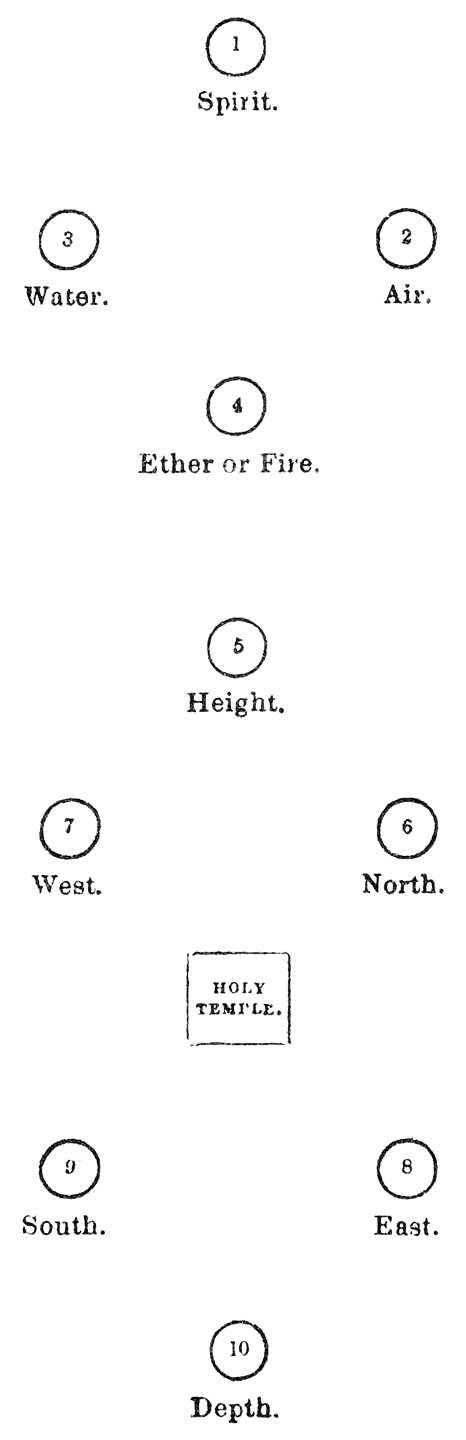
These constitute the primordial ten, from which the whole universe proceeded.
1. Three Mothers, Aleph, Mem, Shin. שלש אמות אמ״ש
The above-named three primordial elements, viz., ether, water and air, which were as yet partially ideal and ethereal, became more concrete and palpable in the course of emanation. Thus the fire developed itself into the visible heaven, the elementary water thickened into the earth, embracing sea and land, whilst the elementary air became the atmospheric air. These constitute the three fundamental types of the universe (שלש אמות בעולם). The three primordial elements also thickened still more in another direction, and gave birth to a new order of creatures, which constitute the course of the year and the temperatures. From the ether developed itself heat, from the water emanated cold, and from the air proceeded the mild temperature which shows itself in the rain or wet. These constitute the fundamental points of the year (שלש אמות בשנה). Whereupon the three primordial elements developed themselves in another direction again, and gave rise to the human organism. The ether sent forth the human head, which is the seat of intelligence; the water gave rise to the body, or the abdominal system; whilst the air, which is the central element, developed itself into the genital organ. These three domains, viz., the macrocosm, the revolution of time, and the microcosm, which proceeded from the three primordial elements, are exhibited by the three letters Aleph (א), Mem (מ) and Shin (ש.) Hence it is said that by means of these three letters—which, both in their phonetic and sacred character, represent the elements, inasmuch as א, as a gentle aspirate, and as the initial of אויר air, symbolises THE AIR; מ, as a labial or mute, and as the initial of מיﬦ water, represents THE WATER; whilst ש, as a sibilant, and as the last letter of אש fire, typifies THE FIRE (Chapter iii, Mishna iii)—God created
In the World—The Fire, Water, Air.
In Man—The Head, Body, Breast.
In the Year—Heat, Cold, Wet.
2. Seven double consonants—Beth, Gimel, Daleth, Caph, Pe, Resh, Tav שבע כפולות בגדכפרת
The three dominions proceeding from the triad of the primordial elements which emanated from the unity continued to develope themselves still further. In the macrocosm were developed the seven planets, in time the seven days, and in the microcosm the seven sensuous faculties. These are represented by the seven double consonants of the alphabet. Hence it is said that by means of these seven letters, which are called double because they have a double pronunciation, being sometimes aspirated and sometimes not, according to their being with or without the Dagesh, God created—
In the World—Saturn, Jupiter, Mars, Sun, Venus, Mercury, Moon.
In Man—Wisdom, Riches, Dominion, Life, Favour, Progeny, Peace.
In the Year—Sabbath, Thursday, Tuesday, Sunday, Friday, Wednesday, Monday.
Owing to the opposite = double pronunciation of these seven letters, being hard and soft, they are also the symbols of the seven opposites (תמורות) in which human life moves, viz., wisdom and ignorance, riches and poverty, fruitfulness and barrenness, life and death, liberty and bondage, peace and war, beauty and deformity. Moreover, they correspond to the seven ends (שבע קצוות), above and below, east and west, north and south, and the Holy Place in the centre, which supports them; and with them God formed the seven heavens, the seven earths or countries, the seven weeks from the feast of Passover to Pentecost. (Chapter iii, Mishna, i–v; cap. iv, Mishna, i–iii.)
3. Twelve simple consonants שתיﬦ עשר פשוטות.
The three dominions then respectively developed themselves into twelve parts, the macrocosm into the twelve signs of the Zodiac, time into twelve months, and the microcosm into twelve active organs. This is shown by the twelve simple consonants of the alphabet. Thus it is declared, that by means of the twelve letters, which are הוז חטי לן סעצק, God created the twelve signs of the Zodiac, viz.:—
In the World—Aries, Taurus, Gemini, Cancer, Leo, Virgo, Libra, Scorpio, Sagittarius, Capricornus, Aquarius, Pisces.
In Man—The organs of Sight, Hearing, Smelling, Talking, Taste, Copulating, Dealing, Walking, Thinking, Anger, Laughter, Sleeping.
In the Year—The twelve months, viz., Nisan, Jiar, Sivan, Tamus, Ab, Elul, Tishri, Cheshvan, Kislev, Tebet, Shebat, Adar. (Comp. chapter v, Mishna i.)
TABLE OF PERMUTATION.
a. Two letters b. Three letters c. Four letters
אב 1. אבג 1. דאבג 19. גאבד 13. באגד 7. אבגד 1.
בא 2. אגב 2. דאגב 20. גאדב 14. באדג 8. אבדג 2.
באג 3. דבאג 21. גבאד 15. בגאד 9. אגבד 3.
בגא 4. דבגא 22. גבדא 16. בגדא 10. אגדב 4.
גאב 5. דגאב 23. גדאב 17. בדאג 11. אדבג 5.
גבא 6. דגבא 24. גדבא 18. בדגא 12. אדגב 6.
form two. build six. build twenty-four.
TABLE OF COMBINATION.
שת רש קר צק פצ עפ סע נס מנ למ כל יכ טי חט זח וז הו דה גד בג אב
. . רת קש צר פק עצ ספ נע מס לנ כמ יל טכ חי זט וח הז דו גה בד אג
. . . . קת צש פר עק סצ נפ מע לס כנ ימ טל חכ זי וט הח דז גו בה אד
. . . . . . צת פש ער סק נצ מפ לע כס ינ טמ חל זכ וי הט דח גז בו אה
. . . . . . . . פת עש סר נק מצ לפ כע יס טנ חמ זל וכ הי דט גח בז או
. . . . . . . . . . עת סש נר מק לצ כפ יע טס חנ זמ ול הכ די גט בח אז
. . . . . . . . . . . . סת נש מר לק כצ יפ טע חס זנ ומ הל דכ גי בט אח
. . . . . . . . . . . . . . נת מש לר כק יצ טפ חע זס ונ המ דל גכ בי אט
. . . . . . . . . . . . . . . . מת לש כר יק טצ חפ זע וס הנ דמ גל בכ אי
. . . . . . . . . . . . . . . . . . לת כש יר טק חצ זפ וע הס דנ גמ בל אכ
. . . . . . . . . . . . . . . . . . . . כת יש טר חק זצ ופ הע דס גנ במ אל
. . . . . . . . . . . . . . . . . . . . . . ית טש חר זק וצ הפ דע גס בנ אמ
. . . . . . . . . . . . . . . . . . . . . . . . טת חש זר וק הצ דפ גע בס אנ
. . . . . . . . . . . . . . . . . . . . . . . . . . חת זש ור הק דצ גפ בע אס
. . . . . . . . . . . . . . . . . . . . . . . . . . . . זת וש הר דק גצ בפ אע
. . . . . . . . . . . . . . . . . . . . . . . . . . . . . . ות הש דר גק בצ אפ
. . . . . . . . . . . . . . . . . . . . . . . . . . . . . . . . הת דש גר בק אצ
. . . . . . . . . . . . . . . . . . . . . . . . . . . . . . . . . . דת גש בר אק
. . . . . . . . . . . . . . . . . . . . . . . . . . . . . . . . . . . . גת בש אר
. . . . . . . . . . . . . . . . . . . . . . . . . . . . . . . . . . . . . . בת אש
. . . . . . . . . . . . . . . . . . . . . . . . . . . . . . . . . . . . . . . . את
— — — — — — — — — — — — — — — — — — — — —
1 + 2 + 3 + 4 + 5 + 6 + 7 + 8 + 9 + 10 + 11 + 12 + 13 + 14 + 15 + 16 + 17 + 18 + 19 + 20 + 21 = 231
In order to ascertain how often a certain number of letters can be transposed, the product of the preceding number must be multiplied with it. Thus—
Letter 2 × 1 = 2
3 × 2 = 6
4 × 6 = 24
5 × 24 = 120
6 × 120 = 720
7 × 720 = 5040 and so on.
From this analysis of its contents it will be seen that the Book Jetzira, which the Kabbalists claim as their oldest document, has really nothing in common with the cardinal doctrines of the Kabbalah. There is not a single word in it bearing on the En Soph, the Archetypal Man, the speculations about the being and nature of the Deity, and the Sephiroth, which constitute the essence of the Kabbalah. Even its treatment of the ten digits, as part of the thirty-two ways of wisdom whereby God created the universe, which has undoubtedly suggested to the authors of the Kabbalah the idea of the ten Sephiroth, is quite different from the mode in which the Kabbalistic Sephiroth are depicted, as may be seen from a most cursory comparison of the respective diagrams which we have given to illustrate the plans of the two systems.
Having shown that the Book Jetzira, claimed by the Kabbalists as their first and oldest code of doctrines, has no affinity with the real tenets of the Kabbalah, we have now to examine:—
II. The Book Sohar.
1. Tosephta and Mathanithan (מתניתן and תוספתא), or Small Additional Pieces which are given in vol. i, 31 b; 32 b; 37 a; 54 b; 59 a; 60 b; 62; 98 b; 121 a; 122; 128 b; 147; 151 a; 152 a; 232; 233 b; 234 a; vol. ii, 4, 27 b; 28 a; 68 b; 135 b; vol. iii, 29 b; 30 a; 54 b; 55. They briefly discuss, by way of supplement, the various topics of the Kabbalah, such as the Sephiroth, the emanation of the primordial light, &c., &c., and address themselves in apostrophes to the initiated in these mysteries, calling their attention to some doctrine or explanation.
2. Hechaloth (היכלות) or The Mansions and Abodes forming part of the text, vol. i, 38 a–45 b; vol. ii, 245 a–269 a. This portion of the Sohar describes the topographical structure of Paradise and Hell. The mansions or palaces, which are seven in number, were at first the habitation of the earthly Adam, but, after the fall of the protoplasts, were rearranged to be the abode of the beatified saints, who for this reason have the enjoyment both of this world and the world to come. The seven words in Gen. i, 2 are explained to describe these seven mansions. Sohar, i, 45 a, describes the seven Hells. In some Codices, however, this description of the Infernal Regions is given vol. ii, 202 b.
3. Sithre Tora (סתרי תורה), or The Mysteries of the Pentateuch, given in separate columns, and at the bottom of pages as follows. Vol. i, 74 b; 75 a; 76 b–77 a; 78 a–81 b; 97 a–102 a; 107 b–111 a; 146 b–149 b; 151 a; 152 b; 154 b–157 b; 161 b–162 b; 165; vol. ii, 146 a. It discusses the divers topics of the Kabbalah, such as the evolution of the Sephiroth, the emanation of the primordial light, &c., &c.
4. Midrash Ha-Neelam (מדרש הנעלם), or The Hidden Midrash, occupies parallel columns with the text in vol. i, 97 a–140 a, and endeavours more to explain passages of Scripture mystically, by way of Remasim (רמזים) and Gematrias (גמטריאות), and allegorically, than to propound the doctrines of the Kabbalah. Thus Abraham’s prayer for Sodom and Gomorrah is explained as an intercession by the congregated souls of the saints in behalf of the sinners about to be punished. (Sohar, i, 104 b.) Lot’s two daughters are the two proclivities in man, good and evil. (Ibid. 110.) Besides this mystical interpretation wherein the Kabbalistic rules of exegesis are largely applied, the distinguishing feature of this portion of the Sohar is its discussion on the properties and destiny of the soul, which constitute an essential doctrine of the Kabbalah.
5. Raja Mehemna (רעיא מהמנא), or the Faithful Shepherd. This portion of the Sohar is given in the second and third volumes, in parallel columns with the text; and when it is too disproportioned for columns, is given at the bottom or in separate pages, as follows. Vol. ii, 25, 40, 59 b; 91 b–93 a; 134 b, 157 b–159 a; 187 b–188 a; vol. iii, 3 a–4 b; 20 a, 24 b, 27, 28 a–29 a; 33 a–34 a; 42 a, 44 a; 63; 67 b–68 a; 81 b–83 b; 85 b–86 a; 88 b–90 a; 92 b–93 a; 97 a–101 a; 103 b–104 a; 108 b–111 b; 121 b–126 a; 145 a–146 b; 152 b–153 b; 174 a–175 a; 178 b–179 b; 180 a, 215 a–239 a; 242 a–258 a; 263 a–264 a; 270 b–283 a. It derives its name from the fact that it records the discussions which Moses the Faithful Shepherd held in conference with the prophet Elias, and with R. Simon b. Jochai, the celebrated master of the Kabbalistic school, who is called the Sacred Light (בוצינא קדישא). The chief object of this portion is to show the profound and allegorical import of the Mosaic commandments and prohibitions, as well as of the Rabbinic injunctions and religious practices which obtained in the course of time. At the dialogue which Moses the lawgiver holds with R. Simon b. Jochai the Kabbalistic lawgiver, not only is the prophet Elias present, but Abraham, Isaac, Jacob, Aaron, David, Solomon, and God himself make their appearance; the disciples of R. Simon are frequently in ecstacies when they hold converse with these illustrious patriarchs and kings of bygone days.
6. Raze Derazin (רזי דרזין), or the Secret of Secrets, Original Secrets, is given in vol. ii, 70 a–75 a, and is especially devoted to the physiognomy of the Kabbalah, and the connection of the soul with the body, based upon the advice of Jethro to his son-in-law Moses (ואתה תחזה) and thou shalt look into the face. ( Exod. xviii, 21 .)
7. Saba Demishpatim (סבא דמשפטים), or the Discourse of the Aged in Mishpatim, given in vol. ii, 94 a–114 a. The Aged is the prophet Elias, who holds converse with R. Simon b. Jochai about the doctrine of metempsychosis, and the discussion is attached to the Sabbatic section called משפטים, i.e., Exod. xxi, 1 – xxiv, 18 , because the Kabbalah takes this word to signify punishments of souls (דינין), and finds its psychology in this section. So enraptured were the disciples when their master, the Sacred Light, discoursed with Moses on this subject, that they knew not whether it was day or night, or whether they were in the body or out of the body. (Sohar, ii, 105 b.)
8. Siphra Detzniutha (ספרא דצניעותא), or the Book of Secrets or Mysteries, given in vol. ii, 176 b–178 b. It is divided into five sections (פרקים), and is chiefly occupied with discussing the questions involved in the creation, e. gr. the transition from the infinite to the finite, from absolute unity to multifariousness, from pure intelligence to matter, the double principle of masculine and feminine (אבא ואמא), expressed in the Tetragrammaton, the androgynous protoplast, the Demonology concealed in the letters of Scripture, as seen in Gen. vi, 2 ; Josh. ii, 1 ; 1 Kings, viii, 3 , 16 ; the mysteries contained in Isa. i, 4 , and the doctrine of the Sephiroth concealed in Gen. i ; &c., as well as with showing the import of the letters יהו״ה composing the Tetragrammaton which were the principal agents in the creation. This portion of the Sohar has been translated into Latin by Rosenroth in the second volume of his Kabbala Denudata, Frankfort-on-the-Maine, 1684.
9. Idra Rabba (אדרא רבא), or the Great Assembly is given in vol. iii, 127 b–145 a, and derives its name from the fact that it purports to give the discourses which R. Simon b. Jochai delivered to his disciples who congregated around him in large numbers. Upon the summons of the Sacred Light, his disciples assembled to listen to the secrets and enigmas contained in the Book of Mysteries. Hence it is chiefly occupied with a description of the form and various members of the Deity, a disquisition on the relation of the Deity, in his two aspects of the Aged (עתיק) and the Young (זעיר), to the creation and the universe, as well as on the diverse gigantic members of the Deity, such as the head, the beard, the eyes, the nose, &c., &c.; a dissertation on pneumatology, demonology, &c., &c. It concludes with telling us that three of the disciples died during these discussions. This portion too is given in a Latin translation in the second volume of Rosenroth’s Kabbala Denudata.
10. Januka (ינוקא), or the Discourse of the Young Man, is given in vol. iii, 186 a–192 a, and forms part of the text of the Sohar on the Sabbatic section called Balak, i.e. Numb. xxii, 2 – xxv, 9 . It derives its name from the fact that the discourses therein recorded were delivered by a young man, under the following circumstances:—R. Isaac and R. Jehudah, two of R. Simon b. Jochai’s disciples, when on a journey, and passing through the village where the widow of R. Hamnuna Saba resided, visited this venerable woman. She asked her son, the young hero of this discourse, who had just returned from school, to go to these two Rabbins to receive their benediction; but the youth would not approach them because he recognised, from the smell of their garments, that they had omitted reciting on that day the prescribed declaration about the unity of the Deity (שמע). When at meals this wonderful Januka gave them sundry discourses on the mysterious import of the washing of hands, based on Exod. xxx, 20 , on the grace recited at meals, on the Shechinah, on the angel who redeemed Jacob ( Gen. xlviii, 16 ), &c., &c., which elicited the declaration from the Rabbins that “this youth is not the child of human parents” (האי ינוקא לאו ב״נ הוא); and when hearing all this, R. Simon b. Jochai coincided in the opinion, that “this youth is of superhuman origin.”
11. Idra Suta (אדרא זוטא) or the Small Assembly, is given in vol. iii, 287 b–296 b, and derives its name from the fact that many of the disciples of R. Simon b. Jochai had died during the course of these Kabbalistic revelations, and that this portion of the Sohar contains the discourses which the Sacred Light delivered before his death to the small assembly of six pupils, who still survived and congregated to listen to the profound mysteries. It is to a great extent a recapitulation of the Idra Rabba, occupying itself with speculations about the Sephiroth, the Deity in his three aspects (שלת רישין), or principles which successively developed themselves from each other, viz.—the En Soph (אין סוף), or the Boundless in his absolute nature, the Macroprosopon (אריך אנפין), or the Boundless as manifested in the first emanation, and the Microprosopon (זעיר אנפין), the other nine emanations; the abortive creations, &c., and concludes with recording the death of Simon b. Jochai, the Sacred Light and the medium through whom God revealed the contents of the Sohar. The Idra Suta has been translated into Latin by Rosenroth in the second volume of his Kabbala Denudata.
From this brief analysis of its component parts and contents, it will be seen that the Sohar does not propound a regular Kabbalistic system, but promiscuously and reiteratedly dilates upon the diverse doctrines of this theosophy, as indicated in the forms and ornaments of the Hebrew alphabet, in the vowel points and accents, in the Divine names and the letters of which they are composed, in the narratives of the Bible, and in the traditional and national stories. Hence the Sohar is more a collection of homilies or rhapsodies on Kabbalistic subjects than treatises on the Kabbalah. It is for this very reason that it became the treasury of the Kabbalah to the followers of this theosophy. Its diversity became its charm. The long conversations between its reputed author, R. Simon b. Jochai, and Moses, the great lawgiver and true shepherd, which it records; the short and pathetic prayers inserted therein; the religious anecdotes; the attractive spiritual explanations of scripture passages, appealing to the hearts and wants of men; the description of the Deity and of the Sephiroth under tender forms of human relationships, comprehensible to the finite, mind, such as father, mother, primeval man, matron, bride, white head, the great and small face, the luminous mirror, the higher heaven, the higher earth, &c, which it gives on every page, made the Sohar a welcome text-book for the students of the Kabbalah, who, by its vivid descriptions of divine love, could lose themselves in rapturous embraces with the Deity.
3. The Sohar (רעיא מהימנה Faithful Shepherd, on section קדושים iii, 82 b), has literally borrowed two verses from the celebrated Hymn of Ibn Gebirol, who was born about A.D. 1021 and died in 1070. This Hymn which is entitled כתר מלכות the Royal Diadem, is a beautiful and pathetic composition, embodying the cosmic views of Aristotle, and forms part of the Jewish service for the evening preceding the Great Day of Atonement to the present day. The quotation in the Sohar from this Hymn is beyond the shadow of a doubt, as will be seen from the following comparison—
Sohar. Ibn Gebirol.
ואשתארו [סיהרא ושמשא] כגופא בלא נשמתא אבל יש אדון עליהם
דאית אדון עליהם מחשיך מאוריהם מחשיך מאוריהם
9. The doctrine of the En Soph, and the Sephiroth, as well as the metempsychosisian retribution were not known before the thirteenth century.
10. The very existence of the Sohar, according to the confession of the staunch Kabbalist, Jehudah Chajoth (flourished 1500), was unknown to such distinguished Kabbalists as Nachmanides (1195–1270) and Ben-Adereth (1235–1310); the first who mentions it is Todros Abulafia (1234–1306).
Sohar, i, 58 a. Moses de Leon, ii, No. 133, p. 25.
ר׳ יהודה פתח לכו חזו מפעלות אלהים אשר שם שמות וגו׳ האי קרא אוקמוה ואתמרּּּּ שמות ודאי והא שמא גרים לכלא (לשון שמשון) דאלו הוו מפעלות. י׳ ה׳ ו׳ ה׳ שם קיום בארץ אבל בגין דהוון מפעלות שמא דאלהים שם שמות בארץ: אמר ליה ר׳ חייא וגו׳ אמנם כי יש פירוש אחר כהיות שם המיוחד נזכר כאחוזנה לקיים על ההויות אמרו חז״ל לכו ראו מפעלות וכו׳ מפני שהיו מפעלות אלהים שם שמותּּּּ שאלמלא היו מפעלות י׳ ה׳ ו׳ ה׳ שם קיום בארץ: והענין בזה על כל המפעלות זה העולם השפל כלם נפסדים מפני שכל הוויותי בשם זה שאלמלא יהיו בשם המיוחד כלם יהיו קימים בקיומם וכו׳
It is for these and many other reasons that the Sohar is now regarded by Steinschneider, Beer, Jellinek, Graetz, &c., as a pseudograph of the thirteenth century. That Moses de Leon should have palmed the Sohar upon Simon b. Jochai was nothing remarkable, since this Rabbi is regarded by tradition as the embodiment of mysticism. No better hero could be selected for the Sohar than R. Simon, of whom the Talmud gives us the following account: “Once upon a time, R. Jehudah, R. Jose, and R. Simon sat together, and R. Jehudah b. Gerim sat by them. R. Jehudah then began and said—How beautiful are the works of this nation (i.e., the Romans)! they have erected market-places, they have erected bridges, and they have erected baths! R. Jose was quiet, but R. Simon b. Jochai answered and said: what they have built they have built for no one except for their own use, they made markets to allure prostitutes, they made baths to gratify themselves therein, and bridges to get tolls by them. Jehudah b. Gerim repeated this, and the emperor’s government got to hear it, who passed the following decree: Jehudah, who exalted, is to be exalted; Jose, who was silent, is to be banished to Zipporis; and Simon, who spoke evil, is to be killed. He (i.e., R. Simon) at once concealed himself with his son, in the place of study, whither his wife daily brought them a loaf and a flask of water; but as the rigour of the decree increased, he said to his son: women are weak-minded—if she is tortured she may betray us. Hence, they left, and betook themselves into a deep cavern, where by a miracle a crab-tree and a well were created for their subsistence. He and his son sat in the sand up to their necks all the day studying the Law. They spent twelve long years in this cavern; when Elias the prophet came and stood at the entrance of the cavern, and called out—Who will inform the son of Jochai that the emperor is dead, and that the decree is commuted? They came out and saw the people tilling and sowing.” (Sabbath, 33 a. Comp. also, Jerusalem Shebiith, ix, 1; Bereshith Rabba, cap. lxxix; Midrash Koheleth, x, 8; Midrash Esther, i, 9.) This is the secret why the story that R. Simon b. Jochai composed the Sohar during his twelve years’ residence in the cavern obtained credence among the followers of the Kabbalah.
III. The Commentary on the Ten Sephiroth.
1. Definition.—By the Being who is the cause and governor of all things, I understand the En Soph, i.e., a Being infinite, boundless, absolutely identical with itself, united in itself, without attributes, will, intention, desire, thought, word or deed. (Answers 2 and 4.)
2. Definition.—By Sephiroth I understand the potencies which emanated from the absolute En Soph, all entities limited by quantity, which like the will, without changing its nature, wills diverse objects that are the possibilities of multifarious things. (Answers 3 and 9.)
i. Proposition.—The primary cause and governor of the world is the En Soph, who is both immanent and transcendent. (Answer 1.)
(a) Proof.—Each effect has a cause, and every thing which has order and design has a governor. (Answer 1.)
(b) Proof.—Every thing visible has a limit, what is limited is finite, what is finite is not absolutely identical; the primary cause of the world is invisible, therefore unlimited, infinite, absolutely identical, i.e., he is the En Soph. (Answer 2.)
(c) Proof.—As the primary cause of the world is infinite, nothing can exist without (EXTRA) him; hence he is immanent. (Ibid.)
Scholion.—As the En Soph is invisible and exalted, it is the root of both faith and unbelief. (Ibid.)
ii. Proposition.—The Sephiroth are the medium between the absolute En Soph and the real world.
Proof.—As the real world is limited and not perfect, it cannot directly proceed from the En Soph, still the En Soph must exercise his influence over it, or his perfection would cease. Hence the Sephiroth, which, in their intimate connection with the En Soph, are perfect, and in their severance are imperfect, must be the medium. (Answer 3.)
Scholion.—Since all existing things originated by means of the Sephiroth, there are a higher, a middle, and a lower degree of the real world. (Vide infra, Proposition 6.)
iii. Proposition.—There are ten intermediate Sephiroth.
Proof.—All bodies have three dimensions, each of which repeats the other (3 × 3); and by adding thereunto space generally, we obtain the number ten. As the Sephiroth are the potencies of all that is limited they must be ten. (Answer 4).
(a) Scholion.—The number ten does not contradict the absolute unity of the En Soph, as one is the basis of all numbers, plurality proceeds from unity, the germs contain the development, just as fire, flame, sparks and colour have one basis, though they differ from one another. (Answer 6.)
(b) Scholion.—Just as cogitation or thought, and even the mind as a cogitated object, is limited, becomes concrete and has a measure, although pure thought proceeds from the En Soph; so limit, measure, and concretion are the attributes of the Sephiroth. (Answer 7.)
4. Proposition.—The Sephiroth are emanations and not creations.
1. Proof.—As the absolute En Soph is perfect, the Sephiroth proceeding therefrom must also be perfect; hence they are not created. (Answer 5.)
2. Proof.—All created objects diminish by abstraction; the Sephiroth do not lessen, as their activity never ceases; hence they cannot be created. (Ibid.)
Scholion.—The first Sephira was in the En Soph as a power before it became a reality; then the second Sephira emanated as a potency for the intellectual world, and afterwards the other Sephiroth emanated for the sensuous and material world. This, however, does not imply a prius and posterius or a gradation in the En Soph, but just as a light whose kindled lights which shine sooner and later and variously, so it embraces all in a unity. (Answer 8.)
5. Proposition.—The Sephiroth are both active and passive (מקביל ומתקבל).
Proof.—As the Sephiroth do not set aside the unity of the En Soph, each one of them must receive from its predecessor, and impart to its successor—i.e., be receptive and imparting. (Answer 9.)
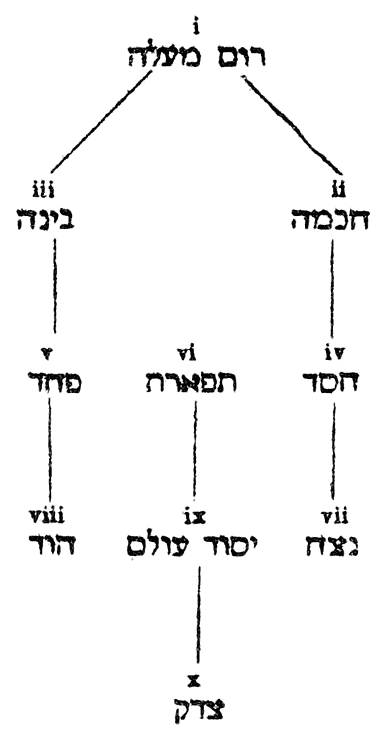
6. Proposition.—The first Sephira is called Inscrutable Height (רום מעלה); the second, Wisdom (חכמה); the third, Intelligence (בינה); the fourth, Love (חסד); the fifth, Justice (פחד); the sixth, Beauty (תפארת); the seventh, Firmness (נצח); the eighth, Splendour (הוד); the ninth, the Righteous is the Foundation of the World (צדיק יסוד עולם); and the tenth, Righteousness (צדק).
(a) Scholion.—The first three Sephiroth form the world of thought; the second three the world of soul; and the four last the world of body—thus corresponding to the intellectual, moral, and material worlds. (Answer 10.)
(b) Scholion.—The first Sephira stands in relation to the soul, inasmuch as it is called a unity (יחידה); the second, inasmuch as it is denominated living (חיה); the third, inasmuch as it is termed spirit (רוח); the fourth, inasmuch as it is called vital principle (גפש); the fifth, inasmuch as it is denominated soul (נשמה); the sixth operates on the blood, the seventh on the bones, the eighth on the veins, the ninth on the flesh, and the tenth on the skin. (Ibid.)
The gradation of the Sephiroth is as follows—
It is this passage, as well as Maimonides’ comment upon it, which led the erudite Franck to the conclusion that the mysteries of the Kabbalah were known to the doctors of the Talmud, and that the forty-two letters composing the divine name are the ten Sephiroth, which, by supplying the Vav conjunctive before the last Sephira, consist exactly of forty-two letters, as follows:—
5 + 5 + 3 + 3 + 5 + 5 + 5 + 4 + 4 + 3 = 42
ויסוד מלכות הוד נצח תפארת גבורה נדולה בינה חכמה כתר
But Franck, like many other writers, confounds mysticism with Kabbalah. That the Jews had an extensive mysticism, embracing theosophy with its collateral angelology and uranology, as well as christology and magic, long before the development of the Kabbalah, and that there were a certain class of people who specially devoted themselves to the study of this mysticism, and who styled themselves “Men of Faith” (בעלי אמונות), is evident from a most cursory glance at the Jewish literature. Based upon the remark—“The secret of the Lord is with them that fear him, and he will show them his covenant,” ( Ps. xxv, 14 ,) some of the most distinguished Jewish doctors in the days of Christ, and afterwards, claimed an attainment of superhuman knowledge, communicated to them either by a voice from heaven (בת קול) or by Elias the prophet (Baba Mezia, 59 b; Sabbath, 77 b; Chagiga, 3 b, 10 a; Sanhedrin, 48 b; Nidda, 20 b; Joma, 9 b). The sages had also secret doctrines about the hexahemeron (מעשה בראשית) and the Vision of Ezekiel = Theosophy (מעשה מרכבה), “which were only communicated to presidents of courts of justice and those who were of a careful heart” (Chagiga, 12 a–16 a). Coeven with this are the mysteries connected with the different letters of the several divine names (Kiddushin, 71 a). Those who were deemed worthy to be admitted into these secrets could at any moment call into existence new creations either in the animal or vegetable kingdom (Sanhedrin, 65 b, 67 b; Jerusalem Sanhedrin, vii); they could fly in the air, heal the sick, drive out evil spirits, and suspend the laws of nature, by sundry mystical transpositions and commutations of the letters composing the divine names, which they wrote down on slips of vellum or pieces of paper and called “amulets” (קמיעות). This mysticism and the literature embodying it began to develop themselves more fully and to spread more extensively from the end of the eighth and the commencement of the ninth centuries. Towards the close of the eighth century came into existence
1. The celebrated mystical work entitled the Alphabet of Rabbi Akiba, which alternately treats each letter of the Hebrew Alphabet as representing an idea as an abbreviation for a word (נוטריקון), and as the symbol of some sentiment, according to its peculiar form, in order to attach to those letters moral, theoanthropic, angelogical and mystical notions. This work has recently been reprinted in two recensions in Jellinek’s Beth Ha-Midrash, vol. iii, p. 12–64, Leipzig, 1855.
2. The Book of Enoch which describes the glorification of Enoch and his transformation into the angel Metatron, regarding him as ידו״ד הקטון the Minor Deity, in contradistinction to ידו״ד הגדול the Great God and which was originally a constituent part of the Alphabet of R. Akiba. It is reprinted in Jellinek’s Beth Ha-Midrash, vol. ii, pp. 114–117. Leipzig, 1853.
3. Shiur Koma (שיעור קומה), or the Dimensions of the Deity, which claims to be a revelation from the angel Metatron to R. Ishmael, and describes the size of the body and the sundry members of the Deity. It is given in the Book Raziel (ספר רזיאל) of Eleazer b. Jehudah of Worms, printed at Amsterdam, 1701, and at Warsaw, 1812.
4. The Palaces (היכלות). This mystical document opens with an exaltation of those who are worthy to see the chariot throne (צפיית המרכבה), declaring that they know whatever happens and whatever is about to happen in the world; that he who offends them will be severely punished; and that they are so highly distinguished as not to be required to rise before any one except a king, a high priest, and the Sanhedrim. It then celebrates the praises of Almighty God and his chariot throne; describes the dangers connected with seeing this chariot throne (מרכבה); gives an episode from the history of the martyrs and the Roman emperor Lupinus, a description of the angels, and of the sundry formulæ wherewith they are adjured. Whereupon follows a description of the seven heavenly palaces, each of which is guarded by eight angels, and into which the student of the mysterious chariot throne may transpose himself in order to learn all mysteries, a description of the formulæ by virtue of which these angelic guards are obliged to grant admission into the celestial palaces, and of the peculiar qualifications of those who desire to enter into them. The document then concludes with detailing some hymns of praise, a conversation between God, Israel, and the angels about those mysteries, a knowledge of which makes man suddenly learned without any trouble, and with a description of this mystery, which consists in certain prayers and charms. This mystical production has also been reprinted in Jellinek’s valuable Beth Ha-Midrash, vol. iii, pp. 83–108.
These mystical treatises constitute the centre around which cluster all the productions of this school, which gradually came into existence in the course of time. So numerous became the disciples of mysticism in the twelfth century, and so general became the belief in their power of performing miraculous cures, driving out evil spirits, &c., &c., by virtue of charms consisting of the letters composing the divers divine names transposed and commuted in mystical forms, that the celebrated Maimonides found it necessary to denounce the system. “We have one divine name only,” says he, “which is not derived from His attributes, viz., the Tetragrammaton, for which reason it is called Shem Ha-Mephorash (שם המפורש). Believe nothing else, and give no credence to the nonsense of the writers of charms and amulets (כותבי הקמיעות), to what they tell you or to what you find in their foolish writings about the divine names, which they invent without any sense, calling them appellations of the Deity (שמות), and affirming that they require holiness and purity and perform miracles. All these things are fables: a sensible man will not listen to them, much less believe in them.” (More Nebuchim, i, 61.)
But this mysticism, with its thaumaturgy, though espoused by later Kabbalists and incorporated into their writings, is perfectly distinct from the Kabbalah in its first and pure form, and is to be distinguished by the fact that it has no system, knows nothing of the speculations of the En Soph, the ten Sephiroth, the doctrine of emanations, and the four worlds, which are the essential and peculiar elements of the Kabbalah. As to Franck’s ingenious hypothesis, based upon the same number of letters constituting a divine name, mentioned in the Talmud, and the ten Sephiroth, we can only say that the Kabbalists themselves never claimed this far-fetched identity, and that Ignatz Stern has shown (Ben Chananja, iii, p. 261), that the Sohar itself takes the ten divine names mentioned in the Bible, which it enumerated in vol. iii, 11 a, and which it makes to correspond to the ten Sephiroth, to be the sacred name composed of forty-two letters, viz.:—
4 + 2 + 2 + 5 + 4 + 5 + 2 + 5 + 2 + 4 + 3 + 4 = 42
אדני חי אל צבאות ידוד אלדים אל ידויד יה אהיה אשר אהיה