Historical Notes and Papers. (continued 2)
Reading edition
“And immediately there was a meeting sett upp and kept at the house of Mark Newby, and in a short time it grew and increased, unto which William Cooper and family, that lived at the Poynte resorted, and sometimes the meeting was kept at his house, who had been settled sometime before. Zeal and fervency of spirit was what, in some degree, at that time abounded among friends, in commemoration of our prosperous success and eminent preservation, both in our coming over the great deep as also that whereas we were but 208few at that time, and the Indians many, where by it put a dread upon our spirits, considering they were a savage people; but ye Lord, that hath the hearts of all in his hands, which cannot be otherwise accounted but to be the Lord doings in our favor, which we had cause to praise his name for.
“And that the rising generation may consider that the Settlement of the country was directed by an impulse upon tranquility, but rather for the posterity yet should be after, and that the wilderness being planted with a good seed, might grow and increase to the satisfaction of the good husbandman. But instead thereof, if for wheat it should bring forth tares, they themselves will suffer loss.
“This narration I have thought good and requisite to leave behind, as having had knowledge of things from the beginning.”
Anecdote of Washington.
Thatcher, in his Military Journal, gives a vivid description of the sufferings of the troops during “the hard winter of 1779–1780,” at Morristown, N. J. He says:
“Morristown, January 1st, 1780. A new year commences, but brings no relief to the sufferings and privations of our army. Our canvass covering affords but a miserable security from storms of rain and snow, and a great scarcity of provisions still prevails, its effects being felt even at headquarters, as appears by the following anecdote: ‘We have nothing but the rations to cook, Sir,’ said Mrs. Thomson, a very worthy Irish woman, and housekeeper to General Washington. ‘Well, Mrs. Thomson, you must then cook the rations, for I have not a farthing to give you.’ ‘If you please, Sir, let one of the gentlemen give me an order for six bushels of salt.’ ‘Six bushels of salt for what?’ ‘To preserve the fresh beef, Sir.’ One of the aids gave the order and the next day his Excellency’s table was amply provided. Mrs. Thomson was sent for, and told that she had done very wrong to expend her own money, for it was not known when she could be repaid. ‘I owe you,’ said his Excellency, ‘too much already to permit the debt being increased, and our situation is not at this moment such as to induce sanguine hope.’ ‘Dear Sir,’ said the good old lady, ‘it is always darkest just before the daylight, and I hope your Excellency will forgive me for bartering the salt for other necessaries which are now on the table.’ Salt was eight dollars a bushel, and it might always be exchanged with the country people for articles of provision.”
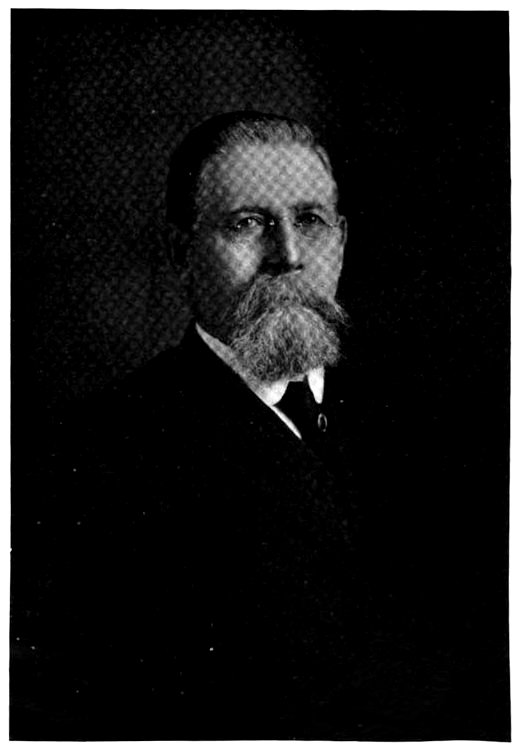
HON. JAMES CUNNINGHAM. Of Portland, Me. Vice-President of the Society for Maine.
209
Cumberland County, N. J.
Baptist Church at Cohansey. As early as the year 1683 some Baptists from Tipperary, in Ireland, settled in the neighborhood of Cohansey. The most prominent persons were David Sheppard, Thomas Abbott, and William Button.
Emigrants flocked into Cohansey from Ireland and it is very probable that a Presbyterian Society was formed about the year 1700 or earlier. Rev. Robert Kelsey, who was from Ireland, used to preach for the Baptists.
THE FIRST CENSUS OF THE UNITED STATES. SOME POINTED COMMENTS ON THE MANNER OF TAKING SAME AND THE RESULTS THEREOF. AN INTERESTING PAPER ON A SUBJECT NOT HERETOFORE TOUCHED BY THE SOCIETY.
BY MICHAEL J. O’BRIEN OF NEW YORK CITY, AUTHOR OF “A GLANCE AT SOME PIONEER IRISH IN THE SOUTH,” IN VOLUME VII OF THE JOURNAL, AND OF MANY OTHER WORKS OF HISTORICAL RESEARCH.
By an Act of Congress, entitled “An act providing for the enumeration of the inhabitants of the United States,” and which was signed by President Washington on March 1, 1790, the marshals of the judicial districts throughout the United States were “authorized and required to cause the number of the inhabitants within their respective districts to be taken, omitting in such enumeration Indians not taxed, and distinguishing free persons, including those bound to service for a term of years, from all others.” These returns they were instructed to file with the clerks of their respective District Courts, who were directed to carefully preserve them.
This was the First Census taken of the inhabitants of the United 210States, but it was far from complete, for the reason that “heads of families” only were recorded.
Eighteen months were allowed in which to complete the enumeration. The census-taking was supervised by the marshals of the several judicial districts, who employed assistant marshals to act as enumerators.
When the schedules were all gathered in, they were turned over to the President, who, on October 27, 1791, transmitted to Congress a summary of the result, which was published in what is now a very rare little volume that has not been reprinted for public use. The original schedules are contained in 26 bound volumes and are still preserved in the Census Office. They form a curious and most interesting collection, written as they were by the assistant marshals, “on such paper as they happened to have, and binding the sheets together. In some cases printed blanks furnished by the States were used, in others merchants’ account paper, and now and then the schedules were bound in wall paper.”
A complete set of schedules for each State, with a summary for the Counties, and in many cases for towns, was filed in the State Department, but, unfortunately, they are not now complete, “the returns for the States of Delaware, Georgia, Kentucky, New Jersey, Tennessee and Virginia having been destroyed when the British burned the Capitol at Washington during the War of 1812.”
In 1907, Congress authorized the Director of the Census to publish, in a permanent form, the First Census of the United States. “These schedules,” says the Director of the Census, “form a unique inheritance for the nation, since they represent for each of the States a complete list of the heads of families in the United States at the time of the adoption of the Constitution. The framers were the statesmen and leaders of thought, but those whose names appear upon the schedules of the First Census were in general the plain citizens, who, by their conduct in war and peace, made the Constitution possible, and by their intelligence and self-restraint put it into successful operation.”
The First Census has a peculiar interest for Americans of Irish blood or descent, for here we find irrefutable evidence of the racial origin of a large part of the people of the United States a few years after the close of the Revolutionary war. There is, of course, no standard, or fixed rule or principle, by which an absolutely correct 211judgment on the question of the racial composition of the early inhabitants of the United States can now be formed. The available statistics on the subject are incomplete and confusing.
But, if names are to be accepted as a criterion, those who examine the Census Returns, in conjunction with the records of land grants, the parochial registers, the Colonial Records that have been collected and edited by the secretaries of state, the court and church records, the Revolutionary rosters, the old newspapers, the Registers of Historical Associations, and other similarly reliable records, must at once conclude that a goodly percentage of the people were of old Irish stock.
It must be borne in mind also that the Census enumerators made no returns of unmarried persons. This fact is important, when we place beside it the statements of reliable historians that the Irish exodus of the 18th century largely comprised the youth of the country. From the records which we have already quoted, we know that thousands of the Irish youth became indentured servants after their arrival in the Colonies, and it is not likely that these people, even though married while still in servitude, were considered of sufficient importance by the census enumerators to be included in the lists of the “heads of families.”
One who examines these records for traces of the Irish settlers will be surprised to find a most inviting field of retrospect and research ever widening before him. We do not need to wander into the field of romance, as some writers occasionally do, in search of proof that at the beginnings of the Nation the Celtic element figured to a larger extent than it has been credited with at the hands of our historians.
There is so much of dry fact concerning them in these hitherto obscure records as to make it a perplexing thought for the investigator where to begin upon an exposition of the part played by the Irish Colonists and their descendants in shaping the destinies of the future Republic. Theirs is generally a prosaic story of trials bravely borne, of victories snatched from rude nature in the face of many difficulties. The pioneer settlers lived a simple but rude life on the frontiers of civilization, free from the artificialities of our latter-day mode of living, but they made the wilderness which they found to blossom as the rose and to become a fair habitation for the generations that have succeeded them.
212Their story would hardly be worth relating were it not for the fact that it affords the proof that men and women of our race and blood were of the “warp and woof” from which has been evolved the new and composite race, miscalled “Anglo-Saxon,” which has made this Western Hemisphere the leader among the nations of the civilized world.
It is in the Census of the Southern States that Irish names appear in the greatest numbers. During the first half of the 18th century there were large immigrations of Irish people to the Carolinas, who spread themselves over an immense area, reaching from the Santee river to the eastern boundary line of Georgia, and as far north as the dividing line of North Carolina. Doubtless, the majority of those on the Census Returns bearing Irish names were descendants of those early settlers, rather than natives of Ireland.
The historian Lossing says: “Between the years 1730 and 1740 an Irish settlement was planted near the Santee river in South Carolina, to which was given the name of Williamsburg Township. Up the Pedee, Santee, Edisto, Savannah and Black rivers settlements spread rapidly, and soon the axe and the plough were plying with mighty energy, and from the North of Ireland such numbers departed for Carolina that the depopulation of whole districts was threatened.”
Williamsburg he calls a “hotbed of rebellion” during the Revolutionary war. As soon as General Francis Marion received his commission from Governor Rutledge, we are told, “he sped to the district of Williamsburg between the Santee and Pedee to lead its rising patriots to the field of active military duties.” (The rosters of General Marion’s brigade contain a large number of Irish names.)
Ramsay also refers to these Irish settlements and deals with them at length in his History of South Carolina. He says that the district was named Williamsburg by an Irishman named James, who came to the Colony with his father in 1733. It is now called Kingstree, and the county in which it is situated is still named Williamsburg.
Sims’ Life of General Marion says: “the people of Williamsburg were sprung generally from Irish parentage. They inherited in common with all the descendants of the Irish in America a hearty detestation of the English name and authority. This feeling rendered 213them excellent patriots and daring soldiers wherever the British lion was the object of hostility.”
Other local historians of the South also refer to the Irish settlements in this territory, which continued with but intermittent intervals down to the closing years of the 18th century. When we turn to the Census schedules we find that the statements of the historians are amply corroborated.
In the Williamsburg district, that “hotbed of rebellion,” we find mention of such Irish families as Burke, Barrett, Biggen, Butler, Barron, Bryan, Broaderick, Boland, Brady, Bradley, Cain, Cummins, Connor, Cunningham, Collins, Conway, Callihan, Cronan, Cantey, Corbett, Connell, Castlelaw, Creed, Conally, Cochran, Dunn, Dempsey, Dawson, Dollard, Downing, Donoho, Donnally, Delaney, Dillin, Dailey, Dulon, Dogharty, Earley, Flin, Foley, Fitzpatrick, Faning, Gorman, Galaspy, Gibbons, Gallivant, Ganey, Gowen, Gavin, Gallaher, Gill, Garven, Hagan, Hart, Harrington, Hayes, Hainey, Joice, Jordan, Kennedy, Keenan, Kelly, Kelty, Keen, Keefe, Kerns, Kailey, Lynch, Leysath, Murphy, McCalvey, McCartney, McGill, McFarlin, Manning, McCormic, McKenny, McDowell, McKee, McGinney, McCauley, McBride, McMullan, Mulhollen, Mitchel, McConnell, McClare, McIlveen, McGee, McFadden, Moore, McCottery, McElroy, McMelly, McCleary, McDaniel, McDonald, McCarthy, McCall, McSwain, McWilliams, Morrison, McGraw, McCausland, McCune, McElhaney, McFail, McClendon, McGrath, McElduff, McAdams, McCoy, McCary, McCain, Mahon, O’Brian, O’Neil, O’Cain, O’Bannon, Phelon, Powers, Quinn, Rogers, Roach, Riley, Reidy, Rial, Ryan, Sullivan, Shealds, Swiney, Steele, Shannon, Timmons, Toole, Ward and Walsh.
These are not all. Of the Murphys alone there were in the Williamsburg district eleven families, nine Kellys and several distinct families named O’Brian, O’Neil, O’Bannon and McCarty.
We have selected only one of each name, in order to show that the Irish settlements spoken of by Lossing, Sims and Ramsay were drawn from the South, East and West, as well as from the North of Ireland. American historians are in the habit of saying that the immigrants from Ireland were mainly the so-called “Scotch-Irish” element from the northern counties. While it is true there were large settlements of Scotch Gaels in the Carolinas, it is seen from 214the foregoing list that nearly every county of Celtic Ireland was represented in the “hotbed of rebellion” of South Carolina.
We see from the Census Returns that the collectors wrote down the names phonetically in most cases, having paid little or no attention to spelling, or the use of capital letters where they were needed. Some peculiar transformations in names resulted from the carelessness or ignorance of the enumerators. For instance, we find O’Neill spelled “onailes” and “Ownaile”; O’Brien spelled “Obrient” and “Obriant”; O’Farrell as “Opherl,” and Casey as “Caycey”; Donovan is down as “Dunnevant” and “Dunnaphant”; Doherty as “Dehoitey” and “Dohoty”; Nolan as “noling”; Sullivan as “Sellivent,” “Swillevaun” and “Sewlovan”; Murphy as “Murff,” “Murph,” “Murpry” and “Murfree”; Gallagher as “Gollerhorn”; Flynn as “Phlyn” and “Fling”; Kinsella as “Kincheloe”; McLaughlin as “Maklafflin”; O’Hara as “Oharroe”; and O’Ryan as “Orion.”
To the prefix “Mac” the enumerators, in many cases, gave the sound of “Mag.” Thus we have such name transformations as “Magnamee” and “Magmanous.” We also find “Makmain” for McMahon and “Muckleroy” for McElroy, and so on. Fitzgeralds are down as “Fitzjarrel” and “Jarrel”; Fitzpatrick as “Fitchparterack” and “Pitch Patrick”; Reilly as “Royley” and “Royalley”; Cassidy as “Casaty.” In some Southern city directories we have come across the name of “Pitch,” and we wonder if some of these are not descendants of the “Pitch Patricks” or Fitzpatricks!
It would be difficult to think of an old Irish name that is not represented in the First Census, and which was not, at some time or other, translated into something very different in appearance, and sometimes only partially retaining the sound of the original name. In the mutations of time, even these new names became still further changed, so that many of the present-day descendants of the Irish pioneers of the Carolinas cannot be recognized as at all of the old Gaelic race.
The most numerous Irish name on the First Census of South Carolina is Murphy, there having been 50 distinct families of that name, although the 48 Kelly families gave them a close race. The Gill and McGill families run nip and tuck with the O’Neills and the Nealls. There were 34 of the former to 33 of the latter. The O’Briens and O’Bryans ran the gauntlet of many changes. The Census enumerators failed to appreciate the significance of the regal prefix “O,” so they wrote down the name Obrient, Obriant, Bryan and Briant. There were 53 of these in South Carolina in 1790.
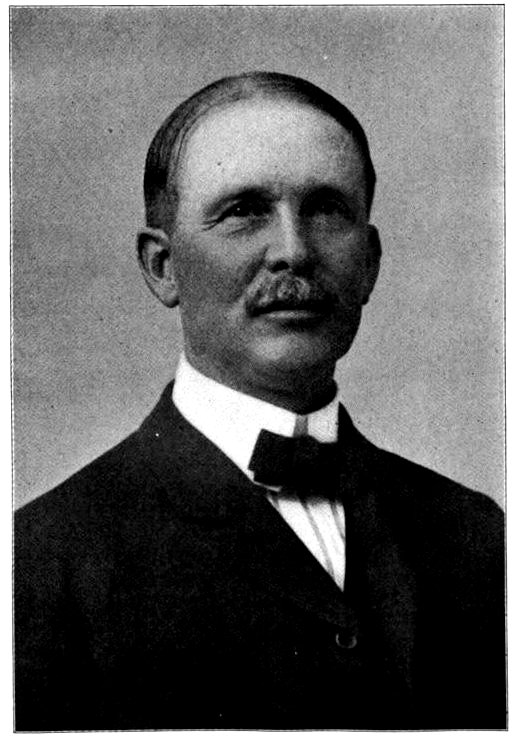
HON. ALEXANDER C. EUSTACE. Elmira, N. Y. Ex-President New York Civil Service Commission. A worthy Member from New York State.
215The Celtic “Macs” make a great showing. There are upwards of one thousand of such families in all, the “Macs” that are indigenous to Ireland being more numerous than those that are supposed to be exclusively native to Scotland. When we consider that, in 1790, the total number of free white males of 16 years and upwards in South Carolina was only 35,756, we can readily understand that one thousand heads of families, with their wives and children, must have constituted a large percentage of the total population. An examination of the Census Returns indicates that the average number of children to each of the Irish-named families was five, so that, on a conservative estimate, the “Macs” alone must have contributed nearly 20 per cent to the population of South Carolina!
We find 40 Ward families, 26 McClure families, 26 McDaniels, 23 McKees, 22 McCoys, 20 McDowells, 19 Cauleys and McCauleys, 19 Mahons and McMahons, 18 McCalls, 17 McBrides, 17 McConnells, 16 McCarts and McCartys, 12 McNeills, 11 McFaddens, and 10 McMullan families. There are also numbers of McCormacks, McGees, McGowens, McGraws, McGuires, McCrackens, McCanns, McCartneys, McCarys, McClearys, McClendons, McCollums, McElroys, McKennys, McKelveys, McLaughlins, McManus, and many other similar Irish family names.
There are 41 distinct families of Bradleys recorded, 29 Harts, 24 Sullivans, 28 Reynolds, 22 Canes and Kains, 22 Hayeses, 22 Hendricks, 21 Dunns, 23 Connors and O’Connors, 21 Carrolls, 20 Logans, 20 Reillys and Royleys, 17 Dawsons, 14 Gilmores, 16 Manions and Mannings, 12 Hagans, 13 Walshes and Welches, 13 Higginses, and 11 Lynch and Linch families.
Among names that are common to Ireland and England, there are 113 families named Moore in the First Census of South Carolina, 80 Rogers and Rodgers, 24 Morrows, 46 Collinses, 42 Butlers and 41 Fords. There are 43 heads of families named Mitchell, 41 Montgomery, 26 McDonald, 26 Cunningham, 18 Gillespie, 17 Cochran and 22 Kennedy families, some of whom, no doubt, were Scotch.
Such names as Brady, Burke, Casey, Connelly, Corbett, Cassidy, Callahan, Cleary, Cummings, Curry, Daly, Doherty, Donnelly, Dempsey, Dowling, Duggan, Doyle, Donovan, Ennis, Fitzgerald, 216Fogarty, Fitzpatrick, Flinn, Garrett, Garvin, Gorman, Hogan, Jordan, Kearns, Lyons, Malone, Mulligan, Madden, Morrison, Nolan, O’Bannon, Quinn, Regan, Roach, Ryan, Rutledge, Shannon and Shiels, as well as others of ancient Irish origin, occur quite frequently in the Census Returns, and in all parts of the state. Indeed, we might say, with startling frequency, if they are examined by that set of persons who are so fond of telling us that the American people are of Anglo-Saxon origin!
Besides the old Irish clan names, it is seen that a very large number of the early inhabitants of South Carolina bore names that have been common in Ireland for centuries, although not all of Irish origin. There are many Browns, Grays, Greens, Whites, Griffins, Grimeses, Rices, Savages, Steeles, Glovers, Raineys, Rays, Flemings, Staffords, Shaws, Gastons, Parnells, Mileses, Reeds, Fergusons, Coxs, Courtneys, Clarks, Carrs, Kerrs, Allens, Pattersons, Berrys, Hails, Henrys, Morrises, Martins, Lowrys, Hollands, Morrows, Jacksons, Laceys, Masseys and Leonards.
That some of these people were Irish seems beyond doubt, particularly when we find such distinctive Irish Christian names as Darby, Malachi, Patrick, Brian, Cormac, Connor and the like. And when we see O’Bryan Smiths, Patrick Smiths, and Michael and Jeremiah Smiths, and other similar name combinations, we can safely assume that in the majority of cases they were of Irish origin or birth.
217
MEMORIAL TO JERSEY PRISON SHIP HEROES.
Since many prominent Irish Americans played an important part in the success of the project for a fitting memorial to the heroes of the British prison-ships of the Revolution, it is fit that reference be made here to this noble tribute and the manner of its accomplishment.
The magnificent monument, costing in the neighborhood of $200,000, was dedicated at Fort Greene Park, Borough of Brooklyn, New York, on November 14, 1908, in the presence of one of the most distinguished and representative gatherings which ever honored a like occasion in this country. Addresses were made by President-elect Taft, by Governor Hughes of New York, Secretary Luke E. Wright of the Navy, and by other distinguished men, including Patrick F. McGowan, Chairman of the Board of Aldermen of the City of New York, and Daniel F. Cohalan, Grand Sachem of the Tammany Society of New York, an organization which did much toward the success of the project and which contributed a substantial amount.
The monument itself is one of the finest memorials in the world. It stands in the center of a broad plaza, reached by three flights of 34 steps each, 100 feet in width. The height from the bottom of the plaza to the top of the monument is nearly 200 feet. The top is accessible and is reached by an electric elevator. The monument is constructed of white granite from New York state, and the steps from granite quarried at Stonington, Penobscot Bay, Maine. The architects were McKim, Mead and White, and the work is said to have been the last of an extensive nature by the late Stanford White.
The funds for the erection of this noteworthy tribute were obtained through a government appropriation of half the amount, a state appropriation of $25,000, an appropriation by the city of twice that amount, and the rest through subscriptions from societies and historical and patriotic organizations. The Tammany Society contributed the final $1,000 to complete the required amount. This well-known organization was the very first to secure a proper recognition of the courage and patriotism of the prison ship martyrs more than one hundred years ago.
218Among the heroes of the British prison-ships were many of Irish birth or extraction, and it is therefore a subject for pride and satisfaction to us as a race that their valor has at last been recognized, and especially that an organization largely controlled by our people has played so important a part in the accomplishment of such recognition. Never in the history of the world have prisoners of war been made the victims of such unexampled cruelties as those practised on the Americans by the British in the Revolution, and it is a striking and never-to-be-forgotten commentary on British methods toward their enemies in war that the record of the prison-ships of the Revolution is deemed by all the world a black mark on English history.
THE IRISH IN THE REVOLUTIONARY WAR.
Short Address Delivered by Master Karl Egan, at the Iowa Opera House, Emmetsburg, Iowa, March 17, 1909, During the Presentation of the Irish Drama, “The Hero of Wicklow,” under the Auspices of the Ancient Order of Hibernians. Some Facts of Interest to the People of Irish Birth or Ancestry.
Ladies and Gentlemen: On this important anniversary, which is associated with so many achievements of interest to the people of our race, it is fitting to enquire what part the Irish took in the Revolutionary War. What did they do for the cause of human liberty at this most critical time in the world’s history? All we ask is the truth. For some reason our ordinary school histories have never given us any credit for the prominent part our ancestors took in that great struggle. What I shall say will bear the closest historical investigation.
It was Patrick Henry, who, by his soul-stirring speech, aroused the members of the Virginia Assembly to a sense of patriotic duty. In 1776 he ran for governor on the Independence ticket and carried that important colony for the Revolutionary cause. Still, he claimed that John Rutledge of South Carolina was the greatest American orator of his time. The latter was also elected president of South Carolina in 1776, on the same ticket. John Rutledge and Patrick Henry were both sons of Irishmen.
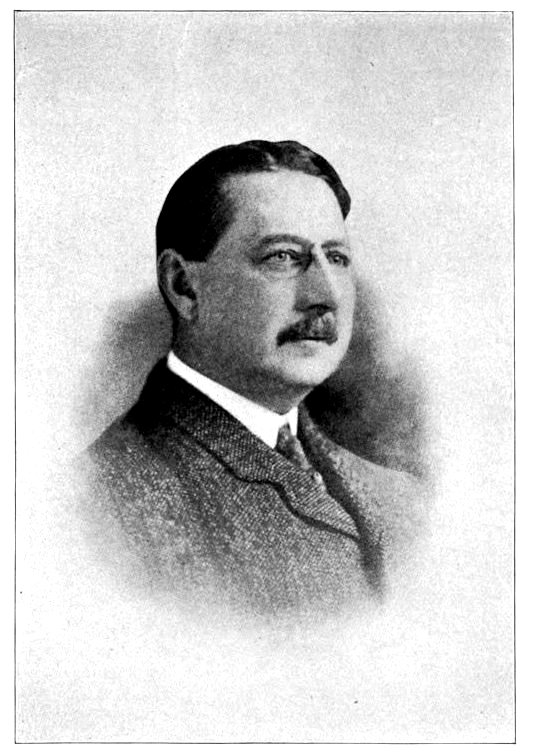
MR. WILLIAM J. FEELEY. Of Providence, R. I. One of the Committee in charge of the Sullivan Memorial and under whose guidance the Memorial was designed and executed.
219During the Revolutionary War men of Irish birth or ancestry served as governors in South Carolina, Virginia, Maryland, Pennsylvania, Delaware, New Jersey, New York, Massachusetts and New Hampshire. They were among the most ardent and fearless of the patriots of that history-making period.
It was in John Duggan’s tavern in Boston that the Boston Tea Party was planned. Several Irishmen were in the execution of the plan.
Eleven of the fifty-four members of the first Continental Congress were Irishmen and sons of Irishmen. Thomas Johnson, who nominated George Washington for commander-in-chief of the American forces, was a Celt of the old school.
The war began April, 1775, but it was not officially declared until July 4, 1776. October 15, 1775, Congress sent a committee to interview General Washington and to decide as to the advisability of continuing the struggle. Of the five who participated in that most important conference, Joseph Reed and Thomas Lynch were Irish. The other members were Benjamin Franklin, Colonel Harrison and General Washington.
A rough draft of the Declaration of Independence was prepared by Thomas Jefferson. It was re-written and carefully revised by Charles Thompson, who was styled the Samuel Adams of Philadelphia, and the life of the cause of liberty. When the Declaration was first proclaimed, it was signed by John Hancock, as president of the Continental Congress, and by Charles Thompson, as secretary. The other names were attached later. Thompson was an Irishman and Hancock an Irish American. John Nixon first publicly read it and Thos. Dunlap first printed it and published it to the world. Both were Celtic to the backbone. Who periled most in signing the immortal document? History answers, Charles Carroll of Carrollton, another Irish American.
Who fought the hardest in the British House of Parliament for the rights of American colonists? Edmond Bourk, an Irishman, and one of the greatest statesmen the world has ever known.
In placing his most important officers, General Washington had Morgan and Hand leading his rifles, Knox at the head of his artillery, 220John Dunlap as his life guard, Edward Hand as his adjutant-general, Andrew Lewis as his brigadier-general, Stephen Moylan and John Fitzgerald as his aids, and Ephraim Blaine as his quartermaster. All were Irish by birth or ancestry. When Washington was retreating through New Jersey, he sent word to Thomas Johnson, a Maryland Celt, that he had not enough men to fight the British and too few to run away with. Johnson raised a force of 1,800 men and hurried to his assistance.
All students of American history have read of the gallant Richard Montgomery, Mad Anthony Wayne, John Sullivan, Daniel Morgan, Stephen Moylan, John Fitzgerald, Henry Knox, Wm. Irvine, Richard Butler, and Generals Cochran, Campbell, McDowell, McCall, McClary, Jasper, Graham, Hazelett, Colonel Pickens, and many others who were among the most valiant and successful officers in that eventful conflict. All belonged to our liberty-loving, heroic race. It has been officially ascertained that out of 131 of the most prominent officers in the war for American Independence, 20 were of English ancestry, 25 of French, 10 of German and Dutch, 8 of Scotch, 2 of Polish, and 84 of Irish and Welch. Commodores Barry, Perry, McDonough and Stewart, of the wars of 1776 and 1812, were scions of brave-hearted exiles from the Emerald Isle.
June 16, 1779, Joseph Galloway, speaker of the Pennsylvania House of Representatives, who had to fly to England because of his sympathy with the Tories, was examined as a witness by a committee of the British House of Parliament, and he testified that the Irish constituted one-half of the American army, the native Americans one-fourth and that the other one-fourth were English and Scotch. This statement is corroborated by Lecky, the English historian, Lord Mountjoy, General Lee, Count Rochambeau, Col. J. C. Custis, the adopted son of General Washington, and Rev. P. Allison, the Presbyterian chaplain of Washington’s army. They are competent authorities. President Roosevelt and James G. Blaine, in public addresses, have acknowledged, in substance, the accuracy of this testimony. Hutchinson, the last royal governor of Massachusetts, declared that his colony would never have voted for independence, had it not been for the rebellious Irish.
There were 15 Irish in the battle of Lexington and 258 at Bunker Hill. The monument at Bunker Hill is covered with Irish names. Captain Parker, who commanded at Lexington, and who was killed, 221was Irish. Colonels Barrett, Smith and Davis, who commanded at Concord, were also Irish. When the American forces took possession of Boston, John Sullivan was officer of the day and the countersign was “St. Patrick.”
After the treason of Benedict Arnold, General Washington ordered that none but the Irish be placed on guard at West Point.
When the soldiers of Lafayette were half naked and starving, the Irish people of Baltimore, then a place of only one hundred homes, gave them food and clothing. In 1780, when the finances of the struggling republic were at the lowest ebb, when it took from $30 to $50 in paper to make $1 in specie, after our soldiers had suffered at Valley Forge and elsewhere, the business men of Philadelphia raised 315,000 lbs. sterling and gave it to Congress. Twenty-seven Irishmen of that city contributed 103,500 pounds of that amount. They were members of the Friendly Sons of St. Patrick, which gave 399 officers of the highest rank to the city, state and nation during its early history. Washington became an honorary member of that patriotic organization.
When our country so badly needed assistance, Bishop Carroll accompanied Benjamin Franklin to France to seek the aid of that country. It was secured. History gives Franklin the credit, but does not mention the name of Bishop Carroll, who really made the mission a successful one. Bishop Carroll also accompanied Franklin to the French Canadian provinces for a similar purpose.
There were twelve Irish delegates to the convention that adopted the Constitution, and there were five Irishmen in the first United States Senate of twenty-two members.
Dr. Hugh Knox educated Alexander Hamilton, who was a poor boy. Doctor Knox was a big-hearted Irishman. It was Matthew P. Lyon, an Irishman, who was sold as a slave in Connecticut when a mere boy, who, on the thirty-sixth ballot, as a congressman from Vermont, later in life, cast the deciding vote that elected Thomas Jefferson president of the United States over Aaron Burr.
Many who came with the French to assist the Americans were sons of Irishmen, who had been driven to France with Patrick Sarsfield after the treachery of the British at Limerick in 1691.
From 1691 to 1791, over 400,000 different Irishmen served in the French army. When the Revolutionary War broke out, they petitioned the French War Department to come to America to fight their 222national foes. There were entire Irish regiments in the French army when Cornwallis surrendered at Yorktown. A young Irishman, Robert Wilson, was appointed to take charge of the surrendered flags and the news of the great victory was sent in haste to President Thomas McKean, of the Continental Congress at Philadelphia. McKean was one of the foremost Irish Americans of his time.
Molly Pitcher and Nancy Hart, two Irish women who participated in the Revolutionary War, deserve rank with the greatest heroines in history.
The Irish were among the leading educators, journalists, theologians, historians, scientists, canal constructors, and railway builders of the decades subsequent to the Revolutionary War. They were leaders in laying substantially the broad foundation for our material, educational and moral greatness. They gave us such statesmen as James Monroe, Andrew Jackson, John C. Calhoun, James K. Polk, and many others, who were among the very ablest national leaders in the early history of our republic.
I shall not refer to the part the Irish took in the War of 1812, the Mexican War, the great Civil conflict, or the Spanish-American struggle for supremacy. All I ask is for you to reflect on their great fight for liberty from 1775 to 1783—that struggle that has been felt around the world—and to tell the facts to your children, to your friends, and to your fellow citizens, for they will not, for some unknown reason, find it in ordinary histories. I can do no better than to quote, in closing, the words of Colonel John Parke Custis, the adopted son of General Washington:
“Then honored be the old and good services of the sons of Erin in the war of independence. Let the shamrock be entwined with the laurels of the Revolution; and truth and justice, guiding the pen of history, inscribe on the tablets of American remembrance: ‘Eternal gratitude to Irishmen.’”
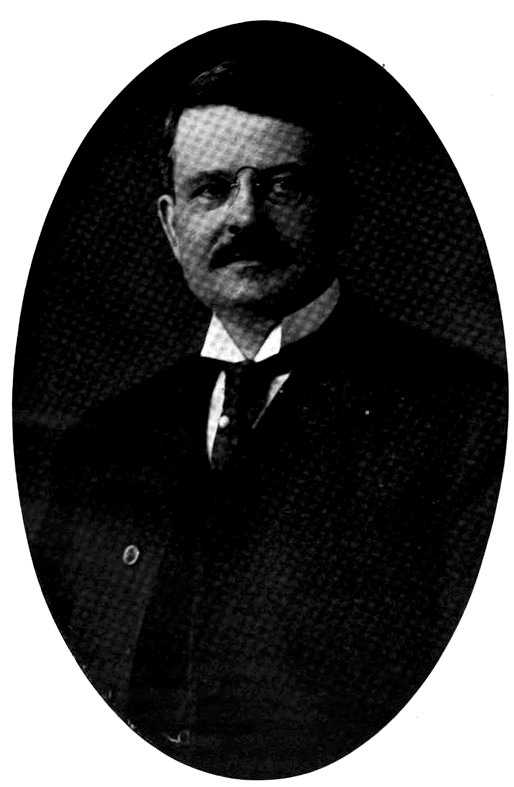
HON. THOMAS HASSETT. New York. Elected a Life Member in 1908.
223
HON. ELI THAYER, ONE OF THE EARLY MEMBERS OF THE AMERICAN IRISH HISTORICAL SOCIETY. A MOST DISTINGUISHED AMERICAN, KNOWN THE WORLD OVER. A FEW FACTS ABOUT HIS LIFE AND WORK.
BY THE SECRETARY-GENERAL.
Hon. Eli Thayer was born in the town of Mendon, in the state of Massachusetts, June 11, 1819, and deceased at Worcester, in that state, April 15, 1899, aged eighty years.
He was elected a member of the American Irish Historical Society in 1897, shortly after its first meeting, and was an active and interested member at the time of his death.
Mr. Thayer was a descendant in the seventh generation from Thomas Thayer and seventh in descent from John Alden of Mayflower fame, through Ruth, daughter of Rev. Noah Alden of Bellingham, Mass., who married his grandfather, Benjamin Thayer. John Alden was an Irishman and Thomas Thayer was Irish on the side of one of his parents.
He was the eldest of eight children. He received his early education in the district schools of Mendon, and at the Bellingham High School. Later he attended the academy at Amherst and the manual training school at Worcester, afterwards the Worcester Academy. He always ranked high in his scholarship, and in 1835–’36 taught school in Douglass, and for the four succeeding years assisted his father in a country store at Millville. In May, 1840, he re-entered the manual labor school, in order to fit for Brown University. Two years later he taught school at Hopkinton, Rhode Island, and while there was elected a member of the Phi Beta Kappa fraternity, an honor seldom conferred before the senior year.
In September, 1844, the superintendent of schools in Providence, Nathan Bishop, induced him to take charge of the boys’ high school for the remainder of the year for $600, a large salary for that period. This school had proven for some time unmanageable in the hands of several masters, but he reduced it to order and subjection. By accepting this position, he lost a year at Brown University, but was 224able to graduate in 1845, the second in his class. After his graduation, he immediately came to Worcester and became a teacher at the Academy, and was later its principal.
In 1845 he purchased of John Jaques four acres and ninety rods of land in Worcester, on what was then called Goat Hill. In 1848 he began the erection of the building called the Oread, which was completed in 1852. It is built of the stone underlying the hill. At first only the north tower was completed, and it was in this portion of the building that he established the famous school for young women, which he conducted with great success until he entered upon his later political work.
At the time that the school was opened, it was the only institute in the country that promised a full college course for women. It was the forerunner of Vassar, Smith and Wellesley. The name Oread means “the abode of the mountain nymphs.” The south tower was completed in 1850, and the connecting portion of the building a year or two later.
The towers are 40 feet in diameter and four stories high, while the entire length of the building is 250 feet. It was constructed after designs entirely Mr. Thayer’s own, without the aid of an architect, and the beauty of the building and the charming location have been remarked by strangers from all over the country.
He entered political life in 1852, when he was elected a member of the school board. Later he was a member of the board of aldermen and served during the years of 1853–’54 in the state legislature. It was during his first year in the state House of Representatives that he became conspicuous by the introduction of a bill to incorporate the Bank of Mutual Redemption, which was hailed with delight by bankers and monied men throughout the state, as it seemed to afford a means of release from the autocratic rule of the Suffolk Bank of Boston.
This bill was passed in the course of years and the Bank of Mutual Redemption loaned the money to the government when Andrew was governor during the Civil War.
It was not, however, until 1854 that Mr. Thayer accomplished the great act of his life, the one which enrolls his name among the benefactors of mankind, in originating the plan which saved Kansas and other territories to the Union and perhaps settled the destiny of the nation, for if the southern leaders had secured the territories, it 225would have given them the balance of power for many years to come and there would have been no rebellion. The North would have acquiesced, as it always had, in the decision of the congressional majority. In his original idea of making Kansas free, he actually settled the destinies of the country.
It was at a meeting to protest against the repeal of the Missouri compromise, held in the old city hall on the evening of March 11, 1854, that Mr. Thayer announced his celebrated “plan of freedom.” In effect it was simply to take possession by lawful means of the new territories through organized immigration of free-state men sustained by a base of supplies.
Mr. Thayer defined this plan as “business anti-slavery,” distinguished from sentimental and political anti-slavery, both of which had been tried for many years and found to be faulty, slavery in the meantime constantly growing stronger. He clearly saw that whichever side gained the majority of the settlers would control the situations of the new section, in spite of all efforts to establish others among them, and to the purpose of securing this majority for freedom he devoted all his energies and all of his means until that end was accomplished.
As the first means toward fortifying himself for this undertaking he immediately secured the passage of an act to incorporate the Massachusetts Emigrant Aid Company and before the vote to repeal the Missouri compromise was taken, hired a hall in Boston and began to speak afternoon and evening in behalf of his undertaking.
The intense excitement and strong opposition which followed the first announcement of the purpose to repeal the compromise in a great measure subsided after that act was accomplished, and he found extreme difficulty in the succeeding months in persuading a sufficient number of men to join in his enterprise to form the first colony.
The Know-Nothing frenzy absorbed the public mind so fully that other considerations were almost entirely excluded, and the Free Soil vote of 1854 dwindled to a few thousands, the Republican candidate for governor himself deserting his party and voting with the native Americans. The Know-Nothing organization had controlled the state for three years, and the frenzy had seized the public mind to such an extent that no man who aspired to public office had a chance of election unless he was affiliated with that party.
226Every member of Congress belonged to it, and it has been commonly said that Henry Wilson and other prominent office-holders of that time were elected upon that platform. The national Know-Nothing party did not agitate the slavery question, but maintained that Congress ought not to legislate on the question of slavery, which was regulated by the statutes of the various states.
In 1856 the Republicans of the Massachusetts congressional district in which Worcester is situated came to the front, but, feeling that they stood no show of winning at the pending elections, made alliances with the Know-Nothing party, whereby the offices were to be divided, and Col. Alexander Dewitt made an agreement with Henry Chapin that he would not run against him. At the last moment, however, Governor Gardiner sent word that he must make the run against Chapin. It was at this crisis that Charles White, a party manager, nominated Eli Thayer for Congress, and took a carriage and went to the Oread to notify him of his nomination.
Mr. Thayer was warmly greeted in the convention and, although it was but five days before the election, he announced his determination to stump the district and called for means of transportation to the various towns and villages. During the five days he made on an average four speeches a day. At the close of the campaign Dr. Joseph Sargent said to Mr. Thayer that no man could do what he had done and live, but he replied that he was prepared to undertake the same ordeal again in the same cause.
During this campaign he would speak at Clinton in the morning, at Leominster at noon, at Ashburnham in the afternoon and at Fitchburg in the evening, and it was in this way that he covered the entire Worcester district in the short space of five days. The result of this bitter contest was most gratifying to Mr. Thayer, who won by a vote of nearly two to one. The election was in November, 1856, but Mr. Thayer did not take his seat until the December of the following year.
At this time a new matter was interesting the southern members—the retention of the state of Kansas in the Democratic column. The notable southern propagandists, of which Quitman of Mississippi was the representative, had, in order to amend the neutrality laws, put on foot a scheme for the unification of Mexico, Cuba and Central America and the formation of an immense slave empire. This was regarded by the northern representatives with a great deal of apprehension, but much to the surprise of everyone Mr. Thayer came out in favor of it.
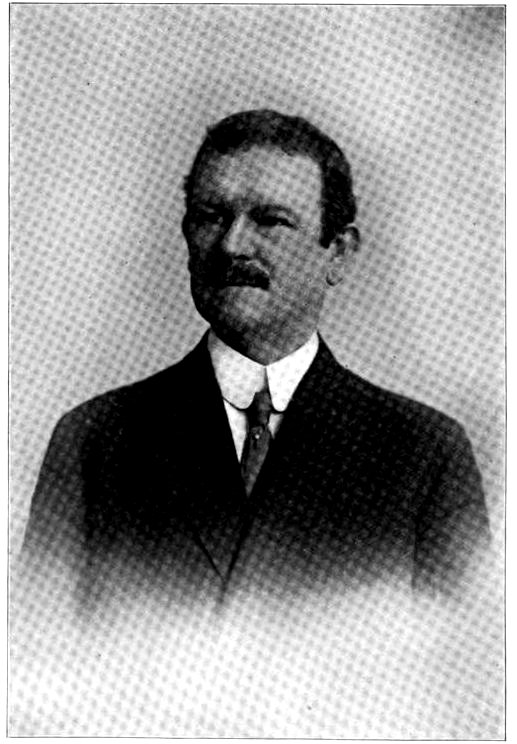
MR. WILLIAM J. FARRELL. Of New York. A New Life Member of the Society.
227He said to the southern leaders that he intended to colonize this new empire with New England Yankees. His speeches on Central American colonization, on the “Suicide of Slavery,” and on the “Admission of Oregon” brought him great fame. Against the caucus decision of his own party he secured the admission of Oregon into the Union, and in this act, though in opposition to partisan dictation, he was sustained by leading Republican organs throughout the country, although he received some censure in his own district.
Soon after these speeches his political enemies in the district began to organize against him, but his popularity was not to be overcome and he was returned with a flattering endorsement. During his second term in Congress he was instrumental in the admission of Oregon as a state to statehood. The Republicans were of the opinion that the admission of Oregon into the Union would mean heavier Democratic representation. Mr. Thayer, however, argued that the best way to make Oregon a Republican state would be to admit it into the Union. Succeeding events proved that his view of the matter was correct, but at the time the Republicans in the House opposed the admission.
Mr. Thayer, during the discussion of the bill, went to Alexander H. Stephens, then chairman of the Committee on Territories of the House, and told him that he should work for the passage of the bill and it was to his everlasting credit that Oregon was admitted to the Union by a majority of eleven votes, of which fourteen had been won over by the untiring efforts of Mr. Thayer.
He was assailed at home for his stand in this matter, as his constituents considered that he had voted for a measure which provided for the admission of a state whose constitution excluded the negro from all political rights. As a direct result of his stand in this matter, the district failed to send him as a delegate to the national convention in 1860, which placed in nomination Abraham Lincoln for the presidency.
Together with Horace Greeley, however, he was a member of the convention, representing Oregon, the state for whose admission he had so earnestly worked, and whose people appreciated his services in its behalf. He worked with Greeley for the nomination of Lincoln in a convention which was replete with startling incidents, not 228the least of which was the motion of Joshua R. Giddings, aiming at the admission of a clause in the platform providing that all men are free and equal.
On account of this outspoken stand in several important measures, it was apparent to Mr. Thayer that he would fail of a renomination, and in the spring of 1860 he announced himself as an independent Republican candidate. As the campaign developed, a candidate in opposition to Mr. Thayer was found in the person of Goldsmith F. Bailey of Fitchburg, but no speaker in the state could be found who was willing to meet the arguments on important questions advanced by Mr. Thayer. Such men as Henry Wilson and Charles Sumner refused to meet him on the stump in joint debate, and he was obliged to fight it out alone. The result was that he was defeated by a very small majority. So great was his popularity throughout the country during his second term that he was prominently spoken of as a possible senator from Massachusetts.
Bailey, who defeated him for Congress, was in advanced stages of consumption when he was nominated and was unable to take the stump against Mr. Thayer. The voters of Worcester at last became so vigorous in their demands to see the candidate that to quiet them a meeting was arranged at which he was to be presented to them from the platform. When Bailey arrived in the city he was such a haggard and ghastly spectacle that it was feared by the party managers that if seen by the voters as he was, it would make votes for Thayer.
It is maintained by those who seem to know that Bailey was taken into George R. Spear’s drug store before the meeting. There his face was painted and touched up with cosmetics until he looked like a thing of life instead of a specter. He sat in Congress but one day, and then returned to his home and died.
In 1856 Mr. Thayer originated a southern colonization scheme, which had for its object the settling of Virginia, North Carolina, Kentucky and the border states and driving the slaves toward the Gulf. He enlisted the services of James Gordon Bennett of the New York Herald, and William Cullen Bryant of the New York Evening Post in his project. He went South at the head of the colonists and founded the town of Ceredo in Virginia, now a sizable place.
At the time he was charged by the Southerners with coming down 229into the South to interfere with slavery, but he and his colonists disclaimed any such purpose, saying that he neither intended to interfere nor have any part in the slavery movement. He said further that he could support the negro power and a steam engine for $10 a year, while it was costing the southern slaveholders $150 a year, and that at the time he came into Virginia land was worth but 50 cents to $1.50 an acre, but that his free settlement had made it worth $50 an acre.
A man named Jenkins, afterwards a rebel officer, appealed to Gov. Henry A. Wise to exterminate this colony of abolitionists, but the governor said that they came into the state in a peaceful way and that anything which tended to increase the wealth should be protected. Considerable progress with the colonization scheme was made in other states, especially in North Carolina, but the John Brown raid and the opening of the rebellion brought the enterprise to an end. After the war Charles B. Hoard, a member of Congress with Mr. Thayer, came into possession of the property at Ceredo. The project caused Mr. Thayer a loss of $118,000.
Mr. Thayer was appointed a special and confidential agent of the treasury department and served as such in 1861–’62. In 1862 he proposed to Secretary Stanton a plan for the military colonization of Florida, which was approved by President Lincoln, all of the members of the president’s cabinet excepting Seward, and by nearly every Republican member of Congress, as well as by Generals Hunter, Hooker and Garfield. According to the plan, Mr. Thayer was to go as military governor and General Garfield as commander of the forces.
This plan was under consideration for several months by the president’s cabinet and was sustained by great meetings in New York City and Brooklyn by such speakers as William Cullen Bryant and Cassius M. Clay and others of equal note. Capitalists came forward with offers of steamships, and other means and regiments were offered from several of the states, but, like other notable plans which were never carried out, this plan was prevented from being put into operation by exigencies of the times.
He remained with the Republican party until the impeachment of President Johnson. He was a Democratic candidate for Congress in this district in 1874, and also later, in the first instance 230nearly defeating Senator George F. Hoar, reducing the Republican majority from 7,000 to 300.
He was interested in the solution of the polygamy question in Utah, and, in connection with such men as Amos A. Lawrence, Edward Everett Hale and other members of the old Emigrant Aid Society, was concerned with plans for the elimination of the evil by the principle formerly put into force in Kansas. In recent years he has written much of history, illustrating his life work and the principles which have governed his actions in political and philanthropic work. He kept fully abreast of the times, with a keen interest in current events, and was always in sympathy with genuine progress.
Mr. Thayer was engaged after leaving Congress by the Hanibal and St. Joe Railroad Company, at a very large salary, to act as its land agent in New York City. He was there from about 1864 until 1870. He was also an expert in matters of invention, acting as a referee in such cases, for which he received large sums. He studied law, but was never admitted to the bar.
During the war time he originated a plan for the establishment of a great port of entry on the peninsular between the York and the James rivers in Virginia, and obtained a bond for a deed of the land. He considered the natural advantages of that locality a rival to New York. His plan, however, was divulged to certain heavy capitalists in New York, and they by some means obtained possession of the property and frustrated his scheme. He said he would have carried the thing through had he obtained the land, but the capitalists undertook it and failed.
He had a very keen sense of humor and a sharp wit. It was most amusing of itself to hear him tell humorous stories and preserve his grim countenance from the suspicion of a smile.
Mr. Thayer took the initiative in developing the south end of Worcester for manufacturing by erecting, more than fifty years ago, the building formerly known as the Adriatic mills on Southgate Street. He was influential in the erection of the junction shop formerly the property of the late Col. James Estabrook, and for many years occupied by the Knowles loom works on Jackson Street. This building, like the Oread Institute, was constructed of the stone taken from Oread Hill. He laid out and improved several streets and tracts of land in the vicinity of the Oread and had under consideration 231at the time of his death the opening up of a large area on the summit of Pakachoag Hill, at the rear of Holy Cross College.
He was the last surviving member of the Emigrant Aid Society, director of the Mutual Redemption Bank, member of the Worcester Society of Antiquity and the American Irish Historical Society. Belonging to no clubs, he was essentially a home man. Throughout the country he was familiarly known as the “Father of Kansas.”
He was married in 1846 to Cardina M. Capron of Millville, Mass., and seven children were born as a result of the union.
LATE PUBLICATIONS ON HISTORY OF INTEREST TO THE MEMBERS OF THE AMERICAN IRISH HISTORICAL SOCIETY.
BY THE SECRETARY-GENERAL.
Pacific Blockade. By Albert E. Hogan, LL. D.
This is the only treatise in English exclusively upon this subject, and the author has discussed a minor topic of international law fully and fairly. His views are briefly that pacific blockade (the right to blockade the ports of another state in time of peace and without war necessarily resulting) is too new a practice to have become entirely regularized; that the state blockaded as well as the blockader, but not the third powers affected, may decline to look upon a specific case of pacific blockade as consistent with peace, and thus consider war to be a fact; that notice, effectiveness, days of grace, etc., are to be observed much as in ordinary blockade; that, unlike ordinary blockade, it may be limited to a certain commodity or a certain traffic; that the ships of third powers, attempting to run a pacific blockade, can only be turned back or at most detained, never seized and confiscated as if war existed; that this kind of coercion is better than war for all parties.
Doctor Hogan is an Irishman and a professor of law at the University of Oxford in England, but his book and his views are being much discussed and widely criticised by American historical authorities.
232The Mystery of the Pinckney Draught. By Hon. Charles C. Nott, formerly Chief Justice of the United States Court of Claims.
This work is interesting throughout. Pinckney was not a great constructive statesman, but in the work of the convention he rendered valuable service in formulating many of the details embodied in the Constitution. It was not so much a new instrument of government that Pinckney framed in his original plan as it was a revision of the Articles of Confederation. In the preparation of his plan, Pinckney drew extensively upon the Articles of Confederation and the various state constitutions, especially that of New York. On May 29th, 1787, Charles Pinckney presented to the Federal Convention “the draft of a federal government to be agreed upon between the free and independent states of America”; that the records note simply its submission to the convention, its reference on the same day to the Committee of the Whole House, and later to the Committee of Detail; and that when John Quincy Adams in 1818 applied to Pinckney for a copy of the missing plan, he received in reply a document so strikingly similar to the draft of a constitution reported by the Committee of Detail on August 6th that it was evident one document must have been taken from the other. The conclusion has been almost universally unfavorable to Pinckney. Judge Nott in his work takes the other side, and in an elaborate argument declares that the original Pinckney plan is lost to the world because it was used as “printer’s copy” by the Committee of Detail.
The Works of James Buchanan, Comprising His Speeches, State Papers and Private Correspondence. Collected and edited by Prof. John Bassett Moore. Volumes V and VI, 1841–1844, 1844–1846.
President Buchanan was an Irishman, and Professor Moore has undertaken a most meritorious work in bringing forth the speeches, state papers and private correspondence of this great American citizen. The volume now issued is the fifth, and covers part of the period that Mr. Buchanan was in the United States Senate, where his continued membership of the Committee on Foreign Relations and Committee on Manufactures brought him into close contact with many of the most pressing questions of the time. The great issues covered by these volumes were those of the northeastern and northwestern boundaries and the annexation of Texas. In 1844 Buchanan was a presidential possibility, and his letters, though few in number, show him willing to take, but unwilling to seek, this high office. An excellent review of these volumes has recently been made by Professor William MacDonald of Brown University, Providence, R. I., a member of the Executive Committee of the American Historical Association.
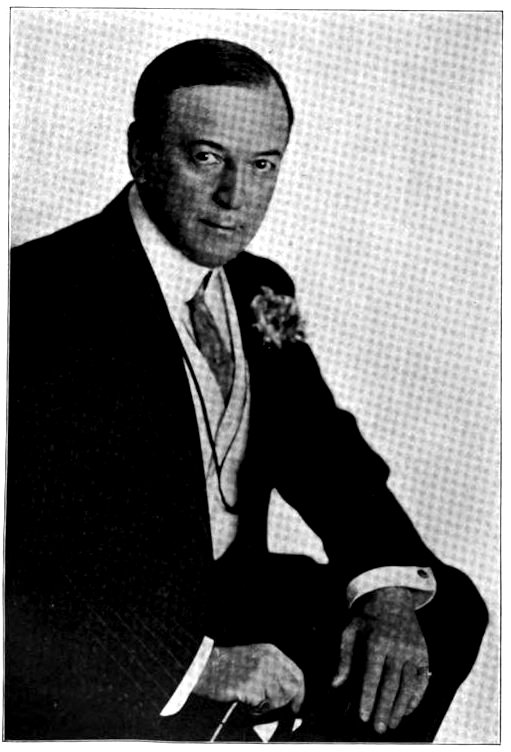
CHAUNCEY OLCOTT. Of New York City, the Famous Actor. A Life Member of the Society.
233Old Times on the Upper Mississippi: The Recollections of a Steamboat Pilot from 1854 to 1863. By George Byron Merrick.
The author’s family were whalers from Nantucket. Mr. Merrick is a good story-teller, and his book abounds with tales of traffic on the Mississippi River from 1854 to 1863.
The author originally came from Nantucket, and began as a pantry boy on the Mississippi, occupying every position in the steamboat and flat-boat business for a great many years, and his tales of war-times are intensely interesting. The book is not well named, however, because steamboating was a large business for over thirty years before the narrative begins. He tells interestingly of bringing to the front in April, 1861, Sherman’s Flying Artillery, the most famous organization in the old army, stationed at the time at Fort Ridgely, high up the Minnesota River. The Fanny Harris, the largest boat which had ever gone up the stream, received the battery on board, its commander then being no other than John C. Pemberton of Pennsylvania, at first a loyal Union officer, although afterwards the Confederate lieutenant-general at Vicksburg. His lieutenant was Romeyn B. Ayres, than whom no Federal officer of the Civil War was braver. The river was at flood, the perils of navigation great, but the emergency was pressing. The Fanny Harris dashed on at full speed, sometimes in the tortuous channel, sometimes crashing through narrow barriers of land into inundated bottoms and even woods, the battery-men meantime exclaiming that the risk to life in battle was far less than among those pouring waters. Three hundred miles down the current was accomplished in two days. The boat was almost stripped of smokestacks, light upper work, and nearly all of her guards, but the battery was delivered, guns and men, at Prairie du Chien. Its style is simple, but very interesting, and the book is beautifully illustrated and printed.
234Texts of the Peace Conferences at The Hague, 1899 and 1907, with English translation and appendix of related documents. Edited by James Brown Scott, technical delegate of the United States to the Second Peace Conference at The Hague.
The volume is published by Ginn & Company of Boston and New York, of which our Librarian and Archivist, Mr. Thomas B. Lawler, is a partner. There is a twenty-five page introduction, giving an analysis and discussion of the work of the conferences. Most of the documents have been published elsewhere, and some of them many times, but it is well worth while to have them brought together in this convenient form. Ex-Secretary Root thinks the work of the Second Conference presents the greatest advance ever made at any single time towards the reasonable and peaceful regulation of international conduct, unless it be the advance made at The Hague Conference of 1899. The volume is complete and treats of the important factors in both conferences, and publishes the very valuable documents.
The Bibliographer’s Manual of American History, containing an account of all state, territory, town and county histories, etc., compiled by Thomas Lindsley Bradford, M. D.
Three volumes have thus far been issued, and each volume shows improvement over its predecessor. It is a valuable work and a most excellent compilation of documents of great advantage to students of American history, and furnishes a good means of observation to the members of the American Irish Historical Society to take in at a glance the history of so many places in this country.
The American Executive and Executive Methods. By John H. Finley, President of the College of the City of New York, and John F. Sanderson, member of the Pennsylvania Bar.
The joint authors of this book have maintained the high standard of scholarship that has characterized the series of which the volume under review is the final number. There are fourteen chapters upon the executive department of the American state, and the other eight deal with the federal executive, to which is added an appendix upon the presidential electoral system. Throughout the work reference is made to the excellent achievements of many Pennsylvania Irishmen, but Mr. Marshall S. Brown, who prints a review of the work, 235finds, among other things, that the book reflects somewhat the defects inherent in a work of dual authorship.
Winthrop’s Journal, 1630–1649. Edited by James Kendall Hosmer. Two volumes.
This is one of the series of “Original Narratives of Early American History.” The old title, “History of New England,” is given in this edition only as a sub-title, and the volumes appear to be what they are—a journal. Nevertheless, the work is interesting throughout, and would be a valuable addition to the Society’s library.
The Province of New Jersey, 1664–1738. By Edwin P. Tanner, Ph. D., instructor in history in Syracuse University.
This is a detailed history of the political affairs and institutions of New Jersey during two generations of its provincial life. The peculiar land system of the proprietors in each of the two Jerseys, elements of the population, the personnel, legal position and activities of executive, council and assembly respectively, and their conflicts, the judicial system, financial affairs, militia system, etc., are carefully treated.
The Writings of James Madison. Edited by Gaillard Hunt.
This is much on the plan and fully as extensive as “The Works of James Buchanan” heretofore referred to, and eight volumes at present have been issued. The notes are excellent in respect to information and judgment, but not much of the matter set out is new, the author merely contenting himself by copying the writings of President Madison without making any specious comment on the same.
A Calendar of Confederate Papers, with a Bibliography of Some Confederate Publications.
This is a preliminary report of the Southern Historical Manuscripts Commission, and is one of the really monumental historical enterprises in the South. The commission is actively collecting, arranging and publishing various kinds of material relating to the Civil War, and to thoroughly appreciate the truly marvelous changes one should have known the conditions in the southern capitals a quarter of a century ago. Those directing this enterprise are so energetic, intelligent and ambitious that we believe the best fruits 236are yet to be gathered, although there is no room to doubt the value of several large collections already made. Mr. Douglas Southall Freeman is the director, and this calendar, orderly throughout and supplemented by careful notes, is very complimentary to him. Much historical data can be gathered for the Society from the southern states, where the recognition of Irishmen and their achievements was more free than in the New England states.
The Adoption of the Fourteenth Amendment. By Horace Edgar Flack, Ph. D.
Is a part of the Johns Hopkins University studies in historical and political science. So much has been heretofore said about these studies in the current magazines that we assume the members of the Society are familiar with them.
Collections and Researches Made by the Michigan Pioneer and Historical Society.
The Society has been at work many years, and now publishes its thirty-sixth volume. The usefulness of this work to members of our Society in Michigan who desire to record the history and achievements of Americans of Irish birth or descent cannot be overestimated.
Collections of the State Historical Society of Wisconsin.
This is the eighteenth volume of the publications, and is edited by Doctor Thwaites, Secretary and Superintendent of the Society. The Wisconsin History Commission, consisting of the governor of the state, the professor of American history in the state university, the secretary of the State Historical Society of Wisconsin, the secretary of the Library Commission, and a representative of the Grand Army of the Republic, work with the State Historical Society of Wisconsin, and have already gathered and arranged the material for a history of Wisconsin’s part in the Civil War. A series of “Original Papers” has been inaugurated, on the line of the papers presented at our last meeting in Washington by Mr. Justice Dowling and Ex-Attorney-General Moloney, and are very interesting.
Lives of the Governors of Minnesota.
Is Volume XIII of the publications of the Minnesota Historical Society Collections, and is by James H. Baker, A. M., who has occupied several political positions in his state and has been closely associated with the men whose lives he has sketched. Mr. Baker is almost eighty years of age, and he has personal acquaintance with the governors from Ramsey, the first territorial governor in 1849, up to the present incumbent. Mr. Baker’s sketches of Gorman, territorial governor from 1853 to 1857; Sibley, first state governor from 1858 to 1860; Swift, third state governor from 1863 to 1864; McGill, 1887 to 1889; and Clough, 1895 to 1899; men of Irish extraction, are thorough and entertaining.
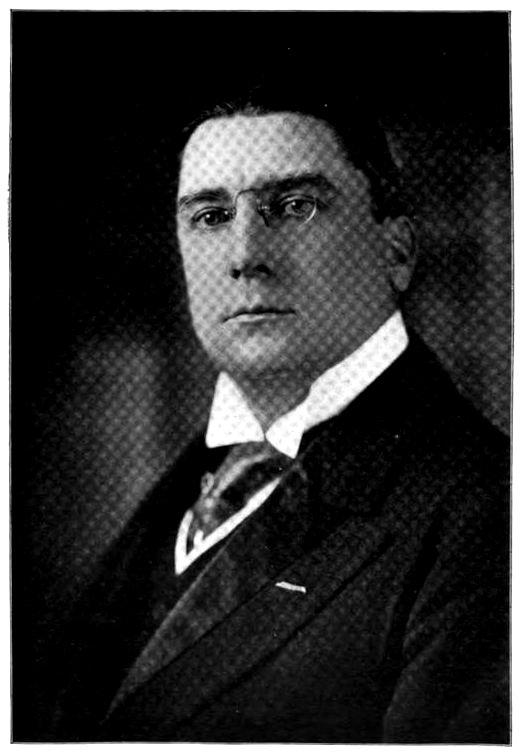
HON. T. ST. JOHN GAFFNEY, Of New York. Consul-General to Dresden, Germany. Vice-President of the Society for Germany.
237Transactions of the Kansas State Historical Society, 1907–1908:
This is Volume X of the publications of the Society, and is edited by the Secretary, George W. Martin. Fifty-six essays by nearly as many writers are presented. Several of the productions are composed of separate papers, such as the collections of biographical sketches of members of early legislatures, etc. A wealth of original material, well worth the notice of historians outside of the state of Kansas, is revealed, and forty-eight maps, plans, portraits and landscapes illustrate the text.
History of the City of Vincennes, 1702–1901:
An important contribution to the local history of Indiana, and a well written and authentic account of the oldest town in that state. By Henry S. Cauthorn.
History of Worcester:
A well written, authentic history of the Massachusetts town in the War of the Rebellion. By A. P. Marvin.
Wisconsin Volunteer Infantry History:
An account of the regiment from 1861 to 1865. By Edwin E. Bryant.
Professor Edward Channing of Harvard University has two volumes of a History of the United States already issued of a series of eight volumes. The title of Volume I is “The Planting of a Nation in the New World, 1000 to 1660”; Volume II, “A Century of Colonial History, 1660 to 1760.” The titles to Volumes III and IV, not yet issued, are “The American Revolution, 1760–1789,” and “Federalists and Republicans, 1789–1812,” while the titles to Volumes V to VIII have not as yet been selected.
238“Dr. John McLoughlin, the Victor of Oregon,” an authoritative biographical sketch, with abundant documents, by Frederick V. Holman.
“A Documentary Source-Book of American History,” by Professor William MacDonald of Brown University, author of “Select Charters,” “Select Documents,” and “Select Statutes,” etc. The work is in one volume, and includes all the most important documents contained in Professor MacDonald’s large works, but in some cases shortened by immaterial omissions.
GENERAL HISTORICAL ITEMS.
A very interesting document is the Report of the Committee on the Documentary Historical Publications of the United States Government, appointed by President Roosevelt in February, 1908, as an assistant committee to the Committee on Department Methods. Hon. Lawrence O. Murray, now Comptroller of the Currency at Washington, D. C., and at that time in the Department of Commerce and Labor, is a member of this committee, and the Society acknowledges with its thanks the receipt from him of a copy.
On February 11th, the President sent it to Congress with a message, and message and report have since been printed as Senate Document No. 714 of the session concluded March 4th.
The report contains a review of the course hitherto pursued by the government in the matter of historical publications; a general survey of the publications hitherto made, and of the gaps still existing between or among them; a body of recommendations for filling such gaps, especially by the inception of a series of National State Papers; and finally a series of suggestions for the organization of a permanent Commission on National Historical Publications, with a bill which, it is hoped, will be introduced in the sixty-first Congress.
The Fifth Annual Meeting of the Pacific Coast Branch of the American Historical Association was held at the University of California November 21st last. Papers were read by Professor E. D. Adams of Stanford University concerning the annexation of California, Mr. Don E. Smith and Professor J. N. Bowman of the University of California, and by Mr. F. J. Taggart. The proceedings lasted the entire day, sessions being held in the morning and afternoon, followed by a banquet in the evening.
239The publications of the American Association for International Conciliation are being sent forward to the members of our Society, and are readable and interesting documents by learned authorities upon the subjects they present. At the suggestion of the Secretary of the Association, the addresses of our members were sent him, and he has written each that the publications of the Association will go forward to them if they so request it. All that it is necessary to do to receive them is to write the Secretary. His address is: “F. P. Keppel, Secretary, Sub-Station 84, New York City.”
Hon. Thomas W. Bicknell, Providence, R. I., President of the Rhode Island Citizens’ Historical Association and an applicant for membership in our Society, has recently published in the Journal of American History an interesting article entitled “First White Owners of Land in America.” Mr. Bicknell is also the author of “Sowans,” a work treating of the early history of Barrington and Warren in Rhode Island.
Among the contents of the last issue of the American Historical Magazine is “Heroes of the Battle of Point Pleasant,” by Delia A. McCulloch.
In the January issue of the Essex Institute Historical Collections is an article on “Captain John Manley of Marblehead, a Man of Irish Descent,” by Robert E. Peabody.
RECOMMENDATIONS.
It has been the custom of the Society since its organization to have one annual meeting and two or more field days each year. The annual meeting in each instance has been called for the early evening, and the business affairs finished in a few minutes; then a short reception would take place, followed by a dinner, on the completion of which some historical papers would be read and addresses of interest made.
This proceeding is not calculated to sufficiently advance the interests of the Society, or enable it to truly do the work for which it is organized. Some historical associations have annual meetings at which there is a morning and afternoon session, followed by a dinner in the evening, while others have sessions lasting two or three days. It is impossible to crowd into a single evening, part of 240which has been taken up in partaking of a good dinner, any significant number of historical papers, much less to have a discussion on them.
Valuable addresses have been made that have not been printed in the Journal, and all that is left of them in the minds of the members is hardly more than pleasant recollections of the speakers. All the leading historical associations procure valuable papers from members, and, after they are read, discussion upon the subject-matter is thrown open, the good points gathered, and all reported in print later for the use of the members.
This Society could profitably take a day and an evening for its annual meeting. A morning session should be had, called to order at ten o’clock. Two or three papers could be read and discussion had upon each, followed by a recess from one to three p. m. Further papers and discussion might then be entertained and the meeting adjourned, with all the business completely transacted, in time for the dinner in the evening, at which short and interesting speeches, good music and general recreation after the day’s work would be in order.
These annual conventions should take place in different parts of the country, and those interested in our work will be sure to be on hand. In looking over some of our old records, it appears that requests have been made by members for meetings to take place in Richmond, Va., Charleston, S. C., and Detroit, Mich. In neither of these places has an annual meeting or a field day of the Society taken place.
Members of the Society are earnestly requested to furnish the Secretary-General with correct addresses. When a member removes or changes his address, the Secretary-General should be notified immediately, otherwise the publications and communications of the Society may be lost or fall into unauthorized hands.
The necessity for prompt payment of dues ought to be manifest to every member. The Society has no income except from the $5 a year contributed by the annual members. No officer or member receives any salary, and the finances are carefully and economically managed by the Executive Council. We have no expense for rental for the Society’s headquarters, and have no recent record of any officer of the Society accepting even his traveling expenses in matters connected with the Society. Nevertheless, the income is small, and our expenditures for printing the annual volume, gathering historical matter, postage, stationery and typewriting are large and do not leave the Society at the end of the year with any substantial balance in the Treasurer-General’s hands.
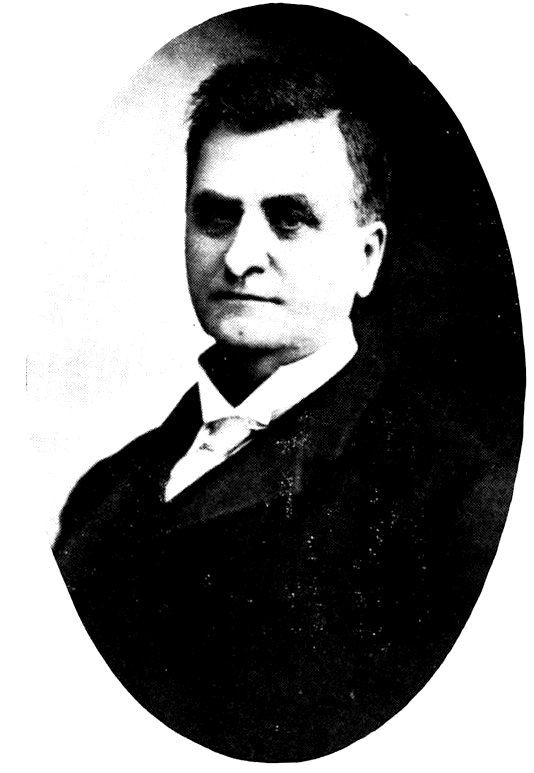
COL. C. C. SANDERS (Deceased). Gainesville, Ga. Late Member of the Executive Council.
241Donations of money or bequests by will or otherwise are earnestly and respectfully solicited, and any member who will take the trouble to read the constitution and note the purposes for which the Society is incorporated can readily see the great and lasting service to our people and American history in general that could be made, in addition to what the Society is now doing, to make better known the Irish Chapter in American History.
Some members well able to pay are in arrears from two to four years in their dues, notwithstanding the fact that several tactful circulars and repeated statements have been forwarded them by committees and officers of the Society. The attention of members is called to section 8 of the by-laws, which reads as follows:
“8. A member neglecting for two years to pay his annual fee shall be notified of such omission by the Secretary-General. Still neglecting for three months to pay the dues, such delinquent member shall be dropped as no longer belonging to the Society.”
Many of our members belong to other historical associations, and, by keeping in touch with their works, become of greater service to us. The American Historical Association, the headquarters of which are at the Smithsonian Institute in Washington, D. C., and the leading state historical associations are cordially recommended to our members.
Members are earnestly requested to furnish the Secretary-General with biographical sketches. It is necessary to have these for our archives, and we hope that no member will allow his feeling of modesty to interfere with keeping the records of the Society complete. These sketches will not be published in the Journal if a member shall so direct. Read over your biographical sketches in the membership roll, and if they are not correct or should have additions, notify the Secretary-General.
Current items of interest relating to the doings of Americans of 242Irish extraction are solicited from every member by the Secretary-General. If a good article is met with in a newspaper or magazine, it will be thankfully received and filed in the archives if you will send it forward. It is by keeping abreast with the current history that we fulfil one of our greatest duties.
Donations of historical works, ancient or modern, or, in fact, books of any description, are solicited for the Society’s library. Copies or originals of old deeds, wills, bills of sale of slaves, curiosities in American or Confederate money, plate, postage stamps, old prints, pictures and the like are also solicited. When received, they will be carefully indexed and filed, with the name of the donor attached. Every member can readily find something of interest to send, and the aggregation will form a nucleus for a good library and possibly a museum.
Volumes I, II, IV, V and VI of the Journal of the Society are out of print. We have fifty copies of Volume III and ten copies of Volume VII left. The Executive Council have ordered fifteen hundred copies of Volume VIII, so that we may be sure every member will have a copy and the Society have some to spare.
These volumes out of print have become very rare, and some of them are held at high prices. If a sufficient demand appears from members who desire to have a complete set of the Society’s publications, the subject will be brought before the Executive Council for action, with the possibility that some of the volumes may be ordered reprinted.
243
REILLY OF F
(Captain H. J. Reilly, Battery F, Fifth Artillery, “The Fighting Fifth,” U. S. A., killed on the walls of Pekin, in the relief of the legations, during the Boxer uprising.)
By John Jerome Rooney.
I.
Know you the story, friends, know you the story?
No hero is mine of the plume and the lance—
Yet worthy to claim the green bay of glory
In the lay of the singer of oldest romance.
Then, when the song of the minstrel is gone,
Forget not how Reilly—brave Reilly went on!
II.
Out from the East, like a bolt from the sky,
Thrilled the wild rumor of danger and dread—
Out from the East flamed a prayer and a cry—
A cry of the living, a cry of the dead—
Straight to the heart of the nations it came,
And the nations were shaken, as wind shakes a flame!
III.
There, ‘mid the millions of Mongols, they stood—
One grain in the desert, a drop in the sea—
Mothers and children—brave men of our blood—
What is their fate? Say, what shall it be?
How can we name the thing that we fear?
The heart, at the thought, is palsied and seer!
IV.
Onward! the cry of the East and the West—
Onward! spoke Chaffee, Columbia’s son:
The nations were calling their bravest and best
For the work of a giant before them undone.
No time now to palter with quavering breath—
’Twas action and rescue—’twas rescue or death!
V.
And the word came to Reilly—it spoke not again—
Brave Reilly with all his bold lads of the guns—
(Ah, if any came out from El Caney’s red rain,
’Twas by the grace of the Lord—not Hispania’s sons!)
Oh, a stancher band never turned face to the foe
As onward with Reilly, straight onward they go!
244VI.
They battered the walls of the forts of Taku,
They lifted the door-knock and pounded it well—
And the door?—the door was a breach looking thro’
An entrance well dusted by shrapnel and shell.
The fort, like a mist of the morning, was gone,
And Reilly went on—bold Reilly went on!
VII.
On by the railroad—still onward they press’d—
Thro’ rampart—thro’ swamp, like a sword of the Lord—
True sons of the East, true sons of the West,
A knight of King Arthur confronting a horde!
And Battery F, unafraid of the brunt,
Kept its pace, and its guns, right up to the front!
VIII.
See! See! the walls of the Capital rise
Away to the right, a vision of power—
They are flashing a signal—our loved one’s replies—
They are lost had the guns been delayed but an hour.
Like a cyclone they open and thunder their doom
And the flame from their mouths is the light in our gloom!
IX.
Battery F opened up like a hell,
With a roar like a lion—a serpent’s fierce hiss—
Solid shot under! above with the shell!
Gates were not made to be pounded like this.
Trembles the portal—with a shot it is gone—
And Reilly went on—bold Reilly went on!
X.
From the compound a cheer, like a voice from the grave,
Rolls upward and out and upward again;
The Lord—He is gracious and mighty to save,
And he works by the hands of His valiant of men!
Still, was work to be done—stern work to be done—
Ere the wall’d town within was level’d and won.
XI.
Then “Forward,” called Reilly—and forward they swept
To the walls where the foe had rallied his horde.
Like a boy, to a ladder the Captain has leapt,
You can see, far in front, the gleam of his sword.
Then up thro’ the smoke, like a wraith, he has gone—
And Reilly went on—bold Reilly went on!
XII.
O sweet harp of Erin, sound gently thy lay!
O star of Colombia, be swift with thy light!
He fell—and the summit of Glory that day
Was the rampart he scaled alone in the fight.
In a beam of the splendor a moment he shone—
And Reilly went on—brave Reilly went on!
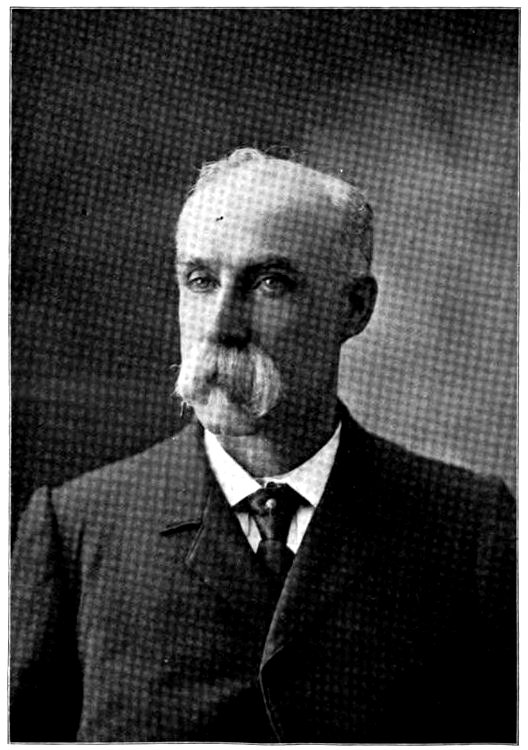
EDWARD CARROLL. Leavenworth, Kansas. A Member of the Society.
245The above is a true story, every word of it. The United States Government brought Captain Reilly’s body home and buried it in the Arlington Cemetery, near Washington, and erected a splendid shaft to mark this brave soldier’s memory. Captain Reilly, as his name indicates, was of Irish stock.—J. J. R.
CHRISTOPHER COLUMBUS SANDERS, ONE OF THE FOUNDERS OF THE AMERICAN IRISH HISTORICAL SOCIETY, AND MEMBER OF THE EXECUTIVE COUNCIL. A WORTHY AND DISTINGUISHED ASSOCIATE.
By A. W. Van Hoose, president brenau college-conservatory, gainesville, ga.
On August 3d, 1908, there died at his home in Gainesville, Ga., one of the most remarkable men that it has been my good fortune to meet.
Descended on his father’s side from Rev. Moses Sanders, a Baptist preacher who emigrated from England to this country in the year 1765, and on his mother’s side from Thomas Smythe, a man distinguished for his great learning and for the many sweet poems that came from his pen, an Irishman, who with a party of friends, left Dublin, Ireland, in 1798 and made his home in Charleston, S. C., Colonel Sanders combined in his nature, disposition and temperament, the very best characteristics of the English and Irish, whose descendant he was.
For twenty years I knew him intimately, and I have no hesitation in making the statement that he was one of the most remarkable men of the generation in which he lived.
If I were asked in what respects he was remarkable, I would 246answer, First in his broad patriotism and deep love of country. Although he was little more than a boy when Georgia, in which state his parents had settled, seceded and issued her call for her sons to take up arms in defense of principles which they knew to be right, young Sanders, who had received a splendid military training at the Georgia Military Academy, was one of the first to respond to his country’s call, and during all those years of carnage and bloodshed, he gave his best strength, mental and physical, to the cause of the Confederacy. For distinguished bravery and great ability in military matters, he was soon made Colonel of the 24th Regiment of Georgia Volunteers and in the battles of Williamsburg, Seven Pines, Cold Harbor, Malvern Hill, Fredericksburg, Chancellorsville, Harper’s Ferry, The Wilderness, Spottsylvania Court House and other great struggles, the Confederacy had no braver soldier or more efficient officer than he. At Spottsylvania, he was severely wounded and his command suffered greatly; he was captured at Sailor’s Creek, May 6, ’65, and until July 25th, suffered the awful horrors of the Federal Prison at Johnston’s Island. During the war, he was offered the rank of Brigadier-General, but with that modesty which characterized his whole life, he declined the honor.
While he loved the cause of the Confederacy with all the ardor of his great soul, when Lee surrendered at Appomatox, Colonel Sanders ceased fighting and applied himself diligently to building up the waste places of his beloved country and to making a competency for himself and family, and the great success which attended his efforts in both instances is the second reason that I would assign for calling him a remarkable man. In 1871, he married Miss Fannie Amelia Scarborough, who until the day of his death, was a blessing and an inspiration to him. Together they came to Gainesville, a little mountain village, in 1871, immediately after their marriage, to build their home and fortune. By industry, economy and great business ability, Colonel Sanders succeeded in amassing a splendid estate, and at the same time was always first in his contributions to any public enterprise or private charity. No one will ever know how many cases of distress he relieved; for he obeyed the Scriptural injunction and never allowed his left hand to know what his right hand was doing. The writer of this sketch, was often at the State Bank, of which Colonel Sanders was President for many years, and has seen numbers of the old veterans, unfortunate men of all classes 247and even the negroes of the city, ask for aid and never once were they refused. On the day that he died, I heard numbers of men, with tears in their eyes, say, “I have lost the best friend that I ever knew”; his funeral services were attended by every class of people in our city and country, and after his more intimate friends came and with streaming eyes looked into the face of him who had befriended them for so long. Such a funeral has been accorded but few men in our country. Colonel Sanders was also remarkable for his literary and scientific attainments. Although he professed to be only a business man, he was a great student of men and affairs; he was a great reader of history and the record of all nations, from the earliest period to the present day, was an open book to him; he had traveled extensively and the literature and civilization of Europe and Egypt and the Holy Land, were so fully and accurately impressed upon him, that he could entertain his friends by hours in recounting his experience as a traveler. But best of all, Colonel Sanders was remarkable in his childlike devotion to and faith in Jesus Christ, the Man of Galilee, in whose footsteps he had followed for many years. He was one of the very few men of my acquaintance who, though devoted to his business, always kept a Bible in the President’s office of the State Bank, and oftentimes have I called to see him only to find him immersed in the beauties of the great prophecies of Isaiah, or reading the Songs of David, the sweet singer of Israel, or studying the life and character of Him who came into the world to save men from their sins. For years, he was a pillar in the Baptist Church of this city; he always taught a class in Sunday School and his presence there was always an inspiration to the Superintendent. During an intimate acquaintance for more than twenty years, I do not think that I ever heard him speak an unkind word of any one and when the summons came, his house was in order and he was ready to meet his Master and give an account of the deeds done in the body. I was with him very often during his last illness and his faith in the promises of Him whom he had served so long and so faithfully, was beautiful and sublime. Not a word of business care or anxiety was heard around the sick bed of Colonel Sanders; he seemed in constant communion with God, and though he had large financial interests, in these last days he made no mention of them.
To the writer of this sketch, his death was a great personal loss; 248when I began the work of building a school for girls in Gainesville nearly twenty-five years ago, Colonel Sanders was my friend and supporter; during all the years of struggle and trial in the early days of the school he gave me the benefit of his advice and counsel and never refused any financial assistance when called upon to extend it. It was his confidence in a struggling young man that often nerved my arm and heart to continue the work which I had undertaken. And when the end had come, and I looked upon that face, calm and sweet, having the appearance of one who had only fallen asleep, I thought of the words of the great poet and said to myself:
“His life was gentle,
And the elements so mixed in him,
That Nature might stand up and say to all the world,
Here was a man.”
PATRICK J. McTIGHE.
A worthy member of the American Irish Historical Society was deceased at Binghamton, N. Y., August 4, 1908.
Patrick J. McTighe was born in Kilrush, County Clare, Ireland, in 1840, and received his education in a university at Dublin. His parents arrived in this country about fifty-five years ago, settled in Binghamton and were among the few pioneer Irish Catholic residents of that section. About forty-five years ago Mr. McTighe followed his parents to Binghamton and secured a position as teacher in one of the public schools. After teaching about two years he entered the employ of the wholesale grocery firm of Jackson, Denton & Marks. This firm changed several times and many different partners were admitted and retired while Mr. McTighe was connected with the business.
Following are a few of the firm names which the original house passed through before Mr. McTighe acquired the present business: Jackson & Marks, Marks & Bean, Bean & Company, McTighe, Truesdell & Davidge. Mr. McTighe was a silent partner in the firm of Bean & Company, and was an active partner in the firm which he later bought out and reorganized under the present name of the McTighe Grocery Company, with offices and warehouses at No. 69 Fayette Street.
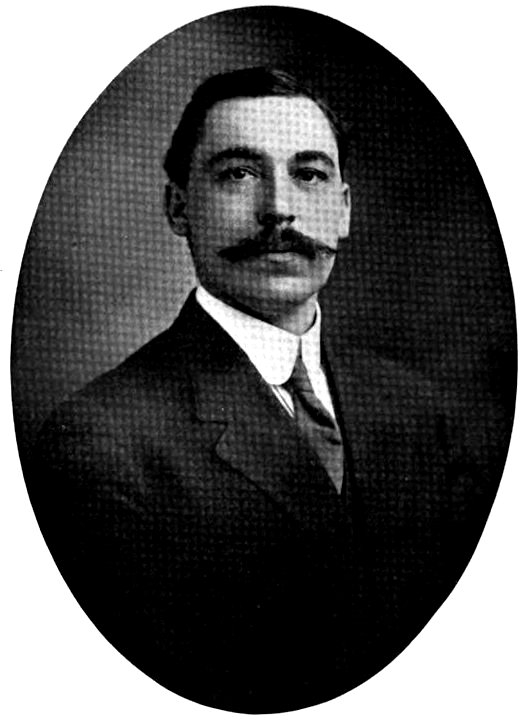
MR. JOHN G. HARDY. Of the William J. Feeley Company. Providence, R. I. The Talented Sculptor of the Sullivan Memorial.
249Mr. McTighe had been prominent in political, religious and social circles in this city for many years. In addition to his membership in the American Irish Historical Society, he was a member of the Catholic Club of New York, the Knights of Columbus, and many other orders and societies. He was president of the local branch of the old Land League during the season of its most effective work; a former president of the Binghamton Board of Trade for several years, and was a police commissioner of that city. During the presidential election of 1892 Mr. McTighe served as a presidential elector when Grover Cleveland was made president.
He had been a devout communicant and a member of the board of trustees of St. Patrick’s Church since the time when this church was the only Roman Catholic edifice in Binghamton. Aside from being a moving spirit in the church proper he took a lively interest in the many branch societies of St. Patrick’s.
He is survived by his widow, whose maiden name was Miss Mary A. McDonald; two sisters, Mrs. Anne Wall and Mrs. Mary Murphy; a nephew and a niece, John and Florence McDonald, whom he brought up from childhood as his own children; two nephews, Patrick and John McTighe; and two nieces, Frances McTighe and Elizabeth Wall.
Mr. McTighe always kept green his memories of the “Ould Sod,” and was in touch with all movements to better the condition of the Irish people. His recent efforts to aid the Kerry fishermen were especially praiseworthy.
Mr. McTighe was the leader in the movement to raise the fund raised in Binghamton to aid the Quilty fishermen, who rescued the sailors of the Leo XIII last autumn. The editor of The Binghamton Press was made treasurer of the fund, in recognition of the sermonette editorial, based upon the thrilling story of the wreck, while Mr. McTighe took active charge of raising the money and sending it to Ireland.
In business Mr. McTighe was a hard worker and a keen, methodical business man. He had the reputation everywhere of having a very high regard for his word. In his long life and connection with the grocery business he was associated with many of the pioneers 250of Binghamton business life and many of the old aristocrats of the business circle.
He was a well educated and well read man, being a scholar in Latin, Spanish, Celtic and French. He was always improving his mind, and, it is said, started in to learn Greek when past the age of sixty, finally mastering it so that he read it with pleasure.
The decease of this estimable man has left vacant a place hard to fill, and the entire city of Binghamton was filled with sorrow at his sudden death.
251[These blanks may be separated and used for membership application]
To the EXECUTIVE COUNCIL of the AMERICAN-IRISH
HISTORICAL SOCIETY:
Application for life/annual membership is hereby made by the undersigned
Name
(Write legibly)
Address
Occupation
Recommended by
Application for membership must be accompanied by cheque for $50.00 for life membership or $5.00 for annual membership, payable to Michael F. Dooley, Treasurer-General.
252
MEMBERSHIP ROLL OF THE AMERICAN IRISH HISTORICAL SOCIETY.
[For officers of the Society see pages 19–21.]
Adams, Hon. Samuel, President and Treasurer of the O’Neill-Adams Company, Twentieth to Twenty-second Street, Sixth Avenue, New York City; director, Garfield National Bank; member of the New York Chamber of Commerce; trustee, Excelsior Savings Bank; an ex-State senator of Colorado.
Adams, T. Albeus, President, Manhattan Refrigerating Company, 525 West Street, New York City; President, Adams & Company, New York; President Union Terminal Cold Storage Company, Jersey City, N. J.
Aspell, John, M. D., 139 West Seventy-seventh Street, New York City; a member of the Academy of Medicine; of the County Medical Association, and of the Celtic Medical Society; recently President of the latter; visiting surgeon to St. Vincent’s Hospital.
Bannin, Michael E., of Converse, Stanton & Company, dry goods commission merchants, 83 and 85 Worth Street, New York City; member of the Merchants Association, New York; director, Emigrant Industrial Savings Bank; member of the Merchants and Catholic clubs, New York, of the Montauk Club, Brooklyn, and of the Brooklyn Arts and Science Institute; director, the Columbian National Life Insurance Company; director, American Investment Securities Company; director Citizen Trust Company, Brooklyn.
Bannon, Henry G., 107 East Fifty-fifth Street, New York City; President of the Irish National Club; Secretary, Celtic-American Publishing Company.
Barrett, Michael F., of Barrett Bros., wholesale and retail dealers in teas and coffees, 308 Spring Street and 574 Hudson Street, New York City.