ELEVENTH ANNUAL BANQUET OF THE AMERICAN IRISH HISTORICAL ASSOCIATION. (continued 2)
Reading edition
“Of course, of the hundreds of thousands of Irishmen who have lived and still live with their descendants in the great city of Chicago, it is not possible for me to give more than a passing glance, and say that they are among the leading business men, lawyers, doctors and financiers of that great metropolis. Volumes might be written about them.
“There were not many professional men among those early emigrants. There was one, however, who deserves special mention. His name was E. G. Ryan. He was born in Dublin and came to Illinois in the thirties. He practised law in that State and was recognized at once as being among the leaders of the bar. He afterwards moved to Wisconsin and there became Chief Justice of the Court of Last Resort of that State. He was a profound lawyer, a regular encyclopædia of learning. He was probably the greatest jurist of the West, and there are those who say that he would bear favorable comparison with the great John Marshall. He has been dead for some few years.
144“Very many of the descendants of those pioneers entered the different professions. In law and medicine they easily hold their own in the West. The ablest, all-around lawyer I ever met was Thomas A. Moran of Chicago, for a time Judge of the Circuit and Appellate Courts in that State. He, too, has passed out into the Great Beyond.
“Another who made history might also be mentioned.
“In early days, as we say out West, one John H. Mulkey, then about twenty years old, came to the southern part of the State of Illinois from the State of Tennessee, as an itinerant Methodist preacher. Being a man of good sense, he soon abandoned the ministry and took up the study and afterwards the practice of the law. He met with great success. He had a splendid career. He was elected to the Supreme Court and served as an honored member of that body for a number of years. In 1896, while I represented the State, he came to my office (he was then practising law) and sought a continuance of a case in the Supreme Court. I readily consented, and he dictated to my stenographer the agreement for a continuance. While he was doing so it occurred to me that he had a very peculiar name indeed, and when he got through I said rather abruptly, I confess: ‘Judge, where in the world did you get that name? I can’t think to what nation your ancestors could have belonged.’ He looked at me, laughed, and said, ‘I am as Irish as you are, but an ancestor changed the good old Irish name of Mulcahey to Mulkey, and’ he added, ‘he didn’t improve it.’
“Mulkey had a high sense of honor. He had a solicitous regard for the reputation of his profession. He was a scholarly man, a conscientious jurist. He detested a dishonest man and especially a dishonest lawyer. Apropos of this, it may not be uninteresting if I relate a few of the circumstances attending a dissenting opinion which he wrote while on the Bench. It seems that two men, one named Hughes and the other Appleton, were neighbors and both practised law in Chicago. Hughes conveyed the title to a piece of property worth eight to ten thousand dollars to Appleton, without consideration. The latter was merely a trustee. Appleton disposed of the property and converted the proceeds to his own use. The Attorney-General of Illinois filed an information in the Supreme Court setting up these facts and asking for the disbarment of Appleton. On a final hearing that Court denied the application on the 145ground that the relation of attorney and client did not exist between them. Mulkey not being able to agree with the majority of the Court wrote a unique dissenting opinion, in which among other things, he said: ‘This defense so forcibly reminds me of the old story of the profane bishop who had the good fortune to be a duke also, I cannot refrain from telling it. An acquaintance who happened to overhear him using profane language asked him how it was that he, being a bishop, could be guilty of swearing. “Ah, my friend,” replied his reverence, “I swear as a duke and not as a bishop.” “But,” retorted the other, “when the devil comes to get the duke, what will become of the bishop?” So, in this case, when his Satanic Majesty calls for Appleton the trustee, I should like to know what will become of Appleton the attorney.’ I might add that some years after his admission to the bar, he became a Catholic, and died in that faith.
“I wonder how many Irish names have been mutilated like that of the good judge. I fear too many.
“In the management of railroads, our people have excelled in the West. The children of two Irishmen, brothers, named Egan, born within about thirty miles of where I reside, have been important, if not chief factors in the management of many railroads. They have been connected with the Grand Trunk, the Illinois Central and other roads. I remember well, in 1894, when the great strike, almost an incipient insurrection, occurred in Chicago, that one of these Egans was selected by the officers and directors of all the railroads centering in that great city, to take entire control of their properties and manage them during the strike. This was quite a tribute to the son of a poor Irishman. Another, still comparatively young, might be mentioned. He was born in the town I live in. I remember him as a poor boy, a brakeman on a branch line running through our city. His name is Patrick Houlihan. A brochure has been written on his career and is entitled, I believe, ‘From Water Carrier to General Manager.’ He has on different lines, successively occupied the positions between that of water boy and superintendent, and is now general manager of the Toledo, St. Louis & Western and the Chicago & Alton Railroad Companies, with headquarters at Chicago. He is bright and brainy, with years of usefulness before him. He is a credit to our race.
“In literature, we have fairly well held our own. I do not mean 146to say that we have written as many novels, good bad and indifferent, as others, but the Rileys, the Finnertys, the Sullivans, the Clearys and Dunns, and men and women of such names have left their impress upon our literature. Many of you no doubt have met and all must have with pleasure, read that Western product, the discoverer of Mr. Dooley and Archie Avenue road, that droll, inimitable writer of ‘dialect’ a philosopher in his way—Finley Peter Dunn, who like other good men, has recently gone wrong, in having against the advice of Greeley and all the sages of the republic, migrated backwards as it were until now Gotham claims him for her own.
“And now a few words as to the tillers of the soil.
“Many of those emigrants settled upon the lands of the West, though under disadvantageous circumstances. There are many townships in my county, and in adjoining counties, and indeed scattered all over the West, that have been settled almost exclusively by them. Those lands are now worth on an average $150 per acre. Measurably, this is true of the Middle West. It is literally true of Illinois.
“Nebraska settlement, as it was called, embracing all that territory from Kansas to Canada, and from the Missouri to the Rocky Mountains, was thrown open for settlement in 1854. A large number of Irish were among the early settlers. In 1857 a convention was held in Buffalo to perfect plans for establishing Irish colonies in the West. Delegates assembled from all over the country. Three large colonies started as a result of this convention—one led by Father Trecy founded St. Patrick’s Colony in Nebraska, now Jackson. Another, under Father Powers, of Pennsylvania, went to Missouri, and a third went to Minnesota. In the latter state, additional Irish colonies have been established. They endured almost untold trials and hardships in a new and wild country. Father Trecy’s colony celebrated its Golden Jubilee in July, 1907, a dozen of the original settlers being present. Greeley County, Nebraska, is practically an Irish county, being settled almost exclusively by Irishmen, especially is this true of the towns of Greeley Center, O’Connor, Spalding and O’Neill.
“Instances of this kind might be indefinitely extended. Notwithstanding this fact, we have been criticised for not going in larger numbers upon the broad prairies and fertile lands of the West. I admit the farmer’s life is the ideal one, but it took something more 147than hands and limbs and brains, too, to go upon a farm. It required money even when land was cheapest. How could a family in Ireland, turned out on the roadside by the crowbar brigade, who with the greatest difficulty could scrape enough together to pay their passage to America, be expected upon their arrival to purchase land and agricultural implements, to go farming with? It was hardly within the possibilities. Even if the father came alone, as he often did, he was compelled to go to work on the first opportunity to provide for his immediate wants and save something to send to the half-starving family at home or pay the passage to America. And, if it was a son or daughter who managed to come, they were ever striving to send for one more of the family or likely enough, to send the greater part of their hard earnings to pay the exorbitant rent of the heartless landlord. I know whereof I speak. I am a living witness of those happenings. As a boy, I was compelled to leave the land of my birth, and I can say without affectation, that I never experienced more real joy than I did when making my first remittance to Ireland. Though I knew the ultimate destination of most of it was the landlord’s pocket, still I think I had more pleasure in sending than he had in receiving it.
“‘More true joy Marcellus exiled feels,
Than Caesar with a Senate at his heels.’
“Of the gold seekers of ’49 who rushed to the coast, many of them were Irish. Many settled down in different parts of that slope and as you know, many of them became millionaires. I need only mention the names of Flood, O’Brien, Mackey, Phelan and others, to conjure up visions of wealth. But, cui bono. The richest people are not always the most interesting even when the wealth is honestly acquired, and here I may remark (though a little foreign to the subject) if the wealth of many of our multi-millionaires were tomorrow turned into the National Treasury, it would not begin to compensate for the moral shame and degradation their practices have brought on the republic. Kerosene colleges will never make straight, or light, Heaven’s pathway.
“When the greatest crime of the nineteenth century was about to be perpetrated in the dismemberment of this Union the Irish people of the West, in goodly numbers, rushed to its defense and sealed with their blood, their love of the republic. You all, no 148doubt, have heard of a Sheridan, a Shields, a Corcoran, a Lawler, and others of the West, who died that the Union might live. Ingratitude has never been the failing of Irishmen. Gratitude for favors, even small ones, adherence to principle, through good and evil times, have ever been characteristic of the race. Prior to that war, the hereditary enemy of our people despised America. Since its termination, they have hated, but fear it. You know Gladstone, when Jefferson Davis was inaugurated President, exclaimed that a new nation had been born. We may in the future as we sometimes have in the past, send de-natured Americans to London, but no occasional slobbering over the great republic by perfidious Albion can disguise that hatred. Napoleon said, scratch a Russian and you will find a Tartar, scratch an Englishman or an Irishman of the garrison, and almost invariably you will find a hater of America.
“In conclusion, let me say, and I say it with some pride, but in no boastful spirit, that the Irish people in the West, though having to struggle from the lowest rung of the ladder, are physically, intellectually, morally, and I might add, financially, the peers of their neighbors. They are not a dying race. I wish some competent hand would write their history.”
Mr. Moloney’s address was greeted with much applause and cheering, and at this point Senator Carter of Montana arrived in the hall and was escorted to his place at the head table by the Secretary-General and Mr. Moseley.
President-General Quinlan: “We are honored this evening by the presence of one of our most earnest members, whose distinguished services to his country in the United States Senate and earnest and unselfish devotion to the work of our Society endears him to all. It is with pleasure I introduce Hon. Thomas H. Carter, United States Senator from Montana.”
Senator Carter: “Mr. Toastmaster, Fellow Members of the Society, Ladies and Gentlemen: I am billed upon this program to deliver a ‘Capital Welcome.’ I at once disclaim ability to do that.
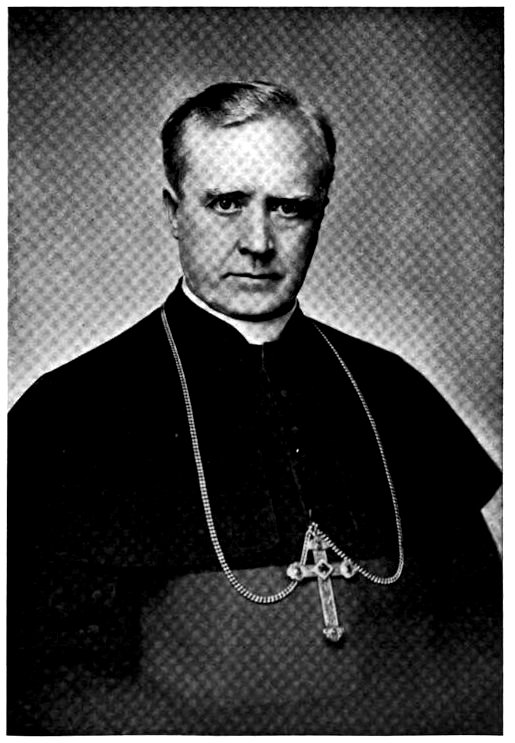
RIGHT REVEREND M. C. LENIHAN. Bishop of Great Falls, Montana. Vice-President of the Society for Montana.
149“‘Capital Welcome’ seems to imply a good or excellent welcome, and that accomplishment is beyond me,—but I most cheerfully extend to you a cordial welcome to this, the Capital City of our common country, and I sincerely hope that as you each depart from here, you will not feel impelled to write upon the register a sentiment similar to that written by one of our distinguished fellow-countrymen upon leaving a watering-place in England. Each of the party was called upon to write on the register of the hostelry a sentiment, and one bright member wrote these words: ‘I came here for change and rest; the porter has the change, the landlord the rest.’
“The man who wrote that was not the same man whom Brother Lee desires me to tell about, who described the kind of a man that Casey was. The man at the head of the table said ‘What kind of a man is Casey?’ ‘Well,’ says Murphy, ‘I’ll tell you what kind of a man Casey is. I went over to Casey’s house. Says he to me, “Murphy, will you have a drink?” I says, “Of course I will, Mr. Casey.” He says, “Murphy, shall I pour or will you pour?” “Pour yourself,” says I, “Mr. Casey.” He says, “All right, tell me when to stop.” He poured out a drop or two, and out of politeness I said “Stop, Casey,” and Casey stopped. That’s the kind of a man Casey is.’
“This Society needs no welcome to the Capitol City of this nation. Wheresoever you may turn in viewing our parks or avenues or historic halls, you will see in bronze and in marble mute evidences of the appreciation expressed by a grateful people of the achievements and contributions of the Irish and the Irish Americans, in building up and maintaining this great Republic.
“In LaFayette Square, immediately in front of the White House, is a statue of Andrew Jackson, a renowned President of the United States who was the son of an Irishman. Out in the northwest part of the city, but a few days ago, we assembled to unveil an equestrian statue to a man whom General Grant pronounced the greatest soldier of any time, the son of an Irishman, Philip Sheridan. Come down but a little farther and you will find a square adorned with trees and flowers, and in its center a beautiful statue to Admiral Farragut, of Irish blood on his mother’s side. Over in Iowa circle, to the northeast of this point, is the statue of General John A. Logan, the son of an Irishman. Pennsylvania Avenue has been gazed upon for years and years by the sightless eyes of a bronze statue of General John A. Rawlins, the confidential friend of the peerless victor of Appomattox. General Rawlins was of Irish extraction.
“Across Pennsylvania Avenue from this hotel is a great building 150in which throbs the heart of the mighty postal system of the country for which we will expend two hundred and thirty millions of dollars during this fiscal year. The first Postmaster-General admitted to the Cabinet of a President was John Barry, the son of an Irishman. And that reminds me of the way Cabinet officers are selected. It is generally supposed that the President’s Cabinet is organized in conformity with law, but such is not the fact. One day Postmaster Barry received a note reading thus: ‘Tomorrow and hereafter you will attend Cabinet meetings.’ Signed ‘Andrew Jackson.’ It was that which established the custom of calling in the Postmaster-General as one of the counselors of the President of the United States, and that custom has been maintained to this day.
“Go through the hall of statuary in our Capitol, and there you will find in marble men of proud fame in this country’s history—General Louis Cass, Henry Wilson, General Shields and others, making a long roll of men of Irish birth or lineage which I will not undertake to call here tonight.
“Just across the Potomac River, when the life of the nation was assailed, Colonel Corcoran of New York was the first to move forward with the Stars and Stripes. When the Capitol was menaced from the southwest, ‘Phil’ Sheridan was there with his cavalry to meet the enemy. When the fate of the nation was trembling in the balance upon the historic field of Gettysburg, the Union Army was directed by the masterful mind of General Meade of Irish blood.
“I will not go back to the early days of the country’s history. It is sufficient to say that in a parliamentary inquiry as to the conduct of the war against the colonies by a committee of the House of Commons of which Edmund Burke was a member, this interesting fact was brought forth. In the cross-examination of Major General Robertson, Mr. Burke asked the question, ‘Of what elements is the Continental Army composed?’ Robertson said, ‘On authority of General Lee, I inform you that more than half the Continental Army is made up of Irishmen.’
“The illustrious names that adorn our country’s history are entitled to imperishable renown because of great deeds well done in that Revolutionary struggle. Among them is a list of men of Irish birth, beginning with the man who struck the first blow, General Sullivan, and continuing along the line to the close of the war. And when I think of the contributions made, the common sufferings 151endured, and the sacrifices made without limit as to time or circumstance, I say the Irish and their descendants are entitled to the privilege of claiming with proud confidence that this is their own country.
“The history of Ireland is confined to an island with its curious, sad and heroic circumstances, but the history of the Irish people is limited only by the inhabitable portions of the globe.
“I have been, as you have been, chagrined to perceive the disposition to rob these people of the credit which is truly and justly their due. Who can read of Burke and Goldsmith and Johnson and Sheridan and Tyndale as English authors without a feeling that some one has been guilty of grand larceny and misrepresentation.
“Who can read the page of history which places Arthur Wellesley as an Englishman without feeling that the hero of Waterloo has been misplaced? Why deny to this island, bereft of the right to control its own destiny, the privilege of claiming the honor and distinction properly due to the achievements of its distinguished sons?
“It is desirable that a society like unto this should be established in England to change the trend which leads to error and confusion. What we undertake here should be undertaken there. I am glad that this Society has taken up the work of developing the history of the Irish and their descendants in the United States, for it is a great and glorious feature in American history. While proud of the past, while proud of the achievements of those whose deeds we record, it is important, I think, that we should at the same time bear in mind the duty we owe to the future.
“I would that the Americans of Irish birth and descent in this country could unite their energies and make of this force in American life a leading force for higher conceptions of civic duty, a force looking to better living, a force working for a civilization such as has not been dreamed of by those who have struggled in the past. This we may do while recording that which has gone by with fidelity and truth. Let us be true to ourselves by working for such conditions as will make our race more distinguished henceforth in its achievements than it has been in the splendid work of the past.”
152President-General Quinlan: The next and last toast of the evening is “Advantages of Historical Research to Irish Americans.” The response will be made by a noble American of Irish ancestry, who comes from the granary belt of the great Northwest, the land of Sitting Bull and the brave Sioux, where the ardent flames of patriotism burn with the intensity of true Americanism.
What means this gathering here tonight,
What Spirit moves along
This crowded hall and touching light
Each heart among the throng
Awakes as tho’ a trumpet blast
Had sounded in their ears
The recollection of the past,
The memories of the years.
Oh, ’tis the spirit of the West, the spirit of the Celt,
The breed that spurned the alien breast and every wrong has felt,
And still tho’ far from fatherland, we never can forget
To tell ourselves with heart and hand,
We’re Irish yet,
We’re Irish yet.
I take great pleasure in introducing to you, ladies and gentlemen, Hon. Robert J. Gamble, United States Senator from South Dakota.
Senator Gamble: Mr. President, Ladies and Gentlemen: I accept the kindly and humorous felicitations of your President. I admit I hail from South Dakota, once the land of the Sioux, of Red Cloud and Sitting Bull. In these later years, however, it has been transformed with marvelous rapidity into an empire of wealth, of productiveness, of social and civic development, and with ideals at least equal to those of any in the Sisterhood of States. In her wonderful prosperity she has been as jealous of the one as the other. In her Constitution and in her laws she has sought to make liberty secure, to foster and provide for the education of her children, to encourage the highest ideals of citizenship, to inspire a patriotism worthy of the opportunities of her people. Along all of these lines we feel South Dakota has met with a high degree of success. She stands almost the lowest in the percentage of illiteracy of her population. Pauperism is scarcely observable. Wealth and comfort are very generally diffused amongst her people. Her schools and colleges are equal to the necessities of the state. The door of opportunity 153is open to all. For more than a decade she has produced each year more wealth per capita than any other state in the Union. (Applause.)
Mr. President, at this late hour I give you assurance of brevity in what I have to say. I appreciate very much the compliment of your invitation, and indeed it is a great pleasure to be present on this occasion and to respond to the toast to which I have been assigned.
The history of Ireland in itself is a sad one, but the high purpose and invincible courage of her manhood and her womanhood, their high ideals and devotion to liberty and to national integrity, have been fraught with blessings and have brought encouragement to human liberty the world over. (Applause.)
Within the circumscribed limits of their own nationality success rarely crowned the patriotic efforts and heroic struggle for liberty of the Irish people. Their field of activity, however, has not been confined to the land of their birth, and has been limited only wherever humanity has asserted itself against tyranny and in a struggle for better conditions and for orderly liberty.
America owes a wonderful debt of gratitude to the Irish race. We must recognize that preceding American independence there was a strong element of our population composed of Irish Americans.
Among the strongest advocates for American independence were Irishmen, or the descendants of Irishmen. Hancock and Rutledge and the Carrolls and their co-workers contributed vastly to the development of a National spirit. The work of these strong, patriotic and efficient men had much to do with drawing the colonies together in united effort and cementing their interests in the common cause. Their voices had long been raised in protest against the Mother Country before the musketry was heard at Lexington. These brave and courageous men, and their associates, with their large vision and patriotic purpose, pointed out the way and crystalized the sentiment for national independence. The work they performed for the cause of national independence, though different in character, was as important in its way as that of the actual participants in the field, of the general or the soldier.
As indicative of the high character of the Irish race, and of their activities and large influence in the formative period of our National history it is gratifying and with a sense of pride in this presence to state that in the First Continental Congress, with a membership 154of fifty-four, eleven were Irish or of Irish descent. The same race has also to its credit three presidents of the Republic whose ancestors came from the Emerald Isle. And Roosevelt, an honored member of this Society, not only our President, but the most distinguished citizen of the world, takes pride in the fact that he can trace his lineage to this indomitable people. (Applause.)
Of the membership of the Continental Congress that put forth the immortal Declaration of Independence, twenty per cent was Irish or of Irish descent. The hand of Thompson that first transcribed it upon parchment was Irish; the first signature that was placed to it as President was that of John Hancock, an Irishman-American; and when those immortal words were read for the first time to the assembled multitude from the balcony of Continental Hall at Philadelphia, it was by the voice of an Irishman, Mr. Nixon; and when it was placed in type for the first time it was by one Dunlap, an Irish printer.
In the spring of 1777, when Congress appointed eighteen brigadier-generals, six of those who were thus commissioned were Irish by birth or descent. Among the number were the dashing and brilliant Mad Anthony Wayne and the strong and courageous Clinton. I need only speak of the accomplished Montgomery, whose valor has been justly praised and who died a hero’s death upon the plains of Quebec, or of Sullivan, the splendid leader and the associate of Washington, upon whom the latter leaned more than upon any other, and for whose great service the thanks of Congress were extended; of Knox and Stark and many others who were ideal and successful leaders in the great Revolutionary struggle. It has been asserted, but undoubtedly with very much exaggeration, that half of the Continental Army were Irish or of Irish descent. Even if this be not true it must be admitted that the race had a large representation in the Army, and it speaks well for their patriotism and devotion to the cause of American Independence.
The Irish race I think can take a just pride in the accomplishments of its people, not only as statesmen and leaders in contributing vastly towards shaping the policies of the colonies in the formative period of our history with a view to the ultimate forming of the Federal Union, and also in leadership and on men in the field of battle.
But it was not alone upon the land that the heroism of the race 155asserted itself in the cause for National Independence. If not the first, at least among the first naval fights of the Revolution was the capture of the British ship Margaretta at Machias Bay on the Coast of Maine on May 11, 1775. The Americans were commanded by Captain O’Brien, the son of an Irish immigrant. This victory has frequently been called “The Lexington of the Seas.”
It was John Barry, a native of Ireland, who received one of the first naval commissions from Congress. Through his ability and leadership and his many well earned victories he brought the highest credit to America upon the seas. Commodore Barry today is justly called “The Father of the American Navy.” He was the great naval commander of the Revolution. I might name many other distinguished officers of this nationality who rendered conspicuous service to their country and added to the fame of the Navy in the war of the Revolution.
Irish womanhood also gave evidence of its devotion and heroism in the person of Mollie Pitcher, who took the place at the cannon of her fallen husband and is accorded a hero’s place in the battle of Monmouth.
The devotion of those of Irish blood did not exhaust itself in the cause of the Revolution alone. In the War of 1812 it contributed some of its most conspicuous figures. It was Jackson at New Orleans, Commodore Stewart on the sea with his Constitution, McDonough on Lake Champlain and Perry on Lake Erie that won imperishable glory for the American Army and Navy in that War.
In the war with Mexico the men of this race had representatives in the persons of Generals Kearney and Shields. The latter also received the exceptional distinction of having been elected to a seat in the United States Senate on three different occasions in separate elections from three different states.
In the recent war, among the most illustrious names is that of General Sheridan, the son of an Irishman, and although less conspicuous others of the same blood rendered high service to their country, and amongst them are such honored names as Meade, Logan, Meagher, Mulligan, Shields and Corcoran.
It is no idle boast to assert that the names of the men of Irish blood adorn the most conspicuous pages of the history of the Republic. They aided as wise, safe and patriotic counsellors in laying the foundations of our institutions. They fought with heroism 156and devotion in the struggle for independence, both upon the land and upon the sea. In every trial and test that has come to us in our history they have made willing and great sacrifice to defend the honor of their country and to perpetuate and sustain her institutions.
Ireland has contributed much to the Republic. In a high degree the race has been unselfish. The devotion of the race has not alone been confined to the United States. It has been frequently and truthfully said though not always gratefully and freely admitted that she gave a Wellington to England and in these later years she has also contributed a Wolsey, a Roberts and a Kitchener. To France she gave McMahon, and to Spain an O’Donnell.
Many of her brave and devoted men followed Bolivar in South America and aided materially in laying the foundations of the Republic in the Southern Hemisphere.
On every field of human endeavor the Irish name has a conspicuous place. In statesmanship she has given Burke, who enriched our language with his oratory. She supplied also Phillips, Grattan and O’Connell.
In literature she has been most generous in giving to the world Goldsmith, Moore, Collins, Knowles, Sheridan and a host of others. In the sciences she has contributed Lardner, Rowe, Proctor, Tyndall, Faraday and our own Fulton.
Nor has she been lacking in the field of Art, but America adopted as her own the gifted St. Gaudens. In philosophy and theology she has many distinguished names.
Mr. President, in conclusion I would state I believe “The advantages of Historical research to Irish Americans” will give them a more just appreciation of the Irish character, of the services they have rendered in founding, sustaining and perpetuating our institutions and in maintaining the highest ideals of our common country.
President-General Quinlan: One final word. The Secretary-General wishes to say something, and I know it will interest you all.
Secretary-General Lee: Mr. Chairman, I move you that the thanks of the American Irish Historical Society be tendered the speakers of the evening for their excellent services in our behalf, and that the entire address of each be printed in the Journal.
Motion carried by unanimous vote.
157Secretary-General Lee: Mr. Chairman, I move you that the thanks of the Society and its invited guests are justly due and are hereby tendered Mr. Thomas J. Talty, Manager of the Hotel Raleigh, for his careful personal attention to the banquet and its details, and for his uniform courtesy to members and guests.
Motion carried by unanimous vote.
Secretary-General Lee: Mr. Chairman, I move you that the thanks of the Society be tendered to our fellow-member, Mr. Henry L. Joyce, Manager of the Marine Department of the Central Railroad Company of New Jersey, to Mr. W. C. Hope, General Passenger Agent of said Railroad, and to Mr. P. Wilfred Heroy, Eastern Passenger Agent of said Railroad, for their courtesy to members and guests of the Society and for their successful efforts to make our trip by special train pleasant and comfortable.
Motion carried by unanimous vote.
President-General Quinlan: This ends the proceedings of the Eleventh Annual Banquet of the Society. I thank you one and all for your attendance. The next annual dinner will take place in the city of New York, and we hope you will all be with us there and that the attendance will be even greater than tonight.
There being no further business before the Society, I declare this meeting adjourned.
COMMITTEES.
The Committee in charge of the entire proceedings in Washington were as follows:
DINNER COMMITTEE.
Hon. Edward A. Moseley, Chairman, Former President-General.
Rear Admiral John McGowan, Former President-General.
Michael F. Dooley, Esq., Treasurer-General.
Hon. Lawrence O. Murray.
Patrick J. Haltigan, Esq.
RECEPTION COMMITTEE.
Michael W. Norton, Esq., Rhode Island.
Hon. John D. Crimmins, New York.
158Hon. Joseph Geoghegan, Utah.
Patrick F. Magrath, Esq., New York.
Hon. John F. O’Connell, Rhode Island.
Dr. M. F. Sullivan, Massachusetts.
Bernard J. Joyce, Esq., Massachusetts.
Patrick Carter, Esq., Rhode Island.
T. Vincent Butler, Esq., New York.
John J. Daly, Esq., New York.
Gen. D. F. Collins, New Jersey.
Francis I. McCanna, Esq., Rhode Island.
Hon. Alexander C. Eustace, New York.
Hon. Thomas J. Lynch, Maine.
Gen. John R. McGinness, Virginia.
Hon. Thomas M. Waller, Connecticut.
NOTES.
The entire proceedings of the Reception by President Roosevelt, Annual Meeting and Eleventh Annual Dinner were stenographically reported by Miss Viola Follis of Providence, R. I., and by her transcribed. Within a few days afterwards, a copy of his speech was furnished each speaker, so that it would come to the hands of the Editor of the Journal exactly as the speaker wished it finally to read.
The stenographic report and transcription were absolutely complete and without error.
The floral decorations on the tables and walls were beautiful and lavish, and at the termination of the dinner some of the nice pieces were sent to the quarters of our lady guests, while the remainder were sent to the hospitals.
During the evening music was furnished by a good orchestra. The words of “Star Spangled Banner,” “Columbia, the Gem of the Ocean,” “Wearing of the Green,” “Minstrel Boy,” and “Yankee Doodle” were printed on the program, and the assemblage, accompanied by the musicians, sung these songs with a will.
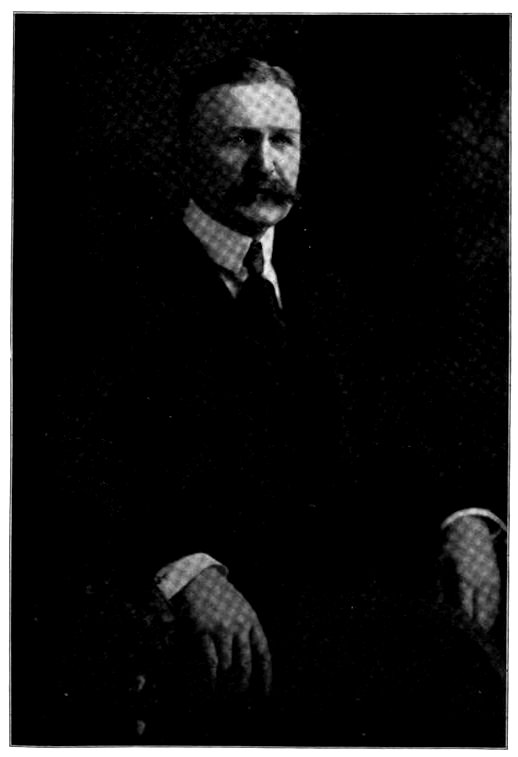
HON. WILLIAM F. SHEEHAN. Of New York City. An Honored Member of the Society.
159A large number of guests left Washington Sunday, January 17th, on the Royal Blue Line 3 p. m. express for New York, and for their comfort special cars were attached exclusively for their use. In the dining car a special dinner was prepared and served under the supervision of Conductor Lewis A. Herring, which was enjoyed by nearly all who returned on that train, and he made the occasion enjoyable by pointing out several interesting bits of scenery en route, among which was the place where Washington crossed the Delaware. The menu was as follows:
Broiled Sardines on Toast
Blue Points on Half Shell
Ox Joint, Anglaise Consomme, Macedoine
Celery Olives
Baked Mackerel, Royal Sauce
Potatoes, Julienne
Lamb Chops, with Green Peas French Pancake, au Rum
Prime Roast Beef, au Jus
Mashed Potatoes Fried Parsnips
Roast Turkey, Cranberry Sauce
String Beans Spinach, with Egg
Claret Punch
Chicken Salad, au Mayonnaise
Tapioca Pudding, Custard Sauce
Vanilla Ice Cream Assorted Cake
Sugar Wafers
Roquefort and Edam Cheese
Toasted Water Crackers Saltine Wafers
Black Coffee
Benedictine
Washington, D. C., January 17, 1909.
A special meeting of the American Irish Historical Society was held in Room 124, Hotel Raleigh, Washington, D. C., this day at 1.30 p. m., President-General Quinlan in the chair.
On motion of Mr. Donovan of New York, it was voted to revise the constitution and by-laws of the Society, and the President-General was instructed to appoint a committee of five to do this work, they to report to the Executive Council.
On motion of Mr. T. Vincent Butler of New York, the thanks of the Society were tendered to the President-General and the Secretary-General for their efficient services in preparing for “the grandest meeting the Society has ever held.” Mr. Butler, in support of 160his motion, made interesting remarks concerning our fellow-member, President Roosevelt.
The President-General later announced that he had appointed the following gentlemen members of the Committee to Revise the Constitution and By-Laws: Messrs. Michael J. Jordan, Patrick J. McCarthy, Joseph T. Ryan, John E. O’Brien and Thomas Z. Lee.
Short addresses were made by the President-General and several other members on subjects connected with the welfare of the Society, after which the meeting adjourned.
Thomas Zanslaur Lee,
Secretary-General.
161