THE INTERPRETER
Reading edition
Cover
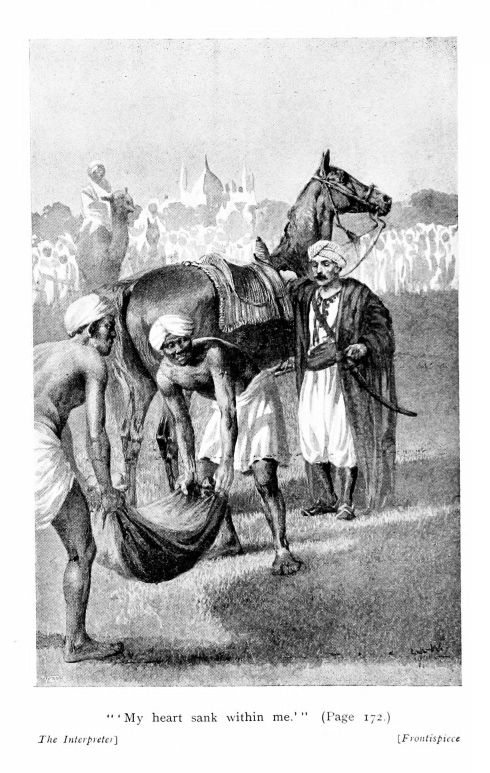
"'My heart sank within me.'" (Page 172.) Frontispiece
The Interpreter
A Tale of the War
By
G. J. Whyte-Melville
Author of "Digby Grand," "General Bounce," etc.
Illustrated by Lucy E. Kemp-Welch
New York Longmans, Green & Co.
CONTENTS
CHAP.
The Old Desk
The Deserter
"Par Nobile"
Father and Son
The Zingynies
School
Play
The Truants
Ropsley
Beverley Manor
Dulce Domum
Alton Grange
"Lethalis Arundo"
The Picture
Beverley Mere
Princess Vocqsal
The Common Lot
Omar Pasha
"'Skender Bey"
The Beloochee
Zuleika
Valerie
Forewarned
"Arcades Ambo"
"Dark and Dreary"
"Surveillance"
Ghosts of the Past
La Dame aux Camellias
"A Merry Masque"
The Golden Horn
The Seraskerât
A Turk's Harem
My Patient
"Messirie's"
"The Wolf and the Lamb"
"The Front"
"A Quiet Night"
The Grotto
The Redan
The War-Minister at Home
Wheels within Wheels
"Too Late"
"The Skeleton"
The Gipsy's Dream
Retribution
Væ Victis!
The Return of Spring
THE INTERPRETER
A TALE OF THE WAR
CHAPTER I
THE OLD DESK
Not one of my keys will fit it: the old desk has been laid aside for years, and is covered with dust and rust. We do not make such strong boxes nowadays, for brass hinges and secret drawers have given place to flimsy morocco and russian leather; so we clap a Bramah lock, that Bramah himself cannot pick, on a black bag that the veriest bungler can rip open in five seconds with a penknife, and entrust our notes, bank and otherwise, our valuables, and our secrets, to this faithless repository with a confidence that deserves to be respected. But in the days when George the Third was king, our substantial ancestors rejoiced in more substantial workmanship: so the old desk that I cannot succeed in unlocking, is of shining rosewood, clamped with brass, and I shall spoil it sadly with the mallet and the chisel.
What a medley it holds! Thank Heaven I am no speculative philosopher, or I might moralise for hours over its contents. First, out flies a withered leaf of geranium. It must have been dearly prized once, or it would never have been here; maybe it represented the hopes, the wealth, the all-in-all of two aching hearts: and they are dust and ashes now. To think that the flower should have outlasted them! the symbol less perishable than the faith! Then I come to a piece of much-begrimed and yellow paper, carefully folded, and indorsed with a date,--a receipt for an embrocation warranted specific in all cases of bruises, sprains, or lumbago; next a gold pencil-case, with a head of Socrates for a seal; lastly, much of that substance which is generated in all waste places, and which the vulgar call "flue." How it comes there puzzles equally the naturalist and the philosopher; but you shall find it in empty corners, empty drawers, empty pockets, nay, we believe in its existence in the empty heads of our fellow-creatures.
In my thirst for acquisition, regardless of dusty fingers, I press the inner sides of the desk in hopes of discovering secret springs and hoarded repositories: so have poor men ere now found thousand-pound notes hid away in chinks and crannies, and straightway, giddy with the possession of boundless wealth, have gone to the Devil at a pace such as none but the beggar on horseback can command; so have old wills been fished out, and frauds discovered, and rightful heirs re-established, and society in general disgusted, and all concerned made discontented and uncomfortable--so shall I, perhaps--but the springs work, a false lid flies open, and I do discover a packet of letters, written on thin foreign paper, in the free straggling characters I remember so well. They are addressed to Sir H. Beverley, and the hand that penned them has been cold for years. So will yours and mine be some day, perhaps ere the flowers are out again; O beate Sexti! will you drink a glass less claret on that account? Buxom Mrs. Lalage, shall the dressmaker therefore put unbecoming trimmings in your bonnet? The "shining hours" are few, and soon past; make the best of them, each in your own way, only try and choose the right way:--
For the day will soon be over, and the minutes are of gold,
And the wicket shuts at sundown, and the shepherd leaves the fold.
LETTER I
"Those were merry days, my dear Hal, when we used to hear the 'chimes at midnight' with poor Brummell and Sir Benjamin;[#] very jolly times they were, and I often think, if health and pockets could have stood it, I should like to be going the pace amongst you all still. And yet how few of us are left. They have dropped off one by one, as they did the night we dyed the white rose red at the old place; and you, and I, and stanch old 'Ben,' were the only three left that could walk straight. Do you remember the corner of King-street, and 'Ben' stripped 'to the buff,' as he called it himself, 'going-in' right royally at the tall fellow with the red head? I never saw such right-and-lefters, I never thought he had so much 'fight' in him; and you don't remember, Hal, but I do, how 'the lass with the long locks' bent over you when you were floored, like Andromache over a debauched Hector, and stanched the claret that was flowing freely from your nostrils, and gave you gin in a smelling-bottle, which you sucked down as though it were mother's milk, like a young reprobate as you were; nor do you remember, nor do I very clearly, how we all got back to 'The Cottage,' and finished with burnt curagoa, and a dance on the table by daylight. And now you and I are about the only two left, and I am as near ruined as a gentleman can be; and you must have lost your pen-feathers, Hal, I should think, though you were a goose that always could pick a living off a common, be it never so bare. Well, we have had our fun; and after all, I for one have been far happier since than I ever was in those roystering days; but of this I cannot bear to speak."
[#] The dandy's nickname for the Prince Regent.
"Nor am I so much to be pitied now. I have got my colours and my sketch-book, after all; and there never was such a country as this for a man who has half an eye in his head. On these magnificent plains the lights and shades are glorious. Glorious, Hal, with a little red jagged in here and there towards sunset, and the ghostly maize waving and whispering, and the feathery acacias trembling in the lightest air, the russet tinge of the one and the fawn-coloured stems of the other melting so softly into the neutral tints of the sandy soil. I could paint a picture here that should be perfectly true to Nature--nay, more natural than the old dame herself--and never use but two colours to do it all! I am not going to tell you what they are: and this reminds me of my boy, and of a want in his organisation that is a sad distress to me. The child has not a notion of colour. I was painting out of doors yesterday, and he was standing by--bless him! he never leaves me for an instant--and I tried to explain to him some of the simplest rudiments of the godlike art. 'Vere,' said I, 'do you see those red tints on the tops of the far acacias, and the golden tinge along the back of that brown ox in the foreground?' 'Yes, papa!' was the child's answer, with a bewildered look. 'How should you paint them, my boy?' 'Well, papa, I should paint the acacias green, because they are green, and'--here he thought he had made a decided hit--'I should put the red into the ox, for he is almost more red than brown.' Dear child! he has not a glimmering of colour; but composition, that's his forte; and drawing, drawing, you know, which is the highest form of the art. His drawing is extraordinary--careless, but great breadth and freedom; and I am certain he could compose a wonderful picture, from his singular sensibility to beauty. Young as he is, I have seen the tears stand in his eyes when contemplating a fine view, or a really exquisite 'bit,' such as one sees in this climate every day. His raptures at his first glimpse of the Danube I shall never forget; and if I can only instil into him the principles of colour, you will see Vere will become the first painter of the age. The boy learns languages readily enough. He has picked up a good deal of Hungarian from his nurse. Such a woman, Hal! magnificent! Such colouring: deep brown tones, and masses of the richest grey hair, with superb, solemn, sunken eyes, and a throat and forehead tanned and wrinkled into the very ideal of a Canidia, or a Witch of Endor, or any fine old sorceress, 'all of the olden time.' I have done her in chalks, and in sepia, and in oils. I adore her in the former. She is, I fancy, a good, careful woman, and much attached to Vere, who promises to be an excellent linguist; but of this I cannot see the advantage. There is but one pursuit, in my opinion, for an intellectual being who is not obliged to labour in the fields for his daily bread, and that is Art. I have wooed the heavenly maid all my life. To me she has been sparing of her favours; and yet a single smile from her has gilded my path for many a long and weary day. She has beckoned me on and on till I feel I could follow her to the end of the world; she shielded me in the dark hour; she has brightened my lot ever since; she led me to nature, her grand reflection--for you know my theory, that art is reality, and nature but the embodiment of art; she has made me independent of the frowns of that other jade, Fortune, and taught me the most difficult lesson of all--to be content. What is wealth? You and I have seen it lavished with both hands, and its possessor weary, satiate, languid, and disgusted. What is rank? a mark for envy, an idol but for fools. Fame? a few orders on a tight uniform; a craving for more and more; even when we know the tastelessness of the food, to be still hungry for applause. Love? a sting of joy and a heartache for ever. Are they not all vanity of vanities? But your artist is your true creator. He can embody the noblest aspirations of his mind, and give them a reality and a name. You, Hal, who are the most practical, unimaginative, business-like fellow that ever hedged a bet or drove a bargain, have had such dreams betwixt sleeping and waking as have given you a taste of heaven, and taught you the existence of a fairy-land of which, to such as you, is only granted a far-away and occasional glimpse. What would you give to be able to embody such blissful visions and call them up at will? Let me have a camel's-hair brush, a few dabs of clay, and, behold! I am the magician before whose wand these dreams shall reappear tangibly, substantially, enduringly: alas! for mortal shortcomings, sometimes a little out of drawing, sometimes a little hard and cold; but still, Hal, I can make my own world, such as it is, and people it for myself; nor do I envy any man on earth, except, perhaps, a sculptor. To have perfected and wrought out in the imperishable marble the ideal of one's whole life, to walk round it, and smoke one's cigar and say, 'This will last as long as St. Paul's Cathedral or the National Debt, and this is mine, I made it'--must be a sensation of delight that even we poor painters, with our works comparatively of a day, can hardly imagine; but then, what we lose in durability we gain in reproduction: and so once more I repeat, let who will be statesman, warrior, stock-jobber, or voluptuary, but give me the pallet and the easel, the délire d'un peintre, the line of beauty and the brush!
"Can you wonder that I should wish my boy to tread the same path? Had I but begun at his age, and worked as I should have worked, what might I have been now? Could I but make amends to him by leading him up the path to real fame, and see Vere the regenerator of modern art, I should die happy.
"And now, Hal, I must ask you of your own pursuits and your own successes. I do not often see an English paper; but these are a fine sporting people, with a dash of our English tastes and love of horseflesh; and in a small pothouse where we put up last week, in the very heart of the Banat, I found a print of Flying Childers, and a Bell's Life of the month before last. In this I read that your Marigold colt was first favourite for the Derby, and I can only say that I hope he will win, as fervently as I should have done some years back, when he would have carried a large portion of my money, or at least of my credit, on his back. I have also gathered that your shorthorns won the prize at the great cattle-show. 'Who drives fat oxen must himself be fat.' I trust, therefore, that you are flourishing and thriving; also, that Constance, the most stately little lady I ever beheld at two years old, still queens it at the Manor-house. I will write again shortly, but must leave off now, as my boy is calling me to go out. He grows more like his poor mother every day, especially about the eyes.--Adieu, Hal; ever yours,
"PHILIP EGERTON."
LETTER II
"The longer I linger here the more I become wedded to the land in which, after all, I have known the few hours of real happiness I ever spent. Yes, Hal, with all its guilt, with all its anxieties, with everything and everybody battling against me--that was my golden year, such as I shall never see again. She was so generous, so gentle, and so true; she sacrificed all so willingly for me, and never looked back. Such courage, such patience, and oh! such beauty; and to lose her after one short year. Well, it is my punishment, and I bear it; but if it had to be done again I would do it. Surely I was not so much to blame. Had she but lived I would have made her such amends. And after all she is mine--mine in her lonely grave under the acacias, and I shall meet her again. If the universe holds her I shall meet her again. Wearily the years have dragged on since I lost her, but every birthday is a milestone nearer home; and in the meantime I have Vere and my art. And we wander about this wild country, and scamper across its boundless plains, and I paint and smoke, and try to be happy.
"We arrived here last night, and I need scarcely tell you that Edeldorf is as English as any place out of England can be, and my old friend but little altered during the last twenty years. You remember De Rohan at Melton and Newmarket, at Rome and at Paris. Wherever he lived he was quite the Englishman, and always rode a thoroughbred horse. It would indeed be ungrateful on your part to forget him. Need I remind you of the dinner at the old Club, and the procession afterwards, with some fourteen wax candles, to inspect The Switcher in your stables, at the risk of burning down the greater part of the town, and converting some of the best horses in England into an exceedingly tough grill. I can see the Count's face of drunken gravity now, as he felt carefully down the horse's forelegs, undeterred by the respectful stare of your groom, or the undisguised astonishment of the animal itself. 'Vat is his name?' was the only question he asked of the polite Mr. Topthorn. 'The Switcher, my lord,' was the reply. 'Ver' nice name,' said the Count, and bought him forthwith at a price that you yourself can best appreciate; but from that day to this he never could pronounce the animal's appellation; and although he rode 'The Svishare' both in England and here, and has got prints and pictures of him all over the house, 'The Svishare' he will continue to be till the end of time.
"All this Anglo-mania, however, is not much appreciated in high places; and I can see enough without looking much below the surface to satisfy me that the Count is eyed jealously by the authorities, and that if ever they catch him tripping they will not spare his fortunes or his person. I fear there will be a row before long, and I would not trust the wild blood of my friends here if once they get the upper hand. Only yesterday an incident occurred that gave me a pretty correct idea of the state of feeling in this country, and the disaffection of the peasant to his imperial rulers. Vere and I were travelling along in our usual manner, occupying the front seat of a most dilapidated carriage, which I purchased at Bucharest for twenty ducats, with the nurse and the baggage behind. We had stopped for me to sketch an animated group, in the shape of a drove of wild horses being drafted and chosen by their respective owners, and Vere was clapping his hands and shouting with delight at the hurry-skurry of the scene (by the way, there was a white horse that I caught in a beautiful attitude, who comes out admirably and lights up the whole sketch), when an officer and a couple of Austrian dragoons rode into the midst of the busy horse-tamers, and very rudely proceeded to subject them to certain inquiries, which seemed to meet with sulky and evasive answers enough. After a time the Austrian officer, a handsome boy of twenty, stroking an incipient moustache, ordered the oldest man of the party to be pinioned; and placing him between his two soldiers, began to interrogate him in a most offensive and supercilious manner. The old man, who was what we should call in England a better sort of yeoman farmer, of course immediately affected utter ignorance of German; and as the young Austrian was no great proficient in Hungarian, I was compelled most unwillingly to interpret between them, Vere looking on meanwhile with his mouth wide open, in a state of intense bewilderment. The following is a specimen of the conversation:--
"Austrian Sub-Lieutenant, in German--'Thou hast been hiding deserters; and so shalt thou be imprisoned, and fined, and suffer punishment.' I have to modify these threats into Hungarian.--'Brother, this noble officer seeks a deserter. Knowest thou of such an one?'
"Old Man--'My father, I know nothing.'
"Austrian Officer, with many expletives, modified as before by your humble servant--'You shall be punished with the utmost rigour if you do not give him up.'
"Old Man, again--'My father, I know nothing.'
"Officer, losing all patience, and gesticulating wildly with his sword--'Slave, brute, dog, tell me this instant which way he took, or I will have you hanged to that nearest tree, your family shall be imprisoned, and your village burnt to the ground.'
"Old Man, as before--'My father, I know nothing.'
"The case was getting hopeless; but the young officer had now thoroughly lost his temper, and ordered his men to tie the peasant up, and flog him soundly with a stirrup-leather. Here I thought it high time to interpose; I saw the wild Hungarian blood beginning to boil in the veins of some dozen dark scowling fellows, who had been occupied tending the horses. Eyes were flashing at the Austrians, and hands clutching under the sheepskin where the long knife lies. Fortunately the officer was a gentleman and an admirer of the English. With much difficulty I persuaded him to abandon his cruel intention, and to ride on in prosecution of his search; but it was when his back was turned that the tide of indignation against himself and his country swelled to the highest. The peasants' faces actually became convulsed with rage, their voices shook with fury, and threats and maledictions were poured on their masters enough to make one's very blood run cold. If ever they do get the upper hand, woe to the oppressor! There is nothing on earth so fearful as a Jacquerie. God forbid this fair land should ever see one.
"We journeyed on in a different direction from the dragoons, but we caught occasional glimpses of their white coats as they gleamed through the acacias that skirted the road; and I was just thinking how well I could put them in with a dab or two of chalk against a thunder-storm, or a dark wood in the midst of summer, when the bright sun makes the foliage almost black, and debating in my own mind whether the officer would not have made a better sketch if his horse had been a light grey, when my postilion pulled up with a jerk that nearly chucked Vere out of the carriage, and, pointing to something in the road, assured 'my Excellency' that the horse was dying, and the rider, in all probability, lying killed under his beast. Sure enough, an over-ridden horse was prostrate in the middle of the road, and a young man vainly endeavouring to raise him by the bridle, and calling him by all the terms of endearment and abuse in the Hungarian vocabulary, without the slightest effect. Seeing our carriage, he addressed me in German, and with a gentlemanlike voice and manner begged to know in what direction I was travelling. 'I hope to get to Edeldorf to-night,' was my answer. He started at the name. 'Edeldorf!' said he; 'I, too, am bound for Edeldorf; can you favour me with a seat in your carriage?' Of course I immediately complied; and Vere and I soon had the stranger between us, journeying amicably on towards my old friend's chateau. You know my failing, Hal, so I need not tell you how it was that I immediately began to study my new acquaintance's physiognomy, somewhat, I thought, to his discomfiture, for at first he turned his head away, but after a while seemed to think better of it, and entered into conversation with much frankness and vivacity. The sun was getting low, and I think I could have sketched him very satisfactorily in that warm, soft light. His head was essentially that of a soldier; the brow deficient in ideality, but with the bold outlines which betoken penetration and forethought. Constructiveness fully developed, combativeness moderate, but firmness very strongly marked; the eye deep set, and, though small, remarkably brilliant; the jaw that of a strong, bold man, while the lines about the mouth showed great energy of character and decision. From the general conformation of his head I should have placed forethought as the distinguishing quality of his character, and I should have painted the rich brown tones of his complexion on a system of my own, which such a portrait would be admirably calculated to bring out. However, I could not well ask him to sit to me upon so short an acquaintance; so, while he and Vere chatted on--for they soon became great friends, and my new acquaintance seemed charmed to find a child speaking German so fluently--I began to speculate on the trade and character of this mysterious addition to our party. 'Hair cut short, moustache close clipped,' thought I, 'perfect German accent, and the broad Viennese dialect of the aristocracy, all this looks like a soldier; but the rough frieze coat, and huge shapeless riding boots could never belong to an officer of that neatest of armies--"the Imperial and Kingly." Then his muscular figure, and light active gait, which I remarked as he sprang into the carriage, would argue him one who was in the habit of practising feats of strength and agility. There is no mistaking the effects of the gymnasium. Stay, I have it, he is a fencing-master; that accounts for the military appearance, the quick glance, the somewhat worn look of the countenance, and he is going to Edeldorf, to teach De Rohan's boy the polite art of self-defence. So much the better. I, too, love dearly a turn with the foils, so I can have a glorious "set-to" with him to-morrow or the next day; and then, when we are more intimate, I can paint him. I think I shall do him in oils. I wish he would turn his head the least thing further this way.' I had got as far as this when my new friend did indeed turn his head round, and looking me full in the face, thus addressed me:--'Sir, you are an Englishman, and an honourable man. I have no right to deceive you. You incur great danger by being seen with me. I have no right to implicate you; set me down, and let me walk.' Vere looked more astonished than ever. I begged him to explain himself. 'I tell you,' said he, 'that I am a thief and a deserter. My name is posted at every barrack-gate in the empire. I am liable to be hanged, if taken. Are you not afraid of me now?' 'No,' exclaimed Vere, his colour heightening and his eyes glistening (oh! so like her). 'Papa and I will take care of you; don't be afraid.' My boy had anticipated what I was going to say; but I assured him that as I had taken him into my carriage I considered him as my guest, and come what would I never could think of abandoning him till we reached our destination. 'Of course,' I added, 'you are then free to come and go as you please. If you have done anything disgraceful, we need never know each other again. I do not wish to hear of it. You are to me only a belated traveller; permit me to add, a gentleman, to whom I am delighted to be of service. Will you smoke? Let me offer you a cigar.' The blood rushed to his face as he declined the proffered courtesy; for an instant he looked half offended, and then, seizing my hand, he exclaimed, 'If you knew all, you would pity me--nay, more, you would approve of what I have done.' He turned suddenly to Vere, and rather startled him by abruptly exclaiming, 'Boy, do you love your father? is he all the world to you?' 'Yes,' said Vere, colouring up again, 'of course I love papa, and Nurse "Nettich" too.' That worthy woman was fast asleep in the rumble. 'Well,' said the stranger, more composedly, 'I love my father, too; he is all I have in the world, and for his sake I would do the same thing again. I will tell you all about it, and you shall judge between me and my crime.' But my new friend's story I must defer, my dear Hal, to another letter. So for the present, Vive valeque."
CHAPTER II
THE DESERTER
Dim and strange are the recollections that steal over me while I read these time-worn letters of one who, with all his faults, was the kindest, fondest, and best of enthusiasts. It seems like a dream; I cannot fancy that I am the child alluded to. It seems as though all this must have happened to some one else, and that I stood by and watched. Yet have I a vague and shadowy remembrance of the warm autumnal evening; the road soft and thick with dust; the creaking, monotonous motion of the carriage, and my waking up from an occasional nap, and finding myself propped by the strong arm of a stranger, and nestling my head upon his broad shoulder, whilst my father's kind face and eager eyes were turned towards my new acquaintance with the earnest comprehensive look I remember so well. My father always seemed to take in at a glance, not only the object that attracted his attention, but all its accessories, possible as well as actual. I believe he never left off painting in his mind. I remember nothing very distinctly; and no wonder, for my little brain must have been a strange chaos of shifting scenes and unexpected events, foreign manners and home ideas, to say nothing of a general confusion of tongues; for I could prattle French, German, and Hungarian, with a smattering of Turkish, not to mention my own native language; and I used them all indiscriminately. But my father's letters bring back much that I had otherwise forgotten, and whilst I read the story of the renegade, I can almost fancy I am leaning against his upright soldierlike form, and listening to the clear decided tones in which he told his tale.
LETTER III
"'I am a soldier, sir,' said my new acquaintance, whilst I leant back in the carriage smoking my cigar, and, more meo, Hal, made the most of my 'study.' 'I am an Austrian soldier--at least I was a week ago--I would not give much for my chance if ever I come into the clutches of the "Double Eagle" again. Shall I tell you why I entered the Imperial army? All my life I have thought it best to be on the winning side. If I had been born an Englishman, oh, what happiness! I would have asked no better lot than to wander about with my dog and my gun, and be free. But a Croat, no, there is no liberty in Croatia. We must have masters, forsooth! territorial dues and seignorial rights; and we must bow and cringe and be trampled on by our own nobility. But these, too, have their masters, and I have seen the lord of many thousand acres tremble before a captain of dragoons. So I determined that if a military despotism was to be the order of the day, why I, too, would make a part of the great engine, perhaps some time I might come to wield it all. My father was appointed steward to a great lord in Hungary--perhaps, had he remained, I might never have left home, for I am his only child, and we two are alone in the world; besides, is not a son's first duty to obey his father?--but I could not bear to exchange the free open air, and my horse, and my gun, and my dogs (I had the best greyhounds in Croatia), for a leathern stool and an inkstand, and I said, "Father, I too will become an Austrian, and so some day shall I be a great man, perhaps a colonel, and then will I return once a year to see you, and comfort you in your old age." So I was sworn to obey the Emperor, and soon I learnt my exercise, and saw that to rise even in the Austrian army was not difficult for one who could see clearly before him, and could count that two and two make four, and never five.
"'Very few men are soldiers at heart, and those who love the profession and would fain shine, can only see one way to success, and that must be the old-established track that has always been followed. If I wanted to move across that stream and had no boats, what should I do? I would try if it be too deep to wade. But the regulation says, soldiers shall not wade if the water be over a certain depth. So for six inches of water I must be defeated. That should not be my way; if it came no higher than their chins my men should cross; and if we could keep our muskets dry, where would be the harm? Well, I soon rose to be a corporal and a sergeant; and whilst I practised fencing and riding and gymnastics, I learnt besides something of gunnery and fortification, and the art of supplying an army with food. At last I was made lieutenant and paymaster of the regiment, for I could always calculate readily, and never shrank from trouble or feared responsibility. So I had good pay and good comrades, and was getting on. Meanwhile my poor father was distressing himself about my profession, and imagining all sorts of misfortunes that would happen to me if I remained a soldier. In his letters to me he always hinted at the possibility of some great success--at his hopes of, before long, placing me in an independent position; that I should leave the army to come and live with him, and we would farm an estate of our own, and never be parted any more. Poor old man! what do you think he built on? why, these foolish lotteries. Ticket after ticket did he purchase, and ticket after ticket came up a blank. At last, in his infatuation, he raised a sum of money--enough to obtain him all the numbers he had set his heart upon--for he mixed calculation with his gambling, which is certain ruin--and for this purpose he embezzled two thousand florins of his employer's property, and wasted it as he had done the rest. In his despair he wrote to me. What could I do? two thousand florins were in the pay-chest. I have it here in this leathern bag. I have saved my father; he is steward at Edeldorf. I shall see him to-night; after that I must fly the country. I will go to England, the land of the free. I am ruined, degraded, and my life is not worth twelve hours' purchase; but I do not regret it. Look at your boy, sir, and tell me if I am not right.' He is a fine fellow this, Hal, depend upon it; and though my own feelings as a gentleman were a little shocked at a man talking thus coolly of robbery in anything but the legitimate way on the turf, I could scarcely remonstrate with him now the thing was done; so I shook him by the hand, and promised him at any rate a safe convoy to Edeldorf, which we were now rapidly approaching. You like a fine place, Hal; you always did. I remember when you used to vow that if ever Fortune smiled upon you--and faith, it is not for want of wooing that you have missed the goddess's favours--how you would build and castellate and improve Beverley Manor, till, in my opinion as an artist and a man of associations, you would spoil it completely; but I think even your fastidious taste would be delighted with Edeldorf. The sun was just down as we drove into the park, and returned the salute of the smart Hussar mounting guard at the lodge; and the winding road, and smooth sward dotted with thorns, and those eternal acacias, reminded one of a gentleman's place in Old England, till we rounded the corner of a beautifully-dressed flower-garden, and came in view of the castle itself, with all its angles and turrets and embrasures, and mullioned windows, and picturesque ins-and-outs; the whole standing boldly out in a chiaro-oscuro against the evening sky, fast beginning to soften into twilight. Old De Rohan was on the steps to welcome me, his figure upright and noble as ever; his countenance as pleasing; but the beard and moustache that you and I remember so dark and glossy, now as white as snow; yet he is a very handsome fellow still. In mail or plate, leaning his arm on his helmet, with his beard flowing over a steel cuirass inlaid with gold, he would make a capital seneschal, or marshal of a tournament, or other elderly dignitary of the middle ages; but I should like best to paint him in dark velvet, with a skull-cap, as Lord Soulis, or some other noble votary of the magic art; and to bring him out in a dusky room, with one ray of vivid light from a lamp just over his temples, and gleaming off that fine, bold, shining forehead, from which the hair is now completely worn away."
There are no more of the old dusty letters. Why these should have been tied up and preserved for so many years is more than I can tell. They have, however, reminded me of much in my youth that I had well-nigh forgotten. I must try back on my vague memories for the commencement of my narrative.
CHAPTER III
"PAR NOBILE"
"You shall play with my toys, and break them if you like, for my papa loves the English, and you are my English friend," said a handsome blue-eyed child to his little companion, as they sauntered hand-in-hand through the spacious entrance-hall at Edeldorf. The boy was evidently bent on patronising his friend. The friend was somewhat abashed and bewildered, and grateful to be taken notice of.
"What is your name?--may I call you by your Christian name?" said the lesser child, timidly, and rather nestling to his protector, for such had the bigger boy constituted himself.
"My name is Victor," was the proud reply, "and you may call me Victor, because I love you; but the servants must call me Count, because my papa is a count; and I am not an Austrian count, but a Hungarian. Come and see my sword." So the two children were soon busy in an examination of that very beautiful, but not very destructive plaything.
They were indeed a strange contrast. Victor de Rohan, son and heir to one of the noblest and wealthiest of Hungary's aristocracy, looked all over the high-bred child he was. Free and bold, his large, frank blue eyes, and wide brow, shaded with clustering curls of golden brown, betokened a gallant, thoughtless spirit, and a kind, warm heart; whilst the delicate nostril and handsomely-curved mouth of the well-born child betrayed, perhaps, a little too much pride for one so young, and argued a disposition not too patient of contradiction or restraint. His little companion was as unlike him as possible, and indeed most people would have taken Victor for the English boy, and Vere for the foreign one. The latter was heavy, awkward, and ungainly in his movements, timid and hesitating in his manner, with a sallow complexion, and dark, deep-set eyes, that seemed always looking into a world beyond. He was a strange child, totally without the light-heartedness of his age, timid, shy, and awkward, but capable of strong attachments, and willing to endure anything for the sake of those he loved. Then he had quaint fancies, and curious modes of expressing them, which made other children laugh at him, when the boy would retire into himself, deeply wounded and unhappy, but too proud to show it. As he looks now at Victor's sword, with which the latter is vapouring about the hall, destroying imaginary enemies, Vere asks--
"What becomes of the people that are killed, Victor?"
"We ride over their bodies," says Victor, who has just delivered a finishing thrust at his phantom foe.
"Yes, but what becomes of them?" pursues the child, now answering himself. "I think they come to me in my dreams; for sometimes, do you know, I dream of men in armour charging on white horses, and they come by with a wind that wakes me; and when I ask 'Nettich' who they are, she says they are the fairies; but I don't think they are fairies, because you know fairies are quite small, and have wings. No, I think they must be the people that are killed."
"Very likely," replies Victor, who has not considered the subject in this light, and whose dreams are mostly of ponies and plum-cake--"very likely; but come to papa, and he will give us some grapes." So off they go, arm-in-arm, to the great banqueting-hall; and Vere postpones his dream-theories to some future occasion, for there is a charm about grapes that speaks at once to a child's heart.
So the two boys make their entrance into the banqueting-hall, where De Rohan sits in state, surrounded by his guests. On his right is placed Philip Egerton, whose dark eye gleams with pleasure as he looks upon his son. Who but a father would take delight in such a plain, unattractive child? Vere glides quietly to his side, shrinking from the strange faces and gorgeous uniforms around; but Victor walks boldly up to the old Count, and demands his daily glass of Tokay, not as a favour, but a right.
"I drink to Hungary!" says the child, looking full into the face of his next neighbour, a prince allied to the Imperial family, and a General of Austrian cavalry. "Monsieur le Prince, your good health! Come, clink your glass with me."
"Your boy is a true De Rohan," says the good-natured Austrian, as he accepts the urchin's challenge, and their goblets ring against each other. "Will you be a soldier, my lad, and wear the white uniform?"
"I will be a soldier," answers the child, "but not an Austrian soldier like you: Austrian soldiers are not so brave as Hungarians."
"Well said, my little patriot," replies the amused General. "So you do not think our people are good for much? Why, with that sword of yours, I should be very sorry to face you with my whole division. What a Light Dragoon the rogue will make, De Rohan! see, he has plundered the grapes already." And the jolly prince sat back in his chair, and poured himself out another glass of "Imperial Tokay."
"Hush, Victor!" said his father, laughing, in spite of himself, at his child's forwardness. "Look at your little English friend; he stands quiet there, and says nothing. I shall make an Englishman of my boy, Egerton; he shall go to an English school, and learn to ride and box, and to be a man. I love England and the English. Egerton, your good health! I wish my boy to be like yours. Sapperment! he is quiet, but I will answer for it he fears neither man nor devil."
My father's face lighted up with pleasure as he pressed me to his side. Kind father! I believe he thought his ugly, timid, shrinking child was the admiration of all.
"I think the boy has courage," he said, "but for that I give him little credit. All men are naturally brave; it is but education that makes us reflect; hence we learn to fear consequences, and so become cowards."
"Pardon, mon cher," observed the Austrian General, with a laugh. "Now, my opinion is that all men are naturally cowards, and that we alone deserve credit who overcome that propensity, and so distinguish ourselves for what we choose to call bravery, but which we ought rather to term self-command. What say you, De Rohan? You have been in action, and 'on the ground,' too, more than once. Were you not cursedly afraid?"
De Rohan smiled good-humouredly, and filled his glass.
"Shall I tell you my opinion of courage?" said he, holding up the sparkling fluid to the light. "I think of courage what our Hungarian Hussars think of a breast-plate. 'Of what use,' say they, 'is cuirass and back-piece and all that weight of defensive armour? Give us a pint of wine in our stomachs, and we are breastplate all over.' Come, Wallenstein, put your breastplate on--it is very light, and fits very easily."
The General filled again, but returned to the charge.
"You remind me," said he, "of a conversation I overheard when I was a lieutenant in the first regiment of Uhlans. We were drawn up on the crest of a hill opposite a battery in position not half-a-mile from us. If they had retired us two hundred yards, we should have been under cover; but we never got the order, and there we stood. Whish! the round-shot came over our heads and under our feet, and into our ranks, and we lost two men and five horses before we knew where we were. The soldiers grumbled sadly, and a few seemed inclined to turn rein and go to the rear. Mind you, it is not fair to ask cavalry to sit still and be pounded for amusement; but the officers being cowards by education, Mr. Egerton, did their duty well, and kept the men together. I was watching my troop anxiously enough, and I heard one man say to his comrade, 'Look at Johann, Fritz! what a bold one he is; he thinks nothing of the fire; see, he tickles the horse of his front-rank man even now, to make him kick.'"
"Exactly my argument," interrupted my father; "he was an uneducated man, consequently saw nothing to be afraid of. Bravery, after all, is only insensibility to danger."
"Fritz did not think so," replied Wallenstein. "Hear his answer--'Johann is a blockhead,' he replied, 'he has never been under fire before, and does not know his danger; but you and I, old comrade, we deserve to be made corporals; for we sit quiet here on our horses, though we are most cursedly afraid.'"
The guests all laughed; and the discussion would have terminated, but that De Rohan, who had drunk more wine than was his custom, and who was very proud of his boy, could not refrain from once more turning the conversation to Victor's merits, and to that personal courage by which, however much he might affect to make light of it in society, he set such store.
"Well, Wallenstein," said he; "you hold that Nature makes us cowards; if so, my boy here ought to show something of the white feather. Come hither, Victor. Are you afraid of being in the dark?"
"No, papa!" answered Victor, boldly; but added, after a moment's consideration, "except in the Ghost's Gallery. I don't go through the Ghost's Gallery after six o'clock."
This naïve confession excited much amusement amongst the guests; but De Rohan's confidence in his boy's courage was not to be so shaken.
"What shall I give you," said he, "to go and fetch me the old Breviary that lies on the table at the far end of the Ghost's Gallery?"
Victor looked at me, and I at him. My breath came quicker and quicker. The child coloured painfully, but did not answer. I felt his terrors myself. I looked upon the proposed expedition as a soldier might on a forlorn hope; but something within kept stirring me to speak; it was a mingled feeling of emulation, pity, and friendship, tinged with that inexplicable charm that coming danger has always possessed for me--a charm that the constitutionally brave are incapable of feeling. I mastered my shyness with an effort, and, shaking all over, said to the master of the house, in a thick, low voice--
"If you please, Monsieur le Comte, if Victor goes, I will go too."
"Well said, little man!" "Bravo, boy!" "Vere, you're a trump!" in plain English from my father; and "In Heaven's name, give the lads a breastplate apiece, in the shape of a glass of Tokay!" from the jolly General, were the acclamations that greeted my resolution; and for one delicious moment I felt like a little hero. Victor, too, caught the enthusiasm; and, ashamed of showing less courage than his playfellow, expressed his readiness to accompany me,--first stipulating, however, with praise-worthy caution, that he should take his sword for our joint preservation; and also that two large bunches of grapes should be placed at our disposal on our safe return, "if," as Victor touchingly remarked, "we ever came back at all!" My father opened the door for us with a low bow, and it closed upon a burst of laughter, which to us, bound, as we fancied, on an expedition of unparalleled danger, sounded to the last degree unfeeling.
Hand-in-hand we two children walked through the ante-room, and across the hall; nor was it until we reached the first landing on the wide, gloomy oak staircase, that we paused to consider our future plans, and to scan the desperate nature of our enterprise. There were but two more flights of steps, a green-baize door to go through, a few yards of passage to traverse, and then, Victor assured me, in trembling accents, we should be in the Ghost's Gallery. My heart beat painfully, and my informant began to cry.
We laid our plans, however, with considerable caution, and made a solemn compact of alliance, offensive and defensive, that no power, natural or supernatural, was to shake. We were on no account whatsoever to leave go of each other's hands. Thus linked, and Victor having his sword drawn,--for the furtherance of which warlike attitude I was to keep carefully on his left,--we resolved to advance, if possible, talking the whole way up to the fatal table whereon lay the Breviary, and then snatching it up hastily, to return backwards, so as to present our front to the foe till we reached the green-baize door, at which point sauve qui peut was to be the order; and we were to rush back into the dining-room as fast as our legs could carry us. But in the event of our progress being interrupted by the ghost (who appeared, as Victor informed me, in the shape of a huge black dog with green eyes,--a description at which my blood ran cold,--and which he added had been seen once by his governess and twice by an old drunken Hussar who waited on him, and answered to the name of "Hans"), we were to lie down on our faces, so as to hide our eyes from the ghostly vision, and scream till we alarmed the house; but on no account, we repeated in the most binding and solemn manner--on no account were we to let go of each other's hands. This compact made and provided, we advanced towards the gallery, Victor feeling the edge and point of his weapon with an appearance of confidence that my own beating heart told me must be put on for the occasion, and would vanish at the first appearance of danger.
And now the green door is passed and we are in the gallery; a faint light through the stained windows only serves to show its extent and general gloom, whilst its corners and abutments are black as a wolfs mouth. Not a servant in the castle would willingly traverse this gallery after dark, and we two children feel that we are at last alone, and cut off from all hopes of assistance or rescue. But the Breviary lies on the table at the far end, and, dreading the very sound of our own footsteps, we steal quietly on. All at once Victor stops short.
"What is that?" says he, in trembling accents.
The question alone takes away my breath, and I feel the drops break out on my lips and forehead. We stop simultaneously and listen. Encouraged by the silence, we creep on, and for an instant I experience that vague tumultuous feeling of excitement which is almost akin to pleasure. But hark!--a heavy breath!!--a groan!!! My hair stands on end, and Victor's hand clasps mine like a vice. I dare scarce turn my head towards the sound,--it comes from that far corner. There it is! A dark object in the deepest gloom of that recess seems crouching for a spring. "The ghost!--the ghost!!" I exclaim, losing all power of self-command in an agony of fear. "The dog!--the dog!!" shrieks Victor; and away we scour hard as our legs can carry us, forgetful of our solemn agreements and high resolves, forgetful of all but that safety lies before, and terror of the ghastliest description behind; away we scour, Victor leaving his sword where he dropped it at the first alarm, through the green door, down the oak staircase, across the hall, nor stop till we reach the banqueting-room, with its reassuring faces and its lights, cheering beyond measure by contrast with the gloom from which we have escaped.
What shouts of laughter met us as we approached the table. "Well, Victor, where's the Breviary?" said the Count. "What! my boy, was Nature too strong for you in the dark, with nobody looking on?" asked the General. "See! he has lost his sword," laughed another. "And the little Englander,--he, too, was panic-struck," remarked the fourth. I shrank from them all and took refuge at my father's side. "Vere, I am ashamed of you," was all he said; but the words sank deep into my heart, and I bowed my head with a feeling of burning shame, that I had disgraced myself in my father's eyes for ever. We were sent to bed, and I shared Victor's nursery, under the joint charge of Nettich and his own attendant; but, do what I would, I could not sleep. There was a stain upon my character in the eyes of the one I loved best on earth, and I could not bear it. Though so quiet and undemonstrative, I was a child of strong attachments. I perfectly idolised my father, and now he was ashamed of me;--the words seemed to burn in my little heart. I tossed and tumbled and fretted myself into a fever, aggravated by the sounding snores of Nettich and the other nurse, who slept as only nurses can.
At last I could bear it no longer. I sat up in bed and peered stealthily round. All were hushed in sleep. I determined to do or die. Yes, I would go to the gallery; I would fetch the Breviary and lay it on my father's table before he awoke. If I succeeded, I should recover his good opinion; if I encountered the phantom dog, why, he could but kill me, after all. I would wake Victor, and we would go together;--or, no,--I would take the whole peril, and have all the glory of the exploit, myself. I thought it over every way. At last my mind was made up; my naked feet were on the floor; I stole from the nursery; I threaded the dark passages; I reached the gallery; a dim light was shining at the far end, and I could hear earnest voices conversing in a low, guarded tone. Half-frightened and altogether confused, I stopped and listened.
CHAPTER IV
FATHER AND SON
The Count's old steward has seen all go to rest in the castle; the lords have left the banqueting-room, and the servants, who have been making merry in the hall, are long ere this sound asleep. It is the steward's custom to see all safe before he lights his lamp and retires to rest; but to-night he shades it carefully with a wrinkled hand that trembles strangely, and his white face peers into the darkness, as though he were about some deed of shame. He steals into the Ghost's Gallery, and creeps silently to the farther end. There is a dark object muffled in a cloak in the gloomiest corner, and the light from the steward's lamp reveals a fine young man, sleeping with that thorough abandonment which is only observable in those who are completely outwearied and overdone. It is some minutes ere the old man can wake him.
"My boy!" says he; "my boy, it is time for us to part. Hard, hard is it to be robbed of my son--robbed----" and the old man checks himself as though the word recalled some painful associations.
"Ay, father," was the reply, "you know our old Croatian proverb, 'He who steals is but a borrower.' Nevertheless, I do not wish the Austrians to 'borrow' me, in case I should never be returned; and it is unmannerly for the lieutenant to occupy the same quarters as the general. I must be off before dawn; but surely it cannot be midnight yet."
"In less than an hour the day will break, my son. I have concealed you here because not a servant of the household dare set foot in the Ghost's Gallery till daylight, and you are safe; but twenty-four more hours must see you on the Danube, and you must come here no more. Oh, my boy! my boy!--lost to save me!--dishonoured that I might not be disgraced!--my boy! my boy!"--and the old man burst into a passion of weeping that seemed to convulse his very frame with agony.
The son had more energy and self-command; his voice did not even shake as he soothed and quieted the old man with a protecting fondness like that of a parent for a child. "My father," said he, "there is no dishonour where there is no guilt. My first duty is to you, and were it to do again, I would do it. What? it was but a momentary qualm and a snatch at the box; and now you are safe. Father, I shall come back some day, and offer you a home. Fear not for me. I have it here in my breast, the stuff of which men make fortunes. I can rely upon myself. I can obey orders; and, father, when others are bewildered and confused, I can command. I feel it; I know it. Let me but get clear of the 'Eagle's' talons, and fear not for me, dear father, I shall see you again, and we will be prosperous and happy yet. But, how to get away?--have you thought of a plan? Can I get a good horse here? Does the Count know I am in trouble, and will he help me? Tell me all, father, and I shall see my own way, I will answer for it."
"My gallant boy!" said the steward, despite of himself moved to admiration by the self-reliant bearing of his son; "there is but one chance; for the Count could not but hand you over to Wallenstein if he knew you were in the castle, and then it would be a pleasant jest, and the nearest tree. The General is a jovial comrade and a good-humoured acquaintance; but, as a matter of duty, he would hang his own son and go to dinner afterwards with an appetite none the worse. No, no. 'Trust to an Austrian's mercy and confess yourself!' I have a better plan than that. The Zingynies are in the village; they held their merrymaking here yesterday. I saw their Queen last night after you arrived. I have arranged it all with her. A gipsy's dress, a dyed skin, and the middle of the troop; not an Austrian soldier in Hungary that will detect you then. Banishment is better than death. Oh, my boy! my boy!" and once more the old man gave way and wept.
"Forward, then, father!" said the young man, whom I now recognised as my travelling acquaintance; "there is no time to lose now. How can we get out of the castle without alarming the household? I leave all to you now; it will be my turn some day." And as he spoke he rose from the steps on which he had been lying when his recumbent form had so alarmed Victor and myself, and accompanied his father down a winding staircase that seemed let into the massive wall of the old building. My curiosity was fearfully excited. I would have given all my playthings to follow them. I crept stealthily on, naked feet and all; but I was not close enough behind, and the door shut quietly with a spring just as my hand was upon it, leaving me alone in the Ghost's Gallery. I was not the least frightened now. I forgot all about ghosts and Breviaries, and stole back to my nursery and my bed, my little head completely filled with a medley of stewards and soldiers and gipsies, and Austrian generals and military executions, and phantom dogs and secret staircases, and all the most unlikely incidents that crowd together in that busy organ--a child's brain.
CHAPTER V
THE ZINGYNIES
The morning sun smiles upon a motley troop journeying towards the Danube. Two or three lithe, supple urchins, bounding and dancing along with half-naked bodies, and bright black eyes shining through knotted elf-locks, form the advanced guard. Half-a-dozen donkeys seem to carry the whole property of the tribe. The main body consists of sinewy, active-looking men, and strikingly handsome girls, all walking with the free, graceful air and elastic gait peculiar to those whose lives are passed entirely in active exercise, under no roof but that of heaven. Dark-browed women in the very meridian of beauty bring up the rear, dragging or carrying a race of swarthy progeny, all alike distinguished for the sparkling eyes and raven hair, which, with a cunning nothing can overreach, and a nature nothing can tame, seem to be the peculiar inheritance of the gipsy. Their costume is striking, not to say grotesque. Some of the girls, and all the matrons, bind their brows with various coloured handkerchiefs, which form a very picturesque and not unbecoming head-gear; whilst in a few instances coins even of gold are strung amongst the jetty locks of the Zingynie beauties. The men are not so particular in their attire. One sinewy fellow wears only a goatskin shirt and a string of beads round his neck, but the generality are clad in the coarse cloth of the country, much tattered, and bearing evident symptoms of weather and wear. The little mischievous urchins who are clinging round their mothers' necks, or dragging back from their mothers' hands, and holding on to their mothers' skirts, are almost naked. Small heads and hands and feet, all the marks of what we are accustomed to term high birth, are hereditary among the gipsies; and we doubt if the Queen of the South herself was a more queenly-looking personage than the dame now marching in the midst of the throng, and conversing earnestly with her companion, a resolute-looking man scarce entering upon the prime of life, with a gipsy complexion, but a bearing in which it is not difficult to recognise the soldier. He is talking to his protectress--for such she is--with a military frankness and vivacity, which even to that royal personage, accustomed though she be to exact all the respect due to her rank, appear by no means displeasing. The lady is verging on the autumn of her charms (their summer must have been scorching indeed!) and though a masculine beauty, is a beauty nevertheless. Black-browed is she, and deep-coloured, with eyes of fire, and locks of jet, even now untinged with grey. Straight and regular are her features, and the wide mouth, with its strong, even dazzling teeth, betokens an energy and force of will which would do credit to the other sex. She has the face of a woman that would dare much, labour much, everything but love much. She ought to be a queen, and she is one, none the less despotic for ruling over a tribe of gipsies instead of a civilised community.
"None dispute my word here," says she, "and my word is pledged to bring you to the Danube. Let me see a soldier of them all lay a hand upon you, and you shall see the gipsy brood show their teeth. A long knife is no bad weapon at close quarters. When you have got to the top of the wheel you will remember me!"
The soldier laughed, and lightly replied, "Yours are the sort of eyes one does not easily forget, mother. I wish I were a prince of the blood in your nation. As I am situated now I can only be dazzled by so much beauty, and go my ways."
The woman checked him sternly, almost savagely, though a few minutes before she had been listening, half amused, to his gay and not very respectful conversation.
"Hush!" she said, "trifler. Once more I say, when the wheel has turned, remember me. Give me your hand; I can read it plainer so."
"What, mother?" laughed out her companion. "Every gipsy can tell fortunes; mine has been told many a time, but it never came true."
She was studying the lines on his palm with earnest attention. She raised her dark eyes angrily to his face.
"Blind! blind!" she answered, in a low, eager tone. "The best of you cannot see a yard upon your way. Look at that white road, winding and winding many a mile before us upon the plain. Because it is flat and soft and smooth as far as we can see, will there be no hills on our journey, no rocks to cut our feet--no thorns to tear our limbs? Can you see the Danube rolling on far, far before us? Can you see the river you will have to cross some day, or can you tell me where it leads? I have the map of our journey here in my brain; I have the map of your career here on your hand. Once more I say, when the chiefs are in council, and the hosts are melting like snow before the sun, and the earth quakes, and the heavens are filled with thunder, and the shower that falls scorches and crushes and blasts--remember me! I follow the line of wealth: Man of gold! spoil on; here a horse, there a diamond; hundreds to uphold the right, thousands to spare the wrong; both hands full, and broad lands near a city of palaces, and a king's favour, and a nation of slaves beneath thy foot. I follow the line of pleasure: Costly amber; rich embroidery; dark eyes melting for the Croat; glances unveiled for the shaven head, many and loving and beautiful; a garland of roses, all for one--rose by rose plucked and withered and thrown away; one tender bud remaining; cherish it till it blows, and wear it till it dies. I follow the line of blood: it leads towards the rising sun--charging squadrons with lances in rest, and a wild shout in a strange tongue; and the dead wrapped in grey, with charm and amulet that were powerless to save; and hosts of many nations gathered by the sea--pestilence, famine, despair, and victory. Rising on the whirlwind, chief among chiefs, the honoured of leaders, the counsellor of princes--remember me! But ha! the line is crossed. Beware! trust not the sons of the adopted land; when the lily is on thy breast, beware of the dusky shadow on the wall; beware and remember me!"
The gipsy stopped, and clung to him exhausted. For a few paces she was unable to support herself; the prophetic mood past, there was a reaction, and all her powers seemed to fail her at once; but her companion walked on in silence. The eagerness of the Pythoness had impressed even his strong, practical nature, and he seemed himself to look into futurity as he muttered, "If man can win it, I will."
The gipsies travelled but slowly; and although the sun was already high, they had not yet placed many miles between the fugitive and the castle. This, however, was of no great importance. His disguise was so complete, that few would have recognised in the tattered, swarthy vagrant, the smart, soldier-like traveller who had arrived the previous evening at Edeldorf. From the conversation I had overheard in the Ghost's Gallery, I was alone in the secret, which, strange to say, I forbore to confide even to my friend Victor. But I could not forget the steward and his son; it was my first glimpse into the romance of real life, and I could not help feeling a painful interest in his fortunes, and an eager desire to see him at least safe off with his motley company. I was rejoiced, therefore, at Victor's early proposal, made the very instant we had swallowed our breakfasts, that we should take a ride; and notwithstanding my misgivings about a strange pony, for I was always timid on horseback, I willingly accepted his offer of a mount, and jumped into the saddle almost as readily as my little companion, a true Hungarian, with whom,
Like Mad Tom, the chiefest care
Was horse to ride and weapon wear.
Of course, Victor had a complete establishment of ponies belonging to himself; and equally of course, he had detailed to me at great length their several merits and peculiarities, with an authentic biography of his favourite--a stiff little chestnut, rejoicing in the name of "Gold-kind," which, signifying as it does "the golden-child," or darling, he seemed to think an exceedingly happy allusion to the chestnut skin and endearing qualities of his treasure.
Fortunately, my pony was very quiet; and although, when mounted, my playfellow went off at score, we were soon some miles from Edeldorf, without any event occurring to upset my own equilibrium or the sobriety of my steed. Equally fortunately, we took the road by which the gipsies had travelled. Ere long, we overtook the cavalcade as it wound slowly along the plain. Heads were bared to Victor, and blessings called down upon the family of De Rohan; for the old Count was at all times a friend to the friendless, and a refuge to the poor.
"Good luck to you, young Count! shall I tell your fortune?" said one.
"Little, honourable cavalier, give me your hand, and cross it with a 'zwantziger,'" said another.
"Be silent, children, and let me speak to the young De Rohan," said the gipsy queen; and she laid her hand upon his bridle, and fairly brought Gold-kind to a halt.
Victor looked half afraid, although he began to laugh.
"Let me go," said he, tugging vigorously at his reins; "papa desired me not to have my fortune told."
"Not by a common Zingynie," urged the queen, archly; "but I am the mother of all these. My pretty boy, I was at your christening, and have held you in my arms many a time. Let me tell your happy fortune."
Victor began to relent. "If Vere will have his told first, I will," said he, turning half bashfully, half eagerly to me.
I proffered my hand readily to the gipsy, and crossed it with one of the two pieces of silver which constituted the whole of my worldly wealth. The gipsy laughed, and began to prophesy in German. There are some events a child never forgets; and I remember every word she said as well as if it had been spoken yesterday.
"Over the sea, and again over the sea; thou shalt know grief and hardship and losses, and the dove shall be driven from its nest. And the dove's heart shall become like the eagle's, that flies alone, and fleshes her beak in the slain. Beat on, though the poor wings be bruised by the tempest, and the breast be sore, and the heart sink; beat on against the wind, and seek no shelter till thou find thy resting-place at last. The time will come--only beat on."
The woman laughed as she spoke; but there was a kindly tone in her voice and a pitying look in her bright eyes that went straight to my heart. Many a time since, in life, when the storm has indeed been boisterous and the wings so weary, have I thought of those words of encouragement, "The time will come--beat on."
It was now Victor's turn, and he crossed his palm with a golden ducat ere he presented it to the sibyl. This was of itself sufficient to insure him a magnificent future; and as the queen perused the lines on his soft little hand, with its pink fingers, she indulged in anticipations of magnificence proportioned to the handsome donation of the child.
"Thou shalt be a 'De Rohan,' my darling, and I can promise thee no brighter lot,--broad acres, and blessings from the poor, and horses, and wealth, and honours. And the sword shall spare thee, and the battle turn aside to let thee pass. And thou shalt wed a fair bride with dark eyes and a queenly brow; but beware of St. Hubert's Day. Birth and burial, birth and burial--beware of St. Hubert's Day."
"But I want to be a soldier," exclaimed Victor, who seemed much disappointed at the future which was prognosticated for him; "the De Rohans were always soldiers. Mother, can't you make out I shall be a soldier?" still holding the little hand open.
"Farewell, my children," was the only answer vouchsafed by the prophetess. "I can only read, I cannot write: farewell." And setting the troop in order, she motioned to them to continue their march without further delay.
I took advantage of the movement to press near my acquaintance of the day before, whom I had not failed to recognise in his gipsy garb. Poor fellow, my childish heart bled for him, and, in a happy moment, I bethought me of my remaining bit of silver. I stooped from my pony and kissed his forehead, while I squeezed the coin into his hand without a word. The tears came into the deserter's eyes. "God bless you, little man! I shall never forget you," was all he said; but I observed that he bit the coin with his large, strong teeth till it was nearly double, and then placed it carefully in his bosom. We turned our ponies, and were soon out of sight; but I never breathed a syllable to Victor about the fugitive, or the steward, or the Ghost's Gallery, for two whole days. Human nature could keep the secret no longer.
CHAPTER VI
SCHOOL
In one of the pleasantest valleys of sweet Somersetshire stands a large red-brick house that bears unmistakably impressed on its exterior the title "School." You would not take it for a "hall," or an hospital, or an almshouse, or anything in the world but an institution for the rising generation, in which the ways of the wide world are so successfully imitated that, in the qualities of foresight, cunning, duplicity, and general selfishness, the boy may indeed be said to be "father to the man." The house stands on a slope towards the south, with a trim lawn and carefully-kept gravel drive, leading to a front door, of which the steps are always clean and the handles always bright. How a ring at that door-bell used to bring all our hearts into our mouths. Forty boys were we, sitting grudgingly over our lessons on the bright summer forenoons, and not one of us but thought that ring might possibly announce a "something" for him from "home." Home! what was there in the word, that it should call up such visions of happiness, that it should create such a longing, sickening desire to have the wings of a dove and flee away, that it should make the present such a blank and comfortless reality? Why do we persist in sending our children so early to school? A little boy, with all his affections developing themselves, loving and playful and happy, not ashamed to be fond of his sisters, and thinking mamma all that is beautiful and graceful and good, is to be torn from that home which is to him an earthly Paradise, and transferred to a place of which we had better not ask the urchin his own private opinion. We appeal to every mother--and it is a mother who is best capable of judging for a child--whether her darling returns to her improved in her eyes after his first half-year at school. She looks in vain for the pliant, affectionate disposition that a word from her used to be capable, of moulding at will, and finds instead a stubborn self-sufficient spirit that has been called forth by harsh treatment and intercourse with the mimic world of boys; more selfish and more conventional, because less characteristic than that of men. He is impatient of her tenderness now, nay, half ashamed to return it. Already he aspires to be a man, in his own eyes, and thinks it manly to make light of those affections and endearments by which he once set such store. The mother is no longer all in all in his heart, her empire is divided and weakened, soon it will be swept away, and she sighs for the white-frock days when her child was fondly and entirely her own. Now, I cannot help thinking the longer these days last the better. Anxious parent, what do you wish your boy to become? A successful man in after life?--then rear him tenderly and carefully at first. You would not bit a colt at two years old; be not less patient with your own flesh and blood. Nature is the best guide, you may depend. Leave him to the women till his strength is established and his courage high, and when the metal has assumed shape and consistency, to the forge with it as soon as you will. Hardship, buffetings, adversity, all these are good for the youth, but, for Heaven's sake, spare the child.
Forty boys are droning away at their tasks on a bright sunshiny morning in June, and I am sitting at an old oak desk, begrimed and splashed with the inkshed of many generations, and hacked by the knives of idler after idler for the last fifty years. I have yet to learn by heart some two score lines from the Æneid. How I hate Virgil whilst I bend over those dog's-eared leaves and that uncomfortable desk. How I envy the white butterfly of which I have just got a glimpse as he soars away into the blue sky--for no terrestrial objects are visible from our schoolroom window to distract our attention and interfere with our labours. I have already accompanied him in fancy over the lawn, and the garden, and the high white-thorn fence into the meadow beyond,--how well I know the deep glades of that copse for which he is making; how I wish I was on my back in its shadow now. Never mind, to-day is a half-holiday, and this afternoon I will spend somehow in a dear delicious ramble through the fairy-land of "out of bounds." The rap of our master's cane against his desk--a gentlemanlike method of awakening attention and asserting authority--startles me from my day-dream. "March," for we drop the Mr. prefixed, in speaking of our pedagogue, "March is a bit of a Tartar, and I tremble for the result."
"Egerton to come up."
Egerton goes up accordingly, with many misgivings, and embarks, like a desperate man, on the loathed infandum Regina jubes.
The result may be gathered from March's observations as he returns me the book.
"Not a line correct, sir; stand down, sir; the finest passage of the poet shamefully mangled and defaced; it is a perfect disgrace to Everdon. Remain in till five, sir; and repeat the whole lesson to Mr. Manners."
"Please, sir, I tried to learn it, sir; indeed I did, sir."
"Don't tell me, sir; tried to learn it, indeed. If it had been French or German, or--or any of these useless branches of learning, you would have had it by heart fast enough; but Latin, sir, Latin is the foundation of a gentleman's education; Latin you were sent here to acquire, and Latin, sir" (with an astounding rap on the desk), "you shall learn, or I'll know the reason why."
I may remark that March, though an excellent scholar, professed utter contempt for all but the dead languages.
I determined to make one more effort to save my half-holiday.
"Please, sir, if I might look over it once more, I could say it when the second class goes down; please, sir, won't you give me another chance?"
March was not, in schoolboy parlance, "half a bad fellow," and he did give me another chance, and I came up to him once more at the conclusion of school, having repeated the whole forty lines to myself without missing a word; but, alas! when I stood again on the step which led up to the dreaded desk, and gave away the book into those uncompromising hands, and heard that stern voice with its "Now, sir, begin," my intellects forsook me altogether, and while the floor seemed to rock under me, I made such blunders and confusion of the chief's oration to the love-sick queen, as drove March to the extremity of that very short tether which he was pleased to call his "patience," and drew upon myself the dreaded condemnation I had fought so hard to escape.
"Remain in, sir, till perfect, and repeat to Mr. Manners, without a mistake--Mr. Manners, you will be kind enough to see, without a mistake! Boys!" (with another rap of the cane) "school's up." March locks his desk with a bang, and retires. Mr. Manners puts on his hat. Forty boys burst instantaneously into tumultuous uproar, forty pairs of feet scuffle along the dusty boards, forty voices break into song and jest and glee, forty spirits are emancipated from the prison-house into freedom and air and sunshine--forty, all save one.
So again I turn to the infandum Eegina Jubes, and sit me down and cry.
I had gone late to school, but I was a backward child in everything save my proficiency in modern languages. I had never known a mother, and the little education I had acquired was picked up in a desultory manner here and there during my travels with my father, and afterwards in a gloomy old library at Alton Grange, his own place in the same county as Mr. March's school. My father had remained abroad till his affairs made it imperative that he should return to England, and for some years we lived in seclusion at Alton, with an establishment that even my boyish penetration could discover was reduced to the narrowest possible limits. I think this was the idlest period of my life. I did no lessons, unless my father's endeavour to teach me painting, an art that I showed year after year less inclination to master, could be called so. I had but few ideas, yet they were very dear ones. I adored my father; on him I lavished all the love that would have been a mother's right; and having no other relations--none in the world that I cared for, or that cared for me, even nurse Nettich having remained in Hungary--my father was all-in-all. I used to wait at his door of a morning to hear him wake, and go away quite satisfied without letting him know. I used to watch him for miles when he rode out, and walk any distance to meet him on his way home. To please him I would even mount a quiet pony that he had bought on purpose for me, and dissemble my terrors because I saw they annoyed my kind father. I was a very shy, timid, and awkward boy, shrinking from strangers with a fear that was positively painful, and liking nothing so well as a huge arm-chair in the gloomy oak wainscoted library, where I would sit by the hour reading old poetry, old plays, old novels, and wandering about till I lost myself in a world of my own creating, full of beauty and romance, and all that ideal life which we must perforce call nonsense, but which, were it reality, would make this earth a heaven. Such was a bad course of training for a boy whose disposition was naturally too dreamy and imaginative, too deficient in energy and practical good sense. Had it gone on I must have become a madman; what is it but madness to live in a world of our own? I shall never forget the break-up of my dreams, the beginning, to me, of hard practical life.
I was coiled up in my favourite attitude, buried in the depths of a huge arm-chair in the library, and devouring with all my senses and all my soul the pages of the Morte d'Arthur, that most voluminous and least instructive of romances, but one for which, to my shame be it said, I confess to this day a sneaking kindness. I was gazing on Queen Guenever, as I pictured her to myself, in scarlet and ermine and pearls, with raven hair plaited over her queenly brow, and soft violet eyes, looking kindly down on mailed Sir Launcelot at her feet. I was holding Arthur's helmet in the forest, as the frank, handsome, stalwart monarch bent over a sparkling rill and cooled his sunburnt cheek, and laved his chestnut beard, whilst the sunbeams flickered through the green leaves and played upon his gleaming corslet and his armour of proof. I was feasting at Camelot with the Knights of the Round Table, jesting with Sir Dinadam, discussing grave subjects of high import with Sir Gawain, or breaking a lance in knightly courtesy with Sir Tristram and Sir Bore; in short, I was a child at a spectacle, but the spectacle came and went, and grew more and more gorgeous at will. In the midst of my dreams in walked my father, and sat down opposite the old arm-chair.
"Vere," said he, "you must go to school."
The announcement took away my breath: I had never, in my wildest moments, contemplated such a calamity.
"To school, papa; and when?" I mustered up courage to ask, clinging like a convict to the hope of a reprieve.
"The first of the month, my boy," answered my father, rather bullying himself into firmness, for I fancy he hated the separation as much as I did; "Mr. March writes me that his scholars will reunite on the first of next month, and he has a vacancy for you. We must make a man of you, Vere; and young De Rohan, your Hungarian friend, is going there too. You will have lots of playfellows, and get on very well, I have no doubt; and Everdon is not so far from here, and--and--you will be very comfortable, I trust; but I am loth to part with you, my dear, and that's the truth."
I felt as if I could have endured martyrdom when my father made this acknowledgment. I could do anything if I was only coaxed and pitied a little; and when I saw he was so unhappy at the idea of our separation, I resolved that no word or look of mine should add to his discomfort, although I felt my heart breaking at the thoughts of bidding him good-bye and leaving the Grange, with its quiet regularity and peaceful associations, for the noise and bustle and discipline of a large school. Queen Guenever and Sir Launcelot faded hopelessly from my mental vision, and in their places rose up stern forms of harsh taskmasters and satirical playfellows, early hours, regular discipline, Latin and Greek, and, worst of all, a continual bustle and a life in a crowd.
There were two peculiarities in my boyish character which, more than any others, unfitted me for battling with the world. I had a morbid dread of ridicule, which made me painfully shy of strangers. I have on many an occasion stood with my hand on the lock of a door, dreading to enter the room in which I heard strange voices, and then, plunging in with a desperate effort, have retired again as abruptly, covered with confusion, and so nervous as to create in the minds of the astonished guests a very natural doubt as to my mental sanity. The other peculiarity was an intense love of solitude. I was quite happy with my father, but if I could not enjoy his society, I preferred my own to that of any other mortal. I would take long walks by myself--I would sit for hours and read by myself--I had a bedroom of my own, into which I hated even a servant to set foot--and perhaps the one thing I dreaded more than all besides in my future life was, that I should never, never, be alone.
How I prized the last few days I spent at home; how I gazed on all the well-known objects as if I should never see them again; how the very chairs and tables seemed to bid me good-bye like old familiar friends. I had none of the lively anticipations which most boys cherish of the manliness and independence arising from a school-life; no long vista of cricket and football, and fame in their own little world, with increasing strength and stature, to end in a tailed coat, and even whiskers! No, I hated the idea of the whole thing. I expected to be miserable at Everdon, and, I freely confess, was not disappointed.
CHAPTER VII
PLAY
Dinner was over, and play-time begun for all but me, and again I turned to the infandum Regina jubes, and sat me down to cry.
A kind hand, grimed with ink, was laid on my shoulder, a pair of soft blue eyes looked into my face, and Victor de Rohan, my former playfellow, my present fast friend and declared "chum," sat down on the form beside me, and endeavoured to console me in distress.
"I'll help you, Egerton," said the warm-hearted lad; "say it to me; March is a beast, but Manners is a good fellow; Manners will hear you now, and we shall have our half-holiday after all."
"I can't, I can't," was my desponding reply. "Manners won't hear me, I know, till I am perfect, and I never can learn this stupid sing-song story. How I hate Queen Dido--how I hate Virgil. You should read about Guenever, Victor, and King Arthur! I'll tell you about them this afternoon;" and the tears came again into my eyes as I remembered there was no afternoon for me.
"Try once more," said Victor; "I'll get Manners to hear you; leave it to me; I know how to do it. I'll ask Ropsley." And Victor was off into the playground ere I was aware, in search of this valuable auxiliary.
Now, Ropsley was the mainspring round which turned the whole of our little world at Everdon. If an excuse for a holiday could be found, Ropsley was entreated to ask the desired favour of March. If a quarrel had to be adjusted, either in the usual course of ordeal by battle, or the less decisive method of arbitration, Ropsley was always invited to see fair play. He was the king of our little community. It was whispered that he could spar better than Manners, and construe better than March: he was certainly a more perfect linguist--as indeed I could vouch for from my own knowledge--than Schwartz, who came twice a week to teach us a rich German-French. We saw his boots were made by Hoby, and we felt his coats could only be the work of Stulz, for in those days Poole was not, and we were perfectly willing to believe that he wore a scarlet hunting-coat in the Christmas holidays, and had visiting cards of his own. In person he was tall and slim, with a pale complexion, and waving, soft brown hair: without being handsome, he was distinguished-looking; and even as a boy, I have seen strangers turn round and ask who he was; but the peculiar feature of his countenance was his light grey eye, veiled with long black eyelashes. It never seemed to kindle or to waver or to wink; it was always the same, hard, penetrating, and unmoved; it never smiled, though the rest of his features would laugh heartily enough, and it certainly never wept. Even in boyhood it was the eye of a cool, calculating, wary man. He knew the secrets of every boy in the school, but no one ever dreamt of cross-questioning Ropsley. We believed he only stayed at Everdon as a favour to March, who was immensely proud of his pupil's gentlemanlike manners and appearance, as well as of his scholarly proficiency, although no one ever saw him study, and we always expected Ropsley was "going to leave this half." We should not have been the least surprised to hear he had been sent for by the Sovereign, and created a peer of the realm on the spot; with all our various opinions, we were unanimous in one creed--that nothing was impossible for Ropsley, and he need only try, to succeed. For myself, I was dreadfully afraid of this luminary, and looked up to him with feelings of veneration which amounted to positive awe.
Not so Victor; the young Hungarian feared, I believe, nothing on earth, and respected but little. He was the only boy in the school who, despite the difference of age, would talk with Ropsley upon equal terms; and if anything could have added to the admiration with which we regarded the latter, it would have been the accurate knowledge he displayed of De Rohan's family, their history, their place in Hungary, all their belongings, as if he himself had been familiar with Edeldorf from boyhood. But so it was with everything; Ropsley knew all about people in general better than they did themselves.
Victor rushed back triumphantly into the schoolroom, where I still sat desponding at my desk, and Ropsley followed him.
"What's the matter, Vere?" he asked, in a patronising tone, and calling me by my Christian name, which I esteemed a great compliment. "What's the matter?" he repeated; "forty lines of Virgil to say; come, that's not much."
"But I can't learn it," I urged. "You must think me very stupid; and if it was French, or German, or English, I should not mind twice the quantity, but I cannot learn Latin, and it's no use trying."
The older boy sneered; it seemed so easy to him with his powerful mind to get forty lines of hexameters by heart. I believe he could have repeated the whole Æneid without book from beginning to end.
"Do you want to go out to-day, Vere?" said he.
I clasped my hands in supplication, as I replied, "Oh! I would give anything, anything, to get away from this horrid schoolroom, and 'shirk out' with Victor and Bold."
The latter, be it observed, was a dog in whose society I took great delight, and whom I kept in the village, at an outlay of one shilling per week, much to the detriment of my personal fortune.
"Very well," said the great man; "come with me to Manners, and bring your book with you."
So I followed my deliverer into the playground, with the infandum Regina still weighing heavily on my soul.
Manners, the usher, was playing cricket with some dozen of the bigger boys, and was in the act of "going for a sixer." His coat and waistcoat were off, and his shirt-sleeves tucked up, disclosing his manly arms bared to the elbow; and Manners was in his glory, for, notwithstanding the beard upon his chin, our usher was as very a boy at heart as the youngest urchin in the lower class. A dandy, too, was Manners, and a wight of an imaginative turn of mind, which chiefly developed itself in the harmless form of bright visions for the future, teeming with romantic adventures, of which he was himself to be the hero. His past he seldom dwelt upon. His aspirations were military--his ideas extravagant. He was great on the Peninsula and Lord Anglesey at Waterloo; and had patent boxes in his high-heeled boots that only required the addition of heavy clanking spurs to complete the illusion that Mr. Manners ought to be a cavalry officer. Of his riding he spoke largely; but his proficiency in this exercise we had no means of ascertaining. There were two things, however, on which Manners prided himself, and which were a source of intense amusement to the urchins by whom he was surrounded:--these were, his personal strength, and his whiskers; the former quality was encouraged to develop itself by earnest application to all manly sports and exercises; the latter ornaments were cultivated and enriched with every description of "nutrifier," "regenerator," and "unguent" known to the hairdresser or the advertiser. Alas! without effect proportioned to the perseverance displayed; two small patches of fluff under the jaw-bones, that showed to greatest advantage by candlelight, being the only evidence of so much painstaking and cultivation thrown away. Of his muscular prowess, however, it behoved us to speak with reverence. Was it not on record in the annals of the school that when the "King of Naples," our dissipated pieman, endeavoured to justify by force an act of dishonesty by which he had done Timmins minor out of half-a-crown, Manners stripped at once to his shirt-sleeves, and "went in" at the Monarch with all the vigour and activity of some three-and-twenty summers against three-score? The Monarch, a truculent old ruffian, with a red neckcloth, half-boots, and one eye, fought gallantly for a few rounds, and was rather getting the best of it, when, somewhat unaccountably, he gave in, leaving the usher master of the field. Ropsley, who gave his friend a knee, secundum artem, and urged him, with frequent injunctions, to "fight high," attributed this easy victory to the forbearance of their antagonist, who had an eye to future trade and mercantile profits; but Manners, whose account of the battle I have heard more than once, always scouted this view of the transaction.