THE INTERPRETER (continued 8)
Reading edition
Into the valley of death
Rode the six hundred!
Yes, stretching down from our very feet lies that mile-and-a-half gallop which witnessed the boldest deed of chivalry performed in ancient or modern times. Well might the French general exclaim, "C'est magnifique!" although he added, significantly, "mais ce n'est pas la guerre." The latter part of his observation is a subject for discussion, but of the former there is and there can be but one opinion. Magnifique indeed it must have been to see six hundred horsemen ride gallantly down to almost certain death--every heart beating equally high, every sword striking equally hard and true.
Groom fought like noble, squire like knight,
As fearlessly and well.
Not a child in England at this day but knows, as if he had been there, the immortal battle of Balaklava. It is needless to describe its situation, to dwell upon the position they were ordered to carry, or the fire that poured in upon front, flanks, ay, and rear, of the attacking force. This is all matter of history; but as the valley stretched beneath us, fresh, green, and smiling peacefully in the sun, it required but little imagination to call up the stirring scene of which it had been the stage. Here was the very ground on which the Light Brigade were drawn up; every charger quivering with excitement, every eye flashing, every lip compressed with the sense of coming danger. A staff officer rides up to the leader, and communicates an order. There is an instant's pause. Question and reply pass like lightning, and the aide-de-camp points to a dark, grim mass of artillery bristling far away down yonder in the front. Men's hearts stop beating, and many a bold cheek turns pale, for there is more excitement in uncertainty than in actual danger. The leader draws his sword, and faces flush, and hearts beat high once more. Clear and sonorous is his voice as he gives the well-known word; gallant and chivalrous his bearing as he takes his place--that place of privilege--in front--"Noblesse oblige" and can he be otherwise than gallant and chivalrous and devoted, for is he not a gentleman? and yet, to the honour of our countrymen be it spoken, not a man of that six hundred, of any rank, but was as gallant and chivalrous and devoted as he--he has said so himself a hundred times.
So the word is given, and the squadron leaders take it up, and the Light Brigade advances at a gallop; and a deadly grasp is on the sword, and the charger feels his rider's energy as he grips him with his knees, and holding him hard by the head urges him resolutely forward--to death!
And now they cross the line of fire: shot through the heart, an aide-de-camp falls headlong from the saddle, and his loose horse gallops on, wild and masterless, and wheels in upon the flank, and joins the squadron once more. It has begun now. Man upon man, horse upon horse, are shot down and rolled over; yet the survivors close in, sterner, bolder, fiercer than before, and still the death-ride sweeps on.
"Steady, men--forward!" shouts a chivalrous squadron leader, as he waves his glittering sword above his head, and points towards the foe. Clear and cheerful rings his voice above the tramp of horses and the rattle of small-arms and the deadly roar of artillery. He is a model of beauty, youth, and gallantry--the admired of men, the darling of women, the hope of his house.--Do not look again.--A round-shot has taken man and horse; he is lying rolled up with his charger, a confused and ghastly mass. Forward! the squadron has passed over him, and still the death-ride sweeps on.
The gaps are awful now, the men told off by threes look in vain for the familiar face at right or left; every trooper feels that he must depend on himself and the good horse under him, but there is no wavering. Officers begin to have misgivings as to the result, but there is no hesitation. All know they are galloping to destruction, yet not a heart fails, not a rein is turned. Few, very few are they by this time, and still the death-ride sweeps on. They disappear in that rolling sulphurous cloud, the portal of another world; begrimed with smoke, ghastly with wounds, comrade cannot recognise comrade, and officers look wildly round for their men; but the guns are still before them--the object is not yet attained--the enemy awaits them steadily behind his gabions, and the fire from his batteries is mowing them down like grass. If but one man is left, that one will still press forward: and now they are on their prey. A tremendous roar of artillery shakes the air. Mingled with the clash of swords and the plunge of horses, oath, prayer, and death-shriek fly to heaven. The batteries are reached and carried. The death-ride sweeps over them, and it is time to return.
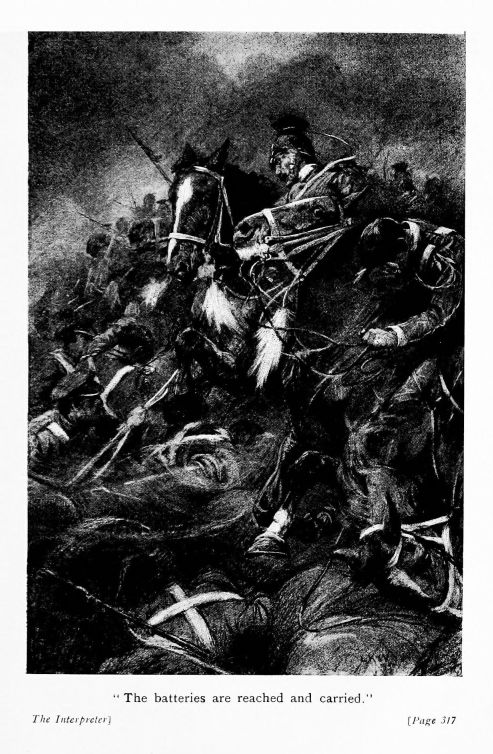
"The batteries are reached and carried. The Interpreter Page 317
* * * * *
In twos, and threes, and single files, the few survivors stagger back to the ground, from whence, a few short minutes ago, a gallant band had advanced in so trim, so orderly, so soldier-like a line.
The object has been attained, but at what a sacrifice? Look at yon stalwart trooper sinking on his saddle-bow, sick with his death-hurt, his head drooping on his bosom, his sword hanging idly in his paralysed right hand, his failing charger, wounded and feeble, nobly bearing his master to safety ere he falls to rise no more. The soldier's eye brightens for an instant as he hears the cheer of the Heavy Brigade completing the work he has pawned his life to begin. Soon that eye will glaze and close for ever. Men look round for those they knew and loved, and fear to ask for the comrade who is down, stiff and stark, under those dismounted guns and devastated batteries; horses come galloping in without riders; here and there a dismounted dragoon crawls feebly back to join the remnants of what was once his squadron, and by degrees the few survivors get together and form something like an ordered body once more. It is better not to count them, they are so few, so very few. Weep, England, for thy chivalry! mourn and wring thy hands for that disastrous day; but smile with pride through thy tears, thrill with exultation in thy sorrow, to think of the sons thou canst boast, of the deed of arms done by them in that valley before the eyes of gathered nations--of the immortal six hundred--thy children, every man of them, that rode the glorious death-ride of Balaklava!
"That was a stupid business," observed Ropsley, as he brought his horse alongside of mine, and pointed down the valley; "quite a mistake from beginning to end. What a licking we deserved to get, and what a licking we should have got if our dragoons were not the only cavalry in the world that will ride straight!"
"And yet what a glorious day!" I exclaimed, for the wild cheer of a charge seemed even now to be thrilling in my ears. "What a chance for a man to have! even if he did not survive it. What a proud sight for the army! Oh, Ropsley, what would I give to have been there!"
"Not whist, my dear fellow," replied my less enthusiastic friend; "that is not the way to play the game, and no man who makes mistakes deserves to win. I have a theory of my own about cavalry, they should never be offered too freely. I would almost go so far as to say they should not be used till a battle is won. At least they should be kept in hand till the last moment, and then let loose like lightning. What said the Duke? 'There are no cavalry on earth like mine, but I can only use them once;' and no man knew so well as he did the merits and the failings of each particular arm. Nor should you bring the same men out again too soon after a brilliant charge; let them have a little time to get over it, they will come again all the better. Never waste anything in war, and never run a chance when you can stand on a certainty. But here we are at the camp of the First Division. Yonder you may catch a glimpse of the harbour and a few houses of the town of Sebastopol. How quiet it looks this fine day! quite the sort of place to take the children to for sea-bathing at this time of the year! I am getting tired of the outside, though, Egerton; I sometimes think we shall never get in. There they go again," he added, as a white volume of smoke rose slowly into the clear air, and a heavy report broke dully on our ears; "there they go again, but what a slack fire they seem to be keeping up; we shall never do any good till we try a coup de main, and take the place by assault;" so speaking, Ropsley picked his way carefully amongst tent-ropes and tent-pegs, and all the impediments of a camp, to reach the main street, so to speak, of that canvas town, and I followed him, gazing around me with a curiosity rather sharpened than damped by the actual warfare I had already seen on so much smaller a scale.
There must have been at least two hundred thousand men at that time disposed around the beleaguered town, this without counting the Land Transport and followers of an army, or the crowds of non-combatants that thronged the ports of Kamiesch and Balaklava. The white town of tents stretched away for miles, divided and subdivided into streets and alleys; you had only to know the number of his regiment to find a private soldier, with as great a certainty as you could find an individual in London if you knew the number of his house and the name of the street where he resided--always pre-supposing that the soldier had not been killed the night before in the trenches, a casualty by no means to be overlooked. We rode down the main street of the Guards' division, admired the mountaineer on sentry at the adjoining camp of the Highland brigade, and pulled up to find ourselves at home at the door of Ropsley's tent, to which humble abode my friend welcomed me with as courteous an air and as much concern for my comfort as he would have done in his own luxurious lodgings in the heart of May-fair. A soldier's life had certainly much altered Ropsley for the better. I could see he was popular in his regiment. The men seemed to welcome back the Colonel (a captain in the Guards holds the rank of lieutenant-colonel in the army), and his brother officers thronged into the tent ere we had well entered it ourselves, to tell him the latest particulars of the siege, and the ghastly news that every morning brought fresh and bloody from the trenches.
As a stranger, or rather as a guest, I was provided with the seat of honour, an old, shrivelled bullock-trunk that had escaped the general loss of baggage on the landing of the army, previous to the battle of the Alma, and which, set against the tent-pole for a "back," formed a commodious and delightful resting-place; the said tent-pole, besides being literally the main-stay and prop of the establishment, fulfilling all the functions of a wardrobe, a chest of drawers, and a dressing-table; for from certain nails artfully disposed on its slender circumference, depended the few articles of costume and necessaries of the toilet which formed the whole worldly wealth of the ci-devant London dandy.
The dandy aforesaid, sitting on his camp-bedstead in his ragged flannel-shirt, and sharing that seat with two other dandies more ragged than himself, pledged his guest in a silver-gilt measure of pale ale, brought up from Balaklava at a cost of about half-a-guinea a bottle, and drank with a gusto such as the best-flavoured champagne had never wooed from a palate formerly too delicate and fastidious to be pleased with the nectar of the immortals themselves, now appreciating with exquisite enjoyment the strongest liquids, the most acrid tobacco, nay, the Irish stew itself, cooked by a private soldier at a camp-fire, savoury and delicious, if glutinous with grease and reeking of onions.
"Heavy business the night before last," said a young Guardsman with a beautiful girlish face, and a pair of uncommonly dirty hands garnished with costly rings--a lad that looked as if he ought to be still at school, but uniting the cool courage of a man with the mischievous light-hearted spirits of a boy. "Couldn't get a wink of sleep for them at any time--never knew 'em so restless. Tell you what, Colonel, 'rats leave a falling house,' it's my belief there's something up now, else why were we all relieved at twelve o'clock instead of our regular twenty-four hours in the trenches? Good job for me, for I breakfasted with the General, and a precious blow-out he gave me. Turkey, my boys! and cherry-brandy out of a shaving-pot! Do you call that nothing?"
"Were you in the advanced trenches?" inquired Ropsley, stopping our young friend's gastronomic recollections; "and did you see poor ---- killed?"
The lad's face fell in an instant; it was with a saddened and altered voice that he replied--
"Poor Charlie! yes, I was close to him when he was hit. You know it was his first night in the trenches, and he was like a boy out of school. Well, the beggars made a sortie, you know, on the left of our right attack: they couldn't have chosen a worse place; and he and I were with the light company when we drove them back. The men behaved admirably, Colonel; and poor Charlie was so delighted, not being used to it, you know," proceeded the urchin, with the gravity of a veteran, "that it was impossible to keep him within bounds. He had a revolver (that wouldn't go off, by the way), and he had filled a soda-water bottle with powder and bullets and odd bits of iron, like a sort of mimic shell. Well, this thing burst in his hand, and deuced near blew his arm off, but it only made him keener. When the Russians retired, he actually ran out in front and threw stones at them. I tried all I could to stop him." (The lad's voice was getting husky now.) "Well, Colonel, it was bright moonlight, and I saw a Russian private take a regular 'pot-shot' at poor Charlie. He hit him just below the waist-belt; and we dragged him into the trenches, and there he--he died. Colonel, this 'baccy of yours is very strong; I'll--I'll just walk into the air for a moment, if you'll excuse me. I'll be back directly."
So he rose and walked out, with his face turned from us all; and though there was nothing to be ashamed of in the weakness, I think not one of us but knew he had gone away to have his "cry" out, and liked him all the better for his mock manliness and his feeling heart.
Ere he came back again the bugles were sounding for afternoon parade. Orderly corporals were running about with small slips of paper in their hands, the men were falling in, and the fresh relief, so diminished every four-and-twenty hours, was again being got ready for the work of death in the trenches.
CHAPTER XXXVII
"A QUIET NIGHT"
On an elevated plateau, sloping downward to a ravine absolutely paved with iron, in the remains of shot and shell fired from the town during its protracted and vigorous defence, are formed in open column "the duties" from the different regiments destined to carry on the siege for the next four-and-twenty hours. Those who are only accustomed to see British soldiers marshalled neat and orderly in Hyde Park, or manoeuvring like clock-work in "the Phoanix," would hardly recognise in that motley, war-worn band the staid and uniform figures which they are accustomed to contemplate with pride and satisfaction as the "money's-worth" of a somewhat oppressive taxation. The Highlanders--partly from the fortune of war, partly from the nature of their dress--are less altered from their normal exterior than the rest of the army, and the Guardsman's tall figure and bear-skin cap still stamp him a Guardsman, notwithstanding patched clothing and much-worn accoutrements; but some of the line regiments, which have suffered considerably during the siege, present the appearance of regular troops only in their martial bearing and the scrupulous discipline observed within their ranks. To the eye of a soldier, however, there is something very pleasing and "workmanlike" in the healthy, confident air of the men, and the "matter-of-course" manner in which they seem to contemplate the duty before them. Though their coats may be out at elbows, their firelocks are bright and in good order, while the havresacks and canteens slung at their sides seem to have been carefully replenished with a view to keeping up that physical vigour and stamina for which the British soldier is so celebrated, and which, with his firm reliance on his officers, and determined bull-dog courage, render him so irresistible an enemy.
There are no troops who are so little liable to panic--whose morale, so to speak, it is so difficult to impair, as our own. Napoleon said they "never knew when they were beaten." And how often has this generous ignorance saved them from defeat! Long may it be ere they learn the humiliating lesson! But that they are not easily disheartened may be gathered from the following anecdote, for the truth of which many a Crimean officer will readily vouch:--
Two days after the disastrous attack of the 18th of June, 1855, a private soldier on fatigue duty was cleaning the door-step in front of Lord Raglan's quarters; but his thoughts were running on far other matters than holystone and whitewash, for on a staff officer of high rank emerging from the sacred portal, he stopped the astonished functionary with an abrupt request to procure him an immediate interview with the Commander-in-Chief.
"If you please, Colonel," said the man, standing at "attention," and speaking as if it was the most natural thing in the world, "if it's not too great a liberty, I wants to see the General immediate and particular!"
"Impossible! my good fellow," replied the Colonel--who, like most brave men, was as good-natured as he was fearless--"if you have any complaint to make, tell it me; you may be sure it will reach Lord Raglan, and if it is just, it will be attended to."
"Well, sir, it's not exactly a complaint," replied the soldier, now utterly neglecting the door-step, "but more a request, like; and I wanted to see his lordship special, if so be as it's not contrary to orders."
The Colonel could hardly help laughing at the coolness with which so flagrant a military solecism was urged, but repeated that Lord Raglan was even then engaged with General Pelissier, and that the most he could do for his importunate friend was to receive his message and deliver it to the Commander-in-Chief at a favourable opportunity.
The man reflected an instant, and seemed satisfied. "Well, Colonel," he said, "we knows you, and we trusts you. I speak for myself and comrades, and what I've got to say to the General is this here. We made a bad business o' Monday, and we knows the reason why. You let us alone. There's plenty of us to do it; only you give us leave, and issue an order that not an officer nor a non-commissioned officer is to interfere, and we, the private soldiers of the British army, will have that place for you if we pull the works down with our fingers, and crack the stones with our teeth!"
"And what," said the Colonel, utterly aghast at this unheard-of proposal, "what----"
"What time will we be under arms to do it?" interrupted the delighted delegate, never doubting but that his request was now as good as granted,--"why, at three o'clock to-morrow morning; and you see, Colonel, when the thing's done, if me and my company wasn't the first lads in!"
Such is the material of which these troops are made who are now waiting patiently to be marched down to the nightly butchery of the trenches.
"It reminds one of the cover-side at home," remarked Ropsley, as we cantered up to the parade, and dismounted; "one meets fellows from all parts of the camp, and one hears all the news before the sport begins. There goes the French relief," he added, as our allies went slinging by, their jaunty, disordered step, and somewhat straggling line of march, forming as strong a contrast to the measured tramp and regular movements of our own soldiers, as did their blue frock-coats and crimson trousers to the véritable rouge for which they had conceived so high a veneration. Ere they have quite disappeared, our own column is formed. The brigade-major on duty has galloped to and fro, and seen to everything with his own eyes. Company officers, in rags and tatters, with swords hung sheathless in worn white belts, and wicker-covered bottles slung in a cord over the hip, to balance the revolver on the other side,--and brave, gentle hearts beating under those tarnished uniforms, and sad experiences of death, and danger, and hardship behind those frank faces, and honest, kindly smiles,--have inspected their men and made their reports, and "fallen in" in their proper places; and the word is given, and its head moves off--"By the left; quick march!"--and the column winds quietly down into the valley of the shadow of death.
Ropsley is field-officer of the night, and I accompany him on his responsible duty, for I would fain see more of the town that has been in all our thoughts for so long, and learn how a siege is urged on so gigantic a scale.
The sun is just setting, and gilds the men's faces, and the tufts of arid grass above their heads in the deepening ravine, with a tawny orange hue, peculiar to a sunset in the East. The evening is beautifully soft and still, but the dust is suffocating, rising as it does in clouds from the measured tread of so many feet; and there is a feeling of depression, a weight in the atmosphere, such as I have often observed to accompany the close of day on the shores of the Black Sea. Even the men seem to feel its influence--the whispered jest, the ready smile which usually accompanies a march, is wanting; the youngest ensign looks thoughtful, and as if he were brooding on his far-off home; and the lines deepen on many a bearded countenance as we wind lower and lower down the ravine, and reach the first parallel, which to some now present must be so forcible a reminder of disappointed hopes, fruitless sacrifices, and many a true and hearty comrade who shall be friend and comrade no more.
Ropsley has a plan of the works in his hand, which he studies with eager attention. He hates soldiering--so he avows--yet is he an intelligent and trustworthy officer. With his own ideas on many points at variance with the authorities, and which he never scruples to avow, he yet rigidly carries out every duty entrusted to him, and if the war should last, promises to ascend the ladder as rapidly as any of his comrades. It is not the path he would have chosen to distinction, nor are the privations and discomforts of a soldier's life at all in harmony with his refined perceptions and luxurious habits; but he has embarked on the career, and, true to his principle, he is determined to "make the most of it." I think, too, that I can now perceive in Ropsley a spice of romance foreign to his earlier character. It is a quality without which, in some shape or other, nothing great was ever yet achieved on earth. Yet how angry would he be if he knew that I had thought he had a grain of it in his strong practical character, which he flatters himself is the very essence of philosophy and common-sense.
As we wind slowly up the now well-trodden covered way of the first parallel, from the shelter of which nothing can be seen of the attack or defence, I am forcibly reminded of the passages in a theatre, which one threads with blindfold confidence, in anticipation of the blaze of light and excitement on which one will presently emerge. Ropsley smiles at the conceit as I whisper it in his ear.
"What odd fancies you have!" says he, looking up from the plan on which he has been bending his earnest attention. "Well, you won't have long to wait for the opera; there's the first bar of the overture already!" As he speaks he pulls me down under the embankment, while a shower of dust and gravel, and a startling explosion immediately in front, warn us that the enemy has thrown a shell into the open angle of the trench, with a precision that is the less remarkable when we reflect how many months he has been practising to attain it.
"Very neatly done," observes Ropsley, rising from his crouching attitude with the greatest coolness; "they seldom trouble one much so soon as this. Probably a compliment to you, Egerton," he adds, laughing. "Now let us see what the damage is."
Stiff and upright as the ramrod in his firelock, which rattles to his salute, a sergeant of the Guards marches up and makes his report:--"Privates Wood and Jones wounded slightly, sir; Lance-corporal Smithers killed."
They pass us as they are taken to the rear; the lance-corporal has been shot through the heart, and must have died instantaneously. His face is calm and peaceful, his limbs are disposed on the stretcher as if he slept. Poor fellow! 'Tis quick work, and in ten minutes he is forgotten. My first feeling is one of astonishment, at my own hardness of heart in not being more shocked at his fate.
So we reach the advanced trenches without more loss. It is now getting quite dark, for the twilight in these latitudes is but of short duration. A brisk fire seems to be kept up on the works of our allies, responded to by the French gunners with ceaseless activity; but our own attack is comparatively unmolested, and Ropsley makes his arrangements and plants his sentries in a calm, leisurely way that inspires the youngest soldier with confidence, and wins golden opinions from the veterans who have spent so many bleak and weary nights before Sebastopol.
We are now in the advanced trenches. Not three hundred paces to our front are yawning the deadly batteries of the Redan. The night is dark as pitch. Between the intervals of the cannonade, kept up so vigorously far away on our right, we listen breathlessly as the night-breeze sweeps down to us from the town, until we can almost fancy we hear the Russians talking within their works. But the "pick, pick" of our own men's tools, as they enlarge the trench, and their stifled whispers and cautious tread, deaden all other sounds. Each man works with his firelock in his hand; he knows how soon it may be needed. Yet the soldier's ready jest and quaint conceit is ever on the lip, and many a burst of laughter is smothered as it rises, and enjoyed all the more keenly for the constraint.
"Not so much noise there," says Ropsley, in his quiet, authoritative tone, as the professed buffoon of the light company indulges in a more lively sally than usual; "I'll punish any man that speaks above a whisper. Come, my lads," he adds good-humouredly, "keep quiet now, and perhaps it will be OUR turn before the night is over!" The men return to their work with a will, and not another word is heard in the ranks.
The officers have established a sort of head-quarters as a place d'armes, or re-assembling spot, near the centre of their own "attack." Three or four are coiled up in different attitudes, beguiling the long, dark hours with whispered jests and grave speculations as to the intentions of the enemy. Here a stalwart captain of Highlanders stretches his huge frame across the path, puffing forth volumes of smoke from the short black pipe that has accompanied him through the whole war--the much-prized "cutty" that was presented to him by his father's forester when he shot the royal stag in the "pass abune Craig-Owar"; there a slim and dandy rifleman passes a wicker-covered flask of brandy-and-water to a tall, sedate personage who has worked his way through half-a-dozen Indian actions to be senior captain in a line regiment, and who, should he be fortunate enough to survive the present siege, may possibly arrive at the distinguished rank of a Brevet-Major. He prefers his own bottle of cold tea; as it gurgles into his lips the Highlander pulls a face of disgust.
"Take those long, indecent legs of yours out of the way, Sandy," says a merry voice, the owner of which, stumbling over these brawny limbs in the darkness, makes his way up to Ropsley, and whispers a few words in his ear which seem to afford our Colonel much satisfaction.
"You couldn't have done it better," says he to the new arrival, a young officer of engineers, the "bravest of the brave," and the "gayest of the gay;" "I could have spared you a few more men, but it is better as it is. I hate harassing our fellows, if we can help it. What will you have to drink?"
"A drain at the flask first, Colonel," answers the light-hearted soldier; "I've been on duty now, one way or another, for eight-and-forty hours, and I'm about beat. Sandy, my boy, give us a whiff out of 'the cutty.' I'll sit by you. You remind me of an opera-dancer in that dress. Mind you dine with me to-morrow, if you're not killed."
The Highlander growls out a gruff affirmative. He delights in his volatile friend; but he is a man of few words, although his arm is weighty and his brain is clear.
A shell shrieks and whistles over our heads. We mark it revolving, bright and beautiful, like a firework through the darkness. It lights far away to our rear, and bounds once more from the earth ere it explodes with a loud report.
"Not much mischief done by that gentleman," observes Ropsley, taking the cigar from his mouth; "he must have landed clear of all our people. We shall soon have another from the same battery. I wish I knew what they are doing over yonder," he adds, pointing significantly in the direction of the Redan.
"I think I can find out for you, Colonel," says the engineer; "I am going forward to the last 'sap,' and I shall not be very far from them there. Your sharpshooters are just at the corner, Green," he adds to the rifleman, "won't you come with me?" The latter consents willingly, and as they rise from their dusty lair I ask leave to accompany them, for my curiosity is fearfully excited, and I am painfully anxious to know what the enemy is about. The last "sap" is a narrow and shallow trench, the termination of which is but a short distance from the Russian work. It is discontinued at the precipitous declivity which here forms one side of the well-known Woronzoff ravine; and from this spot, dark as it is, the sentry can be discerned moving to and fro--a dusky, indistinct figure--above the parapet of the Redan.
The engineer officer and Green of the Rifles seat themselves on the very edge of the ravine; the former plucks a blade or two of grass and flings them into the air.
"They can't hear us with this wind," says he. "What say you, Green; wouldn't it be a good lark to creep in under there, and make out what they're doing?"
"I'm game!" says Green, one of those dare-devil young gentlemen to be found amongst the subalterns of the British army, who would make the same reply were it a question of crossing that glacis in the full glare of day to take the work by assault single-handed. "Put your sword off, that's all, otherwise you'll make such a row that our own fellows will think they're attacked, and fire on us like blazes. Mind you, my chaps have had lots of practice, and can hit a haystack as well as their neighbours. Now then, are you ready? Come on."
The engineer laughed, and unbuckled his sabre.
"Good-afternoon, Mr. Egerton, in case I shouldn't see you again," said he; and so the two crept silently away upon their somewhat hazardous expedition.
I watched their dark figures with breathless interest. The sky had lifted a little, and there was a ray or two of moonlight struggling fitfully through the clouds. I could just distinguish the two English officers as they crawled on hands and knees amongst the slabs of rock and inequalities of ground which now formed their only safety. I shuddered to think that if I could thus distinguish their forms, why not the Russian riflemen?--and what chance for them then, with twenty or thirty "Miniés" sighted on them at point-blank distance? However, "Fortune favours the brave;" the light breeze died away, and the moon was again obscured. I could see them no longer, and I knew that by this time they must have got within a very few paces of the enemy's batteries, and that discovery was now certain death. The ground, too, immediately under the Russian work was smoother and less favourable to concealment than under our own. The moments seemed to pass very slowly. I scarcely dared to move, and the tension of my nerves was absolutely painful, every faculty seeming absorbed in one concentrated effort of listening.
Suddenly a short, sharp stream of light, followed by the quick, angry report of the Minié--then another and another--they illumine the night for an instant; and during that instant I strain my eyes in vain to discover the two dark creeping forms. And now a blinding glare fills our trenches--the figures of the men coming out like phantoms in their different attitudes of labour and repose. The enemy has thrown a fire-ball into our works to ascertain what we are about. Like the pilot-fish before the shark, that brilliant messenger is soon succeeded by its deadly followers, and ere I can hurry back to the rallying-point of the attack, where I have left Ropsley and his comrades, a couple of shells have already burst amongst our soldiers, dealing around them their quantum of wounds and death, whilst a couple more are winging their way like meteors over our heads, to carry the alarm far to the rear, where the gallant blue-jackets have established a tremendous battery, and are at this moment in all probability chafing and fretting that they are not nearer the point of danger.
"Stand to your arms! Steady, men, steady!" is the word passed from soldier to soldier along the ranks, and the men spring like lions to the parapet, every heart beating high with courage, every firelock held firmly at the charge. They are tired of "long bowls" now, and would fain have it out with the bayonet.
The fire from the Redan lights up the intervening glacis, and as I rush hurriedly along the trench, stooping my head with instinctive precaution, I steal a glance or two over the low parapet, which shows me the figure of a man running as hard as his legs can carry him towards our own rallying-point. He is a mark for fifty Russian rifles, but he speeds on nevertheless. His cheery voice rings through all the noise and confusion, as he holloas to our men not to fire at him.
"Hold on, my lads," he says, leaping breathlessly into the trench; "I've had a precious good run for it. Where's the Colonel?"
His report is soon made. It is the young officer of engineers who thus returns in haste from his reconnoitring expedition. His companion, Green, has reached his own regiment by another track, for they wisely separated when they found themselves observed, and strange to say, notwithstanding the deadly fire through which they have "run the gauntlet," both are unwounded. The engineer confers with Ropsley in a low voice.
"They only want to draw off our attention, Colonel," says he; "I am quite sure of it. When I was under the Redan I could hear large bodies of men moving towards their left. That is the point of attack, depend upon it. There they go on our right! I told you so. Now we shall have it, hot and heavy, or I'm mistaken."
Even while he speaks a brisk fire is heard to open on our right flank. The clouds clear off, too, and the moon, now high in the heavens, shines forth unveiled. By her soft light we can just discern a dark, indistinct mass winding slowly along across an open space of ground between the Russian works. The rush of a round-shot from one of our own batteries whizzes over our heads. That dusky column wavers, separates, comes together again, and presses on. Ropsley gets cooler and cooler, for it is coming at last.
"Captain McDougal," says he to that brawny warrior, who does not look the least like an opera-dancer now, as he rears his six feet of vigour on those stalwart supporters, "I can spare all the Highlanders; form them directly, and move to your right flank. Do not halt till you reach the ground I told you of. The Rifles and our own light company will stand fast! Remainder, right, form four deep--march!"
There is an alarm along the whole line. Our allies are engaged in a brisk cannonade for their share, and many an ugly missile hisses past our ears from the foe, or whistles over our heads from our own supports. Is it to be a general attack?--a second Inkermann, fought out by moonlight? Who knows? The uncertainty is harassing, yet attended with its own thrilling excitement--half a pleasure, half a pain.
A few of our own people (we cannot in the failing light discover to what regiment they belong) are giving way before a dense mass of Russian infantry that outnumber them a hundred to one. They have shown a determined front for a time, but they are sorely pressed and overpowered, and by degrees they give back more and more. The truth must out--they are on the point of turning tail and running away. A little fiery Irishman stands out in front of them; a simple private is he in the regiment, and never likely to reach a more exalted rank, for, like all great men, he has a darling weakness, and the temptation to which he cannot but succumb is inebriety--the pages of the Defaulters' Book call it "habitual drunkenness." Nevertheless, he has the heart of a hero. Gesticulating furiously, and swearing, I regret to say, with blasphemous volubility, he tears the coat from his back, flings his cap on the ground, and tossing his arms wildly above his head, thus rebukes, like some Homeric hero, his more prudent comrades--
"Och, bad luck to ye, rank cowards and shufflers that ye are! and bad luck to the day I listed! and bad luck to the rig'ment that's disgracin' me! Would I wear the uniform, and parade like a soldier again, when it's been dirtied by the likes of you? 'Faith, not I, ye thunderin' villains. I'll tread and I'll trample the coat, and the cap, and the facin's, and the rest of it; and I'll fight in my shirt, so I will, if they come on fifty to one. Hurroo!"
Off goes his musket in the very faces of the enemy; with a rush and a yell he runs at them with the bayonet. His comrades turn, and strike in vigorously with the hero. Even that little handful of men serves for an instant to check the onward progress of the Russians. By this time the supports--Guards, Highlanders, and the flower of the British infantry--are pouring from their entrenchments; a tremendous fire of musketry opens from the whole line; staff officers are galloping down hurry-skurry from the camp. Far away above us, on those dark heights, the whole army will be under arms in ten minutes. The Russian column wavers once more--breaks like some wave against a sunken rock; dark, flitting figures are seen to come out, and stagger, and fall; and then the whole body goes to the right-about and returns within its defences, just as a mass of heavy clouds rising from the Black Sea sweeps across the moon, and darkness covers once more besiegers and besieged.
We may lie down in peace now till the first blush of dawn rouses the riflemen on each side to that sharp-shooting practice of which it is their custom to take at least a couple of hours before breakfast. We may choose the softest spots in those dusty, covered ways, and lean our backs against gabions that are getting sadly worn out, and in their half-emptied inefficiency afford but an insecure protection even from the conical ball of the wicked "Minié." We may finish our flasks of brandy-and-water and our bottles of cold tea, and get a few winks of sleep, and dream of home and the loved ones that, except in the hours of sleep, some of us will never see more. All these luxuries we may enjoy undisturbed. We shall not be attacked again, for this is what the soldiers term "A quiet night in the trenches."
CHAPTER XXXVIII
THE GROTTO
It is not all fighting, though, before Sebastopol. Without coinciding entirely with the somewhat Sancho Panza-like philosophy which affirms that the "latter end of a feast is better than the beginning of a fray," there is many a gallant fellow who has not the slightest objection to take his share of both; and from the days of Homer's heavy-handed heroes, down to those of the doughty Major Dugald Dalgetty himself, a good commissariat has always been considered essential to the success of all warlike enterprise. Every campaigner knows what a subject of speculation and excitement is afforded by the prospect of "what he will have for dinner," and the scantiness of that meal, together with the difficulty of providing for it, seems but to add to the zest with which it is enjoyed. Many a quaint incident and laughable anecdote is related of the foraging propensities of our allies, particularly the Zouaves, who had learned their trade in Algeria, and profited by the lessons of their Khabyle foe. The Frenchman, moreover, knows how to cook a dinner when he has filched it, which is more than can be said for our own gallant countrymen.
Had it not been for Fortnum and Mason--names which deserve to be immortalised, and which will ever be remembered with gratitude by the British army--our heroes would indeed have been badly off for luxurious living on that bracing and appetite-giving plateau. Yet, thanks to the energy of this enterprising firm, Amphitryons were enabled to indulge their taste for hospitality, and guests to admire and criticise the merits of the very commendable delicacies placed before them.
A dinner-party at Sebastopol, just out of cannon-shot, had something inexpressibly enlivening in its composition. There was no lack of news, no lack of laughter, no lack of eatables and drinkables, above all, no lack of hunger and thirst. The same faces were to be seen around the board that might have been met with at any dinner-table in London, but white neckcloths and broadcloth had given place to tawny beards and tarnished uniforms, whilst the bronzed countenances and high spirits of the party formed an exhilarating contrast to the weary looks and vapid conversation which makes London society, in its own intrinsic attractions, the stupidest in the world.
The sun's last rays are lighting up that well-known hill where sleeps "the bravest of the brave," he whose name will go down to our children's children coupled with Inkermann, as that of Leonidas with Thermopylæ. He whose fall evoked a deed of chivalry such as minstrel and troubadour snatched from oblivion in the olden time, and handed down to us for a beacon along the pathway of honour. Had they ever a nobler theme than this? A chief falls, surrounded and overpowered, in his desperate attempt to retrieve the fortunes of a day that he deems all but lost. His friend and comrade, faint and mangled, turns once more into the battle, and bestrides the form of the prostrate hero. One to ten, the breathless and the wounded against the fresh and strong, but the heart of an English gentleman behind that failing sword, beat down and shattered by the thirsty bayonets. An instant the advance is checked. An instant and they might both have been saved. Oh, for but one half-dozen of the towering forms that are even now mustering to the rescue! They are coming through the smoke! Too late--too late! the lion-hearted chieftain and the gentle, chivalrous warrior are down, slain, trampled, and defaced, but side by side on the bed of honour; and though the tide sweeps back, and the broken columns of the Muscovite are driven, routed and shattered, to the rear, their ears are deaf to the shout of victory, their laurel wreaths shall hang vacant and unworn, for they shall rise to claim them no more.
The setting sun is gilding their graves--the white buildings of Sebastopol smile peacefully in his declining rays--the sea is blushing violet under the rich purple of the evening sky. The allied fleets are dotted like sleeping wild-fowl over the bosom of the deep; one solitary steamer leaves its long dusky track of smoke to form a stationary cloud, so smooth is the water that the ripple caused by the sunken ships can be plainly discerned in the harbour, and the Russian men-of-war still afloat look like children's toys in the distance of that clear, calm atmosphere. The bleak and arid foreground, denuded of vegetation, and trampled by a thousand footmarks, yet glows with the warm orange hues of sunset, and the white tents contrast pleasingly with here and there the richer colouring of some more stationary hut or storehouse. It is an evening for peace, reflection, and repose; but the dull report of a 68-pounder smites heavily on the ear from the town, and a smart soldier-servant, standing respectfully at "attention," observes, "The General is ready, sir, and dinner is upon the table."
In a grotto dug by some Tartar hermit out of the cool earth are assembled a party of choice spirits, who are indeed anchorites in nothing but the delight with which they greet the refreshing atmosphere of their banqueting-hall. A flight of stone steps leads down into this well-contrived vault, in so hot a climate no contemptible exchange for the stifling interior of a tent, or even the comparative comfort of a wooden hut thoroughly baked through by the sun. A halting figure on crutches is toiling painfully down that staircase, assisted, with many a jest at their joint deficiencies, by a stalwart, handsome Guardsman, a model of manly strength and symmetry, but lacking what he is pleased to term his "liver wing." They are neither of them likely to forget the Crimea whilst they live. Ere they reach the bottom they are overtaken by a cavalry officer with jingling spurs and noisy scabbard, who, having had a taste of fighting, such as ought to have satisfied most men, at Balaklava, is now perpetually hovering about the front, disgusted with his enforced idleness at Kadikoi, and with a strong impression on his mind--which he supports by many weighty arguments--that a few squadrons of Dragoons would be valuable auxiliaries to a storming party, and that a good swordsman on a good horse can "go anywhere and do anything."
"I think we are all here now," says the host; "Monsieur le Général, shall we go to dinner?"
The individual addressed gives a hearty affirmative. He is a stout, good-humoured-looking personage, with an eagle eye, and an extremely tight uniform covered with orders and decorations. He is not yet too fat to get on horseback, though the privations of campaigning seem to increase his rotundity day by day, and he expects ere long to go to battle, like an ancient Scythian, in his war-chariot. By that time he will be a marshal of France, but meanwhile he pines a little for the opera, and enjoys his dinner extremely. He occupies the seat of honour on the right hand of his host. The latter bids his guests welcome in frank, soldier-like style; and whilst the soup is handed round, and those bearded lips are occupied with its merits, let us take a look round the table at the dozen or so of guests, some of whom are destined ere long to have their likenesses in every print-shop in merry England. First of all the dinner-giver himself--a square, middle-sized man, with a kindling eye, and a full, determined voice that suggests at once the habit of command--a kindly though energetic manner, and a countenance indicative of great resolution and clear-headedness; perhaps the best drill in the British army, and delighting much in a neat touch of parade tactics even before an enemy. Many a Guardsman nudged his comrade with a grin of humorous delight when, on a certain 20th of September, his old colonel coolly doubled a flank company in upon the rear of its battalion, and smiled to see the ground it would otherwise have occupied ploughed and riddled by the round-shot that was pouring from the enemy's batteries in position on the heights above the Alma. The British soldier likes coolness above all things; and where in command of foreign troops an officer should rave and gesticulate and tear his hair to elicit a corresponding enthusiasm from his men, our own phlegmatic Anglo-Saxons prefer the quiet smile and the good-humoured "Now, my lads!" which means so much.
On the left, and facing the Frenchman, sits a middle-aged decided-looking man, somewhat thoughtful and abstracted, yet giving his opinions in a clear and concise manner, and with a forcible tone and articulation that denote great energy and firmness of character. His name, too, is destined to fill the page of history--his future is bright and glowing before him, and none will grudge his honours and promotion, for he is endeared to the army by many a kindly action, and it has been exertion for their welfare and watching on their behalf, that have wasted his strong frame with fever, and turned his hair so grey in so short a time. Soldier as he is to his heart's core, he would fain be outside in the sunset with his colours and his sketch-book, arresting on its pages the glorious panorama which is even now passing away; but he is listening attentively to his neighbour, a handsome young man in the uniform of a simple private of Zouaves, and is earnestly occupied in "getting a wrinkle," as it is termed, concerning the interior economy and discipline of that far-famed corps. The Zouave gives him all the information he can desire with that peculiarly frank and fascinating manner which is fast dying out with the ancien régime, for though a private of Zouaves he is a marquis of France, the representative of one of the oldest families in the Empire, and a worthy scion of his chivalrous race. Rather than not draw the sword for his country, he has resigned his commission in that body of household cavalry termed "The Guides," and entered as a trooper in the Chasseurs d'Afrique: a display of martial enthusiasm for which he has been called out from the ranks of his original corps and publicly complimented by the Empress Eugénie herself. Arrived in the Crimea, he found his new comrades placed in enforced idleness at far too great a distance from active operations to suit his taste, and he forthwith exchanged once more into the Zouaves, with whom he took his regular share of duty in the trenches, and he is now enjoying a furlough of some six hours from his quarters, to dine with an English general, and cultivate the entente cordiale which flourishes so vigorously on this Crimean soil. Alas for the gallant spirit, the graceful form, the warm noble heart! no bird of ill omen flew across his path as he came to-day to dinner, no warning note of impending death rang in his ears to give him notice of his doom. To-night he is as gay, as lively, as cheerful as usual; to-morrow he will be but a form of senseless clay, shot through the head in the trenches.
Meanwhile the champagne goes round, and is none the less appreciated that although there is an abundance of bottles, there is a sad deficiency of glasses. A light-hearted aide-de-camp, well accustomed to every emergency, great or small, darts off to his adjoining tent, from which he presently returns, bearing two tin cups and the broken remains of a coffee-pot; with these auxiliaries dinner progresses merrily, and a fat turkey--how obtained it is needless to inquire--is soon reduced to a skeleton. A little wit goes a long way when men are before an enemy; and as the aide-de-camp strongly repudiates the accusation of having purloined this hapless bird, jokes are bandied about from one to another, every one wishing to fasten on his neighbour the accusation of knowing how to "make war support war."
The English officers are a long way behind their allies in this useful accomplishment; and the French general shakes his jolly sides as he relates with much gusto sundry Algerian experiences of what we should term larceny and rapine, but which his more liberal ideas seem to consider excusable, if not positively meritorious.
"The best foragers I had in Algeria," says he, "were my best soldiers too. If I wanted fresh milk for my coffee, I trusted to the same men that formed my storming parties, and I was never disappointed in one case or the other. In effect, they were droll fellows, my Zouaves Indigènes--cunning too, as the cat that steals cream; the Khabyles could keep nothing from them. If we entered their tents, everything of value was taken away before you could look round. To be sure we could carry nothing with us, but that made no difference. I have seen the men wind shawls round their waists that were worth a hundred louis apiece, and throw them aside on a hot day on the march. There was one Khabyle chief who was very conspicuous for the magnificent scarlet cashmere which he wore as a turban. On foot or on horseback, there he was, always fighting and always in the front. Heaven knows why, but the men called him Bobouton, and wherever there was a skirmish Bobouton was sure to be in the thick of it. One day I happened to remark 'that I was tired of Bobouton and his red shawl, and I wished some one would bring me the turban and rid me of the wearer.' A little swarthy Zouave, named Pépé, overheard my observation. 'Mon Colonel,' said he, with a most ceremonious bow,' to-morrow is your jour de fête--will you permit me to celebrate it by presenting you with the scarlet turban of Bobouton?' I laughed, thanked him, and thought no more about it.
"The following morning, at sunrise, I rode out to make a reconnaissance. A party, of whom Pépé was one, moved forward to clear the ground. Contrary to all discipline and ordonnance, my droll little friend had mounted a magnificent pair of epaulettes. Worn on his Zouave uniform, the effect was the least thing ridiculous. As I knew of no epaulettes in the camp besides my own, I confess I was rather angry, but the enemy having opened a sharp fire upon my skirmishers, I did not choose to sacrifice an aide-de-camp by bidding him ride on and visit Pépé with condign punishment; so, reserving to myself that duty on his return, I watched him meanwhile through my glass with an interest proportioned to my regard for my epaulettes, an article not too easily replaced in Algeria. Nor were mine the only eyes that looked so eagerly on the flashing bullion. Bobouton soon made his appearance from behind a rock, and by the manner in which he and Pépé watched, and, so to speak, 'stalked' each other, I saw that a regular duel was pending between the two. In fine, after very many manoeuvres on both sides, the Zouave incautiously exposed himself at a distance of eighty or ninety paces, and was instantaneously covered by his watchful enemy. As the smoke cleared away from the Khabyle's rifle, poor Pépé sprang convulsively in the air, and fell headlong on his face. 'Tenez!' said I to myself, 'there is Pépé shot through the heart, and I shall never see my epaulettes again.'
"The Khabyle rushed from his hiding-place to strip his fallen antagonist. Already his eyes glittered with delight at the idea of possessing those tempting ornaments--already he was within a few feet of the prostrate body, when 'crack!' once more I heard the sharp report of a rifle, and presto, like some scene at a carnival, it was Bobouton that lay slain upon the rocks, and Pépé that stood over him and stripped him of the spoils of war. In another minute he unrolled the red turban at my horse's feet. 'Mon Colonel,' said he, 'accept my congratulations for yourself and your amiable family. Accept also this trifling token of remembrance taken from that incautious individual who, like the mouse in the fable, thinks the cat must be dead because she lies prostrate without moving. And accept, moreover, my thanks for the loan of these handsome ornaments, without the aid of which I could not have procured myself the pleasure of presenting my worthy colonel with the shawl of ce malheureux Bobouton.' The rascal had stolen them out of my tent the night before, though my aide-de-camp slept within two paces of me, and my head rested on the very box in which they were contained."
"Alas! we have no experiences like yours, General," says a tall, handsome colonel of infantry, with the Cape and Crimean ribbons on his breast; "wherever we have made war with savages, they have had nothing worth taking. A Kaffre chief goes to battle with very little on besides his skin, and that is indeed scarce worth the trouble of stripping. When we captured Sandilli, I give you my word he had no earthly article upon his person but a string of blue beads, and yet he fought like a wildcat to make his escape."
"Your health, my friend," replies the General, clinking his glass with that of his new acquaintance. "You have been in Caffraria? Ah! I should have known it by your decorations. Are they not a fierce and formidable enemy? Is it not a good school for war? Tell me, now"--looking round the table for an explanation--"why do you not reserve South Africa, you others, as we do the northern shore, to make of it a drill-ground for your soldiers and a school for your officers? It would cost but little--a few hundred men a year would be the only loss. Bah!--a mere trifle to the richest and most populous country in the world. I do not understand your English sang-froid. Why do you not establish your Algeria at the Cape?"
Many voices are immediately raised in explanation; but it is difficult to make the thorough soldier--the man who has all his life been the military servant of a military Government--understand how repugnant would be such a proceeding to the feelings of the British people--how contrary to the whole spirit of their constitution. At length, with another glass of champagne, a new light seems to break in upon him. "Ah!" says he, "it would not be approved of by Le Times; now I understand perfectly. We manage these matters better with us. Peste! if we go to war, there it is. We employ our Gazettes to celebrate our victories. Your health, mon Général; this is indeed a wearisome business in which we are engaged--a life totally brutalising. Without change, without manoeuvring, and without pleasure: what would you? I trust the next campaign in which we shall meet may be in a civilised country--the borders of the Rhine, for instance; what think you?--where, instead of this barbarian desert, you find a village every mile, and a good house in every village, with a bottle of wine in the cellar, a smoked ham in the chimney, and a handsome Saxon blonde in the kitchen. 'A la guerre, comme à la guerre, n'est ce pas, mon Général?'"
The company are getting merry and talkative; cigars are lit, and coffee is handed round; the small hours are approaching, and what Falstaff calls the "sweet of the night" is coming on, when the tramp and snort of a horse are heard at the entrance of the grotto, a steel scabbard rings upon the stone steps, and although the new-comer's place at one end of the table has been vacant the whole of dinner-time, he does not sit down to eat till he has whispered a few words in the ear of the English general, who receives the intelligence with as much coolness as it is imparted.
In five minutes the grotto is cleared of all save its customary occupants. The French general has galloped off to his head-quarters; the English officers are hurrying to their men; each as he leaves the grotto casts a look at an ingenious arrangement at its mouth, which, by means of a diagram formed of white shells, each line pointing to a particular portion of the attack, enables the observer to ascertain at once in which direction the fire is most severe. The originator of this simple and ingenious indicator meanwhile sits down for a mouthful of food. He has brought intelligence of the sortie already described, and which will turn out the troops of all arms in about ten minutes; but in the meantime he has five to spare, and, being very hungry, he makes the best use of his time. As the light from the solitary lamp brings into relief that square, powerful form--that statue-like head, with its fearless beauty and its classical features--above all, the frank, kindly smile, that never fades under difficulties, and the clear, unwavering eye that never quails in danger,--any physiognomist worthy of the name would declare "that man was born to be a hero!" And the physiognomist would not be mistaken.
CHAPTER XXXIX
THE REDAN
The days dragged on in the camp. Sometimes wearily enough, sometimes enlivened by a party of pleasure to Baidar, an expedition to the monastery of St. George, a general action at the Tchernaya, a hurdle-race at Kadikoi, or some trifling excitement of the same kind. Already the great heat was beginning to be tempered by the bracing air of autumn, and the army was more than half inclined to speculate on the possibility of another long dreary winter before Sebastopol.
But the time had come at last. The blow so long withheld was to be launched in earnest, and for a day or two before the final and successful assault, men's minds seemed to tell them--they scarce knew why--that a great change was impending, and that every night might now be the last on which the dogged valour of the besieged would man those formidable defences that, under the names of the Malakhoff, the Redan, etc., had for so long occupied the attention of France, England, and indeed the whole of Europe.
I was sitting outside Ropsley's tent, sharing my breakfast of hard biscuit with Bold, at daybreak of a fine September morning. The old dog seemed on this occasion to have renewed his youth, and was so demonstrative and affectionate as to call down a strong reproof from Ropsley, with whom he was never on very friendly terms, for laying his broad paw on the well-brushed uniform of the Colonel. "Tie the brute up, Vere," said he, carefully removing the dirt from his threadbare sleeve, "or he will follow us on parade. Are you ready? if so, come along. I would not be late to-day of all days, for a thousand a year."
I remained in his rear, as he completed the inspection of his company. I had never seen the men so brisk or so smartly turned out, and there was an exhilarated yet earnest look on their countenances that denoted their own opinion of the coming day. Ropsley himself was more of the bon camarade, and less of the "fine gentleman" than usual. As we marched down to the trenches side by side, he talked freely of old times,--our school-days at Everdon, our later meeting at Beverley, and, by a natural transition, turned the subject of conversation to Victor de Rohan and his sister Valèrie. I had never known him allude to the latter of his own accord before. He seemed to have something on his mind which pride or mistrust, or both, would not permit him to bring out. At last, apparently with a strong effort, he whispered hurriedly--
"Vere, I've a favour to ask you--if I should be hit to-day by chance, and badly, you know, I should like you to write and remember me to the De Rohans, and--and--particularly to Countess Valèrie. If ever you should see her again, you might tell her so."
I pressed his hand in answer, and I thought his voice was hoarser as he resumed.
"Vere, it is not often I confess myself wrong, but I have wronged you fearfully. If I'm alive to-morrow I'll tell you all; if not, Vere, can you--can you forgive me?"
"From my heart," was all I had time to reply, for at that instant up rode the leader of the assault, and Ropsley's voice was calm and measured, his manner cold and cynical as ever, while he answered the short and military catechism usual on such occasions.
"Then it's all right," was the remark of the mounted officer, in as good-humoured and jovial a tone as if the affair in hand were a mere question of one of his own Norfolk battues; "and what a fine morning we've got for the business," he added, dismounting, and patting his horse as it was led away, ere he turned round to put himself at the head of the storming party.
I watched him as one watches a man whose experiences of danger have given him a fascination perfectly irresistible to inferior minds. It was the same officer whom I have already mentioned as the latest arrival to disturb the dinner-party in the grotto, but to-day he looked, if possible, more cheerful, and in better spirits than his wont. I thought of his antecedents, as they had often been related to me by one of his oldest friends,--of his unfailing good-humour and kindliness of disposition--of his popularity in his regiment--of his skill and prowess at all sports and pastimes, with the gloves, the foils, the sharp-rowelled spurs of the hunting-field, or the velvet cap that fails to protect the steeplechaser from a broken neck--of his wanderings in the desert amongst the Bedouin Arabs, and his cold bivouacs on the prairie with the Red Indians--of his lonely ride after the Alma, when, steering by the stars through a country with which he was totally unacquainted, he arrived at the fleet with the news of the famous flank march to Balaklava--of his daring sang-froid when "the thickest of war's tempest lowered" at Inkermann, and of the daily dangers and privations of the weary siege, always borne and faced out with the same merry light-hearted smile; and now he was to lead the assault.
None but a soldier knows all that is comprised in those three simple words--the coolness, the daring, the lightning glance, the ready resource, the wary tactics, and the headlong gallantry which must all be combined successfully to fill that post of honour; and then to think that the odds are ten to one he never comes back alive!
As I looked at his athletic frame and handsome, manly face, as I returned his cordial, off-hand greeting, as courteous to the nameless Interpreter as it would have been to General Pelissier himself, my heart tightened to think of what might--nay, what must surely happen on that fire-swept glacis, unless he bore indeed a life charmed with immunity from shot and steel.
Man by man he inspected the Forlorn Hope,--their arms, their ammunition pouches, their scaling-ladders, all the tackle and paraphernalia of death. For each he had a word of encouragement, a jest, or a smile. Ropsley and his company were to remain in support in the advanced trenches. All was at length reported "ready," and then came the awful hush that ever ushers in the most desperate deeds--the minutes of pale and breathless suspense, that fly so quickly and yet seem to pass like lead--when the boldest cheek is blanched, and the stoutest heart beats painfully, and the change to action and real peril is felt to be an unspeakable relief to all.
A cold wet nose was poked into my hand. Bold had tracked me from the camp, and had followed me even here; nothing would induce him now to quit my side, for even the dog seemed to think something awful was impending, and watched with red, angry eyes and lowered tail and bristling neck, as if he too had been "told off" for the attack.
A roar of artillery shakes the air; our allies have opened their fire on the Malakhoff, and their columns are swarming like bees to the assault. Battalion after battalion, regiment after regiment, come surging through the ditch, to break like waves on the sea-shore, as the depressed guns of the enemy hew awful gaps in their ranks--to break indeed but to re-form, and as fresh supports keep pressing them on from the rear, to dash upwards against the earthwork, and to overflow and fling themselves from the parapet in the face of the Russian gunners below.
The Muscovite fights doggedly, and without dream of surrender or retreat. Hand to hand the conflict must be decided with the bayonet, and the little Zouaves shout, and yell, and stab, and press onward, and revel, so to speak, in the wild orgy of battle.
But the Northman is a grim, uncompromising foe, and more than once the "red pantaloons" waver and give back, and rally, and press on again to death. Instances of gallantry and self-devotion are rife amongst the officers. Here, a young captain of infantry flings himself alone upon the bayonets of the enemy, and falls pierced with a hundred wounds; there, an old white-headed colonel, décoré up to his chin, draws an ominous revolver, and threatens to shoot any one of his own men through the head that shows the slightest disinclination to rush on. "Ma foi," says he, "c'est pour encourager les autres!" The southern blood boils up under the influence of example, and if French troops are once a little flushed with success, their élan, as they call that quality for which we have no corresponding expression, is irresistible. The Russians cannot face the impetuosity of their charge; already many of the guns are spiked, and the gunners bayoneted; the grey-coated columns are yielding ground foot by foot; fresh troops pour in over the parapet, for the living are now able to pass unscathed over the dead, with whom the ditch is filled. The fire of the Russians is slackening, and their yell dies away fainter on the breeze. A French cheer, wild, joyous, and unearthly, fills the air,--it thrills in the ears of Pelissier, sitting immovable on his horse at no great distance from the conflict; his telescope is pressed to his eye, and he is watching eagerly for the well-known signal. And now he sees it! A gleam of fierce joy lights up his features, and as the tricolor of France is run up to the crest of the Malakhoff, he shuts his glass with a snap, dismounts from his horse, and rolling himself round in his cloak, lies down for a few minutes' repose, and observes, with a zest of which none but a Frenchman is capable, "Tenez! voilà mon bâton de Maréchal!"
His are not the only eyes eagerly watching the progress of the attack; many a veteran of both armies is busied recalling all his own experiences and all his knowledge of warfare, to calculate the probabilities of their success whose task it is to cross that wide and deadly glacis which is swept by the batteries of the Redan.
The men are formed for the assault, and the word is given to advance.
"Now, my lads," says the leader, "keep cool--keep steady--and keep together--we'll do it handsomely when we're about it. Forward!"
It is related of him whom Napoleon called "the bravest of the brave," the famous Ney, that he was the only officer of that day who could preserve his sang-froid totally unmoved when standing with his back to a heavy fire. Many a gallant fellow facing the enemy would pay no more regard to the missiles whistling about his ears, than to the hailstones of an April shower; but it was quite a different sensation to front his own advancing troops, and never look round at the grim archer whose every shaft might be the last. What the French Marshal, however, piqued himself upon as the acme of personal courage and conduct, our English leader seems to consider a mere matter-of-course in the performance of an every-day duty. Step by step, calm, collected, and good-humoured, he regulates the movements of the attacking force. Fronting their ranks, as if he were on parade, he brings them out of their sheltering defences into the iron storm, now pouring forth its deadly wrath upon that rocky plateau which must be crossed in defiance of everything.
"Steady, men," he observes once more, as he forms them for the desperate effort; "we'll have them out of that in ten minutes. Now, my lads! Forward, and follow me!"
The cocked hat is waving amongst the smoke--the daring Colonel is forward under the very guns--with a British cheer, the Forlorn Hope dash eagerly on, comrade encouraging comrade, side by side, shoulder to shoulder--hearts throbbing wild and high, and a grip of iron on good "Brown Bess." Men live a lifetime in a few such moments. There are two brothers in that doomed band who have not met for years--they quarrelled in their hot youth over their father's grave, about the quiet orchard and the peaceful homestead that each had since longed so painfully to see once more; and now they have served, with half the globe between them, and each believes the other to have forgotten him, and the orchard and the homestead have passed away from their name for ever. They would weep and be friends if they could meet again. There are but four men between them at this moment, and two are down, stark and dead, and two are dragging their mangled bodies slowly to the rear, and the brothers are face to face under the fatal batteries of the Redan.
"Is't thou, my lad?" is all the greeting that passes in that wild moment; but the blackened hands meet with a convulsive clasp, and they are brothers once more, as when, long ago, they hid their sturdy little faces in their mother's gown. Thank God for that! In another minute it would have been too late, for Bill is down, shot through the lungs, his white belts limp and crimson with blood; and John, with a tear in his eye, and something betwixt an oath and a prayer upon his lips, is rushing madly on, for the cocked hat is still waving forward amongst the smoke. and the Colonel is still cheering them after him into the jaws of death.
But soldiers, even British soldiers, are but men, and the fire grows so deadly that the attacking force cannot but be checked in its headlong charge. The line breaks--wavers--gives way--the awful glacis is strewed with dead and dying--groans and curses, and shrieks for "water! water!" mingle painfully with the wild cheers, and the trampling feet, and the thunder of the guns; but volumes of smoke, curling low and white over the ground, veil half the horrors of that ghastly scene; yet through the smoke can be discerned some three or four figures under the very parapet of the Redan, and the cocked hat and square frame of the Colonel are conspicuous amongst the group.
It must have been a strange sight for the few actors that reached it alive. A handful of men, an officer or two, a retiring enemy, a place half taken, and an eager longing for reinforcements to complete the victory.
An aide-de-camp is despatched to the rear; he starts upon his mission to traverse that long three hundred yards, swept by a deadly cross-fire, that blackens and scorches the very turf beneath his feet. Down he goes headlong, shot through the body ere he has "run the gauntlet" for a third of the way. Another and another share the same fate! What is to be done? The case is urgent, yet doubtful; it demands promptitude, yet requires consideration. Our Colonel is a man who never hesitates or wavers for an instant. He calls up a young officer of the line, one of the few survivors on the spot; even as he addresses him, the rifleman on his right lurches heavily against him, shot through the loins, and a red-coated comrade on his left falls dead at his feet, yet the Colonel is, if possible, cooler and more colloquial than ever.
"What's your name, my young friend?" says he, shaking the ashes from a short black pipe with which he has been refreshing himself at intervals with much apparent zest. The officer replies, somewhat astonished, yet cool and composed as his commander. The Colonel repeats it twice over, to make sure he has got it right, glances once more at the enemy, then looking his new acquaintance steadily in the face, observes--
"Do I seem to be in a funk, young man?"
"No," replies the young officer, determined not to be outdone, "not the least bit of one, any more than myself."
The Colonel laughs heartily. "Very well," says he; "now, if I'm shot, I trust to you to do me justice. I'll tell you what I'm going to do. I must communicate with my supports. Every aide-de-camp I send gets knocked over. I'm no use here alone--I can't take the Redan single-handed--so I'm going back myself. It's only three hundred yards, but I can't run quite so fast as I used, so if I'm killed, I shall expect you to bear witness that I didn't go voluntarily into that cross-fire because I was afraid."
The young officer promised, and the Colonel started on his perilous errand. On the success of his mission or the tactics of that attack it is not my province to enlarge. Amongst all the conflicting opinions of the public, there is but one as to the daring gallantry and cool promptitude displayed on that memorable day by the leader of the assault.
Every man, however, moves in his own little world, even at the taking of Sebastopol. It was not for a nameless stranger, holding no rank in the service, to run into needless danger, and I was merely in the trenches as a looker-on, therefore did I keep sedulously under cover and out of fire. It is only the novice who exposes himself unnecessarily, and I had served too long with Omar Pasha not to appreciate the difference between the cool, calculating daring that willingly accepts a certain risk to attain a certain object, and the vainglorious foolhardiness that runs its head blindly against a wall for the mere display of its own intrinsic absurdity.
That great general himself was never known to expose his life unnecessarily. He would direct the manoeuvres of his regiments, and display the tactics for which he was so superior, at a safe distance from the fire of an enemy, as long as he believed himself sufficiently near to watch every movement, and to anticipate every stratagem of the adversary; but if it was advisable to encourage his own troops with his presence, to head a charge, or rally a repulse, who so daring and so reckless as the fortunate Croatian adventurer?
And yet, with all my care and all my self-denial--for indeed, on occasions such as these, curiosity is a powerful motive, and there is a strange instinct in man's wilful heart that urges him into a fray--I had a narrow escape of my own life, and lost my oldest friend and comrade during the progress of the attack.
I was gazing eagerly through my double glasses--the very same that had often done me good service in such different scenes--to watch the forms of those devoted heroes who were staggering and falling in the smoke, when a stray shell, bursting in the trench behind me, blew my forage-cap from my head, and sent it spinning over the parapet on to the glacis beyond. Involuntarily I stretched my hand to catch at it as it flew away, and Bold, who had been crouching quietly at my heel, seeing the motion, started off in pursuit. Ere I could check him, the old dog was over the embankment, and in less than a minute returned to my side with the cap in his mouth. The men laughed, and cheered him as he laid it at my feet.
Poor Bold! poor Bold! he waved his handsome tail, and reared his great square head as proudly as ever; but there was a wistful expression in his eye as he looked up in my face, and when I patted him the old dog winced and moaned as if in pain. He lay down, though quite gently, at my feet, and let me turn him over and examine him. I thought so--there it was, the small round mark in his glossy coat, and the dark stain down his thick foreleg--my poor old friend and comrade, must I lose you too? Is everything to be taken from me by degrees? My eyes were blinded with tears--the rough soldiers felt for me, and spared my favourite some water from their canteens; but he growled when any one offered to touch him but myself, and he died licking my hand.
Even in the turmoil and confusion of that wild scene I could mourn for Bold. He was the one link with my peaceful boyhood, the one creature that she and I had both loved and fondled, and now she was lost to me for ever, and Bold lay dead at my feet. Besides, I was fond of him for his own sake--so faithful, so true, so attached, so brave and devoted--in truth, I was very, very sorry for poor Bold.
CHAPTER XL
THE WAR-MINISTER AT HOME
Except at the crisis of great convulsions, when the man with the bayonet is the only individual that clearly knows what he has got to do and how to do it, the soldier is but the puppet upon the stage, while the diplomatist pulls the strings from behind the scenes. Before Sebastopol the armies of England, France, and Sardinia keep watch and ward, ever ready for action; at Vienna, the spruce attaché deciphers and makes his précis of those despatches which decide the soldier's fate. Is it to be peace or war? Has Russia entered into a league with the Austrian Government, or is the Kaiser, in his youthful enthusiasm, eager for an appeal to arms, and forgetful of his defenceless capital, not thirty leagues from the Polish frontier, and innocent of a single fortified place between its walls and the enemy, prepared to join heart and hand with France and England against the common foe? These are questions everybody asks, but nobody seems able to answer. On the Bourse they cause a deal of gambling, and a considerable fluctuation in the value of the florin as computed with reference to English gold. Minor capitalists rise and fall, and Rothschild keeps on adding heap to heap. Money makes money, in Austria as in England; nor are those moustached and spectacled merchants smoking cigars on the Bourse one whit less eager or less rapacious than our own smooth speculators on the Stock Exchange. The crowd is a little more motley, perhaps, and a little more demonstrative, but the object is the same.
"And what news have you here this morning, my dear sir?" observes a quiet-looking, well-dressed bystander who has just strolled in, to a plethoric individual, with a double chin, a double eye-glass, and a red umbrella, who is making voluminous entries in a huge pocket-book. The plethoric man bows to the ground, and becomes exceedingly purple in the face.
"None, honourable sir, none," he replies, with a circular sweep of his hat that touches his toes; "the market is flat, honourable sir, flat, and money, if possible, scarcer than usual."
Whereat the stout man laughs, but breaks off abruptly, as if much alarmed at the liberty he has taken. The well-dressed gentleman turns to some one else with the same inquiry, and, receiving a less cautious answer, glances at his fat friend, who pales visibly under his eye. They are all afraid of him here, for he is no other than our old acquaintance, Monsieur Stein, clean, quiet, and undemonstrative as when we saw him last in the drawing-room at Edeldorf. Let us follow him as he walks out and glides gently along the street in his dark, civil attire, relieved only by a bit of ribbon at the button-hole.
All great men have their weaknesses. Hercules, resting from his labours, spun yarns with Omphale; Antony combined fishing and flirtation; Person loved pale ale, and refreshed himself copiously therewith; and shall not Monsieur Stein, whose Protean genius can assume the characters of all these heroes, display his taste for the fine arts in so picturesque a capital as his own native Vienna? He stops accordingly at a huge stone basin ornamenting one of its squares, and, producing his note-book, proceeds to sketch with masterly touches the magnificent back and limbs of that bronze Triton preparing to launch his harpoon into the depths below. Sly Monsieur Stein! is it thus you spread your nets for the captivation of unwary damsels, and are you always rewarded by so ready a prey as that well-dressed soubrette who is peeping on tiptoe over your shoulder, and expressing her artless admiration of your talent in the superlative exclamations of her Teutonic idiom?
"Pardon me, honourable sir, that I so bold am, as so to overlook your wondrously-beautiful design, permit me to see it a little nearer. I thank you, love-worthy sir."
Monsieur Stein is too thoroughly Austrian not to be the pink of politeness. He doffs his hat, and hands her the note-book with a bow. As she returns it to him an open letter peeps between the leaves, and they part and march off on their several ways with many expressions of gratitude and politeness, such as two utter strangers make use of at the termination of a chance acquaintanceship; yet is the soubrette strangely like Jeannette, Princess Vocqsal's femme de chambre; and the letter which Monsieur Stein reads so attentively as he paces along the sunny side of the street, is certainly addressed to that lady in characters bearing a strong resemblance to the handwriting of Victor, Count de Rohan.
Monsieur Stein pockets the epistle--it might be a receipt for sour-krout for all the effect its perusal has on his impassible features--and proceeds, still at his equable, leisurely pace, to the residence of the War-Minister.
While he mounts the steps to the second floor, on which are situated the apartments of that functionary, and combs out his smooth moustaches, waiting the convenience of the porter who answers the bell, let us take a peep inside.
The War-Minister is at his wit's end. His morning has been a sadly troubled one, for he has been auditing accounts, to which pursuit he cherishes a strong disinclination, and he has received a letter from the Minister of the Interior, conveying contradictory orders from the Emperor, of which he cannot make head or tail. Besides this, he has private annoyances of his own. His intendant has failed to send him the usual supplies from his estates in Galicia; he is in debt to his tailor and his coach-maker, but he must have new liveries and an English carriage against the next Court ball; his favourite charger is lame, and he does not care to trust himself on any of his other horses; and, above all, he has sustained an hour's lecture this very morning, when drinking coffee in his dressing-gown, from Madame la Baronne, his austere and excellent spouse, commenting in severe terms on his backslidings and general conduct, the shortcomings of which, as that virtuous dame affirms, have not failed to elicit the censure of the young Emperor himself. So the War-Minister has drunk three large tumblers of schwartz-bier, and smoked as many cigars stuck up on end in the bowl of a meerschaum pipe, the combined effects of which have failed to simplify the accounts, or to reconcile the contradictory instructions of the Court.
He is a large, fine-looking man, considerably above six feet in height. His grey-blue uniform is buttoned tightly over a capacious chest, covered with orders, clasps, and medals; his blue eyes and florid complexion denote health and good-humour, not out of keeping with the snowy moustaches and hair of some three-score winters. He looks completely puzzled, and is bestowing an uneasy sort of attention, for which he feels he must ere long be taken to task, upon a very charming and well-dressed visitor of the other sex, no less a person, indeed, than that "odious intrigante," as Madame la Baronne calls her, the Princess Vocqsal.
She is as much at home here in the War-Minister's apartments as in her own drawing-room. She never loses her aplomb, or her presence of mind. If his wife were to walk in this minute she would greet her with amiable cordiality; and, to do Madame la Baronne justice, though she abuses the Princess in all societies, her greeting would be returned with the warmth and kindness universally displayed to each other by women who hate to the death. Till she has got her antagonist down, the female fencer never takes the button off her foil.
"You are always so amiable and good-humoured, my dear Baron," says the Princess, throwing back her veil with a turn of her snowy wrist, not lost upon the old soldier, "that you will, I am sure, not keep us in suspense. The Prince wishes his nephew to serve the Emperor; he is but a boy yet. Will he be tall enough for the cavalry? A fine man looks so well on horseback!"
The Baron was justly proud of his person. This little compliment and the glance that accompanied it were not thrown away. He looked pleased, then remembered his wife, and looked sheepish, then smoothed his moustache, and inquired the age of the candidate.
"Seventeen next birthday," replied the Princess. "If it were not for this horrid war we would send him to travel a little. Do you think the war will last, Monsieur le Baronne?" added she, naïvely.
"You must ask the Foreign Minister about that," replied he, completely thrown off his guard by her innocence. "We are only soldiers here, we do not pull the strings, Madame. We do what we are told, and serve the Emperor and the ladies," he added, with a low bow and a leer.
"Then will you put him into the Cuirassiers immediately, Monsieur?" said the Princess, with her sweetest smile; "we wish no time to be lost--now do, to please me."
The Baron was rather in a dilemma; like all men in office, he hated to bind himself by a promise, but how to refuse that charming woman anything?--at last he stammered out--"Wait a little, Madame, wait, and I will do what I can for you; it is impossible just now, for we are going to reduce the army by sixty thousand men."
While he spoke, Monsieur Stein was announced, and the Princess rose to take her leave; she had got all she wanted now, and did not care to face a thousand Baronesses. As she went downstairs, she passed Monsieur Stein without the slightest mark of recognition, and he, too, looked admiringly after her, as if he had never seen her before. The Baron, by this time pining for more schwartz-bier, and another cigar, devoutly hoped his new visitor, with whose person and profession he was quite familiar, would not stay long; and the Princess, as she tripped past the Huissier at the entrance, muttered, "Sixty thousand men--then it will be peace: I thought so all along. My poor Baron! what a soft old creature you are! Well, I have tried everything now, and this speculating is the strongest excitement of all, even better than making Victor jealous!" but she sighed as she said it, and ordered her coachman to drive on at once to her stock-broker.
The presence of Monsieur Stein did not serve to re-establish either the clear-headedness or the good-humour of the War-Minister. The ostensible errand on which he came was merely to obtain some trifling military information concerning the garrison at Pesth, without which the co-operation of the police would not have been so effectual, in annoying still further the already exasperated Hungarians; but in the course of conversation, Monsieur Stein subjected the Baron to a process familiarly called "sucking the brains," with such skill that, ere the door was closed on his unwelcome visitor, the soldier felt he had placed himself--as indeed was intended--completely in the power of the police-agent. All his sins of omission and commission, his neglect of certain contracts, and his issuing of certain orders; his unpardonable lenity at his last tour of inspection, his unlucky expression of opinions at direct variance with those of his young Imperial master:--all these failures and offences he felt were now registered in letters never to be effaced,--on the records of Monsieur Stein's secret report; and what was more provoking still, was to think that he had, somehow or another, been insensibly led on to plead guilty to half-a-dozen derelictions, which he felt he might as consistently have denied.
As he sat bolt upright in his huge leathern chair, and turned once more to "sublime tobacco" for consolation and refreshment, his thoughts floated back to the merry days when he was young and slim, and had no cares beyond his squadron of Uhlans, no thought for the morrow but the parade and the ball. "Ah!" sighed the Baron to himself as he knocked the ash off his cigar with a ringed fore-finger, "I would I were a youngling again; the troop-accounts were easily kept, the society of my comrades was pleasanter than the Court. One never meets with such beer now as we had at Debreczin; and oh! those Hungarian ladies, how delightful it was to waltz before one grew fat, and flirt before one grew sage. I might have visited the charming Princess then, and no one would have found fault with me; no one would have objected--Heigh-ho! there was no Madame la Baronne in those days--now it is so different. Sapperment! Here she comes!"