THE INTERPRETER (continued 3)
Reading edition
And yet I was not in love with her; no, I felt something exalting, something exhilarating in her presence--she seemed to fill the void in my life, which had long been so wearisome, but I was not in love with her--certainly not then. I felt less shy than usual, I even felt as if I too had some claim to social distinction, and could play my part as well as the rest on the shifting stage. She had the happy knack of making others feel in good spirits and at their ease in her society. I was not insensible to the spell, and when Sir Harry came in, and asked kindly after his old friend, and promised to come over soon and pay my father a visit, I answered frankly and at once; I could see even the thoughtless Baronet was struck with the change in my manner, indeed he said as much.
"You must come over and stay with us, Mr. Egerton," was his hospitable invitation; "or if your father is so poorly you cannot leave him, look in here any day about luncheon-time. I am much from home myself, but you will always find Constance and Miss Minim. Tell your father I will ride over and see him to-morrow. I only came back yesterday. How you're grown, my lad, and improved--isn't he, Constance?"
I would have given worlds to have heard Constance's answer, but she turned the subject with an inquiry after Bold (who was at that instant waiting patiently for his master on the door-step), and it was time to take leave, so I bowed myself out, with a faithful promise, that I was not likely to forget, of calling again soon.
"So she has not forgotten Bold," I said to myself, at least twenty times, in my homeward walk; and I think, fond as I had always been of my dog, I liked him that day better than ever.
"Father," I said, as I sat that evening after dinner, during which meal I felt conscious that I had been more lively, and, to use an expressive term, "better company," than usual; "I must write to London for a new coat, that black one is quite worn out."
"Very well, Vere," answered my father, abstractedly; "tell them to make it large enough--you grow fast, my boy."
"Do you think I am grown, father? Indeed, I am not so very little of my age now; and do you know, I was the strongest boy at Everdon, and could lift a heavier weight than Manners the usher; but, father"--and here I hesitated and stammered, till reassured by the kind smile on his dear old face,--"I don't mind asking you, and I do so wish to know--am I so very, very--ugly?" I brought out the hated word with an effort--my father burst out laughing.
"What an odd question--why do you wish to know, Vere?" he asked. I made no reply, but felt I was blushing painfully. My father looked wistfully at me, while an expression as of pain contracted his wan features; and here the conversation dropped.
CHAPTER XIII
"LETHALIS ARUNDO"
That week I went over again to Beverley; the next, I had a book to fetch for Constance from Fleetsbury, that she had long wished to read, and I took it to her a volume at a time. My father was still busy with his painting--Sir Harry had gone off to Newmarket--Miss Minim seemed delighted to find any one who could relieve the monotony of the Manor House, and Constance herself treated me, now that the first awkwardness of our re-introduction was over, like an old playmate and friend. I was happier than I had ever been in my life. I felt an elasticity of spirits, a self-respect and self-reliance that I had thought myself hitherto incapable of entertaining. Oh, the joy of that blindfold time! whilst our eyes are wilfully shut to the future that we yet know must come, whilst we bask in the sunshine and inhale the fragrance of the rose, nor heed the thunder-cloud sleeping on the horizon, and the worm creeping at the core of the flower. I looked on Constance as I would have looked on an angel from heaven. I did not even confess to myself that I loved her, I was satisfied with the intense happiness of the present, and trembled at the bare idea of anything that might break the spell, and interrupt the calm quiet of our lives. With one excuse or another, I was at Beverley nearly every day; there were flowers to be dried, for Constance was a great botanist, and I had taken up that study, as I would have taken up shoe-making, could I have seen her a minute a day longer for the pursuit,--there was music to be copied, and if I could do nothing else, I could point off those crabbed hieroglyphics like a very engraver. Then Miss Minim broke her fan, and I walked ten miles in the rain to get it mended, with an alacrity and devotion that must have convinced her it was not for her sake: and yet I loved Miss Minim dearly, she was so associated in my mind with Constance, that except the young lady's own, that wizened old face brought the blood to my brow more rapidly than any other in the world. Oh! my heart aches when I think of that beautiful drawing-room, opening into the conservatory, and Constance playing airs on the pianoforte that made my nerves tingle with an ecstasy that was almost painful. Miss Minim engaged with her crotchet-work in the background, and I, the awkward, ungainly youth, saying nothing, hardly breathing, lest I should break the spell; but gazing intently on the fair young face, with its soft kind eyes, and its thrilling smile, and the smooth, shining braids of jet-black hair parted simply on that pure brow. Mine was no love at first sight, no momentary infatuation that has its course and burns itself out, the fiercer the sooner, with its own unsustained violence. No; it grew and stole upon me by degrees, I drank it in with every breath I breathed--I fought against it till every moment of my life was a struggle; and yet I cherished and pressed it to my heart when all was done. I knew I was no equal for such as Miss Beverley, I knew I had no right even to lift my eyes to so much beauty and so much goodness--I, the awkward, ugly schoolboy, or at best the shrinking, unattractive youth, in whose homage there was nothing for a woman to take pride, even if she did not think it ridiculous; but yet--God! how I loved her. Not a blossom in the garden, not a leaf on the tree, not a ray of sunshine, nor a white cloud drifting over the heaven, but was associated in my mind with her who was all the world to me. If I saw other women, I only compared them with her; if I read of beauty and grace in my dear old romances, or hung over the exquisite casts and spirited studies of my father's painting-room, it was but to refer the poet's dream and the artist's conception back to my own ideal. How I longed for beauty, power, talent, riches, fame, everything that could exalt me above my fellows, that I might fling all down at her feet, and bid her trample on it if she would. It was bitter to think I had nothing to offer; and yet I felt sometimes there ought to be something touching in my self-sacrifice. I looked for no return--I asked for no hope, no favour, not even pity; and I gave my all.
At first it was delightful: the halcyon days flitted on, and I was happy. Sir Harry, when at home, treated me with the greatest kindness, and seemed to find pleasure in initiating me into those sports and amusements which he himself considered indispensable to the education of a gentleman. He took me out shooting with him, and great as was my natural aversion to the slaying of unoffending partridges and innocent hares, I soon conquered my foolish nervousness about firing a gun, and became no mean proficient with the double-barrel. My ancient captor, the head keeper, now averred that "Muster Egerton was the cooollest shot he ever see for so young a gentleman, and coool shots is generally deadly!" The very fact of my not caring a straw whether I killed my game or not, removed at once that over-anxiety which is the great obstacle to success with all young sportsmen. It was sufficient for me to know that a day's shooting at her father's secured two interviews (morning and afternoon) with Constance, and I loaded, and banged, and walked, and toiled like the veriest disciple of Colonel Hawker that ever marked a covey. All this exercise had a beneficial effect on my health and spirits; I grew apace, I was no longer the square, clumsy-built dwarf; my frame was gradually developing itself into that of a powerful, athletic man. I was much taller than Constance now, and not a little proud of that advantage. Having no others with whom to compare myself, I began to hope that I was, after all, not much worse-looking than the rest of my kind; and by degrees a vague idea sprang up in my mind, though I never presumed to give it shape and consistency, that Constance might some day learn to look kindly upon me, and that perhaps, after many, many years, the time would come when I should dare to throw myself at her feet and tell her how I had worshipped her; not to ask for a return, but only to tell her how true, and hopeless and devoted had been my love. After that I thought I could die happy.
Weeks grew to months, and months to years, and still no change took place in my habits and mode of life. My father talked of sending me to Oxford, for I was now grown up, but when the time came he was loth to part with me, and I had such a dread of anything that should take me away from Alton, that I hailed the abandonment of the scheme with intense joy. Constance went to London with Sir Harry during the season, and for two or three months of the glorious summer I was sadly low and restless and unhappy; but I studied hard during this period of probation, to pass the time, and when she came again, and gave me her hand with her old kind smile, I felt rewarded for all my anxieties, and the sun began to shine for me once more.
I was a man now in heart and feelings, and loved with all a man's ardour and singleness of purpose, yet I never dreamed she could be mine. No; I shut my eyes to the future, and blindfold I struggled on; but I was no longer happy; I grew restless and excited, out of temper, petulant in trifles, and incapable of any fixed application or sustained labour. I was leading an aimless and unprofitable life; I was an idolater, and I was beginning to pay the penalty; little did I know then what would be my sufferings ere the uttermost farthing should be exacted. Something told me the time of my happiness was drawing to a close; there is a consciousness before we wake from a moral as well as a physical sleep, and my awakening was near at hand.
It was a soft grey morning early in August, one of those beautiful summer days that we have only in England, when the sky is clouded, but the air pure and serene, and the face of nature smiling as though in a calm sleep. Not a breath stirred the leaves of the grand old trees in the park at Beverley, nor rippled the milk-white surface of the mere. The corn was ready for cutting, but scarce a sheaf had yet fallen before the sickle; it was the very meridian and prime of the summer's beauty, and my ladye-love had returned from her third London season, and was still Constance Beverley. It was later than my usual hour of visiting at the Manor, for my father had been unwell during the night, and I would not leave him till the doctor had been, so Constance had put on her hat and started for her morning's walk alone. She took the path that led towards Alton, and Bold and I caught sight at the same moment of the well-known white dress flitting under the old oaks in the park. My heart used to stop beating when I saw her, and now I turned sick and faint from sheer happiness. Not so Bold: directly he caught sight of the familiar form away he scoured like an arrow, and in less than a minute he was bounding about her, barking and frisking, and testifying his delight with an ardour that was responded to in a modified degree by the young lady. What prompted me I know not, but instead of walking straight on and greeting her, I turned aside behind a tree, and, myself unseen, watched the form of her I loved so fondly, as she stepped gracefully on towards my hiding-place; she seemed surprised, stopped, and looked about her, Bold meanwhile thrusting his nose into her small gloved hand.
"Why, Bold," said she, "you have lost your master." And as she spoke she stooped down and kissed the dog on his broad, honest forehead. My heart bounded as if it would have burst; never shall I forget the sensations of that moment; not for worlds would I have accosted her then--it would have been sacrilege, it would have seemed like taking advantage of her frankness and honesty. No; I made a wide detour, still concealed behind the trees, and struck in upon the path in front of her as if I came direct from home. Why was it that her greeting was less cordial than usual? Why was it no longer "Vere" and "Constance" between us, but "Mr. Egerton" and "Miss Beverley"? She seemed ill at ease, too, and her tone was harder than usual till I mentioned my father's illness, when she softened directly. I thought there were tears in her voice as she asked me--
"How could I leave him if he was so poorly?"
"Because I knew you came back yesterday, Miss Beverley, and I would not miss being one of the first to welcome you home," was my reply.
"Why do you call me Miss Beverley?" she broke in, with a quick glance from under her straw hat. "Why not 'Constance,' as you used?"
"Then why not call me 'Vere'?" I retorted; but my voice shook, and I made a miserable attempt to appear unconcerned.
"Very well, 'Constance' and 'Vere' let it be," she replied, laughing; "and now, Vere, how did you know I came back yesterday?"
"Because I saw the carriage from the top of Buttercup Hill--because I watched there for six hours that I might make sure--because----"
I hesitated and stopped; she turned her head away to caress Bold. Fool! fool that I was! Why did I not tell her all then and there? Why did I not set my fate at once upon the cast? Another moment, and it was too late. When she turned her face again towards me it was deadly pale, and she began talking rapidly, but in a constrained voice, of the delights of her London season, and the gaieties of that to me unknown world, the world of fashionable life.
"We have had so many balls and operas and dissipations, that papa says he is quite knocked up; and who do you think is in London, Vere, and who do you think has been dancing with me night after night?" (I winced), "who but your old schoolfellow, your dear old friend, Count de Rohan!"
"Victor!" I exclaimed, and for an instant I forgot even my jealousy at the idea of any one dancing night after night with Constance, in my joy at hearing of my dear old schoolfellow. "Oh, tell me all about him--is he grown? is he good-looking? is he like what he was? is he going to stay in England? did he ask after me? is he coming down to see me at Alton?"
"Gently," replied Constance, with her own sweet smile. "One question at a time, if you please, Vere, and I can answer them. He is grown, of course, but not more than other people; he is very good-looking, so everybody says, and I really think he must be, too; he is not nearly so much altered from what he was as a boy, as some one else I know" (with a sly glance at me), "and he talks positively of paying us a visit early in the shooting season, to meet another old friend of yours, Mr. Ropsley, who is to be here to-day to luncheon; I hope you will stay and renew your acquaintance, and talk as much 'Everdon' as you did when we were children; and now, Vere, we must go in and see papa, who has probably by this time finished his letters." So we turned and bent our steps (mine were most unwilling ones) towards the house.
We had not proceeded far up the avenue, ere we were overtaken by a postchaise laden with luggage, and carrying a most irreproachable-looking valet on the box; as it neared us a well-known voice called to the boy to stop, and a tall, aristocratic-looking man got out, whom at first I had some difficulty in identifying as my former school-fellow, Ropsley, now a captain in the Guards, and as well known about London as the Duke of York's Column itself. He sprang out of the carriage, and greeted Constance with the air of an old friend, but paused and surveyed me for an instant from head to foot with a puzzled expression that I believe was only put on for the occasion,--then seized my hand, and declared I was so much altered and improved he had not known me at first. This is always gratifying to a youth, and Ropsley was evidently the same as he had always been--a man who never threw a chance away--but what good could I do him? Why should it be worth his while to conciliate such as me? I believe he never forgot the fable of the Lion and the Mouse.
When the first salutations and inquiries after Sir Harry were over, he began to converse with Constance on all those topics of the London world with which women like so much to be made acquainted,--topics so limited and personal that they throw the uninitiated listener completely into the background. I held my tongue and watched my old schoolfellow. He was but little altered since I had seen him last, save that his tall figure had grown even taller, and he had acquired that worn look about the eyes and mouth which a few seasons of dissipation and excitement invariably produce even in the young. After detailing a batch of marriages, and a batch of "failures," in all of which the names of the sufferers were equally unknown to me, he observed, with a peculiarly marked expression, to Constance, "Of course you know there never was anything in that report about De Rohan and Miss Blight; but so many people assured me it was true, that if I had not known Victor as well as I do, I should have been almost inclined to believe it."
I watched Constance narrowly as he spoke, and I fancied she winced. Could it have been only my own absurd fancy? Ropsley proceeded, "I saw him yesterday, and he desired his kindest regards to you, and I was to say he would be here on the 3rd."
"Oh! I am so glad!" exclaimed Constance, her whole countenance brightening with a joyous smile, that went like a knife to my foolish, inexperienced heart, that OUGHT to have reassured and made me happier than ever. Does a woman confess she is "delighted" to see the man she is really fond of? Is not that softened expression which pervades the human face at mention of the "one loved name" more akin to a tear than a smile? "He is so pleasant and so good-natured, and will enliven us all so much here;" she added, turning to me, "Vere, you must come over on the 3rd, and meet Count de Rohan; you know he is the oldest friend you have,--an older friend even than I am."
I was hurt, angry, maddened already, and this kind speech, with the frank, affectionate glance that accompanied it, filled my bitter cup to overflowing. Has a woman no compunction? or is she ignorant of the power a few light commonplace words may have to inflict such acute pain? Constance cannot have guessed the feelings that were tearing at my heart; but she must have seen my altered manner, and doubtless felt herself aggrieved, and thought she had a right to be angry at my unjustifiable display of temper.
"I thank you," I replied, coldly and distantly; "I cannot leave my father until he is better; perhaps De Rohan will come over and see us if he can get away from pleasanter engagements. I fear I have stayed too long already. I am anxious about my father, and must go home. Good-bye, Ropsley; good-morning, Miss Beverley. Here--Bold! Bold!"
She looked scared for an instant, then hurt, and almost angry. She shook hands with me coldly, and turned away with more dignity than usual. Brute, idiot that I was! even Bold showed more good feeling and more sagacity than his master. He had been sniffing round Ropsley with many a low growl, and every expression of dislike which a well-nurtured dog permits himself towards his master's associates; but he looked wistfully back at Constance as she walked away, and I really thought for once he would have broken through all his habits of fidelity and subordination, and followed her into the house.
What a pleasant walk home I had I leave those to judge who, like me, have dashed down in a fit of ill-temper the structure that they have taken years of pain, and labour, and self-denial to rear on high. Was this, then, my boasted chivalry--my truth and faith that was to last for ever--to fight through all obstacles--to be so pure, and holy, and unwavering, and to look for no return? I had failed at the first trial. How little I felt, how mean and unworthy, how far below my own standard of what a man should be--my ideal of worth, that I had resolved I would attain. And Ropsley, too--the cold, calculating, cynical man of the world--Ropsley must have seen it all. I had placed myself in his power--nay, more, I had compromised her by my own display of bitterness and ill-temper. What right had I to show any one how I loved her? nay, what right had I to love her at all? The thought goaded me like a sting. I ran along the foot-path, Bold careering by my side--I sprang over the stiles like a madman, as I was; but physical exertion produced at last a reaction on the mind. I grew gradually calmer and more capable of reasoning; a resolution sprang up in my heart that had never before taken root in that undisciplined soil. I determined to win her, or die in the attempt.
"Yes," I thought, "from this very day I will devote all my thoughts, all my energies, to the one great work. Beautiful, superior, unattainable as she is, surely the whole devotion of a life must count for something--surely God will not permit a human being to sacrifice his very soul in vain." (Folly! folly! Ought I not to have known that this very worship was idolatry, blasphemy of the boldest, to offer the creature a tribute that belongs only to the Creator--to dare to call on His name in witness of my mad rebellion and disloyalty?) "Surely I shall some day succeed, or fall a victim to that which I feel convinced must be the whole aim and end of my existence. Yes, I will consult my kind old father--I will declare myself at once honestly to Sir Harry. After all, I, too, am a gentleman; I have talents; I will make my way; with such a goal in view I can do anything; there is no labour I would shrink from, no danger I should fear to face, with Constance as the prize of my success;" and I reached the old worn-out gates of Alton Grange repeating to myself several of those well-known adages that have so many premature and ill-advised attempts to answer for--"Fortune favours the bold;" "Faint heart never won fair lady;" "Nothing venture, nothing have," etc.
CHAPTER XIV
THE PICTURE
My father was very weak, and looked dreadfully ill: the doctor had recommended repose and absence of all excitement; "especially," said the man of science, "let us abstain from painting. Gentle exercise, generous living, and quiet, absolute quiet, sir, can alone bring us round again." Notwithstanding which professional advice, I found the patient in his dressing-gown, hard at work as usual with his easel and colours, but this time the curtain was not hastily drawn over the canvas, and my father himself invited me to inspect his work.
I came in heated and excited; my father was paler than ever, and seemed much exhausted. He looked very grave, and his large dark eyes shone with an ominous and unearthly light.
"Vere," said he, "sit down by me. I have put off all I had to say to you, my boy, till I fear it is too late. I want to speak to you now as I have never spoken before. Where have you been this morning, Vere?"
I felt my colour rising at the question, but I looked him straight in the face, and answered boldly, "At Beverley Manor, father."
"Vere," he continued, "I am afraid you care for Miss Beverley,--nay, it is no use denying it," he proceeded; "I ought to have taken better care of you. I have neglected my duty as a father, and my sins, I fear, are to be visited upon my child. Look on that canvas, boy; the picture is finished now, and my work is done. Vere, that is your mother."
It was the first time I had ever heard that sacred name from my father's lips. I had often wished to question him about her, but I was always shy, and easily checked; whilst he from whom alone I could obtain information, I have already said, was a man that brooked no inquiries on a subject he chose should remain secret, so that hitherto I had been kept in complete ignorance of the whole history of one parent. As I looked on her likeness now, I began for the first time to realise the loss I had sustained.
The picture was of a young and gentle-looking woman, with deep, dark eyes, and jet-black hair; a certain thickness of eyebrows and width of forehead denoted a foreign origin; but whatever intensity of expression these peculiarities may have imparted to the upper part of her countenance, was amply redeemed by the winning sweetness of her mouth, and the delicate chiselling of the other features. She was pale of complexion, and looked somewhat sad and thoughtful; but there was a depth of trust and affection in those fond eyes that spoke volumes for the womanly earnestness and simplicity of her character. It was one of those pictures that, without knowing the original, you feel at once must be a likeness. I could not keep down the tears as I whispered, "Oh, mother, mother, why did I never know you?"
My father's face grew dark and stern: "Vere," said he, "the time has come when I must tell you all. It may be that your father's example may serve as a beacon to warn you from the rock on which so many of us have made shipwreck. When I was your age, my boy, I had no one to control me, no one even to advise. I had unlimited command of money, a high position in society, good looks--I may say so without vanity now--health, strength, and spirits, all that makes life enjoyable, and I enjoyed it. I was in high favour with the Prince. I was sought after in society; my horses won at Newmarket, my jests were quoted in the Clubs, my admiration was coveted by the 'fine ladies,' and I had the ball at my foot. Do you think I was happy? No. I lived for myself; I thought only of pleasure, and of pleasure I took my fill; but pleasure is a far different thing from happiness, or should I have wandered away at the very height of my popularity and success, to live abroad by myself with my colours and sketch-book, vainly seeking the peace of mind which was not to be found at home? I was bored, Vere, as a man who leads an aimless life always is bored. Fresh amusements might stave off the mental disease for a time, but it came back with renewed virulence; and I cared not at what expense I purchased an hour's immunity with the remedy of fierce excitement. But I never was faithless to my art. Through it all I loved to steal away and get an hour or two at the easel. Would I had devoted my lifetime to it. How differently should I feel now.
"One winter I was painting in the Belvidere at Vienna. A young girl timidly looked over my shoulder at my work, and her exclamation of artless wonder and admiration was so gratifying, that I could not resist the desire of making her acquaintance. This I achieved without great difficulty. She was the daughter of a bourgeois merchant, one not moving in the same society as myself, and, consequently, unknown to any of my associates. Perhaps this added to the charm of our acquaintance; perhaps it imparted the zest of novelty to our intercourse. Ere I returned to London, I was fonder of Elise than I had ever yet been of any woman in the world. Why did I not make her mine? Oh! pride and selfishness; I thought it would be a mésalliance--I thought my London friends would laugh at me--I thought I should lose my liberty.--Liberty, forsooth! when one's will depends on a fool's sneer. And yet I think if I had known her faith and truth, I would have given up all for her, even then. So I came back to England, and the image of my pale, lovely Elise haunted me more than I liked. I rushed deeper into extravagance and dissipation; for two years I gambled and speculated, and rioted, till at the end of that period I found ruin staring me in the face. I saved a competency out of the wreck of my property; and by Sir Harry's advice--our neighbour, Vere; you needn't wince, my boy--I managed to keep the old house here as a refuge for my old age. Then, and not till then, I thought once more of Elise--oh, hard, selfish heart!--not in the wealth and luxury which I ought to have been proud to offer up at her feet, but in the poverty and misfortune which I felt would make her love me all the better. I returned to Vienna, determined to seek her out and make her my own. I soon discovered her relatives; too soon I heard what had become of her. In defiance of all their wishes, she had resolutely refused to make an excellent marriage provided for her according to the custom of her country. She would give no reasons; she obstinately denied having formed any previous attachment; but on being offered the alternative, she preferred 'taking the veil,' and was even then a nun, immured in a convent within three leagues of Vienna. What could I do? Alas! I know full well what I ought to have done; but I was headstrong, violent, and passionate: never in my life had I left a desire ungratified, and now could I lose the one ardent wish of my whole existence for the sake of a time-worn superstition and an unmeaning vow? Thus I argued, and on such fallacious principles I acted.
"Vere, my boy, right is right, and wrong is wrong. You always know in your heart of hearts the one from the other. Never stifle that instinctive knowledge, never use sophistry to persuade yourself you may do that which you feel you ought not. I travelled down at once to the convent. I heard her at vespers; I knew that sweet, silvery voice amongst all the rest. As I stood in the old low-roofed chapel, with the summer sunbeams streaming across the groined arches and the quaint carved pews, and throwing a flood of light athwart the aisle, while the organ above pealed forth its solemn tones, and called us all to repentance and prayer, how could I meditate the evil deed? How could I resolve to sacrifice her peace of mind for ever to my own wild happiness? Vere, I carried her off from the convent--I eluded all pursuit, all suspicion--I took her with me to the remotest part of Hungary, her own native country. For the first few weeks I believe she was deliriously happy, and then--it broke her heart. Yes, Vere, she believed she had lost her soul for my sake. She never reproached me--she never even repined in words; but I saw, day after day, the colour fading on her cheek, the light growing brighter in her sunken eye. She drooped like a lily with a worm at its core. For one short year I held her in my arms; I did all that man could to cheer and comfort her--in vain. She smiled upon me with the wan, woful smile that haunts me still; and she died, Vere, when you were born." My father hid his face for a few seconds, and when he looked up again he was paler than ever.
"My boy," he murmured, in a hoarse, broken voice, "you have been sacrificed. Forgive me, forgive me, my child; you are illegitimate." I staggered as if I had been shot--I felt stunned and stupefied--I saw the whole desolation of the sentence which had just been passed upon me. Yes, I was a bastard; I had no right even to the name I bore. Never again must I hold my head up amongst my fellows; never again indulge in those dreams of future distinction, which I only now knew I had so cherished; never, never think of Constance more! It was all over now; there was nothing left on earth for me.
There is a reaction in the nature of despair. I drew myself up, and looked my father steadily in the face.
"Father," I said, "whatever happens, I am your son; do not think I shall ever reproach you. Even now you might cast me off if you chose, and none could blame you; but I will never forget you,--whatever happens, I will always love you the same." He shook in every limb, and for the first time in my recollection, he burst into a flood of tears; they seemed to afford him relief, and he proceeded with more composure--
"I can never repay the injury I have done you, Vere; and now listen to me and forgive me if you can. All I have in the world will be yours; in every respect I wish you to be my representative, and to bear my name. No one knows that I was not legally married to her, except Sir Harry Beverley. Vere, your look of misery assures me that I have told you too late. I am indeed punished in your despair. I ought to have watched over you with more care. I had intended to make you a great man, Vere. In your childhood I always hoped that my own talent for art would be reproduced in my boy, and that you would become the first painter of the age, and then none would venture to question your antecedents or your birth. When I found I was to be disappointed in this respect, I still hoped that with the competency I shall leave you, and your own retired habits, you might live happily enough in ignorance of the brand which my misconduct has inflicted on you. But I never dreamed, my child, that you should set your heart on his daughter, who can alone cast this reproach in your teeth. It is hopeless--it is irretrievable. My boy, my boy! your prospects have been ruined, and now I fear your heart is breaking, and all through me. My punishment is greater than I can bear."
My father stopped again. He was getting fearfully haggard, and seemed quite exhausted. He pointed to the picture which he had just completed.
"Day after day, Vere," he murmured, "I have been working at that likeness, and day after day her image seems to have come back more vividly into my mind. I have had a presentiment, that when it was quite finished it would be time for me to go. It is the best picture I ever painted. Stand a little to the left, Vere, and you will get it in a better light. I must leave you soon, my boy, but it is to go to her. Forgive me, Vere, and think kindly of your old father when I am gone. Leave me now for a little, my boy; I must be alone. God bless you, Vere!"
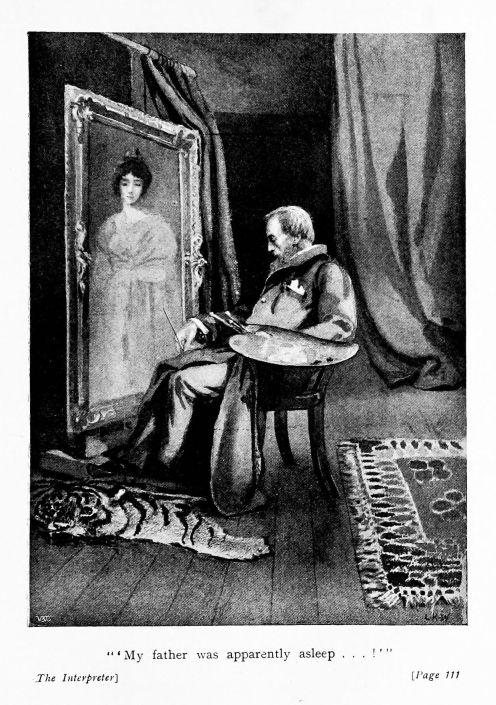
"'My father was apparently asleep...!'" Page 111
I left the painting-room, and went into the garden to compose my mind, and recover, if possible, from the stunning effects of my father's intelligence. I walked up and down, like a man in a dream. I could not yet realise the full extent of my misery. The hours passed by, and still I paced the gravel walk under the yew-trees, and took no heed of time or anything else. At length a servant came to warn me that dinner was waiting, and I went back to the painting-room to call my father. The door was not locked, as it had hitherto been, and my father was apparently asleep, with his head resting on one arm, and the brush, fallen from his other hand, on the floor. As I touched his shoulder to wake him, I remarked that hand was clenched and stiff. Wake him! he would never wake again. How I lived through that fearful evening I know not. There was a strange confusion in the house,--running up and down stairs, hushed voices, ghostly whisperings. The doctors came. I know not what passed. They called it aneurism of the heart; I recollect that much; but everything was dim and indistinct till, a week afterwards, when the funeral was over, I seemed to awake from a dream, and to find myself alone in the world.
CHAPTER XV
BEVERLEY MERE
What contrasts there are in life! Light and shade, Lazarus and Dives, the joyous spirit and the broken heart, always in juxtaposition. Here are two pictures not three miles apart.
A pale, wan young man, dressed in black, with the traces of deep grief on his countenance, and his whole bearing that of one who is thoroughly overcome and prostrated by sorrow, sits brooding over an untasted breakfast; the room he occupies is not calculated to shed a cheering influence on his reflections: it is a long, low, black-wainscoted apartment, well stored with books, and furnished in a curious and somewhat picturesque style with massive chairs and quaintly carved cabinets. Ancient armour hangs from the walls, looming ghostly and gigantic in the subdued light, for although it is a bright October morning out-of-doors, its narrow windows and thick walls make Alton Grange dull and sombre and gloomy within. A few sketches, evidently by the hand of a master, are hung in favourable lights. More than one are spirited representations of a magnificent black-and-white retriever--the same that is now lying on the floor, his head buried between his huge, strong paws, watching his master's figure with unwinking eyes. That master takes no notice of his favourite. Occasionally he fixes his heavy glance on a picture hanging over the chimney-piece, and then withdraws it with a low stifled moan of anguish, at which the dog raises his head wistfully, seeming to recognise a too familiar sound. The picture is of a beautiful foreign-looking woman; its eyes and eyebrows are reproduced in that sorrow-stricken young man. They are mother and son; and they have never met. Could she but have seen me then! If ever a spirit might revisit earth to console the weary pilgrim here, surely it would be a mother's, bringing comfort to a suffering child. How I longed for her love and her sympathy. How I felt I had been robbed--yes, robbed--of my rights in her sad and premature death. Reader, have you never seen a little child, after a fall, or a blow, or some infantine wrong or grievance, run and hide its weeping face in its mother's lap? Such is the first true impulse of our childish nature, and it is never completely eradicated from the human breast. The strong, proud man, though he may almost forget her in his triumphs and successes, goes to his mother for consolation when he is overtaken by sorrow, deceived in his affections, wounded in his feelings, or sad and sick at heart. There he knows he is secure of sympathy and consolation; there he knows he will not be judged harshly, and as the world judges; there he knows that, do what he will, is a fountain of love and patience, never to run dry; and for one blessed moment he is indeed a child again. God help those who, like me, have never known a mother's love. Such are the true orphans, and such He will not forget.
Bold loses patience at last, and pokes his cold, wet nose into my hand. Yes, Bold, it is no use to sit brooding here. "Hie, boy! fetch me my hat." The dog is delighted with his task: away he scampers across the hall--he knows well which hat to choose--and springing at the crape-covered one, brings it to me in his mouth, his fine honest countenance beaming with pride, and his tail waving with delight. We emerge through a glass door into the garden, and insensibly, for the first time since my father's death, we take the direction of Beverley Manor.
This is a dark and sadly-shaded picture; let us turn to one of brighter lights and more variegated colouring. The sun is streaming into a beautiful little breakfast-room opening on a conservatory, with flowers, and a fountain of gold-fish, and all that a conservatory should have. The room itself is richly papered and ornamented, perhaps a little too profusely, with ivory and gilding. Two or three exquisite landscapes in water-colours adorn the walls; and rose-coloured hangings shed a soft, warm light over the furniture and the inmates. The former is of a light and tasteful description--low, soft-cushioned fauteuils, thin cane chairs, bright-coloured ottomans and footstools, Bohemian glass vases filled with flowers--everything gay, vivid, and luxurious; a good fire burning cheerfully on the hearth, and a breakfast-table, with its snowy cloth and bright silver belongings, give an air of homely comfort to the scene. The latter consists of four persons, who have met together at the morning meal every day now for several weeks. Constance Beverley sits at the head of the table making tea; Ropsley and Sir Harry, dressed in wondrous shooting apparel, are busily engaged with their breakfast; and Miss Minim is relating to the world in general her sufferings from rheumatism and neuralgia, to which touching narrative nobody seems to think it necessary to pay much attention. Ropsley breaks in abruptly by asking Miss Beverley for another cup of tea. He treats her with studied politeness, but never takes his cold grey eye off her countenance. The girl feels that he is watching her, and it makes her shy and uncomfortable.
"Any news, Ropsley?" says Sir Harry, observing the pile of letters at his friend's elbow; "no officials, I hope, to send you back to London."
"None as yet, thank Heaven, Sir Harry," replies his friend; "and not much in the papers. We shall have war, I think."
"Oh, don't say so, Mr. Ropsley," observes Constance, with an anxious look. "I trust we shall never see anything so horrid again."
Miss Minim remarks that "occasional wars are beneficial, nay, necessary for the welfare of the human race," illustrating her position by the familiar metaphor of thunderstorms, etc.; but Ropsley, who has quite the upper hand of Miss Minim, breaks in upon her ruthlessly, as he observes, "The funds gone down a fraction, Sir Harry, I see. I think one ought to sell. By-the-bye, I've a capital letter from De Rohan, at Paris. You would like to hear what he is about, Miss Beverley, I am sure."
Constance winced and coloured. It was Ropsley's game to assert a sort of matter-of-course tendresse on her part for my Hungarian friend, which he insisted on so gradually, but yet so successfully, as to give him the power of making her uneasy at the mention of "De Rohan's" name. He wished to establish an influence over her, and this was the only manner in which he could do so; but Ropsley was a man who only asked to insert the point of the wedge, he could trust himself to do the rest. Yet, with all his knowledge of human nature, he made this one great mistake, he judged of women by the other half of mankind; so he looked pointedly at Constance as he added, "I'll read you what he says, or, perhaps, Miss Beverley, you would like to see his letter?"
He had now driven her a little too far, and she turned round upon him.
"Really, Mr. Ropsley, I don't wish to interfere with your correspondence. I hate to read other people's letters; and Count de Rohan has become such a stranger now that I have almost forgotten him."
She was angry with herself immediately she had spoken. It seemed so like the remark of a person who was piqued. Ropsley would be more than ever convinced now that she cared for him. Sir Harry, too, looked up from his plate, apparently at his daughter's unusual vehemence. The girl bit her lips, and wished she had held her tongue. Ropsley saw he had marked up another point in the game.
"Very true," said he, with his quiet, well-bred smile: "old playfellows and old school-days cannot be expected to last all one's life. However, Victor does not forget us. He seems to be very gay, though, and rather dissipated, at Paris; knows all the world and goes everywhere; ran a horse last week at Chantilly. You know Chantilly, Sir Harry."
The Baronet's face brightened. He had won a cup, given by Louis Philippe, from all the foreigners there on one occasion, and he liked to be reminded of it.
"Know it," said he, "I should think I do. Why, I trained Flibbertigibbet in the park here myself--I and the old coachman. We never sent him to my own trainer at Newmarket, but took him over ourselves, and beat them all. That was the cup you saw in the centre of the dinner-table yesterday. The two-year-old we tried at Lansdowne was his grandson. Ah! Ropsley, I wish I had taken your advice about him."
Ropsley was, step by step, obtaining great influence over Sir Harry. He returned to the subject of old friendships.
"By-the-bye, Miss Beverley, have you heard anything of poor Egerton? I fear his father's death will be a sad blow to him. I tremble for the consequences."
And here he touched his forehead, with a significant look at Sir Harry.
Constance was a true woman. She was always ready too vigorously to defend an absent friend, but she was no match for her antagonist; she could not keep cool.
"What do you mean?" said she, angrily. "Why should you tremble, as you call it, for Vere?"
Ropsley put on his most provoking air, as he answered, with a sort of playful mock deference--
"I beg your pardon, Miss Beverley, I am continually affronting you, this unlucky morning. First, I bore you about De Rohan, thinking you do care for your old friends; then I make you angry with me about Egerton, believing you don't. After all, I said no harm about him; nothing more than we all know perfectly well. He always was eccentric as a boy--he is more so than ever, I think, now; and I only meant that I feared any sudden shock or violent affliction might upset his nervous system, and, in short--may I ask you for a little more cream?--end in total derangement. The fact is," he added, sotto voce, to Sir Harry, "he is as mad as Bedlam now."
He saw the girl's lip quiver, and her hand shake as she gave him his cup; but he kept his cold grey eye fastened on her. He seemed to read her most secret thoughts, and she feared him now--actually feared him. Well, it was always something gained. He proceeded good-humouredly--
"Do we shoot on the island to-day, Sir Harry?" he asked of his host. "Perhaps Miss Beverley will come over to our luncheon in her boat. How pretty you have made that island, Sir Harry; and what a place for ducks about sundown!"
The island was a pet toy of Sir Harry's; he was pleased, as usual, with his friend's good taste.
"Yes, come over to luncheon, Constance," said he. "You can manage the boat quite well that short way."
"No, thank you, papa," answered Constance, with a glance at Ropsley; "the boat is out of repair, and I had rather not run the risk of an upset."
"You used to be so fond of boating, Miss Beverley," observed Ropsley, with his scarcely perceptible sneer. "You and Egerton used to be always on the water. Perhaps you don't like it without a companion; pray don't think of coming on our account. I quite agree with you, it makes all the difference in a water-party."
Constance began to talk very fast to her father.
"I'll come, papa, after all, I think," said she; "it is such a beautiful day! and the boat will do very well, I dare say--and I'm so fond of the water, papa; and--and I'll go and put my bonnet on now. I've got two or three things to do in the garden before I start."
So she hurried from the room, but not till Ropsley had presented her with a sprig of geranium he had gathered in the conservatory, and thanked her in a sort of mock-heroic speech for her kindness in so readily acceding to his wishes.
Would he have been pleased or not, could he have seen her in the privacy of her own apartment, which she had no sooner reached than she dashed his gift upon the floor, stamping on it with her little foot as though she would crush it into atoms, while her bosom heaved, and her dark eyes filled with tears, shed she scarce knew why? She had a vague consciousness of humiliation, and an undefined feeling of alarm that she could not have accounted for even to herself, but which was very uncomfortable notwithstanding.
The gentlemen put on their belts and shooting apparatus; and Ropsley, with the sneer deepening on his well-cut features, whispered to himself, "Pour le coup, papillon, je te tiens."
Bold and I strolled leisurely along: the dog indulging in his usual vagaries on the way; his master brooding and thoughtful, reflecting on the many happy times he had trod the same pathway when he was yet in ignorance of the fatal secret, and how it was all over now. My life was henceforth to be a blank. I began to speculate, as I had never speculated before, on the objects and aims of existence. What had I done, I thought, that I should be doomed to be so miserable?--that I should have neither home nor relatives nor friends?--that, like the poor man whose rich neighbour had flocks and herds and vineyards, I should have but my one pet lamb, and even that should be taken away from me? Then I thought of my father's career--how I had been used to look up to him as the impersonation of all that was admirable and enviable in man. With his personal beauty and his princely air and his popularity and talent, I used to think my father must be perfectly happy. And now to find that he too had been living with a worm at his heart! But then he had done wrong, and he suffered rightly, as he himself confessed, for the sins of his youth. And I tried to think myself unjustly treated; for of what crimes had I been guilty, that I should suffer too? My short life had been blameless, orderly, and dutiful. Little evil had I done; but even then my conscience whispered--Much good had I left undone. I had lived for myself and my own affections; I had not trained my mind for a career of usefulness to my fellow-men. It is not enough that a human being should abstain from gross, palpable evil; he must follow actual good. It is better to go down into the market, and run your chance of the dirt that shall soil it, and the hands it shall pass through, in making your one talent ten talents, than to hide it up in a napkin, and stand aloof from your fellow-creatures, even though it should give you cause, like the Pharisee, to "thank God that you are not as other men are."
"Steady, Bold! Heel, good dog, heel! You hear them shooting, I know, and you would like well to join the sport. Bang! bang! there they go again. It is Sir Harry and his guest at their favourite amusement. We will stay here, old dog, and perhaps we may see her once more, if only at a distance, and we shall not have had our walk for nothing." So Bold and I crouched quietly down amongst the tall fern, on a knoll in the park from whence we could see the Manor House and the mere, and Constance's favourite walk in the shrubbery which I had paced with her so often and so happily in days that seemed now to have belonged to another life.
They were having capital sport in the island; it was a favourite preserve of Sir Harry; and although artificially stocked with pheasants--as indeed what coverts are not, for that most artificial of all field-sports which we call a battue?--it had this advantage, that the game could not possibly stray from its own feeding-place and home. Moreover, as the fine-plumaged old cocks went whirring up out of the copse, there was a great art in knocking them over before they were fairly on the wing, so that the dead birds might not fall into the water, but be picked up on terra firma, dry, and in good order to be put into the bag. Many a time had I stood in the middle ride, and brought them down right and left, to the admiration of my old acquaintance, Mr. Barrells, and the applause of Sir Harry. Many a happy day had I spent there, in the enjoyment of scenery, air, exercise, and sport (not that I cared much for the latter); but, above all, with the prospect of Constance Beverley bringing us our luncheon, or, at the worst, the certainty of seeing her on our return to the Manor House. How my heart ached to think it was all gone and past now!
I watched the smoke from the sportsmen's guns as it curled up into the peaceful autumn sky. I heard the cheery voices of the beaters, and the tap of their sticks in the copse; but I could not see a soul, and was myself completely unseen. I felt I was looking on what had so long been my paradise for the last time, and I lost the consciousness of my own identity in the dreamy abstraction with which I regarded all around. It seemed to me as if another had gone through the experiences of my past life, or rather as if I was no longer Vere Egerton, but one who had known him and pitied him, and would take some little interest in him for the future, but would probably see very little of him again. I know not whether other men experience such strange fancies, or whether it is but the natural effect of continued sorrow, which stuns the mental sense, even as continued pain numbs that of the body; but I have often felt myself retracing my own past or speculating on my own future, almost with the indifference of an uninterested spectator. Something soon recalled me to myself. Bold had the eye of a hawk, but I saw her before Bold did; long ere my dog erected his silken ears and stopped his panting breath, my beating heart and throbbing pulses made me feel too keenly that I was Vere Egerton again.
She seemed to walk more slowly than she used; the step was not so light; the head no longer carried so erect, so naughtily; she had lost the deer-like motion I admired so fondly; but oh! how much better I loved to see her like this. I watched as a man watches all he loves for the last time. I strove, so to speak, to print her image on my brain, there to be carried a life-long photograph. She walked slowly down towards the mere, her head drooping, her hands clasped before her, apparently deep, deep in her own thoughts. I would have given all I had in the world could I but have known what those thoughts were. She stopped at the very place where once before she had caressed Bold; she gathered a morsel of fern and placed it in her bosom; then she walked on faster, like one who wakes from a train of profound and not altogether happy reflections.
Meanwhile I had the greatest difficulty in restraining my dog. Good, faithful Bold was all anxiety to scour off at first sight of her, and greet his old friend. He whined piteously when I forbade him. I thought she must have heard him; but no, she walked quietly on towards the water, loosed her little skiff from its moorings, got into it, and pushed off on the smooth surface of the mere.
She spread the tiny sail, and the boat rippled its way slowly through the water. The little skiff was a favourite toy of Constance, and I had taught her to manage it very dexterously. At the most it would hold but two people; and many an hour of ecstasy had I passed on the mere in "The Queen Mab," as we sportively named it, drinking in every look and tone of my idolised companion: poison was in the draught, I knew it well, and yet I drank it to the dregs. Now I watched till my eyes watered, for I should never steer "The Queen Mab" again.
A shout from the shore of the island diverted my attention. Sir Harry had evidently espied her, and was welcoming his daughter. I made out his figure, and that of Barrells, at the water's edge; whilst the report of a gun, and a thin column of white smoke curling upwards from the copse, betokened the presence of Ropsley among the beaters in the covert. When I glanced again at "The Queen Mab," it struck me she had made but little way, though her gossamer-looking sail was filled by the light breeze. She could not now be more than a hundred and fifty yards from her moorings, whilst I was myself perhaps twice that distance from the brink of the mere. Constance rises from her seat, and waves her hand above her head. Is that her voice? Bold hears it too, and starts up to listen. The white sail leans over. God in heaven! it is down! Vivid like lightning the ghastly truth flashes through my brain; the boat is waterlogged--she is sinking--my heart's darling will be drowned in my very sight; it is ecstasy to think I can die with her, if I cannot save her!
"Bold! Bold! Hie, boy; go fetch her; hie, boy; hie!"
The dog is already at the water-side; with his glorious, God-given instinct he has understood it all. I hear the splash as he dashes in; I see the circles thrown behind him as he swims; whilst I am straining every nerve to reach the water's edge. What a long three hundred yards it is! A lifetime passes before me as I speed along. I have even leisure to think of poor Ophelia and her glorious Dane. As I run I fling away coat, waistcoat, watch, and handkerchief. I see a white dress by the side of the white sail. My gallant dog is nearing it even now. The next instant I am overhead in the mere; and as I rise to the surface, shaking the water from my lips and hair, I feel, through all my fear and all my suspense, something akin to triumph in the long, vigorous strokes that are shooting me onwards to my goal. Mute and earnest I thank God for my personal strength, never appreciated till this day; for my hardy education, and my father's swimming lessons in the sluggish, far-away Theiss; for my gallant, faithful dog, who has reached her even now.
"Hold on, Bold! her dress is floating her still. Hold on, good dog. Another ten seconds, and she is saved!"
* * * * *
Once I thought we were gone. My strength was exhausted. I had reached the bank with my rescued love. Her pale face was close to mine; her long, wet hair across my mouth; she was conscious still, she never lost her senses or her courage. Once she whispered, "Bless you, my brave Vere." But the bank was steep, and the water out of our depth to the very edge. A root I caught at gave way. My overtaxed muscles refused to second me. It was hard to fail at the last. I could have saved myself had I abandoned my hold. It was delicious to know this, and then to wind my arm tighter round her waist, and to think we should sleep together for ever down there; but honest Bold grasped her once more in those vigorous jaws--she bore the marks of his teeth on her white neck for many a day. The relief thus afforded enabled me to make one desperate effort, and we were saved.
She fainted away when she was fairly on the bank; and I was so exhausted I could but lie gasping at her side. Bold gave himself a vigorous shake and licked her face. Assistance, however, was near at hand; the accident had been witnessed from the island; Sir Harry and the keeper had shoved off immediately in their boat, and pulled vigorously for the spot. It was a heavy, lumbering craft, and they must have been too late. Oh, selfish heart! I felt that had I not succeeded in saving her, I had rather we had both remained under those peaceful waters; but selfish though it may have been, was it not ecstasy to think that I had rescued her--Constance Beverley, my own Constance--from death? I, the ungainly, unattractive man, for whom I used to think no woman could ever care; and she had called me "her brave Vere!" HERS! She could not unsay that; come what would, nothing could rob me of that. "Fortune, do thy worst," I thought, in my thrill of delight, as I recalled those words, "I am happy for evermore." Blind! blind! Quem Deus vult perdere prius dementat.
CHAPTER XVI
PRINCESS VOCQSAL
It was an accommodating ménage, that of Prince and Princess Vocqsal, and was carried on upon the same system, whether they were "immured," as Madame la Princesse called it, in the old chateau near Sieberiburgen, or disporting themselves, as now, in the sunshine and gaiety of her dear Paris, as the same volatile lady was pleased to term that very lively resort of the gay, the idle, and the good-for-nothing. It was the sort of ménage people do not understand in England quite so thoroughly as abroad; the system was simple enough--"live and let live" being in effect the motto of an ill-matched pair, who had better never have come together, but who, having done so, resolved to make the best of that which each found to be a bad bargain, and to see less of each other than they could possibly have done had they remained as formerly, simply an old cousin and a young one, instead of as now, husband and wife.
Prince Vocqsal was the best of fellows, and the most sporting of Hungarians. Time was, "before the Revolution, mon cher"--a good while before it, he might have added--that the Prince was the handsomest man of his day, and not indisposed to use his personal advantages for the captivation of the opposite sex. His conquests, as he called them, in France, Spain, Italy, not to mention the Fatherland, were, by his own account, second only to those of Don Juan in the charming opera which bears the name of that libertine; but his greatest triumph was to detail, in strict confidence, of course, how he had met with un grand succes amongst ces belles blondes Anglaises, whose characters he was good enough to take away with a sweeping liberality calculated to alter a Briton's preconceived notions as to the propriety of those prudish dames whom he had hitherto been proud to call his countrywomen. I cannot say I consider myself bound to believe all an old gentleman, or a young one either, has to say on that score. Men are given to lying, and woman is an enigma better let alone. The Prince, however, clung stoutly to his fascinations, long after time, good living, and field-sports had changed him from a slim, romantic swain to a jolly, roundabout old gentleman. He dyed his moustaches and whiskers, wore a belt patented to check corpulency, and made up for the ravages of decay by the artifices of the toilet. He could ride extremely well (for a foreigner), not in the break-neck style which hunting men in England call "going," and which none except an Englishman ever succeeds in attaining; but gracefully, and like a gentleman. He could shoot with the rifle or the smooth-bore with an accuracy not to be surpassed, and was an "ace-of-diamonds man" with the pistol. Notwithstanding the many times his amours had brought him "on the ground," it was his chief boast that he had never killed his man. "I am sure of my coup, my dear," he would say, with an amiable smile, and holding you affectionately by the arm, "and I always take my antagonist just below the knee-pan. I sight a little over the ankle, and the rise of the ball at twelve paces hits the exact spot. There is no occasion to repeat my fire, and he lives to be my friend."
Added to this he was a thorough bon vivant, and an excellent linguist. On all matters connected with field-sports he held forth in English, swearing hideously, under the impression that on these topics the use of frightful oaths was national and appropriate. He was past middle age, healthy, good-humoured, full of fun, and he did not care a straw for Princess Vocqsal.
Why did he marry her? The reason was simple enough. Hunting, shooting, horse-racing, gaiety, hospitality, love, life, and libertinism, will make a hole in the finest fortune that ever was inherited, even in Hungary; and Prince Vocqsal found himself at middle age, or what he called the prime of life, with all the tastes of his youth as strong as ever, but none of its ready money left. He looked in the glass, and felt that even he must at length succumb to fate.
"My cousin Rose is rich; she is moreover young and beautiful; une femme très distinguée et tant soit peu coquette. I must sacrifice myself, and Comtesse Rose shall become Princess Vocqsal." Such was the fruit of the Prince's reflections, and it is but justice to add he made a most accommodating and good-humoured husband.
Comtesse Rose had no objection to being Princess Vocqsal. A thousand flirtations and at least half-a-dozen grandes passions, had a little tarnished the freshness of her youthful beauty; but what she had lost in bloom she had gained in experience. Nobody had such a figure, so round, so shapely, of such exquisite proportions; nobody knew so well how to dress that figure to the greatest advantage. Her gloves were a study; and as for her feet and ankles, their perfection was only equalled by the generosity with which they were displayed. Then what accomplishments, what talents! She could sing, she could ride, she could waltz; she could play billiards, smoke cigarettes, drive four horses, shoot with a pistol, and talk sentiment from the depths of a low fauteuil like a very Sappho. Her lovers had compared her at different times to nearly all the heroines of antiquity, except Diana. She had been painted in every costume, flattered in every language, and slandered in every boudoir throughout Europe for a good many years; and still she was bright, and fresh, and sparkling, as if Old Time too could not resist her fascinations, but, like any other elderly gentleman, gave her her own way, and waited patiently for his turn. Thrice happy Princess Vocqsal!--can it be possible that you, too, are bored?
She sits in her own magnificent salon, where once every week she "receives" all the most distinguished people in Paris. How blooming she looks with her back to the light, and her little feet crossed upon that low footstool. Last night she had "a reception," and it was gayer and more crowded than usual. Why did she feel a little dull to-day? Pooh! it was only a migraine, or the last French novel was so insufferably stupid; or--no, it was the want of excitement. She could not live without that stimulus--excitement she must and would have. She had tried politics, but the strong immovable will at the head of the Government had given her a hint that she must put a stop to that; and she knew his inflexible character too well to venture on trifling with him. She was tired of all her lovers, too; she began to think, if her husband were only thirty years younger, and less good-humoured, he would be worth a dozen of these modern adorers. That Count de Rohan, to be sure, was a good-looking boy, and seemed utterly fancy free. By-the-bye, he was not at the "reception" last night, though she asked him herself the previous evening at "the Tuileries." That was very rude; positively she must teach him better manners. A countryman, too; it was a duty to be civil to him. And a fresh character to study, it would be good sport to subjugate him. Probably he would call to-day to apologise for being so remiss. And she rose and looked in the glass at those eyes whose power needed not to be enhanced by the dexterous touch of rouge; at that long, glossy hair, and shapely neck and bosom, as a sportsman examines the locks and barrels of the weapon on which he depends for his success in the chase. The review was satisfactory, and Princess Vocqsal did not look at all bored now. She had hardly settled herself once more in a becoming attitude, ere Monsieur le Comte de Rohan was announced, and marched in, hat in hand, with all the grace of his natural demeanour, and the frank, happy air that so seldom survives boyhood. Victor was handsomer than ever, brimful of life and spirits, utterly devoid of all conceit or affectation; and moreover, since his father's death, one of the first noblemen of Hungary. It was a conquest worth making.
"I thought you would not go back without wishing me good-bye," said the Princess, with her sweetest smile, and a blush through her rouge that she could summon at command--indeed, this weapon had done more execution than all the rest of her artillery put together. "I missed you last night at my reception; why did you not come?"
Victor blushed too. How could he explain that a little supper-party at which some very fascinating ladies who were not of the Princess's acquaintance had assisted, prevented him. He stammered out some excuse about leaving Paris immediately, and having to make preparations for departure.
"And you are really going," said she, in a melancholy, pleading tone of voice,--"going back to my dear Hungary. How I wish I could accompany you."
"Nothing could be easier," answered Victor, laughing gaily; "if madame would but condescend to accept my escort, I would wait her convenience. Say, Princess, when shall it be?"
"Ah, now you are joking," she said, looking at him from under her long eyelashes; "you know I cannot leave Paris, and you know that we poor women cannot do what we like. It is all very well for you men; you get your passports, and you are off to the end of the world, whilst we can but sit over our work and think."
Here a deep sigh smote on Victor's ear. It began to strike him that he had made an impression; the feeling is very pleasant at first, and the young Hungarian was keenly alive to it. He spoke in a much softer tone now, and drew his chair a little nearer that of the Princess.
"I need not go quite yet," he said, in an embarrassed tone, which contrasted strongly with his frank manner a few minutes earlier: "Paris is very pleasant, and--and--there are so many people here one likes."
"And that like you," she interrupted, with an arch smile, that made her look more charming than ever. "One is so seldom happy," she added, relapsing once more into her melancholy air; "one meets so seldom with kindred spirits--people that understand one; it is like a dream to be allowed to associate with those who are really pleasing to us. A happy, happy dream; but then the waking is so bitter, perhaps it is wiser not to dream at all. No! Monsieur de Rohan, you had better go back to Hungary, as you proposed."
"Not if you tell me to stay," exclaimed Victor, his eyes brightening, and his colour rising rapidly; "not if I can be of the slightest use or interest to you. Only tell me what you wish me to do, madame; your word shall be my law. Go or stay, I wait but for your commands."
He was getting on faster than she had calculated; it was time to damp him a little now. She withdrew her chair a foot or so, and answered coldly--
"Who--I, Monsieur le Comte? I cannot possibly give you any command, except to ring that bell. The Prince would like to see you before you go. Let the Prince know Monsieur de Rohan is here," she added, to the servant who answered her summons. "You were always a great favourite of his--of ours, I may say;" and she bade him adieu, and gave him her soft white hand with all her former sweetness of manner; and told her servant, loud enough for her victim to hear, "to order the carriage, for she meant to drive in the Bois de Boulogne:" and finally shot a Parthian glance at him over her shoulder as she left the room by one door, whilst he proceeded by another towards the Prince's apartments.
No wonder Victor de Rohan quitted the house not so wise a man as he had entered it; no wonder he was seen that same afternoon caracolling his bay horse in the Bois de Boulogne; no wonder he went to dress moody and out of humour, because, ride where he would, he had failed to catch a single glimpse of the known carriage and liveries of Princess Vocqsal.
They met, however, the following evening at a concert at the Tuileries. The day after--oh, what good luck!--he sat next her at dinner at the English ambassador's, and put her into her carriage at night when she went home. Poor Victor! he dreamed of her white dress and floating hair, and the pressure of her gloved hand. Breakfast next morning was not half so important a meal as it used to be, and he thought the fencing-school would be a bore. She was rapidly getting the upper hand of young Count de Rohan.
Six weeks afterwards he was still in Paris. The gardens of the Tuileries were literally sparkling in the morning sun of a bright Parisian day. The Zouaves on guard at the gate lounged over their firelocks with their usual reckless brigand air, and leered under every bonnet that passed them, as though the latter accomplishment were part and parcel of a Zouave's duty. The Rue de Rivoli was alive with carriages; the sky, the houses, the gilt-topped railings--everything looked in full dress, as it does nowhere but in Paris; the very flowers in the gardens were two shades brighter than in any other part of France. All the children looked clean, all the women well dressed; even the very trees had on their most becoming costume, and the long close alleys smelt fresh and delicious as the gardens of Paradise. Why should Victor de Rohan alone look gloomy and morose when all else is so bright and fair? Why does he puff so savagely at his cigar, and glance so restlessly under the stems of those thick-growing chestnuts? Why does he mutter between his teeth, "False, unfeeling! the third time she has played me this trick? No, it is not she. Oh! I should know her a mile off. She will not come. She has no heart, no pity. She will not come. Sappramento! there she is!"
In the most becoming of morning toilettes, with the most killing little bonnet at the back of her glossy head, the best-fitting of gloves, and the tiniest of chaussures, without a lock out of its place or a fold rumpled, cool, composed, and beautiful, leaving her maid to amuse herself with a penny chair and a feuilleton, Princess Vocqsal walks up to the agitated Hungarian, and placing her hand in his, says, in her most bewitching accents, "Forgive me, my friend; I have risked so much to come here; I could not get away a moment sooner. I have passed the last hour in such agony of suspense!" The time to which the lady alludes has been spent, and well spent, in preparing the brilliant and effective appearance which she is now making.
"But you have come at last," exclaims Victor, breathlessly. "I may now speak to you for the first time alone. Oh, what happiness to see you again! All this week I have been so wretched without you; and why were you never at home when I called?"
"Les convenances, my dear Count," answers the lady. "Everything I do is watched and known. Only last night I was taxed by Madame d'Alençon about you, and I could not help showing my confusion; and you--you are so foolish. What must people think?"
"Let them think what they will," breaks in Victor, his honest truthful face pale with excitement. "I am yours, and yours alone. Ever since I have known you, Princess, I have felt that you might do with me what you will. Now I am your slave. I offer you----"
What Victor was about to offer never came to light, for at that instant the well-tutored "Jeannette" rose from her chair, and hurriedly approaching her mistress, whispered to her a few agitated words. The Princess dropped her veil, squeezed Victor's hand, and in another instant disappeared amongst the trees, leaving the young Hungarian very much in love, very much bewildered, and not a little disgusted.
One or two more such scenes, one or two more weeks of alternate delight, suspense, and disappointment, made poor Victor half beside himself. He had got into the hands of an accomplished flirt, and for nine men out of ten there would have been no more chance of escape than there is for the moth who has once fluttered within the magic ring of a ground-glass lamp. He may buzz and flap and fume as he will, but the more he flutters the more he singes his wings, the greater his struggles the less his likelihood of liberty. But Victor was at that age when a man most appreciates his own value: a few years earlier we want confidence, a few years later we lack energy, but in the hey-day of youth we do not easily surrender at discretion; besides, we have so many to console us, and we are so easily consoled. De Rohan began to feel hurt, then angry, lastly resolute. One night at the opera decided him. His box had a mirror in it so disposed as to reflect the interior of the adjoining one; a most unfair and reprehensible practice, by-the-bye, and one calculated to lead to an immensity of discord. What he saw he never proclaimed, but as Princess Vocqsal occupied the box adjoining his own, it is fair to suppose that he watched the movements of his mistress.
She bit her lip, and drew her features together as if she had been stung, when on the following afternoon, in the Bois de Boulogne, Vicomte Lascar informed her, with his insipid smile, that he had that morning met De Rohan at the railway station, evidently en route for Hungary, adding, for the Princess was an excellent linguist, and Lascar prided himself much on his English, "'Ome, sweet 'ome, no place like 'ome."
CHAPTER XVII
THE COMMON LOT
"And so, you see, my dear Egerton, it is out of the question. I own to a great liking for your character. I think you behaved yesterday like a trump. I am too old for romance, and all that, but I can understand your feeling, my boy, and I am sorry for you. The objection I have named would alone be sufficient. Let it never be mentioned again. Your father was my oldest friend, and I hope you will not think it necessary to break with us; but marriage is a serious affair, and indeed is not to be thought of."
"No hope, Sir Harry?" I gasped out; "years hence, if I could win fame, distinction, throw a cloak of honour over this accursed brand, give her a name to be proud of, is there no hope?"
"None," replied Sir Harry; "these things are better settled at once. It is far wiser not to delude yourself into the notion that, because you are a disappointed man now, you are destined to become a great one hereafter. Greatness grows, Vere, just like a cabbage or a cauliflower, and must be tended and cultivated with years of labour and perseverance; you cannot pluck it down with one spring, like an apple from a bough. No, no, my lad; you will get over this disappointment, and be all the better for it. I am sorry to refuse you, but I must, Vere, distinctly, and for the last time. Besides, I tell you in confidence, I have other views for Constance, so you see it is totally out of the question. You may see her this afternoon, if you like. She is a good child, and will do nothing in disobedience to her father. Farewell, Vere, I am sorry for you, but the thing's done."
So I walked out of the Baronet's room in the unenviable character of a disappointed suitor, and he went back to his farm book and his trainer's accounts, as coolly as if he had just been dismissing a domestic; whilst I--my misery was greater than I could bear--his last words seemed to scorch me. "I should get over it--I should be the better for it." And I felt all the time that my heart was breaking; and then, "he had other views for Constance;" not only must she never be mine, but I must suffer the additional pang of feeling that she belongs to another. "Would to God," I thought, "that we had sunk together yesterday, never to rise again!"
I went to look for her in the shrubbery: I knew where I should find her; there was an old summer-house that we two had sat in many a time before, and I felt sure Constance would be there. She rose as I approached it: she must have seen by my face that it was all over. She put her hand in mine, and, totally unmanned, I bent my head over it, and burst into a flood of tears, like a child. I remember to this day the very pattern of the gown she wore; even now I seem to hear the soft, gentle accents in which she reasoned and pleaded with me, and strove to mitigate my despair.
"I have long thought it must come to this, Vere," she said, with her dark, melancholy eyes looking into my very soul; "I have long thought we have both been much to blame, you to speak, and I to listen, as we have done: now we have our punishment. Vere, I will not conceal from you I suffer much. More for your sake than my own. I cannot bear to see you so miserable. You to whom I owe so much, so many happy hours, and yesterday my very life. Oh, Vere, try to bear it like a man."
"I cannot, I cannot," I sobbed out; "no hope, nothing to look forward to, but a cheerless, weary life, and then to be forgotten. Oh that I had died with you, Constance, my beloved one, my own!"
She laid her hand gently on my arm--
"Forgotten, Vere," she said; "that is not a kind or a generous speech. I shall never forget you. Always, always I shall think of you, pray for you. Papa knows best what is right. I will never disobey him: he has not forbidden us to see each other; we may be very happy still. Vere, you must be my brother."
"No more," I exclaimed, reproachfully, "no more?"
"No more, Vere," she answered, quite gently, but in a tone that admitted of no further appeal. "Brother and sister, Vere, for the rest of our lives; promise me this," and she put her soft hand in mine, and smiled upon me; pure and sorrowful, like an angel.
I was stung to madness by her seeming coldness, so different from my own wild, passionate misery.
"Be it so," I said; "and as brother and sister must part, so must you and I. Anything now for freedom and repose; anything to drive your image from my mind. I tell you that from henceforth I am a desperate man. Nobody cares for me on earth,--no father, no mother, none for whom to live; and the one I prized most discards me now. Constance, you never can have loved me as I have loved. Cold, heartless, false! I will never see you again."
She was quite bewildered by my vehemence. She looked round wildly at me, and her pale lip quivered, and her eyes filled with tears: even then I remained bitter and unmoved.
"Farewell," I said, "farewell, Constance, and for ever."
Her hand hung passively in mine, her "good-bye" seemed frozen on her lips; but she turned away with more than her usual majesty, and walked towards the house. I remarked that she dropped a white rose--fit emblem of her own dear self--on the gravel path, as she paced slowly along, without once turning her head. I was too proud to follow her and pick it up, but sprang away in an opposite direction, and was soon out of her sight.
That night, when the wild clouds were flying across the moon, and the wind howled through the gloomy yews and the ghostly fir-trees, and all was sad and dreary and desolate, I picked up the white rose from that gravel path, and placed it next my heart. Faded, shrunk, and withered, I have got it still. My home was now no place for me. I arranged my few affairs with small difficulty, pensioned the two old servants my poor father had committed to my charge; set my house in order, packed up my things, and in less than a week I was many hundred miles from Alton Grange and Constance Beverley.
CHAPTER XVIII
OMAR PASHA
It is high noon, and not a sound, save the occasional snort of an impatient steed, is to be heard throughout the lines. Picketed in rows, the gallant little chargers of the Turkish cavalry are dozing away the hours between morning and evening feed. The troopers themselves are smoking and sleeping in their tents; here and there may be seen a devout Mussulman prostrate on his prayer-carpet, his face turned towards Mecca, and his thoughts wholly abstracted from all worldly considerations. Ill-fed and worse paid, they are nevertheless a brawny, powerful race, their broad rounded shoulders, bull necks, and bowed legs denoting strength rather than activity; whilst their high features and marked swarthy countenances betray at once their origin, sprung from generations of warriors who once threatened to overwhelm the whole Western world in a tide that has now been long since at the ebb. Patient are they of hardship, and devoted to the Sultan and their duty, made for soldiers and nothing else, with their fierce, dogged resolution, and their childish obedience and simplicity. Hand-in-hand, two of them are strolling leisurely through the lines to release a restive little horse who has got inexplicably entangled in his own and his neighbour's picket-ropes, and is fighting his way out of his difficulty with teeth and hoofs. They do not hurry themselves, but converse peacefully as they pass along.
"Is is true, Mustapha, that Giaours are still coming to join our Bey? The Padisha[#] is indeed gracious to these sons of perdition."
[#] The Sultan.
"It is true, Janum;[#] may Allah confound them!" replies Mustapha, spitting in parenthesis between his teeth: "but they have brave hearts, these Giaours, and cunning heads, moreover, for their own devices. What good Moslem would have thought of sending his commands by wire, faster than they could be borne by the horses of the Prophet?"
[#] "Oh my soul!" a colloquial term equivalent to the French "Mon cher."
"Magic!" argues the other trooper; "black, unholy magic! There is but one Allah!"
"What filth are you eating?" answers Mustapha, who is of a practical turn of mind. "Have not I myself seen the wire and the post, and do I not know that the Padisha sends his commands to the Ferik-Pasha by the letters he writes with his own hand?"
"But you have never seen the letter," urges his comrade, "though you have ridden a hundred times under the lines."
"Oh, mulehead, and son of a jackass!" retorts Mustapha, "do you not know that the letter flies so fast along the wire, that the eye of man cannot perceive it? They are dogs and accursed, these Giaours; but, by my head, they are very foxes in wit."
"I will defile their graves," observes his comrade; and forthwith they proceeded to release the entangled charger, who has by this time nearly eaten his ill-starred neighbour; and I overhear this philosophical disquisition, as I proceed for orders to the Green Tent of Iskender Bey, commandant of the small force of cavalry attached to Omar Pasha's army in Bulgaria.
As I enter the tent, I perceive two men seated in grave discussion, whilst a third stands upright in a respectful attitude. A chaoosh, or Serjeant, is walking a magnificently caparisoned bay Arab up and down, just beyond the tent-pegs; while an escort of lancers, with two or three more led horses, and a brace of English pointers, are standing a few paces off. The upright figure, though dressed in a Turkish uniform, with a red fez or skull-cap, I have no difficulty in recognising as Victor de Rohan. He grasps my hand as I pass, and whispers a few words in French, while I salute Iskender Bey, and await his orders.
My chief is more than three parts drunk. He has already finished the best portion of a bottle of brandy, and is all for fighting, right or wrong, as, to do him justice, is his invariable inclination. To and fro he waves his half-grizzled head, and sawing the air with his right hand, mutilated of half its fingers by a blow from a Russian sabre, he repeats in German--
"But the attack! Excellency; the attack! when will you let me loose with my cavalry? The attack! Excellency! the attack!"
The person he addresses looks at him with a half-amused, half-provoked air, and then glancing at Victor, breaks into a covert smile, which he conceals by bending over a map that is stretched before him. I have ample time to study his appearance, and to wonder why I should have a sort of vague impression that I have seen that countenance before.
He is a spare, sinewy man, above the middle height, with his figure developed and toughened by constant exercise. An excellent horseman, a practised shot, an adept at all field-sports, he looks as if no labour would tire him, no hardships affect his vigour or his health. His small head is set on his shoulders in the peculiar manner that always denotes physical strength; and his well-cut features would be handsome, were it not for a severe and somewhat caustic expression which mars the beauty of his countenance. His deep-set eye is very bright and keen; its glance seems accustomed to command, and also to detect falsehood under a threefold mask. He has not dealt half a lifetime with Asiatics to fail in acquiring that useful knack. He wears his beard and moustache short and close; they are
Grizzled here and there,
But more with toil than age,
and add to his soldierlike exterior. His dress is simple enough; it consists of a close-fitting, dark-green frock, adorned only with the order of the Medjidjie, high riding-boots, and a crimson fez. A curved Turkish sabre hangs from his belt, and a double-barrelled gun of English workmanship is thrown across his knees. As he looks up from his map, his eye rests on me, and he asks Victor in German, "Who is that?"
"An Englishman, who has joined your Excellency's force as an Interpreter," answered my friend, "and who is now attached to Iskender Bey. I believe the Bey can give a good account of his gallantry on more than one occasion."