THE INTERPRETER (continued 10)
Reading edition
The gipsy maiden had come up to Pesth on an errand of this nature all the way from the Banat. Many a flat and weary mile it is; yet though she had rested but seldom and partaken sparingly of food, the girl's eye was as bright, her step as elastic, and her beauty as dazzling as when she first started on her journey. In such a town as the capital of Hungary she could not fail to attract attention and remark. Ere long, while she herself was feasting her curiosity with innocent delight on the splendours of the shop windows and the many wonders of a city so interesting to this denizen of the wilderness, she found herself the centre of a gazing and somewhat turbulent crowd, whose murmurs of approbation at her beauty were not unmixed with jeers and even threats of a more formidable description. Swabes were they mostly, and Croatians, who formed this disorderly mob; for your true Hungarian, of whatever rank, is far too much of a gentleman to mix himself up with a street riot or vulgar brawl, save upon the greatest provocation. There had been discontent brewing for days amongst the lowest classes; the price of bread had gone up, and there was a strong feeling abroad against the landholders, and what we should term in England the agricultural interest generally.
The mob soon recognised in the Zingynie maiden one of the messengers of their enemies. From taunts and foul abuse they proceeded to overt acts of insolence; and the handsome high-spirited girl found herself at bay, surrounded by savage faces, and rude, insulting tongues. Soon they began to hustle and maltreat her, with cries of "Down with the gipsy!"--"Down with the go-between of our tyrants!"--"To the stake with the fortune-teller!"--"To the Danube with the witch!" Imprudently she drew her long knife and flashed it in the faces of the foremost; for an instant the curs gave back, but it was soon struck from her hand, and any immunity that her youth and beauty might have won from her oppressors was, by this ill-judged action, turned to more determined violence and aggression. Already they had pinioned her arms, and were dragging her towards the river--already she had given herself up for lost, when a lane was seen opening in the crowd, and a tall powerful man came striding to her rescue, and, as he elbowed and jostled his way through her tormentors, asked authoritatively, "What was the matter, and how they could dare thus to maltreat a young and beautiful girl?"
"She is a witch!" replied one ruffian who had hold of her by the wrist, "and we are going to put her in the Danube. You are an aristocrat, and you shall keep her company!"
"Shall I?" replied the stranger, and in another instant the insolent Swabe, spitting out a mouthful of blood and a couple of front teeth, measured his length upon the pavement. The crowd began to retire, but they were fierce and excited, and their numbers gave them confidence. A comrade of the fallen ruffian advanced upon the champion with bared knife and scowling brow. Another of those straight left-handers, delivered flush from the shoulder, and he lay prostrate by his friend. The stranger had evidently received his fighting education in England, and the instructions of science had not been thrown away on that magnificent frame and those heavy muscular limbs. It was indeed no other than the last Count de Rohan, Victor's father, the associate of the Prince of Wales, the friend of Philip Egerton and Sir Harry Beverley: lastly, what was more to the purpose at the present juncture, the pupil of the famous Jackson. Ere long the intimidated mob ceased to interfere, and the nobleman, conducting the frightened gipsy girl with as much deference as though she had been his equal in rank and station, never left her till he had placed her in his own carriage, and forwarded her, with three or four stout hussars as her escort, half-way back on her homeward journey. There is a little bit of romance safe locked up and hidden away somewhere in a corner of every woman's heart. What was the great Count de Rohan to the vagabond Zingynie maiden but a "bright particular star," from which she must always remain at a hopeless and immeasurable distance? Yet even now, though her hair is grey and her brow is wrinkled--though she has loved and suffered, and borne children and buried them, and wept and laughed, and hoped and feared, and gone the round of earthly joys and earthly sorrows--the colour mounts to her withered cheek, and the blood gathers warmer round her heart, when she thinks of that frank, handsome face, with its noble features and its fearless eyes, and the kindly smile with which it bade her farewell. Therefore has she always felt a thrilling interest in all that appertains to the Count de Rohan; therefore has she mourned him with many a secret tear and many a hidden pang; therefore has she loved and cherished and watched over his child as though he had been her own, exhausting all her skill and all her superstition to prognosticate for him a happy future--to ward off from him the evil that she reads too surely in the stars will be his lot.
Once she has warned him--twice she has warned him--will the third time be too late? She shudders to think how she has neglected him. To-morrow--nay, to-day (for it is long past midnight), is the anniversary of his birth, the festival of St. Hubert, and she would have passed it over unnoticed, would have forgotten it, but for last night's dream. The coming morning strikes chill to her very marrow as she thinks what a strange, wild, eerie dream it was.
She dreamed that she was sitting by the Danube; far, far away down yonder, where its broad yellow flood, washing the flat, fertile shores of Moldavia, sweeps onward to the Black Sea, calm, strong, and not to be stemmed by mortal hand, like the stream of Time--like the course of destiny.
Strange voices whispered in her ears, mingled with the plash and ripple of the mighty river; voices that she could not recognise, yet of which she felt an uncomfortable consciousness that she had heard them before. It was early morning, the raw mist curled over the waters, and her hair--how was this?--once more black and glossy as the raven's wing, was dank and dripping with dew. There was a babe, too, in her lap, and she folded the child tighter to her bosom for warmth and comfort. It nestled and smiled up in her face, though it was none of hers; no gipsy blood could be traced in those blue eyes and golden locks; it was De Rohan's heir: how came it here? She asked the question aloud, and the voices answered all at once and confusedly, with an indistinct and rushing sound. Then they were silent, and the river plashed on.
She felt very lonely, and sang to the child for company a merry gipsy song. And the babe laughed and crowed, and leapt in her arms with delight, and glided from her hands; and the waters closed over its golden head, and it was gone. Then the voices moaned and shrieked, still far away, dim and indistinct; and the river plashed sullenly on.
But the child rose from the waves, and looked back and smiled, and shook the drops from its golden hair, and struck out fearlessly down the stream. It had changed, too, and the blue eyes and the clustering curls belonged to a strong, well-grown young man. Still she watched the form eagerly as it swam, for something reminded her of one she used to think the type of manhood years and years ago. The voices warned her now to rise and hasten, but the river plashed on sullenly as before.
She must run to yonder point, marked as it is by a white wooden cross. Far beyond it the stream whirls and seethes in a deep eddying pool, and she must guide the swimmer to the cross, and help him to land there, or he will be lost--De Rohan's child will be drowned in her sight. How does she know it is called St. Hubert's Cross? Did the voices tell her? They are whispering still, but fainter and farther off. And the river plashes on sullenly, but with a murmur of fierce impatience now.
She waves frantically to the swimmer, and would fain shout to him aloud, but she cannot speak; her shawl is wound so tight round her bosom that it stops her voice, and her fingers struggle in vain amongst the knots. Why will he not turn his head towards her?--why does he dash so eagerly on? proud of his strength, proud of his mastery over the flood--his father's own son. Ah! he hears it too. Far away, past the cross and the whirlpool, down yonder on that sunny patch of sand, sits a mermaid, combing her long bright locks with a golden comb. She sings a sweet, wild, unearthly melody--it would woo a saint to perdition! Hark! how it mingles with the rushing voices and the plash of the angry river!
The sand is deep and quick along the water's edge; she sinks in it up to the ankles, weights seem to clog her limbs, and hands she cannot see to hold her back; breathless she struggles on to reach the cross, for there is a bend in the river there, and he will surely see her, and turn from the song of the mermaid, and she will drag him ashore and rescue him from his fate. The voices are close in her ears now, and the river plashing at her very feet.
So she reaches the cross at last, and with frantic gestures--for she is still speechless--waves him to the shore. But the mermaid beckons him wildly on, and the stream, seizing him like a prey, whirls him downwards eddying past the cross, and it is too late now. See! he turns his head at last, but to show the pale, rigid features of a corpse.
The voices come rushing like a hurricane in her ears; the plash of the river rises to a mighty roar. Wildly the mermaid tosses her white arms above her head, and laughs, and shrieks, and laughs again, in ghastly triumph. The dreamer has found her voice now, and in a frenzy of despair and horror she screams aloud.
With that scream she awoke, and left her tent for the cool night air, and counted the hours till noon; and so, with no more preparation, she betook herself to her journey, goaded with the thought that there might be time even yet.
It is sunrise now; a thousand gladsome tokens of life and happiness wake with the morning light. The dew sparkles on herb and autumn flower; the lark rises into the bright, pure heaven; herds of oxen file slowly across the plain. Hope is ever strong in the morning; and the gipsy's step is more elastic, her brow grows clearer and her eye brighter, as she calculates the distance she has already traversed, and the miles that yet lie between her and the woods and towers of Edeldorf. A third of the journey is already accomplished; in another hour the summit of the Waldenberg ought to be visible, peering above the plain. She has often trod the same path before, but never in such haste as now.
A tall Hungarian peasant meets her, and recognising her at once for a gipsy, doffs his hat, and bids her "Good-morrow, mother!" and craves a blessing from the Zingynie, for though he has no silver, he has a paper florin or two in his pocket, and he would fain have his fortune told, and so while away an hour of his long, solitary day only just begun. With flashing eyes and impatient gestures she bans him as she passes, for she cannot brook even an instant's delay, and the curse springs with angry haste to her lips. He crosses himself in terror as he walks on, and all day he will be less comfortable that he encountered a gipsy's malison at sunrise.
A village lies in her road; many a long mile before she reaches it, the white houses and tall acacias seem to mock her with their distinct outlines and their apparent proximity--will it never be any nearer? but she arrives there at last, and although she is weary and footsore, she dreams not of an instant's delay for refreshment or repose. Flocks of geese hiss and cackle at her as she passes: from the last cottage in the street a little child runs merrily out with a plaything in its hand, it totters and falls just across her path; as she replaces it on its legs she kisses it, that dark old woman, on its bright young brow. It is a good omen, and she feels easier about her heart now; she walks on with renewed strength and elasticity--she will win yet.
Another hour, the sun is high in the heavens, and autumn though it be, the heat scorches her head through her crimson handkerchief and her thick grey hair. Ah! she is old now; though the spirit may last for ever, the limbs fail in despite of it; what if she has miscalculated her strength? what if she cannot reach the goal after all? Courage! the crest of the Waldenberg shows high above the plain. Edeldorf, as she knows well, lies between her and that rugged range of hills, but she quails to think from what a distance the waving woods of De Rohan's home should be visible, and that they are not yet in sight. Her limbs are very weary, and the cold drops stand on her brow, for she is faint and sick at heart. Gallantly she struggles on.
It is a tameless race, that ancient nation of which we know not the origin, and speculate on the destiny in vain. It transmits to its descendants a strain of blood which seems as invincible by physical fatigue as it is averse to moral restraint. Lake some wild animal, like some courser of pure Eastern breed, the gipsy gained second strength as she toiled. Three hours after sunrise she was literally fresher and stronger than when she met and cursed the astonished herdsman in the early morning; and as the distance decreased between the traveller and her destination, as the white towers of Edeldorf stood out clearer and clearer in the daylight, glad hope and kindly affection gushed up in her heart, and, lame, wearied, exhausted as she was, a thrill of triumph shot through her as she thought she might see her darling in time to warn him even now.
At the lodge gate she sinks exhausted on a stone. A dashing hussar mounting guard, as befits his office, scans her with an astonished look, and crosses himself more than once with a hurried, inward prayer. He is a bold fellow enough, and would face an Austrian cuirassier or a Russian bayonet as readily and fearlessly as a flask of strong Hungarian wine, but he quails and trembles at the very thought of the Evil Eye.
"The Count! the Count!" gasps out the breathless Zingynie, "is he at the Castle? can I see Count Victor?"
"All in good time, mother!" replies he good-naturedly; "the Count is gone shooting to the Waldenberg. The carriages have but just driven by; did you not see them as you came here?"
"And the Count, is he not riding, as is his custom? will he not pass by here as he gallops on to overtake them? Has my boy learned to forget the saddle, and to neglect the good horse that his father's son should love?"
"Not to-day, mother," answered the hussar. "All the carriages are gone to-day, and the Count sits in the first with a bright, beautiful lady, ah, brighter even than our Countess, and more beautiful, with her red lips and her sunny hair."
All hussars are connoisseurs in beauty.
"My boy, my boy," mutters the old woman; and the hussar, seeing how ill she looks, produces a flask of his favourite remedy, and insists on her partaking of its contents. It brings the colour back to her cheek, and the blood to her heart.
"And they are gone to the Waldenberg! and I ought to reach it by the mountain-path before them even now. Oh, for one hour of my girlhood! one hour of the speed I once thought so little of! I would give all the rest of my days for that hour now. To the Waldenberg!"
"To the Waldenberg!" answered the hussar, taking the flask (empty) from his lips; but even while he spoke she was gone.
As she followed the path towards the mountain, a large raven flew out of the copse-wood on her left, and hopped along the track in front of her. Then the gipsy's lips turned ashy-white once more, for she knew she was too late.
CHAPTER XLV
RETRIBUTION
Carriage after carriage drove from Edeldorf to the foot of the Waldenberg, and deposited its living freight in a picturesque gorge or cleft of the mountain, where the only road practicable for wheels and axles terminated, and whence the sportsman, however luxurious, must be content to perform the remainder of his journey on foot. A hearty welcome and a sumptuous breakfast at the Castle had commenced the day's proceedings; but Madame de Rohan had kept her room on the plea of indisposition, and the only ladies of the party were the Princess and Countess Valèrie. Victor was in unusual spirits, a strange, wild happiness lighted up his eye, and spread a halo over his features; but he was absent and preoccupied at intervals, and his inconsequent answers and air of distraction more than once elicited marks of undisguised astonishment from his guests. The Princess was more subdued in manner than her wont. I watched the two with a painful interest, all the keener that my opportunity had not yet arrived, and that the confidence in my own powers, which had supported me the previous evening, was now rapidly deserting me, as I reflected on the violence of my friend's fatal attachment, and the character of her who was his destiny. If I should fail in persuading him, as was more than probable, what would be the result? What ought I to do next? I had assumed a fearful responsibility, yet I determined not to shrink from it. Valèrie was gay and good-humoured as usual. It had been arranged that the two ladies should accompany the sportsmen to the trysting-place at the foot of the mountain, and then return to the Castle. The plan originated with Valèrie, who thus, enjoyed more of her lover's society. Nor did it meet with the slightest opposition from Victor, who, contrary to his usual custom of riding on horseback to the mountain, starting after all his guests were gone, and then galloping at speed to overtake them, had shown no disinclination to make a fourth in his own barouche, the other three places being occupied by an Austrian grandee and Prince and Princess Vocqsal. Had he adhered to his usual custom, the Zingynie would have met him before he reached the lodge. English thorough-bred horses, harnessed to carriages of Vienna build, none of them being drawn by less than four, make light of distance, and it seemed but a short drive to more than one couple of our party, when we reached the spot at which our day's sport was likely to commence.
A merry, chattering, laughing group we were. On a level piece of greensward, overshadowed by a few gigantic fir-trees, and backed by the bluff rise of the copse-clothed mountain, lounged the little band of gentlemen for whose amusement all the preparations had been made, whose accuracy of eye and readiness of finger were that day to be tested by the downfall of bear and wolf, deer and wild-boar, not to mention such ignoble game as partridges, woodcocks, quail, and water-fowl, or such inferior vermin as hawk and buzzard, marten and wild-cat, all of which denizens of the wilderness were to be found in plenty on the Waldenberg. A picturesque assemblage it was, consisting as it did of nearly a score of the first noblemen in Hungary--men who bore the impress of their stainless birth not only in chivalry of bearing and frank courtesy of manner, but in the handsome faces and stately frames that had come down to them direct from those mailed ancestors whose boast it used to be that they were the advanced guard of Germany and the very bulwarks of Christendom. As I looked around on their happy, smiling faces, and graceful, energetic forms, my blood ran cold to think how the lightest whisper of one frail woman might bring every one of those noble heads to the block; how, had she indeed been more or less than woman, a cross would even now be attached to every one of those time-honoured names on that fatal list which knows neither pity nor remorse. And when I looked from those unconscious men to the fair arbitress of their fate, with her little French bonnet and coquettish dress, with her heightened colour and glossy hair, I thought, if the history of the world were ever really laid bare, what a strange history it would be, and how unworthy we should find had been the motives of some of the noblest actions, how paltry the agency by which some of the greatest convulsions on record had been effected.
She was fastening Victor's powder-horn more securely to its string, and I remarked that her fingers trembled in the performance of that simple office. She looked wistfully after him, too, as he waved his hat to bid her adieu, and stood up in the carriage to watch our ascending party long after she had started on her homeward journey. She who was generally so proud, so undemonstrative, so careful not to commit herself by word or deed! could it have been a presentiment? I felt angry with her then; alas! alas! my anger had passed away long before the sun went down.
"Help me to place the guns, Vere," said Victor in his cheerful, affectionate voice, as we toiled together up the mountain-side, and reached the first pass at which it would be necessary to station a sportsman, well armed with rifle and smooth-bore, to be ready for whatever might come. "I can depend upon you, for I know your shooting; so I shall put you above the waterfall. Vocqsal and I will take the two corners just below; and if there is an old boar in the Waldenberg, he must come to one of us. I expect a famous day's sport, if we manage it well. I used to say 'Vive la guerre,' Vere--don't you remember?--but it's 'Vive la chasse' now, and has been for a long time with me."
He looked so happy; he was so full of life and spirits, I could not help agreeing with his head forester, a tall, stalwart Hungarian, who followed him about like his shadow, when he muttered, "It does one good to see the Count when he gets on the mountain. He is like himself now."
Meanwhile the beaters, collected from the neighbouring peasantry, and who had been all the previous day gradually contracting the large circle they had made, so as to bring every head of game, and indeed every living thing, from many a mile round, within the range of our fire-arms, might be heard drawing nearer and nearer, their shrill voices and discordant shouts breaking wildly on the silence of the forest, hitherto uninterrupted, save by the soft whisper of the breeze, or the soothing murmur of the distant waterfall. Like the hunter when he hears the note of a hound, and erects his ears, and snorts and trembles with excitement, I could see many of my fellow-sportsmen change colour and fidget upon their posts; for well they knew that long before the beater's cry smites upon the ear it is time to expect the light-bounding gambol of the deer, the stealthy gallop of the wolf, the awkward advance of the bear, or the blundering rush of the fierce wild-boar himself; and as they were keen and experienced sportsmen, heart and soul in the business of the day, their quick glances and eager attitudes showed that each was determined no inattention on his own part should baulk him of his prey.
One by one Victor placed them in their respective situations, with a jest and a kind word and a cordial smile for each. Many a hearty friend remarked that day how Count de Rohan's voice was gayer, his manner even more fascinating than usual, his whole bearing more full of energy and happiness and a thorough enjoyment of life.
At last he had placed them, all but Ropsley and myself, and there was no time to be lost, for the cry of the beaters came louder and louder on the breeze; and already a scared buzzard or two, shooting rapidly over our heads, showed that our neighbourhood was disturbed, and the game of every description must ere long be on foot.
"Take the Guardsman above the waterfall, Vere, and put him by the old oak-tree," said Victor, fanning his brow with his hat after his exertions. "He can command both the passes from there, and get shooting enough to remind him of Sebastopol. You take the glade at the foot of the bare rock. Keep well under cover. I have seen two boars there already this season. I shall stay here opposite the Prince. Halloa! Vocqsal, where are you?"
"Here," replied that worthy, from the opposite side of the torrent, where he had ensconced himself in a secure and secret nook, commanding right and left an uninterrupted view of two long narrow vistas in the forest, and promising to afford an excellent position for the use of that heavy double-barrelled rifle which he handled with a skill and precision the result of many a year's practice and many a triumphant coup.
Unlike the younger sportsmen, Prince Vocqsal's movements were marked by a coolness and confidence which was of itself sufficient to predicate success. He had taken off the resplendent wig which adorned his "imperial front" immediately on the departure of the ladies, and transferred it to the capacious pockets of a magnificent green velvet shooting-coat, rich in gold embroidery and filagree buttons of the same precious metal. Its place was supplied by a black skull-cap, surmounted by a wide-brimmed, low hat. On the branches of the huge old tree under which he was stationed he had hung his powder-horn, loading-rod, and shooting apparatus generally, in such positions as to ensure replenishing his trusty rifle with the utmost rapidity; and taking a hunting-knife from his belt, he had stuck it, like a Scottish Highlander, in his right boot. Since his famous encounter with the bear at this very spot, the Prince always liked to wear his "best friend," as he called it, in that place. These arrangements being concluded to his own satisfaction, he took a goodly-sized hunting-flask from his pocket, and, after a hearty pull at its contents, wiped his moustache, and looked about him with the air of a man who had made himself thoroughly comfortable, and was prepared for any emergency.
"Here I am, Victor," he shouted once more, "established en factionnaire. Don't shoot point-blank this way, and keep perfectly quiet after you hear the action has commenced."
Victor laughingly promised compliance, and Ropsley and I betook ourselves, with all the haste we could make, to our respective posts.
It was a steep, though not a long climb, and we had little breath to spare for conversation. Yet it seemed that something more than the exhausting nature of our exercise sealed our lips and checked our free interchange of thought. There was evidently something on Ropsley's mind; and he, too, appeared aware that there was a burden on mine. It was not till I reached the old oak-tree at which he was to be stationed, and was about to leave him for my own place, that he made the slightest remark. Then he only said--
"Vere, what's the matter with De Rohan? There's something very queer about him to-day; have you not observed it."
I made some excuse about his keen zest for field-sports, and his hospitable anxiety that his guests should enjoy their share of the day's amusement, but the weight at my heart belied my commonplace words, and when I reached the station assigned me I sank down on the turf oppressed and crushed by a foreboding of some sudden and dreadful evil.
Soon a shot afar off at the extreme edge of the wood warned me that the sport had commenced; another and yet another followed in rapid succession. Branches began to rustle and dry twigs to crack as the larger game moved onwards to the centre of the fatal circle. A fine brown bear came shambling clumsily along within twenty yards of my post; I hit him in the shoulder, and, watching him as he went on to mark if my ball had taken effect, saw him roll over and over down the steep mountain-side, at the same moment that the crack of Ropsley's unerring rifle reached my ear, and a light puff of smoke from the same weapon curled and clung around the fir-trees above his hiding-place. A "Bravo" of encouragement sprang to my lips, but I checked it as it rose, for at that instant an enormous wild-boar emerged from the covert in front of me; he was trotting along leisurely enough, and with an undignified and ungraceful movement sufficiently ludicrous, but his quick eye must have caught the gleam of my rifle ere I could level it, for he stopped dead short, turned aside with an angry grunt, and dashed furiously down the hill towards the waterfall. "Boar forward!" shouted I, preparing to follow the animal, but in a few moments a shot rang sharply through the woodlands, succeeded instantaneously by another, and then a scream--a long, full, wild, ear-piercing scream! and then the ghastly, awful silence that seems to tell so much. I knew it all long before I reached him, and yet of those few minutes I have no distinct recollection. There was a group of tall figures looking down; a confused mass of rifles, powder-horns, and shooting-gear; a hunting-flask lying white and glittering on the green turf; and an old woman with a bright crimson handkerchief kneeling over something on the ground. Every one made way for me to pass, they seemed to treat me with a strange, awe-stricken respect--perhaps they knew I was his friend--his oldest friend--and there he lay, the brave, the bright, the beautiful, stretched at his length, stone dead on the cold earth, shot through the heart--by whom? by Prince Vocqsal.
I might have known there was no hope. I had heard such screams before cleaving the roar of battle--death shrieks that are only forced from man when the leaden messenger has reached the very well-spring of his life. I need not have taken the cold clammy hand in mine, and opened his dress, and looked with my own eyes upon the blue livid mark. It was all over; there was no more hope for him than for the dead who have lain a hundred years in the grave. This morning he was Count de Rohan; Victor de Rohan, my dear old friend. I thought of him a merry, blue-eyed child, and then I wept; and my head got better, and so I learned by degrees what had happened.
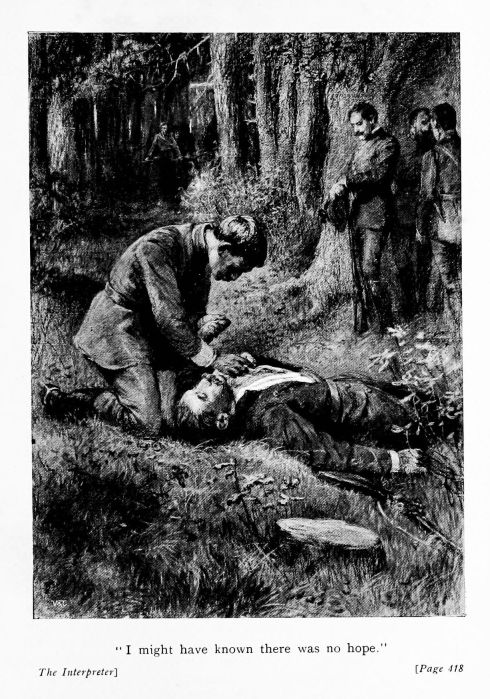
"I might have known there was no hope. The Interpreter Page 418
The boar had dashed down at speed towards the waterfall He had crossed the range of Count de Rohan's rifle, but the Count--and on this fact the forester laid great stress--the Count had missed his aim, and the animal almost instantaneously turned towards Prince Vocqsal. The Prince's rifle rang clear and true; with his usual cool precision he had waited until the quarry was far past the line of his friend's ambush, and had pulled the trigger in perfect confidence as to the result. He, too, had failed for once in the very act of skill on which he so prided himself. His ball missing the game had struck against the hard knot of an old tree beyond it, and glancing thence almost at right angles, had lodged in poor Victor's heart at the very moment when the exhausted Zingynie, staggering with fatigue, had reached his post, murmuring a few hoarse words of warning, and an entreaty to abandon the sport only for that day. As he turned to greet her, the fatal messenger arrived, and with a convulsive bound into the air, and one loud scream, he fell dead at her feet.
Old Prince Vocqsal seemed utterly stupefied. He could neither be prevailed upon to quit the body, nor did it seem possible to make him comprehend exactly what had happened, and the share which he had himself borne so unwittingly in the dreadful catastrophe. The Zingynie, on the contrary, although pale as death, was composed and almost majestic in her grief. To her it was the fulfilment of a prophecy--the course of that destiny which is not to be checked nor stayed. As she followed the body, with head erect and measured tread, she looked neither to right nor left, but her black eyes flashed with awful brilliance as she fastened the dilated orbs on what had once been Victor de Rohan, and murmured in a low chant words which I now remembered, for the first time, to have heard many years before, words of which I now knew too well the gloomy significance. "Birth and Burial--Birth and Burial--Beware of St. Hubert's Day!"
So we bore him down to Edeldorf, slowly, solemnly, as we bear one to his last resting-place. Down the beautiful mountain-side, with its russet copsewood, and its fine old oaks, and its brilliant clothing of autumnal beauty; down the white sandy road between the vine-gardens, with their lightsome foliage and their clusters of blushing grapes, and the buxom peasant-women, and ruddy, happy children, even now so gay and noisy, but hushed and horror-bound as they stopped to look and learn; down across the long level plain, where the flocks were feeding securely, and the cattle stood dreamily, and clouds of insects danced and hovered in the beams of an afternoon sun. Slowly, solemnly, we wound across the plain; slowly, solemnly, we reached the wide park-gates. A crowd of mourners, gathering as we went, followed eager and silent in the rear. Slowly, solemnly, we filed up the long avenue between the acacias, bearing the lord of that proud domain, the last of the De Rohans, to his ancestral home.
Two ladies were walking in the garden as we approached the house; I caught sight of their white dresses before they had themselves perceived our ghastly train. They were Constance de Rohan, and Rose, Princess Vocqsal.
There was deep and holy mourning, there were bitter scalding tears that night in the Castle of Edeldorf. On the morrow, when the sun rose, there was one broken heart within its walls.
CHAPTER XLVI
VÆ VICTIS!
Valèrie de Rohan is Mrs. Ropsley now; she has dropped the rank of Countess, and prides herself upon the facility with which she has adopted the character of an English matron. She speaks our language, if anything, a little less correctly than when I knew her first; never shakes hands with any of her male acquaintances, and cannot be brought to take a vehement interest in Low Church bishops, parliamentary majorities, or the costly shawls and general delinquencies of her pretty next-door neighbour, whose private history is no concern of yours or mine. In all other respects she is British enough to be own grand-daughter to Boadicea herself. She makes her husband's breakfast punctually at ten; comes down in full morning toilet, dressed for the day, bringing with her an enormous bunch of keys, such as we bachelors scrutinise with mysterious awe, and of the utility of which, inasmuch as they are invariably forgotten and left on the breakfast-table, we nourish vague and secret doubts; further, she studies Shakspeare and Burke (not the statesman, but the compiler of that national work which sets forth the pedigrees of peers and baronets, and honourable messieurs and mesdames) with divided ardour, and although she thinks London a little triste, believes her own house in Belgravia to be a perfect paradise, and loves its lord and hers with a pure, simple, and entire devotion. Mrs. Ropsley is very happy, and so is he.
"The boy is father to the man." I can trace in the late Guardsman--who relinquished his profession at the Peace--the same energy, the same calculating wisdom, the same practical good sense, that distinguished his youth; but he has lost the selfishness which made his earlier character so unamiable, and has acquired in its stead an enlarged view of the duties and purposes of life, a mellower tone of thought, a deeper sense of feeling as to its pleasures and its pains. He has discovered that the way to be happy is not to surround oneself with a rampart of worldly wisdom, not to cover the human breast with a shield of cynical defiance, which always fails it at its need, but to take one's share manfully and contentedly of the roses as of the thorns--no more ashamed to luxuriate in the fragrance of the one, than to wince from the sharp points of the other. He entered on life with one predominant idea, and that one perhaps the least worthy of all those which sanguine boyhood proposes so ardently to itself; but he had purpose and energy, and though self was his idol, he worshipped with a perseverance and consistency worthy of a better cause. Circumstances, which have warped so many to evil, rescued him at the turning point of his destiny. When he met Valèrie at Vienna, he was rapidly hardening into a bold, bad man, but the affection with which she inspired him saved him, as such affection has saved many a one before, from that most dangerous state of all in which he lies who has nothing to care for, nothing to hope, and consequently nothing to fear. Oh! you who have it in your power to save the fallen, think of this. How slight is the cable that tows many a goodly vessel into port; what a mere thread will buoy up a drowning man; do not stand on the bank and wag your heads, and say, "I told you so;" stretch but a little finger, throw him the rope that lies to your hand; nay, think it no shame to wet your feet and bring him gently and tenderly ashore, for is he not your brother?
The good work that Valèrie's influence had begun, was perfected by the hardships and horrors of the Crimean campaign. No man could witness the sufferings so cheerfully borne, or take his share in the kindly offices so heartily interchanged on that dreary plateau above Sebastopol, without experiencing an improvement in his moral being, and imbibing far more correct notions than he had entertained before as to the realities of life and death. No man could take his turn of duty day by day in the trenches, see friends and comrades one by one struck down by grape-shot, or withering from disease, and not feel that he too held life on a startlingly uncertain tenure; that if the material were indeed all-in-all, he had no business there; that the ideal has a large share even in this life, and will probably constitute the very essence of that which is to come. It is a mistake to suppose that danger hardens the heart; on the contrary, it renders it peculiarly alive to the softer and kindlier emotions. The brave are nearly always gentler, more susceptible, than apparently weaker natures; and many a man who does not quail at the roar of a battery, who confronts an advancing column with a careless smile and a pleasant jest upon his lips, will wince like a child at an injury or an unkindness dealt him from the hand he loves.
Ropsley, too, had many a pang of remorse to contend with, many an hour of unavailing regret, as he looked back to the mischief he had wrought by his unscrupulous schemes for his own benefit--the misery, to which in his now softened nature he was keenly alive, that a thoughtless selfishness had brought on his oldest and dearest friends. Poor Victor married in haste, when piqued and angry with one who, whatever might be her faults, was the only woman on earth to him. Constance Beverley, driven into this alliance by his own false representations, and her father's ill-judged vehemence. Another old school-fellow, whom he was at last beginning to value and esteem, attributing the wreck of all he hoped and cherished in the world to this fatal marriage; and he himself ere long wishing to be connected by the nearest and dearest ties with those whose future he had been so instrumental in blasting, and who could not but look upon him as the prime source and origin of all their unhappiness.
No wonder Ropsley was an altered man; no wonder Victor's sudden and awful death made a still further impression on his awakened feelings; no wonder he prized the blessing he had won, and determined to make himself worthy of a lot the golden joys of which his youth would have sneered at and despised, but which he was grateful to find his manhood was capable of appreciating as they deserved.
Happiness stimulates some tempers to action, as grief goads others to exertion; and Ropsley is not one to remain idle. Though Edeldorf has passed away from the name of De Rohan for evermore, he has attained a large fortune with his wife; but affluence and comfort alone will not fill up the measure of such a man's existence, and his energetic character will be sure to find some outlet for the talents and acquirements it possesses. Politics will probably be his sphere; and those who know of what efforts a bold far-seeing nature is capable, when backed by study, reflection, above all, common sense; and when blessed with a happy home of love on which to rest, and from which to gather daily new hope and strength, will not think me over sanguine in predicting that something more than a "Hic Jacet" will, in the fulness of time, be carved on Ropsley's tombstone; that he will do something more in his generation than eat and drink, and pay his son's debts, and make a will, and so lie down and die, and be forgotten.
It is good to be firm, strong-minded, and practical; it is good to swim with the stream, and, without ever losing sight of the landing-place, to lose no advantage of the current, no lull of the back-water, no rippling eddy in one's favour. It is not good to struggle blindly on against wind and tide, to trust all to a gallant heart, to neglect the beacon and the landmark, to go down at last, unconquered it may be in spirit, but beaten and submerged for all that, in fact. There is an old tale of chivalry which bears with it a deep and somewhat bitter moral: of a certain knight who, in the madness of his love, vowed to cast aside his armour and ride three courses through the mêlée with no covering save his lady's night-weeds. Helm, shield, and corslet, mail and plate, and stout buff jerkin, all are cast aside. With bared brow and naked breast the knight is up and away!--amongst those gathering warriors clad from head to foot in steel. Some noble hearts--God bless them!--turn aside to let him pass; but many a fierce blow and many a cruel thrust are delivered at the devoted champion in the throng. Twice, thrice he rides that fearful gauntlet; and ere his good horse stops, the white night-dress is fluttering in rags--torn and hacked, and saturated with blood. It is a tale of Romance, mark that! and the knight recovers, to be happy. Had it been Reality, his ladye might have wrung her hands over a clay-cold corpse in vain. Woe to him who sets lance in rest to ride a tournament with the world! Woe to the warm imagination, the kindly feelings, the generosity that scorns advantage, the soft and vulnerable heart! How it bleeds in the conflict, how it suffers in the defeat! Yet are there some battles in which it is perhaps nobler to lose than to win. Who shall say in what victory consists? "Discretion is the better part of valour," quoth Prudence; but Courage, with herald-voice, still shouts, "Fight on! brave knights, fight on!"
In the tomb of his fathers, in a gloomy vault, where a light is constantly kept burning, sleeps Victor de Rohan, my boyhood's friend, my more than brother. Many a stout and warlike ancestor lies about him; many a bold Crusader, whose marble effigy, with folded hands and crossed legs, makes silent boast that he had struck for the good cause in the Holy Land, rests there, to shout and strike no more. Not one amongst them all that had a nobler heart than he who joined them in the flower of manhood--the last of his long and stainless line. As the old white-haired sexton opens the door of the vault to trim and replenish the glimmering death-lamp, a balmy breeze steals in and stirs the heavy silver fringe on the pall of Victor's coffin--a balmy breeze that plays round the statue of the Virgin on the chapel roof, and sweeps across many a level mile of plain, and many a fair expanse of wood and water, till it reaches the fragrant terraces and the frowning towers of distant Sieben-bürgen--a balmy breeze that cools the brow of yon pale drooping lady, who turns an eager, wistful face towards its breath. For why? It blows direct from where he sleeps at Edeldorf.
She is not even clad in mourning, yet who has mourned him as she has done? She might not even see him borne to his last home, yet who so willingly would lay her down by his side, to rest for ever with him in the grave?
Alas for you, Rose, Princess Vocqsal!--you who must needs play with edged tools till they cut you to the quick!--you who must needs rouse passions that have blighted you to the core!--you who never knew you had a heart till the eve of St. Hubert's Day, and found it empty and broken on the morrow of that festival!
She tends that old man now with the patience and devotion of a saint--that old childish invalid in his garden chair, prattling of his early exploits, playing contentedly with his little dog, fretful and impatient about his dinner. This is all that a paralytic stroke, acting on a constitution weakened by excess, has left of Prince Vocqsal.
Nor is the wife less altered than her husband. Who would recognise in those pale sunken features, in that hair once so sunny, now streaked with whole masses of grey, in that languid step and listless, fragile form, the fresh, sparkling roseate beauty of the famous Princess Vocqsal? She has done with beauty now; she has done with love and light, and all that constitute the charm and the sunshine of life; but she has still a duty to perform; she has still an expiation to make; and with a force and determination which many a less erring nature might fail to imitate, she has set herself resolutely to the task.
Save to attend to her religious duties, comprising many an act of severe and grievous penance, she never leaves her patient. All that woman's care and woman's tenderness can provide, she lavishes on that querulous invalid; with woman's instinct of loving that which she protects, he is dearer to her now than anything on earth; but oh! it is a sad, sad face that she turns to the breeze from Edeldorf.
Her director comes to see her twice a day; he is a grave, stern priest--an old man who has shriven criminals on the scaffold--who has accustomed himself to read the most harrowing secrets of the human soul. He should be dead to sensibility, and blunted to all softer emotions, yet he often leaves the Princess with tears in his grave cold eyes.
She is a Roman Catholic; do not therefore argue that her repentance may not avail. She has been a sinner--scarlet, if you will, of the deepest dye; do not therefore say that the door of mercy will be shut in her face. There are sins besides those of the feelings--crimes which spring from more polluted sources than the affections. The narrow gate is wide enough for all. If you are striving to reach it, walking hopefully along the strait path, it is better not to turn aside and take upon yourself the punishment of every prostrate bleeding sinner; if you must needs stop, why not bind the gaping wounds, and help the sufferer to resume the uphill journey? There are plenty of flints lying about, we know--heavy, sharp, and three-cornered--such as shall strike the poor cowering wretch to the earth, never to rise again. Which of us shall stoop to lift one of them in defiance of Divine mercy? Which of us shall dare to say, "I am qualified to cast the first stone at her"?
CHAPTER XLVII
THE RETURN OF SPRING
The smoke curls up once more from the chimneys of Alton Grange; the woman in possession, she with the soapy arms and unkempt hair, who was always cleaning with no result, has been paid for her occupancy and sent back to her own untidy home in the adjoining village. The windows are fresh painted, the lawn fresh mown, the garden trimmed, and the walks rolled; nay, the unwonted sound of wheels is sometimes heard upon the gravel sweep in front of the house, for the country neighbours, a race who wage unceasing war against anything mysterious, and whose thirst for "news," and energy in the acquisition of gossip, are as meritorious as they are uncalled for, have lavished their attentions on the solitary, and welcomed him back to his lonely home far more warmly than he deserves. The estate, too, has been at nurse ever since he went away. An experienced man of business has taken it into his own especial charge, but somehow the infant has not attained any great increase of vigour under his fostering care, and the proprietor is ungrateful enough to think he could have managed it better for himself. Inside, the house is dark and gloomy still. I miss poor Bold dreadfully. After a day of attention to those trivial details which the landowner dignifies with the title of "business," or worse still, of vacant, dreary hours passed in listless apathy, it is very lonely to return to a solitary dinner and a long silent evening, to feel that the wag of a dog's tail against the floor would be company, and to own there is solace in the sympathy even of a brute's unreasoning eye. It is not good for man to be alone, and that is essentially a morbid state in which solitude is felt to be a comfort and a relief; more especially does the want of occupation and companionship press upon one who has been leading a life of busy every-day excitement such as falls to the lot of the politician or the soldier; and it has always appeared to me that the worst of all possible preparations for the quiet, homely duties of a country gentleman, are the very two professions so generally chosen as the portals by which the heir of a landed estate is to enter life. It takes years to tame the soldier, and the politician seldom really settles down at all; but of course you will do what your fathers did--if the boy is dull, you will gird a sword upon his thigh; if he is conceited, you will get him into Parliament, and fret at the obtuse deafness of the House. Perhaps you may as well be disappointed one way as the other; whatever you do with him, by the time he is thirty you will wish you had done differently, and so will he. Action, however, is the only panacea for despondency; work, work, is the remedy for lowness of spirits. What am I that I should sit here with folded hands, and repine at the common lot? There are none so humble but they can do some little good, and in this the poor are far more active than the rich. Let me take example by the day labourers at my gate. There is a poor family not a mile from here who sadly lack assistance, and whom for the last fortnight I have neglected to visit. A gleam of sunshine breaks in through the mullioned window, and gilds even the black oak wainscoting: the clouds are passing rapidly away, I will take my hat and walk off at once towards the common. Oh, the hypocrisy of human motives! The poor family are tenants of Constance de Rohan; their cottage lies in the direct road to Beverley Manor.
It has been raining heavily, and the earth is completely saturated with moisture. The late spring, late even for England, is bursting forth almost with tropical luxuriance. Dank and dripping, the fragrant hedges glisten in the noonday beams. Brimful is every blossom in the orchard, fit chalice for the wild bird or the bee. Thick and tufted, the wet grass sprouts luxuriantly in the meadow-lands where the cowslip hangs her scented head, and the buttercup, already dry, reflects the sunshine from its golden hollow. The yellow brook laughs merrily on beneath the foot-bridge, and the swallows shoot hither and thither high up against the clear blue sky. How fresh and tender is the early green of the noble elms in the foreground, and the distant larches on the hill. How sweet the breath of spring; how fair and lovable the smile upon her face. How full of hope and promise and life and light and joy. Oh, the giant capacity for happiness of the human heart! Oh, what a world it might be! What a world it is!
The children are playing about before the door of the cottage on the common. Dirty, and noisy, and rosy, the little urchins stare, wonder-struck, at the stranger, and disappear tumultuously into certain back settlements, where there are a garden, and a beehive, and a pig. An air of increased comfort pervades the dwelling, and its mistress has lost the wan, anxious look it pained me so to see some ten days ago. With a corner of her apron she dusts a chair for me to sit down, and prepares herself for a gossip, in which experience tells me the talking will be all one way. "Her 'old man' is gone out to-day for the first time to his work. He is quite stout again at last, but them low fevers keeps a body down terrible, and the doctor's stuff was no good, and she thinks after all it's the fine weather as has brought him round; leastways, that and the broth Lady Beverley sent him from the Manor House; and she to come up herself only yesterday was a week, through a pour of rain, poor dear! for foreign parts has not agreed with her, and she's not so rosy as she were when I knew her first, but a born angel all the same, and ever will be."
Tears were in the good woman's eyes, and her voice was choked. I stayed to hear no more. Lady Beverley, as she called her, was, then, once more at home. She had been here--here on this very spot, but one short week ago. I could have knelt down and kissed the very ground she had trodden. I longed if it was only to see her footprints. I, who had schooled myself to such a pitch of stoicism and apathy, who had stifled and rooted out and cut down the germs of passion till I had persuaded myself that they had ceased to exist, and that my heart had become hard and barren as the rock,--I, who had thought that when the time came I should meet her in London with a kindly greeting, as became an old friend, and never turn to look the way she went; and now, because she had been here a week ago, because there was a possibility of her being at the moment within three miles of where I stood, to feel the blood mounting to my brow, the tears starting to my eyes,--oh! it was scarlet shame, and yet it was burning happiness too.
The sun shone brighter, the birds sang more merrily now. There was no longer a mockery in the spring. The dry branch seemed to blossom once more--the worn and weary nature to imbibe fresh energies and renewed life. There was hope on this side the grave, hope that might be cherished without bitterness or remorse. Very dark had been the night, but day was breaking at last. Very bitter and tedious had been the winter, but spring, real spring, was bursting forth. I could hardly believe in the prospect of happiness thus opened to me. I trembled to think of what would be my destiny if I should lose it all again.
In the ecstasy of joy, as in the tumult of uncertainty and the agony of grief, there is but one resource for failing human strength, how feeble and failing none know so well as those whom their fellows deem the noblest and the strongest. That resource has never yet played man false at his need. The haughty brow may be compelled to stoop, the boasted force of will be turned aside, the proud spirit be broken and humbled to the dust, the race be lost to the swift and the battle go against the strong, but the victory shall be wrested, the goal shall be attained by the clasped hands and the bended knees, and the loving heart that through good and evil has trusted steadfastly to the end.
* * * * *
I may lock the old desk now. I have told my tale; 'tis but the every-day story of the ups and downs of life--the winnings and losings of the game we all sit down to play. One word more, and I have done.
In the solitude of my chamber I took from its hiding-place a withered flower; once it had been a beautiful white rose, how beautiful, how cherished, none knew so well as I. Long and steadfastly I gazed at it, conjuring up the while a vision of that wild night, with its flying clouds and its waving fir-trees, and the mocking moonlight shining coldly on the gravel path, and the bitterness of that hour, the bitterness of all that had yet fallen to my lot, and so I fell asleep. And behold it seemed to be noon, midsummer-noon in a garden of flowers, hot and bright and beautiful. The butterfly flitted in the sunshine, and the wood-pigeon mourned sweetly and sadly in the shade. Little children with laughing eyes played and rolled about upon the sward, and ran up, warm and eager, to offer me posies of the choicest flowers. One by one I refused them all, for amongst the pride of the garden there was none to me like my own withered rose that I had cherished so long, and I turned away from each as it was brought me, and pressed her closer to my heart where she always lay.
Then, even as I clasped her she bloomed in her beauty once more, fresh and pure and radiant as of old, steeping my very soul in fragrance, a child of earth indeed, but wafting her sweetness up to heaven.
And I awoke, and prayed that it might not be all a dream.
THE END
Richard Clay & Sons, Limited, London & Bungay.