Chapter XV · THE NORMAN INVASION AND THE CAMPAIGN OF HASTINGS.[1055] (continued 2)
Reading edition
Nature of the site.
The spot on which the destinies of England were fixed was indeed one chosen with the eye of a great general. Harold has, in this respect, had somewhat scanty justice done to him by those of his own countrymen who seem inclined to throw on him the blame of the national defeat. But it is in the Norman accounts, which alone supply details, that the history of the great battle must be studied; and it cannot be denied that, in every military respect, they do full justice both to the English King and to the English army. Their conventional rhetoric of abuse never fails them; but what Harold and his followers really were we see from the facts as stated by the Normans themselves, and from the expressions of unwilling, of half-unconscious, admiration which those facts wring from them.[1257] Harold might be a perjurer and an usurper, but the language of his enemies at least shows that they found him 442|The post perfectly suited to Harold’s object.| an equal and terrible adversary in the day of battle. And nowhere is Harold’s military greatness so distinctly felt as when, with the Norman narratives in our hand, we tread the battle-field of his own choice, and see how thoroughly the post was suited for the purposes of him who chose it. It was the policy of Harold not to attack. The mode of fighting of an English army in that age made it absolutely invincible as long as it could hold its ground. |His arrangements purely defensive.| But neither the close array of the battle-axe men, nor the swarms of darters and other half-armed irregular levies, were suited to take the offensive against the horsemen who formed the strength of the Norman army. It needed only a developement of the usual tactics of the shield-wall to turn the battle as far as possible into the likeness of a siege. This was what Harold now did. He occupied, and fortified as thoroughly as the time and the means at his command would allow, a post of great natural strength, which he made into what is distinctly spoken of as a castle.[1258] It was a post which it was quite impossible that William could pass by without attacking. But it was also a post which it in no way suited William’s purposes to occupy with his own forces. By so doing he might have forced Harold to decline fighting; he could not have compelled him to fight on other ground. Harold was therefore enabled to occupy the post of his own choice, the natural bulwark of London and of the |Description of the hill of Senlac or Battle.| inland parts of England generally. The hill of Senlac,[1259] now occupied by the Abbey and town of Battle, commemorates in its later name the great event of which it was the scene. It is the last spur of the downs covered by the great Andredes-weald, and it completely commands the broken ground, alternating with hill and marsh, which lies between itself and the sea. It stands in fact right in the teeth of 443an enemy marching northwards from Hastings. The hill itself is of a peninsular shape, stretching from the east to the south-west, and it is united by a narrow isthmus to the great mass of the high ground to the north.[1260] The height is low, compared with the mountains and lofty hills of the western parts of our island, but its slopes, greatly varying in their degrees of steepness, would, even where the ascent is most gentle, afford a formidable obstacle to an enemy who relied mainly on his cavalry. The spot was then quite unoccupied and untilled; nothing in any of the narratives implies the existence of any village or settlement; our own Chronicles only describe the site as by “the hoar apple-tree,”[1261] some relic, we may well believe, of the days when streams and trees were still under the guardianship of their protecting, perhaps indwelling deities. At present the eastern part of the hill is covered by the buildings of the Abbey, and by part of the town which has gathered round it, including the parish church. The town also stretches to the north-west, away from the main battle-ground, along what I have spoken of as the isthmus. But the hill reaches to a considerable distance south-west of the isthmus, westward from the buildings of the Abbey, and this part of the ground, we shall see, really played the most decisive part in the great event of the place. A sort of ravine, watered by two small streams which join together at the base of the hill, cuts off the south-western end of the battle-ground from the isthmus and the ground connected with it. The steepness of the ground here is considerable. At the extreme south-east end, the present approach to the town from Hastings, the ascent is gentler. Turning the 444eastern end of the hill, which here takes a slightly forked shape, the ground on the north side, near the present parish church, is exceedingly steep, almost precipitous. Along the south front of the hill, that most directly in the teeth of the invaders, the degree of height and steepness varies a good deal. The highest and steepest is the central point occupied by the buildings of the Abbey. Some way westward from the Abbey is the point where the slope is gentlest of all, where the access to the natural citadel is |The detached hill.| least difficult. But here a low, detached, broken hill, a sort of small island in advance of the larger peninsula, stands out as an outpost in front of the main mass of high ground, and, as we shall see, it played a most important part in the battle.
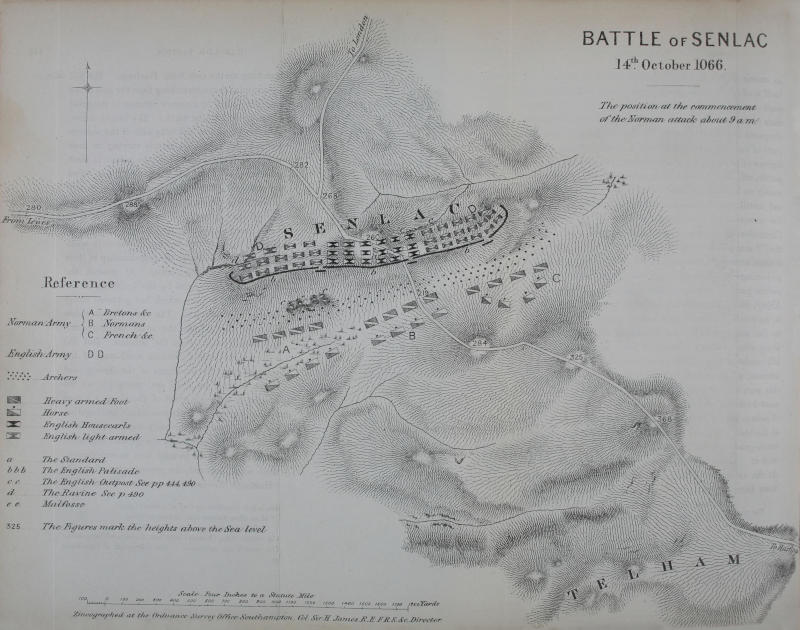
Advantage of the site.
Such a post as this, strong by nature and standing directly in the face of the enemy, exactly suited Harold’s objects. And the approach to it was equally unsuited to the objects of William. Seven miles of hill and dale form the present road from Hastings to Battle. But the Norman army, in its advance from Hastings, would have to spread itself over the whole country, a country where marsh and wood doubtless alternated, except so far as their own ravages had done something to clear their path. The ground immediately around Senlac is specially broken and rolling, and the lower land close at the foot of the hill, which must in many parts have been utterly trackless, was doubtless, in an October of those days, a mere quagmire. It is only where the present road enters the town of Battle that a sort of low isthmus of somewhat higher and firmer ground forms a slight connexion between Senlac and the opposite hills to the south. Through all this difficult country the Normans had to make their way to the foot of the English position. And there they would find, not only a post of great natural strength, but something which was not without reason called a fortress. Harold entrenched himself 445|Harold fortifies the hill. Defences of the English camp.| behind defences, not indeed equal to those of Arques[1262] or Old Sarum, but perhaps nearly equal to those of William’s own camp at Hastings. He occupied the hill; he surrounded it on all its accessible sides by a threefold palisade, with a triple gate of entrance, and defended it to the south by an artificial ditch.[1263] The name of the Watch-Oak is still borne by a tree on the isthmus. In that quarter no attack was to be feared, and the defences were there probably less diligently cared for. The royal Standard was planted just where the ground begins to slope to the south-east, the point most directly in the teeth of the advancing enemy. Within the fortress thus formed, the King of the English and his army awaited the approach of the invaders.
Of the numbers of the host gathered within this narrow compass we have, as we have seen, no certain account. While the English writers naturally diminish, the Norman |Stories of desertions; their probable origin.| writers as naturally magnify their numbers.[1264] The English writers further tell us that, on account of the straitness of the post, many of the English deserted.[1265] It may be so; but it should be again remembered that, with the tactics which Harold had chosen, overwhelming numbers were not desirable. Enough of good troops to hold the hill against the enemy were better than a vast host of tumultuary levies. We can well believe that the population of the neighbouring country flocked to the Standard in far greater numbers than at all suited the King’s purpose. The 446services of some volunteers may have been rejected; some may have turned away when they saw the peculiar nature of the service required of them, a kind of service which we can well conceive to have been neither attractive nor intelligible to raw levies. But it is certain that, whatever was the number of the troops who remained or who were retained, little could be said against their quality. We shall see that the Housecarls, the main core of the army, retained their old reputation to the last, and the fault even of the irregular levies was certainly not that of a lack of mere courage.[1266]
Stories of further messages, spies, &c.
It does not appear that any long time passed between Harold’s occupation of his hill fortress and the battle itself. The spot was not one in which a large body of men could remain for any length of time; on the other hand the invaders could not remain altogether inactive, neither could they pass by the English position without attacking it. And that position, after all, was not a regular castle to be reduced by a regular siege. Immediate battle was absolutely inevitable on both sides. Everything in our narratives leads us to believe that the battle followed almost immediately on the arrival of Harold at Senlac. The hill seems to have been occupied on the Friday, and |Report of the English spy, who takes the shaven Normans for priests.| the fight we know began the next morning. Spies were sent out on both sides,[1267] and there is nothing impossible in the well-known tale that the English spy, struck by the unusual aspect of the closely-shaven Normans, reported to his sovereign that the French host contained more priests than soldiers. Harold, we are told, answered with a laugh 447that the French priests would be found to be valiant warriors |Tale of a dispute between Harold and Gyrth.| indeed.[1268] But much less faith is due to the legend that Harold and Gyrth themselves rode forth to spy out the invading army, that Harold proposed to fall back on London, that Gyrth dissuaded him from such a course, that the two brothers quarrelled and nearly fought, but that they came back to the camp without letting any sign of their dispute appear to any one else.[1269] Nothing can be less trustworthy than these Norman reports of things which are said to have taken place within the English camp. No power short of divination could have revealed to any Norman witness a private conversation and a private |William’s last message.| quarrel between the English King and his brother. A somewhat greater degree of attention is due to the story that William, even at the last moment, after the English camp was actually pitched on Senlac, still made one last attempt at negotiation.[1270] If such an attempt was made, it was of course made with no hope and no thought on William’s part of its leading to any peaceful arrangement between himself and his rival. William’s object must have been to keep up to the last the character of one making a legal and righteous claim, a claim which nothing but a necessity beyond his control drove him into asserting by force. And, by the peculiar form of message which is said to have been sent, he might well have hoped to spread fear and disunion through the English army. He is said to have first invited 448Harold to a personal interview at some point between Hastings and Senlac, with a few followers only on either side. Gyrth is said to have answered for his brother, refusing any personal conference, and bidding William send to the camp whatever message he thought good. |Three choices offered to Harold.| The message came. It offered a choice of three things. Let Harold resign the Kingdom according to his oath. Let Harold and his house hold the Kingdom under William, Harold as Under-king of the Northumbrians, Gyrth as |Challenge to single combat.| Earl of the West-Saxons.[1271] Failing either of these offers, let Harold come forth and meet William in single combat. The Crown of England should be the prize of the victor, and the followers of both combatants should depart unhurt. |William’s object in the message.| |The policy of all these proposals is manifest. Their object| was to make the strife appear a mere personal quarrel between Harold and William, instead of an attack made by the Duke of the Normans on the land and people of England. And the proposal that the two princes should spare the blood of their armies, and decide their difference in their own persons, had a specious look of humanity. |Harold refuses the challenge; his grounds of refusal.| But Harold and Gyrth had seen far too much of the world to be taken in in this way. Harold could not separate himself from his people. His cause was theirs and their cause was his. When the Duke of the Normans attacked the King whom the English nation had chosen, he attacked the nation itself. The Crown was Harold’s by their gift; but it was not Harold’s in any such sense that he could stake it on the result of a single combat, any more than he could stake it on a throw of the dice. A single combat between Harold and William would of course involve the death of one or other of the combatants. Neither King nor Duke was a man likely to cry craven. What then if William slew Harold? His right to the 449English Crown would be no better than it was before. Englishmen, with arms in their hands, were not likely to submit to the judgement of such an ordeal. William would still have had to fight;—he would no doubt have been able to fight at a great advantage, but he would still have had to fight—against Gyrth, Eadgar, Eadwine, Waltheof, any one whom the English people chose to place at their head. If, on the other hand, Harold slew William, it was, if possible, even less likely that the mingled host which came from all the lands beyond the sea for spiritual and temporal gains would at once quietly go back to the various homes from which they had come. The challenge was simply a blind, and Harold did only his duty in refusing to be bound by such a false issue, and in saying that God alone must judge between him and his foe.
Further doubtful details of the messages.
Our accounts of these messages are so confused and contradictory that it is impossible to feel thorough confidence whether any messages were really sent at this stage of the story or not. We are told that, either now or at some earlier time, William offered Harold the option of a legal judgement on the points at issue between them. Let their quarrel be decided either by the laws of Normandy or by the laws of England, or by the Pope and his clergy at Rome.[1272] Here again we see the same sort of fallacy at work as in the challenge to single combat. The Crown of England could not be adjudged according to any rules of Norman Law or by the award of any Norman tribunal. As for English Law, the Assembly which alone had power to deal with the question, had dealt with it nine months before. Those who had then given their votes for Harold were now there present to enforce those votes axe in hand. The appeal to the Roman 450See was a still more transparent fallacy. William and his host knew well, and Harold and his host no doubt also knew well, that the sentence of Rome had already gone forth against England, and that the consecrated banner of the Apostle was at that moment in the Norman camp. In another version we hear, not of a proposed appeal to the Apostolic throne, but of a solemn warning that Harold and all his followers were already excommunicated by the Apostolic sentence. Dismay, we are told, was spread through the English host, and men began to shrink from the coming battle. Gyrth once more steps forth as the good genius of his brother and of his country. His voice and his arguments again bring back the courage and the hopes of the English army.[1273] We may give to these tales such amount of belief as we may think good. But we may be sure that the day before the battle was spent on both sides in diligent preparation for the work that was to come on the morrow.
§ 4. The Battle. October 14, 1066.
The night before the battle. Friday, October 13.
And now the night came on, the night of Friday the thirteenth of October, the night which was to usher in the ever-memorable morn of Saint Calixtus. Very different, according to our Norman informants, was the way in which that night was spent by the two armies. The English spent the night in drinking and singing,[1274] the Normans in 451|Devotion of the Normans.| prayer and confession of their sins.[1275] Among the crowds of clergy in William’s host were two Prelates of all but the highest rank in the Norman Church.[1276] One was Geoffrey, Bishop of Coutances, who in his temporal character was soon to have so large a share of the spoils of England.[1277] The other was the Duke’s own half-brother, the famous Odo, who, to his Bishop’s seat at Bayeux, was soon to add the temporal cares of the Kentish Earldom.[1278] Under the pious care of the two Bishops and of the other clergy, the Norman host seems to have been wrought up to a sort of paroxysm of devotion. Odo extracted from every man a special vow, that those who survived the struggle of the coming Saturday would never again eat flesh on any Saturday that was to come.[1279] Tales like these are the standing accusations which the victors always |The night said to be spent by the English in drinking and singing.| bring against the vanquished. The reproach which is cast on the English host on the night before the fight of Senlac is also cast on the French host on the night before the fight of Azincourt.[1280] And yet there may well be some 452groundwork of truth in these stories. The English were not, like the Normans, fighting under the influence of that strange spiritual excitement which had persuaded men that an unprovoked aggression on an unoffending nation was in truth a war of religion, a Crusade for the good of the souls of Normans and English alike. It may therefore well be that there was more of ceremonial devotion in the camp of William than in the camp of Harold. And yet even a Norman legend gives us a picture of the English King bending before the Body of his Lord,[1281] and Englishmen may deem that the prayers and blessings of Ælfwig and Leofric were at least as holy and as acceptable as the prayers and blessings of Geoffrey and Odo. And we must not forget that the devotions of William and his followers are recorded by William’s own chaplain and flatterer, while no narrative of that night’s doings survives from the pen of any canon of Waltham or any monk of the New Minster. And we shall hardly deem the worse of our countrymen, if that evening’s supper by the camp-fires was enlivened by the spirit-stirring strains of old Teutonic minstrelsy. Never again were those ancient songs to be uttered by the mouth of English warriors in the air of a free and pure Teutonic England. They sang, we well may deem, the song of Brunanburh and the song of Maldon; they sang how Æthelstan conquered and how Brihtnoth fell; and they sang, it well may be, in still louder notes, the new song 453which the last English gleeman had put into their mouths,
“How the wise King
Made fast his realm
To a high-born man,
Harold himself,
The noble Earl.”[1282]
And thoughts and words like these may have been as good a preparation for the day of battle as all the pious oratory with which the warlike Prelate of Bayeux could hound on the spoilers on their prey.
BATTLE of SENLAC. Saturday, October 14.
The morning of the decisive day at last had come. The Duke of the Normans heard mass, and received the communion in both kinds,[1283] and drew forth his troops for their |William’s speech to his army.| march against the English post. As usual, an exhortation from the general went before any military action. The topics for a speech made by William to his army were obvious.[1284] He came to maintain his just right to the English Crown; he came to punish the perjury of Harold and the 454older crime of Godwine against his kinsman Ælfred. The safety of his soldiers and the honour of their country were in their own hands; defeated, they had no hope and no retreat; conquerors, the glory of victory and the spoils of England lay before them. But of victory there could be no doubt; God would fight for those who fought for the righteous cause, and what people could ever withstand the Normans in war? They were the descendants of the men who had won Neustria from the Frank, and who had reduced Frankish Kings to submit to the most humiliating of treaties.[1285] He, their Duke, and they his subjects, had themselves conquered at Mortemer and at Varaville.[1286] Were they to yield to the felon[1287] English, never renowned in war, whose country had been over and over again harried and subdued by the invading Dane? Let them lift up their banners and march on; let them spare no man in the hostile ranks; they were marching on to certain victory, and the fame of their exploits would resound from one end of heaven to the other.[1288]
455The faithful William Fitz-Osbern now rode up to the mound on which his sovereign stood,[1289] and warned him that |The army marches to Telham.| there was no time to tarry.[1290] Kindled by the exhortations of their leader, the host marched on. They made their way, perhaps in no very certain order, till, from the hill of Telham or Heathland, they first came in sight of the |The knights arm.| English encamped on the opposite height of Senlac.[1291] The knights, who had ridden from Hastings in a lighter garb, and probably on lighter horses, now put on their full armour, and mounted their war-steeds. The Duke now |Incident of the reversed hauberk.| called for his harness. His coat of mail was brought forth; but in putting it on, by some accident, the fore part was turned hindmost. Many a man would have been embarrassed 456at the evil omen, and in truth the hearts of many of William’s followers sank.[1292] But his own ready wit never failed him; he was as able to turn the accident to his advantage as when he first took seizin of the soil of Sussex.[1293] The omen, he said, was in truth a good one; as the hauberk had been turned about, so he who bore |William in full harness.| it would be turned from a Duke into a King.[1294] Now fully armed, he called for his war-horse. His noble Spanish steed, the gift of his ally King Alfonso,[1295] was brought forth. The horse was led by the aged Walter Giffard, the Lord of Longueville, the hero of Arques and of Mortemer. He had made the pilgrimage to the shrine of Saint James of Compostella, and he had brought the gallant beast as a worthy offering for a prince who was the mirror of knighthood.[1296] William now sprang on his horse’s back, and, now ready for battle, he paused for a moment at the head of his host. His gallant equipment and bearing called forth the admiration of all around him, and a spokesman for their thoughts was found in Hamon, the Viscount 457of the distant Thouars.[1297] He spoke no doubt the words of all, when he said that never had such a knight been seen under heaven, and that the noble Count would become a nobler King.[1298]
And now the Duke, fully armed, looked forth upon the |Vital brings the news of the English army.| English encampment. At that moment Vital, a follower of his brother the Bishop, one whose name is written in Domesday, rode up to his sovereign. He had been one of those who were sent forth to spy out the English host; and William now asked him what he had seen and where the English usurper was to be found. Vital told him that Harold stood among the thick ranks which crowned the summit of the hill, for there, so he deemed, he had seen the |William vows to build a monastery on Senlac, if victorious.| royal Standard.[1299] Then the Duke vowed his vow, that if God would give him victory over his perjured foe, he would, on the spot where that Standard stood, raise a mighty minster to his honour.[1300] Among those who heard him 458|William Faber prays that it may be in honour of Saint Martin.| was a monk, William by name, who had come from the house of Marmoutiers, nestled far away beneath its cliffs by the banks of the rushing Loire. Men called him Faber, the wright or smith, because in other days, before he had put the cowl upon him, he had shown his skill in forging arrows for the service of the craft of the woods.[1301] He now stepped forward, and craved that the holy house which the Duke would ere long raise on yonder height should be raised in honour of the renowned Saint Martin, the great Apostle of the Gauls.[1302] The Prince of the Cenomannians owed spiritual allegiance to the metropolitan throne of Tours; he said that it should be as his monastic namesake craved, and in after days the height of Senlac was crowned with the Abbey of Saint Martin of the Place of Battle.
Threefold division of the army.
The vow was spoken, and William and his host now marched on in full battle array. The army was ranged in three divisions, corresponding, whether by accident or by design, with the geographical position of each contingent in its own land.[1303] To the left were the Bretons, the Poitevins, the men of Maine, under the command of Alan of 459|The left, Bretons, &c., under Alan.| Britanny.[1304] He and his might deem that, in following the banner of their own Norman conquerors, they were avenging a far earlier wrong, that they were coming to wreak on the Teutonic occupants of the greater Britain a tardy vengeance for the conquest which had driven their own forefathers to the shores of the lesser. Yet Alan might have paused to remember how his own ancestor and namesake had found in an English King his truest champion against the Norman enemy,[1305] and he might have hesitated before striking a blow to bring both Britains into one common bondage. And with Alan rode a man of mingled birth, whose name will again meet us in our history, but as one branded with the twofold infamy of a man false alike |Ralph of Norfolk.| to his native country and to its foreign King. There, the only English traitor in that motley host, rode Ralph of Norfolk, Ralph of Wader, son of an English father and a Breton mother, who now came among the forces of his maternal country to win back the lands which some unrecorded |The right wing; the French and other mercenaries under Roger of Montgomery.| treason had lost him.[1306] Far to the right rode a more honourable foe. There was the post of Roger of Montgomery, whose name has already so often met us in our Norman story, who now came to be the founder of a mighty house in the conquered island, to be honoured with English Earldoms, and to leave the name of his 460Lexovian hill and manor as the name of a borough and a shire among the twice conquered Cymry.[1307] Under him marched the mercenary French, the men of Boulogne and Poix, and all who, from that region, followed Duke William for hire or for hope of plunder.[1308] With Roger was joined in command one who bore a name soon to be as renowned in England and in Flanders as it already was in Normandy, but a name which, after all its bearer’s exploits, has utterly passed away, while that of his colleague |William Fitz-Osbern.| has been so marvellously abiding. For with Roger rode William Fitz-Osbern, the Duke’s earliest and dearest friend, the son of the man who had saved his life in childhood,[1309] the man who had himself been the first to cheer on his master to his great enterprise, and to exhort the nobles of Normandy to follow their lord beyond the |Eustace of Boulogne.| sea.[1310] And there too, among the mingled bands on the right wing, rode one whom England might well curse more bitterly than any other man in the invading host. There rode one who had been honoured with the hand of a daughter of England, who had been enriched with the wealth of England in the days of his royal kinsman, and who now came to seek for a richer and more lasting share of her plunder in the wake of her open enemy. Eustace of Boulogne, the man whose crime had led to the banishment of England’s noblest sons, the man who had murdered unarmed Englishmen on their own hearthstones,[1311] now 461came to feel what was the might of Englishmen harnessed for the battle, and to show himself the one man in either |The Normans in the centre.| host whose heart was accessible to craven fear. And in the centre, between Breton and Picard, just as Normandy lies between Britanny and Picardy, marched the flower of |The men of Coutances| the host, the native Normans.[1312] Furthest to the left, next in order to their Breton neighbours, marched the only band who had an ancestral grudge against England, the only men in William’s host who came to revenge the devastation of their own land by English hands. The valiant men of the Constantine peninsula, the descendants of the Danes of Harold Blaatand, were there under the command of Neal of Saint Saviour.[1313] The rebel of Val-ès-Dunes now followed his lord in his great enterprise; the namesake and descendant of him who had beaten off the host of Æthelred now came to wreak a tardy vengeance on Englishmen in |and Bayeux.| their own land. Next to the forces of the Côtentin came a band whom the men of Wessex and East-Anglia might well nigh claim as countrymen, the Saxons and Danes of the land of Bayeux, among whom, even then, some relics of Teutonic speech and even of heathen worship may perchance have lingered. They came ready and eager to deal hand-strokes |The archers of Evreux.| with the bravest of the English, while the men of Louviers and Evreux came with their unerring bows, and their arrows destined to pierce many an English eye.[1314] The 462|Armour and weapons of the Normans.| archers were all but universally on foot; the Parthian horse-bowman was not absolutely unknown to Norman tactics, but such an union of characters did not extend to any considerable portion of the army.[1315] For the most part the archers were without defensive harness; they were clad in mere jerkins, with caps on their heads, but a few wore the defences common to the horse and foot of both armies. These were the close-fitting coat of mail reaching to the knees and elbows, and the conical helmet without crest or other ornament, and with no protection for the face except the nose-piece. The horses had, unlike the practice of after times, no artificial defence of any kind.[1316] Their riders, in helmets and coats of mail, bore the kite-shaped shield, and were armed with long lances, not laid in the rest as in the equipment of the later chivalry, but lifted high in air over the bearer’s shoulder. For close combat they had the heavy straight sword; the battle-axe is not shown on the Norman side, and two men only in the host are represented as wielding the terrible mace. Those two men formed the |The Papal banner and the group round it.| innermost centre of the advancing host. There, in the midst of all, the guiding star of the whole army, floated the consecrated banner, the gift of Rome and of Hildebrand, the ensign by whose presence wrong was to be hallowed into right. And close beneath its folds rode the two master-spirits of the whole enterprise, kindred alike in |The Duke himself.| blood, in valour, and in crime. There rode the chief of all, the immediate leader of that choicest and central division, the mighty Duke himself. And we may be sure that it was not only by the voice of flattery, but in the words of truth and soberness, that there, amid the choicest chivalry of Europe, the Bastard of Falaise was hailed as bearing the 463stoutest heart and the strongest arm among them all. Mounted on his stately horse, the gift of the Spanish King, he rode beneath the banner of the Apostle, the leader and the moving spirit of the whole host. No man could bend his bow,[1317] but on that day he bore |His mace.| a weapon fitted only for the closest and most deadly conflict;
οὕνεκ’ ἄρ’ οὐ τόξοισι μαχέσκετο δουρί τε μακρῷ,
ἀλλὰ σιδηρείῃ κορύνῃ ῥήγνυσκε φάλαγγας.[1318]
The most authentic record of that day’s fight arms him neither with sword nor spear, but sets before us the iron mace of the Bastard as the one weapon fit to meet, man to man, and prince to prince, with the two-handed axe of Harold.[1319] Round his neck, we are told, were hung, as a hallowed talisman, the choicest of the relics on which the King of the English was said to have sworn his fatal oath.[1320] |Bishop Odo.| Close at his side, and armed with the same fearful weapon, rode one whose name was soon to be joined with his own in the mouths of Englishmen, and who was to win a far deeper share of English hatred than the mighty Conqueror himself. Odo, the warrior-Prelate of Bayeux, rode in full 464armour by the side of his brother and sovereign, as eager and ready as William himself to plunge wherever in the fight danger should press most nearly. To shed blood by sword or spear was a sin against the Church’s canons, but to crush head-piece and head with the war-club was, in Odo’s eyes, no breach of the duties of a minister of peace. The two mighty brethren, Duke and Bishop, formed the |Robert of Mortain.| central figures of the group. And hard by them[1321] rode a third brother of less renown, a third son of the Tanner’s daughter, Robert of Mortain, the lord of the castle by the waterfalls,[1322] he who was soon to have a larger share than any other man of the spoils of England,[1323] and to add to his Earldom by the Breton march the more famous |The Standard borne by Toustain of Bec.| Earldom of the kindred land of Cornwall. Fast by the three brethren the consecrated banner was borne by Toustain the White, the son of Rou, a knight of the less |Refusal of Ralph of Toesny and Walter Giffard to carry it.| famous Bec in the land of Caux.[1324] Two men of higher rank and of greater age had already declined that honourable office. Ralph of Conches or of Toesny, the heir of the proud line of Malahulc,[1325] the man who had perhaps borne to King Henry the news of the night of Mortemer,[1326] held, among his other dignities, the hereditary right to bear the 465banner of his lord in the day of battle.[1327] But on that day that honour was something from which men shrank as keeping them back from the more active duties of the fight. Ralph of Toesny would not encumber his hands with anything, not even with the banner of the Apostle, if it were to stay his sword from smiting the foe without mercy.[1328] So too spake the famous Walter Giffard of Longueville.[1329] Even in the days of Arques and Mortemer he was an aged man, and now he was old indeed; his hair was white, his arm was failing.[1330] He would deal blows on that day with such strength as his years had left him, but the long labour of carrying the standard could be borne |The Norman chivalry.| only by a younger man. Thick around Toustain and the chiefs beside whom he rode, were gathered the chivalry of Normandy, the future nobility of England, the men who made their way into our land by wrong and robbery, but whose children our land won to her own heart, and changed the descendants of the foemen of Pevensey and Senlac into the men who won the Great Charter and dictated the Provisions of Oxford. Time would fail to tell of all; but a few |William Patry.| names must not be passed by.[1331] There was William Patry 466of La Lande, who in old time had received Earl Harold as a guest, and who now rode by William’s side, swearing that he would meet his lord’s rival face to face, and would deal to him the reward of his perjury.[1332] And there too rode |Roger the Bigod.| men of nobler and of more lasting name. There rode Roger the Bigod, son of the poor serving-knight of William of Mortain, whose presence in the hostile ranks we can well forgive, as we hail in him the forefather of that great house whose noblest son defied the greatest of England’s later Kings in the cause of the liberties of England.[1333] |William Malet.| And one there was in that host, well nigh the only Norman on whom Englishmen can look with personal sympathy and honour, William Malet,[1334] a man perchance born of an English mother, one connected at all events by some tie of spiritual or temporal kindred with England and with Harold, and one who on that day knew how to reconcile his duty as a Norman subject with respect and honour towards the prince and towards the land to which that duty made him a foe.[1335] The names and the rewards of 467these men and of countless others are written in the great record of Domesday. The heroes who fought against them for hearth and home are nameless.
Three kinds of troops in each division;
The invading army was thus arranged in a threefold division according to the place of origin of each contingent. Each division again was ranged in a threefold order according to the nature of the troops which each contingent contained. |archers; heavy-armed foot; horsemen.| First in each division marched the archers, slingers, and cross-bow men, then the more heavily armed infantry, lastly the horsemen.[1336] The reason of this arrangement is obvious. |The order of the attack.| The light-armed were to do what they could with their missiles to annoy the English, and, if possible, to disorder their close array. On them followed the heavy infantry; they were to strive to break down the palisades of the English camp, and so to prepare the way for the charge of the horse. For William’s knights to charge up the slope of Senlac was in any case a hard task, but to charge up the slope, right in the teeth of Harold’s axes, with the shield-wall and the triple palisade still unbroken, would have been absolute madness. Because therefore William exposed his infantry to the first and most terrible danger, we are not justified in charging him with that brutal carelessness as to soldiers beneath the degree of knighthood or gentry, which was so often displayed by French commanders of later times. The two great captains who were that day matched together both knew their trade. The foresight of Harold had rendered William’s choicest troops absolutely useless, until after a struggle 468which could not fail to be attended with a frightful slaughter of his warriors of lower degree.
The two armies in sight.
The English host now looked down from the height of Senlac upon the advancing enemy. Like the Normans, they had risen early; they were now fully armed, and they stood ready and eager for battle.[1337] The King rode round his lines, and addressed to his men the speech expected from a |Harold’s speech.| general before action.[1338] The topics of Harold’s exhortation were as obvious as those of William’s. The English had simply to stand firm, and they were invincible; if they broke their ranks, they were lost. They fought for their country, their warfare was purely defensive, while Duke William had come from a foreign land to seek to conquer them. It was therefore for William to attack, for Harold simply to defend; he had therefore chosen a post where the whole work to be done was to defend it. The Normans were good and valiant horsemen; let them once pierce the English barrier, and it would be hard to drive them out again. But if the English kept their ranks, the Normans never could pierce the barrier. Their long lances would be of little avail in a combat on such ground as he had chosen for the fight. The English javelins would disorder their ranks as they advanced, and the axes would cleave them to the earth if they ventured on a hand to hand fight at the barricades.[1339] And now, as Vital had brought his news to |The English spy brings news.| William, so also an English spy brought to Harold the 469latest tidings of the array and the approach of the enemy. The King was still on his horse, his javelin in his hand, when the news was brought to him beneath the shadow of a tree—perhaps the hoar apple-tree which marked the place |He dismounts at the royal post.| of battle.[1340] When he had heard the tidings of his messenger, when he had surveyed and exhorted his whole army, the King rode to the royal post; he there dismounted, he took his place on foot, and prayed to God for help.[1341]
Thus far we have a natural and credible picture of the preparations of Harold and his host for the work of that awful day. But such a day was not likely to pass without |Tales of Harold and Gyrth.| its full accompaniment of legend and romance.[1342] Norman writers, strangely in the confidence of the English King, now tell us of dialogues between Harold and Gyrth; how, when the first division appeared on the crest of the hill, the King’s heart was lifted up as he looked at his own vast numbers, and how he despised the seemingly small band that 470came against him.[1343] But Gyrth, ever wise, bids him think of the valour and good array, the horses and the harness of the enemy, and to remember how large a part of his own army are but unarmed churls. Presently, as division after division appears on Telham and passes down into the lower ground, the King’s heart begins to quake. The Earl, an easy prophet after the fact, reproaches him with not having followed his counsel, with having refused to remain in London, and with having rashly staked everything on a single battle. Harold answers that it is Saturday, his lucky day, the day on which he was born, and the day which he had therefore chosen for his challenge.[1344] The calm intellect of Gyrth, like that of William, mocks at luck, and he reminds his brother that, if Saturday was the day of his birth, Saturday may also prove to be the day of his death. At last the whole ground between the heights is filled with the invading host; the banner of Saint Peter is seen floating over the central division. Then the King’s heart utterly fails him; he can hardly speak for fear and surprise; he can only mutter charges against Baldwin of Flanders for deceiving him by false statements, of which no mention is found elsewhere, as to the force which William would be likely to muster.[1345]
471The credibility of a story of this kind is of the very lowest. Harold and Gyrth both died in the battle; they would at any rate keep their fears to themselves, and it is hard to see how their private talk could have come to the knowledge of the Norman poet. Besides this, Harold must, by this time at least, have known perfectly well the nature and number of the force that was coming against him. The very account in which we find all these stories tells us how well both sides had been served by spies and messengers.[1346] Each prince must have been thoroughly aware with what sort of an enemy he had to deal. There was enough indeed to make the stoutest heart in either army anxious; but of any feeling unworthy of a King or a soldier Harold and William were alike incapable. The proud horsemen and archers of Normandy might indeed, like the Medes of old, wonder at the tactics which opposed them without the help |The English on Senlac.| of bow or steed;[1347] but they could hardly, like their forerunners, impute madness to the immoveable wedge of men which, as if fixed to the ground by nature, covered every |Their defences and close array.| inch of the opposite hill. The whole height was alive with warriors; the slopes, strong in themselves, were still further strengthened by the firm barricades of ash and other timber, wattled in so close together that not a crevice could be seen. Up the slopes, through the barricades, the enemy had to make their way in the teeth of ranks of men, ranged so closely together in the thick array of the shield-wall, that while they simply kept their ground, the success of an assailant was hopeless.[1348] Every man, from the King 472|The whole army on foot.| downwards, was on foot. Those who rode to the field put their horses aside when the moment for actual fighting came.[1349] An English King was bound to expose his subjects to no danger from which he himself shrank, and, where the King fought, no man might dream of flight.[1350] This ancient national custom, adopted in earlier fights from choice and habit, was, in the post which Harold had chosen, a matter of absolute necessity. The work of that day was to defend a fortress, to stand firm, and to strike down at once any man who strove to make his way within |The light-armed to the left.| its wooden walls. To the south-west of the hill, beyond the isthmus, seem to have been placed the less trustworthy portions of the army, the sudden levies of the southern shires. These, like the Norman archers, had, for the most part, no |English armour and weapons.| defensive armour. Their weapons were of various kinds; the bow was the rarest of all;[1351] a few only were armed with 473swords or axes. Most of them had javelins or clubs, some had only such rustic weapons as forks and sharp stakes. Others seem to have retained some of the rudest arms of primitive days, and to have gone to battle with the stone hatchets or stone hammers which we commonly look on as belonging only to earlier and lower races than our own.[1352] But even such rude weapons as these would be of use in thrusting back the less efficient portion of the invaders, as they strove to climb the height or to break down the barricade. But it was not in troops or arms like these that Harold placed his main trust. The flower of the English army consisted of the King’s personal following, his picked men, who had been his comrades in all his wars, together with the chosen warriors of Kent, Essex, and London. These wore helmets and coats of mail hardly differing from those of the enemy. Their shields too were mostly of the same kite-shaped form, but a few of them vary from this type; some especially are round, with a boldly projecting boss, more like the shields of classical warfare. They carried, like the Romans, javelins to hurl at the beginning of the action, and heavier weapons for close combat. Some still retained the ancient broadsword, the weapon of Brunanburh, of Maldon, and of Assandun, but most of 474|The English axes.| them bore a weapon more terrible still, the long-handled axe wielded with both hands. The introduction of this arm was an innovation of the last fifty years. Its introduction was doubtless due to Cnut, but the axe was probably brought into more general use, and made more distinctly the national weapon, by Harold himself. The Norman writers seem almost to shudder at the remembrance of this fearful weapon, which, wielded by the arm of Harold, struck down horse and man at a single blow.[1353] It was in truth the perfection of a weapon of mere strength; no blow could be so crushing if the blow reached its aim; but swung in the air, as it was, with both hands, it left its wielder singularly exposed to missile weapons while in the act of striking the |The two ensigns;| blow.[1354] On the very crown of the hill, on the point where the ground begins to slope to the south-east, the point 475directly in the teeth of the advancing army, on the spot marked to after ages by the high altar of the abbey church of Battle, were planted the two-fold ensigns of England.[1355] |the Dragon;| There, high above the host, flashed the Dragon of Wessex, the sign which had led Englishmen to victory at Ethandun and at Brunanburh, at Penselwood and at Brentford, and which had sunk without dishonour in the last fight beneath the heights of Assandun.[1356] And now it came all glorious from the overthrow of the mightiest warrior of the North, to try the fortune of England against the subtler |the Standard of the Fighting Man.| arts of Gaul and Rome. There too was pitched the Standard, the personal ensign of the King, a glorious gonfanon, blazing with gems, and displaying, wrought in the purest gold, the old device of Eteoklos,[1357] the |The group round the Standard.| armed warrior advancing to the battle.[1358] Around this special post of honour and of danger were ranged the choicest warriors of England, the personal following of Harold and his house, their Thegns and their Housecarls, the men who had stormed the mountain-holds of Gruffydd and whose axes had cloven the shield-wall of Hardrada.[1359] 476And there, between the Dragon and the Standard, stood |The King and his kinsfolk.| the rising hopes of England’s newly-chosen dynasty. There, as the inner circle of the host, were ranged the fated warriors of the house of Godwine. Three generations of that great line were gathered beneath the Standard of its chief. There stood the aged Ælfwig, with his monk’s cowl beneath his helmet. There stood young Hakon the son of Swegen, atoning for his father’s crimes. And, closer still than all, the innermost centre of that glorious ring, stood the kingly three, brothers in life and death. There, in their stainless truth, stood Gyrth the counsellor and Leofwine the fellow-exile.[1360] And there, with his foot firm on his native earth, sharing the toils and dangers of his meanest soldier, with the kingly helm upon his brow and the two-handed axe upon his shoulder,[1361] stood Harold, King of the English.
The French army was now crossing the lower, but not level, ground which lies between Telham and Senlac. It is not strictly a plain, but rather a rolling country, with the ground rising and falling. Swampy as it still is in many places, to cross it, and that in the full harness of battle, 477must have added somewhat to the toils and difficulties of a march which had already led them from Hastings to Telham. Still all three divisions pressed vigorously on to |Points of attack of the three divisions.| the foot of the heights. Alan and his Bretons on the left, the division of William’s army which was most likely the least esteemed, had to make their attack on the least trustworthy portion of the English army. They had to make their way up the ground lying to the west of the present buildings of the abbey. There the ascent is easiest in itself, but it is defended by the small detached hill already spoken of,[1362] which was doubtless occupied as an English outpost. On the other hand, at the extreme right, Roger of Montgomery with his Frenchmen had to attack at the eastern and north-eastern points of the hill, perhaps over the ground ranging from the present road from Hastings nearly to the parish church of Battle. William himself and his native Normans took on them the heaviest task of |William himself against the Standard.| all. They were the centre, and their duty was to cut their way up the hill right to the Standard, in the teeth of King Harold himself and the picked men of the English host.
Beginning of the battle.
And now the fight began. It was one of the sacred hours of the Church, it was at the hour of prime, three |9 A.M.| hours before noon-day,[1363] that the first blows were exchanged between the invaders and the defenders of England. The Normans had crossed the English fosse,[1364] and were now at the foot of the hill, with the palisades and the axes right 478before them. The trumpet sounded, and a flight of arrows from the archers in all the three divisions[1365] of William’s army was the prelude to the onslaught of the heavy-armed foot. |Exploits of Taillefer.| But, before the two armies met hand to hand, a juggler or minstrel, known as Taillefer, the Cleaver of Iron,[1366] rode forth from the Norman ranks as if to defy the whole force of England in his single person. He craved and obtained the Duke’s leave to strike the first blow; he rode forth, singing songs of Roland and of Charlemagne[1367]—so soon had the name and exploits of the great German become the spoil of the enemy. He threw his sword into the air and caught it again;[1368] but he presently showed that he could use warlike weapons for other purposes than for jugglers’ tricks of this kind; he pierced one Englishman with his lance, he struck down another with his sword, and then himself fell beneath the blows of their comrades. A bravado of this kind might serve as an omen, it might stir up the spirits of men on either side; but it could in no other way affect the fate of the battle. 479William was too wary a general to trust much to such |First attack.| knight-errantry as this. After the first discharge of arrows, the heavier foot followed to the attack, and the real struggle now began. The French infantry had to toil up the hill, and to break down the palisade, while a shower of stones and javelins disordered their approach,[1369] and while club, sword, and axe greeted all who came within the reach of hand-strokes. The native Normans had to do this in the face of the fiercest resistance, in the teeth of the heaviest axes, wielded by the hands of men with whom to fight had ever been to vanquish, the kinsmen and Thegns and Housecarls of King Harold. Their own missiles, hurled from below, could do comparatively little damage. Both sides fought with unyielding valour; |The war-cries.| the war-cries rose loud on either side;[1370] the Normans shouted “God help us;” the English, from behind their barricades, mocked with cries of “Out, out” every foe who entered or strove to enter.[1371] But our fathers also mingled piety with valour; they too called on holy names to help them in that day’s struggle.[1372] They raised their 480national war-cry of “God Almighty,”[1373] and in remembrance of the relic which their King so well loved to |The “Holy Cross” of Waltham.| honour, they called on the “Holy Cross,” the Holy Cross of Waltham, little knowing perhaps of the awful warning which that venerated rood had given to their King and to his people.[1374] The Norman infantry had now done its |Attack of the Norman horsemen.| best, but that best had been in vain. The choicest chivalry of Europe now pressed on to the attack.[1375] The knights of Normandy, and of all the lands from which men had flocked to William’s standard, now pressed on, striving to make what impression they could with the whole strength of themselves and their horses on the impenetrable fortress of timber, shields, and living warriors. But the advantage of ground enjoyed by the English, their greater physical strength and stature,[1376] the terrible weapons which they wielded, all joined to baffle every effort of Breton, Picard, Norman, and of the mighty Duke himself. 481Javelin and arrow had been tried in vain; every Norman missile had found an English missile to answer it.[1377] The lifted lances had been found wanting; the broad sword had clashed in vain against the two-handed axe;[1378] the maces of the Duke and of the Bishop had done their best. But few who came within the unerring sweep of |Success of Harold’s tactics; the attack beaten back.| an English axe ever lived to strike another blow. Rank after rank of the best chivalry of France and Normandy pressed on to the unavailing task. All was in vain; the old Teutonic tactics, carried on that day to perfection by the master-skill of Harold, proved too strong for the arts and the valour of Gaul and Roman. Not a man had swerved; not an inch of ground was lost; the shield-wall was still unbroken, and the Dragon of Wessex still soared unconquered over the hill of Senlac.
The English had thus far stood their ground well and wisely. The tactics of Harold had thus far completely answered. Not only had every attack failed, but the great |Flight of the Bretons on the left; the light-armed English pursue.| mass of the French army altogether lost heart. The Bretons and the other auxiliaries on the left were the first to give way. Horse and foot alike, they turned and fled. A body of English troops was now rash enough, in direct defiance of the King’s orders, to leave its post and pursue. These were of course some of the defenders of the English right. They may have been, as is perhaps suggested 482by a later turn of the battle, the detachment which guarded the small outlying hill. Or they may have been the men posted at the point just behind the outlying hill, where the slope is easiest, and where the main Breton attack would most likely be made. They had succeeded in beating back their assailants, and the temptation to chase the flying enemy must have been almost irresistible. And it may even be that old differences of race added keenness to the encounter, and that Englishmen felt a special delight in cutting down Bret-wealas even from |Panic of all William’s army.| beyond sea. At any rate, the whole of William’s left wing was thrown into utter confusion. The central division could hardly have seen the cause of that confusion; the press of the fugitives disordered their ranks, and soon the whole of the assailing host was falling back; even the Normans themselves, as their historian is driven unwillingly to confess, were at last carried away by the contagion.[1379] For the moment the day seemed lost; men might well deem that the Bastard had no hope of being changed into the Conqueror, the Duke of the Normans |William and Odo recall the fugitives.| into the King of the English. But the strong heart of William failed him not, and by his single prowess and presence of mind he recalled his flying troops. Like Brihtnoth at Maldon,[1380] like Eadmund at Sherstone,[1381] he was himself deemed to have fallen or to have fled.[1382] 483He tore his helmet from his head,[1383] and with his look and his voice[1384] he called back his men to the attack. “Madmen,” he cried, “behold me. Why flee ye? Death is behind you, victory is before you. I live, and by God’s grace I will conquer.”[1385] With a spear, snatched, it may be, from some comrade, he met or pursued the fugitives, driving them back by main force to the work.[1386] Yet one version tells us that at this very moment a counsellor of flight was at his side. One Norman poet has sung how Eustace of Boulogne bade William turn his rein, and not rush on upon certain death.[1387] If such counsels were ever given, they were cast aside with scorn; the bold words and gestures of the Duke restored the spirits of his men, and his knights once more pressed on, sword in hand,[1388] round him. His brother the Bishop meanwhile rode, mace in hand, to another quarter, and called back to their duty another party of fugitives.[1389] 484|The Bretons turn on their pursuers.| Encouraged by this turn in the fight, the Breton infantry themselves, chased as they were across the field by the over-daring English, now turned and cut their pursuers in pieces.[1390] Order was soon again established throughout the whole line of the assailants, and William and Odo, with all their host, pressed on to a second and more terrible attack.
Second great attack; personal exploits of William.
A new act in the awful drama of that day has now begun. The Duke himself, at the head of his own Normans, again pressed towards the Standard. Now came what was perhaps the fiercest exchange of handstrokes in the whole battle. As in the old Roman legend,[1391] the main stress of the fight fell on three valiant brethren on either side. William, Odo, and Robert pressed on to the attack, while Harold, Gyrth, and Leofwine stood ready to |William seeks out Harold;| defend. The Duke himself, his relics round his neck, spurred on right in the teeth of the English King. A few moments more, and the mighty rivals might have met face to face, and the war-club of the Bastard might have clashed against the lifted axe of the Emperor of Britain. That Harold shrank from such an encounter we |but is unhorsed by the spear of Gyrth.| may not deem for a moment. But a heart, if it might be, even loftier than his own beat high to save him from such a risk. In the same heroic spirit in which he had already offered to lead the host on what seemed a desperate 485enterprise,[1392] the Earl of the East-Angles pressed forward to give, if need be, his own life for his King and brother. Before William could come to handstrokes with Harold, perhaps before he could even reach the barricade, a spear, hurled by the hand of Gyrth, checked his progress. The weapon so far missed its aim that the Duke was himself unhurt. But his noble Spanish horse, the first of three that died under him that day, fell to the ground.[1393] But Duke William could fight on foot as well as on horseback.[1394] Indeed on foot he had a certain advantage. He could press closer to the barricade, and could deal a nearer and surer |Hand to hand fight at the barricades; William kills Gyrth with his own hand.| blow. And a near and sure blow he did deal. William rose to his feet; he pressed straight to seek the man who had so nearly slain him. Duke and Earl met face to face, and the English hero fell crushed beneath the stroke of the Duke’s mace.[1395] The day might seem to be turning against England, when a son of Godwine had fallen; nor did the blow come singly. Gyrth had fallen by a fate worthy of such a spirit, a fate than which none could be more glorious; he had died in the noblest of causes and by the hand of the mightiest of enemies. Nor did he fall alone; close at his side, and almost at the same moment, 486|Death of Leofwine.| Leofwine, fighting sword in hand, was smitten to the earth by an unnamed assailant, perhaps by the mace of the Prelate of Bayeux or by the lance of the Count of Mortain.[1396] A dark cloud indeed seemed to have gathered over the destinies of the great West-Saxon house. Of the valiant band of sons who had surrounded Godwine on the great day of his return, Harold now stood alone. By a fate of special bitterness, he had seen with his own eyes the fall of those nearest and dearest to him. The deed of Metaurus had been, as it were, wrought beneath the eyes of Hannibal;[1397] Achilleus had looked on and seen the doom of his Patroklos and his Antilochos. The fate of England now rested on the single heart and the single arm of her King.
But the fortune of the day was still far from being determined. The two Earls had fallen, but the fight at the barricades went on as fiercely as before. The men of the Earldoms of the two fallen chiefs relaxed not because of the loss of their captains. The warriors of Kent and Essex |William takes a horse from a knight of Maine.| fought manfully to avenge their leader.[1398] As for the Duke, we left him on foot, an enemy as dangerous on foot as when mounted on his destrier. But Norman and horse could not long be severed. William called to a knight of Maine to give up his charger to his sovereign. Was it cowardice, was it disloyalty to the usurper of the rights of the old Cenomannian house, which made the knight of 487Maine refuse to dismount at William’s bidding?[1399] But a blow from the Duke’s hand brought the disobedient rider to the ground,[1400] and William, again mounted, was soon again dealing wounds and death among the defenders of England.[1401] But the deed and the fate of Gyrth were soon repeated. The spear of another Englishman brought William’s second horse to the ground, and he too, like the East-Anglian Earl, paid the penalty of his exploit by death at the Duke’s own hand.[1402] Count Eustace had by this time better learned how to win the favour of his great ally. His horse was freely offered to the Duke; a knight of his own following did him the same good service, and Duke and Count pressed vigorously on against the English lines.[1403] The struggle was hard; but the advantage |Partial success of the Frenchmen on the right;| still remained with the English. The second attack had indeed to some extent prevailed. Not only had the English suffered a personal loss than which one loss only could have been greater, but the barricade was now in some 488places broken down.[1404] The French on the right had been specially active and successful in this work. And specially distinguished among them was a party under the command of a youthful Norman warrior, Robert the son of the old Roger of Beaumont.[1405] They had perhaps met with a less vigorous resistance, while the main hopes and fears of every Englishman must have gathered round the great personal struggle which was going on beneath the Standard. Still those who were most successful had as yet triumphed only over timber, and not over men. The shield-wall still stood behind the palisade, and every Frenchman who had pressed within the English enclosure had paid |but the general attack repulsed.| for his daring with his life.[1406] The English lines were as unyielding as ever; and though the second attack had been less completely unsuccessful than the first, it was still plain that to scale the hill by any direct attack of the Norman horsemen was a hopeless undertaking.
William’s stratagem of the feigned flight.
But the generalship of William, his ready eye, his quick thought, his dauntless courage, never failed him. In the Norman character the fox and the lion were mingled in nearly equal proportions;[1407] strength and daring had failed, but the object might perhaps still be gained by stratagem.[1408] 489William had marked with pleasure that the late flight of his troops had beguiled a portion of the English to forsake their firm array and their strong position.[1409] He had marked with equal pleasure that some impression had at last been made on the English defences. If by any means any large portion of the English army could be drawn down from the heights, an entrance might be made at the points where the barricade was already weakened. He therefore ventured on a daring stratagem. If his army, or a portion of it, pretended flight, the English would be tempted to pursue; the pretended fugitives would turn upon their pursuers, and meanwhile another division might reach the summit through the gap thus left open. He gave his orders accordingly, and they were faithfully and skilfully obeyed. A portion of the army, seemingly the left wing[1410] which had so lately fled in earnest, now again |The English on the right come down and pursue.| turned in apparent flight.[1411] Undismayed by the fate of their comrades who had before broken their lines, the English on the right wing, mainly, as we have seen, the irregular levies, rushed down and pursued them with shouts of delight.[1412] But the men of Britanny, Poitou, and Maine 490|The Bretons turn.| had now better learned their lesson. They turned on the pursuing English; the parts of the combatants were at once reversed, and the pursuers now themselves fled in earnest.[1413] Yet, undisciplined and foolhardy as their conduct had been, they must have had some wary leaders among them, for they found the means to take a special revenge for the fraud which had been played off upon them. |Stand of the English at the detached hill.| The importance of the small outlying hill now came into full play. Either its defenders had never left it, or a party of the fugitives contrived to rally and occupy it. At all events it was occupied and gallantly defended by a body of light-armed English.[1414] With a shower of darts and stones they overwhelmed a body of French who attacked |Great slaughter of the French in the western ravine.| them; not a man of the party was left. Another party of English, evidently consisting of the levies of the neighbourhood, had the skill to use their knowledge of the country to the best advantage. They made their way to the difficult ground to the west of the hill, to the steep and thickly-wooded banks of the small ravine. Here the light-armed English turned and made a stand; the French horsemen, recklessly pursuing, came tumbling head over heels into the chasm, where they were slaughtered in such 491numbers that the ground is said to have been made level by their corpses.[1415]
Fatal error of the pursuit.
The men who had committed the great error of pursuing the apparent fugitives had thus, as far as they themselves were concerned, retrieved their error skilfully and manfully. But the error was none the less fatal to England. The Duke’s great object was now gained; the main end of Harold’s skilful tactics had been frustrated by the inconsiderate ardour of the least valuable portion of his troops. Through the rash descent of the light-armed on the right, the whole English army lost its vantage-ground. The pursuing English had left the most easily accessible portion of the hill open to the approach of the enemy.[1416] While French and English were scattered over the lower ground, fighting in no certain order and with varied |The Normans ride up the hill to the west. 3 P.M.?| success, the main body of the Normans made their way on to the hill, no doubt by the gentle slope at the point west of the present buildings.[1417] The great advantage of the ground was now lost; the Normans were at last on the hill. Instead of having to cut their way up the slope and through the palisades, they could now charge to the east, with a slight inclination of the ground in their favour, directly against the defenders of the Standard. Still the 492|The battle now on the hill.| battle was far from being over. The site had still some advantages for the English. The hill, narrow and in some places with steep sides, was by no means suited for the evolutions of cavalry, and, though the English palisade was gone, the English shield-wall was still a formidable hindrance in the way of the assailants. In short the position which the keen eye of Harold had chosen stood him in good stead to the last. Our Norman informants still speak with admiration of the firm stand made by the |Close combat of the Normans against the English shield-wall.| English. It was still the hardest of tasks to surround their bristling lines. It was a strange warfare, where the one side dealt in assaults and movements, while the other, as if fixed in the ground, withstood them. The array of the English was so close that they moved only when they were dead, they stirred not at all while they were alive. The slightly wounded could not escape, but were crushed to death by the thick ranks of their comrades.[1418] That is to say, the array of the shield-wall was still kept, though now without the help of the barricades or the full advantage of the ground. The day had now turned decidedly in favour of the invaders; but the fight was still far from being over. It was by no means clear that some new chance of warfare might not again turn the balance in favour of England.[1419]
The English array relaxed.
It is hard to tell the exact point of time at which the Normans gained this great advantage. But it was probably 493about three in the afternoon, the hour of vespers.[1420] If so, the fight had already been raging for six hours, and as yet its result was far from certain. But the last stage of the battle was now drawing near. The English, though no longer entrenched, had still the fortress of shields to trust to, but gradually the line became less firmly kept, and the battle seems almost to have changed |Personal exploits.| into a series of single combats. It is probably at this stage that we should place most of the many personal exploits recorded of various warriors on both sides.[1421] The names of the Normans are preserved, while the English, though full justice is done to their valour, remain nameless. |Valour and conduct of Harold.| Of Harold himself, strange to say, we hear nothing personally, beyond the highest general eulogies of his courage and conduct. His axe was the weightiest; his blows were the most terrible of all. The horse and his rider gave way before him, cloven to the ground by a single stroke.[1422] He played the part alike of a general and of a private soldier. This is a praise which must have been common to every commander of those times; still it is given in a marked way both to William and to Harold.[1423] |Personal exploits of William;| But the two rivals never actually met. William, we are told, sought earnestly to meet his enemy face to face, but he never succeeded.[1424] He found however adversaries hardly 494less terrible. Like Gyrth earlier in the fight, another Englishman, whose axe had been dealing death around him, now met the Duke in single combat. William spurred on his horse, and aimed a blow at him with his mace; the Englishman swerved, he avoided the stroke, and lifted his own axe against William. The Duke bent himself; the axe fell, it beat in his helmet and nearly struck him from his horse. But William kept his seat; he aimed another blow at the Englishman, who now took shelter among his comrades. A party of the Normans pressed on, singled him out, and pierced him through and through with their lances.[1425] Another Englishman smote at the Duke with his spear, but William was beforehand with him; before the blow could be dealt, a stroke of the war-club had smitten him to the ground.[1426] Personal encounters of this sort were going on all over the hill. One gigantic Englishman, captain, we are told, of a hundred men,[1427] did special execution among the enemy. Beneath his blows, as beneath those of the King, horse and rider fell to the ground; the Normans stood aghast before him, till a |of Roger of Montgomery.| thrust from the lance of Roger of Montgomery left him stretched on the earth. Two other Englishmen, sworn brothers in arms, fought side by side, and many horses and men had fallen beneath their axes. A French knight met them face to face; for a moment his heart failed him and he thought of flight; but his courage returned; he raised his shield to save his head from the axes; he pierced one Englishman through with his lance; as the Englishman fell, the lance broke in his body; the Frenchman then 495seized a mace which hung at his saddle-bow, and smote down the comrade of the slain man, crushing head-piece |Death of Robert Fitz-Erneis.| and head with a single blow.[1428] One gallant Norman, Robert Fitz-Erneis, a near kinsman of Ralph of Tesson, died in a more daring exploit than all. He galloped, sword in hand, right towards the Standard itself. He sought for the honour of beating down the proud ensign beneath which the King of the English still kept his post. More than one Englishman died beneath his sword, but he was soon surrounded, and he fell beneath the axes of their comrades. On the morrow his body was found stretched in death at the foot of the Standard.[1429]
Other tales of the same sort, characteristic at least, whether verbally true or not, abound in the pages of the Norman poet. All bear witness to the enduring valour displayed on both sides, and to the fearful execution which was |The English resistance slackens.| wrought by the national English weapon. But at last the effects of this sort of warfare began to tell on the English ranks. There could have been no greater trial than thus to bear up, hour after hour, in a struggle which was purely defensive. The strain, and the consequent weariness, must have been incomparably greater on their side than on that 496of their assailants. It may well have been in sheer relief from physical exhaustion that we read, now that there was no artificial defence between them and their enemies, of Englishmen rushing forward from their ranks, bounding like a stag, and thus finding opportunity for the personal encounters which I have been describing.[1430] Gradually, after so many brave warriors had fallen, resistance grew fainter;[1431] but still even now the fate of the battle seemed doubtful. Many of the best and bravest of England had died, but not a man had fled; the Standard still waved as proudly |The battle undecided while Harold lived.| as ever; the King still fought beneath it.[1432] While Harold lived, while the horse and his rider still fell beneath his axe, the heart of England failed not, the hope of England had not wholly passed away. Around the two-fold ensigns the war was still fiercely raging, and to that point every eye and every arm in the Norman host was directed. The battle had raged ever since nine in the morning, and 497evening-was now drawing in.[1433] New efforts, new devices, were needed to overcome the resistance of the English, diminished as were their numbers, and wearied as they were |The archers shoot in the air.| with the livelong toil of that awful day. The Duke ordered his archers to shoot up in the air, that their arrows might, as it were, fall straight from heaven.[1434] The effect was immediate and fearful. No other device of the wily Duke that day did such frightful execution. Helmets were pierced; eyes were put out; men strove to guard their heads with their shields,[1435] and, in so doing, they were of course less able to wield their axes. And now the supreme moment drew near. There was one point of the hill at which the Norman bowmen were bidden specially to aim with their truest skill. As twilight was coming on, a mighty shower of arrows[1436] was launched on its deadly errand against the defenders of the Standard. There Harold still fought;[1437] his shield bristled with Norman shafts; 498but he was still unwounded and unwearied. At last another arrow, more charged with destiny than its fellows, went still |Harold wounded in the eye and disabled. 6 P.M.| more truly to its mark. Falling like a bolt from heaven, it pierced the King’s right eye; he clutched convulsively at the weapon, he broke off the shaft, his axe dropped from his hand, and he sank in agony at the foot of the Standard.[1438] The King was thus disabled, and the fate |Fight round the Standard.| of the day was no longer doubtful. Twenty knights now bound themselves to lower or to bear off the ensigns which still rose as proudly as ever while Harold lay dying beneath them. But his comrades still fought; most of the twenty paid for their venture with their lives, but |The Dragon borne off and the Standard beaten down.| the survivors succeeded in their attempt. Harold’s own Standard of the Fighting Man was beaten to the earth; the golden Dragon, the ensign of Cuthred and Ælfred, was carried off in triumph.[1439] But Harold, though disabled, 499still breathed; four knights rushed upon him and |Harold despatched by Eustace and three others.| despatched him with various wounds.[1440] The Latin poet of the battle describes this inglorious exploit with great glee. One of the four was Eustace; in such a cowardly deed of butchery he might deem that he was repeating his old exploit at Dover. Nor are we amazed to find the son of Guy of Ponthieu foremost in doing despite to the man who had once been his father’s prisoner. But one blushes to see men bearing the lofty names of Giffard and Montfort, names soon to be as familiar to English as to Norman ears, taking a share in such low-minded vengeance on a fallen foe.[1441] The deeds of the four are enumerated, but we know not how to apportion them among the actors. One thrust pierced through the shield of the dying King and stabbed him in the breast; another assailant finished the work by striking off his head with his sword. But even |Insults offered to his dead body.| this vengeance was not enough. A third pierced the dead body and scattered about the entrails;[1442] the fourth, coming, it would seem, too late for any more efficient share in the 500deed, cut off the King’s leg as he lay dead.[1443] Such was the measure which the boasted chivalry of Normandy meted out to a prince who had never dealt harshly or cruelly by either a domestic or a foreign foe. But we must add, in justice to the Conqueror, that he pronounced the last and most brutal insult to be a base and cowardly act, and he expelled the perpetrator from his army.[1444]
The Thegns and Housecarls still resist.
The blow had gone truly to its mark; but still all was not over. Harold had fallen, as his valiant brothers had fallen before him. The event too truly showed that England had fallen with the sons of Godwine; that, as ever in this age, everything turned on the life of one man, and that the one man who could have guarded and saved England was taken from her. The men who fought upon the hill of Senlac may have been too deeply occupied with the duty of the moment to look forward to the future chances of their country. But they knew at least that with their King’s death that day’s battle was lost. Yet even when Harold had fallen, resistance did not at once cease. As long as there was a ray of light in the heaven, as long as an English arm had strength to lift axe or javelin, the personal following of King Harold continued the unequal 501|Utter slaughter of the King’s personal following.| strife.[1445] Worn out by the strain of a long resistance, while the Normans, as assailants, seemed to draw fresh vigour from the conflict,[1446] they, the highest nobility, the most valiant soldiery of England, were slaughtered to a man.[1447] Quarter was neither given nor asked;[1448] not a man of the comitatus fled; not a man was taken captive. There, around the fallen Standard, we may call up before our eyes the valiant deaths of those few warriors of Senlac whose names we know. There fell Thurkill and Godric beside their friend and former Earl. There Ælfwig died by his royal nephew, leaving an inheritance of sorrow to the house over which he ruled. And there the East-Anglian deacon lay in death by the side of the lord whom, from his early days, he |Leofric and Esegar escape wounded.| had served so faithfully.[1449] Those alone escaped, who, smitten down by wounds, were on the morrow thrown aside as dead,[1450] but who still breathed, and who in time recovered strength to seek their homes and still to serve their |Leofric dies. November 1.| country. Abbot Leofric, sick and weary, made his way home to die in his own Golden Borough;[1451] and Esegar, the valiant Staller, was borne back to London, his body 502disabled by honourable wounds, but his heart still stout and his wit still keen to keep up resistance to the last.[1452]
Few however could those have been who escaped by accidents like these. As a rule, no man of Harold’s following who marched to Senlac found his way back from that fatal hill. The nobility, the warlike flower, of southern and eastern England were utterly cut off. But we cannot blame men of meaner birth and fame for not showing the same desperate valour. Night was now |Flight of the light-armed.| coming on, and, under cover of the darkness,[1453] the light-armed took to flight.[1454] Some fled on foot, some, like the two traitors at Maldon,[1455] on the horses which had carried |Pursuit of the Normans; great slaughter of the pursuers in Malfosse.| the fallen leaders to the battle.[1456] The Normans pursued, and, as in an earlier stage of the day, the fleeing English found means to take their revenge upon their conquerors. On the north side of the hill the descent is steep, almost precipitous, the ground is irregular and marshy. No place could be less suited for horsemen, unaccustomed to the country, to pursue, even by daylight, light-armed foot, to many of whom every step of ground was familiar. In the darkness or imperfect light of the evening, their case was still more hopeless than in the similar case 503earlier in the day. In the ardour of pursuit horse and man fell headforemost over the steep, where they were crushed by the fall, smothered in the morass, or slain outright by the swords and clubs of the English. |Eustace bids William retreat.| For the fugitives, seeing the plight of their pursuers, once more turned and slaughtered them without mercy. Count Eustace, deeming that a new English force had come to the rescue, turned with fifty knights, and counselled William to sound a retreat. He whispered in the ear of the Duke that, if he pressed on, it would be to certain death. The words were hardly out of his mouth, when a blow, dealt in the darkness, struck the Count between the shoulder-blades, and he was borne off with blood flowing from his mouth and nostrils.[1457] But William pressed on; his good fortune preserved him from the bad luck of his less fortunate soldiers, and he did not return to |End of the battle.| the hill till all danger was over. This was the last scene of the battle, and no scene impressed itself more deeply on the minds of the descendants of the victors. The name of Malfosse, borne for some ages by the spot where the flying English turned and took their last revenge, showed how severe was the reverse which the victors there met with even in the very hour of their triumph.[1458]
Effect of the death of Harold.
504I have thus described, as well as I could reconcile various and conflicting narratives, the chief vicissitudes and incidents of this memorable and hard-fought battle. On its historic importance I need not dwell; it is the very subject of my history. England was not yet conquered. The invader, as it was, had hard struggles to go through before he gained full possession of the length and breadth of the land. Had Harold lived, had another like Harold been ready to take his place, we may well doubt whether, even after the overthrow of Senlac, England would have been conquered at all. As it was, though England was not yet conquered, yet, from this moment, her complete conquest was only a matter of time. The Norman had to face much local resistance against the establishment of his power; he had to quell many local revolts after the establishment of his power; but he never again met Englishmen in a pitched battle; he never again had to fight for his Crown against a rival King at the head of a national army. Such being the case, it is from the memorable day of Saint Calixtus that we may fairly date the overthrow, what we know to have been only the imperfect and temporary overthrow, of our ancient and free Teutonic England. In the eyes of men of the next generation that day was the fatal day of England, the day of the sad overthrow of our dear country, the day of her 505handing over to foreign lords.[1459] From that day forward the Normans began to work the will of God upon the folk of England, till there were left in England no chiefs of the land of English blood, till all were brought down to bondage and to sorrow, till it was a shame to be called an Englishman,[1460] and the men of England were no more a people.[1461]
Military character of the battle.
Looking also at the fight of Senlac simply as a battle, it is one of the most memorable in all military history. Two utterly opposite systems of warfare came into conflict under two commanders, each worthily matched against the |Skill and valour shown on both sides.| other both in conduct and in personal prowess. We read with equal admiration of the consummate skill with which Harold chose his position and his general scheme of action, and of the wonderful readiness with which William formed and varied his plans as occasion served, how he seized on every opportunity, and made even discomfiture serve his final purpose. And each chief was thoroughly and worthily served by at least a portion of his army. As a mere question of soldierly qualities, one hardly knows which side to admire most. Each nation displayed, in this the first important battle in which they met as enemies, qualities which to this day remain eminently characteristic of the two nations respectively. The French—for the praise must not be confined to the native Normans only—displayed a gallantry at once impetuous and steady, and 506a quickness and intelligence in obeying difficult orders which is above all praise. They came again and again to the charge, undismayed by repeated reverses, and they knew how to carry out successfully the elaborate stratagem of the feigned flight. This last task must have been all the harder, because it seems not to have been a deliberate scheme planned from the beginning, but to have been suggested to William’s ready wit by the exigencies of the moment. Yet almost more admirable, and far more touching, is the long, stubborn endurance of the English, keeping their post through nine hours of constant defence, never yielding till death or utter weariness relieved them from their toil. Had the whole English host been like Harold’s own following, the defeat of Senlac would undoubtedly have been changed into a victory. Even writers in the Norman interest allow that so great was the slaughter, so general at one time was the flight of the Norman host, that nothing but the visible interposition of God on behalf of his righteous cause could have given William the victory.[1462] |The battle lost through the rashness of the light-armed.| The battle was lost through the error of those light-armed troops, who, in disobedience to the King’s orders, broke their line to pursue. Their error was a grievous and a fatal one, but it was the natural error of high-spirited and untried men, eager for combat and for distinction, and chafing no doubt at the somewhat irksome restraints involved in Harold’s plan of defence. And some credit is due to them and to their immediate leaders for the skill and presence of mind with which they did their best to retrieve their error. Indeed, as far as they themselves were concerned, they did retrieve it amply. Never was a battle more stoutly contested between abler generals supported by more valiant soldiers. Like the whole English history of this age, it shows how little the 507English people had really degenerated in any essential patriotic or military qualities. But again it shows how wholly everything depended on the presence of some one competent man to seize the post of command at the right moment. As long as an Eadmund or a Harold is forthcoming, defeat may alternate with victory, but even defeat never is disgrace. How the same people fared under an incompetent King we have seen throughout the long wretchedness of the reign of Æthelred. How they fared under selfish and vacillating chiefs we shall see in the interregnum which followed the death of Harold. But we must first cast one more look upon Senlac hill, upon the victors and upon the vanquished. We have to behold William the Conqueror in his hour of triumph, and we have the hero of England to follow to his grave.
§ 5. The Burial of Harold. October–December, 1066.
William returns to the hill. His midnight feast.
The fight was now over; night had closed in, and those among the English host who had not fallen around their King had left the field under cover of the darkness. William now returned to the hill, where all resistance had long ceased. He looked around, we are told, on the dead and dying thousands, not without a feeling of pity that so many men had fallen, even as a sacrifice to his own fancied right.[1463] But the victory was truly his own; in the old phrase of our Chroniclers, the Frenchmen had possession of the place of slaughter.[1464] A place of slaughter indeed it was, 508where, from morn till twilight, the axe and javelin of England, the lance and bow of Normandy, had done their deadly work at the bidding of the two mightiest captains upon earth. Dead and dying men were heaped around, and nowhere were they heaped so thickly as around the fallen Standard of England. There, where the flower of England’s nobility and soldiery lay stretched in death,[1465] there, where the banner of the Fighting Man now lay beaten to the ground, the Conqueror knelt, he gave his thanks to God, and bade his own banner be planted as the sign of the victory which he had won. He bade the dead be swept aside; the ducal tent was pitched in this, as it were, the innermost sanctuary of the Conquest, and meat and drink were brought for his repast in the midst of the ghastly trophies of his prowess. In vain did Walter Giffard warn him of the rashness of such an act. Many of the English who lay around were not dead; many were only slightly wounded; they would rise and escape in the night, or they would seek to have their revenge, well pleased to sell their lives at the price of the life of a Norman.[1466] But the strong heart of William feared not; God had guarded him thus far, and he trusted in God to guard him still. Then he took off his armour; his shield and helmet were seen to be dinted with many heavy blows, but the person of the Conqueror was unhurt.[1467] He was hailed 509by the loud applause of his troops, likening him to Roland and Oliver and all the heroes of old. Again he returned thanks to God, again he thanked his faithful followers, and sat down to eat and drink among the dead.[1468]