APPENDIX. (continued 3)
Reading edition
Some notice of this comet will be found in Chambers’ Descriptive Astronomy, pp. 281–3, for sending me to which, and for some other hints, I have to thank Professor H. J. S. Smith. It seems to be that which is called Halley’s Comet, which has since appeared in 1145, 1223, 1301, 1378, 1456, 1531, 1682, 1759, and 1835. The appearance in 1145 is mentioned in the Angevin Chronicle in Labbé, i. 277, and in the Tewkesbury Annals for 1144 (Luard, Ann. Mon. i. 46), where it may possibly be connected with 644Stephen’s wars. The appearance of 1223 is mentioned in the Rouen Chronicle (Labbé, i. 374) under 1222; “Hoc anno visa est stella circum occasum solis Decembrilis, primæ magnitudinis, ardens velut facula, radios sursum erigens, et in acutum velut in conum colligens terræ vicina videbatur, quod aliquod prodigium portendere ferebatur. Hanc dicebant esse cometam.” It must also have appeared in 912 and 989, but I do not find those appearances mentioned in our Chronicles, though comets are mentioned in 905 or 906, 975, and 995.
Dr. Bruce (p. 86) quotes Mr. Hinde for the fact, which was also mentioned to me by Professor Smith, that the comet of 1066 is mentioned in the Chinese annals. Mr. Chambers tells us that they also mention its appearance in 1378—a year, by the way, quite memorable enough for any comet. “It was equal to the full moon in size, and its train, at first small, increased to a wonderful length.”
I have no doubt at all that the group in the Tapestry which immediately follows the representation of the comet itself represents Harold as hearing of its appearance and its interpretation. I cannot think with Mr. Planché (p. 147) and Dr. Bruce (p. 87) that Harold is receiving the news of the landing of Tostig or of anything else. There is no mention of Tostig or his invasion throughout the Tapestry, with whose subject they had indeed only an indirect connexion. It is most unlikely that an incidental and most obscure reference to Tostig’s invasion should lurk in a part of the Tapestry so completely inappropriate both as to time and subject. Nor can the figure speaking to the King represent William’s ambassador or any one directly connected with William. The story of William’s expedition begins from the very beginning in the next compartment, where the ship takes the news of Harold’s accession to Normandy. The present group ends the story of Eadward’s death and Harold’s accession. It follows immediately on the Comet, and it seems connected with it. The speaker is surely the interpreter of the sign, and that interpreter a μάντις κακῶν, a Kalchas or a Micaiah. It is quite possible that what Dr. Bruce calls “the dreamy-like flotilla” in the border may be meant darkly to set forth the nature of his interpretation, and so to act as a connecting link between this compartment and that which comes next after it.
645
NOTE N. p. 80. The Marriage of William and Matilda.
That William’s marriage with Matilda was forbidden by Papal authority, and that the Papal dispensation for the marriage did not issue till some years after the marriage had been celebrated, are facts which have long been known. But the remarkable paper communicated by Mr. Stapleton in 1846 to the Archæological Journal (iii. 1) threw a new light on the whole matter. The essay, like all Mr. Stapleton’s writings, is brimful of curious learning, but, as usual, his power of arranging and making use of his facts is by no means equal to his diligence and acuteness in bringing them together.
Mr. Stapleton’s propositions, as far as I can disentangle them, are three;
First, That Matilda, before her marriage with William, was mother of two children, Gerbod and Gundrada, whose father was Gerbod, known as the Advocate of Saint Bertin.
Secondly, That the ecclesiastical opposition to the marriage of William and Matilda was not owing—at least not wholly owing—to any consanguinity or affinity between them, but to the fact that Matilda, at the time of William’s courtship, had a husband still living.
Thirdly, That the delay in the celebration of the marriage was caused by the necessity of obtaining a divorce.
Of these three propositions Mr. Stapleton has, I think, convincingly made out the first; the second and third I cannot accept.
That Gundrada, the wife of Earl William of Warren, was the daughter of Matilda, but not the daughter of King William, is manifest from the language employed by Earl William in his grant to the Priory of Lewes (Stapleton, Arch. Journ. iii. 21; Monasticon, v. 12). He makes his gifts
“Pro salute animæ meæ et animæ Gundradæ uxoris meæ et pro animâ domini mei Willelmi Regis, qui me in Angliam terram adduxit, et per cujus licentiam monachos venire feci, et qui meam priorem donationem confirmavit, et pro salute dominæ meæ Matildis Reginæ, matris uxoris meæ, et pro salute domini mei Willelmi Regis, filii sui, post cujus adventum in Anglicam hanc cartam feci, et qui me Comitem Surreiæ fecit.”
646It is utterly inconceivable that Earl William would have used this language, if King William had been the father of his wife. In such a case he would have described his wife as the daughter of King William. He would never have drawn the pointed distinction which he does draw between Matilda his lady, the mother of his wife, and William his lord, who has done for him such and such favours. On the other hand there is the earlier charter of King William himself to the same Priory, which is granted, according to the text in the Monasticon (v. 13),
“Pro animâ domini et antecessoris mei Regis Eduuardi, et pro animâ patris mei Comitis Rotberti, et pro meâ ipsius animâ et uxoris meæ Matildis Reginæ, et filiorum atque successorum nostrorum, et pro animâ Guillelmi de Warrennâ et uxoris suæ Gondradæ filiæ meæ et heredum suorum.”
Here William, according to the received text, certainly calls Gundrada his daughter. But the manuscript is said to be nearly illegible, and the reading to be very doubtful. Mr. Stapleton (p. 2) for the words after “Gondradæ” silently reads “pro me et heredibus meis.” Mrs. Green (i. 72) mentions that the words “filiæ meæ” are clearly in a different and later hand. This is admitted by Mr. Blaauw, in an article in the Archæologia (xxxii. p. 108), written expressly in answer to Mr. Stapleton, but he argues that the insertion represents the true reading, and objects to Mr. Stapleton’s reading on other grounds. But it strikes me that Mr. Blaauw’s text, if genuine, does not upset Mr. Stapleton’s position. The words “filiæ meæ,” taken by themselves, would of course prove the person spoken of to be William’s own daughter. But they must be taken in connexion with the other charter of William of Warren. It is far more likely that a man should use the words “filia mea” of his wife’s daughter—his own daughter for many purposes of law—than that a man should speak of his wife’s parents in the extraordinary way which we must attribute to William of Warren, if Gundrada really was William’s daughter.
Another Lewes charter (Monasticon, v. 14), in which Matilda is spoken of as the mother of Gundrada—“Mathildis Regina, mater Henrici Regis et Gundradæ Comitissæ”—is of course evidence for Matilda being the mother of Gundrada as well as of Henry, but it does not prove them to have been children of the same father. It is plain why those two only among Matilda’s children are 647spoken of. Henry was the reigning King, Gundrada was the local benefactress.
The documentary evidence then seems distinctly to show that Gundrada was the daughter of Matilda, but not the daughter of William. One charter plainly implies that she was so; the others do not imply the contrary. But this is not all. There are two passages of Orderic, both quoted by Mr. Stapleton, which imply that Gundrada had a brother Gerbod, and that neither of them was son or daughter of William. Mr. Blaauw answers that Orderic’s authority is weak on this point, as he stumbles, if he does not contradict himself, in his whole account of William’s daughters. Now certainly, if Orderic simply left out Gundrada in a list of William’s daughters, the omission would prove nothing whatever against the least direct proof that she was his daughter. But it proves much more, when Orderic speaks of her incidentally in a way in which it is quite impossible that he should have spoken of a daughter of William, and when he gives her a brother whom no man ever for a moment fancied to be William’s son. In one of these two places (522 C) Orderic tells us that William the Conqueror gave the Earldom of Surrey “Guillelmo de Guarennâ, qui Gundredam sororem Gherbodi conjugem habuit.” In the other place (522 A; cf. 598 A) Orderic recounts the adventures of “Gherbodus Flandrensis,” his investiture with the Earldom of Chester, his return to his own country, and his misfortunes there. It is clear that Orderic did not look on Gundrada as a daughter of William; she was in his eyes simply the sister of Gerbod. Gundrada and Gerbod were therefore, beyond all doubt, children of Matilda, but they were not children of William. But I do not understand Mr. Stapleton when (pp. 20, 25) he gives them another brother, and Matilda another son, named Frederick. He must have been thinking of the Frederick whose existence he had himself established in p. 3. But this Frederick, as appears from Domesday, 196 b, was brother, not of Gundrada, but of her husband William of Warren.
Matilda then was the mother of Gerbod and Gundrada, but who was their father? There does not seem to be any distinct proof, but the Flemish charters collected by Mr. Stapleton (pp. 17–19) show that there was a whole succession of Gerbods, holding the office of Advocate (Advocatus, Avoué) of the Abbey of Saint Bertin at Saint 648Omer, and who are often simply described as Gerbod the Advocate. These Gerbods range over nearly the whole of the eleventh century, from 1026 to the reign of Robert the Frisian, that is between 1071 and 1093. There is, for instance (p. 17), a charter of Baldwin the Fourth in 1026, and among the signatures is “Signum Gerbodonis Advocati.” The same signature is added to charters of Baldwin the father of Matilda in 1056 (Cartulary of Saint Bertin, p. 181) and 1067. In the later charters up to 1087 we find mention of Gerbod and his wife Ada (p. 201), and of Gerbod and his brother Arnulf. Mr. Stapleton supposes—he seems to have no evidence but that of the charters themselves—that Gerbod the husband of Ada is the Earl of Chester and son of Matilda, and that Gerbod and Arnulf were their sons. This is in every way probable, but I cannot follow him when he assumes that the signatures of 1026, 1056, and 1067 all belong to one Gerbod, the father of the Earl of Chester and, according to him, the first husband of Matilda. This assumption seems to be the only ground for the inference that Matilda’s first husband was living at the time of her marriage with William, and that therefore the delay and difficulty about the marriage was caused by the necessity of obtaining a divorce. But it is surely simpler and more obvious to take the signature of 1026 to be that of her husband, and those of 1056 and 1067 to be those of her son. With the Gerbod of 1056 or, considering how young he must have been, with those who acted in his name, the Abbey of Saint Bertin had rather fierce disputes. See the narrative in the Cartulary, p. 183, and Count Baldwin’s charter, pp. 184, 185.
I therefore accept the marriage, but the theory of the divorce seems to me quite untenable on every ground. It is remarkable enough that no hint should be found in any contemporary writer that Matilda had been married before her marriage with William, and that we are driven to infer the fact from the language of charters and from the most casual indications elsewhere. But we have more than one parallel case in Norman history. The Norman writers are absolutely silent about the marriage between Duke Robert and Estrith the sister of Cnut (see vol. i. p. 521). So again, we should never have known from the Encomiast of Emma that she ever was the wife of Æthelred. In his courtly pages the sister of Duke Richard is a virgin (see vol. i. p. 454) when she marries Cnut. So in the Norman writers Matilda is ever the daughter of Baldwin, never the widow of Gerbod. And, as Emma 649is called virgo, so Matilda is called puella, pucelle, demoiselle. But, if she is never called the widow of Gerbod, still less is she called his wife. In the case of Cnut and Emma, we know the real facts from the testimony of both English and Norman writers. In the case of William and Matilda, the Norman writers, in the silence of the English, have it all their own way, and we are left to the evidence of the documents. The English writers are silent through indifference; the Norman writers are silent through design. The best informed of all, William of Poitiers, leaves out the fact that there was any opposition to the marriage at all. But, if William’s marriage had been, not simply irregular or uncanonical, but a glaring act of adultery, committed in open defiance of a Papal command, it is hardly conceivable that so astounding a fact should have failed to find any chronicler.
Again, it may perhaps seem strange if William, when in search of a wife, preferred a widow with children to all the princely maidens who, we are told, were to be had for the asking. But it would be far stranger if, with so wide a field before him, his choice lighted on the married wife of another man. Would the wise men of Normandy have recommended such a step? Would Count Baldwin have consented to expose his daughter to such manifest shame? Would the Papal prohibition of the marriage have taken the form which it did take (see above, p. 89)? Would Pope Leo and the Council of Rheims have simply forbidden Count Baldwin to give his daughter in marriage to William the Norman? Would they not rather have warned William and Matilda, as later assertors of discipline warned Philip and Bertrada, against an act of shameless adultery? Can we conceive that Lanfranc would have stooped to interest himself in obtaining a dispensation for the guilty pair, or that a dispensation would ever have been granted by the most complying Pontiff? Such a dispensation could have been granted only on proof of some canonical impediment which rendered the former marriage of Gerbod and Matilda null and void. No proof of such an impediment is produced. It was a daring act on the part of William, Matilda, and Baldwin to contract an uncanonical marriage in the teeth of a direct Papal prohibition. But they would never have ventured on a step breathing such defiance to all law and morals as a marriage between a man and another man’s wife, contracted on the chance that her first marriage might be proved to be illegal.
650I hold then that Gerbod was dead before 1049, and that the objection to William’s marriage with his widow was simply one of the usual canonical objections on the ground of kindred or affinity. This is asserted by all the writers who mention the subject (see above, pp. 94, 102, 106). But there is no small difficulty in making out what the nearness of kin between William and Matilda was. Mr. Stapleton (p. 22) assumes that their kindred consisted in the fact that Matilda’s “grandmother was a daughter of Duke Richard the Second of Normandy, and aunt of William the Conqueror.” If this could be made out, William and Matilda would clearly be within the prohibited degrees. But the pedigree does not seem to be at all certain. Baldwin the Bearded, Matilda’s grandfather, undoubtedly married a daughter of Richard the Good (Will. Gem. v. 13). But she could not have been the mother of Baldwin of Lisle. A daughter of Richard and Judith could not have been born before 1010 (see vol. ii. p. 586), at which time the younger Baldwin was a grown man, capable of marrying and rebelling against his father. Baldwin the Bearded must have been quite an old man when he married the daughter of Duke Richard. Moreri (art. Flandre) and the Art de Vérifier les Dates (iii. 4) both say, but without references, that she had no children, and the first wife of Baldwin the Bearded, the mother of Baldwin of Lisle and grandmother of Matilda, is called by them Ogiva of Luxemburg. This is doubtless the “Otgiva” or “Odgiva [Eadgifu?] Comitissa” who died in 1030 or 1031 (Ann. Baldinienses and Formoselenses, Pertz, v. 26, 35), only five or six years before Baldwin’s death. Oudegherst (Annales de Flandre, 63, 67, 75), who calls her Ognie and Odgona, has much to say about her, and about her son’s wonderful birth when she was fifty years old. However all this may be, it seems perfectly clear that Matilda was not the granddaughter of any daughter of Richard the Good. Failing Richard the Good, I cannot suggest any other common ancestor for William and Matilda, but it is quite possible that the marriage of William’s aunt with Matilda’s grandfather may have been held to produce some kind of affinity between William and Matilda.
Prevost, in his note on Wace (ii. 60), has a suggestion of the same kind, namely, that the canonical impediment was the affinity arising from the fact that Matilda’s mother, Adela of France, had been married, or rather betrothed, to William’s uncle, 651Richard the Third (cf. Palgrave, iii. 264). Again I am not canonist enough to say whether this would really have been any impediment to a marriage between Richard’s nephew and Adela’s daughter; but there seems to be no doubt that Richard the Third was married or contracted to Adela, daughter of King Robert. His marriage contract with an Adela, dated 1026, in which he endows her with large possessions, mainly in the Côtentin, is printed in D’Achery, Spicilegium, iii. 390, and Licquet, Hist. de Normandie, ii. 269 (see also Palgrave, iii. 137). M. Licquet (ii. 5) maintains that this Adela is not King Robert’s daughter, but some unknown wife of the name, whom he holds to have been the lawful mother of the monk Nicolas (see above, p. 380, and vol. i. p. 518). His chief grounds for this belief are that Adela is not described as the King’s daughter, and that the words of the deed (“annulo mihi in carnis unitate jungendam”) imply that the bride was already a grown woman, whereas Adela the daughter of King Robert was, in 1026, a babe in her cradle. Now the deed is drawn up in a rhetorical style; “Domina Adela” is once addressed in the vocative case, and that is the only mention of her name, though she is told that she is “juxta nobilitatis tuæ lineam dotata.” All this looks to me as if she was the King’s daughter, for whom the city and county of Coutances, and a good deal more, which the deed bestows upon her, would surely not be an unworthy dowry. As to her age, the statement that she was then an infant rests on the authority of William of Jumièges, which is generally very good, but which is in this case contradicted by dates. He says (vi. 6) that the elder Baldwin, at some time after the accession of Duke Robert in 1028, took away Adela as a babe from King Robert’s court, and brought her up as his son’s bride till she was marriageable (“A palatinis tricliniis adeptam tulit, et ad domum propriam in cunis asportavit, eamque usque ad annos nubiles diligenti curâ nutrivit”). But we read directly after that the younger Baldwin, puffed up by his royal connexion (“mox ut nobilis puellæ amplexibus cœpit frui”), rebelled against his father, who was restored by Duke Robert (see vol. i. p. 519). All this is said to have happened about the time of the death of King Robert (“quâ tempestate Robertus Rex Francorum moritur”), which took place in 1031. These two statements, in the same chapter, cannot be made to agree. The truth is that Adela could not possibly have been a mere baby in 1026. Her 652parents, Robert and Constance, were married in 998; her daughter Matilda was the mother of two children before 1049. Compare the imaginary genealogy of Herleva, vol. ii. p. 583.
Adela then, who was betrothed to Duke Richard, is the same person as Adela, daughter of King Robert, wife of Count Baldwin, and mother of Matilda. Richard’s early death seems to have hindered her actual marriage with him, but it may have been held that she had contracted an affinity with the ducal house of Rouen which made it unlawful for her daughter to marry Duke Richard’s nephew. Either then of these possible grounds of affinity, the marriage of the elder Baldwin with the daughter of Richard the Good or the marriage of the younger Baldwin with the betrothed wife of Richard the Third, seems to me far more probable than Mr. Stapleton’s theory of the divorce. It is also supported by the witness of all those writers who speak of the kindred between the parties. The expressions “cognata,” “consanguineum cubile,” &c., are indeed not strictly accurate, as the connexion was only by affinity; but it is far more likely that the writers who use them should laxly apply to affinity words which strictly refer only to kindred, than that they should speak in this way when the impediment really was that Matilda had a husband living. Mr. Stapleton’s arguments against this view seem singularly inconclusive. “The peculiarity of the birth of William the Conqueror,” he tells us (p. 22), “as being illegitimate, certainly forbids such a conclusion, coupled with the silence of the Pope at the Council of Rheims.” The Pope’s silence surely cuts one way as much as another. As for William’s bastardy, Mr. Stapleton would hardly argue that Duke Robert could have lawfully married Herleva’s mother or sister, or that William, as nullius filius, could have lawfully married his own mother or sister. William’s kindred with Eadward is constantly insisted on, notwithstanding his bastardy, and one cannot doubt that a marriage between him and one of the daughters of Emma would have been thought unlawful. Mr. Stapleton presently (p. 24) mentions the foundation of the Abbeys, and adds with some triumph that “no papal bull attests that this penance was enjoined merely for marrying within the degrees of kindred.” Still less does Mr. Stapleton produce any Papal bull attesting that it was enjoined for a shameless and obstinate course of adultery.
There is indeed one other view, that maintained by M. Licquet 653(ii. 131) and followed by Mrs. Green (English Princesses, i. 4), namely that there was no real impediment to the marriage from either kindred or affinity, but that Pope Leo simply forbade the marriage on political grounds. Leo, the firm friend of the Emperor, did not wish to strengthen so doubtful a vassal of the Empire as Baldwin (see vol. ii. p. 97) by so close a connexion with the Duke of the Normans. This is unlikely in itself and unsupported by evidence. Even Papal authority could hardly go so far as to forbid a marriage to which there was no canonical objection; and if Leo did so, a prohibition arising from a temporary political cause would not have been so rigidly maintained by so many successive Pontiffs. And the place which the prohibition holds among the Acts of the Council distinctly shows that it was aimed against a contemplated breach of the ecclesiastical law of marriage. It comes in the middle of a series of citations and excommunications all aimed at offenders of that class, and among which a merely political prohibition would be strangely out of place. M. Licquet, like Mr. Stapleton, appeals to the silence of the Pope as to the motive of the prohibition. This silence is a difficulty according to any view, but it is a greater difficulty according to M. Licquet’s view than on any other. The actual reason is not minutely specified, but the position of the prohibition in the Acts of the Council is enough to show its general nature.
William then, I hold, married the widow of Gerbod. In choosing a widow for his bride, he only acted like several other great men of his century. Eadmund, Cnut, Harold, all married widows. Cnut and Harold married the widows of Kings whom they had helped to deprive of their Kingdoms. But the case which most exactly forestalled William happened just before the beginning of the century, in the person of Matilda’s maternal grandfather, King Robert. That most devout of Kings uncanonically married his widowed cousin (see vol. i. p. 507), and allowed himself to be worried by ecclesiastical censures out of his wife, and well nigh out of his life also. William characteristically stood his ground, and gained his point in the end in the teeth of Prior, Archbishop, Pope, and Council.
The date of the marriage is not given by any of the Norman writers. They all do their best to slur over the delays and difficulties about the marriage, and they would fain have us believe 654that Matilda was won as soon as wooed. The date 1053 comes from the Tours Chronicle (Bouquet, xi. 348), and in default of any better authority, I do not see that we can do otherwise than accept it. It also falls in singularly well, as Mr Stapleton suggests, with the date of the captivity of Pope Leo (see above, p. 98). Another date, 1047, is given in the late Chronicle of Saint Bavon (Corp. Chron. Fland. i. 552, “Wilhelmus Dux Normanniæ, uxorem duxit Mathildem filiam Balduini comitis Flandriæ, quæ postea peperit ei Wilhelmum, postmodum Regem Angliæ”). But this date cannot be accepted, as it is clearly inconsistent with the prohibition of the marriage in 1049. It has been sometimes said (see Bouet, p. 8) that Orderic (484 C) fixes the marriage in 1063, and it has thence been inferred that the marriage was repeated after Lanfranc had come back with the dispensation. But the words of Orderic do not really fix the marriage to 1063. He has been speaking of the death of Geoffrey Martel and other matters, and places the death of Geoffrey in 1060 or 1061. He then, in his usual fashion, takes the opportunity to enlarge on the greatness and prosperity of Normandy and its Duke about this time, and goes on to tell us of his wife and children. But there is nothing bearing on the date of the marriage.
I ought to mention that the Chronicle of Tours, the only one which gives the date of the marriage, adds a most strange tale about William’s courtship;
“Tunc Guillelmus Dux Normanniæ Mathildem, filiam Balduini, Comitis Flandriæ, duxit in uxorem, in hunc modum. Quum ipsa a patre suo de sponso recipiendo sæpiùs rogaretur, eique Guillelmus Normanniæ a patre suo, qui eum longo tempore nutrierat, præ aliis laudaretur, respondit, numquam nothum recipere se maritum. Quo audito, Guillelmus Dux clam apud Brugis, ubi puella morabatur, cum paucis accelerat, eamque regredientem ab ecclesiâ pugnis, calcibus, et calcaribus verberat et castigat, sicque ascenso equo eum suis in patriam remeat. Quo facto, puella dolens ad lectum decubat, ad quam pater veniens, illam de sponso recipiendo interrogat et requirit, quæ respondens dicit, se nunquam habere maritum nisi Guillelmum Ducem Normanniæ quod et factum est.”—Chron. Turon. Bouquet, xi. 348.
This tale is found also in the French rhyming Chronicle of 655Philip de Mouskes, a writer of the thirteenth century (ii. 174, ed. Brussels, 1838). Matilda is thus described;
“... li Quens de Flandres avoit
Une fille qui moult savoit,
Et moult estoit biele et vallans
Sage courtoise et bien parlans.”
(v. 16902.)
To the first offer of marriage her answer is thus given;
“La demoiselle vint avant
Si leur respondi maintenant
J’aim mious estre nonne velée
Que jou soie à bastart donnée.”
(v. 16932.)
William then goes to Lille;
“Tout droit à Lille vint i jour
U la puciele ert a sejour.”
Matilda is throughout called “puciele” and “demoiselle.” William then kicks and beats her, much as in the story in the Tours Chronicle, and her consent is given in much the same way.
The remarkable thing about this tale is that it is evidently a myth which has fastened itself upon William in several forms, and, I suspect, on Harold also. The story of William beating or kicking his wife is, in two accounts, transferred from the beginning of their married life to the end. William of Malmesbury (iii. 273) tells, without believing it, a tale that William in his later days forsook his old chaste manner of life (“non desint qui ganniant eum cœlibatui antiquo renunciâsse quum regia potestas accrevisset”—the same singular use of the word cœlebs spoken of in vol. ii. pp. 383, 531), and took a concubine, the daughter of a priest. Matilda, in her jealousy, had the girl ham-strung (“per satellitem succiso poplite Matildis sustulerit”), a tale apparently taken from the story of King Eadwig’s wife or mistress—(Osbern or Eadmer, Vit. Od. Ang. Sacr. ii. 84). On this Matilda is beaten to death with a bridle (“illam ad mortem fræno equi cæsam”), whether by her husband’s own hand or not is not distinctly said. Now this story is clearly the same as Snorro’s story (Johnstone, 217; Laing, iii. 94) how, when William was setting out for England, his wife came to speak to him, perhaps to detain him, on which, being mounted, he struck her with his heel, so that the spur ran into her breast, and she died (“Enn er hann sá þat, þá laust hann til hennar med hælinom, oc setti sporan fyri brióst henni, svo at á kaf stód, fell hon vid oc feck bana”). And this again, I cannot help thinking, is the same as William of Jumièges’ 656story (vii. 35) of Harold kicking his mother when she implored him not to go forth to battle (see p. 436). The tale of a King kicking or beating his wife or mother was afloat, and it was easy to fill the blank with the name of either William or Harold.
One more point is suggested to me by the charge against William’s chastity brought in the last paragraph. Genealogists, local antiquaries, and romance-writers are fond of calling the well-known William Peverel of Domesday a natural son of the Conqueror. For this assertion I know of no authority, except a statement in Dugdale’s Baronage (i. 436) which is said to come “ex Coll. R. Gl. S.”—that is Robert Glover, Somerset Herald. We are there told that Ranulf Peverel “married the daughter of Ingelric, founder of the Collegiate Church of Saint Martin le Grand in the city of London, who had been a concubine to William Duke of Normandy,” and that William Peverel was “begotten on her by the same Duke before the Conquest of this realm.” The uncorroborated assertions of a herald are not materials for history.
The mention of Matilda suggests the name of her supposed sister, Judith, the wife of Tostig. I have all along (see vol. ii. p. 134) doubted whether she really was a daughter of Baldwin the Fifth. She is called his daughter by Florence (1051) and twice by Orderic. In one place (638 C) he reckons the daughters of Baldwin and Adela as “Mathildis Regina Anglorum et Juditha, Tostici Ducis uxor.” Elsewhere (492 D, see p. 303) he says of William and Tostig, “duas sorores, per quas amicitia sæpe recalescebat, in conjugio habebant.” Orderic is followed by Alberic in the thirteenth century, who gives (p. 98) Baldwin and Adela three sons, Baldwin, Robert, and Philip, and two daughters, “Judith, quam nupsit Tosticus Comes Nordanubriorum in Angliâ, et Mathildem prædictam Normannorum Ducissam.” She is also called Baldwin’s daughter by two writers of the fifteenth century, who record her second marriage with Duke Welf of Bavaria. Botho in his Picture Chronicle of Brunswick (Leibnitz, iii. 325) says of Baldwin (whom by the way he confounds with his son, marrying him to Richilda instead of Adela) that he had “eyne dochter de het Jutta, de nam Konigh Heroden in Engelant, dar wart se geheten Wichanda, do nam se dar na Hertoghen Wolpy den olden in Beyeren.” The honest Nether-Dutch is pleasant to read, but it is strange to make Judith 657the wife of Harold—degraded into Herod—instead of Tostig. But Botho repeats the statement in p. 327, nor does he stand alone in it. In Arenpeck’s Bavarian Chronicle (Leibnitz, iii. 661) we read of Welf, how “accepit Reginam Angliæ, tunc viduam, filiam scilicet Balduini nobilissimi Comitis Flandriæ, Juditham, in uxorem.” These accounts are of course simply amusing, but we shall presently see that, as for their chief blunders, they sin in decent company.
Florence then and Orderic are the only early authorities who call Judith a daughter of Baldwin the Fifth. And the authority of Orderic is lessened by a manifest error which he has fallen into with regard to Baldwin’s family. He makes him (526 C) the father of Udo, Archbishop of Trier, who was really the son of Count Eberhard of Nellenberg (Gest. Trev. ap. Pertz, viii. 183). On the other hand, the local Chronicle of the Counts of Flanders (Corp. Chron. Fland. i. 86) distinctly calls Matilda Baldwin’s only daughter. Baldwin married Adela “genuitque ex eâ duos filios, Balduinum Montensem et Robertum Frisonem, et unam filiam nomine Mathildem.” We now fall back on our own writers and remember that the Worcester Chronicle (1051) called Judith only the “mage” of Baldwin, while Eadward’s Biographer (pp. 404, 424) distinctly called her his “soror.” We now turn to the Saxon Annalist, and, among some wild stories, we find the same relationship distinctly asserted. Judith, as before, is Harold’s widow. Welf of Bavaria (Pertz, vi. 764) “duxit viduam Haroldi Ducis Anglorum [see above, p. 226] Judihtam nomine.” But in an earlier passage we read (vi. 694), “Hujus Haroldi conjux, amita Rodberti Comitis de Flandriâ, ex cognatione beati Ethmundi Regis fuit.”
Here, comparing this passage with the Biographer, we may find the key to the whole matter. The Biographer says that Judith was Baldwin’s sister and Eadward’s niece, which last statement greatly puzzled me. The Saxon Annalist, evidently writing quite independently, calls her the aunt of Baldwin’s son Robert, and also calls her a kinswoman of Eadward (we should of course read Ethwardi for Ethmundi). That is, she was a daughter of Count Baldwin the Bearded by his Norman wife, the daughter of Richard the Good. She thus exactly answers all the descriptions. She is sister of Baldwin of Lisle, aunt of Robert the Frisian, and she is, in a 658vague sense, niece of Eadward, that is, daughter of his first cousin. The pedigree stands thus;
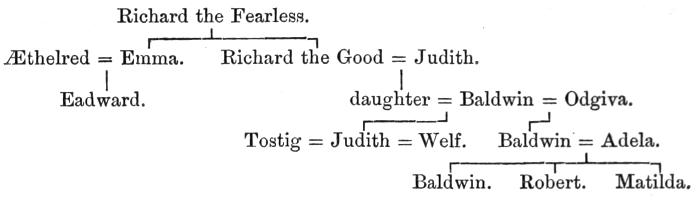
Judith would thus be, not Matilda’s sister but her aunt, an aunt however possibly younger than herself. Odgiva, the first wife of Baldwin the Bearded, died in 1031. His daughter by the Norman Princess, the child of his old age, could not be born before 1032 or 1033. Matilda, the daughter of parents married in 1027, may well have been older.
We have here, I think, another proof of the accuracy of the Biographer in matters coming within his own province, and that in a case where his statement seemed, at first sight, puzzling and suspicious. I do not however know why he calls her Fausta, or why the Brunswick picture-chronicler calls her Wichanda. Judith was an obvious name for her, being that of her maternal grandmother the wife of Duke Richard. Possibly, as Miss Yonge suggests (Christian Names, ii. 345), this Hebrew name, in its form of Jutta, may have got confounded with the Northern Gytha.
NOTE O. p. 112. The Children of William and Matilda.
About the number and order of the sons of William and Matilda there is no doubt. They were Robert, Richard, William, and Henry. There is no doubt that Richard was second in order. He is always put so in the lists, and Orderic (573 C) expressly calls him “Ricardus, filius ejus, qui post Rodbertum natus fuerat.” Sir Francis Palgrave must have been speaking hastily when (iii. 254) he called him “the fourth son.”
But about the daughters, their number, names, and order, the statements are most contradictory. I will first of all set forth the different accounts of the early writers.
659All that William of Poitiers tells us (120) is that two brother Kings of Spain sought for a daughter of William in marriage, whose name is not given, and that they greatly disputed about her. Of the promise or offer of a daughter to Harold he says nothing directly, though he alludes to it in a later passage (145).
William of Jumièges (vii. 21) only says that William had four daughters, without giving their names. His continuator (viii. 34) also enumerates four. First (“primogenita”), Cecily, Abbess of Caen. Second, Constance, wife of Alan Fergant of Britanny. Third, Adelaide [Adelidis], who was betrothed to Harold, but died unmarried (“Heraldo proditori ante bellum Anglicum sponsata, sed, illo dignâ morte mulctato, nulli nupta, virgo jam nubilis obiit”). Fourth, Adela, wife of Stephen of Blois.
Orderic gives no less than four lists. The first time (484 D) he simply gives the names of four daughters, Adeliza, Constance, Cecily, and Hadala. The second time (512 D) the number is raised to five, and the names are Agatha, Constance, Adeliza, Adela, and Cecily. The third time (573 C) he gives little biographies of four daughters. 1st, Agatha, betrothed first to Harold, then to Amfurcius [Alfonso] of Gallicia, but who died a virgin. 2nd, Adelaide [Adelidis], who lived, seemingly as a nun, under the care of Roger of Beaumont (“Adelidis pulcherrima virgo jam nubilis devotè Deo se commendavit, et sub tutelâ Rogeri de Bellomonte sancto fine quievit”). 3rd, Constance, wife of Alan Fergant [Fergannus]. 4th, Adela, wife of Stephen. The fourth time (638 D) he gives a mere list, with the same names as in the second but in a different order, Agatha, Adeliza, Constance, Adela, and Cecily. He also (511 A) says that a daughter of William, whose name he does not mention, was promised in marriage to Earl Eadwine.
William of Malmesbury (iii. 276) says expressly that William had five daughters. 1st, Cecily the Abbess, who was living when he wrote—he wrote therefore before 1126. 2nd, Constance. 3rd, Adela. Of two others he did not know the names (“duarum nomina exciderunt”), one betrothed to Harold, the second to Alfonso, but both of whom died unmarried.
Wace (9650) knows only two daughters, “Ele” and Abbess Cecily. Ele is (10821) betrothed to Harold, but afterwards married to Count Stephen.
Lastly, in Domesday (49) we find incidental mention of a daughter 660Matilda. Her chamberlain Geoffrey (“Goisfridus Camerarius filiæ Regis”) had lands in Hampshire, which he held “de Rege W. pro servitio quod fecit Mathildi ejus filiæ.” She is also mentioned in an Encyclic Letter of the Nuns of the Holy Trinity at Caen (Mabillon, Ann. Ord. Ben. v. 690) along with her mother Matilda and her sisters Adelaide and Constance, as one for whom the prayers of the faithful are asked.
Now of all these, Cecily, Constance, and Adela need give us no trouble here. The history of all three is well ascertained, and will come in its proper place. But about the others, the contradictions are great. The names Adelidis and Adeliza are doubtless the same. We have then these statements.
1. Adeliza was betrothed to Harold, but died unmarried. (Cont. Will. Gem.)
2. Adeliza died unmarried under the care of Roger of Beaumont. (Ord. Vit.)
3. Agatha was betrothed, first to Harold and then to Alfonso, but died unmarried. (Ib.)
4. A nameless daughter betrothed to Harold died unmarried. (Will. Malms.)
5. A nameless daughter betrothed to Alfonso died unmarried. (Ib.)
6. A nameless daughter was betrothed to Eadwine. (Ord. Vit.)
7. Matilda appears without a history. (Domesday.)
The first question is whether the daughter betrothed to Harold and the daughter betrothed to Alfonso are the same. Orderic stands alone in identifying them. On the whole, the balance of evidence seems to me to lie the other way. I am inclined to think that it was Adeliza who was betrothed to Harold, and that it was another daughter who was betrothed to the Spanish King. Indeed they cannot be the same, if we accept the statement which William of Malmesbury (iii. 238) puts into Harold’s mouth in the course of the messages which passed between him and William, namely that the maiden to whom he had been betrothed had died before his election to the Crown (“liberatum se sacramento asserens, quod filia ejus quam desponderat citra nubiles annos obierat”). I am sorry nevertheless to give up Orderic’s (573 C, D) very pretty story, which recalls (or reverses) the well-known ballad of the Spanish Lady’s 661Love. She had seen and loved Harold, and preferred death rather than to give herself to another and an unknown bridegroom. But there is also the difficulty of the extreme youth of any daughter of William at any time to which we can assign Harold’s visit. I cannot think, with Baron Maseres (103), that the betrothed of Harold was Cecily.
According to Wace, the Adeliza or Adelaide betrothed to Harold was the same as Adela, afterwards Countess of Chartres. The two names, both coming from the adel or æðel root, might easily be confounded, and it would not be difficult to suppose that Harold’s betrothed had been on the one hand mistaken for the betrothed of Alfonso, and on the other hand divided into two, Adela and Adeliza. But all the other accounts seem pointedly to distinguish between Adela and the betrothed of Harold, whether she were called Adeliza or not.
I need not discuss the theory according to which Mr. Blaauw and Mr. Thorpe (Lappenberg, Norman Kings, 215) identify the Matilda of Domesday with Gundrada; but a view put forth by Mrs. Green (Princesses, i. 16, 407), who has gone minutely into the matter, is better worth examining. She holds that Matilda and Agatha are the same, that the name of Agatha is a mistake of Orderic, that this is the daughter who was betrothed to Eadwine, and that the story of her attachment to Harold arose from confounding one English lover with another. Again, by gaining the three or four years between the visit of Harold and the betrothal to Eadwine, the difficulty as to age is got over. Mrs. Green’s suggestion is at least ingenious. I have little doubt, as I shall show in my next volume, that the daughter who was betrothed to Eadwine is the same as the daughter who was betrothed to Alfonso. But I do not see the evidence for calling her Matilda.
Abbot Baldric, in his verses addressed to Abbess Cecily (Duchèsne, Rer. Franc, iv. 274), speaks of a sister of the Abbess, who was, in some unexplained way, connected both with Bayeux and with Angers. Mrs. Green identifies her also with Matilda. The lines are,
“Audivi quamdam te detinuisse sororem,
Cujus fama meas aliquando perculit aures.
Nomen it elapsum, vidisse tamen reminiscor.
Baiocensis erat, sed tunc erat Andegavensis,
Quam, tibi si placeat, nostrâ de parte saluta,
Atque mihi nomen rescribe tuumque suumque.”
662As both Abbot Baldric and William of Malmesbury found it impossible to remember the names of William’s daughters, I may perhaps be forgiven if I leave the name of the betrothed of Harold undetermined.
NOTE P. p. 116. The Revolt of William Busac.
There is a good deal of obscurity about William Busac and his revolt. The story is told by no one except William of Jumièges (vii. 20); and, as he seems to put it instead of the far better known story of the revolt of William of Arques, which he tells out of its place (vii. 7), one is tempted to suppose that he has fallen into some confusion between the two revolts and the two Williams. But he tells his tale so clearly and straightforwardly that it is hardly possible to doubt it, unless it can be shown distinctly to contradict some better ascertained piece of history.
The father and brothers of William Busac, as described by William of Jumièges, are all well ascertained persons. But William expresses himself inaccurately when he says (vii. 20) that Count William of Eu was an “uterinus frater” of Richard the Good. He must here use the word “uterinus” vaguely in the sense of illegitimate; for an “uterinus frater,” strictly speaking, of Richard the Good would mean, not a natural son of Richard the Fearless, but a son of Gunnor by some father other than Richard. The only question is as to the time when Count William obtained the grant of Eu, and whether it was granted by his half-brother Richard the Good or by his great-nephew Duke William. The following passages may be referred to on this point, which does not greatly concern my history. Will. Gem. iv. 18, vii. 2, viii. 37; Stapleton, i. lvi.; Roman de Rou, 6123–6215, where a romantic story is told, which is followed by Le Bœuf, Ville d’Eu, p. 28; and Palgrave, iii. 45.
The strange thing is that in none of these accounts is there any mention of William Busac as a son of Count William, though there is of his brothers Robert and Hugh. Still it seems hardly possible wholly to reject William’s existence and his investiture with the County of Soissons, which is so clearly asserted by William of Jumièges, and which, from the further details given in the 663Art de Vérifier les Dates, must, I conceive, rest on other authorities which I have not at hand. The chief difficulty in the story itself is that it seems to be implied throughout that the castle of Eu was in the possession of William Busac at the time of his revolt. If William of Jumièges did not so distinctly make William Busac the second brother—“horum medius” between Robert and Hugh—I should have been inclined to think that William Busac was the eldest brother, that he inherited the County, and that Robert succeeded to it on William’s exile. But this view seems forbidden by the words “horum medius;” and we also find Robert’s name with the title of “Comes de Ou” attached to a charter drawn up “tempore quo discordia cœpit inter ipsum [Comitem Willelmum] et Henricum Regem Francorum.” (Cart. de Saint Bertin, Paris, 1840, p. 426. The signature of “Willelmus de Ou,” attached to an earlier charter on the same page, belongs of course to the elder William.) We must suppose then that William Busac contrived to occupy his brother’s castle by some underhand means and to defend it against the Duke.
In accepting the account of this revolt given by William of Jumièges I do not profess to fix its exact date, or to add any details beyond such as are found in his narrative. From the point at which he introduces the story, it would seem to have happened between the affair of William the Warling and the marriage of Duke William, that is, between 1048 and 1053. But, as William of Jumièges puts the courtship and marriage of William together as if there had been no delay between them (see above, p. 85), it is quite possible that he means to fix the revolt to 1049 or thereabouts. At any rate, the place which I have given to it in my narrative seemed to me the natural one for it, as it is the beginning of a series of events which is carried on in the more famous revolt of William of Arques, namely insurrections in Normandy abetted by the King of the French.
The way in which the story of William Busac is treated by modern writers is curious. See Licquet, ii. 126; La Butte, Histoire des Ducs de Normandie, i. 246, 249; and the local historian of Eu, M. Le Bœuf, p. 30. A still more amazing account will be found in Mr. Roscoe’s Life of William the Conqueror, p. 89, for which it would be well to give some more definite authority than 664“Walsingham; Wace; Chron. Sax.; Chron. de Nor.; W. Malms.; Mazeres.”
But the aberrations of smaller writers will not seem wonderful, when we read the strange and contradictory statements made by Sir Francis Palgrave, which I feel sure would not have been found in any but a posthumous work of that great scholar. He first (p. 50) tells us of Count Robert and his services at Mortemer, and of “Robert’s son William (in France called William Busac) enriched, like his father, by the spoils of the Anglo-Saxon, and, who came to a fearful end.” William Busac is here confounded with his nephew William “de Owe,” son of Count Robert, who was blinded and mutilated by William Rufus in 1096 (see Flor. Wig. in anno, and Palgrave, iv. 420). In a later passage (iii. 224) we read, “William, surnamed Busac, second son of William, Count of Arques, now revolted against the Duke.” If Sir Francis had written or dictated in Latin, I should have thought that “Arcensis” had been substituted for “Aucensis,” by the same editorial process which took “Lagam Regis Eadwardi” to be a misprint for “legem.”
William was succeeded in the County of Soissons by his sons John and Reginald, after whom the County passed to the descendants of his daughter Ramentrude, wife of Ivo of Nesle. Another son, Manasses, was in 1092 chosen Bishop of Cambray by the citizens in opposition to the clergy, and was translated to Soissons in 1103 (see Gest. Epp. Cam. Pertz, vii. 504).
NOTE Q. p. 120. The Revolt of William of Arques.
There is a singular difference among our authorities as to the date of the revolt of Count William of Arques. William of Poitiers, Orderic, and William of Malmesbury put it at the point where I have put it in the text. But in William of Jumièges and Wace it comes much earlier, immediately after Duke William’s recovery of Falaise from Thurstan Goz (see vol. ii. p. 206), some 665years earlier than the battle of Val-ès-dunes. There is no doubt that the later date is the right one. In the narrative of William of Poitiers, the story comes in in what is evidently its natural order, immediately before the French invasion of 1054. The personal action of the Duke himself, now evidently in full maturity, seems inconsistent with the earlier date, as does also the prominent position of Guy-Geoffrey of Poitiers, who in 1044 (see vol. ii. p. 595) was “parvulus.” The story is also fixed to 1053 by the death of Ingelram of Ponthieu and the succession of his brother Guy. See Art de Vérifier les Dates, ii. 752. At the earlier date the elder Ingelram was reigning.
Besides this difference in date, the narratives of William of Poitiers and of Wace differ a good deal in the order of events, though I do not see any further contradiction between the two versions. I have therefore, while forming my narrative mainly on that of William of Poitiers, not scrupled to bring in some touches of detail from Wace which seemed to bear marks of authenticity.
In the order which I have followed, Duke William requires his uncle to surrender his castle, and he himself puts a garrison in it. The garrison then restore the castle to William of Arques, who openly revolts. Duke William hears the news at Valognes, he hastens to Arques, meets a party of loyalists from Rouen, fights a party of the rebels before the gates of the castle, and then blockades it. He then leaves the blockading force under Walter Giffard. King Henry comes to help William of Arques, and he falls into an ambush, where Count Ingelram is slain and Hugh Bardulf taken prisoner. The King retires; the Duke returns; William of Arques surrenders the castle, and the other posts in Normandy held by the French are surrendered also.
The accounts in William of Jumièges and in Wace leave out the occupation of the castle by the Duke and its betrayal to the Count of Arques. They say that the Duke, suspecting his uncle, summoned him to his presence, which summons he declined to obey, and openly rebelled (“Quem Dux à suâ vesaniâ nitens avellere, ad exhibendum sibi obsequium per legatos jussit eum venire. Sed ille hujusmodi legationem habens contemptui, magnâ cum fiduciâ ad resistendum se munivit et armavit.” Will. Gem. vii. 7). Wace transfers the hasty ride from the Côtentin from the first to the second appearance of Duke William before Arques. William of Poitiers 666again makes William reach Arques with six followers, all the others who had started from Valognes having failed to keep up with his pace. He there meets the reinforcement of three hundred from Rouen. Wace makes him reach Arques absolutely alone (v. 8699);
“Tute sa gente s’en merveilla
Ke de si luing si tost vint là:
Nuls ne s’en pot à li tenir,
Ne nuls ne pot o li venir,
De cels qui à Valuignes furent
E de Valuignes od li s’esmurent.”
This is an evident exaggeration, adapted to the new order of events. Had William reached Arques absolutely alone, in the state of things conceived by William of Poitiers, he must have fallen into the hands of his enemies. But, while Wace transposes the two marches of William, Orderic (657 B) rolls the two into one. In his story William’s first appearance comes after King Henry and Count Ingelram have entered the country. He hears of them at Valognes; he sends on a picked force, and then follows himself with his main army. The former (“præcursores mei”) meet Ingelram, and defeat and kill him before William reaches Arques at all. But though I think that Wace has transposed the order of events, I have not scrupled to draw several details of the ride from him, and to accept Valognes as the starting-point. The other writers only mention the Côtentin generally. It is of course possible that Wace may have been thinking of William’s former ride from Valognes (see vol. ii. p. 247), where also the mention of Valognes is peculiar to himself. But, if William was likely to be there at one time, he was likely to be there at another.
The mention of Saint Aubin as the place of the ambush also comes from William of Jumièges, followed by Wace. (I am sorry that, when I was at Arques, I omitted to explore the spot.) I have ventured to connect this mention of Saint Aubin with that which Orderic gives (606 B, C) of Richard of Hugleville’s resistance at Saint Aubin. This comes in a genealogical passage where the campaign of Arques is spoken of only incidentally, and seems to me to be a case of quite independent testimony coinciding.
667
NOTE R. p. 217. The Bequest of Eadward to William and the Oath of Harold.
The oath which, as William alleged, Harold had sworn to him, and the bequest which, as he also alleged, Eadward had made in his favour, are two subjects every detail of which is enveloped in controversy and contradiction, and two subjects moreover which cannot be kept apart from one another. I have, both in the text and elsewhere, set forth more than once what I believe to be the true history. I will now go more minutely through all the evidence which we have bearing on the matter.
I. As I have already said (see above, p. 219), there are three statements as to the object of Harold’s visit to Normandy. And two out of these statements imply different versions of the alleged bequest of Eadward to William. I have stated their substance in the text; I will now go through the evidence for and against them.
1. The first version is that of William of Poitiers. He mentions the matter twice, first in his narrative of Harold’s visit (107 et seqq.), secondly, in the account of the messages sent by William to Harold (129–30). According to this statement (129), Eadward chose William as his heir, on account of his many excellences (“quoniam omnium qui genus suum attingerent me credebat excellentissimum, qui optimè valerem vel ei, quamdiu viveret, subvenire, vel posteaquam decederet, regnum gubernare”) and as a return for the kindness which he had received from William and his predecessors during his sojourn in Normandy (“ob maximos honores et plurima beneficia quæ illi atque fratri suo, necnon hominibus eorum, ego et majores mei impendimus”). This devise of the Crown was apparently made by a decree of the Witan; at any rate it was made by the advice, and confirmed by the oaths, of Archbishop Stigand and of the three great Earls, Godwine, Leofric, and Siward (“sanè neque id absque suorum optimatum consensu, verùm consilio Stigandi Archiepiscopi, Godwini Comitis, Leurici Comitis, Sigardi Comitis”). These great leaders all agreed to accept William as Eadward’s successor on his death, and meanwhile, as the passage seems to mean, to set up no other candidate against him (“qui etiam jurejurando suis manibus confirmaverunt, quod post Edwardi decessum me reciperent dominum, nec ullatenus peterent in vitâ illius patriam hanc ullo impedimento contra me 668occupari”). A son and a grandson of Godwine were given by Eadward as hostages for this engagement (“obsides mihi dedit Godwini filium ac nepotem,” 130; so again, 107, “Heraldus ... cujus antea frater et fratuelis obsides fuerant accepti de successione eâdem”—Willelmi sc.). As Eadward found himself near death—it might have been added, now that the three Earls who had confirmed the devise were all dead—the King thought it good to bind Harold by the same oath which had been formerly taken by his father, with the further security that it should be taken in William’s presence, while Godwine and the rest had, on the former occasion, only bound themselves to him in his absence (“ut quod pater ejus atque cæteri supranominati hic [in England] mihi juravere absenti, is ibi [in Normandy] præsens juaret præsenti”). Eadward also, it would seem, wished to give William, before his death, a further confirmation in his own name (“graviore quam fuerat cautum pignore cavit.” 107). The importance of binding Harold to the proposed succession is strongly set forth. He alone could influence or constrain the English people, who, it is implied, were very likely to disturb the arrangement (“et eum [Haraldum] quidem prudentissimè [destinavit], ut ipsius opes et auctoritas totius Anglicæ gentis dissensum coercerent, si rem novare mallent perfidâ mobilitate, quantâ sese agunt”). Harold is therefore sent on this errand; he falls into the hands of Guy and is rescued by William, as I have described in the text. He makes his oath to William—its terms I shall discuss at a later stage of this note—and William looks on him as one who will most effectually win over the English to his cause (“quem inter se et Anglos, quibus à Rege secundus erat, mediatorem sperabat fidissimum.” 108).
This is the full account given by the contemporary panegyrist of William. Two things are to be noticed in it, as important admissions made by an enemy. First, the loyalty of Harold to Eadward, and the full friendship and confidence which existed between the King and the Earl, are implied throughout, in distinct contradiction of one form of Norman calumny. Secondly, there is throughout a recognition of the English people as a party likely to claim a voice in the matter, and one whose voice, it is expected, will not be given on behalf of William. The epithets of abuse which the Norman panegyrist hurls at the heads of the English nation are in truth a speaking witness to the popular character of the ancient English government.
669William of Jumièges (vii. 31) tells essentially the same story. He says nothing about the counsel and the oaths of Stigand and the three Earls, but he tells us that Eadward, finding himself childless (“disponente Deo successione prolis carens”), sent Archbishop Robert to announce to William his intention of making him his heir (“olim miserat Willelmo Duci Rodbertum Cantuariorum Archipræsulem, ex regno a Deo sibi attributo illum statuens hæredem”). Afterwards he sends Harold, the most powerful Earl in his Kingdom, to confirm the bequest by oath, and to plight his own faith to the Duke (“deinde Heraldum cunctorum suæ dominationis Comitem divitiis et honore ac potentiâ maximum Duci destinavit, ut ei de coronâ suâ fidelitatem faceret, ac Christiano more sacramentis firmaret”). The story then goes on as before.
Orderic (492 A) tells the same story as William of Jumièges, with the addition that the devise in favour of Duke William was made with the consent of the English nation. “Eduardus nimirùm propinquo suo Willelmo Duci Normannorum, primò per Rodbertum Cantuariorum summum Pontificem, postea per eumdem Heraldum, integram Anglici regni mandaverat concessionem, ipsumque, concedentibus Anglis, fecerat totius juris sui hæredem.”
Benoît (36498 et seqq.) follows William of Jumièges, except that he does not give the name of the Archbishop, and that he seems to imply that the mission of the Archbishop and the mission of Harold happened in two consecutive years.
“L’arcevesque de Cantorbire,
Li plus hauz hom de son empire,
Out en Normendie tramis,
Les anz avant, si cum je vus dis,
Por afermer ce qu’il li done
Tot le reaume e la corone.”
(vv. 36508–36513.)
It is really needless to refute this story. Some remarks on the tale will be found in Lord Lyttelton (Henry the Second, i. 351 et seqq.) and Baron Maseres (pp. 74 et seqq., 113 et seqq.) which are far above the average criticism of their age. Both writers are hampered throughout by the supposed necessity of accepting, or at least of attaching some weight to, the accounts of the false Ingulf; otherwise their line of argument is of a high order. There are also some good remarks of Lord Lytton’s in a note to his “Harold” (iii. 385), though I cannot conceive what he means by saying (iii. 386) that “the Saxon chroniclers ... unite in relating Edward’s 670warnings to Harold against his visit to the Norman court.” The “Saxon” Chronicles, I need hardly repeat, are altogether silent on the matter.
No one, I think, who goes carefully through the whole circumstances of the tale as told by William of Poitiers, will hesitate to say, with Baron Maseres, “there is reason to think it is absolutely false,” or, with Lord Lytton, “this appears a fable wholly without foundation.” Here is a purely English matter, an act of the English Witan, a deed confirmed by the greatest men of the Church and State of England, which rests solely on the assertion of an interested Norman writer, and of which no English Chronicle or cartulary has preserved the slightest trace. To make us believe that Leofric, that Siward, that Stigand, that Godwine, that the whole English people, agreed to the succession of William, we should need no evidence short of the document bearing their signatures, strengthened by an entry in the Chronicles to show that the document might possibly be genuine. No statement was ever weighed down by a heavier burthen of internal improbability. An act done when Stigand was Archbishop and when Godwine and the other Earls were still living, must belong to the few months between the appointment of Stigand to the Archbishopric at the Mickle Gemót of September, 1052 and the death of Godwine at Easter, 1053. It will not do to say that the title “Archiepiscopi” is simply descriptive of the person, and that the act might have been done at a time when Stigand had not yet reached the archiepiscopal rank (cf. vol. ii. p. 420). For Stigand and the three Earls are clearly mentioned as being the four greatest men in the Kingdom, which of course would not be the case at a time when Stigand was only a presbyter, or even the Bishop of an inferior see. The devise then, if it was ever made at all, could have been made only within those few months. And, except in those later years when Harold’s succession seems to have been looked upon as a settled thing (see vol. ii. p. 634), no time can be found so unlikely as those few months for any act in favour of William. No wilder assertion was ever made than that which represents the Witan of England, with Godwine at their head, as agreeing to, and even advising, the succession of the Norman Duke to the English Crown at the very moment of their great triumph over Norman favourites and Norman influence in England.
So much for William of Poitiers. William of Jumièges and 671Orderic, who evidently follows him, do not greatly mend matters by leaving out Stigand and the Earls, and seemingly putting Stigand’s predecessor Robert in his stead. Archbishop Robert is made to cross from England into Normandy. They doubtless had in their minds the time when Robert really did cross from England into Normandy. But that perilous passage was not made on the King’s errand or on any errand at all; it was the hurried flight of a public enemy, hastening to save himself from the vengeance of the English people (see vol. ii. p. 331). The story as regards Stigand, Godwine, Leofric, and Siward is manifestly impossible; it is no less impossible as regards Harold. We have already seen that during the whole time that Harold answered the description given of him by the Norman writers as the richest and most powerful Earl in England, the succession was, practically if not formally, determined in favour, first of the Ætheling Eadward and then of Harold himself. The tale that Eadward sent Harold, or that Harold consented to go, on an errand which shut out himself and every other Englishman from all hope of succession to the Crown, is simply absurd and impossible.
2. The second version, that in which Harold goes, not to guarantee the succession to William, but to bring back the supposed hostages, his brother and nephew, involves quite another view of the alleged bequest to William. In this account, there is no mention of any formal act of the Witan, none of any oaths of Bishops and Earls, none even of any act of the King himself, after he became King. It comes out incidentally that Eadward is said to have, years before, privately promised the Crown to William. And the only evidence for this private conversation between Eadward and William is another alleged private conversation between William and Harold. Yet this story is, as I have before said (see vol. ii. p. 302), less grotesquely absurd than the former one, and it rests on better authority. It is the version followed by two most valuable English writers of the next generation, namely Eadmer and Simeon of Durham. The narrative of Simeon, we cannot doubt, was borrowed from the narrative of Eadmer, whose exact words he follows through a great part of the story. And the appearance of the story at all in Simeon’s History is remarkable. Simeon had copied from Florence, with the change or addition of two or three words only, the narrative of the election of Harold, of the two invasions, of the two battles, of the death of Harold and the coronation of William. 672It then perhaps occurred to him that Florence’s narrative contained no statement whatever of any motive for William’s invasion. Simeon therefore (1066) starts as it were afresh, with the introduction, “Ut autem sciatur origo caussae quâ Willelmus Angliam bello appetiit, breviter quæ paullò ante gesta sunt repetantur.” He then goes on to the same effect as Eadmer. The hostages, Wulfnoth and Hakon (“Wlnothus filius Godwini et Hacun filius Suani filii sui”), are given by Godwine to Eadward at their reconciliation, and they are given by Eadward to Duke William for safe-keeping. Some time after Godwine’s death, Harold, now in possession of his father’s Earldom (“Godwinus ... malâ morte”—Eadmer, 4. Simeon says only “quum esset mortuus”—“post breve tempus interiit, et Haraldus filius ejus comitatum Cantiæ patri succedens obtinuit. Is, elapso modico tempore,” &c.), asks leave of the King to go over to Normandy and bring back the hostages. Eadward says that he may go, but warns him against going. He is sure that, if he goes, some harm and shame will happen to him and to England. He knows Duke William well enough to be sure that he will never let the hostages go, unless he can get some gain by so doing (“Hoc non fiet per me; verumtamen ne videar te velle impedire, permitto ut eas quo vis ac experiare quid possis. Præsentio tamen te in nihil aliud tendere nisi in detrimentum totius Anglici regni et opprobrium tui. Nec enim ita novi Comitem mentis expertem ut eos aliquatenus velit concedere tibi si non præscierit in hoc magnum proficuum sui”). Harold however thinks himself wiser than the King (“suo quam Regis consilio credens”), and sets out. He is shipwrecked, imprisoned by Guy (“pro ritu loci, captivitati addicitur”), and delivered and honourably received by William. He presently sets forth to the Duke the cause of his journey. William tells him that it will be his own fault if the matter does not turn out well (“bene quidem rem processuram si in ipso non remaneret”). After a few days, the Duke sets forth his own mind to the Englishman. When he and Eadward were living together as youths in Normandy, Eadward promised him that, if he should ever obtain the Crown of England, he would make it over to him as his heir (“Regem Edwardum, quando secum juvene olim juvenis in Normanniâ demoraretur, sibi, interpositâ fide suâ pollicitum fuisse, quia, si Rex Angliæ foret, jus regni in illum jure hæreditario post se transferret”). If Harold would swear to support this disposal of the Crown, and would bind himself by other engagements 673which I shall presently discuss, Hakon should be released at once and Wulfnoth as soon as William had mounted the English throne (“tunc et modò nepotem tuum, et quum in Angliam regnaturus venero, fratrem tuum incolumem recipies”). Harold, feeling himself in a strait from which he knows not how to escape, swears to all that was required of him (“sensit Haraldus in his periculum undique, nec intellexit quà evaderet, nisi in omnibus istis voluntati Willelmi adquiesceret. Adquievit itaque” &c.). He returns to England with Hakon, and tells the whole story to Eadward, who reminds him of his own warning (“nonne dixi tibi, ait, me Willelmum nôsse, et in illo itinere tuo plurima mala huic regno contingere posse”). Eadward soon afterwards dies, and Harold, according to Eadward’s own wishes, succeeds him. See above, p. 586.
I have already (see above, p. 219, and vol. ii. p. 302) made some remarks on this story, a story which is plainly of English invention. Eadward’s intentions in favour of William are cut down to a rash promise in his youth, of which no one seems to know anything except Eadward and William themselves. Eadward’s present intentions are plainly in favour of Harold, and perfect confidence and cordiality are implied as reigning between the King and the Earl. But, as I have already said, this view of Eadward’s promise will not stand the test of chronology. There was no time when Eadward and William lived together as youths of equal age. When Eadward left Normandy in 1041, William was thirteen or fourteen years old, Eadward perhaps thirty-eight. A private promise of this kind seems most unlikely to have happened between them, though, as I have already said (see vol. ii. p. 523), William’s counsellors may have been already reckoning the chances of William’s succession. The story of Wulfnoth and Hakon being given as hostages for Godwine’s good behaviour on Godwine’s triumphant return is quite inconsistent (see above, p. 221) with the true narrative of that return. Still less can we accept the story of William of Poitiers (see above, p. 668) that Wulfnoth and Hakon were given as hostages, not for Godwine’s good behaviour towards Eadward, but for the carrying out of the imaginary act of the English Witan in favour of William. My own belief is that there were no English hostages at all in the hands of William at the time when Harold came into Normandy. But I think it is 674not hard to see how the story of the hostages arose. It is certain that Wulfnoth was kept as a prisoner by William, and that his imprisonment began early in life. William, on his death-bed (see Florence, 1087), set free various prisoners, both English and Norman, and among them “Wlnothum Regis Haroldi germanum, quern a pueritiâ tenuerat in custodiâ.” This of course might only mean that Wulfnoth was imprisoned after William’s coming to England, as must have been the case with Harold’s son Wulf, whom Florence speaks of directly after. But it is also quite consistent with the statement that he was left behind as a hostage by Harold. That he was so left is affirmed by Eadmer and Simeon in the passage just quoted. It is also implied by William of Poitiers, when he says (111) that, of his two supposed hostages, one, namely Hakon, was allowed to return with his uncle (“quinetiam fratruelis ejus, alter obses, cum ipso redux propter ipsum redditus est”). But moreover William of Jumièges, who says nothing about Hakon or about any earlier giving of hostages, says (vii. 31) that Wulfnoth was left as a hostage; “Postremò ipsum [Heraldum] cum multis muneribus Regi remisit [Willelmus], et pulcrum adolescentem Wlnotum fratrem ejus obsidem retinuit.” In this he is followed by Benoît (36640);
“Heraut out un frere danzel,
Que n’estoveit querre plus bel;
Vuilnoth out non, corteis e sage;
Cel laissa au Duc en ostage.”
One would certainly understand this as meaning that Wulfnoth had accompanied Harold on his voyage and that he was left by him as a hostage for his own good faith. Why should not this have been the case? If, as I have suggested, Harold was accompanied on his voyage by both Wulfnoth and Hakon, if he brought Hakon back and left Wulfnoth behind as a hostage, one can easily see how the story arose about Hakon and Wulfnoth having both originally been hostages. The Norman version would represent them, as William of Poitiers does, as hostages given for William’s succession to the Crown. English writers, knowing that this at least never happened, would find some more possible occasion for the handing over of a son and a grandson of Godwine to the keeping of the Norman Duke. Such an occasion would be found in the reconciliation between Godwine and Eadward. The interchange of hostages is mentioned more than once in the course of 675the story, so that the notion that hostages were given by Godwine at the final conclusion of peace, though an unfounded idea, was not an unnatural one.
These then are the two views, according to both of which Harold is made to set out for Normandy with some settled purpose, either to confirm the bequest of the Crown to William or to obtain the release of his brother and nephew. The two accounts are utterly contradictory to one another, and I do not think that either will stand the test of criticism. But before I go on to the third version, I must mention the accounts given in the Roman de Rou and in the Tapestry. Honest Wace, after his manner, knowing that there were two or three stories, allows his readers to choose between them. He first tells the story of Godwine’s return, according to his notion of it. Godwine is in banishment, and the King will not let him come back unless he gives hostages for his good behaviour. He sends his son and grandson, whom Eadward sends over to William, and Godwine then returns.
“Goigne ne l’osa néer;
Tant por li Reis asséurer,
Tant por sez parenz maintenir,
Tant por sez homes garantir,
Un soen nevo et un soen filz,
K’il aveit ensemble norriz,
A en ostage el Rei bailliez.
E li Reis les a envéiez
Al Duc Willame en Normendie
Come à cil ù mult se fie:
Mandé li a k’il les gart tant
Ke il méisme li demant.”
(vv. 10579–10590.)
He then adds the significant remark, which seems to show that he had the version of William of Poitiers and William of Jumièges in his eye, that this looked very much as if Eadward intended the hostages who were nominally given for the good behaviour of Godwine to act practically as hostages for the succession of William.
“Ço fut semblant k’il voulsist
Ke toz tems cil les retenist,
Ço distrent genz, ke il péust
Sun regne aveir s’il ainz morust.”
(vv. 10591–10594.)
He then goes on to describe Godwine’s death (see vol. ii. p. 612), Eadward’s vow of pilgrimage, the foundation of Westminster, and Eadward’s intention to bequeath his Crown to William, which last he describes in language which is evidently taken from the statement put into William’s own mouth by William of Poitiers (129; see above, p. 667). He then gives a description of Harold, on 676whose virtues, power, and favour with the King he becomes somewhat eloquent, and fully realizes his position as the practical ruler of the whole kingdom.
“En la terre out un senescal
Heraut out nom, noble vassal;
Por sun pris è por sa bunté
Out el regne grant poesté,
Li plus fort hom fu del païs
Fort fu d’homes, fort fu d’amis,
Engleterre out en sa baillie
Com home ki a senechaucie.”
(vv. 10709–10716.)
So directly after;
“Héraut fu ben de son seignior,
Ki à feme aveit sa seror.”
(vv. 10725–10726.)
The story then goes on in much the same shape as in Eadmer. Harold’s wish to release the hostages and the warnings of Eadward are given in much the same way, with the further piece of advice from the King, that, if Harold wishes for the hostages, he should send some other messenger and not go himself. Wace then adds that he has also read another story, that namely of William of Poitiers and William of Jumièges, and that he does not profess to know which is the true one.
“Issi l’ai jo trové escrit,
Et un altre livre me dist
Ke li Reis li rova aler
Por li réalme asséurer
Al Duc Willame sun cosin,
Ke il l’éust emprez sa fin;
Ne sai mie ceste achoisin,
Mais l’un è l’altre escrit trovon.”
(vv. 10741–10748.)
So much for Wace. The Tapestry plainly shows (pl. 1) an interview between Eadward and Harold before Harold sets sail from Bosham, and another interview (pl. 7) after Harold’s return. Of these two scenes the earlier must be interpreted by the later. In that scene Harold is represented as recounting his adventures to the King with a very strange look and strange gestures, quite different from anything shown in the first interview. But Dr. Bruce’s imagination surely carries him a little too far when he says (p. 27) that “Harold comes into the presence of the Confessor like a guilty person, deploring his misdeeds and craving pardon. An axe, carried by an attendant on the left of the King, is turned towards him, apparently betokening that he has committed an offence worthy of death. The King is evidently reproving him sharply, but the attendant on the right of the King having the edge of his axe turned away from 677Harold, shows that the result of the interview was a pardon.” Unluckily for this ingenious theory, one of the persons who in this very plate offer the Crown to Harold carries an axe with its edge no less threateningly turned towards the person of the King-elect. Still there is no doubt that Harold enters the King’s presence with the air of one who is by no means proud of the success of his errand. His neck is stretched out in a most amazing fashion, and the whole expression is that of one whose position is exceedingly awkward. This seems to me to fit in exactly with the version of Eadmer, and I do not see how it can be made to fit in with the version of William of Poitiers. According to that version, Harold had done nothing to be afraid or ashamed of. He had simply pledged himself in a solemn way to carry out the King’s intentions. But, on Eadmer’s view of the matter, he had utterly failed, except so far as he had brought back Hakon; he had involved himself and his country in great danger, and he must have gone to the King with the unpleasant feeling that one so much his intellectual inferior had for once proved wiser than himself. This seems to me to be plainly enough expressed in the representation of the second interview in the Tapestry; I therefore accept the Tapestry as, so far, a witness in favour of Eadmer’s version, or at least in favour of some version according to which Harold went into Normandy on an errand which failed. A certain amount of confirmation is thus given to Eadmer’s statement, but I can hardly think that it is enough to counterbalance its inherent improbability in other respects.
3. I now come to the third version, that which makes Harold’s presence in Normandy wholly the result of accident. William of Malmesbury was fully aware of the version of William of Poitiers. He (ii. 228) distinctly refers to it (“ferunt quidam ipsum Haroldum a Rege in hoc”—namely to announce to William the bequest of Eadward—“Normanniam missum”), but he deliberately rejects it. The story which he prefers as nearer to the truth (“quia propius vero videtur”), and as told by those who were better informed (“alii secretioris consilii conscii”), represented Harold’s presence in Normandy or in any part of Gaul as simply caused by his being carried thither by stress of weather (“invitum, venti violentiâ illuc actum”). He set out from Bosham purely on a voyage 678of pleasure and for the purpose of fishing (“ut animum oblectaret suum, piscatorium conscendit navigium”). Some cause or other led him to venture to an unusual distance from land (“interim quidem longiusculo ludo in altum proceditur”), and a storm drove him to the coast of Ponthieu. According to Henry of Huntingdon, Harold was not thus merely yachting, but was going, for some cause which is not mentioned, to Flanders (“Haraldus verò transiens in Flandriam tempestate compulsus est in Ponticam provinciam,” M. H. B. 760 E). Matthew Paris (p. 1), whom I shall again have to quote, tells the tale in what, for my purpose, is the same way. Harold, still a young man, but looking forward to the Crown (“dum adhuc juvenis esset, adspirans ad regnum Angliæ”), is sailing about, and is driven by the winds to a land which he takes to be Flanders, but which proves to be Ponthieu (“sponte spatiatus, navigando raptus est vi ventorum, et dum Flandriam credidit se attigisse, compulsus venit in Pontinam provinciam”). Snorro (Johnstone, 190; Laing, iii. 75) makes Harold to have been sailing, not to Flanders, but to Wales. He seemingly looks on the voyage as part of Harold’s warfare against Gruffydd. A storm drives his ships, not to Ponthieu, but to the coast of Normandy (“þat var á eino sumri, at Haralldr Gudinason átti ferd til Brettlandz, oc fór á skipi, enn er þeir komo í hafit, þá tók þá andvidri, oc rák út í haf. Þeir tóko land vestr í Nordmandi, oc höfdo fengit storm mann-hættan”). These accounts seem independent, and of course they cannot be reconciled in detail. The important point which they have in common is that they all represent Harold’s presence in Normandy as unintentional. He is not going thither on any errand either of his own or of the King’s; he is carried either directly to Normandy, or first to Ponthieu, by a storm. If this were the true tradition, we can easily understand that various versions would soon arise as to the direction and object of his journey. Snorro’s notion, for instance, of a voyage into Wales is hardly consistent with the remarkable agreement of several versions that it was from Bosham that Harold set sail. But it is of little moment whether he was sailing to Wales or Flanders or nowhere in particular, provided he was not purposely sailing to Normandy. And that this story is the right one will, I think, appear, if we consider the way in which tales grow. They improve, they add details, they give new and fuller reasons for everything; 679but they seldom lop off. The fact of Harold’s presence in Normandy would call forth a thousand conjectures and speculations as to the cause of his being there. The purely negative version, which said that all these speculations were at fault, which asserted that Harold’s presence in Normandy was a mere accident, is, of all the versions, that which least bears the impress of legendary invention or adornment.
This general position is not affected by William of Malmesbury’s evident attempt to reconcile this version with that of William of Poitiers. Harold, in Guy’s dungeon, begins to devise some means of escape (“astuto pectore volvens casûs remedium”). It seems to be taken for granted that such means could come only through the help of the Duke of the Normans. He accordingly sends a man won over by great promises (“hominem promissis ingentibus sollicitatum”) with a message to Duke William. It is hard to see how a prisoner who was kept not only in ward but in fetters could have had the chance of winning over any one in this way, unless indeed the man so won over were one of his own keepers. The message is to the effect that Harold has been sent by Eadward to confirm in a more solemn way the King’s intentions in favour of William. It is assumed that Eadward had made such a disposition (see vol. ii. p. 371), and that it had been made known to William by messengers of inferior dignity; it is only the character of an ambassador which Harold is made falsely to assume for the nonce (“missum se Normanniam a Rege, ut quod minores nuntii balbutierant ipse potissimùm suâ confirmaret præsentiâ”). So Matthew Paris makes Harold falsely pretend that he was coming on an errand to the Duke’s Court, though he gives that errand a different turn from that which it takes in William of Malmesbury, one which I shall have to discuss hereafter. This is a most awkwardly devised story, even as a story, and it is of course inconsistent with the evidence by which I have shown that no disposition in William’s favour at this time can be admitted. It can only be an attempt to piece together the two versions, that of Harold’s embassy and that of his accidental presence in Normandy. He was not really an ambassador, but he pretended to be one. The attempt at joining the two stories was an awkward one, but perhaps no other attempt could have succeeded better.
The two other writers who follow a version essentially the same 680as that of William of Malmesbury, namely Snorro and Henry of Huntingdon, give no details of Harold’s deliverance from his prison in Ponthieu. Snorro leaves out the sojourn in Ponthieu altogether, and Henry only says, “quem [Haraldum] captum Consul Ponticus Willielmo Duci Normanniæ reddidit.” So Matthew Paris, making the act still more voluntary on Guy’s part, says, “quem captum Consul Ponticus Willielmo Normannorum Duci præsentavit.” Snorro, as I have said in the text, gives some curious details of Harold’s sojourn at Rouen; he also makes him get there in the summer, stay through the winter, and go back to England in the spring.
II. It will be seen that two distinct views as to the devise of the Crown in favour of William are involved in the first two of these three versions. According to one of them, the bequest was simply a private promise made by Eadward, when he was not yet King, that, if he ever should become King, William should succeed him. This is in itself not impossible, though it is not possible in the particular shape in which it is told us, namely as the promise of one young man to another young man. It is hardly necessary to show that such a promise as this could have no kind of force, according to the laws of England or of any other kingdom. According to the other story, the devise of the Crown took the form of an Act of Settlement, of a regular vote of the King and his Witan, confirmed by the signatures and the oaths of the four greatest men in the land. Such an act would doubtless have been valid, and it would have given William as good a claim as George the First. At the same time it must not be forgotten that all such attempts at an election before the vacancy seem to have been unpopular, and that they were very seldom carried out in practice (see vol. i. pp. 118, 533). But beyond the assertion of William’s own laureate, there is not a scrap of evidence or of probability in favour of this story, and the particular form in which it is told is chronologically impossible (see above, p. 673). William of Malmesbury, or those whom he followed, probably saw this, and therefore changed the date from some time before the death of Godwine to some time after the death of the Ætheling (see vol. ii. p. 371). He also leaves out all mention of the consent of the Witan or of the Earls, and seems to make it 681a purely personal act of the King. Here we get something which is barely possible, but which has no evidence and no probability in its favour. In fact neither of these statements as to the bequest to William rest on the slightest tenable ground. The third statement, that of a strictly testamentary disposal, a bequest of Eadward on his death-bed, does not appear in any writer at all near the time. The fact of the death-bed nomination of Harold was too notorious to be denied, and the adverse party generally contented themselves with asserting that the nomination was wrung from the dying King against his will. The first appearance of the notion of a death-bed bequest to William is to be found in the passage of the Hyde writer which I have already quoted (see above, p. 595), where it is said that Eadward “Regnum moriens Willelmo Comiti consobrino suo reliquit.” So the Annals of Margam (p. 3 Luard), “quia virgo decessit ... quum potiorem hæredem non haberet, Willelmo Duci Normannorum, consobrino suo, Regnum Angliæ testamento tradidit.” So Thomas Wykes, the partizan of Henry the Third, consistently enough asserts the rights of William in their fulness. He tells us (p. 22 Gale) how Eadward, “prævidens dum adhuc viveret Regnum Angliæ post mortem suam periculis et turbationibus exponendum, nobilissimum Ducem Normanniæ Willielmum le Bastard hæredem suum constituit, et Regni sui successorem, tamquam ex testamento dum adhuc viveret, assignavit ipsum.” M. Francisque Michel, in his note to Benoît (iii. 162), has collected several passages from unpublished writers taking the Norman side, which he very fairly contrasts with the genuine statements of the English writers. One only, the Chronicle of Peter of Ickham, a writer of the fourteenth century, seems worth quoting because he attempts rather ingeniously to combine two versions.
“Iste autem Edwardus, aliquando exsulatus in Normanniam, Willielmo, cognomento Bastard, Duci Normannorum, præstitit sacramentum quod si Rex, annuente Deo, foret, nullum alium præter ipsum haberet hæredem.
“Iste Edwardus, sanctus Dei confessor, absque liberis decessit quia virgo permanserat: et quum hæredem de se non haberet, Willielmo Duci Normanniæ consanguineo suo, sicut ei priùs juramento promiserat, regnum testamento dedit.”
These passages seem quite enough to show that the notion of a 682last will and testament in favour of William is one which was quite unknown till a later generation. I must quote one more passage in which this view is set forth, because it brings in another expression which deserves some notice. In the Chronicle of Battle Abbey (p. 2) we read, “Interea Anglicæ Regnum monarchiæ eidem Duci Willelmo, a suo consanguineo Rege Edwardo e mundo migrante, hæreditario jure delegatum relinquitur.” The expression to be noticed is that of “hæreditario jure,” which is here applied to William’s succession to the Crown. We find it also in charters of William himself and of his son William Rufus. There is one in Rymer (p. 3), where William describes himself as “Ego Willelmus Dei gratia Rex Anglorum hæreditario jure factus;” and one of William Rufus (p. 5), where he describes himself as “Ego Willelmus Dei gratia Rex Anglorum filius magni Regis Willelmi qui Regi Edwardo hæreditario jure successit.” The words “jus hæreditarium” have more than one meaning. It is possible that the Battle writer really meant to assert an hereditary right in the modern sense. He had just before said that William, “principatum proprium”—that is of course the Duchy of Normandy—“hæreditario sibi jure a patre relictum feliciter obtinuit.” And there is no doubt that William’s kindred with Eadward really was looked on by zealots in his cause as giving him some kind of hereditary claim upon England. This was certainly the belief of Henry of Huntingdon. See vol. i. p. 332. Otherwise the words “hæreditario jure” may be taken simply to mean that William was the heir of Eadward in the sense of being adopted by him. So two of the manuscript chronicles quoted by M. Francisque Michel (Benoît, iii. 163) say that Eadward “adoptavit in regnum”—“adoptavit hæredem—Willielmum Ducem Normannorum.” The words “hæreditario jure” are also used to express something which a man holds by a right which is not derived from his forefathers, but which is to be passed on to his descendants. It is even applied, as in the Cartulary of the Holy Trinity at Rouen (pp. 449 et seqq.), to property held by a corporation in absolute freehold, which will therefore pass to the official heirs, so to speak, of the existing members.
There is one more Norman version of the bequest of Eadward, which, though it rests on no early authority, is worth referring to, on account of the detail at which it is given, and because it brings 683in a name which we have already had occasion to mention with honour. It will be found in the History of Colchester Abbey in the Monasticon, iv. 607 (cf. Ellis, i. 415). The “internuntius” between William and Eadward was Hubert of Rye (see vol. ii. p. 249), the father of Odo, the founder of the Abbey. Eadward, finding himself sick and without heirs (“quum eò maximè cruciaretur, quod in se regium genus deficere videret”)—Eadgar is seemingly forgotten—sends Goscelin, a merchant of Winchester, who was in the habit of going on long voyages in the way of trade, on a message to Duke William. Goscelin, by his name, must have been a Norman or Frenchman, and the mention of a French merchant as settled at Winchester in Eadward’s time is worth notice. The Duke is asked to send some confidential agent (“ut aliquem dirigeret à suo latere”) to receive the King’s message for the Duke. In an assembly of Norman Barons (“facto magno procerum conventu”), the Duke seeks for some one who will go on an embassy to England. But all refuse to trust themselves among the barbarians who had wrought the death of Ælfred (“omnes recusant barbaram expetere gentem, propter illa quæ audierant facta apud Geldefordiam”). Hubert at last volunteers to go, and is thereon much praised and rewarded. He goes over in wonderful state (“cum grandi apparatu, cum pompâ magnâ, equis phaleratis et fremitu terribilibus, hominibus serico indutis et colore vestium spectabilibus”). Eadward receives him honourably, and of course gives him a grant of land (“ei primæ in Angliâ suæ mansionis villa quæ Esce dicitur, perpetuò possidenda conceditur.” The place is Ashe in Hampshire, which appears in Domesday, 47, as held by Hubert’s son Odo, but which was held T. R. E. by a tenant of Earl Harold). The business is done satisfactorily, and Hubert goes back to Normandy with the promise of the Kingdom and tokens confirming the promise (“insignia quibus Willielmus declarabatur hæres Edwardi Regis Anglorum, spatam scilicet cum capulo in quo erant inclusæ sanctorum relliquiæ, cornu de auro venatorium, et caput ingens cervinum”).