Chapter XV · THE NORMAN INVASION AND THE CAMPAIGN OF HASTINGS.[1055]
Reading edition
CHAPTER XV. THE NORMAN INVASION AND THE CAMPAIGN OF HASTINGS.[1055]
§ 1. The Building of the Fleet.
Success of all William’s negotiations.
We left the Duke of the Normans successful in every negotiation which concerned his enterprise, both with his own subjects and with strangers. We saw his cause, after 378some hesitation, zealously taken up by his own people, while volunteers flocked eagerly to his muster from the territories of all the neighbouring princes. We have seen his undertaking receive the highest of religious sanctions in the blessing of the Roman Pontiff. Had the enterprise been one against Anjou or France, warfare would have begun long before the period of the year which we have now reached. But William’s present warfare was aimed at a realm whose insular position shielded it at least for a season. England could be reached only by sea, and the Normandy of those days had ceased to be a naval power. The army destined to undertake the conquest of England had to be carried across the Channel. A vast fleet was therefore needed, and a fleet had to be created for the |Formation of the Norman fleet. Summer, 1066.| purpose. The creation of that fleet was the work of the summer of the great year, while King Harold of England was so carefully guarding his southern coasts.[1056] As soon as the undertaking was finally determined on, the woods of Normandy began to be felled,[1057] and the havens of Normandy resounded with the axes and hammers of carpenters and ship-builders.[1058] A large proportion of the ships were the 379|Contributions of ships.| offerings of the great Barons and Prelates of the land.[1059] William Fitz-Osbern, who had been the first man in Normandy to pledge himself to the enterprise, now redeemed his pledge by the gift of sixty ships. The same large number was contributed by Roger of Montgomery and by Roger of Beaumont, and also by Hugh of Avranches, the future Earl of Chester. Fifty ships, with sixty knights, formed the contingent of Hugh of Montfort. Two less famous men, Fulk the Lame and Gerald the Seneschal,[1060] contributed forty each. The gift of Walter Giffard was thirty ships with a hundred knights. The same number of ships, with their crews, were supplied by Vulgrin, the pious and peaceful Bishop of Le Mans. He, we are told, was specially zealous in the Duke’s cause,[1061] looking on him doubtless as the champion of Rome and of Christendom. But greater even than these great contingents were the gifts of the Duke’s own kinsfolk, of the members of the ducal house no less than of those sons of his mother whom his bounty had so lavishly enriched. A hundred and twenty ships, the largest offering in the whole list, were the contribution of the Count of Mortain. A gift second only to that of his brother, a gift of a hundred 380ships,[1062] was the contribution of the Bishop of Bayeux. William of Evreux gave eighty, Robert of Eu sixty. The monk Nicolas, the son of Duke Richard the Third, now Abbot of the great house of Saint Ouen, gave twenty ships with a hundred knights. Others of less degree gave one ship or more, according to their means.[1063] And among these was another monk, of less lofty birth, but of higher personal renown, than the princely Abbot of Saint Ouen’s. |Remigius of Fécamp, first Bishop of Lincoln. 1067–1092.| A single ship with twenty knights was the offering of Remigius, then almoner of the house of Fécamp,[1064] but who was in aftertimes to be the last Prelate of the ancient see of Dorchester, the first who placed his throne on the lordly steep of more famous Lincoln. But one gift, though the gift of a single ship only, had a value beyond all others in the eyes of the Duke. The ship which was destined for his own use, the ship which was to bear William and his fortune,[1065] was the offering of the conjugal love of the |William’s ship the “Mora,” the gift of Matilda.| Duchess Matilda. This chosen vessel bore the name of the Mora, a name not very easy to explain. Either at its prow or at its stern it bore the likeness of a boy wrought in gold blowing an ivory horn pointing towards England.[1066]
Number of the ships variously stated.
381The whole number of the fleet thus collected is variously stated. The lowest reckoning gives the exact number as six hundred and ninety-six; the largest of those accounts which are at all credible raises it to an indefinite number above three thousand.[1067] Exaggeration is always to be looked for in such accounts; but so great a difference can hardly be accounted for wholly by exaggeration. It is evident that our different accounts follow different ways of reckoning; that some, for instance, counted only the ships strictly so called, while others reckoned also the small craft of |Character of the ships.| every kind. The ships, after all, were only large open boats with a single mast and sail, and with a smaller boat attached. It is plain that they were designed almost wholly for transport, and they do not seem to have in any way equalled those mighty horses of the sea[1068] which had borne Swend and Cnut to the conquest of England.
William’s attention to ecclesiastical affairs.
But while William was thus busily pressing his warlike preparations, he was, no less characteristically, largely occupied with ecclesiastical affairs. Indeed the chosen champion of the saints and of their honour, the armed missionary who was setting forth to convert the stiff-necked 382islanders from the error of their ways, was bound, more than ever, to show himself a faithful nursing-father |Council at Bonneville, June 15.| to the Church at home. In a court or council which the Duke held at Bonneville in the month of June two important ecclesiastical appointments were made. Two great Abbeys needed chiefs. The chair of Saint Evroul was void by the death of Abbot Osbern, and the new monastery of Saint Stephen was now far enough advanced towards perfection for the brotherhood to be regularly |Appointment of Mainer at Saint Evroul,| organized under an Abbot. The monks of Saint Evroul petitioned the Duke for the appointment of a new head of their body. William, after consulting with the Diocesan Hugh of Lisieux, placed the pastoral staff in the hand of the Prior Mainer, who presently received the abbatial benediction from the Bishop.[1069] But a greater than Mainer was on this same day advanced from the second to the |and of Lanfranc at Saint Stephen’s.| highest rank in monastic dignity. It was at this court at Bonneville that the renowned Prior of Bec, the future Primate of Canterbury, the man whose acute and busy spirit made him well nigh the soul of his master’s enterprise, became the first chief of his master’s great foundation. The scruples of the great scholar and diplomatist had at last been overcome, and in the same hour in which Mainer received the staff of Saint Evroul, Lanfranc also received the staff |Motives to special devotion at this time.| of the still more famous house of Saint Stephen.[1070] The policy of pushing on the two great expiatory foundations at this particular moment is obvious. The champions of 383the Church must, as far as might be, wipe out all memory of their former sin. William must set out on his holy enterprise with perfectly clean hands, and Matilda must be able to lift up hands no less clean as she prayed for his safety and victory before the altars which she had reared. Indeed, even without this overwhelming motive, the eve of so great and hazardous an undertaking was a moment which specially called for works of devotion of every kind, and we have seen that it was so felt by others in Normandy besides the Duke and Duchess.[1071] At this time therefore, |Consecration of the Holy Trinity at Caen. June 18.| besides the organization of William’s foundation under its first and greatest Abbot, the material fabric of Matilda’s foundation was so eagerly pressed on that the unfinished minster was hallowed three days after the appointment of |Dedication of the Duke’s daughter Cecily.| the two Abbots.[1072] As part of that great ceremony, the ducal pair offered on the altar of God an offering more costly than lands or buildings or jewelled ornaments. In a milder sense than that in which the words were used by the ancient prophet, they gave their first-born for their transgression, the fruit of their bodies for the sin of their souls. The Duke’s eldest daughter Cecily, now a child, but in after days to become a renowned Abbess of her mother’s foundation, was dedicated by her parents as a virgin set apart for God’s service.[1073] It was not however till nine years later that her lips pronounced the irrevocable vows.[1074]
These ecclesiastical ceremonies are the last Norman events 384of a peaceful kind which I have to record during this year of wonders. They answer to the ecclesiastical events which happened in England at a time a little earlier. The establishment of Lanfranc at Saint Stephen’s, the consecration of the minster of the Trinity, answer to King Harold’s renewed gifts to Waltham, to his labours for ecclesiastical reformation at Ely.[1075] On each side of the Channel the rival princes and their subjects were striving to win the favour of Heaven by acts of special devotion. We have now to turn away from ecclesiastical, and from all other peaceful affairs, to that great struggle between the two contending chiefs, on the last act of which we are now fairly entered.
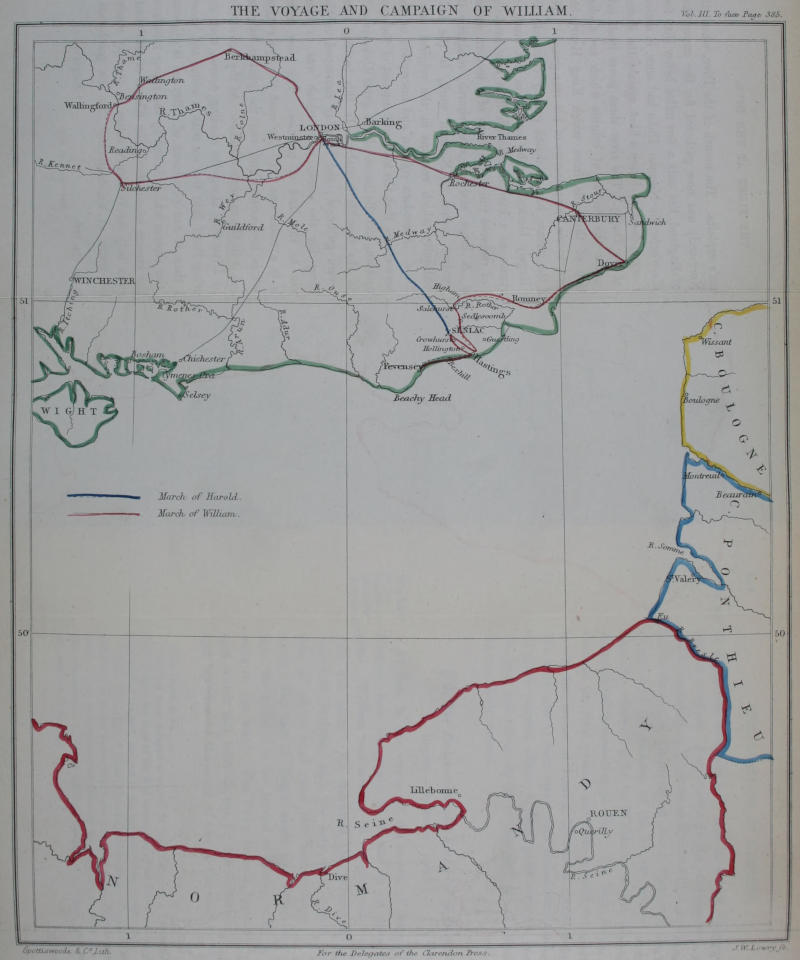
§ 2. The Embarcation and Voyage of William. August–September, 1066.
The fleet at the mouth of the Dive. August 12?
At last, in the course of the month of August,[1076] the Norman fleet was ready to set sail on its great enterprise. William was now to be occupied with war, and with war alone. He entrusted the government of the Duchy to Matilda, with the help of a council of wise men, at whose head stood the famous Roger of Beaumont. The age of Roger made him fitter for counsel than for action; so he tarried at home, while his son went to the war.[1077] The Duke himself hastened to the spot which had been chosen for the embarcation. This spot lay close to the scene of one of the most memorable 385of William’s exploits. The mouth of the Dive, where the fleet of Normandy was now gathered for the unprovoked invasion of England, lies only a few miles below that ford of Varaville where the Norman Duke had once, in a more righteous cause, dealt so heavy a blow against the French |Description of the place.| invaders of his Duchy. The river there pours itself into the sea, under the shelter of heights which are a close continuation of the hills from which King Henry had looked down to see the massacre of his rear-guard.[1078] The course of the stream has no doubt greatly changed; the harbour, largely blocked up by sand, has lost much of its importance as a harbour, though it is now awaking to a kind of renewed life in the form of a modern watering-place. A large and singular church, retaining its massive central arches of Norman work, is the only piece of antiquity which remains in the original small town of Dive. A modern column and inscription on the height above shows that the historical interest of the spot is not forgotten, and the name of the great Duke is still attached to the humble hostelry. In this harbour then the ships were gathered; the host lay encamped on the hills, waiting for the south wind which was to bear them across to the land of promise. The view from those hills is a noble one. To the west the eye ranges over the whole low country and over the gentler heights which bound it in the extreme distance. At the foot of the heights the Dive rolls along its winding course, then no doubt pouring itself into the sea with a wider and more open flood than it can now boast of. Beyond it glistens the Orne, the stream which flowed by the rising minsters of Caen, the stream whose flood, like Kishon of old,[1079] had wrought such help for William’s cause on the day when he won his spurs at Val-ès-dunes.[1080] To the north-east 386stand forth the rocks which guard the entrance to a yet greater stream, the rocks by which William’s Wiking forefathers had so often sailed to threaten the great cities on the Seine, and which now, under Norman guardianship, served as it were to keep the Lord of Paris imprisoned within the narrow limits of his inland realm.
The south wind for which William so eagerly waited was as slow in coming as the east wind which was so eagerly looked for, when a later William was waiting to set forth for the shores of England on a widely different |Delay at the Dive.| errand.[1081] The fleet was detained for a whole month at the mouth of the Dive,[1082] and the panegyrist of William |Good order maintained in William’s army.| grows eloquent on the wonderful good order and peaceable demeanour of the host which was, no doubt most unwillingly, subjected to this untoward delay. The excellence of the Duke’s commissariat is set forth in such glowing colours that we cannot help longing to know the details of his arrangements. The whole army, we are told, received regular pay and regular provisions during the month which was thus condemned to inactivity.[1083] All plunder was forbidden, and we are told that William’s orders to this effect were carried out with a degree of success which seems incredible. The inhabitants of the surrounding country learned to pass without fear among the motley host, a host made up not only of their own countrymen but of adventurers from every province of Gaul.[1084] The 387flocks and herds fed undisturbed in their pastures; the ripening corn remained alike uncut and untrampled by the dangerous visitors.[1085] In all this there is doubtless much of the exaggeration of a professed panegyrist. But we can well believe that the strong will of the Great William was really able to preserve a degree of good order among the mixed multitude which he commanded which a lesser man might have found it hopeless to preserve even among an army of his own subjects.
Numbers of William’s army.
The numbers of the host which William had now assembled are as variously stated as the number of the ships which were to carry them. The sum total is commonly given at sixty thousand, or even more; but there are authorities which bring it as low as fourteen thousand.[1086] Here, as in the case of the ships, while we must allow for error and exaggeration, we must also allow for different systems of reckoning. The higher amount may be meant to take in all the armed men of every class, while the lower may give only the number of knights—what in the military language of a later age would have been called the number of lances. In the history of all ages nothing is so little trustworthy as the figures which profess to set before us the numbers of armies. And I fear that the exact number, or even any near approximation to the exact 388number, either of the Norman invaders or of the English defenders, is one of the things which the historian must, however unwillingly, leave uncertain.
Spies sent by Harold.
It was while the Norman fleet was still at the mouth of the Dive, while the whole southern coast of England was so strongly guarded by the watchful care of Harold,[1087] that an incident is said to have happened, which, though it has been mixed up with events not belonging to it in date, is most likely not without some foundation in fact. The King of the English, among his precautions for the defence of the country,[1088] did not forget to get what knowledge he could as to the condition and numbers of the enemy. He sent spies across to the mouth of the Dive. |One is brought before William, who sends him back with a threatening message to Harold.| One of them was seized and led before the Duke. We are not told whether William followed the magnanimous or ostentatious example of Xerxes[1089] in showing the Englishman the whole strength and numbers of the Norman host; but he at least sent him home unhurt, though charged with a threatening message to his sovereign. When the spy strove to hide his errand under some of the usual subterfuges,[1090] William showed him at once that no disguises could avail with him. Harold might forbear to waste his gold and silver in paying spies to search out William’s resources; sooner than Harold looked for, he 389would himself come as his own messenger, and would teach him on his own soil what the power of Normandy was.[1091] |William’s comparison between himself and Harold.| And it was now, we are told, that the Duke made that most singular comparison between himself and his rival of which I have already spoken. He had promised away all the goods of Harold beforehand, while Harold had not the strength of mind to promise anything of his.[1092] He goes on to say that Harold would fight only to retain what he had wrongfully seized, while he would fight to obtain possession of the gift of his departed friend which he had earned by his services towards him.[1093] Success was certain; the fleet was of such a number as to be fully enough for any purpose that was needed, while he was not cumbered with any useless multitude of ships. And, as for the army, the fate of campaigns was decided, not by the number of armies, but by their valour.[1094]
William resolves to change his position.
A month was thus lost at the Dive,[1095] and yet the south wind came not. The Duke at last resolved to change his position and his place of embarcation. He had many good reasons for doing so. Had he stayed much longer in his first quarters, his supplies would probably have failed him, 390and he would no longer have been able to keep back his troops, especially the foreign mercenaries, from plunder. Meanwhile the same failure of provisions which William merely dreaded had actually defeated all the schemes of the |Influence of the disbanding of Harold’s fleet and army. September 8.| English King. While William lay at the mouth of the Dive, Harold’s great fleet and army, which had so long guarded the English coast, was finally disbanded, and the mass of the ships went back to London.[1096] It had in fact been a sort of involuntary struggle between the two rivals, which could keep an army for a longer time on foot in a state of inaction. In this struggle William had succeeded. The host with which Harold had lined the whole West-Saxon coast was doubtless far larger than the host which William had gathered at a single haven of Normandy. But William’s host, gathered from all parts of Gaul, consisted far more largely of professional soldiers than Harold’s, and in a far smaller degree of the general levies of the country, eager to return to their homes and harvests. It is no wonder that the endurance of William’s army outlasted the endurance of the army of Harold. But William had doubtless by this time exhausted the supplies afforded by the lands near the Dive, and he found it expedient to remove to quarters whose resources were still untouched. And the disbanding of Harold’s fleet and army supplied another motive equally strong. Now that the shores of England were left comparatively defenceless, now that the English fleet no longer rode triumphantly in the Channel, it became a matter of importance with William to be nearer to the English shores, ready to sweep down on any unguarded spot at any favourable moment. William therefore took advantage of a west wind[1097] to hasten from the Dive to a point which far more 391|William sails to Saint Valery. September 12.| closely threatened the southern shores of England. He passed by the mouth of the Seine and by the whole coast of Upper Normandy, and took up his position at a spot beyond the limits of his own immediate dominion, within the territories of his now faithful vassal Guy of Ponthieu.[1098] |History of the Abbey of Saint Walaric or Valery.| Near the mouth of the broad estuary of the Somme, on a low height overhanging the water,[1099] stood a minster, commemorating the good deeds of Walaric, a saint of Merovingian times, who had done much to evangelize the still heathen lands of Northern Gaul.[1100] Like so many other foundations originally secular, it had seen its canons give way to monks, and the monastery now ranked high among foundations of its own class. Near its gate a small town had arisen, bearing, like the abbey itself, the name of its ancient patron, but in a form which French pronunciation had moulded into a likeness to the great Valerian house of Rome. The Abbey of Saint Valery, like many other monasteries, had suffered through its own renown; the relics of its founder had been carried off by the pious cupidity of a Count of Flanders, and had been restored by the pious intercession of a Duke of the French.[1101] Like many other monasteries, the duty of its defence had given 392|The Advocates of Saint Valery.| a title to a line of temporal nobles. The Advocates of Saint Valery were powerful lords; one of them, as we have seen, had married a daughter of Normandy, and a younger branch of his race filled a high and honourable place among |Description of the place.| the great houses of the Norman land.[1102] Of this famous abbey the vast encircling wall still remains, but the remains of the church are small, and of a date somewhat later than the days with which we are concerned. But the ancient town, rising, with its parish church, above the modern port which has arisen rather higher up the river, still retains its walls and gateways and general mediæval look in singular perfection. Below, immediately on the coast, stands a ruined tower of rude work, to which an inaccurate or misunderstood legend has attached the name of Harold of England.[1103] The spot, even apart from its historical associations, is in every way striking. The broad estuary, the wooded heights above it, the ancient and the modern town, unite to form a singularly varied |Gathering of the fleet; its losses.| landscape. It was here, on the wide expanse of water into which the mouth of the great Picard river spreads itself, that the fleet of William rode, still waiting for the long-expected south wind which should at once transport him and his host to the shores of Sussex. Its numbers seem to have been somewhat lessened from the numbers, whatever those numbers were, of the fleet which had been gathered at the mouth of the Dive. We hear of losses from shipwreck, and of losses from desertion;[1104] and, as we 393have seen, it is not impossible that we ought to add losses from at least partial actions with English ships.[1105] At any rate, from what cause soever, a good many men were missing from William’s muster; and we are told that he imitated the well-known stratagem of Xerxes,[1106] by causing the recovered bodies of the drowned men to be buried as secretly as might be, lest the knowledge of their losses |Further delay at Saint Valery. September 12–27.| might serve to dishearten his followers.[1107] Still the wind was not favourable; the west wind had brought the fleet to Saint Valery, but the south wind was not yet willing to bring it to any English haven. All the time then that Harold was engaged in his great Northern march and in his victory at Stamfordbridge, William was still lying inactive in his second naval quarters at the mouth of the Somme.
The army inspirited by exhortations and religious ceremonies.
But with William time was never idle; he had ever at his command the resources of both worlds to occupy any season of constrained inaction. It was even more incumbent upon him to respect the property of his allies and vassals than to respect that of his own subjects. He occupied himself as diligently in care for his commissariat at Saint Valery as he had done at the Dive.[1108] By constant exhortations he kept up the spirits of those of his men who were already beginning to shrink from the enterprise.[1109] And the champion of the Church, the pious leader of the great expedition for the second conversion of the erring English, was not likely to be sparing at such a moment in those means of spiritual excitement of which he so well knew the efficacy. Prayers and sacred rites of every 394kind were resorted to, in order to move Heaven to send the looked-for wind which should waft its servants to do its bidding beyond the sea. The Duke himself was unwearied in his devotions within the minster of Saint Valery, nor did he pay less regard to the outside of the temple than to the inside. His eyes were ever watching the weathercock on the minster tower; when he saw it pointing to the south, his heart was downcast and his eyes were filled with tears, but the least turn in the opposite direction again kindled his hopes. Still the wind came not; the sky was cloudy; the weather was cold and rainy; for fifteen days all the powers of the air seemed steadily bent against the enterprise.[1110] |Procession of the body of Saint Valery.| At last recourse was had to a ceremony of special solemnity, one which, it was thought, could not fail to wring the long-wished-for boon from the saints and from their Creator. At the request of the Duke and his army, the Abbot and monks of Saint Valery came forth from their church in solemn procession, bearing the shrine which contained the wonder-working body of their glorified patron. A carpet was spread on the ground, and the shrine was exposed to the gaze of the army, awaiting their devotions and their offerings. The Duke and all his host 395knelt in prayer for the withdrawal of the adverse breeze and the sending of one more favourable. Nor was their bounty less than their faith; the shrine of Saint Valery was hidden by the pieces of money showered down as offerings by his worshippers.[1111]
The south wind blows. Wednesday, Sept. 27.
The devotion and the pious liberality of the Norman host did not pass unrewarded. The prayers and the gifts of William and his followers did their work. The costly offerings at Caen, the crowning act of devotion at Saint Valery, at last availed to release the new Agamemnôn from his unwilling sojourn at another Aulis.[1112] In the milder belief of William’s age the virginity of Cecily was an offering more acceptable to Heaven than the bloody sacrifice of Iphigeneia. And at last so many prayers were heard. On Wednesday the twenty-seventh of September, two days after Harold’s victory at Stamfordbridge, the south wind blew.[1113]
The embarcation.
396The camp was in a tumult of joy and thankfulness. The wished-for hour was at last come. England and its spoils seemed to lie before them, ready to be grasped by the hands of the champions of the Church and of the Norman saints. Men were seen everywhere lifting up their hands to heaven, exhorting and rejoicing with one another that the hours of weariness were over, that the moment of action at last had come.[1114] In the midst of the general joy came the Duke’s orders for immediate embarcation. William, as eager by temper as he was cautions by reflexion, was foremost in urging his followers to hasten on board their vessels, and to lose no time in making for the promised land.[1115] But his troops needed little urging; the dread of the unknown sea and of the unknown land, the dread of the wealth of England and of the might of her defenders,[1116] had all passed away. The Norman warriors were so clearly the favourites of Heaven, the sign which they had just received so clearly showed that their cause was the cause of righteousness, that doubt and fear no longer lingered in the mind of any man. Men rushed to the shore;[1117] one man exhorted his followers, another his comrades; each was eager to be first on board, to be foremost in the holy work. The captain outstripped his soldiers; the soldier outstripped his companions; men left behind them their goods and their necessary stores, having 397one fear only before their eyes, lest by any mishap they should themselves be left behind.[1118] Some bore on their shoulders the swords, the spears, the coats of mail, which would be needed on the other side of the water. Some yoked themselves to waggons loaded with spears, and loaded also with casks of wine. This last was the only kind of provision of which any great quantity seems to have been thought needful; conquered England was to find the rest.[1119] Some were busy in setting up the masts, some in unfurling the sails;[1120] the especial work of the horsemen was the difficult task of bringing their horses on board the vessels.[1121] The ships resounded with music; the pipe, the zittern, the drum, the cymbals, all were heard, and the voice of the trumpet sounded proudly over all.[1122] Meanwhile the Duke once more made his way to the minster of Saint Valery, and offered his last prayers and gifts on Gaulish ground before he went forth to the conquest of the island realm.[1123] Before he reached his ship, evening had set in. The moon was hidden and the heavens were clouded over. The Duke therefore ordered every ship to 398bear a light,[1124] while on the top of the mast of his own Mora a huge lantern blazed to be the guiding star of the |William sets sail.| whole navy. William now went on board; the trumpet sounded, and the voice of the herald announced the Duke’s last orders before setting sail. The ships were to keep as near together as might be, and to follow closely after the beacon-light of his own ship. When they were well out to sea, they were to rest a while in the dead hour of the night, till the signals speaking alike to the eye and the ear had again issued the ducal commands from the ducal vessel.[1125] The fleet set sail; the vessels halted and rested as the Duke had ordered. But before day-break the trumpet again sounded from the Mora, and the lantern |Details of his voyage.| again blazed at her mast. The ships again set sail; but the ship which carried William and his fortunes far outstripped all her followers.[1126] We are told that the speed of 399the vessel, like that of the divine barks of Scheria,[1127] adapted itself to the eagerness of her master;[1128] but it is plain that one reason for the special fleetness attained by William’s ship was that she was one of the few vessels in the fleet which were unencumbered by horses.[1129] The day was now dawning, and the ducal ship was alone. At the Duke’s bidding a sailor climbed the mast to see whether any of the other vessels were in sight. But the morning light as yet showed him nothing on all sides but the sea and the sky.[1130] The Duke ordered a halt; the anchor was cast, and William, as if in his own house, ordered a plentiful breakfast to be served up. The rich contents of one of the casks of wine were not forgotten; and William in cheerful mood bade his men be of good heart and assured them that their comrades would soon overtake them; God, in whose cause they were setting forth, would watch over the safety of all the host.[1131] The sailor was again sent to the mast-head, and he now announced that four ships were in sight. Presently he saw such a multitude that their masts looked like a forest upon the waves.[1132] The heart of William 400was lifted up in thankfulness.[1133] The south wind still blew; in the morning light the lantern was no longer needed; the chequered colours of the sails of the Mora were now the beacon on which every eye in the whole |William lands at Pevensey. Thursday, September 28.| fleet was fixed.[1134] England was soon in sight, and by nine in the morning of Thursday the twenty-eighth of September, the Norman claimant of her Crown had already set foot upon her shores.[1135]
He landed at a spot so memorable in the earliest English history that, to one who muses there, the landing even of William himself seems but of secondary interest.[1136] William came, as it might seem, to pour a new Latin and Celtic infusion into Teutonic England. He brought his Romanized Northmen and the Welsh of the Lesser Britain to bear rule over Saxons, Angles, and Danes who |Description and historical associations of the place.| had never fallen away from their Teutonic heritage. He came to begin his work on a spot where the Saxon of old had dealt one of the heaviest of all his blows against the Roman and the Briton. He came to subdue England on one of the spots which had seen most done to turn 401Britain into England. A north-west course from Saint Valery had brought the invading fleet to a point in that eastern part of the South-Saxon coast which, trending to the north-east, is cut off in a marked way by the promontory of Beechy Head from that long and nearly straight line of coast which reaches westward to Selsey Bill. At Beechy Head to the west, and again near Hastings to the east, the high ground comes down to the sea. Between these points lies a long flat shore, where the waves now break on a vast mass of shingle, which, at some points, stretches a long way inland, forming a wilderness of pebbles, slightly relieved by small patches of gorse and thin herbage. Between the coast and the hills—the hills which form a part of the great Andredes-weald—there lies a wide level, but here and there slight and low projections, feeble offshoots from the high ground, |Pevensey the ancient Anderida.| straggle down towards the coast. One such post, commanding alike the sea and the inland country, had been chosen as the site of a Roman city, and Anderida, the Andredes-ceaster of our forefathers, became, in the later days of Roman occupation, one of the chief of the fortresses which guarded the Saxon Shore.[1137] In those days, and in the days of William also, Anderida was a haven of the sea. The vast expanse of shingle is owing to the later siltings which have choked up so many harbours along this coast; in the fifth and in the eleventh century the sea still washed the foot of the slight eminence occupied by the city, and ships could ride at anchor beneath the Roman |Remains of the Roman city.| walls.[1138] Of those walls and of their massive towers large portions still remain; but not a single human dwelling-place 402survives within their circuit. In the south-eastern corner of the Roman city, the mediæval castle of Pevensey, a foundation of William’s brother Robert,[1139] has arisen and has fallen into decay. And just without the ancient walls, the villages of Pevensey and West Ham, each with its Old-English name and its mediæval church, seem to show by their position that the first Teutonic settlers in Britain avoided, from whatever reason, the occupation of the old Roman sites. Few groups are more striking in themselves than this assemblage of antiquities of various dates and kinds, Roman and mediæval, ecclesiastical and military. But the true attraction of the spot comes from the memory that there was dealt one of the most awful of those awful blows which made our race dominant in this our island. |Landing of Ælle in Chichester harbour. 477.| Second among the Teutonic settlements, first among the strictly Saxon settlements, the followers of Ælle and Cissa had for fourteen years been fighting their way onwards from their first landing-place on British soil. The foundations of the South-Saxon Kingdom had been laid at Cymenes-óra, in the haven which in after days was to be called after the city to which the younger conqueror gave his name.[1140] Since that day, the Saxons had been gradually spreading eastward towards the frontiers of their |Taking of Anderida. 491.| Jutish kinsfolk in Kent. At last, as we read in our Chronicles, “Ælle and Cissa beset Andredes-ceaster, and slew all that were therein, nor was there a Briton left there any more.”[1141] So it was that our fathers did their work; 403but so it was that England became England. The fall of Anderida put the finishing stroke to the Teutonic conquest of south-eastern Britain. The long extent of coast, once part of the Saxon Shore in the elder sense, now became far more truly a Saxon shore under the rule of our first Bretwalda.[1142] The walls which were stormed by Ælle and Cissa have, from that day to this, remained as the mighty monument of a fallen power, the sepulchre of the races which our fathers swept away. In the days of William, as now, those walls had already long ceased to surround the dwelling-places of men.[1143] The forsaken city could at most have served as an occasional place of shelter for the people of the two English settlements which had arisen at either end of it. Beneath those awful ruins, among the memorials of ancient English victory, the Norman Duke now landed. He came, as it might seem to a superficial eye, to undo the work of Ælle and Cissa, to subject the sons of the destroyers of the Briton and the Roman to men speaking the tongue of Rome, and in the veins of many of whom still flowed the blood of the British exiles of Armorica. In truth the errand on which he came was the exact opposite. He came, a chief of Danes and Saxons who had fallen from their first love, who had cast away the laws and the speech of their forefathers, but who now came to the Teutonic island to be won back into the Teutonic fold, to be washed clean from the traces of their sojourn in Roman lands, and to win for themselves, among the 404brethren whom they were to meet as momentary enemies, a right to an equal share in the name, the laws, and the glories of Teutonic England.
Defenceless state of the coast at the time of William’s landing.
Pevensey then, the English name which had supplanted the ancient Anderida, was the place of William’s landing. The town is mentioned among those ports on the southern coast which Harold had taken special care to supply with garrisons.[1144] But at the moment of William’s landing the post was either wholly undefended, or defended by a force which found it hopeless to offer resistance. It will be remembered that the Housecarls had gone northward with the King, and that the irregular levies which had guarded the coast only three weeks before were now scattered every man to his own home.[1145] Any force then which occupied Pevensey, or any other point of the South-Saxon coast, is likely to have been intended as a mere outpost to watch and to give the alarm, rather than to have been placed there with any hope of seriously withstanding the invaders. Harold had doubtless hoped that the winds which had delayed William so long would still work in the cause of England. He trusted that the enemy’s passage would be delayed till he could himself return to the southern coast at the head of the victors of Stamfordbridge. |Lucky moment of William’s voyage.| But the fortune of William bore him to the English shore at the very moment which suited his purpose. A little earlier or a little later, he would have met with a vigorous and, in all probability, a successful resistance. On that St. Michael’s Eve he met with no resistance whatever. There were neither ships to hinder him from drawing near 405to the shore,[1146] nor soldiers to withstand him in the act of |He lands without resistance.| landing. The whole Norman fleet disembarked without a blow being struck against them.[1147] But the array in which they disembarked seems plainly to show that they had at |Details of the landing; close order of the ships.| least reckoned on meeting with armed resistance. The fleet was not allowed to be scattered; the ships all steered for the same point, and cast anchor as near together as might be in the one haven of Pevensey.[1148] The wide expanse of shore at this point would render such a course especially easy. As soon as the anchors were cast, the ships were run ashore, the masts were lowered, the shields and saddles were unladen, the horses were released from their unfamiliar prisons.[1149] The fighting men then landed as nearly as might be in battle array. The first armed man who set |William slips; his ready use of the omen.| foot on English ground was Duke William himself. As he descended from his ship, his foot slipped and he fell with both his hands upon the ground. A loud cry of grief was raised at the evil omen. But the ready wit of William failed him not. “By the splendour of God,” he cried, “I have taken seizin of my Kingdom, the earth of England 406is in my two hands.”[1150] It is added that a soldier, of kindred spirit with his leader, ran forward, and plucking a handful of thatch from a cottage, placed it in the Duke’s hand as seizin, not only of England, but of all that England held within it.[1151] “I accept it,” answered the Duke; “and may God be with us.”
Order of the landing.
The whole army now landed in order. First came the archers, ready for action, with bended bows and quivers slung at their sides. They scoured the whole of the neighbouring shore, but they nowhere found an armed enemy to resist them.[1152] Next came the knights, all in their helmets and harness. They at once mounted their horses, and formed in the plain as if to call forth the hidden defenders of England to battle.[1153] But not a blow was struck; Pevensey was occupied as the first-fruits of the invasion; a garrison was left to secure William’s first 407possession on English ground, and the words of one of our informants might almost imply that some portion of the Roman ruins was once more turned, in the rough and hurried way which was all that the time allowed, to purposes of defence. One object of this fortification and garrison was to guard the ships, which had been drawn on shore and which were now to be left behind.[1154] For the stay of the Norman host at Pevensey was not a long one. No great amount of provisions had been brought with them, nor could the town of Pevensey and its neighbourhood supply food for so great a multitude.[1155] It was needful to move to some wealthier and more convenient post, which would afford better head-quarters for the army, and which might serve as a central point for a systematic |The army marches to Hastings. Friday, Sept. 29.| harrying of the country. Only one day therefore was spent at Pevensey; on the next day, the feast of the Archangel so deeply reverenced by Norman devotion, the army marched on eastward, probably along the line of a Roman road, and came to the town which William chose as his base of operations for this memorable campaign. That campaign can be 408called by no name so fitting as the Campaign of Hastings; for Hastings was the head-quarters of William, the centre of the whole operations of the campaign. But in speaking of the great battle itself, the name of Hastings simply leads to geographical confusions. I speak therefore of the Campaign of Hastings, while to the battle itself I restore its true ancient name of Senlac.[1156]
Description and early history of Hastings.
The town and port of Hastings[1157] is one which has been more than once mentioned in the earlier stages of our history.[1158] Its name has been made memorable by the zeal and energy displayed by its seamen in their pursuit |1049.| of the pirate-ships of Swegen after the murder of Beorn.[1159] Like Pevensey, it had been garrisoned by Harold.[1160] And yet the town seems to have surrendered to William without striking a blow. Hastings, like most other English towns, had most likely no fortifications which could resist Norman arts of attack, and the prowess of the seamen, whose force would at any time have been weak against the vast fleet of William, was utterly useless now that the invaders had actually landed. The town is placed on a part of the coast where the hills come close down upon the sea, forming a striking contrast to the wide open flats which the Normans had just left behind them at Pevensey. Two gorges between hills open immediately upon the water; the eastern opening is occupied by the elder, the western by the more modern, town of Hastings. The hill which divides the two is crowned by the ruins of the castle which probably marks the site of William’s |Importance of the position.| head-quarters. The position was an important one; it commanded the great roads east and west, and also the 409north road leading directly between London and the coast. |William makes an entrenched camp on the hill.| William therefore chose Hastings as a permanent camp.[1161] After consultation with his brothers, Bishop Odo and Count Robert, he gave orders for the construction of one of those wooden fortresses which were so constantly run up for sudden emergencies in Norman warfare, and which often proved the forerunners of more lasting buildings of stone. The time at William’s command allowed only of the digging of a trench, the casting up of a mound, and the fortification of its summit with a castle of wood.[1162] But it was doubtless this temporary structure which formed the germ of the stately castle which in after days crowned the height of Hastings, and within whose walls arose a church and college, whose chief stall, less than a hundred years after this time, formed one of the countless preferments of the worldly Archdeacon who was so soon to be transformed into the champion and martyr of the Church.[1163]
It is not clear whether it was at Pevensey or at 410|Slight loss of the fleet on the voyage.| Hastings that the Duke reviewed his troops, and found, so we are told in one account, that two only of his ships had been lost on the passage.[1164] But one rather remarkable |Fate of the soothsayer.| life had been lost with them. A clerk, who pretended to the power of soothsaying, had assured the Duke, not only that his voyage would be prosperous, but that he should win England without a blow. Harold would of his own accord again bow to him and become his man. Half the prophecy was already fulfilled; it remained to see what would be the fate of the other half. But the prophet himself came not to the muster. He had embarked in one of the missing ships and was returned as drowned.[1165] “A poor diviner must he have been,” said William, “who could not divine the way and time of his own death. Foolish would he be who should put faith in the words of such a |Was this the time of the affair of Romney?| soothsayer as this.”[1166] One hardly knows whether these dark allusions to lost ships and lost men are to be taken in connexion with the fact that, at some stage of the campaign before the great battle, certain stragglers from the Norman fleet or army had made their way eastward as far as Romney, and had there fallen in a skirmish with the townsmen.[1167] The words of our accounts leave it uncertain whether a portion of the fleet lost its way on the passage, 411or whether a detachment of the army wandered thither from Hastings. In any case, this and some other indications which we have already seen[1168] all tend to show that the fight on Senlac was not absolutely the first time that Normans and Englishmen met with arms in their hands during this memorable year.
William systematically ravages the country.
William, it will be remembered, while encamped in his own territory and in that of his vassal of Ponthieu, had carefully maintained his troops at his own cost, and had at least done his best to hinder all plunder of the surrounding country. But England, though a realm which William claimed as his own by inheritance, was not to be dealt with so tenderly.[1169] A poet in the Norman interest tells us that whatever damage the English suffered was only the fitting punishment for their stubbornness in not at once admitting the manifest rights of their lawful |Object of these ravages; to tempt Harold to fight.| King.[1170] However this may be, there can be little doubt that William’s ravages were not only done systematically, but were done with a fixed and politic purpose. It was William’s object to fight a battle as soon as might be. But it was not his object to advance for this purpose far into the country, to seek for Harold wherever he might be found. So to do would have been to cut himself off from his own powerful base of operations and from his only hope of retreat in case of defeat. It was William’s object to bring Harold down to the sea-coast, to tempt him to an attack on the Norman camp, or to a battle on the level 412ground. In either of these cases the Norman tactics would have a distinct advantage over the English. It is impossible to doubt that the systematic harrying of the whole country round Hastings was done with the deliberate purpose of provoking the English King, and of |Lasting effects of William’s harrying.| bringing him in all haste to defend his subjects. The work was done with a completeness which shows that it was something more than the mere passing damage wrought by an army in need of food. The traces of the ravages done at this time are recorded in the great Survey twenty years later. The Tapestry not only vividly sets before us the way in which provisions of all sorts were brought in for the use of the camp;[1171] it also represents an incident which at once goes to the heart. A house is being set on fire; the inmates, a woman and a child, are coming forth from their burning dwelling.[1172] This is doubtless one instance among thousands of the cruel destruction which was fast spread over the country, as far as William’s plunderers could reach. Men fled everywhere with such of their goods and cattle as they could save, and sought for shelter in the churches and churchyards.[1173] It would doubtless be the policy of the pious Duke to keep his followers back, as far as might be, from all damage towards those who thus put themselves under the direct protection of religion. Elsewhere all was havock. It was to save his people from the horrors of war in their most barbarous form that King Harold jeoparded his life and Kingdom.[1174]
Result of the Northern campaign doubtful at the time of William’s landing.
413At the moment of William’s landing, and even at the moment of his occupation of Hastings, he must have been quite uncertain as to the fortunes of his rival in the North. It was perfectly possible that he might never have to contend with Harold of England at all. The result of the Northumbrian campaign could hardly have been known in Sussex two days after the fight of Stamfordbridge, and it was one of the possible chances of war that William might have to fight for the Crown of England against the victorious host of Tostig and Harold Hardrada. But the two great rivals were not long kept in ignorance of |Robert the son of Wymarc brings news. His position and estimate of his conduct.| each other’s movements and purposes. The news was brought to William by a message from an English landowner of Norman birth, in whom it is easy to recognize the Staller Robert the son of Wymarc, him who had stood at the bed’s head of the dying Eadward.[1175] We know not whether he had retained his Stallership, or any other office, under Harold. But it is plain that he had become the man of the new King, for he was living in England under the King’s peace and in full possession of his lands.[1176] There is nothing in his present conduct which sets him before us as a traitor to his new allegiance. It is scarcely ground enough for such a charge to say that he could hardly have been with Harold 414at Stamfordbridge.[1177] His conduct in fact seems to have been that which was really right and honourable under the circumstances in which he stood. He had to reconcile his good will and his duty towards his adopted country with his earlier good will and earlier duty towards his natural sovereign. He sent a messenger to Hastings,[1178] with a message designed to persuade the Duke, in the interest of all parties, to give up his enterprise, and to |He counsels William to go home.| go quietly back to his own dominions. He, Robert, counselled him as a friend and kinsman;[1179] he would be deeply sorry if any harm befel him or his army, and, if he remained in England, he and his army would meet with certain destruction. It was hopeless for William to think of contending with the forces of England. King Harold had just defeated the Norwegian invader with a slaughter of twenty thousand men;[1180] Tostig and Harold Hardrada were slain; the King of the English was coming southwards with a countless host, a host, men said, of an hundred thousand.[1181] Against the English King and the English army, flushed with their victory over the greatest warrior in the whole world,[1182] it would be madness to risk 415a battle. Neither in number nor in strength were the Normans fit to do battle against King Harold and the English. Against them, in short, William’s army would count for no more than so many barking curs.[1183] The Duke was a prudent man, and had hitherto always acted prudently.[1184] Let him act prudently now; let him go home; let him at all events keep within his entrenchments and not risk a battle.[1185] If he did go forth to fight, his rashness would certainly bring about his utter overthrow.
Such counsel as this, addressed to William the Conqueror, speaks muck more highly for the good intentions of Robert than for his knowledge of mankind, above all for his knowledge of the man with whom he was dealing.[1186] William had not crossed the sea for nothing; he was not like the King in the Gospel, who had to stop on his march to consider whether he were able with his ten thousand to meet him who came against him with twenty thousand.[1187] |William’s answer; He will fight in any case.| It was perhaps not without a reference to that parable that William answered that, had he only ten thousand men, such as those of whom he had sixty thousand, he would not draw back; he would not cross the sea again without avenging himself of his enemy. He would not even keep himself within his entrenchments; whatever were the numbers on either side, he would go forth and 416meet Harold face to face.[1188] He condescended to thank Robert for the kindly interest which he took in his welfare, though he hinted that the words in which he had contrasted Norman and English prowess would better have been spared.[1189] The Duke had no need of such counsels as those which were pressed upon him by his cousin’s favourite. He had come into England to win his Crown, and his Crown he would win at all hazards.
§ 3. The Southern March of Harold. October 1–13, 1066.
The news brought to Harold at York. October 1?
I have already told how the news of William’s landing was brought to King Harold at the feast of victory at York.[1190] That feast must have been saddened by the thought of the many brave men who had fallen at a moment when England needed the help of all her sons, by the thought that England had been saved only by the death of a brother of her King, by the thought that, while King and people were rejoicing at the victory which had just been gained over one enemy, another enemy, certainly not less terrible, was daily threatening the defenceless southern coast. And in the very moment of triumph the news came that the blow had actually fallen. Men now heard that, while Harold was letting the remnants of the Norwegian army depart in peace, the Duke of the Normans had actually landed, that he was ravaging English ground far and wide, that a portion of English ground was already entrenched and palisaded, and changed into a Norman 417|The news brought by a South-Saxon Thegn who saw the landing.| fortress.[1191] The Norman poet gives us a graphic description of the way in which the news was brought to the English King. A Thegn of the country heard the cries of grief and dismay with which the South-Saxon churls beheld the approach of the Norman fleet.[1192] He went forth; he hid himself in a convenient lurking-place, and beheld in safety the whole process of the landing of the Norman army.[1193] He saw first the archers and then the knights disembark. He saw the shields and armour brought out of the ships; he saw the carpenters come out with their axes; he saw the fosse dug, and the palisade thrown up.[1194] The 418|He hastens to York.| sight was enough; the heart of the English Thegn was troubled; he took his weapons, his sword and his javelin;[1195] he mounted his horse, and rode straight to bear the news to his Lord King Harold. He hastened on with all speed night and day; he rested late and rose early,[1196] till he found the victor of Stamfordbridge in the banquetting-hall at York. Here he at once told his errand. The countless host from all Gaul, the host of horsemen and archers and slingers who had gathered under the banner of Duke William,[1197] had landed at Pevensey. They had already built a fort and had fenced it with a palisade.[1198] Presently another messenger, a churl, came from Hastings itself.[1199] He had more news to tell, more details of the cruel harrying of the South-Saxon land. The host of Normans, Frenchmen, and Bretons, a host that no man could number, a host like the stars of heaven or the fishes of the sea, was 419ravaging far and wide.[1200] Men were being slain, their widows, their sons, their daughters, their flocks and their herds, were becoming the prey of the stranger.[1201] Each message enforced the same truth; the King must march at once to the defence of his southern coasts, or the whole land |Answer of Harold.| would be wrested from him. Harold is reported by the Norman poet to have said that it would have been better to have given Tostig all that he asked,[1202] so that he might have been himself in the south to hinder the landing of the French invaders. Such a speech cannot have been uttered by Harold, as it misconceives all the relations between him and his brother. The situation is better conceived when the King is made to say that, had he been on the South-Saxon shore, the strangers would never have made good their landing. Either they would have been driven back into the sea, or they would have escaped its dangers only to perish on English ground. “But,” he added, “the mischance was the will of the King of Heaven, and I could not be everywhere at the same moment.”[1203]
Position of Harold between the two invaders.
420And so of a truth it was. The event of this great campaign, the overthrow of Harold and of England, turned wholly, setting aside the mere accidents of battle, on the inability of Harold himself to contend against two invasions, or to be at the two ends of his Kingdom at the same time. Of the two invasions, the Norwegian and the Norman, each rendered the other possible. Or even had the south wind blown sooner at the mouth of the Dive, the southern coast of England would have been found guarded against any attack, and Harold would probably have gone to meet his namesake of Norway flushed with victory over William and his host. As it was, the fate of England, as ever in that age, rested on one man, and that one man could not be at once in Sussex and in Northumberland. Harold, too late to hinder the landing of the Normans, had now before him the far harder task of dislodging them when they were already in the land. It was a hard lot to have to hasten at once on such an errand, after hardly a moment’s rest from the toils and the glories of Stamfordbridge. One terrible campaign was hardly over, when another yet more terrible had to be begun. But the heart of Harold failed him not, and the heart of England beat in unison with the |Harold begins his march to London.| heart of her King. As soon as the news came, King Harold held a Council of the leaders of Stamfordbridge,[1204] perhaps rather an armed Gemót, such as we have already heard of more than once.[1205] He told them of the landing of the enemy; he set before them the horrors which would come upon the land if the invader succeeded in his enterprise.[1206] A loud shout of unanimous assent rose from the 421Assembly. Every man pledged his faith rather to die in arms than to acknowledge any King but Harold.[1207] The King thanked his loyal followers, and at once ordered an immediate march to the south, an immediate muster of the forces of his Kingdom. London again was the trysting-place.[1208] With speed and energy equal to that which had carried him to his northern capital, he now set out on the return march. He himself pressed on at once, at the head of such of his Housecarls and other immediate following as had survived the fight of Stamfordbridge. Eadwine and Morkere were bidden to follow with the whole force of |Merlswegen in command of the North.| their Earldoms. Meanwhile the command of the North was committed to the Sheriff Merlswegen.[1209] We shall hear of him again among the patriots of a time a few years later, and we cannot doubt that this great command was put into his hands because he was known to be one more worthy of the trust than the King’s own brothers-in-law. And so it |Eadwine and Morkere keep back from the war.| proved. Even the great salvation of Stamfordbridge, the deliverance of Northumberland from the very jaws of her enemy, could not bind the sons of Ælfgar to gratitude or fidelity to the West-Saxon King. In their eyes, no doubt, the landing of William only offered another chance of bringing about their darling scheme of a divided Kingdom. 422William had a quarrel with Harold; he had none with Eadwine or Morkere. They had not forsworn themselves to their lord or done despite to any holy relics. The invader might well be content with the immediate territories of his enemy and his house. William might rule over Wessex and East-Anglia, and might leave Mercia and Northumberland to the House of Leofric. It was probably with some such designs as these that the Northern Earls held themselves and their forces back from the struggle. But, whatever were their motives, the fact that they did hold themselves back is certain.[1210] The main forces of Northumberland and north-western Mercia came not to King Harold’s muster.[1211]
General zeal of the nation.
But elsewhere another spirit reigned.[1212] Men well knew what was at stake. They went forth, as loyal subjects, as true men to their lord, to fight for the King whom they had chosen. But they went forth also on a higher errand still, to save the land of their birth from the grasp of the invader, an invader of wholly alien speech and feeling, an invader who could never be as Cnut or even as Harold of Norway. The presence of the Frenchmen in the land awoke a spirit in every English heart which has never |Charge of parsimony against Harold.| died out to this day. We hear indeed vague stories how Harold lost favour with the victors of Stamfordbridge by refusing to divide among them the rich plunder of the Norwegian host.[1213] We hear how he left the plunder untouched 423under the care of Archbishop Ealdred,[1214] instead of scattering it with a bounteous hand among the men whose toils and whose blood had won it. These stories rest on but poor authority; still they may have some groundwork of truth.[1215] The time was not a time for waste of treasure; the armaments of the year must have been costly in the extreme; Harold needed wealth to oppose to the wealth of William, and, considering the doubtful fidelity of the Northern Earls, he could not afford to throw away the sinews of civil war. A prudent economy on the part of Harold may have called forth a certain measure of discontent; but it is certain that such discontent had no serious effect on the campaign. The discontented in such a case must have been mainly the King’s own Housecarls, and those who bring this charge against Harold tell us also that it was the King’s own Housecarls who formed the strength of the host that fought at Senlac.[1216] It is far more certain that, as King Harold set forth on his southern march, fresh from the triumph of Stamfordbridge and with the fate of England resting once more upon him, the men of the greater part of England flocked eagerly to the Standard of their glorious |The shires which sent men. Wessex, East Anglia, Eastern Mercia.| King. They gathered round him from all the shires through which the Dragon and the Fighting Man passed once more on their southern journey. They gathered round him from all the shires under his own immediate rule, and under the rule of his faithful brothers.[1217] North-western 424|The North and Northwest kept away by their Earls.| Mercia stood aloof under Eadwine. Northumberland, under the rule of Morkere, sent none but such as joined the King’s own Standard on his march. Not so the lands which were still under the House of Siward. Whether the young |Loyalty of the Earldom of Waltheof.| Waltheof came himself we know not; but there is no doubt that the men of Northampton and Huntingdon came loyally to King Harold’s muster. And from all the east and south, from the lands which had passed from the rule of Godwine to the rule of Harold, from the lands where Gyrth still kept up the memory of Harold’s earlier government, from all the lands between the Tamar and the German Ocean, men came to fight for Harold and for |The men of Kent and London.| England. And, foremost and honoured among all, ranking, it would seem, every man among the King’s personal following, came the men of Kent, whose right it was to deal the first blow in the battle, and the men of the great city itself, whose high privilege it was to guard the King himself and his Standard.[1218] At the head of the men of London stood the Sheriff of the Middle-Saxons, the Staller Esegar,[1219] the son of Æthelstan, the son of Tofig, none the 425|Esegar commands the Londoners.| less loyal to his King because the minster of the Holy Rood had risen on soil which had once been the dwelling-place of his fathers.[1220] Of his fellow-Staller Eadnoth we hear nothing; Bondig would almost seem to have tarried in the North, or, from whatever cause or accident, not to |Few names of Englishmen preserved.| have appeared at the muster.[1221] We see then that England, as a whole, failed not of her duty; but few indeed, compared with the long roll-call of the invaders, are the men whom we know by name as having joined in the great march and fought in the great battle. Still there are a few names which have come down to us, names to be cherished wherever the tongue of England is spoken, names which should sound like the call of the trumpet in the |Entries in Domesday.| ears of every man of English birth. In the dry entries of the Norman Survey a few records still live of the men who fought and died for England. Two nameless freemen of Hampshire, owners of a small allodial holding, come first |Ælfric of Huntingdonshire.| on the patriotic bead-roll. One degree clearer in personality stands forth Ælfric of Gelling, a Thegn of Huntingdonshire, and tenant of the Church of Ramsey, who came from Waltheof’s Earldom, whether in the following of his Earl or at the bidding of his own loyalty to his King. |Breme of East-Anglia.| From East-Anglia we find recorded a nameless tenant of the House of Saint Eadmund, and Breme a freeman of King Eadward’s, who came no doubt in the following of Earl Gyrth. With a clearer consciousness of their personal being, we can honour the names of two noble tenants of the Church of Abingdon, men high in rank in the old West-Saxon Earldom, who fought and fell by the side of Harold. Their names set them before us as representatives 426of the two great Teutonic races of the land, each alike armed to defend their common blood and speech |Godric and Thurkill of Berkshire.| against the Southern invader. Thither came Godric the Sheriff, Lord of Fifhide, whose name witnesses to his English descent, and thither too came the Danish Thurkill, Lord of the neighbouring lordship of Kingston. He had, at Earl Harold’s counsel, commended himself and his lands to Saint Mary of Abingdon, and he came no doubt with as fervent a trust in the Black Cross of that ancient house as the King himself reposed in the more famous relic of his own newly hallowed minster. And it was not only the tenants of religious houses who went forth to battle for the excommunicated King against the invader who boasted himself as the special champion of the Church and of religion. Two English Prelates at least, and several churchmen of lower rank, personally braved the curse of Rome in the |Ælfwig Abbot of New Minster.| cause of England. The New Minster of Winchester, King Ælfred’s great bequest to his royal city, was still ruled by Ælfwig, the brother of the great Earl Godwine, the uncle of King Harold himself.[1222] Like Ealhstan and like Eadnoth in earlier times, he and twelve of his monks marched to the field, not merely to pray for England, but to wield their weapons among the foremost of her champions. With their coats of mail over their monastic garb, they took their place in the ranks, and fought and died alongside of Thurkill and Godric and the other valiant men whose names no chronicler has recorded.[1223] Ælfwig came to the fight at the bidding of kindred no less than at the bidding |Leofric Abbot of Peterborough. His death, Nov. 1.| of loyalty. Another Prelate, of equal ecclesiastical rank, and of greater personal fame, Leofric, the renowned Abbot of Peterborough,[1224] preferred the cause of his country to the cause of his own house. Eadwine and Morkere kept aloof from the great struggle; their worthier cousin, the Abbot 427of five monasteries, followed Harold to the fight, and, unlike his brother of Winchester, returned to his home sick and wounded.[1225] And one lowlier churchman must not |Eadric the Deacon.| be passed by. The Norman record itself seems to assume a kind of pathos, as we read how Eadric the Deacon, a freeman of Harold’s, followed his lord from the East-Anglian land of his earlier government, and died with him in the battle.[1226] Volunteers like these doubtless took their places among the King’s personal following. But we cannot doubt that the main strength of the army consisted of Harold’s own picked troops, his veteran Housecarls, the conquerors of Gruffydd, the victors of Stamfordbridge. Still it is clear that the levies of all southern and eastern England answered readily to Harold’s summons. They flocked to his muster in London in as great numbers, and with as great speed, as the swift march of events at this fearful crisis allowed them.
Harold reaches London. October 5?
The march of Harold from York to London was as memorable an instance of the indomitable energy of his character as his march, so short a time before, from London to York. He seems to have reached London about ten days after the fight at Stamfordbridge, about a week after William’s landing at Pevensey.[1227] He came at the head of his own following, and of such of the general levies of the central shires as had joined him on the road. In the great city, which had been appointed as the general trysting-place, he waited, impatiently as it would seem, while men flocked in from his own Wessex and from the lands of the three faithful Earls. He waited also for the 428further succours which were never to arrive, for the forces which the Earls of the North were keeping back from |He goes to pray at Waltham.| the muster. At such a moment of suspense the heart of Harold, no less than the heart of William, looked for help and guidance from on high. His home was now in the royal hall of Westminster, beneath the shadow of the minster of the Apostle, the minster where prayers and masses were daily going up for the soul of his revered predecessor.[1228] It was the minster too where he himself had gone through the most solemn act of his life, where he had received his royal unction and his Imperial Crown. But it was not before the tomb of Eadward, or before the altar of Saint Peter, that Harold sought for heavenly strength and counsel in the great crisis of his life. His heart went back to the home of his earlier days, to the lowlier church of his own rearing, to the relic which had ever been the especial object of his devotion, the Holy Cross which gave England her war-cry. One at least of the few days of the King’s short stay in London was devoted to a last pilgrimage to his own Waltham.[1229] |His last gifts to the minster.| Early in the morning of one of those October days King Harold made his way to the minster of the Holy Cross, bearing with him the last gifts that he was to offer there. Those gifts were a further supply of relics, the treasures of his own chapel,[1230] gathered together no doubt by the lavish piety of Eadward, but which now formed Harold’s last oblation upon the high altar of his own minster. Before 429|Harold’s vow.| that altar the King and Founder knelt in prayer. He vowed that, if God gave him victory in the strife to which he was then marching forth, he would yet further endow the church of the Holy Rood with gifts and lands, and would yet further increase the number of those who served God within its walls. Nay more, he would look upon himself as God’s ransomed servant, and would devote himself to his special service for ever.[1231] We need not take these striking words to mean that Harold dreamed, like Ceadwalla or Ine, of laying aside his Crown and of becoming God’s special servant as monk or priest. We hear in them simply the voice of deep penitence for the few sins and errors which stained that noble life, the voice of earnest prayer for deliverance from the meshes in which the craft of his adversary had entangled him. We hear in them the voice of high and humble resolution to live from henceforth, as man and as King, a life such as became a faithful servant of God, such as became a King sitting on the throne of the righteous Ælfred, and whose first days of government had been passed in the old realm of the martyred Eadmund. When his offerings had been made and his prayers had been uttered, the King turned him to depart. The Canons and all the members of the Church of Waltham formed in procession before their sovereign and Founder. They swept westward along that stately nave, between the two rows of its massive columns, till they reached the great western portal, over which was placed the wonder-working relic, the Holy Rood of Montacute and Waltham.[1232] 430Before the great object of his life’s reverence, King Harold bowed himself low, and lay for a while flat on his face |Miracle of the Holy Rood.| on the consecrated pavement. Then, as men said at Waltham in after days, the holy image, whose head had hitherto stood erect, bowed itself towards the King who lay prostrate beneath it. One eye alone, that of the sacrist Thurkill, was privileged to behold the actual working of the divine wonder. But many there were who had seen the image in former days, and who bare witness how its head had been from that day bowed towards the ground, as if to say “It is finished,” as if to say that all was over with the hopes and the career of him who had so devoutly honoured it.[1233]
Messages between William and Harold.
It was perhaps on his return from Waltham, it was certainly during his short sojourn in London, that Harold received another message from his rival. Here again we come to one of those stages of our narrative where all is confusion and contradiction. The English writers, in their short accounts of events which they loved not to dwell upon, are silent as to any attempts at peaceful negotiations taking place, at the last moment, between the two armed princes. The witness of the Norman writers is full indeed, but their witness does not agree together.[1234] The different versions agree in no circumstance of time, place, or order of events. Yet we cannot doubt that some messages passed between Harold and William, and we can almost as little doubt that it was William who sent the first messenger to Harold, and not Harold who sent the first 431messenger to William. It was perfectly in character that an invader who assumed the character of a legal claimant, nay more, an invader who professed to come as an armed missionary of the Roman See, should play out his part by offering the perjurer and usurper one more chance of repentance. Harold, on the other hand, a national King, simply defending his own Crown and the freedom of his people, had no need thus ostentatiously to put himself in |Mission of Hugh Margot to Harold;| the right. We may then believe that the first message which passed between the Norman Duke and the English King, after William landed on English ground, was when Hugh Margot, a monk of Fécamp, came to King Harold in London. He found him seated, as we may imagine him, on his throne in his Palace of Westminster, |he calls on him to give up the Crown.| and called on him, in the name of the Duke of the Normans, to come down from his throne, and to lay aside his crown and sceptre. The messenger once more set forth the rights of William, his claim on the Crown by the bequest of Eadward, his personal claim on Harold as his sworn man. The Duke was ready to have his claims fairly discussed, according to the law either of England or of Normandy. If either Norman or English judges held that Harold’s right was good, William would let him enjoy that right in peace. Otherwise let him quietly yield up what he had usurped, and spare the bloodshed and misery on either side of which he would be guilty if he attempted to retain it.
Indignation of Harold restrained by Gyrth.
A message like this might have provoked the meekest of men. It is not wonderful that we read in one account[1235] that Harold’s wrath was highly kindled, nay that he was with some difficulty kept back from a breach of the rights of ambassadors in the person of the insolent monk. The influence which thus restrained the King from violence is said to have been that of Earl Gyrth, who, in the Norman 432|Harold’s counter-message to William; his clear statement of his rights.| accounts, appears throughout as the good genius of his royal brother. However this may be, we elsewhere find[1236] a message addressed by Harold to William, which is evidently an answer to the monk of Fécamp, and which contains a calm and clear statement of Harold’s right. He does not deny the fact of his oath to William, but he maintains that it was an extorted oath and therefore of no force. He does not deny the fact of Eadward’s earlier promise to William, but he maintains that that promise has been cancelled by a later bequest. Ever since the blessed Augustine first preached the Gospel to Englishmen, it had always been the law of England that a testament was of no strength at all while the testator lived. Up to the moment of his death, a man might revoke any earlier disposition of his goods, which could not take effect till the breath was out of his body. Eadward had indeed once made a promise of the succession in favour of William, but that promise had become void and of none effect by his later and dying nomination of the reigning King. How far the words of any message of Harold’s have been truly reported to us by our Norman informants it is impossible to say, but it is clear that the answer thus put into Harold’s mouth, though far from exhaustive, is thoroughly to the purpose as far as it goes. Harold’s best claim to his Crown, his election by the English people, is not insisted on. But the answer to the two points insisted |Harold challenges William to fight on Saturday.| on by William seems hardly to admit of a rejoinder. We are told in other accounts that Harold offered William his friendship and rich gifts if he would depart quietly out of the land, but added that if he were bent on warfare, he would meet him in battle on the coming Saturday.[1237] The Duke, we are told, accepted the challenge; he dismissed the messenger with the honourable gifts of a horse and 433arms; and Harold, it is added, when he saw him thus return, repented him that he had done despite to the messenger whom Duke William had sent to him.
Harold as well as William eager for battle.
The challenge had now passed. There can be no doubt that the irritating message of William, and the reports which must have reached London of the cruel harrying of the South-Saxon lands, had wrought the effect which they were doubtless meant to work on the mind of Harold. It was, as we have seen, the policy of William to draw Harold down to a battle, in which William should have the vantage-ground of his intrenched camp at Hastings. And Harold was now as eager for battle as William himself could be. He was eager to avenge his own wrongs and the wrongs of his people. He was eager to strike the decisive blow before the French host could be strengthened by reinforcements from beyond sea.[1238] His personal wrath was kindled against the man who had insulted and mocked him by a challenge the most galling that had ever been addressed to a crowned King upon his throne. And a higher feeling of duty would bid him to go forth and put a stop as soon as might be to the pitiless ravages which were laying waste his land and bringing his people to beggary.[1239] The purpose of the King was to go forth at once and to meet the invader face to face, according to the challenge which he had himself given for the coming |Proposal of Gyrth.| Saturday. But the tale goes on to tell how Gyrth, the special hero of the Norman writers, again strove to turn his brother from his purpose.[1240] His counsel was that the 434King should remain, seemingly as the defender of London, while he himself should go forth to battle with the Norman. The King was wearied with his labours in the Northumbrian campaign; the troops which had as yet come together in London were not numerous enough to justify the King in attempting to strike a decisive blow |Gyrth’s scruples about the oath.| at their head. Moreover, whether the oath was binding or not, Harold could not deny that he had sworn an oath to William as his lord, and it was not well that a man should go forth to fight face to face against the lord to whom he had done homage.[1241] But he, Gyrth, was under no such restraint; he need feel no such scruples. He had never sworn ought to Duke William; he could go forth with a clear conscience and fight against him face |Gyrth proposes that he should march against William, while Harold remains and harries the country.| to face for his native land.[1242] Let the King too think on the risk to himself and to his Kingdom if he jeoparded his own life and all that depended on his own life, the noble heritage of English freedom,[1243] on the chances of a single battle. Let Gyrth fight against William. If Gyrth overcame the invader, the gain to England would 435be as great as if Harold himself overcame him. But if William overcame Gyrth, the loss to England would be far less than if William overcame Harold. If Gyrth were slain or in bonds, Harold could still gather another army, and could strike another blow to rescue or to avenge his brother.[1244] Let then the Earl of the East-Angles go forth with the troops which were already assembled in London, and let the King himself wait till a greater force had answered to his summons. Let him meanwhile harry the whole land between London and the coast, even as the Normans themselves were harrying it. Let him burn houses, cut down trees, lay waste corn-fields. Let him in short put a wilderness between himself and his enemy. William then, whether successful or unsuccessful in the battle with Gyrth, would presently be starved into favourable terms. He would soon find it impossible to maintain his host in the wasted land, and he would be driven to withdraw peacefully to his own dominions.[1245]
Estimate of Gyrth’s advice.
A hero was speaking to a hero; we may add, a general was speaking to a general. Our hearts are moved at the generous self-devotion of the brave Earl, who recked so little of himself as compared with the safety of his brother and his country. And in the wise, though cruel, policy which he enforced upon his brother, we can discern a 436subtlety of intellect fitted to grapple with that of William himself. Gyrth, as painted by hostile historians, stands forth as one who, had he outlived that one fatal day, would never have allowed England to fall without striking another blow. But how were the counsels of that lofty spirit received by the no less lofty spirit to whom they were addressed? |Norman calumnies.| We may cast aside the mere inventions of Norman calumny. They represent Harold as thrusting away his brother with insult, as even spurning his aged mother from his feet, when, still sad at the fate of Tostig,[1246] she implored him not to jeopard the lives of all the sons who were left to her.[1247] Such tales as these come from the same mint of falsehood as the tales which describe William as striking his wife with his spur or as beating her to |Answer of Harold; he refuses to ravage his land or do harm to his people.| death with his bridle.[1248] Another Norman writer, who at least better understood the characters of the two noble brothers, puts into the mouth of Harold words which, after eight hundred years, still send a thrill to the hearts of Englishmen. All who heard the counsel of Gyrth cried out that it was good, and prayed the King to follow it.[1249] But Harold answered that he would never play the coward’s part, that he would never let his friends go forth to face danger on his behalf, while he himself, 437from whatever cause, drew back from facing it.[1250] And he added words which show how the wise and experienced ruler, the chosen and anointed King, had cast aside whatever needed to be cast aside in the fiery exile who had once harried the coast at Porlock.[1251] “Never,” said Harold, “will I burn an English village or an English house; never will I harm the lands or the goods of any Englishman. How can I do hurt to the folk who are put under me to govern? How can I plunder and harass those whom I would fain see thrive under my rule?”[1252] Truly, when we read words like these, we feel that it is something to be of the blood and of the speech of the men who chose Harold for their King and who died around his Standard.
Harold marches from London. Thursday, October 12.
Six days had now been passed in the trysting-place of London.[1253] Daring the whole of that time men had been flocking in, but the forces of the North under the sons of Ælfgar had not yet appeared. Harold now determined to delay no longer. He set out from London, seemingly on Thursday, exactly one week after his arrival in the great city, in order to redeem his challenge of giving battle to the invaders on Saturday. He marched forth 438at the head of his own following and of such troops as had come in to the London muster. These would no doubt be largely reinforced by the levies of Kent and Sussex pressing to his Standard on the march. At |Numbers of his army; exaggeration on both sides.| the numbers of the army which he thus collected it is impossible to do more than guess. The Norman and the English writers both indulge in manifest exaggerations in opposite directions. The Normans employ every rhetorical art to set before us the prodigious numbers of the English. They were a host that no man could number, a host like the host of Xerxes, which drank up the rivers as it passed. Nothing but the special favour of God could have given his servants a victory over their |Harold unjustly censured.| enemies which was truly miraculous. On the other hand, the English writers yielded from the very beginning to the obvious temptation of laying the blame of the national overthrow on the rashness of the King. Harold refused to wait till a sufficient force had come together; he ventured a battle with numbers altogether inadequate, and he paid the penalty of his own over-daring. Such are the comments even of the writers who are warmest in their admiration of Harold, and who pour forth the most bitter regrets over his fall.[1254] Yet we must remember that nothing is easier than to blame a defeated commander, nothing easier than to throw on his shoulders either the faults of others or the mere caprices of fortune. And we should remember too that, deeply as we reverence our national writers, implicitly as we accept their statements of facts, warmly as we sympathize with their patriotic feelings, their criticisms on such a point as this are simply the criticisms of monks on the conduct of a consummate general. We may fairly assume that whatever captains like William and Harold did was the right thing to do in the circumstances under which they found themselves. The consummate generalship 439|His generalship; he fights on ground of his own choice.| of Harold is nowhere more conspicuously shown than in this memorable campaign. He formed his plan, and he carried it out. He determined to give battle, but he determined to give battle on his own ground and after his |No attack on the Norman camp intended.| own fashion. All probability goes against the belief that Harold designed anything so foolhardy as an attack, by night or by day, on the Norman camp. No doubt the expectation of such an attack was prevalent in the Norman camp.[1255] But our evidence proves only the existence of such an expectation among the Normans; it in no way proves the existence of any such design on the part of the English King. The nature of the post which he chose distinctly shows the contrary; it distinctly shows what Harold’s real plan was. It was to occupy a post where the Normans would have to attack him at a great disadvantage, and where he could defend himself at a great advantage. This he effectually did, and it was no small effort of true generalship to 440|Harold probably judged rightly as to numbers.| do so. And for the post which he chose, and for the mode warfare which he contemplated, overwhelming numbers were in no way desirable. A moderate force, if thoroughly compact and thoroughly trustworthy, would really do the work better. If then Harold marched against the invader at the head of a force which, to critics of his own day, seemed inadequate for his purpose, the chances are that Harold knew well what he was doing and that his critics did not understand his plans. Harold was defeated; he has therefore paid the usual penalty of defeat in ignorant censure of his actions. But it is quite certain that his defeat was not owing to mere lack of numbers, and we may fairly conclude that the force with which he set out was one which he judged to be sufficient for carrying out the plan which he had formed.
Military importance of the campaign; skill of both generals.
The great campaign of Hastings was thus in truth a trial of skill between the two greatest of living captains. Each of them, it may fairly be said, to some extent compassed his purpose against the other. William constrained Harold to fight; but Harold, in his turn, constrained William to fight on ground of Harold’s own choosing. He constrained him to fight on ground than which none could be better suited for the purposes of the English defence, none worse suited for the purposes of the Norman attack. This march of Harold from London into Sussex was a march as speedy and as well executed as his march from London to York so short a time before. But it was a march conceived with somewhat different objects. Both marches were made to meet an invader, to deliver the land from the desolation caused by the presence of an invader. But the march into Northumberland was strictly a march to surprize an invader, while the march into Sussex was a march to meet an invader against whom altogether different |Harold’s tactics defensive.| tactics had to be employed. It was Harold’s policy to make the enemy the assailant in the actual battle as well as 441in the general campaign. One cannot doubt that the whole march was designed with reference to this special object. From the moment when Harold fixed a day for the battle, he no doubt also fixed a place. He must have known Sussex well, and he had clearly, from the very beginning, chosen in his own mind the spot on which he would give battle. His march was strictly a march to the |He marches through Kent and Sussex,| actual spot on which the battle was to be fought. His course lay along the line of the great road from London to the south coast. He halted on a spot which commanded that road, and which also commanded the great road eastward from William’s present position. He hastened on through those Kentish and South-Saxon lands which had been the cradle of his house, and which contained so large |and encamps on SENLAC. Friday, October 13.| a portion of his own vast estates. He halted at a point distant about seven miles from the head-quarters of the invaders, and pitched his camp upon the ever-memorable heights of Senlac.[1256]