Chapter VII · FROM THE ELECTION OF EADWARD TO THE BANISHMENT OF GODWINE.[1] 1042–1051. (continued 2)
Reading edition
Now the last order, to live quietly at Winchester, seems to imply some scheme or intrigue on the part of Emma more serious than even an illegal refusal to contribute of her wealth to the exigencies of the State. Is it possible that she had been one of the opponents of her son’s election? A woman who had so completely transferred her affection to her second husband and his children, even though she had no hand in actual conspiracies against the offspring of her first marriage, may conceivably have preferred the nephew of Cnut to her own son by Æthelred. If so, her punishment was only the first act of a sort of persecution 63which during the next three or four years seems to have fallen upon all who had supported the claims of Swend to the Crown. The whole party became marked men, and were gradually sent out of the Kingdom as occasion served.[166] A few of their names may probably be recovered. We have records of several cases of banishment and confiscation during the early years of Eadward, which are doubtless those of the partisans of Eadward’s Danish opponent. First and foremost was a brother of Swend himself, Osbeorn, who, like his brother Beorn, seems to have |Banishments of Swend’s partisans. 1043–1046.| held the rank of Earl in England. The brothers must have taken different sides in the politics of the time, as Osbeorn was banished, while Beorn retained his Earldom.[167] The banishment of Osbeorn did not stand alone. The great |1046.| Danish Thegn Osgod Clapa was banished a few years later,[168] and it was probably on the same account that Æthelstan the son of Tofig lost his estate at Waltham,[169] |1044.| and that Gunhild, the niece of Cnut and daughter of Wyrtgeorn, was banished together with her two sons Heming and Thurkill.[170] She was then a widow for the second time through the death of her husband Earl Harold.[171] He had gone on a pilgrimage to Rome, and was on his way back to Denmark, when he was treacherously 64murdered by Ordulf, the brother-in-law of Magnus of Norway.[172] That Harold was bound for Denmark, and not for England, where his wife and children or stepchildren were, may perhaps tend to show that he was already an exile from England. It is not impossible that Godescalc the Wend ought to be added to the list.[173]
Whether the fall of Emma was or was not connected with the penalties which thus fell on the relics of the Danish party, it certainly carried with it the momentary |Stigand, appointed Bishop of Elmham, and deposed. April-November, 1043.| fall of one eminent Englishman. The disgrace of the Lady was accompanied by the disgrace of the remarkable—we might almost say the great—churchman by whose counsels she was said to be governed. We have already seen Stigand, once the Priest of Assandun,[174] appointed to a Bishoprick and almost immediately deprived of it.[175] The like fate now happened to him a second time. He was, it would seem, still unconsecrated;[176] but, seemingly about the time of Eadward’s coronation, he was named and 65consecrated to the East-Anglian Bishoprick of Elmham.[177] But the spoliation of Emma was accompanied by the deposition of Stigand from the dignity to which he had just been raised. He was deprived of his Bishoprick, and his goods were seized into the King’s hands, evidently by a sentence of the same Gemót which decreed the proceedings against the Lady. Whatever Emma’s fault was, Stigand was held to be a sharer in it. The ground assigned for his deposition was that he had been partaker of the counsels of the Lady, and that she had acted in all things by his advice.[178] That Stigand should have supported the claims of Swend is in itself not improbable. He had risen wholly by the favour of Cnut, his wife, and his sons. The strange thing is that so wary a statesman should not have seen how irresistibly the tide was setting in favour of Eadward. One thing is certain, that, if Stigand mistook his interest this time, he knew how in the long run to recover his lost place and to rise to places far higher.
Importance of ecclesiastical appointments at this time.
During the whole of this period ecclesiastical appointments claim special notice. They are at all times important witnesses to the state of things at any particular moment, and in a period of this kind they are the best indications of the direction in which popular and royal favour is setting. The patrons or electors of an ecclesiastical office can choose far more freely, they can set themselves much more free from the control of local and family influences, than those who are called on to appoint to temporal offices. For King Eadward to appoint a French Earl would prove much more than his appointment of a French Bishop. It would prove much more as to his own inclinations; it would prove much more again as to 66the temper of the people by whom such an appointment was endured. To appoint a French or German Earl as the successor of Godwine or Leofric would doubtless have been impossible. But Eadward found means to fill the sees of Canterbury, London, and Dorchester with French Prelates. In those matters he had a freer choice, because, in the case of an ecclesiastical office, no hereditary claim or preference could possibly be put forward. The same freedom of choice still remains to the dispensers of church patronage in our own times. The Lord Lieutenant, the Sheriff, the ordinary magistrates, of any county are necessarily chosen from among men belonging to that county. But the Bishop, the Dean, the ordinary clergy, may never have set foot in the diocese till they are called on to exercise their functions within it. Then, as now, various influences limited the choice of temporal functionaries which did not limit the choice of spiritual functionaries. It is therefore of special moment to mark the course of ecclesiastical appointments at this time, as supplying our best means of tracing the growth of the foreign influence and the course of the resistance made to it.
Mode of appointing Bishops.
It is not very clear what the exact process of appointing a Bishop at this time was. It is clear that the royal will was the chief power in the appointment. It is clear that the official document which gave the Bishop-elect a claim to consecration was a royal writ, to which now, under the French influences of Eadward’s court, a royal seal, in imitation of continental practice, was beginning to be attached.[179] It is also clear that the appointment was regularly made in full Witenagemót.[180] This of course implies that the Witan had at least the formal right of saying Yea or Nay to the King’s nomination. But we hear at the same time of capitular elections,[181] which clearly 67were not a mere form, though it rested with the King to accept or reject the selected candidate. No doubt some process was in use, in which the Chapter, the Witan, and the King all took their parts,[182] but in ordinary speech the appointment is always said to rest with the King, who is constantly described as giving a Bishoprick to such and such a man. The King too at this time exercised the right, which afterwards became the subject of so much controversy, of investing the Bishop-elect with the ring and staff.[183] It is clear also, from the case of Stigand just recorded, that the King and his Witan had full power of |Increased connexion with Rome.| deposing a Bishop. On the other hand, probably owing to the number of foreign ecclesiastics now in the Kingdom, references to the Court of Rome become from this time far more frequent. For an Archbishop to go to Rome for his pallium was nothing new; but now we hear of Bishops going to Rome for consecration or confirmation, and of the Roman Court claiming at least a veto on the nomination of the English King.[184]
Prevalence of simony.
It is perhaps more startling to find that the court of Saint Eadward was no more free from the suspicion of simony than the courts of ruffians like Harold and Harthacnut.[185] It is clear however that it was neither on the King 68personally nor on the Earl of the West-Saxons that this disgraceful imputation rested. One can hardly help suspecting that it was the itching palms of the King’s foreign favourites which proved the most frequent resting-place for the gold of those who sought for ecclesiastical dignities by corrupt means. In the year after Eadward’s coronation we meet with a story which brings out all |Siward appointed coadjutor to Archbishop Eadsige. 1044.| these points very strongly. Archbishop Eadsige found himself incapacitated by illness from discharging his functions, and wished either to resign his see or, as it would rather seem, to appoint a coadjutor. But he feared lest, if his intentions were made publicly known, some man whom he did not approve of might beg or buy the office.[186] He therefore took into his counsels none but the two first men in the realm, Earl Godwine and King Eadward himself. Godwine would naturally be glad of the opportunity to put some check on the growing foreign influences, and Eadward, easily as he was led astray, would doubtless be anxious, when the case was fairly placed before him, to follow any course which tended to preserve the purity of ecclesiastical rule. By the authority then of Eadward and Godwine, but with the knowledge of very few other persons,[187] Siward, Abbot of Abingdon, was consecrated as Coadjutor-Archbishop.[188] He acted on behalf of the Primate 69|He returns to Abingdon and dies. 1048–50.| for about six years, till illness caused him in his turn to resign his office and return to Abingdon, where he died.[189] On this Eadsige again assumed the administration of the Archbishoprick,[190] for a short time before his own death.
Death of Bishop Ælfweard of London. July 25, 1044.
But a more memorable appointment was made in the course of the same year. Ælfweard, Bishop of London and Abbot of Evesham, a Prelate whose name has already occurred in our history,[191] fell sick of leprosy. He returned to his Abbey, but the brotherhood with one consent refused him admission. They met, we are told, with the just reward of their churlishness. Ælfweard turned away to the distant Abbey of Ramsey, where he had spent his early years, and where he was gladly received. He soon after died, leaving great gifts to the hospitable monks of Ramsey.[192] Rumour however added that they largely consisted of his own former gifts to Evesham, and that he even did not scruple to remove from that undutiful house some precious things which had been the gifts of other benefactors.[193] Two great spiritual preferments were thus vacated, one of them, the see of London, one of the most important in the Kingdom. The lesser office at Evesham 70was conferred on an Englishman, Wulfmær or Mannig, a monk of the house;[194] but in the nomination to the great East-Saxon Bishoprick, the foreigners obtained one of their |He is succeeded by Robert of Jumièges. August 10?| most memorable triumphs. In a full Witenagemót, holden in London in the month of August, the Bishoprick of the city in which the Assembly was held was bestowed on one Robert, a Norman monk, who had first been Prior of Saint Ouen’s at Rouen, and afterwards Abbot of the great house of Jumièges.[195] He has there left behind him a noble memorial in the stately minster which still survives in ruins, |Baneful influence of Robert.| but in England it is not too much to say, that he became, in this high post and in the still higher post which he afterwards reached, the pest of the Kingdom. His influence over the mind of the feeble King was unbounded.[196] We are ludicrously told that, if Robert said that a black crow was white, King Eadward would at once believe him.[197] He is described at all hands as being the chief stirrer up of strife between Eadward and his native subjects. He it was who separated the husband from the wife, and |His calumnies against Godwine.| the King from his most faithful counsellors. He it was whose slanderous tongue again brought up against the great 71Earl[198] that charge of complicity in the death of Ælfred of which he had been solemnly pronounced guiltless by the |His connexion with the Norman invasion.| highest Court in the realm.[199] And the career of Robert is one of great historical importance. It is closely connected with the immediate causes—it may even be reckoned among the immediate causes—of the Norman invasion.[200] Robert’s appointment to the see of London may be fairly set down as marking a distinct stage in the progress of Norman influence in England. He was the first man of utterly alien speech who had held an English Bishoprick since the days of Roman, Scottish, or Cilician missionaries. |[1052.]| His overthrow at a later time was one of the first-fruits of the great national reaction against the strangers, and its supposed uncanonical character was one of the many pretences put forth by William to justify his invasion of England.
This appointment of Robert shows the great advance of the Norman influence. But it had not as yet reached its height. Godwine and the popular party seem to have been able to make a kind of compromise with the King. It was necessary to yield to the King’s strong personal inclination in the case of Robert; but the other vacant preferments were secured for Englishmen. We have seen that Ælfweard’s Abbey was not allowed to be held in plurality by his successor in the Bishoprick, but was bestowed |Stigand Bishop of Elmham.| on an Englishman of high character. Stigand too had by this time made his peace with Eadward and Godwine, and now began to climb the ladder of preferment afresh. He now again received the Bishoprick of 72|Banishment of Gunhild and her sons.| Elmham or of the East-Angles.[201] And it was in the same year, and seemingly at the same Gemót, that Gunhild, “the noble wife,” the widow of the Earls Hakon and Harold, the mother of Heming and Thurkill, was banished together with her sons.[202]
This last event was one of that series of banishments which have been already spoken of as gradually falling on all who had made themselves in any way prominent in opposition to the election of Eadward. But it was most likely not unconnected with the present threatening state |Condition of Northern Europe.| of affairs in Northern Europe. The early years of Eadward in England were contemporary with the great struggle between Swend and Magnus for the Crown of Denmark. |War of Swend and Magnus. 1044–1047.| The details of that warfare are told in our Scandinavian authorities with the usual amount of confusion and contradiction, and it seems hopeless to think of altogether reconciling their conflicting statements. Our own Chronicles, as usual, supply the most promising means of harmonizing them in some small degree. We have seen that Magnus was in actual possession of both Norway and Denmark at the time of Eadward’s coronation.[203] Swend, after several battles, had found himself forsaken |Connexion of Godescalc with Swend and Magnus.| by every one, and had taken refuge in Sweden.[204] Godescalc the Wend, who had accompanied him from England, had forsaken him with the rest,[205] and had entered on that mingled career as missionary and warrior among his heathen countrymen of which I have already spoken.[206] In this warfare he most likely acted as an ally of Magnus, who was also renowned for victories over the same enemy.[207] 73|Triumphant position of Magnus.| Magnus, now at the height of his power, King of Denmark and Norway, conqueror of his heathen neighbours, enjoying, as it would seem, the respect and attachment of the people of both his Kingdoms, regretted and retracted the engagements of fidelity, perhaps even of submission, which he had made to Eadward when his own |He claims the English Crown. 1045.| position seemed less secure. He now fell back on the claim by virtue of which he had possessed himself of Denmark, and which, in his eyes, gave him an equal right to the possession of England. Magnus sent an embassy to England, claiming the Crown, and setting forth his right.[208] He and Harthacnut had agreed that whichever of them outlived the other should succeed to his dominions. Harthacnut was dead; Magnus had, by virtue of that agreement, succeeded to the Crown of Denmark; he now demanded Harthacnut’s other Kingdom of England. |Eadward’s answer.| Eadward, we are told, answered in a magnanimous strain, in which he directly rested his right to the English Crown on the choice of the English people.[209] While his brother lived, he had served him faithfully as a private man, and had put forward no claim by virtue of his birth. On his brother’s death, he had been chosen King by the whole nation and solemnly consecrated to the kingly office. Lawful King of the English, he would never lay aside the Crown which his fathers had worn before him. Let Magnus come; he would raise no army against him, but Magnus should never mount the throne of England till he had taken the life of Eadward.[210] Magnus, so the Norwegian Saga tells us, was so struck with this answer, that he gave up all thoughts of attacking 74England, and acknowledged Eadward’s right to the English Crown. This account, as perhaps Eadward’s answer also, savours somewhat of romance. But that Magnus did contemplate an invasion of England is certain, and, as England had given him no cause for war, an invasion of England would seem to imply a |Preparations against Magnus. 1044–5.| claim on the English Crown. The Norwegian King was looked on as dangerous in the year after Eadward’s coronation, and in the next year he was kept back from an invasion of England only by a renewal of the war in the North. In both these years Eadward found it necessary to gather a fleet together at Sandwich.[211] In the first year the fleet amounted to thirty-five ships only; in the second year we are told that it was a fleet such as no man had ever seen before.[212] In this last case we are distinctly told that its object was to repel an expected invasion on the part of Magnus.
The war renewed by Swend in partnership with Harold Hardrada.
The war was now renewed by Swend, seemingly in partnership with an actor of greater, though perhaps less |Early life and exploits of Harold. 1030–1044.| merited, renown than himself.[213] Harold the son of Sigurd, the half-brother of Saint Olaf, had escaped as a stripling from the field of Stikkelstad, where his brother, according to one view, received the crown of martyrdom, while, according to another, he received only the just reward of hasty and violent, however well-meant, interference with the ancient institutions of his country. Harold, surnamed Hardrada—the stern in council—lived to become the most renowned warrior of the North, the last Scandinavian King who ever set foot as an enemy on purely 75English ground, the last invader who was to feel the might of Englishmen fighting on their own soil for their own freedom, and who was, in his fall, to pave the way for the victory of an invader yet mightier than himself. The fight of Stamfordbridge, the fight of the two Harolds, will form one of the most striking scenes in a later stage of our history. As yet, Harold was known only as the hero of a series of adventures as wild and wonderful as any that have ever been recounted in poetry or romance. |Escape of Harold from Stikkelstad.| Wounded at Stikkelstad, the young prince was saved by a faithful companion, and was cherished during the following winter by a yeoman ignorant of his rank. He passed through Sweden into Russia, where he formed a |He goes to Constantinople.| friendship with King Jaroslaf of Novgorod. Thence, after a few years, he betook himself, with a small train |State of the Empire.| of companions, to the Byzantine Court. He found the Eastern Empire in one of those periods of decay which so strangely alternate in its history with periods of regeneration at home and victory abroad. The great Macedonian dynasty was still on the throne; but the mighty Basil was in his grave, and the steel-clad lancers of the New Rome were no longer the terror of Saracen, Bulgarian, |Reign of Zôê. 1028–1050.| and Russian. The Empire which he had saved, and which he had raised to the highest pitch of glory, had now become the plaything of a worthless woman, and the diadem of the Cæsars was passed on at every caprice of her fancy from one husband or lover to another. The Norwegian prince reached the Great City, the Mickelgard of Northern story, in the period of Byzantine history known as the Reigns of the Husbands of Zôê.[214] The Eastern Cæsars had already begun to gather the Northern adventurers who appeared at their doors as friends or as |The Warangians.| enemies into that famous Warangian body-guard, the counterpart of the Housecarls of Cnut, which as yet 76seems to have been recruited wholly from Scandinavia, but which was afterwards to be reinforced by so large a body of exiles from our own land.[215] Harold apparently received the command of this force, and at their head he is said to have performed a series of amazing exploits.[216] It would almost seem as if the arrival of these Northern auxiliaries had inspired the Empire with a new life. Certain |Their services under Harold in Sicily. 1038–1040.| it is that, just about this time, we find the Byzantine armies, after an interval of torpor, once more in vigorous action, and that in the very region in which the Norwegian Saga places the most memorable exploits of Harold. He waged war, we are told, against the Saracens both in Sicily and in Africa; he fought eight pitched battles, and took castle after castle from the misbelievers. That is, there can be little doubt, Harold and his followers served in the Sicilian expedition of Maniakês, who was at this time waging a vigorous war against the Saracens of Sicily, and who recovered many of their towns to the Empire.[217] It does not appear that Maniakês actually ventured on an African campaign, but, as the Saracens of Africa undoubtedly aided their Sicilian brethren,[218] a landing of Imperial troops on their coast is quite possible. At all events, warfare with African Saracens anywhere might easily, in the half-legendary language of the Sagas, grow |His Crusade or Pilgrimage.| into a tale of an actual invasion of Africa. Harold is next represented as entering on another series of adventures for which it is more difficult to find a place in authentic history. He set out, we are told, on a premature Crusade; he marched with his followers to Jerusalem, clearing the way of robbers, and winning back countless towns and castles to the allegiance of Christ 77and Cæsar. Here we have of course the mere reflexion of the age of the writer, who could not conceive so famous a warrior as entering the Holy City in any character but that of a conqueror. But that Harold, as a peaceful pilgrim, the brother of a canonized Saint, visited Jerusalem, prayed and gave gifts at the Holy Sepulchre, and bathed in the hallowed stream of Jordan, is quite in the spirit of the age and of the man.[219] He shared in the penitential devotion of Robert the father of Norman William and of Swegen the brother of English Harold; and, more fortunate than either, he returned in safety and glory to his own land. He came back to Constantinople to find himself maligned at the Imperial Court, and to be refused the hand of a niece of the Empress.[220] Scandal went so far as to say that the cause of this refusal was that Zôê, a woman whose passions survived to an unusually late period of life, herself cast an eye of love on the valiant |Harold escapes from Constantinople.| Northman. Harold now made his escape from Constantinople, after—so his Northern admirers ventured to say—putting out the eyes of the Emperor Constantine Monomachos. This of course is pure fiction. The historical truth of Harold’s warlike exploits is in no way impugned by the silence of the Byzantine writers; but so striking an event as the blinding of an Emperor could hardly fail to have found a native chronicler. But we may believe, if we please, that Harold carried off the princess by force, that the Scandinavian galleys burst the chain which guarded 78the Bosporos, that Harold then left his fair prize on shore, bidding her tell her Imperial kinswoman how little her power availed against either the might or the craft of the |He returns to Russia,| Northman. Harold now returned to Russia. He had carried off the Byzantine princess only as a bravado; his heart was fixed on Elizabeth, the daughter of his former host Jaroslaf of Novgorod. He now hastened to her father’s court, obtained her in marriage, and passed over with |and finds Swend in Sweden.| her into Sweden. He there found Swend, defeated and in banishment. With him he concerted measures for a joint expedition against Magnus, now in possession of |Swend and Harold attack Magnus, and save England from invasion. 1045.| Denmark.[221] There can be little doubt that it was this joint expedition of Swend and Harold which saved England from a Norwegian invasion. King Eadward watched at Sandwich with his great fleet during the whole summer, expecting the approach of the enemy. But Magnus came not. Harold and Swend together, by their invasion of Denmark, gave him full occupation throughout the year.[222]
Eadward marries Eadgyth. January 23, 1045.
It was apparently early in this year of expected invasion that Eadward at last married Eadgyth the daughter of Godwine.[223] It is not easy to see why the marriage had been 79so long delayed; but, if the Norman influence was advancing, the wary Earl might well deem that no time was to be lost in bringing about the full completion of a promise which the King was probably not very eager to fulfil. Godwine’s power however was not as yet seriously shaken. |Earldoms given to Harold and Beorn.| It was also probably in this year, as we have seen, that his son Harold and his wife’s nephew Beorn received their Earldoms.[224] The ecclesiastical appointments of the year seem also to point to the predominance of the patriotic |Death of Bishop Brihtwold.| party. In this year died Brihtwold, Bishop of Wilton or Ramsbury, a Prelate who had in past times been honoured with a vision portending Eadward’s accession to the Crown, and who had had the good luck of living to |Hermann of Lotharingia succeeds. 1045.| see his prophecy fulfilled.[225] The appointment of his successor should be carefully noticed. He was Hermann of Lotharingia, a chaplain of the King’s, the first of the series of German or other Imperialist Prelates of whom |Promotion of German Prelates.| I have already spoken.[226] The promotion of Germans in England was not wholly new. It seems to have begun under Cnut, and it was probably a fruit of his friendship |Duduc Bishop of Wells. 1033–1060.| with the Emperor Conrad. In his time the Saxon Duduc had obtained the see of Wells,[227] and another German, |Wythmann Abbot of Ramsey.| Wythmann by name, had held the great abbey of Ramsey.[228] Had the appointment of Hermann stood alone, 80we might have simply looked on it as the result of Eadward’s connexion with King Henry. Or we might even have looked on it in a worse light, as a sign that Eadward preferred foreigners of any sort to his own countrymen. But several considerations may lead us to |The German appointments probably favoured by Godwine.| look on the matter in another way. These German appointments are clearly part of a system; the system is continued after the death of Henry the Third, when the close connexion between Germany and England ceases; Harold himself, in the height of his power, appears as a special promoter of German churchmen. We can therefore hardly fail to see in these appointments, as I have already hinted, an attempt of Godwine and the patriotic party to counterbalance the merely French |Policy of Lotharingian appointments.| tendencies of Eadward himself. We must observe that most of these Prelates were natives of Lotharingia, a term which, in the geography of that age, includes—and indeed most commonly means—the Southern Netherlands. That is to say, they came from the border land of Germany and France, where the languages of both kingdoms were already familiar to every educated man.[229] We can well understand that, in those cases in which the patriots found it impossible to procure the King’s consent to the appointment of an Englishman, they might well be content to accept the appointment of a German of Lotharingia as a compromise. One whose blood, speech, and manners had not wholly lost the traces of ancient brotherhood would be more acceptable to Godwine and to England than a mere Frenchman. And one to whom the beloved speech of Gaul was as familiar as his mother-tongue would be more acceptable to the denationalized Eadward than one of his own subjects. This policy was probably as sound as any that could be hit upon in such 81a wretched state of things. But its results were not wholly satisfactory. I know of no reason to believe that any of these Lotharingian Prelates actually proved traitors to England; but they certainly did not, as a class, offer the same steady resistance to French influences as the men who had been born in the land. And, if they were not Normannizers, they were at least Romanizers. They brought with them habits of constant reference to the Papal See, and a variety of scruples on points of small canonical regularity, to which Englishmen had hitherto been strangers. Still something was gained, if Godwine, on the death of Brihtwold, could procure the appointment of a Lotharingian, instead of a French, successor.[230] A slight counterpoise was thus gained to the influence of the Norman Bishop of London. But, at the next great ecclesiastical |Death of Bishop Lyfing. March 23 1046.| vacancy, the patriotic party were more successful. In the course of the next year England lost one of her truest worthies; the great Earl lost one who had been his right hand man in so many crises of his life, in so |His career and character.| many labours for the welfare of his country. Lyfing, the patriot Bishop of Worcester, died in March in the following year. Originally a monk of Winchester, he was first raised to the Abbacy of Tavistock. While still holding |1027.| that office, he had been the companion of Cnut in his Roman pilgrimage, and had been the bearer of the great King’s famous letter to his English subjects.[231] The consummate prudence which he had displayed in that and in other commissions,[232] had procured his appointment to the 82Bishoprick of Crediton or Devonshire. With that see the Bishoprick of Cornwall had been finally united during his episcopate.[233] With that double see he had held, according |1038.| to a vicious use not uncommon at the time, the Bishoprick of Worcester in plurality.[234] In that office, he had steadily adhered to the cause of the great Earl through all the storms of the days of Harold and Harthacnut, and he had had a share second only to that of Godwine himself in the work of placing Eadward upon the throne.[235] Either his plurality of benefices had given, as it reasonably might, offence to strict assertors of ecclesiastical rule,[236] or, what is at least as likely, the patriotic career of Lyfing had made him, like Godwine himself, a mark for Norman slander, whether alive or dead. His death, we are told, was accompanied by strange portents, which were however quite as capable of a favourable as of an unfavourable interpretation.[237] But his memory was loved and cherished in the places where he was best known. Long after the Norman Conquest, the name of the Prelate whose body rested in their minster still lived in the hearts and on the mouths of the monks of Tavistock.[238] And the simple entry of a Chronicler who had doubtless heard him with his own ears bears witness to that power of speech in the exercise of which he had so often stood side by side with his illustrious friend. The other Chronicles merely record his death; the Worcester writer adds the speaking title, “Lyfing the eloquent.”[239]
Leofric, Bishop of Crediton or Exeter. 1046–1072.
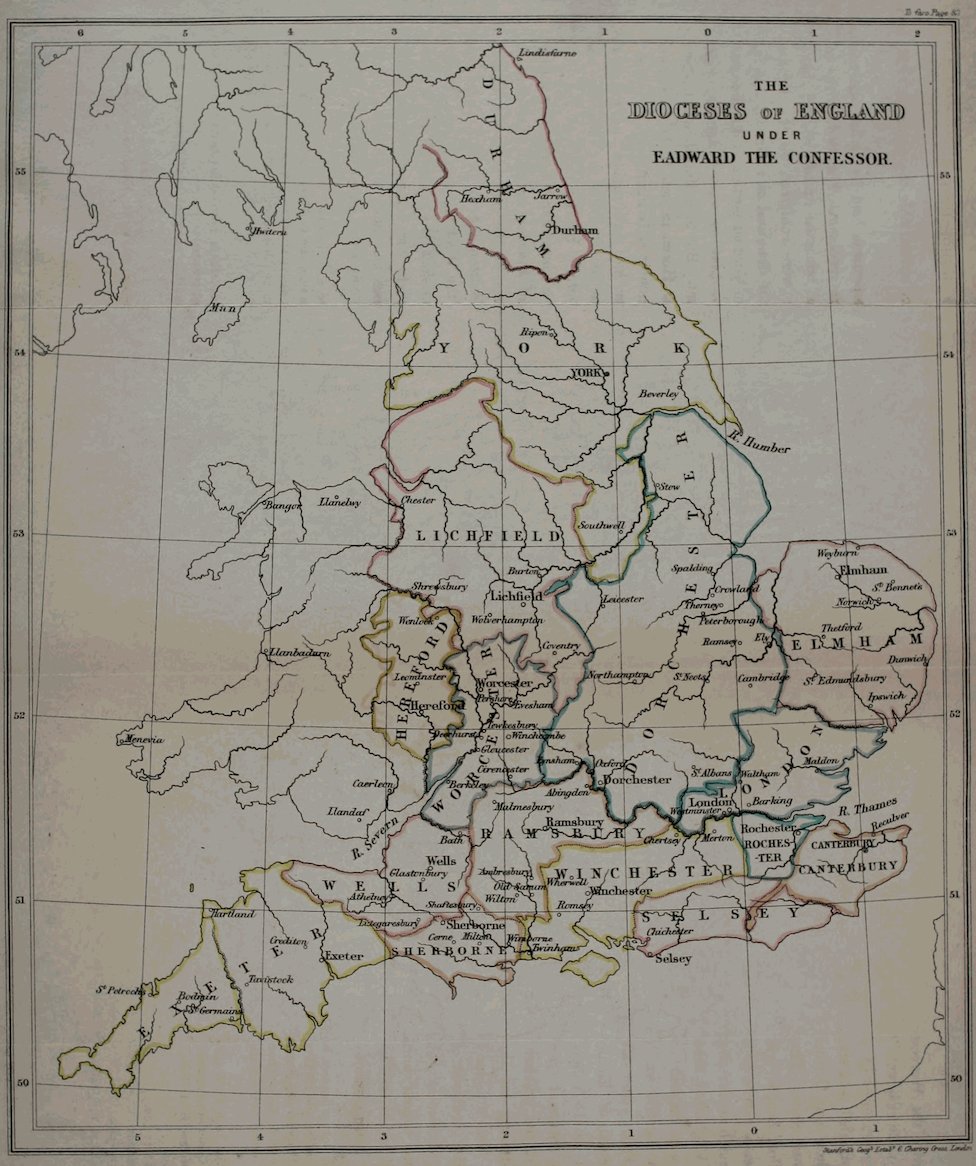
83The great mass of preferment held by Lyfing did not pass undivided to a single successor. The Bishopricks of Devonshire and Cornwall remained united, as they have done ever since. They were conferred on the King’s Chancellor, Leofric, who is described as a Briton, that is, doubtless, a native of the Cornish portion of his diocese.[240] His name however shows that he was of English, or at least of Anglicized, descent. But in feeling he was neither British nor English; as Hermann was a Lotharingian by birth, Leofric was equally a Lotharingian by education.[241] Four years after his appointment, he followed |He removes the see to Exeter. 1050.| the example of Ealdhun of Durham in removing his episcopal see to a new site.[242] He did not however, like Ealdhun, create at once a church and a city;[243] he rather forestalled the practice of Prelates later in the century by transferring his throne to the greatest town of his diocese. The humbler Crediton had to yield its episcopal rank to the great city of the West, the city which Æthelstan had fortified as a cherished bulwark of his realm,[244] the city whose valiant burghers had beaten back the Dane in his full might, and which had fallen into his hands only when the Norman traitor was set to guard its walls.[245] She 84whose fatal presence had caused that great misfortune still |1003–1050.| lived. The first years of Emma in England beheld the capture and desolation of her noble morning-gift. Her last years saw the restored city become the spiritual capital of the great western peninsula. And, within the lifetime |1067.| of many who saw that day, Exeter was again to stand a siege at the hands of a foreign King, and again to show forth the contrast between citizens as valiant as those who drove Swend from before their walls and captains as incompetent or as treacherous as Hugh the Churl. The church of Saint Peter in Exeter now became the cathedral church of the western diocese, and there Leofric was solemnly enthroned in his episcopal chair by the saintly King and his virgin wife.[246] Hitherto the church had been occupied by nuns. They were now removed, and the chapter of the Bishop was formed of secular Canons. Leofric however required them to conform to the stricter |He subjects his Canons to the rule of Chrodegang.| discipline which he had learned in Lotharingia. The rule of Chrodegang of Metz, the model rule of secular Canons, though it did not impose monastic vows, yet imposed on those who conformed to it much of the strictness of monastic discipline.[247] The clerks who submitted to it were severed, hardly less than actual monks, from all the ordinary habits of domestic life. They were condemned to the common table and the common dormitory; every detail of their life was regulated by a series of minute ordinances; they were cut off from lay, and especially from female, society, and bound to a strict obedience to their Bishop or other 85ecclesiastical superior. Still they were not monks; they were even strictly forbidden to wear the monastic garb,[248] and the pastoral duties of baptism, preaching, and hearing confession were strictly enforced upon them. In accordance with the precepts of Chrodegang, the Canons of Exeter were required to eat in a common hall and to sleep in a common dormitory. Their temporal concerns were managed by an officer, who provided them with daily food, and with a yearly change of raiment. This sort of discipline never found favour in England. All who were not actual monks clave earnestly to the usage of separate houses, in which they were often solaced by the company of wives and children. Every earlier and later attempt to introduce the Lotharingian rule in England utterly failed.[249] Leofric’s discipline seems to have lasted somewhat longer than commonly happened in the like cases. Vestiges of the severer rule still remained at Exeter in the next century, but even then the purity of ancient discipline had greatly fallen off.[250]
Ealdred, Abbot of Tavistock, Bishop of Worcester, 1046; Archbishop of York, 1061–1069.
One of the sees vacated by the death of Lyfing thus fell to the lot of a zealous ecclesiastical reformer, but a man who plays no important part in the general history of the time. The fate of Lyfing’s other Bishoprick was widely different. It was bestowed on a Prelate who, without ever displaying any very great qualities, played a prominent, and on the whole not a dishonourable, part for many years to come. The early career of the famous Ealdred, who now succeeded Lyfing in the see of Worcester, had led him 86through nearly the same stages as that of his predecessor. Like him, he had been a monk at Winchester; like him, he had been thence called to the government of one of the great monasteries of the West. The Abbey of Tavistock, |997.| destroyed by Danish invaders in the reign of Æthelred,[251] had risen from its ashes, and it now proved a nursery of |Character of Ealdred.| Prelates like Lyfing and Ealdred.[252] The new Bishop was a man of ability and energy. He exhibits, like Harold, the better form of the increasing connexion between England and the continent. As an ambassador at the Imperial court, as a pilgrim at Rome and Jerusalem, he probably saw more of the world than any contemporary Englishman. He was renowned as a peacemaker, one who could reconcile the bitterest enemies.[253] But he was also somewhat of a time-server, and, in common with so many other Prelates of his time, he did not escape the charge of simony. This charge is one which it is easy to bring and often hard to answer, but the frequency with which it is brought shows that the crime itself was a familiar one. Like many other churchmen of his time, Ealdred did not scruple to bear arms both in domestic and in foreign warfare, but his campaigns were, to say the least, not specially glorious. His most enduring title to remembrance is that it fell to his lot to place, within a single year, the Crown of England on the brow, first of Harold and then of William, and to die of sorrow at the sight of his church and city brought to ruin by the mutual contentions of Normans, Englishmen, and Danes.
Gruffydd ap Llywelyn reconciled with the King. 1046.
87We shall find the new Bishop of Worcester appearing a few years later in arms against the Welsh, to whose incursions the southern part of his diocese lay open. But as yet it was only his powers of persuasion and peacemaking which he was called upon to exercise in that quarter. It was probably by Ealdred’s intervention that a reconciliation was now brought about between the famous King of North Wales, Gruffydd ap Llywelyn,[254] and his English overlord.
Expedition of Swegen and Gruffydd against Gruffydd ap Rhydderch. 1046.
Gruffydd’s immediate neighbour to the east was Swegen, whose anomalous Earldom took in the border shires of Gloucester and Hereford. Gruffydd accordingly gave hostages, and accompanied Swegen in an expedition against the other Gruffydd, the son of Rhydderch, the King of South Wales.[255] On his triumphant return Swegen was guilty of an act which embittered the remainder of his days, a breach of the laws of morality which the ecclesiastical feelings of the time clothed with tenfold guilt. He sent for Eadgifu, Abbess of Leominster, kept her 88|Swegen seduces Eadgifu, Abbess of Leominster.| awhile with him, and then sent her home.[256] Like the Hamor of patriarchal story, he next sought, with a generosity as characteristic of his wayward temper as any |He seeks in vain to marry her.| of his worst deeds, to make reparation by marriage.[257] But the law of the Church stood in his way. Richard of Normandy, as we have seen, found it easy to raise his mistress to all the honours due to a matron and the wife of a sovereign. The Lady Emma herself, wife and mother of so many Kings, was the offspring of an union which the Church had thus hallowed only after the fact.[258] But no such means of reparation were open to the seducer of a consecrated virgin. The marriage was of course forbidden, |He throws up his Earldom, and goes to Denmark.| and Swegen, in his disappointment, threw up his Earldom, left his country, and betook himself, first to Flanders, the usual place of refuge for English exiles, and thence to the seat of war in the North.[259] A formal sentence of outlawry seems to have followed, as the lordships 89of Swegen were confiscated, and divided between his brother Harold and his cousin Beorn.[260] On Eadgifu and her monastery the hand of ecclesiastical discipline seems |Fate of Leominster monastery.| to have fallen heavily. The nunnery of Leominster, one of the objects of the bounty of Earl Leofric,[261] now vanishes from history. The natural inference is that the misconduct of Eadgifu led, not only to her own disgrace, but to the dissolution of the sisterhood over which she had so unworthily presided.[262] We hear of no later marriage on the part of Swegen, but in after years we shall meet with |Hakon son of Swegen.| a son of his, probably a child of the frail Abbess of Leominster. Born under other circumstances, he might have been head of the house of Godwine. As it was, the son of Swegen and Eadgifu was the child of shame and sacrilege, and the career to which he was doomed was short and gloomy.
Banishment of Osgod Clapa. 1046.
The banishment of the Staller Osgod Clapa, at the bridal of whose daughter King Harthacnut had come to his untimely end, took place this year.[263] Like the banishment of Gunhild, this measure was evidently connected 90with the movements in the North of Europe. Osgod was doubtless one of those who had been marked men ever since the election of Eadward,[264] and who, in the present state of Scandinavian affairs, were felt to be dangerous. The immediate peril came from Magnus; but there could be little doubt that, of the three princes who were disputing the superiority of Scandinavia, the successful one, whether Magnus, Harold, or Swend, would assert some sort of claim to the possession of England. Magnus had |1066.| done so already. Harold lived to invade England and to perish in the attempt. It was only the singular prudence of Swend which kept him back from any such enterprise till he was able to interfere in English affairs in the guise |1069.| of a deliverer. Partisans of any one of the contending princes were clearly dangerous in England. Osgod was driven out, seemingly by a decree of the Christmas Gemót,[265] and he presently, after the usual sojourn in Flanders, betook himself to the seat of war in Denmark.[266]
Affairs of Scandinavia.
Osgod and Swegen most probably took service with Swend Estrithson. The presence of Swegen would doubtless be welcome indeed to that prince’s partisans. The nephew of Ulf, the cousin of their own leader, the son of the great English Earl, renowned in the North as the conqueror of the Wends,[267] was a recruit richly to be prized. And the cause of Swend Estrithson just then greatly needed recruits. His hopes, lately so flourishing, had been |Harold Hardrada joins Magnus and receives a share of the Kingdom of Norway. 1047.| again dashed to the ground. Magnus had contrived to gain over his uncle Harold to his side, by the costly bribe of a share in the Kingdom of Norway. The gift indeed 91was not quite gratuitous. Besides cooperating in the war with Swend, Harold was to share with Magnus the treasures which he had gathered in his Southern warfare.[268] The two Kings now joined their forces, and drove Swend out of Jütland and the Danish Isles. He retained only Scania, that part of the old Danish realm which lies on the Swedish side of the Sound, and which is now politically part of Sweden.[269] In the next year Swend was |Swend asks for English help.| again aiming at the recovery of his Kingdom. It was probably the presence of English exiles in his camp, which suggested to him the idea of obtaining regular help from England as an ally of the English King. He |His request is discussed by the Witan;| sent and asked for the help of an English fleet. In those days questions of peace and war were not decided either by the Sovereign only, or by the Sovereign and a few secret counsellors; they were debated openly by the Witan of the whole land. The demand of Swend was discussed in full Gemót. Swend had certainly acted, whether of set purpose or not, as a friend of England; the diversion caused by him had saved England from a Norwegian invasion. But, setting aside any feelings of gratitude on this account, any feelings of attachment to the kinsman of Cnut and of Godwine, it does not appear that England had any direct interest in embracing the cause of Swend. A party which sought only the immediate interest of England might argue that the sound policy was to stand aloof, and to leave the contending Kings of the North to wear out each other’s power and their own. Such however |Godwine supports the claim of Swend;| was not the view taken by Godwine. In the Gemót in which the question was debated, the Earl of the West-Saxons supported the petition of his nephew, and proposed that fifty ships should be sent to his help. It is clear that such a course might be supported by plausible arguments. 92It is clear that equally plausible arguments might be brought forward on the other side. And if, as is possible, this question was discussed in the same Gemót in which sentence of outlawry was pronounced against Swegen the son of Godwine, it is clear that the father of the culprit would stand at a great disadvantage in supporting the request of the prince with whom that culprit had taken service. It marks the still abiding influence of Godwine that he was able to preserve the confiscated lordships of Swegen for Harold and Beorn. But in his recommendation of giving armed support to Swend Estrithson all his |but his demand is opposed by Leofric, and rejected. 1047.| eloquence utterly failed. The cause of non-intervention was pleaded by Earl Leofric, and his arguments prevailed. All the people, we are told—the popular character of the Assembly still impresses itself on the language of history—agreed with Leofric and determined the proposal of Godwine to be unwise. The naval force of Magnus, it was said, was too great to be withstood.[270] Swend Estrithson had therefore to carry on the struggle with his own unaided forces. Against the combined powers of Magnus |Magnus defeats Swend and occupies Denmark.| and Harold those forces were utterly unavailing. Swend was defeated in a great sea-fight; Magnus took possession of all Denmark, and laid a heavy contribution upon the realm.[271] Swend again took refuge in Sweden, and now began to meditate a complete surrender of his claims upon Denmark. Just at this moment, we are told, a messenger appeared, bringing the news of the sudden death of 93|Sudden death of Magnus. 1047.| Magnus.[272] The victorious King had perished by an accident not unlike that which had caused the death of Lewis of France.[273] His horse, suddenly startled by a hare, dashed his rider against the trunk of a tree.[274] On his death-bed he bequeathed the crown of Norway to his uncle Harold |Harold succeeds in Norway, Swend in Denmark.| and that of Denmark to his adversary Swend. Such a bequest is quite in harmony with the spirit of the correspondence between Magnus and Eadward.[275] Swend returned |Their long warfare. 1048–1061.| and took possession of his Kingdom, and though he was for years engaged in constant warfare with Harold, he |Their embassies to England.| never wholly lost his hold upon the country. The first act of both the new Kings was to send embassies to England. Harold offered peace and friendship; Swend again asked for armed help against Harold.[276] The debate of the |Help again refused to Swend, and peace concluded with Harold. 1048.| year before was again reopened. Godwine again supported the request of his nephew, and again proposed that fifty ships should be sent to his help. Leofric again opposed the motion, and the people again with one voice supported Leofric. Help was refused to Swend and peace was concluded with Harold.[277] Swend, despairing of English aid, seems to have sought for protection in another quarter, and to have acknowledged himself a vassal of the Empire.[278]
Physical phænomena. 1046–7.
These two years seem to have been marked by several physical phænomena. In the former we hear of the 94|May 1, 1048.| unusual severity of the winter, accompanied by an extraordinary fall of snow.[279] In the latter several of the midland shires were visited by an earthquake.[280] We read also of epidemics both among men and beasts, and of the appearance called wild fire.[281] A few ecclesiastical appointments are also recorded; but one only calls for notice. |Death of Ælfwine of Winchester, Aug. 29, 1047. Stigand succeeds.| Ælfwine, Bishop of Winchester, died, and his Bishoprick fell neither to Frenchmen nor to Lotharingian. Stigand rose another step in the ladder of promotion by his translation from the humbler see of Elmham to the Bishoprick of the Imperial city.[282]
Ravages of Lothen and Yrling. 1048.
As far as we can make out through the confused chronology of these years, it was in the year of the peace with Norway that England underwent, what we have not now heard of for many years, an incursion of Scandinavian pirates.[283] Two chiefs, named Lothen and Yrling, came with twenty-five ships, and harried various parts of the coast. This event must have been in some way connected with the course of the war between Harold and Swend. Probably some enterprising Wikings in the service of one or other of those princes found a moment of idleness just as the two Kings were taking possession of their crowns, 95and thought the opportunity a good one for an attack on England. Such an attack was doubtless unexpected, especially as such good care had been taken to keep on good terms with both the contending Kings. But possibly the more daring policy of Godwine would really have been the safer.[284] Had fifty English ships, whatever their errand, been afloat in the Northern seas, Lothen and Yrling could hardly have come to plunder the shores of England. Anyhow the story shows us the sort of spirit which still reigned in the North. There were still plenty of men ready to seek their fortunes in any part of the world as soon as a moment of unwelcome quiet appeared at home. Harold and Swend at least did the world some service by finding employment for such men in warfare with one another. The Wikings harried far and wide. From Sandwich they carried off a vast booty in men, gold, and silver.[285] In the Isle of Wight they must have met with more resistance, as many of the best men of the island are said to have been slain.[286] In Thanet too the landfolk withstood them manfully, refused them landing and water, and drove them altogether away.[287] Thence they sailed to Essex, where they plundered at their pleasure.[288] By this time the King |Eadward and the Earls pursue the pirates, but they escape to Flanders.| and the Earls had got together some ships. The Earls were doubtless Godwine and Harold, on whose governments the attack had been made, and the words of our 96authorities seem to imply that Eadward was really present in person.[289] They sailed after the pirates, but they were too late. The enemy had already made his way to the common refuge of banished Englishmen and of foes of England. The Wikings were now safe in the havens of Flanders—of Baldwines land; there they found a ready market for the spoils of England, and thence they sailed back to their own country.[290]
Analogy with the relations with Normandy in 991 and 1000.
We here seem to be reading over again the history of the events which led to the first hostile relations between England and Normandy.[291] The Northmen are again plundering England, and a continental power again gives them so much of help and comfort as is implied in letting them sell their plunder in his havens. This time the offending power was not Normandy but Flanders, and Eadward, unlike his father, had no lack of powerful friends on the |Alliance with the Emperor Henry.| continent. The great prince who had, a year before,[292] been raised to the throne of the world was, as we have seen,[293] on the most intimate terms with his English brother, and it is plain that close alliance with the Empire formed part of the policy of the patriotic party. The illustrious Cæsar had filled the Papal chair with a Pontiff like-minded |The German Popes.| with himself. A series of German Popes of Imperial nomination had followed one another in a quick succession of short reigns, but they had had time to show forth in their virtues a marked contrast to the utter degradation of the Italian Pontiffs who had gone |Leo the Ninth. 1048–1054.| immediately before them. The throne of Peter was now filled, at the Imperial bidding, by Bruno, Bishop of Toul, a native of Elsass and kinsman of the Emperor, who had 97taken the name of Leo the Ninth.[294] He was now in his second year of office, having· been appointed in the year of the peace between England and Norway. It was perhaps only a later legend which told how, on his way to Rome, he fell in with the famous Hildebrand, then in exile, how he listened to his rebukes for the crime of accepting a spiritual office from an earthly lord, how he entered Rome as a pilgrim, and did not venture to ascend the Pontifical throne till he was again more regularly chosen thereto by the voice of the Roman clergy and people.[295] But, in any case, this concession to ecclesiastical rule or prejudice had abated nothing of Leo’s loyalty to his Teutonic sovereign, nothing of his zeal for the welfare, both spiritual and temporal, of lands which the Italian Pontiffs so seldom visited. The Pope was now at Aachen, |Rebellion of Godfrey and Baldwin against the Emperor. 1047.| ready with his spiritual weapons to help the Emperor against a league of his rebellious vassals. They had waged war against their suzerain; they had burned the city and church of Verdun; they had destroyed the noble palace of the Emperor at Nimwegen. Foremost among the offenders were Theodoric of Holland, Baldwin of Flanders, and Godfrey of Lotharingia. Godfrey was specially guilty. After a former rebellion he had been imprisoned and released, and now he was foremost in the new insurrection, especially in the deed of sacrilege at Verdun.[296] The Pope therefore did not hesitate to issue 98|Leo excommunicates Godfrey. 1049.| his excommunication against him. Godfrey yielded; the ban of the father of Christendom bent his soul; he submitted to scourging, he redeemed his hair at a great sum, he contributed largely to the rebuilding of the cathedral which he had burned, and himself laboured at the work |Continued ravages of Baldwin.| like a common mason. But Baldwin of Flanders, possibly trusting to his ambiguous position as a vassal both of the Empire and of the French Crown, was more obstinate, and still continued his ravages. The Emperor accordingly called on his vassals and allies for help against a prince whose power might well seem dangerous even to Kings |Swend and Eadward join the Emperor against Baldwin.| and Cæsars. King Swend of Denmark—so low had Denmark fallen since the days of Cnut—obeyed the summons as a vassal.[297] King Eadward of England contributed his 99help as an ally, and as one who was himself an injured party. The reception of English exiles at Baldwin’s court, the licence allowed to Scandinavian pirates of selling the spoils of England in Baldwin’s havens, caused every Englishman to look on the Count of Flanders as an enemy. The help which had been refused to Swend was therefore readily granted to Henry. The King of the English was not indeed asked to take any share in continental warfare by land. The share of the enterprise assigned to him was to keep the coast with his ships, in case the rebellious prince should attempt to escape by sea.[298] Again, as in the days of Æthelstan and Eadmund, an English fleet appeared in the Channel, ready, if need be, to take a part in continental warfare. But now, as in the days of |Baldwin defeated without actual English help.| Æthelstan and Eadmund,[299] nothing happened which called for its active service. Eadward and his fleet watched at Sandwich, while the Emperor marched against Baldwin by land. But the Count of Flanders, instead of betaking himself to the sea, submitted in all things to the will of the mighty overlord whom he had provoked.[300]
The submission of Baldwin lets loose the English exiles.
The immediate object for the assembling of the fleet had been attained; but the events which immediately followed showed that the fleet was just as likely to be 100needed for protection at home, as for a share in even just and necessary warfare abroad. The submission of Baldwin to the Emperor seems to have let loose the English exiles who had been flitting backwards and forwards between Flanders and Denmark,[301] and who had possibly taken a part on Baldwin’s side in the last campaign. Both Osgod Clapa and Swegen the son of |Swegen and Osgod return.| Godwine now appeared at sea. Swegen had only eight ships; but Osgod had—we are not told how—gathered a force of thirty-nine. While the King was still at Sandwich, Swegen returned to England. He sailed first to Bosham, a favourite lordship of his father’s, and one whose name we shall again meet with in connexion with events of still greater moment to the house of Godwine. He there left his ships, and went to the King at Sandwich, |Swegen’s reconciliation with Eadward. 1049.| and offered to become his man.[302] His natural allegiance as an English subject was perhaps held to be cancelled by his outlawry or by his having become the man of Swend of Denmark or of some other foreign prince. A new personal commendation was seemingly needed for his reconciliation with his natural sovereign. He seems to have asked for his Earldom again; at any rate, he was tired of the life of a sea-rover, and asked that his lands which had been confiscated might be given back to him for his maintenance. He seems to have found favour, either with the King personally or with some of those who were about him, for it was proposed, if not actually resolved, that Swegen should be restored to all his former possessions.[303] But the strongest opponents of such a course 101|Harold and Beorn oppose his reconciliation.| were found in the kinsmen to whom his confiscated lands had been granted, his cousin Beorn and his brother Harold. They both refused to give up any part of what the King had given them.[304] Swegen’s petition was accordingly refused; |Swegen’s outlawry is renewed.| his outlawry was confirmed; only, as seems to have been usual in such cases, he was allowed four days to get him out of the country. How far Harold and Beorn were actuated in this matter by mere regard to their own interests, how far by a regard to the public good, how far by that mixture of motives which commonly determines men’s actions, we have no means of judging. This is not the only act of Harold’s early life which may be taken to show that he had not yet acquired those wonderful gifts of conciliation and self-restraint which mark his more mature career. Of the character of Beorn we know nothing except from this story; what we hear of him directly afterwards certainly sets him before us in a generous and amiable light. The tale is told us in a perfectly colourless way, without any hint how the conduct of the two cousins was judged of in the eyes of contemporaries in general or in those of Earl Godwine. At all events, Swegen went away from Sandwich disappointed. He thence went to Bosham, where his ships were lying in the land-locked haven of that place. This was just at the moment when the fleet, no longer needed for service against Baldwin, was beginning to disperse. We see that this fleet also had been gathered in the ancient way by the contingents or contributions of the shires,[305] and that only a small number of the ships were in the King’s permanent service. Those of the crews who had come from distant, especially inland, 102districts were naturally weary of tarrying when there was no prospect of active service, and the contingent of Mercia was accordingly allowed to return home.[306] The King remained at Sandwich with a few ships only. Meanwhile a rumour came that hostile ships had been seen ravaging |Godwine at Pevensey.| to the west. The Earl of the West-Saxons accordingly sailed forth to the rescue, with forty-two ships belonging to the men of his Earldom.[307] He took also two ships of the King’s, commanded respectively by Harold and by his third son Tostig, of whom we now hear for the first time.[308] Stress of weather however hindered them from getting further west than Pevensey. While they lay there, a change, of the motive of which we are not told, was made in the command of the two royal ships which had accompanied Godwine. Harold gave up the ship which he had commanded to his cousin Beorn.[309] This accidental change possibly saved Harold’s life.[310] For Swegen now came from Bosham to Pevensey, and there found his father and cousin. He there spoke with both of them. The result of their discourse was that Beorn 103|Beorn entrapped and slain by Swegen.| was persuaded to undertake the office of intercessor with the King on Swegen’s behalf. What arrangement was to be proposed—whether Beorn brought himself to consent to the sacrifice which he had before refused—whether Swegen was to be again invested with his Earldom or only with his private lordships—whether Harold, Beorn, or Swegen was to be compensated in any other way for the surrenders which one or more of them would have to make—of all this nothing is explained to us. We hear however that Beorn, trusting to his kindred with Swegen,[311] did not hesitate to set out to ride with him to the King at Sandwich. He even agreed to a proposal of Swegen’s, according to which they left the road from Pevensey to Sandwich, and went westward to Bosham. For this deviation from his original scheme Swegen made an excuse, which was doubtless more intelligible then than it is now, namely a fear lest the crews of his ships should forsake him, if they were not confirmed in their faith to him by the presence of Beorn. The young Earl fell into the snare, and accompanied his cousin to the haven of Bosham. But when Swegen pressed him to go on board one of his ships, Beorn’s suspicions were at last aroused, and he vehemently refused. At last Swegen’s sailors bound him, put him in a boat, rowed him to the ships, and there kept him a prisoner. They then hoisted their sails and steered for Dartmouth.[312] There Beorn was killed by Swegen’s orders, but his body was taken on shore and buried in a church. As soon as the murder became known, Earl Harold,[313] with others of Beorn’s friends, and the sailors 104from London—a clear mark of Beorn’s popularity—came and took up the body, carried it to Winchester, and there buried it in the Old Minster by the side of Beorn’s uncle King Cnut.
Swegen declared Nithing by the armed Gemót.
The general indignation at the crime of Swegen was intense. The King and the army publicly declared the murderer to be Nithing.[314] This was the vilest epithet in the English language, implying utter worthlessness. It was evidently used as a formal term of dishonour. We shall find |1087.| it at a later time resorted to by a Norman King as a means of appeal to his English subjects. William Rufus, when he needed English support, proclaimed in the like sort that all who failed to come to his standard should be declared to be Nithing. But this proclamation has a deeper importance than the mere use of this curious expression of public |Functions of the Witan discharged by the army.| contempt. It is to be noted that the proclamation is described as the act of the King and his army. Here is clearly a case of a military Gemót.[315] The army, as representing the nation, assumes to itself in time of war the functions which belonged to the regular Gemót in time of peace. The army declares Swend to be Nithing, and it was doubtless the army, in the same sense, which had just before hearkened to, and finally rejected, his petition for restoration to his estates. So it was the army, Cnut’s |1014.| Danish army, which assumed to itself the functions of the English Witan by disposing of the English Crown on the 105death of King Swend.[316] In the ancient Teutonic constitution the army was the nation and the nation was the army. In the primitive Gemóts described by Tacitus,[317] to which all men came armed, no distinction could be |Nature of the military Gemót.| drawn between the two. But it should be noticed that the word used is not that which denotes the armed levy of the Kingdom, but that which expresses the army in its special relation to the King.[318] This fact exactly falls in with the practical, though not formal, change which had taken place in the constitution of the ordinary Gemóts.[319] The military Gemót which passed this sentence on Swegen was not the whole force of England, for we were just before told that the contingents both of Mercia and Wessex had left Sandwich. This assembly must have consisted of the King’s Comitatus of both kinds, of the Thegns bound to him by the older and more honourable tie, and also of the standing force of the Housecarls, or at any rate of their officers.[320] Setting churchmen aside—though we have seen that even churchmen often bore arms both by land and by sea—such a body would probably contain a large proportion of the men who were likely to attend an ordinary Witenagemót. By an assembly of this kind, acting, whether constitutionally or not, in the character of a National Assembly, the outlawry and disgrace of Swegen were decreed.
Swegen, deserted by most of his ships, escapes to Flanders.
It would seem that this decree preceded the translation of Beorn’s body to Winchester, a ceremony which may not improbably have been ordered by the Assembly. For it was before that translation[321] that the men of Hastings, 106most probably by some commission from the King or his military council, sailed forth to take vengeance on the murderer. Swegen was already forsaken by the greater part of his following. Of his eight ships six had left him. Their crews were probably rough Wikings from the North, men familiar with all the horrors of ordinary pirate warfare, not troubled with scruples about harrying a land whose people had never wronged them, but who nevertheless shrank from the fouler wickedness of slaying a kinsman by guile. Two ships only remained with Swegen, those doubtless whose crews had been the actual perpetrators of the deed. The men of Hastings chased and overtook these ships, slew their crews, and brought the ships to the King.[322] How Swegen himself escaped it is not easy to see; possibly the men of Hastings still scrupled personally to lay hands upon a son of Godwine. At any rate the murderer baffled pursuit, and again took shelter in his old quarters. Baldwin, so lately restored to his dominions, again began his old practice of receiving English exiles, and Swegen spent the whole winter at the court of Flanders under the full protection of its sovereign.[323]
Character of the act of Swegen.
107The story of the murder of Beorn is told in so minute and graphic a way that it seems impossible to throw doubt on any part of the tale. And every account represents the deed as a deed of deliberate treachery.[324] An act of mere violence would not have greatly offended the morality of that age. Had Swegen killed even a kinsman in a moment of provocation or in a fair fight to decide a quarrel, his guilt would not have seemed very black. Had he even used craft in carrying out an ancestral deadly feud, he might have quoted many precedents in Northumbrian history, and, among them, an act in the life of the reigning Earl of the North hardly inferior in guilt to the worst |Universal indignation against Swegen.| aspect of his own.[325] But to kill a kinsman, a confiding kinsman, one who had just granted a somewhat unreasonable prayer, was something which offended the natural instincts not only of contemporary Englishmen but of Scandinavian pirates. At the moment Swegen seems to have found no friends; the voice of all England was against him; there is no sign that any of his family stood by him; the sympathies of Harold clearly lay with his murdered cousin. It is hardly possible to conceive a blacker or more unpardonable crime. One would have thought that Swegen would have failed to find patrons or protectors in any |His reception by Baldwin.| corner of Christendom. Yet, strange to say, the murderer, forsaken by all, was at once received with favour by Baldwin, even though Baldwin must have known that by receiving him he was running the risk of again offending the King of the English and even the Emperor himself. |His outlawry is reversed and he returns to England. Midlent, 1050.| And what followed is stranger still. In the next year, in a Witenagemót held in London in Midlent, Swegen’s 108outlawry was reversed, and he was restored to his Earldom.[326] And, strangest of all, his restoration is attributed, not to the influence of Godwine or his family, not to any revulsion of feeling on the part of the King or the nation, but |Swegen reconciled to Eadward by Bishop Ealdred.| to the personal agency of Bishop Ealdred the Peacemaker. He it was who, it would seem, crossed over to Flanders, brought Swegen to England, and procured his restoration at the hands of the King and his Witan.[327] There is nothing to show that Ealdred was specially under the influence of Godwine. We shall before long find him acting in a manner which, to say the least, shows that he was not one of Godwine’s special followers. His episcopal city and the greater part of his diocese lay within the Earldom of Leofric; no part of it lay within the Earldom of Godwine.[328] And, if part of his diocese lay within the Earldom of the man whom he sought to restore, that only makes him the more responsible for the act which was so directly to affect a portion of his own flock. In the restoration of Swegen, Ealdred seems to have acted purely in his capacity of peacemaker.[329] At first sight it might seem that Ealdred strove to win the blessing promised to his class by labouring on behalf of a sinner whom the most enlarged charity could hardly excuse. The very strangeness of the act suggests that there must have been some explaining cause, intelligible at the time, but which our authorities have not 109recorded. The later history of Swegen shows that, if he was a great sinner, he was also a great penitent. We can only guess that Ealdred already marked in him some signs of remorse and amendment, that he had received from him some confession of his crime, to which we possibly owe the full and graphic accounts of the murder of Beorn which have been handed down to us.[330] If so, it was doubtless wise and charitable not to break a bruised reed; still again to entrust the government of five English shires to the seducer of Eadgifu and murderer of Beorn was, to say the least, a perilous experiment.
We must now go back to the time when King Eadward had just dismissed the Mercian contingent after the reconciliation |Various military operations of the year 1049.| between Baldwin and the Emperor. While the unhappy events which I have just narrated were going on, Englishmen had cause to be alert in more than one quarter of the island against assaults of various kinds. In the comparatively peaceful reign of Eadward this year stands forth as marked by warlike operations of every sort. England had to resist the assaults of foreign enemies, of faithless vassals, and of banished men seeking their restoration. |Movements of Osgod Clapa.| Besides the small force of Swegen, Osgod Clapa was, as has been already said,[331] at sea with a much larger number of ships. He first appeared at Wulpe near Sluys on the coast of Flanders, and the news of his arrival there was brought to Eadward at the moment when the King was left at Sandwich at the head of a very small force. The Mercian contingent had just been dismissed, and Godwine, with the force of Wessex, had sailed westward. 110Eadward was therefore nearly defenceless. He therefore countermanded the orders for the dismissal of the Mercian vessels, and as many of them as was possible were brought |He returns to Denmark.| back. Osgod however did not act personally as the enemy of England. He merely took his wife from Bruges, where she had been left, and sailed back to Denmark with |Piracy and destruction of his fleet.| six ships. The remainder of his fleet took to piracy off Eadulfsness in Essex, and there did much harm. But a violent storm arose and destroyed all the vessels except four.[332] These were chased and captured, and the crews slain, whether by Eadward’s own fleet in pursuit or by some of the foreign allies of England is not very clear.[333]
Ships from Ireland in the Bristol Channel; joined by Gruffydd of South Wales. July, 1049.
The rumour which had called Godwine westward from Sandwich was not wholly a false one. The ships which were then said to be ravaging the south coast, were doubtless Danish pirate vessels from Ireland, the same which, in the course of July, sailed up the Bristol Channel as far as the mouth of the Usk.[334] There they were welcomed by the South-Welsh King Gruffydd,[335] who was doubtless rejoiced at the prospect of such allies, alike against the English and against his Northern namesake, the momentary confederate of England. After a certain amount of harrying along the coast of the Channel, the combined forces of Gruffydd and the pirates crossed the Wye, and slew and |They invade Gloucestershire, and defeat Bishop Ealdred.| plundered within the diocese of Worcester. It is not clear who was the Earl responsible for the safety of the country since the banishment of Swegen. It was probably the 111King’s nephew, Ralph the Timid, whose name begins about this time to appear in the Charters with the title of Earl.[336] If this be so, this was the first appointment of a foreigner to a great temporal office, a further step in the downward course, still more marked than that of appointing foreign Prelates. Under such a chief as Ralph no vigorous resistance was to be looked for, and the person who really took upon himself the defence of the country was Bishop Ealdred. He gathered a force from among the inhabitants of Gloucestershire and Herefordshire; but part of his army consisted of Welshmen, whether mere mercenaries hired for the occasion, or Welshmen living as immediate subjects of England. But whoever these Welshmen were, their sympathies lay wholly with Gruffydd and not with Ealdred. They sent a secret message to the Welsh King, suggesting an immediate attack on the English army. Gruffydd willingly answered to the call. With his twofold |July 29, 1049.| force, Welsh and Danish, he fell on the English camp early in the morning, slew many good men, and put the rest, together with the Bishop, to flight.[337] Of the further results of this singular and perplexing campaign, especially when and how the retreat of the invaders was brought about, we hear nothing.
Increasing connexion with the continent.
Everything which happened about this time sets before us the great and increasing intercourse which now prevailed between England and the continent. Our fathers |English attendance at Synods.| were now brought into a nearer connexion with both the 112spiritual and the temporal chiefs of Christendom than they had ever known before. We have already seen England in close alliance with the Empire; we have now to contemplate her relations with the Papacy. The active and saintly Pontiff who now presided over the Church held at this time a series of Councils in various places, at most of which English Prelates attended. Leo, after receiving the submission of Godfrey at Aachen, entered France, at the request of Heremar, Abbot of Saint Remigius at Rheims, to hallow the newly built church of his monastery.[338] |Synod of Rheims.| He then held a synod, which sat for six days, and passed several canons of the usual sort, against the marriage of priests and against their bearing arms.[339] The days of Otto the Great seemed to have returned, when the Pope and the Emperor,[340] seemingly without reference to the Parisian King, held a Council on French ground, attended by a vast multitude of Prelates, clergy, and laity from the Imperial Kingdoms and from other parts of Europe. There, besides the Metropolitan of the city in which the synod was held, was the Archbishop of Burgundy, as our Chronicles call him,[341] that is, the Archbishop of the great see of Lyons, Primate of all the Gauls, but no subject or vassal of the upstart dynasty of Paris. There were the Archbishops of Trier and Besançon; and from England came Duduc, the Saxon Bishop of Wells, 113and the Abbots Wulfric of Saint Augustine’s and Ælfwine of Ramsey, whom King Eadward had sent to bring him word of all that should be done for the good of Christendom.[342] |Synod of Mainz.| It does not appear that any English Prelates were present at the synod which Leo held soon after at Mainz;[343] but the two Italian synods which were held soon after were, as we shall see, connected in a singular manner with English affairs. There seems to have been about |Deaths of Bishops and Abbots.| this time a kind of mortality among the English Prelates. Among those who died was the Abbot of Westminster or Thorney, the humbler foundation which was soon to give way to the great creation of the reigning King. He bore the name of Wulfnoth, a name which suggests the likelihood of kindred with the house of Godwine. Another was Oswiu, the Abbot of the other Thorney in the fen land, the neighbour of Peterborough and Crowland. This |Siward dies, and Eadsige resumes the Primacy. 1049.| year too died Siward the Coadjutor-Archbishop, and Eadsige again resumed his functions for the short remainder |Eadnoth of Dorchester dies; Ulf succeeds. 1049.| of his life.[344] Eadnoth too, the good Bishop of Dorchester,[345] the builder of Stow in Lindesey, died this year, and his death offered a magnificent bait to Norman ambition and greediness. The great Bishoprick stretching from the Thames to the Humber, was conferred by the King on one of his Norman chaplains, who however bore the Scandinavian name of Ulf. As to the utter unfitness of this man for such an office there is an universal consent among our authorities. The King, even the holy Eadward, did evil in appointing him; the new Prelate 114did nought bishoplike; it were shame to tell more of his deeds.[346]
The year which followed was one of great note in ecclesiastical history. In England the first event recorded is |Witenagemót of London. Midlent, 1050.| the usual meeting of the Witan in London at Midlent. The proceedings of this Gemót, like those of many others about this time, give us a glimpse of that real, though very imperfect, parliamentary life which was then growing up in England, and which the Norman Conquest threw back for many generations. Then, as now, there were economists pressing for the reduction of the public expenditure, and what we should now call the Navy Estimates were chosen as being no doubt a popular subject for attack. The narrative of the naval events of the last year shows that, on special occasions, naval contingents were called for, according to the old law,[347] from various parts of the Kingdom, but that the King still kept a small naval force |Reduction of the Fleet.| in constant pay. This force had, under Cnut and Harold, consisted of sixteen ships;[348] it seems now to have consisted only of fourteen. The experience of the last year showed that England was still open to attack from the West; but the great fear, fear of invasion from the North, had now quite passed away. It seemed therefore to be a favourable moment for further reductions. By the authority of this Gemót nine ships were accordingly paid off, the crews receiving a year’s pay, and the standing force was cut down to six.[349] It was in this same assembly that Swegen 115|Swegen inlawed.| was inlawed,[350] that is, his outlawry was reversed, by the intercession of Bishop Ealdred. That Prelate, as we have seen, seems to have gone over to Flanders, and to have brought Swegen back with him.[351]
Mission of Ealdred and Hermann to Rome.
But Ealdred had soon to set forth on a longer journey. He and the Lotharingian Bishop Hermann were now sent to Rome on the King’s errand.[352] What that errand was we learn only from legendary writers and doubtful charters, but, as their accounts completely fit in with the authentic history, we need not scruple to |The King’s vow of pilgrimage to Rome.| accept their general outline.[353] The King had in his youth vowed a pilgrimage to Rome, and the non-fulfilment of this vow lay heavy on his conscience. It probably lay heavier still when he saw so many of his subjects of all ranks, led by the fashionable enthusiasm of the time, making both the pilgrimage to Rome and also the more distant pilgrimage to Jerusalem.[354] A broken vow was a crime; still Eadward had enough of political sense and right feeling left to see that his absence from his Kingdom at such a time as the present would be a criminal forsaking of his kingly duty. The Great Cnut might 116venture on such a journey; his eye could see and his hand could act from Rome or Norway or any other part of the world. But the personal presence of Eadward was the only check by which peace could be for a moment preserved between the true sons of the soil, and the strangers |Eadward sends the Bishops to obtain a dispensation. 1050.| who were eating into its vitals. The King laid his case before his Witan; the unanimous voice of the Assembly forbade him to forsake his post; the legend adds that the Witan farther counselled him to satisfy his conscience by obtaining a Papal dispensation from his vow. This was the King’s errand on which Ealdred and Hermann were sent to attend the great synod[355] held this year at Rome. They made good speed with their journey; starting at |The Synod of Rome.| Midlent, they reached the Holy City on Easter Eve.[356] In that synod they stood face to face with a man then known |Lanfranc.| only as a profound scholar and theologian, the bulwark of orthodoxy and the pattern of every monastic virtue, but who was, in years to come, to hold a higher place in the English hierarchy, and to leave behind him a far greater name in English history, than either of the English Prelates whose blessing he may now have humbly craved. In that synod of Rome the doctrines of Berengar of Tours were debated by the assembled Fathers, and the foremost champion of the faith to which Rome still cleaves was Lanfranc of Pavia. Suspected of complicity with the heretic, he produced the famous letter in which Berengar had maintained the Eucharist to be a mere figure of the Body of Christ.[357] How far Ealdred or Hermann took part in these theological debates we know not; but they are said to have successfully accomplished their own errand. 117The King’s vow of pilgrimage was dispensed with, on condition of the rebuilding and endowment on a grander scale of that renowned West Minster whose name was to be inseparably bound together with that of the sainted King.[358] Before the year was out the unwearied Leo held |Synod of Vercelli.| another synod at Vercelli. Here the theological controversy was again raised, and Lanfranc again shone forth as the irresistible smiter of heresy. Berengar was finally condemned, notwithstanding his appeals to the elder teaching of John Scotus, and his protests that those who rejected John Scotus rejected Augustine, Jerome, Ambrose, and all the Fathers of the Church.[359] These disputes, renowned in the Church at large, are wholly passed over by our insular Chroniclers. To them the famous Synod of Vercelli seems to have been memorable only as showing the Roman Court in what was apparently a new relation towards the Prelacy of England. Before the assembled Fathers came |Confirmation of Ulf of Dorchester.| the newly appointed Bishop of Dorchester, Ulf the Norman, seeking, it would seem, for consecration or confirmation. His unfitness for his post was manifest; he was found incapable of going through the ordinary service of the Church. The Synod was on the point of deposing him, of breaking the staff which, according to the ceremonial of those times, he had already received from the King. But the influence which was already all-powerful at Rome saved him. He retained his Bishoprick; but only at the cost of a lavish expenditure of treasure, of which we may be sure that no portion found its way into the private 118|Possible pilgrimage of Macbeth.| coffers of Leo.[360] It was in this same year that Macbeth made that mysterious bestowal of alms or bribes at Rome from which some have inferred a personal pilgrimage on the part of the Scottish usurper.[361] It is not beyond the bounds of possibility that one who seems to us hardly more real than the creations of Grecian tragedy may have personally appeared at Rome or at Vercelli, that he may have shown his pious indignation at the heresies of the Canon of Tours, or have felt his soul moved within him at the incapacity of the Bishop of Dorchester. A personal meeting between Leo, Lanfranc, Ealdred, and Macbeth would form no unimpressive scene in the hands of those who may venture on liberties with the men of far-gone times which to the historian are forbidden.
Ealdred and Hermann thus came back from Rome with the wished for dispensation from the King, and Ulf came back from Vercelli to hold the great see of Mid-England, and to rule it in his unbishoplike fashion for a little time. |Death of Archbishop Eadsige. October 9, 1050.| But before long a still greater ecclesiastical preferment became vacant. Eadsige, who had so lately resumed his archiepiscopal functions, died before the end of the year.[362] The day of complete triumph for the Norman monks and chaplains who surrounded Eadward now seemed to have come. A Frenchman might now sit on the throne of Augustine. Patriotic Englishmen were of course proportionably alarmed, and among them none more so than those who were most immediately concerned, the Chapter of the metropolitan church. The monks of 119Christ Church met, and made what is called a canonical election.[363] In the eye of English law such a process was little more than a petition to the King and his Witan for the appointment of the man of their choice. That choice fell on a member of their own body, their selection of whom showed that seclusion from the world had not made them incapable of a happy union of the dove |The monks of Christ Church elect Ælfric.| and the serpent. There was in their house a monk, Ælfric by name, who had been brought up in the monastery from his childhood, and who enjoyed the love of the whole society. Notwithstanding his monastic education, he was held to be specially skilled in the affairs of the world. And he had a further merit as likely as any of the others to weigh either with an English Chapter or with an English Witenagemót; he was a near kinsman of Earl Godwine.[364] The monks petitioned the Earl, the natural patron of a corporation within his government, to use his influence to obtain the King’s confirmation of their choice.[365] Godwine was doubtless nothing loth to avail himself of so honourable an opportunity to promote an Englishman and a kinsman. But his influence was crumbling away. Four years before he had been able to obtain the confirmation of Siward as Eadsige’s coadjutor; he was now unable to obtain the confirmation of Ælfric, or of any other man of native birth, |Ælfric rejected by the King, and Robert Bishop of London appointed to the see of Canterbury. Midlent, 1051.| 120as Eadsige’s successor. The saintly King paid no regard to the canonical election of the Convent, and in the Midlent Witenagemót of the next year, the Archbishoprick of Canterbury was bestowed on the King’s French favourite, Robert, Bishop of London.[366] The national party however prevailed so far as to secure an English successor |Spearhafoc appointed to London, and Rudolf to the Abbey of Abingdon.| to the see which Robert vacated. Spearhafoc, Abbot of Abingdon, a man famous for his skill in the goldsmith’s craft,[367] was named to the see of London by the King’s writ under his seal.[368] The Abbacy of Abingdon was given to a man whose description raises our curiosity; he was one Rudolf, described as a kinsman of King Eadward and as a Bishop in Norway.[369] For a native Northman to have been a kinsman of the son of Æthelred and Emma is hardly possible, unless the common ancestor was to be looked for so far back as the days before the settlement of Rolf. A Norman is hardly likely to have desired or obtained preferment in so unpromising a land; but it is highly probable that Cnut, who appointed several 121Englishmen to Bishopricks in Denmark, may have made use of a see in Norway either to reward or to remove some remote and unrecorded member of the English royal family. It is therefore very probable that Rudolf may have been an Englishman.[370] He was an aged man and weary of his office. The hand of Harold Hardrada pressed heavily on the Church. Pilgrim of the Holy Sepulchre as he was, he is charged with destroying ecclesiastical buildings, and even with sending Christian men to martyrdom.[371] Rudolf sought and found a place of more quiet, if of somewhat less honour, in the dominions of his kinsman. The monks of Abingdon received him, not very willingly, it would seem, but they were won over by the prospect that the old man would not live very long, and by the King’s promise that at the next vacancy free election should be allowed.[372] Presently the new Archbishop |Robert returns from Rome. July 27, 1051.| Robert came back from Rome with his pallium; he was enthroned in the metropolitan church, and soon hastened to the royal presence.[373] Spearhafoc, the Bishop-elect of London, came with the royal writ, and demanded 122|He refuses to consecrate Spearhafoc.| consecration of his Metropolitan. Robert refused, saying that the Pope had forbidden him to consecrate Spearhafoc.[374] Things had come to such a pass, that an Englishman, appointed to an English office by the King and his Witan, was to be kept out of its full possession by one foreigner acting at the alleged bidding of another. There were times when the Roman see showed itself a real refuge for the oppressed, and, as far as good intentions went, so it doubtless was in the days of good Pope Leo. But Englishmen now needed protection against no one except against the foreign favourites of their own King, and it was on behalf of those foreign favourites, and against Englishmen, that these stretches of Papal authority were now made. The unworthy Ulf was allowed, by the power of bribes, to retain his see—for he was a stranger. Spearhafoc, on what ground we know not—except so far as his English birth was doubtless a crime in the eyes of Robert—was refused the rite which alone could put him into full possession of his office. A second demand was again made by the Bishop-elect, and consecration was again refused |Spearhafoc occupies the Bishoprick without consecration.| by the Norman Archbishop.[375] Spearhafoc, rejected, unconsecrated, nevertheless went to Saint Paul’s, and took possession of the see which he held by the King’s full and regular grant.[376] No doubt he did not pretend to 123discharge any purely episcopal functions, but he kept possession of the see and its revenues, and probably exercised at least its temporal authority. This he did, the Chronicler significantly adds, all that summer and autumn.[377] Before the year was out, the crisis had come, and had brought with it the momentary triumph of the strangers.
One act more must be recorded before we come to the end of this portion of Eadward’s reign. In a meeting of the Witan, seemingly that in which Robert, Spearhafoc, |The remaining ships paid off and the Heregyld remitted.| and Rudolf received their several appointments, the remaining five ships of the standing or mercenary naval force were paid off.[378] The war-contribution or Heregyld was therefore no longer exacted. This tax had now been |1012.| paid for thirty-eight years, ever since Thurkill and his fleet entered the service of Æthelred.[379] This impost had all along been felt to be a great burthen; we are told that it was paid before all other taxes, the other taxes themselves, it would seem, being looked upon as heavy.[380] The glimpse which is thus given us of the financial system of the time is just enough to make us wish for fuller knowledge. We must remember that in a rude state of society any kind of taxation is apt to be looked on as 124a grievance. It requires a very considerable political developement for a nation to feel that the power of the purse is the surest safeguard of freedom. But there must have been something specially hateful about this tax to account for the way in which it is spoken of by the contemporary chroniclers, and for the hold which, as the legends show,[381] it kept on the popular imagination. The holy King, we are told, in company with Earl Leofric, one day entered the treasury in which the money raised by the tax was collected; he there saw the Devil sitting and playing with the coin; warned by the sight, he at once |Distinction between Danegeld and Heregyld.| remitted the tax. In this story the tax is called Danegeld, and as many of the sailors in the English service were likely to be Danes, the Heregyld seems to have been confounded with the Danegeld, and to have been popularly called by that name.[382] The Danegeld was in strictness a payment made to buy off the ravages of Danish invaders, a practice of which we have seen instances enough and to spare in the days of Æthelred. But the tax now taken off was simply a war-tax for the maintenance of a fleet, a fleet whose crews may have been to a great extent Danes, but Danes who were not the enemies of England, but engaged in her service. The two ideas however easily ran into one another; it might be difficult to say under which head we ought to place some of the payments made both under Cnut and under Harthacnut. But the Heregyld, in its more innocent shape, would, according to modern ideas, be an impost absolutely necessary for the defence of the country. If the tax were remitted, no naval force would be retained, except the contingents of the shires, which could not in any case be very readily forthcoming. But, besides the general dislike to taxation 125|Import of the remission.| of any kind, this particular tax was a painful and hateful badge of national disgrace. It was a memory of times when England could find no defence against strangers except by taking other strangers into her pay. Its remission was doubtless looked on as a declaration that England no longer needed the services of strangers, or of hired troops of any kind, but that she could trust to the ready patriotism and valour of her own sons. The Law required every Englishman to join the royal standard at the royal summons.[383] The effectual execution of that law was doubtless held to be a truer safeguard than the employment of men, whether natives or strangers, who served only for their pay. Such reasonings had their weak side even in those days, but they were eminently in the spirit of the time. The measure was undoubtedly a popular one, and we are hardly in a position to say that, under the circumstances of the time, it may not have been a wise one.