Chapter VII · FROM THE ELECTION OF EADWARD TO THE BANISHMENT OF GODWINE.[1] 1042–1051. (continued 3)
Reading edition
§ 4. The Banishment of Earl Godwine. 1051.
The foreign influence at its height.
The influence of the strangers had now reached its height. As yet it has appeared on the face of the narrative mainly in the direction given to ecclesiastical preferments. During the first nine years of Eadward’s reign, we find no signs of any open warfare between the national and the Normannizing parties. The course of events shows that Godwine’s power was being practically undermined, but he was still outwardly in the enjoyment of royal favour, and his vast possessions were still being added to by royal grants.[384] It is remarkable how seldom, at this stage of Eadward’s reign, the acts of the Witan bear 126the signatures of any foreigners except churchmen.[385] We meet also with slight indications showing that the King’s foreign kinsmen and the national leaders were not yet on |Its seemingly stealthy character.| terms of open enmity.[386] It was probably the policy of the strangers to confine their action in public matters to influencing the King’s mind through his ecclesiastical favourites, while the mass of them were gradually providing in other ways for their own firm establishment in the land. But the tale which I now have to tell clearly reveals the fact that the number of French landowners in England was already considerable, and that they had made themselves deeply hateful to the English people. Stealthily but surely, the foreign favourites of Eadward had eaten into the vitals of England, and they soon had the means of showing how bitter was the hatred which they bore towards the champions of English freedom. |Comparison between Danish and Norman influences.| England now, under a native King of her own choice, felt, far more keenly than she had ever felt under her Danish conqueror, how great the evil is when a King and those who immediately surround him are estranged in feeling from the mass of his people. The great Dane had gradually learned to feel and to reign as an Englishman, to trust himself to the love of his English subjects, and to surround the throne of the conqueror with the men whom his own axe and spear had overcome. Even during the troubled reigns of his two sons, the degeneracy was for the most part merely personal. Harthacnut indeed laid 127on heavy and unpopular taxes for the payment of his Danish fleet;[387] but it does not appear that, even under him, Englishmen as Englishmen were subjected to systematic oppression and insult on the part of strangers. And, after all, the Danish followers of Cnut and his sons were men of kindred blood and speech. They could hardly be looked on in any part of England as aliens in the strictest sense, while to the inhabitants of a large part of the Kingdom they appeared as actual countrymen. But now, as a foretaste of what was to come fifteen years later, men utterly strange in speech and feeling stood around the throne, engrossed the personal favour of the King, perverted the course of justice, shared among themselves the highest places in the Church, and were already beginning to stretch out their hands to English lands and lordships as well as to English Bishopricks. The Dane, once brought to the knowledge of a purer faith and a higher civilization, soon learned to identify himself with the land in which he had settled, and to live as an Englishman |Incapacity of the French to appreciate English institutions.| under the Law of England. But to the French favourites of Eadward the name, the speech, the laws of England were things on which their ignorant pride looked down with utter contempt. They had no sympathy with that great fabric of English liberty, which gave to every freeman his place in the commonwealth, and even to the slave held out the prospect of freedom. Gentlemen of the school of Richard the Good,[388] taught to despise all beneath them as beings of an inferior nature, could not understand the spirit of a land where the Churl had his rights before the Law, where he could still raise his applauding voice in the Assemblies of the nation, and where men already felt as keenly as we feel now that an Englishman’s house is his castle. Everything in short which had already made England free and glorious, everything which it is now our 128pride and happiness to have preserved down to our own times, was looked on by the foreign counsellors of Eadward as a mark of manifest inferiority and barbarism. |Diversity in speech;| The Dane spoke a tongue which hardly differed more widely from our own than the dialects of different parts of the Kingdom differed from one another. But the ancient mother-speech, once common to Dane and Frank and Angle and Saxon, the speech of which some faint traces may still have lingered at Laôn and at Bayeux, had now become only one of many objects of contempt in the eyes of men whose standards were drawn from the |in military tactics.| Romanized courts of Rouen and Paris. The Dane met the Englishman in battle, face to face and hand to hand, with the same tactics and the same weapons. Shield-wall to shield-wall, sword to sword or axe to axe, had men waged the long warfare which had ranged from the fight |871–1016.| of Reading to the fight of Assandun. To the Frenchman the traditions of Teutonic warfare appeared contemptible.[389] His trust was placed, not in the stout heart and the strong arm of the warrior, but in the horse which is as useful in the flight as in the charge, and in the arrow which places the coward and the hero upon a level.[390] Men brought up in such feelings as these, full too no doubt of the insolent and biting wit of their nation, now stood round the throne of the King of the English. They were not as yet, to any great extent, temporal rulers of the land, but they had already begun to be owners of its soil; they were already the Fathers of the Church; they were the personal friends of the King; they were the channels of royal favour; their influence could obtain the highest ecclesiastical office, when it was refused alike to the 129demand of the Earl of the West-Saxons and to the prayer of the canonical electors. In the company of these men the King was at home; among his own people he was a |Evils of a denationalized Court, especially in early times.| stranger. The sight of a denationalized Court, a Court where the national tongue is despised and where the sounds of a foreign speech are alone thought worthy of royal lips, a Court in which the heart of the sovereign beats more warmly for foreign favourites or foreign kinsmen than for the children of the soil, is a sight which in any age is enough to stir up a nation’s blood. But far heavier is the wrong in an age when Kings govern as well as reign, when it is not the mere hangers-on of a Court, but the nation itself, which is made personally to feel that strangers fill the posts of honour and influence, on its own soil and at its own cost. Often indeed since the days of Eadward has the Court of England been the least English thing within the realm of England. But, for ages past, no sovereign, however foreign in blood or feeling, could have ventured to place a stranger, ignorant of the English tongue, on the patriarchal throne of Dunstan and |Revolt of England against the foreign influence.| Ælfheah. Against such a state of things as this the heart of England rose. And the soul of the patriotic movement, the leader of the patriotic struggle, was the man whom Norman calumny has ever since picked out as its special victim, but with whom every true English heart was prepared to live and die. The man who strove for England, the man who for a while suffered for England, but who soon returned in triumph to rescue England, was once more Godwine, Earl of the West-Saxons.
Indignation at the appointment of Robert to Canterbury.
The refusal of the King to confer the Archbishoprick of Canterbury on a kinsman of the great Earl regularly chosen by the Convent of the metropolitan church, its bestowal instead on an intriguing monk from Jumièges, had no doubt deeply embittered the feelings of Godwine 130and of all true Englishmen. All the sons of the Church, we are told, lamented the wrong;[391] and we may be sure that the feeling was in no way confined to those who are no doubt chiefly intended by that description. It now became the main object of the foreign Archbishop to bring about the ruin of the English Earl. Robert employed his |Robert’s cabals against Godwine. 1051.| influence with the King to set him still more strongly against his father-in-law, to fill his ears with calumnies against him, above all, to bring up again the old charge, of which Godwine had been so solemnly acquitted, which made him an accomplice in the death of Ælfred.[392] A dispute about the right to some lands which adjoined the estates both of the Earl and of the Primate further embittered the dissension between them.[393] Godwine’s influence was manifestly fast giving way, and an open struggle was becoming imminent. Just at this moment, an act of foreign insolence and brutality which surpassed anything which had hitherto happened brought the whole matter to a crisis.
Marriages of Godgifu daughter of Æthelred with Drogo of Mantes and Eustace of Boulogne.
We have seen that Eadward’s sister Godgifu—the Goda of Norman writers—the daughter of Æthelred and Emma, had been married to Drogo, Count of Mantes or of the French Vexin. Their son, Ralph the Timid, was now high in favour at the court of his uncle.[394] Drogo had accompanied Duke Robert on his pilgrimage, and, like him, had died on his journey.[395] His widow, who must now have been a good deal past her prime,[396] had nevertheless 131found a second French husband in Eustace, Count of Boulogne. This prince, whom English history sets before us only in the darkest colours, was fated by a strange destiny to be the father of one of the noblest heroes of Christendom, of Godfrey, Duke of Lotharingia and King of Jerusalem. We cannot however claim the great Crusader as one who had English blood in his veins through either parent. The second marriage of Godgifu was childless, and the renowned sons of Eustace, Godfrey and his brother Baldwin, were the children of his second |Visit of Eustace to Eadward. September, 1051.| wife Ida. The Count of Boulogne, now brother-in-law of the King of the English, presently came, like the rest of the world, to the English Court. The exact object of his coming is not recorded, but we are told that whatever he came for he got.[397] Some new favours were doubtless won for foreign followers, and some share of the wealth of England for himself. It was now September, and the King, as seems to have been his custom, was spending the autumn at Gloucester.[398] Thither then came Count Eustace, and, after his satisfactory interview |Return of Eustace.| with the King, he turned his face homewards. We have no account of his journey till he reached Canterbury;[399] there he halted, refreshed himself and his men, and rode on towards Dover. Perhaps, in a land so specially devoted to Godwine, he felt himself to be still more thoroughly in an enemy’s country than in other parts of England. At all events, when they were still a few miles from Dover, the Count and all his company took the precaution of putting on their coats of mail.[400] They entered 132|Outrages of Eustace and his party at Dover.| the town; accustomed to the unbridled licence of their own land, puffed up no doubt by the favourable reception which they had met with at the King’s Court, they deemed that the goods and lives of Englishmen were at their mercy. Who was the villain or the burgher who could dare to refuse ought to a sovereign prince, the friend and brother-in-law of the Emperor of Britain? Men born on English soil, accustomed to the protection |1020–1051.| of English Law, men who for one and thirty years[401] had lived under the rule of Godwine, looked on matters in quite another light. The Frenchmen expected to find free quarters in the town of Dover, and they attempted to lodge themselves at their pleasure in the houses of the burghers. There was one Englishman especially—his name unluckily is not preserved—into whose house a Frenchman was bent on forcing himself against the |The burghers resist,| owner’s will. The master of the house resisted; the stranger drew his weapon and wounded him; the Englishman struck the intruder dead on the spot.[402] Count Eustace mounted his horse as if for battle;[403] his followers 133mounted theirs, the stout-hearted Englishman was slain within his own house. The Count’s party then rode through the town, cutting about them and slaying at pleasure. But the neighbours of the murdered man had now come together; the burghers resisted valiantly; a |and drive the French out of the town.| skirmish began; twenty Englishmen were slain, and nineteen Frenchmen, besides many who were wounded. Count Eustace and the remnant of his party made their way out of the town, and hastened back to King Eadward at Gloucester. |Eustace accuses the men of Dover to the King.| They there told the story after their own fashion, throwing of course all the blame upon the insolent burghers of Dover.[404] It is not hard to throw oneself into the position of the accusers. To chivalrous Frenchmen the act of the English burgher in defending his house against a forcible entry would seem something quite beyond their understandings. To their notions the appeal to right and law to which Englishmen were familiar, would seem, on the part of men of inferior rank, something almost out of the course of nature. We often see the same sort of feeling now-a-days in men whom a long course of military habits, a life spent in the alternation of blind obedience and arbitrary command, has made incapable of understanding those notions of right and justice which seem perfectly plain to men who are accustomed to acknowledge no master but the Law.[405] The crime of Eustace was a dark one; but we may be inclined to pass a heavier judgement still on the crime of the English King, who, on the mere accusation of the stranger, condemned his own subjects without a hearing. When Eustace had told his tale, the 134King became very wroth with the burghers of Dover,[406] and this time he thought that he had not only the will |Eadward commands Godwine to inflict military chastisement on the town.| but the power to hurt.[407] He sent for Godwine, as Earl of the district in which the offending town lay. The English champion was then in the midst of a domestic rejoicing. He had, like the King, been strengthening himself by a foreign alliance, and had just connected his house with that of a sovereign prince. Tostig, the third son of Godwine, had just married Judith, the daughter or near kinswoman of Baldwin of Flanders.[408] Such a marriage could hardly have been contracted without a political object. An alliance with a prince reigning in the debateable land between France and Germany, a land which, though its princes were rapidly becoming French, had by no means wholly lost its Teutonic character, was quite in harmony with the Lotharingian connexion so steadily maintained by Godwine and Harold. At the same time, an alliance with a prince who had been so lately in arms against England may not have tended to increase Godwine’s favour with the King. The Earl left the marriage-feast of his son, and hastened to the King at Gloucester. Eadward then told him what insults had been offered within his Earldom to a sovereign allied to himself by friendship and marriage. Let Godwine go, and subject the offending town to all the severity of military chastisement.[409] Godwine had once before been sent on the like 135|Comparison between the cases of Worcester under Harthacnut and Dover under Eadward.| errand in the days of Harthacnut.[410] He had then not dared to refuse, though he had done what he could to lighten the infliction of a harsh and unjust sentence. And, after all, the two cases were not alike. In the case of Worcester, Godwine was required to act as a military commander against a town which was not within his government, and whose citizens stood in no special relation to him. The citizens of Worcester too had been guilty of a real crime. Their crime was indeed one which might readily have been pardoned, and the punishment decreed was out of all proportion to the offence. Still the death of the two Housecarls fairly called for some atonement, though certainly not for an atonement of the kind commanded by Harthacnut. At that time too it was probably sound policy in Godwine to undertake the commission in which he was joined with the other great Earls of England, and merely to do his best to lighten its severity in act. But in the present case all the circumstances were different. Dover was a town in Godwine’s own Earldom; it would almost seem that it was a town connected with him by a special tie, a town whose burghers formed a part of his personal following.[411] At all events it 136was a town over which he exercised the powers of the highest civil magistracy, where, if it was his duty to punish the guilty, it was equally his duty to defend and shelter the innocent. Such a town he was now bidden, without the least legal proof of any offence, to visit with all the horrors of fire and sword. Godwine was not long |Godwine refuses to obey the King’s orders.| in choosing his course. Official duty and public policy, no less than abstract justice and humanity, dictated a distinct refusal. Now or never a stand was to be made against the strangers. Now that Englishmen had been insulted and murdered by the King’s foreign favourites, the time was indeed come to put an end to a system under which those favourites were beginning to deal with England as with a conquered country. The eloquent voice of |He demands a legal trial for the burghers.| the great Earl was raised, in the presence of the King, probably in the presence of Eustace and the other strangers, in the cause of truth and justice.[412] In England, he told them, there was a Law supreme over all, and courts in which justice could be denied to no man. Count Eustace had brought a charge against the men of Dover. They had, as he alleged, broken the King’s peace, and done personal wrong to himself and his companions. Let then the magistrates of the town be summoned before the King and his Witan, 137and there be heard in their own defence and in that of their fellow-burghers. If they could make a good excuse for their conduct, let them depart unhurt; if they could be proved to have sinned against the King or against the Count, let them pay for their fault with their purses or with their persons. He, as Earl of the West-Saxons, was the natural protector of the men of Dover; he would never agree to any sentence pronounced against them without a fair trial, nor would he consent to the infliction of any sort of illegal hardship upon those whom he was bound to defend. The Earl then went his way; he had done his own duty; he was accustomed to these momentary ebullitions of wrath on the part of his royal son-in-law, and he expected that the affair would soon be forgotten.[413]
But there were influences about Eadward which cut off all hope of any such peaceful settlement of the matter. Eustace probably still lingered about the King, to repeat his own story, to enlarge on the insolence of the men of Dover, and on the disobedience—he would call it the |Archbishop Robert excites the King against Godwine.| treason—of the West-Saxon Earl himself. And there was another voice ever at the royal ear, ever ready to poison the royal mind against the English people and their leader. The foreign monk who sat on the throne of so many English saints again seized the opportunity to revive the calumnies of past times. He once more impressed upon the King that the man who refused to obey his orders, the man who had protected, perhaps excited, rebellious burghers against his dearest friends, was also the man who had, years before, betrayed his brother to a death of torment.[414] The old and the new charges worked 138|The Witan summoned to Gloucester to hear charges against Godwine.| together on the King’s mind, and he summoned a Meeting of the Witan at Gloucester, to sit in judgement, no longer on the men of Dover, who seem by this time to have been forgotten, but on Godwine himself.[415] The Earl now saw that he must be prepared for all risks. And, just at this moment, another instance of the insolence and violence of the foreigners in another part of the Kingdom served |Building of Richard’s Castle in Herefordshire.| to stir up men’s minds to the highest pitch. Among the Frenchmen who flocked to the land of promise was one named Richard the son of Scrob, who had received a grant of lands in Herefordshire. He and his son Osbern had there built a castle on a spot which, by a singularly lasting tradition, preserves to this day the memory of himself and his building.[416] The fortress itself has vanished, but its site is still to be marked, and the name of Richard’s Castle, still borne by the parish in which it stood, is an abiding witness of the deep impression which its erection made on the minds of the men of those times. |Import of the building of castles.| The building of castles is something of which the English writers of this age frequently speak, and speak always with a special kind of horror.[417] Both the name and the 139thing were new. To fortify a town, to build a citadel to protect a town, were processes with which England had long been familiar.[418] To contribute to such necessary public works was one of the three immemorial obligations from which no Englishman could free himself.[419] But for a private landowner to raise a private fortress to be the terror of his neighbours was something to which Englishmen had hitherto been unaccustomed, and for such a structure the English language had hitherto contained no name. But now the tall, square, massive donjon of the Normans, a building whose grandest type is to be seen in the Conqueror’s own Tower of London and in the more enriched keep of Rochester, began, doubtless on a far humbler scale, to rear itself over the dwellings of Englishmen. Normandy had, during the minority of William, been covered with such buildings, and his wise policy had levelled many of them with the ground.[420] Such buildings, 140strange to English eyes, bore no English name, but retained their French designation of castles.[421] Such a castle at once became a centre of all kinds of oppression. Men were harboured in it, and deeds were done within its impregnable walls, such as could find no place in the open hall of the ancient English Thegn. So it was with the castle which was now raised within the government of the eldest son of Godwine. The Welshmen, as they are called—that is, not Britons, but Frenchmen, Gal-Welsh, not Bret-Welsh—built their castle, and “wrought all the harm and besmear”—an expressive word which has dropped out of the language—“to the King’s men thereabouts that they might.”[422] Here then was another wrong, a wrong perhaps hardly second to the wrong which had been done at Dover. Alike in Kent and in Herefordshire men had felt the sort of treatment which they were to expect if the King’s foreign favourites were to be any longer tolerated. The time was now come for Englishmen to make a stand.
Godwine and his sons meet at Beverstone with the force of their Earldoms.
141The Earl of the West-Saxons was not a man to be wanting to his country at such a moment. He, with his sons Swegen and Harold, gathered together the force of their three Earldoms at Beverstone in Gloucestershire. This is a point on the Cotswolds, not far from the Abbey of Malmesbury, still marked by a castle of far later date, the remaining fragments of which form one of the most remarkable antiquities of the district. At this time it seems to have been a royal possession, and it may not unlikely have contained a royal house, which would probably be at the disposal of Swegen as Earl of the shire.[423] At Beverstone then assembled the men of Wessex, of East-Anglia, and of that part of Mercia which was under the jurisdiction of Swegen. They came, it would seem, ready either for debate or for battle, as might happen. We must here again remember what the ancient constitution of our National Assemblies really was. If all actually came who had a strict right to come, the Gemót was a ready-made army. On the other hand we have seen that an army, gathered together as an army, sometimes took on itself |The forces of Siward, Leofric, and Ralph assemble at Gloucester.| the functions of a Gemót.[424] Meanwhile, while Godwine assembled his men at Beverstone, the forces of the Earldoms of Siward, Leofric, and Ralph were assembling round the King at Gloucester. Each of the two gatherings might pass for the local Witenagemót of one half of England. At the head of the men of three Earldoms Godwine was still bolder than when he had stood alone in the royal presence. He had then only refused to punish the 142innocent; he now demanded the punishment of the guilty. His first steps however were conciliatory. He first demanded an audience for himself and his sons, as Earls of the three Earldoms; they were ready and anxious to take counsel with the King and his Witan on all matters touching the honour of the King and his people.[425] He even offered to renew his compurgation on the old charge |Godwine’s offers to the King refused through the influence of Frenchmen.| of the death of Ælfred.[426] But the Frenchmen swarmed around the King; they filled his ears with the usual charges against Godwine and his sons; they assured him that the only object of the Earls was to betray him.[427] Eadward therefore refused the audience, and declined to receive the compurgation.[428] Godwine then took a higher |Godwine demands the surrender of Eustace and the other criminals. September 8, 1051.| tone; messages were sent in his name and in the name of the men of the three Earldoms, demanding the surrender of Eustace and his men and of the Frenchmen at Richard’s Castle.[429] The demand was a bold one; Godwine asked for 143the surrender of the person of a foreign prince, the King’s own favourite and brother-in-law. But the demand, if bold, was perfectly justifiable. The two parties of Frenchmen had been guilty of outrageous crimes within the jurisdictions of Godwine and Swegen respectively. The King, instead of bringing them to justice, was sheltering them, and even listening to their charges against innocent men. Their lawful judges, the Earls of the two districts, were ready, at the head of the Witan of their Earldoms, to do that justice which the King had refused. The demand was seemingly backed by threats of an appeal to that last argument by which unrighteous rulers must be brought to reason. Godwine and his followers threatened war against Eadward, as the later Barons of England threatened war against John.[430] The King was frightened and perplexed. |The Northern Earls bring their full forces.| He sent to hasten the coming of Siward, Leofric, and Ralph, and bade them bring a force strong enough to keep Godwine and his party in check. Seemingly they had at first brought or sent only a small body of men; when they heard the full state of the case, they hastened to the King with the whole force of their Earldoms, and restored confidence to his timid mind.[431] This was the sort of occasion which was sure to awaken those provincial jealousies which in that age were often lulled to sleep, but which were never completely got rid of. The northern and southern parts of England were again arrayed against 144|1035.| each other, just as they had been in the great Gemót of Oxford sixteen years before.[432] The French followers of Ralph and the French friends of Eadward were doubtless glad of any excuse to shed the blood or to seize the lands of Englishmen. Siward and his Danes were seemingly not displeased with a state of things in which jealousy of the West-Saxon Earl could be so honourably cloaked under the guise of loyalty to the West-Saxon King. They were therefore quite ready to play into the hands of the strangers. They |The King finally refuses to surrender the Frenchmen.| were still on their march, but seemingly close to the town, when Eadward gave his final answer to the messengers of Godwine; Eustace and the other accused persons should not be given up. The messengers had hardly left Gloucester, |The Northumbrians ready for battle.| when the Northern host entered the city, eager to be led to battle against the men of Wessex and East-Anglia.[433] Godwine and his followers saw by this time that there was little hope of bringing the King to reason by peaceful means. Every offer tending to reconciliation had been spurned; every demand of the Earls and their people had been refused. The punishment of the innocent had been commanded; the punishment of the guilty had been denied; the old charges, of which Godwine had been so |1040.| solemnly acquitted eleven years before, were again raked up against him by the slanderous tongue of a foreign |March of the West-Saxons and East-Angles on Gloucester.| priest. Loath as the Earl and his followers were to fight against their Lord the King,[434] they saw no hope but in an appeal to arms, and the men of the three Earldoms made themselves ready for battle. From the heights of the Cotswolds on which they had been gathered, they marched 145down the hill-side which overlooks the fairest and most fertile of English valleys.[435] The broad Severn wound through the plain beneath them; beyond its sandy flood rose, range beyond range, the hills which guarded the land of the still unconquered Briton. Far away, like a glimpse of another world, opened the deep vale of the Welsh Axe,[436] the mountain land of Brecheiniog, where, in the furthest distance, the giant Beacons soar, vast and dim, the mightiest natural fortress of the southern Cymry. Even then some glimpses of days to come may have kindled the soul of Harold, as he looked forth on the land which was, before many years, to ring with his renown, and to see his name engraved as conqueror on the trophies of so many battle-fields. They passed by relics of unrecorded antiquity, by fortresses and tombs reared by the hands of men who had been forgotten before the days of Ceawlin, some perhaps even before the days of Cæsar. They passed by the vast hill-fort of Uleybury, where the Briton had bid defiance to the Roman invader. They passed by the huge mound, the Giants’-Chamber of the dead, covering the remains of men whose name and race had passed away, perhaps before even the Briton had fixed himself in the islands of the West.[437] Straight in their path rose the towers, in that day no doubt tall and slender, of the great minster of the city which was their goal, where their King sat a willing captive in the hands of the enemies of his 146people. And, still far beyond, rose other hills, the heights of Herefordshire and Shropshire, the blue range of Malvern and the far distant Titterstone, bringing the host as it were into the actual presence of the evil deeds with which the stranger was defiling that lovely region. Godwine had kept his watch on the heights of Beverstone, as Thrasyboulos had kept his on the heights of Phylê,[438] and he now came down, with the truest sons of England at his bidding, ready, as need might be, to strive for her freedom either in the debates of the Witan or in the actual |War hindered by the intervention of Leofric.| storm of battle. But there were now men in the King’s train at Gloucester who were not prepared to shed the blood of their countrymen in the cause of strangers. Eadward had now counsellors at his side who had no mind to push personal or provincial jealousy to the extent of treason to their common country. Earl Leofric had obeyed the command of the King, and had brought the force of Mercia to the royal muster at Gloucester. Some jealousies of Godwine may well have rankled in his breast, but love of his country was a stronger feeling still. He was not ready to sacrifice the champion of England to men who had trampled on every rule of English law and of natural right, men who seemed to deem it a crime if Englishmen refused to lie still and be butchered on their |He effects a compromise, and procures the adjournment of the Gemót.| hearth-stones. The good old Earl of the Mercians now, as ever,[439] stood forth as the representative of peace and compromise between extreme parties. The best men of England were arrayed in one host or the other. It were madness indeed for Englishmen to destroy one another, simply to hand over the land to its enemies without defence.[440] But, while two armed hosts stood ready for 147battle, there was no room for peaceful debate. Let both sides depart; let hostages be given on both sides, and let the Meeting of the Witan stand adjourned, to assemble again, after a few weeks, in another place. Meanwhile all enmities on either side should cease, and both sides should be held to be in full possession of the King’s peace and friendship.[441] The proposal of Leofric was accepted by both parties, and the Gemót was accordingly adjourned, to meet in London at Michaelmas.
Gemót of London. September 29, 1051.
The objects of Leofric in this momentary compromise were undoubtedly honourable and patriotic. But King Eadward and his foreign advisers seem to have been determined to make the most of the breathing-space thus given them for the damage of the national cause. The |Eadward appears at the head of an army.| King employed the time in collecting an army still more powerful than that which had surrounded him at Gloucester. He seems to have got together the whole force of Northumberland and Mercia, and to have summoned the immediate following of the King, the royal Housecarls, and perhaps the King’s immediate Thegns, even within Godwine’s own Earldom.[442] The King’s quarters were probably at his favourite palace of Westminster. Godwine came, accompanied by a large force of the men |The King’s demands of Godwine.| of his Earldom, to his own house in Southwark.[443] Several messages passed to and fro between him and the King. But it soon became clear that, though the King’s full peace and friendship had been assured to Godwine, there was no intention in the royal councils of showing him any favour, or even of treating him with common justice. The two parties had separated at Gloucester on equal 148terms. Each had been declared to be alike the King’s friends; each alike had given hostages to the other; the matters at issue between them were to be fairly discussed in the adjourned Gemót. Instead of this agreement being carried out, Godwine and his sons found themselves dealt |The outlawry of Swegen renewed. Injustice of its renewal.| with as criminals. The first act of the Assembly, seemingly before Godwine and his sons had appeared at all, was to renew the outlawry of Swegen.[444] No act could be more unjust. His old crimes could no longer be brought up against him with any fairness. The time when they might have been rightly urged was on the motion for the repeal of his former outlawry.[445] But, whether wisely or unwisely, that outlawry had been legally reversed; Swegen had been restored to his Earldom, a restoration which of course implied the absolute pardon of all his former offences. Since that time, we hear of no fresh crime on his part, unless it were a crime to have been a fellow-worker with his father, his brother, and the men of his Earldom, in resistance to the wrongs inflicted by the strangers. To condemn Swegen afresh for his old offences was a flagrant breach of all justice; to condemn him for his late conduct was a breach of justice equally flagrant in another way. Besides this, his condemnation on this last ground would carry with it an equal condemnation of Godwine and Harold. Swegen then was outlawed, and that, |Godwine and Harold summoned before the King.| as far as we can see, without a hearing; and Godwine and Harold were summoned to appear before the King, seemingly as criminals to receive judgement. Bishop Stigand, in whose diocese Godwine was then living, procured some delay;[446] but Archbishop Robert took advantage 149of that very delay, still further to poison the King’s mind against the Earl.[447] Godwine, after the treatment which his eldest son had just received, declined to appear, unless he received an assurance of the King’s favour, guaranteed by the placing of special hostages in his hands, as pledges for his personal safety during the interview. The King’s answer was apparently a demand that the Earls should allow, or perhaps compel, all the King’s Thegns who had joined them, to go over to the King’s side.[448] The demand was at once obeyed. By this time the tide was clearly turning against Godwine, and the force which he had brought with him to Southwark |Final summons of the Earls.| was getting smaller and smaller.[449] The King again summoned the Earls to appear, with twelve companions only. We can hardly believe that Stigand was compelled, however against his will, to announce as a serious message to Godwine that the King’s final resolution was that Godwine could hope for his peace only when he restored to him his brother Ælfred and his companions safe and sound.[450] It is inconceivable that such words can have formed part of a formal summons, but it is quite possible that they may have been uttered in mockery, either by |Their demand for a safe-conduct is refused.| the King or by his Norman Archbishop. But whatever was the form of the summons, Godwine and Harold refused to appear, unless they received hostages and a safe-conduct for their coming and going.[451] Without such security 150they could not appear in an Assembly which had sunk into a mere gathering of their enemies.[452] They had obeyed, and would obey, the King in all things consistent with their safety and their honour. But both their safety and their honour would be at stake, if they appeared before such a tribunal without any sort of safeguard, and without their usual retinue as Earls of two great Earldoms.[453] The demand was perfectly reasonable.[454] Godwine and his son could not be expected to appear, without safeguards of any kind, in such an assembly as that which now surrounded the King. The adjourned Gemót had been summoned for the free and fair discussion of all disputes between two parties, each of which was declared to be in the full enjoyment of the King’s peace and friendship. It was now turned into a Court, in which one son of Godwine had been outlawed without a crime or a hearing, in which Godwine himself was summoned to receive judgement on charges on one of which he had been years before solemnly acquitted. The hostages and the safe-conduct were refused. The refusal was announced by Stigand to the Earl as he sat at his evening meal. The Bishop wept; the Earl sprang to his feet, overthrew the table,[455] sprang on his horse, and, with his sons, rode for his life all that night.[456] In the morning the King held his Witenagemót, 151|Godwine and his family outlawed.| and by a vote of the King and his whole army,[457] Godwine and his sons were declared outlaws, but five days were allowed them to get them out of the land.[458] By this |Godwine, Swegen, &c., take refuge in Flanders.| time Godwine, Swegen, Tostig, and Gyrth, together with Gytha and Judith, the newly-married wife of Tostig, had reached either Bosham or the South-Saxon Thorney.[459] There could be little doubt as to the course which they were to take. Flanders, Baldwines land, was the common refuge of English exiles, and Godwine and the Flemish Count are said to have been bound to one another by the tie of many mutual benefits.[460] It was at the court of Baldwin that Swegen had taken refuge in his exile, and the Count was the near kinsman, perhaps the father, of Tostig’s bride, whose wedding-festivities had been so cruelly interrupted by these sudden gatherings of Gemóts and armies.[461] For Bruges then they set sail in a ship laded with as much treasure as it would hold.[462] They reached the court of Flanders in safety; they were honourably received by the Count,[463] and passed the whole winter with him.[464]
152Godwine then, with the greater part of his family,[465] had found shelter in the quarter where English exiles of that age commonly did find shelter. But two of his sons sought quite another refuge. To seek shelter in Flanders, a land forming the natural point of intercommunication between England, France, and Germany, was the obvious course for one whose first object, as we shall presently see, was to obtain his restoration by peaceful diplomacy. Such were the designs of Godwine, the veteran statesman, the man who never resorted to force till all other means |Harold determines on resistance.| had been tried in vain. But Harold, still young, and at all times more vehement in temper than his father, had not yet learned this lesson. His high spirit chafed under his wrongs, and he determined from the first on a forcible return to his country, even, if need be, by the help of a foreign force. This determination is the least honourable fact recorded in Harold’s life. It was indeed no |Estimate of his conduct.| more than was usual with banished men in his age. It is what we have already seen done by Osgod Clapa;[466] it is what we shall presently see done by Ælfgar the son of Leofric; it was in fact the natural resource of every man of those times who found himself outlawed by any sentence, just or unjust. If we judge Harold harshly in this matter, we are in fact doing him the highest honour. So to judge him is in fact instinctively to recognize that he has a right to be tried by a higher standard than the mass of his contemporaries. Judged by such a standard, his conduct must be distinctly condemned; but it should be noticed that, among the various charges, true and false, 153which were brought against Harold, we never find any reference to this, which, according to our ideas, seems |He determines to seek help from the Irish Danes.| the worst action of his life. In company with his young brother Leofwine,[467] he despised the peaceful shelter of Bruges, and preferred to betake himself to a land where, above all others, it would be easy to engage warlike adventurers in his cause. The eastern coast of Ireland, with the numerous towns peopled by Danish settlers, lay admirably suited for their purpose. Thither then |Harold and Leofwine go to Bristol; growing importance of that port.| the two brothers determined to make their way, with the fixed purpose of raising forces to effect their own return and to avenge their father’s wrongs.[468] For the port of their departure they chose Bristol, a town in Swegen’s Earldom, unknown to fame in the earlier days of our history, but which was now rising into great, though not very honourable, importance. The port on the Avon, the frontier stream of Wessex and Western Mercia, was the natural mart for a large portion of both those countries. Commanding, as it did, the whole navigation of the Channel to which it gives its name, Bristol was then, as now, the chief seat of communication between England and the South of Ireland. That is to say, it was in those days the chief seat of the Irish slave-trade.[469] In the haven of Bristol Earl Swegen had, for what cause we are not told, a ship made ready for himself.[470] 154The two brothers made the best of their way towards Bristol, in order to seize this ship for the purpose of their voyage to Ireland. Perhaps they had, wittingly or unwittingly, allowed their purpose of appealing to arms to |Ealdred sent to overtake them.| become known. This would be the only excuse for an act on the King’s part, which, in any other case, would be one of the most monstrous and unprovoked breaches of faith on record. It is not likely that the five days, which had been allowed the outlaws to leave the country, were yet passed. Harold and Leofwine would be sure to make better speed than that. Yet Bishop Ealdred, whose diocese of Worcester then took in the town of Bristol, was sent after them from London with a party to overtake them, if possible, before they got on ship-board. But the Bishop and his company were not zealous on an errand which had at least the appearance of shameless perfidy. They failed to overtake the fugitives; “they could not or they would not,” says the Chronicler.[471] Harold and |They escape, reach Ireland, and are well received by King Diarmid.| Leofwine reached Bristol in safety. They went on board Swegen’s ship; stress of weather kept them for a while at the mouth of the Avon, but a favourable wind presently carried them to Ireland.[472] They were there favourably received by Dermot or Diarmid Mac Mael-na-mbo, King of Dublin and Leinster.[473] He was a prince of native Irish 155descent, who had lately obtained possession of the Danish |1050.| district round Dublin, and whose authority seems to have been recognized by the Danes as well as by the Irish.[474] In such a state of things it would not be difficult to find bold spirits ready for any adventure, and a King whose position must have been somewhat precarious would doubtless welcome any chance of getting rid of some of them. Diarmid gave Harold and Leofwine as kind a reception at Dublin as the rest of the family had found from Baldwin at Bruges, and they stayed at his court through the whole winter, plotting schemes of vengeance.
The Lady Eadgyth sent to the Abbey of Wherwell.
One member only of the family of Godwine still remained to be disposed of. What had been the position or the feelings of Eadgyth during the scenes which have been just described we have no means of knowing; but she too was doomed to have her share in the misfortunes of her father’s house. The English Lady, the daughter of Godwine, could not be allowed to share the honours of royalty, now that all her kinsfolk were driven from the land,[475] now that the reign of the Normans was about to set in. The language of one contemporary authority seems almost to 156imply an actual divorce, of which Archbishop Robert was of course the main instigator.[476] The lawfulness or possibility of divorce in such a case might form a curious subject of speculation for those who are learned in the Canon Law. Eadward consented, perhaps willingly, to the separation; he allowed the Lady to be deprived of all her goods, real and personal;[477] but he interfered at least to save her from personal ignominy. Eadgyth was sent, with no lack of respect or royal attendance,[478] to the royal monastery of Wherwell,[479] and was there entrusted to the safe keeping of the Abbess. This Abbess was a sister of the King,[480] no doubt one of the daughters of Æthelred by his first wife. One of the widows of the slain and banished Earls, the relict of the traitor Eadric or of the hero Ulfcytel,[481] had taken the veil in the holy house of Eadgar and Ælfthryth,[482] and she could there confer with her guest on the uncertainty of human happiness and the emptiness of human greatness.
General character of the story; its difficulties.
157The whole of this history of the fall of Godwine is most remarkable; and it is singular that, though it is told in great detail in three distinct accounts, so much still remains which is far from intelligible. The first point which at once strikes us is the strength of Godwine in the Gemót of Gloucester and his weakness in the Gemót of London. Next year indeed we shall see the tide turn yet again; we shall behold Godwine return in triumph with the good will of all England. This is of course no difficulty; it would be no difficulty, even if popular feeling had been thoroughly against Godwine during the former year. Englishmen welcomed Godwine back again, because they had learned what it was to be without him. But the change of Godwine’s position during that eventful September of which we have just gone through the history is certainly perplexing. At Beverstone and at Gloucester he appears at the head of the whole force of Wessex, East-Anglia, and part of Mercia. All are zealous in his cause, ready, if need be, to fight in his quarrel against the King himself. He is clearly not without well-wishers even in the ranks of the Northern |Sudden collapse of the power of Godwine.| Earldoms. A compromise is brought about in which his honour is carefully guarded, and in which his party and the King’s are studiously put on equal terms. In the London Gemót, a few weeks later, all is changed. His followers gradually drop away from him; he does not venture to take his place in the Assembly which he had so often swayed at his pleasure; he is dealt with as an accused, almost as a convicted, criminal; he is subjected with impunity to every sort of unjust and irritating treatment; and he is at last driven to flee from the land, without a blow being struck, almost without a voice being raised, in his behalf. Such a falling away is difficult to understand; it is hard to see how Godwine could have given fresh offence to any one in the time between 158the conference at Gloucester and his appearance at Southwark. Norman flatterers and talebearers may have fanned the King’s prejudice against him into a still hotter flame; but there is at first sight nothing to account for the desertion |Position of the Northern Earls.| of his own followers. As for the Northern Earls and their followers, they had no ground of jealousy against Godwine in London which they had not equally at Gloucester; and at Gloucester they clearly were not disposed to push matters to extremities. Still it was clearly the number and strength of the following of Siward and Leofric in the London Gemót which decided the day against Godwine. The Earl of the West-Saxons was entrapped. He and his party came as to a peaceful assembly, and they found the King and his foreign followers bent on their destruction, and a powerful military force assembled to crush them. But why did even Siward lend himself to a scheme like this? Why, still more, did Leofric forsake the part, which he had so often and so worthily played, of mediator between extreme parties? Unless we are to suppose, which one would not willingly do, that Leofric was won by the bait of Harold’s Earldom for his son, we can only suppose that a mistaken feeling of loyalty hindered him from opposing a project on which he saw that the King was fully bent. It is in his position and that of Siward that the main difficulty lies. When Godwine found himself face to face with all the strength of Northern England, the rest of the story |Explanation of Godwine’s position and conduct.| becomes more intelligible. He had come expecting a fair discussion of all the questions at issue. But fair discussion was not to be had amid the clash of the axes of Siward’s Danes and of the lances of Ralph’s Frenchmen. Godwine had really no choice but to fight or to yield. Had he chosen to fight, the whole force of Wessex and East-Anglia would no doubt soon have been again at his command. But he shrank from a civil war; he saw that it was better policy to bide his time, to yield, even to 159flee, certain that a revulsion of national feeling would soon demand his recall. Such a course was doubtless wise and patriotic; but it was not one which would be at the time either acceptable or intelligible to the mass of his followers. If he meant to resist, he should doubtless have resisted at once; the hopes of an insurrection always lie in promptness and energy; every hour of delay only adds to the strength of the other side. We can thus understand how men began to fall off from a chief who, it might be said, dared not meet his sovereign either in arms or in council. Still, after all, there is something |His complete and sudden fall.| strange in the details of the story. There is something amazing in so sudden and so utter a fall, not only from the general exaltation of himself and his family, but from the proud and threatening position which he had so lately |Impression on his contemporaries.| held at Beverstone and Gloucester. It is not wonderful that Godwine’s fall from such an unparalleled height of greatness made a deep impression on the minds of the men of his own age. The Biographer of Eadward, who had before likened the children of Godwine to the rivers of Paradise,[483] now deems it a fitting occasion to call upon his Muse to set forth the sufferings of the innocent, and to compare the outlawed Earl to Susanna, Joseph, and other ancient victims of slander.[484] The plain English of the Chronicler who is less strongly committed to Godwine’s cause speaks more directly to the heart; “That would have seemed wonderful to ilk man that in England was, if any man ere that had said that so it should be. For that ere that he was so upheaven, so that he wielded the King and all England, and his sons were Earls and the King’s darlings, and his daughter to the King wedded and married.”[485] He fell from his high estate; but in 160his fall he doubtless foresaw that the day of his restoration was not far distant. Another Gemót of London was soon to repeal the unrighteous vote of its predecessor; the champion of England was to return for a moment to his old honours and his old power, and then to hand them on to a son even more worthy of them than himself.
Complete temporary triumph of the Norman party. October 1051—September 1052.
But for the moment the overthrow of the patriotic leaders was complete. The dominion of the strangers over the mind of the feeble King was fully assured. The Norman Conquest, in short, might now seem to have more than begun. Honours and offices were of course divided among the foreigners and among those Englishmen who had stood on the King’s side. Through the banishment of Godwine and his sons three great Earldoms were vacant. No one Earl of the West-Saxons seems to have been appointed. Probably, as in the early days of Cnut,[486] the Imperial Kingdom, or at least its greater portion, was again put |Partition of honours among the King’s friends.| under the immediate government of the Crown. The anomalous Earldom of Swegen was dismembered. The |Ralph;| King’s nephew Ralph seems to have been again invested with the government of its Mercian portions.[487] Of the two West-Saxon shires held by Swegen, Berkshire is not |Odda;| mentioned, but Somersetshire was joined with the other western parts of Wessex to form a new government under Odda, a kinsman of the King’s.[488] His Earldom took in the whole of the ancient Wealhcyn, but it is now Cornwall only which is distinguished as Welsh. The policy of Æthelstan[489] had been effectual, and no part of the land 161east of the Tamar is now recognized as a foreign land. Odda was a special favourite of the monks, and is spoken of as a man of good and clean life, who in the end became a monk himself.[490] The third Earldom, that of East-Anglia, |Ælfgar.| hitherto held by Harold, was bestowed on Ælfgar, the son of Leofric,[491] of whom we hear for the first time during these commotions. He had himself, it would seem, played a prominent part in them,[492] and one would wish to believe that his promotion was the reward of acts of his own, rather than of his father’s seeming desertion of the patriotic |Spearhafoc deposed,| cause. Among churchmen, Spearhafoc, who had throughout the summer and autumn held the see of London without consecration,[493] had now to give up his doubtful possession. |and William made Bishop of London. 1051.| The Bishoprick was then given to a Norman named William, a chaplain of the King’s.[494] A man might now go from the Straits of Dover to the Humber, over Kentish, East-Saxon, and Danish ground, without once, in the course of his journey, going out of the spiritual jurisdiction of Norman Prelates. It is due however to Bishop William to say that he bears a very different character in our history from either his Metropolitan Robert or his fellow-suffragan Ulf. Banished for a while, he was restored when the patriotic party was in the height of its power—a distinct witness in his favour, perhaps a witness against his English competitor.[495] William kept his Bishoprick for 162many years, and lived to welcome his namesake and native prince to the throne of England. But he had not to wait for so distant an opportunity of displaying his new honours |Visit of Duke William to England. 1051.| in the eyes of his natural sovereign. While Godwine dwelt as an exile at Bruges, while Harold was planning schemes of vengeance in the friendly court of Dublin, William the Bastard first set foot on the shores of England.[496]
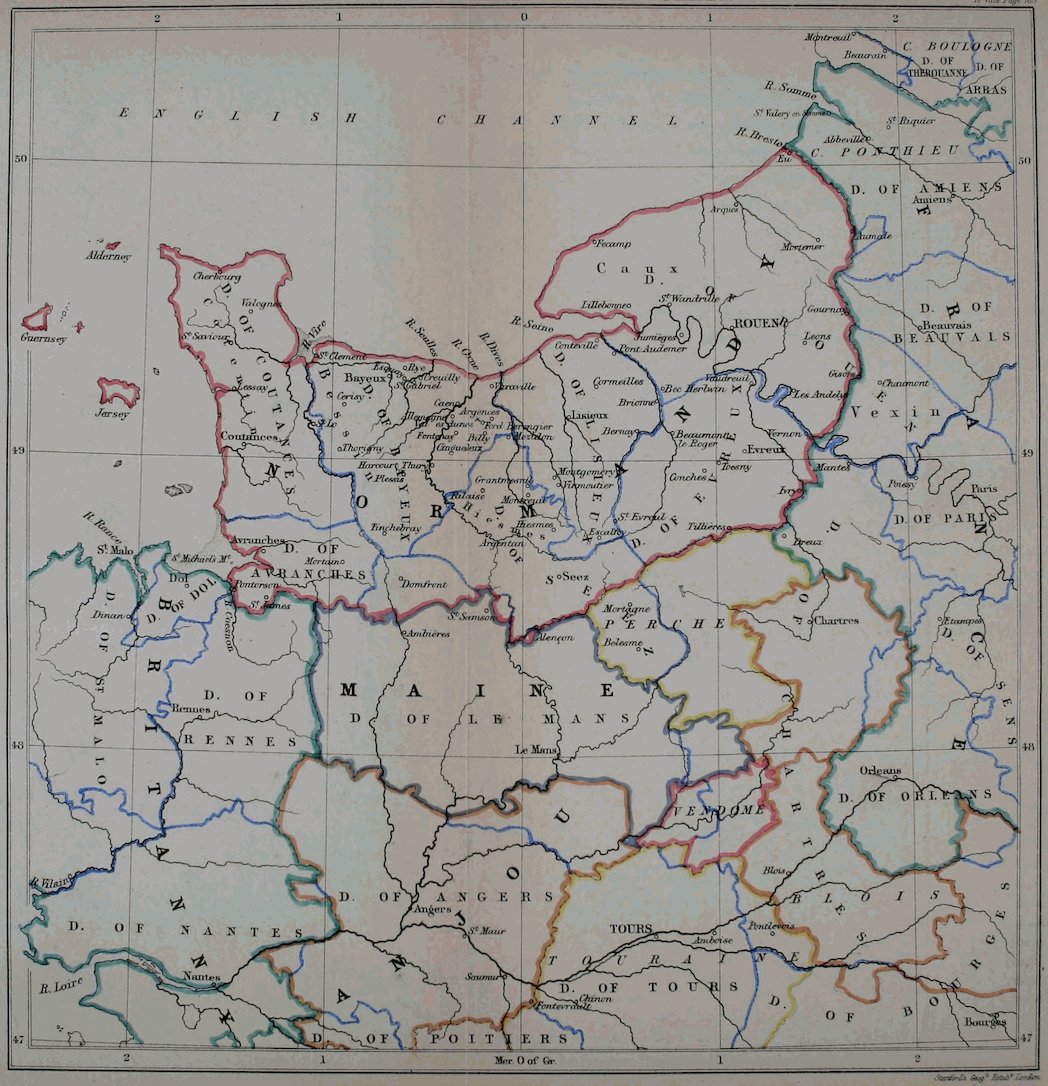
We are thus at last brought face to face with the two great actors in our history. Harold has already appeared before us. We have seen him raised at an early age to the highest rank open to a subject; we have seen him, in the cause of his country, deprived of his honours and driven to take refuge in a foreign land. His great rival we have as yet heard of only at a distance; he now comes directly on the field. There can be no doubt that William’s visit to England forms a stage, and a most important one, among the immediate causes of the Norman Conquest. I pause then, at this point, to take up the thread of Norman history, and to give a sketch of the birth, the childhood, the early reign, of the man who, in the year of Godwine’s banishment, saw, for the first time, the land which, fifteen years later, he was to claim as his own.
163