APPENDIX. (continued 2)
Reading edition
The first hint which we come across of a dismemberment of this kind is in 1041, when we find Thuri or Thored, “Comes 558Mediterraneorum” and Rani or Hranig, “Comes Magesetensium,” distinguished from Leofric, “Comes Merciorum.” Of Thored we also know that his Earldom took in Huntingdonshire. See vol. i. p. 580, where a writ of Harthacnut addressed to him is quoted. And one may suspect that we ought to substitute the same name for “Toli comes” who in a Huntingdon writ of Eadward (Cod. Dipl. iv. 243) is addressed along with Bishop Eadnoth, fixing the date of the writ to the years 1042–1050. (This Toli can hardly be Tolig who is elsewhere addressed in Suffolk, seemingly as Sheriff under the Earldom of Gyrth. Cod. Dipl. iv. 222, 223.) Of Ranig we know that he held the rank of Earl as early as 1023 (see vol. i. p. 580). We may therefore be inclined to suspect that Mercia was dismembered on the death of Eadric, and that, besides the Mercian Earldom held by Leofwine and Leofric, two fresh Earldoms, whether subordinate or independent, were formed within the limits of the old Mercian Kingdom. On the whole I am inclined to think that a certain superiority was always retained by Leofric, as chief Earl of the Mercians. He always fills a special place, alongside of Godwine and Siward, and we shall come across evidence to show that some of the dismembered shires did, in the end, revert to him or to his house.
As to this Earldom of the “Mediterranei” or Middle-Angles, held by Thored, we have no distinct account of its extent. But it is a probable guess that it took in the whole eastern part of Mercia, the part in which the Danish element was strongest. I am inclined to think that in this Earldom Thored was succeeded by Beorn. Our indications are certainly slight, but they look that way. We hear nothing distinctly of Thored in Eadward’s time, while it is plain (see p. 36) that Beorn held some Earldom from about the year 1045 till his murder. We know also that his Earldom took in Hertfordshire (Cod. Dipl. iv. 19c). I infer then that Beorn was Earl of the Middle-Angles, of Eastern or Danish Mercia. I also infer that in that Earldom he had no one successor. No Earl is spoken of in the later days of Eadward who can show any claim to such a description, and several of the shires contained within the country which I conceive to have been held by Thored and Beorn seem to have remained in a sort of fluctuating state, ready to be attached to any of the great governments, as might be convenient.
559Thus Huntingdonshire was within the Earldom of Thored. But in 1051 (Flor. Wig. in anno) we find it, together with Cambridgeshire, a shire still so closely connected with it as to have a common Sheriff, detached altogether from Mercia, and forming part of the East-Anglian Earldom of Harold. “Men” of Harold’s in Huntingdonshire accordingly occur in Domesday (p. 208). But Huntingdonshire was afterwards separated from East-Anglia, perhaps on Harold’s translation to Wessex in 1053. It then became, strange to say, an outlying portion of the Earldom of Northumberland. It does not however appear that Cambridgeshire followed it in this last migration. That Huntingdonshire was held by Siward is shown by a writ (Cod. Dipl. iv. 239) coming between 1053 and 1055. It is certain that it was afterwards held by Waltheof. Domesday also (208) implies the succession of Siward, Tostig, and Waltheof, by speaking of “men” and rights belonging first to Tostig and afterwards to Waltheof. It might be worth considering whether some confused tradition of these transfers of the shire formed an element in the legend of Tostig, Earl of Huntingdon, slain by Siward. See vol. i. pp. 461, 587.
Northamptonshire, like Huntingdonshire, was separated from Mercia and attached to Northumberland. This is distinctly shown by a royal writ addressed to Tostig as its Earl (Cod. Dipl. iv. 240). The only other Northamptonshire writ that I know (iv. 216) is addressed to Bishop Wulfwig without any Earl’s name. But, as to Northamptonshire, another question might arise. The singular description of the daughter of the Northumbrian Earl Ælfhelm as Ælfgifu of Northampton (see vol. i. p. 453) may possibly point to an earlier connexion between the two districts. This last is a mere guess, but the connexion between Northumberland and Northamptonshire during part of the reign of Eadward is quite certain. But Northamptonshire and Huntingdonshire were afterwards again detached from Northumberland, and held as a separate Earldom by Waltheof. On this point the evidence seems quite plain; the only question is as to the exact date. Waltheof held some Earldom at the end of the year 1066, when he is spoken of as an Earl with Eadwine and Morkere (Chron. Wig. 1066). Under William, besides his great Northumbrian government, he was certainly Earl of Northamptonshire (Ord. Vit. 522 C) and of Huntingdonshire (Will. Gem. viii. 37). We 560may therefore infer that these fragments of his father’s government formed the Earldom which he had held under Harold. The false Ingulf (Gale, i. 66) makes him receive both these shires on his father’s death in 1057, Tostig receiving Northumberland. The Chronicle of John of Peterborough, which, though not contemporary, has some authority as being a local record, distinctly makes Waltheof succeed to Northamptonshire on his father’s death in 1055; “Siwardus Dux Northanhumbrorum obiit; ... cujus filius Waldevus, postea martyr sanctus, factus est Comes Northhamptoniæ; comitatus autem Northanhumbrorum datus est Tostio fratri Haroldi” (Giles, p. 50). But this is shown to be incorrect by the charter just quoted, which shows that Tostig was Earl in Northamptonshire. And the course taken by the Northumbrian rebels in 1065 (see p. 489) seems to point to a still abiding connexion between that shire and Northumberland. We can therefore hardly doubt that both Northamptonshire and Huntingdonshire were obtained by Waltheof as a result of the Northumbrian revolt in 1065.
About Nottinghamshire I do not feel quite certain. It appears from Domesday (280) that Tostig had certain rights in the town of Nottingham; but he is not distinctly spoken of as Earl of the shire. But the connexion between this shire and the Northumbrian Primate makes a connexion with the Northumbrian Earl far from unlikely.
Hertfordshire formed part of the Earldom of Beorn. We have no further account of it till after the redistribution in 1057 (see above, pp. 418, 419), when it appears in the hands of Leofwine. Two writs (Cod. Dipl. iv. 217, 218) are addressed to him as Earl, conjointly with Wulfwig, Bishop of Dorchester—the Prelate of the Middle-Angles—whose episcopacy ranges from 1053 to 1067. In Domesday also (132) eighteen burghers in the town of Hertford are described as being “homines Heraldi Comitis et Lewini Comitis,” perhaps a sign of the superiority exercised by Harold over the Earldoms of Gyrth and Leofwine. Men of Leofwine occur also in the town of Buckingham (143) and in other parts of that shire (144, 145), suggesting that Buckinghamshire also made part of his Earldom. Of Bedfordshire we seem to have no distinct account. Waltheof (Domesday, 210 b) held lands there, but it need not have been in his Earldom.
561Oxfordshire appears in 1015 (Flor. Wig. in anno) as part of the Earldom of Swegen. (See above, p. 36.) After 1057 it appears as an outlying appendage of the East-Anglian Earldom of Gyrth. Two writs for Oxfordshire are addressed to him conjointly with Bishop Wulfwig (Cod. Dipl. iv. 215, 217). The former is the well known grant of Islip to the church of Westminster.
Of the other East-Mercian shires we have no account. But I am inclined to believe that they must have reverted to Leofric, perhaps on the death of Beorn. I am led to this belief by the almost certain fact that Lincolnshire did. All history and tradition connects Leofric and his house with that shire; one of the great objects of his bounty, the minster of Stow, is within its borders, and it is plain that, in 1066 (Flor. Wig. in anno), Lindsey formed part of the Earldom of his grandson Eadwine.
The shiftings of the East-Mercian shires are thus frequent and perplexing, but those of West-Mercia are equally so. That the north-western shires remained constantly under Leofric and his house there can be no reasonable doubt. Our one writ in those parts (Cod. Dipl. iv. 201) is addressed to Eadwine in Staffordshire, and the entries of property held in that shire and in Cheshire by him and his father are endless. The same may be said of Shropshire, but as soon as we get south of that limit, we are at once in the region of fluctuations. We have seen that Ranig was Earl of the Magesætas or of Herefordshire in 1041. It is impossible to say whether his government extended beyond that limit. One can hardly doubt that Ranig was succeeded by Swegen, whose Mercian possessions (Flor. Wig. 1051) consisted of the shires of Hereford, Gloucester, and Oxford. It is therefore not unlikely that Ranig’s government was of the same extent, but we cannot be certain. But it is quite certain that Herefordshire was detached from the government of Leofric and his successors during the whole reign of Eadward. It is not clear what became of the shire during Swegen’s first banishment. Something belonging to Swegen, either his Earldom or his private estate, was (see pp. 89, 101) divided during his absence between Harold and Beorn. It is therefore quite possible that one or other of them may have governed Herefordshire from 1046 to 1050. But it is equally possible that the shire was, during that interval, held by Ralph of Mantes, Ralph the Timid, the son of Walter and Godgifu, 562Indeed this last view becomes the more likely of the two, when we remember the firm root which the Normans had taken in Herefordshire before 1051 (see p. 138), which looks very much as if they had been specially favoured in these parts. That Ralph succeeded Swegen on his final banishment in 1051 I have no doubt at all. Sir Francis Palgrave (English Commonwealth, ii. ccxc.) calls this fact in question on the grounds that, at the time when William of Malmesbury (ii. 199) calls him “Comes Herefordensis,” Herefordshire was under the government of Swegen, and that, when Florence (1055) speaks of his doings in the Herefordshire campaign, he does not formally describe him as Earl of the shire. But surely, when a certain shire is invaded, and a certain Earl goes forth to defend it, the presumption, in the absence of some distinct evidence the other way, is that the Earl who so acts is the Earl in charge of the shire. The passage of William of Malmesbury is simply one of his usual confusions of chronology. Speaking of Eustace of Boulogne and his visit to England in 1051, he mentions his marriage with Godgifu, and goes on thus, “quæ ex altero viro, Waltero Medantino, filium tulerat Radulfum, qui eo tempore erat Comes Herefordensis, ignavus et timidus, qui Walensibus pugnâ cesserit, comitatumque suum, et urbem cum episcopo, ignibus eorum consumendum reliquerit; cujus rei infamiam maturè veniens Haroldus virtutibus suis abstersit. Eustachius ergo ... Regem adiit.” Undoubtedly, according to strict grammatical construction, “eo tempore” ought to mean in 1051, but William so jumbles together the events of 1051 and of 1055 that it is hardly safe to argue from this expression that he meant distinctly to assert that Ralph was Earl of Herefordshire in 1051. He may just as well have meant that he was so when he waged his unfortunate campaign with the Welsh, and certainly no one who got up his facts from William of Malmesbury only would ever find out that that campaign happened four years after the visit of Eustace.
Ralph then, I hold, was certainly Earl of Herefordshire in 1055, and the natural inference is that he succeeded Swegen in 1051, and that, as Swegen never came back, he was allowed to retain his Earldom in 1052. That Ralph was succeeded by Harold in 1057 there can be no doubt. But Harold’s Herefordshire Earldom is so important as a piece of national policy, and it is connected with so many points in Harold’s character, that I have spoken 563of it somewhat largely in the text. See pp. 395, 417, and, for writs addressed to Harold in Herefordshire, see p. 547.
But we have also the fact that Ralph certainly held the rank of Earl in the year 1051, while Swegen was still acting as Earl of the Magesætas (see p. 141). We have also his signatures as Earl as early as 1050 (see p. 111). Sir Francis Palgrave is therefore very possibly right in quartering him in Worcestershire. That shire, he is inclined to think, was in Cnut’s time held by Hakon the doughty Earl, the first husband of Gunhild. This view he rests on a writ of Cnut’s (Cod. Dipl. iv. 56) addressed to him as Earl in Worcestershire. The writ is clearly spurious, but it is perhaps one of those cases in which a spurious document proves something. Would a forger insert a name so little known as that of Hakon in a spurious writ, unless he had seen it in a genuine writ? Again, it is rather remarkable that in two Worcestershire documents (see a deed of Bishop Ealdred, Cod. Dipl. iv. 137, evidently passed in a Worcestershire Scirgemót, and another, iv. 262) there is mention of Danish Thegns (“ealla ða yldestan þegnas on Wigeraceastrescíre, Denisce and Englisce”) as a distinct class in Worcestershire. This is what we should hardly have looked for so far west, and it may possibly be taken in connexion with the complaints about Danish spoilers of the Church of Worcester, which we have seen in pp. 544, 560. This prevalence of Danes in the shire looks of itself like the effect of the administration of a Danish Earl, and we find also what seems to be a distinct mention of a Hakon as holding a prominent position in the shire. In a document of Bishop Æthelstan of Hereford in Cod. Dipl. iv. 234 we find, joined together in a transaction of the time of Cnut, “Leofwine Ealdorman and Hacc ... and Leofric, and eal seo scír.” In Mr. Thorpe’s Diplomatarium, p. 376, the name is supplied in full, “Hacun,” which one might almost have ventured to do without manuscript authority. Hakon is thus placed between Ealdorman Leofwine and his son and successor Leofric. This looks very much as if Hakon were a subordinate Earl of Worcestershire under Leofwine as superior Earl of the Mercians. If so, he may, or may not, have been removed from Worcestershire to the greater government of the East-Angles. But, if we admit Hakon, we still have no means of bridging over the interval between his death in 1030 and Ralph’s appearance in 1041. Ralph, I suspect, 564when he received Herefordshire, gave up Worcestershire to Odda. Of this Earl I must say a little more, and he forms a natural means of transition from Mercia to Wessex.
The West-Saxon Earldom, during the administration of Godwine and Harold, seems, except during the year of banishment, to have suffered no dismemberment beyond the surrender of certain shires to be held by the sons or brothers of its two Earls, doubtless under the superiority of the head of the family. Thus Swegen, during his father’s lifetime, held, besides his three Mercian shires, the government of Somersetshire and Berkshire (Flor. Wig. 1051). On the fall of Godwine, Wessex was for a moment dismembered (see p. 160). As we hear of no Earl of the West-Saxons being appointed, the eastern shires, Berkshire included, probably reverted to the Crown. But Somersetshire was joined with the other western shires to form a new government under the King’s kinsman Odda (“Odo et Radulfus Comites et Regis cognati,” says William of Malmesbury, ii. 199). He had already some connexion with that part of England, as he signs (Cod. Dipl. vi. 196) a charter of Bishop Ælfwold of Sherborne relating to matters in Dorsetshire and Devonshire, which, from the mention of Bishop Lyfing, must be older than 1046. He was now set as Earl over the whole of the ancient Wealhcyn, or as the Peterborough Chronicler (1048) puts it, “ofer Defenascire and ofer Sumersæton and ofer Dorseton and ofer Wealas.” The Welsh are of course the Welsh of Cornwall. (There is something singular in the territorial form being applied to Devonshire and the tribe form to the Sumorsætas, but the same distinction is made by the Worcester Chronicler in the next year.) Dr. Lappenberg (510) suspects this Odda to have been a Frenchman. I see no reason for this surmise. An “Odo Comes” is certainly mentioned in the list of Normans established in England in Eadward’s time given in Duchèsne, p. 1023, a list clearly made up of bits from Florence and elsewhere. But he is said to have been “ante Edwardi tempora in exsilium ejectus.” Henry of Huntingdon too (M. H. B. 761 E) speaks of an “Odo Consul” as banished along with Archbishop Robert. But these are no great authorities. A banishment of Odda seems quite out of the question, and there is not a word in the Chronicles to imply that he was a foreigner. Foreigners are commonly spoken of as such, and a foreign descent is certainly not implied in Odda’s kindred 565with the King. He may have sprung from some of the more distant branches of the royal family, or he may have been connected with the King through his grandmother Ælfthryth. His name, in its various forms, Odda, Oda, Odo, Oddo, Otto, Eudes, and the like, is one of the few names which are common to England, Germany, and France. But, in the shape of Odda, it is thoroughly English, and it appears in English local nomenclature in such names as Oddington. Odda had also a brother and sister, who bore the distinctively English names of Ælfric (Cod. Dipl. iv. 137, 262. Chron. Wig. 1053) and Eadgyth (“Eddied soror Odonis Comitis,” in Domesday 186). He himself also, after his monastic profession, bore the no less truly English name of Æthelwine (Flor. Wig. 1056. A signature of “Odda monachus” in Cod. Dipl. iv. 132 cannot be his, by the date). His signatures as Earl are rare; there is one in Cod. Dipl. iv. 139. But both Odda and Ælfric often sign charters as “minister” and “nobilis,” sometimes, as in one of 1048 (Cod. Dipl, iv. 116, so also vi. 196), in company with one Dodda, whom one suspects to be a kinsman. Odda of course resigned his West-Saxon government on the return of Godwine, and both Somersetshire and Berkshire henceforth remained in the immediate possession of the Earl of the West-Saxons. (See writs to Harold in Somersetshire, Cod. Dipl. iv. 195 et seqq., in Berkshire, iv. 200, in Dorsetshire, iv. 200.) But Odda continues to be spoken of as Earl (Chronn. Ab. and Wig. 1056); and his connexion with the Hwiccian land and its monasteries points to Worcestershire, or possibly Worcestershire and Gloucestershire, as the district under his charge. Three of the documents just quoted as bearing his signatures are the deeds of Bishop Ealdred concerning lands in Worcestershire of which I have already spoken (Cod. Dipl. iv. 137, 138, 262, see above, p. 562), The signatures to be noted are “Leofric Eorl and Odda Eorl and Ælfric his broðor,” “Leofricus Dux, Ælfgarus Dux, Odda Dux,” “Leofric Eorl and Odda and Ælfric his broðor.” There is also a signature of Azor or Atsor, a well known Hwiccian Thegn (see above, p. 545). The special mention of Danish Thegns in Worcestershire I have already spoken of (p. 561). It is therefore most probable that Odda held the Earldom of the Hwiccas from the return of Godwine till the time when he forsook the world. It must then have reverted to the House of Leofric, as in Domesday (172) we find the city of Worcester making payments to Eadwine as Earl.
566In the East of England the ancient boundaries both of Wessex and of East-Anglia were freely tampered with when the younger sons of Godwine had to be provided with Earldoms. There can be no doubt that the Earldom of East-Anglia was conferred on Gyrth, when Ælfgar was translated to Mercia in 1057. The only question is whether he had not received some smaller government at an earlier time. Gyrth appears as “Eorl” in the Chronicles and as “Comes” in Domesday (Suffolk, 283 et al). In one Suffolk entry (290) it is distinctly said that “Comes Guert tertiam partem habebat.” That his Earldom took in Oxfordshire as an outlying possession we have already seen; his possession of the two strictly East-Anglian shires is shown by a variety of writs. In Cod. Dipl. iv. 208 he is addressed for Norfolk and Suffolk, in iv. 222 for Suffolk only, in iv. 223 and 225 for East-Anglia generally, in iv. 221 for Suffolk only, conjointly with Harold. In all these writs he is joined with Æthelmær, Bishop of the East-Angles from 1047 to 1070. The date of his appointment seems certain, as no earlier date is possible, and there is no reason to suspect one at all later. But the words in which the Biographer of Eadward describes Gyrth’s elevation are not very clear. After speaking of the appointments of Harold and Tostig, he adds (Vita Eadw. p. 410), “Juniorem quoque Gyrth, quem supra diximus, immunem non passus est idem Rex à suis honoribus, sed comitatum ei dedit in ipso vertice Orientalis Angliæ, et hunc ipsum amplificandum promisit, ubi maturior annos adolescentiæ exuerit.” This may mean that Gyrth was first invested with the government of some part of East-Anglia, perhaps under the superiority of Ælfgar, and was encouraged to look forward to the possession of the whole. Or it may mean that, when invested with the government of all East-Anglia, he was encouraged to look forward to something beyond its bounds, a promise of which the addition of Oxfordshire may have been the fulfilment. This last view is incidentally confirmed in a singular manner by the way in which the town of Oxford is spoken of in Domesday (154). The duties payable to the Earl are described as paid to Ælfgar. Here of course, as in several other cases, the record describes a state of things existing “in the time of King Eadward,” but not “on the day when King Eadward was quick and dead.” A mention of Eadwine would have excluded Gyrth; a mention of Ælfgar does not exclude him. But it shows that Oxfordshire was at one time 567held by Ælfgar; it shows therefore that Gyrth did not receive Oxfordshire at the same time as Norfolk and Suffolk. The shire may have been taken from Ælfgar at his second outlawry, or it may have been conferred on Gyrth after Ælfgar’s death. But at all events, Gyrth became Earl of the East-Angles in 1057, only with a narrower jurisdiction than had been attached to that title when it was held by Harold, probably narrower than when it was held by Ælfgar. Harold had, together with the two strictly East-Anglian shires, held Huntingdonshire, Cambridgeshire, and Essex, probably including Middlesex. None of these, except perhaps Cambridgeshire, fell to the lot of Gyrth. He seemingly took the remote Oxfordshire in their stead. Of Huntingdonshire I have already spoken. The shires of Essex and Middlesex, together with that of Hertford, and probably Buckinghamshire (see above, p. 560), fell to the lot of Leofwine. Of Bedfordshire I cannot speak with any certainty.
We have no record of Leofwine’s appointment as Earl, but one can hardly doubt that his investment with the large and important government which the writs set him before us as holding took place at the general distribution in 1057. But, as in the case of Gyrth, a question arises whether he had held a smaller government at an earlier time. There is a writ in Cod. Dipl. (iv. 191) addressed to Leofwine in Kent conjointly with Archbishop Eadsige, who died in 1050, and with Godwine, Bishop of Rochester, who died in 1046. If this document be genuine, it reveals the very curious fact that the young son of Godwine, while still hardly beyond boyhood, held, under his father’s immediate eye, the government of the shire which had been his father’s first possession. If this be so, it may decide us as to the interpretation of the doubtful passage of the Biographer about Gyrth, and we shall have to look for some similar earlier endowment for Tostig. But, on the other hand, the Chroniclers, in recording the events of the years 1049–1052, while they carefully give the title of Earl to Godwine, Swegen, Harold, and Beorn, never give it to Tostig, Gyrth, or Leofwine. “Harold Eorl and Tostig his broðor,” says the Peterborough Chronicler (1046). Leofwine’s early promotion is therefore very doubtful; but of the extent of his later government there is no doubt. It took in the shires of Essex, Middlesex, Hertford, Surrey, Kent, and probably Buckinghamshire. Writs are addressed to him for Surrey, jointly with Stigand 568(Cod. Dipl. iv. 205), for Essex (as he is coupled with Bishop William, iv. 213), for Middlesex jointly with William (iv. 214), for Hertfordshire, as we have seen, jointly with Wulfwig. “Men” of Earl Leofwine in Middlesex are also mentioned in Domesday, 130 b. But the general superiority of Harold, whether as elder brother or as elected Ætheling, seems shown by a writ addressed to him in Middlesex, jointly with Bishop William (iv. 211). It can hardly belong to the time between September 1052 and Easter 1053, between which dates it is just possible, and no more, that there may have been some moment at which Harold was Earl of the East-Angles and William also was in possession of the see of London (see pp 345, 358). The Earldom of Leofwine thus answered pretty well to what Londoners sometimes speak of as the Home Counties. But the great city itself was not subject to the jurisdiction of any Earl. The King’s writs for London are addressed to the Bishop, the Portreeve or Portreeves, the Burgh-thegns, and sometimes the whole people (“ealle ðe burhware”). See Cod. Dipl. iv. 212, 213, 214.
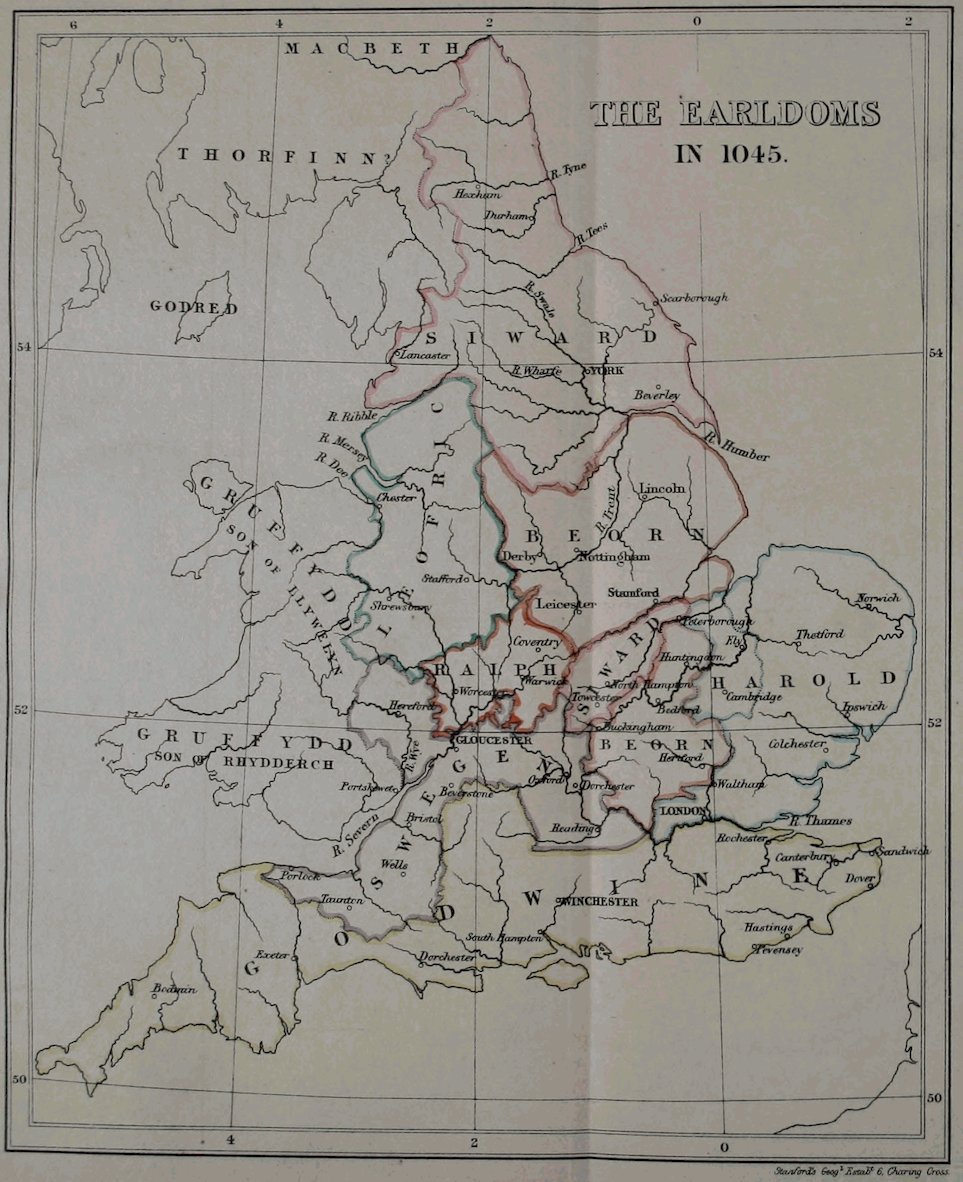
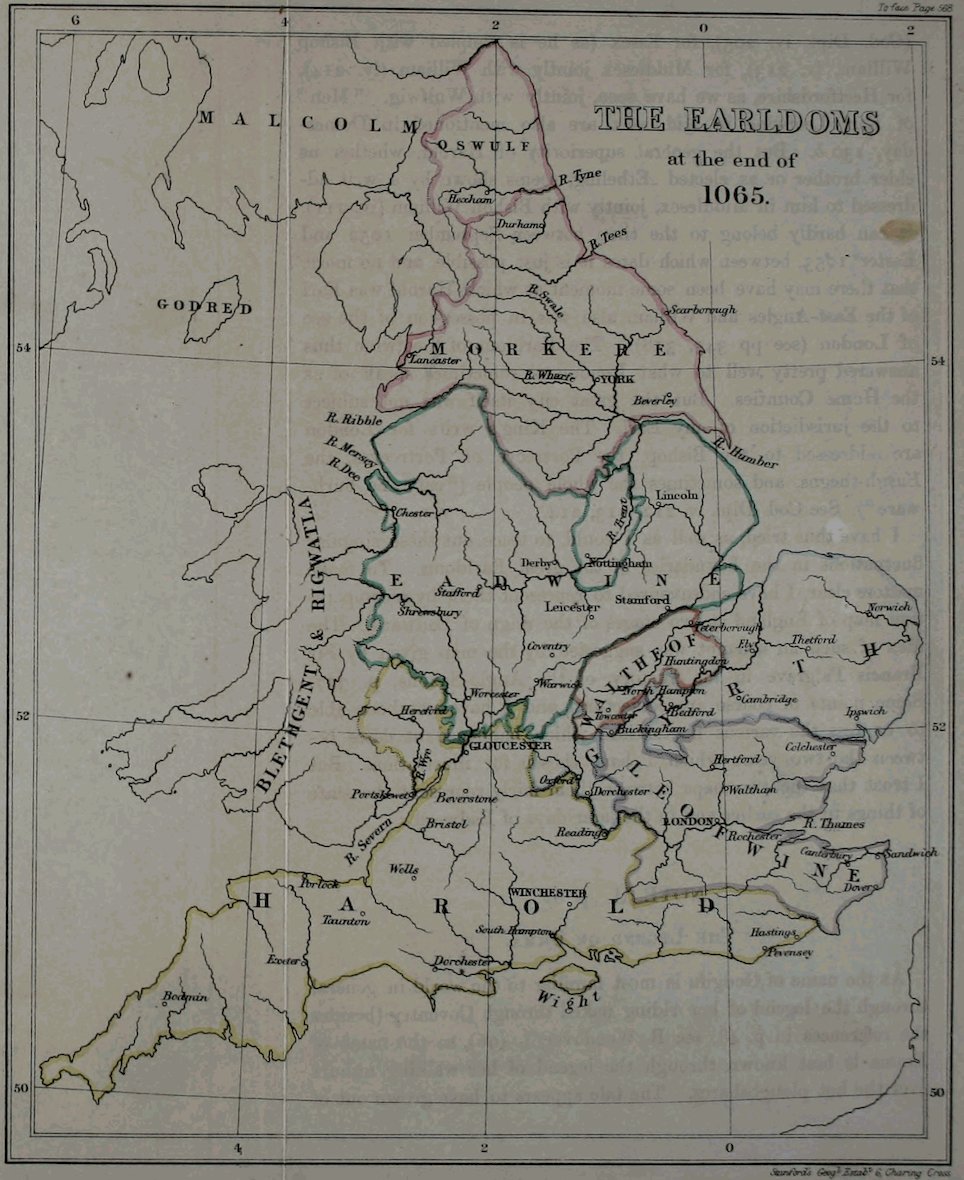
I have thus tried, as well as I could, to trace out these singular fluctuations in the boundaries of the great Earldoms. To make matters clear, I have endeavoured to represent them by a comparative map of England at two stages of the reign of Eadward. The idea of such an attempt was suggested by the map given by Sir Francis Palgrave in his History of the Anglo-Saxons, p. 327. Some points of course are conjectural, and I have not been able to express the various fluctuations which happened at dates between the two years which I have chosen for illustration. But I trust that the two maps between them fairly represent the state of things in the earlier and in the later days of Eadward.
NOTE H. p. 62. The Legend of Emma.
As the name of Godgifu is most familiar to the world in general through the legend of her riding naked through Coventry (besides the references in p. 48, see R. Wendover, i. 496), so the name of Emma is best known through the legend of her walking unhurt over the hot ploughshares. The tale appears to have grown out of the real history of her disgrace at this time, mixed up with other particulars from various quarters. And when a prince stands in such singular relations both to his mother and to his wife as those in which Eadward stood to Emma and Eadgyth, it is not wonderful that, in the process of legend-making, the two injured Ladies got confounded.
569The tale may be seen in Bromton, X Scriptt. 941. He seems to place the event in 1050, when Robert was already Archbishop of Canterbury. He calls it indeed the fourth year of Eadward, but he places it immediately before the events of 1051. The Norman Primate persuades the King that Emma—forty-eight years after her first marriage, fifteen years after the death of her second husband—had been guilty of too close an intimacy (“nimia familiaritas”) with Ælfwine, Bishop of Winchester. The choice of an episcopal lover was unlucky, as Ælfwine had already been dead three years (see p. 94); a more ingenious romancer would have named Stigand. The Bishop is imprisoned; the Lady is spoiled of her goods and sent to Wherwell, a manifest confusion with Eadgyth’s banishment thither in 1051. From her prison, where she was not very strictly kept (“laxiùs custodita”), Emma writes to those Bishops in whom she trusted, saying that she is far more shocked at the scandal against Ælfwine than at that against herself. She is even ready to submit to the ordeal of burning iron in order to prove the Bishop’s innocence. The other Bishops advise the King to allow the trial, but the Norman Archbishop uses very strong language indeed. Emma is “fera illa, non fœmina;” her daring went so far that “amasium suum lubricum Christum Domini nominavit,” and so forth. She may make compurgation for the Bishop (“vult purgare pontificem”), but who will make compurgation for herself? She is still charged with complicity in the death of Ælfred, and with having made ready a poisoned bowl for Eadward himself. Yet, if she will make a double purgation, if she will walk over four burning shares for herself and five for the Bishop, her innocence shall be allowed. By dint of prayer to Saint Swithhun, the ordeal is gone through successfully. The penitent King implores pardon, and receives stripes (“disciplinas recepit”) both from his mother and from the Bishop; he restores their confiscated goods; and Robert, if not actually banished, finds it convenient to leave England. In honour 570of the deliverance, of the Lady and the Bishop, each gives nine manors, one for each ploughshare, to the Church of Winchester.
The account in the Winchester Annals (p. 21 et seqq. Luard) is substantially the same, and it sometimes agrees in words with that in Bromton. Unless Bromton has simply abridged the Winchester story, both are borrowed from the same source. But the Winchester annalist is very much fuller, and, after his manner, he puts long speeches into the mouths of his actors, that made by the Norman Archbishop displaying a remarkable acquaintance with the less decent parts of the satires of Juvenal. The most important difference is the introduction of Godwine. The event is placed in 1043. Archbishop Robert—he is already Archbishop—persuades the King to banish Godwine and his sons, to send his mother to Wherwell, and to forbid Ælfwine to come out of the city of Winchester. The tale then follows much as before, only, together with the restoration of Emma and flight of Robert, Godwine and his sons are restored at the petition of Emma. Also, it was after these doings that Eadward seems to have first taken to working miracles (“Rex Edwardus magnis post hæc cœpit coruscare miraculis etiam in vitâ suâ”).
I suspect that this is the older version. This is the Winchester writer’s only mention of the banishment and return of Godwine. Bromton, or whoever is represented by that name, knew that Godwine’s banishment happened at quite another time and from quite other causes; he knew also that Robert was not Archbishop in 1043. He therefore left out all about Godwine, and moved the tale to the year 1050, when Robert was Archbishop. But he failed to mark that he thus brought in a chronological error as to the death of Ælfwine. On this last point the local Winchester writer is of course accurate.
I cannot help adding good Bishop Godwin’s inimitable account of the charges brought by Robert against Emma. “He began therefore to beate into the king’s head (that was a milde and soft natured gentleman) how hard a hand his mother had held upon him when he lived in Normandy; how likely it was that his brother came to his death by the practise of her and Earle Godwyn; and lastly that she used the company of Alwyn Bishop of Winchester, somewhat more familiarly then an honest woman needed.”
571I may add that M. de Bonnechose (“ut erat miræ simplicitatis et innocentiæ,” as the Winchester writer says of Eadward) believes everything. All about Godgifu, all about Emma, the “cruelle épreuve” and the “tragique scène,” will be found in his Quatre Conquêtes, ii. 81–88. In short, his history gives us, as Sir Roger de Coverley says, “fine reading in the casualties of this reign.” Mr. St. John exercises a sound judgement, and Thierry seems to hold his peace.
NOTE I. p. 110. The Welsh Campaign of 1049.
The whole account of this campaign is full of difficulties. It is mentioned by the Worcester Chronicler only, whose narrative is somewhat expanded by Florence. There are also some entries in the Welsh Chronicles which seem to refer to the same event, but the readings of the manuscripts are so different that it is hard to tell their exact meaning. The Worcester writer mentions the coming of thirty-six ships from Ireland to the Usk; there, with Gruffydd’s help, they do much harm; then Bishop Ealdred gathers a force against them, but he is defeated, and many of his men slain, by a sudden attack in the early morning. Florence is more detailed. First, he explains that the Gruffydd spoken of is Gruffydd of South Wales, Gruffydd the son of Rhydderch (“adjutorio Griffini Regis Australium Brytonum”). This is very likely; the last time we had to do with Welsh affairs, the Northern Gruffydd was leagued with England against his Southern namesake (see p. 87). But a difficulty immediately follows. The pirates, with Gruffydd’s good will, begin plundering by sea, seemingly on the coast of Gwent. The words are “circa loca illa”—this immediately follows the mention of the Welsh Axe or Usk—“prædam agentes.” This may mean the Somersetshire coast just opposite, but it would more naturally mean the coast by the mouth of the Usk. But Gruffydd ap Rhydderch would hardly consent to the harrying of his own dominions; so we are led to suspect that Gwent must have passed into the hands of Gruffydd ap Llywelyn, perhaps as a result of the campaign waged by him in concert with Swegen. Or is it possible that Gwent had already, for a time at least, passed into English hands? We 572should certainly infer as much from the language of the Chronicler, who seems to make Ealdred gather his force to defend the country at the mouth of the Usk. But it is more likely that this is only a confused way of telling the story, for Florence tells us very clearly that the invaders crossed the Wye and harried some district, which must therefore have been part of Gloucestershire. “Dein, conjunctis viribus, Rex [Griffinus] et ipsi [Hibernienses piratæ] flumen quod Weage nominatur transeuntes Dymedham incenderunt, et omnes quos ibi reperiebant peremerunt.” But what is Dymedham? One would expect to find it the name of a town in Gloucestershire, but I know of no such place. It almost looks as if Florence had got hold of some Welsh account, and had been led astray by some such word as Dyfed or Deheubarth. Anyhow one may accept the fact that they crossed the Wye, and so entered the Hwiccian diocese. It is then that Ealdred brings his force against them. In the Chronicle that force is simply called “folc,” without further description; it is Florence who tells us that it consisted of small bodies from Gloucestershire and Herefordshire (“pauci de provincialibus Glawornensibus et Herefordensibus”), together with that body of Welshmen to whose treachery he attributes the defeat of the English.
The mention of these Welshmen in the English army raises some further questions. Were they mere mercenaries hired for the occasion, subjects possibly of the Northern Gruffydd, or were they men of Welsh blood and speech living under the immediate sovereignty of the King of the English? It can hardly be doubted that much Welsh blood must have lingered among the inhabitants of Herefordshire and Western Gloucestershire, just as it lingered among the inhabitants of Somersetshire and Devonshire. A small part of modern Gloucestershire, and a larger part of modern Herefordshire, consists of the districts added to those shires at the dissolution of the Welsh Marches. This part of Herefordshire was, till quite recent ecclesiastical changes, included in the Diocese of Saint David’s. But it would seem that, as late as the seventeenth century, Welsh must have been spoken in Herefordshire beyond these limits, as the Act of Uniformity joins the Bishop of Hereford with the Welsh Bishops in the duty of providing a Welsh translation of the Prayer-Book. We can therefore well believe that, in the days of Eadward, considerable remains both of Welsh blood 573and of the Welsh language must have remained in large districts of the Magesætas and even of the Hwiccas. Still the picture given us in Domesday of the Herefordshire borderers (see above, p. 388), though in no way decisive of their ethnology, sets them before us as a race eminently loyal to the English Crown. It is therefore more likely that these traitorous Welshmen were mere hirelings, and an expression of Florence seems to look the same way. He calls them “Walenses quos secum habuerant [provinciales Glawornenses et Herefordenses], eisque fidelitatem promiserant.” This certainly looks as if they were not immediate English subjects, but strangers who would serve only on receiving some sort of pledge of good faith from their English comrades. Such at least is the only meaning which I can get out of the text, and there seems to be no question as to the reading. Otherwise I should be strongly tempted to read, “quique eis fidelitatem promiserant,” so as to make the “fidelitas” a pledge given by the Welshmen. In any case the “fidelitas” seems to be given or received by the army as a body, not by the Bishop or any other commander. We seem here to have a military Scirgemót, just as we elsewhere have military Gemóts of the whole Kingdom.
One can hardly doubt that this fleet from Ireland is the same as that of which the Welsh Chroniclers speak under the year 1050. But they say nothing of the alliance between Gruffydd and the pirates, and they seem rather to speak of the fleet as one which came to attack Wales. The variations in the manuscripts are remarkable. The text of the Brut y Tywysogion calls it a fleet which “failed coming from Ireland to South Wales” (“ballaỽd llyges o Iwerdon yn dyfot y Deheubarth.” I quote the original, though ignorant of the Welsh language, as Welsh scholars may be able to judge of the translation). But another reading is “a fleet from Ireland endangered South Wales” (“y periglawd llynghes o Iwerdon Dehavbarth”). The text of the Annales Cambriæ has “Classis Hiberniæ in dextrali parte periit,” but another manuscript reads “Classis Hiberniæ in dextrali parte Cambriæ prædavit.” It is quite possible that the Danes may have begun with plundering, and may have afterwards been won over by Gruffydd to join him against the English.
The most perplexing thing, after all, about this campaign, is its ending, or rather its lack of an ending. What happened after the escape of Ealdred?
574
NOTE K. p. 124. Danegeld and Heregeld.
It can hardly be doubted that the original meaning of the word Denagyld must have been money paid to the Danes to buy them off, a practice of which I need not multiply instances during the reign of Æthelred. But it so happens that the word itself does not occur till much later times. As far as I know, the single appearance of the word in Domesday (336 b) is the earliest instance. It occurs also in the so-called Laws of Eadward, c. 11 (Schmid, 496), in the Laws of Henry the First, first in the Charter of London (Schmid, 434) and afterwards in c. 15 (Schmid, 446). There are also well known passages in Bromton (942, 957) and the Dialogus de Scaccario, (ap. Madox, Exchequer, p. 27). In all these passages, (except perhaps in that of Bromton, who calls it “tallagium datum Danis,”) the Danegeld is described as a tax levied, not to buy off Danes, but to hire mercenaries, whether Danes or others, to resist them. Thus in the “Laws of Eadward” the description given is as follows;
“Denegeldi redditio propter piratas primitùs statuta est. Patriam enim infestantes, vastationi ejus pro posse suo insistebant; sed ad eorum insolentiam reprimendam statutum est Denegeldum annuatim reddendum; i. e. duodecim denarios de unâque hidâ totius patriæ, ad conducendos eos, qui piratarum irruptioni resistendo obviarent.”
The description in the Laws of Henry (Schmid, 446) is more remarkable, as it distinctly connects the Danegeld with the famous force established by Cnut. “Denagildum, quod aliquando þingemannis dabatur.”
But it is plain, from the passage with which we are concerned in the text, and from the other passage in the Peterborough Chronicle (1040) describing the payment to Harthacnut’s fleet in 1041, that the formal name for a tax levied for the payment of soldiers or sailors was Heregyld, Heregeold, Heregeld. I conceive that Denagyld was a popular name of dislike, which was originally applied to the payments made to buy off the Danes, and which was thence transferred to these other payments made to Danish and other mercenary troops, from the time of Thurkill onwards. This 575would account for the name not occurring in any early Chronicle or document.
It is commonly assumed, with great probability but without direct proof, that the Danegeld of Domesday is the same as the “mycel gyld” recorded in the Peterborough Chronicle to have been laid on by William in the winter Gemót of 1083–1084. This is looked on as the revival of the tax now taken off by Eadward. Yet it would be strange if no taxes at all for the support of warlike forces of any kind were levied between 1051 and 1083. The Housecarls certainly continued; we hear of them by name, besides Florence’s mention of “stipendiarii et mercenarii” in 1066. Are we to infer that the Housecarls were henceforth maintained out of the ordinary royal revenues, or, what seems more likely, that the tax now remitted related wholly to the fleet?
While on the subject of Danegeld, I may mention that the Liber de Hydâ contains a document purporting to be the Will of King Eadred, which, if genuine, shows that the possibility of a payment to the Danes was contemplated even in his time. The document is given in Old-English, with a later English and a Latin translation; but it is curious enough that, in the two latter versions, the passage is left out. In the Old-English text it stands thus (p. 153);
“Þænne an he his sayla to anliesnesse, and his deodscipe to þearfe, sixtyne hund punda, to þan ðæt hi mege magan hu[n]gor, and hæþenne here him fram aceapian gif hie beþurfen.”
The language seems to be corrupt, but the meaning can hardly be doubted.
See also on Danegeld, Pegge’s Short Account of Danegeld (London 1756) and Ellis, i. 350, 351.
NOTE L. p. 131. The Banishment of Godwine.
Of the events which led to the banishment of Godwine and his sons we have three original narratives. The Worcester and Peterborough Chronicles give accounts which at first sight seem to be widely different, and the Life of Eadward contains another account which seems to be still more widely different from either of the 576others. The narrative in Florence is mainly founded on that in the Worcester Chronicle, while William of Malmesbury, as in many other cases, plainly had the Peterborough Chronicle before him. These Latin writers serve in some cases to explain and illustrate their English originals, while in other places they have curiously mistaken their meaning. When, fifteen years back, I wrote my papers on the Life and Death of Godwine in the Archæological Journal (vol. xii. p. 48), I thought that there was a wide difference between the accounts of the two Chroniclers, and that a choice had to be made between them. I now think that there is little or no discrepancy as to the facts. The main difference is that in the Worcester narrative there are many omissions, which are supplied by the Peterborough writer. There is also, as usual, a marked difference in tone. The Peterborough writer is here, as ever, a devoted partizan of Godwine, and he carefully brings into prominence every circumstance which can tell in his favour. The Worcester writer, without showing the least feeling against the Earl, is not so strongly committed to his side. The curious result is that the Normannizing William of Malmesbury, following the Peterborough version, gives a more strongly Godwinist account than our English Florence. Also, since my former papers were written, the contemporary Life of Eadward has come to light. The Biographer’s account is very singular. As usual, his rhetorical way of dealing with everything, and the necessity under which he felt himself of justifying both Eadward and Godwine, hamper him a good deal in his story. He also gives an account of the origin of the dispute, which is quite different from that mentioned in the Chronicles, and which yet is in no way inconsistent with it. He agrees with the Chroniclers in the main facts as to places and persons, and he adds, especially towards the end, some of those minute touches which increase one’s confidence in the writer, as they seem to come from personal knowledge. The chief difference between him and the Chroniclers is the difference inevitably involved in their several positions. The Chroniclers were monks, writing in their monasteries for the edification of their brethren. They might err through ignorance, they might exaggerate through party spirit; but they had no temptation to win anybody’s favour by wilful omissions or perversions. The Biographer, with far better means of knowing the 577exact truth, laboured under all the difficulties of a courtier. He had to please one who was at once the daughter of Godwine, the widow of Eadward, the sister of Harold, and the favoured subject of William.
The two Chroniclers agree in making the outrages of Eustace at Dover the main cause of the dispute. The Peterborough writer adds, as a collateral cause, the misconduct of the Frenchmen in Herefordshire. There is here no inconsistency, but simply an omission on the part of the Worcester writer. And, after all, the Worcester writer, though he does not directly tell the Herefordshire story, yet incidentally shows his knowledge of it, both in his present narrative (see p. 142, note 5, where I have mentioned the singular mistake of Florence) and in his entry of the next year (see p. 311). The Biographer says nothing about either Eustace or Herefordshire; he speaks only of a revival of the old calumnies by Archbishop Robert. Of this last cause the Chroniclers say nothing. But there is no real inconsistency between these accounts. Nothing is more likely than that Robert would seize such an opportunity again to poison the King’s mind against Godwine. But these private dealings in the royal closet would be much more likely to be known, and to seem of great importance, to a courtier and royal chaplain than to men who were watching the course of public affairs from a distance. And we must not forget that, when the Biographer wrote, Robert was dead and had no one to speak for him, while Eustace and Osbern of Herefordshire were high in William’s, therefore probably in Eadgyth’s, favour. It might therefore be inconvenient to enlarge too fully on their misdeeds. The Biographer in short reports the intrigues of the court, while the Chroniclers record the history of the nation. I accept his account, not as an alternative, but as a supplement, to the account in the Chronicles, and I have accordingly worked in his details into my own narrative. As to the broad facts of the story, the meeting at Gloucester, the presence of the great Earls, and the adjournment to London, all our witnesses agree.
One great apparent discrepancy between the two Chroniclers at the very outset of the story, is, I am now convinced, merely apparent. As we read the tale in Florence (1051), the violent conduct of Eustace took place immediately upon his landing at Dover (“Eustatius ... paucis Doruverniam applicuit navibus; in quâ milites ejus ... 578unum è civibus peremerunt," &c.). Now it is impossible to reject the clear and detailed story of the Peterborough writer, according to which the affair took place, not on Eustace’s landing, but on his return from the court at Gloucester. It now seems to me that there is here simply an omission on the part of the Worcester writer, and that Florence was misled by his expression, “on þam ylcan geare com Eustatius up æt Doferan,” &c. Taken alone, this would certainly give one the idea which it seems to have given Florence, but, with the fuller light of the Peterborough narrative, we may fairly take it the other way. If this explanation be not accepted, there can be no doubt that the Peterborough story is the one to be followed. But it must be remembered that, if any one chooses to accept Florence’s story, the case of Godwine and his clients is thereby made still stronger. As Florence tells the tale, the men of Dover were not simply resisting an act of violence done within the Kingdom; they were resisting what would seem to them to be an actual foreign invasion.
In the narrative of the events in Gloucestershire each of the Chronicles fills up gaps in the other. The Worcester writer leaves out Eadward’s command, and Godwine’s refusal, to subject Dover to military chastisement. On this point the Peterborough writer is naturally emphatic, and this part of the story seems to have awakened a deep sympathy in his copyist William of Malmesbury. Worcester also leaves out the King’s summons to the Witan, so that Godwine seems to levy his forces at once, as soon as he hears of the behaviour of Eustace. A quite different colour is thus given to the story, but it is merely by omission, not by contradiction. On the other hand Peterborough leaves out, what we cannot doubt to be authentic, Godwine’s demand for the surrender of Eustace and the other Frenchmen, and his threat of war in case of refusal. In fact the Worcester writer seems to dwell as much as he can on the warlike, and the Peterborough writer on the peaceful, side of the story. But the particular facts on which each insists are in no way contradictory, and I accept both. The Biographer confirms the Peterborough statement of a summons to the Witan, only he leaves out all the warlike part, and tells us of Godwine’s offer to renew his compurgation. This last fact is not mentioned by either Chronicler, but it does not contradict either of them. The mediation on both sides is mentioned in both Chronicles; the 579personal intervention of Leofric comes from Florence, but it is eminently in character. I was puzzled fourteen years back at finding what appeared in one account as an Assembly of the Witan, described in the other as a gathering of armies. I did not then realize so well as I do now that in those days an army and a Witenagemót were very nearly the same thing.
In the account of the adjourned Gemót in London, or perhaps rather under its walls, there are a good many difficulties, but no distinct contradictions. The Peterborough narrative is still the fuller of the two, and that which seemingly pays more regard to the strict order of events. The Biographer tells the story from his own special point of view, and helps us to several valuable personal notices of Stigand, Robert, and Godwine himself. His great object is to represent Godwine, no doubt with a good deal of exaggeration, as a model of submissive loyalty towards Eadward. It is too much when he tells us (p. 402), how the Earl “legationes mittens petiit ne præjudicium innocentiæ suæ inferretur à Rege, agebatque se in omnibus modis paratum ad satisfaciendum Regi, et cum jure et ultra jus, ad nutum voluntatis suæ.” On one small point we find a good instance of the way in which one authority fills up gaps in another. The Worcester Chronicle tells us that, when the Gemót was summoned to London, Godwine went to Southwark. Why to Southwark? It is easy to answer that it was a convenient spot, as being at once in his own Earldom and yet close to the place appointed for holding the Gemót (on Southwark and its relation to Godwine as Earl, see Domesday, 32). But the Biographer helps us to a still closer connexion between Godwine and Southwark (p. 402); “Dux quoque insons et fidens de propriâ conscientiâ semper immuni à tanto scelere, è diverso adveniens cum suis, assederat extra civitatis ejusdem flumen Temesin, loco mansionis propriæ.” So it is from the Peterborough and Worcester Chronicles put together that we see that Eadward summoned forces of two kinds, both fyrd and here (see p. 147), to his help at the London Gemót. The Worcester Chronicler says, “And man bead þa folce þider ut ofer ealne þisne norð ende, on Siwardes eorldome and on Leofrices and eac elles gehwær.” Here is the fyrd of the Northern Earldoms and something else. The last words, not being very clear, are slurred over in the version of Florence; “Rex vero de totâ Merciâ et Northhymbriâ copiosiorem exercitum congregavit et secum Lundoniam duxit.” 580But Peterborough tells us more; “And het se cyning bannan út here, ægðer ge be suðan Temese ge be norðan eall þa æfre betst wæs.” The fyrd of the North came, and the King’s comitatus, the “best men,” were also summoned, in virtue of their personal obligations, even within Godwine’s Earldom. But the fyrd of Wessex was, at first at least, on the side of its own Earl; for the Worcester writer says that Godwine came to Southwark “and micel mænegeo mid heom of Westsæxum.” He also directly after calls the King’s force here; Godwine and his force come to meet the King “and þone here þe him mid wæs.”
The main difficulty in this part of the story arises from an expression of each Chronicler about the surrender to the King of certain Thegns who were in the hands of Godwine or Harold. The first stage of the discussion in the Worcester Chronicle stands thus, “And man borh fæste þam kyninge ealle þa þegnas þe wæron Haroldes Eorles his [Godwine’s] suna.” In the Peterborough account, Godwine first demands hostages and a safe-conduct; then follows, “Ða gyrnde se cyng ealra þæra þegna þe þa eorlas ær hæfdon, and hi letan hi ealle him to hande.” Then the King again summons Godwine to come with twelve companions only, and Godwine again demands hostages and a safe-conduct. One would think that the transactions spoken of in two Chronicles must be the same; but, if so, the Worcester writer must have placed the demand for these Thegns out of its proper order, as he makes it come before the renewed outlawry of Swegen, which it clearly followed. And who were these Thegns? I once thought, with Mr. Kemble (Saxons in England, ii. 231), that they were the hostages who had been given to Godwine at the Gloucester Gemót. This would give an excellent meaning. Godwine has already received hostages, as leader of one of the two great parties who are recognized as equally in the King’s favour. He now demands further hostages for his own personal safety. The King, instead of granting them, demands the restoration of the former hostages. But, had this been the meaning, they could hardly fail to have been spoken of by the regular name gislas. Who then were the Thegns spoken of? I can hardly fancy that Godwine and Harold surrendered all their own personal Thegns, the members of their own comitatus. This seems to have been the notion of William of Malmesbury, though his account is very confused. The Earls are bidden “ut duodecim solùm homines 581adducerent; servitium militum, quos per Angliam habebant, Regi contraderent.” (So Lappenberg, p. 509 of the German original, Thorpe, ii. 249.) But surely such a surrender is improbable in itself, and it is hardly consistent with the licence to bring twelve companions, which implies that, after the surrender, they had still some comitatus left. I am therefore driven to suppose that some of the King’s Thegns within the Earldoms of Godwine and Harold had, notwithstanding the King’s summons, followed the Earls, that these Thegns were now called on to join the King, and that the Earls put no hindrance in their way.
It is curious, after reading William of Malmesbury’s account of all these matters, grounded on the patriotic Peterborough Chronicle, to turn to the passage quoted in a former note (p. 543) where he speaks of Godwine and his sons as banished on account of their sacrilege and other wickedness.
NOTE M. p. 174. The Surnames of William.
It has been pointed out by more writers than one that a certain amount of confusion is involved in the familiar description of the great King-Duke as William the Conqueror. He is not often called “Conquæstor” by writers of or near his own time. Moreover, “Conquæstor” hardly means “Conqueror” in the common use of that word, but rather “Acquirer,” or “Purchaser,” in the wider legal sense of the word “purchase.” A former colleague of mine in the Oxford Schools always made a point of describing him as “William the Purchaser.” But the title of William the Conqueror, even as commonly understood, is so familiar, so true, and so convenient, that I have not the least wish to interfere with its use.
As far as I can see, he was known to his contemporaries as William the Bastard, and was, after his death, distinguished from his successor by the name of William the Great. The title of Bastard indeed stuck so close to him that some writers, who could hardly have known what it meant, seem almost to have taken it for his real name. Even Adam of Bremen, who certainly knew its meaning, uses it almost as a proper name. He introduces William 582(iii. 51) as “Willehelmus, cui pro obliquo sanguine cognomen est Bastardus,” and goes on to speak of “Bastardus victor,” and (c. 53) to say how “inter Suein et Bastardum perpetua contentio de Angliâ fuit.” So Marianus Scotus, a. 1089 (Pertz, v. 559), talks of “Willihelmus, qui et Bastart;” Lambert of Saint Omer (Pertz, v. 65) says, “Terra Anglorum expugnata est a Willelmo Notho Bastart;” and most curiously of all, Lambert of Herzfeld, a. 1074 (Pertz, v. 216), calls him “Willehelmus, cognomento Bostar, Rex Anglorum.” In our own Worcester Chronicle, a. 1066, he appears as “Wyllelm Bastard,” and in Olaf Tryggwasson’s Saga (p. 263), as “Vilialmur Bastardur Rudu Jarl.” So in Orderic (663 C), “Guillelmus Nothus.” So in the Annales Formoselenses (Pertz, v. 36), “Willelmus Bastardus invasit regnum Anglorum.” One writer (Chron. Gaufredi Vosiensis, Labbe, iii. 284) for “Bastard” uses the equivalent word “Mamzer”—“Normannorum Ducis filius Mamzer Guillelmus.”
It has been often said that William himself used the description in formal documents. This assertion rests on very slight authority. There is a charter in Gale’s Registrum Honoris de Richmond, p. 225 (a reference for which I have to thank Professor Stubbs), beginning “Ego Willielmus, cognomento Bastardus, Rex Angliæ.” But it seems to me to be palpably spurious, and those who accept it allow it to be unique.
The other title may be seen growing from the vaguer form of “the great William” to the more distinct “William the Great.” We read in a charter of William Rufus (Rymer, i. 5), “Ego Willelmus, Dei gratiâ, Rex Anglorum, filius magni Regis Willelmi.” So Eadmer (lib. iii. 57. Selden), “quando ille magnus Willielmus hanc terram primò devicit:” so William of Jumièges (vii. 16; cf. his description of Robert, vii. 1; see vol. i. p. 529), “Willelmus Dux magnus:” so the Ely History (ii. 41), “deditio Wilhelmi Regis magni.” But we find more distinctly in Orderic (706 C), “Henricus Guillelmi Magni Regis Anglorum filius,” and still more distinctly in William of Malmesbury (Prol. in lib. iv.), “Willelmus filius Willelmi Magni,” and in Æthelred of Rievaux (X Scriptt. 393), “Vixit autem ad Willielmi Magni tempora.”
The earliest instance, as far as I know, of “Conquæstor” is in Orderic (603 A), who joins it with “Magnus”—“Guillelmus Magnus, id est Conquæstor, Rex Anglorum.” One of the foreign 583writers quoted above (Chron. Gaufredi Vosiensis, Labbe, iii. 293) comes still nearer to the modern idea. William Rufus is “Guillelmus filius magni Triumphatoris Guillelmi;” and elsewhere (284) he speaks of “Triumphator ille Guillelmus Mamzer.”
NOTE N. p. 177. The Birth of William.
Several questions arise out of the narratives, historical and legendary, of the birth of the great William. No one doubts that he was the natural son of Duke Robert, or that he was born at Falaise; but there are several points open to doubt,—
1st, As to the origin of his mother;
2nd, As to the exact date of his birth;
3rd, As to the exact place of his birth;
4th, As to the number of his mother’s other children.
I will discuss these questions in order.
I. I have mentioned in the text, as a curious illustration of English feeling, the story which made William’s mother a descendant of the royal house of England. It will be found at length, with some curious details, in the Winchester Annals of Thomas Rudborne, Anglia Sacra, i. 247. Rudborne professes to get the story from a book called “Chronica Danorum in Angliâ regnantium.” As a piece of chronology and genealogy, the tale is strange enough. The tanner is called Richard, which looks rather as if he were a Frenchman, and he bears the surname of “Saburpyr,” the meaning of which is far from clear. His wife is distinctly said to be a daughter of Eadmund and Ealdgyth. Now Eadmund married Ealdgyth in 1015 (see vol. i. p. 412), and he died before the end of 1016. There is therefore hardly room for the birth of a daughter besides the apparently twin (see vol. i. p. 455) Æthelings, Eadmund and Eadward. Such a daughter must have eloped with the tanner at about the same time of life as Hermês when he stole the cows, and, as the mother of the mother of William, who was born at the latest in 1028, she must have been a grandmother at the age of twelve. William must also, besides being a distant cousin of Eadward, have been also a distant nephew, a fact nowhere 584else alluded to. In this tale William’s mother is called Helen, perhaps through some similarity of letters with Herleva.
The trade of Herleva’s father seems to be agreed on at all hands. He was a burgess of Falaise and a tanner. So the Chronicle of Saint Maxentius (Labbe, ii. 202); “Robertus Willelmum genuit ex eâ quæ fuit filia pelletarii burgensis.” In the narrative of William of Jumièges, the bastardy of the Conqueror and the calling of his maternal grandfather dawn upon the reader by degrees. He first, when describing Robert’s nomination of William as his successor, simply calls him “Willelmum filium suum, quem unicum apud Falesiam genuerat” (vi. 12). When he speaks of the indignation of the Norman nobles at William’s accession, he is driven to mention his bastardy; “Willelmus enim, ex concubinâ Roberti Ducis, nomine Herlevâ, Fulberti cubicularii Ducis filiâ, natus, nobilibus indigenis, et maximè ex Richardorum prosapiâ natis, despectui erat utpote nothus” (vii. 3). The later dignity of the grandfather is here put forward as a sort of forlorn hope; but when it is necessary to explain the point of the insults offered to William at Alençon, the unsavoury trade of Fulbert at last unavoidably peeps out; “Parentes matris ejus pelliciarii exstiterant” (vii. 18).
It is possible that the word “indigenis” in the second of the extracts just made may be taken to confirm the story according to which Fulbert was not only of a low occupation, but of foreign birth. Besides the English legend, which may possibly contain this small grain of truth, there is a tale in the Chronicle of Alberic “Trium Fontium” (a. 1035, Leibnitz, Accessiones, ii. 66), which is told with great glee by Sir Francis Palgrave (iii. 144). According to this version, Herbert, as he is called, was not a native of Falaise, but came with his wife Doda or Duixa from some place, either Chaumont or Huy (Hoium), in the Bishoprick of Lüttich. This tale however does not represent the tanner’s daughter as the original object of the fancy of Robert. The Count sees the daughter of his provost or bailiff (præpositus) at Falaise dancing, and asks for her; but the lover is made the subject of a trick, and the daughter of the tanner takes the place of the daughter of the bailiff. Here is food for the Comparative Mythologists, as this tale is the same as the tale of Richard and Gunnor, and as one of the legends of our own Eadgar. See vol. i. p. 279.
585II. The date of William’s birth has been discussed by M. Deville in the Memoires de la Société des Antiquaires de Normandie, 1837, vol. xi. p. 179, and, after him, by M. Florent Richomme, in a pamphlet published at Falaise under the title of La Naissance de Guillaume-le-Conquérant à Falaise. There is no doubt that William was born in 1027 or 1028; M. Deville endeavours to fix the exact date to June or July, 1027. William was seemingly between seven and eight when Robert set out on his pilgrimage. “Habebat tunc,” says William of Malmesbury (iii. 229), “filium septennem.” So Wace (14360);
“N’aveit encor que sol set anz,
Petit esteit, n’ert mie granz,
Quant li Dus Robert se croisa
Et en Jerusalem alla.”
The date of Robert’s departure seems to be fixed to January, 1035, by a charter quoted by M. Deville from the Departmental Archives at Rouen. It is granted by Robert on the Ides of January, “quo et Hierusalem petiturus ibi licentiam eundi à Deo et sanctis ejus petii.” But it is argued that William was full eight years old when the news of his father’s death reached Normandy, and when he was accordingly invested with the Duchy. William of Jumièges (vii. 44) calls him “fere sexagenarius, anno ducatûs in Normanniâ LII,” at his death in September, 1087. This puts his birth in 1027, and his accession in 1035. Orderic (459 D) says that, at his accession, “tunc octo annorum erat,” and again (656 C) William is made to call himself at that time, “tenellus puer, utpote octo annorum.” It is therefore inferred that William attained the full age of eight years at some time after his father’s departure, but before his death, or at least before his death was known in Normandy. For this purpose six months or thereabouts is allowed, and it is thus ruled that William was eight years old in June or July, 1035, and was therefore born in June or July, 1027.
I am not fully convinced by these arguments. The expression of William of Jumièges, “ferè sexagenarius,” would seem to imply that William was not fully sixty in September, 1087, and, if he succeeded in July, 1035, he would then be in the fifty-third and not in the fifty-second year of his reign. Orderic indeed (459 D) says that he reigned fifty-three years, but, succeeding in 1035 and dying in 1087, he certainly did not reign fifty-three years full. And Orderic’s chronology is very confused on the matter; in the 586passage (656 C) where William calls himself eight years old at his accession, he calls himself sixty-four years old at his death (“mala quæ feci per LX quatuor annos”). This would put his birth in 1023, quite contradicting Orderic’s other statement. Moreover the Chronicle of Saint Michael’s Mount (Labbe, i. 348) calls him “septennis” at the time of his accession. It seems to me therefore that it is not safe to attempt to fix the date of William’s birth so minutely as M. Deville does, but that it certainly happened in 1027 or 1028, and more probably in 1027.
M. Deville connects the birth of William with that siege of Falaise which made Robert submit to his brother Richard (see vol. i. p. 517). This, and the death of Richard, he places in August, 1027. But William of Jumièges (vi. 2) distinctly says that Richard died in 1028, after a reign of two years (see vol. i. p. 517). Orderic (459 D), by making Richard reign a year and a half, might agree with M. Deville. Most of the Chronicles however make Richard die in 1026, the year of his accession. See the Chronicles of Fécamp (Labbe, i. 326), of Rouen (i. 366; cf. Duchèsne, 1017 B), of Saint Michael’s Mount (i. 348). The authority of William of Jumièges is no doubt much the highest, but his chronology is inconsistent with M. Deville’s view.
M. Deville has however done good service in bringing prominently forward the fact, which is commonly forgotten, that Robert, at the time of his first amour with Herleva, was not yet Duke of the Normans, but only Count of the Hiesmois, in which character Falaise was his capital. He has also well pointed out his extreme youth. Robert was the second son of Richard and Judith. The marriage contract of Judith, dated in 1008, is given in Martène and Durand’s Thesaurus Novus, i. 123. Robert could therefore hardly have been born before 1010; he could have been only eighteen at the most at the time of the birth of William, and only twenty-five at the time of his pilgrimage and death. His brother Richard, the father of the monk Nicholas, must have been equally precocious. Edward the Third too was only eighteen years older than the Black Prince; but at any rate he was married.
III. That William was born at Falaise all accounts agree; but there is not the faintest authority for placing his birth in the present donjon. M. Deville says that the tradition is a very modern one. A room is shown as that where William “fut engendré et nâquit,” 587and a sufficiently absurd inscription commemorates the supposed fact. But we have seen (see above, p. 176) that the existing keep is, in all probability, of a later date than William’s birth; and, if it did exist in Robert’s time, and if William were born in the castle at all, it is far more likely that Herleva would be lodged at such a time in some other part of the building, and not in the keep. The keep was not the common dwelling-place of the lord of a castle, but only his occasional place of defence. See Mr. G. T. Clark, Old London, pp. 14, 39, 43.
But there is another statement which, if it be trustworthy, as it seems to be, puts it beyond all doubt that William was not born in the castle at all, but elsewhere in the town of Falaise. The local historian of Falaise, M. Langevin (Recherches Historiques sur Falaise, 1814. p. 134), says, on the authority of “les anciens manuscrits extraits du chartier” of Trinity Church, Falaise, that William was born in 1027, in that parish, in a house belonging to him—that is, seemingly to his mother or her father—in the old market-place, and that he was baptized in Trinity Church. See Richomme, p. 12, who follows Langevin. One would like to have the exact extracts from the manuscripts, and to know something of their date; but in any case they are better authority than a romantic modern story, which seems not even to be a genuine tradition.
IV. Most writers state, or rather assume, that William was the only child of Robert and Herleva. The lioness was bound to bring forth only a single cub. But Mr. Stapleton, who pried into every corner in Norman matters, has, in a paper in the Archæologia (xxvi. 349 et seqq.), brought some strong arguments to show that William had a sister by the whole blood, Adelaide or Adeliza, wife of Enguerrand, Count of Ponthieu. This Adelaide was the mother of two daughters, one bearing her own name, who married Odo of Champagne, the other Judith, the too famous wife of our Earl Waltheof. The elder Countess Adelaide has been commonly taken to be only a half-sister of William, a daughter of Herleva by her husband Herlwin. She appears to have been so considered by the continuator of William of Jumièges (viii. 37), who calls the mother of Judith “soror uterina Willelmi Regis Anglorum senioris,” words which he would hardly use of a daughter of Robert. Still Mr. Stapleton’s case is very strong. It rests mainly on a charter, which 588Mr. Stapleton prints, granted to the College (afterwards Monastery) of Saint Martin of Auche (Alcis) near Aumale. Adelaide is there distinctly called the wife of Enguerrand and sister of William, and her daughters, Adelaide and Judith, are spoken of. After the death of her husband, she enriched the church of Saint Martin, and, while still young (“quum esset adhuc in juvenili ætate”), she had it hallowed by Archbishop Maurilius. Now Count Enguerrand died in 1053, and Maurilius was Archbishop of Rouen from 1055 to 1069. Mr. Stapleton thinks that these dates better suit a daughter of Robert and Herleva, who must have been born between 1028 and 1035, than a daughter of Herlwin and Herleva, who could not have been born before 1036. There are also two statements which, though erroneous as they stand, point to the parentage argued for by Mr. Stapleton as their groundwork. Thus Orderic (522 C) makes Odo of Champagne marry a sister of William and daughter of Duke Robert. The two Adelaides, mother and daughter, are here confounded, but the fact that Duke Robert had a daughter is preserved. So Robert de Monte, under the year 1026 (Pertz, vi. 478), preserves the name of Aeliz or Adelaide, daughter of Duke Robert, though he makes her the child of another mistress and not of Herleva. This is doubtless an attempt to reconcile the existence of Adelaide with the belief that William was an only child.
The Norman writers, it must be remembered, know nothing, or choose to say nothing, of the marriage of Robert with Cnut’s sister Estrith. See vol. i. p. 521. They look upon Herleva as Robert’s only consort, lawful or unlawful. So William of Malmesbury, iii. 229; “Unicè dilexit et aliquamdiù justæ uxoris loco habuit.” But no writer asserts any actual marriage, except the Tours Chronicler in Bouquet, x. 284. He marries Herleva to Robert soon after William’s birth (“Dux Robertus, nato dicto Guillelmo, in isto eodem anno matrem pueri, quam defloraverat, duxit in uxorem”). He also transfers the story of Herleva from Falaise to Rouen. Possibly also some notion of a marriage may have floated across the brain of our own Knighton, when he said (2339) that William was called “Bastardus,” “quod ante celebrationem matrimonii natus est.”
The story of the Tours Chronicler cannot be true, as such a marriage would have legitimated William, and he then could not have 589been known as William the Bastard. But Herleva might seem from William of Malmesbury’s words to have been looked on as something more than an ordinary concubine. It is strange that he should be the only writer who makes Herleva marry Herlwin during Robert’s lifetime. His words (iii. 277) are, “Matrem, quantùm vixit, insigni indulgentiâ dignatus est, quæ, ante patris obitum, cuidam Herlewino de Comitisvillâ, mediocrium opum viro, nupserat.” But William of Jumièges (vii. 3) distinctly puts the marriage after Robert’s death; “Postquam Hierosolymitanus Dux obiit, Herluinus quidam probus miles Herlevam uxorem duxit, ex quâ duos filios, Odonem et Robertum, qui postmodùm præclaræ sublimitatis fuerunt, procreavit.” According to Orderic (660 B), Herleva was the second wife of Herlwin, whose son Ralph by a former marriage was also promoted by William. The honours shown by William to his mother seem to have struck writers at a distance. Besides William of Malmesbury just quoted, the Tours Chronicle in the French Duchèsne (iii. 361) says, “Matrem dum vixit honorificè habuit,” and the Limousin writer William Godell (Bouquet, xi. 235) says, “Guillelmus Rex matrem suam, quamvis esset inferiori genere orta, multùm honoravit.” He goes on to mention the promotion of her sons.
Of the sons of Herleva, Odo and Robert, I need not speak here; but I may mention that she had also a daughter by Herlwin, named Muriel, who has naturally been confounded with William’s other sister Adelaide. Wace says (Roman de Rou, 11145),
“Ki à fame avait Muriel,
Seror li Dus de par sa mere
E Herluin aveit à pere.”
See Taylor’s note, p. 102.
One would have thought that the story of Robert and Herleva was one which could never have been forgotten. Yet later writers did not scruple to provide the Conqueror with new and strange mothers. Thomas Wikes, the royalist chronicler of the thirteenth century (Gale, ii. 22), gives William the following wonderful pedigree. He was “natus ex nobilissimâ muliere Matilde, quæ fuit filia strenuissimi militis Richardi dicti Sanz-peur, filii Willielmus [sic, at least in the printed text] Lungespeye, filii Rolandi, qui fuit primus Dux Normannorum.” And in an unpublished manuscript of the famous Sir John Fortescue of the fifteenth century (for a knowledge of which I have to thank the Right Hon. Chichester 590Fortescue), William is said to be Eadward’s “consanguineus germanus ex Gunhildâ amitâ suâ, sorore patris sui.” The confusion is delightful, but it preserves the fact that the kindred between William and Eadward had something to do with an aunt of one or other of them.
NOTE O. p. 254. The Battle of Val-ès-dunes.
Since my account of the battle was written, I have received a small work by the Abbé Le Cointe, Curé of Cintheaux, called “Conspiration des Barons Normands contre Guillaume-le-Bâtard, Duc de Normandie, et Bataille du Val-des-dunes, 1047” (Caen, 1868). M. Le Cointe has examined the ground very carefully, both before and since my visit of last year, and the result of his researches is a most minute topographical account, full, accurate, and rich in local interest. I am glad to say that I do not find anything which calls upon me to alter my own shorter description. Since I was there, the foundations of the Chapel of Saint Lawrence have been brought to light, and many skeletons have been found there and in other parts of the field.
With regard to more strictly historical matters, M. Le Cointe, following in the main the same authorities as I do, gives essentially the same account. But he also makes use of a manuscript Chronicle of Normandy, which however seems not to be earlier than the fifteenth century, and whose mistakes he often stops to point out. Late writings of this kind are of course valuable only when there is reason to believe either that their authors had access to earlier written authorities now lost, or else that they embody trustworthy local traditions. The Chronicle in question contains two statements which, if true, are highly important, and the truth of which it would be most desirable to test. One is that the rebels were strengthened by a party of Angevins and Cenomannians, commanded by Enguerrand, nephew of Count Geoffrey Martel (Le Cointe, pp. 19, 35). The other is that the men of Caen—faithful among the faithless—took the side of the Duke (p. 18). It is quite possible that the influence of the local chieftains would be 591smaller in so considerable a city than it was at Coutances and Bayeux.
I would call particular attention to M. Le Cointe’s excellent remarks on the position of the rebel forces, in p. 25.
NOTE P. p. 274. The Counts of Anjou and of Chartres.
With Geoffrey Grisegonelle, and still more with Fulk Nerra, we begin to get on firmer historical ground than we can find in the days of the earlier Counts. Fulk occupies an important place in the history of Rudolf Glaber, having two whole chapters (ii. 3, 4) pretty well to himself. And the exploits of Geoffrey derive more or less of corroborative testimony from several independent sources. The panegyrist of the family (Gest. Cons. 246) tells us that Geoffrey took an active part in resisting Otto’s invasion of France in 978 (see vol. i. p. 265). We learn from a distinct and contemporary authority that Geoffrey had before that taken a part in that wild raid against Aachen (see vol. i. p. 264) by which Lothar had provoked the German inroad. “Lotarius ... Lotharingiam calumniatus est. Cujus expeditionibus Gosfridus Comes Andegavorum, pater Fulconis ultimi, interfuit, nostræque ætatis multi viri” (Chron. S. Maxentii, Labbe, ii. 203). The words “Fulconis ultimi” could hardly have been used during the life of Fulk Nerra; it looks therefore as if the Chronicler wrote, in extreme old age, after Fulk’s death in 1040. These entries about Geoffrey’s attendance on Lothar fit in curiously with a Breton account (Chron. Brioc., Morice, p. 32), how Geoffrey seized on Guerech, the Breton Bishop and Count, on his return from the King’s Court, and forced him—setting a precedent for two more famous acts of his grandson—to surrender Nantes.
Rudolf Glaber is very full on the war between Geoffrey and Conan, and the battle of Conquereux (Concretus in Rudolf, Conquerentium in the Angevin, Concruz in the Breton, Chronicles) in the County of Nantes. The Bretons mention two battles on the same spot, one in 982, the other in 992 (v Kal Julii), when Conan was killed (Chron. Bret. ap. Morice, i. et seqq.); the Angevin writer (Labbe, i. 275) speaks of the latter only. In the battle recorded by 592Rudolf, Conan seems not to be killed, but only “truncatus dexterâ” (ii. 3). Conan, according to Rudolf, had taken the title of King, like several of his predecessors. This assumption may not have been unconnected with the great revolution of 987. Rudolf’s account of the Bretons (ii. 3) is amusing. Their land, “finitimum ac perinde vilissimum, Cornu Galliæ nuncupatur.” This vile country “habitatur diutiùs à gente Brittonum, quorum solæ divitiæ primitùs fuere libertas fisci publici et lactis copia, qui omni prorsùs urbanitate vacui, suntque illis mores inculti ac levis ira et stulta garrulitas.” Rudolf indeed is just now so full on Angevin matters that the local panegyrist is often content to copy him.
As for the Counts of Chartres, I was in vol. i. pp. 508, 509, misled by a passage of William of Jumièges (v. 10) into confounding the first and the second Odo. Odo the First died in 995, and was succeeded by his son Theobald, who was followed in 1004 by Odo the Second. It was this second Odo who waged the war about Tillières. In D’Achery, iii. 386, there is a charter of Richard the Good, restoring to the Church of Chartres lands which had been alienated from it, doubtless in the war of Tillières.
Rudolf Glaber (iii. 2) calls the younger Odo, “secundus Odo, filius scilicet prioris Odonis, qui quantò potentior, tantò fraudulentior ceteris.” He goes on to say, “Fuit etiam juge litigium et bella frequentia inter ipsum Odonem et Fulconem Andegavorum Comitem, quoniam uterque tumidus superbiâ, idcirco et pacis refuga.” The Angevin Chronicles, on the other hand, charge King Robert with leaving Fulk to fight their common battles all by himself. This first war, especially the battle of Pontlevois, will be found narrated in most of the Chronicles of the time. See Gest. Cons. 253. Chronn. Andeg. (Labbe, i. 275, 286, 287) 1016, 1025, 1026, 1027. Chron. S. Maxent. (Labbe, ii. 206) 1016, 1026. Chron. S. Florentii, ap. Morice, 122. The most striking piece of detail, the intervention of Aldebert of Perigeux in 990, comes from Ademar (iii. 34, ap. Pertz, iv. 131); “Urbem quoque Turonis obsidione affectam in deditionem accepit et Fulchoni Comiti Andegavensi donavit. Sed ille ingenio doloso civium amisit post paullulum, et iterum Odo Campanensis eam recuperavit.” Odo is prematurely called “Campanensis,” as he did not become Count of Champagne till 1019.
593Odo’s last war (see p. 277) is described, among French writers, by Rudolf Glaber, iii. 9; in Gest. Cons. 254; and Chron. S. Petri Senonensis (D’Achery, ii. 475), where the date is given as 1046. It is described also by all the German writers, whom the matter more immediately concerned. See the authorities collected by Struvius, Hist. Germ. i. 342, to which may be added the very brief notices of Lambert under the years 1033 and 1037. The Kingdom of Burgundy, which came to an end in 1032 by the death of King Rudolf (see vol. i. p. 479), was claimed by Odo as well as by the Emperor Conrad, both being sisters’ sons to Rudolf. Odo obtained some advantages in Burgundy, and he is said to have received an offer of the Crown of Italy. He then contemplated a restoration of the Lotharingian Kingdom and a coronation at Aachen. In Germany he was clearly looked upon as the representative of French aggression. While one manuscript of Hermann calls him “Princeps Gallicæ Campaniæ,” another calls him “Princeps Carlingorum” (see Pertz, v. 121, and the old edition of Pistorius, p. 137). On this very remarkable expression, see vol. i. p. 172.
But still more remarkable is the sort of echo of these distant events which reached Ireland. In the Annals of Ulster, a. 1038 (O’Conor, Rer. Hib. Scriptt. iv. 324), we read of “Prœlium inter Cuana Regem ferorum Saxonum et Othonem Regem Francorum, in quo cæsi sunt millia plurima.” So in Tigernach, under the same year (O’Conor, i. 287), “Prœlium inter Cuanum Regem Saxonum et Otam Regem Francorum, in quo occisi sunt mille cum Otâ.” “Cuana” reminds us of “Cona” in our own Chronicles (1056), where however Henry is meant. It is also to be noticed that Conrad the Frank is called King of the Saxons. Not only is the Imperial dignity forgotten, but the memory of the great Saxon dynasty seems to extend itself over all succeeding Kings and Emperors. Then Odo, a French Count, striving after the Kingdom of Burgundy, or in truth after any Kingdom that he could get, is magnified into a King of the French. Lastly, “feri” seems to be a standing epithet for all Saxons, whether continental or insular. The Ulster Annals (O’Conor, iv. 326) in the very next year record the death of “Haraldus Rex Saxonum ferorum,” that is, Harold the son of Cnut.
594
NOTE Q. p. 276. The Imprisonment of William of Aquitaine.
This imprisonment of William of Aquitaine is described at greater or less length by a whole crowd of writers. See the Gesta Consulum (257, 258), where the war is very fully narrated; the Angevin Chronicles under 1033; Chron. S. Mich. ap. Labbe, i. 350. Will. Pict. 86. Will. Malms. iii. 231. Chron. S. Maxent. 1032, 1035. According to the Gesta the war began out of the quarrel about Saintonge, and it is probably with reference to that County that both William of Poitiers and William of Malmesbury speak of the Duke of Aquitaine as the “lord” (dominus) of Geoffrey. The Chronicle of Saint Maxentius also speaks of the battle “juxta monasterium Sancti Jovini ad Montem Cærium” (Labbe, ii. 207). It is of course dwelt on at much greater length in the Gesta.
The cession of Bourdeaux, asserted by William of Malmesbury, seems hardly credible. The author of the Gesta, generally not indisposed to underrate the successes of the Angevin house, speaks only of the cession of the disputed territory of Saintonge. William of Poitiers (86) says only “argenti et auri pondus gravissimum, atque prædia ditissima extorsit.” And the Chronicles of Saint Maxentius (a. 1036) speak of no territorial cession at all, but only of a ransom; “Isembertus Episcopus Pictavis fecit synodum, ubi magnam pacem [doubtless the Truce of God] firmavit. Qui, cum Eustachiâ uxore Guillelmi Comitis, aliquantulùm exspoliavit monasteria auro et argento, unde redimerent eum.” He then mentions the deaths of William and Eustachia. It was perhaps the flourish of William of Poitiers (86) about Poitiers, Bourdeaux, and other cities obeying Geoffrey (“Andegavi, Turoni, Pictones, Burdegala, multæ regiones, civitates plurimæ”) which suggested a formal cession of Bourdeaux to the mind of William of Malmesbury.
There can be no doubt that Eustachia was the real wife of William the Fat, the prisoner of Geoffrey, and that Agnes, whom Geoffrey married, was only his father’s widow. William of Poitiers says distinctly that, after the death of William, Geoffrey “novercam præcipuè nobilitatis [she was daughter of Otto-William, Count of 595Burgundy] toro suo sociavit” (p. 86). He is followed by William of Malmesbury (iii. 231), who says, “Martellus, ne quid deesset impudentiæ, novercam defuncti matrimonio sibi copulavit.” So the Chronicle of Saint Maxentius, which places the death of William in 1036, places the marriage in 1037. This last Chronicle is the only one which gives us an intelligible reason for Geoffrey’s conduct in contracting this marriage. Agnes could not have been very young, fifteen or sixteen years after her first marriage in 1018 (Art de vérifier les Dates, ii. 354. The date, according to the Chronicle of Saint Maxentius, is 1023, but then the second marriage is put later also); but Geoffrey had a political motive. “Willermo Comite mortuo, Pictavenses in magno angore et anxietate positi de morte principis sui, sicut oves sine pastore relicti, Odonem Comitem, germanum ejus ex patre supradicto, ex Gasconiâ convocaverunt. Per hæc tempora Gaufredus Martellus duxerat uxorem supradictam Agnetem, caussâ Pictavensium, ut haberet sibi subditos adhuc duobus filiis suis, scilicet Petro et Gaufredo parvulis” (Labbe, ii. 207). The two boys were in the end (1044) established by Geoffrey as Counts of Poitiers and Gascony respectively.
Some of the Angevin and Norman Chroniclers seem to have confounded the two Williams, William the Great, the husband of Agnes, and William the Fat, her stepson, who was imprisoned by Geoffrey. They therefore make a strange hash of the story, making Geoffrey marry the wife of the prince whom he imprisoned, and that even during her husband’s lifetime. The Angevin Chronicler in Labbe, i. 276, puts the marriage of Agnes a year before the imprisonment of William (1032 and 1033). “Gaufridus Martellus,” he says, “Agnetem duxit incesto conjugio.” It is not clear whether there was any kindred between Geoffrey and Agnes, or whether the Chronicler called the marriage “incestum” because he fancied that Agnes had a husband alive. The Chronicle of Saint Michael’s Mount (Labbe, i. 350) is still more express. The marriage is recorded under 1032, and under 1033 we read that Geoffrey took prisoner William “cujus uxorem Agnetem ante duxerat.” There can be no doubt that both the chronology and the facts are altogether confused, and we are thus led to look with some little suspicion on the other events which the Angevin Chronicler connects both with the imprisonment and with the marriage. Under 1032, after recording the marriage, he adds, “Inde bellum illud exsecrabile 596quod contra patrem suum per annos ferè septem subsequentes impiè gessit.” On the imprisonment in 1033 he adds, “Quare orta est discordia inter patrem et matrem.” What could these things have to do with one another?
NOTE R. p. 319. The Ravages attributed to Harold and Godwine.
The only writer who puts on anything like a tone of censure with regard either to Harold’s conduct at Porlock or to Godwine’s plundering along the south coast, is William of Malmesbury, and he does not draw the proper distinction between the doings of father and son. His words (ii. 199) are, “Exsulum quisque, de loco suo egressi, Britanicum mare circumvagari, littora piraticis latrociniis infestare, de cognati populi opibus prædas eximias conjectare.”
There is however a marked difference of tone in the way in which the story of Harold’s landing at Porlock is told by the different Chroniclers. The Abingdon writer, as I have often noticed, may be looked on as to some extent hostile to Godwine, and the Worcester writer, though on the whole favourable to the Earl, yet constantly follows the Abingdon narrative. The Peterborough version, I need hardly say, is quite independent, and is always strongly for Godwine. According to Abingdon and Worcester (1052), Harold landed and plundered, and then the people of the country came together to withstand him. He landed, they say, and “þær mycel gehergode, and þæt landfolc him ongean gaderodan.” But the Peterborough writer makes the local force to have been already brought together, and speaks of no ravaging till after Harold had found the country hostile. Harold came to Porlock—“and wes þær mycel folc gegaderod ongean. Ac he ne wandode na him metes to tylienne; eode úp, and ofsloh þær mycelne ende þes folces.” That is to say, the partizan of Godwine tells the tale in the way least unfavourable to Harold, while the hostile or indifferent writer tells it in the way most unfavourable. But the pains taken in both directions show that both writers agreed in thinking that the harrying and slaying, unless done in strict self-defence, was discreditable.
597The Biographer of Eadward seems to have thought differently. He greatly exaggerates the ravaging, and tells the tale (405) in a tone of distinct triumph; “Ab ipsis Occidentalium Britonum sive Anglorum finibus usque quò Dux consederat, ferro, igne, et abductâ prædâ omne regnum sunt devastati.” It has been ingeniously suggested to me from this passage that the Biographer was a foreigner. His way of looking at this particular matter certainly stands out in distinct contrast to that of all the native writers. The supposition that he was a foreigner would account for many of the characteristics of his work. It would quite explain his evidently minute personal knowledge of many things, combined with his frequent inaccuracy about others. It would account for his invariable tendency to dwell on all personal details about the King, the Lady, and the Earls, and rather to slur over the political affairs of the Kingdom. But, if he was a foreigner, the spirit in which he writes forbids the notion that he was a Frenchman. Probably he was a member of the other importation from Lotharingia.
But it is very singular that, in the account of the plundering of Godwine in Wight and Portland, it is the Peterborough writer who puts matters in the strongest light; “And eodon þær úp, and hergodon swa lange þær þæt þæt folc geald heom swa mycel swa hi heom on legden; and gewendon heom þa westweard, oð þet hi comon to Portlande, and eodon þær úp, and dydon to hearme swa hwet swa hi dón mihton.” Abingdon, on the other hand, mentions the plundering only incidentally, when saying that it ceased after the meeting of Godwine and Harold; “And hi na mycelne hearm ne dydon syððan hig togædere comon, buton þæt heo metsunge namon.” And the juxtaposition of the words which follow is remarkable; “Ac speonnon heom eall þæt landfolc to be ðam sǽ riman, and eac up on lande.” The people joined Godwine, notwithstanding his plunderings.
The mention of the plundering in Sheppey (see p. 323) comes also from the Peterborough Chronicle only. These differences show that the several writers, though one often wrote in a different spirit from another, all wrote honestly, and that they did not wilfully either invent or conceal things for party purposes.
In the name of common fairness, as wishing to give to our common hero his due praise and no more, I must protest against the way in which the Porlock story is slurred over by Thierry and Mr. St. John. 598This part of Harold’s conduct cannot be defended, and it ought not to be concealed. It is enough that he wiped out the stain by his refusal on a later day to ravage one inch of the Kingdom which had been given him to guard.