Front matter
Reading edition
THE HISTORY OF MODERN PAINTING
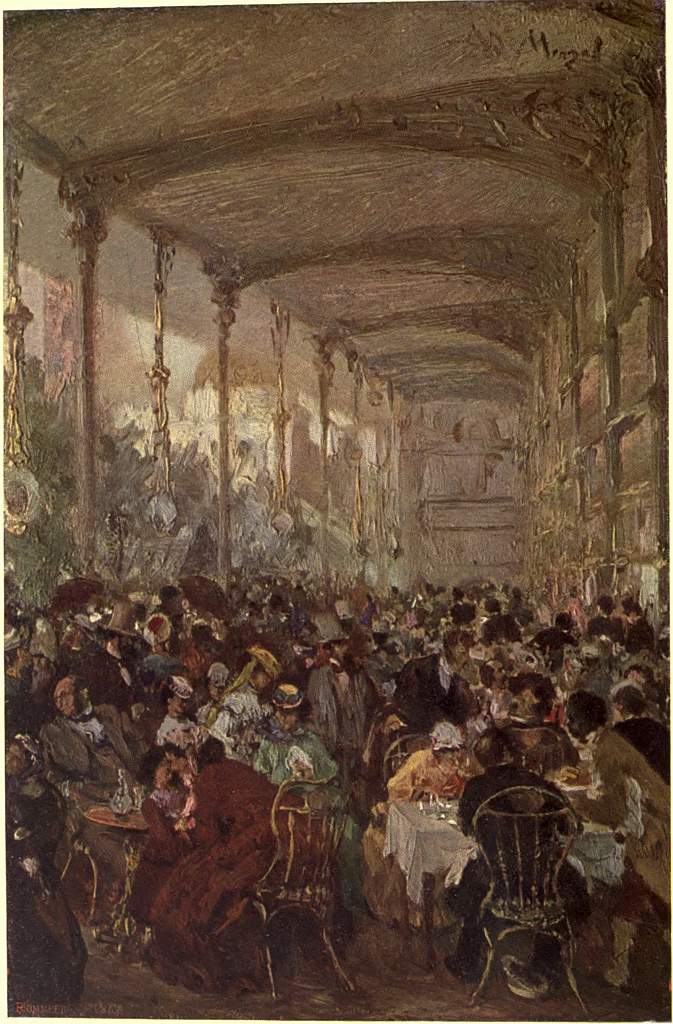
ADOLF VON MENZEL. RESTAURANT AT THE PARIS EXHIBITION 1867.
CONTENTS
PAGE
LIST OF ILLUSTRATIONS ix
BOOK IV (continued)
THE REALISTIC PAINTERS AND MODERN IDEALISTS (continued)
CHAPTER XXVIII
REALISM IN ENGLAND
The mannerism of English historical painting: F. C. Horsley, J. R. Herbert, J. Tenniel, E. M. Ward, Eastlake, Edward Armitage, and others.—The importance of Ruskin.—Beginning of the efforts at reform with William Dyce and Joseph Noël Paton.—The pre-Raphaelites.—The battle against “beautiful form” and “beautiful tone.”—Holman Hunt.—Ford Madox Brown.—John Everett Millais and Velasquez.—Their pictures from modern life opposed to the anecdotic pictures of the elder genre painters.—The Scotch painter John Phillip 1
CHAPTER XXIX
REALISM IN GERMANY
Why historical painting and the anecdotic picture could no longer take the central place in the life of German art after the changes of 1870.—Berlin: Adolf Menzel, A. v. Werner, Carl Güssow, Max Michael.—Vienna: August v. Pettenkofen.—Munich becomes once more a formative influence.—Importance of the impetus given in the seventies to the artistic crafts, and how it afforded an incentive to an exhaustive study of the old colourists.—Lorenz Gedon, W. Diez, E. Harburger, W. Loefftz, Claus Meyer, A. Holmberg, Fritz August Kaulbach.—Good painting takes the place of the well-told anecdote.—Transition from the costume picture to the pure treatment of modern life.—Franz Lenbach.—The Ramberg school.—Victor Müller brings into Germany the knowledge of Courbet.—Wilhelm Leibl 39
CHAPTER XXX
THE INFLUENCE OF THE JAPANESE
The Paris International Exhibition of 1867 communicated to Europe a knowledge of the Japanese.—A sketch of the history of Japanese painting.—The “Society of the Jinglar,” and the influence of the Japanese on the founders of Impressionism 81
CHAPTER XXXI
THE IMPRESSIONISTS
Impressionism is Realism widened by the study of the milieu.—Edouard Manet, Degas, Renoir, Camille Pissarro, Alfred Sisley, Claude Monet.—The Impressionist movement the final phase in the great battle of liberation for modern art 105
CHAPTER XXXII
THE NEW IDEALISM IN ENGLAND
Rossetti and the New pre-Raphaelites: Edward Burne-Jones, R. Spencer Stanhope, William Morris, J. M. Strudwick, Henry Holliday, Marie Spartali-Stillman.—W. B. Richmond, Walter Crane, G. F. Watts 151
CHAPTER XXXIII
THE NEW IDEALISM IN FRANCE AND GERMANY
Gustave Moreau, Puvis de Chavannes, Arnold Boecklin, Hans von Marées.—The resuscitation of biblical painting.—Review of previous efforts from the Nazarenes to Munkacsy, E. von Gebhardt, Menzel, and Leibermann.—Fritz von Uhde.—Other attempts: W. Dürr, W. Volz.—L. von Hofmann, Julius Exter, Franz Stuck, Max Klinger 210
BOOK V
A SURVEY OF EUROPEAN ART AT THE PRESENT TIME
INTRODUCTION 251
CHAPTER XXXIV
FRANCE
Bastien-Lepage, L’hermitte, Roll, Raffaelli, De Nittis, Ferdinand Heilbuth, Albert Aublet, Jean Béraud, Ulysse Butin, Édouard Dantan, Henri Gervex, Duez, Friant, Goeneutte, Dagnan-Bouveret.—The landscape painters: Seurat, Signac, Anquetin, Angrand, Lucien Pissarro, Pointelin, Jan Monchablon, Montenard, Dauphin, Rosset-Granget, Émile Barau, Damoye, Boudin, Dumoulin, Lebourg, Victor Binet, Réné Billotte.—The portrait painters: Fantin-Latour, Jacques Émile Blanche, Boldini.—The Draughtsmen: Chéret, Willette, Forain, Paul Renouard, Daniel Vierge, Cazin, Eugène Carrière, P. A. Besnard, Agache, Aman-Jean, M. Denis, Gandara, Henri Martin, Louis Picard, Ary Renan, Odilon Redon, Carlos Schwabe 255
CHAPTER XXXV
SPAIN
From Goya to Fortuny.—Mariano Fortuny.—Official efforts for the cultivation of historical painting.—Influence of Manet inconsiderable.—Even in their pictures from modern life the Spaniards remain followers of Fortuny: Francisco Pradilla Casado, Vera, Manuel Ramirez, Moreno Carbonero, Ricardo Villodas, Antonio Casanova y Estorach, Benliure y Gil, Checa, Francisco Amerigo, Viniegra y Lasso, Mas y Fondevilla, Alcazar Tejeder, José Villegas, Luis Jimenez, Martin Rico, Zamacois, Raimundo de Madrazo, Francisco Domingo, Emilio Sala y Francés, Antonio Fabrés 307
CHAPTER XXXVI
ITALY
Fortuny’s influence on the Italians, especially on the school of Naples.—Domenico Morelli and his followers: F. P. Michetti, Edoardo Dalbono, Alceste Campriani, Giacomo di Chirico, Rubens Santoro, Edoardo Toffano, Giuseppe de Nigris.—Prominence of the costume picture.—Venice: Favretto, Lonza.—Florence: Andreotti, Conti, Gelli, Vinea.—The peculiar position of Segantini.—Otherwise anecdotic painting still preponderates.—Chierici, Rotta, Vannuttelli, Monteverde, Tito.—Reasons why the further development of modern art was generally completed not so much on Latin as on Germanic soil 326
CHAPTER XXXVII
ENGLAND
General characteristic of English painting.—The offshoots of Classicism: Lord Leighton, Val Prinsep, Poynter, Alma Tadema.—Japanese tendencies: Albert Moore.—The animal picture with antique surroundings: Briton-Rivière.—The old genre painting remodelled in a naturalistic sense by George Mason and Frederick Walker.—George H. Boughton, Philip H. Calderon, Marcus Stone, G. D. Leslie, P. G. Morris, J. R. Reid, Frank Holl.—The portrait painters: Ouless, J. J. Shannon, James Sant, Charles W. Furse, Hubert Herkomer.—Landscape painters.—Zigzag development of English landscape painting.—The school of Fontainebleau and French Impressionism rose on the shoulders of Constable and Turner, whereas England, under the guidance of the pre-Raphaelites, deviated in the opposite direction until prompted by France to return to the old path.—Cecil Lawson, James Clarke Hook, Vicat Cole, Colin Hunter, John Brett, Inchbold, Leader, Corbett, Ernest Parton, Mark Fisher, John White, Alfred East, J. Aumonier.—The sea painters: Henry Moore, W. L. Wyllie.—The importance of Venice to English painting: Clara Montalba, Luke Fildes, W. Logsdail, Henry Woods.—French influences: Dudley Hardy, Stott of Oldham, Stanhope Forbes, J. W. Waterhouse, Byam Shaw, G. E. Moira, R. Anning Bell, Maurice Greiffenhagen, F. Cayley Robinson, Eleanor Brickdale 341
BIBLIOGRAPHY 405

LIST OF ILLUSTRATIONS
PLATES IN COLOUR
PAGE
Adolf Von Menzel: Restaurant at the Paris Exhibition, 1867 Frontispiece
Millais: The Vale of Rest Facing p. 28
Degas: The Ballet Scene from Robert the Devil ” 118
Monet: A Study ” 138
Rossetti: The Day-Dream ” 160
Burne-Jones: The Mill ” 176
L’Hermitte: The Pardon of Plourin ” 266
Raffaelli: The Highroad to Argenteuil ” 274
Carrière: School-Work ” 304
Segantini: Maternity ” 338
Alma-Tadema: The Visit ” 354
Colin Hunter: Their only Harvest ” 394
IN BLACK AND WHITE
PAGE
Alma Tadema, Laurens.
Sappho 354
Aman-Jean, Edmond.
Sous la Guerlanda 303
An Unknown Master.
Harvesters resting 97
Ansdell, Richard.
A Setter and Grouse 37
Aumonier, M. J.
The Silver Lining to the Cloud 394
Bastien-Lepage, Jules.
Portrait of Jules Bastien-Lepage 256
Portrait of his Grandfather 257
The Flower Girl 258
Sarah Bernhardt 259
Mme. Drouet 260
The Hay Harvest 261
Le Père Jacques 262
Joan of Arc 263
The Beggar 264
The Pond at Damvillers 265
The Haymaker 266
Bell, R. Anning.
Oberon and Titania with their Train 398, 399
Benliure y Gil.
A Vision in the Colosseum 321
Besnard, Paul Albert.
Evening 299
Portrait of Mlles. D. 301
Boecklin, Arnold.
Portrait of Himself 227
A Villa by the Sea 229
A Rocky Chasm 231
The Penitent 232
Pan startling a Goat-Herd 234
The Herd 235
Venus despatching Cupid 237
Flora 241
In the Trough of the Waves 242
The Shepherd’s Plaint 243
An Idyll of the Sea 244
Vita Somnium Breve 245
The Isle of the Dead 246
Boldini, Giovanni.
Giuseppe Verdi 290
Boudin, Eugène Louis.
The Port of Trouville 289
Boughton, George.
Green Leaves among the Sere 367
Snow in Spring 368
A Breath of Wind 369
The Bearers of the Burden 370
Brangwyn.
Illustration to the Rubáiyát of Omar Khayyám 401
Brown, Ford Madox.
Portrait of Himself 10
Lear and Cordelia 11
Romeo and Juliet 13
Christ washing Peter’s Feet 15
The Last of England 29
Work 31
Burne-Jones, Sir Edward.
Chant d’Amour 169
The Days of Creation 170, 171
Circe 172
Pygmalion (the Soul attains) 173
Perseus and Andromeda 175
The Annunciation 176
The Enchantment of Merlin 177
The Sea Nymph 178
The Golden Stairs 179
The Wood Nymph 181
Butin, Ulysse.
Portrait of Ulysse Butin 278
The Departure 279
Caldecott, Randolph.
The Girl I left behind Me 363
Carrière, Eugène.
Motherhood 297
Casado del Alisal.
The Bells of Huesca 323
Cazin, Jean Charles.
Judith 295
Hagar and Ishmael 296
Crane, Walter.
The Chariots of the Fleeting Hours 193
From The Tempest 194
From The Tempest 195
Dagnan-Bouveret, Pascal Adolphe Jean.
Consecrated Bread 284
Bretonnes au Pardon 285
The Nuptial Benediction 286
Dantan, Edouard.
A Plaster Cast from Nature 280
Degas, Hilaire Germain Edgard.
The Ballet in Don Juan 119
A Ballet-Dancer 121
Horses in a Meadow 122
Dancing Girl fastening her Shoe 123
Diez, Wilhelm.
Returning from Market 61
Duez, Ernest.
On the Cliff 282
The End of October 283
Dyce, William.
Jacob and Rachel 5
Eastlake, Sir Charles Lock.
Christ blessing little Children 3
Favretto, Giacomo.
On the Piazzetta 331
Susanna and the Elders 333
Fildes, Luke.
Venetian Women 396
Forain, J. L.
At the Folies-Bergères 293
Forbes, Stanhope.
The Lighthouse 397
Fortuny, Mariano.
Portrait of Mariano Fortuny 309
The Spanish Marriage (La Vicaria) 310
The Trial of the Model 311
The Snake Charmers 312
Moors playing with a Vulture 313
The China Vase 314
At the Gate of the Seraglio 315
Furse, Charles W.
Frontispiece to “Stories and Interludes” 381
Gervex.
Dr. Péan at La Salpétrière 281
Güssow, Karl.
The Architect 53
Harunobu.
A Pair of Lovers 101
Heilbuth, Ferdinand.
Fine Weather 277
Herkomer, Hubert.
John Ruskin 382
Charterhouse Chapel 383
Portrait of his Father 384
Hard Times 385
The Last Muster 387
Found 389
Hiroshige.
The Bridge at Yeddo 93
A High Road 94
A Landscape 95
Snowy Weather 96
Hirth, Rudolf du Frénes.
The Hop Harvest 70
Hokusai.
Hokusai in the Costume of a Japanese Warrior 82
Women Bathing 83
Fusiyama seen through a Sail 84
Fusiyama seen through Reeds 85
An Apparition 86
Hokusai sketching the Peerless Mountain 87
Holl, Frank.
“The Lord gave, the Lord hath taken away; Blessed be the Name of the Lord” 373
Leaving Home 374
Ordered to the Front 375
Hunt, William Holman.
The Scapegoat 8
The Light of the World 9
Hunter, Colin.
The Herring Market at Sea 393
Kaulbach, Fritz August.
The Lute Player 64
Kiyonaga.
Ladies Boating 99
Korin.
Landscape 89
Rabbits 91
Lawson, Cecil.
The Minister’s Garden 391
Leibl, Wilhelm.
Portrait of Wilhelm Leibl 71
In the Studio 72
The Village Politicians 73
The New Paper 74
In Church 75
A Peasant drinking 76
In the Peasant’s Cottage 77
A Tailor’s Workshop 79
Leighton, Lord.
Portrait of Lord Leighton, P.R.A. 343
Captive Andromache 345
Sir Richard Burton 347
The Last Watch of Hero 348
The Bath of Psyche 349
Lenbach, Franz.
Portrait of Franz Lenbach 65
Portrait of Wilhelm I. 66
Portrait of Prince Bismarck 67
The Shepherd Boy 68
L’Hermitte, Léon.
Pay time in Harvest 267
Portrait of Léon L’Hermitte 268
Manet, Édouard.
Portrait of Édouard Manet 107
The Fifer 108
The Guitarero 109
Le Bon Bock 110
A Garden in Rueil 111
The Fight between the “Kearsarge” and “Alabama” 114
Boating 115
A Bar at the Folies Bergères 116
Spring: Jeanne 117
Mason, George Hemming.
The End of the Day 365
Menzel, Adolf.
Portrait of Adolf Menze 40
From Kugler’s History of Friedrich the Great 41
The Coronation of King Wilhelm I. 43
From Kugler’s History of Friedrich the Great 45
The Damenstiftskirche at Munich 46
King Wilhelm setting out to join the Army 47
The Iron Mill 49
Sunday in the Tuileries Gardens 51
A Levee 52
Meyer, Claus.
The Smoking Party 63
Michetti, Francesco Paolo.
Going to Church 329
The Corpus Domini Procession at Chieti 330
Millais, Sir John Everett.
Portrait of Sir John Everett Millais 16
Lorenzo and Isabella 17
The North-West Passage 19
The Huguenot 20
Autumn Leaves 21
The Yeoman of the Guard 22
The Right Hon. W. E. Gladstone 23
Yes or No 25
Mrs. Bischoffsheim 26
Thomas Carlyle 27
Monet, Claude.
Portrait of Claude Monet 139
Monet’s Home at Giverny 140
Morning on the Seine 141
A Walk in Grey Weather 143
The Church at Varangéville 144
River Scene 145
The Rocks at Bell-Isle 147
Hay-Ricks 148
A View of Rouen 149
Moore, Albert.
Portrait of Albert Moore 355
Midsummer 356
Companions 357
Yellow Marguerites 359
Waiting to Cross 360
Reading Aloud 361
Moore, Henry.
Mount’s Bay 395
Moreau, Gustave.
The Young Man and Death 213
Orpheus 214
Design for Enamel 215
The Plaint of the Poet 216
The Apparition 217
Morelli, Domenico.
The Temptation of St. Anthony 327
Nittis, Giuseppe de.
Paris Races 276
Okio.
A Carp 92
Ouless, Walter William.
Lord Kelvin 377
Outamaro.
Mother’s Love 98
Paton, Sir Joseph Noël.
The Reconciliation of Oberon and Titania 7
Pettenkofen, August von.
Portrait of August von Pettenkofen 56
A Woman Spinning 57
In the Convent Yard 59
Phillip, John.
The Letter-Writer, Seville 33
Spanish Sisters 35
Pissarro, Camille.
Sitting up 133
Rouen 135
Sydenham Church 136
Pissarro, Lucien.
Solitude 287
Ruth 288
Poynter, Edward.
Idle Fear 350
The Ides of March 351
A Visit to Æsculapius 353
Pradilla, Francisco.
The Surrender of Granada 317
On the Beach 319
Puvis de Chavannes, Pierre.
Portrait of Pierre de Chavannes 218
A Vision of Antiquity 219
The Beheading of John the Baptist 220
The Threadspinner 221
The Poor Fisherman 223
Summer 224
Autumn 225
Raffaëlli, Francisque Jean.
Place St. Sulpice 271
The Midday Soup 272
The Carrier’s Cart 273
Paris, 4K. 1 274
Le Chiffonier 275
Ramberg, Arthur von.
The Meeting on the Lake 69
Reid, John Robertson.
Toil and Pleasure 371
Renoir, Firmin Auguste.
Supper at Bougival 125
The Woman with the Fan 126
Fisher Children by the Sea 127
The Woman with the Cat 129
A Private Box 130
The Terrace 131
Robinson, F. Cayley.
A Winter Evening 403
Roll, Alfred.
The Woman with a Bull 269
Manda Lamétrie, Fermière 270
Rossetti, Dante Gabriel.
Portrait of Dante Gabriel Rossetti 153
Beata Beatrix 154
Monna Rosa 155
Ecce Ancilla Domini 157
Sancta Lilias 158
Astarte Syriaca 159
Study for Astarte Syriaca 161
Dante’s Dream 163
Rosa Triplex 165
Sir Galahad 166
Mary Magdalene at the House of Simon the Pharisee 167
Sant, James.
The Music Lesson 379
Sisley, Alfred.
Outskirts of a Wood 137
Stanhope, R. Spencer.
The Waters of Lethe 183
Strudwick, J. M.
Elaine 185
Thy Tuneful Strings wake Memories 186
Gentle Music of a bygone Day 187
The Ramparts of God’s House 189
The Ten Virgins 191
Tanyu.
The God Hoteï on a Journey 88
Tito, Ettore.
The Slipper Seller 335
Toyokumi.
Nocturnal Reverie 103
Villegas, José.
Death of the Matador 320
Walker, Frederick.
The Bathers 366
Watts, George Frederick.
G. F. Watts in his Garden 196
Lady Lindsay 197
Hope 198
Paolo and Francesca 199
Love and Death 201
Ariadne 203
Orpheus and Eurydice 205
Artemis and Endymion 207
Willette, Adolfe.
The Golden Age 291
CHAPTER XXVIII
REALISM IN ENGLAND
The year 1849 was made famous by a momentous interruption in the quiet course of English art brought about by the pre-Raphaelites. A movement, recalling the Renaissance, laid hold of the spirit of painters. In all studios artists spoke a language which had never been heard there before; all great reputations were overthrown; the most celebrated Cinquecentisti, whose names had hitherto been mentioned with respectful awe, were referred to with a shrug as bunglers. A miracle seemed to have taken place in the world, for the muse of painting was removed from the pedestal on which she had stood for three centuries and set up in triumph upon another.
To understand fully the aims of pre-Raphaelitism it is necessary to recall the character of the age which gave it birth.
After English art had had its beginning with the great national masters and enjoyed a prime of real splendour, it became, about the middle of the nineteenth century, the prey to a tedious disease. A series of crude historical painters endeavoured to fathom the noble style of the Italian Cinquecento, without rising above the level of intelligent plagiarism. As brilliant decorative artists possessed of pomp and majesty, and sensuously affected by plastic beauty, as worshippers of the nude human form, and as modern Greeks, the Italian classic painters were the worst conceivable guides for a people who in every artistic achievement have pursued spiritual expression in preference to plastic beauty. But in spite of the experiences gained since the time of Hogarth, they all went on the pilgrimage to Rome, as to a sacred spring, drank their fill in long draughts, and came back poisoned. Even Wilkie, that charming “little master,” who did the work of a pioneer so long as he followed the congenial Flemish painters and the Dutch, even Wilkie lost every trace of individuality after seeing Spain and Italy. As this imitation of the high Renaissance period led to forced and affected sentiment, it also developed an empty academical technique. In accordance with the precepts of the Cinquecento, artists proceeded with an affected ease to make brief work of everything, contenting themselves with a superficial façade effect. A painting based on dexterity of hand took the place of the religious study of nature, and a banal arrangement after celebrated models took the place of inward absorption.
It was to no purpose that certain painters, such as F. C. Horsley, J. R. Herbert, J. Tenniel, Edwin Long, E. M. Ward, and Eastlake, the English Piloty, by imitation of the Flemish and Venetian masters, made more of a return from idealism of form to colour, and that Edwin Armitage, who had studied in Paris and Munich, introduced Continental influences. They are the Delaroche, Gallait, and Bièfve of England. Their art was an imposing scene painting, their programme always that of the school of Bologna—the mother of all academies, great and small—borrowing drawing from Michael Angelo and colour from Titian; taking the best from every one, putting it all into a pot, and shaking it together. Thus English art lost the peculiar national stamp which it had had under Reynolds and Gainsborough, Constable and Turner. It became an insignificant tributary of the false art which then held sway over the Continent, insincere towards nature, full of empty rhetorical passion, and bound to the most vacant routine. And as the grand painting became hollow and mannered, genre painting grew Philistine and decrepit. Its innocent childishness and conventional optimism had led to a tedious anecdotic painting. It repeated, like a talkative old man, the most insipid tales, and did so with a complacency that never wavered and with an unpleasant motley of colour. The English school still existed in landscape, but for everything else it was dead.
A need for reform became urgent all the sooner because literature too had diverged into new lines. In poetry there was the influence of the Lake poets Wordsworth and Coleridge, who had simplicity, direct feeling for nature, and a Rousseau-like pantheism inscribed as a device upon their banner, and it came as a reaction against the dazzling imaginative fervour of those great and forceful men of genius Byron and Shelley. Keats had again uttered the phrase which had before been Shaftesbury’s gospel: “Beauty is truth, truth beauty.” In the year 1843 John Ruskin published the first volume of his Modern Painters, the æsthetic creed of which culminated in the tenet that nature alone could be the source of all true art.
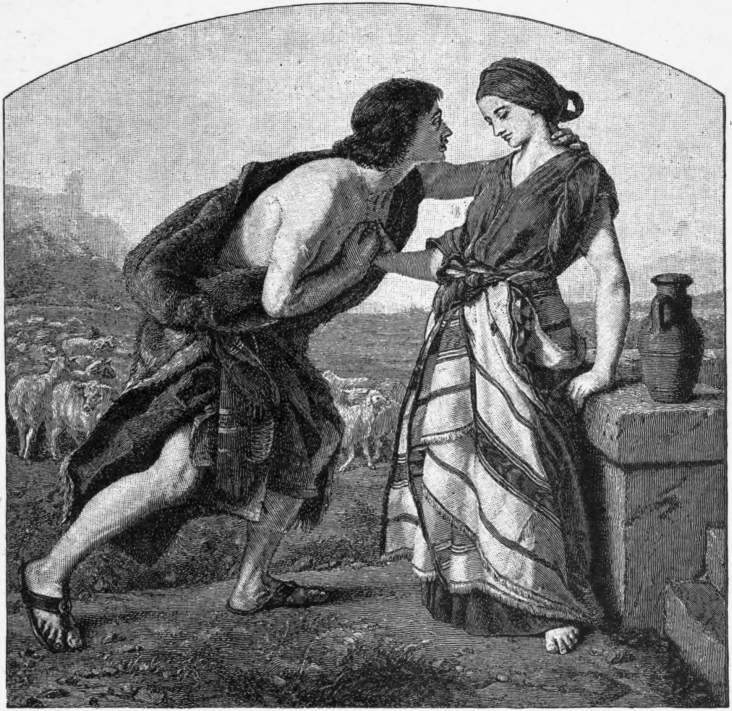
This transitional spirit, which strove for liberty from the academical yoke, though diffidently at first, is represented in painting by the Scotch artist William Dyce. In England he pursued, though undoubtedly with greater ability, a course parallel to that of the German Nazarenes, whose faith he championed. Born in 1806, he had in Italy, in the year 1826, made the acquaintance of Overbeck, who won him over to Perugino and Raphael. Protesting against the histrionic emptiness of English historical painting, he took refuge with the Quattrocentisti and the young Raphael. His masterpiece, the Westminster frescoes, with the Arthurian legends as their subject, goes to some extent on parallel lines with Schnorr’s frescoes on the Nibelungen myths. The representation of vigorous manhood and tempestuous heroism has been here attempted without sentimentality or theatrical heroics. In his oil pictures—Madonnas, “Bacchus nursed by the Nymphs,” “The Woman of Samaria,” “Christ in Gethsemane,” “St. John leading Home the Virgin,” etc.—he makes a surprising effect by the graceful, sensuous charm of his women, by his exquisite landscapes and his tender idyllic characters. The charming work “Jacob and Rachel,” which represents him in the Hamburg Kunsthalle, might be ascribed to Führich, except that the developed feeling for colour bears witness to its English origin. With yearning the youth hastens to the maiden, who stands, leaning against the edge of the well, with her eyes cast down, half repulsing him in her austere chastity.
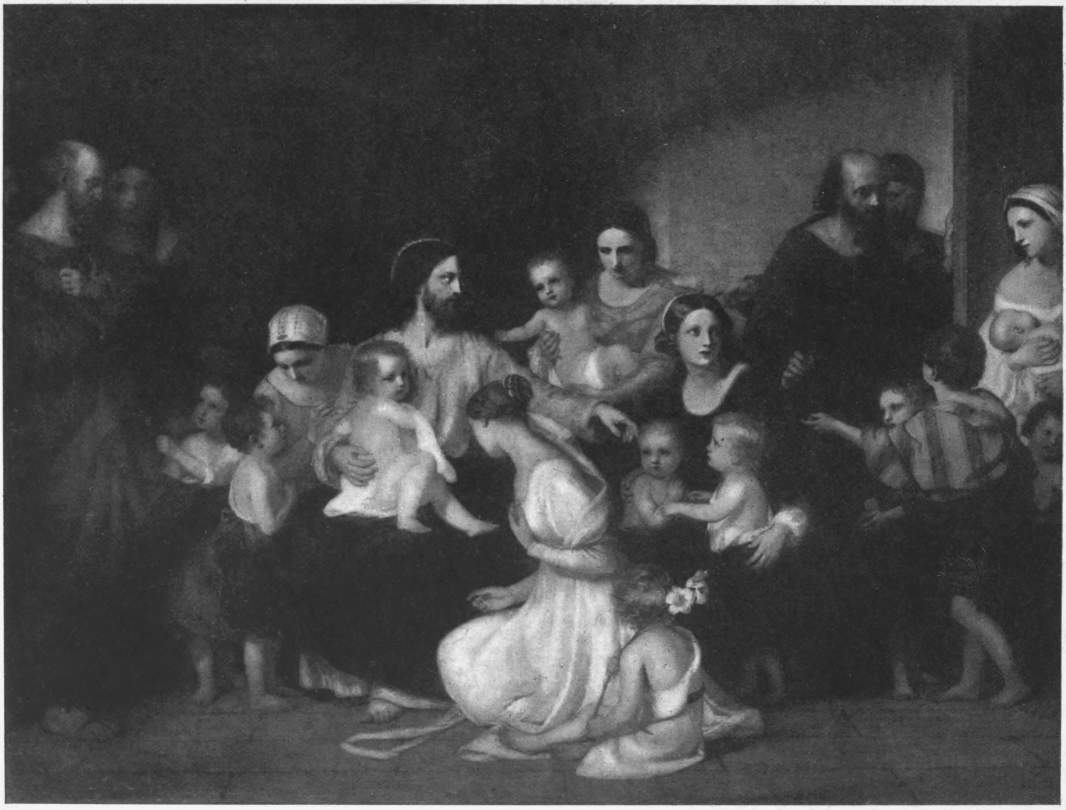
EASTLAKE. CHRIST BLESSING LITTLE CHILDREN.
(By permission of the Corporation of Manchester, the owners of the picture.)
Seemann, Leipzig.
DYCE. JACOB AND RACHEL.
Where the Nazarenes obtain a pallid, corpse-like effect, a deep and luminous quality of colour delights one in his pictures. He is essentially graceful, and with this grace he combines the pure and quiet simplicity of the Umbrian masters. There is something touching in certain of his Madonnas, who, in long, clinging raiment, appeal to the Godhead with arms half lifted, devout lips parted in prayer, and mild glances lost in infinity. A dreamy loveliness brings the heavenly figures nearer to us. Dyce expresses the magic of downcast lids with long, dark lashes. Like the Umbrians, he delights in the elasticity of slender limbs and the chaste grace of blossoming maiden beauty. Many German fresco painters have become celebrated who never achieved anything equal in artistic merit to the Westminster pictures of Dyce. Yet he is to be reckoned with the Flandrin-Overbeck family, since he gives a repetition of the young Raphael, though he certainly does it well; but he only imitates and has not improved upon him.
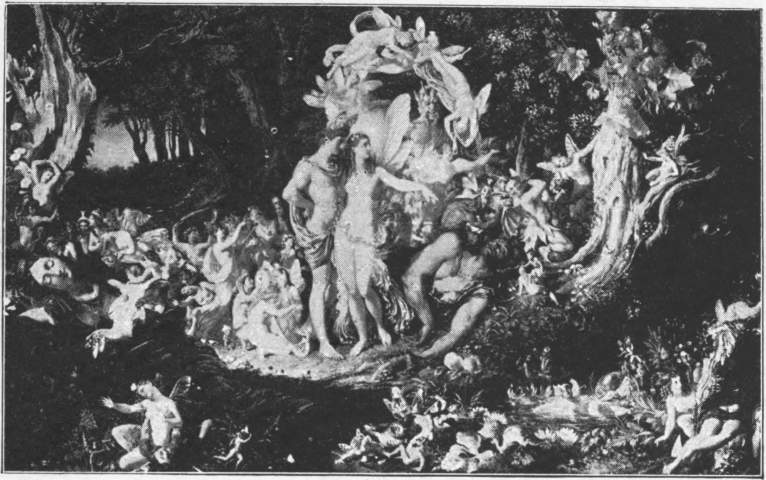
The pictures of another Scotchman, Sir Joseph Noël Paton, born in 1821, appear at a rather later date. Most of them—“The Quarrel of Oberon and Titania,” “The Reconciliation of Oberon and Titania” in the Edinburgh Gallery, and his masterpiece, “The Fairy Queen”—have, from the æsthetic standpoint, little enjoyment to offer. The drawing is hard, the composition overladen, the colour scattered and motley. As in Ary Scheffer, all the figures have vapid, widely opened eyes. Elves, gnomes, women, knights, and fantastic rocks are crowded so tightly together that the frame scarcely holds them. But the loving study of nature in the separate parts is extraordinary. It is possible to give a botanical definition of each plant and each flower in the foreground, with so much character and such care has Paton executed every leaf and every blossom, even the tiny creeping things amid the meadow grass. Here and there a fresh ray of morning sun breaks through the light green and leaps from blade to blade. The landscapes of Albrecht Altdorfer are recalled to mind. Emancipation from empty, heroically impassioned emphasis, pantheistic adoration of nature, even a certain effort—unsuccessful indeed—after an independent sentiment for colour, are what his pictures seem to preach in their naïve angularity, their loving execution of detail, and their bright green motley.
This was the mood of the young artists who united to form the pre-Raphaelite group of 1848. They were students at the Royal Academy of from twenty to four-and-twenty years of age. The first of the group, Dante Gabriel Rossetti, had already written some of his poems. The second, Holman Hunt, had still a difficulty in overcoming the opposition of his father, who was not pleased to see him giving up a commercial career. John Everett Millais, the youngest, had made most progress as a painter, and was one of the best pupils at the Academy. But they were contented neither by the artistic achievement of their teachers nor by the method of instruction. Etty, the most valued of them all, according to the account of Holman Hunt, painted mythological pictures, full of empty affectation; Mulready drew in a diluted fashion, and sacrificed everything to elegance; Maclise had fallen into patriotic banalities; Dyce had stopped short in his course and begun again when it was too late. Thus they had of necessity to provide their own training for themselves. All three worked in the same studio; and it so happened that one day—in 1847 or 1848—chance threw into their hands some engravings of Benozzo Gozzoli’s Campo-Santo frescoes in Pisa. Nature and truth—everything which they had dimly surmised, and had missed in the productions of English art—here they were. Overcome with admiration for the sparkling life, the intensity of feeling, and the vigorous form of these works, which did not even shrink from the consequences of ugliness, they were agreed in recognising that art had always stood on the basis of nature until the end of the fifteenth century, or, more exactly, until the year 1508, when Raphael left Florence to paint in the Vatican in Rome. Since then everything had gone wrong; art had stripped off the simple garment of natural truthfulness and fallen into conventional phrases, which in the course of centuries had become more and more empty and repellent by vapid repetition. Was it necessary that the persons in pictures should, to the end of the world, stand and move just as they had done a thousand times in the works of the Cinquecentisti? Was it necessary that human emotions—love, boldness, remorse, and renunciation—should always be expressed by the same turn of the head, the same lift of the eyebrows, the same gesture of the arms, and the same folded hands, which came into vogue through the Cinquecentisti? Where in nature are the rounded forms which Raphael, the first Classicist, borrowed from the antique? And in the critical moments of life do people really form themselves into such carefully balanced groups, with the one who chances to have on the finest clothes in the centre?
Annan, photo.
PATON. THE RECONCILIATION OF OBERON AND TITANIA.
From this reaction against the Cinquecentisti and against the shallow imitation of them, the title pre-Raphaelite Brotherhood, and the secret, masonic sign P.R.B., which they added to their signatures upon their pictures, are rendered comprehensible. But whilst Dyce, to avoid the Cinquecentisti, imitated the Quattrocentisti, the title here is only meant to signify that these artists, like the Quattrocentisti, had determined to go back to the original source of real life. The Academy pupils Rossetti, Millais, and Holman Hunt, together with the young sculptor Thomas Woolner, who had just left school, were at first the only members of the Brotherhood. Later the genre painter James Collinson, the painter and critic F. G. Stephens, and Rossetti’s brother, William Michael Rossetti, were admitted to the alliance.
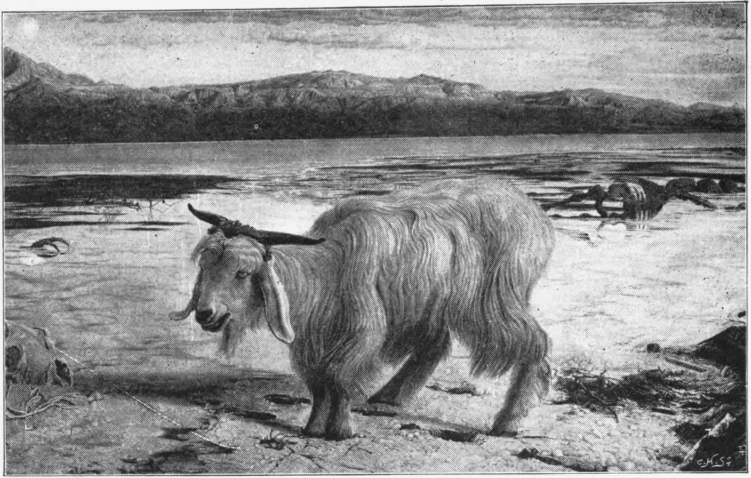
HOLMAN HUNT. THE SCAPEGOAT.
(By Permission of Messrs. Henry Graves & Co., the owners of the copyright.)
Boldly they declared war against all conventional rules, described themselves as beginners and their pictures as attempts, and announced themselves to be, at any rate, sincere. The programme of their school was truth; not imitation of the old masters, but strict and keen study of nature such as the old masters had practised themselves. They were in reaction against the superficial dexterity of technique and the beauty of form and intellectual emptiness to which the English historical picture had fallen victim; they were in reaction against the trivial banality which disfigured English genre painting. In the representation of passion the true gestures of nature were to be rendered, without regard to grace and elegance, and without the stock properties of pantomime. The end for which they strove was to be true and not to create what was essentially untrue by a borrowed idealism which had an appearance of being sublime. In opposition to the negligent painting of the artists of their age, they demanded slavishly faithful imitation of the model by detail, carried out with microscopic exactness. Nothing was to be done without reverence for nature; every part of a picture down to the smallest blade or leaf was to be directly painted from the original. Even at the expense of total effect every picture was to be carried out in minutest detail. It was better to stammer than to make empty phrases. A young and vigorous art, such as had been in the fifteenth century, could win its way, as they believed, from this conception alone.
In all these points, in the revolt against the emptiness of the beauté suprême and the flowing lines of the accepted routine of composition, they were at one with Courbet and Millet. It was only in further developments that the French and English parted company; English realism received a specifically English tinge. Since every form of Classicism—for to this point they were led by the train of their ideas—declares the ideal completion of form, of physical presentment, to be its highest aim, the standard-bearers of realism were obliged to seek the highest aim of their art, founded exclusively on the study of nature, in the representation of moral and intellectual life, in a thoughtful form of spiritual creation. The blending of realism with profundity of ideas, of uncompromising truth to nature in form with philosophic and poetic substance, is of the very essence of the pre-Raphaelites. They are transcendental naturalists, equally widely removed from Classicism, which deals only with beautiful bodies, as from realism proper, which only proposes to represent a fragment of nature. From opposition to abstract beauty of form they insist upon what is characteristic, energetic, angular; but their figures painted faithfully from nature are the vehicles of a metaphysical idea. From the first they saturated themselves with poetry. Holman Hunt has an enthusiasm for Keats and the Bible, Rossetti for Dante, Millais for the mediæval poems of chivalry.
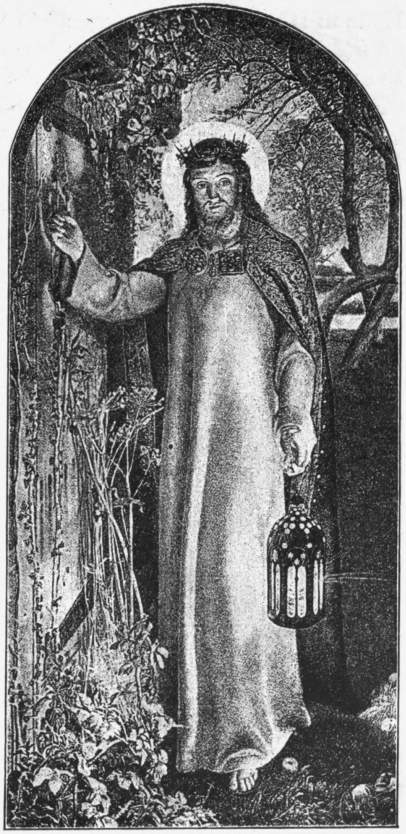
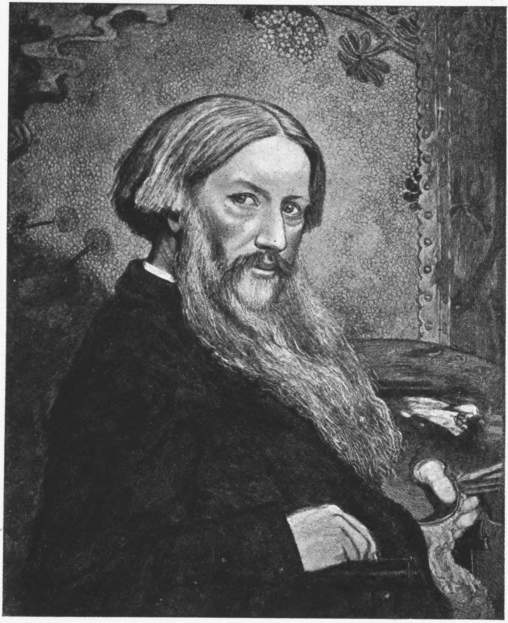
HOLMAN HUNT. THE LIGHT OF THE WORLD. FORD MADOX BROWN. Mag. of Art. PORTRAIT OF HIMSELF.
(By permission of Mr. L. H. Lefèvre, the owner of the copyright.) (By permission of Theodore Watts Dunton, Esq., the owner of the picture.)
All three appeared before the public for the first time in the year 1849. John Millais and Holman Hunt exhibited in the Royal Academy, the one being represented by his “Lorenzo and Isabella,” a subject drawn from Keats, the other by his “Rienzi.” Rossetti had his picture, “The Girlhood of Mary Virgin,” exhibited at the Free Exhibition, afterwards known as the Portland Gallery. All three works excited attention and also derision, and much shaking of heads. The three next works of 1850—“A Converted British Family sheltering a Christian Missionary,” by Holman Hunt; “The Child Jesus in the Workshop of Joseph the Carpenter,” by Millais; and “The Annunciation” by Rossetti—were received with the same amused contempt. When they exhibited for the third time—Holman Hunt, a scene from The Two Gentlemen of Verona; Millais, “The Return of the Dove to the Ark” and “The Woodman’s Daughter”—such a storm of excitement broke forth that the pictures had to be removed from the exhibition. A furious article appeared in The Art Journal; the exhibitors, it was said, were certainly young, but they were too old to commit such sins of youth. Even Dickens turned against them in Household Words. The painters who had been assailed made their answer. William Michael Rossetti laid down the principles of the Brotherhood by an article in a periodical called The Critic, and smuggled a second article into The Spectator. In 1850 they founded a monthly magazine for the defence of their theories, The Germ, which on the third number took the title Art and Poetry, and was most charmingly embellished with drawings by Holman Hunt, Madox Brown, and others. Stephens published an essay in it, on the ways and aims of the early Italians, which gave him occasion to discuss the works recently produced in the spirit of simplicity known to these old masters. Madox Brown wrote a paper on historical painting, in which he asserted that the true basis of historical painting must be strict fidelity to the model, to the exclusion of all generalisation and beautifying, and exact antiquarian study of costumes and furniture in contradistinction to the fancy history of the elder painters. But all these articles were written to no purpose. After the fourth number the magazine was stopped, and in these days it has become a curiosity for bibliomaniacs. But support came from another side. Holman Hunt’s picture dealing with a scene from Shakespeare’s Two Gentlemen of Verona received the most trenchant condemnation in The Times. John Ruskin came forward as his champion and replied on 13th May 1851. The Times contained yet a second letter from him on 30th May. And soon afterwards both were issued as a pamphlet, with the title Pre-Raphaelitism, its Principles, and Turner. These works, he said, did not imitate old pictures, but nature; what alienated the public in them was their truth and rightness, which had broken abruptly and successfully with the conventional sweep of lines.
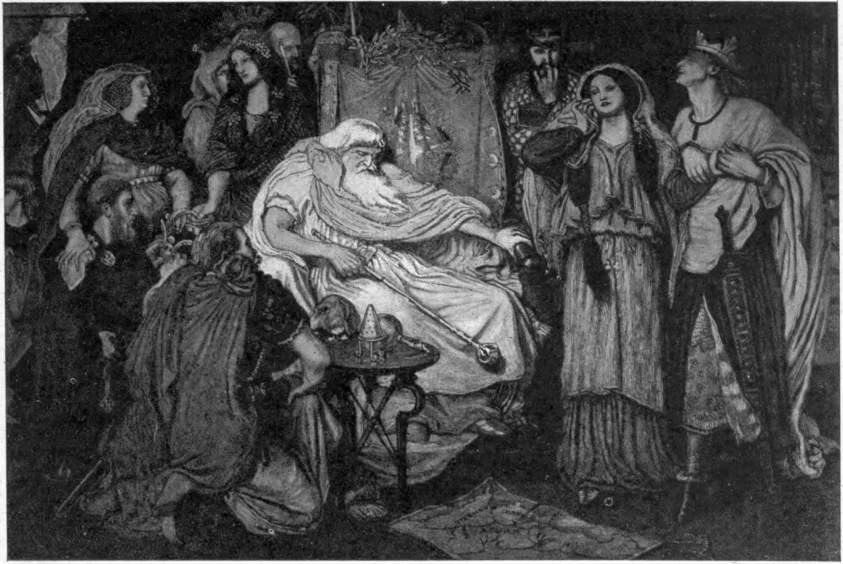
FORD MADOX BROWN. Mag. of Art. LEAR AND CORDELIA.
(By permission of Albert Wood, Esq., the owner of the picture.)
Holman Hunt is the painter who has been most consistent in clinging throughout his life to these original principles of the Brotherhood. He is distinguished by a depth of thought which at last tends to become entirely elusive, and often a depth of spirit more profound than diver ever plumbed; but at the same time by an angular, gnarled realism which has scarcely its equal in all the European art of the century.
“The Flight of Madeleine and Porphyro,” from Keats’ Eve of St. Agnes, was the first picture, the subject being borrowed in 1848 from his favourite poet. In the work through which he first acknowledged himself a member of the pre-Raphaelite Brotherhood he has given a plain and simple rendering of the scene in the introductory chapter of Bulwer Lytton’s Rienzi. He has chosen the moment when Rienzi, kneeling beside the corpse of his brother, takes a vow of vengeance against the murderer who is riding away. The composition avoids any kind of conventional pyramidal structure. In the foreground every flower is painted and every colour is frankly set beside its neighbour without the traditional gradation. His third picture, “A Converted British Family sheltering a Christian Missionary,” is not to be reckoned amongst his best performances. It is forced naïveté, suggesting the old masters, to unite two entirely different scenes upon the same canvas: in the background there are fugitives and pursuers, and a Druid, merely visible by his outstretched arms, inciting the populace to the murder of a missionary; in the foreground a hut open on all sides, which could really offer no protection at all. Yet in this hut a priest is hiding, tended by converted Britons. However, the drawing of the nude bodies is an admirable piece of realism; admirable, also, is the way in which he has expressed the fear of the inmates, and the fanatical bloodthirsty rage of the pursuers, and this without any false heroics, without any rhetoric based upon the traditional language of gesture. The picture from Shakespeare’s Two Gentlemen of Verona, with the motto, “Death is a fearful thing, and shamed life a hateful,” is perhaps theatrical in its arrangement, though it is likewise earnest and convincing in psychological expression.
Microscopic fidelity to nature, which formed the first principle in the programme of the Brotherhood, has been carried in Holman Hunt to the highest possible point. Every flower and every ear of corn, every feather and every blade of grass, every fragment of bark on the trees and every muscle, is painted with scrupulous accuracy. The joke made about the pre-Raphaelites has reference to Holman Hunt: it was said that when they had to paint a landscape they used to bring to their studio a blade of grass, a leaf, and a piece of bark, and they multiplied them microscopically so many thousand times until the landscape was finished. His works are a triumph of industry, and for that very reason they are not a pleasure to the eye. A petty, pedantic fidelity to nature injures the total effect, and the hard colours—pungent green, vivid yellow, glaring blue, and glowing red—which Holman Hunt places immediately beside each other, give his pictures something brusque, barbaric, and jarring. But as a reaction against a system of painting by routine, which had become mannered, such truth without all compromise, such painstaking effort at the utmost possible fidelity to nature, was, in its very harshness, of epoch-making significance.
With regard, also, to the transcendental purport of his pictures Holman Hunt is perhaps the most genuine of the group. In the whole history of art there are no religious pictures in which uncompromising naturalism has made so remarkable an alliance with a pietistic depth of ideas. The first, which he sent to the exhibition of 1854, “The Light of the World,” represents Christ wandering through the night in a gold-embroidered mantle, with a lantern in His hand, like a Divine Diogenes seeking men. Taine, who studied the picture impartially without the catalogue, describes it, without further addition, as “Christ by night with a lantern.” But for Holman Hunt the meaning is Christianity illuminating the universe with the mystic light of Faith and seeking admission at the long-closed door of unbelief. It was because of this implicit suggestion that the work made an indescribable sensation in England; it had to go on pilgrimage from town to town, and hundreds of thousands of copies of the engraving were sold. The pietistic feeling of this ascetic preacher was so strong that he was able to venture on pictures like “The Scapegoat” of 1856 without becoming comical.
Cassell & Co.
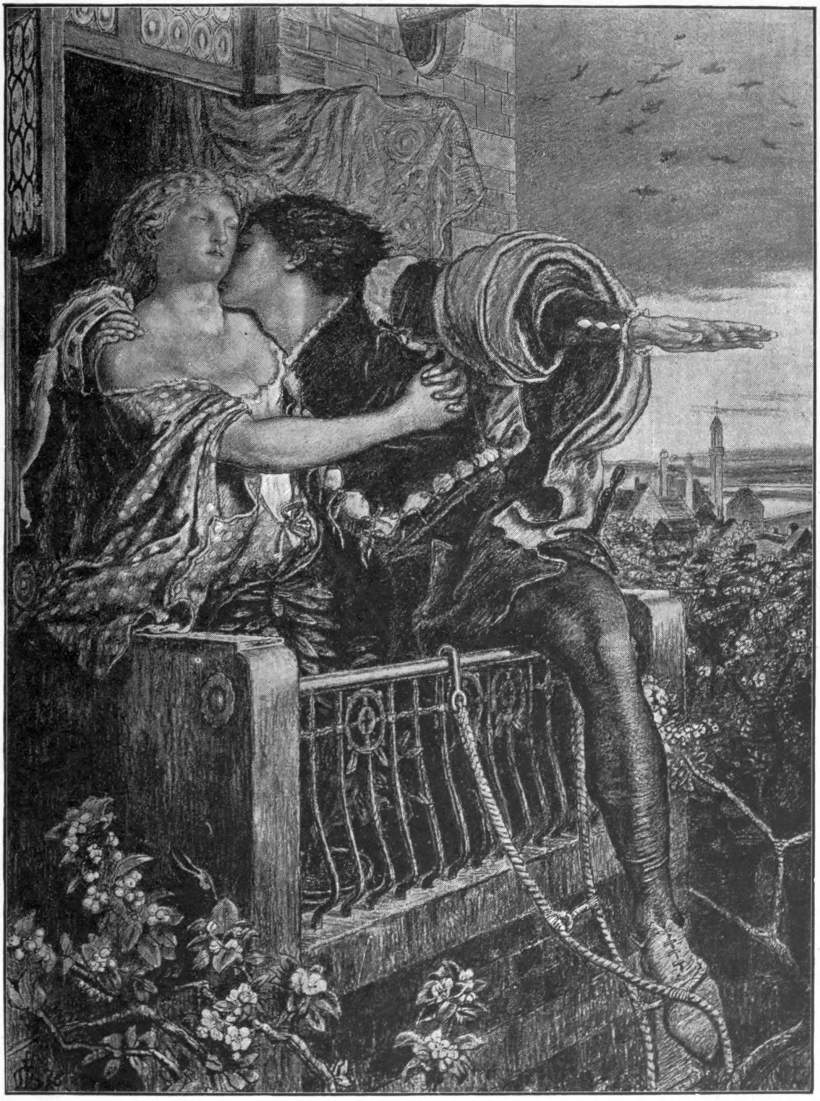
FORD MADOX BROWN. ROMEO AND JULIET.
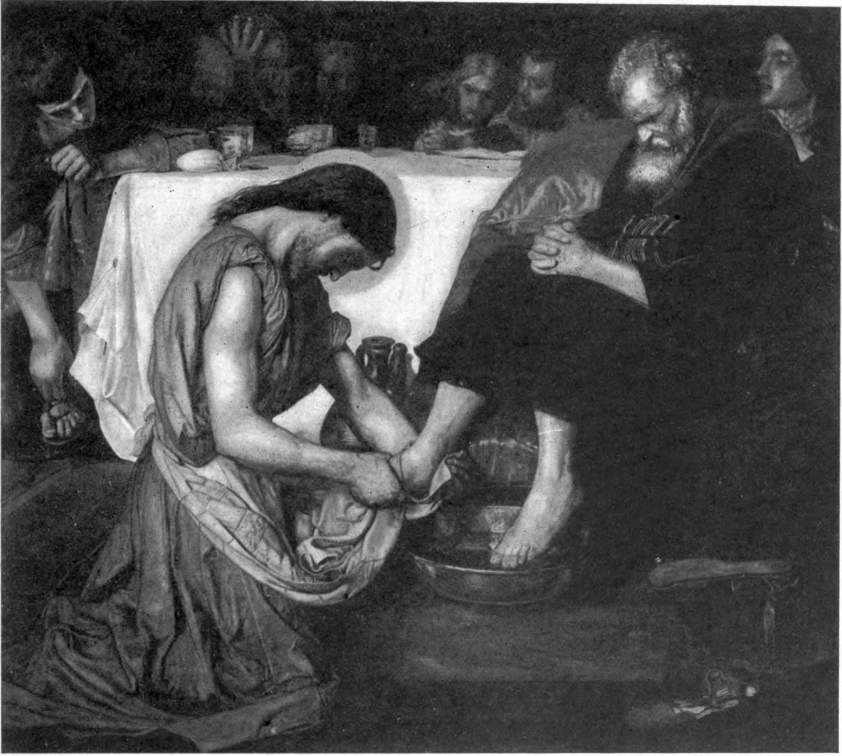
FORD MADOX BROWN. CHRIST WASHING PETER’S FEET.
A striving to attain the greatest possible local truth had led Holman Hunt to the East when he began these biblical pictures. He spent several years in Palestine studying the topographical character of the land, its buildings and its people, and endeavoured with the help of these actual men and women and these landscape scenes to reconstruct the events of biblical history with antiquarian fidelity. To paint “The Shadow of Death” he searched in the East until he discovered a Jew who corresponded to his idea of Christ, and painted him, a strong, powerful man, the genuine son of a carpenter, with that astounding truth to nature with which Hubert van Eyck painted his Adam. Even the hairs of the breast and legs are as faithfully rendered as if one saw the model in a glass. Near this naked carpenter—for He is clothed only with a leather apron—there kneels a modern Eastern woman, bowed over a chest, in which various Oriental vessels are lying. The ground is covered with shavings of wood. Up to this point, therefore, it is a naturalistic picture from the modern East. But here Holman Hunt’s pietistic sentiment is seen: it is the eve of a festival; the sun casts its last dying rays into the room; the journeyman carpenter wearily stretches out His arms, and the shadow of His body describes upon the wall the prophetic form of the Cross.
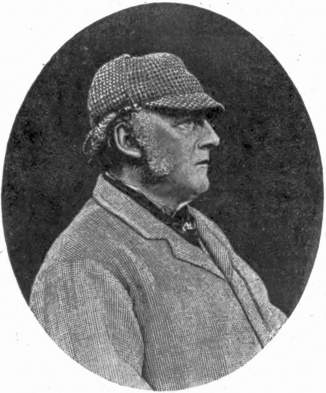
SIR JOHN EVERETT MILLAIS.
Another picture represented the discovery of our Lord in the Temple, a third the flock which has been astray following the Good Shepherd into His Father’s fold. On his picture of the flight into Egypt, or, as he has himself called it, “The Triumph of the Innocents,” he published a pamphlet of twelve pages, in which he goes into all the historical events connected with the picture with the loyalty of an historian; he discusses everything—in what month the flight took place, and by what route, how old Christ was, to what race the ass belonged, and what clothes were worn by Saint Joseph and Mary. One might be forgiven for thinking such a production the absurd effusion of a whimsical pedant were it not that Hunt is so grimly in earnest in everything he does. In spite of all his peculiarities it must be admitted that he gave a deep and earnest religious character to English art, which before his time had been so paltry; and this explains the powerful impression which he made upon his contemporaries.
The artist most closely allied to him in technique is Ford Madox Brown, who did not reckon himself officially with the pre-Raphaelites, though he followed the same principles in what concerned the treatment of detail. Only a little senior to the founders of the Brotherhood—he was nine-and-twenty at the time—he is to be regarded as their more mature ally and forerunner. Rossetti was under no illusion when, in the beginning of his studies, he turned to him directly. In those years Madox Brown was the only English painter who was not addicted to the trivialities of paltry genre painting or the theatrical heroics of traditional history. He is a bold artist, with a gift of dramatic force and a very rare capacity of concentration, and these qualities hindered him from following the doctrine of the pre-Raphaelites in all its consequences. If he had, in accordance with their programme, exclusively confined himself to work from the living model, several of his most striking and powerful pictures would never have been painted.
Cassell & Co.
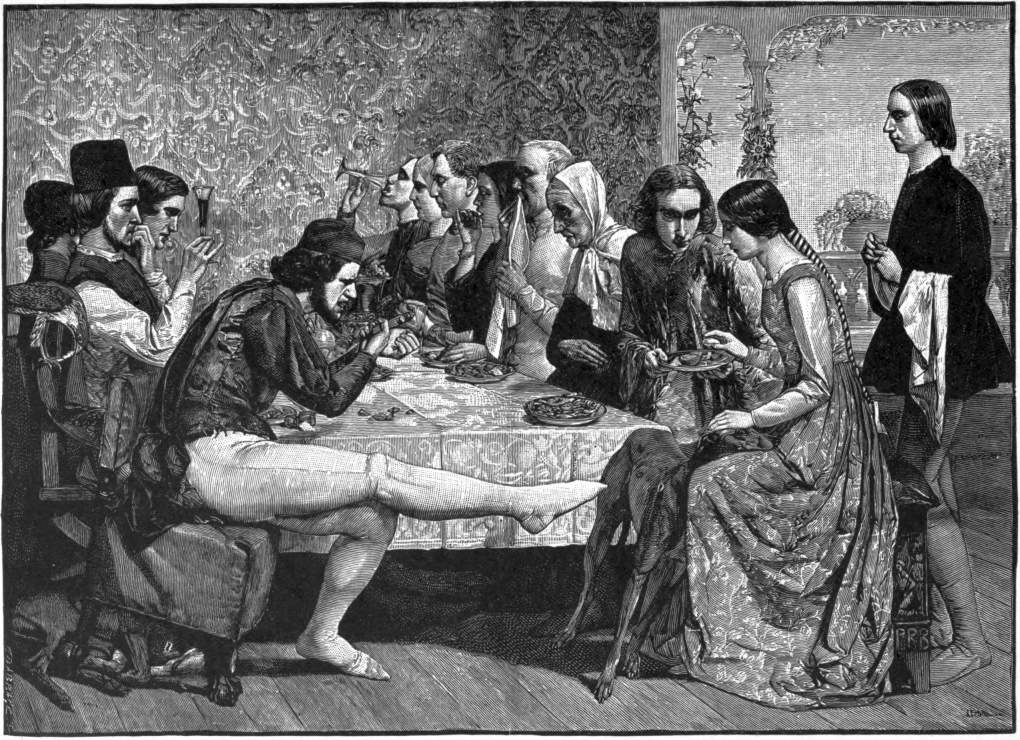
MILLAIS. LORENZO AND ISABELLA.
Hanfstaengl.
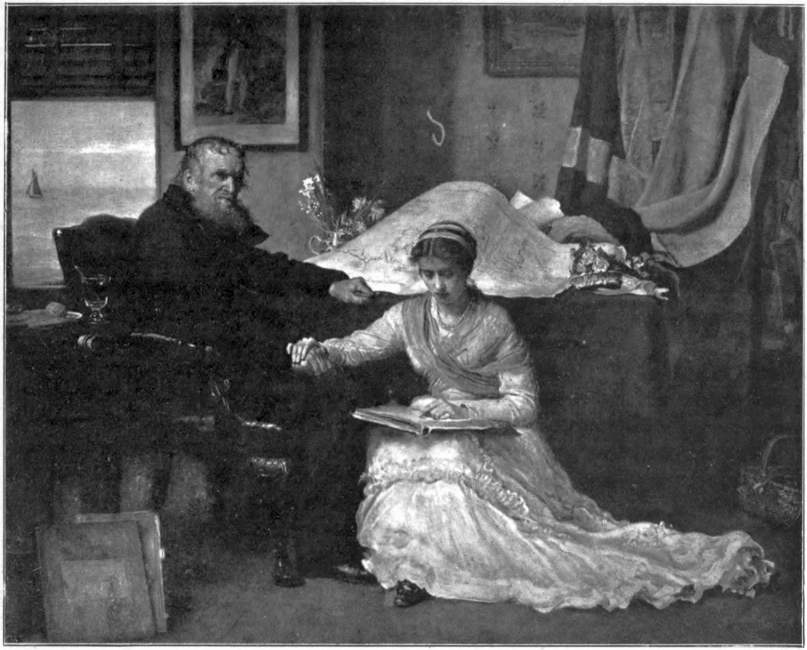
MILLAIS. THE NORTH-WEST PASSAGE.
Madox Brown passed his youth on the Continent—in Antwerp with Wappers, in Paris, and in Rome. The pictures which he painted there in the beginning of the forties were produced, as regards technique, under the influence of Wappers. The subjects were taken from Byron: “The Sleep of Parisina” and “Manfred on the Jungfrau.” It is only in the latter that an independent initiative is perceptible. In contradistinction from the generalities of the school of Wappers he aimed at greater depth of psychology and accuracy of costume, while at the same time he endeavoured, though without success, to replace the conventional studio light by the carefully observed effect of free light. These three things—truth of colour, of spiritual expression, and of historical character—were from this time forth his principal care. And when his cartoon of “Harold,” painted in Paris in the year 1844, was exhibited in Westminster Hall, it was chiefly this scrupulous effort at truth which made such a vivid impression upon the younger generation. In the first masterpiece which he painted after his return to London in 1848 he stands out already in all his rugged individuality. “Lear and Cordelia,” founded on a most tragic passage in the most tragic of the great dramas of Shakespeare, is here treated with impressive cogency. It stood in such abrupt opposition to the traditional historical painting that perhaps nothing was ever so sharply opposed to anything so universally accepted. The figures stand out stiff and parti-coloured like card kings, without fluency of line or rounded and generalised beauty. And the colouring is just as incoherent. The brown sauce, which every one had hitherto respected like a binding social law, had given way to a bright joy of colour, the half-barbaric motley which one finds in old miniatures. It is only when one studies the brilliant details, used merely in the service of a great psychological effect, that this outwardly repellent picture takes shape as a powerful work of art, a work of profound human truth. Nothing is sacrificed to pose, graceful show, or histrionic affectation. Like the German masters of the fifteenth century, Madox Brown makes no attempt to dilute what is ugly, nor did Holbein either when he painted the leprous beggars in his “Altar to St. Sebastian.” Every figure, whether fair or foul, is, in bearing, expression, and gesture, a character of robust and rigorous hardihood, and has that intense fulness of life which is compressed in those carved wooden figures of mediæval altars: the aged Lear with his weather-beaten face and his waving beard; the envious Regan; the cold, cruel, ambitious Goneril; Albany, with his fair, inexpressive head; the gross, brutal Cornwall; Burgundy, biting his nails in indecision; and Cordelia, in her touching, bashful grace. And to this angular frankness of the primitive masters he unites the profound learning of the modern historian. All the archæological details, the old British costumes, jewels, modes of wearing the hair, weapons, furniture, and hangings, have been studied with the accuracy of Menzel. He knows nothing of the academic rules of composition, and his robes fall naturally without the petty appendage of fair folds and graceful motives.
Brothers, photo.
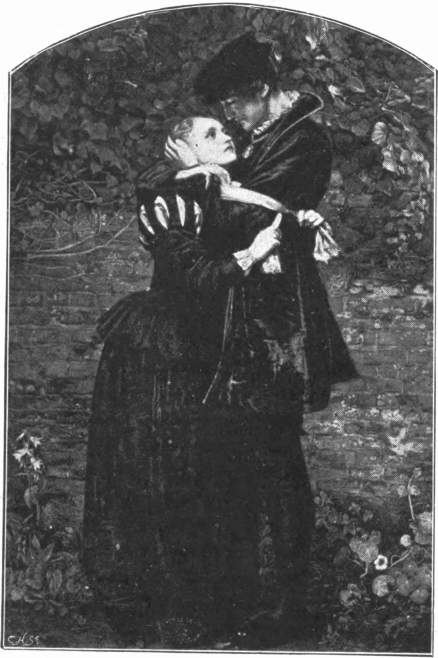
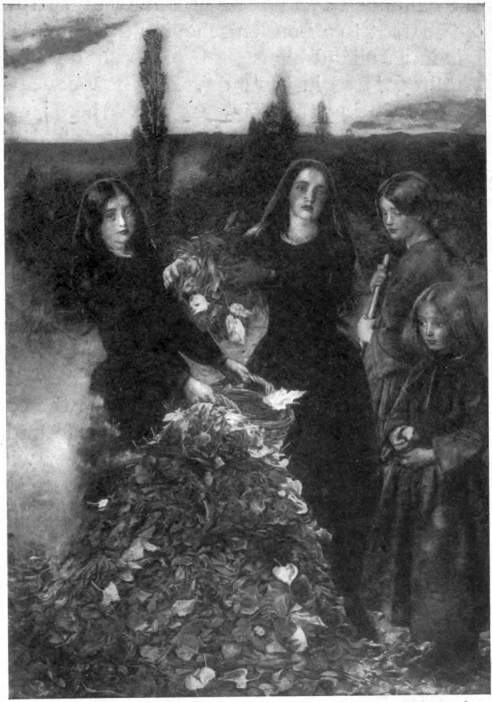
MILLAIS. THE HUGUENOT. MILLAIS. AUTUMN LEAVES.
The picture in which he treated the balcony scene in Shakespeare’s Romeo and Juliet is outwardly repellent, like “Lear and Cordelia,” but what a hollow effect is made by Makart’s theatrical heroics beside this aboriginal sensuousness, this intensity of expression! Juliet’s dress has fallen from her shoulders, and, devoid of will and thought, with closed lids, half-naked, and thrilling in every fibre with the lingering joy of the hours that have passed, she abandons herself to the last fiery embraces of Romeo, who in stormy haste is feeling with one foot for the ladder of ropes.
He has solved a yet more difficult problem in the picture “Elijah and the Widow.”
“See, thy son liveth,” are the words in the Bible with which the hoary Elijah brings the boy, raised from death and still enveloped in his shroud, to the agonised mother kneeling at the foot of the sepulchre. The woman makes answer: “Now by this I know that thou art a man of God.” In the embodiment of this scene likewise Madox Brown has aimed in costume and accessories at a complete harmony between the figures and the character of the epoch, and has set out with an entirely accurate study of Assyrian and Egyptian monuments. Even the inscription on the wall and the Egyptian antiquities correspond to ancient originals. At the same time the figures have been given the breath of new life. Elijah looks more like a wild aboriginal man than a saint of the Cinquecento. The ecstasy of the mother, the astonishment of the child whose great eyes, still unaccustomed to the light, gaze into the world again with a dreamy effort, after having beheld the mysteries of death—these are things depicted with an astonishing power. The downright but convincing method in which Hogarth paints the soul has dislodged the hollow, heroical ideal of beauty of the older historical painting. Madox Brown’s confession of faith, which he formulated as an author, culminates in the tenet that truth is the means of art, its end being the quickening of the soul. This he expresses in two words: “emotional truth.”
While Holman Hunt and Madox Brown held fast throughout their lives to the pre-Raphaelite principles, pre-Raphaelitism was for John Everett Millais, the youngest of the three, merely a transitory phase, a stage in his artistic development.
L’Art.
MILLAIS. THE YEOMAN OF THE GUARD.
Sir John Millais was born 8th June 1829, in Southampton, where his family had come from Jersey. Thus he is half a Frenchman by descent. His childhood was passed in Dinant in Brittany, but when he was nine years old he went to a London school of drawing. He was then the little fair-haired boy in a holland blouse, a broad sash, and a large sailor’s collar, whom John Phillip painted in those days. When eleven he entered the Royal Academy, probably being the youngest pupil there; at thirteen he won a prize medal for the best drawing from the antique; at fifteen he was already painting; and at seventeen he exhibited an historical picture, “Pizarro seizing the Inca of Peru,” which was praised by the critics as the best in the exhibition of 1846. With “Elgiva,” a work exhibited in 1847, this first period, in which he followed the lines of the now forgotten painter Hilton, was brought to an end. His next work, “Lorenzo and Isabella,” now in the Walker Art Gallery in Liverpool, bore the letters P.R.B., as a sign of his new confession of faith. Microscopically exact work in detail has taken the place of the large bravura and the empty imitation of the Cinquecentisti. The theme was borrowed from one of Boccaccio’s tales, The Pot of Basil—the tale on which Keats founded Isabella. A company of Florentines in the costume of the thirteenth century are assembled at dinner. Lorenzo, pale and in suppressed excitement, sits beside the lovely Isabella, looking at her with a glance of deep, consuming passion. Isabella’s brother, angered at it, gives a kick to her dog. All the persons at the table are likenesses. The critic F. G. Stephens sat for the beloved of Isabella, and Dante Gabriel Rossetti for the toper holding his glass to his lips at the far right of the table. Even the ornaments upon the damask cloth, the screen, and the tapestry in the background are painted, stroke after stroke, with the conscientious devotion of a primitive painter. Jan van Eyck’s brilliancy of colour is united to Perugino’s suavity of feeling, and the chivalrous spirit of the Decameron seized with the sureness of a subtle literary scholar.
The work of 1850, “The Child Jesus in the Workshop of Joseph the Carpenter,” illustrated a verse in the Bible (Zechariah xiii. 6): “And one shall say unto Him, What are these wounds in Thine hands? Then He shall answer, Those with which I was wounded in the house of My friends.” The Child Jesus, who is standing before the joiner’s bench, has hurt Himself in the hand. St. Joseph is leaning over to look at the wound, and Mary is kneeling beside the Child, trying to console Him with her caresses, whilst the little St. John is bringing water in a wooden vessel. Upon the other side of the bench stands the aged Anna, in the act of drawing out of the wood the nail which has caused the injury. A workman is labouring busily at the joiner’s bench. The floor of the workshop is littered with shavings, and tools hang round upon the walls. The Quattrocentisti were likewise the determining influence in the treatment of this subject. Ascetic austerity has taken the place of ideal draperies, and angularity that of the noble flow of line. The figure of Mary, who, with her yellow kerchief, resembled the wife of a London citizen, was the cause of special offence.
MILLAIS. Mag. of Art. THE RIGHT HON. W. E. GLADSTONE.
(By permission of Messrs. Thomas Agnew & Co., the owners of the copyright.)
Cassell & Co.
MILLAIS. YES OR NO?
L’Art.
MILLAIS. MRS. BISCHOFFSHEIM.
(By permission of Mrs. Bischoffsheim, the owner of the picture.)
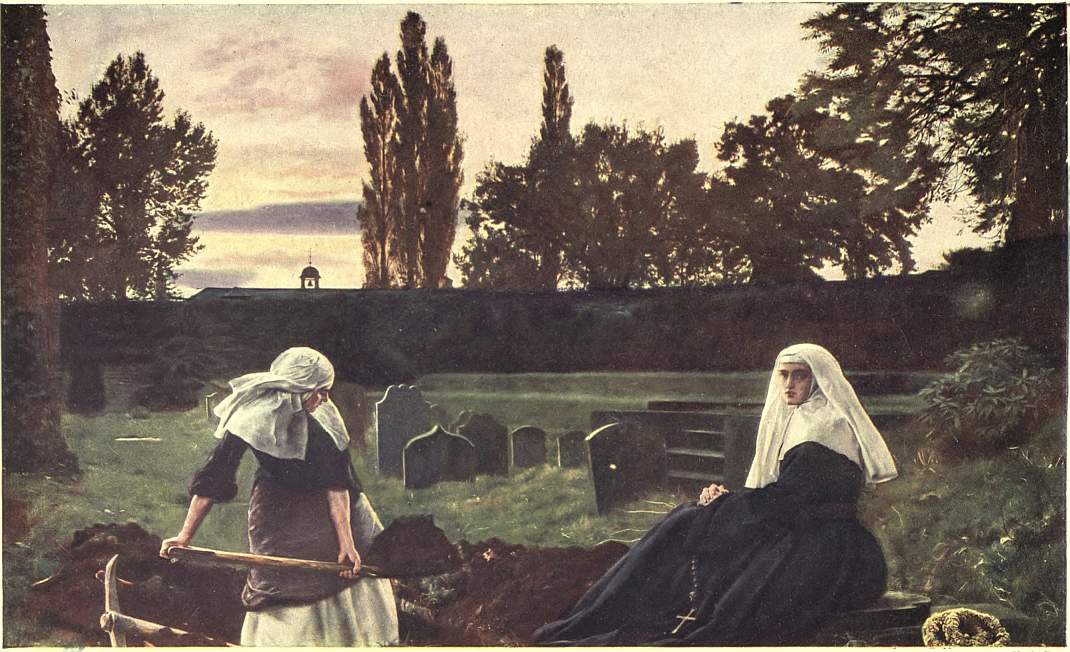
Up to the seventies Millais continued to paint such pictures out of the Bible, or from English and mediæval poets, with varying success. One of them, which in its brilliant colouring looked like an old picture upon glass, represented the return of the dove to Noah’s ark. The central point was formed by two slender young women in mediæval costume, who received the exhausted bird in their delicate hands. The picture, “The Woodman’s Daughter,” was an illustration to a poem by Coventry Patmore, on the love of a young noble for a poor child of the wood. In a semicircular picture of 1852 he painted Ophelia as she floats singing in the green pool where the white water-lilies cover her like mortuary wreaths—floats with her parted lips flickering with a gentle smile of distraction. The other picture of this year, “The Huguenot,” represented two lovers taking leave of each other in an old park upon the eve of St. Bartholomew. She is winding a white scarf round his arm to save him from death by this badge of the Catholics, whilst he is gently resisting. The mood of the man standing before the dark gate of death, the moral strength which vanquishes his fear, and all the solemnity of his farewell to life are expressed in his glance. A world of love rests in the eyes of the woman. Millais has often treated this problem of the loving woman with earnest and almost sombre realism, that knows no touch of swooning sentimentality. “The Order of Release” of 1853 shows a jailor in the scarlet uniform of the eighteenth century opening a heavy prison door to set at liberty a Highlander, whose release has been obtained by his wife. A scene from the seventeenth century is treated in “The Proscribed Royalist”: a noble cavalier, hidden in a hollow tree, is kissing the hand of a graceful, trembling woman, who has been daily bringing him food at the risk of her life. “The Black Brunswicker” of 1856 closed this series of silent and motionless dramas. In the picture of 1857, “Sir Isumbras at the Ford,” an old knight is riding home through the twilight of a sultry day in June. The dust of the journey lies upon his golden armour. At a ford he has fallen in with two children, and has lifted them up to carry them over the water. And “The Vale of Rest,” a picture deep and intense in its scheme of colour, earnest and melancholy as a requiem, revealed—with a sentiment a little like that of Lessing—a cloister garden where two nuns are silently preparing a grave in the evening light; while “The Eve of Saint Agnes” in 1863 illustrated the same poem of Keats to which ten years previously Holman Hunt had devoted his work of early years. Madeleine has heard the old legend, telling how girls receive the tender homage of their future husbands if they go through their evening prayer supperless at midnight. With her heart filled with the thoughts of love she quits the hall where the guests are seated at a merry feast, and mounts to her room so hastily that her thin taper is extinguished on the way. She enters her little chamber, kneels down, repeats the prayer, and rises to her feet, taking off her finery and loosening her hair. The clear moonlight streams through the window, throwing a ghostly illumination over the little images of saints in the room, falling like a caress upon the tender young breast of the girl, playing upon her folded hands, and touching her long, fair hair with a radiance like a vaporous glory. In the shadow of the bed she sees him whom she loves. Motionless, as in a dream, she stands, nor ventures to turn lest the fair vision should vanish. “The Deliverance of a Heretic condemned to the Stake,” “Joan of Arc,” “Cinderella,” “The Last Rose,” that dreamy picture of romantic grace, “The Childhood of Sir Walter Raleigh,” and the picture of the hoary Moses, supported by Hur and Aaron, watching from the mountain-top the victory of Joshua, were the principal works achieved in the later years of the master. But when these pictures were executed England had become accustomed to honour Millais, not as a pre-Raphaelite, but as her greatest portrait painter.
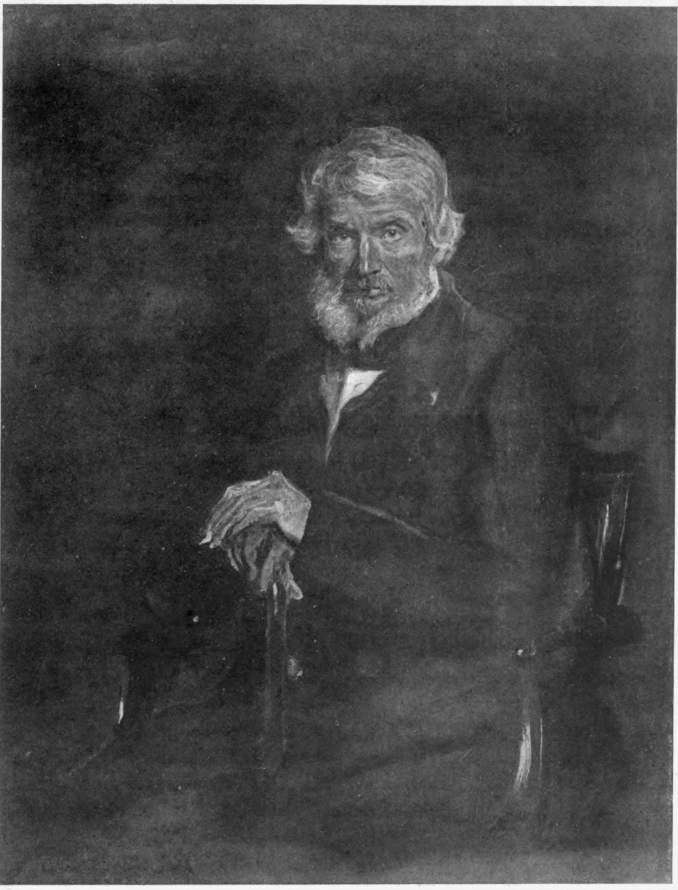
MILLAIS. THOMAS CARLYLE.
His portrait of himself explains this transformation. With his white linen jacket and his fresh sunburnt face Sir John Millais does not look in the least like a “Romanticist,” scarcely like a painter; he has rather the air of being a wealthy landowner. He was a man of a sound and straightforward nature, a great and energetic master, conscious of his aim, but a poet in Ruskin’s sense of the word is what he has never been. His pre-Raphaelitism was only a flirtation. His methods of thought were too concrete, his hand too powerful, for him to have lingered always in the world of the English poets, or endured the precise style of the pre-Raphaelites. “Millais will ‘go far’ if he will only change his boots,” About had written on the occasion of the World Exhibition of 1855; when that of 1867 was opened Millais appeared in absolutely new shoes. The great exhibition of 1857 in Manchester, which made known for the first time how many of the works of Velasquez were hidden in English private collections, had helped Millais to the knowledge of himself. From the naturalism of the Quattrocentisti he made a transition to the naturalism of Velasquez.
Millais was a born portrait painter. His cool and yet finely sensitive nature, his simple, manly temperament, directed him to this department, which rather gravitates to the observant and imitative than to the creative pole of art. In his pictures he has the secret of enchanting and of repelling; he has arrived at really definite issues in portrait painting. His likenesses are all of them as convincing as they are actual. Together with the Venetians and with Velasquez, Millais belongs to the master spirits of the grand style, which relies upon the large movement of lines, in figure and in face, upon the broad foundation of surfaces, and the strict subordination of individual details. His figures are characteristic and recognisable even in outline. He makes no effort to render them interesting by picturesque attitudes, or to vivify them by placing them in any situation. There they stand calm, and sometimes stiff and cold; they make no attempt at conversation with the spectator, nor come out of themselves, as it were, but fix their eyes upon him with an air of well-bred composure and indifference. Even the hands are not made use of for characterisation.
Cassell & Co.
MILLAIS. THE VALE OF REST.
The extraordinary intensity of life which sparkles in his great figures, so simply displayed, is almost exclusively concentrated in the heads. Millais is perhaps the first master of characterisation amongst the moderns. To bold and powerful exposition there is united a noble and psychical gaze. The eyes which he paints are like windows through which the soul is visible.
Mag. of Art.
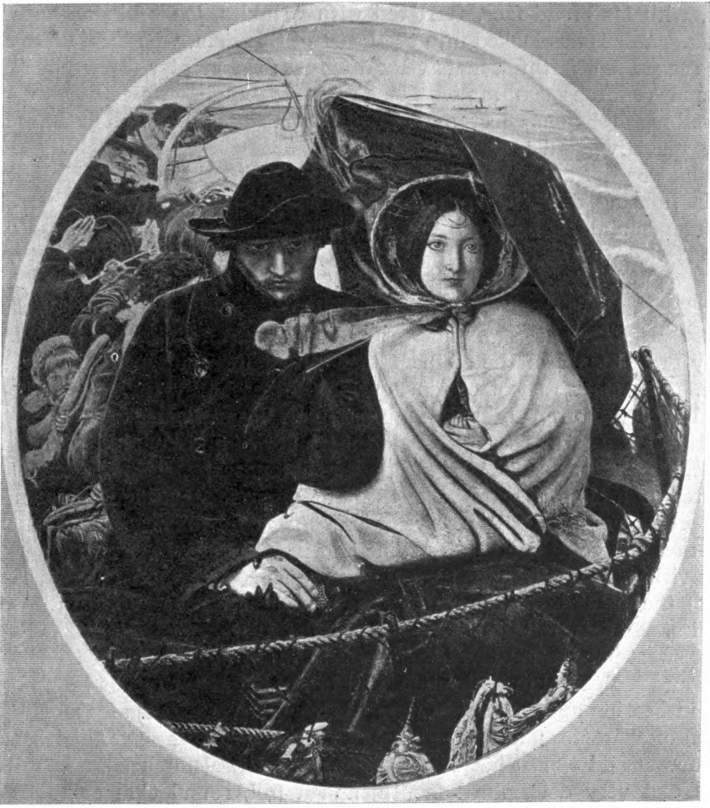
FORD MADOX BROWN. THE LAST OF ENGLAND.
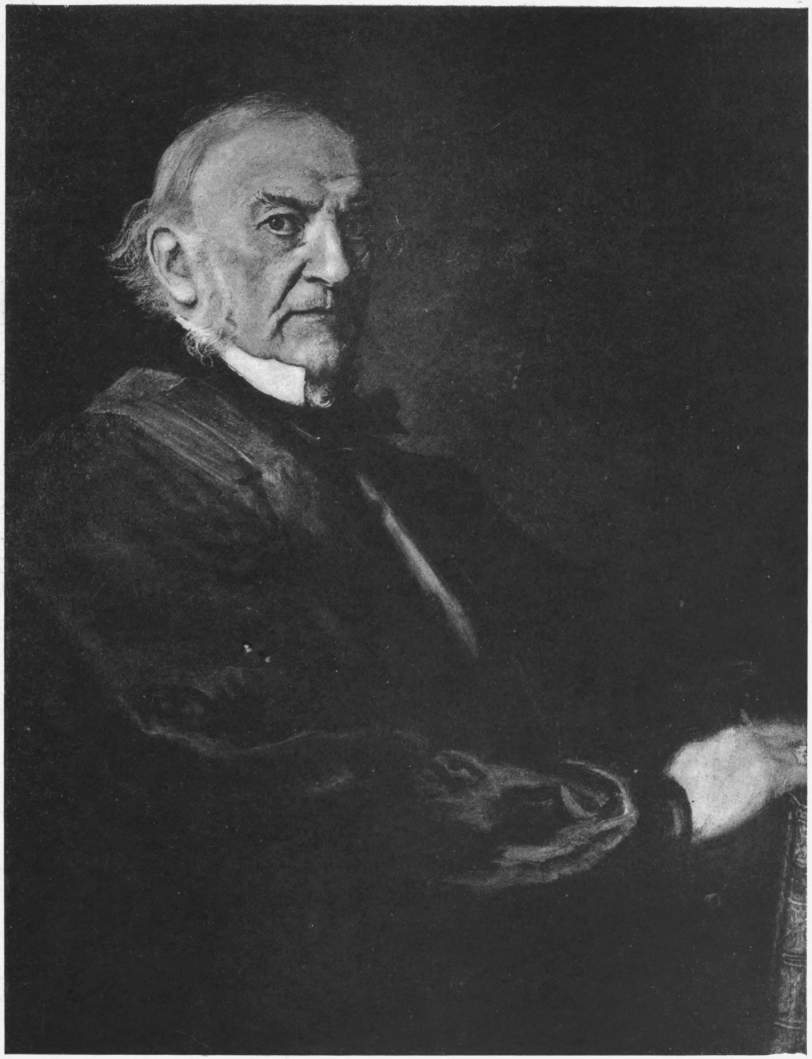
Amongst his portraits of men, those of Gladstone and Hook stand in the first rank: as paintings perhaps they are not specially eminent; both have an opaque, sooty tone, from which Millais’ works not unfrequently suffer, but as a definition of complex personalities they are comparable only with the best pictures of Lenbach. How firmly does the statesman hold himself, despite his age, the old tree-feller, the stern idealist, a genuine English figure chiselled out of hard wood. The play of light centres all the interest on the fine, earnest, and puckered features, the lofty forehead, the energetic chin, and the liquid, thoughtful eyes. All the biography of Gladstone lies in this picture, which is simpler and greater in intuition than that which Lenbach painted of him. Hook, with his broad face, furrowed with wrinkles, looks like an apostle or a fisher. Millais has looked into the heart of this man, who has in him something rugged and faithful, massive and tender; the painter of vigorous fishermen and vaporous sunbeams. Hook’s landscapes have a forceful, earnest, and well-nigh religious effect, and something patriarchal and biblical lies in his gentle, reflective, and contemplative glance.
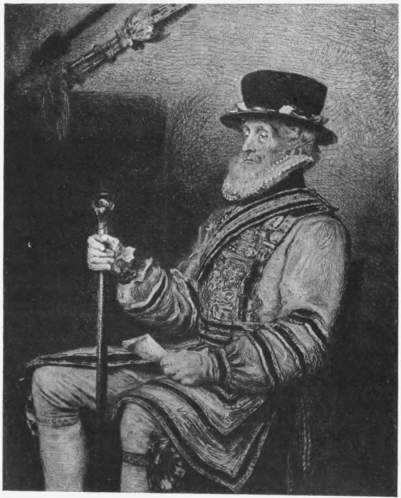
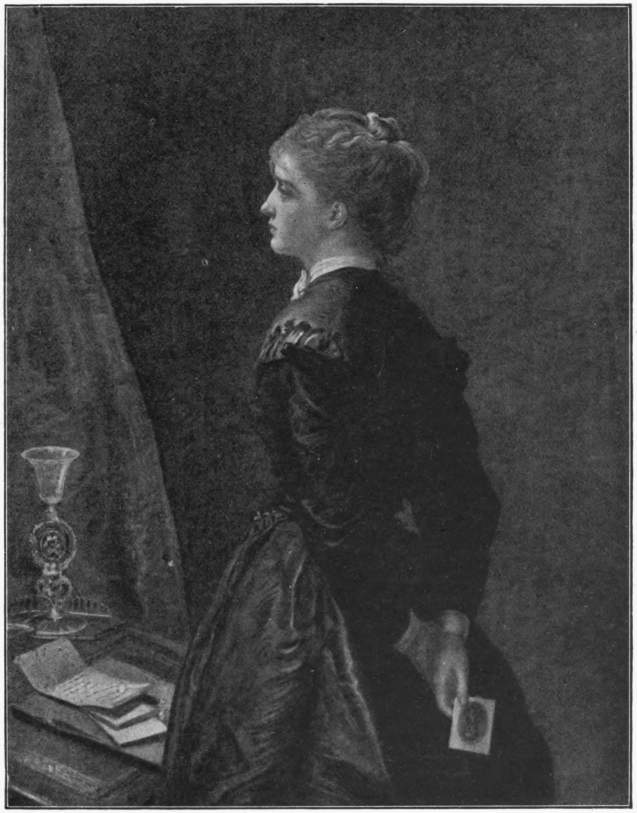
In his portrait of the Duke of Westminster, painted in 1878, Millais depicts him in hunting dress, red coat, white corduroys, and high, flexible boots, as he stands and buttons on his glove. The same year “The Yeoman of the Guard” was exhibited in Paris—the old type of discipline and loyalty, who sits there in his deep red uniform, with features cast in bronze, like a Velasquez of 1878. Disraeli, Cardinal Newman, John Bright, Lord Salisbury, Charles Waring, Sir Henry Irving, the Marquis of Lorne, and Simon Fraser are all worthy descendants of the eminent men whom Reynolds painted a century before. The plastic effect of the figures is increased by the vacant, neutral ground of the picture. Like Velasquez, Millais has made use of every possible background, from the simplest, from the nullity of an almost black or bright surface, to richly furnished rooms and views of landscape. Sometimes it is only indicated by a plain chair or table that the figure is standing in a room, or a heavy crimson curtain falls to serve as a repoussoir for the head. With a noble abstention he avoids prettiness of line and insipid motives, and remains true to this virile taste even in his portraits of women. His women have curiously little of the æsthetical trait which runs elsewhere through English portraits of ladies. Millais renders them—as in the picture “Dummy Whist”—neither sweet nor tender, gives them nothing arch, sprightly, nor triumphant. Severe and sculptural in their mien, and full of character rather than beauty, proud in bearing and upright in pose, their serious, energetic features betray decision of character; and the glance of their brown eyes—eyes like Juno’s—is indifferent and almost hard. A straight and liberal forehead, a beautifully formed and very determined mouth, and a full, round chin complete this impression of earnest dignity, august majesty, and chilling pride. To this regular avoidance of every trace of available charm there is joined a strict taste in toilette. He prefers to work with dark or subdued contrasts of colour, and he is also fond of large-flowered silks—black with citron-yellow and black with dark red.
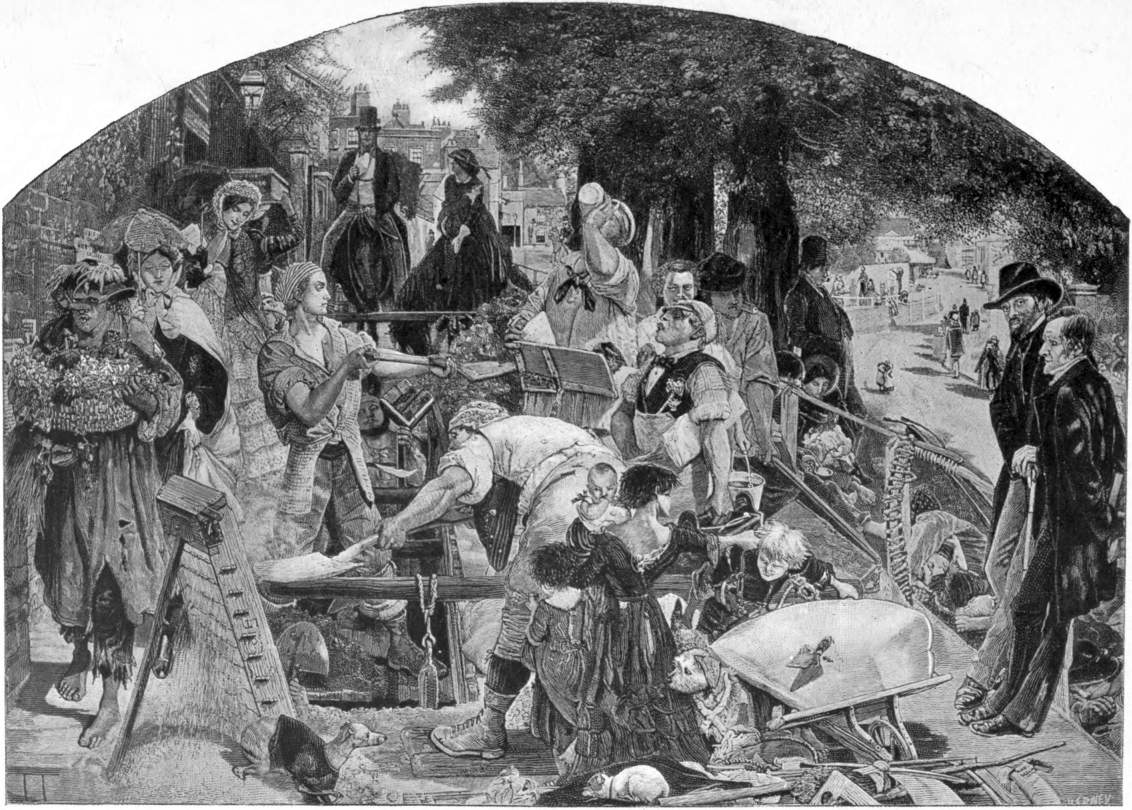
FORD MADOX BROWN. Mag. of Art. WORK.
(By permission of the Corporation of Manchester, the owners of the picture.)
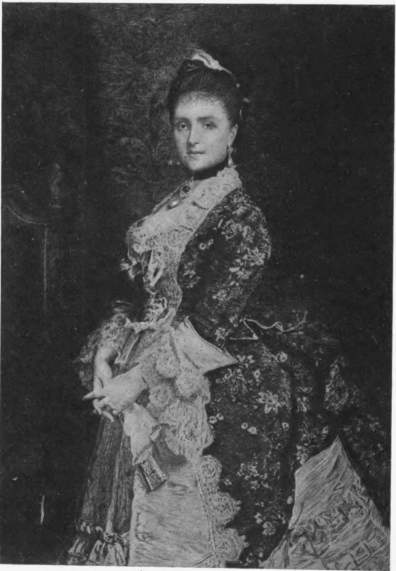
And this same stringent painter of character commands, as few others, the soft light brush of a painter of children. No one since Reynolds and Gainsborough has painted with so much character as Millais the dazzling freshness of English youth; the energetic pose of a boy’s head or the beauty of an English girl—a thing which stands in the world alone: the soft, glancing, silken locks, rippling to a blonde cendrée, pale, delicate little faces, pouting little mouths, and great, shining blue, dreamy, childish eyes. Sometimes they stand in rose-coloured dresses embroidered with silver in front of a deep green curtain, or sit reading upon a dark red carpet flowered with black. At other times they are arrayed like the little Infantas of Velasquez, and play with a spaniel like the Doge’s children of Titian, or hold out with both hands an apron full of flowers, which Millais paints with a high degree of finish. A spray of pale red roses, chrysanthemums, or lilies stands near. One must be a great master of characterisation to paint conscious, dignified, and earnest feminine beauty like that of Mrs. Bischoffsheim, and at the same time that fragrant perfume of the fresh and dewy spring of youth which breathes from Millais’ pictures of children.
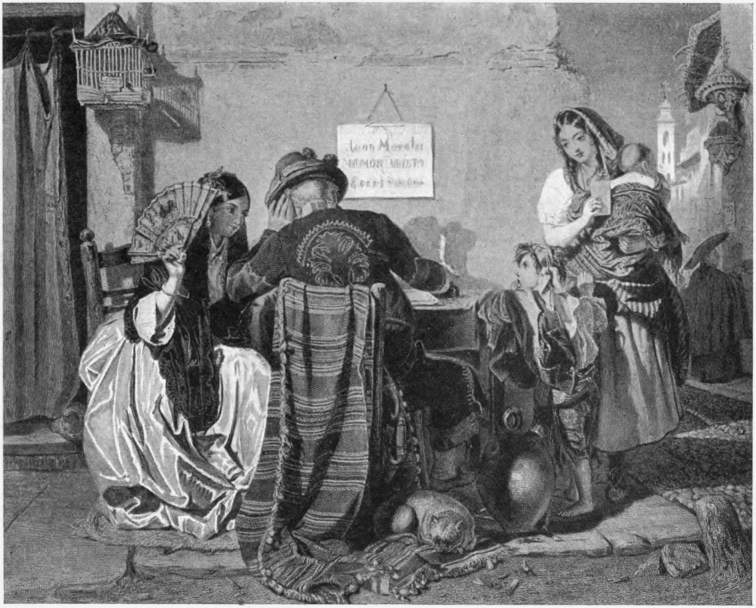
PHILLIP. THE LETTER-WRITER, SEVILLE.
Millais is one of those men in the history of nineteenth-century painting who are as forcible and healthy as they are many-sided. I do not know one who could have developed so swiftly from a style of the most minute exactness to one of the most powerful breadth; not one who could have united such poetry of conception with such an enormous knowledge of human beings; not one who could have been so like Proteus in variety—at one moment charming, at another dreamy, at another entirely positive. In their firm structure and largeness of manner his landscapes sometimes recall Théodore Rousseau. And now the pre-Raphaelite is just a little evident in an excess of detail. He paints every blade of grass and every small plant, though there is at the same time a largeness in the midst of this scrupulous exactitude. He does not merely see the isolated fact through a magnifying lens, but has eyes that are sensitive to the poetry of the whole, and in spite of all study of detail he sometimes reaches a total effect which is altogether impressionist. His picture “Chill October” has an airy life, a grey, vibrating atmosphere, such as only John Constable painted elsewhere.
Such a concrete study of nature as was made by the pre-Raphaelites of necessity led at last to entirely realistic pictures from modern life. In their biblical and poetic pictures they had started from the conviction that new life-blood could only be poured into the old conventional types, which had gradually become meaningless by tactfully drawing the models for them from popular life. They believed, as the masters of Florence and Bruges had done before them, that there could be no good painting without strict dependence on the model; that it was of the utmost importance to give a poetic or legendary figure the stamp of nature, the strong savour of individuality. All their creations are based upon the elements of portrait painting, even when they illustrate remote scenes from the New Testament or from mediæval poetry. And these elements at last led them altogether to give up transposing such figures into an alien milieu, and simply to paint what was offered by their own surroundings. In this way they reached the goal which was arrived at in French painting through Courbet and Ribot. It is due in the first place to the pre-Raphaelites that the well-meant and moderately painted genre picture of the old style, which, with its wealth of pathetic stories, was once a prime source of supposed artistic pleasure, was finally vanquished in England, and made way for earnest and vigorous painting,—painting which sought to make its effect by purely artistic means, and proudly declined attempt to conceal intrinsic weakness in “interesting” subject drawn from external sources. As early as 1855 Millais exhibited a picture in the Royal Academy which Ruskin called a truly great work containing the elements of immortality—“The Rescue.” It represented a fireman who has carried three children from a burning house and laid them in the arms of their parents. Narrative purport was entirely renounced. The fireman was treated without sentimentality, and in a way that suggested the cool fulfilment of a duty, and the agitation of the parents was also rendered without any dash of melodrama. Then there followed that masterpiece of exquisite and soft colouring, tender and moving expression, and infinite grace, “The Gambler’s Wife,” sadly taking up the cards which have brought her misery upon her. In 1874 was painted “The North-West Passage,” a sort of modern symbol of the forceful, enterprising English people who have populated and subdued half the world from their little island kingdom. “There is a passage to the Pole, and England will find it—must find it.” These are more or less the words spoken by Trelawney, the old friend and comrade of Byron in Greece. With a chart before him he is brooding over the plan of the North-West Passage, and upon his own outstretched hand, which would fain hold the future in its grasp, the hand of a youthful woman is soothingly laid, as she sits at his feet reading to him the narrative of the last voyage of discovery. The figure of the seaman with his white beard has a strong, sinewy life, and the broad daylight streams through the room, filled with charts and atlases. The sea and clear, bright sky gleam through the open window. It is a powerful and moving picture, one of those modern creations in which the ideas of the nineteenth century are concentrated with simplicity and a renunciation of all hollow emphasis.
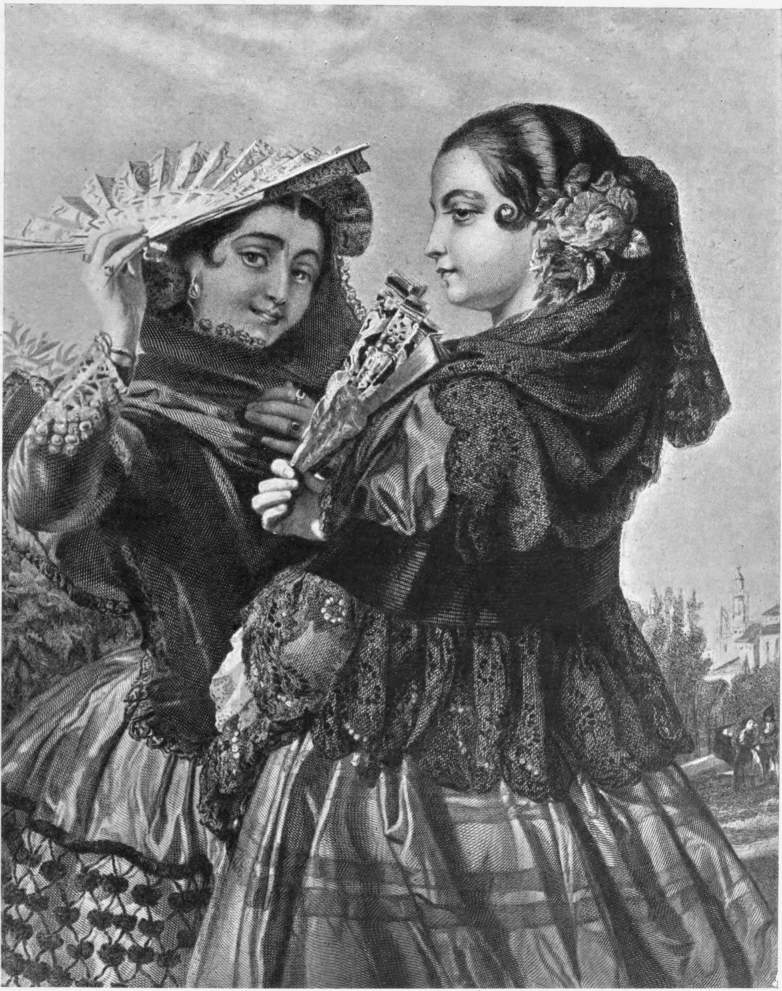
PHILLIP. SPANISH SISTERS.
A few pictures of modern life which have nothing in common with the older genre painting may even be found among the works of the devotionalist Holman Hunt. “Awakened Conscience,” according to the explanation of the painter, tells the story of a young woman seduced by a cruel and light-minded man, and kept in a luxurious little country-house. They are together. Seated at the piano he is playing the old melody “Oft in the Stilly Night,” and the strains of the song recall to the frail maiden her youth, and the years of purity and innocence. Thus even Hunt has not overcome the moralising tendencies of Hogarth, though his taste is more discreet and delicate. He has struck deeper chords of thought than the English public had heard before. And in particular the painting is not a mere substratum for the story; it has become the principal thing, and the story subsidiary. In another picture, “May Morning on Magdalen Tower,” he renounced all deeper purpose altogether, and merely painted a number of Oxford dons and students, who, in accordance with the old custom, usher in the May with a hymn from the college tower.
But the most remarkable work of this description has been executed by Madox Brown, the English Menzel, who has not merely reconstructed the environment of past ages with the accuracy of an eye-witness, but has looked upon the drama of modern life as an attentive observer. His first picture, “The Last of England,” was executed in the June of 1852, at a time when emigration to America began to take serious proportions. A married couple, humble, middle-class people, are sitting on the deck of a ship. The man, in his thick cloth overcoat, with a soft felt hat on his head, a pale face, and sunken eyes with dark rings underneath, casts one more look upon his native-land, which vanishes in the hazy distance, as he thinks bitterly of lost hopes and vain struggles. But the young wife, in a light-coloured cloak and a pretty round bonnet with wide strings, gazes before her with gentle resignation, from underneath a great umbrella protecting her from the boisterous sea-wind.
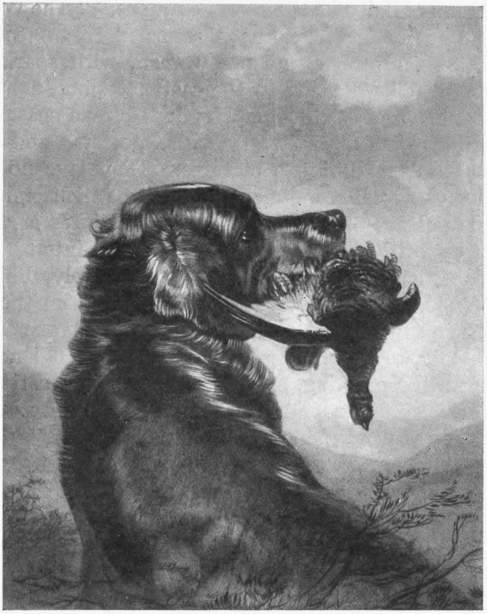
R. ANSDELL. A SETTER AND GROUSE.
In “Work,” begun at the same period, and finished, after various interruptions, in 1865, he has produced the first modern picture of artisans after Courbet’s “Stone-breakers.” The painter, who was then living in Hampstead, where extensive cuttings were being made for the laying down of gas-pipes, daily saw the English artisan at labour in all his thick-set strength. This gave him the theme for his picture. In bright daylight on a glaring summer afternoon artisans are digging a trench for gas-pipes in a busy street. Women and poor children are standing near. Even the older genre artists had painted men in their working blouses, but only joking and making merry, never at work. Like stage-managers who are sure of their public, they always set the same troop of puppets dancing. Madox Brown’s artisans are robust and raw-boned figures; where the older artists affected to be witty with their genre painting, Madox Brown painted straightforwardly, without humour and without making his figures beautiful. The composition of his pictures is just as plain. No one poses, no one makes impassioned gestures, no one thinks of grouping himself with his neighbour in fine flowing lines. It is pleasant to think that this powerful symbol of work has passed by presentation into the possession of one of the greatest manufacturing towns in England, into the gallery of Manchester.
A Scotchman, born in Aberdeen, John Phillip was the vigorous abettor of the pre-Raphaelites in these realistic endeavours. He, too, was a painter in the full meaning of the word, and he has therefore left works with which the future will have to reckon. Velasquez had opened his eyes as he had opened those of Millais. When Phillip went to Spain in 1851, he was not the first who had trod the Museo del Prado. Wilkie had painted in Spain before him, and Ansdell had been busy there at the same time. But no one had been able to grasp in any degree the impressive majesty of the old Spanish painters. John Phillip alone gained something of the verve of Velasquez, a broad, virile technique which distinguishes him from all his English contemporaries. The impression received from his pictures is one of opulence, depth, and weight; they unite something of the strength of Velasquez to a more Venetian splendour of colour. The streets of Seville, the Spanish port on the Guadalquivir, the town where Velasquez and Murillo were born, were his chief field of study. Here he saw those market-women, black as mulattoes and sturdy as grenadiers, who sit in front of their fruit-baskets under a great umbrella, and those water-carriers with sunburnt visages, strongly built chests, and athletic arms.
After he had returned to Scotland he occasionally painted pictures of ceremonies, “The House of Commons,” “The Wedding of the Princess Royal,” and so forth, but he soon returned to subjects from Spanish life. Gipsy-looking, cigarette-smoking women, with sparkling eyes and jet-black hair, young folks dancing to the castanets, bull-fighters with glittering silver-grey costume and flashing glances, dark-brown peasants in citron-yellow petticoats, hollow-eyed manufactory girls, potters, and glass-blowers.—such are the materials of Phillip’s pictures. They give no scope to anecdote; but they always reveal a fragment of reality which emits a world of impressions and an opulence of artistic ability. As painter par excellence, John Phillip stands in opposition to older English genre painters. Whilst they were, in the first place, at pains to tell a story intelligibly, Phillip was a colourist, a maître peintre, whose figures were developed from the colours, and whose creations are so full of character that they will always assert their place with the best that has ever been painted. Even in England, the country of literary and narrative painting, art was no longer an instrument for expressing ideas; it had become an end in itself, and had discovered colour as its prime and most essential medium of expression.
CHAPTER XXIX
REALISM IN GERMANY
In Germany the realistic movement was carried out in much the same way as in France, though it came into action two decades after its French original. Here also it was recognised that the well-meant but badly painted anecdote must give way to the well-painted picture: and if we inquire who it was that gave to Germany the first serious paintings inspired by the modern spirit the reply, without hesitation, must be Adolf Menzel. The pioneering work of this great little man, who for fifty years had embodied in their typical perfection all phases of German art, is something fabulous: the greatest and, one might almost say, the only historical painter of bygone epochs, the only one who knew a previous period so intimately that he could venture on painting it, was also the leader of the great movement which, in the seventies, aimed at the representation of our own life. His first appearance was in the time when the proud Titan Cornelius sought to take heaven by storm. Little Menzel was no Titan in those days; he seems in that generation like one bound to the earth, yet he belonged to the Cyclopean race. He was a mighty architect with the powers of a giant; and this uncouth Cyclops rough-hewed and chiselled the blocks, and, fitting each in its place, raised an edifice to as lofty a height as the Romanticists had reached on the perilous wings of Icarus. Having been first the draughtsman and then the painter of Frederick the Great, he gave up history after finishing the picture of the Battle of Hochkirch: his talent was too modern, too much set upon what was concrete, to admit of its being given full scope to the end by constructive work from a milieu that was not his own. Until his fortieth year he had celebrated the glorious past of his country. When, with the death of Friedrich Wilhelm IV, a great and decisive turn was given to the politics of the Prussian state—one which put an end to the stagnation of civil life in Prussia and Germany, and ushered in a new and brilliant period for the realm and the heirs of Friedrich—the painter of Friedrich the Great became the painter of the new realm. After he had already, in the first half of the century, placed reality on the throne of art in the place of rhetoric and a vague ideal, he went one step further in the direction of keen and direct observation, and now painted what he saw around him—the stream of palpitating life.
“The Coronation of King Wilhelm at Königsberg” is the great and triumphant title-page to this section of his art. The effects of light, the red tones of the uniforms, the shimmering white silk dresses, the surging of the mass of people, the perfect ease with which all the personages are individualised, the princes, the ministers, the ambassadors, the men of learning, the instantaneousness in the movement of the figures, the absolutely unforced and yet subtle and pictorial composition, render this painting no picture of ceremonies, in the traditional sense of the phrase, but a work of art at once intimate and august in the impression which it makes. In the picture “King Wilhelm setting out to join the Army”—the representation of the thrilling moment, on the afternoon of 31st July 1870, when the King drove along the linden avenue to the railway station—this phase, which he began with the Coronation picture, was brought to a close. Everything surges and moves, speaks and breathes, and glows with the palpitating life which vibrates through all in this moment of patriotic excitement. But the painter’s course led him further.
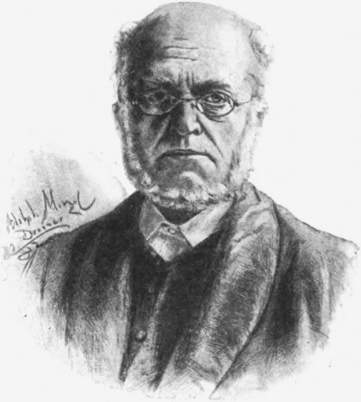
ADOLF MENZEL.
He first became entirely Menzel when he made the discovery of toiling humanity. In 1867, in the year of the World Exhibition, he came to Paris and became acquainted with Meissonier and Stevens. With Meissonier in particular—whose portrait he painted—he entered into a close friendship, and it was curious afterwards to see the two together at exhibitions—the little figure of Menzel with his gigantic bald forehead and the little figure of Meissonier with his gigantic beard, a Cyclops and a Gnome, two kings in the realm of Liliput, of whom one was unable to speak a word of German and the other unable to speak a word of French, although they had need merely of a look, a shrug, or a movement of the hand to understand each other entirely. He also came into the society of Courbet, who had just made the famous separate exhibition of his works, at the Café Lamartine, in the company of Heilbuth, Meyerheim, Knaus, and others. Here in Paris he produced his first pictures of popular contemporary life, and if as an historical painter he had already been a leader in the struggle against theatrical art, he became a pioneer in these works also. Everywhere he let in air and made free movement possible for those who pressed forward in his steps. In the course of years he painted and drew everything which excited in him artistic impulse upon any ground whatever, and not one of these endeavours was work thrown away. A universal genius amongst the painters of real life, he combined all the qualities of which other men of excellent talent merely possessed fragments separately apportioned amongst them: the sharpest eye for every detail of form, the most penetrative discrimination for the life of the spirit, and at times a glistening play of colour possessed by none of his German predecessors.
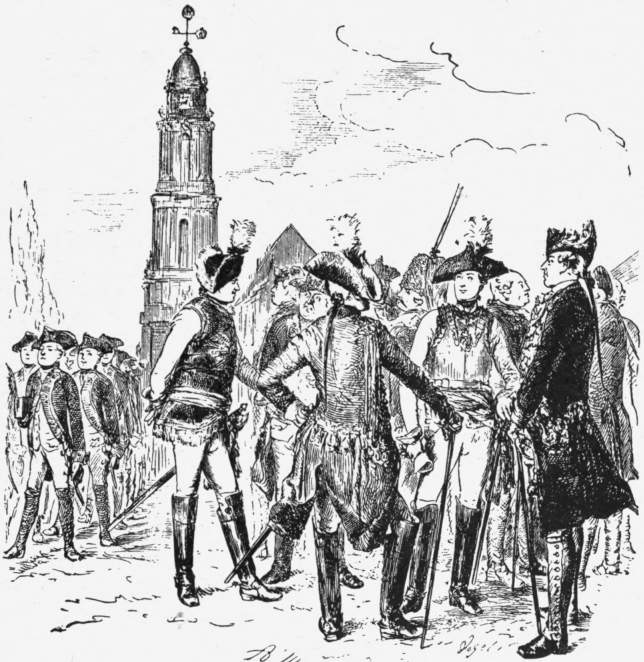
MENZEL. FROM KUGLER’S “HISTORY OF FRIEDRICH THE GREAT.”
Catholic churches seem always to have had a great attraction for him, as well as the people moving in them, and in this an echo of his rococo enthusiasm is still perceptible. The quaint, rococo churches in the ornate style favoured by the Jesuits, which are still preserved intact in Munich and the Tyrol, were those for which he had a peculiar preference. He lost himself voluptuously in the thousand details of sculpture, framework, organs, balustrades, and carved pulpits, dimly outlined in the subdued light from stained-glass windows. In the gloom it was all transformed into a forest of ornaments, expanding their traceries like trees in a wood. Sick and infirm people, women in prayer burying their faces in their hands, and lame men with crutches, kneel or move amid the luxuriant efflorescence of stone and wood and gold, of angels’ heads and shrines, garlands of flowers, consoles, and fonts of holy water. Twisted marble pillars, church banners, lamps and lustres mount in a confusion of capricious outlines at once tasteful and piquant to the vaulted dome, where the painted skies, blackened by the ascending mist of incense, seem waywardly fantastic.
After the churches the salons appealed to him. There came his pictures of modern society: ladies and cavaliers of the Court upon ballroom balconies, the conversation of Privy Councillors in the salon, the marvellous ball supper, where a mass of beautiful shoulders, splendid uniforms, and rustling silken trains move amid mirrors, lustres, colonnades, and gilded frames. “The Ball Supper” of 1870 is a vivid picture, bathed in glistening light. The music has stopped. And from a door of the brilliantly lighted ballroom the company is streaming into the neighbouring apartment, where the supper-table has been laid, and groups of ladies and men in animated conversation are beginning to occupy the chairs and sofas. In 1879 there followed the famous “Levee”: the Emperor Wilhelm in the red Court uniform of the Gardes du Corps is talking with a lady, surrounded by a sea of heads, uniforms, and naked bowing shoulders. Though it was always necessary in earlier representations of the kind to have a genre episode to compensate the insufficient artistic interest of the work, in Menzel’s pictures the pictorial situation is grasped as a whole. They have the value of a book; they neither falsify nor beautify anything, and they will hand down to the future an encyclopædia of types of the nineteenth century.
From the salon he went to the street, from exclusive aristocratic circles into the midst of the eddying crowd. For many years in succession Menzel was a constant visitor at the small watering-places in the Austrian and Bavarian Alps. The multitude of people at the concerts, in the garden of the restaurant, on the promenade, at the open-air services, were precisely the things to occupy his brush. The light rippled through the leaves of the trees; women, children, and well-bred men of the world listened to the music or the words of the preacher. One person leaves a seat and another takes it; everything lives and moves. Huge and lofty trees stretch out their arms, protecting the company from the sun. Unusually striking was “The Procession in Gastein”: in the centre was the priest bearing the Host, then the choristers in their red robes, in front the visitors and tourists who had hastened to see the spectacle, and in the background the mountain heights. The bustle of people gives Menzel the opportunity for a triumph. In Kissingen he painted the promenade at the waters; in Paris the Sunday gaiety in the garden of the Tuileries, the street life upon the boulevard, the famous scene in the Jardin des Plantes, with the great elephants and the vivid group of Zouaves and ladies; in Verona the Piazza d’Erbe, with the swarm of people crowding in between the open booths and shouting at the top of their voices. Many after him have represented such scenes, although few have had the secret of giving their figures such seething life, or painting them, like Menzel, as parts of one great, surging, and many-headed multitude.
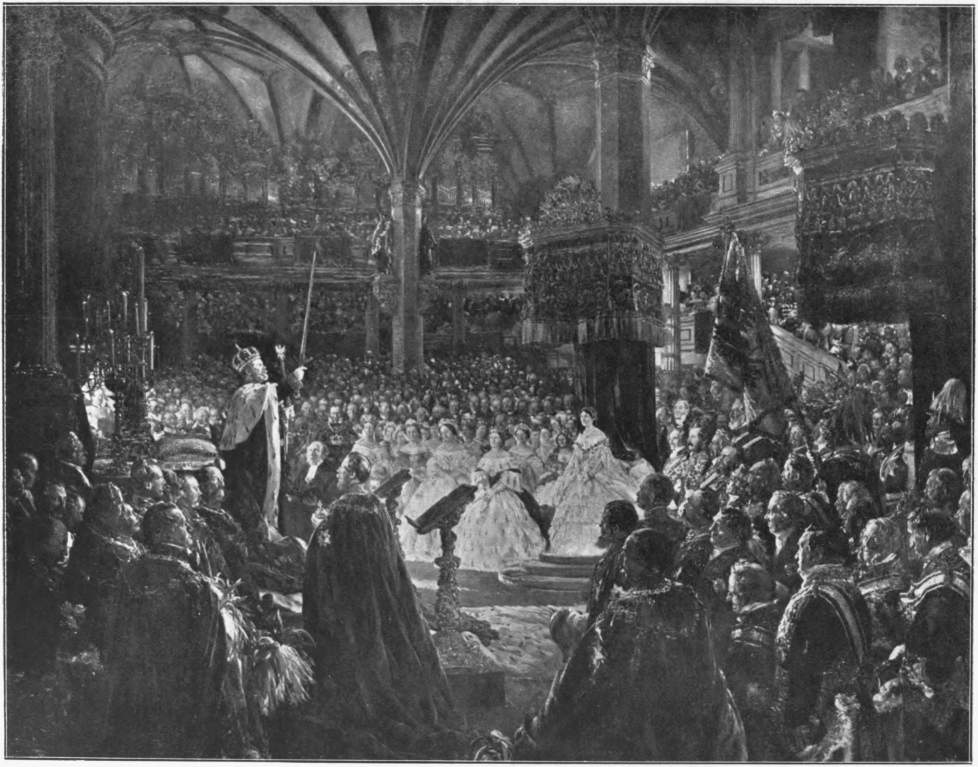
Hanfstaengl.
MENZEL. THE CORONATION OF KING WILHELM I.
People travelling have always been for him a source of much amusement: men sitting in the corner of a railway carriage with their legs crossed and their hats over their eyes, yawning or asleep; women looking out of the windows or counting their ready money. Alternating with such themes are those monotonous yet simple and therefore genial landscapes from the suburbs of the great city, poor, neglected regions with machines and men at their labour. Children bathing in a dirty stream bordered by little, stunted willows; small craft gliding over a river, sailors leaping from one vessel to another, men landing sacks or barrels, and great, heavy cart-horses dragging huge waggons loaded with beer-barrels along the dusty country road. Or the scaffolding of a house is being raised. Six masons are at work upon it, and they are working in earnest. A green bush waves (German fashion) above the scaffolding, and further off long rows of houses stretch away, and the aqueducts and gas-works which supply the huge crater of Berlin, and day-labourers are seen wheeling up barrow-loads of stones. For the first time a German painter sings the canticle of labour.
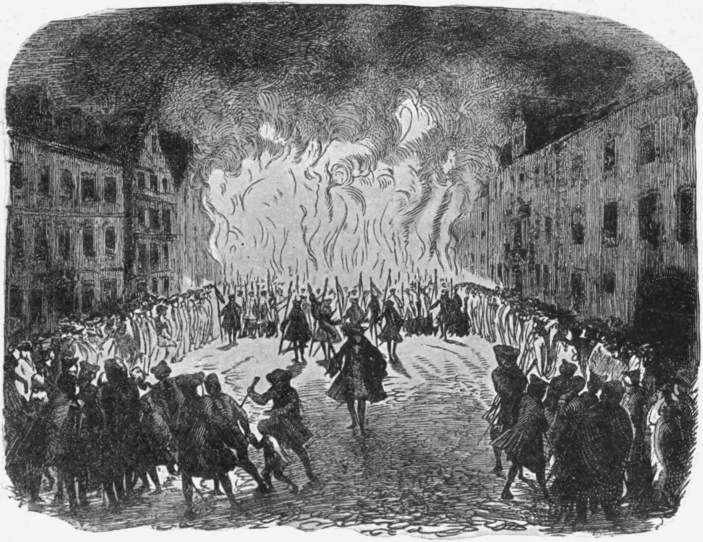
MENZEL. FROM KUGLER’S “HISTORY OF FRIEDRICH THE GREAT.”
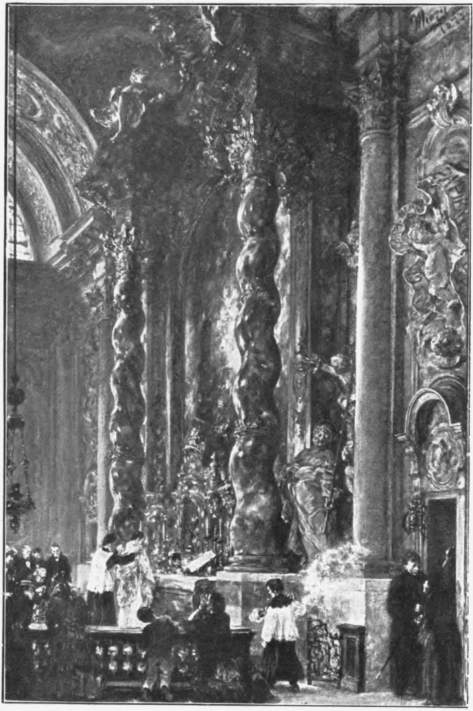
Hanfstaengl.
MENZEL. THE DAMENSTIFTSKIRCHE AT MUNICH.
From the streets he enters the work-places, and interprets the wild poetry of roaring machines in smoky manufactories. The masterpiece of this group is that bold and powerful picture, his “Iron Mill” of 1876. The workshop of the great rail-forge of Königshütte in Upper Silesia is full of heat and steam. The muscular, brawny figures of men with glowing faces stand at the furnace holding the tongs in their swollen hands. Their vigorous gestures recall Daumier. Upon the upper part of their bodies, which is naked, the light casts white, blue, and dark red reflections, and over the lower part it flickers in reddish, greenish, and violet tinges, on the creases in their clothing. The smoke rising in spirals is of a whitish-red, and the beams supporting the roof are lit up with a sombre glow. Heat, sweat, movement, and the glare of fire are everywhere. Dust and dirt, strong, raw-boned iron-workers washing themselves, or exhausted with hard toil, snatching a hasty meal, a confusion of belting and machinery, no pretty anecdote but sober earnest, no story but pure painting—these were the great and decisive achievements of this picture. Courbet’s “Stone-breakers” of 1851, Madox Brown’s “Work” of 1852, and Menzel’s “Iron Mill” are the standard works in the art of the nineteenth century.
Within German art Menzel has won an enclave for himself, a rock amid the sea. In France during the sixties he represented German art in general. France offered him celebrity, and after this recognition he had the fortune to be honoured in his native-land before he was overtaken by old age. His realism was permitted to him at a time when realistic aims were elsewhere reckoned altogether as æsthetic errors. This explains the remarkable fact that Menzel’s toil of fifty years had scarcely any influence on the development of German painting; it would scarcely be different from what it is now if he had never existed. When he might have been an exemplar there was no one who dared to follow him. And later, when German art as a whole had entered upon naturalistic lines, the differences between him and the younger generation were more numerous than their points of sympathy, so that it was impossible for him to have a formative influence. He stood out in the new period merely as a power commanding respect, like a hero of ancient times. Even the isolated realistic onsets made in Berlin in the seventies are in no way to be connected with him.
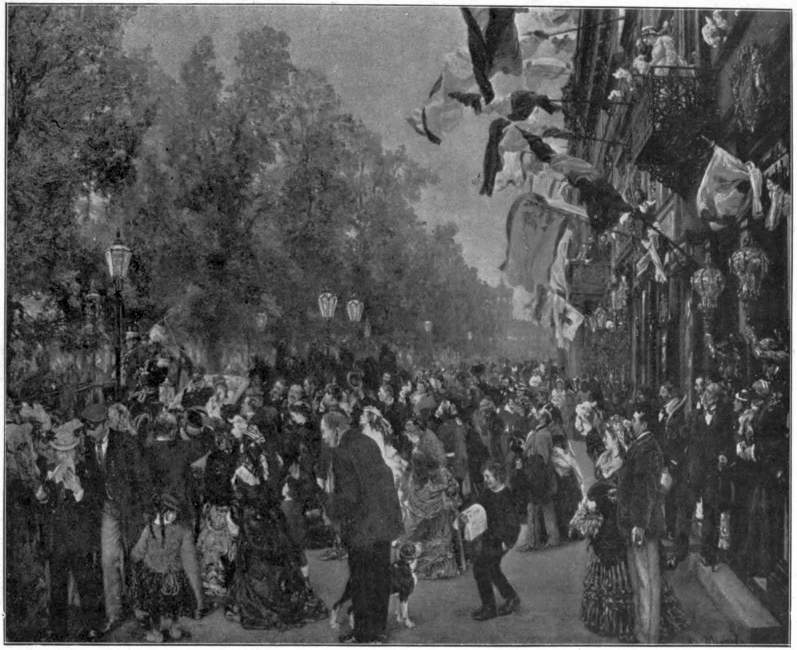
Hanfstaengl.
MENZEL. KING WILHELM SETTING OUT TO JOIN THE ARMY.
If realism consisted in the dry and sober illustration of selected fragments of reality, if upright feeling, loyalty, and honest patriotism were serviceable qualities in art, a lengthier consideration should certainly be accorded to Anton von Werner. In his genre pictures of campaign life everything is spick and span, everything is in its right place and in soldierly order: it is all typically Prussian art. His portraits are casino pictures, and as such it is impossible to imagine how they could better serve their purpose. From the spurs to the cuirassier helmet everything is correct and in accordance with military regulation; even the likeness has something officially prescribed which would make any recruit form front if suddenly brought face to face with such a person. In his pictures of ceremonies his ability was just sufficient to chronicle the function in question with the conscientiousness of a clerk in a law court. The intellectual capacity for seeing more of a great man than his immaculately polished boots and the immaculately burnished buttons of his uniform was denied him, as was the artistic capacity of exalting a picture-sheet to the level of a picture.
Equipped with a healthy though trivial feeling for reality, Carl Güssow ventured to approach nature in a sturdy and robust fashion in some of his works, and exhibited in Berlin a few life-sized figures, “Pussy,” “A Lover of Flowers,” “Lost Happiness,” “Welcome,” “The Oyster Girl,” and so forth. Through these he opened for a brief period in Berlin the era of yellow kerchiefs and black finger-nails, and on the strength of them was exalted by the critics as a pioneer of realism or else anathematised, according to their æsthetic creed. He had a robust method of painting muscles and flesh and clothes of many colours, and of setting green beside red and red beside yellow, yet even in these first works—his only works of artistic merit—he never got beyond the banal and barbaric transcript of a reality which was entirely without interest.
Max Michael seems to be somewhat influenced by Bonvin. Like the latter, he was attracted by the silent motions of nuns, juicy vegetables, dark-brown wainscoting, and the subdued light of interiors. He was, like Ribot in France, although with less artistic power, a good representative of that “school of cellar skylights” which imitated in a sound manner the tone of the old Spanish masters. One of his finest pictures, which hangs in the Kunsthalle in Hamburg, represents a girls’ school in Italy. A nun is presiding over the sewing-lesson; the background is brown; the light comes through the yellow glass of a high and small window (like that of an attic), and throws a brown dusky tone over the room, in which the gay costumes of the little Italian girls, with their white kerchiefs, make exceedingly pretty and harmonious spots of colour. No adventure is hinted at, no episode related, but the picturesque appearance of the little girls, and their tones in the space, are all the more delicately rendered. A refined scheme of colour recalling the old masters compensates for the want of incident.
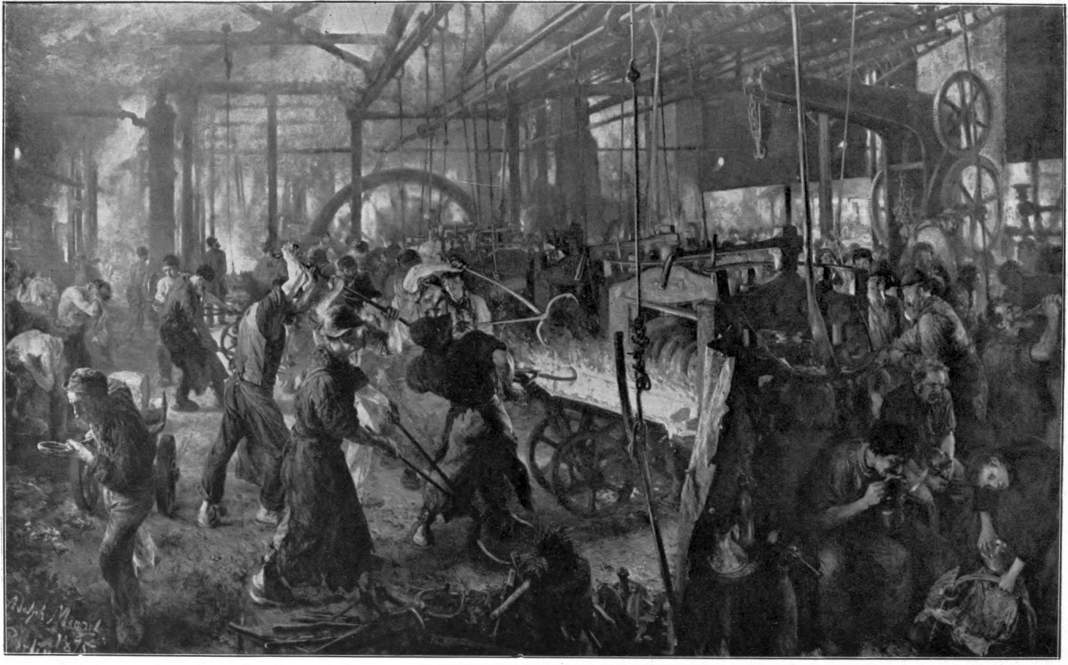
MENZEL. Hanfstaengl. THE IRON MILL.
(By permission of the Berlin Photographic Co., the owners of the copyright.)
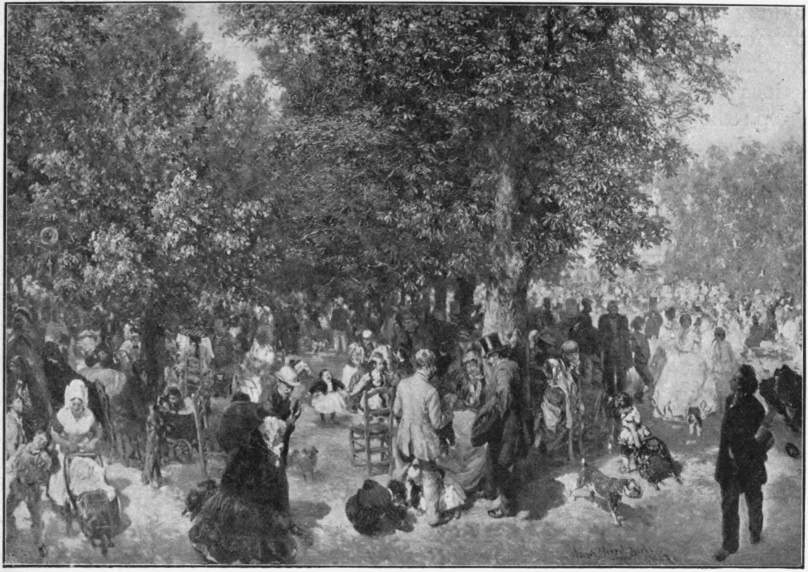
Hanfstaengl.
MENZEL. SUNDAY IN THE TUILERIES GARDENS.
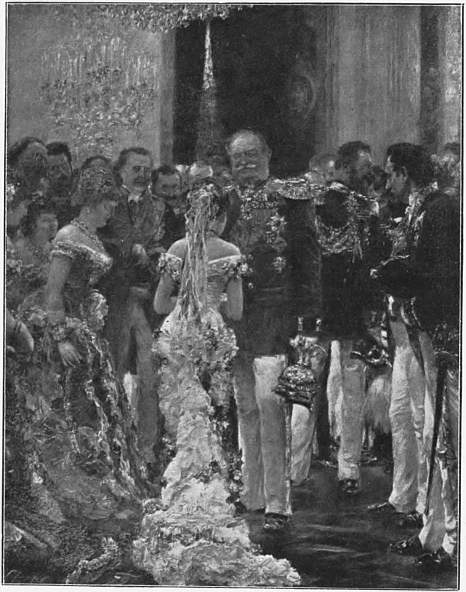
Hanfstaengl.
MENZEL. A LEVEE.
In Vienna August von Pettenkofen made a transition from the ossified, antediluvian genre painting to painting which was artistically delicate. While the successors of Gauermann and Danhauser indulged in heart-breaking scenes or humorous episodes, Pettenkofen was the first to observe the world from a purely pictorial point of view. Alfred Stevens had opened his eyes in Paris in 1851. Troyon’s pictures and Millet’s confirmed him in his efforts. He was brought up on a property belonging to his father in Galicia, and had been a cavalry officer before he turned to painting: horses, peasants, and oxen are the simple figures of his pictures. In the place of episodic, ill-painted stories he set the meagre plains of lonely Pusta, sooty forges, gloomy cobblers’ work shops, dirty courtyards with middens and rubbish-heaps, gipsy encampments, and desolate garrets. There is no pandering to sentimentality or the curiosity excited by genre painting. There are delicate chords of colour, and that is enough. The artist was in the habit of spending the summer months in the little town of Spolnok on the Theiss, to the east of Pesth. Here he wandered about amongst the little whitewashed houses, the booths of general dealers, and the fruit-sellers’ stalls. A lazily moving yoke of oxen with a lad asleep, dark-eyed girls fetching water, poor children playing on the ground, old men dreaming in the sun in a courtyard, are generally the only breathing beings in his pictures. Here is a sandy village-square with low, white-washed houses; there is a wain with oxen standing in the street, or a postilion trotting away on his tired nag. Like Menzel, Pettenkofen paints busy humanity absorbed in their toil, simple beings who do not dream of leaving off work for the sake of those who frequent picture galleries. What differentiates him from the Berlin painter is a more lyrical impulse, something tender, thoughtful, and contemplative. Menzel gives dramatic point to everything he touches; he sets masses in movement, depicts a busy, noisy crowd, pressing together and elbowing one another, forcing their way at the doors of theatres or the windows of cafés in a multifarious throng. Pettenkofen lingers with the petty artisan and the solitary sempstress. In Menzel’s “Iron Mill” the sparks are flying and the machines whirring, but everything is peaceful and quiet in the cobblers’ workshops and the sunny attics visited by Pettenkofen. Menzel delights in momentary impressions and quivering life; Pettenkofen in rest and solitude. In the former every one is thinking and talking and on the alert; in the latter every one is yawning or asleep. If Menzel paints a waggon, the driver cracks his whip and one hears the team rattling over the uneven pavement; in Pettenkofen the waggon stands quietly in a narrow lane, the driver enjoys a midday rest, and an enervating, sultry heat broods overhead. Menzel has a love for men and women with excitement written on their faces; Pettenkofen avoids painting character, contenting himself with the reproduction of simple actions at picturesque moments. The Berlin artist is epigrammatically sharp; the Viennese is elegiac and melancholy. Menzel’s pictures have the changing glitter of rockets; those of Pettenkofen are harmonised in the tone of a refined amateur. They have only one thing in common: neither has found disciples; they are not culminating peaks in Berlin or Vienna art so much as boulders wedged into another system.
Whilst the realistic movement in both towns was confined to particular masters, Munich had once again the mission of becoming a guiding influence. Here all the tendencies of modern art have left the most distinct traces, all movements were consummated with most consistency. The heroes of Piloty followed the divinities of Cornelius, and these were in turn succeeded by the Tyrolese peasants of Defregger, and amid all this difference of theme one bond connected these works: for interesting subject was the matter of chief importance in them, and the purely pictorial element was something subordinate. The efforts of the seventies had for their object the victory of this pictorial element. It was recognised that the talent for making humorous points and telling stories, which came in question as the determining quality in the pictures of monks and peasants of the school of Defregger and Grützner, was the expression of no real faculty for formative art—that it was merely technical incompleteness complacently supported by the lack of artistic sensibility in the public which had produced this narrative painting. It was felt that the task of formative art did not consist in narrative, but in representation, and in representation through the most sensuous and convincing means which stood at its disposal. A renewed study of the old masters made this recognition possible.
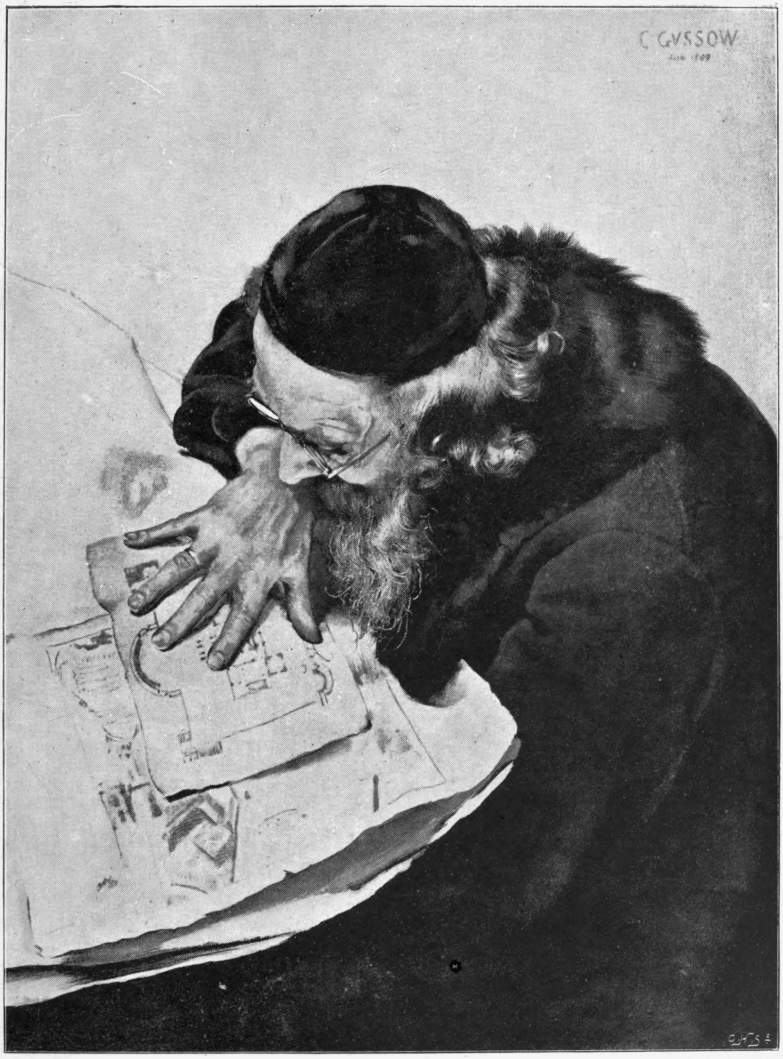
GÜSSOW. THE ARCHITECT.
(By permission of M. H. Salomonson, Esq., the owner of the picture.)
Up to this time the most miserable desolation had also reigned over the province of the artistic crafts. But, borne up by the rekindled sentiment of nationality, and favoured by the high tide of the milliards paid by France, since 1870, that eventful movement bearing the words “Old German” and “Fine Style” on its programme had become an accomplished fact. The German Renaissance, which research had been hitherto neglected, was discovered afresh. Lübke explored it thoroughly and systematically; Woltmann wrote on Hans Holbein, Thausing on Dürer; Eitelberger founded the Austrian Industrial Museum; Georg Hirth brought out his Deutsches Zimmer, and began the publication of the Formenschatz. The national form of art of the German Renaissance was taken up everywhere with a proud consciousness of patriotism: here, it was thought, was a panacea. Those who followed the artistic crafts declared open war against everything pedestrian and tedious. Lorenz Gedon in particular—in union with Franz and Rudolf Seitz—was the soul of the movement. With his black, curly hair, his little, fiery, dark eyes, his short beard, his negligent dress, and his two great hands expert in the exercise of every description of art, he had himself something of the character of an old German stone-cutter. His manner of expressing himself corresponded to this appearance. In every thing it was original, saturated with his own personal conception of the world. As the son of a dealer in old pictures and curiosities, he was familiar with the old masters from his childhood, and followed them in the method of his study. He was far from confining himself to one branch. The façades of houses, the architecture of interiors, tavern rooms and festal decorations, furniture and state carriages, statues and embellishments in stone, bronze, wood, and iron, portrait busts in wax, clay, and marble, models for ornaments, for iron lattices, for the adornment of ships and the fittings of cabins, all objects that were wayward, fantastic, quaint, and curious lay in his province; and for the execution of each in turn this remarkable man felt that he had in him an equal capacity. And, at the same time, the temperament of a collector was united in him with that of an artist in an entirely special way. In the bushy wilderness of a garden before his house in the Nymphenburger Strasse countless stone fragments of mediæval sculpture were strewn about, up to the very hedge dividing it from the street. Rusty old trellises of wrought iron slanted in front of the windows, and in the house itself the most precious objects, which artists ten years before had passed without heed, stood in masses together. As Gedon was taken from his work when he was forty his artistic endeavour never got beyond efforts of improvisation, but the impulse which he gave was very powerful. Through his initiative the whole province of the artistic crafts was brought under observation from a pictorial point of view. The bald Philistine style of decoration gave way and a blithe revel of colour was begun. The great carnival feasts arranged by him on the model of the Renaissance period are an important episode in the history of culture in Munich, and have contributed in no unessential manner to the refinement of taste in the toilette of women. The Munich Exhibition of the Arts and Crafts in 1876 (before the entrance of which he had erected that great portal made of old fragments of architecture, wood-carving, and splendid stuffs, and bearing the inscription “The Works of our Fathers”) indicated the zenith of that movement in the handicrafts which was flooding all Germany in those days.