Front matter (continued 6)
Reading edition
To be at once refined and true is the goal which portrait painting in recent years has also specially set itself to reach. In the years of chic it started with the endeavour to win from every personality its beauties, to paint men and women “to advantage”; but later, when the Naturalism of Bastien-Lepage stood at its zenith, it strove at all costs to seize the actual human being, to catch, as it were, the work-a-day character of the personality as it is in involuntary moments when people believe themselves to be unobserved and give up posing. The place of those pompous arrangements of the painters of material was taken by a soul, and temperament interpreted by an intelligence. And corresponding with the universal principle of conceiving man and nature as an indivisible whole, it became imperative in portrait painting no longer to place persons before an arbitrary background, but in their real surroundings—to paint the man of science in his laboratory, the painter in his studio, the author at his work-table—and to observe with accuracy the atmospheric influences of this environment.
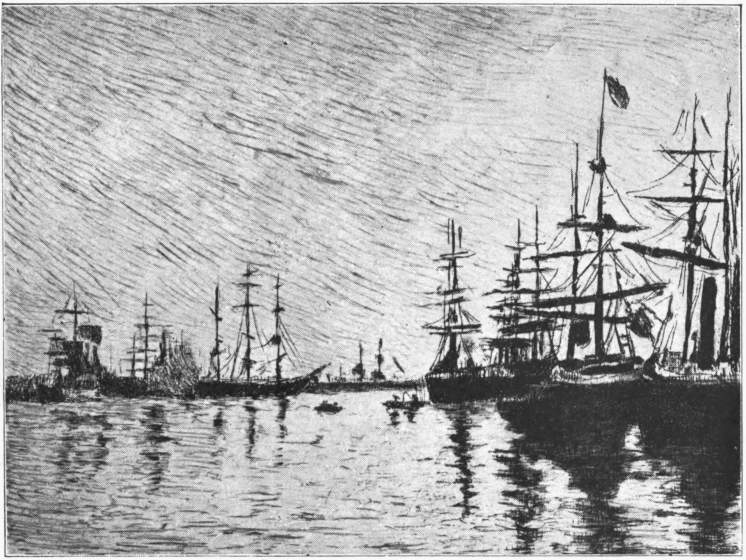
BOUDIN. THE PORT OF TROUVILLE.
(By permission of M. Durand-Ruel, the owner of the copyright.)
The ready master-worker of this plain and sincere naturalism in portrait painting was peculiarly Fantin-Latour, who ought not merely to be judged by his latest paintings, which have something petrified, rigid, gloomy, and professorial. In his younger days he was a solid and powerful artist, one of the soundest and simplest of whom France could boast. His pictures were dark in tone and harmonious, and had a puritanic charm. The portrait of Manet, and that of the engraver Edwin Edwards and his wife, in particular, will always preserve their historical value.
L’Art.
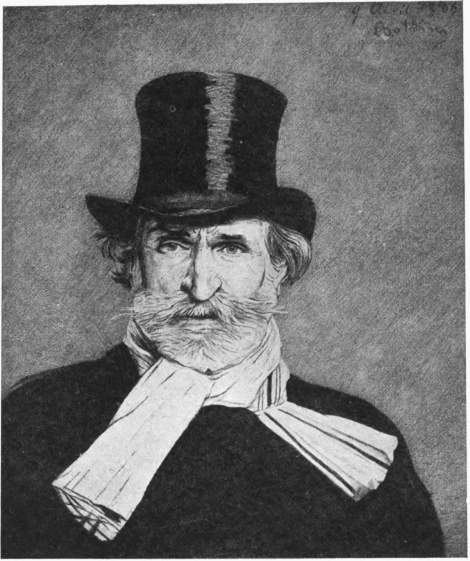
BOLDINI. GIUSEPPE VERDI.
Later, when the whole bias of art tended away from the poorer classes, and once more approached this fashionable world, portrait painting also showed a tendency to become exquisite and over-refined, and to exhibit a preference for symphonic arrangements of colour and subtilised effects of light. White, light yellow, and light blue silks were harmonised upon very delicate scales with pearly-grey backgrounds. Ladies in mantles of light grey fur and rosy dresses stand amid dark-green shrubs, in which rose-coloured lanterns are burning, or they sit in a ball-dress near a lamp which produces manifold and tender transformations of light upon the white of the silk.
The work of Jacques Émile Blanche, the son of the celebrated mad-doctor, is peculiarly characteristic of these tendencies of French portrait painting. It is well known that English fashion was at this time regarded in Paris as the height of elegance, while Anglicisms were entering more and more into the French language; and this tendency of taste gave Blanche the occasion for most æsthetic pictures. The English Miss, in her attractive mixture of affectation and naïveté, in all her slim and long-footed grace, has found a delicate interpreter in him. Tall ladies clad in white, bitten with the Anglomania, drink tea most æsthetically, and sit there bored, or are grouped round the piano; gommeux, neat, straight, chic, from their tall hats to their patent-leather boots, look wearily about the world, with an eyeglass fixed, a yellow rose in their buttonhole, and a thick stick in the gloved hand. Amongst his portraits of well-known personalities, much notice was attracted by that of his father in 1890—a modern Bertin the Elder, and in 1891 by that of Maurice Barrès, a portrait in which he has analysed the author of Le Jardin de Bérénice in a very simple and convincing fashion.
Quantin, Paris.
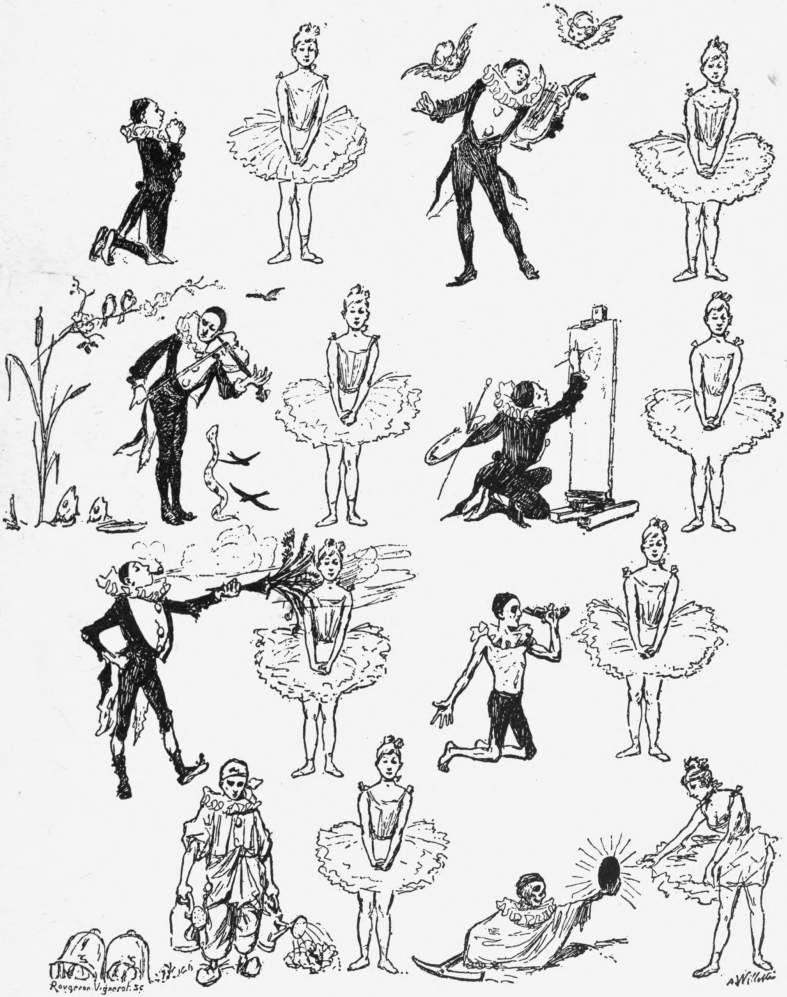
WILLETTE. THE GOLDEN AGE.
The brilliant Italian Boldini brought to this English chic the manual volubility of a Southerner: sometimes he was microscopic à la Meissonier, sometimes a juggler of the brush à la Fortuny, and sometimes he gave the most seductive mannerism and the most diverting elegance to his portraits of ladies. Born in 1845, the son of a painter of saints, Boldini had begun as a Romanticist with pictures for Scott’s Ivanhoe. From Ferrara he went to Florence, where he remained six years. At the end of the sixties he emerged in London, and, after he had painted Lady Holland and the Duchess of Westminster there, he soon became a popular portrait painter. But since 1872 his home has been Paris, where the fine Anglo-Saxon aroma, the “æsthetic” originality of his pictures, soon became an object of universal admiration. In his portraits of women Boldini always renders what is most novel. It is as if he knew in advance the new fashion which the coming season would bring. His trenchantly cut figures of ladies in white dresses and with black gloves have a defiant and insolent effect, and yet one which is captivating through their ultra-modern chic. The portraits of Carolus Duran have nothing of that charm which makes such an appeal to the nerves, nothing of that discomposing indefinable quality which lies in the expression and gestures of a fashionable woman, whose eccentricity reveals every day fresh nuances of beauty. He had not the faculty of seizing movement, the most difficult element in the world. But Boldini’s pictures seem like bold and sudden sketches which clinch the conception with spirit and swiftness in liberal, pointed crayon strokes controlled by keen observation. There is no ornament, no bracelet, no pillars and drapery. One hears the silken bodice rustle over the tightly laced corset, sees the mobile foot, and the long train swept to the side with a bold movement. Sometimes his creations are full and luxuriant, nude even in their clothes, excited and full of movement; sometimes they are bodiless, as if compact of the air, pallid and half-dead with the strain of nights of festivity, “living with hardly any blood in their veins, in which the pulse beats almost entirely out of complaisance.”
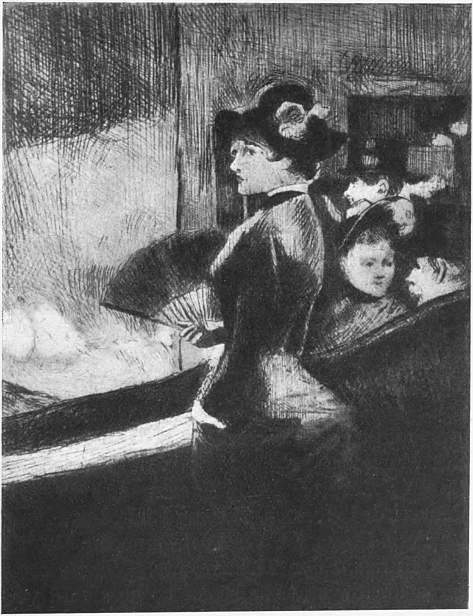
FORAIN. AT THE FOLIES-BERGÈRES.
(By permission of M. Durand-Ruel, the owner of the copyright.)
His pictures of children are just as subtle: there is an elasticity in these little girls with their widely opened velvet eyes, their rosy young lips, and their poses calculated with so much coquetry. Boldini has an indescribable method of seizing a motion of the head, a mien, or a passing flash of the eyes, of arranging the hair, of indicating coquettish lace underclothing beneath bright silk dresses, or of showing the grace and fineness of the slender leg of a girl, encased in a black silk stocking, and dangling in delicate lines from a light grey sofa. There is French esprit, something piquant and with a double meaning in his art, which borders on the indecorous and is yet charming. These portraits of ladies, however, form but a small portion of his work. He paints in oils, in water-colour, and pastel, and is equally marvellous in handling the portraits of men, the street picture and the landscape. His portrait of the painter John Lewis Brown, crossing the street with his wife and daughter, looked as though it had been painted in one jet. In his little pictures of horses there is an astonishing animation and nervous energy. M. Faure, the singer, possesses some small rococo pictures from his brush, scenes in the Garden of the Tuileries, which might have come from Fortuny. His pictures from the street life of Paris—the Place Pigalle, the Place Clichy—recall De Nittis, and some illustrations—scenes from the great Paris races—might have been drawn by Caran D’Ache.
There is no need to treat illustration in greater detail, because, naturally, it could no longer play the initiative part which fell to it in earlier days, now that the whole of life had been drawn within the compass of pictorial representation. Besides, in an epoch like our own, which is determined to know and see and feel everything, illustration has been so extended that it would be quite impossible even to select the most important work. Entirely apart from the many painters who occasionally illustrated novels or other books, such as Bastien-Lepage, Gervex, Dantan, Détaille, Dagnan-Bouveret, Ribot, Benjamin Constant, Jean Paul Laurens, and others, there are a number of professional draughtsmen in Paris, most of whom are really distinguished artists.
In particular, Chéret, one of the most original artists of our time—Chéret, the great king of posters, the monarch of a fabulously charming world, in which everything gleams in blue and red and orange, cannot be passed over in a history of painting. The flowers which he carelessly strews on all sides with his spendthrift hand are not destined for preservation in an historical herbarium; his works are transient flashes of spirit, brilliantly shining, ephemera, but a bold and subtle Parisian art is concealed amid this improvisation. Settled for many years in London, Jules Chéret had there already drawn admirable placards, which are now much sought after by collectors.
In 1866 he introduced this novel branch of industry into France, and gave it—thanks to the invention of machines which admit of the employment of the largest lithographic stones—an artistic development which could not have been anticipated. He has created many thousands of posters. The book-trade, the great shops, and almost all branches of industry owe their success to him. His theatrical posters alone are amongst the most graceful products of modern art: La Fête des Mitrons, La Salle de Frascati, Les Mongolis, Le Chat Botté, L’Athénée Comique, Fantaisies Music-Hall, La Fée Cocotte, Les Tsiganes, Les Folies-Bergères en Voyage, Spectacle Concert de l’Horloge, Skating Rink, Les Pillules du Diable, La Chatte Blanche, Le Petit Faust, La Vie Parisienne, Le Droit du Seigneur, Cendrillon, Orphée aux Enfers, Éden Théâtre, etc. These are mere posters, destined to hang for a few days at the street corners, and yet in graceful ease, sparkling life, and coquettish bloom of colour they surpass many oil paintings which flaunt upon the walls of the Musée Luxembourg.
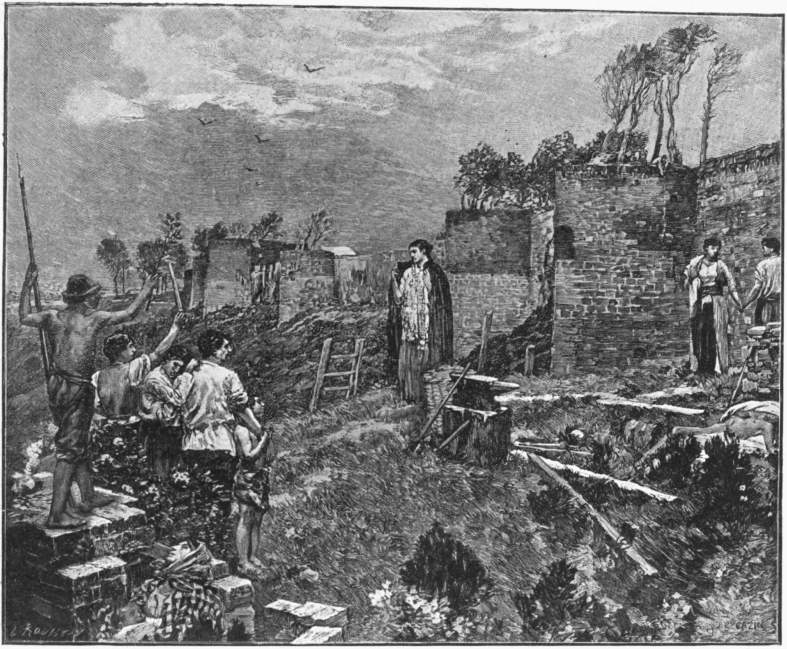
Baschet.
CAZIN. JUDITH.
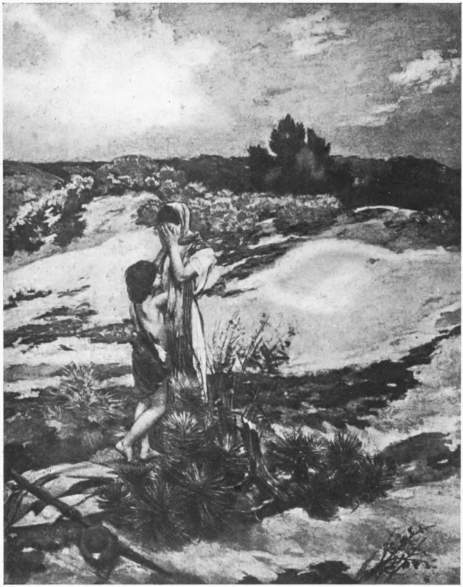
Baschet.
CAZIN. HAGAR AND ISHMAEL.
Amongst the illustrators Willette is perhaps the most charming, the most brilliant in grace, fancy, and spirit. A drawing by him is something living, light, and fresh. Only amongst the Japanese, or the great draughtsmen of the rococo period, does one find plates of a charm similar to Willette’s tender poems of the “Chevalier Printemps” or the “Baiser de la Rose.” At the same time there is something curiously innocent, something primitive, naïve, something like the song of a bird, in his charming art. No one can laugh with such youthful freshness. No one has such a childlike fancy. Willette possesses the curious gift of looking at the world like a boy of sixteen with eyes that are not jaded for all the beauty of things, with the eyes of a schoolboy in love for the first time. He has drawn angels for Gothic windows, battles, and everything imaginable; nevertheless, woman is supreme over his whole work, ruined and pure as an angel, cursed and adored, and yet always enchanting. She is Manon Lescaut, with her soft eyes and angelically pure sins. She has something of the lovely piquancy of the woman of Brantôme, when she disdainfully laughs out of countenance poor Pierrot, who sings his serenades to her plaintively in the moonlight. One might say that Willette is himself his Pierrot, dazzled with the young bosoms and rosy lips: at one time graceful and laughing, wild as a young fellow who has just escaped from school; at another earnest and angry, like an archangel driving away the sinful; to-day fiery, and to-morrow melancholy; now in love, teasing, blithe, and tender, now gloomy and in mortal trouble. He laughs amid tears and weeps amid laughter, singing the Dies Iræ after a couplet of Offenbach; himself wears a black-and-white garment, and is, at the same time, mystic and sensuous. His plates are as exhilarating as sparkling champagne, and breathe the soft, plaintive spirit of old ballads.
Beside this amiable Pierrot Forain is like the modern Satyr, the true outcome of the Goncourts and Gavarni, the product of the most modern decadence. All the vice and grace of Paris, all the luxury of the world, and all the chic of the demi-monde he has drawn with spirit, with bold stenographical execution, and the elegance of a sure-handed expert. Every stroke is made with trenchant energy and ultimate grace. Adultery, gambling, chambres séparées, carriages, horses, villas in the Bois de Boulogne; and then the reverse side—degradation, theft, hunger, the filth of the streets, pistols, suicide,—such are the principal stages of the modern epic which Forain composed; and over all the Parisienne, the dancing-girl, floats with smiling grace like a breath of beauty. His chief field of study is the promenade of the Folies-Bergères—the delicate profiles of anæmic girls singing, the heavy masses of flesh of gluttonising gourmets, the impudent laughter and lifeless eyes of prostitutes, the thin waists, lean arms, and demon hips of fading bodies laced in silk. Little dancing-girls and fat roués, snobs with short, wide overcoats, huge collars, and long, pointed shoes—they all move, live, and exhale the odour of their own peculiar atmosphere. There is spirit in the line of an overcoat which Forain draws, in the furniture of a room, in the hang of a fur or a silk dress. He is the master of the light, fleeting seizure of the definitive line. Every one of his plates is like a spirited causerie, which is to be understood through nods and winks.
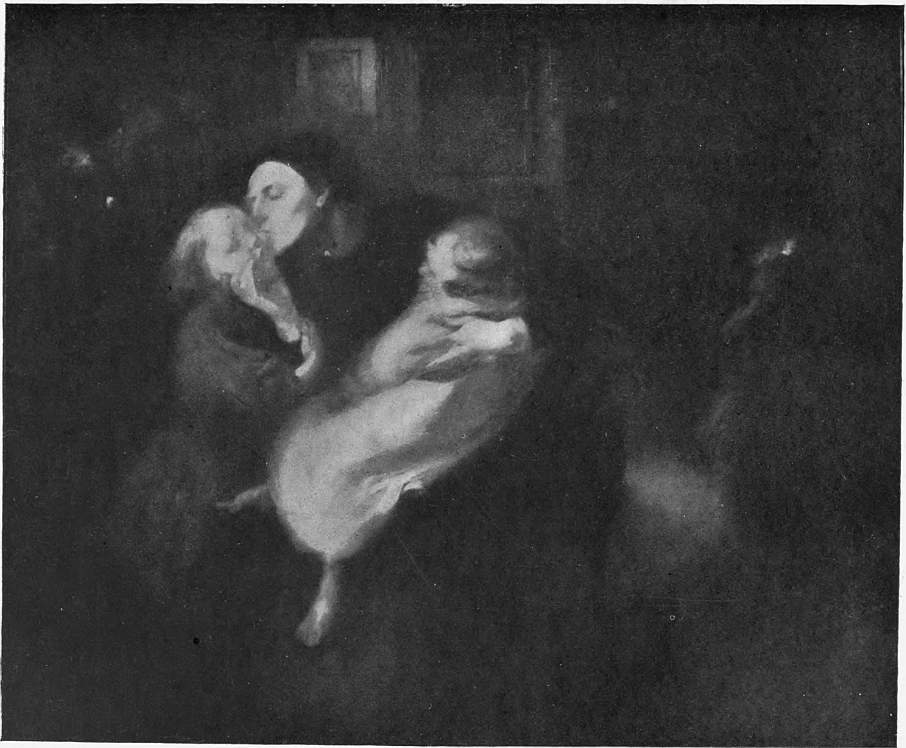
CARRIÈRE. MOTHERHOOD.
The name of Paul Renouard is inseparable from the opera. Degas had already painted the opera and the ballet-dancers with wonderful reality, fine irony, or in the weird humour of a dance of death. But Renouard did not imitate Degas. As a pupil of Pils he was one of the many who, in 1871, were occupied with the decoration of the staircase of the new opera house, and through this opportunity he obtained his first glance into this capricious and mysterious world made up of contrasts,—a world which henceforward became his domain. All his ballet-dancers are accurately drawn at their rehearsals, but the charm of their smile, of their figures, their silk tights, their gracious movements, has something which almost goes beyond nature. Renouard is a realist with very great taste. Girls practising at standing on the tips of their toes, dancing, curtseying, and throwing kisses to the audience are broadly and surely drawn with a few strokes. The opera is for him a universe in a nutshell—a résumé of Paris, where all the oddities, all the wildness, and all the sadness of modern life are to be found.
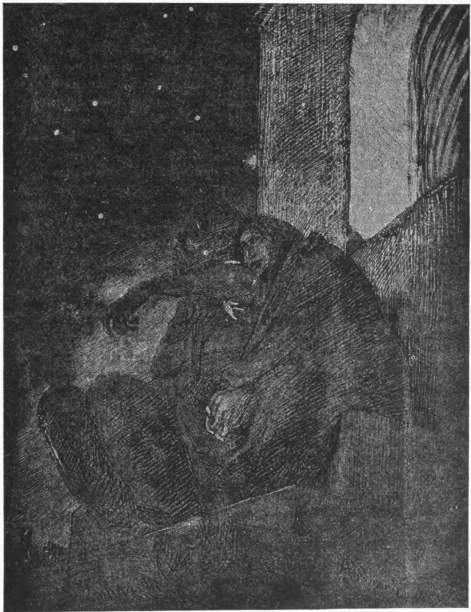
Gaz. des Beaux-Arts.
BESNARD. EVENING.
Mention must also be made of Daniel Vierge, torn prematurely from his art by a cruel disease, but not before he had been able to complete his masterpiece, the edition of Don Pablo de Segovia. Henri de Toulouse-Lautrec too must be named, the grim historian of absinthe dens, music halls and dancing saloons; and we must give a passing glance to Léandre and Steinlen, in whose drawings also the whole of Parisian life breathes and pulsates, with all the glitter of over-civilisation, with all its ultra-refinement of pleasure. But a detailed appreciation of these draughtsmen is obviously out of place in a history of painting.
If we turn back to those who have done good work in the province of painting pure and simple, we must tarry for a while with that refined painter of elegiac landscape, Charles Cazin. He awaits us as the evening gathers, and tells with a vibrating voice of things which induce a mood of gentle melancholy. He has his own hour, his own world, his own men and women. His hour is that secret and mystic time when the sun has gone down and the moon is rising, when soft shadows repose upon the earth and bring forgetfulness. The land he enters is a damp, misty land with dunes and pale foliage, one that lies beneath a heavy sky and is seldom irradiated by a beam of hope, a land of Lethe and oblivion of self, a land created to yield to the tender colour of infinite weariness. The motives of his landscapes are always exceedingly simple, though they have a simplicity which is perhaps forced, instead of being entirely naïve. He represents, it may be, the entrance into a village with a few cottages, a few thin poplars, and reddish tiled roofs, bathed in the pale shadows of evening. Upon the broad street lined with irregular houses, in a provincial town, the rain comes splashing down. Or it is night, and in the sky there are black clouds, with the moon softly peering between them. Lamps are gleaming in the windows of the houses, and an old post-chaise rolling heavily over the slippery pavement. Or dun-green shadows repose upon a solitary green field with a windmill and a sluggish stream. The earth is wrapt in mysterious silence, and there is movement only in the sky, where a flash of lightning quivers—not one that blazes into intensely vivid light, but rather a silvery white electric spark lambent in the dark firmament. Corot alone has painted such things, but where he is joyous Cazin is elegiac. The little solitary houses are of a ghostly grey. The trees sway towards each other as if in tremulous fear. And the mist hangs damp in the brown boughs. Faint evening shadows flit around. A Northern malaria seems to prevail. At times a sea-bird utters a wailing complaint. One thinks of Russian novels, Nihilism, and Raskolnikoff, though I know not through what association of ideas. One is disposed to sit by the wayside and dream, as Verlaine sings:—
“La lune blanche Luit dans les bois; De chaque branche Part une voix. L’étang reflète, Profond miroir, La silhouette Du saule noir Où le vent pleure: Rêvons c’est l’heure. Un vaste et tendre Apaisement Semble descendre Du firmament Que l’astre irise: C’est l’heure exquise.”
Gaz. des Beaux-Arts.
BESNARD. PORTRAIT OF MLLES. D.
Sometimes the humour of the landscape is associated with the memory of kindred feelings which passages in the Bible or in old legends have awakened in him. In such cases he creates the biblical or mythological pictures which have principally occupied him in recent years. Grey-green dusk rests upon the earth; the shadows of evening drive away the last rays of the sun. A mother with her child is sitting upon a bundle of straw in front of a thatched cottage with a ladder leaning against its roof, and a poverty-stricken yard bordered by an old paling, while a man in a brown mantle stands beside her, leaning upon a stick: this picture is “The Birth of Christ.” Two solitary people, a man and a woman, are walking through a soft, undulating country. The sun is sinking. No house will give the weary wanderers shelter in the night, but the shade of evening, which is gradually descending, envelops them with its melancholy peace: this is “The Flight into Egypt.” An arid waste of sand, with a meagre bush rising here and there, and the parching summer sun brooding sultry overhead, forms the landscape of the picture “Hagar and Ishmael.” Or the fortifications of a mediæval town are represented. Night is drawing on, watch-fires are burning, brawny figures stand at the anvil fashioning weapons, and the sentinels pace gravely along the moat. The besieged town is Bethulia, and the woman who issues with a wild glance from the town gateway is Judith, going forth followed by her handmaid to slay Holofernes. Through such works Cazin has become the creator of the landscape of religious sentiment, which has since occupied so much space in French and German painting. The costume belongs to no time in particular, though it is almost more appropriate to the present than to bygone ages; but something so biblical, so patriarchal, such a remote and mystical poetry is expressed in the great lines of the landscape that the figures seem like visions from a far-off past.
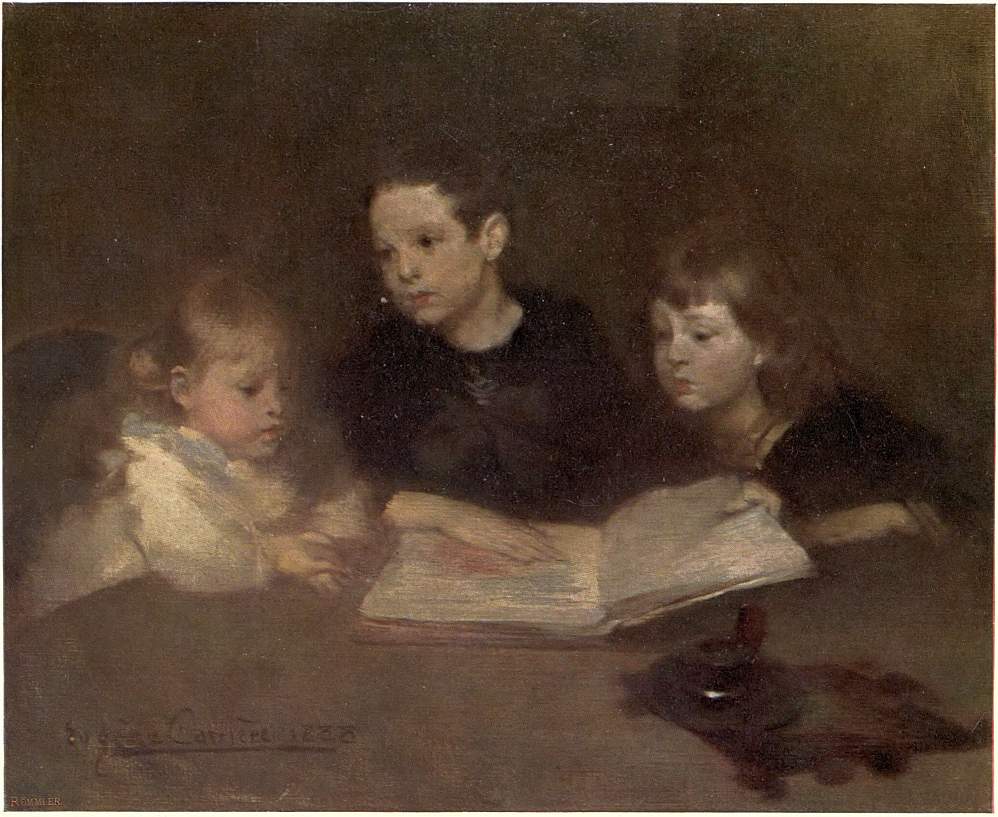
The continuation of this movement is marked by that charming artist who delighted in mystery, Eugène Carrière, “the modern painter of Madonnas,” as he has been called by Edmond de Goncourt. Probably no one before him has painted the unconscious spiritual life of children with the same tender, absorbed feeling: little hands grasping at something, stammering lips of little ones who would kiss their mother, dreamy eyes gazing into infinity. But although young children at the beginning of life, whose eyes open wide as they turn towards the future, look out of his pictures, a profound sadness rests over them. His figures move gravely and silently in a soft, mysterious dusk, as though divided from the world of realities by a veil of gauze. All forms seem to melt, and fading flowers shed a sleepy fragrance around; it is as though there were bats flitting invisible through the air. Even as a portrait painter he is still a poet dreaming in eternal haze and a twilight of mystery. In his portraits, Alphonse Daudet, Geffroy, Dolent, and Edmond de Goncourt looked as though they had been resolved into vapour, although the delineation of character was of astonishing power, and marked firmly with a penetrative insight into spiritual life such as was shared by Ribot alone.
At the very opposite pole of art stands Paul Albert Besnard: amongst the worshippers of light he is, perhaps, the most subtle and forcible poet, a luminist who cannot find tones high enough when he would play upon the fibres of the spirit. Having issued from the École des Beaux-Arts, and gained the Prix de Rome with a work which attracted much notice, he had long moved upon strictly official lines; and he only broke from his academical strait-waistcoat about a dozen years ago, to become the refined artist to whom the younger generation do honour in these days, a seeker whose works vary widely in point of merit, though they always strike one afresh from the bold confidence with which he attacks and solves the most difficult problems of light. In Puvis de Chavannes, Cazin, and Carrière a reaction towards sombre effect and pale, vaporous beauty of tone followed the brightness of Manet; but Besnard, pushing forward upon Manet’s course, revels in the most subtle effects of illumination—effects not ventured upon even by the boldest Impressionists—endeavours to arrest the most unexpected and unforeseen phases of light, and the most hazardous combinations of colour. The ruddy glow of the fire glances upon faded flowers. Chandeliers and tapers outshine the soft radiance of the lamp; artificial light struggles with the sudden burst of daylight; and lanterns, standing out against the night sky like golden lights with a purple border, send their glistening rays into the blue gloom. It is only in the field of literature that a parallel may be found in Jens Pieter Jacobsen, who in his novels occasionally describes with a similar finesse of perception the reflection of fire upon gold and silver, upon silk and satin, upon red and yellow and blue, or enumerates the hundred tints in which the September sun pours into a room.
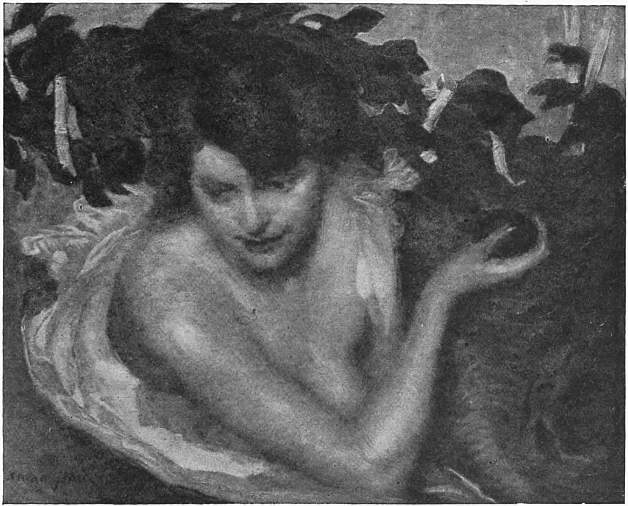
The portrait group of his children is a harmony in red. A boy and two girls are standing, with the most delightful absence of all constraint, in a country room, which looks out upon a mountainous landscape. The wall of the background is red, and red the costume of the little ones, yet all these conflicting nuances of red tones are brought into harmonious unity with inherent taste. Rubens would have rejoiced over a second landscape exhibited in the same year. A nude woman is seated upon a divan drinking tea, with her feet tucked under her and her back to the spectator. Upon her back are cast the warm and the more subdued reflections of a fire which lies out of sight and of the daylight quivering in yellowish stripes, like a glowing aureole upon her soft skin.
Studio.
AMAN-JEAN. SOUS LA GUERLANDA.
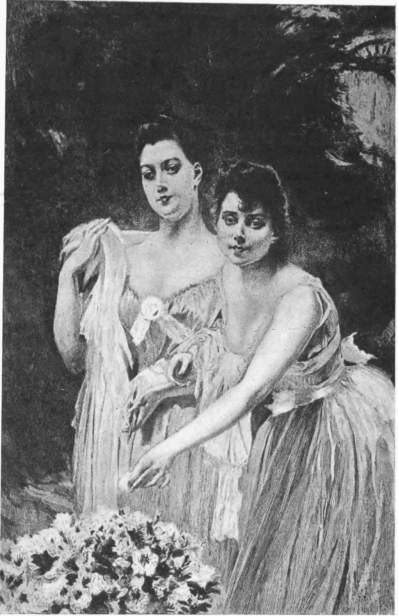
In a third picture, called “Vision de Femme,” a young woman with the upper part of her form unclothed appears upon a terrace, surrounded by red blooming flowers and the glowing yellow light of the moon. Under this symbol Besnard imagined Lutetia, the eternally young, hovering over the rhododendrons of the Champs Elysées and looking down upon the blaze of lights in the Café des Ambassadeurs. In 1889 he produced “The Siren,” a symphony in red. A petite femme of Montmartre stands wearily in a half-antique morning toilette before a billowing lake, which glows beneath the rays of the setting sun in fiery red and dull mallow colour. In his “Autumn” of 1890 he made the same experiment in green. The moon casts its silvery light upon the changeful greenish mirror of a lake, and at the same time plays in a thousand reflections upon the green silk dress of a lady sitting upon the shore; while, in a picture of 1891, a young lady in an elegant négligé is seated at the piano, with her husband beside her turning over the music. The light of the candles is shed over hands, faces, and clothes. Another picture, called “Clouds of Evening,” represented a woman with delicate profile amid a violet landscape over which the clouds were lightly hovering, touched with orange-red by the setting sun. The double portrait, executed in 1892, of the “Mlles. D——,” one of whom is leisurely placing a scarf over her shoulders with a movement almost recalling Leighton, while the other stoops to pick a blossom from a rhododendron bush, is exceedingly soft in its green, red, and blue harmony.
The French Government recognised the eminent decorative talent displayed in these pictures, and gave Besnard the opportunity of achieving further triumphs as a mural painter. Here, too, he is modern to his fingertips, knowing nothing of stately gestures, nothing of old-world naïveté; but merely through his appetising and sparkling play of colour he has the art of converting great blank spaces into a marvellous storied realm.
In 1890 he had to represent “Astronomy” as a ceiling-piece for the Salon des Sciences in the Hôtel de Ville. Ten years before there would have been no artist who would not have executed this task by the introduction of nude figures provided with instructive attributes. One would have held a globe, the second a pair of compasses, and the third a telescope in one hand, and in the other branches of laurel wherewith to crown Galileo, Columbus, or Kepler. Besnard made a clean sweep of all this. He did not forget that a ceiling is a kind of sky, and accordingly he painted the planets themselves, the stars which run their course through the firmament of blue. The figures of the constellations are arranged in a gracious interplay of light bodies floating softly past. Amongst the pictures of the École de Pharmacie a like effect is produced by Besnard’s great composition “Evening,” a work treated with august simplicity. The atmosphere is of a grey-bluish white: stars are glittering here and there, and two very ancient beings, a man and a woman, sit upon the threshold of their house, grave, weather-beaten forms of quiet grandeur, executed with expressive lines. The old man casts a searching glance at the stars, as if yearning after immortality, while the woman leans weary and yet contented upon his shoulder. In the room behind a kettle hangs bubbling over the fire, and a young woman with a child upon her arm steps through the door: man and the starry world, the finite and the infinite, presented under plain symbols.
CARRIÈRE. SCHOOLWORK.
Such are, more or less, the representative minds of contemporary France, the centres from which other minds issue like rays. Alfred Agache devotes himself with great dexterity to an allegorical style after the fashion of Barroccio. Inspired by the pre-Raphaelites, Aman-Jean has found the model for his allegorical compositions in Botticelli, and is a neurasthenic in colour, which is exceptionally striking, in his delicate portraits of women. Maurice Denis, who drew the illustrations to Verlaine’s Sagesse in a style full of archaic bloom, as a painter takes delight in the intoxicating fragrance of incense, the gliding steps and slow, quiet movements of nuns, in men and women kneeling before the altar in prayer, and priests crossing themselves before the golden statue of the Virgin. The Spaniard Gandara, who lives in Paris, displays in his grey and melting portraits much feeling for the decorative swing of lines. That spirited “pointillist” Henri Martin seems for the present to have reached a climax in his “Cain and Abel,” one of the most powerful creations of the younger generation in France. Louis Picard’s work has a tincture of literature, and he delights in Edgar Allan Poe, mysticism and psychology. Ary Renan, the son of Ernest Renan and the grandson of Ary Scheffer, has given the soft subdued tones of Puvis de Chavannes a tender Anglo-Saxon fragrance in the manner of Walter Crane. And that spirited artist in lithograph, Odilon Redon, has visions of distorted faces, flowers that no mortal eye has seen, and huge white sea-birds screaming as they fly across a black world. Forebodings like those we read of in the verse of Poe take shape in his works, ghosts roam in the broad daylight, and the sea-green eyes of Medusa-heads dripping with blood shine in the darkness of night with a mesmeric effect. Carlos Schwabe drew the illustrations for the Évangile de l’Enfance of Catulle Mendès with the charming naïveté of Hans Memlinc, and afterwards attracted attention by his delicate, archaic pictures.
Bonnard, Vuillard, Valloton and Roussel are others whose names have in the last few years become well known. Their art is built up on the foundation laid by the Impressionists only so far as they use the new colour-values discovered by the “bright painters,” in a free, harmonious manner, and place them at the service of a new decorative purpose. In exhibitions one is often at a loss how to view these decorative paintings, such, for instance, as those of Bonnard and Vuillard; the eye is astounded for a moment when, after looking at the usual array of good pictures, it suddenly comes upon works that look more like pieces of Gobelin tapestry than paintings. Then one’s mind reverts to rooms such as Olbrich, Van de Velde, or Josef Hoffmann designed with some particular purpose in view, and one understands the object of these pictures. “We can hang in our rooms any picture which is beautiful in itself and by itself.” That is the old familiar story, but that feeling never enters our minds when we stand in a mediæval room in which there are no pictures that can be taken away from their surroundings. It is a difficult task to arrange things that are individually beautiful into a harmonious whole. The realisation of the old-time principle is for obvious reasons well-nigh impracticable—the modern man is a restless, fickle creature; he must always be at liberty to pitch his tent anywhere—but we can surely make some approach to it. One may imagine in every dwelling a room in which furniture and pictures are made to fit into some conception of harmony, and the works of Bonnard and Vuillard may be conceived as parts of such a scheme for the decoration of a room, and indeed—though we must not forget similar attempts which have been made in other directions—as parts of a scheme which, though thoroughly modern and by no means a mere external copy, reverts to the style of bygone centuries.
From the historian’s standpoint these young artists scarcely come into question; they are still too much in the embryonic stage for any conclusion to be arrived at with respect to either of them. But the art lover who looks to the future rather than the past feels bound to follow with care their creations, in which the wealth of beauty that is already indicated in their first prints, the certainty of purpose with which they direct their efforts towards the point at which Impressionism has left the widest gap, seems to give a guarantee that in the future France will maintain in the province of art the position she has held during the nineteenth century as the leading artistic nation.

CHAPTER XXXV
SPAIN
Just as France to-day shows such a wealth of talent, Spain, correspondingly, can scarcely be said to come into the question of modern endeavour in art; in fact, it is quite impossible to treat of a history of Spanish art, one can only consider individual artists, for they each go their own way, working in different directions and without any concerted plan.
It was in the spring of 1870 that a little picture called “La Vicaria” was exhibited in Paris at the dealer Goupil’s. A marriage is taking place in the sacristy of a rococo church in Madrid. The walls are covered with faded Cordova leather hangings figured in gold and dull colours, and a magnificent rococo screen separates the sacristy from the middle aisle. Venetian lustres are suspended from the ceiling; pictures of martyrs, Venetian glasses in carved oval frames hang on the wall, richly ornamented wooden benches, and a library of missals and gospels in sparkling silver clasps, and shining marble tables and glistening braziers form part of the scene in which the marriage contract is being signed. The costumes are those of the time of Goya. As a matter of fact, an old beau is marrying a young and beautiful girl. With affected grace and a skipping minuet step, holding a modish three-cornered hat under his arm, he approaches the table to put his signature in the place which the escribano points out with an obsequious bow. He is arrayed in delicate lilac, while the bride is wearing a white silk dress trimmed with flowered lace, and has a wreath of orange blossoms in her luxuriant black hair. As a girl-friend is talking to her she examines with abstracted attention the pretty little pictures upon her fan, the finest she has ever possessed. A very piquant little head she has, with her long lashes and her black eyes. Then, in the background, follow the witnesses, and first of all a young lady in a swelling silk dress of the brightest rose-colour. Beside her is one of the bridegroom’s friends in a cabbage-green coat with long flaps, and a shining belt from which a gleaming sabre hangs. The whole picture is a marvellous assemblage of colours, in which tones of Venetian glow and strength, the tender pearly grey beloved of the Japanese, and a melting neutral brown, each sets off the other and give a shimmering effect to the whole.
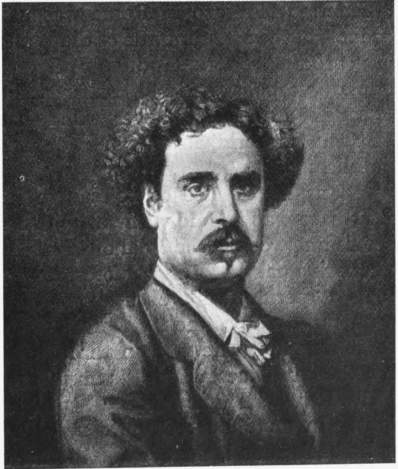
The painter, who was barely thirty, bore the name of Mariano Fortuny, and was born in Reus, a little town in the province of Tarragona, on 11th June 1838. Five years after he had completed this work he died, at the age of thirty-six, on 21st November 1874. Short as his career was, it was, nevertheless, so brilliant, his success so immense, his influence so great, that his place in the history of modern painting remains assured to him.
Like French art, Spanish art, after Goya’s death, had borne the yoke of Classicism, Romanticism, and academical influence by turns. In the grave of Goya there was buried for ever, as it seemed, the world of torreros, majas, manolas, monks, smugglers, knaves, and witches, and all the local colour of the Spanish Peninsula. As late as the Paris World Exhibition of 1867, Spain was merely represented by a few carefully composed, and just as carefully painted, but tame and tedious, historical pictures of the David or the Delaroche stamp—works such as had been painted for whole decades by José Madrazo, J. Ribera y Fernandez, Federigo Madrazo, Carlo Luis Ribera, Eduardo Rosales, and many others whose names there is no reason for rescuing from oblivion. They laboured, meditating an art which was not their own, and could not waken any echo in themselves. Their painting was body without soul, empty histrionic skill. As complete darkness had rested for a century over Spanish art, from the death of Claudio Coellos in 1693 to the appearance of Goya, rising like a meteor, so the first half of the nineteenth century produced no single original artist until Fortuny came forward in the sixties.
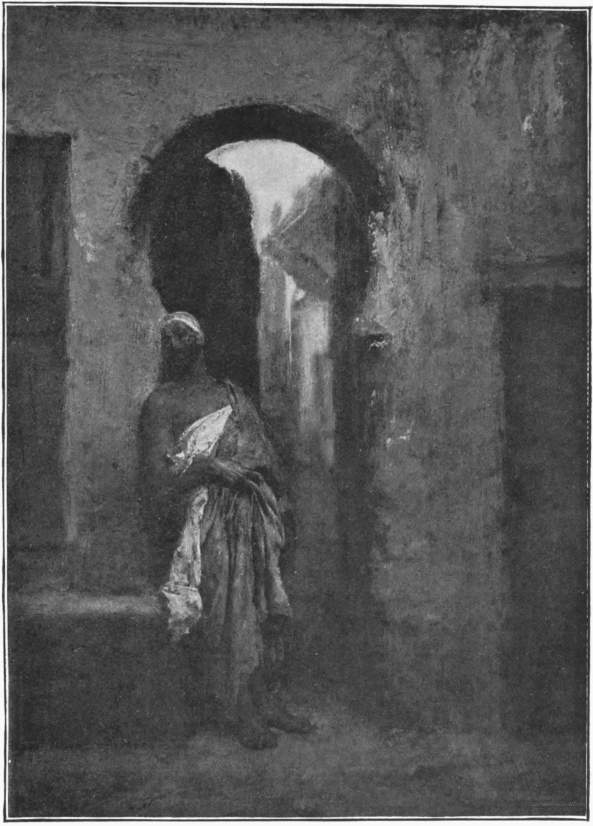
He grew up amid poor surroundings, and when he was twelve years of age he lost his father and mother. His grandfather, an enterprising and adventurous joiner, had made for himself a cabinet of wax figures, which he exhibited from town to town in the province of Tarragona. With his grandson he went on foot through all the towns of Catalonia, the old man showing the wax figures which the boy had painted. Whenever he had a moment free the latter was drawing, carving in wood, or modelling in wax. It chanced, however, that a sculptor saw his attempts, spoke of them in Fortuny’s birthplace, and succeeded in inducing the town to make an allowance of forty-two francs a month to a lad whose talent had so much promise. By these means Fortuny was enabled to attend the Academy of Barcelona for four years. In 1857, when he was nineteen years of age, he received the Prix de Rome, and set out for Rome itself in the same year. But whilst he was copying the pictures of the old masters there a circumstance occurred which set him upon another course. The war between Spain and the Emperor of Morocco determined his future career. Fortuny was then a young man of three-and-twenty, very strong, rather thick-set, quick to resent an injury, taciturn, resolute, and accustomed to hard work. His residence in the East, which lasted from five to six months, was a discovery for him—a feast of delight. He found the opportunity of studying in the immediate neighbourhood a people whose life was opulent in colour and wild in movement; and he beheld with wonder the gleaming pictorial episodes so variously enacted before him, and the rich costumes upon which the radiance of the South glanced in a hundred reflections. And, in particular, when the Emperor of Morocco came with his brilliant suite to sign the treaty of peace, Fortuny developed a feverish activity. The great battle-piece which he should have executed on the commission of the Academy of Barcelona remained unfinished. On the other hand, he painted a series of Oriental pictures, in which his astonishing dexterity and his marvellously sensitive eye were already to be clearly discerned: the stalls of Moorish carpet-sellers, with little figures swarming about them, and the rich display of woven stuffs of the East; the weary attitude of old Arabs sitting in the sun; the sombre, brooding faces of strange snake-charmers and magicians. This is no Parisian East, like Fromentin’s; every one here speaks Arabic. Guillaumet alone, who afterwards interpreted the fakir world of the East, dreamy and contemplative in the sunshine, has been equally convincing.
L’Art.
MARIANO FORTUNY.
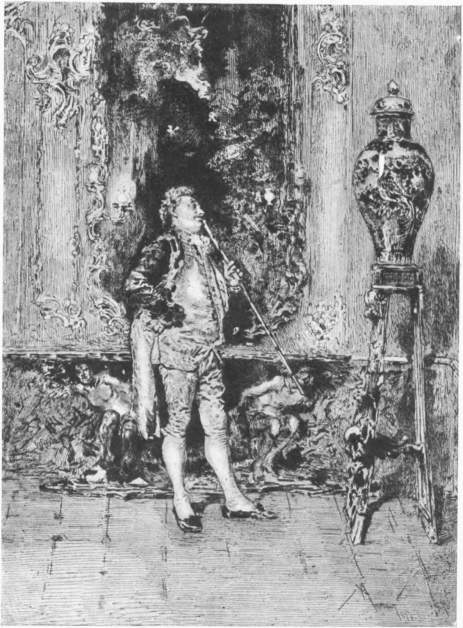
Yet Fortuny first discovered his peculiar province when he began, after his return, to paint those brilliant kaleidoscopic rococo pictures with their charming play of colour, the pictures which founded his reputation in Paris. Even in the earliest, representing gentlemen of the rococo period examining engravings in a richly appointed interior, the Japanese weapons, Renaissance chests, gilded frames of carved wood, and all the delightful petit-riens from the treasury of the past which he had heaped together in it, were so wonderfully painted that Goupil began a connection with him and ordered further works. This commission occasioned his journey, in the autumn of 1866, to Paris, where he entered into Meissonier’s circle, and worked sometimes at Gérôme’s. Yet neither of them exerted any influence upon him at all worth mentioning. The French painter in miniature is probably the father of the department of art to which Fortuny belongs; but the latter united to the delicate execution of the Frenchman the flashing, gleaming spirit of the Latin races of the South. He is a Meissonier with esprit recalling Goya. In his picture “The Spanish Marriage” (La Vicaria) all the vivid, throbbing, rococo world, buried with Goya, revived once more. While in his Oriental pieces—“The Praying Arab,” “The Arabian Fantasia,” and “The Snake Charmers”—he still aimed at concentration and unity of effect, this picture had something gleaming, iridescent and pearly, which soon became the delight of all collectors. Fortuny’s successes, his celebrity, and his fortune dated from that time. His fame flashed forth like a meteor. After fighting long years in vain, not for recognition, but for his very bread, he suddenly became the most honored painter of the day, and began to exert upon a whole generation of young artists that powerful influence which survives even at this very day.
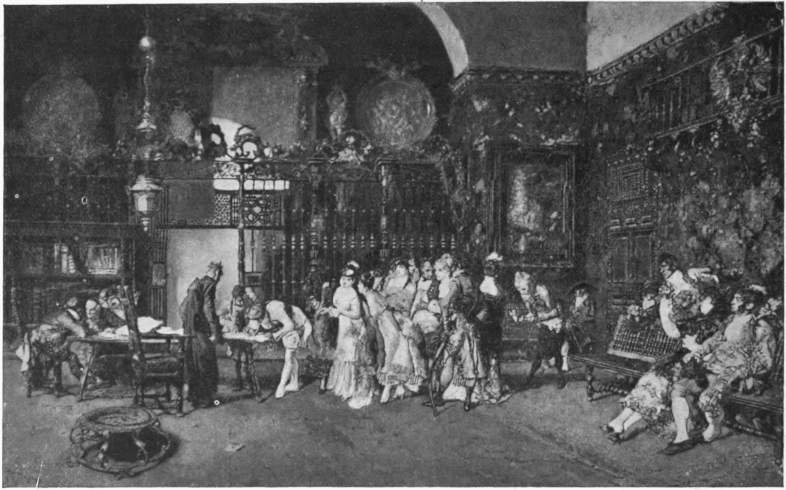
FORTUNY. THE SPANISH MARRIAGE (LA VICARIA).
(By permission of Messrs. Goupil & Co., the owners of the copyright.)
The studio which he built for himself after his marriage with the daughter of Federigo Madrazo in Rome was a little museum of the most exquisite products of the artistic crafts of the West and the East: the walls were decorated with brilliant oriental stuffs, and great glass cabinets with Moorish and Arabian weapons, and old tankards and glasses from Murano stood around. He sought and collected everything that shines and gleams in varying colour. That was his world, and the basis of his art.
Pillars of marble and porphyry, groups of ivory and bronze, lustres of Venetian glass, gilded consoles with small busts, great tables supported by gilded satyrs and inlaid with variegated mosaics, form the surroundings of that astonishing work “The Trial of the Model.” Upon a marble table a young girl is standing naked, posing before a row of academicians in the costume of the Louis XV period, while each one of them gives his judgment by a movement or an expression of the face. One of them has approached quite close, and is examining the little woman through his lorgnette. All the costumes gleam in a thousand hues, which the marble reflects. By his picture “The Poet” or “The Rehearsal” he reached his highest point in the capricious analysis of light. In an old rococo garden, with the brilliant façade of the Alhambra as its background, there is a gathering of gentlemen assembled to witness the rehearsal of a tragedy. The heroine, a tall, charming, luxuriant beauty, has just fallen into a faint. On the other hand, the hero, holding the lady on his right arm, is reading the verses of his part from a large manuscript. The gentlemen are listening, and exchanging remarks with the air of connoisseurs; one of them closes his eyes to listen with thorough attention. Here the entire painting flashes like a rocket, and is as iridescent and brilliant as a peacock’s tail. Fortuny splits the rays of the sun into endless nuances which are scarcely perceptible to the eye, and gives expression to their flashing glitter with astonishing delicacy. Henri Regnault, who visited him at that time in Rome, wrote to a Parisian friend: “The time I spent with Fortuny yesterday is haunting me still. What a magnificent fellow he is! He paints the most marvellous things, and is the master of us all. I wish I could show you the two or three pictures that he has in hand, or his etchings and water-colours. They inspired me with a real disgust of my own. Ah! Fortuny, you spoil my sleep.”
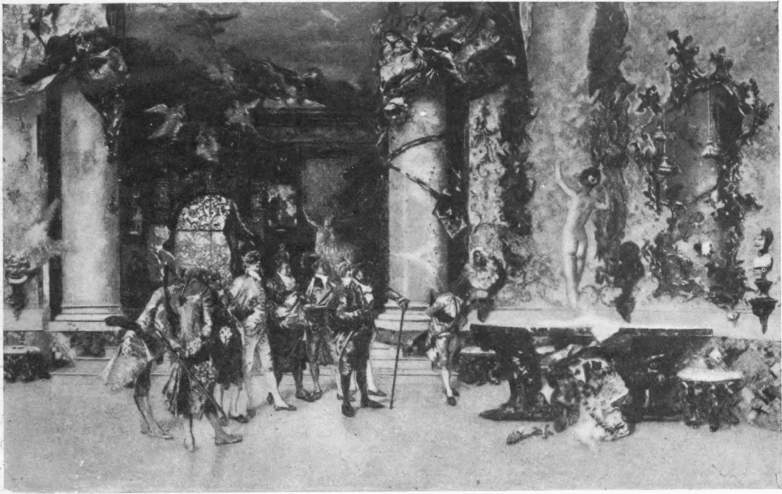
FORTUNY. THE TRIAL OF THE MODEL.
(By permission of Messrs. Boussod, Valadon & Co., the owners of the copyright.)
Even as an etcher he caught all the technical finesses and appetising piquancies of his great forerunner Goya. It is only with very light and spirited strokes that the outlines of his figures are drawn; then, as in Goya, comes the aquatint, the colour which covers the background and gives locality, depth, and light. A few scratches with a needle, a black spot, a light made by a judiciously inserted patch of white, and he gives his figures life and character, causing them to emerge from the black depth of the background like mysterious visions. “The Dead Arab,” covered with his black cloak, and lying on the ground with his musket on his arm, “The Shepherd” on the stump of a pillar, “The Serenade,” “The Reader,” “The Tambourine Player,” “The Pensioner,” the picture of the gentleman with a pig-tail bending over his flowers, “The Anchorite,” and “The Arab mourning over the Body of his Friend,” are the most important of his plates, which are sometimes pungent and spirited, and sometimes sombre and fantastic.
In the picture “The Strand of Portici” he attempted to strike out a new path. He was tired of the gay rags of the eighteenth century, as he said himself, and meant to paint for the future only subjects from surrounding life in an entirely modern manner like that of Manet. But he was not destined to carry out this change any further. He passed away in Rome on 21st November 1874. When the unsold works which he left were put up to auction the smallest sketches fetched high figures, and even his etchings were bought at marvellous prices.
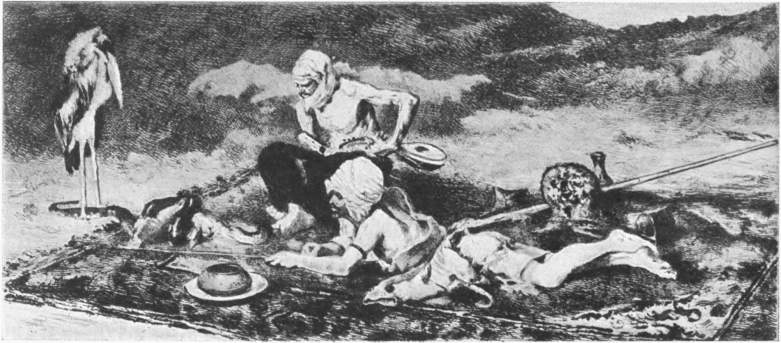
Gaz. des Beaux-Arts.
FORTUNY. THE SNAKE CHARMERS.
In these days the enthusiasm for Fortuny is no longer so glowing. The capacity to paint became so ordinary in the course of years that it was presupposed as a matter of course; it was a necessary acquirement for an artist to have before approaching his pictures in a psychological fashion. And in this later respect there is a deficiency in Fortuny. He is a charmeur who dazzles the eyes, but rather creates a sense of astonishment than holds the spectator in his grip. Beneath his hands painting has become a matter of pure virtuosity, a marvellous, flaring firework that amazes and—leaves us cold after all. With enchanting delicacy he runs through the brilliant gamut of radiant colours upon the small keyboard of his little pictures painted with a pocket-lens, and everything glitters golden, like the dress of a fairy. He united to the patience of Meissonier a delicacy of colour, a wealth of pictorial point, and a crowd of delightful trifles, which combine to make him a most exquisite and fascinating juggler of the palette—an amazing colourist, a wonderful clown, an original and subtle painter with vibrating nerves, but not a truly great and moving artist. His pictures are dainties in gold frames, jewels delicately set, astonishing efforts of patience lit up by a flashing, rocket-like esprit; but beneath the glittering surface one is conscious of there being neither heart nor soul. His art might have been French or Italian, just as appropriately as Spanish. It is the art of virtuosi of the brush, and Fortuny himself is the initiator of a religion which found its enthusiastic followers, not in Madrid alone, but in Naples, Paris, and Rome.
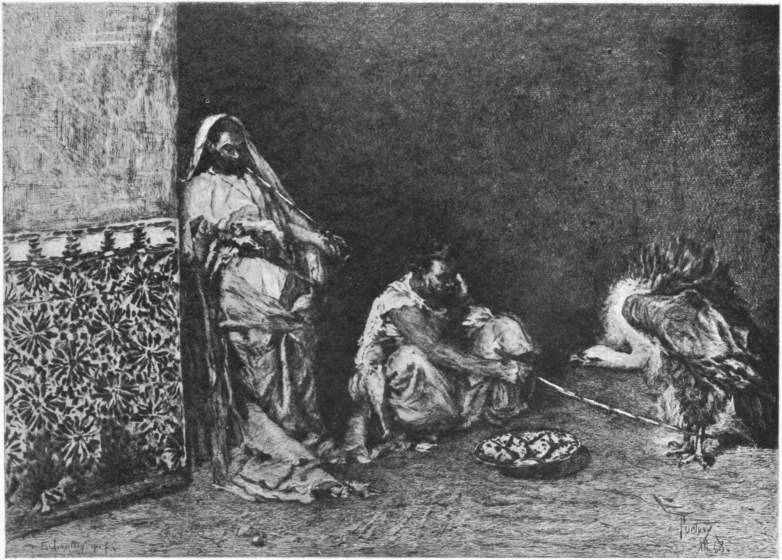
L’Art.
FORTUNY. MOORS PLAYING WITH A VULTURE.
Yet Spanish painting, so far as it is individual, works even now upon the lines of Fortuny. After his death it divided into two streams. The official endeavour of the academies was to keep the grand historical painting in flower, in accord with the proud programme announced by Francisco Tubino in his brochure, The Renaissance of Spanish Art. “Our contemporary artists,” he writes, “fill all civilised Europe with their fame, and are the object of admiration on the far side of the Atlantic. We have a peculiar school of our own with a hundred teachers, and it shuns comparison with no school in any other country. At home the Academy of the Fine Arts watches over the progress of painting; it has perfected the laws by which our Academy in Rome is guided, the Academy in the proud possession of Spain, and situated so splendidly upon the Janiculum. In Madrid there is a succession of biennial exhibitions, and there is no deficiency in prizes nor in purchases. Spanish painting does not merely adorn the citizen’s house or the boudoir of the fair sex with easel-pieces; by its productions it recalls the great episodes of popular history, which are able to excite men to glorious deeds. Austere, like our national character, it forbids fine taste to descend to the painting of anything indecorous. Before everything we want grand paintings for our galleries; the commercial spirit is no master of ours. In such a way the glory of Zurburan, Murillo, and Velasquez lives once more in a new sense.”
L’Art.
FORTUNY. THE CHINA VASE.
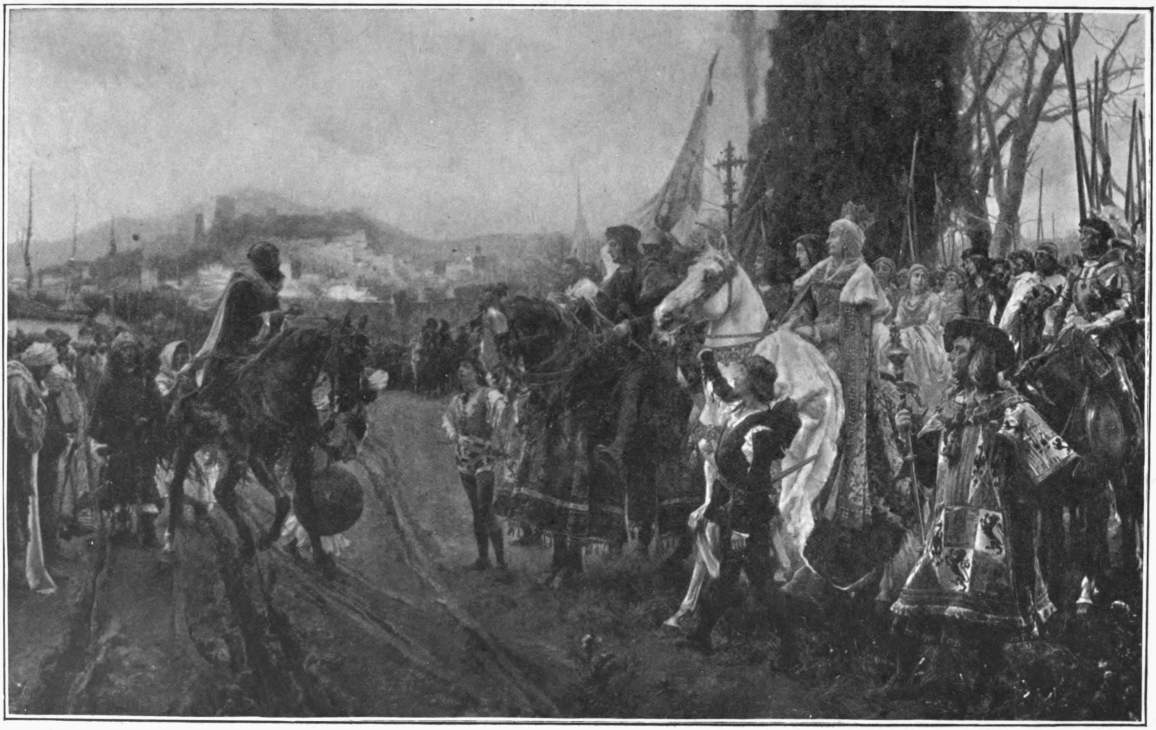
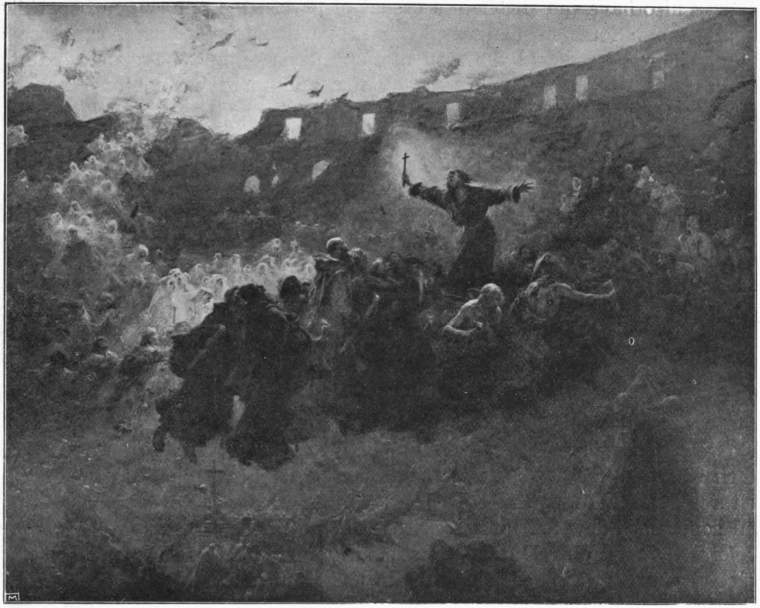
The results of such efforts were those historical pictures which at the Paris World Exhibition of 1878, the Munich International Exhibition of 1883, and at every large exhibition since have been so exceedingly refreshing to all admirers of the illustration of history upon ground that was genuinely Spanish. At the Paris World Exhibition of 1878 Pradilla’s “Joan the Mad” received the large gold medal, and was, indeed, a good picture in the manner of Laurens. Philip the Fair is dead. The funeral train, paying him the last honours, has come to a halt upon a high-road, and the unhappy princess rushes up with floating hair and staring eyes fixed upon the bier which hides the remains of her husband. The priests and women kneeling around regard the unfortunate mad woman with mournful pity. To the right the members of the Court are grouped near a little chapel where a priest is celebrating a mass for the dead; to the left the peasantry are crowding round to witness the ceremony. Great wax candles are burning, and the chapel is lit up with the sombre glow of torches. This was all exceedingly well painted, carefully balanced in composition, and graceful in drawing. At the Munich Exhibition of 1883 he received a gold medal for his “Surrender of Granada, 1492,” a picture which made a great impression at the time upon the German historical painters, as Pradilla had made a transition from the brown bituminous painting of Laurens to a “modern” painting in grey, which did more justice to the illumination of objects beneath the open sky. In the same year Casado’s large painting, “The Bells of Huesca,” with the ground streaming with blood, fifteen decapitated bodies, and as many bodiless heads, was a creation which was widely admired. Vera had exhibited his picture, filled with wild fire and pathos, “The Defence of Numantia,” and Manuel Ramirez his “Execution of Don Alvaro de Luna,” with the pallid head which has rolled from the steps and stares at the spectator in such a ghastly manner. In his “Conversion of the Duke of Gandia,” Moreno Carbonero displayed an open coffin à la Laurens: as Grand Equerry to the Empress Isabella at the Court of Charles V, the Duke of Gandia, after the death of his mistress, has to superintend the burial of her corpse in the vault at Granada, and as the coffin is opened there, to confirm the identity of the person, the distorted features of the dead make such a powerful impression upon the careless noble that he takes a vow to devote himself to God. Ricardo Villodas in his picture “Victoribus Gloria” represents the beginning of one of those sea-battles which Augustus made gladiators fight for the amusement of the Roman people. By Antonio Casanova y Estorach there was a picture of King Ferdinand the Holy, who upon Maundy Thursday is washing the feet of eleven poor old men and giving them food. And a special sensation was made by the great ghost picture of Benliure y Gil, which he named “A Vision in the Colosseum.” Saint Almaquio, who was slain, according to tradition, by gladiators in the Colosseum, is seen floating in the air, as he swings in fanatical ecstasy a crucifix from which light is streaming. Upon one side men who have borne witness to Christianity with their blood chant their hymns of praise; upon the other, troops of female martyrs clothed in white and holding tapers in their hands move by; but below, the earth has opened, and the dead rise for the celebration of this midnight service, praying from their graves, while the full moon shines through the apertures of the ruins and pours its pale light upon the phantom congregation. There was exhibited by Checa “A Barbarian Onset,” a Gallic horde of riders thundering past a Roman temple, from which the priestesses are flying in desperation. Francisco Amerigo treated upon a huge canvas a scene from the sacking of Rome in 1527, when the despoiling troops of Charles V plundered the Eternal City. “Soldiers intoxicated with wine and lust, tricked out with bishops’ mitres and wrapped in the robes of priests, are desecrating the temples of God. Nunneries are violated, and fathers kill their daughters to save them from shame.” So ran the historical explanation set upon the broad gold frame.
Cassell & Co.
FORTUNY. AT THE GATE OF THE SERAGLIO.
But, after all, these historical pictures, in spite of their great spaces of canvas, are of no consequence when one comes to characterise the efforts of modern art. Explanations could be given showing that in the land of bull-fights this painting of horrors maintained itself longer than elsewhere, but the hopes of those who prophesied from it a new golden period for historical painting were entirely disappointed. For Spanish art, as in earlier days for French art, the historical picture has merely the importance implied by the Prix de Rome. A method of colouring which is often dazzling in result, and a vigorous study of nature, preserved from the danger of “beautiful” tinting, make the Spanish works different from the older ones. Their very passion often has an effect which is genuine, brutal, and of telling power. In the best of these pictures one believes that a wild temperament really does burst into flame through the accepted convention that the painters have delight in the horrible, which the older French artists resorted to merely for the purpose of preparing veritable tableaux. But in the rank and file, in place of the Southern vividness of expression which has been sincerely felt, histrionic pose is the predominant element, the petty situation of the stage set upon a gigantic canvas, and in addition to this a straining after effect which grazes the boundary line where the horrible degenerates into the ridiculous. Through their extraordinary ability they all compel respect, but they have not enriched the treasury of modern emotion, nor have they transformed the older historical painting in the essence of its being. And the man who handles again and again motives derived from what happens to be the mode in colours renders no service to art. Delaroche is dead; but though he may be disinterred he cannot be brought to life, and the Spaniards merely dug out of the earth mummies in which the breath of life was wanting. Their works are not directing-posts to the future, but the last revenants of that histrionic spirit which wandered like a ghost through the art of all nations. Even the composition, the shining colours, the settles and carpets picturesquely spread upon the ground, are the same as in Gallait. How often have these precious stage properties done duty in tragic funereal service since Delaroche’s “Murder of the Duke of Guise” and Piloty’s “Seni”!
Hanfstaengl.
PRADILLA. THE SURRENDER OF GRANADA.
Kunst unserer Zeit.
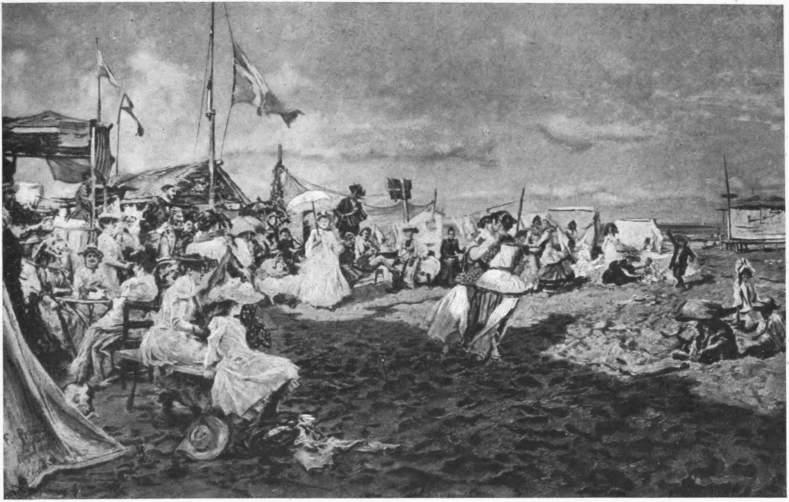
PRADILLA. ON THE BEACH.
And these conceptions, nourished upon historical painting, had an injurious influence upon the handling of the modern picture of the period. Even here there is an endeavour to make a compromise with the traditional historic picture, since artists painted scenes from modern popular life upon great spaces of canvas, transforming them into pageants or pictures of tragical ceremonies, and sought too much after subjects with which the splendid and motley colours of historical painting would accord. Viniegra y Lasso and Mas y Fondevilla execute great processions filing past, with bishops, monks, priests, and choristers. All the figures stand beaming in brightness against the sky, but the light glances from the oily mantles of the figures without real effect. Alcazar Tejedor paints a young priest reading his “First Mass” in the presence of his parents, and merely renders a theatrical scene in modern costume, merely transfers to an event of the present that familiar “moment of highest excitement” so popular since the time of Delaroche. By his “Death of the Matador,” and “The Christening,” bought by Vanderbilt for a hundred and fifty thousand francs, José Villegas, in ability the most striking of them all, acquired a European name; whilst a hospital scene by Luis Jimenez of Seville is the single picture in which something of the seriousness of French Naturalism is perceptible, but it is an isolated example from a province of interest which is otherwise not to be found in Spain.
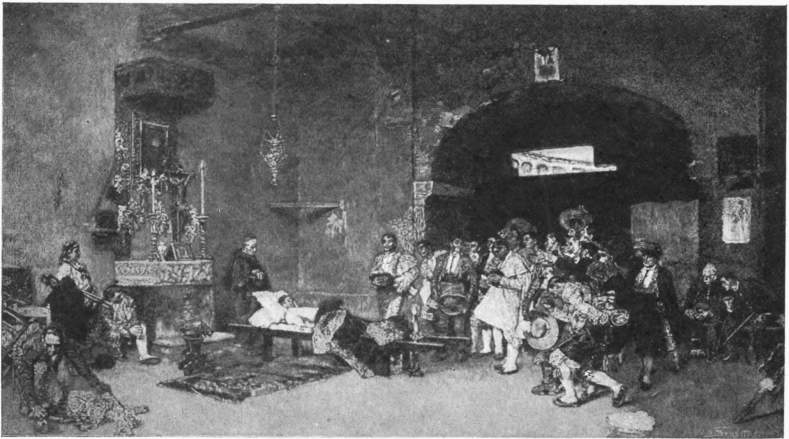
VILLEGAS. DEATH OF THE MATADOR.
Indeed, the Spaniards are by no means most attractive in gravely ceremonial and stiffly dignified pictures, but rather when they indulge in unpretentious “little painting” in the manner of Fortuny. Yet even these wayward “little painters,” with their varied glancing colour, are not to be properly reckoned amongst the moderns. Their painting is an art dependent on deftness of hand, and knows no higher aim than to bring together in a picture as many brilliant things as possible, to make a charming bouquet with glistening effects of costume, and the play, the reflections, and the caprices of sunbeams. The earnest modern art which sprang from Manet and the Fontainebleau painters avoids this kaleidoscopic sport with varied spots of colour. All these little folds and mouldings, these prismatic arts of blending, and these curious reflections are what the moderns have no desire to see: they half close their eyes to gain a clearer conception of the chief values; they simplify; they refuse to be led from the main point by a thousand trifles. Their pictures are works of art, while those of the disciples of Fortuny are sleights of artifice. In all this bric-à-brac art there is no question of any earnest analysis of light. The motley spots of colour yield, no doubt, a certain concord of their own; but there is a want of tone and air, a want of all finer sentiment: everything seems to have been dyed, instead of giving the effect of colour. Nevertheless those who were independent enough not to let themselves be entirely bewitched by the deceptive adroitness of a conjurer have painted little pictures of talent and refinement; taking Fortuny’s rococo works as their starting-point, they have represented the fashionable world and the highly coloured and warm-blooded life of the people of modern Spain with a bold and spirited facility. But they have not gone beyond the observation of the external sides of life. They can show guitarreros clattering with castanets and pandarets, majas dancing, and ribboned heroes conquering bulls instead of Jews and Moors. Yet their pictures are at any rate blithe, full of colour, flashing with sensuous brilliancy, and at times they are executed with stupendous skill.
Hanfstaengl.
BENLIURE Y GIL. A VISION IN THE COLOSSEUM.
Martin Rico was for the longest period in Italy with Fortuny, and his pictures also have the glitter of a casket of jewels, the pungency of sparkling champagne. Some of his sea-pieces in particular—for instance, those of the canal in Venice and the Bay of Fontarabia—might have been painted by Fortuny. In others he seems quieter and more harmonious than the latter. His execution is more powerful, less marked by spirited stippling, and his light gains in intensity and atmospheric refinement what it loses in mocking caprices, while his little figures have a more animated effect, notwithstanding the less piquant manner in which they are painted. Their outlines are scarcely perceptible, and yet they are seen walking, jostling, and pressing against each other; whereas those of Fortuny, precisely through the more subtle and microscopic method in which they have been executed, often seem as though they were benumbed in movement. Certain market scenes, with a dense crowd of buyers and sellers, are peculiarly spirited, rapid sketches, with a gleaming charm of colour.
Zamacois, Casanova, and Raimundo de Madrazo, Fortuny’s brother-in-law, show no less virtuosity of the palette. Sea-pieces and little landscapes alternate with scenes from Spanish popular life, where they revel, like Fortuny, in a scintillating medley of colour. Later, in Paris, Madrazo was likewise much sought after as a painter of ladies’ portraits, as he lavished on his pictures sometimes a fine hautgoût of fragrant rococo grace a la Chaplin, and sometimes devoted himself with taste and deftness to symphonic tours de force à la Carolus Duran. Particularly memorable is the portrait of a graceful young girl in red, exhibited in the Munich Exhibition of 1883. She is seated upon a sofa of crimson silk, and her feet rest upon a dark red carpet. Equally memorable in the Paris World Exhibition of 1889 was a pierrette, whose costume ran through the whole gamut from white to rose-colour. Her skirt was of a darker, her bodice of a brighter red, and a light rose-coloured stocking peeped from beneath a grey silk petticoat; over her shoulders lay a white swansdown cape, and white gloves and white silk shoes with rose-coloured bows completed her toilette. His greatest picture represented “The End of a Masked Ball.” Before the Paris Opera cabs are waiting with coachmen sleeping or smoking, whilst a troop of pierrots and pierrettes, harlequins, Japanese girls, rococo gentlemen, and Turkish women are streaming out, sparkling with the most glittering colours in the grey light of a winter morning, in which the gas lamps cast a warm yellow glimmer.
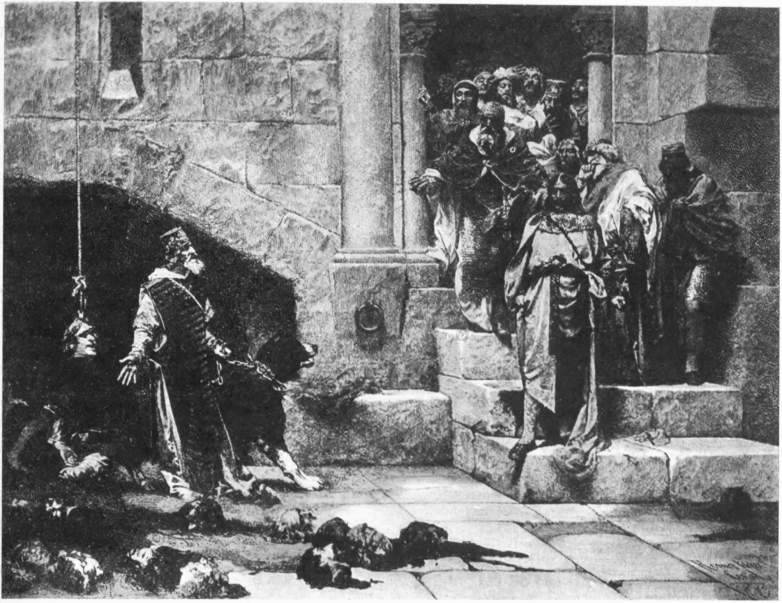
CASADO. THE BELLS OF HUESCA.
Even those who made their chief success as historical painters became new beings when they came forward with such piquant “little paintings.” Francisco Domingo in Valencia is the Spanish Meissonier, who has painted little horsemen before an inn, mercenary soldiers, newspaper readers, and philosophers of the time of Louis XV, with all the daintiness in colour associated with the French patriarch—although a huge canvas, “The Last Day of Sagunt,” has the reputation of being his chief performance. In the year in which he exhibited his “Vision in the Colosseum,” Benliure y Gil made a success with two little pictures stippled in varied colours, the “Month of Mary” and the “Distribution of Prizes in Valencia,” in which children, smartened and dressed in white frocks, are moving in the ante-chambers of a church, decorated for the occasion. Casado, painter of the sanguinary tragedy of Huesca, showed himself an admirable little master full of elegance and grace in “The Bull-Fighter’s Reward,” a small eighteenth-century picture. The master of the great hospital picture, Jimenez, took the world by surprise at the very same time by a “Capuchin Friar’s Sermon before the Cathedral of Seville,” which flashed with colour. Emilio Sala y Francés, whose historical masterpiece was the “Expulsion of the Jews from Spain in 1493,” delights elsewhere in spring, Southern gardens with luxuriant vegetation, and delicate rococo ladies, holding up their skirts filled with blooming roses, or gathering wild flowers among the grass. Antonio Fabrés was led to the East by the influence of Regnault, and excited attention by his aquarelles and studies in pen and ink, in which he represented Oriental and Roman street figures with astonishing adroitness. But the ne plus ultra is attained by the bold and winning art of Pradilla, which is like a thing shot out of a pistol. He is the greatest product of contemporary Spain, a man with a talent for improvisation as ingenious as it was free, who treated with equal facility the most varied subjects. In the bold and spirited decorations with which he embellished Spanish palaces he sported with nymphs and Loves and floating genii à la Tiepolo. All the grace of the rococo period is cast over his works in the Palais Murga in Madrid. The figures join each other with ease—coquettish nymphs swaying upon boughs, and audacious “Putti” tumbling over backwards in quaint games. Nowhere is there academic sobriety, and everywhere life, pictorial inspiration, the intoxicating joyousness of a fancy creating without effort and revelling in the festal delight of the senses. In the accompanying wall pictures he revived the age of the troubadours, of languishing love-song and knightly romance free from the burden of thought, in tenderly graceful and fluent figures. And this same painter, who filled these huge spaces of wall, lightly dallying with subjects from the world of fable, seems another man when he grasps fragments from the life of our own age in pithy inspirations sure in achievement. His historical pictures are works which compel respect; but those paintings on the most diminutive scale, in which he represented scenes from the Roman carnival and the life in Spanish camps, the shore of the sea and the joy of a popular merry-making with countless figures of the most intense vividness, carried out with an unrivalled execution of detail which is yet free from anything laboured, and full of splendour and glowing colour,—these, indeed, are performances of painting beside which as a musical counterpart at best Paganini’s variations on the G string are comparable—sleights of art of which only Pradilla was capable, and such as only Fortuny painted forty years ago.
Two masters who do not live at home, but in France, have followed still further the modern development of art with great power. The first is Zuloaga. The pictures of this artist have something truly Spanish, something that one as an admirer of Goya looks for eagerly in Spanish pictures. At the first glance the eye receives rather a shock. One seeks in vain for delicate painting of light in Zuloaga, or exquisite harmonies of colour. He places the crudest reds and yellows next to each other, strong, almost brutal, like a poster. With an uncompromising love of truth he paints the rouge-smeared cheeks and blackened eyebrows of his women-about-town, does not even try to make their movements graceful or give their costumes a touch of modish smartness. But what a breadth of conception! With what daring he sweeps his bold strokes over the picture! It is just because he avoids all flattery, because he brings nothing foreign, nothing cosmopolitan into his exclusive world, that the characteristics of Spanish life are mirrored with such truth in his works. Especially in his portrait of the popular poet, Don Miguel de Segovia, the whole picture is suffused with a rare Don Quixote feeling. Velasquez’ Pablillas stands before you reincarnated. It is interesting, too, that Zuloaga, though in France, remains still a Spaniard. Even when he paints Parisiennes he translates toilette and gesture into grandiose Spanish style.
The influence of the French school is much more marked in the second of these Spanish masters, Hermen Anglada. He has come to the front in the exhibitions of the last few years. Besnard has given him much of his refined epicurism, and this French hautgoût lends his pictures a charm which is altogether their own. If you are seeking for unusual and quaint effects you will find them in this Spaniard, who paints pale, colourless women in the most astonishing costumes, places them in the midst of sensuous, misty landscapes, and gives you a glistening potpourri of colours. But Anglada’s work is in itself the best testimony to the fact that the Spain of to-day is getting worn-out and bloodless. There is something senile and sapless in this over-refined art that takes pleasure in nothing but the most extraordinary nuances, and that needs something very unusual to tickle its nerves.
CHAPTER XXXVI
ITALY
Italy has played a very different part from that of Spain in the development of modern art. Even at the World Exhibition of 1855 Edmond About called Italy “the grave of painting” in his Voyage à travers l’Exposition des Beaux-Arts. He mentions a few Piedmontese professors, but about Florence, Naples, and Rome he found nothing to say. The Great Exhibition of 1862 in England was productive of no more favourable criticism, for W. Bürger’s account is as little consolatory as About’s. “Renowned Italy and proud Spain,” writes Burger, “have no longer any painters who can rival those of other schools. There is nothing to be said about the rooms where the Italians, Spanish, and Swiss are exhibited.” To-day there are in Italy a great number of vigorous painters. In Angelo de Gubernati’s lexicon of artists there are over two thousand names, some of which are favourably known in other countries also. But the mass dwindles to a tiny heap if those only are included who have risen from the level of dexterous picture-makers to that of painters of real importance in the world of art.
Whether it be from direct influence or similarity of origin, Fortuny has found his ablest successors amongst the Neapolitan artists. As early as the seventeenth century the school of painting there was very different from those in the rest of Italy; the Greek blood of the population and the wild, romantic scenery of the Abruzzi gave it a peculiar stamp. Southern brio, the joy of life, colour, and warmth, in contrast with the noble Roman ideal of form, were the qualities of Salvator Rosa, Luca Giordano, and Ribera, bold and fiery spirits. And a breath of such power seems to live in their descendants still. Even now Neapolitan painting sings, dances, and laughs in a bacchanal of colour, pleasure, delight in life, and glowing sunshine.
Kunst für Alle.
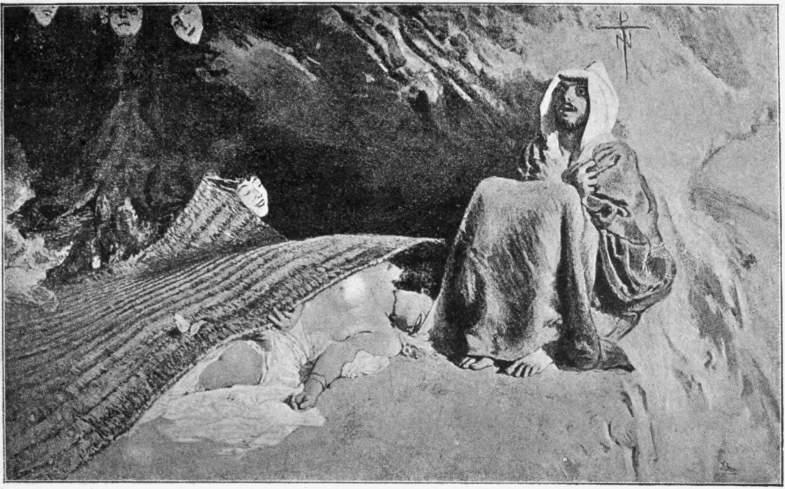
MORELLI. THE TEMPTATION OF ST. ANTHONY.
A wild and restless spirit, Domenico Morelli, whose biography is like a chapter from Rinaldo Rinaldini, is the head of this Neapolitan school. He was born on 4th August, 1826, and in his youth he is said to have been, first a pupil in a seminary of priests, then an apprentice with a mechanician, and for some time even facchino. He never saw such a thing as an academy. Indeed, it was a Bohemian life that he led, making his meals of bread and cheese, wandering for weeks together with Byron’s poems in his pocket upon the seashore between Posilippo and Baiæ. In 1848 he fought against King Ferdinand, and was left severely wounded on the battle-field. After these episodes of youth he first became a painter, beginning his career in 1855 with the large picture “The Iconoclasts,” followed in 1857 by a “Tasso,” and in 1858 by a “Saul and David.” Biblical pictures remained his province even later, and he was the only artist in Italy who handled these subjects from an entirely novel point of view, pouring into them a peculiarly exalted and imaginative spirit. A Madonna rocking her sleeping Child, whilst her song is accompanied by a legion of cherubs playing upon instruments, “The Reviling of Christ,” “The Ascension,” “The Descent from the Cross,” “Christ walking on the Sea,” “The Raising of the Daughter of Jairus,” “The Expulsion of the Money-Changers from the Temple,” “The Marys at the Grave,” “Salve Regina,” and “Mary Magdalene meeting Christ risen from the Grave,” are the principal stages of his great Christian epic, and in their imaginative naturalism a new revolutionary language finds utterance through all these pictures. There is in them at times something of the mystical quietude of the East, and at times something of the passionate breath of Eugène Delacroix. In these pictures he revealed himself as a true child of the land of the sun, a lover of painting which scintillates and flickers. As yet hard, ponderous, dark, and plastic in “The Iconoclasts,” he was a worshipper of light and resplendent in colour in the “Mary Magdalene.” “The Temptation of St. Anthony” probably marks the summit of his creative power in the matter of colour. Morelli has conceived the whole temptation as a hallucination. The saint squats upon the ground, claws with his fingers, and with fixed gaze tries to stifle thoughts, full of craving sensuality, which are flaming in him. Yet they throng ever more thickly, take shape ever more distinctly, are transformed into red-haired women who detach themselves from corners upon all sides. They rise from beneath the matting, wind nearer from the depth of the cavern; even the breeze that caresses the fevered brow of the tormented man changes into the head of a girl pressing her kisses upon him. Only Naples could produce an artist at once so bizarre, so many-sided and incoherent, so opulent and strange. Younger men of talent trooped around him. A fiery spirit, haughty and independent, he became the teacher of all the younger generation. He led them to behold the sun and the sea, to marvel at nature in her radiant brightness. Through him the joy in light and colour came into Neapolitan painting, that rejoicing in colour which touches such laughing concords in the works of his pupil Paolo Michetti.
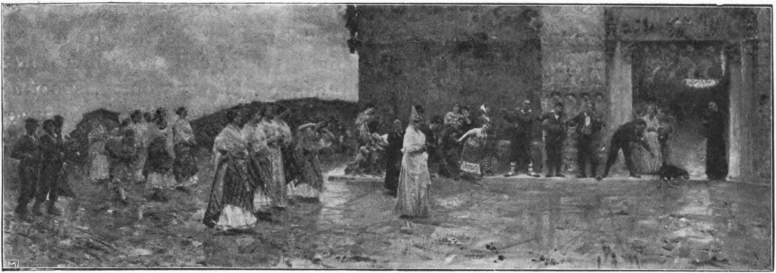
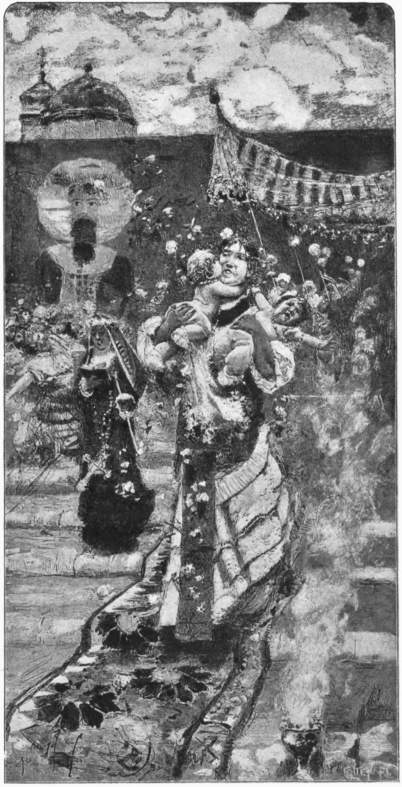
A man of bold and magnificent talent, the genuine product of the wild Abruzzi, Michetti was the son of a day-labourer, like Morelli. However, a man of position became the protector of the boy, who was early left an orphan. But neither at the Academy at Naples nor in Paris and London did this continue long. As early as 1876 he was back in Naples, and settled amid the Abruzzi, close to the Adriatic, in Francavilla à Mare, near Ostona, a little nest which the traveller passes just before he goes on board the Oriental steamer at Brindisi. Here he lives out of touch with old pictures, in the thick of the vigorous life of the Italian people. In 1877 he painted the work which laid the foundation of his celebrity, “The Corpus Domini Procession at Chieti,” a picture which rose like a firework in its boisterous, exhilarating medley of bright colours. The procession is seen just coming out of church: men, women, naked children, monks, priests, a canopy, choristers with censers, old men and youths, people who kneel and people who laugh, the mist of incense, the beams of the sun, flowers scattered on the ground, a band of musicians, and a church façade with rich and many-coloured ornaments. There is the play of variously hued silk, and colours sparkle in all the tints of the prism. Everything laughs, the faces and the costumes, the flowers and the sunbeams. Following upon this came a picture which he called “Spring and the Loves.” It represented a desolate promontory in the blue sea, and upon it a troop of Cupids, playing round a hawthorn bush in full flower, are scuffling, buffeting each other, and leaping as riotously as Neapolitan street-boys. Some were arrayed like little Japanese, some like Grecian terra-cotta figures, whilst a marble bridge in the neighbourhood shone in indigo blue. The whole picture gleamed with red, blue, green, and yellow patches of colour: a serpentine dance painted twelve years before the appearance of Loie Fuller. Then again he painted the sea. It is noon, and the sultry heat broods over the azure tide. Naked fishermen are standing in it, and on the shore gaily dressed women are searching for mussels; whilst, in the background, vessels with the sun playing on their sails are mirrored brightly in the water. Or the moon rises casting greenish reflections upon the body of Christ, which shines like phosphorus as it is being taken from the cross: or there is a flowery landscape upon a summer evening; birds are settling down for the night, and little angels are kissing each other and laughing. In all these pictures Michetti showed himself an improviser of astonishing dexterity, solving every difficulty as though it were child’s play, and shedding a brilliant colour over everything—a man to whom “painting” was as much a matter of course as orthography is to ourselves. Even the Paris World Exhibition of 1878 made him celebrated as an artist, and from that time his name was to the Italian ear a symbol for something new, unexpected, wild, and extravagant. The word “Michetti” means splendid materials, dazzling flesh-tones, conflicting hues set with intention beside each other, the luxuriant bodies of women basking in heat and sun, fantastic landscapes created in the mad brain of the artist, strange and curious frames, and village idylls in the glowing blaze of the sun. There are no lifeless spots in his works; every whim of his takes shape, as if by sorcery, in splendid figures.
Hanfstaengl.
MICHETTI. GOING TO CHURCH.
Kunst für Alle.
MICHETTI. THE CORPUS DOMINI PROCESSION AT CHIETI.
Another pupil of Morelli, Edoardo Dalbono, completed his duty to history by a scene of horror à la Laurens, “The Excommunication of King Manfred,” and then became the painter of the Bay of Naples. “The Isle of Sirens” was the first production of his able, appetising, and nervously vibrating brush. There is a steep cliff dropping sheer into the blue sea. Two antique craft are drawing near, the crews taking no heed of the reefs and sandbanks. With phantomlike gesture the naked women stretch out their arms beckoning, embodiments as they are of the deadly beautiful and voluptuously cruel ocean. By degrees the sea betrayed to him all its secrets—its strangest combinations of colour and atmospheric effects, its transparency, and its eternally shifting phases of ebb and flow. He has painted the Bay of Naples under bright, hot noon and the gloom of night, in the purple light of the sinking sun and in the strange and many-coloured mood of twilight. At one moment it shines and plays variegated and joyous in blue, grass-green, and violet tones; at another it seems to glitter with millions of phosphorescent sparks: the rosy clouds of the sky are glassed in it, and the lights of the houses irregularly dotted over abrupt mountain-chains or the dark-red glow of lava luridly shining from Vesuvius. Now and then he painted scenes from Neapolitan street-life—old, weather-beaten seamen, young sailors with features as sharply cut as if cast in bronze, beautiful, fiery, brown women, shooting the hot Southern flame from their eyes, houses painted white or orange-yellow, with the sun glittering on the windows. The “Voto alla Madonna del Carmine” was the most comprehensive of these Southern pictures. Everything shines in joyous blue, yellowish-green, and red colours. Warmth, life, light, brilliancy, and laughter are the elements on which his art is based.
Alceste Campriani, Giacomo di Chirico, Rubens Santoro, Federigo Cortese, Francesco Netti, Edoardo Toffano, Giuseppe de Nigris have, all of them, this kaleidoscopic sparkle, this method of painting which gives pictures the appearance of being mosaics of precious stones. As in the days of the Renaissance, the Church is usually the scene of action, though not any longer as the house of God, but as the background of a many-coloured throng. As a rule these pictures contain a crowd of canopies, priests, and choristers, and country-folk, bowing or kneeling when the host is carried by, or weddings, horse-races, and country festivals; and everything is vivid and joyous in colour, saturated with the glowing sun of Naples. Alceste Campriani’s chief work was entitled “The Return from Montevergine.” Carriages and open rack-waggons are dashing along, the horses snorting and the drivers smacking their whips, while the peasants, who have had their fill of sweet wine, are shouting and singing, and the orange-sellers in the street are crying their goods. A coquettish glancing light plays over the gay costumes, and the white dust sparkles like fluid silver, as it rises beneath the hoofs of the horses wildly plunging forward. The leading work of Giacomo di Chirico, who became mad in 1883, was “A Wedding in the Basilicata.” It represents a motley crowd. The entire village has set out to see the ceremony. The wedding guests are descending the church steps to the square, which is decked out with coloured carpets and strewn with flowers. Triumphal arches have been set up, and the pictures of the Madonna are hung with garlands. Meanwhile the sindaco gives his arm to the bride, beneath whose gay costume a charmingly graceful little foot is peeping out. Then the bridegroom follows with the sindaco’s wife. All the village girls are looking on with curiosity, and the musicians are playing. Winter has covered the square with a white cloak of snow; yet the sunbeams sport over it, making it shine vividly with a thousand reflections.
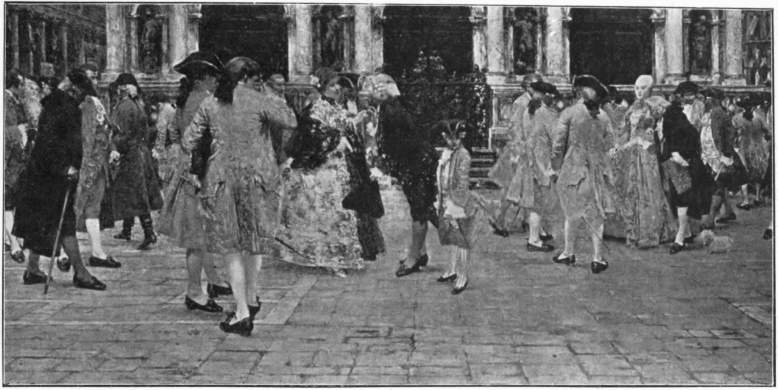
Hanfstaengl.
FAVRETTO. ON THE PIAZZETTA.
Of course, the derivation of all these pictures is easily recognisable. Almost all the Neapolitan painters studied at Fortuny’s in the seventies in Rome, and when they came home again they perceived that the life of the people offered themes which had a coquettish fitness in Fortuny’s scale of tones. From the variously coloured magnificence of old churches, the red robes of ecclesiastics, the gaudy splendour of the country-people’s clothes, and the gay glory of rags amongst the Neapolitan children, they composed a modern rococo, rejoicing in colour, whilst the Spaniard had fled to the past to attain his gleaming effects.
A great number of the Italians do the same even now. In numerous costume pictures, from the seventeenth and eighteenth centuries, flashing with silk and velvet, the Southerner’s bright pleasure in colour still loves to celebrate its orgies. Gay trains rustle, rosy Loves laugh down from the walls, Venetian chandeliers shed their radiance; no other epoch in history enables the painter with so much ease to produce such an efflorescence of full-toned chords of colour. With his shining glow of hue the delectable and spirited Favretto (who, like Fortuny, entered the world of art as a victor, and, like him again, was snatched from it when barely thirty-seven, after a brief and brilliant career) stands at the head of this group. The child of poor parents, indeed the son of a joiner, he was born in Venice in 1849, and, like the Spaniard, passed a youth which was full of privations. But all the cares of existence, even the loss of an eye, did not hinder him from seeing objects under a laughing brightness of colour. Through his studies and the bent of his fancy he had come to be no less at home in the Venice of the eighteenth century than in that of his own time. This Venice of Francesco Guardi, this city of enchantment surrounded with the gleam of olden splendour, the scene of rich and brilliantly coloured banquets and a graceful and modish society, rose once more under Favretto’s hands in fabulous beauty. What brio of technique, what harmony of colours, were to be found in the picture “Un Incontro,” the charming scene upon the Rialto Bridge, with the bowing cavalier and the lady coquettishly making her acknowledgments! This was the first picture which gave him a name in the world. What fanfares of colour were in the two next pictures, “Banco Lotto” and “Erbajuolo Veneziano”! At the Exhibition in Turin in 1883 he was represented by “The Bath” and “Susanna and the Elders”; at that in Venice in 1887 he celebrated his last and greatest triumph. The three pictures “The Friday Market upon the Rialto Bridge,” “The Canal Ferry near Santa Margherita,” and “On the Piazzetta” were the subject of enthusiastic admiration. All the Venetian society of the age of Goldoni, Gozzi, and Casanova had become vivid in this last picture, and moved over the smooth brick pavement of the Piazzetta at the hour of the promenade, from the Doge’s palace to the library, and from the Square of St. Mark to the pillar of the lions and Theodore, to and fro in surging life. Men put up their glasses and chivalrously greeted the queens of beauty. The enchanting magic building of Sansovino, the loggetta with their bright marble pillars, bronze statues of blackish-grey, and magnificent lattice doors, formed the background of the standing and sauntering groups, whose variegated costumes united with the tones of marble and bronze to make a most beautiful combination of colours. Favretto had a manner of his own, and, although a member of the school of Fortuny, he was stronger and healthier than the latter. He drew like a genuine painter, without having too much of the Fortuny fireworks. His soft, rich painting was that of a colourist of distinction, always tasteful, exquisite in tone, and light and pleasing in technique.
By the other Italian costume painters the scale run through by Fortuny was not enriched by new notes. Most of their pictures are nugatory, coquettishly sportive toys, masterly in technique no doubt, but so empty of substance that they vanish from memory like novels read upon a railway journey. Many have no greater import than dresses, cloaks, and hats worn by ladies during a few weeks of the season. Sometimes their significance is not even so great, since there are modistes and dressmakers who have more skill in making ruches and giving the right nuance to colours. Some small part of Favretto’s refined taste seems to have been communicated to the Venetian Antonio Lonza, who delights in mingling the gleaming splendour of Oriental carpets, fans, and screens amid the motley, picturesque costumes of the rococo period—Japanese who perform as jugglers and knife-throwers in quaint rococo gardens before the old Venetian nobility. But the centre of this costume painting is Florence, and the great mart for it the Società artistica, where there are yearly exhibitions.
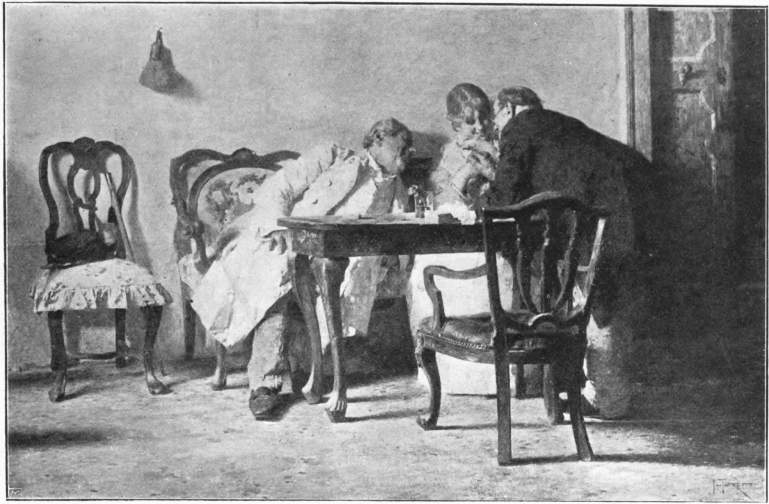
Hanfstaengl.
FAVRETTO. SUSANNA AND THE ELDERS.
Francesco Vinea, Tito Conti, Federigo Andreotti, and Edoardo Gelli are in Italy the special manufacturers who have devoted themselves, with the assistance of Meissonier, Gérôme, and Fortuny, to scenes from the sixteenth and seventeenth centuries, to plumed hats, Wallenstein boots, and horsemen’s capes, to Renaissance lords and laughing Renaissance ladies, and they have thereby won great recognition in Germany. Pretty, languishing women in richly coloured costumes, tippling soldiers and gallant cavaliers, laughing peasant women and trim serving-girls drawing wine in the cellar vaults and setting it before a trooper, who in gratitude affectionately puts his arm round their waist, beautiful and still more languishing noble ladies, who laugh with a parrot or a dog, instead of a trooper, in apartments richly furnished with Gobelins—such for the most part are the subjects treated by Francesco Vinea with great virtuosity bordering on the routine of a typewriter. His technique is neither refined nor fascinating; the colours are so crude that they affect the eye as a false note the ear. But the mechanical power of his painting is great. He has much ability, far more, indeed, than Sichel, and possesses the secret of painting, in an astonishing manner, the famous lace kerchiefs wound round the heads of his fair ones. Andreotti and Tito Conti work in the same fashion, except that the ballad-singers and rustic idylls of Andreotti are the smoother and more mawkish, whereas the pictures of Conti make a somewhat more refined and artistic effect. His colour is superior and more transparent, and his tapestry backgrounds are warmer.
And, so far as one can judge from their pictures, life runs as merrily for the Italians of the present as it did for those rococo cavaliers. Hanging here and there beside the serious art of other nations, these little picture-people enjoy their careless tinsel pomp; art is a gay thing for them, as gay as a Sunday afternoon with a procession and fireworks, walks and sips of sherbet, to an Italian woman. By the side of the blue-plush and red-velvet costume-picture comic genre still holds its sway: barbaric in colour and with materials which are merrier than is appropriate in tasteful pictures, Gaetano Chierici represents children, both good and naughty, making their appearance upon a tiny theatre. Antonio Rotta renders comic episodes from the life of Venetian cobblers and the menders of nets. Scipione Vannuttelli paints young girls in white dresses arrayed as nuns or being confirmed in church. Francesco Monteverde rejoices in comical intermezzi in the style of Grützner—for instance, an ecclesiastical gentleman observing, to his horror, that his pretty young servant-girl is being kissed by a smart lad in the yard. This is more or less his style of subject. Ettore Tito paints the pretty Venetian laundresses whom Passini, Cecil van Haanen, Charles Ulrich, Eugène Blaas, and others introduced into art. Only a very few struck deeper notes. Luigi Nono, in Venice, painted his beautiful picture “Refugium Peccatorum”; Ferragutti, the Milanese, his “Workers in the Turnip Field,” a vivid study of sunlight of serious veracity; and after these Giovanni Segantini came forward with his forcible creations, in which he has demonstrated that it is possible for a man to be an Italian and yet a serious artist.
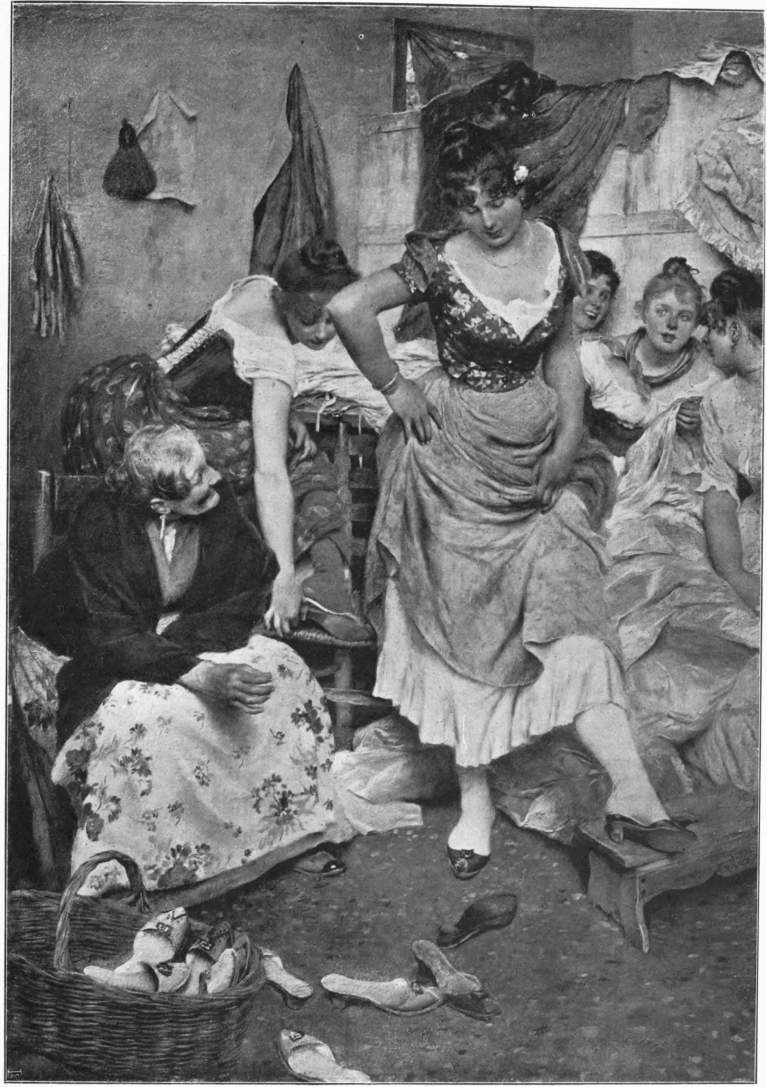
Hanfstaengl.
TITO. THE SLIPPER SELLER.
Segantini’s biography is like a novel. Born the child of poor parents, in Arco, in 1858, he was left, after the death of his parents, to the care of a relative in Milan with whom he passed a most unhappy time. He then wanted to make his fortune in France, and set out upon foot; but he did not get very far, in fact he managed to hire himself out as a swine-herd. After this he lived for a whole year alone in the wild mountains, worked in the field, the stable, the barn. Then came the well-known discovery, which one could not believe were it not to be read in Gubernati. One day he drew the finest of his pigs with a piece of charcoal upon a mass of rock. The peasants ran in a crowd and took the block of stone, together with the young Giotto, in triumph to the village. He was given assistance, visited the School of Art in Milan, and now paints the things he did in his youth. In a secluded village of the Alps, Val d’Albola in Switzerland, a thousand metres above the sea, amid the grand and lofty mountains, he settled down, surrounded only by the peasants who make a precarious living from the soil. Out of touch with the world of artists the whole year round, observing great nature at every season and every hour of the day, fresh and straightforward in character, he is one of those natures of the type of Millet, in whom heart and hand, man and artist, are one and the same thing. His shepherd and peasant scenes from the valleys of the high Alps are free from all flavour of genre. The life of these poor and humble beings passes without contrasts and passions, being spent altogether in work, which fills the long course of the day in monotonous regularity. The sky sparkles with a sharp brilliancy. The spiky yellow and tender green of the fields forces its way modestly from the rocky ground. In front is something like a hedge where a cow is grazing, or there is a shepherdess pasturing her sheep. Something majestic there is in this cold nature, where the sunshine is so sharp, the air so thin. And the primitive, it might almost be said antique, execution of these pictures is in accord with the primitive simplicity of the subjects. In fact, Segantini’s pictures, with their cold silvery colours, and their contours so sharp in outline, standing out hard against the rarefied air, make an impression like encaustic paintings or mosaics. They have nothing alluring or pleasing, and there is, perhaps, even a touch of mannerism in this mosaic painting; but they are nevertheless exceedingly true, rugged, austere, and yet sunny. Segantini opened up to painting an entirely new world of beauty, the poetry of the highlands. His appearance dates from the Impressionistic period when preference was given to damp, misty atmospheres which toned down all colour and melted away all lines, and artists made a specialty of flat, monotonous plains. At that time the mountains were in bad repute, thanks to the old-fashioned painters of views, the masters of the “picture-postcard style.” Segantini led the way again up to the heights; but he did not paint the mountain-tops that, like the Titans of old, strive to reach the sky; he painted the plateaus, not the plains of the lowlands, but of the highlands, lonely, weird, sublime, where man draws near to the heart of Nature, far from the noise and struggle of everyday life. The air of the heights is there, the colours and lines speak with no uncertain voice. Thus Segantini learnt from the locale of his pictures to become the first master of line among the Impressionists. How he mirrors in his pictures the stillness, the might and grandeur of these lofty heights! With what astounding truth his cold, clear colours make us feel the coldness and clearness of these regions. Like a dome of steel, the sky stretches over the steel-blue lakes, clear as crystal, over the pale-green meadows in the grip of the frost; the tender foliage rustles and freezes in the quivering ice-cold air: there glaciers gleam, there glitters the snow, there the sun pours down his beams upon the earth like plumes of fire. A thunder cloud draws near, calm and majestic as destiny in its relentless course. There is something Northern and virginal, something earnest and grandiose, which stands in strange contrast with the joyful, conventional smile which is otherwise spread over the countenance of Italian painting. Though he died so young, Giovanni Segantini will live for all time in the history of art.
With the exception of Segantini, not one of these painters will own that there are poverty-stricken and miserable people in his native land. An everlasting blue sky still laughs over Italy, sunshine and the joy of life still hold undisputed sway over Italian pictures. There is no work in sunny Italy, and in spite of that there is no hunger. Even where work is being done there are assembled only the fairest girls of Lombardy, who kneel laughing and jesting on the strand, while the wind dallies with their clothes. They have a special delight for showing themselves while engaged at their toilette, in a bodice, their little feet in neat little slippers, their naked arms raised to arrange their red-gold hair. As a rule, however, they do nothing whatever but smile at you with their most seductive smile, which shows their pearl-white teeth, and ensnares every poor devil who does not suspect that they have smiled for years in the same way, and most of all with him who pays highest: “j’aime les hommes parse que j’aime les truffes.” These pictures are almost invariably works which are well able to give pleasure to their possessor, only they seldom suggest discussion on the course of art. Trop de marchandise is the phrase generally used in the Paris Salon when the Italians come under consideration. Few there are amongst them who are real pioneers, spirits pressing seriously forward and having a quickening influence on others. The vital questions of the painting of free light, Impressionism, and Naturalism do not interest them in the least. A naïve, pleasant, lively, and self-complacent technique is in most cases the solitary charm of their works. One feels scarcely any inclination to search the catalogue for the painter’s name, and whether the beauty—for she is not the first of her kind—who was called Ninetta last year has now become Lisa. Most of these modern Italians execute their pictures in the way in which gold pieces are minted, or in the way in which plastic works, which run through so many editions, are produced in Italy. Nowhere are more beautiful laces chiselled, and in the same manner painters render the shining splendour of satin and velvet, the glittering brilliancy of ornaments, and the starry radiance of the beautiful eyes of women. Only, as soon as one has once seen them one knows the pictures by heart, as one knows the works in marble, and this is so because the painters had them by heart first. Everywhere there are the evidences of talent, industry, ability, and spirit, but there is no soul in the spirit and no life in the colours. So many brilliant tones stand beside each other, and yet there is neither a refined tone nor the impression of truth to nature.