Front matter (continued 8)
Reading edition
The painter of the river-port of London and the arm of the Thames is William L. Wyllie, whose pictures unite so much bizarre grandeur with so much precision. One knows the port life of the Thames, with its accumulation of work, which has not its like upon the whole planet. Everything is colossal. From Greenwich up to London both sides of the river are a continuous quay: everywhere there are goods being piled, sacks being raised on pulleys, ships being laid at anchor; everywhere are fresh storehouses for copper, beer, sails, tar, and chemicals. The river is of great width, and is like a street populated with ships, a workshop winding again and again. The steamers and sailing vessels move up and down stream, or lie in masses, close beside one another, at anchor. Upon the bank the docks lie athwart like so many streets of water, sending out ships or taking them in. The ranks of masts and the slender rigging form a spider’s web spreading across the whole horizon; and a vaporous haze, penetrated by the sun, envelops it with a reddish veil. Every dock is like a town, filled with huge vats and populated with a swarm of human beings, that move hither and thither amid fluttering shadows. This vast panorama, veiled with smoke and mist, only now and then broken by a ray of sunlight, is the theme of Wyllie’s pictures. Even as a child he ran about in the port of London, clambered on to the ships, noted the play of the waves, and wandered about the docks; and so he painted his pictures afterwards with all the technical knowledge of a sailor. There is no one who knows so well how ships stand in the water; no one has such an understanding of their details: the heavy sailing vessels and the great steamers, which lie in the brown water of the port like mighty monsters, the sailors and the movements of the dock labourers, the dizzy tide of men, the confusion of cabs and drays upon the bridges spanning the arm of the Thames; only Vollon in Paris is to be compared with him as painter of a river-port.
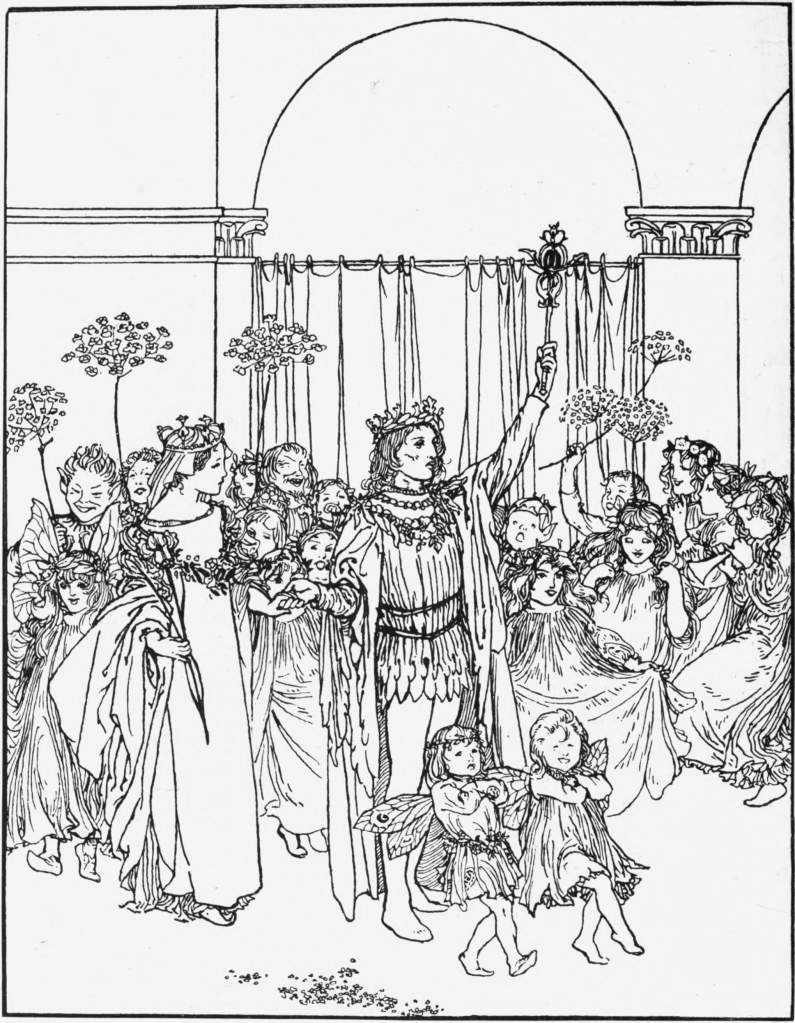
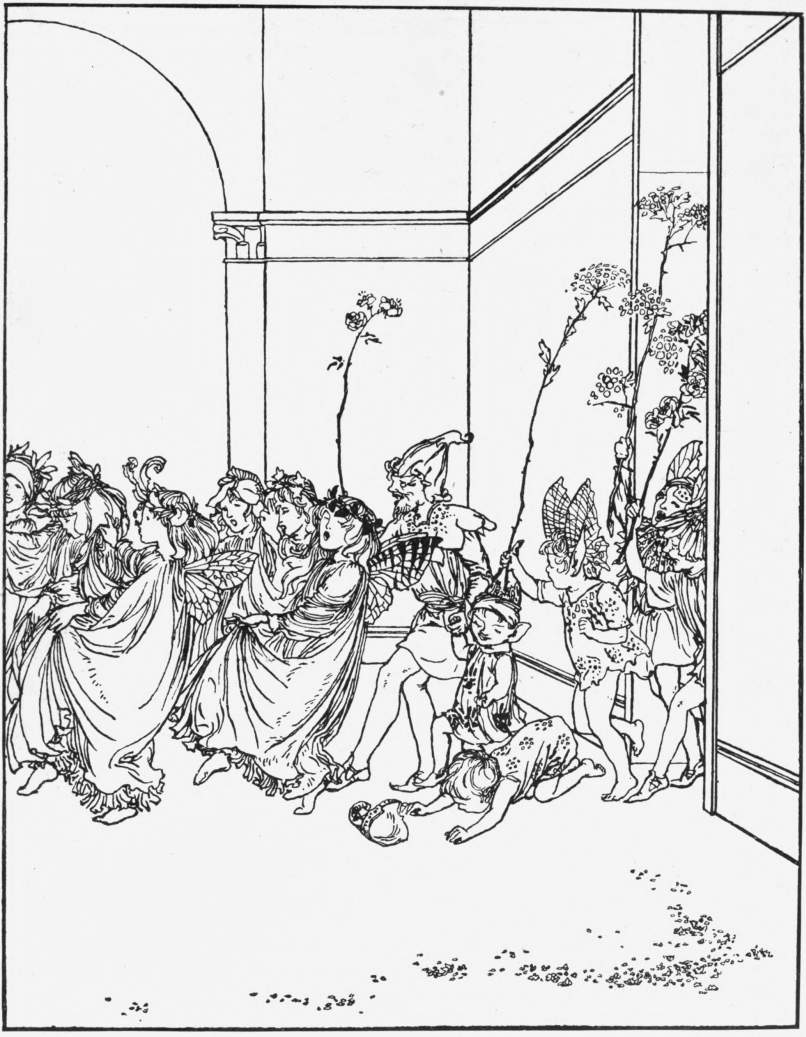
R. ANNING BELL. OBERON AND TITANIA WITH THEIR TRAIN.
Apart from him, Clara Montalba specially has painted the London port in delicate water-colours. Yet she is almost more at home in Venice, the Venice of Francesco Guardi, with its magic gleam, its canals, regattas, and palaces, the Oriental and dazzling splendour of San Marco, the austere grace of San Giorgio Maggiore, the spirited and fantastic décadence of Santa Maria della Salute. Elsewhere English water-colour often enters into a fruitless rivalry with oil-painting, but Clara Montalba cleaves to the old form which in other days under Bonington, David Cox, and Turner was the chief glory of the English school. She throws lightly upon paper notes and effects which have struck her, and the memory of which she wishes to retain.
For the English painters of the day, so far as they do not remain in the country, Venice has become what the East was for the earlier generations. They no longer study the romantic Venice which Turner painted and Byron sang in Childe Harold, they do not paint the noble beauty of Venetian architecture or its canals glowing in the sun, but the Venice of the day, with its narrow alleys and pretty girls, Venice with its marvellous effects of light and the picturesque figures of its streets. Nor are they at pains to discover “ideal” traits in the character of the Italian people. They paint true, everyday scenes from popular life, but these are glorified by the magic of light. After Zezzos, Ludwig Passini, Cecil van Haanen, Tito, and Eugène Blaas, the Englishmen Luke Fildes, W. Logsdail, and Henry Woods are the most skilful painters of Venetian street scenes. In the pictures of Luke Fildes and W. Logsdail there are usually to be seen in the foreground beautiful women, painted life-size, washing linen in the canal or seated knitting at the house door; the heads are bright and animated, the colours almost glaringly vivid. Henry Woods, the brother-in-law of Luke Fildes, rather followed the paths prescribed by Favretto in such pictures as “Venetian Trade in the Streets,” “The Sale of an Old Master,” “Preparation or the First Communion,” “Back from the Rialto,” and the like; of all the English he has carried out the study of bright daylight most consistently. The little glass house which he built in 1879 at the back of the Palazzo Vendramin became the model of all the glass studios now disseminated over the city of the lagunes.
And these labours in Venice contributed in no unessential manner to lead English painting, in general, away from its one-sided æsthetics and rather more into the mud of the streets, caused it to break with its finely accorded tones, and brought it to a more earnest study of light. Beside his idealised Venetian women, Luke Fildes also painted large pictures from the life of the English people, such as “The Return of the Lost One,” “The Widower,” and the like, which struck tones more earnest than English painting does elsewhere; and in his picture of 1878, “The Poor of London,” he even recalled certain sketches which Gavarni drew during his rambles through the poverty-stricken quarter of London. The poor starving figures in this work were rendered quite realistically and without embellishment; the general tone was a greenish-grey, making a forcible change from the customary light blue of English pictures. Dudley Hardy’s huge picture “Homeless,” where a crowd of human beings are sleeping at night in the open air at the foot of a monument in London, and Jacomb Hood’s plain scenes from London street life, are other works which in recent years were striking, from having a character rather French than English. Stott of Oldham, by his pretty pictures of the dunes with children playing, powerful portraits, and delicate, vaporous moonlight landscapes, has won many admirers on the Continent also. Stanhope Forbes painted “A Philharmonic Society in the Country,” a representation of an auction, and scenes from the career of the Salvation Army, in which he restrained himself from all subordinate ideas of a poetic turn.
In the same way those artists are important who work according to the demands of decorative painting. A picture in a room should be like a jewel in its setting, in harmony. It should fit agreeably into the scheme of decoration, its colour in unison, its lines melodious, its general effect toning well with the general design.
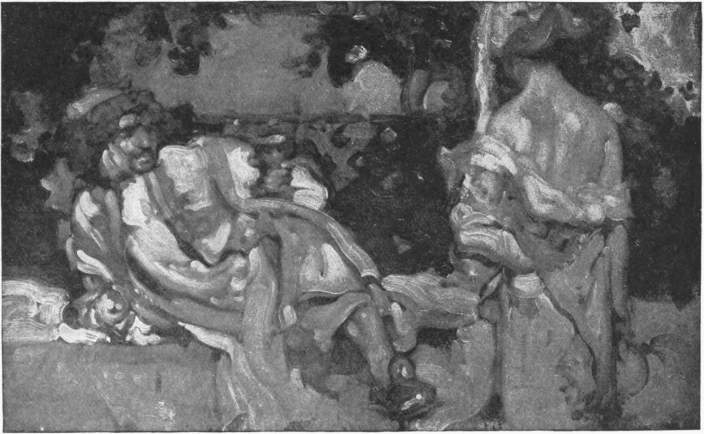
BRANGWYN. ILLUSTRATION TO THE RUBÁIYÁT OF OMAR KHAYYÁM.
(By permission of Messrs. Gibbings & Co., the owners of the copyright.)
These principles, taught by Morris, have had a formative influence on the work of a large number of artists. There arose a tendency which, by borrowing characteristic effects from woodwork, carpets, and stained-glass, and by the application of style to line as well as to colour, went one step further than Burne-Jones.
The pictures of John W. Waterhouse, for instance, are not only conceived in literary vein, but seen with the eye of a painter. By smooth, thick lines, by the discordant harmony of blues, greens, and violet, he gets a carpet-like effect which is highly decorative.
Byam Shaw, still a young man, is just such another master of decorative lines. At the age of twenty-five he painted the picture “Love’s Baubles,” which now hangs in the art gallery in Liverpool. The subject he took from a poem in Rossetti’s “House of Life.” Beautiful women snatch after the fruit which a boy carries along on a salver. The whole is a harmony of melodious lines and rich, quiet colours.
In his next picture, “Truth,” he ranges himself with Boutet de Monoel or Ludwig von Zumbusch: he strives after the monumental effect that the figures of old Brueghel have.
Next to Byam Shaw, G. E. Moira is the chief representative of this decorative school. His picture of Pelleas and Melisande is a work quite out of the ordinary, original in arrangement, incisive, almost bitter in colour, dull-green, black, lilac, and yellow; fine in the atmosphere of Maeterlinck that pervades the whole. But he does his best work as a decorator, not as a painter of pictures that can be taken away from their setting. In the frieze with which he decorated the Trocadéro Restaurant in London he, for the first time, made use of polychrome relief, that since has played such an important part in the art of decoration, and sought to enhance the colour effect still more by the use of metal. In the Paris Exhibition he attracted considerable attention by the pictures with which he decorated the pavilion of the Peninsular and Oriental Steamship Company—simple lines and fantasies of colour which with their delicate, flowing harmony had an effect like music. His designs for stained-glass windows have the same qualities, and in his position as professor in the National College of Art at South Kensington he is bound to exert a great influence over the younger generation.
Anning Bell, well known by his design for the cover of the Studio, has also done excellent work in coloured relief, especially in his frieze “Music and Dancing.”
Maurice Greiffenhagen surprises one by the ardour of his imagination, his strong emphatic line, and the tapestry-like beauty of his colour. He reminds one of Aman-Jean, such a wonderful “old-master-like” beauty is suffused through the picture “The Sons of God looked upon the Daughters of Men.” No less effective is the “gourmandise” with which he gives his interpretation the appearance of an old picture. The colours, though full of sound and movement, are at the same time so etiolated and faint that one would think the picture had hung for centuries in a dusty corner of an old church, or that spiders had spun their webs across it; the frame too is in keeping, and enhances the general effect of solemnity.
The same style is found in the later work of Frank Brangwyn, who began by painting out-of-door pictures in the spirit of the French Impressionists, and afterwards, thanks to a visit to the East, was brought into touch with Nature saturated in colour and massive in feature.
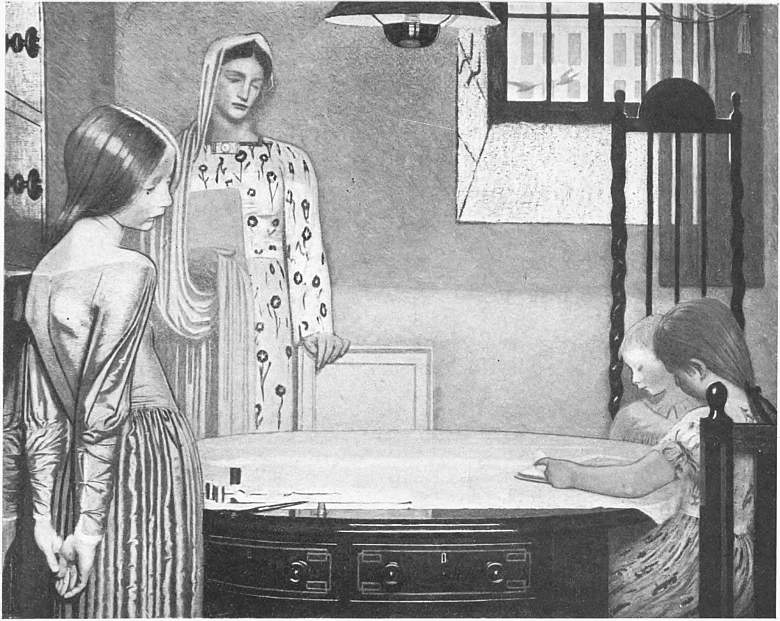
F. CAYLEY ROBINSON. A WINTER EVENING.
(By permission of the Artist.)
All his works are imposing through the decisive way in which he builds up his masses, and the wonderful, rhythmical articulation of forms and colours combined. The picture “Gold, Frankincense, and Myrrh” which has been given a place in the Luxembourg, and the large mural painting “Commerce and Navigation” in the Royal Exchange in London, are up to now his strongest work.
F. Cayley Robinson, who arrests one’s attention with his austere, almost heraldic arrangement of line, and his gloomy acerbity of colour; Miss Eleanor Fortescue Brickdale, who awoke high hopes with her picture “The Deceitfulness of Riches”; and that spirited draughtsman, W. Nicholson, whose drawings lead the eye to and fro, backwards and forwards, along heavy decided lines, noting every expressive turn and movement. Almost all these masters have come to us from the applied arts. It was the idea of attaining to unity of effect in decorative ornament that impelled these artists to work in the spirit of to-day, not that each should bring forward his own work of art and let it stand by itself, but that the scheme of decorative architecture, modelling, and painting should work together hand in hand in a homogeneous scheme of decoration.
With all these artists one cannot help noticing that they owe much in the way of light and leading to one who in England, the land of poems-in-paint, proclaimed more outspokenly than anyone else the principle of “Art for art’s sake,”—to the great American, James M‘Neill Whistler.

BIBLIOGRAPHY
BIBLIOGRAPHY
CHAPTER XXVIII
In General:
John Ruskin: Letters to “The Times” on the Principal Pre-Raphaelite Pictures in the Exhibition of 1854. Reprinted for Private Circulation. London, 1876.
Pre-Raphaelitism: Its Art, Literature, and Professors, “London and County Review,” March 1868.
The Poetic Phase in Modern English Art, “New Quarterly Magazine,” June 1879.
William Holman Hunt: The Pre-Raphaelite Brotherhood, “Contemporary Review,” April-June 1886.
Edouard Rod: Les Préraphaélites Anglais, “Gazette des Beaux-Arts,” 1887, ii 177, 399.
W. v. Seidlitz: Die englische Malerei auf der Jubiläumsausstellung zu Manchester im Sommer, 1887, “Repertorium für Kunstwissenschaft,” 1888, xi 274, 405.
P. T. Forsyth: Religion in Recent Art. Manchester and London, 1889.
Wilhelm Weigand: Die aesthetische Bewegung in England, “Gegenwart,” 1889 (35), p. 165.
Wilhelm Weigand: Die Praeraphaeliten, in his “Essays.” Munich, 1892.
Cornelius Gurlitt: Die Praeraphaeliten, eine britische Malerschule, “Westermanns Monatshefte,” April-June, 1892.
W. Holman Hunt: Pre-Rafaelitism and Pre-Rafaelite Brotherhood. London, 1905.
Noël Paton:
J. M. Gray: Sir Noël Paton, “Art Journal,” 1881, p. 78.
Holman Hunt:
F. G. Stephens: W. Holman Hunt, “Portfolio,” 1871, p. 33.
F. G. Stephens: Holman Hunt’s “The Triumph of the Innocents,” “Portfolio,” 1885, p. 80.
J. Beavington-Atkinson: Mr. Holman Hunt, his Work and Career, “Blackwood’s Magazine,” April 1886.
Madox Brown:
W. M. Rossetti: Mr. Madox Brown’s Exhibition and its Place in our School of Painting, “Fraser’s Magazine,” May 1865.
Sidney Colvin: Ford Madox Brown, “Portfolio,” 1870, p. 81.
Madox Brown’s Mural Painting at Manchester, “Academy,” 1879, p. 379.
W. M. Rossetti: Mr. Madox Brown’s Frescoes in Manchester, “Art Journal,” 1881, New Series, p. 9.
E. Chesneau: Peintres anglais contemporains: Ford Madox Brown, “L’Art,” 1883, p. 409.
F. G. Stephens: Ford Madox Brown, his early Studies and Motives, “Portfolio,” 1893, pp. 62 and 69.
Millais:
Sidney Colvin: Millais, “Portfolio,” 1871, p. 1.
Modern Artists. Illustrated Biographies. 2 vols. 1882-84.
Emilie Isabel Barrington: Why is Mr. Millais our Popular Painter? “Fortnightly Review,” July 1882.
Walter Armstrong: Sir J. E. Millais, his Life and Work. Illustrated with Engravings and Facsimiles, “The Art Annual.” London, 1885.
John Ruskin: Notes on some of the Principal Pictures of Sir John Millais. London, 1886.
Helen Zimmern: Sir John Millais, “Die Kunst unserer Zeit,” Munich, 1891.
M. H. Spielmann: Millais and his Works. London, 1898.
A. L. Baldry: Millais, his Art and his Influence. London, 1899.
Millais: Life and Letters of Millais. 2 vols. London, 1899.
CHAPTER XXIX
Menzel:
(Beside books, etc. cited for Chapter XV.):
Duranty: Adolf Menzel, “Gazette des Beaux-Arts,” 1880, i and ii.
A. Lichtwark: Menzels Piazza d’Erbe, “Gegenwart,” 1884, 25.
C. Gurlitt: Menzels Brunnenpromenade in Kissingen, “Gegenwart,” 37, p. 61.
Georg Galland: Das Arbeiterbild in Vergangenheit und Gegenwart, “Frankfurter Zeitung,” 1890, p. 139.
Jul. Meier-Gräfe: Der junge Menzel. Stuttgart, 1906.
Bleibtreu:
K. Pietschker: Georg Bleibtreu, der Maler des neuen deutschen Kaiserreiches, Kunststudie und biographische Skizze. Koethen, 1877.
A. v. Werner:
Ludwig Pietsch: “Nord und Süd,” 18, 1881, p. 185.
Ad. Rosenberg, in “Künstlermonographien,” ix. Bielefeld, 1900.
Max Michael:
Hermann Helferich: Erinnerung an Max Michael, “Kunst für Alle,” 1891, vi 225.
Güssow:
Max Kretzer: “Westermanns Monatshefte,” vol. 54, 1883, p. 519.
Pettenkofen:
Alfred de Lostalot: “Gazette des Beaux-Arts,” 1877, i 410.
Carl v. Lützow: “Zeitschrift für bildende Kunst,” 1889.
Lorenz Gedon:
G. Hirth: “Zeitschrift des Münchener Kunstgewerbevereins,” 1884, 1, 2.
Fr. Schneider, the same, 1884, 5 and 6.
“Allgemeine Zeitung,” 1884, No. 67.
K.: “Allgemeine Kunstchronik,” 1884, viii p. 5.
Ludwig Pietsch: “Nord und Süd,” 30, 1884, p. 42.
Diez:
Friedrich Pecht: Zu Wilhelm Diez 50 Geburtstage, “Kunst für Alle,” 1889, iv 113.
H. E. v. Berlepsch: W. Diez, “Zeitschrift für bildende Kunst,” xxii.
Claus Meyer:
Claus Meyer-Album. Twelve Photogravures, with Biographical Text by W. Lübke. München, 1890.
Harburger:
Harburger-Album. Munich, Braun & Schneider, 1882.
Fritz August Kaulbach:
Hermann Helferich: Neue Kunst. Berlin, 1887.
P. G.: “Zeitschrift für bildende Kunst,” 1888, xxiii 125.
R. Graul: “Graphische Künste,” 1890, xiii 27, 61.
See also Kaulbach-Album. Verlag für Kunst und Wissenschaft. München, 1891.
Ad. Rosenberg, in the “Künstlermonographien.” Ed. by Knackfuss. Bielefeld, 1901.
Lenbach:
Friedrich Pecht: Franz Lenbach, “Nord und Süd,” 1877, i 113.
B. Förster: Franz Lenbachs neueste Porträts, “Zeitschrift für bildende Kunst,” 1880, No. 26.
Ludwig Pietsch: Franz Lenbach, “Nord und Süd,” 44, 1888, p. 363.
C. Gurlitt: Lenbachs Bismarck-Bildniss, “Gegenwart,” 37, p. 318.
H. Helferich: Lenbachs Zeitgenössische Bildnisse, “Nation,” 5, 1887-88, pp. 205 and 227.
H. E. v. Berlepsch: Franz Lenbach, in “Velhagen und Klasings Monatshefte,” 1891, i.
Ad. Rosenberg, in the “Künstlermonographien.” Ed. by Knackfuss. Bielefeld, 1898.
See also Lenbachs Zeitgenössische Bildnisse. Heliogravures by Albert. München, 1888.
Leibl:
S. R. Köhler: “American Art Review,” 1880, 11.
Hermann Helferich: “Kunst für Alle,” January 1892.
Georg Gronau, in the “Künstlermonographien.” Ed. by Knackfuss. Leipzig, 1901.
CHAPTER XXX
Leading Works:
Louis Gonse: L’Art japonais. Paris, Quantin, 1883.
Anderson: The Pictorial Arts of Japan, London, 1883.
J. Brinkmann: Kunst und Handwerk in Japan. Berlin, 1889.
See also Ernest Chesneau: Le Japon à Paris, “Gazette des Beaux-Arts,” 1878, ii 385, 841.
H. v. Tschudi: Die Kunst in Japan, “Mittheilungen des k. k. österreichischen Museums,” 1879, xiv 170.
Le Blanc du Vernet: L’Art japonais, “L’Art,” 1880, p. 280; Japonisme, “L’Art,” 1880, p. 273.
Th. Duret: L’Art japonais. Les livres illustrés. Les albums imprimés. Hokusai, “Gazette des Beaux-Arts,” 1882, ii 113, 300.
Hans Gierke: Japanesische Malerei, in “Westermanns Monatshefte,” May 1883.
D. Brauns: Die Leistungen der Japaner auf dem Gebiete der Künste, “Unsere Zeit,” 1883, ii 765.
O. v. Schorn: Malerei und Illustration in Japan, “Vom Fels zum Meer,” April 1884.
F. E. Fenollosa: Review of the Chapter on Painting in “L’Art japonais,” by L. Gonse. Yokohama, 1885.
W. Koopmann: Kunst und Handwerk in Japan, “Zeitschrift für bildende Kunst,” xiv 189.
T. de Wyzewa: La peinture japonaise, “Revue des Deux Mondes,” 1 July 1890. Also separately, Les grands peintres de l’Espagne, etc. Paris, 1891.
S. Bing: Le Japon artistique. Paris, 1888.
Edward F. Strange: Japanese Illustration. London, 1897.
W. v. Seidlitz: Geschichte des japanischen Farbenholzschnittes. Dresden, 1897.
Outamaro:
E. de Goncourt: Outamaro le peintre des maisons vertes. Paris, 1891.
Hokusai:
G. Geffroy, in “La vie artistique.” Paris, 1892.
CHAPTER XXXI
In General:
Duranty: La nouvelle peinture, à propos du groupe d’artistes qui expose dans les galeries Durand-Ruel. Paris, Dentu, 1876.
Théodore Duret: Les peintres impressionists: C. Monet, Sisley, C. Pissarro, Renoir, B. Morisot. Avec un dessin de Renoir. Paris, 1879.
Louis Enault: Une revolution artistique. Paris, 1880.
Frederick Wedmore: The Impressionists, “The Fortnightly Review,” January 1883.
Felix Fénélon: Les Impressionistes en 1886. (Angrand, Caillebotte, Miss Cassatt, Degas, Dubois-Pillet, David Estoppey, Forain, Gauguin, Guillaumin, Claude Monet, Mme. Morisot, de Nittis, Camille et Lucien Pissarro, Raffaelli, Renoir, Seurat, Signac, Zandomeneghi, etc.) Paris, 1886.
Catalogue illustré de l’exposition des peintures du groupe Impressioniste et Synthétiste, faite dans le local de M. Volpini au Champ de Mars, 1889.
G. Lecomte: L’Art Impressioniste. Paris, 1892.
H. Huysmans: Certains. Paris, 1892.
H. Huysmans: L’Art moderne. Paris, 1892.
G. Geffroy: La vie artistique. Paris, 1892.
Jul. Meier-Gräfe: Der Impressionismus in Muther’s series, “Die Kunst.” Berlin, 1902.
Manet:
Zola: Mes Haines. Edouard Manet. Paris, 1878, p. 327.
Catalogue de l’exposition des Œuvres de Manet, avec préface d’Emile Zola. Paris, 1884.
Edmond Bazire: Manet. Paris, 1884.
Jacques de Biez: Edouard Manet. Conférence faite à la salle des capucines le Mardi, 22 Janvier 1884. Paris, 1884.
L. Gonse: Manet, “Gazette des Beaux-Arts,” 1884, i 133.
Fritz Bley: Edouard Manet, “Zeitschrift für bildende Kunst,” 1884, 8.
Paul D’Abrest: “Allgemeine Kunstchronik,” 1884, viii 5.
Andreas Aubert, in the Copenhagen “Tilskueren,” 1888.
Hugo von Tschudi: Edouard Manet. Berlin, 1902.
Monet:
Théodore Duret: Le peintre Claude Monet: Notice sur son œuvre. Paris, 1880.
A. de Lostalot: Exposition des œuvres de M. Claude Monet, “Gazette des Beaux-Arts,” 1883, i 342.
C. Dargenty: Exposition des œuvres de M. Monet, “Courier de l’Art,” 1883, 11.
Hermann Helferich: Claude Monet, “Freie Bühne,” 1890, 8.
Degas:
George Moore: Degas, the Painter of Modern Life, “Magazine of Art,” 1889.
Max Liebermann: Degas, Berlin, Cassirer, 1901.
Pissarro:
G. Lecomte: Camille Pissarro. No. 11 of “Hommes d’aujourd’hui.” Paris, 1890.
CHAPTER XXXII
Rossetti:
William Sharp: Dante Gabriel Rossetti and Pictorialism in Verse, “Portfolio,” 1882, p. 176.
William Sharp: Dante Gabriel Rossetti, a Record and a Study. London, 1882.
William Tirebuck: Dante Gabriel Rossetti, his Works and Influence. London, 1882.
T. Hall Caine: Recollections of Dante Gabriel Rossetti. London, 1882.
F. G. Stephens: The Earlier Works of Rossetti, “Portfolio,” May 1882.
Sidney Colvin: Rossetti as a Painter, “Magazine of Art,” March 1883.
W. Tirebuck: Obituary in the “Art Journal,” January 1883.
R. Waldmüller: Dante Gabriel Rossetti, Dichter und Maler, “Allgemeine Zeitung,” 1883, Blatt 344.
Notes on Rossetti and his Works, “Art Journal,” May 1884.
William Michael Rossetti, Introduction to the two-volume edition of the works of Dante Gabriel Rossetti. London, 1883.
Franz Hüffer: Dante Gabriel Rossetti. Leipzig, 1883.
J. Beavington-Atkinson: Contemporary Art, Poetic and Positive (Rossetti and Alma Tadema, Linnell and Lawson), “Blackwood’s Magazine,” March 1883.
Theodore Watts: The Truth about Rossetti, “Nineteenth Century,” March 1883.
F. G. Stephens: The Earlier Works of Rossetti, “Portfolio,” 1883, pp. 87 and 114.
Théodore Duret: Les expositions de Londres: Dante Gabriel Rossetti, “Gazette des Beaux-Arts,” 1883, ii 49.
David Hannay: The Paintings of Rossetti, “National Review,” March 1883.
Helen Zimmern: Aus London, D. G. Rossetti, “Westermanns Monatshefte,” August 1883.
Harry Quilter: The Art of Rossetti, “Contemporary Review,” February 1883.
William Michael Rossetti: Notes on Rossetti and his Works, “Art Journal,” 1884, pp. 148, 164, 204, 255.
F. G. Stephens: Ecce Ancilla Domini, “Portfolio,” 1888, p. 125.
William Michael Rossetti: D. G. Rossetti as Designer and Writer. London, 1889.
Wilhelm Weigand: “Gegenwart,” 1889, p. 38, and his Essays.
F. G. Stephens: Beata Beatrix, “Portfolio,” 1891, p. 45.
F. G. Stephens: Rosa Triplex, by D. G. Rossetti, “Portfolio,” 1892, p. 197.
H. C. Marillier: D. G. Rossetti, an Illustrated Memorial of his Art and Life. 2nd Edition. London, 1901.
Burne-Jones:
Sidney Colvin: “Portfolio,” 1870, p. 17.
F. G. Stephens: “Portfolio,” 1885, pp. 220 and 227.
Birmingham Museum and Art Gallery, Catalogue (with Notes) of the Collections of Paintings by George Frederick Watts and Edward Burne-Jones. Birmingham, 1886.
F. G. Stephens: “Portfolio,” 1889, p. 214.
F. G. Stephens: Mr. Burne-Jones’ Mosaics at Rome, “Portfolio,” May 1890.
Malcolm Bell: Edward Burne-Jones. London, 1892.
André Michel: “Journal des Débats,” 15 March 1893.
Cornelius Gurlitt: Die Praerafaeliten, eine britische Malerschule, “Westermanns Monatshefte,” July 1892.
P. Leprieur: Burne-Jones, decorateur et ornemaniste, “Gazette des Beaux-Arts,” 1892, ii 381.
Ninety-one Photogravures directly reproduced from the Original Paintings, “Berl. Photogr. Gesell.,” 1901.
Malcolm Bell: Burne-Jones. Muther’s “Die Kunst.” Bd. 3.
Otto v. Schleinitz: “Künstlermonographien.” Ed. by Knackfuss. Bd. 55. Bielefeld, 1901.
Arthur Hughes:
William Michael Rossetti: “Portfolio,” 1870, p. 113.
J. M. Strudwick:
G. Bernard Shaw: “Art Journal,” 1891, p. 97.
Richmond:
H. Lascelles: William B. Richmond, “Art Journal,” Christmas Annual. 1902.
Morris:
Aymer Vallance: William Morris, his Art, his Writings, and his Public Life. London, 1897.
J. W. Mackail: Life of William Morris. 2 vols. London, 1901.
Walter Crane:
F. G. Stephens: The Designs of Walter Crane, “Portfolio,” 1891, 12, 45.
Cornelius Gurlitt: “Gegenwart,” 1893.
Peter Jessen: “Zeitschrift für bildende Kunst,” 1893.
V. Berlepsch: Walter Crane. Wien, 1897.
Otto v. Schleinitz: Walter Crane, in the “Künstlermonographien.” Ed. by Knackfuss, Bielefeld, 1901.
P. G. Konody: The Art of Walter Crane. London, 1902.
Watts:
J. Beavington-Atkinson: “Portfolio,” 1870, p. 65.
F. W. Myers: On Mr. Watts’ Pictures, “Fortnightly Review,” February 1882.
F. W. Myers: Stanzas on Mr. Watts’ Collected Works. London, 1882.
H. Quilter: The Art of Watts, “Contemporary Review,” February 1882.
Walter Armstrong: George Frederick Watts, “L’Art,” 1882, p. 379.
E. I. Barrington: The Painted Poetry of Watts and Rossetti, “Nineteenth Century,” June 1883.
E. Pfeiffer: On Two Pictures by G. F. Watts, “Academy,” 1884, p. 627.
M. H. Spielmann: The Works of Mr. G. F. Watts, with a Catalogue of his Pictures, “Pall Mall Gazette Extra,” No. 22. London, 1886.
F. G. Stephens: G. F. Watts, “Portfolio,” 1887, p. 13.
Helen Zimmern in “Die Kunst unserer Zeit,” 1892.
Hermann Helferich: “Kunst für Alle,” December 1893.
Jarno Jessen: George Frederick F. Watts. Berlin, 1901.
Rosa E. D. Sketchley: George Frederick Watts. London, 1904.
CHAPTER XXXIII
Gustave Moreau:
Paul Leroi: Les parias du Salon, “L’Art,” 1876, iii 246.
Charles Tardieu: La peinture à l’exposition universelle de 1878, “L’Art,” 1878, ii 319.
Ary Renan: G. Moreau, “Gazette des Beaux-Arts,” 1886, i 377, ii 36.
Claude Phillips: Fables of La Fontaine by Gustave Moreau, “Magazine of Art,” 1887, p. 37.
Karl Huysmans: A. Rebours. Paris, 1891, passim.
P. Flat: Le musée Gustave Moreau. Étude sur Gustave Moreau, ses œuvres, son influence. Paris, 1898.
Ary Renan: Gustave Moreau. Paris, 1900.
G. Larronnet: Gustave Moreau. Paris, 1901.
Puvis de Chavannes:
A. Baignières: La peinture décorative au XIX siècle. M. Puvis de Chavannes, “Gazette des Beaux-Arts,” 1881, i 416.
Edouard Aynard: Les peintures décoratives de Puvis de Chavannes au Palais des Arts. Lyon, 1884.
Thiebault-Sisson: Puvis de Chavannes et son œuvre, “La Nouvelle Revue,” December 1887.
André Michel: Exposition de M. Puvis de Chavannes, “Gazette des Beaux-Arts,” 1886, i 36.
Hermann Bahr: Zur Kritik der Moderne. Zürich, 1890.
André Michel: “Graphische Künste,” xiv, 1892, 37.
A. Nossig: “Allgemeine Kunstchronik,” 1893, No. 12.
M. Vachon: Puvis de Chavannes. Paris, 1896.
L. Bénédite: Les dessins de Puvis de Chavannes au musée du Luxembourg. Paris, 1901.
Golberg: Puvis de Chavannes. Paris, 1901.
Boecklin:
F. Pecht: “Nord und Süd,” 1878, iv 288. Reprinted in “Deutsche Künstler des 19 Jahrhunderts,” Nördlingen, 1879, pp. 180-202.
A. Rosenberg: “Grenzboten,” 1879, i pp. 387-397.
Graf Schack: Meine Gemäldesammlung. Stuttgart, 1881, pp. 139-155.
O. Berggruen: Die Galerie Schack. Wien, 1883.
Zwei neue Gemälde von A. Boecklin, “Deutsche Rundschau,” June 1883.
E. Koppel: Arnold Boecklin, “Vom Fels zum Meer,” July 1884.
Otto Baisch: Arnold Boecklin, “Westermanns Monatshefte,” August 1884, 37.
Guido Hauck: Arnold Boecklins Gefilde Seligen und Goethes Faust. Berlin, 1884.
F. Pecht: Zu Arnold Boecklins 60 Geburtstag, “Kunst für Alle,” 1887, iii 2.
Fritz Lemmermayer: “Unsere Zeit,” 1888, ii 492.
Helen Zimmern: “Art Journal,” 1888, p. 305.
Berthold Haendke: Arnold Boecklin in seiner historischen und künstlerischen Entwicklung. Hamburg, 1890.
Hugo Kaatz: Der Realismus Arnold Boecklins, “Gegenwart,” 1890, 38, p. 168.
Carus Sterne: Arnold Boecklins Fabelwesen im Lichte der organischen Formenlehre, “Gegenwart,” 1890, 37, p. 21.
A. Fendler: Arnold Boecklin, “Illustrirte Zeitung,” 1890, No. 2310.
Max Lehrs: Arnold Boecklin, Ein Leitfaden zum Verständniss der Kunst. München, 1890.
J. Mähly: Aus Arnold Boecklins Atelier, “Gegenwart,” 1892, 14.
Emil Hannover, in “Tilskueren,” Kopenhagen, 1892, p. 118.
Franz Hermann, “Gazette des Beaux-Arts,” Nos. 430 and 433, 1 April and 1 July 1893.
Franz Hermann, in “Die Kunst Unserer Zeit,” December 1893.
Carl Neumann, “Preussische Jahrbücher,” vol. 71, 1893, Part 2.
Cornelius Gurlitt: “Kunst für Alle,” 1894, Part 2.
Ola Hansson: “Seher und Deuter.” Berlin, 1894, p. 152.
F. von Ostini, in “Velhagen und Klasings Monatshefte,” 1894.
See also the work on Boecklin produced by the “Verlag für Kunst und Wissenschaft,” with forty of the artist’s chief pictures reproduced in photogravure. München, 1892.
W. Ritter: Arnold Boecklin. Paris, 1895.
H. F. Meissner: Arnold Boecklin. Berlin, 1898.
E. Schick: Boecklins Tagebuch. Hrsg. v. Tschudi. Berlin, 1899.
H. Mendelssohn: Arnold Boecklin. Berlin, 1900.
H. Brockhaus: Arnold Boecklin. Leipzig, 1901.
G. Floerke: Gespräche mit Boecklin. München, 1902.
J. Meier-Gräfe: Der Fall Boecklin. Stuttgart, 1905.
H. von Marées:
Conrad Fiedler: H. von Marées. Munich, 1889. (1 vol. text, 1 vol. pictures.)
Conrad Fiedler: H. von Marées auf der Münchener Jahresausstellung, “Allgemeine Zeitung,” 1891, Supplement No. 150.
H. Janitschek: “Die Nation,” 1890, No. 51.
Carl von Pidoll: Aus der Werkstatt eines Künstlers. Luxemburg, 1890.
Cornelius Gurlitt: “Gegenwart,” 1891, 1.
Heinr. Wölfflin: “Zeitschrift für bildende Kunst,” 1892, Part 4.
Emil Hannover, in “Tilskueren,” Kopenhagen, 1891, p. 1.
Franz Dreber:
Exhibition in Royal National Gallery of Berlin, 1876.
Hubert Janitschek: Zur Charakteristik Franz Drebers, “Zeitschrift für bildende Kunst,” xi, 1876, p. 681.
CHAPTER XXXIV
Bastien-Lepage:
A. Theuriet: J. Bastien-Lepage, l’homme et l’artiste. Paris, 1885.
A. Hustin: Bastien-Lepage, “L’Art,” 1885, i 13.
G. Dargenty: “L’Art,” 1885, i 146, 163.
A. de Fourcaud: Jules Bastien-Lepage, sa vie et ses œuvres. Paris, 1888.
Marie von Baskirtscheff: “Journal intime.” Paris, 1890.
Marie Baskirtscheff:
Cornelius Gurlitt: Marie Baskirtscheff und ihr Tagebuch, in “Die Kunst unserer Zeit,” 1892, i 61.
Léon L’Hermitte:
Robert Walker: L’Hermitte, “Art Journal,” 1886, p. 266.
Raffaelli:
Alfred de Lostalot: Expositions diverses à Paris: Œuvres de M. J. F. Raffaelli, “Gazette des Beaux-Arts,” 1884, i 334.
Emil Hannover: Raffaelli, “Af Dagens Krönike.” Kopenhagen, 1889.
J. de Nittis:
Philippe Burty: “L’Art,” 1880, p. 276.
Henry Jouin: Maîtres contemporains, p. 229. Paris, 1887.
Ferdinand Heilbuth:
A. Hustin: “L’Art,” 1889, ii 268.
A. Helferich: “Kunst für Alle,” v, 1890, p. 61.
Gervex:
F. Jahyer: Galerie contemporaine litéraire et artistique, 1879, p. 178.
Friant:
Roger Marx: Silhouettes d’artistes contemporains, “L’Art,” 1883, p. 461.
Ulysse Butin:
Paul Leroi: “L’Art,” 1878, ii 25.
Abel Patoux: “L’Art,” 1890, ii 7, 117.
Dagnan-Bouveret:
B. Karageorgevitsch: “Magazine of Art,” February 1893, No. 148.
On the more Modern Landscape Painters in General:
P. Taren: Die moderne Landschaft, “Gegenwart,” 1889, 20.
On Neo-Impressionism:
Paul Signac: D’Eugène Delacroix au Neo-impressionisme. Paris, 1903.
George Seurat:
Obituary in the “Chronique des Arts,” 1890, 14.
Cheret:
Ernest Maindron: Les affiches illustrées, “Gazette des Beaux-Arts,” 1884, ii 418 and 435.
Karl Huysmans: Certains. Paris, 1891.
L’affiche illustrée. Le roi de l’affiche. L’œuvre de Chéret, etc., “La Plume,” No. 110, 15 November 1893.
R. H. Sherard: “Magazine of Art,” September 1893, No. 155.
L. Morin: Quelques artistes de ce temps. [Cherét, Vierge.] Paris, 1898.
G. Kahn: Jules Chéret, “Art et Decoration,” xii, 1902, p. 177.
Steinlen:
Crouzat: A. de Steinlen, peintre, graveur, lithographe. Paris, Maison du livre, 1902.
Paul Renouard:
Eugène Véron: “L’Art,” 1875, iii 58; 1876, iv 252.
Jules Claretie: M. Paul Renouard et l’Opéra, “Gazette des Beaux-Arts,” 1881, i 435.
Daniel Vierge:
J. and E. R. Pennell: Daniel Vierge, “Portfolio,” 1888, p. 201.
By the Editor: “Magazine of Art,” 1892, No. 146 (December).
Cazin:
Leon Bénédite: Cazin. Paris, 1902.
Lautrec:
E. Klassowki: Die Maler von Montmartre [Billotte, Steinlen, Toulouse-Lautrec, Léandre]. “Die Kunst,” Bd. 15. Edited by R. Muther.
André Rivoire: “Revue de l’art ancien et moderne,” xi, 1902.
Carrière:
G. Geffroy: La vie artistique. Préface d’Edmond de Goncourt. Pointe sèche d’Eugène Carrière. Paris, Dentu, 1893.
Léailles: E. Carrière, l’homme et l’artiste. Paris, 1901.
G. Geffroy: L’œuvre d’Eugène Carrière. Paris, 1902.
Aman-Jean:
A. Beaunier, Aman-Jean, “Art et Decoration,” vi, 1899.
Odilon Redon:
J. Destrée: L’œuvre lithographique de Odilon Redon. Catalogue descriptif. Bruxelles, 1891.
CHAPTER XXXV
In General:
Francisco Tubino: The Revival of Spanish Art. 1882.
Spanische Künstlermappe. Edited by Prince Ludwig Ferdinand, with an Introduction by F. Reber. Munich, 1885.
Gustav Diercks: Moderne spanische Maler, “Vom Fels zum Meer,” 1890, 5.
Fortuny:
“Zeitschrift für bildende Kunst,” ix, 1874, p. 341.
J. C. Davillier: Fortuny, sa vie, son œuvre, sa correspondance. Avec cinq dessins inédits en facsimile et deux eaux-fortes originales. Paris, Aubry, 1876.
Fortuny und die moderne Malerei der Spanier, “Allgemeine Zeitung,” 1881, Supplement, 245.
Walther Fol: “Gazette des Beaux-Arts,” 1875, i 267, 351.
Charles Yriarte: “L’Art,” 1875, i 361.
Charles Yriarte, in “Les artistes célèbres.” Paris, 1885.
See also the Fortuny Album published by Goupil. 40 page photographs. Paris, 1889.
Pradilla:
Delia Hart: “Art Journal,” 1891, p. 257.
CHAPTER XXXVI
James Jackson Jarves: Modern Italian Painters and Painting, “Art Journal,” 1880, p. 261.
P. P.: Die Kunstausstellung im Senatspalast zu Mailand, “Zeitschrift für bildende Kunst,” xvi, 1881, 361, 381.
Camillo Boito: Pittura e scultura. Milano, 1883.
Die modernen Venetianer Maler, “Allgemeine Kunstchronik,” 1884, viii 2.
Milliot: De l’art actuel en Italie, “Revue du monde latin,” Juin, 1887.
Angelo de Gubernatis: Dizionario degli Artisti Italiani viventi. Firenze, 1889.
M. Wittich: Italienische Malerei. Mappe, 1890, 8.
Helen Zimmern: Die moderne Kunst in Italien, “Kunst unserer Zeit,” 1890, p. 74.
A. Stella: Pittura e Scultura in Piemonte. Turin, Paravia & Comp., 1893.
On the Neapolitans:
Principessa della Rocca: Artisti Italiani Viventi (Napolitani). Napoli, 1878.
Helen Zimmern: Die neapolitanische Malerschule, “Kunst für Alle,” 1889, p. 81.
Morelli:
Helen Zimmern: “Art Journal,” 1885, pp. 345 and 357.
E. Dalbano: Domenico Morelli. Napoli Nobilissima, xi, 1902.
Michetti:
Helen Zimmern: “Art Journal,” 1887, pp. 16 and 41.
Dalbono:
Helen Zimmern: “Art Journal,” 1888, p. 45.
Favretto:
Obituaries in 1887: Garocci, “Arte e storia,” vi 16; “Chronique des Arts,” 24; “Allgemeine Kunstchronik,” 26; “Mittheilungen des Mähr. Gewerbemuseums,” 8; “Courrier de l’Art,” vi 25; “Kunstchronik,” xxii 37; “The Saturday Review,” 1 October 1887.
See also Giacomo Favretto e le sue opere. Edizione unica di tutti i principali Capolavori del celebre Artista Veneziano. Publicata per cura di G. Cesare Sicco. Torino, 1887.
L. Brasch: Giacomo Favretta, “Die Kunst unserer Zeit,” xii, 1902.
Segantini:
W. Fred: Giovanni Segantini. Wien, 1901.
Franz Servaes: Giovanni Segantini. Sein Leben und sein Werk. Hrsg. v. k. k. Ministerium für Kultus und Unterricht. Wien, M. Serlach & Co. 1901.
CHAPTER XXXVII
In General:
Frederick Wedmore: Some tendencies in Recent Painting, “Temple Bar,” July 1878.
E. Chesneau: Artistes anglais contemporains. Paris, 1887.
Claude Phillips: The Progress of English Art as shown at the Manchester Exhibition, “Magazine of Art,” December 1887.
Ford Madox Brown on the same subject in the “Magazine of Art,” February 1888.
Rutari: Kunst und Künstler in England, “Kölnische Zeitung,” 1890, 205.
Leighton:
J. Beavington Atkinson: “Portfolio,” 1870, p. 161.
Mrs. A. Lang: Sir F. Leighton, his Life and Work. 42 Plates. “The Art Annual,” 1884. London, Virtue.
Wyke Bayliss: Five Great Painters of the Victorian Era. London, Sampson Low, Marston & Co. 1902.
G. C. Williamson: Frederic Lord Leighton. London, G. Bell & Sons, 1902.
Poynter:
Sidney Colvin: “Portfolio,” 1871, 1.
P. G. Hamerton: “Portfolio,” 1877, 11.
James Dafforne: “Art Journal,” 1877, p. 18; 1881, p. 26.
Alma Tadema:
G. A. Simcox: “Portfolio,” 1874, p. 109.
H. Billung: “Zeitschrift für bildende Kunst,” 1879, xiv 229, 269.
The Works of Laurence Alma Tadema, “Art Journal,” February 1883.
Alice Meynell: L. Alma Tadema, “Art Journal,” November 1884.
Georg Ebers: Lorenz Alma Tadema, “Westermanns Monatshefte,” November and December 1885.
Helen Zimmern: L. Alma Tadema, his Life and Work, “The Art Annual,” 1886. London, Virtue.
K. Brügge: Alma Tadema, “Vom Fels zum Meer,” 1887, 2.
Helen Zimmern in “Die Kunst unserer Zeit,” 1890, ii 130.
Rudolf de Cardova: Sir Laurence Alma Tadema, “Cassell’s Magazine,” 1902.
H. Zimmern: Sir Laurence Alma Tadema. London, G. Bell & Sons, 1902.
Albert Moore:
Sidney Colvin: “Portfolio,” 1870, 1.
Harold Frederic: “Scribner’s Magazine,” December 1891, p. 712.
Karl Blind: “Vom Fels zum Meer,” 1892.
Briton Rivière:
James Dafforne: The Works of Briton Rivière, “Art Journal,” 1878, p. 5.
Walter Armstrong: Briton Rivière, his Life and Work, “Art Annual,” 1891. London, Virtue.
A. Braun: Ein englischer Thiermaler, “Allgemeine Kunstchronik,” 1888, 37-39.
R. Caldecott:
Claude Phillips: “Gazette des Beaux-Arts,” 1886, i 327.
See also R. Caldecott: Sketches, with an Introduction by H. Blackburn. London, 1890.
George Mason:
Sidney Colvin: George Mason, “Portfolio,” 1871, p. 113.
G. A. Simcox: Mr. Mason’s Collected Works, “Portfolio,” 1873, p. 40.
Alice Meynell: “Art Journal,” 1883, pp. 43, 108, and 185.
Walker:
Sidney Colvin: Frederick Walker, “Portfolio,” 1870, p. 33.
Obituary in the “Art Journal,” 1875, pp. 232, 254, 351.
James Dafforne: The Works of Frederick Walker, “Art Journal,” 1876, p. 297.
J. Comyns Carr: “Portfolio,” 1875, p. 117.
J. Comyns Carr: “L’Art,” 1876, i 175, ii 130.
J. Comyns Carr: Frederick Walker, an Essay. London, 1885.
Clementina Black: Frederick Walker. London, Duckworth, 1902.
G. H. Boughton:
Sidney Colvin: “Portfolio,” 1871, p. 65.
James Dafforne: “Art Journal,” 1873, p. 41.
G. D. Leslie:
Tom Taylor: “Portfolio,” 1870, p. 177.
P. H. Calderon:
Tom Taylor: “Portfolio,” 1870, p. 97.
James Dafforne: “Art Journal,” 1870, p. 9.
Marcus Stone:
Lionel G. Robinson: “Art Journal,” 1885, p. 68.
Frank Holl:
Harry Quilter: In Memoriam: Frank Holl, “Universal Review,” August 1888.
Erwin Volckmann: “Zeitschrift für bildende Kunst,” xxiv, 1889, p. 130.
Gertrude E. Campbell: “Art Journal,” 1889, p. 53.
Herkomer:
J. Dafforne: The Works of Hubert Herkomer, “Art Journal,” 1880, p. 109.
Helen Zimmern: H. Herkomer, “Kunst für Alle,” vi, 1891, i.
W. L. Courtney: Professor Hubert Herkomer, Royal Academician, his Life and Work, “Art Annual” for 1892. London, Virtue.
Ludwig Pietsch: Hubert Herkomer, “Velhagen und Klasings Monatshefte,” 1892.
See also H. Herkomer: Etching and Mezzotint Engraving. Lectures delivered at Oxford. London, 1892.
L. Pietsch: Herkomer, “Künstlermonographien.” Ed. Knackfuss, No. 54. Bielefeld, 1901.
On Modern English Landscape:
P. G. Hamerton: The Landscape-Painters, “Portfolio,” 1870, p. 145.
Alfred Dawson: English Landscape Art, its Position and Prospects. London, 1876.
Alfred W. Hunt: Modern English Landscape-Painting, “Nineteenth Century,” May 1880.
Cecil Lawson:
“Art Journal,” 1882, p 223.
Heseltine Ovon: “Magazine of Art,” No. 158, December 1893.
Hook:
F. G. Stephens: James Clarke Hook, “Portfolio,” 1871, p. 181.
A. H. Palmer: James Clarke Hook, “Portfolio,” 1888, pp. 1, 35, 74, 105, 165.
Frederick George Stephens: James Clarke Hook, his Life and Work, “Art Annual,” 1888. London, Virtue.
Vicat Cole:
James Dafforne: “Art Journal,” 1870, p. 177.
Colin Hunter:
Walter Armstrong: “Art Journal,” 1885, p. 117.
Birket Foster:
James Dafforne: “Art Journal,” 1871, p. 157.
Marcus B. Huish: “Art Annual,” 1890. London, Virtue.
David Murray:
Marion Hepworth Dixon: “Art Journal,” 1891, p. 144.
W. Armstrong: “Magazine of Art,” 1891, p. 397.
Ernest Parton:
“Art Journal,” 1892, p. 353.
W. B. Leader:
James Dafforne: “Art Journal,” 1871, p. 45.
W. L. Wyllie:
J. Penderel-Brodhurst: “Art Journal,” 1889, p. 220.
Henry Moore:
“Art Journal,” 1881, pp. 161 and 223.
P. G. Hamerton: A Modern Marine Painter, “Portfolio,” 1890, pp. 88 and 110.
On the Group of English Painters working in Venice:
Julia Cartwright: The Artist in Venice, “Portfolio,” 1884, p 17.
Henry Woods:
“Art Journal,” 1886, p. 97.
Clara Montalba:
Paul Leroi: “L’Art,” 1882, iii 207.
Stanhope A. Forbes:
Wilfrid Meynell: “Art Journal,” 1892, p. 65.
Shaw:
P. G. Konody: Byam Shaw, “Kunst und Kunsthandwerk,” v, 1902.
Printed by Morrison & Gibb Limited, Edinburgh