Front matter (continued 2)
Reading edition
The course which was run by this movement in the following years is well known, and it is well known how the imitation of the German Renaissance soon became as wearisome as in the beginning it had been attractive. After it had been a little overdone another step was taken, and from the Renaissance people went to the baroque period, and soon afterwards the rococo period followed. In these days sobriety has taken the place of this fever for ornamentation, and the mania for style has resulted in a surfeit, a weariness and a desire for simplicity and quietude. Nevertheless the beneficial influence of the movement on the general elevation of taste is undeniable, and indirectly it was of service to painting.
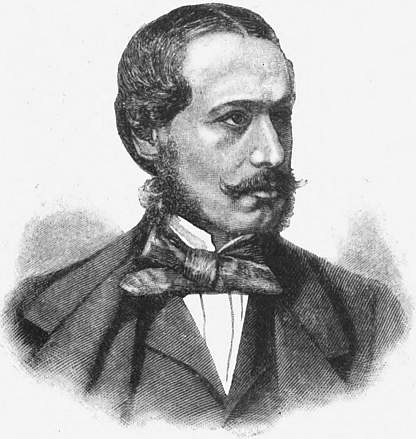
Seeman, Leipzig.
AUGUST VON PETTENKOFEN.
In rooms where the owner was the only article of the inventory repugnant to the conception of style, only those pictures were admitted which had been executed in the exact manner of the old masters. Works of art were regarded as tasteful furniture, and were obliged to harmonise correctly with the other appointments of the room; they had, moreover, to be themselves legitimate “imitations of the Works of our Fathers.” And, in this way, the movement in the handicrafts gave an impulse to a renewed study of the old masters, carried out with far more refinement than had hitherto been the case. Amongst the costume painters spread over all Germany, the experts in costume, working in Munich during the seventies, form a really artistic race of able painters who were peculiarly sensitive to colour. They were the historians of art, the connoisseurs of colour in the ranks of the painters. Piloty did not satisfy them; they buried themselves in the study of old masters with a delicately sensitive appreciation of them; they began to mix soft, luxuriant, and melting colours upon their palettes, and to feel the peculiar joy of painting. Whilst they imitated the exquisite “little masters” of former ages, in dimly lighted studios hung with Gobelins, imitating at the same time the beautifying rust of centuries, they gradually abandoned all their own tricks of art; and whilst they devoted themselves to detail they brought about the Renaissance of oil-painting. Compared with earlier works, their pictures are like rare dainties. They no longer recognised the end of their calling, as the genre painters had done, in a one-sided talent for characterisation, but tried once more to lay chief weight upon the pictorial and artistic appearance of their pictures. They were conscious of a presentiment that there were higher spheres of art than the commonplace humour of genre painting, and this recognition had a very wide bearing. Pictorial point took the place of narrative humour. If artists had previously painted thoughts they now began to paint things, and even if the things were bundles of straw, mediæval hose, and the old robes of cardinals, they were no longer “invented,” but something which had been seen as a whole. It was a transition towards ultimately painting what had actually taken place before the artist’s eyes.
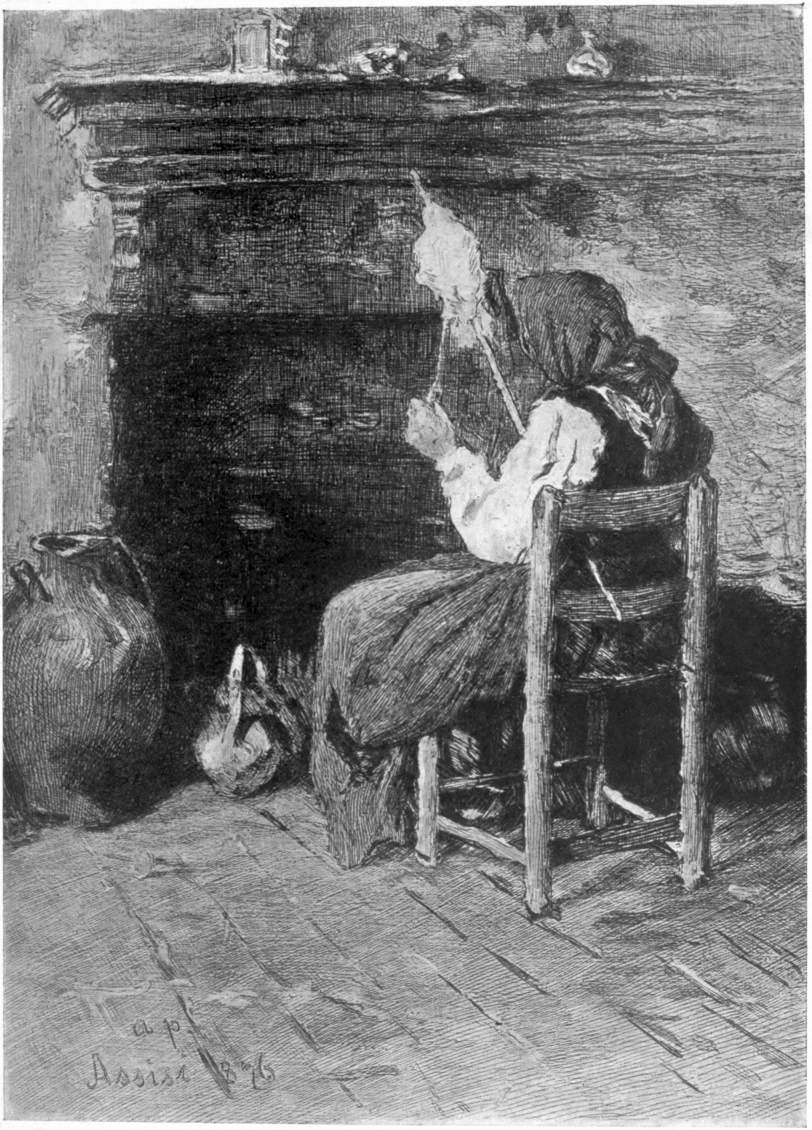
Seemann, Leipzig.
PETTENKOFEN. A WOMAN SPINNING.
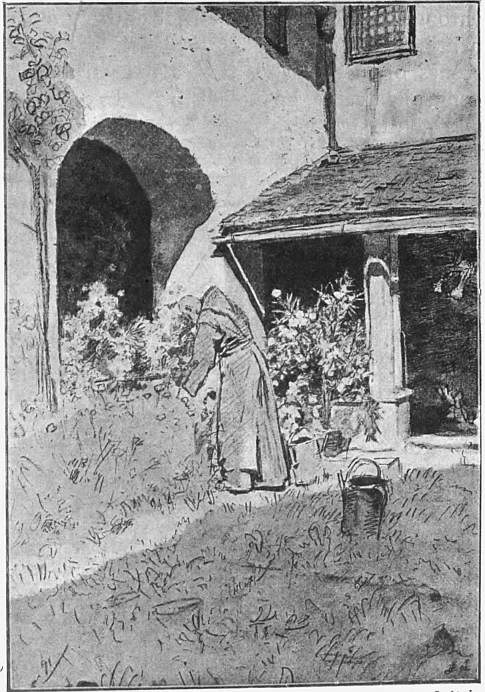
Seemann, Leipzig.
PETTENKOFEN. IN THE CONVENT YARD.
That sumptuous, healthy artist of such pictorial ability, Diez, the Victor Scheffel of painting, stands at the head of the group. From his youth upwards his chief place of resort had been the cabinet of engravings where he studied Schongauer, Dürer, and Rembrandt, and all the boon-companions and vagabonds etched or cut in copper or wood, and on the model of these he painted his own marauders, robber-barons, peasants in revolt, old German weddings and fairs. His picture “To the Church Consecration” recalls Beham, his “Merry Riding” Schongauer, and his “Ambuscade” Dürer, whilst Teniers served as model for his fairs. Diez knows the period from Dürer and Holbein to Rubens, Rembrandt, Wouwerman, and Brouwer as thoroughly as an historian of art, and sometimes—for instance in his “Picnic in the Forest”—he has even drawn the eighteenth century into the circle of his studies. His pictures had an unrivalled delicacy of tone, and could certainly hang beside their Dutch models in the Pinakothek without losing anything by such proximity.
Something of Brouwer or Ostade revived once more in Harburger, the talented draughtsman of Fliegende Blätter, the undisputed monarch of the kingdom of slouching hats, old mugs, and Delft pipes. Pictures like “The Peasants’ Doctor,” “The Card-players,” “The Grandmother,” “By the Quiet Fireside,” “In the Armchair,” and “Easy-going Folk” were masterpieces of delicate Dutch painting: the tone of his pictures shows distinction and temperament; they have deep and fine chiaroscuro, and are soft and fluent in execution. Loefftz with his picture “Love and Avarice” appeared as Quentin Matsys redivivus, and then attached himself in turn to Holbein and Van Dyck; and exercised, like Diez, a great influence on the younger generation by his activity as a teacher.
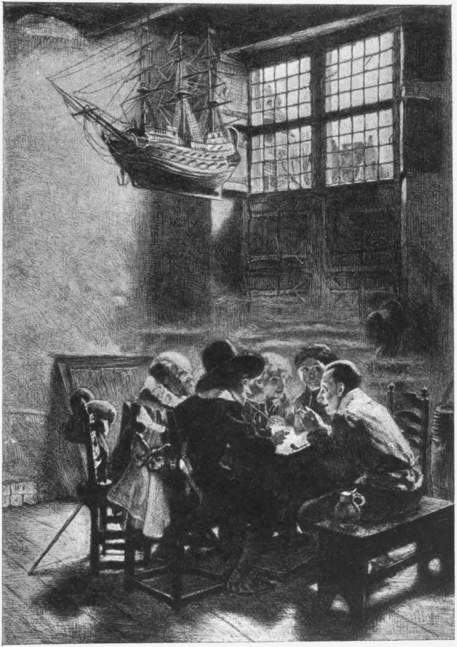
Claus Meyer, who became one of the best known amongst the young Munich painters by his “Sewing School in the Nunnery” of 1883, is worthy of remark inasmuch as he acquired a method of painting which was full of nuances, through modelling himself upon Pieter de Hoogh and Van der Meer of Delft. Through the windows hung with thin curtains the warm, quiet daylight falls into the room, glancing on the clean boards of the floor, on the polished tops of the tables, the white pages of the books, and the blond and brown hair of the children, playing round it like a golden nimbus. Another sunbeam streams through the door, which is not entirely closed, and quivers over the floor in a bright and narrow strip of light. The intimate representation of peaceful scenes of modest life, the entirely pictorial representation of peaceful and congenial events, has taken the place of the adventures dear to genre painting. Old gentlemen with a glass of beer and a clay pipe, servant-girls peeling potatoes in the kitchen, pupils at the cloister sitting over their books in the library, drinkers, smokers, and dicers—such were the quiet, passive, and silent figures of his later pictures. The mild sunshine breaks in and plays over them. Light clouds of tobacco smoke float in the air. Everything is homely and pleasant, touched with a breath of pictorial charm, comfortable warmth, and poetic fragrance. A hundred years hence his works will be sold as flawlessly delicate and genuine old Dutch pictures. Holmberg became the historian of cardinals. A window, consisting of rounded, clumpy panes, with little glass pictures let in, forms the background of the room, and in the subdued oil-light which beams over splendid vessels and ornaments, chests and Gobelins, the white satin dresses of ladies in the mode of 1640, or the lilac and purple robes of cardinals from the artist’s rich wardrobe, are displayed, together with the appropriate models.
In Fritz August Kaulbach, the most versatile of the group in his adoption of various manners, the essence of this whole tendency is to be found. He did not belong to the specialists who restricted themselves, in a one-sided fashion, to the imitation of the Flemish or the Dutch masters, but appeared like old Diterici, Proteus-like, now in one and now in another mask; and, whether he assumed the features of Holbein, Carlo Dolci, Van Dyck, or Watteau, he had the secret of being invariably graceful and chic.
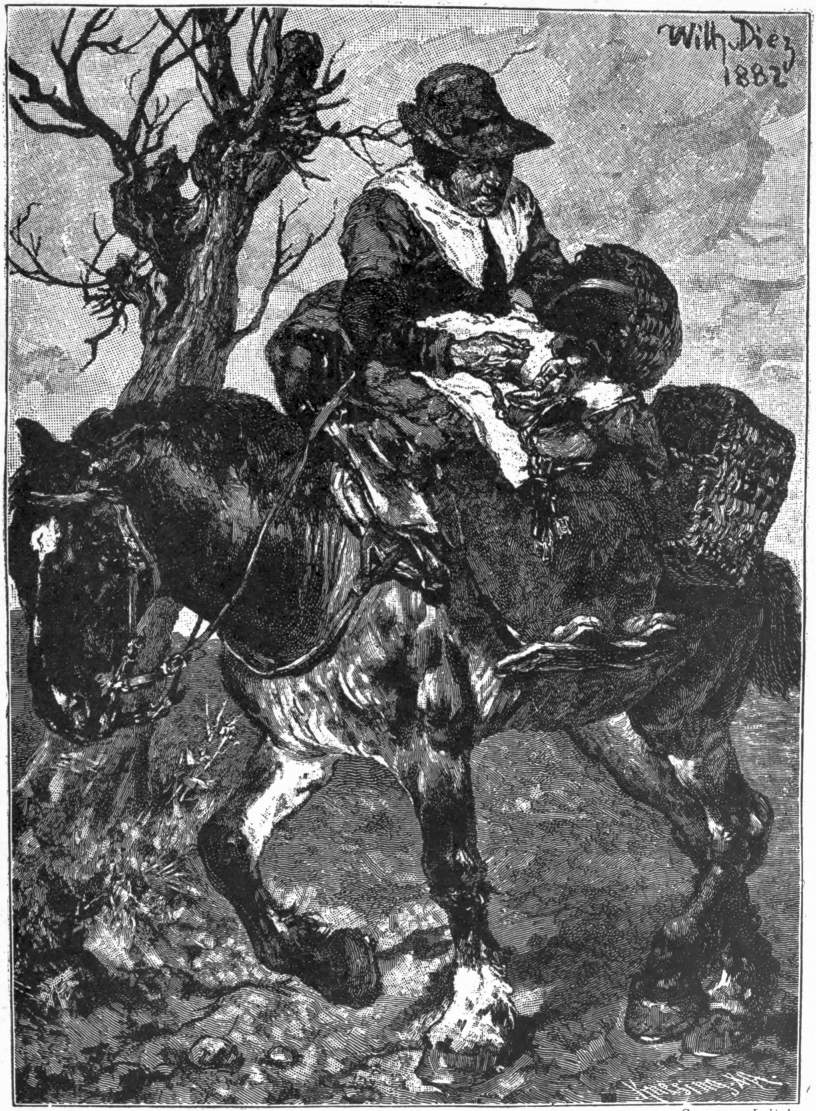
Seemann, Leipzig.
DIEZ. RETURNING FROM MARKET.
Hanfstaengl.
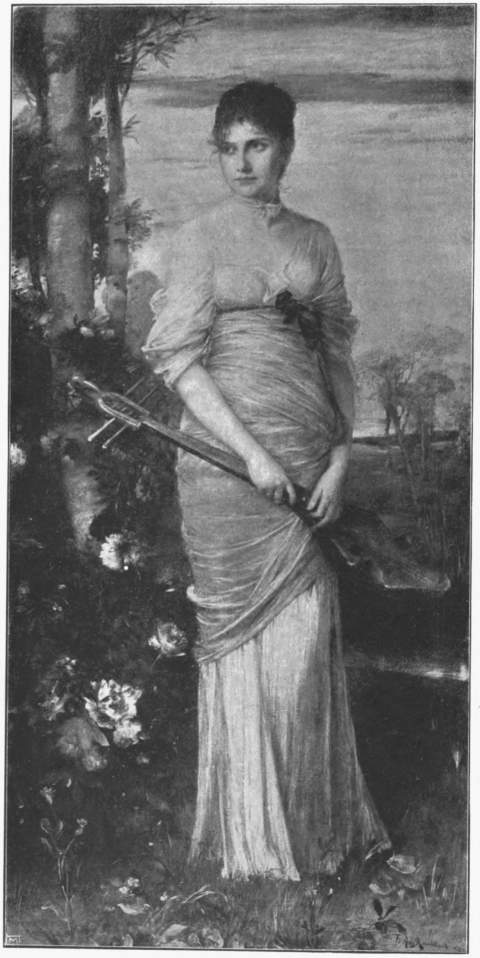
CLAUS MEYER. THE SMOKING PARTY. KAULBACH. THE LUTE PLAYER.
When the German Renaissance was at its zenith he painted in the Renaissance style: harmless genre pictures à la Beyschlag—the joys of love and of the family circle—but not being so banal as the latter he painted them with more delicate colouring and finer poetic charm. Certain single figures were found specially acceptable—for instance, the daughters of Nuremberg patricians, and noble ladies in the old German caps, dark velvet gowns, and long plaits like Gretchen’s, with their eyes sometimes uplifted and sometimes lowered, and their hands at one moment folded and at another carrying a shining covered goblet. Occasionally these single figures were portraits, but none the less were they transformed into “ladies in old German costume”; and Kaulbach understood how to paint, to the utmost satisfaction of his patrons, the black caps, no less well than the little veil and the net of pearls, and the greenish-yellow silk of the puffed sleeves, no less well than the plush border of the dark gown and the antique red Gretchen pocket. Many of them held a lute and stood amid a spring landscape, before a streamlet, or a silver-birch, such as Stevens delighted in painting ten years previously. At that time Fritz August Kaulbach, with greater softness in his treatment, occupied in Germany the place which Florent Willems had occupied in Belgium. Since then he has brought nearer to the public the most various old and modern masters, and he has done so with fine artistic feeling: in his “May Day” he has revived the pastoral scenes of Watteau with a felicitous cleverness; in his “St. Cecilia” he created a total effect of great grace by going arm in arm with Carlo Dolci and Gabriel Max; his “Pietà” he composed with “the best figures of Michael Angelo, Fra Bartolommeo, and Titian,” just as Gerard de Lairesse had once recommended to painters. Intermediately he painted frail flower-like girls à la Gabriel Max, charming little angels à la Thoma, children in Pierrot costume à la Vollon, and little landscapes à la Gainsborough. He did not find in himself the plan for a new edifice in erecting his palace of art, but built according to any plans that came in his way; he simply chose from all existing forms the most graceful, the most elegant, the most precious, culled from their beauties only the flowers, and bound them into a tasteful bouquet. In his modern portraits of women, which in recent years have been his chief successes, he placed himself between Van Dyck and the English. Of course, a really chic painter of women, like Sargent, is not to be thought of in this connection; but for Germany these portraits were in exceedingly fine taste, had an interesting Kaulbachian trace of indifferent health, and breathed an odeur de femme which found very wide approval. In his “Lieschen, the Waitress of the Shooting Festival” he risked a fresh attempt at treating popular life, and made of it such a graceful picture that it might almost have been painted by Piglhein; while in a series of spirited caricatures he even succeeded in being—Kaulbach. The history of art is wide, and since Fritz August Kaulbach knows it extremely well, he will certainly find much to paint that is pleasing and attractive, “s’il continue à laisser errer son imagination à travers les formes diverses créées par l’art de tous les temps,” as the Gazette des Beaux-Arts said of him on the occasion of the Vienna World Exhibition of 1878.
After all, these pictures will have little that is novel for an historian of the next century. “Être maître,” says W. Bürger, “c’est ne ressembler à personne.” But these were the works of painters who merely announced the dogma of the infallibility of universal eclecticism, as the Caracci had done in their familiar sonnets: they were spirited imitators, whose connection with the nineteenth century will be known in after years only by the dates of their pictures. As old masters called back to life, they have enriched the history of art, as such, by nothing novel. Yet, in replacing superficial imitations by imitations which were excellent and congenial, they have nevertheless advanced the history of art in the nineteenth century in another way.
Hanfstaengl.
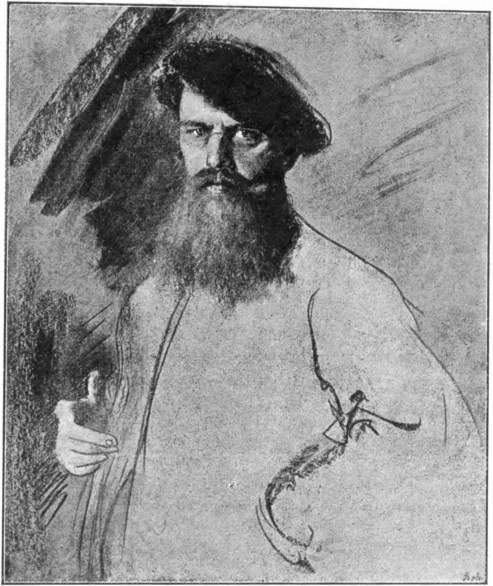
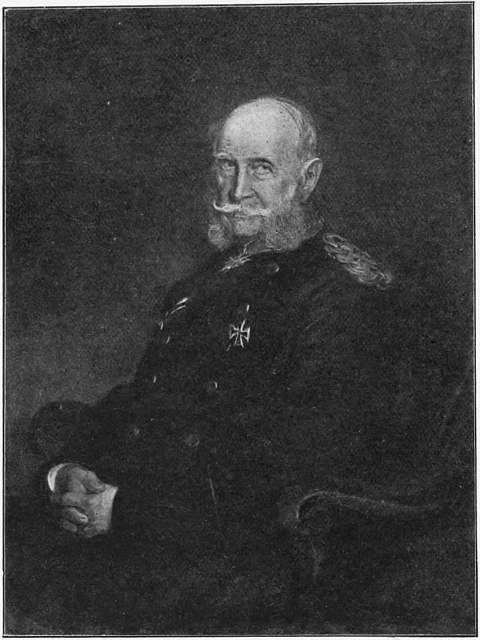
FRANZ LENBACH. LENBACH. PORTRAIT OF WILHELM I.
By the labour of his life each one of them helped to make a place in Germany for the art of oil-painting, which had been forgotten under the influence of Winckelmann and Carstens, and in this sense their works were very important stations, as one might say, on the great thoroughfare of art. Through systematic imitation of the finest old masters, the Munich school had in a comparatively short time regained the appreciation of colour and treatment which had so long been lost. At a hazy distance lay those times when the distinctive peculiarity of German painting lay in its wealth of ideas, its want of any sense for colour, and its clumsy technique, whilst the æsthetic spokesmen praised these qualities as though they were national virtues. These views had been altogether renounced, and a decade of strenuous work had been devoted to the extirpation of all such defects. Such an achievement was sufficiently great, and sufficiently important and gratifying. This last resuscitation of the old masters was capable of being turned into a bridge leading to new regions.
A feeling arose that the limit had been reached, and it arose in those very men who had advanced furthest in pictorial accomplishment, adapting and making their own all the ability of the old masters. Painters believed that they had learnt enough of technique to be able to treat subjects from modern life in the spirit of these old masters, not handling them any longer as laboriously composed genre pictures, but as real works of art. And a group of realists came forward as they had done in France, and began to seek truth with scientific rigour and an avoidance of any kind of anecdotic by-play.
The greatest pupil of the old masters, Franz Lenbach, stands in a close and most important relationship with these endeavours of modern art, through some of his youthful works.
The public has accustomed itself to think of him only as a portrait painter, and he is justly honoured as the greatest German portraitist of the century. But posterity may one day regard it as a special favour of the gods that Lenbach should have been born at the right time, and that his progress to maturity fell in the greatest epoch of the century. His gallery of portraits has been called an epic in paint upon the heroes of our age. The greatest historical figures of the century have sat to him, the greatest conquerors and masters in the kingdom of science and art. Nevertheless this gallery would be worthless to posterity if Lenbach had not had at his disposal one quality possessed by none of his immediate predecessors, a sacred respect for nature. At a time when rosy tints, suave smiles, and idealised drawing were the requirements necessary in every likeness, at a time when Winterhalter painted great men, not as they were, but as, in his opinion, they ought to have been—without reflecting that God Almighty knows best what heads are appropriate for great men—Lenbach appeared with his brusque veracity of portraiture. That alone was an achievement in which only a man of original temperament could have succeeded. If a portrait painter is to prevail with society a peculiar combination of faculties is necessary, apart from his individual capacity for art. Lenbach had not only an eye and a hand, but likewise elbows and a tongue which placed him hors concours. He could be as rude as he was amiable, and as deferential as he was proud; half boor and half courtier, at once a great artist and an accomplished faiseur, he succeeded in doing a thing which has brought thousands to ruin—he succeeded in forcing upon society his own taste, and setting genuine human beings of strong character in the place of the smiling automatons of fashionable painters. In comparison with the works of earlier portrait painters it might be said that a touch of pantheism and nature-worship goes through Lenbach’s pictures.
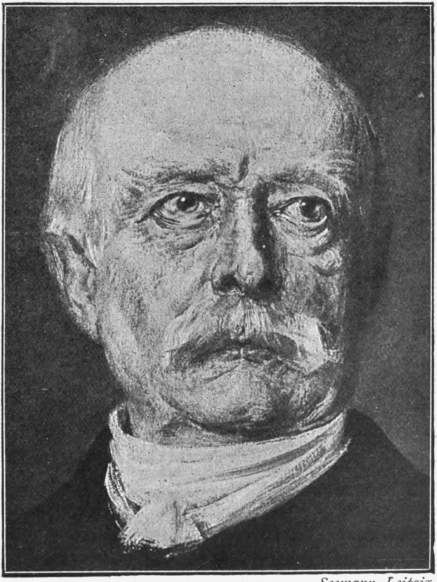
Seeman, Leipzig.
LENBACH. PRINCE BISMARK.
And what makes this so invaluable is that his greatness depends really less upon artistic qualities than upon his being a highly gifted man who understands the spirit of others. It is not merely artistic technique that is essential in a portrait, but before everything a psychical grasp of the subject. No artist, says Lessing, is able to interpret a power more highly spiritual than that which he possesses himself. And this is precisely the weak side in so many portrait painters, since a man’s art is by no means always in any direct relationship with the development of his spiritual powers. In this respect a portrait of Bismarck by Lenbach stands to one by Anton von Werner, as an interpretation of Goethe by Hehn stands to one by Düntzer. To speak of the congenial conception in Lenbach’s pictures of Bismarck is a safe phrase. There will always remain something wanting, but since Lenbach’s works are in existence one knows, at any rate, that this something can be reduced to a far lower measure than it has been by the other Bismarck portraits. “Bien comprendre son homme,” says Bürger-Thoré, “est la première qualité du portraitiste,” and this faculty of the gifted psychologist has made Lenbach the historian elect of a great period, the active recorder of a mighty era. It even makes him seem greater than most foreign portrait painters. How solid, but at the same time how matter-of-fact, does Bonnat seem by Lenbach’s side! One should not look at a dozen Bonnats together; a single one arrests attention by the plastic treatment of the person, but if you see several at the same time all the figures have this same plastic character, all of them have the same pose, and they all seem to have employed the same tailor. Lenbach has no need of all that characterisation by means of accessories in which Bonnat delights. He only paints the eyes with thoroughness, and possibly the head; but these he renders with a psychological absorption which is only to be found amongst modern artists, perhaps in Watts. In a head by Lenbach there glows a pair of eyes which burn themselves into you. The countenance, which is the first zone around them, is more or less—generally less—amplified; the second zone, the dress and hands, is either still less amplified, or scarcely amplified at all. The portrait is then harmonised in a neutral tone which renders the lack of finish less obvious. In this sketchy treatment and in his striking subjectivity Lenbach is the very opposite of the old masters. Holbein, and even Rubens—who otherwise sets upon everything the stamp of his own personality—characterised their figures by a reverent imitation of every trait given in nature. They produced, as it were, real documents, and left it to the spectator to interpret them in his own way.
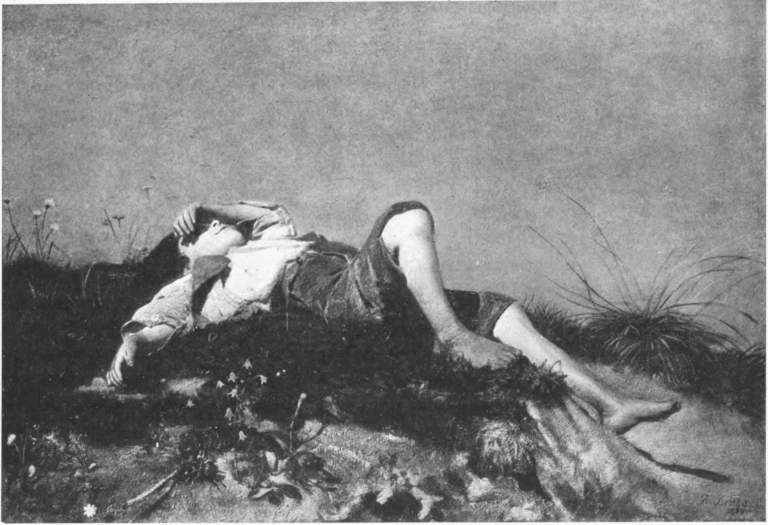
LENBACH. THE SHEPHERD BOY.
Hanfstaengl.
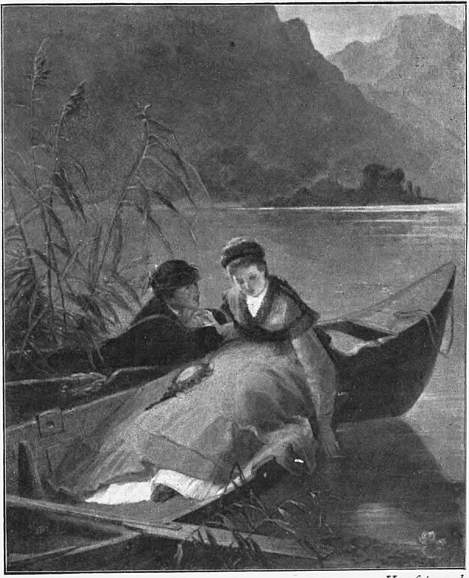
RAMBERG. THE MEETING ON THE LAKE.
Lenbach, less objective, and surrendering himself less absolutely to his subject, emphasises one point, disregards another, and in this way conjures up the spirit by his faces, just as he sees it. It may be open to dispute which kind of portraiture is the more desirable; but Lenbach, at any rate, has now forced the world to behold its great men through his eyes. He has given them the form in which they will survive. No one has the same secret of seizing a fleeting moment; no one turned more decisively away from every attempt at idealising glorification or at watering down an individual to a type. He takes counsel of photography, but only as Molière took counsel of his housekeeper: he uses it merely as a medium for arriving at the startling directness, the instantaneous impression of life, in his pictures. Works like the portraits of King Ludwig I, Gladstone, Minghetti, Bishop Strossmayer, Prince Lichtenstein, Richard Wagner, Franz Liszt, Paul Heyse, Wilhelm Busch, Schwind, Semper, Liphart, Morelli, and many others have no parallel as analyses of the character of complex personalities. Some of his Bismarck portraits, as well as his last pictures of the old Emperor Wilhelm, will always stand amongst the greatest achievements of the century in portraiture. In the one portrait is indestructible power, as it were the shrine built for itself by the mightiest spirit of the century; in the other the majesty of the old man, already half alienated from the earth, and glorified by a trace of still melancholy, as by the last radiance of the evening sun. In these works Lenbach appears as a wizard calling up spirits, an évocateur d’âmes, as a French critic has named him.
But what the history of art has forgotten in estimating the fame of the portrait painter Lenbach is, that in the beginning of his career this very man paved the way for the “Realistic” movement in German painting which later he confronted so haughtily and with so much reserve. The first of these works of his, which have for Germany much the same significance as the early works of Courbet have for France, is the well-known “Shepherd Boy” in the Schack Gallery. Stretched on his back, he lies in the high grass where flowers grow thickly, and looks up while butterflies and dragon-flies flutter through the dusty air of a Roman summer day. Such a frank, an audacious, naked realism, breaking away from everything traditional in its representation of fact, was something entirely novel and surprising in Germany in the year 1856. Up to this time no one had seen a fragment of nature depicted with such unqualified veracity. The tanned shepherd lad, with his naked sunburnt feet, covered by a dark crust of mire from the damp earth, seemed to be lying there in the flesh, plastically thrown into relief by the glowing midday sun. The next of these pictures, “Peasants taking Refuge from the Weather,” which appeared in the exhibition of 1858, called down a storm of indignation on account of its “trivial realism.” Every figure was painted after nature with blunt and rigorous sincerity, and no anecdotic incident was devised in it.
Hanfstaengl.
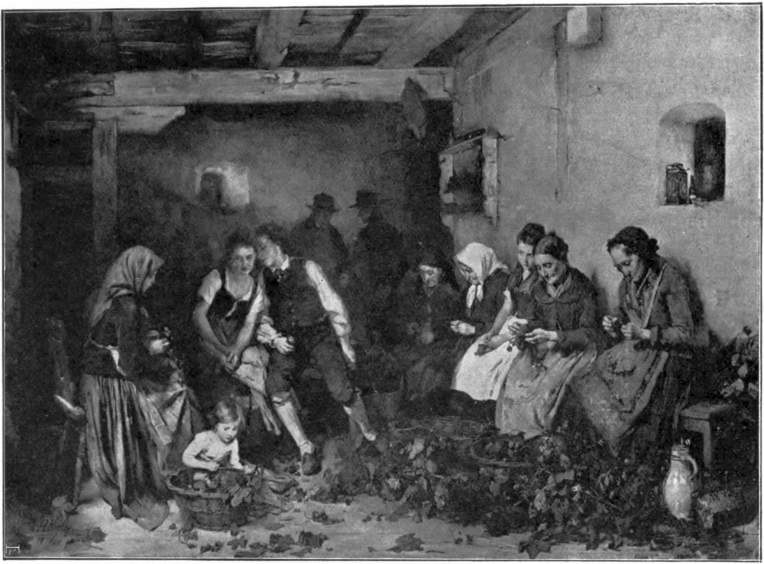
HIRTH. THE HOP HARVEST.
After the sixties the influence of Courbet began to be directly felt. In the days when he worked in Couture’s studio Victor Müller had taken up some of the ideas of the master of Ornans, and when he settled in 1863 in Munich, Müller communicated to the painters there the first knowledge of the works of the great Frenchman. He did not follow Courbet, however, in his subjects. “The Man in the Heart of the Night lulled to Sleep by the Music of a Violin,” “Venus and Adonis,” “Hero and Leander,” “Hamlet in the Churchyard,” “Venus and Tannhäuser,” “Faust on the Promenade,” “Romeo and Juliet,” “Ophelia by the Stream”—such are the titles of his principal works. But how far they are removed from the anæmic, empty painting of beauty which reigned in the school of Couture! Though a Romanticist of the purest water in his subjects, Müller appears, in the manner in which he handles them, as a Realist on whom there is no speck of the academical dust of the schools. The dominant features of Victor Müller’s pictures are the thirst for life and colour, full-blooded strength, haughty contempt for every species of hollow exaggeration and all outward pose, genuine human countenances and living human forms inspired with tameless passion, an audacious rejection of all the traditional rules of composition, and, even in colour, a veracity which in that age, given up to an ostentatious painting of material, must have had an effect that was absolutely novel. In 1863 the blooming flesh of his “Wood Nymph” excited the Munich public to indignation, just as the nude female figures of Courbet had roused indignation about the same time in Paris. Pictures painted with singular sureness of hand were executed by him during the few years that he yet had to live—portraits of dogs, landscapes of a flaming glow of colour, single figures of red-haired Bacchantes and laughing flower-girls, old men dying, and charming fairy pictures. The nearer he came to his death the more his powers of work seemed to increase. The most remarkable ideas came into his head. He drew, and painted without intermission designs which had occupied him for years. “I feel,” he said, “like an architect who has been commissioned to carry out a great building, and I cannot do it: I must die.”
But the impulse which he had given in more than one direction had further issues. As Hans Thoma in later years continued the work of the great Frankfort master in the province of fairy-tale, Wilhelm Leibl realised Müller’s realistic programme.
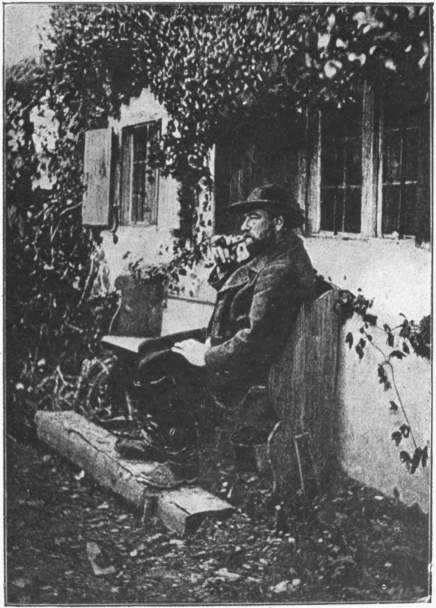
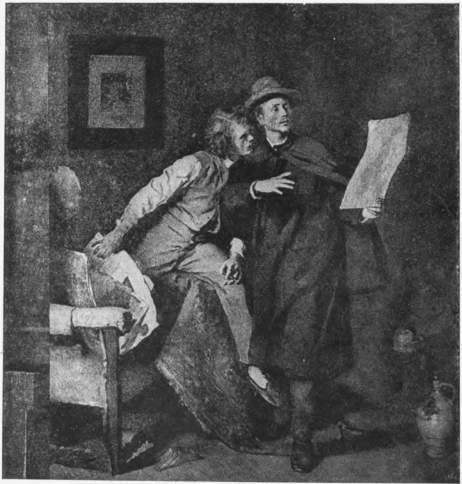
Kunst für Alle.
WILHELM LEIBL. Kunst für Alle. LEIBL. IN THE STUDIO.
Wilhelm Leibl, son of the conductor of music in the cathedral, was born at Cologne on 23rd October 1844. At Munich he entered the studio of Arthur van Ramberg, that unjustly forgotten master who, both by his own work and by his activity as a teacher, exercised upon the younger Munich school a far healthier influence than Piloty. Ramberg was a modern man, was always eager to come into immediate contact with life and break the fetters of tradition which hung everywhere upon that generation. He was an aristocrat and a dandy, and, having occupied himself in the beginning with romantic fairy subjects, he painted, soon after his migration to Munich, a series of pictures from modern life—“Dachau Girls on Sunday,” “The Return from the Masked Ball,” “A Walk with the Tutor,” “The Meeting on the Lake,” “The Invitation to Boat,” and others, which rose above the mass of contemporary productions by their great distinction, fragrance, and grace. At a time when others held nothing but the smock-frock fit for representation, Ramberg painted the fashionable modern costume of women. And when others devoted themselves to clumsy genre episodes, he created songs without words that were full of fine reserve, nobility, and delicate feeling.
Rudolf Hirth, who made a stir with his “Hop Harvest”; Albert Keller, the tasteful painter of fashionable life; Karl Haider, the sincere and conscientious miniature painter whose energy of manner had a suggestion of the old masters, together with Wilhelm Leibl, all issued from Ramberg’s school, not from Piloty’s.
The young student from Cologne was thus saved, in the beginning, from occupying himself with history, and he had no need to addict himself to narrative genre painting, since his entire organisation preordained him to painting pure and simple. Wilhelm Leibl was in those days a handsome fellow, with powerful limbs and shining brown eyes. He was realism incarnate—rather short, but strongly made, and with a frame almost suggesting a beast of burden, broad in the chest, high-shouldered, and bull-necked. His arms were thick and his feet large. His gait was slow, heavy, and energetic, and he made with his arms liberal gestures which took up a good deal of room. He had not the fiery spirit of Courbet, being more prosaic, sober, and deliberate, but he resembled him both in appearance and in the artistic faculty of eye and hand. “He had,” as a French critic wrote of him, “one of those organisations which are predestined for painting, as Courbet had amongst us Frenchmen. Such men extract the most remarkable things from painting.”
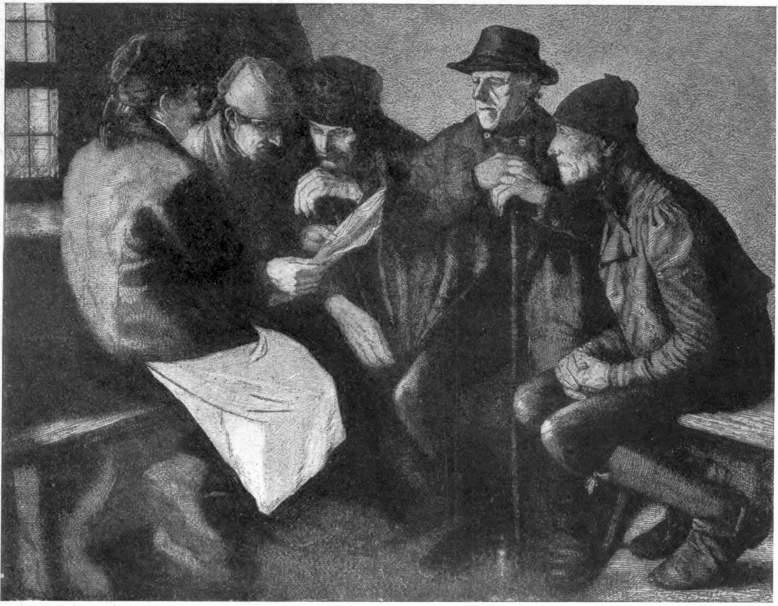
American Art Review.
LEIBL. THE VILLAGE POLITICIANS.
Even his first picture, exhibited in 1869, and representing his two fellow-pupils Rudolf Hirth and Haider looking at an engraving, had a soft, full golden harmony, which left all the products of conventional genre painting far behind it, and came into direct competition with the refined works of the Dutch painter Michael Swert. His second picture, a portrait of Frau Gedon, made an impression even in Paris by its Rembrandtesque beauty of tone, and was awarded there in 1870 the gold medal which the judges had not ventured to give him the year before at Munich, because he was still an Academy pupil. Yet 1869 was the decisive year in Leibl’s life. The Munich Exhibition gave at that time an opportunity for learning the importance of French art upon a scale previously unknown. Over four hundred and fifty pictures were accessible, and the works of the smooth, conventional historical painters were the minority. Troyon was to be seen there, and Millet and Corot. But Courbet, to whose works the committee had devoted an entire room, was chiefly the hero, and one over whom there was much conflict. Opinions were violently at odds about him in the painters’ club. The official circle greeted the master of Ornans with the same hoot of indignation which had been accorded him in France. But for Leibl he became an adored and marvellous ideal. His eyes sparkled when he sat opposite him at the Deutsches Haus, and in default of any other means of making himself understood he assured Courbet of his veneration by sturdily drinking to him: “Prosit Courbet—Prosit Leibl.” He stretched his powerful limbs, and threw himself into vigorous attitudes to evince in sanguinary quarrels, when necessary, his enthusiasm for the great Frenchman. How false and paltry seemed the whole school of Piloty, with its rose-coloured insipidity and its conventional bloom of the palette, when set against the downright veracity and the masterly painting of these works!
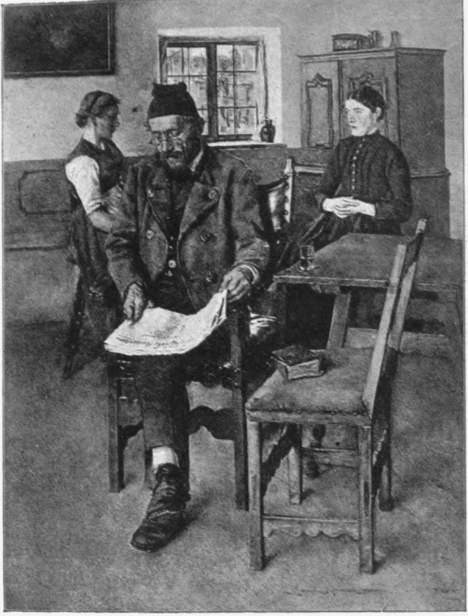
Kunst für Alle. Seemann, Leipzig.
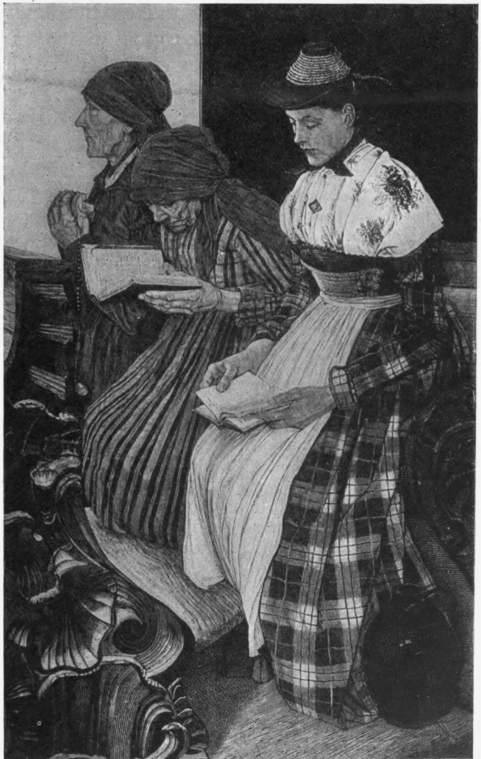
LEIBL. THE NEW PAPER. LEIBL. IN CHURCH.
In the same year he went to Paris, special occasion for the journey being given by a commission for a portrait which he received from the Duc Tascher de la Pagerie. There he painted “La Cocotte,” the portrait of a fat Frenchwoman seated upon a sofa and watching the clouds of smoke from her clay pipe. In its massive realism, and in the exuberant power of its broad, liquid painting, it might have been signed “Courbet,” and Leibl told afterwards with pride how Courbet slapped him on the shoulder when he was at his work, saying: “Il faut que vous restez à Paris.” The breaking out of the war brought his residence in Paris to an end more quickly than he had foreseen, but though he was there only nine months that was long enough to give for ever a firm direction to the efforts of the painter. Leibl became the apostle of Courbet in Germany, and in his outward life the German Millet. Back once more in Bavaria, he migrated in 1872 to Grasolfingen, then to Schondorf on the Ammersee, then to Berbling near Aibling, and in 1884 to Aibling itself; he became a peasant, and, like Millet, he painted pictures of peasants.
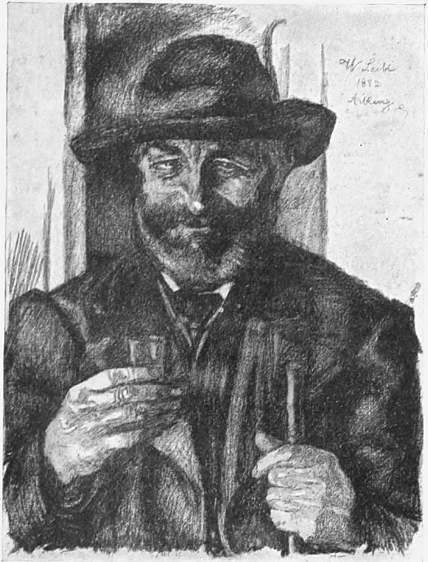
The poetic and biblical, the august and epical bias which characterises the works of Millet, is not to be expected in Leibl. A spirit bent upon what is great and heroic speaks out of Millet’s pictures. A Rembrandtesque feeling for space, the great line, the simplification, the intellectual restraint from anecdotic triviality of form, are the things which constitute his style. Leibl is at his best when he buries himself with delight in the hundred little touches of nature. He triumphs when he has to paint the faces of old peasant women, full of wrinkles, and furrowed with care; the ruddy cheeks of girls, sparkling in all their natural rustic freshness; figured dresses, the material and texture of which are clearly recognisable; flowered silk kerchiefs worn round the neck, coarse woollen bodices, and heavy hobnail shoes. He is to Millet what Holbein is to Michael Angelo.
L’Art.
LEIBL. A PEASANT DRINKING.
Nor can he be called an artist of intimate feeling in the sense in which the Scandinavians are amongst the moderns. In Viggo Johansen the painter disappears; what he paints has not the effect of a picture, but of a moment of existence, a memory of something clear and familiar—something which has been lived and seen, but not fashioned with deliberate intention. His figures are like the sudden appearance of actual persons, spied upon, as if one were looking through the window into a strange room under cover of night. One feels that there is no occasion to pay the artist a compliment; but one would like to sit in such a warm, cosy room, impregnated with tobacco smoke, to inhale the fine cloud of steam issuing from the tea-kettle, to hear the water bubbling and humming upon the glimmering fire. But the painter is always seen in Leibl’s pictures. A communicative spirit, something which touches the heart and sets one dreaming, is precisely what is not expressed in them. The spectator invariably thinks, in the first place, of the astonishing ability, the incredible patience, which went to the making of them. And with all their photographic fidelity he is, moreover, conscious that the painter himself was less concerned in seizing the poetry of a scene, the instantaneous charm of an impression of nature, than in forcing into the foreground particular evidences of his technical powers which he has reserved for display. For instance, newspapers in which, if it is possible, a fragment of the leading article may be deciphered, earthen vessels, bottles, and brandy glasses, play in his pictures a rôle similar to that assumed by the little caskets with brass covers that catch the flashing lights, the overturned settles, the tapestry, and the globe in works of the school of Piloty.
Wilhelm Leibl is a good workman, like Courbet, a man of fresh, vigorous, and energetic nature and robust health, very material, and at times matter-of-fact and prosaic. Painting is as natural to him as breathing and walking are to the rest of us. He goes his way like an ox in the plough, steadily and without tiring, without vibration of the nerves, and without the touch of poetry. He goes where his instinct leads him and paints with a muscular flexibility of hand whatever appeals to his eye or suits his brush. Opposed to the neurotic and hurrying moderns, he has something of a mediæval monk who sits quietly in his cell, without counting the hours, the days, and the years, and embellishes the pages of his service-book with artistic miniatures, to depart in peace when he has set “Amen, Finis” at the bottom of the last page. But he has, too, all the capacity and all the boundless veneration for nature of these old artists. He is the greatest maître peintre that Germany has had in the course of the century, and in this sense his advent was of epoch-making importance.
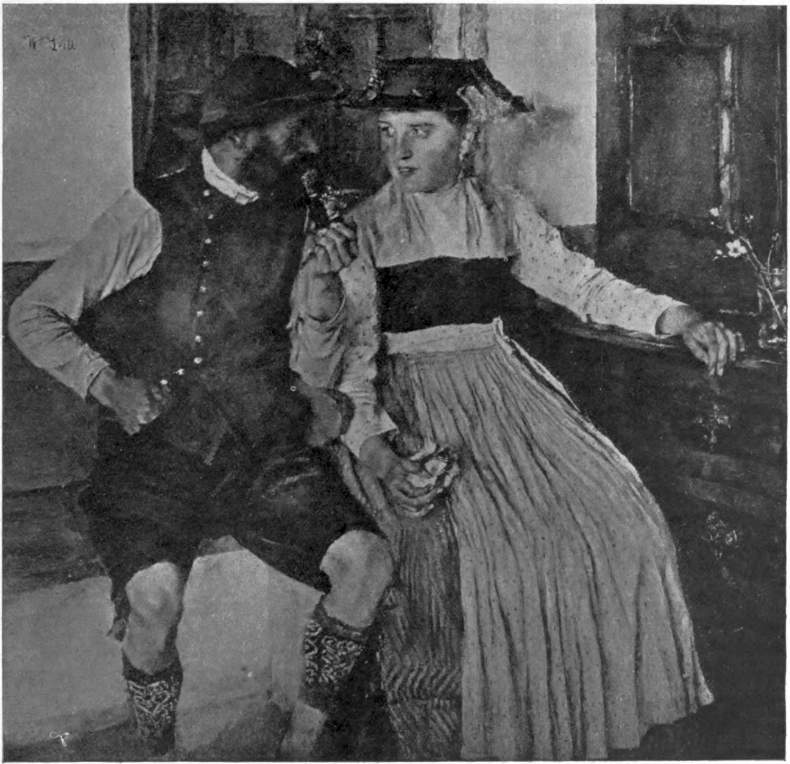
LEIBL. IN THE PEASANT’S COTTAGE.
Even Defregger had observed peasant life altogether from a narrative and anecdotic point of view. In Leibl this narrative genre has been overcome. He had ability enough to give artistic attractions even to an “empty subject.” To avoid exaggerated characterisation, to avoid the expression of anything divided into rôles, he consistently painted people employed in the least exciting occupations—peasants reading a newspaper, sitting in church, or examining a gun. Pains are taken to avoid the slightest movement of the figures. Whilst all his predecessors were romance writers, Leibl is a painter. His themes—simple scenes of daily life—are a matter of indifference; the beauty of his pictures lies in their technique. They are works of which it may be said that every attempt to give an impression of them in words is useless, for they have not proceeded from delight in anecdotic theme, but, as in the good periods of art, from the discipline of the sense for colour and from an eminent capacity for drawing: they are pictures in which mere interest in subject is lost in the consideration of their artistic value, while the matter of what is represented is entirely thrown into the background by the manner in which it is carried out. The chief aim of the historical as of the genre painters had been to draw a fluent cartoon based upon single studies, to mix the colours nicely upon the palette, lay them upon the canvas according to the rules, blend them and let them dry, so as then to attain the proper harmony of colour by painting over again and finally glazing. Leibl’s mastery, which of itself resulted in an astonishing truth to nature, lay in seizing an impression as quickly as possible, taking hold of the reality rightly at the first glance, and transferring the colours to his canvas with decision and sureness, in clear accord with the hues of the original. Lessing’s maxim, “From the eyes straight to the arm and the brush,” has been realised here for the first time in Germany.
As yet no German had, in the same measure, what the painter calls qualities, and even in France two apparently heterogeneous faculties have seldom been united in one master in the same measure as they were in Leibl: a broad and large technique, a bold alla prima painting, and, on the other hand, a joy in work of detail with a fine brush, such as was known by Quentin Matsys, the smith of Antwerp. “The Village Politicians” of 1879 was the chief work that he painted in Schondorf. What would Knaus, the king of illustration and the ruler over the province of vignettes, have made out of this theme! By a literary evasion he would have subordinated the interest of the picture to his ideas. One would have learnt what it is that peasants read, and received instruction as to their political allegiance to party and their offices and honours in the village: that would be the magistrate, that the smith, and that the tailor. In Leibl there are true and simple peasants, who, by way of relaxation from the toil of the week, listen stupidly and indifferently to the reading of a Sunday paper, in which one of them is endeavouring to discover the village news and the price of crops. They are harsh-featured and common, but they have been spared theatrical embellishment and impertinent satire; they are not artistically grouped, though they sit there in all the rusticity of their physiognomies, and all the angularity of their attitudes, without polish or Sunday state. Leibl renders the reality without altering it, but he renders it fully and entirely. The fidelity to nature held fast on the canvas surpassed everything that had hitherto been seen, and it was gained, moreover, by the soundest and the simplest means. Whereas Lenbach, in his effort to reproduce the colour-effects of the old masters, destroyed the durability of his pictures even while he worked upon them, Leibl seemed to have chosen as his motto the phrase which Dürer once used in writing to Jacob Heller: “I know that, if you preserve the picture well, it will be fresh and clean at the end of five hundred years, for it has not been painted as pictures usually are in these days.”
He took a further step in the direction of truth when he made a transition from the Dutch towards the old German masters. After he had, in his earlier productions, worked very delicately at the tone of his pictures, and, for a time, had particularly sought to attain specific effects of chiaroscuro, attaching himself to Rembrandt, he took up an independent position in his conception of colour, painting everything not as one of the old masters might have seen it, but as he had seen it himself. All the tricks of painting and sleights of virtuosity were despised, special emphasis being scarcely laid upon pictorial unity of effect. Everything was simple and true to nature, and had a sincerity which is not to be surpassed.
The picture of the three peasant women, “In Church,” is the masterpiece in this “second manner” of his, and when it appeared in the Munich International Exhibition of 1883 it was an event. From that date Leibl was established—at any rate in the artistic circles of Munich—as the greatest German painter of his time. That Leibl painted the picture without sketching for himself an outline, that he began with the eye of the peasant girl and painted bit by bit, like fragments of a mosaic, was a feat of technique in which there were few to imitate him. The young generation in Munich studied the pages of the service-book and the squares of the gingham dress, the girl’s jug and the carvings of the pew, with astonishment, as though they were the work of magic. They were beside themselves with delight over such unheard-of strength, power, and delicacy of modelling, the fusion of colour suggesting Holbein, and the intimate study of nature. They perpetually discovered new points that came upon them as a surprise, and many felt as Wilkie did when he sat in Madrid before the drinkers of Velasquez, and at last rose wearily with a sigh.
L’Art.
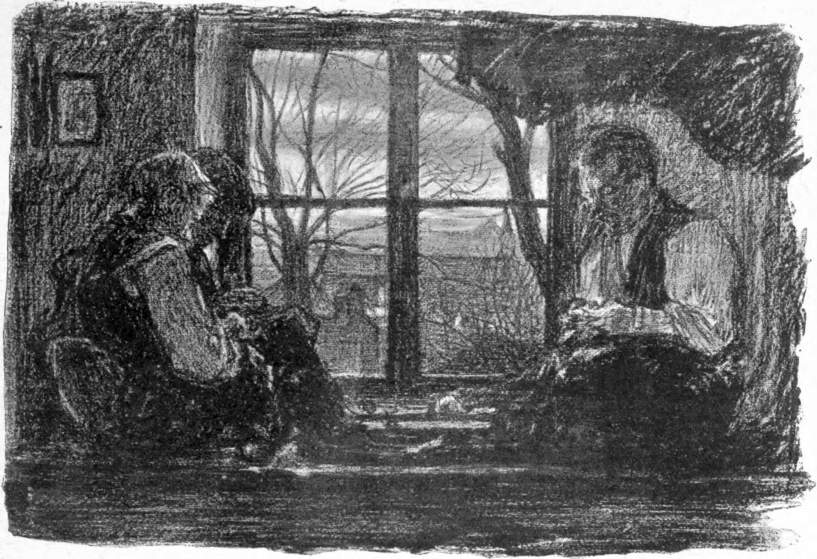
LEIBL. A TAILOR’S WORKSHOP.
Leibl did for Germany what the pre-Raphaelites did for England. Men and women were represented with astonishing pains just as they sat and suffered themselves to be painted. He was determined to give the whole, pure truth, and he gave it; that, and nothing more and nothing less. He reproduced nature in her minutest traits and in her finest movements, bringing the imitative side of art to the highest perfection conceivable. In virtue of these qualities he was a born portrait painter; and although he never had “conception,” as Lenbach had, his portraits belong, with those of Lenbach, to the best German performances of the century. Only Holbein when he painted his “Gysze” had this remorseless manner of analysing the human countenance in every wrinkle. Leibl once more taught the German painters to go into detail, and led them constantly to hold nature as the only source of art; and that has been the beginning of every renaissance.
His works were pictorially the most complete expression of the aims of the Munich school in colour. As a representative of the efforts of the decade from 1870 he is as typical as Cornelius for the art of the thirties, Piloty for that of the fifties, and as Liebermann became later as a representative of the efforts of the eighties.

CHAPTER XXX
THE INFLUENCE OF THE JAPANESE
Courbet and Ribot for France, Holman Hunt and Madox Brown for England, Stevens for Belgium, Menzel, Lenbach, and Leibl for Germany, are the great names of modern Realism, the names of the men who subjected modern life to art, and subjected art to the nineteenth century.
One point, however, the question of colour, still remained unsolved: as the preceding generation took their form, so these painters took their colour, not from nature, but from the treasury of old art.
Courbet announced it as his programme to express the manners, ideas, and aspect of his age—in a word, to create living art. He described himself as the sincere lover of la vérité vraie: “la véritable peinture doit appeler son spectateur par la force et par la grande vérité de son imitation.” But one may question how far his figures, and the environment of them, are true in colour? Where there is a delightful subtlety of fleeting nuances in nature, an oppressive opaque heaviness is found in this modern Caravaggio of Franche-Comté. He certainly painted modern stone-breakers, but it was in the tone of saints of the Spanish school of the seventeenth century. His pictures of artisans have the odour of the museum. The home of his men and women is not the open field of Ornans, but that room in the Louvre where hang the pictures of Caravaggio.
Alfred Stevens made a great stride by painting modern Parisiennes. Whereas the costume picture had up to his time sought the truth of the old masters only in the matter of the skirts which the fashion of their age prescribed, Stevens was the first to dress his women in the garb of 1860, just as Terborg painted his in the costume of 1660 and not of 1460. But the very atmosphere in which the Parisienne of the nineteenth century lived is no longer that in which the women of de Hoogh moved. The whole of life is brighter. The studios in which pictures are painted are brighter, and the rooms in which they are destined to hang. Van der Meer of Delft, the greatest painter of light amongst the Dutch, still worked behind little casements; and in dusky patrician dwellings, “where the very light of heaven breaks sad through painted window,” his pictures were ultimately hung. The old masters paid special attention to these conditions of illumination. The golden harmony of the Italian Renaissance came into being from the character of the old cathedrals furnished with glass windows of divers colours; the half-light of the Dutch corresponded to the dusky studios in which painters laboured, and the gloomy, brown-wainscoted rooms for which their pictures were destined. The nineteenth century committed the mistake even here of regarding what was done to meet a special case as something absolute. Rooms had long become bright when studios were artificially darkened, and artists still sought, by means of coloured windows and heavy curtains, to subdue the light, so as to be able to paint in tones dictated by the old masters. Stevens shed over a modern woman, a Parisienne, sitting in a drawing-room in the Avenue de Jena, the light of Gerard Dow, without reflecting that this illumination, filtered through little lattice-windows, was quite correct in Holland during the seventeenth century, but no longer proper in the Paris of 1860, in a salon where the windows had great cross-bars and clear white panes which were not leaded. It is chiefly this that makes his pictures untrue, lending them an old Flemish heaviness, something earthy, savouring of the clay, and not in keeping with the fresh fragrance of the modern Parisienne. Her modernity is seen through the yellowish glass which the old Flemish masters seemed to hold between Stevens and his model.
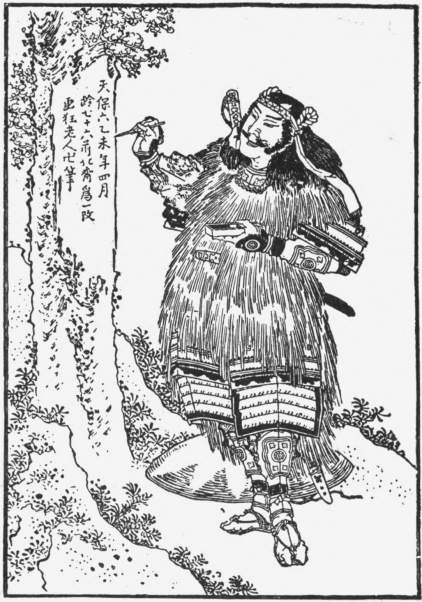
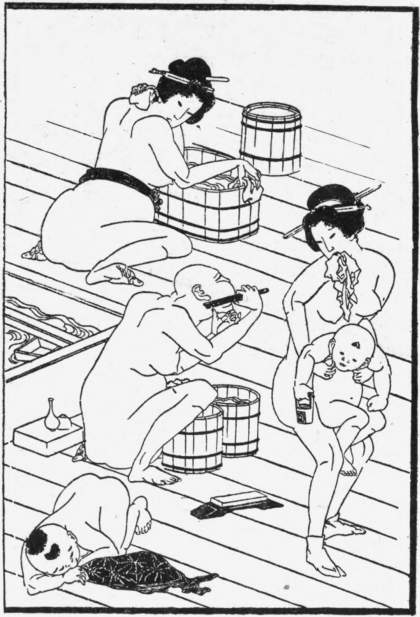
Quantin, Paris. Quantin, Paris.
HOKUSAI IN THE COSTUME OF A JAPANESE WARRIOR. HOKUSAI. WOMEN BATHING.
Considered as a separate personality Ribot, too, is a great artist; his works are masterpieces. Yet when young men spoke of him as the last representative of the school of cellar-windows there was an atom of truth in what they said. Like Courbet, he continued the art of galleries. The master of a style and yet the servant of a manner, he marks the summit of a tendency in which the great traditions of Frans Hals and Ribera were once more embodied. When he paints subjects resembling the themes of these old masters he is as great as they are, as genuine and as much a master of style; but as soon as he turns to other subjects the imitative mannerist is revealed. Even things as tender and unsubstantial as the flowers of the field seem as if they were made of wax. His disdain for what is light, fluent, and fickle, like air and water, is evident in his sea-pieces. His steamers plough their way through a greyish-black sea beneath a thick black stormy sky, as though through grey deserts. Nature quivering in the air and bathed in light is not so heavy and compact, nor has it such plasticity of appearance. His women reading are the ne plus ultra of painting; only it is astonishing that any human being can read in such a dark room.
Ribot’s parallel in Germany is Lenbach, who had less pictorial and greater intellectual power. As a painter of copies, particularly copies of the artists of the sixteenth and seventeenth centuries, he formed and perfected a school for the understanding of the old masters, as none of his contemporaries had done. The copies which he made as a young man for Count Schack in Italy and Spain are probably the best translations by the brush that have ever been executed. He has reproduced Titian and Rubens, Velasquez and Giorgione, with equal magic; no other painter has entered into all the subtleties of their technique with such intelligence and keenness; and by the aid of these sleights of art, which he learnt as a copyist from classic masterpieces, he communicated to his own works that impress which qualifies them for the gallery and suggests the old masters with such refinement. His pictures mark the summit of ability reached in Germany in the pictorial style of the old artists.
But, at the same time, his weakness lies in this very eminence. The man who had passed through the high-school of the old masters with the greatest success was entered as a student for life, and never took the professorial chair himself. Helferich has called him the impersonated spirit of the galleries, the spirit which is centuries old.
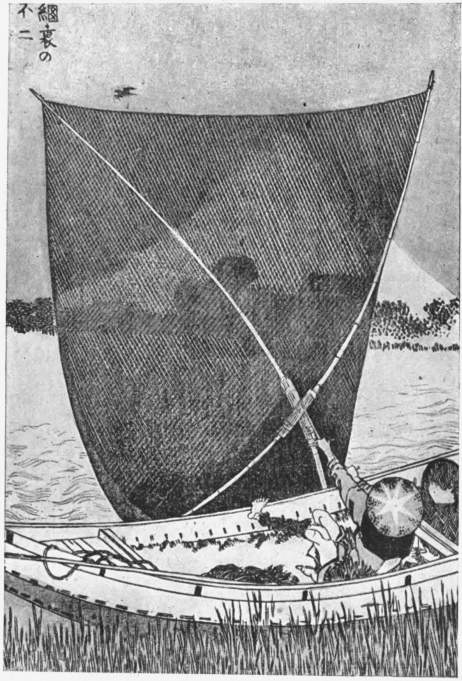
Quantin, Paris.
HOKUSAI. FUSIYAMA SEEN THROUGH A SAIL.
This indicates the direction which must be taken by the further development of painting. A really new and independent art must finally emancipate itself from the Renaissance colouring, the tone of Church painting, and the chiaroscuro of pictures painted behind the variegated panes of lattice-windows. It must be evident that the methods of the old Spanish and old Dutch schools, excellent in themselves, were fully in keeping with strange scenes of martyrdom or quiet interiors with peasants and fat matrons, but that they could not possibly be employed in pictures of artisans beneath the free sky, nor in those of elegant interiors of our own days, nor of pale and delicate Parisiennes attired in silks, beings of a new epoch. A different period necessitates different methods. It is not merely that the subjects of art change, but the way in which they are handled must bear the marks of the period. Nature should no longer be studied through the prism of old pictures, and the phrase beau par la vérité must be exalted to a principle applying to colour also.
The pre-Raphaelites and Menzel were the first to become alive to the problem. They were never taken captive by the tones of the early masters, but placed themselves always in conscious opposition to the artists of older ages. The battle against “brown sauce” even formed an essential point in the programme of the Brotherhood. They protested against conventional colouring as violently as against the sweeping line taught by traditional rules of beauty.
But, as so often happens in the nineteenth century, though the English found the jewel, they did not understand how to cut it. The pre-Raphaelites had a quickening influence, in exciting a feeling for hue and tint, and rendering it keener by their own insistence on the elementary effects of colour. They sought to free themselves from brown sauce and to be just to local tones, through straightforward, independent observation. They painted the trees green, the earth grey, the sky blue, the sunbeams yellow, in sharply accentuated colours, as little blended as possible. But in most cases the result was not particularly pleasant; there was almost always a hard, motley colouring which produced a most unpleasant, glaring effect. Their audacity was somewhat barbaric. There was a want of warmth and softness, the atmosphere did not combine the whole by its mitigating and harmonising power. Even Madox Brown’s “Work” is an offensive chaos of crying colours. The bright clothes, the blue blouses, the red uniforms have a gaudy and unquiet effect. The problem was attacked, but the solution was harsh and crude.
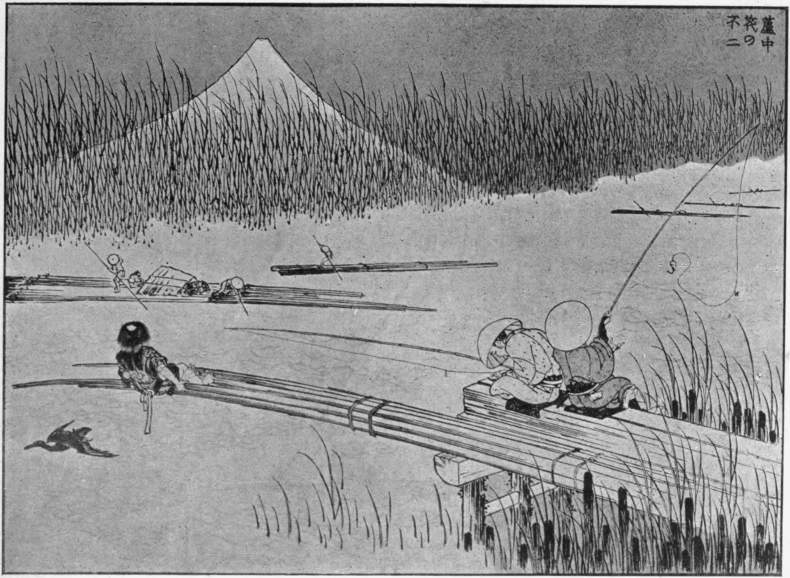
HOKUSAI. FUSIYAMA SEEN THROUGH REEDS.
Of Menzel’s pictures the same is true, though not perhaps in the same degree. In pictorial conception he also has not quite reached the summit. His method of painting is sometimes sparkling and full of spirit, holding the mean, more or less, between the quiet and plain painting of Meissonier and the crisp, glittering style of Fortuny; he lets off a flickering, dazzling, rocket-like firework, but at bottom he has been cut from the block from which draughtsmen are made. Sometimes it is astonishing how his brush sweeps over costumes, ornaments, and buildings, but he does not think in colour; it is supplementary to the drawing, and not of earlier origin, nor even of equal birth. Much as he tried to paint smoke and steam in his “Iron Mill,” he had no understanding for atmospheric life; for this reason harsh and glaring tones almost invariably make a disturbing effect in his works. His “Piazza d’Erbe” as well as his “King Wilhelm setting out to join the Army” have a motley and restless effect in the picture, and only in photography or black and white do they acquire something of the simplicity which is to be desired in the originals. The best of his drawings may stand beside the sketches of Dürer without detriment; to place his pictures on the same level is impossible, because quietude and pure harmony are wanting in them.
So extremes meet. Courbet, Ribot, and Lenbach are greater connoisseurs of colour than Europe had seen previous to their appearance, but this they are at the expense of truth; they have identified themselves with the old masters, and not arrived at any personal conception of colour. Menzel and the pre-Raphaelites despised the old masters, but their conception of colour had something primitive, jarring, and undisciplined.
The note of truth was still missing in the mighty orchestra. By what possible means could it be supplied? How bring to perfection that great harmony which is ever the end and aim of all true artistic effort. It was not until the art of the Far East was unfolded before the eyes of Western painters that this disquieting problem reached its solution.
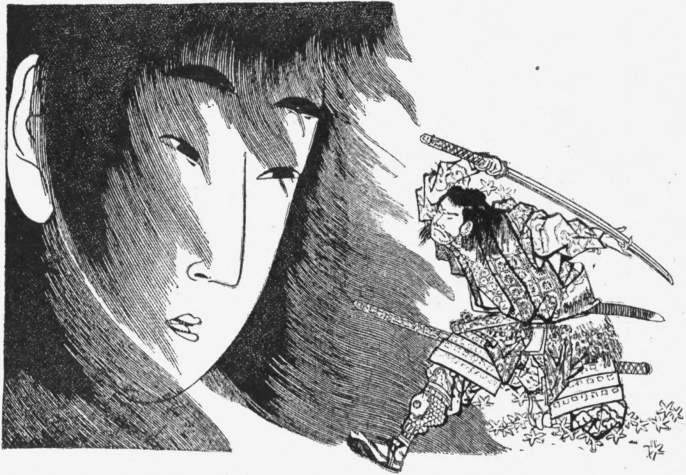
Quantin, Paris.
HOKUSAI. AN APPARITION.
In the year in which Millet exhibited his “Winnower” and Courbet painted his “Stone-breakers” a man died in the Far East whose name was Hokusai. He was the last great representative of an art of painting more than a thousand years old—one which had no Raphael, Correggio, or Titian, though it was, nevertheless, art in the loftiest meaning of the word. Marco Polo, the great traveller of the Middle Ages, had told of a remarkable land “towards the sunrise,” the soil of which it was not permitted to him to tread. And the artistic views of the eighteenth century were revolutionised when the first Japanese porcelain and lacquer-work arrived at the Courts of Dresden and Paris. The aged Louis XIV himself began to find pleasure in idols, pagodas, and “stuffs printed with flowers.” In a short time these works formed an important part of superior collections, and led to the movement against the inflexible despotism of the pompous Lebrun style. For the Japanese gave Europe the unfettered principles of a freer intuition of beauty; they excited a preference for things which were unsymmetrical, capricious, full of movement, for everything by which the charming Louis XV style is to be distinguished from the tiresome academic art of Louis XIV. In the sixties of the nineteenth century Japan exerted, for the second time, a revolutionary influence on the development of European painting. If Japanese productions were in earlier days regarded as curiosities, for which place was to be found in cabinets of rarities, as trifles the artistic value of which was less prized than the dexterity of their construction, it was reserved for the present age to do justice to Japanese art as such.
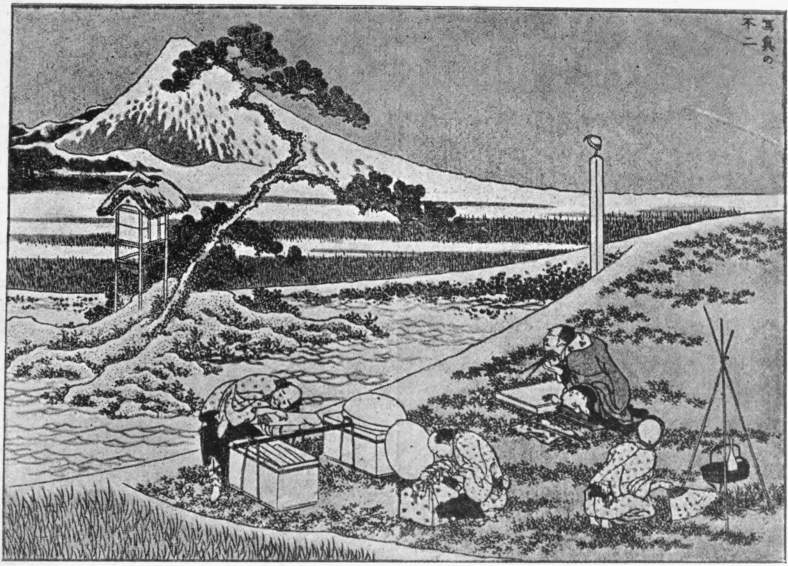
HOKUSAI. HOKUSAI SKETCHING THE PEERLESS MOUNTAIN.
As is well known, oil-painting exists neither in China nor Japan. Just as the Japanese choose the slightest material for building, so everything in their painting bears a trace of extreme lightness. Japanese pictures, kakemonos, are painted in water colour or Chinese ink upon framed silk or paper; but this paper has an advantage over the European article in its unsurpassed toughness, its remarkable softness and pliability, its surface which has either a dull, silky lustre, or may only be compared with the finest parchment. And the pictures themselves are kept rolled up, and only hung, as occasion offers, in the Tokonama, the little closet near the reception-room, and according to very refined rules. Only a few are hung at a time, and only such as harmonise. When a visit is expected the taste of the guest determines the selection. Fresh and variously coloured flowers and branches, placed near them in vases, are obliged to harmonise in colour with the pictures.
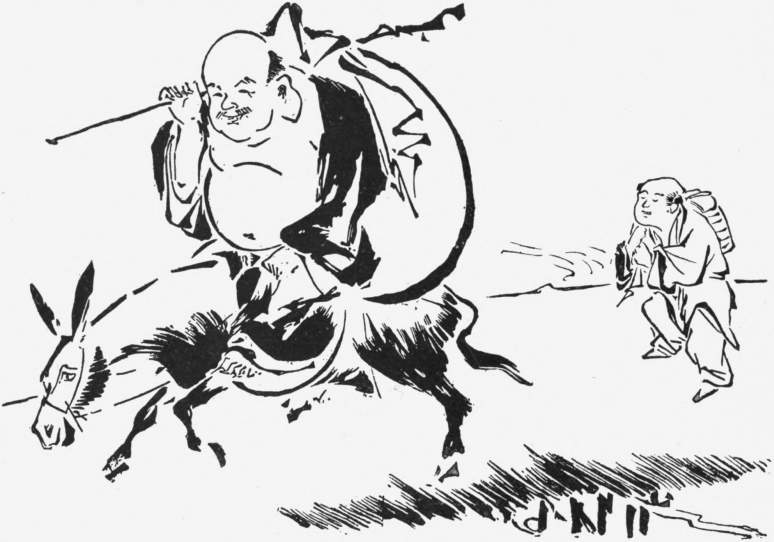
TANYU. THE GOD HOTEÏ ON A JOURNEY.
As an instrument for painting use is only made of the pliant brush of hair, which executes everything with a free and fluent effect. Pen, crayon, or chalk, and all hard mediums which offer resistance, are consistently excluded. The subject-matter of these pictures is surprisingly rich, and assumes for their proper understanding some acquaintance with Japanese literature. An opulent folk-lore, in which cannibals and heroes like Tom Thumb live and move and have their being, just as in European fairy stories, stands at the disposal of the artist. Historical representations from the life of fabulous national heroes, ghosts, and apparitions half man and half bird, alternate with simple landscapes and scenes from daily life. And in all pictures, whether they are fanciful or plain renderings of fact, attention is riveted by the same keenness of observation, the same refinement of taste, in the highest sense of the word by pictorial charm. After the Japanese have been long recognised as the first decorative artists in the world, after the highest praise has been accorded to them in the industrial crafts taken jointly—in lacquer-work and bronze work, weaving, embroidery, and pottery—they are now likewise celebrated as the most spirited draughtsmen in existence.
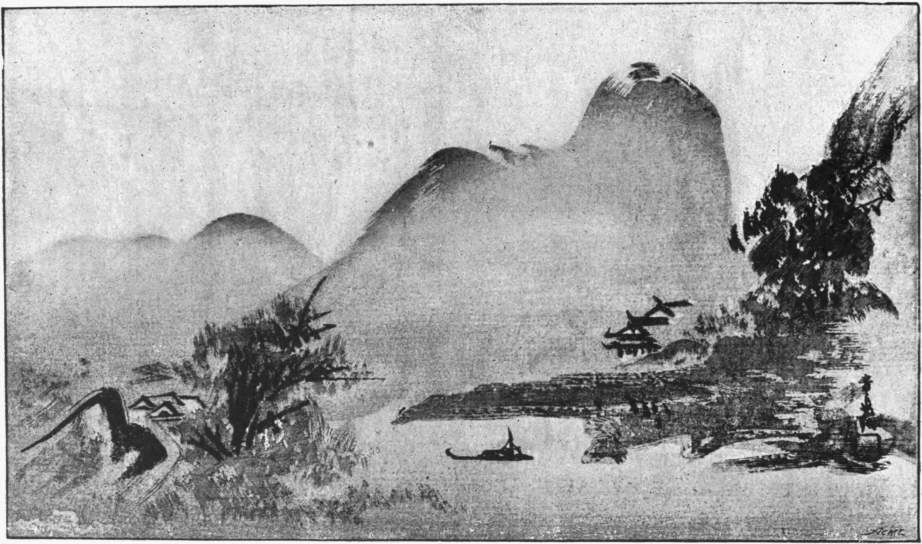
Studio.
KORIN. LANDSCAPE.
Studio. Cassell & Co.
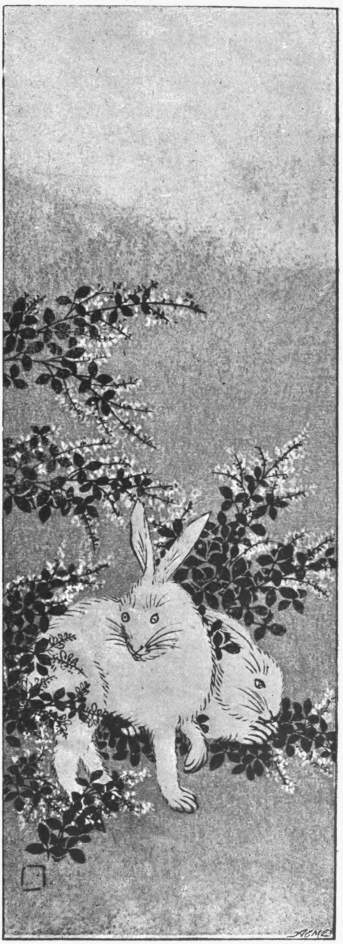
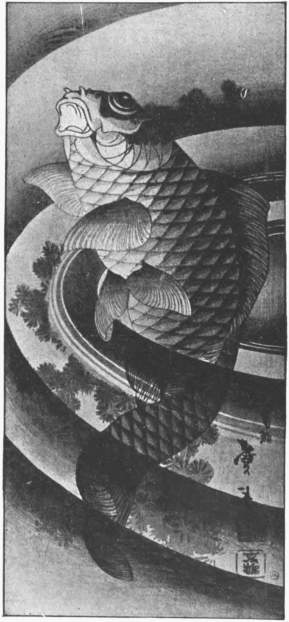
KORIN. RABBITS. OKIO. A CARP.
The Japanese artist lives with nature and in her as no artist of any other country has ever done. Life in the open air creates a relation to nature suggestive of the doctrines of Rousseau; it makes earth, sky, and water as familiar to man as are the beings that move in them. Every house, even in the centre of towns, has a garden laid out with fine taste, and combining beautiful flowers, trees, and cascades, everything incidental to the soil. The form of trees, the shape and colour of flowers, the ripple of leaves, and the gleaming mail of insects are so imprinted in the memory of the painter that his fancy can summon them at pleasure without the need of fresh study. The most fleeting moment of the life of nature is held as firmly in his mind as the everlasting form of rocks and gigantic trees shadowing the temple groves of Nippon. Every one of these artists works with the unfettered falcon glance of the child of nature. His keen eye sees in the flight of birds turns and movements first revealed to us by instantaneous photography. This quickness of eye and this astonishing exercise of memory enable him to obtain the most striking effects with the slightest means. If a Japanese executes figures, race, station, age, business, personality are all seized with the keenest vision, and pregnantly rendered in their essential features. Robes and unclad forms, heads and limbs, animated and still nature, are all reproduced with the same reality. Yet little as the doctrine ever gained ground that to create works of art nature should be mastered upon a system, trivial realism was just as little at any time the vogue.
The love of nature is born in the Japanese, but the photographic imitation, the servile reproduction of reality, is never his ultimate aim. Geoffroy has noted with much subtlety the resemblance which exists between Japanese poets and painters in this respect. Their poets never describe, but only endeavour to express a spiritual feeling, to hold a memory fast—the blitheness of smiling pleasure, the mournfulness of vanished joy. They sing of the mist passing over the mountain summits, the fishing boats, the reeds by the seashore, the plash of waves, the flying streaks of cloud, the sunset streaming purple over the weary world. The same economy of means, the same sureness in the choice of characteristic features, and a similar rapidity in striking the keynote are peculiar to the painters. They, too, express themselves by the scantiest means, shrink from saying too much, and aim only at a rapid and right expression of total effect, leaving to the imagination the task of supplementing and amplifying what is given. The heaviness of matter is overcome, the absurd pretence of reality not attempted. Like the French of the eighteenth century, the Japanese possess the sportive grace, the esprit of the brush hovering over objects, extracting merely their bloom and essence, and using them as the basis for free and independent caprices of beauty. They have the remarkable faculty of being synthetic and discarding every ponderous and disturbing element, without losing the local accent in a landscape or a figure. They fasten upon the most vivid impression of things, but in great, comprehensive lines, subordinating every peculiarity to the light which shines upon them and the shadow in which they are muffled. Their handwriting is at once broad and precise, graceful and bizarre. What a nonchalant, fragile, piquant, or coquettish effect have their feminine figures! And but a few firm strokes sufficed to create the impression. A dexterous sweep of the brush was all that was necessary for the modelling, all that was wanted to summon the idea of the velvet softness of the flesh and the firmness of the bosom. Or surging waves have been painted, or foaming cataracts. But with what consummate mastery, with what peculiar knowledge, the swirl and eddying of the waters have been represented. And how slight are the means which have been employed! Everything has the freshness of life, and the sheer, intangible movement of objects has been caught by a simple and decisive line. A few dashes of Chinese ink are made, and the forcible strokes unite without effort in forming a mountain path or a hillside stream foaming over rocks and trees. Or the prow of a vessel is represented. Nothing is to be seen of the water, and yet it is as if the waves were rocking the ship. The billow swells, rises, and sinks, suggesting the wide sea, the rhythm in the universe. The lines in which the motives are executed render only what is essential. But combined with this striving after simplified form there is a sense of space which of itself, as it were, controls everything, producing the poetic illusion of distance.
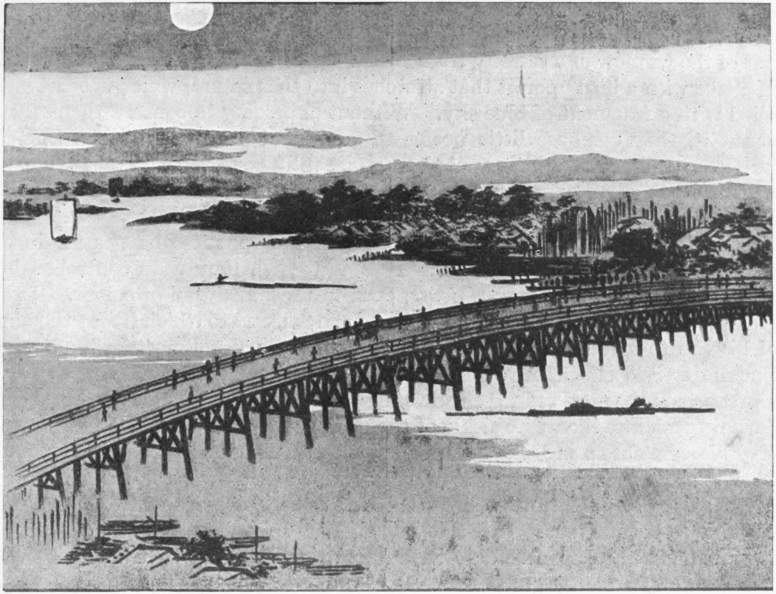
HIROSHIGE. THE BRIDGE AT YEDDO.
The Japanese are masters of the art of enlarging a narrow picture frame to a great expanse, and indicating by a few strokes the distance between foreground and horizon. There is often nothing, or next to nothing, in the wide space, but proximity and distance are so correctly related that all the geological structure is clear, whilst light air is pervasive, giving the eye a vision of boundless perspective. The spur of a headland, the bank of a river, or a cleft between two mountains enables the eye to measure far landscapes. In the presence of their works one dreams, one has the presentiment of infinite distances. They divest objects of their earthiness by bold simplifications, and transform reality into dreamland. It is the spirit of things, their smile, and their intangible perfume which live in these veiled masterpieces which are yet so precise.
The bold irregularity of Japanese works, which know nothing of the stiffness of symmetrical composition, contributes much to this impression. Their pictures are never “composed” in our sense of the word, but rather resemble the instantaneous pictures of photographers. A bird is seen to dart past, only half visible, a cluster of trees is a chance slice from the forest, as it is seen out of the window of a railway train whizzing past. Or it is merely the bough of a tree with a bird upon it that stretches into the picture, which is otherwise filled with a fragment of blue sky. Without appearing to concern themselves about it, they compose little poems of grace and freshness, with a frog, a butterfly, and a blossoming apple-branch sprouting out of a vase. They play with beetles, grasshoppers, tortoises, crabs, and fish as did the artists of the Renaissance with Cupids and angels.
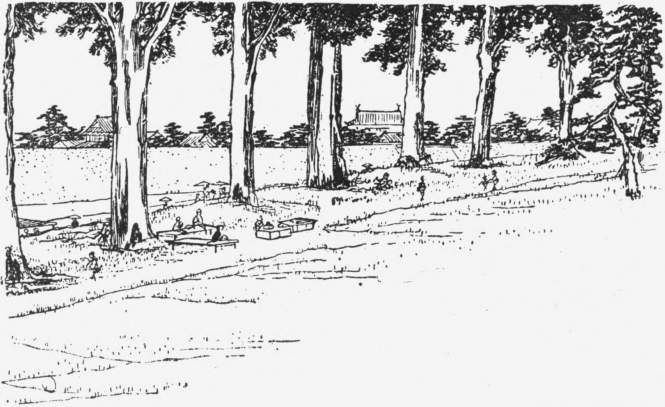
HIROSHIGE. A HIGH ROAD.
And in everything, as regards colour too, the Japanese have a strain of refinement peculiar to themselves. It is as though they were controlled by the finest tact, as by a force majeure, even in their intuition of colour. That great harmony of which Théodore Rousseau spoke, and to which it was the aim of his life to attain, is reached by the Japanese artist almost instinctively. The most vivid effects of red and green trees, yellow roads, and blue sky are represented; the most refined effects of light are rendered—illuminated bridges, dark firmaments, the white sickle of the moon, glittering stars, the bright and rosy blossoms of spring, the dazzling snow as it falls upon trim gardens; and there are discords nowhere. How heavy and motley our colouring is compared with these delicious chords, set beside each other so boldly, and invariably so harmonious. Is it that our eyes are by nature less delicate? or is everything in the Japanese only the result of a more rational training? We have not the same intense force of perception, this instinctive and sensuous gift of colour. Their colouring is a delight to the eyes, a magic potion. Offence is nowhere given by a glaring or an entirely crude tone; everything is finely calculated, delicately indicated, and has that melting softness so enchanting in Japanese enamel. The simplest chords of colour are often the most effective; nothing can be more charming than the delicate duet of grey and gold. And the cheapest wood-cut has often all these refinements in common with the most costly kakemono. Even here, where they turn to lowly things, their art is never vulgar, but maintains itself at such an aristocratic height that we barbarians of the West, blessed with oleographs and Academies of Art, can only look up with envy to this nation of connoisseurs.
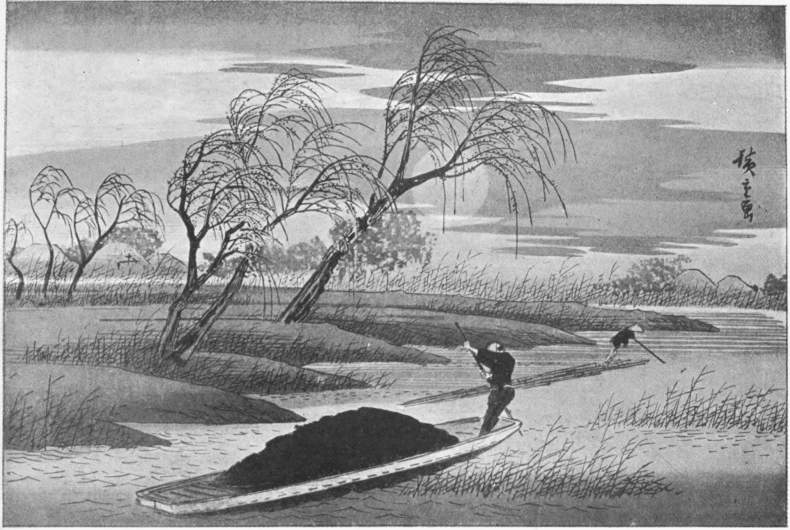
HIROSHIGE. A LANDSCAPE.
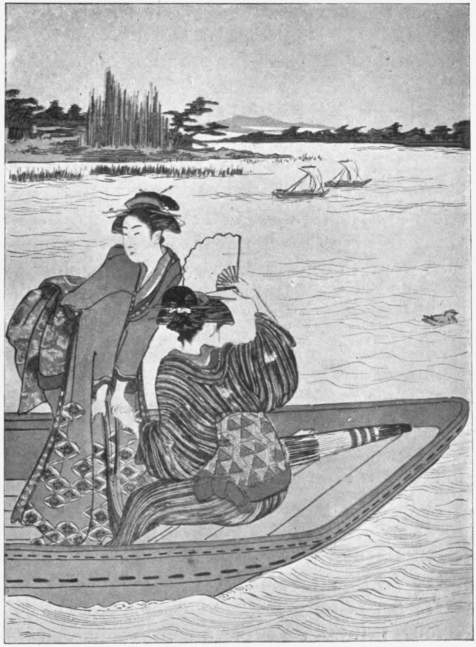
The oldest of these Japanese artists working in wood-cut engraving was Matahei, who lived in the beginning of the seventeenth century, and executed scenes from the theatres and Japanese family and street life. Icho and Moronobu followed at the close of the seventeenth century, the one being a spirited caricaturist, the other a genuine baroque artist of noble and classic reserve. Through the masters of the eighteenth century, as through Eisen, Fragonard, and Boucher, this reproductive art took fresh development. The soft girls of Soukénobu with their delicate round faces, the graceful beauties of Harunobu arrayed in costly toilettes, the tall feminine forms of the marvellous Outamaro in all their provocative charm, the vivid scenes from popular life of the great colourist Shunsho, are works pervaded with a delicate perfume of which Edmond de Goncourt alone could render any impression in words.
Outamaro, the poet of women, was, in a special sense, the Watteau of aristocratic life in Japan. He knew the life of the Japanese woman as no other has ever done—her domestic occupations, her walks and her charming graces, her vanities and her love affairs. He knew also the scenes of nature which she contemplated, the streets through which she passed, and the banks along which she sauntered with an undulating step. His women are slender beings, isolated like idols, and standing motionless in poses hieratically august; æsthetic souls, who swoon and grow pale under the sway of disquieting visions; fading flowers, forms roaming wearily by the verge of a lonely sea or a sluggish stream, or flitting timidly, like bats, through the soft brilliancy of lights amid a festival by night. And in killing what is fleshly and physical he renders the faces visionary and dreamy, renders the hands and the gestures finer, and at the same time subdues and mitigates the colours and the splendour of the clothes, taking pleasure in dying chords, in deep black and tender white, in fine, pallid nuances of rose-colour and lilac. Every one of his pupils became a fresh chronicler of aristocratic life. Toyohami painted night festivals; Toyoshiru, animated crowds; Toyokumi, scenes of the theatre; Kunisada, women upon their walks; Kunioshi, melodramatic representations full of pomp, with marvellous fantastic landscapes.
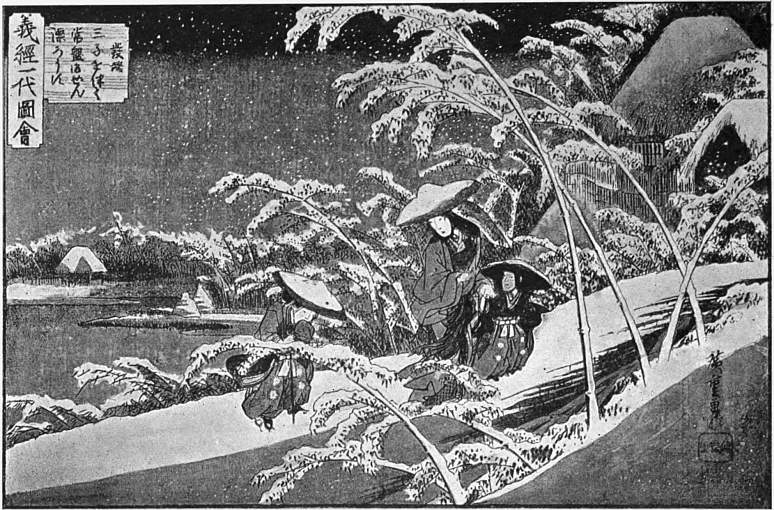
Quantin, Paris.
HIROSHIGE. SNOWY WEATHER.
The nineteenth century brought the widest popularisation of art, corresponding more or less to the “resort to popular national life,” as the beginning of modern genre painting and of the modern art of illustration was called in Germany. The refined son of Nippon shrugs his shoulders over these last creations of Japanese reproduction in colours; he prefers those earlier charming masters of grace, and misses the aristocratic cachet in the new men, with as much justification as the refined European collector has when he does not care to place the plates of Granville or Doré in a portfolio with those of Eisen or Fragonard. Nevertheless amongst the draughtsmen who followed the popular tendency there was at any rate one great genius, one of the most important artists of his country, who became more familiar to Europe than any of his other compatriots: this was Hokusai.
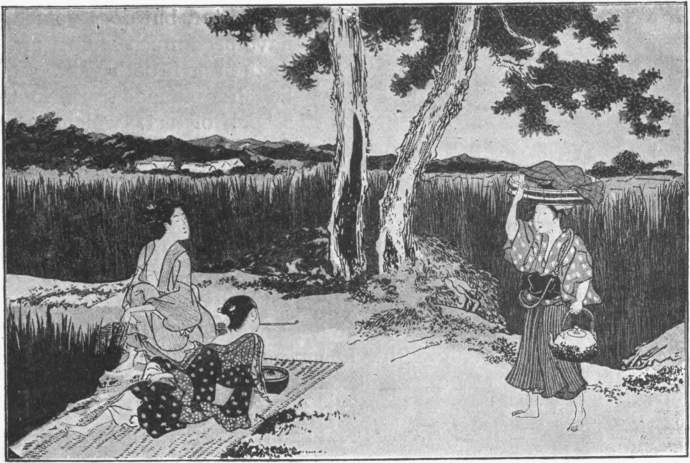
AN UNKNOWN MASTER. HARVESTERS RESTING.
All the qualities of Japanese art are united in him as in a focus. His work is the encyclopædia of a whole nation, and in his technical qualities he stands by the side of the greatest men in Europe. He is the most attentive observer, a painter of manners as no other has ever been; he takes strict measure of everything, analysing the slightest movements. He draws the solid things of earth, the immovable rocks, the everlasting primæval mountains, and yet follows the changing phenomena of light and shade upon its surface. He has, in the highest degree, that peculiarly Japanese quality of giving tangible expression to the movements of things and living creatures. His men and women gesticulate, his animals run, his birds fly, his reptiles crawl, his fish swim; the leaves on the trees, the water of the rivers, and the sea and the clouds of the sky move gently. He is a magnificent landscape painter, celebrating all the seasons, from blossoming spring to ice-bound winter. In his designs he maps out orchards, fields, and woods, follows the winding course of rivers, summons a fine mist from the sea, sends the waves surging forward, and the billows racing up against the rocks and losing themselves as murmuring rivulets in the sand. But he is also a philosopher and a poet of wide flight, who makes the boldest journeys into the land of dreams. His imagination rises above the work-a-day world, rides upon the chimera, bodies forth a new life, creates monsters, and tells visions of terrible poetry. The deep feeling of the primitive masters revives in him, and he appears as a strange mystic, when he paints his blithe ethereal goddesses, or that old Buddhist who, when banished, came every day across the sea, as the legend tells, to behold once more Fuji, the sacred mountain.
Studio.
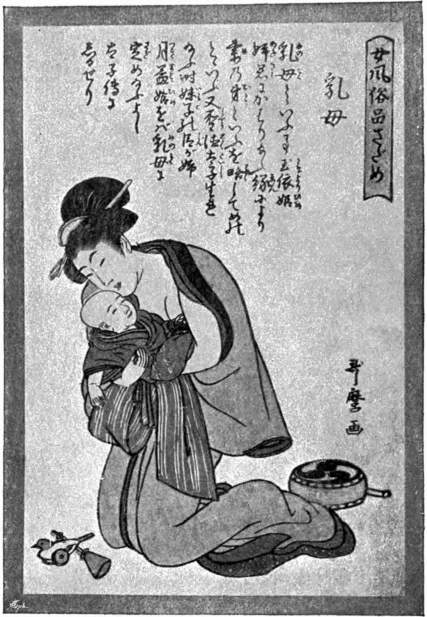
OUTAMARO. MOTHER’S LOVE. KIYONAGA. LADIES BOATING.
Hokusai was born in 1760, amid flowery gardens in a quiet corner of Yeddo, fourteen years after Goya and twelve years after David. His father was purveyor of metallic mirrors to the Court. Hokusai took lessons from an illustrator, but does not seem to have been much known until his fortieth or fiftieth year. In 1810 he first founded an industrial school of art, which attracted numbers of young people. To provide them with a compendium of instruction in drawing he published in 1810 the first volume of his Mangwa. From that time he was recognised as the head of a school. When his fame began to spread he changed his residence almost every month to protect himself from troublesome visitors. And just as often did he alter his name. Even that under which he became famous in Europe is only a pseudonym, like “Gavarni”: amongst various noms de guerre it was that which he bore the longest and by which he was definitely recognised.
As a painter he was only active in his youth. The achievement of his life is not his pictures, but a magnificent series of illustrated books, a life’s work richer than that of any of his compatriots. Like Titian and Corot, fate had predestined him to reach a very great age without ever growing old.
“From my sixth year,” he writes in the preface to one of his books, “I had a perfect mania for drawing every object that I saw. When I had reached my fiftieth year I published a vast quantity of drawings; but I am unsatisfied with all that I have produced before my seventieth year. At seventy-three I had some understanding of the form and real nature of birds, fish, and plants. At eighty I hope to have made further progress, and at ninety to have discovered the ultimate foundation of things. In my hundredth year I shall rise to yet higher spheres unknown, and in my hundred and tenth, every stroke, every point, and in short everything that comes from my hand will be alive.” Hokusai certainly did not reach so great an age as that. He died at eighty-nine, on 13th April 1849, and is buried in the temple at Yeddo. During the period between 1815 and 1845 he published about eighty great works, altogether over five hundred volumes.
“I rose from my seat at the window, where I had idled the whole day long ... softly, softly.... Then I was up and away.... I saw the countless green leaves tremble in the densely embowered tops of the trees; I watched the flaky clouds in the blue sky, collecting fantastically into shapes torn and multiform.... I sauntered here and there carelessly, without aim or volition.... Now I crossed the Bridge of Apes and listened as the echo repeated the cry of the wild cranes.... Now I was in the cherry-grove of Owari.... Through the mists shifting along the coast of Miho I descried the famous pines of Suminoye.... Now I stood trembling upon the Bridge of Kameji and looked down in astonishment at the gigantic Fuki plants.... Then the roar of the dizzy waterfall of Ono resounded in my ear. A shudder ran through me.... It was only a dream which I dreamed, lying in bed near my window with this book of pictures by the master as a cushion beneath my head.”
In these words a learned Japanese has indicated the great range of subject, the unspeakably rich material of the works of the master. By preference he leads us to the work-places of artisans, to woodcarvers, smiths, workers in metal, dyers, weavers, and embroiderers. Then come the pleasures of the nobility, who are displayed in their refinement, reserve, and dignity; the country-folk at their daily avocations, or making merry upon holidays; the fantastic shapes of fabulous animals and demons, who figure in the life of Japanese national heroes, mighty with the sword; apparitions, drunken men, wrestlers, street figures of every conceivable description, mythical reptiles, snow-clad mountain tops, waving rice-fields lashed by the wind, woodland glens, strange gateways of rock, far views over waters with cliffs clothed with pine.
The most celebrated of those works which contain landscapes exclusively are the views, published in three volumes in 1834-36, of the mountain of Fuji, the great volcano rising close by Yeddo, and from old time playing a part in the works of Japanese landscape painters. In Hokusai’s book the cone of the mountain is sometimes seen rising clear in a cloudless sky, whilst it is sometimes shrouded by clouds of various shapes. Its beautiful outline glimmers through the meshes of a net, through the spindrift of snow falling in great flakes, or through a curtain of rain splashing vertically down. It rises from misty valleys coloured by the rays of the evening sun, or is reflected—itself out of sight—in the smooth surface of a lake, upon the reedy shores of which the wild geese cackle, or it stands in ghostly outlines against the night sky flooded with silver moonlight. Summer breezes and winter storms drive over it, rattling showers of hail, lashed by the wind, or light falls of snow descend round it. In spring the blossoms of peach and plum-trees flutter to the earth, like swarms of white and rosy butterflies. Only famished wolves or dragons, which popular superstition has located in the mountain of Fuji, occasionally animate the grandiose solitude of the landscape.
“Never,” says Gonse, “has a more dexterous hand rested upon paper. It is impossible to study his plates without an excited feeling of pleasure, for they are absolute perfection, the highest that Japanese art has produced in freshness, brilliancy, life, and originality. Hokusai’s capacity of giving the impression of relief and colour with a stroke of the brush has nothing like it except in Rembrandt, Callot, and Goya. Men, animals, landscapes, and everything in his drawings are reduced to their simplest expression. Groups are seen in motion, priests in procession, soldiers on the march, and often a single stroke is sufficient to render an individual or create the impression of life and movement. Every plate is a masterpiece of coloured woodcut engraving, of singular flavour in colour, delightful in its gravely harmonised chord of golden yellow, faded green, and fiery red, to which are sometimes added golden, silvern, and other metallic tones.”
After the beginning of the sixties Paris came under the captivating influence of Japan. And there is no doubt that as the English influenced the landscape painters of Fontainebleau, the Venetians Delacroix, and the Neapolitan masters Courbet and Ribot, the newest phase of French art, which took its departure from Manet, was inaugurated by the enthusiasm for things Japanese. From the moment when the peculiar isolation of Japan was ended by the breaking up of the Japanese feudal state, Paris was flooded by splendid works of Japanese art. A painter discovered amongst the mass of articles newly arrived albums, colour prints, and pictures. Their drawing, colouring, and composition deviated from everything hitherto accounted as art, and yet the æsthetic character of these works was too artistic to permit of any one smiling over them as curiosities. Whether the discoverer was Alfred Stevens or Diaz, Fortuny, James Tissot, or Alphonse Legros, the enthusiasm for the Japanese swept over the studios like a storm. The artistic world never wearied of admiring the capricious ability of these compositions, the astonishing power of drawing, the fineness in tone, the originality of pictorial effect, nor of wondering at the refined simplicity of the means by which these results were achieved. Japanese art made itself felt by its fresh and tender charm, its creative opulence, its lightness and delicacy of observation; it arrested attention because directness, unfailing tact, and inherent distinction were of the essence of its conception; and it was recognised as the production of a nation of artists combining the subtilised taste of an originally refined civilisation with the freshness of feeling peculiar to primitive people. Colour prints, now to be had for a few francs at every bazaar, were bought at the highest figures. Every new consignment was awaited with feverish impatience. Old ivory, enamel, porcelain and embellished pottery, bronzes and wood and lacquer-work, ornamented stuffs, embroidered silks, albums, books of wood-cuts, and knick-knacks were scarcely unpacked in the shop before they found their way into the studios of artists and the libraries of scholars. In a short time great collections of the artistic productions of Japan passed into the hands of the painters Manet, James Tissot, Whistler, Fantin-Latour, Degas, Carolus Duran, and Monet; of the engravers Bracquemond and Jules Jacquemart; of the authors Edmond and Jules de Goncourt, Champfleury, Philippe Burty, and Zola; and of the manufacturers Barbedienne and Christofle.
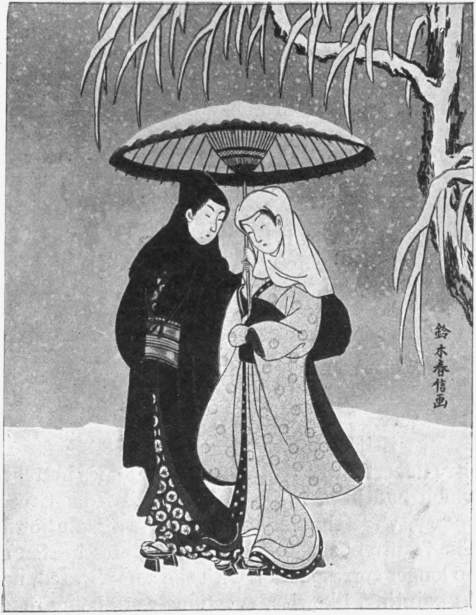
HARUNOBU. A PAIR OF LOVERS.
The International Exhibition of 1867 brought Japan still more into fashion, and from this year must be dated the peculiar influence of the West upon the East and the East upon the West. The Japanese came over to study at the European polytechnic institutes, universities, and military academies. On the other hand, we became the pupils of the Japanese in art. Even during the course of the Exhibition a group of artists and critics founded a Japanese society of the “Jinglar,” which met every week in Sèvres at the house of Solon, the director of the manufactory. They used a Japanese dinner-service, designed by Bracquemond, and everything except the napkins, cigars, and ash-trays was Japanese. One of the members, Dr. Zacharias Astruc, published in L’Étendard a series of articles upon “The Empire of the Rising Sun,” which made a great sensation. Soon afterwards the Parisian theatres brought out Japanese ballets and fairy plays. Ernest d’Hervilly wrote his Japanese piece La Belle Saïnara, which Lemère printed for him in Japanese fashion and paged from right to left, giving it a yellow cover designed by Bracquemond. A Japanese ballet was performed at the opera, and a Japanese turn was given to the toilettes of women.
For painters Japanese art was a revelation. Here was uttered the word that hovered on so many lips, and that no one had dared to pronounce. With what a fleeting touch, and yet with what precision, with what incomparable sureness, lightness, and grace, was everything carried out. How intuitive and spontaneous, how imaginative and how full of suggestion, how effortless and how rich in surprises, was this strange art. How happily was industry united with caprice, and nonchalance with endeavour at the highest finish. How suggestive was this disregard for symmetry, this piquant method of introducing a flower, an insect, a frog, or a bird here and there, merely as a pictorial spot in the picture. How the Japanese understood the art of expressing much with few means, where the Europeans toiled with a great expenditure of means to express little.
It would certainly have been an exceedingly false move if a direct imitation of the Japanese had been thought of. Japanese art is the product of a sensuous people, and European art that of intellectual nations. The latter is greater and more serious; it is nobler, and it reaches heights of expression not attained by the grotesque and terrible distortions and the morbidly droll or melancholy outbursts of sentiment known to the Japanese. Our imagination is alien to that of these children of the sensuous world, who quake and tremble for joy, horrify themselves with their masks, and pass from convulsive laughter to sheer terror, and from the shudder of hallucination to ecstatic bliss. Had Japanese art been coarsely transposed by imitators it would have led to caricature.
But if its poetics were little suitable for Europe in the specialised case, they nevertheless contained general laws better fitted for modern art than those which had been hitherto borrowed from Greece. All arts, music as well as poetry, were then striving for the dissolution of simple, tyrannical rhythms. The recurrence of unyielding measures beaten out with unwavering repetition no longer corresponded with the complicated, neurotic emotions of the new age. In painting, likewise, exertions were being made to burst the old shell, and a style was sought after for the treatment of modern life which had been violently handled in the effort to force it to fit the Procrustean bed of traditional rules. Then came the Japanese with their astonishing, rapid, and pictorial sketches, and revealed a new method for the interpretation of nature. At a time when the symmetrical balance of lines, borrowed from the works of the Renaissance masters, became wearisome in its monotony, they taught a much freer architecture of form, and one which was broken by charming caprices. Where there had been rhythm, tension, clarity, largeness, and quietude in the old European painting, there was in them a nervous freedom, an artful carelessness, and life and charm. Art was concealed beneath the fancy shown in their facile construction, which seemed to have been improvised by nature herself. An artistic method of deviating from geometrical arrangement, freedom of distribution, unforced and unsymmetrical structure, in the place of balance and construction according to rules, were learnt from the Japanese in the matter of composition.
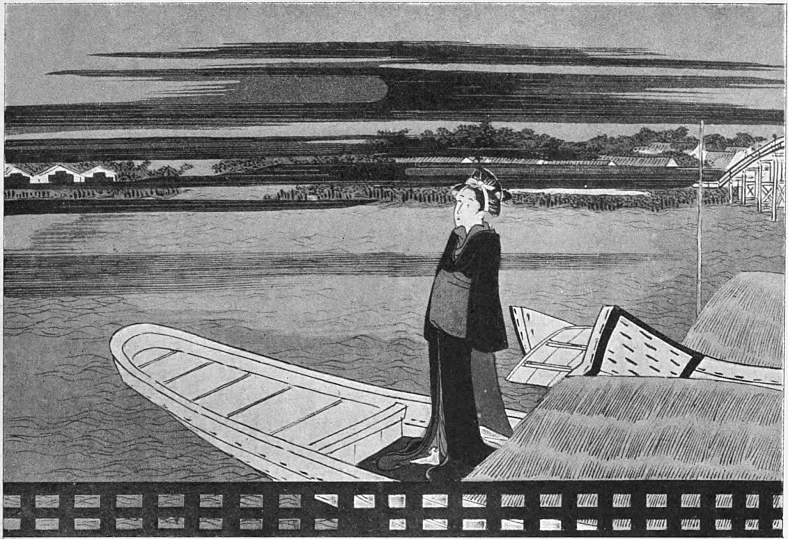
TOYOKUMI. NOCTURNAL REVERIE.
At the same time, they threw light upon what had been flat and trivial in Courbet’s realism. These spirited narrators never told a story for the sake of telling it; they never painted to give a prosaic copy of some particle of reality. They liberated European painting from the heaviness of matter, and rendered it tender and delicate. They taught that art of not saying everything, which says so much, the method of compendious drawing, the secret of expanding distance by a special treatment of lines, the touch thrown rapidly in, the unforeseen, the surprise, the fleeting hint, the way of increasing effect by the incompletion of motive, the suggestion of the whole by a part. Artists learnt from them another manner of drawing and modelling, a manner of giving the impression of the object without the need for the whole of it being executed, so that one knows that it is there only through one’s knowledge. They brought in the taste for pithy sketches dealing only with essentials, the consciousness of the endless catalogue of what may be contained—in life, reality, and fancy—by one fluent outline. They introduced the preference for perspective bird’s-eye views, the disposition to throw groups, dense masses, and crowds more into the distance, and render them more animated and vivid by a relief of the foreground, which (though confirmed by photography) is apparently improbable.
The influence of Japan on colouring is just as visible as upon composition and drawing. It had been clearly shown in Courbet’s pictures of artisans that the rules of the Bolognese school, with their brown sauce and their red shadows, could not possibly be applied to objects in the open air. It was therefore necessary to discover a new principle of colour for modern subjects, a principle by which oil-painting would be divested of its oil, and light and air would come to their rights. It was seen from the works of the painters of Nippon that it was not absolutely necessary to paint brown to be a painter. They taught a new method of seeing things, opened the eyes to the changing play of the phenomena of light, the fugitive nature and constant mutability of which had up to this time seemed to mock at every rendering. The softness of their bright harmonies was studied and artistically transposed.
These are the points in which Japanese art has had a revolutionary effect upon the development of European. Each one of those who at that time belonged to the Society of the Jinglar has had more or less experience of its influence. Alfred Stevens owes to it certain delicacies of colouring; Whistler, his exquisite refinement of tone and his capriciously artistic method in the treatment of landscape; Degas, his fantastic and free grouping, his unrivalled audacities of composition. Manet especially became now the artist to whom history does honour, and Louis Gonse tells a story with a very characteristic touch of the first exhibition of the Maîtres impressionistes. He went there, coming from the official Salon in the company of a Japanese, and, while the French public declared the fresh brightness of the pictures to be untrue and barbaric, the son of sacred Nippon, accustomed from youth to see nature in light, airy tones without a yellow coating of varnish, said: “Over there I was in an exhibition of oil-pictures, here I feel as if I were entering a flowery garden. What strikes me is the animation of these figures, and the feeling is one I have never had elsewhere in your picture exhibitions.”
CHAPTER XXXI
THE IMPRESSIONISTS
The name Impressionists dates from an exhibition in Paris which was got up at Nadar’s in 1871. The catalogue contained a great deal about impressions—for instance, “Impression de mon pot au feu,” “Impression d’un chat qui se promène.” In his criticism Claretie summed up the impressions and spoke of the Salon des Impressionistes.
The beginning of the movement, however, came about the middle of the sixties, and Zola was the first to champion the new artists with his trenchant pen. Assuming the name of his later hero Claude, he contributed in 1866 to L’Événement, under the title Mon Salon, that article which swamped the office with such a flood of indignant letters and occasioned such a secession of subscribers that the proprietor of the paper, the sage and admirable M. de Villemessant, felt himself obliged to give the naturalist critic an anti-naturalistic colleague in the person of M. Théodore Pelloquet. In these reviews of the Salon, collected in 1879 in the volume Mes Haines, and in the essay upon Courbet, the Painter of Realism—Courbet, the already recognised “master of Ornans “—those theories are laid down which Lantier and his friends announced at a later date in L’Œuvre. Then the architect Dubiche, one of the members of the young Bohème, dreamed in a spirit of presage of a new architecture. “With passionate gestures he demanded and insisted upon the formula for the architecture of this democracy, that work in stone which should give expression to it, a building in which it should feel itself at home, something strong and forcible, simple and great, something already proclaimed in our railway stations and our markets in the grace and power of their iron girders, but purified and made beautiful, declaring the largeness of our conquests.” A few years went by, and then the Paris Centenary Exhibition provided that something, though it was not in monumental stone. The great edifices were fashioned of glass and iron, and the mighty railway buildings were their forerunners. The enormous engine-rooms which gave space for thousands and the Eiffel Tower announced this new architecture. And as Dubiche prophesied a new architecture, so did Claude prophesy a new painting. “Sun and open air and bright and youthful painting are what we need. Let the sun come in and render objects as they appear under the illumination of broad daylight.” In Zola Claude Lantier is the martyr of this new style. He is scorned, derided, avoided, and cast out. His best picture is smuggled, through grace and mercy, into the Exhibition by a friend upon the hanging committee as a charité. But, ten years after, these new doctrines had penetrated all the studios of Paris and of Europe like germs borne in the air.
The artistic ideas of Claude Lantier were given to Zola by his friend Édouard Manet, the father of Impressionism, and in that way the creator of the newest form of art. Manet appeared for the first time in 1862. In 1865, when the Committee of the Salon gave up a few secondary rooms to the rejected, the first of his pictures which made any sensation were to be seen—a “Scourging of Christ” and a picture of a girl with a cat resting—both invariably surrounded by a dense circle of the scornful. Forty years before, the first works of the Romanticists, whose doctrine was likewise scoffed at in the formula Le laid c’est le beau, had called forth a similar outcry against the want of taste common to them all. A generation later people laughed at “The Funeral in Ornans,” and now the same derision was directed against Manet, who completed Courbet’s work. His pictures were held to be a practical joke which the painter was playing upon the public, the most unheard of farce that had ever been painted. If any one had declared that these works would give the impulse to a revolution in art, people would have turned their backs upon him or thought that he was jesting. “Criticism treated Manet,” wrote Zola, “as a kind of buffoon who put out his tongue for the amusement of street boys.” The rage against “The Scourging of Christ” went so far that the picture had to be protected by special precautions from the assaults of sticks and umbrellas.
But the matter took a somewhat different aspect when, five years afterwards, from twenty to thirty more recent pictures were exhibited together in Manet’s studio. Whether it was because the aims of the painter had become clearer in the meanwhile, or because his works suffered less from the proximity of others, they made an impression, and that although they represented nothing in the least adventurous and sensational. Life-size figures, light and almost without shadow, rowed over blue water, hung out white linen, watered green flower-pots, and leant against grey walls. The light colours placed immediately beside each other had a bizarre effect on the eye accustomed to chiaroscuro. The eye, which, like the human spirit, has its habitudes, and believes that it always sees nature as she is painted, was irritated by these delicately chosen tone-values which seemed to it arbitrary, by these novel harmonies which it took for discords. Nevertheless the clarity of the pictures made a striking effect, and something of “Manet’s sun” lingered in the memory. People still laughed, only not so loud, and they gave Manet credit for having the courage of his convictions. “A remarkable circumstance has to be recorded. A young painter has followed his personal impressions quite ingenuously, and has painted a few things which are not altogether in accord with the principles taught in the schools. In this way he has executed pictures which have been a source of offence to eyes accustomed to other paintings. But now, instead of abusing the young artist through thick and thin, we must be first clear as to why our eyes have been offended, and whether they ought to have been.” With these words criticism began to take Manet seriously. Charles Ephrussi and Duranty, besides Zola, came forward as his first literary champions in the press. “Manet is bold” was now the phrase used about him in public. The Impressionists took the salon by storm. And Manet’s bright and radiant sun was seen to be a better thing than the brown sauce of the Bolognese. It was as if a strong power had suddenly deranged the focus of opinion in all the studios, and Manet’s victory brought the same salvation to French art as that of Delacroix had done forty years before and that of Courbet ten years before. Manet et manebit. Delacroix, Courbet, and Manet are the three great names of modern French painting, the names of the men who gave it the most decisive impulses.
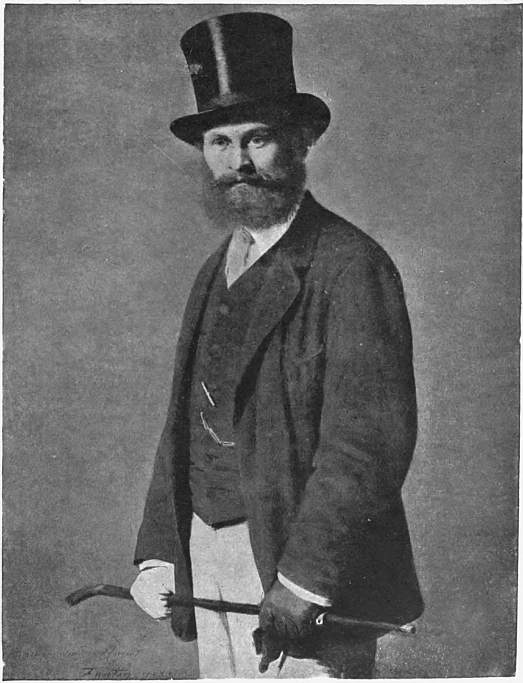
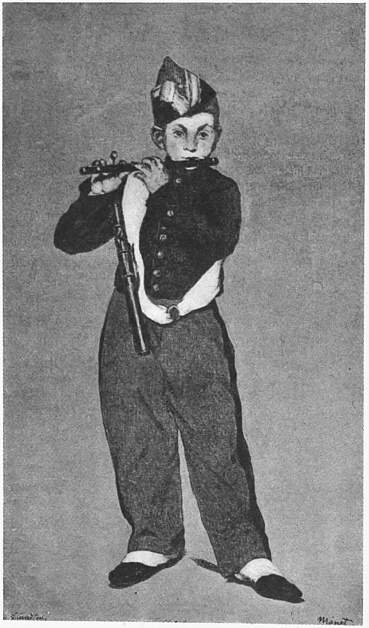
ÉDOUARD MANET. MANET. Gaz. des Beaux-Arts. THE FIFER.
(By permission of M. Durand-Ruel, the owner of the copyright.)
Édouard Manet, le maître impressioniste, was born in 1832, in the Rue Bonaparte, exactly opposite the École des Beaux-Arts, and his life was quietly and simply spent, without passion and excitement, unusual events, or sanguinary battles. At sixteen, having passed through the Collège Rollin, he entered the navy with the permission of his parents, and made a voyage to Rio de Janeiro, which was accomplished without any incident of interest, without shipwreck or any one being drowned. With his cheerful, even temperament he looked on the boundless sea and satiated his eyes with the marvellous spectacle of waves and horizon, never to forget it. The luminous sky was spread before him, the great ocean rocked and sported around, revealing colours other than he had seen in the Salon. On his return he gave himself up entirely to painting. He is said to have been a slight, pale, delicate, and refined young man when he became a pupil of Couture in 1851, almost at the same time as Feuerbach. Nearly six years he remained with the master of “The Decadent Romans,” without a suspicion of how he was to find his way, and even after he had left the studio he was still pursued by the shade of Couture; he worked without knowing very well what he really wanted. Then he travelled, visiting Germany, Cassel, Dresden, Prague, Vienna, and Munich, where he copied the portrait of Rembrandt in the Pinakothek; and then he saw Florence, Rome, and Venice. Under the influence of the Neapolitan and Flemish artists, to whom Ribot, Courbet, and Stevens pointed at the time, he gradually became a painter. His first picture, “The Child with Cherries,” painted in 1859, reveals the influence of Brouwer. In 1861 he exhibited, for the first time, the “double portrait” of his parents, for which he received honourable mention, although—or because—the picture was entirely painted in the old Bolognese style. These works are only of interest because they make it possible to see the rapidity with which Manet learnt to understand his craft with the aid of the old masters, and the sureness and energy with which he followed, from the very beginning, the realistic tendency initiated by Courbet. “The Nymph Surprised,” in 1862, was a medley of reminiscences from Jordaens, Tintoretto, and Delacroix. His “Old Musician,” executed with diligence but trivial in its realism, had the appearance of being a tolerable Courbet. Then he made—not at first in Madrid, which he only knew later, but in the Louvre—the eventful discovery of another old master, not yet known in all his individuality to the master of Ornans.