Front matter (continued 3)
Reading edition
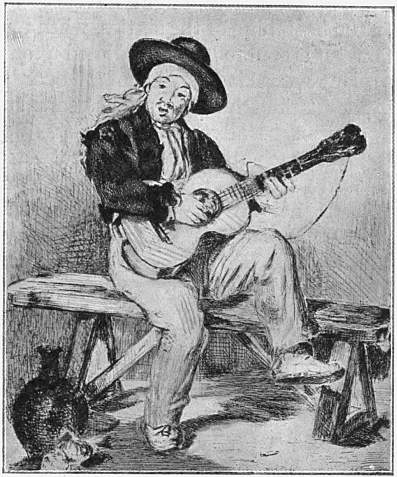
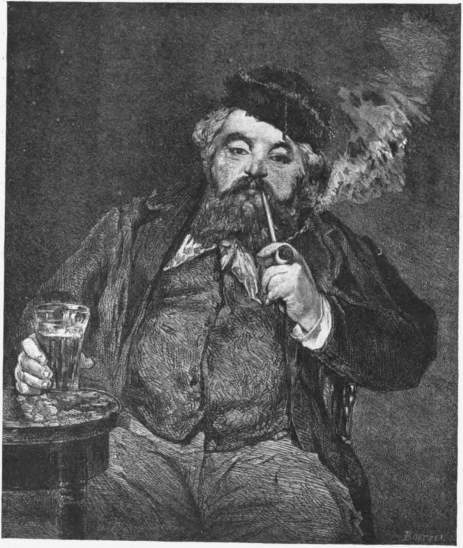
MANET. Gaz. des Beaux-Arts. THE GUITARERO. MANET. LE BON BOCK.
(By permission of M. Faure, the owner of the picture.) (By permission of M. Faure, the owner of the picture.)
At the great Manchester Exhibition of 1857 Velasquez had been revealed to the English; in the beginning of the sixties he was discovered by the French. William Stirling’s biography of Velasquez was translated into French by G. Brunet, and provided with a Catalogue raisonné by W. Bürger. The works of Charles Blanc, Théophile Gautier, and Paul Lefort appeared, and in a short time Velasquez, of whom the world outside Madrid had hitherto known little, was in artistic circles in Paris a familiar and frequently cited personality, who began not only to occupy the attention of the historians of art, but of artists also. Couture was in the habit of saying to his pupils that Velasquez had not understood the orchestration of tones, that he had an inclination to monochrome, and that he had never comprehended the nature of colour. From the beginning of the sixties France came under the sway of that serious feeling for colour known to the great Spaniard, and Manet was his first enthusiastic pupil. Certain of his single figures against a pearl-grey background—“The Fifer,” “The Guitarero,” “The Bull-fighter wounded to Death”—were the decisive works in which, with astonishing talent, he declared himself as the pupil of Velasquez. W. Bürger praised Velasquez as le peintre le plus peintre qui fût jamais. As regards the nineteenth century, the same may be said of Manet. Only Frans Hals and Velasquez had these eminent pictorial qualities. In the way in which the black velvet dress, the white silk band, and the red flag were painted in the toreador picture, there was a feeling for beauty which bore witness to the finest understanding of the great Spaniard. In his “Angels at the Tomb of Christ” he has sought, as little as did Velasquez in his picture of the Epiphany, to introduce any trace of heavenly expression into the faces, but as a piece of painting it takes its place amongst the best religious pictures of the century. His “Bon Bock”—a portrait of the engraver Belot, a stout jovial man smoking a pipe as he sits over a glass of beer—is one of those likenesses which stamp themselves upon the memory like the “Hille Bobbe” of Frans Hals. “Faure as Hamlet” stands out from the vacant light grey background like the “Truhan Pablillos” of Velasquez. The doublet and mantle are of black velvet, the mantle lined with rose-coloured silk; and the toilette is completed by a broad black hat with a large black feather. He seems as though he had just stepped to the footlights, and stands there with his legs apart, the mantle thrown over the left arm, and his right hand closing upon his sword. The cool harmony of black, white, grey, and rose-colour makes an uncommonly refined effect. Manet has the rich artistic methods of Velasquez in a measure elsewhere only attained by Raeburn, and as the last of these studies he has created in his “Enfant à l’Épée” a work which—speaking without profanity—might have been signed by the great Spaniard himself. In the beginning of the sixties, when he gave a separate exhibition of his works, Courbet is said to have exclaimed upon entering, “Nothing but Spaniards!”
But even this following of the Spaniards indicated an advance upon Courbet; it meant the triumph over brown sauce and a closer approximation to truth. For, amongst all the old masters, Velasquez and Frans Hals—who greatly resemble each other in this respect—are the simplest and most natural in their colouring; they are not idealists in colour like Titian, Paul Veronese, and Rubens, nor do they labour upon the tone of their pictures like the Dutch “little masters” and Chardin. They paint their pictures in the broad and common light of day. Their flesh-tint is truer than the juicy tint of the Venetians, and the fiery red of Rubens, with his shining reflections. Beside Velasquez, as Justi says, the colouring of Titian seems conventional, that of Rembrandt fantastic, and that of Rubens is tinged with something which is not natural. Or, as a contemporary of Velasquez expressed himself: “Everything else, old and new, is painting; Velasquez alone is truth.”
Thus the difference between the youthful works of Manet and those of his predecessor Courbet is the difference between Velasquez and Caravaggio. Of course, in Manet’s earliest pictures there were found the broad, dull red-brown surfaces which characterise the works of the Bolognese and the Neapolitans. A cool silver tone, a shadowless treatment gleaming in silver, has now taken the place of this warm brown sauce. He has the white of Velasquez, his cool subdued rose-colour, his delicate grey which has been so much admired and against which every touch of colour stands out clear and determined, and that celebrated black of the Spaniard which is never heavy and dull, but makes such a light and transparent effect. What is bright is contrasted with what is bright, and light colours are placed upon a silvery grey background. The most perfect modelling and plastic effect is attained without the aid of strong contrasts of shadow. Thus he closed his apprenticeship to the old masters by being able to see with the eyes of that old master whose vision was the truest.
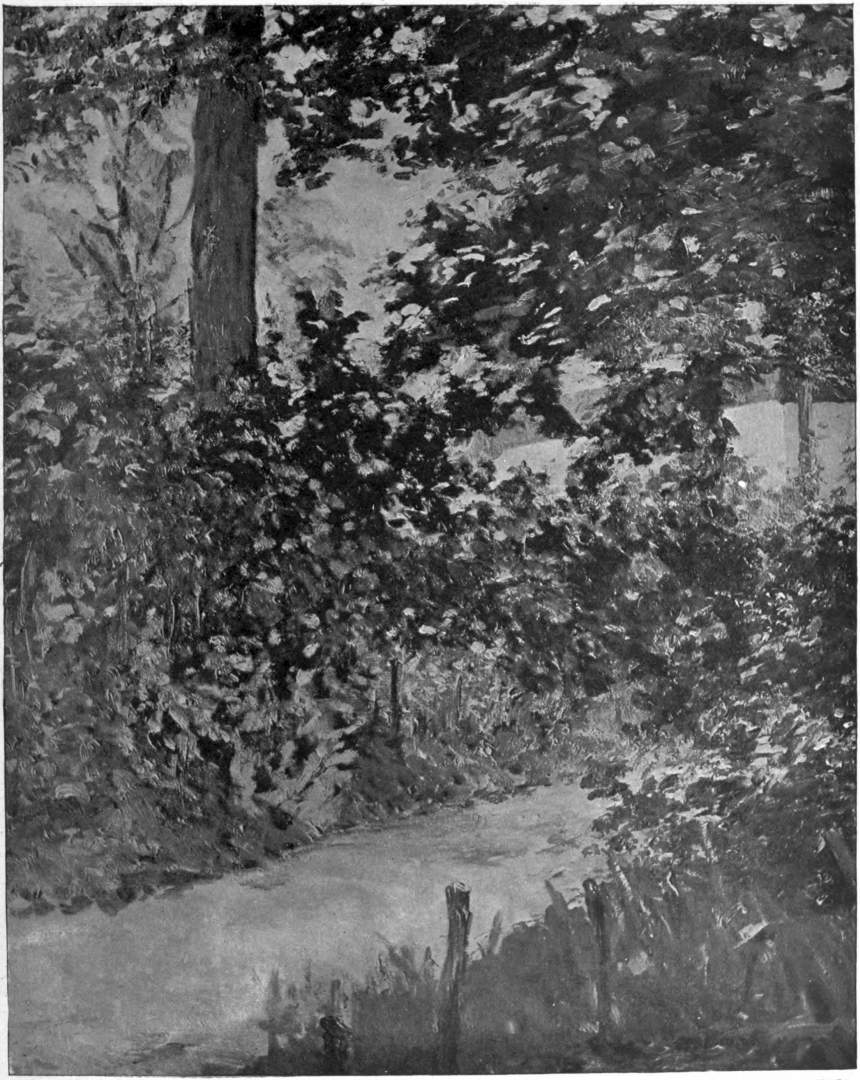
MANET. A GARDEN IN RUEIL.
This was the point of departure for Manet’s further development. The study of Velasquez did not merely set him free from sauce; it also started the problem of painting light. He went through a course of development similar to that of the old Spaniard himself. When Velasquez painted his first picture with a popular turn, the “Bacchus,” he still stood upon the ground of the tenebrous painters; he represented an open-air scene with the illumination of a closed room. Although the ceremony is taking place in broad daylight, the people seem to be sitting in a dingy tavern, receiving light from a studio window to the left. Ten years afterwards, when he painted “The Smithy of Vulcan,” he had emancipated himself from this Bolognese tradition, which he spoke of henceforward as “a gloomy and horrible style.” The deep and sharply contrasted shadows have vanished, and daylight has conquered the light of the cellar. The great equestrian portraits which followed gave Mengs occasion to remark, even a hundred years ago, that Velasquez was the first who understood how to paint what is “ambiant,” the air filling the vacuum between objects. And at the end of his life he solved the final problem in “The Women Spinning.” In the “Bacchus” might be found the treatment of an open-air scene in the key of sauce, but here was the glistening of light in an interior. The sun quivers over silken stuffs, falls upon the dazzling necks of women, plays through coal-black Castilian locks, renders one thing plastically distinct and another pictorially vague, dissolves corporeality, and lends surface the rounding of life. Contours touched with the brightness of light surround the heads of the girls at work. The shadows are not warm brown but cool grey, and the tints of reflected light play from one object to another.
Two remarkable pictures of 1863 and 1865 show that Manet had grasped the problem and was endeavouring in a tentative way to give expression to his ideas.
In one of these, “The Picnic,” painted in 1863, there was a stretch of sward, a few trees, and in the background a river in which a woman was merrily splashing in her chemise; in the foreground were seated two young men in frock-coats opposite another woman, who has just come out of the water and been drying herself. Needless to say, this picture was rejected as something unprecedented, by the committee, which included Ingres, Léon Cogniet, Robert Fleury, and Hippolyte Flandrin. Eugène Delacroix was the only one in its favour. So Manet was relegated to the Salon des Refusés, where Bracquemond, Legros, Whistler, and Harpignies were hung beside him. This Exhibition was held in the Industrial Hall, and the public went through a narrow little door from one gallery to the other. Half Paris was bewildered and discomposed by these works of the rejected; even Napoleon III and the Empress Eugénie ostentatiously turned their backs upon Manet’s picture when they visited the Salon. This naked woman made a scandal. How shocking! A woman without the slightest stitch of clothes between two gentlemen in their frock-coats! In the Louvre, indeed, there were about fifty Venetian paintings with much the same purport. Every manual of art refers to “The Family,” as it is called, and the “Ages of Life” of Giorgione, in which nude and clothed figures are moving in a landscape and placed ingenuously beside each other. But that a painter should claim for a modern artist the right of painting for the joy of what is purely pictorial was a phenomenon that had never been encountered before. The public searched for something obscene, and they found it; but for Manet the whole picture was only a technical experiment: the nude woman in front was only there because the painter wanted to observe the play of the sun and the reflections of the foliage upon naked flesh; the woman in her chemise merely owed her existence to the circumstance of her charming outline making such a delightful patch of white amid the green meadows. Manet for the first time touched the problem which Madox Brown had thrown out in his “Work” ten years before in England, though for the present he did so with no greater success: the sunbeams glanced no doubt, but they were heavy and opaque; the sky was bright, but without atmosphere. As yet there is nothing of the Manet who belongs to history.
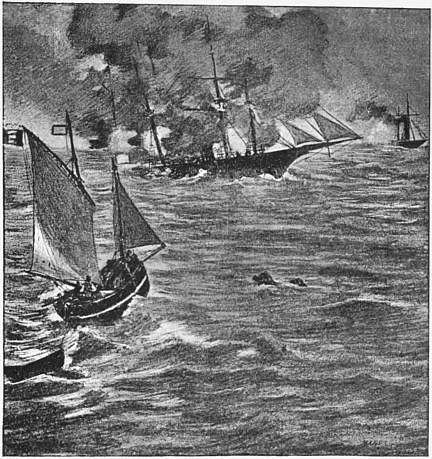
Gaz. des Beaux-Arts.
MANET. THE FIGHT BETWEEN THE “KEARSARGE” AND “ALABAMA.”
The celebrated “Olympia” of 1865, now to be found in the Luxembourg, was painted during this stage in his development: it represents a neurotic, anæmic creature, who stretches out, pale and sickly, her meagre nudity upon white linen, with a purring cat at her feet; whilst a negress in a red dress draws back the curtain, offering her a bouquet. With this picture—no one can tell why—the definite battles over Impressionism began. The critics who talked about obscenity were not consistent, because Titian’s pictures of Venus with her female attendant, the little dog, and the youth sitting upon the edge of the bed, are not usually held to be obscene. But it is nevertheless difficult to find in this flatly modelled body, with its hard black outlines, those artistic qualities which Zola discovered in it. The picture has nothing whatever of Titian in it, but it may almost be said to have something of Cranach. “The Picnic” and “Olympia” have both only an historical interest as the first works in which the artist trusted his own eyes, refusing to look through any one’s spectacles. Feeling that he would come to nothing if he continued to study nature through the medium of an old master, he had to render some real thing just as it appeared to him when he was not looking into the mirror of old pictures. He tried to forget what he had studied in galleries, the tricks of art which he had learnt with Couture, and the famous pictures he had seen. In his earlier works there had been a far-fetched refinement and a delicacy taken from the old masters, but “The Picnic” and “Olympia” are simpler and more independent. In both he was already an “Impressionist,” true to his personal vision, though he could not entirely express the new language that hovered upon his lips. He had tried both to rid himself of Courbet’s brown sauce and of the ivory tone of Bouguereau, and to be just to local tones through simple and independent observation; in his “Picnic” he had painted the trees green, the earth yellow, and the sky grey, and in “Olympia” the bed white and the body of the woman flesh-colour. But he was as little successful as the pre-Raphaelites in bringing the local tones into full harmony. This is the step which Manet made in advance of the pre-Raphaelites: after he had emancipated himself from the conventional brown and ivory scheme of tone, and had been for a time, like the pre-Raphaelites, true although hard, he attained that harmony which hitherto had been either not reached by artistic means or not reached at all, by strict observation of the medium by which nature produces her harmonies—light. As the air, the pervasive atmosphere, renders nature everywhere harmonious and refined in colour, so it forthwith became for the artist the means of reaching that great harmony which is the object of all pictorial endeavour, and which had never previously been reached except through some mannerism.
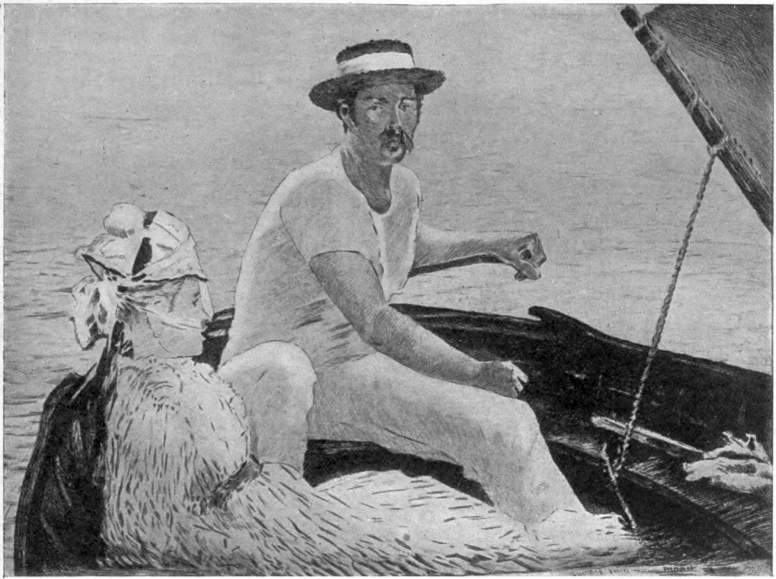
Baschet.
MANET. BOATING.
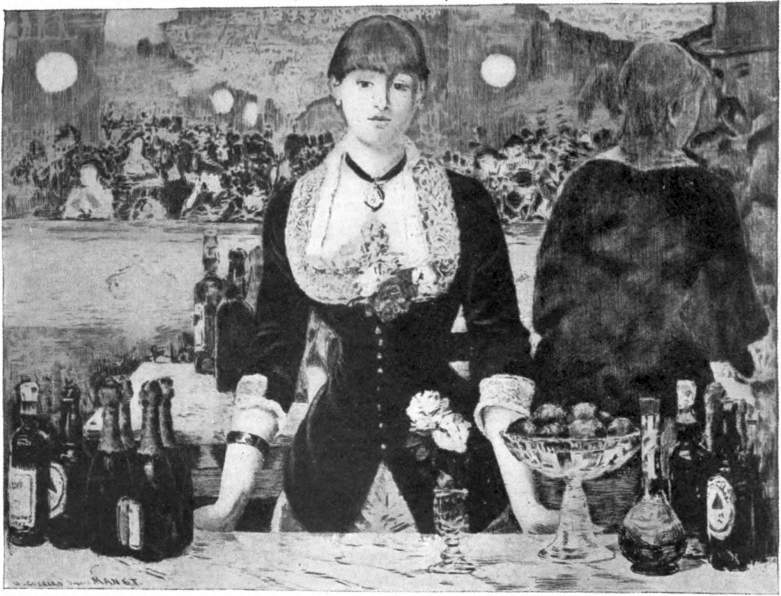
Gaz. des Beaux-Arts.
MANET. A BAR AT THE FOLIES-BERGÈRES.
This movement, so historically memorable, when Manet discovered the sun and the fine fluid of the atmosphere, was shortly before 1870. Not long before the declaration of war he was in the country, in the neighbourhood of Paris, staying with his friend de Nittis; but he continued to work as though he were at home, only his studio was here the pleasure-ground. Here one day he sat in full sunlight, placed his model amid the flowers of the turf, and began to paint. The result was “The Garden,” now in the possession of Madame de Nittis. The young wife of the Italian painter is reclining in an easy-chair, between her husband, who is lying on the grass, and her child asleep in its cradle. Every flower is fresh and bright upon the fragrant sward. The green of the stretch of grass is luminous, and everything is bathed in soft, bright atmosphere; the leaves cast their blue shadows upon the yellow gravel path. “Plein-air” made its entry into painting.
In 1870 his activity had to be interrupted. He entered a company of Volunteers consisting chiefly of artists and men of letters, and in December he became a lieutenant in the Garde Nationale, where he had Meissonier as his colonel. The pictures, therefore, in which he was entirely Manet belong exclusively to the period following 1870.
From this time his great problem was the sun, the glow of daylight, the tremor of the air upon the earth basking in light. He became a natural philosopher who could never satisfy himself, studying the effect of light and determining with the observation of a man of science how the atmosphere alters the phenomena of colour.
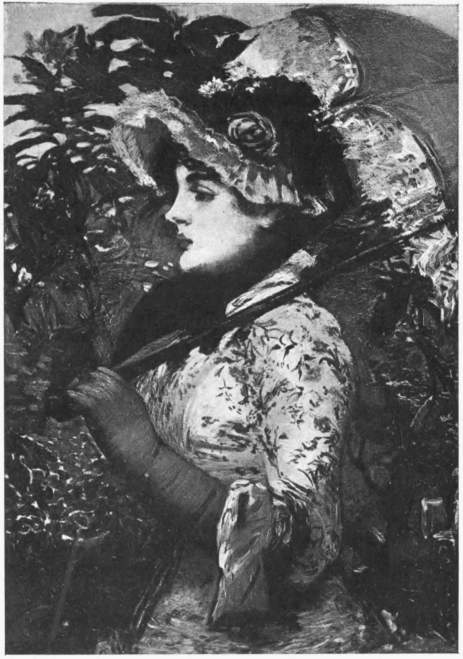
Baschet.
MANET. SPRING: JEANNE.
In tender, virginal, light grey tones, never seen before, he depicted, in fourteen pictures exhibited at a dealer’s, the luxury and grace of Paris, the bright days of summer and soirées flooded with gaslight, the faded features of the fallen maiden and the refined chic of the woman of the world. There was to be seen “Nana,” that marvel of audacious grace. Laced in a blue silk corset, and otherwise clad merely in a muslin smock with her feet in pearl-grey stockings, the blond woman stands at the mirror painting her lips, and carelessly replying to the words of a man who is watching her upon the sofa behind. Near it hung balcony scenes, fleeting sketches from the skating rink, the café concert, the Bal de l’Opéra, the déjeuner scene at Père Lathuille’s, and the “Bar at the Folies-Bergères.” In one case he has made daylight the subject of searching study, in another the artificial illumination of the footlights. “Music in the Tuileries” reveals a crowd of people swarming in an open, sunny place. Every figure was introduced as a patch of colour, but these patches were alive and this multitude spoke. One of the best pictures was “Boating”—a craft boldly cut away in its frame, after the manner of the Japanese, and seated in it a young lady in light blue and a young man in white, their figures contrasting finely with the delicate grey of the water and the atmosphere impregnated with moisture. And scattered amongst these pictures there were to be found powerful sea-pieces and charming, piquant portraits.
Manet had a passion for the world. He was a man with a slight and graceful figure, a beard of the colour known as blond cendré, deep blue eyes filled with the fire of youth, a refined, clever face, aristocratic hands, and a manner of great urbanity. With his wife, the highly cultured daughter of a Dutch musician, he went into the best circles of Parisian society, and was popular everywhere for his trenchant judgment and his sparkling intellect. His conversation was vivid and sarcastic. He was famous for his wit à la Gavarni. He delighted in the delicate perfume of drawing-rooms, the shining candle-light at receptions; he worshipped modernity and the piquant frou-frou of toilettes; he was the first who stood with both feet in the world which seemed so inartistic to others. Thus the progress made in the acquisition of subject and material may be seen even in the outward appearance of the three pioneers of modern art. Millet in his portrait stands in wooden shoes, Courbet in his shirt-sleeves; Manet wears a tall hat and a frock-coat. Millet, the peasant, painted peasants. Courbet, the democrat from the provinces, gave the rights of citizenship to the artisan, but without himself deserting the provinces and the bourgeoisie. He was repelled by everything either distinguished or refined. In such matters he could not find the force and vehemence which were all he sought. Manet, the Parisian and the man of refinement, gave art the elegance of modern life.
In the year 1879 he made the Parisian magistracy the offer of painting in the session-room of the Town Hall the entire Ventre de Paris, the markets, railway stations, lading-places, and public gardens, and beneath the ceiling a gallery of the celebrated men of the present time. His letter was unanswered, and yet it gave the impulse to all those great pictures of contemporary life painted afterwards in Paris and the provinces for the walls of public buildings. In 1880 he received, through the exertions of his friend Antonin Proust, a medal of the second class, the only one ever awarded to him. And the dealer Duret began to buy pictures from him; Durand-Ruel followed suit, and so did M. Faure, the singer of the Grand Opera, who himself is the owner of five-and-thirty Manets. The poor artist did not long enjoy this recognition. On 30th April 1883, the varnishing day at the Salon, he died from blood-poisoning and the consequences of the amputation of a leg.
But the seed which he had scattered had already thrown out roots. It had taken him years to force open the doors of the Salon, but to-day his name shines in letters of gold upon the façade of the École des Beaux-Arts as that of the man who has spoken the most decisive final utterance on behalf of the liberation of modern art. His achievement, which seems to have been an unimportant alteration in the method of painting, was in reality a renovation in the method of looking at the world and a renovation in the method of thinking.
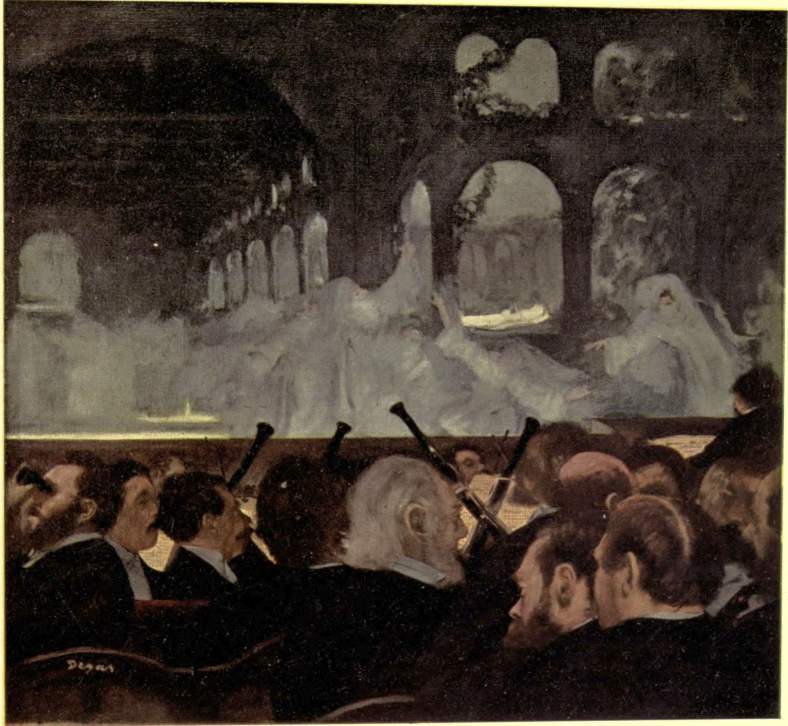
Mansell Photo.
DEGAS. THE BALLET SCENE IN ROBERT THE DEVIL.
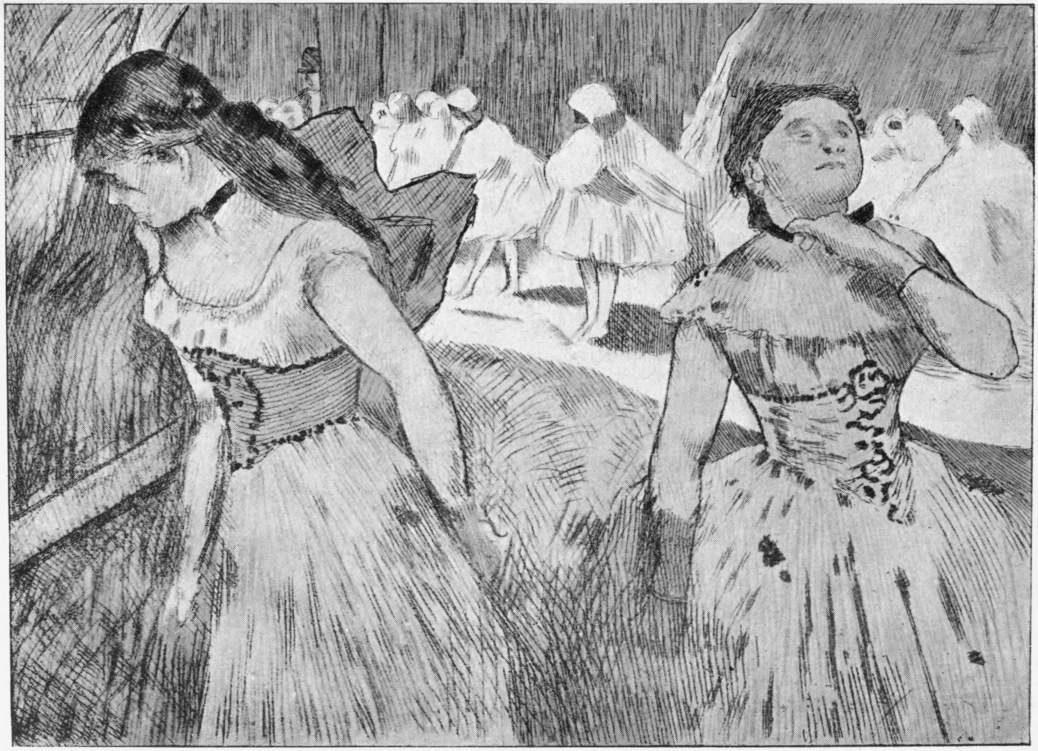
DEGAS. THE BALLET IN DON JUAN.
(By permission of M. Durand-Ruel, the owner of the copyright.)
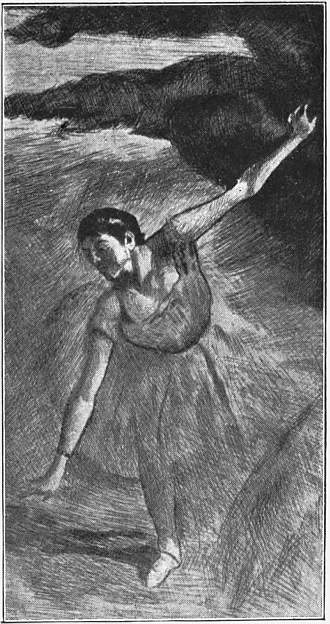
DEGAS. A BALLET DANCER.
(By permission of M. Durand-Ruel, the owner of the copyright.)
Up to this time it was only the landscape painters who had emancipated themselves from imitation of the gallery tone, and what was done by Corot in landscape had, logically enough, to be carried out in figure-painting likewise; for men and women are encompassed by the air as much as trees. After the landscape painters of Barbizon had made evident the vast difference between the light of day and that of a closed room in their pictures painted in the open air, the figure-painters, if they made any claim to truth of effect, could no longer venture to content themselves with the illumination falling upon their models in the studio, when they were painting incidents taking place out of doors. Yet even the boldest of the new artists did not set themselves free from tradition. Even after they had become independent in subject and composition they had remained the slaves of the old masters in their intuition of colour. Some imitated the Spaniards, without reflecting that Ribera painted his pictures in a small, dark studio, and that the cellar-light with which they were illuminated was therefore correct, whereas applied, in the present age, to the bright interiors of the nineteenth century it was utterly false. Others treated open-air scenes as if they were taking place in a ground-floor parlour, and endeavoured by curtains and shutters to create a light similar to that which may be found in old masters and pictures dimmed with age. Or the artist painted according to a general recipe and in complete defiance of what he saw with his eyes. For instance, an exceedingly characteristic episode is told of the student days of Puvis de Chavannes. Upon a grey, misty day the young artist had painted a nude figure. The model appeared enveloped in tender light as by a bright, silvery halo. “That’s the way you see your model?” grumbled Couture indignantly when he came to correct the picture. Then he mixed together white, cobalt blue, Naples yellow, and vermilion, and turned Puvis de Chavannes’ nude grey figure by a universal recipe into one that was highly coloured and warmly luminous—such a figure as an old master might perhaps have painted under different conditions of light. With his “Fiat Lux” Manet uttered a word of redemption that had hovered upon many lips. The jurisdiction of galleries was broken now also in regard to colour; the last remnant of servile dependence upon the mighty dead was cast aside; the aims attained by the landscape painters thirty years before were reached in figure-painting likewise.
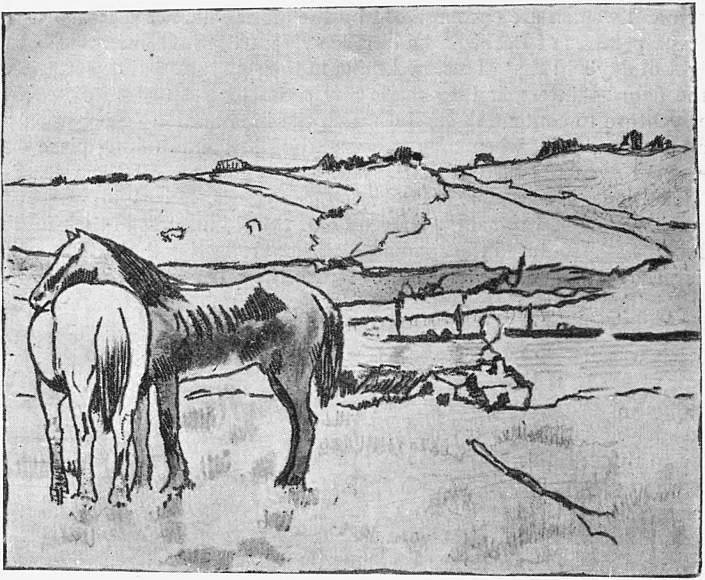
DEGAS. HORSES IN A MEADOW.
(By permission of M. Durand-Ruel, the owner of the copyright.)
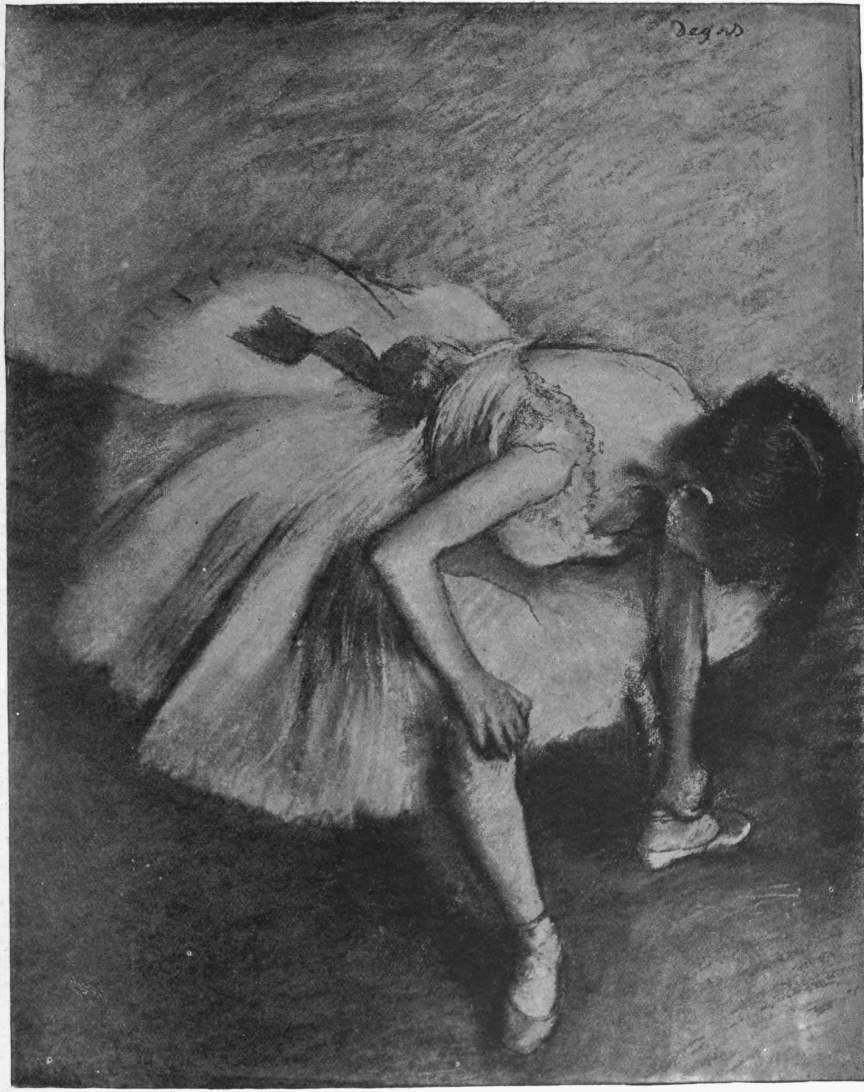
DEGAS. DANCING GIRL FASTENING HER SHOE.
Perhaps a later age may even come to recognise that Manet made an advance upon the old masters in his delicacy and scrupulous analysis of light; in that case it will esteem the discovery of tone-values as the chief acquisition of the nineteenth century, as a conquest such as has never been made in painting since the Eycks and Masaccio, since the establishment of the theory of perspective. In a treatise commanding all respect Hugo Magnus has written of how the sense of colour increased in the various periods of the world’s history; since the appearance of the Impressionists, verification may be made of yet another advance in this direction. The study of tone-values has never been carried on with such conscientious exactitude, and in regard to truth of atmosphere one is disposed to believe that our eyes to-day see and feel things which our ancestors had not yet noticed. The old masters have also touched the problem of “truth in painting.” It is not merely that the character of their colours often led the Italian tempera and fresco painters to the most natural method of treating light. They even occupied themselves in a theoretical way with the question. An old Italian precept declares that the painter ought to work in a closed yard beneath an awning, but should place his model beneath the open sky. In the frescoes which he painted in Arezzo in 1480, Piero della Francesca, in particular, pursued the problem of plein-air painting with a fine instinct. But love of the beautiful and luminous tints, such as the technique of oil-painting enabled artists to attain at a later date, quickly seduced them from carrying out the natural treatment of light in the gradation of colour. Under the influence of oil-painting the Italians of the great period, from Leonardo onwards, turned more and more to strong contrasts. And in spite of Albert Cuyp, even the Dutch landscape painters of the seventeenth century have seen objects rather in line and form, plastically, than pictorially in their environment of light and air. The nineteenth century was the first seriously to attack a problem which—except by Velasquez—had been merely touched upon by the old schools, but never solved.
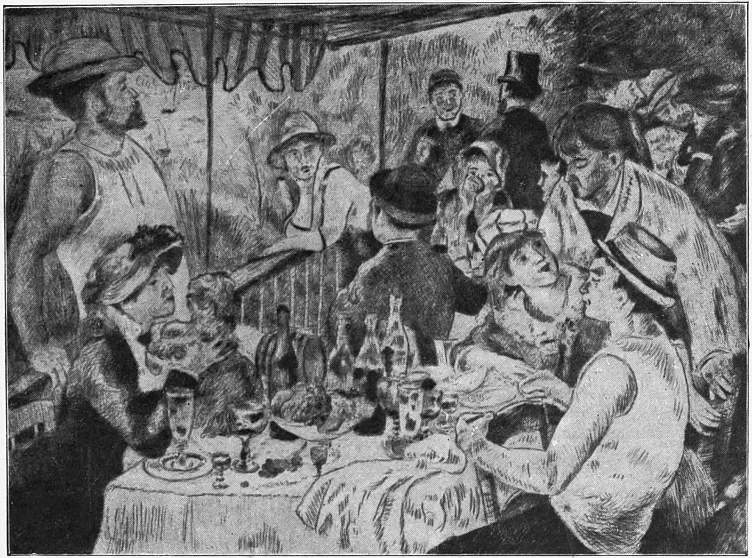
RENOIR. SUPPER AT BOUGIVAL.
(By permission of M. Durand-Ruel, the owner of the copyright.)
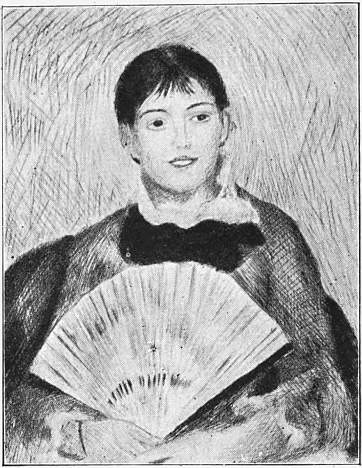
RENOIR. THE WOMAN WITH THE FAN.
(By permission of M. Durand-Ruel, the owner of the copyright.)
What the masters of Barbizon had done through instinctive genius was made the object of scientific study by the Impressionists. The new school set up the principle that atmosphere changes the colour of objects; for instance, that the colour and outline of a tree painted in a room are completely different from those of the same tree painted upon the spot in the open air. As an unqualified rule they claimed that every incident was to be harmonised with time, place, and light; thus a scene taking place out of doors had of necessity to be painted, not within four walls, but under the actual illumination of morning, or noon, or evening, or night. In making this problem the object of detailed and careful inquiry the artist came to analyse life, throbbing beneath its veil of air and light, with more refinement and thoroughness than the old masters had done. The latter painted light deadened in its fall, not shining. Oils were treated as an opaque material, colour appeared to be a substance, and the radiance of tinted light was lost through this material heaviness. Courbet still represented merely the object apart from its environment; he saw things in a plastic way, and not as they were, bathed in the atmosphere; his men and women lived in oil, in brown sauce, and not where it was only possible for them to live—in the air. Everything he painted he isolated without a thought of atmospheric surroundings. Now a complete change of parts was effected: bodies and colours were no longer painted, but the shifting power of light under which everything changes form and colour at every moment of the day. The elder painters in essentials confined light to the surface of objects; the new painters believed in its universality, beholding in it the father of all life and of the manifold nature of the visible world, and therefore of colour also. They no longer painted colours and forms with lights and cast-shadows, but pellucid light, pouring over forms and colours and absorbed and refracted by them. They no longer looked merely to the particular, but to the whole, no longer saw nothing except deadened light and cast-shadows, but the harmony and pictorial charm of a moment of nature considered as such. With a zeal which at times seemed almost paradoxical, they proceeded to establish the importance of the phenomena of light. They discovered that, so far from being gilded, objects are silvered by sunlight, and they made every effort to analyse the multiplicity of these fine gradations down to their most delicate nuances. They learnt to paint the quiver of tremulous sunbeams radiating far and wide; they were the lyrical poets of light, which they often glorified at the expense of what it envelops and causes to live. At the service of art they placed a renovated treasury of refined, purified, and pictorial phases of expression, in which the history of art records an increase in the human eye of the sense of colour and the power of perception.
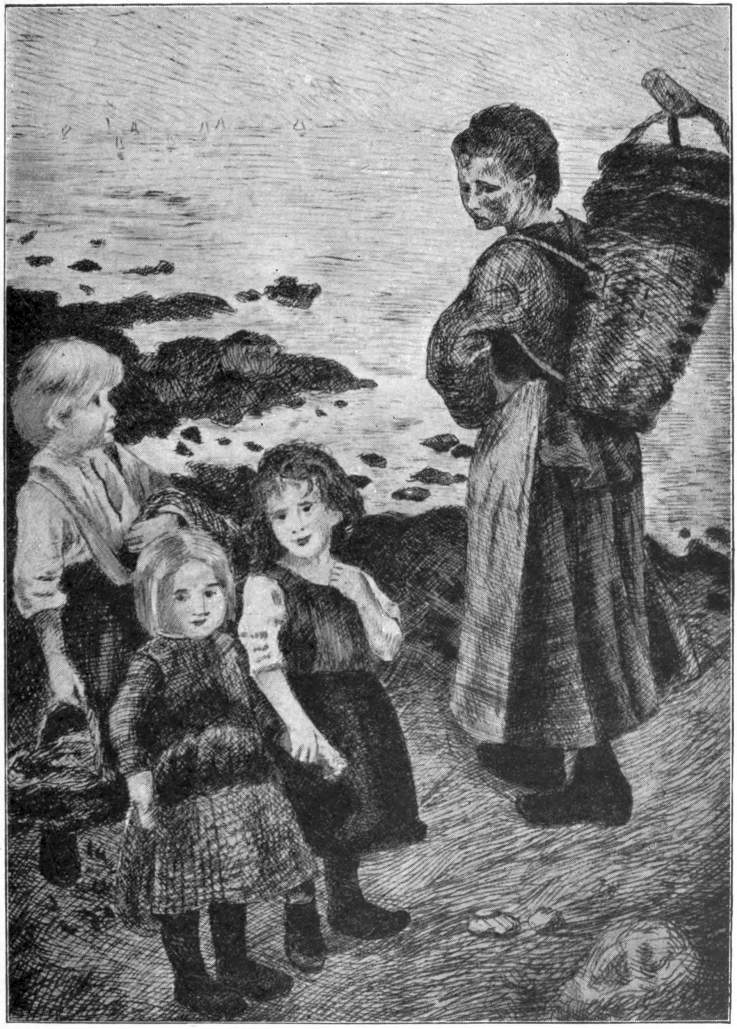
RENOIR. FISHER CHILDREN BY THE SEA.
(By permission of M. Durand-Ruel, the owner of the copyright.)
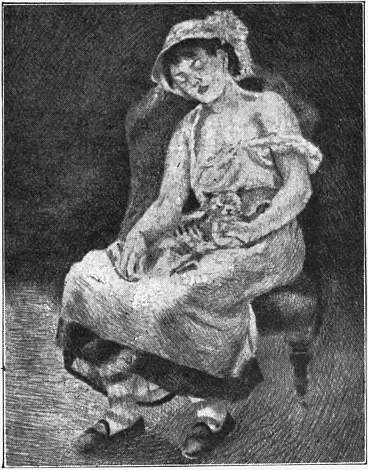
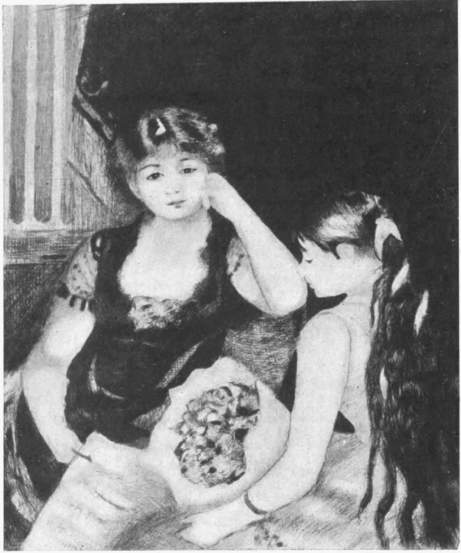
RENOIR. THE WOMAN WITH THE CAT. RENOIR. A PRIVATE BOX.
(By permission of M. Durand-Ruel, the owner of the copyright.) (By permission of M. Durand-Ruel, the owner of the copyright.)
That light is movement is here made obvious, and that all life is movement is just what their art reveals. Courbet was an admirable painter of plain surfaces. If he had to paint a wall he took it upon his strong shoulders and transferred it to his canvas in such a way that a stonemason might have been deceived. If it was a question of rocks, the body of a woman, or the waves of the sea, he began to mix his pigments thick, laid a firm mass of colour on the canvas, and spread it with a knife. This spade-work gave him unrivalled truth to nature in reproducing the surface of hard substances. Rocks, banks, and walls look as they do in nature, but in the case of moving, indeterminate things his power deserts him. His landscapes are painted in a rich, broad, and juicy style, but his earth has no pulsation. Courbet has forgotten the birds in his landscape. His seas have been seen with extraordinary largeness of feeling, and they are masterpieces of drawing; the only drawback is that they seem uninhabitable for fish. Under the steady hand of the master the sea came to a standstill and was changed into rock. If he has to paint human beings they stand as motionless as blocks of wood. The expression of their faces seems galvanised into life, like their bodies. Placing absolute directness in the rendering of impressions in their programme, as the chief aim of their artistic endeavours, the Impressionists were the first to discover the secret of seizing with the utmost freshness the nuances of expression and movement, which remained petrified in the hands of their predecessors. Only the flash of the spokes is painted in the wheel of a carriage in motion, and never the appearance of the wheel when it is at rest; in the same way they allow the outlines of human figures to relax and become indistinct, to call up the impression of movement, the real vividness of the appearance. Colour has been established as the sole, unqualified medium of expression for the painter, and has so absorbed the drawing that the line receives, as it were, a pulsating life, and cannot be felt except in a pictorial way. In the painting of nude human figures the waxen look—which in the traditional painting from the nude had a pretence of being natural—has vanished from the skin, and thousands of delicately distinguished gradations give animation to the flesh. Moreover, a finer and deeper observation of temperament was made possible by lighter and more sensitive technique. In the works of the earlier genre painters people never are what they are supposed to represent. The hired model, picked from the lower strata of life, and used by the painter in bringing his picture slowly to completion, was obvious even in the most elegant toilette; but now real human beings are represented, men and women whose carriage, gestures, and countenances tell at once what they are. Even in portrait painting people whom the painter has surprised before they have had time to put themselves in order, at the moment when they are still entirely natural, have taken the place of lay-figures fixed in position. The effort to seize the most unconstrained air and the most natural position, and to arrest the most transitory shade of expression, produces, in this field of art also, a directness and vivacity divided by a great gulf from the pose and the grand airs of the earlier drawing-room picture.
From his very first appearance there gathered round Manet a number of young men who met twice a week at a café in Batignolles, formerly a suburb at the entrance of the Avenue de Clichy. After this trysting-place the society called itself L’École des Batignolles. Burty, Antonin Proust, Henner, and Stevens put in an occasional appearance, but Legros, Whistler, Fantin-Latour, Duranty, and Zola were constant visitors. Degas, Renoir, Pissarro, Sisley, Monet, Gauguin, and Zandomeneghi were the leading spirits of the impressionistic staff, and, being excluded from the official Salon, they generally set up their tent at Nadar’s, Reichshofen’s, or some other dealer’s. These are the names of the men who, following Manet, were the earliest to make the new problem the object of their studies.
Degas, the subtle colourist and miraculous draughtsman, who celebrates dancers, gauze skirts, and the foyers of the Opera, is the boldest and the most original of those who banded together from the very outset of the movement—the worst enemy of everything pretty and banal, the greatest dandy of modern France, the man whose works are caviare to the general and so refreshing to the gourmet, the painter who can find a joy in the sublime beauty of ugliness.
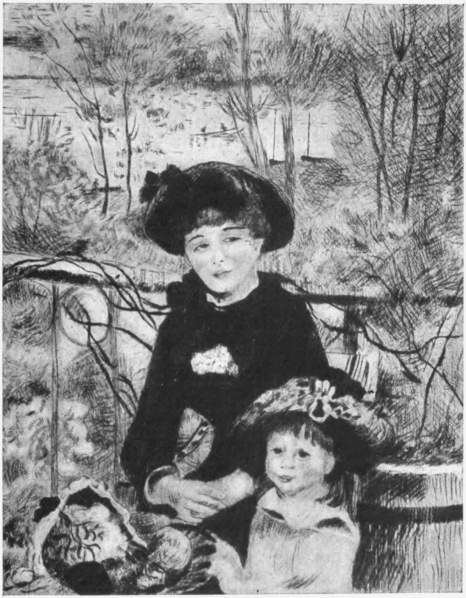
RENOIR. THE TERRACE.
(By permission of M. Durand-Ruel, the owner of the copyright.)
Degas was older than Manet. He had run through all phases of French art since Ingres. His first pictures, “Spartan Youths” and “Semiramis building the Walls of Babylon,” might indeed have been painted by Ingres, to whom he looks up even now as to the first star in the firmament of French art. Then for a time he was influenced by the suggestive and tender intimacy in feeling and the soft, quiet harmony of Chardin. He had also an enthusiasm for Delacroix: less for his exaggerated colouring than for the lofty mark of style in the gestures and movements painted by this great Romanticist, which Degas endeavoured to transfer to the pantomime of the ballet. From Manet he learnt softness and fluency of modelling. And finally the Japanese communicated to him the principle of their dispersed composition, the choice of standpoint, allowing the artist to look up from beneath or down from above, the taste for fantastic decoration, the suggestive method of emphasising this and suppressing that, the surprise of detail introduced here and there in a perfectly arbitrary fashion. From the original and bizarre union of all these elements he formed his exquisite, marvellously expressive, and entirely personal style, which is hard to describe with the pen, and would be defectively indicated by reference to Besnard, who is allied to him in the treatment of light. It is only in literature that Degas has a parallel. If a comparison between them be at all possible, it might be said that his style in many ways recalls that of the brothers de Goncourt. As these have enriched their language with a new vocabulary for the expression of new emotions, Degas has made for himself a new technique. Utterly despising everything pretty and anecdotic, he has the secret of gaining the effect intended by refinements of drawing and tone-values, just as the de Goncourts by the association of words; he has borrowed phrases from all the lexicons of painting; he has mixed oils, pastel, and water-colour together, and, such as he is to-day, he must, like the de Goncourts, be reckoned amongst the most delicate and refined artists of the century.
His range of subjects finds its limit in one point: he has the greatest contempt for banality, for the repetition of others and of himself. Every subject has to give opportunity for the introduction of special models, not hitherto employed, of pictorial experiments and novel problems of light. He made his starting-point, the grace and charming movements of women. Trim Parisian laundresses in their spotless aprons, little shop-girls in their boutiques, the spare grace of racehorses with their elastic jockeys, marvellous portraits, like that of Duranty, women getting out of the bath, the movements of the workwoman, and the toilette and négligé of the woman of the world, boudoir scenes, scenes in court, and scenes in boxes at the theatre—he has painted them all. And with what truth and life! How admirably his figures stand! how completely they are what they give themselves out to be! The Circus and the Opera soon became his favourite field of study. In his ballet-girls he found fresher artistic material than in the goddesses and nymphs of the antique.
At the same time the highest conceivable demands were here made on the capacities of the painter and the draughtsman, and on his powers of characterisation. Of all modern artists Degas is the man who creates the greatest illusion as an interpreter of artificial light, of the glare of the footlights before which these décolleté singers move in their gauze skirts. And these dancers are real dancers, vivid every one of them, every one of them individual. The nervous force of the born ballerina is sharply differentiated from the apathy of the others who merely earn their bread by their legs. How fine are his novices with tired, faded, pretty faces, when they have to sweep a curtsey, and pose so awkwardly in their delightful shyness. How marvellously he has grasped the fleeting charm of this moment. With what spirited nonchalance he groups his girls enveloped in white muslin and coloured sashes. Like the Japanese, he claims the right of rendering only what interests him and appears to make a striking effect—“the vivid points,” in Hokusai’s phrase—and does not hold himself bound to add a lifeless piece of canvas for the sake of “rounded composition.” In pictures, where it is his purpose to show the varied forms of the legs and feet of his dancers, he only paints the upper part of the orchestra and the lower part of the stage—that is to say, heads, hands, and instruments below, and dancing legs above. He is equally uncompromising in his street and racing scenes, so that often it is merely the hindquarters of the horses and the back of the jockey that are visible. His pictures, however, owe not a little of their life and piquancy to this brilliant method of cutting through the middle, and to these triumphant evasions of all the vulgar rules of composition. But, for the matter of that, surely Dürer knew what he was about when, in his pictures of apocalyptic riders, instead of completing the composition, he left it fragmentary, to create an impression of the wild gallop.
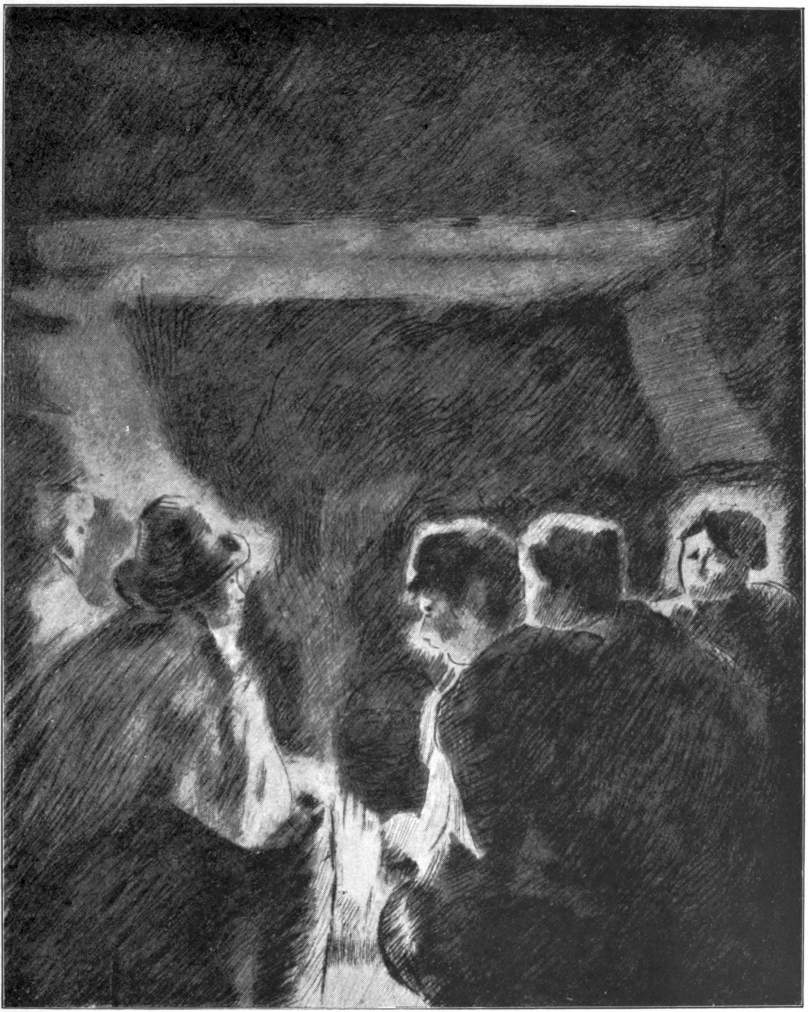
C. PISSARRO. SITTING UP.
(By permission of M. Durand-Ruel, the owner of the copyright.)
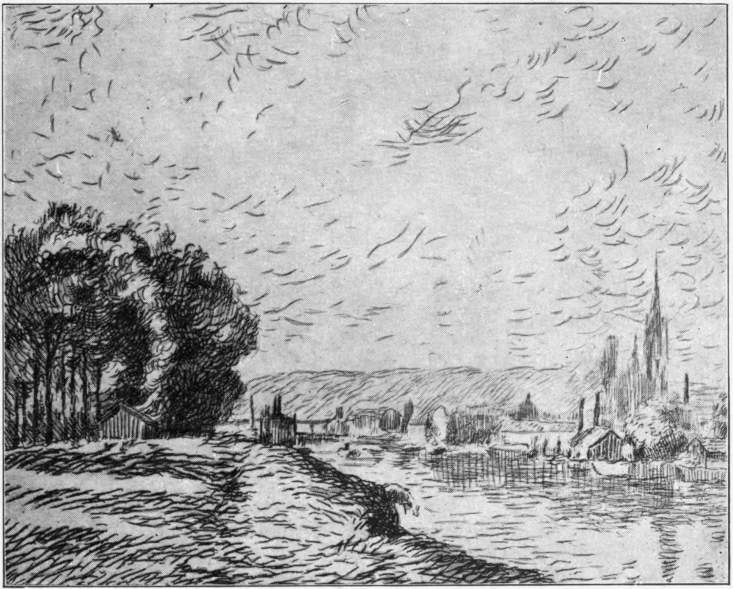
C. PISSARRO. ROUEN.
(By permission of M. Durand-Ruel, the owner of the copyright.)
A special group amongst the artist’s ballet pictures is that in which he represents the training of novices, the severe course through which the grub must pass before taking wing as a butterfly. Here is displayed a strange fantastic anatomy, only comparable to the acrobatic distortions to which the Japanese are so much addicted in their art. But it is precisely these pictures which were of determining importance for the development of Degas. In the quest of unstable lines and expressions, instead of feeling reality in all its charming grace, he came to behold it only in its degeneration. He was impelled to render the large outline of the modern woman—the female figure which has grown to be a product of art beneath the array of toilette—even in the most ungraceful moments. He painted the woman who does not suspect that she is being observed; he painted her seen, as it were, through the key-hole or the slit of a curtain, and making, to some extent, the most atrociously ugly movements. He was the merciless observer of creatures whom society turns into machines for its pleasure—dancing, racing, and erotic machines. He has depicted cruelly the sort of woman Zola has drawn in Nana—the woman who has no expression, no play in her eyes, the woman who is merely animal, motionless as a Hindu idol. His pictures of this class are a natural history of prostitution of terrible veracity, a great poem on the flesh, like the works of Titian and Rubens, except that in the latter blooming beauty is the substance of the brilliant strophes, while in Degas it is wrinkled skin, decaying youth, and the artificial brightness of enamelled faces. “A vous autres il faut la vie naturelle, à moi la vie factice.”
L’Art française.
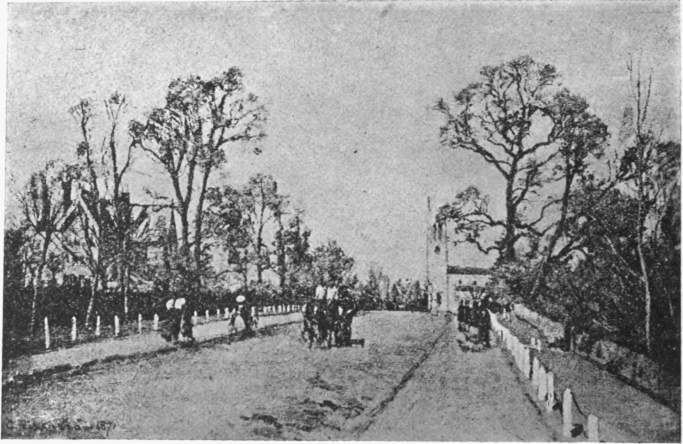
PISSARRO. SYDENHAM CHURCH.
This sense of having lived too much expressed itself also in the haughty contempt with which he withdrew himself from exhibitions, the public, and criticism. Any one who is not a constant visitor at Durand-Ruel’s has little opportunity of seeing the pictures of Degas. The conception of fame is something which he does not seem to possess. Being a man of cool self-reliance, he paints to please himself, without caring how his pictures may suit the notions of the world or the usages of the schools. For years he has kept aloof from the Salon, and some people say that he has never exhibited at all. And he keeps at as great a distance from Parisian society. In earlier days, when Manet, Pissarro, and Duranty met at the Café Nouvelle Athènes, he sometimes appeared after ten o’clock—a little man with round shoulders and a shuffling walk, who only took part in the conversation by now and then breaking in with brief, sarcastic observations. After Manet’s death he made the Café de la Rochefoucauld his place of resort. And young painters went on his account also to the Café de la Rochefoucauld and pointed him out to each other, saying, “That is Degas.” When artists assemble together the conversation usually turns upon him, and he is accorded the highest honours by the younger generation. He is revered as the haughty Independant who stands unapproachably above the profanum vulgus, the great unknown who never passed through the ordeal of a hanging committee, but whose spirit hovers invisibly over every exhibition.
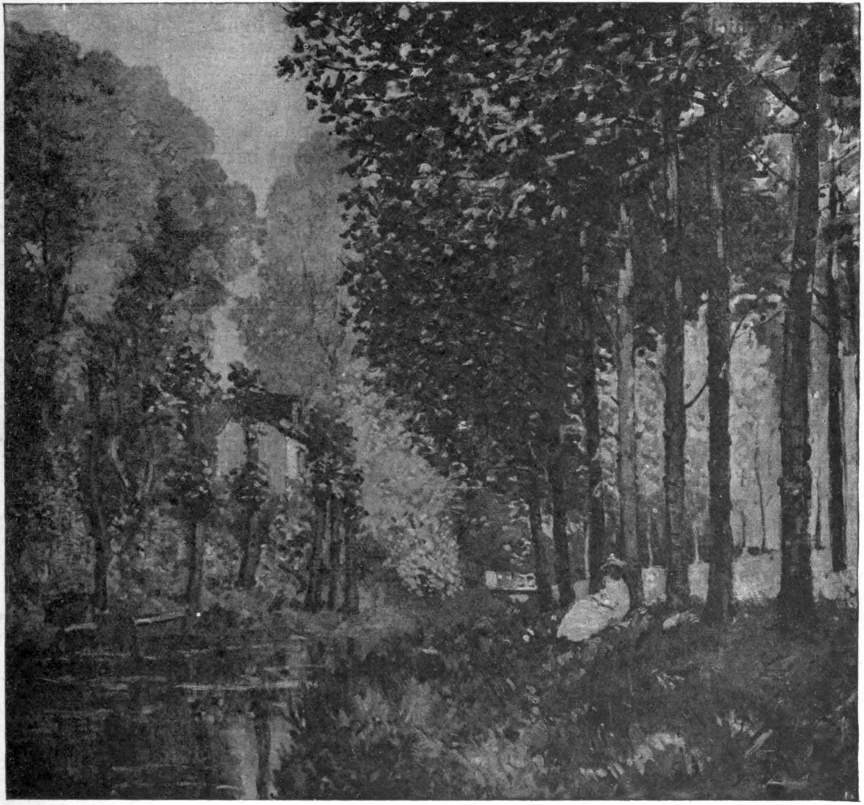
SISLEY. OUTSKIRTS OF A WOOD.
A refined charmeur, Auguste Renoir, has made important discoveries, in portrait painting especially. He is peculiarly the painter of women, whose elegance, delicate skin, and velvet flesh he interprets with extraordinary deftness. Léon Bonnat’s portraits were great pieces of still-life. The persons sit as if they were nailed to their seats. Their flesh looks like zinc and their clothes like steel. In Carolus Duran’s hands portrait painting degenerated into a painting of draperies. Most of his portraits merely betray the amount which the toilettes have cost; they are inspired by their rich array of silk and heavy curtains; often they are crude symphonies in velvet and satin. The rustle of robes, the dazzling—or loud—fulness of colour in glistening materials, gave him greater pleasure than the lustre of flesh-tints and any glance of inquiry into the moral temperament of his models. Renoir endeavours to arrest the scarcely perceptible and transitory movements of the features and the figure. Placing his persons boldly in the real light of day which streams around, he paints atmospheric influences in all their results, like a landscapist. Light is the sole and absolute thing. The fallen trunk of a tree upon which the broken sunlight plays in yellow and light green reflections, and the body or head of a girl, are subject to the same laws. Stippled with yellowish-green spots of light, the latter loses its contours and becomes a part of nature. With this study of the effects of light and reflection there is united an astonishing sureness in the analysis of sudden phases of expression. The way in which laughter begins and ends, the moment between laughter and weeping, the passing flash of an eye, a fleeting motion of the lips, all that comes like lightning and vanishes as swiftly, shades of expression which had hitherto seemed indefinable, are seized by Renoir in all their suddenness. In the portraits of Bonnat and Duran there are people who have “sat,” but here are people from whom the painter has had the power of stealing and holding fast the secret of their being at a moment when they were not “sitting.” Here are dreamy blond girls gazing out of their great blue eyes, ethereal fragrant flowers, like lilies leaning against a rose-bush through which the rays of the setting sun are shining. Here are coquettish young girls, now laughing, now pouting, now blithe and gay, now angry once more, and now betwixt both moods in a charming passion. And there are women of the world of consummate elegance, slender and slight-built figures, with small hands and feet, an even pallor, almond-shaped eyes catching every light, moist shining lips of a tender grace, bearing witness to a love of pleasure refined by artifice. And children especially there are, children of the sensitive and flexuous type: some as yet unconscious, dreamy, and free from thought; others already animated, correct in pose, graceful, and wise. The three girls, in his “Portrait of Mesdemoiselles M——,” grouped around the piano, the eldest playing, the second accompanying upon the violin, and the youngest quietly attentive, with both hands resting upon the piano, are exquisite, painted with an entirely naïve and novel truth. All the poses are natural, all the colours bright and subtle—the furniture, the yellow bunches of flowers, the fresh spring dresses, the silk stockings. But such tender poems of childhood and blossoming girlhood form merely a part of Renoir’s work. In his “Dinner at Chaton” a company of ladies and gentlemen are seated at table, laughing, talking, and listening; the champagne sparkles in the glasses, and the cheerful, easy mood which comes with dessert is in the ascendant. In his “Moulin de la Galette” he painted the excitement of the dance—whirling pairs, animated faces, languid poses, and everything enveloped in sunlight and dust. Renoir’s peculiar field is the study of the various delicate emotions which colour the human countenance.
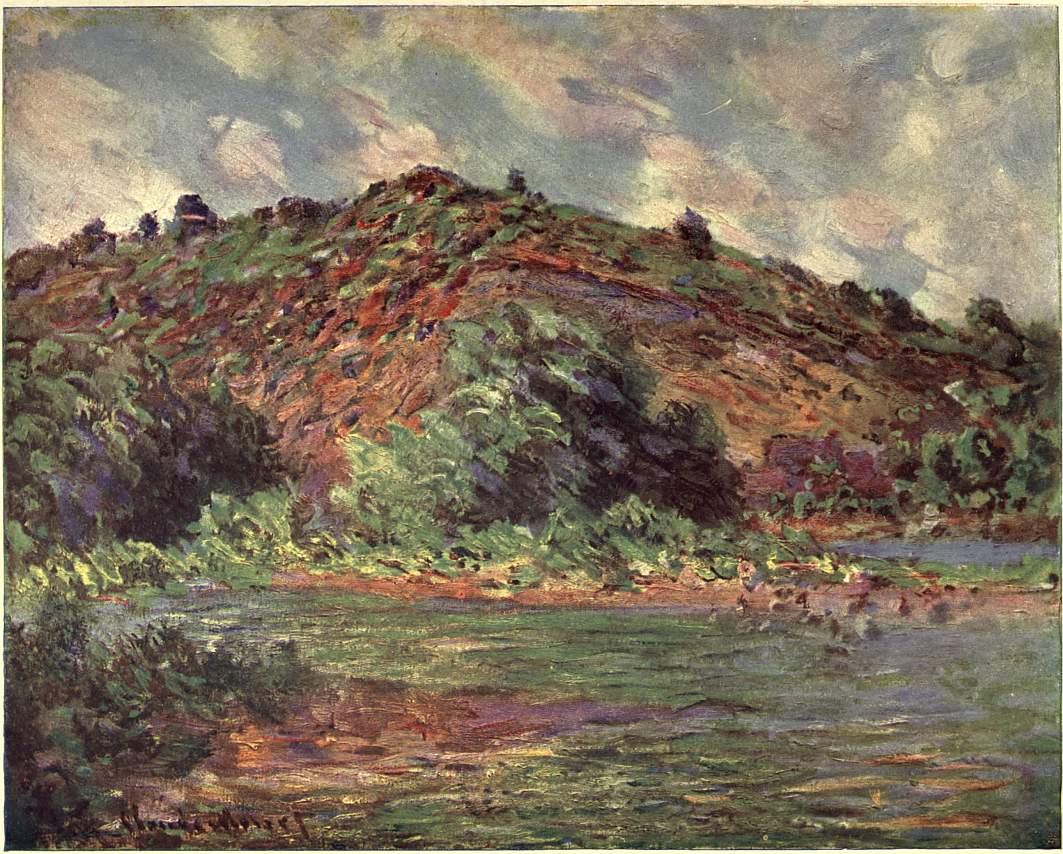
MONET. A STUDY.
By permission of M. Durand-Ruel.
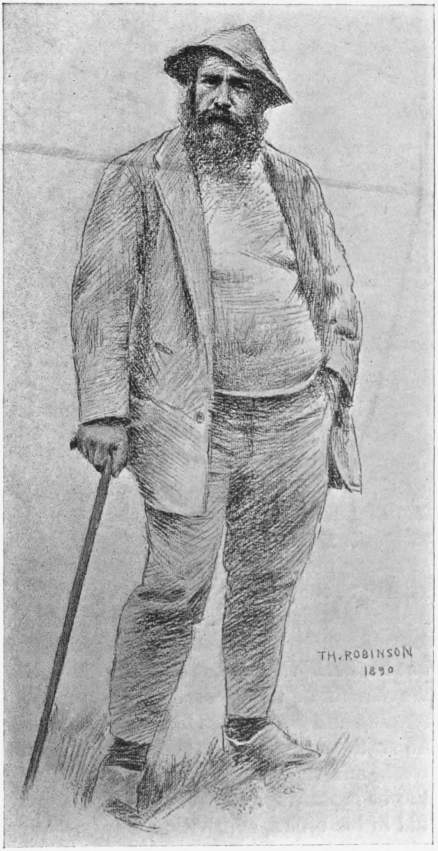
CLAUDE MONET. The Century.
The merit of Camille Pissarro is to have once more set the painting of peasants, weakened by Breton, upon the virile lines of Millet, and to have supplemented them in those places where Millet was technically inadequate. When the Impressionist movement began Camille Pissarro had already a past: he was the recognised landscape painter of the Norman plains; the straightforward observer of peasants, the plain and simple painter of the vegetable gardens stretching round peasant dwellings. Since Millet, no artist had placed himself in closer relationship to the life of the earth and of cultivated nature. Though a delicate analyst, Pissarro had not the epic feeling nor the religious mysticism of Millet; but like Millet he was a rustic in spirit, like him a Norman, from the land of vineyards, of large farmyards, green meadows, soft avenues of poplars, and wide horizons reddened by the sun. He was healthy, tender, and intimate in feeling, rejoiced in the richness of the land and the voluptuous undulation of fields, and he could give a striking impression of a region in its work-a-day character. Celebrated in the press as the legitimate descendant of Millet, he might have contented himself with his regular successes. He had, indeed, arrived at an age when men usually leave off making experiments, and reap what they have sown in their youth, at an age when many conquerors occupy themselves with the mechanical reproduction of their own works. Nevertheless the Impressionistic movement became for Pissarro the starting-point of a new way.
He aimed at fresher, intenser, and more transparent light, at a more cogent observation of phenomena, at a more exact analysis of the encompassing atmosphere. He celebrated the eternal, immutable light in which the world is bathed. He loved it specially during clear afternoons, when it plays over bright green meadows fringed by soft trees, or at the foot of low hills. He has sought it on the slopes across which it ripples deliciously, on the plains from which it rises like a light veil of gauze. He studied the play of light upon the bronzed skin of labourers, on the coats of animals, on the foliage and fruit of trees. He characterised the seasons, the hour of day, the moment, with the conscientiousness of a peasant intent upon noting the direction of the wind and the position of the sun. The cold, chilly humour of autumn afternoons, the vivid clarity of sparkling wintry skies, the bloom and lightness of spring mornings, the oppressive brooding of summer, the luxuriance or the aridity of the earth, the young vigour of foliage or the fading of nature robbed of her adornment,—all these Pissarro has painted with largeness, plainness, and simplicity. He strays over the fields, watching the shepherd driving out his flock, the wains rumbling along the uneven roads, the quiet, rhythmical movement of the gleaners, the graceful gait of the women who have been reaping and now return home in the evening with a rake across their shoulders; he stations himself at the entrance of villages where the apple-pickers are at work, and the women minding geese stand by their drove; he notes the whole life of peasants, and gives truer and more direct intelligence of it than Millet did in his broad, synthetic manner. Where there is a classic quietude and an oily heaviness in Millet, there is in Pissarro palpitating life, transparence, and freshness. He sees the country in bright, laughing tones; and the pure white of the kerchiefs, the pale rose-colour or tender blue bodices of his peasant women, lend his pictures a blithe delicacy of colour. His girls are like fresh flowers of the field which the sun of June brings forth upon the meadows. There is something intense and yet soft, strong and delicate, true and rhythmical in Pissarro’s tender poems of country life.
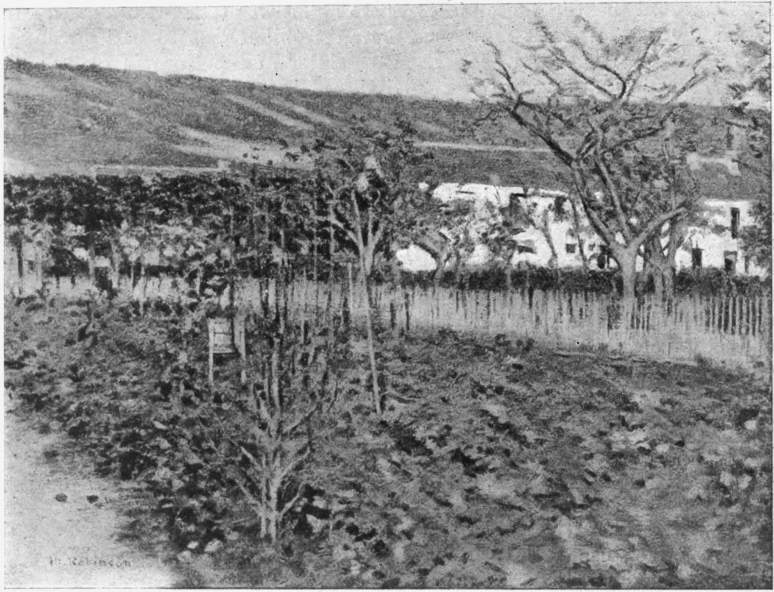
The Century.
MONET’S HOME AT GIVERNY.
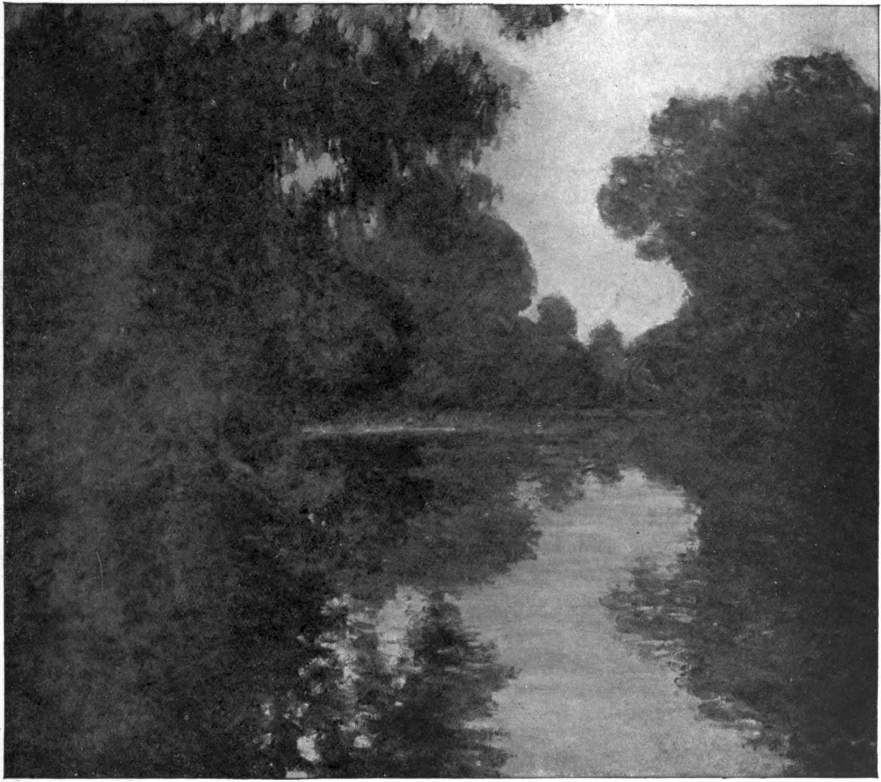
MONET. MORNING ON THE SEINE.
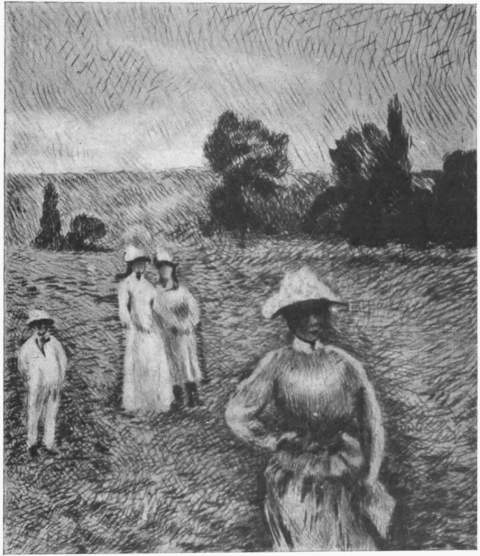
MONET. A WALK IN GREY WEATHER.
(By permission of M. Durand-Ruel, the owner of the copyright.)
So long as any advance beyond Rousseau and Corot seemed impossible, pictures of talent but only moderate importance had increased in number in the province of landscape. The landscape painters who immediately followed the great pioneers loved nature on account of her comparative coolness in summer; upon sites where the classic artists of Fontainebleau dreamed and painted they built comfortable villas and settled down with the sentiments of a householder. The country was parcelled out, and each one undertook his part, and painted it conscientiously without arousing any novel sensations. Impressionism gave landscape painting, which showed signs of being split into specialties, once more a firm basis, a charming field of study. To communicate impressions without any of the studio combinations, just as they strike us suddenly, to preserve the vividness and cogency of the first imprint of nature upon the mind, was the great problem which Impressionism placed before the landscape painters. The artists of Fontainebleau painted neither the rawness and rigidity of winter nor the sultry atmosphere and scorching heat of summer; they painted artistic and dignified and exquisite works. The Impressionists did not approach their themes as poets, but as naturalists. In their hands landscape, which in Corot, Millet, Diaz, Rousseau, Daubigny, and Jongkind is an occasional poem, becomes a likeness of a region under special influences of light. With more delicate nerves, and a sensibility almost greater, they allowed nature to work upon them, and perceived in the symphonies of every hour strains never heard before, transparent shadows, the vibration of atoms of light. decomposing the lines of contour, that tremor of the atmosphere which is the breath of landscape. Here also England was not without influence. As Corot and Rousseau received an impulse from Constable and Bonington in 1830, Monet and Sisley returned from London with their eyes dazzled by the light of the great Turner. Laid hold upon, like Turner, by the miracles of the universe, by the golden haze which trembles in a sunbeam, they succeeded in painting light in spite of the defectiveness of our chemical mediums.
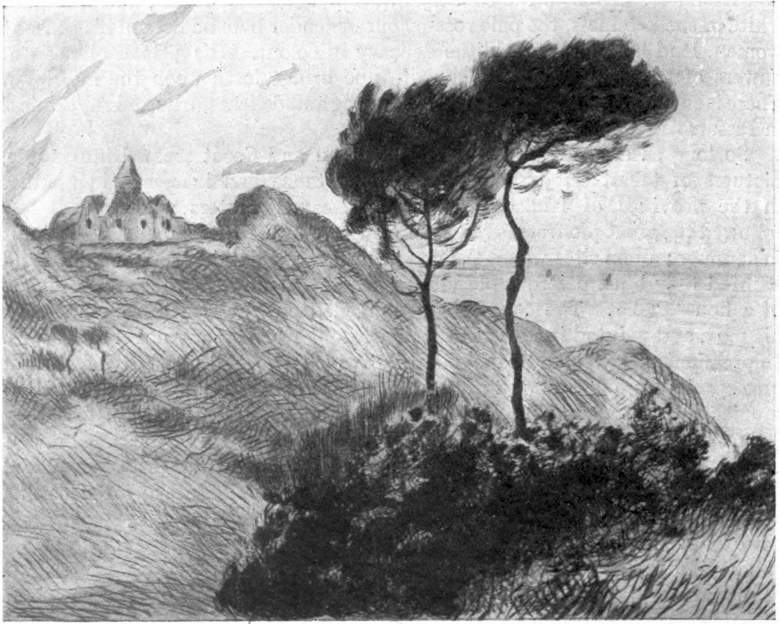
MONET. THE CHURCH AT VARANGÉVILLE.
(By permission of M. Durand-Ruel, the owner of the copyright.)
Alfred Sisley might be compared with Daubigny. He settled in the neighbourhood of Moret, upon the banks of the Loing, and is the most soft and tender amongst the Impressionists. Like Daubigny, he loves the germinating energy, the blossoming, and the growth of young and luminous spring; the moist banks of quiet streamlets, budding beeches, and the rye-fields growing green, the variegated flowering of the meadows, clear skies, ladies walking in bright spring dresses, and the play of light upon the vernal foliage. He has painted tender mornings breathed upon with rosy bloom, reeds with a bluish gleam, and moist duck-weed, grey clouds mirrored in lonely pools, alleys of poplar, peasants’ houses, and hills and banks, melting softly in the warm atmosphere. His pictures, like those of the master of Oise, leave the impression of youth and freshness, of quiet happiness, or of smiling melancholy.
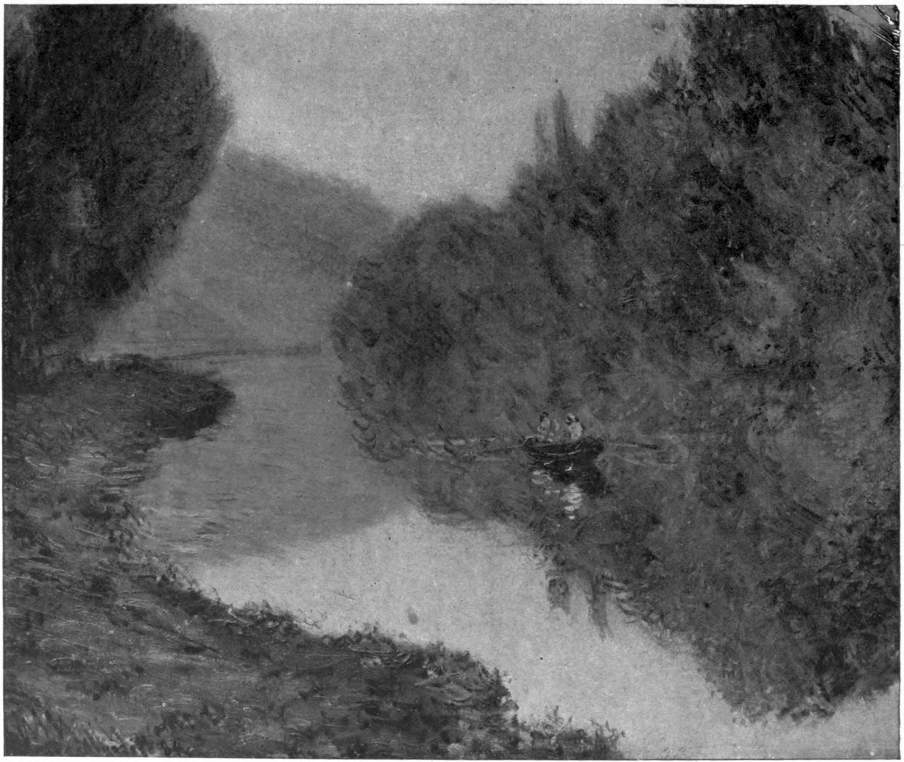
MONET. RIVER SCENE.
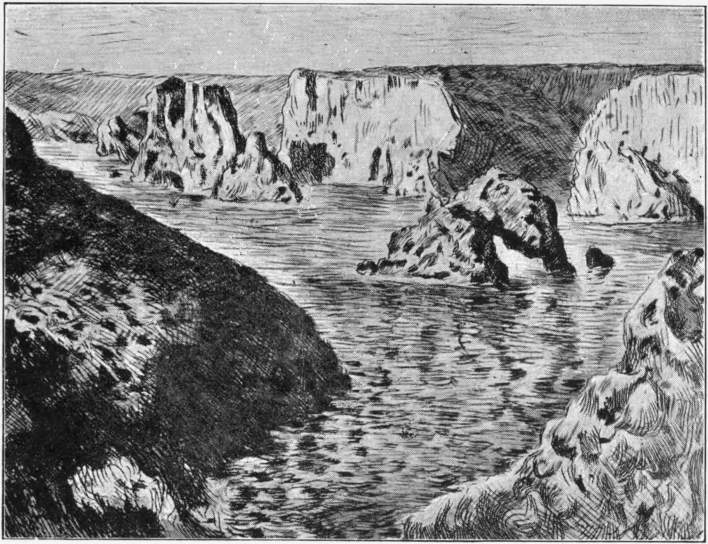
MONET. THE ROCKS AT BELLE-ISLE.
(By permission of M. Durand-Ruel, the owner of the copyright.)
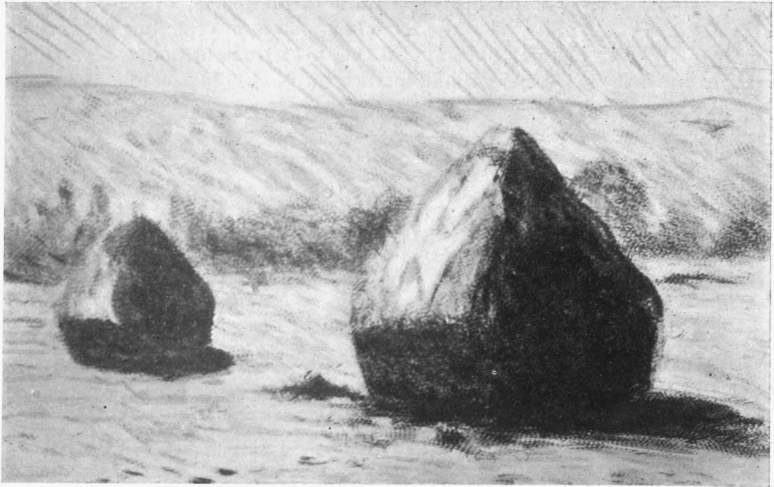
MONET. HAY-RICKS.
(By permission of M. Durand-Ruel, the owner of the copyright.)
On many of his pictures, saturated as they are with light, Claude Monet could inscribe the name of Turner without inciting unbelief. In exceedingly unequal works, which are nevertheless full of audacity and genius, he has grasped what would seem to be intangible. Except Turner there is no one who has carried so far the study of the effects of light, of the gradations and reflections of sunbeams, of momentary phases of illumination, no one who has embodied more subtle and forcible impressions. For Monet man has no existence, but only the earth and the light. He delights in the rugged rocks of Belle-Isle, and the wild banks of the Creuse, when the oppressive sun of summer is brooding over them. He paints phenomena as transitory as the shades of expression in Renoir. The world appears in a glory of light, such as it only has in fleeting moments, and such as would be blinding were it always to be seen. Nature, in his version, is an inhospitable dwelling where it is impossible to dream and live. One hopes sometimes to hear a word of intimate association from Monet—but in vain; Claude Monet is only an eye. Carouses of sunshine and orgies in the open air are the exclusive materials of his pictures. Thus he has little to say for those who seek the soul of a human being in every landscape. Like Degas, he is par excellence the master in technique whose highest endeavour is to enrich the art of painting with novel sensations and unedited effects, even if it has to be done by violence. There are sea-pieces filled with the spirit of evening, when the sea, red as a mirror of copper, merges into the glory of the sky, in a great radiant ocean of infinity; moods of evening storm, when gloomy clouds over the restless tree-tops race across the smoky red sky, losing tiny shreds in their flight, little thin strips of loosened cloud, saturated through and through with a wine-red glow by the splendour of the sun. Or there are spring meadows fragrant with bloom, and hills parched by the sun; rushing trains with their white smoke gleaming in the light; yellow sails scudding over glittering waters; waves shining blue, red, and golden; and burning ships, with shooting tongues of flame leaping upon the masts; and, behind, a jagged rim of the evening glow. Claude Monet has followed light everywhere—in Holland, Normandy, the South of France, Belle-Isle-en-Mer, the villages of the Seine, London, Algiers, Brittany. He became an enthusiast for nature as she is in Norway and Sweden, for French cathedrals rising into the sky, tall and fair, like the peaks of great promontories. He interpreted the surge of towns, the movement of the sea, the majestic solitude of the sky. But he knows too that the artist could pass his life in the same corner of the earth and work for years upon the same objects without the drama of nature played before him ever becoming exhausted. For the light which streams between things is for ever different. So he stood one evening two paces in front of his little house, in the garden, amid a flaming sea of flowers scarlet like poppies. White summer clouds shifted in the sky, and the beams of the setting sun fell upon two stacks, standing solitary in a solitary field. Claude Monet began to paint, and came again the next day, and the day after that, and every day throughout the autumn, and winter, and spring. In a series of fifteen pictures, “The Hay-ricks,” he painted—as Hokusai did in his hundred views of the Fuji mountain—the endless variations produced by season, day, and hour upon the eternal countenance of nature. The lonely field is like a glass, catching the effects of atmosphere, the breeze, and the most fleeting light. The stacks gleam softly in the brightness of the beautiful afternoons, stand out sharp and clear against the cold sky of the forenoon, loom like phantoms in the mist of a November evening, or sparkle like glittering jewels beneath the caress of the rising sun. They shine like glowing ovens, absorbed by the light of the autumnal sunset; they are surrounded as by a rosy halo, when the early sun pierces like a wedge through the dense morning mist. They rise distinctly, covered with sparkling, rose-tinged snow, into the cloudless heaven, and cast their pure, blue shadows upon the silent, white, wintry landscape, or stand out in ghostly outlines against the night firmament, mantled with silver by the moonlight. Without moving his easel, Monet has interpreted the silence of winter, and autumn with her sad and splendid feasts of colour—dusk and rain, snow and frost and sun. He heard the voices of evening and the jubilation of morning; he painted the eternal undulation of light upon the same objects, the altered impression which the same particle of nature yields according to the changing light of the hour. He chanted the poetry of the universe in a single fragment of nature, and would be a pantheistic artist of world-wide compass had he merely painted these stacks of hay for the rest of his natural existence.
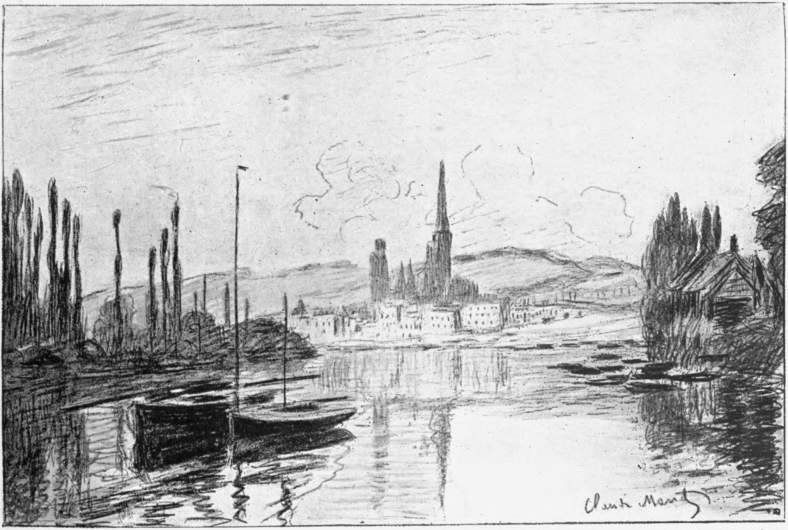
MONET. Gaz des Beaux-Arts. A VIEW OF ROUEN.
(By permission of the Artist.)
And here ends the battle for the liberation of modern art. Libertas artibus restituta. The painters of the nineteenth century are no longer imitators, but have become makers of a new thing, “enlargers of the empire.” The prophetic words written in the beginning of the nineteenth century by the Hamburger, Philipp Otto Runge, “light, colour, and moving life,” were to form the great problem, the great conquest of modern art; they were fulfilled after two generations. Through the Impressionists art was enriched by an opulence of new beauties. A new and independent style had been discovered for the representation of new things, and a new province—a province peculiar to herself—was won for painting.

CHAPTER XXXII
THE NEW IDEALISM IN ENGLAND
The flood of Impressionism was at the same time crossed by another current. Impressionism was a phase of progressive art of world-wide influence. It proclaimed that nature and life were the inexhaustible mine of beauty. Then after Naturalism had taught artists to work upon the impressions of external reality in an independent manner, a transition was made by some who embodied the impressions of their inward spirit in a free creative fashion, unborrowed from the old masters.
We feel the need of living not merely in the world around us, but in an inner world that we build up ourselves, a world far more strange and fair, far more luminous than that in which our feet stumble so helplessly. We must needs mount upon the pinions of fancy into the wide land of vision, build castles in the clouds, watch their rise and their fall, and follow into misty distance the freaks of their changing architecture. The more grey and colourless the present may be, the more alluringly does the fairy splendour of vanished worlds of beauty flit before us. It is the very banality of everyday life that renders us more sensitive to the delicate charm of old myths, and we receive them in a more childlike, impressionable way than any earlier age, for we look upon them with fresh eyes that have been rendered keen by yearning.
From all this it is evident that Impressionism could not remain the mode of expression for the whole world of the present day. The longing for old-world romance would brook no refusal. It was demanded from art not that she should mirror nature, nature could be seen without her aid, but that she should carry us away on dream-wings to a distant world more beautiful than our own; not that she should be merely modern, but that she should afford us even to-day some reflection of that beauty which sheds forth its lustre from the works of the old masters.
This yearning after far-off worlds of beauty was combined with a demand for new delights of colour. The Impressionists had centred every effort in compassing the most difficult elements of the world of phenomena—light, air, and colour—ending in extreme imitation of reality. Then came a desire for colours, more radiant, more vivid than ever was seen on this poor world of ours; and since hardly any of the younger generation fulfilled the desire of the modern longing, the standard of a bygone age was raised aloft, and there set in the anti-naturalistic, anti-modern current that still survived from the age of romance in the work-a-day world of the present.
How was it possible that England should have taken the lead upon this occasion also? Can an Englishman, a matter-of-fact being who finds his happiness in comfort and a practical sphere of action, be at the same time a Romanticist? Is not London the most modern town in Europe? Yet, without a question, this is the very reason why the New Romanticism found its earliest expression there, although it was the place where Naturalism had reigned longest and with the greatest strictness. There was a reaction against the prose of everyday life, just as, in the earlier part of the century, English landscape painting had been a reaction against town life. To escape the whistle of locomotives and the restless bustle of the struggle for existence, men take refuge in a far-off world, a world where everything is fair and graceful, and all emotions tender and noble, a world where no rudeness, no discord, and nothing fierce or brutal disturbs the harmony of ideal perfection. These artists become revellers in a land of fantasy, and flee from reality to an inner life which they have created for themselves, wander from London’s railways and fogs to the sunny Italy of Botticelli, take their rest in the land of poetry, and come back with packing-cases full of lovely pictures and hearts full of happy emotions.
Moreover, they find in the primitive artists that simplicity which is most refreshing of all to overstrained spirits. Having produced Byron, Shelley, and Turner, the English were artistic gourmets, sated with all enjoyments in the realms of the intellect, and they now meditated works through which yet a new thrill of beauty might pass through the imagination. In the primitive masters they discovered all the qualities which had vanished from art since the sixteenth century—inofficious purity, innocent and touching Naturalism, antiquated austerity, and an enchanting depth of feeling. Jaded with other experiences, they admired in those naïve spirits the capacity for ecstatic rapture and vision—in other words, for the highest gratification. If one could but have in this nineteenth century such feelings as were known to Dante, the gloomy Florentine; Botticelli, the great Jeremiah of the Renaissance; or the tender mystic Fra Angelico! Surfeited with modernity, and endowed with nerves of acute refinement, artists went back in their fancy to this luxuriously blissful condition, and finally came to the point at which modernity was transformed once more into childish babble and the unbelieving materialism of the present age into a mystical and romantic union with the old currents of emotion.
Under the influence of Dante Gabriel Rossetti English pre-Raphaelitism now entered upon a new and entirely different phase.
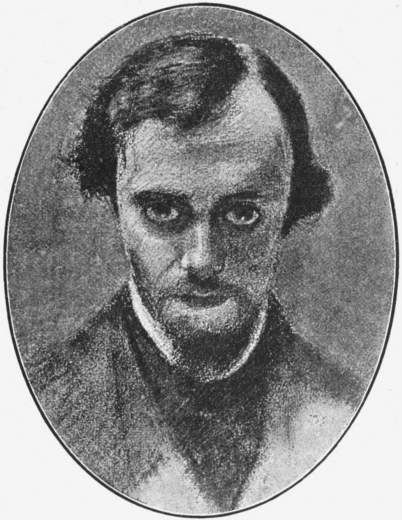
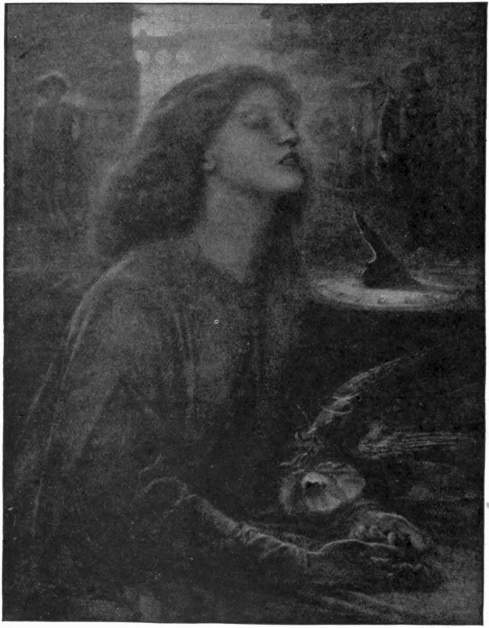
Mag. of Art. ROSSETTI. Cassell & Co. BEATA BEATRIX.
DANTE GABRIEL ROSSETTI. (By permission of Mr. F. Hollyer, the owner of the copyright.)
Although Rossetti was the soul of the earlier movement, he was a man whose temperament was even then essentially different from that of his comrades Millais and Hunt, who founded the Brotherhood with him in 1848. Even the two works which he exhibited with them in 1849 and 1850 make one feel the great gulf which lay between him and them. In the former year, when Hunt was represented by his “Rienzi,” and Millais by his “Lorenzo and Isabella,” Rossetti produced his “Girlhood of Mary Virgin.” In the following, when Hunt painted “The Converted British Family sheltering a Christian Missionary” and Millais “The Child Jesus in the Workshop of Joseph the Carpenter,” Rossetti came forward with his “Ecce Ancilla Domini.” “The Girlhood of Mary Virgin” was a little picture of austere simplicity and ascetic character; it was intentionally angular in drawing, and possessed a certain archaic bloom. The Virgin, clad in grey garments, sits at a curiously shaped frame embroidering a lily with gold threads upon a red ground. The flower she is copying stands before her in a vase, and a little angel, with roseate wings, is watering it with an air of abashed reverence. St. Anne is busy by the side of the Virgin—both being, respectively, portraits of the artist’s mother and sister—and in the background St. Joachim is binding a vine to a trellis. And several Latin books are lying upon the floor. The second work, “Ecce Ancilla Domini,” is the familiar picture which is now in the National Gallery—a harmony of white upon white of indescribable graciousness and delicacy. Mary, a bashful, meditative, and childlike maiden, in a white garment, is shown in a half-kneeling attitude upon a white bed. The walls of the chamber are white, and in front of her there stands a frame at which she has been working; and a piece of embroidery, with a lily which she has begun, hangs over it. Before her stands the angel with flame rising from his feet, in solemn, peaceful gravity, as he extends towards her the stalk of the lily which he holds. A dove flies gently in through the window. Now, in spite of their romantic subjects the work of Hunt and Millais is lucid and temperate, while Rossetti is dreamily mystical. The two former were straightforward, true, and natural, whereas the simplicity of the latter was subtilised and consciously affected. It was due to the vibrating delicacy of his distempered, seething imagination that he was able to give himself a deceptive appearance of being a primitive artist. The creative power of the two former is an earnest power of the understanding, whereas in the latter there is a vague dreaminess, a tendency to luxuriate in his own moods, an efflorescence of tones and colours. In the one case there is an angular but single-minded study of nature; in the other there is the demureness and embarrassment of the Quattrocento, a demureness breaking into blossom, and an embarrassment full of charm—a romanticism which cherished the yearning for repose in the childlike and innocent Middle Ages, and clothed it with all the attractions of mysticism. Holman Hunt, Madox Brown, and Millais were realists in their drawing, men who wanted to represent objects with all possible accuracy, to be faithful in rendering the finest fibre of a petal and every thread in a fabric. Rossetti’s picture was a symphonic ode in pigments, and he himself was one of the earliest of the modern lyricists of colour. This distinction became wider and wider with the course of time, and as early as 1858 he found himself deserted by his earlier comrades. Madox Brown, Holman Hunt, and especially Millais, in their further development, tended more and more to become Naturalists, and were finally led to completely realistic subjects from the immediate present by the inviolable fidelity with which they studied nature. On the other hand, Rossetti became the centre of a new circle of artists, who directed the current of what was originally Naturalism more and more into mysticism and refined archaism.
In 1856 The Oxford and Cambridge Magazine was founded as a monthly periodical. There were several contributions by Rossetti, and in this way he became so well known in Oxford that the Union accepted an offer from him to execute a series of wall-paintings. Accordingly he painted several pictures from the Arthurian legends, making the sketches for them himself, and employing for their elaboration a number of young men, some of them amateur artists and students at the University. In this way he came into connection with Arthur Hughes, William Morris, and Edward Burne-Jones. These artists, afterwards joined by Spencer Stanhope and Walter Crane, both of them younger men, became—with George Frederick Watts at their flank—the leading members of the new brotherhood, the representatives of that New pre-Raphaelitism in which interest is still centred in England.
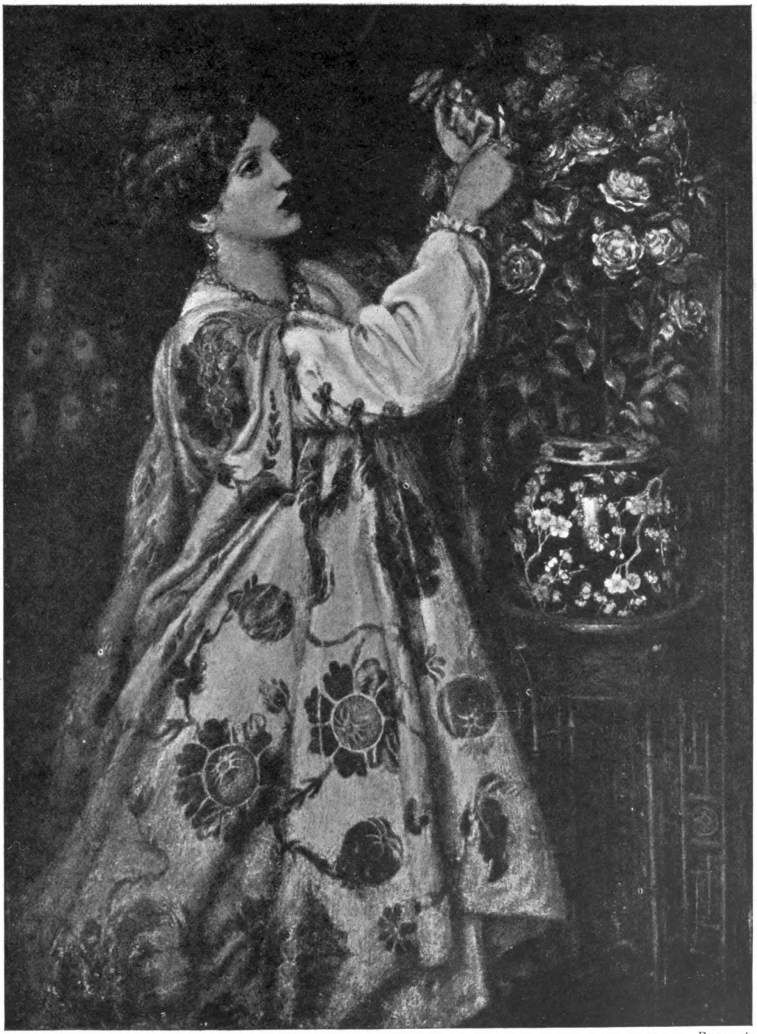
ROSSETTI. Pageant. MONNA ROSA.
(By permission of Mr. W. M. Rossetti.)
Their art is a kind of Italian Renaissance upon English soil. The romantic chord which vibrates in old English poetry is united to the grace and purity of Italian taste, the classical lucidity of the Pagan mythology with Catholic mysticism, and the most modern riot of emotion with the demure vesture of the primitive Florentines. Through this mixture of heterogeneous elements English New Idealism is probably the most remarkable form of art upon which the sun has ever shone: borrowed and yet in the highest degree personal, it is an art combining an almost childlike simplicity of feeling with a morbid hautgoût, the most attentive and intelligent study of the old masters with free, creative, modern imagination, the most graceful sureness of drawing and the most sparkling individuality of colour with a helpless, stammering accent introduced of set purpose. The old Quattrocentisti wander amongst the real Italian flowers; but with the New pre-Raphaelites one enters a hot-house: one is met by a soft damp heat, bright exotic flowers exhale an overpowering fragrance, juicy fruits catch the eye, and slender palms, through the branches of which no rough wind may bluster, gently sway their long, broad fans.
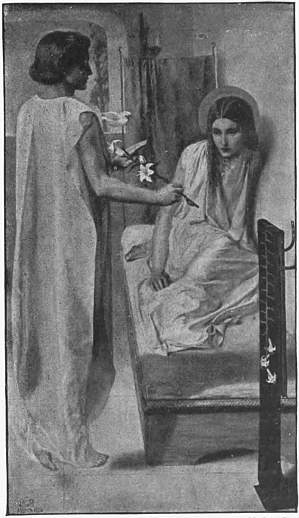
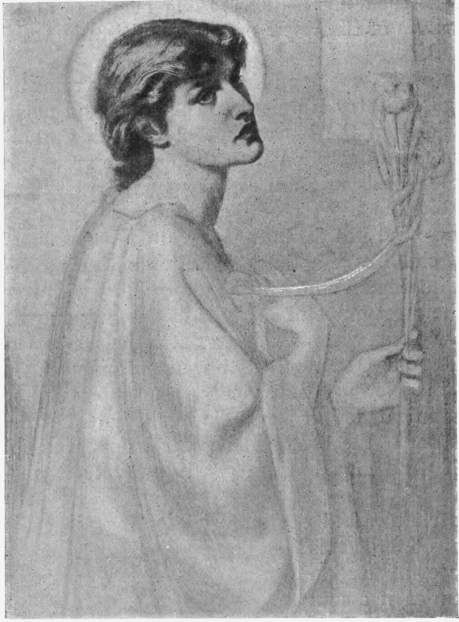
ROSSETTI. Cassell & Co. ECCE ANCILLA DOMINI. ROSSETTI. Portfolio. SANCTA LILIAS.
(By permission of Messrs. T. Agnew & Sons, the owners of the copyright.)
Professor Lombroso would certainly find the material for ingenious disquisition in Rossetti, who introduced this Italian phase, and himself came of an Italian stock. And it might almost seem as if a soul from those old times had found its reincarnation in the lonely painter who lived at Chelsea, though it was a soul who no longer bore heaven in his heart like Fra Angelico. In his whole being he seems like a phenomenon of atavism, like a citizen of that long-buried Italy who, after many transmigrations, had strayed into the misty North, to the bank of the Thames, and from thence looked in his home-sickness ever towards the South, enveloped in poetry and glowing in the sun.
Dante Gabriel Rossetti was a Catholic and an Italian. Amid his English surroundings he kept the feelings of one of Latin race. His father, the patriot and commentator upon Dante, had originally lived in Naples, and inflamed the popular party there by his passionate writings. In consequence of the active part which he took in political agitation he lost his post at the Bourbon Museum, escaped from Italy upon a warship, disguised as an English officer, settled in London in 1824, and married Francesca Polidori, the daughter of a secretary of Count Alfieri. Here he became Professor of the Italian language at King’s College, and published several works on Dante, the most important of which, Dante’s Beatrice, written in 1852, once more supported the theory that Beatrice was not a real person. Dante Gabriel, the son of this Dante student Gabriele Rossetti, was born in London on 12th May 1828. The whole family actively contributed to scholarship and poetry. His elder sister, Maria Francesca, was the authoress of A Shadow of Dante, a work which gives a most valuable explanation of the scheme of The Divine Comedy; his younger sister, Christina, was one of the most eminent poetesses of England; and his brother, William Michael Rossetti, is well known as an art-critic and a student of Shelley. Even from early youth Dante Gabriel Rossetti was familiar with the world of Dante, and brought up in the worship of Dante’s wonderful age and an enthusiasm for his mystic and transcendental poetry. He knew Dante by heart, and Guido Cavalcanti. The mystical poet became his guide through life, and led him to Fra Angelico, the mystic of painting. Indeed, the world of Dante and of the painters antecedent to Raphael is his spiritual home.
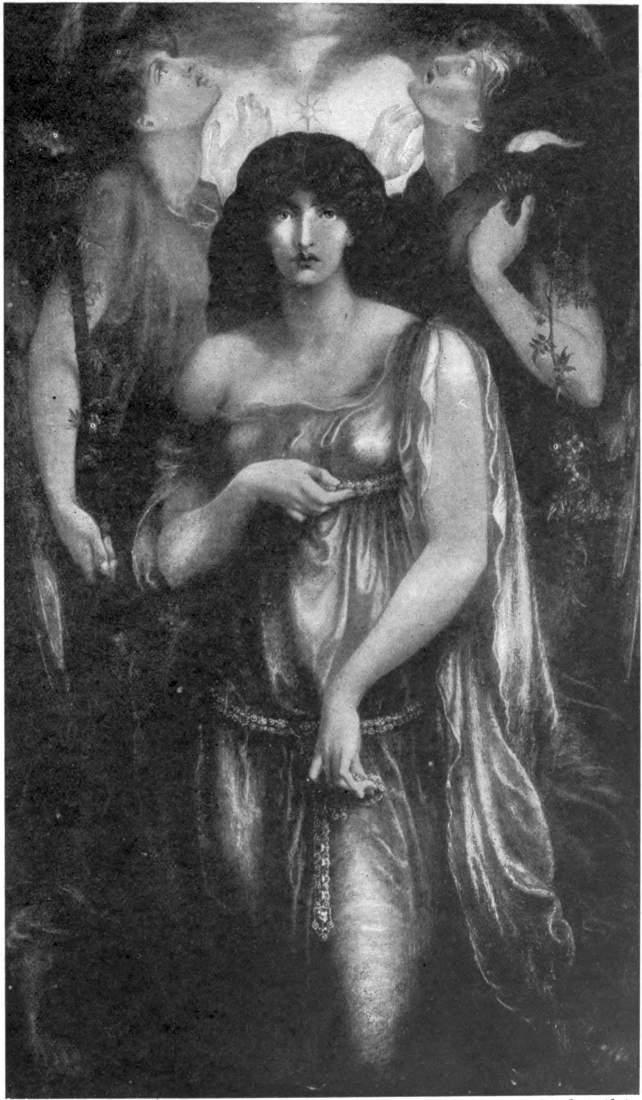
ROSSETTI. Brothers, photo. ASTARTE SYRIACA.
(By permission of the Corporation of Manchester, the owners of the picture.)
Mansell & Co.
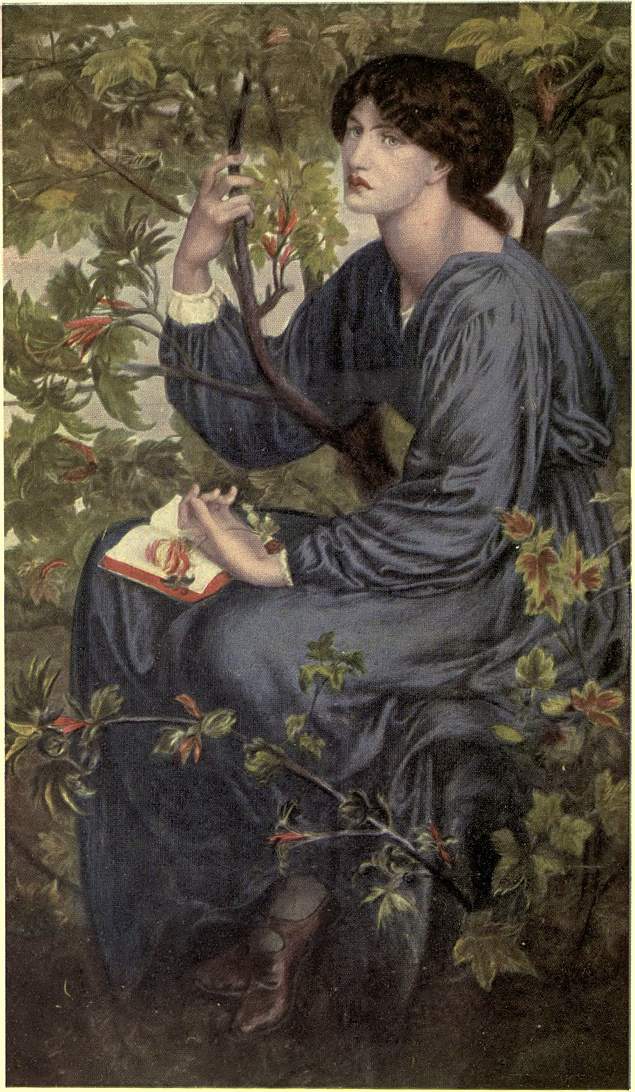
ROSSETTI. THE DAY DREAM.
He was barely eighteen when he became a pupil at the Royal Academy, studying a couple of years later under Madox Brown, who was not many years older than himself. Even then Rossetti had an almost mesmeric influence upon his friends. He was a pale, tall, thin young man, who always walked with a slight stoop; reserved, dry in his manner, and careless in dress, there was nothing captivating about him at a transitory meeting. But his pale face was lit up by his unusually reflective, deeply clouded, contemplative eyes; and about his defiant mouth there played that contempt of the profane crowd which is natural to a superior mind, while the laurel of fame was already twined about his youthful forehead. In 1849, when he was exhibiting his earliest picture, he had published in The Germ, to say nothing of his numerous poems, a mystical, visionary, sketch in prose named Hand and Soul, which was much praised by men of the highest intellect in London. Soon afterwards he published a volume entitled Dante and his Circle, in which he translated a number of old Italian poems, and rendered Dante’s Vita Nuova into strictly archaic English prose. Reserved as he was towards strangers, he was irresistibly attractive to his friends, and his brilliant, genial conversation won him the goodwill of every one. A man of gifted and delicate nature, sensitive to an extreme degree, a sedentary student who had yet an enthusiasm for knightly deeds, a jaded spirit capable of morbidly heightened, exotic sensibility and soft, melting reverie, one whose overstrained nerves only vibrated if he slept in the daytime and worked at night, it seemed as though Rossetti was born to be the father of the décadence, of that state of spirit which every one now perceives to be flooding Europe.
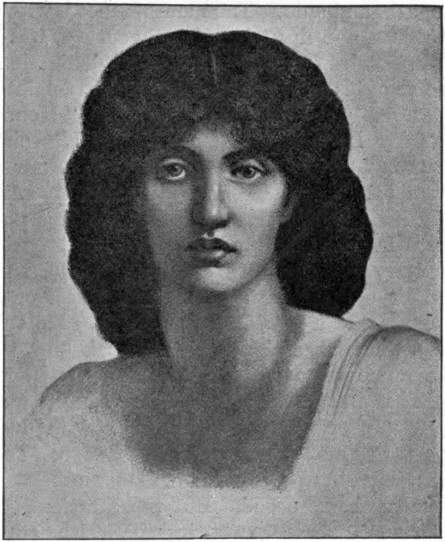
ROSSETTI. STUDY FOR ASTARTE SYRIACA.
His later career was as quiet as its opening had been brilliant. After that graciously sentimental little picture, “Ecce Ancilla Domini,” Rossetti exhibited in public only once again; this was in 1856. From that date the public saw no more of his painting. He worked only for his friends and the friends of his friends. He was famous only in private, and looked up to like a god within a narrow circle of admirers. One of his acquaintances, the painter Deverell, had introduced him in 1850 to the woman who became for him what Saskia Uylenburgh had been for Rembrandt and Helene Fourment for Rubens—his type of feminine beauty. She was a young dressmaker’s assistant, Miss Eleanor Siddal. Her thick, heavy hair was fair, with that faint reddish tint in it which Titian painted; it grew in two tapering bands deep down into the neck, being there somewhat fairer than it was above, and it curled thickly. Her eyes had something indefinite in their expression; nothing, however, that was dreamy, mobile, and changeable, for they seemed rather to be insuperable, fathomless, and unnaturally vivid. All the play of her countenance lay in the lower part of her face, in the nostrils, mouth, and chin. The mouth, indeed, with its deep corners, sharply chiselled outlines, and lips triumphantly curved, was particularly expressive. And her tall, slender figure had a refined distinction of line. In 1860 they married. Some of his most beautiful works were painted during this epoch—the “Beata Beatrix,” the “Sibylla Palmifera,” “Monna Vanna,” “Venus Verticordia,” “Lady Lilith,” and “The Beloved”—pictures which he painted without a thought of exhibition or success. After a union of barely two years this passionately loved woman died, shortly after the birth of a still-born child. He laid a whole volume of manuscript poems—many of them inspired by her—in the coffin, and they were buried with her. From that time he lived solitary and secluded from the world, surrounded by mediæval antiques, in his old-fashioned house at Chelsea, entirely given up to his dreams, a stranger in a world without light. He suffered much from ill-health, and was sensitive and hypochondriacal, and, indeed, undermined his health by an immoderate use of chloral. His friends entreated him to bring out his poems, and all England was expectant when Rossetti at length yielded to pressure, opened the grave of his wife, and took out the manuscript. The poems appeared in the April of 1870. The first edition was bought up in ten days, and there followed six others. Wherever he appeared he was honoured like a god. But the attacks directed against the first pictures of the pre-Raphaelites were repeated, although now transferred to another region. A pseudonymous article by Robert Buchanan in the Contemporary Review, and published afterwards as a pamphlet, entitled The Fleshly School of Poetry, accused Rossetti of immorality and imitation of Baudelaire and the Marquis de Sade. Rossetti stepped once more into the arena, and replied by a letter in the Athenæum headed The Stealthy School of Criticism. From that time he shut himself up completely, never went out, and led “the hole-and-cornerest existence.”
In 1881 he published a second volume of poems, chiefly composed of ballads and sonnets. A year afterwards, on 10th April 1882, he died, honoured, even in the academical circles in which he never mingled, as one of the greatest men in England. The exhibition of his works which was opened a couple of months after his death created an immense sensation. Those of his pictures which had not been already sold straight from the easel were paid for with their weight in gold, and are now scattered in great English country mansions and certain private galleries in Florence. The only very rich collection in London is that of an intimate friend of the artist, the late Mr. Leyland, who had gathered together, in his splendid house in the West End, probably the most beautiful work of which the East can boast in carpets and vases, or the early Renaissance in intaglios, small bronzes, and ornaments. Here, surrounded by the quaint and delicate pictures of Carlo Crivelli and Botticelli, Rossetti was in the society of his contemporaries.
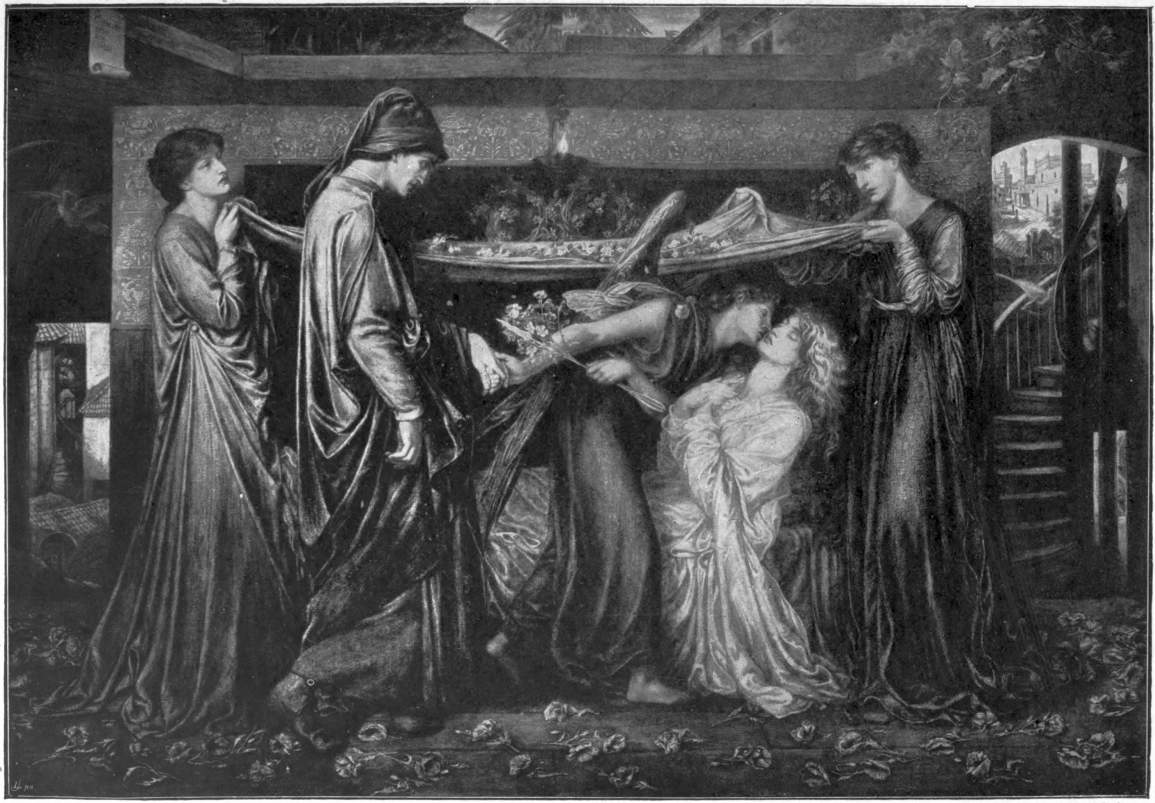
ROSSETTI. Seemann, Leipzig. DANTE’S DREAM.
(By permission of the Corporation of Liverpool, the owners of the picture.)
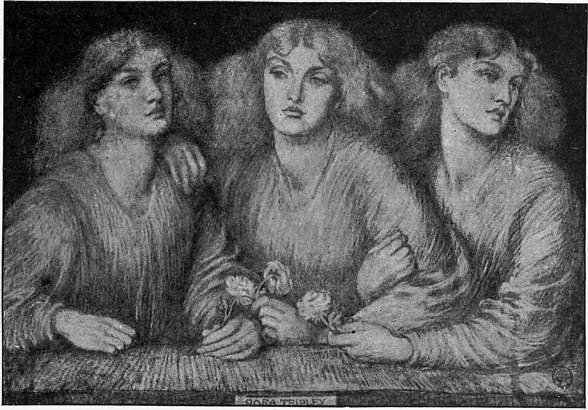
ROSSETTI. Cassell & Co. ROSA TRIPLEX.
(By permission of Mr. F. Hollyer, the owner of the copyright.)
His range of subject was not wide. In his earliest period he had a fancy for painting small biblical pictures, of which “Ecce Ancilla Domini” is the best known, and the delightfully archaic “Girlhood of Mary Virgin” one of the most beautiful. But this austerely biblical tendency was not of long continuance. It soon gave way to a brilliant, imaginative Romanticism, to which he was prompted by Dante. “Giotto painting the Portrait of Dante,” “The Salutation of Beatrice on Earth and in Eden” (from the Vita Nuova), “La Pia” (from the Purgatorio), the “Beata Beatrix,” and “Dante’s Dream,” in the Walker Art Gallery in Liverpool, are the leading works which arose under the influence of the great Italian. The head of his wife, with her heavily veiled eyes, and Giotto’s well-known picture of Dante, sufficed him for the creation of the most tender, mystical poems, which, at the same time, show him in all the splendour of his wealth of colour. He revels in the most brilliant hues; his pictures have the appearance of being bathed in a glow; and there is something deeply sensuous in his vivid and lustrous green, red, and violet tones. In the picture “Dante on the Anniversary of Beatrice’s Death” the poet kneels at the open window which looks out upon Florence; he has been drawing, and a tablet is in his hand. The room is quite simple, a frieze with angels’ heads being its only ornament. Visitors of rank have come to see him—an elderly magnate and his daughter—and have stood long behind him without his noticing their presence; for he has been thinking of Beatrice, and it is only when his attention is attracted to them by a friend that he turns round at last. The “Beata Beatrix,” in the National Gallery in London—a picture begun in 1863 and ended in the August of 1866—treats of the death of Beatrice “under the semblance of a trance, in which Beatrice, seated in a balcony overlooking the city, is suddenly rapt from earth to heaven.” In accordance with the description in the Vita Nuova, Beatrice sits in the balcony of her father’s palace in strange ecstasy. Across the parapet of the balcony there is a view of the Arno and of that other palace where Dante passed his youth close to his adored mistress, until the unforgotten 9th of June 1290, when death robbed him of her. A peaceful evening light is shed upon the bank of the Arno, and plays upon the parapet with warm silvery beams. Beatrice is dressed in a garment belonging to no definite epoch, of green and rosy red, the colours of Love and Hope. Her head rises against a little patch of yellow sky between the two palaces, and seems to be surrounded by it as by a halo. She is in a trance, has the foreknowledge of her approaching death, and already lives through the spirit in another world, whilst her body is still upon the earth. Her hands are touched by a heavenly light. A dove of deep rose-coloured plumage alights upon her knees, bringing her a white poppy; whilst opposite, before the palace of Dante, the figure of Love stands, holding a flaming heart, and announcing to the poet that Beatrice has passed to a life beyond the earth.
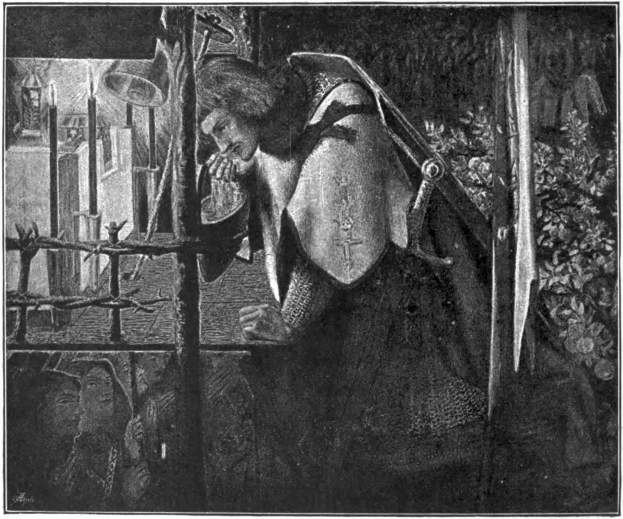
Cassell & Co.
ROSSETTI. SIR GALAHAD.
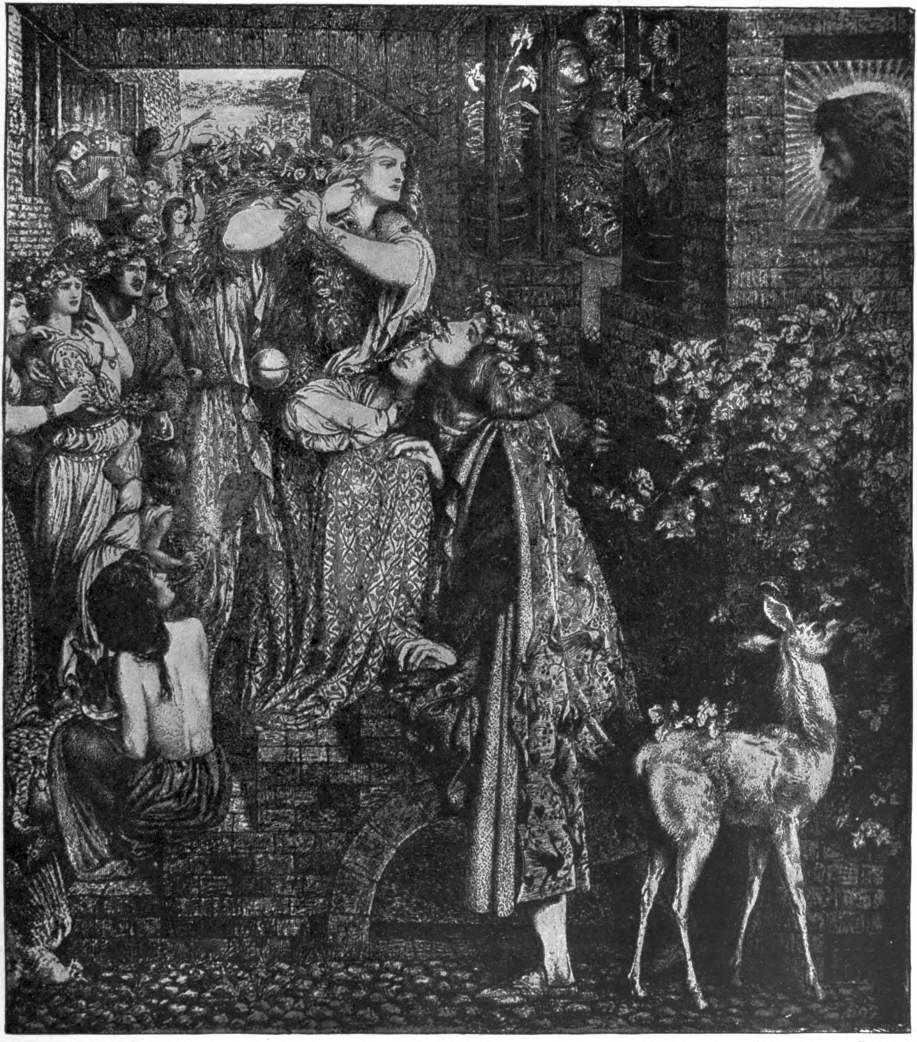
ROSSETTI. Pageant. MARY MAGDALENE AT THE HOUSE OF SIMON THE PHARISEE.
(By permission of Mr. W. M. Rossetti.)
“La Donna Finestra,” painted in 1879, and to be counted amongst his ripest creations, has connection with that passage in the Vita Nuova where Dante sinks to the ground overcome with sorrow for Beatrice’s death, and is regarded with sympathy by a lady looking down from a window, the Lady of Pity, the human embodiment of compassion. “Dante’s Dream” is probably the work which shows the painter at his zenith. The expression of the heads is profound and lofty, the composition severely mediæval and admirably complete; and although the painting is laboured, the total impression is nevertheless so cogent that it is impossible to forget it. “The scene,” in Rossetti’s own description, “is a chamber of dreams, strewn with poppies, where Beatrice is seen lying on a couch, as if just fallen back in death; the winged figure of Love carries his arrow pointed at the dreamer’s heart, and with it a branch of apple-blossom; as he reaches the bier, Love bends for a moment over Beatrice with the kiss which her lover has never given her; while the two green-clad dream-ladies hold the pall full of May-blossom suspended for an instant before it covers her face for ever.” The expression of ecstasy in Dante’s face, and the still, angelical sweetness of Beatrice, are rendered with astonishing intensity. She lies upon the bier, pale as a flower, wrapped in a white shroud, with her lips parted as though she were gently breathing, and seems not dead but fallen asleep. Her fair hair floats round her in golden waves. In its vague folds the covering of the couch displays the marble outlines of the body: and a look of bliss rests upon the pure and clear-cut features of her lovely face.
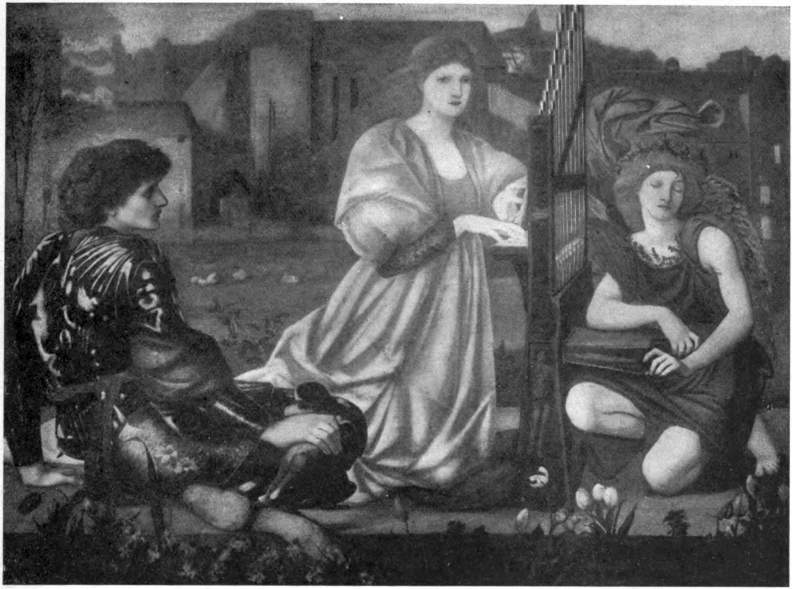
BURNE-JONES. CHANT D’AMOUR.
(By permission of Mr. F. Hollyer, the owner of the copyright.)
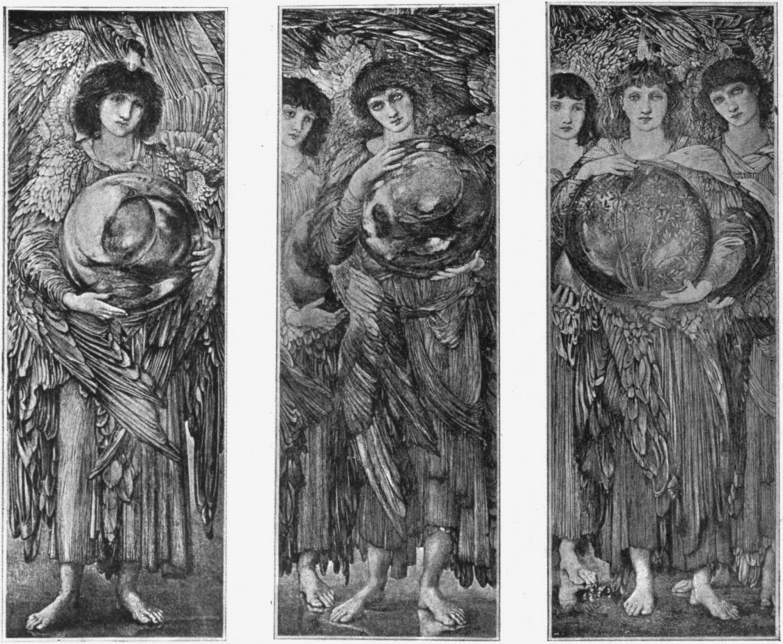
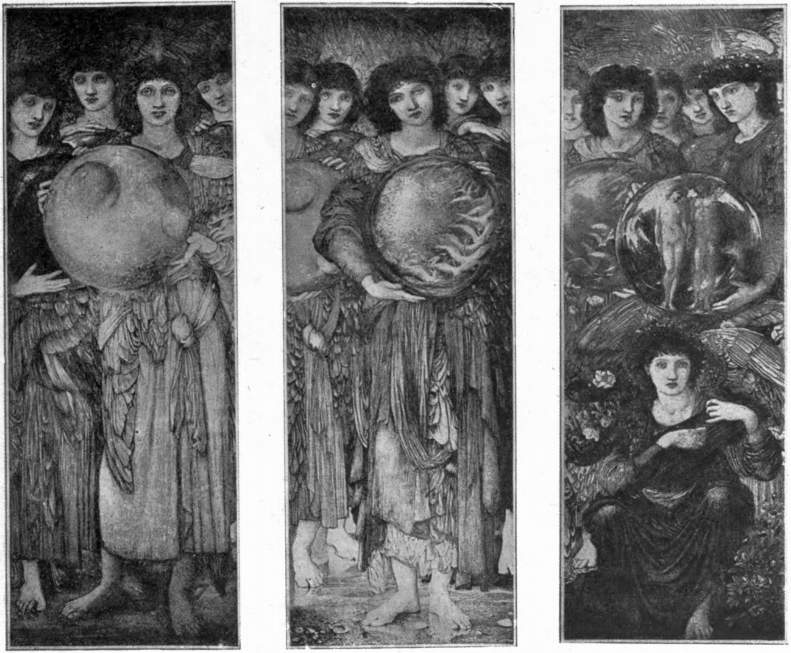
BURNE-JONES. THE DAYS OF CREATION.
(By permission of Mr. F. Hollyer, the owner of the copyright.)
This “painting of the soul” occupied Rossetti almost exclusively in the third and most fruitful period of his life, when he painted hardly any pictures upon the larger scale, but separate feminine figures furnished with various poetic attributes, the deeper meaning of which is interpreted in his poems. “The Sphinx,” in which he busied himself with the great riddle of life, is the only one containing several figures. Three persons—a youth, a man of ripe years, and a grey-beard—visit the secret dwelling of the Sphinx to inquire their destiny of this omniscient being. It is only the man who really puts the question; the grey-beard stumbles painfully towards her cavern, while the young man, wearied with his journey, falls dying to the earth before the very object of his quest. The Sphinx remains in impenetrable silence, with her green, inscrutable, mysterious eyes coldly and pitilessly fixed upon infinity. “The Blessed Damozel,” “Proserpina,” “Fiammetta,” “The Daydream,” “La Bella Mano,” “La Ghirlandata,” “Veronica Veronese,” “Dis Manibus,” “Astarte Syriaca” are all separate figures dedicated to the memory of his wife. As Dante immortalised his Beatrice, Rossetti honoured his wife, who died so early, in his poems and his pictures. He painted her as “The Blessed Damozel,” with her gentle, saint-like face, her quiet mouth, her flowing golden hair and peaceful lids. He represents her as an angel of God standing at the gate of Heaven, looking down upon the earth. She is thinking of her lover, and of the time when she will see him again in heaven, and of the sacred songs that will be sung to him. Lilies rest upon her arm, and lovers once more united hover around.
There is no action or rhetoric of gesture in Rossetti. His tall Gothic figures are motionless and silent, having almost the floating appearance of visionary figures which stand long before the gaze of the dreamer without taking bodily form. They glide along like phantoms and shadows, like the undulations of a blossom-laden tree or a field of corn waving in the wind. They neither talk nor weep nor laugh, and are only eloquent through their quiet hands, the most sensuous and the most spiritual hands ever painted, or with their eyes, the most dreamy and fascinating eyes which have been rendered in art since Leonardo da Vinci. In the pictures which Rossetti devoted to her, Eleanor Siddal is a marvellously lofty woman, glorified in the mysticism of a rare beauty. Rossetti drapes his idol in Venetian fashion, with rich garments which recall Giorgione in the character of their colour, and, like Botticelli, he strews flowers of deep fragrance around her, especially roses, which he painted with wonderful perfection and hyacinths, for which he had a great love, and the intoxicating perfume of which affected him greatly.
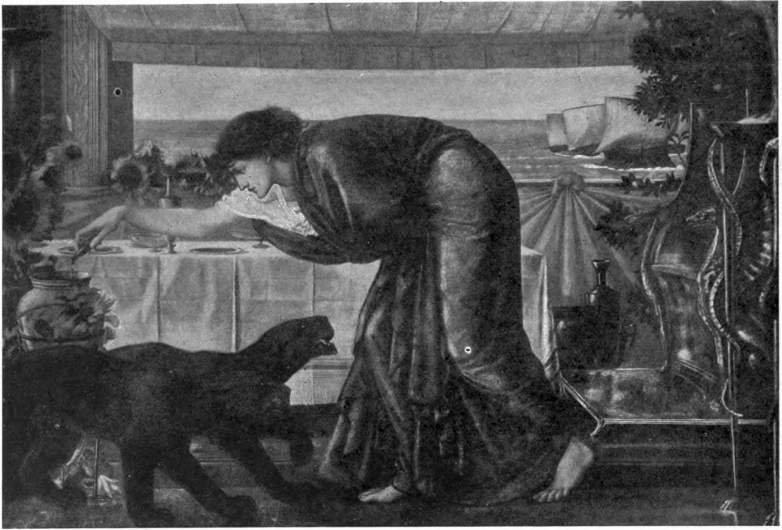
BURNE-JONES. CIRCE.
(By permission of Mr. F. Hollyer, the owner of the copyright.)
This taste for beautiful and deeply lustrous colours and rich accessories is, indeed, the one purely pictorial quality which this painter-poet has, if one understands by pictorial qualities the capacity for intoxicating one’s self with the beauty of the visible world. His drawing is often faulty; and his bodies, enveloped in rich and heavy garments, are, perhaps, not invariably in accordance with anatomy. What explains Rossetti’s fabulous success is purely the condition of spirit which went to the making of his works—that nervous vibration, that ecstasy of opium, that combination of suffering and sensuousness, and that romanticism drunk with beauty, which pervade his paintings. When they appeared they seemed like a revelation of a beautiful land, only one could not say where it existed—a revelation, indeed, for it revealed for the first time a world of story which was in no sense fabulous: there came a romanticism which was something real; a style arose which seemed as though it were woven of tones and colours, a style rioting in an everlasting exhilaration of spirit, breaking out sometimes in a glow of flame and sometimes in delicate, tremulous longing. Even where he paints a Madonna she is merely a woman in his eyes, and he endows her with the glowing fire of passionate fervour, with a trace of the joy of the earth, which no painter has ever given her before; and through this union of refined modern sensuousness and Catholic mysticism he has created a new thrill of beauty. His painting was a drop of a most precious essence, in its hues enchanting and intoxicating, the strongest spiritual potion ever brewed in English art. The intensity of his overstrained sensibility, and the wonderful Southern mosaic of form into which he poured this sensibility with elaborate refinement, make him seem own brother to Baudelaire.
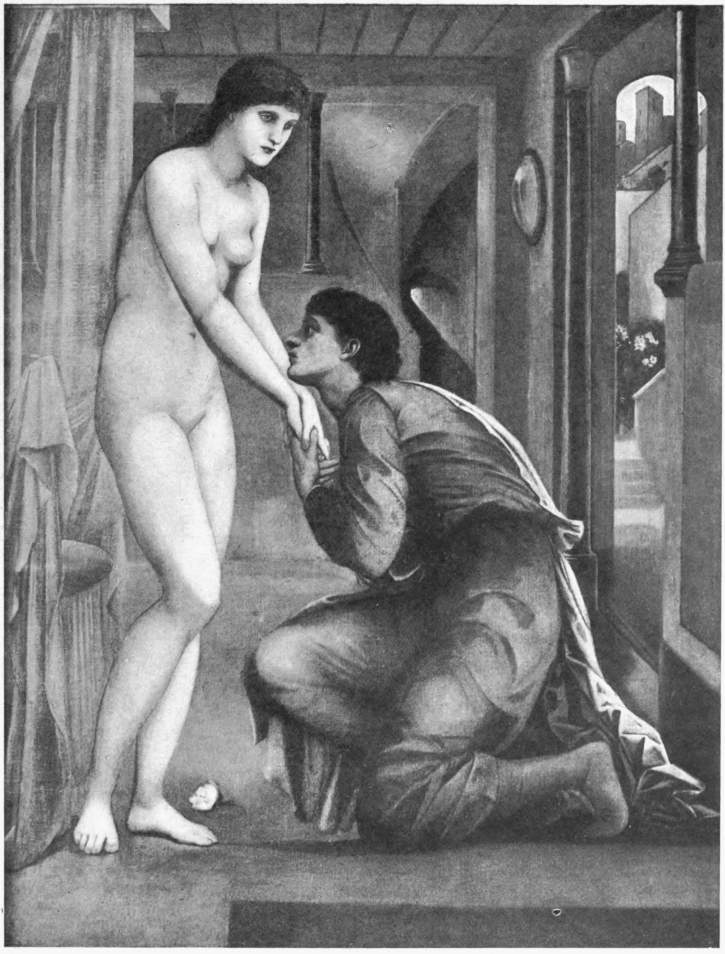
BURNE-JONES. PYGMALION (THE SOUL ATTAINS).
(By permission of Mr. F. Hollyer, the owner of the copyright.)
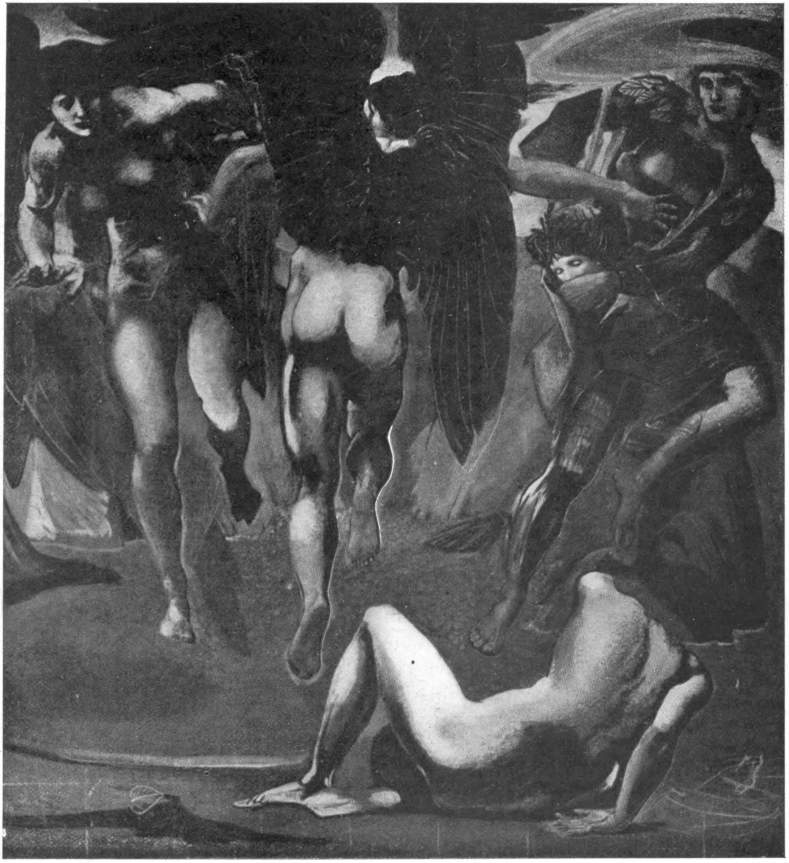
Pageant.
BURNE-JONES. PERSEUS AND ANDROMEDA.
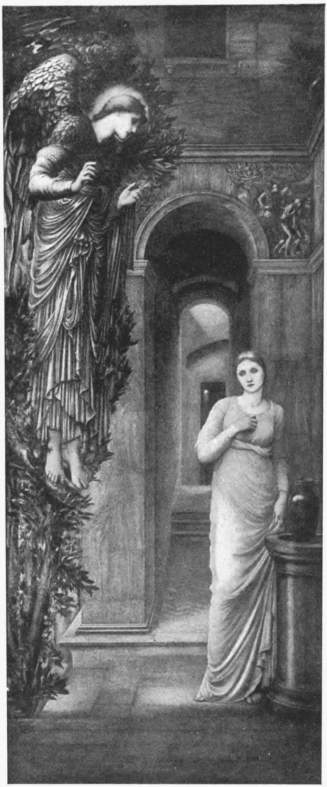
BURNE-JONES. THE ANNUNCIATION.
(By permission of Mr. F. Hollyer, the owner of the copyright.)
This tendency of spirit was so novel, this plunge in the tide of mysticism so enchanting, this delicate, archaic fragrance so overwhelming, that a new stage in the culture of modern England dates from the appearance of Rossetti. He borrowed nothing from his contemporaries, and all borrowed from him. There came a time when budding girls in London attired themselves like early Italians from Dante’s Inferno, when Jellaby Postlethwaite, in Du Maurier’s mocking skit, entered a restaurant at luncheon-time, and ordered a glass of water and placed in it a lily which he had brought with him. “What else can I bring?” asked the waiter. “Nothing,” he sighed; “that is all I need.” There began that æstheticism, that yearning for the lily and that cult of the sunflower, which Gilbert and Sullivan parodied in Patience. Swinburne, who has tasted of emotions of the most various realms of spirit, and in his poems set them before the world as though in marvellously chiselled goblets, represents this æsthetic phase of English art in literature. As a painter, Edward Burne-Jones—the greatest of that Oxford circle which gathered round Rossetti in 1856—began to work at the point where Rossetti left off.
Sir Edward Burne-Jones, who must now be spoken of, was born in Birmingham in August 1833, and was reading theology in Oxford when Rossetti was there painting the mural pictures for the Union. Rossetti attracted him as a flame attracts the moth. As yet he had not had any artistic training, but some of his drawings which were shown to Rossetti by a mutual friend revealed so much poetic force, in spite of their embarrassed method of expression, that the painter-poet entered into communication with him, and allowed him to paint in the Debating Room of the Union a subject from the Arthurian legends, “The Death of Merlin.” The picture met with approval, and Burne-Jones abandoned theology, became an intimate friend of Rossetti and the companion of his studies, and went with him to London. There he designed a number of church windows for Christ Church Cathedral, Oxford, and in 1864 exhibited his first picture, “The Merciful Knight.” Later there followed the triptych “Pyramus and Thisbe” and a picture called “The Evening Star,” a glimmering landscape through which a gentle spirit in a bronze-green garment is seen to float. But none of these works excited much attention. The small picture exhibited in 1870, “Phyllis and Demophoön,” was even thought offensive on account of the “sensuous expression” of the nymph. So Burne-Jones withdrew it, and for many years from that time held aloof from all the exhibitions of the Royal Academy. For seven years his name was never seen in a catalogue. It was only on 1st May 1877, at the opening of the Grosvenor Gallery—founded by Sir Coutts Lindsay, likewise a painter, to afford himself and his comrades a place of exhibition independent of the Academy—that Burne-Jones once more made his appearance before the eyes of the world. But his pictures, like those of Rossetti, had found their way in secrecy and by their own merit, and of a sudden he saw himself regarded as one of the most eminent painters in the country.
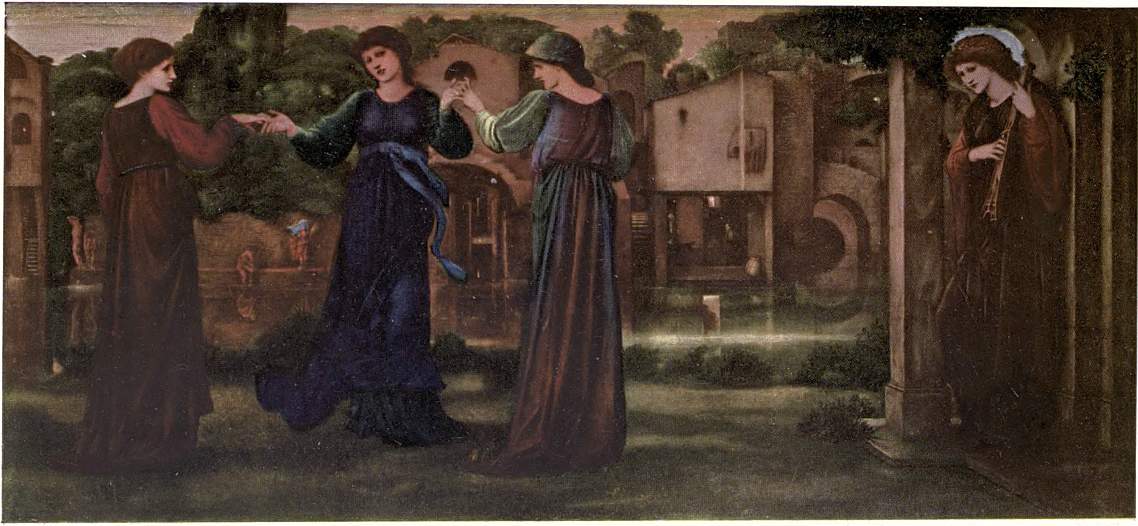
Mansell Photo.
BURNE-JONES. THE MILL.
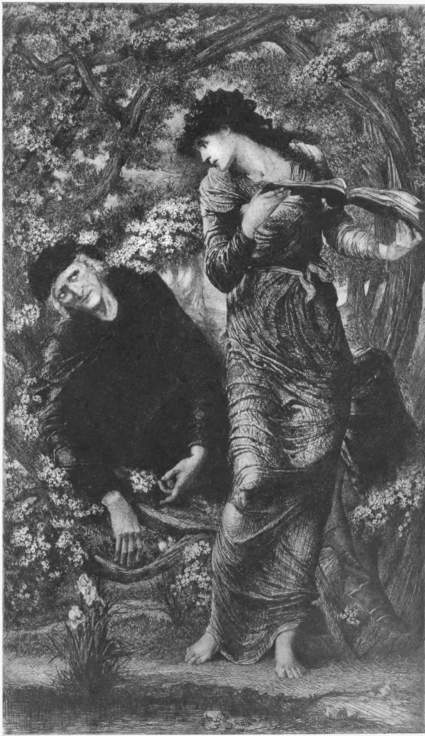
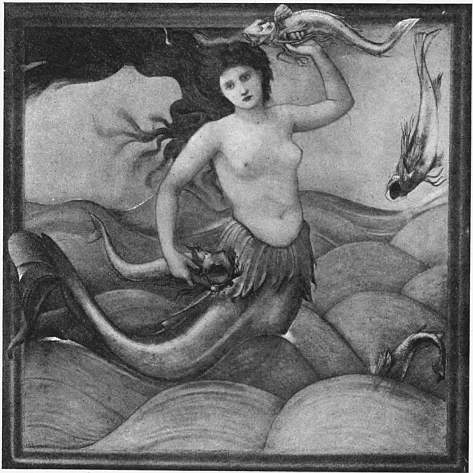
BURNE-JONES. L’Art. THE ENCHANTMENT OF MERLIN. BURNE-JONES. Pageant. THE SEA NYMPH.
(By permission of Mr. F. Hollyer, the owner of the copyright.) (By permission of Mr. F. Hollyer, the owner of the copyright.)
His art is the flower of most potent fragrance in English æstheticism, and the admiration accorded to him in England is almost greater than that which had been previously paid to Rossetti. The Grosvenor Gallery, where he exhibited his pictures at this period, was for a long time a kind of temple for the æsthetes. On the opening day men and women of the greatest refinement crowded before his works. There was a cult of Burne-Jones at the Grosvenor Gallery, as there is a cult of Wagner at Bayreuth. One had to work one’s way very gradually through the crowd to see his pictures, which always occupied the place of honour in the principal room of the gallery, and I remember how helplessly I stood in 1884 before the first of his pictures which I saw there.
In a kind of vestibule of early Gothic architecture there was seated in the foreground an armed man, who, in his dark, gleaming harness and his hard and bold profile, was like a Lombard warrior, say Mantegna’s Duke of Mantua, and as he mused he held in his hand an iron crown studded with jewels; farther in the background, upon a high marble throne, a maiden was seated, a young girl with reddish hair and a pale worn face, looking with steadfast eyes far out into another world, as though in a hypnotic trance. Two youths, apparently pages, sang, leaning upon a balustrade; while all manner of costly accessories, brilliant stuffs, lustrous marble, grey granite, and mosaic pavement, shining in green and red tones, lent the whole picture an air of exquisite richness. The title in the catalogue was “King Cophetua and the Beggar-Maid,” and any one acquainted with Provençal poetry knew that King Cophetua, the hero of an old ballad, fell in love with a beggar-girl, offered her his crown, and married her. But this was not to be gathered from the picture itself, where all palpable illustration of the story was avoided. Nevertheless a vague sense of emotional disquietude was revealed in it. The two leading persons of the strange idyll, the earnest knight and the pallid maiden, are not yet able themselves to understand how all has come to pass—how she, the beggar-maid, should be upon the marble throne, and he, the king, kneeling on the steps before her whom he has exalted to be a queen. They remain motionless and profoundly silent, but their hearts are alive and throbbing. They have feeling which they cannot comprehend themselves, and the past and present surge through one another: life is a dream, and the dream is life.
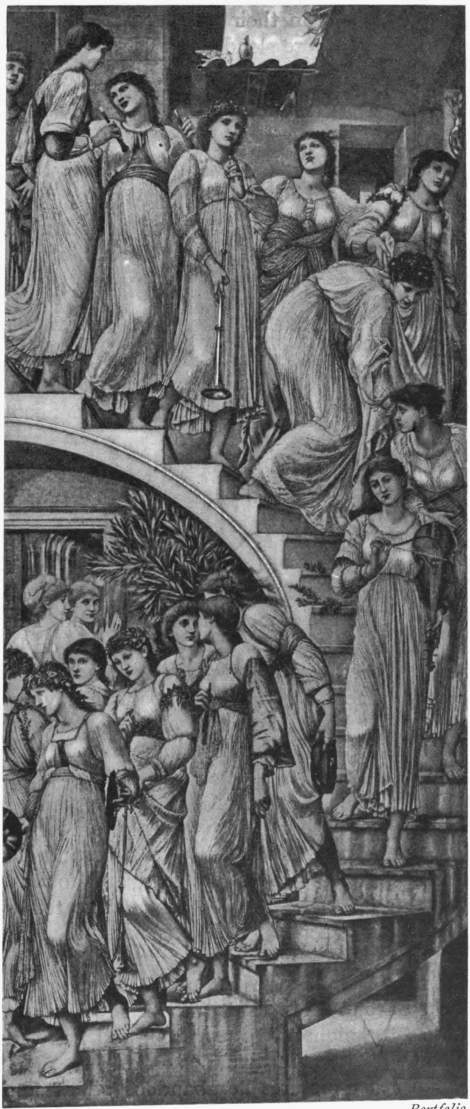
Portfolio.
BURNE-JONES. THE GOLDEN STAIRS.
(By permission of Mr. F. Hollyer, owner of the copyright.)
Everything that Burne-Jones has created is at once fragrant, mystical, and austere, like this picture. His range of subject is most extensive. In his Princess Alfred Tennyson had quickened into new life the legends of chivalry, and in his Idylls of the King the tales of the Knights of the Holy Grail. Swinburne published his Atalanta in Calydon, in which he exercised once more the mysterious spell of the ancient drama, while he created in Chastelard, Bothwell, and Mary Stuart a trilogy of the finest historical tragedies ever written, and showed in Tristram of Lyonesse that even Tennyson had not exhausted all the beauty in old legends of the time of King Arthur; while, as early as 1866, he had given to the world his Poems and Ballads, dedicated to Burne-Jones. In these works lie the ideas to which the painter has given form and colour.