Book 2 — CHAPTER V. THE NINETEENTH CENTURY
Reading edition
[1822-1900 A.D.]
Immediately after the proclamation of the Constitution of 1822, the Austrian and Russian ambassadors had taken their departure and now that intervention in Spain had been definitely determined on by the Congress of Verona, one of the queen’s adherents, the count of Amarante, raised the standard of revolt at Villa Real, on the northern bank of the Douro in the province of Tras-os-Montes, where the family of Silveira, to which he belonged, possessed estates. The rebellion was made in the name of absolutism or, as the phrase went, in the name of regeneration. The enterprise did not succeed, and the insurrectionists were driven across the Spanish border, though still hoping for the support of the French who had now arrived on the scene. This hope was delusive, for the duke of Angoulême and his government had to consider the susceptibilities of England. That power, already provoked by the treatment of Spanish concerns at the Congress of Verona, looked distrustfully at the development of events in the peninsula, and took a special interest in Portuguese matters; only the regency at Madrid gave them as much assistance as possible.
[1823-1826 A.D.]
But there was no need for direct interference. The new Portuguese constitution had not effected what it had promised; long before this the fickle humour of this passionate, ignorant, and idle people had veered round. In particular the party opposed to the constitution had successfully worked upon the troops and the liberal cause had no one, no regular party, and only a few individual men in whom reliance could be placed. Thus in May, 1823, Dom Miguel was able openly to declare against the constitution. He withdrew from the capital, collected troops, and soon that same Sepulveda who had been one of the principal instigators of the revolution of 1820 marched to the prince’s headquarters at Villafranca at the head of several thousands.
Thither on the 30th of May the king himself was conducted by mutinous troops, and from thence on the 3rd of June issued a proclamation in which he declared the “infamous cortes” dissolved and the “pure monarchy” established. Two days later he returned, an absolute monarch, to the capital he had left as a constitutional ruler. Of the members of the dismissed cortes a number had escaped to England, though the king himself nourished no thoughts of vengeance. The adherents and promoters of the counter-revolution were rewarded: Count Amarante, for instance, was made marquis of Chaves; the cloisters were restored and their property was given back, a new ministry was formed under Count Palmella and a junta appointed to indicate those dispositions of the cortes which were incompatible with the monarchical principle. For a time Dom Miguel, who had been appointed commander-in-chief of the army, was praised throughout Europe as the hero of the reaction.
On the 18th of June Queen Carlota also returned to Lisbon. This infamous woman detested her husband, who on his part had good reason to dread her fury which stopped at nothing. She was now bent on raising to his place her son Miguel who promised to be a prince after her own heart. A system of monarchical terrorism according to the ideas of this worthy pair was impossible so long as the mild Dom João was reigning; the utmost that could be managed was a wretched assassination, like that of which the king’s moderate counsellor, the marquis of Loulé, was the victim; the reins had therefore to be snatched from him by a coup d’état.
On the 30th of April, 1824, Dom Miguel caused the leaders of the moderate party to be arrested. The king’s minister, at whom the blow was really aimed, found time to escape on an English man-of-war which lay at anchor in the Tagus. Thither on the 9th of May the king, who had little confidence in his unnatural son, also fled, being assisted by the English and French ambassadors. But this time the overstrained bow broke in the hands of the absolutist party. They had forgotten to reckon with one factor on which they were accustomed to count too securely. The common people of the capital regarded their sovereign with something like idolatry; and when, from his place of refuge, the king disclosed the criminal designs of those who should have stood closest to him, Miguel found himself suddenly forsaken by all and threatened by many, so that nothing was left him but to go himself to his father and implore his pardon. He was now for a time held in custody on the English vessel.
His “inexperienced youth” might be made a pretext for securing his pardon, for he was indeed, although a practised sinner, only twenty-two years old; but it was thought expedient to send him to travel abroad. He betook himself through France to Vienna, to prepare himself, under Metternich’s eye, for a subsequent continuation of his rôle. His mother was banished to a cloister which suited her but ill; she resisted, under the pretence of illness, and is said to have even taken the last sacraments to prove her sickness. The question of the form of government was then so far settled that on the 4th of June, 1824, the king, acting on English advice, granted a constitution by which the cortes were re-established in their ancient form and division into three estates, the cortes of Lamego, as they were called from their place of assembly. The country now remained undisturbed till the king’s death, which took place on the 10th of May, 1826, and placed the two thrones of Portugal and Brazil to a certain extent at the disposal of his eldest son Dom Pedro, who was conducting the government in Rio de Janeiro.
PORTUGAL RECEIVES A NEW RULER AND A NEW CONSTITUTION
[1826 A.D.]
But to hold them both had become an impossibility since the events of 1820, and a treaty effected through English mediation in 1825 had expressly provided that the two crowns should never again be united on one head, thus confirming the work of the Brazilian cortes of 1822 which declared the country’s independence of Portugal. On the 23rd of April, 1826, the new ruler granted the Portuguese an extremely liberal constitution, the Charta de ley and renounced his European throne in favour of his daughter Maria da Gloria. He endeavoured to counteract the danger to which her claims might be exposed from his younger brother, Dom Miguel, by assigning the child, then only seven years old, as wife to the uncle who was seventeen years her senior and by making the validity of his own resignation depend on the condition that Miguel should swear to the Charta and accept the marriage; until this should be completed Pedro’s own rights were reserved, and since owing to the difference of age between the couple the marriage could not take place for some time, he intrusted the government to his sister Isabella Maria as regent.
She proclaimed the new constitution, which was sufficiently liberal; in it the king retained only a certain power of intervention and arbitration, with no immediate influence on legislation; but liberality in the constitution was a very doubtful advantage in a country which was still so unripe for freedom, and an article which guaranteed freedom of religious worship roused the spiritual caste, who had no difficulty in representing to the ignorant country people and the numerous class of petty rural nobility whose interests were compromised by the new Charta that the new constitution was a work of the devil. However, a first attempt at a rising by the marquis of Chaves was suppressed, and in 1826 the regent was able to open the chambers.
But, supported by the apostolic party in Spain, Chaves returned. A formidable rebellion arose simultaneously in the north and south and gained such alarming proportions that the regent felt herself compelled to call in the aid of England. And this time not in vain. On Friday evening, December the 8th, 1826, the English government received the despatch. George Canning, the guiding spirit of that government, had long since declared that he would suffer no Spanish intervention of any sort in the country so long allied to England; on the 11th the regiments under General Clinton were on the march to their places of embarkation, and on the 12th the great minister made that great speech in the lower house which echoed throughout the world and lent to events in that remote corner of the continent, in themselves of little significance to the destinies of Europe, a far-reaching importance much above their immediate value.
Canning made use of the occasion to justify his whole policy—a peace policy, but one which must yield to treaty obligations entered into towards a country long allied with England; the contingency provided for by the treaty had now arisen and it would be a pitiful quibble to say that this was not a case of Spanish intervention because the troops which had risen against the legal government of Portugal were Portuguese: “They are Portuguese troops, but they are armed by Spain. We will not uphold by force or against the will of the country the constitution which Portugal has given herself, but neither will we permit others to overthrow it by force and against the will of the country.” His words were meant to alarm and warn the Spanish government; but they also alarmed all those who had long been forcibly intermeddling with the internal politics of other states in behalf of principles opposed to liberty and friendly to absolutism.
[1826-1832 A.D.]
Canning pursued his policy with moderation. He showed the strength of a giant without using it in a giant’s fashion. On the 1st of January the English army corps under Clinton landed at Lisbon, and eleven English ships of the line cast anchor in the mouth of the Tagus. The news of their arrival sufficed to prevent the further spread of rebellion. The marquis of Chaves with ten thousand men stood ready for battle on the way to Coimbra. The constitutional troops, about seven thousand in number, marched against him; on the 9th of January a battle was fought which lasted till darkness fell. But in the night the news of the approach of the English spread amongst the Miguelites; this was enough to scatter their army. The English had no need to take action. Their mere presence facilitated the subjection of the rebels by the constitutional generals, Saldanha and others, and the Spanish government, which had understood Canning’s speech, disarmed those who thronged across the border and delivered their weapons to the Portuguese authorities.
DOM MIGUEL SEIZES THE POWER (1827 A.D.)
Thus far England had interfered in response to the queen-regent’s request for aid. Meantime Dom Miguel had taken the oath to the constitution, and had been betrothed to his niece; on the 5th of July, 1827, Dom Pedro appointed him regent of the kingdom. On the 22nd of February, 1828, after having presented himself in London, where he insinuated himself with the ministry, now no longer guided by a Canning, he landed at Lisbon. At a solemn meeting of the estates he repeated his oath, appointed a moderate ministry and kept himself in the background. But it was observed that the criers who daily shouted in front of the palace, “Long live the absolute king!” were no longer driven away or punished as they had been at first and that the constitutional officials and officers had been replaced by adherents of the opposite party; and after the withdrawal of the English troops, whose task was ended after the disbandment of the Spanish corps of observation on the frontiers, he threw off the mask.
On the 13th of March the chamber of deputies was dismissed, and a commission appointed to consider a new election law. On the 3rd of May the governor summoned the three estates of the realm, the “cortes of Lamego,” according to the ancient ordinances. It was now seen whither this true son of his mother was steering. In face of proceedings so manifestly in excess of the existing rights of the regent, the ambassadors of the powers provisionally laid down their offices, and the troops in Oporto rose in defence of the rights of their lawful ruler, Dom Pedro IV. There was no lack of recruits; the number of the constitutional troops increased to seven thousand, but there seems to have been a want of resolute leaders, some of them having taken their departure at Dom Miguel’s first move. The last-named had meanwhile assembled his forces; the mob and the country people armed, and on the 24th of June the constitutional troops suffered a defeat at the hands of the Miguelites under Povoas, in the neighbourhood of Coimbra. They retreated to Oporto, where some of the leaders of the constitutionalists, the marquis of Palmella, and the generals Saldanha, Villaflor, and Stubbs, who had now returned from their flight, in vain endeavoured to rally the disheartened army. Nothing was left to them but to escape from absolutist vengeance by a second flight; the remains of the constitutional army, four thousand strong, crossed into Spanish soil and Miguel’s troops marched into Oporto.
The seizure of the throne could now be completed undisturbed. The new estates which had met at Lisbon, passed, each for itself, the resolution that, according to the fundamental laws of the kingdom, Dom Miguel had been called to the throne. On the 7th of July they paid their homage to the usurper as king. Thus the country was delivered over to the tyranny of a man who for baseness of disposition might compete even with a Ferdinand, and who actually surpassed the latter in coarseness and brutality. Incarcerations, judicial murders, deportations were the order of the day, and reached figures of frightful magnitude. It was a despotism which relied on the mob and the clergy for support; yet the fashion in which Dom Miguel had stolen the crown had been too openly in the very face of the principle of legitimacy to allow of his recognition by the powers; the Spanish ambassador alone remained in Lisbon.
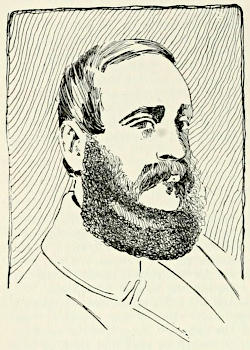
Dom Miguel de Braganza
All Portugal submitted; only on the island of Terceira, one of the Azores, the governor Cabrera had upheld the rights of Dom Pedro and his daughter. Repeated attempts of the usurper to subdue the island were frustrated. The leaders of the constitutional party collected there, and there in March, 1830, Dom Pedro established a regency composed of the marquis of Palmella, the lawyer Guerreiro, and General Villaflor, who took possession of the whole group of islands in the name of the lawful government of Portugal.
By injuries to English and French subjects the barbarous reign of violence which prevailed under Dom Miguel soon added the enmity of those two powers to its native opponents. They exacted compensation and the humiliation of the usurper encouraged the party opposed to him which now found further and more energetic support. For in April, 1831, a revolt in Brazil had obliged the emperor Dom Pedro to resign his throne in favour of his son, Dom Pedro II, who was still a minor. In Europe a task lay ready to his hand: that of assisting his daughter Maria da Gloria to her throne, and at the same time freeing Portugal from her tyrant.
Countenanced by England and France, the duke of Braganza, as Dom Pedro now called himself, obtained a small land-force and a fleet, and with these he appeared at Terceira in March, 1832. With seventy-five hundred men he sailed thence to Portugal, landed in the neighbourhood of Oporto, and on the 8th of July obtained possession of this rich commercial city. But he did not succeed in rousing the country to enthusiasm in his cause. In the summer of 1833 his means were exhausted and only a bold decision availed to give a new turn to the undertaking, which, just in itself, had degenerated into a mere aimless adventure. By a loan raised in the city of Oporto he settled the demands of an English free-lance, named Sartorius, who was in his service, and replaced him by Captain Charles Napier. With the latter there embarked a corps of three thousand men under the duke of Terceira, General Villaflor, to try their fortune in the southern province of Algarve. The result exceeded all expectation; the province went over to the cause of Dom Pedro and the queen, and as the ships were on their way back to Oporto, Napier attacked Dom Miguel’s fleet off Cape St. Vincent and won a complete victory. Five ships of war with 280 cannon fell into his hands, and those on board, thirty-two hundred soldiers and sailors, entered Dom Pedro’s service. The news encouraged the duke of Terceira to venture a march on Lisbon, and this bold action also succeeded. Queen Maria da Gloria was proclaimed in the city, and four days later Dom Pedro also entered the town and took over the regency in his daughter’s name.
[1832-1834 A.D.]
But the new government was by no means securely established. The regent understood little of Portuguese matters and, as always in these southern revolutions, the victorious party were strangers to the moderation required to restore tranquillity to the country. Dom Miguel had preserved the greater part of his army and its ranks were swelled by the peasants who were completely subjected to him and the priests, and by a numerous and continually multiplying rabble. This army maintained itself in the neighbourhood of Coimbra and on the upper Tagus; frequently it even penetrated to Lisbon and thus the two representatives of priest-ridden absolutism, Dom Miguel and Don Carlos, stood opposed to the two minor queens, whom chance had made the representatives of the principle of liberalism.
It was in Portugal that matters first came to an issue. To England, Portugal was the most important country as Spain was to France, and for both powers a real neutrality was an impossibility. A complete victory for Dom Miguel, signified to England—apart from the indignation which must be excited by that monster’s system of rule—the complete loss of her influence in Portugal, and at the same time the destruction of the constitutional principle which naturally had the sympathies of the English nation and the Whigs who were then in power, and which was identified with the government of those classes of society whom a commercial people like the English must necessarily consider. And England had already long since broken through her neutrality.
In regard to the government of France, the position was similar: Louis Philippe was the natural ally of Queen Isabella, whose claims to the throne rested, like his own, on a violation of the principle of legitimacy. But the victory of the Portuguese pretender would of necessity lead to that of the Spanish claimant whose cause had equal chances in its favour, and moreover there could not be a better opportunity of opposing a liberal solidarity on the part of the western powers to the legitimatist solidarity of the eastern, and thus confirm the stability of the new throne of France. This community of interests brought about the conclusion of a quadruple alliance between Portugal and Spain, England and France (12th of April, 1834), by which the regents of Portugal and Spain agreed to expel the two pretenders, and for this object a Spanish corps was to co-operate with the Portuguese troops; the undertaking was to be supported by England with her warships and by France, if necessary, with troops.
[1834-1835 A.D.]
The result was soon apparent. On the 12th of May Dom Miguel’s army was defeated by the united Spanish and Portuguese army at Asseiceira and on the 26th the two allies, Dom Miguel and Don Carlos, surrounded by a superior force, capitulated at Evora in the province of Alemtejo. The former took a money payment, which he might squander anywhere but in Spain and Portugal, promised to respect his niece’s rights and retired from the scenes, taking ship for Genoa. Don Carlos went to England.
Affairs quieted down in Portugal. Dom Pedro summoned the cortes and restored the Constitution of 1826; monastic and knightly orders and various abuses were abolished; the Jesuits had to leave the country; but the establishment of the new order of things was completed with moderation and without revenge, and above all the law was treated with respect. On the 18th of September in that year the estates declared the queen, though only fifteen, to be of age, since the state of the regent’s health did not permit of his attending to business. On the 24th Dom Pedro died at the age of thirty-seven.b
MARIA II (1834-1853 A.D.)
Donna Maria was sixteen years old at her father’s death. The cortes believed nevertheless that it ought to declare the majority of the queen, which she would not have attained according to the charter until her eighteenth year. Donna Maria hastened to put all her confidence in the duke of Palmella. Senhor de Palmella and his friends, while they brought great support to the government, did not make up for the strength of which it had been deprived by Dom Pedro’s death, and did not disarm any adversary. The position of the entire Portuguese ministry with regard to England was truly intolerable; placed between an imperious national sentiment and unconquerable necessities it was at all times accused by the opposition of sacrificing the country’s interests to those of an insatiable ally. The question of customs duties and the renewal of the treaties furnished the enemies of the ministry with national weapons, for nothing was so unpopular in Portugal as the lowering of the tariff and free trade.
In spite of the enormous expenditure due to civil war and the general ruin, the raising of loans contracted in London easily covered at first the deficit in the treasury. The abundance of money was such that they even foolishly employed specie to retire a paper currency in circulation since the time of João V. This false prosperity had no other result than to close all eyes to the dangers of the future. At the beginning of 1835 the minister of finance was compelled to admit an enormous deficit. The government was unable to borrow any longer nor even increase their taxes. It became necessary to have recourse to expedients and to set out on the deplorable road of anticipations.
Officials’ salaries and officers’ pay were no longer regularly paid, and the number of malcontents grew in proportion to the impossibility of satisfying them. The army and the national guard of Lisbon were entirely in the clutches of the secret societies. The internal dissensions among the ministers led several of them to associate themselves with clubs and to seek in the anarchist party a passing point of support against their colleagues; for, while all attacks were directed against Palmella, and especially Carvalho, there were in the space of one year eight changes of cabinet. The motives of these changes were always of a personal nature, and were to be found in the intrigues of the clubs which often crossed and clashed with those of other clubs.
[1835-1837 A.D.]
Upon this state of affairs there broke the revolt of La Granja, which served as a signal for a similar movement in Portugal. For more than a year alarming symptoms had been showing themselves. The chamber of deputies had refused the chief command of the army to the queen’s first husband, Prince Augustus of Leuchtenberg. After four months of marriage he succumbed to a short illness.c In less than a year the queen remarried. Her second husband was Prince Ferdinand of Saxe-Coburg-Gotha, nephew of the Belgian king. He obtained the chief command of the army, which made matters more difficult as he was unpopular.a
Then the queen ordered the dissolution of the cortes at the moment when all the Spanish juntas were in insurrection. The government was playing with the frivolity and light-mindedness of the people when, on the 9th of September, 1836, the newly elected deputies from Oporto arrived in Lisbon. They all belonged to the radical party. A band of musicians advanced to meet them, the city was illuminated, and enthusiastic cheers filled the streets and byways. By the end of the evening the ministers became alarmed at the demonstration and sent out a battalion to restore order. The soldiers fraternised with the people and all cried, “Down with the ministers; long live the Constitution of 1822.” This excited mob, really more joyous than hostile, made its way to the palace and sent the surprised queen a deputation ordering her to dismiss the ministers and adhere to the constitution.
The queen refused to obey, and rejected the revolutionists’ commands. A little later she resigned herself to the necessity, and she burst into tears. The count of Lumiares, Bernardo de Sá da Bandeira, and Passos were named ministers, and the queen promised to convoke the cortes according to the forms of the Constitution of 1822, in order that they might recast the fundamental law of the kingdom.
Passos planned out a pantheon, issued a thousand regulations relating to libraries and museums, and abolished bull-fights through motives of philanthropy. Bernardo de Sá destroyed all that he could, his principle being that things would arrange themselves afterward as well as they could and what was once overthrown would never be re-established.
November 3rd a few persons of the court tried to work a counter-revolution. The queen secretly betook herself to the castle of Belem, from which place she called the army and the people of the court around her and abjured the forced oath she had taken on the 10th of September. This scheme, bad and unpracticable in itself, presented one difficulty among many others which had not been seen by the prime movers of the plot. Belem is separated from Lisbon by a little river, and the constitutionalists in seizing the bridge of Alcantara cut off all communication between the castle and the partisans of the charter. The hostile attitude of his Britannic majesty’s warships intimidated no one. The constitutionalists strengthened their love of the constitution with their hatred for England, and this time the people of Lisbon seemed led by a common sentiment. At the end of three days the queen renounced her dangerous project and returned to the city amid bonfires and the enthusiastic acclamations of the people.
This unlucky and abortive affair proved three things: the solidity of Donna Maria’s throne, which was never for one moment shaken by this foolish experiment; the aversion of the people for the English yoke; and the hatred of the radicals towards a few political men. Freire was assassinated at the bridge of Alcantara. On the 18th of January, 1837, after four months and a half of dictatorial power, exercised according to the statutes of the constitution by Bernardo de Sá and Passos, the constituent cortes met at Lisbon. According to the law of 1822 it formed a single chamber and was elected by almost universal suffrage. The 6th of May the cortes submitted the basis of the constitution and sixty-four votes against sixteen declared for absolute veto, the two chambers and the leading principles of all fundamental laws.
[1837-1838 A.D.]
This was the opportunity for its enemies, and the baron de Leiria, who commanded in the north, raised the banner of insurrection on the 12th of July. Several garrisons, more important for the names of the towns than for the number of the soldiers, rose up to cries of “Long live the charter!” Marshal Saldanha proceeded to Castello Branco. The duke of Terceira soon joined him, and for a month the two insurgent marshals overran the country without opposition. The Lisbon government confided extraordinary powers to the viscount de Sá and the baron de Bomfim.
These two officers, with the constitutional forces, attacked the marshal’s troops at Rio Mayor on the 28th of August, and, although on both sides they had had more than six weeks in which to make preparations, neither of the armies counted eight hundred men. But the soldiers were more prudent than their leaders. After a slight infantry skirmish in which the Portuguese nobility had sensible losses to deplore, the two marshals gave the order to charge to their little squadron and the viscount de Sá advanced at the head of his troops. The cavalry on both sides stopped at fifty paces, replaced their sabres in the scabbards, and having fraternised returned faithfully to the flags of their respective commanders. The latter saw themselves compelled to sign an armistice, and the marshals retired to the north to rejoin baron de Leiria who still held out in the suburbs of Valencia.
Forces were equal and victory depended on the side that would get hold of the corps which, having served in the army of Queen Christina, was returning to Portugal under the orders of the viscount das Antas. This general decided in favour of the constitutionals, and, after a bloody fight at Ruivaes on the 20th of September, the remains of the chartist army was obliged to take refuge in Galicia.
But the evil which no constitution could remedy was growing day by day. On the 14th of October bankruptcy was declared—the necessity of paying the victors had drained the last drop of the state’s finances. The body of workmen at the arsenal, who for two weeks had been giving unequivocal signs of discontent, openly rebelled on the 13th of March, 1838. Baron Bomfim surrounded the arsenal buildings by a line of troops and the rebels fired first upon the soldiers. This was truly a critical moment for Portugal. The cortes were opposed to any vigorous measures and clung to the side of the insurrection. But the fate of the ministers was nevertheless bound to the maintenance of order, and Bernardo took his stand boldly. He marched with Baron Bomfim against the rebels, who were completely defeated after a furious and bloody combat. After this time the arsenal party, as it was called, attempted fresh insurrections and more than once threatened the peace of the kingdom, but the events of the 13th of March had irrevocably fixed the government’s position. Besides, when on the 4th of April the queen took an oath to the new constitution and proclaimed a general amnesty for the past, the chartists and the moderate portion of the constitutionalists found themselves naturally united against the more radical faction. Afterwards they were almost completely confused under the name of the “friends of order.”b On the 16th of September, 1837, Queen Maria had given birth to a son. This greatly improved the queen’s position, but the king-consort continued very unpopular, and the condition of affairs encouraged Dom Miguel to seek aid in London. But he sought in vain and returned to Rome. Discontent was still rife in Portugal, cabinets played see-saw, and in August, 1840, the 6th regiment of the line mutinied and shot its colonel.
Meanwhile England was pressing its claims for £375,475 [$1,807,475] for commissariats in 1826 and for half-pay for the British officers who had served under Wellington and Beresford. The claim provoked only indignation in Portugal. In 1841 Spain came in for hostility.a
[1835-1842 A.D.]
In 1835 the navigation of the Douro had caused considerable excitement between Spain and Portugal, which nearly led to a war between the two countries. There appeared in the Gazette de Madrid a violent article against Portugal, also an insulting one against Donna Maria II. Saldanha gave the Spanish government forty-eight hours to make reparation, notifying it that in the event of refusal a Portuguese fleet should fire the towns from Cadiz to Barcelona. Apology was made. Portugal had difficulties also with Denmark, when Saldanha requested the Portuguese minister to leave, if, after three days, satisfaction was not given. The Danish minister was recalled, but Saldanha obtained his wishes.
England complained that Portugal was too complaisant to France and the United States, and forgot her old ally, and declared she felt disposed to occupy the Portuguese Indian possessions on account of claims. Saldanha went to London with instructions to do as he pleased. Lord Palmerston told him to tell his government that England acceded to his desire to modify the convention, for his sake, and not for that of the Portuguese government.
Dom Miguel’s party in Portugal, as well as the absolutos on the continent, considered he had now another chance of returning to his country. He left Rome for England, remaining some time, but he could make no move, and returned again to Italy. In December, 1841, the municipal elections commenced in Lisbon. There were now two great contending parties, the moderados, who supported the ministry, and the constitutionals, that of order; the pure Septembrists[184] were considered as revolutionists or even republicans, and there were most probably many Miguelites amongst them.d
CABRAL AND THE CHARTISTS IN POWER (1842 A.D.)
[1842-1847 A.D.]
In January, 1842, Portugal once more found herself face to face with the sad prospect of revolution, and the leader no less a person than the minister of justice, Costa Cabral, formerly one of the most ardent of Septembrists, now entirely converted to Dom Pedro’s charter. Secretly seconded by the king and by Dietz and Drummond, who composed the occult government at Lisbon, he went to Oporto and thence to Coimbra, proclaiming the abolition of the established constitution.
The queen, who was not in the secret of the plot, in vain confided its repression to Palmella, Das Antas, and Bomfim. The duke of Terceira pronounced in favour of Costa Cabral; Palmella took no action and the revolution was brought to a head before anyone had seriously thought of suppressing it. Costa Cabral completed his triumph with the promise that the cortes would be immediately convoked for the revision of the charter, and from that time it was he who reigned under the name of the duke of Terceira, president of the council. It goes without saying that Donna Maria was content to subscribe to everything she formerly had opposed. Most docile, subject to the wishes of her husband and her confessor, she had, moreover, never liked the constitution, and had herself twice attempted to destroy it in 1837.
Sustained by the high protection of the court, by the servility of the two chambers, by the friendship of his brother the governor of Lisbon, and finally by the friendly neutrality of the Miguelites, for whom the fall of the constitution would be nothing less than a triumph, Costa Cabral had nothing to restrain him. And he was not the man to hesitate before despotism. It was not sufficient that the tribune was almost silenced; he soon affirmed his power by the promulgation of three decrees which abolished almost the last of Portugal’s liberties. The first concerned the judges, whose independence he destroyed; the second delivered the officers over to the absolutism of the minister; the third submitted all education to a censor and struck a death-blow at the universities. Is there need to add that the press was not less abused, and no longer had freedom but to praise?
It was not long before he went a little further. For a long time one of the greatest plagues of the Portuguese administration was that they could not exist without loans. They borrowed to meet even the ordinary expenses, they borrowed to pay interest on the debt; they borrowed for redemptions—all the while accumulating a more onerous burden. Costa Cabral finally had his eyes opened to this state of affairs, pointed it out to the queen, and while he himself was responsible for twenty-three loans in three years, he dared undertake to get rid of them, understanding well that irreparable ruin would be the result of the continuation of such a policy. But whether the taxation he established to reopen the true sources of prosperity to the finances of his country was really too heavy, or the strangeness of the thing made it seem so, Costa Cabral did not have the time to carry out and improve this great reform. He had presumed too much on his own strength and the intelligence of the people; no government was solid enough in Portugal to stand such a test.
THE SEPTEMBRISTS OVERTHROW COSTA CABRAL
[1847-1850 A.D.]
But from the day that Costa Cabral himself set the example of insurrection, by rousing Oporto and Coimbra in the name of the charter, all his former friends became allied to punish him as soon as possible for his apostasy. Their leaders were Das Antas, Passos, Sá da Bandeira, Loulé, and especially Bomfim, who represented the mixed party.
When he had furnished them an opportunity by the introduction of a new tax which could not fail to arouse the anger of the peasants, they induced the whole province of Minho to revolt; and the majority of the other towns showing similar inclinations, Costa Cabral found it impossible to hold up his head to the storm.[185] Cabral fled to Spain with his brother the governor, under pretext of a year’s leave of absence which the queen herself had granted him. During this time those whom he had formerly exiled and despoiled succeeded to his high power.
But it was not for long. Costa Cabral had been in power at least four years. Scarcely had his adversaries entered into possession of the authority, when they had to contend with a new counter-revolution hatched in the queen’s palace and soon supported by England, France, and Spain.
Donna Maria’s victory was also Costa Cabral’s, the latter in truth was only awaiting the signal to reappear in Portugal, and (astonishing thing, and one that shows well how superficial these agitations are!) he was cordially received there. It seemed as if everybody was his friend. Justice must be rendered Cabral in that, far from being intoxicated with a victory as complete as it was unexpected, he appeared only desirous of wiping it out—perhaps because he feared to raise again all the resentment under which he had once succumbed, perhaps because he preferred to hold back, or perhaps because, scorned plebeian that he was, he feared to offend the aristocratic pride of the great families by the immediate occupation of the highest office. He therefore refused the ministry and, content with an anonymous supremacy, transferred the honour to Pombal’s grandson, the old marshal the duke of Saldanha, January, 1848.
This policy of Costa Cabral’s showed itself still better at the moment when Marshal Saldanha refused to retain the post which was a source of trouble to him. Costa Cabral begged the duke of Terceira and Duarte-Leitao to accept the presidency of the council, and it was only upon their positive refusal that he decided to reassume it himself. If nobody wanted it, how could he be blamed for taking it? Still, he tried to disarm the anger that might be aroused at his accession by accepting a feudal title which undoubtedly he cared little about. But was it not better to defer solemnly to the unconquerable prejudices of the Portuguese aristocracy by concealing a plebeian name under the pompous title of the count of Thomar? However that might be, the new president of the council used his power energetically for the reformation of abuses, to complete the reconciliation of Portugal and Rome, to improve the state of the finances, to stimulate agriculture and commerce, and to restore the navy. Never, whatever might be said of it afterward, had Portugal been so prosperous since the glorious era when Pombal had undertaken to revive the glories of olden times. If this administration, rigorous but able, could have maintained itself for only ten years, Portugal would have lifted itself out of the abyss into which it was threatening to disappear.
But unfortunately this was not to be. All his old adversaries, disconcerted for a moment by the suddenness of his return, returned on their side to their intrigues and their alliances. The Miguelites irritated at his reforms, the great nobles offended at his supremacy, the Septembrists indignant at what they called his apostasy, the journalists embittered at the severities of his new law against the press (1850)—all these combined to overthrow him again. There remained to find a leader, and that did not take long. The marshal Saldanha was there, discontented and anxious to avenge himself at any cost.
Having voluntarily left the ministry, the duke of Saldanha proclaimed himself at first the friend and devoted adherent of the count of Thomar. He even went so far as to say one day that in politics he and the count were one and the same person. But constancy and fidelity were not distinguishing qualities of the noble duke, and this effervescence of friendship did not prevent his regretting the authority he had just given up of his own accord. As his claims were admitted neither by the count of Thomar nor his colleagues, he was thrown roughly into the ranks of the opposition and his first declaration of hostilities was a virulent attack upon the minister of war. Neither the chamber, the ministers, nor the queen paid much attention to this, and the latter even dared to reply that she did not allow her servants to give her advice, and especially written advice, unless she asked it. This was a cruel allusion to the post of first major-domo of the palace with which the duke was invested. Thereupon Saldanha’s anger put him at the disposition of all those who were willing to second his revenge.
[1850-1855 A.D.]
A not less seductive hope for Costa Cabral’s enemies was England’s declared assistance. Lord Palmerston was at that time at the head of foreign affairs, and no minister was ever more exclusively preoccupied with the interests of England. At the first news of the reforms which the Portuguese government had accomplished, or was meditating, he did not lose an instant in encouraging its enemies, in overwhelming it with threatening notes, in recommending a close friendship with the Septembrists to the representatives of Great Britain, and even in sending a fleet with provisions and money. If there were to be a Portuguese renaissance, what would in truth become of England’s commercial supremacy over that country, and through that country over the whole peninsula?
Accusations of embezzlement, intrigue, and corruption were renewed against Thomar which served to disconcert his friends. April 8th, 1851, the duke of Saldanha succeeded in raising two battalions. It was from Oporto that the signal for the revolt came. It extended from there to Coimbra and then to Lisbon, when it found a leader even in the prime minister’s brother, Sylva Cabral. Some personal resentment had ranged this unhappy personage with the bitterest adversaries and calumniators of the count of Thomar. Forced finally to hand in his resignation, he was exiled. The count of Thomar took his departure, with regret at leaving his reforms uncompleted, and without the wealth, of whose accumulation his enemies so persistently accused him. As for the queen, she tried vainly to soften the rough blow which royalty itself had received. Neither the conquerors of the count of Thomar, nor Lord Palmerston, nor Sir Henry Seymour, powerfully supported by an English fleet, would consent to spare her any of the bitterness of her defeat. They signified their wish that she should solemnly retract all the acts of the preceding ministry, that she should remove the king from the command of the army, restore Marshal Saldanha to his post of major-domo, and even accept him as prime minister in place of the marshal the duke of Terceira, whom she had been forced to substitute for the count of Thomar. What could she do against this triumphant power? Donna Maria agreed to everything, and a few days later Saldanha entered Lisbon amid flowers and cries of enthusiasm, which the fickle populace lavished upon every victory.e In 1852 the charter was revised to suit all parties; direct voting, one of the chief claims of the radicals, was allowed, and the era of civil war came to an end.f
When, under Saldanha’s more vigorous rule, peace was beginning to settle over the land, the queen died on November 15th, 1853, at the age of thirty-five. Her husband Ferdinand of Saxe-Coburg became regent for his minor son, who mounted the throne of Portugal on September 17th, 1855, as Dom Pedro V.[186]
PEDRO V (1855-1861 A.D.)
[1855-1862 A.D.]
There was still that dream of uniting Spain to Portugal, but when the proposition was made to Pedro V, he replied: “They think to flatter my ambition and believe that I shall favour them; they are mistaken. Besides the reasons of propriety, policy, and honour which should restrain me, there are considerations which I must not forget—yes, I—if others do forget them. They do not reflect that if the house of Braganza mounts the throne of the peninsula, Portugal would be nothing but a Spanish province, and that our nationality would be absorbed. But I, who am the first of the Portuguese, the first citizen of a country which occupies an honourable place in the history of humanity—I should be a faithless vicar, if I favoured such a project. These people are even our great enemies, for they prevent many useful enactments which might be for the common good of the two peoples—for example, the development of international communication, progress in the material interests of the countries, and the unity of weights, measures, money, and customs regulations.”g
The only political event of any importance during the reign of Dom Pedro V, who in 1857 married the princess Stephanie of Hohenzollern, was the affair of the Charles et Georges. This French ship was engaged in what was undoubtedly the slave-trade, though slightly disguised, off the coast of Africa, when it was seized by the authorities of Mozambique, and, in accordance with the laws and treaties against the slave-trade, its captain, Roussel, was condemned to two years’ imprisonment. The emperor Napoleon III, glad to have a chance of posing before the French people, and counting on his close alliance with England, instantly sent a large fleet to the Tagus under Admiral Lavaud, and demanded compensation, which, as England showed no signs of assistance, Portugal was compelled to pay. The whole country, especially the city of Lisbon, was ravaged by cholera and yellow fever during this reign, itself evidence of the extreme neglect of all sanitary precautions; and on November 11th, 1861, the king, who refused to quit the pestilence-stricken capital, died of cholera, and was speedily followed to the grave by two of his brothers, Dom Ferdinand and Dom João.f
THE REIGN OF LUIZ (1861-1889 A.D.)
The development of affairs in Portugal now took a decidedly liberal course. The Portuguese government had recognised the new Italian monarchy already in June, 1861, and the following year King Luiz had married Princess Maria Pia, the daughter of King Victor Emmanuel. On December 22nd, 1861, Dom Luiz took the oath to the constitution and, since the people were alarmed at the frequent number of deaths in the royal family, the government laid before the cortes a law controlling the regency and another which declared princesses also to be eligible for the throne and thus put still further off the danger that a descendant of Dom Miguel might succeed to the throne of Portugal.
[1862-1868 A.D.]
Not a single Portuguese bishop appeared at the celebrated council at Rome in 1862 and, in a document dated July 3rd, the pope had occasion to complain that in the “lamentable state of the Catholic church in Portugal” the bishops were too lukewarm and tolerant; he reminded them that it was their duty to watch over the sheep intrusted to their care so that—in the language of the curial—“they should not be devoured by the ravenous beasts which make the surface of the earth unsafe to live upon.” When some of the clergy took advantage of this to preach against the government, they were reminded by a proclamation of the minister of justice (August 2nd) that there were prisons in Portugal for such cases. The ministers were of liberal colour; in April, 1863, an important law was passed abolishing the right of primogeniture, an old evil of their country; in May, 1864, a decision of the second chamber demanded that the peers’ title should no longer be hereditary.b
In spite of popular opposition the government entered resolutely on reform by abolishing capital punishment for any crime, civil or political. Following the example set by many European countries, they also adopted the metric system, organising consolidated funds and, what was a very important reform, abolishing the royal gifts of lands to support a title. In 1864, a treaty of delimitation which had been in progress for several years was definitely drawn up with Spain. New roads were marked out and furrowed the kingdom in every direction, making Lisbon the centre for all roads having direct communication with the province. Aqueducts were constructed; towns made sanitary; hospitals, almshouses, model dwellings rose in the large industrial centres. Newly made canals allowed these towns to transport their goods seawards without unnecessary costly relading. The smallest boroughs were provided with schools, etc. But all these works, useful, it is true, and almost necessary, made a large hole in the state coffers. Fontes Pereira de Mello tried to overcome this by getting votes for the modification and increase of old taxes of every kind, even of the yearly land tax, also the amending of indirect taxation. These reforms were the cause of new troubles in Oporto, but they were suppressed without recourse to arms. Lisbon and several other towns followed Oporto’s example, and the government, fearing lest troubles there should insensibly assume serious proportions and lead to civil war, yielded to the people’s will and withdrew the new taxes (1867).
In 1868, a fresh insurrection broke out in Spain and was necessarily felt in Portugal. It was an immediate question of conferring the Spanish crown so as to fuse the two peoples, a union which would have taken the title of the Iberian Union. But the Portuguese, remembering what their ancestors had suffered under the Spanish yoke, feared lest this union should lead to the surrender of Portugal to Spain, and profited by the anniversary of the coming to the throne of João IV (of the illustrious house of Braganza) in 1640, to make strong resistance against Spain. In view of this excitement, the Spaniards abandoned their first idea, not being willing to expose themselves any more to the vindictiveness of a people not able to forget oppression dating nearly four centuries back.
One of the wisest and most humane reforms, and one which adds most to the glory of Luiz I, was the entire abolition of slavery in every colony. But, by a curious and sad coincidence, as if in answer to the royal benefit, about five hundred Portuguese were pitilessly massacred by natives on the Zambesi. On this news being announced, an army corps embarked immediately to avenge the honour of the flag.h
[1864-1899 A.D.]
The history of Portugal for the years 1863-1866, as far as its connection with the rest of Europe is concerned, presents almost empty pages—which, however, was not precisely a misfortune to the country. We read in November, 1864, of differences between the government and the pope which ended in the recall from Rome of the Portuguese ambassador, who did not return thither until two years later; of the opening and closing of the sessions of the cortes, of elections, of satisfactory finances, of the modification and change of ministries. It was already something remarkable that the great state question was raised at the birth of a prince in August, 1865, that the papal nuncio would not permit King Victor Emmanuel, the father of the young mother, who was in a sense under a ban, to officiate as godfather, and that the royal child was not admitted to the privilege of baptism until after Napoleon III had added to his many rôles that of being sponsor to the Portuguese prince.b
In 1866 Dom Miguel died, after having stood at the head of the absolutists calling themselves the Party of the Faith, and sojourning at various European courts. He had been lampooned by the liberal press, but was given a magnificent funeral.
The old and stormy Saldanha threatened a pronunciamento in 1870, and succeeded in ousting from court the king’s favourite, the duke of Loulé. He was appeased by supplanting Loulé as minister, but after four months was gracefully disposed of on the pretext of the embassy to England, where he died in 1876. The ministry of Pereira de Mello lasted for three years, 1883-1886, in which year there was danger of collision with the French Republic in view of the marriage of Luiz’s heir to the daughter of the comte de Paris. The ceding of a portion of the Lower Congo territory to Belgium in 1885, the definition of German and Portuguese spheres of influence in Africa, the cession of the island of Macao by China, the building of a railroad in Angola marked colonial affairs. In 1889 there was alarm over the encroachments of England on Portuguese influence in Africa, and Major Serpa Pinto invaded territory on the Shiré river claimed by England. The British government demanded reparation and sent to Portugal a fleet which, January 11th, 1890, induced Portugal to withdraw from the Shiré region under protest.
CARLOS I BECOMES KING (1889 A.D.)
This surrender provoked outbreaks at Lisbon and Oporto; the ministry of José de Castro resigned, and the republicans, stimulated by the Brazilian success in establishing a republic the year before, turned the anti-British demonstration into a republican agitation. King Carlos had succeeded his father when King Luiz died of typhoid fever, October 19th, 1889. The new king assumed to side with the popular feeling and refused the order of the Garter which Queen Victoria had just offered him. The republican movement overshot itself, and, after various arrests were made, the elections were strongly for the government. August 20th, an agreement with England had been reached, after a vain appeal to international arbitration. The terms were again distasteful to the public and the cortes refused to accept them. Passages at arms took place between the Portuguese and the British in Nika (Manica), which by the terms of the August agreement were Portuguese. But the terms had been declined and the Portuguese were defeated. A military revolt was suppressed in January, 1891, and the republican press suppressed. The terms of the August agreement were now accepted and a treaty with Great Britain was signed May 28th, 1891.
Financial affairs had now reached a crisis after wrecking so many cabinets. In May, 1892, the government finally declared itself bankrupt. Still relief did not come and Oliveira Martins, after failing as minister to establish a sound financial condition, gave way to Ferreira, who yielded to Hintze-Ribeiro, who lasted from 1894 to 1897, and returned in 1899.
In 1895 a reform of the constitution of the cortes was achieved, the lower chamber was reduced from 170 to 145, the upper house was to be constituted of ninety members chosen by the king, the royal princes, and twelve bishops; the right of suffrage was based on the ability to read and write and the minimum payment of 500 reis (50 cents) in taxes. Domestic servants, government employees, and soldiers are, however, forbidden to vote. This same year the king visited England, accepted the order of the Garter, and began the cultivation of that British friendship which its liberal construction of the limits of neutrality during the South African War served to strengthen—at least in England, though violently attacked in Portugal. In 1900 the Delagoa Bay Railroad dispute with England was decided in Portugal’s favour by Switzerland as arbitrator.a
PORTUGUESE LITERATURE
[1812-1900 A.D.]
The country of Camoens and João de Barros has never lost its love for letters, and the Portuguese people have always possessed a poetic strain. If in the eighteenth century poetry reached the level of too Parnassian trifles, it redeemed itself after the war under the impulse of Francisco Manoel do Nascimento, and with still finer taste under the influence of Almo da Garot, and of Castilho, followed by a good number of lyric and dramatic poets and romancers. J. B. Gomes (died 1812), by his sole tragedy The New Iñes de Castro, has taken a place among the most remarkable of dramatists. Other authors have written for the theatre; for example, Vasconcellos, Reis Quita, Biester, Pimentet, and perhaps the first of them all is Almeida Garrett (died 1854).
Bulhão Pato has made a name among the poets as well as T. A. Gonzaga, João de Lemos, Antonio Pereira da Cunha, and Ribeiro, the minister. Like King Diniz of old and Philip of Lancaster, King Pedro IV was a poet. He has written verse destined to be set to music and he has given the country the “Constitution Hymn.” Dominic Buontempo founded the Philharmonic Academy at Lisbon, and the composer Marcos Portugal is known throughout all Europe.
Alexandre Herculano (died 1878), erudite and littérateur, rivalled the work of the Benedictines in his Portugalica Monumenta Historica; but he did not please the clergy, for he wrote of the Inquisition in Portugal and the Concordat of February 21st, 1857. In the Harp of the Believer he has told in verse of the eternal strife between doubt and faith.
Science, letters, and art have had illustrious representatives in José Ribeira, Antonio de Almeida (died 1839), Gaetan de Amaral, Antonio de Carmo, Velho de Barbosa, Costa de Macedo who has aroused much discussion by his opinions, Francisco Alexandre Lobo, de Carvalho, Manoel Coelho da Rocha. In geography, the viscount of Santarem (died 1856), Brito Capello, Robert Irens, Serpa Pinto, and Otto Schutt, count among African explorers.g
[1897 A.D.]
The present king of Portugal, Carlos I, born in 1863, has shown a decided determination to seek the peace his country so much needs. He has shown also a real interest in science and letters and since the five hundredth anniversary of Prince Henry the Navigator celebrated in March, 1894, he has shown a lively concern for deep-sea soundings and exploration. He has made personal studies and both published their results and shown them at an oceanographic exhibition which he opened in 1897. The world is too well mapped to offer such prizes as once lay hidden in the Sea of Darkness, but there is a peculiar fitness in the present monarch’s interest in that ocean across which his great predecessor showed the path that led Portugal to greatness, and through Portugal turned the whole world to exploration.a
FOOTNOTES
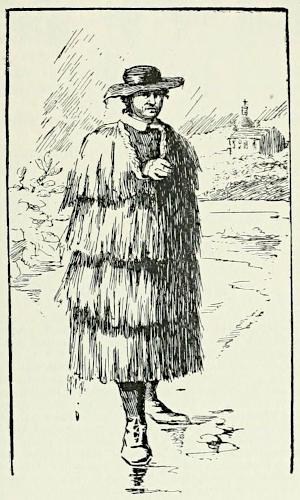
A Portuguese Peasant
APPENDIX A. THE INQUISITION[187]
The Inquisition was a judicial police organisation instituted by the Roman church with the concurrence of temporal rulers for the purposes of suppressing heresy and blasphemy.... It has left an odious memory—and not without reason. Anyone who denies that atrocities were committed by the Inquisition must indeed be blinded by a foolish and prejudiced desire to apologise for the deeds of history. But why is it against the Inquisition that the indignation inspired to-day by the memory of early religious persecutions is particularly directed? Thousands of human beings were burned for their faith before the Inquisition existed.... There is one circumstance, however, among others, which explains and justifies the general sentiment, and that is that the Inquisition pretended to be—and was—a regular judicial organisation. The worst excesses are forgotten when they are not systematic. It is the long-continued travesties of justice perpetrated in the service of fanaticism or for reasons of state that arouse the more lasting resentment. Therefore it is that, whatever be their number, the victims of the Roman Inquisition weigh so heavy in the scales of history.—From the article “L’Inquisition,” by C. V. Langlois, in La Grande Revue (Paris, 1901).
All the gods have been addicted to jealousy. Their worshippers have accordingly usually felt and often acted towards heretics with the characteristic ruthlessness of the most merciless of passions.
Egypt was not free from religious reigns of terror, nor yet India, nor China, and even the genial creeds of Greece brought the mildly unorthodox Socrates to his death. Rome was comparatively tolerant of alien religions for political convenience, but there were laws against foreign rites in Rome; the prætor Hispalus was banished for worshipping Jupiter Sabasius, and the temples of Isis and Serapis were thrown down after they had been erected in the city. Augustus and Tiberius proscribed Egyptian and Jewish worship in Rome, the latter sending four thousand Jews to Sardinia. The hideous sufferings of the early Christians and the martyrdoms they underwent in the arenas are well known.
When at length the victims became the victors and the emperor Constantine was persuaded to Christianity, the same intolerant zeal from which the Christians had suffered now turned the tables on the pagans. At this time the Christians had not developed an idolatry of their own such as later brought on the terrors of the war of the image-breakers, so they heaped contempt upon the objects of worship revered by the pagans. The Jews were as usual the first and the worst sufferers. Then, again, as usual, the bitterest of all punishments were spent upon those who differed only slightly in doctrine. Constantine tried confiscation and exile on the Donatists, in 316 A.D.; he branded Arius as an infamous outlaw and had his writings burned.a
All the laws of Constantine were subsequently renewed by his successors, and applied with more or less rigour to the different heretical sects. By an edict published in January, 381 A.D., Theodosius the Great deprives heretics of all their churches, and annuls all edicts to the contrary into which preceding emperors had been surprised. In this edict he condemns by name the Photinians, Arians, and Eunomians; he recommends the Nicene Creed, and prohibits all assemblies of heretics within the walls of cities; adding, moreover, that if they attempted to cause any disturbance, they should be even banished from the cities.
In the same year he published a much more severe law against the Manichæans; he declared them infamous; deprived them totally of the power of making a will, or even of succeeding to their paternal or maternal property; and ordered all such property to be confiscated, except in the case of children, who were qualified, if they embraced a more holy religion, to inherit their father’s or mother’s property. Another law of Theodosius treats still more rigorously those Manichæans who disguised themselves under the names of Encratites, Saccophori, and Hydroparastates; he subjected them to capital punishment. To insure the execution of this law the emperor orders the prefect of the prætorium to appoint inquisitors, charged to discover heretics and to inform against them.
This is the first time that the name of an inquisitor against heretics occurs; but the Inquisition itself was of older standing, for we have already seen Constantine institute one precisely similar against the Arians and the other heretics of his time. These severe measures were provoked by the abominable doctrine of the Manichæans, which had drawn down on them, from the very origin of their sect, the severity of even the pagan emperors.c
When the Arians secured an emperor of their creed they enforced on the Athanasians a heavy usury of exile, punishment, torture, and even death, till the emperor Julian was driven to exclaim, according to Ammianus,h “Even beasts are not so cruel to men as the generality of Christians to each other.”
This work is not the place for an account of all the heresies that have complicated Christianity without cessation. The great feud of iconoclasm has already been described and the major disagreements between the Greek and Roman churches have been recounted in the history of the papacy, where it was also shown how the growth of papal supremacy brought about a constant duel with the kings and the emperor.a
Whilst the hierarchy, unmindful of its spiritual calling, was entangling itself in ceaseless warfare, in order to bring all secular power under its sway; whilst the system of ecclesiastical doctrines, with its progressive development, was enclosing the reason with bonds ever narrowing; whilst the means of salvation held out by the church were at the same time ever more and more losing their spiritual character and their moral power, by the one-sided speculations of the schoolmen, and also sinking to a lifeless mechanism in their administration by a coarse priesthood which had lost all respect for morality; lastly, while this tortuous church system, despairing of any spiritual influence, was endeavouring to win consideration for itself by continual acts of external aggression; it could not but be that the rebellious against the church, who in earlier times came forward but one by one, should now be growing more numerous and more powerful.
The earlier divisions in the church employed themselves for the most part only in speculations of the understanding; and even for this very reason the church always succeeded, as soon as she could adopt strong measures, in bringing back the recusants, for the interest taken in a moral conception of nearly equivalent meaning seldom remained for many generations unconquered by persecution. But there lay at the root of the opposition to the church, which now began to feel its way forward, a living moral interest, which felt itself injured by the whole condition of the church; and even for this very reason this opposition was rather strengthened than weakened by the bloodshed resorted to as a means to destroy it. It stood always unconquered, although the opposing parties differed widely from each other in the peculiarities of their systems, and modified them in many ways.
THE CATHARI
At the same time that two frantic enthusiasts, Tanchelm, who wandered about from 1115 to 1124 in the Netherlands, and Eudes de Stella or Eon, who roved till 1148 in Brittany, perplexed the minds of men, two ecclesiastics in southern France, the priest, Pierre de Bruis or Bruys (from 1104-1124, Petrobrusiani) and Henry, formerly a monk of Cluny and deacon (from 1116-1148, Henriciani), declaimed zealously against the mechanical organisation of the church and the immorality of the clergy. But besides these, the Manichæans who trace their origin to the period of time before this were continually on the increase. The most common names for them now, were in Germany Cathari or Ketzer, in Italy Paterini, in France Publicani, though many other names were in use; not only did they make their appearance permanently in most distant quarters of France, but they also planted themselves in the neighbouring countries. The Cathari reached England in the year 1159; they were, however, quickly exterminated.
But the headquarters of the Cathari were those countries in which at that time, along with civic freedom, civilisation, and education, discontent at the wanton and avaricious clergy had grown up in a remarkable manner; such were southern France and northern Italy. In southern France, where Toulouse was their central point, the interest awakened by Pierre de Bruis and Henry worked for their advantage. The synodal decrees issued against them remained without effect, for almost all the barons of this country protected them, and so their numbers here received a very considerable increase. The bishops of the district vainly endeavoured in the council at Lombers (1165) to bring back these bonos homines, as they were here usually called, to the church; little more effect was produced by the cardinal-legate Peter of St. Chrysogonus in Toulouse (1178), and the severe decree of Alexander III, in the Third Lateran Council (1179). Against Roger II, viscount of Béziers, Carcassone, Albi, and Rasez, who protected the Cathari, the cardinal-legate Henry, abbot of Clairvaux, already headed a crusading army (in 1181), but he could produce no lasting effect. [See the history of the Crusades.] In the beginning of the thirteenth century the greater part of the daughters of the nobility were brought up in the educational establishments of the Perfectæ, who lived together in monastic style.
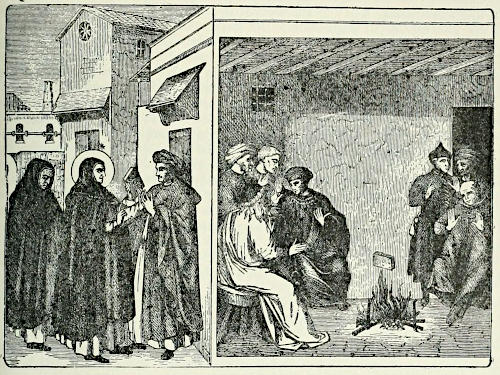
Testing the Book of the True Gospel by Fire. The Book is removed, unscorched, from the Flames
(From a sixteenth century cut in the Louvre)
THE WALDENSES
From the scriptural and reforming turn of mind which had been spread by means of Pierre de Bruis and Henry, along with the sect of the Cathari, in southern France, there arose from the year 1170 the party of the Waldenses [or Vaudois]:[188] free from all speculative enthusiasm they consecrated all their energies to realise once again apostolic Christendom, with all its simplicity and all its inward devotion. About that year began the founder of the sect, Peter Waldo or Waldensis from Lyons, with several companions, to preach the Gospel in the manner of the apostles. At first they had so little intention of separating from the church that, when the archbishop of Lyons forbade them to preach, they petitioned the pope Alexander III in 1179 for his permission. But when Lucius III (in 1184) pronounced sentence of excommunication against them, then they thought they must obey God rather than man, and withdrew from a church which cursed that which seemed to them a call from heaven. At first the only question at issue between them and the Roman church was on the exclusive right of the clergy to preach; and they spread themselves more easily in those countries where the deficiency of the church was exposed plainly enough for the conviction of all, but where many still felt themselves not less repulsed by the Catharism, which was set up in opposition; for instance in France, particularly the southern parts, down as far as Aragon, and in northern Italy, particularly in Milan. And in every place where they came fresh zeal went forth from them among the people, to learn to understand Holy Scripture for themselves.
The earlier measures taken against the heretics in southern France had caused so little hindrance to their extension that they constituted the dominant party at the end of the twelfth century in many parts of this country. For this reason Innocent III, immediately after his accession to the see in 1198, was induced to send legates thither armed with the most unlimited powers for the suppression of heretics. After they had produced, by forcible measures, effects more apparent than real, Diego, bishop of Osma, with Dominic, the subprior of his cathedral, persuaded them in the year 1206 to adopt a more apostolic way of proceeding. Now the two legates, the Cistercians Peter of Castelnau and Raoul, with these two Spaniards, wandered barefoot from place to place and held conferences with the heretics on the disputed points (1206 and 1207). When however all this continued without effect, they returned again to the old method with tenfold cruelty.
CRUSADE AGAINST THE ALBIGENSES
Raymond VI. count of Toulouse, though outwardly a Catholic, had fallen out with the ambitious legate Peter of Castelnau. So when the latter in 1208 was murdered by an unknown hand, the monks threw the blame on the count; and Innocent III seized this opportunity to have a crusade preached against him by Arnold, abbot of Citeaux; for which national jealousy and the allurements of the delicious south procured great popularity in northern France. In order to avert the threatening danger, Raymond sought for reconciliation. Innocent granted this with a view to weaken the resistance of the victims by division. When, in June, 1209, the count submitted to the most humiliating conditions which Milo the papal legate prescribed to him, and even took the cross himself from his hands, he only effected the delay of the blow destined for himself, that it might strike with so much the greater certainty.
The crusading army assembled against the Albigenses, with the frantic Arnold[189] as papal legate at its head, first marched upon the domain of Raymond Roger, viscount of Béziers (1209). After the fall of Béziers and Carcassonne, the devastated land was conquered. But among the noble crusaders only Simon de Montfort was willing to receive the spoil from the legate. Next they turned against Raymond of Toulouse, who had been spared till now. Extravagant demands, which he could not satisfy, formed the pretext for excommunicating and attacking him (1211). The pope himself was no longer able to check his own instruments; the crusade was preached with fresh ardour; the territory of the count was conquered by Simon de Montfort, and formally adjudged to him by a council at Montpellier in 1215 for his own possession.
Innocent III did not only confirm this grant at the great Lateran Council in this same year, but also held up the principle of the method of procedure hitherto adopted against these countries, as a precedent in similar cases. Then at length Raymond sought for help in the attachment of his former subjects, and after Simon’s death (1218) he made a considerable advance in the reconquest of his country, although the pope, without ceasing, used every means of resistance. When, after the death of Raymond VI (1222), Raymond VII regained his whole ancestral heritage, and had even forced his enemy Amaury, son of Simon, to a complete surrender, then Honorius III, elsewhere so mild, still thought it due to the papal honour to hate the father in the son, however guiltless. He stirred up Louis VIII, king of France, to conquer Toulouse for himself in a new crusade. Hostilities began on the 6th of June, 1226, but they were greatly crippled by the death of Louis VIII on the 18th of November of the same year; at length Raymond obtained peace on the hardest conditions, by which a part of his domain passed into the power of France, and the annexation of the rest to this kingdom was furthered.
THE INQUISITION ESTABLISHED
The unhappiness of this country was accomplished by the horrors of the Inquisition which now rose up.[190] In order to perpetuate the work of blood begun by the papal legate in a permanent institution, the Fourth Lateran Council in 1215 made it the chief business of the episcopal synodal tribunals to search out and punish heretics; and the Council of Toulouse (1229) achieved the organisation of this episcopal Inquisition. However, soon after it was in fact almost annihilated; for in 1232 and 1233 Gregory IX appointed the Dominicans to be the standing papal inquisitors, and forthwith they began their hideous work in the countries tainted with heresy. In order that the church may not seem to soil herself with blood, the secular princes must serve the office as executioner. Louis IX in 1228, Frederick II in 1232, the ill-fated Raymond VII in 1233, each passed the requisite laws.
That the new Inquisition might strike more of the guilty, a way of proceeding was prescribed for it, to which of necessity many of the guiltless must fall victims. Thus armed, this monster raged with most frightful fury in southern France, where the heretics had only learned from former events to keep themselves more secret. Germany for a short space of time (1231-1233) was taught to know the Inquisition in its maddest rage in Conrad of Marburg, and in the Dominican monk Conrad Dorso who came to Strasburg; and at the same time acquired the most fearful experience of the abuse of the new laws against heretics in the crusade on the Stedinger, the lovers of freedom, in 1234. But by these events so universal a resistance against every Inquisition was aroused, that Germany for a long time after remained free from this monster.
In the twelfth century the executions of heretics were for the most part the handiwork of the irritated populace, and even found much opposition among the clergy. However, the theory of religion, which in the thirteenth century was especially flexible, in this case also adapted itself to the practice of the church by the vindication of the new laws against heresy.
Another no less evil result of this period, so fraught with outrage, was that the laity were entirely forbidden Holy Scripture, so that the possession of a translation of the Bible was forthwith accounted a token of heresy, and only translations prepared for the purpose of supporting the Romish church were tolerated.
The regulations which were adopted against the heretics, and the cruel manner in which their so-called conversion was pursued, could only produce exactly the contrary effect to that they had in view upon their convictions. This, however, they did accomplish, that the persecuted persons, filled with exaggerated hatred and horror of the church, spread themselves with the greatest secrecy over other countries also. Thus in the thirteenth century public feeling was roused ever more and more against Rome, against the clergy, and against the abuses of the church, and from time to time there rose a stirring sense of the necessity of a reformation to counteract them. On comparison of the morals of the clergy with those of the heretics, the advantage is decidedly in favour of the latter; so it cannot seem strange if in the thirteenth century we find the earlier parties more widely spread than before, and fresh sects springing up alongside of them. Yet the number of new names of heretics in this period is far greater than that of new parties.
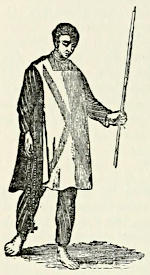
Costume of a Person condemned to be burned, but who confessed before his Condemnation
(From Historia Inquisitionis, 1592)
The Cathari, or as they are now more commonly called the Albigenses or Bulgarians, did not only maintain their ground in southern France, but increased in number chiefly in upper Italy, where the political distraction of the country was advantageous to them, and where Milan continued to be their principal abode. But they spread themselves also into the rest of Italy as far as Spain, and throughout Germany; they were very numerous in Bosnia and the adjoining countries, often the prevailing party, and they maintained in all lands a close connection with each other.
When the persecutions began, the Waldenses were standing so near the Catholic church that a reconciliation seemed to be by no means difficult. But the horrors of the persecution had no further effect on the Waldenses than to confirm them more and more in their anti-hierarchical system, and to place their doctrine and ecclesiastical constitution on a more independent footing. The more plainly their departure from church teaching could vindicate itself as a purification of the church, the more easy acceptation they found with the thoughtful of their time. As early as in the thirteenth century they showed themselves in the valleys of Piedmont, in which they have maintained themselves until now. Still, not only did they spread in other countries, as for instance as far as Germany, but also put in circulation among numbers, who did not come over to their society, ideas unfavourable to the prevailing faith of the church.
Besides the old sects, new ones were engendered in the thirteenth century. The pantheistic system introduced by Amalric of Bène, after the persecution it underwent in Paris in the year 1210, only spread more widely than before. In the course of the thirteenth century its disciples might be found in different places; at the end of this century they were already so numerous among the Beghards on the Rhine that the people understood them only to be meant by the name of Beghards, although they called themselves brothers and sisters of the Free Spirit. In the beginning of the fourteenth century they made their appearance also in Italy.
Other sects pass quickly in review before us. As the universal discontent of the advancing tyranny of the hierarchy aroused isolated resistances in England and in France, so the ill usage of the Hohenstaufen family gave rise to a sect in Halle in Swabia (about 1248), which declared the hierarchy to be abolished in consequence of its moral corruption of the entire purpose of the church. After the extermination of the Hohenstaufen family the detestation caused by this deed of the hierarchy was maintained for centuries by the expectation that one time an emperor Frederick would wreak vengeance in blood on the papacy. This expectation also found place among the manifold superstitions, chiefly borrowed from the Fratricelli, with which the apostolic brothers from 1260 to 1307 disquieted the north of Italy.d
The statutes of the Council of Toulouse (1229), framed after the successful termination of the war against the Albigenses, in order to absolutely extirpate every lingering vestige of heresy, form the code of persecution, which not merely aimed at suppressing all public teaching but the more secluded and secret freedom of thought. It was a system which penetrated into the most intimate sanctuary of domestic life; and made delation not merely a merit and a duty, but an obligation also, enforced by tremendous penalties.
The archbishops, bishops, and exempt abbots were to appoint in every parish one priest, and three or more lay inquisitors, to search all houses and buildings, in order to detect heretics, and to denounce them to the archbishop or bishop, the lord, or his bailiff, so as to insure their apprehension. The lords were to make the same inquisition in every part of their estates. Whoever was convicted of harbouring a heretic forfeited the land to his lord, and was reduced to personal slavery. If he was guilty of such concealment from negligence, not from intention, he received proportionate punishment. Every house in which a heretic was found was to be razed to the ground, the farm confiscated. The bailiff who should not be active in detecting heretics was to lose his office, and be incapacitated from holding it in future. Heretics, however, were not to be judged but by the bishop or some ecclesiastical person.
Anyone might seize a heretic on the lands of another. Heretics who recanted were to be removed from their homes, and settled in Catholic cities; to wear two crosses of a different colour from their dress, one on the right side, one on the left. They were incapable of any public function unless reconciled by the pope or by his legate. Those who recanted from fear of death were to be immured forever. All persons, males of the age of fourteen, females of twelve, were to take an oath of abjuration of heresy, and of their Catholic faith; if absent, and not appearing within fifteen days, they were held suspected of heresy. All persons were to confess, and communicate three times a year, or were in like manner under suspicion of heresy. No layman was permitted to have any book of the Old or New Testament, especially in a translation, unless perhaps the Psalter, with a breviary, or the Hours of the Virgin. No one suspected of heresy could practise as a physician. Care was to be taken that no heretic had access to sick or dying persons. All wills were to be made in the presence of a priest. No office of trust was to be held by one in evil fame as a heretic. Those were in evil fame who were so by common report, or so declared by good and grave witnesses before the bishop.
But statutes of persecution always require new statutes rising above each other in regular gradations of rigour and cruelty. The legate found the canons of Toulouse to be eluded or inefficient. He summoned a council at Melun, attended by the archbishop of Narbonne and other prelates. The unhappy count of Toulouse was compelled to frame the edicts of this council into laws for his dominions. The first provision showed that persecution had wrought despair. It was directed against those who had murdered, or should murder, or conceal the murderers of persecutors of heretics. A reward of one mark was set on the head of every heretic, to be paid by the town, or village, or district to the captor.
It was evident that the heretics had now begun to seek concealment in cabins, in caves, and rocks, and forests; not merely was every house in which one should be seized to be razed to the ground, but all suspected caves or hiding-places were to be blocked up; with a penalty of twenty-five livres of Toulouse to the lord on whose estate such houses or places of concealment of evil report should be found. Those who did not assist in the capture of heretics were liable to punishment. If any one was detected after death to have been a heretic, his property was confiscated. Those who had made over their estates in trust, before they became heretics, nevertheless forfeited such estates. Those who attempted to elude the law by moving about, under pretence of trade or pilgrimage, were ordered to render an account of their absence. A council at Béziers (1233) enforced upon the clergy, under pain of suspension or of deprivation, the denunciation of all who should not attend divine service in their churches on the appointed days, especially those suspected of heresy.g
METHOD OF PROCEDURE WITH A SUSPECT
The method of proceeding in the courts of the Inquisition was at first simple, and not materially different from that in the ordinary courts. But gradually the Dominicans, guided by experience, rendered it far more complex; and so shaped their proceedings that the mode of trying heretical causes (if the phrase be allowable) became altogether different from that usually practised in judicial proceedings. For these good friars, being wholly unskilled in forensic affairs, and acquainted with no other tribunal than that which in the Romish church is called the penitentiary tribunal, regulated these new courts of the Inquisition, as far as possible, according to the plan of those religious proceedings. And hence arose that strange system of jurisprudence, bearing in many respects the most striking features of injustice and wrong. Whoever duly considers this history of their origin will be able to account for many things that seem unsuitable, absurd, and contrary to justice, in the mode of proceeding against offenders in the courts of the Inquisition.e
When the Inquisition discovered a transgressor of their laws, either by common report, or by their spies, or by an informer, he was cited three times to appear before them; and if he did not appear, he was forthwith condemned. It was safest to appear on the first citation; because the longer a man delayed the more guilty he would be; and the Inquisition had their spies, and a thousand concealed ways for getting an absconding heretic in their power.
When a supposed heretic was once in the hands of the Inquisition, no one dared to inquire after him, or write to him, or intercede for him. When everything belonging to the person seized was in their hands, then the process began; and it was protracted in the most tedious manner.
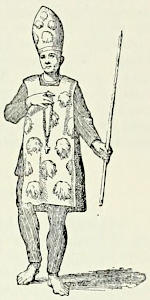
Costume of a condemned Person who confessed, after Conviction
(From Historia Inquisitionis, 1592)
After many days, or perhaps months, which the accused dragged out in a loathsome dungeon, the keeper of the prison asked him, as it were accidentally, if he wished to have a hearing. When he appeared before his judges, they inquired, just as if they knew nothing about him, who he was, and what he wanted. If he wished to be informed what offence he had committed, he was admonished to confess his faults himself. If he confessed nothing, time was given him for reflection, and he was remanded to prison. If, after a long time allowed him, he still confessed nothing, he must swear to answer truly to all the questions put to him. If he would not swear, he was condemned without further process. If he swore to give answer, he was questioned in regard to his whole life, without making known to him his offence. He was, however, promised a pardon if he would truly confess his offences; an artifice this, by which his judges often learned more than they knew before against him.
At last the charges against him were presented to him in writing, and counsel also was assigned him, who, however, only advised him to confess fully his faults. The accuser and informer against him were not made known to him, but the real charges against him were put into his hands. He was allowed time for his defence; but his accuser, and the witnesses against him, he could know only by conjecture. Sometimes he was so fortunate as to discover who they were; but rarely were they presented before him, and confronted with him.
If his answers did not satisfy the judges, or if the allegations against him were not adequately proved, resort was had to torture. Each of these tortures was continued as long as, in the judgment of the physician of the Inquisition, the man was able to endure them. He might now confess what he would, but still the torture would be repeated, first to discover the object and motives of the acknowledged offence, and then to make him expose his accomplices.
If, when tortured, he confessed nothing, many snares were laid to elicit from him unconsciously his offence. The conclusion was that the accused, when he seemed to have satisfied the judges, was condemned, according to the measure of his offence, to death, or to perpetual imprisonment, or to the galleys, or to be scourged; and he was delivered over to the civil authorities, who were intreated to spare his life, as the church never thirsted for blood; but yet they would experience persecution if they did not carry the decisions of the court into execution.
What an infernal device is the Inquisition! What innocent person could escape destruction, if an inquisitor were disposed to destroy him? A heretic, even if he had been acquitted by the pope himself, might still be condemned to die by the Inquisition. An equivocal promise of pardon might be given to induce him to make confession, but the promise must not be fulfilled when the object of it was obtained. Even death did not free a person from the jurisdiction of the Inquisition; for a deceased heretic must be burned in effigy. Would not every feeling of humanity be outraged by following such horrid principles? The inquisitorial judges did not deny that by such proceedings many innocent persons unavoidably perished, along with the guilty; but this did not trouble them. “Better,” they said, “that a hundred innocent persons should be cut off and go to paradise, than let one heretic escape, who might poison many souls and plunge them into endless perdition.”f
JOHN FOXE ON THE EVILS OF THE INQUISITION
“The abuse of this Inquisition is most execrable. If any word shall pass out of the mouth of any, which may be taken in evil part; yea, though no word be spoken, yet if they bear any grudge or evil will against the party, incontinent they command him to be taken, and put in a horrible prison, and then find out crimes against him at leisure, and in the meantime no man living is so hardy as once to open his mouth for him. If the father speak one word for his child, he is also taken and cast into prison as a favourer of heretics; neither is it permitted to any person to enter in to the prisoner; but there he is alone, in a place where he cannot see so much as the ground where he is, and is not suffered either to read or write, but there endureth in darkness palpable, in horrors infinite, in fear miserable, wrestling with the assaults of death.
“By this it may be esteemed what trouble and sorrow, what pensive sighs and cogitations they sustain, who are not thoroughly instructed in holy doctrine. Add, moreover, to these distresses and horrors of the prison, the injuries, threats, whippings, and scourgings, irons, tortures, and racks which they endure. Sometimes also they are brought out, and showed forth in some higher place to the people, as a spectacle of rebuke and infamy. And thus are they detained there, some many years, and murdered by long torments, and whole days together treated much more cruelly, out of all comparison, than if they were in the hangman’s hands to be slain at once. During all this time, what is done in the process no person knoweth, but only the holy fathers and the tormentors, who are sworn to execute the torments. All this is done in secret, and (as great mysteries) pass not the hands of these holy ones. And after all these torments so many years endured in the prison, if any man shall be saved, it must be by guessing; for all the proceedings of the court of that execrable Inquisition are open to no man, but all is done in hugger-mugger and in close corners, by ambages, by covert ways, and secret counsels. The accuser is secret, the crime secret, the witness secret, whatsoever is done is secret, neither is the poor prisoner ever advised of anything. If he can guess who accused him, whereof and wherefore, he may be pardoned peradventure of his life; but this is very seldom, and yet he shall not incontinent be set at liberty before he hath long time endured infinite torments; and this is called their “penitence,” and so is he let go; and yet not so but that he is enjoined, before he pass the inquisitor’s hands, that he shall wear a garment of yellow colours for a note of public infamy to him and his whole race. And if he cannot guess right, showing to the inquisitors by whom he was accused, whereof, and wherefore (as is before touched), incontinent the horrible sentence of condemnation is pronounced against him, that he shall be burned for an obstinate heretic. And yet the sentence is not executed by and by, but after he hath endured imprisonment in some heinous prison.”j
HOW A PENITENT WAS TREATED
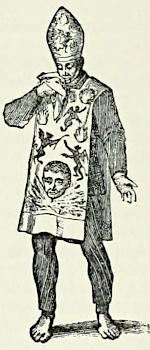
Costume of a condemned Person who had not confessed
(From Historia Inquisitionis, 1592)
It was a peculiar horror of the Inquisition that while almost anyone might be haled before it, even on an anonymous complaint, hardly anyone ever escaped certain penalties. If the fate of the wretch was heavy, who, being innocent of heresy would not confess his guilt and therefore was tortured until he confessed imaginary guilt, and was then burned to death, hardly less was the misery of the victim who repented or recanted and was freed from the death penalty. The penalty for recantation can hardly be more plainly stated than an actual order quoted by Llorente,k giving the punishment awarded by St. Dominic himself to a repentant heretic even before the actual organisation of the Inquisition.a
“To all faithful Christians to whom these presents may come. Friar Dominic, canon of Osma, the least of the preachers, greeting in Christ. By the authority of the lord abbot of Cister (Citeaux), legate of the apostolic see (whose power we exercise) we have reconciled the bearer of these presents, Poncio Roger, converted from the sect of the heretics by the grace of God; and we have enjoined him in virtue of the sworn promise which he has made to comply with our precepts that on three Sunday festivals he be led, stripped, by a priest, who shall scourge him from the gates of the city to those of the church.
“We further lay upon him, by way of penance, that he abstain from eating flesh meat, eggs, cheese, and other foods derived from animals, forever. Save only on the day of the resurrection, of Pentecost, and of the Lord’s nativity, on which days we command him to partake thereof as a mark of his detestation of his former error. He shall observe four Lents in the year, abstaining from fish, and shall forever fast and abstain from fish, oil, and wine three days in the week, save only when physical infirmities or the labours of his station require a dispensation. He shall wear religious garments both in shape and colour, with two small crosses sewn on each side of his breast. He shall hear mass every day when occasion serves, and on feast days he shall assist at vespers in the church. Every day he shall recite the Hours for the day and night, and shall repeat the prayer ‘Our Father’ seven times during the day, ten times in the night, and twenty times at midnight. He shall observe chastity, and shall present this letter one day, in the morning, every month, in the town of Cereri to his parish priest, whom we enjoin to watch over the conduct of Poncio, who shall faithfully observe all that is here expressed until the lord legate shall manifest his will. And should Poncio fail in his observance we command that he be held perjured, heretic, and excommunicated, and be separated from the company of the faithful.”k