Book 1 — CHAPTER XIV. THE RESTORATION OF THE BOURBONS
Reading edition
[1814-1902 A.D.]
On the 7th of March, 1814, Ferdinand VII definitely received his passports from the French. Master of himself once more, he began to think of means of returning to the capital and recovering his former power. But, at the same time, he resolved to avoid doing anything that would seem to sanction modifications accomplished by the cortes, regarding such as an attack on his sovereign power. To enter Spain without making any promise at all was the essential point. The king’s counsellors proposed he should send a king’s messenger to Madrid bearing a letter carefully flattering the hopes of the Liberal party without undertaking to fulfil the slightest engagement with regard to it. Ferdinand acted on this advice, and charged General Zayas to bear to Madrid the news of his immediate return, and to give the regency a letter wherein were these ambiguous words:
“As to the re-establishment of the cortes and all they have been able to do of use for the kingdom during my absence, my approbation will be given in so far as it all conforms to my royal intentions.”
The general set out for Madrid with this letter and hastened to arrive thither, where his coming produced the liveliest enthusiasm. The cortes affected to see in the message a pledge for the political future of their sovereign, and abstained thenceforth from those energetic measures alone able to save them. While they thus lulled themselves in fancied security, Ferdinand had hastened to gain the Spanish frontier by Toulouse and Perpignan. On the 24th of March he crossed the Fluvia, limit chosen by Marshal Suchet as the theatre which was to see the solemn restoration of the royal captive to the Spanish troops. The ceremony was carried out amid general enthusiasm, and all the people eagerly ran to assist at such a novel spectacle.
From this moment, Ferdinand, reinstated in his kingly prerogatives, found himself under a double influence, one drawing him to the representative system, the other towards that absolute monarchy which best suited his desires and tastes. In all the towns he went through, and particularly in Gerona where he had stayed some days, a people mad with joy, drunk with enthusiasm, had cast themselves at his feet, had dragged his carriage, and given most striking testimony of obedience and submission.[124]
Sure now of the destiny awaiting him, he decided to abandon the route fixed by the decree of the 2nd of February.
During this triumphal journey (24th of March to the 6th of April), the gravest events had taken place in France, and one may conceive that Ferdinand, before attempting his coup d’état, did not want to get too far away from the frontier, at any rate while the issues were doubtful. Certain events were very favourable: the entry of the allies into Paris; the creation of a provisionary government; Napoleon’s abdication, and departure for Elba; and lastly the proclamation of Louis XVIII, which should lead to the suppression of hostilities and the end of the war.
The Aragonese were just as unbridled as the Catalans in expressing monarchial fanaticism. So while the authorities remained faithful to the regency, the people showed such enthusiasm for the king that he could no longer doubt for an instant that he could now venture all. Old courtiers, interested in seeing the ancient court restored, constantly urged him to retake absolute authority.
Yet, while the storm was slowly gathering that would sweep them away, the cortes, always dominated by a perfectly unjustified feeling of confidence, never ceased publishing decrees which served to feed the general enthusiasm in the king’s favour. The weak royalist minority which still existed in their midst had ceased to make common cause with them. Its leader, Mozo de Rosales, had gone to Valencia carrying a representation in which the events of the past six years were considered as a passing saturnalia, similar to those which the Persians used to celebrate during an interregnum, and which put forth that order would only reign in Spain from that day when kingly authority should be reinstated in its integrity. Whilst the cortes waited with lively impatience to know their fate, they celebrated the fête of the 2nd of May with great pomp; ascribed several civic rewards to soldiers who had bravely fought in the war of Independence; transferred the seat of their meetings from the theatre of Los Canos del Peral to the convent of Doña Maria of Aragon; and decreed a death sentence against anyone demanding constitutional reform before eight years. Such were the acts of the cortes. The cardinal De Bourbon, president of the regency council, accompanied by the minister of state, Don José Luyando, was to present himself before the monarch, and a commission, presided over by the Bishop of Urgel, was to go on in front of him as far as La Mancha plains.
Ferdinand arrived the 16th of April on the borders of Turia. There he found everything had been prepared by the care of his uncle Don Antonio, De Macanaz, and Escoiquiz, to whom were united Villamil and Lardizabal, whose reverses at Cadiz had filled them with bitterness and spite against the representative system. The highest aristocrats came to Ferdinand offering him riches enough to enable him to act without the concourse of the cortes. General Elio, betraying his first duty and oblivious of obedience owing to the regency, promised the strongest assistance from all his army corps. A special paper, entitled Lucindo, boldly advocated a return to the old régime. The time had come to act in a decisive manner. Ferdinand applied himself to the work. In receiving the cardinal De Bourbon he affected to give him his hand to make him kiss it in sign of homage, as if to show that the regency was nothing but an emanation from his own authority. In the same fashion he received the commander’s bâton which the latter presented before the troops, as if by this to teach the soldiers that obedience was due to himself alone. He received representatives from the Persians with cordiality.[125] He made a cavalry corps precede him commanded by Don Santiago Wittingham, to Madrid, and then received a solemn oath from all the officers to “support him in all his rights.”
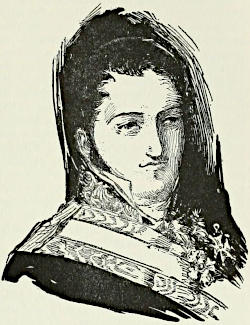
Ferdinand VII
Such symptoms were decisive, and, once made public, he had only to exercise the direct absolute authority which he had just seized. This is exactly what happened. The king signed on the 4th of May at Valencia the famous manifesto now so mournfully celebrated. In this he stated that not only did he refuse to swear to the constitution or to recognise any decree extraordinary or ordinary, but he declared that constitution annulled, of no value either to-day or forever, as its acts had never been nor could be effaced by time. Then, without making known his absolutist programme, he marched straight on Madrid with General Elio, having given orders to the cardinal De Bourbon and Luyando to retire, the one on Toledo, the other on Cartagena.
It seemed impossible that the arrival of General Wittingham almost under the walls of Madrid should not open the deputies’ eyes as to Ferdinand’s intentions; nevertheless, they took no measures for their personal security. The execution of the Valencia decree had been confided to General Eguia, nominated captain in general of New Castile, and known under the name of Coletilla because of his attachment to old costumes and his habit of wearing his hair in a plait at the back of his head as in Charles III’s time. Eguia, who was commander-in-chief of Elio’s first division of troops, and who only preceded the king by some days, was supported by Wittingham’s cavalry and the underhand movements of the count of Montijo, who had raised the slums of Madrid against those favourable to the representative system. Under these circumstances he had not any difficulty in executing the coup d’état with which he had been intrusted. Thus, while Ferdinand pursued his triumphal march from Valencia to Madrid in the midst of a joy and enthusiasm officially worked up, midst subversive cries around him for the suppression of the constitution and re-establishment of absolutism, while he refused to see the cortes’ deputation who came before him at La Mancha, all vestiges of the preceding system were being carefully destroyed in the city. A terrible persecution fell on all the men who had helped in establishing the constitutional system.
In the one night of the 10th of May, 1814,—a day so celebrated in the annals of the Spanish liberals,—Eguia took from their houses and imprisoned all regency members, all state councillors, all deputies who were known as partisans to the constitution whether in the actual cortes or the preceding one. Of this number were the two regents Don Pedro Agar and Don Gabriel Ciscar, the ministers Don Juan Alvarez Guerra and Don Manuel Garcia Herreros, the constituents Muñoz Torrero, Arguelles, Oliveros, Villanueva, the deputies Martínez de la Rosa, Canga-Arguelles, and Cepero. Some had the good luck to escape, among these Toreño and Isturiz. As to the others, they were surprised in their homes. So unexpected was such a ruse in the then circumstances of the country, that no one had dreamed of taking the slightest precautions. The day after their arrestation they were constantly exposed to the insults of the multitude who reproduced in Spain all the excesses of that blind reaction in the south of France. The Madrid populace, after having torn away the corner-stone of the constitution, went in tumultuous procession to the quiet street where the prisoners were shut up, and there shouting “Death to the liberals!” they begged with frightful cries permission to drag the corpses in the mud as they had dragged the stone of the constitution.
This tumult was the work of the count of Montijo and several monks who, seeing the star of their ascendency reappear in the horizon—an ascendency lost for six years—had, at the same time as the Valencia decree was proclaimed in all the squares, circulated a scandalous leaflet having for the object an organised proscription and the raising of the masses against all partisans of the liberal system. Thus the 13th of May, 1814, saw Ferdinand’s triumphal entry into his capital. He had already given his reign the distinctive character that marks it out in history: an obstinate return to old ideas; a cruel proscription against all the men devoted to culture and intelligence and gifted with liberal aspiration; a stirring up of the masses by a recrudescence of religious fanaticism; an exaltation of monarchical principle pushed as far as absolutism, and a near re-establishing of the Inquisition, convents, favouritism, and all their fatal consequences.b
The great mass of the people, who were not enlightened enough to feel the want, or appreciate the blessings, of political liberty, had not sufficient experience of the benefits which the new institutions were calculated to confer to have conceived any value for them; and the troops, who, from their intercourse with the English army, might have learned some respect for liberty and equal laws, were hostile to the cortes on account of the neglect and injustice with which they had frequently been treated.
Ferdinand proceeded to acts for which no palliation can be found, namely, inflicting punishments upon those who had defended his cause when he himself had abandoned it, but had, in his opinion, forfeited all claim to his gratitude, by seeking to limit the power they preserved for him. Fortunately, however, Sir Henry Wellesley extorted from the king a solemn promise that no blood should be shed for political opinions. No lives therefore were taken. But the cardinal De Bourbon was banished to Rome. The only symptom of gratitude shown by Ferdinand to those who had so zealously served him, was his confirming to Lord Wellington the honours and rewards conferred upon him by the cortes.
In America the long-pending dispute with the United States respecting the boundaries of Louisiana and West Florida was finally settled by the sale of both the Floridas to that power. The war with the colonies continued, but altered in character. Ferdinand there took part with the cortes he had condemned, pertinaciously refused to acknowledge the equality, the sort of federal connection with the mother-country that the colonies claimed, and wasted the resources of Spain by sending his best troops across the Atlantic to assert the old Spanish monopoly. The colonies, exasperated by this return for their loyalty, now disowned the authority of Ferdinand, and proclaimed their entire and absolute independence. Ferdinand resisted these pretensions yet more vehemently than the former, but it was evident from the beginning that Spain had finally lost her transatlantic empire. Cuba, Porto Rico, and the Philippines were her only remaining colonies.
As the short convulsion, which followed Napoleon’s return from Elba in the following spring and was terminated by the dreadful and glorious battle of Waterloo as finally sealing Bonaparte’s fall, produced no other effect in the peninsula than an order to arm, a detail of these affairs would be out of place here.q
THE REIGN OF TERROR
[1814-1824 A.D.]
A famous society, that of the Exterminating Angel, had extended its roots over the whole country under the direction of a former regent, the bishop of Osma, and was moving all the apostolics of the peninsula as by a single mind. It had relations with the principal bishops to whom several owed their offices; its ramifications crept into all the monasteries, and much more violent than its French chapter it preached the extermination of all the liberals.
The military commissions set to work with a new activity aided by a mass of regulations whose laconism and hypocrisy were only equalled by their vigour and violence. They had the power of condemning to death all who were guilty of lèse-majesté, that is to say all who declared themselves opposed to the rights of the king or in favour of the constitution. With the help of this ambiguous phrase, any writer who put into print any words in which the rights of Ferdinand were doubted, anyone who in any manner whatever had co-operated in the revolution of 1820-1823; anyone who kept in his house a copy of the constitution, a portrait of Riego, any souvenir whatsoever of the illustrious exiles living in a foreign country, anyone who by a shout or word, spoken even in drunkenness, showed hatred of tyranny—any of these could be found guilty of lèse-majesté. A decree bearing the date of October 9th, 1824, which through some expiring sentiment of modesty was not inserted in the official gazette, but nevertheless was applied with care, suppressed all of the laws and delivered the lives of all citizens over to these tribunals. A premium was put upon information and a secret police penetrated into every household in order to divine the secret of consciences and to purge Spain of all the liberal element. Not age, sex, virtue, or poverty were protection against these terrible commissions; wealth alone sometimes saved from death. He who had some fortune bought his life with the greatest part of his property.
The commission of Madrid, presided over by a fierce brute named Chaperon, who acquired the melancholy honour of giving his name to the whole epoch, surpassed all its rivals in the number of condemnations and severity of sentences. It sent to the scaffold all those in whose homes portraits of Riego were discovered, and to the galleys the women and children who committed the crime of not denouncing their husbands or fathers. More than one well-born woman thrown into infamous prisons with the most odious criminals died of despair in the midst of the unjust abjection to which she saw herself reduced. Chaperon, like all the judges who consented to make themselves the devoted instruments of social hatred, rejoiced in the midst of the terror which his name inspired, and under the general torpor that it created. He assisted at executions in full uniform; they were fête days for him, and on one occasion, anxious to hasten the execution of one of his condemned (it was a national militiaman who had taken part in the defence of Madrid, the 7th of July, against the revolted guards), he pulled, himself, the legs of the poor victim already hanging from the fatal gibbet, and this exploit finished, retired, proud to have exercised the functions of executioner and judge.b
THE TYRANNIES OF FERDINAND “THE DESIRED”
[1814 A.D.]
The places left in the power of the French were evacuated one by one, and finally, on the 20th of July, Spain gave its assent to the treaty of peace and friendship which the allies had concluded with France on the 30th of the preceding May. In the beginning of May the king had found a ministry which he modified before the end of the month, but at the head of it each time he placed the duke of San Carlos. The system of persecution continued and everything which seemed to favour innovations was vigorously opposed. Ferdinand regained his power, the cortes had disappeared, the constitution of Cadiz existed only in people’s memories. The Spain of 1814 became again the Spain of 1807; as before, she was subject to the joint domination of prince and clergy. The legislative bodies which constituted the government and the chief judicial magistracy of 1808 were abolished in 1814.
Among the reforms introduced by Joseph’s government and by that of the cortes after him, there were some which were unjust, extortionate, contrary to the re-established order; but there were others which should have been retained or modified with reservations. The king had no thought of making a choice. He considered, not the nature of the acts, but their origin; the good and the bad, salutary reform and disastrous measure, all were included in a general proscription. The state, impoverished by a long war, had at hand timely assistance in the estates of the religious communities, without being obliged to impose heavy burdens on the people; never had there been such a favourable opportunity for limiting and regulating these exaggerated possessions which had fallen into mortmain. A measure calling for investigation and reform which had been authorised by a papal bull under Charles IV might now have been carried into effect. But no attention was paid to anything of the kind. All their goods of which the cortes had disposed were returned to the convents, and at the same time a royal order re-established the holy office of the Inquisition on the ground that the government of usurpation and the pretended cortes had regarded the suppression of this tribunal as a very efficacious method of furthering their perverse schemes. The Jesuits were recalled, receiving again the goods which had belonged to them in the preceding century.
The administration of the realm was with great pains thrown again into the secular confusion out of which so many ministers had laboured to disentangle it. Instead of the happy division of territory decreed by the cortes, there reappeared the spectacle of provinces governed by captains-general, who added to their plenitude of military and administrative authority certain judicial attributes. Lastly the councils of Castile, of the Indies, of the orders, of finance, marine and war, authorities independent of the ministry, whose traditions made them hostile to any reform undertaken in the interests of the reigning power or of the people, began again to operate.
Around Ferdinand was formed that too famous camarilla[126] controlled by the Russian minister, which, wholly lacking in a broad outlook, seemed to have no object but destruction and vengeance. At the same time that it overturned all which the revolution had done for the unity of Spain, it struck at all those men who had incurred its hatred. Ten thousand Spaniards had had the misfortune to attach themselves to the French cause; they were banished and their goods confiscated. The members of the regency, those of the cortes, all the ministers, all the individuals who had taken part in framing the constitution or had been zealous partisans of it, were brought before commissioners to be tried with no legal formality. The number of the condemned was considerable: presides, imprisonment in the citadels, exile—such were the penalties inflicted; the king made no use of his right of pardon and these acts continued with cold perseverance. Two years after the king had regained his full power, the prisons were still full, and long proscription lists still appeared at intervals.
Such a government could not fail to have a dire influence on the interior prosperity of the country; but it is difficult to imagine the extent of the disorder into which everything had been thrown. It was necessary to resort to arbitrary taxes which caused discontent without affording much relief to the treasury and to exorbitant custom duties which completed the destruction of commerce by breaking off all relations with foreign countries. The old régime, to remain in possession of Spain, would have needed the treasures of the New World to hold the country in subjection, and to defray the expenses of an administration useless at its best. But then it would have had to get the better of the insurrections already victorious or soon to be so in Venezuela, Chile, Peru, Buenos Ayres, and Mexico, and to combat all the points of that immense continent at once. In order to quell their revolution, which was termed a revolt, an army needed first to be procured. To embark this army a fleet was necessary for the equipment of which both time and means were lacking; the government was reduced to bargaining for ships with Russia. In order to obtain immediate assistance it had to resort to a system of credit and give some assurance of a good administration together with securities for the public debt. This necessity was so pressing that in the ministerial council Don Martin Garay, surnamed the Necker of Spain, and several others of the same school were placed at the side of men like Eguia and Lozano de Torres, those defenders of ancient customs.
Garay had to promise services for which he had no resources and at the same time establish credit for an enormous public debt, the securities for which had just been taken away. Garay had counted on resources which were daily becoming more illusory through the complete cessation of commerce and the disastrous state of agriculture. Events in America demanded an expenditure of forces which Spain could not have mustered even in her palmiest days. When Garay wished to resort to more radical measures, he was sent into exile. Nothing seemed able to uplift the credit of the industrial situation of Spain, blockaded from Cadiz to Corunna by the corsairs of the insurgent colonies, compromised with the United States for Florida, and obliged to purchase the seeming neutrality of England in the struggle with the colonies.
A SERIAL REVOLUTION (1814-1822 A.D.)
[1814-1818 A.D.]
By reason of so much capricious violence the upper classes had become discontented and the people indifferent, the government was reduced to relying on armed force. But the army itself, ill equipped and ill paid, was become a hotbed of insurrection. Secret societies were organised everywhere and complaints led to plots. The well-known guerilla Mina responded by an armed revolt to a refusal to give him the title of captain-general in Navarre, but he was abandoned by his companions and escaped death only by flight to France in 1814. In 1815, General Diaz Porlier incited the garrisons of Corunna and Ferrol to revolt for a brief space, and proclaimed the constitution of Cadiz. He was also abandoned and ended his life on the gallows. Even in Madrid a conspiracy was formed headed by War Commissioner Richard, who perished on the scaffold in 1816. The next year General Lacy undertook in Catalonia what Porlier had attempted in Galicia. The plot was discovered and Lacy shot. In Valencia in 1818 also revolts took place; the captain-general Elio[127] seized the insurgent chief Vidal, who was immediately hung with twelve of his accomplices.
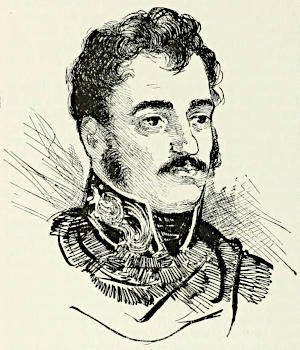
General Francisco Mina
So many unsuccessful attempts served only to irritate the malcontents who still hoped to find better support among their companions at arms. Such was the disposition of a number of officers at Cadiz, where an army was slowly and with difficulty being got together for a definitive expedition against the rebellious colonies, upon which all the hopes of the Spanish government were concentrated. The soldiers were frightened by tales of old mutilated warriors who had returned from Colombia. They were made to see the possibility of escaping the misfortune which awaited them without being exposed to the reproach or suspicion of a lack of courage. They were told stories of the last war, of the liberty conquered and then lost, of honour compromised.
[1818-1820 A.D.]
The conspirators had more hope of success because they had the chief of the expedition himself, O’Donnell, the count of Abisbal, on their side; but this general turned traitor, denounced the conspirators, and even arrested some of them. But he too was later suspected, and was recalled with all the signs of disgrace. Persecutions recommenced. Everything pointed to a redoubling of rigour which in turn produced a redoubling of irritation and also of hope. The conspirators again took up their plans which had been interrupted for an instant, but this time they did not look to generals for help. A less distinguished leader gave the impulse to revolt in one of the cantonments.
The 1st of January, 1820, Rafael del Riego assembled a battalion encamped in a village, presented it with the constitution of 1812 as the law of the country, to which he made it swear allegiance, marched upon Arcos, surprised and captured O’Donnell’s successor Calderon with his staff, and continued his march upon San Fernando where he was joined by Colonel Quiroga. But the gates of Cadiz remained closed to them, the garrison and the fleet took on a hostile attitude toward the rebels. At the same time an army of thirteen thousand men under General Freire arrived with forced marches to quell the insurrection. Thereupon Riego advanced towards the centre of Andalusia preaching insurrection and proclaiming the constitution of Cadiz. But the general indifference of the country was enough to thwart the enterprise of the insurgents. There was discouragement in the camp at the isle of Leon and, the governmental forces accumulating in Andalusia, it seemed that the rebellion was about to expire.
But the emissaries charged with arousing the provinces worked without relaxation. The 21st of February they succeeded in proclaiming the constitution in the capital of Galicia. Ferrol followed this example the 23rd. The same thing took place at Vigo. The government tried to compromise with the revolution and offered to assemble the cortes, but no confidence was placed in these promises because it was remembered that the decree of May 4th, 1814, by which the constitution was abolished, had promised to convoke the cortes but had not been carried into effect. The revolutionaries of the capital incited by the feebleness of the government worked openly towards their object. General Ballesteros, who came to Madrid to declare to the monarch that he must accept the constitution, was hailed as a deliverer by the king; the 9th of March Ferdinand took the oath for this act which he detested, at the moment when Riego’s column, reduced to a few men, was forced to disband, and the garrison at Cadiz was energetically opposing the insurrection.
When the king had sworn to observe the constitution of 1812, the people and the troops which still remained faithful gave up without resistance. Everyone had been affected by the disastrous effects of the régime to which the country had been subjected for several years and all were glad to be freed from it without a civil war. The prisons were opened. The reins of government were in the hands of ministers whose ideas were wholly popular. Several provinces were governed by juntas, one was established even in the capital, which was known as the provisional junta. The government consulted it on all important matters. The country awaited with impatience the arrival of the deputies who were to give it a better order of things than that from which it had just been delivered, instead of giving thought to the necessary improvements. Thoughtful minds perceived that it was necessary substantially to modify the civil legislation; to render remunerative large masses of untaxed property; to negotiate with Rome a reform which would alter the position of the clergy; to re-establish the financial situation; to place the provinces under a common law, combining extensive local liberty with unity of administration; above all not to imitate the preceding government in its deeds of violence.
The first acts of the cortes showed that it understood its task. An important law concerning entailed estates was passed in a spirit of wisdom; they were placed in the category of free property and their owners could dispose of them with certain reservations and just conditions. But the assembly was largely composed of members of the special cortes of Cadiz who considered the work of the constitution perfect and would suffer no change in it. Thus, before proceeding to anything else, it was necessary to deal with those who had opposed their constitution in 1814—the sixty-nine deputies known as the Persians, who had presented the king at Valencia with an address in favour of absolute power. On the other hand the enthusiasts wanted to advance much more quickly in the path of improvement. There soon came to be a distinction between the liberals of 1812 and those of 1820. The radical party soon kept no bounds; its papers, its clubs attacked the ministers, the cortes, the king. It was supported by the army of the isle of Leon, and the government wished to disperse the bodies composing the latter among the different garrisons. The men of the isle of Leon thereupon took occasion to send to Madrid Riego, who was commander-in-chief during the absence of Quiroga, deputy to the cortes. Here applause and ovations were lavished upon the leader of the men of 1820, who, carried away by popular favour, braved the cortes and the ministers. But the garrison and the national militia decided for the established order. Riego was exiled to Oviedo, the army of the isle was disbanded.
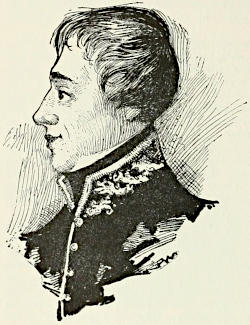
General Rafael del Riego
Nevertheless the presence of Riego at Madrid gave an impulse to the radicals which remained after his departure. Fresh conspiracies were brought to light against the new régime. The discussion of the law regarding religious orders was affected by their attitude of mind. They tried to accomplish at once, what should have been the work of years. In immediately suppressing the greater part of the religious congregations and putting their goods up for sale, difficulties of more than one kind were created. In Catalonia and Valencia troops had to guard the gates of the monasteries day and night to prevent pillage and massacre. The king had hesitated to sanction the decree, and, after the session closed on the 9th of November, he made an unsuccessful trial of absolute power by nominating General Carvajal captain-general of New Castile, without the signature of the minister of war. The fermentation then became terrible and the minister augmented it in order to frighten the king. The latter threatened and insulted on all sides was forced to return to Madrid from his retreat in the Escorial. When one day his bodyguard was moved to pity by the dangers he ran, their quarter was besieged and the corps disorganised. The ayuntamiento of Madrid imposed their measure on the government.
[1820-1821 A.D.]
After having swallowed so many affronts Ferdinand wished to make an attempt to shake off the yoke. He hoped with his new resolution to impose on his adversaries, who were troubled by the attitude of the great European powers, since England alone had frankly recognised the constitutional government. Russia had not concealed her displeasure at the triumph of the insurrection. Prussia and Austria held themselves in a reserve which boded no good, and France had tried to bring about a change in the position of the king of Spain. Ferdinand chose the opening of the second session of the cortes, on March 1st, 1821, to deliver his attack. After finishing the customary address prepared by his ministers he read a supplement added by himself complaining of the ministers who had permitted his person to be subjected to such outrages. The next day he dismissed them and chose a new cabinet from the moderate party of the chamber. Events in Piedmont and Naples gave cause for conflicting sentiments. Attempts of the absolutists gave rise to disturbances in Valencia, Corunna, Seville, and Barcelona. The king in order to ward off the anger of the demagogues sent a message to the cortes expressing his grief over events in Italy and his sympathy with the Italian patriots. The ministry, also desiring to forestall public defiance, on April 17th proposed two laws, one of which pronounced a sentence of death on all who should try to overturn the religion of the constitution, and a decree of banishment against any person who used any expression tending to such an overthrow. The second law provided that those accused of conspiracy and arrested by armed force, whatever their social position, be placed before a military tribunal chosen from the corps which had made the arrest. Judgment was to be pronounced within six days, and executed within forty-eight hours after being confirmed by the chief military authority. There was to be no appeal or exercise of pardon by the king. The populace would have liked to apply this law to all political offenders.
[1821-1822 A.D.]
Confusion increased from day to day. Republican uprisals took place in Malaga and Barcelona. In the environs of Manresa were armed bands in the name of “the faith.” There was conspiracy at Murcia and absolutist agitation at Malaga. Bands were arming themselves on the frontier of France, and no one knew where to turn for money to organise the sadly needed troops. The cortes was moreover beginning to give way before the weight of events which attacked it on all sides. The question of the independence of America terrified it, and it did not care to renounce the pretensions of despotic Spain over men who had made use of the right of insurrection. But negotiations proved useless. Out of so many vast possessions Spain retained only a few fortified places occupied by the remnants of its armies.
Riots became more and more frequent at Madrid, but they were put down by the courage and sangfroid of Morillo. The cortes separated February 22nd, 1822, at a moment when Seville and Valencia were given up to rebellion, the Basque provinces and Navarre were infested with bands armed in the name of the altar and of the throne, others in Aragon, Alcañiz, Calatayud, Alagon, and Caspe proclaimed the authority of the Virgin and of religion.
The new cortes opened the 1st of March, 1822, with Riego as president, who very soon fell into discord with the new ministry presided over by Martínez de la Rosa. The quarrels between the branches of power incited absolutist riots and revolutionary insurrection throughout the country. The cortes finally decided to send a message to the king informing him of the necessity of putting a stop to the critical situation of the realm. After stating its complaints it demanded more resolute men at the head of affairs, and also the expulsion of prelates and priests who preached fanaticism and rebellion. The king relying on popular manifestation in his favour did not reply to the deputation. In Catalonia was a considerable body called Army of the Faith under the command of Miralles, Romagosa, and Marañon, called the Trappist, who succeeded in capturing Urgel by assault.d
CHÂTEAUBRIAND’S ACCOUNT OF THE CHAOS
The eminent writer Châteaubriand, who was a representative of France at the Congress of Verona, and who was one of the principal advocates of the French invasion of Spain, has brilliantly pictured the chaos of affairs, in 1822, which led him to think French intervention necessary. We may quote briefly his description:
The press, secret societies, clubs, had disorganised everything. Barcelona, Valencia, Pamplona had risen. One side cried “Vive Dieu!” the other “Vive Riego!” Killing was carried on in the name of Him who murders not and of him who murders. At Madrid, regiments fought against the royal grenadiers; young men walked about the streets crying for absolute monarchy. God and the king! It was all one in Spain; las ambas magestades. In the very house of cortes, deputies were saying that a refusal to listen to the popular complaint authorised dagger justice. Riego, the president, was powerless. He was always ready to sing the Trágala.[128] A couplet of it might at any moment mean a crown; but, if it was not good, the crown would vanish, and one would remain on the highway with the throne changed into a mere stage.
The serviles, who paraded their name as proudly as though it were a royal designation, profited by one hour’s respite and reaction against secret societies to re-seize power. Royalist risings replaced revolutionary insurrections. The Descamisados, matadors in servile pay, were beaten in their turn. They revived the human sacrifices of their Carthaginian ancestors. Monarchical sections appeared under the old guise. Govostidi, Misas, Merino, fabulous heroes of the presbytery, rose in Biscay, Catalonia, and Castile. Insurrection spread. Quesada, Juanito, Santo-Ladron, Truxillo, Schafaudino, and Hierro were all alive with it. Finally Baron Eroles showed himself in Catalonia. Near him was Antonio Marañon. Antonio, called the Trappist, was first a soldier, then fled into cloistered life under the influence of passion. He carried cross and sword with equal enthusiasm. His military dress was a Franciscan gown, on which hung a crucifix. At his waist hung a sword, pistols, and a rosary. He used to gallop along carrying a whip. Peace and war, religion and license, life and death, were united in one man, who alternately blessed and exterminated. Crusades and civil massacres, psalms and war hymns, Stabat Mater and Trágala, genuflection and jota Aragonese, triumphs as martyr or soldier, souls mounting heavenwards to strains of the Veni Creator, rebels shot to military music—such was existence in this corner of the world.
Ferdinand, on the banks of the Tagar, rio qui cria oro e piedras preciosas, had sworn to the constitution only to betray it. Sincere friends invited him to modify instructions, working with the cortes. Shortsighted friends urged him to overthrow them; royalist successes secretly flattered the king; the hope of an uncontrolled sovereignty gratified him. Want of power to wield power made him love it the more.
The king’s birthday fell on the 30th of May. It was celebrated by the peasants of La Mancha, reunited at Aranjuez. In vain the soldiers repeated the patriotic cry of the peasants, even as the bodyguard at Versailles sang “O Richard! O mon Roi!” If France had not soon interfered, Ferdinand would have followed where Richard led Louis XVI. The militia marched on the people, and a townsman lifted his sword against Don Carlos—that last of the kings and one who waited so heavy a crown. At Valencia, a detachment of artillery wanted to deliver General Elio, shut up in the citadel. The Catalonian insurgents, now organised, had taken the name of the Army of the Faith.f
CIVIL WAR
On the 21st of June, 1822, the Army of the Faith learned the isolated condition of the feeble garrison in Seo de Urgel. Romanillo, Romagosa, and Miralles, with the Trappist, arranged to meet under its walls. Helped by the citizens, they immediately surrounded the citadel. An assault was decided on, and the Trappist, setting an example to the soldiers, was the first to scale the tower, a crucifix in one hand, in the other a long whip, emblem of power. He braved the balls directed against him, and the soldiers, persuaded of his invulnerability, followed after. The tower was taken, the other forts were surrendered, and next day the citadel, with sixty artillery pieces and sixteen hundred guns, was in the hands of the apostolics. This first success was most important, for the French aides had, in promising help, made a formal condition that the Army of the Faith should possess at least one stronghold.
In proportion to the consternation excited among the leaders by the taking of Seo de Urgel, so was Ferdinand strongly roused and the courage of those about him stirred. It was now a question with them all of quickly striking a decisive blow. The instrument for this was soon found in the royal guard, wherein most lively discontent reigned because the cortes had shown intention of reorganising it, and who, seeing themselves in danger of losing all their privileges, had decided to fight against the national militia, whose principles were particularly odious to them.
This guard at Madrid alone numbered six entire battalions; that is, a more considerable force than the rest of the garrison, and there was, moreover, a brigade of carbineers, then in garrison at Castro del Rio, near Cordova. A young officer, already celebrated at Cadiz for his royalist devotion, Don Luis Fernandez of Cordova, received from the king or had a self-imposed mission to concentrate all this military force and lead it against the established system. The projected reforms of the cortes made this easy, and, on the 25th of June, the carbineers of Castro del Rio raised the standard of revolt in Andalusia. At Aranjuez and Madrid the royal guards began a series of struggles with the people and the militia—struggles which every day became more animated. On the 27th the court returned from Aranjuez to the capital, and this was the signal for fresh outbreaks. The royal ceremony of closing the first session of the cortes took place on the 30th. This important act was carefully observed, because Ferdinand did not think himself really in a position to act until he had freed himself from these importunate adversaries. But on returning from the ceremony, when the king had just regained his palace, a lively quarrel burst out. Some shouted “Long live our absolute king!” and some “Long live the constitution!” The guards were simply furious. Stationed at the Plaza de Oriente, they suddenly returned to the crowd, drove them back, and chased away some national militia picketed on the square. Then they organised themselves in military style as though in an enemy’s city. Some among their officers belonged to the cortes, one of them, Mamerto Landáburu, wanted to recall his men to discipline. They insulted him, whereupon he drew his sword to punish the offenders himself, but, far from being listened to, he became their first victim. Three grenadiers struck him behind and he fell bathed in his own blood at the very gates of the palace.
The Madrid populace had for two years been too accustomed to scenes of tumult, to rise at the news of an isolated act. But the national militia took arms incontinently, and seized two plazas.
It was a critical moment for Ferdinand. Supported by a military force which would only take orders from himself, he could find a serious concourse in the ministry against all his enemies, if he only consented to the drawing up of a charter and granting the representative institutions for which he had shown so much anxiety before M. de Villèle. But the king thought himself now in a position to acquire absolute power. He knew that a regiment of militia had joined with the carbineers at Castro del Rio; and he had seen insurgent troops of Andalusia coming to help his guards at the very doors of his palace. However, he had to reckon with the militia and the garrison of Madrid, and these two elements were preparing to fight with a calmness and courage that argued success. These formed under the name of the Holy Battalion, and under Don Evaristo San Miguel there was a special corps composed of ardent patriots. The most distinguished generals, Ballesteros, Alava, and Palarea, showed inclination to make the laws respected. For several days the two parties remained face to face. The two battalions stationed at the palace were vilely seduced by the king and his courtiers. Money was freely scattered among the guards, and they were excited to fight by promises of all kinds.
By the 6th the necessity of taking a definite step was felt. But favourable news arriving of the insurrection of Castro del Rio, the aspect of affairs suddenly changed. Orders were given that neither the ministers, the state councillors, nor the political leader were to leave the palace, as grave events might happen during the night.
And just so it happened. The four Pardo battalions marched on the capital in the hope of surprising it and disarming the national militia. Arrived at one of the chief gates, they divided into three columns, one making for the artillery park, a second to the Puerta del Sol, and a third to the Constitution square. As fate so willed, the first column met a patrol of the Holy Battalion, and this circumstance decided the issue of the struggle. A few stray shots awoke the people. In an instant every patriot was afoot; each ran to his post, and the guards were driven from the artillery park and the Plaza Mayor. They retired in sufficiently good order on the Puerta del Sol column, which had tried to take the Casa de Correos, but had been stopped by means of a strong barricade put up behind the door. A governmental committee exacted that the four rebellious battalions should lay down their arms, and allowed the other two to go out armed to settle in the villages of Vicalvaro and Leganes, with the one condition that they should give up the murderers of Landáburu.
This capitulation ought to have ended the struggle, but did nothing of the sort. The four battalions to be disarmed refused obedience, going out of the palace by a gate which led to the Campo del Moro and fleeing in the direction of Alcorcon, after discharging their arms at the militia. After this, no conciliatory efforts were made. Three columns, commanded by Ballesteros, Copons, and Palarea pursued and smote them hip and thigh, killing a great number and taking many prisoners. If some stories can be believed, Ferdinand crowned his infamy in these memorable days by personally urging on the conquerors. “After them! After them!” cried he to Morillo from his balcony, so ordering the extermination of those who had given themselves to his cause.b
[1822-1823 A.D.]
The new administration began by banishing from the capital all those who were suspected of having counselled this last attempt of the court, and by appointing new officers; Quiroga received the command in Galicia and Mina in Catalonia. At Valencia General Elio was condemned for an imaginary crime by a council of war in obedience to the cries of the populace, and was strangled on September 11th. But while the conquerors of July 7th were pursuing their triumph, civil war was spreading its ravages, and events of a new order gave it a more political character. At Urgel a government was established with the title “supreme regency of Spain during the captivity of the king.” This was recognised by a majority of the officers in the so-called royal army, by General Eguia, O’Donnell, the general inquisitor, the bishop of Pamplona and various juntas of the provinces. The troops obtained some successes and were aided by the French government. Its agents were favourably received by the congress at Verona. Nevertheless it was compelled to evacuate Urgel, and install itself at Puycerda, whence it was forced to retreat to France and terminate its existence at Toulouse on December 7th. Mina pursued the royalist bands relentlessly.
The next extra session of the cortes opened the 7th of October at a moment when war was raging on the northern frontier. The famous brigand Jayme Alfonso had raised the standard of the faith in Murcia; the priest Merino had also re-entered the field. Civil war raged in Castile, Andalusia, and in the province of Toledo.d
INTERVENTION OF THE HOLY ALLIANCE (1823 A.D.)
But Spain was not allowed to work out its own salvation. Europe was dominated at this time by the Holy Alliance, which disguised a resolution to repress popular liberties and to maintain despotism under a pretended zeal for piety, justice, and brotherly love. At the Congress of Verona (October, 1822), France, Austria, Russia, and Prussia agreed upon armed intervention in Spain, in spite of the protest of Canning on the part of England. Spain was to be called upon to alter her constitution and to grant greater liberty to the king, and if an unsatisfactory answer was received France was authorised to take active measures.a
In the first days of January, 1823, France, Austria, Russia, and Prussia presented notes at Madrid demanding a change in the political constitution and the liberty of the king. On the 11th of the month the cortes declared that it would make no concessions to the threatening powers. The ambassadors of Russia, Austria, and Prussia demanded their passports at once and left Madrid; the French minister followed soon after.
A cruel blow to the strength of the constitutionals followed in the success of various royalist armies. On February 19th, 1823, after the closing of the extraordinary sessions of the cortes, the news of the deposition of the ministry caused violent disorder. The palace was besieged and the king forced to revoke the decree. The popular societies of the free masons and the comuneros fought strenuously with each other: at the same time they agreed in rejecting all proposals to modify the constitution, in spite of the vice of the duke of Wellington and the ambassador of England. The new cortes which had opened the 1st of March was engaged in transferring the government to Seville. The king was notified that he must prepare himself for such a move, and in spite of vague and uncertain plots the departure took place on the 20th.d
THE FRENCH INVASION
[1823 A.D.]
It does not lie within our province to give in detail all the various incidents which signalled the union of the French army on the borders of the Pyrenees, and finally the decision to brave events and to pass the Bidassoa on the 7th of April before the liberals could develop their plans to seduce the troops.
The French army was divided into five large corps and presented an effective of ninety-five thousand light infantry and twenty-one thousand horse. In addition to this very respectable number of troops, the intervention counted equally on apostolic insurgents in the various provinces. The baron d’Eroles could bring nearly nine thousand Catalans in the pay of the Urgel regency. Eguia, at Bayonne, who for two years had spent a sum of nearly two millions in fomenting civil wars in Navarre and the Basque provinces, put at the duke of Angoulême’s disposition all divisions and bands which, under the orders of Carlos, O’Donnell, Quesada, Guergué, and Longa, had carried on a guerilla warfare against governmental generals. Finally in the interior of the country relations were established with all such leaders as Bessières, Sampère, Merino. One might estimate at least thirty-five thousand men against the constitutional system.
The French army expected to meet a vigorous resistance in the Basque provinces, especially as the lay of the land lent itself so admirably to intelligent strategy. But General Ballesteros, to whom had been given the task of defending these provinces, surprised perhaps by the rapidity of an invasion, ordered his troops to retire before the enemy’s advance-guard. San Sebastian received the French with cannon-shot and refused to open its gates, but Fuenterrabia and the Passage were occupied immediately. The duke of Angoulême ordered Bourke to follow up the siege of San Sebastian, and himself went straight on with the bulk of the army for Vitoria. The French troops found without the slightest difficulty all provisions and stores needed, thanks to the business-like ways of the commissariat Ouvrard, who knew how to raise the speculative spirit in the Basques, and faithfully paid for all goods brought him. This brought into a country ravaged by poverty an unexpected good instead of ruin and desolation. There was no danger encountered in scaling the Pyrenees. The duke of Angoulême, conqueror without fighting, could establish his headquarters at Vitoria and patiently wait the concentration of all his columns before marching directly on the capital.
After the government departed, military authority was concentrated at Madrid in the hands of General O’Donnell, the count of Abisbal. A vigorous defence was expected in the Guadarrama defiles, but the count was not straightforward in his dealing. He had arrived at the highest honours by flattering each party successively. Instead of arming the population and occupying the most important points, he entered into secret negotiations with the staff of the duke of Angoulême, which had received most detailed instructions to spare bloodshed by using means of corruption, with which it had been generously provided. Gained over to the cause against which he had pronounced in 1820, Abisbal openly pointed out to his officers the impossibility of resisting the invasion. The army officers, indignant, went in a body to his house and intimated that it was time for him to resign. Abisbal realised the danger he ran, and fled to France.
An army thus abandoned by its leader at the last moment, found itself unfit to arrest the victorious march of the duke of Angoulême. Of the two generals who had succeeded Abisbal, one of them, Castel dos Ruis, decided to go on into Estremadura heading the bulk of his troops. The other, Zayas, was left with a feeble corps of from twelve to fifteen hundred to obtain a capitulation which would at least assure life and property to the inhabitants of Madrid. This last measure was full of foresight, for while the near coming of the French army was spoken of, Bessières, the same leader of the band who a little before had threatened Madrid, had made a bold move and pretended to occupy the city, while his followers hoped to give it over to pillage. But Zayas, with the help of the garrison and national militia, fearlessly barred his passage, forced him to retreat, and kept him outside the city walls until the arrival of the first French troops—this, in spite of his repeated threats and the rage of all the bad subjects greedily anticipating an easily won booty.
The multitude in all large cities are always ready for a spectacle, fête, or anything emotional. Moreover, Madrid had within her a crowd of partisans of absolutist principles—all those who belonged to the palace or the clergy, all those whom a liberal administration had deprived of employment, and the relations of refugees. These warmly welcomed him who was conqueror over a constitutional system. But the duke of Angoulême, although received with open arms, with acclamation, song, and dance, could hardly mistake the general feeling. For while the absolutists thronged the streets, the middle class, who alone desired and upheld liberty, hid their humiliation by their firesides. The duke had to put an end to the excesses of a mad populace who would overthrow the constitution and pillage the houses of all the well-known constitutionists. For three days the manolas overran the town singing the Pitita; they went into the churches and solemnly put Ferdinand’s portrait on the altar in place of the saints. In the hope of getting out of this anarchistic situation, the duke hastened to give a definite form to the new government, which would definitely take matters in hand, in a proclamation dated from Alcobendas (23rd of May, 1823), announcing his intention of leaving the Spaniards to govern themselves and inviting the former counsellors of Castile and the Indies to choose a regency to take the helm of the state until Ferdinand had recovered his full liberty. The duke of Angoulême made the terrible mistake of sanctioning nominations that were fatal and soon to be regretted. Then having seen the regency commence work with the duke of Infantado as president, and the new ministry formed wherein Canon Victor Saez was minister of foreign affairs and Don J. B. Erro minister of finance, he thought he could rest with perfect security and have nothing but his military operations to occupy him until Ferdinand was seized from the cortes.
The unlucky prince did not realise that, in confiding the government of Spain to personages picked out by former counsellors, he was practically condemning the unhappy country to ten years of a horrible system of persecution and religious fanaticism; that he was making the French flag responsible for the organisation of the most odious government which the human mind could conceive, and soiling the white flag he wished to hold high by making it the symbol of ignorance, fanaticism, and shameful arbitration.b
Meanwhile the cortes held Ferdinand practically a prisoner in Seville. On the approach of the French the king, protesting violently, was haled to Cadiz, after the appointment of a regency of three. In his diary Ferdinand describes vividly the humiliation of his position, and it is evident that he was treasuring up a wealth of grudges to repay with all his liberality in spite. Late in June Cadiz was besieged by land and sea. After a heavy bombardment, during which Ferdinand kept signalling to the duke of Angoulême, Cadiz fell on the 23rd of September, 1823, and on October 1st Ferdinand was delivered free to the French at Puerto de Santa Maria.
THE RETURN OF FERDINAND (1823 A.D.)
The 1st of October Ferdinand crossed from Cadiz to Santa Maria. He was scarcely in possession of his authority before he annulled every act which had been passed since March 7th, 1820, and announced that he considered himself released from all obligations towards his rebellious subjects and that he was going to punish their assaults. The extreme party which carried him with it no longer restrained its vengeance. The duke of Angoulême returned to Madrid and left immediately for Paris. The king proceeded to the capital where the absolutist party welcomed him in triumph. But there he saw that he must submit to a new yoke, for when certain officers of the voluntary royalists were presented to him, remembering the national militia he remarked that they were “the same dogs with different collars.”
The conquerors gave themselves up to the intoxication of vengeance. One of the victims most passionately demanded was Riego, who paid the penalty for his deeds on the 7th of November in the public square of Madrid.[129] The generals Ballesteros and Morillo went into exile. The prisons were full to overflowing. The populace hurled its rage against the liberals, who were proscribed under the name of Negros; during the ministry of Victor Saez, the king’s confessor, the hangman seemed to be the most active instrument of power.
[1823-1826 A.D.]
Ferdinand felt himself too strongly ruled by the absolutist faction[130] and he feared moreover the projects the latter seemed to be forming in connection with his brother, the infante Don Carlos, for whom they hoped for a more complete devotion. His old partisan Bessières, now at the mercy of the faction, having called together his troops without the government’s order, paid for it on the scaffold. Ferdinand was forced to retard the evacuation of Barcelona by the French for fear of the hostility from the partisans of pure despotism; he was obliged to go to Catalonia to scatter the assemblies of troops clamouring too loudly for an absolute king, and he returned to Madrid full of fear and suspicion. His reign after the fall of the Saez ministry is easy to characterise. No new principle was proclaimed, no abuse was solemnly repudiated. Not one word of authority gave reason to suppose that at some time any thought would be given to reforming ancient customs, to modifying the absolute right of the throne which is inseparable from that of religion. In 1826, when the Brazilian charter was established in Portugal, a governmental proclamation still comprised all the duties of a Spaniard in the following precepts: “Love the king, obey the king, and die for his absolute power.”
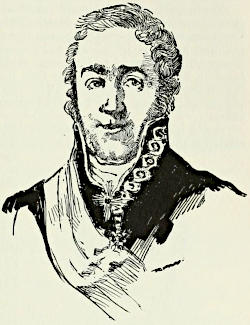
Calomarde
(Minister of Ferdinand VII)
[1826-1833 A.D.]
In spite of these formulas another spirit directed affairs. The council of state had to be purged of its most influential personages. Old adherents of the constitution and even of King Joseph surrounded the throne at times, because the king had no other sentiment than that of personal safety; he did not wish to give himself up completely to the party which was already proclaiming another name than his own. He had always had a horror of the constitution, but he did not ignore the fact that the exclamation of Vive l’inquisition! had been accompanied by another cry. Thus he saw himself compelled to crush both parties, to sacrifice without pity the authors of audacious attempts, no matter on which side they might be. Moreover he had good cause to treat with the new spirit because he had need of money for his administration and army, and to get it he had to revert to foreigners. It was declared by the government which succeeded him that from 1823 to the end of his reign the public debt increased 665,000,000 francs.
Ferdinand did not wish to constitute a party, to proclaim his principles, to cause his interests to dominate. He merely chose men reputed to be skilful and opposed them in his council to men who were necessary but dangerous. Spain lent itself to this oblique course because her passions had died out: the voluntary royalists who opposed the Negros had been punished. The majority of the episcopal body turned a deaf ear to cries for the re-establishment of the Inquisition. In 1827 the old hands “of the faith,” who had arisen in Catalonia against Ferdinand and his ministers, had been crushed with no hope of return. The same causes brought about the extinction of the liberal effervescence. Mina himself was obliged to escape by flight from the persecutions of populations which had once celebrated his exploits.
Ferdinand appeared equally indifferent or undecided in regard to the members of his family. On March 29th, 1830, when his young wife Maria Christina of Naples was pregnant, he issued a “pragmatic sanction” proclaiming as a law of the state a resolution of King Charles IV, made in accord with a demand of the cortes of 1789, abolishing the Salic law instituted in 1713 by Philip V, and thus re-established the right of women to inherit the throne of Spain; but he afterwards showed no predilection for the young princess Maria Isabella Louisa, who was born in July of the same year.
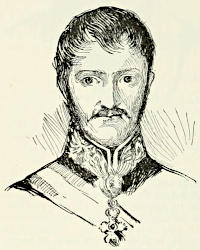
Don Carlos I
Again he assembled the most devoted partisans of his brother Don Carlos about his throne, and when an attack of the gout brought him to the edge of the tomb in September, 1832, he signed a decree revoking the new law of succession. Then, returned to life again, he placed the infante Don Carlos at a distance, drove away the ministers who had wrung the fatal signature from his feeble hand and denounced their odious manœuvres; and as though to protect himself against new obsessions he placed the government in the hands of the queen, his wife, until his health should be restored. He let her publish decrees of amnesty for political criminals, take measures to destroy the existence of the voluntary royalists, reduce the privileges of the council of Castile; then, for fear of seeing her advance too rapidly in the way of reforms, he had her announce in a manifesto of December that he did not intend to introduce the slightest innovation into the constitutional laws of the monarchy, nor to change anything that was established. On January 4th, 1833, he announced that, as his health was sufficiently recovered, he had reassumed the reins of government. The day before, so that they might receive full authenticity, the queen placed in the archives the act of the cortes of 1789 and the revolution of Charles IV in regard to the abolition of the Salic law. In spite of his antipathy towards innovators Ferdinand felt that it was necessary to constitute a political force around the cradle of his daughter. Men for whom the name of Don Carlos was a menace came together to defend the young princess. A decree of April 7th, 1833, convened the cortes at Madrid. The 3rd of June, the nobles, prelates, and delegates of the cities took an oath of allegiance to the princess of the Asturias, as heiress of the crown of Spain and the Indes. The 29th of September, 1833, Ferdinand died, leaving a heavy sceptre in the hands of his daughter.d
RISE OF CARLISM
[1833-1834 A.D.]
Though Ferdinand while alive had been accumulating legal acts in favour of direct descent, he had attached more and more importance to obtaining the acquiescence of his brother Don Carlos in his sovereign will. He had sent a royal order asking when he thought of recognising the already proclaimed heiress. Don Carlos, not to be behindhand, profited by this to take up a definite position as claimant in the eyes of the public. He wrote his brother a letter which he hastened to make public, in which these words were found:
You ask whether or not I intend recognising your daughter as princess of the Asturias? My conscience and honour will not permit this. My rights to the crown, if I survive you, or you leave no male posterity, are so legitimate that I need not enumerate them. These rights were given by God when he willed my birth, and he alone can take them away by granting you a son, an event that I desire perhaps even more than you. Moreover, I am defending the rights of all those who come after me. Thus I find myself obliged to send you the enclosed declaration, of which I send a formal copy to you and other sovereigns, to whom I hope you will communicate it.
Adieu, very dear brother of my heart. I am always yours, always yours lovingly, and you are ever present in the prayers of your most affectionate brother,
Carlos.
The declaration was thus worded:
Sire:
I, Carlos-Maria-Isidoro de Bourbon, infante of Spain, am thoroughly convinced of my legitimate rights to the Spanish throne in case of my surviving you, or your not leaving male issue. I say that my conscience and my honour will not permit me to swear to or recognise any other rights, and this I declare.
Your affectionate and faithful servant,
Don Carlos, Infante.
Ramalhao, April 29th, 1833.
In answer to this declaration Ferdinand wrote to his brother saying that, without dreaming of violating his conscience, he nevertheless must forbid his returning to Spain, “for very serious political reasons and in consideration of the country’s laws.” He could not, he continued, make the declarations to foreign kings, basing his refusal on the principle that foreign governments ought not to interfere in interior state affairs. The salutations used were always full of an affectionate tenderness that formed a curious contrast to the real purport of the letters.
Don Carlos submitted to the banishment imposed, but had no idea of leaving Portugal, so as soon as an order came to go to Italy, he busied himself with reasons for not doing anything of the kind, not openly refusing that obedience which he had always affected to owe his brother, but inventing a crowd of pretexts for not rendering it. The now published correspondence between the two brothers on this occasion shows, on the infante’s part, a series of successive inventions to excuse his stay in Portugal, and from the king a refutation of the vain pretexts advanced, and a constant endeavour to remove obstacles to departure. Ferdinand, at length, left off using a tone of fraternal love and spoke as an annoyed king, desiring his brother to say whether he intended to obey or not. The answer was proud and disdainful. Don Carlos said if he left Portugal, he would have the air of a fugitive who had committed some crime: that he declined to put himself in such a shameful position, and, if really guilty, demanded a trial according to the laws of the realm (July, 1833).
From this date Don Carlos led a party quite in opposition to his sovereign, although keeping up an appearance of not stirring up civil war before his brother’s death. He began to gather round him in his little court at Ramalhao, then at Mafra and Coimbra, all those who had refused their oath to Princess Isabella. Inflammatory pamphlets went thence in every direction to spread doubt in men’s minds as to the legality of Ferdinand’s testamentary arrangements. A few active men were already engaged in raising army corps. Baron Los Valles was sent into France and England to convince those two governments of the justness of the claim put forth by the Spanish infante.b
WAR OF THE CHRISTINOS AND CARLISTS (1833-1839 A.D.)
Scarcely had King Ferdinand VII closed his eyes, when the apostolic party in northern Spain, especially in Navarre and the Basque provinces, proclaimed Don Carlos, brother of the king, as King Charles V. In order successfully to oppose the Carlists, who fought for absolutism and priesthood, there was nothing for the regent, Maria Christina, to do but to throw herself into the arms of the liberal party. Thus the seven years’ war between Carlists and Christinos grew out of a fight for the throne into a civil war and a battle for principles. The Carlists had the upper hand to start with, owing to the ability of their general, Zumalacarregui, against whom the Christinos could place no equally matched leader. From Portugal, where Don Carlos was residing with his beloved nephew, Don Miguel, this general threatened the frontiers of Spain.
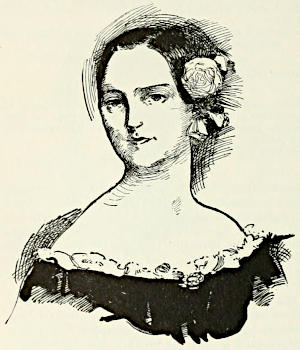
Queen Maria Christina
[1834-1855 A.D.]
Hence Christina turned to England and France, and the Quadruple Alliance of April 22nd, 1834, was concluded between these states and Spain and Portugal, the object of which was to maintain the constitutional throne of Isabella and of Maria da Gloria and to drive out the two pretendants, Carlos and Miguel. Still, in that same year, these two men, who enjoyed the favour of the eastern powers and of the pope to a high degree, were obliged to leave Portugal. Carlos went to England in June, on an English ship, but he escaped again in July, and, after an adventurous journey through France, appeared suddenly in Navarre to reanimate the courage of his followers by his royal presence. The war was carried on with passion and cruelty on both sides. After the death of Zumalacarregui, who lost his life on June 14th, 1835, at the siege of Bilbao, the Christinos, who exceeded in numbers, seemed to have the advantage. But they could accomplish little against the restless Cabrera, who had just received his first ecclesiastical orders, and had gone over into the camp of the pretender. He was a most able guerilla leader. The turning-point came first when the command of the Christino army was intrusted to Espartero. He conquered the Carlists in 1836 in a bloody battle at Luchana, hastened to the relief of the capital when the Carlists advanced to the vicinity of Madrid in 1837, and compelled Carlos to retreat.
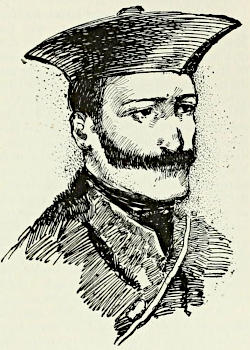
Thomaso Zumalcarregui
To these losses was added discord in the camp itself. The pretender, wholly lacking in competence and independence, was the tool of his camarilla,[131] who in the choice of a general paid more attention to a knowledge of the catechism than of the arts of war and displaced the most able leaders to put up their own creatures in their stead. The new general, Guergué, was beaten several times by Espartero in 1838, which gradually cooled the enthusiasm of the northern provinces. He was deposed and the chief command given to the crafty Maroto, who, as an enemy of the camarilla could have maintained himself against their continual attacks only by gaining great victories. Since he could not win these against the superior force of Espartero, he concluded the Treaty of Vergara with him on August 31st, 1839, according to which he went over to the Christinos with his army and obtained in return an amnesty and the confirmation of the freedom of Basque and Navarre. With this, the cause of Don Carlos was hopelessly lost. The latter went to France in September with many of his followers, and had to pass six years under police supervision in the city of Bourges. Not until 1845, after he had transferred all his pretensions to his eldest son, the count of Montemolin, did he receive permission to depart, whereupon he betook himself to Italy. He died at Trieste on March 10th, 1855. His followers continued to fight for some time longer in Catalonia under Cabrera. But they also were overpowered by Espartero, and in July, 1840, with a force of about eight thousand men, were obliged to flee to France, where they were kept under supervision. The civil war was now at an end, but the strife continued. Espartero, entitled duke of victory (Vittoria) was the most influential and the most popular personage in Spain, with whom everyone, even the queen-regent, had to reckon.
THE STORMY REGENCY OF CHRISTINA (1833-1841 A.D.)
[1833-1841 A.D.]
In the meanwhile the latter neither by her private life nor by her political conduct had been able to win the love and respect of the Spaniards. Her liberal attacks did not go very deep and as soon as the immediate necessity was past they gave place to the most opposite tendencies. At the spread of the Carlist rebellion in 1834, she had placed the once persecuted Martínez de la Rosa, known as a poet and writer, at the head of the ministry and had given the country a constitution [the estatuto real] which satisfied no one. The cortes convened again after a long interval and soon became divided into the two hostile factions of the moderates (moderados) and the progressists (progresistas). The ministries changed rapidly. The progressists demanded abolition of the monks’ orders and confiscation of their property, which was in part carried out. In single cities it came to bloody excesses; cloisters were destroyed, monks and nuns murdered, priests and Jesuits driven over the border. The continual wavering, the frequent dissolution of the cortes increased the discontent; the progressists in 1836 feared a reaction and wanted to make concessions. Revolts were organised in the larger cities, the constitution of 1812 was placed on the programme. The government responded by placing Madrid in a state of siege, by disbanding the national guard. Revolt broke out in the summer residence, La Granja, whither Christina had retreated. Soldiers of the guard forced their way into the palace and compelled her to adopt the constitution of 1812.
A constitutional assembly discussed a revision of the same, and thus the new constitution of 1837 came into being. Christina took oath to keep it, but hoped by watching over the election to bring the moderados into the cortes and the ministry. When she succeeded in accomplishing this in 1840, she issued a municipal law in accordance with which the election of municipal authorities was placed in the hands of the government. This caused a revolt in Madrid and other cities, and when Christina commissioned Espartero, who had just returned victoriously, to quell the uprisal in Madrid he refused to be made the tool of an unpopular policy. And yet he was the only man who could check the revolution which was threatening on all sides. Hence Christina was obliged to appoint Espartero as ministerial president on September 16th, 1840. He chose all progressist members for his cabinet, made a triumphal entry into Madrid on September 29th, and placed his programme before the queen-regent in Valencia on October 5th. In this he demanded repeal of the municipal law, dissolution of the cortes, and dismissal of the camarilla.
The regency had little attraction more for Christina under such conditions. Other influences were also at work. Shortly after the death of her husband, she had taken a handsome life-guardsman, called Muñoz, into her favour, had made him chamberlain, and had secretly married him. The union was soon proclaimed by a large number of children, but not until 1844 was there a public marriage, whereupon Muñoz was made duke of Rianzares and grandee of Spain. By this act she had thrown away her womanly respect and laid herself open to all sorts of attacks, so that she preferred to leave the country. On October 12th, she resigned her position as regent and travelled to France.
ESPARTERO REGENT (1841-1843 A.D.)
[1841-1843 A.D.]
The newly elected cortes, on May 8th, 1841, named Espartero regent of Spain and guardian of the queen Isabella and her sister the infanta Luisa Fernanda. Nor did he prove unworthy of this high position, seeking to establish order in all branches of the state administration and to preserve his respect before the clergy and the pope. Since he knew how energetically Christina, supported by Louis Philippe, was working against him with her influence and her money, he attached himself more to England, whereupon those who were envious of him, and his rivals, accused him of selling Spain’s commercial interests to England. The fact that he quelled a rebellion in Barcelona in 1842 by a bombardment, was charged against him as tyranny. New revolts broke out in the south in 1843; Colonel Prim hastened to Catalonia and placed himself at the head of the soldiers who had been won over through large expenditures of money by Christina’s agents. Espartero’s bitterest enemy, General Narvaez, landed in Valencia and entered Madrid with his troops. Espartero, against whom moderados and progressists had conspired together, found himself abandoned and set sail for England from Cadiz on July 26th, 1843. Not until 1848 was it safe for him to return.
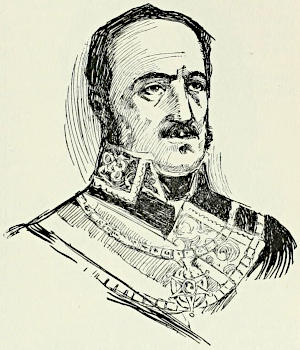
Espertero, Regent
THE PROFLIGATE QUEEN ISABELLA II (1843-1868 A.D.)
[1843-1851 A.D.]
In November, 1843, the thirteen-year-old Isabella was declared of age. She took over the reins of government, appointed Narvaez, who had been raised to be duke of Valencia, president of the ministry, and called back her mother. This opened the doors and gates to French influence, to the game of intrigue and reaction. The constitution of 1837 was changed in 1845 in favour of absolutism, the freedom of the press was limited, the national guard abolished, and the cortes even more than in France reduced to a nominal existence. In order to insure for his house a lasting influence in Spain and to obtain for it a reversion of the Spanish throne, Louis Philippe, acting with Christina, brought about a marriage on October 16th, 1846, between Isabella and her cousin Francis de Asis, and between the infanta Luisa and the duke of Montpensier, the youngest of his sons. (Louis Philippe had planned at first to marry Isabella also to one of his sons, the duke of Aumale, but he gave this up on account of the decided protest of Palmerston’s cabinet and chose instead for Isabella in Francis de Asis that person who, on account of his mental and bodily weakness, would stand least in the way of his son, Montpensier). This marriage which was conducted wholly in secret cost Louis Philippe the friendship of the English cabinet. The pleasure-loving Isabella, following in the footsteps of her mother, soon grew heartily tired of her Francis and enjoyed herself in July, 1847, at La Granja, with the handsome and agreeable progressist General Serrano and other officers, while Francis found himself condemned to a hermit’s life at the hunting castle of Pardo. The marriage was a very unfortunate one, and Christina, the evil genius of Spain, fled one day and came back the next.
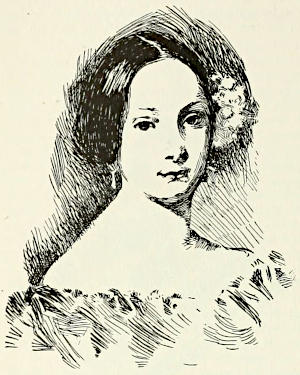
Queen Isabella II
Isabella kept more and more to the path of her father Ferdinand, and pursued an administrative policy which joined military despotism to clerical absolutism and in which confessors and soldiers played a rôle, and even guided the rudder of state. While such conduct repelled the liberal elements from her side the frivolity of her private life made her lose all claims to respect.[132] She even went so far that the legitimacy of all her children was doubted. No wonder that from time to time revolts broke out, which, as is customary in Spain, were incited and led by officers. The government saved itself by executions and deportations. The ministerial president Marshal Narvaez, who bore the title duke of Valencia, was always ready for such drastic measures. His successor was Gonzalez Bravo [or Brabo] Murillo, who soon had the whole army against him.e His cabinet was very significant and important, not only because of the question of economies, but also because of Bravo Murillo’s project to abolish or diminish the military preponderance which was not very beneficial to the country. The germs of discord remained, to be united with those displayed in other acts, such as the ostentatious reception of Narvaez in Paris by the Spanish representative, the duke de Sotomayor, who was replaced by the marquis de Valdegamas, and the ridiculous prohibition of the farce called the entierro de la sardina (the burial of the sardine) and the piñata ball. The burial of the sardine is part of the carnival festivities on Ash Wednesday. The piñata ball is a masked ball at the theatre—the piñata being a large earthenware jar full of sweets; the dancers are blindfolded, turned round, and have to try and break the jar with poles, after which there is a general scramble for the sweets. These sports were prohibited by the minister of government without consulting his colleagues, whom he thus compromised, occasioning resignations and annoyances, while the prestige of the new cabinet in the palace suffered somewhat from the ill-judged and useless measure of one of its members. In an unfriendly spirit towards the ministry, Napoleon showed marked honour to Narvaez and Sotomayor. General O’Donnell [who had won distinction in the Morocco wars of 1860 and become duke of Tetuan] showed himself somewhat disrespectful towards the minister of war because he had made several military appointments out of the order of seniority, the young officer of infantry wishing to put an end to this injustice.j
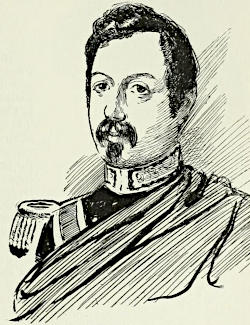
Marshal Narvaez
[1851-1868 A.D.]
Spain was, on the surface, a monarchy akin to that of France, Belgium, and England. Below the surface, as soon as the dynastic peril had subsided and the throne of the queen was somewhat consolidated, the old reactionary undercurrent set to work. A novel and powerful instrument of reaction—militarism—appeared on the scene and made Spain sadly famous. Its interference in politics and its pronunciamientos were fatal to discipline and, what was far worse, to the sense of respect for parliamentary legality which is the corner-stone of modern institutions. It must be said that Castilian militarism somewhat atoned for its interference in politics by using its extraordinary influence quite as often in the cause of liberty and of progress as in defence of reactionary cabinets and palace favourites. It will suffice to say that Marshal Espartero acted thus from 1836 to 1843 to crush the first Carlist risings, and to check the caprices of the regent Doña Christina, and then, in 1854-1856, again stepped in to check another reaction. Marshal O’Donnell was the champion of moderate liberalism from 1856 to 1866, which might have preserved the crown of Queen Isabella had she not always harboured preferences for retrograde statesmen and generals. Marshals Prim and Serrano, too, were in the van of the progressists and advanced liberals who would fain have served their queen, but went over to revolution and conspiracies at last in sheer disgust. Such names can well be set against those of the military champions of political reaction and religious intolerance—marshals Narvaez [who died in 1868], Cheste, Novaliches, and Calonje.k
[1868-1869 A.D.]
In July, 1868, a great military revolt was to break out. The minister caused the most important generals, among them Serrano and Dulce, to be deported to the Canary Isles, and even banished from Spain the queen’s brother-in-law, the duke of Montpensier, whose name seemed to serve as a watchword for the revolution. Excitement increased in the land. Isabella thought herself compelled to enter into closer relations than hitherto with her friend and ally, as she called Napoleon III, and arranged an interview with him for the 18th and 19th of September in the two frontier posts Biarritz and San Sebastian. Napoleon was accredited with the plan of recalling his troops from Rome and filling their places with Spanish soldiers in the event of his beginning his long-threatened war with Germany. Isabella, who had just been honoured by receiving the Golden Rose of the Faith and Virtue from the pope, was very much in favour of such a project.
THE REBELLION OF 1868 A.D.
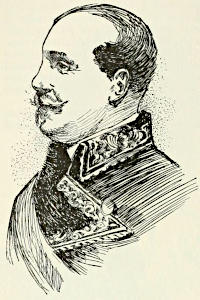
General Leopold O’Donnell
But at the very moment when the Franco-Spanish alliance was to have been concluded and their majesties were at their appointed posts, rebellion broke out in Cadiz. It was the 18th of September. The banished generals Serrano and Prim returned, the rear-admiral Topete joined them with the whole fleet, the few faithful troops were conquered by Serrano on September 28th, near Alcolea. All the larger cities, even Madrid, took sides with the revolution with the cry, “Down with the Bourbons! down with the Jesuits!” on the 29th; and so there was nothing left for Isabella but to leave San Sebastian the next day and to take refuge on French soil. She at once took up her residence at Pau whence she uttered a passionate but unavailing protest against her exile. When she realised that all hope of restoration, for the present, was gone, she went to Paris, where she died in 1902.
The direction of the state was intrusted to the leaders of the revolution. Marshal Serrano took the position of president of the ministry, Prim became minister of war, Topete of marine. The order of Jesuits and a number of cloisters were abolished, freedom of faith was proclaimed; in Barcelona and Madrid even Protestant services were held. The newly elected cortes, convened on February 18th, 1869, deliberated over a new constitution, declared in favour of a constitutional monarchy, and appointed Serrano regent, until a suitable candidate could be found. The political outlook, however, was not favourable for Spain. There existed a strong republican party, which threatened to oppose with arms the establishment of a new throne; the island of Cuba, that “pearl of the Antilles,” was in full revolt, ready to break loose from Spain and found an independent republic; and Carlism again raised its head.e
PIRALA ON THE “MILD ANARCHY” OF 1869 A.D.
[1869-1870 A.D.]
At the end of the year 1869, the state of the nation clearly showed that when parties pursue private rather than public aims the result can be no other than what then existed—that is, a monarchy without a monarch, a powerless regency, a constitution disregarded and infringed, an ill-directed and expiring camara, a dictatorship without a dictator, and an empty treasury and a retrograding revolution.
We do not lay the fault of this upon any of the men concerned in our revolution, and we do not think that history does so either, but we cannot cease to lament the lack of one of those men of genius who take the lead without imposing themselves. The situation had not improved at the beginning of the year 1870.
The cortes again resumed its labours. With praiseworthy frankness, Prim, as president of the council, said that they had reached a pitch of confusion in which, surrounded by thick clouds, they might come near to realising the fable of the two wolves who met on a dark night and devoured each other so that nothing was left but their tails.
Union facilitates the work of construction which is gradually perfected in every detail, but dissension entails the fate of the builders of the tower of Babel. A nation can show no sadder or more futile spectacle; and yet it is the history of all. Is mankind condemned ever to turn in this vicious circle and never to get free from it? It is impossible to think so, for in the midst of this continual conflict of interests and bastard ambitions the nineteenth century has achieved imperishable victories.
Nations conquer their sovereignty and of their own right make their laws, and struggle unceasingly to overcome ancient traditions, uproot absurd vices and tyrannical tendencies. Thus even as science pierces the mountains, explores the depths of the sea, discovers and explains the spots on the sun, and almost realises the aforetime foolish and chimerical ambition of the Titans; so politics, that science of modern societies and of free and civilised nations, will find the solution of the social problem bringing the rights of all men, the interests of all nations, and the good of all humanity into combined and harmonious action. A vast idea like a great discovery suffices to bring the whole world into close relationship. And like the electric current which flashes words and ideas from pole to pole, a grand political inspiration, social, human, fraternal, moral, just, and worthy, needs but to be hinted to triumph. Printing had but to be invented to extend over the whole world; steam came into immediate use, and Franklin needed but a lightning-conductor for Turgot to exclaim:
“Eripuet cœlo fulmen Sceptrumque tyrannis.”
And the lightning-conductor alone produced the cable which brings both worlds into constant communication, the thread which annihilates distances and transmits thoughts and events. Politics is indeed a science, and if nothing is impossible to science, shall anything be impossible to politics?
This work of social reconstruction advances slowly, all collecting materials and contributing their ideas to its perfectionment; the work will be completed; it is but a question of time, and what appears long in the life of the individual is very short in the life of nations. Liberty and civilisation being inseparably welded, where civilisation is least, liberty finds most obstacles, and the task must be more difficult and laborious.
In the meanwhile Spain was going through a troubled period, and it was said in the press and in the cortes that a heavy responsibility lay upon those who had taken part in a political movement the issue of which was so unfortunate, and cut off the country from the civilising progress of the century and the social importance to which it had so many claims; that the triumphant liberal spirit was suffocating for want of guidance, and could not succeed in laying definitive institutions upon a solid basis; that the perils surrounding the revolution were increasing; that all was unstable and that “a mild anarchy” reigned everywhere, as was said by the minister of government himself, who was yet so dilatory in framing fundamental laws.
There followed the famous session of March 19th, 1870, when the forced harmony exploded between unionists, progressists, and democrats, placing regency, government, and country in a terrible position. Thus it was published by a deputy of recognised ability, who had good reason to be well acquainted with the internal workings of the camara, that “it would be difficult to conceive worse confusion than that to which it was a prey. Without true unity in the ministry, without true unity in the majority, without unity even in the midst of the oppositions, every individual, whether minister or deputy, radical or conservative, republican or traditionalist, in the questions natural or incident to the debate expressed his own opinion without thought for the general interests of any party; the result of which was that every one of the three hundred representatives who had their seat upon the benches of the congress spoke a different language, and if such a state of moral anarchy continued, the assembly would before long be converted into a regular tower of Babel.”l
ESTIMATE BY CHERBULIEZ OF GENERAL PRIM
There are in every country men who accomplish their ends by romantic adventures, and this is more common in Spain than anywhere else. There it is an ancestral or fictitious adventurer, who has really no other god but his own interests, but succeeds by his audacities and a kind of native generosity in giving an air of grandeur to his exploits, a varnish of glory and poetry to his cupidity. So the favourite Spanish hero, the famous Cid Campeador, appears to us when criticism has rolled away the luminous clouds with which pure legend has surrounded him. The Rodrigo whom Corneille celebrated was only the vision of a poet; the true Cid of history was a man of prey, not troubled with scruples, ready to espouse all causes, bearing into every camp the restlessness of his moods and courage, fighting alternately for or against his prince, serving Christ or Mohammed, and, if one can believe the Arabic chroniclers, preferring a bushel of gold to a smile from Ximena. His mighty sword thrusts, his haughty bearing, his natural grandiloquence, redeemed everything; he had received from heaven the art of persuasive speech, and posterity remembers words more than intentions. The romancero relates that, being in a hurry to set out on an expedition, and having need of money, he borrowed a very large sum from a Jew, giving him as guarantee a coffer full of jewels, which coffer being opened after his departure, was found to contain only sand. On his return, the Jew reproached him with deception. “Yes, it was sand,” he answered loftily, “but this sand contained the gold of my given word.” The idea was good, albeit a trifle extravagant.
It is not with any evil intention to the memory of General Prim, to suggest that he also was a hero with too easy a conscience. Is one bound to have more convictions, more principles than the Cid? “Do you know,” said Castelarm when orator of the opposition, “who is General Prim’s god? It is Chance. Would you know his religion? It is Fatalism. And his ideal? The dream of always keeping power in his own hands. To that everything is brought to bear and to that everything is sacrificed. Institutions matter nothing to him; he bends them to his convenience. Laws count even less for him. They are mere spider webs, to be brushed aside by the swords of his captain-generals. Parties are as nothing, he dissolves them. Engagements have never hampered him, for he forgets them. The most inconceivable alliances are not repugnant, provided he and his are advantaged thereby.”
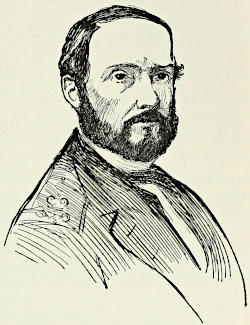
General Prim
But it is just to add that General Prim, when he came into power, astonished his enemies as much as his friends by the continued wisdom of his conduct. The most redoubtable trial of an adventurer is success. His ideas must grow with his fortune; having gained the coveted rank, he must break with his past, his habits and memories, so as to transform himself into a statesman. Only those who have good stuff in them lend themselves to such changes, and Don Juan Prim soon proved that the Aranjuez conspirator possessed the qualities of a politician, a quick sense of justice, a power of realising situations, skilful management of men and interests, and tact sufficient to use his authority without doing anything irregular. He could use strategy in councils, employing a sober yet nervous eloquence which went straight to the point, and possessed above the art of speaking the more useful one of being silent. A Portuguese has remarked that this last talent, strongly admired among a talkative people, made a man resemble a Gothic cathedral, and gave him the prestige of obscurity and mystery.