Book 2 — CHAPTER V. THE NINETEENTH CENTURY (continued 2)
Reading edition
THE HISTORY OF TORTURE
If the above document gives a foreshadowing of the rigours of the Inquisition towards those whose only error was a temporary wavering of opinion, what can be expected as the fate of those who persisted in their error, or denied it in spite of witnesses?—surely some distinguished form of punishment. Death was not enough, for thus the heretic instantly escaped the clutches of the disciplinarians. Torture was the resource. Before taking up this blackest subject on the page of human history, it is desirable to trace briefly its evolution, for torture was by no means the invention or monopoly of the Inquisition, though it has come to be thought so in the popular mind.
It is only justice to the church and to the zealots of that time to emphasise the fact that when the inquisitors sought a tool for special punishment, they found it ready at hand, made familiar and natural by the civil law of the day. Furthermore torture was a venerable institution.
The Greeks used torture for cross-examining slaves and at times nonresidents and even free citizens; the Romans under the republic practised it on slaves, and under the empire on citizens; the man accused of treason was always liable to it, as well as those whose testimony was open to the charge of confusion or inconsistency. Even in Cicero’s time there was a grim machinery for the purpose. Torture in England though not legal was practised, as it was on the continent, and in Scotland where it had the best civil sanction. Even in the United States there is one instance of torture, but that was during the Salem witchcraft insanity, though, like the inquisitorial processes, it was conducted by the church and civil government, and like so many of the inquisitorial punishments was due to an accusation of sorcery. The belief in witchcraft, now obsolete among even the common people, was once supported by a papal bull and by Sprenger’sl tremendous work, called The Hammer of Witches, which Henry C. Lean calls “the most portentous monument of superstition which the world has produced.”
The civil powers had then used torture from time immemorial. The people were as used to it in that day as we of to-day are to certain torments of animals cooked alive or otherwise worried to death. The crime of treason was specifically devoted to torture. As heresy was in the days of temporal church power distinctly a crime of treason, the secular authorities were ordered to punish it. In fact the church took the stand that it was simply hunting for justice, and when it found the accused innocent, it technically “intervened” in his behalf and “stayed the arm of the law.”[191]
But while using these facts to prevent us from thinking of the inquisitors as men of diabolical invention unlike their kind or their time in manner of thought or action, and while giving these facts their due weight in palliation of the personal offences of the inquisitors against fundamental principles of justice and mercy, we must not forget that, though the church took the idea of torture from the civil law and compelled the civil officials to administer it, yet the church enlarged the methods of torment and the causes for its use; the church forced upon the law and upon the monarchs many extremes of cruelty to which they were reluctant and against which they often mutinied.
And finally, seeing that the best men of the time were supposed to enter the church, and that the church appointed as inquisitors only its most exemplary members,[192] the defence of the Inquisition by some of its apologists on the ground of its origin in the customs of the period, really amounts to the astounding implication that the best men of the church were only a little worse than the average of their time.
It is stupefying to reflect on the character of the torments which crowds of people once watched for hours with joy, and which the supposedly best and gentlest spirits, the church fathers, inflicted day after day with all the fascination of ingenuity put to its utmost test. Such torments we of to-day can neither approve nor permit, and can hardly read of without nausea. None the less, lest we forget the horrors to which the doctrine of religious intolerance can drive mankind, and lest we lose the lesson of all history that no excess of punishment ever yet stopped the human hunger for liberty of thought and action, it will be well to place here a few of the more authentic instances of inquisitorial outrage.
We may well begin with the description from contemporaries, such as the history of Gonsalvius Montanuso or Gonzalez de Montés, a Spanish Protestant, who narrowly escaped death, whose friend was martyred, and who published a book on the Inquisition at Heidelberg in 1597. He is quoted with others in the history of Limborch,b which was published in 1692, and based almost solely on the church’s own accounts.a
A Contemporary Account of the Preliminaries to Torture
The place of torture in the Spanish Inquisition is generally an underground and very dark room, to which one enters through several doors. There is a tribunal erected in it, where the inquisitor, inspector, and secretary sit. When the candles are lighted, and the person to be tortured is brought in, the executioner, who was waiting for the other, makes an astonishing and dreadful appearance. He is covered all over with a black linen garment down to his feet, and tied close to his body. His head and face are all hid with a long black cowl, only two little holes being left in it for him to see through. All this is intended to strike the miserable wretch with greater terror in mind and body, when he sees himself going to be tortured by the hands of one who thus looks like the very devil.o
Whilst the officers are getting things ready for the torture, the bishop and inquisitor by themselves, and other good men zealous for the faith, endeavour to persuade the person to be tortured freely to confess the truth, and if he will not, they order the officers to strip him, who do it in an instant. Clergymen however must not be tortured by a lay officer or torturer unless they cannot find any clergymen who know how to do it, or are willing, because it would be in vain for the judges to order any clergyman or monk to the torture, if there was nobody to inflict it; and therefore in such a case it is usual to torture them by lay officers.
Whilst the person to be tortured is stripping, he is persuaded to confess the truth. If he refuses it, he is taken aside by certain good men, and urged to confess, and told by them that if he confesses, he will not be put to death, but only be made to swear that he will not return to the heresy he hath abjured. The inquisitor and bishop promise the same, unless the person be a relapse.
If he is persuaded neither by threatenings nor promises to confess his crime, he is tortured either more lightly or grievously, according as his crime requires, and frequently interrogated during the torture, upon those articles for which he is put to it, beginning with the lesser ones, because they think he will sooner confess the lesser matters than the greater. According to the directions of Royas,u one of the Spanish inquisitors: “The criminals are with great care and diligence to be admonished by the inquisitors, and especially when they are under torture, that they should not by any means bear false witness against themselves or others, through fear of punishment or torments, but speak the truth only. Nor may the inquisitors promise pardon or forgiveness of the offence, to compel the criminals to confess crimes which they have not committed, out of their great zeal to inquire out the truth. And such a false confession the accused person may safely revoke.”
The inquisitors themselves must interrogate the criminals during their torture, nor can they commit this business to others, unless they are engaged in other important affairs, in which case they may depute certain good and skilful men for the purpose. Although in other nations criminals are publicly tortured, yet in Spain it is forbidden by the royal law for any to be present whilst they are torturing, besides the judges, secretaries, and torturers. The inquisitors must also choose proper torturers, born of ancient Christians, who must be bound by oath by no means to discover their secrets, nor to report anything that is said. The judges also usually protest that if the criminal should happen to die under his torture, or by reason of it, or should suffer the loss of any of his limbs, it is not to be imputed to them, but to the criminal himself, who will not plainly confess the truth before he is tortured. A heretic may not only be interrogated concerning himself, but in general also concerning his companions and accomplices in his crime, his teachers and his disciples, for he ought to discover them, though he be not interrogated; but when he is interrogated concerning them, he is much more obliged to discover them than his accomplices in any other the most grievous crimes.
A person also suspected of heresy, and fully convicted, may be tortured upon another account, i.e., to discover his companions and accomplices in the crime. This must be done when he hesitates, or it is half fully proved at least that he was actually present with them, or he hath such companions and accomplices in his crime; for in this case he is not tortured as a criminal, but as a witness. But he who makes full confession of himself is not tortured upon a different account; whereas if he be a negative, he may be tortured upon another account, to discover his accomplices and other heretics, though he be full convicted himself, and it be half fully proved that he hath such accomplices. The reason of the difference in these cases is this, because he who confesses against himself would certainly much rather confess against other heretics if he knew them. But it is otherwise when the criminal is a negative.
Whilst these things are doing, the notary writes everything down in the process, as what tortures were inflicted, concerning what matters the prisoner was interrogated, and what he answered. If by these tortures they cannot draw from him a confession, they show him other kind of tortures and tell him he must undergo all of them, unless he confesses the truth. If neither by this means they can extort the truth, they may, to terrify him and engage him to confess, assign the second or third day to continue, not to repeat, the torture, till he hath undergone all those kinds of them to which he is condemned.
The degrees of tortures formerly used were five, which were inflicted in their turn, and are described by Julius Clarusv [member of the council to Philip II of Spain]. “Know therefore,” says he, “that there are five degrees of torture, viz., first, the being threatened to be tortured; secondly, being carried to the place of torture; thirdly, by stripping and binding; fourthly, the being hoisted upon the rack; fifthly, squassation.”
The stripping is performed without any regard to humanity or honour, not only to men, but to women and virgins, though the most virtuous and chaste, of whom they have sometimes many in their prison. For they cause them to be stripped, even to their very shifts, which they afterwards take off, forgive the expression, and then put on them straight linen drawers, and then make their arms naked quite up to their shoulders.
As to squassation, it is thus performed: the prisoner hath his hands bound behind his back, and weights tied to his feet, and then he is drawn up on high till his head reaches the very pulley. He is kept hanging in this manner for some time, that by the greatness of the weight hanging at his feet all his joints and limbs may be dreadfully stretched, and on a sudden he is let down with a jerk, by the slacking the rope, but kept from coming quite to the ground, by which terrible shake his arms and legs are all disjointed, whereby he is put to the most exquisite pain; the shock which he receives by the sudden stop of the fall, and the weight at his feet stretching his whole body more intensely and cruelly.b
The inquisitors sometimes shamefully and rashly proceed to the torture of innocent persons, as will evidently appear by one instance, not to mention more, given us by Gonsalvius.o “They apprehended in the Inquisition at Seville a noble lady, Joan Bohorquia, the wife of Francis Varquius, a very eminent man, and lord of Higuera, and daughter of Peter Garsia Xeresius, a wealthy citizen of Seville. The occasion of her imprisonment was that her sister, Mary Bohorquia, a young lady of eminent piety, who was afterwards burned for her pious confession, had declared in her torture that she had several times conversed with her sister concerning her own doctrine. When she was first imprisoned, she was about six months gone with child, upon which account she was not so straightly confined, nor used with that cruelty which the other prisoners were treated with, out of regard to the infant she carried in her.
“Eight days after her delivery, they took the child from her, and on the fifteenth shut her close up, and made her undergo the fate of the other prisoners, and began to manage her with their usual arts and rigour. In so dreadful a calamity she had only this comfort, that a certain pious young woman, who was afterwards burned for her religion by the inquisitors, was allowed her for her companion. This young creature was, on a certain day, carried out to her torture, and being returned from it into her jail, she was so shaken, and had all her limbs so miserably disjointed, that when she laid upon her bed of rushes it rather increased her misery than gave her rest, so that she could not turn herself without the most excessive pain. In this condition, as Bohorquia had it not in her power to show her any, or but very little outward kindness, she endeavoured to comfort her mind with great tenderness. The girl had scarce begun to recover from her torture, when Bohorquia was carried out to the same exercise, and was tortured with such diabolical cruelty upon the rack, that the rope pierced and cut into the very bones in several places, and in this manner she was brought back to prison, just ready to expire, the blood immediately running out of her mouth in great plenty. Undoubtedly they had burst her bowels, insomuch that the eighth day after her torture she died.
“And when, after all, they could not procure sufficient evidence to condemn her, though sought after and procured by all their inquisitorial arts, yet as the accused person was born in that place, where they were obliged to give some account of the affair to the people, and indeed could not by any means dissemble it, in the first act of triumph appointed her death, they commanded her sentence to be pronounced in these words: ‘Because this lady died in prison (without doubt suppressing the causes of it), and was found to be innocent upon inspecting and diligently examining her cause, therefore the holy tribunal pronounces her free from all charges brought against her by the fiscal, and absolving her from any further process, doth restore her both as to her innocence and reputation, and commands all her effects, which had been confiscated, to be restored to those to whom they of right belonged,’ etc. And thus, after they had murdered her by torture with savage cruelty, they pronounced her innocent!”o
LIMBORCH’S ACCOUNT OF THE FATE OF A JEW
The method of torturing and the degree of tortures used in the Spanish Inquisition will be well understood from the history of Isaac Orobio, a Jew, and doctor of physic, who was accused to the Inquisition as a Jew by a certain Moor, his servant, who had by his order before this been whipped for thieving; and four years after this he was again accused by a certain enemy of his for another fact, which would have proved him a Jew. But Orobio obstinately denied that he was one. I will here give the account of his torture, as I had it from his own mouth. After three whole years which he had been in jail, and several examinations, and the discovery of the crimes to him of which he was accused, in order to his confession and his constant denial of them, he was at length carried out of his jail, and through several turnings brought to the place of torture. This was towards the evening.
It was a large underground room, arched, and the walls covered with black hangings. The candlesticks were fastened to the wall, and the whole room enlightened with candles placed in them. At one end of it there was an enclosed place like a closet, where the inquisitor and notary sat at a table, so that the place seemed to him as the very mansion of death, everything appearing so terrible and awful. Here the inquisitor again admonished him to confess the truth before his torments began.
When he answered he had told the truth, the inquisitor gravely protested that, since he was so obstinate as to suffer the torture, the Holy Office would be innocent, if he should shed his blood, or even expire in his torments. When he had said this, he put a linen garment over his body, and drew it so very close on each side, as almost squeezed him to death. When he was almost dying, they slackened at once the sides of the garment, and after he began to breathe again, the sudden alteration put him to the most grievous anguish and pain. When he had overcome this torture, the same admonition was repeated, that he would confess the truth in order to prevent further torment.
And as he persisted in his denial, they tied his thumbs so very tightly with small cords as made the extremities of them greatly swell, and caused the blood to spurt out from under his nails. After this he was placed with his back against a wall and fixed upon a little bench. Into the wall were fastened little iron pulleys, through which there were ropes drawn, and tied round his body in several places, and especially his arms and legs. The executioner drawing these ropes with great violence, fastened his body with them to the wall so that his hands and feet, and especially his fingers and toes being bound so straightly with them, put him to the most exquisite pain, and seemed to him just as though he had been dissolving in flames. In the midst of these torments the torturer, of a sudden, drew the bench from under him, so that the miserable wretch hung by the cords without anything to support him, and by the weight of his body drew the knots yet much closer.
After this a new kind of torture succeeded. There was an instrument like a small ladder, made of two upright pieces of wood and five cross ones sharpened before. This the torturer placed over against him, and by a certain proper motion struck it with great violence against both his shins, so that he received upon each of them at once five violent strokes, which put him to such intolerable anguish that he fainted away. After he came to himself, they inflicted on him the last torture.
The torturer tied ropes about Orobio’s wrists and then put those ropes about his own back, which was covered with leather, to prevent his hurting himself. Then falling backwards and putting his feet up against the wall, he drew them with all his might till they cut through Orobio’s flesh, even to the very bones; and this torture was repeated thrice, the ropes being tied about his arms about the distance of two fingers’ breadth from the former wound, and drawn with the same violence.
But it happened that, as the ropes were drawing the second time, they slid into the first wound, which caused so great an effusion of blood that he seemed to be dying. Upon this the physician and surgeon, who are always ready, were sent for out of a neighbouring apartment to ask their advice whether the torture could be continued without danger of death, lest the ecclesiastical judges should be guilty of an irregularity if the criminal should die in his torments.
They, who were far from being enemies to Orobio, answered that he had strength enough to endure the rest of the torture, and hereby preserved him from having the tortures he had already endured repeated on him, because his sentence was that he should suffer them all at one time, one after another. So that if at any time they are forced to leave off through fear of death, all the tortures, even those already suffered, must be successively inflicted to satisfy the sentence. Upon this the torture was repeated the third time, and then it ended. After this he was bound up in his own clothes and carried back to his prison, and was scarce healed of his wounds in seventy days. And, inasmuch as he made no confession under his torture, he was condemned, not as one convicted, but suspected of Judaism, to wear for two whole years the infamous habit called sambenito, and it was further decreed that after that term he should suffer perpetual banishment from the kingdom of Seville.
OTHER FORMS OF TORTURE
Gonsalviuso tells us of another kind of torture. There is a wooden bench, which they call “the wooden horse,” made hollow like a trough, so as to contain a man lying on his back at full length, about the middle of which there is a round bar laid across, upon which the back of the person is placed, so that he lies upon the bar instead of being let into the bottom of the trough, with his feet much higher than his head. As he is lying in this posture, his arms, thighs, and shins are tied round with small cords or strings, which being drawn with screws at proper distance from each other, cut into the very bones, so as to be no longer discerned.
The Tormento di Toca
Besides this, the torturer throws over his mouth and nostrils a thin cloth, so that he is scarce able to breathe through them, and in the meanwhile a small stream of water like a thread, not drop by drop, falls from on high upon the mouth of the person lying in this miserable condition and so easily sinks down the thin cloth to the bottom of his throat, so that there is no possibility of breathing, his mouth being stopped with water and his nostrils with the cloth, so that the poor wretch is in the same agony as persons ready to die, and breathing out their last. When this cloth is drawn out of his throat, as it often is, that he may answer to the questions, it is all wet with water and blood, and is like pulling his bowels through his mouth.
The Chafing-dish; The Water-cure
There is also another kind of torture peculiar to this tribunal, which they call the fire. They order a large iron chafing-dish full of lighted charcoal to be brought in and held close to the soles of the tortured person’s feet, greased over with lard, so that the heat of the fire may more quickly pierce through them.
This is inquisition by torture, when there is only half full proof of their crime. However, at other times torments are sometimes inflicted upon persons condemned to death, as a punishment preceding that of death. Of this we have a remarkable instance in William Lithgow,w an Englishman, who, as he tells us in his travels, was taken up as a spy in Malaga, and was exposed to the most cruel torments upon the Wooden Horse. But when nothing could be extorted from him, he was delivered to the Inquisition as an heretic. He was condemned, in the beginning of Lent, to suffer the night following eleven most cruel torments, and after Easter to be carried privately to Grenada, there to be buried at midnight, and his ashes to be scattered into the air; when night came on his fetters were taken off, then he was stripped naked, put upon his knees, and his head lifted up by force; after which, opening his mouth with iron instruments, they filled his belly with water till it came out of his jaws. Then they tied a rope hard about his neck, and in this condition rolled him seven times the whole length of the room, till he almost quite strangled. After this they tied a small cord about both his great toes, and hung him up thereby with his head down, letting him remain in this condition till all the water discharged itself out of his mouth, so that he was laid on the ground as just dead, and had his irons put on him again. But beyond all expectation, and by a very singular accident, he was delivered out of jail, escaped death, and fortunately sailed home to England.b
Details of another revolting case are quoted by Limborch from an official contemporary document, which may best be reproduced here in its original form.a
THE PROCEEDINGS AGAINST AN ENGLISHWOMAN
Elizabeth Vasconcellos, now in the city of Lisbon, doth, on the 10th day of December, anno 1706, in the presence of John Milner, Esq., her majesty’s consul-general of Portugal, and Joseph Willcocks, minister of the English factory at Lisbon, declare and testify:
That she was born at Arlington, in the county of Devon, and a daughter of John Chester, Esq., bred up in the church of England; and in the eleventh year of her age her uncle, David Morgan, of Cork, intending to go and settle in Jamaica as a physician, by her father’s consent, he having several children, took her with him to provide for her.
In 1685, they went in an English ship, and near the island they were attacked by two Turkish ships; in the fight her uncle was killed, but the ship got clear into Madeira, and she, though left destitute, was entertained by Mr. Bedford, a merchant, with whom, and other English, she lived as a servant till 1696. In that year she was married by the chaplain of an English man-of-war to Cordoza de Vasconcellos, a physician of that island, and lived with him eight years, and never in the least conformed to the Romish church.
In 1704, her husband being gone on a voyage to Brazil, she fell dangerously ill, and, being light-headed, a priest gave her the sacrament, as she was told afterwards, for she remembered nothing of it. It pleased God she recovered, and then they told her she had changed her religion, and must conform to the Romish church, which she denied and refused to conform; and thereupon, by the bishop of that island, she was imprisoned nine months, and then sent prisoner to the Inquisition at Lisbon, where she arrived the 19th of December, 1705. The secretary of the house took her effects, in all above £500; she was then sworn, that that was all she was worth, and then put into a straight dark room, about five feet square, and there kept nine months and fifteen days.
That the first nine days she had only bread and water, and a wet straw bed to lie on. On the ninth day, being examined, she owned herself a Protestant, and would so continue; she was told she had conformed to the Romish church, and must persist in it or burn, she was then remanded to her room; and after a month’s time brought out again, and persisting in her answer as to her religion, they bound her hands behind her, stripped her back naked, and lashed her with a whip of knotted cords a considerable time, and told her afterwards that she must kneel down to the court, and give thanks for their merciful usage of her, which she positively refused to do.
After fifteen days she was again brought forth and examined, and a crucifix being set before her, she was commanded to bow down to it and worship it, which she refusing to do, they told her that she must expect to be condemned to the flames, and be burned with the Jews, at the next auto da fé, which was nigh at hand. Upon this she was remanded to her prison again for thirty days, and being then brought out, a red hot iron was got ready, and brought to her in a chafing-dish of burning coals, and her breast being laid open, the executioner, with one end of the red hot iron, which was about the bigness of a large seal, burned her to the bone in three several places, on the right side, one hard by the other, and then sent her to her prison, without any plaster, or other application, to heal the sores, which were very painful to her.
A month after this she had another severe whipping, as before; and in the beginning of August she was brought before the table, a great number of inquisitors being present, and was questioned, whether she would profess the Romish religion or burn. She replied, she had always been a Protestant, and was a subject of the queen of England, who was able to protect her, and she doubted not would do it, were her condition known to the English residing in Lisbon; but as she knew nothing of that, her resolution was to continue a Protestant, though she were to burn for it. To this they answered that her being the queen of England’s subject signified nothing in the dominions of the king of Portugal; that the English residing in Lisbon were heretics, and would certainly be damned; and that it was the mercy of that tribunal to endeavour to rescue her out of the flames of hell, but if her resolution were to burn rather than profess the Romish religion, they would give her a trial of it beforehand.
Accordingly the officers were ordered to seat her in a fixed chair, and to bind her arms and her legs, that she could make no resistance, nor motion, and the physician being placed by her, to direct the court how far they might torture her without hazard of life, her left foot was made bare, and an iron slipper, red hot, being immediately brought in, her foot was fastened into it, which continued on burning her to the bone, till such time as by extremity of pain she fainted away, and the physician declaring her life was in danger, they took it off, and ordered her again to her prison.
On the 19th of August she was again brought out, and whipped after a cruel manner, and her back was all over torn, and being threatened with more and greater tortures, and, on the other hand, being promised to be set at liberty if she would subscribe such a paper as they should give her, though she could have undergone death, yet not being able to endure a life of so much misery, she consented to subscribe, as they would have her, and accordingly, as she was directed wrote at the bottom of a large paper, which contained she knew not what; after which they advised her to avoid the company of all English heretics, and not restoring to her anything of all the plate, goods, or money she brought in with her, and engaging her by oath to keep secret all that had been done to her, turned her out of doors, destitute of all relief, but what she received from the help and compassion of charitable Christians.
The above said Elizabeth Vasconcellos did solemnly affirm and declare the above written deposition to be true, the day and year above written.
John Milner, Joseph Willcocks.
Lisbon, January 8th, 1707, N.S.
(A copy examined from the original, by J. Blisse.)b
INQUISITORIAL DOCUMENTS
That the above affidavit is not a mere party document is only too plainly proved by the very manual of procedure, the Cartilla of the Inquisition at Seville, which W. H. Ruley has translated. It was meant for the guidance of all the Spanish inquisitors, and its business-like calm is not its least horrible feature, as is this insistence upon a full report of the torture and its results:a
How the Record was Kept
“If the criminal is under age, the guardian must be present at pronouncing sentence, in order that he may appeal if he wishes; but he must not be present at the torture.
“All that the criminal says has to be set down, and the questions that were put to him, and his answers, without omitting anything, and how they ordered him to be stripped, and his arms to be bound, and the rounds of cord that are put on him, and how they ordered him to be placed on a rack, and to bind his legs, head, and arms, and how he was bound, and how they ordered the garrotes to be put on, and how they were put on, and how compressed, declaring if it was on leg, thigh, or shin, or arms, etc., and what was said to him at each of these operations.
“If the torture is of pulley, it must be entered how the irons were put; and the weight or weights, and how he was hoisted, and how many times, and how long he was up each time. If it is of rack, it shall be said how the toca[193] was put on him, and how many pitchers of water were thrown over him, and how much each contained.”y
The Proper Form of Torture for Women
Even more ghastly is the blank form for convenience in recording the various steps. The following from the same manual, as translated by Rule,y corroborates the testimony of Elizabeth Vasconcellos quoted above, inasmuch as it prescribes the gentler forms of discipline to be used when the errant one was a woman. There is something peculiarly terrible in the very omission of a special name and the consequent thought of the number of wretches whose vain words and torments were thus recorded.a
“She was told to tell the truth, or orders would be given to strip her. She said, etc. She was commanded to be stripped naked.
“She was told to tell the truth, or orders would be given to cut off her hair. She said, etc.
“Orders were given to cut off her hair; and when it was taken off, she was examined by the doctor and surgeon, who said there was not any objection to her being put to the torture.
“She was told to tell the truth, or she would be commanded to mount the rack. She said, etc.
“She was commanded to mount, and she said, etc.
“She was told to tell the truth, or her body should be bound. She said, etc. She was ordered to be bound.
“She was told to tell the truth, or, if not, they would order her right foot to be made fast for the trampazo.[194] She said, etc. They commanded it to be made fast.
“She was told to tell the truth, or they would command her left foot to be made fast for the trampazo. She said, etc. They commanded it to be made fast. She said, etc. It was ordered to be done.
“She was told to tell the truth, or they would order the binding of the right arm to be stretched. She said, etc. It was commanded to be done. And the same with the left arm. It was ordered to be executed.
“She was told to tell the truth, or they would order the fleshy part of her right arm to be made fast for the garrote. She said, etc. It was ordered to be made fast.
“And by the said lord inquisitor it was repeated to her many times that she should tell the truth, and not let herself be brought into so great torment; and the physician and surgeon were called in, who said, etc. And the criminal, etc. And orders were given to make it fast.
“She was told to tell the truth, or they would order the first turn of mancuerda. She said, etc. It was commanded to be done.
“She was told to tell the truth, or they would command the garrote to be applied again to the right arm. She said, etc. It was ordered to be done.
“She was told to tell the truth, or they would order the second turn of mancuerda. She said, etc. It was commanded to be done.
“She was told to tell the truth, or they would order the garrote to be applied again to the left arm. She said, etc. It was ordered to be done.
“She was told to tell the truth, or they would order the third turn of mancuerda. She said, etc. It was commanded to be done.
“She was told to tell the truth, or they would order the trampazo to be laid on the right foot. She said, etc. It was commanded to be done.
“For women you do not go beyond this.”y
LATER HISTORY OF THE INQUISITION IN SPAIN
It would be gratuitously harrowing to multiply such instances of human misery, and we may return to the chronicle of the progress of the Inquisition, leading up to its culmination in Spain and Portugal, instances of whose severity have already been quoted. It is a pitiful chronicle, and one that the humanitarian might well wish to pass over in silence; but one which the historian cannot altogether ignore.a
The notion of heresy was enlarged so as to comprehend not only the slightest deviation from the creed of the church, but also usury, sorcery, contempt of the cross and clergy, dealings with Jews, etc.
The people in many places rose up against the inquisitors, as in Albi, and Narbonne (1234), and Toulouse; and in France, where the Inquisition had first been put in force, it was first abolished.[195] The Jesuits sought to restore the Inquisition in Bavaria (1599), and during the Thirty Years’ War found an occasional victim; but Maria Theresa abolished it in her kingdom, and it soon afterwards disappeared in Germany. It had no hold in England, Sweden, Norway, or Denmark; but in Spain, Portugal, and the Netherlands it enjoyed a luxuriant growth.z
The tribunal, after having been successively adopted in Italy and Germany, was introduced into Aragon, where, in 1242, additional provisions were framed by the Council of Tarragona, on the basis of those of 1233, which may properly be considered as the primitive instructions of the Holy Office in Spain.
This “ancient” Inquisition, as it is termed, bore the same odious peculiarities in its leading features as the modern; the same impenetrable secrecy in its proceedings, the same insidious modes of accusation, a similar use of torture, and similar penalties for the offender. A sort of manual, drawn up by Eymerich,p an Aragonese inquisitor of the fourteenth century, for the instruction of the judges of the Holy Office, prescribes all those ambiguous forms of interrogation by which the unwary and perhaps innocent victim might be circumvented. The arm of persecution, however, fell with sufficient heaviness, especially during the thirteenth and fourteenth centuries, on the unfortunate Albigenses, who, from the proximity and political relations of Aragon and Provence, had become numerous in the former kingdom. The persecution appears, however, to have been chiefly confined to this unfortunate sect, and there is no evidence that the Holy Office, notwithstanding papal briefs to that effect, was fully organised in Castile before the reign of Isabella. This is perhaps imputable to the paucity of heretics in that kingdom. It cannot, at any rate, be charged to any lukewarmness in its sovereigns; since they, from the time of St. Ferdinand, who heaped the fagots on the blazing pile with his own hands, down to that of John II, Isabella’s father, who hunted the unhappy heretics of Biscay like so many wild beasts among the mountains, had ever evinced a lively zeal for the orthodox faith.
By the middle of the fifteenth century, the Albigensian heresy had been nearly extirpated by the Inquisition of Aragon; so that this infernal engine might have been suffered to sleep undisturbed from want of sufficient fuel to keep it in motion, when new and ample materials were discovered in the unfortunate race of Israel, on whom the sins of their fathers have been so unsparingly visited by every nation in Christendom among whom they have sojourned, almost to the present century.
Under the Visigothic empire the Jews multiplied exceedingly in Spain, and were permitted to acquire considerable power and wealth. But no sooner had their Arian masters embraced the orthodox faith than they began to testify their zeal by pouring on the Jews the most pitiless storm of persecution. One of their laws alone condemned the whole race to slavery; and Montesquieuaa remarks, without much exaggeration, that to the Gothic code may be traced all the maxims of the Modern Inquisition, the monks of the fifteenth century only copying, in reference to the Israelites, the bishops of the seventh.
State of the Jews in Spain
After the Saracenic invasion, which the Jews, perhaps with reason, are accused of having facilitated, they resided in the conquered cities and were permitted to mingle with the Arabs on nearly equal terms. The Jews accordingly, under these favourable auspices, not only accumulated wealth with their usual diligence, but gradually rose to the highest civil dignities, and made great advances in various departments of letters.
The ancient Castilians of the same period, very different from their Gothic ancestors, seem to have conceded to the Israelites somewhat of the feelings of respect which were extorted from them by the superior civilisation of the Spanish Arabs. We find eminent Jews residing in the courts of the Christian princes, directing their studies, attending them as physicians, or more frequently administering their finances. For this last vocation they seem to have had a natural aptitude; and, indeed, the correspondence which they maintained with the different countries of Europe by means of their own countrymen, who acted as the brokers of almost every people among whom they were scattered during the Middle Ages, afforded them peculiar facilities both in politics and commerce. We meet with Jewish scholars and statesmen attached to the courts of Alfonso X, Alfonso XI, Pedro the Cruel, Henry (Enrique) II, and other princes. Their astronomical science recommended them in a special manner to Alfonso el Sabio, who employed them in the construction of his celebrated tables. James I of Aragon condescended to receive instruction from them in ethics; and in the fifteenth century we notice Juan (John) II of Castile employing a Jewish secretary in the compilation of a national Cancionero.
But all this royal patronage proved incompetent to protect the Jews when their flourishing fortunes had risen to a sufficient height to excite popular envy, augmented as it was by that profuse ostentation of equipage and apparel for which this singular people, notwithstanding their avarice, have usually shown a predilection. Stories were circulated of their contempt for the Catholic worship, their desecration of its most holy symbols, and of their crucifixion, or other sacrifice, of Christian children at the celebration of their own passover. With these foolish calumnies, the more probable charge of usury and extortion was industriously preferred against them; till at length, towards the close of the fourteenth century, the fanatical populace, stimulated in many instances by the no less fanatical clergy, and perhaps encouraged by the numerous class of debtors to the Jews, who found this a convenient mode of settling their accounts, made a fierce assault on this unfortunate people in Castile and Aragon, breaking into their houses, violating their most private sanctuaries, scattering their costly collections and furniture, and consigning the wretched proprietors to indiscriminate massacre, without regard to sex or age.
“Conversion” of the Jews
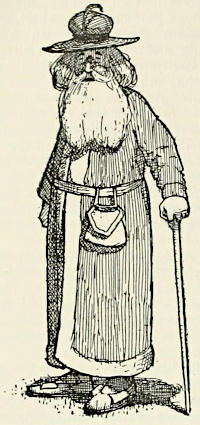
A Jew of the Middle Ages
In this crisis the only remedy left to the Jews was a real or feigned conversion to Christianity. St. Vincent Ferrier, a Dominican of Valencia, performed such a quantity of miracles, in furtherance of this purpose, as might have excited the envy of any saint in the calendar; and these, aided by his eloquence, are said to have changed the hearts of no less than thirty-five thousand of the race of Israel, which doubtless must be reckoned the greatest miracle of all.
The legislative enactments of this period, and still more under Juan II during the first half of the fifteenth century, were uncommonly severe upon the Jews. While they were prohibited from mingling freely with the Christians, and from exercising the professions for which they were best qualified, their residence was restricted within certain prescribed limits of the cities which they inhabited; and they were not only debarred from their usual luxury of ornament in dress, but were held up to public scorn, as it were, by some peculiar badge or emblem embroidered on their garments.
Such was the condition of the Spanish Jews at the accession of Ferdinand and Isabella. The “new Christians,” or “converts,” as those who had renounced the faith of their fathers were denominated, were occasionally preferred to high ecclesiastical dignities, which they illustrated by their integrity and learning. They were intrusted with municipal offices in the various cities of Castile; and as their wealth furnished an obvious resource for repairing, by way of marriage, the decayed fortunes of the nobility, there was scarcely a family of rank in the land whose blood had not been contaminated, at some period or other, by mixture with the mala sangre, as it came afterwards to be termed, of the house of Judah; an ignominious stain, which no time has been deemed sufficient wholly to purge away.
Notwithstanding the show of prosperity enjoyed by the converted Jews, their situation was far from secure. Their proselytism had been too sudden to be generally sincere; and as the task of dissimulation was too irksome to be permanently endured, they gradually became less circumspect, and exhibited the scandalous spectacle of apostates returning to wallow in the ancient mire of Judaism. The clergy, especially the Dominicans, who seem to have inherited the quick scent for heresy which distinguished their frantic founder, were not slow in sounding the alarm; and the superstitious populace, easily roused to acts of violence in the name of religion, began to exhibit the most tumultuous movements, and actually massacred the constable of Castile in an attempt to suppress them at Jaen, the year preceding the accession of Isabella. After this period the complaints against the Jewish heresy became still more clamorous, and the throne was repeatedly beset with petitions to devise some effectual means for its extirpation (1478).
It is easy to discern, in the medley of credulity and superstition, the secret envy entertained by the Castilians of the superior skill and industry of their Hebrew brethren, and of the superior riches which these qualities secured to them; and it is impossible not to suspect that the zeal of the most orthodox was considerably sharpened by worldly motives.
Be that as it may, the cry against the Jewish abominations now became general. Among those most active in raising it were Alfonso de Ojeda, a Dominican, prior of the monastery of St. Paul in Seville, and Diego de Merlo, assistant of that city, who should not be defrauded of the meed of glory to which they are justly entitled by their exertions for the new establishment of the Modern Inquisition. These persons, after urging on the sovereigns the alarming extent to which the Jewish leprosy prevailed in Andalusia, loudly called for the introduction of the Holy Office, as the only effectual means of healing it. In this they were vigorously supported by Niccolo Franco, the papal nuncio then residing at the court of Castile. Ferdinand listened with complacency to a scheme which promised an ample source of revenue in the confiscations it involved. But it was not so easy to vanquish Isabella’s aversion to such repugnant measures.
Queen Isabella persuaded to Persecution
Well had it been for the land if the queen’s conscience had always been intrusted to the keeping of persons of such exemplary piety as her confessor, Talavera. Unfortunately, in her early days, during the lifetime of her brother Henry, that charge was committed to a Dominican monk, Thomas (Tomas) de Torquemada, a native of Old Castile, subsequently raised to the rank of prior of Santa Cruz in Segovia, and condemned to infamous immortality by the signal part which he performed in the tragedy of the Inquisition. This man, who concealed more pride under his monastic weeds than might have furnished forth a convent of his order, was one of that class with whom zeal passes for religion, and who testify their zeal by a fiery persecution of those whose creed differs from their own; who compensate for their abstinence from sensual indulgence by giving scope to those deadlier vices of the heart, pride, bigotry, and intolerance, which are no less opposed to virtue and are far more extensively mischievous to society. This personage had earnestly laboured to infuse into Isabella’s young mind, to which his situation as her confessor gave him such ready access, the same spirit of fanaticism that glowed in his own. Fortunately this was greatly counteracted by her sound understanding and natural kindness of heart. Torquemada urged her, or indeed, as is stated by some, extorted a promise that, “should she ever come to the throne, she would devote herself to the extirpation of heresy, for the glory of God and the exaltation of the Catholic faith.” The time was now arrived when this promise was to be discharged.
It is due to Isabella’s fame to state thus much in palliation of the unfortunate error into which she was led by her misguided zeal; an error so grave that, like a vein in some noble piece of statuary, it gives a sinister expression to her otherwise unblemished character. It was not until the queen had endured the repeated importunities of the clergy, particularly of those reverend persons in whom she most confided, seconded by the arguments of Ferdinand, that she consented to solicit from the pope a bull for the introduction of the Holy Office into Castile. Sixtus IV, who at that time filled the pontifical chair, easily discerning the sources of wealth and influence which this measure opened to the court of Rome, readily complied with the petition of the sovereigns, and expedited a bull bearing date November 1st, 1478, authorising them to appoint two or three ecclesiastics, inquisitors for the detection and suppression of heresy throughout their dominions.
The queen, however, still averse to violent measures, suspended the operation of the ordinance, until a more lenient policy had been first tried. By her command, accordingly, the archbishop of Seville, Cardinal Mendoza, drew up a catechism exhibiting the different points of the Catholic faith, and instructed the clergy throughout his diocese to spare no pains in illuminating the benighted Israelites, by means of friendly exhortation and a candid exposition of the true principles of Christianity. How far the spirit of these injunctions was complied with, amid the excitement then prevailing, may be reasonably doubted. There could be little doubt, however, that a report, made two years later by a commission of ecclesiastics with Alfonso de Ojeda at its head, respecting the progress of the reformation, would be necessarily unfavourable to the Jews.
In consequence of this report the papal provisions were enforced by the nomination, on the 17th of September, 1480, of two Dominican monks as inquisitors, with two other ecclesiastics, the one as assessor and the other as procurator-fiscal, with instructions to proceed at once to Seville and enter on the duties of their office. Orders were also issued to the authorities of the city to support the inquisitors by all the aid in their power. But the new institution proved so distasteful to them in its origin that they refused any co-operation with its ministers, and during the first years it can scarcely be said to have obtained a footing in any other places in Andalusia than those belonging to the crown.
The Inquisition of 1481
On the 2nd of January, 1481, the court commenced operations by the publication of an edict, followed by several others, requiring all persons to aid in apprehending and accusing all such as they might know or suspect to be guilty of heresy, and holding out the illusory promise of absolution to such as should confess their errors within a limited period. As every mode of accusation, even anonymous, was invited, the number of victims multiplied so fast that the tribunal found it convenient to remove its sittings from the convent of St. Paul, within the city, to the spacious fortress of Triana, in the suburbs.
The presumptive proofs by which the charge of Judaism was established against the accused are so curious that a few of them may deserve notice. It was considered good evidence of the fact, if the prisoner wore better clothes or cleaner linen on the Jewish Sabbath than on other days of the week; if he had no fire in his house the preceding evening; if he sat at table with Jews, or ate the meat of animals slaughtered by their hands, or drank a certain beverage held in much estimation by them; if he washed a corpse in warm water, or when dying turned his face to the wall; or, finally, if he gave Hebrew names to his children—a provision most whimsically cruelly, since, by a law of Henry II, he was prohibited under severe penalties from giving them Christian names. He must have found it difficult to extricate himself from the horns of this dilemma.
On the sixth day of January six convicts suffered at the stake. Seventeen more were executed in March, and a still greater number in the month following; and by the 4th of November in the same year no less than 298 individuals had been sacrificed in the autos da fé of Seville. Besides these, the mouldering remains of many, who had been tried and convicted, after their death, were torn up from their graves, with a hyena-like ferocity which has disgraced no other court, Christian or pagan, and condemned to the common funeral pile. This was prepared on a spacious stone scaffold, erected in the suburbs of the city, with the statues of four prophets attached to the corners, to which the unhappy sufferers were bound for the sacrifice. This monument of fanaticism continued to disgrace Seville till 1810, when it was removed in order to make room for the construction of a battery against the French. The sword of justice was observed, in particular, to strike at the wealthy, the least pardonable offenders in times of proscription.
The plague which desolated Seville this year, sweeping off fifteen thousand inhabitants, as if in token of the wrath of heaven at these enormities, did not palsy for a moment the arm of the Inquisition, which, adjourning to Aracena, continued as indefatigable as before. A similar persecution went forward in other parts of the province of Andalusia; so that within the same year, 1481, the number of the sufferers was computed at two thousand burned alive, a still greater number in effigy, and seventeen thousand “reconciled”; a term which must not be understood by the reader to signify anything like a pardon or amnesty, but only the commutation of a capital sentence for inferior penalties, as fines, civil incapacity, very generally total confiscation of property, and not infrequently imprisonment for life.[196]
The Jews were astounded by the bolt which had fallen so unexpectedly upon them. Some succeeded in making their escape to Granada, others to France, Germany, or Italy, where they appealed from the decisions of the Holy Office to the sovereign pontiff.[197] Sixtus IV appears for a moment to have been touched with something like compunction, for he rebuked the intemperate zeal of the inquisitors, and even menaced them with deprivation. But these feelings, it would seem, were but transient; for in 1483 we find the same pontiff quieting the scruples of Isabella respecting the appropriation of the confiscated property, and encouraging both sovereigns to proceed in the great work of purification by an audacious reference to the example of Jesus Christ, who, says he, consolidated his kingdom on earth by the destruction of idolatry.
The Spanish or “Modern” Inquisition established
In the course of the same year he expedited two briefs, appointing Thomas de Torquemada inquisitor-general of Castile and Aragon, and clothing him with full powers to frame a new constitution for the Holy Office (August 2nd and October 17th, 1483). This was the origin of that terrible tribunal, the Spanish or Modern Inquisition, familiar to most readers whether of history or romance, which for three centuries extended its iron sway over the dominions of Spain and Portugal.
Edicts were ordered to be published annually, on the first two Sundays in Lent, throughout the churches, enjoining it as a sacred duty on all who knew or suspected another to be guilty of heresy to lodge information against him before the Holy Office; and the ministers of religion were instructed to refuse absolution to such as hesitated to comply with this, although the suspected person might stand in the relation of parent, child, husband, or wife. All accusations, anonymous as well as signed, were admitted; it being only necessary to specify the names of the witnesses, whose testimony was taken down in writing by a secretary, and afterwards read to them, which, unless the inaccuracies were so gross as to force themselves upon their attention, they seldom failed to confirm.
Not the least odious feature of the whole was the connection established between the condemnation of the accused and the interests of his judges; since the confiscations, which were the uniform penalties of heresy, were not permitted to flow into the royal exchequer until they had first discharged the expenses, whether in the shape of salaries or otherwise, incident to the Holy Office. The most humane provisions were constantly evaded in practice; and the toils for ensnaring the victim were so ingeniously multiplied that few, very few, were permitted to escape without some censure. Not more than one person, says Llorente, in one or perhaps two thousand processes, previous to the time of Philip III, received entire absolution. So that it came to be proverbial that all who were not roasted were at least singed:
“Devant l’Inquisition, quand on vient à jubé, Si l’on ne sort rôti, l’on sort au moins flambé.”
The “Auto da fé”
The last scene in this dismal tragedy was the “act of faith” (auto da fé),[198] the most imposing spectacle, probably, which has been witnessed since the ancient Roman triumph, and which, as intimated by a Spanish writer, was intended, somewhat profanely, to represent the terrors of the Day of Judgment. The proudest grandees of the land, on this occasion, putting on the sable livery of familiars of the Holy Office and bearing aloft its banners, condescended to act as the escort of its ministers; while the ceremony was not unfrequently countenanced by the royal presence. It should be stated, however, that neither of these acts of condescension—or, more properly, humiliation—was witnessed until a period posterior to Isabella’s reign. The effect was further heightened by the concourse of ecclesiastics in their sacerdotal robes, and pompous ceremonial which was intended to consecrate, as it were, this bloody sacrifice by the authority of a religion which has expressly declared that it desires mercy and not sacrifice.[199]
The most important actors in the scene were the unfortunate convicts, who were now disgorged for the first time from the dungeons of the tribunal. They were clad in coarse woollen garments, styled san benitos, brought close round the neck and descending like a frock down to the knees. These were of yellow colour, embroidered with a scarlet cross, and well garnished with figures of devils and flames of fire, which, typical of the heretic’s destiny hereafter, served to make him more odious in the eyes of the superstitious multitude.[200] The greater part of the sufferers were condemned to be “reconciled,” the manifold meanings of which soft phrase have been already explained. Those who were to be “relaxed,” as it was called, were delivered over, as impenitent heretics, to the secular arm, in order to expiate their offence by the most painful of deaths, with the consciousness, still more painful, that they were to leave behind them names branded with infamy, and families involved in irretrievable ruin.[201]
It is remarkable that a system so monstrous as that of the Inquisition, presenting the most effectual barrier, probably, that was ever opposed to the progress of knowledge, should have been revived at the close of the fifteenth century, when the light of civilisation was rapidly advancing over every part of Europe. It is more remarkable that it should have occurred in Spain, at this time under a government which had displayed great religious independence on more than one occasion, and which had paid uniform regard to the rights of its subjects and pursued a generous policy in reference to their intellectual culture. Where, we are tempted to ask, when we behold the persecution of an innocent, industrious people for the crime of adhesion to the faith of their ancestors—where was the charity which led the old Castilian to reverence valour and virtue in an infidel, though an enemy, where the chivalrous self-devotion which led an Aragonese monarch, three centuries before, to give away his life in defence of the persecuted sectaries of Provence, where the independent spirit which prompted the Castilian nobles, during the very last reign, to reject with scorn the purposed interference of the pope himself in their concerns, that they were now reduced to bow their necks to a few frantic priests, the members of an order which, in Spain at least, was quite as conspicuous for ignorance as intolerance? True, indeed, the Castilians, and the Aragonese subsequently still more, gave such evidence of their aversion to the institution, that it can hardly be believed the clergy would have succeeded in fastening it upon them, had they not availed themselves of the popular prejudices against the Jews.[202] Providence, however, permitted that the sufferings thus heaped on the heads of this unfortunate people should be requited in full measure to the nation that inflicted them. The fires of the Inquisition, which were lighted exclusively for the Jews, were destined eventually to consume their oppressors. They were still more deeply avenged in the moral influence of this tribunal, which, eating like a pestilent canker into the heart of the monarchy at the very time when it was exhibiting a most goodly promise, left it at length a bare and sapless trunk.
Torquemada and his Successors
Notwithstanding the persecutions under Torquemada were confined almost wholly to the Jews, his activity was such as to furnish abundant precedent, in regard to forms of proceeding, for his successors; if, indeed, the word forms may be applied to the conduct of trials so summary that the tribunal of Toledo alone, under the superintendence of two inquisitors, disposed of 3,327 processes in little more than a year. The number of convicts was greatly swelled by the blunders of the Dominican monks, who acted as qualificators or interpreters of what constituted heresy, and whose ignorance led them frequently to condemn, as heterodox, propositions actually derived from the fathers of the church. The prisoners for life, alone, became so numerous that it was necessary to assign them their own houses as the places of their incarceration.
The data for an accurate calculation of the number of victims sacrificed by the Inquisition during this reign are not very satisfactory. From such as exist, however, Llorente has been led to the most frightful results. In this enormous sum of human misery is not included the multitude of orphans, who, from the confiscation of their paternal inheritance, were turned over to indigence and vice.[203] Many of the reconciled were afterwards sentenced as relapsed; and the curate of Los Palacioscc expresses the charitable wish that “the whole accursed race of Jews, male and female, of twenty years of age and upwards, might be purified with fire and fagot!”[204]
The vast apparatus of the Inquisition involved so heavy an expenditure, that a very small sum comparatively, found its way into the exchequer, to counterbalance the great detriment resulting to the state from the sacrifice of the most active and skilful part of its population. All temporal interests, however, were held light in comparison with the purgation of the land from heresy; and such augmentations as the revenue did receive, we are assured, were conscientiously devoted “to pious purposes and the Moorish war”![205]
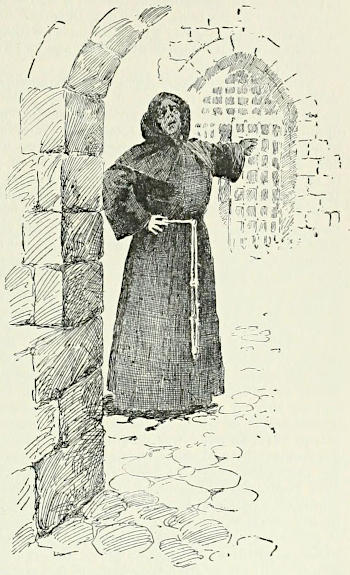
Torquemada
The Roman see is charged with duplicity, characteristic of Alexander VI, in making a gainful traffic by the sale of dispensations from the penalties incurred by such as fell under the ban of the Inquisition, provided they were rich enough to pay for them, and afterwards revoking them, at the instance of the Castilian court. Meanwhile, the odium excited by the unsparing rigour of Torquemada raised up so many accusations against him that he was thrice compelled to send an agent to Rome to defend his cause before the pontiff; until, at length, Alexander VI, in 1494, moved by these reiterated complaints, appointed four coadjutors, out of a pretended regard to the infirmities of his age, to share with him the burdens of his office.
This personage, who is entitled to so high a rank among those who have been the authors of unmixed evil to their species, was permitted to reach a very old age, and to die quietly in his bed. Yet he lived in such constant apprehension of assassination that he is said to have kept a reputed unicorn’s horn always on his table, which was imagined to have the power of detecting and neutralising poisons; while, for the more complete protection of his person, he was allowed an escort of fifty horse and two hundred foot in his progresses through the kingdom.
This man’s zeal was of such an extravagant character that it may almost shelter itself under the name of insanity. His history may be thought to prove that of all human infirmities, or rather vices, there is none productive of more extensive mischief to society than fanaticism. The opposite principle of atheism, which refuses to recognise the most important sanctions to virtue, does not necessarily imply any destitution of just moral perceptions, that is, of a power of discriminating between right and wrong, in its disciples. But fanaticism is so far subversive of the most established principles of morality, that, under the dangerous maxim, “For the advancement of the faith, all means are lawful,” which Tasso has rightly, though perhaps undesignedly, derived from the spirits of hell, it not only excuses, but enjoins the commission of the most revolting crimes as a sacred duty. The more repugnant, indeed, such crimes may be to natural feeling or public sentiment, the greater their merit, from the sacrifice which the commission of them involves. Many a bloody page of history attests the fact that fanaticism armed with power is the sorest evil which can befall a nation.m
Under Charles I (the emperor Charles V) the cortes sought for a modification of the laws of the Inquisition; but under Philip II the flames burned brightly again, at first in Seville and Valladolid (1559 seq.). But by the end of the seventeenth century all vestiges of the Reformation were effaced, and the activity of the Inquisition became limited to the destruction of prohibited books, of which an Index had been prepared in 1558. Under Charles III, in 1770, an edict was passed, securing an accused party from arbitrary imprisonment; and other regulations were passed, curtailing the powers of the Inquisition, until, in 1808, Joseph Bonaparte abolished it entirely. In 1814 Ferdinand VII restored it; but the popular rage in 1820 destroyed the inquisitor’s palace at Madrid, and the cortes again abolished it. But in 1825, by the efforts of the clergy, another inquisitorial commission was appointed. It continued till 1834, when it was finally abolished, and its property applied to the payment of the public debt. But it may be a long while before the country will revive from the effects of the court which, in the sixteenth and seventeenth centuries, extinguished her active literary life and placed this nation, so richly endowed, almost outside of the circle of European civilisation. Spain, it is true, remained free from heresies and religious wars; but her rest was the rest of the grave, so far as religious vitality was concerned.
The fortunes of the Inquisition in Portugal were similar to those which it had in Spain. In the reign of John VI (1818-1826) it was finally abolished. The last relics of the Italian Inquisition disappeared at the unification of the nation. The Congregation of the Inquisition at Rome, appointed by Sixtus V in 1587, is all that remains of it. In its day it likewise had crushed out the Reformation, and had raged the most fearfully in Venice; but there its activity seems to have ceased in 1781, and in 1808 Napoleon abolished it. Restored under Pius VII in 1814, it directed its energies to prevent the diffusion of the Italian Bible, and to check the introduction of evangelical truth.
In the Netherlands, where the Inquisition was first introduced in the thirteenth century, it became a terrible weapon in the time of the Reformation. In 1521, Charles V passed a rigorous edict against heretics, and appointed Franz van der Hulst inquisitor-general. In 1525 three inquisitors-general were appointed, in 1537 the number was increased to four, and in 1545 one was appointed for each of the provinces. According to Grotius, a hundred thousand victims died under Charles V; according to the prince of Orange, fifty thousand. Both computations are probably too large. Under Philip II the inquisitors developed the most zeal; and the duke of Alva, in 1567, appointed the Bloody Council, which proceeded with unheard-of cruelty against those whose wealth excited their avarice, or whose heresy aroused their suspicion. In 1573 Alva was recalled; and three years later the provinces concluded the League of Ghent, whose fifth article abolished the edicts against heresy.z
Torture lasted as late as 1817 in Spain, where Van Halen suffered it, notwithstanding the papal bull of 1816; and, according to Mackenna,t it lasted in Spanish America until 1809.
In conclusion it is possible to present a fairly accurate total of the ruinous sweep of the Inquisition. The historian Llorentek accomplished the seemingly impossible task of unearthing the records. He was a Spanish priest, and from 1785 was an officer of the Inquisition in its then milder form. In 1808 he became a Bonapartist, and was concerned in the suppression of monastic orders. The archives were at his disposal, and he studied them thoroughly. He fled to France on the Restoration in 1814, and there brought out his monumental work in French. His life was not safe even there, and he suffered much persecution. His work has been convicted of many faults, but not of dishonesty, and his conclusions may be quoted with a reasonable amount of confidence.a
Llorente’s Computation of the Victims of the Inquisition
In summing up, it appears that the Spanish Inquisition, during the first eighteen years of its existence under Torquemada, condemned 8,800 persons to perish in the flames, 6,500, dead or fugitives, to be burned in effigy; and imposed different pains and penalties upon 90,004 who were reconciled; making a total of 105,294 victims. I propose to take each tribunal separately and to place the number of victims as low as circumstances will permit.
Were I guided by the autos da fé of the Inquisition of Toledo and Saragossa I might triple the number of victims, for in eight years alone 6,341 were punished by the inquisitors of Seville, which is at the rate of 792 a year, not including the many victims of other autos da fé which I have found mentioned, but of which I cannot find the reports. Saragossa shows almost similar results, and if the same is assumed of the other tribunals the total would be twice as much again as by my reckoning. But I do not wish to give anyone grounds for saying that I have tried to exaggerate the evil.
The second general inquisitor was Diego Deza, a Dominican, tutor to the prince of Asturias, Don Juan, bishop of Zamora, Salamanca, Jaen, Palencia, and finally archbishop of Seville. He held the office from the beginning of 1499 to the end of 1506, when he resigned it by order of king Ferdinand V, regent of Castile. In his time there were the same twelve tribunals in the peninsula as in the time of his predecessor; therefore I reckon only 208 burned, 104 burned in effigy, and 4,057 subjected to penances, making a total of 4,369 victims a year. This number, multiplied by eight makes the number of victims in his time, 1,664 of the first class, 832 of the second class, and 32,456 of the third class; a total of 34,952 victims.
The third general inquisitor was the cardinal-archbishop Francisco Ximenes de Cisneros, a Franciscan. He held the office from the year 1507 until the 8th of November, 1517, when he died. During that time there was a separate office of general inquisitor of Aragon which was first held by Juan Enguera, a Dominican, bishop of Vique. He died in 1513 and was succeeded by Luis Mercader, a Carthusian, who upon his death on the 1st of June, 1516, was succeeded by Cardinal Adriano de Florencio, then dean of Lobania, tutor of Charles V, afterwards bishop of Tortosa, and ultimately sovereign pontiff (Adrian VI). In 1513 Cardinal Ximenes de Cisneros created a tribunal of the Inquisition for the bishopric of Cuenca and its districts, separating them from the jurisdiction of Murcia in 1516; another for the fortress of Oran in Africa, and another for America in the island of Cuba. We will leave the two last out of our calculations, as well as those of Caller in the island of Sardinia, and of Palermo in Sicily.
The twelve former tribunals of the peninsula produced, according to the inscription in Seville, with the modification adopted, 208 burned, 104 burned in effigy, 4,057 subjected to penances, a year, making from the year, 1507 to 1513 inclusive a total of 1,456 of the first class, 728 of the second class, and 28,399 of the third class.
The tribunal of Cuenca was established in 1514, and according to my method of computation I assign to it 200 of the first class, 200 of the second, and 1,700 of the third, which added to the 208, 104, and 4,057 of the other twelve tribunals gives a total for that year of 408, 304, and 5,757. In 1515, the tribunal of Cuenca is counted as one of the old tribunals, with only 16 of the first class, 8 of the second, and 312 of the third, which added to the total of the other tribunals amounts to 224, 112, and 4,369. In 1516 and 1517, the result is similar. The total of the eleven years during which Ximenes de Cisneros was general inquisitor is 2,536 burned, 1,368 burned in effigy, and 47,263 penitents, 51,167 in all.
Cardinal Adriano, bishop of Tortosa, was the fourth general inquisitor. He was appointed at the beginning of March, 1518, and though he was elected pope on the 9th of January, 1522, he had no successor as head of the Holy Office until the end of 1522; for Adriano issued the bulls on the 10th of September of that year, fourteen days before his death. For this reason the number of tribunals in the peninsula was not increased for six years, but in America one was established at Puerto Rico for the West Indies in 1519.
According to the inscription in the castle of Triana, in the thirteen tribunals of our continent there were every year 224 persons burned, 112 burned in effigy, and 4,369 subjected to penances; consequently the total for the six years was 1,344 of the first class, 672 of the second class, and 26,214 of the third class; 28,230 victims in all.
The fifth general inquisitor was Cardinal Alfonso Manrique, successively bishop of Badajoz and of Cordova, and archbishop of Seville. In 1524, he ordered the inscription which has guided our calculations for the preceding years to be placed in the castle of Triana in Seville. In this same year the tribunal of Granada, which had been established the year before, began to exercise its functions. Although the number of those punished as Judaical heretics was diminished, there was no lack of victims, their places being supplied by the Mohammedan Moriscoes, Lutherans, and Sodomites, whose punishment, and that of other criminals, was confided to the inquisitors by Pope Clement VII. Manrique died on the 28th of September, 1538, having established tribunals of the Inquisition in Canaria, Jaen, and Granada, and two in America for Tierrafirme (Terra Firma) and the West Indies. It is calculated that the yearly victims would be about 10 burned, 5 burned in effigy, and 50 subjected to penances, a total of 65 victims. There were thirteen tribunals in the peninsula, two in the adjacent islands, and multiplying by the fifteen years of Manrique’s ministry there were 2,250 of the first class, 1,125 of the second class, and 11,250 of the third class, a total of 14,625 victims.
[Llorente continues thus his record from inquisitor to inquisitor through the centuries. We shall omit these till we reach the last years of the Holy Office.]
Fortieth, Felipe Beltran, bishop of Salamanca, was general inquisitor after Quintano, in 1774. He exercised this function until he died, which appears to me to have been about 1783. In his time there were 2 burned, none burned in effigy, 16 condemned to public penances, and very many in secret without infamy or confiscation. My departure from Madrid for Valencia on the 10th of August, 1812, since which I never returned to court, prevented me from completing this catalogue with the exact dates, but the substance of my narrative is most exact. The last victim who perished in the flames was a beata of Seville, on the 7th of November, 1781. She was condemned for having a compact and illicit personal intercourse with the devil, and for impenitent denial of the offence, according to the trial. Her life would have been spared had she pleaded guilty to the crimes of which she was accused.
Forty-first, Augustin Rubin de Cevallos, bishop of Jaen, knight of the grand cross of the royal Spanish order of Charles III. He immediately succeeded Beltran and was general inquisitor from 1784 until 1792, when he died. No one was burned in person nor in effigy in his time; 14 were condemned to public penances, and many in secret but without infamy or confiscation. Forty-second, Manuel Abad-y-la-Sierra, bishop of Astorga, archbishop of Selimbra and general inquisitor, appointed in 1792. He resigned in 1794 by order of Charles IV. In his time 16 were condemned to public and many to private penances; no one was burned. Forty-third, Francisco Antonio de Lorenzana, cardinal-archbishop of Toledo, was appointed general inquisitor in 1794, and resigned by order of Charles IV in 1797. In his time 14 were condemned to public and many to private penances; no one was burned.
Forty-fourth, Ramón Josef de Arce, archbishop of Burgos and of Saragossa, patriarch of the Indies, councillor of state, general director of the Royal University of Madrid, and knight of the grand cross of the royal order of Charles III. He was general inquisitor from 1798 to 1808. In his time 20 were condemned to public and many to private penances, without infamy or confiscation of goods. One effigy was burned at Cuenca, but no one was burned in person, for though sentence was pronounced against the curate of Esco, the general inquisitor and supreme council refused to confirm it, in order to prevent its execution. Recapitulation: burned in person, 31,912; burned in effigy, 17,659; condemned to severe penances, 291,450; total, 341,021.
My design is to calculate the number of victims at the lowest figure possible, and I am convinced that from the year 1481, when the tribunal was established, until the end of the reign of Philip II, the numbers were much more than I have stated, considering the records of the tribunals of Toledo and Saragossa, which did not notably exceed the rest. If we were to add the victims punished by the tribunals of Mexico, Lima, Cartagena de las Indias (Cartagena in Colombia), Sicily, and in the galleys at sea, the number would be incalculable. Still more so were we to count the victims which resulted from the attempts to establish the Inquisition in Naples, Milan, and Flanders, for all these belonged to Spain, and felt the influence of the Spanish tribunal. How many died in their beds of illness caused by the infamy which fell upon them through the condemnation of their relations? No possible calculation could include all this misery.k
EFFECTS AND INFLUENCES OF THE INQUISITION
Geddes,q in 1714, made this contemporary observation, and his point should not be forgotten in an estimate of the far-reaching evils. “By this list we see what a terrible havoc is made by the Inquisition in Portugal, and especially among the trading people, to the great diminution both of its stock in trade and of the number of its current and expert merchants. For though there were but four persons burned this year in Lisbon by the Inquisition, there were above threescore undone by it. Anyone of a family’s being taken up by the Inquisition goes a great way towards ruining it, filling them with such horrors as drive them into countries that are out of the reach of the Inquisition.”
A recent writer, a churchman, Dean Kitchin,ll has said:
“The hand of the Holy Office was outstretched against all; no lofty dignity in church or state, no eminence in art or science, no purity of life, could defend from its attacks. It is said to have threatened Charles V and Philip II; it persecuted Archbishop Carranza, head of the church in Spain; destroyed De Dominis, archbishop of Spalatro; it smote Galileo, murdered Giordano Bruno, attacked Pico di Mirandola, and even is said to have threatened Cæsar Borgia. With equal vigour, in combination with the Jesuits, the Inquisition made war on books and learning, religious or secular alike; we have seen how baleful was its effect in earlier days on literature and art in Provence, and in the time of the Catholic sovereigns on the material well-being of Spain. ‘In the love of Christ and his maid-mother,’ says Queen Isabella, ‘I have caused great misery, and have depopulated towns and districts, provinces and kingdoms.’”ll
A CATHOLIC VIEW OF THE INQUISITION (C. J. HEFELE)
The word inquisition with the original signification of an ecclesiastical court of faith, was later applied to a state institution which, on account of its real or alleged harshness, has become a by-word in Europe for everything horrible. There is no doubt that, an ecclesiastical court of inquiry existed among the Christians from the beginning, but it is equally certain that in the earliest times the penalties for heresy were only ecclesiastical and clerical without any civil effect. The case was altered when Emperor Constantine appeared as both the protector and the secular arm of the church, for which reason he considered it necessary to exile the heretics, who were threatening the church with danger, in order to put them out of the way of doing harm. More severe punishments than exile were first inflicted upon the Catholics by the Arians when their co-religionists Constantius and Valens occupied the throne. The former introduced the practice of imprisoning the orthodox, the latter of drowning them, and Arian princes in the later Germanic kingdoms always exercised violence towards those of different faiths.
The connection of church and state was made much closer by the great theocratic idea, emanating from Gregory VII, which aimed at the bringing together of all peoples of the occident into one theocratic union, the protector of which was to be the pope, in the name of God; but the members of which could naturally be only those who belonged to the church. From this standpoint, heretics necessarily appeared as criminals of state because, through their wrong teaching, they rebelled against God as the king of the theocratic union: hence the civil codes of the middle ages punished heresy with death.
Whereas, after the time of Constantine the Great, the civil punishments of heretics were inflicted by the secular rulers, the decision as to whether a person was a heretic or not, was from the very beginning made by the bishops and synods. Hence, if we wish to get at the fundamental idea of the Inquisition, that it was a seeking out and a punishing of heretics, we must say that, in the former sense, it has existed since the time of the apostles; and, in the latter, since that of Constantine the Great. The actual Inquisition had its beginning in the great synod of Toulouse in 1229. Soon after this synod in southern France, we meet especially appointed inquisitors in Italy. Here also heresy had ravaged widely and had become so dangerous that even Emperor Frederick II, who is the last person one could accuse of bigotry, immediately upon his coronation and repeatedly afterwards uttered the death penalty against heretics. Gradually the episcopal inquisition became changed into a Dominican inquisition and was introduced into nearly all the countries of Europe. In the Pyrenaean peninsula likewise, which is here our main subject of interest, it came into Castile, Navarre, and Portugal, as well as into Aragon. Castile was to become the home of the “New Inquisition,” as Llorentek calls it,—more correctly of the Spanish Inquisition, the direct impulse to which was given by a peculiar condition which existed nowhere else than in Spain.
Already in the first centuries after the birth of Christ, the Jews in Spain had become so numerous and powerful that they began to think of Judaising the whole land. Hence it came about that the synod of Eliberis (303-313), an old Spanish city in the vicinity of which the later Granada is said to have been built, passed a resolution that in the future no Christian landholder was to let his fields be blessed by Jews. On the other hand there was no lack of attempts on the part of the old Visigothic kings in Spain to force the Jews to become Christians; but this was forbidden by the fourth council of Toledo, in its 57th canon, with the words: “Hereafter no Jew may be made to accept Christianity by force, but those who are already converted, even though it was by force, since they have already received the holy sacraments, must keep their faith and may in no wise blaspheme or despise it.”
Much more dangerous than the real Jews were those who were seemingly converted to Christianity and whose numbers had increased enormously after the persecutions at the end of the 14th century. While the former had seized upon a large part of the national wealth and the Spanish commerce, the latter threatened both the Spanish nationality and the Christian religion, since these disguised Jews on the one hand invaded clerical offices and even occupied episcopal chairs, while on the other they attained high civil honours, married into all noble families and used all these connections, together with their wealth, to bring about the victory of Judaism over Spanish nationality and over the Christian faith. Many laymen as well as churchmen recognised the danger threatened by the Jews and were convinced that something must be done by the government, for which reason repeated requests were made to Ferdinand and Isabella to take measures against the disguised Jews: it was against them that the inquisition was directed later, but never against the real Jews.
Soon after Ferdinand and Isabella had decided to introduce the Inquisition into Castile, Pope Sixtus IV, on November 1st, 1478, gave the ecclesiastical permission and allowed the two rulers to appoint two, or three clerical dignitaries, secular or regular priests, to question and to punish heretics. Two royal inquisitors were now appointed for Seville on the strength of the papal bull. In this step we have the beginning of the New or the Spanish state inquisition which differs principally from the ecclesiastical institution of the same name in the fact that the persons intrusted with the examination and the punishment of heretics—whether they were clericals or laymen—appeared not as servants of the church but as state officials who received their appointment and instructions from the ruling princes.
There was a second political reason why the Spanish monarchs in every way should have favoured an institution which, while appearing to be ecclesiastical, was almost continually accused and fought by the heads of the church, by the popes and bishops. With the reign of Ferdinand and Isabella the transition began from the old state to the new, from the Germanic to the abstract and absolute. In the old state the central or royal power was limited by three comparatively free corporations, the nobility, the clergy, and the municipalities, and this the more so as these estates were closely connected with powers abroad, the clergy with Rome, the nobility and municipalities with their foreign peers, so that the union of the state within itself and therewith the superiority of the throne was not a little hindered. In both Castile and Aragon the inquisition was the most effective means of bringing all subjects, especially the clergy and nobility, under the power of the throne, and of perfecting the absolute authority of the sovereign.
Hence it was that it was precisely the two higher estates which most hated the Inquisition and which were persecuted as its enemies more often than the heretics; it was also principally the prelates who were soon involved in numerous suits with the new tribunals. The popes also could not fail to see that the Spanish Inquisition served the political absolutism much more than it did ecclesiastical purism, and hence they tried to intercept its growth in the same degree that they had promoted the old ecclesiastical inquisition.
This state character of the Spanish Inquisition has also been fully recognised by the more exact historical investigation of modern times, and even Rankemm has expressed himself to the same effect as follows: “We have a celebrated book concerning it (the Inquisition) by Llorente,k and if I make so bold as to say anything in disagreement with such a predecessor let this be an excuse, that that so well informed author wrote in the interest of the Alfrancesados of the Josephinian government [i.e. the Gallicising faction supporting King Joseph Bonaparte]. In their interest he opposes the liberties of the Basque provinces, although the latter can hardly be denied. In the same interest he sees in the Inquisition also a usurpation of clerical power over state authority. If I am not mistaken, however, from the very facts which he relates it appears that the Inquisition was a royal court, but one provided with clerical weapons.”
Guizotnn agrees with this opinion in the words: “It (the Inquisition) was at first more political than religious, and destined to maintain order rather than to defend the faith.”
That the Portuguese Inquisition also was always regarded by the government itself as a state institution is shown by an ordinance dated March 20th, 1769, in which King Joseph I says: “It has been reported to me that whereas all other courts of justice, because they represent my royal person, have always borne and still bear the title Majesty, the misuse has arisen in connection with the Holy Office, a tribunal which by its organisation and its service is most closely and directly connected with my royal person, of giving it another title of address.”
The Inquisition is often judged according to standards of the 19th instead of the 15th and 16th centuries, and hence it is judged incorrectly. Whereas during the past hundred years it has been the tendency to regard wrong believers and unbelievers of all kinds as the most educated and the noblest citizens, the Inquisition on the contrary was based on the mediæval view that erring in religion was high treason and that only the advocate of the state religion could be a safe and trustworthy citizen. It is natural that the upholder of one standpoint cannot possibly judge impartially, events which have arisen from the other, unless in giving his judgment he is able to transport himself from his own time into the other and into its views.
This is done by every true historian. But the Inquisition is a subject which has been most discussed and described by those who give mere phrases instead of investigations, mere arbitrary statements instead of critical examinations, mere romantic descriptions instead of objective judgments, and who try to replace a lack of knowledge by so called liberally-minded phrases. People of this sort do not remember that the principle, cujus est regio, illius et religio,[206] on which the whole Inquisition rests, was universally recognised in olden times, and was so little questioned that Protestants especially upheld it and put it into execution.
For example in the palatinate, when the Kurfürst Frederick III, who had been a Lutheran until then, went over to Calvinism in 1563, he compelled all congregations in his land to take the same step, and exiled everyone who would not accept the Heidelberg catechism. Thirteen years later, in 1576, his son Ludwig restored the orthodox Lutheranism, drove out the Calvinistic preachers and teachers, and forced his dependents to become Lutheran again. The Religious Peace of the year 1555 gave every government the power of giving its dependents the alternative of accepting the religion of the sovereign or of emigrating, upon paying a certain sum, just as was done in Spain with the Jews and Moors; and it is a well-known fact that the Reformation owed its spread in Germany in large measure to this lenient Spanish alternative.
Furthermore, in judging the Inquisition it is often forgotten that the penal code of that time was much more severe and sanguinary than that of the 19th century. Many a trespass which is now atoned for by a slight penalty had at that time to be paid for with blood; and the criminal code of Charles V of the year 1532 is a most speaking witness for the severe criminal justice of the period out of which the Spanish Inquisition grew. Also the Carolina, for example, inflicts punishments on body, life, and limb for blasphemy of God and of the Blessed Virgin (§CVI); and witches are punished with death (§CXVI).