Book 1 — CHAPTER XIII. THE PENINSULAR WAR
Reading edition
[1808-1814 A.D.]
The Spaniards have boldly asserted the deliverance of the peninsula to be the work of their hands. This claim is unjust to the fame of Wellington, injurious to the glory of the British arms. The imbecility of Charles IV, the vileness of Ferdinand, the corruption imputed to Godoy, were undoubtedly the proximate causes of the calamities which overwhelmed Spain; but the primary, the historical cause, was the despotism springing from the union of a superstitious court and a sanguinary priesthood, a despotism which suppressed knowledge, contracted the public mind, sapped the foundation of military and civil virtue, and prepared the way for invasion. No foreign potentate would have attempted to steal into the fortresses of a great kingdom, if the prying eyes and clamorous tongues of a free press had been ready to expose his projects, and a disciplined army present to avenge the insult: Spain, destitute of both, was first circumvented by the wiles, and then ravaged by the arms of Napoleon. She was deceived and fettered because the public voice was stifled; she was scourged and torn because her military institutions were decayed.
When an English force took the field, the Spaniards ceased to act as principals in a contest carried on in the heart of their country and involving their existence as an independent nation. After the first burst of indignation the cause of independence created little enthusiasm. Horrible barbarities were exercised on French soldiers thrown by sickness or the fortune of war into the power of the invaded, and this dreadful spirit of personal hatred was kept alive by the exactions and severe retaliations of the invader; but no great general exertion to drive the latter from the soil was made, at least none was sustained with steadfast courage in the field; manifestoes, decrees, lofty boasts, like a cloud of canvas covering a rotten hull, made a gallant appearance, but real strength and firmness could nowhere be found.
Strange indeed was the spectacle presented—patriotism supporting a vile system of government, a popular assembly working to restore a despotic monarch, the higher classes seeking a foreign master, the lower armed in the cause of bigotry and misrule. The upstart leaders, secretly abhorring freedom though governing in her name, trembled at the democratic activity they excited; and while calling forth all the bad passions of the multitude repressed the patriotism that would regenerate as well as save. The country suffered the evils without enjoying the benefits of a revolution; tumults and assassinations terrified and disgusted the sensible part of the community; a corrupt administration of the resources extinguished patriotism; neglect ruined the armies. The peasant-soldier, usually flying at the first onset, threw away his arms and went home; or, attracted by the license of the partidas, joined the banners of men, the most part originally robbers, who were as oppressive to the people as the enemy; and these guerilla chiefs would in their turn have been quickly exterminated, had not the French, pressed by the British battalions, been compelled to keep in large masses: this was the secret of Spanish constancy. Copious supplies from England and the valour of the Anglo-Portuguese troops supported the war, and it was the gigantic vigour with which the duke of Wellington resisted the fierceness of France and sustained the weakness of three inefficient cabinets that delivered the peninsula.b
WAR DECLARED ON FRANCE
The slaughter of the 2nd of May at Madrid, and the treatment of Ferdinand at Bayonne were as the spark of fire to the mine, and the explosion, beginning in the original cradle of Spanish liberty, the Asturias, spread in the course of the month over all Spain. Juntas, or councils, composed of the most influential and generally of the most enlightened persons of their respective neighbourhoods, were formed in every province, and most large towns. Many excesses and crimes were committed; many persons fell sacrifices to the suspicions, justly or unjustly excited by their own conduct, of being agents and partisans of the French. When Seville, as next in importance to Madrid and Barcelona, and therefore first of the unsubdued cities of Spain, claimed for her junta the title of supreme, and a degree of authority over the others, the other juntas frankly acknowledged her pretensions. In the name of Ferdinand VII, the supreme junta of Seville, on the 6th of June, declared war against Napoleon and France. Orders were issued for enrolling the whole male population of Spain, combined with judicious instructions to the Spanish leaders to avoid risking their raw soldiers in pitched battles against the disciplined veterans of France; and fast-sailing vessels were sent to the colonies, to warn them against the designs of France and claim obedience to the supreme junta, as lawfully exercising the authority of Ferdinand.
JOSEPH BONAPARTE CHOSEN KING OF SPAIN
The crown of Spain Napoleon is said to have originally destined for Lucien Bonaparte, the ablest of his brothers. But Lucien was a republican upon principle; he had besides accumulated in the public service a large fortune, which he was enjoying at Rome in the pleasures of taste and literature; and, in addition to the sacrifice of his principles and his tastes, Napoleon required from him that of his affections. He would not comply with Napoleon’s desire that he should repudiate the mother of his children in order to wed a princess. He is believed to have refused the crown of Spain; and Napoleon assigned it to Joseph, already king of Naples.
A sort of Spanish assembly, meant as a substitute for the cortes, and called by the French name of the “notables,” was summoned to Bayonne, to meet and acknowledge Joseph, and to accept the new constitution to be conferred upon them with their new king. Many obeyed the call, some from believing resistance to the power of Napoleon impossible; some preferring reforms imposed by the hand of a foreign conqueror to the vices of their late government; and more from motives of personal interest.
Joseph then selected his ministers, the great officers of his household, etc. Urquijo, who had succeeded to Saavedra under Charles IV, and been like him displaced by Godoy’s jealousy, was appointed secretary of state; Cevallos minister for foreign affairs; Jovellanos for the interior; Cabarrus of finance; Pinuela of justice; Azanza of the Indies; Mazarredo of the marine; O’Farrel of the war department. Jovellanos alone firmly and perseveringly refused to hold office under the intrusive king. But of those present some appear to have accepted the places offered them merely because they saw no other means of getting back to their own side of the Pyrenees.
The new king of Spain entered his allotted kingdom on the 9th of July, 1808, and issued proclamations inviting his subjects to submission by the fairest promises of good government. But he found it requisite to pause at Vitoria, until his imperial brother’s generals should make way for his progress to his capital. This did not seem likely to be an affair of any great difficulty, for the insurgents were as yet unsupported from abroad. The war between England and Spain was declared to be at an end. But the strength of England was then frittered away in various remote expeditions; and the only immediately disposable force consisted of about nine thousand men, who had been assembled at Cork for an attack upon South America. All hostile measures against the Spanish colonies were now out of the question; and Sir Arthur Wellesley [afterwards made duke of Wellington], to whom the command of this small body of men was given, was directed to proceed with it to the assistance of Spain and Portugal.
On the first symptoms of resistance, Murat had fortified the palace of Buen Retiro, nearly adjoining Madrid, made dispositions for defending the capital (which his successor, Savary, followed up), and sent generals of merited reputation, with considerable divisions of the army, in several directions, to suppress the rebellion, as it was termed, and control the country. The success of the adverse parties in these different situations had been various. At Cadiz, a French squadron had been compelled to surrender, and that nominally without the aid of the British fleet, which, however, lying off the mouth of the harbour, prevented Admiral Rosilly from escaping to sea. Moncey had been repulsed with considerable loss from before Valencia.[113]
But the greatest battle that had yet occurred in this war was now to be fought for the purpose of opening Joseph’s road to Madrid, whither Napoleon had enjoined him to repair with all speed. Cuesta, with the army of Castile, and Blake with that of Galicia, had united at Rio Seco, where their combined forces amounted to thirty thousand men. Bessières attacked them on the 14th of July with little more than fifteen thousand. The superior skill and discipline of the French very soon prevailed over their courage and numbers. They lost five or six thousand men, killed and wounded, and twelve hundred prisoners. The two generals threw the blame on each other, and separated in mutual disgust. This victory cost Bessières less than four hundred men. Joseph pursued his journey; and on the 20th made his triumphant entry into Madrid. Orders had been given that the streets through which the procession was to pass should be decorated, according to Spanish custom, by hanging tapestry, etc., from the windows, and that the church bells should be rung. The inhabitants obeyed; but the tapestry they hung out was old, dirty, and ragged, and the bells tolled as for a funeral. The meanest of the populace scorned to pick up the money scattered amongst them as the king passed, leaving it to the French soldiers; and the theatres, which were opened gratis in honour of the day, were filled only by Frenchmen. The council of Castile, which had previously seemed disposed to submit, refused to take the oath required of them to the new sovereign and constitution, alleging that both must first receive the sanction of the nation through the cortes; and the Spanish soldiers, who did duty jointly with the French, deserted by whole guards at a time, leaving not a single sentinel at his post. The first tidings received by Joseph at Madrid were in harmony with the character of his reception.
Dupont had advanced prosperously, defeating all who opposed him, as far as Cordova, which he took by storm, but almost without resistance. However, Castaños, an old soldier, attacked Dupont with about double his numbers, and gained a victory so complete that at Baylen, whither four days of engagement had drawn the French main body, and upon the very day of Joseph’s entrance into Madrid, Dupont, with nearly twenty thousand men, surrendered upon condition of being sent with his whole corps to France. The terms of the capitulation were afterwards broken by the vindictive rage of the peasantry, whom their generals could not control. Numbers were put to death, and the rest, instead of being sent to France, were confined in the hulks in the bay of Cadiz, where they suffered every kind of misery, and the greater part perished.c In its moral effects the battle of Baylen was one of those events which, insignificant in themselves, cause great changes in the affairs of nations. The defeat of Rio Seco, the preparations of Moncey for a second attack on Valencia, the miserable plight of Saragossa, the despondency of the ablest men of Spain, and the disgust and terror generally excited by the excesses of the populace, weighed heavy on the Spanish cause: one victory more, and the moral as well as the physical force of Spain would have been crushed. The victory of Baylen opened as it were a new crater for Spanish pride, vanity, and arrogance; the glory of past ages seemed to be renewed, every man thought himself a Cid, and, in the surrender of Dupont, saw, not the deliverance of Spain, but the immediate conquest of France. “We are obliged to our friends the English,” was a common phrase among them when conversing with the officers of Sir John Moore’s army; “we thank them for their good-will, we shall escort them through France to Calais, the journey will be pleasanter than a long voyage: they shall not have the trouble of fighting the French, and we shall be pleased to have them spectators of our victories.” This absurd confidence might have led to great things, but it was a voice—nothing more.b
Madrid, upon which the victorious Andalusian army could now advance unopposed, was no longer deemed a residence for Joseph; and on the 31st of July, after a residence of ten days, having summoned Bessières from the pursuit of Blake and Cuesta to protect his retreat, the king and his party evacuated the capital, and withdrew to Vitoria. Another triumph obtained soon afterwards by the Spaniards was the successful defence of Saragossa.c
On the morning of the 4th of August, after feigning an attack upon the Aljaferia and gate of Portillo, the formidable battery of San Engracia was suddenly set to work, twenty-six pieces simultaneously vomited fire upon the convent of this name, and nearly all the defenders of it perished in the ruins. At five o’clock all the batteries of Saragossa were levelled; the French, crossing the Huerva, precipitated themselves into the town by two wide breaches. Then followed fierce hand-to-hand fights, sustained with desperate valour among the dead bodies and ruins. At the fiercest moment of the fight, General Verdier caused the following brief message to be brought to Palafox: “Peace and capitulation?” “War and steel!” answered without hesitation the leader of the men of Saragossa. The bloody contest was continued; trampling on the dead the French advanced triumphantly. But the news of Baylen caused them to raise the siege.e
THE ENGLISH APPEAR
At this period of the war a new actor appeared upon the stage, upon whom thenceforward, the fortune of the peninsula mainly depended. On the 12th of July, 1808, the British expedition sailed from Cork; and its commander, Sir Arthur Wellesley, as soon as the whole was fairly under way, preceded it in a frigate, in order to gather the information requisite for regulating its destination. Landing was made in Mondego Bay. It was the 5th of August before all the troops were on shore. Spencer having arrived during the landing, his junction raised the numbers of the little army to thirteen thousand; and with them Sir Arthur began his march towards Lisbon.
Upon receiving intelligence of Sir Arthur’s landing, Junot sent Laborde, one of the ablest of the French generals, from Lisbon, with three thousand foot and five hundred horse to check the progress of the British; and calling in his various detachments, he ordered them severally to effect their junction with Laborde. Under these circumstances, the English commander’s object was to prevent the junction of the several detachments—an object which the skill and celerity of his movements enabled him, in the most important instance, to effect. Wellesley was thus enabled to attack Laborde at Roliza on the 17th of August, with great numerical superiority. He drove him from his position with comparative facility; but Laborde fell back about a mile to much stronger ground, where he again awaited the English, and here the battle was sanguinary. Laborde, after displaying both skill and intrepidity, abandoned the contest, retreating in good order.
After the victory was gained, Sir Arthur, now reinforced to about sixteen thousand men, proposed turning the left flank of the position occupied by Junot and his united forces—about fourteen thousand men—and endeavouring to cut him off from Lisbon. But, unfortunately, Sir Arthur Wellesley was no longer commander-in-chief. The English ministry had not known how to appreciate the man whose extraordinary talents had as yet only been tried in India; and three senior officers had been appointed to supersede him, and, as it proved, each other. The nomination of one of these could not be blamed, for Sir John Moore then certainly ranked higher in public estimation as a general than Sir Arthur Wellesley; but Sir Harry Burrard and Sir Hew Dalrymple had never been in situations to display military capacity. Sir Harry Burrard arrived on the very day that the reinforcements joined Sir Arthur; and with all the caution of old age refused to sanction the advance of an army deficient in cavalry and artillery horses, especially as ten thousand men were daily expected with Sir John Moore.
On the morning of the 21st, Junot fell upon the British army, with the impetuosity characterising his countrymen and Napoleon’s warriors. They were, however, repulsed in every attack; the defects of the position, and the almost total want of cavalry, were immediately remedied by the ability of the general, and the loss was far greater on the side of the French, and less on that of the British, than at Roliza. The battle was over by noon; a considerable portion of the army had not been engaged, and Sir Arthur proposed to follow up his victory, pursue the retreating enemy, cut him off from Lisbon, and thus deliver the capital from the French yoke. Again Burrard’s caution prevailed to forbid the pursuit, and still the army remained at Vimeiro.
Sir Harry Burrard’s authority expired almost as soon as he had thus unfortunately used it; and on the 22nd Sir Hew Dalrymple landed to take the supreme command. On the evening of the same day, before he could well make himself master of the state of affairs, General Kellermann was sent by Junot to the British camp to propose an armistice, and the evacuation of Portugal by the French troops upon conditions. Such as it was, the so-called Convention of Cintra was signed, and Portugal delivered from her conquerors, on the 30th of August, within a month of General Wellesley’s landing.
The authority of Queen Maria and the prince-regent was now restored throughout Portugal. Sir Hew Dalrymple reinstated the council of regency appointed by the prince at his departure, and began his preparations for entering Spain. He was, however, recalled to stand a sort of trial for concluding the Convention of Cintra which provoked wild rage in England; Sir Harry Burrard and Sir Arthur Wellesley returned home to give evidence upon the subject, and the command devolved upon Sir John Moore.
About sixty thousand French troops were now left in Spain. But the British army with all its reinforcements did not exceed twenty-five thousand men. Sir John Moore was of a temperament rather desponding than sanguine: although a brave and able officer, he had not the self-reliance characteristic of a master-mind, and the conduct of the Spaniards abundantly justified his mistrust of the allies, in co-operation with whom he was required to risk an army too valuable to be rashly hazarded, but too small singly to engage the French forces now concentrated upon the Ebro. But now that Spanish energy had driven the intrusive king and his foreign troops almost to the foot of the Pyrenees, Spanish pride deemed all accomplished, and the restraints that had compelled union were no more. Provincial ambition, local, and even individual interests, jealousy, and intrigue tainted the patriotism of the juntas.
Meanwhile discussions were going on as to the mode of government to be adopted. Florida-Blanca, the president of the Murcian junta, and the Council of Castile (which, on the evacuation of Madrid, had there assumed the reins of government) strongly pointed out the necessity of some central executive power, and the evils resulting from the existing anarchy of independent juntas. The convocation of the cortes, or the choice of a Sicilian prince as regent, were proposed, amongst other expedients. At length it was agreed that each junta should send two deputies from its own body to form a central and sovereign junta, each separate junta, however, still governing its own province. The central junta was installed at Aranjuez on the 26th of September. Florida-Blanca, one of the Murcian deputies, was chosen president (Jovellanos was the only other member of much reputation), and its first measure was a solemn proclamation of Ferdinand VII.
France was now pouring one hundred thousand additional men into Spain, Ney, duke of Elchingen, temporarily holding the command until the emperor should arrive from Erfurt to rule the war in person. The French army was, however, still waiting Napoleon’s arrival to make a forward movement, when the Spaniards, to the number of 130,000 men, formed in a crescent around them.
One of Sir Arthur Wellesley’s reasons for approving the Convention of Cintra had been that it immediately set the English army at liberty to enter Spain. But this advantage was either neglected or lost in the care of investigating the circumstances of that convention. It was not till the beginning of October that Sir John Moore received orders to enter Spain, and co-operate with the armies assembled around the French. Sir David Baird was, at the same time, sent to Corunna with ten thousand men, to act under Moore, who appointed Salamanca for their junction. Neither food nor means of transport had been provided; Baird was unfurnished with pecuniary resources, whilst the Galician and Austrian juntas, though so abundantly supplied by the profuse munificence of the English ministry, refused the troops of their benefactors every kind of succour. Indeed, most of the juntas appear to have misapplied the money sent by England to their own purposes, and often to have made no use whatever of the arms and stores. Moore could not cross the frontiers till the 11th of November; and the absurd precipitation of the central junta, and of those inexperienced generals who were equal in authority to Castaños, had already brought the Spanish forces into collision with the French. After many days’ skirmishing and manœuvring, Blake had been defeated, October 30th, by Lefebvre, but had retreated, rallied his men, and being joined by some of La Romana’s troops, again made head.
Napoleon himself entered Spain on the 8th of November, and the influence of his genius was immediately apparent. On the 10th, Soult, duke of Dalmatia, attacked, defeated, and utterly routed Belvedere. He then turned upon the line of retreat of Blake, whom Victor, duke of Belluno, defeated at Espinosa on the 11th, and Soult finally annihilated at Reynosa on the 13th. The greater part of the veterans brought back from the Baltic were destroyed in Blake’s successive defeats. Blake fled to the Asturian mountains, where he reunited the relics of his army, and met La Romana, who, though disappointed in all his schemes, assumed the command of these routed troops, and exerted himself strenuously to reorganise and reinforce them. The emperor now turned his forces against Castaños and Palafox, whilst his cavalry swept the plains of Leon and Castile. On the 23rd, Lannes attacked Castaños and Palafox at Tudela, and completely routed them.
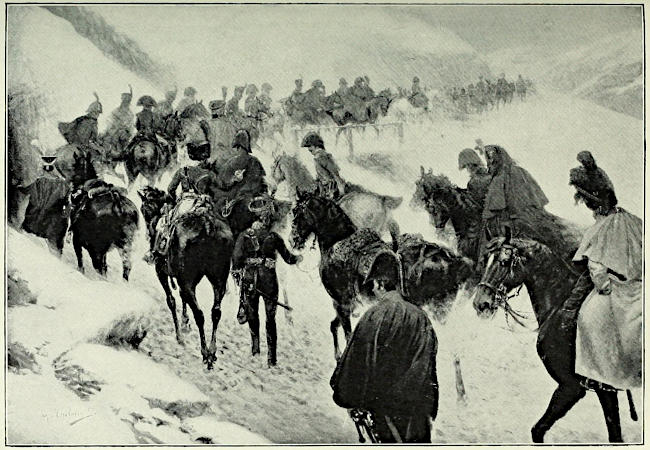
NAPOLEON IN THE PYRENEES
Napoleon now advanced upon Madrid, and on the 30th reached and attacked the Somosierra. The pass was defended by General San Juan; his troops fled after firing one volley, and afterwards sought to excuse their panic by accusing their unfortunate commander of treachery, and murdering him. The French crossed the mountains almost unopposed, and appeared before Madrid. In the moment of danger the inefficiency of the central junta became apparent. On the approach of the French armies the whole body fled towards Badajoz.
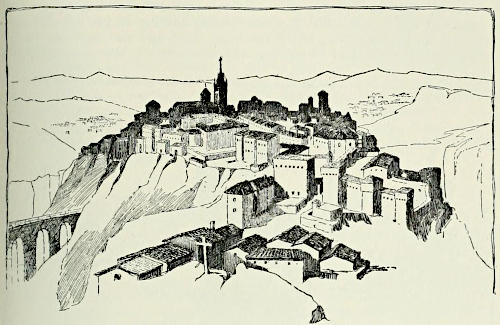
Guenca
Napoleon appeared before Madrid on the 2nd of December, and summoned the city to surrender, with fearful threats in case of resistance. On the morning of the 5th Morla surrendered Madrid. The emperor took possession of the palace of the kings of Spain; and in his proclamations threatened the Spaniards that, unless by their conduct they earned Joseph’s pardon, he would find another kingdom for his brother, and make Spain a French province. Such threats were not adapted to conciliate the haughty Spaniards; and the really beneficial decrees he promulgated, diminishing the exorbitant power of the clergy and the number of monks and nuns, by exasperating the whole ecclesiastical body, confirmed the nation in its enmity to him and his dynasty. Regardless of this enmity, however, Napoleon prepared to overrun and subjugate Portugal and the south of Spain with his grand army, whilst a division of thirty-five thousand men again besieged Saragossa. The central junta continued its fight to Seville, and the troops, which the different generals had rallied in considerable numbers, prepared to defend the Sierra Morena and the Tagus.
MOORE’S FAMOUS RETREAT
Moore’s situation was unquestionably one of great difficulty. The French are stated to have had two hundred thousand men in Spain; he could not bring into the field above twenty-five thousand; Madrid had fallen; and of the Spanish armies nothing remained within his reach but the few thousands, half clothed and half armed, that La Romana was endeavouring to organise. Moore had lost all confidence in Spanish professions, and was convinced that Frere, who vehemently urged him to attempt something, was deceived by his zeal in the Spanish cause and his ignorance of the Spanish character. Nevertheless Moore resolved to make such a diversion as should recall Napoleon from the south and from Portugal, and, if possible, to destroy Soult, who was within his reach with inferior numbers, before he could be reinforced. But he undertook this bold and generous enterprise with a heavy heart, and, as appears from his own letters, as sacrificing his own judgment to what he knew were the expectations of the British public. Moore began his movement on the 11th, effected his junction with Baird, and reached Sahagun on the 21st of December. There he halted two days for his supplies, meaning to attack Soult on the 24th. But on the 23rd he received information that Napoleon, upon hearing of his advance, had suspended all his operations in the south and west, and was marching in full force against the English. The projected diversion was thus accomplished; and he began his retreat towards Galicia, where he proposed embarking, and carrying his army southwards to join the Spanish forces collecting in Andalusia. The retreat was most disastrous. Officers and men disliked it; the bonds of discipline were early relaxed, and the bulk of the army was a mere drunken mob, never resuming any semblance of order or propriety except when there appeared a prospect of a battle. Then all were again found British soldiers.c
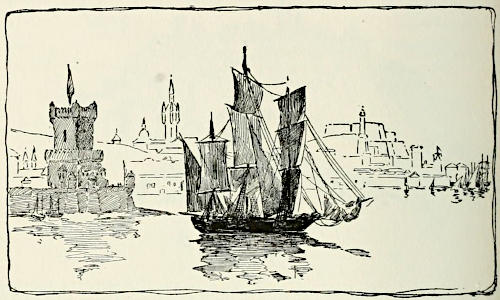
Lisbon in 1800
(From an old Spanish print)
Before discussing this famous disaster we may quote the words of H. M. Stephens,d who, after calling Moore “the only English general who has gained lasting fame by the conduct of a retreat,” and referring to his death as showing “how a modern Bayard should die in battle—every thought for others, none for himself,” thus sums up his position in history:
“It may be possible, in the face of his heroic death, to exaggerate Moore’s actual military services, but his influence on the British army cannot be overrated. The true military spirit of discipline and of valour, both in officers and men, had become nearly extinct during the American war. Abercromby, who looked back to the traditions of Minden, was the first to attempt to revive it, and his work was carried on by Moore. The formation of the light regiments at Shorncliffe was the answer to the new French tactics, and it was left to Wellington to show the success of the experiment. Moore’s powers as a statesman are shown in his despatches written at Salamanca, and he had the truest gift of a great man—that of judging men. It may be noticed that, while Wellington perpetually grumbled at the bad qualities of his officers and formed no school, Moore’s name is associated with the career of all who made their mark. Among generals, Hope, Graham, Sir E. Paget, Hill, and Craufurd, all felt and submitted to his ascendency, and of younger officers it was ever the proud boast of the Napiers, Colborne, the Beckwiths, and Barnard that they were the pupils of Moore, not of Wellington. Nay more, he inspired an historian. The description of Moore’s retreat in Napier is perhaps the finest piece of military history in the English language, not only because the author was present, but because his heart was with the leader of that retreat; and, if Napier felt towards Wellington as the soldiers of the Tenth legion felt towards Cæsar,[114] he felt towards Moore the personal love and devotion of a cavalier towards Montrose.”
We can do no better than quote at some length Napier’s famous account from his work, which has been favourably compared with those of Thucydides, Xenophon, and Cæsar.a
Napier’s Story of Moore’s Retreat
[1808-1809 A.D.]
That Moore succoured Spain in her extremity, and, in her hour of weakness, intercepted the blow descending to crush her, no man of candour can deny. For what troops, what preparations, what courage, what capacity was there in the south to have resisted even for an instant the progress of a man like Napoleon, who, in ten days and in the depth of winter, crossing the snowy ridge of the Carpentinos, had traversed two hundred miles of hostile country, and transported fifty thousand men from Madrid to Astorga in a shorter time than a Spanish courier would have taken to travel the same distance? This stupendous march was rendered fruitless by the quickness of Moore; but Napoleon, though he failed to destroy the English army, resolved, nevertheless, to cast it forth from the peninsula. Being himself recalled to France by tidings that the Austrian storm was ready to burst, he fixed upon Soult to continue the pursuit. Including Laborde, Heudelet, and Loison’s division, nearly sixty thousand men and ninety-one guns were put on the track of the English army.
Soult, nowise inferior to any of his nation, if the emperor be excepted, followed Moore with vigour. Nineteen thousand British troops posted in strong ground might have offered battle to very superior numbers; yet where was the use of merely fighting an enemy who had three hundred thousand men in Spain? Nothing could be gained, but Moore might by a quick retreat reach his ships unmolested, and carry his army from that narrow corner to the southern provinces and renew the war under more favourable circumstances. But in the immense wine-vaults of Bembibre hundreds of men remained inebriated, the followers of the army crowded the houses, and many of Romana’s disbanded men were mixed with this heterogeneous mass of marauders, drunkards, muleteers, women, and children. Moore, leaving a small guard with them, proceeded to Calcabellos. At Calcabellos the reserve took up a position, Baird marched to Herrerias, and Moore went on to Villa Franca; but in that town also great excesses had been committed by the preceding divisions; the magazines were plundered, the bakers driven from the ovens, the wine-stores forced, the commissaries prevented making the regular distributions; the doors of the houses were broken, and a scandalous insubordination then showed a discreditable relaxation of discipline by the officers. Moore arrested this disorder, and caused one man taken in the act of plundering a magazine to be hanged in the market-place.
Under the most favourable circumstances, the tail of a retreating force exhibits terrible scenes of distress, and on the road near Nogales the followers of the army were dying fast from cold and hunger. The soldiers, barefooted, harassed, and weakened by their excesses at Bembibre and Villa Franca, were dropping to the rear by hundreds, while broken carts, dead animals, and the piteous spectacle of women and children, struggling or falling exhausted in the snow, completed a picture of war, which like Janus has a double face.
The British army was not provided to fight above one battle; there were no draught cattle, no means of transporting reserve ammunition, no magazines, no hospitals, no second line, no provisions: a defeat would have been ruin, a victory useless. A battle is always a serious affair; two battles in such circumstances, though both should be victories, would have been destruction. A terrible storm of wind and rain, mixed with sleet, commenced as the army broke up from the position at Lugo; the marks were destroyed, the guides lost the true direction, only one of the divisions gained the main road, the other two were bewildered, and when daylight broke the rear columns were still near to Lugo. The fatigue, the depression of mind occasioned by this misfortune, and the want of shoes broke the order of the march, stragglers became numerous, and unfortunately Baird, thinking to relieve the men during a halt which took place in the night, desired the leading division to take refuge from the weather in some houses a little way off the road. Complete disorganisation followed this imprudent act. The commander-in-chief, who covered this march with the reserve and cavalry, ordered several bridges to be destroyed, but the engineers failed of success in every attempt.
As the troops approached Corunna, on January 12th, 1809, the general’s looks were directed towards the harbour, but an expanse of water painfully convinced him that to fortune at least he was in no way beholden; contrary winds still detained the fleet at Vigo, and the last consuming exertion made by the army was rendered fruitless. The men were put into quarters, and their leader awaited the progress of events. The reserve was posted between the village of El Burgo and the road of Santiago de Compostella. For twelve days these hardy soldiers had covered the retreat, during which time they traversed eighty miles of road in two marches, passed several nights under arms in the snow of the mountains, were seven times engaged, and now took the outposts having fewer men missing from the ranks, including those who had fallen in battle, than any other division in the army: an admirable instance of the value of good discipline, and a manifest proof of the malignant injustice with which Moore has been accused of precipitating his retreat beyond the measure of human strength.
Now a painful measure was adopted; the ground in front of Corunna is impracticable for cavalry, the horses were generally foundered, it was impossible to embark them all in the face of an enemy, and a great number were reluctantly ordered to be shot; worn down and foot-broken, they would otherwise have been distributed among the French cavalry, or used as draught cattle until death relieved them from procrastinated suffering. But the very fact of their being so foundered was one of the results of inexperience; the cavalry had come out to Corunna without proper equipments, the horses were ruined, not for want of shoes but want of hammers and nails to put them on. Soon the French gathered on the Mero, and Moore sought a position of battle. On the evening of the 14th the transports from Vigo hove in sight; the dismounted cavalry, the sick, the best horses, and fifty pieces of artillery were embarked, six British and three Spanish guns being kept on shore for action. When Laborde’s division arrived, on the 15th, the French force was not less than twenty thousand men, and Soult made no idle evolutions of display. Distributing his lighter guns along the front of his position, he opened a fire from the heavy battery on his left, and instantly descended the mountain with three columns covered by clouds of skirmishers. The ground about that village was intersected by stone walls and hollow roads; a severe scrambling fight ensued, the French were forced back with great loss, but, being reinforced, renewed the fight beyond the village. Major Napier,[115] commanding the 50th, was wounded and taken prisoner, and Elvina then became the scene of another contest. The line of the skirmishers being supported vigorously, checked the advance of the enemy’s troops in the valley; at the same time the centre and left of the army also became engaged, and a furious action ensued along the line, in the valley, and on the hills. Sir John Moore, while earnestly watching the result of the fight about the village of Elvina, was struck on the left breast by a cannon-shot.
Notwithstanding this great disaster the troops gained ground, and when the night set in, their line was considerably advanced beyond the original position of the morning, while the French were falling back in confusion. Their disorder facilitated the original plan of embarking during the night. Hope, upon whom the command had devolved, resolved therefore to ship the army, and so complete were the arrangements that no confusion or difficulty occurred; the pickets kindled fires to cover the retreat, and were themselves withdrawn at daybreak to embark under the protection of Hill’s brigade, which was in position under the ramparts of Corunna.
When the morning of the sixteenth dawned, the French, seeing the British position abandoned, pushed some battalions to the heights of San Lucia, and about midday opened a battery on the shipping in the harbour. This caused great confusion amongst the transports, several masters cut their cables, and four vessels went on shore, but the troops were rescued by the men-of-war’s boats, the stranded vessels burned, and the fleet got out of harbour. Hill then embarked at the citadel, which was maintained by a rearguard under Beresford until the 18th, when, the wounded being all on board, the troops likewise embarked; the inhabitants faithfully maintained the town meanwhile, and the fleet sailed for England. The loss of the British, never officially published, was estimated at eight hundred; of the French at three thousand. The latter is probably an exaggeration, yet it must have been great.
From the spot where he fell, the general was carried to the town by his soldiers; his blood flowed fast and the torture of the wound was great; yet the unshaken firmness of his mind made those about him, seeing the resolution of his countenance, express a hope of his recovery: he looked steadfastly at the injury for a moment, and said: “No, I feel that to be impossible.” Several times he caused his attendants to stop and turn round, that he might behold the field of battle; and when the firing indicated the advance of the British, he discovered his satisfaction and permitted the bearers to proceed. When life was almost extinct, with an unsubdued spirit, as if anticipating the baseness of his posthumous calumniators, he exclaimed: “I hope the people of England will be satisfied. I hope my country will do me justice.” In a few minutes afterwards he died, and his corpse, wrapped in a military cloak, was interred by the officers of his staff in the citadel of Corunna. The guns of the enemy paid his funeral honours, and Soult with a noble feeling of respect for his valour raised a monument to his memory on the field.b
A Spanish Opinion of the Retreat
English historians, especially Napier,b are so severe in their aspersions on the Spanish that it is only fair to give the words of a Spanish historian and contemporary, the count de Toreño, who says:
“The residents of Corunna with disinterested zeal not only assisted the English, but also kept faith with them, and did not immediately surrender the fortress, a noble example rarely given by towns when they see themselves abandoned by those from whom they expected protection and aid. So ended General Moore’s retreat, censured by some among his own compatriots, upheld and even praised by others. Leaving the investigation and criticism of this campaign to military men, we are of opinion that the chance of being compelled to fight before his troops embarked, and also his having ended his days honourably on the field of battle, have lent lustre to the glory and good name of General Moore. For the rest, if a veteran well-disciplined army such as the English, provided with abundant supplies, began a retreat before combating, in the progress of which retreat there were witnessed such disorders, such damage, such scandals, who can wonder that there were disorders and confusion in the Spanish retreats, executed after fighting, with an army of raw recruits, lacking all resources, and in their own country? We do not say this to detract from British glory, but in defence of our own, so reviled by certain English writers—by those indeed who took part in this disastrous campaign.”f
FRENCH SUCCESSES
[1809 A.D.]
In Catalonia an attempt by the Spaniards to recover Barcelona was defeated by St. Cyr, who likewise took Rosas. In Galicia La Romana sheltered himself and his little band amidst the mountains, whilst Soult overran the province; Corunna surrendered to him as soon as the English troops were safe on board, and Ferrol followed its example, delivering up the squadron in its port.
On the 22nd of January, 1809, Joseph returned to Madrid. His second entrance does not appear to have called forth the same demonstrations of national feeling as the first. The municipality and the several councils received him with loud professions of loyalty, and all the population took the oath of allegiance.
Saragossa had been invested by Marshal Moncey the 20th of December, 1808, and summoned to surrender; Palafox gave the answer that might be expected from his conduct in the former siege, and with his brave townsmen prepared to stand a second, yet more destructive. For a while the siege languished, and dissension existed amongst the besieging generals. But, on the 22nd of January, 1809, Lannes assumed the command; and on the 1st of February the besiegers forced their entrance into the town, and for three weeks the struggle, street by street and house by house, was maintained, with all the circumstances of affecting heroism recorded on the former occasion. But the numbers that had thronged to defend Saragossa were her bane: pestilence was engendered in the crowded cellars, and proved a yet more deadly foe than the French. The posts were manned by hospital patients, sitting, because they could not stand; Palafox was in his bed delirious; and on the 22nd of February the junta capitulated. Lannes violated the capitulation in many points, and sent Palafox, whose liberty had been stipulated, prisoner to France. The central junta loaded the city and all its inhabitants and defenders with praises, honour, and rewards.[116]
The reconquest of Portugal was now the object of the French. Soult was appointed governor of that kingdom, and ordered to invade it from the north, whilst Victor and Lapisse were to co-operate with him, the former in the south, and the latter from Ciudad Rodrigo.
Soult took Oporto by storm on the 29th of March, fixed his headquarters there, and seems to have meditated becoming king of northern Lusitania, if not of Portugal. But Oporto was the limit of his conquest. Behind him La Romana, who had rallied his constantly increasing army, found Ney full employment, and Silveira was again master of Tras-os-Montes. In the south Victor could not invade Alemtejo till he should have defeated Cuesta and the Estremaduran army; and Lapisse could not make himself master of Ciudad Rodrigo, which was defended chiefly by Sir Robert Wilson with his Lusitanian legion. This legion was the first attempt, in the course of the war, to improve the Portuguese soldiers, by placing them under British officers. The prince of Brazil was induced to send General Beresford a commission as field-marshal and general-in-chief of the Portuguese army. With this commission, Beresford landed early in March, and immediately proceeded to train the troops and to place over them as many effective English officers as he thought national jealousy would bear (always, however, nominally commanded by a native colonel).
Bonaparte is calculated to have had at this time about 270,000 men in the peninsula. These he deemed amply sufficient for its subjugation, and at the moment could not well reinforce them. His alarms touching Austria had proved just. If Napoleon was successful as ever in Germany, his generals were not equally prosperous in the peninsula. And what was of yet more consequence, on the 22nd of April, Sir Arthur Wellesley arrived in the Tagus, bearing the character of general-in-chief of the English and Portuguese troops.
WELLINGTON RESUMES CONTROL
There was no hesitation in Sir Arthur’s measures. He resolved first to clear Portugal of invaders, then to assist Spain. On the 6th of May, leaving a body of British and Portuguese on the Tagus to watch Victor, he began his march from Coimbra with about thirteen thousand British troops, three thousand Germans, and nine thousand of Beresford’s new levies, to effect the first of these objects. The French troops, who had ventured to take post south of the Douro, were everywhere outmanœuvred and driven back. Soult, having broken the bridges and secured the boats upon the Douro, a broad and rapid stream, believed the English could only cross by their ship-boats at the mouth of the river. But on the 12th, Sir Arthur contrived to procure four barges at a point where a wood concealed the river, and a hill his army, from the town, whilst his guns could play on the point at which the men were to land; and before the French suspected so daring an attempt, some companies were passed over who made good their footing.
Soult, after a short contest, evacuated Oporto, and precipitately retreated. The pursuit was continued for five days, till the French marshal, sacrificing his artillery, stores, baggage, and even his sick and wounded, escaped with the remnant of his troops, by mountain paths through which no regularly equipped and appointed army could attempt to follow. Sir Arthur then abandoned the chase, appointed Trant military governor of Oporto (the bishop had fled to Lisbon, where he was thenceforward a leading member of the regency), and leaving the protection of the northern provinces to Silveira and his Portuguese, returned southwards, to assist Cuesta against Victor. The utter impracticability of this brave, zealous, and upright, but narrow-minded, prejudiced, and obstinate old man,[117] thwarted every scheme proposed, and thus wasted much valuable time. The British commander found it impossible to obtain from his Spanish coadjutor either provisions or means of transport for his artillery and stores.
The French now returned with superior numbers, under the command of the king, aided by his major-general, Marshal Jourdan. Upon the 27th and 28th of July they attacked the allies at Talavera. The battle, long, obstinately contested, and sanguinary, ended in the complete defeat of the assailants; but the destitute and exhausted condition of the English troops, who were without provisions for man or horse, prevented their pursuing the discomfited enemy, who was consequently enabled to retreat in good order. The good that should have resulted from the victory was further counteracted by an alarm from the north, and Cuesta’s perverse temper.
La Romana had rallied and increased his little army, and had so harassed Soult and Ney, that they, considering likewise the greater importance of the transactions then taking place in the south, resolved to evacuate the province. They did so, and Galicia remained thenceforward unmolested by invaders. In their progress southwards the two marshals were joined by Mortier, and Soult received from Napoleon the command of the combined corps with orders to march upon the English and Cuesta. The Spaniards stationed to secure the mountain passes fled; and Sir Arthur led the British army against this new foe, intrusting to Cuesta the maintenance of the post of Talavera. An apprehension of Victor’s advancing anew induced Cuesta to evacuate Talavera, and he hastened after Wellesley, leaving fifteen hundred British wounded to the enemy, whilst it is said many of his own carts were removed empty. This step, and Soult’s advance in unexpected strength, exposed Sir Arthur to be cut off from Portugal. His troops were starving; and as the protection of Portugal was the point chiefly insisted upon in his instructions, he retreated to a frontier position on the Guadiana. Venegas was defeated at Almonacid. Blake’s army of Aragon and Valencia had been beaten and dispersed; and the fall of Spain appeared to be inevitable. Venegas’ repeated defeats had now made him so unpopular that the command of his army was taken from him.
Meanwhile the central junta exerted themselves to reinforce Cuesta’s army, which had been surprised and half destroyed by the enemy since its separation from the English; and they thought of removing the unmanageable general. A paralytic stroke saved them that trouble, by compelling him to resign. The command of the principal army of fifty thousand men was given to Areizaga who was ordered to free Madrid, before the reinforcements, set at liberty by the end of the Austrian war, could reach Spain. The same peculiarity of the Spanish character, namely, assuming as done whatever is promised, or even wished, seems to have convinced the inexperienced statesmen of the central junta that the general they had sent to conquer could not be beaten, and that a decree, ordering the English army to be well supplied, must answer every purpose, though they took no measures for procuring the provisions or the cattle required. Lord Wellington remained in his cantonments; and on the 17th of November, Areizaga was totally defeated at Ocaña. The French now menaced Portugal: the British general was prepared for its protection.
The French were masters of nearly all Spain north of the Sierra Morena, with the exception of Galicia, Valencia, and Catalonia; and in this last province, although it resisted most stoutly, the French army, under St. Cyr, held the field, and Gerona, one of the most important fortresses not in their hands, fell in December, after emulating the glory of Saragossa during a seven months’ siege.[118] But their garrisons were distressed, and their communications were harassed both by the British cruisers on the coast, and by the Catalans themselves, who were almost all in arms, as miquelets or guerrillas, displaying the same indomitable spirit they had shown in former wars. In the course of the year 1809, as the regular armies were defeated and dispersed, the example of the Catalans was followed throughout Spain; and bands of guerillas consisting of peasants, deserters, outlaws—of individuals, in short, of all classes—were everywhere established, the command of which was assumed by men of talent and resolution, likewise of all classes—officers, monks, physicians, yeomen, or smugglers. This was a mode of warfare to which the climate was favourable, the vindictive Spanish character peculiarly adapted, and habits of discipline unnecessary. They appeared in force wherever a blow was to be struck; when pursued, they dispersed and vanished. A few of the guerilla leaders, as Juan Martin Diaz, better known as the Empecinado, Julian Sanchez, Juan Diaz Porlier, Don Mariano de Renovalos Longa, and last, and far the greatest, the two Minas, uncle and nephew, acquired a celebrity that renders the record of their names indispensable in Spanish history.
[1809-1810 A.D.]
The central junta, opposed by the local junta, and alarmed at their own unpopularity, were now prevailed upon to transfer their authority to a regency of five persons. The regency, instead of devoting their time and thoughts to calling forth the resources and energies of the country, or even to the defence of Cadiz, began their administration by a vehement attack upon the measures of the central junta, accused that body of usurpation and peculation, threw some of the members into prison, and banished even the excellent Jovellanos to his native province, where his conduct was ordered to be watched. Alburquerque was deprived of the government of Cadiz and sent as ambassador to England, where he soon died, of mortification, it is said, at his ill usage. Whilst the regency were persecuting their predecessors, or occupied with commercial interests, Andalusia and Granada submitted at once to the conqueror, who met resistance only from Cadiz.
The war with Austria was now over, and it was generally expected that the dreaded Napoleon would return to the peninsula, to bear down all resistance by the energy of his own mighty genius. But he sent his favourite general, Masséna, whom he had surnamed the Spoiled Child of Victory, to conquer Portugal, drive the English into the sea, and, it was supposed, receive the crown of Portugal as his reward.
The Spaniards had now no army on foot deserving the name, and central Spain, from the Pyrenees to the lines before Cadiz, was nominally in the possession of King Joseph, Galicia and Estremadura, on the western, and Murcia, Valencia, and Catalonia on the eastern side, with a few fortresses, being all that yet remained unconquered; and, in Catalonia, Suchet was slowly making formidable progress. But the temper of the people never was less subdued, and the war had assumed a character of extraordinary ferocity.
Napoleon deemed that professional soldiers only had a right to fight; and instead of respecting the patriotic feeling that roused the whole nation to struggle for independence, he considered the armed peasantry as mere licentious rebels against their lawful king. Hence whilst the ordinary courtesies of war were observed towards the British, nearly all the Spaniards and the irregular Portuguese troops were treated with wanton cruelty, and their women exposed to the grossest outrage from the French soldiery, until almost every individual in the Spanish guerilla bands, and the Portuguese irregulars, had a private injury to revenge; and even sympathy in their resentments can barely palliate the sanguinary temper in which that revenge was sought. And to these personal motives of exasperation was added a deep sense of religious horror, since the French emperor had seized upon the estates of the church, upon Rome itself, and carried Pope Pius VII, who refused to sanction his spoliation, a prisoner to France. From the influence of so many various feelings, the whole of Spain was now overrun by fierce guerillas, and Joseph, in fact, was only master of the places actually occupied by French soldiers.
As soon as the French movements threatened Portugal, Lord Wellington could not hope, with 27,000 British, and 30,000 nearly untried Portuguese troops, to defend Portugal against 80,000 French veterans, led by an able general, and supported by bodies of 30,000 or 40,000 men, acting as a rearguard.
THE LINES OF TORRES VEDRAS
The British commander was even then directing the construction of those military works, known as the lines of Torres Vedras, by which the naturally strong ground covering Lisbon was rendered nearly impregnable; and his main object upon the frontier appears to have been retarding the enemy’s advance, until those lines should be perfected and the harvest gathered in. He intended that the inhabitants should then evacuate the intermediate district, with all their provisions and movable property; and that he himself, retreating to his lines, should draw Masséna into a desert country, where the French marshal could not subsist his troops, and would find himself confronted by a strong army, in an impregnable position, whilst his rear and communications were harassed by militia and ordenanzas, the proper name of the Portuguese armed peasantry.
Masséna, recently created by his imperial master, the prince of Essling, dedicated the spring to assembling his army, and making preparations; nor was it until he began the siege of Ciudad Rodrigo that the line by which he proposed to invade Portugal was ascertained. That town was gallantly defended by its governor, Herrasti, assisted by the guerilla chief, Sanchez, from the 4th of June till the 10th of July, 1810. When the place was no longer tenable, Sanchez and his band, breaking through the besiegers, escaped, and Herrasti capitulated. Lord Wellington’s plan required that he should hazard no attempt to relieve the besieged,[119] but his menacing position had long kept Masséna’s usually enterprising temper in check, and continued to do so; for upwards of a month was suffered to elapse after the fall of Ciudad Rodrigo ere the French general proceeded to lay siege to the neighbouring Portuguese fortress, Almeida.
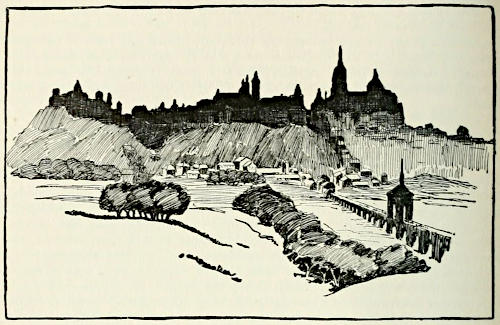
Salamanca
[1810 A.D.]
The allied army, falling back as he advanced, offered no interruption. But an English officer commanded the Portuguese garrison in Almeida, and a defence yet longer than Ciudad Rodrigo’s was confidently expected. An accident caused the explosion of the principal powder magazine on the 26th of August, when, through the panic of some and the treachery of others, the garrison flung down their arms, and forced the mortified governor to capitulate. Masséna concentrated his forces about the middle of September and prepared, as he hoped, to drive the British to their ships. Lord Wellington arranged his army upon the ridge of Busaco, and awaited the enemy. The French troops scaled the steep ascent with daring alacrity, but were driven down again with heavy loss. The French killed and wounded in this battle are estimated at from five to six thousand, those of the allies at twelve hundred: but perhaps not the least important event of the day was that the Portuguese troops displayed a steadiness of courage which had scarcely been as yet expected from their training. On the following day Masséna, learning that there was a mountain road by which he could turn the left of his adversary’s position, filed off his troops in that direction, vainly hoping to reach Coimbra the first. On the 29th Lord Wellington prevented him, by retreating upon that city along the direct road.
It was not till they actually saw the allied army retreating before the invaders that the inhabitants prepared to obey Lord Wellington’s proclamation, and forsake their homes. And now it was too late to attain the end for which the order had been given. The provisions were left behind, the mills were scarcely damaged; whilst the helpless and desolate crowds that, flying from the enemy, accompanied the troops, encumbered their march, and gave birth to the usual disorders of a retreat. Such disorders were, however, repressed by the vigour with which Lord Wellington punished, and the precautions he took to prevent them; whilst Masséna’s negligence indulged his troops in a license that rendered the disorder of the pursuing far greater than even now was that of the retreating army. At Coimbra alone the French troops, during the three days they spent there, wasted and destroyed stores that might have supplied two months’ subsistence. But at Coimbra Masséna was still ignorant of the existence of the lines of Torres Vedras; and still believing that he was merely chasing the British to their ships, he probably saw no need of restraining his troops or of providing against famine.
On the 10th of October the allied army took up its position within those extraordinary lines, of which one end rested upon the sea, and the other upon the Tagus, extending in length twenty-nine miles, at about thirty-five miles average distance from Lisbon. The utmost skill of the engineer had been exerted to improve the natural strength of this mountain line, and to supply its deficiencies. A second line of fortifications had been prepared some ten miles nearer Lisbon, in case the first should be lost, or prove too extensive for the numbers occupying it; and a third to protect a possible forced embarkation. But this danger was happily gone by. Reinforcements arrived from England, additional Portuguese corps were assembled, and La Romana, at Lord Wellington’s request, brought in two Spanish divisions. Before the end of the month seventy thousand regular troops were within the lines, ready to be moved, along convenient roads, to whatever points might be threatened, whilst sixty thousand Portuguese militia manned the different forts and redoubts that commanded the approaches.
Masséna halted in disagreeable surprise before the stupendous fortress. He was obliged to send foraging detachments to great distances; these were cruelly harassed, and sometimes cut off by the Portuguese militia and ordenanzas. Towards the middle of November, Masséna withdrew from before the lines, and took up a strong position at Santarem, upon the Tagus. Wellington, to observe him, stationed himself in advance of his lines, upon which he could fall back at a moment’s warning.
Throughout the greater part of Spain meanwhile a desultory warfare had been carried on, in which the French were generally successful. Victor was conducting the siege of Cadiz, an operation that proceeded languidly on both sides, from want of numbers on Victor’s, and the usual causes on that of the Spaniards.
The assembling of the cortes was looked to as the period and as the means of the regeneration of Spain. These hopes were confirmed, and the peculiar character of the Spanish resolution was, at the same time, curiously illustrated by the mode in which the elections were carried on, even in the provinces most thoroughly occupied by the French. Considerable bodies of armed peasants, or of guerillas, sometimes temporarily drove the French from the town where an election was appointed to take place, sometimes merely held them at bay, whilst the suffrages were collected. And thus, almost everywhere, deputies were elected who, sooner or later, found their way to Cadiz. On the 24th of September, 1810, the cortes were solemnly opened. The assembly immediately decreed a new levy of 150,000 men, together with provision for the support and equipment of all the Spanish armies. But then, as if this decree had sufficed for expelling the enemy, who held the whole country in subjection, they dedicated their whole attention to framing a constitution, and to establishing sweeping theories, resembling those adopted by the French National Assembly, and equally democratic in their tenor. The disputes that ensued between the cortes and the regency ended in the dissolution of the latter body, for whom was substituted an executive council of three. The cortes offended the clergy by attacking the Inquisition, and attempting other ecclesiastical reforms for which the country was unripe, exasperated the whole church, and sowed the seeds of the fatal subsequent reaction that robbed Spain of all the internal benefits she ought to have derived from the restoration of her representative legislature.
[1810-1811 A.D.]
Although they had allowed the colonies to send deputies to the cortes, they were not willing to treat the colonists as brethren. The colonies had unanimously professed their loyalty to Ferdinand, and their adhesion to the national cause. The emissaries employed by Napoleon and Joseph to seduce them had been everywhere derided and punished; and the American revenues, regularly conveyed to the mother-country by English vessels, ought, if fairly applied, to have done much towards supporting the war.
On the intelligence of the surrender of Seville, the subjugation of Andalusia, and the flight and dispersion of the central junta, the province of Caracas assumed that Spain was conquered; and, declaring that it never would submit to Joseph, cast off the authority of the mother-country whilst proclaiming inviolable fidelity to Ferdinand. This example was followed by the other provinces of Terra Firma, as the north coast of the South American continent was called; and on the 19th of April, 1810, the Venezuela confederation proclaimed its independent existence under Ferdinand VII. They refused to acknowledge the Cadiz regency and cortes, with whom they carried on a paper war; and those bodies, vehemently resenting this daring assertion of independence, divided the forces that should have been dedicated to the expulsion of the enemy from Spain, in order to compel colonial submission.
From the injudicious appointment to the chief command of the worst of all the Spanish generals, Lapeña, Cadiz must have fallen, if Soult had not been ordered by Napoleon to co-operate with Masséna against Portugal. Lapeña, to whom Graham, as a measure of conciliation, gave up the supreme command, stood inactive in a safe and distant post, with eleven thousand Spaniards, whilst at Barrosa, Graham, with little more than four thousand English and Portuguese, fought and defeated nearly nine thousand French. By the Spanish general’s refusal even to pursue the beaten enemy, the benefit of this hardly won success was lost. The council and cortes approved of Lapeña’s conduct: he claimed the merit of the victory, and Graham, in disgust, resigning his command to General Cooke, joined Lord Wellington. La Romana died on the 24th of January, 1811. Olivenza had capitulated on the 22nd, and the French laid siege to Badajoz. La Romana’s successor, Mendizabal, was defeated by Soult; but Don Raphael Menacho, the governor of Badajoz, defended the place stoutly, and Soult remained before it. In Portugal the winter had passed with little alteration. Wellington and Masséna had spent it in watching each other.
[1811 A.D.]
By the end of February, 1811, the provisions, which the obstinacy of the regents had left to the French, were exhausted. Masséna learned from his partisans in Lisbon that English reinforcements had landed on the 2nd of March, and on the 6th he had evacuated Santarem and begun his retreat. He conducted it with great skill, stained, however, with as great and wanton cruelty. In fact, this retreat, though highly honourable to the general’s abilities, remains one of the foulest blots upon the moral character of the French army.[120] But the pursuit was conducted by Lord Wellington with yet greater ability, every strong position taken by the French army being immediately turned by the British; and on the 5th of April Masséna was finally driven across the frontiers of Portugal. This retreat cost the French about six thousand men, and the allies a tenth of that number. Masséna’s previous losses are estimated at twenty-five or thirty thousand.
FAILURES IN SPAIN
Lord Wellington, having now again delivered Portugal, asked for such reinforcements as might enable him to undertake the deliverance of Spain, without being, as before, dependent upon the obstinate generals and feeble counsels of that country. But to the feasibility of his future schemes, and even to the maintenance of Portugal and of Cadiz, the recovery of Almeida, Ciudad Rodrigo, and Badajoz was indispensable. The first of these fortresses Wellington immediately blockaded, and directed Marshal Beresford to lay siege to the last.
Masséna, having refreshed, re-equipped, and reorganised his army in Spain, marched to relieve Almeida. His advance produced the battle of Fuentes de Onoro, fought on the 5th of May, in which, after an obstinate and sanguinary contest, they were repulsed, and again retreated. Brennier, the governor of Almeida, then despairing of relief, blew up the fortifications of the place, made his way, with little loss, through the British lines, and rejoined Masséna. Ciudad Rodrigo was next blockaded, but the French easily introduced convoys, and the blockade was abandoned. Little progress was made in the south. Some smaller places Marshal Beresford recovered; but he had scarcely invested Badajoz when the approach of Soult, with a powerful army, obliged him to raise the siege. He fought a battle at Albuera on the 16th of May. But the victory was purchased by the loss of forty-five hundred British, killed and wounded, out of six thousand, and twenty-six hundred Germans, Spaniards, and Portuguese. Lord Wellington arrived in Beresford’s camp soon after the battle, and Badajoz was besieged a second time under his own direction.
On the night of the 5th of June an attempt was made to storm. It failed; was repeated two nights later, and again failed, both times with heavy loss. Upon this second repulse, as the combined French armies, to the amount of seventy thousand men, were approaching, Lord Wellington, who had but fifty-six thousand, and was particularly inferior to his adversaries in cavalry, raised the siege, and withdrew the troops to a strong position, limiting himself, for the present, to the defence of Portugal. No other war raged now to distract the attention of the French emperor; but he did not again take the command of the peninsular armies, and it is difficult to assign a valid reason for his conduct. He contented himself with sending reinforcements to the extent of fifty thousand men, naming Marmont, duke of Ragusa, to supersede Masséna, whose conduct of the invasion of Portugal he of course blamed; and placing Catalonia, like Aragon, under Suchet’s command, and also Valencia when he should have conquered that province.
[1811-1812 A.D.]
Suchet had deserved this confidence: he had done more than any other French general both to conquer Spain and to bend her to the yoke. Aragon was tolerably submissive; Tarragona, the last fortress of Catalonia, fell in June. Considering his work done in Catalonia, although guerilla bands still occupied the mountain fastnesses, and the bold and able Sarsfield watched every opportunity of directing them upon the French, Suchet next invaded Valencia. He defeated several detachments of the Spanish army, and on the 16th of October laid siege to Murviedro. Blake gave battle on the 25th of October, and was defeated. Upon this disaster, Murviedro capitulated, and Blake took another strong position to protect the capital, Valencia, where Suchet, on the 26th of December, again defeated him, driving him into Valencia. There Suchet besieged him, and compelled him to capitulate on the 8th of January, 1812. This campaign, the most successful the French had made in Spain since the first, Napoleon rewarded by creating Suchet duke of Albuféra, and granting him the royal domain of that name in Valencia, as an inalienable fief of the French empire.
The dissensions with the colonies likewise diverted both the attention and the resources of the Spanish government from the vigorous prosecution of the war. In every American province insurrection now raged. In Mexico, after a severe struggle, the Spaniards regained the ascendency. In South America the insurgents everywhere prevailed, as will be described later in the histories of Spanish America.
The year 1812 opened with an exploit, the brilliant rapidity of which seems equally to have confounded the French and enraptured the Spaniards. Lord Wellington had long been silently forwarding every preparation for the siege of Ciudad Rodrigo. On the 8th of January, 1812, he suddenly appeared before the place, invested it, and on the 19th the town was stormed.c But throwing off the restraints of discipline, the British troops committed frightful excesses; the town was fired in three or four places, the soldiers menaced their officers and shot each other; many were killed in the market-place, intoxication soon increased the tumult, and at last, the fury rising to absolute madness, a fire was wilfully lighted in the middle of the great magazine, by which the town would have been blown to atoms but for the energetic courage of some officers and a few soldiers who still preserved their senses.
To recompense an exploit so boldly undertaken and so gloriously finished, Lord Wellington was created duke of Ciudad Rodrigo by the Spaniards, earl of Wellington by the English, marquis of Torres Vedras by the Portuguese.b
By disguising his designs, Lord Wellington hoped to master Badajoz like Ciudad Rodrigo, before Soult and Marmont should have time to hear of the siege, and unite their forces to raise it. On the 16th of March, 1812, Badajoz was invested. The works were hurried on with the diligence already practised, and on the 24th an important fort was carried by assault. On the 30th information was received that Soult was advancing with his whole disposable force to raise the siege; that Graham and Hill were retreating before him towards Albuera; that Marmont, taking advantage of the allied army’s removal, had crossed the frontier, blockaded Ciudad Rodrigo, masked Almeida, and marched southwards, plundering and ravaging the country, as far as Castello Branco; and that the cavalry and militia, left to observe him, had fallen back, the latter upon the mountains, the former towards the Tagus. In consequence of this threatening intelligence, the siege was pressed with increased ardour; on the 6th of April three sufficient breaches were made; and on the night of that day they were stormed.c
The account of this desperate attack is perhaps the most dramatic, and is certainly the most famous, portion of Napier’s History of the War in the Peninsula, which, as we have already stated, is regarded as the most eminent military history in the English language. We quote herewith the greater part of what is a masterwork of literature describing a masterwork of heroism.a
NAPIER’S ACCOUNT OF THE ASSAULT ON BADAJOZ
[1812 A.D.]
Dry but clouded was the night, the air thick with watery exhalations from the rivers, the ramparts and the trenches unusually still; yet a low murmur pervaded the latter, and in the former lights were seen to flit here and there, while the deep voices of the sentinels at times proclaimed that all was well at Badajoz. The French, confiding in Phillipon’s direful skill, watched from their lofty station the approach of enemies whom they had twice before baffled, and now hoped to drive a third time blasted and ruined from the walls. The British, standing in deep columns, were as eager to meet that fiery destruction as the others were to pour it down, and both were alike terrible for their strength, their discipline, and the passions awakened in their resolute hearts. Former failures there were to avenge, and on both sides leaders who furnished no excuse for weakness in the hour of trial. The possession of Badajoz had become a point of personal honour with the soldiers of each nation, but the desire for glory with the British was dashed by a hatred of the citizens on an old grudge; and recent toil and hardship with much spilling of blood had made many incredibly savage; for these things render the noble-minded indeed averse to cruelty but harden the vulgar spirit: numbers also, like Cæsar’s centurion, who could not forget the plunder of Avaricum, were heated with the recollection of Ciudad Rodrigo and thirsted for spoil. Thus every spirit found a cause of excitement, the wondrous power of discipline bound the whole together as with a band of iron, and in the pride of arms none doubted their might to bear down every obstacle that man could oppose to their fury.
At 10 o’clock, the castle, the San Roque, the breaches, the Pardaleras, the distant bastion of San Vincente, and the bridge-head on the other side of the Guadiana were to have been simultaneously assailed, and it was hoped the strength of the enemy would shrivel within that fiery girdle. But many are the disappointments of war. An unforeseen accident delayed the attack of the 5th division, and a lighted carcass thrown from the castle, falling close to the 3rd division, discovered their array and compelled them to anticipate the signal by half an hour. Then, everything being suddenly disturbed, the double columns of the 4th and light divisions also moved silently and swiftly against the breaches, and the guard of the trenches rushing forward with a shout encompassed the San Roque with fire and broke in so violently that scarcely any resistance was made. But a sudden blaze of light and the rattling of musketry indicated the commencement of a more vehement combat at the castle. There General Kempt—for Picton hurt by a fall in the camp, and expecting no change in the hour, was not present—there Kempt, I say, led the 3rd division. Having passed the Rivillas in single files by a narrow bridge under a terrible musketry, he had reformed, and running up a rugged hill, reached the foot of the castle, where he fell severely wounded, and as he was carried back to the trenches met Picton, who was hastening to take the command.
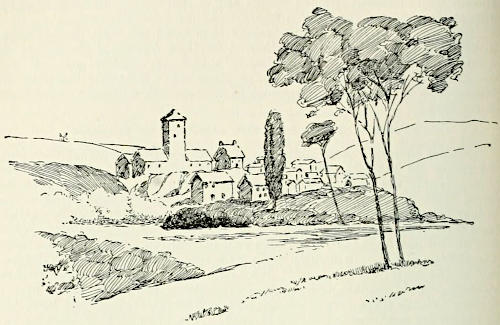
Vimeiro
Meanwhile the troops, spreading along the front, had reared their heavy ladders, some against the lofty castle, some against the adjoining front on the left, and with incredible courage ascended amidst showers of heavy stones, logs of wood, and bursting shells rolled off the parapet, while from the flanks the enemy plied his musketry with fearful rapidity, and in front with pikes and bayonets stabbed the leading assailants or pushed the ladders from the walls; and all this was attended with deafening shouts and the crash of breaking ladders, and the shrieks of crushed soldiers answering to the sullen stroke of the falling weights. Still swarming round the remaining ladders those undaunted veterans strove who should first climb, until all being overturned, the French shouted victory, and the British, baffled but untamed, fell back a few paces and took shelter under the rugged edge of the hill. There the broken ranks were somewhat reformed, and the heroic Ridge, springing forward, seized a ladder, and calling with stentorian voice on his men to follow, once more raised it against the castle, yet to the right of the former attack, where the wall was lower and an embrasure offered some facility. A second ladder was soon placed alongside of the first by the grenadier officer Canch, and the next instant he and Ridge were on the rampart, the shouting troops pressed after them, the garrison, amazed and in a manner surprised, were driven fighting through the double gate into the town, and the castle was won. A reinforcement from the French reserve then came up, a sharp action followed, both sides fired through the gate, and the enemy retired; but Ridge fell, and no man died that night with more glory—yet many died, and there was much glory.
All this time the tumult at the breaches was such as if the very earth had been rent asunder and its central fires bursting upwards uncontrolled. The two divisions had reached the glacis just as the firing at the castle commenced, and the flash of a single musket discharged from the covered way as a signal showed them that the French were ready; yet no stir was heard and darkness covered the breaches. Some hay-packs were thrown, some ladders placed, and the forlorn hopes and storming parties of the light division, five hundred in all, descended into the ditch without opposition; but then a bright flame shooting upwards, displayed all the terrors of the scene. The ramparts, crowded with dark figures and glistering arms, were on one side, on the other the red columns of the British, deep and broad, were coming on like streams of burning lava; it was the touch of the magician’s wand, for a crash of thunder followed, and with incredible violence the storming parties were dashed to pieces by the explosion of hundreds of shells and powder-barrels.
For an instant the light division stood on the brink of the ditch amazed at the terrific sight, but then with a shout that matched even the sound of the explosion the men flew down the ladders, or disdaining their aid leaped reckless of the depth into the gulf below; and at the same moment, amidst a blaze of musketry that dazzled the eyes, the 4th division came running in and descended with a like fury. There were only five ladders for the two columns which were close together, and a deep cut made in the bottom of the ditch was filled with water from the inundation; into that watery snare the head of the 4th division fell, and it is said above a hundred of the fusiliers, the men of Albuera, were there smothered. Those who followed checked not, but, as if such a disaster had been expected, turned to the left and thus came upon the face of the unfinished ravelin, which being rough and broken was mistaken for the breach and instantly covered with men; yet a wide and deep chasm was still between them and the ramparts, from whence came a deadly fire wasting their ranks. Thus baffled they also commenced a rapid discharge of musketry and disorder ensued. Now a multitude bounded up the great breach as if driven by a whirlwind, but across the top glittered a range of sword-blades, sharp-pointed, keen-edged on both sides, and firmly fixed in ponderous beams chained together and set deep in the ruins; and for ten feet in front the ascent was covered with loose planks studded with sharp iron points, on which feet being set the planks moved and the unhappy soldiers falling forward on the spikes rolled down upon the ranks behind. Then the Frenchmen, shouting at the success of their stratagem and leaping forward, plied their shot with terrible rapidity, for every man had several muskets, and each musket in addition to its ordinary charge contained a small cylinder of wood stuck full of wooden slugs, which scattered like hail when they were discharged. Once and again the assailants rushed up the breaches, but always the sword-blades, immovable and impassable, stopped their charge, and the hissing shells and thundering powder-barrels exploded unceasingly. Hundreds of men had fallen, hundreds more were dropping, still the heroic officers called aloud for new trials, and so furious were the men themselves that in one of these charges the rear sometimes followed by many, sometimes by a few, ascended the ruins; strove to push the foremost on to the sword-blades, willing even to make a bridge of their writhing bodies, but the others frustrated the attempt by dropping down; and men fell so far from the shot, it was hard to know who went down voluntarily, who were stricken; and many stooped unhurt that never rose again. Vain also would it have been to break through the sword-blades, for the trench and parapet behind the breach were finished, and the assailants, crowded into even a narrower space than the ditch was, would still have been separated from their enemies and the slaughter would have continued.
Order was impossible! Officers of all ranks, followed more or less numerously by the men, were seen to start out as if struck by sudden madness and rush into the breach. Colonel Macleod of the 43rd, a young man whose feeble body would have been quite unfit for war if it had not been sustained by an unconquerable spirit, when one behind him in falling plunged a bayonet into his back, complained not but continuing his course was shot dead within a yard of the sword-blades. Yet there was no want of gallant leaders or desperate followers, until two hours passed in these vain efforts had convinced the troops the breach of the Trinidad was impregnable. Gathering in dark groups and leaning on their muskets, they looked up with sullen desperation at the Trinidad; while the enemy, stepping out on the ramparts and aiming their shots by the light of the fire-balls which they threw over, asked as their victims fell, “Why did they not come into Badajoz?” In this dreadful situation, while the dead were lying in heaps and others continually falling, the wounded crawling about to get some shelter from the merciless shower above, and withal a sickening stench from the burned flesh of the slain, Captain Nicholas was observed making incredible efforts to force his way with a few men into the Santa Maria bastion; but when they had gained two-thirds of the ascent a concentrated fire of musketry and grape dashed nearly the whole dead to the earth: Nicholas was mortally wounded and the intrepid Shaw stood alone. With inexpressible coolness he looked at his watch, and saying it was too late to carry the breaches rejoined the masses at the other attack. After this no further effort was made at any point, and the troops remained passive but unflinching beneath the enemy’s shot which streamed without intermission.
About midnight, when two thousand brave men had fallen, Wellington, who was on a height close to the quarries, ordered the remainder to retire and reform for a second assault; he had heard the castle was taken, but, thinking the enemy would still resist in the town, was resolved to assail the breaches again. This retreat from the ditch was not effected without further carnage and confusion. All this time the town was girdled with fire. Walker’s brigade, having passed on during the feint on the Pardaleras, was escalading the distant bastion of San Vincente. His troops had advanced along the banks of the river and reached the French guard-house at the barrier-gate undiscovered, the ripple of the waters smothering the sound of their footsteps; but just then the explosion at the breaches took place, the moon shone out, the French sentinels discovering the columns fired, and the British soldiers springing forward under a sharp musketry began to hew down the wooden barrier at the covered way. The Portuguese, panic-stricken, threw down the scaling-ladders, the others snatched them up again and forcing the barrier jumped into the ditch; but the guiding engineer officer was killed, there was a cunette which embarrassed the column, and the ladders proved too short, for the walls were generally above thirty feet high. The fire of the enemy was deadly, a small mine was sprung beneath the soldiers’ feet, beams of wood and live shells were rolled over on their heads, showers of grape from the flank swept the ditch, and man after man dropped dead from the ladders.
Fortunately some of the defenders had been called away to aid in recovering the castle, the ramparts were not entirely manned; and the assailants, discovering a corner of the bastion where the scarp was only twenty feet high, placed three ladders there under an embrasure which had no gun and was only stopped with a gabion. Some men got up with difficulty, for the ladders were still too short, and the first man who gained the top was pushed up by his comrades and drew others after him until many had won the summit; and though the French shot heavily against them from both flanks and from a house in front, their numbers augmented rapidly and half the 4th regiment entered the town itself to dislodge the French from the houses, while the others pushed along the rampart towards the breach and by dint of hard fighting successively won three bastions.
In the last of these combats Walker, leaping forward sword in hand at the moment when one of the enemy’s cannoneers was discharging a gun, was covered with so many wounds it was wonderful that he could survive, and some of the soldiers immediately after, perceiving a lighted match on the ground, cried out: “A mine!” At that word, such is the power of imagination, those troops who had not been stopped by the strong barrier, the deep ditch, the high walls and the deadly fire of the enemy, staggered back appalled by a chimera of their own raising; and in this disorder a French reserve under General Veillande drove on them with a firm and rapid charge, pitching some men over the walls, killing others outright, and cleansing the ramparts even to the San Vincente. There however Leith had placed Colonel Nugent with a battalion of the 38th as a reserve, and when the French came up, shouting and slaying all before them, this battalion, two hundred strong, arose and with one close volley destroyed them; then the panic ceased, the soldiers rallied, and in compact order once more charged along the walls towards the breaches; but the French, although turned on both flanks and abandoned by fortune, did not yet yield.
Meanwhile the portion of the 4th regiment which had entered the town was strangely situated. For the streets were empty and brilliantly illuminated and no person was seen, yet a low buzz and whispers were heard around, lattices were now and then gently opened, and from time to time shots were fired from underneath the doors of the houses by the Spaniards, while the troops with bugles sounding advanced towards the great square of the town. In their progress they captured several mules going with ammunition to the breaches; yet the square itself was as empty and silent as the streets, and the houses as bright with lamps: a terrible enchantment seemed to be in operation—they saw only an illumination and heard only low whispering around them, while the tumult at the breaches was like the crashing thunder. Plainly, however, the fight was there raging, and hence, quitting the square, they attempted to take the garrison in reverse by attacking the ramparts from the town side; but they were received with a rolling musketry, driven back with loss, and resumed their movement through the streets. At last the breaches were abandoned by the French, other parties entered, desultory combats took place, Veillande, and Phillipon who was wounded, seeing all ruined, passed the bridge with a few hundred soldiers, and entered San Christoval.
Now commenced that wild and desperate wickedness which tarnished the lustre of the soldiers’ heroism. All indeed were not alike, hundreds risked and many lost their lives in striving to stop the violence; but madness generally prevailed, and as the worst men were leaders here, all the dreadful passions of human nature were displayed. Shameless rapacity, brutal intemperance, savage lust, cruelty and murder, shrieks and piteous lamentations, groans, shouts, imprecations, the hissing of fires bursting from the houses, the crashing of doors and windows, and the reports of muskets used in violence, resounded for two days and nights in the streets of Badajoz! On the third, when the city was sacked, when the soldiers were exhausted by their own excesses, the tumult rather subsided than was quelled: the wounded men were then looked to, the dead disposed of. Five thousand men and officers fell in this siege, and of these, including 700 Portuguese, 3,500 had been stricken in the assault, 60 officers and more than 700 men being slain on the spot. The five generals, Kempt, Harvey, Bowes, Colville, and Picton were wounded, the first four severely; 600 men and officers fell in the escalade of San Vincente, as many at the castle, and more than 2,000 at the breaches, each division there losing 1,200. And how deadly the breach strife was may be gathered from this: the 43rd and 52nd regiments of the light division lost more men than the seven regiments of the 3rd division engaged at the castle.[121]
Let it be considered that this frightful carnage took place in a space of less than a hundred yards square; that the slain died not all suddenly nor by one manner of death—that some perished by steel, some by shot, some by water, that some were crushed and mangled by heavy weights, some trampled upon, some dashed to atoms by the fiery explosions; that for hours this destruction was endured without shrinking, and the town was won at last. Let these things be considered, and it must be admitted a British army bears with it an awful power. And false would it be to say the French were feeble men; the garrison stood and fought manfully and with good discipline, behaving worthily: shame there was none on any side. Yet who shall do justice to the bravery of the British soldiers—the noble emulation of the officers? Who shall measure out the glory of Ridge, of Macleod, of Nicholas, of O’Hare of the 95th, who perished on the breach at the head of the stormers, and with him nearly all the volunteers for that desperate service? Who shall describe the springing valour of that Portuguese grenadier who was killed, the foremost man at the Santa Maria; or the martial fury of that desperate rifleman, who, in his resolution to win, thrust himself beneath the chained sword-blades, and there suffered the enemy to dash his head to pieces with the ends of their muskets? Who can sufficiently honour the intrepidity of Walker, of Shaw, of Canch, or the hardiness of Ferguson of the 43rd, who having in former assaults received two deep wounds was here, his former hurts still open, leading the stormers of his regiment, the third time a volunteer, the third time wounded? Nor would I be understood to select these as pre-eminent; many and signal were the other examples of unbounded devotion, some known, some that will never be known; for in such a tumult much passes unobserved, and often the observers fell themselves ere they could bear testimony to what they saw: but no age, no nation ever sent forth braver troops to battle than those who stormed Badajoz. When the extent of the night’s havoc was made known to Lord Wellington, the firmness of his nature gave way for a moment, and the pride of conquest yielded to a passionate burst of grief for the loss of his gallant soldiers.b
BRITISH PROGRESS
One result of this triumph was the immediate and final retreat of the French from Estremadura and Portugal. Marmont raised the blockade of Ciudad Rodrigo, and fell back to Salamanca.
In Spain, the native leaders meanwhile continued their desultory warfare; Lacy, Sarsfield, Rovira, Mina, and Porlier in the north, the Empecinado and Sanchez in the Castiles, and Ballasteros in the south, gained trifling advantages over the enemy in divers engagements; but for want of concert no material result was obtained from their successes, whilst Suchet made himself master of the whole kingdom of Valencia, with the single exception of Alicante. In Tarifa, a town defended only by an old wall, eighteen hundred English and Spanish troops, commanded by Colonel Skerrett, repulsed ten thousand French led by the duke of Belluno in person.[122]
Meanwhile General Hill had driven the French from Almaraz upon the Tagus, and thus obtained possession of the only place through which the enemy’s armies of Portugal and of the south could conveniently keep up their communication across the river. The earl of Wellington then advanced towards Salamanca on the 13th of June, 1812. He there, despite the efforts of Marmont, reduced several very strong forts. Marmont retreated to the Douro. A series of masterly manœuvres ensued, in which, during six days, the contending generals displayed all the resources of their art. The advantage in this pure trial of skill remained with the Briton, who, on the 22nd of July, seizing upon a rash movement of Marmont’s, instantly attacked him, and gained the splendid victory of Salamanca, in which the French lost seven thousand prisoners, at least as many killed and wounded, including three generals killed and four wounded, amongst whom was Marmont himself, eleven pieces of artillery, and two eagles. The loss of the allies amounted to fifty-two hundred killed and wounded, the former including one general, the latter five.
Clausel, who upon Marmont’s being disabled, succeeded to the command, rallied the routed army, and retreated to Burgos. Wellington pursued him as far as Valladolid, and then turning southwards, marched upon Madrid. Joseph had not above twenty thousand men for the defence of his capital; he abandoned it at the approach of the allies; but weakened himself by leaving a garrison of two thousand men in a fortress adjoining the palace of Buen Retiro. They capitulated on the approach of the British. Lord Wellington entered Madrid on the 12th of August, and was received with every demonstration as the deliverer of Spain. The new constitution was proclaimed in the capital, and sworn to with eager zeal. And now the exploits and services of the British general had at length so far conquered Spanish jealousy that the cortes named the duke commander-in-chief of the Spanish forces.
Soult raised the blockade of Cadiz on the 25th, and united with Suchet. He left, however, a garrison in Seville, which fell into the hands of the English and Spanish troops on the 27th. Joseph, on the advance of Hill, retreated in the same direction, and Andalusia was again freed from the presence of the invaders. But the position of Lord Wellington at Madrid, which had already produced most of the expected advantages, was becoming dangerous. He was disappointed of the diversions upon which he had relied. Maitland’s army proved too weak, amounting only to six thousand men, to attempt a landing in Catalonia. It was therefore directed to Alicant, where the Anglo-Sicilian army necessarily remained in garrison. Wellington quitted Madrid on the 1st of September, to march against Burgos, leaving half his army under Hill to observe Soult, and if possible defend Madrid. The English troops that had garrisoned Cadiz now joined the army.
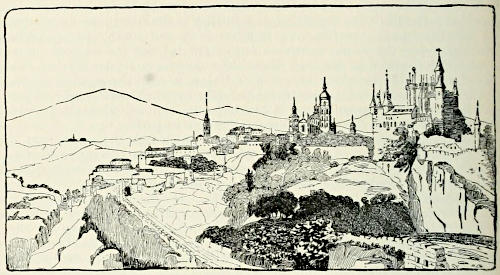
Segovia
The French retreated as the allies advanced. On the 19th, Lord Wellington occupied Burgos, and laid siege to the castle. Here the deficiency of means proved more detrimental than ever, rendering it impossible to conquer the science and courage displayed in the defence, or to prevent the approach of Souham with all the disposable French force in the north of Spain. Lord Wellington, on the 22nd of October, judged it expedient to raise the siege, and take up his winter quarters on the Portuguese frontier. About the same time, Joseph and Soult advancing upon Madrid, Hill in obedience to his instructions, retreated to Salamanca, where, on the 3rd of November, he joined Lord Wellington. On the 24th, the troops went into cantonments along the frontier line, headquarters being fixed at Freynada. It is mortifying to be compelled to add that, leisurely as was this retreat, and untroubled by aught save very wet weather, the troops, dispirited by their failure before Burgos, discovered much of the disorder and insubordination that had marked Sir John Moore’s retreat to Corunna.c