Chapter IV · MOHAMMED (continued 2)
Reading edition
The mission of the ancient prophets, of Moses, and of Jesus, had been confirmed by many splendid prodigies; and Mohammed was repeatedly urged by the inhabitants of Mecca and Medina to produce a similar evidence of his divine legation; to call down from heaven the angel or the volume of his revelation, to create a garden in the desert, or to kindle a conflagration in the unbelieving city. As often as he is pressed by the demands of the Koreish, he involves himself in the obscure boast of vision and prophecy, appeals to the internal proofs of his doctrine, and shields himself behind the providence of God, who refuses those signs and wonders that would depreciate the merit of faith and aggravate the guilt of infidelity. But the modest or angry tone of his apologies betrays his weakness and vexation; and these passages of scandal establish, beyond suspicion, the integrity of the Koran.
The votaries of Mohammed are more assured than himself of his miraculous gifts, and their confidence and credulity increase as they are further removed from the time and place of his spiritual exploits. They believe or affirm that trees went forth to meet him; that he was saluted by stones; that water gushed from his fingers; that he fed the hungry, cured the sick, and raised the dead; that a beam groaned to him; that a camel complained to him; that a shoulder of mutton informed him of its being poisoned; and that both animate and inanimate nature were equally subject to the apostle of God. His dream of a nocturnal journey is seriously described as a real and corporeal transaction. A mysterious animal, the borak, conveyed him from the temple of Mecca to that of Jerusalem; with his companion Gabriel he successively ascended the seven heavens, and received and repaid the salutations of the patriarchs, the prophets, and the angels, in their respective mansions. Beyond the seventh heaven, Mohammed alone was permitted to proceed; he passed the veil of unity, approached within two bow-shots of the throne, and felt a cold that pierced him to the heart when his shoulder was touched by the hand of God. After this familiar, though important conversation, he again descended to Jerusalem, remounted the borak, returned to Mecca, and performed in the tenth part of a night the journey of many thousand years. According to another legend, the apostle confounded in a national assembly the malicious challenge of the Koreish. His resistless word split asunder the orb of the moon; the obedient planet stooped from her station in the sky, accomplished the seven revolutions round the Kaaba, saluted Mohammed in the Arabian tongue, and suddenly contracting her dimensions entered at the collar, and issued forth through the sleeve of his shirt. The vulgar are amused with these marvellous tales; but the gravest of the Mussulman doctors imitate the modesty of their master, and indulge a latitude of faith or interpretation. They might speciously allege that, in preaching the religion, it was needless to violate the harmony of nature; that a creed unclouded with mystery may be excused from miracles; and that the sword of Mohammed was not less potent than the rod of Moses.
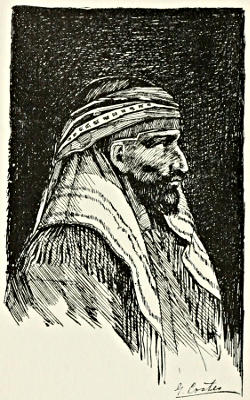
An Arab Chief
The polytheist is oppressed and distracted by the variety of superstition; a thousand rites of Egyptian origin were interwoven with the essence of the Mosaic law, and the spirit of the Gospel had evaporated in the pageantry of the church. The prophet of Mecca was tempted, by prejudice, or policy, or patriotism, to sanctify the rites of the Arabians and the custom of visiting the holy stone of the Kaaba. But the precepts of Mohammed himself inculcate a more simple and rational piety; prayer, fasting, and alms are the religious duties of a Mussulman; and he is encouraged to hope that prayer will carry him half-way to God, fasting will bring him to the door of his palace, and alms will gain him admittance.
(1) According to the tradition of the nocturnal journey, the apostle, in his personal conference with the Deity, was commanded to impose on his disciples the daily obligation of fifty prayers. By the advice of Moses, he applied for an alleviation of this intolerable burden; the number was gradually reduced to five; without any dispensation of business or pleasure, or time or place, the devotion of the faithful is repeated at daybreak, at noon, in the afternoon, in the evening, and at the first watch of the night; and in the present decay of religious fervour our travellers are edified by the profound humility and attention of the Turks and Persians. Cleanliness is the key of prayer; the frequent lustration of the hands, the face, and the body, which was practised of old by the Arabs, is solemnly enjoined by the Koran; and a permission is formally granted to supply with sand the scarcity of water. The words and attitudes of supplication, as it is performed either sitting, or standing, or prostrate on the ground, are prescribed by custom or authority, but the prayer is poured forth in short and fervent ejaculations; the measure of zeal is not exhausted by a tedious liturgy; and each Mussulman, for his own person, is invested with the character of a priest. Among the theists, who reject the use of images, it has been found necessary to restrain the wanderings of the fancy by directing the eye and the thought towards a kibla, or visible point of the horizon. The prophet was at first inclined to gratify the Jews by the choice of Jerusalem, but he soon returned to a more natural partiality; and five times every day the eyes of the nations at Astrakhan, at Fez, at Delhi are devoutly turned to the holy temple of Mecca. Yet every spot for the service of God is equally pure; the Mohammedans indifferently pray in their chamber or in the street. As a distinction from the Jews and Christians, the Friday in each week is set apart for the useful institution of public worship; the people are assembled in the mosque; and the imam, some respectable elder, ascends the pulpit, to begin the prayer and pronounce the sermon. But the Mohammedan religion is destitute of priesthood or sacrifice; and the independent spirit of fanaticism looks down with contempt on the ministers and the slaves of superstition.
(2) The voluntary penance of the ascetics, the torment and glory of their lives, was odious to a prophet who censured in his companions a rash vow of abstaining from flesh, and women, and sleep; and firmly declared that he would suffer no monks in his religion. Yet he instituted, in each year, a fast of thirty days; and strenuously recommended the observance, as a discipline which purifies the soul and subdues the body, as a salutary exercise of obedience to the will of God and his apostle. During the month of Ramadhan, from the rising to the setting of the sun, the Mussulman abstains from eating, and drinking, and women, and baths, and perfumes; from all nourishment that can restore his strength, from all pleasure that can gratify his senses. In the revolution of the lunar year, the Ramadhan coincides by turns with the winter cold and the summer heat; and the patient martyr, without assuaging his thirst with a drop of water, must expect the close of a tedious and sultry day. The interdiction of wine, peculiar to some orders of priests or hermits, is converted by Mohammed alone into a positive and general law; and a considerable portion of the globe has abjured, at his command, the use of that salutary though dangerous liquor. These painful restraints are, doubtless, infringed by the libertine and eluded by the hypocrite; but the legislator by whom they are enacted cannot surely be accused of alluring his proselytes by the indulgence of their sensual appetites.
(3) The charity of the Mohammedans descends to the animal creation; and the Koran repeatedly inculcates, not as a merit but as a strict and indispensable duty, the relief of the indigent and unfortunate. Mohammed, perhaps, is the only lawgiver who has defined the precise measure of charity; the standard may vary with the degree and nature of property, as it consists either in money, in corn or cattle, in fruits or merchandise; but the Mussulman does not accomplish the law unless he bestows a tenth of his revenue; and if his conscience accuses him of fraud or extortion, the tenth, under the idea of restitution, is enlarged to a fifth. Benevolence is the foundation of justice, since we are forbidden to injure those whom we are bound to assist. A prophet may reveal the secrets of heaven and of futurity; but in his moral precepts he can only repeat the lessons of our own hearts.
The two articles of belief and the four practical duties of Islam are guarded by rewards and punishments; and the faith of the Mussulman is devoutly fixed on the event of the judgment and the last day. The prophet has not presumed to determine the moment of that awful catastrophe, though he darkly announces the signs, both in heaven and earth, which will precede the universal dissolution, when life shall be destroyed and the order of creation shall be confounded in the primitive chaos. At the blast of the trumpet, new worlds will start into being; angels, genii, and men will arise from the dead, and the human soul will again be united to the body. The doctrine of the resurrection was first entertained by the Egyptians; and their mummies were embalmed, their pyramids were constructed, to preserve the ancient mansion of the soul during a period of three thousand years. But the attempt is partial and unavailing; and it is with a more philosophic spirit that Mohammed relies on the omnipotence of the Creator, whose word can reanimate the breathless clay, and collect the innumerable atoms that no longer retain their form or substance. The intermediate state of the soul it is hard to decide; and those who most firmly believe in her immaterial nature, are at a loss to understand how she can think or act without the agency of the organs of sense.
The reunion of the soul and body will be followed by the final judgment of mankind; and in his copy of the magian picture the prophet has too faithfully represented the forms of proceeding, and even the slow and successive operations of an earthly tribunal. By his intolerant adversaries he is upbraided for extending, even to themselves, the hope of salvation; for asserting the blackest heresy—that every man who believes in God and accomplishes good works may expect in the last day a favourable sentence. Such rational indifference is ill adapted to the character of a fanatic; nor is it probable that a messenger from heaven should depreciate the value and necessity of his own revelation. In the idiom of the Koran, the belief of God is inseparable from that of Mohammed; the good works are those which he has enjoined; and the two qualifications imply the profession of Islam, to which all nations and all sects are equally invited. Their spiritual blindness, though excused by ignorance and crowned with virtue, will be scourged with everlasting torments; and the tears which Mohammed shed over the tomb of his mother, for whom he was forbidden to pray, display a striking contrast of humanity and enthusiasm.
The doom of the infidels is common; the measure of their guilt and punishment is determined by the degree of evidence which they have rejected, by the magnitude of the errors which they have entertained; the eternal mansions of the Christians, the Jews, the Sabians, the Magians, and the idolaters are sunk below each other in the abyss; and the lowest hell is reserved for the faithless hypocrites who have assumed the mask of religion. After the greater part of mankind has been condemned for their opinions, the true believers only will be judged by their actions. The good and evil of each Mussulman will be accurately weighed in a real or allegorical balance, and a singular mode of compensation will be allowed for the payment of injuries; the aggressor will refund an equivalent of his own good actions for the benefit of the person whom he has wronged; and if he should be destitute of any moral property, the weight of his sins will be loaded with an adequate share of the demerits of the sufferer. According as the shares of guilt or virtue shall preponderate, the sentence will be pronounced, and all, without distinction, will pass over the sharp and perilous bridge of the abyss; but the innocent, treading in the footsteps of Mohammed, will gloriously enter the gates of paradise, while the guilty will fall into the first and mildest of the seven hells. The term of expiation will vary from nine hundred to seven thousand years; but the prophet has judiciously promised that all his disciples, whatever may be their sins, shall be saved, by their own faith and his intercession, from eternal damnation.
It is not surprising that superstition should act most powerfully on the fears of her votaries, since the human fancy can paint with more energy the misery than the bliss of a future life. With the two simple elements of darkness and fire we create a sensation of pain, which may be aggravated to an infinite degree by the idea of endless duration. But the same idea operates with an opposite effect on the continuity of pleasure; and too much of our present enjoyment is obtained from the relief, or the comparison of evil. It is natural enough that an Arabian prophet should dwell with rapture on the groves, the fountains, and the rivers of paradise; but instead of inspiring the blessed inhabitants with a liberal taste for harmony and science, conversation and friendship, he idly celebrates the pearls and diamonds, the robes of silk, palaces of marble, dishes of gold, rich wines, artificial dainties, numerous attendants, and the whole train of sensual and costly luxury which becomes insipid to the owner, even in the short period of this mortal life. Seventy-two houris, or black-eyed girls, of resplendent beauty, blooming youth, virgin purity, and exquisite sensibility will be created for the use of the meanest believer; a moment of pleasure will be prolonged to a thousand years, and his faculties will be increased a hundredfold, to render him worthy of his felicity.
Notwithstanding a vulgar prejudice, the gates of heaven will be open to both sexes; but Mohammed has not specified the male companions of the female elect, lest he should either alarm the jealousy of their former husbands, or disturb their felicity by the suspicion of an everlasting marriage. This image of a carnal paradise has provoked the indignation, perhaps the envy, of the monks; they declaim against the impure religion of Mohammed; and his modest apologists are driven to the poor excuse of figures and allegories. But the sounder and more consistent party adheres, without shame, to the literal interpretation of the Koran; useless would be the resurrection of the body, unless it were restored to the possession and exercise of its worthiest faculties; and the union of sensual and intellectual enjoyment is requisite to complete the happiness of the double animal, the perfect man. Yet the joys of the Mohammedan paradise will not be confined to the indulgence of luxury and appetite; and the prophet has expressly declared that all meaner happiness will be forgotten and despised by the saints and martyrs, who shall be admitted to the beatitude of the divine vision.
The talents of Mohammed are entitled to our applause; but his success has perhaps too strongly attracted our admiration. Are we surprised that a multitude of proselytes should embrace the doctrine and the passions of an eloquent fanatic? In the heresies of the church the same seduction has been tried and repeated from the time of the apostles to that of the reformers. Does it seem incredible that a private citizen should grasp the sword and the sceptre, subdue his native country, and erect a monarchy by his victorious arms? In the moving picture of the dynasties of the East, a hundred fortunate usurpers have arisen from a baser origin, surmounted more formidable obstacles, and filled a larger scope of empire and conquest.
Mohammed was alike instructed to preach and to fight, and the union of these opposite qualities, while it enhanced his merit, contributed to his success; the operation of force and persuasion, of enthusiasm and fear, continually acted on each other, till every barrier yielded to their irresistible power. His voice invited the Arabs to freedom and victory, to arms and rapine, to the indulgence of their darling passions in this world and the other; the restraints which he imposed were requisite to establish the credit of the prophet and to exercise the obedience of the people; and the only objection to his success was his rational creed of the unity and perfections of God.
It is not the propagation but the permanency of his religion that deserves our wonder; the same pure and perfect impression which he engraved at Mecca and Medina is preserved after the revolutions of twelve centuries by the Indian, the African, and the Turkish proselytes of the Koran. If the Christian apostles, St. Peter or St. Paul, could return to the Vatican, they might possibly inquire the name of the deity who is worshipped with such mysterious rites in that magnificent temple; at Oxford or Geneva, they would experience less surprise, but it might still be incumbent on them to peruse the catechism of the church and to study the orthodox commentators on their own writings and the words of their master. But the Turkish dome of St. Sophia, with an increase of splendour and size, represents the humble tabernacle erected at Medina by the hands of Mohammed. The Mohammedans have uniformly withstood the temptation of reducing the object of their faith and devotion to a level with the senses and imagination of man. “I believe in one God, and Mohammed the apostle of God,” is the simple and invariable profession of Islam. The intellectual image of the Deity has never been degraded by any visible idol; the honours of the prophet have never transgressed the measure of human virtue; and his living precepts have restrained the gratitude of his disciples within the bounds of reason and religion. The votaries of Ali have indeed consecrated the memory of their hero, his wife, and his children, and some of the Persian doctors pretend that the divine essence was incarnate in the person of the imams; but their superstition is universally condemned by the Sunnites, and their impiety has afforded a seasonable warning against the worship of saints and martyrs.
The metaphysical questions on the attributes of God and the liberty of man have been agitated in the schools of the Mohammedans, as well as in those of the Christians; but among the former they have never engaged the passions of the people or disturbed the tranquillity of the state. The cause of this important difference may be found in the separation or union of the regal and sacerdotal characters. It was the interest of the caliphs, the successors of the prophet and commanders of the faithful, to repress and discourage all religious innovations; the order, the discipline, the temporal and spiritual ambition of the clergy are unknown to the Moslems, and the sages of the law are the guides of their conscience and the oracles of their faith. From the Atlantic to the Ganges the Koran is acknowledged as the fundamental code, not only of theology but of civil and criminal jurisprudence; and the laws which regulate the actions and the property of mankind are guarded by the infallible and immutable sanction of the will of God. This religious servitude is attended with some practical disadvantage; the illiterate legislator had been often misled by his own prejudices and those of his country; and the institutions of the Arabian desert may be ill adapted to the wealth and numbers of Ispahan and Constantinople. On these occasions, the kadi respectfully places on his head the holy volume, and substitutes a dexterous interpretation more apposite to the principles of equity and the manners and policy of the times.
His beneficial or pernicious influence on the public happiness is the last consideration in the character of Mohammed. The most bitter or most bigoted of his Christian or Jewish foes will surely allow that he assumed a false commission to inculcate a salutary doctrine, less perfect only than their own. He piously supposed, as the basis of his religion, the truth and sanctity of their prior revelations, the virtues and miracles of their founders. The idols of Arabia were broken before the throne of God; the blood of human victims was expiated by prayer, and fasting, and alms, the laudable or innocent arts of devotion; and his rewards and punishments of a future life were painted by the images most congenial to an ignorant and carnal generation. Mohammed was, perhaps, incapable of dictating a moral and political system for the use of his countrymen; but he breathed among the faithful a spirit of charity and friendship, recommended the practice of the social virtues, and checked, by his laws and precepts, the thirst of revenge and the oppression of widow and orphans. The hostile tribes were united in faith and obedience, and the valour which had been idly spent in domestic quarrels was vigorously directed against a foreign enemy. Had the impulse been less powerful, Arabia, free at home and formidable abroad, might have flourished under a succession of her native monarchs. Her sovereignty was lost by the extent and rapidity of conquest. The colonies of the nation were scattered over the East and West, and their blood was mingled with the blood of their converts and captives. After the reign of three caliphs, the throne was transported from Medina to the valley of Damascus and the banks of the Tigris; the holy cities were violated by impious war; Arabia was ruled by the rod of a subject, perhaps of a stranger; and the Bedouins of the desert, awakening from their dream of dominion, resumed their old and solitary independence.d
FOOTNOTES