Book 2 — CHAPTER II. “THE NIGHT OF THE PAPACY”—CHARLEMAGNE TO OTTO THE GREAT (continued 2)
Reading edition
Yet no sooner had the emperor returned to Pavia, than the perfidious John, finding that he had unwarily introduced a master instead of an obsequious ally, began to enter into correspondence with Adalbert, who, driven from every Italian city, had found refuge with the Saracens. Rumours of this treason reached the emperor. The noble German would not believe the monstrous perfidy; he sent some trustworthy officers to inquire into the truth; they returned with a fearful list of crimes, of license, and cruelty, with which the son of Alberic, who seems entirely to have sunk the character of pope in that of the young, warlike, secular prince, was charged by the unanimous voice of Rome. In July, 963, Otto marched upon the capital; the pontiff had reckoned on the cordial support of the people; they recoiled; the pope and Adalbert fled together from Rome.
TRIAL OF THE POPE
[963-964 A.D.]
The emperor summoned an ecclesiastical council; it was attended by the archbishops of Aquileia (by deputy), of Milan, of Ravenna, and Hamburg; by two German and two French metropolitans; by a great number of bishops and presbyters from Lombardy, Tuscany, and all parts of Italy. The whole militia of Rome assembled as a guard to the council round the church of St. Peter. The proceedings of the council mark the times. Inquiry was made why the pope was not present. A general cry of astonishment broke forth from the clergy and the people: “The very Iberians, Babylonians, and Indians have heard the monstrous crimes of the pope. He is not a wolf who condescends to sheep’s clothing; his cruelty, his diabolical dealings are open, avowed, disdain concealment.” The calmer justice of the emperor demanded specific charges. The cardinal presbyter rose and declared that he had seen Pope John celebrate mass without himself communicating. Another, that he had ordained a bishop in a stable; that he had taken bribes for the consecration of bishops, and had ordained a bishop of Todi who was but ten years old. “For his sacrileges, all eyes might behold them;” they alluded, probably, to the dilapidation of the churches, which were open to the weather, and so much out of repair that the worshippers could not assemble from fear lest the roofs should fall on their heads.
Darker charges followed, mingled with less heinous, in strange confusion, charges of adultery, incest, with the names of the females, one his father’s concubines, another a widow and her niece; he had made the Lateran palace a brothel; he had been guilty of hunting; charges of cruelty, the blinding of one dignified ecclesiastic, the castrating another, both had died under the operation; he had let loose fire and sword, and appeared himself constantly armed with sword, lance, helmet, and breast-plate. Both ecclesiastics and laymen accused him of drinking wine for the love of the devil; of invoking, when gambling, heathen deities, the devils Jove and Venus. He had perpetually neglected matins and vespers, and never signed himself with the sign of the cross.
The emperor could speak only German; he commanded the bishop of Cremona to address the assembly in Latin. Liutprand warned the council, he adjured them by the blessed Virgin and by St. Peter, not to bring vague accusations, nor such as could not be supported by accredited testimony, against the holy father. Bishops, deacons, clergy, and people with one voice replied, “If we do not prove these and more crimes against the pope, may St. Peter, who holds the keys of heaven, close the gates against us; may we be stricken with anathema, and may the anathema be ratified at the day of judgment!” They appealed to the whole army of Otto, whether they had not seen the pope in full armour on the other side of the Tiber; but for the river he had been taken in that attire.
Letters were sent summoning the pope to answer to these accusations; accusations some of them so obscene that they would have been thought immodest if made against stage-players. If the pope dreaded any assault from the enraged multitude, the emperor answered for the security of his person. The pope’s reply was brief, contemptuous: “John, the servant of God, to all the bishops. We hear that you design to elect a new pope; if you do, in the name of Almighty God, I excommunicate you; and forbid you to confer orders or to celebrate mass!”
Thrice was Pope John cited before the council. Messengers were sent to Tivoli; the answer was, “The pope was gone out to shoot.” Unprecedented evils demand unprecedented remedies. The emperor was urged to expel this new Judas from the seat of the apostle, and to sanction a new election. Leo, the chief secretary of the Roman see, was unanimously chosen, though a layman, in the room of the apostate John XII.
But the army of Otto, a feudal army, and bound to do service for a limited period, began to diminish; part had been injudiciously dispersed on distant enterprises; the Romans, as usual, soon grew weary of a foreign, a German yoke. The emissaries of Pope John watched the opportunity; a furious insurrection of the people broke out against the emperor and his pope. The valour of Otto, who forced the barricades of the bridge over the Tiber, subdued the rebellion (964). He took a terrible revenge. The supplications of Leo with difficulty arrested the carnage. Otto soon after left Rome, and marched towards Camerino (Camerinum) and Spoleto in pursuit of King Adalbert. The king Berengar and his wife Willa were taken in the castle of St. Leo, and sent into Germany.
[964-966 A.D.]
Hardly, however, had Otto left the city when a new rebellion, organised by the patrician females of Rome, rose on the defenceless Leo, and opened the gates of the city to John. Leo with difficulty escaped to the camp of Otto. The remorseless John re-entered the city, resumed his pontifical state, seized and mutilated the leaders of the imperial party; of one he cut off the right hand, of another the tongue, the nose, and two fingers; in this plight they appeared in the imperial camp. An obsequious synod reversed the decrees of that which had deposed John. The Roman people had now embraced the cause of the son of Alberic with more resolute zeal; for the emperor was compelled to delay till he could reassemble a force powerful enough to undertake the siege of the city. Ere this, however, his own vices had delivered Rome from her champion or her tyrant, Christendom from her worst pontiff. While he was pursuing his amours in a distant part of the city, Pope John XII was struck dead (May 14th, 964), by the hand of God, as the more religious supposed; others, by a more natural cause, the poniard of an injured husband.
But it was a Roman or Italian, perhaps a republican feeling which had latterly attached the citizens to the son of Alberic, not personal love or respect for his pontifical character. They boldly proceeded at once, without regard to the emperor, to the election of a new pope, Benedict V. Otto soon appeared before the walls; he summoned the city, and ordered every Roman who attempted to escape to be mutilated. The republic was forced to surrender. Benedict, the new pope, was brought before the emperor. The cardinal archdeacon, who had adhered to the cause of Leo, demanded by what right he had presumed to usurp the pontifical robes during the life-time of Leo, the lawful pope. “If I have sinned,” said the humbled prelate, “have mercy upon me.” The emperor is said to have wept. Benedict threw himself before the feet of Otto, drew off the sacred pallium, and delivered up his crosier to Leo. Leo broke it, and showed it to the people. Benedict was degraded to the order of deacon and sent into banishment in Germany. He died at Hamburg.
The grateful, or vassal pope, in a council, recognises the full right of the emperor Otto and his successors in the kingdom of Italy, as Adrian that of Charlemagne, to elect his own successors to the empire and to approve the pope. This right was to belong forever to the king of the Roman Empire, and to none else.
Early in the next year the emperor Otto recrossed the Alps. Leo VIII died March, 965, and a deputation from Rome followed the emperor to Germany to solicit the reinstatement of the exiled Benedict to the popedom. But Benedict was dead also. The bishop of Narni (John XIII), with the approbation or by the command of the emperor, was elected to the papacy.
[966-974 A.D.]
Scarcely had John XIII assumed the pontificate than the barons and the people began to murmur against the haughtiness of the new pontiff. They expelled him from the city with one consent. The prefect Rotfred, not without personal insult to the pope, assumed the government of Rome; for ten months John XIII was an exile from his see, at first a prisoner, afterwards in freedom. From his retreat in Campania he wrote with urgent entreaty to the emperor. Otto made the cause of John his own; for the third time he descended the Alps; the terror of his approach appalled the popular faction. In a counter insurrection in favour of the pope, Rotfred the prefect was killed, and the gates opened to the pontiff; he was received with hymns of joy and gratulation. At Christmas Otto entered Rome; and the emperor and the pope wreaked a terrible vengeance at that holy season on the rebellious city. The proud Roman titles seemed but worthy of derision to the German emperor and his vassal pope. The body of the prefect who had expelled John from the city was dug up out of his grave and torn to pieces. The consuls escaped with banishment beyond the Alps; but the twelve tribunes were hanged; the actual prefect was set upon an ass, with a wine-bag on his head, led through the streets, scourged, and thrown into prison. All Europe, hardened as it was to acts of inhumanity, shuddered at these atrocities.
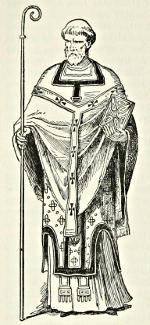
A Bishop of the Tenth and Eleventh Centuries
The rebellion was crushed for a time; during the five remaining years of John’s pontificate the presence of Otto overawed the refractory Romans. He ruled in peace. At his death the undisturbed vacancy of the see for three months implies the humble consultation of Otto’s wishes (he had now returned to Germany) on the appointment of his successor.
The choice fell on Benedict VI, as usual of Roman birth (January 19th, 973). The factions of Rome now utterly baffle conjecture as to their motives, as to the passions, not the principles, which actuated their leaders. Twice (the second time after an interval of ten years, during which he was absent from Rome), the same man, a cardinal deacon, seizes and murders two popes; sets himself up as supreme pontiff; but though with power to commit these enormities, he cannot maintain on either occasion his ill-won tiara.
The formidable Otto the Great died the year of the accession of Benedict VI (December 25th, 967). Otto II, whose character was as yet unknown, had succeeded to the imperial throne; he had been already the colleague of his father in the empire. He had been crowned at Rome by Pope John XIII.
[974-985 A.D.]
The year after the accession of Otto II, on a sudden, Boniface, surnamed Francone, described as the son of Ferruccio, a name doubtless well known to his contemporaries, seized the unsuspecting pope Benedict and cast him into a dungeon (July, 974), where shortly after he was strangled. Boniface assumed the papacy, but he had miscalculated the strength of his faction; in one month he was forced to fly the city. Yet he fled not with so much haste but that he carried off all the treasures, even the sacred vessels from the church of St. Peter. He found his way to Constantinople, where he might seem to have been forgotten in his retreat. The peaceful succession of Benedict VII, the nephew or grandson of the famous Alberic, may lead to the conclusion that the faction of that family still survived, and was opposed to that of Boniface. The first act of Benedict, as might be expected, was the assembling a council for the excommunication of the murderer and anti-pope Boniface. This is the first and last important act in the barren annals of Pope Benedict VII. Under the protection of the emperor Otto II, or by the strength of his Roman faction, he retained peaceful possession of the see for nine years, an unusual period of quiet. He was succeeded, no doubt through the influence of the emperor, by John XIV, who was no Roman, but bishop of Pavia. But in the year of John’s accession (983), Otto II was preparing a great armament to avenge a terrible defeat by the Saracens. He had hardly fled from the conquering Saracens, and made his escape from a Greek ship by leaping into the sea and swimming ashore. He now threatened with all the forces of the realm to bridge the Straits of Messina, and reunite Sicily to the empire of the West. In the midst of his preparations he died at Rome.
The fugitive Boniface Francone had kept up his correspondence with Rome; he might presume on the unpopularity of a pontiff, if not of German birth, imposed by foreign influence, and now deprived of his all-powerful protector. With the same suddenness as before, he reappeared in Rome, seized the pope, imprisoned him in the castle of St. Angelo, of which important fortress he had become master, and there put him to death by starvation or by poison (August 20th, 984). He exposed the body to the view of the people, who dared not murmur. He seated himself, as it seems, unresisted, in the papal chair. The holy see was speedily delivered from this murderous usurper. He died suddenly. The people revenged themselves for their own base acquiescence in his usurpation by cowardly insults on his dead body; it was dragged through the streets, and at length buried, either by the compassion or the attachment (for Boniface must have had a powerful faction in Rome) of certain ecclesiastics. These bloody revolutions could not but destroy all reverence for their ecclesiastical rulers in the people of Rome.g
CHARLES KINGSLEY ON TEMPORAL POWER
A united Italy suited the views of the popes then no more than it does now. Not only did they conceive of Rome as still the centre of the western world, but more, their stock in trade was at Rome. The chains of St. Peter, the sepulchres of St. Peter and St. Paul, the catacombs filled with the bones of innumerable martyrs—these were their stock in trade. By giving these, selling these, working miracles with these, calling pilgrims from all parts of Christendom to visit these in situ, they kept up their power and their wealth.
Having obtained what they wanted from Pepin and Charlemagne, it was still their interest to pursue the same policy; to compound for their own independence, as they did with Charlemagne and his successors, by defending the pretences of foreign kings to the sovereignty of the rest of Italy. This has been their policy for centuries. It is their policy still; and that policy has been the curse of Italy. This fatal gift of the patrimony of St. Peter—as Dante saw, as Machiavelli saw, as all clear-sighted Italians have seen—has kept her divided, torn by civil wars, conquered and reconquered by foreign invaders. Unable, as a celibate ecclesiastic, to form his dominions into a strong hereditary kingdom; unable as the hierophant of a priestly caste to unite his people in the bonds of national life; unable, as Borgia tried to do, to conquer the rest of Italy for himself, and form it into a kingdom large enough to have weight in the balance of power, the pope was forced, again and again, to keep himself on his throne by intriguing with foreign princes, and calling in foreign arms; and the bane of Italy, from the time of Stephen III to that of Pius IX, was the temporal power of the pope. But on the popes, also, the Nemesis came. In building their power on the Roman relics, on the fable that Rome was the patrimony of Peter, they had built on a lie; and that lie avenged itself.
Having committed themselves to the false position of being petty kings of a petty kingdom, they had to endure continual treachery and tyranny from their foreign allies—to see not merely Italy, but Rome itself, insulted and even sacked by faithful Catholics, and to become more and more, as the centuries rolled on, the tools of those very kings whom they had wished to make their tools.
True, they defended themselves long, and with astonishing skill and courage. Their sources of power were two, the moral and the thaumaturgic, and they used them both; but when the former failed, the latter became useless. As long as their moral power was real; as long as they and their clergy were on the whole, in spite of enormous faults, the best men in Europe, so long the people believed in them, and in their thaumaturgic relics likewise. But they became by no means the best men in Europe. Then they began to think that after all it was more easy to work the material than the moral power—easier to work the bones than to work righteousness. They were deceived. Behold! when the righteousness was gone, the bones refused to work. People began to question the virtue of the bones, and to ask, “We can believe that the bones may have worked miracles for good men, but for bad men? We will examine whether they work any miracles at all.” And then, behold, it came out that the bones did not work miracles, and that possibly they were not saints’ bones at all; and then the storm came; and the lie, as all lies do, punished itself. That salt had lost its savour. They who had been the light of Europe, became its darkness; they who had been first, became last; a warning to mankind until the end of time, that on truth and virtue depends the only abiding strength.h
FOOTNOTES