Book 1 — CHAPTER VI. THE LAST CRUSADES
Reading edition
The poet, As-Sahib Jemal ad-Din ben Matrub made the following verses on the failure of Saint Louis’ Crusade, his capture and ransom:
“Bear to the king of France, when you shall see him, these words, traced by a partisan of truth: The death of the servants of the Messiah has been the reward given to you by God.
“You have landed in Egypt, thinking to take possession of it. You have imagined that it was only peopled with cowards! you who are a drum filled with wind.
“You thought that the moment to destroy the Mussulmans was arrived; and this false idea has smoothed, in your eyes, every difficulty.
“By your excellent conduct, you have abandoned your soldiers on the plains of Egypt, and the tomb has gaped under their feet.
“What now remains of the seventy thousand who accompanied you? Dead, wounded, and prisoners!
“May God inspire you often with similar designs! They will cause the ruin of all Christians, and Egypt will have no longer to dread anything from their rage.
“Without doubt your priests announced victories to you; their predictions were false.
“Refer yourselves to a more enlightened oracle.
“Should the desire of revenge urge you to return to Egypt, be assured the house of Lokman still remains, that the chain is ready prepared, and the eunuch guard awake.”
[1239-1314 A.D.]
The council of Spoleto decreed that fresh levies should be sent into Asia on the expiration of the truce with Kamil. The Franciscans and Dominicans were the bearers of the resolutions to the princes and people of Christendom. But it was soon apparent that the recovery of the Holy Land was not the paramount consideration in the mind of Gregory IX, for the preaching of the crusade once more became the means of filling the papal coffers. By the different engines of persuasion and compulsion, the missionaries gained numberless converts, and then allowed the unwilling, and compelled the wealthy crusaders to give the church great largesses in exchange for the vow. The once humble friars grew so rich by these exactions, that their pride and magnificence were detestable in the eyes of the people. These disgraceful scenes were acted in England for two years; but the indignation of society at the avarice of the pope was so strong, that the preaching ceased. Some of the English nobility were inflamed by the love of warlike praise, and took the cross with no intention of submitting to a pecuniary commutation. The earl of Chester, and also Richard, earl of Cornwall, brother to King Henry II, prepared to measure lances with the Saracens.
RICHARD OF CORNWALL’S CRUSADE (THE SEVENTH)
[1236-1240 A.D.]
The desire of crusading was influenced by events in Palestine. A truce between the sultan of Aleppo and the Templars expired with the life of the Mussulman prince; and when his successor renewed the war with them, they sustained so severe a defeat, that every commandery in Europe sent them succours; and even the Hospitallers resolved to avenge the death of their rivals. Three hundred knights and a considerable body of stipendiaries went from London.
The spirit of crusading burned in France, particularly in the middle and southern provinces; and many barons assembled at Lyons in order to concert the means of giving effect to their common desire. But a legate of the pope interrupted their councils with announcing the commands of his master for the dissolving of the assembly, and the return of the members to their homes. The barons remonstrated against this versatility of opinion in an infallible guide. The nuncio was contumeliously dismissed. Most of the nobility pressed forwards to Marseilles, and hoisted sail for the Holy Land. Indignant at their contempt of his wishes, the emperor prohibited the governors of Apulia and other countries from affording aid to the crusaders. This measure prevented many parties of cavaliers from pursuing the voyage; but it did not impede those fanatical and romantic warriors, the king of Navarre, the duke of Burgundy, and the counts of Bar and Brittany, from continuing their course to Acre.
News of the warlike preparations of Europe had been communicated to the sultan of Egypt; and the first moment when the faith of treaties opposed not a hostile course, he drove the Latins out of Jerusalem, and overthrew the tower of David, which, until that time, had always been regarded as sacred by all classes of religionists. After this capture Kamil died; various princes of Syria and Egypt asserted their pretensions to the vacant throne; but the military spirit was too active among the Mussulmans, to allow the Christians rationally to hope that they should eventually profit by these dissensions. The war began by a successful irruption of the count of Brittany into the Damascene territories. But in the vicinity of Gaza three hundred Frenchmen, who wished to imitate the glory of the cavaliers of Brittany, were defeated by a smaller number of Turks.
[1240-1244 A.D.]
The pope renewed his endeavours to persuade the English to commute their piety for gold, but his ministers, the Franciscans and Dominicans, were treated only with contempt; and in the spring of the year 1240, Richard, earl of Cornwall, William Longespee or Longsword, Theodore, the prior of the Hospitallers, and many others of the nobility, embarked at Dover. The arrival of Richard and the other barons at Acre, took place shortly after the signature of the discordant treaties between the Templars and the emir of Karak, and the Hospitallers with the sultan of Egypt. The English were astonished to find that the king of Navarre and the count of Brittany had fled from the plains of Syria, when they received intelligence of the departure of reinforcements from Europe. The emir of Karak, too, could not fulfil his treaty, or even restore to the Templars the prisoners which had been made in the battle of Gaza. Richard marched to Joppa, but as the sultan of Egypt (then at war with the sultan of Damascus) sent to offer him terms of peace, he prudently seized the benefits of negotiation. With the consent of the duke of Burgundy, the master of the Hospitallers, and other lords of high degree, he accepted a renunciation of Jerusalem, Berytus, Nazareth, Bethlehem, Mount Tabor, and most of the Holy Land. An exchange of prisoners was to cement the union. The great object of the crusaders seemed now to be accomplished. Palestine belonged to the Christians. Richard returned to Europe, and was received in every town as the deliverer of the Holy Sepulchre. From neglect or inability he had not induced the Templars to consent to his completion of the hopes of the West; and in spleen and revenge the cavaliers renewed those unfraternal altercations with other knights which had hastened the ruin of the kingdom in the time of Saladin (1241).
The Hospitallers opened their treasury for the re-edification of the walls of Jerusalem. The patriarch and clergy entered the sacred city, and reconsecrated the churches. For two years Christianity was the only religion administered in Jerusalem, and the faithful began to exult in the apparent permanent downfall of infidelity, when a new enemy arose more dreadful than even the Mussulmans.
THE TATAR CREVASSE
[1244 A.D.]
The great Tatarian princes, Jenghiz Khan and his successors, had obliterated the vast empire of Khwarizm; and the expelled and defeated Tatars fled to the south. The storm rolled on towards Egypt, the Khwarizmians demanded a settlement; the sultan was the only Moslem prince who entered into treaties with those barbarians; and he advised them to fix themselves in Palestine. He sent one of his principal emirs, and a large body of troops as their guides and coadjutors, and at the head of twenty thousand horse, Barbacan, the Khwarizmian general entered the Holy Land. The Christians in Jerusalem heard with dismay that the Tatarian tempest had reached their territories. It was evident from the ruined state of the walls that Jerusalem was no longer tenable. The cavaliers, and many of the inhabitants, abandoned the sacred city.
The Khwarizmians entered it, spared neither lives nor property, and violated both Christian and Mussulman sanctuaries. In the wantonness of cruelty they disinterred the departed great, and made a cremation of venerable remains. The insulting fanatics of savageness murdered priests round the altars, exclaiming while they stabbed the holy men, “Let us pour their blood on the place where they poured out wine in commemoration of their crucified God.” As crafty as ferocious, they planted a banner of the cross upon the walls, and, deceived by this joyful appearance, several thousands of the fugitives returned to the city, but only to partake of the miserable doom of their friends.
The repeated solicitations of the Templars at length brought four thousand soldiers from their Syrian allies. The united Christian and Mussulman forces were so far inferior to the Tatars, that policy required a course of measures perfectly defensive. But the fury of the patriarch precipitated the army into the gulf of destruction. The awful conflict raged for two days. The soldiers of Damascus and Emesa were soon slain, or scattered. The loss of every part of the army was great, almost beyond example. Only sixteen Hospitallers, thirty-three Templars, and three Teutonic cavaliers remained alive and free. These soldiers fled to Acre, and that city became the refuge of the Christians. After having razed the fortifications of Askalon, and the castle of Tiberias, the Khwarizmians and Egyptians encamped on the plains of Acre, devastated the country, and slew or led into captivity all straggling Franks.
A united force of Khwarizmians and mamelukes conquered Damascus, and Europe heard with dismay that the Mussulman power was again consolidating. But the members soon were separated, for the sultan of Egypt, faithless as cruel, denied his allies a permanent settlement on the shores of the Nile. The soldiers of fortune flew to the banner of the Damascene prince, and assisted him in his efforts to recover his capital. But the cause of the mamelukes was felt as the common interest of the Moslem world, and all Syria, as well as all Egypt, was in arms in order to exterminate the northern barbarians. In a general engagement the Khwarizmians were defeated and scattered. Barbacan was slain, and southern Asia recovered from its panic and distress.
THE CRUSADE OF ST. LOUIS (THE EIGHTH)
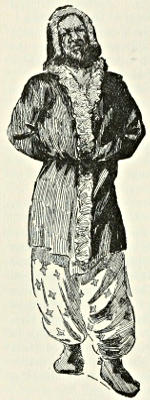
A Tatar
The superstition of a French king, and the successes of the savage Khwarizmians, gave birth to the Eighth Crusade. Pope Innocent IV convoked a general council at Lyons; the Bishop of Berytus described the effects of the Tatarian storm, and left his ecclesiastical brethren to conclude, whether one effort should not be made for a restoration of things to the state in which Richard, earl of Cornwall, had left them. It was accordingly resolved that a crusade should be preached throughout Christendom, and that for four years peace and seriousness should reign over Europe. Such of the faithful as did not expose their persons in the holy cause were to give the subsidiary aid of treasure; and the contribution to be made by the cardinals was fixed at a tenth, and that of the other ecclesiastics at a twentieth part of their yearly revenues.
The pope wrote to Henry III, king of England, urging him to press on his subjects the necessity of punishing the Khwarizmians. But the spirit of crusading raged more strongly in France than in any other country of the West; and it revived in all its fierceness of piety and chivalry in Louis IX. Agreeably to the temper of the times, he had vowed, whilst afflicted by a severe illness, that in case of recovery he would travel to the Holy Land. In the delirium of his fever, he had beheld an engagement between the Christians and the Saracens; the infidels were victorious, and the brave king of a valiant nation fancied it his duty to avenge the defeat. The victories of the Khwarizmians were a realisation of part of his dream, and his preparations had anticipated the decrees of the Lyonese council. This vow was made about the year 1244, according to Nangis and Chronicle of St. Denis, cited in Du Cange’s notes. From the moment of his resolving to go to the Holy Land, St. Louis quitted all pomp of dress; he exchanged his purple for black, a royal for a religious habit. During the crusade he abstained from wearing scarlet, vair, or ermine. The example of the monarch gave efficacy to the laws regarding simplicity of dress, and the lord of Joinville assures us, that, during the whole time he was attending the king on his crusade, he never once saw an embroidered coat of arms. The French barons, however, when resident in Damietta, were less rigid in morality than in dress. The cross was likewise taken by the three royal brothers, the counts of Artois, Poitiers, and Anjou, by the duke of Burgundy, the countess of Flanders, and her two sons, the count of St. Paul, and many other knights.
Sentiments of respect for the king of France were not felt in his country alone; the people of England revered his name, and avowedly in imitation of his example, the bishop of Salisbury, William Longespee, Walter de Lucy, and many other English nobles and gentlemen were crossed. William Longespee was, or feigned himself, poor, and went to Rome to solicit the aid of the pope. He returned to England, and extorted more than a thousand marks from the religious, while the less scrupulous or more powerful earl of Cornwall was insatiable in his avarice, and gained from one archdeacon alone, six hundred pounds. Political circumstances detained St. Louis in France for three years; but the money and troops which he sent to the Holy Land invigorated the hopes of the Latin Christians. The ranks of the military orders were recruited by hired troops and regular knights from the different stations in Europe.
On the 12th of June, 1248, Louis, attended by his three brothers, went to the abbey of St. Denis, and received from the pope’s legate the oriflamme, the alms’ purse, and pilgrim’s staff. He sailed from France at the end of August, and arrived in September at Cyprus, the appointed rendezvous for his barons and their vassals. The king remained eight months in Cyprus, employed in organising his troops, in works of piety, and particularly in healing the breaches in charity between the military orders. The Venetians and other people assisted the French with provisions; on one occasion the supplies of the emperor Frederick preserved the army, and the grateful king implored the pope to absolve a man who had been benevolent to the soldiers of the church. The ambassadors of a Tatarian prince appeared before Louis, offering their master’s aid to root the Saracens and pagans out of the Holy Land. The king sent a magnificent present to his ally, in order to bribe him to become a Christian. Two black monks, who understood the Arabic language, were charged with the missionary office, and their eloquence and embroidered representation of some of the mysteries of Christianity were to effect the conversion of the Scythian savage and his court. In the spring of the year 1249, the soldiers of Louis were mustered, and his ships prepared for sea; fifty thousand men formed his military force, and eighteen hundred was the number of his transports, palendars, and store ships. They set sail for Egypt; a storm separated the fleet, and the royal division, in which were nearly three thousand knights and their men-at-arms, arrived off Damietta.
[1249 A.D.]
The shores were lined by the sultan’s troops, who astonished the French by the clangour of trumpets and brazen drums. The heralds of the king of France instantly went to the sultan, Nejm ad-Din (a son of Kamil), near Ashmun, and spared no language of exaggeration in describing the power of their master. The only way to avoid the tempest was to receive priests who would teach the Christian religion to the people of Egypt:[73] otherwise he would pursue them everywhere, and God should decide to whom the country should be given. The sultan replied that he also knew the use of arms, and like the French, inherited valour. The cause of the Mussulmans was that of justice; and the Koran declared, that they who made war unjustly should perish.
Some of the knights wished to dissuade the king from landing, till the appearance of their brethren in arms; but on the second day after their arrival, Louis commanded the disembarkation; he himself leaped into the water; his shield was suspended from his neck, his helmet was on his head, and his lance on his wrist. His soldiers followed him to the shore; and the Saracens, panic-struck at their boldness and determination, made but a slight show of defence, and fled into the interior of the country. Although Damietta was better prepared for a siege than in those days when it had sustained an attack of eighteen months’ duration, yet the garrison sought safety in the fleetness of their horses. They were received at Cairo with the indignation which their cowardice merited; and the sultan (who had repaired thither from Ashmun) strangled fifty of the chiefs. The people of Damietta loaded themselves with their most valuable effects, set fire to the part of the city in which their merchandise and plunder were collected, and then took flight for Cairo. Louis fixed his residence in the city; a Christian government was established; and the clergy, agreeably to old custom, purified the mosques. According to ancient usage, one-third part of the spoil should have been allotted to the general-in-chief, and the remaining portions had been usually divided among the pilgrims; but, at the suggestion of the patriarch of Jerusalem, Louis ordered that the corn and provisions should form a magazine for the common benefit of the army; and he retained to himself the rest of the movable booty.
Neither the religious character of the war, nor the importance of preserving military discipline, had any effect on the conduct of the holy warriors. So general was the immorality, that the king could not stop the foul and noxious torrent. The hope of the reward of a piece of gold for an enemy’s head, inspirited the Mussulmans to many enterprises of difficulty and danger; but Louis prevented at length their incursions into his camp, for he surrounded it with deep ditches, and his cross-bowmen galled the approaching parties of Mussulman cavalry. The French looked with impatience for the count of Poitiers and the arrière-ban of France, the remainder of the force which had sailed from Cyprus, and had been driven to Acre in the tempest. In October 1249 the count of Poitiers reached Egypt. The French also were joined by two hundred English knights.
THE BATTLE OF MANSURA
[1250 A.D.]
At the close of November, the army commenced its march to the capital of Egypt. Until their approach to the vicinity of Mansura, they overcame the open and insidious enmity of the Saracens. Soon after his departure from Damietta, the king accepted the proffered aid of five hundred horsemen of the sultan, and commanded his army to respect their guides. Vainly thinking that this order was inflexible to circumstances, the Saracens attacked the Templars, who formed the van of the army. But the valiant knights rallied round their grand master, and invoking God to aid them in this perilous conjuncture, they rushed upon and destroyed their treacherous foes. Fakhr ad-Din, the Egyptian emir, and his army were encamped on the opposite side of the Ashmun canal, which the French in vain endeavoured to cross. They commenced a causeway over the canal; but the Saracens ruined in a day the work of a month; and even crossed the Nile by one of the passages which were familiar to them and gave battle to the enemy.b
It is so hard for the layman to get a true idea of the chaos and disintegrated nature of a battle, that a realistic account of how St. Louis fought the Saracens is well worth quoting, especially from the pen of the lord of Joinville whose sword was busy in these very scenes.a
DE JOINVILLE’S ACCOUNT OF THE BATTLE OF MANSURA
A Bedouin had lately come to say that if we would give him five hundred golden besants, he would show a safe ford, which might easily be crossed on horseback. The day appointed for this purpose was Shrove-Tuesday, which, when arrived, we all mounted our horses, and armed at all points, followed the Bedouin to the ford. On our way thither, some advanced too near the banks of the river, which being soft and slippery, they and their horses fell in and were drowned. The king seeing it, pointed it out to the rest, that they might be more careful and avoid similar danger. Among those that were drowned was that valiant knight Sir John d’Orleans, who bore the banner of the army. When we came to the ford, we saw on the opposite bank full three hundred Saracen cavalry ready to defend this passage. We entered the river, and our horses found a tolerable ford with firm footing, so that by ascending the stream we found an easy shore, and through God’s mercy we all crossed over with safety. The Saracens, observing us thus cross, fled away with the utmost despatch.
Before we set out, the king had ordered that the Templars should form the van, and the count d’Artois his brother should command the second division of the army; but the moment the count d’Artois had passed the ford with all his people, and saw the Saracens flying, they stuck spurs into their horses and galloped after them; for which those who formed the van were much angered at the count d’Artois, who could not make any answer, on account of Sir Foucquault du Melle, who held the bridle of his horse; and Sir Foucquault, being deaf, heard nothing the Templars were saying to the count d’Artois, but kept bawling out, “Forward, forward!” When the Templars perceived this, they thought they should be dishonoured if they allowed the count d’Artois thus to take the lead, and with one accord they spurred their horses to their fastest speed, pursuing the Saracens through the town of Mansura, as far as the plains before Babylon; but on their return the Turks shot at them plenty of arrows and other artillery, as they repassed through the narrow streets of the town. The count d’Artois and the lord de Coucy, of the name of Raoul, were there slain, and as many as three hundred other[74] knights. The Templars lost, as their chief informed me, full fourteen score men at arms and horses. My knights, as well as myself, noticing on our left a large body of Turks who were arming, instantly charged them; and when we were advanced into the midst of them, I perceived a sturdy Saracen mounting his horse, which was held by one of his esquires by the bridle, and while he was putting his hand on the saddle to mount, I gave him such a thrust with my spear, which I pushed as far as I was able, that he fell down dead. The esquire, seeing his lord dead, abandoned master and horse; but, watching my motions, on my return struck me with his lance such a blow between the shoulders as drove me on my horse’s neck, and held me there so tightly that I could not draw my sword, which was girthed round me. I was forced to draw another sword which was at the pommel of my saddle, and it was high time; but, when he saw I had my sword in my hand, he withdrew his lance which I had seized and ran from me.
It chanced that I and my knights had traversed the army of the Saracens, and saw here and there different parties of them, to the amount of about six thousand, who, abandoning their quarters, had advanced into the plain. On perceiving that we were separated from the main body, they boldly attacked us, and slew Sir Hugues de Trichatel, lord d’Escoflans, who bore the banner of our company. They also made prisoner Sir Raoul de Wanon, of our company, whom they had struck to the ground. As they were carrying him off, my knights and myself knew him, and instantly hastened, with great courage, to assist him, and deliver him from their hands. In returning from this engagement the Turks gave me such heavy blows, that my horse, not being able to withstand them, fell on his knees, and threw me to the ground over his head. I very shortly replaced my shield on my breast, and grasped my spear, during which time the lord Errart d’Esmeray, whose soul may God pardon! advanced towards me, for he had also been struck down by the enemy; and we retreated together towards an old ruined house to wait for the king, who was coming, and I found means to recover my horse. As we were going to this house, a large body of Turks came galloping towards us, but passed on to a party of ours whom they saw hard by; as they passed, they struck me to the ground, with my shield over my neck, and galloped over me, thinking I was dead; and indeed I was nearly so. When they were gone, my companion Sir Errart came and raised me up, and we went to the walls of the ruined house. Thither also had retired Sir Hugues d’Escosse, Sir Ferreys de Loppei, Sir Regnault de Menoncourt, and several others; and there also the Turks came to attack us, more bravely than ever, on all sides. Some of them entered within the walls, and were a long time fighting with us at spear’s length, during which my knights gave me my horse, which they held, lest he should run away, and at the same time so vigorously defended us against the Turks, that they were greatly praised by several able persons who witnessed their prowess.
Sir Hugues d’Escosse was desperately hurt by three great wounds in the face and elsewhere. Sir Raoul and Sir Ferreys were also badly wounded in their shoulders, so that the blood spouted out just like to a tun of wine when tapped. Sir Errart d’Esmeray was so severely wounded in the face by a sword, the stroke of which cut off his nose, that it hung down over his mouth. In this severe distress, I called to my mind St. James, and said, “Good Lord St. James, succour me, I beseech thee; and come to my aid in this time of need.” I had scarcely ended my prayer, when Sir Errart said to me, “Sir, if I did not think you might suppose it was done to abandon you and save myself, I would go to my lord of Anjou, whom I see on the plain, and beg he would hasten to your help.” “Sir Errart,” I replied, “you will do me great honour and pleasure, if you will go and seek succour to save our lives; for your own also is in great peril”; and I said truly, for he died of the wound he had received. All were of my opinion that he should seek for assistance; and I then quitting hold of the rein of his bridle, he galloped towards the count d’Anjou, to request he would support us in the danger we were in. There was a great lord with him who wished to detain him, but the good prince would not attend to what he urged, but, spurring his horse, galloped towards us followed by his men. The Saracens, observing them coming, left us; but when on their arrival they saw the Saracens carrying away their prisoner, Sir Raoul de Wanon, badly wounded, they hastened to recover him, and brought him back in a most pitiful state. Shortly after, I saw the king arrive with all his attendants, and with a terrible noise of trumpets, clarions, and horns. He halted on an eminence, with his men at arms, for something he had to say; and I assure you I never saw so handsome a man under arms. He was taller than any of his troop by the shoulders; and his helmet, which was gilded, was handsomely placed on his head; and he bore a German sword in his hand. Soon after he had halted, many of his knights were observed intermixed with the Turks; their companions instantly rushed into the battle among them; and you must know, that in this engagement were performed, on both sides, the most gallant deeds that were ever done in this expedition to the Holy Land; for none made use of the bow, cross-bow, or other artillery. But the conflict consisted of blows given to each other by battle-axes, swords, butts of spears, all mixed together. From all I saw, my knights and myself, all wounded as we were, were very impatient to join the battle with the others. Shortly after, one of my esquires, who had once fled from my banner, came to me, and brought me one of my Flemish war-horses; I was soon mounted, and rode by the side of the king, whom I found attended by that discreet man, Sir John de Valeri. Sir John seeing the king desirous to enter into the midst of the battle, advised him to make for the riverside on the right, in order that in case there should be any danger, he might have support from the duke of Burgundy and his army, which had been left behind to guard the camp; and likewise that his men might be refreshed and have wherewith to quench their thirst; for the weather was at this moment exceedingly hot.

Thirteenth Century Crusader
As this was doing, Sir Humbert de Beaujeu, constable of France, came up, and told the king that his brother, the count d’Artois, was much pressed in a house at Mansura, where, however, he defended himself gallantly, but that he would need speedy assistance; and entreated the king to go to his aid. The king replied, “Constable, spur forward, and I will follow you close.” All of us now galloped straight to Mansura, and were in the midst of the Turkish army, when we were instantly separated from each other by the greater power of the Saracens and Turks. Shortly after, a serjeant at mace of the constable, with whom I was, came to him, and said the king was surrounded by the Turks, and his person in imminent danger. You may suppose our astonishment and fears, for there were between us and where the king was full one thousand or twelve hundred Turks, and we were only six persons in all. I said to the constable, that since it was impossible for us to make our way through such a crowd of Turks, it would be much better to wheel round and get on the other side of them. This we instantly did. There was a deep ditch on the road we took between the Saracens and us; and, had they noticed us, they must have slain us all; but they were solely occupied with the king, and the larger bodies; perhaps also they might have taken us for some of their friends. As we thus gained the river, following its course downward between it and the road, we observed that the king had ascended it, and that the Turks were sending fresh troops after him. Both armies now met on the banks, and the event was miserably unfortunate; for the weaker part of our army thought to cross over to the division of the duke of Burgundy, but that was impossible from their horses being worn down, and the extreme heat of the weather. As we descended the river, we saw it covered with lances, pikes, shields, men, and horses, unable to save themselves from death. When we perceived the miserable state of our army, I advised the constable to remain on this side of the river to guard a small bridge that was hard by; “for if we leave it,” added I, “the enemy may come and attack the king on this side; and if our men be assaulted in two places, they must be discomfited.”
There then we halted; and you may believe me when I say, that the good king performed that day the most gallant deeds that ever I saw in any battle. It was said, that had it not been for his personal exertions, the whole army would have been destroyed; but I believe that the great courage he naturally possessed was that day doubled by the power of God, for he forced himself wherever he saw his men in any distress, and gave such blows with battle-axe and sword, it was wonderful to behold. The lord de Courtenai and Sir John de Salenai one day told me, that at this engagement six Turks caught hold of the bridle of the king’s horse, and were leading him away; but this virtuous prince exerted himself with such bravery in fighting the six Turks, that he alone freed himself from them; and that many, seeing how valiantly he defended himself, and the great courage he displayed, took greater courage themselves, and abandoning the passage they were guarding, hastened to support the king. After some little time, the count Peter of Brittany came to us who were guarding the small bridge from Mansura, having had a most furious skirmish. He was so badly wounded in the face that the blood came out of his mouth, as if it had been full of water, and he vomited it forth. The count was mounted on a short, thick, but strong horse, and his reins and the pommel of his saddle were cut and destroyed, so that he was forced to hold himself by his two hands round the horse’s neck for fear the Turks, who were close behind him, should make him fall off. He did not, however, seem much afraid of them, for he frequently turned round, and gave them many abusive words by way of mockery.
In our front were two of the king’s heralds; the name of one was Guillaume de Bron, and that of the other John de Gaymaches; against whom the Turks led a rabble of peasants of the country, who pelted them with clods of earth and large stones. At last, they brought a villainous Turk, who thrice flung Greek fires at them; and by one of them was the tabard of Guillaume de Bron set on fire; but he soon threw it off, and good need had he, for if it had set fire to his clothes, he must have been burned. We were also covered with these showers of stones and arrows which the Turks discharged at the two heralds. I luckily found near me a gaubison of coarse cloth which had belonged to a Saracen, and turning the slit part inward, I made a sort of shield, which was of much service to me; for I was only wounded by their shots in five places, whereas my horse was hurt in fifteen. Soon after, as God willed it, one of my vassals of Joinville brought me a banner with my arms, and a long knife of war, which I was in want of; and then, when these Turkish villains, who were on foot, pressed on the heralds, we made a charge on them and put them instantly to flight. Thus when the good count de Soissons and myself were returned to our post on the bridge, after chasing away these peasants, he rallied me, saying, “Seneschal, let us allow this rabble to bawl and bray; and, by the Cresse Dieu,” his usual oath, “you and I will talk over this day’s adventures in the chambers of our ladies.”
It happened that towards evening, about sunset, the constable, Sir Humbert de Beaujeu, brought us the king’s cross-bows that were on foot; and they drew up in one front, while we horsemen dismounted under shelter of the cross-bows. The Saracens observing this immediately took to flight, and left us in peace. The constable told me that we had behaved well in thus guarding the bridge; and bade me go boldly to the king, and not quit him until he should be dismounted in his pavilion. I went to the king, and at the same moment Sir John de Valeri joined, and requested of him, in the name of the lord de Chastillon, that the said lord might command the rear guard, which the king very willingly granted. The king then took the road to return to his pavilion, and raised the helmet from his head, on which I gave him my iron skull-cap, which was much lighter, that he might have more air. Thus as we were riding together, Father Henry, prior of the hospital of Ronnay, who had crossed the river, came to him and kissed his hand, fully armed, and asked if he had heard any news of his brother the count d’Artois. “Yes,” replied the king, “I have heard all”; that is to say, that he knew well he was now in paradise. The prior, thinking to comfort him for the death of his brother, continued, “Sire, no king of France has ever reaped such honour as you have done; for with great intrepidity have you and your army crossed a dangerous river to combat your enemies; and have been so very successful that you have put them to flight and gained the field, together with their warlike engines, with which they had wonderfully annoyed you, and concluded the affair by taking possession this day of their camp and quarters.” The good king replied that God should be adored for all the good he had granted him; and then heavy tears began to fall down his cheeks, which many great persons noticing, were oppressed with anguish and compassion on seeing him thus weep, praising the name of God who had enabled him to win the victory.f
RESULTS OF MANSURA
The count of Artois had rallied his forces in the town. The Egyptian chief invested Mansura; and, with ability equal to his spirit, placed a body of troops in such a station as to intercept the communication between the count and the king. The soldiers in Mansura engaged the French. The inhabitants partook of the perils of the day, and poured upon their enemy, with deadly effect, burning coals, boiling water, and stones. The count did not survive to witness all the dreadful issues of his rashness. William Longespee and a numerous band of gallant men also perished. The grand master of St. John fell into the enemy’s hands; and the master of the Templars was happy in escaping with the loss of an eye. On the side of the enemy Fakhr ad-Din was slain; but his station was quickly filled by a chief of equal bravery and conduct. The king and his army had crossed the ford, and prevented the total rout of the Christians. The valiant master of the Templars was slain in this renewed engagement. Egyptian and Christian annalists have claimed the honour and rewards of victory for their respective sides; but in truth the result of the battle appears to have been indecisive.
The Saracens, however, cut off all communications between St. Louis and Damietta. Famine and disease appeared in the Christian camp, and the French described the latter of those evils as having sprung from a pestilential air emitted from the dead bodies of their friends and foes, and from eating eel pouts which had fed on corpses in the river.b “From this poisonous diet,” says De Joinville, “and from the bad air of a country where it scarcely ever rains, the whole army was infected by a shocking disorder, which dried up the flesh on one’s legs to the bone, and our skins became tanned as black as the ground, or like an old boot that has long lain behind a coffer. In addition to this miserable disorder, those afflicted by it had another sore complaint in the mouth, from eating eel pouts that rotted the gums. Very few escaped death that were attacked, and the surest symptoms of its being fatal was a bleeding at the nose. The barbers were obliged to cut away large pieces of flesh from the gums to enable the patient to eat. It was pitiful to hear the cries and groans of those on whom the operation was performed; they seemed like to the cries of women in labour, and I cannot express the great concern all felt who heard them.”f
ST. LOUIS A PRISONER
Negotiations for peace were opened between the contending powers, and the exchange of the lordship of Jerusalem for that of Damietta formed the basis of the treaty. The king offered either of his brothers as a hostage for the delivery of Damietta to the Egyptians; but the sultan objected, and all hopes of peace were abandoned, because the Christians would not consent to the delivery of their king as the hostage. The miserable condition of the French army forbade all thoughts of victory, and called for a retreat to Damietta.
The retreat was ordered; but those who attempted it by the river were taken by the enemy, and the fate of such as proceeded by land was equally disastrous. While they were occupied in constructing a bridge over the canal, the Mussulmans entered the camp, and murdered the sick. The valiant Louis, though oppressed with the general calamity of disease, sustained boldly, with Sir Godfrey de Sergines, the shock of the enemy, and threw himself into the midst of them, resolved to perish in defending his troops. The brave Sergines, who never left him, succeeded at last in drawing him from the foe, and conducted him to a village, where he sank into insensibility and helplessness.[75]
In that state the Mussulmans made him prisoner. Charles count of Anjou, Alphonsus of Poitiers, and indeed all the nobility fell into the enemy’s hands. The sultan clothed the king and the nobles with robes of honour, and treated them with kindness and generosity. But many of the unfortunate men who were ill, and therefore useless, were killed by their new masters in defiance of the command of Saladin, and the general usage of oriental nations not to put to death anyone to whom they had given bread and salt. Other prisoners saved their lives by renouncing their religion; the Saracenic commander indulged the fanaticism of his people by allowing the converts to be received, though he well remembered the sage remark of Saladin, that a Christian was never known to make a good Moslem, nor a good Saracen a Christian.[76] So great were the calamities of the French in this attempted retreat, that twenty thousand were made captives, and seven thousand were slain or drowned.b The last battles and disasters of St. Louis made, it may well be believed, a vivid impression on the Saracens. We may quote the account of Makrisi, a Moslem historian.a
MOSLEM ACCOUNT OF ST. LOUIS’ CAPTURE
The day of Bairam (January 6th, 1250) a great lord and relative to the king of France was made prisoner. Not a day passed without skirmishes on both sides, and with alternate success. The Mussulmans were particularly anxious to make prisoners, to gain information as to the state of the enemy’s army, and used all sorts of stratagems for this purpose. A soldier from Cairo bethought himself of putting his head withinside of a watermelon, the interior of which he had scooped out, and of thus swimming towards the French camp; a Christian soldier, not suspecting the trick, leaped into the Nile to seize the melon; but the Egyptian was a stout swimmer, and catching hold of him, dragged him to his general. On Wednesday, the 7th day of the moon Shawwal (January 13th, 1250), the Mussulmans captured a large boat, in which were a hundred soldiers, commanded by an officer of distinction. On Thursday, the 15th of the same moon, the French marched out of their camp, and their cavalry began to move. The troops were ordered to file off, when a slight skirmish took place, and the French left on the field forty cavaliers with their horses.
Some traitors having shown the ford over the canal of Ashmun to the French, fourteen hundred cavaliers crossed it and fell unexpectedly on the camp of the Mussulmans, on a Tuesday, the 15th day of the moon Dhul-Kadeh (February 15th), having at their head the brother of the king of France. The emir Fakhr ad-Din was at the time in the bath; he instantly quitted it with precipitation and mounted a horse without a saddle or bridle, followed only by some slaves. The enemy attacked him on all sides, and his slaves like cowards, abandoned him when in the midst of the French; it was in vain he attempted to defend himself; he fell pierced with wounds. The French, after the death of Fakhr ad-Din, retreated to Jédilé; but their whole cavalry advanced to Mansura, and, having forced one of the gates, entered the town; the Mussulmans fled to the right and left. The king of France had already penetrated as far as the sultan’s palace, and victory seemed ready to declare for him, when the Baharite slaves, led by Bibars, advanced and snatched it from his hands; their charge was so furious that the French were obliged to retreat. The French infantry, during this time, had advanced to cross the bridge; had they been able to join their cavalry, the defeat of the Egyptian army, and the loss of the town of Mansura, would have been inevitable.
Night separated the combatants, when the French retreated in disorder to Jédilé, after leaving fifteen hundred of their men on the field. They surrounded their camp with a ditch and wall, but their army was divided into two corps; the least considerable body was encamped on the branch of the Ashmun, and the larger on the great branch of the Nile that runs to Damietta. A pigeon had been let loose to fly to Cairo the instant the French had surprised the camp of Fakhr ad-Din, having a note under its wing, to inform the inhabitants of this misfortune. The melancholy event had created a general consternation in the town, which the runaways had augmented, and the gates of Cairo were kept open all the night to receive them. A second pigeon bearing the news of the victory over the French, had restored tranquillity to the capital. Joy succeeded sorrow; and each congratulated the other on this happy turn of affairs, and public rejoicings were made.
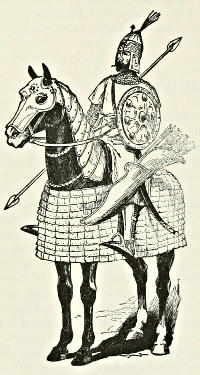
A Saracen
Boats sent from Damietta brought all sorts of provisions to the French camp, and kept it abundantly supplied. Turan Shah caused many boats to be built which, when taken to pieces, he placed on the backs of camels, and had them thus carried to the canal of Méhalé, when they were put together again, launched on the canal, and filled with troops for an ambuscade. As soon as the French fleet of boats appeared at the mouth of the canal of Méhalé, the Mussulmans quitted their hiding-place and attacked them. While the two fleets were engaged, other boats left Mansura filled with soldiers, and fell on the rear of the French. It was in vain they sought to escape by flight; a thousand Christians were killed or made prisoners. In this defeat fifty-two of their boats laden with provisions were taken, and their communication with Damietta by the navigation of the Nile was cut off, so that within a short time the whole army suffered the most terrible famine. The Mussulmans surrounded them on all sides, and they could neither advance nor retreat.
On the first of the moon Dhul-hija (March 7th), the French surprised seven boats; but the troops on board had the good fortune to escape. In spite of the superiority of the Egyptians on the Nile, they attempted to bring up another convoy from Damietta, but they lost it; thirty-two of their boats were taken and carried to Mansura, on the ninth of the same moon. This new loss filled the measure of their woes, and caused them to propose a truce and send ambassadors to treat of it with the sultan. The emir Zain ad-Din and the kadi Bedr ad-Din were ordered to meet and confer with them, when the French offered to surrender Damietta, on condition that Jerusalem, and some other places in Syria, should be given in exchange for it. This proposal was rejected, and the conference broken up.
On Friday, the 27th of the moon Dhul-hija (April 2nd), the French set fire to all their machines of war and timber for building, and rendered almost all their boats unfit for use. During the night of Tuesday, the third day of the moon Muharrem (April 7th), in the year of the Hegira 648, the whole of the French army decamped, and took the road to Damietta. Some boats which they had reserved fell down the Nile at the same time. The Mussulmans having, at break of day of the Wednesday, perceived the retreat of the French, pursued and attacked them.
The heat of the combat was at Fariskur. The French were defeated and put to flight; ten thousand of their men fell on the field of battle, some say thirty thousand. Upwards of one hundred thousand horsemen, infantry, tradespeople, and others were made slaves. The booty was immense in horses, mules, tents, and other riches. There were but one hundred slain on the side of the Mussulmans. The Baharite slaves, under the command of Bibars al-Bundukdari, performed in this battle signal acts of valour. The king of France had retired, with a few of his lords, to a small hillock, and surrendered himself, under promise of his life being spared, to the eunuch Jemal ad-Din Mahsun as-Salih; he was bound with a chain, and in this state conducted to Mansura, where he was confined in the house of Ibrahim ben Lokman, secretary to the sultan, and under the guard of the eunuch Salih. The king’s brother was made prisoner at the same time, and carried to the same house. The sultan provided for their subsistence.
The number of slaves was so great, it was embarrassing, and the sultan gave orders to Saif ad-Din Jusuf ben Tardi to put them to death. Every night this cruel minister of the vengeance of his master had from three to four hundred of the prisoners brought from their places of confinement, and after he had caused them to be beheaded, their bodies were thrown into the Nile; in this manner perished one hundred thousand of the French.
The sultan departed from Mansura, and went to Fariskur, where he had pitched a most magnificent tent. He had also built a tower of wood over the Nile; and, being freed from a disagreeable war, he there gave himself up to all sorts of debauchery. The victory he had just gained was so brilliant that he was eager to make all who were subjected to him acquainted with it. He wrote with his own hand a letter, in the following terms, to the emir Jemal ad-Din ben Jagmur, governor of Damascus: “Thanks be given to the All-powerful, who has changed our grief to joy; it is to Him alone we owe the victory. The favours He has condescended to shower upon us are innumerable, but this last is most precious. You will announce to the people of Damascus, or, rather, to all Mussulmans, that God has enabled us to gain a complete victory over the Christians at the moment they had conspired our ruin. On Monday, the first day of this year, we opened our treasury and distributed riches and arms to our faithful soldiers. We had called to our succour the Arabian tribes, and a numberless multitude of soldiers ranged themselves under our standards. On the night between Tuesday and Wednesday our enemies abandoned their camp, with all their baggage, and marched towards Damietta; in spite of the obscurity of the night, we pursued them, and thirty thousand of them were left dead on the field, not including those who precipitated themselves into the Nile. We have, besides, slain our very numerous prisoners, and thrown their bodies into the same river. Their king had retreated to Minieh; he has implored our clemency, and we have granted him his life, and paid him all the honours due to his rank. We have regained Damietta.”
The sultan, with this letter, sent the king’s cap, which had fallen in the combat; it was of scarlet, lined with a fine fur. The governor of Damascus put the king’s cap on his own head when he read to the public the sultan’s letter. A poet made these verses on the occasion: “The cap of the French was whiter than paper; our sabres have dyed it with the blood of the enemy, and have changed its colour.”g
As ransom for the noble prisoners the sultan offered to accept some of the baronial castles in Palestine, or those which belonged to the Templars and Hospitallers. But the king and his peers replied that the liege lord, the emperor of Germany, would never consent that a pagan or Tatar should hold any fief of him; and that no cession of the property of the knights could be made, for the governors of their castles swore on their investiture that they would never surrender their charge for the deliverance of any man. The king was even threatened with torture, but as the Mussulmans saw in him no symptoms of fear on which they could work, they proposed to make a pecuniary ransom. Louis offered to pay ten thousand golden besants, which were equal to five hundred thousand livres, for the deliverance of his army, and that as the royal dignity could not be estimated by a vulgar scale, he would for his own freedom surrender the city of Damietta. The sultan was liberal in the fulness of his joy at such a completion of his victories, and remitted a fifth part of the pecuniary ransom.[77] Peace was to continue for ten years between the Mussulmans and the Christians, and the Franks were to be restored to those privileges in the kingdom of Jerusalem which they enjoyed before the landing of Louis at Damietta. The repose which succeeded the treaty was interrupted by the murder of the sultan; but after a few acts of hostility the successful emirs, and their mamelukes, renewed with a few changes the condition of amity. One moiety of the ransom was to be discharged before the king left the river, and the other on his arrival at Acre. The sick at Damietta, with the stores and baggage, were to be retained by the sultan till the last portion of the ransom should be paid.
Damietta was accordingly surrendered. But the mamelukes were more savage and unprincipled than any preceding enemies of the Latin name. They burned all the military engines, murdered the sick, and some of the most ferocious thirsted for the blood of the Christian potentates. The counsels of justice prevailed, and the Christians were relieved from their fears that the treaty would not be acted upon. The counts of Flanders and Brittany, the count of Soissons, and others embarked for France. The royal treasure at Damietta could not furnish the stipulated portion of the ransom. The new grand master of the Templars opposed the institutes of his order to the king’s request for a loan of the funds of the society, and contended that he could not divert them from their regular and appointed purposes. But state necessity trampled over mere statutable forms, and the chest of the Templars was seized by the royal officers. The king’s person was redeemed, and the French went to Acre.
The expedition of St. Louis into Egypt resembles in many respects the war in Egypt thirty years before. In both cases the Christian armies were encamped near the entrance of the Ashmun canal; they could not advance, and the surrender of Damietta was the price of safety.
[1250-1254 A.D.]
Many of Louis’ council were astonished at his resolution to remain in Palestine while political affairs were calling him to his duty to France. They were divided in their patriotism and their allegiance. The sultan of Damascus, a relative of the murdered Egyptian lord, solicited the aid of Louis to revenge the murder, and stimulated his virtue by the promise that in the event of victory he would deliver to the Christians the city of Jerusalem. The king replied that he would send to the mamelukes at Damietta, to know whether they would repair their violations of the treaty, and that, in case of their refusal, he would assist the sultan of Damascus. On intelligence of this negotiation, the people of Damietta restored to the king all the knights and common soldiers whom they had detained in prison. Louis wisely profited by circumstances, and declared that he would not enter upon a truce with the Egyptians, until they had absolved him from the payment of the remaining moiety of the ransom, and restored to him the heads of those Christians on the walls of Cairo, who had fallen in the battle near Mansura, and such Christian children as they had forced to become Mussulmans. The emirs and mamelukes complied with these terms, and, on condition of the alliance of the French king, they engaged to deliver up to him Jerusalem itself. The military force of Louis did not much exceed four thousand men. The king’s two brothers returned to Europe; and, in order to retain a respectable army, Louis was obliged to be liberal of his treasure. Louis remained a year at Cæsarea, and rebuilt its houses and repaired its fortifications. Joppa was the next object of his care. The war between the Egyptians and Syrians raged with dreadful violence. By the mediation of the caliph, the Mussulmans made peace; Egypt and Jerusalem were to belong to the mamelukes; and the countries beyond the Jordan to the sultan of Syria. But the united infidels did not pursue their schemes of destruction with that vigour and ability which had distinguished the fierce and dreadful movements of Nur ad-Din and Saladin. They might have swept the feeble and exhausted Christians from the shores of Palestine; but they merely ravaged the country round Acre, and then proceeded to Sajecte, in whose strong castle were Louis and most of the army. The blood and property of the citizens satisfied the Moslems, who departed without trying the valour of the French in garrison.
Perpetual disappointment gradually desiccated the spring of hope, and the king turned his mind to France. His friends marked his change of purpose, and news from Europe of the death of his royal mother, the regent of his kingdom, made him openly proclaim his resolution to return. The patriarch and barons of Palestine offered him their humble thanks and praise for the great good and honour he had conferred on the Holy Land; and, shortly after Easter, he embarked for the West. Louis IX gathered no new laurels in his transmarine expedition. All that was great and chivalric in France had been spread out in martial array, and had met with little else than discomfiture and defeat. In the course of Louis’ stay at Joppa, the sultan of Damascus sent him permission to visit Jerusalem. The king ardently desired to behold the sacred places, and was slow in allowing considerations of policy to conquer selfish feelings. The reason which dissuaded him from the journey, was, that if he should perform a pilgrimage to Jerusalem without delivering it from the enemies of God, every subsequent crusading monarch would think a similar proceeding sufficient, and would not consider himself obliged to perform more than what the king of France had done. St. Louis was also reminded that Richard Cœur de Lion refused to behold Jerusalem as a pilgrim.
THE CHRISTIANS QUARREL AMONG THEMSELVES
[1255-1259 A.D.]
All the blood which had been shed, and all the treasure which France had lavished for the crusade of St. Louis, did not long preserve the Christians in Palestine from the hostilities of the Mussulmans, and, as no new succours arrived from Europe, the barons and knights were compelled, in some cases, to keep within the shelter of their fortresses, and at other times to make disadvantageous treaties with their foe. Although it was evident that nothing but unanimity in the holy warriors could preserve the remnants of the kingdom of Godfrey de Bouillon from annihilation, yet the Christians wasted their strength in party collisions, instead of watching the politics of the Saracenian courts, and gathering those branches of power which their enemies, in their ambitious feuds, continually broke from the tree of Islamism. The haughty republicans of Italy would never enter into any common bond of union, and the Venetians, the Pisans, and the Genoese had frequent hostile encounters, respecting the possession of churches to which each nation asserted her claims. The two great military orders only forgot their mutual jealousies when in the field they were opposed to the Moslems, but in every interval of peace, the knights, incapable of any exertions or thoughts but those which war inspired, gratified their arrogance and restlessness in disputes touching military prowess and precedency. As reason did not give birth to these altercations, she did not control the decision.

A German Crusader, Thirteenth Century
The jealousy and rancour of the Hospitallers and Red Cross knights were frequently aggravated by irregular skirmishes, and at length the kindred squadrons met in a general engagement. Victory sat on the helms of the cavaliers of St. John; few prisoners were taken, and scarcely a Templar escaped alive. But new companions from Europe gradually filled the places of the deceased brethren. New occasions demanded all their valour and skill, and civil discord was lost amidst the more honourable war with the real enemies of the state.
A blood-stained revolution in Egypt had placed the mameluke chief Bibars, or Bundukdari, on the throne of that country; he was well disposed to lead his savage mamelukes against the Christians, and his ferocity did not want the excitement which the military orders gave it, of refusing, contrary to treaty, to deliver to him some Mohammedan prisoners. His soldiers, as savage as the Khwarizmians, demolished the churches of Nazareth, and the fortress and church on Mount Tabor. They made their way to the gates of Acre with fire and sword, and such of the Christians as were immediately slain were not so much objects of compassion as the prisoners on whom the Turks inflicted every description of torture, in order to force a change of religion. Though Acre itself was saved for a few years, yet Cæsarea did not escape the wide-spreading calamities. Through these dreadful scenes the military orders fought with their usual heroism, and in the sieges of the strong fortresses of Azotus and Saffuria, the spirit of devotion which they manifested to their cause had never been equalled. The small force of ninety Hospitallers held possession of the former of these places. The number gradually diminished on each renewed assault, and when the Turks mounted the breach, they trampled on the bodies of the last of the knights.
After ravaging the neighbourhood of Acre, Tyre, and Tripolis, the Egyptians laid siege to the fortress of Saffuria. The fall of that place was inevitable, and the prior of the Templars therefore agreed to capitulate, and, on the surrender being made, the knights and garrison, altogether amounting to six hundred men, were to be conducted to the next Christian town. The sultan was invested with lordship over the fortress, but he violated the conditions of the surrender, and left the knights only a few hours to determine on the alternative of death or conversion to Islam. The prior and two Franciscan monks were earnest in fixing the faith of the religious cavaliers, and, at the appointed time for the declaration of their choice, they unanimously avowed their determination to die rather than incur the dishonour of apostacy. The decree for the slaughter of the Templars was pronounced and executed; and the three preachers of martyrdom were flayed alive.
HISTORY OF ANTIOCH (1206-1268 A.D.)
[1206-1268 A.D.]
Before we continue our review of the calamities of Palestine, a retrospect must be taken of a principality whose fate was closely connected with that of the Latin kingdom of Jerusalem. Bohemond IV continued to be the reputed lord of Antioch, from the year 1206 till the time of his death in 1233. But for many years during this interval he did not exercise any royal authority, for he was a tyrant, and was both hated by the people and excommunicated by the clergy. His nephew Rupin, the right heir, was aided by the papal legate, who was present at the great siege of Damietta, in the year 1218, and made several attempts to recover his thrones of Antioch and Tripolis; but he died some years before Bohemond, in a prison at Tarsus, into which he had been cast by Constantius, nominal regent of Antioch, and guardian of Isabella, daughter and successor of Livon, king of Armenia. From Bohemond IV and his first wife Plaisance, daughter of the lord of Gabala, Bohemond V descended. To him succeeded Bohemond VI. It does not appear that the family of the Bohemonds were entire masters of the principality and county from the year 1233 till their absorption in the Egyptian power. It is certain that Bohemond V was reigning over Antioch and Tripolis in 1244, when he became tributary to the Khwarizmians; and that in 1253 Bohemond VI was made a knight by St. Louis, and was considered lawful prince of Antioch, though he was a minor, and under his mother’s tutelage. But it is equally certain that at times, from 1233 to 1288, Frederick and Conrad, a son and grandson of the emperor Frederick II, had possession of all or part of the states of Antioch and Tripolis.
RAVAGES OF BIBARS
[1268-1269 A.D.]
We may now resume the thread of the general history. Joppa and the castle of Beaufort were the mameluke conquests which succeeded in point of time to those of Azotus and Saffuria.
The tempest at length burst upon the state of Antioch; and the city of that principality yielded without even the formality of a siege (1268). The reproach of treachery is alternately cast upon the patriarch and the inhabitants; and heavy is the disgrace of causing an event which occasioned the destruction of forty thousand, and the captivity of one hundred thousand Christians. Bibars ravaged the country round Tyre; but being equally religious and cruel, he gave the Franks a respite by pilgrimising to the holy places in Arabia. He soon, however, resumed his fell purpose of exterminating the Christians; Laodicea and many other places submitted to him; and the knights of St. John gained immortal honour by their brave, though fruitless, defence of the fortress of Karak, between Arca and Tortosa. The prince of Tripolis preserved his title by the sacrifice of half of his territory. Acre was saved in consequence of the reported succour of the king of Cyprus. Bibars returned to Cairo, hastily fitted out a fleet for the conquest of the island, which was without the presence of its monarch. But his ships were lost in a tempest; Cairo was overwhelmed with sorrow, and none of his efforts could re-establish affairs.
SECOND CRUSADE AND DEATH OF LOUIS IX
[1269-1270 A.D.]
Before the news of the capture of Antioch reached Europe, the people of the West had contemplated a new crusade. St. Louis thought that his first expedition to the Holy Land brought more shame on France than good on the Christian cause; and he feared that his own personal fame had withered. The pope encouraged his inclinations for a new attempt. England was at that time in a state of repose, and her martial youth were impatient of indolence. Prince Edward, with the earls of Warwick and Pembroke, received the holy ensign. The assumption of the cross by the heir of the English throne spread great joy throughout France. He was invited to Paris; the co-operation of the English and French was determined upon; and Louis lent his youthful ally thirty thousand marks on the security of the customs of Bordeaux. The prelates and clergy of England agreed to contribute a tenth of their revenue for three years; and by a parliamentary ordinance, a twentieth part was taken from the corn and movables which the laity possessed at Michaelmas. A crusade had for many years been popular in England. During the first expedition of St. Louis, and soon after the departure of William Longsword, Henry III engaged to fight under the sacred banners. But he was slow in preparing to go to the Holy Land; and the public murmured the suspicion that he had only assumed the cross as a pretence for collecting money. It was found that five hundred knights had been crossed; and the number of inferior people could not be counted. The holy warriors resolved to commence their voyage at midsummer; but the king had anticipated all their proceedings; and he declared that if they dared to march without him the thunders of the Vatican should be hurled against them. Some people submitted to, and others clamoured at this menace of papal interference; and the religious ardour of the most enthusiastic was cooled by the king’s delays, and the news of the disastrous events in Egypt. The pope and king were deaf to the reproaches of the French nation that indifference to Christianity could be the only motive for obstructing the pious wishes of the English people.[78] The king’s poverty was ever the alleged cause of his remissness; and two years after his dissolution of the association of English knights, he endeavoured to extort money from the clergy on the pretence of a journey to Syria. But they resisted his demands; and reproached him with his avarice and violation of oaths.
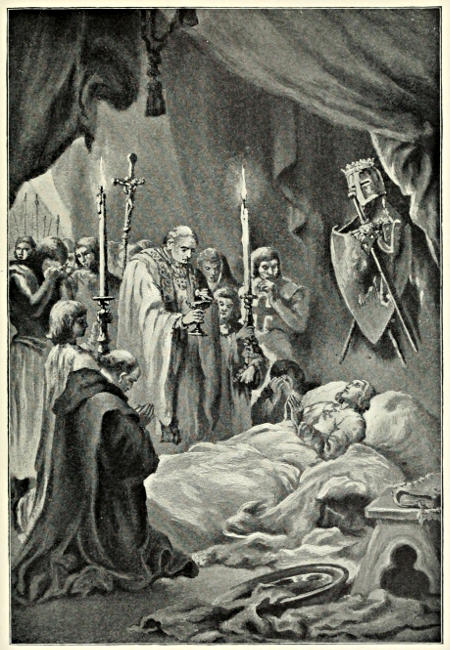
DEATH OF ST. LOUIS
Anticipating the laurel of victory, or the crown of martyrdom, St. Louis spread his sails for the Holy Land in 1270. Sixty thousand soldiers were animated by their monarch’s feelings of religious and military ardour; and we may remark among the leaders the lords of Flanders, Champagne, and Brittany. The fleet was driven into Sardinia; and at that place a great change was made in the plan of operations. The king of Tunis had formerly sent ambassadors to Louis, and expressed a wish to embrace the only true religion. Northern Africa had formerly paid a pecuniary tribute to the sovereign of the Two Sicilies; and Charles of Anjou, the reigning monarch, concealing his selfishness under the garb of piety and justice, strongly urged his brother to restore the rights of Christendom. The soldiers too, now more greedy of plunder and revenge than zealous in bigotry, entreated to be led to Tunis. The subjugation of the Mussulmans in Africa was declared to be a necessary preliminary to successes in Palestine; the French soon reached the first object of their hopes; and the camp and town of Carthage were the earliest rewards of victory. But every sanguine expectation was damped when a pestilential disease spread its ravages through the Christian ranks.
The great stay of the Crusades fell August, 1270. During his illness Louis ceased not to praise God, and supplicate for the people whom he had brought with him. He became speechless; he then gesticulated what he could not utter; he perpetually made signs of the cross, stretched himself on the floor, which was covered with ashes; and in the final struggle of nature he turned his eyes to heaven, and exclaimed, “I will enter thy house, I will worship in thy sanctuary.”
PRINCE EDWARD LEAVES ENGLAND
Before this calamitous event Prince Edward, Edmund Crouchback, earl of Lancaster, four earls, four barons, and the English division, had not only arrived in Africa, but had left it for Sicily, in despair that their French compeers would ever march to Palestine. The winter season was passed by Prince Edward in military exercises, and in the various occupations of chivalry, and in the following spring he turned his prow up the Mediterranean and arrived at Acre.
The whole of the forces of Edward did not exceed one thousand men. But the prowess of the Plantagenets was dreaded by the Mussulmans; and they feared that another Cœur de Lion was come to scourge them. The sultan of Egypt departed from the vicinity of Acre, which he had devastated with fire and sword. All the Latins in Palestine crowded round the banner of the English prince; and he took the field at the head of seven thousand men. The city of Nazareth was redeemed; and he surprised and defeated a large Turkish force. Edward was brave and provident, and owed his success as much to his skill as to his courage. But he was not less cruel than any preceding hero of the holy wars; and he gave a dreadful earnest of that savage implacability which Scotland afterwards so often rued. The barbarities which stained the entry of the Christians into Jerusalem, two centuries before, were repeated in a smaller theatre of cruelty in Nazareth.
[1271-1272 A.D.]
But the march of victory was closed, for the English soldiers were parched by the rays of a Syrian sun, and their leader was extended on the bed of sickness. The governor of Joppa was the apparent friend of Edward, but the sultan’s threat of degradation, if further commerce were held with an infidel, changed courtesy into malignity. He hired an assassin who, as the bearer of letters, was admitted into the chamber of his intended victim. After receiving two or three wounds, the vigorous prince threw the villain on the floor and stabbed him to the heart. The dagger had been steeped in poison, and for some hours Edward’s fate was involved in danger. The fairy hand of fiction has ascribed his convalescence to his queen.[79]
After the English prince had been fourteen months in Acre, the sultan of Egypt offered peace, for wars with the Moslem powers engrossed his military strength. Edward gladly seized this occasion of leaving the Holy Land, for his force was too small for the achievement of great actions, and his father had implored his return to England. The hostile commanders signed accordingly a treaty for a ten years’ suspension of arms; the lords of Syria disarrayed their warlike front, and the English soldiers quitted Palestine for their native country (July, 1272).
VAIN EFFORTS OF GREGORY X
[1274-1291 A.D.]
At the time when Palestine began to breathe from the horrors of war, hope once more raised her head in consequence of the election to the chair of St. Peter falling upon Theobald, archdeacon of Liège. The choice of the cardinals was made known to him while he was in Palestine. He impatiently transported himself to Italy, and so ardent was his zeal that his endeavours for a crusade even preceded his introduction to the pontificate. The trumpet of war again was heard among the nations. The blast was however only faintly echoed. The republics of Pisa, Genoa, and Venice, and the city of Marseilles, agreed to furnish a few galleys and twenty-five thousand marks of silver were obtained from Philip the Hardy on mortgage of the Templars’ estates in France. The masters of the military friars and Red Cross knights went to Rome, and convinced their papal friend that these succours would be too inconsiderable to enable the Christians to drive infidels out of Palestine.
Again was the Christian world assembled, and the council of Lyons (May 1274) decreed the obligation of a new crusade. But Pope Gregory died within two years after the sitting of the Lyonese council, and all thoughts of a crusade were dropped when the life of its great promoter closed.
Palestine however was at peace. Hugh III, king of Cyprus, a lineal descendant of the princess Alice, had been crowned king of Jerusalem at Tyre, a short time before the death of Conradin, the last unhappy descendant of that house of Germany, of which three emperors had supported and adorned holy wars. The Templars befriended Charles of Anjou, but the Hospitallers, with more virtue than was generally shown, declared that they could not fight against any Christian prince, and contended that the claims for succession to the kingdom ought to be deferred till the kingdom itself should be recovered. In the fourth year of the peace which the valiant prince Edward had gained for Palestine, the mameluke chief and king Bundukdari, died.
In the reign of Kalaun, the third sultan in succession to him who had torn so many cities from the Christians, the war was renewed (1280), and after a few years of dreadful preparation the living cloud of war burst upon the Christians. Margat was captured; but so brave had been the resistance of the knights that it procured them a safe and honourable retreat to the neighbouring town of Tortosa (1287), and the sultan, dreading even the possibility of future opposition, razed the fortress.
PROGRESS OF THE MAMELUKES
With rapid and certain steps the power of the Latins approached its fatal termination. The city of Tripolis, that last remaining satellite of the kingdom of Jerusalem, was taken in 1289; its houses were burned, its works dismantled, and its people murdered or retained in slavery. Acre once more became the principal possession of the Christians. The sultan concluded a treaty of peace with Henry II of Cyprus, who had driven away the lieutenants and soldiers of Charles, and had been acknowledged king of Jerusalem.
The grand-master crossed the Mediterranean in order to infuse his martial spirit into the people of the West. Pope Nicholas IV heard with coldness the dismal tale. He declined to open the treasury of St. Peter for the advancement of the Christian cause, and he gave his noble friend only fifteen hundred men—the offscourings of Italy. Circular letters were sent to the different European potentates, but the light which once shone upon the holy cause had waned; cavaliers no longer thronged round the cross, and the grand-master was compelled to return to Palestine, accompanied only by his Italian banditti. When they arrived at Acre, the city was in the greatest state of turbulence. Within its walls were crowded the wretched remains of those kingdoms and principalities which had been won by the blood of the West. Every distinct people occupied a particular division, and, in the assertion of individual privileges, general interests were forgotten.
[1291-1300 A.D.]
The sultan died before his preparations of vengeance were completed; but his son Khalil was not less anxious than his father to exterminate the infidel miscreants. In April, 1291, nearly two hundred thousand mameluke Tatars of Egypt marched into Palestine, and encamped before Acre, exactly on the same ground upon which a century before assembled Europe had stood. To avoid the dreadful consequences of war, a large part of the population embarked in the numerous vessels which at that time rode at anchor in the harbour, and the defence of the place was left to the care of about twelve thousand soldiers. The garrison was speedily reinforced by a few hundred men, headed by Henry II of Cyprus, who boasted the ideal title of king of Jerusalem. But the Christians beheld their towers yielding to the mines and battering-rams. The pusillanimous monarch, seizing a few ships, sailed to Cyprus. With the morn, the mamelukes renewed the attack. Most of the German cavaliers died upon the breach; the others slowly left the walls, and the firmness of their little phalanx checked the foe. The Hospitallers chased back the mamelukes, and even forced them headlong into the ditch. But the sultan was prodigal of blood. His battalions marched to the breach, and in a few hours the entry into the city was repeatedly lost and won by the Christians and infidels.
Under the cover of a few cross-bowmen, the knights of St. John, seven only were the remnant, embarked, and left forever the scene of their virtue and their valour. Their brethren in arms, the Templars, were equally brave, and their fate was equally disastrous. Their resistance was so firm, that the sultan was compelled to promise them a free and honourable departure. But the insults of some low Saracenian people irritated the cavaliers; the sword again was drawn, and such of the Templars as survived the conflict, fled into the interior country. The unarmed population of Acre hurried to the coast; but the elements co-operated with the devastating spirit of the Turks, and the tempestuous waves refused shelter to the fugitives. While gnashing with despair, the people beheld their town in flames. The ruthless hand of death fell upon them, and the sea shore of Palestine again drank torrents of Christian blood.
TOTAL LOSS OF THE HOLY LAND
Tyre, Berytus, and other towns, were awed into submission. The Turks swept all Palestine, and murdered or imprisoned all the Christians who could not fly to Cyprus. The memory of the Templars is embalmed, for the last struggle for the Holy Land was made by the Red Cross knights. Such as escaped from Acre went to Sis, in Armenia. A Mussulman general drove them to the island of Tortosa, whence they escaped to Cyprus, and the cry of religious war no longer rung through Palestine.
The loss of the Holy Land did not fill Europe with those feelings of grief and indignation which the fall of Jerusalem, an hundred years before, had occasioned. The flame of fanaticism had slowly burned out. During the thirteenth century, the territorial possessions of the Christians in Palestine gradually diminished; the expeditions and reinforcements were in consequence less vigorous, for, both politically and personally, the people of the West declined in their interest in respect of the affairs of the East. Pope Nicholas IV endeavoured to revive holy undertakings; but the kings of Europe were deaf or disobedient. As Genoa was allied to the Grecian emperor, Venice sought the friendship of the Mussulmans. The mamelukes gave their Christian brothers a church, an exchange, and a magazine in Alexandria; and the Venetians carried on the lucrative but disgraceful trade of furnishing the Egyptian market with male and female slaves from Georgia and Circassia.
[1299-1413 A.D.]
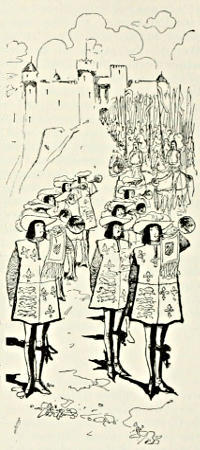
Heralds of the Crusaders
There was some pretence for the preaching of a crusade by Pope Boniface VIII in the year 1300. Kazan, the Mongol sultan of Persia, resolved to exterminate the mamelukes of Egypt. He allied himself with the kings of Georgia, Armenia, and Cyprus. In 1299 the fortunes of war smiled on the allies; but still the success not being so great as what he had expected, Kazan sent to the pope, soliciting the more powerful alliance of the princes of the West, and agreeing that when Palestine was recovered, it should be retained by the Christians. The project, though warmly patronised by the pope, proved abortive. In the interim, the tide of victory flowed in favour of the Egyptians. Kazan died about the year 1303.
From the commencement, till past the middle of the fourteenth century, the popes repeatedly sounded the charge; but the West in most cases disregarded the summons of its ghostly instructor; and it was evident that, although the papal rulers could fan, they could not create the sacred flame. At the time when the loss of the Holy Land became known in Europe, the people had not recovered from the astonishment and terror with which the victories of Jenghiz Khan and his successors had filled the West. Part of Russia, the whole of Poland, Silesia, Moravia, Hungary and all the countries to the eastward of the Adriatic Sea, fell a prey to barbaric desolation. Several of the popes attempted in vain to soften the ferocity of these new foes; but the papal legates were dismissed with the tremendous command, for Rome herself to submit her neck to the Mongol yoke.
Though Europe in general felt that in the fall of Acre all was lost, yet despair did not immediately complete his triumph, for chivalry and policy sometimes endeavoured to revive the religious spark. If Pope John XXII had not been too open in the display of his avarice, and too prodigal in the commutation of vows for money, the knights of Germany would once more have fought under the glorious ensign of the cross. A threatened invasion from England (1328 A.D.) deterred Philip de Valois from leaving his country for Palestine, and a large body of crusaders was dispersed when (1364 A.D.) John Le Bon of France died, on whom the pope intended to have conferred the title of commander of the new crusaders. The politic Henry IV[80] of England wished to “busy giddy minds with foreign quarrels,” in order to divert his people from looking too nearly into his state, and to retain their newly sworn allegiance. Both his maritime and military preparations were considerable; but the hand of nature stopped him and it was his fate to succumb to death, before he could attempt to commence his new religious career.
FATE OF THE MILITARY ORDERS
[1291-1600 A.D.]
Such were the last appearances of that martial frenzy which so long agitated Europe; and here the history of the holy wars would naturally close, if curiosity did not suggest an inquiry into some of those military and religious orders which arose from the spirit of pilgrimages and crusades, and whose existence forms one of the most prominent characteristics of the Middle Ages. The knights of the Teutonic order were fixed in their conquest of Prussia, some years before the loss of the Holy Land. Their love of war was not extinguished; they carried both the sword and the Gospel into Pomerania; and the eastern part of that country was definitively ceded to the order by a treaty of peace in the year 1343. The town of Dantzic, the capital of the new conquest, was considerably aggrandised under the dominion of the knights, and became one of the principal places of commerce on the Baltic. Pressed forward again by religion and ambition, they made war on the infidel Lithuanians, but it was not till the beginning of the fifteenth century, and after rivers of blood had flowed, that the pagans lost their independence, and relinquished their national superstition. But the oppressive government of the knights; their intestine divisions; their heavy imposts, the unhappy result of wars continually reviving, encouraged the nobility of Prussia and Pomerania to confederate, and to seek the protection of the kings of Poland. The torch of war was rekindled, the knights were defeated, and by the peace of Thorn in 1466 all Pomerania, and indeed all the country which is generally called Polish Prussia, was ceded to Poland. The order was allowed to preserve the west of Prussia by the tenure of feudal service to the kings of Poland.
The Teutonic knights thus lost Prussia; their name appears on few occasions in the history of Europe, and the order became only a “cheap defence of nations.” Pope Innocent VIII in the year 1490 endeavoured to suppress the order of the Knights of St. Lazarus. In Italy, perhaps he succeeded, but not in any other country. The bull was resisted by the knights of France and till the reign of Henry IV they were independent and elected their own grand-masters.
KNIGHTS OF ST. JOHN
[1291-1310 A.D.]
After the loss of Acre, the knights of St. John and the Temple, from every preceptory and commandery in Europe, flocked to Cyprus, impatient for glory and revenge. The military friars soon quitted their settlements in Cyprus. The grand-master of the Hospitallers gained the friendship and the purse of Pope Clement V, and drew a flattering picture of Christian prosperity, if the cavaliers of St. John could set up their banners in some island in the Mediterranean. Rhodes was fixed upon. Fifteen years subsequently to the loss of Acre, a new crusade was published, and the volunteers were invited to repair to Brundusium. The king of Sicily and the republic of Genoa furnished transports. The grand-master headed the army, but it was not until after they had sailed, that the crusaders knew the object of the armament. Rhodes was at that time in the power, partly of the Greeks and partly of the Saracens. The soldiers landed; many battles were fought, and the army of the invaders was at last reduced to the military friars. Their chief hired new soldiers, recommenced his attacks, and the whole island submitted to his authority (1310). The subsequent history of the knights of St. John is interwoven with the general history of Europe.
THE TEMPLARS IN FRANCE
[1307-1311 A.D.]
While the military friars were planning the acquisition of an equivalent to their loss in Palestine, most of the Red Cross knights gradually left Cyprus, returned to their different commanderies, and lived in security and indolence. But circumstances soon made the Templars repent that they had not, like the Hospitallers, attempted a renewal of hostilities with the infidels. Philip the Fair, king of France, acquainted Pope Clement V, that the order of the knights Templar had been accused of heresy and various other crimes against religion and morals. Some members had charged their fraternity with the different abominations of treachery, murder, idolatry, and Islamism. Philip the Fair took the bold step of imprisoning all the knights Templar whom his officers could discover in France, and of sequestering their property. Clement then circulated a bull throughout Christendom, by which instrument of papal authority, nuncios and the resident clergy were commanded to inquire into the conduct of the knights. His holiness says that, pressed by public clamour and by the declarations of the king, the barons, the clergy, and laity of France, he had examined seventy-two members of the order, and had found them all guilty, though in various degrees, of irreligion and immorality. Such of the knights as yielded to blandishments and threats were pardoned, but the torture was applied to those who denied the charges, and thirty-six knights in Paris heroically braved the horrors of the rack, and maintained the innocence of the order, till death closed their sufferings and their virtue. Others confessed in the midst of corporeal agony, and afterwards recanted their confessions. The knights Templar were accused of renouncing, at the time of their matriculation, God, Jesus Christ, the Virgin, and all the saints. It was said that the brethren used often to spit and trample on the cross, in proof of their contempt of Christ, who was crucified for his own crimes and not for the sins of the world. Out of their disdain of God and his Son, they adored a cat, and certain wooden and golden idols. The master could absolve brethren from sins. On the assurance that the king would destroy the order, whether the result of the examinations were favourable or hostile to its continuance, many knights had yielded to pain and hopelessness, stayed the hand of the executioner, confessed every crime, upon their confessing of which, royal pardon and protection were proffered. The court condemned to perpetual imprisonment those from whom no confession of guilt had been extorted. But such as had retracted their forced avowals were declared to be relapsed heretics; they were delivered over to the secular power, and condemned to the fire (May 11th, 1310). The number in the last-mentioned class of the proscribed was fifty-four. All the historians who have spoken of the event, whatever opinion they might have entertained on the general question, friends or enemies, natives or strangers, have unanimously attested the virtuous courage, the noble intrepidity, and the religious resignation, which these martyrs of heroism displayed. Arrived at the place of punishment, they beheld with firmness and placidity the piles of wood, and the torches already lighted in the hands of the executioners. In vain a messenger of the king promised pardon and liberty to those who did not persist in their retractations; in vain their surrounding friends endeavoured to touch their hearts by prayers and tears. Invoking God, the Virgin, and all the saints, they sung the hymn of death; triumphing over the most cruel tortures, they believed themselves already in the heavens, and died in the midst of their songs.
IN OTHER COUNTRIES
[1311-1314 A.D.]
By royal command, the sheriffs of the different counties of England and Wales seized the estates, and imprisoned the persons of the Templars. The cavaliers were more than a year and a half in prison. At the end of that time a papal bull was received in England; and the archbishop of Canterbury appointed courts at London, York, and Lincoln, for the trial of the Templars, July, 1311. The charges were the same in substance as those which had been preferred against the order in France. Forty-seven of the knights who had been incarcerated in the Tower were examined upon oath before the bishop of London, some inferior clergy, and the representatives of the pope. William de la Moore, the grand prior of England, was as earnest as de Molay had been in defence of the French Templars.
Four knights made a general confession of crimes, when they were told that the pope had authorised a full pardon to those who acknowledged their iniquities; but that if they persisted in heresy, they should be considered and punished as heretics. Thirteen newly admitted knights swore that they were not acquainted with the secrets of the order, but that they were prepared to renounce all the erroneous opinions in which it was possible the minds of men could be stained. William de la Moore, the grand prior, was the only man whom no fear of imprisonment or dread of ecclesiastical punishment could induce to deny his first avowal of the innocence of the order. He was requested to make a general confession; but he replied that he was not guilty of heresy, and would never abjure crimes which he had not committed.
In Ireland about thirty Templars, in Scotland only two, were confined and examined. In Lincoln the number somewhat exceeded twenty. There were twenty-three in York. The general charges of apostasy and idolatry were not proved in any case. However, all the knights made a general confession of the offence of heresy, and avowed they could not cleanse themselves from the crimes mentioned in the bull. The clergy pardoned them, and received them again into the bosom of the church. They were then sent into confinement in various monasteries until the decision of a general council should be declared.
The fate of the Templars in other parts of the world remains to be told. In Germany the innocence of the order was proved before the archbishops of Mainz and Trèves, at councils held in their respective dioceses. In Italy the pope had a little more success. Several Templars at Florence confessed every species of abomination. Much blood was shed in Lombardy, Tuscany, Sicily, Naples, and Provence, whenever the knights would not be guilty of self-condemnation. In those parts of Spain where the conduct of the Templars was inquired into, the result was an acquittal. Their military front was powerful, and the ministers of papal vengeance did not dare to apply the torture.
COUNCIL AT VIENNE
Four years after the first seizure of the Templars in France a council was held at Vienne in Dauphiné, for the purpose of making some general decision on the case of the order, October, 1311. The pope headed three hundred bishops, and an untold number of inferior clergy. All men who desired to defend the order were promised security and freedom. Nine cavaliers presented themselves before the assembly in the character of representatives of fifteen hundred of their brethren, who were living at Lyons, and in the secret fastnesses of Savoy and Switzerland. Clement immediately violated his promise of protection, and threw the nine knights into prison. He then called upon the council for its opinion, whether in consequence of the confessions of the Templars the society ought not to be dissolved? With the disgraceful exception of one Italian prelate, and three French archbishops, the whole body of churchmen declared that so illustrious an order as that of the Red Cross knights ought not to be suppressed, until the grand-master and the nine knights had been heard in its defence. The pope disregarded the opinion of the majority; and tried in vain for six months to make a change.