THE HOME OF FOUR O'CLOCK TEA.
Reading edition
SOME GOSSIP NOT OFTEN HEARD.
Of the millions of people who drink tea, very few seem to know how it is grown or manufactured.
They would hardly believe that there are just on 800,000 acres of land planted under tea in India and Ceylon, employing over one million people—all British subjects. Just imagine employing a fifth of the population of London for the production of one article! Then, again, look at the thousands of people who are employed in the tea trade at home—merchants, dealers, brokers—all dependent on this one article of consumption for their bread-and-butter!
And yet hardly ten per cent. of these know anything about tea manufacture, or have ever given a thought to the one million of people employed in its production.
The duty paid to the Customs during the past twelve months on Indian and Ceylon tea amounted to £3,805,935, to say nothing of the revenue accruing to the Indian and Ceylon Governments in taxes and a hundred and one little charges, all helping to swell the coffers of State, and enabling hundreds of thousands of people to maintain a living.
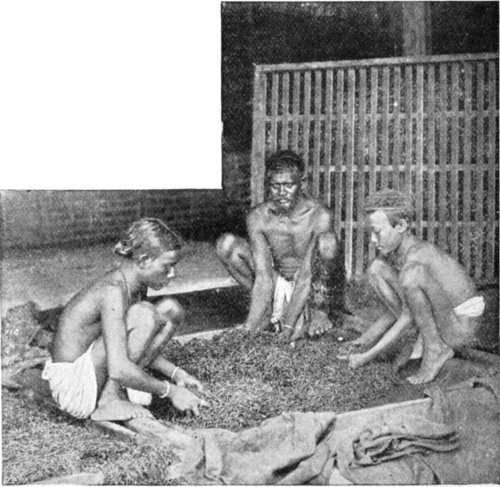
TURNING THE LEAVES FOR FERMENTATION. Bourne & Shepherd Photo, India
Surely all these things should induce the patriotic British public to drink only British-grown tea, grown as it were by their own people—for are not India and Ceylon British? and are not the people of Great Britain and India and Ceylon one, under one Sovereign?
The plucking of the tea plant generally commences about the middle of March, and goes on till the end of November, except in Ceylon, where it goes on more or less throughout the twelve months, there being no cold weather to check the "flush" and allow the bushes to lie dormant.
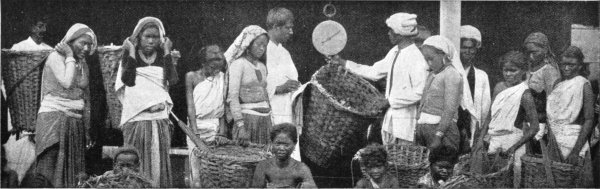
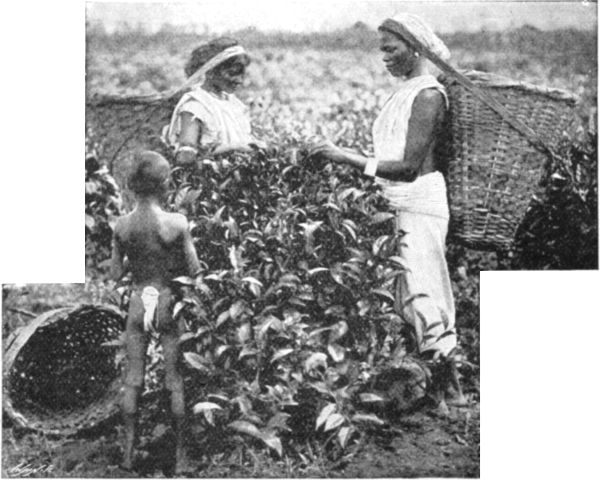
A tea bush is not considered fully ripe for plucking until about five years of age, though a little "tipping" is done on low-lying gardens during the third and fourth years. It is generally carried on by the coolie women and children; the former are rapid and expert workers, and are paid so much for every pound of green leaf plucked. As the leaves are plucked they are thrown into baskets, the contents of which are taken to the factory twice a day for weighing.
There are many ideas as to how plucking should be carried out, and how many leaves should be taken off, but the most general system is to pluck two leaves and a bud, not separately but together.
PICKERS HAVING THEIR TEA LEAVES WEIGHED. Bourne & Shepherd, Photo, India
Some planters, who prefer quantity to quality, pluck the half or whole of the third leaf as well.
It must be thoroughly understood that all the leaves are not "ripped" off the bushes, but only the young shoots. It is a very delicate operation, requiring great care and skill, and is usually carried out under the eye of the assistant manager.
It is usual to get round a plantation once in six to eight days, and woe be to him who cannot cope with the leaf, or lets it run away from him, as it will show the result both in the dry leaf and liquor.
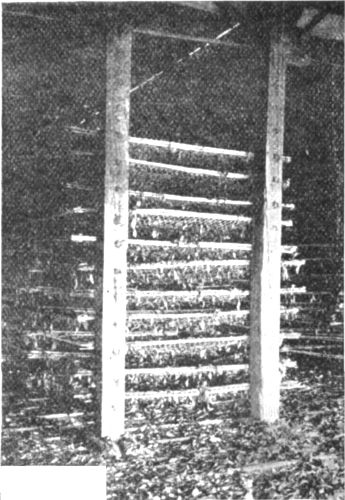
The leaf, when plucked, is brought into the factory, weighed, and put through the following process of manufacture. The first process is called withering. The leaf is thinly spread on wire meshing, stretched from end to end of the loft or withering-house, the object being to allow a certain percentage of moisture to evaporate, and to get the leaf into a pliable condition for rolling, so that it will not break during this process. Properly withered leaf should be as flexible as a soft kid glove.
Then comes the rolling, the object of which is to break the cells of the leaf one into the other, so as to free the juice and to give a "twist" or "roll" to the leaf. Care has to be taken that too much juice is not expressed, which would be detrimental to the liquor when in the household pot.
The old and dirty method of rolling by hand, which is still carried out by our Chinese friends, is quite extinct in India and Ceylon, where rolling machines or tables are used.
The religion of the natives of India compels them to be cleaner in their habits than the Chinese, so it would not matter how much they handled the leaf.
HOW THE LEAVES ARE WITHERED. Bourne & Shepherd Photo, India
The next process through which the unfortunate tea leaf has to go, and which is considered by many planters as the most critical in the whole manufacture, is fermentation, as good leaf can easily be spoiled.
After coming out of the rollers, the leaf is taken into a separate room, generally built off the factory, away from the heat, as it is essential to keep the fermenting leaf cool and moist. It is then spread in little heaps on the floor or trays, having to be constantly turned over to keep cool. It soon begins to oxidise, and change from a bright green to a bright coppery colour, the young leaves being as bright as a new penny.
PLUCKING THE TEA LEAVES. Bourne & Shepherd Photo, India
Some planters sift these young leaves from the coarse directly after the rolling, so as to try and get a more even colour, but it is a most difficult task, as the leaves are sticky and cling together. It is usual, as soon as the desired copper colour is obtained, to give the leaves another roll just before firing.
The object to be obtained in the next process—firing—is to remove all the moisture, without losing any of the constituents which add to the commercial value of the tea. Most factories are equipped with modern firing machines, and these are of many kinds. Heated air drawn over the leaf by revolving fans is the method of most machines. The temperature used is different on nearly every estate, according to the ideas of the planters. Some men give two firings. First the leaf is fired 70% dry at a certain temperature, and then taken to another machine, where the final firing takes place.
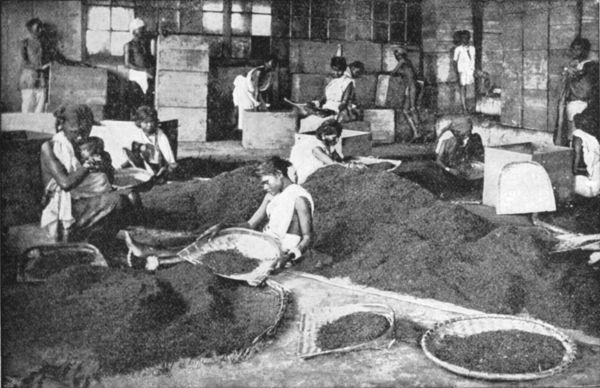
Then comes the sorting of the dry leaf into the various grades, the names of which are pretty well known to most people, i.e. Pekoe, P. Souchong, etc. This is done, as the photograph shows, by revolving flat sieves of varying sizes, after which it is refired, weighed, and packed ready for despatch to market. It will be seen that the manufacture of tea is somewhat of an art, requiring all the skill of the planter. He sometimes has to turn out two or three times a night to see that nothing is overlooked. Climatic influence plays an important part both in the quality of leaf and during manufacture. Sometimes it is impossible to get your leaf to wither and ferment, flirt with it as you will; at others the change is so rapid that it is almost impossible to cope with it. Nothing is so disappointing as the manufacture of tea, for, having done all in your power, and watched each process carefully with untiring energy, under most unfavourable circumstances, you possibly receive a broker's report on the samples, with a polite letter from your agent telling you that the tea is unsatisfactory.
Our photographs are by Bourne and Shepherd, Calcutta.
SORTING THE LEAVES ACCORDING TO QUALITY.
A VERY CLOSE FINISH. Photo by C. M. Ward, Edinburgh