MICE WORTH THEIR WEIGHT IN GOLD.
Reading edition
SOME EXTRAVAGANT PETS. By Gavin Macdonald.
Most of us kept mice in the days of our childhood. They were always white with pink eyes, and our elders objected to them tooth and nail.
Without warning, the mouse fancy has sprung into general popularity, and the craze for rearing and showing the tiny creatures has assumed the proportions of an important and fashionable hobby.
There is a National Mouse Club, a National Mouse Show, and a hundred others of less importance. Nor is there lack of prizes. The Mouse Challenge Bowl is a trophy worthy of consideration by a Derby winner; and there are pots and medals and specials galore for competition by enthusiastic members of the fancy.
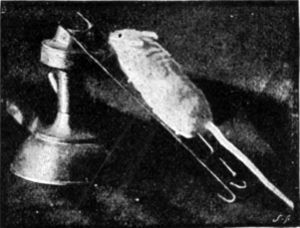
THIS MOUSE IS INVESTIGATING OUR PHOTOGRAPHER'S FLASH-LIGHT APPARATUS.
A first visit to a famous collection is likely to occasion considerable surprise to those who are only familiar with the white and pink-eyed variety and the common little grey-backed member of the household.
During the last two or three years various fanciers have been industriously endeavouring to improve the breed, and they have succeeded in producing the most beautiful specimens. The show mouse is larger than the common household specimen. The eye is much larger and fuller, and the coat would not disgrace a thoroughbred racer. But the chief points are colour and marking. These are simply wonderful. The self colours include not only black and white, but almost every shade between. The black specimens have rich silky coats. The white to be at all valuable must possess black eyes. The pink eye has been eliminated altogether.
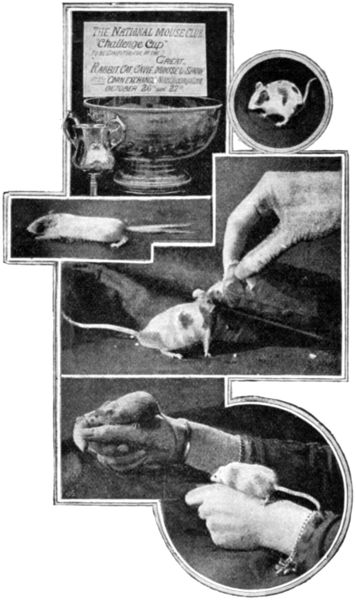
(1) MOUSE CHALLENGE CUP. (2) A MOUSE WITH TWO TAILS. (3) HOW A LADY FANCIER FEEDS HER PETS, AND (4) HOW SHE PLAYS WITH THEM.
Sables exist in every possible shade, and some of them are of the richest and most beautiful quality. Silver grey is a fashionable colour this year, and I have seen some very perfect specimens with bluish-grey coats.
The marked mouse is a most popular fancy, and no wonder, for in this department the most wonderful results have been obtained, as our illustrations prove.
At the present moment a well-known lady fancier is striving to obtain a Dalmatian mouse. She has already a most wonderfully spotted specimen, and hopes before long to show a perfect example.
Apart from their great beauty, fancy mice pay, and pay well. At the National Mouse Show I was shown several specimens worth £5 apiece, and as much as £20 has been given for a champion. The two mice in our picture of judging are both £5 animals.
Another thing about them is that they are practically all profit. The bread and milk and occasional hemp seed upon which they live is used in such small quantities that an expenditure of 6d. per week will suffice to keep dozens.
Then there are many fanciers who make a lot of money out of their young mice. A working man in the North of England, who is an ardent fancier, makes no less than £15 per annum in this way, besides an occasional pound or two for an extra-promising specimen.
Many fanciers have very large collections. The secretary of the National Mouse Club possesses some 2,000 in his cages, and I know at least half a dozen others whose collections range between two and five hundred. At one day old the mice are little pink objects scarcely longer than a wax vesta, minus sight and minus coat. I saw a litter of this age in Staffordshire some time ago. A fortnight later they were in full war paint, and were winning prizes at a big show in the "under eight weeks" class. It is well that they develop so quickly, since at two years they get ill and out of condition and are usually destroyed.
There are many collections in this country valued at £30, and I know of one for which £100 has been offered and refused.
As with other fancy animals, the best specimens are selected from a litter and the rest are drowned. The selected mice are reared with the greatest care, and as soon as they are of the right size and age they commence the round of the shows. At home they are kept in immense tenement cages, divided into tiny compartments for two, but they travel to the shows singly in special exhibition cages.
"MATCHLESS," THE CHAMPION MOUSE—SHOWING HOW THE JUDGING IS DONE.
These exhibition cages are packed together in a live-stock box, and on their arrival at their destination are taken charge of by special stewards, who see to the feeding arrangements and place them in their right classes.
Great interest is taken in the judging of these tiny creatures, and the judge is always surrounded by an eager crowd of spectators. Usually he contents himself with a glance in the box, shaking it up if the occupant is of a lazy disposition. When it comes to taking stock of a particularly good exhibit the mouse is taken out of the cage and examined.
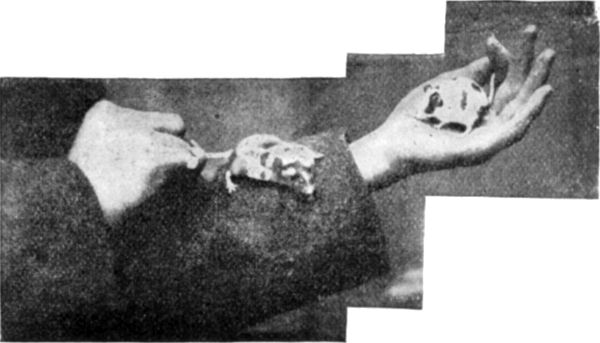
They are always lifted and held by their tails during this examination. In the case of it being necessary to compare two competitors, they are held on the sleeve as illustrated in our photograph of judging.
In this picture, Mr. Richards of Dursley, Gloucestershire, is seen judging two specially fine specimens, the mouse to the left being Mr. Singleton's famous champion "Matchless," one of the most perfect show mice living.
The border on the first page of this article is entirely composed of photographs of show animals, and gives a very good idea of the beautiful markings so much sought after by fanciers.
Miss Grimston owns a famous collection, which she keeps at her house in Mayfair. Each mouse is named, and the idiosyncrasies of its character are well known to its mistress. Two fine specimens are shown sitting on her hands. The mouse on the ladder is also hers.
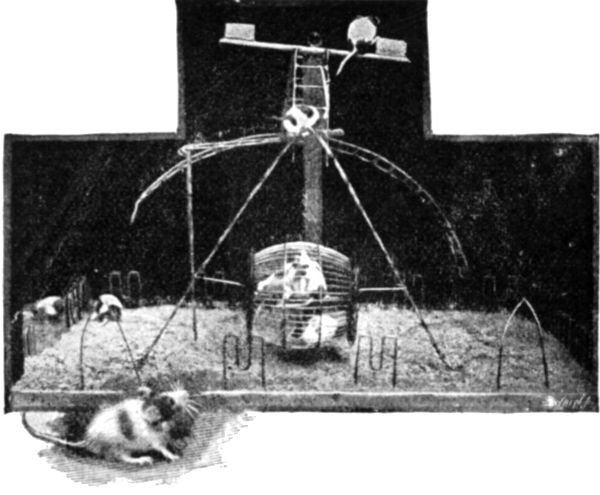
This lady possesses a unique playground, fitted with a tiny gymnasium. The young mice are turned into this for exercise and play. It keeps them in health and coat, two very necessary conditions for show purposes.
Miss Grimston is a particularly successful exhibitor, having captured some dozens of prizes, including cups and medals. Her collection at the present time contains some forty show specimens. They are rarely home for long together. As soon as they return from one show they are off to another.
"WHEN THE CAT'S AWAY, THE MICE WILL PLAY."
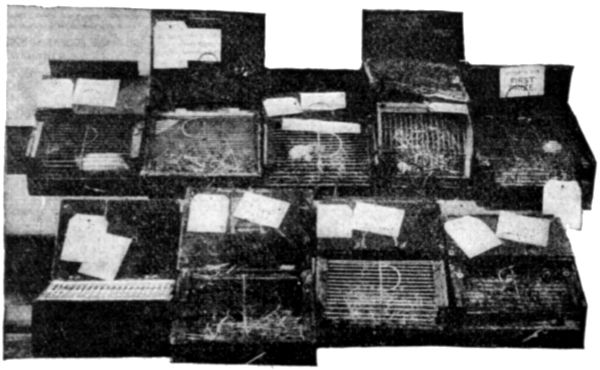
The exhibition cages shown in the illustration at the foot of this page are a representative collection.
Although more or less of regulation size, shape and ornamentation are left to the individual taste of the fancier.
As a result, many of them are extremely decorative, poker-work sketches and other novel methods of adornment being commonly resorted to.
Many fanciers make their own cages and live-stock boxes, and combine the mouse fancy with amateur carpentry. One fancier who is his own carpenter has received so many applications for the address of the maker of his exhibition cages, that he has taken up cage-making professionally, and makes over £50 per annum in his spare time by the sale of his handiwork.
It is needless to say that cats are unknown in the establishments of show mouse owners, and show committees have to exercise the greatest care in order to exclude cats from the exhibition rooms.
It is a capital hobby, full of interest and fascination.
SOME OF THE MICE CAGES AT THE NATIONAL SHOW.