"OFF TO KLONDYKE."
Reading edition
A STORY TO BE READ TO CHILDREN. By Geo. A. Best. Illustrated with novel Photographs from life by Arthur Ullyett, Ilford.
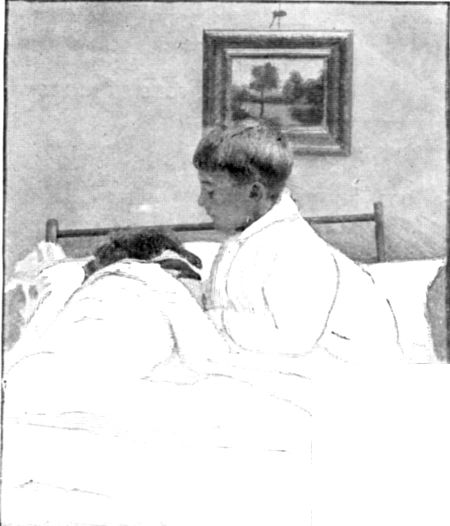
"Wake up, Lessels!" said Stanley, in a hoarse whisper, shaking his younger brother as he spoke. "I've got a grand idea!"
"'WAKE UP, LESSELS! I'VE GOT A GRAND IDEA!'"
"'I'M OFF TO KLONDYKE, AND YOU'VE GOT TO BE MY PARD.'"
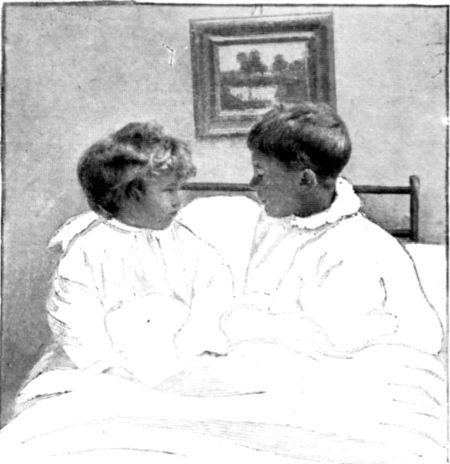
"Gimme a little bit then," answered Lessels, drowsily. "You had some of my chocolate cweam last night."
"You goose! Don't you know what an idea is?" retorted the elder boy, disdainfully. "It isn't anything to eat. It's a notion."
"Then you can have it all yourself," remarked Lessels, indifferently.
"Would you like a thousand pounds to spend on caramels and chocolate?" asked Stanley. "And a golden guinea to put in the bank till you are a man?"
"I'd like the chocolate," answered Lessels, with some show on interest. "An' I'd like a boxful of caramels; an' a barley-sugar lion; an' a real engine which would go by itself an' wun into things. An' I'd like a toy fire-engine, so that I could set fire to Madge's dolls' house an' put it out; an' a bucketful of ice cream, an'——"
"Don't speak so loud, you little duffer, or you'll get nothing at all!" interrupted the elder boy. "Just get out of bed at once, and dress yourself without dropping anything. We're off to Klondyke!"
"Off to what?"
"Klondyke—a place where you dig money out of the ground like coals. Big lumps of solid gold, what'll buy a whole shopful of toys, and tons of best London mixture and marzipan. See?"
"What about washin' our faces an' bweakfast?"
"Miners never wash themselves, silly; and they don't have proper breakfasts till they've made their pile."
"What's a miner, an' who's a pile?" asked Lessels, chasing himself across the room backwards to attach his braces to a rear button which was apparently running away.
"A miner's a man who digs gold up and washes it in a cinder-sifter," explained Stanley. "And he shoots everybody who comes near him except his pard. I'm off to Klondyke to be a miner before dada awakes, and you've got to be my pard."
"Who'll I shoot?" asked Lessels, with a defiant glare.
"Everybody but me," answered Stanley, condescendingly. "We'll want my best sixpence-ha'penny gun; several sticks of lead pencil to shoot; two spades; a cinder-sifter; an umberrellar to sleep under; our nightshirts; a loaf of bread, and a big knife."
"Shall we take Desmond in the mail cart?" asked the four-year-old "pard," innocently. "Desmond, an' a packet of sherbet, an' my toy engine, an' a chair to sit on, an' the kitchen lamp, an' our bed, an' a few other fings to eat?"
"Babies and toys must be left at home," snapped the miner. "And how do you think we can carry a bed along? We must hunt for crabs to eat with our bread, and shoot birds and catch fish. Our Klondyke is really the beach, for I heard dada say last night that Southend was a regular Klondyke, as gold had been found on the sands. What a good job we live close to Southend, isn't it?"
"Hadn't we better tell dad we're going, an' get a penny to spend?" suggested the long-headed Lessels, ignoring his brother's question.
"A penny to spend!" echoed the elder boy, scornfully. "We'll have fifty thousand golden sovereigns to spend before this day week; and dad will forget to whack us when we buy him a new house, and a carriage with two horses and a footman, and an ounce of tobacco. And mamma shall have four splendid servants, and a sealskin jacket, and a bottle of scent, and a bicycle, and a new box of hairpins! I'm quite ready now, are you?"
Lessels answered with a somewhat doubtful nod, and the children crept silently downstairs. The kitchen door was successfully unbolted after a table and chair had been mounted by the intrepid Stanley, and the necessary materials for the outfit were rapidly collected from the neighbourhood of the washhouse.
STANLEY AND LESSELS START FOR KLONDYKE.
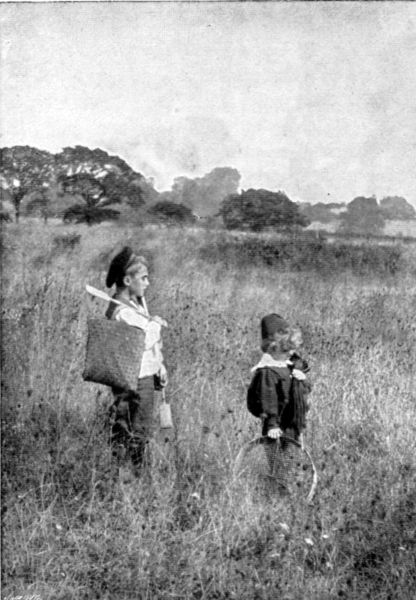
"I'll carry the umberellar, gun, and knife," whispered Stanley. "You can fetch along the cinder-sifter and the other things."
"I don't like to touch the shinder-sifter: it's got nasty worms and snails on," protested Lessels, whimpering. "An' if I can't carry the gun I shan't go, so there!"
"I've a great mind to put a lead pencil through you, you great baby!" hissed the miner, furiously. "You're a nice pard for a man to have, to be sure! Don't forget that my gun is loaded, and I'm not going to stand any nonsense, so just do as you're told. If you're afraid of a worm, what are you going to do when conger eels, sea serpents, and octopussys attack us?"
"Fight 'em to deaf!" answered the "pard," growing suddenly cheerful at the prospect of encountering large game. "Is the octopussy like other cats?"
THEY MARCH THROUGH A DENSE JUNGLE.
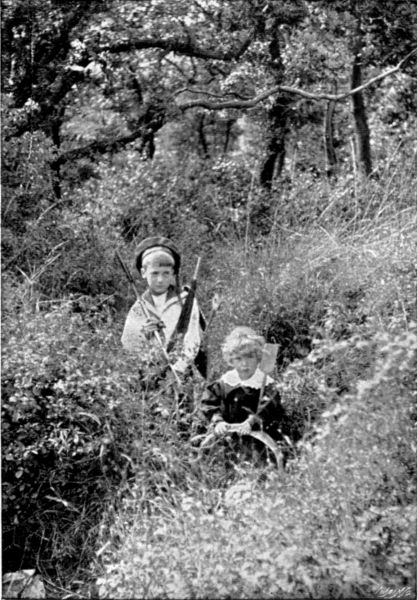
"It isn't a cat at all; it's a fish like a large spring onion with eyes in, and hundreds of roots which are all alive," explained Stanley, as the expedition moved slowly across the first field.
After a long and painful march over a plain covered with thistles and long grass, succeeded by a dense jungle, the heavily laden "prospectors" reached the beach at a lonely spot some miles to the westward of Southend pier. Here the umbrella tent was erected, the gun reloaded, and the mining utensils carefully unpacked. The loaf was thoughtfully wrapped up in a nightshirt to preserve it from the effect of sun and salt water.
"We must stake out our claim at once," said Stanley, producing four clothes pegs from his pocket, and sticking one at each corner of a four-sided diagram hastily scratched on the sand with a spade. "All miners have to do this before they've been in Klondyke five minutes. And we must put up a notice that this claim belongs to us, so as to keep other gold hunters off. See?"
"Then we shan't have nobody to shoot," protested Lessels, in a disappointed tone.
"Dig up some sand, pard, and fling it into the cinder-sifter while I write out the caution in blue pencil," said Stanley. "And when all the sand has run through call me to pick out the gold."
And after seeing the first spadeful of sand fall into the sieve, the elder miner rapidly produced a notice worded as follows:—
"This is our clame. Tresspasers will be persecuted and shot. Vissitors are requested not to tuch the nugets."
"Anybody reading that warning won't dare to come within a mile of us," remarked the author, proudly, as he attached the notice to the ferrule of his "tent." "Any luck, pard?"
"Any what, Stan?"
"Luck—I mean have you found anything?"
"I've got a kwab, an' a cockle shell, an' an old shoe, an' a ginger-beer bottle," replied Lessels, with a yawn. "The bottle's got some beer left in, an' I'm very thirsty. Shall we have a dwop?"
"That isn't ginger-beer, it's sea water!" cried Stanley, warningly. "If you drink ever so little you'll go mad, and smash things and shoot yourself! Then I shall have to bury you in the sand, and put a wooden cross over your head, so that I can show dada where I left you."
"My head aches, an' I'm getting thirsty," protested the hard-working pard.
THEY DIG FOR GOLD, AND FLING THE SAND INTO THE CINDER-SIFTER.
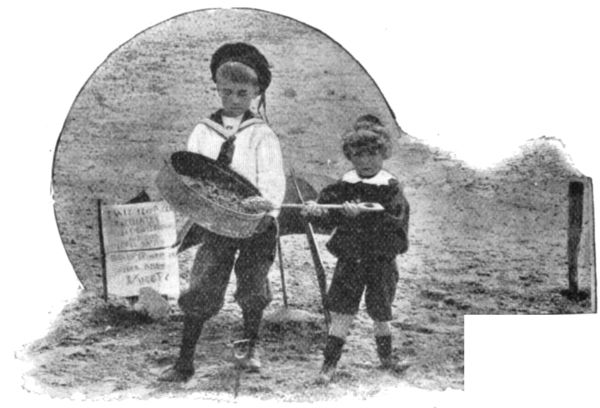
A BIG NUGGET IS DISCOVERED.
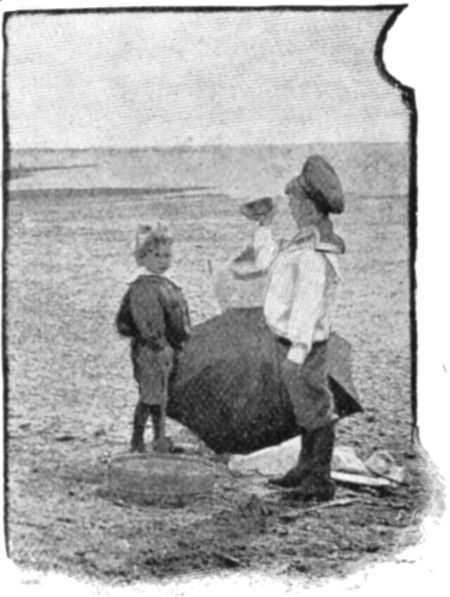
"You 'ave got gold fever, that's all!" said Stanley, impatiently. "All miners suffer from gold fever, but it doesn't often kill 'em. If we both work hard for a few minutes p'r'aps we'll find a tiny nugget that we can change for real ginger-beer and buns at the store. We'll have a splendid evening at the store after our day's work is done. All the boys will be there, and we'll drink more than is good for us, and fight and play poker."
"We haven't got any pokers to play with," argued the matter-of-fact Lessels. "An' there isn't any boys but us about; an' there's no store where we can spend our nuggets, an' fight in. If you tell stories like that, Stan, you'll never get to——"
"The worst of you is you're so silly!" interrupted the elder boy, shaking the cinder-sifter vigorously as he spoke. "You never think anything's real that you can't see. When people get to know that there's millions of pounds under these sands there'll be cheap two-and-sixpenny excursion trains, full of wild miners, arriving here every few minutes."
"Will there be anything to eat an' dwink?" demanded the hot and thirsty pard, anxiously.
"Tons of it!" answered the senior digger, enthusiastically. "We shall use sweets an' sugar sticks for bullets, an' wash ourselves in real ginger beer. Miners always spend their money like that. They waste what they can't eat, and wash their faces in drink when they've had more than is good for them. It's a splendid life, isn't it, Lessels?"
"Which?" asked the pard, doubtfully.
"What's the use of explaining things to a fellow like you?" snapped Stanley. "Haven't I told you all about it?"
Lessels retired to the shelter of the tent without attempting to reply to either of these questions, and slowly divested himself of his shoes and socks.
"Now what are you going to do?" demanded the miner, angrily.
"Paggle," replied Lessels, pointing to the incoming tide, which was rapidly approaching the camp.
"Paddle!" echoed Stanley. "What sense is there in paddling before we've found a single ha'porth of gold? Hallo! Come here, quick!" he continued, excitedly, as something large and hard rolled from side to side of the sieve. "Oh, Lessels! I've found a monster nugget! Come and help me lift it out. Hurrah!"
"'KEEP THE GUN LOADED; WE'LL HAVE ROBBERS ALONG PRESENTLY.'"
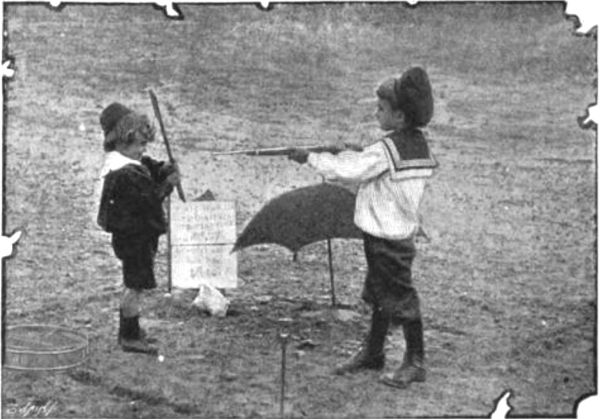
"Wait till I get my sock off," replied Lessels, indifferently. "Is it weal gold?"
"Of course it is, you little duffer! Never mind your sock!" roared the excited miner. "It's a large, square nugget—yellow, and broken in two. I wonder who's stole the other half."
"Looks like a bwick," remarked the pard, suspiciously, after carefully surveying the find. "An' it isn't clean an' bwight like weal money."
"I tell you it's a nugget," replied the lucky miner, in a tone which was intended to put an end to all argument on the subject. "Keep the gun loaded; I guess we'll have some robbers along presently."
"Where can we spend it?" asked Lessels, anxiously.
"There's a stall where they sell ginger-beer and ice-cream, about half a mile along the beach," replied Stanley; "you can just see it in the distance. If you like, you can walk over there and bring back half a dozen of beer, three gipsy cakes, and about twenty sovereigns' worth of change. But don't let the storekeeper cheat you."
"I'll go!" declared Lessels, delighted by the prospect of obtaining some very necessary refreshment. "I'll go, Stan, and you can dig out plenty big nuggets, an' save 'em up till I come back. I'd better take the gun, so's I can shoot the man if he tries to cheat me."
"Don't forget the change!" cried Stanley, as he watched his little brother run rapidly away in the direction of the stall.
In ten minutes' time, a flushed and weary-looking little miner, hugging a piece of wave-worn brick, presented himself to the storekeeper, who was just in the act of taking down the shutters of his timber-built shop.
"Well, my little man, what can I do for you?" asked the shopkeeper, cheerily.
"Half a dozen of ginger-beer, three gipsy cakes, and twenty sovereigns in change!" demanded the miner, breathlessly.
LESSELS TRIES TO CASH HIS NUGGET.
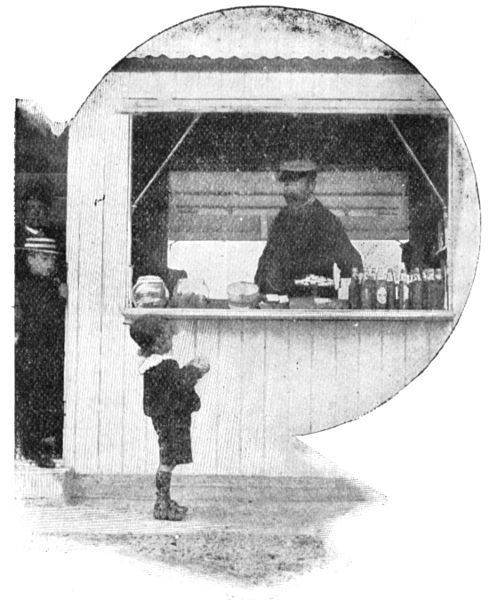
"Twenty sovereigns change!" echoed the man. "What do you mean, little one? Where's your money?"
"Here it is!" replied Lessels, boldly, laying the precious "nugget" on a plate of puff pastry, and assuming an attitude of defence. "Half a dozen of ginger cakes, three bottles of gipsy——"
"I can't give you all that for a brick," interrupted the shopkeeper, shaking his head. "You'd better run away and play."
"It isn't a bwick—it's a weal nugget," said the miner, with a scowl. "An' if you try to cheat me, Stanley said I must shoot you dead!"
"Here's a bottle of pop and your nugget for nothing," said the kind-hearted shopkeeper, with a laugh. "But don't bring any more brick ends or rubbish over here. Where are you going to take it to?"
"The camp."
"Where's the camp?"
"In Klondyke."
"Where's Klondyke?"
"On the beach, wight over there where Stanley is."
"Who's Stanley?"
"Stan's a miner, an' I'm his pard. We're diggin' up nuggets to spend in sweets, an' carriages, an' other fings for dada and mamma."
The tide had nearly reached the camp when Lessels returned.
"I haven't found any more nuggets, Lessels," said Stanley, despondingly. "Did you get the change all right?"
"No: I brought the gold back with me, 'cos the man said it was only a bwick!"
"Only a brick!" echoed Stan, with a dry sob. "I'm so thirsty and tired, Les."
"You've got gold fever, like I had," said Lessels, sympathetically. "Lie down an' west a bit while I dwink up the ginger-beer which the man gave me for nothing."
"All right, greedy!"
"I'm not gweedy, Stan, only thirsty. You can have a little dwop when I've cut the string an' shot the cork off. Then we'll go home to bweakfast, won't we?"
"It's nearly dinner time now, Lessels," said Stanley, sadly. "And we can't go home without a single nugget to buy presents with, or dada'll be sure to whack us."
"'I DON'T LIKE KLONDYKE.'"
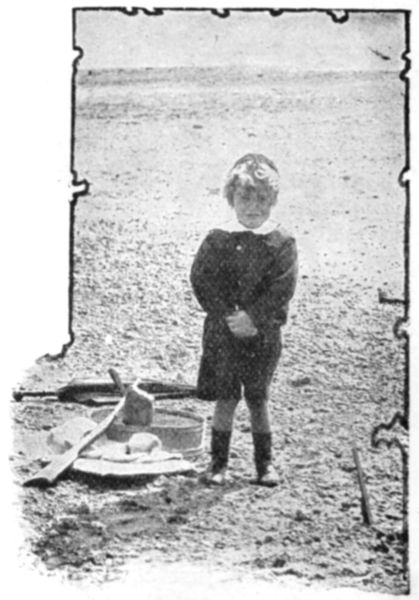
"I don't like Klondyke! I don't like Klondyke!" sobbed poor Lessels, a moment afterwards when the ginger-beer cork flew skywards with a loud report, causing the bold miner to drop the bottle in dismay.
"You're a pretty pard to send on an errand!" cried the disappointed Stanley, as the greedy sand quickly absorbed the contents of the bottle. "Frightened of a ginger-beer cork! I wouldn't be such a cowardy custard! Here I am nearly dying of gold fever, and there's nothing to drink or eat but sea-water and dry bread."
"Poor old Stan!" said Lessels, with genuine concern. "Don't die an' leave me to find my way home all by myself. Let's lie down an' go to sleep a bit. Then we'll forget how hungwy an' thirsty we are, an' how dada'll whack us when we get home!"
"Dear old pard!" said Stanley, sleepily. "It was my fault bringing you here, and I ought to have all dada's smacks."
"Not all; nearly all," answered the loyal pard, with sublime condescension. "You can have all the biggest ones. I'm not gweedy! S'pose the tide comes up an' drownds us, what'll mamma say?"
"It serves us right," was the drowsy reply.
"An' dada?"
"Dada'll say he'll teach us to get drownded again!"
"An' baby Desmond?"
"Desmond'll say 'cuckoo'—he doesn't know any other words."
"An' the dog?"
The last question remained unanswered.
"Poor old Stanny's asleep," soliloquised Lessels. "I'll just cover him over with the nightshirts, an' the nugget bag what hasn't any nuggets in, so's he won't catch a cough an' keep me awake at nights. Then I'll lie down close to him, as I do in bed, an' have a west. I wish mamma was here to kiss me, an' I hope dad won't beat me harder than he can help!"
And in another moment absolute silence reigned in the camp, while the tide crept noiselessly and stealthily around the higher bank of sand which formed the children's Klondyke. The summer sun shone lovingly on a pair of still forms; and the warning to trespassers fluttered gently in the warm breeze.
THE MINERS' DREAM OF HOME.
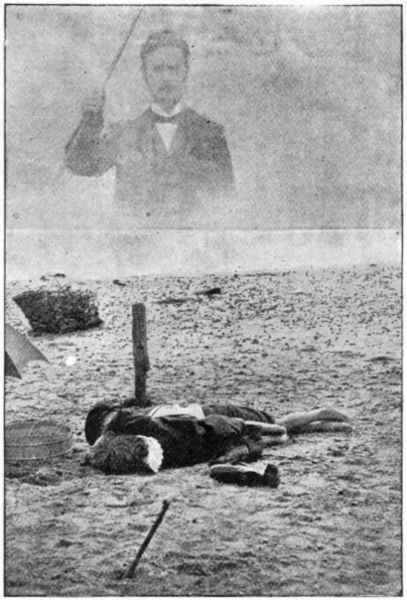
When a wave, bolder than the rest, broke against the bare feet of the younger miner, he awoke with a cry of alarm.
"Wake up, Stan! We're both drownded!"
"What's the matter?" demanded Stanley, sitting up and rubbing his eyes.
"We're in the miggle of the sea!" was the startling answer. "Our camp's all wet an' miserable, an' we can't shwim home, an' it's no use shoutin', cos there's nobody on the beach!"
"Lessels, we shall have to leave dada's umberellar, and the gold, and everything else, and fly for our lives," said Stanley, impressively, glancing anxiously towards the distant beach as he spoke.
"I can't fly," whimpered Lessels. "Let's call dada."
"He wouldn't hear us!"
"Dad heard me shout when I fell in a bucket of water at home," argued Lessels.
"This isn't a bucket of water, and we're not home now," replied the elder boy, irritably. "I believe I could swim all the distance to the beach—with one foot on the bottom. Then I could walk to the village and get a boat to bring you off; or run home and get dada and the clothes line; or fetch one of the life-buoys from the end of Southend pier."
"I'll come and get a live boy, too!" exclaimed Lessels, clinging frantically to his brother, as a wave broke over his knees. "Don't leave me, Stanny; I'se so frightened!"
"I can't swim if you hold me like that!" said Stanley, rolling up his shirt sleeves with sudden determination. "You'll have to let me tow you to land by the hair of your head. Drowning people have to stun each other sometimes to keep one another quiet while they are rescued," he added, darkly.
THE RESCUE OF THE MINERS.
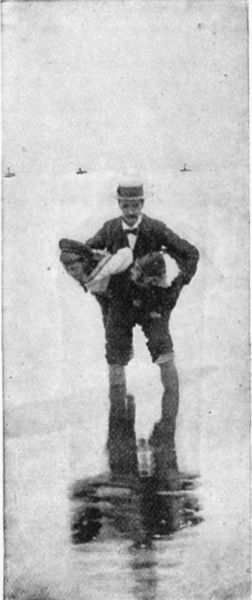
At this distressing moment a well-known form appeared on the beach, and the terrified miners shouted and waved their caps simultaneously.
"It's dada!" shrieked Lessels; "I knew he'd come. Look! he's walking in the sea, with all his clothes on; an' he's laughing; an' he hasn't got a shtick after all."
"What is all this about, boys?" asked the welcome visitor, pointing, as he spoke, to the fast disappearing camp.
"It's Klondyke, dada, that's all!" answered Lessels. "We digged for gold all day to buy you a lot of horses and tobacco, but we haven't found anything at all 'cept a bad nugget!"
"You're not the first miner who has done that, Lessels," was the comforting reply.
"I had a horrid dream about you, dad, when I was tired and fell asleep on the sand," said Stanley. "Guess what it was."
"Perhaps I was injured by one of the fine horses you were going to buy?"
"No, dad, it was much worse than that," was the earnest reply. "In my dream you were looking for us with a great stick in your hand."
"Dear old dad!" whispered Stanley, as he was being carried into safety, upside down, a few minutes later. "Dear old dad! You aren't very cross because we have lost your umberellar, and haven't got any nuggets, are you? And you won't turn nasty and spank us after we've made you laugh so?"
THE LAST OF THE CAMP.
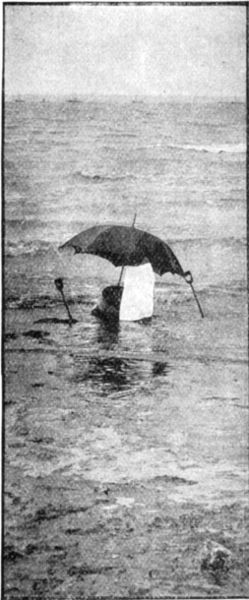
"Please don't, dada!" added Lessels, brokenly.
And dada only kissed the weary little faces of the supplicants, and laughed again until the tears ran down his cheeks.
"I believe dad's crying," said Lessels, in a stage whisper—"cryin' inside, an' laughin' outside!"
"Keep quiet, you little muff!" whispered Stanley, hoarsely. "Father looked like that when the doctor told him that I wasn't likely to die of fever after all. It's a laugh that stops crying."
"And one which is worth more than all the ordinary laughs of a lifetime, my boys," added the listener, quietly.