3,000 MILES ON RAILWAY SLEEPERS.
Reading edition
ONE ASPECT OF MY BICYCLE RIDE ROUND THE WORLD. By Edward Lunn. Illustrated with Photos by F. H. Lowe.
MR. EDWARD LUNN AND THE BICYCLE HE RODE ROUND THE WORLD.
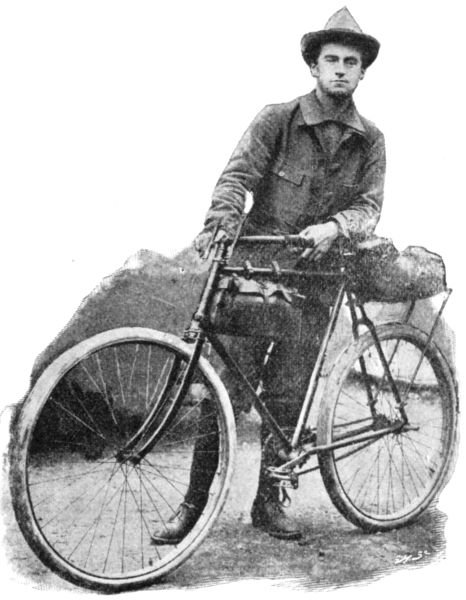
The question most frequently put to me since I returned with my two companions, Mr. Lowe and Mr. Fraser, from my cycling tour round the world has been, "What were the roads like?" and to answer this question fully would require a volume rather than a magazine article.
There were the paved roads of Belgium, the excellent military roads of Germany, the steep slopes of Austro-Hungary and Roumania, the cart-tracks of Southern Russia, the Government highway over the Caucasus, the post-road to Erivan, the camel-tracks of Persia, the Grand Trunk road of India, the bouldered highways of China, and the Tokaido of Japan, not to mention the alkali deserts of Nevada and the old Colonial roads of the Eastern States—the only thoroughfares deserving the name in the Land of the Stars and Stripes, excepting always the excellent pavements in the great American cities.
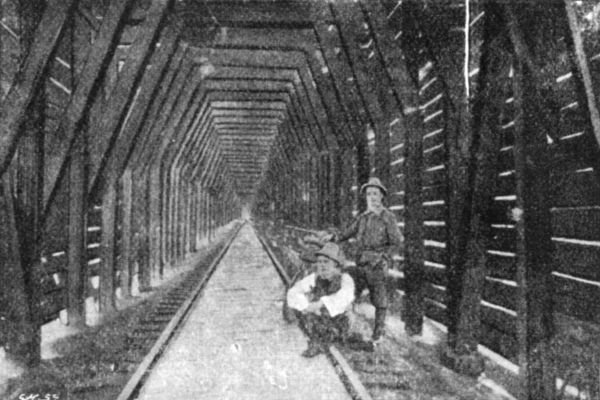
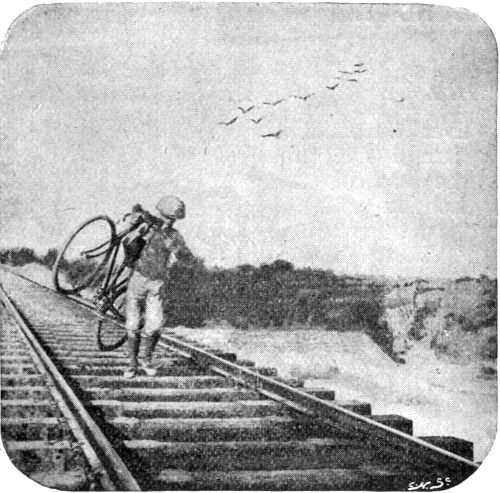
WE HAD TO RIDE ON SLEEPERS THROUGH FORTY-THREE MILES OF SNOW SHEDS—THIS SORT OF THING.
But of all the roads we traversed, the most interesting to cyclists will probably be the 2,900 miles and upwards on railway tracks that we covered in our circuit of the globe. We were first driven to these tracks in Russia, and this jolting and jarring method of progression may safely be recommended as an even better specific for liver troubles than a ride on the top of a London 'bus. We were crossing the Russian steppes. For several days we had been battling against the icy wind that blows from the Caucasus, dressed always in the light summer clothes which we wore in the smiling valleys of Roumania. The road was so sandy as to render riding impossible. We forced our way along, pushing our machines, through a blinding sandstorm, till at last we had to take to the railway track.
These tracks in Russia are better made than any we have come across elsewhere, and they are laid out with much elaboration. First, an array of stones, neatly planned in patterns like an ornamental flower bed; then the footway; then another pattern of stones, and then the line. Whenever possible, we rode on the path between the two rows of stones; but we were frequently obliged to try the sleepers, the interstices between which were to some extent filled up with "ballast," which assisted our progress materially. The trains near the Caucasus are few and far between, and did not interfere with us to any extent. On our arrival at a station, everybody seemed to think it quite natural that we should come along on the line, and we took our meals in the railway buffets, and slept in the waiting-rooms. Our railway-track riding in Russia amounted to about 150 miles.
HOW WE CARRIED OUR BICYCLES OVER THE RAILWAY BRIDGES.
Arriving in India, we were accompanied out of Karachi by a dozen Englishmen who were practically novices at cycling. We started on a good road, which ended a little way out of the town in deep sand, as is the way with roads in this part of India. We then suggested to our companions that we should ride on the track—a proceeding which they did not understand at all. However, they took to the idea very kindly after a time, and went with us thirty or forty miles on our way, returning by train.
We rode in this way for 800 miles, till we got within four miles of Lahore, where we struck the Grand Trunk road. At one of the little wayside stations we knocked up the native station-master and asked for food. He told us we could get nothing but rice and chupatties—a bill of fare which did not "smile upon us," as the French say.
"Are there no English people here?" we asked.
"Oh, no; no English people here—this jungle."
"But we saw some English ladies in white dresses," we persisted.
"Oh," said the official, scornfully, "those only missionary."
THE BRIDGE ON WHICH I RACED A TRAIN.
We had to try the railway track again in Burmah, between Rangoon and Mandalay. There was a road here once, but it has fallen into decay, and in many places is returning to the primæval jungle. In the pelting rain of a Burmese monsoon the so-called road soon became a mere quagmire. Railway-track riding in Burmah is much the same as it is in India, only that, as the climate is moister and more malarial, the adventure involves greater danger to health. The line is banked up on either side to a considerable height—a detail of which I was to have a practical and painful impression. Riding along the footpath one day, my machine stuck in the mud, and unfortunately overbalanced on the wrong side, towards the cutting, so that I could not put my foot to the ground on the other side to dismount. Down I went some ten feet—fortunately with no serious consequences—while, from the bank, my two companions greeted my achievement with loud applause.
My fall into the ditch was not the pleasanter for the probability of disturbing centipedes a foot long, cobras, and scorpions.
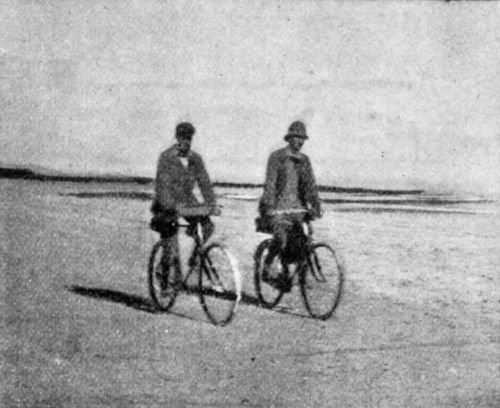
RIDING ACROSS THE SALT DESERT OF PERSIA.
What food we got was more highly flavoured than the chutney and curries of India, but we appreciated the lavish supply of bananas and pineapples. One day a native station-master asked us about Lenz, the little American cyclist who went this way and was afterwards murdered in Armenia. We described his sad end, and the jovial Burman was quite overcome. "Very kind smiling face," he said, with tears in his eyes.
When we crossed the frontier into China we left railways behind, though the newspapers have informed us since we came back that a concession has been granted for a railway in Yunnan. I can only say that if that railway is ever made, it will give points to any switchback that was ever invented, so mountainous is the entire country.
When we reached America we little imagined what was before us. We had fondly believed that the most progressive country in the world would at least provide ridable roads for cyclists. But the fact is that while in old countries the road comes before the rail, in newly developed countries the rail comes before the road—and sometimes the road never comes at all. Cyclists, however, are doing a great deal to help themselves in this matter, through the medium of the League of American Wheelmen, one of the most powerful organisations in the United States.
At the Olympic Club in San Francisco we had some hints of what was to befall us. The cycling editor of Hearst's great paper, The Examiner, interviewed us during our stay, and gave us the chart of the route followed by the great Trans-Continental Relay race, which had taken place not long before our arrival.
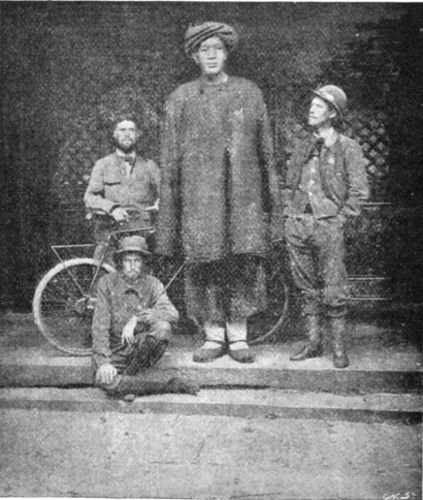
THE THREE WORLD CYCLISTS AND A CHINESE GIANT WHO DOES NOT CYCLE.
We struck the railway track at Newcastle in California, and on the second day the most perilous part of our experiences in this sort of riding commenced, with our entrance to the "Snow Sheds" crossing the great Sierra Nevada range. These snow-sheds, with the exception of two bridges (of which more hereafter), extend uninterruptedly for forty-three miles, with innumerable twists and turns, and we were in semi-darkness for the entire distance. We were obliged to ride between the rails. The snow had begun to melt, and pools of water extended along either side of the lines, while between the sleepers, which were free of snow, the ice lay in great uneven hummocks. We moved on at the modest pace of some seven miles an hour through the darkness, while the noise of our three machines and the rattling of the baggage we carried prevented us from hearing anything of approaching trains till they were actually upon us. Then we had to leap from our cycles and crouch against the icy walls of the snow-shed while the train thundered past. We took our lives in our hands several times a day.
Our position was worse in this respect when we were going down the other side of the Nevada range. As we ascended, the trains had come up behind us "full steam ahead," so that we could more easily detect their approach; but as we went down from the summit, those following us on the down grade came with steam shut off, and were upon us before we could hear them.
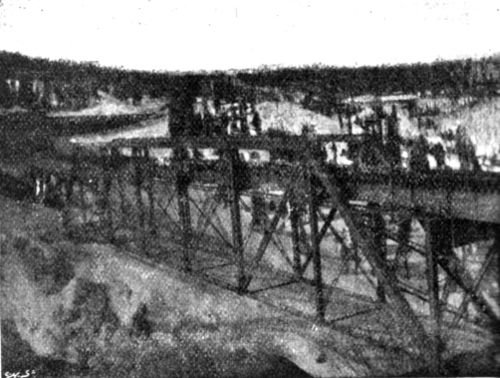
On a bridge near Cisco an incident occurred which might have been serious for me. It is about two hundred yards long, and I was beginning to cross it, when my companions who were on in front beckoned me to stop. I thought that one of my friends wished to take a snap-shot, and stopped accordingly. However, after waiting about five minutes, as nothing happened, I went on. It was a skeleton bridge, with a framework in the middle. I had just reached the framework, carrying my machine, when I heard the shriek of an engine whistle in the shed ahead. I managed to keep my head and my balance, as a false step would have meant death. I reached the end of the bridge, and stepped on to the siding just as the train rushed past.
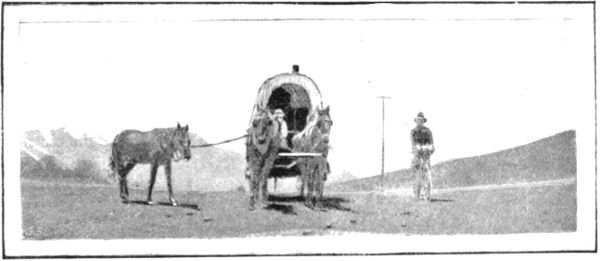
TRAVELLING WITH EMIGRANTS IN THE WESTERN STATES.
It was only then that I fully realised the narrow shave I had had.
We joyfully left the railway track shortly before entering Omaha, and from thence to Chicago we had roads that might, in comparison with our previous experiences, be called tolerable.
At Chicago we took to the railway track again for a short time in the suburb of Pullman; but from that point to New York we had the rare and delightful experience of riding on a "made road," with charming scenery about us. And very glad we were not to add to our record of riding 3,000 miles on railway sleepers.
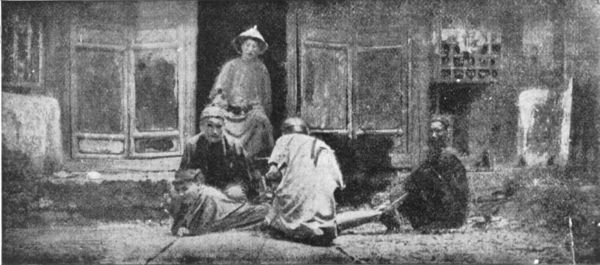
THRASHING A CHINESE THIEF WHO STOLE THE CAMERA WITH WHICH THESE PHOTOS WERE TAKEN.