PERIOD III.
Reading edition
THE DECLINE AND FALL OF THE HANSA.

INTRODUCTION.
From the law of change to which all human affairs are subject the mighty Hanseatic League was not exempt. Great though its power seemed to all outward appearance, and rich as were its members, still, for some time past, signs of decay and decline had made themselves manifest, here and there ominous rents and fissures, that threatened, if not an entire, yet a partial fall of the building.
The latter years of the fifteenth and the early years of the sixteenth centuries were a time of the greatest moment in the history of modern Europe. They mark the transition from the mediæval to the modern spirit, embracing two such potent factors in human development as the Reformation and the discovery of America. It is almost sad to think that the decrepitude of a powerful institution should have coincided with the transformation and rejuvenescence of Europe. Yet so it was. So it will ever be; we must march onward with our time, or be trodden down.
Many of the ideas of the Hansa had grown effete or were becoming gradually obsolete. Individuality in men, independence in nations were factors beginning to manifest themselves and to rebel against those notions of blind obedience and of selfish monopoly inculcated by the Hansa. The time was nearing when the old system of staple, of factories was to give place to the busy varied life of the Exchange.
The discovery that the earth was round, not flat, that Ulysses had no idle dream when he dreamed that there was another continent beyond the pillars of Hercules, was a matter of unspeakable moment to trade. When we recollect that almost to the same date belong the discovery of a maritime route to the East Indies, and the invention of printing, we cannot but recognize that a power, not willing to move with the times, but painfully, obstinately clinging to its own ideas and images, had to be left behind. The very causes for which the Hansa had been founded, insecurity of roads, want of international justice, and other barbarous and intolerant conditions, no longer existed. The League itself had developed from a liberator into an oppressor. It no longer fitted with the changing conditions; it too must change or perish. In vain did it point to ancient charters, evoke "inviolable treaties" acquired at the point of the sword or by might of wealth. It had to learn that of these treaties, as indeed of treaties in general, must be said that which is sadly, but too truly said of human promises, that they are "like pie-crust, made to be broken."
The spirit of revolution, or rather of change, was abroad. It made itself felt in manners, in institutions, in governments. The capture of Constantinople by the Turks contributed to the new development. By warning Europe of a new and menacing danger, it drew yet more closely together the different states which the Crusades had already put into relations with one another, and for which the feudal system formed a sort of common link. This same event turned the stream of sciences, letters, and arts towards Italy. On the other hand, the princes were finding out the means of diminishing the power of the feudal lords and nobles. The subjugation of the power of these vassals undermined little by little the feudal system, and allowed this worn-out institution to be replaced by institutions more in conformity with the needs of modern society.
Various states, that had been unable to develope their forces, owing to the abuse of the feudal system, moved swiftly forward, now that they were free from restraint, and, having succeeded in centralizing their power desired to give it a firm and equal step in the march onwards. Meanwhile the forces that existed in the hands of the rulers were active enough to assure the tranquillity of the people, but it was always possible to turn them from their destination; war might arise any moment out of the very institutions that ought to secure the maintenance of peace. The people, recognizing this and fearing lest ambitious rulers should form projects of aggrandizement and conquest, had recourse to that policy which the Italian republics had already initiated and in which Florence took the lead.
The democracy understood full well that it was for their good, and even essential to their very existence as a power in the state, that they should act upon the forces that determined the government, just as these re-acted upon them: that, in a word, they should mutually hold each other within the limits of the law and that general security could only arise from the equilibrium of the means of attack and defence. This new policy which demanded frequent communications between the parties interested, gave rise to the system of embassies, itself quite a new feature in international and political life, though it was really an extension of ideas and systems long ago pursued by the Hansa. In a word, the whole method of the world was changing, and it remained to be seen whether the Hansa could still keep ahead as it had hitherto done.
While other nations were looking about them all round the globe, the Hansa was, as ever, occupied in securing to itself the monopoly of the Baltic basin, in order that no other peoples should deprive them of the wealth of Scandinavia. And yet this "monopoly of the herring and the cod-fish," as it has been named, was steadily becoming less and less valuable. More than half of Europe was Protestant and no longer fasted; wax was no more required in quantities for Church ceremonials and the evidences of personal piety; the imitation of Italian and Spanish fashions in dress caused less demand for the furs of the North. The English were among the chief commercial rivals of the Hansa at this date, and after them the Dutch, those very Dutch whose cities had at one time formed part of the League, but who had seceded after the wars with Waldemar, finding it more profitable to keep friends with the Danes.
It is strange that this combination of merchants, generally so astute, should not have recognized whither the stream of things was tending.
Nor in its perplexities could it find any help from the emperor. The German Empire was suffering from the same ills as the League, and with equal steps was advancing towards its dissolution. Until now the Hansa had gone on its triumphal way in spite of all inner and outer political complications, indeed had rather profited than lost by these. This was now altered. It was now no longer a body animated by one will, one spirit. The disintegrating element of religious discord had entered among its members, they were mixed up with the bloody doctrinal wars, that followed the Reformation and ravaged Germany, and they were divided among themselves on this very point. At last, after the treaty of Augsburg (1555), which restored to Germany a more or less agitated peace of some fifty years, there followed the terrible, devastating Thirty Years' War, which gave the death blow to the League.
The Thirty Years' War left behind it only a heap of ruins. It had consequences so disastrous that from some of them Germany has not recovered even to this day. It caused her to lag in the onward march of progress, and for all her military strength at this present moment, she has not yet overtaken her neighbours and contemporaries in many important points of civilization, that are more unfailing sources of a nation's power than mere brute strength in arms or tactical skill in battle.
One of the first serious causes of decline in the Hanseatic power was due to the fact that as time went on and conditions of trade altered, the interests of the maritime and continental cities were no longer identical. The sea-board towns used to furnish to the inland the means of selling the produce of industries with profit in the countries east, north, and west of the Baltic. The Hanseatic ships and factories facilitated this distribution of goods. But when other nations, and, above all, the merchants of the Netherlands, and after them the English, Danes, and Swedes carried on a part of this commerce with their own ships, the inland cities no longer had the same interest in remaining united with the maritime. They even thought that their union with the League was more onerous than useful, and began to grow restive and would no longer pay their dues to the general fund, which consequently became much weakened and impoverished. Thus there were not only enemies from without, but enemies from within to contend against. "A house divided against itself cannot stand" is a saying of which our Hansa was very soon to learn the full truth.
But before the final collapse came the League was to know one more moment of proud prosperity, a moment which, had it been wisely and unselfishly used would have secured to the Hansa a prolonged dictatorship in Northern Europe.
After this rapid survey we will consider these events in detail and order.

I.
STORM CLOUDS.
The centre of the Hansa's power had ever been the Baltic Ocean. On its shores the idea of the League had first taken shape: here it had grown and flourished, and here also it was to receive its death blow. As we have said, in the course of the fifteenth century the Dutch gradually came forward as serious competitors of the League. Their geographical position made them freer than the Hanseatics; enclosed in a sort of inland basin to which at any moment they might lose the key, their astuteness was not less keen than that of their rivals, and like their rivals they wisely made use of any quarrels or dissensions that might be abroad. They were not slow, therefore, to discern that the Scandinavian people and also the Scandinavian kings groaned under the heavy despotism exercised by these German merchants. They proposed themselves as substitutes for the Hansa, offering money and support to the kings and easier and better conditions of trade to the natives. These proposals were unofficially accepted. Neither rulers nor ruled as yet dared oppose themselves openly to the League, but they were not sorry to see its power reduced.
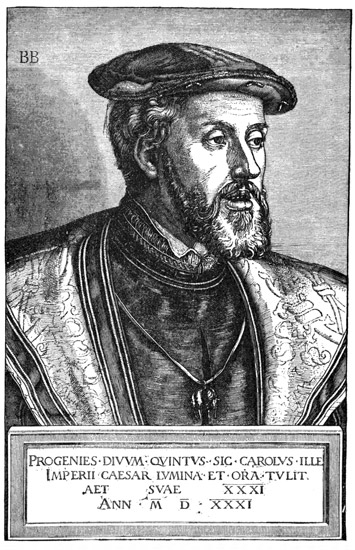
CHARLES V.
For awhile the Hansa were able to keep their rivals in check, worrying them by piracy on the one hand, and insisting on their ancient claims and trade rights on the other.
But Charles V. had ascended the throne; the greatest emperor that had ever governed in Germany since his namesake Charles the Great. He was ruler not only of Germany, but of Spain and the Netherlands, and to the latter people he was especially well disposed. He looked with no friendly eye upon the League, which made itself a power within his territory, and he was not sorry to see it weakened by competition. When the Sound, their Danish Hellespont, the gold mine of the League, continued to be jealously guarded by them, and its navigation denied to other nations, Charles V. declared quite openly that "he would rather miss three royal crowns, than that his Burgunders should be excluded from the Sound." This was a sort of challenge to the Hansa. Let us hear how other circumstances came about to enforce it from other quarters.
It may be remembered that since the days of Waldemar Atterdag, the League had always had a voice in the election of a ruler to one of the three northern kingdoms, and that it regarded with no friendly eye the attempts made at a union of those kingdoms under one common head.
In 1513 Christian II. had ascended the Danish throne. He was an unscrupulous and cruel ruler, known to posterity as the Nero of the North. Before ascending the throne of Denmark he had been governor of Norway, and in that capacity had conceived a bitter hatred against the overbearing foreigners, "those German cobblers," as he called them, who once even ventured to close against him the gates of his own town of Bergen. He had already favoured by all ways in his power the trade of non-Hanseatics, and tried to obtain some gentler treatment for the oppressed burghers of Bergen. Still so great was yet the fear of the Hansa, that when in 1513 Christian was crowned King of Denmark, he made no difficulties about renewing all Hanseatic treaties and privileges, and only stipulated that the harbours of Norway should also be accessible to the Netherlanders. In return he desired their assistance against Sweden, with which country he was at war.
For a time the League, and above all Lübeck, were rejoiced at this new king and his attitude towards them, but not many years had passed before they found out that they had to do with a more logical and altogether sterner man than any of his predecessors had been. Christian hated the Hansa, and rebelled against the subjection of the Sound, a Danish sea, to foreign control, and the absolute sway of the Hansa in his markets. Among many unwise words and deeds that live bound up with his memory, it was not the most unwise which he repeated after Sigbrit Willem, the mother of his beloved and lovely friend, Digveke (Little Dove), "that good friendship must be maintained with the Netherlands, and that Copenhagen must be made the staple place of the North."
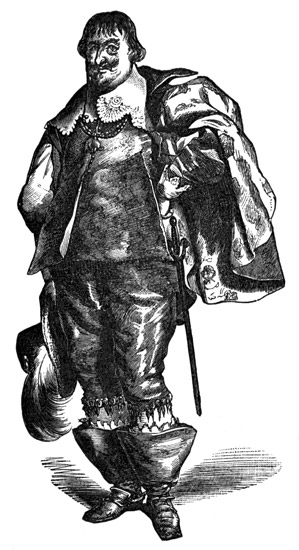
CHRISTIAN II. OF DENMARK.
Unfortunately for Christian, though he could repeat Sigbrit's sayings, and perhaps also in a measure recognize their wisdom, he had not the natural capacity to carry them into execution. This clever woman recognized that the aim of the king should be to reinstate the Scandinavian Union, to break the power of the aristocracy and the clergy, and to free his impoverished people from the fetters in which the Hansa had bound them for nine centuries. This was all right and well, but it needed to be carried into effect with tact and moderation. Christian did not possess these gifts; he made himself personally detested by his cruelty and his overbearing manner, he knew not that generosity which so gracefully becomes a victor. After conquering Sweden, he soiled his victory by causing the most illustrious personages of the kingdom to be executed, and still worse he stained his personal honour by violating the conditions of an armistice in causing Gustavus Ericson, of the house of Vasa, to be carried off captive to Denmark. It did not improve matters when Christian explained that he required him as a hostage. He caused Gustavus to be shut up in the strong fortress of Kalo in Jutland. Here the captive was put on his parole, and it is said suffered none of the rigours of custody. But the food put before him, salt junk, sour ale, black bread, and rancid herrings, cannot have comforted his enforced captivity in the material sense, while he confessed to having been maddened by the talk of the soldiers who guarded him, and who boasted that they would soon hold all Sweden, and jestingly parcelled out among themselves the wealth and beauty of the nation.
This young man so unjustly imprisoned was destined to become the avenger of his fatherland, and those of his fellow-countrymen who had perished upon the scaffold. He resolved to escape, hoping to reach Sweden in time to defend his country, or to take advantage of any favourable juncture that might arise.
It was in September, 1519, that, early one raw autumn morning, Gustavus managed to escape from the Castle of Kalo, disguised as a drover of oxen. He made his way to the city of Lübeck, and threw himself upon the protection of the burgomaster and council. Needless to say the town gave a generous welcome to the man who was foe of their foe—the King of Denmark. But it was not long ere his whereabouts became known, and Christian sent messengers to Lübeck, demanding in high-handed language that Gustavus should be handed over to him. He complained that Vasa had effected his escape contrary to his pledged word as a knight. Gustavus spoke in his own defence.
"I was captured," he said, "contrary to all justice and all plighted faith. It is notorious that I went to the king's fleet as a hostage. Let any one who can, point out the place where I was made prisoner in battle, or declare the crime for which I deserved chains. Call me not then a prisoner, but a man seized upon unjustly, over-reached, betrayed. I am now in a free city, and before a government renowned for justice and for defending the persecuted. Shall I then be altogether deceived in the confidence I have placed in them? or can breach of faith be reasonably objected to me by one who never himself kept faith or promise? or can it be wondered at that I should free myself from prison which I deserved by no fault, except that of trusting to the assurances of a king."
The shrewd burgesses who listened to Gustavus's defence were not misled by his rhetoric, but motives of policy told in his favour. They knew that if Christian were once undisturbed king of the three northern kingdoms, he would possess a power which, as he had already shown, he would not use to the advantage of the League. Here was a young nobleman of fearless character and high talent, a man who hated the king with hereditary hatred and personal animosity. Might he not become a thorn in his side and a clog upon his movements?
This was the view of the matter taken by the burgomaster of Lübeck and put forcibly before his colleagues. It was therefore agreed emphatically to refuse the king's demands, and, instead of giving up Gustavus, to furnish him rather with the means to return to his own country. "For who knows," said the worthy council, "what he may do when he gets there."
To this refusal to deliver up the hostage the King of Denmark replied, through his ambassadors, that he should make a house-to-house search for his prisoner. That was truly more than the proud city could stomach. They answered in the most haughty terms that they should never permit such an interference with their home rights and privileges, and in the presence of the Danish ambassadors reassured the fugitive of their protection and friendship.
When the news of this reply reached Christian, he regarded it as an act of great audacity. From this moment he became a yet more embittered enemy of the Hansa, whose chief city and spokesman he very properly recognized was Lübeck. He harassed them continually in fresh ways; he carried on a yet more envenomed war against the Swedes, of whom he knew the League to be the secret ally and the chief support.
At first success favoured his arms; he broke faith in all directions—plundered, ravaged, sacked. But at last he made the cup of wrath against him overflow by his cruel execution of ninety noble Swedes, in the autumn of 1520; vaunting the deed in insolent heartless words. He had shown them, he said, "how he roasted his Michaelmas goose." Further, in his wanton presumption he did not hesitate to give active expression to his hatred against Lübeck. When congratulated by his councillors that he could now rejoice in the possession of the three northern crowns, he replied: "So long as Lübeck is not in my power, I cannot be happy in my kingdoms."
Shortly after this, Christian set out for the Netherlands to visit his imperial brother-in-law at Ghent. The objects of his journey were various. He wanted to obtain the payment of his consort's marriage portion; to solicit the emperor's aid against his uncle, Frederick of Schleswig Holstein; and yet more to obtain his tacit, if not active assistance, against the Hansa towns on the Baltic, and especially against Lübeck.
It was on the occasion of this visit that Charles V., accompanied by Christian and Margaret of Austria, laid the foundation-stone of Antwerp Cathedral. After this ceremony they returned to Brussels, where Christian entertained his friends at a banquet. Among the guests was the great German painter, Albert Dürer, then visiting the Low Countries. He was then and there commissioned to paint the Danish king's portrait—a portrait that all contemporaries greatly admired as a faithful reproduction of Christian's manly beauty. The artist received thirty florins—a sum that seemed to him munificent, and called forth expressions of real gratitude.
Soon after, Christian presented a petition to the young and inexperienced Charles, in which he begged, as a gift from him, "a little town on the German side of his dominions, called Lübeck, so that when sometimes he passed over to Germany he might possess a place of his own in which to rest." Charles, enlightened by the burgomaster of Cologne to the effect that Lübeck was no "little town," but one of the four imperial cities, and a chief centre of the Hanseatic League, refused his brother-in-law's petition in decisive terms. Nor did Christian fare better with his other demands; Charles had been warned against him, and had been taught to see in him a possible heretic. It is even related that in his anger Christian tore from his neck the Order of the Golden Fleece, given to him by the emperor, and trod it under foot in disdain.
Christian returned home to find fresh difficulties awaiting him, for in his absence Gustavus Vasa had not been idle. This restless patriot had lingered but eight months in the hospitable German city. Young, full of enthusiasm and fire, he longed to be actively at work to aid his oppressed compatriots; and one morning, in the spring of 1520, after confessing his obligations and his gratitude to the Lübeckers, he stole over to the Swedish coast in a little fishing-smack, and landed in territory that was groaning under Christian's oppressions.
At first, Gustavus, who at once assumed the rôle of leader of revolt, could not make himself heard among the peasants. They replied to his instigations in their apathy of oppression with, "Salt and herrings will not fail us as long as we obey the king, but if we rise we are sure of ruin." But Gustavus was undaunted, though he knew a price was put upon his head. For months he scoured the country, travelling by by-paths, sleeping one night in the woods, another in the open fields; assuming now this, now that disguise. Gradually he gathered a following around him, which grew in importance day by day. His influence increased above all after the tidings of the "Bloodbath," for so the terrible massacre came to be called, perpetrated by Christian upon the nobles of Stockholm, on the occasion when he offered them a banquet, apparently of peace, but which proved to them a feast of death.
Chief among Gustavus's allies were the people of Dalecarlia, among whom he went on his mission of revolt dressed in their native dress. This land of valleys is inhabited by a people who have many points of resemblance with the Scotch Highlanders; thinking themselves, as these do, of a superior caste and adhering even to this day to an exaggerated and antiquated mode of dress. Like the Highlanders, too, they are frugal; they are accustomed to drink only water, and often in case of necessity eat bread made of the inner rind of the birch tree, which grows so freely in their woods. It is said that one of the Danish commanders, learning this, exclaimed "A people who can live upon wood and drink water the devil himself could not conquer, much less any other. Let us go hence."
When the Danes heard of the army of peasants that was rising against them, they at first treated the news with great contempt. "If the skies rained peasants," they said, "we would fight them all." But they were soon to see that these peasants were not to be lightly despised. It was before Upsala that Gustavus's army, aided by troops sent to him from Lübeck made its first attack on the Danes. There was a heavy snowfall during the battle, in consequence of which the Danish cavalry and artillery proved of no avail, while the peasants with their irregular mode of warfare were less impeded by the elements. The victory was theirs, and the Danes had to confess that their boast was foolish, "For when God withdraws his hand from a warrior a poor peasant is as good as he."
From this moment success followed success and the prospects of the cause of Gustavus grew steadily brighter. His instructions to his followers were that "they must teach the tyrant that Swedes must be ruled by love, not ground down by cruelty."
In August, 1521, Gustavus was elected administrator of Sweden, and was virtually ruler of the land, though the whole was not yet in his possession. The time of shifts, disguises, and humiliations was now over. The scenes of these, however, the barns where Gustavus threshed, the different spots where he was in the greatest peril—are still pointed out with veneration by the descendants of those peasants who succoured him in his adversity, and boasted that they were the first to help him to a crown.
In this juncture Christian saw himself obliged to send out yet more ships and men against Gustavus. To meet the re-enforced enemy, Vasa turned to Lübeck in 1522 and begged of "his fathers, brothers, friends, and dear neighbours of that town," under promise of eternal gratitude, to help him against "the tyrant," saying he would in his turn and time "accord to them milder privileges and everything that could be to their profit." The burghers decided to accede to this request; ten strong ships were armed to aid Gustavus Vasa and sent out to meet the Danish fleet.
Meanwhile they did not neglect to use the weapons of diplomacy; weapons so often successfully employed by them during their career. They remembered that Duke Frederick of Schleswig Holstein was uncle to Christian II., and that the two had ever been at feud. It occurred to them that it would be well to gain the duke as their ally, promising him the Danish throne in event of their victory; of course in return for important privileges; the Hansa would have been untrue to themselves and their traditional policy had they for one moment left out of sight their own advantages.
This proposal met with assent, and the consequence was that a powerful enemy was thus raised up in the centre of the king's dominions. Christian, following the counsel of Sigbrit, planned another wholesale massacre of the nobles whom he believed favourable to Frederick's cause. The matter got known, and in consequence a council was held by them in which they drew up a deed, renouncing their allegiance to Christian and choosing Frederick in his place to fill the Danish throne.
A question arose as to who should convey the perilous document to the king. A certain monk of Jutland offered to bear the ill tidings. He met the king as he was proceeding to one of his castles. Assuming an open and cheerful countenance he managed to get himself asked to dinner by the king, and continued to amuse him and divert all suspicions till the king retired to rest. Then, placing the despatch in one of his gloves, he left it on the table, went quietly out and escaped by a boat which he had ordered to be in readiness. A page who found the despatch next morning carried it to the king.
Christian, who till then had blustered and disbelieved in real danger, grew alarmed when he read this unexpected paper. He wrote to those who subscribed it saying "that he submitted himself to the emperor and other disinterested princes as his judges. As to the massacre at Stockholm, he would atone for it; he would fill the country with churches and monasteries, and undergo any penance which the Pope might impose. The Council and States should have from him fresh securities, if only they would retract their step and turn from him this dishonour they had meditated." The nobles replied that they acknowledged no tribunal superior to their own; that the king had perjured himself so often that they could not trust him; that he had confessed himself guilty, that the deeds by which he had freed them from their allegiance were known to all the world, and that they had chosen the Duke of Holstein as his successor.
And indeed Frederick, Duke of Holstein, was proclaimed king of Denmark in January, 1523. The Hansa fleet by sea, the support of the clergy and nobles by land—that clergy and those nobles whom Christian had oppressed—conduced to this result.
A manifesto put forth by Lübeck made known to the Emperor of Germany and the Empire how "the city after long patience and repeated prayers, in consideration of her oaths and duties towards the Holy Roman Empire and remembering the inevitable damage done to body, honour, and goods, had taken up arms to prosecute the wanton insurer and aggressor of the Holy Roman Empire."
This manifesto was one of the little farces the Hanseatic League loved to play with their supposed liege lord and sovereign, the Emperor of Germany, each time they took independent action and showed by deeds how little they heeded his authority or wishes.
In vain Christian, after his deposition, tried to rally his subjects around him. Fearing probably that revenge would be taken upon his person for his cruel massacres in Sweden, he decided that discretion was the better part of valour. Choosing twenty of his best and fastest ships, he placed on board of them all the State papers, all the gold and silver that had been hoarded in the public buildings, and the State jewels. On April 13, 1523, he, his wife and three children together with Sigbrit, "the last packed away in a chest with the treasures," quaintly writes a contemporary chronicler, went on board the largest of the vessels, whereupon they all set sail for the Netherlands. It was nothing more or less than flight, and an acknowledgment that Gustavus Vasa and his ally the Hansa, through its representative Lübeck had conquered; that the League, though declining in might, was still able, as in the most glorious times of its history, to play with kings like dice, deposing and installing them.
Two years later the same city of Lübeck was called upon to arbitrate in a conflict between the two kings, which it thus had made, Frederick of Denmark and Gustavus of Sweden. As the price of its intervention and of the sacrifices it had made on their behalf, the city, in the name of the League, of course, asked great favours, favours which were accorded by treaty, and which were to be the last smiles of Fortune, about to become fickle to the union she had favoured so long.
Meanwhile, in June, 1523, Gustavus Vasa had been, by unanimous consent, elected King of Sweden. It is amusing to read that Stockholm, the last city to surrender to its new ruler, the last faithful to Christian, refused, even after it had capitulated, to deliver up the keys of the gates to Gustavus. The governor handed them over to two Lübeck councillors, present on the occasion, with the words, "We present to the imperial city of Lübeck the kingdom and the city, and not to that rogue, Gustavus Erikson, who stands there."
It must not be supposed, however, that Christian so quietly and easily abandoned his Danish crown to his uncle and rival. He made many attempts to enlist the various courts in his favour. Especially did he try to gain the help of his brother-in-law, the emperor, but the League was too clever and too strong for him. He did get together an army of mercenaries, but his means of paying them soon ran out, though to attain that end he pawned or sold all his treasures and the queen's jewels. At last, he had to fly in terror from his own soldiers who were enraged at his inability either to pay them their wages, or at least lead them to some town they could plunder.
Nevertheless, Christian was not daunted. He was a man not easily dismayed. He intrigued on every hand to regain his kingdom, and at last, fancying that the Lutheran doctrines he had embraced prejudiced the emperor against him, he formally renounced Protestantism and returned into the bosom of the Romish Church.
Christian had not erred in his calculations. This step induced Charles to be more favourable to him, and for a while he lent him his countenance, soon, however, to withdraw it. Still the brief favour sufficed to enable him to get together a strong army to attack Denmark. Frederick, alarmed, turned to Lübeck for aid, and did not turn in vain. Indeed, his ambassadors admitted that "Lübeckers had shown themselves in this time of need, not like mere neighbours, but like fathers to Denmark."
After many vicissitudes of fortune, Christian at last abandoned the idea of regaining his old rights by force of arms. He craved an interview with his uncle and a free passage to Copenhagen. This safe passage was accorded to him and its terms were couched in the most sacred and solemn words. The Hanseatic representatives enforced the promise on their own account. Not suspecting treachery, unwarned, Christian stepped on board the vessel that was to convey him to the Danish capital, and arrived in Copenhagen with the fond hope that Frederick would receive him like the prodigal son. Instead of allowing him to land at once, however, he was detained in the harbour for five days, under the pretext that Frederick was absent, and at last when permitted to set foot on dry land, he was invited to meet the king at Flensburg, and was told that the fleet had orders to carry him thither.
Then, and only then, the unfortunate man suspected that he had been betrayed. And so it was. Frederick and his councillors pronounced the safe conduct null and void; Christian was taken prisoner, and amid fierce ejaculations of rage and despair, was locked up in the "Blue Tower" of the Castle of Sonderburg. Here for fifteen years in company with his favourite dwarf, Christian had to suffer painful confinement that only ended with his death. His confinement was unjust, no doubt, but it was richly merited.
Unmourned by his relations, or the aristocracy he had oppressed, Christian's memory lived among the peasants and lower classes, of whom he had been the supposed friend, a friendship that no doubt had no higher aim than his own ends, but which never had occasion to show its true character. His name, consequently, became a watchword among the people, and inspired those who soon after were to be the leaders in great convulsions in the Scandinavian provinces. But this is outside the course of my history.

II.
KING FREDERICK AND KING GUSTAVUS VASA.
In speaking of Christian's continued aggressions and his death, we have somewhat anticipated the course of our story. We left our League in the proud consciousness of having made two kings and expelled a third. It was but natural that they should now look for some reward in the gratitude of Frederick and Gustavus. They thought that the moment had come to regain their ascendency in the Scandinavian north. But they were to learn the old, old lesson once again: "Put not thy trust in princes."
Frederick was the first to show his colours. It was true that he had sworn to the Hansa not only restitution, but extension of all their ancient rights and privileges, but when they demanded as a first pledge of friendly feeling, that the Baltic should be absolutely closed to the Netherlanders, and that indeed no one might trade in that sea but themselves, Frederick met them with an inexorable refusal. We should be wrong if we regarded this refusal as a mere display of ingratitude on the king's part. He saw that the claim was detrimental to the interests of his own subjects, whom, after all, he was bound to consider first.
But he went much further. He dissolved the German Society that traded at Copenhagen and insisted that all Hanseatics should be subjected to the same laws as his own subjects. Further, he took under his protection the inhabitants of Bornholm, which island was under the rule of Lübeck, having been given up to that city by reason of forfeiture. For the natives groaned under the Hansa's rule, and declared "they would rather be under the Turks, than under the German, Christian, imperial city."
In vain did Lübeck protest to Frederick; in vain did she remind him of his promises, point to his treaties, and recall his written and spoken words. She had to ask herself bitterly what she had gained in return for the great sacrifices she had made to change the ruler of Denmark. The uncle had become the nephew, that was all, and worse than the nephew, because less impetuous and passionate, and, therefore, more determined and dangerous. Added to this, they fell out about religious matters. Frederick encouraged the new faith, while the Queen of Hansa, stubbornly conservative in all matters, remained until the spring of 1531 an adherent of the old religion.
In 1553 Frederick died. An interregnum of more than a year followed, during which the hopes of Lübeck to re-establish her authority in the north revived; and were fed and fanned by the Burgomaster Jürgen Wullenweber. It was to prove the last flickering of the Hansa's glory.
But before we speak of the agitated period of Wullenweber's ambitious plans, let us see how, on his part, Gustavus Vasa showed his gratitude to the town to which he owed so much.
Gustavus Vasa had even less consideration than Frederick. During his residence in Lübeck he had learned to appreciate the material results that sprang from trade, and was secretly resolved that his own subjects and not these strangers should benefit by the country's resources. At first he, like Frederick, accorded the Hansa munificent charters. Indeed, he could not do less than assent to all their demands; he was deeply their debtor for money advanced during his wars, for material as well as moral assistance. He had no gold or silver to offer them, but he could accord them the exclusive use of those gold mines, the Baltic and the Sound. The Hansa should have the trading monopoly "for ever and ever," so ran the words of the charter.
But as soon as Gustavus felt the crown firmly planted on his head, and had in part paid off his debt, he applied himself to securing the commercial independence of his country and to making the League understand the meaning of the words "for ever," when they occur in a promise. He resolutely set his face against the Hanseatic claims for monopoly. "Gustavus was an angel at first," piteously writes the Lübeck official chronicler; "Alas, that he should so soon have become a devil."
In open assembly, 1526, the king did not hesitate to speak the following words of unmistakable clearness: "We must," he said, "withdraw from the strangers their unrestricted liberty; we must open the Swedish harbours to all ships." Next year even more definite words were spoken in the assembly. It was decided "to curtail the Hanseatic privileges without further delay, as seriously prejudicial to the kingdom."
There was one way by which Lübeck could retain in leading strings the "vassals," as she proudly called them, who had grown over her head. This was by means of their still unpaid debts. But Gustavus worked unremittingly towards attaining this end. His country, which was poor, had been yet further impoverished by wars, but still he succeeded, by means of heavy taxation, in raising supplies. He taxed everything that he could think of. It is said even hazel-nuts were subjected to this burden. Nay he even persuaded various towns and communes to melt down their church bells in order to expunge the national debt. By these trenchant means he succeeded in reducing it to a small amount by the year 1532, and then threatened the Hansa with yet more repressive measures, if they ventured to persist in claiming their ancient privileges.
No wonder that the ill-humour of the Lübeckers grew from day to day, and that they used to say to each other, "This is our thanks for having made an ox driver a king."
But Gustavus never swerved from his fixed resolve to make an end of Hanseatic privileges and monopolies as far as concerned his kingdom. By the time of his death in 1560 the power of the League was broken in Sweden beyond all hope or possibility of revival.

III.
WULLENWEBER.
Among the various disintegrating influences at work upon the League we have already named the Reformation. The new doctrines were destined at first to bring little blessing to the land in which they took their birth, and more especially to the Hansa was the purer creed to prove a source of dissension, resulting in eventual dissolution. Among other causes this was due to the fact that the cities did not all or at the same time embrace Protestantism. Thus a schism arose in their very midst: the Protestant cities eyeing the Catholic with distrust, and vice versâ. Moreover, these changes of view and system led to great disunion in the various towns themselves, often temporarily weakening the authority of the municipality and causing the city to be too much pre-occupied to attend to the common affairs and the welfare of the entire League. The movement also took different forms in different centres. In some it came about quite easily, and found the ground all ready prepared; in others, it entered with strife and bloodshed, or with fanatical excesses and absurdities, as for example in Bremen, and Münster, where the over-excited sect of the Anabaptists held sway.
It was especially in the North, that the trade in indulgences, consequent on a Papal need for ready money, found the most rigid opponents. The clear-headed burghers resented this demand as an insolent defiance of their common sense, and many who had already been half unconsciously influenced by the stream of tendency towards a reformed faith, manifested in the persons of Wickliffe and Huss, felt that this outrageous and unblushing traffic was too much for their credulity. The travelling merchants bought Luther's pamphlets, and carried them to their various homes. The wandering apprentices learnt the stirring psalms of the "Wittenberg nightingale." A new spiritual day was dawning, above all for the lower classes, who, ignorant of Latin, the language of the Catholic creed, were unable to follow or comprehend the services of the church they attended.
It was in consequence of this awakening, and the wider and nobler mode of thinking, and the educating force which it implied, that hand-in-hand with the religious movement there became manifest also a political stirring. The character of this was democratic, and it is not hard to understand why it was so. The people who had groaned under the oppression of the clergy and of the aristocracy, who almost invariably were their allies, began to assert their rights. They could now read the Scriptures in the vulgar tongue, and thence could learn that the blind submission demanded by the priests was by no means an integral part of Christianity. They remembered how the cities had been founded on democratic principles; they drew to light old privileges and charters; and by their memory and their ardour they made things far from comfortable for the burgomasters and patricians who held the government of the towns. Especially was their power felt by the arrogant and dissolute clergy, whose property they confiscated and devoted to public purposes, and whose churches and monasteries they converted into almshouses and schools.
It is necessary to realize the absolute moral corruption of the priests, monks, and nuns, in order to comprehend the anger of the populace, and to excuse the excesses into which they were led by their righteous zeal. Nor must it be forgotten that the people had groaned under the Vehmic Tribunal, which persecuted heretics, and that they had beheld Christians burn their fellow-Christians for the glory of God.
Already, early in the century, Dr. Johann Bugenhagen had been elected Bishop of the Lutheran Hanseatic cities, and their need for such an office gives us an indication of their numbers and importance. Bugenhagen was a man specially suited to work out the reform of doctrines and to set in order church affairs, and this work he performed for the whole of Northern Germany and Denmark. The new movement gathered strength. It advanced like a mighty ocean with resistless power. Only Lübeck, of all the northern cities, remained untouched by the storms beating around it. True to its stubbornly conservative character it continued longer than the rest faithful to the Roman hierarchy. But even Lübeck had to yield. The pressure to which it gave way came from the people. For some time past these had craved teachers of "the purer word" as the new creed was at first called. At first the demands were refused on imperial authority, but after a while concessions were made. It was needful to conciliate the inhabitants, for the funds of the city were low, thanks to the wars for Frederick and Gustavus, and it was foreseen that new taxes would be submitted to with a bad grace. Indeed, when in 1529 the rulers appealed to the guilds to support them in imposing new taxes they were answered by a delegation of forty-eight persons who replied to the municipal demands in bold terms, of which the upshot was that they would treat of "no money questions until the municipality should permit the introduction of the evangelical teaching" and the sacrament be administered in both forms. This language was unmistakably clear, and the city rulers seeing the townspeople were in earnest, yielded to all their demands. Thus in 1531 Lübeck openly acknowledged the Lutheran creed. The democracy had spoken and triumphed. They had made their power felt; they were conscious of their success, and they did not mean easily to abandon their newly acquired position of importance. The leader and spokesman of this demonstration was Jürgen Wullenweber, the man whose ambition and energy were to give to the Hansa yet one more proud moment of triumph; one more, and the last.
The origin and the life of Jürgen Wullenweber are to this day wrapped in some mystery. It suited the various party factions to represent him respectively as an idol and a scoundrel. Even the records that survive concerning him in Lübeck are few. But modern research has unearthed much, and proved incontestably that Wullenweber, even if personally ambitious, was a true and disinterested patriot. Time has thrown round his figure a sort of mystical halo. He has been made the hero of many German romances, and the protagonist of various German plays.
Of his family little is known except that they came from Hamburg, and were no doubt at first wool weavers, as the name implies. Jürgen's name does not appear in any Lübeck register until the year 1530, when he was chosen a member of the Burgher Committee. He is there described as a merchant.
This man had been the chosen spokesman of the democratic party on the occasion when they defied the city rulers. Soon after he was elected into the municipal council, and it was not long before it was generally felt that new blood stirred within that body. In 1533 King Frederick of Denmark died. During the interregnum that followed the Danes entered into a defensive alliance with the Swedes against their common oppressors, the Hansa. The Scandinavian nations wished to emancipate themselves from the League's tutelage. Wullenweber at a glance recognized the full gravity of the situation. He thought now or never the time had come to reassert, if need be by force of arms, the Hansa's might; now or never was the moment to punish for their ingratitude and faithlessness the two kings Lübeck had created. He called together a council, meeting in the guildhall, March 16, 1533, and with eloquent, ardent words, he laid before the assembly the whole political situation, its gravity, and its possibilities. He showed how the entire Hanseatic trade was endangered by the commerce of the Netherlands in the Baltic. He urged the bold scheme that Lübeck should take forcible possession of the Sound, and thus hold in its own hands the key to that sea.
It was a scheme which had often crossed the minds of the Lübeck councillors, but which since the days of Waldemar Atterdag they had never tried to carry into effect, recognizing probably that the might of the League was not great enough to retain such a point of vantage, even if their physical force sufficed to gain it.
Wullenweber's eloquence and self-confidence, however, carried the day. The next thing was to consider the matter of funds. Jürgen reminded his hearers of the silver and gold ornaments and church decoration confiscated by the State in consequence of the Reformation. These he said could be melted down. As before, he was listened to and obeyed. He spared nothing in his zeal, even the colossal chandelier of St. Mary's Church had to go into the melting pot to make cannons. So much for the funds. It was now needful to find the men. This was no arduous task. Lübeck was a favourite resort for the mercenaries who in those times roamed the world in search of adventure and pay. Among these men were Max Meyer, a native of Hamburg, destined to become the condottiere of the League in its last war.
The figure of Max Meyer is a most romantic one. His parents can never have credited what the fairies sang around the boy's cradle, that he would become a friend of the great king of England, Henry VIII., and have his portrait painted by the most eminent artist of his day, Holbein. He was born in the humblest circumstances, and brought up as a blacksmith. Two great iron conduits, the work of his hand, are shown in Hamburg to this day. He was a tall, strong, fine looking man, with lively eyes and large hands, and whoever beheld him at his smithy, swinging his large hammer upon the anvil, could not help fancying that he beheld some old Norse Viking, who was moulding his own sword, so bold and enterprising did he look. And, indeed, a desire for adventures stirred in his blood. He knew no rest beside his smithy fire. He felt he must go into the world. Already, as an apprentice, he had fought in some of the northern disturbances, had served as ensign under Christian II. Throwing aside his hammer, he once more ranged the world in search of danger and distinction. Coming to Lübeck, in the course of his travels, he was engaged by that city to lead the 800 men whom she was sending to the emperor as aid against the Turks. A year after he returned to his native city, glorious and victorious, rich in booty and honours. Hamburg received him as though he were a great and powerful lord, and he impressed all his friends and relations by his magnificence. When he rode away to return to Lübeck, dressed in a full cuirass, with nodding plumes upon his helmet, a local chronicler wrote that "he was so good to look upon, that, although he was a blacksmith, yet he was such a fine, clever fellow, he could pass anywhere for a nobleman." He left Hamburg in triumph, trumpeters heading the procession, in which there were forty men in full armour, and two great waggon-loads of booty. The foremost men of the city conducted him to the gates.
Arrived at Lübeck, Max Meyer entered it in the same proud manner in which he had left Hamburg, greatly impressing the townspeople by his wealth and splendour. Among those who saw his entry and beheld him with a favourable eye was the rich widow of the Burgomaster Lunte. She lost her heart entirely to the handsome blacksmith, and at last she married him, sorely against the wish and will of her family. Thus Max Meyer became a person of importance in Lübeck, thanks to his marriage and his wife's connections, and, consequently, he was thrown into close relations with Wullenweber. The latter was not slow to recognize that he was dealing with no common person, and that here might be the instrumental hand to aid his schemes. And, indeed, Max Meyer soon became Wullenweber's close ally.
It was while Lübeck was thus at war with the Netherlands that Max Meyer, as commander of the city's war-ships, approached the English coasts, hearing that some twenty-four Dutch merchant vessels were sailing in these waters. He hoped to capture them and to obtain rich booty. In this attempt, however, he failed; but he took, instead, some Spanish ships laden with English goods. This was a breach of the peace, since the Hansa was not at war with England; but, regardless of this act, Meyer, perhaps because in want of provisions, actually sailed into an English harbour and anchored his vessel. King Henry, who had heard of his presence, and knew him to be a Lübeck captain carrying on hostilities against the Netherlands, received him with great honour. The English king had his own private reasons for wishing to stand well with the Hansa. He knew they were Protestants, and that they were not too well disposed to the Emperor Charles, from whom he also had become estranged, now that he had grown weary of his Imperial Highness's aunt, the elderly Catherine of Aragon. As the Pope would not listen to the scruples of his tender conscience about having taken to wife his brother's widow, from whom he sought a divorce on that account—according to his own showing—he hoped, not wrongly, that the Protestants would take less stubborn and unscriptural views of the indissolubility of the marriage contract, and he therefore sought to conciliate all Protestant powers.
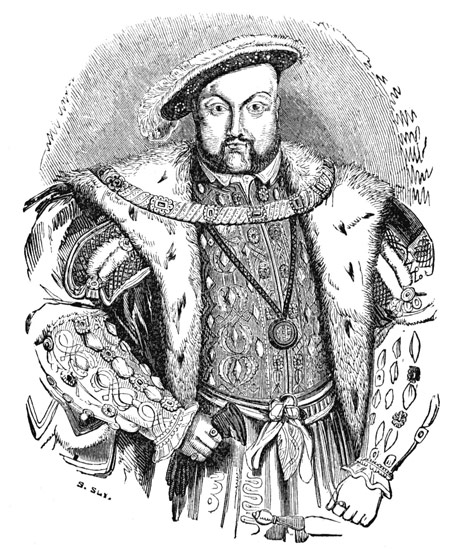
HENRY VIII.
But the England of those days, like the England of ours, was a law-abiding country, and three days after King Henry had received Meyer with great feasts and honours at Court, the royal guest was arrested as a pirate. It was pleaded that he ought to suffer the common penalty of piracy, that is to say, death. In these straits the merchants of the Steelyard came forward to aid their representative, offering to stand surety for him. They succeeded in averting the sentence of death by restoring the value of the goods seized; they could not succeed in relieving him from the imprisonment which his breach of international faith had incurred. Max Meyer had to go to prison, whence he was released at last only by the intervention of the municipality of Lübeck, though not until he had almost served his time.
Justice satisfied, Max Meyer returned to King Henry's Court, and was once more made a welcome guest. Whether he was empowered by the city to act as plenipotentiary, or whether, in the first instance, he acted on his own account, does not appear. But what is certain is that he made a number of proposals to King Henry, to which the latter lent a willing ear, that Meyer was knighted by his royal host, and received from him a golden chain in token of the honour in which he held him, and that Henry further promised him a yearly income of three hundred and a half golden crowns. The terms were that the English king should advance a considerable sum to Lübeck towards her war expenses—a sum which the city promised to refund and to double, out of the first profits derived from the conquered Danish kingdom.
Henry's object in this alliance was chiefly to harass and annoy his Catholic compeers, and to have a rich Protestant ally in the complications that were thickening round him. There was not much result from the friendship on either side; but for the moment, the news that the King of England was their friend and supporter, gave renewed courage to the democratic party in Lübeck. It also gave them ready cash wherewith to carry on the war with the Netherlands and their friends the Danes. For war it must be. This Wullenweber openly advocated, after various vain attempts to induce the Danish king to grant the Hansa's requests. Wullenweber himself had on two occasions been sent by Lübeck as their ambassador to Copenhagen, and had returned home furious at the want of success that met his negotiations. Why should not the Hansa, he pleaded, once more play the rôle of king-maker? Gustavus Vasa had proved a failure and a disappointment to the League, had broken every promise he had made to them. Let a new king be put in his place. Those who had helped the Swedish king into power with a hundred marks, should help him out of power with five hundred marks, he boasted; adding that before the next carnival he should make a masquerade before King Gustavus that he would not despise. For Denmark too he had his plan; and this was no other than to reinstate Christian II., once the enemy of the League. Christian had always opposed the aristocracy and the clergy, and had proclaimed himself the friend of the people. Reinstated by the Hansa, he would owe them gratitude, so reckoned Wullenweber, and being popular with the lower classes in Denmark the League might reckon upon their support. To aid him in this enterprise the dictator turned to the Count of Oldenburg, a relation of the dethroned king, an intrepid and intelligent Lutheran known as the Alcibiades of the North.
Christopher of Oldenburg, at that time thirty years of age, handsome in face and stature, was one of those princelings of Germany, of which the race is not quite extinct, whose title was their sole fortune and who, in former days, were willing to sell their services to any king who needed their aid, and in more modern times are utilized to marry the redundant princesses of royal parentage, for whom no match can be found among the reduced number of reigning houses. These bold condottieri, whether in search of adventure, of booty, or of a marriage portion and ease, had little but their wits to rely upon. Christopher of Oldenburg, for example, possessed as his whole patrimony an old convent. He had attracted around him, however, a band of devoted troops, free lances, willing to follow wherever he led: men without fatherland, faith, or ideal, the scum of all lands, whose desire was bloodshed and booty, and whose sole religion was obedience to their chosen captain. Christopher of Oldenburg was not an ordinary chief. With the military courage of a condottiere he combined a bright intellect and a mind of real elevation. He was well educated and well read. A copy of Homer accompanied him in all his adventures; his passionate desire was to be a hero of romance. This was the kind of instrument Wullenweber required; the man who could realize, appreciate, and help to carry out his bold designs. And these were, in a word, to put the Hansa in possession of the Sound. Possessing this advantage, with two obedient monarchs upon the respective thrones of Denmark and Sweden, and enjoining the moral and material support of the English king, the League would once more be as in the days of its greatest glory.
So reasoned Wullenweber, and not without reason. But he was too ambitious, or, at any rate, too bold. He had not reckoned with the apathy and the economic egotism that dictated the policy of the sister towns. He was to play a dangerous game. He staked his all and he lost.
Wullenweber's original plan was to attack Denmark, while carrying on at the same time the war with the Netherlands. This proposal, which besides being audacious, meant a great outlay of money, alarmed the other cities, and, above all, the town of Hamburg. Owing to her endeavours, a brilliant congress was assembled within her walls during the month of March, 1534, when it was proposed to examine carefully the various points of grievance at issue between the Hansa and her opponents. There were present delegates from the various Baltic cities, imperial councillors, Netherland grandees, and Danish nobles. But none of them exceeded in outward splendour the representatives of Lübeck, Jürgen Wullenweber and Max Meyer, as they rode into the city of Hamburg, dressed in full armour preceded by the chief of Lübeck's militia, by trumpeters and drummers, and followed by sixty armed riders. The timid Hamburgers glanced at all this military display with some terror, feeling assured that such a proud bearing meant that the town that sent forth these men would not easily yield its claims. Already, before the first assembly of the delegates, Wullenweber had been regarded with an evil eye by many of the other Hanseatic envoys. They could not grasp the ultimate ends he had in view for the benefit of the League. They thought he was inciting to needless expense and disturbance. They did not understand, still less did they sympathize with, the democratic wave which had swept over Lübeck, and which had brought two such men as Wullenweber and Max Meyer to the front. Local chroniclers, speaking of this meeting of plenipotentiaries, call the Hamburgers "the peace loving," and accuse the Lübeckers of being "the instigators of the woful wars."
On March 2, 1534, the Congress was opened by the Burgomaster of Hamburg in the grand council chamber of the local guildhall, an historical room, unfortunately destroyed in the great fire that devastated Hamburg in 1842. In an eloquent speech the local magnate described the miseries entailed by the war in which the Lübeckers had engaged against the Dutch, and urged that peace should be concluded in the interest of the common Hanseatic merchants. The burgomaster was followed by an imperial councillor, who said the same things in yet stronger terms. Wullenweber was visibly angered. His anger was increased when the Dutch envoy rose to his feet and claimed that it should be laid down as a principle "that the sea and all other waters should be free to the shipping of whosoever listed," adding that "if the Lübeckers suffered damage in consequence, they should find comfort in God's will and in the mutability of all earthly things."
This was too much for Wullenweber's temper to bear. He declared with violence that if the speeches continued in this tone and spirit he and his colleagues should leave the assembly, and this, in fact, they shortly afterwards did. Not only did he leave the assembly, but the city also, after he found that all the demands of Lübeck fell on deaf ears. But before he left he made a powerful speech in the guildhall, wherein he asserted and maintained that all he had done had been done solely for the general benefit of the League. He even accused the other Hanseatic delegates of being Dutch in sympathy, "a thing," he added, "which they and the Dutch would repent of as long as he lived."
He was asked to explain his projects. He sketched a plan almost identical in spirit with the Navigation Act of Cromwell; it might indeed almost be regarded as its prototype. When taunted regarding the egotism of this proposal, when told that the sole purpose that inspired it was to prevent the vessels of other powers from deriving a profit out of carriage of goods, Wullenweber retorted as angrily as Cromwell might have done, and with the same contempt for the petty spirits that could see no higher object, nor any larger or wider aims than purely personal and financial ones. To Wullenweber's mind there was at stake not only vulgar profit, but the control and supervision of the Baltic trade, the maintenance of the Hanseatic colonies, indeed of all commercial navigation; in a word, of everything that had made the Hansa what it was.
The colonial policy pursued by the Hansa, which had been one of its sources of strength, became a cause of weakness, and ultimately led to its fall. It was based in all essentials upon the same principles as those pursued later by other nations with regard to their foreign non-European colonies, and which led in time to the loss of these same colonies. The chief points were these: that the direct intercourse and traffic with the Eastern settlements and their commercial domain were reserved exclusively to Hanseatic vessels, and that transport by land was forbidden, because in that case it was not so easy to keep watch upon business, and to be assured that no Hanseatic laws were transgressed. Foreign flags were excluded from all Eastern ports and non-Hanseatic merchants not admitted to their markets. All traffic from the Eastern cities to non-Hanseatic places, and all traffic with these places were to go by way of Lübeck. This is the sum of the Lübeck Staple Act, which had a little sunk into abeyance during the late disorders and which Wullenweber desired to see fully reinforced. Again, to refer to England's dictator, with whom Wullenweber had some points of resemblance, this Lübeck staple was neither more nor less than the British staple, prescribed by Cromwell's Navigation Act, when it excluded foreign flags from American harbours, and interdicted the Americans from sending ships to any other European harbour than those of the mother-land. Two hundred years separated these two Tribunes of the People from each other, and yet, in some respects, their ideals and ideas were identical. But to return to the course of our narrative, which has been interrupted in order to make clearer the aims the Lübeck burgomaster had in view.
Wullenweber grew daily more angered at the tone adopted in the Congress, not only from his opponents, but by those from whom he had a right to look for support.
On March 12th, accompanied by Max Meyer, and the same military train with which he had entered, he left Hamburg, shaking the dust of the city off his feet in anger. He was soon followed by the delegates of the other Baltic cities. The congress had come to an untimely end, and nothing had been settled.
Wullenweber's object in returning so precipitately was twofold. He desired to know the wishes of the city under the changed circumstances, and he wished to complain of the colleagues who had failed to support him. This precipitous return greatly alarmed the citizens, all the more because during Wullenweber's absence the aristocratic party had tried to lodge various complaints against the absent burgomaster, and to stir up the people to revolt and discontent. They had even ventured to insinuate that he was guilty of "stealing and treason." Indeed, the tumult in the city was so great and seemed so threatening, that many timid spirits began to think that discretion was the better part of valour, and that it would be well to absent themselves awhile.
Into this state of affairs Wullenweber, by his unexpected return, dropped like a bombshell. He saw that energetic steps were needful here. He did not hesitate for a moment to take them. A meeting of the Forty-six was held, who were charged to invite the burghers to a general assembly in St. Mary's Church. More than a thousand persons replied to the summons. Wullenweber mounted the pulpit. In ardent words he expressed his patriotic intentions, and related in detail the reasons for his abrupt departure from Hamburg. He also complained most bitterly of the conduct of those who should have supported him. Next day he addressed a similar meeting in the guildhall, and spoke, if possible, in stronger terms, openly accusing his opponents of envy, and saying he was well aware that some among them even intended to attack him at night in his house, and to make him prisoner.
The upshot of his two speeches was that the democratic party once more gained the upper hand; that it was agreed that Wullenweber should act entirely according to his own discretion in the matter with the Netherlanders; that three of the municipal councillors inimical to him should be removed from their place; and that various burghers, whom he designated as "of Swedish or Netherlandish sympathy," should either be banished or imprisoned.
With his power thus increased, Wullenweber returned to Hamburg, and the congress was reopened. Since, however, he could gain no support from the other Hanseatic cities for his policy of continuing the war with the Netherlands, he at last consented to accept a truce of four years; a truce which he recognized would leave his hands free for the execution of his other plans.
Nor did he hesitate for a moment to put them into action. Riders and foot messengers were engaged in all directions; the "peace ships" were put into war condition; emissaries were sent to the sister towns to explain fully the purpose of the new attack upon the Scandinavian North, and to ask what assistance they proposed to render in money, ships, and men.
Wullenweber's plan was really a stroke of genius, and by no means so foolhardy or foolish as his enemies have since tried to prove it. It was: to form around the whole Baltic basin a sort of German confederation, and had it succeeded, or rather had it not been impeded by the petty vacillating policy of the other cities, it would have marked a re-birth of the Hansa, and there would have been no power in the North that could have opposed it.
In May, 1534, hostilities began with Denmark, and Sweden was also threatened with armed intervention, in case the broken promises to the Hansa were still left unfulfilled. To the people, the counter promise was made that they should have nothing to fear from the Hansa's armies, "if they did not second the arrogance of their king."
To this Gustavus replied by demanding help from his brother rulers, saying "that it was intolerable that the Lübeckers should put up for auction the three good old northern realms, just as if they were their market wares."
In a short time the whole North was in flames. At first extraordinary success crowned the attacks of the Hansa's fleet and armies, and by Midsummer, 1534, almost the entire Danish kingdom was in the hands of the Lübeckers. Then fortune somewhat turned, and Lübeck had to see an army surround its very walls, much to the consternation of the inmates. This danger was however happily averted, thanks to clever negotiations and force of arms; but meanwhile things had grown yet more complicated and intricate in the Scandinavian question. Party faction and religious jealousies prevented corporate action. There was a moment when things looked so black that even Wullenweber was daunted, and the confession escaped him that "if he were not in the middle of all this muddle, he should take good care to keep outside it."
In the midst of these difficulties dawned the year 1535, one of the most fatal in the life of the German States; a year destined to unravel and settle for ever the northern confusions.
Such a spectacle as the Baltic presented at this period it had not shown for many a long day. In the Sound, in all the Danish seas, in all the narrow waterways that separated the islands from one another, were seen waving from the tall masts of the Hanseatic "peace ships," the flag of the League, and in the harbours of Lübeck, Rostock, and Stralsund, more ships were put upon a war footing. There was likewise seen the white-and-black banner of the Prussian flotilla, sent to aid the imprisoned Danish king, while the flags of Denmark and Sweden fluttered from their respective vessels.
Nor was the spectacle on land less animated than that on the sea. Troops, mercenaries of every land and language crowded the shore of the mainland. It was evident that the encounter would be severe, the resistance great. The first check came to the Hansa in the shape of the capture of Max Meyer, owing to the false information given to him by the Danish commandant of Scania. Christian III. was proclaimed king of Denmark, and Gustavus Vasa lent the new king his most active aid. Things did not look well for the League, but Wullenweber, though he grew serious and thoughtful as he learnt the news, was not discouraged. He continued to confide "in divine help."
A vast number of intrigues were now set on foot, whose purpose was to alienate or conciliate, as the case might be, the various Catholic and Protestant kings and princes; thus giving to the entire quarrel a party character. Lübeck counted on the assistance of Henry of England, and offered the king in return for substantial subsidies the entire kingdom of Denmark as his booty.
Meanwhile Max Meyer was fretting at his enforced imprisonment and absence from the scene of action. In March, by means of a subtle, but not specially honest, subterfuge, he managed to escape from the castle that held him, and thanks to his fertility of resource, and to his popularity, he soon found himself surrounded by quite a little army, and resolved to carry on the war in his own manner, and according to his own ideas. It is said that he offered the throne of Denmark to Francis I. of France, an offer which that monarch refused. Nor did he forget his old friend, bluff King Hal of England, who, in his turn, seems not to have forgotten him. Though Henry nominally rejected the proposals made to him by Max Meyer, it is certain he continued to give him substantial and moral support, so that, owing to English help, Max Meyer was able to hold out in the seaboard castle of Vardberg, in which he had ensconced himself, until his tragic end. The gateway over its lintel, bore, till the time of its destruction, the arms of the Tudor, a delicate compliment from Max Meyer to Henry, implying that the castle was in very truth the king's.
The first great encounter of the armies took place by sea in the month of June. In number and excellence of ships the Hansa had the advantage. The Lübeckers were still the best shipbuilders of the northern world, and many of the Danish and Swedish vessels sent against them were nothing more than herring-boats and fishing smacks roughly put on a war footing. If victory depended on strength and numbers alone, it seemed assured to the Hansa. Unhappily, among the many secret methods employed by the aristocratic party to break the power of the democratic faction, there existed bribery and corruption of the ship captains. The usual Hanseatic concord was absent.
Indeed, herein is to be found in a great measure the explanation of the ill success of the Hansa. When Jürgen Wullenweber dreamed that he would revive the days and glories of Waldemar Atterdag he forgot that the burgomasters of those days when they set out for battle were followed by an army consisting of the burghers themselves, that, for example, in the struggle for Scania in 1368, no less than sixteen hundred citizens gave up their lives to gain a victory for the League. With the increase of wealth had grown up, as is usual, an increase of luxury and idleness. Citizens of rich Hanseatic towns contented themselves with keeping watch in turns at the city gates, with defending their own city walls, with interfering in street brawls and keeping order in the town. But when it came to active fighting, to going abroad to battle, they preferred to hire the mercenaries with which Germany was overrun, thanks to the disturbed state of the land arising out of the continual wars of Charles V. Hence arose the class known as Landsknechte; hence it came about that in those days German often fought against German, and that all true patriotic sentiments were extinguished. The rich Queen of the Hansa, Lübeck, had of course met with no difficulty in finding numbers willing to serve under her flag and to accept her pay, but these men, as is but too natural, did not fight with that enthusiasm and ardour which men display when the cause is their own. Jürgen Wullenweber was of the old Hanseatic type, but the mould that had formed him was broken. His contemporaries were not up to the level of his noble and patriotic ambition. Had he been ably seconded the whole history of Northern Germany might have been transformed.
As we have said, the fleets met in hostile encounter in the month of June. After some heavy fighting the heavens themselves interposed in the strife. A great storm arose, driving the vessels of the foes asunder. Two days later the decisive combat was fought on land. The place of encounter was Assens, on the island of Fünen, a spot where human sacrifices used to be offered to the great Norse god Odin. This battle of Assens ended in the complete discomfiture of the burgher army, and there followed immediately afterwards another meeting by sea, when the Hansa had to suffer the shame of seeing some of its vessels flee before the enemy, while others capitulated in cowardly fashion.
The consequences of these battles made themselves felt instantly. What Wullenweber had said the previous year when he was yet the victor was now realized, "that it was easier to conquer Denmark than to keep it." For not only Fünen, but Zealand and Scania fell off from the burgomaster's party after the defeat at Assens, and did homage to Christian III. as their king and ruler. Only Copenhagen, Malmöe, and a few small towns refused this allegiance, and still offered an armed resistance. But it was not to be of long duration.
Meanwhile the close of Wullenweber's proud career approached. It is characteristic of the whole course of German history, that the fall of Wullenweber, and the ultimate fall of the Hansa, were due not so much to external as to internal enemies. Petty jealousies, "particularism," to use their own phrase, that is to say, practising a church-steeple policy rather than a wide and liberal one, has ever been a danger to Germany. It defeated the efforts of Wullenweber, as it did those of the patriots of 1848, and of many more before and since.
In July the Hanseatic Diet was called together to consider the state of the League's affairs; and on this occasion a number of the cities, and chief among them the inland ones, found a much desired occasion to vent the wrath and envy which they had long nourished against Lübeck and its democratic dictator. A number of attacks, some of them of the most despicably petty character, were made against Wullenweber. The Lübeckers were told that they had permitted "irregular disorders," and that it was they who disturbed the general concord of the common Hansa. Most bitter of all were the charges launched by Cologne, the town that had long been jealous of the power of her northern sister. Forgetful of the whole course of Hanseatic history, she ventured to say that it would seem strange to the emperor and other princely potentates, that a town like Lübeck should meddle with such great matters as the deposition and installation of kings.
To this taunt Lübeck replied with dignity, pointing out that she had no wish either to change the faith of the kings or to murder them (as Cologne had previously suggested), but that according to treaty she had the right to act as she had done, and that she had acted, not for the sake of exhibiting her own power, but because of the natural, intimate, and needful relationship that existed between Denmark and the Baltic towns. Since olden days no king might be elected in Denmark without the knowledge of Lübeck, and on this they had ever acted.
The men of Cologne were not abashed by this reference to history. They replied that it might be so, and that the Lübeckers had the right they would not deny; but they repeated, it made a strange impression upon kings and princes that the men of Lübeck should make and unmake kings.
Alas! how were the mighty fallen! What a degradation of sentiment in the Hansa when the cause of one was no longer the cause of all!
Some days later, in reply to a similar attack, the Lübeckers replied, in the old bold spirit that characterized the Hansa in its best times, "In one thing they had made a mistake, and that was when they helped two such worthless men as the kings of Denmark and Sweden to power, and had further made them great, in return for which they were now ill repaid."
Cologne then tried to shift its recriminations on to the religious ground. Glancing at the excesses committed in Münster by the Anabaptists, she ventured to question the benefits that had accrued to Lübeck and other Hanse cities from the Reformation, concluding with the shameless words, "In our city we hang, behead, or drown all heretics, and find ourselves very comfortable in consequence."
To most of these attacks Wullenweber as representative of Lübeck had to reply in person. He knew too well that many of them were aimed directly at himself. He strove hard to keep his hot temper in check and to reply with moderation and dignity.
The attitude of these Diet meetings, however, was but to prove the prologue to the intrigues which were to eject Wullenweber and his party from power, and to break not only the hegemony of Lübeck, but that of the whole Hansa—a consummation the opponents certainly did not intend. "Those whom the gods wish to destroy they first strike with blindness," says the Latin proverb, and its truth was once more made manifest by the attitude of the Hanseatic towns among themselves. They who had ever been so strong and so united, now no longer held together in brotherly concord, and weakness and disruption were the result.
The instrument that was to spring the chief mine on Wullenweber and his party was found in the person of Nicholas Brömse. This man was one of the leading personages of the Municipal Council of Lübeck in the early days of the sixteenth century, and was burgomaster of the town in the days when Gustavus Vasa arrived there as a fugitive. Indeed, he is said to have been one of the most zealous friends and protectors of the young Vasa. When the Reformation dissensions began to stir in the city, Brömse was among the most pronounced opponents of the purer creed, and repeatedly, by his personal interference, retarded its introduction. Indeed once, after it was officially introduced, he succeeded, in virtue of his personal influence with Charles V., in getting the Lutheran creed forbidden in the town. In so doing, however, he somewhat exceeded his limits; his action aroused suspicion in the council and hatred among the citizens; and finally, in 1532, he had to resign his post and fly secretly from Lübeck to escape the wrath of his enemies. He made his way to the imperial Court, at that time located in Brussels, and there he gained the ear and favour of Charles. Thence he watched with anxious curiosity the course which events were taking in his native town. He was biding his time to revenge himself upon the city that had ejected him, and upon the burgomaster who had supplanted him in popular favour.
When Nicholas Brömse learnt how the Hanseatic Diet had censured the action of Jürgen Wullenweber, he thought that the time for which he had long waited had come. He employed all his personal influence with the emperor to induce him to take a decisive step against the city of Lübeck, and with good result. For there issued from the imperial council chamber, June 7, 1535, a decree, stating that unless within six weeks and three days from the receipt of this document the town of Lübeck had abolished all democratic innovations and reinstated in the government Nicholas Brömse and other councillors banished together with him, the town would be declared under the imperial ban.
With Jesuitical astuteness not a word was breathed regarding Church reforms, but it was fully understood that a blow was aimed at the Lutheran creed quite as much as at Jürgen Wullenweber and the democratic party.
A Hanseatic Diet was sitting at Lübeck when this decree arrived. A committee was at once chosen to discuss the acceptance of the imperial mandate. It decided that obedience must be tendered to the dictates of the imperial council. In consequence the democratic party resigned power, and Wullenweber, who understood well that the whole was chiefly aimed at him, saw that there remained nothing for him to do but follow his party.
After delivering before the Diet a speech of great dignity marked by unusual moderation, in which he said if it were the will of God and were adjudged for the common weal that he should retire, he should certainly not refuse, he laid down in August, 1535, the office he had filled with such zeal and patriotic ambition.
It is characteristic of popular gratitude that when he returned from the guildhall, after completing the deed of renunciation, he was followed by a crowd that hissed and hooted him. This people of shopkeepers turned upon the man who was their true friend because the wars had impoverished them, had slackened their trade, and had brought distress within their walls. They did not recognize, or they forgot, that they themselves had encouraged the outbreak of these hostilities, and had applauded and sustained the man who proposed them; and that had he been better supported, his plans would have resulted in their pecuniary benefit.
It is evident that his fellow-rulers among the Lübeck Council knew that Wullenweber had been wronged, since they offered to bestow on him for six years the governorship of a neighbouring dependency. This he refused, but before he finally quitted office he took good care that the welfare and existence of the new creed should not be endangered by the return of the zealous Papist, Brömse, and also that an amnesty should be accorded to all political offenders.
Shortly afterwards Brömse entered the city in stately procession, preceded by a hundred and fifty horsemen. He proceeded at once to St. Mary's Church and took possession of the burgomaster's chair, whence he listened to the minutes decided upon by the Hanseatic Diet. The decree by no means pleased his Catholic soul that whatever else was reinstated, the new religion should be left intact; but he held his peace and trusted to time, as he had already done, with good result, while he waited at the Court of the Emperor Charles. In this one respect, however, he was to be disappointed. Lübeck never again changed its creed, or bowed its head to the Papal party.
But where now was the man to find peace who but recently had held as ruler both sides of the Sound, who had dared to fling the gauntlet to two monarchs, and who had been dictator throughout all Scandinavia? Notwithstanding many negotiations, peace had not yet been concluded between Lübeck and Denmark. Copenhagen was still held by the Hansa's allies. It is easy to understand that the temptation presented itself to Wullenweber to make common cause with them, and to try in yet another form to gain success for the League. But whether this was really his plan or not we have now no means of deciding. The latter years of Wullenweber's life are wrapped in much mystery, owing to intentional falsification of facts on the part of his enemies. Thus much is certain, that in the autumn of 1535 he set forth on a journey northwards, making for the province of Halland on the Cattegat, where lay the castle held by Max Meyer. Probably he wished to confer with his trusty colleague. His friends tried to dissuade him from his intention, reminding him that his road led him through the territory of the Archbishop of Bremen, one of his most violent opponents. It was impossible, however, to control or guide this headstrong and fearless man. Ambition and self-confidence made him fall into the trap which his enemies had laid for him.
Nicholas Brömse and his followers, hearing of this journey, at once sent messengers to the ecclesiastical prince, and by heavy bribes bought him over to their side. In consequence, scarcely had Wullenweber touched the archbishop's domains than he was seized and imprisoned, regardless of the letter of safe conduct he bore about him. He was carried off to Rothenburg, one of the archbishop's castles, and for some weeks the world knew nothing of his whereabouts, until his foes had matured their plans against him.
Wullenweber's brother, Joachim, at that time one of the Council of Hamburg, was the first to be uneasy regarding Jürgen's fate, and he succeeded in ascertaining the fact of his imprisonment and the perpetrator of the deed. He addressed a letter to the archbishop, demanding an explanation of this breach of faith. The audacious prelate replied, that "Since it was notorious how designedly and presumptuously Jürgen had acted against the will of God, of the emperor, and of the spiritual rulers of Lübeck, and how he had spent a night in his, the archbishop's domains without his permission, his will or a safe conduct, he, as the emperor's relative and as prince of the empire, had held himself in duty bound towards his Church to take the man prisoner. Further reasons for this step would be made known in course of time."
Armed with this insolent reply Joachim Wullenweber turned to King Henry VIII. of England in his sore strait, and implored him to befriend the man who had ever befriended him. To this request Henry lent a ready ear and he pleaded, but in vain, for his "faithful and honoured friend," with the Council of Hamburg and Bremen, and at last with the archbishop himself.
But Brömse and his party were not the men to release their prey when once it had fallen into their hands. They were determined to have their revenge. They hated Wullenweber; Brömse, in particular, hated him so much that it was possible for a contemporary chronicler to declare that he even tore Wullenweber's flesh off his bones with his own teeth. This no doubt is a baseless charge. Nicholas Brömse, the patrician, with the delicate coquettish features of a woman, with the lily white hands that were noted among his contemporaries, is not likely to have done such a thing. He might be false and cruel, but he could not have been actively bestial and ferocious.
What is certain is that Wullenweber's enemies were determined to destroy him. So great and powerful a man could not be simply put aside; he had to be sacrificed. A truly fiendish scheme of incrimination was opened against him; so painful and unfair that it awoke pity even in the breasts of his contemporaries. Among them, Maria, at that time regent of the Netherlands, was so deeply moved by the burgomaster's fate, that she felt herself called upon to demand that the prisoner should at least be brought before an imperial governor, in order that his case might have a more impartial consideration. But Wullenweber's foes would not listen to any mild or merciful counsels. Their chief endeavour was to spread abroad a belief that the dictator had acted in concert and sympathy with the Anabaptists, at that moment the bogey with which to scare both Catholics and Protestants.
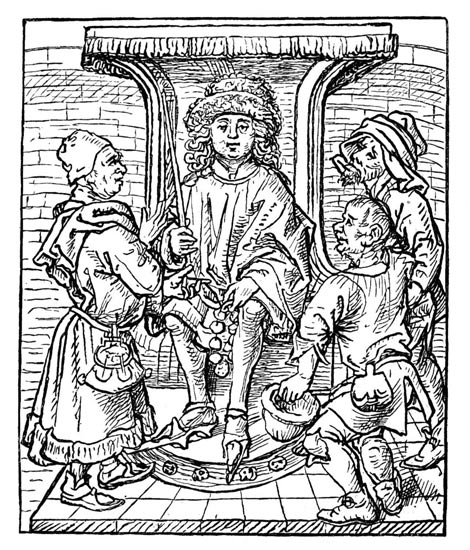
SCENE BEFORE A JUDGE.
The exact means employed to break Wullenweber's strong spirit during the first months of his imprisonment are not known. There is no doubt, however, that he was subjected to torture, and that upon the rack he was made to acquiesce in statements, many of them quite false, and others distorted to serve the purpose of his tormentors. Among the so-called confessions were said to be an admission of his Anabaptist leanings, an intimation that he had proposed to murder and kill as many nobles as possible, that he had abstracted for his own private ends public and church property, and other statements, so manifestly out of keeping with his previously known character and general bearing, that it is amazing to think how his contemporaries, even those most opposed to him, could for a moment have given them credit.
Hero though Wullenweber was in the moral sense he was no hero at bearing physical pain, and, indeed, the two qualities by no means go together, nor does nervous shrinking from pain necessarily imply moral weakness. The contrary is often the case. The man of finely strung nerves, to whom bodily pain is on this account less supportable than to his more coarse-grained brother, is, for that very reason, capable of a refinement of sentiment and action equally unknown to the other. The beef-built man is apt to be beef-witted.
It is quite certain that all the admissions undoubtedly made by Wullenweber were wrung from him under excruciating tortures. Indeed, in the hour of his death, and in two letters to his brother Joachim, he affirmed that "the jailer of Bremen, together with his mortal enemies, had forced him into the admission of political and moral sins." He says he was racked again and again, and on one occasion had to swear that he would not answer in any other sense than that demanded of him. If he failed in obedience to this command he should be torn to little pieces on the wheel, but, so God help him, he knew nothing whatever of Anabaptists or these other charges. He implores his brother to make known all this to his friends at Lübeck, and to beg that some honourable men would search his account books, and see whether it be true that he had abstracted State moneys. The brother himself might come and hang him higher than any thief yet hung, if he could prove that he, Jürgen, had stolen anything from the Lübeckers. Finally, he warns the zealous Lutherans that the purpose of all that he had to suffer, all that was now being done, was to restore the old state of things, and that he feared that his foes would effect this in Lübeck of all other places.
Meantime, King Henry of England repeatedly demanded of the Archbishop of Bremen that his "beloved and trusty servant, Jürgen Wullenweber," should be treated with more clemency. Receiving no reply from the archbishop, the king turned to the city of Hamburg for aid to release the imprisoned burgomaster. He said he had need of his "innocent servant" for most important purposes, and pointed out that it was for the weal, not only of his own kingdom, but also, and even more, for that of the German nation, that Jürgen should be freed. Baffled on all sides, the king demanded at last, that at least the reasons for this confinement should be made publicly known.
These reasons could not be given, based as they were on motives of the lowest kind, that would not bear the light of day and of judicial investigation. The inquiries, however, caused the archbishop and his wire-pullers at Lübeck to think it well to remove Wullenweber from his prison at Rothenburg to some other more distant place. In consequence, he was passed on in the spring of 1536 to the custody of the archbishop's brother, Duke Henry of Brunswick, a bigoted Catholic and zealous persecutor of heretics. He confined Wullenweber in his castle of Steinbrück, a strong fortress situated between the towns of Brunswick and Hildesheim. The dark dungeon with its walls ten feet in thickness, with its small door but a foot and a half in breadth, are shown to this day. Quite recently this inscription has been put up inside it—"Here Jürgen Wullenweber lay and suffered. 1536-1537."