PERIOD II. (continued 2)
Reading edition
They had not in Scania, as at Bergen, a regularly organized factory, but the Witten stood under superintendence, while at adjacent Malmö they founded a permanent colony, under the jurisdiction of an alderman, who administered Lübeck law and watched over the Witten trade with jealous care. Here each town had its guild representative, often its house, and here annually a dignitary from Lübeck would pay a passing visit in order to adjust quarrels and investigate the state of trade.
The "Scandinavian travellers," as they were named, instituted a number of companies with rules of a religious, commercial, and worldly-sensuous character. Thus the "Pious Brotherhood of Malmö" buried every poor stranger with the same church pomp, costly palls, candles and masses, as they would one of their own members. No one was admitted into the brotherhood who was at feud with one of its associates. No one might enter the common room bearing arms. A member who introduced a guest was responsible for his good behaviour. In a word, the regulations were of a certain humane character, far different from those which obtained at Bergen. They were evidently copied from those of the guilds in the Hanseatic and other towns of the Middle Ages.
Until early in the sixteenth century the League retained in undiminished vigour its advantages in Scandinavia. To break their power it was necessary for the Dutch to discover a better mode of salting the fish. Then the fish itself came in smaller shoals to these coasts, and appeared instead near Scotland and Ireland, and, worst of all, modern Europe became Protestant, and fasting was hence no longer an obligatory fashion. Only a few sunken gravestones, still standing amid the desolation of this district, bear witness to the former importance of the site.
As for the rest of Sweden, the country, though not productive, was still of value to the Hanseatics, since they held the entire trade in their hands. As from Norway, they exported wood, iron, copper, skins, in a word, explored all its resources. In most of the maritime towns they exercised certain rights. Thus Stockholm itself was partly in their possession, the local administration being half chosen by them. In this wise they were able to bring pressure to bear upon the government. In short, they disposed of the whole commerce of Sweden, and it was not until the days of Gustavus Vasa that their might was rudely and completely shaken.
Indeed, in those middle centuries there seemed no limit to the Hanseatics' ambition and power. They early cast their eyes towards that immense territory in the far north, that Russian Empire which in those days was truly an unknown land. With quick traders' instinct they recognized that the country was worthy to be included in their vast monopoly. When they first established themselves in Russia is not known. Towards the end of the thirteenth century we find them in possession of a factory at Novgorod, on the river Volchor, a city which, with the province that surrounded it, was then an independent republic, for the Russia of those days was surrounded by various principalities mostly under Tartar rule. The natives were not strong enough to claim as their own a rich and populous city, whose liberties were protected by the Western Christians, and which had moreover been founded by aliens, namely, by one of those enterprising Norman chiefs, who in early times were, as we know, the terror of all states and countries.[9]
It is thought that the Hanseatics had another similar establishment at Pleskow, a city on the Velika, and perhaps even a depôt at Moscow, but undoubtedly Novgorod was their most important station. Here merchants and artizans fixed their abode, and drew around them a rich commerce for the town. It was the staple for Arctic and Byzantine riches, riches which the more barbarian Russians did not understand how to utilize like our cunning traders. As early as the eleventh century we hear of a German trading settlement at Novgorod. In 1269 the local ruler accorded to the Hanseatics, "to the German settlement, the Goths, and all peoples of Latin tongue," special freedom in dealing with his province.
As usual, the Hanseatics created a monopoly and jealously excluded all strangers. Assigned in Novgorod to a special quarter of the town, they built a church of their own, dedicated to St. Peter, and grouped their guildhall, shops, stores, and dwelling-houses around it. The quarter soon became known as the Court of the Germans at Great Novgorod, or the Court of St. Peter. As at Bergen, it was built in such a manner that it could be defended, if need be, and at night it was closed and guarded by watchmen and fierce dogs.
There is happily preserved for us the Codex of this German colony on the Lake of Ilmen. It is called the Skra, an old German word which we encounter elsewhere in Hanseatic chronicles. This Skra furnishes a lively picture of the strange character of the Court of St. Peter. It appears that "the entire council, together with the common consent of the wisest of all the German cities," had decreed that the laws here laid down should be enforced on all who visited the court, "as it was done from the commencement." The non-resident merchants, who always travelled in large parties and accompanied by a priest, are spoken of as the "summer and winter travellers." They elected from out of their number the alderman of the Court of St. Peter. He became head of the settlement, received the income, fees, and taxes, and defrayed the general costs. The alderman of the dwelling court was the highest dignitary and, with the aid of the four wisest, adjudged all quarrels, personal or commercial. These aldermen had special privileges in the choice of residence, and the aldermen of the "winter travellers" were further allowed certain honours and comforts in the great common room. The land travellers had to yield to the seafarers in all matters of convenience and space. Their priest, too, was regarded as the chief ecclesiastic of St. Peter's Court, and to him alone was accorded free board and a salary out of the common funds. Any one who refused to appear in answer to a summons before the court was subjected to a heavy fine. The so-called "rooms" (i.e., dwellings) were common to all; except that the "winter travellers," secluded from all the world in midst of the long Arctic nights, were permitted special privileges. The "children's room," the abode of the younger clerks and apprentices, also enjoyed rather more freedom from strict rules than was accorded to their elders. A master might not dismiss his subordinate until he had brought him back to his country; he was also bound to care for him in sickness, and might not punish him arbitrarily, or on his own authority alone. As at Bergen, and at the Steelyard in London, the whole establishment partook of a monastic character, in which most stringent rules prevailed. And of these rules none was more strict than that which forbad social intercourse or partnership trading with natives.
A special brewery concocted the sweet mead or beer drunk by the thirsty brotherhood of St. Peter's; in St. Peter's cauldron was melted down all the wax brought in from afar; the wood for firing was felled in St. Peter's forests. A monotonous life it was, interrupted only in spring and autumn by the arrival of the summer and winter travellers with their rich wares. In the cosy warmth of the common room, over endless bowls of mead, these far-travelled men, snowed up here and unable to return till spring released them, would beguile the long winter evenings with anecdote and tales. In this wise the Scandinavian Sagas first penetrated into Middle and Southern Germany.
The rules made against the Russians were severe and offensive in the extreme. It is evident they were not trusted in the smallest degree. A Hanseatic enjoyed the first privilege in all respects. For example, if a native was bankrupt, the German merchant to whom he was in debt had the first right to be paid before Russian creditors, and the Germans could further insist that such a bankrupt should be banished the city with wife and child. By way of tax they themselves paid a piece of cloth to the ruler of the mainland between their Court and the sea, and a pair of gloves to the Russian officials.
For the rest their whole attitude was haughty and overbearing, and it is scarcely astonishing that quarrels and risings against them were of frequent occurrence. But they almost always kept or at least regained the upper hand. Their audacious motto was "Who can stand against God and the Great Novgorod?" No doubt many of their rigid measures were necessary to a small colony living amid a turbulent and rude population, differing from them in manners, language, and religion. The station was as difficult to hold as years ago was that of Canton for the English. Like the Chinese, the Russians hated the merchants, if for no other reason than because they were foreigners. In every possible manner they tried to cheat them, adulterating wax, furnishing bad furs, &c., &c. In consequence, the alderman of St. Peter's saw himself obliged continually to issue new warnings and rules to secure his traders from the Russian tricksters. So, for example, the dwellers of the Court of St. Peter were enjoined only to buy furs in well-lighted places, where it was easier to test their genuineness and excellence, further to accept no large consignments that had not been previously subjected to careful scrutiny. And notwithstanding the fact that their commerce in Russia was subjected to great danger, that they even had several times to close their court and withdraw, the Hanseatics clung tenaciously to their Russian monopoly, which was one of the chief sources of their wealth. They even watched to see that no non-Hanseatic learnt Russian, an indispensable acquirement for this trade. Nay, at one time they held the whole province of Livonia responsible for hindering such a proceeding. After a time, under penalty of one hundred marks, no Russian was allowed to live in Livonia. On pain of corporal punishment, they were enjoined to treat with Russians only for ready money, or more strictly for ready goods. Credit with these barbarians was not encouraged, for it was desirable in every way to simplify intercourse, and moreover then, as now, it was next to impossible to a foreigner to make good his credit claims before Muscovite justice.
The trade consisted in Russian products, furs, metals, honey, and, above all, wax, much sought after in those Catholic times, when the consumption of this article was wonderfully great. It would seem as though some obscure merit were attached to the burning or the gift of candles, the origin of which is probably heathen. What the Hanseatics brought to market was chiefly Flemish and English cloths and linen, as well as divers articles of luxury, eagerly sought after by the various princes and sovereigns and by the innumerable Boyars who ranked like petty princes.
In those large and small courts a barbaric and gorgeous display was common, and ostentatious rivalry existed between the princes. Probably this love of exterior pomp is explained by their neighbourhood to the East. The Hanseatics astutely utilized this Russian tendency, and spared no pains in bringing to market wares calculated to dazzle and please these grown children; children in this respect alone however, that they could be fascinated by finery and show. In other matters the Russians behaved like adults, and they kept a constant watch upon the Hanseatics, never neglecting any opportunities of annoying them or hindering their trade. Thus, if the League accused the Russians of want of good faith in commercial dealings, they returned the compliment, and complaints of linen goods as being too narrow, too coarse, or not according to sample, were frequent. Often these were justified, as often not. But on several occasions the Russians arrested Hanseatics, put them in irons, even on one occasion hanged a Hanseatic merchant from the door of the League's own factory. The Hanseatics met such insults by threatening to leave Novgorod; indeed, carried out this threat several times, but love of gain on the one hand, hunger after luxuries on the other, appeased the troubled spirits, and peace was re-established on the old footing. These treaties of reconciliation were sealed by the Germans with a key in a shield, the seal of St. Peter's Court. The Russians swore fidelity by kissing the crucifix.
But as such disturbances might always recur, and in order that the damage should not prove too heavy to members of the League, it was decreed by them in the fourteenth century that no merchant might send to or store at Novgorod merchandise exceeding in value the sum of a thousand marks. This shows that their position at Novgorod was rather that of a hostile encampment than that of a secure and permanent settlement.
Above all, the Hanseatics strictly forbade Russia to trade on the sea, and any Russian merchant ships that they encountered were captured and the captain and crew severely punished.
Early in the twelfth century the clever Lombards, already famous throughout Europe for their skill in all banking transactions, tried to gain a footing at Novgorod. It seems that their financial shrewdness was not always combined with the strictest honesty, and that hence they enjoyed an ill fame. Certainly the Hanseatics succeeded in 1405 in prohibiting "these dangerous men" from any residence in the Baltic cities, while in St. Peter's Court their presence was formally proscribed in 1346.
A serious interruption to the commerce of the League with Russia occurred in the middle of the fifteenth century, when the Prussian towns revolted against the oppressive supremacy of the chivalric order of the Teutonic Knights. Like all spiritual powers, when it is a question of the goods of this world, the Teutonic Knights fought ardently to regain their power, and this warfare long rendered the Baltic dangerous and impossible for trade purposes. Indeed, so long and so serious was this war that but for the fact that the League was in a sufficiently flourishing condition to be able to bear great losses, and also for the fact that the Russian trade was worth many sacrifices, the League might even then have been permanently crushed.
More serious was the next enemy who arose and who shook to its foundations the empire of Hanseatic commerce in Russia. This was the Czar Ivan II., known as the Terrible. He had conquered and chased from his domains the savage Tartar hordes that annually ravaged it; he was ambitious to unite the whole Muscovite kingdom under his sway. Like his successors to this day, he hated all that savoured of liberty and independence, and was resolved to exclude from his realms everything that approached a more advanced civilization and was irreconcilable with absolute rule.
He cast a jealous eye on Novgorod, with its political independence and its prosperity. Here, he said to himself, were rich spoils to be obtained; this power within his own domains must be broken. He tried, with success, to gain over to his side a portion of the population. These were, however, soon denounced as traitors to the community, and the great bell of Novgorod, regarded as the Palladium of popular liberty, was rung to call the city under arms. A violent struggle ensued, in which Ivan committed many of those acts of cruelty that have made his name notorious.
At last, after a gallant resistance, in which especially a woman, named Marsa, took a leading part, Novgorod fell into the hands of Ivan, who despoiled it of its liberty and riches, and sent its chief inhabitants into the centre of his empire and replaced them by his Muscovites; burnt, ravaged, pillaged, and sacked, so that at one blow the town lost its liberty, lustre, and prosperity. The great bell of freedom was carried to Moscow, where to this day it hangs, no longer inciting to revolt, but calling the people to prayer. As for the Hanseatics at Novgorod, they were taken prisoner and kept in cruel durance. Their merchandise was confiscated, and all their possessions, such as church ornaments, bells, silver vases, &c., were carried off in triumph to Moscow.
This blow came upon them like a thunderbolt, for all their privileges had just been reconfirmed by the Russian ruler. But to Ivan no sacred treaties were binding. Only after many years and long negotiations did the Hanseatics succeed in getting him at least to release their prisoners. When he did agree to this most had already died from the effects of privation. Of the confiscated goods he would not return a bale.
Thus ended the glory of the Hanseatic rule in Russia. It is true that under Ivan's son the cities once more endeavoured to open their court on the Volchor. But a twenty years' interruption of trade was not easily made good. They could not recover their monopoly, which had been usurped by Danes and Dutchmen. The last blow to all such efforts came from the English, who had discovered a passage to Russia by means of the White Sea and Archangel, and hence no longer needed Hanseatic mediation. In 1603 Czar Boris Gudenow wanted to reinstate the Hansa in its ancient privileges. It was too late. The dissensions that agitated Russia did not permit the League to derive any profit from his good intentions. Commerce had taken another direction, and kept it. When, some time after, a traveller passed through Novgorod, all he found to remind him of the German colony here were only the ruins of the stone church of St. Peter, a single storehouse, and one wooden shanty, which served as shelter for him and his servant. Of the former glory and prosperity there was no sign.
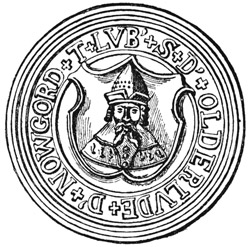
SEAL OF NOVGOROD.
VI.
THE COMMERCE OF THE LEAGUE WITH THE NETHERLANDS AND SOUTHERN EUROPE.
Among the Western countries not even England attracted the attention of the League so powerfully as did the Netherlands, with their cosmopolitan market of Bruges, a market which, as early as the days of King Canute, was already of great importance. There was to be found every element needful to second their vast ambition and to foster their activity. In Flanders lived the most industrious nation in Europe, dwelling in opulent cities, having excellent harbours and markets, where all the necessaries of life, and all objects of luxury abounded. In these markets our traders could find all the articles most eagerly sought after by the inhabitants of more northern climes, while they, in their turn, could furnish the Flemings with the productions of the North, and especially with those which were necessary to a maritime people. Thus the League had cunningly got into their hands the whole monopoly of hemp, so needful for rope making. Indeed, it must ever be borne in mind that the Hansa had the monopoly in those days of the whole industry and of all the products of Northern and Eastern Europe. This active and profitable commerce was almost entirely carried on by means of the factory which the League had established at Bruges. It was here that its merchants supplied themselves in their turn with the manufactures of the industrious Flemings; with cloth, linen, and the costly tapestries admired to our day.
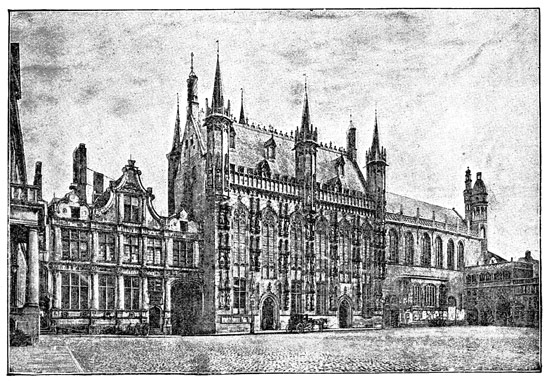
STADT-HAUS, BRUGES.
It was at Bruges, then, that the vast ramifications of Flemish and Hanseatic trade were united. Fifteen different foreign nations held established depôts in the city which was a very artery of commerce. Sixty-eight Flemish trade-guilds flourished in the town. It communicated with the sea by means of a canal and a not too distant harbour. Extensive privileges had been accorded to it by various native princes. The inhabitants were proud, rich, and independent. It was said of them by a contemporary that the merchant-aristocrats of Bruges "rode to tournament yesterday, bottled wine to-day, cut out garments to-morrow." A queen of France could not deny that the splendour and luxury of the courts were cast into the shade by the pomp and splendour of the maids and matrons of commercial Bruges. With these men commerce had already become a science, and various peoples who had till then the most elementary notions on the point came to the Netherlands to instruct themselves. It is surprising to read that, as early as 1310, they had instituted at Bruges an insurance office, and that the chief principles affecting exchange of values were already understood. These matters were novelties even to the Hanseatics, though they owed their prosperity and very existence to trade.
The League therefore found itself in a totally different position in the Netherlands from that which it occupied in poor or barbarous countries like Norway or Russia. Here was no question of submitting a whole people to their monopoly; it was rather a matter of obtaining gracious concessions and privileges. Hence the factory at Bruges in no way resembled those of Bergen and Novgorod, which were armed citadels placed in the midst of a more or less hostile people and constantly liable to warlike attacks. Here, on the other hand, civilization reigned and competition was active. The Hanseatic factory at Bruges partook more of the character of a general office and storehouse than that of any other factory of the League. But "the Residence of the German Merchants," as it was called, was organized in the main like that of its brethren. In its most prosperous days the factory consisted of about three hundred traders or agents, who executed the orders to buy and sell for those Hanseatic merchants who did not come to Bruges in person to carry on their trade. These resident merchants were not permitted to quit the factory until after a certain number of years' sojourn. During this time they were interdicted from associating with the natives. They lived in the Hanseatic building under the supervision of six aldermen and a council composed of eighteen members, and there were in force for them here as elsewhere rigid rules of life, among which the imposition of celibacy took a leading place. The factory was partitioned into several chief divisions called "districts," where the members from different cities abode in almost monastic seclusion. Less rude customs, however, prevailed than at Bergen. The Hanseatics being in the midst of a polished and luxury-loving people, acquired some of their more civilized habits. By way of Bruges comforts and refinements penetrated into German homes, and Flemish modes of thought and speech crept into German literature.
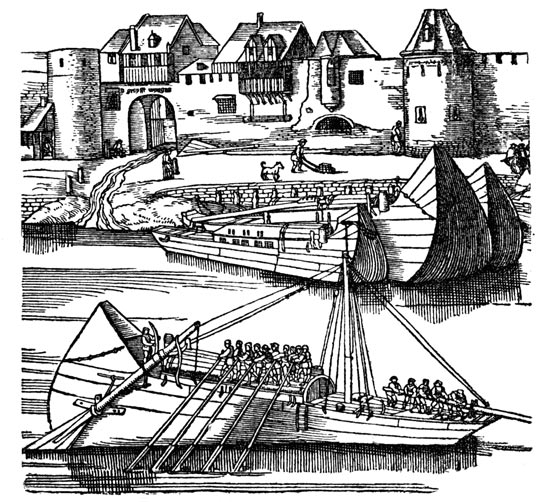
RHINE BOAT, COLOGNE.
The factory at Bruges was in every respect of immense value to Germany and the Hansa. It grew into a sort of training college from which came forth the most able magistrates and administrators of the Hanseatic League.
The head of the factory was a president chosen by the Diet of the League. He was changed annually, usually at Whitsuntide, when the by-laws of the factory were read and the newly elected had to swear "to submit to its statutes, to see that these were observed without fraud as far as in him lay and according to his five senses."
As elsewhere expenses were paid by fines and customs dues. These latter some cities tried to elude at various times in a spirit of egotistic and most short-sighted policy. Chief among these was Cologne which was in consequence "unhansed" for some time. Indeed Cologne was always a more or less turbulent member of the League. The official meetings of the Hanseatic representatives at Bruges curiously enough did not take place in their own factory, but were held in the Reventer, that is to say, the refectory of the Carmelite convent. Their charters were deposited in the church sacristy, or more precisely in the so-called Noah's ark, this alliance between sacred and profane things being a common feature of those times.
As the might of the League increased at Bruges they insisted that every vessel sailing the seas must make an enforced halt at the port of Bruges, and thus give the traders a first chance of buying their wares or, in any case, of exacting from them a staple toll. Exception was made only in the case of ships sailing to England or to the Baltic seaboard. The possession of this privilege naturally proved a source of great wealth and power to the League, who grew proud and haughty as they increased in strength, and even ventured to oppose themselves to the Flemings, if they considered that these had in any way offended against "the majesty of the Hanseatic nation in the person of any of its members or officers." They would then threaten to transport their factory into some other city, and once actually carried out the threat. They suspended all trade with Flanders, blocked its ports, and refused to buy its goods. At the last the murmurs of the artizans thus thrown out of work, and the general distress among the people, forced the rulers to crave grace and to beg for the return of these masterful strangers, even according them new privileges, that is to say, new weapons of oppression. For the League, on these occasions of proud resentment, took the most menacing of tones and exacted a heavy satisfaction. Thus once, because one of its members had been, as it considered, gravely insulted, and others murdered, it demanded that a chapel should be built and masses founded to pray for the repose of the souls of those who had perished; and that a large indemnity should be paid to the relations of the dead and to the division of the League to which they belonged. And, further, in order to induce this division to return to Bruges, it was requisite that one hundred of the chief burghers should come in procession to the Carmelite convent and ask public pardon from the Hanseatics, and that sixteen of these should go in pilgrimage to Santiago de Compastello and four to the Holy Sepulchre at Jerusalem. Only after such expiation would the division allow itself to be re-established.
The dissensions and revolutions which, in the fourteenth century, convulsed Flanders and caused the sovereignty of the provinces to pass into the hands of the Dukes of Burgundy, did not, for a long time, touch the commerce of the Hanseatics. Their trade seemed able to cope with the subversive influences of tumults, seditions, and civil wars; their activity was not discouraged; their great credit enabled them to repair all losses, and even to draw profit from these very disturbing influences themselves. Each new ruler, guided by the same motives of interest, awarded the same favour to this association of strangers, who, in coming to their country, nourished its industries and profitably exchanged products. Even Charles the Bold—proud and warlike though he was, a declared foe to all liberty, attacking at that very time the Swiss people, who were striving to gain their national independence—openly protected the Hanseatic towns, and interested himself warmly in aiding them to overcome the English, with whom they had been at strife.
This good understanding, it is true, was impaired under Maximilian of Austria, his son-in-law and successor. This prince was a stranger to the Flemings, a German by birth, accustomed to exact blind obedience, the son of an emperor and his heir. On all these accounts he was distasteful to the Flemings, who rose up in revolt against him, and imprisoned him in the Castle of Bruges. It was on this occasion that there happened an event made famous in legend. Maximilian's Court jester, who loved his master, had formed a plan for his liberation. Horses, rope ladders—all were in readiness. The jester himself sprang into the canal that separated the castle from the mainland, in order to swim across and aid his sovereign. But it happened that his night raid alarmed the swans which were kept by the town on this canal. They raised a great noise, flapped their wings in anger, and threatened to kill the poor fellow, who was obliged to beat a hasty retreat, while his scheme, thus discovered, was rendered futile. For four months Maximilian was kept in confinement. No sooner was he liberated and master of the empire than he took his revenge. This audacity was punished severely, and ended in a loss to Flanders of its opulence and a great part of its industry. Above all, the town of Bruges had to submit to hard treatment, and ceased from that time forwards to be the most flourishing and important market of Europe.
The wily Hanseatics had, meanwhile, acted like the proverbial rats that abandon the sinking ship. Seeing the course that things were taking, they sought to establish themselves elsewhere, and Antwerp, long jealous of Bruges, obtained the reversion of its rival's trade: the fruits of which it enjoyed until the murderous hordes of Philip II., in their turn, crushed Antwerp as Maximilian had crushed Bruges.
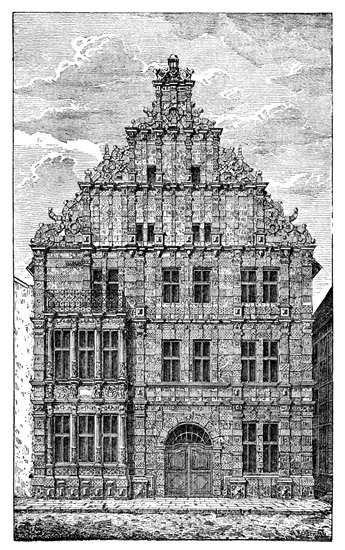
THE PIED PIPER'S HOUSE, HAMELIN.
No doubt, by means of the Flemish market, the League also treated with France, but our knowledge concerning this trade is very scanty. It seems certain that they had no regular factory in that country, though for a short time they held a depôt at Bordeaux. Probably their trade with France was chiefly indirect and by means of Flanders. The fact that for so long the greater part of the French seaboard was in the hands of the English may have had something to do with this matter. We know, however, that successive French kings accorded to them various privileges. Louis XI., on one occasion, speaks of them as a "Power," and proposed to make an alliance with them against England. Charles VIII. yet further enlarged the concessions granted by his father. It is even recorded that in case any difficulties arose because of obscurities of phrase in a contract made between the League and Frenchmen, these should always be interpreted to the advantage of the Hanseatics. They were further promised impartial justice, reduced custom dues, and a civil standing equal in all respects to that of the natives. The kingdom was open to them for trading purposes, and in case of a war breaking out between France and a foreign nation, the Hanseatics were allowed to continue their commercial connection with that nation without being regarded as violating the peace and friendship promised. France, on the other hand, reserved to itself the same privileges. But why France was willing to concede so much to these strangers does not appear. The commerce can in no case have been considerable. The manufactures of France in those days were few and limited. Their small navy did not require much wood, iron, or hemp. It is true they had their wines and their salt, and that in exchange they bought herrings and smoked fish, but there was no such lively and profitable intercourse as we encounter elsewhere. The land was still too poor, too distracted with wars and dissensions to be able to utilize its native riches. Besides this, her own direct commerce with the Mediterranean and Latin East, and the Crusaders and Italian traders, rendered her more independent of Hansa help.
Very scanty are the records that have come down to us concerning the trade of the League with Spain. This nation, incessantly occupied in wars with the Moors and in chivalrous exploits, neglected and disdained trade. They even went so far at times as to interdict it also to others. But all that has come down to us concerning the intercourse of the Hanseatics with this country is so vague, and borders so much on the fabulous, that it cannot be accepted as history. What does seem certain is that in 1383 King John of Castile forbade the Hanseatics to have any intercourse with his kingdom, that he confiscated eighty-four of their vessels, and that in 1441 the factory of Bruges received orders to practise reprisals upon the Spaniards and to close to them all the ports of the Netherlands. All details, however, are lacking. We only know, again, for certain that in 1472 the Spaniards raised the interdict against the League. No doubt they had suffered pecuniarily from the absence of these active traders. In 1551 Philip II. even went so far as to sign a treaty of commerce with the League, in which this prince favoured them as much as his predecessors tried to harm them. And this treaty, strange to say, was not quite a nullity even at the beginning of our own century. On the strength of certain clauses contained in it were founded various privileges enjoyed up to that date, in their commercial intercourse with Spain, by the cities that were then all that remained of the once mighty League—namely, Lübeck, Hamburg, and Bremen.
In Portugal the League was more fortunate than in Spain, and early established a factory at Lisbon. From this port they traded with the Mediterranean, and came in contact with the flourishing Italian commercial republics, as well as with the products of the Levant and India, for which Italy was the sole market. But the Italian trade was chiefly in the hands of the South German cities, such as Augsburg, Ulm, and Nüremberg, and the wares were transported by land. These cities formed a counter league among themselves, which, though in a measure affiliated to the Hansa, was never quite an integral part. Their sole object was the Levant and Italian trade. Already in the thirteenth century they had a depôt at Venice, the far-famed Fontego de' Tedeschi, which visitors to Venice behold to this day as one of the most lovely palaces abutting on the Grand Canal. This factory, however, was very differently constituted from that of other cities. The League never obtained a monopoly or special privileges in Italy. The Fontego at Venice was merely the warehouse or dwelling-house of the German traders, without any internal jurisdiction or president.
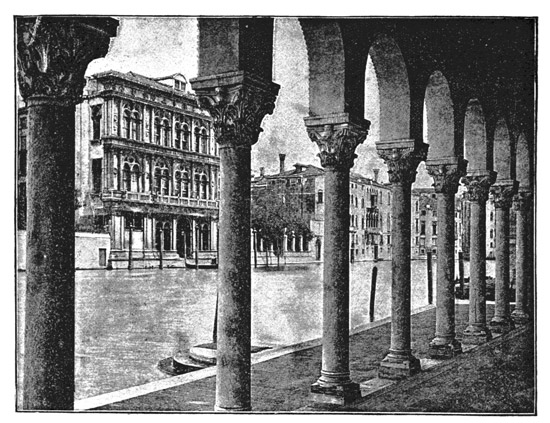
FONTEGO DEI TEDESCHI, VENICE.
They were permitted to sojourn with their wares at stated times in Venice, received on their arrival the keys of the fifty-six rooms of the building, which on their departure they had to re-deliver to the Venetian authorities. In course of time the Germans, gaining refinement and acquiring a love of art from their Italian intercourse, spent large sums in decorating and adorning this palace, which, however, never passed into their real possession. Three Venetian citizens, under the title of Visdomini de' Tedeschi, and native secretaries, and a "fontegaro," always inhabited the building and kept strict watch over the traders, whose commerce was subjected to all manner of tedious restrictions. The house, as we have said, was only open to them at stated times of the year. They were only permitted to sell to and buy from Venetians; all wares exported or imported had to be weighed in the public balances, and only this weight was accepted as just. The Italian secretaries, one of whom always slept in the Fontego, kept strict account of all goods that came to hand or were sent away, and the control over these wares was in the power of the Visdomini. Nothing might be unladen in the warehouse without permission from one of these local officials. But in spite of all these restrictions, which the Germans would not have tolerated for a moment at Bergen or Bruges, their depôt at Venice was a favourite sojourn, and remained the centre of a pleasant, easy, and refined intercourse between Germany and Italy until the time of the Reformation. The influence of the Rialto made itself felt in Prague, Dresden, Frankfort, and the other South German cities, and has placed its imprint upon their literature and art. From Italy these cities brought the models to adorn their streets, markets, guildhalls, and churches. From Italy they brought the tales and fables that delighted listeners long before the days of printing, and awoke the native mediæval poetic art, so that the stories of Boccaccio became as familiar to the Germans as to the Italians themselves. In spite of all the restrictions they placed on their freedom, the foreigners were not unwelcome to the proud Venetian signoria. They even spoke of the German nation as their "cuorisino" (little heart), and in their sore need, during the time of the League of Cambray, formed by the Pope, the Emperor and the kings of France and Spain against the Republic of Venice (1508), they called upon their German friends for sympathy, and did not call in vain. The bond of a common interest, that of trade, bound together the proud rich city of the Lagoons and the less powerful, less wealthy, but by no means poor or insignificant, cities of Southern Germany.


VII.
THE STEELYARD IN LONDON.
Nowhere was the Hanseatic power so great as in England. Of none of its connections do we possess more ample records. As already stated, England was one of the first depôts of the "common German merchant," long before these combined under the generic name of Hanseatic. From early days the English kings had protected these rich foreigners, who helped them out of many a pecuniary difficulty. Indeed they accorded them such privileges and monopolies as could not fail to rouse the jealousy of their own people. We therefore find in the history of the Steelyard in London a mingled record of all passions and interests, hate and favours, honour and national prosperity, envy and violence, greed and poverty, pride and fear, in a word, a most motley record of which it is not easy to frame the contradictory elements into one harmonious picture.
During the long reign of Henry II., and under his sons, Richard Cœur de Lion and John, there was an active intercourse between Germany and England, encouraged by the marriage of Matilda, daughter of Henry II. with Duke Henry the Lion.
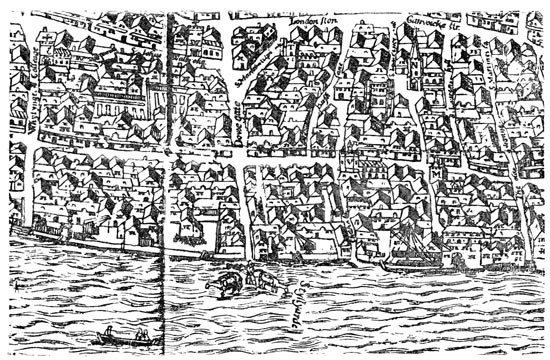
THE STEELYARD, LONDON. (From an old Print.)
The rich merchants of Cologne were the earliest to obtain special favours. These were accorded by Richard Cœur de Lion, who, halting in that city to attend high mass in the cathedral after his release from Austrian imprisonment, received there such ample supplies towards the heavy ransom money required for his person, that, to show his gratitude, he gave to his "beloved burghers of Cologne" a letter of freedom, in which he released them from their annual rent of two shillings for their guildhall in London, and from all other taxes due to the king upon their persons or their merchandise. It was long ere King John, his successor, could make up his mind to renew these privileges, but his own difficulties with his turbulent barons, and the pressure which the merchants could bring to bear by their riches, at last overcame his hesitation. Edward I. and his followers further extended these prerogatives, for the Plantagenets found the Hanseatic Rothschilds even more useful in aiding their war schemes than the skilful alchymists whom they had summoned to their Court, and who knew how to shape the Rose noble (the money of the period) out of artificial gold. Then, too, the Hanseatics were considerate creditors, who did not press unduly, and even overlooked a debt if some favour were extended in default of payment.
Edward the Third's crown and most costly jewels were long retained at Cologne in pawn for a heavy sum of money. The details concerning this transaction are preserved to this day in a correspondence deposited in the State Paper Office of London. It seems that when the time for redemption came the king had not the money. He was in special straits just then, for the celebrated commercial firm of the Bardi, at Florence, which constituted the very focus of the Italian money business, had failed, and the King of England appeared in their books as a debtor for the sum of one million golden gulden. The merchants of the Steelyard were not slow adroitly to turn the royal perplexity to their profit. They undertook to redeem the pawned jewels and offered the king loans of more money, although he already owed them much. Edward was in sore need, for the wars with France strained his resources to the utmost. He drew upon them for thirty thousand pounds, a sum worth fifteen times more then than to-day. Thus it came about that the great victories of the Black Prince at Crecy and Poitiers were gained in no small degree by the help of German capital. Needless to add that the Hanseatic merchants showed no diffidence in accepting for their factory important privileges in return for these services.
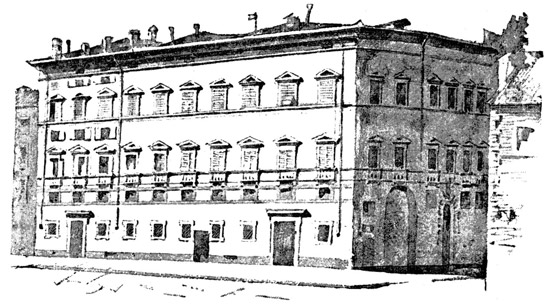
BARDI PALACE, FLORENCE.
It was to a German merchant prince that the king let the tin mines belonging to the Black Prince in the Duchy of Cornwall. To the same firm he ceded a large number of farms situated in different shires for the space of a thousand years.
The Easterlings are spoken of in records as the allies of the English kings, and there seemed at last no limit to the royal favours.
That the people did not look upon them with the same friendly eye is easy to understand. The English, full of a just sentiment of what they could do by themselves, and of what they were hindered from doing by these foreign monopolists, bore their presence with extreme impatience. Feuds and riots were not infrequent, and no royal favours, no Hanseatic ships of war could save them from occasional brutal attacks at the hands of the mob. Thus during the Wat Tyler rebellion the people pursued the hated foreigners even into the sanctuary of the church, murdering mercilessly all those who could not pronounce the words "bread and cheese" with the pure English accent. But these rebellions were quelled by the royal commands, or extinguished themselves by the fact that the Hanseatics were also useful to the English people, oppressed by the feudal system and engaged in constant wars, whose trade industries were thus unable to develop quickly. Nor did such passing storms shake the power or the resistance of the Hanseatics. Bloody encounters, rude tumults were entirely in keeping with the license and roughness of those earlier ages, and were met by the League, more or less, in all their foreign stations.
With their usual astuteness they utilized wisely all periods of calm, and reckoned with the love of gain to help them in less peaceful moments. When the English made things uncomfortable for them at home, they revenged themselves upon them at Bruges or at Bergen, paralysing their commerce, and harassing their vessels, even forbidding them to enter the ports of Norway, Iceland, and Greenland. For verily in those days whosoever tried to outwit the Hansa was likely to prove the victim of his own plots. Circumstances aided the Germans, enabling them to make their power felt just when England had to betray weakness. The feeble and stormy period of Henry VI., often deposed and made prisoner, the Wars of the Roses, the long and continual hostilities waged with France, all favoured the League, and made the English submit to its demands rather than attract to themselves yet more enemies.
In no place, not even in Bergen, did the Hanseatics succeed in enjoying greater independence. Their factory was privileged, and while benefiting by English law, they were quite independent of it. Everything, therefore, was favourable to their commerce, and they were hampered by no such restrictions as weighed, not only upon other foreigners, but upon the English themselves. To give a just idea of the degree of power to which their privileges and trade had raised the League, let us cite one example. It will serve in lieu of many, and it places in full light the almost incredible ascendency which a company of merchant cities, isolated and distant from each other, had gained over a great kingdom and a proud and valiant nation.
The English Government having been unable or unwilling to repress the frequent acts of piracy which its subjects practised against members of the League, these also took to piracy, and mutual recriminations ensued. The Lübeckers in particular revenged themselves fiercely. They also wrote a letter of complaint to the English king, "a letter full of pride and audacity," says Henry IV. It then happened that the Danes, at strife with the English for other causes, joined themselves to the Hanseatics, and united they harassed the English by sea and by land. These, in their turn, took possession of the Hanseatic depôt in London, and put in prison or killed all who lodged there. The League hearing this broke off commercial connection with England, closed their ports and the entrances of the Baltic, and seized English vessels on all seas and on all coasts. The Hanseatics even landed in England itself, and pitilessly ravaged many of the maritime provinces, hanging on the masts of their ships all the men they took prisoners. This war at last grew so ruinous for the English that they applied to the Duke of Burgundy, Charles the Bold, to mediate between them and their foes. A congress was assembled at Utrecht to put an end to this dire quarrel and to assure peace upon a solid basis. The mediator and his counsellors thought it but just to accord to the English a part of what they had desired so long, namely, liberty to trade in the Baltic and with the Hanseatic ports of Dantzig and Russia. This concession greatly favoured the commerce which their merchants were ambitious to carry on, or already carried on, notwithstanding all obstacles. But for their part the Hanseatics insisted on recovering all the privileges they had lost, and on recovering them with usury. In fact, by this treaty of Utrecht Edward IV. not only reconfirmed all their ancient monopolies, but accorded to them new and important favours, proving to what extent the English were still in the power of these foreigners. Such was the effect of the fear which the League inspired in the English; such, too, was the ignorance of their Government, which, being in possession of a power not less great and, had they desired, even greater than that of their rivals, allowed strangers to deprive them of the most useful of all independent rights, that of utilizing for their own profit the resources of their own labour and their own soil.
In reading this chapter of the annals of England, it is hard to believe that we are dealing with the nation whose ships now scour all the seas, whose tonnage exceeds that of all other countries combined, which is the greatest trader of the earth, and which trades not only freely, but also in that spirit of domination with which its ancestors reproached the Hanseatics, and which they endured with so much impatience.
This treaty of Utrecht served for a long while as basis for all subsequent treaties between the Hanseatics and the English, and well or ill observed, it survived until the reign of Edward VI.
The position held by the Hanseatics in England certainly has no counterpart in the international intercourse of the Middle Ages. The only exception, perhaps, is the position of Genoa, Venice, and Pisa in the Byzantine and Latin empires.
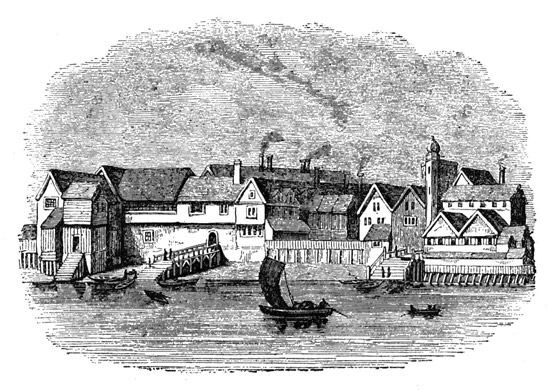
STEELYARD WHARF, LONDON.
The chief depôt of the Hanseatics in England was in London, and was known first as the Guildhall of the Germans, then as the Easterlings' Hall, and finally, as its dimensions grew, as the Steelyard. It was situated in Thames Street, on the left bank of the river, close to Dowgate, just above London Bridge, in earlier times the only city gate that commanded the water. The whole length of this street leading to the post gate was lined with the wharves, warehouses, and dwelling-houses of the Germans. It is therefore easy to comprehend how they held, by their position alone, the key to the whole commerce of the City of London in days when goods were almost entirely transported by water-ways. As at Bergen, so here, they dominated the whole commercial situation.
There have been many disputes as to the origin of the name Steelyard. It has been now pretty well established that it took its rise from the fact that on this spot stood the great balance of the City of London, known as the Steelyard, on which all exported or imported merchandise had to be officially weighed. It was after the treaty of Utrecht in 1474 that the German factory first took this name, from the circumstance that its domain was then greatly enlarged. The whole place was defended by a high strong wall, fortress fashion, and there were few windows towards the front. This was as a protection from the frequent attacks of the London mob, and also as a defence against the robbers anxious to penetrate into a storehouse of riches. The chief building, still called their Guildhall, was a massive stone structure, of which, until 1851, some of the main walls still remained. The northern front, which looked towards Thames Street was especially imposing with its many stories, its high gabled roof, surmounted by the double eagle of the empire with its outspread wings. Three round portals, well protected and clamped with iron, were seen on its northern frontage. The centre one, far larger than the others, was rarely opened, and the two others were walled up. Above these three portals were to be read, in later days, the following characteristic inscriptions:
"Haec domus est laeta, semper bonitate repleta; Hic pax, hic requies, hic gaudia semper honesta."
"Aurum blanditiae pater est natusque doloris; Qui caret hoc moeret, qui tenet hoc metuit."
"Qui bonis parere recusat, quasi vitato fumo in flammam incidit."
The second of these couplets is attributed to Sir Thomas More, Chancellor of England, author of the "Utopia," and a good friend to the Hanseatics. This great hall was used for the meetings of the merchants and for their common dining-room. At one end was a low tower that served as depository for the documents and valuables belonging to the merchants or the factory. Close upon the river stood another strong building, the dwelling of the house master. Here was the capacious stone kitchen, in which ample preparations were made for the dinners of week-days and festivals. Between these two buildings ran the garden, in which the Germans had planted fruit trees and vines. On summer evenings they were wont to rest here after the business of the day, while the young people among them amused themselves with playing at ball or other recreations. It was a pleasant green spot with cool shady arbours, tables, and seats, and was frequented, not only by the Hanseatics themselves, but by the London citizens; for the League had the permission to sell their Rhenish wines in this spot. Threepence a bottle was the average price.
In "Pierce Penilesse, his application to the devil," we read, "Let us go to the Stilliard and drink rhenish wine;" and in one of Webster's plays a character says: "I come to entreat you to meet him this afternoon at the Rhenish warehouse in the Stillyard. Will you steal forth and taste of a Dutch brew and a keg of sturgeon?" This garden restaurant was also famous for its neat's tongues, salmon, and caviar. It would seem that the place was a favourite resort from the days of Prince Hal and Sir John Falstaff to those of Lord Herbert of Cherbury, the former the embodiment of boisterous enjoyment, the latter of chivalric and pedantic learning. A multifarious and varied company indeed that little garden harboured in its day, who met in "the Rhenish wine house" to close their bargains over their wine cups, for festive carouse or serious talk. There could be seen England's most honoured men; bishops, mayors, ministers, chancellors, naval and military heroes. Even Shakespeare's company of actors, London's merriest gourmets, are known to have turned in here. The spot did not lie far off the famous "Boar's Head" tavern, and Prince Hal's town residence in Cold Harbour Lane abutted upon the Steelyard. There, too, assembled the grave ambassadors of the Hanseatics, their delegates and merchants, their apprentices and agents; a motley crew indeed, who, until the days when the garden in Cosins Lane perished in the Great Fire of London (1666), constantly frequented the locality, and helped to enhance its wealth and importance. The memory of the place was kept up, till quite lately, by a large tavern, bearing the sign of the Steelyard, which still stood on the same spot, surmounted by a bunch of golden grapes, similar to those which we so frequently meet with in the narrow streets of old German towns.
No less busy, no less varied was the inner life of that small state within a state. A strange little world with its severe monastic discipline, its semi-religious character. In many rooms and halls, in warehouses and passages, were crowded a number of masters and men, assembled here from some sixty Hanseatic cities, busy superintending the stapled wares which arrived by river and were drawn up by means of the mighty crane that formed a notable feature in the water frontage of the factory. Some wares, too, arrived by way of the crooked streets. These entered the building through the small carefully guarded doorways. As time went on and there was not room enough for all the guests in the main building, adjoining houses were rented for the Hanseatics, but all were subject to the same rigid discipline, and were members of the same large household. In early days the London merchants had insisted that an Englishman should be head inspector of the Hanseatic warehouses, but from this they soon freed themselves, alleging that it was giving the sheepfold over into the keeping of the wolf. As elsewhere, the presidency was assigned to an alderman and twelve councillors. These were chosen from the different towns in rotation. As elsewhere, all residents had to remain unmarried during the period of this sojourn in the Steelyard. Not even the house-master was allowed to have a wife. In later years, a Cologne merchant who had decorated, improved, and enlarged the garden inn, and turned it into one of the most beautiful taverns in London, being a resident for life, was anxious to marry. But so sternly did the League hold by their decree of celibacy for their absent members, that they only agreed to make an exception in his case after fourteen members of the English Parliament had signed a round robin petition to the Hanseatic Diet to this effect. Those who trespassed against the by-laws of the house as to habits or morals were heavily fined. If refractory they were often imprisoned, and at times even the aid of the English constables would be called in. But this was not frequent. The Hanseatics preferred to manage their own affairs, and keep themselves distinct from the natives among whom they dwelt. In criminal cases the jury, as is still the custom in England under similar conditions, was composed half of Englishmen, half of Germans. At nine every evening the portals of the various dwelling-houses were closed, and the key given to one of the masters, who took turns to fill this office. Whoever played at dice in his room at the tavern, whoever entertained non-Hanseatics, whoever let a woman cross the precincts of the Steelyard paid a heavy sum, of which half went to the informant. Cleanliness was severely imposed both in person and in the use of the common sleeping and packing rooms. The fine for contravention in this respect was paid in wax, not in money. It was employed for the candles which the Hanseatics kept burning on their behalf in the church of All Hallows the More. Opprobrious language towards one another, blows or drawing of knives was fined by a hundred shillings paid into the common fund; a high sum truly if we consider that five pounds sterling was worth, in the fourteenth century, about four times its present value. They were even forbidden to fence or to play tennis with their English neighbours under out paying a penalty of twenty shillings.
Every merchant was bound to have in readiness in his room a full suit of armour, and all the needful weapons in case of an attack on the Steelyard, or on the Bishopsgate. For the City of London had ceded to the Hanseatics this gate, which they had to guard and keep in repair, relieving them instead of the annual tax towards the preservation of the town walls known as wall-money, of bridge money, and paving money. They also managed to obtain special privileges with regard to shipwrecked goods; the English being obliged to pay them damages provided that something living, if only a dog, or cat, or cock reached the shore alive from the shipwrecked vessel. This secured them greatly from the perils of wanton wreckage.
In London none of those gross manners and customs prevailed that we find at Bergen or Novgorod. The Hanseatics knew that in England they found themselves among a people fully their equals, and were careful not to offend them in any respect. Indeed they did all they could to conciliate them, and were liberal in presents. Thus the Lord Mayor of London received from them yearly a cask of the finest sturgeon, or two barrels of herring, or a hundredweight of Polish wax. An English alderman, annually chosen to adjust disputes between the natives and the foreigners, was presented each New Year's Day with fifteen golden nobles, wrapped up in a pair of gloves, by way of tender consideration for the feelings of the recipient. The Chief Inspector of Customs received about twenty pounds sterling, intended probably to make him indulgent in the exercise of his duties. And so forth, making as a whole a most goodly sum thus wisely spent in fees and in conciliating those in power and office. Every point relating to this as well as to the inner statutes of the factory was most carefully recorded in writing, and has, in large part, been preserved to us. It is a record of most quaint regulations, every one of which no doubt had its wise purpose and scope.
The Hanseatics purchased from the English the produce of their flocks and tillage, that is to say, wool, strong hides, corn, beer, and cheese. Wool was from the earliest date one of the chief and most important articles of their exportation from England. This was sent to Flanders and the Netherlands to be worked up. It was only later, as the English learnt to manufacture skilfully this costly produce, that the Hanseatics exported the finished goods in lieu of the raw material. The details concerning this wool trade show how many places in England were engaged in it, and how appropriately the Chancellor of England is seated upon a wool-sack as symbol of one of the main sources of England's ancient wealth. So valuable, indeed, was this wool trade that a special tax was placed upon the wool, a tax which Edward III. repeatedly farmed out to Cologne merchants for the space of several years in advance in return for ready cash.
Among the articles imported by the League we find pepper, potash, various kinds of wood adapted for building ships and making crossbows, iron and iron utensils, flax, linen, hemp, grease, fish, corn, and Rhenish wines. We even find that they imported French wines after the English had lost all their possessions in France with the exception of Calais. By their means, too, there came to England Italian and Oriental produce, such as choice spices, perfumes, medicines, metals, figs, almonds, dates, even gold dust, and jewels, with which they provided themselves at Bruges.
A very important branch of trade was that in salted cod-fish, or stock-fish as it was called, an article largely used on the Continent and in England too in the Middle Ages. With this the English were then accustomed to feed their troops when on service. Nor were even living creatures lacking among their cargoes, such as choice falcons from Norway or Livonia, for which the English nobility, who were then, as now, passionately addicted to sport, paid high prices.
Indeed, the Steelyard was one of the staple places for the export and import of all the principal necessaries of life before men had thought of the products of America.
Nor was London by any means their only depôt. It was the chief, but they also had factories in York, Hull, Bristol, Norwich, Ipswich, Yarmouth, Boston, and Lynn Regis. Some mention of them is found in Leland's "Itinerary." Under an invitation to the Hanseatics to trade with Scotland we find the name honoured in legend and song of William Wallace. In John Lydgate's poems we also meet with our Hanseatics. In relating the festivities that took place in London city on the occasion of the triumphal entry of Henry VI., who had been crowned king at Paris some months previously, the poet narrates how there rode in procession the Mayor of London clad in red velvet, accompanied by his aldermen and sheriffs dressed in scarlet and fur, followed by the burghers and guilds with their trade ensigns, and finally succeeded by a number of foreigners.
"And for to remember of other alyens, Fyrst Jenenyes (Genoese) though they were strangers, Florentynes and Venycyens, And Easterlings, glad in her maneres, Conveyed with sergeantes and other officeres, Estatly horsed, after the maier riding, Passed the subburbis to mete withe the kyng."[10]
A love of pomp and outward show was indeed a characteristic of the Hanseatics in England who thus perchance wished to impress upon the natives a sense of their wealth. As times grew less turbulent and the German Guildhall less of a fortress, it was handsomely decorated with costly paintings and fine carving. Most notable were two large works by Holbein, who visited England at the invitation of King Henry VIII., desirous of emulating his rival Francis I. in protecting the fine arts. When the painter first came over he lived in one of the quaint houses that, before the Great Fire, stood on London Bridge, and some of his earliest works seem to have been two commissions for his countrymen, whose Steelyard was close by. They were destined to decorate the Great Hall, and were tempera pictures representing respectively the Triumph of Poverty and of Riches. When in the days of James I. the Steelyard ceased to exist as the collective home of the Hanseatics, the towns decided to present these pictures to the Prince of Wales, Henry, who was a lover of the arts like his younger brother, Charles I., into whose collection they passed on Henry's death. Unfortunately, they perished in the great fire that destroyed Whitehall. Federigo Zuccari, who saw them during his sojourn in London and appraised them as exceeding in beauty the works of Raphael, made careful drawings of them, and thanks to these and the engravings made after them we are in possession of at least an outline representation of Holbein's work. The pictures are conceived in the spirit of the age that loved such so-called triumphs in art and poetry. The figures, chiefly allegorical, were life size and in the richness of fantasy and learning that they display it is permissible to recognize the help and advice of Holbein's friend, the Chancellor, Sir Thomas More. In many cases the names of the personages represented are written beside the figures, after the quaint method of that time.
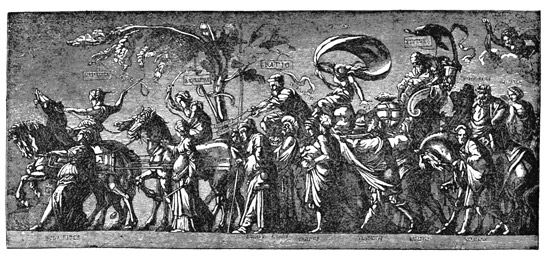
THE TRIUMPH OF RICHES, BY HOLBEIN.
The Triumph of Riches shows a car of Plutus drawn by four white horses, driven by Fortune and followed by a motley crowd which includes Justice, Usury, Bona Fides, Sichæus, the rich husband of Queen Dido, Pythias (of whom Plutarch tells that he so loved gold that once when he returned hungry from abroad his wife placed gold before him instead of meats), and many figures, for the most part culled from the pages of Herodotus, Juvenal, and other classic authors. In the heads of Crœsus and Cleopatra it is said that Holbein painted likenesses of Henry VIII. and Anne Boleyn. In a corner of the picture is written the distich ascribed to Sir Thomas More which we have already met with above the central portal of the German Guildhall.
The Triumph of Poverty was purely allegorical, and appears to have been considered less attractive than the former work, whether on account of its treatment, or on account of its less pleasing theme does not appear. In this case the car is drawn by two oxen and two asses, designated as Negligence and Idleness, Greed and Sloth. This canvas, too, bore some Latin verses from More's pen, which, curiously enough, have not been incorporated in his collected works.
In all public ceremonies and processions the Hanseatics seem also to have taken a notable part; as we mentioned above on the occasion of Henry the Sixth's entry. We come across another detailed account when Queen Mary went in triumph through London the day before her coronation. At Fenchurch the Genoese had dressed up a lovely boy as a girl, who was carried before the Queen and greeted her. The Hanseatics had built up a hillock in the corner of Gracechurch, whence a fountain poured forth wine. On this hillock stood four children who likewise greeted the Queen. In front of the Steelyard they had placed two casks of wine, from which they poured drink to all who passed. This liberality cost them a thousand pounds, and heavy payments to cover such expenses are not infrequent in their account books.
In England, contrary to the usual custom, the Hanseatic League never had its own church. Perhaps this need was less felt in a land that professed the same creed than in Russia. The Germans frequented the parish church of All Hallows, contenting themselves with endowing a chapel, altars, special masses, and alms. They also presented the church with costly stained glass windows, in the decoration of which the German imperial eagle figured conspicuously, and with cunningly-carved stalls reserved for the use of the Steelyard authorities. As late as the year 1747 these seats were still in the possession of the master of the Steelyard and the other representatives of the guild. In front of these stalls there always burned five of the biggest tapers the church could boast. Indeed the Hanseatics were famous for their outward observances of piety, both while they were Catholics and after they, as well as the English, became Protestants. Of course the Catholic religion made more show. Saint Barbara was a saint whom they specially affected, and on her day (December 4th) they caused a most elaborate mass to be sung and afterwards treated the priest, their English alderman, and the royal doorkeeper of the Star Chamber to fruit and wine in the Cosin's Lane Garden. At Corpus Christi they joined the great procession of all the guilds and notabilities; and on midsummer night, and the eve of St. Peter and St. Paul, they illumined their Great Hall after the ancient Saxon fashion with Yule fires and torches. After the Great Fire of London the League presented All Hallows with a carved oak screen that ran the length of the whole church. It was the work of a Hamburg carver, and excites admiration to this day. In the centre it shows the large imperial eagle, as also the arms of Queen Anne; the main work consists of twisted columns and arches.
The Germans in England seem to have adopted the purer Protestant doctrines with great caution, if not tardily. At least we have it on record, that when in 1526 a commission, headed by Sir Thomas More in person, proceeded to make a domiciliary search of the Steelyard for writings of Luther, nothing was found but Old and New Testaments and German prayer books, while the whole body, both young and old, swore at St. Paul's Cross that there was not a heretic among them. Soon afterwards the Reformation was firmly established in England, as it already was in most of the cities belonging to the League, and from that time forward the Steelyard associates attended the English Protestant service in All Hallows Church.
Such were the life, the habits, and the nature, of the German community that made its English centre in the Steelyard, and which, so long as it was in harmony with the times, conferred many advantages not only upon themselves, but upon the people among whom they dwelt. For in thrifty activity the English in those days could not be compared with the Hanseatics, while in point of wealth no one could compete with these Germans, excepting only the Italian money-changers of Lombard Street, then, as still, a favourite locality of banking houses. But the Italians were exclusively occupied with financial transactions, while the Germans devoted themselves exclusively to mercantile affairs.

VIII.
THE ORGANIZATION OF THE HANSEATIC LEAGUE.
The notices that have come down to us about the organization of our League are scanty, although we possess a vast number of minutes concerning their diets. It is doubtful whether there was even a fixed mode of governing and government, whether the whole was not rather in a state of flux controlled by the circumstances of the moment. That certain traditional modes of administration obtained, however, seems indisputable. It raises a smile to read that when some problem seemed insoluble, or some venture proved a failure, our naïve Hanseatics registered in their books, "of this matter let those think who come after us," thus throwing the burden upon the following generation.
There was no fixed place of meeting for the Hanseatic diets, but most frequently these were held at Lübeck, because it was situated almost in the centre of the various activities of the League. The assemblies were held in "the name of all the cities," and those who failed to send representatives were begged "not to take it amiss" if conclusions were arrived at without their sanction. "Every town shall consider the benefit of the others, so far as is in accordance with right and honour," runs one of their quaint formulæ. "Should strife arise between the cities, which God forbid, they shall settle their dispute according to the counsels of the neighbouring towns."
There was also no fixed time for these diets; they were assembled according to urgency or press of business, but usually they were annual, and met about Whitsuntide, as that feast falls in the fine weather, when travelling was easier for the delegates of the northern towns. At the close of each diet, the deputies present decided on the time and place of the next meeting, and Lübeck and other leading cities were charged with the care of making known to the cities unrepresented the decisions arrived at by the assembly. But default to send a deputy to the diet was not lightly overlooked. Some excuse had to be given, and the validity of the excuse was sharply criticized. Sometimes a town might be busy resisting its temporal or ecclesiastical lords, an internal revolution might have occupied all its energies, the roads might be unsafe, or it might have been visited by some public calamity like the Black Death. If the diet thought that these pleas were merely subterfuges to save the expense of sending a delegate, or to avoid explaining some infraction of the rules of the League of which the city in question was guilty, a heavy money fine was imposed, and in case of absence three times repeated it might even find itself "unhansed," deprived of all the pecuniary privileges belonging to members of this powerful association. By such rigid measures did the League hold its members together. Nor was this all. A deputy who did not arrive in time for the opening of the proceedings was fined a gold mark for each day of delay, a fine that was not remitted unless the causes for his default were found on scrutiny to be in every way sufficient.
On their arrival at the meeting place, the deputies were received in state by some member of the local municipal council, and were offered the wine of honour. The conferences began about seven or eight in the morning, and lasted till one or two in the afternoon. One of the burgomasters of Lübeck was usually made president. At the first meeting he would thank the members present for having come, and these would reply to him in courteous terms. Then when all their credentials had been examined, and the excuses of the absent sifted, the diet would proceed to the business in hand. This business was heavy and varied, covering the external and internal policy of the League, the needful moneys to be raised, the state of the various foreign factories. Even private quarrels between merchants were heard here in appeal. The diet decided on peace and war, sent despatches to foreign kings and princes; threatened, warned, exhorted, those who had failed to fulfil treaty obligations. Such was its power that it rarely failed to make its voice heard, and a threat indited by the city of Lübeck was not put quietly into the waste-paper basket by the northern courts. These missives were sealed with the seal of the city in which the diet was sitting at the time. Just as in their buildings, their guildhalls, and their towers, our forefathers knew how to express a quaint conceit, so also in a simple seal they understood how to express symbolically a summary of their activity. Thus the pious and wise Lübeck bore on its city seal a ship with high bulwarks, from whose single central mast waved a flag bearing the cross. An ancient pilot steers the vessel through the waves with his left hand while his right is raised in admonition. Opposite to him sits a youth busy with the ropes, who, with his uplifted right hand, seems to point to the help of heaven. This was to symbolize that prudence, energy, and pious confidence accompanied Lübeck in all its paths. The common Hanseatic seal was only used for foreign affairs. It represented the imperial double eagle with the inscription "Signum civitatum maritimarum."
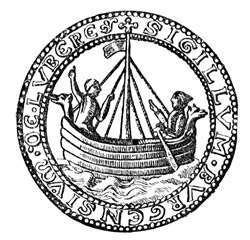
SEAL OF LÜBECK
The decisions arrived at by the diet were all recorded in careful minutes, known as "recesses," of which an immense number have come down to us, escaping fire and other vicissitudes. They all testify to the thoroughly businesslike character that distinguished the League. Among other matters we often come across applications from cities to be admitted into the Hansa. Their candidature was generally addressed to Lübeck, and their claims and resources carefully scrutinized by the prudent League. As a rule the demand was conceded. The League was never sorry to see its strength grow, and its expenses diminish by being divided among a greater number of towns. Such admission, however, was made upon unequal conditions, according to the importance, the resources, and the situation of the city in question. This inequality had struck deep roots also in the very heart of the cities. The inhabitants were far removed from enjoying the same prerogatives, the Hansa was by no means a democratic association. The most important posts were reserved for a certain number of families know as patricians, who had distinguished themselves by services for the common weal, or who held power in the shape of wealth. An individual, however, could be "unhansed" as well as a city, if he had failed to observe some law of high commercial consequence, and it was even more difficult for an individual to be readmitted than a town.
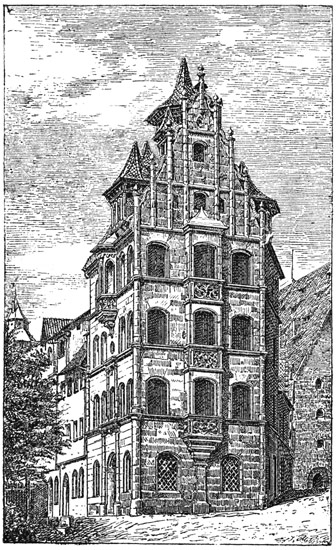
PETERSEN-HAUS, NUREMBURG.
From the inequalities in the position of different members of the League there arose conflicts of interest which were to prove "the little rift within the lute," that by and by should "make the music mute." For instance, the interest of the maritime towns was not always that of the inland ones. Schisms and divisions were apt, above all, to take place when there was a question of beginning a war, as this could never be done without general approbation. Each town was inclined to throw the burden on its associates. For as each was solely preoccupied with its personal interests, and only entered into the League with a view to the profits it could thus obtain, there was always in the minds of the delegates a tacit reserve to make as few sacrifices as possible, and as time went on they were even ready to abandon their allies, and let the League perish if they did not find themselves directly benefited by any sacrifice demanded by the common weal.
What held them together at all was, in a word, nothing more noble or ideal than personal advantage, the fear through exclusion of losing by exclusion, the great advantages that accrued from being a member of the League. No wonder that with an ambition so little exalted the Hansa was destined not to survive until our own day. For communities like individuals must strive after some lofty ideal if their existence is to be happy, and to have a sound enduring basis. The wonder is rather that seeing what motives animated its members, the defective character of the means at its disposal, such as the lack of a standing army, and the constant mutations in its form of government, it should have attained to such mighty results as we have roughly sketched in this, the second and culminating period of its existence.