PERIOD II.
Reading edition
THE HISTORY OF THE HANSEATIC LEAGUE, FROM 1370 TO THE PUBLIC PEACE OF 1495, DECREED IN GERMANY BY MAXIMILIAN I.
I.
LÜBECK RECEIVES AN IMPERIAL VISITOR.
The great war ended, the Hansa, in true merchant spirit, instantly busied itself making up its accounts. The poundage toll, instituted to cover martial expenses, was at once abolished; credit and debit carefully balanced. Examination of its books showed that, notwithstanding the long duration of the war, the Hansa had been as little a pecuniary, as it had been a military, loser, in its struggle against Waldemar's assumptions.
While thus engaged, Lübeck was startled by the intelligence that the Emperor, Charles IV., intended to honour "his beloved free Imperial City of Lübeck" by a personal visit. Since Frederick Barbarossa no emperor had ever passed the city gates, and the town councillors were probably not far wrong when they perceived in this proposal a tacit imperial acknowledgment of the Hansa's great military victories, victories in which Lübeck had played the part of leader. For twenty-eight years Charles had worn the imperial crown, and all that time his chief efforts had been directed towards extending the power of his family, and the home influence of the emperors. He was a shrewd and wily old man, who saw the dangers Italy presented to the empire, and wished to avoid them. At first, however, he had no proper comprehension of the great power that had sprung up within his own domains in the shape of the Hanseatic League, nay, indeed, he had sided against his subjects and with Waldemar. But now the scales fell from his eyes, and he appreciated, as all Europe did, the greatness and the strength of the Hansa.
Of course he did not admit this in words, yet there is little doubt that he wished to gain the goodwill of this League, and hoped thus to get from it both pecuniary and military support for his dynastic plans.
It was, however, "diamond cut diamond;" the worthy councillors of Lübeck were no less shrewd and wily than their imperial master. Needless to say that, in accordance with the usage of the age, they indulged in the most servile and hyperbolical expressions of their joy and unworthiness to be so honoured, but like true merchants they had a good memory, and knew that Charles had not so long ago pawned his coronation cloak and some of his tolls to one of their federation, and they suspected in their heart of hearts that ulterior motives were probably not absent to account for this unwonted event. Still, with the wisdom of the serpent, they let nothing of this appear, either in their replies to Charles, or in their treatment of him. Like their Lombard predecessors, even when in open warfare against the emperor's authority, they ever protested in words their submission and fidelity to the imperial crown.
It was in the autumn of 1375 that Charles the Fourth entered the gates of Lübeck as the city's guest. It is a curious fact that his visit coincided with the death of Waldemar on the island of Zealand; but in those days of slow communication the news did not reach the emperor till after the festivities were over.
On October 22nd, the Emperor, accompanied by the Empress, the Archbishop of Cologne, prince-bishops, dukes, earls, and suzerains many and mighty, halted before the closed gates of Lübeck. His suite, his armed retainers, and those of his party, made such a numerous host that Lübeck hesitated awhile ere opening its gates to so great a multitude, not feeling wholly sure whether their mission were indeed one of peace, or whether an affectation of peace was meant to cover a deceitful attack. For such things were not uncommon in those days.
After some preliminaries it was however decided to let them all in. A halt had been made outside the walls. Here was situated the Chapel of St. Gertrude, patron saint of strangers. The chapel was the property of the municipal council, and to obtain relics for it the town had spent many sums of money. Among other matters, they boasted of possessing some bones of Thomas à Becket, and it is curious to note that they sent over to England to buy these at the very time Chaucer was superintendent of tolls in the harbour of London, and was writing his immortal "Canterbury Tales," in which he derides the frauds constantly practised upon the purchasers of such wares; as in his "Pardonere's Tale." Now Charles IV. had a great fancy for objects of this nature; he was in the habit of making tours in his kingdom in order to collect them, begging them from churches or monasteries, and giving in return privileges and sanctions. It is possible he also had an eye to St. Thomas's bones, but among the rich booty he took with him from Lübeck, we find no mention of such relics.
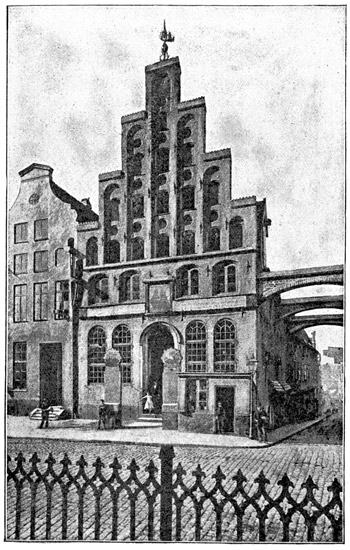
SHIPPING HOUSE, LÜBECK.
It was before St. Gertrude's Chapel, then, that Charles and his great suite halted, and here he and his empress put on their imperial robes previous to entering the city. This done, they were greeted by a procession that came forth from the gates to welcome them. It consisted of the temporal and spiritual lords of the town, the leading men, and the most lovely and notable of its women. They carried before them a crucifix and a casket containing relics. Both the emperor and his consort kissed these with great fervour. Then two stately horses, richly caparisoned, were brought before them, upon which they mounted. That of the emperor was led by two burgomasters, that of the empress by two town councillors. Eight young patricians carried a baldachino of rich stuffs over the heads of the imperial pair. In front of the emperor rode a councillor, bearing aloft on a pole the keys of the city; while he was flanked by two imperial dukes, carrying respectively the sword and the sceptre of the empire. In front of the empress rode the archbishop, bearing the imperial globe. Behind followed all the nobles, the suite, the men-at-arms.
Such was the procession that moved from St. Gertrude's Chapel on the morning of October 22nd. In the space between the outer and inner walls of the city the women of Lübeck awaited them ready to greet the guests with cheers and song and waving kerchiefs. It was through the stately Burg Thor that the great train passed and entered the streets of the city, gaily decked out with arras and banners and verdure to bid them welcome. They rode the whole length of the town, through the Breite Strasse, to the sound of fife and drum, and then made for the cathedral. Here they halted, dismounted, and entered. A solemn thanksgiving service was held, and the choir sang the Introitus for the feast of the Epiphany: "Ecce advenit Dominator Dominus" ("Behold the Lord, the Ruler is come"), and then the second verse of the Seventy-second Psalm, "Give the king Thy judgments, O God." After this the party once more re-formed, and rode along the Königstrasse, till they came to the house that was to harbour the imperial guests.
Contemporary chroniclers tell us that all along the route of the procession and both by night and day the sounds of military and sacred music never ceased. Night was as light as day, thanks to the general illumination prescribed by the council; a prescription that, in a city thus overcrowded by a martial train and by curious spectators from far and near, was as much a matter of safety as of compliment to its guests. In those times street-lighting was an unknown luxury, and nocturnal brawls of constant occurrence.
The house where Charles halted exists to this day, as also that where the empress lodged. They are both corner-houses and boast gables, which according to contemporary writers was an indication of an aristocratic building. The lodging of the empress was opposite to that of the emperor, and a covered way was built across the street to connect them. Such road-bridges, springing from the projecting gable windows, were not unusual things in the harrow streets of those times. The condition of the unpaved roads made them requisite, as these could not be crossed on foot with safety or cleanliness.
For the space of eleven days Charles and his train halted at Lübeck, and the town spared neither cost nor trouble to entertain him right royally, and to impress him with its wealth and importance. Feasts, tournaments, rejoicings, followed upon one another; time was not allowed to hang heavy upon the emperor's hands. But neither was he allowed to carry out his ulterior objects. With great politeness and fulsome flattery Charles was made to understand that the Hansa was sure of its own strength, and since he had not helped it in the hour of need, it did not propose to make great sacrifices to assist him in his troubles. All however was done with perfect courtesy, Charles even being permitted on one occasion to be present at a meeting of the municipal council when both sides exchanged pretty compliments. He even went so far as to address them as "Lords." With great modesty they disclaimed this appellation. But the emperor insisted on it: "You are lords," he said; "the oldest imperial registers know that Lübeck is one of the five towns that have had accorded to them in the imperial council the ducal rank, that they may take part in the emperor's council and be present where is the emperor."
These five cities were Rome, Venice, Pisa, Florence, and Lübeck.
When Charles left Lübeck he was delighted with the hospitality he had there received, but disappointed in his political aims. It is certain, however, that he rode out richer than he rode in; to this the account books of the city bear testimony, of this the taxpayers told a tale for many a long day. Indeed the expenses incurred through this imperial visitor were to lead later on to some serious riots of the guilds against the municipality.
It was through the Mühlen Thor that Charles departed with his train and by order of the town council this gate was walled up for ever behind him. It was meant as a piece of subtle flattery to the emperor, a suggestion that no mortal was worthy to step where he had stepped,[8] but it is not out of keeping with the astute sense of humour that distinguished these commercial princes, that the act also covered a secret satisfaction in having outwitted their imperial guest and in being once more the victors in an encounter with royalty. Certain it is that Charles' visit proves that the Hanseatic League had reached the apex of power, and that the city of Lübeck was regarded in Europe as the head of this organization. Charles' visit was one of the proudest moments in her story, and the memory survives in local chronicles.
It also survives in an old picture preserved until quite recently in the house where he lodged, and now removed to the rooms of the Municipal Antiquarian Society. In this canvas we see the Emperor Charles IV., seated on a large throne-like chair. On either side of him is a leaded window. A carpet lies before his feet bordered with black, red, and gold cords. The emperor is clothed partly in imperial, partly in episcopal robes: a not uncommon mode of representation in those days. He wears his hair long, has a long moustache, and his full beard is parted in the middle, showing the costly clasp that closes his mantle. His head is surrounded by a golden jewelled crown, in his right hand he holds a long sword, in his left the imperial globe. The subscription runs: "Anno Dni. 1376 ipse Sevori Dn. Carolus quartus imperator invictissimus decem diebus hac in domo hospitatus est."


II.
THE TOWNS IN THE FOURTEENTH CENTURY.
Our League had attained its maturity. As we have seen from its origin and as we shall see until its decadence, security and extension of commerce was its one aim and solicitude. The Hanseatics were at all times desirous to extend their markets abroad, to obtain, if possible, the monopoly of trade, and it must be admitted that they succeeded admirably in achieving the end they had in view. When we look back and consider the disorganized state of the empire and the slight support they received from their nominal liege lord, it seems strange that they did not take this occasion to constitute themselves also into a political union, forming independent states after the pattern of the Italian commercial republics. In general, the towns in pursuing their policy took as little real notice of the authority of the emperor, as the emperor of the interests and doings of the towns.
Even our shrewd Hansa merchants, it would seem, were afraid outwardly to present a bold front to their rulers, though secretly they defied them and circumvented their laws. The very existence of the federation was illegal, and in direct contravention to one of the chief clauses of the Golden Bull, which forbade all associations and unions within the empire. It is no doubt on this account that the Hansa, like the Venetian Republic, kept its organization so secret. Even in its own day people were but vaguely informed as to the working of its government, and as to the number and extent of its dominions.
The very natural question arises now that our League is mature, How many cities did it count in its federation? but it cannot be answered with precision. Nay, this question can receive no final reply in any period of the Hansa's history. The towns that joined did not always do so permanently, or were not able to maintain their place, and to fulfil their duties. Often, too, they proved restive and were "unhansed," and it was no easy or inexpensive matter to be readmitted. The ban of the Hansa was more potent than that of pope or emperor. A town that fell under it lost its commerce at one blow. Thus, for example, Bremen, headstrong and stiff-necked, anxious to play an undue part in the Hansa League, saw itself shut out in 1356, because one of its burghers had traded with Flanders at a time when such trading was forbidden. The municipality, called upon to punish him, took his part, with the result that for thirty years the town was "unhansed," thirty miserable years, during which "the city was impoverished, grass grew in its streets, and hunger and desolation took up their abode in its midst," so writes a contemporary eyewitness. Reinstated at last, Bremen had to take up heavy responsibilities in atonement for its misdeeds.
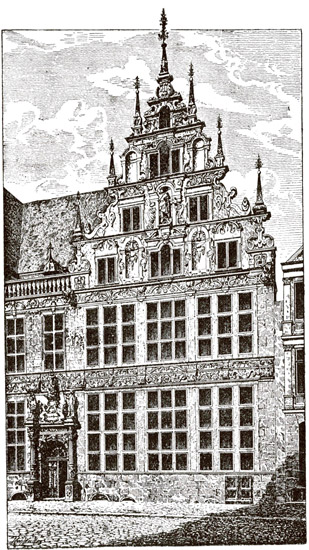
GROCERS' HALL, BREMEN.
On another occasion Brunswick fell into the hands of discontented artizans, who headed a revolt of several towns against the League. A fulminating decree was issued by the Hansa with the same results as in the case of Bremen. Misery and hunger in this case also proved persuasive, and at last, after six years, this proscribed town was readmitted. It had to send deputies to Lübeck, who craved pardon in the most abject terms, and who had to accept the most humiliating conditions. Besides questions of internal management, the Brunswickers undertook to build a votive chapel in the town in memory of their bad behaviour, and to send pilgrims to Rome who should crave the Papal pardon for the murders of councillors committed by the rioters. Two burgomasters of Brunswick, and eight of the chief citizens walked humbly in procession, bare-headed, bare-footed, carrying candles in their hands from the church of our Lady at Lübeck, to the town hall, where in the great council chamber of the League, before an enormous crowd, they had publicly upon their knees to confess their repentance for what unruly passion had caused them to do, and to implore their confederates to pardon them for the love of God, and the honour of the Virgin Mary.
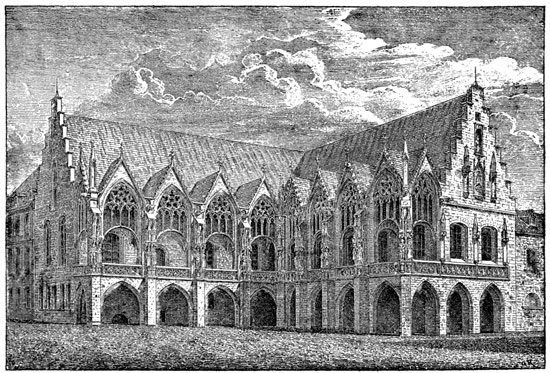
RATH-HAUS, BRUNSWICK.
More and more did Lübeck come to take the leading place among the cities. Her laws ruled at the Hansa diets. They were reckoned the wisest ever framed by an autonomous community, and are still quoted with respect. The right to use Lübeck law was as eagerly craved by distant cities as the Greek colonies craved the holy fire from native altars. No wonder Lübeck's merchants loved to quote the proud couplet:
"Was willst begehren mehr, Als die alte Lübsche Ehr?" ("What more will you desire than the old Lübeck honour?")
Æneas Sylvius Piccolomini, afterwards Pope Pius II., when travelling through Europe as Chancellor of the Emperor Frederick III., visited Lübeck, and writes of it as the town which surpasses all others in the wealth and magnificence of its buildings and churches. The same praise is echoed a little later by a rare guest, the Metropolitan of Moscow, who passed through Lübeck on his way to Florence, to be present at the great church council held there by Eugene IV. Æneas also visited Danzig, and says it was so well equipped for land and sea warfare, that it could call under arms at least 50,000 men.
The prominence of the cities varied greatly. Circumstances which at one time might be to their advantage, might at another time prove adverse. Thus Wisby, after its sacking by Waldemar, was the victim of an accidental fire, which destroyed all that the Dane had spared. In consequence it fell at once from its position of importance, and its very site, once the source of its strength, became the cause of its downfall, for it proved a most convenient station to pirates. Where the merchant had safely halted, he was now in peril of life and goods.
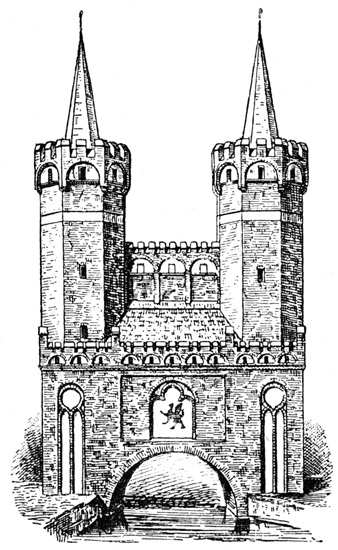
MÜHLENTHOR, STARGARD.
To the question put at various times to the Hansa's ambassadors "which are the Hansa's cities?" evasive replies were given, either "those towns that fought the Hansa's battles;" or a few were enumerated, and the list closed with a colossal etcetera, etcetera. For they were not easily caught napping, these worthy burghers, and had ever in view "the interests of the common German merchants," which they feared might be endangered by too much publicity. Still, they had become a power that could not be hid, and seeing how well they realized this in most respects, it is the more curious that they did not avail themselves of their chance of attaining political autonomy. The more curious too, because, as a rule, the Hanseatics, like the modern Italians, knew so well how to draw profit out of all the dissensions and disorders that agitated Europe.
It was indeed a vast dominion that stood under the sway of the Hansa. In the course of less than a hundred years there had arisen on the Baltic coast, within the area of two hundred and fifty miles, no fewer than fourteen cities of first-class importance, not to name those that already existed there. Thus the merchants held in their possession the mouths of all the great Baltic rivers, on all of which they founded harbours and depôts. Germany in that epoch evinced a power of colonization which in its successes recalls the most brilliant moments of the extension of Greek life in the Mediterranean. In more modern times only the North American soil has exercised an attraction similar to that of the Baltic coasts, and has shown an equal power of upraising cities within a brief space of time. Many of the towns boasted a far larger population than they have at this day. Thus Lübeck in the fourteenth century counted eighty thousand inhabitants, as against forty-eight thousand in 1870.
An interesting contemporary opinion on our merchants is extant from the pen of a learned and travelled Italian, Marino Sanudo, a pious Venetian, who set forth early in the fourteenth century with a mission to stir up the Christian world, and organize a new Crusade, for Askelon, the last stronghold of the Romish Church, had fallen into the hands of the unbelievers. His first purpose was to gauge the fighting power of the various European maritime states, for it was a fleet rather than an army that was required. In his journeyings he ventured as far north as the Baltic, and thus reports in his letter to Pope John XXII.:
"In Alemannia live many peoples that could prove most useful to us.... I have seen with my own eyes that these coasts of Alemannia are quite similar to the Venetian. The inhabitants, strong of limb and practised in arms, are mostly warriors; others well skilled in dyke-making; besides, they are rich, and what is yet more commendable, they show a warm zeal for the affairs of the Holy Land."
After enumerating other advantages to be gained from these allies, he is however obliged to draw his Holiness' attention to a serious drawback on their part, namely, "that the Germans are enormous eaters, which arouses anxiety in respect to supplies when the fleet shall find itself in the hot regions."
A love for feasting meets us repeatedly in the old chronicle reports on the German merchants, and shows that in those days there also held good what Hawthorne has more recently expressed, that the Germans need to refresh exhausted nature twice as often as any other peoples. Then, as now, they were an upright, thorough, massive race, not made of too fine a clay and wanting rather on the æsthetic side; a want sure to strike the more finely strung senses of an Italian.
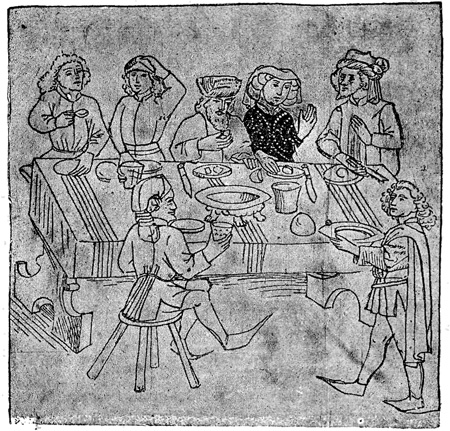
BURGHERS AT TABLE.
It is certain that the fourteenth century was in many respects the epoch when the Hansa cities flourished most actively. Neither before nor after did they have so many sided an importance for the whole life of the German nation. It was a stirring period in the history of the European continent; when the Minnesingers gave place to the Mastersingers; when learning, hitherto stored up jealously in the monasteries and the libraries of the princes, had found its way out among burghers and laymen; when protectors of art and science were more often simple merchant princes than noble-born beggars. In a word, it was an epoch when the middle class sprang into full being, and took its due and proper place as a link between the nobility and the common people.
Towards bringing about this state of things the Hansa had greatly contributed. If it failed to emancipate itself entirely from the empire, it was yet ever keenly desirous of emancipating itself from its petty suzerains. Thus the burghers of Lübeck, Cologne, Goslar, and other cities were early forbidden to hold posts under the lord of the domain, no matter how lucrative such posts might be. Wismar, engaged on one occasion in a dispute with the Dominican monks concerning the repair of the town walls, and obliged to cede to these ecclesiastics because the lord of the land was favourable to the Church, carefully recorded the occasion in its "town book," "in order," as it wrote, "that it might remember the circumstance on some future and more favourable occasion." "To pay them out" is implied though not expressed in the phrase.
With the same insistence and energy the towns made good their claims when it was requisite to protect the burgher in his commerce, this source of life to all the cities. Formerly, it is true, the German merchants had appeared in the foreign markets as "the men of the emperor," but now the emperors had no longer might wherewith to back their right, and more efficient protection was called for. This each found in his own city. Hundreds and thousands of treaties and letters of freedom attest to the fact that the towns recognized their duties towards their citizens and practised them most strenuously. Sometimes these were written out in the name of a princeling, whose signature it was always possible to buy for hard cash; but as time went on the towns gradually took an entirely independent stand, so that from France to the Russian districts of Smolensk the whole continent was overspread with a network of diplomatic and commercial contracts eagerly supported and extended by the towns.
The first thing sought for from the territorial lords, was protection for person and property from the gang of banditti who dwelt in every castle under the leadership of some titled robber; then protection against the cruel rights of wreckage and salvage, which declared all such goods the property of the territorial lord; further, release from imprisonment for debts and other misdemeanours incurred within the jurisdiction of the city and to be dealt with by itself alone; assistance in obtaining payment of foreign debts; freedom from the so-called "judgments of God" in the form of torture, walking on red-hot irons, &c.; regulation and diminution of local taxes and tolls on the lading or unlading of vessels, the weighing of merchandise; permission to fell wood to repair ships; in a word, one and all of the necessary permits to render more easy and profitable the intercourse between towns and nations.
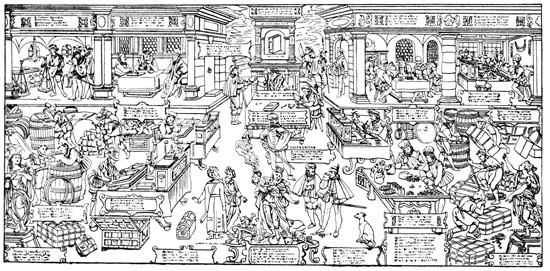
GERMAN TRADE LIFE.
In each foreign country the Hanseatics had always their permanent settlement, known as the Kontor, and for these they had early obtained a species of autonomy that permitted them to exercise jurisdiction according to their native laws over their own country people. Defaulters were judged by Hanseatic rules, and the "common merchant" found a help and support against the foreigners among whom he for the moment resided and with whom he traded.
The shrewd towns knew well how to estimate the value of such foreign settlements, and it is noteworthy that they never accorded reciprocal rights. In vain foreigners pleaded permission to found similar settlements in the Hansa's dominions; the towns always skilfully declined such requests. Thus in Cologne foreign merchants were not allowed to reside longer than six weeks at a stretch, and this only three times in the year; therefore only eighteen weeks in all. Similar and even more restrictive regulations prevailed in the other cities.
It is curious to note that, until the end of the thirteenth century, it was chiefly the inland towns who were the great traders, but when they needed for their trade the highway of the ocean, gradually the maritime ports had taken the place of importance. One of the chief lines of sea traffic was that between Bruges in Flanders and Northern Russia. On this route hundreds of ships sailed annually, all owned by the "Easterlings," as the Baltic merchants were called to distinguish them from the inland traders. It was not until the fifteenth century that we find Dutchmen, Zealanders, and Frisians striving to come into serious competition with the Hansa.
A decree that no German merchant might go into partnership with a Russian, Fleming, or Englishman, no doubt aided greatly this exclusive possession of the Baltic Sea. In Russia waterways led them as far as Smolensk; and, later on, they penetrated even further inland, by utilizing the roads that had been made by the German knights whose seat of might was Pomerania and Livonia. The Marienburg, the chief house of the Order, proved a welcome halting station for the merchant travellers, where they found safety and shelter. Furs were largely obtained from the inner districts of Russia. "They are plentiful as dung there," writes the pious chronicler, Adam of Bremen; adding, "for our damnation, as I believe, for per fas et nefas we strive as hard to come into the possession of a marten skin as if it were everlasting salvation." According to him, it was from this cause and from Russia "that the deadly sin of luxurious pride" had overspread the West.
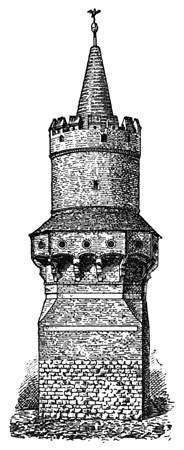
RENSLAU GATE.
Wax, that played so large a part in mediæval religious rites, and was required in great abundance, was furnished by the "honey-trees" of the virgin Russian forests. Leather, skins, tallow, and all species of fat, were also among the chief products of Russia and the exports of the Hansa. In return, they imported into that empire the produce of the looms of Germany, England, and Flanders, the fine Flemish cloths, the coarser English and German. Silk, too, and linen were valued goods. Important also were all manner of worked metal objects, and such wares as town industries manufacture. Beer, too, was a valued and most profitable article of commerce. This drink was brewed in superior excellence in Northern Germany, the hops being grown on the spot. Contemporary writers tell how outside all the northern cities hop gardens flourished. This beer was never wanting at any carouse in the whole stretch of land from Flanders to Finland; a heavy, heady beverage, which would now be deemed unpalatable and indigestible. Some specimens are preserved to this day in the Danzig Topenbier and the Brunswick Mumme. To this thirst for ale Hamburg largely owes its prosperity. For many long years it was the greatest beer-making town of the North, boasting in the fourteenth century no less than five hundred breweries.
From Sweden the Hanseatics fetched copper and iron; in many cases they had acquired the sole possession of the mines. Scandinavia also furnished skins, as well as the various forest products of wood, potash, pitch, and tar. From Blekingen, as at this day, the merchants brought granite, and from Gothland and Bornholm limestone, both stones being required for those building purposes for which the native material of brick did not suffice. Already the Baltic supplied the Netherlands with grain.
The Hansa carried in return to Sweden, Finland, and Russia the requirements of daily life, since these countries possessed neither manufactures nor skilled labour. Down to the altar shrines and the psalters of the Church the merchants brought the evidences of civilized workmanship to these lands. The very furs they had taken thence were returned to their northern homes; of course manipulated and worked up. Even the English, more advanced in handicraft, submitted to the same régime. It used to be said on the European continent in those days: "We buy the fox skins from the English for a groat, and re-sell them the foxes tails for a guilder." With England indeed the Hansa's intercourse was most active, as we shall show more in detail later on.
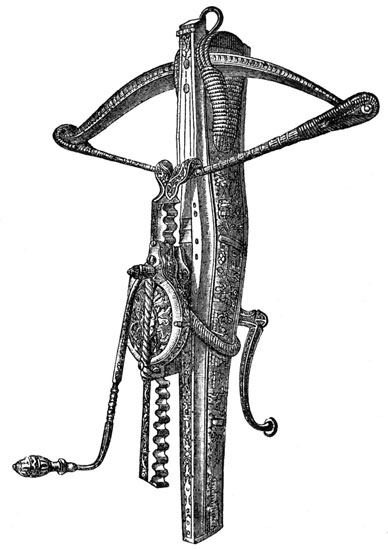
CROSSBOW.
Danzig owes almost all its splendour to the English trade. This city dealt largely in Austrian and Hungarian products, which were distributed from out its harbour. English crossbowmen received all the wood for their bows from Austria by way of Danzig. They were made from the yew tree, which was considered especially adapted to this end.
What the German merchant obtained as produce from Russia, Scandinavia, and other parts of Europe, not to mention the special productions of his own towns, he distributed either at home or in the world-famed markets of Bruges and London, for the Hansa was then the only intermediary between East and West. For more than three hundred years Bruges maintained its place as the central market for the whole of Europe this side the Alps. Here could be met traders from all parts; the Lombard bankers and money-changers, the Florentine, Spanish, Portuguese, French, Basque, English, Scotch, North and South Germans. It was from Bruges that the Baltic merchant supplied his home and Northern Germany with the products of the East, which the South German had brought from Venice and over the Alpine passes along the Rhine. In Bruges he could buy the fruits of the Mediterranean, the silks of Florence, the oils of Provence, the wines of Spain and Italy. These meetings of merchants were wont to take place at stated times, intercourse being thus made surer and easier. This custom laid the foundation for those annual fairs for the exchange of wares, of which one yet survives in Germany in little diminished importance, namely, the great fair of Leipzig, where all the German publishers meet to exchange the intellectual productions of the year.
Another source of wealth to the cities arose from the circumstance that they not only supplied the requirements of the mass, but were also the purveyors to the princes and the aristocracy. We find in their books that these frequently owed them heavy sums for furs, Flanders cloth, and choice wines. They were also most often their bankers, for the towns and, above all, Lübeck, the centre of cash transactions, were held desirable places for money investments. Even in the distant districts of Sweden people knew no better mode of investing capital than to confide it to Lübeck merchants.
Of course the conditions of trade were vastly different from those of to-day. Above all, the merchant had to act more in person. Posts did not exist, orders and contracts, therefore, could rarely be made by letter, for it mostly required a special messenger to carry these. It was hence almost the rule that the merchant accompanied his wares "over sea and sand," as the phrase went. For the sake of greater security, and in order also to diminish expenses, many would club together to charter a ship. It was usual to interest the captains in the sales of the wares, it being held advisable that every one on board should have an advantage in bringing the goods safe to land and in their profitable disposal. This custom arose from the dangers that lurked from robbers, while insurance of goods in transit was yet unknown. By interesting captain and crew pecuniarily they were less likely to throw the goods overboard in a storm, or to allow pirates quietly to board and rob the vessels; both matters of common occurrence.
If it was dangerous to travel by water, it was yet far worse to travel by land. Not to mention that there were few roads, that the mud often lay piled wheel high, so that the strongest horses could not pull the carts; the presence of robbers was a constant cause of fear on the road. Many of these were, as we know, the lordlings of the land in disguise, and hence they naturally turned a deaf ear to the repeated petitions of the merchants to keep the highways in better order. Added to this, each lord had the right to demand toll for the passing of his dominions and the toll stations were often very close together. Thus, for example, within a space of fifteen miles from Hamburg the merchant encountered no less than nine. Fortunately the tables of tolls in those days were not too complicated. They were generally paid by waggon, or ship load, regardless of contents.
The Middle Ages were ignorant of protective taxes. These impediments to the useful exchange of international produce were reserved for the invention and practice of our more enlightened centuries. It is characteristic that the oath which played so great a part in all mediæval transactions, social and political, was also employed to settle the toll dues of the traveller. A crucifix was held before him; on this he swore that he was not defrauding, that the weight of his wares, as stated by him, was accurate, and herewith the transaction was completed. It was, however, necessary to be most careful not to diverge from the toll roads. If a merchant was found on a bye-road his goods were confiscated and he himself imprisoned. On this account, too, companionship was sought after, the leadership of some one familiar with the ground, and hence merchants and merchandize generally moved in caravans.
It is worthy of note that all the trade of that time was strictly legitimate, and what is known as real merchant's business. Speculation hardly existed. Commission and agency dues were not wholly unknown, but happily there was not existent that pernicious scourge of modern trade, the time bargains, which permit merchandize to be sold a dozen times over before it actually exists. It was honest, true trade, which only sold what it could show. Therefore, it could uphold and practise the axiom, "ware for ware, or for cash." In certain districts, for example Russia, barter was more common than money payments. Credit was absolutely forbidden in certain towns and in certain branches of trade. If credit was allowed the borrower had to find a surety, and to go surety was a grave matter, of which the consequences might easily prove disastrous, entailing loss of property and often of personal freedom.
Payments were usually made in coined money, but bar silver was also employed, especially in Russia, and bills of exchange were not quite unknown. The bills were payable as a rule either at Lübeck or Bruges. Silver was the chief currency, but in the fourteenth century Lübeck was permitted to coin gold. It made guilders after the pattern of the Florentine ducats. The gold to coin them with was bought at Bruges. We must remember that money had a far higher value in those days than in ours, and that if we want to arrive at a just comparison with our own times, we must multiply the sums by seventy or seventy-five. The most common form of reckoning was the Flemish, i.e., one pound, equal to twenty shillings at twelve groats each; in a word, exactly the reckoning that has survived in England to this day. The pound of money was originally a weight. The best money was that of Lübeck, and, above all, the English contracted to be paid in pounds of the "Easterlings," their generic name for the Baltic merchant. As a survival and abbreviation of this phrase we in England say pound sterling to this day. A bad light upon the morality and conditions of the period is thrown by the fact that the petty kings, seeing that their coins were often refused and mistrusted, did not hesitate to coin and give currency to false money bearing the imprint of the League. We come across frequent bitter and often useless complaints on this subject.
Putting out capital at interest was not wholly unknown in those days, notwithstanding the prohibitions of the Church which, founded on the text in St. Luke vi. 54, and the Fourteenth Psalm ("qui pecuniam non debet ad usuram"), forbade all usury business. The Jews early held this branch of trade in their hands. Rates of interest varied from 6 to 10 per cent. Loans, too, were made to princes, foreign and native, and to cities, upon industrial enterprises. Wholly erroneous is the notion that capital was inactive, kept in a strong box or an old stocking. That great riches were accumulated is proved by some of the old wills and account books. Fortunes of a quarter of a million were not unknown. A single merchant would often own not only many farms in different and distant parts of the country, but whole villages and townships. As for the men themselves, we encounter them in every part of the continent, the artisan as well as the merchant. Thus, for example, Germans seem the favourite shoemakers; we hear of them in this capacity as far off as Lisbon. Then, as now, they were renowned as bakers, and no one knew better how to salt and preserve herrings and cod-fish.
In Livonia, Esthonia, Gothland, rich merchants died whose nearest heirs had to be sought in far off Westphalia. For instance: A worthy shoemaker became burgher of Lübeck; then visited Rome and San Jago di Compostella as a pilgrim, and afterwards being named shoemaker to the German knights, had as his chief debtor for goods supplied a cavalier who fought in Sweden. Thus diverse, many-coloured, and full of adventure were lives in those times, which we are too often tempted to think sleepy and stay-at-home.
It is difficult to gain an idea of the full extent and nature of mediæval trade, but this too was far more rich and varied than we suppose. Though there was no activity outside Europe, still it can well stand beside our modern commerce, and as regards honesty, thoroughness of produce and workmanship, it unhappily far eclipses it. Certainly the list of articles imported and exported in their variety of needful and needless objects, their luxury and magnificence, goes far to disprove our notions of the greater simplicity of life in the Middle Ages. For supply means demand, and meant this yet more emphatically with our practical forefathers.
Apart from the evidences of figures and statistics, the evidences of wealth and luxury can also be found in the yet extant monuments of the time, and, above all, in the churches. In the Middle Ages the one converging point of ideal life was the Church. Everything that went beyond the immediate practical needs of daily existence, every form of charity, every endeavour after culture, every striving of artistic and scientific activity had in those days a religious foundation. Imagination, too, came to the aid of this tendency in the shape of the possible and probable dangers encountered by "sea and sand," by the town traders. Thus in 1401 we find merchants and shippers at Lübeck founding "an eternal brotherhood and guild to the honour of God, of Mary His beloved mother, and all the saints; above all, the holy true helper in need, St. Nicholas, that they may aid and comfort the living and the dead, and all those who seek their rightful livelihood on the water, many of whom, alas! perish in water troubles, are thrown overboard or expire in other ways, dying unconfessed and without repentance; for on account of their agonies they could feel neither remorse nor penitence for their sins, and who have none who pray for them except the general prayers."
Such guilds were by no means rare. Legacies, too, were left for similar ends, by which thousands of our money were willed away: churches, monasteries, and holy foundations of all kinds raised or aided to pray for the benefit of the souls of the dead.
Nor were distant pilgrimages unknown. The merchant would go in person, combining business and religion on the road, or he would send a substitute, who for a certain sum would visit Rome, the Holy Land, San Jago in Spain, or Rocamadour in Guyenne. Such pilgrims by profession were frequent. St. Peter, St. James, after them St. John, then St. Nicholas and St. Clement as patron saints of merchants, shippers and fishermen, and among the women saints St. Catherine, were the chosen objects of North German piety. In no town was lacking a leper house, a refuge for those troubled with that plague of the Middle Ages, happily now almost unknown in Europe. These were dedicated to the Holy Ghost and to St. George, the slayer of dragons.
Above all, worship was paid to the Virgin Mary. All the municipal churches were dedicated to her. There is not a town that has not its church of "Our Lady." The municipal council were put under her especial protection. To this day the so-called Beautiful Door of the Mary Church at Danzig bears the inscription in golden letters: "Queen of Heaven, pray for us!"
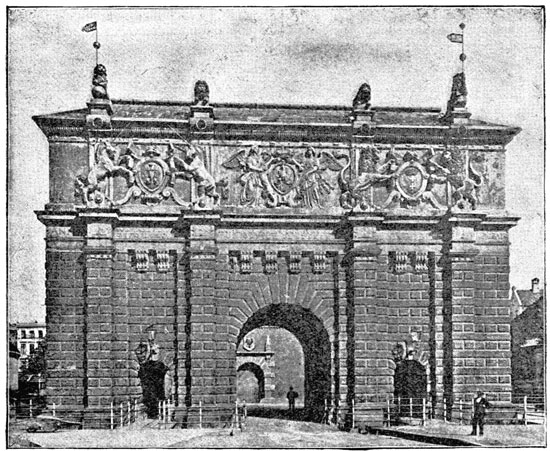
HOHE-THOR, DANZIG.
These churches and religious buildings of all kinds, many of which survive to this day amid surroundings to which they have grown strange, speak more eloquently of the Hansa's might than piles of old parchment records. All Scandinavia can show nothing to compare with these architectural monuments, and we can well comprehend that the Northman entering the Elbe, the Trave, or other Baltic rivers, and seeing the lighthouses, churches, and mighty buildings of the towns, were awed by the Germans' wealth and power and strength, much as we are impressed now-a-days when we first set eyes upon Eternal Rome. These buildings resembled each other in externals; in each we find the same tall graceful steeples rising into the heavens, the same proud, defiant battlements and turrets, the same high-gabled many storeyed, small-windowed houses, the same tendency to employ bricks as building materials, and to use coloured varieties as ornamentation. Of this method of building and decoration the Holstenthor of Lübeck is a well-preserved example, as indeed these double gates to the towns were also a characteristic feature. One, a round tower, resembling greatly the Castel St. Angelo of Rome, situated on the south side of Rostock, was so strongly built that even the mechanical contrivances of our days found it hard work to demolish it when modern progress required its removal.
Art was then almost exclusively the handmaiden of religion, and hence it is also in the churches we have to seek evidences of what the Hansa could produce in this respect. Metal gravestones, rich bindings, cunning iron work, attest its taste. Evidence of a love of painting is found in many works now preserved in museums of the pre-Holbein day. And, incredible though it may seem, they were so famous for glass painting that early in the fifteenth century men came from Italy to Lübeck to learn perfection in the craft.
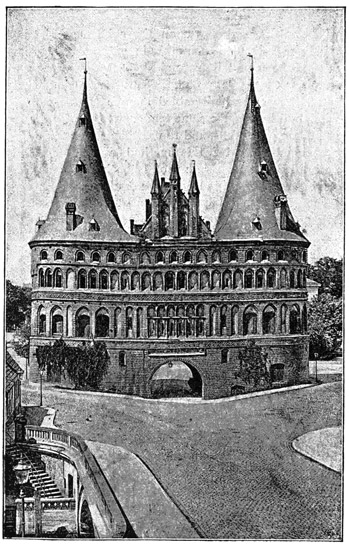
HOLSTENTHOR, LÜBECK.
Of their domestic architecture little, unhappily, remains to us, the practice of building with wood having wrecked most of the cities. Such houses as survive, however, testify to the national love of cunning carvings and inscriptions of didactic purpose. For it is the keynote of that time to express in artistic form its ardent faith and activity, and its somewhat rough-and-ready philosophy. Theorizings and abstractions were little understood. Thus in old legal codes we see the punishments to be inflicted pictorially portrayed. Contempt and mocking also took tangible form, and the clergy were by no means exempted from such satire. Notwithstanding all the piety of the age, the people were ever on their guard against the encroachments of the wily priests. The deeds of Reynard the Fox—that favourite national comic epic, so wholly in keeping with the Hansa spirit of practical good sense and business cunning—was a favourite theme for weaving into arras and carpet; and it was common to give a distinct hit at the clergy in the person of the sly beast.
It was the custom to depict the Last Judgment in the court of justice of each guildhall. That painted in 1341 for Hamburg led to a long lawsuit before the Papal Court at Avignon, because the local dean and chapter saw in it personal allusions. Thus devoutness did not impede the townspeople from rigidly retaining their mental independence of view and action.
Science and literature—such as those ages could boast—were, like art, more or less pressed into the service of the Church. The only exception is to be found in the few popular folk-tales, all comic, like the deeds of Eulenspiegel, and in the town chroniclers who were in the pay of the municipal council; but activity was not great in this latter domain. In most cities, schools were attached to all the parishes, in which the children of the wealthy classes learned reading, writing, some arithmetic, singing, and a little Latin. These institutions were founded in defiance of the priests, who loved to keep the people in the darkness and enslavement of ignorance.
Nearly all the merchants and many artizans could read and write, even if they did not practise these arts with great facility. Business letters were indited either in Latin or German, for the latter tongue was more widely diffused for commercial purposes than in our day.
But if the wealth of the towns led them to encourage the gentler aspects of life, it also enabled them to give expression to less refined tastes, and refinement of taste was never a speciality of these rather coarse-grained and boorish Teutons. The Middle Ages were essentially a time of animal enjoyment and license; the people loved life and all life could offer on the material side. We come across constant records of carouses and feasts, at which the manners and customs were—to our ideas, at least—most gross. No occasion for merry-making, which meant largely eating and drinking, was allowed to slip by unheeded. Nor were these occasions few, for the Catholic Church, with its endless list of saints, furnishes easy and constant excuses for holiday-making, as we see to this day in Catholic countries.
When guilds, corporations, or associations met for convivial intercourse, this was pursued according to established rules, some of which survive in the student corps of German universities. Breaches of regulation were punished by extra rations of beer that were paid for by the delinquent. Entrance fees were defrayed by giving a feast to all members. In short, they ate hard and drank yet harder, with the result that nightly drunken brawls were frequent, the quieter folk often lodging complaints concerning disturbed sleep or rioting beneath their windows between the younger burghers and the watchman. Occasionally a man is banished for molesting the town guard, while intoxicated and disorderly, for undue license was not winked at by the town council.
This was also the epoch when flourished those civic games which furthered the sentiment of brotherhood, and served, besides, to improve the youth of the city in the use and practice of arms. Among these, the May games, May processions, May empires, took a foremost place. They had their origin in the pagan conception of spring as a fair youth, who, in victorious duel, overcame the treacherous winter.
The May emperor was usually elected from among the town council. The one who had obtained the wreath during the previous year delivered it up at the beginning of May or at Whitsuntide. He would ride out into a neighbouring wood "upon his good horse," accompanied by all the councillors clad in armour, to the sound of martial music and with the town's flag flying. This was called "going to fetch the May." A beautiful boy generally headed the procession. What ceremonies went on in the wood is not known, but when the procession returned, leading in the new May emperor, the boy would bear a flowery wreath upon his long pole as token of victory; while all the councillors and the huge crowd that followed in their train were decked with green branches and boughs. The newly-elected emperor was expected to treat the crowd. After a while this grew a heavy and serious expense, and we find it recorded that a certain burgher of Stralsund, who knew he would be elected to this honour, fled the city. He was, however, followed and brought back, made to accept the post and its expenses, and heavily fined into the bargain.
As in modern Switzerland, so in mediæval Germany, crossbow shooting for prizes gave another occasion for public holiday, the different guilds turning out, with banner and music, to do honour to their various patron saints. In such wise all adult men were trained to warfare, though the armies of the Hansa usually consisted in great part of hired mercenaries, easily obtained for ready cash in those days, when fighting was held a pleasure far beyond legitimate work. Many records survive to attest that these Hansa merchants were skilled in the use of dagger and axe. One, for example, a peaceful citizen and trader, with his own hand killed a noted pirate who had long rendered the Baltic unsafe. The merchant went his road, as the saying was, trusting to God and his own right arm. "Whosoever would be a good burgher at Danzig must be industrious both in commerce and arms," runs an inscription on the house of the crossbow shooters of that city.
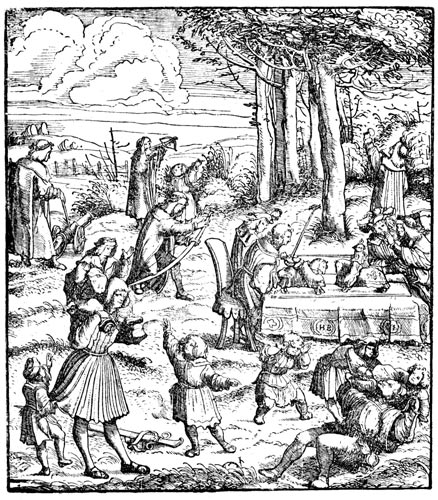
CHILDREN'S SPORTS.
Later on, as the towns grew more aristocratic in character, the gilded youth of the day had games of their own, from participation in which the artizan was excluded. These, in many cases, led to such riots and uprisings of the populace against the municipality as occasioned the "unhansing" of Brunswick and other cities. Foremost among them were the so-called "Popinjay Associations," who met to shoot down from a pole these bright-coloured birds with which travellers had become acquainted in the market of Bruges. It was usual for the winner to treat his comrades to a barrel of beer and cakes.
Indeed, without touching upon the innumerable institutions common to guilds, trades, patricians, and plebeians, a picture of those times would be imperfect. Some of these were instituted for purely hilarious purposes, others combined charity and mutual support with carouse and license. Thus in Cologne there was a society which met to drink wine, and presented to every honoured guest a medal having the inscription, "Bibite cum hilaritate." This society imposed on itself certain laws regarding the avoidance of bad language, of lawless living, of coarse speech and action.
In the North beer was the chief beverage, many companies were dedicated to Gambrinus, the "arch-king and inventor of brewing." Here, too, quaint rules attest the rudeness of contemporary manners. It was customary to exact a monetary fine from those who spilt more beer than they could cover with their hand. It seems that even women were not excluded wholly from these revels. At least a princely guest, harboured by Lübeck, expressed his disapprobation at the presence in the cellar of the town hall of patrician ladies, who under cover of their veils, which formed for them an incognito, drank hard and enjoyed themselves grossly.
Endless are the rules and regulations of the various calends, ghostly brotherhoods, companies, and other names by which they styled themselves. Thus, for example, they were forbidden to take the food off each other's plates, to call each other certain most injurious names, to throw knives and plates at each other, to appear at solemn drinking bouts bare-footed, to roll in the mud, to retain arms, hat, and cloak when in company, to tap a fresh barrel without the presence of an elder, and so forth. Their duties to each other combined social and religious obligations. Thus they were often bound to pray for those who, absent on travels, could not attend at mass. They gave decent burial to their poorer comrades, nursed them when sick, helped them when distressed. A pound of wax, half a hundredweight of tallow, a barrel of beer, were not uncommon fines for dereliction of duty. Games of chance were universally forbidden. Dancing and song were common forms of diversion. The shoemakers and tailors of Lübeck were noted for their skill in the sword-dance, a dance probably not unlike the Highland reel executed to this day by Scotchmen.
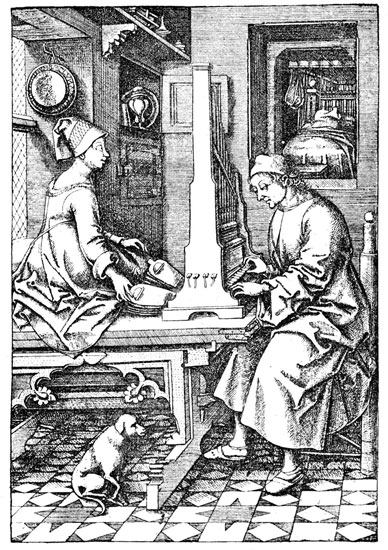
DOMESTIC MUSIC.
Wit, grace, imagination, were elements mostly absent from the lives of these rough Germans. This is nowhere more evident than in their amusements. The carnival practices furnished a notable example, practices so graceful, so pretty in the South, so rough and rude in the North. Two instances will suffice. At Stralsund it was customary to nail up a poor cat with which a man fought until he hit it to death, when he was mock-knighted by the burgomaster. In Cologne poor blind people were let loose in an enclosed space to hit a pig, which should be the prize of the successful candidate. The joy of the spectators reached its height when the poor blind men struck each other in place of their victim. The practices at weddings were too rude for description.
Luxury in dress was most pronounced, and sumptuary laws were repeatedly enacted. It seems strange that it was the men even more than the women who offended in these respects. Simple, nay, rude as the lives of these burghers were in their homes, out of doors they loved to make display, especially in the matter of costly weapons and brave horses. Young men returning from the wars or the great markets of London or Bruges, introduced new fashions and fantasies which changed far more frequently than we are apt to suppose. The most conservative dress was the headgear of the patricians, the councillors and members of the municipality. This consisted for many ages in a long cap of cloth, trimmed with fine fur. Before hats or caps came into fashion as coverings, the sight of these men in their long fur cloaks, with their heads enclosed in these curious hoods, must have had a stately, grave effect. So proud were the patricians of this dress that the councillors of Bremen actually forged a document early in the thirteenth century, according to which Godfrey of Bouillon, accorded to them, during the first Crusade, the permission to wear fur and gold chains. The dress, clogging the free action of the legs, necessitated a stately slow walk, and its length would seem often to have inconvenienced them in those times of unpaved streets and mud-coated roads. A certain Evart von Huddessen, the representative of Stralsund at the Court of King Erik of Sweden, gained the special favour of the monarch on an occasion, when, invited by the king to visit with him his pleasure gardens outside the town, he quietly walked through the puddles after Erik's horse, instead of waiting like the other representatives for their servants to carry for them their trains, which they feared to spoil in the mud. "Eh! what are we waiting for here?" he cried to his colleagues, "shall his royal highness ride alone? I reckon my masters of Stralsund are rich enough that they can make good to me my new coat."
Nor were they invariably simple in their homes, though usually so. A favourite German folk tale tells how Melchior, of Bremen, had his dining-room paved with silver dollars, and even if history or chronicle does not confirm this legend, it is thoroughly in keeping with Hanseatic modes of displaying wealth. There did exist, for instance, a certain Wulf Wulflam, of Stralsund, who sat upon a silver seat, and had his rooms hung with costly arras. When he married he, like a royal personage, caused the road from his house to the church to be overspread with a Flanders carpet, while musicians played day and night before his door. No doubt at his wedding appeared also the eighty dishes which at weddings was the highest limit allowed to burgher luxury by the Hanseatic by-laws.
It would seem, too, that the Hansa representatives when sent to "Hansa days" (the meetings of the various cities in common council) after a while indulged in great display to impress beholders with the power and wealth of their respective cities. This, after a time, assumed such proportions that poorer or wiser communities refrained, whenever possible, from sending members to the "Hansa days."
Such were the habits and customs of these old burghers. As we see, it was a time when men were occupied with the material rather than the ideal side of life. A curious medley it presents of egotism and altruism, piety and license, love of individuality and strict regulation, roughness of living and unbridled luxury, boorishness and civilization.
A word must be said of that important institution, the town council, to complete this sketch of the German towns during the fourteenth and fifteenth centuries. Its constitution varied somewhat of course, according to the size and wealth of the cities, but there were certain main resemblances. The number of aldermen varied from twelve to twenty-four. At their head were two or four burgomasters, who enjoyed no special privileges, except that in council they held the office of president. The appointment was for life, but they took it in turns to be on active duty. Certain limitations of choice as to aldermen existed. Thus for long in Lübeck no one could hold that office who earned his bread by handicraft. This regulation however did not last. Still merchants throughout filled the chief places; as, being travelled men, and knowing the requirements of their fellows, they were considered the most fit. Next to these, brewers and tailors took a leading part. The general constitution of the council may be regarded as in a fashion aristocratic, but it was checked in deliberations and decisions by a sort of second chamber, the common council. Under their rule the cities certainly flourished; the one chamber counselled, the other acted, and to be alderman was indeed no sinecure, but rather a post that imposed heavy labour. Honour it brought, but scanty remuneration.
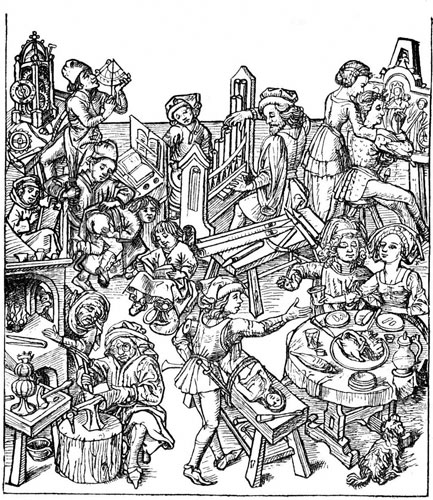
MIDDLE-CLASS OCCUPATIONS IN THE FIFTEENTH CENTURY.
Noblesse oblige was the proud motto these men acted on. The church bells called them to their meetings, which at first were held in the municipal church, later in the guildhalls. At Lübeck they always assembled first in their own chapel of Our Lady's Church, then went in procession to the town-hall. This was the centre of all national life. The market-place was built before it, around it were the chief shops. In the market-place justice was administered, either in the open air or under the open porticos of the guildhall. Civic feasts were held here, foreign guests received at this spot. No wonder, then, that the burghers spent great sums upon the building and decoration of their town-halls and surroundings. They were to them the palladium of civic independence, whence law and order, merriment and feasting took their origin. To this day the cellars of the town-halls in Germany boast the best wines and choicest foods, and though now let out as restaurants they still, many of them, show in fresco and carving the remains of ancient splendour. In the town-halls were preserved the treasure, the civic documents, and the great town books, called into requisition in all disputes. "No witness goes beyond the Book" was the axiom of the day.
The market-place was always the largest open place in a city. The streets were narrow and tortuous. This was necessitated by the circumstance that all towns at that date were walled, and hence their extension circumscribed. Each class of workmen lived together; shoemakers in one street, coopers in another, and so forth. Their houses being small, it was usual for them on fine days to do their work out of doors, which gave an animated appearance to the place. At night these streets were closed by iron chains drawn across them.
The town life was, in short, but the family life on an extended scale, and the municipality watched over the welfare of the inhabitants as a father over that of his household. To facilitate commerce and industry, and to look after roads and buildings, were among its chief cares. It is noteworthy that in some towns regulations existed compelling every one who had means to leave in his will a certain sum for repairing the highways and keeping the ports in good condition. Many fulfilled this provision, even without this order.
Another occupation of the aldermen was to superintend trade, and see it carried out on honest principles. Thus, at Novgorod, a bale of linen is discovered to be bad, so that "no honourable and good man could be paid in such ware." It is sent back to Riga, thence to Wisby, thence to Lübeck, where the aldermen had to find out who delivered these goods. Punishment for such fraud followed inevitably, and was so heavy that, on the whole, few attempted to play these base tricks. We also come across complaints that barrels of herrings had been packed fraudulently, good and large fish being on the top; small and inferior and even stale ones filling the rest of the barrel. As such perishable goods could not be returned, the aldermen instituted official herring packers, who were responsible for honest action.
In all difficult matters, the advice of the municipality was asked and given. It was held "that they knew what others did not know." Thus burgher and burgher ruler worked hand in hand, and each man felt himself a link of the whole chain. This feeling gave rise to an active patriotism, a warm love for their own town, of which instances abound in the mediæval chronicles. Many tales are preserved of brawls arising in the towns through the vauntings of rival citizens. Thus a certain Lübecker meeting a Bremener in a Hamburg inn, boasted so greatly of his native town's advantages and made such fun of his companion's aldermen that they all but came to serious blows. "You had better mind your words and drink your beer in peace," was the friendly advice of a bystander.
Such were these burghs which had grown free and strong through burgher industry, and were kept powerful by burgher unity and honesty.

III.
THE VICTUAL BROTHERS.
A serious interruption to the Baltic trade after the glorious peace with Waldemar arose from the notorious gang of pirates known to history as the Victual Brothers. Upon the principle that all is fair in love and war the Hansa, during its campaign against the Danish king, had openly countenanced and even abetted piracy, so long as the attacks of the robbers were directed against their enemies. The chance of plundering under protection was too tempting not to attract a large number of adventurers, who for some years carried on their black trade under the designation of "Victual Brothers," a name chosen because their ostensible aim was to supply with provisions that part of the Swedish coast which belonged to the Hansa.
It seems strange to us of to-day to find as the leading spirits among these Brothers the names of Moltke and Manteuffel, doubtless forbears of the famous modern German generals. These pirates founded masses and charitable institutions on the one hand, and robbed and sacked remorselessly on the other. Peace being concluded, the Hansa naturally had to clear the seas of these pests, but it had been easier to call them into activity than to suppress them. A large body of men had found profitable employment coupled with stirring adventure; this latter being a powerful incentive in those days, and were loth to quit their free wild life.
They continued their association, nay, even enlarged it, forming themselves into a corporation, after the pattern of the Knights Templars, and divided all booty equally among their body. In a brief space they became the scourge of all the commercial cities. "God's friend and all the world's enemy" was their audacious motto. Masters of both seas, the Baltic and the German Ocean, on one occasion they even seized, plundered, and burnt down Bergen (1392) and took prisoner the bishop. Gothland became their stronghold, and Wisby, once the Hansa's glory, was turned into a pirate's nest near which the merchant sailed with fear and trembling.
It seems strange, to our modern ideas, even to think that piracy was once a reputable calling. It was held as such, for example, in ancient Greece, as we may read in Thucydides, book i. chap. 5. No offence was in those days either intended or taken if one Greek asked another if he were a pirate. In the Baltic, like duelling in more polished climes, this practice long survived the positive laws framed against it. Pirates would even give back empty ships to merchants, wishing them a happy return with fresh and fuller cargoes.
In vain did Margaret of Sweden protest against the audacities of the Victual Brothers. She was helpless against them. The measure of her impotence can be gauged by the fact that she begged from Richard II., king of England, permission to hire three ships at Lynn for the protection of her kingdom. In vain, too, on the days when the Hansa met in council, was this theme discussed. For three whole years all fishing on Scania had to be abandoned. The result was severely felt throughout the length and breadth of Christian Europe, for herrings and other Lenten food became rare and costly.
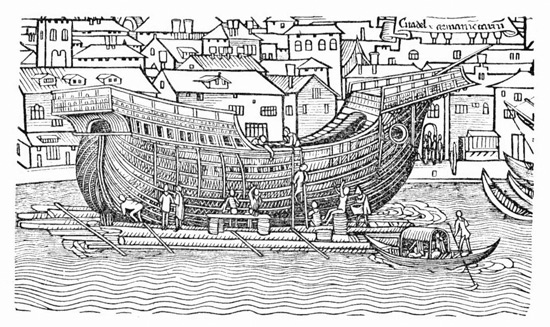
SHIP-BUILDING IN THE FOURTEENTH CENTURY.
Stronger and stronger grew these pirates, so that at last it was decided to send out an army against them. Once more recourse was had to a poundage tax to raise supplies and thirty-five large vessels with three thousand men were sent to sea in 1394. After long and arduous struggles they at last broke the power of the association, but for long afterwards separate bands of pirates, once members of the mighty gang, rendered the navigation of these seas a peril.
Legend took possession of these robbers from an early date, and we come across them in song and fable. Taking a foremost place were Godeke Michelson and Stortebeker, whose special mission it was to harry the traders with England. Stortebeker, it is said, was a nobleman, indeed noblemen were frequently found in the association. As a youth he had been wild and lived so riotous a life that all his property was gambled and drunk away. When finally the town of Hamburg, the scene of his carouses, in order to pay his debts, deprived him of his knightly armour and forbade him the city precincts, he joined the Victual Brothers.
At this time their leader was Godeke Michelson, who hailed the new confederate with joy, after testing his strength, which was so great that with his hands he broke iron chains like string. And because his new ally was also great at drinking—he could pour down huge bumpers at one gulp—he bade him lay aside his noble name and renamed him instead Stortebeker ("Pour down bumpers"). Once when the pair had plundered the North Sea clean they made a descent upon Spain. As was their wont, they divided their spoils with their comrades, only on this occasion they kept for themselves the holy bones of St. Vincent, stolen from a church, bearing them under their coats upon their naked breasts. Hence, says legend, they grew invulnerable, so that neither crossbow nor axe, sword nor dagger, could harm or wound them.
When the Victual Brothers were conquered by the Hansa and banished from the Baltic, these two chieftains with their followers found good friends in Frisia, where to this day memories of Stortebeker survive, and the chieftain Keno then Broke became his father-in-law, for his lovely daughter lost her heart to the doughty pirate, and followed him on to his ships and his floating kingdom. For Stortebeker was a king in his way. When he made captives who promised him a ransom he let them live. But if they were poor and old and weak, he threw them overboard relentlessly. If they were poor but strong, and so likely to be of use, he tested their strength in this manner. He caused his own enormous goblet to be filled with wine. If they could empty it at one gulp they were his peers, and he accepted them as comrades. Those who could not pass this ordeal were dismissed.
It is said that Stortebeker and Godeke Michelson sometimes had moments of penitence concerning the lives they led. In such a moment of remorse they each presented the cathedral of Verdun with seven glass windows, on which were painted cunningly the seven deadly sins. Stortebeker's "mark," two reversed goblets, is depicted in one of them, probably the one that treats of gluttony. They also founded a charity for distributing bread to the poor.
In 1400, the Hansa sent out a fleet to Frisia to combat these chieftains. It was in this war that the Hamburgers attained the honour of conquering the Victual Brothers, dispersing their crew and releasing their captives. Keno then Broke was carried off into confinement, for he had, against his oath and faith, contrived to aid the pirates. With Keno the town of Hamburg made a new treaty. It is said that just as it was signed and the councillors had left the council chamber, Stortebeker managed to slip out of a hiding-place, where he had heard all that passed, and joked with his father-in-law at the expense of the Hamburg aldermen who had once more put faith in him. Whilst so engaged a certain Councillor Naune, who had forgotten his gloves, returned to the hall and overheard them. Hence the war broke out afresh. Once more many Victual Brothers were captured and beheaded in Hamburg. Their heads were stuck upon poles for the warning of all beholders, while the account books prove that the executioner received eight pennies per trunk decapitated and his servant twenty pennies per body buried. Yet again a fleet had to set forth; for as long as Stortebeker and Godeke Michelson were living there was no peace possible. Under a Hamburg alderman, Simon of Utrecht, who commanded the fleet on board a mighty ship known as the Coloured Cow, they again set out. The name of this vessel is remarkable, and is the first instance we come across in Hanseatic history of a profane denomination for a ship. All the others are named after some saint or angel, under whose special protection it was supposed to sail. "The Coloured Cow, from Flanders, that tore through the ocean with its great horns," sings the folk-song, the "Stortebeker Lied," which a hundred and fifty years ago was still sung by the people. The Victual Brothers lay off Heligoland. Towards dark one evening in the year 1402, the Hamburg fleet approached them, and a daring fisherman came so near that he was able to pour molten lead upon some of their rudders, loosening them, and rendering the vessels unseaworthy. Next day the battle began. It raged three days and three nights, and only after a desperate resistance was Stortebeker conquered.
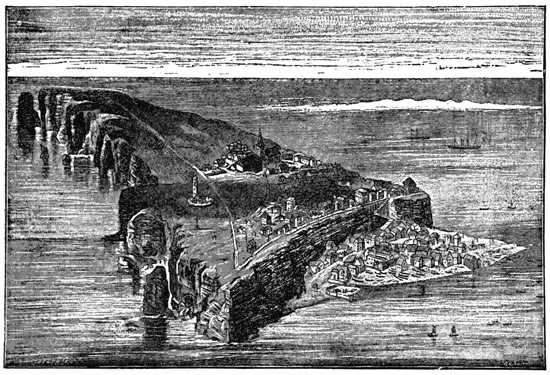
HELIGOLAND.
Some of the pirates fled, many were killed or thrown into the sea; their ships, richly laden with booty in the shape of linen, wax, cloth, &c., were seized, and Stortebeker with seventy comrades carried in triumph to Hamburg. The cell in which Stortebeker was confined was known as Stortebeker's hole as long as it existed. It was destroyed like so many of the antiquities of Hamburg in the great fire of 1842. Short work was of course made of his trial, and with his companions Stortebeker was condemned to death. When he heard his sentence it afflicted him much, and he offered the municipality in return for his life and freedom a chain of gold to be made from his hidden treasures, so long that they could span with it the whole cathedral and also all the town. This offer was, of course, indignantly rejected, and next day he was publicly executed, together with seventy comrades. In compliance with their dying petition they went to death dressed in their best, marching in stately procession, and preceded by fifes and drums.
After Stortebeker's death the Hamburgers searched his ships for the hidden treasures. Except a few goblets they could find nothing at first, until a carpenter broke the main-mast, which was discovered to be hollow and full of molten gold. With this fortune the merchants who had suffered at Stortebeker's hands were indemnified, the costs of the war paid, and out of the remainder a golden crown was made and placed on the spire of St. Nicholas Church.
Stortebeker was thus out of the way; but there still remained Godeke Michelson. So the Hamburgers with Simon of Utrecht and his Coloured Cow, once more set forth and once more returned victorious, bearing in their train Godeke Michelson, eighty robbers, and the under-chieftain Wigbold, of whom it is said that he had been a professor of philosophy at Rostock, and had exchanged his chair for the forecastle of a ship. These men also were all decapitated in the presence of the burghers and municipal council.
It was a heavy day's work for the executioner, and it is related that he waded up to his ankles in blood. After it was all ended an alderman asked him kindly if he were not much wearied. "Oh no," said the headsman, laughing grimly, "I never felt better in my life, and I have strength enough left to behead the whole lot of you councillors." For this treasonable speech he was at once dismissed from his post.
Various relics exist to this day to keep Stortebeker's memory fresh in Hamburg. Among them were a small whistle with which he gave the signal to his ships during a storm, an iron cannon nineteen feet long, his armour, and the executioner's sword.
But chief of all Hamburg preserved the so-called Stortebeker goblet, a silver bumper, from which tradition says he drank. "Whosoever comes to Hamburg and does not go to the Ship's Company, that he may drink from the goblet of Stortebeker and Godeke Michelson, and write his name in the book that lies beside it, has not been in Hamburg," says an old writer. This goblet is about a yard and a half high, and holds four bottles. A sea-fight is engraved on it, together with other incidents out of Stortebeker's life, and some rough rhymes. Once more modern criticism, destructive and intolerant of all picturesque legend, declares that the cup is of later date than Stortebeker's time, and can never have been his.
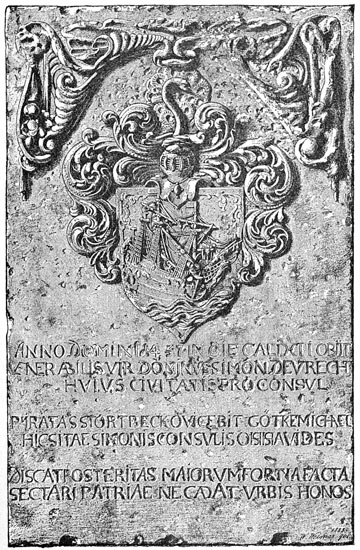
TOMB OF SIMON OF UTRECHT, HAMBURG.
Soon after the death of the pirate chiefs, Hamburg sent an envoy as pilgrim to the shrine of San Jago of Compostella. Whether he was employed to bear thither the thanks of the city to the saint for their victory, or to return to Spain the relics of St. Vincent, history saith not. A medal was struck to commemorate the event. It bears Stortebeker's portrait and an appropriate inscription. Simon of Utrecht, the victorious captain of the fleet, who later won other battles for the Hansa, received high honours from Hamburg. When he died he was accorded honourable burial, and a gravestone to his memory was put outside St. Nicholas Church. Happily it survived the great fire. It shows the crest of Simon, a large three-masted vessel, with the figure of a beast at the helm; doubtless, the famous "coloured cow;" a swan draws this ship through the waves. Below is an inscription in Latin verse, recording the hero's feats against the pirates, and enjoining posterity to imitate the great deeds of their forbears, that the fame of the city may not be diminished.

IV.
THE FACTORY OF BERGEN.
We have seen how great was the Hansa's power in peace and in war; let us now cast a glance at the basis upon which the whole proud fabric rested. This is to be sought, beyond doubt, in its foreign commerce. How enormous the interest they had, especially in the Baltic trade, how great, indeed almost exclusive, was their empire in that sea, it is difficult to realize. And to retain this empire, to be masters of the mercantile relations between the eastern and western extremities of Europe, they considered no sacrifice too great. This was the keynote of their policy. Their purpose, simple enough in conception, was carried out with a disregard of other claims than their own, and often a violence which made them encounter resistance, and which in the end was largely the cause of their fall.
The political agitations and confusions which disturbed the Scandinavian kingdoms early in the fifteenth century were astutely utilized by the Hanseatics, who, having their settlements at Bergen and Scania, were able to keep out the Dutch and English, then just beginning to attempt a rivalry with them in the northern trade. The Dutch were easily disheartened. Not so the English; and we read of instances in which the Hanseatics and English acted towards one another with a savagery which proves that commercial rivalry can excite hearts as bitterly and furiously as political or religious fanaticism.
No matter at what cost, monopoly the Germans were resolved to have, and they succeeded in forcing the kings of Denmark to place an interdict upon English trading. This prohibition corresponded to another that they had extorted, according to which all merchandize coming from the extreme end of the Norwegian kingdom was obliged to pass through and halt at their station of Bergen. The purpose of the latter regulation was to concentrate all the productions of the country at a single point; thus offering to the Hanseatics the first refusal of goods, and a power of dominating the market.
Indeed nowhere did their imperious and self-seeking policy show itself in a less amiable light than in the dealings of the Hansa with the poor inhabitants of Norway's sterile coasts. The history of their factory at Bergen is from its earliest foundation the history of a relentless despotism, disfigured by violence and breach of faith in treaties. King Haguin had, in 1376, accorded to the German merchants the right to trade freely in all the burghs, villages, and harbours of his kingdom, but it seemed that they themselves preferred to restrict their business to the town of Bergen, which, it is true, combined uncommon advantages. It possessed an excellent harbour, the city was shielded by an amphitheatre of lofty mountains, and though, as regards climate, it could boast no advantages, more rainy days occurring there than at other points of the Norwegian coast, yet it had early been the staple of all Norwegian and Arctic products. Its geographical situation rendered it equally accessible for travellers from the north and south, while its harbour was so deep that even ships of considerable draught could anchor almost in front of the town's houses.
From the earliest times the inhabitants of Bergen had been traders. In 1393 they were grievously pillaged by the Victual Brothers; and ere they could recover from this misfortune, another pirate, Bartholauer Voet (1428), attacked them, just when the English were helping them to recover their commerce. It is pretty evident that his attack was countenanced, if not commanded, by the Hansa. At sight of his ships the inhabitants fled. The crew were thus enabled to land unhindered; they plundered everything, down to the bishop's palace and his library; and they despoiled the Norman vessels which had come there for the summer fishing. They then took their stolen goods to market, returning the following Easter for a second visit. This time the inhabitants were more on their guard, and made a gallant but vain defence. Once more the city was sacked, and the royal and episcopal palace and many private houses were burnt to ashes.
Shorn of its wealth, Bergen was now so weak that the conquerors were able to dictate their own terms. The city, which for five hundred years had been in exclusive possession of the Greenland passage had to renounce all maritime traffic. Further, the citizens saw themselves forced to pawn their land to the Hanseatics, in return for the mere necessaries of life, and as they could rarely redeem these pledges the whole city of Bergen gradually fell into the hands of these opulent traders.
Expelled from their old dwellings in ancient Bergen, which formed the part of the city known as the Bridge, the inhabitants planned to establish themselves on the harbour board that skirted the opposite side of the crescent. But the insatiable greed of the Hanseatics would not suffer them to stay there. The conquerors obtained this also for themselves, so that in the end the entire port was in their power.
Thus, and by means of an ever-increasing population of merchants, clerks, apprentices, sailors, workmen, they exercised a practical suzerainty over the town. Whenever cited to submit themselves to the local authorities they claimed the privilege of foreigners; they refused to pay city taxes, though they held the rights of citizens, while they paid custom duties at a reduction. They openly protected the enemies of the king, felled the forests, introduced themselves arbitrarily into the houses of strangers; in short, committed every offence with impunity. As in London and Novgorod, so in Bergen, the Hanseatic factory formed a state within the state.
The Hanseatics, in their arbitrary actions, repeatedly ran counter to the Hansa's command and how to keep order at Bergen became one of the most difficult problems at "Hansa days." It would seem as if the rude climate had exercised a deleterious influence over these naturally coarse-grained Germans.
As we have said, the whole harbour board was in their hands. The two sides were connected by the so-called Shoemaker's Alley, long the abode of strangers at Bergen, a quarter that became after a time the residence of all boors and doubtful characters, who shrank from no acts of violence, and defended the German monopoly after their own fashion, i.e., by means of fisticuffs and knives. Thus, as an example: the all-important fish market was so situated that the inhabitants of Bergen could reach it only by means of this street. Until the Germans had had the first pick of newly-arrived goods, the inmates of Shoemaker's Alley suffered no one to pass, and woe to those who ventured to disregard this prohibition. So completely broken was the might of these northern people—the descendants of the Normans, that most warlike race, the scourge of ancient Europe.
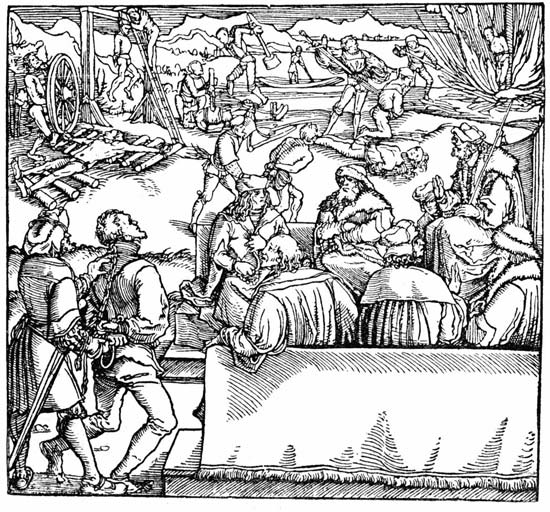
JUSTICE IN THE FIFTEENTH CENTURY.
The side of the harbour known as the Bridge—the Bridge of the lice the natives called it in derision—was the actual factory of the Hansa. It consisted of so-called gardens, of which nine belonged to the community of St. Martin and thirteen to that of St. Mary. Each garden was isolated, and formed a separate factory, bearing its own crest and name, such as "The Cloak," the "Court of Bremen," &c. The common crest of the Bridge was odd enough, presenting half of the German imperial eagle, against a crowned cod-fish. Each garden was connected with the sea by a drawbridge, so that vessels could anchor in front. The ground-floor consisted of workshops and warehouses: in the first were the bedrooms of the resident merchants, above were the kitchens. Behind the house were mighty cellars, and above these again the "Schutting," a large windowless space used as a council chamber. Opening thence was the kitchen garden.
Every "garden" was inhabited by at least ten "families," each of whom had a husband as chief superintendent and magistrate, to keep order among the younger members and apprentices. As a rule the "family" came from the same Hansa town. The faults of the very young were punished by flogging, those of the apprentices by fines or imprisonment. In the summer the heterogeneous "families" dined alone, in the sad winter time they all met in the "Schutting," but ate at separate tables. At a fixed hour every one had to rise and go to bed.
Superintending the entire factory was a grand council, composed of two aldermen, eighteen members, and a secretary, who had to be a doctor of laws. When conflicts arose between the different members of a family, or between residents and travellers, the matter was referred to the aldermen for decision. Grave cases were sent up to the Hanseatic diet. The aldermen had further to watch over trade, taxes, and all that regarded the business transactions of the colony.
In its time of greatest prosperity the factory at Bergen counted about three thousand souls, all vowed to celibacy, which was imposed on them under most severe penalties. The fear was that union with the native women might lead to the divulging of Hanseatic secrets, or induce the men to settle permanently in this spot, and so become denaturalized. Members of the Hansa were strictly forbidden to spend a night outside the factory. Armed watchmen and savage dogs exercised a rigid guard.
These residents were usually agents for merchants in the Baltic cities. After ten years' sojourn, they were obliged to return to their native town to give place to new arrivals, who then had to go through the various gradations of rank, beginning as office boy, and ending, if luck favoured, as alderman. It was a sort of hierarchic organization, of which the rules were most rigidly enforced. Entrance dues for vessels, fines, and money penances defrayed the general expenses of the factory; each town paid for the board, wages, and arming of its representatives. Not all members of the Hansa, however, were permitted to trade with Bergen, the conditions being purposely made onerous and expensive.
In the same restrictive spirit, and to hinder a great influx of men to the factory, a series of probationary ordeals was planned, through which every new-comer had to pass. By rendering these tests difficult and repulsive they hoped to deter from Bergen the sons of opulent families, for whom the advantages to be gained there would be counterbalanced by the perils of initiation. These "games," as with grim humour they were termed, were entirely in keeping with the grotesque spirit of the age, and analogies are to be found, though less gross, in the religious orders and the institutions of chivalry. The mildest of them resembled in some respects the practices common to British sailors in crossing the line. It is scarcely strange, that in the frigid, rigid north, among a population naturally rough, far from home, friends, and the more refining influences of life, a prey to deadly ennui, imagination should have taken a fierce and coarse turn.
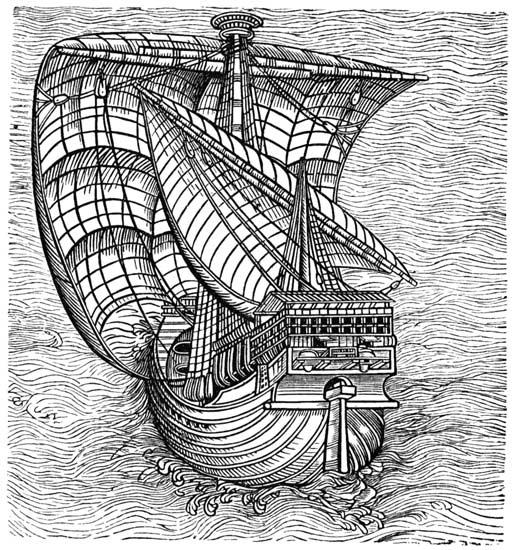
SHIP AT THE END OF THE FIFTEENTH CENTURY.
We cannot sully our pages by detailing the thirteen different "games" or modes of martyrdom that were in use at Bergen. Our more civilized age could not tolerate the recital. In those days they attracted a crowd of eager spectators, who applauded the more vociferously the more cruel and barbarous the tortures. The most popular were those practices known as the smoke, water, and flogging games; mad, cruel pranks, calculated to cause a freshman to lose health and reason. Truly Dantesque hell tortures were these initiations into Hansa mysteries. Merely to indicate their nature we will mention that for the smoke game the victim was pulled up the big chimney of the Schutting while there burnt beneath him the most filthy materials, sending up a nauseous stench and choking wreaths of smoke. While in this position he was asked a number of questions, to which he was forced, under yet more terrible penalties, to reply. If he survived this torture he was taken out into the yard and plied under the pump with six tons of water.
The "water" game that took place at Whitsuntide consisted in first treating the probationer to food, and then taking him out to sea in a boat. Here he was stripped, thrown into the ocean, ducked three times, made to swallow much sea-water, and thereafter mercilessly flogged by all the inmates of the boats. The third chief game was no less dangerous to life and limb. It took place a few days after, and was a rude perversion of the May games. The victims had first to go out into the woods to gather the branches with which later they were to be birched. Returned to the factory, rough horse-play pranks were practised upon them. Then followed an ample dinner, which was succeeded by mock combats, and ended in the victims being led into the so-called Paradise, where twenty-four disguised men whipped them till they drew blood, while outside this black hole another party made hellish music with pipes, drums, and triangles to deafen the screams of the tortured. The "game" was considered ended when the shrieks of the victims were sufficiently loud to overtone the pandemonic music.
When all the ordeals were ended a herald, who also occupied the rôle of fool, announced in a loud voice that the games were over, adding the fervent wish that the noble practice of ordeals might never be abandoned, and that for the honour and prosperity of the Hansa commerce and the Hanseatic factory they might ever be held in veneration.
Only those who survived and sustained these rites were admitted into the corporation at Bergen and could rise to the highest grades, with the prospect of assisting as spectators at the games in which before they had themselves played a part. Not till 1671 were these barbarous practices, which every year increased in ferocity, suppressed by order of Christian V. of Denmark, and only, of course, after the Hansa had sunk from its pristine power.

V.
THE HANSEATIC COMMERCE WITH DENMARK, SWEDEN, AND RUSSIA.
Though the Government of Denmark was more enlightened than that of Norway, and though the Danes were jealously desirous of keeping their trade in their own hands, they, too, could not free themselves from the all-absorbing power of the Hanseatic League. In vain did they endeavour to raise up rivals to these traders; in vain did they even encourage pirates to attack them; in vain did they institute custom dues and taxes; each and all of these measures proved insufficient. The credit of the towns was unassailable. The Hanseatics knew how to vanquish all obstacles, and finally they found themselves in full possession of all their ancient privileges, as well as those which they had extorted in concluding peace with Waldemar.
The dissensions of the three northern kingdoms, which lasted for nearly fifty years, and which the Hanseatic League were by no means anxious to see settled (for, above all else, they feared the union of the three northern kingdoms under one head) were admirably utilized. The League played off one set of enemies against another, now aided this faction, now sided with that, never too openly expressed either sympathy or hostility, and yet always contrived so that any advantages accruing were theirs.
It was in those troubled times that Lübeck bought from the Danish king the town of Kiel and adjoining lands, while the queen pawned her jewels to the city in order to raise money for war purposes.
Denmark was of immense importance to the Hanseatic League, not only for the grain and cattle it produced, but because it was the key to the passages of the Belt and the Sound, the only maritime routes for passing from the Baltic to the North Sea. And, above all, the Sound was of first-class importance as dominating the coveted province of Scania, that mediæval Peru. This tongue of land, which juts out into the sea in form of a hook on the extreme south-west of Sweden, and shows to-day two miserable towns, Skânoe and Falsterbo, almost buried in driving sand, presented in the fourteenth and fifteenth centuries, from St. Jacob's to St. Michael's Day (July 25th to September 29th), a most animated spectacle. Nothing more strange is to be found in either hemisphere than was the tumultuous life of this arid province. Here each foot of ground was jealously disputed by fishermen and merchants.
Englishmen, Flemings, Danes, and peoples of tongues and customs the most diverse were found side by side. But the Hanseatics preponderated. They established themselves in a species of rude wooden barrack called by them Witten, where they at once instituted their peculiar rules and privileges, which gave them that united power which in the end enabled them to crush out all competition. For the device of the Hanseatics, though unexpressed, was "Monopoly," and during these centuries they carried it rigidly into effect. The word Witten still survives in the name of various fishing stations on the Baltic; for example, one not far remote from the old pagan city of Arkona, once the site of a temple, where the Christian Saxons bought the right to fish by paying tribute to the local god.
The main object of the trade in Scandinavia was herrings, but this brought many other industries in its train. Itinerant merchants offered cloth, linen, hardware, wine, beer, and many other articles to the natives, whose country boasted no handicrafts, as well as to the temporary residents. In short, the place became a market for the exchange of Western and Eastern products, natural and manufactured. Here could be seen the Lübeck cooks busy in extemporized kitchens that formed a sort of rude restaurant; here rough taverns in which German drinks were obtainable at easy prices; here German shoemakers plied their skill; above all, the coopers drove a lively trade, making and mending the barrels needed for the precious fish. The import of salt, too, was obviously of first-class importance, and this was entirely in the hands of the Germans. We might expect that during the busy period when thousands of men were hard at work fishing, salting, packing the herring, beer should have been drunk in large quantities, but the amount consumed almost passes belief. This also was entirely supplied by the Hanseatic cities. It was they, too, who shipped the indispensable fish and sent it to England, France, the Netherlands, the Baltic, nay, far into the centre of Germany, and even to Poland and Russia.