PERIOD III. (continued 3)
Reading edition
If this was not the language of insubordination, it is difficult to say what else would be. Whither had vanished the blind obedience which the League had ever exacted, and till now obtained from all its members, and which was the source of its greatness and strength?
Whether all that was stated by the Steelyard in this memorandum was true, it is difficult to decide. Substantially no doubt it was so, but in the reports of the Hansa Diets during these years, we come across frequent complaints of the prevarication practised by the aldermen of the London factory.
Perhaps we must not blame either the towns, or the factories too much for yielding to the all-powerful instinct of self-preservation. When the Hanseatic towns as a whole recognized that they were impotent to demolish the rising commerce of England, or to break the firm will of its lady sovereign, they were almost forced to desert a cause which was a losing one, and to work each for their own separate advantage.
Hamburg was the first among the confederate cities to recognize whither matters were tending, and to adjust its policy with a due regard to the new spirit of the age. It concluded a convention on its own account with England. Matters came about in this wise. The chief foreign trade of England was gradually passing into the hands of the Merchant Adventurers. Now to this company the Netherlands were closed, owing to the conflict raging between Elizabeth and King Philip of Spain. Hence these merchants had to seek elsewhere the depôt which they had found in the Low Countries for their English merchandise. Owing to its situation and its excellent harbour the town of Embden, which did not belong to the Hanseatic League, seemed to unite in itself all requisite conditions, and it was indeed towards this place that English commerce was directed. In consequence Embden, within a brief space, grew most prosperous.
This prosperity, however, speedily proved noxious to the city of Hamburg, till then one of the great staple towns for the traffic in English woollens. Seeing its gains passing thus into the hands of strangers, the city deliberated whether the situation could not be changed, and whether it would not be wiser, more lucrative, and altogether better, to open its own gates to the Merchant Adventurers, conceding to them a factory, various privileges, and great commercial liberties. Thus it would secure the double profits arising from their sojourn, and from the commerce that passed through.
In 1567, Hamburg put this project into execution, concluding a formal treaty with the Merchant Adventurers for the space of ten years. It was cautious at first not to name a longer term. The experiment was but tentative, as it assured those of its burghers, who, clinging to the old Hanseatic ideas, opposed the scheme.
That the project was also opposed by the Hansa Diet will be easily inferred. Bitter reproaches were addressed to Hamburg by the Diet held at Lübeck in 1572. They were told that they had been guilty of treason to the common cause. Their delegates replied with warmth, rejecting this reproach. They recalled to the memory of their hearers the treaty of Utrecht which stipulated reciprocity for England, and they endeavoured to prove that their townsmen had acted, not only in no spirit of narrow egoism, but in the interests of the entire League, since in consequence of their treaty with the Merchant Adventurers, the export of undyed cloths from England had been permitted in larger quantities, and that the German waters were freed from British pirates. Further they contended that every town had a right to think also of its own interests. Embden had received the Merchant Adventurers, and had extracted profit from them; why then should such profit be grudged to a town that was a portion of the Hansa?
The delegates were able to point also to the tangible fact, that in the short space of the first two years, the factory of the Merchant Adventurers had turned over in Hamburg, the sum of three and a half million of dollars.
This was all well and good for Hamburg, but beyond question the treaty still further disturbed the relations of the cities towards each other, and helped on the pending catastrophe. And the worst of all was that Elizabeth could not be induced to reconfer the old Hanseatic privileges, even after her subjects had been received by Hamburg.
Still, for the moment, nothing was changed with regard to the new position taken up by Hamburg, though the agitation on the subject within the League itself continued unabated. When the ten years of treaty were ended, and the Hansa was desirous of renewing the convention, then the storm broke forth with fresh fury. Appeal was even made by the Hanseatic League to the Emperor Maximilian II., who decreed solemnly that no town might treat with England without the consent of its allies.
Still the Queen of England did not at once break off all relations with the Hanseatic League. She temporized, not being willing to lose for her subjects the advantages gained at Hamburg which she hoped to see further extended. The Hansa, on its part, demanded that the queen should re-confirm its privileges; then it would accord a factory to the English. The queen replied that she wished first to see the factory accorded; then it would be time enough to speak of the privileges.
In this wise the negotiations did not progress. Each of the parties was rolling the stone of Sisyphus, as Elizabeth herself remarked. It was quite evident that at that moment the queen was resolved not to resort to extreme measures, and though she threatened, she did not carry out her threat of putting the Hanseatics on the same footing with other strangers. The moment had not yet come. It came later, when she could do without certain of her imports, such as raw materials for ship-building and for stores of war, among which latter gunpowder took a great place. Then, too, before the defeat of the Spanish Armada had occurred, England did not feel her maritime power great enough to venture a coup de force.
Meanwhile, each new meeting of the Hansa Diet put in a stronger light the radical difference between the policy pursued respectively by the towns of Lübeck and Hamburg. This difference may be said to form the tame epilogue to the great tragedy of Wullenweber's failure and death.
The Lübeckers wanted the old privileges, the whole privileges, nothing but the privileges. What cared they for the changed condition of the world's affairs? Syndic Sudermann's ideal was the restoration of the good old customs in the factories, the continuance of every measure that in the past had made the Hansa great. But Sudermann was no military hero, who could win back privileges at the point of the sword, or "hold down foreign nations under his thumb," as the secretary of the Steelyard expressed himself. He was a learned, well-nourished, well-paid Hanseatic Syndic, thorough, pedantic, earnest, long-winded. It is on record that one of his memoranda destined for the Imperial Diet was so long, that a hundred and fifty dollars had to be paid in the Imperial Chancery for having it transcribed—an enormous sum in those days of cheap labour—and that the imperial councillors roundly declared that they would not read it at all, if it were not shortened. He it was who on all occasions represented Lübeck as her spokesman, and the ideas he expressed were those of the city.
Hamburg, on the other hand, could not refrain at times from remarking that the kingdom of England, like other kingdoms, no longer presented the same aspect as two or three hundred years ago, and that hence account must be taken of modifications, and actions be regulated accordingly. Its delegates cited the case of Antwerp, pointing out that that town's prosperity dated from the days it had opened its gates to the English Merchant Adventurers. Till then the houses had been thatched with straw, and the inhabitants had subsisted on the profits accruing from agriculture and fishing. And now what commercial activity, what a busy life was to be seen in the marts of Antwerp, what wealth was found among all classes of its burghers! To cite one instance alone: dwellings that fifty years ago were taxed at a rental of forty to sixty dollars, now cost eight hundred dollars.
But Lübeck would not recede from its old standpoint, and would not relinquish its old conservative ideas. It seemed to have none of that elasticity of mind that can adapt itself to changed conditions, and profit by them. It could but plead repeatedly—how far it was in earnest it is hard to tell—that the government of the League might be taken from off its shoulders, for the burden had grown too heavy. As a substitute it proposed either Cologne or Bremen. It could not find words to express the sorrow which Hamburg and other cities had caused by relinquishing the general weal for their own private good. It said it would itself retire from the League, in which the old sentiments no longer lived, were it not held to its duty, or what it deemed its duty, by the force of old memories. It could not realize that its system was antiquated, its ideas played out. Like some old people, it could neither give way gracefully, nor assimilate intelligently the new thoughts that sway the younger and rising generation. Like the old, too, it overlooked the fact that the young must win, time being in their favour.
In a great Diet held in 1591 the following resolution was actually put forward, namely, "that each town present should declare whether it intended to remain Hanseatic." This question was indeed significant. It should be mentioned that during the sitting of this Diet Syndic Sudermann died—a man who deserved well of the League, even if his opinions were sometimes narrow and mistaken, and not up to the level of the current ideas. Like Wullenweber, he had reaped nothing but ingratitude in return for his ardent and patriotic labours.
It is remarkable that Cologne was the first of the cities to reply in the affirmative, that she wished to remain in the League, Cologne ever so insubordinate and stubborn. Bremen also acquiesced, provided twenty more cities sided with Cologne. They stated that they decided thus for the sake of their posterity, since, having once acted, they must go through with it at all costs.
While all these dissensions were going on in the heart of the League itself, England continued in its onward path, evincing that feverish activity of commercial enterprise that has ever distinguished it. Elizabeth sent ambassadors in all directions, courted and bribed the German princelings, distributed her gold everywhere, and by means of her spies neglected no means of making herself feared or beloved, or both.
The League meanwhile had to look on with impotence, for it lacked resources to do otherwise. Day by day it was losing its influence. It is true that both the Hanseatic and the Imperial Diet tried to prevent the English from settling in Germany; but the towns that saw their profit in receiving them either openly or secretly disobeyed commands which neither party could enforce. As a sample of the replies given to the Diet by the Hanseatic cities may be cited the case of Stade, which, when called to account, answered "That Almighty God had put the English in their way, and thus sent them some means of subsistence, in order that the citizens might get a bit of bread, and keep off the pangs of hunger."
Thus year by year England's influence increased and that of the Hansa declined. Then occurred a further cruel blow to the League. In consequence of the strained relations between England and Spain, Hanseatic trade in that country and in Portugal had risen to some importance. The Hansa supplied those countries with grain, munitions of war, and shipbuilding materials. Queen Elizabeth naturally looked on all this trade with an evil eye, and regarded it as so much support accorded to her enemies. She did not fail to make the League acquainted with her displeasure, even threatening to treat its cargoes as contraband of war. The Hansa in its turn pleaded that it merely exercised the right of neutrals, and persisted in not abandoning a lucrative trade.
Then came the defeat of the invincible Armada which left to England the empire of the seas, and gave her a boldness and self-confidence which she has happily never since lost. Sixty Hanseatic vessels were encountered by Norris and Sir Francis Drake about to enter the mouth of the Tagus. They were laden with grain to provision the Spaniards. These were seized, and no subsequent negotiations ever succeeded in causing Elizabeth to release her hold either on the vessels or their cargo.
Needless to say, that this proved the last straw in the load of Hanseatic grievances against the queen.
Meanwhile the King of Spain, to compensate the League, and to win it to his side, offered to enter into a firm alliance with it. But they would not break with the Netherlands, now in full revolt against King Philip. There remained only the last and almost hopeless resort, to appeal once more to the empire.
On August 1, 1597, after fifteen years of nearly useless solicitation, and when it was quite too late to remedy matters, the Emperor Rudolph caused an imperial mandate to be issued at Prague, which enjoined the English to quit the Empire within the space of three months. This mandate was couched in proud and fierce terms against the English queen, and menaced with severe punishment those Germans who, on German soil, should put themselves into communication with the hated Merchant Adventurers of England.
Great was the joy of Lübeck and of several other towns at this order, and they kept strict watch that the imperial mandate should be obeyed. They hoped from it the most salutary effects in modifying the resolutions of Elizabeth.
They had reckoned without their host, or rather they had not duly judged the character of their opponents. Driven from Germany, the English found a refuge in the Dutch town of Middleburgh, whence they conducted a lucrative trade with the empire, awaiting some happy chance that would be sure to arise from the now ever active discord in the League, and that might reinstate them on the shores of the Elbe and the Rhine.
Elizabeth meanwhile, in 1598, driven to yet further exasperation by a Hanseatic attempt to hinder the export of grain to England and Holland, sent word to the merchants residing at the Steelyard that they must depart out of these premises and quit England within the space of fourteen days. The Mayor of London, attended by the Sheriffs, formally presented to the authorities of the Steelyard this decree, which authorized them to take possession of the building and all that pertained to it.
Ten days after this compulsory taking of possession the Germans filed out of the Steelyard in orderly procession. The authorities wrote to the Hanseatic Diet, stating that, after duly protesting against this forcible act, they "marched out of the gate, the alderman at the head, and we following him, sad in our souls, and the gate was closed behind us; nor should we have cared to have remained another night within the walls. God be pitiful."
Thus the last sacrifice was consummated, which had been long demanded by Sir Thomas Gresham and his friends, and which the now flourishing condition of English trade required. In order that the English merchant might thrive unchecked, he had to drive away from his midst his old masters, the Hansa, the men who had taught him how to trade, a lesson the pupil had learnt too well. Such was the mournful end of the German Guildhall on the banks of the Thames; an institution older than the Hanseatic League itself; the most honourable monument which Germany could point to abroad of her strength and enterprise. Yet it is, perhaps, rather the fact that it endured so long, than that it perished, that should surprise us. It is certainly wonderful, and much to the credit of the English, that musty parchments sealed with the seals of the Plantagenets, should have been honoured so late, honoured when England's commerce and navy could boast men such as Sir Thomas Gresham, Sir Francis Drake, and Sir Walter Raleigh.
Of course the Hanseatic League did not at once give up all for lost. They intrigued, they negotiated, they even flattered themselves with hopes of success. Then suddenly the news of Elizabeth's death broke up a congress held with this end in view. The Hanseatics at once cast glances full of hope at her successor. They trusted he might prove less inexorable. Experience had often shown them that with a change of ruler came a change of policy.
But they proved greatly mistaken. The reply received by the first embassy they addressed to James I. rudely shattered all their hopes. They resumed their intrigues at home, trying to stir up the emperor to hinder the export of wool from Germany, and to encourage the manufacture of woollen goods at home.
It was the great De Witt who wisely said that the one weak point in the German Hansa was that it was not backed by manufacturing interests. They were merely carriers and intermediaries, and this made itself felt in the days of their decline.
Negotiations, entreaties leading to nothing, and the Germans being impotent to hinder, the English soon found their way again into the empire with their persons and their goods, and once more Hamburg was the first to receive them formally and to conclude a treaty with them. This time neither the emperor nor the League protested. It is true the Steelyard in London was ultimately restored to the Germans, but the old privileges enjoyed with it were gone for ever. Nor was it, when restored, regarded any longer as the property of the Hanseatic League such as we have known it—a compact body, willing and able to defend its rights. It was rather the property of the Germans living in England, and this it remained. In 1853 the Steelyard property was sold to an English company for building purposes for the sum of £72,500, by the cities of Lübeck, Bremen, and Hamburg, the sole heirs of the once powerful Hanseatic League. The present Cannon Street Station stands on part of the site.
With the death of Elizabeth the history of the Hanseatic League as such practically comes to an end in England. Then followed, quickly afterwards, the Thirty Years' War, which gave the League a mortal blow, from which it never recovered.
Even before the last stroke fell, John Wheeler, a secretary of the association of Merchant Adventurers, had declared regarding the Hanseatic cities (1601), "Most of their teeth have fallen out, the rest sit but loosely in their head." His judgment was verified all too soon.

VII.
THE THIRTY YEARS' WAR KILLS THE LEAGUE.
John Wheeler's diagnosis of the condition of the League was too correct. It is true that an ostensibly official document enumerates fifty towns as forming part of the Hansa League in 1603, but we know that at the same time only fourteen had a seat and voice in the Diet and duly paid their fees. Indeed, the more we examine the internal condition of the League at this period the more we wonder, not that it fell asunder, but that it endured so long. It had become utterly disorganized and was decaying fast.
In 1606, the Emperor Rudolph II. evoked a feeling of alarm among all the towns by suddenly demanding to see their charters, and to know whence they derived their privileges and statutes. Thus the results of appealing to imperial aid, in the English complications, bore their inevitable and unpleasant fruit. The emperor's ulterior aim was of course to extract money from the cities, this time in aid of his Hungarian wars. As in the days of their glory, the cities knew how to protect themselves, and how to escape undesirable inquiries by means of subterfuges and evasive answers. Still the first attempt at supervision had been made, and was to bear fruit later.
While matters were in this uncomfortable state, there broke forth the long, terrible strife known to history as the Thirty Years' War. Its causes are to be sought for in those most unhappy differences of doctrinal opinions, which, being rooted in mutual intolerance, a want of fairness of spirit, and of dramatic insight into the needs of divergent mental constitutions, make one man wish forcibly to impose his point of view upon his neighbour, under the conviction that it is the only point of view, and hence the true one. This intolerant and narrow spirit, which more fatally divides individuals and nations than any other form of human folly, had reached its climax in the century of the Reformation, when not only were Protestant and Catholic opposed to one another, but Protestants were also divided among themselves, Calvinist and Lutheran persecuting each other with an acrimony quite out of proportion to the gravity of the questions at stake.
The details of this most deplorable war fall outside our province, and belong to the history of Germany proper. We can but touch on it as it concerns our League. When hostilities commenced, the Hansa were to realize what even the shadow of a great name implies. Power after power made overtures to the League to make common cause with them. Gustavus Adolphus of Sweden, was the first. As early as 1621, he sought an alliance with the cities, and he counted the more on an affirmative reply, that his enmity to Denmark was shared by the League. But they refused his offer, saying they wished to enter into no unequal bond, assuring the king however, at the same time, that they desired to remain good friends with him, and to continue their commercial intercourse.
The fact was that, seeing the agitated and disordered condition of affairs in Germany, the Hanseatic League hardly felt it wise to take any definite step at this juncture.
Gustavus Adolphus, however, was the more disappointed at their refusal, since he had been led to expect different treatment from them. Since the time he had ascended the throne, his relations with the League had been friendly. An old chronicler tells us how some time before the king's marriage, the "honourable Hansa towns" sent ambassadors to Sweden to conclude a treaty with Gustavus Adolphus about the Protestant religion, and also to treat with him concerning trade privileges. Indeed, the latter seems to have been their chief aim. But as they wanted to keep it secret, says the writer, they professed that they had been sent to congratulate the king upon his marriage. Gustavus Adolphus received them in solemn audience, standing and with uncovered head; no small honour to pay to a confederation of trading towns. Beside him stood his mighty Chancellor, Oxenstjerna. After the king had accorded them a cordial and formal reception, he gave them the traditional presents, usually only awarded to nobles. Further, he accorded them free board at the cost of the city of Stockholm, as often as they did not eat at his royal table. In order that no mistake might arise regarding quantity, he informed them that in the matter of meat alone, they could count on six oxen, twenty-one fat sheep, one reindeer; and as to drink, on four barrels of good wine, and three hundred and sixty Swedish dollars to cover their other expenses. "This royal treatment mightily pleased the honourable delegates," writes our chronicler, and no wonder, when we remember that the men of the Hansa were famed for the amount they could eat and drink. No wonder, too, that Gustavus Adolphus thought to find in them ready allies, if only in return for his good hospitality.
That the King of Denmark, their old foe, should also have courted their alliance, seems yet stranger. He too, was refused. So was France, who, in 1625, sent delegates to the Hanseatic Diet to sound the members as to her chances of success, in forming an offensive and defensive alliance with these once so powerful merchants.
The most important and strangest offer of all was the wooing of the imperial delegates in the name of Spain, at the Diet held at Lübeck, in 1627. It appears that Spain stood in need of a friendly commercial navy in order to carry on her colonial trade, as well as of a friendly maritime power with which to meet the Netherlands. This idea was in accord with Duke Wallenstein's project to gain empire over the Baltic by means of an imperial navy, thus to surround the imperial crown with a new lustre, and the more surely to hold within bounds the recalcitrant inland princes. It was not from pure ill will or haughtiness that Wallenstein so terrified Stralsund, the town which he besieged so long and mercilessly, nor from pure love of well-sounding titles, that he styled himself "General and Admiral of the Baltic and North Seas."
The two imperial delegates, who appeared before the Hanseatic Diet at Lübeck deigned to speak the quaint formal language that was traditional with the Hansa League. They were begging for a favour, and so deemed it wise to assume no masterful tones. The emperor's word was said to be addressed "to the honourable councillors and other members of the worthy city of Lübeck, regarding it as the head of the most ancient Hansa League." The ambassadors put before the assembled Hanseatic deputies, that the Holy Roman Empire, in its entirety, and the venerable German Hansa towns in particular, had suffered grievously from the restraint on free navigation which had been imposed on them by foreign potentates; and that the German nation had thus the bread taken out of their very mouths. Therefore it was the emperor's earnest and ardent desire to befriend the towns, and to restore the nation to its former reputation and grandeur. A most useful alliance would be proposed to them, and this proposal did not come from a foreign power, but was put forward under the emperor's patronage and protection. The facts were these,—Spain had for some time past declared itself willing to enter into an agreement, that all the merchandise, whether exported from or imported into the Spanish dominions, should only pertain to the natives of the German Empire or to Spanish subjects.
The emperor through his ambassadors admitted that this proposal had at first sight seemed to him somewhat grave, and requiring consideration, but those competent to judge had demonstrated to him, that such direct importation of Spanish and Indian wares into Germany would benefit, not alone the Hansa towns, but the whole of Germany, and would serve to compensate for the privations and sacrifices imposed by the most unhappy war.
The emperor went on to add, that he had ever noted in Lübeck a very true and German frankness and fidelity, and that he did not doubt that Lübeck would carefully consider this proposal, in concert with the sister towns, in order that, after the compact had been duly concluded between the emperor and the King of Spain, it might be openly confirmed with the help and advice of the Hansa towns.
This was the smooth speaking in which the Hansa's imperial masters chose to indulge when it suited their imperial purpose. But decrepit, weakened though the Hansa was, it was not easy to catch it napping. Our wary merchants felt convinced there was some ulterior motive at the bottom of this sudden graciousness, and considered the imperial proposal very carefully and thoroughly. What could it mean, that of a sudden these jealous Spaniards were willing to share the monopoly of their whole colonial trade with the Hansa towns? Our cities feared the Spaniards, even when they came laden with gifts. When we recall, said these traders, the incessant and endless annoyances which our merchants have endured during two centuries while doing business with Spain and Portugal, the arrogant demands, the petty frauds and meanness of the Spanish consuls in the Hanseatic towns, we must confess that this previous knowledge of the character of our would-be allies does not lead us to trust their new, gracious, and friendly offers. They remembered, further, how a certain consul, called De Roy, was never named in their minutes, other than as the "arch enemy of the Hansa towns." They recalled, too, the project of a maritime commercial company (an Amirantazgo), proposed some time back by Spain between the Low Germans and Netherlands, which had revealed to the acute Hanseatics that Spain was deficient in ships and in capital, and that its real purpose was to obtain a fleet for itself on terms as cheap as possible. No, decidedly, the Spanish offers were not to be thought of.
Moreover, the Hanseatics very naturally feared an inevitable breach with their Scandinavian neighbours if they accepted. They foresaw, too, that their adhesion to the plan would give the emperor a sort of right to interfere in their commerce and internal arrangements. They had a wholesome fear, not without cause, of being placed under the most Catholic protectorate of Spain, and, looking ahead, thought they beheld, hidden beneath these velvet offers, the claws of the terrible, abominable Inquisition.
The whole project was therefore allowed to remain a project. To the imperial spokesmen were presented respectively four thousand and two thousand dollars, and the Diet resolved to place the proposal ad referendum. This meant that it was shelved once and for ever.
Nor did the Diet have cause to regret its decision, for soon after the King of Denmark, at that moment trying to ingratiate himself with them, sent for their perusal letters which he had intercepted. These communications were from the emperor, authorizing Count Tilly to secure the cities of Lübeck, Hamburg, Bremen, Stade, &c. So much for the sincerity of this monarch's vaunted friendship.
And now the war storm long brewing broke over Northern Europe. Germany was to pay heavily for her want of religious unity, or at least the want of mutual forbearance among her people. At first the Hansa towns had hoped that as usual their claims for neutrality would be regarded, but Tilly refused to listen to this, probably owing to his secret instructions from the emperor. All the northern towns had to suffer the full horrors of the war-curse, and they suffered hardly less at the hands of their friends than at those of their enemies. Both proved equally merciless. In order to escape having a military occupation within its walls, Rostock had once to pay 100,000 dollars, and another time 150,000 dollars, Wismar was taxed to the sum of 200,000 dollars; and Hamburg a sum yet higher. Magdeburg's fate was even more sad; it was besieged by the imperial army, pillaged, and given to the flames.
Imperial authority had never appeared so redoubtable to these free cities, or so injurious to their religious liberties and their political integrity. Wallenstein and Count Schwarzenberg even went the length of demanding the Hansa's ships, in order to use them for pursuing the foes of their imperial master upon the high seas, and it is easy to understand how, in presence of an armed force of a hundred thousand men, it was vain for the Hanseatic Diet to object that their deputies had received no instructions which could warrant them in acceding to such a proposal.
The ports of Rostock, Warnemunde, and the town of Wismar were all occupied by the Imperialists, who were also engaged in besieging Stralsund.
The history of this siege and the heroism displayed by this city are among the most notable features in the Thirty Years' War. Wallenstein had rightly judged it as most important for his purpose from its geographical position, and had determined it should be his. As Schiller says in his play Wallenstein's Lager, he had sworn—
"Rühmt sich mit seinem gottlosen Mund Er müsse haben die Stadt Stralsund, Und wär' sie mit Ketten an den Himmel geschlossen."
This town which, thanks to some succour from outside, succeeded in wearing out the enemy, proved what bravery can do even under the most unfavourable conditions. At the same time the episode throws a fierce light on the low condition into which the League had fallen. In vain did the city of Stralsund appeal to the Diet and to the sister cities for help. It was only after long reflection and many debates that it was decided to advance to this unlucky friend the meagre sum of fifteen thousand dollars, and this at interest of 5 per cent.
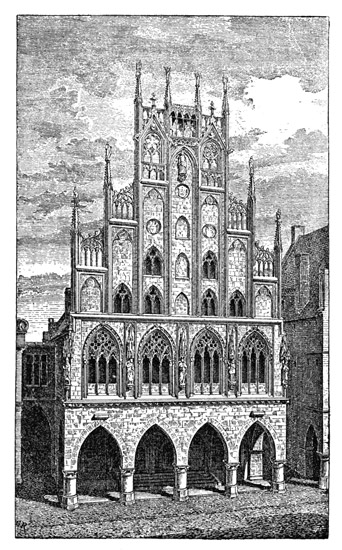
RATH-HAUS, MÜNSTER.
These merchants, once princely and noble, at least in their dealings among themselves, had sunk to shopkeepers even in the domestic circle. The fact is, that defeat and terror had paralysed and prostrated them. Instead of making such a firm resistance as they would have done in the past, they had now recourse only to the feeble weapons of tears and entreaties in order to procure some gentler treatment for those of their members who had fallen into the enemy's hands. Most frequently, too, these humiliating steps proved quite futile, and were answered according to the temperaments of the generals-in-chief—brusquely and rudely by Tilly, politely and cunningly by Duke Wallenstein.
Meanwhile matters went from bad to worse for the Hansa towns and for Germany. Even when the empire achieved victories, the people had grown too impoverished and too enervated to profit by them. The story of this long-confused conflict of thirty years' duration is one of the saddest and most depressing in European history.
When in 1648 the peace of Westphalia was at last concluded, it nominally restored calm to the whole northern world, including the Hansa towns. But the League to all intents and purposes was at an end. The peace could restore neither its power, nor its union, and the confederation which seemed to have sunk in deep sleep during the war, awoke from its long repose only to find itself deprived of nearly all its members, and powerless to continue any longer its enfeebled existence.
VIII.
THE SURVIVORS.
Although the peace of Westphalia found the Hansa hopelessly broken, yet it was not until after this event that the various members fully realized their condition. Until then they had anticipated a resuscitation with the advent of political calm. When the Hanseatic deputies had assembled at the Diet of 1628, the last of which an official record exists, they had voted to postpone to a more convenient season all proposals that were brought forward for consideration. This Diet revealed the confusion into which the Hanseatic accounts had fallen. Still even on this occasion various cities pleaded for re-admission into the union. It throws a sad light upon the character of the delegates to read that those of Brunswick, reporting to that city the history of this Diet, should lay great and detailed stress upon the fact that they had not been regaled with the customary wine of honour and the wonted supply of cakes!
All that was achieved on this occasion was that the cities of Lübeck, Bremen, and Hamburg, were charged with the protection of the Hanseatic interests, in the name of all the other cities, so far as such interests could at present be said to be at stake.
Yet another Diet was summoned in February, 1630, at Lübeck. On this occasion there occurred what of late had not been unusual, namely, that no Hanseatic delegates appeared, with the exception of those of Bremen and Lübeck.
It is a picturesque historical invention, but, unfortunately, like most picturesque legends, quite untrue, that on this occasion all the members of the most ancient German Hansa put in an appearance, and in Lübeck's Hansa Saal decreed, in all solemnity, its own dissolution; that, in short, the Hansa was present at its own funeral. As the Hansa never had an actual foundation day, so it had no day of dissolution. As its growth had been gradual, the result of time and circumstance, so was its decay. It had been built up imperceptibly, it passed away almost as imperceptibly.
After the Diet of 1630, and again in 1641, the three cities above named—Lübeck, Bremen, and Hamburg—made still closer their friendly alliance, erecting a species of new Hansa upon the ruins of the old. With great modifications this compact survived down to our own times, and was not dissolved until forcibly rent asunder, as disturbing to Prussian ambition and to Prussian ideas of protective trade. For these cities kept up a species of free trade, while all the rest of Germany was protective, and to this day, though despoiled and shorn of their honour, the cities call themselves proudly the Hanseatic towns. In those days their main endeavour was to save as much as possible from the general wreck, and to try and keep alive the spirit of the League, of which most ambitiously they retained the name. They believed, indeed the other cities believed too, that with the restoration of peace they could establish themselves upon the old foundations.
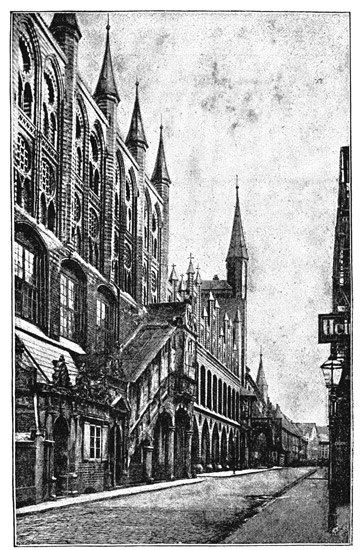
RATH-HAUS, LÜBECK.
This vain, daring hope, so common to all who suffer from incurable disease, did not quit them till the conclusion of the peace so ardently desired. This peace inaugurated a state of things incompatible with the commercial tendencies of the Hanseatics, and showed indisputably the futility of their hopes.
Yet with that doggedness or obtuseness which prevents a man from knowing when he is beaten, and which was at all times both the strength and weakness of the Hansa, even after facts had been made plain to them, they still refused absolutely to accept them. They still hoped against hope, to shape the course of events, and as usual Lübeck the energetic was to the front in these endeavours.
After the peace of Westphalia, this city tried repeatedly to organize a Hanseatic Diet in the old style. It was not until 1669 that a number of cities could be found willing to send deputies sufficient to qualify the assembly with the name of a Diet. But many of these deputies came only to announce that their towns would not in future pay contributions to the League, putting forward as their reason either that the war had impoverished them too much, or that the changed manner and course of trade made them doubt as to the continued utility of their union.
The discussions on this occasion were most animated. It was a stormy sitting, but it produced no real result. Too many different and absolutely conflicting opinions were advanced. The only conclusion that was arrived at was the choice of a certain Dr. Brauer, of Lübeck, to fill the honoured post of Hanseatic Syndic.
Vain honour truly, a very sinecure. For our poor old League, already in its death throes, did not survive this Diet. After eighteen sittings had been held it was made manifest that no accord could be arrived at, and the city of Lübeck even doubted if it were worth while to draw up an official report of the proceedings. Respect for ancient usages, however, prevailed, and the minutes were therefore drawn up in all due form. But they had no fact to record, except that the assembly had not been able to arrive at a unanimous opinion on any one point put forward.
Speaking of this final moment, the eminent historian of the League, Sartorius, writes—
"The constituent elements of the League had been united together in silence, and it was also without noise that they were decomposed. No one could be astonished at this end, which for some time past have been foreseen by any intelligent person."
"Sic transit gloria mundi" might have been written on its tomb. Its glory had been great and real indeed.
No less a person than the eminent philosopher, Leibnitz, in 1670, advised the imperial authorities, of course without result, to revive German trade by the re-establishment of the Hanseatic towns. The profound indifference of the empire was a fact too great to be overcome. The Emperor Charles VI. even went the length of formally forbidding his subjects to trade with the two Indies by way of England and Holland. At no single princely court of the whole realm was there to be found a sound view of commerce and commercial requirements. In the midst of such apathy and ignorance it was a real piece of good fortune for Germany that, at any rate, the three cities of Lübeck, Bremen, and Hamburg, were allowed to keep their independence.
It was in these cities, then, gradually as trade revived and the disastrous effects of the Thirty Years' War were somewhat overcome, that wealth concentrated itself. Here too was still to be found commercial knowledge, activity, and enterprise, while the old name of Hansa was discovered to have sufficient power left to conjure with. That German industry still found foreign outlet, that it still survived, and proved profitable, was henceforward due solely to the three remaining Hansa towns.
The empire, meanwhile, whenever it did not harry them by attempts at futile restrictions or by foolish criticism of their policy, ignored them entirely. This was always for the cities the happiest course, allowing them free room to act as they, with their commercial knowledge and insight, thought fittest.
But as time went on, and the political state of Germany grew more and more abject, it naturally came about that the Germans grew less and less respected and feared in the foreign markets, the foreign people with whom they had to deal knowing full well that there was no real power to back them. They had to see all other strangers preferred before them and the name of German become a by-word. Indeed they would be scornfully asked what was meant by German, seeing there was no land really so styled, and that the country which once bore that name was split up into a vast number of small principalities. No wonder that this condition of things did not help on German trade. No wonder that under these circumstances the foreign policy of the new League, or rather of the union of the three towns, for league it could not be called, was a policy of weakness, almost of cringing, far different indeed from that of their predecessors, who had played with thrones and deposed kings. Where once they commanded they had now to plead or flatter, and if these methods failed they were driven to observe the mores mundi, to use their own phrase, and let fly silver balls, unlike the heavy balls used in olden times, that is to say, they had to bribe.
After the French Revolution and the European disorders of that time, the Hansa towns by common accord of Russia and France were declared to be perpetually neutral, a gift of doubtful value. The cities were soon made to feel what was meant by owing their existence to aliens.
A little later Napoleon the Great was frequently on the point of giving away the Hansa cities, even before he had appropriated them to himself. In 1806 he offered them as compensation for Sicily, and, according to Lord Yarmouth, would have given them to Hanover if thereby he could have procured the peace with England. Sometime after they were destined by him to serve as the footstool of the throne he designed for his brother Louis in North Germany.
While he was making up his mind they were held by his soldiers, and these days of French occupation were spoken of to their dying days by the burghers in accents of terror. At last, in 1810, quite suddenly and without previous warning, "without due regard and courtesy," as was pleaded afterwards at the Congress of Vienna, Napoleon incorporated the Hansa towns with the empire.
It was well for them that this period was of short duration, for trade was in those days a matter of no small difficulty. Napoleon's mania regarding the continental system had reached its culminating point. Commerce was carried on either by submitting to grave sacrifices owing to the blockade, or by smuggling on a colossal scale. Neither method brought with it prosperity or calm.
Then dawned the memorable year of 1813, and with it came the first check in Napoleon's victorious path. The citizens of the three Hansa towns were among the first in Germany to put on armour and draw the sword for the liberation of themselves and of their suffering fellow-countrymen. Great oppression, happily for mankind and progress, often produces a strong recoil. Enthusiasm knew no bounds; German courage, which seemed dead, was revived.
Alas! it was a false hope. Reaction once more got the upper hand after Germany was liberated from Napoleon's yoke, and it is a question whether the yoke of the native rulers was not even heavier to bear than that of the foreign usurper. It was certainly less liberal.
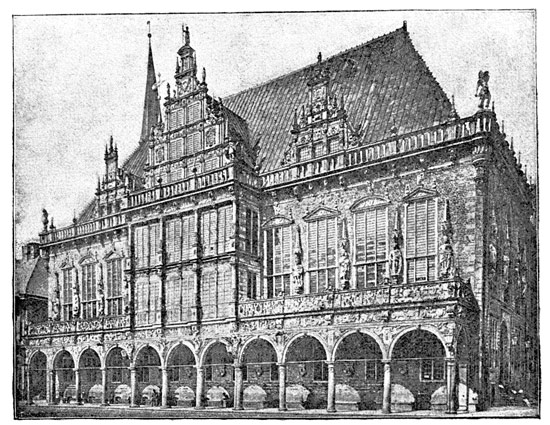
RATH-HAUS, BREMEN (From a print in the British Museum).
The three Hansa towns, however, fortunately for them, managed to secure their independence, though not without a struggle. There were not lacking neighbours who gazed at them with covetous eyes, nor others who would have looked the other way had some power appropriated them.
At the Congress of Vienna Lübeck was all but given away to Denmark. But this was more than the Hanseatic delegates present in the assembly could stand. Accustomed of old to lift up their voices boldly, and not to fear crowned or anointed heads, they fiercely denounced this project as a deed of darkness, and appealed so strongly to the consciences of those present, reminding them of the everlasting shame attending a broken word or promise, that they actually succeeded in bringing them round to their point of view. The project was abandoned.
Thus the towns remained virtually free, while nominally attached to Germany, and continued, as of old, as willing, as they were able, to serve their country with the talents that had been entrusted to their keeping. Their flag again appeared on all the seas, their commerce extended in all lands, they even succeeded in concluding favourable trade alliances in virtue of the old Hanseatic firm of "the Merchants of the German Empire."
But, as ever before, they were not backed by the nation or by any real power at home, and now that they were only three towns they could not act as in the days of old, when their number extended across Europe.
But since the many hundred little states of which Germany consisted have been all absorbed by Prussia, and incorporated under the collective name of Germany, even the three Hansa towns, the last to resist and to stand out for their autonomy, have had to succumb to the iron hand of Prince Bismarck and the Prussian spiked helmet. Hamburg still keeps up a semblance of independence, but it is but a shadow, and even that shadow is rapidly vanishing from its grasp. Military, protectionist Germany does not care to have in its confines a town where free trade and burgher independence are inherited possessions. The name of Hansa towns, the title of Hanseatic League, is but a proud memory, one, however, to which modern Germany may well look back with satisfaction, and from the story of the "common German Hansa" it can still, if it chooses, learn many a useful lesson.
NOTE.
Since writing the foregoing, the event, long anticipated as inevitable, has taken place, and the last two cities to uphold the name and traditions of the Hanseatic League, Hamburg and Bremen, have been incorporated into the German Zoll Verein, thus finally surrendering their old historical privileges as free ports. Lübeck took this step some twenty-two years ago, Hamburg and Bremen not till October, 1888—so long had they resisted Prince Bismarck's more or less gentle suasions to enter his Protection League. But they foresaw what the end must be; that his motto was that of the Erl King in Goethe's famous ballad:
"Und bist Du nicht willig, so brauch ich Gewalt." ("And if thou be not willing, I shall use force.")
Still they, and Hamburg in particular, held out nobly, jealous, and rightly jealous, of the curtailment of those privileges which distinguished them from the other cities of the German Empire. It was after the foundation of this empire that the claim of the two cities to remain free ports was conceded and ratified in the Imperial Constitution of April, 1871, though the privilege, in the case of Hamburg, was restricted to the city and port, and withdrawn from the rest of the State, which extends to the mouth of the Elbe and embraces about one hundred and sixty square miles, while the free-port territory was reduced to twenty-eight square miles. This was the first serious interference with the city's liberty, and others followed, perhaps rather of a petty, annoying, than of a seriously aggressive, character, but enough to show the direction in which the wind was blowing.
It was in 1880 that the proposal to include Hamburg in the Customs Union was first politically discussed. It met, not unnaturally, with much opposition among the citizens, and especially among the merchant class, of whom these citizens are so largely composed. Not only did it wound the Hamburgers' pride to see an old and honourable distinction abolished, but they feared, and not without reason, that their trade would be seriously affected by such a step. They were afraid that their city would cease to be the great international distributing centre which it had been so long. Hot and animated were the discussions in the Senate, the House of Burgesses, the press, on docks and quays, in public and in private. But the pressure exercised from Berlin, though in appearance gentle, was firm and decided. How could a single city stand against a strong military empire? In May, 1881, therefore, was drafted a proposal to the effect that the whole of the city and port of Hamburg should be included in the Zoll Verein. This was laid before the Senate, who passed a resolution that the treaty should be accepted, stating its conviction that the inclusion of the free ports in the Zoll Verein would not only be beneficial for the empire, most of whose foreign commerce passed through them, but also would increase the prosperity of the cities themselves. Whether the Senate really held this belief, or whether they thought it wise to profess this opinion, does not appear. The proposal was then sent down to the House of Burgesses. Here it did not find such facile acceptance as among the more aristocratic senators; here no real or professed illusions reigned. For seven hours did the fathers of the city discuss the resolution of the Senate in a sitting that will ever be famous among the annals of the town. The speech made by Dr. Petersen, the Commissioner for the Senate, was most impressive, and it touched the hearts of all his hearers.
He reminded the Assembly that their thousand years' history testified to the fact that the Hamburgers were ever an active, practical, patriotic people, who took life earnestly, caring not only for business and family, but for the common weal. Every good Hamburger has always been ready to sacrifice his feelings and his personal interests for the good of the Fatherland. Let all of them, he urged, even those who could not do it heartily, vote for the measure, in the sure and certain conviction that the "Father City" would flourish and prosper, and increase through the skill, the energy, and, above all, the public spirit of its citizens. Hamburg would still remain the emporium, for the wide world, of the German Fatherland, to which she would be more closely united than ever.
This speech was followed by much and earnest discussion, after which the proposal of the Senate was at last agreed to as an inevitable measure, and Hamburg was included in the Zoll Verein by one hundred and six votes against forty-six.
The details for carrying into effect this conclusion have occupied seven years, and the event was finally celebrated with great pomp, the Emperor William II. coming in person to enhance the solemnity of the sacrifice brought by the burghers of the erst free city for the common weal of the German Fatherland.
As we have said, the step was inevitable sooner or later, and the Hamburgers knew it. The German Empire, so long a fiction, had arisen stronger than ever. It was natural, very necessary, that an anomaly should be abolished which placed the great gateway of foreign commerce outside the customs regulations of the rest of the empire. It was natural for the imperial authorities to desire that their two great commercial ports should be at one with the empire in all respects; that as far as their trade is concerned they should not be in the position of foreign countries, jealously watched by imperial officers lest they might seek to injure the financial interests of the country of which they form a part.
It is too early to know what effect this step will have upon the trade of the two cities, whether it will check or increase their prosperity. The gain to Germany is certain. The gain to the two cities, but in especial to Hamburg, is something less than problematical. Meantime the last and only privilege the three once powerful Hanseatic cities retain is that of being entitled, like the greatest States in the empire, to send their own representatives to the Bundesrath and to the Reichstag.
EPILOGUE.
The once proud and mighty Hanseatic League is dead now, quite dead. There remains of it only a noble memory, the record of a high and fearless spirit which resisted tyrants petty and great, a spirit which recognized the value of independence, and strove with all its strength to attain and to maintain this boon. We have traced it from its earliest dawn to its recent complete demise; there but remains for us to speak its funeral oration. This is soon accomplished, since whether for men, for nations or associations, if their deeds speak not for them more eloquently than human words, the latter shall avail them little.
The chief title of the Hanseatic League to remembrance is that it was the means of spreading higher culture throughout wide tracts of the European continent, many of them, in those early times, still sunk in utter barbarism; that it introduced Western customs and civilization into all domains of private and social life for millions upon millions of people. This association is a bright spot that strikes the eye, as it looks back across the long, dark abyss of ages past, and we welcome it the more gladly because the bond that held this League together was neither force nor fear, but free will and clear insight into the advantages and necessity of mutual help. To quote the pertinent words of Mrs. Sinnett: "These free cities of Germany rise like happy islands amidst the wide-wasting ocean of violence and anarchy. Not by war and spoil, but by industry, enterprise, and prudent economy, did they accumulate the wealth that enabled them to heal so many of the wounds inflicted on their country by the iron hands beneath whose grasp art, science, even agriculture, by which they subsisted, was perishing. By the unions which the cities formed amongst themselves they stemmed the torrent of violence and anarchy that was threatening to turn their country into a desert peopled by hordes of robbers and slaves; they lent the most effectual aid to the Church in her efforts for the peace and civilization of Europe; yet they held the balance most firmly against the too great preponderance of her power, and rescued the human mind from the injurious subjection which she sometimes claimed as the price of her benefits when society had outgrown the leading strings that guarded its infancy, and felt as a galling restraint what had once been a needed protection. The cities built asylums for the widows and orphans whom the nobles and warriors had made desolate; they stretched out often a helping hand to the poor knight, who was regarding them with envy, hatred, and malice, and all uncharitableness, taking him into their pay as a soldier, and enabling him to get a comparatively honest living, instead of wringing 'from the hard hands of peasants their vile trash,' or filling some menial office at the court of a prince, and picking up the crumbs that fell from the great man's table. Behind their walls and bastions the young tree of civil liberty, which was perishing in the open country, took root and flourished; there, even whilst striving only at first for riches and their peaceful enjoyment, did men learn to prize the blessings of social order, justice, and peace. These cities were not mere aggregations of men within a narrow space, such as may have existed among the most barbarous nations; they were organic bodies animated by a living spirit—a spirit of enlightened intelligence, courage, and self-reliance, which best supplied what was defective in the religious system of the time, and gave a more healthy and manly tone to the character both of individuals and of society. The Church, it cannot be denied, sometimes taught men, in the pursuit of an imagined perfection, to trample on the impulses, and violate the duties of nature; in these little republics, on the contrary, though originally they had only the attainment of temporal good in view, they rose insensibly to higher objects, and not only cultivated the social virtues more effectually, but in their struggle to maintain their place in the world, fought in many instances a more successful fight against the sins of the flesh, through the discipline of the manifold cares of an active life, than the recluse of the cloister, with all his fastings and flagellations. Among the happy influences belonging to these miniature states was the ardent attachment of the free citizens of the Middle Ages to the little spot which they had hedged in from the wide wilderness of slavery around, where the individual, if not of noble birth, was usually the mere helpless victim of arbitrary power. Freedom and honour, the respect of his fellows, the happiness of domestic life, the interest and excitement of active business, the joviality of social intercourse, a thousand ties entwined around him, connected him closely with the city, and even the house of his birth; for in those days it was common for men to live and die beneath the same roof under which they had been born. The merchant regarded his native town with a pride fully equal to that of birth and chivalry in the privileged classes, and little envied, we may suppose, the life of the solitary feudal lord in his castle, or the anxious and dependent position of the courtier. The citizen of a humbler class showed, by parading on all occasions the tools and emblems of his trade with the same complacency with which a soldier displays his sword, or the noble his armorial bearings, that he knew his position and was content with it, and felt none of that weak shrinking from his appointed place in society or uneasy longing after another, which has since been the epidemic malady of the middle classes."
For two centuries and more this guild of merchants made the German name respected in European lands, the German flag respected in European waters. When the empire had fallen to pieces and there was no union, no cohesion left, the Hanseatics remained German and held together staunchly and nobly. Though the time of their existence was brief, yet it was all-important, not only for their own land, but for all Europe.
To appreciate to its full extent the influence exercised upon Europe in general by the Hanseatic League, we must carry our minds back, and compare Europe as it was when the League took its rise, with Europe as it was when the League declined. The Hansa made its appearance in history at a time when barbarism, violence, religious fanaticism, political and civil slavery, and dire intellectual darkness overspread the whole continent, when liberty and industry, as we understand them, were unknown. The constant and active communication kept up by the cities of the Hansa, not only among themselves and with all parts of Germany, but with the most distant countries, awoke and kept alive the intelligence of the people. To the Hanseatics, as to the Italians of the same epoch, was reserved the honour of dispelling the obscurity that reigned in the mental and material world. The Hansa's glory only pales before that of the rival Italian mercantile associations from the fact that its energies were somewhat too exclusively confined to money-getting. Had these communities arisen in a period of literary culture, or among the glorious relics of the art of a brighter age, these cities would have presented several more salient points of resemblance to the republics of Greece and Italy. It cannot, however, be denied that in many of their institutions they improved on the model set by the Italian cities, and this more especially in all matters relating to morality and rectitude. But they were less grand and large in their policy than their Trans-Alpine brethren, and unfortunately for themselves, their commercial maxims were always narrow and selfish. Monopoly was their watchword, their grand aim. And it was largely in consequence of this narrow policy that their ruin overtook them. They perished of that disease whereof corporations are apt to perish, namely, egotism, the centrifugal force which is perpetually tending to rend asunder all human society, and must inevitably do so, when not restrained by some powerful antagonistic action.
It is strange that, while so rich commercially, the Hanseatic League lacked political ambition. Had they possessed it, there is little doubt they might have made themselves independent masters of all Northern Germany. But they seem never to have forgotten that they were merchants. They were held down by petty motives, smallness of views. Here, again, they were unlike the Italians, among whom the trader could develop into the aristocrat, as is abundantly proved by the history of the Medici and other famous great houses. The reason must be sought, no doubt, in the different native temperament of the two nations—the one innately refined, the other rougher and more boorish. Though the civic pride of the Hanseatics was highly flattered when the kings of the North and the princes of Germany trembled before them, they confined their ambitions entirely to gaining commercial advantages.
Certain it is that the two powers—the Hanseatic and the Italian Republics—each in their respective sphere of action, helped on the progress that has changed the entire face of this hemisphere, and that they did this by no other means than that of their commercial activity.
For this is the great power of commerce, if practised in its best and highest spirit, that it is able to work veritable miracles, bringing into contact the extremes of civilization, enlarging and disseminating ideas, and helping forward towards that universal brotherhood of man, that universal peace and goodwill, which is, and must be, the highest ideal of humanity. Not till war is really rooted out from among us, not till what is for the benefit of one is held for the benefit of all, not until a generous altruism reigns supreme, can mankind be said to be thoroughly civilized. Trade and commerce, though apparently egotistic factors, work strongly towards this end, even though their action proceed merely from motives of self-seeking. War is so serious an interruption to trade that men will seek to avert it, even out of a simple regard for their own pockets. By fair smiling peace, not only traders, but all the world is benefited and made happier. Once let nations fully understand and recognize its incalculable benefits, and even the lowest and most squalid souls will struggle to uproot this remnant of a barbaric spirit which can never evince itself as aught but an evil.
The Hansa uprose in a rough age, and hence had to work with the rough-made methods of its time; but in its time and in its way it did a good work, and posterity cannot withhold from it either gratitude or admiration. Its policy, its laws, its constitution, its commerce, its immense credit, the sway which it once exercised, the able magistrates, merchants, and mariners whom it produced—all these have vanished, unable to resist the torrent of time that engulfs good and bad alike. But its influence and example have remained, while much of its spirit, like many of its ideas and rules, have become incorporated into the general stock of the ideas of humanity.
Of the League itself, it is true there remains only an illustrious name. For Germany, which gave it birth, there remain memories both of pride and regret—memories that should serve as a spur to noble and useful emulation.
"The History of Commerce," says Montesquieu, "is the history of the intercommunication of peoples." The story of the Hanseatic League is an eloquent testimony to the truth of these words.
INDEX.
A
Albert Dürer, 226
Alva, Duke of, 299
Amsterdam, 308, 310
Antwerp, 308, 310
Armada, 317, 349
Arnold of Brescia, 38
Art, 109
B
Baltic, 21, 45, 89, 217, 260, 286, 296, 309
Barbarossa, 4, 35
Bergen, 20, 127, 137, 284
Bismarck, 375
Blackmail, 12, 43
Boris, Gudenow, 161, 302
Bornholm, 59, 98, 237, 300
Bremen, 83, 322, 365, 375
Brömse, Nicholas, 266, 270
Bruges, 95, 100, 163, 307
Brunswick, 85
Burleigh, Lord, 336
C
Charles IV., 63, 73
Charles V., 219
Charles VI., 369
Christian II., 219
Christopher of Oldenburg, 251
Civilizing influence of traders, 24
Cologne, 34, 61, 95, 168, 179, 264, 309, 319, 321, 348
Commerce with Denmark, Sweden, and Russia, 148
Commerce with the Netherlands and Southern Europe, 163
Copenhagen, 50, 57
Court of St. Peter, 30, 153
Cromwell's Navigation Act, 256
D
Dalecarlia, 227
Dangers of navigation, 17, 18
Danzig, 87, 98, 185, 300, 315
Decline and fall, 209
Denmark, 48, 51, 57, 148, 219, 250, 259, 260, 284, 300, 357
Diet of Worms, 43
Ducal cities, 80
Duke of Northumberland, 332
Dürer, Albert, 226
Dutch, 95, 137, 169, 217, 306
E
Elizabeth, Queen, 336
Embden, 342
End of Hansa dominion in England, 324
England, 15, 16, 98, 138, 179, 286
England, end of dominion in, 324
English towns, 195
Epilogue, 379
Ethelred the Unready, 15
F
Federation, 21
Feodorowitch Gudenow, 161, 302
Fights of the Hansa, 48
Foreign protection, 15
Foreign trade, 30
France, 171
Frederick Barbarossa, 4, 35
Frederick (of Holstein), 225, 231, 236, 244
Freiburg, 38
G
Godeke Michelson, 129, 134
Gothland, island of, 24, 54, 55, 127
Gresham, 328, 337
Gudenow, Feodorowitch, 161, 302
Gustavus Adolphus, 355
Gustavus Vasa, 222, 226, 232, 236, 260, 285
H
Hamburg, 300, 342, 365, 375
Hansa fights, 48
Hansa, name of, 46
Hansa, towns in fourteenth century, 82
Henry VIII., 248, 271, 326
Herring, 48
Holbein, 246
Holy Roman Empire, 4, 6, 31, 231, 358
I
Italian merchants, 37, 40, 307
Italy, 175
J
Julin, 23
L
Liberty, personal in twelfth century, 35
Life in fourteenth century, 112
Lisbon, 175
Livonia, 157, 288, 291
Lombards, 6, 37, 40, 159
London, 15, 16, 20, 179
Loss of colonies, 283
Lübeck, 48, 50, 57, 63, 73, 85, 89, 149, 202, 223, 232, 237, 242, 246, 283, 300, 319, 333, 345, 357, 365, 375
M
Mary, Queen, 332
Max Meyer, 245
Merchant Adventurers, 325, 328, 337, 342
Meyer, 245
Michelson, 129, 134
Municipal privileges, 40
N
Napoleon, 371
Netherlands, 217, 250, 306
Nicholas Brömse, 266, 270
Northumberland, Duke of, 332
Norway, 137, 219, 284
Novgorod, 20, 152
O
Oldenburg, Christopher of, 251
Organization of the League, 202
P
Payments, 103
Peace of Westphalia, 364, 365
Personal liberty in twelfth century, 35
Peter's Court, St., 30, 153
Petersen, 377
Portugal, 175
Protection, foreign, 15
R
Reformation, the, 241
Religion, 106, 241
Rhine towns, 45
Rudolph II., 350, 354
Russia, 23, 96, 152, 185, 286, 301
S
St. Nicholas Church, 56, 133
St. Peter's Court, 30, 153
Scania, 26, 48, 53, 57, 60, 149
Simon of Utrecht, 131, 134, 136
Sir Thomas Gresham, 328, 337
Smolensk, 20, 96
Spain, 174, 311, 349, 357
Steelyard, 30, 179, 328
Stock-fish, 26, 195, 214
Storm clouds, 217
Stortebeker, 129
Stralsund, 47, 67, 357, 362
Sudermann, 314, 332, 347
Survivors, 365
Sweden, 98, 149, 152, 222, 259, 285, 296, 355
T
Teutonic knights, 159, 292
Thirty Years' War, 215, 354
Tilly, 361
Trade guild, 11
Treaty of Stralsund, 67
Treaty of Utrecht, 185, 339, 343
U
Unhansing, 29
Utrecht, Simon of, 131, 134, 136
Utrecht, Treaty of, 185, 339, 343
V
Vasa, 222, 226, 232, 236, 260, 285
Venice, 20, 175
Victual Brothers, 126
W
Waldemar, 47, 49, 51, 75
Wallenstein, 357, 361
Westphalia, peace of, 364, 365
Winetha, 23
Wisby, 25, 54, 55, 87, 127
Wittenborg, 57
Wrecking, 12
Wullenweber, 237, 240
Y
York, 20
Z
Zealand, 64, 319
FOOTNOTES
Transcriber's Note:
Obvious typographical errors have been corrected. Inconsistent spelling and hyphenation in the original document have been preserved.
Page 312: formerly possibly should be formally
Page 160: Ivan II. possibly should be Ivan IV.
Footnote 1: ἡ θαλασσα ἁγιάζεται changed to ἡ θάλασσα ἁγιάζεται