PERIOD III. (continued 2)
Reading edition
Yes, suffered indeed. For a year and a half this unfortunate man suffered mental and physical tortures in this hole. On one occasion he was racked in the presence of Nicholas Brömse and other burghers from Lübeck, and in order that he might recant nothing he had previously been made to say, he was racked twice before this public torture came about, and threatened with instant death did his answers vary. The duke was present on all occasions, it being a special pleasure to him to witness the sufferings of heretics. At the end, when the questions and replies were read aloud in the presence of the Lübeckers and the lacerated man, the duke turned on him harshly, asking, "Jürgen what do you say to all this?" "I have said, yes," replied the broken man, in low tones.
A letter written to his brother a few days after this event is heart-rending in its accents of despair and sorrow that he had been made to incriminate others by enforced false testimony. He begs his brother to do his best to make this good; he says he knows that he himself will lose his life, though he had two kings of England to friend, but he wished to save those who had stood by him and aided him. Brömse and the others who persecute him, know well that all the accusations are false, but it suits their purpose to put them forward. "Vouchsafe me credit; if I am a thief, may you yourself help me on to the gallows; if I am a traitor, on to the wheel; if I am an Anabaptist, into the fire."
Thus Wullenweber's confinement dragged on, and public sympathy for his fate increased. Seeing this, his persecutors thought it desirable to make an end. They announced that "the honest country" should judge Wullenweber. They carried out this proposal in the most despicable and treacherous manner. On a Monday morning September 24, 1537, a large gathering of peasants was assembled in an open space in the neighbourhood of Wolfenbüttel. From their midst were chosen twelve farmers who had not the smallest knowledge of State affairs, and barely comprehended the question at stake against the accused. Then the charges made against Wullenweber and to which he had acquiesced under torture were read before them. Called upon to reply, Wullenweber boldly, in a speech of great dignity, denied the charges, and declared himself willing to die to prove his innocence. That he should die was unanimously resolved; indeed, the verdict was a foregone conclusion. As they were unable to resolve upon the method it was voted that the hangman should decide on Wullenweber's punishment. Master Hans, called on by the judge, said that he "deemed it right and fitting that Wullenweber should be led forth and quartered and his body be torn on four wheels, and that he should be judged thus between heaven and earth, that he might act in this wise no more, and that others should remember how he had been dealt by."
But even after this Wullenweber's enemies were not appeased. They read out three more articles of accusation against him, articles which the advocate said he could not hear because of the noise made by the crowd. Jürgen replied. It was true he had confessed this while in prison, but under great pain, and in order to save his body and soul. But in order that his soul might not lie before the stern judgment seat of God, he herewith exculpated those whom he had inculpated while in prison, and begged his gracious lord (Duke Henry was close by) not to stain his hands with innocent blood and to bring therewith his (Wullenweber's) soul to lasting damnation. He then requested, as a last favour, to be permitted to speak a word or two with the emissaries from Lübeck. Most unwillingly the two men came into the presence of their late chief. "Jürgen, what do you want?" said one of them, in harsh tones that roused all the pent-up ire of Wullenweber's soul. In presence of the miserable instruments of his oppressors he broke, for the first time, his silence of two years' standing.
"This," he said in loud, clear tones: "this is what you have striven after so long, even four years ago when you wanted to surprise and carry me off by night in my house, which God Almighty did not permit. Now after all you have succeeded, that I admit before God. But I also tell you before the whole world, that the last articles are false, and that what I said in prison, I said under torture and to save my life."
He wanted to add yet more, but the Lübeckers were afraid lest a tumult in his favour should arise among the people. One of them urged Master Hans, the hangman, to hurry on the execution. But the hangman had a soul of mercy. He listened to Wullenweber's prayer, "I have but a short while left. Let me say two or three words more, then I will gladly die." And yet again he repeated, taking Almighty God to witness, that he had in no respect failed in his duty or his obligations to the town of Lübeck; that he was no thief, no traitor! Then as though he had done with his conscience, with the world, he sank upon his knee, and bent his head to receive his death-blow. Master Hans severed the noble head from its trunk with one sharp blow. The body was then quartered and torn to little pieces on the wheel.
So perished the last great Hanseatic hero and with him the Hansa's power. At that time, so great was the fear of his foes, so blindly prejudiced the masses, that no one ventured to speak a good word for the dead man. But that all did not think that he had suffered justly is made manifest by a few little trifles. Thus, for example, a worthy Hamburg burgher of the period notes in his private diary the fate that had befallen this great man. In the margin he painted a red flaming sword and underneath he wrote the words, "This he did not deserve." The same man writing a few days later and speaking of his execution and quartering, notes again in the margin, "Duke Henry merited this." Even the chancellor of Zelle, one day in his cups, ventured the utterance that "Wullenweber had died as a martyr to the gospel."
Yes, he had died as a martyr; a martyr to his town and to his faith, and the Hanseatic League was not to see the like of him again. He was no perfect hero of romance. Indeed his impetuosity and his excitable temperament, which caused him to be carried away by his enthusiasms, hindered him from developing one of those firm characters that excite eternal admiration and respect; he was lacking in moderation, and in foresight; but combined with his faults there were grand and noble elements, and take him "all in all," he was a man to honour and admire, a true patriot, a true friend to the people and their cause.
In the archives of Weimar are deposited and can be seen to this day, the acts of interrogation and indictment planned against Wullenweber by his enemies; curious documents, well worth the study of a student of humanity, as proving how even truth can be distorted to bad ends. In one of them Wullenweber's signature is scarcely decipherable; no wonder when we learn that he had just before been hung up for four hours by his thumbs!
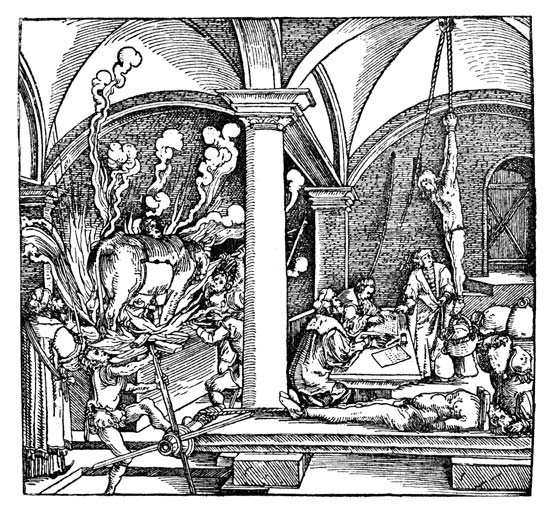
THE RACK.
Jürgen's friend and ally Max Meyer had not survived him. He too fell a victim to treachery and cruelty. Vardberg's walls were subjected to hot bombardment, from which sacks stuffed full of wool taken in booty could not preserve them. Then too the hired soldiery had grown restive, their wages being in arrear, owing to the delay with which supplies arrived from England. In the month of May, 1536, the castle was forced to surrender and open its gates to the enemy. Max Meyer was promised a safe pass, a promise that in accordance with the usages of the time was broken. The whilom blacksmith was delivered over into the hands of King Christian III., who caused him to be put in irons. He was then accused of all manner of offences, many of them, as in the case of Wullenweber, purely imaginary; was tortured, and made to confess to fictitious crime; and finally, given over to the keeping of the Danish governor from whose guardianship he had months before escaped by his happy ruse. On June 17, 1536, Max Meyer was beheaded at Helsingoer, and his body quartered and torn upon the wheel. So ended this handsome adventurer, and with his death, and that of his friend Jürgen Wullenweber, ended also an important and picturesque episode in Hanseatic history.

IV.
THE HANSA LOSES ITS COLONIES.
The prominence which we have had to accord to the history of Lübeck in the preceding chapters would almost make it appear as though we were dealing with the adverse fortunes of only one town, of a town moreover that was fighting mainly for its private and special interests and that succumbed in the combat. But this conception would be wholly erroneous. In those days the German Empire had no maritime commerce save that carried on by the Hansa; this commerce had no protection save that afforded to it by the League. The League was only powerful so long as Lübeck with a firm hand and high spirit held together its various members and led and encouraged their more feeble and often vacillating steps. For there were few among the cities that heartily supported the Queen of the Hansa in these latter days. At the cost of great and real sacrifices she insisted that the prerogatives of the League should be maintained, and if in return she also asked for some privileges for herself, this can scarcely excite wonder. It is therefore obvious that the declining power of Lübeck necessarily brought with it an enfeeblement of the whole federation.
After the failure of Wullenweber's bold schemes and his ignominious death, after the enmity against Lübeck, and consequently against the League, that had been fanned to yet greater fury by late events, it is easy to understand that the relations of the Hansa to the Scandinavian kingdoms suffered an entire change. Denmark was the first to avail itself of the liberty it had regained. The country forthwith began to draw profit from its "gold mine" the Sound. Then Norway followed suit. The town of Bergen, above all, so long oppressed by the League, now took its revenge. Gradually as the inhabitants beheld the enfeeblement at home and abroad of their rivals they withdrew from them privilege after privilege until the time came that the natives of Bergen recovered both their commercial activity and their fortune.
The justice of history is less pressed for time than the justice of man, but it is yet surer and more inexorable.
This inevitable justice, which punishes the children for the sins of their fathers, fell upon the Hanseatics in full measure at Bergen. The time actually came when it fell to the people of Bergen to advance funds to impoverished or ruined Hanseatics, and, on the principle of returning a tooth for a tooth, an eye for an eye, insult for insult, they advanced these moneys under the same hard conditions that had been employed towards themselves. The dispossession of the Hanseatics was naturally a work of time, but in course of years it became complete. The last occasion when the four chief "games" were performed, which according to a reporter at the Hanseatic Diet were designed "to keep off rich folks' children from Bergen and secure the profits of the trade to poor young fellows," seems to have been about 1590.
It is true that up to the eighteenth century German merchants retained certain prerogatives in Norway, but they were no longer the Hanseatics of the League, they were merely the members of an association reduced to slender proportions, an association as impotent to sustain its dignity as to restore the rights of its predecessors.
Sweden was no less happy in its efforts after emancipation from Hanseatic tutelage. Gustavus Vasa laid the foundations for this exemption from tolls, monopolies, and harassing restrictions. He taught his subjects the great lesson how to trade to their own profit. After his position as ruler was once well assured he did not hesitate to speak in open court of the German merchants as "butchers," comparing his predecessors to "good milch kine," and adding that he should never forgive himself, but should be ashamed before God and man, did he sacrifice the well-being of his kingdom to the rapacity and selfishness of the Lübeckers. And he kept his word. So long as he lived he checkmated the League with all the resources at his command, and he left his desire to raise the commercial prosperity of his kingdom as a legacy to his son.
Nor was it enough that men had come to hate the Hansa with that fierce hatred which is felt towards those who, holding power in their hands disgust and oppress their inferiors by overbearing conduct. Even nature seemed to turn against them in that dark moment of their national life. In the years following the burgomaster's war, as Wullenweber's war grew to be called, the herrings which had already failed once or twice during the course of the fifteenth century, either entirely abandoned the Scanian coasts, or came in such small quantities as not to repay the cost of maintenance of the "Witten." There was yet worse in store. Not only did the herrings abandon the Hansa, but they favoured their rivals the Netherlanders, coming in great masses into their waters, and thus enriching them at the expense of their enemies; a circumstance that furnished the pious preacher Bonnus with the theme for a sermon, in which he pointed out, to his own satisfaction, how this was the direct punishment inflicted by Almighty God, for the war so wantonly entered upon by the Hansa.
A fresh blow of great force came to the League in the year 1553. The English, so long forcibly kept outside the navigation of the Baltic, had suddenly opened out for themselves a road to the mouth of the Northern Dwina by means of the Arctic Ocean, thus discovering the White Sea, and offering a new route to merchants trading with Russia.
The discoverer of this new ocean route was Sir Richard Chancellor, who, together with Sir Hugh Willoughby, had been commissioned by an association of London merchants, to undertake the search of a road to China by way of the icy sea. They set forth in three stately vessels, the Bona Esperanza, the Bona Confidentia, and the Edward Bonaventura. For four months the ships kept close together, but in the region of the North Cape the Edward Bonaventura, which Chancellor commanded, was separated, owing to ice and storms, from its comrades—never more to rejoin them.
Sir Hugh penetrated with his ships as far as the harbour of Artschina in Northern Lapland, whence he could not continue his journey, owing to the intense cold and the lack of means of sustenance. In this desolate spot, he and his whole crew perished. Long after, fishermen found their bodies. Beside Willoughby's corpse lay his journal, which closed with the desponding words: "Then sent we three men south-east three days' journey, who returned without finding of people or any similitude of habitation." The diary, which has been lately printed, is a touching record of patient endurance and heroic enterprise.
Meantime the more fortunate Sir Richard had penetrated to the spot where Archangel is now situated, and where then stood a monastery dedicated to St. Nicholas. After resting here, he made his way to Moscow, where Czar Ivan held his Court. Here he was received in the most friendly manner, remained some months, and was finally dismissed with a royal letter to the young King Edward VI., in which Ivan expressed his great wish that their two countries should henceforth approach each other in more intimate relationship. Nor were these desires of the Czar's fruitless.
After Sir Richard Chancellor's return, and on hearing his report concerning the terms under which the Czar would allow the English to trade in and with his country, a number of London merchants formed themselves into a commercial corporation under the title of "The London and Muscovite Company." This company once more despatched Chancellor to treat with the Czar, and the result was that by the year 1555, mutual trading relations between Russia and England were established.
Now if an earthquake had shaken the whole of Northern Europe, it could not have produced a greater commotion in the entire Baltic North than did this Russo-Anglican alliance, "The London and Muscovite Company." The good understanding between England and Russia was at once recognized as a danger of first-class importance to all the merchants along the Sound and the Baltic. They saw their entire commerce in imminent danger. What did it now avail them that the Sound had been closed for centuries against the English ships, if the London merchants could carry their goods to Russia by another route? Above all, the Hanseatic League recognized the danger that menaced both them and their colony of Livonia, the colony of which the city of Bremen was wont to boast that it had been the godmother. What would happen, they asked themselves, with good reason, if Czar Ivan, already their enemy at Novgorod, should also take unto himself Livonia, if he should open its harbours to his new friends, and thus obtain for himself the mastery of the Baltic?
In order to fully appreciate these fears, we must remember that the province anciently called Livonia embraced all the departments now known as Esthonia, Courland, and Livonia; in a word, the whole Baltic coast of the Russian continent. This district was entirely governed by the Germans. Three hundred years back a priest named Meinhard had founded the first Christian Church at the mouth of the Dwina, and from that time forward Germany had not ceased to send the flower of its aristocracy, the élite of its burghers, its monks and its priests, its merchants and citizens, its landsknechte and mercenaries to these northern coasts to spread the Christian faith, and to found a German colony.
Colonists of all kinds rapidly established themselves in Livonia, and while the industry of the merchants raised prosperous cities and safe harbours along the river and the seaboard, the nobles dotted the land with their castles and strongholds, and the clergy with their churches and convents. It was a special characteristic of this greater Germany that it faithfully retained and reproduced the outward features of the mother-land. With German speech, German law and German customs had become naturalized.
On the gates of the citadels the knights beheld the same coats of arms that greeted their eyes at home. In the towns were seen the same architectural features, the same tightly-packed gabled houses, with their quaint projecting storeys, and their yawning cellars, for the storage of goods; the cocklofts, with their heavy, pendant cranes, that distinguished the northern cities and made them all resemble, more or less, those toy towns of our childhood that come from Nürnberg, and are so deftly packed into their box that, once removed, no unskilled fingers can replace them.
The monks and the priests, on their part, formed in Livonia their accustomed cells, their silent cloisters, the glory and weird wonder of the Gothic cathedral, with its tall, pointed spires and steeples, its coloured glass windows, through which the northern sunlight broke in soft rays, staining the floors of God's house with glory.
In a word, everything here reproduced mediæval Germany. Of the natives of the land there was little trace, though some of these still lingered in the country and ventured secretly to pay worship to their old deposed gods in sacred thickets and on lonely heaths. To this day Livonia retains its German character; the German language still reigns supreme there, German customs prevail, German names survive. In the times we speak of it was entirely under Teutonic sway.
Was this rich, important colony to be lost to the mother-land and to the Hansa that had created it? No wonder the League was alarmed.
Nor was it alone in its fears. Sweden and all the West took fright. In imagination, they already beheld the East—in the shape of Russia and its barbarous dependencies—descending upon them with the weapons furnished to them by England. At the instigation of the King of Sweden and of the Livonians, who, in 1556, expressed their fears on this subject before the Hanseatic Diet, the League, desirous to dispel this European peril, warned the Emperor of Germany, the Kings of Denmark, England, and Poland, and the Duke of Prussia, not to facilitate Russia's projects of invasion by putting at her disposal either the munitions of war or the means that would help to civilize her, and thus render her yet more redoubtable.
To these requests England turned a deaf ear, for her commercial policy then, as now, was a trifle selfish and insular. Judging that the distance which separated her from Russia gave her entire security, she did not dream of disturbing a traffic which she found lucrative. Queen Mary, admonished by the King of Sweden to interdict to her subjects the new navigation to Archangel, contented herself by forbidding the shippers who traded with the White Sea the exportation of arms.
It was not long before the alarms expressed proved themselves to be anything but chimerical. Danger first showed itself in the shape of dissension. Livonia, seeing itself suddenly grown of enhanced importance to the League, took up certain pretentious airs towards its foster-mother. It broke through ancient contracts and statutes, among which was a stern interdict against trading on its own account with Russia. The next step was to put the Hanseatic League commercially upon the same footing as a stranger; and the Livonians were, consequently, able to turn against them some of their own laws—for example, that which declared that guest should not trade with guest.
Meanwhile Russia, which had now completely thrown off the Tartar yoke and was beginning to feel its strength, cast more and more greedy eyes towards Livonia, with its rich cities and wide seaboard.
Under pretext of bringing about a fusion of the Greek and Latin branches of the Catholic Church, the Czar Ivan had sent successive embassies to Germany, who there recruited for him workmen, artists, learned men, and officers, all of whom were to aid in putting the newly-welded Russian Empire upon a civilized basis. While there, these men had learnt the fact that Livonia, which stood under the government of the Teutonic knights, had been divided by internal dissensions since the death of the Grand Master, Water von Plattenberg, who, early in the sixteenth century, had saved the province from falling a prey to the Russian desire for conquest.
Ivan, hearing this, felt the moment was favourable. He saw that the German Empire looked on indifferently at what was passing in the extreme corner of its possessions—the German Empire always had the knack of being indifferent at the wrong and critical moment—he perceived that the Hansa League was ill-disposed at that instant to her stubborn and disobedient daughter; while Sweden and Denmark glanced with all too loving eyes at the German colony on the Baltic Sea. He felt now or never was the time for action. Moreover, Livonia had but one friend, and that a nominal one, Poland, which masked designs anything but friendly under the cover of an amicable alliance; it had but one man on whom it could count—the present Grand Master of the Teutonic knights, Gotthard Kettler. But this man, though of dauntless courage and a true patriot, was condemned to rule over the once bold company of Knights at a moment when too long-continued peace and prosperity had sunk them into sloth, indifference, and vicious practices.
Under the pretext that a certain toll had not been paid him, Ivan quite unexpectedly sent into Livonia a herd of barbarous soldiers, under the leadership of the erstwhile Khan of Kasan. The money not being forthcoming, this army took possession of Narwa, a port just about to enter into the League. Thence they overspread all the province, burning, razing, sacking, robbing, and violating.
They met with little resistance. The enervated nobles—"usually so ready for a scuffle," says an old chronicler—fell like flies before them, and the strongest burghs were quietly delivered over into their hands. Dorpat, one of the strongest, opened its gates to the invader without the smallest opposition, the citizens having been seized with panic at their approach. Here there fell into their hands rich treasure, stored in the fort, affording them the sinews of war. Reval, also besieged, turned to the King of Denmark for aid against its foes. He sent back the Livonian ambassadors laden with a thousand sides of bacon and other victuals to stay their hunger, but more effective aid he could not or would not afford.
In short Livonia was being rapidly broken up and divided among the various greedy nationalities that surrounded her—the two Slavonic, Russia and Poland, on the one hand; the two Scandinavian, Sweden and Denmark, on the other.
In these sore straits the Grand Master of the Teutonic knights, Gotthard Kettler, made "the sad plaint of the Christian Brothers on the Baltic," heard at the Imperial Diet. The Emperor Ferdinand, to whom the Grand Master made personal appeal for speedy help, promised his assistance, and did send a letter to the Czar, begging him to desist from his persecution of the Livonians; but the letter was so lukewarm in its wording, and it was so evident from its tenour that the Emperor had no intention of following it up by action, that the Czar did not hesitate to send a very haughty and defiant reply. In this letter he proved that it was not difficult to find excuses for his conduct. The Germans, for instance, had oppressed his subjects; had taken from them their churches, and converted them into storehouses for their goods; had forbidden to his people free-trade in their markets. Some of these complaints were doubtless not quite groundless, for we know with what a high hand the Hansa was wont to treat the inhabitants of a land they had taken under their protection.
Livonia now turned to the League for aid; but the League had been offended by the late independent deeds of its colonies, and was not inclined to bestir itself much. The Hanseatics did not perceive the folly of their action at the time; they did not observe that in thus yielding to personal feeling they were losing their finest, richest dependency. It seemed as though with Wullenweber all Hanseatic ambition, clear-sightedness, and enterprise had sunk into its grave. An able scheme which would have rescued the entire colony for the Hansa, at a cost of some 200,000 dollars, was allowed to gather dust, unregarded and unconsidered, in the archives of Lübeck.
The weakness of Germany, the supineness of the League, the cold calculations of the King of Poland, all combined to deprive the hapless land of support. It became a prey, on the one side, to the barbaric vigour of Ivan IV., and, on the other, to the machinations of Sigismund Augustus, king of Poland. By the year 1561 the colony of Livonia was lost to Germany and to the Teutonic knights, and was divided among the various nationalities that surrounded it, Sweden coming in for no inconsiderable portion. Thus fell Livonia, the Russo-Baltic province to which in those days was assigned the rôle accorded to the Ottoman Empire by a certain class of statesmen in our own time, namely, that of a rampart of civilization against barbarism.
As we look back upon the course of history and the state of opinion in those times, it seems almost incredible that this fall should have been permitted, that neither the Hansa nor Germany should have stretched out a hand to help the oppressed colony. Incredible, because at that time the whole German and Scandinavian Baltic coast resounded with the cry of alarm that the Muscovite was seeking to make himself master of the Baltic. It is true that this result, equally bitter for Germany and for all Northern Europe, was only accomplished in the days of Peter the Great; but the foundations of this Russian Empire over the inland sea were laid in those times, and Germany had largely itself to blame for the disasters that happened in consequence.
The immediate result of the loss of Livonia was that Lübeck became involved in its last war—a war that was to leave it exhausted. These hostilities lasted seven years, from 1563 to 1570, and were instigated by a desire on the part of Lübeck that the Hansa, though it had lost Livonia, should not lose all profits accruing from trade with the Russian continent. The quarrel began by Eric XIV., Gustavus Vasa's successor, professing that he would reinstate the Hansa in all her privileges in his kingdom; but demanding in return from the League far more than it had ever possessed in Sweden, namely, a factory and special privileges in every town of the League.
When this was not granted he suddenly chose to take umbrage at the fact that Lübeck had never ceased to trade with Narwa, although he had, as he alleged, repeatedly told the Lübeckers that by so doing they strengthened the hands of the Muscovite, the common enemy. He complained of this to the Emperor Ferdinand, who, on his part however, was satisfied with the reasons for their actions put forward by the Lübeckers. Eric who, on his side, was by no means satisfied, now demanded in the most emphatic terms that the Hansa should cease all navigation to Narwa or to Russia, in order that the Muscovite might not be strengthened by the importation of arms. He contended that the channels of Finland were not the open sea, but belonged to his dominions, and that he had a right to hold sway over them, and to capture or harass any vessels he found in their waters.
It is strange indeed to find Lübeck replying to this, that the open, rude Baltic had been recognized by nature herself as a free sea; Lübeck which had ever contended that this sea was an inland lake and should be so treated, that only those should trade in its waters to whom she, its mistress, graciously accorded permission. The conclusion of the dispute was that Lübeck made an alliance with the Danish king, Frederick II., in which it was resolved to carry on war against Sweden. The sister towns, apathetic and most unwilling to fight, did not fail, however, to obey the Danish king's mandate that they should at once cease from all trade and intercourse with Sweden.
On June 9, 1563, the Queen of the Hansa issued her declaration of war against Eric XIV. of Sweden. The king, to whom the document was addressed, referred it with contempt to the magistrates of Stockholm, saying that "kings must write to kings, but burghers and peasants should treat with their peers."
But though Eric was so contemptuous, these burghers, whom he professed to despise, were to cause him some uncomfortable moments. Not inglorious for Lübeck was this last seven years' war waged by her, and its results might have been of some consequence had she been supported by the whole League. But this was far from being the case. Still she won several important victories, and on one occasion captured the Swedish admiral's vessel. In the midst of the hostilities Eric was deposed, and here again would have been the Hansa's opportunity had it known how to profit by it.
But in vain did Lübeck counsel union and implore the other Baltic cities to make common cause and crush the common enemy. They only replied complaining of the expenses entailed by this thoughtless war, and by alleging that more advantage might be obtained by diplomacy. In the end Lübeck had to bend to the common sentiment.
Imperial diplomacy was put into motion, resulting in a congress held at Stettin, in December, 1570, in which a reconciliation was brought about between Denmark, Lübeck, and King John of Sweden; and of which the conditions were, that the Hansa might trade with certain Russian cities; "so long as the emperor permitted it;" Sweden was also bound over to pay some of the outstanding debts which Gustavus Vasa had contracted with Lübeck.
King John assented, but no sooner did he feel himself firmly seated on his throne than he too forgot all his treaty promises, and once more demanded that all Hanseatic commerce with Russia should cease. He defiantly styled himself "Lord of the Baltic," assigning as his claim to this title the fact that to the Swedish crown had passed the heritage of the Hansa, both on the seas and in the Livonian colonies.
An Imperial Diet assembled at Speyer shortly afterwards and discussed these new complications, and professed great anxiety for the welfare of those deluded subjects of the empire, the Hanseatics. It also made sympathetic reference to the fate of Livonia, and made no secret of its embarrassment and annoyance at seeing now the Muscovite, now the Pole, now the Swede in possession of the Baltic.
But the anxiety and the sympathy did not go beyond words. The Hansa was weary; the empire was impotent to aid. It is true that Sweden had offered to restore to the Germans all the portion of Livonia she had taken for herself in return for the costs of war, but even this proposal was allowed to drop. When, by 1579, the Swedes perceived that the empire made no effort to regain its lost possession, they quietly assumed that none would ever be made, and their assumption did not prove erroneous.
Curiously enough, at the diet held at Frankfort, in the autumn of 1570, presided over by the Emperor Maximilian who was ever well inclined to the Hansa, and repeatedly urged them to unity, there was also present the infamous Duke of Alva, the Catholic butcher, who murdered human beings to the glory and honour of God. It was he who urged that by all possible means the exportation of armour and fire-arms should be hindered, lest the Muscovite, in possession of a European army, should one day bring sorrow not only to the Netherlands, but to all Christendom.
The German merchant world was to blame, in the first instance, for the loss of the prosperous colony; and that this was perfectly understood by outsiders is proved by the rough utterance of a Tartar Khan who had been imprisoned together with a Livonian. Spitting into the face of the latter, the barbarian said, "It serves you German dogs quite right that you have lost your province; you first put into the hands of the Muscovite the rod with which he whipped us, now he has turned it against yourselves and whipped you with it."
But the League's troubles were not at an end with the loss of Livonia and their Russian trade. They were to learn by bitter experience, what individuals too have to learn, that mankind cannot resist the temptation to kick the man or nation that is down.
Bitter ingratitude was first to be shown them by their ally, Denmark, in return for all the heavy sacrifices they had made on her behalf. Lübeck was treated with overbearing contempt, while the neutral cities were punished, as perhaps they more justly deserved, for their cowardly policy. Thus Rostock, which had furnished the Swedish admiral with food supplies in 1566, was forbidden to trade thenceforth with Scania; Hamburg, whose ships had been captured engaged in the same unpatriotic business, had to pay a hundred thousand dollars to regain them; and Danzig, too, was fined the same sum by the King of Denmark for a like offence.
But the keenest humiliation was yet in store for Lübeck herself, in King Frederick's behaviour concerning the Island of Bornholm, so long the Hansa queen's special possession. First a Lübeck governor was formally ejected by the Danes, then the inhabitants of the island, encouraged in insubordination by seeing how the authorities at Copenhagen dealt with their masters, refused to pay their dues, finally one of the towns even forcibly ejected some Lübeck traders. It was ominous that King Frederick opposed all mention of Bornholm during the treaties for peace. Suddenly, on the 7th of September, 1575, he informed the city of Lübeck, "that as the fifty years' possession, accorded to them by his grandfather, would have expired on the 19th of the month, he intended to retake possession of the island." On the city's replying that the peace of Hamburg had extended their right of possession which they held for unpaid Danish debts, King Frederick was not ashamed to reply to the council of Lübeck, that they should reasonably consider that this treaty was invalid since his father, who had made it, was not at that time crowned, and neither he nor his councillors had been consulted in the matter. Frederick did not for a moment consider that the Hansa had in all respects acknowledged the "uncrowned king," and had helped him into his kingdom.
Lübeck felt too weak, too exhausted, seriously to resist the king's claims. It sent an embassy to Copenhagen, begging for the extension of the possession, held by them as a pledge, for another forty, thirty, twenty, fifteen, eight, seven, six, five, or at least one year. Thus low had the Queen of the Hansa sunk, thus was she broken, that she could beg so abjectly. She begged in vain. King Frederick was deaf to entreaties; he saw his rival's weakness, and he profited by it. Had they not had enough return for helping Frederick I. to power by holding the island fifty years? Lübeck was forced to yield; the only concession that was made to her was, that Frederick graciously permitted her to convey one hundred tuns of Rhenish wine free of duty through the Sound for the space of ten years, to supply the town cellar of the capital. In the summer of 1576 Bornholm was formally delivered over to the Danes, and the Hansa lost yet another source of wealth.
For a while the League still strove to carry on some trade with Russia, at first by Reval, then by Narwa, but in 1587 the latter town was finally taken by the Swedes. By good fortune Lübeck and its friends found in the Czar, Feodor Ivanowitch, a prince inclined to deal favourably with them. Indeed, so well disposed was he, that in the year 1586 he reduced the existing custom dues by half in their favour, and placed at their entire disposal once more the factories Novgorod and Plestrow. But in recovering the possession of their establishments, the Hansa were far from recovering their monopoly, which time and events had undermined for ever. Annoyances without end awaited them from the Swedes and the Poles, whose territories they had to cross to arrive at their settlements. They were made to pay heavy transit tolls; their goods were subjected to annoying, and often disastrous delays; their ships were often captured and ransacked by Swedish and Polish pirates, who were well aware that their devastations were regarded with no evil eye by the home authorities.
The last embassy sent by the old and veritable Hanseatic Confederation to the Muscovite Court, in January, 1603, only attained their ends very partially, notwithstanding the truly royal presents which they laid at the feet of the then reigning Czar, Boris Féodorowitch Gudenow. The chronicles tell that the presents consisted of valuable silver-gilt vessels, representing ostriches, eagles, pelicans, griffins, lions, also a Venus and a Fortuna. Presents were also added for the Czar's son, but by an unlucky oversight, the all-powerful Russian Chancellor had been forgotten in the matter of gifts; this want of thought lost the Hanseatic ambassadors his potent favour.
The ambassadors consisted of councillors from Lübeck and Stralsund, and there went with them besides a certain Zacharias Meyer, an old Lübeck merchant, who had lived for many years in Russia, and knew the language and habits of the people. The embassy met with little success.
The monarch whose geographical knowledge was not very extensive, and who confounded the names of the Hanseatic towns who sent him this embassy with those that had passed into the possession of Poland, his arch enemy, categorically refused to recognize the Hanseatic League as such, and would only allow the city of Lübeck to be spoken of, which it seems was less unfamiliar to him. Towards this city he showed himself well disposed, and very generous, and said it might establish factories and storehouses in various localities, according to traditional custom, and trade freely without vexatious custom dues as far as Moscow. In return he demanded only a money duty on the weight of the merchandise imported, no matter of what nature. In vain the ambassadors pleaded that the towns could not separate themselves. The Chancellor exclaimed with anger—
"Then we will separate them; the Czar does not know the other towns, and those which he knows are in the hands of princes who are his enemies."
And from this decision neither he nor his royal master could be moved. This entirely personal favour to Lübeck naturally changed the character borne hitherto by the Hanseatic commerce in Russia, and helped yet further to fan the fire of discontent already smouldering in the bosom of the League. All attempts made by the other cities to profit by the advantages conceded to Lübeck remained fruitless; and this city herself, though she seems to have preserved these custom privileges until the middle of the seventeenth century, does not seem, judging from appearances, to have obtained any durable or profitable result from them. There always remained the disturbing fact that either Swedish or Polish domains must be crossed, or a long détour made by way of the White Sea, where again obstacles of yet another kind awaited them.
In very truth the Hanseatic commerce with Russia was slowly dying. Some efforts were made to resuscitate it by the cities that remained united when Czar Michael Feodorowitch sat on the imperial throne. The Hansa's demands were actually supported by the Netherlands. But even goodwill on the Russian side was impotent to raise a commerce which had been practically strangled by the powerful grasp of Sweden. Gustavus Adolphus, it is true, annoyed at the new direction commerce was taking, and the consequent loss to his kingdom in transit dues, tried all in his power to revive the old movement upon the Baltic. In this spirit and with this desire, he concluded various treaties with Russia that obliged the Hanseatics to pass through his domains, and especially to touch at Reval, the Lübeckers, who held their depot at Novgorod, naturally preferring to pass by way of Narwa. But Gustavus Adolphus and his successors, after all, did not depart from the previous policy of Sweden. He and they, like their predecessors, sought to make themselves masters of the entire Baltic commerce, and to impose their intervention upon the outside nations, whom they crippled with custom dues. Various promises of relaxation which were made to Lübeck by Sweden were ill kept. The hand of this country continued to weigh heavily upon all the Baltic coasts, until there arose on the scene the figure of Peter the Great, who in his turn reduced them to submission, and who made himself practically lord and master of the Baltic lands.
Thus ends the history of the Hanseatic commerce with Russia, which might be said to have ended already, under Czar Feodorowitch Gudenow, for it was no longer one League, but only an individual city that maintained communication with Russia in those latter days. The confederation of cities known as the Hanseatic League had ceased to march together, or to figure by name in the various treaties and negotiations made after the accession to power of this Czar.


V.
THE LEAGUE IN THE NETHERLANDS.
The successive losses of factories and Hanseatic liberties in the kingdoms of the North and East, were of themselves a fatal shock to the prosperity of the League. It must be remembered that the great privileges attained by the League in times past in England, the Netherlands, France, and Spain, were all based on the monopoly acquired by them in trading in the products of Russia, Denmark, Sweden, and Norway. This monopoly, as we have seen in the last chapters, had been seriously threatened; factories had been forcibly closed, natives and strangers had competed with the Hanseatics; the League's prerogatives and charters had been trodden under foot and disregarded.
All the efforts made by the Hanseatics at the end of the fifteenth century and in the early years of the sixteenth to expel from the Baltic waters their various competitors, had ended in failure. It obviously followed that, with the loss of this monopoly, the privileges extorted on the strength of it would vanish also; and this was speedily the case, for under what pretence of preference could the League now invoke special favours at the hands of the Eastern nations?
These general causes of failure in the West were destined to be complicated in the case of the Netherlands with the adverse fate which befell the town of Bruges at the end of the second period of our story, and of which we have already spoken. The disaster which deprived the town of its commercial importance also contributed to ruin the Hanseatic factory established in that city. Then the Hanseatics themselves were not wholly blameless, seeing how at Bruges they repeatedly revolted against paying the tax enforced for storage of goods, a tax that was a regular condition in the statutes of the League, and which was exacted in all its foreign settlements; and, besides this, there are also other circumstances to be reckoned with, of a more general character. The closing of the factory of Bruges was one of many signs of the course of events. A new spirit was abroad affecting commerce and progress in all directions, a spirit against which, as we have said, the League resolutely set its face, and which it refused to recognize until it was too late.
After the invasion of the territory of Bruges in 1488 and the ten years' blockade of the harbour of Sluys, by the Emperor Frederick III., to avenge the confinement of his son, the city found her trade almost ruined. Two important branches were lost to her, by the Italians who brought their own silk stuffs to the rival market of Antwerp and by the Flemish cloth-workers who had settled in England and likewise sent their goods thither.
Under these circumstances the Hansa could scarcely hope for the continued prosperity of Bruges. The tumultuous activity that had hitherto reigned in the factory gave place to a death-like silence. The profit that was lost to the town fell chiefly to the lot of Amsterdam and Antwerp, but partly to the fairs held annually in various localities of the Netherlands, which benefited by this abandonment and which came gradually to attract to themselves all the business of the East.
It must not be supposed, however, that the Hanseatic Diet did not observe with dismay the visible and rapid decline of the prosperity of this once flourishing factory; but what could they do to hinder the general desertion of its merchants? Could they, reduced as they were in strength and influence, restore to the city of Bruges its character of general depôt for the West? Could they remove the obstruction of the Zivin, ordered by the emperor, which, by a canal had connected Bruges with the sea? Were they not themselves so weakened that their own members refused to pay the imposed dues, violated all the factory laws, and traded and made common cause with the natives?
In vain did various diets send ambassadors to Bruges to recall to the minds of the faithless traders the laws under which they were constituted and by which they were bound to abide. In vain did the alderman of the factory itself plead with the men living under his charge. The spirit of individualism and insubordination was abroad, and since the League could no longer ensure its old profits to its foreign members, these no longer found it to their own interests to obey its behests, many of which they rightly felt to be antiquated. Add to this, that the failure to pay the appointed taxes made negotiations often impossible for lack of means, and it will be seen how crippled and handicapped was the League in its relations with Bruges.
The Baltic towns, ever the most public-spirited and perhaps also the most commercially enlightened recognizing this state of affairs, had in 1530 combined on a fixed tariff, which they thought should be paid to the factory at Bruges for its maintenance. But the other cities would not listen to this, and the absence of concord, that of late had made itself felt and heard too often in the councils of the League, was manifest again on this occasion. Town after town stated through its deputies that it would not contribute to this general tax unless some special favour were granted to it, unless some special merchandise were allowed to pass free into the Netherland domains; the merchandise named being usually that in which the bulk of the town's trade consisted. If ever an association gave practical exemplification of the homely saying of "cutting off one's nose to spite one's face," the League was doing it at that moment.
As usual Cologne was one of the most restive and obstructive of all the towns. It actually proposed to pay a lump sum of a hundred guilders annually, and so be free from all custom duties of whatever kind. By the time the dispute was at last decided, and a sum fixed upon by all the towns together, the dominion of Bruges had hopelessly passed away from the Hansa, and the League was busy with the thought of removing its factory to Antwerp.
For they finally admitted that they must cut loose from the old moorings; that it was necessary to quit the ancient factory, where disunion and grave disorders had crept in. The merchants who had deserted had many of them become naturalized citizens of Amsterdam, or Antwerp, where they quietly continued their commercial relations with the confederated towns, without taking notice either of the confederation or of its factories. Under these changed circumstances what could be done? There were only two courses possible to the League: to afford free trade to the Netherlands, and so renounce its ancient methods, or to maintain the old system, and make an attempt to apply its principles in a new locality. The first course would have been the most rational, and the most in keeping with the spirit of the time. But the Hanseatics, as we have frequently had occasion to see in the course of our story, were not men easily to lose hold of prey, or to break spontaneously with a past that had been glorious and lucrative. They decided in favour of the second course, and at once set about seeking for the spot which would best secure their interests. Various places offered themselves for their choice, such as Bergen-op-Zoom, Middlebourg, Haarlem, all of which promised the Hansa considerable advantages, in order to attract it to themselves. It would, perhaps, have most inclined to Amsterdam, but it could not forget that this town had often fought in the ranks of its enemies, and had put forth in the Baltic a special activity very prejudicial to its monopoly. Antwerp was finally decided upon, for it was manifest already in 1513 that the great commercial movement of the epoch seemed inclined to tend towards that spot.
The story of the rise of the city into importance is most interesting. Formerly its houses had been all thatched with straw. Its inhabitants lived on the results of agricultural labour and fishing. Since the English merchant adventurers had patronized the town, wretched habitations had given place to fine solid houses; ease and wealth had taken up their abode among the burghers. As an instance of this, it may be mentioned that houses which fifty years previously let for forty to sixty dollars of annual rent, now fetched four to eight hundred dollars a year. The Hansa asked themselves, very naturally, were not some of those good things to fall to their share.
It was in 1545 that it was finally settled by the Hanseatic Diet that a depôt should be established at Antwerp, but the negotiations regarding it dragged on. It was, however, at once decided, that the factory should become, like the factories of the past, an obligatory intermediary of all the relations between the Hansa and strangers.
In 1561, the League was fortunate enough to obtain from King Philip of Spain the confirmation of the privileges which they had extorted in the fourteenth and fifteenth centuries from the Dukes of Brabant, and which permitted them to bring in their goods at a minimum rate, and accorded to them other valuable privileges. And besides this liberality on the part of the ruler of the land, the interested city also showed itself willing to further the weal of the League. The Hanseatics were offered by the town of Antwerp a spacious tract of land, free of rent, situated between two canals, on which they were to be allowed to erect a factory. Besides this, Antwerp offered to defray a third of the costs, laying down for this purpose the large sum of thirty thousand guilders. Annexed to the establishment, which was to be the free possession of the confederation, was an open public square, that formed a sort of exchange—free to all comers—where prices were to be settled, and sales and auctions held. A public balance, adapted to the weights in use among the Hanseatics, was to serve in the residence itself, for weighing the merchandise imported by them, while the public balance of the town was to serve for weighing their purchases. Other very favourable conditions with regard to the exportation of unsold goods, and of goods in storage and in transit were added. In return for all these favours, the Hanseatics had to promise not to abandon Antwerp, unless very real and serious causes, such as a war or a plague, should force them thence; and that Antwerp should enjoy in Hanseatic cities such commercial liberties as were accorded by the League to the most favoured nations.
On May 5, 1564, the foundation-stone of the splendid House of the Easterlings, at Antwerp, was laid, with great pomp and ceremony, in presence of the local burgomasters and the representatives of the League. In four years the stately edifice was finished, and formerly handed over to the aldermen of the Hansa, and such Hanseatics as were in Antwerp, who were regarded by the city as the representatives of the confederated towns.
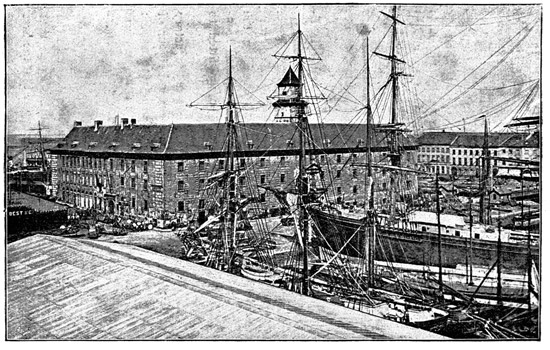
THE HANSA FACTORY, ANTWERP.
The first Hanseatic Syndic General, Dr. Heinrich Sudermann, of Cologne, then put the finishing touch to the great work by sketching out for the factory a projected code of statutes for its internal management. It was laid before the Hansa Diet for revision, approved, and at once promulgated. This code enumerated the qualities requisite for admission to the enjoyment of Hanseatic privileges, determined the methods of nomination, as well as the duties of the various functionaries attached to the factory, and other details. The accounts were to be placed under the supreme supervision of Lübeck. Further, the merchants were to maintain the traditional monastic discipline, were to live under the same roof, and partake of their repasts in common in the great hall of the factory. A few of the rules recall the old hostile attitude always maintained by the League towards strangers. All disputes of Hanseatics among themselves were to be submitted to the jurisdiction of the factory.
In a word, in the outer magnificence of the factory building, as well as in the elaboration and rigour of the statutes, all the ancient traditional Hanseatic forms had been revived. Indeed, as regards the statutes, these attained at this epoch their greatest scientific perfection.
But perfect, correct, traditional, though the forms might be, they were no longer in accordance with the times; no longer the expression of the epoch that gave them birth. It was easy to foresee that the first adverse breath would dissipate them.
And so truly it proved. Indeed, certain complications showed themselves before the building was finished, and foreshadowed the nature of the troubles to be expected in the future. Money, as usual, was the touchstone of discord. Various cities refused to pay in the stipulated sums, others protested against the regulations proposed. Danzig even went so far as entirely to object to the new settlement as too distant from the centre of business, and contended that the pact of the League with the town of Antwerp had been concluded too hurriedly, and without due consultation.
In consequence of these difficulties, the factory, when completed, found itself crippled, and hampered by debts, from which it was never able to free itself. This was an unfortunate start, and was entirely due to the apathy and bad faith of the cities, among whom it became more and more evident that the old spirit of union was rapidly dying out.
Another difficulty was, that the traders began to object to living in common under one roof. The reasons in ancient times for this regulation, such as the defective conditions of public security, no longer existed in these more civilized times. Merchants did not care to submit to the often tiresome and petty restrictions on personal liberty involved by the monastic rules that existed in the factory.
In vain the Syndic of the League put forward for the consideration of these unruly members, that the concentration of all the Hanseatics in one factory building made the defence of their privileges more easy, while their dispersion in the various towns and villages facilitated exactions by the natives and the raising of taxes. In vain he pointed to the example of England, where the Hanseatics, thanks to their unity of action and of existence, had kept their prerogatives intact during three centuries, while, on the contrary, in the Netherlands the spirit of isolation had produced in course of time an augmentation of at least treble their original dues. In vain he demonstrated that partnerships made with foreigners were onerous for the Hanseatics themselves, and drew down upon them the too great probability of conflicts with the rulers of the Netherlands, who thus would find their interests betrayed.
Expostulations, appeals to the statutes, and menaces, proved powerless to change the state of things, or the direction in which affairs were tending. There was no longer a strong support to be obtained from the League as a body, in return for obedience; its threats were no longer followed up by deeds, it had grown too feeble to quell resistance, especially such resistance as was made by towns strong in themselves—as, for example, Danzig and Cologne.
The jurisdiction of the factory was no longer respected as supreme by its own members. It frequently happened, even in the early days of the settlement, that Hanseatics residing at Antwerp brought their differences before the local tribunals instead of before their own court. It is related, that one day one of the Hanseatic aldermen, anxious to repress this mode of violating rules, reprimanded a citizen of Cologne, one Mathern Schoff, on this account. The accused fell upon the official dignitary and belaboured him with his fists. The matter created a scandal and was brought before the High Court of Brabant. This court took part with the rebellious Hanseatic, with the result that the authorities of the factory were forbidden, under the most heavy penalties, to take any action against him. They were even threatened with the loss of all their privileges.
Such incidents, and a number of others like them, presaged a catastrophe at a time not too far distant. But circumstances unconnected with the factory rendered its position still more difficult and precarious and hastened its fate.
Chief among these external causes was the war between England and Spain; the war whose chief incident was the destruction of the great Spanish Armada by the force of the elements, which ranged themselves on the side of the English Queen. This war, which made the navigation of the seas unsafe, was of course a most serious interruption to trade. Nor did the destruction of the Armada bring peace to the Hansa. Besides this there had broken forth in the Netherlands the great revolt in the cause of freedom against the ecclesiastical and civil despotism of Philip II., which was permanently to change the whole state of that corner of Europe, and which for the time being absolutely extinguished all trade by sea or land. Glorious as these events proved for the cause of liberty and of freedom of thought, they were disastrous to the League. Each of the militant nations interdicted it from all relation with the other, and security for commerce was of course quite at an end.
Now it must be borne in mind that the revolt of the Netherlands began while the Hanseatics were still building their new residence at Antwerp. The League was no longer, as in old days, strong enough to make its neutrality respected, and the consequence was, it had to yield to the demands of whichever party was at the moment the strongest. Thus the Prince of Orange manifested from 1571 onwards a desire that they should interrupt their communications with Spain. As a result, when Antwerp was taken, and pillaged by the Spaniards, November 4, 1576, the Hanseatics were forced to see themselves treated not as neutrals, but as friends of the rebels. Their papers were seized and their goods confiscated; even their charter was seized and the price of ransom fixed at the high rate of twenty thousand guilders. Further, if we may deduce inferences from the minutes of the Hanseatic Diet of the same year, 1576, it would seem as though King Philip II., and the Prince of Orange each in their turn placed a tax of 10, 20, and even 40 per cent. upon the merchandise imported by the Hanseatics into the Low Countries.
The League, in this desperate situation pleaded for help now from one leader, now from another, but could obtain no efficient relief or support from any side. At last in April, 1577, the Spanish governor of the Netherlands offered conditions to a Hanseatic embassy which under the circumstances seemed sufficiently advantageous. It was proposed that to indemnify them for the losses suffered during the pillage of Antwerp, the Hanseatics should for twenty years be completely exempt from all taxes imposed in Holland or Brabant, and from half the taxes established for Zealand. Besides this the heads of the factory were once more to be recognized as alone competent to pronounce judgment in civil suits between Hanseatics residing in the Low Countries. On their part, however, the Hanseatics would have to submit to the necessities of warfare. Further, full latitude was conceded to them in the matter of re-exportation of their goods, unless imperious need opposed this, in which case they should receive current prices for their merchandise.
That these promises were ill kept, and that the factory, scarcely born, was rapidly nearing its end, is proved by the complaints addressed in 1581 and 1582, to the city of Lübeck by its representatives residing at the factory of Antwerp. They pointed out how money was absolutely wanting in the establishment; that the Hanseatics, resident and non-resident, did not pay the contributions promised; that the Spaniards harassed them, and rendered their indebted position yet more difficult; that they had no means of enforcing payment, and that if any one city, or private person did pay, it was out of pity. Then followed complaints of certain cities, especially of Cologne, which sent merchandise to foreign agents. The document further states that the rooms, cellars, and storehouses of the factory were quite empty; that the imposition or rather the faithful payment of some of the various taxes had to be taken into serious consideration; and that as the canal duties in Zealand were always rising in price, contrary to treaty, it seemed to the petitioners advisable that reprisals should be made on the natives of that territory, residing in or treating with Germany. Finally, they announced to the city that they were about to charge an able secretary with the permanent duties of looking after the affairs of the factory, if such a plan were pleasing to the town of Lübeck, and if the factory was to continue its existence. This last phrase is significant.
Lübeck, in its reply, offered to the factory of Antwerp mere empty phrases of consolation, promising in a lukewarm manner to see that the outstanding Hanseatic dues were paid, in order that a beginning might at least be made. But it opposed the advice given by its representatives at Antwerp, to practise reprisals towards the Netherlanders, because in that case they would seek for themselves other routes and the Hanseatic port would remain abandoned and neglected.
One of the Hansa's earliest and most able historians, commenting on this reply from the city of Lübeck makes the following very just remarks: "Nothing betokens more clearly the end of the Hanseatics' commercial dominion than this last passage in Lübeck's reply to its petitioners. Formerly the League would have interrupted all intercourse with the country that so misbehaved, and would thus have punished it, would have avenged the very smallest infraction of its privileges. Now it did not even dare have recourse to this measure for fear of completely sacrificing a commerce the pursuit of which had become possible independent of the Hanseatics."
A little later than the documents referred to above, an Antwerp Hanseatic alderman wrote that he saw no hope for their body, and that the debts were of such a nature, so numerous, so onerous, that within twenty-four hours the representatives of the factory might be arrested, and the factory itself put up for sale. This piece of news did arouse the apathy of the cities. Indeed it created such alarm that even Cologne showed itself disposed to pay the stipulated taxes faithfully and regularly, within the course of the ensuing years. Unfortunately however at the point to which the Hansa had come, this tax which was levied on goods proved fatal to the Hanseatic commerce, already crippled by other custom dues, while it assured an ever-increasing advantage to their two commercial rivals, the English and Dutch. It was in consequence of these heavy duties, too, that many a Hansa citizen renounced of his own free will the liberties that had come to cost so dear.
The Hansa Diet could see no remedy save in their old traditional measures. These import duties they insisted must be paid by the towns, and to insure this they established payment stations in divers localities of the Low Countries, such as Dortrecht and Amsterdam. But all these efforts failed to bring about the needful result, and the chief alderman at Antwerp was menaced with imprisonment. Indeed, it is said he was actually confined for some while.
In sore straits, the Hansa resolved to confide the administration of its Antwerp factory to a manager and a secretary chosen from the town of Cologne, who in critical moments should seek advice of the towns of Lübeck and Bremen.
Unfortunately the best administration in the world—and that of Cologne was perhaps not the best—could not restore life to an establishment irrevocably doomed. The few promises made, the few guarantees given, whether by the United Provinces or by the Spanish Netherlands, were not kept. Two Hansa embassies which passed through Antwerp early in the seventeenth century—the one bound for England, the other for Spain—halted at the factory to inspect it. Their official report sent to the Diet was, that this factory was completely fallen into disrepute and decay, and that in the general ruin every one thought only of himself, and the general interest was not considered. They added, that places formerly bustling with commercial life had been converted into barns for the threshing of corn.
A faint new hope was excited by the armistice which in 1609 was concluded between Spain and the Low Countries; and Bremen was charged with the administration of the factory in the place of Cologne. But this was a mere passing delusion which was to vanish before the reality; for in 1624 the Spanish soldiers took up their headquarters in the factory, and never quitted it until after the lapse of nearly thirty years, by that time having made its hundred and seventy rooms entirely uninhabitable.
A very pardonable, and indeed in this case very laudable, amour propre made the town of Lübeck too late desirous to restore this factory, which recalled the greatness, as well as the decadence, of the Hanseatic League. But the Queen of the Hansa, the most patriotic, the most energetic of all the cities, was not supported by her confederates in this costly enterprise. She therefore saw herself forced to abandon the establishment to its fate.
Still, before that date, indeed immediately after the pillage of Antwerp, the trade of the Hanseatic League with the Low Countries had ceased to be a commerce placed upon a regulated footing and ruled by prescribed laws, laws emanating from the factory and punctually and faithfully obeyed by the members. A faint activity and revival occurred in the seventeenth century when the Dutch and Hanseatics made a mutual trade pact. But this proved of little profit to the latter, as far at least as their traffic in the Low Countries was concerned; for, like impatient heirs, the citizens of the United Provinces endeavoured to enfeeble their rivals, to whose succession they looked forward.


VI.
THE END OF THE HANSA'S DOMINION IN ENGLAND.
The Hansa had been more fortunate in England than in the Low Countries. Up to the middle of the sixteenth century nothing had occurred that had sensibly modified its old relationship with the English nation. Nor had the factory diminished in power or the commerce in importance. It is true that at various times, now the kings themselves, now the people, had grown restive under the heavy monopoly of the Hansa League; but, to the kings especially, the League with its riches, its command of ready money and of ships, was of great use, and all attempts at restriction of privilege ended in failure.
But as Russia became consolidated after she had thrown off the Tartar yoke, so England also gained in strength after she had once renounced the foolish desire of making herself mistress of France, and after the long civil war of the Roses was ended, and a new and peaceful reign inaugurated.
Henry VII. left the Hansa privileges intact. The same was the case under Henry VIII., who even confirmed and extended them. The patron of Max Meyer, the friend of the democratic burgomaster Wullenweber, found it to his own interest to have the theological and political support of the maritime Baltic cities, and was regardless of the interests and deaf to the entreaties of his native merchants. It is true that this hot-tempered and capricious monarch several times threatened the League with a restriction of their rights. Once indeed his threats seemed so likely to take effect that the Hamburgers, in alarm, advised the Steelyard authorities to remove from the factory all silver vessels and all ready money. However, these threats were not serious; they were perhaps but a ruse to extract more pecuniary or moral assistance from his allies.
The successive checks, however, which the League was encountering in other foreign countries were not without their reactionary effect upon England. Various discussions arose between Hanseatic and English merchants, and led to more or less violent squalls, which were certainly the prelude to the coming tempest.
The Hansa, for instance, complained that they had been suddenly forbidden to export English goods into foreign countries, that is to say, countries other than Germany proper. Above all, an attempt was made to prevent them from carrying English cloth into the Low Countries. This traffic the Merchant Adventurers, an association formed partly upon the pattern of the Hansa, wished to reserve to themselves alone.
The Hanseatics further revolted against the old-established custom that made them all responsible for infraction of privilege, and punished them for the wrong done by one or several of their cities against some individual Englishman.
On their side the English insisted with much bitterness that the German towns refused to render them justice within their dominions; that they had even laid violent hands upon such of their compatriots as were occupied in fishing in Ireland; and that they had, in the days of Christian II., harassed their navigation in the Baltic.
During the hostilities between Francis I. and Henry VIII. the mutual recriminations diminished. The German Empire supported the English king, and the League had one more opportunity of playing the old game that had so often turned to its advantage. Solicited by both parties to lend its support, it played off one against the other; and insisting upon the neutrality of its members, traded freely and advantageously with both combatants.
It is quite certain that, notwithstanding some vexations and disputes, King Henry VIII. of England remained until his death the staunch friend of the Hansa, as well as of the Low German towns that formed part of the Smalkaldic League.
The reign of his young son and successor was to witness the first serious shock to the Hansa's power. This boy, who ascended the throne at the early age of ten years, confirmed all the Hanseatic privileges on his accession. Destined to give some rude blows to the confederation, he conformed in the first years of his reign to the ways of his ancestors. One incident is worth mentioning in order to illustrate the immense influence which the Hansa had gained in England. It was the rule, contracted years ago, that the name of the Hansa should figure in all treaties between England and France.
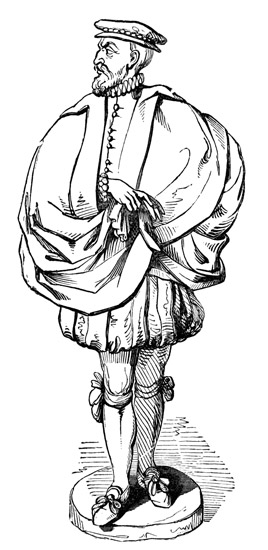
SIR THOMAS GRESHAM.
But after Edward had reigned a few years he lent willing ear to the requests of the Merchant Adventurers, all the more readily that their petitions were supported by Sir Thomas Gresham, the honoured founder of the London Exchange. This man made clear to the young king and his guardian, the Duke of Northumberland, that unless the Steelyard were destroyed, the price of exchange could not rise, because the fiscal privileges accorded to the Hansa weighed too heavily upon the English. Besides this, the men of the Steelyard were subjects of the emperor, whom the young Protestant king hated as a persecutor of his fellows in the purer faith.
Still the Hansa suspected no real danger from King Edward, and the less so, as they had completely acceded to his desire that they should abstain from all trade with Scotland. In April, 1551, a plot laid against the hated and envied strangers by the London burghers was discovered. In the course of the inquiry into the plot, it was needful to examine the Hansa's claims. Confiding in the goodwill of the king's councillors, the "New Hansa," as Sir Thomas Gresham called the Merchant Adventurers, poured forth a long catalogue of grievances against the League. It was stated that English merchants had been ill-treated in various Hansa cities, notably in Danzig and Stralsund; that the commerce of the English was hindered in all possible ways; and that serious loss was incurred by the royal treasury from the circumstance, suspected to be true, that the Hansa permitted persons foreign to their association to enjoy with them the benefit of their privileges.
In the list of complaints retailed before the king by the discontented burghers and merchants of London, and by the Merchant Adventurers who found themselves less favoured than these foreigners, an attempt was evident on the part of the English to place on one footing and to consider as equally prohibited, the fraudulent importation by the Germans of merchandise belonging to non-Hanseatics, and the importation by them of merchandise which belonged to them, but was not produced in their territory.
The fact was urged that, since the Hansa paid only the usual custom dues, even for the foreign products they imported, and for their exportation of English goods to lands outside the rule of the Hanseatic League, they were thus able to paralyse with the greatest facility all English competition in these different lands.
Certainly nothing better justifies the murmurs of the islanders against the foreigners than a comparison of their various commercial transactions. From these it appears that the English themselves, in 1551, exported 1,100 pieces of native cloth as compared with 44,000 pieces exported by the Hansa League in the same year.
It is true that all these complaints were not new. But this time they fell upon more fruitful soil. The government were perhaps all the more ready to give an attentive ear, as of late the national commerce had taken a very vigorous start, so that the royal treasury might hope for considerable receipts, even if the Crown should lose the duties paid to it by the members of the League.
In consequence the representative members of the Steelyard were cited before the Privy Council, which after a very brief examination of the claims brought forward by the Hansa, decided hastily (February 23, 1552) "that the Hansa, an illegal body, the names and origin of whose members were unknown, had by importation and adulteration of foreign goods forfeited the privileges accorded them by Edward VI."
The following day, also in Privy Council, the suppression of all the old Hanseatic privileges was decreed and the League placed on an equality with all other foreigners, none of whom had special favours granted them. This decision seemed to promise that at last the English would gain pre-eminence over their redoubtable rivals.
Meantime, the Hanseatic Diet, informed of this step on the part of the English Government, sent over an ambassador to treat with the king and Council. The result of his efforts was that, in July of the same year, the Hansa's privileges were re-established provisionally "as far as was reconcilable with the justice, fairness, and honour of the king"—so ran the clause.
Of all the negotiations a detailed and interesting account has been preserved to posterity in the Diary of the young King Edward, one of the most interesting documents for the knowledge of his short reign.
The concession granted to them made the members of the Steelyard think, and very rightly, that it would be well for them to put their own house in order, and of their own accord to initiate various reforms in their body, reforms much needed, for complaints against them had been loud and long. They secretly hoped to be in this wise restored to their former favoured position.
The disorders, however, in the body of the Steelyard were not, on the whole, those from which other foreign factories suffered. The taxes and other enforced contributions, both from residents and from the towns trading with England, were punctually paid, and the finances of the establishment were flourishing. The complaints, moreover, addressed to the Diet, that the members of the Steelyard loved luxury, wine, women, and gambling too well, and that they rebelled against their semi-monastic life, were not more frequent from England than elsewhere.
The difficulties were chiefly that trade regulations were not faithfully observed; that rules of the strictest nature, on which largely depended the Hansa's success, were circumvented and disregarded. For instance, no man who had not attained his majority was by statute allowed to become a member of the League and trade on his own account; nor was one who had not learnt English for at least six months. This latter precaution was the more requisite, as past experience had taught that, by ignorance of the native language, these men were apt to compromise the interests of the factory. Then there were other abuses that led to grave results, such as trading illicitly with natives and then absconding with their debts unpaid; the whole factory in such cases becoming responsible for the debts.
In 1553, therefore, the members of the Steelyard drew up a series of new statutes which they proposed to lay before the King of England for approval. If these minutes are well considered it will be seen that whatever else was dead or moribund, Hanseatic astuteness was not. The new laws, it is true, tended to abolish the abuses that had crept into the use of their privileges, but they did not make the least sacrifice of the liberties that the Hansa had acquired in the course of years.
King Edward, however, seemed little inclined to consider these statutes, or to revoke permanently his somewhat arbitrary decision—a decision undoubtedly just towards his subjects. Then happily for the Hanseatic League, though not for his country, he died in this same year, and the crown passed to his sister, the fanatical persecutor of Protestants, Bloody Queen Mary, as the popular mouth has named her.
The new sovereign speedily made it evident that she meant in all respects to pursue a different policy from that of her predecessor. The first to fall was the Duke of Northumberland, the pronounced enemy of the Hansa. Immediately after, the queen showed by various signs that she was graciously disposed towards these strangers, who had boldly greeted her proclamation as queen against her rival, Lady Jane Grey, by draughts of Rhenish wine liberally bestowed upon the populace at the gates of her capital. On the occasion of her triumphal entry into London they were foremost in welcoming her with pomp and splendour, as we have already mentioned in a former chapter.
Scarcely was the queen firmly seated on her throne, than the Syndic General of the Hansa, Dr. Sudermann, waited upon her, attended by councillors from some of the chief Hansa cities. The result of their representations was that one of the first acts of the new queen's reign was to annul the royal statute of Edward VI. that so grievously threatened the League. This almost unexpected good result was, it is whispered, not due merely to Queen Mary's reactionary policy, but also to the corrupting influence of Hanseatic gold, judiciously distributed.
Our League thus recovered its entire liberties and rights in the matter of export and import, notwithstanding the opposition of Parliament, of the Lord Mayor of London, and of the citizens. It is therefore not astonishing that they were willing to show themselves liberal on the occasion of King Philip's entry as husband of the English queen; and that in order to maintain the favour of this couple, various cities, especially Lübeck, showed themselves far from friendly to Protestant refugees who sought protection in their precincts.
A valuable memorandum, drawn up by the Syndic Sudermann and happily preserved to our times, gives a vivid picture of what was implied by the Hanseatic privileges in England.
Taking merely into account one article of their commerce, English cloth, it appears from this report that from the month of January to the month of November, 1554, the Hansa had exported from England 36,000 pieces of cloth, as against 1,100 exported by the English themselves, a third dyed and two-thirds in the rough; that they only paid for the right of exit threepence each piece, while other foreigners paid five shillings and ninepence; that they could use their own servants for packing and expediting merchandise, and so were relieved of various custom dues; that had they not possessed these privileges they would have had to buy this cloth on the Antwerp market, paying about £1 sterling more for the same; that they further gained £1 on each undyed piece, which they alone were allowed to export in this state, and which they resold after having had it dyed. If it be further considered that in reality they paid less than threepence a piece in the pound as custom duties, because the price of goods, fixed in ancient statutes, had gone up, while the Hansa still paid at the old figure; if, in short, this and various other matters be taken into account, it is no wonder that Syndic Sudermann could prove that on English cloth alone the Hansa earned, above that made by other foreigners who traded in this branch, a sum of about £61,000 sterling.
Small wonder, therefore, that the trade was as much coveted as it was prosperous, and that the mayor and municipal council of London did not cease from laying their complaints before the queen. They literally pestered her with petitions and demands on this subject.
For some months the Hansa succeeded in averting the storm from their heads, but finally the leading members of the Steelyard found themselves suddenly cited to appear before the Queen's Privy Council, and had to listen to a long catalogue of grievances drawn up by their accusers.
The sum total of these grievances was, that the Hansa did not contribute sufficiently to the resources of the English Crown; that it was prejudicial to the English navy, because it refused to employ any vessels but its own; that it harmed the very quality of English cloth, for the makers, seeing the Hansa would be sure to buy, presented them often with inferior qualities. An amusing complaint is the following: Whereas, say the memorialists, the Hanseatics are all bachelors, they greatly injure English trade at Antwerp, because the increased leisure this state gives them, allows of their trading more extensively and actively. Further, they once more brought forward the time-honoured objection that the Hansa would permit of no reciprocity, and while nominally allowing the English to settle in their towns, crippled their trade by heavy taxation and vexatious regulations.
That these assertions were not without foundation, not even the Hansa could deny. They could but point to ancient charters to justify them in a measure. The result of this last formal complaint was, however, that the Privy Council decided that henceforth the Hansa should abstain from importing English cloth into the Netherlands, and that the quantity of undyed goods they might export be reduced by two-thirds. They further added that any infraction of these orders would result in entire suppression of all privileges.
The Hansa, who did not easily own themselves beaten, and who desired at all costs to hinder their rivals from supplanting them, sent various embassies in the course of the next few years to the Court of England. They also once more attempted the agency of bribery and corruption by means of Hansa gold, to attain their ends. In vain. Embassies, seductions, led to no result; not even a letter which King Philip of Spain was induced to indite to his wife, the Queen of England, on their behalf, could modify by one iota the decision taken by the Privy Council.
Despairing of a good result from these measures, the League resolved to have recourse to its ancient mode of exerting pressure upon obstinate peoples, by threatening to break off all intercourse with them. The measure was, however, likely to have brought destruction to them in England; that it did not was due to the circumstance that the towns were no longer, as in past days, blindly obedient to the orders issued by the Hanseatic Diet. The Hansa, issuing such an order, forgot that they were no longer the exclusive masters of the North and East.
Such was the state of things when Queen Mary died, and Elizabeth, the Virgin Queen, took into her firm and able hands the reins of the English government (1558). It is true that she gave a gracious reception to the Hanseatic embassy that waited on her in May, 1560; but between a gracious reception and a confirmation of the ancient privileges of the League the Hansa were to learn that there lay an abyss she would never bridge over.
That the Hansa's power was effectually broken in England ultimately was due to that queen and to her wise statesman, Lord Burleigh.
It was soon felt by the nation at large that, with the advent to power of Elizabeth, a new spirit was infused into English life and enterprise. After a hundred years of weakness, England awoke to renewed life and vigour, and with vigour awoke ambition.
The Merchant Adventurers, encouraged by Gresham, put forward their desires; and they, too, asked that the Hansa should be kept down. These desires were listened to by the patriotic sovereign. She reconfirmed all the new tariffs with which the Hansa had been charged by Edward VI., and she further made various demands which the Hansa were most unwilling to concede; for they implied a strict investigation of the affairs of their factory—an investigation that they had no wish to provoke.
In the following years an active correspondence took place between the English queen and the Hansa cities, which made it most emphatically manifest to the latter that they must renounce all their antiquated pretensions; but that, on the other hand, the English queen was willing to place them in the category of the most-favoured nation clause, so that they would still pay less than other foreigners.
The Steelyard authorities, being on the spot and better able, therefore, to estimate the bearings and value of Elizabeth's letters and threats, strongly advised the Hansa towns to conform to the queen's concessions and demands. They foresaw that worse things were in store were this not done. But the League—to whom the smallest and most equitable sacrifice always seemed an enormity—resolved, before yielding, to try as a last resource what could be effected by endeavouring to obtain the intervention of the emperor.
It is strange that, after the lapse of so many years, experience should not have taught the Hanseatics that from the German emperor no effective help could be obtained. In this case, as in many previous ones, the reigning sovereign contented himself by writing a letter of remonstrance—a letter so worded that it was easily manifest to the recipient that words would not be followed by deeds. Both the Hansa and the emperor involuntarily revealed that, even after the ancient special privileges were withdrawn, the League would still enjoy great favour in England.
The emperor's letter was presented to Elizabeth by the aldermen and councillors of the Steelyard. The queen's privy councillors, and especially the trusty William Cecil, Lord Burleigh, in reply, made it very clear to the deputation that they had nothing to hope for beyond the last concessions offered.
Burleigh was the special object of the Hansa's hate. This arose, perhaps, from the fact that he had, according to a contemporary reporter, insulted one of their ambassadors by accosting him "with almost indecent rough speech." But Burleigh's speech can scarcely deserve these epithets, if the complaints and remarks are founded on his saying, that it was a bad shepherd who desired to pasture the cattle of strangers more richly than his own flocks; nor could they complain that they were excluded, so long as they might trade as freely as the English, and more freely than the French, Flemings, Dutch, Scotch, and other nations.
The Hansa, blind, unwise, stuck to its old policy, and like Shylock demanded the very letter of its ancient bond. It is true that Elizabeth insisted, on her side, that her subjects should be favoured in the Hansa towns; that this reciprocity should be granted was already a clause in the Treaty of Utrecht, concluded, it will be remembered, in 1474, but it had never been carried into effect.
It must be admitted that, all things considered, Queen Elizabeth treated the Hanseatics with a good deal of consideration and long-suffering, and demanded from them no more than what she had a right to demand. When they refused the offer to be placed on an equal footing with the English the queen issued an order that their export of English cloth should in future not exceed five thousand pieces. Cologne tried to retaliate by putting on an import tax, but it was an isolated measure, and had no effect.
In a word, the victory remained in the end with the English Government, on the side of which fought, not only its own vigorous organization, but also the disunion among the Hansa towns, which grew more serious daily, and the grave disorders that existed in the Steelyard itself.
For some time past serious complaints had been heard against the alderman of the factory, Peter Eiffler, a man who filled this high post for several consecutive years. He was accused among other things, of having tampered with the funds of the establishment, of having administered the factory without the help, or advice of the council; and of having divided unfairly among the Hanseatic merchants, the five thousand pieces of cloth permitted to them for export. Further, he was reproached for having in 1563 made a journey, leaving the Steelyard and the care of the treasury to young men incapable of so high a trust, who had done great damage to the factory.
After all these accusations had been duly sifted, this unfaithful servant of the Hansa was of course deposed from his post of trust, but his dismissal brought no fresh order into the shattered condition of things. As is frequently the case in the face of a public calamity, public spirit was extinct. Each individual thought only of himself, and of what he could rescue from the impending general ruin. On the one hand, there was the selfishness of the individual towns; on the other, the selfishness of the foreign factories. The London Steelyard, seeing that the fabric of the League was tottering, tried to save its individual existence out of the general wreck. It thought to acquire an independent life, and act and trade on its own account. Hence when the League knocked at the doors of its strong-room, to obtain the funds that should prolong or, as they hoped, even dispel the death agonies of the other foreign factories, whether by bribing nobles and kings, or by sending embassies to foreign courts, the Steelyard was careful not to listen to these demands, thinking of the future, when it might need all funds for itself. It was thus that in 1567, the London factory, in reply to a reprimand sent it by Syndic Sudermann for delaying to pay a sum of over one thousand florins into the public fund, made known to the town of Lübeck that this delay must not be imputed to it as a fault, that the times were not favourable to saving, that the annual expenses of the Steelyard amounted to eight hundred pounds sterling, and that other sums no less high had to be expended by it, in maintaining the factories at Lynn and Boston. The memorandum went on to explain that, if the English establishments were not kept in good repair, they would become forfeit to the English Crown. Then, again, the Hansa taxes had grown so heavy that no one could bear them. If the Diet wished, the Steelyard would be quite ready annually to send its accounts to Lübeck for revision, in accordance with the ancient usage, which however did not seem very firmly established; but, on the other hand, they would prefer not to act thus, since they feared lest their account-books should fall into the hands of their enemies, who by inspecting them, would gain an undesirable insight into Hanseatic commerce, and might thus perchance despoil them of their last privileges. The memorandum winds up by saying, that the Steelyard would feel greatly obliged if the League would refrain in future from making demands for pecuniary help in times of public difficulty.