INTRODUCTION
Reading edition
In undertaking to treat of a subject concerning hardly a detail of which can any statement be made without the possibility of dispute, the unfortunate necessity rests upon me of beginning with three topics which are the most controversial of all—the origin of tragedy, the origin of comedy, and the Greek theater. Instead of trying to conceal our ignorance on these matters by vague generalities, I shall set forth such data as are known, and attempt, clearly and frankly, to erect hypotheses to answer the questions that most naturally arise, even though this very striving for clearness and frankness will expose me to attack. I believe with Bacon that “truth emerges sooner from error than from confusion,” or, as a recent writer has expressed it, that “the definitizing of error is often the beginning of its disappearance.” Limits of space will require, at many points, a dogmatic statement of my views without stopping to examine the evidence from every angle. It must be understood, however, that no account of these subjects, whoever its author or however detailed his treatment, could find universal acceptance or anything approaching it.
The Origin of Tragedy.[12]—It is still the canonical doctrine, though its modern history goes back no farther than Welcker’s book on the Satyrspiel in 1826 and though no conclusive testimony for this view can be cited more ancient than Byzantine times, that satyric drama was the intermediate stage in the derivation of tragedy from the dithyramb. The argument runs somewhat as follows: The dithyramb was an improvisational song and dance in honor of Dionysus (Bacchus), the god of wine, and was performed by a band of men provided with goatlike horns, ears, hoofs, and tails and clad in a goatskin (or in a goat-hair loin-band) in imitation of Dionysus’ attendant sprites, the satyrs; on account of this costume the choreutae (members of the chorus) were sometimes called tragoi, which is the Greek word for “goats”; in certain localities, as the dithyramb became quasi-literary and took on a dramatic element, its name was changed to satyric drama; still later, as these tendencies increased, especially through the addition of an actor, the satyr-play came to be called tragoidia (“goat-song”), derived from the nickname applied to the caprine choreutae; the chorus still consisted of satyrs and, since these were licentious, bestial creatures, the performance was yet crude and undignified; Aeschylus (525-456 B.C.) was possibly the first to abandon satyric choreutae and was certainly the first to raise tragedy to the rank of real literature; during the fifth century each poet was required to follow his group of three tragedies at the dramatic festival with a satyr-play as a concession to the satyric origin of the performance.
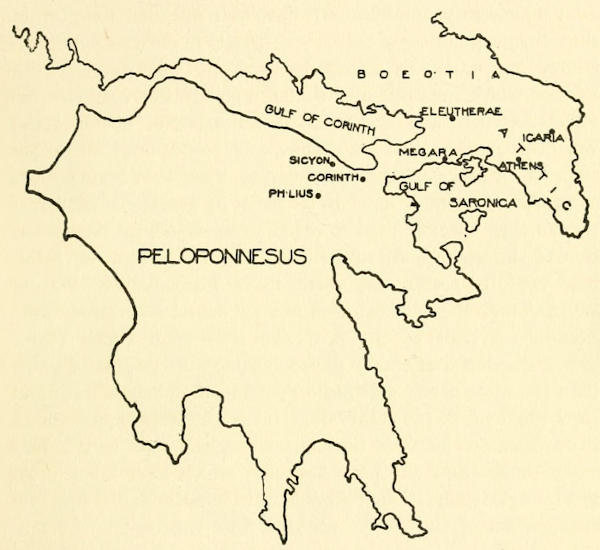
Fig. 2.—Sketch Map of Attica and the Peloponnesus, Showing Early Centers of Dramatic Activities in Greece.
In recent years, essential supports of this doctrine have slowly crumbled away before searching investigation; at present, scarcely a single clause in the foregoing sketch would escape unchallenged by some scholar of deserved standing. An ever-increasing number of students believe that tragedy is not the child of the satyr-play, but that the two are separate in their origin. Unfortunately, however, these dissenters, including such men as Dr. Emil Reisch of Vienna, Mr. Pickard-Cambridge of Oxford, Professor Wilhelm Schmid of Tübingen, and Professor William Ridgeway of Cambridge, though they are unanimous in rejecting Welcker’s hypothesis, cannot agree among themselves as to a constructive policy. My own view is that tragedy and satyric drama are independent offshoots of the same literary type, the Peloponnesian dithyramb. The former came to Athens from Corinth and Sicyon by way of Icaria. Somewhat later the latter was introduced directly from Phlius by Pratinas, a native of that place. My reasons for these opinions will develop in the course of the discussion.
Very recently, notable efforts have been put forth to interpret the religious practices of the Greeks, partly in the light of anthropology and partly in accordance with the new psychological method which inquires, not what the god is, but what are the social activities and the social organization of his devotees. Whatever may be said for these avenues of approach in other respects, in practice those who employ them have shown more eagerness to assemble data which might be considered confirmatory of their theories than to reach an unprejudiced interpretation of the whole body of ancient evidence. Thus, much has been made of present-day carnivals in Thessaly, Thrace, and Scyrus,[13] and these ceremonies are employed as if they were assured survivals of the primitive rites from which Greek drama developed and as if their evidence were of greater value than the most firmly established data in the ancient tradition. Now the a priori possibility that these carnivals should retain their essential features unchanged through two and a half millenniums amid all the vicissitudes which have come upon these regions must be pronounced infinitesimal. And an examination of the details confirms this impression. Certain parts of the ceremonies are parodies of the Christian rites of marriage and burial. Not only an Arab but also a Frank appear in the cast of characters. Though Phrynichus is said to have been the first to represent female rôles,[14] such rôles abound in these modern plays. Yet there is another defect in this assumption which is still more serious. If there is one well-authenticated fact in the history of Greek drama, expressly stated in ancient notices and fully substantiated by the extant plays, it is that tragedy arose from a choral performance and only gradually acquired its histrionic features. On the contrary, these carnivals are predominantly histrionic; there is either no chorus or its rôle is distinctly secondary. Had Aristotle been guilty of such a faux pas, we can easily imagine the derisive comments in which modern investigators would have indulged at his expense.
Of course, our evidence is far from being as complete as we could wish, and must therefore be supplemented at many points by conjecture pure and simple; but this fact does not justify us in throwing all our data overboard and in beginning de novo. In this matter we have been too prone to follow a practice which the late Professor Verrall characterized, in a different connection, as follows: “We are perhaps too apt, in speculations of this kind, to help a theory by the convenient hypothesis of a wondrous simpleton, who did the mangling, blundering, or whatever it is that we require.”[15] Now, whatever may be true in other cases, Aristotle at least was no “simpleton,” competent only to mangle his sources of information; and furthermore, apart from certain ethnographic parallels which are of only secondary importance after all,[16] our fund of knowledge in this field is in no wise comparable with his. In fact, except for the extant plays our information is almost confined to what we derive, directly or indirectly, from him. Since this is so, what can be more absurd than to reject his conclusions and have recourse to unhampered conjecture?
But if we are to hold fast to Aristotle, one precaution is necessary—we must be sure that we do not make him say more or less than he does say. He wrote for a very different audience from that which now reads his words and with a very different purpose from that to which his book is now put. And these factors often render him enigmatical. This resulted also from his frequently assuming a familiarity with things which now cannot always be taken for granted. As Professor Bywater expressed it: “It is clear from Aristotle’s confession of ignorance as to comedy that he knows more of the history of tragedy than he actually tells us, and that he is not aware of there being any serious lacuna in it.”[17] Thus, Aristotle says that tragedy was “improvisational by origin” and, more specifically, was derived “from the leaders of the dithyramb.”[18] Though this expression unhappily is somewhat lacking in precision, the main item, that the dithyramb is the parent of tragedy, emerges from any interpretation. Ridgeway may proceed to dissociate the dithyramb from Dionysus and to derive it from ceremonies at the tombs of heroes if he choose; however unwarranted, that is at least logical. But to ignore this statement of Aristotle’s and to seek, as many do, to trace tragedy back to δρώμενα (“ritual acts”) of various kinds by another line of development transgresses good philological practice.
There is an unfortunate facility in such attempts. Tragedy embraced many diverse elements in its material and technique. Accordingly, whatever anyone sets out to find, he can be almost certain of discovering there. Thus, Dieterich with his theory of the development of tragedy from funeral dirges, the Eleusinian mysteries, and various aetiological sources; Ridgeway with his tomb theory; Miss Harrison with her “Year Spirit” (the Eniautos-Daimon) and sympathetic magic; and Murray with his attempt to reconcile and expand the Dieterich-Harrison theories, all find confirmation for their views in the same body of dramatic literature. The very facility of such analyzing is its undoing.
Moreover, despite numerous attempts to the contrary, the real nature of the primitive dithyramb can scarcely be a matter of doubt. Plato, who was also no “simpleton,” defined it as a song in celebration of the birth of Dionysus.[19] Now since the dithyramb is known to have been opened up to a wider range of themes considerably before Plato’s time, his definition must apply to the original meaning of the term. This interpretation does not remain unsupported. Thus, the first extant instance of the words occurs in a fragment of Archilochus (ca. 680-640 B.C.), who declares that he “knows how, when his heart is crazed with wine, to lead lord Dionysus’ dithyramb.”[20] It should be observed that Archilochus does not say that he knows how to write a dithyramb, but how to take part in one as a drunken ἐξάρχων (“leader”). Such a performance was doubtless, as Aristotle said, largely improvisational, being perhaps coupled with the rendition of some ritual chant (καλὸν μέλος). Dionysus is characterized as θριαμβο-διθύραμβος (“celebrated in dithyrambs”) by Pratinas,[21] and addressed as διθύραμβος by Euripides in his Bacchanals, vs. 526. In an ode in honor of the victories which were won by Xenophon of Corinth in 464 B.C. Pindar inquires, “Whence appeared the charms of Dionysus in connection with the ox-driving dithyramb?”[22] Here, also, the author is not referring to the Corinthian dithyramb of his own day but to the period when it was put upon a quasi-literary level by Arion (see below). Finally, Epicharmus went so far as to declare that “when you drink water, it isn’t a dithyramb,”[23] showing that the more primitive meaning of the term was not crowded out by later developments. These passages are sufficient to show that the dithyramb was at all times intimately associated with Dionysus and at the beginning belonged to him exclusively; their force is not invalidated by the acknowledged fact that at an early period (see p. 11, below) the restriction was broken down.
It was not until after the middle of the seventh century that the dithyramb became “poetized.” This step was taken by Arion of Methymna in Lesbos, then resident in Corinth. His connection with the dithyramb and early tragedy is vouched for by irrefutable evidence. Solon of Athens (639-559 B.C.) is said in a recently discovered notice[24] to have declared in his Elegies that “Arion introduced the first drama of tragedy.” The question immediately arises as to exactly what language Solon had employed. The words τῆς τραγῳδίας πρῶτον δρᾶμα are, of course, only a paraphrase, for no form of the word τραγῳδία can be used in elegiac verse. This objection does not lie against the word δρᾶμα, however, and it will be remembered that the Dorians based their claims to tragedy partly upon this non-Attic term.[25]. Thus, we obtain an explanation of the cumbersome circumlocution “the first drama of tragedy.” In Solon’s Elegies the author of this notice (or his source) found only the ambiguous term δρᾶμα. A desire to retain the terminology of the original prevented his frankly substituting τραγῳδία. Accordingly, he kept δρᾶμα but inserted the qualifying genitive τῆς τραγῳδίας. I do not understand that Aristotle either indorses or rejects the Dorian pretensions with respect to this word; but in view of our present evidence I am of the opinion that Arion called his performances “dramas” and was the first to use the word in this sense and that there is so much of justice in the Dorian claims. It is not necessary to believe, however, that they were ever called satyric dramas, see p. 22, below.
Now, Dr. Nilsson has objected that Solon would have had no occasion to express his opinion upon a matter of this kind (op. cit., p. 611, note). But the mention of the title of the work from which the citation purports to come goes far to substantiate its genuineness. Furthermore, Solon was incensed at Thespis (see pp. 17 f., below), and therefore it was only natural that he should take an interest in the matter, assign the distinction to another, and state his opinion in as public a manner as possible. The fact that he lived in the days before real (Aeschylean) tragedy and before the importance of Thespis’ innovations was understood explains the error in his judgment. But at the very least, this notice proves that the tradition of Arion’s connection with tragedy was current as early as the first half of the sixth century.
Pindar’s reference to the development of the dithyramb at Corinth has already been mentioned. In the next generation Herodotus characterized Arion as follows: “Arion was second to none of the harpists of that time and was the first of the men known to us to compose (ποιήσαντα) a dithyramb and to give it a name (ὀνομάσαντα) and to represent it at Corinth” (I, 23). It is customary nowadays to seek to explain such notices as arising from the rival claims of jealous cities; but be it noted that here are two Attic sympathizers, Solon and Herodotus, granting full recognition to the literary achievements of a neighboring city. In fact, Herodotus is apparently too generous, for Arion could not have been the inventor of the dithyramb, broadly speaking. But ποιεῖν denotes not only “to compose” but also “to poetize,” and the latter translation is in better accord with what else we know of Arion’s contribution to the history of the dithyramb. On the other hand, ὀνομάσαντα probably means that in Herodotus’ opinion Arion was the first to give names (titles) to his performances.[26]
A Byzantine writer repeats and amplifies Herodotus’ statements but adds one interesting clause to the effect that Arion “introduced satyrs speaking in meter.”[27] In this there is nothing surprising. In the Peloponnesus caprine satyrs were regular attendants upon Dionysus, and in consequence the dithyrambic choreutae must usually have been thought of as satyrs. Their improvisations, also, must always have engaged the speaking as well as the singing voice. This fact, however, did not at this time involve histrionic impersonation (μίμησις) for the reason that they would not attempt to say what was appropriate to satyrs but to themselves in propria persona as revelers and worshipers. The word ἔμμετρα (“in meter”), therefore, is the important one. The use of meter marked the coming of artistic finish and the passing of a performance largely extemporaneous. Some idea of the technique of Arion’s productions may be drawn from a dithyramb by Bacchylides (first half of the fifth century) in honor of Theseus. This is in the form of a lyric dialogue and was doubtless influenced somewhat by contemporaneous tragedy. The chorus of Athenians, addressing Aegeus, king of Athens, inquires why a call to arms has been sounded (vss. 1-15), and the coryphaeus (“chorus-leader”) replies that a herald has just arrived and summarizes his message (vss. 16-30). The chorus asks for further details (vss. 31-45), and once more the king’s reply is borrowed from the herald (vss. 46-60). Here Theseus, not Dionysus, is the theme of the poem; the choreutae do not represent satyrs, but appear in their true character as plain citizens of Athens; and the coryphaeus is given a dramatic character, that of Aegeus. These are all developments later than the time of Arion; nevertheless, the general effect must have been much the same.
Before the close of the sixth century the dithyramb had become a regular form of literature—a chorus of fifty, dancing and singing formal compositions. In 508 B.C. a contest of dithyrambic choruses of men was made a standing feature of the program at the City Dionysia in Athens. Simonides (556-467 B.C.) is known to have composed a dithyramb entitled Memnon, the exclusively Dionysiac character of the genre being then, if not earlier, abandoned. But it is important to remember that originally the dithyramb was extemporaneous and confined to the worship and exaltation of Dionysus.
In the new notice concerning Solon and Arion, von Wilamowitz finds “die Bestätigung dass die τραγῳδοί vor Thespis bestanden” (cf. op. cit., p. 470). This development could scarcely have taken place at Corinth in Arion’s time, for there was no need of coining a new word to designate the performers so long as they appeared as satyrs. And if a term had then been derived from the choreutae to designate their performance, it must have been *σατυρῳδία and not τραγῳδία. Neither could the new term have been derived at this period from the prize, for then the goat was only the third award.[28] Let us therefore turn to Sicyon.
In a well-known passage (v. 67) Herodotus tells how the Sicyonians used to honor their former king, Adrastus, in other ways, and in particular celebrated his sorrows with “tragic” (or “goat”) choruses (τραγικοῖσι χοροῖσι) and how their tyrant Clisthenes in anger at Adrastus assigned these choruses to Dionysus and the other features of the rites to Melanippus. Melanippus in his lifetime had killed Adrastus’ brother and son-in-law, and Clisthenes had brought his bones from Thebes and transferred to him part of the honors which had previously been paid to Adrastus, in order to insult the latter as outrageously as possible. The superimposition of the worship of Dionysus upon that of the local hero and the reference to tragic choruses have furnished Ridgeway a foundation upon which to rear his theory that tragedy developed from ceremonies at the tombs of heroes. In this passage the meaning of the word τραγικοῖσι has provoked much discussion. I believe that Herodotus meant τραγικός here in the sense current in his own day, viz., tragic, but I do not believe that he stopped to consider whether these Sicyonian dances “were sufficiently like the choruses in the tragedies of his contemporaries to be called ‘tragic.’”[29] I think he employed that adjective simply because τραγικοὶ χοροί was the Sicyonians’ own designation for their performances. If so, whatever τραγικοῖσι χοροῖσι connoted to Herodotus, or even to contemporaneous Sicyonians, originally τραγικός in this phrase must have meant “goat,” and these choruses must originally have been, for whatever reason, “goat” choruses.
Some considered Epigenes of Sicyon the first tragic poet, Thespis being second (or as others thought, sixteenth) in the list.[30] In connection with Epigenes another tradition must be mentioned. Several explanations are preserved of the proverb oὐδὲν πρὸς τὸν Διόνυσον (“nothing to do with Dionysus”). These are somewhat vague in details and need not be taken too seriously; but at least they are valuable as showing the general periods in which their authors thought that the proper situation for the rise of such a proverb had existed. According to one account, this expression was uttered “when Epigenes had composed a tragedy in honor of Dionysus.”[31] In just what particular Epigenes’ performance seemed alien to the worship of Dionysus the retailers of the anecdote do not specify. Ridgeway supposes that Epigenes “did not confine himself to Dionysiac subjects.”[32] But surely that development came much later. In my opinion, the explanation is simpler. We have no information as to the costume which the choreutae wore in honoring the sorrows of Adrastus. There was, of course, no reason for their appearing as satyrs. But were satyric choreutae introduced at the same time that the dances were given over to Dionysus? If we answer this question in the negative, the situation becomes clear. The audience, or part of it, was sufficiently acquainted with the performances instituted by Arion at Corinth to expect a chorus of satyrs in the Sicyonian dances after they were transferred to Dionysus. And when Epigenes brought on his choreutae in the same (non-satyric) costume as had previously been employed, they naturally manifested their surprise with the ejaculation: οὐδὲν πρὸς τὸν Διόνυσον. By this they meant: “Why, these choreutae are just what we have had all the time; there is nothing of the satyrs about them. They have nothing to do with Dionysus.”
Practically everyone is convinced that τραγῳδία means “goat-song.” The only difficulty consists in explaining how this name came to be applied. We have already noted (see p. 2, above) that Welcker explained it on the basis of costume, and this is now the prevailing view. But though the choreutae at Corinth were satyrs, there were good reasons why no new term should be coined there to designate them (see p. 11, above), and in fact, τραγῳδία, τραγῳδός (“goat-singer”), and τραγικός (in a technical sense) apparently did not originate there. On the other hand, in Sicyon (where at least the expression τραγικοὶ χοροί, if not the others, seems to have been in use at an early day) the costume of the choreutae was assuredly not caprine before the dances were transferred from Adrastus to Dionysus and probably was not thereafter. Consequently, Welcker’s explanation must be rejected.
But the earliest and favorite explanation of these terms in antiquity derived them from the fact that a goat was given to the victorious poet as a prize.[33] Knowledge and approval of this interpretation can be traced almost uninterruptedly from the high authority of the Parian Chronicle[34] in the third century B.C. onward, and there is no cogent reason for doubting its truth. The other suggestion that the name was derived from the goat which was offered in sacrifice in connection with the performances will be seen not to conflict with this view when it is remembered that in the later dithyrambic contests the prize (a tripod) was not regarded as the personal possession of the victor but was customarily consecrated in some temple or other public place. In my opinion, these explanations have been most unwarrantably abandoned in modern times, and I think a reaction in their favor has set in. They are spoken of respectfully by Dr. Reisch,[35] and Mr. Pickard-Cambridge mentions them exclusively.[36]
Now the transfer of the Sicyonian dances from Adrastus to Dionysus would probably happen early in the reign of Clisthenes (ca. 595-560 B.C.), and for this very period Eusebius preserves a notice to the effect that “a goat was given to contestants among the Greeks, and from this fact they were called τραγικοί.”[37] I therefore believe that Herodotus, Eusebius (Jerome), and Suidas all refer to the same event: that Clisthenes of Sicyon established the goat prize about 590 B.C. when he surrendered to Dionysus the dances which had previously been performed in honor of Adrastus,[38] that Epigenes was the poet whom Clisthenes employed to initiate this innovation, and that non-satyric choreutae and the terms τραγικός, τραγῳδός, etc., arose in this manner, time, and place. The neatness with which these notices fit together to produce this result renders them comparatively secure from the critical assault which might more successfully be directed against them individually. In any case, it is incumbent upon any skeptic, not merely to reject the later authorities, but also to provide a more satisfactory explanation of Herodotus.
If this series of conclusions is accepted, we have an answer to the question under consideration—the occasion of the term τραγῳδοί. We must conclude that honoring Adrastus with choruses either did not involve the giving of a prize or that the prize was other than a goat. With the transfer to Dionysus, a goat (for some reason) was chosen as the object of competition, and was doubtless immediately consumed in a sacrificial feast. We have seen that at Corinth, where the choreutae were satyrs, there was no reason to coin a new term to designate them. But at Sicyon the situation was different. What more natural than that from the new prize should be derived new names (τραγικοὶ χοροί and τραγῳδοί respectively) for the new-old performances and their choreutae.[39] It is not enough to pass this tradition of Sicyonian tragedy by in silence or to brand it as aetiological or as arising from the partisanship of rival cities. It must first be shown to be inconsistent, either with itself or with other established facts.
Hitherto we have dealt with the Peloponnesus, which was inhabited by the Dorian branch of the Greek stock; at this point we pass to Attica, which was Ionic. We are indebted to the late Professor Furtwängler (op. cit., pp. 22 ff.) for having pointed out that among the Dorians the attendant sprites of Dionysus were caprine satyrs, but that among the Ionians he was attended by sileni, creatures with equine ears, hoofs, and tails. Caprine satyrs do not appear upon Attic vases until about 450 B.C. (see p. 24, below). Although the sort of dances from which tragedy developed had existed in Attica from time immemorial,[40] yet they did not emerge into prominence and literary importance until the age of Thespis and in Icaria. Evidently Thespis’ innovations were partly borrowed from the Peloponnesus and partly his own. Included among the former would be the dropping of improvisation, the use of meter, the goat prize, and such terms as δρᾶμα and τραγῳδός. Most distinctive among the latter was his invention of the first actor. In early choral performances it was customary for the poet himself to serve as coryphaeus, and in Bacchylides’ dithyramb we have seen how the coryphaeus was set apart from the other choreutae, answering the questions which they propounded. It was inevitable that to someone should come the happy thought of developing this rôle still further and of promoting the coryphaeus to a position independent of the chorus. It is significant that the verb which was first used to designate the actor’s function was ἀποκρίνεσθαι (“to answer”), and that until the time of Sophocles all playwrights were actors in their own productions. We are now in a position to realize the true inwardness of Aristotle’s phrase: he does not say merely that tragedy was derived from the dithyramb but from the “leaders” of the dithyramb.
We have noted that the early dithyramb did not require impersonation (see p. 10, above). Even at an advanced stage it was probably much like a sacred oratorio of modern times in which the performers may sing words which are appropriate to characters and yet make no attempt by costume, gestures, or actions to represent those characters. Thespis changed all this. Since he assumed an actor’s rôle himself, first of all probably that of Dionysus, the choreutae could no longer conduct themselves as worshipers in disguise, but must now not merely look like real attendants of Dionysus but also behave as such. This is a fundamental matter. Only after this step had been taken could real drama in the modern sense become possible. Neither honoring the sorrows of Adrastus nor the “fore-doing” of imitative magic, not even the primitive δρώμενα at Eleusis or elsewhere demanded or presupposed actual impersonation. This development took place at Icaria and by the agency of Thespis. I cannot do better than to quote certain sentences of Miss Harrison’s:
We are apt to forget that from the epos, the narrative, to the drama, the enactment, is a momentous step, one, so far as we know, not taken in Greece till after centuries of epic achievement, and then taken suddenly, almost in the dark, and irrevocably. All we really know of this momentous step is that it was taken sometime in the sixth century B.C. and taken in connection with the worship of Dionysus. Surely it is at least possible that the real impulse to the drama lay not wholly in “goat-songs” and “circular dancing places” but also in the cardinal, the essentially dramatic, conviction of the religion of Dionysus, that the worshipper can not only worship, but can become, can be, his god. Athene and Zeus and Poseidon have no drama, because no one, in his wildest moments, believed he could become and be Athene or Zeus or Poseidon. It is indeed only in the orgiastic religions that these splendid moments of conviction could come, and, for Greece at least, only in an orgiastic religion did the drama take its rise.[41]
Thespis’ invention of impersonation probably provides the clue for understanding the clash between him and Solon:
Thespis was already beginning to develop tragedy, and on account of its novelty the matter was engaging general attention but had not yet been brought into a public contest. Now Solon, who by nature was fond of hearing and learning, to a still greater extent in old age gave himself up to leisurely amusement and even to conviviality and music. Therefore, he went to see Thespis himself act, as was customary for the earlier poets. And when the spectacle was over, Solon addressed him and inquired if he had no sense of shame to lie so egregiously before so many. Moreover, when Thespis said that it was no crime to say and enact such things in sport, Solon struck the ground violently with his staff and said: “Yet if we praise and honor this ‘sport’ under these circumstances, it will not be long before we discover it in our contracts.”[42]
To so straightforward a man as Solon such a facile abandonment of one’s own personality might well seem like barefaced lying, and to augur and even encourage similar shuffling prevarications in the more serious affairs of life.
To Ridgeway, however, all this appears in a different light. In the first place, after citing Diogenes Laertius to the effect that “in ancient times the chorus at first carried on the action in tragedy alone, but later Thespis invented an actor in order to allow the chorus intervals of relief,”[43] he declares flatly: “But this cannot mean, as is commonly held, that Thespis first separated in some degree the coryphaeus from the chorus and made him interrupt the dithyramb with epic recitations, for, as we have seen above, before his time the poet or coryphaeus used to mount a table and hold a dialogue with the chorus.”[44] In the cross-reference Ridgeway had quoted Pollux iv. 123: “The ἐλεός was a table in the olden days upon which in the period before Thespis some one mounted and made answer to the choreutae,” and Etymologicum Magnum, s.v. “θυμέλη”: “It was a table upon which they stood and sang in the country when tragedy had not yet assumed definite form.” These late notices are manifestly vague and inexact references to rudimentary histrionicism among the choreutae themselves or between them and their coryphaeus. The first of them is probably due to a false inference from a scene in some comedy.[45] It is true that the invention of the first actor is expressly attributed to Thespis only by Diogenes, yet it may be inferred in several other connections. Evidently the matter is largely one of definition. Ridgeway himself concedes all that is important, when he continues: “There seems no reason to doubt that Thespis in some way defined more exactly the position of the actor, especially by the introduction of a simple form of mask.”
In the second place, Ridgeway considers that Thespis made the “grand step” in the evolution of tragedy when he
detached his chorus and dithyramb from some particular shrine, probably at Icaria, his native place, and taking his company with him on wagons gave his performances on his extemporised stage when and where he could find an audience, not for religious purposes but for a pastime. Thus not merely by defining more accurately the rôle of the actor but also by lifting tragedy from being a mere piece of religious ritual tied to a particular spot into a great form of literature, he was the true founder of the tragic art. This view offers a reasonable explanation of Solon’s anger on first seeing Thespis act. A performance which he would have regarded as fit and proper when enacted in some shrine of the gods or at a hero’s tomb, not unnaturally roused his indignation when the exhibition was merely “for sport,” as Thespis himself said (and doubtless also for profit), and not at some hallowed spot, but in any profane place where an audience might conveniently be collected [op. cit., p. 61].
Not only does such an interpretation find no support in Plutarch’s anecdote but it is highly improbable as well. It may be granted that after long neglect Thespis’ “wagon”[46] seems to be enjoying a recrudescence of favor. Dieterich and von Wilamowitz have referred to it in all seriousness.[47] There is nothing improbable about the tradition nor any compelling reason for supposing it borrowed from the history of early comedy. It is natural to suppose that Thespis did not restrict his activities to Icaria, but extended them to such other demes as were interested or found them appropriate to their festivals. In that case, means of transportation for performers and accessories became imperative. The use of such a vehicle in the Prometheus Bound of Aeschylus shows that it need not necessarily have served also as a stage, as has sometimes been thought. Now, as a matter of fact, several Attic vases, dating from the close of the sixth century B.C., represent the “wagon-ship” of Dionysus (Fig. 65). Just what relationship subsisted between primitive drama and the scenes depicted upon these vases has yet to be definitely established. Dr. Frickenhaus would associate them with the preliminary procession at the City Dionysia (see p. 121, below). But at least, until such time as any connection with Thespis’ wagon has been shown to be impossible, the suggestion can scarcely be laughed out of court as utterly ridiculous. On the other hand, to suppose that Thespis entirely dissociated his performances from shrines and festivals not only rests upon no evidence but is so out of harmony with other data as to be incredible.
Whether the innovation of treating non-Dionysiac themes in tragedy must also be credited to Thespis before he brought his career to a close must remain a matter of doubt, though personally I am inclined to suppose so. Suidas[48] reports Phorbas or the Prizes of Pelias, Priests, Youths, and Pentheus as the titles of four of his plays. Of these the last is clearly Dionysiac, the first probably is not, and the other two are noncommittal. This evidence, however, cannot be relied upon, for the reason that Aristoxenus is said to have declared that Heraclides Ponticus wrote tragedies and attributed them to Thespis.[49]
But as we are not told that these plays bore the same titles as those ascribed to Thespis by Suidas, it does not by any means follow that the latter are spurious. But even if the titles were the same, it is not unlikely that Heraclides would have chosen as titles for his spurious compositions names declared by tradition to be those of genuine works of the Father of Attic Tragedy. The titles as they have reached us indicate that the ancients most certainly did not believe that Thespis confined himself to Dionysiac subjects.[50]
In any case, this development could not have been long deferred after 534 B.C. To the more conservative it is said to have given offense; according to some authorities, the expression “Nothing to do with Dionysus” took its rise at this juncture.[51] Simultaneously, or at least only a little subsequently, the tragic choreutae were no longer dressed to represent sileni but whatever the needs of the individual play demanded, often plain citizens of Athens, Corinth, Thebes, etc.
Even after all that Thespis did for it tragedy must still have been a crude, coarse, only semi-literary affair. Nevertheless, in 534 B.C., when Pisistratus, tyrant of Athens, established a new festival called the City Dionysia, in honor of Dionysus Eleuthereus,[52] he made a contest in tragedy the chief feature of its program. As was but fitting, Thespis won the first goat prize ever awarded in this Athenian festival.[53] It is unnecessary to enlarge upon this recognition except to protest against a not uncommon tendency to assume that terms like τραγῳδία and τραγῳδός were not in use before this date. Of course, the matter can not be definitely proved, but the evolution which I have been tracing at Sicyon and Icaria distinctly favors the other view.
We have seen that Aristotle’s statements ought not to be ignored or lightly rejected. On the other hand, it is no less important to read nothing into his language which does not belong there. Thus, when he declares: “Discarding short stories and a ludicrous diction, through its passing out of its satyric stage, tragedy assumed, though only at a late point in its progress, a tone of dignity,”[54] the phrase διὰ τὸ ἐκ σατυρικοῦ μεταβαλεῖν ὀψὲ ἀπεσεμνύνθη has generally been taken to mean that tragedy developed out of a form like the satyric dramas known to us, in the next century, from Sophocles’ Trackers and Euripides’ Cyclops. For such a historical development no other testimony can be cited until Byzantine times (see p. 29 and n. 2, below). Now this interpretation of Aristotle’s phrase has always involved certain difficulties and has been pronounced inconsistent with his other statement that tragedy developed “from the leaders of the dithyramb.” But in my opinion we must accept Reisch’s interpretation: “We are certainly not warranted in translating ἐκ σατυρικοῦ baldly as ‘from the satyr-play.’ On the contrary, Aristotle is speaking only of the ‘satyr-play-like origin’ and of the ‘satyr-like poetry’ (as Theodor Gomperz suitably renders it in his translation); and from this, first of all, only a family relationship between primitive tragedy and the satyr-play, not an identity, may be inferred.”[55] The same thought recurs in Aristotle’s next sentence, when he says: “The iambic measure then replaced the trochaic tetrameter, which was originally employed when the poetry was of the satyric order, and had greater affinities with dancing.”[56] In other words, though early Attic tragedy never received the name of “satyric drama,” and though its choreutae were probably sileni and not satyrs, nevertheless, since the Thespian and pre-Thespian performances, by reason of their obscenities, grotesque language, ludicrous and undignified tone, the predominance of choral odes, etc., bore a certain resemblance to the contemporaneous exhibitions of satyrs in the Peloponnesus and to Pratinas’ satyric drama in Athens at a later period, it can truthfully be said that tragedy had passed through a “satyric stage” and had had a “satyric” tinge which it was slow to lose.
What, then, was the origin of the performance which in the fifth century constituted the final member of tetralogies? Such tetralogies cannot be made out for any playwright before Aeschylus; and the number of plays attributed to Pratinas, eighteen tragedies and thirty-two satyric dramas, throws additional doubt upon the probability that the early poets were required to present four plays together.[57] We have thus far considered three types of performances: the improvisational dithyramb, which was still continued in rural and primitive districts; the improved dithyramb (in 508 B.C. dithyrambic choruses of men were added to the program of the City Dionysia at Athens), and tragedy. The last two had by this time become semi-literary types. Now we are expressly told, and there is no reason to discredit the information, that Pratinas of Phlius in the Peloponnesus was “the first to write satyr-plays.”[58] The general situation is clear. After tragedy had lost its exclusively Bacchic themes and had considerably departed from its original character, Pratinas endeavored to satisfy religious conservatism by introducing a new manner of production, which came to be called satyric drama. This was a combination of the dramatic dithyramb of his native Phlius, which of course had developed somewhat since the days of Arion and Epigenes, and of contemporary Attic tragedy; and it had the merit of continuing, at least for a while, the Dionysiac subjects which were so appropriate to the god’s festival. It appears that at first satyr-plays were brought out independently of tragedy and in greater numbers, comparatively, than was afterward the case. But about 501 B.C. the City Dionysia was reorganized: the goat prize was abandoned; κῶμοι, i.e., the volunteer performances from which comedy was later to develop, were added to the program; and, in particular, the regulation was established that each tragic poet must present three tragedies and one satyr-play in a series. Pratinas is known to have competed against Aeschylus about 499 B.C. His innovation doubtless fell somewhere between the institution of the tragic contest in 534 B.C. and the reorganization of the festival program in 501 B.C., possibly about 515 B.C.
There remains the difficult problem as to the appearance of the choreutae in the satyric drama at different periods in Athens. Fortunately the aspect of non-dramatic sileni and satyrs is fairly certain. Already on the François vase, an amphora signed by Clitias and Ergotimus and belonging to about 600-550 B.C., there are representations of three ithyphallic creatures with equine ears, hoofs, and tails (Fig. 3).[59] An inscription ΣΙΛΕΝΟΙ leaves no doubt as to the identity of the figures. Mr. A. B. Cook lists six other inscribed vases from Attica which tell a similar story.[60] None of these seven vases, however, betrays any relationship to the theater.
On the other hand, a list[61] of fifteen Attic vases has been drawn up on which goat-men appear. None of these antedates 450 B.C., so that it is clear that such figures did not go back to a remote period in Athenian history. In fact, they can hardly be conceived of as preceding Pratinas’ introduction of the satyric drama toward the close of the sixth century. Unfortunately none of these vases is inscribed, but the caprine ears, hoofs, horns, and tails scarcely leave room for doubt that these creatures, like similar figures of Hellenistic and Roman times, were known as satyrs. With one possible exception (Fig. 9), which will be discussed presently, these representations also have no direct relationship to the theater. It would thus appear that from first to last a clear distinction was drawn, outside the sphere of theatrical influence, between the equine sileni and the caprine satyrs.
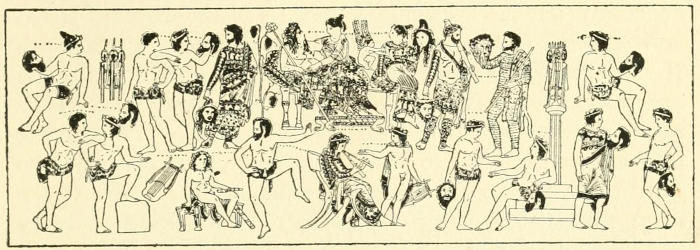
Fig. 4.—Preparations for a Satyric Drama from a Naples Crater of About 400 B.C.
Of the vases which may certainly be regarded as representing scenes from satyric drama the best known and most pretentious is a crater in Naples (Fig. 4).[62] This and a crater at Deepdene were painted about 400 B.C. Somewhat earlier are another crater at Deepdene, a dinos at Athens (Figs. 5 and 6), and fragments of two dinoi at Bonn (Fig. 7).[63] The last three are derived from the same original. On the Naples crater preparations for a satyr-play are being made in the presence of Dionysus and Ariadne, who are seen in an affectionate embrace in the center of the top row. The names of the figures are made known by inscriptions in most cases but are not always significant. Just beyond Ariadne, Love (Ἵμερος) hovers above an uninscribed actor in women’s costume, whose mask is provided with a Scythian cap. The next figure is Heracles (inscribed) and the next is thought to be Silenus. Beyond Dionysus is an uninscribed actor in royal costume. Except Love, all these figures carry masks and constitute the histrionic personages in the drama. It has been claimed with great plausibility that the play dealt with Heracles’ exploits at Troy.[64] In that case the king is Laomedon and the maiden is Hesione, his daughter, who was rescued from the sea monster by Heracles. To the right of the dancing choreutes in the lower row is the flute-player (Pronomus), who will furnish the accompaniment for the lyrical portions of the play; to the left is Demetrius with a roll in his hand, probably the poet. The remaining twelve figures are probably choreutae and bear more directly upon our present investigation. Most of them carry masks, and they have human feet and no horns. They resemble sileni in having long equine tails. The sole resemblance to satyrs is found in the fact that nine of them wear a shaggy covering about the loins, supposedly a goatskin. The waistband upon the choreutes in the extreme upper left-hand corner, however, resembles cloth trunks more than a skin. Yet this divergence is probably to be explained as due to carelessness or a whim on the part of the draftsman instead of to an essential difference in material. This appears plainly from a study of the other vases in this series, on which the loin-bands resemble the trunks of the last-mentioned choreutes on the Naples crater rather than the skins of his nine companions. None the less, a multitude of short dashes on the waistbands in one of the Bonn dinoi (Fig. 7) is plainly intended to characterize them as skins, and the bands on the Deepdene craters are “patterned in such a way as to suggest a fringed or shaggy edge.” An illuminating side light upon the freedom which the painter exercised is afforded by a comparison of the left-hand choreutae in Figs. 6 and 7. These are identical figures in different copies of the same original; yet the shagginess of the loin-band is clearly indicated in the one and entirely omitted in the other. Moreover, the choreutes on the other dinos at Bonn seems to wear no waistband at all![65] In conclusion, it will be observed that, except for variations in the representation of the conventionalized goatskin, the choreutae upon all these vases are exactly alike:[66] they all have human feet, no horns, and equine tails. It is evident that by 400 B.C. or a little earlier this type had become standardized for theatrical purposes. That it suffered no material modification thereafter appears from a Pompeian mosaic (Fig. 8).[67]
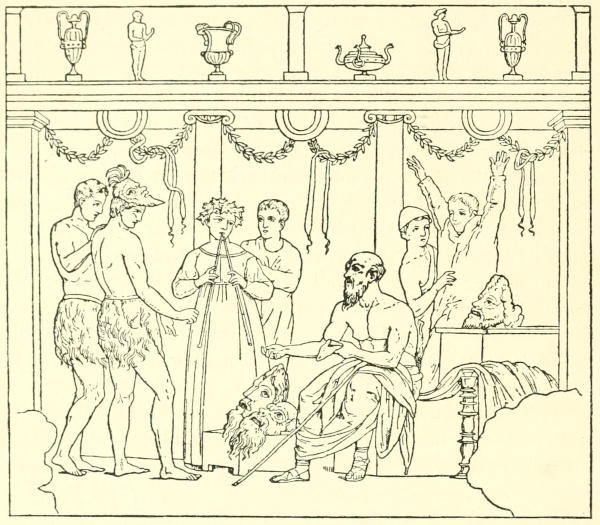
Fig. 8.—Poet and Choreutae of a Satyric Drama from a Pompeian Mosaic
It is plain that this was the type of satyr which the unknown source of the notice in Etymologicum Magnum had in mind when attempting to explain the etymology of τραγῳδία: “... or because the choruses generally consisted of satyrs whom they called ‘goats’ in jest either on account of the shagginess of their bodies or on account of their lasciviousness, for the animal is of such a sort; or because the choreutae plaited their hair, imitating the form of goats.”[68] This passage has been used to support the canonical doctrine that tragedy was the child of satyric drama (see pp. 2 and 22 f., above), but is far from adequate for that purpose. The words after δασύτητα (“shagginess”) are often ignored or even omitted. But it is necessary to interpret the final phrase, “imitating the form of goats,” in terms of the details stated in the context. So far as we are now concerned, the only point of resemblance mentioned is their “shagginess.” This and Horace’s expression about the tragic poet “stripping his satyrs” for the satyr-play[69] would be entirely suitable in describing the choreutae on the Naples crater. Furthermore, it will be noted that this explanation occurs only in a late Byzantine notice and that no earlier source is mentioned. The only way in which a respectable antiquity can be claimed, by means of literary evidence, for this interpretation consists in maintaining that it is implicit in Aristotle’s phrase ἐκ σατυρικοῦ μετέβαλεν. But we have already seen (see p. 22, above), that this expression need not, and probably does not, support this view. The only other passage which can be cited in this connection occurs in three other Byzantine writers.[70] The conclusion is irresistible that both the goat-men explanation of the word τραγῳδία and the supposed development of tragedy from satyric drama are due to “reconstructions” of literary history at an extremely late period.
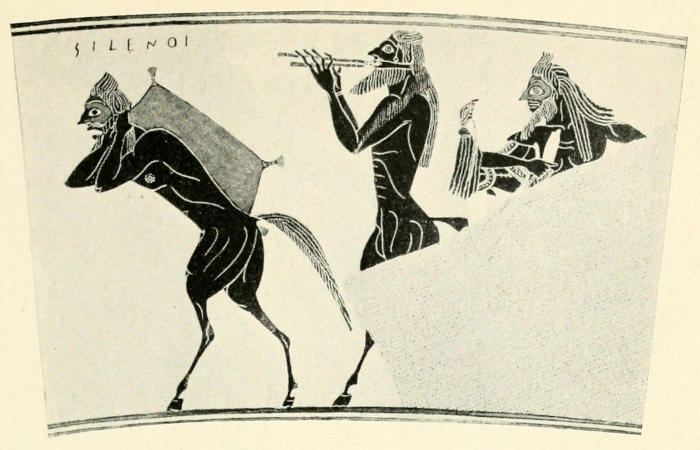
Fig. 3.—Caprine Sileni upon the François Vase, 600-550 B.C.
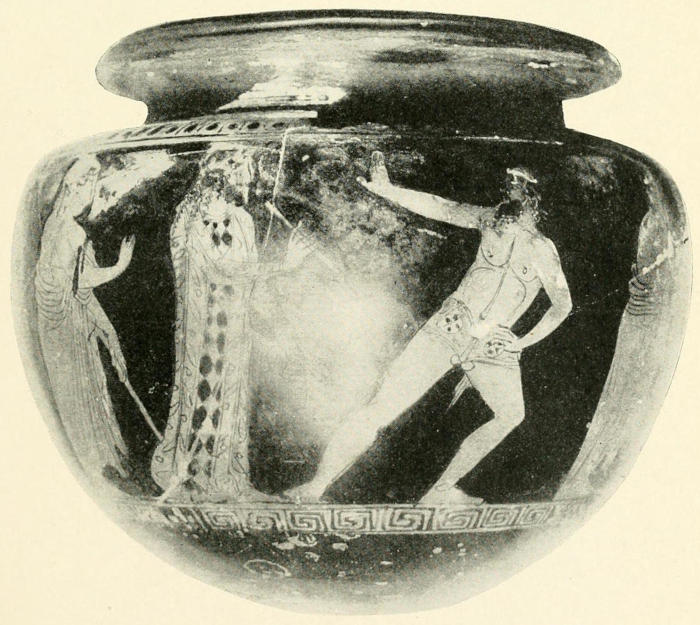
Fig. 5.—View of a Satyr-Play from a Dinos in Athens
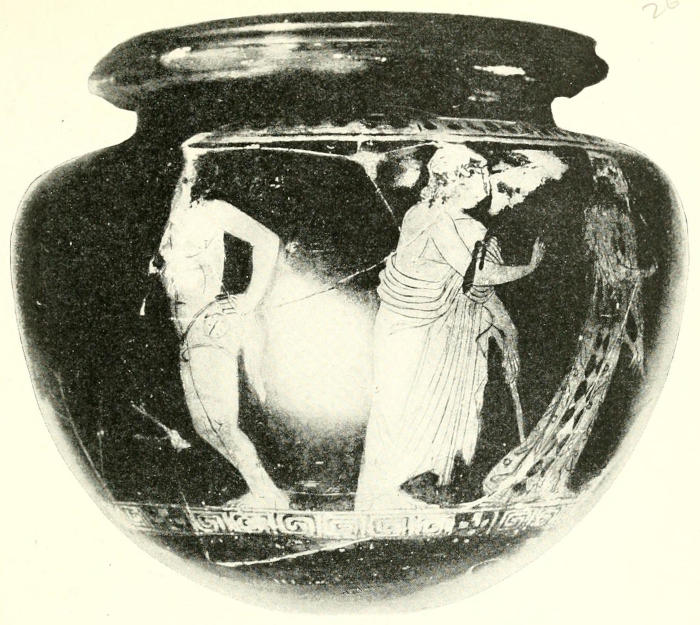
Fig. 6.—View of a Satyr-Play from a Dinos in Athens
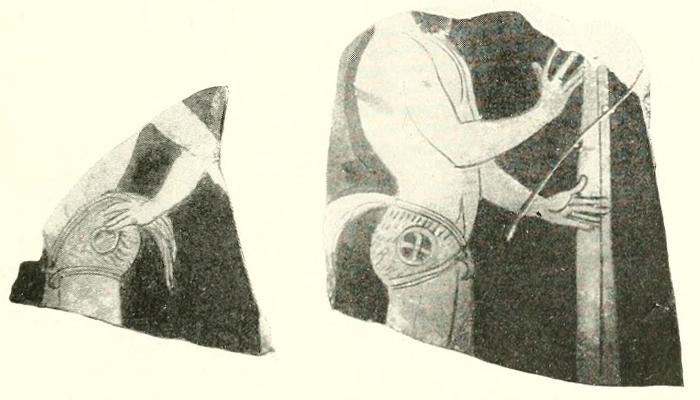
Fig. 7.—Views of a Satyr-Play from a Dinos in Bonn
Evidently this standard type of theatrical satyr took its genesis from an amalgamation of the caprine satyrs and the equine sileni. It is significant that in Euripides’ Cyclops and Sophocles’ Trackers Silenus is one of the characters and is the father of the chorus. These satyr-plays were brought out in the vicinity of 440 B.C.[71] The question now arises: Was this conventional type the invention of Pratinas or did it develop later? It will be remembered that in the list of fifteen fifth-century vases from Attica on which representations of goat-men occur (see p. 25, above), one was mentioned as having a possible connection with the theater. The single exception is a crater in the British Museum of about 450 B.C. (Fig. 9).[72] The larger design on the same side of the vase represents the decking of Pandora, and it is commonly thought that the two scenes belong together and are derived from a satyr-play dealing with Pandora. However that may be, the presence of a flute-player would seem to indicate that at least Fig. 9 is theatrical. If so, the choreutae are not of the type which we have been studying, but true satyrs with caprine hoofs, horns, and tails.[73] About their loins they wear trunks, which in three cases are painted black (to represent a goatskin?) but in one case are left unpainted. Now from Aeschylus’ satyric drama entitled Prometheus the Fire-Kindler is preserved a line “O goat, you will mourn (lose) your beard,” which was addressed by Prometheus to a satyr who wished to kiss a flame and which has been used as proof that the choreutae were caprine in appearance.[74] Again, in Sophocles’ Trackers occur the words: “For though you are young with a flourishing beard, you revel as a goat in the thistles.”[75] Finally, in Euripides’ Cyclops the chorus speak of wandering about “with this poor goatskin cloak.”[76] Although these passages do not constitute proof that the dramatic satyrs were of caprine appearance, they gain considerably in point if we may suppose that they were, and to that extent they confirm the evidence of the British Museum crater.
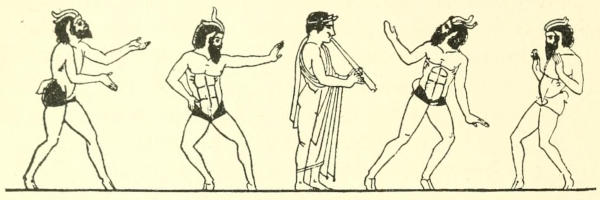
Fig. 9.—Satyrs on a British Museum Crater of About 450 B.C.
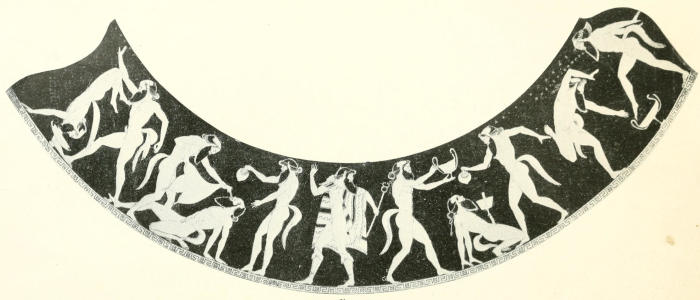
Fig. 10
A BRITISH MUSEUM PSYKTER BY DURIS OF ABOUT 480 B.C., PROBABLY SHOWING INFLUENCE OF CONTEMPORANEOUS SATYRIC DRAMA
Such, then, is the penultimate stage in the evolution of the satyric chorus, and many authorities are content to stop here. But there remains evidence for a still earlier stage. A British Museum psykter by Duris (Fig. 10)[77] represents ten “choreutae” and a herald, and a British Museum cylix by Brygus contains two scenes, in one of which three “choreutae” are attacking Iris before Dionysus and his altar and in the other Hermes and Heracles are protecting Hera from four “choreutae.”[78] These vases belong to about 480 B.C., and the “choreutae” upon them have human feet, no horns, no loin-bands, and equine ears and tails. Reisch is undoubtedly correct in recognizing in these scenes at least the indirect influence of the satyr-play.[79] Furthermore, a similar figure appears upon a Würzburg cylix of about 500 B.C. (Fig. 11).[80] This bears the inscription ΣΑΤΡΥΒΣ, a manifest mistake for σάτυρος. Here we have the earliest representation of a satyr in Attica. And though it does not belong to a theatrical scene, its divergence from contemporaneous satyrs of the Peloponnesus and from Attic satyrs of a later period can be explained only on the basis of the appearance of the choreutae in contemporaneous satyr-plays. The Duris psykter and the Brygus cylix show that this type did not at once disappear.
To my mind the meaning of all this is fairly clear. When Pratinas attempted to restore the Dionysiac element to contemporaneous drama at Athens, he kept the Peloponnesian name but did not venture to shock conservatives still further by disclosing to their eyes creatures so foreign and strange as the Dorian goat-men would have been. Accordingly, he transformed his satyrs so as to approximate the sileni of native tragedy.[81] After fifty or sixty years, however, satyric drama had become so thoroughly at home in Athens that the experiment was tried of imposing the Peloponnesian type unchanged upon the Attic choruses. But the reaction could not and did not endure. In two or three decades the final type had emerged, such as we see it in the Naples crater. Except for the goatskin about the loins, which is often highly conventionalized, the native sileni are at every point victorious.
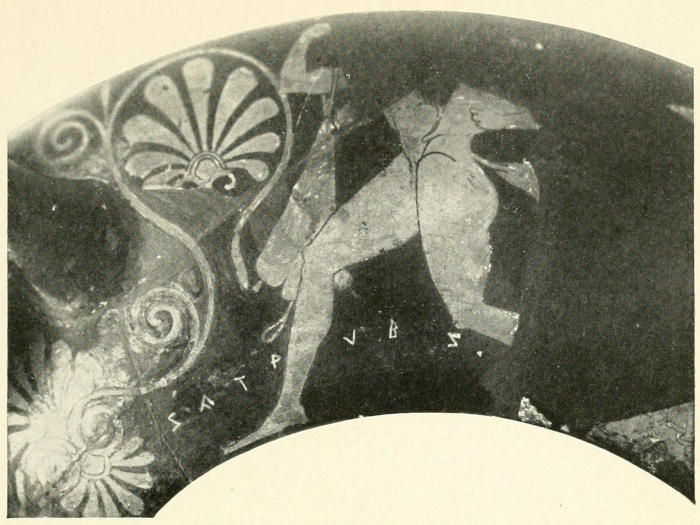
Fig. 11.—A Satyr upon a Würzburg Cylix of About 500 B.C.
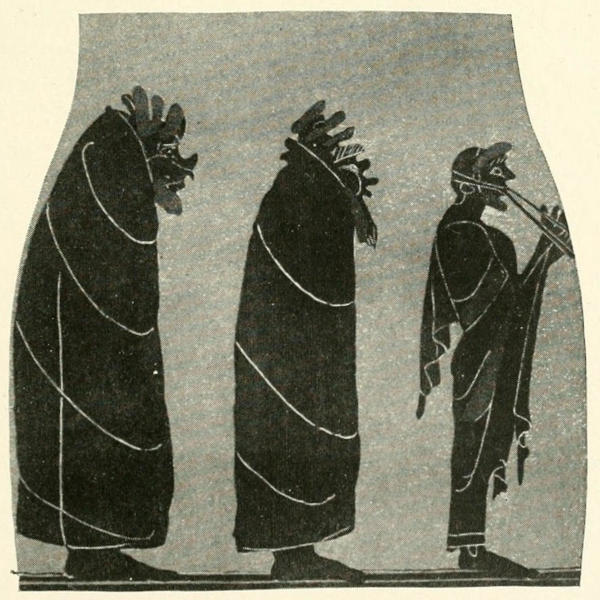
Fig. 12.—A Comus upon a Berlin Amphora
The Greeks were inordinately fond of associating every invention or new literary genre with some one’s name as discoverer (εὑρετής). In the case of tragedy the problem was unusually complicated. In later years Arion, Epigenes, and Thespis all had their partisans. The last named is the one most frequently mentioned, and strictly speaking this view is correct. But more broadly considered, the question largely depends upon the stage of development to which one is willing to apply the word “tragedy.” To many moderns, with almost two and a half millenniums of dramatic history as a background, Aeschylus will seem the first tragic playwright. At least, in his hands tragedy became for the first time real literature.
The foregoing treatment will show that I do not believe a study of the origin of religion to be indispensable for a discussion of the origin of Greek tragedy. Prior to Arion and Epigenes there was nothing which the most fanciful could recognize as akin to modern tragedy. After the work of Thespis and Aeschylus no one can fail to note its presence. To trace, so far as we may, the gradual unfolding of the new genre from a state of nonexistence to a period of vigorous growth seems to me a concrete problem and distinctly worth while. The songs and dances from which tragedy and the satyr-play developed were associated, at the period when they became truly dramatic, with the worship of Dionysus, and at that same period Dionysus was as truly a “god” (as distinct from a “hero”) as any that the Greeks ever knew. To abandon these plain facts and others like them in favor of vague theorizing on religious origins will never bring us satisfactory results. Now, in his Origin of Tragedy Ridgeway, who may serve as a protagonist of this method, recognized only the satyr-play as Dionysiac in origin, and attempted to dissociate tragedy and the dithyramb from that deity and to derive them from ceremonies at the tombs of heroes, i.e., from ancestor worship. I cannot conceive that many classical scholars will believe him to have succeeded in this attempt. Ridgeway evidently foresaw this and tried to forestall it by saying that “as Dionysus himself had almost certainly once been only a Thracian hero, even if it were true that Tragedy had risen from his cult, its real ultimate origin would still be in the worship of the dead” (op. cit., p. 93). What, then, was the point in his conceding that satyric drama was Dionysiac in origin? In that case the ultimate origins of tragedy and satyric drama must, after all, have been identical, and the differences in their origins must have consisted only of the minor divergencies in the final stage of their development. In practice, how does this result differ from the more usual procedure, which ignores the ultimate sources and concentrates attention upon the last stage of development? So far as I can see, it would differ only to the extent that the underlying religion of both genres would now be understood to be ancestor worship. But this distinction loses all meaning, for the reason that in his last volume Ridgeway maintains that “Vegetation, Corn, and Tree spirits, as well as those of rocks, mountains, and rivers, and what are collectively termed Totemistic beliefs,” fertility-rites, initiation-rites, mana, “the worship of Demeter and almost[82] all other Greek deities” are “not primary phenomena but merely secondary and dependent on the primary belief in the immortality and durability of the soul,” and consequently that tragedy and serious drama (being everywhere associated with some form of religion) not only in Greece but “wherever they are found under the sun have their roots in the world-wide belief in the continued existence of the soul after the death of the body.”[83] How much of truth there may be in Ridgeway’s contention that ancestor worship is prior to and the ultimate source of other forms of religion I shall not stop to discuss. But the practical value of so universal a generalization has been well expressed by another: “Even if it can be shown that your far-off ancestor was an ape, it does not follow that your father was an ape.”[84] In other words, in spite of any resemblance which may have obtained between the ultimate forms of Dionysiac worship and the true veneration of heroes, at the time when tragedy actually came into being the existing differences between them were of much greater significance than any alleged identity of origin in the far-distant past could have been. If it were possible for Ridgeway to substantiate his first position, viz., that tragedy arose directly from the worship of the hero Adrastus at Sicyon, or the like, there would be some meaning in his work. But his doctrine of ultimate derivation loses itself in primeval darkness.
The Origin of Comedy.[85]—The difficulty of this problem was recognized as early as Aristotle:
Now the successive changes in tragedy and the persons who were instrumental thereto have not passed into oblivion, but comedy did suffer oblivion for the reason that it was not at first taken seriously. And a proof of this is found in the fact that it was relatively late [viz., 486 B.C.] before the archon granted a chorus of comic performers; they used to be volunteers. And comedy already had certain forms when the aforementioned comic poets [i.e., Chionides and Magnes, the first comedians after official recognition was granted] appear in the records. Who furnished it with “characters” (πρόσωπα)[86] or prologues or number of actors and the like remains unknown. Developing a regular plot was a Sicilian invention, but of the Athenians the first to abandon the “iambic” or lampooning form and to begin to fashion comprehensive themes and plots was Crates.[87]
But whatever uncertainties may obscure the various stages in the history of comedy, fortunately there is little doubt as to the source from which it came. Aristotle states that “comedy also sprang from improvisations, originating with the leaders of the phallic ceremonies,[88] which still survive as institutions in many of our cities.”[89] Mr. Cornford (op. cit., pp. 37 ff.) finds the best illustration of these ceremonies in the well-known passage in Aristophanes’ Acharnians, vss. 237 ff. Dicaeopolis has just concluded a private peace with Sparta and prepares to celebrate a festival of Dionysus on his country estate. He marshals his meager procession as if it contained a multitude, his daughter carries upon her head a sacred basket with the implements of sacrifice, two slaves hold aloft a pole which is surmounted by the phallic symbol, and Dicaeopolis himself brings up the rear with a large pot in his arms, while the wife and mother constitutes the watching throng. At vss. 246 ff. a sacrifice is offered to the accompaniment of an invocation to Dionysus. Finally Dicaeopolis re-forms his procession with various coarse remarks and starts up a phallic ballad of an obscene nature in honor of Phales, “mate of Dionysus and fellow-reveller” (ξύγκωμε). The proceedings thus consist of a procession to the place of sacrifice, the sacrifice itself, and the phallic song or comus (κῶμος). The last is important for our present purpose because comedy (κωμῳδία) etymologically means “comus-song” (κῶμος + ᾠδή). Κῶμος denotes both a revel and the band of masqueraders participating therein. The comus was the particular type of phallic ceremony from which comedy developed.
The comus in Aristophanes’ Acharnians is sung by Dicaeopolis alone for the reason that the lack of suitable helpers compelled him to act as both priest and congregation. But Cornford is right (op. cit., pp. 38 ff.) in recognizing this song as belonging to a widely spread type in which the improvisations of one or more leaders (ἐξάρχοντες) are interrupted at more or less regular intervals by a recurrent chantey on the part of the chorus. In this instance the song is not continued to a length natural to the type, but is cut short by the real chorus of the play which has been hiding but now bursts forth and stops proceedings with a shower of stones. From the standpoint of contents Cornford detects two elements in the comus: an invocation to the god to attend his worshipers in their rites, and an improvisational “iambic” element of obscene ribaldry, which often took the form of satire directed against individuals by name (ibid., p. 41). These two elements exactly correspond to the double object of all phallic ceremonies, which were both a “positive agent of fertilization” and a “negative charm against evil spirits.” The former result was obtained by the invocation of friendly powers; as to the latter,
the simplest of all methods of expelling such malign influences of any kind is to abuse them with the most violent language. No distinction is drawn between this and the custom of abusing, and even beating, the persons or things which are to be rid of them, as a carpet is beaten for no fault of its own, but to get the dust out of it.... There can be no doubt that the element of invective and personal satire which distinguishes the Old Comedy is directly descended from the magical abuse of the phallic procession, just as its obscenity is due to the sexual magic; and it is likely that this ritual justification was well known to an audience familiar with the phallic ceremony itself [ibid., pp. 49 f.].
It is possible to cite many examples of ritualistic scurrility among the Greeks, such as that indulged in by the Eleusinian procession as it approached “the bridge,” that of the riders upon the carts on the Day of Pots (χόες) at the Anthesteria, that at the Stenia festival, and many others. Sometimes these involved physical violence as well as mere abuse, and this element (or the threat of it) frequently recurs in Old Comedy. Perhaps the most interesting parallel is afforded by Herodotus v. 82 f. In the sixth century B.C., in order to avert a famine, the Epidaurians set up wooden statues of Damia and Auxesia, goddesses of fertility.[90] Somewhat later, the Aeginetans stole these images and set them up in their own country; “they used to appease them with sacrifices and female satiric choruses, appointing ten men to furnish the choruses for each goddess; the choruses abused no man but only the women of the country; the Epidaurians also had the same rites.”
The comus frequently took the form of a company marching from house to house to the music of a flute-player and rendering a program of singing and dancing at every dwelling. From what has already been said it will be understood that the improvisations of the comus leaders would rarely redound to the credit of the householders. These scurrilous attacks upon their neighbors combined with other motives to induce the comus revelers to assume disguises, which varied from year to year. Now, according to the Parian Chronicle, comic choruses were the invention of Susarion and were first performed at Icaria. This doubtless means that Susarion transformed the ceremonies of an old ritual procession in the country into a “stationary” performance in an orchestra. The same authority informs us that this innovation was introduced into Athens between 580 and 560 B.C.[91] This notice must refer to the Lenaean festival, since the program of the City Dionysia did not receive this addition until about 501 B.C. At both festivals the performances still continued for some time to be called comuses (κῶμοι), comedy being a name of later date, and were produced by “volunteers.” Five Attic vase paintings of about 500 B.C. depict comus revelers as cocks, birds, or as riding upon horses, dolphins, or ostriches (Figs. 12-16).[92] The state did not assume official supervision of comedy until 486 B.C. at the City Dionysia and about 442 B.C. at the Lenaea.[93]
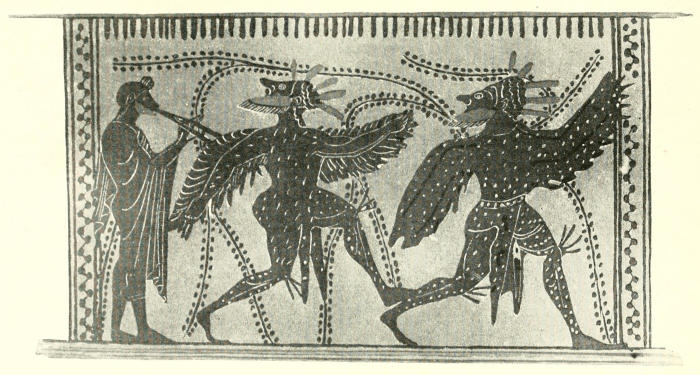
Fig. 13
A COMUS UPON A BRITISH MUSEUM OENOCHOE
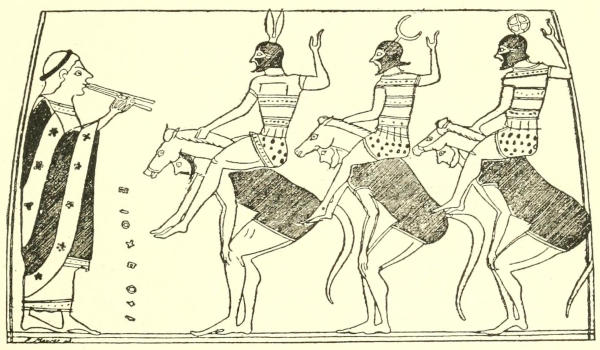
Fig. 14.—A Comus upon a Berlin Amphora
Before we can proceed further, it will be necessary to consider the nature of ancient comedy. In the time of Hadrian the history of literary comedy at Athens was divided into three periods, called Old, Middle, and New Comedy, respectively. Old Comedy came to a close shortly after the beginning of the fourth century B.C. Politics and scurrilous attacks upon contemporaneous personages made up the bulk of its subject-matter. Living men, such as Pericles, Socrates, Euripides, and Cleon were represented by actors on the stage and were lampooned with the utmost virulence. Sometimes their identity was thinly disguised under a transparent pseudonym, but oftentimes the very name of the victim was retained along with the other marks of identification. Middle Comedy was a transitional period of about half a century’s duration between Old and New. It renounced the political and personal themes of its forerunner and was largely given up to literary criticism, parodies, and mythological travesty. New Comedy, in turn, abandoned such subjects for the most part and devoted itself to motives drawn from everyday life. Except for the occasional presence of the chorus, it does not greatly differ in structure, theme, or technique from the comedy of manners today, mutatis mutandis.
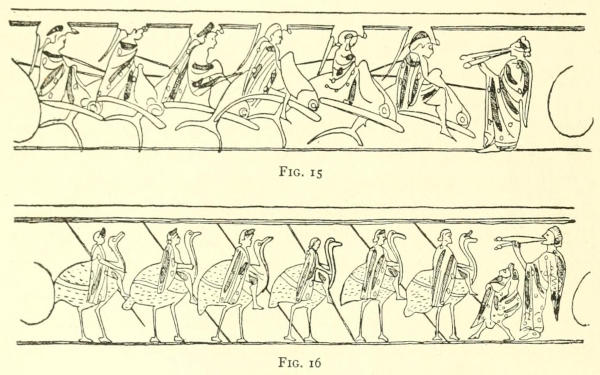
Figs. 15-16.—Comus Scenes upon a Boston Skyphos
For the study of origins, however, we must turn back to the earliest type, Old Comedy, which is entirely unlike any present-day genre. We are fortunate in possessing eleven complete plays of Aristophanes, the chief poet of Old Comedy; and though no two of them are exactly alike in the details of their structure, yet the general outline is clear. The leading features are as follows:[94]
1. The prologue (πρόλογος) spoken by the actors and serving both as an exposition and to set the action of the play in motion.
2. The parodus (πάρoδος), or entrance song of the chorus. Originally this division must have been exclusively choral, but by Aristophanes’ time it has been developed so as sometimes to include lines spoken by actors.
3. The agon (ἀγών, “contest”), a “dramatized debate” or verbal duel between two actors, each supported by a semi-chorus; see p. 43, below.
4. The parabasis (from παραβαίνω, to “come forward”), a “choral agon” in which the chorus, the actors being off stage, march forward to address the audience. When complete, the parabasis consists of seven parts which fall into two groups: the first group contains three single parts, which were probably rendered by the first coryphaeus. Dropping all dramatic illusion and all connection with the preceding events of the play, he sets forth the poet’s views concerning his own merits and claims upon the public, ridicules the rival playwrights, announces his opinions on civic questions, etc. The second group contains four parts in the form of an epirrhematic syzygy, i.e., a song (ᾠδή) and epirrheme (ἐπίῤῥημα, “speech”) by one semi-chorus and its leader, respectively, are counterbalanced by an antode (ἀντῳδή) and an antepirrheme (ἀντεπίῤῥημα) by the other semi-chorus and its leader; here the chorus usually sing in character once more, the knights praising their “horses,” the birds their manner of life as compared with men’s, etc.[95]
5. There follows a series of episodes (ἐπεισόδια), histrionic scenes separated (6) by brief choral odes (στάσιμα or χορικά). The episodes portray the consequences of the victory won in the agon (3). For example, in the Acharnians the subject of controversy is whether Dicaeopolis shall be punished for the alleged treason of having made a private peace with Sparta, and part (5) represents him, in a succession of burlesque scenes, as enjoying the fruits of that peace.
7. The exodus (ἔξοδος), or recessional of the chorus. Properly speaking, this should contain only the final, retiring song of the chorus (the ἐξόδιον), but the term came to include the histrionic passage just preceding it, also.
This is a very incomplete sketch of a highly complicated subject, but it will suffice for present purposes.
Now in the scurrility of the primitive (non-literary) comus Professor Navarre (op. cit., p. 248) would recognize three stages. In the first, the ribaldry of the comus received no answer from the crowd of spectators. This is doubtless to be explained by supposing that all who were competent to participate were already members of the comus; the spectators consisted only of women and children, who frequently had no more right of speech in religious ritual than in law. So Dicaeopolis’ wife is present but speechless in Aristophanes’ Acharnians (see p. 36, above). In the second stage, the bystanders retorted to the assaults of the comus revelers. This probably indicates that membership in the comus has been restricted in some way, leaving others free to retaliate in kind from the crowd. The third stage was reached when this new element was formally recognized and brought within the comus itself, which was thus divided into antagonistic halves for mutual recrimination. Thus may be explained a peculiar feature of Old Comedy. Its chorus was a double chorus of twenty-four members, always divided into two semi-choruses, which often were hostile during a large portion of the play. Sometimes this division between them was shown by their masks or costumes, as when the chorus represented men and women, horses and their riders, etc. But sometimes the division was one of sentiment—one semi-chorus, for example, favoring peace and the other being opposed to it. The result of this division of the early comus revelers into semi-choruses is a parallelism of structure in certain parts of comedy, ode being matched by antode, and the epirrheme of one chorus leader by the antepirrheme of the other. It is clear that all the divisions which show this duality of arrangement descend from the comus.[96]
One of these divisions is the parabasis (4). Though one of the most ancient features of Old Comedy, it was also one of the first to decay: complete in Aristophanes’ earlier plays, it is always mutilated in some way during his middle period and in his last two comedies has disappeared entirely. We have seen (p. 37, above) that the essential characteristics of the phallic ceremonies were the induction of the good influences by invocation and the aversion of the bad by vituperation. Now in the epirrhematic syzygy which constituted the second half of the parabasis, even as late as Aristophanes, when it naturally must have changed considerably in function, “the ode and antode normally contain an invocation, either of a muse or of gods, who are invited to be present at the dance, the divine personages being always selected with reference to the character of the chorus. The epirrheme and antepirrheme often contain the other element of satire or some milder form of advice and exhortation.”[97]
Another division of Old Comedy which was carefully balanced and which ought, therefore, to be a derivative of the comus is the agon (3). Normally this division was epirrhematic in structure and fell into nine parts, as follows: First comes the ode sung by one half-chorus, then the cataceleusmus (κατακελευσμός, “encouragement”) in which their leader exhorts one of the actor contestants, thirdly this actor delivers his speech (epirrheme), concluding with a peroration (πνῖγος, “choke,” so called because it was all to be delivered in one breath and left the performer speechless). Next came the antode, anticataceleusmus, antepirrheme, and antipnigus rendered by the other half-chorus, their leader, and the second actor, respectively. Finally, in the sphragis (σφραγίς, “seal”) is given the unanimous verdict of the whole chorus. At first glance it would seem that too important a rôle is here played by actors for the agon ever to have been derived from the comus, which was purely choral. The comus consisted of an undifferentiated band of revelers and its choreutae assumed no distinct parts. In fact, there is no reason to suppose that their performances involved dramatic impersonation (μίμησις) at all. They might be dressed to represent birds or animals, but with few or no exceptions they sang and spoke and conducted themselves as would be appropriate for men engaged in such a rite to do. As we have already seen (p. 38, above) their costumes were for disguise.
Nevertheless, the situation is not so impossible as it seems. The fact that the masks and costumes of the choreutae were all alike, or at most of two types to correspond to the two semi-choruses, did not prevent each member of the chorus from speaking, or singing, apart from the rest. This was sometimes done even in fully developed tragedy, where the line of distinction between chorus and actors was usually a sharp one. Thus, in Aeschylus’ Agamemnon, vss. 1348 ff., each of the choreutae in turn pronounces two iambic lines. In particular, the rôles of the two chorus leaders must have been developed in the comus and early comedy so as partly to compensate for the lack of actors. Note that Aristotle does not state merely that comedy sprang from phallic ceremonies but from the leaders (ἐξάρχοντες) of the phallic ceremonies. An illustration of what may result from participation in the action on the part of individual choreutae is afforded by Aristophanes’ Women in Council. I believe that the “First Woman” and the “Second Woman” who appear in our editions as uttering brief remarks at the beginning of this play are not actors but the leaders of the two half-choruses.[98] In function they are not at first distinguishable from Praxagora. Indeed, it does not transpire until later that Praxagora herself is an actor, not the coryphaeus. The fact is that in all his plays Aristophanes seems to have assigned his two chorus leaders more extensive participation both in lyrics and in recitative than has been generally recognized (cf. White, op. cit., passim). In my opinion this sort of thing was even more common at an earlier period, and in this way it was possible for the comus to have a quasi-agon from which the later histrionic agon could easily develop. Of course, the chorus leaders could not appear in individualized rôles, as the actors did in the Aristophanic agon, for characters had not yet been introduced into comedy; but they could engage in a contest of perfectly general, depersonalized billingsgate or, at a later period, speak as the poet’s mouthpiece for the pros or cons of any question. Thus, they would not represent individual men, with an individual’s name and characterization, but any men. Their sentiments would have been equally appropriate in the mouths of any of the other choreutae.
The agon and parabasis must necessarily have been flanked on either side by a processional and a recessional. In their simplest form, these need not have involved more than silent marching in and out again; but probably the flute accompaniment was always present, and singing would soon be added. Even when words and singing were employed, there was no necessity of these being newly composed for each occasion or even original at all. It will be remembered that in Aristophanes’ earliest and latest plays he did not write special exodia but borrowed from earlier poets any popular airs that suited his purpose.[99] Moreover, Aristophanes’ exodi lack the balanced structure which is characteristic of all divisions which descend directly from the primitive comus; but in this instance that fact has no significance, for the reason that by the end of a comedy (or comus) the two half-choruses would always be reconciled and go marching off together. Nevertheless, the intrusion of the histrionic element, the comparative rarity of the earliest dramatic meter (the trochaic tetrameter), and the absence of a canonical structure make it plain that the recessional of the primitive comus never developed into a regular division—in other words, that the exodus of Aristophanic comedy was the product of a later period.
On the other hand, the Aristophanic parodus resembles the agon and the parabasis in making a large use of the tetrameter (op. cit., p. 185). Moreover, it contains distinct survivals of epirrhematic composition (ibid., pp. 159 and 366), so that, in spite of its histrionic elements and the absence of a canonical form, the parodus ought to be considered as having been exclusively choral by origin and as having developed out of the simple processional before the comus became histrionic.
The theatrical comus, then, must have been something as follows: first a choral parodus, next a semi-histrionic agon, then a parabasis, and finally a recessional which ultimately developed into an exodus. A late notice,[100] if correctly emended, informs us that at one time comedies contained no more than three hundred verses. I am of the opinion that this is the type of performance alluded to and that comedy did not, in essence, greatly depart therefrom until actors, as distinct from the chorus, were added.
How did this addition come to be made? It is impossible that the comic playwrights, with the actors of tragedy ever before them, should never have thought of taking this step. Nevertheless, the main impulse seems to have come from another direction. We have seen (p. 36, above) that in the non-theatrical comus the phallus was borne on a pole in the ritual procession with which the comus was originally associated; it was not worn. Neither is it worn by the comus choreutae as represented on Attic vase paintings (Figs. 12-16). But in Old Comedy it is clear that at least some of the characters wore the phallic emblem. That this was in fact the general practice appears from the language in which Aristophanes boasts of the modesty of his Clouds:
And observe how pure her morals: who, to notice first her dress, Enters not with filthy symbols on her modest garments hung, Jeering bald-heads, dancing ballets, for the laughter of the young.[101]
And Dr. Körte (op. cit., pp. 66 ff.) has collected ten passages in other plays of our poet which indicate that Aristophanes was not always so puritanical as he claims to be here. These conclusions are confirmed also by numerous representations, of Attic workmanship, which are plausibly thought to depict actors in Old and Middle Comedy (Figs. 17-19).[102] By the time of New Comedy, on the contrary, the phallus was apparently no longer worn, and the characters were garbed in the dress of everyday life. Now the Dorian mime or farce was widely cultivated in the Peloponnesus and Magna Graecia. The performers were individualized actors, not welded into a chorus. They wore the phallus, had their bodies stuffed out grotesquely both in front and behind by means of copious padding, and in general bear a very close resemblance to the comic actors at Athens (Figs. 20 and 21).[103] Their performances were loosely connected, burlesque scenes, abounding in stock characters and enlivened by obscenity and ribald jests. Most authorities agree that the burlesque episodes (5) of Old Comedy are derived from this source. According to Aristotle,[104] the Megarians claimed that comedy originated with them about 600 B.C. when a democracy with its resultant freedom of speech was established among them. It was even asserted that Susarion, the reputed founder of Attic comedy (see p. 38, above), came from Megara, but this claim is apparently unwarranted.[105] The fact remains, however, that Aristophanes and his confrères often speak of stupid, vulgar scenes or jokes as being “stolen from Megara.”[106] Though these words have been otherwise explained,[107] I believe that Megara, which is the nearest Dorian city to Attica, had something to do with the introduction of the histrionic element into Attic comedy. Of course, this does not mean that Megara is to be regarded as the inventor of Athenian comedy, for the comus was indigenous and received its development on Attic soil and the type of performance which came into being after the introduction of actors was quite unlike anything in Megara or any other part of the Dorian world.
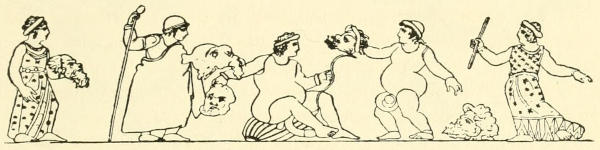
Fig. 17.—Comic Actors and Flute-Players upon an Attic Vase in Petrograd
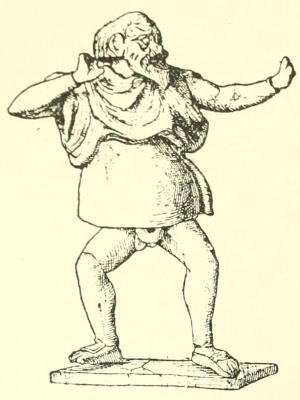
Fig. 18.—An Attic Terra Cotta in Berlin Representing a Comic Actor.
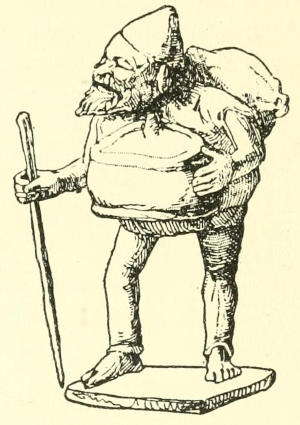
Fig. 19.—An Attic Terra Cotta in Munich Representing a Comic Actor.
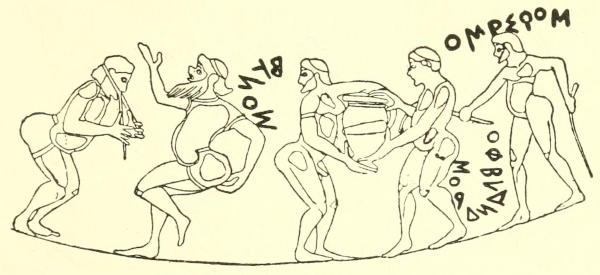
Fig. 20.—Actors of Dorian Comedy upon a Corinthian Crater in Paris
With actors, impersonation became possible for the first time in Attic comedy. Besides the nondescript chorus and chorus leaders, there were now performers who could assume the identity of real or imaginary characters and carry a rôle or, by a change of mask, several rôles through the play. The importance of all this is too obvious to require amplification. It marked the birth of dramatic comedy at Athens. Through the introduction of actors, comedy became amenable to several other influences. Tragedy could at once make itself felt. A histrionic prologue could now be added, the comic prologue corresponding in length and function to the tragic prologue and first episode combined.[108] A real agon of actors now became possible, whatever use may have been made previously of the chorus leaders for this purpose. Furthermore, the new Megarian burlesque episodes (5) would naturally be separated by stasima (6) in imitation of tragedy. It would also be possible to insert an episode[109] between the parodus and the agon, as is done in Aristophanes’ Plutus, vss. 322-486; or between the agon and the parabasis, as in Aristophanes’ Knights, vss. 461-97; or to compose a second parabasis and to insert an additional episode between them, as in Aristophanes’ Peace, vss. 1039-1126, etc. In addition to all this, tragedy would exert a constant influence in elevating and standardizing all parts of comedy alike.
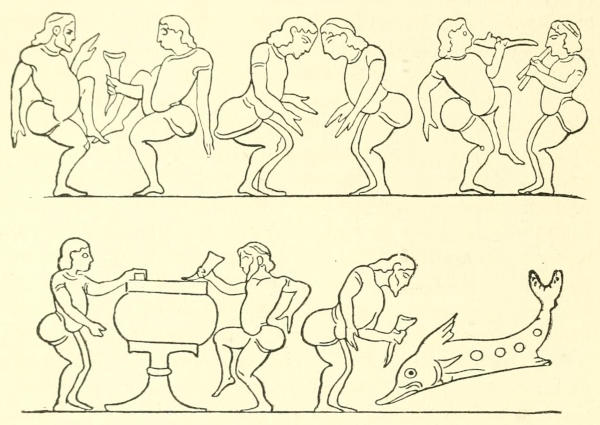
Fig. 21.—Actors of Dorian Comedy upon a Corinthian Vase
But the restricted and even disconnected method of elaboration employed in earlier comedy, with its invective, lampoons, and obscene jests, would not suffice to fill so ample a framework. Therefore, it became necessary to broaden and deepen the plots; in fact, now for the first time in Attic comedy was it possible to have a plot worthy of the name. All this is implied in the words which have already been quoted from Aristotle (p. 35, above): “Developing a regular plot was a Sicilian invention, but of the Athenians the first to abandon the ‘iambic’ or lampooning form and to begin to fashion comprehensive themes and plots (καθόλου ποιεῖν λόγους καὶ μύθους) was Crates.” The reference in the first half of this sentence is to Epicharmus, whose name actually appears in Aristotle’s text at this point but without grammatical construction. Epicharmus was a resident of Megara Hyblaea in Sicily, whence he migrated to Syracuse about 485 B.C. Like the Megarians on the Greek mainland, also the Sicilian Megarians laid claim to the honor of having invented comedy.[110] They based their pretensions on the fact that Epicharmus flourished and won his reputation before 486 B.C., which was the terminus post quem for the beginning of the official careers of Magnes and Chionides, who were the first poets of state-supported (as opposed to volunteer) comedy, at the City Dionysia in Athens. Epicharmus raised the Dorian mime in Sicily to literary importance, and seems to have improved upon the detached or but loosely connected scenes of his predecessors by stringing them together upon the thread of a common plot-interest. His plays had no chorus and did not touch upon his contemporaries or politics. Now Aristotle’s words concerning Crates must certainly be understood as indicating a resemblance between him and Epicharmus in at least some of these particulars. The expression which I have translated “to fashion comprehensive themes and plots” has been rendered “generalized his themes and plots” by Butcher, “to frame stories of a general and non-personal nature, in other words, Fables or Plots” by Bywater, and “composed plots or fables of a ‘universal’ character” by Cornford (op. cit., p. 217). Whatever other meaning may inhere in this phrase, I think that it must be taken to mean, first of all, that Crates, like Epicharmus, made all or, at least, most of the parts of his plays subservient to one connecting idea or plot; and it seems to me that the previous clause which refers to his abandonment of the “iambic” or lampooning form looks in the same direction. In my opinion, the invective of his predecessors had been episodic and unrelated to its context by any sequence of thought, often being expressed in passages like the following:
Shall we all a merry joke At Archedemus poke, Who has not cut his guildsmen yet, though seven years old; Yet up among the dead He is demagogue and head, And contrives the topmost place of the rascaldom to hold? And Clisthenes, they say, Is among the tombs all day, Bewailing for his lover with a lamentable whine. And Callias, I’m told, Has become a sailor bold, And casts a lion’s hide o’er his members feminine.[111]
Here this abuse is dragged in a propos of nothing, and the three citizens who are assailed within a score of lines have no connection with the main theme of the play. It was this sort of thing, I venture to believe, that Crates discontinued; and Aristotle’s language does not require us to conclude that he relinquished scurrility altogether. It is usually thought, however, that Crates made no assaults of any kind upon his contemporaries but “generalized” his plots by treating imaginary, “ideal” characters in his plays. In other words, he is supposed to have anticipated to some extent the manner and material of New Comedy. I have no desire to combat this view, which simply advances a step beyond my own. The main fact, that of Crates’ having invented plot sequence in Attic comedy, can hardly be made a matter of dispute.
We are indebted to a late authority, Tzetzes, for the following statements:
But also Old Comedy differs from itself [i.e., falls into two types], for those who first established the institution of comedy in Attica (and they were Susarion and his successors) used to bring on the characters (πρόσωπα) in an undifferentiated crowd (ἀτάκτως), and laughter alone was the object sought. But Cratinus [a contemporary of Crates], succeeding them, put a stop to the confusion (ἀταξίαν) and set the characters (πρόσωπα) in comedy for the first time at three; and he added profit to the pleasure of comedy, lampooning the evildoers and chastising them with comedy as with a public scourge. But even he still shared in the archaic qualities and, slightly, in the confusion (ἀταξίας).[112]
Whatever the ultimate source of this notice, it contains much of value. In the first place, a distinction is correctly drawn between primitive comedy (Susarion to Cratinus; ca. 565 to ca. 450 B.C.) and Old Comedy (450 to ca. 385 B.C.). The earlier period is marked by ἀταξία, which I refer to the practice of having characterless choreutae take part singly as if they were actors (see p. 44, above). Though still occasionally guilty of this practice, as even Aristophanes sometimes was, Cratinus regularly withdrew his choreutae from participation in the dialogue and reduced the performers to three. These three, however, were now real actors, as distinct from the chorus and chorus leaders, and played individualized rôles which demanded dramatic impersonation. The number three was doubtless due to contemporaneous tragedy in which the number of actors had recently been increased by Sophocles from two to three (see p. 167, below).[113]
A second difference between primitive comedy and Old Comedy is found in the use which was made of invective. If this development had not taken place, Old Comedy would not occupy the unique place which it now holds in the dramatic literature of the world. As we have just seen, the lampooning of primitive comedy was probably episodic and detached from the context, like that in Aristophanes’ Frogs, vss. 416-30; a whole play was not devoted to one person, and no citizen was impersonated by an actor. Its object was merely to cause a laugh and it rarely served any useful purpose, certainly none for the public interests of the state. It was a natural outgrowth of the magical abuse of the old phallic processions. Now Old Comedy, on the whole, was just the reverse of this, and Cratinus seems to have been the innovator who, “generalizing” his plots by giving them a single theme, after the fashion set by Crates, devoted them solely or mainly to political and social questions and dragged his victims in person upon his stage.
When did these changes take place? First let it be noted how they mutually depend one upon another: neither tragedy nor the Sicilian mime could greatly influence early Attic comedy until actors, as distinct from a chorus, were introduced, nor could their influence be long delayed after the actors came. I think that these factors came to fruition not long before 450 B.C.
a) Reverting to Aristotle’s words (quoted on p. 35, above), when are we to suppose that the Athenians began to “treat comedy seriously”? The most obvious answer would be, “486 B.C., when comedy first received official recognition.” Chionides and Magnes are the poets of this period, and there is no reason to believe that they improved upon their immediate predecessors of the “volunteer” comedy otherwise than in a more worthy literary treatment of their plays. Aristophanes describes Magnes’ efforts in the following terms:
All voices he uttered, all forms he assumed, the Lydian, the fig-piercing Fly, The Harp with its strings, the Bird with its wings, the Frog with its yellow-green dye.[114]
It is plain that these words refer to plays by Magnes which were called The Lydians, The Gall-Flies, The Harpists, The Birds, and The Frogs. These titles at once remind us of the animal masks which were so common in the comus (Figs. 12-16). Of course, state supervision implies a certain amount of serious attention. Nevertheless I think that in this passage Aristotle had a later period in mind.
It was long ago pointed out that Attic comedies were not published before the time of Cratinus. The fact of publication shows that comedy was at last being treated with true seriousness and helps to explain the ignorance, in later times, with respect to certain points. Though the state records gave the names of comic victors from 486 B.C. on, they did not include information upon matters of mere technique. For knowledge of this sort Aristotle (the ultimate source of Tzetzes) and all other ancient investigators were almost entirely dependent upon what they could glean from the editions of Cratinus, Crates, and their successors. Now the earliest texts available revealed the use of characters, prologues, and three actors as well as of the parodus, agon, parabasis, and exodus. Why did Aristotle specifically name the first group and not the second?
In my opinion, Professor Capps[115] has provided the correct answer. He maintains that Aristotle distinguished two kinds of ignorance concerning the history of comedy. In the first place, there was the Egyptian darkness which covered the period previous to 486 B.C. For example, when Aristotle declared that comedy “already had certain forms” (σχήματά τινα) at this time, he could not have specified what these forms were; he was merely surmising that the fact of state supervision presupposed more or less definiteness of form. In the second place, there was the period of semi-darkness immediately after 486 B.C. Tradition must have placed in this period the introduction of characters, prologues, and three actors, and so Aristotle singled them out for mention. But tradition had not handed down also the names of the innovators, and in the absence of texts it was impossible to probe the matter further. Needless to state, the situation regarding the other innovations, whether of this period or earlier, was much worse.
b) Though Thespis is said to have invented the prologue in tragedy, this statement is justly discredited (see p. 298, below); and no tragedy is actually known to have had one before Phrynichus’ Phoenician Women (476 B.C.). Aeschylus’ Suppliants (about 490 B.C.) and Persians (472 B.C.) have none. It is most unlikely that comedy should have anticipated tragedy in this feature.
c) Capps[116] has plausibly suggested that knowledge of Epicharmus’ achievements in comedy was brought to Athens by Aeschylus, who is known to have been in Sicily ca. 476 B.C., shortly after 472 B.C., and for about two years before his death there in 456 B.C.
d) The third actor was introduced into tragedy between about 468 and 458 B.C., and it is more probable that the use of three actors in comedy was borrowed from tragedy than vice versa.
e) Cratinus won his first victory at the City Dionysia of 452 B.C. and (f) Crates at that of 450 B.C. Doubtless the activity of both men began somewhat earlier.
g) It is incredible that the state should have postponed official control of comedy at the Lenaean festival until about 442 B.C., if the developments which we have been sketching had taken place long before.
h) The earliest comedian to refer to Megarian comedy is Ecphantides, whose first victory was won between 457 and 453 B.C. Whenever Aristophanes “names any writers of ‘vulgar comedy’ who used the stale antics which he repudiates, these writers are his own predecessors and contemporaries of the Attic stage.”[117] This implies that the borrowing was a fairly recent occurrence.
i) Finally, Megara was actually under the sway of Athens during 460/59-446/45 B.C. The opportunity for the exchange of ideas between Megara and Athens would naturally be most favorable at that time.
In view of the preceding considerations, I am of the opinion that actors were introduced into Athenian comedy shortly before 450 B.C.
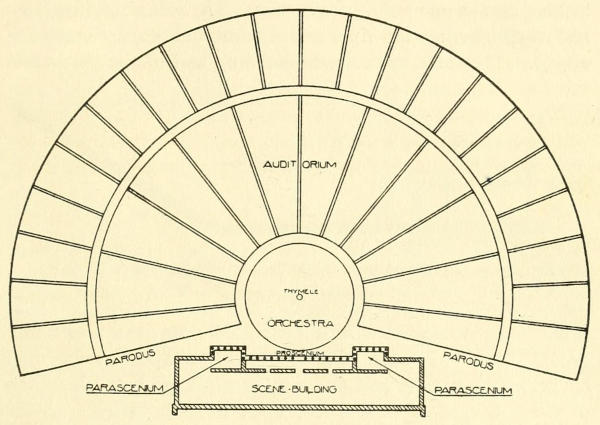
Fig. 22.—Ground Plan of a Greek Theater with Names of Its Parts
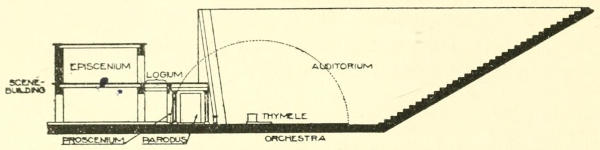
Fig. 23.—Cross-Section of a Greek Theater with Names of Its Parts
The Greek Theater.[118]—Since, as we have seen, both tragedy and comedy among the Greeks were choral by origin, the center of their theaters was a circular “dancing place” called an orchestra[119] (ὀρχήστρα), in the middle of which stood a thymele (θυμέλη) or “altar” (Figs. 22 f.).[120] When an actor was added to the tragic choreutae, it became necessary to provide a dressing-room where he might change his mask and costume. This temporary structure was called a σκηνή (“hut”: our English word “scene”), and at first stood outside the spectators’ range of vision. Afterward it was brought immediately behind the orchestral circle and then served also as a background in front of which the dramatic action was performed. Its face was pierced by doors, usually three but sometimes only one, which were conventionally thought of as leading into as many different houses. The scene-building often had two projecting side wings called parascenia (παρά, “beside” + σκηνή). The front of the scene-building and of the parascenia came to be decorated with a row of columns, the proscenium (πρό, “before” + σκηνή). The top of this proscenium was used by actors when they had occasion to speak from the housetop or were thought of as standing upon some elevation. In the course of time it was employed also for divinities, especially in epiphanies at the close of tragedies (see p. 292, below). Since this spot was never invaded by the singing or dancing of the chorus and was the only place reserved for actors exclusively, it came to be called the logium (λογεῖον, from λέγειν to “speak”) or “speaking place.”[121] Behind the logium was the second story of the scene-building, known as the episcenium (ἐπισκήνιον; ἐπί, “upon” + σκηνή); its front wall was pierced by one or more large doorways. Past each parascenium a “side entrance” or parodus (πάροδος; παρά, “beside” + ὁδός, “passage”) led into the orchestra. These entrances were used by the audience before and after the play, and during it by the actors (who could use also the doors in the scene-building) and the chorus. The parodi were often framed by beautiful gateways (Figs. 51 f.). The remainder of the orchestral circle was surrounded by the auditorium, the “theater” proper.[122] Chorus and actors stood on the same level in the orchestra or in the space between it and the scene-building. There was no stage in the Greek theaters until about the beginning of the Christian era.