Chapter IX · (continued 2)
Reading edition
Mica-diabase.
Fig. 40.—Mica-diabase, Gebel Um Khariga [10,373] × 17. pl, plagioclase felspar; b, biotite, with separated opaque flakes of magnetite, often in geometric forms; a, clouded mineral, probably altered augite, with which the felspars are ophitically intergrown.
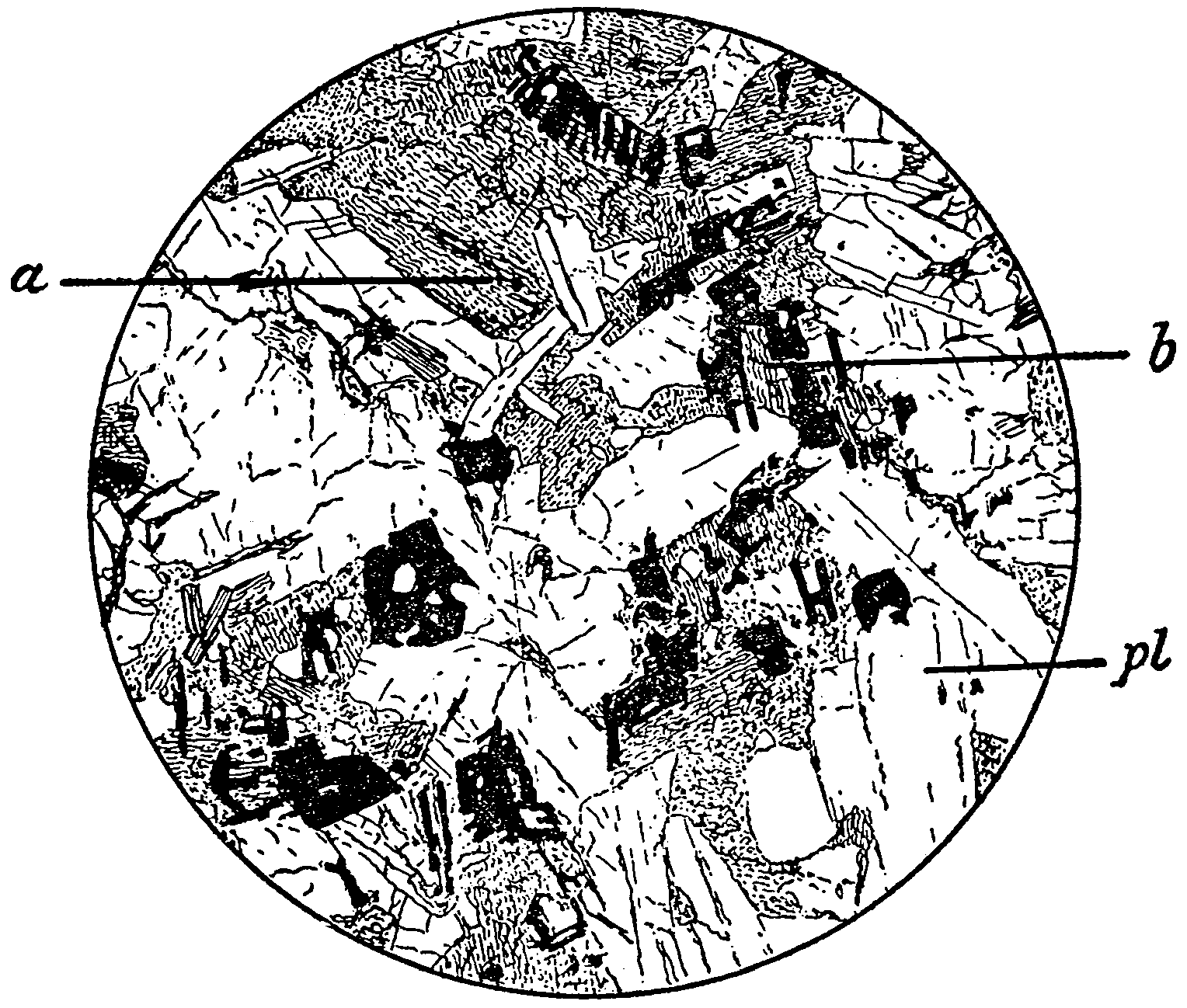
The rock which forms the top of Gebel Um Khariga [10,373] appears to be an altered mica-diabase. It is highly magnetic; the compass was found to point 20° out of its normal position at the station on the hill, while hand specimens broken off the rock showed strong polarity, some parts attracting and other parts repelling the needle; a fragment of the size of a pea deflected the compass needle several degrees when placed near it. It is a dark brown rock, of sp. gr. 2·83, very rotten, which in the mass looks like an altered dolerite. Microscopic study of a slide reveals the presence of altered plagioclase, in rather large lath-shaped crystals; biotite, largely altered to opaque iron oxide, the flakes of which show marked geometric forms; scattered grains of magnetite, and some secondary calcite. The brown clouded mineral polarises as a confused fine-grained and fibrous aggregate in low colours; it is probably altered augite, with which the plagioclases were ophitically intergrown, but is in too highly altered a state for certain identification. The strongly magnetic character of the rock would appear to indicate that the iron oxides produced by the alteration of the biotite are, like the primary grains, in the form of magnetite.
Basalt.
Basalt, the volcanic representative of the gabbros and diabases, is quite a scarce rock in South-Eastern Egypt, having been noted at only four or five points. Fairly fresh olivine-basalts, probably comparatively late intrusions, form the two conspicuous low hills near the coast called Gimeida and Einiwai; more altered rocks of basaltic type occur at the head of Wadi Um Deheisi (north of Gebel Kahfa), and in the hills on either side of the Wadi Huluz some ten kilometres north-west of Gebel Hamata; while an amygdaloidal rock which forms a large part of the hill-mass of Ti Keferiai has been classed as an altered hornblende-basalt.
Fig. 41.—Basalt, Gimeida Hill [12,156], × 40. Porphyritic crystals of plagioclase (pl) and olivine (o) in a hemicrystalline ground mass containing tiny crystals of plagioclase and granules of augite (a) and magnetite (m).
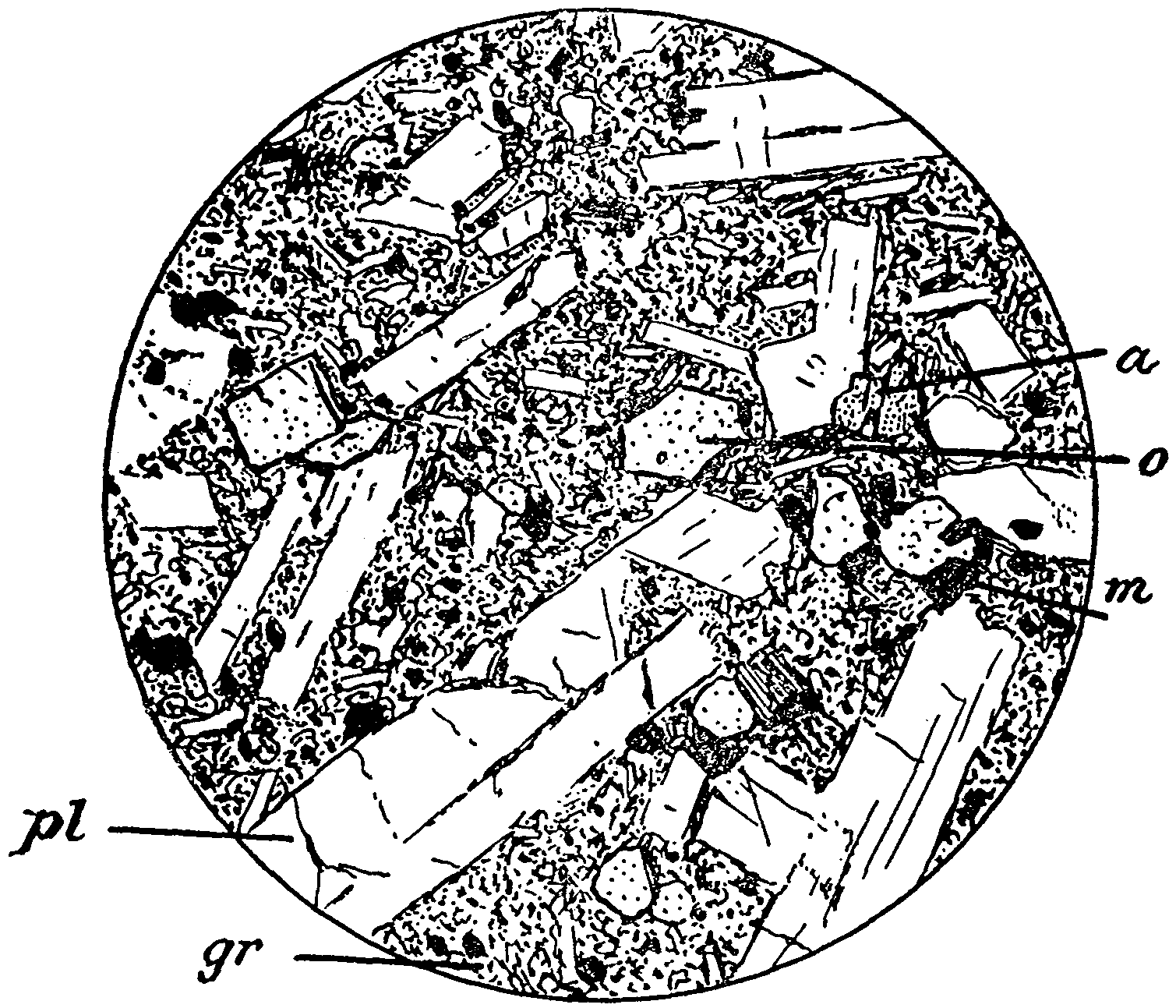
The basalt of Gimeida Hill [12,156], is a hard heavy block rock of sp. gr. 2·88, of dull aspect, with glassy white to colourless plagioclase crystals up to three millimetres diameter scattered through it, and here and there a dark diallagic crystal and some greenish glassy-looking grains of olivine. The microscopic slide shows the rock to be remarkably fresh; the porphyritic plagioclase and olivine crystals are seen to be embedded in a crystalline ground mass containing little lath-shaped plagioclases, with granules of pale brown augite, and abundant grains of magnetite.
Fig. 42.—Basalt, Einiwai Hill [12,144], × 17. o, olivine; a, augite; p, picotite, with a border of opaque chromite; gr, hemicrystalline ground mass.
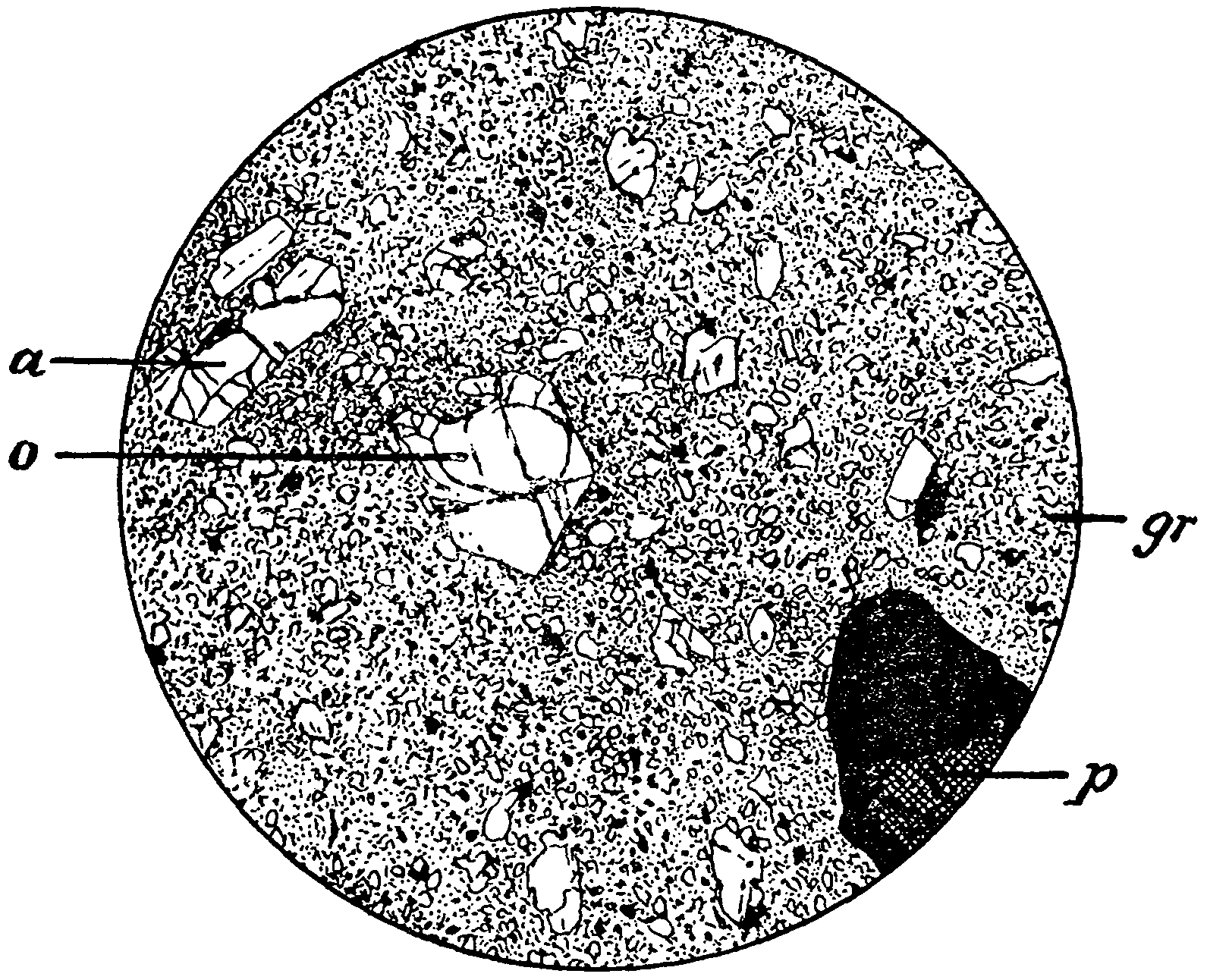
The basalt of Einiwai [12,144] differs from that of Gimeida in the absence of porphyritic felspars. It occurs capping the red granite which forms the lower part of Einiwai Hill and the surrounding plain. It is a hard dull black rock with little glassy colourless to pale green crystals plentifully scattered through it (see Plate XXIV). The sp. gr. is 3·10. The microscopic slide shows porphyritic crystals of olivine, augite, and picotite, in a very fine-grained semi-glassy ground mass containing tiny laths of felspar and grains of augite and magnetite. The porphyritic crystals all show a remarkable absence of colour in the slide, which has been cut exceptionally thin on account of the darkness of the ground mass; this thinness of the slide doubtless accounts for the minerals all showing relatively low polarisation colours. The porphyritic crystals are mostly in six-sided and prismatic forms, but sometimes show as rounded grains; cleavage is usually indistinct, but irregular cracks are common, and some of the crystals are broken in two and the halves separated. Most of the six-sided crystals show straight extinction, and are probably a non-ferruginous olivine (forsterite); they show very little alteration, there being a general absence of serpentinisation or magnetite-separation along the cracks. The prismatic porphyritic crystals are in forms resembling those of augite, and some of the crystals show extinction sufficiently oblique to justify their identification as augite; others, however, showing straight extinction and very low polarisation colours, are probably enstatite. The picotite is in rather large isotropic rounded grains, of a pale green colour with a well marked opaque border of chromite.
A peculiar basaltic rock [10,408] occurs at the top of Wadi Um Deheisi, at the pass into Wadi Um Retba, on the road which passes from Bir Shadli to the north-east of Gebel Kahfa. It is a black rock of sp. gr. 2·98, and of such fine grain that practically nothing can be made out with a lens. It is remarkably magnetic, the compass being deflected by 13° from its normal direction at a plane-table station on the pass. The microscopic slide shows rounded and angular clear areas in a cryptocrystalline ground mass of greenish colour, full of specks of magnetite. The rounded clear areas are occupied by a very pale brownish mineral, probably augite, forming nests of crystals in different orientations, with fairly well-marked cleavages, high extinction-angle and fairly high double refraction. The angular clear areas are mostly colourless; they seem to consist chiefly of altered felspar, but some of them are formed of a fine mosaic of quartz granules. The ground mass is largely of chloritic nature, with small fibres of hornblende and some decomposed felspar. Its large content of rounded magnetite granules accounts for the magnetic character of the rock.
The basalt of the Wadi Huluz [10,410] is a close grained greenish-black rock containing white spots (amygdules) up to three millimetres diameter. Its sp. gr. is 2·93. The microscope shows the main bulk of the rock to be formed of lath-shaped plagioclase crystals, around and between which is green matter, now mostly chlorite. Here and there are small clear areas within the green patches, which show bright polarisation colours, and are probably augite, being the remains of the original mineral which has been largely chloritised. There is a fair amount of magnetite in scattered grains. The amygdules are partly filled with clear quartz, and partly with zeolites.
The hill mass of Ti Keferiai is largely made up of a fine-grained black rock [12,120], of sp. gr. 2·99, in which are greenish-white and pink amygdules up to two millimetres diameter. It is frequently much crushed, and in one place it has been broken into a coarse breccia and cemented with rose quartz [12,123]. The microscopic slide shows the main part of the rock to be a fine-grained mixture of pale hornblende with altered plagioclase, while the amygdules are filled with radiating zeolites. The amygdules seem to indicate that the rock is a volcanic one, and it has been classed as a basalt rather than as an andesite on account of its basic nature and high specific gravity. Its texture is microgranitic rather than basaltic, a circumstance perhaps in part due to the crushing it has undergone; the rock is passing into a schist.
Ultra-basic Igneous Rocks.
The ultra-basic igneous rocks (i.e., rocks practically free from felspar and composed entirely of ferro-magnesian silicates such as pyroxenes, amphiboles, and olivines), though forming but a small part of the earth’s crust in general, occur in very large proportion in the igneous masses of South-Eastern Egypt, where they cover several hundred square kilometres and form prominent mountain-masses such as those of Gebels Dahanib, Korabkansi, and Gerf. They may be classified into:—
(a) Pyroxenites (rocks composed essentially of pyroxenes);
(b) Amphibolites (rocks composed essentially of hornblende);
(c) Peridotites (rocks composed essentially of olivine, with or without pyroxenes and amphiboles);
All these ultra-basic rocks are easily altered to
(d) Serpentines, in which the original minerals may or may not be traceable.
A characteristic of the ultra-basic rocks here, as in other parts of the world, is their gradual transition into one another, showing that the various forms have arisen from consolidation of parts of one and the same magma owing to slight differences in composition or in the physical conditions under which consolidation has taken place. A further noteworthy circumstance is their gradual passage into basic rocks; there is no hard-and-fast line to be drawn, for instance, between basic diorites and amphibolites, nor between basic gabbros and pyroxenites, nor between olivine gabbros, poor in felspar and peridotites, these various classes being found to pass by insensible gradations one into another as they are followed up in the field. Moreover, being typically coarse-grained rocks, and pyroxenes and amphiboles being often indistinguishable in the hand specimen, great caution has to be exercised in naming a rock mass from a few microscopic slides which of necessity each embrace at most but a few square centimetres of section.
In the field, the appearance and cohesive strength of the ultra-basic rocks varies primarily with the extent to which they have been altered towards their final stage of serpentinisation. Where they are least altered, they form black masses of hard heavy crystalline rock of such toughness that they are only broken with difficulty with a sledge hammer; while in the cases where serpentinisation has proceeded to the greatest extent, they frequently form foxy red or even pink-looking hills which might almost be taken for granite from a distance, and they are so shattered that the rock comes off literally in tons at a mere touch; in these cases, long search is necessary to find a coherent piece large enough for a museum specimen. The brown or pink colour just referred to is of course only superficial, but in the untrodden and rainless wilderness surface films remain unbroken and give characteristic colours to the scenery. Freshly fractured surfaces are always dark green, dark brown, or black, with more or less crystal structure visible according as the rock is less or more altered; pyroxenites or amphibolites, when but little altered, are a mass of lustrous platey or fibrous dark crystals, while serpentines are typically of dull aspect. The specific gravity is high, ranging from as much as 3·1 in the less altered forms down to about 2·6 in those which are more completely serpentinised.
The process of serpentinisation is of course a chemical change, consisting largely in the combination of water with ferro-magnesian silicates free from alumina; but it is remarkable how frequently this chemical change has been accompanied by a parallel physical deformation. Serpentines are almost always shattered rocks, full of slickensided surfaces; when we compare the low sp. gr. of serpentine (2·6) with that of augite, hornblende, or olivine (about 3·2), we naturally conclude that the shattering of the rock is in all probability due to the expansion on hydration causing internal stress, and the slickensiding is due to the rock yielding along certain surfaces. The cracking of felspars and the forcing of serpentine into them, which are frequently seen in thin sections of olivine rocks, such as the troctolite shown in Fig. 34 on p. 304, shows on a small scale the physical effect of expansion on serpentinisation, and should lead us to expect a corresponding effect in rock masses. It is thus not necessary to infer great tectonic movements to explain the shattering of the rock, and in fact the disposition of the serpentines in broad mountain tracts like Gebel Gerf is opposed to the idea of there being here any local accentuation of folding or crushing by general crust-crumpling. I have calculated that a horizontal sheet of pyroxenite of sp. gr. 3·1, ten kilometres wide, confined between fixed abutments and prevented from increasing its thickness, would rise into an arch having a height of about two and a quarter kilometres at its centre if converted into serpentine of sp. gr. 2·6; this is, of course, not given as a precise example of what may actually have taken place, but it will serve to show that expansion on hydration may produce dynamical effects not inferior to those of contraction of the earth’s crust, such as are believed to be the main cause of mountain formation, and to explain why we may find serpentines shattered to fragments and full of slickensided surfaces in areas where the surrounding rocks show comparatively little evidence of dynamo-metamorphism.
Pyroxenites.
Heavy dark green rocks, of medium to coarse grain, and consisting almost entirely of a schillerized-looking mineral, form the hill-masses of Gebels Um Ein and Qrein Salama, and similar rocks are found in connexion with gabbro at Gebel Um Gunud and elsewhere. From the diallagic appearance of these rocks in the hand specimen, they were classed in the field as pyroxenites or diallage rocks. But an examination of the slides cut from the specimens reveals the main constituent to be hornblende, and the rocks must therefore be placed in the division of amphibolites. It is, however, highly probable that these rocks were originally pyroxenites, the hornblende having originated mainly from the alteration of augite; the change from augite to hornblende in the gabbros has already (p. 302) been remarked, and in these ultra-basic forms the same process appears to have gone on.
Some parts of the great ultra-basic mass of Gebel Gerf consist of bronzite-rock. Specimens from the least altered portions consist almost entirely of bronzite, sometimes with a little olivine; the rocks are, however, generally found passing into serpentine, such as forms the main portion of the mountain, and on microscopic examination even the freshest portions always exhibit more or less serpentinisation. It will accordingly be preferable to treat of these rocks under the heading of serpentines.
Amphibolites.
Rocks consisting almost entirely of hornblende occur in considerable masses in the neighbourhood of Gebel Um Gunud, and form the conspicuous hills Gebel Um Ein and Qrein Salama; they also occur in a small patch about three kilometres east of Erf el Fahid. In the field, especially with the coarser-grained varieties, there is often considerable difficulty in identifying the main constituent of the rock as hornblende, owing to the schillerized appearance of the mineral being more suggestive of diallage; the mass east of Erf el Fahid, for instance, was classed in the field as a basic gabbro or diallage-rock, instead of a very basic diorite or hornblende-rock, such as the microscopic examination proves it to be. These rocks are always very heavy and extremely tough; they weather commonly into great rusty-looking rounded blocks, and a sledge hammer is required to get a specimen.
Fig. 43.—Amphibolite, from hills near Gebel Um Gunud [11,511], × 30. Almost the whole of the figure is occupied by hornblende, which is seen clouded and altering to granular epidote at e. Part of a large grain of calcite, bordered and streaked with iron oxide, is seen at c, while q is a small crystal of interstitial quartz. The slide also contains a small proportion of plagioclase felspar, not shown in the figure.
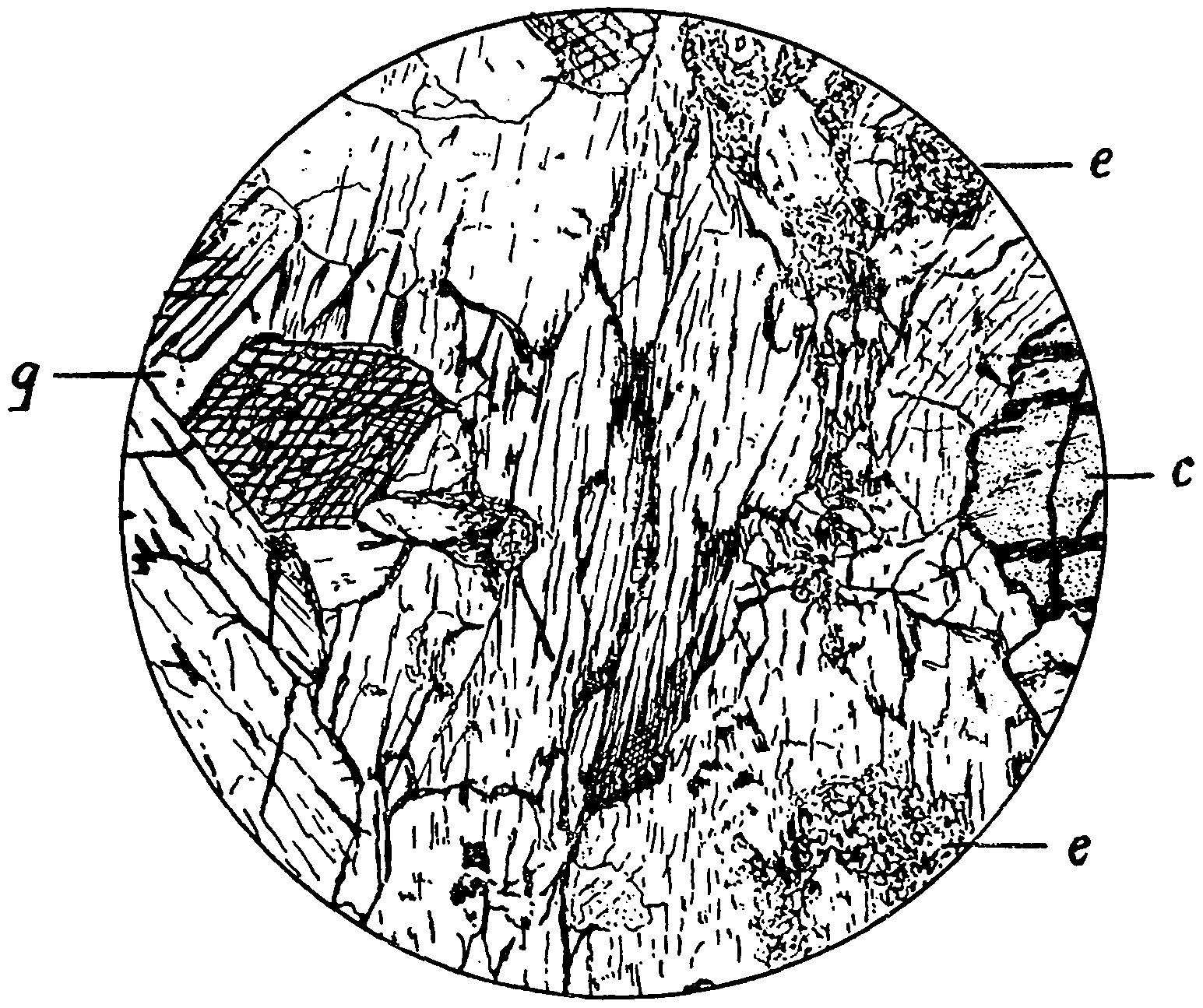
The amphibolite of the hills about Gebel Um Gunud [11,511] is a very hard and heavy coarse grained greenish-black rock composed almost entirely of shining platey-looking crystals of hornblende, which often reach two centimetres in length and breadth. The sp. gr. is 3·08. The microscopic slide shows the rock to be granitic in structure and to contain, in addition to hornblende, small amounts of plagioclase, quartz, calcite, and iron oxides. The irregular-shaped hornblende crystals show strong pleochroism, from pale olive-brown to moderately deep green. The extinction angles are large, being frequently over 20°. Twinning of the crystals is fairly common. Many of the crystals are clouded, and the alteration of the mineral has resulted in the formation of much epidote. The plagioclase is only present in very small quantity, strongly clouded by decomposition, but still showing twinning clearly. The quartz is clear, and is likewise present in very small proportion, mostly interstitial. Calcite is fairly plentiful in large rounded and irregular grains, rather turbid-looking, of a brownish or greenish tinge, outlined and streaked with strong lines of iron oxide, in a way which at times suggests that the calcite may possibly be the result of alteration of a lime olivine.
A specimen of amphibolite [11,528] obtained from a hill near the junction of Wadi Abu Marwa with Wadi Naait, about seven kilometres north-east of Gebel Um Gunud, is a dark green rock of rather fine grain, made up of shining plates and small fibrous crystals of hornblende and chlorite. Its sp. gr. is 2·97. Under the microscope the hornblende is in rather ragged-looking irregular crystals of various sizes, all interlocked with each other, rarely showing any approximation to idiomorphism except in the smaller crystals, which are commonly limited by prismatic faces; these smaller crystals are frequently included in the larger ones. The pleochroism is fairly strong, a pale olive brown, c moderately deep green. Prismatic cleavage is well marked. Extinction angles are often large, ranging up to 24°. A few of the crystals are slightly bent, and many show more or less clouding owing to partial alteration to chlorite, but on the whole the rock is fairly fresh. Except for a few specks of magnetite, and the alteration product chlorite, the rock contains nothing but hornblende.
The hornblende-rock or amphibolite of Gebel Um Ein [12,130] is of medium grain, almost entirely made up of shining crystals of hornblende with a little chloritic matter. The sp. gr. is 3·03. The microscopic slide shows large individuals of hornblende inclining to idiomorphism, set in a sort of ground mass of smaller crystals. The hornblende shows the same strong pleochroism and high extinction angles as in the two rocks just described; it is frequently clouded and speckled with iron oxides, and often full of lighter-coloured patches which extinguish with the rest of the crystal; in many cases these lighter patches contain a central granule of iron oxide, and they are doubtless due to a bleaching by segregation of the iron. Between crossed nicols many of the crystals are full of small fibres extinguishing differently from the rest of the crystal; some of these fibres polarise in low colours and are probably chlorite or serpentine, while others show brilliant tints and are possibly actinolite.
The amphibolite which occurs three kilometres east of Gebel Erf el Fahid [10,361] is of extremely coarse grain, looking like a very basic gabbro owing to the schillerized appearance of its large hornblende crystals and the presence of a little interstitial felspar. The sp. gr. of the rock is 2·98. The section shows the hornblende to be of a very pale green colour, with an almost entire absence of iron oxide grains and other alteration products. Between crossed nicols it has a fibrous woody appearance. The interstitial plagioclase (probably labradorite) is likewise very fresh, showing its repeated twinning very clearly; the crystals are full of tiny fibres of hornblende, and are traversed by broad cracks filled with a mosaic of smaller crystals of plagioclase and quartz.
Fig. 44.—Amphibolite of Qrein Salama [12,157], × 17. h, hornblende, strongly striated, altering to chlorite; o, olivine, and b, bronzite, both passing into serpentine.
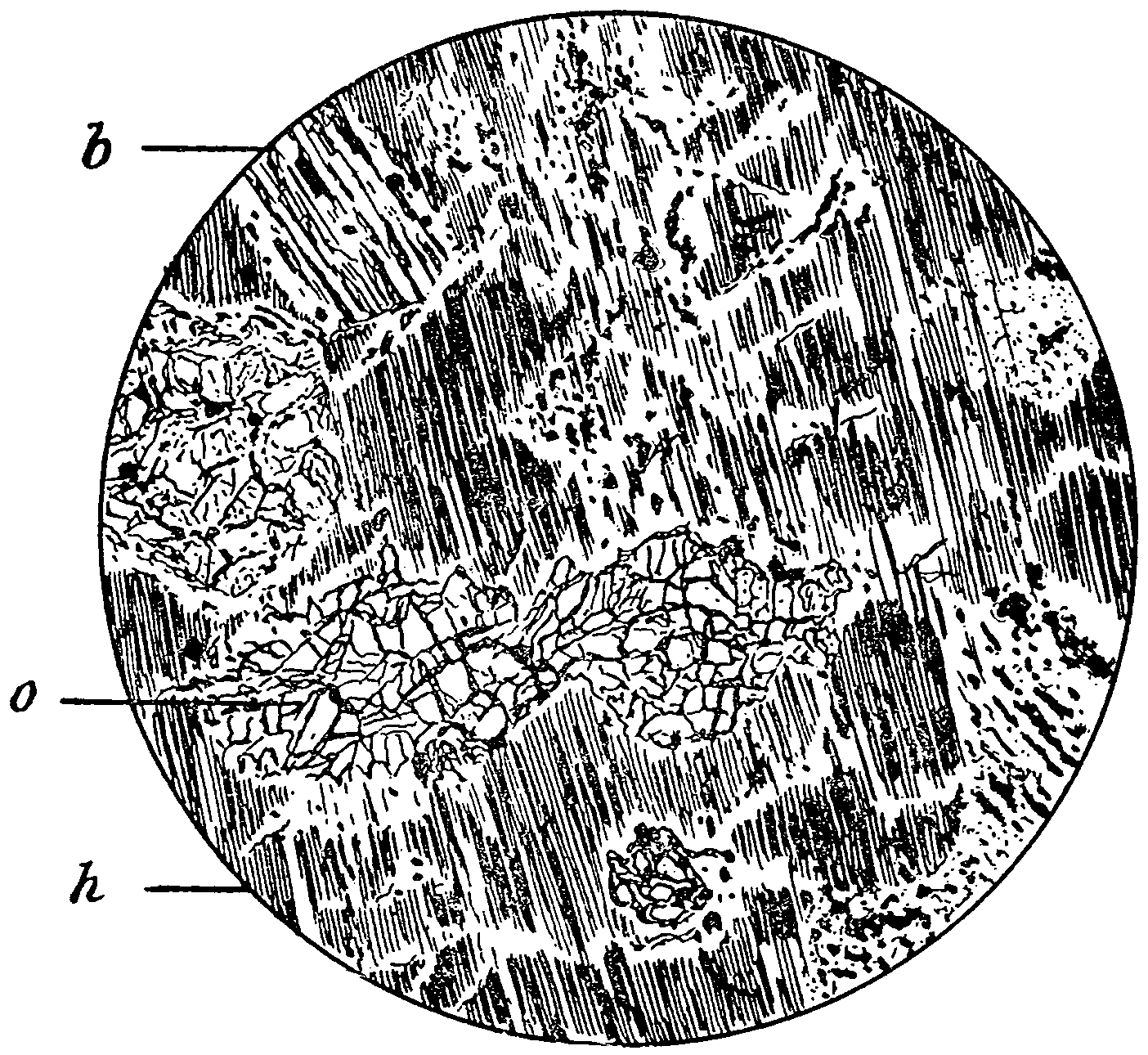
The rock [12,157], of the hill called Qrein Salama, to the east of Gebel Gerf, is interesting as containing olivine and bronzite in addition to the more abundant hornblende, and thus forming a link between the amphibolites proper and the peridotites; but as about three-quarters of the rock is hornblende it is still classed as an amphibolite. The sp. gr. is 3·05. In the slide, the hornblende is seen in irregular crystals, colourless to very pale green, with a fibrous structure which is strongly marked by patches of shading of extremely fine black prismatic striations. With crossed nicols the fibrous structure is still more apparent, the mineral polarising as brilliant fibres separated by chloritic alteration products. The pronounced striation and faint colour of the crystals are more suggestive of diallage than of hornblende, but the extinction angles measured in the slide are all less than 22°. Many of the hornblende-crystals contain large numbers of small rounded grains and strings of iron oxide. The olivine is mostly in rounded crystals, frequently included in the hornblende; it is largely serpentinised and full of small grains of opaque iron oxides, but kernels of the original mineral remain. The bronzite, which is present in about equal proportion with the olivine, is likewise extensively serpentinised and full of iron oxide grains; it is distinguishable from the olivine by a more fibrous appearance (the serpentinisation having gone on mainly along the direction of the vertical axis instead of along irregular cracks), and by its generally lower polarisation colours in the unaltered portions.
Peridotites.
The peridotites, or felspar-free rocks consisting largely of olivine, are usually classified into:—
(a) Dunites, consisting entirely of olivine.
(b) Harzburgites, consisting of olivine and enstatite or bronzite.
(c) Wehrlites, containing olivine and diallage.
(d) Lherzolites, containing olivine, diallage, enstatite or bronzite, and picotite or chromite.
(e) Hornblende-picrites, containing olivine and hornblende.
(f) Mica-peridotites, containing olivine and biotite.
Most if not all of these classes are represented in South-Eastern Egypt, but in the altered form of serpentine. The change to serpentine has been so complete that it is now hardly possible to extract even a small specimen of the primitive rock; indeed, careful search is often required to obtain even specimens containing any unaltered mineral whatever, and one has frequently to rely on the structure of the serpentine for the identification of the rocks from which it originated.
Serpentine.
Serpentines cover about 400 square kilometres of South-Eastern Egypt, forming the principal rock of several remarkable mountain groups and also occurring in lower hill country.
The largest occurrence is that of the great mountain mass of Gebel Gerf, where serpentine with alternations of gabbroid and dioritic rocks can be followed from Bir Meneiga southward for some thirty kilometres to beyond the Sherefa pass, while the breadth of the tract from east to west is some fifteen kilometres or more at its widest part; this tract includes a vast assemblage of high peaks and ridges, towering up in many cases to more than a kilometre above sea-level. To the north, south, and east, the serpentine is bounded by gabbros and diorites, while on the west a tract of schistose rocks separates it from another great serpentine mass which forms Gebel Korabkansi.
Other remarkable serpentine masses are Gebel Abu Dahr and the upper part of Gebel Sikait; serpentines also enter into the composition of Gebels Ghadir and Um Tenedba, while lower hills formed of similar rocks occur near Bir Murra in Wadi Shait, in Wadi Um Khariga, near Gebel Kalalat, and on the plain east of Abraq Springs.
The foxy red colour of exposed faces of serpentine hills, and the generally shattered nature of the rock, have already been referred to. When one approaches the masses closely, the red colour often becomes less marked, because the fresh debris flanking the hills is of a darker aspect. The slopes of serpentine hills are usually steep, and this combined with the rotten nature of the rock renders their climbing not always quite free from danger.
Any attempt to map out in the field the precise limits of the different peridotites which were the parents of the serpentine ends in failure, partly because the constituent minerals can generally only be identified on microscopic examination, and partly because the different peridotites pass gradually one into another, and are evidently only produced by slight variations in the composition or conditions of consolidation of a single magma. Even the limits of the serpentine itself are not always very clear; for where the associated rock is gabbro, as for instance to the north of Gebel Gerf, there is a gradual passage through more or less serpentinised olivine gabbro to the true serpentine. Golden yellow veinlets of fibrous chrysotile can be seen running through the rock at many places, and occasionally veins and pockets of magnesite and an inferior kind of asbestos occur (see p. 330).
The serpentines are nearly always more or less magnetic, and sometimes show strong polarity. The compass was disturbed by 40° at the triangulation station on Gebel Sikait; the amount of disturbance changes greatly when one moves even a short distance, and all estimations of direction from compass readings in serpentine country are therefore liable to enormous error.
In a strictly petrographical sense it would be most systematic to describe the serpentines in classes according to the nature of the parent rock; grouping together, for instance, all those derived from pyroxenites into one class, those from amphibolites into another, those from dunites into a third, and so on. But besides the fact that the nature of the parent rock cannot always be determined with certainty, such a course would possess the objection of separating the different parts of one and the same mass; at Gebel Gerf, for example, we have serpentines derived from rocks of various of these classes, though probably all formed part of the same igneous intrusion and are thus genetically connected. In the descriptions which follow, therefore, the serpentines of each locality will be grouped together, irrespective of origin. The localities are taken in order of latitude from north to south.
Fig. 45.—Serpentine, probably derived from a mica-peridotite, east of Erf el Fahid [10,360], × 40. cm, chlorite and magnetite from alteration of biotite; s, clear serpentine, probably altered olivine.
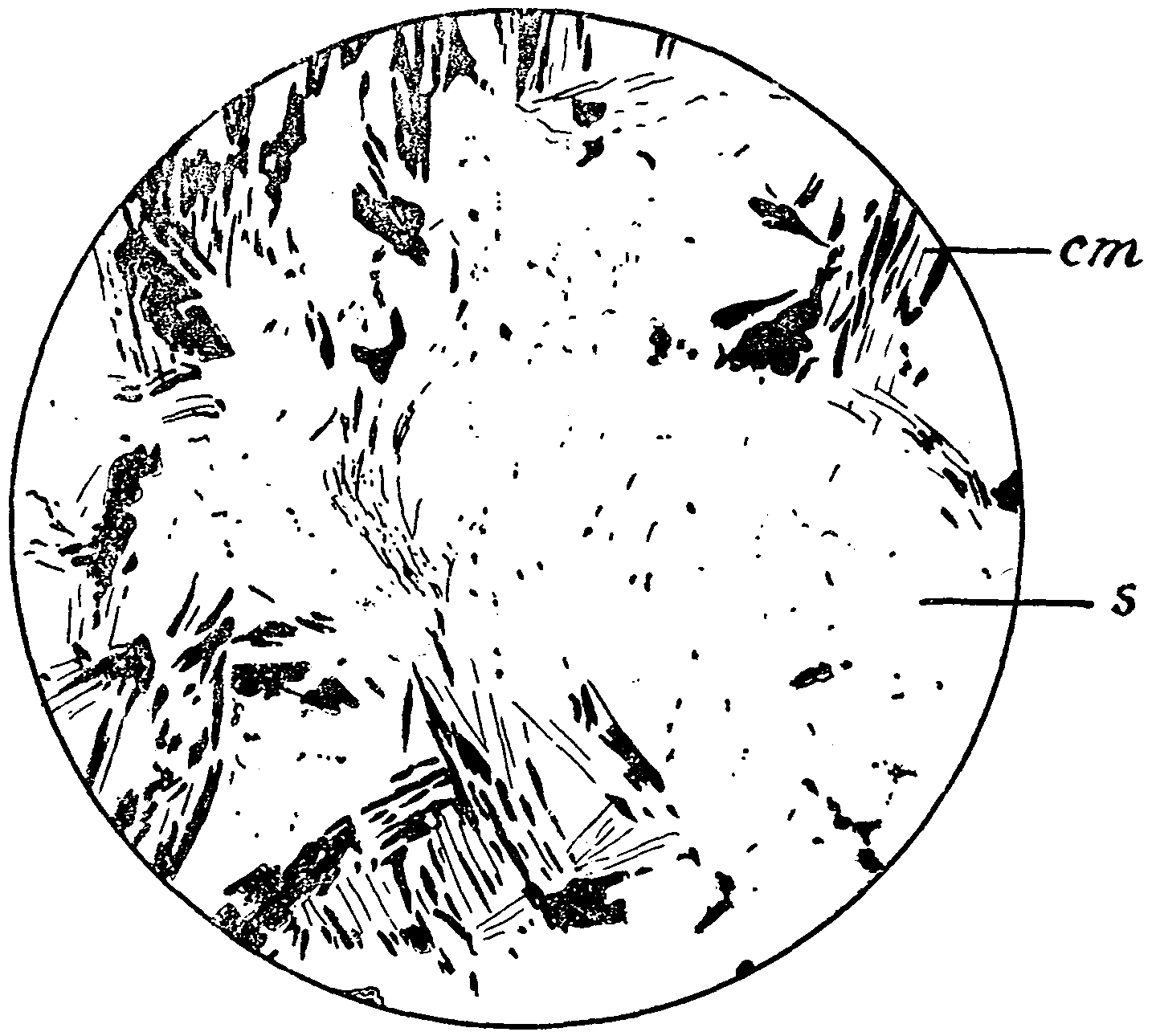
A serpentine which occurs associated with amphibolite and various schists about three kilometres east of Gebel Erf el Fahid [10,360] may possibly have been derived from a mica-peridotite. In the hand specimen it is a dark brown rock of dull aspect with greenish patches, and shows marked magnetic polarity. The sp. gr. is 2·63. The microscopic slide shows mainly colourless serpentine, but there are strings and bundles of pale greenish-yellow chlorite, and specks and strings of magnetite. The arrangement of the magnetite (see Fig. 45) at once attracts attention, being frequently aggregated in parallel strings reminding one of the cleavage of mica. Between crossed nicols the chlorite is easily distinguished from the serpentine by its slightly higher polarisation-colours (low yellows as compared with greys); and its arrangement in long leaves and bundles, with distinct traces of the original mica, leaves no doubt as to its derivation from biotite. The parallel strings of magnetite are also most likely due to alteration of biotite, for it is difficult to account for their peculiar arrangement otherwise; they are mostly separated by material of lower double refraction than the chlorite above-mentioned, perhaps a variety of chlorite poorer in iron, owing to the previous separation of the oxide. The clear serpentine which forms the bulk of the slide does not contain much iron oxide, and does not include any trace of the original mineral from which it has been formed; but between crossed nicols it shows an irregular mesh structure which makes one almost certain of its derivation from olivine.
Fig. 46.—Serpentine, probably derived from lherzolite, Wadi Um Khariga [10,368], × 17. so, serpentine derived from olivine; sb and sd serpentine probably derived from bronzite and diallage; c, calcite; p, picotite; m, magnetite.
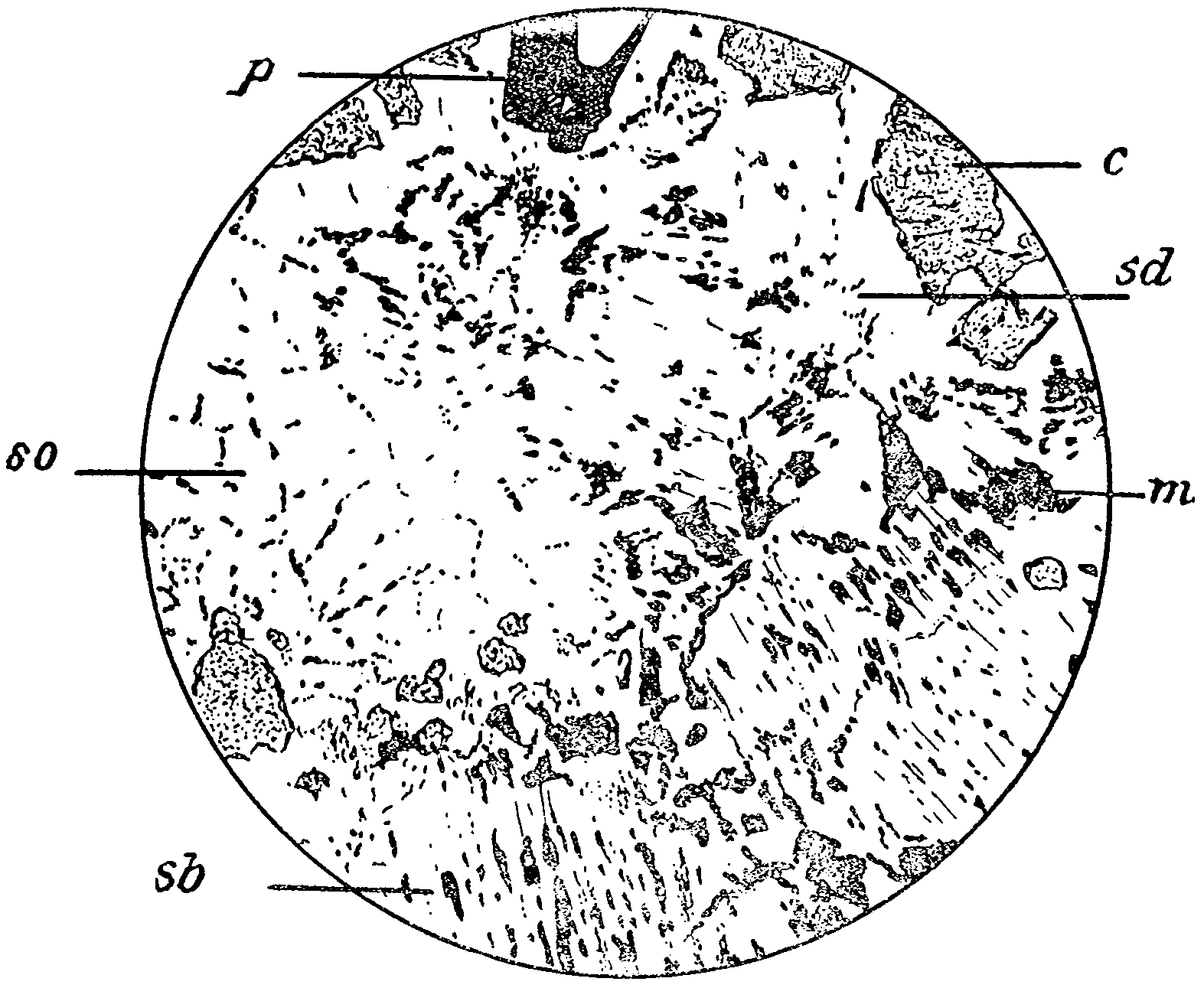
The serpentine of the hills on the west side of the Wadi Um Khariga [10,368] is remarkable in the field by its foxy red colour on all exposed surfaces. The rock, which has a sp. gr. of 2·63, is nearly black on fractured surfaces, and no crystals can be detected in it. The slide shows colourless to yellow serpentine, with a fair amount of calcite often arranged along cracks, a liberal sprinkling of magnetite, and one or two fairly large grains of picotite, or chromite. In some parts of the slide the serpentine shows an irregular mesh structure between crossed nicols; these portions, in which the magnetite-granules show an irregular honeycomb-like arrangement, are doubtless altered olivine. In other places the serpentine polarises in clear greys with a fibrous aspect, and the magnetite is arranged in parallel lines; calcite is typically developed in these fibrous portions, sometimes along the cleavages and sometimes in irregular patches. The fibrous-looking serpentine probably represents the alteration-products of both rhombic and monoclinic pyroxenes, and the parent rock was thus a medium-grained lherzolite, containing olivine, diallage, bronzite and picotite.
In the hills on the east side of the Wadi Um Khariga, about in latitude 24° 55′, there is some serpentine which has apparently resulted from the alteration of very basic dykes. The sp. gr. is 2·65. A slide cut from this rock [10,367] shows the same clear fibrous-looking patches as the specimen last described, and picotite, in a confused and nearly isotropic mass of fine fibres of serpentine, with but little magnetite and no calcite. No original mineral remains except the picotite. The clearer fibrous patches may represent diallage or bronzite, while the rest of the serpentine is somewhat doubtfully referred to olivine. There is some trace of banding in the rock, perhaps due to movement during consolidation.
A serpentine approaching an ophicalcite [10,376] forms the main rock at Gebel Ghadir, where it is associated with a peculiar quartz felsite resembling granulite. In the mass the rock, which has a sp. gr. of 2·67, is black to green, veined with calcite; surfaces of the debris are often covered with a brilliant green glaze. The microscopic slide reveals an irregular mixture of nearly colourless serpentine and cloudy-looking calcite, with abundant specks and a few larger granules of slightly translucent deep-brown chromite or picotite. Between crossed nicols, the serpentine is a mass of fibres and little plates, in which a strong tendency to linear arrangement can be seen, and here and there a lattice-structure. Though none of the original mineral remains there is not much doubt that the rock is an altered amphibolite or basic diorite; the calcite is possibly derived from the alteration of an original lime felspar, but it has been largely redistributed in the crushed rock by solution and redeposition.
The serpentine forming the hills on the north side of the mouth of Wadi Kalalat is a dark reddish-brown rock, of sp. gr. 2·76, in which shining crystalline specks of olivine can be seen. It has doubtless resulted from the alteration of a dunite, or rock consisting almost entirely of olivine. The slide [11,510] shows the rock still to contain abundant clear colourless kernels of the original olivine, in a mesh-work of pale olive-brown serpentine. The serpentinisation has taken place along irregular cracks in the olivine, each crack being generally marked by a thin streak of opaque iron oxide running longitudinally down its centre, with serpentine fibres running crosswise and filling the rest of the crack. Where the kernels first left have themselves become changed to serpentine, they are nearly isotropic, while the cracks polarise in clear greys, so that even where the whole of a crystal has been serpentinised the structure is still clear, both in ordinary light by the magnetite strings, and in polarised light by the way in which the serpentine of the cracks stands out from the more isotropic patches within the meshes. There is a little accessory diallage, easily recognisable by its fibrous appearance and the oblique extinction of its unaltered portions. The diallage, like the olivine, is passing into serpentine, but here the serpentine goes on along cleavage planes as well as along irregular cross cracks, giving the partially altered crystals a striped appearance between crossed nicols. Where the diallage has become entirely serpentinised, it can still be differentiated by its clearer appearance from the olivine-serpentine in ordinary light, and by its striated structure between crossed nicols; but of course unless kernels of the original mineral are left one cannot be sure whether it was diallage or bronzite. There are a few patches of calcite or magnesite, and veinlets of the same secondary minerals; these may have arisen from the alteration of a little original felspar, or from the diallage.
Near the head of Wadi Arais, to the south of Gebel Um Bisilla, there are some dykes of dark magnetic rock of sp. gr. 2·56. A specimen from one of these dykes [11,519], turns out on microscopic examination to be a schistose serpentine. It is traversed by parallel strings of opaque and brown translucent iron oxides, and granules of magnetite are also scattered over the interspaces. The interspaces between the iron oxide strings are filled with serpentine showing no recognisable structures, but containing here and there little nests of clouded green hornblende, suggesting the possibility of the rock being an altered basic diorite or amphibolite.
The highly crushed and rotten serpentine which forms the high and steep-sided mountain mass of Gebel Abu Dahr, differs considerably in composition in different parts. The most typical form of the rock, which has a sp. gr. of 2·77, is a dark brown serpentine with little strings of olive-green matter, and occasionally large dulled black crystals. A slide [11,516 A], cut from this portion of the rock shows mostly olivine, altering to serpentine in the usual manner with abundant clear kernels of the original mineral. Associated with the olivine is another mineral of a somewhat fibrous aspect, altered partly to serpentine and partly to another substance which polarises as a confused aggregate of fibres and flakes in brilliant colours, the flakes extinguishing with slight obliquity; the serpentine is formed mainly along the vertical cleavages of the mineral (though it also fills transverse irregular cracks), while the other substance (tremolite?) fills up interspaces. In some parts of the mass the rock has a blacker colour and a slightly higher density (2·87), somewhat resembling a basalt with large greenish fibrous-looking crystals scattered sparsely through it. The slide cut from this form of the rock [11,516 B] shows no olivine whatever, practically the whole slide being composed of the fibrous mineral just described, together with a little nearly colourless fibrous hornblende, in which the change above-mentioned appears to be going on. Thus it would seem likely that the rock of Gebel Abu Dahr is essentially an altered hornblende-picrite (or olivine-hornblende rock) with variations towards dunite (olivine-rock) on the one hand, and towards an amphibolite or hornblende-rock on the other. The alteration of hornblende here is not a purely serpentinous one, but results in the formation first of serpentine along cracks and cleavage planes, and then of a tremolitic mineral in the interspaces. It is worth remark, moreover, that in the slide free from olivine the change to tremolite preponderates, and there is much less serpentine in the altered hornblende than in the slide containing olivine; this suggests that the presence of the neighbouring olivine has in some way brought about more serpentine in the hornblende, perhaps by actual forcing of serpentine from the expanding olivine into cracks in the hornblende, or by the influence of pressure set up by the same expansion.
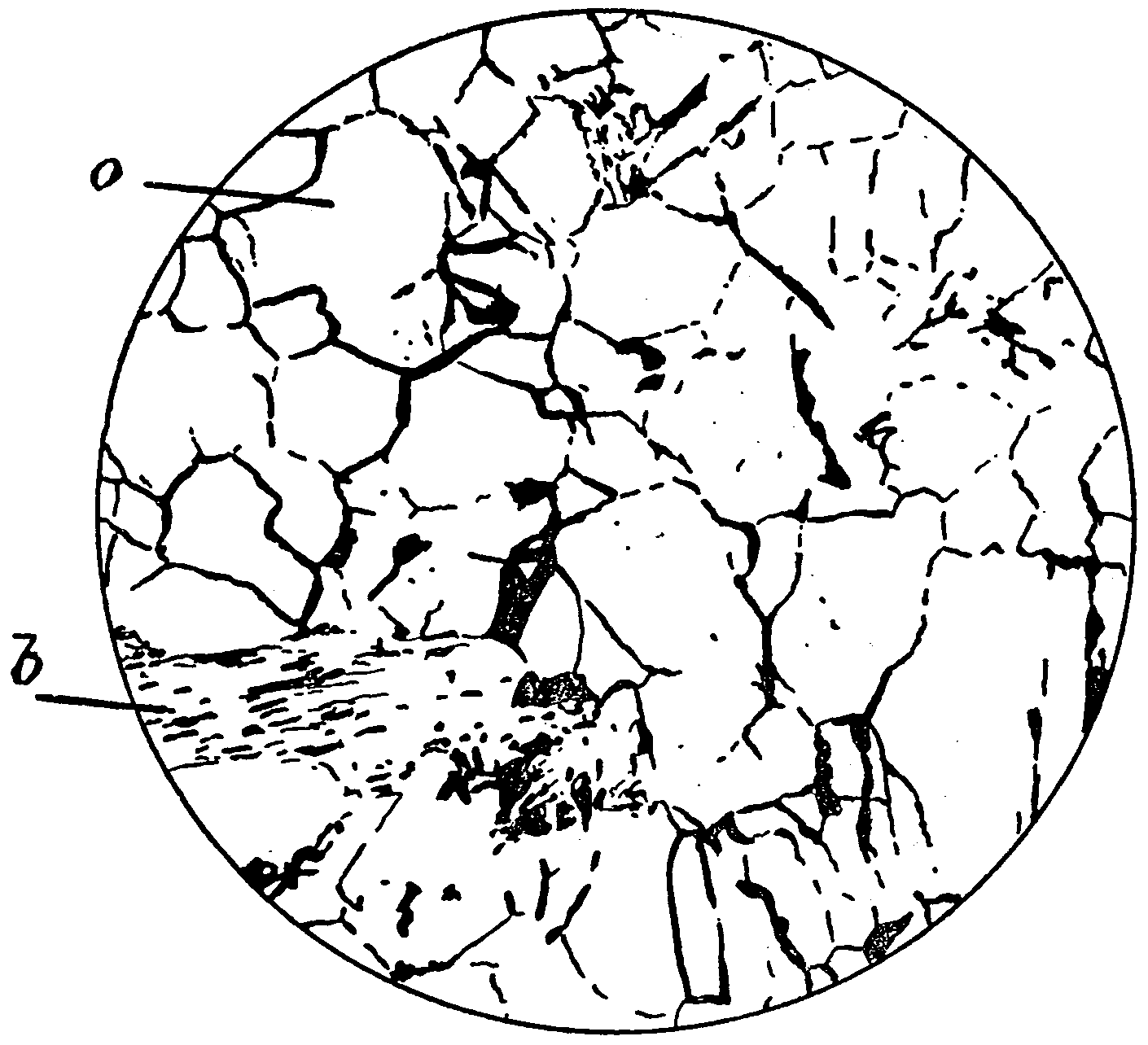
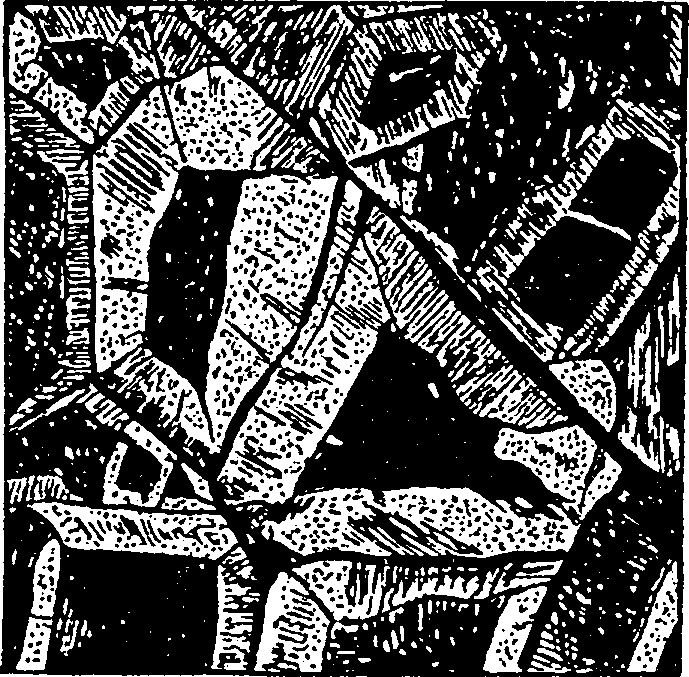
In the serpentine from some low hills on the plain a little to the east of Bir Abraq [11,506] we have a rock evidently derived from a dunite, though not a trace of unaltered olivine remains. The sp. gr. is 2·61. The microscopic slide consists of nearly colourless serpentine with strings of magnetite marking the cracks along which its formation began (see Fig. 47). Between crossed nicols (see Fig. 48) the main portion of the serpentine, doubtless derived from olivine, presents a very remarkable appearance; most of the polygonal spaces between the magnetite-meshwork are lined with plates of clear serpentine, while the centre is occupied by nearly isotropic material. Thus the slide in polarised light presents somewhat the aspect of an aggregate of cells with dark nuclei. Besides olivine, the slide shows a small amount of a fibrous mineral, probably bronzite, which is likewise almost entirely altered to serpentine, though a few original fibres remain; the magnetite grains in the serpentine derived from this mineral is typically aggregated in strings parallel to the fibres.
Fig. 47.—Serpentine derived from an almost pure olivine-rock, from a low hill east of Bir Abraq [11,506], × 17. The outlines of the original olivine crystals (o) and the cracks in them are marked by granules and strings of magnetite. A serpentinised crystal of bronzite is seen at b. Fig. 48.—A small portion of the serpentine derived from olivine in the same slide, viewed between crossed nicols under a higher power, showing the cellular structure.
A serpentine rock found associated with fine-grained diorite at Gebel Um Tenedba [11,517 B] may have been derived from an olivine diabase poor in felspar. The rocks in this locality are highly altered and crushed, and frequently more or less schistose. In a slide cut from the serpentine of the lower part of the mountain, which has a sp. gr. of 2·71, all the original minerals of the rock have been replaced by alteration products. The main portion of the slide is probably altered augite; it consists of serpentine with fairly distinct mesh structure in which iron oxides are very abundant in clots and strings. Some patches, which show a more uniform grey aspect under crossed nicols, are doubtfully referred to altered felspar. Smaller areas, usually free from iron oxide grains and mostly consisting of almost isotropic serpentine with a substance polarising in low yellow tints running along irregular cracks in all directions, are believed to represent altered olivine; one of these areas is nearly filled with little brushes of the substance just mentioned, giving it almost a spherulitic appearance as the nicols are rotated.
Fig. 49.—Serpentine, derived from wehrlite, Gebel Gerf [12,128], × 17. s, serpentine (mainly altered olivine, with strings of magnetite); o, unaltered olivine, mixed with granules of augite; d, diallage.
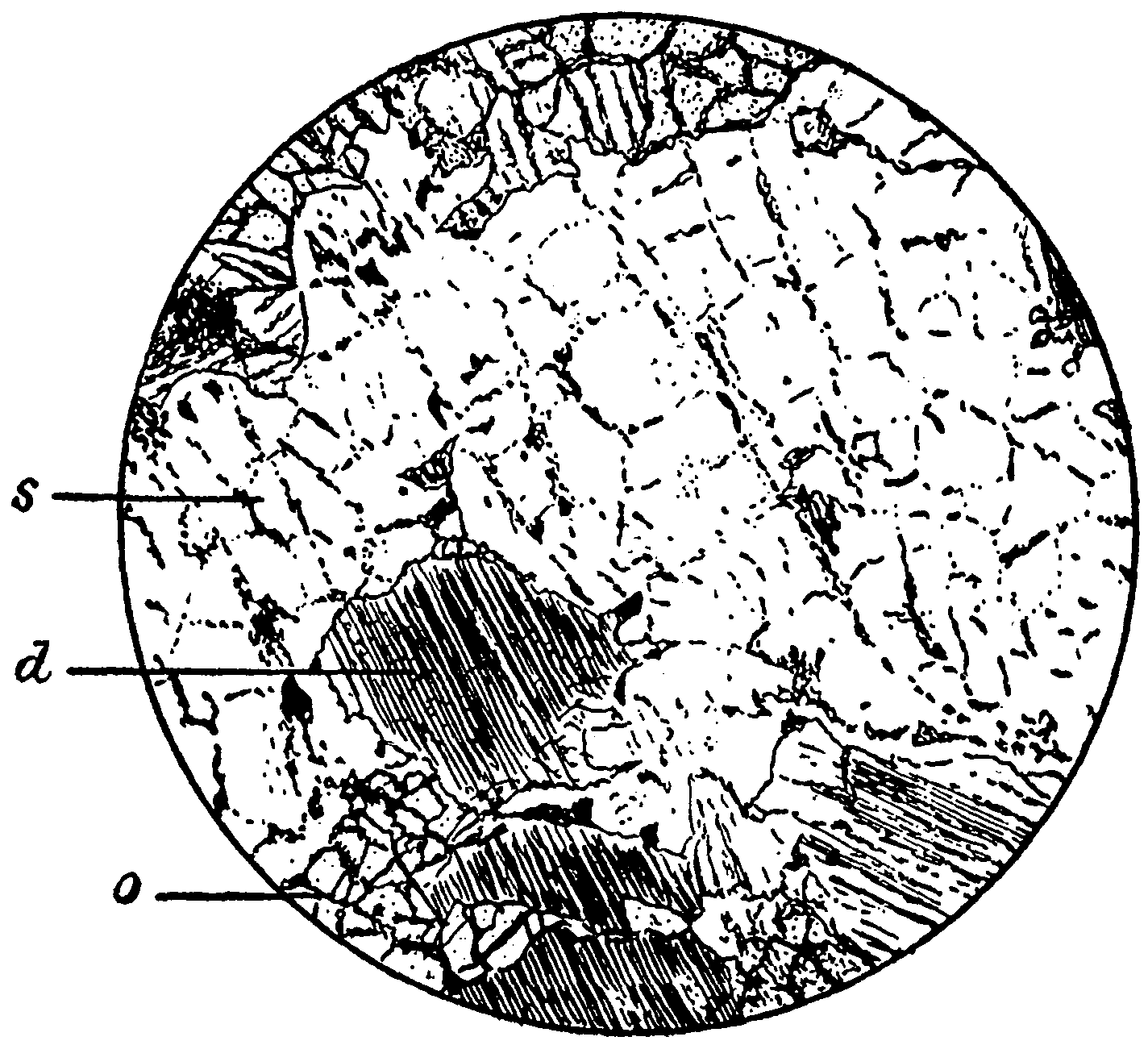
The predominant rock of the mountain mass of Gebel Gerf [12,128] is a serpentine apparently derived from a wehrlite or olivine-diallage rock. In the hand specimen, it is a rather heavy black rock (sp. gr. 2·75) with small pea-green spots and a few small bronzy and glassy looking crystals here and there. The microscopic slide (see Fig. 49) shows the olivine to be largely altered to serpentine in the ordinary manner with separation of magnetite, but some granules of the original mineral remain, especially aggregated, together with augite granules, round the diallage crystals. The diallage is tolerably fresh, and easily recognisable by its fine striation and oblique extinction. Besides the diallage, there is some ordinary augite, not always very easily distinguishable from the unaltered olivine owing to its cleavage not being very marked. Some of the diallage crystals show undulose extinction as the result of strain.
Fig. 50.—Serpentinisation of bronzite, as seen in a serpentine derived from bronzite-rock, Gebel Gerf [12,119], under a high power between crossed nicols. The clearer portions of the figure are unaltered portions of a single large crystal of bronzite; the serpentine is seen forming mainly along the cleavages of the original mineral, with subsidiary cross-fibres.
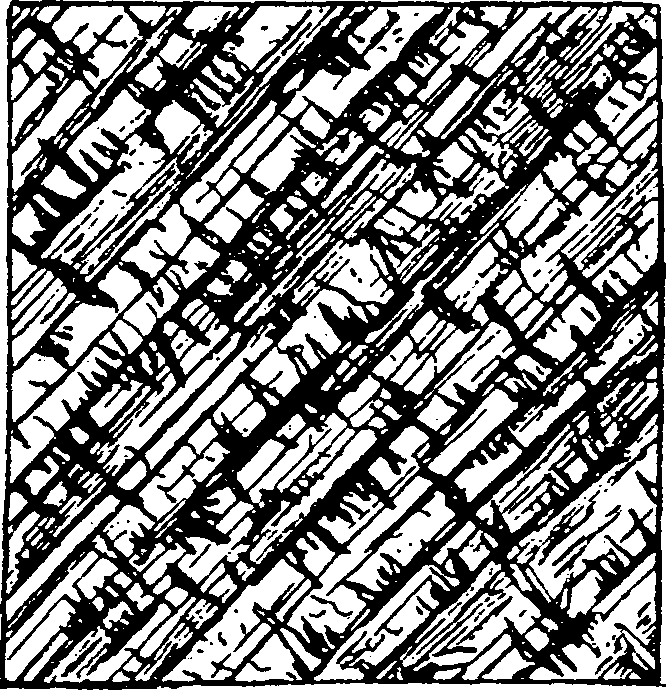
At many points the serpentine of Gebel Gerf contains a great deal of bronzite, crystals of this mineral of typical aspect and measuring up to five millimetres diameter being visible in the hand specimen scattered liberally through the duller serpentine. The sp. gr. of this portion of the mass is 2·81. The slide [12,119] shows practically nothing but bronzite altering to serpentine, so that locally the parent rock has been a pyroxenite rather than a peridotite. The serpentinisation of the bronzite has proceeded mainly along the fibres of the original mineral, but there are numerous cross-fibres (see Fig. 50), and here, as in the hornblende of the rock of Gebel Abu Dahr, the change to serpentine appears to have been accompanied by the production of tremolite. In another slide [12,127] the main constituent appears to be still bronzite, but here it is of a pronounced olive-brown colour even in thin section, and is accompanied by some nearly colourless diallage; some of the olive-brown fibrous crystals show extinction-angles of a few degrees, and it is possible that these are hornblende.
Though the greater part of the Gerf serpentine has been derived from rocks free, or practically free, from felspar, it is possible that these were mixed with other rocks, such as gabbros and diabases, in which basic plagioclase formed an essential constituent. One of the specimens brought back from the mountain [12,115], having a sp. gr. of 2·67, is a somewhat wedge-shaped block, about ten centimetres square and four centimetres thick, covered entirely with the shining black to greenish glaze which is characteristic of shattered serpentine, except where chipped with the hammer to test its coherence and to look for remains of crystals in it. The fractured surface is mostly dull and nearly black, with little strings and spots of greenish matter and scattered shining specks. But although the block so thoroughly resembles a serpentine, the slide cut from it proves the rock to be a fine-grained diabase, consisting essentially of augite and plagioclase, with a good deal of iron oxide. The plagioclase is tolerably fresh, in lath-shaped forms still showing twinning very clearly, while the augite is very clouded and is changing to hornblende and chlorite or serpentine. In the field nothing was noted which would separate this rock from the rest of the mass, which it resembles almost perfectly in appearance, and whether the diabase forms a dyke or sheet, or the specimen represents a fragment of diabase caught up by the magma, is not certain. A dyke of this material, shattered and serpentinised on all the fractured surfaces, would be indistinguishable from the surrounding serpentine. It is even possible, though not likely, that the diabase is not a separate intrusion, but merely a variation of the same plutonic mass which has given origin to the main bulk of the serpentine.
Other variations in the serpentine which point to parts of the Gerf mass having originally been of a gabbroid type, occur in the mountains round Bir Korbiai and Bir Meneiga. A specimen from near Bir Korbiai [12,125], is a greyish-black fine-grained rock full of little white and greenish specks and strings, with pale citron-green serpentinous matter covering the slickensided surfaces of the fragments into which the mass readily separates. The sp. gr. is 2·67. The microscopic slide shows serpentine with pronounced knitted structure in places, as though derived from augite, and considerable patches of calcite which may represent an original lime-felspar. The calcite has, however, been largely redistributed along cracks, where it is often mixed with extremely coarse fibres or plates of serpentine.
The specimen from the mountains round Bir Meneiga [12,104] is a hard dull slatey-grey rock with black streaks and spots; it is strongly magnetic and shows a tendency to schistose structure. The sp. gr. is 2·54. On examination with a lens the grey matter has in places something of a resemblance to saussuritised felspar. The slide cut from this specimen contains no original minerals. The bulk of it seems to be composed of very minute fibres or plates, generally showing a distinctly parallel arrangement along the planes of schistosity, but exhibiting knitted structure in places, and thus probably consisting in part of kaolinic matter derived from altered felspar, and in part of serpentinous matter derived from alteration of augite; while scattered through the slide are abundant patches and strings of calcite and magnetite. The rock is too intensely crushed and altered for one to be certain of its origin, but it appears to have been originally a diabase.
Fig. 51.—Serpentine derived from alteration of harzburgite, Gebel Korabkansi [12,140], × 17. s, serpentine, mostly formed from olivine; o, unaltered olivine; b, altering bronzite; c, chromite or magnetite, enveloping olivine.
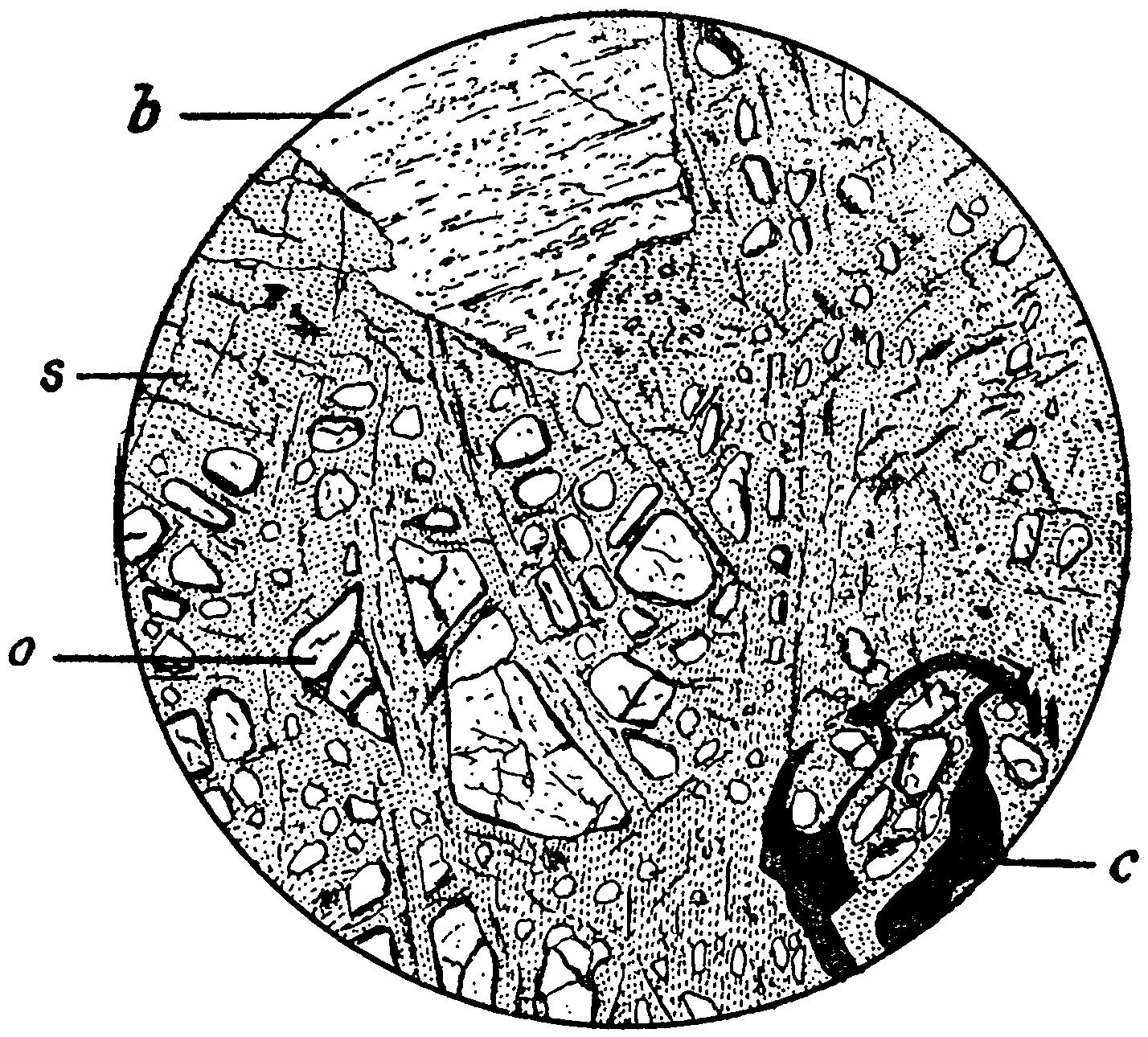
The serpentine of Gebel Korabkansi, to the west of Gebel Gerf, is an altered olivine-bronzite rock (harzburgite) of moderately coarse grain. A slide [12,140] cut from the least altered portion, where the sp. gr. of the rock is 2·72, shows olivine to have been the most abundant constituent; it is largely serpentinised in the typical manner, but abundant kernels remain unaltered. Mixed with the olivine crystals are others of a fibrous mineral, altered partly to serpentine and partly to a confused mass of tremolite fibres; in the few cases where any of the original material remains, this fibrous mineral shows straight extinction, and is probably bronzite. The alteration of the pyroxene has here proceeded more rapidly than that of the olivine. The pyroxenic mineral is easily picked out in the slide by ordinary light, owing to the fact that the olivine has altered to greenish-yellow serpentine, while the mixed material produced from the pyroxene is of a dirty-white aspect. Another slide from Gebel Korabkansi [12,112] exhibits in places mesh-structure with clear kernels which extinguish very obliquely to the meshes, showing augite or diallage also to have been a constituent of the parent rock; and there is a single ragged-looking crystal of dark green fibrous hornblende, altering to nearly colourless serpentine. The sp. gr. of the specimen from which this latter slide was cut is 2·63. Both the slides from Gebel Korabkansi are rather poor in iron oxides, but there are a few irregular crystals of chromite, generally enveloping olivine.
Alteration Products of Serpentine. Magnesite and Asbestos.
In many of the serpentine-masses the effects of solution and pressure can be traced in the formation of veins and pockets of magnesite, asbestos, and occasionally talc in the rock. Magnesite veinlets are frequently seen, for instance, round about Bir Meneiga [12,142] and Bir Muqur, while asbestos has been found in pieces of several kilogrammes weight in the Wadi Sherefa el Sherqi [12,122] and near Bir Muqur [12,153]. At the last-named locality it occurs along the crush-planes of the serpentine, and appears to be preceded by the formation of long fibres of a green substance.[133] Where thickest, the glaze on the slickensided surfaces of the serpentine fragments seems to consist of this same green substance, which splits into hard fibres often reaching ten centimetres or more in length and only a few millimetres in diameter [12,153 A] and these hard fibres, which have a sp. gr. of 2·64, break up gradually, apparently under weathering influences, into the much finer and more flexible fibres of white asbestos. The quality of the asbestos is, however, inferior, for a specimen of the softest kind sent to London for an expert opinion, was reported to be of no commercial value; even had it been otherwise, the quantity seen was too small to justify working, though of course a thorough search among the mountains might reveal the presence of bigger deposits than were encountered during the survey.