Volume 1 — CHAPTER XIII.
Reading edition
THE AUSTRALIAN REGION.
The Australian is the great insular region of the earth. As a whole it is one of the best marked, and has even been considered to be equal in zoological value to all the rest of the globe; but its separate portions are very heterogeneous, and their limits sometimes ill-defined. Its central and most important masses consist of Australia and New Guinea, in which the main features of the region are fully developed. To the north-west it extends to Celebes, in which a large proportion of the Australian characters have disappeared, while Oriental types are mingled with them to such an extent that it is rather difficult to determine where to locate it. To the south-east it includes New Zealand, which is in some respects so peculiar, that it has even been proposed to constitute it a distinct region. On the east it embraces the whole of Oceania to the Marquesas and Sandwich Islands, whose very scanty and often peculiar fauna, must be affiliated to the general Australian type.
Australia is the largest tract of land in the region, being several times more extensive than all the other islands combined, and it is here that the greatest variety of peculiar types have been developed. This island-continent, being situated in the track of the southern desert zone, and having no central mountains to condense the vapours from the surrounding ocean, has a large portion of its interior so parched up and barren as to be almost destitute of animal life. The most extensive tract of fertile and well-watered country is on the east and south-east, where a fine range of mountains reaches, in the Colony of Victoria, the limits of perpetual snow. The west coast also possesses mountains of moderate height, but the climate is very dry and hot. The northern portion is entirely tropical, yet it nowhere presents the luxuriance of vegetation characteristic of the great island of New Guinea immediately to the north of it. Taken as a whole, Australia is characterized by an arid climate and a deficiency of water; conditions which have probably long prevailed, and under which its very peculiar fauna and flora have been developed. This fact will account for some of the marked differences between it and the adjacent sub-regions of New Guinea and the Moluccas, where the climate is moist, and the vegetation luxuriant; and these divergent features must never be lost sight of, in comparing the different portions of the Australian region. In Tasmania alone, which is however, essentially a detached portion of Australia, a more uniform and moister climate prevails; but it is too small a tract of land, and has been too recently severed from its parent mass to have developed a special fauna.
The Austro-Malay sub-region (of which New Guinea is the central and typical mass) is strikingly contrasted with Australia, being subjected to purely equatorial conditions,—a high, but uniform temperature, excessive moisture, and a luxuriant forest vegetation, exactly similar in general features to that which clothes the Indo-Malay Islands, and the other portions of the great equatorial forest zone. Such a climate and vegetation, being the necessary result of its geographical position, must have existed from remote geological epochs with but little change, and must therefore have profoundly affected all the forms of life which have been developed under their influence. Around New Guinea as a centre are grouped a number of important islands, more or less closely agreeing with it in physical features, climate, vegetation, and forms of life. In most immediate connection we place the Aru Islands, Mysol and Waigiou, with Jobie and the other Islands in Geelvinck Bay, all of which are connected with it by shallow seas; they possess one of its most characteristic groups, the Birds of Paradise, and have no doubt only recently (in a geological sense) been separated from it. In the next rank come the large islands of the Moluccas on the west, and the range terminating in the Solomon Islands on the east, both of which groups possess a clearly Papuan fauna, although deficient in many of the most remarkable Papuan types.
All these islands agree closely with New Guinea itself in being very mountainous, and covered with a luxuriant forest vegetation; but to the south-west we find a set of islands extending from Timor to Lombock, which agree more nearly with Australia, both in climate and vegetation; being arid and abounding in eucalypti, acacias, and thickets of thorny shrubs. These, like the Moluccas, are surrounded by deep sea, and it is doubtful whether they have either of them been actually connected with New Guinea or Australia in recent geological times; but the general features of their zoology oblige us to unite all these islands with New Guinea as forming the Austro-Malay sub-division of the Australian region. Still further west however, we have the large island of Celebes, whose position is very difficult to determine. It is mountainous, but has also extensive plains and low lands. Its climate is somewhat arid in the south, where the woods are often scattered and thorny, while in the north it is moister, and the forests are luxuriant. It is surrounded by deep seas, but also by coralline and volcanic islets, indicating former elevations and subsidences. Its fauna presents the most puzzling relations, showing affinities to Java, to the Philippines, to the Moluccas, to New Guinea, to continental India, and even to Africa; so that it is almost impossible to decide whether to place it in the Oriental or the Australian region. On the whole the preponderance of its relations appears to be with the latter, though it is undoubtedly very anomalous, and may, with almost as much propriety, be classed with the former. This will be better understood when we come to discuss its zoological peculiarities.
The next sub-region consists of the extensive series of islands scattered over the Pacific, the principal groups being the Sandwich Islands, the Marquesas and Society Islands, the Navigators', Friendly, and Fiji Islands. New Caledonia and the New Hebrides have rather an uncertain position, and it is difficult to decide whether to class them with the Austro-Malay Islands, the Pacific Islands, or Australia. The islands of the west Pacific, north of the equator, also probably come into this region, although the Ladrone Islands may belong to the Philippines; but as the fauna of all these small islets is very scanty, and very little known, they are not at present of much importance.
There remains the islands of New Zealand, with the surrounding small islands, as far as the Auckland, Chatham, and Norfolk Islands. These are situated in the south temperate forest-zone. They are mountainous, and have a moist, equable, and temperate climate. They are true oceanic islands, and the total absence of mammalia intimates that they have not been connected with Australia or any other continent in recent geological times. The general character of their zoology, no less than their botany, affiliates them however, to Australia as portions of the same zoological region.
General Zoological Characteristics of the Australian Region.—For the purpose of giving an idea of the very peculiar and striking features which characterise the Australian region, it will be as well at first to confine ourselves to the great central land masses of Australia and New Guinea, where those features are manifested in their greatest force and purity, leaving the various peculiarities and anomalies of the outlying islands to be dealt with subsequently.
Mammalia.—The Australian region is broadly distinguished from all the rest of the globe by the entire absence of all the orders of non-aquatic mammalia that abound in the Old World, except two—the winged bats (Chiroptera), and the equally cosmopolite rodents (Rodentia). Of these latter however, only one family is represented—the Muridæ—(comprising the rats and mice), and the Australian representatives of these are all of small or moderate size—a suggestive fact in appreciating the true character of the Australian fauna. In place of the Quadrumana, Carnivora, and Ungulates, which abound in endless variety in all the other regions under equally favourable conditions, Australia possesses two new orders (or perhaps sub-classes)—Marsupialia and Monotremata, found nowhere else on the globe except a single family of the former in America. The Marsupials are wonderfully developed in Australia, where they exist in the most diversified forms, adapted to different modes of life. Some are carnivorous, some herbivorous; some arboreal, others terrestrial. There are insect-eaters, root-gnawers, fruit-eaters, honey-eaters, leaf or grass-feeders. Some resemble wolves, others marmots, weasels, squirrels, flying squirrels, dormice or jerboas. They are classed in six distinct families, comprising about thirty genera, and subserve most of the purposes in the economy of nature, fulfilled in other parts of the world by very different groups; yet they all possess common peculiarities of structure and habits which show that they are members of one stock, and have no real affinity with the Old-World forms which they often outwardly resemble.
The other order, Monotremata, is only represented by two rare and very remarkable forms, Ornithorhynchus and Echidna, probably the descendants of some of those earlier developments of mammalian life which in every other part of the globe have long been extinct.
The bats of Australia all belong to Old-World genera and possess no features of special interest, a result of the wandering habits of these aerial mammals. The Rodents are more interesting. They are all more or less modified forms of mice or rats. Some belong to the widely distributed genus Mus, others to four allied genera, which may be all modifications of some common Old-World form. They spread all over Australia, and allied species occur in Celebes and the Papuan Islands, so that although not yet known from the Moluccas, there can be little doubt that some of them exist there.
Birds.—The typical Australian region, as above defined, is almost as well characterized by its birds, as by its mammalia; but in this case the deficiencies are less conspicuous, while the peculiar and characteristic families are numerous and important. The most marked deficiency as regards wide-spread families, is the total absence of Fringillidæ (true finches), Picidæ (woodpeckers), Vulturidæ (vultures), and Phasianidæ (pheasants). and among prevalent Oriental groups, Pycnonotidæ (bulbuls), Phyllornithidæ (green bulbuls), and Megalæmidæ (barbets) are families whose absence is significant. Nine families are peculiar to the region, or only just pass its limits in the case of single species. These are Paridiseidæ (paradise-birds), Meliphagidæ (honey-suckers), Menuridæ (lyre-birds), Atrichidæ (scrub-birds), Cacatuidæ (cockatoos), Platycercidæ (broad-tailed and grass-paroquets), Trichoglossidæ (brush-tongued paroquets), Megapodiidæ (mound-makers), and Casuariidæ (cassowaries). There are also eight very characteristic families, of which four,—Pachycephalidæ (thick-headed shrikes), Campephagidæ (caterpillar shrikes), Dicæidæ (flower-peckers), and Artamidæ (swallow-shrikes)—are feebly represented elsewhere, while the other four—Ploceidæ (weaver-finches), Alcædinidæ (kingfishers), Podargidæ (frog-mouths), and Columbidæ (pigeons)—although widely distributed, are here unusually abundant and varied, and (except in the case of the Ploceidæ) better represented in the Australian than in any other region. Of all these the Meliphagidæ (honeysuckers) are the most peculiarly and characteristically Australian. This family abounds in genera and species; it extends into every part of the region from Celebes and Lombock on the west, to the Sandwich Islands, Marquesas, and New Zealand on the east, while not a single species overpasses its limits, with the exception of one (Ptilotis limbata) which abounds in all the islands of the Timorese group, and has crossed the narrow strait from Lombock to Baly; but this can hardly be considered to impugn the otherwise striking fact of wide diffusion combined with strict limitation, which characterizes it. This family is the more important, because, like the Trichoglossidæ or brush-tongued paroquets, it seems to have been developed in co-ordination with that wealth of nectariferous flowering shrubs and trees which is one of the marked features of Australian vegetation. It probably originated in the extensive land-area of Australia itself, and thence spread into all the tributary islands, where it has become variously modified, yet always in such close adaptation to the other great features of the Australian fauna, that it seems unable to maintain itself when subject to the competition of the more varied forms of life in the Oriental region; to which, possessing great powers of flight, some species must occasionally have emigrated. Its presence or absence serves therefore to define and limit the Australian region with a precision hardly to be equalled in the case of any other region or any other family of birds.
The Trichoglossidæ, as already intimated, are another of these peculiarly organized Australian families,—parrots with an extensile brush-tipped tongue, adapted to extract the nectar and pollen from flowers. These are also rigidly confined to this region, but they do not range so completely over the whole of it, being absent from New Zealand (where however they are represented by a closely allied form Nestor), and from the Sandwich Islands. The Paradiseidæ (birds of paradise and allies) are another remarkable family, confined to the Papuan group of Islands, and the tropical parts of Australia. The Megapodiidæ (or mound-builders) are another most remarkable and anomalous group of birds, no doubt specially adapted to Australian conditions of existence. Their peculiarity consists in their laying enormous eggs (at considerable intervals of time) and burying them either in the loose hot sand of the beach above high-water mark, or in enormous mounds of leaves, sticks, earth, and refuse of all kinds, gathered together by the birds, whose feet and claws are enlarged and strengthened for the work. The warmth of this slightly fermenting mass hatches the eggs; when the young birds work their way out, and thenceforth take care of themselves, as they are able to run quickly, and even to fly short distances, as soon as they are hatched. This may perhaps be an adaptation to the peculiar condition of so large a portion of Australia, in respect to prolonged droughts and scanty water-supply, entailing a periodical scarcity of all kinds of food. In such a country the confinement of the parents to one spot during the long period of incubation would often lead to starvation, and the consequent death of the offspring. But the same birds with free power to roam about, might readily maintain themselves. This peculiar constitution and habit, which enabled the Megapodii to maintain an existence under the unfavourable conditions of their original habitat gives them a great advantage in the luxuriant islands of the Moluccas, to which they have spread. There they abound to a remarkable extent, and their eggs furnish a luxurious repast to the natives. They have also reached many of the smallest islets, and have spread beyond the limits of the region to the Philippines, and North-Western Borneo, as well as to the remote Nicobar Islands.
The Platycercidæ, or broad-tailed paroquets, are another wide-spread Australian group, of weak structure but gorgeously coloured, ranging from the Moluccas to New Zealand and the Society Islands, and very characteristic of the region, to which they are strictly confined. The Cockatoos have not quite so wide a range, being confined to the Austro-Malayan and Australian sub-regions, while one species extends into the Philippine Islands. The other two peculiar families are more restricted in their range, and will be noticed under the sub-regions to which they respectively belong.
Of the characteristic families, the Pachycephalidæ, or thick-headed shrikes, are especially Australian, ranging over all the region, except New Zealand; while only a single species has spread into the Oriental, and one of doubtful affinity to the Ethiopian region. The Artamidæ, or swallow-shrikes, are also almost wholly confined to the region, one species only extending to India. They range to the Fiji Islands on the east, but only to Tasmania on the south. These two families must be considered as really peculiar to Australia. The Podargidæ, or frog-mouths—large, thick-billed goat-suckers—are strange birds very characteristic of the Australian region, although they have representatives in the Oriental and Neotropical regions. Campephagidæ (caterpillar-shrikes) also abound, but they are fairly represented both in India and Africa. The Ploceidæ, or weaver-birds, are the finches of Australia, and present a variety of interesting and beautiful forms.
We now come to the kingfishers, a cosmopolitan family of birds, yet so largely developed in the Australian region as to deserve special notice. Two-thirds of all the genera are found here, and no less than 10 out of the 19 genera in the family are peculiar to the Australian region. Another of the universally distributed families which have their metropolis here, is that of the Columbidæ or pigeons. Three-fourths of the genera have representatives in the Australian region, while two-fifths of the whole are confined to it; and it possesses as many species of pigeons as any other two regions combined. It also possesses the most remarkable forms, as exemplified in the great crowned pigeons (Goura) and the hook-billed Didunculus, while the green fruit-pigeons (Ptilopus) are sometimes adorned with colours vying with those of the gayest parrots or chatterers. This enormous development of a family of birds so defenceless as the pigeons, whose rude nests expose their eggs and helpless young to continual danger, may perhaps be correlated, as I have suggested elsewhere (Ibis, 1865, p. 366), with the entire absence of monkeys, cats, lemurs, weasels, civets and other arboreal mammals, which prey on eggs and young birds. The very prevalent green colour of the upper part of their plumage, may be due to the need of concealment from their only enemies,—birds of prey; and this is rendered more probable by the fact that it is among the pigeons of the small islands of the Pacific (where hawks and their allies are exceedingly scarce) that we alone meet with species whose entire plumage is a rich and conspicuous yellow. Where the need of concealment is least, the brilliancy of colour has attained its maximum. We may therefore look upon the genus Ptilopus, with its fifty species whose typical coloration is green, with patches of bright blue, red, or yellow on the head and breast, as a special development suited to the tropical portion of the Australian region, to which it is almost wholly confined.
It will be seen from the sketch just given, that the ornithological features of the Australian region are almost as remarkable as those presented by its Mammalian fauna; and from the fuller development attained by the aërial class of birds, much more varied and interesting. None of the other regions of the earth can offer us so many families with special points of interest in structure, or habits, or general relations. The paradise-birds, the honeysuckers, the brush-tongued paroquets, the mound-builders, and the cassowaries—all strictly peculiar to the region—with such remarkable developments as we have indicated in the kingfishers and pigeons, place the Australian region in the first rank for the variety, singularity, and interest of its birds, and only second to South America as regards numbers and beauty.
Reptiles.—In Reptiles the peculiarity of the main Australian region is less marked, although the fauna is sufficiently distinct. There is no family of snakes confined to the region, but many peculiar genera of the families Pythonidæ and Elapidæ. About two-thirds of the Australian snakes belong to the latter family, and are poisonous; so that although the Crotalidæ and Viperidæ are absent, there are perhaps a larger proportion of poisonous to harmless snakes than in any other part of the world. According to Mr. Gerard Krefft the proportion varies considerably in the different colonies. In Victoria, New South Wales, and Queensland the proportion is about two to one; in West Australia three to one; and in South Australia six to one. In Tasmania there are only 3 species and all are poisonous. The number of species, as in other parts of the world, seems to increase with temperature. The 3 in Tasmania have increased to 12 in Victoria, 15 in South Australia and the same in West Australia; 31 in New South Wales, and 42 in sub-tropical Queensland.
The lizards of Australia have lately been catalogued by Dr. Günther in the concluding part of the "Voyage of the Erebus and Terror," issued in 1875. They belong to 8 families, 3 of which are peculiar; 57 genera of which 36 are peculiar; and about 140 species, all but 2 or 3 of which are peculiar. The scinks and geckoes form the great bulk of the Australian lizards, with a few Agamidæ, Gymnopthalmidæ, and Varanidæ. The three peculiar families are the Pygopodidæ, Aprasiidæ and Lialidæ; comprising only 4 genera and 7 species. The above all belong to Australia proper. Those of the other sub-regions are few in number and will be noticed under their respective localities. They will perhaps bring up the number of genera to 70. West and South Australia seem to offer much peculiarity in their lizards; these districts possessing 12 peculiar genera, while a much smaller number are confined to the East and South-East, or to the North.
Among the fresh-water turtles of the family Chelydidæ there are three peculiar genera—Chelodina, Chelemys, and Elseya, all from Australia.
Amphibia.—No tailed amphibians are known from the whole region, but no less than eleven of the families of tail-less Batrachians (toads and frogs) are known to inhabit some part or other of it. A peculiar family (Xenorhinidæ), consisting of a single species, is found in New Guinea; the true toads (Bufonidæ) are only represented by a single species of a peculiar genus in Australia, and by a Bufo in Celebes. Nine of the families are represented in Australia itself, and the following genera are peculiar to it:—Pseudophryne (Phryniscidæ), Pachybatrachus, and Chelydobatrachus (Engystomydæ); Helioporus (Alytidæ); Pelodyras and Chirodyras (Pelodryadæ); Notaden (Bufonidæ).
Fresh-water Fish.—There is only one peculiar family of fresh-water fishes in this region—the Gadopsidæ—represented by a single genus and species. The other species of Australia belong to the families Trachinidæ, Atherinidæ, Mugillidæ, Siluridæ, Homalopteræ, Haplochitonidæ, Galaxidæ, Osteoglossidæ, Symbranchidæ, and Sirenoidei; most of the genera being peculiar. The large and widely-distributed families, Cyprinodontidæ and Cyprinidæ, are absent. The most remarkable fish is the recently discovered Ceratodus, allied to the Lepidosiren of Tropical America, and Protopterus of Tropical Africa, the three species constituting the Sub-class Dipnoi, remains of which have been found fossil in the Triassic formation.
Summary of Australian Vertebrata.—In order to complete our general sketch of Australian zoology, and to afford materials for comparison with other regions, we will here summarize the distribution of Vertebrata in the entire Australian region, as given in detail in the tables at the end of this chapter. When an undoubted Oriental family or genus extends to Celebes only we do not count it as belonging to the Australian region, that island being so very anomalous and intermediate in character.
The Australian region, then, possesses examples of 18 families of Mammalia, 8 of which are peculiar; 71 of Birds, 16 being peculiar; 31 of Reptiles, 4 being peculiar; 11 of Amphibia, with 1 peculiar; and 11 of Fresh-water fish, with 1 peculiar. In all, 142 families of Vertebrates, 30 of which are almost or quite confined to it, or between one-fourth and one-fifth of the whole number.
The genera of Mammalia occurring within the limits of this region are 70, of which 45 are almost, or quite, confined to it.
Of Land-Birds there are 296 genera, 196 of which are equally limited. The proportion is in both cases very nearly five-eighths.
This shows a considerable deficiency both in families of Vertebrates and genera of Mammalia, as compared with the Oriental and Ethiopian regions; while in genera of Birds it is a little superior to the latter in total numbers, and considerably so in the proportion of peculiar types.
Supposed Land Connection between Australia and South America.
We may now consider how far the different classes and orders of vertebrates afford indications that during past ages there has been some closer connection between Australia and South America than that which now exists.
Among Mammalia we have the remarkable fact of a group of marsupials inhabiting South America, and extending even into the temperate regions of North America, while they are found in no other part of the globe beyond the limits of the Australian region; and this has often been held to be evidence of a former connection between the two countries. A preliminary objection to this view is, that the opossums seem to be rather a tropical group, only one species reaching as far as 42° south latitude on the west coast of South America; but whatever evidence we have which seems to require a former union of these countries shows that it took place, if at all, towards their cold southern limits, the tropical faunas on the whole showing no similarity. This is not a very strong objection, since climates may have changed in the south to as great an extent as we know they have in the north. Perhaps a more important consideration is, that Didelphys is a family type unknown in Australia; and this implies that the point of common origin is very remote in geological time. But the most conclusive fact is that in the Eocene and Miocene periods this very family, Didelphyidæ, existed in Europe, while it only appeared in America in the Post-pliocene or perhaps the Pliocene period; so that it is really an Old-World group, which, though long since extinct in its birthplace, has survived in America, to which country it is a comparatively recent emigrant. Primeval forms of marsupials we know abounded in Europe during much of the Secondary epoch, and no doubt supplied Australia with the ancestors of the present fauna. It is clear, therefore, that in this case there is not a particle of evidence for any former union between Australia and South America; while it is almost demonstrated that both derived their marsupials from a common source in the northern hemisphere.
Birds offer us more numerous but less clearly defined cases of this kind. Among Passeres, the wonderful lyre bird (Menura) is believed by some ornithologists to be decidedly allied to the South American Pteroptochidæ, while others maintain that it is altogether peculiar, and has no such affinity. The Australian Pachycephalidæ have also been supposed to find their nearest allies in the American Vireonidæ, but this is, perhaps, equally problematical. That the mound-makers (Megapodiidæ) of the Australian region are more nearly allied to the South American curassows (Cracidæ) than to any other family, is perhaps better established; but if proved, it is probably due, as in the case of the marsupials, to the survival of an ancient and once wide-spread type, and thus lends no support to the theory of a land connection between the two regions. A recent author, Professor Garrod, classes Phaps and other Australian genera of pigeons along with Zenaida and allied South American forms; but here again the affinity, if it exists, is so remote that the explanation already given will suffice to account for it. There remain only the penguins of the genus Eudyptes; and these have almost certainly passed from one region to the other, but no actual land connection is required for birds which can cross considerable arms of the sea.
Reptiles again seem to offer no more support to the view than do mammalia or birds. Among snakes there are no families in common that have not a very wide distribution. Among lizards the Gymnopthalmidæ are the only family that favour the notion, since they are found in Australia and South America, but not in the Oriental region. Yet they occur in both the Palæarctic and Ethiopian regions, and their distribution is altogether too erratic to be of any value in a case of this kind; and the same remarks apply to the tortoises of the family Chelydidæ.
The Amphibia, however, furnish us with some more decided facts. We have first the family of tree-frogs, Pelodryade, confined to the two regions; Litoria, a genus of the family Hylidæ peculiar to Australia, but with one species in Paraguay; and in the family Discoglossidæ, the Australian genus Chiroleptes has its nearest ally in the Chilian genus Calyptocephalus.
Fresh-water fishes give yet clearer evidence. Three groups are exclusively found in these two regions; Aphritis, a fresh-water genus of Trachinidæ, has one species in Tasmania and two others in Patagonia; the Haplochitonidæ inhabit only Terra del Fuego, the Falkland Islands and South Australia; while the genus Galaxias (forming the family Galaxidæ) is confined to South Temperate America, Australia, and New Zealand. We have also the genus Osteoglossum confined to the tropical rivers of Eastern South America, the Indo-Malay Islands and Australia.
It is important here to notice that the heat-loving Reptilia afford hardly any indications of close affinity between the two regions, while the cold-enduring amphibia and fresh-water fish, offer them in abundance. Taking this fact in connection with the absence of all indications of close affinity among the mammalia and terrestrial birds, the conclusion seems inevitable that there has been no land-connection between the two regions within the period of existing species, genera, or families. Yet some interchange of amphibia and fresh-water fishes, as of plants and insects, has undoubtedly occurred, but this has been effected by other means. If we look at a globe we see at once how this interchange may have taken place. Immediately south of Cape Horn we have the South Shetland Islands and Graham's land, which is not improbably continuous, or nearly so, with South Victoria land immediately to the south of New Zealand. The intervening space is partly occupied by the Auckland, Campbell, and Macquaries' Islands, which, there is reason to believe are the relics of a great southern extension of New Zealand. At all events they form points which would aid the transmission of many organisms; and the farthest of the Macquaries' group, Emerald Island, is only 600 miles from the outlying islets of Victoria land. The ova of fish will survive a considerable time in the air, and the successful transmission of salmon ova to New Zealand packed in ice, shows how far they might travel on icebergs. Now there is evidently some means by which ova or young fishes are carried moderate distances, from the fact that remote alpine lakes and distinct river systems often have the same species. Glaciers and icebergs generally have pools of fresh water on their surfaces; and whatever cause transmits fish to an isolated pond might occasionally stock these pools, and by this means introduce the fishes of one southern island into another. Batrachians, which are equally patient of cold, might be transported by similar means; while, as Mr. Darwin has so well shown, (Origin of Species, 6th Ed. p. 345) there are various known modes by which plants might be transmitted, and we need not therefore be surprised that botanists find a much greater similarity between the production of the several Southern lands and islands, than do zoologists. It is important to notice that, however this intercommunication was effected, it has continued down to the epoch of existing species; for Dr. Günther finds the same species of fresh-water fish (Galaxias attenuatus) inhabiting Tasmania, New Zealand, the Falkland Islands, and Temperate South America; while another species is common to New Zealand and the Auckland Islands. We cannot believe that a land connection has existed between all these remote lands within the period of existence of this one species of fish, not only on account of what we know of the permanence of continents and deep oceans, but because such a connection must have led to much more numerous and important cases of similarity of natural productions than we actually find. And if within the life of species such interchange may have taken place across seas of greater or less extent, still more easy is it to understand, how, within the life of genera and families, a number of such interchanges may have occurred; yet always limited to those groups whose conditions of life render transmission possible. Had an actual land connection existed within the temperate zone, or during a period of warmth in the Antarctic regions, there would have been no such strict limitations to the inter-migration of animals. It may be held to support the view that floating ice has had some share in the transmission of fish and amphibia, when we find that in the case of the narrow tropical sea dividing Borneo from Celebes and the Moluccas, no proportionate amount of transmission has taken place, but numerous species, genera, and whole families, terminate abruptly at what we have other reasons for believing to be the furthest limits of an ancient continent. We can hardly suppose, however, that this mode of transmission would have sufficed for such groups as tree-frogs, which are inhabitants of the more temperate or even warm portions of the two southern lands. Some of these cases may perhaps be explained by the supposition of a considerable extent of land in the South-Temperate and Antarctic regions now submerged, and by a warm or temperate climate analogous to that which prevailed in the Arctic regions during some part of the Miocene epoch; while others may be due to cases of survival in the two areas of once wide-spread groups, a view supported in the case of the Amphibia by the erratic manner in which many of the groups are spread over the globe.
From an examination of the facts presented by the various classes of vertebrates, we are, then, led to the conclusion, that there is no evidence of a former land-connection between the Australian and Neotropical regions; but that the various scattered resemblances in their natural productions that undoubtedly occur, are probably due to three distinct causes.
First, we have the American Didelphyidæ, among Mammals, and the Cracidæ, among birds, allied respectively to the Marsupials and the Megapodiidæ of Australia. This is probably more a coincidence than an affinity, due to the preservation of ancient wide-spread types in two remote areas, each cut off from the great northern continental masses, in which higher forms were evolved leading to the extinction of the lower types. In each of these southern isolated lands the original type would undergo a special development; in the one case suited to an arboreal existence, in the other to a life among arid plains.
The second case is that of the tree-frogs, and the genus Osteoglossum among fishes; and is most likely due to the extension and approximation of the two southern continents, and the existence of some intermediate lands, during a warm period when facilities would be afforded for the transmission of a few organisms by the causes which have led to the exceptional diffusion of fresh-water productions in all parts of the world. As however Osteoglossum occurs also in the Sunda Islands, this may be a case of survival of a once wide-spread group.
The third case is that of the same genera and even species of fish, and perhaps of frogs, in the two countries; which may be due to transmission from island to island by the aid of floating ice, with or without the assistance of more intervening lands than now exist.
Having arrived at these conclusions from a consideration of the vertebrata, we shall be in a position to examine how far the same causes will explain, or agree with, the distribution of the invertebrate groups, or elucidate any special difficulties we may meet with in the relations of the sub-regions.
Insects.
The insects of the Australian region are as varied, and in some respects as peculiar as its higher forms of life. As we have already indicated in our sketch of the Oriental region, a vast number of forms inhabit the Austro-Malay sub-region which are absent from Australia proper. Such of these as are common to the Malay archipelago as a whole, have been already noted; we shall here confine ourselves more especially to the groups peculiar to the region, which are almost all either Australian or Austro-Malayan, the Pacific Islands and New Zealand being very poor in insect life.
Lepidoptera.—Australia itself is poor in butterflies, except in its northern and more tropical parts, where green Ornithopteræ and several other Malayan forms occur. In South Australia there are less than thirty-five species, whereas in Queensland there are probably over a hundred. The peculiar Australian forms are few. In the family Satyridæ, Xenica and Heteronympha, with Hypocista extending to New Guinea; among the Lycænidæ, Ogyris and Utica are confined to Australia proper, and Hypochrysops to the region; and in Papilionidæ, the remarkable Eurycus is confined to Australia, but is allied to Euryades, a genus found in Temperate South America (La Plata), and to the Parnassius of the North-Temperate zone.
The Austro-Malay sub-region has more peculiar forms. Hamadryas, a genus of Danaidæ, approximates to some South American forms; Hyades and Hyantis are remarkable groups of Morphidæ; Mynes and Prothoë are fine Nymphalidæ, the former extending to Queensland; Dicallaneura, a genus of Erycinidæ, and Elodina, of Pieridæ, are also peculiar forms. The fine Ægeus group of Papilio, and Priamus group of Ornithoptera, also belong exclusively to this region.
Xois is confined to the Fiji Islands, Bletogona to Celebes, and Acropthalmia to New Zealand, all genera of Satyridæ. Seventeen genera in all are confined to the Australian region.
Among the Sphingina, Pollanisus, a genus of Zygænidæ, is Australian; also four genera of Castniidæ—Synemon, Euschemon, Damias, and Cocytia, the latter being confined to the Papuan islands. The occurrence of this otherwise purely South American family in the Australian region, as well as the affinity of Eurycus and Euryades noticed above, is interesting; but as we have seen that the genera and families of insects are more permanent than those of the higher animals, and as the groups in question are confined to the warmer parts of both countries, they may be best explained as cases of survival of a once wide-spread type, and may probably date back to the period when the ancestors of the Marsupials and Megapodii were cut off from the rest of the world.
Coleoptera.—The same remark applies here as in the Lepidoptera, respecting the affinity of the Austro-Malay fauna to that of Indo-Malay Islands; but Australia proper is much richer in beetles than in butterflies, and exhibits much more speciality. Although the other two parts of the Australian region (Polynesia and New Zealand) are very poor in beetles, it will, nevertheless, on the whole compare favourably with any of the regions except the very richest.
Cicindelidæ are not very abundant. Therates and Tricondyla are the characteristic genera in Austro-Malaya, but are absent from Australia, where we have Tetracha as the most characteristic genus, with one species of Megacephala and two of Distypsidera, a genus which is found also in New Zealand and some of the Pacific Islands. The occurrence of the South American genus, Tetracha, may perhaps be due to a direct transfer by means of intervening lands during the warm southern period; but considering the permanence of coleopterous forms (as shown by the Miocene species belonging almost wholly to existing genera), it seems more probable that it is a case of the survival of a once wide-spread group.
Carabidæ are well represented, there being no less than 94 peculiar genera, of which 19 are confined to New Zealand. The Australian genera of most importance are Carenum (68 species), Promecoderus (27 species), Silphomorpha (32 species), Adelotopus (27 species), Scaraphites (25 species), Notonomus (18 species), Gnathoxys (12 species), Eutoma (9 species), Ænigma (15 species), Lacordairea (8 species), Pamborus (8 species), Catadromus (4 species),—the latter found in Australia and Celebes. Common to Australia and New Zealand are Mecodema (14 species), Homalosoma (32 species), Dicrochile (12 species), and Scopodes (5 species). The larger genera, confined to New Zealand only, are Metaglymma (8 species), and Demetrida (3 species). The curious genus Pseudomorpha (10 species), is divided between California, Brazil, and Australia; and the Australian genera, Adelotopus, Silphomorpha, and Sphallomorpha, form with it a distinct tribe of Coleoptera. These being all confined to the warmer regions, and having so scattered a distribution, are no doubt the relics of a widespread group. The Australian genus, Promecoderus, has, however, closely allied genera (Cascelius and its allies), in Chili and Patagonia; while two small genera confined to the Auckland Islands (Heterodactylus and Pristancyclus) are allied to a group found only in Terra-del-Fuego and the Falkland Islands, (Migadops); and in these cases we may well believe that a direct transmission has taken place by some of the various means already indicated.
In Lucanidæ, Australia is only moderately rich, having 7 peculiar genera. The most important are Ceratognathus and Rhyssonotus, confined to Australia; Lissotes to Australia and New Zealand; Lamprima to Australia and Papua. Mitophyllus and Dendroblax inhabit New Zealand only; while Syndesus is found in Australia, New Caledonia, and tropical South America.
The beautiful Cetoniidæ are poorly represented, there being only 3 peculiar genera;—Schizorhina, mainly Australian, but extending to Papua and the Moluccas; Anacamptorhina, confined to New Guinea, and Sternoplus to Celebes. Lomaptera is very characteristic of the Austro-Malay Islands. This almost tropical family shows no approximations between the Australian and Neotropical faunas.
In Buprestidæ, the Australian region is the richest, possessing no less than 47 genera, of which 20 are peculiar to it. Of these, 15 are peculiar to Australia itself, the most important being Stigmodera (212 species), Ethon (13 species), and Nascio (3 species); Cisseis (17 species), and the magnificent Calodema (3 species), are common to Australia and Austro-Malaya; while Sambus (10 species) and Anthaxomorpha (4 species), with some smaller groups, are peculiarly Austro-Malayan. In this family occur several points of contact with the Neotropical region. Stigmodera is said to have a species in Chili, while there are undoubtedly several allied genera in Chili and South Temperate America. The genus Curis has 5 Australian and 3 Chilian species, and Acherusia has 2 species in Brazil, 1 in Australia. These resemblances may probably have arisen from intercommunication during the warm southern period, when floating timber would occasionally transmit a few larvæ of this family from island to island across the antarctic seas. When the cold period returned, they would spread northward, and become more or less modified under the new physical conditions and organic competition, to which they were subjected.
We now come to the very important group of Longicorns, in which the Australian region as a whole, is very rich, possessing 360 genera, of which 263 are peculiar to it. Of these about 50 are confined to the Austro-Malay Islands, 12 to New Zealand, and the remainder to Australia proper with Tasmania. Of the genera confined to, or highly characteristic of Australia, the following are the most important:—Cnemoplites, belonging to the Prionidæ; Phoracantha, to the Cerambycidæ; Zygocera, Hebecerus, Symphyletes, and Rhytidophora, to the Lamiidæ. Confined to the Austro-Malay Islands are Tethionea (Cerambycidæ): Tmesisternus, Arrhenotus, Micracantha, and Sybra (Lamiidæ); but there are also such Malayan genera as Batocera, Gnoma, Praonetha, and Sphenura, which are very abundant in the Austro-Malay sub-region. A species of each of the Australian genera, Zygocera, Syllitus, and Pseudocephalus, is said to occur in Chili, and one of the tropical American genus, Hammatochærus, in tropical Australia; an amount of resemblance which, as in the case of the Buprestidæ, may be imputed to trans-oceanic migration during the Southern warm period. This concludes our illustrations of the distribution of some of the more important groups of Australian insects; and it will be admitted that we have not met with any such an amount of identity with the fauna of Temperate South America, as to require us to modify the conclusions we arrived at from a consideration of the vertebrate groups.
Land-Shells.—The distribution of many of the larger genera of land-shells is very erratic, while others are exceedingly restricted, so that it requires an experienced conchologist to investigate the affinities of the several groups, and thus work out the important facts of distribution. All that can be done here is to note the characteristic and peculiar genera, and any others presenting features of special interest.
In the great family of the snails (Helicidæ), the only genera strictly confined to the region are, Partula, now containing above 100 species, and ranging over the Pacific from the Solomon Isles on the west, to the Sandwich Islands and Tahiti on the east; and Achatinella, now containing nearly 300 species, and wholly confined to the Sandwich Islands. Pfeifferia is confined to the Philippine Islands and Moluccas; Cochlostyla to the Indo-Malay Islands and Australia; Bulimus occurs in most of the insular groups, including New Zealand, but is absent from Australia.
Among the Aciculidæ, the widely-scattered Truncatella is the only genus represented. Among Diplommatinidæ, Diplommatina is the characteristic genus, ranging over the whole region, and found elsewhere as far as India, with one species in Trinidad. The extensive family Cyclostomidæ, is not well represented. Seven genera reach the Austro-Malay Islands, one of which, Registoma, is confined to the Philippines, Moluccas, New Caledonia, and the Marshall Islands. Omphalotropis is the most characteristic genus, ranging over the whole region; Callia is confined to the Philippines, Ceram, and Australia; Realia to New Zealand and the Marquesas. The genus Helicina alone represents the Helicinidæ, and is found in the whole region except New Zealand. The number of species known from Australia is perhaps about 300; while the Polynesian sub-region, according to Mr. Harper Pease, contains over 600; the Austro-Malay Islands will furnish probably 200; and New Zealand about 100; making a total of about 1,200 species for the whole region.
Australian Sub-regions.
Few of the great zoological regions comprise four divisions so strongly contrasted as these, or which present so many interesting problems. We have first the Austro-Malay Islands, an equatorial forest-region teeming with varied and beautiful forms of life; next we have Australia itself, an island-continent with its satellite Tasmania, both tropical and temperate, but for the most part arid, yet abounding in peculiar forms in all the classes of animals; then come the Polynesian Islands, another luxuriant region of tropical vegetation, yet excessively poor in most of the higher groups of animals as well as in some of the lower; and lastly, we have New Zealand, a pair of temperate forest-clad islands far in the southern ocean, with a very limited yet strange and almost wholly peculiar fauna. We have now to consider the general features and internal relations of the faunas of each of these sub-regions, together with any external relations which have not been discussed while treating the region as a whole.
I. Austro-Malayan Sub-region.
The central mass on which almost every part of this sub-region is clearly dependent, is the great island of New Guinea, inhabited by the Papuan race of mankind; and this, with the surrounding islands, which are separated from it by shallow seas and possess its most marked zoological features, are termed Papua. A little further away lie the important groups of the Moluccas on one side and the Eastern Papuan Islands on the other, which possess a fauna mainly derivative from New Guinea, yet wanting many of its distinctive types; and, in the case of the Moluccas possessing many groups which are not Australian, but derived from the adjacent Oriental region. To the south of these we have the Timor group, whose fauna is clearly derivative, from Australia, from Java, and from the Moluccas. Lastly comes Celebes, whose fauna is most complex and puzzling, and, so far as we can judge, not fundamentally derivative from any of the surrounding islands.
Papua, or the New Guinea Group.—New Guinea is very deficient in Mammalia as compared with Australia, though this apparent poverty may, in part, depend on our very scanty knowledge. As yet only four of the Australian families of Marsupials are known to inhabit it, with nine genera, several of which are peculiar. It also possesses a peculiar form of wild pig; but as yet no other non-marsupial terrestrial mammal has been discovered, except a rat, described by Dr. Gray as Uromys aruensis, but about the locality of which there seems some doubt.[13] Omitting bats, of which our knowledge is very imperfect, the Papuan Mammals are as follows:—
Family. Genus. Species.
Suidæ Sus 1 Eastern limit of the genus.
Muridæ Uromys 1 Aru Islands (?)
Dasyuridæ Phascogale 1 Australian genus.
" Antechinus 1 Aust"alian ge"us.
" Dactylopsila 1 To North Australia only.
" Myoictis 1 Aru islands only.
Peramelidæ Perameles 1 New Guinea only.
Macropodidæ Dendrolagus 2 New Guinea only.
" Dorcopsis 2 Papua only.
Phalangistidæ Cuscus 7 Celebes to New Guinea.
" Belideus 1 Australia and Moluccas.
We have here no sign of any approach to the Mammalian fauna of the Oriental region, for though Sus has appeared, the Muridæ (rats and mice) seem to be wanting.
In Birds the case is very different, since we at once meet with important groups, either wholly, or almost peculiar to the Papuan fauna. According to a careful estimate, embodying the recent discoveries of Meyer and D'Albertis, there are 350 species of Papuan land-birds comprised in 136 genera. About 300 of the species are absolutely peculiar to the district, while 39 of the genera are exclusively Papuan or just extend into the Moluccas, or into North Australia where it closely approaches New Guinea. In analysing the genera we may set aside 31 as having a wide range, and being of no significance in distribution; such are most of the birds of prey, with the genera Hirundo, Caprimulgus, Zosterops; and others widely spread in both the Oriental and Australian regions, as Dicæum, Munia, Eudynamis, &c. Of the remainder, as above stated, about 39 are peculiar to the Papuan fauna, 50 are characteristic Australian genera; 9 are more especially Malayan, and as much Australian as Oriental; while 7 only, appear to be typically Oriental with a discontinuous distribution, none of them occurring in the Moluccas.
This Papuan fauna is so interesting and remarkable, that it seems advisable to give lists of these several classes of generic types.
I. Genera occurring in the Papuan Islands which are characteristic of the Australian region (89). Those marked with an asterisk are exclusively Papuan.
Sylviidæ Malurus, Gerygone, Petroica, Orthonyx.
Certhiidæ Climacteris.
Sittidæ Sittella.
Oriolidæ Mimeta.
Campephagidæ Graucalus, Lalage.
Dicruridæ *Chætorhynchus.
Muscicapidæ *Peltops, Monarcha, *Leucophantes, Micrœca, Sisura, Myiagra, *Machærirhynchus, Rhipidura, *Todopsis.
Pachycephalidæ Pachycephala.
Laniidæ *Rectes.
Corvidæ Cracticus, *Gymnocorvus.
Paradiseidæ *Paradisea, *Manucodia, *Astrapia, *Parotia, *Lophorina, *Diphyllodes, *Xanthomelus, *Cicinnurus, *Paradigalla, *Epimachus, *Drepanornis, *Seleucides, Ptilorhis, Ælurœdus, *Amblyornis.
Meliphagidæ Myzomela, Entomophila, Glicyphila, Ptilotis, *Melidectes, *Melipotes, *Melirrhophetes, Anthochæra, Philemon, *Euthyrhynchus, Melithreptes.
Nectariniidæ Chalcostetha, *Cosmetira.
Artamidæ Artamus.
Pittidæ *Melampitta.
Cuculidæ *Caliechthrus.
Alcedinidæ Alcyone, *Syma, Dacelo, *Tanysiptera, *Melidora.
Podargidæ Podargus, Ægotheles.
Caprimulgidæ Eurostopodus.
Cacatuidæ Cacatua, *Microglossus, Licmetis, *Nasiterna.
Platycercidæ Aprosmictus
Palæornithidæ Tanygnathus, Eclectus, Geoffroyus, *Cyclopsitta.
Trichoglossidæ Trichoglossus, *Charmosyna, Eos, Lorius.
Nestoridæ *Dasyptilus.
Columbidæ Ptilopus, Carpophaga, Ianthœnas, Reinwardtœnas, *Trugon, *Henicophaps, Phlogœnas, *Otidiphaps, *Goura.
Megapodiidæ Talegallus, Megapodius.
Falconidæ *Henicopernis.
Casuariidæ Casuarius.
The chief points of interest here are the richness and specialization of the parrots, pigeons, and kingfishers; the wonderful paradise-birds; the honeysuckers; and some remarkable flycatchers. The most prominent deficiencies, as compared with Australia, are in Sylviidæ, Timaliidæ, Ploceidæ, Platycercidæ, and Falconidæ.
II. The genera which are characteristic of the whole Malay Archipelago are the following (10):—
1. Erythrura (Ploceidæ) 6. Loriculus (Psittacidæ)
2. Pitta (Pittidæ) 7. Macropygia (Columbidæ)
3. Ceyx (Alcedinidæ) 8. Chalcophaps "
4. Calao (Bucerotidæ) 9. Calœnas "
5. Dendrochelidon (Cypselidæ) 10. Baza (Falconidæ)
III. The curious set of genera apparently of Indo-Malayan origin, but unknown in the Moluccas, are as follows:—
1. Eupetes (Cinclidæ) 4. Arachnothera (Nectariniidæ)
2. Alcippe (Timaliidæ) 5. Prionochilus (Dicæidæ)
3. Pomatorhinus " 6. Eulabes (Sturnidæ)
The above six birds are very important as indicating past changes in the Austro-Malay Islands, and we must say a few words about each. (1) Eupetes is very remarkable, since the New Guinea birds resemble in all important characters that which is confined to Malacca and Sumatra. They are probably the survivors of a once wide-spread Malayan group. (2) Alcippe or Drymocataphus (for in which genus the birds should be placed is doubtful) seems another clear case of a typical Indo-Malayan form occurring in New Guinea and Java, but in no intervening island. (3) Pomatorhinus is a most characteristic Himalayan and Indo-Malayan genus, occurring again in New Guinea and also in Australia, but in no intermediate island. The New Guinea bird seems as nearly related to Oriental as Australian species. (4) Arachnothera is exactly parallel to Alcippe, occurring nowhere east of Borneo except in New Guinea. (5) Prionochilus, a small black bird, sometimes classed as a distinct genus, but evidently allied to the Prionochili of the Indo-Malay Islands. (6) Eulabes, the genus which contains the well known Mynahs of India, extends east of Java as far as Flores, but is not found in Celebes or the Moluccas. The two New Guinea species are sometimes classed in different genera, but they are undoubtedly allied to the Mynahs of India and Malaya.
We find then, that while the ornithology of New Guinea is preeminently Australian in character and possesses many peculiar developments of Australian types, it has also—as might be expected from its geographical position, its climate, and its vegetation—received an infusion of Malayan forms. But while one group of these is spread over the whole Archipelago, and occasionally beyond it, there is another group which presents the unusual and interesting feature of discontinuous distribution, jumping over a thousand miles of island-studded sea from Java and Borneo to New Guinea itself. It is a parallel case to that of Java in the Oriental region, which we have already discussed, but the suggested explanation in that case is more difficult to apply here. The recent soundings by the Challenger show us, that although the several islands of the Moluccas are surrounded by water from 1,200 to 2,800 fathoms deep, yet these seas form inclosed basins with rims not more than from 400 to 900 fathoms deep, suggesting the idea of great lakes or inland seas which have sunk down bodily with the surrounding land, or that enormous local and restricted elevations and subsidences have here occurred. We have also the numerous small islands and coral banks south of Celebes and eastward towards Timor-Laut and the Aru Islands, indicating great subsidence; and it is possible that there was an extension of Papua to the west, approaching sufficiently near to Java to receive occasional straggling birds of Indo-Malay type, altogether independent of the Moluccas to the north.
Bright Colours and Ornamental Plumage of New Guinea Birds.—One of the most striking features of Papuan ornithology is the large proportion which the handsome and bright-coloured birds bear to the more obscure species. That this is really the case has been ascertained by going over my own collections, made at Aru and New Guinea, and comparing them with my collection made at Malacca—a district remarkable for the number of handsome birds it produces. Using, as nearly as possible, the same standard of beauty, about one-third of the Malacca birds may be classed as handsome,[14] while in Papua the proportion comes out exactly one-half. This is due, in part to the great abundance of parrots, cockatoos, and lories, almost all of which are beautiful; and of pigeons, more than half of which are very beautiful; as well as to the numerous kingfishers, most of which are excessively brilliant. Then we have the absence of thrushes, and the very small numbers of the warblers, shrikes, and Timaliidæ, which are dull-coloured groups; and, lastly, the presence of numerous gay pittas, flycatchers, and the unequalled family of paradise-birds. A large number of birds adorned with metallic plumage is also a marked feature of this fauna, more than a dozen genera being so distinguished. Among the remarkable forms are Peltops, a flycatcher, long classed as one of the Indo-Malayan Eurylæmidæ, which it resembles both in bill and coloration; Machærirhynchus, curious little boat-billed flycatchers; and Todopsis, a group of terrestrial flycatchers with the brilliant colours of Pitta or Malurus. The paradise-birds present the most wonderful developments of plumage and the most gorgeous varieties of colour, to be found among passerine birds. The great whiskered-swift, the handsomest bird in the entire family, has its head-quarters here. Among kingfishers the elegant long-tailed Tanysipteræ are preeminent, whether for singularity or beauty. Among parrots, New Guinea possesses the great black cockatoo, one of the largest and most singular birds in the order; Nasiterna, the smallest of known parrots; and Charmosyna, perhaps the most elegant. Lastly, among the pigeons we have the fine crowned-pigeons, the largest and most remarkable group of the order.
Plate X.
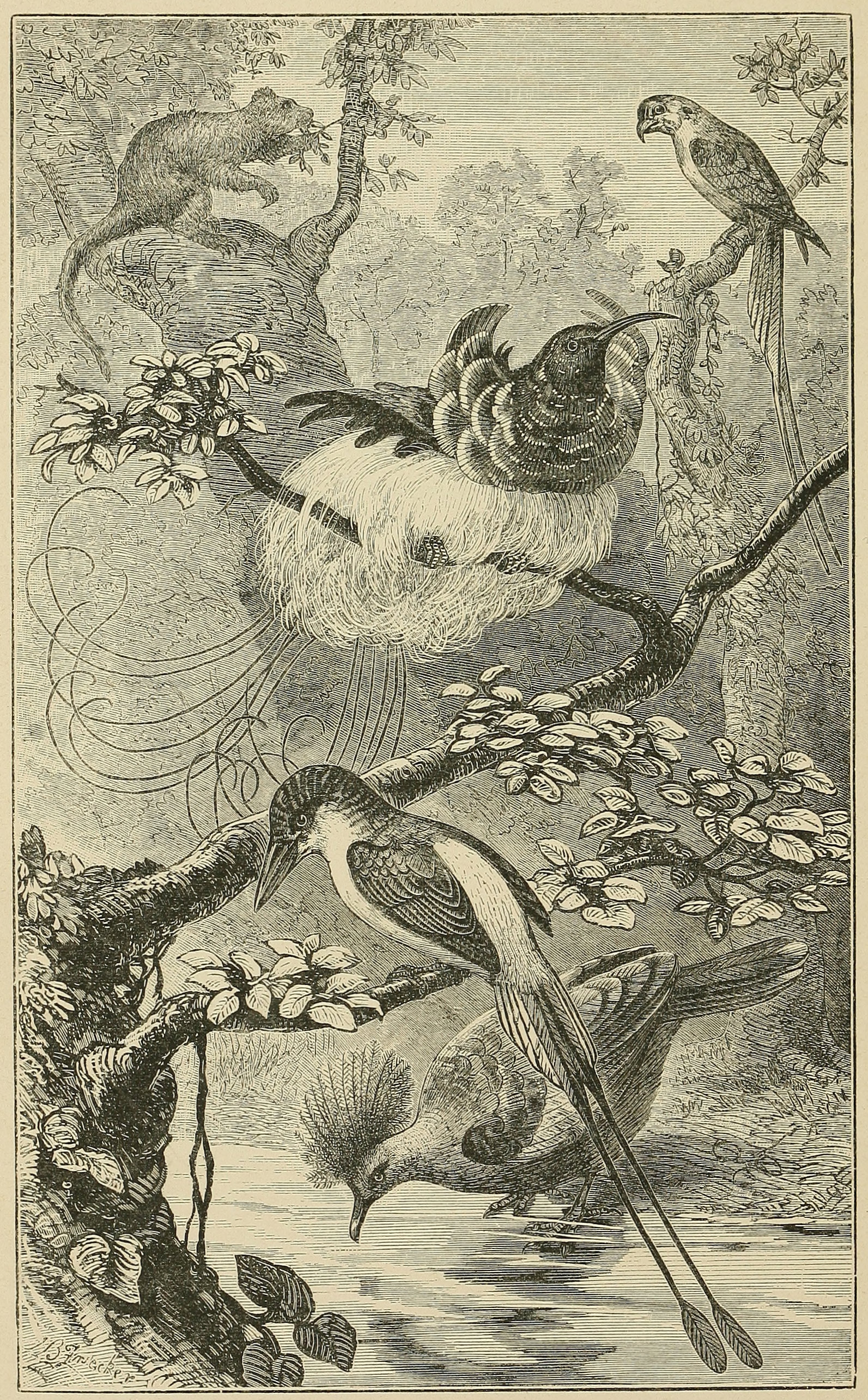
SCENE IN NEW GUINEA, WITH CHARACTERISTIC ANIMALS.
Plate X. Illustrating the Ornithology of New Guinea.—The wonderful ornithological fauna we have just sketched, could only be properly represented in a series of elaborate coloured plates. We are obliged here to confine ourselves to representing a few of the more remarkable types of form, as samples of the great number that adorn this teeming bird-land. The large central figure is the fine twelve-wired paradise-bird (Seleucides albus), one of the most beautiful and remarkable of the family. Its general plumage appears, at first sight, to be velvety black; but on closer examination, and by holding the bird in various lights, it is found that every part of it glows with the most exquisite metallic tints—rich bronze, intense violet, and, on the edges of the breast-feathers, brilliant green. An immense tuft of dense plumes of a fine orange-buff colour, springs from each side of the body, and six of these on each side terminate in a black curled rachis or shaft, which form a perfectly unique adornment to this lovely bird. To appreciate this wonderful family (of which no good mounted collection exists) the reader should examine the series of plates in Mr. Elliot's great work on the Paradiseidæ, where every species is figured of the size of life, and with a perfection of colouring that leaves little to be desired.
Below the Seleucides is one of the elegant racquet-tailed king-hunters (Tanysiptera galatea) whose plumage of vivid blue and white, and coral-red bill, combined with the long spatulate tail, renders this bird one of the most attractive of the interesting family of kingfishers. On a high branch is seated the little Papuan parroquet (Charmosyna papuensis), one of the Trichoglossidæ, or brush-tongued parrots,—richly adorned in red and yellow plumage, and with an unusually long and slender tail. On the ground is the well-known crowned pigeon (Goura coronata), a genus which is wholly confined to New Guinea and a few of the adjacent islands. One of the very few Papuan mammals, a tree-kangaroo (Dendrolagus inustus), is seated on a high branch. It is interesting, as an arboreal modification of a family which in Australia is purely terrestrial; and as showing how very little alteration of form or structure is needed to adapt an animal to such a different mode of life.
Reptiles and Amphibia.—Of these classes comparatively little is at present known, but there is evidence that the same intermixture of Oriental and Australian forms that occurs in birds and insects, is also found here. Dr. A. B. Meyer, the translator of this work into German, and well known for his valuable discoveries in New Guinea, has kindly furnished me with a manuscript list of Papuan reptiles, from which most of the information I am able to give is derived.
Of Snakes, 24 genera, are known, belonging to 11 families. Six of the genera are Oriental,—Calamaria, Cerberus, Chrysopelea, Lycodon, Chersydrus, and Ophiophagus. Four are Australian,—Morelia, Liasis, Diemenia, and Acanthophis; while four others are more especially Papuan,—Dibamus (Typhlopidæ), Brachyorros—a sub-genus of the wide-spread Rhabdosoma (Calamariidæ), found also in Timor; Nardoa and Enygrus (Pythonidæ), ranging from the Moluccas to the Fiji Islands. The rest are either common to the Oriental and Australian regions or of wide range.
Of Lizards also, 24 genera are recorded, belonging to 5 families. Three only are peculiarly Oriental,—Eumeces, Tiaris, and Nycteridium; but another, Gonyocephalus, is Malayan, ranging from Java and Borneo to the Pelew Islands. Three are Australian,—Cyclodus, Heteropus, and Gehyra; while six are especially Papuan,—Keneuxia (extending to the Philippines), Elania, Carlia (to North Australia), Lipinia (to the Philippine Islands), and Tribolonotus,—all belonging to the Scincidæ; and Arua belonging to the Agamidæ. We must add Cryptoblepharus, which is confined to the Australian region, except a species in Mauritius. The other genera have a wider distribution.
The preponderant Oriental element in the snakes as compared with the lizards, is suggestive of the dispersal of the former being dependent on floating trees, or even on native canoes, which for an unknown period have traversed these seas, and in which various species of snakes often secrete themselves. This seems the more probable, as snakes are usually more restricted in their range than lizards, and exhibit less numerous examples of widespread genera and species. The other orders of reptiles present no features of interest.
Of Amphibia only 8 genera are known, belonging to 6 families. Rana, Hylarana, and Hyla are wide-spread genera, the former being, however, absent from Australia. Hyperolius, Pelodryas, Litoria, and Asterophrys are Australian; while Platymantis is Polynesian, with a species in the Philippine Islands. Hence it appears that the amphibia, so far as yet known, exhibit no Oriental affinity; and this is a very suggestive fact. We have seen (p. 29) that salt water is almost a complete barrier to the dispersal of these creatures; so that the wholly Australian character of the Papuan batrachia is what we might expect, if, as here advocated, no actual land connection between the Oriental and Australian regions, has probably occurred during the entire Tertiary and Post-tertiary periods.
Insects.—The general character of the Papuan insects has been sufficiently indicated in our sketch of the Entomology of the region. We will here only add, that the metallic lustre so prevalent among the birds, is also apparent in such insects as Sphingnotus mirabilis, a most brilliant metallic Longicorn; Lomaptera wallacei and Anacamptorhina fulgida, Cetonii of intense lustre; Calodema wallacei among the Buprestidæ; and the elegant blue Eupholi among the weevils. Even among moths we have Cocytia durvillii, remarkable for its brilliant metallic colours.
The Moluccas.—The islands of Gilolo, Bouru, and Ceram, with several smaller islands adjacent, together with Sanguir, and perhaps Tulour or Salibaboo to the north-west, and the islands from Ke to Timor-Laut to the south-east, form the group of the Moluccas or Spice-Islands, remarkable for the luxuriance of their vegetation and the extreme beauty of their birds and insects. Their Mammalia are of Papuan character, with some foreign intermixture. Two genera of the New Guinea marsupials, Belideus and Cuscus, abound; and we have also the wide-spread Sus. But besides these, we find no less than five genera of placental Mammals quite foreign to the Papuan or Australian faunas. These are 1. Cynopithecus nigrescens, found only in the small island of Batchian, and probably introduced from Celebes, where the same ape occurs. 2. Viverra tangalunga, a common Indo-Malayan species of civet, probably introduced. 3. Cervus hippelaphus, var. Moluccensis, a deer abundant in all the islands, very close to a Javan species and almost certainly introduced by man, perhaps very long ago. 4. Babirusa alfurus, the babirusa, found only in the island of Bouru, and perhaps originally introduced from Celebes. 5. Sorex sp., small shrews. With the exception of the last, all these species are animals habitually domesticated and kept in confinement by the Malays; and when we consider that none of the smaller Mammalia of Java and Borneo, numbering at least fifty different species, are found in any of the Moluccas, we can hardly suppose that such large animals as the deer and ape, could have reached them by natural means. There is every reason to believe, therefore, that the indigenous Mammalia of the Moluccas are wholly of Papuan stock, and very limited in number.
The birds are much more varied and interesting. About 200 species of land-birds are now known, belonging to 85 genera. Of the species about 15 are Indo-Malayan, 32 Papuan, and about 140 peculiar. Of the genera only two are peculiar,—Semioptera, a paradise bird, and Lycocorax, a singular form of Corvidæ; but there is also a peculiar rail-like wader, Habroptila. One genus, Basilornis, is found only in Ceram and Celebes; another, Scythrops, is Australian, and perhaps a migrant. About 30 genera are characteristic Papuan types, and 37 others, of more or less wide range, are found in New Guinea and were therefore probably derived thence. There remains a group of birds which are not found in New Guinea, and are either Palæarctic or Oriental. These are 13 in number as follows:—
1. Monticola. 8. Corydalla.
2. Acrocephalus. 9. Hydrornis.
3. Cisticola. 10. Batrachostomus.
4. Hypolais. 11. Loriculus.
5. Criniger. 12. Treron.
6. Butalis. 13. Neopus.
7. Budytes.
Of these the Monticola, found only in Gilolo, appears to be a straggler or migrant from the Philippine islands. Acrocephalus, of which four species occur, is a wide-spread group; one of the Moluccan birds is an Australian and another a North-Asian species, which perhaps indicates that there has long been some migration southward from island to island, across the Moluccas. Cisticola is a genus of very wide range, extending to Australia. Hypolais is probably a modified form of a Chinese or Javanese species. Criniger is a pure Indo-Malay form, represented here by three fine species. Butalis is a Chinese species, no doubt straggling southward. Budytes and Corydalla are widespread Oriental and Palæarctic species or slight modifications of them. Hydrornis is a Malayan form of Pittidæ. Batrachostomus is a distinct representative of a purely Indo-Malay genus. Loriculus is Malayan, and especially Philippine, but it reaches as far as Mysol. Treron is here at its eastern limit, and is represented in Bouru and Ceram by one of the most beautiful species. Neopus, a Malayan eagle, is said to occur in the Moluccas. We find then only three characteristic Indo-Malay types in the Moluccas,—Criniger, Batrachostomus, and Treron. All are represented by distinct and well marked species, indicating a somewhat remote period since their ancestors entered the district, but all are birds of considerable powers of flight, so that a very little extension of the islands in a south-westerly direction would afford the means of transmission, but this could not well have been by way of Celebes, because the two former genera are unknown in that island.
It is evident, therefore, that the Moluccas are wholly Papuan in their zoology; yet they are no less clearly derivative, and must have obtained their original immigrants under conditions that rendered a full representation of the fauna impossible. Such remarkable and dominant types as the eleven genera of Paradiseidæ, with Cracticus, Rectes, Todopsis, Machærirhynchus, Gerygone, Dacelo, Podargus, Cyclopsitta, Microglossum, Nasiterna, Chalcopsitta, and Goura,—all characteristic Papuan groups, found in almost all the islands and most of them very abundant, are yet totally absent from the Moluccas. Taking this, in conjunction with the absence of the two genera of Papuan kangaroos and the other smaller groups of marsupials, and we must be convinced that the Moluccas cannot be mere fragments of the old Papuan land, or they would certainly, in some one or other of their large and fertile islands, have preserved a more complete representation of the parent fauna. Most of the Moluccan birds are very distinct from the allied species of New Guinea; and this would imply that the entrance of the original forms took place at a remote period. The two peculiar genera with clearly Papuan affinities, show the same thing. The cassowary, found only in the large island of Ceram and distinct from any Papuan species, would however seem to have required a land connection for its introduction, almost as much as any of the larger mammalia.
Taking all the facts into consideration, I would suggest as the most probable explanation, that if the Moluccas ever formed part of the main Papuan land, they were separated at an early date, and subsequently so greatly submerged as to destroy a large proportion of their fauna. They have since risen, and have probably been larger than at present, and rather more closely approximated to the parent land, whence they received a considerable immigration of such animals as were adapted to cross narrow seas. This gave them several Papuan forms, but still left them without a number of the types more especially confined to the forest depths, or powerful enough to combat the gales which often blow weaker flyers out to sea. Most of the birds whose absence from the Moluccas is so conspicuous belong to one or other of these classes.
Among the most characteristic birds of the Moluccas are the handsome crimson lories of the genera Lorius and Eos. These are found in every island (but not in Celebes or the Timor group); and a fine species of Eos, peculiar to the small islands of Siau and Sanguir, just north of Celebes, obliges us to place these with the Moluccas instead of with the former island, to which they seem most naturally to belong. The crimson parrots of the genus Eclectus are almost equally characteristic of the Moluccas, and add greatly to the brilliancy of the ornithology of these favoured islands.
Reptiles.—The Reptiles, so far as known, appear to agree in their distribution with the other vertebrates. In some small collections from Ceram there were no less than six of the genera peculiar to the Australian region, and which were before only known from Australia itself. These are, of snakes, Liasis and Enygrus, genera of Pythonidæ; with Diemenia and Acanthophis (Elapidæ); of lizards, Cyclodus, a genus of Scincidæ; and of Amphibia, a tree-frog of the genus Pelodryas.
Insects—Peculiarities of the Moluccan Fauna.—In insects the Moluccas are hardly, if at all, inferior to New Guinea itself. The islands abound in grand Papilios of the largest size and extreme beauty; and it is a very remarkable fact, that when the closely-allied species of the Moluccas and New Guinea are compared, the former are almost always the largest. As examples may be mentioned, Ornithoptera priamus and O. helena of the Moluccas, both larger than the varieties (or species) of Papua; Papilio ulysses and deiphobus of Amboyna, usually larger than their allies in New Guinea; Hestia idea, the largest species of the genus; Diadema pandarus and Charaxes euryalus, both larger than any other species of the same genera in the whole archipelago. It is to be noted also, that in the Moluccas, the very largest specimens or races seem always to come from the small island of Amboyna; even those of Ceram, the much larger island to which it is a satellite, being almost always of less dimensions. Among Coleoptera, the Moluccas produce Euchirus longimanus, one of the largest and most remarkable of the Lamellicornes; Sphingnotus dunningi, the largest of the Austro-Malayan Tmesisterninæ; a Sphenura, the largest and handsomest of an extensive genus; an unusually large Schizorhina (Cetoniidæ); and some of the most remarkable and longest-horned Anthotribidæ. Even in birds the same law may be seen at work,—in the Tanysiptera nais of Ceram, which has a larger tail than any other in the genus; in Centropus goliath of Gilolo, being the largest and longest-tailed species; in Hydrornis maximus of Gilolo, the largest and perhaps the most elegantly and conspicuously coloured of all the Pittidæ; in Platycercus amboinensis, being pre-eminent in its ample blue tail; in the two Moluccan lories and Eos rubra, being more conspicuously red than the allied New Guinea species; and in Megapodius wallacei of Bouru, being the only species of the genus conspicuously marked and banded.
All these examples, of larger size, of longer tails or other appendages, and of more conspicuous colouring, are probably indications of a less severe struggle for existence in these islands than in the larger tract of New Guinea, with a more abundant and more varied fauna; and this may apply even to the smaller islands, as compared with the larger in the immediate vicinity. The limited number of forms in the small islands compared with a similar area in the parent land, implies, perhaps, less competition and less danger; and thus allows, where all other conditions are favourable, an unchecked and continuous development in size, form, and colour, until they become positively injurious. This law may not improbably apply to the New Guinea fauna itself, as compared with that of Borneo or any other similar country; and some of its peculiarities (such as its wonderful paradise-birds) may be due to long isolation, and consequent freedom from the influence of any competing forms. The difference between the very sober colours of the Coleoptera, and in a less degree of the birds, of Borneo, as compared with their brilliancy in New Guinea, always struck me most forcibly, and was long without any, even conjectural, explanation. It is not the place here to go further into this most curious and interesting subject. The reader who wishes for additional facts to aid him in forming an opinion, should consult Mr. Darwin's Descent of Man, chapters x. to xv.; and my own Contributions to the Theory of Natural Selection, chapters iii. and iv.
Timor Group.—Mammalia.—In the group of islands between Java and Australia, from Lombok to Timor inclusive, we find a set of mammals similar to those of the Moluccas, but some of them different species. A wide-spread species of Cuscus represents the Papuan element. A Sorex and a peculiar species of wild pig, we may also accept as indigenous. Three others have almost certainly been introduced. These are, (1.) Macacus cynomolgus, the very commonest Malay monkey, which may have crossed the narrow straits from island to island between Java and Timor, though it seems much more probable that it was introduced by Malays, who constantly capture and rear the young of this species. (2.) Cervus timoriensis, a deer, said to be a distinct species, inhabits Timor, but it is probably only a variety of the Cervus hippelaphus of Java. This animal is, however, much more likely to have crossed the sea than the monkey. (3.) Paradoxurus fasciatus, takes the place of Viverra tangalunga in the Moluccas, both common and wide-spread civets which are often kept in confinement by the Malays. The Felis megalotis, long supposed to be a native of Timor, has been ascertained by Mr. Elliot to belong to a different country altogether.
Birds.—The birds are much more interesting, since they are sufficiently numerous to allow us to determine their relations, and trace their origin, with unusual precision. There are 96 genera and 160 species of land-birds known to inhabit this group of islands; and on a careful analysis, they are found to be almost equally related to the Australian and Oriental regions, 30 genera being distinctly traceable to the former, and the same number to the latter. Their connection with the Moluccas is shown by the presence of the genera Mimeta, Geoffroyus, Cacatua, Ptilopus, and Ianthænas, together with Megapodius and Cerchneis represented by Moluccan species. Turacœna shows a connection with Celebes, and Scops is represented by a Celebesian species. The connection with Australia is shown by the genera Sphæcothera, Gerygone, Myiagra, Pardalotus, Gliciphila, Amadina, and Aprosmictus; while Milvus, Hypotriorchis, Eudynamis, and Eurystomus, are represented by Australian species. Other genera confined to or characteristic of the Australian region, are Rhipidura, Monarcha, Artamus, Campephaga, Pachycephala, Philemon, Ptilotis, and Myzomela.
We now come to the Indo-Malay or Javan element represented by the following genera:
1. Turdus (T.) 11. Oriolus. 21. Yungipicus.
2. Geocichla (T.) 12. Pericrocotus. 22. Merops.
3. Zoothera. 13. Cyornis (T.) 23. Pelargopsis.
4. Megalurus (T.) 14. Hypothymis. 24. Ceyx.
5. Orthotomus. 15. Tchitrea. 25. Loriculus.
6. Pratincola (T.) 16. Lanius (T.) 26. Treron (T.)
7. Oreicola (T.) 17. Anthreptes. 27. Iotreron (s.g. of Ptilopus).
8. Drymocataphus (T.) 18. Eulabes. 28. Chalcophaps (T.)
9. Parus. 19. Estrilda (T.) 29. Gallus (T.)
10. Pycnonotus. 20. Erythrura (T.) 30. Strix.
Such genera as Merops and Strix, which are as much Australian as Oriental, are inserted here because they are represented by Javan species. The list is considerably swelled by genera which have reached Lombok across the narrow strait from Baly, but have passed no further. Such are Zoothera, Orthotomus, Pycnonotus, Pericrocotus and Strix. A much larger number (12) stop short at Flores, leaving only 13, indicated in the list by (T) after their names, which reach Timor. It is evident, therefore, that these islands have been stocked from three chief sources,—the Moluccas (with New Guinea and Celebes,) Australia, and Java. The Moluccan forms may well have arrived as stragglers from island to island, aided by whatever facilities have been afforded by lands now submerged. Most of the remainder have been derived either from Australia or from Java; and as their relations to these islands are very interesting, they must be discussed with some detail.
Origin of the Timorese Fauna.—We must first note, that 80 species, or exactly one-half of the land-birds of the islands, are peculiar and mostly very distinct, intimating that the immigration commenced long enough back to allow of much specific modification. There is also one peculiar genus of kingfishers, Caridonax, found only in Lombok and Flores, and more allied to Australian than to Oriental types. The fine white-banded pigeons (s. g. Leucotreron) are also almost peculiar; one other less typical species only being known, a native of N. Celebes. In order to compare the species with regard to their origin, we must first take away those of wide distribution from which no special indications can be obtained. In this case 49 of the land-birds must be deducted, leaving 111 species which afford good materials for comparison. These, when traced to their origin, show that 62 came from some part of the Australian region, 49 from Java or the Oriental region. But if we divide them into two groups, the one containing the species identical with those of the Australian or Oriental regions, the other containing allied or representative species peculiar to the islands, we have the following result:
Species common to the Timorese Islands and the Oriental Region 30
Peculiar Timorese species allied to those of the Oriental Region 19
Total 49
Species common to the Timorese Islands and the Australian Region 18
Peculiar Timorese species allied to those of the Australian Region 44
Total 62
This table is very important, as indicating that the connection with Australia was probably earlier than that with Java; since the majority of the Australian species have become modified, while the majority of the Oriental species have remained unchanged. This is due, no doubt, in part to the continued immigration of fresh individuals from Java, after that from Australia, the Moluccas and New Guinea had almost wholly ceased. We must also notice the very small proportion of the genera, either of Australia or Java, that have found their way into these islands, many of the largest and most wide-spread groups in both countries being altogether absent. Taking these facts into consideration, it is pretty clear that there has been no close and long-continued approximation of these islands to any part of the Australian region; and it is also probable that they were fairly stocked with such Australian groups as they possess before the immigration from Java commenced, or a larger number of characteristic Oriental forms would have been able to have established themselves.
On looking at our map, we find that a shallow submerged bank extends from Australia to within about twenty miles of the coast of Timor; and this is probably an indication that the two countries were once only so far apart. This would have allowed the purely Australian types to enter, as they are not numerous; there being about 6 Australian species, and 10 or 12 representatives of Australian species, in Timor. All the rest may have been derived from the Moluccas or New Guinea, being mostly wide-spread genera of the Australian region; and the extension of Papua in a south-west direction towards Java (which was suggested as a means of providing New Guinea with peculiar Indo-Malay types not found in any other part of the region) may have probably served to supply Timor and Flores with the mass of their Austro-Malayan genera across a narrow strait or arm of the sea. Lombok, Baly, and Sumbawa were probably not then in existence, or nothing more than small volcanic cones rising out of the sea, thus leaving a distance of 300 miles between Flores and Java. Subsequently they grew into islands, which offered an easy passage for a number of Indo-Malay genera into such scantily stocked territories as Flores and Timor. The north coast of Australia then sank, cutting off the supply from that country; and this left the Timorese group in the position it now occupies.
The reptiles and fishes of this group are too little known to enable us to make any useful comparison.
Insects.—The insects, though not numerous, present many fine species, some quite unlike any others in the Archipelago. Such are—Papilio liris, Pieris læta, Cirrochroa lamarckii and C. leschenaultii among butterflies. The Coleoptera are comparatively little known, but in the insects generally the Indo-Malay element predominates. This may have arisen from the peculiar vegetation and arid climate not being suitable to the Papuan insects. Why Australian forms did not establish themselves we cannot conjecture; but the field appears to have been open to immigrants from Java, the climate and vegetation of which island at its eastern extremity approximates to that of the Timorese group. The insects are, however, so peculiarly modified as to imply a very great antiquity, and this is also indicated by a group of Sylviine birds here classed under Oreicola, but some of which probably form distinct genera. There may, perhaps, have been an earlier and a later approximation to Java, which, with the other changes indicated, would account for most of the facts presented by the fauna of these islands. One deduction is, at all events, clear: the extreme paucity of indigenous mammals along with the absence of so many groups of birds, renders it certain that the Timorese islands did not derive their animal life by means of an actual union with any of the large islands either of the Australian or the Oriental regions.
Celebes Group.—We now come to the Island of Celebes, in many respects the most remarkable and interesting in the whole region, or perhaps on the globe, since no other island seems to present so many curious problems for solution. We shall therefore give a somewhat full account of its peculiar fauna, and endeavour to elucidate some of the causes to which its zoological isolation may be attributed.
Mammalia.—The following is the list of the mammalia of Celebes as far as at present known, though many small species may yet be discovered.
1. Cynopithecus nigrescens. 7. Barbirusa alfurus.
2. Tarsius spectrum. 8. Sciurus (5 peculiar sp.)
3. Viverra tangalunga. 9. Mus (2 peculiar sp.)
4. Cervus hippelaphus. 10. Cuscus (2 peculiar sp.)
5. Anoa depressicornis. Also 7 species of bats, of which 5 are peculiar.
6. Sus celebensis.
The first—a large black ape—is itself an anomaly, since it is not closely allied to any other form of quadrumana. Its flat projecting muzzle, large superciliary crests and maxillary ridges, with the form and appearance of its teeth, separate it altogether from the genus Macacus, as represented in the Indo-Malay islands, and ally it closely to the baboons of Africa.[15] We have already seen reason to suppose that it has been carried to Batchian, and there is some doubt about the allied species or variety (C. niger) of the Philippines being really indigenous there; in which case this interesting form will remain absolutely confined to Celebes. (2.) The tarsier is a truly Malayan species, but it is said to occur in a small island at the northern extremity of Celebes and on some of the Philippine Islands. It might possibly have been introduced there. (3) and (4)—a civet and a deer—are, almost certainly, as in the Moluccas, introduced species. (5.) Anoa depressicornis. This is one of the peculiar Celebesian types; a small straight-horned wild-bull, anatomically allied to the buffaloes, and somewhat resembling the bovine antelopes of Africa, but having no near allies in the Oriental region. (6.) Sus Celebensis; a peculiar species of wild-pig. (7.) Babirusa alfurus; another remarkable type, having no near allies. It differs in its dentition from the typical Suidæ, and seems to approach the African Phacochœridæ, The manner in which the canines of the upper jaw are reversed, and grow directly upwards in a spiral curve over the eyes, is unique among mammalia. (8.) Five squirrels inhabit Celebes, and all are peculiar species. (9.) These are forest rats of the sub-genus Gymnomys, allied to Australian species. 10. Cuscus. This typical Australian form is represented in Celebes by two peculiar species.
Leaving out the Indo-Malay species, which may probably have been introduced by man, and are at all events comparatively recent immigrants, and the wild pig, a genus which ranges over the whole archipelago and which has therefore little significance, we find two genera which have come from the Australian side,—Cuscus and Mus; and four from the Oriental side,—Cynopithecus, Anoa, Babirusa, and Sciurus. But Sciurus alone corresponds to Cuscus, as a genus still inhabiting the adjacent islands; the other three being not only peculiar to Celebes, but incapable of being affiliated to any specially Oriental group. We seem, then, to have indications of two distinct periods; one very ancient, when the ancestors of the three peculiar genera roamed over some unknown continent of which Celebes formed, perhaps, an outlying portion;—another more recent, when from one side there entered Sciurus, and from the other Cuscus. But we must remember that the Moluccas to the east, possess scarcely any indigenous mammals except Cuscus; whereas Borneo and Java on the west, have nearly 50 distinct genera. It is evident then, that the facilities for immigration must have been much less with the Oriental than with the Australian region, and we may be pretty certain that at this later period there was no land connection with the Indo-Malay islands, or some other animals than squirrels would certainly have entered. Let us now see what light is thrown upon the subject by the birds.
Birds.—The total number of birds known to inhabit Celebes is 205, belonging to about 150 genera. We may leave out of consideration the wading and aquatic birds, most of which are wide-ranging species. There remain 123 genera and 152 species of land-birds, of which 9 genera and 66 species are absolutely confined to the island, while 20 more are found also in the Sula or Sanguir Islands, so that we may take 86 to be the number of peculiar Celebes species. Lord Walden, from whose excellent paper on the birds of Celebes (Trans. Zool. Soc. vol. viii. p. 23) most of these figures are obtained, estimates, that of the species which are not peculiar to Celebes, 55 are of Oriental and 22 of Australian origin, the remainder being common to both regions. This shows a preponderant recent immigration from the West and North, which is not to be wondered at when we look at the long coast line of Java, Borneo, and the Philippine islands, with an abundant and varied bird population, on the one side, and the small scattered islands of the Moluccas, with a comparatively scanty bird-fauna, on the other.
But, adopting the method here usually followed, let us look at the relations of the genera found in Celebes, omitting for the present those which are peculiar to it. I divide these genera into two series:—those which are found in Borneo or Java but not in the Moluccas, and those which inhabit the Moluccas and not Borneo or Java; these being the respective sources from which, primâ facie, the species of these genera must have been derived. Genera which range widely into both these districts are rejected, as teaching us nothing of the origin of the Celebesian fauna. In a few cases, sub-genera which show a decided eastern or western origin, are given.
Genera derived from Borneo and Java.
1. Geocichla. 9. Nectarophila. 17. Hydrocissa.
2. Pratincola (sp.) 10. Anthreptes (sp.) 18. Cranorrhinus.
3. Trichastoma. 11. Munia (sp.) 19. Lyncornis.
4. Oriolus (sp.) 12. Acridotheres. 20. Treron (sp.)
5. Cyornis. 13. Yungipicus. 21. Gallus (sp.)
6. Hypothymis. 14. Mulleripicus. 22. Spilornis.
7. Hylocharis. 15. Rhamphococcyx. 23. Butastur.
8. Æthopyga. 16. Hierococcyx. 24. Pernis.
Genera derived from the Moluccas or Timor.
1. Graucalus (sp.) 6. Tanygnathus. 11. Myristicivora (s. g.)
2. Chalcostetha. 7. Trichoglossus. 12. Ducula (s. g.)
3. Myzomela. 8. Scythrops (sp.) 13. Zonœnas (s. g.)
4. Munia (sp.) 9. Turacœna. 14. Lamproteron (s. g.)
5. Cacatua (sp.) 10. Reinwardtœnas (sp.) 15. Megapodius.
These tables show a decided preponderance of Oriental over Australian forms. But we must remember that the immediately adjacent lands from whence the supply was derived, is very much richer in the one case than in the other. The 24 genera derived from Borneo and Java are only about one fourth of the characteristic genera of those islands; while the 15 Moluccan and Timorese genera are fully one third of their characteristic types. The proportion derived from the Australian, is greater than that derived from the Oriental side.
We shall exhibit this perhaps more clearly, by giving a list of the important groups of each set of islands which are absent from Celebes.
Important Families of Java and Borneo absent from Celebes. Important Families of the Moluccas absent from Celebes.
1. Eurylæmidæ. 5. Laniidæ. 1. Meliphagidæ.
2. Timaliidæ. 6. Megalæmidæ.
3. Phyllornithidæ. 7. Trogonidæ.
4. Pycnonotidæ 8. Phasianidæ.
Additional important genera of Java or Borneo absent from Celebes. Important genera of the Moluccas absent from Celebes.
1. Orthotomus. 1. Mimeta.
2. Copsychus. 2. Monarcha.
3. Enicurus. 3. Rhipidura.
4. Tchitrea. 4. Pachycephala.
5. Pericrocotus. 5. Lycocorax.
6. Irena. 6. Alcyone.
7. Platylophus. 7. Tanysiptera.
8. Dendrocitta. 8. Geoffroyus.
9. Eulabes. 9. Eclectus.
10. Hemicercus. 10. Platycercus.
11. Chrysocolaptes. 11. Eos.
12. Tiga. 12. Lorius.
13. Micropternus.
14. Batrachostomus.
15. Palæornis.
16. Rollulus.
If we reckon the absent families to be each represented by only two important genera, we shall find the deficiency on the Oriental side much the greatest; yet those on the side of the Moluccas are sufficiently remarkable. The Meliphagidæ are not indeed absolutely wanting, since a Myzomela has now been found in Celebes; but all its larger and more powerful forms which range over almost the entire region, are absent. This may be balanced by the absence of the excessively abundant Timaliidæ of the Indo-Malay islands, which are represented by only a single species; and by the powerful Phasianidæ, represented only by the common Malay jungle fowl, perhaps introduced. The entire absence of Pycnonotidæ is a very anomalous fact, since one of the largest genera, Criniger, is well represented in several islands of the Moluccas, and one has even been found in the Togian islands in the great northern inlet of Celebes; but yet it passes over Celebes itself. Ceyx, a genus of small kingfishers, is a parallel case, since it is found everywhere from India to New Guinea, leaving out only Celebes; but this comes among those curiosities of the Celebesian fauna which we shall notice further on. In the list of genera derived from Borneo or Java, no less than 6 are represented by identical species (indicated by sp. after the name); while in the Moluccan list 5 are thus identical. These must be taken to indicate, either that the genus is a recent introduction, or that stragglers still occasionally enter, crossing the breed, and thus preventing specific modification. In either case they depend on the existing state of things, and throw no light on the different distribution of land and sea which aided or checked migration in former times; and they therefore to some extent diminish the weight of the Indo-Malay affinity, as measured by the relations of the peculiar species of Celebes.
From our examination of the evidence thus far,—that is, taking account firstly, of the species, and, secondly, of the genera, which are common to Celebes and the groups of islands between which it is situated, we must admit that the connexion seems rather with the Oriental than with the Australian region; but when we take into account the proportion of the genera and species present, to those which are absent, and giving some weight to the greater extent of coast line on the Indo-Malay side, we seem justified in stating that the Austro-Malay element is rather the most fully represented. This result applies both to birds and mammals; and it leads us to the belief, that during the epoch of existing species and genera, Celebes has never been united with any extensive tract of land either on the Indo-Malay or Austro-Malay side, but has received immigrants from both during a very long period, the facilities for immigration having been rather the greatest on the Austro-Malay or Australian side. We have now to consider what further light can be thrown on the subject by the consideration of the peculiar genera of Celebes, and of those curiosities or anomalies of distribution to which we have referred.
Nine genera of birds are altogether peculiar to Celebes; three more are found only in one other island, and seem to be typically Celebesian; while one is found in the Sula islands (which belongs to the Celebes group) and probably exists in Celebes also. The following is a list of these 13 genera:
1. Artamides (Campephagidæ) 8. Monachalcyon (Alcedinidæ)
2. Streptocitta (Corvidæ) 9. Cittura "
3. Charitornis " 10. Ceycopsis "
4. Gazzola, (s. g.) " 11. Meropogon (Meropidæ)
5. Basilornis (Sturnidæ) 12. Prioniturus (Psittacidæ)
6. Enodes " 13. Megacephalon (Megapodiidæ)
7. Scissirostrum "
Of the above, Artamides, Monachalcyon, Cittura, and Megacephalon, are modifications of types characteristic of the Australian region. All are peculiar to Celebes except Cittura, found also in the Sanguir islands to the northward, but which seems to belong to the Moluccan group. Streptocitta, Charitornis, and Gazzola, are peculiar types of Corvidæ; the two former allied to the magpies, the latter to the jackdaws. Charitornis is known only from the Sula islands east of Celebes, and is closely related to Streptocitta. There is nothing comparable to these three groups in any of the Malay islands, and they seem to have relations rather with the Corvidæ of the old-world northern continent. Basilornis, Enodes, and Scissirostrum, are remarkable forms of Sturnidæ. Basilornis has a beautiful compressed crest, which in the allied species found in Ceram is elongated behind. Enodes has remarkable red superciliary streaks, but seems allied to Calornis. Scissirostrum seems also allied to Calornis in general structure, but has a very peculiarly formed bill and nostrils. We can hardly say whether these three forms show more affinity to Oriental or to Australian types, but they add to the weight of evidence as to the great antiquity and isolation of the Celebesian fauna. Scissirostrum has been classed with Euryceros, a Madagascar bird, and with Buphaga, an African genus; but the peculiar beak and nostrils approximate more to Cracticus and its allies, of the Australian region, which should probably form a distinct family. Ceycopsis is undoubtedly intermediate between the Malayan Ceyx and the African Ispidina, and is therefore especially interesting. Meropogon is a remarkable form of bee-eater, allied to the Indo-Malayan Nyctiornis. Prioniturus (the raquet-tailed parrots) of which two species inhabit Celebes, and one the Philippines, appears to be allied to the Austro-Malayan Geoffroyus.
We must finally notice a few genera found in Celebes, whose nearest allies are not in the surrounding islands, and which thus afford illustrations of discontinuous distribution. The most remarkable, perhaps, is Coracias, of which a fine species inhabits Celebes; while the genus is quite unknown in the Indo-Malay sub-region, and does not appear again till we reach Burmah and India; and the species has no closer affinity for Indian than for African forms. Myialestes, a small yellow flycatcher, is another exmple; its nearest ally (M. cinereocapilla) being a common Indian bird, but unknown in the Malay islands. The Celebesian bird described by me as Prionochilus aureolimbatus, is probably a third case of discontinuous distribution, if (as a more careful examination seems to show) it is not a Prionochilus, but congeneric with Pachyglossa, a bird only found in the Himalayas. The fine pigeon, Carpophaga forsteni, belongs to a group found in the Philippines, Australia, and New Zealand; but the Celebes species is very distinct from all the others, and seems, if anything, more allied to that of New Zealand.