Volume 1 — CHAPTER XIII. (continued 2)
Reading edition
The Sula islands (Sula-mangola, Sula-taliabo, and Sula-besi) lie midway between Celebes and the Moluccas, being 80 miles from the nearest part of Celebes, with several intervening islands, and 40 miles from Bouru, all open sea. Their birds show, as might be expected, a blending of the two faunas, but with a decided preponderance of that of Celebes. Out of 43 land birds which have been collected in these islands, we may deduct 6 as of wide range and no significance. Of the 37 remaining, 21 are Celebesian species, and 4 are new species but allied to those of Celebes; while there are 10 Moluccan species and 2 new species allied to those of the Moluccas. It is curious that no less than 3 Moluccan genera, quite unknown in Celebes itself, occur here,—Monarcha, Pachycephala, and Criniger; but all these, as well as several other of the Moluccan birds, are rather weak flyers, and such as are likely to have been carried across by strong winds. Of the genera, 23 are from Celebes, 10 from the Moluccas. These facts show, that the Sula islands form part of the Celebes group, although they have received an infusion of Moluccan forms, which will perhaps in time spread to the main island, and diminish the remarkable individuality that now characterises its fauna.
Insects.—Of the reptiles and fishes of Celebes we have not sufficient information to draw any satisfactory conclusions. I therefore pass to the insects of which something more is known.
The Butterflies of Celebes are not very numerous, less than 200 species in all having been collected; but a very large proportion of them, probably three-fourths of the whole, are peculiar. There is only one peculiar genus, Amechania, allied to Zethera (a group confined to the Philippine Islands), with which it should perhaps be united. Most of the genera are of wide distribution in the archipelago, or are especially Malayan, only two truly Australian genera, Elodina and Acropthalmia, reaching Celebes. On the other hand, 7 peculiar Oriental genera are found in Celebes, but not further east, viz., Clerome, Adolias, Euripus, Apatura, Limenitis, Iolaus, and Leptocircus. There are also several indications of a direct affinity with the continent rather than with Malaya, as in the cases already enumerated among birds. A fine butterfly, yet unnamed, almost exactly resembles Dichorragia nesimachus, a Himalayan species. Euripus robustus is closely allied to E. halitherses of N. India; there are no less than 5 species of Limenitis, all quite unlike those found in other parts of the archipelago. The butterflies of Celebes are remarkably distinguished from all others in the East, by peculiarities of form, size, and colour, which run through groups of species belonging to different genera. Many Papilionidæ and Pieridæ, and some Nymphalidæ, have the anterior wings elongated, with the apex often acute, and, what is especially remarkable, an abrupt bend or shoulder near the base of the wing. (See Malay Archipelago, 3rd Ed. p. 281, woodcut.) No less than 13 species of Papilio, 10 Pieridæ, and 4 or 5 Nymphalidæ, are thus distinguished from their nearest allies in the surrounding islands or in India. In size again, a large number of Celebesian butterflies stand preeminent over their allies. The fine Papilios—adamantius, blumei, and gigon—are perfect giants by the side of the closely-allied forms of Java; while P. androcles is the largest and longest-tailed, of all the true swallow-tailed group of the Old World. Among Nymphalidæ, the species of Rhinopalpa and Euripus, peculiar to Celebes, are immensely larger than their nearest allies; and several of the Pieridæ are also decidedly larger, though in a less marked degree. In colour, many of the Celebesian butterflies differ from the nearest allied species; so that they acquire a singularity of aspect which marks them off from the rest of the group. The most curious case is that of three butterflies, belonging to three distinct genera (Cethosia myrina, Messaras mæonides, and Atella celebensis) all having a delicate violet or lilac gloss in lines or patches, which is wholly wanting in every allied species of the surrounding islands. These numerous peculiarities of Celebesian butterflies are very extraordinary; and imply isolation from surrounding lands, almost as much as do the strange forms of mammals and birds, which more prominently characterise this interesting island.
Of the Coleoptera we know much less, but a few interesting facts may be noted. There are a number of fine species of Cicindela, some of peculiar forms; and one Odontochila, a South American genus; while Collyris reaches Celebes from the Oriental region. In Carabidæ it has one peculiar genus, Dicraspeda; and a species of the fine Australian genus Catadromus. In Lucanidæ it has the Oriental genus, Odontolabris. In Cetoniidæ it has a peculiar genus, Sternoplus, and several fine Cetoniæ; but the characteristic Malayan genus, Lomaptera, found in every other island of the archipelago from Sumatra to New Guinea, is absent—an analogous fact to the case of Ceyx among birds. In Buprestidæ, the principal Austro-Malay genus, Sambus, is found here; while Sponsor, a genus 8 species of which inhabit Mauritius, has one species here and one in New Guinea. In Longicorns there are four peculiar genera, Comusia, Pytholia, Bityle, and Ombrosaga; but the most important features are the occurrence of the otherwise purely Indo-Malayan genera Agelasta, Nyctimene, and Astathes; and of the purely Austro-Malayan Arrhenotus, Trysimia, Xenolea, Amblymora, Diallus, and Ægocidnus. The remaining genera range over both portions of the archipelago. In the extensive family of Curculionidæ we can only notice the elegant genus, Celebia, allied to Eupholus, which, owing to its abundance and beauty, is a conspicuous feature in the entomology of the island.
Origin of the fauna of Celebes.—We have now to consider, briefly, what past changes of physical geography are indicated by the curious assemblage of facts here adduced. We have evidently, in Celebes, a remnant of an exceedingly ancient land, which has undergone many and varied revolutions; and the stock of ancient forms which it contains must be taken account of, when we speculate on the causes that have so curiously limited more recent immigrations. Going back to the arrival of those genera which are represented in Celebes by peculiar species, and taking first the Austro-Malay genera, we find among them such groups as Zonœnas (s.g.), Phlogœnas, Leucotreron (s.g.), and Turacœna, which are not found in the Moluccas at all; and Myzomela, found in Timor and Banda, but not in Ceram or Bouru, which are nearest to Celebes. This, combined with the curious absence of so many of the commonest Moluccan genera, leads to the conclusion that the Austro-Malay immigration took place by way of Timor and the southern part of New Guinea. It will be remembered, that to account for the Indo-Malayan forms in New Guinea, we suggested an extension of that country in a westerly direction just north of Timor. Now this is exactly what we require, to account for the stocking of Celebes with the Australian forms it possesses. At this time Borneo did not approach so near, and it was at a somewhat later period that the last great Indo-Malay migration set in; but finding the country already fairly stocked, comparatively few groups were able to establish themselves.
Going back a little farther, we come to the entrance of those few birds and insects which belong to India or Indo-China; and this probably occurred at the same time as that continental extension southward, which we found was required to account for a similar phenomenon in Java. Celebes, being more remote, received only a few stragglers. We have now to go much farther back, to the time when the ancestors of the peculiar Celebesian genera entered the country, and here our conjectures must necessarily be less defined.
On the Australian side we have to account for Megacephalon, and the other genera of purely Papuan type. It may perhaps be sufficient to say, that we do not yet know that these genera, or some very close allies, do not still exist in New Guinea; in which case they may well have entered at the same time with the species, already referred to. If, on the other hand, they are really as isolated as they appear to be, they represent an earlier communication, either by an approximation of the two islands over the space now occupied by the Moluccas; or, what is perhaps more probable, through a former extension of the Moluccas, which have since undergone so much subsidence, as to lead to the extinction of a large proportion of their ancient fauna. The wide-spread volcanic action, and especially the prevalence of raised coral-reefs in almost all the islands, render this last supposition very probable.
On the Oriental side the difficulty is greater; for here we find, what seem to be clear indications of a connection with Africa, as well as with Continental Asia, at some immensely remote epoch. Cynopithecus, Babirusa, and Anoa; Ceycopsis, Streptocitta, and Gazzola (s. g.), and perhaps Scissirostrum, may be well explained as descendants of ancestral types in their respective groups, which also gave rise to the special forms of Africa on the one hand, and of Asia on the other. For this immigration we must suppose, that at a period before the formation of the present Indo-Malay Islands, a great tract of land extended in a north-westerly direction, till it met the old Asiatic continent. This may have been before the Himalayas had risen to any great height, and when a large part of what are now the cold plateaus of Central Asia may have teemed with life, some forms of which are preserved in Africa, some in Malaya, and a few in Celebes. Here may have lived the common ancestor of Sus, Babirusa, and Phacochœrus; as well as of Cynopithecus, Cynocephalus, and Macacus; of Anoa and Bubalus; of Scissirostrum and Euryceros; of Ceyx, Ceycopsis, and Ispidina. Such an origin accounts, too, for the presence of the North-Indian forms in Celebes; and it offers less difficulties than a direct connection with continental Africa, which once appeared to be the only solution of the problem. If this south-eastward extension of Asia occurred at the same time as the north-eastward extension of South Africa and Madagascar, the two early continents may have approached each other sufficiently to have allowed of some interchange of forms: Tarsius may be the descendant of some Lemurine animal that then entered the Malayan area, while the progenitors of Cryptoprocta may then have passed from Asia to Madagascar.
It is true that we here reach the extremest limits of speculation; but when we have before us such singular phenomena as are presented by the fauna of the island of Celebes, we can hardly help endeavouring to picture to our imaginations by what past changes of land and sea (in themselves not improbable) the actual condition of things may have been brought about.
II. Australia and Tasmania, or the Australian Sub-region.
A general sketch of Australian zoology having been given in the earlier part of this chapter, it will not be necessary to occupy much time on this sub-region, which is as remarkably homogeneous as the one we have just left is heterogeneous. Although much of the northern part of Australia is within the tropics, while Victoria and Tasmania are situated from 36° to 43° south latitude, there is no striking change in the character of the fauna throughout the continent; a number of important genera extending over the whole country, and giving a very uniform character to its zoology. The eastern parts, including the colonies of New South Wales and Queensland, are undoubtedly the richest, several peculiar types being found only here. The southern portion is somewhat poorer, and has very few peculiar forms; and Tasmania being isolated is poorer still, yet its zoology has much resemblance to that of Victoria, from which country it has evidently not been very long separated. The north, as far as yet known, is characterised by hardly any peculiar forms, but by the occurrence of a number of Papuan types, which have evidently been derived from New Guinea.
Plate XI.
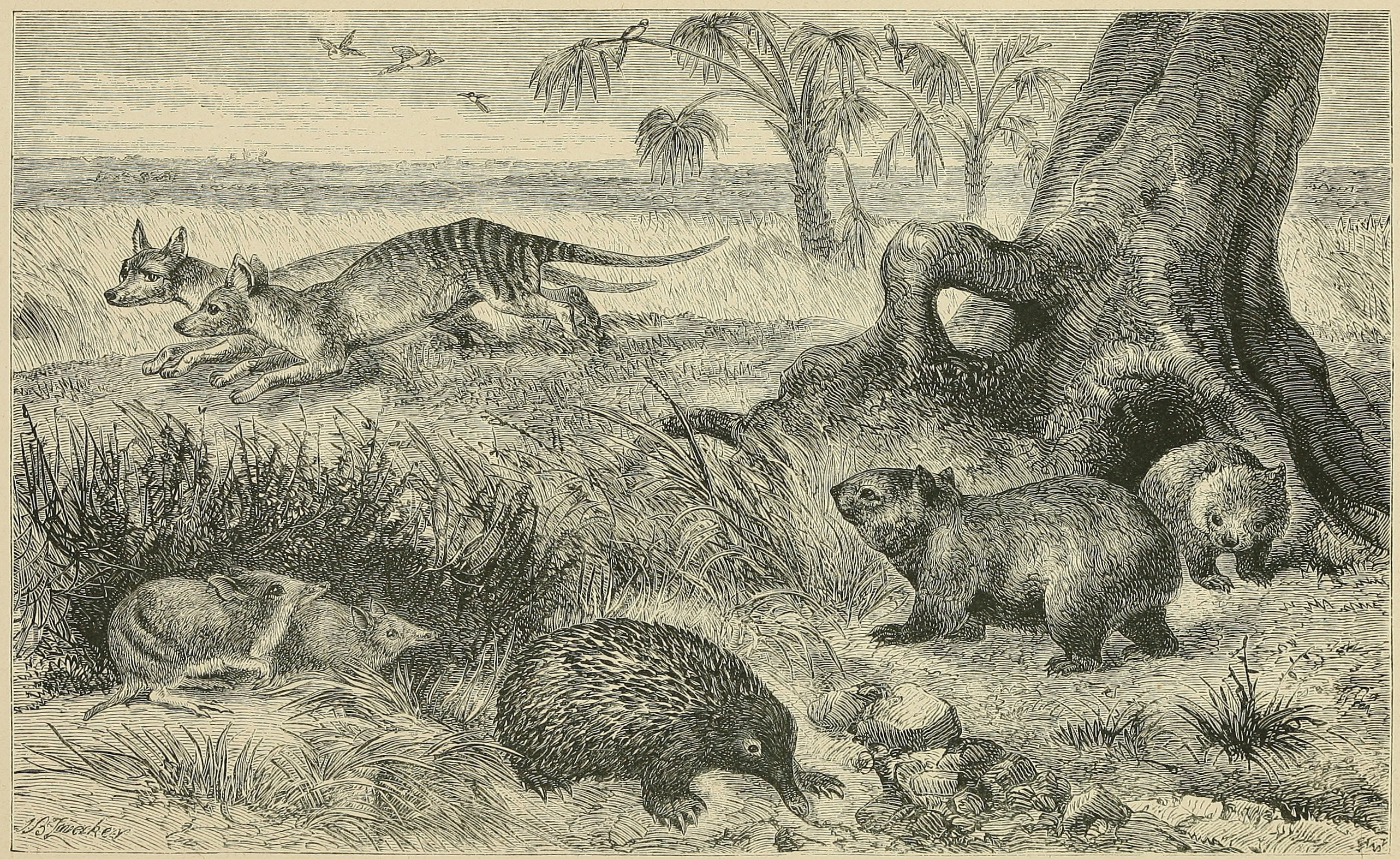
A SCENE IN TASMANIA, WITH CHARACTERISTIC MAMMALIA.
Mammalia.—The Australian sub-region contains about 160 species of Mammalia, of which 3 are Monotremata, 102 Marsupials, 23 Chiroptera, 1 Carnivora (the native dog, probably not indigenous), and 31 Muridæ. The north is characterised by a species of the Austro-Malayan genus Cuscus. Phascolarctos (the koala, or native bear) is found only in the eastern districts; Phascolomys (the wombat) in the south-east and Tasmania; Petaurista (a peculiar form of flying opossum) in the east. Thylacinus (the zebra-wolf), and Sarcophilus (the "native devil"), two carnivorous marsupials, are confined to Tasmania. West Australia, the most isolated and peculiar region botanically, alone possesses the curious little honey-eating Tarsipes, and the Peragalea, or native rabbit. The remarkable Myrmecobius, a small ant-eating marsupial, is found in the west and south; and Onychogalea, a genus of kangaroos, in West and Central Australia. All the other genera have a wider distribution, as will be seen by a reference to the list at the end of this chapter.
Plate XI. A Scene in Tasmania, with Characteristic Mammalia.—As some of the most remarkable Mammalia of the Australian region are now found only in Tasmania, we have chosen this island for the scene of our first illustration of the fauna of the Australian sub-region. The pair of large striped animals are zebra-wolves (Thylacinus cynocephalus), the largest and most destructive of the carnivorous marsupials. These creatures used to be tolerably plentiful in Tasmania, where they are alone found. They are also called "native tigers," or "native hyænas;" and being destructive to sheep, they have been destroyed by the farmers and will doubtless soon be exterminated. In the foreground on the left is a bandicoot (Perameles gunnii). These are delicate little animals allied to the kangaroos; and they are found in all parts of Australia, and Tasmania, to which latter country this species is confined. On the right is the wombat (Phascolomys wombat), a root-eating marsupial, with large incisor teeth like those of our rodents. They inhabit south-east Australia and Tasmania. In the foreground is the porcupine ant-eater (Echidna setosa), belonging to a distinct order of mammalia, Monotremata, of which the only other member is the duck-billed Ornithorhynchus. These animals are, however, more nearly allied to the marsupials, than to the insectivora or edentata of the rest of the world, which in some respects they resemble. An allied species (Echidna hystrix) inhabits south-east Australia.
Birds.—Australia (with Tasmania) possesses about 630 species of birds, of which 485 are land-birds. Not more than about one-twentieth of these are found elsewhere, so that it has a larger proportion of endemic species than any other sub-region on the globe. These birds are divided among the several orders as follows:
Passeres 306 Accipitres 36
Picariæ 41 Grallæ 77
Psittaci 60 Anseres 65
Columbæ 24 Struthiones 3
Gallinæ 15
The Psittaci, we see, are very richly represented, while the Picariæ are comparatively few; and the Columbæ are scarce as compared with their abundance in the Austro-Malay sub-region.
Birds seem to be very evenly distributed over all Australia; comparatively few genera of importance being locally restricted. In the eastern districts alone, we find Origma, and Orthonyx (Sylviidæ); Sericulus and Ptilorhynchus (Paradiseidæ); Leucosarcia (Columbidæ); and Talegalla (Megapodiidæ). Nectarinia, Pitta, Ptilorhis, Chlamydodera, and Sphecotheres, range from the north down the east coasts. Nanodes (Psittacidæ), and Lipoa (Megapodiidæ), are southern forms, the first extending to Tasmania; which island appears to possess no peculiar genus of birds except Eudyptes, one of the penguins. West Australia has no wholly peculiar genus except Geopsittacus, a curious form of ground parroquet; the singular Atrichia, first found here, having been discovered in the east. In North Australia, Emblema (Ploceidæ) is the only peculiar Australian genus, but several Austro-Malayan and Papuan genera enter,—as, Syma and Tanysiptera (Alcedinidæ); Machærihynchus (Muscicapidæ); Calornis (Sturnidæ); Manucodia, Ptilorhis, and Ælurœdus (Paradiseidæ); Megapodius; and Casuarius. The presence of a species of bustard (Eupodotis) in Australia, is very curious, its nearest allies being in the plains of India and Africa. Among waders the genus Tribonyx, a thick-legged bird somewhat resembling the Notornis of New Zealand, though not closely allied to it, is the most remarkable. The district where the typical Australian forms most abound is undoubtedly the eastern side of the island. The north and south are both somewhat poorer, the west much poorer, although it possesses a few very peculiar forms, especially among Mammalia. Tasmania is the poorest of all, a considerable number of genera being here wanting; but, except the two peculiar carnivorous marsupials, it possesses nothing to mark it off zoologically from the adjacent parts of the main land. It is probable that its insular climate, more moist and less variable than that of Australia, may not be suitable to some of the absent forms; while others may require more space and more varied conditions, than are offered by a comparatively small island.
The remaining classes of animals have been already discussed in our sketch of the region as a whole (p. 396).
Plate XII. Illustrating the Fauna of Australia.—In this plate we take New South Wales as our locality, and represent chiefly, the more remarkable Australian types of birds. The most conspicuous figure is the wonderful lyre-bird (Menura superba), the elegant plumage of whose tail is altogether unique in the whole class of birds. The unadorned bird is the female. In the centre is the emu (Dromæus novæ-hollandiæ), the representative in Australia, of the ostrich in Africa and America, but belonging to a different family, the Casurariidæ. To the right are a pair of crested pigeons (Ocyphaps lophotes), one of the many singular forms of the pigeon family to which the Australian region gives birth. In every other part of the globe pigeons are smooth-headed birds, but here they have developed three distinct forms of crest, as seen in this bird, the crowned pigeon figured in Plate X., and the double-crested pigeon (Lopholæmus antarcticus). The large bird on the tree is one of the Australian frog-mouthed goat-suckers (Podargus strigoides), which are called in the colony "More-pork," from their peculiar cry. They do not capture their prey on the wing like true goat-suckers, but hunt about the branches of trees at dusk, for large insects, and also for unfledged birds. A large kangaroo (Macropus giganteus) is seen in the distance; and passing through the air, a flying opossum (Petaurus sciureus), a beautiful modification of a marsupial, so as to resemble in form and habits the flying squirrels of the northern hemisphere.
III. The Pacific Islands, or Polynesian Sub-region.
Although the area of this sub-region is so vast, and the number of islands it contains almost innumerable, there is a considerable amount of uniformity in its forms of animal life. From the Ladrone islands on the west, to the Marquesas on the east, a distance of more than 5,000 miles, the same characteristic genera of birds prevail; and this is the only class of animals on which we can depend, mammalia being quite absent, and reptiles very scarce. The Sandwich Islands, however, form an exception to this uniformity; and, as far as we yet know, they are so peculiar that they ought, perhaps, to form a separate sub-region. They are, however, geographically a part of Polynesia; and a more careful investigation of their natural history may show more points of agreement with the other islands. It is therefore a matter of convenience, at present, to keep them in the Polynesian sub-region, which may be divided into Polynesia proper and the Sandwich Islands.
Plate XII.
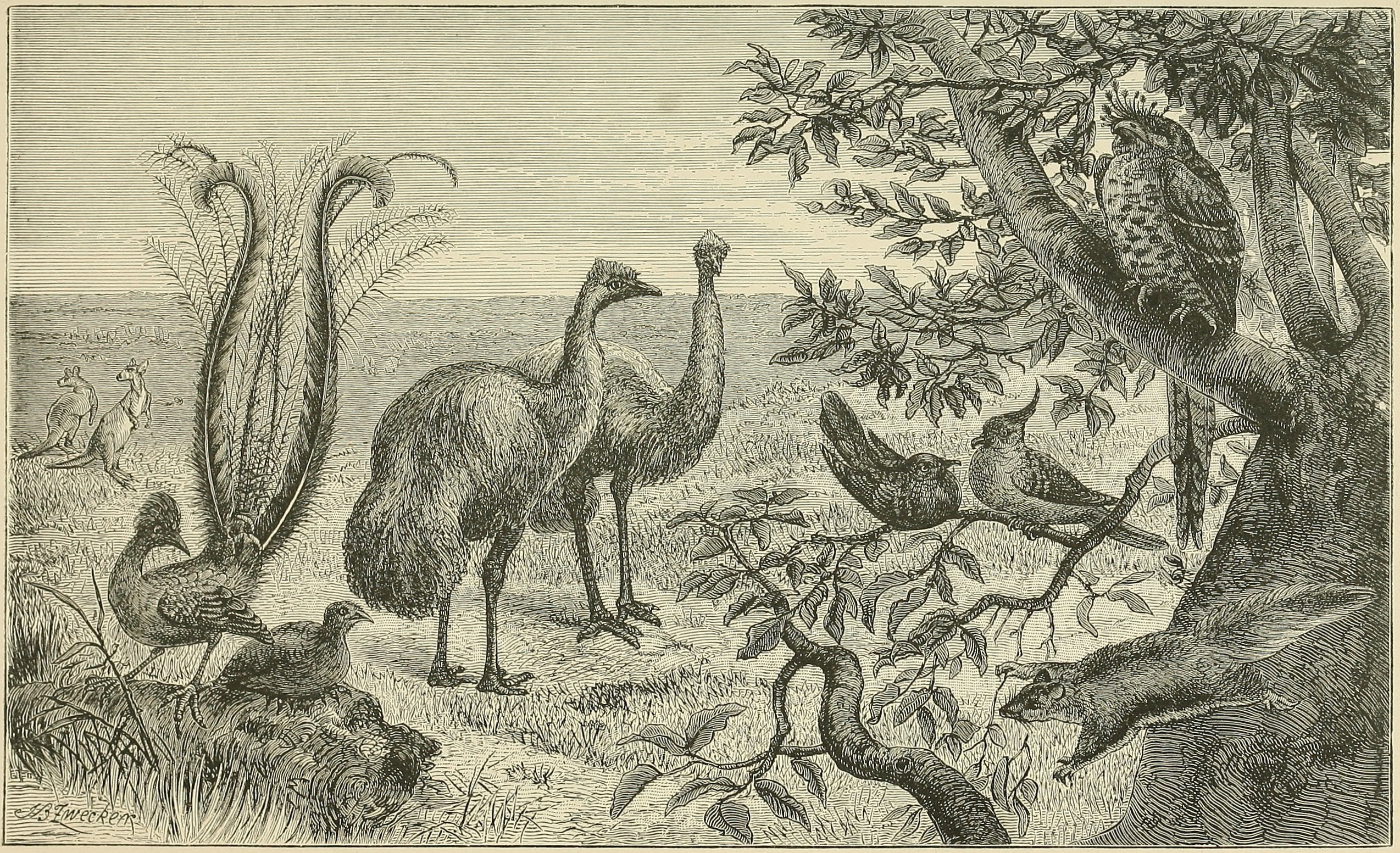
THE PLAINS OF NEW SOUTH WALES, WITH CHARACTERISTIC ANIMALS.
Polynesia proper consists of a number of groups of islands of some importance, and a host of smaller intermediate islets. For the purpose of zoological comparison, we may class them in four main divisions. 1. The Ladrone and Caroline Islands; 2. New Caledonia and the New Hebrides; 3. The Fiji, Tonga, and Samoa Islands; 4. The Society, and Marquesas Islands. The typical Polynesian fauna is most developed in the third division; and it will be well to describe this first, and then show how the other islands diverge from it, and approximate other sub-regions.
Fiji, Tonga, and Samoa Islands.—The land-birds inhabiting these islands belong to 41 genera, of which 17 are characteristic of the Australian region, and 9 more peculiarly Polynesian. The characteristic Australian genera are the following: Petroica (Sylviidæ); Lalage (Campephagidæ); Monarcha, Myiagra, Rhipidura (Muscicapidæ); Pachycephala (Pachycephalidæ); Rectes (Laniidæ); Myzomela, Ptilotis, Anthochæra (Meliphagidæ); Amadina, Eythrura, (Ploceidæ); Artamus (Artamidæ); Lorius (Trichoglossidæ); Ptilopus, Phlogænas (Columbidæ); Megapodius (Megapodiidæ).
The peculiar Polynesian genera are:—Tatare, Lamprolia (Sylviidæ); Aplonis, Sturnodes (Sturnidæ); Todiramphus (Alcedinidæ); Pyrhulopsis, Cyanoramphus, (Platycercidæ); Coriphilus (Trichoglossidæ); Didunculus (Didunculidæ).
The wide-spread genera are Turdus, Zosterops, Hirundo, Halcyon, Collocalia, Eudynamis, Cuculus, Ianthœnas, Carpophaga, Turtur, Haliæetus, Astur, Circus, Strix, Asio. The aquatic birds are fifteen in number, all wide-spread species except one—a form of moor-hen (Gallinulidæ), which has been constituted a new genus Pareudiastes.
Society, and Marquesas Islands.—Here, the number of genera of land-birds has considerably diminished, amounting only to 16 in all. The characteristic Australian genera are 5;—Monarcha, Anthochæra, Trichoglossus, Ptilopus, and Phlogœnas. The Polynesian genera are 4;—Tatare, Todiramphus, Cyanoramphus, Coriphilus, and one recently described genus, Serresius, an extraordinary form of large fruit pigeon, here classed under Carpophaga. These remote groups have thus all the character of Oceanic islands, even as regards the rest of Polynesia, since they possess hardly anything, but what they might have received by immigration over a wide extent of ocean.
Ladrone, and Caroline Islands.—These extensive groups of small islands are very imperfectly known, yet a considerable number of birds have been obtained. They possess two peculiar Polynesian genera, Tatare and Sturnodes; one peculiar sub-genus, Psammathia (here included under Acrocephalus); and ten of the typical Australian genera found in Polynesia,—Lalage, Monarcha, Myiagra, Rhipidura, Myzomela, Erythrura, Artamus, Phlogœnas, Ptilopus, and Megapodius, as well as the Papuan genus Rectes, and the Malayan Calornis;—so that they can be certainly placed in the sub-region. Genera which do not occur in the other Polynesian islands are, Acrocephalus, (s.g. Psammathia) originally derived perhaps from the Philippines; and Caprimulgus, a peculiar species, allied to one from Japan.
New Caledonia, and the New Hebrides.—Although these islands seem best placed with Polynesia, yet they form a transition to Australia proper, and to the Papuan group. They possess 30 genera of land-birds, 18 of which are typical of the Australian region; but while 13 are also Polynesian, there are 5 which do not pass further east. These are Acanthiza, Eopsaltria, Gliciphila, Philemon, and Ianthœnas. The peculiar Polynesian genus, Aplonis, of which three species inhabit New Caledonia, link it to the other portions of the sub-region. The following are the genera at present known from New Caledonia:—Turdus, Acanthiza, Campephaga, Lalage, Myiagra, Rhipidura, Pachycephala, Eopsaltria, Corvus, Physocorax (s.g. of Corvus, allied to the jackdaws), Glicphila, Anthochæra, Philemon, Zosterops, Erythrura, Aplonis, Artamus, Cuculus, Halcyon, Collocalia, Cyanoramphus, Trichoglossus, Ptilopus, Carpophaga, Macropygia, Ianthœnas, Chalcophaps, Haliastur, Accipiter. The curious Rhinochetus jubatus, forming the type of a distinct family of birds (Rhinochetidæ), allied to the herons, is only known from New Caledonia.
It thus appears, that not more than about 50 genera and 150 species of land-birds, are known from the vast number of islands that are scattered over the Central Pacific, and it is not probable that the number will be very largely increased. Some of the species, as the Eudynamis taitensis and Tatare longirostris, range over 40° of longitude, from the Fiji Islands to the Marquesas. In other genera, as Cyanoramphus and Ptilopus, each important island or group of islands, has its peculiar species. The connection of all these islands with each other, on the one hand, and their close relation to the Australian region, on the other, are equally apparent; but we have no sufficient materials for speculating with any success, on the long series of changes that have brought about their existing condition, as regards their peculiar forms of animal life.
Sandwich Islands.—This somewhat extensive group of large islands, is only known to contain 11 genera and 18 species of indigenous land-birds; and even of this small number, two birds of prey are wide ranging species, which may well have reached the islands during their present isolated condition. These latter are, Strix delicatula, an owl spread over Australia and the Pacific; and Asio accipitrinus, a species which has reached the Galapagos from S. America, and thence perhaps the Sandwich Islands. Of the remaining 8 genera, one is a crow (Corvus hawaiensis), and another a fishing eagle (Pandion solitarius), of peculiar species; leaving 7 genera, which are all (according to Mr. Sclater) peculiar. First we have Chasiempis, a genus of Muscicapidæ, containing two species (which may however belong to distinct genera); and as the entire family is unknown on the American continent these birds must almost certainly be allied to some of the numerous Muscicapine forms of the Australian region. Next we have the purely Australian family Meliphagidæ, represented by two genera,—Moho, an isolated form, and Chætoptila, a genus established by Mr. Sclater for a bird before classed in Entomyza, an Australian group. The four remaining genera are believed by Mr. Sclater to belong to one group, the Drepanididæ, altogether confined to the Sandwich Islands. Two of them, Drepanis and Hemignathus, with three species each, are undoubtedly allied; the other two, Loxops and Psittirostra, have usually been classed as finches. The former seem to approach the Dicæidæ; and all resemble this group in their coloration,
The aquatic birds and waders all belong to wide-spread genera, and only one or two are peculiar species.
The Sandwich Islands thus possess a larger proportion of peculiar genera and species of land-birds than any other group of islands, and they are even more strikingly characterised by what seems to be a peculiar family. The only other class of terrestrial animals at all adequately represented on these islands, are the land shells; and here too we find a peculiar family, sub-family, or genus (Achatinella or Achatinellidæ) consisting of a number of genera, or sub-genera,—according to the divergent views of modern conchologists,—and nearly 300 species. The Rev. J. T. Gulick, who has made a special study of these shells on the spot, considers that there are 10 genera, some of which are confined to single islands. The species are so restricted that their average range is not more than five or six square miles, while some are confined to a tract of only two square miles in extent, and very few range over an entire island. Some species are confined to the mountain ridges, others to the valleys; and each ridge or valley possesses its peculiar species. Considerably more than half the species occur in the island of Oahu, where there is a good deal of forest. Very few shells belonging to other groups occur, and they are all small and obscure; the Achatinellæ almost monopolising the entire archipelago.
Remarks on the probable past history of the Sandwich Islands.—The existence of these peculiar groups of birds and land-shells in so remote a group of volcanic islands, clearly indicates that they are but the relics of a more extensive land; and the reefs and islets that stretch for more than 1,000 miles in a west-north-west direction, may be the remains of a country once sufficiently extensive to develope these and many other, now extinct, forms of life.[16]
Some light may perhaps be thrown on the past history of the Sandwich Islands, by the peculiar plants which are found on their mountains. The peak of Teneriffe produces no Alpine plants of European type, and this has been considered to prove that it has been always isolated; whereas the occurrence of North Temperate forms on the mountains of Java, accords with other evidence of this island having once formed part of the Asiatic continent. Now on the higher summits of the Sandwich Islands, nearly 30 genera of Arctic and North Temperate flowering plants have been found. Many of these occur also in the South Temperate zone, in Australia or New Zealand; but there are others which seem plainly to point to a former connection with some North Temperate land, probably California, as a number of islets are scattered in the ocean between the two countries. The most interesting genera are the following:—Silene, which is wholly North Temperate, except that it occurs in S. Africa; Vicia, also North Temperate, and in South Temperate America; Fragaria, with a similar distribution; Aster, widely spread in America, otherwise North Temperate only; Vaccinium, wholly confined to the northern hemisphere, in cold and temperate climates. None of these are found in Australia or New Zealand; and their presence in the Sandwich Islands seems clearly to indicate a former approximation to North Temperate America, although the absence of any American forms of vertebrata renders it certain that no actual land connection ever took place.
Recent soundings have shown, that the Sandwich Islands rise from a sea which is 3,000 fathoms or 18,000 feet deep; while there is a depth of at least 2,000 fathoms all across to California on one side, and to Japan on the other. Between the Fiji Islands, New Caledonia, the Solomon Islands, and Australia, the depth is about 1,300 fathoms, and between Sydney and New Zealand 2,600 fathoms; showing, in every case, a general accordance between the depth of sea and the approximation of the several faunas. In a few more years, when it is to be hoped we shall know the contour of the sea-bottom better than that of the continents, we shall be able to arrive at more definite and trustworthy conclusions as to the probable changes of land and sea by which the phenomena of animal distribution in the Pacific have been brought about.
Reptiles of the Polynesian Sub-region.—The researches of Mr. Darwin on Coral Islands, proved, that large areas in the Pacific Ocean have been recently subsiding; but the peculiar forms of life which they present, no less clearly indicate the former existence of some extensive lands. The total absence of Mammalia, however, shows either that these lands never formed part of the Australian or Papuan continents, or if they did, that they have been since subjected to such an amount of subsidence as to exterminate most of their higher terrestrial forms of life. It is a remarkable circumstance, that although Mammalia (except bats) are wanting, there are a considerable number of reptiles ranging over the whole sub-region. Lizards are the most numerous, five families and fourteen genera being represented, as follows:—
1. Cryptoblepharus (Gymnopthalmidæ) Fiji Islands.
2. Ablepharus " All the islands.
3. Lygosoma (Scincidæ) Pelew Islands, New Caledonia.
4. Mabouya " Samoa Islands.
5. Euprepes " Pacific Islands.
6. Dactyloperus (Geckotidæ) Sandwich Islands.
7. Doryura (Geckotidæ) Pacific Islands.
8. Gehyra " Fiji Islands.
9. Amydosaurus " Tahiti.
10. Heteronota " Fiji Islands.
11. Correlophus " New Caledonia.
12. Brachylophus (Iguanidæ) Fiji Islands.
13. Lophura (Agamidæ) Pelew Islands.
14. Chloroscartes " Fiji Islands.
The first five are wide-spread genera, represented mostly by peculiar species; but sometimes the species themselves have a wide range, as in the case of Ablepharus pœcilopleurus, which (according to Dr. Günther) is found in Timor, Australia, New Caledonia, Savage Island (one of the Samoa group), and the Sandwich Islands! Gehyra and Heteronota are Australian genera; while Lophura has reached the Pelew Islands from the Moluccas. The remainder (printed in italics), are peculiar genera; Brachylophus being especially interesting as an example of an otherwise peculiar American family, occurring so far across the Pacific.
Snakes are much less abundant, only four genera being represented, one of them marine. They are, Anoplodipsas, a peculiar genus of Amblycephalidæ from New Caledonia; Enygrus, a genus of Pythonidæ from the Fiji Islands; Ogmodon, a peculiar genus of Elapidæ, also from the Fiji Islands, but ranging to Papua and the Moluccas; and Platurus, a wide-spread genus of sea-snakes (Hydrophidæ). In the more remote Sandwich and Society Islands there appear to be no snakes. This accords with our conclusion that lizards have some special means of dispersal over the ocean which detracts from their value as indicating zoo-geographical affinities; which is further proved by the marvellous range of a single species (referred to above) from Australia to the Sandwich Islands.
A species of Hyla is said to inhabit the New Hebrides, and several species of Platymantis (tree-frogs) are found in the Fiji Islands; but otherwise the Amphibians appear to be unrepresented in the sub-region, though they will most likely be found in so large an island as New Caledonia.
From the foregoing sketch, it appears, that although the reptiles present some special features, they agree on the whole with the birds, in showing, that the islands of Polynesia all belong to the Australian region, and that in the Fiji Islands is to be found the fullest development of their peculiar fauna.
IV. New Zealand Sub-region.
The islands of New Zealand are more completely oceanic than any other extensive tract of land, being about 1,200 miles from Australia and nearly the same distance from New Caledonia and the Friendly Isles. There are, however, several islets scattered around, whose productions show that they belong to the same sub-region;—the principal being, Norfolk Island, Lord Howe's Island, and the Kermadec Isles, on the north; Chatham Island on the east; the Auckland and Macquarie Isles on the south;—and if these were once joined to New Zealand, there would have been formed an island-continent not much inferior in extent to Australia itself.
New Zealand is wholly situated in the warmer portion of the Temperate zone, and enjoys an exceptionally mild and equable climate. It has abundant moisture, and thus comes within the limits of the South-Temperate forest zone; and this leads to its productions often resembling those of the tropical, but moist and wooded, islands of the Pacific, rather than those of the temperate, but arid and scantily wooded plains of Australia. The two islands of New Zealand are about the same extent (approximately) as the British Isles, but the difference in the general features of their natural history is very great. There are, in the former, no mammalia, less than half as many birds, very few reptiles and fresh-water fishes, and an excessive and most unintelligible poverty of insects; yet, considering the situation of the islands and their evidently long-continued isolation, the wonder rather is that their fauna is so varied and interesting as it is found to be. Our knowledge of this fauna, though no doubt far from complete, is sufficiently ample; and it will be well to give a pretty full account of it, in order to see what conclusions may be drawn as to its origin.
Mammalia.—The only mammals positively known as indigenous to New Zealand are two bats, both peculiar to it,—Scotophilus tuberculatus and Mystacina tuberculata. The former is allied to Australian forms; the latter is more interesting, as being a peculiar genus of the family Noctilionidæ, which does not exist in Australia; and in having decided resemblances to the Phyllostomidæ of South America, so that it may almost be considered to be a connecting link between the two families. A forest rat is said to have once abounded on the islands, and to have been used for food by the natives; but there is much doubt as to what it really was, and whether it was not an introduced species. The seals are wide-spread antarctic forms which have no geographical significance.
Birds.—About 145 species of birds are natives of New Zealand, of which 88 are waders or aquatics, leaving 57 land-birds belonging to 34 genera. Of this latter number, 16, or nearly half, are peculiar; and there are also 5 peculiar genera of waders and aquatic birds, making 21 in all. Of the remaining genera of land-birds, four are cosmopolite or of very wide range, while the remainder are characteristic of the Australian region. The following is a list of the Australian genera found in New Zealand: Sphenæacus, Gerygone, Orthonyx (Sylviidæ); Graucalus (Campephagidæ); Rhipidura (Muscicapidæ); Anthochæra (Meliphagidæ); Zosterops (Dicæidæ); Cyanoramphus (Platycercidæ); Carpophaga (Columbidæ); Hieracidea (Falconidæ); Tribonyx (Rallidæ). Besides these there are several genera of wide range, as follows:—Anthus (Motacillidæ); Hirundo (Hirundinidæ); Chrysococcyx, Eudynamis (Cuculidæ); Halcyon (Alcedinidæ); Coturnix (Tetraonidæ); Circus (Falconidæ); Athene (Strigidæ).
Most of the above genera are represented by peculiar New Zealand species, but in several cases the species are identical with those of Australia, as in the following: Anthochæra carunculata, Zosterops lateralis, Hirundo nigricans, and Chrysococcyx lucidus; also one—Eudynamis taitensis—which is Polynesian.
We now come to the genera peculiar to New Zealand, which are of especial interest:
List of Genera of Birds Peculiar to New Zealand.
Sylviidæ.
1. Myiomoira 3 Allied to Petroica, an Australian genus
2. Miro 2 All"ed to Petr"ica, an Austr"lian ge"
Timaliidæ (?)
3. Turnagra 2 Of doubtful affinities.
Sittidæ.
4. Xenicus 3 Of doubtful affinities.
5. Acanthisitta 1 Of doubtful affinities.
Paridæ.
6. Certhiparus 2 Of doubtful affinities.
Meliphagidæ.
7. Prosthemadera 1 Peculiar genera of honeysuckers, a family which is confined to the Australian Region.
8. Pogonornis 1
9. Anthornis 3
Sturnidæ.
10. Creadion 2 These three genera are probably allied, and perhaps form a distinct family.
11. Heterolocha 1
12. Callæas 2
Nestoridæ.
13. Nestor 3 A peculiar family of Parrots.
Stringopidæ.
14. Stringops 1 A peculiar family of Parrots.
Strigidæ.
15. (Sceloglaux) 1 s.g. of Athene.
Rallidæ.
16. Ocydromus 6 Allied to Eulabeornis, an Australian genus.
17. Notornis 1 Allied to Porphyrio, a genus of wide range.
Charadriidæ.
18. Thinornis 1
19. Anarhynchus 1
Anatidæ.
20. Hymenolæmus 1 Allied to Malacorhynchus, an Australian genus.
Apterygidæ.
21. Apteryx 4 Forming a peculiar family.
We have thus a wonderful amount of speciality; yet the affinities of the fauna, whenever they can be traced, are with Australia or Polynesia. Nine genera of New Zealand birds are characteristically Australian, and the eight genera of wide range are Australian also. Of the peculiar genera, 7 or 8 are undoubtedly allied to Australian groups. There are also four Australian and one Polynesian species. Even the peculiar family, Nestoridæ is allied to the Australian Trichoglossidæ. We have therefore every gradation of similarity to the Australian fauna, from identical species, through identical genera, and allied genera, to distinct but allied families; clearly indicating very long continued yet rare immigations from Australia or Polynesia; immigrations which are continued down to our day. For resident ornithologists believe, that the Zosterops lateralis has found its way to New Zealand within the last few years, and that the two cuckoos now migrate annually, the one from Australia, the other from some part of Polynesia, distances of more than 1,000 miles! These facts seem, however, to have been accepted on insufficient evidence and to be in themselves extremely improbable. It is observed that the cuckoos appear annually in certain districts and again disappear; but their course does not seem to have been traced, still less have they ever been actually seen arriving or departing across the ocean. In a country which has still such wide tracts of unsettled land, it is very possible that the birds in question may only move from one part of the islands to another.
Islets of the New Zealand Sub-region.
We will here notice the smaller islands belonging to the sub-region, as it is chiefly their birds that possess any interest.
Norfolk Island.—The land-birds recorded from this island amount to 15 species, of which 8 are Australian, viz.: Climacteris scandens, Symmorphus leucopygius, Zosterops tenuirostris and Z. albogularis, Halcyon sanctus, Platycercus pennanti, Carpophaga spadicea, Phapspicata and P. chalcoptera. Of the peculiar species three belong to Australian genera; Petroica, Gerygone, and Rhipidura; one to a cosmopolitan genus, Turdus. So far the affinity seems to be all Australian, and there remain only three birds which ally this island to New Zealand,—Nestor productus, Cyanoramphus rayneri, and Notornis alba. The former inhabited the small Phillip Island (close to Norfolk Island) but is now extinct. Being a typical New Zealand genus, quite incapable of flying across the sea, its presence necessitates some former connexion between the two islands, and it is therefore perhaps of more weight than all the Australian genera and species, which are birds capable of long flights. The Cyanoramphus is allied to a New Zealand broad-tailed parroquet. The Notornis alba is extinct, but two specimens exist in museums, and it is even a stronger case than the Nestor, as showing a former approximation or union of this island with New Zealand. A beautiful figure of this bird is given in the Ibis for 1873.
Lord Howe's Island.—This small island, situated half-way between Australia and Norfolk Island, is interesting, as containing a peculiar species of the New Zealand genus Ocydromus, or wood-hen (O. sylvestris). There is also a peculiar thrush, Turdus vinitinctus. Its other birds are wholly of Australian types, and most of them probably Australian species. The following have been observed, and no doubt constitute nearly its whole indigenous bird fauna. Acanthiza sp., Rhipidura sp., Pachycephala gutturalis, Zosterops strennuus and Z. tephropleurus, Strepera sp., Halcyon sp., and Chalcophaga chrysochlora. The two species of Zosterops are peculiar. The Ocydromus is important enough to ally this island to New Zealand rather than to Australia; and if the white bird seen there is, as supposed, the Notornis alba which is extinct in Norfolk Island, the connection will be rendered still more clear.
Chatham Islands.—These small islands, 450 miles east of New Zealand, possess about 40 species of birds, of which 13 are land-birds. All but one belong to New Zealand genera, and all but five are New Zealand species. The following are the genera of the land-birds: Sphenæacus, Gerygone, Myiomoira, Rhipidura, Zosterops, Anthus, Prosthemadera, Anthornis, Chrysococcyx, Cyanoramphus, Carpophaga, Circus. The peculiar species are Anthornis melanocephala, Myiomoira diffenbachi and M. traversi, Rhipidura flabellifera, and a peculiar rail incapable of flight, named by Captain Hutton Cabalus modestus. It is stated that the Zosterops differs from that of New Zealand, and is also a migrant; and it is therefore believed to come every year from Australia, passing over New Zealand, a distance of nearly 1,700 miles! Further investigation will perhaps discover some other explanation of the facts. It is also stated, that the pigeon and one of the small birds (? Gerygone or Zosterops) have arrived at the islands within the last eight years. The natives further declare, that both the Stringops and Apteryx once inhabited the islands, but were exterminated about the year 1835.
The Auckland Islands.—These are situated nearly 300 miles south of New Zealand, and possess six land-birds, of which three are peculiar,—Anthus aucklandicus, Cyanoramphus aucklandicus, and C. malherbii, the others being New Zealand species of Myiomoira, Prosthemadera, and Anthornis. It is remarkable that two peculiar parrots of the same genus should inhabit these small islands; but such localities seem favourable to the Platycercidæ, for another peculiar species is found in the remote Macquarie Islands, more than 400 miles farther south. A peculiar species and genus of ducks, Nesonetta aucklandica, is also found here, and as far as yet known, nowhere else. A species of the northern genus Mergus is also found on these islands, and has been recently obtained by Baron von Hügel.
Plate XIII.
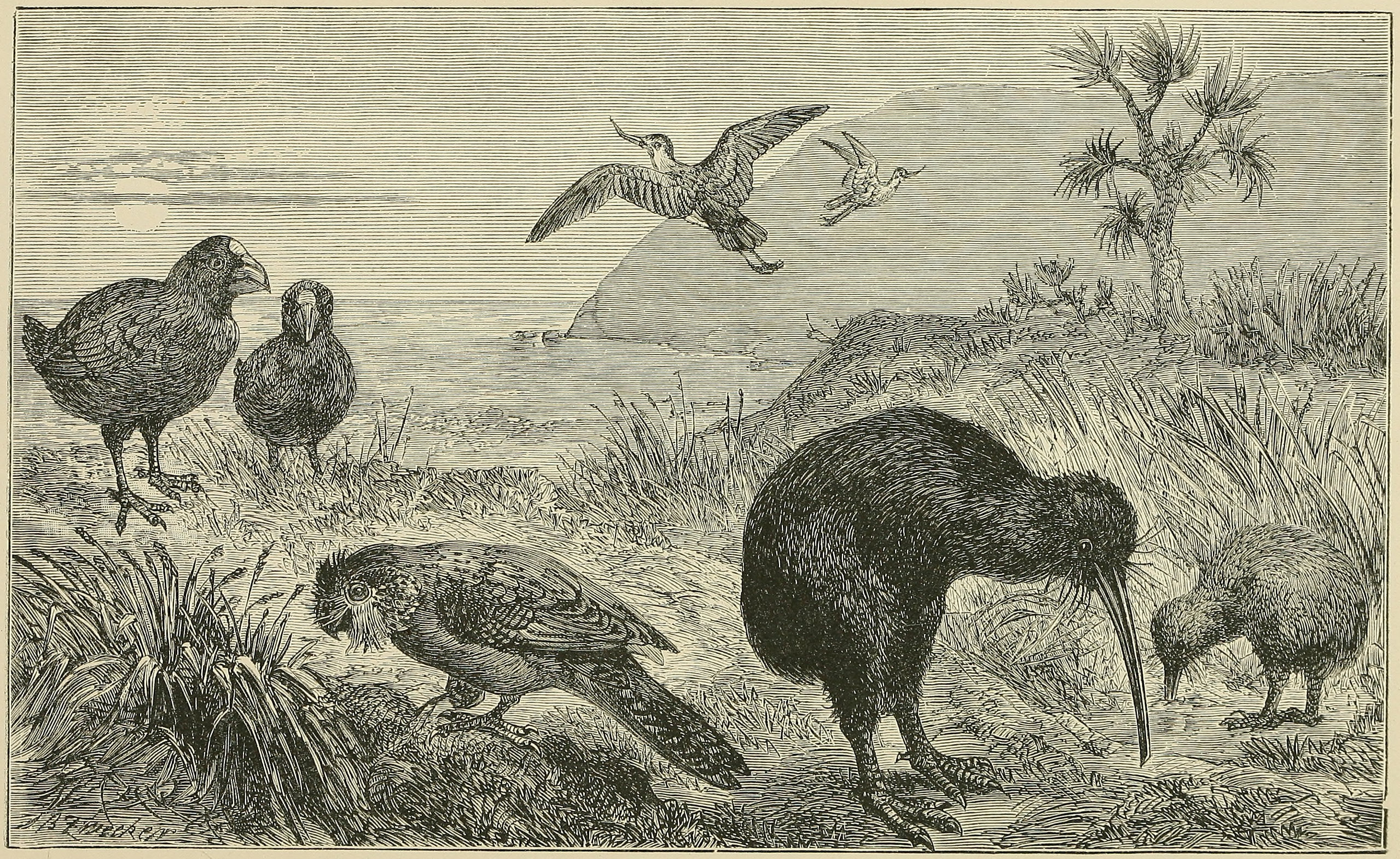
SCENE IN NEW ZEALAND, WITH SOME OF ITS REMARKABLE BIRDS.
Plate XIII. Illustrating the peculiar Ornithology of New Zealand.—Our artist has here depicted a group of the most remarkable and characteristic of the New Zealand birds. In the middle foreground is the Owl-parrot or Kakapoe (Stringops habroptilus), a nocturnal burrowing parrot, that feeds on fern-shoots, roots, berries, and occasionally lizards; that climbs but does not fly; and that has an owl-like mottled plumage and facial disc. The wings however are not rudimentary, but fully developed; and it seems to be only the muscles that have become useless for want of exercise. This would imply, that these birds have not long been inhabitants of New Zealand only, but were developed in other countries (perhaps Australia) where their wings were of use to them.
Beyond the Kakapoe are a pair of the large rails, Notornis mantelli; heavy birds with short wings quite useless for flight, and with massive feet and bill of a red colour. On the right is a pair of Kiwis (Apteryx australis), one of the queerest and most unbird-like of living birds. It has very small and rudimentary wings, entirely concealed by the hair-like plumage, and no tail. It is nocturnal, feeding chiefly on worms, which it extracts from soft earth by means of its long bill. The genus Apteryx forms a distinct family of birds, of which four species are now known, besides some which are extinct. They are allied to the Cassowary and to the gigantic extinct Dinornis. On the wing are a pair of Crook-billed Plovers (Anarhynchus frontalis), remarkable for being the only birds known which have the bill bent sideways. This was at first thought to be a malformation; but it is now proved to be a constant character of the species, as it exists even in the young chicks; yet the purpose served by such an anomalous structure is not yet discovered. No country on the globe can offer such an extraordinary set of birds as are here depicted.
Reptiles.—These consist almost wholly of lizards, there being no land-snakes and only one frog. Twelve species of lizards are known, belonging to three genera, one of which is peculiar, as are all the species. Hinulia, with two species, and Mocoa, with four species (one of which extends to the Chatham Islands), belong to the Scincidæ; both are very wide-spread genera and occur in Australia. The peculiar genus Naultinus, with six species, belongs to the Geckotidæ, a family spread over the whole world.
The most extraordinary and interesting reptile of New Zealand is, however, the Hatteria punctata, a lizard-like animal living in holes, and found in small islands on the north-east coast, and more rarely on the main land. It is somewhat intermediate in structure between lizards and crocodiles, and also has bird-like characters in the form of its ribs. It constitutes, not only a distinct family, Rhyncocephalidæ, but a separate order of reptiles, Rhyncocephalina. It is quite isolated from all other members of the class; and is probably a slightly modified representative of an ancient and generalised form, which has been superseded in larger areas by the more specialized lizards and saurians.
The only representatives of the Ophidia are two sea-snakes of Australian and Polynesian species, and of no geographical interest.
Amphibia.—The solitary frog indigenous to New Zealand, belongs to a peculiar genus, Liopelma, and to the family Bomburatoridæ, otherwise confined to Europe and temperate South America.
Fresh-water Fishes.—There are, according to Captain Hutton, 15 species of fresh-water fish in New Zealand, belonging to 7 genera; six species, and one genus (Retropinna), being peculiar. Retropinna richardsoni belongs to the Salmonidæ, and is the only example of that family occurring in the Southern hemisphere, where it is confined to New Zealand and the Chatham Islands. The wide distribution of Galaxias attenuatus—from the Chatham Islands to South America—has already been noticed; while another species, G. fasciatus, is found in the Chatham and Auckland Isles as well as New Zealand. A second genus peculiar to New Zealand, Neochanna, allied to Galaxias, has recently been described. Prototroctes oxyrhynchus is allied to an Australian species, but belongs to a family (Haplochitonidæ) which is otherwise South American. An eel, Anguilla latirostris, is found in Europe, China, and the West Indies, as well as in New Zealand! while the genus Agonostoma ranges to Australia, Celebes, Mauritius, and Central America.
Insects.—The great poverty of this class is well shown by the fact, that only eleven species of butterflies are known to inhabit New Zealand. Of these, six are peculiar, and one, Argyrophenga (Satyridæ), is a peculiar genus allied to the Northern genus Erebia. The rest are either of wide range, as Pyrameis cardui and Diadema bolina; or Australian, as Hamdyaas zoilus; while one, Danais erippus, is American, but has also occurred in Australia, and is no doubt a recent introduction into both countries. Only one Sphinx is recorded, and no other species of the Sphingina except the British currant-moth, Ægeria tipuliformis, doubtless imported. Coleoptera are better represented, nearly 300 species having been described, all or nearly all being peculiar. These belong to about 150 genera, of which more than 50 are peculiar. No less than 14 peculiar genera belong to the Carabidæ, mostly consisting of one or two species, but Demetrida has 3, and Metaglymma 8 species. Other important genera are Dicrochile, Homalosoma, Mecodema, and Scopodes, all in common with Australia. Mecodema and Metaglymma are the largest genera. Even the Auckland Islands have two small genera of Carabidæ found nowhere else.
Cicindelidæ are represented in New Zealand by 6 species of Cicindela, and 1 of Dystipsidera, a genus peculiar to the Australian region.
The Lucanidæ are represented by two peculiar genera, Dendroblax and Oxyomus; two Australian genera, Lissotes and Ceratognathus; and by the almost cosmopolite Dorcus.
The Scarabeidæ consist of ten species only, belonging to four genera, two of which are peculiar (Odontria and Stethaspis); and two Australian (Pericoptus and Calonota). There are no Cetoniidæ.
There is only one Buprestid, belonging to the Australian genus Cisseis. The Elateridæ, (about a dozen species,) belong mostly to Australian genera, but two, Metablax and Ochosternus, are peculiar.
There are 30 species of Curculionidæ, belonging to 22 genera. Of the genera, 12 are peculiar; 1 is common to New Zealand and New Caledonia; 5 belong to the Australian region, and the rest are widely distributed.
Longicorns are, next to Carabidæ, the most numerous family, there being, according to Mr. Bates (Ann. Nat. Hist., 1874), about 35 genera, of which 26 are peculiar or highly characteristic, and 7 of the others Australian. The largest and most characteristic genera are Æmona and Xyloteles, both being peculiar to New Zealand; few of the remainder having more than one or two species. Demonax extends to the Moluccas and S. E. Asia. A dozen of the genera have no near relations with those of any other country.
Phytophaga are remarkably scarce, only two species of Colaspis being recorded; and there is only a single species of Coccinella.
The other orders of Insects appear to be equally deficient. Hymenoptera are very poorly represented, only a score of species being yet known; but two of the genera are peculiar, as are all the species. The Neuroptera and Heteroptera are also very scarce, and several of the species are wide-spread forms of the Australian region. The few species of Homoptera are all peculiar. The Myriapoda afford some interesting facts. There are nine or ten species, all peculiar. One genus, Lithobius, ranges over the northern hemisphere as far south as Singapore, and probably through the Malay Archipelago, but is not found in Australia. Henicops occurs elsewhere only in Tasmania and Chili. Cryptops, only in the north temperate zone; while two others, Cermatia and Cormocephalus, both occur in Australia.
Land-Shells.—Of these, 114 species are known, 97 being peculiar. Three species of Helix are also found in Australia, and five more in various tropical islands of the Pacific. Nanina, Lymnæa, and Assiminea, are found in Polynesia or Malaya, but not in Australia. Amphibola is an Australian genus, as is Janella. Testacella and Limax belong to the Palæarctic region.
From the Chatham Islands, 82 species of shells are known, all being New Zealand species, except nine, which are peculiar.
The Ancient Fauna of New Zealand.—One of the most remarkable features of the New Zealand fauna, is the existence, till quite recent times, of an extensive group of wingless birds,—called Moas by the natives—many of them of gigantic size, and which evidently occupied the place which, in other countries, is filled by the mammalia. The most recent account of these singular remains, is that by Dr. Haast, who, from a study of the extensive series of specimens in the Canterbury museum, believes, that they belong to two families, distinguished by important differences of structure, and constitute four genera,—Dinornis and Miornis, forming the family Dinornithidæ; Palapteryx and Euryapteryx, forming the family Palapterygidæ. These were mostly larger birds than the living Apteryx, and some of them much larger even than the African ostrich, and were more allied to the Casuariidæ and Struthionidæ than to the Apterygidæ. No less than eleven species of these birds have been discovered; all are of recent geological date, and there are indications that some of them may have been in existence less than a century ago, and were really exterminated by man. Remains have been found (of apparently the same recent date) of species of Apteryx, Stringops, Ocydromus, and many other living forms, as well as of Harpagornis, a large bird of prey, and Cnemiornis, a gigantic goose. Bodies of the Hatteria punctata have also been found along with those of the Moa, showing that this remarkable reptile was once more abundant on the main islands than it is now.
The Origin of the New Zealand Fauna.—Having now given an outline sketch of the main features of the New Zealand fauna and of its relations with other regions, we may consider what conclusions are fairly deducible from the facts. As the outlying Norfolk, Chatham, and Lord Howe's Islands, are all inhabited (or have recently been so) by birds of New Zealand type or even identical species, almost incapable of flight, we may infer that these islands show us the former minimum extent of the land-area in which the peculiar forms which characterise the sub-region were developed. If we include the Auckland and Macquarie Islands to the south, we shall have a territory of not much less extent than Australia, and separated from it by perhaps several hundred miles of ocean. Some such ancient land must have existed to allow of the development and specialization of so many peculiar forms of birds, and it probably remained with but slight modifications for a considerable geological period. During all this time it would interchange many of its forms of life with Australia, and there would arise that amount of identity of genera between the two countries which we find to exist. Its extension southwards, perhaps considerably beyond the Macquaries, would bring it within the range of floating ice during colder epochs, and within easy reach of the antarctic continent during the warm periods; and thus would arise that interchange of genera and species with South America, which forms one of the characteristic features of the natural history of New Zealand.
Captain F. W. Hutton (to whose interesting paper on the Geographical relations of the New Zealand Fauna we are indebted for some of our facts) insists upon the necessity of former land-connections in various directions, and especially of an early southern continental period, when New Zealand, Australia, Southern Africa, and South America, were united. Thus he would account for the existence of Struthious birds in all these countries, and for the various other groups of birds, reptiles, fishes, or insects which have no obvious means of traversing the ocean,—and this union must have occurred before mammalia existed in any of these countries. But such a supposition is quite unnecessary, if we consider that all wingless land-birds and some water-birds (as the Gare-fowl and Steamer Duck) are probably cases of abortion of useless organs, and that the common ancestors of the various forms of Struthiones may have been capable of a moderate degree of flight; or they may have originated in the northern hemisphere, as already explained in Chap. XI. p. 287. The existence of two, if not three, distinct families of these birds in New Zealand, proves that the original type was here isolated at a very early date, and being wholly free from the competition of mammalia, became more differentiated than elsewhere. The Hatteria is probably coeval with these early forms, and is the only relic of a whole order of reptiles, which once perhaps ranged far over the globe.
Still less does any other form of animal inhabiting New Zealand, require a land connection with distant countries to account for its presence. With the example before us of the Bermudas and Azores, to which a great variety of birds fly annually over vast distances, and even of the recent arrival of new birds in New Zealand and Chatham Island, we may be sure that the ancestors of every New Zealand bird could easily have reached its shores during the countless ages which elapsed while the Dinornis and Apteryx were developing. The wonderful range of some of the existing species of lizards and fresh-water fish, as already given, proves that they too possess means of dispersal which have sufficed to spread them, within a comparatively recent period, over countries separated by thousands of miles of ocean; and the fact that a group like the snakes, so widely distributed and for which the climate of New Zealand is so well adapted, does not exist there, is an additional proof that land connection had nothing to do with the introduction of the existing fauna. We have already (p. 398), discussed in some detail the various modes in which the dispersal of animals in the southern hemisphere has been effected; and in accordance with the principles there established, we conclude, that the New Zealand fauna, living and extinct, demonstrates the existence of an extensive tract of land in the vicinity of Australia, Polynesia, and the Antarctic continent, without having been once actually connected with either of these countries, since the period when mammalia had peopled all the great continents. That event certainly dates back to Secondary, if not to Palæozoic, times, because so dominant a group must soon have spread over the whole continuous land-area of the globe. We have no reason for believing that birds were an earlier development; and certainly cannot, with any probability, place the origin of the Struthiones before that of Mammals.
Causes of the Poverty of Insect-life in New Zealand: its Influence on the Character of the Flora.—The extreme paucity of insects in New Zealand, to which we have already alluded, seems to call for some attempt at explanation. No other country in the world, in which the conditions are equally favourable for insect-life, and which has either been connected with, or is in proximity to, any of the large masses of land, presents a similar phenomenon. The only approach to it is in the Galapagos, and in some of the islands of the Pacific; and in each of these cases the absence of mammals leads us to infer, that no connection with a continent has ever taken place. Yet the fauna of New Zealand evidently dates back to a remote geological epoch, and it seems strange that an abundance of indigenous insects have not been developed, especially when we consider the vast antiquity that most of the orders and families, and many of the genera, of insects possess (see p. 166), and that they must always have reached the country in greater numbers and variety than any of the higher animals. The undoubted fact that such an indigenous insect-fauna has not arisen, would therefore lead us to conclude, that insects find the conditions requisite for their development only in the great continental masses of land, in strict adaptation to, and dependance on, a varied fauna and flora of ever-increasing richness and complexity. A small number of widely-separated forms, introduced into a country where the fauna and flora are alike scanty and unrelated to them, seem to have little tendency to vary and branch out into that vast network of insect-life which enriches all the great continents and their once connected islands.
It is a striking confirmation on a large scale, of Mr. Darwin's beautiful theory—that the gay colours of flowers have mostly, or perhaps, wholly been produced, in order to attract insects which aid in their fertilization—that in New Zealand, where insects are so strikingly deficient in variety, the flora should be almost as strikingly deficient in gaily-coloured blossoms. Of course there are some exceptions, but as a whole, green, inconspicuous, and imperfect flowers prevail, to an extent not to be equalled in any other part of the globe; and affording a marvellous contrast to the general brilliancy of Australian flowers, combined with the abundance and variety of its insect-life. We must remember, too, that the few gay or conspicuous flowering-plants possessed by New Zealand, are almost all of Australian, South American, or European genera; the peculiar New Zealand or Antarctic genera being almost wholly without conspicuous flowers. In the tropical Galapagos the same thing occurs. Mr. Darwin notices the wretched weedy appearance of the vegetation; and states that it was some time before he discovered that most of the plants were in flower at the time of his visit! And the insect-life was correspondingly deficient, consisting mainly of a few terrestrial beetles.
The poverty of insect-life in New Zealand must, therefore, be a very ancient feature of the country; and it furnishes an additional argument against the theory of land-connection with, or even any near approach to, either Australia, South Africa, or South America. For in that case numbers of winged insects would certainly have entered, and the flowers would then, as in every other part of the world, have been rendered attractive to them by the development of coloured petals; and this character once acquired would long maintain itself, even if the insects had, from some unknown cause, subsequently disappeared.
After the preceding paragraphs were written, it occurred to me, that if this reasoning were correct, New Zealand plants ought to be also deficient in scented flowers; because it is a part of the same theory, that the odours of flowers have, like their colours, been developed to attract the insects required to aid in their fertilization. I therefore at once applied to my friend Dr. Hooker, as the highest authority on New Zealand botany; simply asking whether there was any such observed deficiency. His reply was:—"New Zealand plants are remarkably scentless, both in regard to the rarity of scented flowers, of leaves with immersed glands containing essential oils, and of glandular hairs." There are a few exceptional cases, but these seem even more rare than might be expected, so that the confirmation of theory is very complete. The circumstance that aromatic leaves are also very scarce, suggests the idea that these, too, serve as an attraction to insects. Aromatic plants abound most in arid countries, and on Alpine heights; both localities where winged insects are comparatively scarce, and where it may be necessary to attract them in every possible way. Dr. Hooker also informs, me that since his Introduction to the New Zealand Flora was written, many plants with handsome flowers have been discovered, especially among the Ranunculi, shrubby Veronicas, and herbaceous Compositæ. The two former, however, are genera of wide range, which may have originated in New Zealand by the introduction of plants with handsome flowers, which the few indigenous insects would be attracted by, and thus prevent the loss of their gay corollas; so that these discoveries will not much affect the general character of the flora, and its very curious bearing on the past history of the islands through the relations of flowers and insects.
In judging of the relation here supposed to exist, it must be remembered, that if the New Zealand insects have been introduced from the surrounding countries by chance immigrations at distant intervals, then, as we go back into the past the insect fauna will become poorer and poorer, and still more inadequate than at present to lead to the development of attractive flowers and odours. This quite harmonizes with the fact of the ancient indigenous flora being so remarkably scentless and inconspicuous, while a few of the more recently introduced genera of plants have retained their floral attractions.
Concluding Remarks on the Early History of the Australian Region.
We have already discussed in some detail, the various relations of the Australian sub-regions to the surrounding Regions, and the geographical changes that appear to have taken place. A very few observations will therefore suffice, on the supposed early history of the Australian region as a whole.
It was probably far back in the Secondary period, that some portion of the Australian region was in actual connection with the northern continent, and became stocked with ancestral forms of Marsupials; but from that time till now there seems to have been no further land connection, and the Australian lands have thenceforward gone on developing the Marsupial and Monotremate types, into the various living and extinct races we now find there. During some portion of the Tertiary epoch Australia probably comprised much of its existing area, together with Papua and the Solomon Islands, and perhaps extended as far east as the Fiji Islands; while it might also have had a considerable extension to the south and west. Some light has recently been thrown on this subject by Professor McCoy's researches on the Palæontology of Victoria. He finds abundant marine fossils of Eocene and Miocene age, many of which are strikingly similar to those of Europe at the same period. Among these are Cetaceans of the genus Squalodon; European species of Plagiostomous fishes; mollusca and corals closely resembling those of Europe and North America of the same age,—such as numerous Volutes closely allied to those of the Eocene beds of the Isle of Wight, and the genus Dentalium in great abundance, almost or quite identical with European tertiary species. Along with these, are found some living species, but always such as now live farther north in tropical seas. The Cretaceous and Mesozoic marine fossils are equally close to those of Europe.
The whole of these remains demonstrate that, as in the northern so in the southern hemisphere, a much warmer climate prevailed in the Eocene and Miocene periods than at the present time. This is a most important result, and one which strongly supports Mr. Belt's view, before referred to, that the warmer climates in past geological epochs, and especially that of the Miocene as compared with our own, was caused by a diminution of the obliquity of the ecliptic, leading to a much greater uniformity of the seasons for a considerable distance from the equator, and greatly reducing the polar area within which the sun would ever disappear during an entire rotation of the earth. During such a period, tropical forms of marine animals would have been able to spread north and south, into what are now cool latitudes; and identical genera, and even species, might then have ranged along the southern shores of the old Palæarctic continent, from Britain to the Bay of Bengal, and southward along the Malayan coasts to Australia,
Numerous Miocene plant-beds have also been found in Victoria, containing abundance of Dicotyledonous leaves, which are said generally to resemble those of the Asiatic flora, and of the Miocene plant-beds of the Rhine. It is to be hoped these beds will be more closely examined for remains of insects, land-shells, and vertebrates, and that the plants will be carefully preserved and critically studied; for here probably lies hidden the key, that will solve much of the mystery that attaches to the past history of the Australian fauna.
TABLES OF DISTRIBUTION.
In drawing up these tables, showing the distribution of the various classes of animals in the Australian region, the following sources of information have been relied on, in addition to the general treatises, monographs, and catalogues used in compiling the 4th Part of this work.
Mammalia.—Gould, Mammals of Australia; Waterhouse on Marsupials; Dr. J. E. Gray's List of Mammalia of New Guinea; Müller, Temminck and Schlegel on Mammals of the Moluccas; papers by Dr. Gray; and personal observations by the Author.
Birds.—Gould's Birds of Australia; Buller's Birds of New Zealand; G. R. Gray's Lists of Birds of Moluccas, &c.; Hartlaub and Finsch on Birds of Pacific Islands; Sclater on Birds of Sandwich Islands; papers by Haast, Hutton, Meyer, Salvin, Schlegel, Sclater, Travers, Lord Walden and the Author.
Reptiles.—Krefft, Catalogue of Snakes; Gunther, List of Lizards in Voyage of Erebus and Terror (1875); and numerous papers.
TABLE I.
FAMILIES OF ANIMALS INHABITING THE AUSTRALIAN REGION.
Explanation.
Names in italics show families which are peculiar to the region.
Names inclosed thus (...) show families which only just enter the region, and are not considered properly to belong to it.
Numbers correspond to the series of numbers to the families in Part IV.
Order and Family Sub-regions Range beyond the Region.
Austro-Malaya. Australia. Polynesia. New Zealand.
MAMMALIA.
Primates.
3. Cynopithecidæ — Oriental and Ethiopian
Chiroptera.
9. Pteropidæ — — — — Oriental and Ethiopian
11. Rhinolophidæ — — The Eastern Hemisphere
12. Vespertilionidæ — — — — Cosmopolite
13. Noctilionidæ — All tropical regions
Carnivora.
25. (Viverridæ) — Oriental
33. Otariidæ — — N. and S. temperate zones
35. Phocidæ — — N. and S. temperate zones
Cetacea.
36 to 41. Oceanic
Sirenia.
42. Manatidæ — Ethiopian, Oriental
Ungulata.
47. Suidæ — All other regions but Nearctic
50. (Cervidæ) — All other regions but Ethiopian
52. (Bovidæ) — All other regions but Neotropical
Rodentia.
55. Muridæ — — All other regions
61. (Scuiridæ) — All other regions
Marsupialia.
77. Dasyuridæ — —
78. Myrmecobiidæ —
79. Peramelidæ — —
80. Macropodidæ — —
81. Phalangistidæ — —
82. Phascolomyidæ —
Monotremata.
83. Ornithorhynchidæ —
84. Echidnidæ —
BIRDS.
Passeres.
1. Turdidæ — — — Cosmopolite
2. Sylviidæ — — — — Cosmopolite
3. Timaliidæ — — — Oriental family
5. Cinclidæ —
8. Certhiidæ — —
9. Sittidæ — — —
10. Paridæ — —
13. Pycnonotidæ — Oriental family
14. Oriolidæ — — Oriental and Ethiopian
15. Campephagidæ — — — — Oriental and Ethiopian
16. Dicruridæ — — Oriental and Ethiopian
17. Muscicapidæ — — — — The Old World
18. Pachycephalidæ — — — Almost peculiar to region
19. Laniidæ — — — The Old World
20. Corvidæ — — — Cosmopolite
21. Paradiseidæ — —
22. Meliphagidæ — — — —
23. Nectariniidæ — — Oriental and Ethiopian
24. Dicæidæ — — — — Oriental and Ethiopian
25. Drepanididæ —
30. Hirundinidæ — — — — Cosmopolite
34. Ploceidæ — — — Oriental, Ethiopian
35. Sturnidæ — — — The Old World
36. Artamidæ — — — Oriental
37. Alaudidæ — — The Old World and N. America
38. Motacillidæ — — — The Old World
47. Pittidæ — — Oriental, Ethiopian
49. Menuridæ — Peculiar to Australia
50. Atrichiidæ — Peculiar to Australia
Picariæ.
51. Picidæ — All other regions
58. Cuculidæ — — — — Cosmopolite
62. Coraciidæ — — Oriental and Ethiopian
63. Meropidæ — — Oriental and Ethiopian
67. Alcedinidæ — — — — Cosmopolite
68. Bucerotidæ — Oriental and Ethiopian
71. Podargidæ — — Oriental
73. Caprimulgidæ — — — Cosmopolite
74. Cypselidæ — — — Cosmopolite
Psittaci.
76. Cacatuidæ — — Philippine Islands
77. Platycercidæ — — — —
78. Palæornithidæ — Oriental
79. Trichoglossidæ — — —
82. Nestoridæ — —
83. Stringopidæ —
Columbæ.
84. Columbidæ — — — — Cosmopolite
84a. Didunculidæ —
Gallinæ.
87. Tetraonidæ — — — — Old World and N. America
88. (Phasianidæ) — Oriental
89. Turnicidæ — — The Old World
90. Megapodiidæ — — —
Accipitres.
96. Falconidæ — — — — Cosmopolite
97. Pandionidæ — — — — Cosmopolite
98. Strigidæ — — — — Cosmopolite
Grallæ.
99. Rallidæ — — — — Cosmopolite
100. Scolopacidæ — — — — Cosmopolite
103. Parridæ — — Tropical
104. Glareolidæ — — The Eastern Hemisphere
105. Charadriidæ — — — — Cosmopolite
106. Otididæ — The Eastern Hemisphere
107. Gruidæ — The Eastern Hemisphere
112. Rhinochetidæ —
113. Ardeidæ — — — — Cosmopolite
114. Plataleidæ — — Almost cosmopolite
115. Ciconiidæ — — Widely distributed
Anseres.
118. Anatidæ — — — — Cosmopolite
119. Laridæ — — — — Cosmopolite
120. Procellariidæ — — — — Cosmopolite
121. Pelecanidæ — — — — Cosmopolite
122. Spheniscidæ — — S. temperate regions
124. Podicipidæ — — — — Cosmopolite
Struthiones.
127. Casuariidæ — —
128. Apterygidæ —
129. Dinornithidæ — Extinct
130. Palapterygidæ — Extinct
REPTILIA.
Ophidia.
1. Typhlopidæ — — All regions but Nearctic
2. Tortricidæ — Oriental, S. America, California
3. Xenopeltidæ — Oriental
5. Calamariidæ — — All warm countries
7. Colubridæ — — Almost cosmopolite
8. Homalopsidæ — — Oriental, and all other regions
11. Dendrophidæ — — Oriental, Ethiopian, Neotropical
12. Dryiophidæ — Oriental, Ethiopian, Neotropical
13. Dipsadidæ — — Oriental, Ethiopian, Neotropical
15. Lycodontidæ — Ethiopian and Oriental
16. Amblycephalidæ — Oriental, Neotropical
17. Pythonidæ — — — Tropical regions, California
19. Acrochordidæ — Oriental
20. Elapidæ — — — Tropical regions, Japan, S. Carolina
23. Hydrophidæ — — — — Oriental, Madagascar, Panama
Lacertilia.
30. Varanidæ — — Oriental, Africa
33. Lacertidæ — The Eastern Hemisphere
41. Gymnopthalmidæ — — — Neotropical, Ethiopian, Palæarctic
42. Pygopodidæ —
43. Aprasiadæ —
44. Lialidæ —
45. Scincidæ — — — — Almost cosmopolite
48. Acontiadæ — Ethiopian, Oriental
49. Geckotidæ — — — — Almost cosmopolite
50. Iguanidæ — N. and S. America
51. Agamidæ — — — The Eastern Hemisphere
Rhyncocephalina.
53. Rhyncocephalidæ —
Crocodilia.
54. Gavialidæ — Oriental
55. Crocodilidæ — — Tropical regions
Chelonia.
57. Testudinidæ — All other regions
58. Chelydidæ — — Ethiopian, Neotropical
60. Cheloniidæ — — — — Marine
AMPHIBIA.
Anoura.
7. Phryniscidæ — Ethiopian, Malayan, Neotropical
9. Bufonidæ — All other regions
10. Xenorhinidæ —
11. Engystomidæ — All regions but Palæarctic
12. Bombinatoridæ — Neotropical, Palæarctic
14. Alytidæ — — All regions but Oriental
15. Pelodryadæ — — Neotropical
16. Hylidæ — — All regions but Ethiopian
17. Polypedatidæ — — — All the regions
18. Ranidæ — — Almost cosmopolite
19. Discoglossidæ — — All regions but Nearctic
FISHES (FRESH-WATER).
Acanthopterygii.
11. Trachinidæ — Patagonia (? marine)
35. Labyrinthici — Oriental, S. Africa
37. Atherinidæ — Europe, America
38. Mugillidæ — — — Ethiopian, Neotropical
Anacanthini.
53. Gadopsidæ —
Physostomi.
59. Siluridæ — — — — All warm regions
61. Haplochitonidæ — Temperate S. America
65. Salmonidæ — Palæarctic, Nearctic
67. Galaxidæ — — Temperate S. America
78. Osteoglossidæ — All tropical regions
85. (Symbranchidæ) — Oriental, Neotropical
Dipnoi.
92. Sirenoidei — Ethiopian, Neotropical
INSECTS. LEPIDOPTERA (PART).
Diurni (Butterflies).
1. Danaidæ — — — — All warm regions, and to Canada
2. Satyridæ — — — — Cosmopolite
3. Elymniidæ — Oriental, Ethiopian
4. Morphidæ — — Oriental, Neotropical
6. Acræidæ — — All tropical regions
8. Nymphalidæ — — — — Cosmopolite
9. Libytheidæ — All the other regions
10. Nemeobeidæ — All other regions but Nearctic
13. Lycænidæ — — — — Cosmopolite
14. Pieridæ — — — — Cosmopolite
15. Papilionidæ — — — — Cosmopolite
16. Hesperidæ — — — — Cosmopolite
Sphingidea.
17. Zygænidæ — — — — Cosmopolite
18. Castniidæ — — — — Neotropical
19. Agaristidæ — — — — Oriental, Ethiopian
20. Uraniidæ — — — — All tropical regions
23. Sphingidæ — — — — Cosmopolite
TABLE II.
GENERA OF TERRESTRIAL MAMMALIA AND BIRDS INHABITING THE AUSTRALIAN REGION.
Explanation.
Names in italics show genera peculiar to the region.
Names enclosed thus (...) show genera which just enter the region, but are not considered properly to belong to it.
Genera truly belonging to the region are numbered consecutively.
MAMMALIA.
Order, Family, and Genus. No. of Species. Range within the Region. Range beyond the Region.
PRIMATES.
Cynopithecidæ.
(Macacus 1 Lombok to Timor) Oriental genus
1. Cynopithecus 1 Celebes and Batchian Philippines?
Lemuridæ.
(Tarsius 1 Celebes) Indo-Malayan genus
CHIROPTERA.
Pteropidæ.
2. Pteropus 15 The whole reg. except New Zeal. Tropics of E. Hemisp.
3. Xantharpyia 1 Moluccas and Timor Oriental, S. Palæarctic
4. Cynopterus 1 Morty Island Oriental
5. Macroglossus 1 Celebes, Moluccas, Timor Indo-Malaya
6. Harpyia 1 Celebes and Moluccas Philippines
7. Hypoderma 1 Celebes, Moluccas, and Timor
8. Notopteris 1 Fiji Islands
Rhinolophidæ.
9. Rhinolophus 7 Moluccas, Timor, Australia Warmer pts. of E. Hemis.
10. Hipposideros 5 Moluccas and Aru Islands Oriental
11. Phyllorhina 2 Moluccas and Timor Indo-Malaya
12. Asellia 1 Amboyna Indo-Malaya
13. Megaderma 1 Ternate Oriental, Ethiopian
Vespertilionidæ.
14. Scotophilus 8 Moluccas, Timor, Australia Oriental
15. Vespertilio 2 Australia Cosmopolite
16. Miniopteris 3 Moluccas, Timor, and Australia Indo-Malaya, S. Africa
17. Taphozous 2 Celebes, Moluccas, N. Australia Orien., Ethiop., Neotrop.
18. Plecotus 1 Timor N. India, S. Palæarctic
19. Nyctophilus 5 Australia and Tasmania India
Noctilionidæ.
20. Molossus 1 Australia Neotrop., Ethiop., S. Pal.
21. Mystacina 1 New Zealand
INSECTIVORA.
Soricidæ.
22. Sorex 2 Moluccas and Timor The E. Hemis. & N. Amer.
CARNIVORA.
Viverridæ.
(Viverra 1 Celebes and Moluccas) Oriental genus
(Paradoxurus 1 Timor, Ke Islands, ? introduced) Oriental genus
Otariidæ.
23. Arctocephalus 1 S. Australia, New Zealand S. Temperate shores
24. Zalophus 1 Australia North Pacific
Phocidæ.
25. Stenorhynchus 1 New Zealand Antarctic shores
SIRENIA.
Manatidæ.
26. Halicore 1 N. Australia Oriental Ethiopian
UNGULATA.
Suidæ.
27. Sus 4 Celebes to New Guinea Palæarctic, Oriental
28. Babirusa 1 Celebes, Bouru
Cervidæ.
(Cervus 2 Celebes, Moluccas, Timor) Oriental genus
Bovidæ.
29. Anoa 1 Celebes
RODENTIA.
Sciuridæ.
(Sciurus 5 Celebes) All the other regions
Muridæ.
30. Mus 13 Australia, Celebes, Papua The Western Hemisphere
31. Pseudomys 1 Australia
32. Hapalotis 13 Australia
33. Hydromys 5 Australia and Tasmania
34. Acanthomys 1 N. Australia
35. Echiothrix 1 Australia
MARSUPIALIA.
Dasyuridæ.
36. Phascogale 3 New Guinea and Australia
37. Antechinomys 1 S. Australia (interior)
38. Antechinus 12 Aru Ids. Australia and Tasmania
39. Chætocercus 1 S. Australia
40. Dactylopsila 1 Aru Islands and N. Australia
41. Podabrus 5 Australia and Tasmania
42. Myoictis 1 Aru Islands
43. Sarcophilus 1 Tasmania
44. Dasyurus 4 Australia
45. Thylacinus 1 Tasmania
Myrmecobiidæ.
45. Myrmecobius 1 S. and W. Australia
Peramelidæ.
47. Perameles 8 N. Guinea, Aru Ids., Australia, and Tasmania
48. Peragalea 1 W. Australia
49. Chæropus 1 S. E. and W. Australia
Macropodidæ.
50. Macropus 4 Australia and Tasmania
51. Osphranter 5 All Australia
52. Halmaturus 18 Australia and Tasmania
53. Petrogale 7 All Australia
54. Dendrolagus 2 New Guinea
55. Dorcopsis 2 Aru, Mysol, and N. Guinea
56. Onychogalea 3 Central Australia
57. Lagorchestes 5 N., W., and S. Australia
58. Bettongia 6 W., S., and E. Australia and Tasmania
59. Hypsiprymnus 4 W. and E. Australia & Tasmania
Phalanigistidæ.
60. Phascolarctos 1 E. Australia
61. Phalangista 5 E., S., and W. Australia and Tasmania
62. Cuscus 8 Celebes to N. Guinea, Timor & N. Australia
63. Petaurista 1 E. Australia
64. Belideus 5 S., E., & N. Austral., N. Guinea, and Moluccas
65. Acrobata 1 S. and E. Australia
66. Dromicia 5 W. & E. Australia & Tasmania
67. Tarsipes 1 W. Australia
Phascolomyidæ.
63. Phascolomys 1 S. E. Australia and Tasmania
MONOTREMATA.
Ornithorhynchidæ.
69. Ornithorhynchus 1 S. and E. Australia & Tasmania
Echidnidæ.
70. Echidna 2 S. & E. Australia, & Tasmania
BIRDS.
PASSERES.
Turdidæ.
1. Turdus 6 Timor, Austral., New Caledonia, Norfolk Island, Lord Howe's and Samoan Islands Cosmopolite
2. Oreocincla 1 S. E. Australia and Tasmania Palæarctic, Oriental
3. Geocichla 4 Celebes, Lombok, Timor, Austral. Oriental
(Monticola 1 Gilolo, Celebes) Palæarctic and Oriental
(Zoothera 1 Lombok) Oriental genus
Sylviidæ.
4. Cisticola 7 Celebes, Bouru, Timor, Australia Palæarctic, Oriental
5. Sphenæacus 4 Australia, N. Zealand, Chatham Islands Ethiopian
6. Megalurus 1 Timor Oriental
7. Poodytes 2 Australia
8. Amytis 3 Australia
9. Sphenura 4 Australia
10. Stipiturus 1 Australia, Tasmania
11. Malurus 16 Australia, Tasmania, & N. Guinea
12. Hylacola 3 Australia
13. Calamanthus 2 Australia and Tasmania
14. Acrocephalus 7 Celebes, Moluccas, Australia, Caroline Islands Palæarc., Orien., Ethiop.
15. Tatare 2 Samoan to Marquesas Islands
16. Hypolais 1 Moluccas Palæarc., Orien., Ethiop.
17. Sericornis 7 Australia and Tasmania
18. Acanthiza 14 Austral., Tasmania, N. Caledonia
19. Gerygone 24 The whole region, excl. Moluccas Philippines
20. Drymodes 2 Australia
21. Oreicola 4 Lombok to Timor Burmah ?
(Pratincola 1 Celebes to Timor) Oriental, Palæarctic
22. Epthianura 3 Australia
23. Petroica 18 Papua to Samoan Ids., Australia
24. Myiomoira 3 N. Zealand
25. Lamprolia 1 Fiji Islands
26. Miro 3 New Zealand
27. Cinclorhamphus 2 Australia
28. Origma 1 Australia
29. Orthonyx 5 N. Guinea, Austral., New Zeald.
Timaliidæ.
30. Pomatorhinus 5 N. Guinea and Australia Oriental
31. Cinclosoma 4 Australia and Tasmania
32. Turnagra 3 New Zealand
33. Psophodes 2 S. E. and W. Australia
34. Alcippe 3 New Guinea Oriental
(Trichastoma 1 Celebes) Oriental genus
35. Drymocataphus 1 Timor Oriental
36. Struthidea 1 N. and E. Australia
Cinclidæ.
37. Eupetes 2 New Guinea Malayan
Certhiidæ.
38. Climacteris 8 Australia and N. Guinea
Sittidæ.
39. Sittella 5 Australia and N. Guinea
40. Acanthisitta 1 New Zealand
41. Xenicus 3 New Zealand
Paridæ.
42. Certhiparus 2 New Zealand
43. Sphenostoma 2 E. and S. Australia
Pycnonotidæ.
44. Criniger 5 Moluccas, and small islands E. of Celebes Oriental
Oriolidæ.
45. Sphecotheres 3 Timor and Australia
46. Oriolus 3 Celebes, Sulla Ids., Lombok and Flores Oriental, Ethiopian
47. Mimeta 10 Moluccas, N. Guinea, Timor, & Australia
Campephagidæ.
(Pericrocotus 1 Lombok) Oriental genus
48. Graucalus 20 Celebes to New Hebrides and N. Zealand Oriental
49. Artamides 1 Celebes
50. Pteropodocys 1 Australia
51. Campephaga 12 Celebes to Timor & New Guinea Oriental, Ethiopian
52. Lalage 15 Celebes to Australia & Samoan Ids. Malayan
53. Symmorphus 1 E. Australia and Norfolk Id.
Dicruridæ.
54. Dicrurus 11 Celebes to N. Ireland & Austral. Oriental, Ethiopian
55. Chætorhynchus 1 New Guinea
Muscicapidæ.
56. Peltops 1 Papuan Islands
57. Monarcha 30 The whole region (excl. Celebes and N. Zealand)
58. Leucophantes N. Guinea
(Butalis 1 Moluccas and Celebes) Palæarc., Orien., Ethiop.
59. Micræca 6 Timor, N. Guinea, Australia
60. Cyornis 2 Celebes and Timor Oriental
61. Siphia 1 Timor Oriental
62. Seisura 5 Moluccas to N. Ireland, Austral.
63. Myiagra 15 Moluccas to Samoan Ids. Austral.
(Hypothymis 2 Celebes) Oriental
64. Machærirhynchus 4 Papuan Ids. and N. Australia
65. Rhipidura 32 The region to Samoan Ids. and N. Zealand Oriental
(Myialestes 1 Celebes) Oriental genus
(Tchitrea 1 Flores) Orien. & Ethiop. genus
66. Todopsis 5 Papuan Islands
67. Chasiempis 2 Sandwich Islands
Pachycephalidæ.
68. Oreœca 1 Temperate Australia
69. Falcunculus 2 Temperate Australia
70. Pachycephala 45 Moluccas to Tonga Ids. and Tasmania
71. Hylocharis 2 Celebes and Timor Oriental
72. Eopsaltria 10 Australia to New Hebrides
Laniidæ.
73. Colluricincla 4 Australia and Tasmania
74. Rectes 18 Papuan to Fiji Ids., N. Austral.
(Lanius 1 Lombok) Northern Hemisphere
Corvidæ.
75. Strepera 4 Australia and Tasmania
76. Barita 3 Australia and Tasmania
77. Cracticus 9 Papuan Ids. to Tasmania
78. Grallina 1 Australia
79. Streptocitta 2 Celebes
80. Charitornis 1 Sulla Islands (Celebes group)
81. Corvus 8 The whole region, excl. N. Zeal. Almost Cosmopolite
82. Gymnocorvus 2 Papuan Islands
83. Corcorax 1 Australia
84. Lycocorax 3 Moluccas
Paradiseidæ.
85. Paradisea 4 Papuan Islands
86. Manucodia 3 Papuan Ids. and N. Australia
87. Astrapia 1 New Guinea
88. Parotia 1 New Guinea
89. Lophorina 1 New Guinea
90. Diphyllodes 3 Papuan Islands
91. Xanthomelus 1 New Guinea
92. Cicinnurus 1 Papuan Islands
93. Paradigalla 1 New Guinea
94. Semioptera 1 Gilolo and Batchian
95. Epimachus 1 New Guinea
96. Drepanornis 1 New Guinea
97. Seleucides 1 New Guinea
98. Ptilorhis 4 New Guinea and N. Australia
99. Sericulus 1 E. Australia
100. Ptilorhynchus 1 E. Australia
101. Chlamydodera 4 N. and E. Australia
102. Æluredus 3 Papuan Islands and E. Australia
103. Amblyornis 1 New Guinea
Meliphagidæ.
104. Myzomela 20 The region; excl. N. Zealand
105. Entomophila 4 Papuan Islands and Australia
106. Gliciphila 10 Papuan Ids. Timor, Australia, N. Caledonia
107. Acanthorhynchus 2 Australia and Tasmania
108. Meliphaga 1 East and S. Australia
109. Ptilotis 43 Lombok and Gilolo to Tasmania and Samoan Ids. (Baly)
110. Meliornis 5 Australia and Tasmania
111. Prosthemadera 1 New Zealand
112. Anthornis 4 New Zealand and Chatham Ids.
113. Anthochæra 10 New Guinea to Tasmania and Samoan Ids., N. Zealand
114. Pogonornis 1 New Zealand
115. Philemon 18 Lombok to N. Guinea, N. Caledonia, Australia
116. Enicmiza 2 Australia
117. Manorhina 5 Australia and Tasmania
118. Melithreptus 8 N. Guinea, Australia, Tasmania
119. Euthyrhynchus 3 N. Guinea
120. Melirrhophetes 2 N. Guinea
121. Melidectes 1 N. Guinea
122. Melipotes 1 N. Guinea
123. Moho 3 Sandwich Islands
124. Chætoptila 1 Sandwich Islands
Nectariniidæ.
125. Cosmetira 1 Papuan Islands
(Æthopyga 1 N. Celebes) Oriental genus
126. Chalcostetha 5 Celebes, Moluccas, Papuan Ids. Malaya
127. Arachnecthra 5 Austro-Malaya and N. Australia Oriental
(Nectarophila 1 Celebes) Oriental genus
Anthreptes 1 Celebes and Sulla Islands Malayan genus
128. Arachnothera 1 Papuan Islands, Lombok Oriental
Dicæidæ.
129. Zosterops 28 The region to Fiji Ids. & N. Zeal. Oriental, Ethiopian
130. Dicæum 12 Celebes to Solomon Ids. & Austral. Oriental
131. Pachyglossa ? 1 N. Celebes Himalayas
132. Piprisoma 1 Timor India, Ceylon
133. Pardalotus 1 Australia and Tasmania, Timor
134. Prionochilus Papuan Islands Malaya
Drepanididæ.
135. Drepanis 3 Sandwich Islands
136. Hemignathus 3 Sandwich Islands
137. Loxops 1 Sandwich Islands
138. Psittirostra 1 Sandwich Islands
Hirundinidæ.
139. Hirundo 7 The whole region Cosmopolite
140. Atticora 1 Australia Neotropical
Ploceidæ.
141. Estrilda 4 Flores, Timor, Australia Oriental, Ethiopian
142. Emblema 1 N. W. Australia
143. Munia 6 Celebes to N. Guinea and N. Australia Oriental
144. Donacola 3 Australia
145. Poephila 6 Australia
146. Amadina 9 Flores to Tasmania and Samoan Islands Ethiopian
147. Erythrura 7 Moluccas to Caroline and Fiji Islands, Timor, N. Caledonia Java, Sumatra
Sturnidæ.
148. Eulabes 4 Sumbawa, Flores, Papuan and Solomon Islands Oriental
149. Basilornis 2 Celebes and Ceram
(Acridotheres 1 Celebes) Oriental genus
150. Creadion 2 N. Zealand
151. Heterolocha 1 N. Zealand
152. Callæas 2 N. Zealand
153. Aplonis 8 N. Caledonia to Tonga Islands
154. Calornis 13 Celebes to Solomon Islands and N. Australia Malaya
155. Enodes 1 Celebes
156. Scissirostrum 1 Celebes
Artamidæ.
157. Artamus 15 Celebes to Fiji Ids. and Tasmania Oriental
Alaudidæ.
158. Mirafra 2 Flores and Australia Oriental, Ethiopian
Motacillidæ.
159. Budytes 11 Moluccas, Timor, Australia Palc., Ethiopian, Orien.
160. Corydalla 5 Lombok and Moluccas to N. Zealand Palæarctic, Oriental
Pittidæ.
161. Pitta 12 Celebes and Lombok to N. Guinea and Australia Oriental
162. Hydrornis 1 Gilolo, Batchian Himalayas to Java
163. Melampitta 1 N. Guinea
Menuridæ.
164. Menura 2 E. Australia
Atrichiidæ.
165. Atrichia 2 W. Australia and Queensland
PICARIÆ.
Picidæ.
166. Yungipicus 2 Celebes, Lombok, and Flores Oriental
(Mulleripicus 1 Celebes) Oriental genus
Cuculidæ.
167. Rhamphococcyx 1 Celebes
168. Centropus 13 Austro-Malaya and Australia Oriental, Ethiopian
169. Cuculus 5 Austro-Malaya and Australia Palc., Orien., Ethiopian
170. Caliechthrus 1 Papuan Islands
171. Cacomantis 10 Austro-Malaya and Australia Oriental
172. Chrysococcyx 5 Austro-Malaya to Fiji Islands and N. Zealand Oriental, Ethiopian
(Hierococcyx 1 Celebes) Oriental genus
173. Eudynamis 6 The whole region; excl. Sandwich Islands Oriental
174. Scythrops 1 Celebes, Moluccas, and Australia
Coraciidæ.
(Coracias 1 Celebes) Oriental and Ethiopian
175. Eurystomus 4 Austro-Malaya and Australia Oriental and Ethiopian
Meropidæ.
176. Meropogon 1 Celebes
177. Merops 2 Austro-Malaya and Australia Palc., Orien., Ethiopian
Alcedinidæ.
178. Alcedo 4 Celebes to New Ireland Palc., Orien., Ethiopian
179. Alcyone 6 Batchian to Tasmania Philippines
180. Pelargopsis 2 Celebes, Flores Oriental
181. Ceyx 7 Celebes to New Guinea Oriental
182. Ceycopsis 1 Celebes
183. Syma 2 Papuan Islands and N. Australia
184. Halcyon 19 The whole region; excl. Sandwich Islands Oriental, Ethiopian
185. Todirhamphus 3 Central Pacific and Sandwich Ids.
186. Dacelo 6 Papuan Islands and Australia
187. Monachalcyon 1 Celebes
188. Caridonax 1 Lombok and Flores
189. Tanysiptera 14 Batchian to N. Guinea and N. Australia
190. Cittura 2 Celebes and Sanguir Islands
191. Melidora 1 New Guinea
Bucerotidæ.
192. Hydrocissa? 1 Celebes Oriental
193. Calao 1 Moluccas to Solomon Islands Malayan
194. Cranorrhinus? 1 Celebes Malayan
Podargidæ.
195. Podargus 10 Papuan Islands to Tasmania
196. Batrachostomus 2 Moluccas Oriental
197. Ægotheles 5 Papuan Islands to Tasmania
Caprimulgidæ.
198. Caprimulgus 4 Lombok to Australia, N. Guinea to Pelew Islands Palc., Ethiopian, Orien.
199. Eurostopodus 2 Aru Islands and Australia Oriental genus
(Lyncornis 1 Celebes)
Cypselidæ.
200. Dendrochelidon 2 Celebes to N. Guinea Oriental
201. Collocalia 4 Celebes to Pacific Islands Oriental
202. Cypselus 1 Australia Palc., Orien., Ethiopian
203. Chætura 2 Celebes, Australia Ethio., Orien., American
PSITTACI.
Cacatuidæ.
204. Cacatua 17 Celebes and Lombok, to Solomon Islands and Tasmania Philippines
205. Calopsitta 1 Australia
206. Calyptorhynchus 8 Australia and Tasmania
207. Microglossus 2 Papuan Islands and N. Austral.
208. Licmetis 3 Austr., Solmn. Ids., & N. Guin. ?
209. Nasiterna 3 Papuan and Solomon Islands
Platycercidæ.
210. Platycercus 14 Austral., Tasmania, Norfolk Id.
211. Psephotus 6 Australia
212. Polytelis 3 Australia
213. Nymphicus 1 Australia and N. Caledonia
214. Aprosmictus 6 Moluccas, Timor, Papuan Islands, Australia
215. Pyrrhulopsis 3 Tonga to Fiji Islands
216. Cyanoramphus 14 N. Zealand, Norfolk Island, N. Caledonia, Society Islands
217. Melopsittacus 1 Australia
218. Euphema 7 Australia
219. Pezoporus 1 Australia and Tasmania
220. Geopsittacus 1 W. Australia
Palæornithidæ.
221. Prioniturus 2 Celebes Philippines
222. Geoffroyus 5 Borneo to Timor & Solomon Ids.
223. Tanygnathus 4 Celebes to New Guinea Philippines
224. Eclectus 8 Moluccas and Papuan Islands
225. Cyclopsitta 7 Papuan Ids. and N. E. Austral. Philippines
226. Loriculus 7 Celebes to Mysol, Flores Oriental
227. Trichoglossus 29 The whole region, excl. Sandwich Islands, and N. Zealand
228. Nanodes 1 Australia and Tasmania
229. Charmosyna 1 New Guinea
230. Eos 9 Sanguir Ids. and Moluccas to Solomon Ids.
231. Lorius 23 Bouru and Gilolo to Solomon Ids.
232. Coriphilus 4 Samoan to Marquesas Islands
Nestoridæ.
233. Nestor 5 New Zealand and Norfolk Ids.
234. Dasyptilus 1 New Guinea
Stringopidæ.
235. Stringops 1 N. Zealand, Chatham Islands?
COLUMBÆ.
Columbidæ.
236. Treron 5 Celebes, Bouru, and Ceram, Flores and Timor Oriental, Ethiopian
237. Ptilopus 50 The whole region; excl. N. Zealand Indo-Malaya
238. Carpophaga 40 The whole region Oriental
239. Ianthænas 6 Gilolo, Timor, Papuan Ids. to Samoan Islands Japan, Philippines, Andaman Islands
240. Leucomelœna 1 Australia
241. Lopholæmus 1 Australia
242. Geopelia 5 Lombok to Tasmania Malaya, China
243. Macropygia 6 Austro-Malaya, Australia Indo-Malaya
244. Turacœna 3 Celebes, Timor, Solomon Ids.
245. Reinwardtœnas 1 Celebes to New Guinea
246. Turtur 2 Austro-Malaya Palæarc., Orien., Ethiop.
247. Ocyphaps 1 Australia
248. Petrophassa 1 N. W. Australia
249. Chalcophaps 4 Austro-Malaya, Australia Oriental
250. Trugon 1 N. Guinea
251. Henicophaps 1 Papuan Islands
252. Phaps 3 Australia and Tasmania
253. Leucosarcia 1 Australia
254. Geophaps 2 Australia
255. Lophophaps 3 Australia
256. Calœnas 1 Austro-Malaya Indo-Malaya
257. Otidiphaps 1 N. Guinea
258. Phlogœnas 7 Celebes, N. Guinea to Madagascar Philippine Islands
259. Goura 3 Papuan Islands
Didunculidæ.
260. Didunculus 1 Samoan Islands
GALLINÆ.
Tetraonidæ.
261. Coturnix 9 Celebes, Timor, Australia, N. Zealand Palæarc., Orien., Ethiop.
Phasianidæ.
(Gallus 2 Celebes to Timor) Oriental genus
Turnicidæ.
262. Turnix 9 Celebes & Moluccas to Tasmania Palæarc., Orien., Ethiop.
Megapodiidæ.
263. Talegallus 3 Papuan Islands and Australia
264. Megacephalon 1 Celebes
265. Lipoa 1 S. Australia
266. Megapodius 12 Celebes to Austral. & Samoan Ids. Philippines, Nicobar Ids.
ACCIPITRES.
Falconidæ.
267. Circus 2 Celebes, S. and E. Austral Almost Cosmopolite
265. Astur 20 The region, to Fiji Islands Almost Cosmopolite
269. Accipiter 6 The whole region, to Fiji Islands Almost Cosmopolite
270. Urospiza 1 Australia
271. Uroaëtus 1 Australia and Tasmania
272. Nisaëtus 1 Australia S. Palæarc., Ethiopian, Oriental
273. Neopus 1 Celebes and Ternate Oriental
274. Spizaëtus 2 Celebes and N. Guinea Neotrop., Ethiop., Orien.
275. Circaëtus 1 Timor and Flores Palæarc., Ethiop., Orien.
(Spilornis 2 Celebes and Sulla Islands) Oriental genus
276. Butastur 1 Celebes to New Guinea Oriental, N. E. Africa
277. Haliæetus 1 The whole region Cosmop., excl. Neotrop. region
278. Haliastur 2 Australia and N. Caledonia Oriental
279. Milvus 1 Celebes to Australia Palæarc., Orien., Ethiop.
280. Lophoictinia 1 Australia
281. Gypoictinia 1 Australia
282. Elanus 3 Celebes and Australia Oriental, Ethiopian
283. Henicopernis 1 Papuan Islands
(Pernis 1 Celebes) Palæarctic, Oriental, and Ethiopian
284. Baza 4 Moluccas and Australia Oriental
285. Harpa 1 N. Zealand and Auckland Ids.
286. Falco 6 Austro-Malaya and Australia Almost Cosmopolite
287. Hieracidea 2 Australia and Tasmania
288. Cerchneis 2 Austro-Malaya and Australia Almost Cosmopolite
Pandionidæ.
289. Pandion 1 The whole region Cosmopolite
290. Polioaëtus 1 Celebes and Sandwich Islands Oriental
Strigidæ.
291. Athene 21 The whole reg., excl. Pacific Ids. Palæarc., Orien., Ethiop.
292. Scops 6 Celebes, Moluccas, N. Zealand Almost Cosmopolite
(Asio 1 Sandwich Islands) Almost Cosmopolite, excl. Australian region
293. Strix 7 The whole region Cosmopolite
Peculiar or very characteristic Genera of Wading and Swimming Birds.
GRALLÆ.
Rallidæ.
Ocydromus 5 New Zealand
Cabalus 1 Chatham Islands
Notornis 2 New Zealand, Norfolk and Lord Howe's Islands
Tribonyx 4 Australia and N. Zealand
Habroptila 1 Moluccas
Rallina 6 Austro-Malaya Oriental
Pareudiastes 1 Samoan Islands
Scolopacidæ.
Cladorhynchus 1 Australia
Charadriidæ.
Esacus 1 Austro-Malaya, Australia Oriental
Erythrogonys 1 Australia
Thinornis 2 New Zealand
Anarhynchus 1 New Zealand
Pedionomus 1 Australia
Rhinochetidæ.
Rhinochetus 1 New Caledonia
Anatidæ.
Nesonetta 1 Auckland Islands
Malacorhynchus 1 Australia
Hymenolæmus 1 New Zealand
Biziura 1 Australia
Anseranas 1 Australia
Cereopsis 1 Australia and Tasmania
Procellariidæ.
Prion 6 New Zealand Antarctic Seas
Spheniscidæ.
Eudyptes 4 Australia and N. Zealand Antarctic shores
STRUTHIONES.
Casuariidæ.
294. Dromæus 2 Australia
295. Casuarius 9 Ceram to New Britain, N. Austrl.
Apterygidæ.
296. Apteryx 4 New Zealand
Dinornithidæ.
297. Dinornis 5 N. Zealand
298. Mionornis 2 N. Zealand
Palapterygidæ.
299. Palapteryx 2 N. Zealand
300. Euryapteryx 2 N. Zealand