RECEIPTS. (continued 2)
Reading edition
No. 83. Tench with Anchovy Butter. Cook the tench as in the last, but they may be plain boiled in salt and water; dress upon a dish without a napkin, then put six spoonfuls of melted butter in a stewpan, with one of milk; place it upon the fire, and when upon the point of boiling add an ounce of anchovy butter (page 33), shake it round over the fire until the butter is melted, when sauce over and serve.
No. 84. Perch fried in Butter. Clean the fish as explained (p. 94), dry well, make an incision upon each side with a knife, put a quarter of a pound of butter in a sauté-pan over a slow fire, lay in the fish, fry gently, turning them over when half done; when done dress upon a napkin, and serve melted butter in a boat.
No. 85. Perch, Hampton Court Fashion. Cook the fish as above, and have ready the following sauce: put six spoonfuls of melted butter in a stewpan, with a little salt and the juice of a lemon; when upon the point of boiling stir in the yolk of an egg mixed with a tablespoonful of cream; do not let it boil; blanch about twenty small sprigs of parsley in boiling water ten minutes, drain and put them in the sauce, which pour over the fish and serve.
Perch may also be served plain boiled or stewed as directed for tench, with sauce served separate.
No. 86. Eels Fried. Cut your eels into pieces three inches long, dip the pieces into flour, egg over with a paste brush, and throw them into some bread-crumbs; fry in hot lard as directed for fried soles (p. 114).
No. 87. Stewed Eels, Sauce Matelote. Procure as large eels as possible, which cut into pieces three inches long, and put them into a stewpan, with an onion, two bay-leaves, a sprig of thyme and parsley, six cloves, a blade of mace, a glass of sherry, and two of water; place the stewpan over a moderate fire, and let simmer about twenty minutes, or according to the size of the eels; when done drain upon a cloth, dress them in pyramid upon a dish without a napkin, with a matelote sauce over, made as directed for salmon sauce matelote (No. 57), but using the stock your eels have been cooked in to make the sauce, having previously well boiled it to extract all the fat.
No. 88. Gudgeons are floured, egged, bread-crumbed, or simply floured and fried as directed for smelts; but being smaller, they require less time to cook.
No. 89. Escaloped Oysters. Put two dozen of oysters with their liquor into a stewpan, place over a fire, and when a little firm drain them upon a sieve, catching the liquor in another stewpan; detach the beard from the oysters, and throw them again into their liquor; add half a blade of mace, place again upon the fire, and when boiling add a piece of butter, the size of a walnut, with which you have mixed a teaspoonful of flour; shake round over the fire until becoming very thick, season with a little cayenne, and salt if required, have an escalop-shell, well buttered and bread-crumbed, place the oysters in, sprinkle bread-crumbs over, put it in the oven a quarter of an hour, pass the salamander over, and serve.
No. 90. Stewed Oysters. Blanch and beard the oysters as above, when done, put them with their liquor in a stewpan, with four cloves, a blade of mace, and a teaspoonful of essence of anchovies, with a little chopped parsley and cayenne; let simmer a minute, stir in two pats of butter, with which you have mixed half a teaspoonful of flour, let simmer a little longer, lay the oysters in your dish upon a piece of toast, and sauce over.
No. 91. Gratin of Lobsters. Procure a good-sized lobster, cut it in halves, detaching the head from the body, take out all the meat, and save the four shells; cut the meat into dice, then take a teaspoonful of chopped eschalots in a stewpan, with a piece of butter the size of two walnuts, pass them a few minutes over a fire, add a tablespoonful of flour (mix well in), half a pint of milk, stir over the fire, boiling about five minutes, then add the lobster, which season with a little cayenne, salt, chopped parsley, and essence of anchovies; stand it again upon the fire, stirring until boiling, then stir in the yolk of an egg; take off the fire, fill the shells of the lobster, sprinkle bread-crumbs over, put them into the oven about ten minutes, the top requiring to be browned; serve upon a napkin garnished with parsley.
SIMPLE HORS-D’ŒUVRES.
No. 92. Rissoles of Oysters. Prepare two dozen of blanched oysters as directed for escaloped oysters, but cutting each oyster into six pieces, turn it out upon a dish, where leave it until quite cold; then have the trimmings of some puff paste,[25] which roll very thin; put some of the oysters upon it in pieces the size of a walnut, fold them over with the paste, which cut out with a round cutter, giving each the shape of a turnover, egg with a paste brush, and throw them into bread-crumbs, cover well, have ready a stewpan in which there is some very hot lard or white dripping (as for frying fish), in which fry your rissoles of a light brown colour; dress upon a napkin in a plate, garnish with fried parsley, and serve to be handed round the table.
No. 93. Rissoles of Lamb. Cut up about a pound of cooked lamb (the remains of a previous day) into very small dice, with a quarter of a pound of lean cooked ham, then put a teaspoonful of chopped eschalots in a stewpan, with a piece of butter the size of a nut, pass them over the fire a couple of minutes, then stir in a teaspoonful of flour, after which add nearly half a pint of melted butter and the meat; stir it over the fire until it boils, season well with a little pepper and salt, and stir in the yolks of a couple of eggs, put it out upon a dish till cold, and proceed as directed in the last article.
The flesh of any poultry or game may be used exactly the same.
No. 94. Rocambole, or Croquettes of Meat, Game, or Poultry. Make a preparation as above with some description of cold cooked meat, or poultry; when cold divide it into pieces, each rather larger than a walnut, roll them to about two inches and a half in length, have three eggs in a basin well whisked, into which dip them, throw them into bread-crumbs, take them out, well covered, and smooth them by gently patting them with a knife, then dip them into clarified butter, and again into bread-crumbs, smooth them again, and fry them of a light colour in a stewpan of hot lard, and serve precisely the same as for rissoles.
No. 95. Lamb’s Fry. See the other department of this work, page 312; nothing can be more simplified.
REMOVES SIMPLIFIED.
No. 96. Stewed Rump of Beef. Choose a small rump of beef, cut it away from the bone, cut about twenty long pieces of fat bacon, which run through the flesh in a slanting direction, then chop up the bone, place it at the bottom of a large stewpan, with six cloves, three onions, one carrot, a turnip, head of celery, a leek, and a bunch of parsley, thyme, and bay-leaf, then lay in the rump (previously tying it up with string), which just cover with water, add a good handful of salt and two burnt onions, place upon the fire, and when boiling stand it at the corner, let simmer nearly four hours, keeping it skimmed; when done pass part of the stock it was cooked in (keeping the beef hot in the remainder) through a hair sieve into a basin; in another stewpan have ready a quarter of a pound of butter, melt it over the fire, add six ounces of flour, mix well together, stirring over the fire until becoming a little brownish, take off, and when cold add two quarts of the stock, stir it over the fire until it boils, then have four carrots, four turnips (cut into small pieces with cutters), and forty button onions peeled, put them into the sauce, when again boiling draw it to the corner, where let simmer until tender, keeping it skimmed, add a little powdered sugar and a bunch of parsley; if it should become too thick add a little more of the stock, dress the beef upon a dish, sauce round and serve.
No. 97. Stewed Rump of Beef with Onions. See page 172, in the other department.
The remains of stewed beef, cut in slices and warmed in some of the stock, is good the next day served with a little sharp sauce (page 15). The remaining stock is good for any kind of soup or stock the next day.
No. 98. Stewed Rump Steak with Oyster Sauce. Cut from a small stale rump of beef two steaks, about-three quarters of an inch in thickness, season well with pepper and salt; well butter a deep sauté-pan, lay in your steaks, with four cloves, a blade of mace, and a bunch of parsley, thyme, and bay-leaf, cover with a quarter of a pint of water, set over a slow fire, when they have simmered half an hour turn them over, and let remain until quite tender; take up, place upon your dish, and keep them hot, place the sauté-pan at the corner of the fire, boil, skim well, add an ounce of butter, with which you have mixed half a tablespoonful of flour, stir well, and when it thickens add two dozen oysters previously blanched and bearded, half a teaspoonful of essence of anchovies, and a little cayenne pepper, sauce over the steaks and serve. The steak with common stewed oysters would be very good.
No. 99. Ribs of Beef à l’Hôtelière. Procure four ribs of beef, but not too fat or too thick, take off the chine-bone neatly, and the tips of the rib-bones, skewer the flap under, so as to form a good square piece; put a quarter of a pound of butter at the bottom of a large braising-pan, let melt, then lay in your beef (which must previously be larded through the best part with ten long pieces of fat bacon), seasoned with a teaspoonful of salt, and half ditto of pepper, cover the braising-pan, and put it upon a slow fire for twenty minutes, keeping it stirred round until becoming a nice gold colour, then add a pint of water; when about half done throw in eighty button onions and about sixty small pieces of carrot, cut the size and shape of young ones; half an hour after add the same number of pieces of turnips, and a bunch of parsley, to which you have added three bay-leaves and four sprigs of thyme, keep stewing gently until the vegetables are done, and the beef is quite tender, which take out, trim, and lay it upon your dish, skim off as much fat as possible from the vegetables, add an ounce of butter with which you have mixed a tablespoonful of flour, with a teaspoonful of sugar, boil altogether, dress round and serve.
No. 100. Beef à la Mode. The real beef à la mode is made as follows, and not as a kind of soup daily sold in cookshops.
Procure either a small piece of rump, sirloin, or ribs of beef, about twelve pounds in weight, take away all the bone, and lard it through with ten long pieces of fat bacon; then put it into a long earthen pan, with a calf’s foot, four onions, two carrots cut in slices, if large, a bunch of parsley, two bay-leaves, two sprigs of thyme, two cloves stuck in one of the onions, half a teaspoonful of pepper, one of salt, four wineglasses of sherry, four ditto of water, and a pound of streaked bacon cut in squares, place the cover upon the pan, with a piece of common flour-and-water paste round the edges to keep it perfectly air-tight; put in a very moderate oven four hours, take out, place upon your dish with the vegetables and bacon round, skim the gravy, which pour over; but the above is best eaten cold, when it should not be taken out of the pan, nor the pan opened until nearly cold. A long brown earthen pan for the above purpose may be obtained at any china warehouse, but if you cannot obtain one, a stewpan must supply the place.
Another Method. Have ready six pounds of rump of beef cut into pieces two inches square, lard each piece through with two or three lardons of bacon; have also two pounds of streaked bacon, clear it from the skin, and cut it into squares half the size of the beef, put them into an earthen pan with two calf’s feet (cut up), half a pint of sherry, two bay-leaves, a sprig of thyme, a bunch of parsley, four onions, with a clove in each, a blade of mace, and half a pint of water, cover the pan as in the last, and put it in a moderate oven for three hours; do not open the pan until three parts cold, then take out the meat, lay a little of the beef at the bottom of a stewpan (not too large), then a little of the bacon, then more beef, and so on alternately, press them together lightly, then pass the gravy through a hair sieve over, and leave it until quite cold, then dip the stewpan into hot water, and turn out upon your dish to serve; the calf’s feet may be made hot in a little of the stock, to which add two pats of butter, with which you have mixed a teaspoonful of flour, a little chopped parsley, and half a spoonful of vinegar, and serve as an entrée. The above is excellent either hot or cold.
No. 101. Ox-tongue. Procure a well-pickled ox-tongue, if weighing five or six pounds it will take three hours gently boiling in a gallon of water; when done skin it and trim the root, serve where afterwards directed, or with spinach dressed as (No. 1088.)
No. 102. Loin of Veal, with Stewed Celery. Put a small loin of veal upon a spit surrounded with all descriptions of vegetables, tied up in oiled paper; roast, if a middling-sized one, about two hours and a half before a moderate fire, have sixteen heads of celery, trim off all the green part from the tops, and a little of the roots, wash well, then cover the bottom of a stewpan with slices of fat bacon, lay in the celery, two heads tied together, add two onions and a carrot, just cover them with a little good stock, made as directed for soupe Julienne (page 652), let simmer an hour or more until very tender, drain upon a cloth, untie them, dress the loin in the centre of your dish, make a border of the celery round, take out the bacon, onions, and carrot, skim off all the fat, reduce a little, add an ounce of butter, with which you have mixed half a tablespoonful of flour, stir well in, season with a little sugar, salt, and pepper, and when boiling, sauce over the celery and serve; add a little catsup and Harvey sauce to give a brownish colour to the sauce.
No. 103. Loin of Veal, with White Sauce. Roast a loin of veal as directed in the last, but keep it as white as possible, when done dress it upon your dish, with some small well-boiled cauliflowers round it, have a quart of white sauce made as directed (No. 136) boiling in a stewpan, sauce over the whole and serve; should peas be in season, a pint of young green ones may be boiled and sprinkled over.
No. 104. Dress Fillet of Veal for Remove. Procure a small fillet of veal, skewered up very round, and well covered with udder, place a good piece of streaked bacon in the centre where the bone was taken out, and stuff it under the udder thus: chop three quarters of a pound of beef suet very fine, which put into a basin with six ounces of bread-crumbs, the rind of half a lemon chopped very fine, a little grated nutmeg, two tablespoonfuls of chopped parsley, and a little chopped thyme and marjoram, with one bay-leaf, mixed, amalgamate the whole with the yolks of three, and two whole eggs, sew it in, surround your fillet when upon the spit with every description of vegetables, tie up in oiled paper, and roast about three hours before a moderate fire; when done clear it from the vegetables, skewer up with silver, plated, or polished skewers, draw out those it was first trussed with, place upon your dish with celery sauce (page 47), white sauce (No. 136), or rather thin melted butter, with which you have mixed two tablespoonfuls of Harvey sauce and one of catsup, and boiled until it becomes rather a clear brown sauce.
No. 105. Breasts and Necks of Veal may be plain roasted, or roasted in vegetables as above, and served with stewed peas (No. 1077), or a sauce jardinière (page 40), which are very simply described.
No. 106. Half Calf’s Head, with White Sauce. Procure the half of a scalded calf’s head, which put into a braising-pan, just cover with water, add a little salt, two onions, two carrots, two turnips, a large bunch of parsley, thyme, and bay-leaves, and six cloves; boil very gently for two hours, or until tender, which you can tell by pressing upon it with your finger; when done take up, drain and place in your dish, surrounded with some well-boiled potatoes cut in halves, and have ready the following sauce: put a pint and a half of melted butter into a stewpan, with the juice of a lemon, when boiling add two ounces of fresh butter and a pinch of salt, when the butter is melted add a liaison of two yolks of eggs, mixed with half a gill of cream, stir in quickly over the fire, but do not let it boil, sauce over and serve; the sauce requires to be rather highly seasoned.
Should you have the tongue and brains, boil the tongue with the head, when done skin it, lay the brains in warm water to disgorge, blanch them two minutes in boiling water, to which you have added a little salt and vinegar; skin, chop, and put them into a stewpan, with the juice of a lemon, a little pepper and salt, a tablespoonful of chopped parsley, and half a pint of melted butter, boil altogether a few minutes, turn out upon a dish, dress the tongue over, and serve with the calf’s head.
No. 107. Half Calf’s Head in Currie. Boil half a calf’s head as directed in the last, and have ready the following sauce: put four large onions in slices in a stewpan, with two ounces of lean ham, three apples in slices, six cloves, a blade of mace, two bay-leaves, and two ounces of butter, pass them over the fire, until slightly browned, add two good tablespoonfuls of flour, and one of currie-powder, or a little more if required, mix well in, add a quart of the stock the head was boiled in, season with salt and sugar, reduce until of a proper consistency, rub it through a hair sieve or tammie, put into another stewpan, boil up, skim, and sauce over the head, which serve with rice, plain boiled, in a separate dish.
No. 108. Half Calf’s Head à la Vinaigrette. (See No. 460, Kitchen of the Wealthy.)
No. 109. Half Calf’s Head Broiled, Sauce Piquante. Boil the head as before, when done drain upon a napkin, place it upon a baking-sheet, egg over with a paste-brush, cover with bread-crumbs, put a few small pieces of butter upon it at various places, and put into a hot oven until well browned; dress upon your dish with a pint of good sharp sauce (page 15) round. The tongue and brains may be served dressed as described before, with each of the methods for dressing calf’s head.
No. 110. Large Veal Pie. Have ready boiled a pound of streaked bacon, when cold cut it in large thin slices, also cut four pounds of lean veal from the fillet into large but thin slices, season each piece well with pepper and salt, and dip them into flour; lay some of the bacon at the bottom of a pie-dish, then some veal, over which sprinkle a little chopped eschalots, then more bacon, and so on alternately, finishing in a perfect dome; have ready a pound of half puff paste (p. 480), place a band round the edge of your dish, wet it, and pour in a quarter of a pint of water to the meat, cover with the remainder of the paste, egg over, and decorate it tastefully, bake an hour and three quarters in a moderate oven. They may also be made of the remains of a joint of veal previously served, but half a pint of white sauce (No. 136) used in it, and the water omitted, but the paste will then require to be much thinner, and it must be baked in a much warmer oven, or the meat would eat dry; a couple of bay-leaves in a veal pie is a great improvement.
No. 111. Saddle of Mutton à la Bretonne. (See page 189.)
No. 112. Leg of Mutton basted with Devil’s Tears. Procure a fine but small leg of mutton which has been well kept, cut an incision in the knuckle, in which put a clove of garlic, rub all over with a spoonful of salt, a saltspoonful of cayenne, two ditto of black pepper, and another clove of garlic (well mixed), and let remain upon a dish until the following day, when place it upon a spit before a sharp fire, then procure about a quarter of a pound of fat bacon, place it upon a long toasting fork, running the prongs through the rind, and hold over the fire until in a blaze, then hold it over the mutton upon which it will drop in tears of fire, until all melted; it will give the mutton quite a peculiar flavour and appearance, and requiring a quarter of an hour less to roast than in the ordinary method; when done dress upon your dish, sauce over with two spoonfuls of Harvey sauce and serve.
No. 113. Leg of Mutton, the Housewife’s Method. Have a good leg, beat it a little with a rolling-pin, make an incision in the knuckle, in which put two cloves of garlic, then put it into a braising-pan, with a pound of lean bacon cut in eight pieces, set over a moderate fire half an hour, moving it now and then until becoming a light brown colour, season with a little pepper and salt, add twenty pieces of carrots of the same size as the bacon, fifteen middling-sized onions, and when half done fifteen middling-sized potatoes, two bay-leaves, two cloves, and a pint of water, replace it upon a moderate fire, moving round occasionally, stew nearly three hours, dress upon your dish, with the carrots and onions dressed tastefully around, take off as much of the fat from the gravy as possible (which will be a little thickened by the potatoes), take out the bay-leaves, and pour the garniture round the mutton, which serve very hot.
No. 114. Shoulder of Mutton, Savoyard’s Method. Put a small shoulder of mutton in a deep sauté-pan or baking-dish, season with a little pepper and salt, cover over with thin slices of fat bacon, then put in ten potatoes peeled and quartered, and the same quantity of apples, with half a pint of water, place in a moderate oven and bake for two hours, dress upon your dish, with the potatoes and apples round, skim all the fat from the gravy, which pour over and serve; it requires a little oil or butter over before baking.
No. 115. Shoulder of Mutton à la Polonaise. As described (No. 467) in the other department of this work.
No. 116. Shoulder of Mutton, Provençale Fashion. Roast a fine shoulder of mutton; whilst roasting mince ten large onions very fine, put them into a stewpan, with two tablespoonfuls of salad-oil, pass them ten minutes over a good fire, keeping it stirred, then add a tablespoonful of flour, stir well in, and a pint of milk, season with a little pepper, salt, and sugar; when the onions are quite tender, and the sauce rather thick, stir in the yolks of two eggs and take it off the fire; when the shoulder is done spread the onions over the top, egg over, cover with bread-crumbs, put in the oven ten minutes, and salamander a light brown colour, dress upon your dish, put the gravy from it in your stewpan, with a pat of butter, with which you have mixed a little flour, boil up, add a little scraped garlic, pour round the shoulder, which serve. The shoulder may also be dressed in the housewife’s method, as directed for the leg. A little burnt sugar may be added.
No. 117. Saddle of Lamb, Berlin Fashion. Roast a small saddle of lamb an hour, keeping it rather pale; you have boiled eight or ten good potatoes, peel them, put in a stewpan, add two ounces of butter, a teaspoonful of salt, a quarter ditto of pepper, a tablespoonful of chopped parsley, and a little grated nutmeg; mix all well together with a fork, add half a gill of milk and one egg, turn well with a wooden spoon, let it get cold, and roll them in long shape and size of plover’s eggs, egg and bread-crumb twice, fry light-coloured in hot lard or fat; dress your saddle upon a dish, surround it with the potatoes, have half a pint of melted butter in a stewpan, place upon the fire, and when upon the point of boiling stir in a quarter of a pound of maître d’hôtel butter (page 33) highly seasoned; when quite melted sauce round and serve with mint sauce likewise in a boat; for other variations see pages 197, 198, and following pages. Haunch, fore-quarter, or ribs may be dressed the same.
No. 118. Leg or Shoulder of Lamb with Peas. The leg or shoulder must be plain roasted (see page 645); boil a quart of very young peas, which strain and put into a stewpan, with a quarter of a pound of butter, half a teaspoonful of salt, and one of sugar, toss them well together over the fire until the butter is melted, when pour them into your dish and dress the joint over.
No. 119. Leg or Shoulder, with French Beans. Plain roasted as before; you have cut and boiled two hundred French beans, drain and put them into a stewpan with a quarter of a pound of fresh butter, a little pepper, salt, powdered sugar, and grated nutmeg, toss over the fire till the butter is melted, add half a pint of melted butter; boil altogether ten minutes, then stir in quickly a liaison of one yolk of egg mixed with a quarter of a gill of cream, pour them in your dish and serve the joint over.
No. 120. Boiled Leg of Lamb, with Spinach. Boil a small very white leg of lamb (see page 646), have also half a sieve of spinach, well picked, washed, and boiled, drain it quite dry, chop it very fine, and put it into a stewpan, with a quarter of a pound of fresh butter, a little salt, sugar, and grated nutmeg; stir over the fire until very hot, then add a tablespoonful of flour, eight of melted butter, and four of cream or milk, boil two or three minutes, keeping it stirred, then pour it upon your dish, and dress the leg over.
No. 121. Neck of Lamb à la Jardinière. Plain roast the neck; you have previously cut with a round tin cutter rather larger than a quill about fifty pieces of carrot, and one hundred pieces of turnip, half an inch in length, put them into a stewpan, with twenty button onions ready peeled, two ounces of butter, and a teaspoonful of powdered sugar; place them over a sharp fire (keeping them moved to prevent burning) ten minutes, add a tablespoonful of flour and a pint of broth, which reserve from your soup, stand it at the corner of the fire, add a small bunch of parsley, thyme, and bay-leaf and let boil until the vegetables are tender and the sauce becomes thickish, keeping well skimmed, then add a few ready boiled peas, French beans, Brussels sprouts, or any other green vegetables in season, pour the sauce in your dish, and dress the lamb upon it; if your sauce is not quite brown enough add a few drops of colouring to it.
No. 122. Lamb’s Head Broiled, with Mint Sauce, or Sauce Piquante. Procure two heads, split them, but not to detach them, take out the brains and the greater part of the skull bone, forming each head as nearly as possible to the shape of a heart, put them into a braising-pan, with two onions, a carrot, turnip, head of celery, a bunch of parsley, thyme, and bay-leaf, six cloves, a blade of mace, and just cover them with a little water, stew them until quite tender, then take out, drain, egg over with a paste-brush, and cover them with bread-crumbs, place small pieces of butter here and there over them, place them in the oven ten minutes, then brown them with a salamander, and serve them with a good sauce piquante (page 15) round them, or they may be served with the brains cooked as directed for calf’s brains (page 282) under them; sheeps’ heads are done the same, only they require a longer time to stew.
The heart and pluck are also excellent served under them as follows: blanch them in boiling water twenty minutes, and when half cold cut the whole in very fine dice, put an ounce and a half of butter in a stewpan, with a spoonful of chopped onions, pass over the fire two minutes (keep stirring), then add a spoonful of flour (mix well), moisten with a pint of broth or milk, when boiling add the mince, and season with a teaspoonful of salt, a quarter ditto of white pepper, and a little grated nutmeg.
No. 123. Loin or Neck of Pork à la Bourguinotte. The neck or loin must be plain roasted; you have peeled and cut four onions in dice, put them into a stewpan, with two ounces of butter, stir over the fire until rather brown, then add a tablespoonful of flour, mix well, add a good pint of broth if any, or water, with an ounce of glaze, boil ten minutes, add two tablespoonfuls of French mustard, with a little pepper, salt, and sugar, pour the sauce upon the dish, and dress your joint upon it; serve with a little apple sauce separate in a boat.
No. 124. Loin or Neck of Pork, Normandy fashion. Procure a neck or loin, put it in a common earthen dish, having previously scored the rind, rub over with a little oil, place about twenty potatoes cut in halves or in quarters in the dish with the pork, ten onions peeled, and twenty apples peeled and quartered, place in a warm oven for an hour and a half or more, then dress it upon your dish with the apples, onions, and potatoes around, and serve.
No. 125. Pig’s Cheek, a new Method. Procure a pig’s cheek nicely pickled (see page 649), boil well until it feels very tender, tie half a pint of split peas in a cloth, put them into a stewpan of boiling water, boil about half an hour, take them out, pass through a hair sieve, put them into a stewpan, with an ounce of butter, a little pepper and salt, and four eggs, stir them over the fire, until the eggs are partially set, then spread it over the pig’s cheek, egg with a paste-brush, sprinkle bread-crumbs over, place in the oven twenty minutes, brown it with the salamander and serve.
No. 126. Sucking Pig is merely plain roasted (see page 204), stuffed with sage and onions, but before putting it upon the spit it requires to be floured and rubbed very dry, otherwise the skin would not eat crisp; the usual method of serving it is to cut off the head, and divide the body and head of the pig in halves, lengthwise; serve apple sauce separate in a boat if approved of.
In my Kitchen at Home I can also roast a haunch or neck of venison, depending upon which is presented to me, and precisely as recommended in the other department of this book (page 222); for the remains I also proceed the same.
No. 127. Roast Turkey. Pluck, draw, and truss a turkey for roasting, stuff it at the breast with the same stuffing as directed for the fillet of veal (page 51); if it should weigh twelve pounds it will require two hours roasting before a strong fire, when done take it off the spit, take away the skewer and string it was trussed with, hold it by the legs, sprinkle a little salt over, and pour a little hot water or broth over the back to make a gravy,[26] and serve with broiled sausages, ham, or a piece of boiled bacon, separate.
No. 128. Braised Turkey. Truss a nice turkey with the legs inside as for boiling, then put three onions in slices at the bottom of a stewpan, with a carrot, turnip, leek, and a head of celery, also cut small, a bunch of parsley, a sprig of thyme, a bay-leaf, four cloves, a blade of mace, half a pound of lean ham, and two pounds of veal cut in dice, cover them with two quarts of water, then lay in the turkey, breast downwards, cover the stewpan close, and let it simmer about two hours over a slow fire; then take it up, place it upon your dish, with a cover over it to keep it hot, then pass the stock from it through a hair sieve into a stewpan, place it upon the fire, boil and skim off all the grease; then in another stewpan place two ounces of butter, let melt, then stir in a sufficient quantity of flour to make a roux, stir over the fire some time, but keeping it quite white, then take it off, stir until partly cold, add the stock, boil, keep it stirred; if too thick add a little milk, season with a little salt and sugar, place four cauliflowers nicely boiled round the turkey, sauce over the whole and serve; a boiled ham, tongue, or a piece of bacon is usually served separate with it.
No. 129. Capons or Poulardes are almost too extravagant for My Kitchen at Home, but may be either plain roasted or braised, as directed for the turkey in the last, and served with peas, French beans, or sauce jardinière, made as directed for the legs or shoulders of lamb, only for jardinière, stewing the vegetables in the sauce you have made from your braise, instead of the method there directed.
No. 130. Fowls, with Mushroom Sauce. Braise two fowls, trussed for boiling, precisely as directed for braised turkey; when your sauce is made, add a pottle of white button mushrooms, stew for half an hour in the sauce, adding a little sugar, then stir in a liaison of one yolk of egg mixed with a spoonful of cream, take it instantly from the fire, dress the poularde upon your dish, and sauce over.
No. 131. Fowls, with Spring Vegetables. Braise a poularde as directed for the turkey, and make a sauce from the braise as there directed; then have twenty young carrots and twenty young turnips, lightly peeled, and three parts boiled, with twenty small onions, drain and put them into your sauce, which you have made as No. 136, with a good teaspoonful of powdered sugar; stew them gently until tender, then dress the poularde upon your dish, arrange the vegetables tastefully around, mix half a gill of cream with the sauce, boil a few minutes, sauce over the whole and serve.
No. 132. Fowls Braised, Fricassée Sauce. Braise the fowls as before, and make the sauce from the braise, in which put a bunch of parsley, fifty button onions, and a pottle of mushrooms, both well peeled; stew half an hour, add a little sugar, salt, and a gill of cream, boil a few minutes, sauce over and serve. Chickens may be dressed in either of the above methods, calculating the time they require cooking by their size.
No. 133. Roast Goose. Pluck, draw, and truss a goose, fill the inside with sage and onions, by cutting four large onions into small dice, and put them into a stewpan with a few leaves of sage (chopped fine), and a couple of well-boiled mealy potatoes, crumbled very small, add two ounces of butter, and a little pepper and salt; when the onions become tender stuff the goose, the day previous if time permit, which roast an hour and a quarter before a moderate fire, serve plain, with a little gravy on the dish, and apple sauce separate.
No. 134. Ducks may also be stuffed and roasted as a goose; a few apples may also be used with the stuffing instead of potatoes, for either ducks or geese, if approved of.
No. 135. Ducks à l’Aubergiste (or Tavern-keeper’s fashion). Truss one or two ducks with the legs turned inside, put them into a stewpan with a quarter of a pound of butter; place them over a slow fire, turning round occasionally, until they have taken a nice brown colour, add two spoonfuls of flour, mix well with them, add a quart of water, with half a tablespoonful of salt and sugar, let simmer gently until the ducks are done (but adding forty button onions well peeled as soon as it begins to boil), keep hot; peel and cut ten turnips in slices, fry them in a frying-pan with butter, drain upon a cloth, put them into the sauce, and stew until quite tender; dress the ducks upon your dish, skim the fat from the sauce, which has attained a consistency, pour round the ducks and serve.
SIMPLIFIED ENTRÉES.
The word entrée is a French culinary term (universally known by the nobility and gentry of Europe), signifying a corner, or made dish, in which sauce is introduced, the importance of which is known in the kitchens of the wealthy as forming the size and magnitude of a dinner. Being considered as the principal dish upon which it is intended to dine well, the wealthy epicure orders his cook to prepare a dinner of four, six, or eight entrées, thus making a criterion for the second course, which, in the opinion of real gourmets, is a secondary consideration of delight, and very often left entirely to the cook. But when a lady of moderate income is consulted, she very properly devotes all her attention, good taste, and economy to the subject.
The entrées, however, which I am here about to describe, are very economical; whilst those entrées of importance, which are so well known for their excellence and unavoidable expense, I have left to those whose means will better afford it, and content myself with here offering to my readers those only with which I would be content in placing before my friends at home.
My readers will find that certain made dishes, instead of being expensive, tend to greater economy. Every ordinary cook might be perfect in roasting and boiling a joint, but quite incapable of making a single made dish to perfection, even from the remains of a joint. In a tradesman’s family it often happens that he dines once or twice a week from a Sunday joint, either in winter or summer; in the last it is partly excusable, but, in the former, hot meat for such an important meal is much more preferable, being more light than cold, and of course digests more freely. To prove the truth of this argument, pickles are continually used with cold meat to invigorate and open the appetite, and facilitate digestion. I would always advise to take a little cold lunch, and a hot late dinner, if circumstances permit, and avoid as much as possible a supper, particularly a late one.
SAUCES.—No. 136. For daily use I avoid making any foundation sauces, but when I want to give a little party at home, I generally previously provide a small quantity of white and brown sauce as follows:
Cut and chop a knuckle of veal, weighing about four pounds, into large dice; butter the bottom of a large stewpan with a quarter of a pound of butter, add two onions, a small carrot, a turnip, three cloves, half a blade of mace, a bay-leaf, a sprig of thyme, and six of parsley tied in a bunch; add a gill of water, place over a sharp fire, stirring round occasionally, until the bottom of the stewpan is covered with whitish glaze, when fill up with three quarts of water, add a good teaspoonful of salt, and let simmer at the corner of the fire an hour and a half, keeping well skimmed, when pass it through a hair sieve into a basin; in another stewpan put a quarter of a pound of butter, with which mix six ounces of flour, stirring over the fire about three minutes, take off, keep stirring until partly cold, when add the stock all at once, continually stirring and boiling for a quarter of an hour; add half a pint of boiling milk, stir a few minutes longer, add a little chopped mushrooms if handy, pass through a hair sieve into a basin, until required for use, stirring it round occasionally until cold; the above being a simplified white sauce.
For a brown sauce I use the same proportion as for the white, but having beef instead of veal for the stock, which must be made brown by placing four large onions cut in halves at the bottom of the stewpan, which must be well buttered, placing the meat over, standing upon the fire, and drawing down to a brown glaze before filling up; the thickening must also be made brown, by stirring a few minutes longer over the fire, and the milk omitted. Sometimes I make both stocks in the same stewpan, pass one half for the white sauce, and put a couple of burnt onions into the remainder, allowing it to simmer an hour longer, when pass and use for a brown sauce.
No. 137. Melted Butter. Put two ounces of butter into a stewpan, with which mix a good teaspoonful of flour, using a wooden spoon, add a saltspoonful of salt, half a one of pepper, a little grated nutmeg, and half a pint of water, stir over the fire until just upon the point of boiling, when take off, add two ounces more butter, and half a tablespoonful of vinegar, keeping it stirred until quite smooth, and the butter well melted, when pass through a hair sieve or tammie if required (you can also use milk instead of water for the above); it is then ready for use. In making melted butter great attention ought to be paid to the above directions, it being almost in daily use.
No. 138. New and Economical Lobster Sauce. Break up a fresh lobster, use the solid flesh for salad or any other purpose, pound the soft part and shell together (in a mortar) very fine, place the whole in a stewpan, cover with a pint of boiling water, place over the fire, and let simmer ten minutes, when pass the liquor through a hair sieve into a basin, and use for making melted butter as in the last, to which add a little cayenne pepper and a piece of anchovy butter (see page 33, Kitchen of the Wealthy) the size of a walnut; if any red spawn in the lobster, pound and mix it with a small piece of fresh butter, and add to the sauce with a little lemon-juice when upon the point of serving; an anchovy pounded with the shells of the lobster would be an improvement; some of the flesh may be served in the sauce.
No. 139. Lobster Sauce à la Crème. Cut up a small lobster into slices, the size of half-crown pieces, put into a stewpan, pound the soft and white part with an ounce of butter, and rub it through a sieve; pour three spoonfuls of melted butter, and two of cream, over the slices in the stewpan, add half a blade of mace, a saltspoonful of salt, a quarter ditto of pepper, and a little cayenne, warm gently, and when upon the point of boiling add the butter and two spoonfuls of thick cream, shake round over the fire until quite hot, when it is ready to serve.
No. 140. Lobster Sauce simplified. Put the slices of lobster as above into a stewpan, with four spoonfuls of milk, add a little salt, pepper, cayenne, two cloves, and a quarter of a blade of mace, let boil, add a piece of butter the size of a walnut, with which you have mixed a little flour, shake round over the fire, and when getting thick, add half a gill of cream; when quite hot it is ready to serve.
No. 141. Shrimp Sauce is very excellent made by pounding half a pint of shrimps with their skins, boiling ten minutes in three parts of a pint of water, finishing as directed for lobster sauce (No. 138), and always serving very hot.
No. 142. Anchovy Sauce is made by adding a spoonful of Harvey sauce and two of essence of anchovy, with a little cayenne, to half a pint of melted butter; shrimps, prawns, or even blanched oysters may be served in it.
No. 143. Oyster Sauce. Put two dozen of oysters into a stewpan with their liquor, and two spoonfuls of water, add six peppercorns, and half a blade of mace, blanch them until just set, drain the oysters upon a sieve, catching the liquor in another stewpan, detach the beards from the oysters, which put again into the liquor, place over the fire; when beginning to simmer, add a piece of butter the size of a walnut, with which you have mixed sufficient flour to form a paste, breaking it in four or five pieces, shake round over the fire, when it thickens add a gill of milk, season with a little cayenne, salt, pepper, and a few drops of essence of anchovies, serve very hot.
Another way. Blanch and save the liquor as above, omitting the water; reduce to half, add eight spoonfuls of melted butter made with milk, season rather high, adding a teaspoonful of Harvey sauce and one of essence of anchovy; it is then ready for use.
No. 144. Caper Sauce. Make half a pint of good melted butter, to which add a tablespoonful of capers and a teaspoonful of their vinegar. Observe, that all fish sauces are better too thick than too thin, the fish being watery, the sauce would not envelope it if too thin.
No. 145. To chop Onions, Herbs, &c. Every practical cook knows how to chop the above ingredients to perfection, but many plain cooks instead of chopping, literally smash them with their knives, thus losing the succulence and flavour, which becomes absorbed by the wood they are smashed upon.
For onions, peel, and cut in halves lengthwise, then with a thin knife cut each half in slices, leaving them jointed at the root; again cut into slices contrarywise, and then from top to bottom, thus having cut it into very small squares; then take the knife lightly with the right hand, place two fingers of the left upon the point, and commence chopping, lifting the knife entirely every stroke, not digging the point into the board, and pressing heavily upon the handle, as is too commonly the case; when chopped very fine put them into the corner of a clean cloth, which rinse in water to wash them, squeeze quite dry in the cloth, they will be then as white as possible, and quite ready for use. Eschalots are chopped in the same manner, cutting first into small dice, without cutting them in halves.
For parsley or herbs, previously wash very clean, take the stalks in your left hand (when quite dry), pressing upon the leaves with your fingers, holding the knife with your right hand, cutting as fine as possible; chop as directed for the onions. By following the above directions you will be enabled to chop them very fine, scarcely staining the board; the above directions to some may appear superfluous, but the difference made in the flavour of sauces, by their being well or badly chopped, being so great, caused me to make these observations.
No. 146. To make a Colouring or Browning from Sugar. Put two ounces of white powdered sugar into a middling-sized stewpan, which place over a slow fire; when beginning to melt, stir round with a wooden spoon until getting quite black, when set it in a moderate oven upon a trivet about twenty minutes, pour a pint of cold water over, let dissolve, place in a bottle, and use wherever directed in My Kitchen at Home.
ECONOMICAL MADE DISHES.
No. 147. Fillet of Beef or a small rump steak is very excellent dressed in the following new way:
Procure a piece of fillet of beef, weighing from three to four pounds, which can be purchased in any butcher’s shop, being the under part of the rump; trim it a little, taking off part of the skin, leaving a piece of fat half an inch in thickness upon each side, cut it crosswise in slices a quarter of an inch in thickness, making about six pieces, beat lightly, giving them a roundish shape; place them upon a gridiron over a sharp fire, season whilst broiling with about a saltspoonful of salt, and the half of one of black pepper, turn them once or twice whilst upon the gridiron, which process will keep the gravy in, and when done dress them immediately upon a dish, in which you have put the following simple but excellent sauce, which I usually make over an ordinary fire; put the yolks of four eggs in a stewpan or iron saucepan, with half a pound of fresh butter (rather firm) cut into slices, half a teaspoonful of salt, a quarter ditto of pepper, the juice of half a lemon, and half a tablespoonful of chopped parsley; set upon a slow fire, keep stirring quickly with a wooden spoon in every direction, until becoming rather thick, when remove it from the fire half a minute, still stirring, then again upon the fire, stirring until the butter is quite melted, but congealed with the yolks of eggs, forming a smooth thickish sauce; should it, however, be too thick, add a little milk or cream, and if requiring more seasoning add a little pepper and salt, with the juice of the other half lemon; proceed the same for rump steak, but if for a corner dish, the fillet would be preferable, as the steak would be too large, appearing clumsy. The above quantity would be sufficient for a party of ten, but a much smaller quantity might be made.
A great improvement would be to have four or five middling-sized potatoes, peeled, cut in quarters lengthwise, and afterwards into thin slices crosswise; have ready upon the fire a stewpan, containing lard or dripping, when hot (which you may perceive by the smoke arising from it, or by throwing a drop of water in, if sufficiently hot it will hiss and snap), put in the slices of potatoes, and fry about ten minutes until crisp, and a very light brown colour; care must be taken that the fat is not too hot, or the potatoes would be burnt before they were sufficiently cooked.
Another method of frying potatoes, although rather more extravagant, is very simple and excellent: put a quarter of a pound of butter in a stewpan or saucepan, and when melted put in twenty small new potatoes, if in season, or potatoes cut as before, place over a sharp fire, stirring them occasionally, until of a nice gold colour; should they absorb all the butter, add a little more, when done sprinkle a little salt over, and serve round the fillet or steak; this may be used in many instances in the kitchens of the wealthy.
No. 148. A new Steak. Procure a piece of ribs of beef containing a couple of bones, from which detach the meat, and cut three steaks lengthwise, beat lightly with the cutlet-bat, trim a little, broil one or two, seasoning them well, and serve with sauce and fried potatoes as before.
No. 149. Fillet or Steak à la Maître d’Hôtel. Cut, trim, and broil the fillet or steaks, from either the rump or ribs of beef, as before (always over a sharp fire); place them upon your dish, have ready two ounces of butter, with which you have mixed a saltspoonful of salt, a quarter ditto of white pepper, one of chopped parsley, and the juice of half a lemon, rub all over the steaks, turning them three or four times, the butter mixing with the gravy forms an admirable sauce; serve with fried potatoes round as before.
The above steaks or fillets are also very excellent broiled as above, and served with anchovy butter (page 33), instead of the butter prepared as last directed, and using one ounce instead of two.
Should any of the above steaks be required plain broiled, to give them an extra zest, sprinkle chopped eschalots in addition to the other seasoning over previous to placing them upon the gridiron; a steak cut of the ordinary size, would require ten minutes broiling over a good fire. Mutton and lamb chops, or even cotelettes, are very good dressed in the before-mentioned manners; a little glaze, if handy, is also an improvement. For mutton chops, a little Harvey sauce and Chili vinegar poured over just before taking from the gridiron renders them very beautiful eating.
No. 150. A new Mutton or Lamb Chop. Having previously and successfully introduced a new joint (the saddle-back), I thought I would also introduce a new form of mutton or lamb chops, and adopted the following one, as represented in the engraving, which is not only very novel, but the manner in which the chops are cut, by jagging the meat, causes them to eat much lighter and better, they being sawed off the saddle instead of cut from the loin; proceed as follows:
Trim a middling-sized saddle of mutton, which cut into chops, half an inch in thickness, with a saw, without at all making use of a knife; then trim to the shape represented in the drawing; season well with salt and pepper, place upon a gridiron over a sharp fire, turning them three or four times, they will require about ten minutes cooking; when done place them upon a dish, spread a small piece of fresh butter (if approved of) over each, and serve. The bone keeping the gravy in whilst cooking, is a very great advantage in having chops cut after the above method. At home, when I have a saddle of mutton, I usually cut three or four such chops from it, cook and rub maître d’hôtel butter over, and serve them with fried potatoes round, using the remainder of the saddle as a joint the next day.

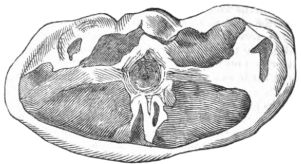
The above are also excellent seasoned, dipped into eggs, and bread-crumbed previous to broiling; for lamb chops proceed precisely the same, only broiling them a few minutes less.
No. 151. Veal Cutlets. Cut four cutlets from the neck, half an inch in thickness, beat lightly with a chopper, and cut off the chine-bones, season them well; have a couple of eggs well beaten upon a plate, into which dip them, then into bread-crumbs, take out, pat gently with a knife, and broil rather more than ten minutes upon a gridiron over a good fire, turning occasionally, keening them of a very light brown colour; dress upon a dish, spreading a piece of the maître d hôtel butter over each, turning them two or three times in the dish, and serving very hot. Veal cutlets are also very good served with the new sauce as for fillets of beef or steaks, and the fried potatoes around them.
No. 152. Pork Chops. Take four chops from a loin of pork, each about half an inch in thickness, beat them lightly, trim, season well with pepper and salt, broil nearly a quarter of an hour over a good fire, and serve very hot upon a dish, with or without apple-sauce in a boat.
No. 153. Pork or Veal Chops Fried. Put one ounce of butter in a sauté or frying-pan, rub over the bottom, lay in four chops, well seasoned as in either of the last two; place the pan over a moderate fire, when the chops become coloured upon one side turn them over, they will require turning two or three times before done; when done, and of a nice colour, take them out, and place upon a dish; put a spoonful of chopped onions in the pan, which fry until becoming of a brownish colour, then take off as much of the fat as possible, add a teaspoonful of flour (mix well with a wooden spoon), and moisten with half a pint of water; stir quickly, add a bay-leaf, and when boiling season with half a saltspoonful of pepper, two of salt, one of sugar, and two spoonfuls of vinegar, stir over the fire until forming a sauce, when again lay in the chops, let simmer five minutes, dress the chops upon a dish, add two chopped gherkins to the sauce, which pour over and serve; a little brown colouring (No. 146) added to the sauce would improve their appearance.
No. 154. Hashed Beef is made from any description of roast beef. It may also be made from stewed, but roast is preferable. Cut about a pound and a half of meat into thin slices, using a small quantity of the fat; lay them upon a dish, sprinkle a spoonful of flour, a teaspoonful of salt, and a quarter ditto of pepper, place the meat in a stewpan, moisten with half a pint of water or light broth, if handy; add a little colouring (No. 146) to give a nice brown colour, place it upon the fire, allowing it to warm gently, stirring occasionally, simmering a quarter of an hour, taste if requiring more seasoning, if so add a little and serve very hot immediately. In making a hash of any description, avoid having to keep it hot as much as possible, or it would become greasy, and likewise prevent the hash boiling over the fire, which would cause the meat to eat hard and tough. If the beef has been well roasted, as described (page 639), the remainder, being underdone, makes an excellent and very nutritious hash.
To vary any description of hash, it may be served upon a large piece of buttered toast, or half a spoonful of chopped onions may be added with the flour and seasoning; chopped parsley may also be added with a spoonful of catsup, two of Harvey sauce, two of vinegar, or one of Chili vinegar; four nice green gherkins in slices may also be added at the time of serving. Some fresh mushrooms from the fields, cleaned, and stewed in the hash, is also a great improvement, a bay-leaf also added imparts a pleasant flavour. A little meat left upon the bones, well peppered and broiled, are frequently served with the hash.
No. 155. Remains of Salt Beef, although very good cold, in winter is very desirable made hot; one of the best methods of doing which is to convert it into that old-fashioned dish entitled bubble-and-squeak; the beef should be, as usual, rather underdone, and cut into slices not thicker than a five-shilling piece, then put two ounces of butter in a sauté or frying-pan, when melted lay in the beef, which place over a quick fire, frying both sides of a yellowish brown colour, when take them out upon a dish, keeping them hot; you have previously boiled six or eight greens or one Savoy cabbage, which chop fine, season with four saltspoonfuls of salt and one of black pepper, place in the same pan you fried the beef in over the fire, keep turning them over until quite hot, when dress upon a dish with the beef over, and serve. A few slices of fat ought to be fried with the beef.
Another way of warming salt beef, is to cut slices and lay in a pan with just sufficient water to cover them; place over the fire, add about an ounce of fresh butter mixed with a little flour, a little Harvey sauce, and a piece of glaze about the size of a walnut, if handy. Another way would be to lay the slices in a saute or frying-pan well buttered, place over the fire and fry a light brown colour, pour off as much of the fat as possible, add a quarter of a pint of water, and a piece of butter the size of a walnut, with which you have mixed half a teaspoonful of flour, shake round over the fire a minute or two, add two spoonfuls of piccalilly cut in slices, two ditto of the liquor, and one of the colouring (No. 146), and serve over when ready.
No. 156. Ox Tails en Currie. Have ready some ox tails dressed as described in page 273 (they will keep several days in a basin covered with their own stock), when wanted warm them in their stock, cut four onions into very thin slices, put them into a stewpan with a quarter of a pound of butter, fry over a slow fire until the onions become brown and pulpy, when add a nicely boiled mealy potato (peeled), a tablespoonful of currie-powder, and one of currie-paste, or one and a half of the powder, mix all well together, moisten with three parts of a pint of the stock from the tails; then add the tails, stirring them round gently until well covered with the sauce, set over a slow fire to stew very slowly for half an hour, moving them round occasionally, finish with a little salt and the juice of half a lemon; dress upon a dish pyramidically, pour the sauce, which must be rather thick, over, and serve with rice boiled as directed (page 51) upon a separate dish.
Another way, for a change, would be to introduce four very ripe tomatas at the same time with the potato and currie-powder, omitting the lemon-juice, and adding half a teaspoonful of sugar. A tablespoonful of currie-paste added to any description of hash would convert it into a very good currie.
No. 157. Ragout of Ox Tails. Cut two ox tails into pieces two inches in length, rub two ounces of butter over the bottom of a convenient-sized stewpan, place in the pieces of tails, with half a pound of streaked bacon cut into square pieces the size of walnuts, place over a moderate fire, stirring occasionally until nicely browned, but not in the least burnt, add two ounces of flour (mix well) and three pints of water; when boiling and half cooked add a bunch of parsley, with two bay-leaves, twenty young carrots, or pieces of old ones, and twenty button onions, season with a teaspoonful of salt, a half ditto of sugar, and a quarter ditto of pepper; let simmer until the tails and vegetables are quite tender, keeping well skimmed, when take out and dress them in pyramid upon mashed potatoes, garnish round with the vegetables, pass the sauce through a hair sieve into another stewpan, place over the fire, stir with a wooden spoon until adhering to the back, when pour over the tails, and serve very hot.
No. 158. Ox Cheeks are very delicate when well stewed, and may be purchased very cheap; they require soaking all night, and about six hours to blanch in salt water, until the flesh will detach easily from the bone, when take it out, remove the bone, place some onion, carrot, and turnip, in slices, in a large flat stewpan, with a piece of bacon, a few sprigs of thyme, parsley, and two bay-leaves, cover with a little stock (if any) or water, place the flesh from the cheek over, put in a moderate oven until very tender, when take up, dress upon a dish, and serve with a sharp sauce over.
Ox cheeks may also be served in currie, or converted into a ragout after blanching, as directed for ox tails.
Should you happen to have the remains of a fresh ox tongue, it would be very good cut in slices, warmed, and served with a sharp sauce, or hashed; the remains of a pickled one may be used in any little made dish of veal, or poultry, hereafter described; to some persons it is, however, preferable cold.
No. 159. Ox Kidneys are very good for breakfast or luncheon; cut the kidneys into thin slices, avoiding the piece in the centre, put two ounces of butter in a stewpan, with a little chopped eschalots, place over the fire; when becoming a little browned add the kidneys, which keep stirring for five minutes still over the fire, add half a tablespoonful of flour (mix well), two glasses of sherry, two of water, half a teaspoonful of salt, a quarter ditto of pepper, one of chopped parsley, and a bay-leaf, let simmer gently five minutes, not, however, to boil, or they would become hard and indigestible; should the sauce be too thin add a little butter and flour mixed together, it requires to be sufficiently thick to envelope the kidneys; when done poor out upon a dish, and serve very hot. A few raw mushrooms stewed with the kidneys is also a great improvement.
A bullock’s heart is a favorite dish with some persons; soak an hoar in lukewarm water to disgorge, dry, and stuff the interior with a good veal stuffing, roast an hour and a half before a moderate fire, and serve very hot, with a little veal sauce (see page 647) around; proceed the same for calves’ or sheep’s hearts, but of course they will require less time.
No. 160. Calf’s Head. Should you have any left from a previous dinner it may be dressed in various ways. To hash calf’s head, cut into good slices not too thin, or it would have a bad appearance; put a spoonful of chopped onions in a stewpan, with a wineglassful of vinegar, six peppercorns, a sprig of thyme, a bay-leaf, a piece of glaze the size of a walnut, and a gill of broth, reduce to half over the fire, then add the slices of calf’s head and a gill more broth, season with a little pepper and salt, when quite hot through add half an ounce of butter, with which you have mixed a tablespoonful of flour, first breaking it into four or five pieces, shake round over the fire until becoming a little thickish, add a little colouring (No. 146) to give a light brown colour; pour out upon your dish, and serve with a few slices of gherkins sprinkled over.
Calf’s head may also be cut in slices, warmed, and served with some of the sauces as directed for fillet of beef, or curried as for the ox-tails (No. 156); hashed calf’s head, with a couple of spoonfuls of currie-paste added, is also very excellent.
No. 161. Calf’s Brains and Tongue. Boil the tongue in stock or water until tender, lay the brains in lukewarm water to disgorge, then carefully take off all the skin, put about a quarter of a pound of butter in a sauté-pan, rub all over the bottom, cut the brains in slices, lay them in the pan, season with a little pepper, salt, and lemon-juice, place over a moderate fire, and when set turn them over, add about a gill of melted butter, and a little milk, if too thick, season a little more if required, shake the sauté-pan round, moving the brains from the bottom, but not breaking them, and pour upon a dish, skin and trim the tongue, cut it in halves lengthwise, glaze and serve dressed upon the brains. Sheep and lamb’s tongues and brains are dressed in precisely the same manner as the calf’s.
No. 162. Veal Cutlets, the English Method. Procure a piece of fillet of veal weighing about four pounds, from which (to the best advantage) cut eight or ten pieces of the shape and size of fillets of fowl, season lightly with a little pepper and salt, have a couple of eggs, well beaten, upon a plate, into which dip the cutlets, and afterwards into bread-crumbs, beat lightly; then cut four or five slices of streaked bacon, which fry in a sauté or frying-pan; when done take out and lay in the cutlets, which fry of a nice light brown colour, dress the bacon and cutlets alternately upon your dish, pour as much fat as possible out of the pan, into which pour a quarter of a pint of water, and the same of melted butter; boil until becoming rather thickish, when add a tablespoonful of Harvey sauce, one of catsup, a little colouring (No. 146), and a little pepper and salt, boil another second, pass through a sieve over the cutlets, and serve. Veal cutlets cut and fried as above may also be served upon some very light mashed potatoes, omitting the sauce.
No. 163. Sweetbreads. I never can procure sweetbreads at home except in the autumn or winter season of the year, so many families being then out of town, they may be procured at a very reasonable price; I usually dress them thus: lay them in water three or four hours to disgorge, blanch two minutes in boiling water, take out and put them into another stewpan, with a few slices of onions, carrot, turnip, a little parsley, thyme, bay-leaf, six peppercorns, a blade of mace, and a small piece of bacon, cover over with a little broth if any, place over the fire, and let boil about twenty minutes, then take out, dry them on a cloth, egg all over, throw into bread-crumbs, run a skewer through each, tie them to a spit and roast of a nice brown colour before a sharp fire, a quarter of an hour would be sufficient; they might also be browned in a hot oven, or fried in very hot lard or dripping ten minutes; then, however, they must be stewed rather longer; serve them with vegetable garniture of any description, if peas, merely plain boiling them, putting them in a stewpan, with a little sugar, pepper, salt, and a piece of fresh butter, toss them round over the fire until very hot, pour them into the dish, and dress the sweetbreads over, or serve with French beans dressed also in the same manner, spinach dressed as directed (page 43), or merely with the following sauce: put a gill of melted butter into a stewpan, with a spoonful of Harvey or Reading sauce, and a little catsup, boil altogether, and if too thick add a little water. If I cannot meet with heart sweetbreads, I in general satisfy myself with the throats.
No. 164. Calf’s Liver Stewed, French fashion. Procure a small delicate liver, cut twenty pieces of fat bacon, three inches in length and a quarter of an inch square, season with a little pepper, salt, and chopped parsley, then with a larding-needle run them into the liver crosswise, put two ounces of butter into a convenient-sized stewpan, with half a pound of lean uncooked ham, keep stirring over a sharp fire until the ham becomes rather brownish, then lay in the liver, cover the stewpan, stir round occasionally until the liver has become quite firm and of a brownish colour; then add half a teaspoonful of salt, a quarter of one of pepper, forty button onions, twenty young carrots (or twenty pieces of old, previously blanched), half a pint of water, a bunch of parsley, with three sprigs of thyme and two bay-leaves (tied together), four cloves, and a blade of mace, let simmer twenty minutes; then add twenty new potatoes, or old ones cut of the same size, cover the stewpan, and let stew gently until all the vegetables are done, when take out the bunch of herbs, dress the liver upon a dish, with the vegetables and ham around it, skim all the fat from the gravy in the stewpan, pour over the vegetables and serve; if any remain, it is excellent made hot the next day, or even to be eaten cold.
No. 165. Calf’s Liver Fried. Cut the liver into slices the eighth of an inch in thickness, dip them in flour, and fry them in a sauté or frying-pan, in which you have previously fried some slices of streaked bacon, fry the liver until quite browned and rather crisp, when take out and place it upon a dish with the bacon, pour as much of the fat as possible from the pan, pour in a quarter of a pint of water, when boiling add a piece of butter the size of a walnut, with which you have mixed a teaspoonful of flour, shake the pan round over the fire until becoming rather thickish, season with a little Harvey sauce, catsup, pepper, and salt, if too thick add a little more water, pour over the liver and serve. Or, for variation, after the liver is well fried, take it out and put a tablespoonful of chopped onions in the pan, set upon the fire a minute, then pour off the greater part of the fat, add a teaspoonful of flour, mix well in, and half a pint of broth or water, boil until forming a thickish sauce, season with pepper, salt, two spoonfuls of vinegar, a little sugar, and half a teaspoonful of mixed mustard, set upon the fire until quite hot, pour over the liver and serve. Or liver may be served plain fried with bacon, without any sauce whatever. Sheep or lamb’s liver may be dressed precisely in the same manner.
With the remains of a joint of veal, either roasted, boiled, or braised, I make mince, hashes, blanquettes, and even pies. For a blanquette of veal cut about a pound into thin slices of the size of half-crown-pieces, add also a few slices of cooked tongue, ham, or streaked bacon, season well with about a teaspoonful of chopped onions, half ditto of salt, and a quarter ditto of white pepper, add a gill of broth or water, warm gently, and when quite hot add a piece of butter the size of a walnut, with which you have mixed a teaspoonful of flour, shake round over the fire, when becoming thickish add half a gill of milk or cream, with which you have mixed the yolk of an egg, stir in quickly, add the juice of half a lemon, and serve (it must not boil after the egg and cream have been added) with triangular pieces of toasted or fried bread round. A blanquette of lamb made in the same manner is equally good. With the bones you may make a little stock by chopping them up into small pieces, and putting them into a stewpan, with an onion in slices, a bay-leaf, bunch of parsley, and a little raw ham, add water according to the quantity of bones, and boil rather more than half an hour, convert it into sauce by thickening with a little butter and flour, and use for hash; to make which cut the meat into small thin slices, put into a stewpan, with sufficient of the above sauce to moisten it, let simmer ten minutes, add two spoonfuls of vinegar and four gherkins in slices, season with a little white pepper and salt; pour upon your dish and serve.
No. 166. Minced Veal and Poached Eggs are also a very favorite dish; from the remains of veal cut about a pound of the lean, with a little of the fat, and two ounces of cooked ham into very small dice, put a tablespoonful of chopped onions into a stewpan, with half an ounce of butter, place over the fire, keep stirring until the onions change colour slightly, then stir in a tablespoonful of flour, moisten with half a pint of stock or milk, let boil ten minutes, add the mince, season well with white pepper and salt, when quite hot stir in a yolk of egg, mixed with two tablespoonfuls of cream or milk, do not let boil afterwards, finish with the juice of half a lemon, and pour upon your dish; have ready poached six eggs, by having a stewpan upon the fire with one quart of water, quarter of an ounce of salt, and a quarter of a gill of vinegar, when boiling break in six eggs separately, let boil from three to four minutes, draw off the fire, take them out with a colander spoon, drain a moment upon a cloth, dress upon the mince, pour a little melted butter over each, and serve with triangular pieces of fried bread round.
Minced lamb, beef, or mutton is done the same, using stock or water instead of milk, and letting the onions with the thickening become a little brown over the fire, likewise omit the yolk of egg and cream, serve with the eggs precisely the same; any kind of mince must be rather thick that the eggs may rest on it. By finishing the minced veal with the yolks of three eggs, stirring a moment over the fire until set, and pouring upon a dish until cold, you can serve it in any shaped croquettes you please, taking pieces from it of the size you may require, shaping them with a knife, dipping twice into eggs and bread-crumbs, patting them gently, frying a light brown colour in a stewpan of hot lard or dripping, and serving upon a napkin garnished with fried parsley; they may be made in oblong shapes, the size and length of small sausages, and fried as above: they are then called boudins.
Patties may also be made from cooked veal, preparing a blanquette as before described, and leaving it upon a dish until cold; line six large patty-pans very thinly with half puff paste (see page 480), lay some of the veal in the centre of each, sprinkle a little water over, and cover with sheets of the same paste of the thickness of a five-shilling piece, egg over, crimp the edges a little with a knife, place a leaf of paste upon the top of each, and bake about twenty minutes in a very hot oven until the paste is well done.
The remains of poultry, game, or any other description of meat, may also be converted into patties in the same method as above.
The remains of meat dressed as for the above patties is also very excellent for larger pies, filling the dish with it, when cold covering with paste, and baking in a rather warm oven.
No. 167. Mutton Cutlets Sautés. Cut eight cutlets from a neck of mutton, as directed (page 294), and put them into a sauté-pan, with an ounce of butter, season well with pepper and salt, place over the fire, when becoming a little browned turn them over, when firm to the touch they are done (which will take about ten minutes); take up and dress them upon your dish, pour as much of the fat as possible from the pan, add a quarter of a pint of water or broth, let boil until becoming a thin glaze, add a little sugar and a spoonful of Harvey sauce, pour over the cutlets and serve. Should you want a thick sauce you can obtain it by adding a small piece of butter, with which you have mixed a little flour, to the gravy in the sauté-pan, adding also a little colouring (No. 146).
No. 168. Mutton Cutlets Sautés, with Vegetables. Dress the cutlets as in the last, have some vegetables of all kinds (that is, carrots, turnips, artichokes, and button onions), cut up small, stew them in a little broth with a little sugar until tender, when pour them into the sauté-pan you cooked the cutlets in, reduce until the stock becomes a thin glaze, then dress the vegetables in the centre of the cutlets, sauce over, and serve.
No. 169. Mutton Cutlets, Irish Method. Cut eight or ten mutton cutlets, season well with pepper and salt, place them in a stewpan, just cover them with water, let simmer gently twenty minutes, then add forty button onions, and as many pieces of potatoes, cut with a scoop in pieces a size larger; stew until tender, dress the cutlets in a circle upon your dish, with the vegetables in the centre, skim off some of the fat from the stock in the sauté-pan, reduce a little, sauce over, and serve.
No. 170. Mutton Cutlets Broiled. Cut eight or ten cutlets, season well with pepper and salt, dip them into eggs, then into bread-crumbs, beat gently with a knife, have a little butter in a stewpan, which melt over the fire; dip each cutlet into the butter, and again into bread-crumbs, beat again lightly, place them upon a gridiron over a moderate fire; when lightly coloured upon one side turn them over; they will require about ten minutes to cook thoroughly; serve plain dressed upon your dish.
Dressed as above they may likewise be served with a maître d’hôtel sauce made thus: put half a pint of melted butter into a stewpan with a piece of glaze the size of a walnut, when boiling add two ounces of maître d’hôtel butter (see p. 33), shake the stewpan round over the fire; when quite hot pour in the dish with the cutlets, have ready some thin slices of potatoes fried as for the fillet of beef, dress in pyramid in the centre, and serve.
No. 171. Mutton Cutlets Harricoed. Cut ten cutlets from a neck of mutton, leaving them rather short, not beating them flat, and taking off some of the fat; put two ounces of butter in a stewpan, lay in the cutlets, which well season with pepper and salt; set upon a moderate fire, turning them round occasionally until of a lightish brown colour, then add a good spoonful of flour; mix well, and moisten with a quart of water, keep stirring until boiling, throw in twenty small onions, twenty small pieces of carrots, and the same of turnips (each about the size of walnuts), and a small bunch of parsley, with two bay-leaves; let simmer until the vegetables are done, skim well, take out the cutlets, which dress in crown upon a dish, place the vegetables in the centre, reduce the sauce if required, which pour over and serve. Should it be convenient, it would be as well to pass the vegetables by putting about a quarter of an ounce of powdered sugar into a stewpan; place over the fire, and when melted add two ounces of butter and the vegetables, which keep tossing over the fire until covered with a kind of glaze, when put them into the stewpan with the cutlets; it gives the harrico quite a peculiar and good flavour.
No. 172. Ragout of Mutton en Currie. Peel and slice four large onions, which put into a stewpan with two ounces of butter, place over a moderate fire, and when becoming lightly browned and pulpy lay in ten cutlets as in the last; move round occasionally until a little brown, when add a good spoonful of currie-powder and the half of one of flour; mix well, moisten with a pint of water, let simmer twenty minutes, or until the mutton is quite tender, finish with a little sugar, salt, and lemon-juice, take out the cutlets, which dress in circle upon a dish, have ready some boiled rice (p. 51) very hot, which dress in pyramid in the centre; pass the sauce through a tammie, pour over the cutlets, and serve.
No. 173. Mutton Currie. Peel and slice four large onions as in the last, fry the same, have ready two pounds of lean mutton cut into square pieces the size of walnuts, put into the stewpan with the fried onions; let remain ten minutes over the fire, stirring frequently, then add a tablespoonful of currie-powder and one of currie-paste; mix well in, let remain over a slow fire until the mutton is tender, season with a little salt and lemon-juice, pour out upon your dish, and serve with boiled rice separate.
Lamb cutlets are dressed precisely as the mutton; but when bread-crumbed and broiled they are very good served with peas or French beans, previously boiled, and placed in a stewpan with an ounce of fresh butter, a little pepper, salt, and sugar; when quite hot stir in half a gill of cream, with which you have well mixed the yolk of an egg, stir in quickly, pour out upon your dish, dress the cutlet over, and serve.
No. 174. Pork Cutlets Sautés. Cut six or eight good-sized cutlets from the neck, of the same shape as the mutton, lay them in a buttered sauté-pan, season well with pepper and salt, place over the fire; when done lay them upon a plate, pour some of the fat from the sauté-pan, add a good tablespoonful of chopped onions, pass over the fire a minute, then add a teaspoonful of flour; moisten with half a pint of broth or water, with a piece of glaze added, season a little more, add a bay-leaf and a teaspoonful of vinegar, with one of mustard, mix well, lay in the cutlets until quite hot, when dress upon a dish, sauce over, and serve. This sauce is good with any kind of cutlets, but especially pork.
No. 175. Pork Cutlets aux Cornichons. Cut six or eight cutlets from a middling-sized neck of pork, season well with pepper and salt, dip in eggs well beaten upon a plate, and then into grated crust of bread (not too brown); put two ounces of lard or butter into a sauté or frying-pan, lay in the cutlets and fry very slowly; when done place them upon a dish; keep hot, pour some of the fat from the pan, add a good teaspoonful of flour, mix well, moisten with half a pint of broth or water with a piece of glaze, add half a wineglassful of vinegar, a little salt, pepper, and six gherkins in slices, place the cutlets in the pan to warm gently in the sauce, then dress them upon a dish, sauce over, and serve.
No. 176. Pork Cutlets, Sauce demi Robert. Cut eight cutlets from a neck as before, season well with pepper and salt, sprinkle chopped onions and parsley over upon both sides, beating the cutlets lightly to make them adhere, then dip them into eggs well beaten upon a plate, and then into bread-crumbs; pat them lightly, have some clarified butter in a stewpan, into which dip the cutlets, and again into bread-crumbs, well covering them, place them upon a gridiron over a moderate fire, broiling a nice light brown colour; when done dress them upon a dish. Have ready the following sauce: cut two large onions into very small dice, put them into a stewpan with an ounce of butter, fry of a light yellow colour, add a teaspoonful of flour, mix well, moisten with half a pint of broth and two spoonfuls of vinegar, season well, let boil, skim, and reduce, until rather thick, when add a spoonful of mixed mustard, one of colouring (No. 146); sauce in the centre of the cutlets and serve.
No. 177. Hashed Pork. Put two spoonfuls of chopped onions into a stewpan with a wineglassful of vinegar, two cloves, a blade of mace, and a bay-leaf, reduce to half, take out the spice and bay-leaf, add half a pint of broth or water, cut some pork previously cooked into thin small slices, season well upon a dish with pepper and salt, shake a good teaspoonful of flour over, mix all together, and put into the stewpan; let simmer gently ten minutes, pour out upon your dish, and serve with slices of gherkins in it; a little mustard may be added if approved of, or a little piccalilly with the vinegar is excellent.
The remains of salt pork, though very palatable cold, if required hot may be cut into large thin slices, and placed in a buttered sauté or frying-pan, with a little broth, or merely fried in the butter, and served with a puree of winter peas, made by boiling half a pint of peas until tender (tied up in a cloth); when done put them into a stewpan with two ounces of butter; season with pepper and salt, add a gill of milk or cream, pour into the dish, and dress the pork over.
No. 178. Pig’s Liver. Procure a nice pig’s liver with the caul, cut the liver into good-sized slices of the shape of hearts, season with a little pepper, salt, and cayenne, sprinkle chopped eschalots and dried sage over, and fold each piece of liver in a piece of the caul; put some butter in a sauté or frying-pan, lay them in, place over the fire, let fry rather quickly, not too dry; when done it will be a beautiful colour; take out and dress in circle upon your dish; have ready the following sauce: put six spoonfuls of melted butter in a stewpan, with one of catsup, and two of Harvey or Worcestershire sauce; when boiling pour over the liver and serve.
To plain fry it, cut in slices, season with pepper and salt, dip in flour, or eggs and bread-crumbs, fry a light brown in butter or lard, dress in a circle upon your dish, pour a gill of water into the pan, add a little Harvey sauce and a piece of butter the size of a walnut, with which you have mixed half a teaspoonful of flour; let boil a minute, add a little pepper and salt, sauce over and serve.
No. 179. Pigs’ Kidneys. Cut them open lengthwise, season well with pepper and salt, egg over with a paste-brush, dip into bread-crumbs, with which you have mixed some chopped parsley and eschalot, run a skewer through to keep them open, and broil for about a quarter of an hour over a good fire; when done place them upon a dish, have ready an ounce of butter, with which you have mixed the juice of a lemon, a little pepper and salt, and a teaspoonful of French or common mustard, place a piece upon each of the kidneys, place in the oven for one minute and serve. Pigs’ kidneys may also be sautéd as directed for ox kidneys (No. 159).
No. 180. Black Puddings. Very few people take the trouble to do them at home, it being part of the business of the pork butcher to prepare such delicacies. I shall, however, here describe a very simple method for making them more palatable than those purchased in England, which have so much spice in them as to entirely destroy their delicate flavour. Cut into rather small dice twenty large onions, having cut off the roots, being hard, put them into a stewpan with half a pound of lard or butter, let stew gently, cut three pounds of pig’s flead, free from skin, into small dice, have ready boiled six heads of endive chopped fine, and put into the stewpan with the onions, add two ounces of salt, a saltspoonful of pepper, half a nutmeg, grated, and four spoonfuls of parsley, chopped with a little thyme and bay-leaf; then add six pints of pig’s blood, mix well, leaving no lumps; if too thin add a few handfuls of bread-crumbs, or half a pound of well-boiled rice; have ready the small intestines, which well scrape and wash in salt and water, tie one end upon a tin funnel, having a piece a yard in length, closing it at the other end, fill with the above preparation by pressing through a funnel; take off the funnel, tie up the end, and put them into a stewpan of nearly boiling water, let simmer twenty minutes, pricking them occasionally with a pin; when no blood oozes out they are done; take up and place them upon a dish until cold; when ready to serve cut into pieces four inches in length, cut through the skin at different places, broil ten minutes over a sharp fire, serve plain, but very hot.
These puddings are best made whilst the blood is still warm from the pig, which if killed at home, the other ingredients may be prepared previously. The endive may be omitted, but for a real epicure procure it if possible; they are served in France on the best of tables, and are quite worthy of that honour. Many kinds of black puddings are also made in Scotland, where they more frequently use sheep’s blood, using the interior of the sheep, fat and all, in the same proportions as if made of a pig, adding oatmeal, omitting part of the onions, and using the larger entrails.
It being usual in this country to introduce leeks, you must then omit the bread-crumbs and rice, or part of the onions. To prevent the blood curdling, it must be salted, by adding a handful of salt, and whisking well for ten minutes as soon as you obtain it from the pig.
Rice well boiled in broth but not too much so, is an excellent addition to black puddings (half a pound for the above quantity being quite sufficient), or grated bread; leeks also may be used instead of endive, or both may be omitted. I have mentioned these different articles, that if one cannot be procured, another might be used instead, fill also very even, mixing fat and all well together, carefully avoid letting any air get in, or they would burst in boiling.
No. 181. Excellent Sausage Cakes. Chop some lean pork very fine, having previously detached all the skin and bone, and to every pound of meat add three quarters of a pound of fat bacon, half an ounce of salt, a saltspoonful of pepper, the quarter of a nutmeg grated, six young green chopped onions, and a little chopped parsley; when the whole is well chopped put into a mortar and pound well, finishing with three eggs; then have ready a pig’s caul, which cut into pieces large enough to fold a piece of the above preparation the size of an egg, which wrap up, keeping the shape of an egg, but rather flattened, and broil very gently over a moderate fire.