"The Forest Exiles"
Reading edition
Chapter One.
The biggest Wood in the World.
Boy reader, I am told that you are not tired of my company. Is this true?
“Quite true, dear Captain,—quite true!” That is your reply. You speak sincerely? I believe you do.
In return, believe me, when I tell you I am not tired of yours; and the best proof I can give is, that I have come once more to seek you. I have come to solicit the pleasure of your company,—not to an evening party, nor to a ball, nor to the Grand Opera, nor to the Crystal Palace, nor yet to the Zoological Gardens of Regent’s Park,—no, but to the great zoological garden of Nature. I have come to ask you to accompany me on another “campaign,”—another “grand journey” through the fields of Science and Adventure. Will you go?
“Most willingly—with you, dear Captain, anywhere.”
Come with me, then.
Again we turn our faces westward; again we cross the blue and billowy Atlantic; again we seek the shores of the noble continent of America.
“What! to America again?”
Ha! that is a large continent, and you need not fear that I am going to take you over old ground. No, fear not that! New scenes await us; a new fauna, a new flora,—I might almost say, a new earth and a new sky!
You shall have variety, I promise you,—a perfect contrast to the scenes of our last journey.
Then, you remember, we turned our faces to the cold and icy North,—now our path lies through the hot and sunny South. Then we lived in a log-hut, and closed every cranny to keep out the cold,—now, in our cottage of palms and cane, we shall be but too glad to let the breeze play through the open walls. Then we wrapped our bodies in thick furs,—now we shall be content with the lightest garments. Then we were bitten by the frost,—now we shall be bitten by sand-flies, and mosquitoes, and bats, and snakes, and scorpions, and spiders, and stung by wasps, and centipedes, and great red ants! Trust me, you shall have a change!
Perhaps you do not contemplate such a change with any very lively feelings of pleasure. Come! do not be alarmed at the snakes, and scorpions, and centipedes! We shall find a cure for every bite—an antidote for every bane.
Our new journey shall have its pleasures and advantages. Remember how of old we shivered as we slept, coiled up in the corner of our dark log-hut and smothered in skins,—now we shall swing lightly in our netted hammocks under the gossamer leaves of the palm-tree, or the feathery frondage of the ferns. Then we gazed upon leaden skies, and at night looked upon the cold constellation of the Northern Bear;—now, we shall have over us an azure canopy, and shall nightly behold the sparkling glories of the Southern Cross, still shining as bright as when Paul and his little Virginie with loving eyes gazed upon it from their island home. In our last journey we toiled over bleak and barren wastes, across frozen lakes, and marshes, and rivers;—now we shall pass under the shadows of virgin forests, and float lightly upon the bosom of broad majestic streams, whose shores echo with the voices of living nature.
Hitherto our travels have been upon the wide, open prairie, the trackless plain of sand, the frozen lake, the thin scattering woods of the North, or the treeless snow-clad “Barrens.” Now we are about to enter a great forest,—a forest where the leaves never fade, where the flowers are always in bloom,—a forest where the woodman’s axe has not yet echoed, where the colonist has hardly hewed out a single clearing,—a vast primeval forest,—the largest in the world.
How large, do you ask? I can hardly tell you. Are you thinking of Epping, or the New Forest? True, these are large woods, and have been larger at one time. But if you draw your ideas of a great forest from either of these you must prepare yourself for a startling announcement—and that is, that the forest through which I am going to take you is as big as all Europe! There is one place where a straight line might be drawn across this forest that would measure the enormous length of two thousand six hundred miles! And there is a point in it from which a circle might be described, with a diameter of more than a thousand miles, and the whole area included within this vast circumference would be found covered with an unbroken forest!
I need scarce tell you what forest I allude to, for there is none other in the world of such dimensions—none to compare with that vast, trackless forest that covers the valley of the mighty Amazon!
And what shall we see in travelling through this tree-covered expanse? Many a strange form of life—both vegetable and animal. We shall see the giant “ceiba” tree, and the “zamang,” and the “caoba,” twined by huge parasites almost as thick as their own trunks, and looking as though they embraced but to crush them; the “juvia,” with its globe-shaped fruits as large as the human head; the “cow-tree,” with its abundant fountains of rich milk; the “seringa,” with its valuable gum—the caoutchouc of commerce; the “cinchona,” with its fever-killing bark; the curious “volador,” with its winged seeds; the wild indigo, and the arnatto. We shall see palms of many species—some with trunks smooth and cylindrical, others covered with thorns, sharp and thickly set—some with broad entire leaves, others with fronds pinnate and feathery, and still others whose leaves are of the shape of a fan—some rising like naked columns to the height of an hundred and fifty feet, while others scarcely attain to the standard of an ordinary man.
On the water we shall see beautiful lilies—the snow-white nymphs, and the yellow nuphars. We shall see the Victoria regia covering the pool with its massive wax-like flowers, and huge circular leaves of bronze green. We shall see tall flags like Saracen spears, and the dark green culms of gigantic rushes, and the golden arundinaria—the bamboo, and “cana brava,”—that rival the forest trees in height.
Many a form of animal life we may behold. Basking in the sun, we may behold the yellow and spotted body of the jaguar—a beautiful but dreaded sight. Breaking through the thick underwood, or emerging slowly from the water, we may catch a glimpse of the sombre tapir, or the red-brown capivara. We may see the ocelot skulking through the deep shade, or the margay springing upon its winged prey. We may see the shaggy ant-bear tearing at the cones of sand-clay, and licking up the white termites; or we may behold the scaly armadillo crawling over the sun-parched earth, and rolling itself up at the approach of danger. We may see human-like forms,—the quadrumana—clinging among the high branches, and leaping from tree to tree, like birds upon the wing; we may see them of many shapes, sizes, and colours, from the great howling monkeys, with their long prehensile tails, down to the little saïmiris and ouistitis not larger than squirrels.
What beautiful birds, too!—for this forest is their favourite home. Upon the ground, the large curassows, and guans, and the “gallo,” with his plumage of bright red. Upon the trees, the macaws, and parrots, and toucans, and trogons. In the waters, the scarlet flamingoes, the ibises, and the tall herons; and in the air, the hawks, the zamuros, the king-vultures, and the eagles.
We shall see much of the reptile world, both by land and water. Basking upon the bank, or floating along the stream, we may behold the great water lizards—the crocodile and caiman; or the unwieldy forms of the cheloniae—the turtles. Nimbly running along the tree-trunk, or up the slanting lliana, we may see the crested iguana, hideous to behold. On the branches that overhang the silent pool we may see the “water-boa,” of huge dimensions, watching for his prey—the peccary, the capivara, the paca, or the agouti; and in the dry forest we may meet with his congener the “stag-swallower,” twined around a tree, and waiting for the roebuck or the little red-deer of the woods.
We may see the mygale, or bird-catching spider, at the end of his strong net-trap, among the thick foliage; and the tarantula, at the bottom of his dark pitfall, constructed in the ground. We may see the tent-like hills of the white ants, raised high above the surface, and the nests of many other kinds, hanging from high branches, and looking as though they had been constructed out of raw silk and pasteboard. We may see trees covered with these nests, and some with the nests of wasps, and still others with those of troupials and orioles—birds of the genus icterus and cassicus—hanging down like long cylindrical purses.
All these, and many more strange sights, may be seen in the great forest of the Amazon valley; and some of them we shall see—voilà!
Chapter Two.
The Refugees.
Upon a bright and lovely evening, many years ago, a party of travellers might have been seen climbing up that Cordillera of the Andes that lies to the eastward of the ancient city of Cuzco. It was a small and somewhat singular party of travellers; in fact, a travelling family,—father, mother, children, and one attendant. We shall say a word of each of them separately.
The chief of the party was a tall and handsome man, of nearly forty years of age. His countenance bespoke him of Spanish race, and so he was. He was not a Spaniard, however, but a Spanish-American, or “Creole,” for so Spaniards born in America are called to distinguish them from the natives of Old Spain.
Remember—Creoles are not people with negro or African blood in their veins. There is a misconception on this head in England, and elsewhere. The African races of America are either negroes, mulattoes, quadroons, quinteroons, or mestizoes; but the “Creoles” are of European blood, though born in America. Remember this. Don Pablo Romero—for that was the name of our traveller—was a Creole, a native of Cuzco, which, as you know, was the ancient capital of the Incas of Peru.
Don Pablo, as already stated, was nearly forty years of age. Perhaps he looked older. His life had not been spent in idleness. Much study, combined with a good deal of suffering and care, had made many of those lines that rob the face of its youthful appearance. Still, although his look was serious, and just then sad, his eye was occasionally seen to brighten, and his light elastic step showed that he was full of vigour and manhood. He had a moustache, very full and black, but his whiskers were clean shaven, and his hair cut short, after the fashion of most people in Spanish America. He wore velvet pantaloons, trimmed at the bottoms with black stamped leather, and upon his feet were strong boots of a reddish yellow colour—that is, the natural colour of the tanned hide before it has been stained. A dark jacket, closely buttoned, covered the upper part of his body, and a scarlet silk sash encircled his waist, the long fringed ends hanging down over the left hip. In this sash were stuck a Spanish knife and a pair of pistols, richly ornamented with silver mountings. But all these things were concealed from the view by a capacious poncho, which is a garment that in South America serves as a cloak by day and a blanket by night. It is nearly of the size and shape of an ordinary blanket, with a slit in the centre, through which the head is passed, leaving the ends to hang down. Instead of being of uniform colour, several bright colours are usually woven into the poncho, forming a variety of patterns. In Mexico a very similar garment—the scrape—is almost universally worn. The poncho of Don Pablo was a costly one, woven by hand, and out of the finest wool of the vicuña, for that is the native country of this useful and curious animal. Such a poncho would cost 20 pounds, and would not only keep out cold, but would turn rain like a “macintosh.” Don Pablo’s hat was also curious and costly. It was one of those known as “Panama,” or “Guayaquil,”—hats so called because they are manufactured by Indian tribes who dwell upon the Pacific coast, and are made out of a rare sea-grass, which is found near the above-mentioned places. A good Guayaquil hat will cost 20 pounds; and although, with its broad curling brim and low crown, it looks not much better than Leghorn or even fine straw, yet it is far superior to either, both as a protection against rain, or, what is of more importance in southern countries, against a hot tropical sun. The best of them will wear half a lifetime. Don Pablo’s “sombrero” was one of the very best and costliest; and this, combined with the style of his other habiliments, betokened that the wearer was one of the “ricos,” or higher class of his country.
The costume of his wife, who was a dark and very beautiful Spanish woman, would have strengthened this idea. She wore a dress of black silk with velvet bodice and sleeves, tastefully embroidered. A mantilla of dark cloth covered her shoulders, and on her head was a low broad-brimmed hat, similar to those usually worn by men, for a bonnet is a thing unknown to the ladies of Spanish America. A single glance at the Doña Isidora would have satisfied any one that she was a lady of rank and refinement.
There were two children, upon which, from time to time, she gazed tenderly. They were her only ones. They were a boy and girl, nearly of equal size and age. The boy was the elder, perhaps thirteen or more, a handsome lad, with swarth face, coal-black eyes, and curly full-flowing dark hair. The girl, too, who would be about twelve, was dark—that is to say, brunette in complexion. Her eyes were large, round, and dreamy, with long lashes that kept the sun from shining into them, and thus deepened their expression.
Perhaps there are no children in the world so beautiful as those of the Spanish race. There is a smoothness of skin, a richness in colour, and a noble “hidalgo” expression in their round black eyes that is rare in other countries. Spanish women retain this expression to a good age. The men lose it earlier, because, as I believe, they are oftener of corrupted morals and habits; and these, long exercised, certainly stamp their lines upon the face. Those which are mean, and low, and vicious, produce a similar character of countenance, while those which are high, and holy, and virtuous, give it an aspect of beauty and nobility.
Of all beautiful Spanish children none could have been more beautiful than our two little Creole Spaniards, Leon and Leona—for such were the names of the brother and sister.
There yet remains one to be described, ere we complete the account of our travelling party. This one was a grown and tall man, quite as tall as Don Pablo himself, but thinner and more angular in his outlines. His coppery colour, his long straight black hair, his dark and wild piercing eye, with his somewhat odd attire, told you at once he was of a different race from any of the others. He was an Indian—a South American Indian; and although a descendant from the noble race of the Peruvian Incas, he was acting in the capacity of a servant or attendant to Don Pablo and his family. There was a familiarity, however, between the old Indian—for he was an old man—and Don Pablo, that bespoke the existence of some tie of a stronger nature than that which exists between master and servant. And such there was in reality. This Indian had been one of the patriots who had rallied around Tupac Amaru in his revolution against the Spaniards. He had been proscribed, captured, and sentenced to death. He would have been executed, but for the interference of Don Pablo, who had saved his life. Since then Guapo—such was the Indian’s name—had remained not only the retainer, but the firm and faithful friend, of his benefactor.
Guapo’s feet were sandalled. His legs were naked up to the knees, showing many an old scar received from the cactus plants and the thorny bushes of acacia, so common in the mountain-valleys of Peru. A tunic-like skirt of woollen cloth,—that home-made sort called “bayeta,”—was fastened around his waist, and reached down to the knees; but the upper part of his body was quite bare, and you could see the naked breast and arms, corded with strong muscles, and covered with a skin of a dark copper colour. The upper part of his body was naked only when the sun was hot. At other times Guapo wore a species of poncho like his master, but that of the Indian was of common stuff—woven out of the coarse wool of the llama. His head was bare.
Guapo’s features were thin, sharp, and intelligent. His eye was keen and piercing; and the gait of the old man, as he strode along the rocky path, told that it would be many years before he would show any signs of feebleness or tottering.
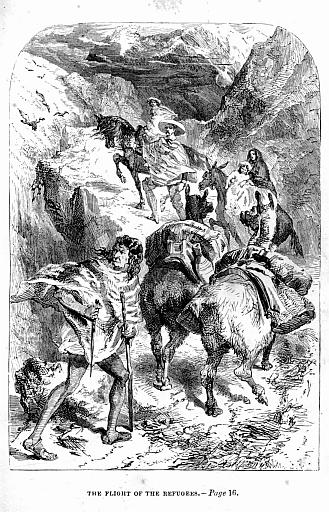
There were four animals that carried our travellers and their effects. One was a horse ridden by the boy Leon. The second was a saddle mule, on which rode Doña Isidora and Leona. The other two animals were not mounted. They were beasts of burden, with “yerguas,” or pack-saddles, upon which were carried the few articles that belonged to the travellers. They, were the camels of Peru—the far-famed llamas. Don Pablo, with his faithful retainer, travelled afoot.
You will wonder that one apparently so rich, and on so distant a journey, was not provided with animals enough to carry his whole party. Another horse at least, or a mule, might have been expected in the cavalcade. It would not have been strange had Guapo only walked—as he was the arriero, or driver, of the llamas—but to see Don Pablo afoot and evidently tired, with neither horse nor mule to ride upon, was something that required explanation. There was another fact that required explanation. The countenance of Don Pablo wore an anxious expression, as if some danger impended; so did that of the lady, and the children were silent, with their little hearts full of fear. They knew not what danger, but they knew that their father and mother were in trouble. The Indian, too, had a serious look; and at each angle of the mountain road he and Don Pablo would turn around, and with anxious eyes gaze back in the direction that led towards Cuzco. As yet they could distinguish the spires of the distant city, and the Catholic crosses, as they glistened under the evening sunbeam. Why did they look back with fear and distrust? Why? Because Don Pablo was in flight, and feared pursuers! What? Had he committed some great crime? No. On the contrary, he was the victim of a noble virtue—the virtue of patriotism! For that had he been condemned, and was now in flight—flying to save not only his liberty but his life! yes, his life; for had the sentinels on those distant towers but recognised him, he would soon have been followed and dragged back to an ignominious death.
Young reader, I am writing of things that occurred near the beginning of the present century, and before the Spanish-American colonies became free from the rule of Old Spain. You will remember that these countries were then governed by viceroys, who represented the King of Spain, but who in reality were quite as absolute as that monarch himself. The great viceroys of Mexico and Peru held court in grand state, and lived in the midst of barbaric pomp and luxury. The power of life and death was in their hands, and in many instances they used it in the most unjust and arbitrary manner. They were themselves, of course, natives of Old Spain—often the pampered favourites of that corrupt court. All the officials by which they were surrounded and served were, like themselves, natives of Spain, or “Gachupinos,” (as the Creoles used to call them,) while the Creoles—no matter how rich, or learned, or accomplished in any way—were excluded from every office of honour and profit. They were treated by the Gachupinos with contempt and insult. Hence for long long years before the great revolutions of Spanish America, a strong feeling of dislike existed between Creole Spaniards and Spaniards of Old Spain; and this feeling was quite independent of that which either had towards the Indians—the aborigines of America. This feeling brought about the revolution, which broke out in all the countries of Spanish America (including Mexico) about the year 1810, and which, after fifteen years of cruel and sanguinary fighting, led to the independence of these countries.
Some people will tell you that they gained nothing by this independence, as since that time so much war and anarchy have marked their history. There is scarcely any subject upon which mankind thinks more superficially, and judges more wrongly, than upon this very one. It is a mistake to suppose that a people enjoys either peace or prosperity, simply because it is quiet. There is quiet in Russia, but to its millions of serfs war continuous and eternal; and the same may be said of many other countries as well as Russia. To the poor slave, or even to the over-taxed subject, peace is no peace, but a constant and systematised struggle, often more pernicious in its effects than even the anarchy of open war. A war of this kind numbers its slain by millions, for the victims of famine are victims of political crime on the part of a nation’s rulers. I have no time now to talk of these things. Perhaps, boy reader, you and I may meet on this ground again, and at no very distant period.
Well, it was not in the general rising of 1810 that Don Pablo had been compromised, but previous to that. The influence of the European Revolution of 1798 was felt even in distant Spanish America, and several ebullitions occurred in different parts of that country at the same time. They were premature; they were crushed. Those who had taken part in them were hunted to the death. Death! death! was the war-cry of the Spanish hirelings, and bitterly did they execute their vengeance on all who were compromised. Don Pablo would have been a victim among others, had he not had timely warning and escaped; but as it was, all his property was taken by confiscation, and became the plunder of the rapacious tyrant.
We are introduced to him just at the period of his escape. By the aid of the faithful Guapo he had hastily collected a few things, and with his wife and family fled in the night. Hence the incompleteness of his travelling equipage. He had taken one of the most unfrequented paths—a mere bridle-road—that led from Cuzco eastward over the Cordillera. His intent was to gain the eastern slope of the Andes mountains, where he might conceal himself for a time in the uninhabited woods of the Great Montaña, and towards this point was he journeying. By a ruse he had succeeded in putting the soldiers of the despot on a false track; but it was not certain that they might not yet fall into the true one. No wonder then, when he gazed back towards Cuzco, that his look was one of apprehension and anxiety.
Chapter Three.
The Poison-Trees.
Following the rugged and winding path, the travellers had climbed to a height of many thousand feet above the ocean level. There was very little vegetation around them. Nothing that deserved the name of tree, if we except a few stunted specimens of quenoa trees (Polylepis racemosa), and here and there patches of the Ratanhia shrub (Krameria), which covered the hill-sides. Both these are used by the mountain Indians as fuel, but the Ratanhia is also a favourite remedy against dysentery and blood-spitting. Its extract is even exported to European countries, and is to be found in the shop of the apothecary.
Now and then a beautiful species of locust was seen with its bright red flowers. It was the “Sangre de Christo” of the Peruvian flora.
Don Pablo Romero was a naturalist, and I may here tell you a pleasant and interesting fact—which is, that many of the earliest patriots and revolutionists of Spanish America were men who had distinguished themselves in natural science—in fact, were the “savans” of these countries. I call this a pleasant fact, and you may deem it a curious one too, because men of science are usually lovers of peace, and not accustomed to meddle either in war or politics. But the truth of the matter is this,—under the government of the viceroys all books, except those of a monkish religion, were jealously excluded from these countries. No political work whatever was permitted to be introduced; and the people were kept in the grossest ignorance of their natural rights. It was only into learned institutions that a glimmering of the light of freedom found its way, and it was amongst the professors of these institutions that the “rights of men” first began to be discussed. Many of these noble patriots were the first victims offered up on the altar of Spanish-American independence.
Don Pablo, I have said, was a naturalist; and it was perhaps the first journey he had ever made without observing attentively the natural objects that presented themselves along his route. But his mind was busy with other cares; and he heeded neither the fauna nor flora. He thought only of his loved wife and dear children, of the dangers to which he and they were exposed. He thought only of increasing the distance between them and his vengeful enemies. During that day they had made a toilsome journey of fifteen miles, up the mountain—a long journey for the llamas, who rarely travel more than ten or twelve; but the dumb brutes seemed to exert themselves as if they knew that danger threatened those who guided them. They belonged to Guapo, who had not been a mere servant, but a cultivator, and had held a small “chacra,” or farm, under Don Pablo. Guapo’s voice was well known to the creatures, and his “hist!” of encouragement urged them on. But fifteen miles was an unusual journey, and the animals began to show symptoms of fatigue. Their humming noise, which bears some resemblance to the tones of an Eolian harp, boomed loud at intervals as the creatures came to a stop; and then the voice of Guapo could be heard urging them forward.
The road led up a defile, which was nothing more than the bed of a mountain-torrent, now dry. For a long distance there was no spot of level ground where our travellers could have encamped, even had they desired to stop. At length, however, the path led out of the torrent-bed, and they found themselves on a small ledge, or table, covered with low trees. These trees were of a peculiar kind, very common in all parts of the Andes, and known as molle trees. They are more properly bushes than trees, being only about ten or twelve feet in height. They have long delicate pinnate leaves, very like those of the acacia, and, when in fruit, they are thickly covered with clusters of small bright red berries. These berries are used among some tribes of Indians for making a highly valuable and medicinal beer; but the wood of the tree is of more importance to the people of those parts as an article of fuel, because the tree grows where other wood is scarce. It is even considered by the sugar-refiners as the best for their purpose, since its ashes, possessing highly alkaline properties, are more efficient than any other in purifying the boiling juice of the sugar-cane. The leaves of this beautiful tree, when pressed, emit a strong aromatic smell; and a very curious property ascribed to it by the more ignorant people of the mountains will be illustrated by the dialogue which follows:—
“Let us pass the night here,” said Don Pablo, halting, and addressing himself to Guapo. “This level spot will serve us to encamp. We can sleep under the shade of the bushes.”
“What! mi amo! (my master) Here?” replied the Indian, with a gesture of surprise.
“And why not here? Can any place be better? If we again enter the defile we may find no other level spot. See! the llamas will go no farther. We must remain therefore.”
“But, master,” continued Guapo—“see!”
“See what?”
“The trees, master!”
“Well, what of the trees? Their shade will serve to screen us from the night dew. We can sleep under them.”
“Impossible, master—they are poison trees!”
“You are talking foolishly, Guapo. These are molle trees.”
“I know it, señor; but they are poison. If we sleep under them we shall not awake in the morning—we shall awake no more.”
And Guapo, as he uttered these words, looked horrified.
“This is nonsense; you are superstitious, old man. We must abide here. See, the llamas have lain down. They will not move hence, I warrant.”
Guapo turned to the llamas, and thinking that their movements might influence the decision of his master, began to urge them in his accustomed way. But it is a peculiarity of these creatures not to stir one step beyond what they consider a proper journey. Even when the load is above that which they are accustomed to carry—that is to say, 120 pounds—neither voice nor whip will move them. They may be goaded to death, but will not yield, and coaxing has a like effect. Both knew that they had done their day’s work; and the voice, the gesticulations and blows of Guapo, were all in vain. Neither would obey him any longer. The Indian saw this, and reluctantly consented to remain; at the same time he continued to repeat his belief that they would all most certainly perish in the night. For himself, he expressed his intention to climb a ledge, and sleep upon the naked rocks; and he earnestly entreated the others to follow his example.
Don Pablo listened to the admonitions of his retainer with incredulity, though not with any degree of disdain. He knew the devotedness of the old Indian, and therefore treated, what he considered a more superstition, with a show of respect. But he felt an inclination to cure Guapo of the folly of such a belief; and was, on this account, the more inclined to put his original design into execution. To pass the night under the shade of the molle trees was, therefore, determined upon.
All dismounted. The llamas were unloaded; their packs, or yerguas, taken off; the horse and mule were unsaddled; and all were permitted to browse over the little space which the ledge afforded. They were all trained animals. There was no fear of any of them straying.
The next thing was to prepare supper. All were hungry, as none of the party had eaten since morning. In the hurry of flight, they had made no provision for an extended journey. A few pieces of charqui (jerked or dried beef) had been brought along; and, in passing near a field of “oca,” Guapo had gathered a bunch of the roots, and placed them on the back of his llama. This oca is a tuberous root (Oxalis tuberosa), of an oval shape and pale red colour, but white inside. It resembles very much the Jerusalem artichoke, but it is longer and slimmer. Its taste is very agreeable and sweetish—somewhat like that of pumpkins, and it is equally good when roasted or boiled. There is another sort of tuberous root (Tropaeolum tuberosum), called “ulluca” by the Peruvians, which is more glutinous and less pleasant to the taste. This kind is various in form, being either round, oblong, straight, or curved, and of a reddish, yellow colour outside, though green within. It is insipid when boiled with water, but excellent when dressed with Spanish peppers (Capsicum). Out of the oca, then, and charqui, the supper must be made; and for the purpose of cooking it, a fire must be kindled with the wood of the mollé.
For a long time there was a doubt about whether it would be safe to kindle this fire. The sun had not yet gone down, and the smoke might attract observation from the valley below. If the pursuers were on their track, it might be noticed; as upon this lonely route a fire would indicate nothing else than the camp of some one on a journey. But the stomachs of our travellers cried for food, and it was at length resolved to light the fire, but not until after sunset, when the smoke could be no longer seen, and the blaze would be hidden behind the thick bushes of molle.
Don Pablo walked off from the camp, and wandered among the trees to see if he could find something that might contribute a little variety to their simple supper. A small, broom-like plant, that grew among the mollé trees, soon attracted his attention. This was the quiñoa plant (Chenopodium quiñoa), which produces a seed, not unlike rice, though smaller in the grain, whence it has received in commerce the name “petty rice.” The quiñoa seeds, when boiled, are both pleasant and nutritious, but especially so when boiled in milk. Previous to the discovery of America, “quiñoa” was an article of food, supplying the place of wheat. It was much used by the natives, and is still collected for food in many parts. Indeed, it has been introduced into some European countries, and cultivated with success. The leaves, when young, can be used as spinach, but the seeds are the most sought after for food.
Don Pablo having called Leon to assist him, a quantity of the seeds were soon collected into a vessel, and carried to the place which they had chosen for their camp; and, as it was now dark enough, the fire was kindled and the cooking-pot got ready. The Doña Isidora, although a fine lady, was one of those who had all her life been accustomed to look after her household affairs: and this, it may be remarked, is a somewhat rare virtue among the Peruvian ladies, who are generally too much given to dress and idleness. It was not so, however, with the wife of Don Pablo. She knew how to look after the affairs of the cuisine, and could dress any of the peculiar dishes of the country with the best of cooks. In a short while, therefore, an excellent supper was ready, of which all ate heartily, and then, wrapping themselves up in their ponchos, lay down to sleep.
Chapter Four.
The Supper of Guapo.
I have said all ate of the supper. This is not strictly true. One of the party did not touch it, and that was old Guapo. Why? Was he not hungry like the rest? Yes; as hungry as any of them. Why then did he not eat of the charqui and ocas? Simply because Guapo had a supper of a very different kind, which he carried in his pouch, and which he liked much better than the charqui stew. What was it? It was “coca.”
“Chocolate,” you will say, or, as some call it, “cocoa,” which should be called, to name it properly, “cacao.” No, I answer—it was not chocolate, nor cocoa, nor cacao neither.
“It must have been cocoa-nuts, then?” No; nor yet cocoa-nuts. The “coca,” upon which Guapo made his supper, and which contented his stomach perfectly for the night, was an article very different from either the cacao which makes chocolate, or the nut of the cocoa-palm. You are now impatient to hear what sort of thing it was, and I shall tell you at once.
The coca is a small tree or shrub about six feet in height, which grows in the warmer valleys among the Andes mountains. Its botanical name is Erythroxylon coca. Its leaves are small and of a bright green colour, and its blossoms white. Its fruits are very small scarlet berries. It is a native plant, and, therefore, found in a wild state; but it is cultivated by the planters of these countries in fields regularly laid out, and hence called “cocales.” This plant is raised from the seed, and when the young shoots have attained the height of about eighteen inches, they are transplanted and put down again at the distance of about a foot apart from each other. Now as these little bushes require a humid atmosphere, maize-plants are sown between the rows to protect them from the sun. In other places arbours of palm-leaves are constructed over the coca-plants. When no rain falls, they are watered every five or six days. After about two and a half years of this nursing, the coca-bush is ready for use, and it is the leaves alone that are valuable. These are gathered with great care, just as the Chinese gather the leaves of the tea-plant; and, as in China, women are principally employed in this labour. The leaves are said to be ripe, not when they have withered and turned brown, but at a period when they are full-grown and become brittle. When this period arrives, they are picked from the tree, and laid out on coarse woollen cloths to dry in the sun. When dried, they remain of a pale green colour; but should they get damp during the process, they become darker, and are then of inferior quality, and sell for a less price. When fully dried, they are carefully packed in bags and covered up with dry sand, and are thus ready for the market. Their price, on the spot where the crop is produced, is about one shilling English per pound. They are, therefore, full as costly to produce as tea itself, although the coca-bush will yield three crops of leaves in one year—that is, a crop every four months; and one hundred plants will produce about an arroba (25 pounds) at a crop. The coca-plant will continue to give fresh leaves for a long period of years, unless attacked and destroyed by ants, which is not unfrequently the case.
Now, why have I so minutely described the coca-bush? Because, that, in the economy of the life of those Indians who inhabit the countries of the Andes mountains, this curious plant plays a most important part. Scarcely one of these people is to be met with who is not an eater of coca—a “coquero.” With them it is what the tea-tree is to the Chinese. Indeed, it is a curious fact, that in all parts of the world some stimulating vegetable is used by the human race. Tea in China; the betel-leaf, and the nut of the areca palm, among the Southern Asiatics; the poppy in the East; with tobacco, and many like things, in other countries.
But the coca not only supplies the Indian with a solace to his cares, it forms the chief article of his food. With a supply of coca, an Indian will support himself five or six days without eating anything else. The poor miners, in the Peruvian mines, are all “coqueros;” and it is alleged that, without coca, they would be unable to undergo the painful toil to which their calling subjects them. When used to excess, the coca produces deleterious effects on the human system; but, if moderately taken, it is far more innocent in its results than either opium or tobacco.
The coca-leaf is not eaten alone. A certain preparation is necessary, and another substance is mixed with it before it produces the proper effect. But let us watch the movements of Guapo, and we shall see how he does it, for Guapo is a confirmed coquero.
Guapo, true to his promise, does not sleep under the molle trees. He leaves the party, and, with a melancholy air, has climbed up and seated himself upon a projecting rock, where he intends to pass the night. His last glance at Don Pablo and his family was one of foreboding. He had again remonstrated with his master, but to no purpose. The latter only laughed at the earnestness of the old Indian, and told him to go to his perch and leave the party to themselves.
It was still grey light when Guapo climbed up to the rock. Against the sky his tall, lank form could be traced in all its outlines. For some moments he sat in a serious and reflective mood—evidently busy with thoughts about the “poison-trees.” His appetite, however, soon got the better of him; and he set to work to prepare his coca supper. It was a simple operation.
Around Guapo’s neck there hung a small pouch made of the skin of the chinchilla, which beautiful little animal is a native of these parts. This pouch contained a quantity of the dry leaves of the coca. Having taken out some half-dozen of these leaves, he put them into his mouth and commenced chewing them. In a short while, by the aid of tongue, teeth, and lips, they were formed into a little ball of pulp, that rolled about in his mouth. Another step in the process now became necessary. A small gourd, that hung around Guapo’s neck by a thong, was laid hold of. This was corked with a wooden stopper, in which stopper a wire pin was fixed, long enough to reach down to the bottom of the gourd. After taking out the stopper, Guapo applied the lower part of the pin to his lips, and then, plunging it once more into the gourd, drew it out again. This time the pin came out, with a fine whitish powder adhering to the part that had been wetted. Now what was this powder? It was nothing else than lime that had been burned, and then pulverised. Perhaps it was the ashes of the molle tree, of which we have already spoken, and which, as we have said, possess a highly alkaline property. The ashes of the musa, or plantain, are sometimes used; but, after all, it is most likely that it was the molle ashes which Guapo carried, for these are most highly esteemed by the Indians of Southern Peru; and Guapo was a connoisseur in coca-eating. Whichever of the three it was—lime, molle, or musa—Guapo carried the pin to his mouth, and, without touching his lips (it would have burnt him if he had), he inserted it, so as to penetrate the ball of chewed coca-leaves that rested upon the tip of his tongue. This was stabbed repeatedly and adroitly by the pin, until all the powder remained in the coca-ball; and then the pin was withdrawn, wiped, and restored to its place, along with the stopper of the gourd.
Guapo now remained quietly “ruminating” for a period of about forty minutes—for this is about the time required for chewing a mess of coca-leaves. Indeed, so exactly is this time observed, that the Indians, when travelling, measure distances by it; and one “coceada” is about equal to the time occupied in walking a couple of English miles.
The coceada of our old Indian being finished, he drew his llama-wool poncho around him; and, leaning back against the rock, was soon buried in a profound slumber.
Chapter Five.
The Puna.
By early dawn Guapo was awake, but he did not immediately awake the others. It was still too dark to follow the mountain road. His first care was to have his coca breakfast, and to this he applied himself at once.
Day was fairly broke when he had ended the process of mastication, and he bethought him of descending from the rock to arouse the sleepers. He knew they still slept, as no voice had yet issued from the grove of molles. The mule and horse were heard cropping the grass, and the llamas were now feeding upon an open spot,—the first they had eaten since their halt, as these creatures do not browse in the night.
Guapo descended with fear in his heart. How it would have joyed him to hear the voice of his master, or of any of them! But, no. Not a sound proceeded from any one of the party. He stole nimbly along the ledge, making his way through the molle trees. At length he reached the spot. All asleep?—yes, all! “Are they dead?” thought Guapo, and his heart beat with anxiety. Indeed, they seemed so. The fatigue of travel had cast a sickly paleness over the faces of all, and one might easily have fancied they no longer lived. But they breathed. “Yes, they breathe!” ejaculated the old Indian, half aloud. “They live!” Guapo bent down, and seizing Don Pablo by the arm, shook him—at first gently, uttering, at the same time, some words to awake him. But neither the shaking nor the voice had any effect. Guapo shook more violently, and shouted louder. Still Don Pablo slept. None of the others moved—none of them heard him. It was strange, for the Indian knew that Don Pablo himself, as well as the others, were easily awaked on ordinary occasions. Guapo, becoming alarmed, now raised his voice to its loudest pitch, at the same time dragging Don Pablo’s shoulder in a still more violent manner. This had the desired effect. The sleeper awoke, but so slowly, and evidently with such exertion, that there was something mysterious in it.
“What is it?” he inquired, with half-opened eyes. “Is it morning already?”
“The sun is up. Rouse, my master! It is time we were on the road,” replied the Indian.
“I feel very drowsy—I am heavy—I can scarce keep my eyes open. What can be the cause of this?”
“The poison-trees, master,” answered Guapo.
The answer seemed to impress Don Pablo. He made a violent effort, and rose to his feet. When up he could scarcely stand. He felt as though he had swallowed a powerful opiate.
“It must be so, good Guapo. Perhaps there is some truth in what you have said. O, heavens!” exclaimed he, suddenly recollecting himself,—“the others—my wife and children!”
This thought had fully awakened Don Pablo; and Guapo and he proceeded at once to arouse the others, which they effected after much shouting and shaking. All were still heavy with sleep, and felt as did Don Pablo himself.
“Surely there is some narcotic power in the aroma of these trees,” muttered Don Pablo. “Come, wife, let us be gone! We must remain under its influence no longer, else what Guapo has said may prove too true. Saddle up—we must eat our breakfasts farther on. To the road!—to the road!”
Guapo soon had the horses ready, and all hurried from the spot, and were once more climbing up the mountain-path. Even the animals seemed to move slowly and lazily, as though they, too, had been under the influence of some soporific. But the pure cold air of the mountain soon produced its effect. All gradually recovered, and after cooking some charqui and ocas in the ravine, and making their breakfast upon these, they again felt light and fresh, and pursued their journey with renewed vigour.
The road kept on up the ravine, and in some places the banks rose almost perpendicularly from the bed of the dry torrent, presenting on both sides vast walls of black porphyry—for this is the principal rock composing the giant chain of the Andes. Above their heads screamed small parrots of rich plumage of the species Conurus rupicola, which make their nestling places, and dwell upon these rocky cliffs. This is a singular fact, as all other parrots known are dwellers among trees and are found in the forest at all times, except when on their passage from place to place. But even the squirrel, which is an animal peculiarly delighting in tree-life, has its representative in several species of ground-squirrels, that never ascend a tree; and, among the monkeys, there exists the troglodyte or cave-dwelling chimpanzee. No doubt squirrels or monkeys of any kind, transported to an open or treeless country, would soon habituate themselves to their new situation,—for Nature affords many illustrations of this power of adaptation on the part of her creatures.
It was near sunset when our travellers reached the highest point of their route, nearly 14,000 feet above the level of the sea! Here they emerged upon an open plain which stretched far before them. Above this plain towered mountains of all shapes to a height of many thousand feet from the level of the plain itself. Some of these mountains carried their covering of eternal snow, which, as the evening sun glanced upon it, exhibited the most beautiful tints of rose, and purple, and gold. The plain looked bleak and barren, and the cold which our travellers now felt added to the desolateness of the scene. No trees were in sight. Dry yellow grass covered the ground, and the rocks stood out naked and shaggy. They had reached one of those elevated tables of the Andes known as the Puna.
These singular tracts elevated above the level of cultivation are almost uninhabited. Their only inhabitants are a few poor Indians, who are employed by the rich proprietors of the lower valleys as shepherds; for upon these cold uplands thrive sheep, and cattle, and llamas, and flocks of the wool-bearing alpaco. Through this wild region, however, you may travel for days without encountering even a single one of the wretched and isolated inhabitants who watch over these flocks and herds.
On reaching the Puna, our party had made their day’s journey, and would have halted. The llamas already showed signs of giving out by stopping and uttering their strange booming note. But Guapo knew these parts—for, though a descendant of the Incas, he had originally come from the great forest beyond the eastern slope of the Andes, where many of the Peruvian Indians had retired after the cruel massacres of Pizarro. He now remembered, that not far from where they were, was a shepherd’s hut, and that the shepherd himself was an old friend of his. That would be the place to stop for the night; and, by Guapo’s advice, Don Pablo resolved to continue on to the hut. Guapo fell upon his knees before the llamas, and, after caressing and kissing them, and using a great variety of endearing expressions, he at last coaxed these animals to proceed. No other means would have availed, as beating would not make either llama budge an inch. The leader, who was a fine large animal and a great favourite with its master, at length stepped boldly out; and the other, encouraged by the sound of the small bells that tinkled around the head of the leader, followed after, and so the travellers moved on.
“Come, papa!” cried Leon; “you are tired yourself—mount this horse—I can walk a bit:” at the same instant the boy flung himself from the back of the horse, and led him up to where his father stood. Then handing the bridle to the latter, he struck off along the plain, following Guapo and his llamas.
The road skirted round the rocks, where the mountain came down to meet the plain. The walk was not a long one, for the hut of which Guapo spoke became visible at less than a quarter of a mile’s distance. An odd-looking hut it was—more like an ill-built stack of bean-straw than a house. It had been built in the following manner:—
First, a round ring of large stones had been laid, then a row of turf, then another tier of stones, and so on, until the circular wall had reached the height of about four or five feet, the diameter being not more than eight or nine. On the top of the wall a number of poles had been set, so as to meet above where they were tied together. These poles were nothing else than the long flower-stalks of the maguey or American aloe (Agave Americana), as no other wood of sufficient length grew in the vicinity. These poles served for rafters, and across them laths had been laid, and made fast. Over all this was placed a thatch of the long coarse Puna grass, which was tied in its place by grass ropes that were stretched from side to side over the top. This was the hut of Guapo’s friend, and similar to all others that may be encountered in the wild region of the Puna. A door was left in the side, not over two feet high, so that it was necessary to crawl upon the hands and knees before any one could reach the interior.
As our travellers approached, they saw that the entrance was closed by an ox-hide which covered the whole of the opening.
Whether the shepherd was at home, was the next question; but as they got near to the house, Guapo suggested that Don Pablo should dismount and let Leon get upon horseback. This suggestion was made on account of the Puna dogs—of which creatures Guapo had a previous knowledge. These dogs, known by the name of Inca dogs (Canis Ingae), are, perhaps, the fiercest animals of their species. They are small, with pointed muzzles, tails curling upward, and long shaggy hair. They are half-wild, snappish, and surly, as it is possible for dogs to be. They attack strangers with fury, and it is as much as their masters can do to rescue even a friend from their attack. Even when wounded, and unable any longer to keep their feet, they will crawl along the ground and bite the legs of those who have wounded them. They are even more hostile to white people than to Indians, and it is sometimes dangerous to approach an Indian hut where three or four of these fierce creatures are kept, as they will jump up against the side of a horse, and bite the legs of the rider. Their masters often use the stick before they can get obedience from them. In every Indian hut several of these animals may be found, as they are extremely useful to the shepherds in guarding their flocks and for hunting. They are much employed throughout the Puna to hunt the “yutu,” a species of partridge which inhabits the rushy grass. This bird is traced by the dogs, seized before it can take to flight, and killed by a single bite of its fierce pursuer. Considering the savage nature of the Inca dogs, Guapo showed great caution in approaching the hut of his friend. He first called loudly, but there was no reply. He then stole forward with his long knife, or “macheté” in his hand; and having lifted the skin that covered the low doorway, peeped in. The hut was empty.
Chapter Six.
The wild Bull of the Puna.
Guapo was not much troubled at this. He knew he could take the liberty of using his friend’s roof for the night, even should the latter not return to grant it. He crawled in. Of course his friend was only temporarily absent—no doubt looking after his flocks of sheep and alpacos; and as he was a bachelor, there was no wife at home, but there were his furniture and utensils. Furniture! No—there was none. There never is in the hut of a Puna shepherd. Utensils! yes—there was an earthen “olla,” or pot to cook soup in, another to boil or roast maize, a jar to hold water, a few split gourd-shells for plates, two or three others for cups—that was all. This was the catalogue of utensils. Two stones set a little apart formed the fire-place, in which the shepherd, when he makes a fire to cook with, makes it out of dry dung (taquia). A couple of dirty sheepskins lay upon the ground. These were the bed. Nothing more was to be seen. Yes, there was one thing more, and this gladdened the eyes of Guapo. In a bag that hung against the wall, and on which he soon laid his hands, he felt something—a collection of hard round objects, about as big as large chestnuts. Guapo knew very well what these were. He knew they were “macas.”
What are macas? you will ask. Macas, then, are tuberous roots that grow in the elevated regions of the Puna, where neither ocas, ullucas, nor potatoes, will thrive. They are cultivated by the inhabitants, and in many parts constitute almost the only food of these wretched people. They have an agreeable and rather sweetish flavour, and, when boiled in milk, taste somewhat like boiled chestnuts. They can be preserved for more than a year, by simply drying them in the sun, and then exposing them to the cold air, when they become hard and shrivelled. They thrive best in this high region, for although they will grow in the lower valleys, they are there very insipid and worthless. The Indians prepare them for food by boiling them into a soup, or syrup, which is taken with parched maize-corn.
Guapo knew that he had got his hands upon a bag of dried macas, and although their owner was absent, he had already come to the determination to appropriate them for himself and party. His joy at the discovery had not subsided when another bag drew his attention, and this was the signal for another delightful surprise. His hand touched the new bag in a trice. There was a rattling sound within. Peas? No—maize.
“Good!” ejaculated Guapo; “maize and macas! That with what is left of the charqui—we shall not fast to-night.”
Guapo now backed himself out of the hut, and joyfully announced the discoveries he had made. The travellers dismounted. The horse and mule were picketed on lassoes on the plain. The llamas were left to go at will. They would not stray far from their owner.
It was piercing cold in this highland region. Doña Isidora and the children entered the hut, while Don Pablo and Guapo remained without for the purpose of collecting fuel. There was not a stick of wood, as no trees of any sort grew near. Both strayed off upon the plain to gather the taquia, or ordure of the cattle, though no cattle were in sight. Their tracks, however, were visible all around.
While engaged thus, the old Indian suddenly raised himself from his stooping position with an exclamation that betokened alarm. What had startled him? A loud bellowing was heard—it was the bellowing of a bull. But what was there in that sound to alarm two full-grown men? Ah! you know not the bulls of the Puna.
Coming around a promontory of rocks a large black bull was in sight. He was approaching them in full run, his head thrown down, his eyes glaring fiercely. At every spring he uttered a roar, which was terrific to hear. A more horrid object it would be difficult to conceive. You may suppose that an adventure with an enraged bull is one of an ordinary character, and may occur any day, even in the green meadow pastures of Old England. So it is, if the animal were only an English bull. But it is a far different affair with the bulls of the Puna. Throughout all Spanish America animals of this kind are of a fiercer nature than elsewhere. It is from them the bulls used in the celebrated fights are obtained; and, perhaps, the race has been made fiercer by the treatment they receive on such occasions—for many of those that exhibit in the arena, are afterwards used to breed from. But, in general, the Spanish-American “vaqueros,” or cattle—herds, treat the cattle under their charge with much cruelty, and this has the effect of rendering them savage. Even in herds of cattle where there are no bulls, there are cows so dangerous to approach, that the vaqueros never attempt driving them unless when well mounted. A Mexican or South American cattle-herd is, therefore, always a mounted man. There is a difference, too, among the bulls in different parts of these countries. On the Llanos of Venezuela they are not so fierce as those of the Puna, and they are more and less so in different parts of Mexico and the Pampas of Buenos Ayres.
The Puna bulls are, perhaps, the fiercest and most dangerous of all. They are more than half wild. They scarcely ever see a human being, and they will attack one upon sight. To a mounted man there is little danger, unless by the stumbling or falling of his horse; but many a poor Indian, crossing these high plains afoot, has fallen a sacrifice to these vengeful brutes.
Both Don Pablo and Guapo knew all this, and therefore were aware of their own danger. Neither had a weapon—not so much as a stick. They had laid aside their knives and other arms, which had been carried inside the hut. To reach the hut before the bull reached them would be impossible; the brute was coming nearly from it—for he had issued from some shelter in the rocks not far off. They were full two hundred yards out upon the plain, and to run in the direction of the rocks would have been to run counter to the bull, and meet him face to face! Their danger was imminent. What was to be done?
There was not much time left them for consideration. The furious animal was within thirty paces distance, roaring loudly, shaking his head and brandishing his long sharp horns. At this moment a happy thought occurred almost simultaneously to Don Pablo and the Indian. The evening, as we have already said, was piercing cold, and both, in going out to collect the fuel, had worn their ponchos. The trick of the matador with his red cloak suggested itself in this moment of peril. Both had seen it performed—Don Pablo often—and knew something of the “way.” In a moment both had stripped the ponchos from their shoulders, and, placing themselves a la matador, awaited the onset of the bull. It was agreed that as soon as the bull was “hooded” by either, that both should run at all speed to the rocks, where they could easily climb out of reach of the animal.
Don Pablo happened to be more in the way, and perhaps his more showy poncho attracted the brute; but whether or not, he was the first to receive the charge. With the adroitness of a practised matador he flung his poncho on the horns of the animal, and then both ran in the direction of the rocks. As they faced towards the hut, however, to the horror of Don Pablo he saw the Doña Isidora, with Leon and the little Leona, all outside, and even at some distance from the entrance! Attracted by the bellowing of the bull and the shouts of the men, they had rushed out of the hut.
Don Pablo, in wild accents, shouted to them to make for the door; but, paralysed by terror, they were for some moments unable to move. At length Doña Isidora, recovering herself, ran for the entrance, pushing the children before her. But the low doorway was difficult of access; they were slow in getting under it; and they would have been too late, as the bull, after shaking off the poncho, had turned and made directly for the hut.
“O God, preserve her!” cried Don Pablo, as he saw the enraged animal within a few paces of where his wife had knelt to enter the doorway. “She is lost! she is lost!”
In fact, the bull was making directly towards her, and it seemed as if nothing could then have interposed to save her.
At that moment the tramp of a horse in full gallop sounded on their ears. Don Pablo looked up. A strange horseman was near the spot—an Indian. Over his head a singular instrument was revolving. There were three thongs fastened at one end, while at the other end of each was a ball. These balls were whirling and gyrating in the air. The next moment both thongs and balls were seen to part from the hands of the rider, and warp themselves around the legs of the bull. The latter made an awkward spring forward, and then fell upon the plain, where he lay kicking and helpless. The horseman uttered a yell of triumph, sprang from his horse, and running up to the prostrate animal, thrust the blade of his long macheté into its throat. The red stream gushed forth, and in a few seconds the black monster lay motionless upon the plain.
The new-comer quietly unwound the thongs—the bolas—from the legs of the dead bull, and then addressed himself to our travellers.
Chapter Seven.
The “Vaquero.”
Who was this deliverer? No other than the vaquero—the friend of Guapo,—who now welcomed Guapo and his companions, telling them in the polite phraseology of all Spanish-Americans that his house (?) was at their service. They were welcome to all it contained.
The macas, and maize, and a fresh steak from the wild bull, enabled them to make a most excellent supper. In return for this hospitality, Don Pablo made the vaquero a handsome present out of his purse; but what gratified him still more was a supply of coca which his friend Guapo was enabled to bestow upon him, for his own stock had been exhausted for some days. Guapo, on leaving Cuzco, had spent his last peseta in buying this luxury, and therefore was well provided for weeks to come.
After they had had supper, he and his friend seated themselves on one side, and quietly chewed for a good half-hour, when at length Guapo, who knew he could trust the vaquero—because the latter, like himself, was one of the “patriotas”—communicated to him the object of their journey through that desolate region. The vaquero not only promised secrecy, but bound himself to put any party of pursuers completely off the trail. The vaquero, even in his remote mountain-home, had heard of Don Pablo, knew that he was a good patriot and friend of the Indians, and he would therefore have risked his life to serve such a man—for no people have proved more devoted to the friends of their race than these simple and faithful Indians of the Andes. How many instances of noble self-sacrifice—even of life itself—occurred during the painful history of their conquest by the cruel and sanguinary followers of Pizarro!
The vaquero, therefore, did all in his power to make his guests comfortable for the night. His dogs—there were four of them—were not so hospitably inclined, for they did not seem to know friends from enemies. They had come up shortly after their master himself arrived, and had made a desperate attack upon everybody. The vaquero, however, assisted by Guapo—who, being an Indian, was less troubled with them—gave them a very rough handling with a large whip which he carried; and then, securing the whole of them, tied them together in a bunch, and left them at the back of the hut to snap and growl at each other, which they did throughout the live-long night. Supper over, all the travellers would have retired to rest; but the vaquero, having announced that he was going out to set snares for the chinchillas and viscachas, Leon could not rest, but asked permission to accompany him. This was granted both by Don Pablo and the vaquero himself.
The chinchilla, and its near relative the viscacha, are two little animals of the rodent, or grass-eating kind, that inhabit the very highest mountains of Peru and Chili. They are nearly of the same size, and each about as big as a rabbit, which in habits they very much resemble. They have long tails, however, which the rabbit has not, though the latter beats them in the length of his ears. The colour of the chinchilla is known to everybody, since its soft, velvety fur is highly prized by ladies as an article of dress, and may be seen in every London fur-shop. The animal is of a beautiful marbled grey, white and black, with pure white feet. The fur of the viscacha is not so pretty, being of a brownish and white mixture. Its cheeks are black, with long, bristly moustaches, like those of a cat while its head resembles that of the hare or rabbit. Both these innocent little creatures live upon the high declivities of the Andes, in holes and crevices among the rocks, where they remain concealed during the day, but steal out to feed twice in the twenty-four hours,—that is, during the evening twilight and in the early morning. The mode of capturing them is by snares made of horse-hair, which are set in front of their caves—just as we snare rabbits in a warren, except that for the rabbits we make use of light elastic wire, instead of the horse-hair.
Leon was delighted with the excursion, as the vaquero showed him how to set the snares, and told him a great many curious stories of Puna life and habits. Some of these stories were about the great condor vulture—which the narrator, of course, described as a much bigger bird than it really is, for the condor, after all, is not so much bigger than the griffon vulture, or even the vulture of California. But you, young reader, have already had a full account of the vultures of America—the condor among the rest—therefore we shall not repeat what was said by the vaquero about this interesting bird.
On the way to the place where the snares were to be set, they passed a lagoon, or marshy lake, in which were many kinds of birds peculiar to these high regions. Out on the open water they saw a wild goose of a very beautiful species. It is called the “Huachua” goose. Its plumage is of a snowy whiteness, all except the wings, which are bright green and violet, while the beak, legs, and feet, are scarlet. They also saw two species of ibis wading about in the marsh, and a gigantic water-hen (Fulica gigantea) almost as big as a turkey. This last is of a dark grey colour, with a red beak, at the base of which is a large yellow knob of the shape of a bean. On this account it is called by the Indians “bean nose.” Upon the plain, near the border of the marsh, they noticed a beautiful plover (Charadrius), having plumage marked very much like that of the “huachua” goose, with green wings shining in the sun like polished metal. Another curious bird also sat upon the plain, or flew around their heads. This was a bird of prey of the species of jerfalcons (Polyborus). The vaquero called it the “Huarahua.” He told Leon it preyed only on carrion, and never killed its own food; that it was very harmless and tame—which was evidently true, as, shortly after, one of them seated upon a stone allowed the Indian to approach and knock it over with a stick! Such a silly bird Leon had never seen.
The vaquero was quite a naturalist in his way—that is, he knew all the animals of the Puna, and their habits, just as you will sometimes find a gamekeeper in our own country, or often a shepherd or farm-servant. He pointed out a rock-woodpecker, which he called a “pito” (Colaptes rupicola), that was fluttering about and flying from rock to rock. Like the cliff-parrots we have already mentioned, this rock-woodpecker was a curious phenomenon, for, as their very name implies, the woodpeckers are all tree-dwelling birds, yet here was one of the genus living among rocks where not a tree was to be seen, and scarcely a plant, except the thorny cactuses and magueys, with which succulent vegetables the woodpecker has nothing to do. The “pito” is a small, brown, speckled bird, with yellow belly, and there were great numbers of them flying about.
But the bird which most fixed the attention of Leon was a little bird about the size of a starling. Its plumage was rather pretty. It was brown, with black stripes on the back, and white-breasted. But it was not the plumage of the bird that interested Leon. It was what his companion told him of a singular habit which it had—that of repeating, at the end of every hour during the night, its melancholy and monotonous note. The Indians call this bird the “cock of the Inca,” and they moreover regard it with a sort of superstitious reverence.
Having placed his snares, the vaquero set out to return with his youthful companion. As they walked back along the mountain-foot, a fox stole out from the rocks and skulked towards the marshy lake, no doubt in search of prey. This fox was the Canis Azara, a most troublesome species, found all through South America. He is the great pest of the Puna shepherds, as he is a fierce hunter, and kills many of the young lambs and alpacos. The vaquero was sorry he had not his dogs with him, as, from the route the fox had taken, he would have been certain to have captured him, and that would have been worth something, for the great sheep-owners give their shepherds a sheep for every old fox that they can kill, and for every young one a lamb. But the dogs, on this occasion, had been left behind, lest they should have bitten Leon, and the vaquero was compelled to let “Renard” go his way. It was night when they returned to the hut, and then, after Leon had related the details of their excursion, all retired to rest.
Chapter Eight.
Llamas, Alpacos, Vicuñas, And Guanacos.
Our travellers were stirring by early break of day. As they issued from the hut, a singular and interesting scene presented itself to their eyes. At one view—one coup d’oeil—they beheld the whole four species of the celebrated camel-sheep of the Andes; for there are four of them,—llama, guanaco, alpaco, and vicuña! This was a rare sight, indeed. They were all browsing upon the open plain: first, the llamas, near the hut; then a flock of tame alpacos, out upon the plain; thirdly, a herd of seven guanacos farther off; and still more distant, a larger herd of the shy vicuñas. The guanacos and vicuñas were of uniform colours,—that is, in each flock the colour of the individuals was the same; while among the llamas and alpacos there were many varieties of colour. The latter two kinds were tame,—in fact, they were under the charge of Guapo’s friend the shepherd; whereas the herds of vicuñas and guanacos consisted of wild animals.
Perhaps no animal of South America has attracted so much attention as the llama, as it was the only beast of burden the Indians had trained to their use on the arrival of Europeans in that country. So many strange stories were told by the earlier Spanish travellers regarding this “camel-sheep,” that it was natural that great interest should attach to it. These reported that the llama was used for riding. Such, however, is not the case. It is only trained to carry burdens; although an Indian boy may be sometimes seen on the back of a llama for mischief, or when crossing a stream and the lad does not wish to get his feet wet.
The llama is three feet high from hoof to shoulder, though his long neck makes him look taller. His colour is generally brown, with black and yellow shades, sometimes speckled or spotted; and there are black and white llamas, but these are rare. His wool is long and coarse, though the females, which are smaller, have a finer and better wool. The latter are never used to carry burdens, but only kept for breeding. They are fed in flocks upon the Puna heights, and it was a flock of these that our travellers saw near the hut.
The males are trained to carry burdens at the age of four years. A pack-saddle, called yergua, woven out of coarse wool, is fastened on the back, and upon this the goods are placed. The burden never exceeds 120 or 130 pounds. Should a heavier one be put on, the llama, like the camel, quite understands that he is “over-weighted,” and neither coaxing nor beating will induce him to move a step. He will lie down, or, if much vexed, spit angrily at his driver, and this spittle has a highly acrid property, and will cause blisters on the skin where it touches. Sometimes a llama, over vexed by ill-treatment, has been known, in despair, to dash his brains out against a rock.
The llamas are used much in the mines of Peru, for carrying the ore. They frequently serve better than either asses or mules, as they can pass up and down declivities where neither ass nor mule can travel. They are sometimes taken in long trains from the mountains down to the coast region for salt and other goods; but on such occasions many of them die, as they cannot bear the warm climate of the lowlands. Their proper and native place is on the higher plains of the Andes.
A string of llamas, when on a journey, is a very interesting spectacle. One of the largest is usually the leader. The rest follow in single file, at a slow, measured pace, their heads ornamented tastefully with ribands, while small bells, hanging around their necks, tinkle as they go. They throw their high heads from side to side, gazing around them, and when frightened at anything, will “break ranks,” and scamper out of their path, to be collected again with some trouble. When resting, they utter a low, humming noise, which has been compared to the sound of an Eolian harp. They crouch down on their breast—where there is a callosity—when about to receive their burdens, and also sleep resting in the same attitude. A halt during the day is necessary, in order that they may be fed, as these animals will not eat by night. In consequence of this they make but short journeys—ten to fifteen miles—although they will travel for a long time, allowing them a day’s rest out of every five or six. Like the camels of the East, they can go days without water, and Buffon knew one that went eighteen months without it! but Buffon is very poor authority. When one of them becomes wearied, and does not wish to proceed, it is exceedingly difficult to coax him onward.
These animals were at one time very valuable. On the discovery of America a llama cost as much as eighteen or twenty dollars. But the introduction of mules and other beasts of burden has considerably cheapened them. At present they are sold for about four dollars in the mining districts, but can be bought where they are bred and reared for half that amount. In the days of the Incas their flesh was much used as food. It is still eaten; but for this purpose the common sheep is preferred, as the flesh of the llama is spongy and not very well flavoured. The wool is used for many sorts of coarse manufacture. So much for llamas. Now the “guanaco.”
This animal (whose name is sometimes written “huanaca,” though the pronunciation is the same with “guanaco” or “guanaca”) is larger than the llama, and for a long time was considered merely as the wild llama, or the llama run wild, in which you will perceive an essential distinction. It is neither, but an animal of specific difference. It exists in a wild state in the high mountains, though, with great care and trouble, it can be domesticated and trained to carry burdens as well as its congener the llama. In form it resembles the latter, but, as is the case with most wild animals, the guanacos are all alike in colour. The upper parts of the body are of a reddish brown, while underneath it is a dirty white. The lips are white, and the face a dark grey. The wool is shorter than that of the llama, and of the same length all over the body. The guanaco lives in herds of five or seven individuals, and these are very shy, fleeing to the most inaccessible cliffs when any one approaches them. Like the chamois of Switzerland and the “bighorn” of the Rocky Mountains, they can glide along steep ledges where neither men nor dogs can find footing.
The “alpaco,” or “paco,” as it is sometimes called, is one of the most useful of the Peruvian sheep, and is more like the common sheep than the others. This arises from its bulkier shape, caused by its thick fleece of long wool. The latter is soft, fine, and often five inches in length; and, as is well known, has become an important article in the manufacture of cloth. Its colour is usually either white or black, though there are some of the alpacos speckled or spotted. Ponchos are woven out of alpaco-wool by the Indians of the Andes.
The alpaco is a domesticated animal, like the llama, but it is not used for carrying burdens. It is kept in large flocks, and regularly shorn as sheep are. If one of the alpacos gets separated from the flock, it will lie down and suffer itself to be beaten to death, rather than go the way its driver wishes. You have, no doubt, sometimes seen a common sheep exhibit similar obstinacy.
Of all the Peruvian sheep the vicuña is certainly the prettiest and most graceful. It has more the form of the deer or antelope than of the sheep, and its colour is so striking that it has obtained among the Peruvians the name of the animal itself, colour de vicuña (vicuña colour). It is of a reddish yellow, not unlike that of our domestic red cat, although the breast and under parts of the body are white. The flesh of the vicuña is excellent eating, and its wool is of more value than even that of the alpaco. Where a pound of the former sells for one dollar—which is the usual price—the pound of alpaco will fetch only a quarter of that sum. Hats and the finest fabrics can be woven from the fleece of the vicuña, and the Incas used to clothe themselves in rich stuffs manufactured from it. In the present day, the “ricos,” or rich proprietors of Peru, pride themselves in possessing ponchos of vicuña wool.
The vicuña inhabits the high plains of the Andes, though, unlike the guanaco, it rarely ventures up the rocky cliffs, as its hoofs are only calculated for the soft turf of the plains. It roams about in larger herds than the other—eighteen or twenty in the herd—and these are usually females under the protection and guidance of one polygamous old male. While feeding, the latter keeps watch over the flock, usually posting himself at some distance, so that he may have a better opportunity of seeing and hearing any danger that may approach. When any is perceived, a shrill whistle from the leader and a quick stroke of his hoof on the turf warn the flock; and all draw closely together, each stretching out its head in the direction of the danger. They then take to flight, at first slowly, but afterwards with the swiftness of the roe; while the male, true to his trust, hangs in the rear, and halts at intervals, as if to cover the retreat of the herd.
The llama, guanaco, alpaco, and vicuña, although different species, will breed with each other; and it is certain that some of their hybrids will again produce young. There exist, therefore, many intermediate varieties, or “mules,” throughout the countries of the Andes, some of which have been mistaken for separate species.
Chapter Nine.
A Vicuña Hunt.
The vicuña being of such value, both inside and out, both in flesh and wool, is hunted by the mountain Indians with great assiduity. It is an animal most difficult to approach, and there is rarely any cover on these naked plains by which to approach it.
The chief mode of capturing it is by the “chacu.” This cannot be effected by a single hunter. A great number is required. Usually the whole population of one of the villages of the “Sierras” lower down turns out for this sport, or rather business, for it is an annual source of profit. Even the women go along, to cook and perform other offices, as the hunt of the chacu sometimes lasts a week or more.
A hunting party will number from fifty to one hundred persons. They climb up to the altos, or high and secluded plains, where the vicuña dwells in greatest numbers. They carry with them immense coils of ropes, and a large quantity of coloured rags, together with bundles of stakes three or four feet in length. When a proper part of the plain has been chosen, they drive in the stakes four or five yards apart and running in the circumference of a circle, sometimes nearly a mile in diameter. A rope is then stretched from stake to stake, at the height of between two and three feet from the ground, and over this rope are hung the coloured rags provided for the occasion, and which keep fluttering in the wind. A sort of scare-crow fence is thus constructed in the form of a ring, except that on one side a space of about two hundred yards is left open to serve as an entrance for the game. The Indians then, most of them on horseback, make a grand détour, extending for miles over the country; and having got behind the herds of vicuñas, drive them within the circle, and close up the entrance by completing the ring. The hunters then go inside, and using the bolas, or even seizing the animals by their hind-legs, soon capture the whole. Strange to say, these silly creatures make no attempt to break through the sham fence, nor even to leap over it. Not so with the guanacos, when so enclosed. The latter spring against the fence at once, and if, by chance, a party of guanacos be driven in along with the vicuñas, they not only break open the rope enclosure and free themselves, but also the whole herd of their cousins, the vicuñas. It is, therefore, not considered any gain to get a flock of guanacos into the trap.
The hunt usually lasts several days, but during that time the enclosure of ropes is flitted from place to place, until no more vicuñas can be found. Then the ropes, stakes, etcetera, are collected, and the produce of the hunt distributed among the hunters. But the Church levies its tax upon the “chacu,” and the skins—worth a dollar each—have to be given up to the priest of the village. A good round sum this amounts to, as frequently four or five hundred vicuñas are taken at a single chacu.
A good hunter is sometimes able to “approach” the vicuña. Guapo’s friend was esteemed one of the best in all the Puna. The sight of the herd out on the plain, with their graceful forms, and beautiful reddish-orange bodies, was too much for him, and he resolved to try his skill upon them. He said he had a plan of his own, which he intended to practise on this occasion.
Don Pablo and his party—even Doña Isidora and the little Leona—were all outside the hut, although the morning air was raw and chill. But the domicile of the worthy vaquero was not empty, for all that. It was peopled by a very large colony of very small animals, and a night in their society had proved enough for the travellers. The chill air of the Puna was even more endurable than such company.
The vaquero crawled back into the hut, and in a few minutes returned, but so metamorphosed, that had the party not seen him come out of the doorway they would have mistaken him for a llama! He was completely disguised in the skin of one of these animals. His face only was partly visible, and his eyes looked out of the breast. The head and neck of the skin, stuffed with some light substance, stood up and forward, after the manner of the living animal, and although the legs were a little clumsy, yet it would have required a more intelligent creature than the vicuña to have observed this defect.
All hands, even the saturnine Guapo, laughed loudly at the counterfeit, and the vaquero himself was heard to chuckle through the long wool upon the breast. He did not lose time, however, but instantly prepared to set off. He needed no other preparation than to get hold of his bolas,—that was his favourite weapon. Before going farther, I shall tell you what sort of weapon it is.
The bolas consist of three balls—hence the name—of lead or stone, two of them heavier than the third. Each ball is fastened to the end of a stout thong made of twisted sinews of the vicuña itself, and the other ends of the three thongs are joined together. In using them the hunter holds the lightest ball in his hand, and twirls the other two in circles around his head, until they have attained the proper velocity, when he takes aim and launches them forth. Through the air fly the thongs and balls, and all whirling round in circles, until they strike some object; and if that object be the legs of an animal, the thongs become immediately warped around them, until the animal is regularly hoppled, and in attempting to escape comes at once to the ground. Of course great practice is required before such an instrument can be used skilfully; and to the novice there is some danger of one of the balls hitting him a crack on the head, and knocking over himself instead of the game. But there was no danger of Guapo’s friend the vaquero committing this blunder. He had been swinging the bolas around his head for more than forty years!
Without more ado, then, he seized the weapon, and, having gathered it with his fore-feet into a portable shape, he proceeded in the direction of the vicuñas.
The travellers remained by the hut, watching him with interest, but his movements were particularly interesting to Leon, who, like all boys, was naturally fond of such enterprises.
The herd of vicuñas was not more than three quarters of a mile off. For the first half of this distance the vaquero shambled along right speedily, but as he drew nearer to the animals he proceeded slower and with more caution.
The pretty creatures were busily browsing, and had no fear. They knew they were well guarded by their faithful sentinel, in whom they had every confidence,—the lord and leader of the herd. Even from the hut, this one could be seen standing some distance apart from the rest. He was easily recognised by his greater bulk and prouder bearing.
The false llama has passed near the guanacos, and they have taken no heed of him. This is a good omen, for the guanacos are quite as sharp and shy as their smaller cousins, and since he has succeeded in deceiving them, he will likely do the same for the vicuñas. Already he approaches them. He does not make for the herd, but directly for the leader. Surely he is near enough; from the hut he seems close up to the creature. See! the vicuña tosses his head and strikes the ground with his hoof. Listen! it is his shrill whistle. The scattered herd suddenly start and flock together; but, look! the llama stands erect on his hind-legs; the bolas whirl around his head—they are launched out. Ha! the vicuña is down!
Where is the female drove? Have they scampered off and forsaken their lord? No! faithful as a loving wife, they run up to share his danger. With shrill cries they gather around him, moving to and fro. The llama is in their midst. See! he is dealing blows with some weapon—it is a knife! his victims fall around him—one at every blow; one by one they are falling. At last, at last, they are all down,—yes, the whole herd are stretched, dead or dying, upon the plain!
The struggle is over; no sound is heard, save the hoof-stroke of the guanacos, llamas, and alpacos, that cover the plain in their wild flight.
Leon could no longer restrain his curiosity; but ran off to the scene of the slaughter. There he counted no less than nineteen vicuñas lying dead, each one stabbed in the ribs! The Indian assured him that it was not the first battue of the kind he had made. A whole herd of vicuñas is often taken in this way. When the male is wounded or killed, the females will not leave him; but, as if out of gratitude for the protection he has during life afforded them, they share his fate without making an effort to escape!
Chapter Ten.
Capturing a Condor.
The vaquero with his horse soon dragged the vicuñas to the hut. Guapo gave him a help with the mule, and in a few minutes they were all brought up. One of them was immediately skinned, and part of it prepared for breakfast, and our travellers ate heartily of it, as the cold Puna air had given an edge to their appetites.
The new-killed animals, along with the red skin of the bull, which had been spread out on the ground at some distance from the hut, had already attracted the condors; and four or five of these great birds were now seen hovering in the air, evidently with the intention of alighting at the first opportunity.
An idea seemed to enter the head of the vaquero, while his guests were still at breakfast, and he asked Leon if he would like to see a condor caught. Of course Leon replied in the affirmative. What boy wouldn’t like to see a condor caught?
The vaquero said he would gratify him with the sight, and without staying to finish his breakfast—indeed he had had his “coceada,” and didn’t care for any,—he started to his feet, and began to make preparations for the capture.
How he was to catch one of these great birds, Leon had not the slightest idea. Perhaps with the “bolas,” thought he. That would have done well enough if he could only get near them; but the condors were sufficiently shy not to let any man within reach either with bolas or guns. It is only when they have been feasting on carrion, and have gorged themselves to repletion, that they can be thus approached, and then they may be even knocked over with sticks.
At other times the condor is a shy and wary bird. No wonder either that he is so, for, unlike most other vultures, he is hunted and killed at all times. The vultures of most countries are respected by the people, because they perform a valuable service in clearing away carrion; and in many parts these birds are protected by statute. There are laws in the Southern United States, and in several of the Spanish-American Republics, which impose fines and penalties for killing the black vultures (Cathartes aura and Cathartes atratus). In some Oriental countries, too, similar laws exist. But no statute protects the condor. On the contrary, he is a proscribed bird, and there is a bounty on his head, because he does great damage to the proprietors of sheep, and llamas, and alpacos, killing and devouring the young of these animals. His large quills, moreover, are much prized in the South American cities, and the killing of a condor is worth something. All this will account for the shyness of this great bird, while other vultures are usually so tame that you may approach within a few paces of them.